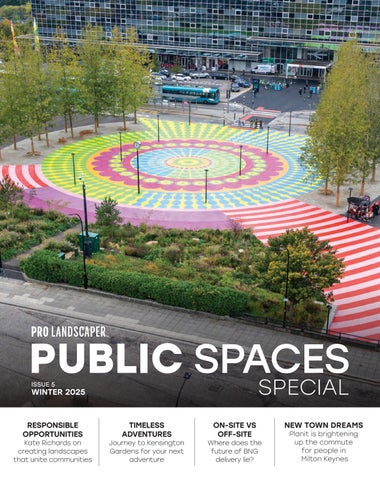
Pro Landscaper Public Spaces Special Winter 2025

Page 1


PUBLIC SPACES

ISSUE 5

WINTER 2025

RESPONSIBLE OPPORTUNITIES

Kate Richards on creating landscapes that unite communities

TIMELESS ADVENTURES

Journey to Kensington Gardens for your next adventure

ON-SITE VS OFF-SITE

Where does the future of BNG delivery lie?

NEW TOWN DREAMS

Planit is brightening up the commute for people in Milton Keynes

Surface water, managed. With TreeTank™

Planting more trees is important to make and keep our cities healthy and climate resilient. Helping trees thrive within a built environment is where TreeTank comes in. It lets them flourish and prevents roots from damaging roads; providing the ideal environment for root growth with sufficient minerals, water and air. Thanks to TreeTank, people can reap the rewards of living in greener surroundings too.

Water is at your command with Wavin on your side.

CONTACT

Eljays44 Ltd, BizSpace, Courtwick Lane, Littlehampton, West Sussex, BN17 7TL

Tel: 01903 777 570

EDITORIAL

Deputy editor – Bethany Vann bethany.vann@eljays44.com Tel: 01903 959 394

Editorial assistant – Holly Chapman holly.chapman@eljays44.com Tel: 01903 959 407

Senior subeditor – Katrina Roy katrina.roy@eljays44.com Tel: 01903 777 570

Designer – Louise Klose Louise.Klose@eljays44.com

ADVERTISING

Sales executive – Ollie Finch ollie.finch@eljays44.com Tel: 01903 777 579

MANAGEMENT

Managing director – Jamie Wilkinson jamie.wilkinson@eljays44.com Tel: 01903 777 589

Divisional director – David Griffiths david.griffiths@eljays44.com Tel: 01903 777 584

Content director – Nina Mason nina.mason@eljays44.com Tel: 01903 959 393

Commercial director – Luke Chaplin luke.chaplin@eljays44.com Tel: 01903 777 582

MARKETING & CIRCULATION

Subscription enquiries – Ollie Finch ollie.finch@eljays44.com Tel: 01903 777 579

Marketing Executive – Kiri Shaw Kiri.Shaw@eljays44.com Tel: 01903 777 570

Printed by Stephens and George Ltd

Published by ©Eljays44 Ltd – Connecting Horticulture. Pro Landscaper’s content is available for licensing overseas. Contact jamie.wilkinson@eljays44.com

Pro Landscaper is published 12 times per year by Eljays44 Ltd. The 2025 subscription price is £128. Subscription records are maintained at Eljays44 Ltd, BizSpace, Courtwick Lane, Littlehampton, West Sussex, BN17 7TL. Articles and information contained in this publication are the copyright of Eljays44 Ltd and may not be reproduced in any form without the written permission of the publishers. The publishers cannot accept responsibility for loss of, or damage to, uncommissioned photographs or manuscripts

Whilst every effort has been made to maintain the integrity of our advertisers, we accept no responsibility for any problem, complaints, or subsequent litigation arising from readers’ responses to advertisements in the magazine. We also wish to emphasise that views expressed by editorial contributors are not necessarily those of the publishers. Reproduction of any part of this magazine is strictly forbidden.

SPECIAL PUBLIC SPACES

Before urban expansion the area that is now London was made up of a collection of diverse natural environments, from woodlands to marshes, it was home to a variety of wildlife. Now, due to urban sprawl, it is home to around 9m people and what is left of those vast landscapes is fragmented; a fate met by many areas of the UK.

Unfortunately, that past rate of growth has caught up with us. But we’ve come back around and are now looking for ways to reverse the loss of nature through the creation

of multifunctional spaces that serve us and wildlife, as Kate Richards explains (p9). We’re seeing more responsible consideration given over to the importance of inner-city wildlife with legislations like BNG (p25), but what else can we do to protect these ecosystems?

Christopher Martin (p14) says we need to make walking a more attractive means of travel throughout the cities, while Nigel Glogan (p16) highlights the potential of supermarket car parks to give back space.

Now don’t get me wrong, we need our urban environments – I wouldn’t do well living in a forest – but the model in which many of them were built on is outdated and it’s a breath of fresh air to see the tide changing and wildlife being welcomed back into our cities, so while it may be a rocky journey to get there, it is one worth taking.

Bethany

CONTENTS

From accessibility to meaningful placemaking – a landscape architects’ responsibility

Christopher Martin on how we’ve made walking difficult, dangerous and dull

Nigel Glogan advocates for the planification of supermarket car parks

The Royal Parks charity on reimagining the Diana, Princess of Wales Memorial Playground

Pro

Join the debate over where the future of BNG delivery should be

31 PLANTS: STATEMENT SHRUBS

Wykeham Mature Plants shares five of its standout shrubs

33 LIVING

EXPERIMENT

Garden for the Future at the National Trust’s Sheffield Park and Garden by Joe Perkins

41 VIBRANCE IN VICTORIA Cardinal Place by BD landscape architects

45 NEW TOWN DREAMS Station Square, Milton Keynes by Planit

50 10 MINUTES WITH EMMA HINDLE

Explore BNG uplift with Ground Control’s business development director

PUBLIC REALMS in the making

Planning secured for sustainable Manchester skyscraper scheme

Oval Real Estate has secured planning approval to develop Manchester’s newest landmark – the Albert Bridge House skyscraper scheme.

Set to be built atop a space next to the Albert Bridge and River Irwell – currently occupied by surface car parks – the trio of blocks are expected to cost around £350m to build.

Revised from a 2023 design, the plans feature two octagonal residential towers rising to 37 and 49 storeys and an 18-storey commercial block.

Featuring more than 5,700m2 of new public realm, planning includes new walking and cycling routes, centred around an urban arboretum with retained mature trees and new planting.

The now scaled-down office building has been designed to meet net zero carbon standards, with a thermally dynamic façade and smart slime systems to align with Manchester’s 2038 carbon-neutral target, explains architect Studio Egret West’s David West.

SAcross national and international waters, these green projects are set to enhance community spaces

ky and Legal & General have secured planning permission to expand Sky Studios Elstree in Hertfordshire to double its current size – while still meeting sustainability targets, says the media provider.

Construction of the

expansion is scheduled to start next year, whilst Sky has also pledged £6.5m towards local road upgrades, a new community green and safeguarding 27 acres of land for wildlife.

Approved Elstree film studio expansion promises to hit sustainability targets

lighting throughout and a fully electric vehicle fleet.

Sustainability targets will also see solar panels across every rooftop, LED

Approved by Hertsmere councillors, the £400m Elstree project will deliver over 10 extra stages and 210,000ft2 of tier one space.

©Studio Egret West
©Sky Studios Elstree

DMasterplan for Minghu district connects landscape with city

esign company Benoy has unveiled its design plans for the core Minghu district of Ningo Eastern New Town in China.

The design plans have been guided by creating a “harmony between landscape and city, symbiosis with nature,” intended to create a new urban landmark, reads Benoy’s scheme.

Featuring a new multi-level urban park with a rich, layered commercial experience that blends cultural elements with natural textures.

Alongside office space, the masterplan features a lakeside resort retail, residential zones and a transport hub.

Birmingham estate £1bn renewal gets green light

INTERNATIONAL

Birmingham City Council has given online consent for the £1bn regeneration of the Druids Heath estate to deliver new homes, accessibility and overall improvement of its public realm.

The long-term masterplan includes 3,500 homes, with 1,785 intended to be affordable through a partnership between the council, Lovell and Homes England.

Alongside a new local high street, later-living homes, sports and community facilities, the masterplan also features generous green spaces, upgraded transport links to transform walking, cycling and access to services.

With the opportunity to embed modern methods of construction, low-carbon materials and high-performance building fabric, the Birmingham project also intends to emphasise biodiversity gains and high-quality landscapes.

University of Cambridge’s new neighbourhood to boast 50ha of open space

Amasterplan for the next phase of the University of Cambridge’s new mixed-used neighbourhood, Eddington, includes 50ha of open space.

This includes parks, play areas, community gardens, sports pitches and routes for walking, cycling and recreation as part of the development in Northwest Cambridge.

The new masterplan has been created by a multidisciplinary team led by Hawkins Brown, with Grant Associates as landscape architect, AECOM for civil and infrastructure, KMC for transport, and Max Fordham for sustainability.

Eddington is a pioneering development,” says Keith French, director at Grant Associates.

“Working closely with the team, our focus has been on shaping a generous nature-based network and a public realm with liveable streets and spaces that support a vibrant, diverse and connected community.”

Around 3,800 homes are proposed alongside new community facilities and active travel routes, all of which will build on the first phase of Eddington which began in 2013 and boasts 79% of trips made by walking, cycling or public transport.

Streets are designed around people rather than cars, with a network of public green spaces, shared gardens and biodiverse corridors to create new habitats for wildlife.

Also check out the Diana, Princess of Wales Memorial Playground from The Royal Parks on page 19, which explores the new multi-million revamp of the iconic west London park.

PUBLIC SPACES EXPO RECAP

On 7-8 October, Public Spaces Expo – co-located with FutureScape – brought together the professionals shaping the evolution of our shared environments for a two-day exploration of some of the most significant topics in placemaking, from biodiversity net gain and Sustainable Drainage Systems to designing for the future with inclusivity in mind.

Lining the aisles of the expo were a diverse array of exhibitors, many of which took to the stage to lend their voices to the conversations taking place in the Public Spaces Theatre.

Panel Discussions – Day One

Over the two days, the Public Spaces Theatre welcomed several recognised voices from across the built environment profession to share their insights and experiences with audiences.

Balance the Scales: On-Site vs Off-Site Biodiversity Net Gain Delivery

Hosted by Pro Landscaper’s deputy editor, Bethany Vann, the first discussion of the day brought together Nick White, Julia Baker, Rachael Emous-Austin, Brian Hawtin and Mark Chadwick who explored the delivery model of BNG.

Debating whether the BNG Hierarchy as it is now with a preference towards on-site gains is the most optimal method of delivery – find out more about what was discussed in this panel discussion on p25.

Planning Ahead: Getting the Green Light

Then it was onto the new Planning & Infrastructure Bill – introduced as a way to fast track the delivery of 1.5m homes – hosted by Frosts Landscapes’ managing director, Alistair Bayford, who was joined by Wayne Grills, Chris Wellbelove and Martin Scholar.

Panellists delved into the new Bills role in addressing the delays in gaining planning approval that are having a knock-on effect through the delivery chain.

The Regenerative Framework: An Urban Toolkit for Mitigating Climate Change

Urban regenerative thought leader and climate coach, Jamie Rosenthal flew in from across the pond to share in the Roots Down Regenerative Framework – a city-scale, service-based product designed by turn land care into climate action.

eWeeding: The Latest Innovation on Weed Control in Public Spaces

Co-founder and partner at eWeeding, Michel Wimmers guided visitors through the advantages of the application of eWeeding in public spaces, from sustainability benefits to a reduction in costs.

The Future of SuDS: Turning Standards into Action

Closing out day one, our deputy editor returned to the stage, this time with Cristina Refolo, Martyn Neil, Lisa Sawyer and Shane Frost, to share their insights on the best practices for design and the implementation of SuDS.

Panel Discussions – Day Two

It’s Time to Make Spaces for Girls

Kicking off day two was Caroline Millar and Imogen Clark from campaign charity, Make Space for Girls, where the two unpacked research data that revealed a marked difference in public realm use based on gender.

Delving into why young people, particularly young women and teenage girls feel put off from visiting these spaces – why it matters and what the charity is doing to bring about change.

Inclusive by Design: Creating Active Spaces for All

Continuing with the theme of inclusivity and accessibility, Pro Landscaper’s content director, Nina Mason was joined by George Sandbach, Imogen Clark, Vicky Hill, Pippa Henshall, and Fenella Griffin.

The group explored the importance of making active areas inclusive and accessible and the benefits this can have on the local community.

Mayfield

Park: A Blueprint for the Park of the Future

Director of landscape at Studio Egret West, Duncan Paybody wrapped up the day by sharing how the practice’s park-first vision for the project champions nature, local heritage, and climate heritage.

Sports and Activity Zone

New to this year’s show, the zone showcased sports, play, leisure and recreation related products and contractors with the aim of improving the accessibility of these facilities in public realms and schools.

Local Authority Hub

The hub brought together some of the most visionary local authorities across the UK to share in some of their major focuses and projects, as well as potential opportunities.

Your Partner in Blue Green Infrastructure

Your Partner in Blue Green Infrastructure

Sustainable landscapes demand a solutions-led approach to climate resilience and require integrated Blue Green Infrastructure (BGI) that performs. Our expert team helps translate policy into practical, buildable designs. From rain gardens to green roofs, we’ll help you:

Sustainable landscapes demand a solutions-led approach to climate resilience and require integrated Blue Green Infrastructure (BGI) that performs. Our expert team helps translate policy into practical, buildable designs. From rain gardens to green roofs, we’ll help you:

> Navigate BNG requirements

> Navigate BNG requirements

>

> Integrate SuDS seamlessly into green infrastructure

> Specify

> Specify

“WE HAVE THE OPPORTUNITY, AND THE RESPONSIBILITY TO LOOK OUTSIDE OF THAT WIDER CONTEXT AND IMPROVE

CONNECTIVITY WITH HABITATS, BUT ALSO COMMUNITIES WHEN WE’RE DESIGNING.”

From open-water swims to accessible design, Kate Richards shares how she champions landscapes that bring people, habitats, and communities closer together.

Kate Richards’ journey into the realm of landscape architecture is a tale as old as time; as she puts it, it was by happy happenstance that she found herself on this career path. But it wasn’t due to a lack of interest that Richards hadn’t considered pursuing landscape architecture, it was – as it often is – due to the invisibility of the profession.

At the age of 15 while on a family holiday in Tuscany, it was then, inspired by the beauty of countless piazzas, cathedrals and narrow, winding streets that Richards knew she wanted to follow a path that allowed her to shape the world around her.

“When I narrowly missed out on my place at the University of Sheffield, my form teacher encouraged me to call the School of Architecture, and I got talking to one of the course leaders for the dual course, and that’s how I basically stumbled onto landscape architecture.”

Though taking on the dual course –arguably taking on two full degrees at the same time – was sometimes akin to

Hermione Granger in Hogwarts trying to be in two places once – “but without a magic pocket watch to help”, jokes Richards – it was a rewarding experience, which Richards says has given her the insight and strengths of both disciplines going into her career.

“Ultimately, I chose landscape over architecture because of the real connection to nature that you can get and improve on,” says Richards.

“Nature doesn’t really see a red line, which we obviously draw to give a boundary as you

must to developments, but nature doesn’t see that”, says Richards. “We have the opportunity, and the responsibility to look outside of that wider context and improve connectivity with habitats, but also communities when we’re designing, which I really, really like.”

I think in the built environment as a woman, particularly of colour, you sometimes really are conscious of the fact you’re in a minority

Land-based Visibility and Accessibility

Creating multifunctional spaces naturally supports the development of environments that are accessible and welcoming to people from all walks of life. By designing areas that can adapt to varied needs and activities, we allow communities to interact more freely and inclusively.

Early last year Land Studio was selected by the National Trust to improve accessibility

WORDS: BETHANY VANN

across the gardens at Grade I listed Sizergh Castle near Kendal in Cumbria: “The ultimate aim of the project is to – whilst obviously balancing the sensitivity of the heritage – improve accessibility so that more visitors can actually get into the gardens and experience these lovely spaces.”

Throughout our catch-up Richards delved into her time spent exploring green spaces with her parents, from Lake District mountains, and the South West coastline, to many National Trust stately homes and gardens. At the time, like many in their formative years, she didn’t recognise the value, but those childhood experiences have, as Richards says, shaped her view on the importance of connecting with the outside world.

Coming full circle, from exploring National Trust properties around the country with her own parents, to working on and taking her own children to these sites - “It’s lovely because it’s become multi-generational.”

As well as the project at Sizergh, the Chester-based practice is also working on several schools, which Richards describes as challenging in a different way - “But that opportunity to try and really get children to interact with nature, not just through educational activities, but through play

and those joyful experiences that they can have simply by being outside.”

As the world becomes more and more saturated with indoor entertainment, children are arguably losing out on the opportunity to connect with the natural world: “[Nature is] then not really something that they feel any stewardship towards because they don’t engage with it.”

Without opportunities to engage with the outside world, we risk diminishing the visibility of environmental career paths, while children miss out on the many benefits that nature provides. And although Richards jokes that passing on her love of the outdoors has led to more laundry, she emphasises that it’s an invaluable experience for her children.

“It doesn’t have to be complex play equipment. It can sometimes, often be much more rewarding if it’s kind of the natural play, and children will create their own opportunities to play. They don’t need a load of stuff, when they’re outside.”

Through her position as co-chair of the Landscape Institute Wales Branch – which she has been fulfilling for the past couple of years –Richards has been using the position to champion landscape careers at a primary school level, tailoring the talks to her audience:

“I’ll talk about the school projects that I work on, because that’s so much more familiar to them,. I probably wouldn’t talk to them about plants as much as I would about animals. So, I talk about habitat creation, play and Forest Schools.”

Richards goes on to note that increasing diversity across the industry could significantly enhance its visibility. When children are able to see people who look like them working in land-based

roles, it not only broadens their understanding of what’s possible but also sparks new conversations about career paths they may never have considered. In turn, this representation can open up a wider range of opportunities and encourage a more inclusive, dynamic future workforce.

“I think in the built environment as a woman, particularly of colour, you sometimes really are conscious of the fact you’re in a minority [...] It’s

The ultimate aim of the project is to – whilst obviously balancing the sensitivity of the heritage – improve accessibility so that more visitors can actually get into the gardens and experience these lovely spaces

about trying to improve, improve that as the generations go – it may be my optimism but I think it will improve.”

Village Dwellings

While Richard’s love for nature-infused placemaking has never faded, there was a period about 10 years ago – after she became a chartered landscape architect but before her husband, Simon Richards, founded Land Studio – when she found herself owning and running the village shop in the small North Wales community they had just moved to.

“It’s very odd, I know - like a diversion from my career, but in some ways, I think it probably was something that I needed to do at that time.”

Though she knew she would eventually make her way back to landscape architecture, creating what was essentially a hub for the community pushed Richards outside of her comfort zone, and has given her the confidence to pursue more things since moving back into the profession.

“Because the village that I live in is in an Area of Outstanding Natural Beauty we had a lot of dealings with the local authority, and the country park.. So, some of the skills that I already had from landscape architecture, could weirdly link to

tourism and hospitality.”

But as Richards says this transfer of skills has worked both ways – “All businesses are kind of the same in terms of you need to make a profit, manage staff, and market yourself, and now I have that understanding of how visitor destinations operate [...] There are a lot of things that I think I’ve taken from that experience.”

Building With Nature

In addition to her work at Land Studio, Richards is now serving as an assessor for Building with Nature: “I assess projects that are going for Building with Nature (BwN) Awards [...] It is an accreditation scheme and framework that has come from wanting to raise the standards and quality of design for housing developments, but it can be applied to any project and that’s something we at Land Studio have really taken on.”

The 12 BwN Standards, are as Richards says, a qualitative process, whereby there is a real emphasis on creating multifunctional designs, which by definition are designed for multidimensional benefits that meet the diverse needs of their communities, while also supporting local ecosystems.

Highlighting the importance of these Standards, Richards says the different material considerations, from civil engineering and ecology to creating community infused spaces is a framework that aligns with Land Studio’s ethos. “We’ve really taken the Standards on, and we try and weave that into everything that we do.” Find out more about

When I started open water swimming, which was back in 2012 I didn’t know about the water quality issues. I was happily swimming in the River Dee blithely unaware

Improving Our Waterways

Last year Richards, figuratively and literally, dived into raising money for Surfers Against Sewage when she took on the Aquasphere Chillswim Lakes Triple Crown Challenge.

Richards swum 5.25 miles across Coniston, 7.5 miles across Ullswater, and 11 miles across Windermere, during which she is raised nearly £1k for the charity.

“When I started open water swimming, which was back in 2012 I didn’t know about the water quality issues. I was happily swimming in the River Dee blithely unaware of what was in the water. I don’t actually swim in the Dee anymore, which is really sad.”

The benefits of open water swimming

• Increased immunity

• Improved circulation

• Physical and mental relaxation

• Stress reduction

• Increased levels of serotonin

Outside of a hobby that improves Richards’s connectivity to nature; while also providing a plethora of health and wellbeing benefits, it is also a means for the avid swimmer to raise awareness for the crisis impacting our nation’s waterways – from climate change to pollution.

“I did swim in the River Trent this year, which is a river I’ve never swum in before, but because the water levels were so low it was actually a real challenge to swim in it. There were times when we had to stand and walk because the water

Ultimately, I chose landscape over architecture because of the real connection to nature that you can get and improve on

levels were so low. [...] It just brings into focus for me, the reasons why I do what I’m doing.”

Richards’ journey reminds us that landscape architecture is rooted in curiosity, responsibility, and connection. From her early explorations of the countryside to her work shaping accessible, nature-led places, she continues to champion the belief that the outdoors should be understood, protected, and shared.

Whether championing standards, inspiring young people, or open water swimming to highlight environmental challenges, Richards continues to show how powerful it can be when passion for people and landscapes meet.

Established 1864

Established 1864

Established 1864

Established 1864

Discover World Class Trees

Established 1864

Discover World Class Trees

Established 1864

Discover World Class Trees

Established 1864

Discover World Class Trees

Discover World Class Trees

Discover World Class Trees

Expertly grown on 700-acres of pristine Hillier land in Hampshire, this is sustainable tree production as it should be.

Expertly grown on 700-acres of pristine Hillier land in Hampshire, this is sustainable tree production as it should be.

Discover World Class Trees

Expertly grown on 700-acres of pristine Hillier land in Hampshire, this is sustainable tree production as it should be.

Expertly grown on 700-acres of pristine Hillier land in Hampshire, this is sustainable tree production as it should be.

Expertly grown on 700-acres of pristine Hillier land in Hampshire, this is sustainable tree production as it should be.

Expertly grown on 700-acres of pristine Hillier land in Hampshire, this is sustainable tree production as it should be.

Hillier Trees: Growing for England since 1864

Hillier Trees: Growing for England since 1864

Expertly grown on 700-acres of pristine Hillier land in Hampshire, this is sustainable tree production as it should be.

Hillier Trees: Growing for England since 1864

Please contact trees@hillier.co.uk

Hillier Trees: Growing for England since 1864

Hillier Trees: Growing for England since 1864

Please contact trees@hillier.co.uk

Hillier Trees: Growing for England since 1864

Please contact trees@hillier.co.uk

trees.hillier.co.uk

trees.hillier.co.uk

Hillier Trees: Growing for England since 1864

Please contact trees@hillier.co.uk

Please contact trees@hillier.co.uk

trees.hillier.co.uk

01794 368 733

Please contact trees@hillier.co.uk

01794 368 733

trees.hillier.co.uk

01794 368 733

trees.hillier.co.uk

trees.hillier.co.uk

Please contact trees@hillier.co.uk

Download The Hillier Tree Guide

01794 368 733

01794 368 733

Download The Hillier Tree Guide

trees.hillier.co.uk

01794 368 733

Download The Hillier Tree Guide

Download The Hillier Tree Guide

Download The Hillier Tree Guide

01794 368 733

Download The Hillier Tree Guide

Your guide to our range of trees. Showing their form and size over 15, 25 and 50 years, plus helpful information on suggested usage for a variety of projects and locations.

Your guide to our range of trees. Showing their form and size over 15, 25 and 50 years, plus helpful information on suggested usage for a variety of projects and locations.

Scan this QR code to download your copy today!

Download The Hillier Tree Guide

Your guide to our range of trees. Showing their form and size over 15, 25 and 50 years, plus helpful information on suggested usage for a variety of projects and locations.

Scan this QR code to download your copy today!

Your guide to our range of trees. Showing their form and size over 15, 25 and 50 years, plus helpful information on suggested usage for a variety of projects and locations.

Your guide to our range of trees. Showing their form and size over 15, 25 and 50 years, plus helpful information on suggested usage for a variety of projects and locations.

Scan this QR code to download your copy today!

Your guide to our range of trees. Showing their form and size over 15, 25 and 50 years, plus helpful information on suggested usage for a variety of projects and locations.

Scan this QR code to download your copy today!

Scan this QR code to download your copy today!

Your guide to our range of trees. Showing their form and size over 15, 25 and 50 years, plus helpful information on suggested usage for a variety of projects and locations.

Scan this QR code to download your copy today!

Scan this QR code to download your copy today!

A CITY BUILT FOR FEET

We’ve let our paths go and our cities are the paying the price, warns Christopher Martin

Cities, if we’re honest, are humanity’s great social experiments – vast petri dishes where millions of strangers tacitly agree to coexist, collide, and sometimes even cooperate. They are born not from steel or planning policy but from our collective willingness to live among unfamiliar faces because we know instinctively that opportunity is a team sport.

This is the conviviality principle: the whole point of urban life is the promise inherent in proximity. And yet, in the last half-century, we’ve designed cities as though the chief ambition of human evolution was the private car park.

Transport, which ought to be the discreet valet of city life, has somehow become its overbearing maître d’: officious, demanding, spatially greedy. Streets that once acted as communal living rooms have been turned into conveyor belts for giant metal boxes, and the quality of our lives has withered accordingly.

We’ve made walking – the thing our species is quite literally built for – difficult, dangerous, dull or, quite often, impossible.

Human beings are walking animals. This is not poetic metaphor; it is biological fact. Look at our pelvis, our arched feet, our rhythm-

system with such confident stupidity that our entire urban tapestry now sags and warps.

Which is where Borneo’s cats come in. In the 1950s, the Dayak people suffered a malaria outbreak. The World Health Organisation, armed with the breezy optimism of mid-century science, sprayed the island with DDT. Mosquitoes died – hurrah!

But so did the parasites that restrained the caterpillars that ate the thatched roofs. The roofs collapsed. Tin roofs were installed. They turned homes into uninhabitable steel drums in the monsoon.

Meanwhile, DDT worked its way up the food chain into geckos, then cats, which promptly died. Without cats, rats surged. Without

Streets that once acted as communal living rooms have been turned into conveyor belts for giant metal boxes

limit, rats introduced plague. And so the WHO, chastened, airdropped live cats into the jungle to restore equilibrium.

making tendons, our spine’s improbable S-curve – everything about us says: “You are designed for sociable, walkable habitats.”

We have the receipts in fossilised footpaths stretching back millions of years. And yet we’ve tugged at the thread of this natural

Systems thinking in one tragic, comic parable: tug at the wrong thread and the entire fabric unravels. Urban transport is no different. We tugged at walking, and now we’re drowning in obesity, loneliness, heat islands, road deaths, social isolation, economic decline, and an epidemic of built environments that repel rather than

welcome human life.

This is why walkability is not a fringe concern for sandal-wearing idealists. It is the backbone of sustainable, inclusive, multimodal transport. Every journey – every single one – begins and ends with walking or wheeling. Make that part miserable, and the entire system

Every journey – every single one – begins and ends with walking or wheeling

collapses like a Dayak roof under a caterpillar binge.

The great trick is to reconnect self-interest with societal good. Make walking useful, safe, comfortable, and interesting. Make it the natural, easy thing to do – because if you make it difficult, people simply won’t. We know this

when designing phones, websites, microwaves; yet when designing cities, we seem to develop collective amnesia.

Space is our most precious urban resource, and nothing consumes it quite as greedily as the private car. A cyclist who stops cycling becomes a pedestrian; a driver who stops driving becomes an emergency storage problem. No mammal has ever been more poorly adapted to compact urban life than the automobile.

So here’s your homework. Walk down your street and look for the absurdities. The ludicrous turning lane. The swollen kerb radius.

The slab of road hatching that declares,

“Here lies extraordinarily valuable urban land we gave up on.”

Reclaim it. Plant something. Invite someone. Make a corner worth lingering in. If we want cities that are sustainable, inclusive, healthy, sociable, and sane, we need only do one thing:

Put walkability (walking and wheeling) - the original mode, the natural system, the convivial glue – back at the heart of everything.

Christopher Martin

Christopher is an urbanist who supports cities to develop strategy, change policies, and make great places possible. He is co-founder of transport + urban design practice, Urban Movement, leading complex projects that address human connection, social equity, and climate repair. Christopher is also vice-chair of the board for the UK charity for everyday walking, Living Streets. urbanmovement.co.uk @ChrisCities

Should we be making better use of our supermarket car parks by giving space over to nature? Nigel Glogan says yes

HTHE PLANTS ARE ALWAYS RIGHT

ave you ever considered that supermarket car parks and retails parks could be natural havens for wildlife?

We have so many supermarkets and retail parks in the UK that could become natural oases for wildlife, instead of being managed in the traditional manner with shrubs and trees just hacked to fit the bed they were planted into – most of this planting is now very tired and in need of a change.

This is an ideal opportunity for us to re-evaluate what is already growing on these sites and then decide how we might add to it. We can encourage more wildlife into these areas by taking a different approach to how we manage them, and with the number of supermarkets and retail parks dotted around the UK, we could link them to create wildlife corridors.

At the Design Stage

Retail areas and supermarket car parks could be designed so that space is better used and broken up to create wildlife habitats; it needs to be fulfilled more than just the function of literally parking your car. Large spans of tarmac should be reduced and thought given to designing drainage systems that channel rainwater run-off to planted borders in a form of grey water harvesting.

Boosting What’s Already There

Initially, more attention should be given to choosing the right plant material – both for new sites and refurbishments. However, we also have a lot of potential to explore sites that were planted some years ago: we can develop and use the original planted material to its best advantage.

Some plants need to be cut back hard and will relish the pruning –although this depends on the species. In some cases, woody material has become old and tired and just needs to be removed.

We also have a lot of potential to explore sites that were planted some years ago: we can develop and use the original planted material to its best advantage

During the autumn, various bulbs can be planted in drifts to give interest and colour to the early part of the growing season.

The best daffodils for pollinators are the wild types such as Narcissus poeticus and Narcissus jonquilla which support bees and butterflies. However, any bulb can be added to any area and are very good value for money. They can also provide seasonal interest and colour, increase insect pollinators and are low maintenance.

Urban Meadows and Nectar Bars

One quick fix is to introduce urban flora areas. The species are often not native, but they are very good at encouraging pollinating insects.

Like most supermarkets, retail park soil is too nutrient rich to support native wildflower meadow mixes.

There is an initial cost for seed and preparing the seed bed, but after that you don’t have to touch it until the end of the flowering season when you cut it down and leave the stems for a few days to a week to allow the seeds to disperse ready for the next year.

Birdboxes and Bug Hotels

Birdboxes can easily be introduced to car parks and retail sites and are simple to install to increase habitat for birds. Bug hotels are also easy to site and install to increase wildlife habitats.

Ponds and Water Features

Many sites already have ponds or water features, and these too can be managed to increase the biodiversity of an area.

British Native Plants

The Botanical Society of Britain and Ireland (BSBI) published its Atlas 2020 cataloguing the wildflower species of the British Isles. This 20-yearlong research project recorded plant life in our nation and highlights

Large spans of tarmac should be reduced and thought given to designing drainage systems that channel rainwater run-off

a definite decline in half of our wildflower species. Native plants and archaeophytes – plants introduced to Britain before 1500 – have fallen in number since 1950, while neophytes – plants introduced to Britain after 1500s – have increased steadily.

New Works

The time has come to rethink our management of the planted areas around supermarkets and in retail parks so we can introduce rich biodiversity metre-on-metre by bringing in species that attract a vast number of different insects.

By planting trees, shrubs, and other native species that thrive in local conditions, we can create rich pockets of biodiversity that attract countless insects.

Nigel Glogan

Nigel Glogan started his career in horticulture at just 14 years old, working in a local garden centre. He later moved the landscape construction, and ran his own business for 15 years. He’s now a grounds maintenance contract manager at OUTCO – an outdoor maintenance company with over 20 year’s experience working in FM.

Bulbs

boombonheur.com

ON THE DRAWING BOARD

TIMELESS ADVENTURES

London’s green spaces have long been a source of inspiration for authors, with many of the city’s parks being forever preserved in literary classics over the years, from Charles Dickens and George Eliot to Virginia Woolf and H. G. Wells.

One of Kensington Gardens most recognisable residents, however, is Peter Pan –the boy who wouldn’t grow up. It is only fitting then that J.M Barrie’s fantastical character be immortalised in the very park he was first introduced in.

Founded in the time of Barrie, the Peter Pan inspired playground, though still infused with the

magic – or fairy dust – of the literary classic, now goes by another name: the Diana, Princess of Wales Memorial Playground.

Throughout her life, Diana, Princess of Wales was regarded for her humanitarian work with children – from playing an instrumental role in the opening of the Wolfson Children’s Cancer Unit at the Royal Marsden Hospital, to her advocacy for the betterment of children’s social and emotional development.

Nestled within London’s Kensington Gardens – next to the late Princess’s Kensington Palace residence in west London and across the road from where J.M. Barrie lived, the Diana, Princess

The Royal Parks charity shares how its renewal of the Diana, Princess of Wales Memorial Playground will continue to champion the spirit of imagination it was founded on

of Wales Memorial Playground – cared for by

The Royal Parks charity, was erected in June 2000, on the site of the existing playground in commemoration of the Princess’s activism, three years after her death in 1997 on what would have been her 39th birthday.

RUMOUR HAS IT

If scuttlebutt is to be believed, Barrie himself is responsible for secretly installing the bronze statue of Peter Pan in Kensington Gardens in 1912 in the cover of night. It marks the spot where a young Peter Pan landed in the original novel.

WORDS: BETHANY VANN

In the 25 years since its opening, the Diana, Princess of Wales Memorial Playground continues to welcome over a million visitors per annum from around the world; establishing itself as one of London’s most popular attractions.

Its continued popularity is evidenced by the fact it is now, for the first time since it opened, undergoing an extensive £3m renovation, as Rhona Harley, senior landscape architect at The Royal Parks charity explains. “Its popularity has meant that some of the biggest and most popular pieces of equipment in the playground, such as the Galleon and the Treehouse, had reached the end of life and required a full replacement.”

with a slide, further expanding engagement opportunities and the grounds overall inclusivity.

Harley notes that as well as increased opportunities for adventure, the new structure will foster interactive engagement with the inclusion of social spaces throughout, such as musical equipment and talk tubes, giving children a space to socialise at varying levels.

We used this opportunity to see what other features in the playground needed upgrading or replacing so we could do these works at the same time

With sustainability a “key element of the process”, as Harley explains, both the Galleon and the Treehouse will be constructed using timber sourced from sustainably managed European forests – while some of the timber from the existing structures will be repurposed to create new fencing and seating.

playground should keep a watchful eye for the new stone covered crocodile sculpture lurking beneath the redesigned water play area.

Paying homage to its literary namesake – TickTock – the semi-aquatic reptile comes in at approximately 12 metres long and is not just for show, as Harley explains: “The sculpture will incorporate dams between the connecting parts of the crocodile’s body, allowing children to control the flow of water.”

As well as helping children boost their physical, sensory and cognitive skills, the redesigned water play area will expand the current water and sand play area and will also double as a sustainable drainage system, collecting rainwater runoff to later be used for irrigation.

Replacing both the Galleon and the Treehouse, each one an iconic feature of the playground, was always going to mean a full shutdown of the attraction, says Harley. “We used this opportunity to see what other features in the playground needed upgrading or replacing so we could do these works at the same time.”

She adds that, as well as replacing the well-loved structures, improving accessibility and inclusivity throughout the ground was also a priority; appointing AccessibleUK to do a site-wide audit of the playground and provide recommendations that influenced the redesign to support adventurers of all ages and abilities in their quests.

Across the Blanket Sands

A visually striking and notable feature of the playground, the original Galleon – a full-scale wooden pirate ship which serves as a climbing area for children – will be replaced with a new ship in the centre of the surrounding sandpit – complete with two crows’ nests (an elevated lookout on the mast of the ship), a new ship’s wheel and play telescope, and the instalment of ramped access to the main deck; each providing, as Harley explains, new, accessible opportunities for play.

The new multi-level timber Treehouse will also boast wheelchair access and climbing opportunities for different ages and abilities with the inclusion of a new suspension bridge, a tunnel slide, a rope bridge, and a see-saw bridge

After they’re finished sailing the sands in the name of adventure, visitors to the new

Young adventurers will also have the chance to traverse the sands in the new, refreshed under three’s area, which will include a new sandpit, their very own play ships, timber houses, and a seesaw and climbing structure.

SENSORY PLANTING

The Journey to Inclusivity

•Frangula alnus

‘Aspleniifolia’

• Pennistum orientale

• Phlomis italica

• Stachys byzantina

‘Big Ears’

• Tamarix ramosissima

‘Pink Cascade’ TOUCH SOUND

• Existing and new bamboo and grasses, date palms, and Trachycarpus fortunei

“To make this playground even more welcoming, we have taken steps to improve accessibility and inclusivity”, says Harley, as she highlights the new wheelchair accessible spaces within the new timber structures. A new accessible path is also being established, while some of the existing paths will be resurfaced and widened, opening up areas of the playground.

When the young adventurers grow tired, they’ll be able to gather round one of the new wheelchair accessible picnic tables, or at one of the raised tables in both the water play and sand areas.

Visitors can fully immerse themselves in their adventure as they explore the jungle-inspired planting surrounding the Galleon, enjoying a vibrant blend of sights and sounds that set the perfect scene for their next voyage.

To make this playground even more welcoming, we have taken steps to improve accessibility and inclusivity

The space will also feature new sensoryrich, allergy-friendly, and pollinator-friendly plantings – a vital addition for both biodiversity, by creating essential habitats and food sources, and for an enriched sensory experience, offering visitors a diverse palette of sights, sounds, smells, and textures to explore.

“The design proposals have retained the subtropical style planting within the playground which includes a significant specimen large date palm Phoenix canariensis”, says Harley. She goes on to add: “The trees and shrubs have grown into dense habitats creating spaces for children to hide, fostering a sense of enclosure and immersion in nature that was important to retain as far as possible while providing an opportunity to enhance existing and new plant areas.”

Around the Treehouse, plant species have been selected based on their resilience, potential for seasonal interest, and suitability for play spaces: thornless, non-spiky, sensory and high biodiversity value.

Expedition Planning

Over the last year, The Royal Parks charity has been engaging with vistors and the local community, for which the feedback has been taken aboard and fed into the redesign. “This playground holds a special place in many people’s hearts, with lots of parents telling us they remember going as a child, and that they love that this moment has now come full circle, and they can bring their own children”, says Harley.

She explains that this renewal will preserve the much-loved Peter Pan inspired features of the playground, while replacing aging equipment and enhancing accessibility and inclusivity. With the ultimate goal being to ensure it remains a magical and welcoming play space for children of all abilities for generations to come – “what’s even

This playground holds a special place in many people’s hearts

25 YEARS OF ADVENTURE

In September this year, The Royal Parks charity welcomed thousands of children and their carers to attend a day of activities at the Diana, Princess of Wales Memorial Playground in celebration on the parks 25th anniversary.

At the event the charity revealed design plans to attendees, whilst also celebrating the welcoming on the millionth visitor for the year 2025.

Peter Heuken, Richter Spielgerate’s director of special projects, who led a team in creating the Galleon back in 2000, dropped by to join in the celebrations. He was joined by members of Timberplay, who together with Richter Spielgeräte are delivering the Treehouse and the Galleon.

Speaking at the event, Heuken said: “I am immensely proud to have been involved in the original Galleon of this playground, and what will be the new one. Everywhere I travel from Canada to New Zealand, people know this park, and they know this playground. It’s a global reference for high quality public play.”

better is that this playground is and always will be, completely free to enter.”

The sculpture will incorporate dams between the connecting parts of the crocodile’s body, allowing children to control the flow of water

From celebrating the timeless story of the boy who refused to grow up to honouring the enduring legacy of Princess Diana, the memorial playground has long stood as a place of wonder, crafted to spark the same imagination and inspiration in all who wander its whimsical paths. Visitors can resume their adventures when the park reopens in the summer of 2026.

SENSORY PLANTING

AROMATIC

• Hamamelis x intermedia ‘Jelena’

• Salvia officinalis ‘Icterina’

• Hoheria sexstylosa ‘Stardust’

• Leptospermum scoparium ‘Snow Flurry’

• Sarcococca confusa

VISUAL INTEREST

• A mixture of subtropical plants existing and new including Callistemon citrnus ‘Splendens’

SUPPORTING BIODIVERSITY - THE LINDUM WAY

Transform your landscape instantly with our award winning wildflower turf, designed to create a vibrant wildflower meadow or garden area. It features a carefully balanced blend of native wildflowers, herbs, and colourful flowering perennials, all thriving in a moisture-retentive, plastic-free, biodegradable felt. This eco -friendly solution not only enhances the beauty of your outdoor space but also supports local biodiversity. Experience the joy of an instant wildflower area that is both sustainable and visually stunning.

Our Species-Rich Turf is a harmonious blend of wildflowers and grasses, the 80/20 mix is carefully cultivated into a plastic-free, moisture-retentive mat, creating an instant biodiverse haven. This uniqu e turf can be maintained like a traditional lawn with regular mowing, or left to grow naturally to encourage the flourishing of diverse plant species.

REWILDING OR RELOCATION?

Balancing ecological impact, community value, and long-term resilience – where does the future of biodiversity net gain delivery lie?

In 2023 the State of Nature report revealed a staggering 1,781 of UK species were at risk of extinction. Before that in 2021, the UK ranked in the bottom 10% globally for remaining biodiversity – according to the Natural History Museum’s Biodiversity Intactness Index – with England in particular coming in seven from the bottom among the 240 countries and territories. It could be said that all the signs are pointing towards a total eco-system collapse – our nation’s biodiversity is calling out for help. That help has come in the form of biodiversity net gain (BNG), a legislation introduced in February of 2024 that requires developers in England to deliver a minimum 10% uplift in biodiversity value compared to the pre-developed state of a site. There are three ways the statutory uplift can be achieved:

• On-site: Enhance and restore biodiversity on the development through the creation of new habitats or the improvement of existing ones.

• Off-site: Create qualifying habitats outside of the development’s boundary line.

• Biodiversity credits: Purchase credits to make up for the loss of biodiversity – these are then used to fund environmental improvement projects, led by relevant organisations.

This is referred to as the BNG Hierarchy – not to be confused with the Mitigation Hierarchy – it specifies the order of preference for where the required 10% should be delivered. Since the legislations launched, on-site delivery has been the preferred method as outlined in the government guidance. However, recent data has suggested that off-site gains are performing ‘better’.

WORDS: BETHANY VANN

So, where does that leave us? Should BNG be delivered within the boundary lines of a development to directly benefit the impacted biodiversity, or can off-site solutions offer more strategic ecological benefits?

Principal advisor – net gain at Natural England, Nick White says the executive non-departmental public body continues to advocate for maintaining the BNG Hierarchy. He highlights that when the policy wasfirst conceived improving our country’s biodiversity was a priority, but the legislation’s other two components were people and sustainability – the opportunity to deliver the benefits of nature to people and improving the sustainability of projects, respectively.

“We know that living close to nature provides us with lots of benefits around health and wellbeing and climate resilience,” says White. “So, [Natural England] see a real opportunity and the benefits of looking first to try and deliver gains on site.”

Creating those opportunities has, as associate landscape architect at Huskisson Brown Associates, Brian Hawtin says instilled a sense of stewardship over nature for those close to it: “There are developments out there where houses sell because of the nature of the landscape around them.”

Adding that, through his work he’s seen homeowners naturally begin to take stewardship of the landscape: “I think it’s very important that we have on-site mitigation first. There’s a place for off-site mitigation, but the process of involving people in understanding nature and assuming stewardship is vitally important.”

the process in involving people in understanding nature and assuming stewardship is vitally important

With a high percentage of developments occurring in urban and peri-urban areas, where, as White highlights “people don’t necessarily have access to green space”, on-site delivery provides the opportunity to address this and facilitate the potential for improved accessibility to nature, a movement that has long been a popular topic of discussion.

However, as White acknowledges, on-site delivery isn’t always ecologically viable and delivering off-site gains then becomes an option.

But is following the BNG Hierarchy the key to making, not just the legislation but the movement to save our country’s nature, a success?

“There’s a compliance angle; we can tick all the boxes and we can run through the processes,” notes Mark Chadwick, chief executive officer at Kew REACH.

“But what success actually looks like is that we are delivering biodiversity. We’re increasing our biodiversity. So, this question of whether it should be on-site or off-site is a little bit of an artificial question, to some

let’s absolutely support the off-site market - but we can’t swing from one place to another

extent, because the question is, where are we going to have the ecological impact that we want to have?”

Concerns have been raised over the continued preference of the on-site delivery model potentially resulting in isolated pockets of biodiversity, which arguably off-site could look to regulate, but as Chadwick notes, should not come at the expense of fumbling the opportunity to engage local communities in nature.

“We should also recognise that local biodiversity is necessarily fragmented, so it doesn’t always have the ecological impact that we want it to have,” says Chadwick. “Whereas if we embrace off-site biodiversity and we do it in a robust way with the right monitoring and frame

working and reporting, we can bring together much larger schemes that are more interconnected and that generate resilient habitats and ecosystems.” Referring, of course, to the creation of green corridors, which serve as stepping stones for biodiversity, allowing wildlife a safer route between areas, as well as improving human access to nature.

– both perception and intervention. If, for example, a new grassland habitat that needs to be protected for the next 30 years is established on-site in a high-traffic area, the reality is this could quickly become an inappropriate use of land.

the question is, where are we going to have the ecological impact that we want to have?

If we were to move away from the BNG Hierarchy, whereby developers could opt for an off-site delivery model from the start, this, as Julia Baker, technical director for nature services at Mott Macdonald warns, could open the ‘floodgates’ to developers potentially relying too heavily on the purchase of BNG units to meet their legal obligations.

However, Baker goes on to say we must “rise and support” BNG providers, who are supporting developers meet the legal requirements of the legislation, and who are helping to create rich, biodiverse spaces.

Because as White mentioned, on-site delivery isn’t always a viable option – delivering nature where it will fail to survive could be more damaging – so how do we avoid this?

“The way that we do that is to keep the BNG Hierarchy”, says Baker: “Which is the material consideration of on-site, before you go off-site. So, let’s absolutely support the off-site market –but we can’t swing from one place to another.”

Safeguarding the Hierarchy, as Baker says, would allow for the continued step-by-step consideration approach, which as we know puts on-site gains as the first port of call; but that is not without its challenges either.

As White said earlier, people are a key component of BNG. Delivering improved access to nature is vital, but there is argument to say that public perception of how nature looks and acts at times is often rose-tinted.

As Rachael Emous-Austin MSGLD, director of Austin Design Works highlights, client education is also a vital part of the successful delivery of BNG, as well as knowing which projects would benefits from on-site improvements to those that perhaps wouldn’t. “It’s about making it appropriate,” says Emous-Austin.

While we consider whether a habitat would naturally survive within the boundary lines of a site, we should also consider the human aspect

High levels of footfall, vehicle movement, or general public activity can undermine the ecological value the habitat is meant to deliver. Trampling, soil compaction, informal path-making, littering, and simple disturbance can all prevent the habitat from functioning as intended.

Placing a protected habitat in an area heavily used for recreation or circulation may create long-term management conflicts, where the needs of people and the needs of the habitat are fundamentally misaligned.

So, while the BNG uplift has technically been delivered, “it’s going to be land that the residents can’t use,” says White: “It’s probably never going to achieve the ecological outcome. It would still have been possible to put some type of nature into that scheme and then put the residual, the better stuff off-site as well. So, it is about the context.”

Ultimately, safeguarding the BNG Hierarchy remains essential, not as a rigid formula, but as a framework that ensures each project considers the most meaningful and context-appropriate route to real ecological recovery.

On-site delivery plays a vital role in reconnecting people with nature, improving wellbeing, and fostering long-term stewardship, while off-site delivery offers scale, connectivity, and resilience.

As Chadwick highlighted earlier, the debate between on-site and off-site delivery is arguably moot. By using both in tandem – guided by the mitigation hierarchy, contextual evidence, and ecological ambition – we can create impactful biodiversity outcomes that meet legislative requirements while also delivering lasting benefits for local communities and contributing to nature recovery across the country.

Content has been taken from the Balancing the Scales: On-Site vs Off-Site Biodiversity Net Gain Delivery panel discussion at FutureScape.

LANDSCAPING WITH SUDS: PRINCIPLES,DESIGN AND PRACTICAL APPLICATIONS

As climate change drives more extreme rainfall and flooding across the UK, Tobermore shares how SuDS are an essential tool for managing water and protecting biodiversity

The growing impact of climate change has become increasingly apparent as the UK simultaneously experiences widespread flooding, habitat loss, and a decline in biodiversity. This means we must design hard landscaping capable of preventing flooding from the outset, while also supporting natural habitats.

Planning Guidance Requires the use of SuDS to Prevent Flooding

According to the Met Office, rainfall events that would have occurred once every 50 years before the industrial age are now occurring every five years. As a result, managing flash floods, surface water, river and coastal flooding is one of the biggest challenges faced by the UK.

Surface water flooding is currently the biggest risk due to its unpredictability – and the problem is likely to get worse. As per the State of the UK Climate report, the intensity of summer rainfall is increasing, while winters are also getting wetter.

Sustainable Drainage Systems (SuDS) can help prevent flooding by mimicking natural drainage by slowing the rate of surface water

runoff and improving infiltration. SuDS schemes are suitable for use in both rural and urban areas.

At the time of writing, the UK’s National Planning Policy Framework requires the use of Sustainable Drainage Systems wherever possible. The anticipated future implementation of Schedule 3 of the Flood and Water Management Act (2010) in England is also a consideration.

In 2021, to ensure that good practice is embedded into national and local planning policy, the government published the National Model Design Codes with associated Guidance Notes. This includes guidance on 10 different types of SuDS devices to help control surface water where it falls.

Thorngrove Park, Glasgow

With the increased risks of flooding in the UK in recent years, Westpoint Homes felt it was vital that a SuDS solution be employed to help prevent potential problems. Tobermore’s Hydropave Tegula and Hydropave Shannon permeable paving were key to providing an infiltration method for runoff.

Principles for Designing

Practical SuDS Schemes

There are four design principles of SuDS. These ask the designer to consider:

• How the quantity of rainwater runoff will be controlled

• How the quality of the water will be managed to prevent pollution

• What amenities will be created for the people using the spaces

• How biodiversity will be improved

These principles are interlinked, and most SuDS schemes will utilise multiple components for maximum effectiveness.

PROMOTION

Rainey Endowed School

The Environment’s Pollution Prevention Department allowed the Magherafelt Council to introduce 1500 gallons of polluted water into the Rainey Endowed School playground that featured a newly installed Hydropave permeable system by Tobermore.

To capture accurate data on the system filtration performance, monitoring equipment was installed, including data loggers, flow meters, and temperature gauges. Water samples were collected throughout the test. Within one hour, the permeable paving system had removed over 90% of hydrocarbons and heavy metal pollutants. The complete table of substances removed can be seen below.

Where housing developments are concerned, flow rates are usually controlled to meet the greenfield runoff rate or at a value agreed with the planners.

However, SuDS schemes can exceed the 100mm per hour likely to be experienced during an extreme storm in the UK. Design for new developments applies a Climate Change Allowance factor of 1.4 to account for the projected increase in future.

There can be a tendency to assume that SuDS schemes can only work for sites with a specific topography. That’s simply not the case. Designers can be creative with measures to reduce the volume of water. On most sites, it is better to incorporate several

In terms of managing the quantity of rainfall, it’s now becoming the norm for SuDS schemes to ensure that the first five millimetres of rain – that’s equivalent to normal, everyday rainfall – never leaves the site. Well-designed SuDS schemes can accommodate up to 40% of water volume in soil vegetation alone.

Permeable paving systems play a key role in SuDS scheme design. The amount of water drained will vary and is dependent on the type of permeable paving system used, the infiltration rate and storage system.

flow controls either at source or at site controls throughout the design.

It makes sense to use a combination of SuDS devices such as permeable paving, rain gardens, tree pits and blue/green roofs to create a series of small sub catchments, each of which manages relative volume and quality of the water.

When combined, they help deliver aesthetically pleasing and functional spaces that are easy to maintain and add value to developments.

Monkwearmouth Hospital

Tobermore played a key role in the enhancement of Monkwearmouth Hospital’s hard landscaping. The hospital required a high-end permeable paving system to comply with Sustainable Drainage Systems (SuDS) regulations, ensuring effective water management while enhancing the overall environment. Tobermore’s Hydropave Fusion and Hydropave 240 were the perfect choices, delivering top-tier performance in both drainage efficiency and aesthetic appeal.

Cost-effective Design and Maintenance of SuDS Solutions

A common question is whether SuDS is costly to integrate into designs. When planned from inception, SuDS schemes can be more cost-effective than traditional drainage systems. Permeable paving systems typically cost around 13% less than asphalt or tarmac systems that require extensive excavation, considerable pipework, manhole covers and gullies for separate drainage. Maintenance can also be reduced for permeable paving.

There are economic and welfare benefits of SuDS and BNG designs. Properties situated near green spaces are not only more desirable to buyers, but they can also sell up to 20% higher than similar properties

without access to green space.

Accessible, high-quality green spaces have long been known to be of benefit to individual and communal wellbeing. Research now qualifies the impact: regular access to greenspace reduces GP visits by 28% and could save the NHS £2.1bn annually.

Landscape architects should approach SuDS and BNG as an integral part of their designs. This will ensure they deliver attractive and cost-effective projects that will meet planning requirements, contribute to a more biodiverse environment, and prevent flooding.

Tobermore is here to support with Create & Construct, a new support hub designed to provide landscape architects and designers with tailored tools and resources for every stage of the design process.

PROMOTION

DESIGNED FOR DOWNPOUR

Martin

Lambley, senior

product manager for urban climate resilience at Wavin on building planet friendlier landscapes with SuDS

How often do we switch on the news only to see yet another community struggling with severe flooding? This isn’t just a passing story – it reflects a changing reality. Extreme weather in the UK is becoming more frequent, with the Met Office’s Annual Climate Stocktake noting that weather extremes are now a regular part of our climate.

The Environment Agency’s 2024 national assessment highlights the scale of the challenge, showing that around 6.3 million properties in England are in areas at risk of flooding.

role to play. By combining grey and green principles, they can design landscapes that not only look good but also reduce flood risk, improve drainage, and support biodiversity.

Bringing Water Management to the Surface

we must embrace a smarter, more integrated approach to surface water management

To overcome these growing challenges, we must embrace a smarter, more integrated approach to surface water management, treating it as the new normal. This requires reimagining how we design landscapes by blending grey engineering with green, nature-based systems that slow, absorb and store water.

As the climate continues to shift, landscapers have a crucial

Sustainable drainage systems (SuDS) are design approaches that mimic natural water processes by managing rainwater where it falls, slowing its flow and allowing it to soak into the ground naturally. They use a combination of natural features and engineered elements – like permeable paving, swales, and rain gardens – to reduce flooding, improve water quality, and support biodiversity.

A powerful example of SuDS in practice is Wavin’s TreeTank.

Engineered to support both healthy tree growth and effective surface water management, TreeTank is a lightweight, fully modular system installed around a planting void filled with uncompacted soil. Integrated pipework for irrigation and

ventilation ensures that roots receive a steady supply of water, air, and nutrients, while carefully directing their growth away from roads, pavements, and underground utilities. The innovative solution helps trees grow, manages surface water, supports biodiversity, and prevents costly damage to surrounding infrastructure.

Collaborating for Sustainable Surface Water Management

Effective use of grey and green SuDS relies on a co-ordinated understanding of how different environmental elements interact on a site. Landscapers play a key role in designing surface features – such as rain gardens, swales and permeable paving – that complement below-ground systems like TreeTank.

By working closely with engineers, planners, contractors and manufacturers, they help

ensure these solutions work together to slow, store and release water in a controlled way, reducing flood risk, easing pressure on drainage systems and supporting long-term resilience.

Manufacturers are key partners in this process, offering high-quality, adaptable SuDS solutions and expert guidance on design, installation and performance. Early engagement between landscapers and manufacturers ensures every element functions as intended, resulting in landscapes that are attractive, sustainable and biodiversity friendly.

With the right products and collaboration, surface water management becomes straightforward and costeffective, enabling landscapers to deliver spaces that are as future-proof and resilient as they are beautiful.

To find out more about Wavin’s surface water management solutions, visit: wavin.com/gb/ solutions/stormwater

STATEMENT SHRUBS FIVE TOP

Looking for a shrub that draws the eye?

Wykeham Mature Plants has you covered

OSMANTHUS × BURKWOODII

Slow-growing evergreen shrub with dark green foliage and white, highly fragrant flowers in spring. Clips well to be used as a dense hedging plant, mound shapes or can be selectively pruned into cloud-pruned specimens. Incredibly versatile, both in terms of potential appearance and because it will tolerate such a wide range of conditions.

Position: Full sun to semi-shade

Soil conditions: Well-drained, moderately acid to moderately alkali

PINUS MUGO

Dwarf mountain pine

AMELANCHIER LAMARCKII

Snowy mespilis

A vigorous, large shrub, eventually growing to about 5m tall if permitted. Pinkish buds open with white, star-shaped blossom in mid to late April. Young coppery foliage matures to mid green which, with good direct light, turns bright scarlet in autumn. Naturally open and airy, it’s popularly grown with the lower side shoots removed as a multistemmed large shrub or small tree. Alternatively, regular top-pruning to restrict size will also increase density for block planting or to create semi-formal clipped shapes.

Position: Full to partial sun

Soil conditions: Neutral to acid. Well-drained to clay (but not waterlogged)

A compact, bushy and very hardy form of pine. Although native to high altitude areas of central and southern Europe, it’s often used in Japanese style plantings, but don’t let that limit your ideas for using this useful, architectural plant. It can be pruned to increase density, creating an interesting and unusual texture when used for block planting. Drought-tolerant once established and resilient to wind and exposure.

Position: Ideally full to partial sun – will grow in shade but may become more drawn and lose density

Soil Conditions: Well-drained, moderately acid to moderately alkali

VIBURNUM PLICATUM ‘MARIESII’

Japanese snowball ‘Mariesii’

A stately deciduous shrub, often wider than it is tall, with spreading branches developing tiers. White flowers in late May, resembling those of a lacecap hydrangea but smaller and more numerous. With plenty of direct light, the vivid green foliage turns deeply coppery-red in autumn. Useful for clay soils and surprisingly tolerant of exposed sites.

Position: Full sun to semi-shade

Soil Conditions: Ideally moist but well-drained, moderately alkaline to acid

PHYSOCARPUS “MAGIC BALL”

Ninebark

A compact, dense deciduous shrub. This low maintenance form of ninebark has foliage giving a dazzling display of colours ranging through shades of greens, yellows, oranges, caramel and coppery-red tones, varying from spring to autumn but often multiple colours all at once that seem to light up in the sun. A real stunner, offering attractive clusters of small flowers in late summer.

Position: Full sun to semi-shade

Soil Conditions: Ideally moist but welldrained, neutral to acid

Modular steel edging for ground level planter landscaping.

Modular steel edging for ground level planter landscaping.

• Modular units reduce lead times and speed up installation

Modular steel edging for ground level planter landscaping.

• Modular units reduce lead times and speed up installation

• Extra height allows for cost-effective planter-height borders

• Modular units reduce lead times and speed up installation

• Extra height allows for cost-effective planter-height borders

• Extra height allows for cost-effective planter-height borders

• Strong, corrosion-resistant steel ensures durability in high-traffic areas

• Strong, corrosion-resistant steel ensures durability in high-traffic areas Rolled top edges enhance safety and rigidity

• Strong, corrosion-resistant steel ensures durability in high-traffic areas

• Rolled top edges enhance safety and rigidity while adding a refined appearance

• Rolled top edges enhance safety and rigidity while adding a refined appearance

• Seamless fixings and connections create a smooth, professional finish

• Seamless fixings and connections create a smooth, professional finish

• Made from sustainable, 100% recyclable materials

• Made from sustainable, 100% recyclable materials

• Triangular brackets provide additional support

• Triangular brackets provide additional support

Suitable for

Suitable for

• Large-scale landscaping projects

• Large-scale landscaping projects

• Ground-level planters

• Ground-level planters

• Sloping or undulating terrain

• Sloping or undulating terrain

• High-traffic areas

• High-traffic areas

sales@kinley.co.uk

01580 830688 Find out more about HiGrade

01580 830688 about HiGrade

sales@kinley.co.uk

sales@kinley.co.uk

01580 830688

LIVING EXPERIMENT

PROJECT DETAILS

Project value

Approx. £800k Build time 1 year

Size of project 2,000m2 Awards

Sussex Heritage Trust Awards

2025, Landscapes and Gardens Winner & Eco Award Highly Commended.

BALI National Award 2025, Hard Landscaping Construction (non-domestic)

GARDEN FOR THE FUTURE AT THE NATIONAL TRUST’S SHEFFIELD PARK AND GARDEN JOE PERKINS DESIGN

– Under £500k Winner. Joe Perkins is a landscape architect and founder of Joe Perkins Design, based in Hove, East Sussex. With nearly 30 years of experience in garden design and construction, his work focuses on how gardens can improve lives, support wellbeing, and address environmental challenges. joeperkinsdesign.com

With a history rooted in British heritage, it is no surprise Sheffield Park and Garden is now considered one of the most significant landscape gardens in the country.

Starting its life as a Tudor deer park, the now Grade I listed park and garden was first transformed in the 18th century by landscape designers, Lancelot ‘Capability’ Brown and Humphry Repton for the First Earl of Sheffield, John Baker Holroyd.

Jumping ahead to the 19th century when the Third Earl of Sheffield, Henry North Holroyd – remembered in part for his love of cricket –

PLANT LIST

TREES

• Araucaria araucana

• Chamaerops humilis

• Eucalyptus neglecta ‘Dargo Plains’

• Quercus suber

• Wollemia nobilis

augmented the surrounding landscape park to create what was described as the ‘the finest cricket ground in the kingdom’.

Then in the 20th century – under the ownership of Aruthur Gilstrap Soames – the gardens welcomed more new additions in the form of what were at the time considered ‘exotic’ plants, including Swamp Cypress and Nyssa, collected by Soames while on his travels.

Throughout this time, the garden was used as the backdrop for Soames’ personal horticultural research, from propagating new hybrid species to experimenting with bolder colour schemes.

Now, over 250 acres of garden and parkland

at the estate are cared for by the National Trust, after being acquired by the charity in 1954. It has stood relatively unchanged in the time since –that is, until earlier this year.

Marked as the first ‘major’ land-based regeneration undertaken at the East Sussex estate in over 70 years, the previously under-used and under-visited space has been transformed into a climate resilient, biodiverse, living experiment.

Designed by landscape architect and garden designer, Joe Perkins, the aptly named Garden for the Future is being used to observe and monitor how new and old species respond together in their new home. The intention:

PLANT LIST

SHRUBS

• Rhododendron

‘Water Girl’

• Berberis × lologensis

‘Apricot Queen’

• Fothergilla gardenii

‘Blue Mist’

• Pittosporum tenuifolium

‘Tom Thumb’

• Zenobia pulverulenta

‘Blue Sky’

to influence future design adaptions in the surrounding garden, as well as other National Trust properties in the face of a changing climate. Described by Perkins as ‘progressive in nature’, with strong themes of sustainability and climate resilience at its core, the contemporary garden design offers year-round horticultural interest for visitors, as well as encouraging engagement and wellbeing.

He adds that the design sits comfortably within the heritage landscape – representing continuation but also innovation in terms of

1 An aerial view of the Garden for the Future, showing how the garden nestles in amongst the existing historic plantings

2 Large ’pebbles’ made from Sequoia. The grain of the wood can be felt. Self-seeded wildflowers will naturalise in the sandstone wall. Feijoa sellowiana bears fruits and beautiful flowers. Grasses are Anemanthele lessoniana (pheasant’s tail grass)

3 A sinuous bench, crafted from local storm-felled oak by Sussex-based furniture designer and maker Oli Carter, gives visitors space to pause. The garden blends into Sheffield Park’s historic planting, seen in the background

4 Raised dry exotic bed with temperate woodland. Among the plants is Prostanthera cuneata (alpine mint bush). This is known to be dry-tolerant, but as part of the experimental function, the team will monitor how the species responds to winter cold

Sheffield Park’s long history of progressive and experimental design – a call back to Soames’ earlier studies.

Previously supporting limited biodiversity, this space is now home to almost four and a half thousand shrubs, herbaceous plants, bulbs, grasses and ferns – all of which are already being enjoyed by local pollinators, says Perkins.

The newly established planting aims to highlight the National Trust’s work to address the challenges and opportunities presented by the continual climate shift and expected extremes in fluctuation of both temperature and rainfall. Chosen for their resilience to extreme

“This garden demonstrates how the National Trust is leading the way in reimagining garden conservation in the UK. Forward-looking projects such as this also provide opportunities for continual professional development for horticulturists and apprentices, from career-changers and volunteers to those visionary gardeners who are inspired by the past to create gardens for the future.”

Sheila Das, head of gardens and parks, National Trust

weather conditions, the planting scheme is made up of plants that can tolerate both extended periods of drought – and potentially heat – as well as harsh winters.

From drier ‘exotic’ raised beds to shadier and potentially wetter ground level zones beneath the existing trees, the unique zones give way to a mosaic habitat design – increasing biodiversity while also giving visitors the opportunity to traverse differing landscapes.

Like with most experiments, the planting does come with an element of risk. “The approach to risk is based largely on individual plant lifespan,” notes Perkins. “For example, shorter-lived perennials and sub-shrubs might be expected to tolerate higher summer temperatures with an assumption that the risk of severe winter cold is less likely during their lifespan, whereas longerlived trees are selected with a more conservative level of risk in mind.”

Accessibility and inclusion were so important from the beginning of the process

for the future.

“The garden is as much an experiment as it is a space to inspire visitors – we want to learn from the new plants, how they behave, how they withstand the seasons, and ultimately how we as gardeners can plant species in the wider garden – as well as in other National Trust properties – with an understanding of how to provide resilience and safeguard living heritage for future generations.”

A common requirement for many of the garden’s plants is good drainage – which due to the heavy clay found in East Sussex has led to some of the species in the existing collection to struggle in the face of extreme weather conditions.

As the garden continues to grow and the plants – which were all grown peat-free –become more established, the team at Sheffield Park and Garden will be recording any losses in an effort to measure particular species success against temperatures and rainfall at different times of the year and over an extended period; these recordings will feed into evidence-based planning

“The clay means they are waterlogged for months in the winter”, says Perkins. “ The clay then dries and cracks in prolonged drought periods in the summer, damaging the delicate and critical surface root structures of many established plants.” To combat this, the team experimented with different soil types in the raised beds – with the new garden’s

PLANT LIST

GRASSES

• Anemanthele lessoniana

• Carex divulsa

• Festuca mairei

• Luzula sylvatica

• Sesleria autumnalis

PLANT LIST

BULBS

• Ipheion uniflorum

• Iris reticulata

• Nerine bowdenii ‘Alba’

• Oxalis adenophylla

• Tulbaghia violacea

growing medium comprising of recycled crushed brick, compost, sand and some topsoil: “The recycled crushed brick which forms a large part of the growing medium helps lock in moisture and limit run-off, meaning watering will not be required once the plants are established.”

The constraints of working with a Grade I listed and historic landscape also informed the design development – for example the existing trees, especially the veteran oak, dictated where we could put down hard surfaces, where we

needed to restrict access and where we could change ground levels within the site.

While the planting design was a prominent facet in the garden’s core purpose, there was also the ambition to link with layers of historical context, the need to improve accessibility, to support mental wellness, as well as to offer a social space for visitors to immerse themselves.

“Accessibility and inclusion were so important from the beginning of the process,” adds Perkins.

The garden is as much an experiment as it is a space to inspire visitors –we want to learn from the new plants

“We consulted with local user groups to understand what they would value most and what would make visits easier for those with disabilities and additional needs.” From this, both communal seating for large groups and quieter spaces for individuals have been established throughout the space.

Sinuous benches were crafted from stormfelled oak by Sussex-based crafter, Oli Carter. The long, curved benches wrap around areas of planting, encouraging visitors to linger and admire the surrounding amphitheatre of trees. Made from an oak tree which fell close to Carter’s studio in the great storm of 1987, the planks have been preserved for over 30 years – air drying naturally without the need for a kiln. As a result, the timber is extremely hard and subsequently meant that more blades than usual were used when creating the benches – which, fun fact, are the largest he has ever been commissioned to make.

5 One of the

for

just visible) and Tulbaghia violacea

6 Planting detail: Chamaerops humilis and left, Aloe striatula, surrounded by an annual pictorial meadow mix

7 Close up of Aloe striatula, a sturdy succulent that grows in the Karoo region of South Africa. Aloes cope well in extreme heat due to their ability to store large amounts of water in their leaves. In the background are flowers from an annual pictorial meadow mix

8 Sheffield Park and Garden Head Gardener,

9 Joe Perkins, three-time RHS Chelsea award-winning garden designer, designed the Garden for the Future

Garden
the Future’s flat dry exotic beds. Key plants include Maytenus boaria (centre), Chamaerops humilis (far left), Aloe striatula (centre-left,
Jodie Hilton

REFERENCES

Contractor

The Landscaping Consultants thelandscapingconsultants.co.uk

Furniture

Oli Carter olicarter.co.uk

Plants

Kelways Plants kelways.co.uk

Architectural Plants architecturalplants. com

Permeable surfacing

CED Stone cedstone.co.uk

Reclaimed greenheart

timber

Ashwell Timber ashwelltimber.com

Rockery Stone

Horsham Stone

Other sustainable considerations include the freedraining pathways made from granite (inert), with only a small amount of concrete used to secure the metal edging for the beds. Excavated materials were also retained and reused on site, while external resources were sourced locally wherever possible to reduce carbon emissions when in transit.

The veteran oak tree now stands a good chance of living for centuries – that’s hugely important for the ecosystem it supports

“The veteran oak tree now stands a good chance of living for centuries – that’s hugely important for the ecosystem it supports. There are hundreds of trees like this in the garden, so how we look after them matters for the future,” says the National Trust head gardener Jodie Hilton. Today, the garden stands as a valuable reminder of the importance of nature, not just in its preservation but also, it’s adaptability. So, while its

The site’s Grade I listed status also informed design decisions; the existing trees – particularly the veteran oak tree which the garden is designed around – dictated where the team could put down hard surfaces, where they needed to restrict access and where they could change ground levels.

The oak’s Root Protection Zone meant no-dig methods were used beneath it, lighter machinery and careful consideration of ingress and egress to site were all employed, on top of the normal considerations for a heritage site – such as archaeology, ecology and visitor safety. The boardwalk is constructed from wood reclaimed from marine engineering, making it highly durable and long-lasting.

Linking the various planting beds, the boardwalk has opened up an area of the site that was previously inaccessible to wheelchair users, while also doubling as a way to protect the root zone. Its elevated design creates a natural exclusion zone around the oak – with the understorey planting boosting biodiversity even in the unseen areas of the garden.

“The completion of the garden is an important chapter in Sheffield Park’s story, but it’s just the start; we will now begin to add the data from the new garden to support our evidence-based approach to planning. Most important is that we continue to work in collaboration with others, sharing our knowledge and collecting lessons learnt – because none of us have all the answers. It’s only by continuing to be curious and willing to innovate and adapt that we can create truly sustainable, resilient gardens for the future.”

Pippa Reece, general manager, Sheffield Park and Garden

origin lies in the past, its future will be defined by the imperative to protect the nation’s natural landscapes from the impacts of climate change.

nationaltrust.org.uk/sheffield-park-and-garden

10 The dry exotic beds include equatorial plants, such as Corokia cotoneaster (wire netting bush, seen by the end of the bench) – a New Zealand native. The garden plays with textures and shades of green, such as zingy euphorbias

June 8-9, 2026 | Riyadh

International Convention & Exhibition Center

This event brings together all aspects of landscaping, from public space projects to residential developments that enhance outdoor living and wellness. More than just an exhibition, this premier B2B event is a transformative movement dedicated to the beautification and future of our landscapes, aligned with Saudi Arabia’s Vision 2030.

SEMINAR THEATRES

Join us and hear indsutry leaders and experts speaking about case studies, success stories and exciting projects supporting Saudi Arabia’s Vision 2030. Stay tuned for updates on the full agenda and speaker announcements!

150+ INDUSTRY LEADING EXHIBITORS

With over 150 incredible exhibitors, FutureScape Global is the only place to meet these industry leaders under one roof.

$1.5 TRILLION

PRO LANDSCAPER INTERNATIONAL AWARDS

Pro Landscaper International Awards - celebrating outstanding achievements in design and showcasing the best landscaping projects. Taking place during FutureScape Global they will recognise excellence across various categoriesResidential under 500k, over 500k, City Landscape Project, Commercial and Conceptual Design.

SAUDI RISING STARS AWARDS

Only at FutureScape Global, meet the Saudi Rising Stars who shine as the next generation of industry

This landmark event will showcase over $1.5 trillion worth of projects, including NEOM, Green Riyadh, the Red Sea Project, Roshn, Misk City, Qiddiya, and King Salman Park - some of the most ambitious landscaping and construction initiatives in the world.

VIP LOUNGE

SAUDI LANDSCAPING 100

Providing recognition to the 100 most influential figures shaping the future of landscaping in Saudi Arabia. These trailblazers, from visionary designers to key decision-makers and industry pioneers, have been instrumental in transforming the nation’s outdoor spaces. The only place to meet them all is FutureScape Global!

SHOW GARDEN

Connecting the most influential decision-makers in the world’s fastest-growing market.

Want to exhibit with us? Contact our event director Harry at harry.greenwood@eljays44.com

A full realised show garden highlighting the latest in outdoor design. Beyond visual inspiration, this is a space for discovery: what defines cutting-edge design today, and how does innovation shape our landscapes?

VIBRANCE IN VICTORIA

BD LANDSCAPE ARCHITECTS

CARDINAL PLACE

Home to Landsec’s headquarters, Cardinal Place is situated in the heart of Victoria; where thousands of people float through every day. With an ambition to transform the site into a modern and inclusive piece of public realm, Landsec commissioned BD landscape architects to create a space capable of capturing people’s attention, draw them in, linger a while and subsequently encourage them to return.

Cardinal Place was originally completed in 2006, marking Landsec’s first steps in

making Victoria a vibrant place to live, work, shop and socialise. Fitted with offices, restaurants, shops and a residential building, the old space still offered minimal opportunities for engagement, explains BD.

As noted in initial surveys with a wide range of visitors, including young people, respondents felt there was a lack of public provision, seating and amenities other than shops. In addition, respondents felt an unfriendliness within the space due to a lack of comfort at a human-scale.

Project

months Size of project 7500m2 Awards Landscape Institute Awards 2023 Excellence in Collaboration, Engagement and Influence finalist

Recognising the space’s potential, BD landscape architects noted its central position beside Victoria’s train and coach stations, as well as its wide entrances, sunny spots, rain cover, walkways, expansive central area and sunny roof terrace. “The design,” explains BD landscape architects, “responds to the vibrancy and business of its surroundings, whilst providing a green respite for visitors”.

Complemented by enhanced biodiverse planting, the new informal event space, sociable

seating, a wayfinding kiosk and market space enables visitors to engage with the area. Additionally, the increased greening contributes to the improvement of mental health and wellbeing of residents and guests.

Eyes can be immediately drawn to the focal point of the downstairs space, which features a continuous AI-generated piece of artwork as an alternative for a clock. By sharing the length of time since the day started, or the time it will take until ‘tomorrow’ arrives, the circular installation

PLANTING LIST

• Ilex ‘Nellie R. Stevens’

• Alnus glutinosa

• Sarcococca hookeriana ‘Winter Gem’

• Skimmia × confusa ‘Kew Green’

• Anemone x hybrida ‘Honorine Jobert’

• Brunnera macrophylla ‘Mister Morse’

• Omphalodes cappadocica ‘Cherry Ingram’

• Persicaria ‘Pink Elephant’

compares this with local narratives.

Beneath the structure, the project’s warm and vibrant colour palette is showcased across planters, wayfinding elements and furniture. Splashes of vibrant golds, scarlets and greens creates Cardinal Place’s new creative character.

BD landscape architects chose the planting palette to remain successful and relevant in a changing climate after conversing with Cardinal Place’s in-house landscape maintenance team. From evergreen species to winter and

early spring flowering species, the palette intends to extend the interest period across the space.

To keep the project’s carbon footprint at a minimum, the team decided to retain the existing high-quality materials in the surfacing and raised stone planters. Featuring water storage tanks within

all planters, not only does the scheme reduce the need for constant maintenance operators but also allows planters to retain the stored water.

Centring sustainability at the project’s heart,

The design, responds to the vibrancy and business of its surroundings, whilst providing a green respite for visitors wishing to step away from Victoria Street

Landsec commissioned artwork which provides mitigation for road pollution. Made from recycled polyester, the banners have a special printed mineral finish that can clean and remove pollutants from the air when exposed to UV light.

Upon the roof terrace, surrounded by restaurants, the team focused on adding value to its use as an event space. The colourful

BD landscape architects is an award-winning practice, committed to the integration of sustainable design in this climate emergency to deliver amazing and resilient places for people. Its approach combines contemporary, sustainable design with a creative ecological approach that seeks to reveal the unique genius loci of each place. Its designs draw inspiration from the history, ecology, environment, use and character of the site.

bdlandarch.com

loungers and seating create a flexible, social oasis amongst enhanced planting that cascades and climbs over planters and shelters.

Designed collaboratively through extensive community engagement embedded into every step of the process, “the final scheme reflects the aspirations of the client to create a distinctive and memorable landscape that connects to the wider Victoria streetscape,” explains BD senior associate, Emma Santamaria.

Client Feedback

“The redesign of Cardinal Place encapsulated the objective to create a place where communities can dwell and enjoy space, through the introduction of colour, seating and an abundance of new planting, Cardinal Place is now a place where people want to be.”

Zoe Gilligan, portfolio director at Landsec

“I feel the redesign of Cardinal has brought some muchneeded new energy to the estate; the bold colours and vibrant seating areas have transformed the atmosphere. It’s a place people now want to pause in, not just pass through. Visitors are staying longer to soak in the new surroundings.”

Jenny Harper, workplace manager at Landsec

NEW TOWN DREAMS

Created in the 1960s, Milton Keynes was planned and built as a post-war new town under the 1946 New Towns Act. Considered as one of the largest and greatest new towns, Milton Keynes was then given city status in 2022. From roundabouts to green space, it is easy to see why the city is considered a hotspot of interest.

Milton Keynes also holds a significant artistic streak, with more than 270 public artworks spread across the city. Joining such art, is Yinka Ilori MBE’s ‘Walk With Your Dreams’ installation in front of the city’s train station. The bespoke 2D artwork

The piece aims to make the space more welcoming, sociable and inspiring, while reflecting the character and telling the story of the city that surrounds it

integrates into the Sation Square’s new flooring scheme, intended to enhance the public space.

An area once dressed in a grey palette and cluttered with an abundance of worn-out street furniture and signage; the public realm revitalisation introduces an embellishment of colour. An area that welcomes millions of visitors to the city each year, the new public space exudes diverse motifs, from the beauty of nature to connection and community represented in its vibrant colour scheme. From the moment the train pulls into the station, the combination of Ilori’s artwork and Planit’s designs guides visitors into the wider city centre.

“The piece aims to make the space more welcoming, sociable and inspiring, while reflecting the character and telling the story of the city that surrounds it,” reads the design brief.

Commissioned by Milton Keynes Development Partnership (MKDP) and Milton Keynes City Council, Ilori’s design is brought to life alongside a new planting palette set up by design practice Planit.

Taken as inspiration for Ilori’s design, Milton Keyne’s infamous grid system is reflected into

PLANTING

• Thalictrum aquilegafolium

• Persicaria amplexicaulis ‘Rosea’

• Echinacea ‘Guava Ice’

• Sarcococca congusa

• Stipa turkestanica

• Pennisetum villosum

• Hamamellis mollis

• Phlomis tuberosa

geometric composition. Interpreted through the lens of textile patterns, the design uses the traditional Yoruba dyeing technique, Adire, whilst drawing on visual references to the city’s cultural and natural diversity. Home to a population of over 30% of residents from ethnically diverse backgrounds, Ilori also draws on his Nigerian roots: “With a thriving Nigerian community and growing arts scene, Milton Keynes is a location that aligns with my values of bringing art to wider audiences and to fostering connection and community.”

Milton Keynes is made up of 22m trees and plants, and the new station square softscape design introduces new visual character and year-round interest. Delicate sprays of flowers populate upper levels of planting with Thalictrum aquilegafolium. The tall perennial Persicaria amplexicaulis ‘Rosea’ grows clumps of pink flowers throughout summer and autumn, joining Echinacea ‘Guava Ice’, made up of deep orange and pink double flowers.

With a thriving Nigerian community and growing arts scene, Milton Keynes is a location that aligns with my values of bringing art to wider audiences and to fostering connection and community

Progression into autumn and winter will see flowering tree species such as Hamamellis mollis enrich and brighten up the space in the otherwise darker and colder months.

Deliberately dense, the planting has been chosen to include species that are vigorous, but not invasive. This limits the extend of open ground, whilst maintaining weeding pressures, erosion and drought. The addition of new trees are a dominant feature in the square and Planit’s landscape architect Frankie Smith-Morris explains:

“The successful planting of 22 very tall 18m high plane trees was a real win. They perfectly encircle the dramatic mural and also provide shelter within the square which previously felt windswept and exposed.”

A colourful garnish to Milton Keynes, ‘Walk With Your Dreams’ will remain on the train station entrance floor for at least five years as part of a series of creative commissions celebrating the city’s continuing transformation.

Client Feedback

“To ‘Walk With Your Dreams’ is an attitude that’s uniquely fitting to Milton Keynes, whether you’re talking about the ingenuity that imagined the new town’s development in the first place or the energy and bold ideas that fuel our thriving city today.”

Councillor Shanika Mahendran, cabinet member for planning and placemaking, Milton Keynes City Council

REFERENCES

Contractor Frosts Landscapes frostslandscapes. co.uk

Contractor London Mural Company thelondonmuralcompany.com

Landscape architects Planit planit-ie.com

Designer Arcadis arcadis.com

Designer Yinka Ilori yinkailori.com

Tree nursery Van Den Berk vdberk.co.uk

Paint Polycote polycote.com

What is Àdìre?

The term àdìre means ‘tie and dye’ in Yoruba and refers to the 1800s technique that became increasingly popular in the 1920s. The indigo-dyed clothes were decorated using resistdying technique to create striking patterns. Traditionally worn throughout the Yoruba region of south-western Nigeria, West Africa, the clothes were worn as wraps around the body.

EMMA HINDLE TEN MINUTES WITH

Business development director of landscape, design, energy and biodiversity net gain at Ground Control explores the ins and outs of BNG uplift, both onsite and offsite

What is Ground Control’s Evergreen Fund?

In 2020, the Evergreen Fund was set up to dedicate 5% of Ground Control’s annual net profits to a £5m Impact Venture Fund focused on environmental initiatives and carbon sequestration.

In 2021 we bought Wildfell, which is an environmental centre of recovery in Essex. It was bought originally to basically rewild. In 2023 we bought Devana, which is in Cambridge.

They’re both in the same national character area, and they were bought with the idea to

transform agricultural land back to what it was before. Then, legislation for biodiversity net gain (BNG) came in at a later date, and we quickly identified that we’ve got a revenue stream here where we can sell BNG units.

Both of those sites have undergone all of the relevant ecology surveys. They’ve got habitat management and monitoring plans, and those plans cover how many units you can achieve to deliver the uplift and how to maintain and monitor them for the next 30 to 35 years.

What the benefits of delivering BNG solutions off-site?

Off-site BNG is beneficial to those developers that don’t have the room on site. There’re quite often the smaller enquiries that we receive where it’s a smaller developer, and they’re doing five luxury homes and they’ve got to maximize that space for the development, so it’s almost easier for them to give it to us.

The other reason potentially is liability. For example, if they were to do on site themselves, they are also tied into the same responsibility as we are if we’re instructed to provide the BNG units.

So, with the local planning authority, if they are taking the habitat out of their development and putting it back in in some way, they have got to demonstrate that it’s established, and it’s looked after for that time. Some developers don’t want that, or they don’t have the setup to make sure that it is delivered and monitored for that time. So that’s where we would take that liability away from them.

The Evergreen Fund also offers on-site uplift, why is this important too?

When we talk about on-site, we can talk about couple of different things. The first being where it is – the site. For example, going to a housing developer, they’ve got public open space, and they’ve got an abundance of space to have it there.

They’ve got a full landscape plan where they know exactly what they can achieve within that

In 2020, the Evergreen Fund was set up to dedicate 5% of Ground Control’s annual net profits to a £5m Impact Venture Fund focused on environmental initiatives and carbon sequestration space. There are developers that own a lot of land that are nearby which they can transform into habitat banks.

We’ve also got the soft landscaping element and the type of work that we at Ground Control are used to doing. With the habitat bank modelling, we can get involved right at the beginning from the ecology, the habitat management and monitoring plans and advising through one of our ecology partners on the design of the land that they’ve got.

We can then implement it by estimating it for them, going into contract and then delivering the work for them over a set time.

How can technology benefit delivery of BNG? It’s a mixed bag, a little because of AI due to the experience and exposure that I’ve had to it currently, in terms of what it can do to baseline sites; we’re not quite there yet.

I think it probably doesn’t give us enough detail on habitat types, and from the reports I have seen, they are a little bit off to what a human ecologist would do.

For on-site BNG, we’ve got an app which has been developed by us internally that’s called GC-Go. It creates rapid biodiversity assessments which are based on us going to a specific part of a site to map out the size, and using the Defra metric, it identifies what quality of habitat there is. In seconds it can tell you the measures that you could put in place to increase the biodiversity on-site.

What would you say to public space developers looking at BNG uplift?

Get the right advice in terms of your ecologist and make sure that what you are offsetting is correct. I would also encourage to keep it local to the development.

What do you hope to see included in the BNG for Nationally Significant Infrastructure metric due to come out in May 2026?

More sites on the register to be able to fulfil the requirements. Within those sites, there needs to be varying types of habitats as opposed to hundreds of sites that have just got grassland, we really need loads of different types of units on there. That will come in time.

THE EVERGREEN FUND’S HABITAT TYPES

• Woodland

• Scrub

• Ponds

• Hedgerows

• Grassland

Evergreen

Email info@evergreen-fund.co.uk

evergreen-fund.co.uk

Turn static files into dynamic content formats.

Create a flipbook
Issuu converts static files into: digital portfolios, online yearbooks, online catalogs, digital photo albums and more. Sign up and create your flipbook.
Pro Landscaper Public Spaces Special Winter 2025 by 44Group - Issuu