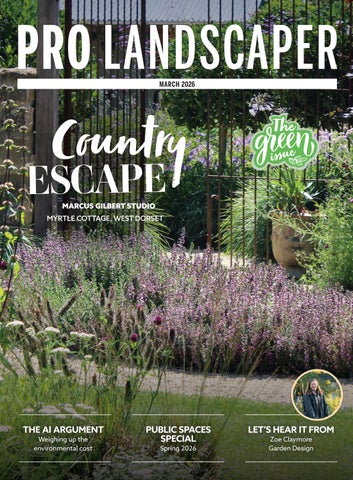
Pro Landscaper March 2026

Page 1


MARCH 2026

ESCAPECountry

MARCUS GILBERT STUDIO

MYRTLE COTTAGE, WEST DORSET LET’S HEAR IT FROM Zoe Claymore

Weighing up the environmental cost

2025/26

CONTACT

Eljays44 Ltd, BizSpace, Courtwick Lane, Littlehampton, West Sussex, BN17 7TL

Tel: 01903 777 570

EDITORIAL

Deputy editor – Bethany Vann bethany.vann@eljays44.com Tel: 01903 959 394

Senior staff writer – Holly Chapman holly.chapman@eljays44.com Tel: 01903 959 407

Senior subeditor – Katrina Roy katrina.roy@eljays44.com Tel: 01903 777 570

Graphic designer – Louise Klose louise.klose@eljays44.com

ADVERTISING

Sales executive – Ollie Finch ollie.finch@eljays44.com Tel: 01903 777 579

MANAGEMENT

Managing director – Jamie Wilkinson jamie.wilkinson@eljays44.com Tel: 01903 777 589

Divisional director – David Griffiths david.griffiths@eljays44.com Tel: 01903 777 570

Content director – Nina Mason nina.mason@eljays44.com Tel: 01903 959 393

Commercial director – Luke Chaplin luke.chaplin@eljays44.com Tel: 01903 777 582

MARKETING & CIRCULATION

Marketing executive – Kiri Shaw kiri.shaw@eljays44.com Tel: 01903 959 408

Subscription enquiries – Ollie Finch ollie.finch@eljays44.com Tel: 01903 777 579

Printed by Stephens and George Ltd

Published by ©Eljays44 Ltd – Connecting Horticulture. Pro Landscaper’s content is available for licensing overseas. Contact jamie.wilkinson@eljays44.com

Pro Landscaper is published 12 times per year by Eljays44 Ltd. The 2026 subscription price is £128. Subscription records are maintained at Eljays44 Ltd, BizSpace, Courtwick Lane, Littlehampton, West Sussex, BN17 7TL, UK. Articles and information contained in this publication are the copyright of Eljays44 Ltd and may not be reproduced in any form without the written permission of the publishers. The publishers cannot accept responsibility for loss of, or damage to, uncommissioned photographs or manuscripts.

Whilst every effort has been made to maintain the integrity of our advertisers, we accept no responsibility for any problem, complaints, or subsequent litigation arising from readers’ responses to advertisements in the magazine. We also wish to emphasise that views expressed by editorial contributors are not necessarily those of the publishers. Reproduction of any part of this magazine is strictly forbidden.

Pro Landscaper is proud to be an Accredited Supplier member of BALI

The Association of

Pro Landscaper is proud to be an associate member of the APL

Welcome

While the weather thus far this year is living up to the UK’s wet and grey reputation – one we’re proud of – 2025 told a different story; coming in at the third warmest year on record. Since 2023, we have seen a surge in average annual temperatures – just one of the impacts of our changing climate.

Tackling the environmental repercussions of the climate crisis is an on-going battle, one we are all well acquainted with by now. But we’re not mistaking that familiarity with complacency – which is why we are once again dedicating our March issue to those imposing pressures and the ways we can fight them.

From combating air pollution with the installation of living walls (p.52), to improving drainage systems throughout our public realms to mitigate increasing rainfall (p.71), we explore a range of practical responses. Some of the biggest modern environmental problems we’re finding solutions for come in the form of soil degradation; and finding alternative growing mediums (p.99), to recognising and mitigating the ecological impacts of artificial intelligence (p.105).

The weight of those pressures has given birth to even more impactful solutions; solutions that are driving our industry forward –equipping us with the best means to continue the good – or rather the green – fight as we continue to defend our natural world.

Bethany

BUSINESS

10

Tips, Tricks and Goals

Companies across the industry share their sustainability goals for the year ahead, as well as top tips for fostering a greener future

27

Let’s Hear It From...Zoe Claymore

From Dartmoor daydreams to RHS triumphs – Zoe Claymore on cultivating immersive gardens rooted in personal healing

75 Designed for All

From improved accessibility to better wildlife conservation – designer Ollie Pike shares why he launched the Landscapes for Change initiative

INSPIRE

31

Country Escape

Take a trip to the countryside with this awardwinning and idyllic garden from Marcus Gilbert Studio in West Dorset

35

Layered Sanctuary

Relax into this award-winning, multifunctional sanctuary from Greenscape Gardens in Epsom Downs

39 Next Stop: Sustainability

Don’t miss your stop, or chance to explore this award-winning brownfield site turned ecological haven in Colchester

99

Rubble with a cause

Alternative growing mediums such as sand and rubble could be ground-breaking. But are they likely to become mainstream?

105 Environmental AI

Hear from both sides of the argument as industry members dissect both the opportunities and long-lasting effects of AI

110

Prevent and Protect

APHA and Defra reaffirm the importance of reporting disease threats and pests in the face of a changing climate

13

She's Cordially Invited

Karen Tatlow shares her new business venture, The Olivia Collective, to better connect with past and present clients

65

Interview: Saira Ali

The Landscape Institute's new president-elect, Saira Ali reflects on her achievements and what she hopes to accomplish in her new role

71

Come Rain or Shine

Lisa Sawyer takes a deeper look into what is really holding back holistic landscape designs incorporating SuDS in public spaces

ALSO IN THIS ISSUE

17

Green Design

Rachel Bailey on maximising environmental benefits of designed gardens and landscapes with elemental

44

On the Wild Side

James Scott explores the diversity of wildflowers – from common misconceptions to their significant in green spaces

69

Vulnerability and Robustness

Judith Loesing of East architecture on the importance of creating diverse and responsible urban spaces

GOVERNMENT PUSHES FREE AI COURSES AMIDST ENVIRONMENTALCONCERNS

In a bid to make Britain the fastest adopting AI country in the G7, the government has released £27m of funding to bring free AI courses to workers across all industries.

The announcement comes midst recent global environmental research that finds AI has released as much carbon dioxide into the atmosphere in 2025 as the whole of New York City, as its water usage overtakes that of the entirety of the global bottled-water demand.

Backed by Skills England and the department for science, innovation and technology, the AI Skills Boost programme features free AI foundations training for all workers, with a plan to upskill 10 million people by 2030. Liz Kendall, secretary of state

ROUNDUP Industry Updates

LONDON LIVERPOOL STREET STATION REDESIGN FEATURES LARGEST GREEN ROOF IN LONDON

The City of London has given the green light for the transformation of London Liverpool Street Station intended to uplift the area's green qualities for a more resilient and sustainable building.

Led by SLA, the landscape and public realm design features new and improved pedestrian and cycle connections, step-free access to all platforms and a major expansion for

the station concourse and forecourt. The project also delivers the largest green roof in the City of London, with fluid plans to "strengthen local green connections," explains SLA.

Rasmus Astrup, design principal and senior partner at SLA says, "this project signals that nature-based, landscape-led design is incredibly recognised as essential." sla.dk

for science, innovation and technology says, “change is inevitable.”

The International Energy Agency said earlier this year that AI-focused datacentre electricity consumption is expected to more than double by 2030.

Donald Campbell, director of advocacy at non-profit campaigning organisation Foxglove comments on the new research: “This is yet more evidence that the public is footing the environmental bill for some of the richest companies on Earth.” Current founding partners of the government’s AI Skills Boost programme includes Amazon, Barclays, Google, IBM and Microsoft. aiskillshub.org.uk

THE SGLD AWARDS CELEBRATE “THOUGHTFUL, SUSTAINABLE AND HUMANCENTRED” DESIGNS

The Society of Garden and Landscape Designers (SGLD) Awards crowned 21 winners on Friday 6 February.

Honouring creative talents of members across the industry, the awards celebrated a soft, natural family garden as well as a woodland-inspired immersive garden.

Andrew Duff, SGLD chair says, “this year’s award winners demonstrate a profound commitment to thoughtful, sustainable, and human-centred design."

SGLD Garden of the Year Award was given to Putney Garden, designed by Tomoko Kawuchi at Charlotte Rowe Garden Design, described by the judges as “an absolute masterpiece."

The Lifetime Achievement Award was given to Tom Stuart-Smith for redefining “garden and landscape design through extraordinary vision, artistry and lasting influence,” explains Duff. sgld.org.uk

©Jason Ingram

ALBA TREES ACQUIRES SCOTTISH

Alba Trees has announced the acquisition of Christies of Fochabers, a nursery and treegrowing business.

Based in Arradoul in Scotland, Christies was a family-owned business which

HELMRIG BECOMES A TRAINING CENTRE IN MANAGEMENT AND LEADERSHIP

Helmrig has received approval from City and Guilds to become a training centre, announces managing director Dave Gallagher.

The landscaping and tree services company now offers both level 2 and level 3 in leadership and management as an “ongoing development of our people,” says Gallagher.

Part of its strategic plan, Helmrig hopes that by introducing this training, it can offer entrants the career path from trainee landscaper or arborist to director while remaining in-house with continuous support.

“Trade skills are, of course, very important. But leadership and management skills are every bit as important – daily, our supervisors are leading teams, tacking challenges, adapting to new circumstances, and mentoring younger team members,” highlights Gallagher. helmrig.com

TREE NURSERY

collapsed last year, a few months after selling its garden centre business to Simpsons Garden Centre in order to focus on its nursery and tree-growing business.

Alba Trees's – based in East Lothian and one of the largest producers of cell-grown trees in the UK – acquisition of Chrisities will allow the forestry company to supply in-house bare root production alongside its excisting offering.

With the transfer of all 32 Christies employees, Alba aims to “ensure continuity for staff, customers and suppliers”. albatrees.co.uk

MEMORIAL REGENERATION HONOURS HISTORY WITH NEW ENHANCEMENTS

BLandscapes has announced its role as principle contractor for the regeneration of Memorial Gardens in Kingston upon Thames to improve its public realm whilst respecting its role as a place of remembrance.

The site is over 200 years old and forms an important part of Kingston upon Thames’ history.

The project is being delivered by Kingston Council, in partnership with Kingston First, working alongside landscape designers Davies White Landscape Architects and LanPro Services.

Developed following community engagement, the regeneration plans include new and improved pathways, enhanced lighting, increasing tree planting, biodiversity-led planting and informal seating. blakedown.co.uk

KIM

AS PART OF NEW YEAR HONOURS LIST

A notable name within the New Year Honours List stands Kim Wilkie, whose efforts were rewarded with a Commander of the Order of the British Empire for his services to landscape architecture.

SEVEN GREEN PROJECTS TRANSFORMING LONDON

With recent planning applications being submitted, and others getting the green light, 2026 is expected to see plenty of landscape strategies begin to come into fruition.

PUTTING HORTICULTURE ON THE RADAR WITH PRO LANDSCAPER 30 UNDER 30 WINNER

Unaware of what a career in horticulture looked like when he was back at school, Sean Ryan is now a gardening supervisor at the All England Lawn Tennis Club, Wimbledon.

WILKIE EXPRESSES SURPRISE
©Kingston Council
lakedown

Highlights COMMUNITY

ROME GLOWS ROSSA FOR MILWAUKEE® WORLD OF SOLUTIONS

During the early days of February, the Pro Landscaper team attended the MILWAUKEE® World of Solutions event in Rome, Italy, to view the company’s fast-growing Outdoor Power Equipment (OPE) range. The professional tool and equipment manufacturer lit up the city with a multitude of red lights creating a glowing epicentre of innovation from the home of La Nuvola.

Kicking off the event with an evening presentation hosted by Oliver Lerch, president product and marketing EMEA, and James Dickinson, president sales power equipment EMEA, attendees learnt about the history of MILWAUKEE®, upcoming projects, new products and ongoing initiatives. The event was last held in Rome during 2012, and since then, the company has grown 14 times in size. As it evolves its tradespecific solutions, the company continues to introduce new battery-powered equipment for the outdoor landscaping industry.

From hedge trimmers, mowers, blowers and chainsaws, MILWAUKEE®’s OPE, including cordless garden tools, “bring power, battery life and ergonomics,” says the company. The range

Reels

Keep up to date with the @ProLandscaper team over on Instagram!

spans over 50 different 12V and 18V tradefocused tools.

The presenting duo also spent time dissecting key industry issues. Where one-in-three jobs are poorly resourced, the skills gap is affecting 25.5% of construction roles across Europe. In addition, the ‘great retirement’ sees an aging workforce with 20-30% of the industry set to retire over the next decade.

In response, not only do MILWAUKEE® offer safe and user-friendly outdoor power tools and equipment for both professionals and apprentices, but through its job site solutions (JSS) initiative, they are able to “help the construction industry to increase productivity, save costs, and cut the cord on the jobsite,” it says.

"For years, the sector and the government have been searching for a solution, and we believe technology is a critical part of the answer,” explains Ian Wakelin, JSS director.

Through the support of over 150 trade schools and colleges, MILWAUKEE® has every intention of counteracting the current skills decline.

From product presentations, in-depth

INSIDE THE GREEN ROOM PODCAST WITH JAMIE WILKINSON

Now available to watch, catch a few snippets of our managing director, Jamie Wilkinson, chatting with the Inside the Green Room podcast about the company.

explanations and numerous demonstrations, day two covered every corner of MILWAUKEE®’s wide range of solutions across 10 dedicated workstations, including OPE, accessories, hand tools and PPE. As its outdoor power equipment range continues to grow, the company intends to disrupt every aspect of the industry.

15 YEARS OF FUTURESCAPE!

As we celebrate 15 years of FutureScape, we reflect on how our industry has connected with one another over the years.

COME WITH US TO MILWAUKEE WORLD OF SOLUTIONS

Travel with us to Rome as we visited Milwaukee’s World of Solutions event, showcasing new initiatives, products and technologies.

WBoom

Modern Gardeners – Care Not Capital

Planting is dynamic and needs nurture, so we should be getting gardeners and maintenance into the conversation and the budget right from the start. The more developments and public green space projects that do this, the more sustainable and successful the spaces will be.

A lot of money is spent on a bigname designers and hard landscaping, but a really good gardener is what is going to make that space long-lasting as well as beautiful.

Susanna Grant

TIPS, TRICKS, and Green Goals

OUTCO

Our green goal for this year includes the increase of our urban flower sowing to more of our sites. This will be achieved by identifying areas of the sites following site meetings with our clients to encourage more pollinating insects and installation of bug towers. We are also looking at increasing our green waste recycling through encouraging our sites to have compost bins so we can produce their own compost.

[We will] increase the use of our in-house bio-blend soil improver – produced from spent mushroom compost, recycled green waste and manure – in all new planting projects throughout the planting season.

Nigel Glogan MCI Hort

GROUND CONTROL

At Ground Control’s Evergreen Fund, our vision is to show business as a force for good with a focus on nature recovery. We want to build on the past five years' successes and amplify our impact by continued engagement with landowners and managers. Our central green goal for 2026 will be challenging managers to review their sites from a nature positive perspective and implement enhancements wherever possible. [We want] to drive a shift from purely a traditional, operational focus to one that maximises the space for nature. Sites need to deliver their core function, but this can and should work in harmony with nature.

Chris Bawtree

© Emilia Trafalgar-2.

Companies across the industry are outlining their sustainability goals for 2026 – and highlighting the actions we can take to help advance a greener future

ELEMENTAL

As a community-interest company, elemental’s 2026 goal is to support the landscape industry to design better outcomes for climate, nature and people. We aim to help 500 additional users design and build landscapes that strengthen urban resilience, reduce carbon footprints and support biodiversity recovery. Through targeted questions, accessible resources and

a landscap e-specific carbon calculator, users can compare design options while learning best-practice approaches to responsible materials management, healthy soils, thriving biodiversity, clean water and air, inclusivity for people and reducing embodied carbon.

Rachel Bailey MSGLD, MAPL Find out more: elementalgreendesign.co.uk

NICHE

Bringing innovative biodiversity products to market. We want to keep producing products that wow people, offer technical solutions for the industry in relation to creating functional habitat, and make it easy to achieve site enhancements.

Our mission is to bridge the gap between complex ecology and practical application. By streamlining the path to high-quality habitat creation, we empower developers and landowners to create meaningful habitat features without the friction. We are committed to a "naturefirst" engineering philosophy, ensuring every product, from bee posts to bird towers, are backed by science and a passion for the wild.

MILLBOARD

We’ve earned an EcoVadis Silver Medal (top 15% of companies assessed) – recognising the strength of our sustainability management across environment, labour and human rights, ethics and sustainable procurement. For specifiers and homeowners, this verified status provides UK-aligned, independent reassurance that our progress, and our claims, are evidenced and transparent.

Patrick Clarke Landscapes

I believe that a greener planet has so much to do with exercising respect for both people and place. In a recent project, we re-used almost all 'found' materials which were in existence on the site. Not only did this result in less waste and fewer miles importing new materials and removing old, but it engaged so much more with the vernacular architecture of the place and the resulting landscape had a much deeper and more relevant connection to the existing house and surrounding hinterland.

Additionally, this gentler approach provides for less disruption and a greater respect to the people in the surrounding community. By treating land and the local community with respect and kindness when undertaking projects, as designers we stand a chance of making an improved contribution to better cohesiveness in the community as a whole. We should always try and consider the impact of our design decisions on the wider community while also satisfying our client's brief. Patrick Clarke

In 2026, Millboard is strengthening how we measure, prove and improve our sustainability performance again, to build on this achievement. James Etheridge

© Patrick Clarke

She’s Cordially INVITED

Karen Tatlow creates lasting connections with clients while bringing like-minded women together with her new venture, The Olivia Collective

WORDS: HOLLY CHAPMAN

Karen Tatlow set up Karen Tatlow Garden Design in May 2018, with the intention of creating bespoke gardens with a personal touch. Since then, she has designed gardens for RHS Malvern Spring Festival, a hospice garden and countless residential spaces. Integral to her process, she looks to form close relationships with her clients, as a means to create a more personal, bespoke space tailored to their needs.

By invitation only, Tatlow introduces The Olivia Collective, a private membership club for both past and present clients. Offering seasonal workshops, elegant experiences and inspiration, the collective has been designed to help members feel more connected to their garden alongside others who feel the same.

Delivered inside rose-pressed envelopes, sealed with a wax melt stamp, tied in ribbon and adorned with a green sprig, Tatlow personally invited the attendees of her first event in December 2025 to join The Olivia Collective, as well as additional introductory information on the membership.

It’s all about connection. The connection between clients and the connection between the Olivias and their garden

Referring to the group as the ‘Olivias’, Tatlow explains that when working on identifying her ideal client, she has always imagined her as being named Olivia. In an effort to connect with them on a more personal basis, she goes above and beyond to create an experience in each of their workshops.

In February, Tatlow hosted a rose pruning workshop from her newly renovated home. As the majority of her clients have taken inspiration from her previous garden, she says they knew it quite well and were curious to see the new project. Upon arrival, attendees were welcomed with a rosemary, honey and lemon hot toddy with homemade rosemary and sea salt flapjacks.

A keen baker, Tatlow includes these additional personal touches to create a welcoming atmosphere to her home and way of life.“I didn’t want people to feel like they were at a workshop that could be anywhere,” she specifies.

“It’s all about connection. The connection between clients and the connection between the Olivias and their garden,” says Tatlow.

The women were invited to warm their gardening gloves on an old Victorian radiator, before heading into Tatlow’s greenhouse to learn how to prune a potted rose. Blessed with dry weather, they followed the garden designer into her own rose garden for some hands-on practice.

After taking notes, reviewing an array of roses and then putting their hard work into motion, the women were invited back indoors for

lunch. Fuelled by French onion soup, and homemade pear frangipanes, attendees left with a goody bag filled with treats and rose pruning notes.

Each Olivia will receive a spot in Tatlow’s workshops throughout the year. From cutting garden workshops, to creating hanging baskets, the upcoming events also include a soiree hosted in Tatlow’s garden ahead of her open-garden weekend in July, and a visit to the RHS Chelsea Flower Show with afternoon tea.

“Once you’ve finished a client’s garden, you could just walk away, but I want to maintain these relationships with my clients for years afterwards. Not just from a business perspective, but also on personal level, I want to help them maintain their gardens and see them flourish.”

By creating meaningful relationships, Tatlow hopes to remain a central figure in her clients' minds. From recommendations to seeking advice, she will be on hand to help.

The Olivia Collective’s tagline reads,“celebrating gardens, gatherings and gracious living,” explains Tatlow. Her intentions are to start small, with a maximum of five Olivias this year, and with two already on board, she expresses her growing excitement for what’s to come:

“I don’t want to push water uphill but just go with the way it’s naturally flowing for a successful outcome.”

Once you’ve finished a client’s garden, you could just walk away, but I want to maintain these relationships with my clients for years afterwards

workshop dates for those who couldn’t attend, she’s looking forward to what The Olivia Collective will bring. Professionally, the continued growth of her practice, and personally, the lasting connections that encourage clients to become thoughtful stewards of their outdoor spaces long after the design journey ends.

KAREN TATLOW GARDEN DESIGN

karentatlowgardendesign.co.uk info@karentatlowgardendesign.co.uk

In addition to the workshops, Tatlow also hosts ‘Garden Gossip’ – a monthly garden catch-up session. The 45-minute online gathering is available for inspiration and connection. From quick queries to thoughts on future improvements, Tatlow invites the Olivias to grab a cuppa, a biscuit and join in on the conversation.

Moving forward, Tatlow will take on the feedback provided by the women she looks to work with.“Everybody seems to love the idea, and many are trying to find ways to be included,” she explains. With plans for a two-tiered membership, member-led introductions and repeat

DESIGN Green

Rachel Bailey on maximising environmental benefits of designed gardens and landscapes with elemental

Although I have spoken at recent events about the hope in addressing the climate emergency and biodiversity crisis, I struggle daily with the slow pace of progress.

In 2024, Earth’s temperature reached the 1.5°C target above pre-industrial levels, and we’re on course to exceed 2°C by 2050. According to experts that came together for the National Emergency Briefing, we are on track to reach 3-4°C of global warming by 2100, which will mean the collapse of our systems; “if we keep burning fossil fuels, temperatures will keep rising. Fossil fuels must be eliminated”.

At the same time, we face a biodiversity crisis. “The UK is among the most nature-depleted countries. Restoring nature is one of the highest return investments available. Wetlands, peatlands, hedgerows and urban trees cut flood risk, prevent heat deaths, protect food supplies, store carbon and create skilled jobs – at far lower cost than rebuilding after disasters.”

cycle, store carbon, and have positive benefits for people’s health and wellbeing.

The landscape and horticultural industries have real potential to lead; but only if we move beyond business as usual. Change can feel daunting in an economy that often rewards environmentally damaging practices.

When doing the right thing costs more and green wash is widespread, sometimes it can be overwhelming to know where to start

Gardens and public green spaces are also vital. Collectively, gardens can support a huge variety of wildlife, offer connectivity through built up environments, contribute to the water

When doing the right thing costs more and green wash is widespread, sometimes it can be overwhelming to know where to start.

elemental – the green design tool

Well, this is where elemental comes in. elemental is a free web-based design tool that is full of resources to support the landscape industry to design with best outcomes for climate, nature and people. It is a learning tool, rather than a judgement tool, for landscape architects, garden designers, landscape contractors, gardeners – anyone involved in decision making for gardens and landscapes.

elemental encourages you to consider the design holistically. The tool can help you find design solutions that can have a positive effect on multiple pillars. For example, addressing water holding capacity onsite could also be a win for biodiversity.

The tool can help you find design solutions that can have a positive effect on multiple pillars

However, there also may be tradeoffs. For example, allowing good access for people to the landscape can fragment and disturb wildlife; removing a slippery material for one that is non-slip will have impacts on the carbon emissions but offers better access for people. These tradeoffs could be justified by considering the connection of people with nature – for their health and wellbeing and for their cue to care about nature in the wider landscape. Also, if the garden is for people but it does not allow access, then the garden will not last and any good you may have done will be for nothing. Below, I have presented two case studies that show the benefits of using elemental during the design process.

CASE STUDY 1: OAK VIEW HOUSING SCHEME –NICHOLSONS

The tool has come about through an industry wide collaboration between the SGLD, LI, BALI, the RHS and APL all in association with original developers, Nicholsons.

elemental is built around the six pillars of environmental design (see BOX A) and invites users to answer a series of questions around the pillars of material management (waste), soils, biodiversity, water & air, people, and communities, and is underpinned by a full greenhouse gas (hereafter referred to as carbon) emissions data assessment.

Brief: To create a sustainable, landscape-led development for 48 dwellings in 4.4 hectares. The landscape strategy aims to provide a parkland setting for new homes that draws on the existing countryside character, to deliver a multi-functional and high-quality network of open space which diversifies the lives of the new and existing communities while enhancing natural habitats.

The carbon emissions and the positive impact scores of the original scheme were determined in elemental (see BOX B). The scheme was then redesigned using elemental as a tool. By reducing the amount of hard landscaping, changing the paving to a permeable surface, and increasing planting areas and how these were designed to be managed resulted in a 58% reduction in carbon emissions, and an increase in the positive impact scores by nearly two-fold.

BOX A - elemental’s Six Pillars of Environmental Design

Materials Management

Soil

Responsible materials management is fundamental to successful landscape construction, influencing environmental impact, long-term performance, and whole-life value. Thoughtful selection, specification, and handling of materials – at any scale, from small domestic gardens to major public schemes – can significantly reduce waste and future maintenance burdens, while improving durability, safety, as well as aesthetic appeal.

Soil is a fundamental but often overlooked component of landscape construction, underpinning plant health, drainage, carbon storage and long-term landscape performance. Careful consideration of existing soil health and structure, management and movement, can help protect this finite resource and ensure landscapes can establish successfully and function as intended.

Water and Air Water flow and air movement are essential considerations for any landscape, regardless of scale. Thoughtful design can conserve water, improve drainage, enhance air quality and create healthier environments for both people and wildlife.

Biodiversity Landscape construction plays a crucial role in shaping ecological outcomes, where well-considered design and management can help protect existing habitats, support living ecosystems and create opportunities for longterm biodiversity enhancement. Even modest interventions, when carefully planned, can deliver meaningful ecological benefits across sites of any size or context.

People and Place

Well designed landscapes do more than shape places – they can support healthier bodies, calmer minds and stronger diverse communities. Thoughtful green spaces have been proven to reduce stress, encourage movement and even reduce the impact of illnesses by creating connections with nature and enhancing overall quality of life.

Carbon Reducing the embodied carbon of a project from the outset is essential to minimise its contribution to atmospheric carbon and to allow the landscape to more quickly store more carbon than was used to create it in the first place.

CASESTUDY 2: DOMESTIC GARDEN, PAISLEY – RACHEL BAILEY STUDIO

The brief was to create an informal, modern, plant-filled garden for the family to relax, dine and garden whilst offering a haven for wildlife, especially bees. The garden is suburban and relatively small at 192 m2.

The carbon emissions and the positive impact scores of the first concept, which proposed using new natural stone paving, ordinary Portland cement where concrete/ mortar was needed, was determined in elemental (see BOX B).

A second concept was designed using elemental as a tool. The existing paving and other onsite materials were reused/ repurposed; all soil from excavations was kept onsite; rainwater was harvested from the summerhouse roof; and low carbon cement was used where needed. These changes resulted in 22% reduction in carbon emissions and a 1.4 fold increase in the positive impact scores.

Take home message

BOX B - Case Study Results

Scheme: Oak View

The lower upfront carbon emissions of a project, the quicker more CO2 will be taken up by the plants and stored in the soil than was used to make it in the first place. Addressing more than just carbon will also help businesses be mindful on their interactions from material use, biodiversity, soil, air and water impacts, and create positive places for people too.

Register for your free elemental account today to maximise the environmental benefits of the gardens and landscapes you design, build or care for: elementalgreendesign.co.uk

NEW AND IMPROVED ELEMENTAL - V2.0

At the end of March 2026, a new version of elemental will be released. This version will be even more user-friendly and include a greater range of materials for the carbon emissions calculations, carbon sequestration data for trees and plants that are included in the garden or landscape.

The questions in the five pillars that contribute to the positive impact scores have been reviewed by the technical advisory groups and have been updated to ensure they are capturing the best information.

Rachel Bailey runs an award-winning SGLD registered design practice with a team of four in Scotland. Working with professional landscapers, local plant nurseries and crafts people, the practice has created immersive plant-filled gardens from small courtyards to large landscapes working in the residential, public and commercial sectors. She is a registered member of the SGLD and design member of the APL, and the sustainability officer for the SGLD.

RACHEL BAILEY MSGLD MAPL

This package includes:

• Company branded meeting point in drinks reception – reserved poseur table

• Premium table positioned directly in front of stage within first two rows

• 6 bottles of table wine (extra bottle)

• 2 bottles of champagne and bucket of beers on your table

• Dedicated drinks waiter

• Three-course lunch

• Coffee and petit fours

VIP TABLE OF 10 limited availability last few remaining!

• Professional group photo of your table at the awards

INTELLECTUAL PROPERTY or Copyright?

In the digital age, copyright has become increasingly ambiguous – Alan Sargent is here to help navigate

Intellectual property or copyright?

Few topics cause as much recurring confusion in a professional practice as copyright. It is a question that arises repeatedly, in slightly different forms, and is often asked by my clients and colleagues in the design and build landscape industry.

I should state from the outset that I am an accredited expert witness, and not a lawyer. However, after many years of working in design and construction, both domestic and commercial, and dealing with the practical consequences of copyright disputes, I hope the following observations will serve as a useful guide. They are offered in good faith and from personal experience, rather than as formal legal advice.

What do we mean by copyright and intellectual property?

Greater care is required in design and build projects, particularly those that become public spaces

Copyright and intellectual property (IP) are often treated as interchangeable terms, and for most designers, the distinction is more academic than practical. Broadly speaking, copyright usually refers to original works that are written, drawn or expressed, such as drawings, plans or even a comedian’s joke delivered in a public forum. Intellectual property is the wider concept, encompassing inventions, such as a new vacuum cleaner or novel crips flavour.

In essence, both terms are concerned with ownership of creativity, skill, talent, and originality of thought. This is, no doubt, a simplified explanation, but is sufficiently accurate for the everyday concerns of a garden designer.

Everyday client working practice

In normal practice with private clients, all designs and planting plans remain the designer’s copyright. In many cases, that copyright is formally assigned to the customer once full and final payment has been received in accordance with the designer’s terms and conditions.

However, unless the contract expressly forbids it, there is generally no reason why a designer cannot use the same design over and again should they choose to do so.

Public shows and sponsored gardens

Designing gardens for public shows such as RHS Chelsea where a third-party sponsor is involved, introduces another layer of complexity, but the basic principle remains the same. You are the designer and you retain the copyright unless you have explicitly surrendered those rights to a sponsor through the wording of a contract.

I have never known a sponsor wishing to start selling gardens to their customers, and there has never been such a caveat to my knowledge.

Design and build public projects

housebuilder – I later went on to design and build a further three Chelsea gardens for McAlpine.

Sometime afterwards, one of my other builder clients used a photograph of that gold-medal exhibit in their own (rival) marketing brochures. Unsurprisingly, McAlpine were not very pleased. In practice, however, there was little they could do to prevent this situation. Only if it could be shown that a purchaser had bought a house specifically because of that photograph, and relied on it for when making their decision, might a claim have been possible. Even then, only by the purchaser in certain circumstances.

RHS Chelsea is not immune from claims of plagiarism or copying, even between exhibiting designers. In 1998 and again in 2006, two high profile claims were started, before being settled out of court.

The challenge of the digital age

Today, the situation is further complicated by social media and online image libraries. Platforms such as Facebook and Instagram are filled with photographs of completed projects and identifiable schemes, often shared without credit to either designer or the photographer. In such an environment, controlling or policing has become extraordinarily difficult –if not impossible.

Unless the contract expressly forbids it, there is generally no reason why a designer cannot use the same design over and again

Greater care is required in design and build projects, particularly those that become public spaces, or that involve longterm liability through public scrutiny. One example is the New Music Schools at Eton College, where I designed a large water feature as part of a design and build package.

Although the ultimate client was the college, contract and payment was made via a main contractor. In the event of a claim, the legal chain would have been complex. Notwithstanding, responsibility for the design itself ultimately remains mine; a point that is not always fully appreciated until problems or disputes arise.

Grey areas and real-world complications

Copyright disputes rarely unfold in neat, theoretical terms. I once constructed a Gold and Best in Show Chelsea garden, designed by Peter Rogers FSGD, sponsored by Alfred McAlpine Homes, the

ALAN SARGENT

Since 1968, Alan Sargent has founded the Association of Professional Landscapers, Professional Garden Consultant's Association, The Landscape Libary and Paving Site Online magazine. Landscape consultant and expert witness, award-winning columnist, author of 13 books written for designers and landscapers, he is passionate about training and encouraging professionalism in landscaping. alansargent.co.uk

Welcome to this regular column, where I share practical, iPad based digital workflows, tools, and drawing techniques to help make your landscaping and design work easier, faster and more efficient, whether you are out on site or back at the desk.

Morpholio Trace has recently introduced a feature that significantly expands what the software can do: Snap to Grid. It is a deceptively simple addition, but in practice it transforms Morpholio from a purely freehand sketching environment into something that can also function like a lightweight CAD system.

The key difference is that your pencil now snaps to a configurable grid, allowing you to draw with precision and speed without needing to constantly reach for the ruler tool.

The grid can be set to any dimensions you require, which makes it immediately useful for mapping out real gardens. In the accompanying tutorial, I begin by working in one metre increments to establish the primary structure of a rectilinear layout.

DRAWING BOARD Digital

creates an intuitive bridge between sketching and drafting.

As the design develops, the grid size can be changed at any point. When more detail is needed, you can quickly switch from metre increments to half metres, or down to 100 millimetres, depending on the working scale of that part of the drawing.

The key difference is that your pencil now snaps to a configurable grid, allowing you to draw with precision

This flexibility is crucial. It allows you to move fluidly between broad conceptual planning and finer detailing without leaving the same workspace. You are not locked into a single resolution; the drawing environment adapts to the level of precision you need at that moment.

With the grid active, it becomes possible to block out boundaries, paths, terraces and key structural elements in minutes. You are still drawing by hand, with the natural feel of the Apple Pencil, but every line is anchored to a measured framework. This

Once the underlying structure is established, the grid can simply be turned off. Instantly, you are back in a fully freehand mode, where Morpholio’s familiar strengths take over. Layers, tracing, stencils, and expressive line work can all be used to develop the design into a polished concept plan.

Because the framework was set out with measurable accuracy, the finished drawing can be printed at a true scale on any paper size, whether 1:50, 1:100, or 1:200, with confidence that proportions are correct.

What makes Snap to Grid so powerful is that it enhances precision without sacrificing the character of hand drawing. You retain the immediacy and creativity of sketching, but gain a drafting backbone that dramatically accelerates the early stages of design.

John Wood explores Morpholio Trace’s latest feature: Snap to Grid

WORK UP RECTILINEAR CONCEPT DRAWING IN MINUTES, PERFECTLY SCALED TO A CLICKABLE GRID

For rectilinear layouts in particular, it opens up a fast, reliable method of mapping ideas that would otherwise require more formal CAD tools. It is a small feature on the surface, but it unlocks a new way of working that blends accuracy and freedom in a remarkably efficient workflow.

Scan the QR code to see these tips in action! Also check out Create Visual’s YouTube channel @create_ visual_ipad to learn more about Morpholio Trace.

John Wood runs Create Visual, a CPD training platform for garden and landscape professionals, specialising in digital drawing and 3D modelling workflows using iPad-based tools. He delivers training both independently and for the Society of Garden and Landscape Designers, and also offers a professional visualisation service for designers and landscape architects, transforming 2D plans and sketches into 3D renders and photorealistic fly-throughs. Drawing on over two decades of experience in garden design, he helps professionals work more creatively, efficiently, and with confidence in their presentations. create-visual.co.uk

JOHN WOOD
THE NEW 'SNAP TO GRID' SYSTEM ALLOWS DRAWING AT ANY SCALE SIMPLY BY SETTING THE GRID TO THE REQUIRED DIMENSIONS AS WE WORK

1st March - 30th September 2026

COMING SOON

New Stone Range

Sourced from Britain, Europe, The Middle East and Asia, our exciting new stone range has been carefully curated to offer style, sustainability and incredible value — natural stone, refined.

• Paving, pavers, steps, cladding & walling

• Sawn, tumbled, flamed, brushed, sandblasted & antiqued finishes

• New sizing format for sustainable production & easier installation

Visit one of our inspirational showrooms or email info@londonstone.co.uk for more information.

“THE 21ST CENTURY

GARDEN

DESIGNER ALSO NEEDS TO BE A PSEUDO ECOLOGIST AND NEEDS TO HAVE A MINDSET SHIFT

TO THINKING OF THE GARDEN AS A LIVING, BREATHING ECOSYSTEM”

From Dartmoor daydreams to RHS triumphs – Zoe Claymore is cultivating immersive gardens rooted in personal healing, environmental purpose and emotional connection

WORDS: BETHANY VANN

When designer Zoe Claymore was diagnosed with PTSD in her early 20s, she didn’t set out to build award-winning gardens – she simply wanted to reconnect with her love of being outdoors. In those moments of planting, tending, and watching her garden grow, she found a new sense of calm, as she explains: “I found nature and being outside in particular, an awful lot more regulating. I found it easier – I was less hyper vigilant; I was able to do more and my base stress level was lowered – then I started gardening without thinking about it.”

I was determined to make [the garden] my little sanctuary. I bought all the wrong plants, but I had a great time

This wasn’t Claymore’s first venture into the great outdoors however; spending much of her childhood adjacent to Dartmoor National Park and exploring the vast moorland in the county of Devon would become, as she labels it, her “call of the wild” that would later resurface.

“My happiest memories are playing in my grandparents' garden in Dartmoor and playing in

© Julie Skelton

my parents' garden in Hampshire. Looking back on it, it's obvious this is what I wanted to do.”

She recalls marching her parents to their local Hillier Garden Centre, buying up all the plants she could and taking them home to create her own version of Eden: “I was determined to make [the garden] my little sanctuary. I bought all the wrong plants, but I had a great time.”

If there’s a good way to get me to do a show garden, it is to convince me emotionally that there’s a problem that needs solving or at least addressing

But, like so many at a young age, the pressures of university began to loom, and the pursuit of higher education was a given that she never questioned – that's not to say Claymore didn’t enjoy her course, as she reminisces: “I loved my course. It was absolutely mad – I did anthropology and ethnomusicology. My dissertation was in the Kazakhstani heavy metal and identity politics – I had a great time.”

Between then and rediscovering her love for the outdoors, Claymore worked as a researcher for NGOs, universities, and the civil service – rising to senior evaluation lead at Ofsted where she managed multi-millionpound national research trials.

Show garden successes

In 2023, at the RHS Hampton Court Palace Garden Festival – where I first met Claymore – the young designer was exhibiting with her debut garden, The Wildlife Trusts’: Renters’ Retreat – designed to offer guidance for renters looking to make the most of their transient outdoor spaces.

An in-depth look into the Renters’ Retreat was one of my first big projects when starting out in this industry – I recall meeting Claymore at the show where she took the time to give me a tour of the garden, sitting with me to discuss the article I had written – a memory we fondly share, as she reflects on how new we both were to the industry at the time.

Being fresh out of the Inchbald School of Design – where she graduated with the Dean’s prize for garden design –Claymore’s design, which was directly based on the small garden she had at 24, was reworked to show just how much life and character can be squeezed into a rented space. It was recognised with a hattrick of

© Annabelle May Photography
ZOE CLAYMORE’S THE RENTERS’ RETREAT GARDEN FEATURING CORTEN STEEL PLANTERS FROM LUXUNIQUE

awards: RHS Gold, People’s Choice, and Best ‘Get Started’ Garden.

“If there’s a good way to get me to do a show garden, it is to convince me emotionally that there’s a problem that needs solving or at least addressing,” says Claymore. Which stands true for her second stint on the show ground, this time at the Royal Hospital Chelsea, London.

Recommissioned by The Wildlife Trusts to produce its ‘British Rainforest Garden’ at the RHS Chelsea Flower Show, Claymore returned to the horticultural stage in 2025 to earn Silver Gilt and yet another People’s Choice award, this time in the All About Plants Garden. Now, with two People’s Choice awards to her name, Claymore reflects on the honour: “It’s the nicest thing to get – that huge affirmative stamp of approval, because the whole team works really hard.”

Calling on some of her fondest childhood memories adventuring through Lydford Gorge in Devon, Claymore accredits those times to her design, which brought a slice of temperate woodland to life in London.

“The stream feature in the garden followed the trajectory of the main river in the Dart Valley – the River Dart. While much of the stone and trees were sourced from a tight geographical area for provenance and ecological accuracy, I basically bottled down a valley into a domestic-sized space.”

CONNECTING THROUGH MUSIC

One of Claymore top tricks of the trade stems from her musical training at the Junior Royal Academy of Music where she trained as a double bassist: “One of the things I do when I design, if I'm stuck, I will play music I associate with the client, or music that I associate with the building or the place or the time.”

When talking about her RHS Chelsea garden, she says there wasn’t a particular song associated, “but it was very much like folklore and Celtic music,” a very fitting tone for her design.

I’ll try all the normal things – turning the paper the other way around and that kind of stuff. I might put some music on, or go for a walk. Sometimes I’ll go to the V&A and sit in the gallery, looking at links to the concept we’re trying to develop. That’s always unstuck me so far.

When delving into her experience at Chelsea, she recounts the rush of it and the success she had in bringing the vision to life, one she affirms is owned to the entire team:

In my practice, the projects I enjoy the most are ones where I am working with someone to find that joy for them

“My team at Chelsea absolutely worked their socks off. Us as designers are like conductors of an orchestra – we stand up, we open the music, and we set the pace. Our job is to bring together the best trumpeters or the best brick layers or the best horticulturalists – essentially the best people in each of their fields, and then we empower them to do the best.”

From British to musical royalty, Claymore’s garden was a buzzing hub for well-known figures throughout the day: “We had three TV crews come the day before and we did manage to get on lots of the news, which was really great for the Trusts –then I was told the king was coming.”

RHS Chelsea Flower Show 2025
© Frogheath Landscapes
© Annabelle May Photography

She recalls walking him through the garden and being pleasantly surprised by how much he knew of all the species featured: “I was like, come see my mossy madness [...] He knew every single plant, he could point them out. Then he turned to me and he said ‘it's very rare to find someone that can do this – pointing at my planting. So, that was a huge compliment.”

But the royal quests don’t stop there, as Claymore and I recount Sir Brian May’s appearance at the show, and more specifically, on the British Rainforest Garden with her: “His daughter was there too and they were very nice. He's got a real interest in the environment, so it was nice for him to see that.”

A deeper connection

While still in, what Claymore calls, its infancy, her design practice Zoe Claymore Garden Design – based in Teddington, London – is actively expanding: “The business is growing enough to be able to have people work with and for me – it's nice now to not be so isolated. Because if you're just used as a single practising designer, it can get incredibly lonely from a creative standpoint.”

We’re seeing more and more people embrace their outdoor spaces, treating them in essence like an outdoor room, but even that phrase can have limitations on the true potential of gardens, as Claymore shares: “I would challenge that notion of the garden room – it's a very 20th century notion, and it's not actually addressing some of the big challenges of our time. I think treating the garden strictly like a room is disingenuous, because gardens are breathing, living, evolving, changing things.”

She goes on to add: “The 21st century garden designer also needs to think like an

ecologist, have a mindset shift to think of the garden as a living, breathing ecosystem.”

At the core of the practice is Claymore’s ability to forge connections with her clients to create a living space that works as a reflection of them and their needs –though this can mean a fair few edits along the way to get things just right, she says: “The garden is a spiritual relationship. It's a living thing.”

What sets her apart isn’t just the mossy, immersive spaces she creates, but a disarmingly honest philosophy: gardens are not finished objects – they’re ongoing conversations between people and nature.

connect them with their garden and to develop a much deeper relationship with the natural world. And it doesn't mean it has to be a 'wild garden' – everyone is different and everyone's journey is different.”

I would challenge that notion of the garden room – it's a very 20th century notion, and it's not actually addressing some of the big challenges of our time

She adds: “In my practice, the projects I enjoy the most are ones where I am working with someone to find that joy for them – to

Going on to note that throughout her own journey she’s been incredibly fortunate to form strong connections, particularly with The Wildlife Trusts: “I think what sets our practice apart is the fact that we've been extremely fortunate to work with such a wonderful charity and build an affiliation for now, and there is stuff in the pipeline that will see that relationship continuing.”

A teasing end to our catch-up as Claymore reveals a big project on the horizon in the West Country, that she’s remaining tight lipped on for now, but watch this space.

© Julie Skelton
© Julie Skelton

Escape COUNTRY

MARCUS GILBERT STUDIO

MYRTLE COTTAGE, WEST DORSET

After moving into this Grade II listed home, the new owners of Myrtle Cottage turned their attention to establishing a garden befitting of the lush rolling landscape of West Dorset. With a dream in mind to turn the space into an idyllic country escape, the owners approached Marcus Gilbert Studio to bring their vision to life.

The primary goal for the team was to create an organic and soft sanctuary that highlights views of the surrounding valley while preserving the garden’s intimate atmosphere.

Heavy emphasis was placed on increasing the garden’s soft landscaping while keeping

ABOUT

paving to a minimum – creating enough of a walkway to allow for easy traversal amongst the towering foliage.

Over 4,000 new plants and trees have been established in the garden – around 30% of which are native to the UK, as well as mixed native turf and bulbs. Rich burgundies, purple and deeps oranges are standout colours amongst the palette.

The scope of the garden led to dividing the project into three distinct areas that the Marcus Gilbert Studio and AM Landscaping teams took on in linear order.

Starting in the cutting and herb garden – an area wrapping around the neighboring property, bound on each side

Marcus Gilbert Studio – established by award winning designer Lynne Marcus FSGLD, MBALI – is based in London and Bath. Its extensive portfolio includes classic, contemporary, traditional, formal and naturalistic gardens and landscapes in London, in the country, on the coast and abroad. The studio offers a full service from conception to completion. marcusgilbertstudio.co.uk

PERENNIALS

• Aster

• Betonica officinalis

• Echinacea

• Leucanthemum

• Nepeta

• Sanguisorba officinalis

• Trifolium rubens

with neighboring walls. Home to a recently constructed out-building with accompanying veranda to the rear and panoramic views of the sweeping fields, the space now includes raised planting beds and fruit trees, creating a space for the owners to flex their green thumbs.

The new beds include Osmanthus × burkwoodii, Cornus mas, Juniperus procumbens 'Nana', Pinus mugo 'Varella', and Pinus nigra 'Pierrick Bergen', creating a visual journey of structural intrigue and texture to draw the eye and further envelop the space in greenery.

The area is primarily infused with richly-coloured plants, berries, twigs and foliage with a wildflower prairie garden comprised of a grass and perennial base with orchard and additional trees –encasing the space with rich scents and lush colours to create that countryside feel.

SHRUBS

• L onicera ligustrina var. yunnanensis 'Maigrün'

• Rosa rugosa 'Alba' (Ru)

• Salvia yangii 'Blue Steel' (Pe)

• Teucrium chamaedrys

GRASSES

• Calamagrostis × acutiflora 'Waldenbuch'

• Carex divulsa

• Deschampsia cespitosa 'Goldschleier'

• Deschampsia cespitosa 'Goldtau'

• Molinia caerulea subsp. caerulea 'Poul Petersen'

CLIENT FEEDBACK

“The garden looked lovely when it was built and looks even better now. It has changed our lives.”

TREES

• Acer campestre 'Red Shine'

• Betula pendula

• Cor ylus avellana 'Contorta'

• Crataegus monogyna

• Malus sylvestris

• Prunus domestica 'Victoria' (D)

• Pyrus communis 'Williams' Bon Chrétien' (D/C)

• Ulmus glabra 'Camperdownii'

REFERENCES

Contractor

AM Landscaping

Ham stone

Ham Hill Quarry

Sherborne turf

Wildflower Turf wildflowerturf.co.uk

Plants

Hardy’s Cottage Garden Plants hardysplants.co.uk

J.Parker’s jparkers.co.uk

Knoll Gardens knollgardens.co.uk

Landlife Wilflowers wildflower.co.uk

Towards the rear of the space, the palette transitions from rich colours behind the cottage into paler counterparts, elongating the space and creating a sense of openness towards the boundary line.

A native mixed hedge and purple beech hedge have been established around the boundary lines in place of fencing as a means to screen the neighboring properties and provide privacy for the owners.

Leading into the meadow area – which now houses a new seating area to create additional vantage points of the garden – is a cleared area between the fence and rear boundary. The owners had recently commissioned

a new stone wall to run the length of the northwest boundary and requested pathways meandering through sweeps of prairie style planting, wildflowers and lawns for this area.

The domestic area at the rear of the house had its formally steep incline terraced, creating space for the main dining and lounge area – as well as additional paths and steps to bring cohesion throughout the space.

The geometry transitions from the linear forms of walls and paths leading to the cottage doors and windows, to curvilinear shapes at the junction of the open ‘prairie’ and wildflower planting, creating a network of curved paths that weave among flower

New Wood Trees newwoodtrees.co.uk

Premier Plants premierplantsuk.com

Style Roses styleroses.co.uk

beds and pools of lawn. Mounded lawns echo the views beyond the valley, while lawn paths dovetail with solid paths and lead to strategically placed seating ‘sweet spots’ throughout the garden.

Finally, curvilinear and linear geometry combine to create a formal cutting garden with raised beds linking the old gate to the meadow with the new out house.

Bolstering a huge increase in biodiversity, the established garden is an attractive and secluded place for the owners to meander amongst nature, basking in the views of West Dorset and the afternoon sun as local wildlife and pollinators flock to the space.

LAYERED

Sanctuary

GREENSCAPE GARDENS

EPSOM TOWNHOUSE

50k Principal winner

Taking inspiration from the existing wooded bank and Epsom Downs location, this compact residential garden was built to unwind and entertain. With each carefully considered element, Greenscape Gardens has created a garden that encapsulates an immersive, multi-functional sanctuary that connects the clients to the changing seasons and the landscape beyond.

Flourished with Mediterranean influences drawn from the clients’ heritage, the garden flows between a weathered floating deck over a shady slope – while lush, layered planting builds woodland character garnished with embedded boulders.

Originally a standard new build garden, the landscaping company – owned by Carl Chaney and James Gleghorn – had a blank canvas to embellish. From concrete pavers and gravel with a retaining wall separating and restricting the usability of the garden, the landscaping duo transformed the small space into an “extraordinary vision” as described by the BALI National Landscape Awards judging panel.

Sat in the centre of the garden is an outdoor dining terrace and small kitchen, decorated with finishing touches such as colourful tiles, additional planting and cosy cushions. A space to socialise, beyond the terrace lies an oak bench nestled within the mossy boulder. Posing a challenge, this particular area of the garden was “a real labour of love, but absolutely worth the effort”, says Gleghorn.

The slope was also a challenge in the transformation of the garden, but the way in which the thoughtful design incorporated a beautifully constructed clad wall, oak bench,

• Saxifraga urbium 'London Pride'

• Geranium pyrenaicum 'Bill Wallis''

• Galium odoratum

• L onicera periclymenum honeysuckle

• Amelanchier

• Nepeta

• Geranium Rozanne

steps and boulders ensured that every part of the space was utilised to maximise every square metre.

As their first property with a garden, the clients requested a space that was both functional and practical, while acting as a starting point for their desired gardening journey.

Featuring rich coloured planting, the garden also holds a carpet of the evergreen Saxifraga urbium 'London Pride' within planting rills between the steps which thrives in the shade, while coping well in dry conditions. It also acts to absorb water runoff, as well as working to soften the hardscape.

Evoking a wild and woodland feel, both Anthriscus sylvestris 'Ravenswing' and Geranium pyrenaicum 'Bill Wallis' thread through the garden which tailors to the changing seasons. Atop the bank at the end of the garden, Galium odoratum has been planted to provide low groundcover which layers beneath several other plants to avoid soil erosion, water runoff and the sight of bare soil.

Greenscape Gardens is a multi-award-winning landscaping company that specialises in creating gardens of exceptional quality with a personal and collaborative approach. Run by Carl Chaney and James Gleghorn, they have spent over 20 years doing what they love; creating bespoke gardens of exceptional quality.

DURING

While the clay paving is permeable and chosen to also reduce runoff, the grey water from the outdoor sink can be channelled into the planting beds helping to irrigate the beds as well as avoid water wastage.

From year-round habitats with evergreen grasses and groundcover, the planting scheme also provides vital shelter for hibernating insects, especially during the winter months when it is most needed.

There is also plenty of food for pollinators spread across every season. From spring to late autumn, the Amelanchier provides tree blossom, alongside the repeating flowering of Nepeta, while Geranium 'Rozanne' flowers until November.

Once completed, the team walked away “with an immense sense of pride,” says Chaney: “This was a garden we’d all want to have.”

CLIENT FEEDBACK

“Working with Greenscape Gardens has been a lovely experience from start to finish. Their team is remarkably keen on detail and always available to suggest creative options that perfectly suited our vision. We are more than happy with the results; we are finally enjoying our garden, and it has truly improved our daily lives.”

REFERENCES

Designer Helen Saunders helensaundersgardendesign. co.uk

Vande Moortel Clay Pavers Country Supplies countrysupplies.uk

Sawn sandstone paving London Stone londonstone.co.uk

Millboard decking

Composite Cladding & Decking Supply compositecds.co.uk

Boulders CED Stone cedstone.co.uk

Corten planters

Weather It weather-it.co.uk

Plants

Northill nurseries northhillnurseries.co.uk

Trees

Majestic Trees majestictrees.co.uk

Kitchen Wwoo kitchen wwoo.nl

NEXT STOP: Sustainability

THE BETH CHATTO MEANWHILE GARDEN

DARRYL MOORE, SPECIAL PROJECTS CONSULTANT AT BETH CHATTO’S PLANTS & GARDENS

Once a hub of activity in the centre of Colchester, this former bus depot site has stood vacant for several years; with plans scrapped for the delivery of new student housing following public opposition – all that remained was an unused brownfield site, in accessible to the public.

PROJECT DETAILS Build time 2 weeks Size of project 1,000m2

Project value £7.3k Awards

Pro Landscaper

Project Awards 2025

Sustainable Garden under £50,000 winner

© Julie Skelton

Now the space has been given a new lease on life after being transformed into atemporary public pocket park by Beth Chatto’s Plants & Gardens.

Designed to bring educational value and enjoyment to the local community and an aim to challenge people to think about urban ecology, plants and public spaces.

Currently owned by Essex County Council, the license to create the garden was acquired by Beth Chatto’s Plants & Gardens on the proviso that the space be given back over should the council have another use for it in the future – contributing to the term ‘meanwhile’ in its title.

Over the years where the site has laid dormant, it had developed characteristics typical to brownfields, including a selfestablished layer of vegetation that had moved beyond the initial stage of ruderal colonisation to a fairly stable community of wildflowers, and was just about to tip over into the shrub stage of succession, says designer Darryl Moore: “This existing vegetation was rich and complex, so retaining it was important for its value to biodiversity.”

Existing plants included Achillea millefolium, Arrhenatherum elatius, Bromus hordeaceus, Daucus carota, Geranium pusillum, and Reseda luteola, all of which were retained to preserve the site’s established ecology and mitigate disruption to the insect species found.

With additional planting also established, the pallet for the space draws upon Beth Chatto’s legacy of ‘Right plant, right place’, based on the understanding of plants’ natural habitats, shares Moore.

A selection of around 1,000 plants –including 35 hardy species – were planted in December 2023 by The Beth Chatto Gardens team, with a further session in spring 2024. Instead of using a planting plan, the team opted instead for plant placement that adhered to the aforementioned principles.

The planting scheme features droughttolerant species arranged according to a matrix scheme, with grasses as the key matrix plants, complemented by layered perennials – from ground cover, through small and mid-height species to tall accent plants.

Ensuring plant survival without irrigation and with minimal aftercare required a planting design composed of hardy, drought-tolerant species with competitive

© Darryl Moore.

tendencies capable of balancing those of the more prolific wildflower species, Moore explains.

Species have been established across the introduced brick rubble mounds – the recycled aggregates providing an optimal free-draining and low nutrients environment that will encourage strong root establishment, before developing aerial biomass.

The aggregates are crushed concrete and brick from whole bricks down to dust. The clay content in brick provides slightly more nutrients than crushed concrete and is also slightly more water retentive.

With an ecological ethos at its core, all the newly established plants were from the nearby Beth Chatto Nursery, each grown sustainably in peat-free mediums.

As well as locally-sourced planting, all of the recycled aggregates used were taken from another part of the site, while the outdoor seating area, railway sleepers and fencing were recycled from Cityscapes’ RHS Chelsea Repurposed garden from the 2024 RHS Chelsea Flower Show, which was originally created by using key elements from show gardens dating back as far as 2010.

“The achievement of the garden is that it is a sustainable, biodiverse garden, created on an unused space in the heart of Colchester City, which is now well used and loved by local residents. The responsive approach to the site provides an inspirational low-cost template for other community groups to use in order to activate more much-needed green spaces in cities.

The project shows that horticultural industry leaders, such as Beth Chatto Gardens, can extended their reach into local communities, offering support and experience, to benefit the environment and the experiences of those who use it – both human and more-than-human.

Seeing people and insects using the garden throughout the seasons is the greatest reward.”

© Darryl Moore. © David Gates
© Julie Skelton

PLANTING

• Agapanthus Twister

• Asphodeline lutea

• Carex scaposa

• Cistus x argenteus ‘Silver Pink’

• Dianthus carthusianorum

• Nepeta racemosa ‘Walker's Low’

• Origanum vulgare ‘Thumble's Variety’

• Salvia nemorosa ‘Amethyst'

• Stipa tenuissima ‘Pony Tails’

• Verbena hastata ‘White Spires’

Another of the dwelling sites was made using wood sourced from Suffolk County Council parks in Ipswich, which was generated during routine maintenance. The benches and table were made by hand by a local artisan woodworker, based on designs informed by local young people in workshops led by architects Matt+Fiona.

CLIENT FEEDBACK

“It’s a place that people can come and sit. You can see people using the benches. That people will discover. And that they will enjoy the planting, the wildlife, the diversity. It’s a very gentle garden. Nature will do its thing with this garden; it will evolve as the community and as nature takes it, and I love that idea. It’s a politics of possibility."

In place of a disused and inaccessible former bus depot now stands a flourishing hub of ecological possibility, where the local community can take time to explore and engage with the natural world right in the heart of the city.

© David Gates
© Darryl Moore.
© Darryl Moore.

Crafted with Character

Experience the timeless beauty of the Florence Porcelain Range. Inspired by classic stone, each tile features naturally tumbled edges that create an authentic, handcrafted look. The subtle texture and warm tones bring a soft, inviting atmosphere to any space, perfectly blending rustic charm with modern elegance.

This is just a glimpse of the wider collection waiting to be explored.

Explore our range at

Wildflower meadows and meadow-style planting are becoming an increasingly prominent feature in contemporary landscape design, valued for their naturalistic beauty, biodiversity benefits and opportunity to replace low-value lawn. As their popularity has grown, so too has the range of ways in which meadows can be created.

Over years of designing and delivering meadow schemes – particularly in the Chilterns, where The Garden Company is based – I have seen first-hand how different approaches perform in real landscapes. While the visual intent may be similar, the method of establishment has a real impact on outcomes.

Despite their widespread use, there remains confusion between wildflower landscape turf products and traditionally sown wildflower meadows. For designers and landscapers, understanding this distinction is important, as the two behave very differently on site. Choosing the right approach underpins reliable performance and successful design outcomes.

Traditionally sown wildflower meadows are established from seed, involving lower upfront cost, longer establishment times and greater variability in early years, particularly on challenging sites.

Wild Side On the

Designer James Scott explores the diversity of wildflowers and their significance within green spaces

Wildflower landscape turf, by contrast, is pre-grown and installed as a finished surface, offering immediate visual impact, known species composition and more predictable establishment. Both approaches have their place, but turf is often favoured for speed of establishment and early impact.

A common misunderstanding lies in the term wildflower itself. Wildflowers are often assumed to be native plants, but botanically this is not always so. A wildflower is simply a plant that occurs naturally in the wild somewhere – not necessarily in the UK.

plant type rather than a horticultural selection. While straight species are native somewhere in the world, they are not necessarily native to the UK.

Wildflowers are often assumed to be native plants, but botanically this is not always so

Importantly, plants do not need to be native to provide biodiversity benefits; pollinators respond to nectar, pollen and habitat structure, not national boundaries!

A wildflower landscape turf product is a pre-grown mat of wildflowers, often – though not always – combined with grasses. In practice,‘wildflower turf’ covers a wide range of mixes, species compositions and design intentions. This diversity is both a strength and a challenge, particularly where assumptions about native planting and biodiversity persist.

Wildflower landscape turf products may include native species, non-native species that are highly valuable to wildlife, and, in some cases, cultivars selected for traits such as vigour or flowering reliability. Plant nomenclature is helpful here.

A straight species (for example, Achillea millefolium) refers to a naturally occurring

A plant with a cultivar name in quotation marks – for example, Achillea millefolium ‘Cerise Queen’ – or described as a hybrid is a horticultural selection. Cultivars are bred or selected for predictable traits such as flower colour, height or flowering performance. In the UK, a native plant is generally defined as one present since the end of the last Ice Age, around 10,000 years ago. This results in a relatively limited native flora – commonly cited at around 1,300–1,400 species. By contrast, Australia, where there wasn’t an Ice Age, has approx. 800 different species of Eucalyptus! There is also an important intermediate category: naturalised species, which were introduced historically but have since formed self-sustaining wild populations.

This broader context is critical when planning a wildflower meadow. Ecological value is influenced not only by whether a plant is strictly native, but by how effectively it functions within a given landscape.

Choosing between turf and a seeded meadow

Establishing a successful seeded wildflower meadow requires specialist knowledge, careful soil preparation and long-term management. Historic weed seedbanks must be addressed; selective herbicides cannot be used once the meadow is establishing; sowing rates are critical; and careful cutting regimes are needed for several years to prevent grasses becoming dominant.

A seeded meadow can take two to three seasons to reach its intended balance.

Wildflower turf removes much of this uncertainty. The pre-grown mat suppresses residual weed germination, the balance of grasses and flowers is already established, and soil preparation is similar to that used for conventional lawn turf.

Early-stage maintenance is also reduced; while turf requires consistent watering during establishment, it generally demands far less intervention in the first 12–18 months. For many projects, these features are invaluable.

Design flexibility

The range of wildflower landscape turf products now available offers significant design flexibility. One of our key suppliers, James Hewitson-Brown of Wildflower Turf Company, has been a pioneer in this area. Understanding site conditions is essential when choosing mixes, which may be grass-free or grass-inclusive, native-only or blended, and suited to shade, dry soils or specific geological contexts. Purpose-made mixes can also reinforce local character.

At The Garden Company, we often favour native mixes when working in rural areas of the Chilterns, while our urban projects allow for a broader palette. Given the UK’s limited native flora, suppliers may incorporate non-native or naturalised species to extend flowering seasons and increase visual impact.

Plant knowledge remains important, as some species may need to be introduced separately or require

time for soil conditions to support them. Bulbs for instance are a great addition to the mix. They can be planted under the turf if it is being laid in the autumn, or added later.

Residential and commercial drivers

In residential projects, wildflower turf appeals to clients seeking naturalistic landscapes with early results – softer, more ecological spaces without years of waiting. In commercial and public schemes, additional drivers include biodiversity net gain targets and sustainability frameworks such as BREEAM, where measurable ecological value is often a specification requirement.

Specifying wildflower landscape turf should be approached with the same rigour as any planting decision. When chosen thoughtfully, these products offer designers and landscapers a powerful tool – balancing ecology with aesthetics.

Scott

The Garden Company in 1991. As managing director and principal designer, he oversees all projects and has led the company to win multiple national awards for both design excellence and landscaping craftmanship. With a strong focus on sustainability, Scott is dedicated to creating places that celebrate nature – where people love to spend time and that contribute to their wellbeing. He is an Accreditor for the Society of Garden and Landscape Designers and serves on the judging panel for both the SGLD and Pro Landscaper Project Awards. thegardenco.co.uk

Soil-less wildflower turf delivering reliable, long-term biodiversity. Price: £12.25

James
FSGLD MBALI founded
JAMES SCOTT FSGLD MBALI
Image ©The Garden Company
Lawn-like turf with enhanced biodiversity benefits. Price: £12.25 Species

GO

Wild

Choose the turf mix as carefully as any planting scheme

Not all wildflower turf products suit every site. Avoid selecting mixes based on flowers alone – sun levels, soil moisture, exposure and maintenance must all be considered along with the wider setting.

Layer in bulbs to extend seasonal interest

Planting bulbs alongside turf adds structure and early-season impact. Species such as alliums, Narcissus ('Pheasant’s eye' is a personal favourite), bluebells, Fritillaria meleagris and Camassia integrate well and extend flowering.

James Scott’s top five tips for incorporating wildflowers into your next project

Design with aftercare in mind

Most wildflower turfs benefit from one to two cuts per year – timed to allow flowering and seed set. Cuttings should be removed to prevent soil enrichment and excessive grass growth.

Create mown routes to invite interaction

Mown pathways add visual interest and encourage engagement, helping meadow areas feel accessible rather than off-limits.

THE COMPLETE PACKAGE

Increase Biodiversity: Our award winning plastic free wildflower turf is a game-changer for promoting local ecosystems. By incorporating a variety of native plants, you can create beautiful, biodiverse habitats that attract pollinators and support wildlife.

General Landscaping: Whether you’re designing a park, garden, or recreational area, our versatile turf solutions offer the ideal foundation for any landscaping project, delivering beauty and functionality.

Golf Courses: Achieve the perfect balance of aesthetics and playability with our premium turf options tailored specifically for golf courses. Enjoy lush greens and resilient fairways that enhance the golfing experience for players of all levels.

Sports Pitches: Our high-performance turf is ideal for sports pitches, providing a durable and consistent playing surface that stands up to the rigors of competitive play, ensuring safety and enjoyment for athletes.

In conversation with...

WILDFLOWER CO. CHARLIE DAVISON

With a rebrand designed to reflect its growing scale and ambition, Wildflower Co.’s commercial director discusses the thinking behind the company’s major new refresh

What was the inspiration behind the decision to rebrand?

Wildflower Turf did not simply enter a market. It created one.

We invented the pre-grown wildflower turf category in the UK. In doing so, we set the benchmark for quality, reliability and ecological integrity – earning genuine trust across the landscaping and development sectors. That legacy matters to us.

But the business has grown far beyond one product. Over time, we have expanded into UK-grown native seed production, engineered pre-seeded substrates through Meadowscape Pro, BNG-specific compliant mixes, green roof systems and biodiversity consultancy. The name Wildflower Turf no longer reflected the scale or ambition of what we had become.

The move to Wildflower Co. is a strategic evolution. It acknowledges our heritage, but it also recognises that we are now operating as a broader biodiversity solutions partner. Biodiversity net gain has accelerated the market, but this rebrand is about long-term positioning. It reflects where we are heading, not just where the legislation is today.

Can you share what the rebrand entails, and how will it set Wildflower Co. apart in a competitive market?

The rebrand includes a new name, a refined visual identity and, more importantly, clearer positioning. Wildflower Co. now represents:

• Wildflower Turf

• UK-grown native seed

• Meadowscape Pro engineered pre-seeded substrates

• BNG-specific compliant seed and turf mixes

• Green roof systems

• Enhance biodiversity improvement solutions

• Technical specification and consultancy support

The name Wildflower Turf no longer reflected the scale or ambition of what we had become

supplying a product. We are delivering integrated biodiversity systems. Behind that positioning sits a strengthened R&D function.

We invest in the development, testing and refinement of our seed mixes, substrates and establishment methodologies to ensure they perform in real-world site conditions. Our work is informed by ecology, soil science and long-term habitat outcomes, not just shortterm establishment.

• In-house research and development driving innovation and performance

Visually, the brand is more confident and contemporary. But the bigger shift is strategic. We are not simply

The market is becoming crowded as more businesses respond to BNG. What sets us apart is control, credibility and technical depth. We grow our own seed. We design our own mixes. We manufacture engineered systems. We test and refine them through our R&D capability. And we support clients technically from specification through to establishment.

That integration gives developers and contractors confidence that what is specified can genuinely be delivered on site and perform long term.

How do you foresee this new identity propelling the brand further in the future?

The new identity gives us headroom. Wildflower Turf anchored us to a single product category. Wildflower Co. reflects a platform. It allows us to engage at a higher level with housebuilders, local authorities and major landscapers who are thinking about biodiversity across entire sites and portfolios.

As BNG becomes embedded in planning policy, the industry is shifting from simply installing wildflower areas to delivering measurable habitat units. Our BNG-specific compliant mixes and engineered systems such as Meadowscape Pro are designed for that reality.

The brand now matches the level at which we operate and the scale we intend to reach.

With the rebrand reflecting the company's expansive portfolio of products, can you share how Wildflower Co’s product range has evolved over time?

We began with one innovation: Wildflower Turf, which removed the uncertainty around meadow establishment and delivered instant impact. From there, growth has been deliberate.

The progression reflects a clear shift from aesthetic meadow creation to structured, policy-aligned biodiversity delivery, while continuing to support landscape architects and garden designers who want both ecological integrity and strong visual impact.

and contractors to specify with clarity and confidence under Biodiversity Net Gain requirements.

Our work is informed by ecology, soil science and long-term habitat outcomes, not just short-term establishment

What have been some of the major product launches over the years that you feel bolstered the brand?

The launch of Wildflower Turf changed expectations around what was possible in meadow creation.

Securing our own UK-grown native seed capability strengthened our ecological integrity and supply chain control.

More recently, BNG-specific compliant mixes and the expansion of Meadowscape Pro have been pivotal. These systems allow developers

Each milestone has reinforced our position not just as innovators, but as a dependable delivery partner.

With a growing product range and portfolio of services, can you share anything new that is on the horizon?

Our focus now is on refinement, performance and scalability.

We are continuing to develop BNG-aligned specifications to stay ahead of evolving habitat guidance and planning expectations. At the same time, we are investing in stronger technical support and long-term performance advice. Biodiversity delivery does not end at installation, and we take that seriously.

You will see continued innovation, but always grounded in practicality and measurable outcomes

Is there anything else you would like to add?

This rebrand is not about distancing ourselves from Wildflower Turf. It is about building on it.

Wildflower Co. carries forward the credibility, research and practical experience that defined the business. The difference is that the name now reflects the full breadth of our capability.

The biodiversity market is maturing quickly. Our ambition is simple: to lead it responsibly, commercially and with genuine ecological integrity.

POWERFUL FEEL

TAKE ON THE MOST DEMANDING CLEARING JOBS WITH THE XGT 40V MAX BRUSH CUTTER. COMBINING EXCEPTIONAL POWER AND MANOEUVRABILITY WITH QUIET, FUME-FREE PERFORMANCE, IT’LL MAKE YOU FEEL UNSTOPPABLE.

POWERFUL

FREE BL4040F BATTERY with selected XGT tool and battery purchases before 30.09.2026.

LIVING Developments

From stark grey hoardings to vibrant green façades, temporary living walls are emerging around development sites as a way to reduce environmental impact

WORDS: BETHANY VANN

As their benefits – both aesthetic and environmental – become more widely recognised and their design adaptability widens; living walls – also known as a vertical garden or green wall – have been rapidly growing in popularity in recent years.

Although traditionally seen within the bounds of a completed development, living walls are increasingly popping up on construction sites in urban areas as temporary installations, as a means to mitigate the environmental and society effects of development.

Matt Lindsay, general manager at Growing Revolution – one of the companies facilitating this temporary greening movement –says the installation of a temporary living wall on a temporary construction hoarding can take a once stark boundary line and turn it into a “vibrant feature that supports both contractors and communities.”

to make creating vertical gardens more accessible. Made from 100% recycled materials, with a modular and reuseable design, the PlantBox is “perfect for projects that evolve over time – transforming temporary barriers into lasting community and environmental features,” says Lindsay.

Even those temporary installations can provide habitats for pollinators and insects, helping to create wildlife corridors

He adds: “Greening up hoardings can also enhance streetscapes, support wellbeing, boost biodiversity, and show a commitment to sustainability.”

Growing Revolution’s PlantBox is a stackable living wall system designed

While advancements are being made in reducing the average emission total of a development, construction remains one of the top contributors to global carbon emissions; accounting for around 25% of global CO2 emissions, with a 38% when combined with building operations. With a significant amount of construction activity occurring in and around city limits – a side effect of continued urbanisation and population growth – there is arguably a need to introduce new methods of lowering these emissions – on top of mitigating the societal impacts as well, such as noise and urban heat levels.

Lindsay adds: “We hope to show how temporary structures such as construction site hoardings can contribute positively to streetscapes, community wellbeing and urban biodiversity. As awareness of sustainable green infrastructure grows, I believe that greening up construction site hoardings should be standard practice for all new developments, helping our cities and towns integrate nature, even during – often disruptive – construction projects.”

We hope to show how temporary structures such as construction site hoardings can contribute positively to streetscapes, community wellbeing and urban biodiversity

Temporary walls, lasting benefits

Even short-term living walls in cities can provide immediate, flexible and sustainable benefits — from shading buildings and releasing moisture into the air to reduce urban heat levels, to capturing rainwater, reducing runoff volumes and relieving pressure on city drainage systems.

They can also boost biodiversity: “Even those temporary installations can provide habitats for pollinators and insects, helping to create wildlife corridors and contributing to a local ecosystem network,” adds Lindsay.

PERKS OF A LIVING WALL

• Increased biodiversity

• Temperature regulation

• Reduced building energy consumption

• Enhanced visual appeal

• Rainwater management

• Sound insulation

• Improved wellbeing

He notes as well that a living wall can enhance the visual aesthetic of a construction site, because let’s be honest, seeing construction site after construction site on your way to work can become repetitive: “Adding an established living wall to a hoarding will help to soften the harshness of construction sites creating a much better streetscape for residents, pedestrians and for workers.”

HOW DOES A TEMPORARY LIVING WALL DIFFER FROM A PERMANENT ONE, IN TERMS OF PLANT SPECIES, DESIGN, AND MAINTENANCE?

“Temporary living walls are better suited to using modular systems like PlantBox, with robust, tested and evergreen plant species suited to shorter installation periods. Our PlantBox Living Wall is also simple to install, easy to relocate, and straightforward to maintain. It can also be used on permanent living walls too and can be easily connected to an automated irrigation system to ensure growth and longevity.”

Though non-permanent in nature, many temporary living walls can also be retained on site or relocated after construction is complete, as Lindsay explains: “PlantBox Living Walls are modular and reusable, so once construction is complete they can be relocated on site, repurposed for other development projects, or installed in community or public spaces – often considered by the contractor by way of thanking the community for working with them during what can be a disruptive period.”

So, while the construction industry continues to confront its environmental impact through innovations such as sustainable materials and green waste initiatives, temporary living walls may offer a practical solution that is closer and more accessible than we realise.

1. https://ecochain.com/blog/constructionindustry-carbon-emissions/

PAVING the

GLOBAL STONE

PAVING SUPERSTORE Way

SANDSTONE PORCELAIN – BUFF

BROWN & YORK GREEN

New for 2026, this range offers a more realistic sandstone-inspired texture, combining natural depth and authenticity with the practicality and durability of porcelain, supplied in cardboardfree packaging.

• Natural sandstone look; enhanced texture and depth

• Cardboard-free packaging

• No wet, soggy waste on site globalstonepaving.co.uk

Built to last and made to impress – these paving solutions can transform any space

MODAL X PRIORA

Modal X Priora Textured combines contemporary style with Marshalls’ patented Priora permeable system, allowing rainwater to drain naturally. This durable concrete block features a textured, slip-resistant surface in modern colours.

• Priora® permeable system supports sustainable drainage (SuDS)

• Enhanced interlock for strength and durability

• Textured granite-look finish with slip resistance pavingsuperstore.co.uk

TOBERMORE

TETRALOCK

Tetralock is a new high-performance interlocking concrete paving system, engineered for heavy traffic, exceptional stability, contemporary urban design and long-term durability for projects where product lifecycle matters.

• Five-side interlock with a clawing base for maximum shift protection

• High compressive strength, built to last – guaranteed for 25 years

• Textured granite finishes and modular sizes offer design flexibility for standout schemes tobermore.co.uk

SPRING Restart

Paul Jeffery on why professional irrigation recommissioning

Amatters

s spring approaches, facilities managers and estates teams face the crucial task of bringing irrigation systems back online after winter shutdown. With unpredictable weather, tightening water regulations, and rising sustainability expectations, a controlled recommissioning process is essential to protect landscapes, ensure compliance, and avoid costly setbacks.

Irrigation systems left idle over winter are vulnerable to hidden faults, leaks and blockages. Attempting a rushed or DIY restart can lead to burst pipes, uneven coverage or controller failures. These problems increase costs, risk reputational damage and can result in unplanned downtime for sites that need to be ready for the growing season.

Missed servicing windows or overlooked issues often mean higher repair bills, wasted water and disruption to business continuity. The landscape sector is under increasing pressure to demonstrate sustainable water management. Water authorities are introducing stricter usage limits and demanding evidence of compliance. Facilities managers must now provide clear documentation of preventative maintenance and system performance to meet both regulatory and client expectations. Non-compliance can result in fines or negative audits, and it may even impact insurance or tender eligibility for future contracts.

This thorough process ensures that every component operates safely and efficiently, reducing water waste and protecting valuable plant stock. Facilities managers benefit from peace of mind, knowing their irrigation system is fully operational and compliant, with all work documented for future reference.

Our team supplies clear inspection reports, maintenance records, and recommendations for future upgrades, supporting site managers in meeting both internal and external requirements.

Missed servicing windows or overlooked issues often mean higher repair bills, wasted water and disruption to business continuity

Industry expectations have shifted. Preventative maintenance, digital monitoring, and transparent reporting are now standard for responsible landscape management. Sites that invest in proper recommissioning avoid emergency callouts, reduce mid-season breakdowns, and demonstrate operational professionalism to clients and stakeholders.

Long-term partnerships with a specialist provider like Waterscapes bring added value, from ongoing support and troubleshooting to advice on system upgrades and sustainability measures.

Spring is also the ideal time to review water efficiency measures. Upgrading to weather-based controllers, drip irrigation, or smart sensors can reduce waste and improve plant health. These improvements support both sustainability targets and regulatory compliance, making them a smart investment ahead of the growing season.

Waterscapes can advise on the most suitable enhancements for your site and handle installation as part of the recommissioning process.

A professional approach to recommissioning involves far more than simply switching the system back on. At Waterscapes, our engineers manage every stage of the process:

• Site and asset review to identify issues before activation

• System cleaning and flushing to remove debris and maintain water quality

• Technical diagnostics using specialist equipment to uncover hidden faults

• Compliance and safety checks in line with current regulations

• Performance benchmarking for ongoing reliability and future planning

Planning ahead is key. Demand for recommissioning and servicing rises sharply in spring, so early booking secures the right expertise and avoids delays. Our process starts with a pre-season consultation, followed by a tailored schedule of works and post-commissioning support.

We work closely with estates and facilities teams to keep projects on track and resolve any issues quickly, ensuring your site remains compliant and operational throughout the season.

Paul Jeffery is the managing director of Waterscapes. He has over 30 years’ expertise in irrigation and water feature projects for corporate, municipal and private clients across the UK and Ireland.

01963 824166 info@waterscapes.co.uk @waterscapesltd

ADDAGRIP

THE ONLY CHOICE

Addagrip are the sensible choice for professionals considering resin paving. With a legacy rooted in innovation and reliability, every project reflects a commitment to quality that stands the test of time. Addagrip. Set in Stone.

Quality

We worked alongside The BBA, developing certification and raising the bar for the industry.

Experience

With over 45 years of experience delivering projects, we know our way around a commercial site.

Sustainability

The only supplier to hold a valid EPD certificate, demonstrating our commitment to sustainability.

To specify Addagrip, find us on NBS Source

In conversation with...

LONDON STONE STEVE WALLEY

From a major rebrand to a new collection that marks a return to its roots, London Stone’s managing director reveals everything that’s on the horizon

Can you tell us about London Stone’s new stone range?

Over the last few years, the business grew quickly, particularly through Covid. In that time our priority had to be fulfilment and infrastructure, making sure we could keep delivering for customers.

I’ll be honest, during that period our energy naturally went into operations and service. Product development didn’t stop, but it wasn’t getting the spotlight it deserved. So, this new stone range is us going back to our roots. Refocusing on materials and design, and doing what we love most, helping people create beautiful gardens.

Curating this range has been a real team effort, we've listened to what landscapers and designers need on site and built the range around that. The new stone range lands very soon, so keep an eye out for that!

This new stone range is us going back to our roots. Refocusing on materials and design

What are some of the key characteristics of the range that set it apart in the market?

The range introduces a wide selection of several new limestones in finishes including sawn, tumbled, sandblasted, brushed and antiqued.

It also covers paving, pavers, setts, steps, cladding and walling. We previewed much of it at our Evening with London Stone events in the middle of February and the feedback was really positive.

The new size format is really where this range comes to life. We’ve moved away from the old back-breaking 900×600 slabs and introduced a smaller, more tactile format that feels current and works beautifully in modern garden design.

The sizes are designed to maximize block yield and make use of all available material, dramatically reducing waste. That means faster production, lower environmental impact, and better pricing for customers.

It ticks every box: On trend, easier to handle on site, better for the planet and better value, all without compromising on performance or aesthetics.

With a rebrand on the horizon, what was the inspiration behind this decision?

Styles change, expectations change, and we never want to stand still. We’ve been trading for 17 years now, so we’re no longer the new kids on the block. I felt it was the right time to refresh the brand.

The new logo reflects a move towards more tactile materials, warmer colours and a more rustic, natural feel, while still respecting the heritage of London Stone. It also aligns closely with our growing focus on sustainability. We see it as an important part of the next chapter of the business.

How does the new website fit into this rebrand?

We’ve partnered with a leading ecommerce agency, and the new website takes our digital offering to another level. It will look great, but the real value is in the functionality.

Customers can expect enterprise-level features, an industryleading checkout, much stronger search so they can find what

they need quickly, and account access where they can view orders and paperwork in one place.

We’re also completely overhauling our image library, which will make browsing products far more inspiring and useful. Ultimately, it’s all about making life a lot easier for our customers. The website goes live the week commencing the 2 March.

London Stone has also recently launched CPD courses for garden designers. Can you tell us more?

Helping to raise standards in the industry has always been important to us. We want to give landscape professionals the knowledge they need to design and build better gardens, so we’ve launched five CPD sessions covering everything from bespoke stone and material selection through to installation guidance and maintenance.

Styles change, expectations change, and we never want to stand still

They’re open to garden designers, landscapers and anyone in the industry who wants to learn more. It’s another way we’re supporting the people who use our products.

Is there anything else you’d like to add?

We’re also opening a new showroom in April just outside Wimbledon, taking us to 10 showrooms nationwide, which we’re very proud of.

Hard landscaping materials form the foundation of any garden and represent a significant investment, so we believe people deserve a place where they can explore materials properly and get expert advice.

It’s all part of making it easier for our customers to create beautiful gardens.

Finally, I just want to say thanks to our customers for their continued support, and give a big shout out to our brilliant team and wish everyone in the landscaping industry a successful 2026.

For more information, visit: londonstone.co.uk

Established 1864

Established 1864

Established 1864

Established 1864

Discover World Class Trees

Discover World Class Trees

Discover World Class Trees

Discover World Class Trees

Expertly grown on 700-acres of pristine Hillier land in Hampshire, this is sustainable tree production as it should be.

Expertly grown on 700-acres of pristine Hillier land in Hampshire, this is sustainable tree production as it should be.

Expertly grown on 700-acres of pristine Hillier land in Hampshire, this is sustainable tree production as it should be.

Expertly grown on 700-acres of pristine Hillier land in Hampshire, this is sustainable tree production as it should be.

Hillier Trees: Growing for England since 1864

Hillier Trees: Growing for England since 1864

Hillier Trees: Growing for England since 1864

Hillier Trees: Growing for England since 1864

Please contact trees@hillier.co.uk

Please contact trees@hillier.co.uk

trees.hillier.co.uk

Please contact trees@hillier.co.uk

Please contact trees@hillier.co.uk

trees.hillier.co.uk

01794 368 733

trees.hillier.co.uk

trees.hillier.co.uk

01794 368 733

01794 368 733

01794 368 733

Download The Hillier Tree Guide

Download The Hillier Tree Guide

Download The Hillier Tree Guide

Download The Hillier Tree Guide

Your guide to our range of trees. Showing their form and size over 15, 25 and 50 years, plus helpful information on suggested usage for a variety of projects and locations.

Your guide to our range of trees. Showing their form and size over 15, 25 and 50 years, plus helpful information on suggested usage for a variety of projects and locations.

Scan this QR code to download your copy today!

Your guide to our range of trees. Showing their form and size over 15, 25 and 50 years, plus helpful information on suggested usage for a variety of projects and locations.

Your guide to our range of trees. Showing their form and size over 15, 25 and 50 years, plus helpful information on suggested usage for a variety of projects and locations.

Scan this QR code to download your copy today!

Scan this QR code to download your copy today!

Scan this QR code to download your copy today!

SPRING 2026

PUBLIC REALMS in the making

Manchester regeneration plans to produce new public square on former supermarket site

Aplanning application has been submitted to relocate Moston Superstore in Manchester from Pym Street to unlock a new public square in its former location.

The superstore will move to a site on Kenyon Lane currently occupied by the Ebsworth Street car park, pending planning approval, which will provide residents with a larger food shop and dedicated car parking and cycle store.

Featuring new seating, lighting, trees and planting, the new public square will eventually host markets and community events.

To date, the Moston project has already seen new social housing, new pocket parks and green spaces, junction improvements, road safety works, new alley-gates and investment to tackle fly-tipping and environmental issues.

As well as the new public square, the 2023 framework indicated that the vacant sites behind Moston Lane could also accommodate around 80 new homes.

Bev Craig, leader of Manchester City Council says, “we have ambitious plans to see over £25m investment into Moston Lane and this is a significant milestone for the Moston community as this planning application marks an important step in creating a brand-new public square at the heart of the neighbourhood.”

Draft designs for the plans will be published once Manchester City Council has selected a developer to build the new space, homes and commercial space.

LFrom local streets to global cities, these in-progress projects are reshaping spaces for community life

and Use Consultants

(LUC) has received approval for the transformational Clifden town regeneration plan in Galway, Ireland.

A popular tourist destination, the Clifeden Town Centre Enhancement Project will be led by LUC and Galway County Council to improve the quality of public spaces.

Proposals also include a more people-friendly town centre, access to waterfront areas and new green spaces to benefit residents and visitors.

From the revitalised Beach Road Quay and a new Harbour

Galway town regeneration receives go ahead

Park, LUC says the transformation will “boost biodiversity, create welcoming public spaces and celebrate the town’s unique heritage.”

Approved by An Coimisiún Pleanála, the plans can now move forward in seeking funding for a comprehensive scheme that will reshape the area in Galway.

© LUC

Canary Wharf welcomes Sea Lanes plans

After proposal plans were floated for a natural water lido to open at Eden Dock in Canary Wharf, planning permission for Sea Lanes has now been approved.

Joe McNulty, director at Sea Lanes says the open water swimming centre will “offer Londoners a chance to swim in natural water,” adding: “Sea Lanes Canary Wharf will be more than just a swimming pool – it will be an urban oasis for health and wellbeing all set within the green and biodiverse waterfront of Eden Dock. We’re excited to create a space where Londoners can connect with nature, their community, and themselves.”

Approved plans feature a 50m six-lane floating swimming pool within dock water, two saunas powered by 100% renewable energy, community clubhouse and a wetsuit concierge service.

Set to be open 364 days a year for swimmers of all ages, the natural swimming pool will allow locals to connect with nature and the environment from the heart of London.

Construction is set to begin in early 2026, with an opening date in summer 2026.

Perth expects transformation on untouched waterfront

Australian developer Golden Sedayu has submitted planning for the Burswood Point water development in Perth, Western Australia.

The masterplan is being led by Skidmore, Ownings & Merrill, while the Precinct B landscape and public realm strategy is being headed up and designed by Grant Associates.

Set along the Swan River at the tip of Burswood Peninsula, just 3.5km from Perth

Copenhagen’s new park gets green light

Copenhagen City Council has officially approved plans and designs for the city’s new 30-hectare coastal nature park.

Designed by Team SLA, Nordør will be shaped from decades of deposited soil from Copenhagen construction sites with minimal interventions.

Featuring sport fields, beaches, playgrounds, lagoons, marine reefs and community spaces, the new park is the first of its kind to be created in over a decade.

Designed for the city of Copenhagen and By & Havn, the construction of the park is set to start in 2028.

CBD, Precinct B intends to deliver a new mixed-use waterfront neighbourhood on a previously untouched stretch of the foreshore.

Featuring public open spaces, riverfront parkland and civic gathering spaces, the landscape concept also includes a water sensitive urban design strategy with rain gardens, vegetated swales, permeable surfaces and native planting.

“This approach positions Precinct B as a climate-resilient waterfront neighbourhood designed for long-term environmental performance,” says Grant Associates.

Now that planning has been submitted, Precinct B is expected to be Australia’s most vibrant new waterfront neighbourhoods currently progressing through approval.

©Sea Lanes
©Team SLA
“I

WANT TO ENSURE LANDSCAPE ARCHITECTURE IS RECOGNISED AS CENTRAL TO ADDRESSING THE CLIMATE AND NATURE EMERGENCIES”

New president-elect of the Landscape Institute, Saira Ali, reflects on her achievements and what she’s looking to accomplish in her new role

WORDS: BETHANY VANN

From an early age, Saira Ali was fascinated with the creative process

– from conception to realisation – watching as her ideas took shape and came to life: “I loved the idea of creating something tangible, almost like sculpting, where you can stand back and see the impact of what you’ve made,” says Ali.

Despite being a complex and vital field, a career in landscape architecture – like so many others – wasn’t a path Ali grew up knowing existed, likely due to the lack of public awareness and misunderstandings of the sectors intricacies. But once it was her radar, there was, as she says, no going back.

“Once I came across it, something clicked. It brought together everything I cared about: design, people, environment, and the ability to transform places for the better.”

The idea of creating large-scale, tangible and impactful spaces was the driving force behind Ali’s journey into the realm of landscape architecture: “What hooked me was the scale of impact. Instead of creating a single object, I realised I could shape whole spaces, influence how people feel and move, and leave a positive legacy in communities. That’s what still drives me

today – the desire to create, to collaborate, and to leave my mark in a way that enriches the world around us.”

Creating purpose-driven spaces

The desire to deliver those enriched spaces has guided Ali throughout her career to date; leading projects that combine creativity, sustainability and social purpose.

As team leader of the landscape design and conservation team at City of Bradford Metropolitan District Council, Ali has helped the city realise its landscape and environmental-led vision that places people, nature and heritage at the heart of its new regeneration projects.

“Our work has transformed onceneglected urban areas into inclusive, thriving public spaces,” she explains. “From largescale city centre regeneration under the Transforming Cities Fund (TCF) to heritageled initiatives like the NHLF Top of Town Townscape Heritage Scheme and Bradford HAZ – these projects celebrate Bradford’s rich cultural identity while embedding climate resilience, biodiversity and wellbeing.”

With heritage-led regeneration a particular passion for Ali, she notes how respecting the

past can better inform the future; supporting the revitalisation of once underused realms and creating a new, evolved space that meets the contemporary needs of both city dwellers and urban nature.

She adds: “By integrating historic character with sustainable design and community co-creation, we’ve not only conserved important places but also renewed civic pride and social connection.”

One such major project is the Future Bradford programme, which has seen an ‘unprecedented’ level of investment injected into the city to fund a series of flagship projects that will strengthen its sustainability, while future-proofing the district.

©City of Bradford Metropolitan District Council

Under the programme’s banner, the council is working to create a more sustainable, inclusive and accessible district that will facilitate community connection and bolster environmental capital.

“Our ethos is simple: landscape first”, Saira explains: “We embed sustainability and nature-based solutions into every project –from tree planting, rain gardens, and wildflower meadows to active travel infrastructure.”

Project’ 2023 and ‘Excellence in Place Regeneration’ 2025.

As well as the Pro Landscaper Sustainability & Biodiversity Awards 2025 ‘Best Local Authority’ award and Business Award for ‘Diversity & Inclusion’ 2024, she has also received an Honorary Doctorate from the University of Bradford for her contribution to greener communities.

By integrating historic character with sustainable design and community cocreation, we’ve not only conserved important places but also renewed civic pride and social connection

Under Ali’s leadership, Bradford Council has earned national recognition, including multiple Landscape Institute awards ‘Excellence in Public Health and Wellbeing’ and President’s Award for ‘Best

“Sustainability isn’t an add-on in Bradford – it’s embedded in everything we do.” Ali notes: “It’s part of the council’s corporate priorities and climate strategy, aligning with the UN Sustainable Development Goals, especially Sustainable Cities and Communities, Climate Action, and Good Health and Wellbeing.”

Norfolk Garden

In 2025, Bradford’s city centre underwent a major transformation that saw a new 10,000m2 park open to the public –complemented by new pedestrianised areas on Market Street, Bridge Street, Bank Street, Broadway and Hall Ings.

The new park’s design is heavily inspired by the district’s heritage and culture, using plants and additional features that bring together functionality and biodiversity.

Norfolk Garden marks a major milestone in the wider £45m transformation of the city centre, delivered by Bradford Council and the West Yorkshire Combined Authority as part of the Bradford City Centre Walking and Cycling Improvement Scheme – funded through the government’s TCF.

She adds that the Bradford Walking and Cycling Scheme exemplifies this holistic approach – reintroducing nature into the heart of Bradford through meadows, rain gardens, native trees, and more than two kilometres of purposeful cycle lanes.

“These spaces do far more than look good – they manage floodwater, improve air quality, reduce heat, and create healthier, more walkable environments.”

©City of Bradford Metropolitan District Council

Going the extra mile

Extending beyond design delivery of new urban schemes, Ali is also a passionate advocate for diversity, equity and inclusion – from mentoring young professionals and championing representation to promoting accessible routes into the industry, Ali underscores the importance of bolstering our industry’s workforce with diverse professionals as a means of safeguarding it, as well as facilitating diverse design inputs that will help to shape future public realms, designed for all walks of life.

her belief in leadership with compassion and social purpose.

“Every achievement reinforces my belief that great places are co-created, rooted in identity, inclusivity, and a shared vision for a resilient future,” she says.

Every achievement reinforces my belief that great places are co-created, rooted in identity, inclusivity, and a shared vision for a resilient future

She also plays a role in influencing the national thinking on blue-green infrastructure, climate adaption, and public health through the policy contribution, research, and national forums. She serves as an independent member of the Yorkshire Regional Flood and Coastal Committee and is an appointed member of the Yorkshire Dales National Park Authority.

And if all of that wasn’t enough to the fill her days, Ali also serves as an ambassador for the Children’s Heart Surgery Fund – highlighting

Among her proudest civic achievements is leading and delivering the UK’s first Commonwealth Memorial outside London, unveiled in Bradford in 2024, which symbolises inclusivity, representation, and belonging, says Ali.

“What I’m most proud of”, she reflects, “is creating better environments for the next generation. Places that inspire healthier lifestyles, greater social connection, and a deeper respect for nature. If my work helps change behaviours, improve wellbeing, and support a healthier planet, then that’s the legacy I want to leave.”

Stepping into the role of president

In 2025, Ali was selected as president-elect of the Landscape Institute (LI) – she will be taking

over from the institute’s current president, Carolin Göhler from July this year.

Ali says this transition has been a defining moment in her career, noting: “The president is the figurehead of the institute, representing more than 6,000 members, advocating for the profession, and ensuring we play a leading role in tackling climate change, biodiversity loss and social inequality.”

As president-elect, Ali is currently serving in a preparatory and supportive capacity before assuming full leadership in July 2026. Her priorities are clear: “I want to lead an institute that truly reflects our shared values – one that champions climate leadership, inclusion and professional empowerment.”

In July of last year, the LI unveiled its new people-focused refresh; in a move that it says will look to strengthen the brand and improve it accessibility. “The new identity, ‘We connect People, Place and Nature’ perfectly captures who we are and what we stand for,” says Ali. “It’s more than just a new look – it’s a statement of intent. It’s about accessibility, inclusivity and visibility – ensuring the institute reflects the diversity of the profession and the communities we serve.”

The refresh came after a two-year consultation period with members and staff –it is designed to futureproof the LI’s identity while still allowing room for evolution in the years to come as it approaches its centenary year in 2029.

“It positions [the LI] as the chartered body of a vital profession, one that is expert, essential, and inclusive, advocating for climate resilience, biodiversity, and social equity”, explains Ali.

In a sneak-peak of her upcoming manifesto, Ali shares that the theme will centre around a connected, resilient, and inclusive future, “grounded in nearly three decades of landscapeled regeneration and community collaboration”, adding: “My aim is to strengthen the institute’s voice on climate action, promote naturepositive design, and ensure that inclusivity and diversity are embedded in everything we do.”

She shares that her leadership philosophy will centre atop four main principles:

• Vision: Aligning the institute’s work with global sustainability goals

• Humility: Fostering a transparent, member-led organisation that amplifies underrepresented voices

• Resilience: Supporting members through fairer fees, mental health resources, and sustainable practice

• Curiosity: Promoting interdisciplinary collaboration and innovation

“It’s about leading with purpose, aligning the passion of our members with the big challenges of our time.”

In the years to come Looking ahead, Ali shares her belief that urban placemaking will continue in its new era – one defined by green innovation, inclusive design and people-driven purpose.

She says: “Cities are reimagining public spaces as multifunctional, resilient environments. Nature-based solutions, from green roofs and urban forests to permeable streets and rain gardens are now integral to how we design and adapt for the future.”

Going on to highlight the wider shift toward Sponge City and nature-positive principles: “Urban resilience isn’t optional anymore, it’s essential. The future of placemaking lies in designing for coexistence: where people, nature, and infrastructure function in harmony.”

As she prepares to take up the LI presidency in 2026, Ali’s main goal is to strengthen the collective voice of the landscape profession.

Sustainability isn’t an addon in Bradford – it’s embedded in everything we do

She points to Bradford’s next phase of regeneration, including the City Village neighbourhood, Shipley and Keighley town centre redevelopments, and the Southern Gateway regeneration zone, which will link to the city’s future mass transit system. “These projects will embed green infrastructure, social equity, and heritage into the heart of city making,” she explains.

“I want to ensure landscape architecture is recognised as central to addressing the climate and nature emergencies,” she says. “That means influencing government policy, building stronger partnerships, and empowering members to lead in their own right.”

She also hopes to see the profession continue to grow more inclusive and accessible.

“We need to reach new audiences, in schools, communities, and across disciplines, to inspire the next generation of landscape professionals.”

©City of Bradford Metropolitan District Council

VULNERABILITY AND ROBUSTNESS

Judith Loesing of East architecture on the importance of creating diverse and responsible urban spaces

As architects and landscape architects, especially working in public space, we are called to design spaces that are affordable, robust, durable, low or no maintenance, vandal-proof, and ‘secure by design’.

These new public spaces carry a lot of conflicting, pressures: they are tasked with needing to resolve disparate issues such as provision for play and sports, urban cooling, improvements to air quality, and increases in biodiversity and the attenuation of flooding. This requirement produces spaces which are interchangeably called squares, pocket parks or home zones.

Planners and clients in the public sector are often enthusiastic, but also overworked and under-paid, and the deliberate shrinkage of local authority budgets in the last administration left boroughs with tough choices that lead to often drastic cuts of maintenance budgets.

So, it is no surprise that a tried and tested list of materials – standardised, industrially produced, often fossil-fuel-derived, low cost, and easy to procure and install – is at the heart of many approved palettes of materials.

more often, naïve: minimal falls in paving that will create puddles at the first spit of rain; meadows that will be trampled into mud by high levels of footfall; ornamental planting reliant on bulbs likely to disappear after a year; or trees spaced so closely that they will ultimately crowd one another out.

Repair, maintenance, and even care are seen as failures to be mitigated against

An ever-smaller range of materials and products like ‘reconstituted’ stone – such as concrete – pavers and oversized timber sections, recycled plastic in wood optic, and motorway station evergreen shrubs – hello pittosporum – make most new spaces feel eerily alike.

Britain has the most incredible variety of geology and landscape, and yet our construction contracts expect materials to be available at an instant, in equal and predictable appearance, quality, and price, for decades to come. Repair, maintenance, and even care are seen as failures to be mitigated against.

On the other hand, in design reviews – whether with students or less experienced practitioners – I see proposals that are, at best, optimistic and,

We need skilful designers that work carefully with our precious, finite resources and detail these with guts and charm, so they can age and weather with grace. It is worth spending on these elements: The 300mm-wide granite kerbs we find in many London streets for example become more beautiful with all the abuse they are getting, and outlive paving materials from concrete, fake or natural stone flags by many lifecycles.

But there is also another approach: in the same way that natural flood mitigation is about permeability – an opening up from an unsuccessful idea of superficial order and safety in concrete channels – can we allow clearly defined areas of our public space to be softer and less determined, allowing for changing maintenance regimes, people taking care or not, planting developing, possibly failing, and thriving again, without this being an error?

To build without accelerating climate breakdown and depleting finite resources, we need to use low carbon, locally sourced, bio-based materials and, even more importantly, integrate care – not just capital.

2 East’s project for Queen’s Crescent in Camden uses standard radius granite kerbs to form patterned paving, raised planters, and raingardens. While initial planting is undertaken by Camden’s Highways department, the design allows for residents and shopkeepers to take over, with a fallback option for the raised areas to be sealed with permeable gravel and used as wide benches

Judith Loesing

Judith Loesing is a director of East architecture, landscape urban design working on public spaces and buildings for many local authorities. She has just published the ‘London Arboretum’, a book on greenspace in the capital with the Architecture Foundation and is a member on several London Design Review Panels. east.uk.com

1 At Parish Wood Park East – rather than designing a dedicated playground, East distributed robust furniture in the park that allowed access to the trees

EXPERTISE Rooted in

Wyevale Nurseries offers free advice on climate-resilient planting

Wyevale Nurseries is this year offering free expert advice to amenity customers on plants that will survive both very wet and extremely dry weather conditions.

The Hereford-based commercial horticultural company, which is in its 96th year, prides itself on providing astute, practical support to amenity customers at the earliest stages of their project design.

Kersten Catella, sales director at Wyevale Nurseries, explains: “Our expertise in translating design intent into buildable plant lists, combined with pack by phase labelling, helps any schemes we supply plants for progress smoothly from concept to installation by phase labelling,

“Underpinning our service this year is our offer of free advice on a range of trees and plants that are much more durable in the extremes of weather conditions we’re starting to see now.

“We’ve evaluated trees and plants for drought and heat tolerance, as well as sustainable drainage systems (SuDS) suitability, particularly in urban areas, and we’ve considered

their pollinator value too. Our aim is to help our amenity customers find plants that hit ecology targets and deliver biodiversity net gain (BNG), but without sacrificing reliable establishment rates.”

Wyevale Nurseries is already well known for its focus on climate-resilient trees and high-performing hedging, supported by its native-first approach. Its diverse production units, which cover trees, transplants and container shrubs, provide depth of availability. Consolidated loads, delivery window scheduling and reduced packaging all ensure logistics that protect plant

quality on arrival while also reducing carbon footprint.

Catella adds:

“Environmental stewardship is integral to our business. Whether we’re offering advice on trees or plants, taking care of our stock on our nursery or delivering to customers. It’s in everything we do.

“We invest heavily in soil health and biodiversity, and have developed new on-site reservoirs to enhance water capture and reuse, reduce mains abstraction, increase resilience during dry periods and alleviate flooding. These innovations support our

peat-free production policy and facilitate more precise irrigation, protecting plant quality while cutting waste.

“Our dedicated amenity sales team provides real-time feedback on seasonality and trends, strengthening our nursery’s ranges and ensuring we keep at the forefront of plant fashions – whether that’s a style of planting scheme or a popular colour, seen, for example, at RHS Chelsea.

trees, shrubs, hedging and herbaceous plants, it serves the professional amenity sector nationwide, including landscape contractors, local authorities, housebuilders and commercial estates.

Catella concludes:

We invest heavily in soil health and biodiversity and have developed new onsite reservoirs to enhance water capture

“Our knowledgeable team also offers aftercare guidance, giving our customers comprehensive support once stock has been delivered. To add to this, we’re one of the last remaining large nurseries in the UK with our own propagation unit and we grow most of our stock in-house."

Founded in 1930 and still family-owned, Wyevale Nurseries has 800 acres of production across multiple sites.

As a wholesale grower and supplier of

“As we look to the future, our mission remains clear: to protect natural biodiversity for generations to come and to provide plants that survive climate change and help reduce it too.

"With a focus on native, resilient, high-quality plants, retail customers can depend on our products to flourish, and know that they’ll help build a more sustainable landscape for us all.”

For further details, please call: 01432 845 200, or visit wyevalenurseries.co.uk

OCOME RAIN OR SHINE

What is really holding back holistic landscape designs that incorporate SuDS in public spaces? Asks Lisa Sawyer

ur relationship with water in the built environment has undergone a profound transformation over the past two centuries. Historically, water was a visible, celebrated and functional part of everyday public life. It animated civic squares, supported ecosystems, and provided places for gathering, areas to play and socialise.

Victorian water fountains, for example, were not merely decorative monuments but essential community hubs. As cities industrialised this relationship shifted. The Industrial Revolution played a defining role in this shift. Natural hydrological processes were replaced with engineered systems designed to move water underground and away from urban areas.

Rivers and streams polluted by industry were culverted or built over. Expanding urbanisation introduced vast expanses of impermeable surfaces such as concrete, asphalt, and paving. These surfaces sealed the ground and prevented natural infiltration. Water was seen as a waste product, a nuisance to be drained rather than a resource.

Today, as climate change intensifies flooding, drought and heat stress, cities are being forced to rethink this approach. Concepts such as the “sponge city” model and nature‑based drainage solutions offer a way to restore our connection with water while building resilience.

Sustainable Drainage Systems (SuDS) have the potential to transform public spaces into multifunctional landscapes that manage water,

support biodiversity and enhance wellbeing. Yet despite their promise, truly holistic SuDS‑integrated landscapes remain the exception rather than the norm.

Many SuDS features that do get built end up as fenced‑off basins, muddy depressions or small, poorly vegetated areas of our developments far from the biodiverse, multifunctional systems envisioned.

One of the main barriers may lie in the way design teams are traditionally procured. The conventional procurement model is sequential and fragmented, appointing engineers, landscape architects, ecologists and other specialists as separate entities, often at different stages of the project.

This structure discourages early collaboration and limits opportunities for integrated thinking. By the time SuDS are discussed, the site layout may already be fixed, leaving little room for creative, landscape‑led solutions.

Engineers may size basins without input from ecologists; landscape architects may be brought in too late to influence drainage strategy; and maintenance teams—those who will ultimately care for the system—are rarely consulted at all. The result is a disjointed process that prioritises technical compliance over multifunctional design.

Compounding this is the persistent perception that landscape is a “nice to have” rather than a core component of urban infrastructure. When budgets tighten, landscape elements are often the first to be value‑engineered out.

Compounding this is the persistent perception that landscape is a “nice to have” rather than a core component of urban infrastructure

Permeable surfaces may be replaced with cheaper impermeable alternatives or planting specifications reduced. These decisions may save money upfront but often undermine the performance of SuDS, pushing water back into pipes or creating systems that fail prematurely.

Traditional tendering processes, which prioritise the lowest price rather than long‑term outcomes, further discourage innovation. Consultants may avoid proposing multifunctional or biodiverse solutions if they fear these will be deemed too costly or too complex.

Even when SuDS are included in a design, a lack of construction experience can severely compromise their success. Many contractors and some designers have limited understanding of the technical nuances required to build functioning nature‑based drainage.

Small errors such as incorrect inlet levels, poorly installed control structures, or inadequate soil preparation can cause systems to fail before vegetation has a chance to establish. Compacted soils, for instance, prevent infiltration and lead to waterlogging, plant die‑off and erosion.

Planting schemes may specify species that cannot tolerate the extreme fluctuations typical of SuDS environments, from sudden inundation to prolonged drought. Without robust, deep‑rooted species at inlets, stormwater flows can physically rip out vegetation during the first major rainfall event.

This lack of confidence and experience often pushes developers back toward traditional engineered drainage systems. Pipes and tanks may not offer biodiversity or amenity value, but they are familiar, predictable and perceived as lower risk. Nature‑based solutions, by contrast, are sometimes viewed as messy, unpredictable or difficult to maintain.

Maintenance itself is another critical barrier. SuDS are frequently designed and built without a clear long‑term management plan. Without routine care, inlets can become blocked, sediment can accumulate and vegetation can become overgrown or dies off.

Poorly maintained SuDS not only lose their ecological and hydraulic function but also create negative public perception. When communities see silted‑up basins, stagnant water or dead planting, they understandably view SuDS as eyesores rather than assets. This public pushback can make planners hesitant to approve similar features in future developments.

DEFRA in July 2025, represent a significant step toward more holistic, landscape‑led SuDS design. While not yet mandatory, the proposed updates to the National Planning Policy Framework strengthen requirements for SuDS in all new developments in England. Crucially, these standards emphasise that SuDS must do more than simply store and slow water.

Poorly maintained SuDS not only lose their ecological and hydraulic function but also create negative public perception

Health and safety concerns also arise when SuDS are either poorly designed, not given the space they need or located in the wrong part of the site. Deep basins, steep side slopes or stagnant pools can lead to fears about drowning, mosquitoes or vermin.

In response, some schemes fence off SuDS features entirely, eliminating any potential amenity value and reinforcing the perception that these spaces are hazards rather than community assets.

Planting and soil specification present further challenges. Designers may default to “wetland” species that require constant water, or ornamental species that cannot tolerate inundation. In reality, SuDS demand resilient species, often not strictly native, that can withstand both flooding and drought.

Using standard nutrient‑rich topsoil is another common mistake. High nutrient levels encourage weeds and algae, while inappropriate soil permeability can cause either waterlogging or rapid drying, both detrimental to plant survival and system performance.

Despite these challenges, there are signs of progress. The National Standards for Sustainable Drainage Systems, released by

They should also support water reuse, improve water quality, enhance biodiversity, and provide amenity benefits wherever possible. Some great examples of good design, costing and maintenance models need to now be made available for all to see.

This shift signals a broader cultural change: a recognition that water is not merely a drainage problem but a vital component of healthy, resilient and beautiful public spaces. To fully realise this vision, however, the industry must move beyond fragmented procurement, short‑term cost‑cutting, and outdated perceptions of landscape and water inclusion.

It requires early collaboration, skilled construction, thoughtful maintenance and a willingness to embrace water as a visible, celebrated part of urban life once again.

Lisa Sawyer is the landscape engineer and director at Land Studio.

A chartered civil engineer, she has over 25 years’ experience in the construction industry, working for both contractors and design consultants. She leads the civil engineering design delivery at Land Studio, a specialist landscape-led external works practice.

Sawyer specialises in surface water management within the landscape and served on the steering group for the new CIRIA guidance Getting SuDS Right from the Start, which was released on 30 September.

Lisa Sawyer

DESIGNED FOR ALL

From improved accessibility to better wildlife conservation – designer Ollie Pike shares why he launched the Landscapes for Change initiative

In 2021, the Mental Health Foundation published a report on the physical and mental wellbeing benefits of quality engagement with nature. In the report – How connecting with nature benefits our mental health – 44% of people said that being close to nature helped them feel less anxious, while a further 65% said they experience positive emotions from being in nature.

The impact of nature on our wellbeing has long been a subject of discourse, but so too has the accessibility of nature. In the same report, several groups – such as young people and disabled people – revealed the inequality in access to nature has impacted their ability to experience these benefits.

Ollie Pike of landscape architecture and garden design practice, Pike Studio, is actively seeking to change this and bring about positive change to the accessibility of natural spaces – amongst other benefits – through his Landscapes for Change initiative, which he launched just over a year ago.

“I’m really passionate about making these external spaces that everyone can access because people’s access to nature can be quite deprived in many urban areas,” says Pike. “All sorts of things stop people from getting to nature, so improving that access is really important to me.”

Launched just over a year ago, a majority of the Landscapes for Change projects Pike undertakes have been completed in and around urban areas, with many identified as heritage sites, as the Pro Landscaper 30 Under 30 alumni explains: “It’s about protecting those sites and trying to make them as sustainable as possible, in terms of environment and the community.”

Urban placemaking is continually evolving. In the last few years alone, we’ve seen greater emphasis placed on the redesigning of older spaces that no longer serve the needs of their communities effectively, nor support their nearby wildlife.

As part of Landscapes for Change, Pike has established a criteria framework for each of the projects under the initiative to follow, they are:

• Free access for the general public

• Benefit a charitable group or organisation and its mission

• Equitable access for people of all abilities and backgrounds

• Beneficial for local community’s connection to nature and improved wellbeing

• Improve conservation of nature and wildlife

• Conserve existing heritage and improve interpretation and access

• Aim to achieve the most sustainable and ethical design possible

• All our “Landscapes for Change” will have their impact carbon calculated

Each part of the framework underscores Pike’s passions for creating sustainable and ecologically beneficial spaces that are accessible to all walks of life – a mix of purposes that Pike calls a balancing act: “There’s lots of juxtapositions between making something as wildlife-friendly as possible, but also making it as human-friendly as possible.”

There is arguably still a multitude of public perception barriers that designers are continually tackling – one of which is that a space for wildlife is not fit-for-purpose for the public and vice versa. “As a trained landscape architect, I’ve been told for the last, however many years, the wilder and more natural – the better, because it was better for wildlife”, says Pike. “But not everyone likes that. So, it’s a bit of a balancing act meeting these criteria.”

Physical access, as Pike explains is only one part of the accessibility equation – consideration also needs to be given over to the mental accessibility and approachability of a space too. To create spaces fit for their communities, Pike notes that it’s critical these communities be involved in the design process – “it’s about engagement rather than consultation”, he says.

“Rather than sitting in a room and telling people what you’re going to do, it’s about involving people in the process of all these different steps. Instead of just saying, ‘I’m the designer, I know best, and this is what we’re going to do’, it’s about bringing people on the journey with you.”

As Pike explains, maintenance of these spaces is primarily carried out by charities or volunteers: “By having people invested in what you’re creating, there’s going to be more incentive to look after it.”

He adds: “If they weren’t there, no one else is going

Rather than sitting in a room and telling people what you’re going to do, it’s about involving people in the process

to look after it – you could create the most sustainable, new and flashy landscape in the world, but if no one was going to look after it, then it’s not going to last, and therefore it’s not sustainable.”

As part of the practice’s philosophy, Pike and the team are dedicated to ensuring at least 50% of all their outgoing project time is towards Landscapes for Change: “We averaged to 57% last year.”

A percentage he is looking to increase, with a target goal of 75% of project time by 2035, though he acknowledges that it is going to be challenge, he’s committed to pursuing it because for Pike: “There’s nothing more rewarding than working with people, seeing your sketches come to life, and people enjoying that.”

THE WHITTARD OF CHELSEA GARDEN

After scooping several awards at the 2024 RHS Flower Show Tatton Park – including Best Show Garden and a Gold medal – Pike will be making his debut at the RHS Chelsea Flower Show this year, with his container garden, The Whittard of Chelsea Garden. While there are no set plans in place yet for the garden’s relocation after the show, Pike is hopeful that when the space does find its new home, it will be done as a landscape for change.

1. https://www.mentalhealth.org.uk/our-work/research/nature-how-connecting-naturebenefits-our-mental-health

The award-winning This Garden Isn’t Finished Without You sponsored by The Methodist Church garden, designed by Ollie Pike, relocated to the grounds of a Methodist Church near RHS Tatton Park as a landscape for change.

FIVE PLANTS FOR THE FUTURE URBAN CLIMATE

Introducing Greenwood Plants' new Climadapt range

HEDERA ALGERIAN ‘BELLECOUR®’

This Hedera variety is unique to its genus as it has been selectively bred so that it does not climb, and has greater drought tolerance. Ideal as low-maintenance groundcover for public spaces, which helps reduce fire risk during hot and dry periods.

AGAVE URBAFLORA® ‘HALE AND HARDY’

A highly drought-tolerant succulent selected and bred for its cold tolerance properties, perfect for planting/xeriscaping schemes in the UK. Able to withstand temperatures as low as -10°C once established, suited to the changeable nature of our native climate.

DISPOROPSIS URBAFLORA® ‘SHADE RUNNER’

An evergreen groundcover plant that can help with urban cooling, particularly in built-up areas where direct sunlight is infrequent. It can be planted in sheltered areas, helping to capture airborne pollution, stabilise soil, as well as providing resilient green coverage to urban spaces.

COTONEASTER URBAFLORA® ‘URBAN RUNNER’

A large-leaved variety of Cotoneaster, with corrugated foliage proven to be more effective at capturing pollutants. It has been bred and selected to produce little to no berries, making it less invasive and suitable as fast growing, low maintenance groundcover.

whilst able to tolerate the demands of the future climate. Features large foliage with fine hairs that help to capture airborne pollutants.

QUERCUS URBAFLORA® ‘GRACE’

Ninebark

An English/Iranian hybrid, Quercus URBAFLORA®

‘Grace’ has been selected and bred for its droughtresistant properties, closely related to the native Quercus robur,

Greenwoodplants.co.uk

WOODLAND ESCAPE

CHILTON SQUARE ROOT AND ERECT

PROJECT DETAILS

Project value

Not disclosed

Build time

8 months

Size of project

Approx. 1,200m2

ABOUT rootanderect.co.uk

Founded in London by Barbara Kaucky and Susanne Tutsch, Root And Erect has focused on building a public realm that works for the common good for over two decades. The RIBA-chartered practice has won numerous awards and is known for landscape and public realm design and strategies, as well as conceiving and hosting complex sets of events to co-design projects with users and stakeholders. The practice also has specialist expertise in child-friendly city design.

Take a wander through the heart of King’s Cross, London and you’ll discover Chilton Square – a woodland inspired playscape nestled amongst the urban landscape; a place for the local community to play, explore and work out – open to all and accessible 24 hours a day.

The square has been transformed into a new destination woodland playscape for children to explore and get lost in the wonders of play, as well as a mini outdoor gym to engage all ages and encourage activity throughout the day.

The new space also functions as a green corridor between Canal Reach to the northwest and the Lewis Cubitt Park to the southeast; creating opportunities for visitors to connect with nature and create a space for wildlife to thrive amongst the urban setting.

Designed with 4 to 12-year-olds in mind

– but accessible to all – landscape and architecture practice, Root And Erect engaged local pupils from King’s Cross Academy and Frank Barnes School for Deaf Children in a creative workshop session that saw the children give feedback on the proposed play concepts to ensure the location serves its intended audience.

The students’ responses have been weaved in throughout the design, bringing to life the new quiet, more sensory zones found throughout the space – as well as inspiring the creation of willow dens and the inclusion of roleplay opportunities.

Susanne Tutsch, director of the womanfounded practice Root And Erect, says the square’s location meant it was important to create a space with wide public appeal: “With a sculptural structure at its core, Chilton Square

combines a kids’ adventure playground, fitness facilities for all ages, and lounging and socialising opportunities. The play area is not segregated but integrates into the wider public realm with deep planting beds holding the space, adding seasonal and sensory experiences as well as providing a buffer.”

Designed to embody the look and feel of a tucked away woodland enclosure, the space is characterised by pine trees, planted beds, cork surfacing and an earthy-toned colour palette that creates a sense of calm whimsy amongst the hustle and bustle of city life.

Chosen for their suitability for shady conditions, each of the 27 planted trees will offer new wildlife habitats and provide seasonal interest year-round.

At the square’s core is a tubular steel play structure, designed to engage children of all ages and abilities – while its bronze tone complements the surrounding buildings to create harmony within the new space.

Created using reclaimed steel, the bronze helix structure pays homage to the Francis Crick Institute in the King’s Cross Knowledge Quarter – where the playscape resides. Inspired by the helical shape of DNA, the structure provides a framework of climbing rungs, scrambling nets, sofa and basket swings, ropes, balance bars and more.

Root And Erect notes that one of Chilton Square’s most distinguishable features is its lighting design. In keeping with the guidelines

PLANTING

• Betula albosinensis

• Cercidiphyllum japonicum

• Pinus nigra

• Prunus ‘Ichiyo’ (d)

recorded in Making London Child-Friendly, a report co-authored by Root and Erect for the GLA’s Good Growth Programme, the playscape is softly illuminated after hours as a means to extend outdoor playtime.

The lighting design has been created to provide practical light guidance, as well as create zonal structure to the square. Multi-headed spots of different colours shine throughout the space, activated by movement and change in response to motion.

Corkeen – a by-product of the cork industry – lines the square as a safety surface. Not only is the material hypoallergenic and free from harmful chemicals, it is also a more sustainable and healthier alternative to conventional rubber surfacing.

Officially open to the public last autumn, Chilton Square is a net-zero-embodied-carbon playground that encourages year-round play, community engagement and wildlife connection in the heart of the borough.

REFERENCES

Landscape architect Applied Landscape Design appliedlandscape.co.uk

Landscape contractor Maylim maylim.co.uk

Soft landscape contractor

Willerby Landscapes willerby-landscapes.co.uk

Civil engineer Stantec stantec.com

Structural engineer Allt Environmental alltenvironmental.com

Play manufacturer

Massey & Harris masseyandharris.com

Lighting designer Speirs Major smlightarchitecture.com

Accessibility consultant All Clear Designs allclear.co.uk

Benches Streetlife streetlife.com

Plants Robin Tacchi Plants robintacchiplants.com

Trees Deepdale Trees deepdale-trees.co.uk

Hillier Nurseries hillier.co.uk

©RachelFerrimanLowres_186
©RachelFerrimanLowres_150

High Impact Meadows for Urban Spaces

Designed for biodiversity, sustainability and low-input management

With over two decades of experience, Pictorial Meadows® specialist mixes combine aesthetic impact, ecological value and reliable performance. The UK’s largest selection of bespoke seed and wildflower turf mixes, alongside expert meadow consultation, installation and long-term aftercare options.

CAMDEN CULTURE

PROJECT DETAILS

Project value

£100k

Build time 5 weeks

Size of project 240m2 Awards

London Festival of Architecture

Camden ‘Square’ competition winner

CAMDEN SUBSTRATUM LONDON FESTIVAL OF ARCHITECTURE

Edgy Collective

Edgy Collective is a design studio creating wild futures with a deep commitment to place, community, and ecological consciousness. Blending design, public engagement, and horticultural insight, its work spans public realm design, ecological communitybuilding and sustainable construction.

ABOUT

LINDA

Susanna Grant of LINDA is a leading garden designer and urban planting consultant specialising in biodiverse, habitat-rich gardens, placing plants and wildlife at the heart of her designs. Her approach champions nature-first principles and the creative reuse of materials to protect and enhance existing ecosystems.

Camden High Street can be described as a central vessel to north London. From eclectic markets, food stalls, music venues and alternative subcultures, its renowned streets reflect its own diverse communities and creative energy. The high street has continuously evolved as a social and cultural meeting place, balancing its historic

PLANTS

Leahurst Nursery treeferns.com

Incredible Vegetables incrediblevegetables.co.uk

Provender Nursery provendernurseries.co.uk

Monksilver Nursery monksilvernursery.co.uk

Zophian Nursery

character with contemporary urban needs. During the late 2000s, Camden Council invested in a streetscape redesign featuring widening pavements, planting trees and removing unnecessary road markings to reestablish pedestrian access, safety and encourage public interaction.

Over the years, Camden has continued to develop its public space. Today, the site is now part of an 18-month pedestrianisation trial aimed at reclaiming the area for people over vehicles.

Designed by planting consultant Susanna Grant of LINDA and Edgy Collective, a studio which blends design, horticulture and public engagement, Camden subSTRATUM is a project intended to celebrate the value of craft and community enhanced with planting, wayfinding and social spaces.

“Our cities need more public squares framed by nature and designed for the full spectrum of

©Nathan Piccio

human interaction: a place for everything from a solitary moment to public performance,” says Leila Taheri, creative director and cofounder of Edgy Collective.

Developed in response to public consultation, the design blends inclusivity with creativity. Accessible seating crafted from naturally fallen London oak is lined with drought-tolerant planting. Planted in the autumn, the scheme encourages resilient growth after developing root growth to ensure healthy plants in the spring. Gaps between seats create room for wheelchair users as a means of fostering comfort and inclusivity.

A seamless one-level surface erases the divide between pavements, brought to life by a punk studinspired pattern in a tribute to Camden’s vibrant musical and cultural heritage. Laid atop are serpentine shaped planters weaving across the surface, complemented by a pair of yellow buoys hovering midair similar to pins on a map. Resting upon a twisting, hand-carved wooden bee habitat, the buoys

signpost local destinations and nearby green spaces which illuminate after dark using solar energy.

Our cities need more public squares framed by nature and designed for the full spectrum of human interaction: a place for everything from a solitary moment to public performance

A sustainable blend of recycled materials improve drainage and reduces water use across the site. Edible and aromatic plants support local biodiversity, boosted by the bee habitats located above. Maintained by local gardeners, the space will be nurtured through its evolution, ensuring it remains vibrant and welcoming throughout the year for residents and visitors alike.

A sensory map has also been created, inviting residents and visitors to explore the greenery and wildlife that forms Camden’s ecosystem and shows the subSTRATUM installation as part of the wider network of green and blue spaces. ‘It isn’t just flat whites and Wi-Fi spots’, reads the sensory map, available to view online, it marks the layered world of the bees, foxes and pigeons of Camden.

Completed by an all-female team, and put together in just five weeks, the final outcome ticked every box they had in mind. “As soon as the installation barriers began to be removed, people started sitting down; an elderly couple rested their legs, a family ate lunch, strangers sat opposite each other and conversed, all the while a bumble bee foraged for pollen.

©Emilia Trafalgar-5
©Emilia Trafalgar-5
©Nathan Piccio

PLANTING

•Acacia pravissima

• Hippophae rhamnoides

• Rosemary (Salvia rosmarinus)

• Thymus serpyllum

• Thymus pseudolanuginosus

It was incredibly rewarding to see this immediate positive response,” explains Daniella Levene, environmentalist and co-founder of Edgy Collective.

An event space for upcoming celebrations for Camden’s global community, Camden subSTRATUM will host the Spring Nowruz, Summer Solstice, Autumn Harvest and Late Winter Wassail. A feature that will lay across Camden high street over the next few months, while not permeant, will provide insight into a future permanent scheme.

“The winning design, Camden subSTRATUM captures the spirit of Camden — bold, inclusive, and community-driven and to better serve the people who live, work and visit here.”

Councillor Adam Harrison, cabinet member for planning and a sustainable Camden.

REFERENCES

Designer Edgy Collective

Designer LINDA

Metal planter fabrication

Jamps Studio jamps.co.uk

Timber Fallen & Felled fallenandfelled.co.uk

Lighting design

Bailes + Light bailesandlight.com

Substrates

Recycled in Orsett riosoils.co.uk

Substrates

Thompsons of Crews Hill thompsonsofcrewshill. com

Buoy habitats Wilkinson & Rivera wilkinson-rivera.com

©Adrienne Lau-5
©Nathan Piccio
©Nathan Piccio

Experts in bringing biodiversity, conservation and sustainability solutions to public spaces and urban landscapes.

Enhancing biodiversity connecting people with nature imagining sustainable landscapes www.niche-environmental.co.uk office@niche-environmental.co.uk

Bespoke Steel Landscaping Products

PRAIRIE BENEATH THE ARCH

PROJECT DETAILS

Project

Recognised as one of the most iconic football grounds in the world for its position as England’s national team home, Wembley Stadium stands as an authentic landmark in London’s skyline for its grand stature and signature arch.

Below the arch is Wembley Park – one of London’s most popular visitor destinations, with its shopping and entertainment complexes, as well as its sprawling outdoor spaces; the latest addition of which is Union Park.

DID YOU KNOW?

Union Park is the first major park to open in the Wembley Park neighbourhood in over 130 years.

At the Northeast Lands of Union Park lies project Luna; made up of a sweeping prairie of wildflowers – creating a flowing sea of colour, biodiversity and sensory opportunity – lush lawns for relaxation, trees, and additional active spaces befitting of the neighbouring sporting stadium.

Luna’s urban setting and sprawling open space saw heightened importance placed on tree selection and placement, as a means to provide both optimal canopy cover and visual structure to the canvas.

The species chosen were done so for their ability to withstand the effects of a changing climate and are characterised by strong autumn colourings to provide year-round interest and visual interest in the park drawing the eye up.

Sourcing some of the more ‘unusual’ trees proved a challenge, with the contracts team managing to secure what was likely the last three trees in Europe of the uniquely reversecolouring Toona sinensis ‘Flamingo’ (v). Its vibrant pink spring foliage pales to a creamy yellow before reaching its rich green leaf in late summer.

At the north park’s core is a meadow of flexible green space for recreation, relaxation and events. It is planted with diverse mix of native wildflower species that can either be cut shorter for functionality of the space or left to grow to create flowering interest and increase biodiversity.

Spanning the eastern edge of the meadows lies a collection of long bed borders, adorned with flower-rich ‘enhanced meadow’ planting. A selection of non-native species has been mixed into the native wildflowers to extend the period of visual interest well into the autumn, as well as to heighten the colour display that blooms in spring.

©Amanda Rose
©Gary Britton

The meadows’ southern and western borders are characterised by swathes of robust, naturalistic perennial and herbaceous planting to provide additional year-round interest – from sheets of early spring bulbs, through to the seed heads of autumn and winter.

Amongst the dynamic of ever-changing florals lies a bold framework of architectural perennials and grasses to add structure amongst the sea of colours – in addition to several well-placed multi-stem shrubs which provide further solidity throughout the year.

Jamie Wheeler, project director at Quintain adds: “The sheer volume of species and planting is something that is unlike previous public realm projects.”

On site in early 2024, the Goddards contract and site teams were faced with tight deadlines and craning schedules, but their established and familiar relationship with Sisk – the projects main contractor – and Quintain – the client – meant those tighter windows were achievable.

The sheer volume of species and planting is something that is unlike previous public realm projects

The Luna project stands as the largest bulb planting project to date carried out by the Goddards team, with managing director Peter Bassett saying: “The quality of the trees, shrubs, bulbs and wildflower turf has shone through and really reflects the design intent and magnificent installation by our skilled workforce.”

DID YOU KNOW?

Wembley Stadium welcomed a recordbreaking almost three million visitors in 2025.

Bassett adds: “At ground floor, podium and upper roof levels, we had interfaces with more trades than usual, so coordination and collaboration was especially important. Once again, our supply chain stepped-up to the mark and enabled the efficient use of resources within restricted timeslots.”

The larger trees were delivered on site in May 2024; with the weather unseasonally warm and the sensitive tree bark susceptible to even the slightest knock or scratch – it was paramount the team ensured placement and planting went

PLANTING

•Bistorta amplexicaulis ‘Firetail’

• Gymnocladus dioicus

• Miscanthus sinensis ‘Flamingo’

• Stipa calamagrostis

• Toona sinensis ‘Flamingo’ (v)

©Gary Britton
©Gary Britton

Our supply chain stepped-up to the mark and enabled the efficient use of resources within restricted timeslots

the water line. Plant species established around the pond were chosen for their visual interest – creating a diverse palette of flowering plants and reeds, which function to naturally filter and clean the water running through the pond and reedbed system with no mechanical filters required.

Goddards notes that the key to Luna’s landscape success has been continuity, communication, and consideration.

Luna – Union Park provides a pocket of escapism amongst its urban location, offering more usability and increased biodiversity amongst a colourful sea of flowering meadows.

CLIENT FEEDBACK

smoothly. The ensuing wet summer we experienced that year was, as Goddards says, a godsend for both planting and its healthy establishment.

Planting three months in advance, Goddards engaged a local agency team to manage the meadow creation which assessed gaps in the plan as well as reacted to and recognised phase changes in a timely manner.

Having a local presence gave continuity and ownership to the project, while also providing employment opportunities and support to the local community. The streamlined structure also helped to mitigate a build-up of vans on any one day which went towards reducing emissions.

Another key feature of the park is the natural banked pond and reed beds that work to create a visual link to the water features in the south park.

REFERENCES

Providing important amenity value in the park, the pond also increases the opportunity for biodiversity through the introduction of aquatic and marginal water plants.

Landscape architect Gross.Max. grossmax.com

Landscape architect (podium)

Bradley-Hole Schoenaich bhsla.co.uk

Construction contractor Sisk sisk.com

Contract grower Tamar Nurseries tamarnurseries.com

Flower bulbs

Boston Bulbs bostonbulbswholesale. co.uk

Irrigation

Waterscapes waterscapes.co.uk

Trees

Lorenz von Ehren lve-baumschule.com

Wildflower turf

Lindum Turf turf.co.uk

Softening the pond’s borders is done through the use of ‘emergent’ plants, rooted in the substrate below the water, with its shoots visual above

“NE03 represents another successful project delivered by Goddards at Wembley Park – a relationship that has spanned over 10 years. By utilising their continued technical excellence and open collaboration with the wider design, client and contractor team – Goddards have managed to complete another fantastic landscape project.”

Wheeler, project director, Quintain

©Gary Britton
©Amanda Rose

SUSANNA GRANT FIVE MINUTES WITH

Planting specialist and garden designer Susanna Grant explains why planting design and gardeners should be a priority in public space planning

Why is planting design so important for public spaces?

It’s important for people because not only does it visually soften urban spaces, but there’s so much scientific proof that it really improves wellbeing. As well as this, we share a city with so much wildlife, and we’re constantly building on top of their natural habitat so we need to give something back. Planting is important for biodiversity, cleaning the air and reducing pollution.

What is Care Not Capital and the ‘modern gardener’?

We share a city with so much wildlife, and we’re constantly building on top of their natural habitat so we need to give something back

Care Not Capital is a training organisation I run with John Little where we upskill the trained gardener. We’re not training them in horticulture – we’re training them in all the things that we think are important, such as habitat creation and re-using existing materials on site.

Why is it important to have a gardener to maintain public spaces?

Because green spaces that are not properly maintained are so depressing!

Have you worked on public realm projects?

Last year, I finished a project in the newly pedestrianised Camden High Street. The planting is very vulnerable because there is so much anti-social behaviour. Initially, the council wasn’t keen on including a lot of planting because if it’s not looked after it, it won’t survive. Since we’ve had gardeners there from the start, it’s thrived. I even get sent daily reports/photos on WhatsApp!

We want the gardener to be valued and the impact they have on a gardened space recognised. Once they are trained, we would like to be able to pay them to go into public spaces, such as social housing or community gardens, to help make those spaces work better for the residents. Applications have just opened to train 15 gardeners for free.

I would like to see more complex habitats created by keeping as much green waste on site as possible

Including a gardener in the very first conversations when you’re putting together a proposal that involves green space could change everything. This way, you can factor in proper maintenance, incorporate interesting landscaping and planting, and know it will be properly looked after long term. It’s not a huge amount of money you need and it creates employment – but it’s always an afterthought, and the money has all been spent. It’s about trying to put the emphasis on how good a space will look if it has a gardener in it.

What would you like to see more of in public spaces?

More gardeners! I would like to see more complex habitats created by keeping as much green waste on site as possible. I would also like more understanding from the government of why we need to care for and value green spaces; how vital they are to the environment; why they are so important to the public; and how integral a good gardener is to their success.

You can apply for the Care Not Capital modern gardener training here:

NEW VENUE

FREE AND EASY PARKING

LOWER PARTICIPATION COSTS

GREEN, SUSTAINABLE VENUE

BETTER NETWORKING SPACES

EASIER BUILD AND BREAKDOWN LOGISTICS

OUTDOOR AREAS FOR MACHINERY AND DEMOS MORE ROOM FOR BIGGER STANDS

A CAUSE Rubble with

WORDS: NINA MASON

It wasn't that long ago that burying demolition waste in a growing medium might have been a mark of bad practice –but a new movement is turning that idea on its head, and it’s being carried out on some high-profile projects too.

Those behind the new garden to commemorate the life of Queen Elizabeth II at The Regent’s Park in London are working with soil science consultancy Tim O’Hare Associates to reuse the foundations of the demolished glasshouses.

“We’re using crushed concrete mixed with a little bit of subsoil,” says Tim O’Hare. “We wanted low fertility, good drainage, and an alkaline soil for the Mediterranean type, climate resilient garden. Using crushed concrete as the material gives us all those things. It’s granular, free draining, low fertility and more alkaline than the native species around here would tolerate.”

It’s a first for The Royal Parks, but seemingly part of a wider trend towards utilising rubble rather than removing it. So, what’s behind the increasing interest in alternative growing mediums such as this, and are these likely to become the norm or are they just a passing fad?

For renowned landscaper Mark Gregory, it starts with our ability to think differently. “Some of the things I learned 30 years ago are really out of date. You need to open your mind to current trends and be adaptive."

The bottom line

Some of the things I learned 30 years ago are really out of date. You need to open your mind to current trends and be adaptive

Especially if it could help to mitigate some of the soaring costs. “As an industry, we’ve got a massive increase in waste costs, in moving material off site, and the cost of labour.” The standard rate for landfill tax leapt up by 21% from 1 April last year, and it’s set to rise again, from £126.15 per tonne to £130.75 per tonne, just one year later. The lower rate also increased by

CRUSHING

RR 3-Way Screener

20%, and is now set to more than double, from £4.05 to £8.65 per tonne.

That’s on top of yet another jump in the minimum wage this spring – arguably a blow to businesses that are still reeling from the increases last April as well as the rate of employer’s National Insurance Contributions being hiked up by 1.2% to 15%.

So, for Gregory, crushing and reusing material rather than paying to remove it is a no brainer, and it’s being helped by the evolution of micro crushers such as those from British manufacturer Red Rhino.

“They’re getting more efficient. Twenty years ago, if you said you were going to bury inert material in a garden, they’d call you a cowboy –now, you’re the good guy, you’re the learned one. It’s acceptable to think outside the box. One of the issues, though, was the speed in which you could transform bits of concrete into a material that could be used – but the speed of these micro crushers has got better and better.”

They don’t call them landscapes anymore; they call them habitats. And for those, lower fertility soils are generally required

It’s not just about cutting costs, either. There are environmental benefits too. “The other side of this movement is biodiversity,” says O’Hare. “We've gone from wanting traditional, old-school, high-fertility soils for trees and shrubs and amenity grass to there being a swing over to biodiverse habitats, even before biodiversity net gain was implemented. They don’t call them landscapes anymore; they call them habitats. And for those, lower fertility soils are generally required.”

Rubble is a fairly inert substrate to grow into, he says. “But over time, Mother Nature will bring in small amounts of nitrogen and kickstart these biodiverse plants, or ‘pioneer plants’ as they’re often called, which are designed to take over these sorts of environments where there are little nutrients around.”

Spotting hazards

The issue with using these “demolition soils” is the potential contaminants. “It can’t be laced with sharp shards of glass or ceramic if

it’s being used in a public garden or a client’s garden as a topsoil.”

There’s a risk assessment that needs to be undertaken. “You have to look at what you’re going to be crushing before it’s demolished, if possible. If there are still glass windows and tiles, then your output is going to potentially be full of glass and ceramic shards. That’s not a risk if you use it as a drainage medium, for example, which has been the case for ages. But if you use it as the surface layer, then you have to bear in mind that you’re effectively sitting shards right on the surface, so you need to consider end-user risk and gardeners using appropriate PPE.”

Then there’s the possibility of asbestos. “Even if it’s the fairly safe cementitious board, crushing that will release all the fibres. So, there’s a health and safety or environmental consideration when you start crushing up buildings – to make sure you’re not releasing anything into the environment that will cause harm to the environments or the occupants that are doing it.”

Hardcore isn’t the only planting medium being explored, though. At last year’s RHS Chelsea Flower Show, designer Nigel Dunnett created one of the most talked about gardens, growing coastal plants such

as Lagerstroemia indica ‘Natchez’ and Tamarix ramosissima in sand.

Gregory – whose company Landform Consultants built the garden – says it encouraged conversation around using the material as a growing medium. “It’s a bit like Marmite – you love it or you hate it. But some of the horticulture in it gets people talking about the possibilities.”

A shore thing?

It’s the likes of Dunnett and his colleague at the University of Sheffield, James Hitchmough, that likely introduced the idea of using sand to the UK for planting perennial meadows, says O’Hare.

“A thick layer was being used almost like a surface mulch to minimise unwanted seeds blowing in from establishing properly because there’d be nothing there apart from sand – it was too harsh an environment. But also, any weed seeds and rhizomes in the underlying topsoil couldn’t really pick up and establish as the natural environment for seeds to germinate, which is light and warmth, didn’t happen.”

Plug plants would be used, which come with their own reserve of nutrients from the plug or container and have an established root system already. “They go looking for air and water, effectively, which sand is perfect for –and ultimately, they will get down to the more nutritious soil underneath. So, the sand is almost an introductory layer that holds back the plants they don’t want to grow, which is ideal for when you’re using multiple species to plant perennial meadows and you’re trying to control the range of plants growing there.”

It’s a much more sustainable way of planting as we don’t irrigate the sand beds at all

garden designer Tom Stuart-Smith moved his studio to a new site in Hertfordshire. The idea, at first, was for each staff member to look after their own plot to help boost plant knowledge – but when the plants arrived, they realised there would be a lot of repetition. So, instead, each plant has a metre squared plot. There are now around 2,000 plants –half which are planted in sand.

It’s now being used beyond perennial meadows, though. Take The Plant Library at The Serge Hill Project, which was set up around five years ago when prolific

When the original area was created five years ago, they sprayed off the ground with glyphosate and put 150mm of locally sourced quarried sand on top. “There was nothing special about it at all – it's just sharp sand, and we planted directly into that,” says head gardener Millie

It allows us to grow a lot of Mediterranean plants that wouldn’t normally survive in a British heavy clay soil and to grow a bigger variety of plants
© RHS / Neil Hepworth

Souter. “Some people wash off the compost or soil from a P9 plant; but we put them straight into the sand to save time and that’s worked absolutely fine.”

There’s always work needed to steer the balance; it’s just a different kind of work that’s required

The sand has been really successful as a growing medium, she adds. “It almost acts as a mulch, and it maintains a consistent moisture level and temperature. If you’re on the beach on holiday when it’s 40 degrees and you dig down about 15cm into the sand, it’s still damp and cool. So, it keeps things more consistent for plants, like a blanket, and the plants are a lot happier as a result. Because there are less nutrients, they work a lot harder to get a really strong root system.

“It allows us to grow a lot of Mediterranean plants that wouldn’t normally survive in a British heavy clay soil and to grow a bigger variety of plants. We are going to be the temperature of Barcelona by 2050, so we have to think about that as well going forward, in terms of not irrigating.”

Breaking the mould

It’s getting used to a different way of

gardening. “In the UK, it tends to be all about high yield, getting really strong plants – but ‘strong’ is confusing because they’re not actually strong. For example, in the richer, more fertile beds with green waste material, plants will grow very quickly in spring and summer and then, because they’ve grown too quickly, are not strong enough in their root structure so they’ll start to flop and need staking. So, it’s a change of mindset. I’m lucky because I can see the benefits and the difference, so I can understand them, whereas for a lot of people coming here, it can be quite mind blowing. I don’t think all these plants have to be in sand, but I would say maybe 20% are much happier here. What it does is contribute to a longer living plant that is healthier and has a better life span.”

At the Knepp Estate in West Sussex – a site that has become renowned for its

It won’t be an instant garden, but that’s something that needs to be discouraged going forward

not a lot of resources there needed for growth, it’s very dry and free draining, so the drought tolerant adapted plants from, say, the Mediterranean or further south in Europe are fine with that. They’ll put down a really deep root system and find moisture and be incredibly drought tolerant as a result.”

Around 400t of crushed brick and concrete from demolished farm buildings on the estate were placed on top of what was once a manicured croquet lawn as well as sharp sand. “For the main build of the garden, the sand came from a pit up the road, so very local; but for new plantings that we’re doing, we’re trying to use recycled sand. So, basically, we’re just using waste products to plant into.”

© RHS / Neil Hepworth

focus on rewilding – the walled garden uses both sand and rubble as growing mediums, partly to grow a wider palette of plants and to support a range of local wildlife, explains head gardener Charlie Harpur.

“This is a project that was intended to be an experiment in garden biodiversity. We’re on very sticky, rich clay here, so there’s a lot of nutrient availability. We wanted to grow as many different types of plants as we could, and we were quite restricted by our clay palette. So, in order to diversify the conditions and to grow a wider range of plants, the soil was tinkered with.”

They also wanted to reduce the amount of watering required. “We haven’t watered the plants since day one,” says Harpur. “The first year of the project was 2022, when we had over 40° heat and it didn’t rain for about four months. In our clay soil, we’d have to water the plants a hell of a lot in order to keep them alive because the clay supports competitive plants that put on a lot of growth. That means that they’re not necessarily very well drought adapted. Whilst if you have a load of crushed concrete, it’s alkaline, and the plants basically think it’s chalk. So, you can grow hardy plants in those sorts of mineral aggregate mulches. There’s

The demolished building material was laid on top of the existing site soil as a mulch. “There were a lot of variations in the topography to mimic natural undulations and natural landscapes. And by doing that, you have low and high points, so there are bits where the water sits at the bottom and bits where it’s nice and dry.”

Both the rubble and the sand act as weed suppressants, says Harpur. But “low maintenance is a myth,” he warns. “There’s always work needed to steer the balance; it’s just a different kind of work that’s required. You might spend less time weeding, say, but we still spend a lot of time cutting back or trying to slightly suppress more competitive plants from smothering out plants that are less competitive and more stress adapted. As organic matter falls on the surface – whether that be from leaf litter or you pulling out a weed and it brings up a bit of soil – you start to get fertility into it. So, it’s not a permanently low maintenance garden; it might just give you more time to begin with.”

Thinking ahead

These experimentations should be embraced, says Gregory. “Horticulture is not stagnant; it’s evolving. There’s a lot of

mileage to do, but you’ve got pioneers like Tom Stuart-Smith and James Hitchmough leading it, and others will follow – because we have to design environmentally, and costs are increasing.”

Sand is a virgin raw material extracted from the ground, though, so there needs to be careful consideration around how it’s used, says Souter. “Some people say that sand is the new peat, in terms of being finite, but I think that’s quite an extreme angle. There’s a lot of sand to go around – but it’s more responsible to mix it in with hardcore materials that were heading to landfill.”

That would be the ideal situation – a combination of both sand and recycled material. “That’s more sustainable and a more realistic view. To purely use sand, there is a possibility that it could become a trend; but if it’s used in the right way, then it’s moving away from the rich fertilisation, lots of irrigation way of gardening which isn’t sustainable anymore.”

O’Hare wonders whether domestic clients will buy into the idea, especially during the dormant winter when it can be a somewhat stark environment. “And if it’s covered over with a mulch, then fine, but if not, it can look pretty unsightly with bits of brick and concrete popping out everywhere.”

But according to Harpur, they already are. A private client reached out when they had a large pile of demolished material and asked if he could do anything with it. “It’s cheaper to hire a small crusher than it is to hire a skip, so there’s a cost consideration.

“We’re trying to show that this material gives you a potentially very diverse planting scheme, one that is going to give you a much more resilient garden as a result. And as the climate’s changing, we think that’s a win-win. It’s a strange thing for people to get their heads around at the moment, and planting can be quite sparse for the first year or two; but I see no reason why it wouldn’t catch on.

“It won’t be an instant garden, but that’s something that needs to be discouraged going forward – a slow garden is going to be a much more climate-resilient garden.”

Rubble and sand might not be the only solution moving forward, but they’re an alternative worth considering – at least, for those bold enough to try them.

Images © RHS / Neil Hepworth:The Hospitalfield Arts Garden designed by Nigel Dunnett at RHS Chelsea Flower Show 2025

Award winning, reliable irrigation and water feature professionals

Award winning, reliable irrigation and water feature professionals

Supporting landmark landscapes with precision and care, from concept to completion

• Irrigation and water feature design & installation

• Full maintenance services

• Construction, local authority and private client sectors

• Constructionline Gold, SafeContractor & BALI Approved

THE AI Argument

As AI grows, industry members dissect the opportunities and long-lasting effects of leaning into the technological uprising

WORDS: HOLLY CHAPMAN

The rise of AI has been stirring for years, with chatbots, online assistants and robot developments, but the boom of generative AI surged a new perspective with the release of ChatGPT in 2022. As new technologies surface and a growing number of businesses jump on the bandwagon, others sit back and ride an opposing wave.

Garden and landscape designer Darryl Moore, for example, warns of both environmental and societal issues that come with the exponential growth of AI and AI-powered systems: “People can be so consumed in the digital realm; they may not see the bigger picture. They don’t always see the other things,” he reasons.

If you’re asking [AI] to look at the carbon impact or sustainability of a project, you should be doing that yourself as a designer

Recent global environmental research has found that AI’s

water usage has overtaken the entirety of the world's bottled-water demand. In addition, the datacentres powering AI systems are contributing between 32.6 and 79.7 million tonnes of CO2 in 2025. Both the water usage and carbon footprint of AI are expected to double by 2030.

As an increasing amount of data is being collected and published. The government has released £27m of funding to bring free AI courses to workers across all industries with a new AI Skills Boost programme. Moore, who is opting to swim against the tide of AI, says: “I certainly avoid anything that is obviously AI because it’s not actually doing anything for me that I couldn’t do myself. I would be wary at this stage to trust details coming from AI –who has liability if it collapses and affects people who are liable?”

I think if it's used correctly, like most things, the benefits far outweigh the impact

Using AI in business

Nick Ruddle, a business coach with over 20 years of experience, has launched a new AI-powered system designed to help landscaping businesses to unlock potential and achieve growth. Featuring a custom membership GPT system, it can aid recruitment, build adverts and feed the whole induction process.

Aware of the environmental concerns, Ruddle counters: “I think if it's used correctly, like most things, the benefits far outweigh the impact.” With the UK currently contributing 1% of the annual global CO2 emissions, Ruddle adds: “operationally inefficient sectors using AI can improve the efficiency which can be really good for the UK.”

Are these organisations going to make ethical decisions or are they just going to make a commercial decision that is not best for society but is best for their investors?

“I think [AI] is a big threat to design. I don’t think people in the garden and landscape design world have thought about it properly. If you’re asking [AI] to look at the carbon impact or sustainability of a project, you should be doing that yourself as a designer.”

The inescapable uprising

“There’s no getting away from AI. It’s happening,” states Lucy Fisher, idverde’s operations director. She questions its ability to help signpost towards solving climate change, or perhaps it is a big ruse or existential threat. “I definitely don’t think AI ethics is shouted about as much as it should be.”

A gap already prevalent across the horticultural industry, AI could either improve the skillset of the next generation or simply turn them away.

Fisher describes AI as a commercial product, saying: “There's always that pressure from huge

From saving on mileage, reducing waste and creating all-round productive systems, Ruddle says AI can benefit any business, including landscapers:

“It is going to save a lot of time. Time that you could be focusing on improving your business and looking at other ways to save the environment by being a bit more sustainable.”

Comparing the growth of AI to the mobile phone, Wayne Grills, chief executive of the British Association of Landscape Industries (BALI), is happy to embrace it. “We look at it for the innovation that it can bring without a shadow of a doubt. We just need to make sure that it's being used for sensible purposes,” he explains.

As a means of improved productivity and efficiency, BALI can shift its focus on “spending more time with members, understanding their businesses, connecting and engaging” after implementing AI.

On the other hand, Moore says: “I don’t see many instances in horticulture where AI is relevant.” Wary of where landscape designers would end up if AI were to take over the design world, he also queries if they could be out of a job as a result.

Its threats lie with the social issues, she argues, as a whole group of graduates could struggle to find employment if jobs continue to be taken up by AI. “Social value is an integral part of sustainability, and that concept of environmental justice,” says Fisher: “Sustainability can’t just be for a certain group from society who can afford it because the inequality gap will then widen.” The gap would then widen even more when all automated jobs are completed by different forms of AI.

organisations to give a return on investment. So, due to the speed of those products, the pressure for the return on investment and how many corners will be cut, including ethical corners to ultimately make money –are these organisations going to make ethical decisions or are they just going to make a commercial decision that is not best for society but is best for their investors?”

Ruddle says the world is still early in the AI revolution, and in a year’s time, “the vast majority of people are going to be using AI, and that's why I think my product is still early for a lot of people.” He predicts that businesses will look back on how the world ran without AI and wonder how they coped.

The dark side of AI

Sabine Zetteler, owner of communications agency Zetteler, discusses her own anxieties around the use of AI and her decision not to use it in her business. Covering design and the public realm, Zetteler explains: “I’m not someone who would get rid of another person to enrich myself for financial reasons or efficiency."

With a strong client network, Zetteler holds her relationships close; through human contact, interaction and creativity.

“I'm not someone who is hungry to make every single saving possible to make the

DEFINITION OF GREENWASHING

The misleading or deceptive publicity by an organisation with the aim of presenting an environmentally-responsible public image.

company more profitable, or myself more profitable, at the expense of hiring a human being we can talk to.”

When it comes to creating environmentally-friendly green spaces, is it possible these are contradicted by the effects of AI. Even offsetting any impacts, “the globe has been offset over and over, it’s becoming another way for big companies to make more money,” explains Zetteler.

A recent report published in February states the focus on AI for the climate is a distraction from the decision to worsen the pollution of data centres, also compared to greenwashing.

It’s not about reducing the number of people within the business, it is about refocusing on what those people could have the free time to do

I'm not someone who is hungry to make every single saving possible to make the company more profitable

The research, commissioned by nonprofits including Beyond Fossil Fuels and Climate Action Against Disinformation found popular online tools were leading to a “material, variable and substantial” reduction in planet-heating emissions.

“The things we do know is that AI is absolutely devasting for the environment. I’d be curious to find out how businesses will offset any impacts,” says Zetteler.

On the other side of the argument, Grills argues that if it’s used for sensible purposes, “there is a positive impact overall.” He says BALI will be using AI to further its sustainability and overall leadership of the industry. However, he adds that people should be educated on the effects and potential risks in order to move forward in the right way. “It’s important to embrace it for what it can bring in terms of cost and time saving,” Grills adds. In using AI, he also doesn’t see a threat to jobs: “It’s not about reducing the number of people within the business, it is about refocusing on what those people could have the free time to do.”

As the AI conversation continues, it seems necessary to understand the effects on the climate as it grows. As both Ruddle and Grills suggest, businesses should be using AI to streamline processes and increase overall productivity. However, Moore, Zetteler and Fisher deem the social and environmental impacts of AI harmful, especially when being used unproductively. So, now it’s up to you. Will you be implementing AI-powered processes into your business?

1. The carbon and water footprints of data centers and what this could mean for artificial intelligence, Alex de Vries-Gao 2. https://ketanjoshi.co/2026/02/17/big-techgreenwashing-report/

HOW IS AI AFFECTING OUR PLANET?

Energy consumption:

In 2024, data centres accounted for 1.5% of the world’s electricity consumption, with a demand predicted to double by 2030.

Data centres also contribute around 1% of global energy-related greenhouse gas emissions. By 2035, increased energy usage could lead to an additional 0.4-1.6 gigatonnes of CO2.

Water usage:

While fossil fuels still provide over 60% of total global electricity generation, the rising demand for AI computing could increase the use of greenhouse gases.

Data centres require water for cooling, which tends to be highly concentrated and threaten local water supplies. In 2027, global AI training and use are projected to account for 4.2-6.6 bn cubic metres of water withdrawal.

PREVENT and Protect

FIn the face of a changing climate, APHA and Defra reaffirm the importance of reporting disease threats and pests

rom the moment a plant passes into English borders, the Animal and Plant Health Agency (APHA) are responsible for identifying and controlling disease and pests. The nation’s biosecurity relies heavily on the preventative measures in place to mitigate the spread of disease and pests to protect agriculture, the environment and human health.

“It's about operating in that global market, but it's also about looking after the people in the UK and the communities that we serve and support,” explains Dr Jenny Stewart, science director at APHA.

“The reason we care about biosecurity is because we're protecting businesses, farms, our communities that those businesses and farms operate in, but also our economy and our ability to feed ourselves and export to the rest of the world.”

By monitoring diseases such as avian influenza, APHA is able to provide partners, such as the UK Health Security Agency, with data and insights that allow them to assess any risks of spreading to humans. As over 75% of new and emerging human infections disease originate in animals, the agency urges the public to understand the importance of understanding the link between animal and human health. It has recently been announced that APHA’s headquarters in Weybridge would undergo a £1bn transformation to improve its resilience against disease. The National Biosecurity Centre will provide

essential research, surveillance and outbreak response, demonstrating its commitment to the UK Biological Security Strategy.

We need to work together to become vigilant so that if there is an outbreak or an incursion, we can respond very quickly and try to eradicate it

With a focus on animal health specifically, the new biosecurity centre intends to handle growing risks of disease due to the effects of climate change. The new facility joins a network of national centres under the UK Biological Security Strategy. Stewart, also the co-chair of the respond pillar as part of the UK Biological Security Strategy, works on developing and implementing preparedness when a biological risk presents itself.

A background in security and defence, Stewart was involved in the first iteration of the strategy in 2018 when she was working in the home office. The strategy combines being prepared to detect a threat and in turn respond, whether it is driven by natural causes such as climate change or accidental loss and deliberate attacks.

APHA, as Stewart explains, plays a huge role in all pillars as part of the UK Biological Security Strategy. In conjunction to this, the Department for Environment, Food and Rural Affairs (Defra) oversees the response to any outbreaks and the implantation of the Plant Biosecurity (2023-2028) for Great Britain. The country’s plants and trees contribute societal benefits of at least £15.7bn per year, meaning the importance of keeping the green spaces safe is at an all-time high. As the climate changes, plants are becoming more susceptible to pests and disease. From flooding to intense storms and drought, the actions taken by both APHA and Defra protect the trade through appropriate regulation, raising public awareness, monitoring surveillance and working collaboratively the industry.

Professor Nicola Spence

Chief plant officer for the UK, Professor Nicola Spence, says “we need to work together to become vigilant so that if there is an outbreak or an incursion, we can respond very quickly and try to eradicate it.”

As emerging concerns of climate change rises, Defra has been working with the Met Office and its climate modelling tools. Teams are able to research a pest's ability to spread and any geographic limits it possesses based on climate. Additionally, by studying other areas of the world, Defra is able to analyse the spread of pests. In response, the team can place

Dr Jenny Stewart

additional surveillance, legislation – if appropriate – in order to tackle any fears head on before they become a widespread problem.

Spence, who has been serving in her position since 2014, explains the

PRIORITY PESTS AND DISEASES

• Acute oak decline

• Agrilus fleischeri

• Asian longhorn beetle

• Beech leaf disease

• Bronze birch borer

• Chalara dieback of ash

• Citirus longhorn beetle

• Dothistroma needle blight

• Elm zigzag Sawfly

• Emerald ash borer

• Great spruce bark beetle

• Horse chestnut lead miner

• Mountain ash ringspot

• Oak processionary moth

• Yellow legged hornet

FOR MORE INFORMATION observatree.org.uk planthealthaction.org

It's about operating in that global market, but it's also about looking after the people in the UK and the communities that we serve and support

importance of acting quickly during an outbreak.

In 2023, a potato pest called the Colorado beetle was found in Kent, “a real hot spot area,” she adds, and reported by a crop consultant.

“It's really important that farmers and people that work with crops know that they have an obligation to report statutory kinds of quarantine pests,” she states. This meant Defra and APHA emergency plant health inspectors were able to reach the site quickly, set up monitoring and surveillance zones, and in turn eradicate the pest before looking in the surrounding areas. Just after Christmas 2025, Defra published the complete eradication of the pest after three years of surveillance.

“We all need to work together to highlight a problem, and then we will lead the response, but we still appreciate and value the help that we get.”

There have been recent counts of complaint as trees and plants taken through border control posts (BCP) have been reported as damaged. Spence assures that any issues that come from inspection will be investigated through the complaints process. Inspections are undertaken by stevedores, not plant health inspectors, she clarifies: “We want to work with the industry to try and resolve these issues.”

As discussed by Spence and Stewart, APHA and Defra are navigating the changing climate with every intention of keeping our industry and natural world safe. Both teams urge collaboration and assistance in the monitoring of pests and disease across all trees and plants.

YELLOW-LEGGED HORNETS

Also known as an Asian hornet, there has been an unprecedented number of yellow-legged hornet sightings in the UK this year. The hornet poses a serious threat to the honeybee and other beneficial species in the country. Most of the sightings have been documented in Kent and Southeast England, but also as far as Dorset and Cheshire.

OAK PROCESSIONARY MOTH

Commonly found in Southeast England, the moth is known for its disastrous effects on oak trees and hazardous impact on humans and animals. Distinguishable by their black heads and grey, furry bodies, the caterpillars of the moth are typically found through spring and summer until the end of July, colonising on the trunks or thick branches of oak trees. Feeding on the leaves of several oak species, the caterpillars strip the trees of foliage, compromising their growth rate and leaving them vulnerable to future disease.

ASH DIEBACK

Originated from Asia, the fungus has devastated the European ash for over 30 years. The fungus overwinters in leaf litter on the ground, particularly ash leaf stalks. It produces small white ruing bodies which release spores into the surrounding atmosphere. While the tree can fight back, year-on-year infections will eventually kill it.

BAD Influence

Moving on from last month's article but keeping the same theme, it’s been noted over the festive period and beyond, that so-called influencers, who think they are well versed in paving and landscaping installation, are urging paviors and landscapers to go with their instincts and use their experience when laying paving instead of going with British Standards and manufacturers' specifications…Well, my thoughts on this are as you would expect: what a load of rubbish!

Firstly, this not only shows a lack of knowledge but is also completely irresponsible behaviour –knowingly leading contractors down a path that could result in expensive, stressful ramifications, as they wouldn’t have a leg to stand on in court should they find themselves with a client complaint, and then the court.

Bad advice taken on board by contractors that goes against British Standards and manufacturers' specifications is potentially harmful to a business's reputation. Many clients are very much on the ball these days, too. With a click of a button, they can easily view manufacturers' specifications themselves or ask a responsible expert.

Of course, this type of disinformation encourages the race to the bottom, or more impressionable paviors and landscapers to believe that standards and specifications shouldn’t be followed and aren’t necessary, which couldn't be further from the truth.

Apologies to rake over old ground but undermining professional standards devalues skilled workmanship and creates mistrust when

Amidst the rise of landscaping ‘influencers’, Gareth Wilson fears a dip in standards is on the horizon

clients expect “TikTok–Facebook results” instead of durable, lasting and safe construction.

It is abundantly clear that these influencer types have no more than a basic knowledge of paving and landscaping; they either think they are bigger than the industry, or they're trying to cover their own failings. Either way, leading contractors down a potentially costly and hazardous path is irresponsible and harms the industry at a time when it needs a boost.

Leading contractors down a potentially costly and hazardous path is irresponsible and harms the industry at a time when it needs a boost

still come under constant fire in 2026. To summarise, ignoring standards and specifications will eventually catch up with you. Giving helpful hints and tips is one thing, but openly telling contractors to ignore standards and specifications shows not only a lack of knowledge but also irresponsibility and should be called out. Think very carefully about who you put your faith in as a contractor.

Of course, much of this again also boils down to views, likes, and analytics for social media, so I urge tool and product manufacturers/ sponsors to choose carefully and responsibly who they work with.

It’s a nailed-on fact that certain products that were put in the wrong hands years ago

provides technical advice to large companies, and he mentors and trains contractors and garden designers in landscape construction and on show garden logistics. He also provides on-site training, expert witness reports and mediation services. He is a B/507 modular paving committee member, BS7533:102 panellist, and an industry awards judge. gkwilsonlandscaping.co.uk paving.site

Gareth Wilson is a leading paving installation expert in the UK. He has won 14 RHS Gold medals and five Best in Show & six Best Construction Awards, and he is a member of multiple professional bodies. He
GARETH WILSON

Inspiring Streetscenes

CIS Street Furniture offer a diverse range of street furniture which will complement any location.

As a result of the built environment compaction can inhibit or prevent natural root growth of trees. CIS SUDs compliant resin bound tree grilles are a great way of enhancing the sustainability of your project for future generations. Find out more at our website below.

Tel: 01483 203388 www.cis-streetfurniture.co.uk

A complete sub-structure, paving or decking and terrace planter & seating system for rooftop spaces. Wallbarn’s high performance Class A fire-rated sub-structure and Bespoke Metal Planters’ solutions creates the perfect one-stop shop for hard & soft landscaping projects. Tel: 020 8916 2222 www.wallbarn.com

INTERVIEWS Little

LUCY FISHER

Pro Landscaper asks quick-fire questions to gain a small insight into the people who make up our industry. To take part, email content@eljays44.com.

GLEN MACFARLANE

OPERATIONS DIRECTOR, IDVERDE FOUNDING PRINCIPAL, MACFARLANE + ASSOCIATES

What do you hope to see for the industry this year?

It's an opportunity to reevaluate where we are as an industry, to make sure that we don't just have sustainable aspirations or ideology, but it's actually commercially based. We need to ensure the initiatives we're doing are meaningful, not just showing we're being green, but that we are being green.

What’s one thing that could make the industry more sustainable?

It's really listening to the people on the ground, the people on the tools doing the work and getting them involved with the planning but also challenging ideas.

What sustainable strategies do you implement to stay at the forefront?

It’s about having the mindset of continuous learning – whether that's formal qualifications or

more informal things like going to conferences and trade shows and listening to the speakers

Would you recommend entering for a Pro Landscaper Sustainability and Biodiversity Award?

It’s a milestone, an achievement and really an acknowledgement of all the work done previously that can feel a little bit hard going, as I'm sure a lot of true sustainability professionals feel. It's a really nice moment to bookmark those achievements.

Who has been your biggest inspiration?

There's no one person. It's all those individuals along the way that have made up that story. There were some individuals on some of the major events that we have worked on that took recycling so seriously, for example. They were not just doing it themselves but getting others on board, too.

What’s one thing that could make the industry more sustainable?

One meaningful shift that could materially improve industry sustainability is reducing reliance on concrete, as it is one of the most carbonintensive materials in the built environment. In short, wherever possible, use less concrete, use it smarter, and prioritise landscapeled solutions wherever feasible.

What sustainable strategies do you implement to stay at the forefront?

As a B-Corp certified placemaking agency, using our business as a force for good, we strive to bring tangible benefits to people’s lives by putting social and environmental impacts front and centre. We embed sustainability and social value in every project, continually challenging ourselves to raise industry standards and respond to the climate and biodiversity emergencies.

Would you recommend entering for a Pro Landscaper Sustainability and Biodiversity Award?

Yes – we would strongly recommend entering the Pro Landscaper Sustainability and Biodiversity Award. Beyond the recognition itself, the submission process proved genuinely valuable, created space for critical reflection, enabling us to reassess and strengthen our internal sustainability policies, biodiversity benchmarks, and delivery frameworks.

What would the title of your biography be?

I think it would have to be

‘Do what you love’. This mantra has served me well.

What’s your go to karaoke song?

‘Crazy’ by Seal (remastered 2022). Such a great motivational tune and chorus.

Turn static files into dynamic content formats.

Create a flipbook