Subscription records are maintained at Eljays44 Ltd, BizSpace, Courtwick Lane, Littlehampton, West Sussex, BN17 7TL, UK. Articles and information contained in this publication are the copyright of Eljays44 Ltd and may not be reproduced in any form without the written permission of the publishers. The publishers cannot accept responsibility for loss of, or damage to, uncommissioned photographs or manuscripts.
Whilst every effort has been made to maintain the integrity of our advertisers, we accept no responsibility for any problem, complaints, or subsequent litigation arising from readers’ responses to advertisements in the magazine. We also wish to emphasise that views expressed by editorial contributors are not necessarily those of the publishers. Reproduction of any part of this magazine is strictly forbidden.
Pro Landscaper is proud to be an Accredited Supplier member of BALI
Pro Landscaper is proud to be an associate member of the APL
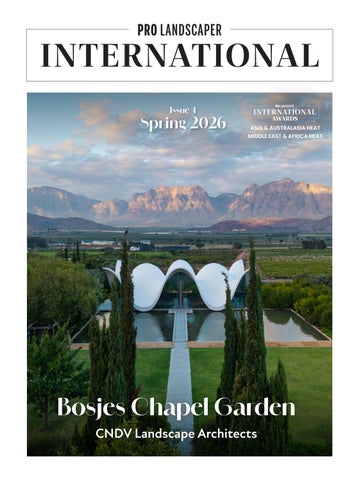
Issue 4
Spring 2026
Urmila Rajadhyaksha—our interview for this issue— talks about landscape architects having to play the role of activists in Mumbai, fighting for more space and working around shoestring budgets. But this isn’t limited to Mumbai. At a recent conference, Sir Tim Smit, cofounder of the Eden Project in the UK, issued almost a call to arms for the sector, arguing that we need to “yell, rebel, yell” about the profession and be brave enough to steal words such as health and wellbeing to stress the importance of landscape.
What you’ll see across the following pages is the possibilities when landscape wins; when it becomes on a par with the rest, if not the focus, of a development. These ambitious projects—shortlisted for the Asia & Australasia and Middle East & Africa heats of the 2026 Pro Landscaper International Awards—showcase some of the best of landscape design and construction.
From supporting eco-conscious living in Abu Dhabi, UAE, to reducing the noise from a double-decker highway in Jinan, China, to managing water and cooling the temperature in Bosjes, South Africa, landscape is multifunctional and vital to these awe-inspiring projects.
They mark the end of our regional heats for the 2026 Awards. On 8-9 June, we’ll be bringing together all our finalists from across the continents to compete at the final at FutureScape Global in Riyadh, Saudi Arabia—a country that is recognising the value of landscape as part of its Vision 2030. We hope to see some of you there!
Nina Content director
Architecture and landscape architecture firm Henning Larsen has won a design competition for a new mobility hub at the University of Konstanz in Germany which combines nature with campus life.
Featuring a new bicycle garage, wood-sheltered bus stop and central plaza, the design deprioritizes cars and instead lets people move through light, greenery, and open space. ‘The campus comes alive,’ says Hendrik Porst, head of department, idea and concept.
The design features canopy-like roof openings that bring daylight and natural ventilation to the lower level, while creating space for trees to grow through the structure itself and social areas for university students.
Guided by nature, the design transforms the dark, gray underground garage as an open and integrated environment constructed from recycled concrete.
The slightly concave roof will channel rainwater to retention boxes for irrigation and evaporation, while drought-tolerant and biodiversity-supporting plants reduce the need for additional watering.
The 7,000m2 hub project, located nearby the shores of Lake Constance in Germany bordering Switzerland, is expected to be completed in 2031.
New designs for immersive oasis leads biophilic living in India
Designed to promote well-being, community and biodiversity, the landscape design for a new residential development in Gurugram, India, sets a new benchmark for wellness-led, biophilic living.
Unveiled by landscape designers Grant Associates, the plans feature a sequence of interconnected garden experiences, blending hospitality-style amenities with nature-rich spaces.
Hosting pools, spa gardens, water features, shaded trails, an event lawn and a biodiverse woodland, the landscape design spreads across 12 acres.
Designed for Gaia Residence & Amstoria Verti-Greens, the residential area comprises a series of 45-story residential towers designed by DPA Singapore.
Construction began before Christmas and is expected to complete by 2032.
Developer Golden Sedayu has submitted planning for the Burswood Point water development in Perth, Western Australia.
The master plan is being led by Skidmore, Owings & Merrill (SOM), while the Precinct B landscape and public realm strategy is being headed up and designed by Grant Associates.
Set along the Swan River at the tip of
Shanghai Opera House
holistic regeneration approaches completion
Following a competition in 2017, Snøhetta, East China Architectural Design and Research Institute, Theater Projects, and Nagata Acoustics were commissioned to deliver the Shanghai Grand Opera House.
From initial concept to completion, architecture and landscape architecture
Burswood Peninsula just 3.5km from Perth CBD, Precinct B will deliver a mixed-use waterfront neighborhood on a previously untouched stretch of the foreshore.
Featuring public open spaces, riverfront parkland and civic gathering spaces, the landscape concept also includes a water sensitive urban design strategy with rain gardens, vegetated swales, permeable surfaces and native planting.
Precinct B is currently progressing through approval.
Gardens by the Bay embarks on new Wetlands by the Bay
Home to 1.5 million plants from across the world, Gardens by the Bay in Singapore kicks off its next phase of development with a new space known as Wetlands by the Bay.
Spanning approximately five hectares, the space will expand the existing Kingfisher Wetlands precinct along the waterfront promenade near the MRT station.
Featuring teamLab museum’s first-ever multi-sensory voyage, the development will move between indoor galleries and the open landscape.
A newly designed canopy boardwalk will extend over the wetlands, offering views of the surrounding nature.
Construction is set to begin in the first quarter of 2027, with its opening targeted for the end of 2028.
Flex Loh, Gardens by the Bay chief executive, says: “Gardens by the Bay is ever evolving to continuously provide fresh experiences for both Singaporeans and visitors.”
firm Snøhetta has designed the new Opera House to bring artists and the public under one shared roof with themes reflective of the surrounding environment.
The spiral staircase connects ground and sky, with views towards the city and the Huangpu riverbanks. The building also acts as a catalyst for urban regeneration, while highlighting the district’s ecological ambitions.
“The surrounding landscape adopts a radical layout that mirrors the opera house’s architectural geometry, reinforcing a holistic, low-carbon design vision,” says the studio.
Nearing completion, the Shanghai Grand Opera House is expected to open in the final months of 2026.
Perth expects transformation on untouched waterfront
Tsurpassed even that of China, making it the most populous country in the world—and it’s expected to hold that position for the rest of the century.“Today, we are a country that’s growing at a restless speed, with cities that are growing faster than they should and becoming dust bowls to an extent,” says Urmila Rajadhyaksha.
That’s why, even though she didn’t choose to be in the role, Rajadhyaksha is determined to use her position as honorary president of the Indian Society of Landscape Architects (ISOLA) to push the field into one that functions more professionally and one that sits at the forefront of developing spaces that are suitable for the swelling number of inhabitants.
Rajadhyaksha has already served as the founding chairperson of the Mumbai chapter of ISOLA and has been a member of the Society since its inception in 2003. She’s now in her second two-year term as president until 2027.
“As landscape architects, we are pretty low-key professionals. We are not really those who go out and sell ourselves. So, I can’t really
I got into it what I wanted.”
Choosing landscape architecture happened more by chance and “maybe good luck” for Rajadhyaksha too.“When I set out to study architecture, I didn’t know what landscape architecture was. We had very standard
professions that you’d choose from; you would either be an engineer or a doctor—or sometimes a lawyer, but even that wasn’t a very
architecture was itself a conscious deviation from the norm. At that time, it was the only architecture program in the state in which I lived, which was Kerala, to the south of India. One kind of chose the streams that one would want to work in by inclination, and there were few ways of gaining knowledge about practices that existed.”
Information came about through the people you met, or something you read, or chance encounters. That’s what happened to Rajadhyaksha. In 1986, in her third year of studying architecture, professor Ravindra
As landscape architects, we are pretty low-key professionals. We are not really those who go out and sell ourselves
Bhan—who founded the Master's program of Landscape Architecture at the School of Planning and Architecture (SPA) in Delhi— visited her college in Trivandrum, a “pretty
URMILA RAJADHYAKSHA IS USING HER POSITION AS PRESIDENT OF THE INDIAN SOCIETY OF LANDSCAPE ARCHITECTS TO MAKE A LASTING IMPACT ON HER COUNTRY’S APPROACH TO THE PROFESSION
remote” area in those days.“The works he presented included the memorial that he created for the late Prime Minister Indira Gandhi—the design itself as well as the pragmatism of his approach and the way he described how he fashioned the site really fascinated me. It was there and then that I decided that, if I’m doing a Master's after architecture, it would be landscape architecture—and eventually, I went on to do it in the same institution where he founded the program.”
Growing visibility
When Rajadhyaksha left university, she went to Chennai, where landscape architecture as a profession was “very nascent”. There, she worked in an architect’s office doing both architecture and landscape architecture. A couple of years later, she moved to India’s largest and most populous city, Mumbai, the city she now calls home and it was here that she first worked as a landscape architect.
Her first project was for a city park, working with senior professionals at the firm on a design that has since been emulated by others.
Designing landscapes in Mumbai brings out the activist in you, because you’re always fighting for that little bit more space or something that people can use
Whilst other Master’s programs developed from a Ford Foundation grant for higher education eventually had undergraduate courses created to precede them, this did not occur in landscape architecture— which places the profession at something of a disadvantage.
“We are in a country of over a billion. Landscape architects are a very small community because we only become landscape architects by doing a Master's program; we do not presently have a Bachelor's. So, the number of people who become landscape architects is smaller than other professions.”
ISOLA being formed two decades ago gave it a louder voice, though.“We only had about three Master's programs for landscape architecture at the time the Society was founded; today, we have 12 to 14. The existence of the Society, the visibility that it gave the profession, has helped the profession itself to grow, as well as the infrastructure growth that we see in the country. People are now aware that there is a profession called landscape architecture.”
Studying at SPA in New Delhi, the capital of India, made a huge difference to Rajadhyaksha’s own viewpoint.“It was the political nerve centre with major developments happening and the college reflected this with buzzing activity as it offered various programs in planning, urban design, urban conservation as well, and some of the best-known architects of the day taught or lectured there and we could interact with on a one-on-one basis. That exposure, though it was for a very short time, really made a difference to one’s perception.”
“In a way, it was a landmark that was being created, though I didn’t know that at the time.” The park was being renovated by a developer who lived in the vicinity in memory of his recently deceased wife and we as designers were encouraged to innovate.
“Parks used to be very standard. The municipal corporations that maintained them were not as rich as they are today. They were free to enter, which we changed slightly—we introduced an entrance fee for part of it and kept a vast central space open, because we felt we shouldn’t take it away from people as Mumbai is an open space starved city.
“We created a raised jogging track—a novelty in those days. It was a stabilized mud track, whereas hard paving had been the norm before that. Mud is always difficult to deal with in a
monsoon city like Mumbai which experiences heavy rainfall, so we used Australian technology to help stabilize the jogging track, and we elevated it so that the water would drain off and not stagnate on top. We created subsoil drainage from scratch, making holes in pipes, which today you get as ready fixtures. We also introduced play equipment and a musical fountain. It’s become a really popular venue for ad film shoots, so every now and then I’ll catch a glimpse of it on some television commercial."
Shoestring budgets
Rajadhyaksha’s approach has leaned towards ‘appropriate architecture’ for India, using natural materials. This is partly inspired by Laurie Baker, a Scotsman who settled in Trivandrum, the city where Rajadhyaksha studied.
"His philosophy was to do away with the unnecessary, which meant minimizing the high energy material used and use the benefits nature offered. That was the kind of architecture that I really empathised with. That didn’t really work in Mumbai when I came here. It was a big city, a developing metropolis. But the influence of conserving materials, working around what you have, was something that has gone into the landscape architecture that I do.”
Indian culture is very much to respect and reuse, says Rajadhyaksha. Take Chipko, a forest conservation movement that began in the 1970s.“This happened in the villages of the Himalayan hills. When people came to fell trees for timber, the women clung onto each tree out
of cultural belief that they were sacred.” It successfully halted commercial logging in the Himalayan region, resulting in a 15-year ban on tree felling above 1,000m that was imposed by Prime Minister Indira Gandhi in 1980.“It eventually got reversed—but it’s a huge country, and our cities are growing. We have a mixed culture. We have some of those roots still within us. We also tend to get on with the hustle and bustle of life, so we sometimes tend to push it aside. It’s a mix of both.”
The other area Rajadhyaksha branched into was heritage landscapes. Take the Chhatrapati Shivaji Maharaj Vastu Sangrahalaya (CSMVS), formerly named the Prince of Wales Museum of Western India, which was built before the First World War and was used as a hospital to cope with casualties. The building’s Indo-Saracenic design came with symmetrical gardens, which Rajadhyaksha was commissioned to restore “on a shoestring budget”.
Fortunately, it was a success. The Museum has since received a UNESCO-Asia Pacific Honourable Mention for Cultural Heritage Conservation of the Building and, eight years ago,
it was declared a UNESCO World Heritage site. “The best compliment I got, though, was from some of the people who worked in the museum. We initially uprooted everything that was planted over there and they were horrified as we were removing the bit of green that they had. But when it was all done, they said we’d really made a difference to the place, and they were seeing that every day. That was really great.” Then, like most countries, the ongoing challenge is finding funding for maintenance.“We depend heavily on grants for projects,” says Rajadhyaksha.“Mumbai is a port city which grew on trade, and for many of the landmarks as well as other projects, the people who rise to the occasion are usually the merchants of Mumbai—the business houses like The Tata Group and Jindal, and even Bank
The influence of conserving materials, working around what you have, was something that has gone into the landscape architecture that I do
of America has often been a supporter. So, many of these are the ones who step in and give where it’s required, and that’s how we manage to keep things going and even expanding facilities."
Wider influence “Designing landscapes in Mumbai brings out the activist in you, because you’re always fighting for that little bit more space or something that people can use. But
Mumbai is also a head business city, so a lot of decisions happen in Mumbai which affect places outside of the city. In that sense, Mumbai is an interesting location—so many projects that get sanctioned here affect the country that surrounds it. And Mumbai is presently teaming with infrastructure renewal. There’s a lot of activism going on around what open space we do or don’t get, or whatever is going to be designed. So, advocacy becomes part and parcel of your profession, even if it doesn’t pay your fees.”
associated, primarily, with beautification and you were called into a project at a later stage to make it look pretty. So, there’s been a change in that attitude for sure.”
Beginning Bachelor's programs in Landscape Architecture is something which I have really set my mind to try
and do. I hope I succeed
Part of that progress will come from the profession being less insular and connecting with other countries. That’s why ISOLA hosted the IFLA APR in November last year, with nearly 2,000 people flocking to Mumbai for the event.“We’ve taken this much of a leap since 2003. To do the next leap, we need to put in a lot of work.”
The infrastructure renewal Rajadhyaksha mentions includes Mumbai’s expanding metro network, where there’s a target of creating a 523km system by 2030.“We also have a lot of new roads being implemented, and a lot of new spaces being carved out by all these linear infrastructure projects that are happening. Those are our opportunities.”
Rajadhyaksha hopes these will create more enjoyable cities, to which landscaping should be key.“I’d like to see cities where you could walk or use public transport and enjoy the daily life you live. We are putting in structures for that purpose, but along with the major work we are doing, we need to not lose out on greenery, and the natural aspects that we have need to be incorporated as well. We should have a blue-green code for every infrastructure program. Only then could we have the city that we would like to live in, or we would like our children to live in.”
And whilst Rajadhyaksha is pleased to see her home city investing in this, she’d like to see a more equitable distribution of opportunities across the country. Existing transport infrastructure is bursting at the seams because of a growing population and many people are coming to Mumbai for opportunities that they don’t have in their own city, says Rajadhyaksha.
“It’s very difficult to understand what’s moving forward in our country because we always seem to be taking two steps ahead, then one step or sometimes even two steps back. But we need to keep going, and maybe five or 10 years down the line we’ll start to see the difference. I can see a difference from when I started 40 years ago. Landscape architecture was
Attracting the next generation will also be key.“When we began ISOLA, it was kind of a family attitude. Nobody would miss a conference because it was a chance to meet everybody once more. This is something that’s there with the senior members of ISOLA, but with the younger generation, it’s more about, ‘What’s the society doing for me? How does it help me?’ That’s not limited to landscape architecture. So, we’ve decided to look at improving opportunities. Even the outreach to other countries is, to some extent, aimed towards that.“We’ve also looked at career advice, as well as setting up institutions which help to showcase landscape, which still has a long way to go.”
Hosting the IFLA APR went towards giving landscape architecture “a sense of a larger existence” in India.“Right now, in our country, for
every landscape architect, we probably have 100 architects, and maybe about 10 times the number of engineers, so we kind of get lost. So, bringing out the presence, maybe slightly glamorizing the profession and raising it to another level, promoting what the profession does, will hopefully give it more visibility and encourage more people to join.”
In her present position as the head of the department for a Master's Program in Landscape Architecture, Rajadhyaksha is mentoring new landscape architects, but she also has put a Bachelor's degree in Landscape Architecture in India on her agenda. It’s a huge country. There are many voices of opinions and dissents, and usually a change like this would have to be at the Government of India level. So, it requires a certain amount of political clout and lobbying—but beginning Bachelor's programs in Landscape Architecture is something which I have really set my mind to try and do. I hope I succeed.” The activist in Rajadhyaksha will undoubtedly try everything in order to do so.
Inspired by an African-Mediterranean aesthetic, Perfect Technical Works and Landscaping reimagines the penthouse residence’s outdoor space at the One Palm hotel on Palm Jumeirah to reflect its luxurious character. One of Dubai’s most exclusive residential projects, the series of 94 homes has become a landmark destination on the beachfront.
Featuring thoughtful spatial planning, the once-empty space with minimal identity is now a vibrant living environment. Curated from the orange and green palette, the warm and
immersive sanctuary overlooks Dubai’s iconic skyline and Arabian Gulf waters across three distinctive zones.
A private wellness garden and outdoor gym, decorated with mature trees and lush greenery, guides guests into a serene pool area before stepping into the scenic terrace hosting pergola-shaded seating. The space is enhanced with water features, an outdoor BBQ area and fire pit.
To thrive within the intense UAE climate, materials and plant species have been chosen with resilience in mind.
The landscape wraps around the penthouse apartment, designed for relaxing, socialising and reflecting. Only separated by floor to ceiling windows, the gardens form a close relationship with the interiors. Now a refined living space, the Rooftop Landscape Penthouse invites people to engage with their surroundings in an entirely new way.
Perfect Technical Works and Landscaping LLC stands out as a leading provider of landscaping and technical services, recognized for its commitment to excellence, innovation and operational efficiency. Through a highly skilled workforce and strong leadership, the company consistently delivers high-quality projects while maintaining the highest standards of safety and sustainability. Its customer-centric approach and proven track record position it as a trusted and forward-thinking industry leader. perfectdxb.ae
Shortlisted:
Residential Project Under $500k
Kalrav Villa
Project Details
Gujarat, India
EShortlisted: Residential Project Under $500k
very winter, migratory birds travel vast distances to the wetlands of Thol Lake in Gujarat, filling the landscape with movement, color and sound—locally known as Kalrav. Inspired by this phenomenon, Kalrav is a 6,000 sq ft yard residential landscape near the Thol Lake Bird Sanctuary in Ahmedabad, developed in two phases, completed in 2020 and 2024.
The project reimagines a home as a living ecosystem where water, plants, birds and people coexist. Influenced by the site’s rich ecology—with the area being home to 160 bird species—the design draws from natural wetland systems. The idea emerged from the client’s love for birds and desire to create a peaceful, nature-integrated environment.
A central aviary anchors the layout, dividing the site into a social zone and private residential area. The landscape was developed first, allowing ecological systems to establish.
Phase one focuses on a cascading bio-pond system, where water flows through multiple levels and is naturally filtered by wetland vegetation. Phase two integrates the residence with dense plantations, courtyards and open lawns, strengthening the indoor-outdoor connection.
Using native planting, rainwater harvesting and natural materials, Kalrav evolves beyond a garden into a thriving habitat, where architecture recedes and nature takes the lead.
ABOUT VPA ARCHITECT S
VPA Architects is a multidisciplinary design studio offering architecture, interior design, and landscape architecture services. The landscape practice at VPA is driven by strong conceptual thinking, ecological sensitivity, and an exploration of diverse design languages. Its aim is to paint the earth green with creativity while crafting meaningful, luxurious, and sustainable outdoor environments. vpaarchitects.in
The award-winning “Original Land” project in Dongguan, China, is situated in a mature neighborhood and adjacent to a park with distant mountain views—an arrangement considered favorable for its feng shui. As the final phase of a multi-stage development, the site presented both opportunities and constraints, including limited space, an existing architectural plan, and a 5-6 meter cut slope along the boundary.
Rather than treating these constraints as limitations, Attractions International transformed them into defining features. The retaining wall became a central element, which incorporates water features, textured surfaces, and mist effects to create a dramatic focal point while minimizing water and energy use. A key innovation
Project Details
Location
Dongguan, China
was reimagining the basement swimming pool by introducing natural light, ventilation, and a connection to an outdoor environment, significantly enhancing user experience.
Integration with the adjacent public park and a future community centre was carefully managed to balance accessibility and residential privacy. Stepped planting, screening, and transitional spaces helped blend the development into its surroundings.
Above the parking lot, layered gardens, courtyards, and social spaces create a rich residential landscape despite structural constraints. The result is a cohesive, ecologically responsive environment that turns challenges into defining features, contributing to commercial success and critical acclaim.
Attractions International is a multidisciplinary landscape architecture and planning practice. Founded on a commitment to design excellence, the firm focuses on luxury developments in the field of mixed-use retail and entertainment, resort environments, residential communities, commercial place making and a specialty tourism division providing design services to theme parks, water parks, aquariums and zoos. Over the past 30 years, Attractions International has delivered work across Asia, the Middle East, Europe and North America. attractions-international.com
Original Land
Project Details
Location
Masdar City, Abu Dhabi, UAE
Project value N/A
Size of project 131,000m2
Status In construction
Expected completion 2028
OFay HillsU+A
ffering a new multi-generation contemporary community life for all, Fay Hills centers around pedestrian connectivity in UAE’s capital, Abu Dhabi. Featuring a research and development cluster, shops, restaurants, residential neighborhoods, community centers, parks and plazas, the project intends to encompass all respective needs of its residents.
Offering a total of 130 eco-friendly villas across three parks, the Fay Hills vibrant lifestyle combines eco-conscious living with luxury. Looking to balance of cultural living, modern architecture and sustainable design, properties are targeted towards families seeking both investment potential and long-term lifestyle benefits.
Shaped by three forces of nature—earth, air and water—the landscape is translated into a sequence of connected outdoor experiences that support both community life and wellbeing. The first, Terra
Park, forms the grounded community heart which provides social spaces, shaded gathering areas and tactile planting.
Aria Park introduces movement and vitality with open and flowing landscapes designed for wellness and recreation. From soft pathways, lawns and planting, this space encourages physical activity and everyday interaction.
Garnished with cool planting and contemporary seating, Aqua Park offers a calm, reflective retreat that enables residents and visitors to connect with nature within a tranquil environment. The three realms create a balanced landscape located just a stone’s throw away from Zayed International Airport and Khalifa City.
U+A, a member of 10N Collective, created by Egis, is a leading regional architecture and design firm offering a multidisciplinary approach across architecture, interior design, landscape architecture, urban, and master planning. The team combines global expertise with regional insight to produce functional spaces that support community and sustainability. ua-intl.com
Desert Nest Qatari Pavilion
DAR AL-HANDASAH
Landscape architecture Dar Al-Handasah
Project Team
Client Qatar’s Public Works Authority (Ashghal)
Project Details
Desert Nest Pavilion project explores how landscape can support life in arid environments, inspired by desert ecosystems and cultural practices in Qatar.
Dar Al-Handasah's design draws on key ecological typologies of Qatar across the design—from rawdat, sabkha and wadi landscapes. Together, they form a layered strategy that expresses resilience and seasonal variation, while shaded pathways, gathering spaces and a plaza connect these environments into a continuous and legible journey.
In the center, a 3D-printed concrete structure—named Burj Al-Hamam—is a contemporary interpretation of traditional Qatari pigeon towers. Awarded a Guiness World Record in 2022 as the world’s tallest freestanding 3D-printed tower, the structure is historically used to support desert agriculture featuring bird habitats to enable a natural fertilization system, in turn enriching nutrient-poor soils.
Encompassing a curated palette of native planting and adaptive species, the project also includes edible and ornamental planting. Shaded spaces and layered vegetation enhance microclimate comfort, allowing visitors to immerse themselves within the landscape.
Ultimately, it reframes the desert not as a constraint, but as a system to work with—where design becomes a means of restoring balance between people, place, and nature.
ABOUT DAR AL-HANDASAH
Dar Al-Handasah, founded in 1956, is an international, interdisciplinary practice shaping places with precision and intent. A founding member of Sidara Collaborative, Dar brings together design and engineering expertise within a global perspective shaped by context, climate, and the rhythms of everyday life—creating places defined by how people move, gather, and experience them. dar.com
Project Team
Client and developer Musanada Nael Bin Harmal Hydroexpert Department of Municipalities and Transport
Landscape designer ICON
Corniche Al Grum ICON
Project Details
Location Abu Dhabi, UAE
Project value N/A
Size of project 135,740m2
Status
Complete
Completed 2020
OShortlisted: City Landscape Project
nce a fenced, shared walkway with limited water contact, the two-kilometer corniche between Sheikh Zayad Bin Sultan Street and the Eastern Mangrove National Park is now a nature-led public realm evoking opportunities for learning, leisure and everyday interaction with the mangroves.
Ensuring safe movement and accessible views, the promenade has been extended by six meters, now featuring 13 waterside nodes spaced 250m apart to create regular points for rest, shade and interpretation for visitors. Intended to be used by families, joggers and cyclists alike, the landscape hosts landscape buffers and hostile vehicle migration at busy points of the trail.
Enhanced with integrated lighting, irrigation and signage, the landscape is ready for all-season use. The design also optimizes an existing corridor to deliver cooling shade, biodiversity and continuous waterfront access to highlight cultural and environmental significant into everyday urban life.
Adorned with shaded pergolas, native planting and locally sourced materials, the site’s longevity grows by strengthening ecological value while recusing maintenance intensity over time.
By integrating movement, ecology, and community within a constrained right-of-way, Corniche Al Gurm demonstrates how city infrastructure can become a vibrant, inclusive landscape that measurably enhances quality of life.
ABOUT ICON
Founded in 2006, ICON is a global award-winning landscape architecture and engineering firm focused on creating resilient, people-centered spaces where communities flourish and nature is nurtured. Its integrated approach blends design excellence, technical skills, and environmental responsibility to produce inspiring landscapes and sustainable urban systems. iconspaces.com
MOVEMENT FOG, LIGHT &
Project context
Eau Claire Plaza in Downtown Calgary, Canada demonstrates how water features can be designed as long-term public realm infrastructure rather than seasonal amenities. In a coldclimate city where winter defines much of the year, the project sets a precedent for how water, light, and interaction can work together across seasons to support comfort, identity, and everyday civic life.
responsible for water feature design, choreography, and manufacturing of all water feature components.
The Eau Claire Plaza project was led by DIALOG as prime consultant, with the City of Calgary as prime stakeholder. Crystal Fountains was
Design intent and evolution
From the outset, the design centered on two key goals: creating a multigenerational, year-round public experience and improving microclimate comfort through evaporative cooling in the summer. Early concepts explored a range of traditional jets and water expressions, but the final design intentionally refined the feature to a single water medium—fog. Paired
with integrated lighting, fog offered the most inclusive and flexible solution, encouraging interaction without visual or physical barriers.
The fog field and interactivity
The completed installation spans 400 sqm and comprises 79 custom fog niches, 43 of which include integrated LED ring lights, organized into 12 programmable activation zones. Four stainless steel bollards allow visitors to trigger sequences, introducing intuitive interactivity that supports a wide range of users, from children to seniors. Rather than acting as an object within the plaza, the fog operates as a ground-plane atmosphere, inviting people to move through the space while remaining visually subtle within the broader landscape composition.
In the summer, fog provides cooling benefits while creating a playful, tactile
The Eau Claire Plaza Project story. By Robert Mikula, director of creative design at Crystal Fountains
PROMOTION
experience that responds to wind, light, and human movement. Its lowpressure, low-flow nature supports safety and accessibility, making the feature inherently water efficient and multi-generational.
Lighting as night-time identity
Lighting plays a critical role in extending the feature’s contribution beyond daytime hours. Fully addressable LEDs enable controlled color, intensity, and sequencing, supporting evening activation and seasonal programming while reinforcing the plaza’s identity against Calgary’s urban backdrop.
Winter mode and protection
In cold-climate cities, the true test of a water feature is what happens when the water is turned off. At Eau Claire Plaza, winterization was embedded into the design intent rather than treated as an
operational afterthought. Cylindrical winter covers protect deck-level components while keeping the lighting system active.
When water is offline, the feature transitions from fog to light, becoming a luminous winter installation that sustains presence, legibility, and evening use throughout the colder months, further supported by pre-programmed shows that can be triggered using the bollards.
A precedent for landscape architects
For landscape architects, Eau Claire is a precedent in designing a water feature as a four-season public realm infrastructure that sustains visitation, not just operation. By pairing an intuitive, walk-up interactive
field with a deliberate seasonal protection strategy, the feature remains a consistent draw, supports programmed and unprogrammed use, and strengthens the plaza’s role as a year-round civic destination.
The result is a water feature that reinforces place identity while helping the public space keep momentum across the full annual cycle.
Contact Crystal Fountains
Eau Claire Plaza blog post
ICON reimagines the role of streetscapes by transforming movement corridors into immersive civic spaces while linking Louvre Abu Dhabi, Zayed National Museum, and the Abrahamic Family House along a continuous shaded spine.
Designed to elevate public realm into a cultural and social experience, the strategy conveys passive and active cooling. Featuring endemic planting, layered canopies, the shaded promenades naturally generate their own microclimates to reduce heat gain while fostering biodiversity.
Located across targeted zones, embedded cooling technologies activate during peak conditions to ensure year-round comfort for passersby while minimizing energy consumption. From radiant surfaces, misting and floor-ducted air systems, ‘cool spots’ punctate the path every 400-500m to offer relief along one's journey.
Along the Cool Path stands urban amphitheaters, cafes, art pockets, hammocks and cycle paths. The project integrates sustainability with urban identity, creating a people-focused landscape that makes outdoor life possible in Abu Dhabi’s dense climate.
ICON looks to create a new benchmark for future city-making with projects such as this.
Lighting design Studio Lumen Landscape designer ICON Design Genius Loci
Saadiyat Cultural District – Cool Path
UniPark
ATTRACTIONS INTERNATIONAL
This 100,000 sqm mixed-use development in Jinan, China, was delivered for China Overseas Company following a competition win in 2022. The key challenge was its proximity to a double-decker highway, which created noise, visual intrusion, and an unwelcoming edge for a commercial destination.
With open plazas required and tree cover limited, the design focused on alternative ways to soften the impact. A central move was the introduction of a sunken plaza,
expanding the excavation already needed for underground parking. This created a sheltered, multi-level public space connected directly to the basement food court, improving accessibility while reducing noise exposure. External escalators and clear circulation routes helped draw visitors in from multiple directions.
To support the surrounding residential community, the scheme integrates outdoor amenities including a sports park, skate area, and family water play zone. A rooftop—less
Location
Licheng district, Jinan, China
Project value
$12m approx.
Size of project
100,000m2
Status Completed Completed 2022
affected by traffic—was activated with low-cost materials, forming a jogging circuit, event space, and wedding lawn linked to the hotel. Simple materials, integrated seating, and clear wayfinding ensure usability across the large site. Water features and lighting
ABOUT ATTRACTIONS INTERNATIONAL
Attractions International is a multidisciplinary landscape architecture and planning practice. Founded on a commitment to design excellence, the firm focuses on luxury developments in the field of mixed-use retail and entertainment, resort environments, residential communities, commercial place making and a specialty tourism division providing design services to theme parks, water parks, aquariums and zoos. Over the past 30 years, Attractions International has delivered work across Asia, the Middle East, Europe and North America. attractions-international.com
enhance evening activity while remaining flexible for events.
Attractions International created a lively, community-focused destination where the sunken plaza, in particular, provides a safe, engaging environment despite the nearby highway.
Mineral rich waters flow from Cogman’s Kloof into natural hot springs that bubble to the surface at 43 degrees in the thermal pools and spas at Avalon Springs, South Africa. Once an aging hotel with five pools, the new vibrant destination now features 10 pools and four mini spa pools, all provided by the same hot water source.
The award-winning project celebrates the unique rural setting between rocky landscapes overlooking a dramatic mountain valley in the semi-arid Little Carew, near the town of Montagu. The shapes and formations of each pool reflect the characteristics of its surrounding rock formations.
Material has been selected by CNDV Landscape Architects to reinforce Avalon’s connection with space. Local stone from
Montagu and Roberston was used extensively while exposed local aggregate concrete and cut river boulders sourced from the valley were used as paving materials.
A keen visitor of the area, the baboon had to be discouraged from coming back and raiding the gardens. Therefore, the project features plants naturally occurring in the valley but grown specifically for the garden that would be unpalatable for a troop of baboons.
The pools were redesigned with varying depths and temperatures to accommodate both adults and children, all within the thermal bathing environment. With thoughtful landscape design, Avalon Springs celebrates its surrounding environment for a tranquil setting.
ABOUT CNDV LANDSCAPE ARCHITECTS
CNDV Landscape Architects is a Cape Town–based, award-winning firm and a leader in landscape architectural design in South Africa, with over 25 years of experience. The practice delivers distinctive, high-value spaces across a wide range of projects, from intimate gardens to large urban environments.
cndv.biz
Avalon Springs
CNDV LANDSCAPE ARCHITECTS
Project Details
Location Montagu, Western Cape, South Africa
Project value
R 20 million
Size of project 130,000m2
Status Completed Completed 2023
Shortlisted: Commercial Project
Once a neglected wine farm that saw minimal traffic, Bosjes Chapel Garden is in a remote setting with dramatic mountainous views, located in the foothills just two hours from Cape Town in South Africa. CNDV Landscape Architects was set to create a destination between the site's areas of degraded field, vineyards, graveyard and old manor house.
Now, the space hosts an experiential garden anchoring a new wedding chapel and wine tasting room in keeping with the original manor house and graveyard.
Bosjes celebrates the site’s abundant water resources—whilst acknowledging that it’s a scarce resource in the country— as well as featuring locally sourced planting and materials. The garden carefully reuses water from dams, boreholes and circulation systems of the water features that embellish the space. Not only do these features reinforce reflection and the spiritual narrative, but the water also provides evaporative cooling during the summer months.
Each space of the vast landscape references a biblical narrative, creating a series of interconnected garden rooms responding to environmental requirements within symbolic areas. From a lush garden, into a water garden through into the dry mountain and finally a sheltered oasis.
Now a globally recognized garden, Bosjes transforms a derelict farm into a destination of meaning.
Project Details
Landscape architects CNDV ArchitectsLandscape
Team Architect Steyn Studio, TV3 Architects & Town Planners Landscape contractor Interplant Horticulture
BosjesGardenChapel
CNDV LANDSCAPE ARCHITECTS
Shortlisted: Commercial project
ABOUT CNDV LANDSCAPE ARCHITECTS
CNDV Landscape Architects is a Cape Town–based, award-winning firm and a leader in landscape architectural design in South Africa, with over 25 years of experience. The practice delivers distinctive, high-value spaces across a wide range of projects, from intimate gardens to large urban environments. cndv.biz
Al Qana Waterfront ICON
Shortlisted: Commercial project
Awaterfront destination, Al Qana has been transformed into a vibrant public realm linking retail, dining and entertainment areas. The 2.4km promenade and pedestrian bridges have been designed to support foot traffic, dwell time and event programming throughout the trading day. Inspired by crystalline salt flakes, the canal geometry creates a memorable waterside edge and distinct sense of place. Characterized by long views and inclusive walkways for all, the waterfront invites active play, passive seating and events along the promenade.
Dotted along the geometric edges, water features offer a combination of benefits for the passersby. While the trailing water
cools the promenade, its reflective surfaces amplify light as the sun sets, providing an atmosphere from day until nightfall, and there’s an array of streams, waterfalls and rills. Sensory play supports inclusive use for all ages.
ICON has decorated the space with planting tuned to desert conditions, using planters atop slabs and noninvasive species, while trees create shaded areas in the midst of the Abu Dhabi heat. Looking to support heavy foot traffic all year round, high SRI paving has been laid to mitigate heat at pedestrian scale, alongside the use of durable edges, steps and seating.
Al Qana intends to anchor everyday leisure with tourism while elevating everyday quality of life.
Founded in 2006, ICON is a global award-winning landscape architecture and engineering firm focused on creating resilient, people-centered spaces where communities flourish and nature is nurtured. Its integrated approach blends design excellence, technical skills, and environmental responsibility to produce inspiring landscapes and sustainable urban systems. iconspaces.com
Framing the Louvre Abu Dhabi art museum, the concept garden design creates a climate-active civic stage combining heritage, ecology and everyday life. The first universal museum in the Arab world, the Louvre celebrates stories of cultural connections, just as landscape designer ICON’s concept intends to.
In order to optimize space, the concept moves through a sequence of three elements. Between the desert, oasis and the sea, the design invites movement, gathering and nature within a compact urban footprint.
A wadi promenade doubles as a green cultural corridor linking the city, museum and the sea. Beneath elevated walkways, a hydrology system captures rain and surplus irrigation water into micro-basins, following sponge-city principles to cool, humidify and recharge the soil.
On the ground, tall trees stand to sculpt wind and create shade to form comfortable microclimates for
visitors. Adorned with native and adaptive planting, the space lowers irrigation demand and fosters biodiversity within an arid climate.
From reflective water features, shaded plazas and an array of event space, the public realm design has been devised in order to enrich community life while maintaining inclusivity for all as well as clear views of both the museum and the surrounding environments.
ABOUT ICON
Founded in 2006, ICON is a global award-winning landscape architecture and engineering firm focused on creating resilient, people-centered spaces where communities flourish and nature is nurtured. Its integrated approach blends design excellence, technical skills, and environmental responsibility to produce inspiring landscapes and sustainable urban systems. iconspaces.com
Le Louvre Abu Dhabi Garden
The Source Garden
Nestled in the midst of Saadiyat’s cultural district, this climbable garden concept—which reimagines a circular podium roof newly finalized development The Grove—offers panoramic views overlooking landmarks such as Zayed National Museum and Le Louvre Abi Dhabi.
A multi-tier planting strategy, from meadows to canopy, incorporates native and climate-adapted species, with select zones permitted to self-seed. Referred to as a ‘garden in motion’, the adaptive space enhances habitats for pollinators and birds while building resistance to heat and drought.
Prioritizing lush, green planting, the roofscape features closed-loop irrigation guided by soil-moisture sensors. Rainwater will be captured for storage, just as rain gardens filter pollutants.
Terraced landforms turn technical systems into a living, walkable garden, featuring benches and steps that slow water runoff and shape cool microclimates. An identity structured by graphic lines and layered planting, the concept offers an accessible path for all.
Underpinned with a community focus, elements across the garden are framed by views of the city. From barrier-free pathways to shaded seating and sensory spaces, the roof transforms into a living classroom for everyday use.
Offering a model for arid cities and warm climates, the Source Garden highlights inclusive public life within a limited urban space overlooking some of Abu Dhabi’s finest architecture.
ABOUT ICON
Founded in 2006, ICON is a global award-winning landscape architecture and engineering firm focused on creating resilient, people-centered spaces where communities flourish and nature is nurtured. Its integrated approach blends design excellence, technical skills, and environmental responsibility to produce inspiring landscapes and sustainable urban systems. iconspaces.com
Project Details
Project Details
Location Tamil Nadu, India
Size of project
52,609m2
Status
Concept
Shortlisted: Conceptual Design
ABOUT RAVIKUMAR AND ASSOCIATES
Ravikumar and Associates (RaA) is a Chennai based professional design team founded in 1995 by architect and landscape architect Ravikumar Narayan.
RaA has been involved in more than 1,000 projects of various scale, typology, culture, climate and terrain in India and aboard, right from the coastal zones of Kerala to the hilly terrains of the Himalayas including Mauritius Islands.
ravikumarassociates.net
Achireum
RAVIKUMAR AND ASSOCIATES
With the client’s name, Achireum, meaning ‘surprise’, Ravikumar and Associates’s design for its ecotourism resort in Mudikkarai, Kalayarkoil needed to be outside the box. Enter a masterplan for a 13-acre “Living Landscape Where Culture and Nature Meet”. Ravikumar and Associates looked to Chettinad in Tamil Nadu, India for inspiration, putting a contemporary spin on the dry region’s traditional settlement
patterns, water management systems, agricultural fields, and sacred groves, preserving native tree species and creating habitats for fauna. Eco ponds, bioswales and retention systems are a nod to its “water wisdom,” but it’s reinterpreting the area’s cultural streetscape that sits at the heart of the design, creating a “pedestrian spine” for community events.
To create a holistic experience for visitors, there are elements such as
rejuvenation spaces, agroforestry zones and artisan workshops, whilst the agroforestry landscape provides experiences such as bullock cart rides and engaging in farming practices. There are activities such as nature walks, tree houses, adventure games, and apiculture—all of which weave ecological conservation with experiential tourism.
Together, these zones form a mosaic of cultural and ecological experiences that embody the spirit of Chettinad.
Avilala Ecopark
RAVIKUMAR AND
ASSOCIATES
Shortlisted: Conceptual Design
Wetlands, wildflower gardens and a network for trails all centered around a restored lake ecosystem—Avilala Ecopark brings together habitat restoration and public realm with the history of the 150-acre site. Infilling and degradation have turned what was once part of Tirupati’s traditional tank system into a somewhat bare landscape; but Ravikumar and Associates’ design would the reestablish water systems whilst bringing a whole host of other benefits to both people and wildlife.
Drawing inspiration from the Chittoor district, which Tirupati used to be part of until recently, it reintroduces four dominant ecological typologies to Avilala Ecopark: hills, forests, agricultural fields and lake ecosystems. Ravikumar and Associates has used these to create five interconnected
zones within the park: Preservation & Habitat, Experience, Resource & Knowledge, Community & Social Recreation, and Services & Infrastructure.
Wetlands, bioswales and rainwater harvesting systems support the restored lake ecosystem, which includes boardwalks, viewing decks, and lake trails, the latter of which form part of a network of trails. There are agricultural landscapes complemented by wildflower gardens, butterfly gardens, botanical gardens and arboretums, whilst arts and crafts zones, event spaces and public parks all help to create a new civic quarter.
Avilala Ecopark transforms a barren landscape into a resilient ecological and cultural destination for the city of Tirupati.
ABOUT RAVIKUMAR AND ASSOCIATES
Ravikumar and Associates (RaA) is a Chennai based professional design team founded in 1995 by architect and landscape architect Ravikumar Narayan.
RaA has been involved in more than 1000+ projects of various scale, typology, culture, climate and terrain in India and aboard, right from the coastal zones of Kerala to the hilly terrains of the Himalayas including Mauritius Islands. ravikumarassociates.net
Project Details
Location Tirupati, India
Size of project 607,028m2
Status
Concept
Project Details
Location Chennai, India
Size
Ripon Building RAVIKUMAR
AND ASSOCIATES
Acivic landmark, the Ripon Building has become an iconic example of neoclassical architecture since it was built in 1913, housing the Greater Chennai Corporation, the oldest municipal corporation in India. But it needs a landscape that blends heritage architecture with contemporary urban life. The Ripon Building Campus Landscape Redevelopment transforms the 10-acre site, which has been historically incoherent, into an accessible public realm.
Ravikumar and Associates’ proposal brings the architectural style of the building into the surrounding landscape, using neoclassical garden design principles such as symmetry and geometric parterres to add gazebos, colonnades, statues, and carefully structured open spaces.
From the restored vistas and sculptural focal points of the Entrance Court, the campus unfolds into the People’s Park, a vibrant network of interconnected outdoor rooms designed for everyday civic life, with the center acting as a “circular amphitheater” for cultural events, festivals, and public gatherings. Next to this lies the Ripon Garden, where
formal promenades and water features frame the façade of the historic building.
It’s a pedestrian-first environment, prioritizing walkability, but with discreet multi-level parking. Environmental resilience is also embedded through elements such as the Eco-Pond.
The masterplan merges heritage, ecology and civic life, creating a landscape both fitting for the iconic Ripon Building and for the city of Chennai.
ABOUT RAVIKUMAR AND ASSOCIATES
Ravikumar and Associates (RaA) is a Chennai based professional design team founded in 1995 by architect and landscape architect Ravikumar Narayan. RaA has been involved in more than 1000 projects of various scale, typology, culture, climate and terrain in India and aboard, right from the coastal zones of Kerala to the hilly terrains of the Himalayas including Mauritius Islands. ravikumarassociates.net
Discover the versatile and surprising range at Boom & Bonheur. Be inspired by distinctive plants that add character and atmosphere to any garden or outdoor space. A beautiful example is Crataegus crus-galli, grown as an elegant topiary form. In spring, it bursts into bloom; in autumn, it delights with vivid red berries and stunning crimson foliage. A true eye-catcher — and a magnet for butterflies, bees, and birds.
Just one example of what Boom & Bonheur has to offer. Visit us and let yourself be surprised by the diversity and quality of our nursery! Boom & Bonheur – because trees give life and bring happiness! Boom & Bonheur BV boombonheur.com