APRIL 2026
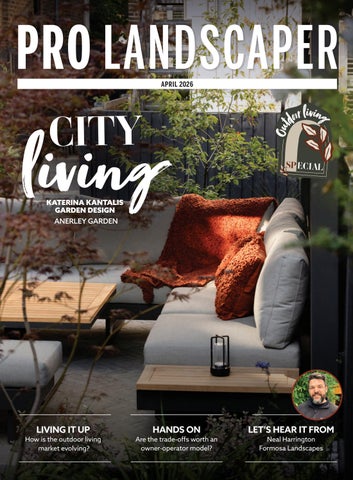
CITY living
KATERINA KANTALIS GARDEN DESIGN
ANERLEY GARDEN

LIVING IT UP
How is the outdoor living market evolving?
HANDS ON
Are the trade-offs worth an owner-operator model?

LET’S HEAR IT FROM Neal Harrington Formosa Landscapes
CONTACT
Eljays44 Ltd, BizSpace, Courtwick Lane, Littlehampton, West Sussex, BN17 7TL
Tel: 01903 777 570
EDITORIAL
Deputy editor – Bethany Vann bethany.vann@eljays44.com
Tel: 01903 959 394
Senior staff writer – Holly Chapman holly.chapman@eljays44.com Tel: 01903 959 407
Senior subeditor – Katrina Roy katrina.roy@eljays44.com Tel: 01903 777 570
Graphic designer – Louise Klose louise.klose@eljays44.com
ADVERTISING
Sales executive – Ollie Finch ollie.finch@eljays44.com Tel: 01903 777 579
MANAGEMENT
Managing director – Jamie Wilkinson jamie.wilkinson@eljays44.com Tel: 01903 777 589
Divisional director – David Griffiths david.griffiths@eljays44.com Tel: 01903 777 570
Content director – Nina Mason nina.mason@eljays44.com Tel: 01903 959 393
Commercial director – Luke Chaplin luke.chaplin@eljays44.com Tel: 01903 777 582
MARKETING & CIRCULATION
Marketing executive – Kiri Shaw kiri.shaw@eljays44.com Tel: 01903 959 408
Subscription enquiries – Ollie Finch ollie.finch@eljays44.com Tel: 01903 777 579
Printed by Stephens and George Ltd
Published by ©Eljays44 Ltd – Connecting Horticulture. Pro Landscaper’s content is available for licensing overseas. Contact jamie.wilkinson@eljays44.com
Pro Landscaper is published 12 times per year by Eljays44 Ltd. The 2026 subscription price is £128. Subscription records are maintained at Eljays44 Ltd, BizSpace, Courtwick Lane, Littlehampton, West Sussex, BN17 7TL, UK. Articles and information contained in this publication are the copyright of Eljays44 Ltd and may not be reproduced in any form without the written permission of the publishers. The publishers cannot accept responsibility for loss of, or damage to, uncommissioned photographs or manuscripts.
Whilst every effort has been made to maintain the integrity of our advertisers, we accept no responsibility for any problem, complaints, or subsequent litigation arising from readers’ responses to advertisements in the magazine. We also wish to emphasise that views expressed by editorial contributors are not necessarily those of the publishers. Reproduction of any part of this magazine is strictly forbidden.
Pro Landscaper is proud to be an Accredited Supplier member of BALI
Pro Landscaper is proud to be an associate member of the APL
Welcome

The sun is shining – at least for the moment – and spring feels as though it has finally graced us with an air of gentle renewal, and the ripples of change hang on the horizon.
Change can be a scary thing, but more so when what is on the other side is unknown, and as an industry, we’ve been through our fair share of changes recently – with more to come.
If it’s not shifting how we source fresh talent (p.11), it’s the introduction of a digital era for tax (p.23).
But one major change we’ve seen in recent years has been the shift in perception and renewed sense of the value outdoor spaces offer; giving way to the rise of the outdoor living market (p.65).
Gardens are now being seen as an extension of the home, with more time, money, and consideration being given to how we can make the most of these spaces on our doorsteps.
It goes without saying then that this uprise has sent a shockwave of change throughout our industry – from businesses expanding into the outdoor living market (p.33), to others evolving to include interior decoration considerations (p.72).
So, yes – change can be scary, but it’s also what continues to drive us to new heights, new opportunities and new innovations. Without it, we risk becoming stagnant and set in our ways, and that’s not what nature – nor this industry – is about.

Bethany
BUSINESS
18
Pro Landscaper Business Awards
The shortlist for the 2026 Pro Landscaper Business Awards, in association with Paving Superstore, is revealed – with a ceremony taking place later this month in London
27 Built to Thrive
Building a successful business is one challenge – planning your exit is another. Phil Jones explains why mastering both is essential
33 Let’s Hear It From...Neal Harrington
Neal Harrington and Johanna Peña – the duo behind Formosa Landscapes, and now Formosa Living – share their aspirations for the brand’s future


INSPIRE
37 City Living
Experience how designer Katerina Kantalis transformed this once disjointed space into a cohesive and contemporary haven
41 Elegant Discovery
Explore this APL Award-winning project from Town and Country Gardens as it revigorates this family garden into a welcoming escape
47 Hard Rock Blues
Take a trip to the seaside with this awardwinning public realm restoration from LUC in the heart of East Sussex
65
Living It Up
As the outdoor living market skyrockets, we wonder: Is this level of growth sustainable, or are the cracks beginning to show?
72 Turning the Inside Out
As outdoor living demands grow, landscape and interior designers explore opportune collaboration and discuss certain limitations
79 Hands On
Being on the tools as an owner-operator could be the key to a decent profit margin –but are the trade-offs worth it?

PEOPLE
91 Up to Standard
Diluting professional standards can only lead to a race to the bottom, warns Luke Mills, as the industry risks undermining quality
94 Comeback Kings
Given space and the right companions, Weigelas become elegant and ecologically grounded, says Humaira Ikram
98 Ten Minutes with Chris Cunningham
The head of outdoor living design at Vale & Eden discusses the company’s move to a fully in-house service
ALSO IN THIS ISSUE
11 A Route to Resetting Skills
Amid on-going recruitment and labour shortages, Elmtree Landscapes is finding success at refugee settlement job fairs
20 Trust in the Process
Clients can lose faith for various reasons, but it’s possible to earn or regain their trust, says Rae Wilkinson

54 The Great Outdoors
Christina Cobb explores what finishing touches can tie a garden together to make it an inviting and practical space 33


PRO LANDSCAPER HUNTS FOR MOST INFLUENTIAL DECKING SUPPLIERS IN NEW INITIATIVE
Pro Landscaper looks to recognise the decking suppliers that are making an outstanding contribution to the industry.
Following the success of Most Influential Nurseries and Most Influential Stone Suppliers last year, Pro Landscaper


MOST INFLUENTIAL Decking
introduces Most Influential Decking Suppliers to be judged across eight categories.
Nominations are open now, urging the industry to put forward the decking suppliers and individuals going above and beyond in terms of championing sustainability and offering a high-quality service.
ROUNDUP Industry Updates

EDEN PROJECT CELEBRATES £6.8BN ECONOMIC IMPACT AHEAD OF 25TH ANNIVERSARY
As the Eden Project approaches its 25th anniversary, it publishes a landmark Impact Report which reveals the charitable trust has delivered £6.8bn in total economic impact to the southwest.
Since opening in 2001, the Eden Project has also contributed £5.7bn net additional economic impact to Cornwall.
The report, released on Cornwall’s national day, St Piran’s Day, also
highlights its 25 million visitors, with 80% outside of Cornwall, generating £8.4bn total visitor spend.
Co-founded by Tim Smit and architect Jonathon Ball, the Eden Project began as an “educational charity with a mission that extends far beyond horticulture: to reconnect people with nature through education, regeneration and storytelling.” edenproject.com

Once nominations close on Thursday 7 May, finalists will be determined and put into a vote which will open on Monday 11 May. Voting will then close on Friday 29 May, with winners being announced towards the end of June and within Pro Landscaper's July issue.

BARBICAN SECURES RENEWAL PROGRAMME APPROVAL
The City of London Corporation approves the planning application for the Barbican Renewal Programme to ensure the future of Europe’s largest multi-arts centre for generations to come.
Focussing on access, sustainability and more dynamic use of space for arts and bringing people together, the scheme includes a design team led by Allies and Morrison to review a sensitive and conservation-led renewal.
A new lift will be installed in the conservatory, which will provide step-free access to the fly tower for the first time.
The Barbican’s foyers and lakeside terrace will then be developed through a sustainable, retrofit approach. Using reused materials, the plan reflects a commitment to sustainable conservation.
Works will begin in 2027 and from June 2028-29, the Barbican will pause the majority of its activities to allow the most intense period of works to take place.

Anew data survey from Trade Direst Insurance has found that more than one in three tradespeople say their job is harming their mental health, including gardeners and landscapers.
It has been revealed that 42% of landscapers report high levels of stress, with their top concern being cost of materials.
MEI LOCI LANDSCAPE ARCHITECTS MOVES TO FOUR-DAY WEEK LANDSCAPERS AMONGST TOP TRADESPEOPLE EXPERIENCING MENTAL HEALTH ISSUES
Mei Loci Landscape Architects has announced its transition into a four-day working week, without any reduction in pay for staff.
Under the 4 Day Week Foundation’s Employer Accreditation Scheme, Mei Loci has been accredited as a Gold Standard employer as all 10 employees move into a 32-hour working week.

Analysis by the Office for National Statistics found that 200,000 workers have switched to a four-day week since Covid. Other companies operating a four-day week include environmental consultancy Tyler Grange and communications company, Zettler.
Gardeners have reported their workload is at the top of their concerns, with 33% saying having too much work is causing them stress, in turn, harming their mental health.
The survey has also found that nearly one in five tradespeople have admitted that their job is directly causing mental health problems.
While over 900,000 people work in the skilled trade across the UK, Patricia Gardiner, sales and marketing director at Trade Direct Insurance says the findings highlight the hidden pressures tradespeople face daily.
GRO WELCOMES NEW CHAIR OF THE BOARD

Green Roof Organisation (GRO) introduces a new chair of the Board, Chris Bridgman, as other Board members retain their seats for another three-year term.
Bridgman steps in to replace the past chair, Giles Doland, who will continue to serve as a Board member.
Managing partner of Bridgman & Bridgman LLP, Bridgman has been working in horticulture for the last 17 years, focusing on constructing and maintaining green, living roofs across the UK.
Bridgman also thanks GRO’s co-founder Mark Harris for “his support, encouragement and understanding.”
This year, GRO will be hosting events across the UK to improve accessibility, spend time visiting member organisations and strengthen relationships with Europe and the rest of the world. greenrooforganisation.org


GOING ABOVE AND BEYOND WITH IVY + STONE
A meticulous eye for attention, Ben Thomas set up Ivy + Stone Landscapes back in 2020 to create high quality gardens while building strong client relationships.


FROM MAN UNITED TO GARDEN DESIGN, NADINE MANSFIELD SWITCHES UP HER CAREER
Once upon a time, Nadine Mansfield worked for British Airways, Key 103 radio station, Manchester United football club, Manchester airport and The Jockey Club over the years.


11 WOMEN CHANGING THE FACE OF HORTICULTURE
From garden design, landscaping and grounds maintenance, women have played a crucial role in the development of horticulture.
THE INDUSTRY GATHERS AT PRO LANDSCAPER PREMIUM PLUS LANDSCAPING THE HOUSEBUILDING REVOLUTION

COMMUNITY Highlights
Landscape architects and contractors, planners and developers, policy makers and growers – all had a seat at the table at Pro Landscaper Premium Plus’ conference, ‘Landscaping the Housebuilding Revolution’. From understanding some of the policies and regulations driving the opportunities, to hearing what developers are looking for, to learning from some of the leaders in the commercial landscaping sector, the one-day event brought together key stakeholders to put landscaping at the forefront of the government’s housebuilding target.

GARDEN PRESS EVENT MARKS ITS 20TH ANNIVERSARY
Pro Landscaper went along to The Garden Press Event to help celebrate its 20th anniversary this year. For the last two decades, it has brought journalists together with some of the top brands in the garden industry.
There were also talks from social media influencer Jonny Hincks and growers Frank P Matthews and Architectural Plants, to name a few, and a roundup of what visitors can expect at this year’s BBC Gardeners’ World events – including the final year of the Association of Professional Landscapers’ ‘APL Avenue’.

PLANTS@WORK ANNOUNCES PRIDE NETWORK DURING 25TH ANNIVERSARY CELEBRATIONS
Hosted at Provender Nurseries, interior landscaping association plants@work celebrated its 25th anniversary after forming back in February 2001. Originally set up as European Federation of Interior-Landscaping Groups (eFIG), plants@work brought together industry leaders and previous chairmen for a day of networking, learning and reflection.
The association also launched its new Pride Network to support LGBTQ+ professionals within the horticultural and interior landscaping sectors.
Reels
Keep up to date with the @ProLandscaper team over on Instagram!


FIRST LOOK AT THE UK’S FIRST CIRCULAR CONSTRUCTION HUB
A collaboration between Yes Move, RESOLVE Collective and Material Cultures has brought the UK’s first circular construction hub, Tipping Point East. The 20,000m2 site brings together material reuse, lowcarbon construction, training and cultural activity.
TPE intends to feed into national government strategy around the circular economy, as well as aligning with the mayor of London’s ambition for London to be zero carbon by 2030.


TEAM ATTENDS HUSQVARNA SPRING SOCIAL
Husqvarna invited the Pro Landscaper team to its spring social alongside other members from across the industry to take a look at the new wire-free robotic mowers powered by AI vision technology.


PLANTS@WORK ANNIVERSARY AND TOUR OF PROVENDER NURSERIES
Celebrate interior landscapers plants@work’s 25th anniversary with us at Provender Nurseries in Swanley!


The event also welcomed Husqvarna’s new brand ambassador, Jonny Hincks, as a means of sharing a passion for gardening, innovation and sustainability. The selfproclaimed lawn fanatic intends to connect people to nature and outdoor spaces.


LANDSCAPING THE HOUSEBUILDING REVOLUTION
Take a look through the lens into Pro Landscaper Premium Plus’ latest conference, featuring industry insight, advice and networking.

THE OFFICE IS ON FIRE, WHAT ARE WE BRINGING?
Ever wondered what we would save if our office building was on fire? Well, with this latest trend, you can find out. (Starring Moose).

Discover the versatile and surprising range at Boom & Bonheur. Be inspired by distinctive plants that add character and atmosphere to any garden or outdoor space. A beautiful example is Crataegus crus-galli, grown as an elegant topiary form. In spring, it bursts into bloom; in autumn, it delights with vivid red berries and stunning crimson foliage. A true eye-catcher — and a magnet for butterflies, bees, and birds.
Just one example of what Boom & Bonheur has to offer. Visit us and let yourself be surprised by the diversity and quality of our nursery! Boom & Bonheur – because trees give life and bring happiness! Boom & Bonheur BV boombonheur.com


A ROUTE TO Resettling Skills
WORDS: HOLLY CHAPMAN

Amid recruitment and labour issues, Elmtree Landscapes finds success at refugee settlement job fairs
Aware of the labour shortage across the industry, Bristol-based Elmtree Landscapes has chosen to take a slightly different route to other grounds maintenance and landscaping companies in search of new skills. Instead of sifting through hundreds of online CV applications, the team head to settlement job fairs in Bristol on the hunt for fresh faces with experience and a hardworking attitude.
Most recently, Rodd and his team met a Turkish man at a fair on 4 February 2026 who once owned his own landscaping company in his homeland. “He’s hopefully going to be starting with us, bringing with him all of his transferable skills,” says Rodd.
We need to get over that stigma for whatever reason – it is why [companies] aren’t going to these job fairs
“It seems like a no-brainer,” decides Elmtree operations manager Toby Rodd. He adds: “We've got people coming from another country, where they've already been doing what we do. So, if they can bring their skills over here, why wouldn't we use them?”
The company, which was established by its current chairman Keith Lynch in 1969, recently rebranded to incorporate its growth within the landscaping and small-scale construction sector. Once known as Elmtree Garden Contractors, Lynch deemed it necessary to clarify its services, which were no longer restricted to gardens only.
According to the Royal Horticultural Society (RHS), 70% of businesses within the horticultural sector struggle to source skilled labour. Due to limited training opportunities, a lack of education pathways, and an ageing workforce, the industry has faced this challenge for several years.
Organised by the South Gloucestershire council, the Refugee and Resettled Communities Job Fair was held in Patchway, Bristol. The event focused on supporting displaced communities as they build new lives in the UK.


Often being the only grounds maintenance and landscaping company at the fairs, Rodd guesses others may not be as open to the idea, which is says is unfortunate. “There’s plenty of us in Bristol and South Gloucestershire who are also struggling for labour. There must be a reason why people aren’t doing this sort of thing too,” he wonders. Managing director, Paul Lynch, often shares the company’s experiences on social media, and still Elmtree remains the only company within its sector to pursue this particular avenue of recruitment.

“We need to get over that stigma for whatever reason – it is why [companies] aren’t going to these job fairs,” Rodd decides.
Perhaps, he explains, it could be down to the time and manpower it takes to attend one of these events. Gone for at least five hours out of the day, Rodd says the catchup the following day can be chaotic. “But it’s definitely worth it,” he reasons, “because you could potentially come away with two or three new starters that you’ve met and spoken with. That may never happen for recruitment in another way.”
Having now attended three settlement fairs in total, Elmtree has employed four refugees after meeting them during the events. The first, back on 10 January 2025, followed shortly by the second, gave Elmtree two refugees who have successfully completed their CSCS and register of land-based operations (ROLO) courses.
We've got people coming from another country, where they've already been doing what we do. So, if they can bring their skills over here, why wouldn't we use them?
Connected by two earpieces and their mobile phones, English can be translated into any language to better establish communication. While they are not used all of the time, Rodd and the team have found them to be very useful, especially during the initial stages of joining the company.
Additionally, the company invest in training to deliver structured, industry-specific development pathways. After investing £73k in training last year, Elmtree aspires to go even further in 2026,including a partnership with Hyphae Learning, an online learning hub founded by Jake Catling and Sam Grayson.
Elmtree has also been recognised at the Pro Landscaper Business Awards, in association with Paving Superstore, 2026.
The most important thing, Rodd specifies, is some form of understanding English. Once a CSCS card is acquired, helped by Elmtree, they can begin working on site. In order to ease the transition, Elmtree uses translation devices.
WHAT IS A CSCS CARD?
The Construction Skills Certification Scheme is a British company that runs a training and qualification verification scheme. CSCS cards provide proof that individuals working on construction sites have the appropriate training and qualifications for the job they do, thereby helping to improve standards and safety across UK construction.
Shortlisted in all three categories it entered, Elmtree is up for the Commercial Landscape Company, Grounds Maintenance Company and Landscape Company (Over £5m Turnover) awards at the end of the month.
As the company moves into the business of growing season, it looks forward to warmer, drier and longer days. While the team moves towards going back on site, working hard to maintain landscapes across the southwest, they intend to utilise every avenue to maintain a diverse, friendly and successful cohort.
References
1 https://www.rhs.org.uk/education-learning/qualificationsand-training/new-shoots/careers-promotion


High Impact Meadows for Urban Spaces
Designed for biodiversity, sustainability and low-input management
With over two decades of experience, Pictorial Meadows® specialist mixes combine aesthetic impact, ecological value and reliable performance. The UK’s largest selection of bespoke seed and wildflower turf mixes, alongside expert meadow consultation, installation and long-term aftercare options.


The Wild
UPRISING
“Rip, scatter, go wild” isn’t just Seed Revolution’s tagline – it’s a call to rethink how we see seeds altogether
I'd like to work with more
landscapers
as well to understand what it is that they need
Walk into almost any garden centre and the seed aisle looks the same: busy, technical, and occasionally outdated. For many younger would-be gardeners, that wall of complex packets can feel less like an invitation and more like a barrier – posing as yet another hurdle for gaining entry into the industry.
Just under three years ago, Max Mancroft recognised the barrier traditional branding could be posing and opted to bridge that gap with the launch of Seed Revolution.
At 24, Mancroft was living the dream on paper – a job in London, a busy-post Covid social life in the city that never switched off. In reality, the young entrepreneur was longing to break away from the mould and reconnect with nature. “Having grown up in Gloucestershire, I had access to the most beautiful parts of the


country and the wildness of it – running around in woods and playing in streams. And I thought, well, what would be the easiest, quickest, low-entry point for people to experience that?”
Founded as a way to encourage more people to get stuck into gardening and make it less intimidating, Seed Revolution is also working as a means to create more access points into the industry and save the nation’s natural world.
That philosophy has informed everything from Seed Revolution’s branding to its product design. Gone are the dense blocks of technical jargon and in its place “fun, funky designs” with easy-tofollow instructions and a no-grow, no-fee policy.

But why wildflowers?
Since the 1930s we have lost 97% of our wildflower meadows in England, reducing this vital habitat to just 1% of the UK’s land area. Driven by intensive farming, urbanisation, and nutrient pollution, this loss has caused a 41% decline in


species since 1970, threatening biodiversity and pollinators. Mancroft recognised this loss and the potential wildflowers have, as he adds: “[Wildflowers] are a fantastic low entry-point,” says Mancroft. “They are really easy to manage, and they work everywhere – from plant pots, balconies and bigger gardens.”
With that goal in mind, Seed Revolution launched with two seed mixes and in the time since, it has evolved to an offering of hundreds, with a recent launch in Blue Diamond Garden Centres and an exclusive partnership with Hugh Fearnley-Whittingstall’s River Cottage.
[Wildflowers] are a fantastic low-entry point [...] They are really easy to manage, and they work everywhere – from plant pots, balconies and bigger gardens
The partnership looks to inspire people to grow and cook with organic vegetables, with a new 2026 collection of River Cottage Organic Seeds – the first of its kind from the cottage – which includes 19 different varieties of vegetable seeds – from beetroot and carrot to chard and rocket.

"[This partnership] gives us access to new areas. Hugh has put us in front of people we wouldn't have found out about for years,” says Mancroft: “They are champions for organic veg, and it's a really nice way to partner up with people you consider an expert in certain areas.”
As Seed Revolution continues to grow – pun intended – Mancroft is showing no signs of slowing down. It plans to continue expanding the business naturally, increase its retail presence, and scale its trade offerings. “We already have trade customers and a couple of landscaping companies that come to us because we're seeing a massive uptick in people wanting wildflowers in their garden,” muses Mancroft, adding: “[Trade offerings] are something I would like to build out more though. I'd like to work with more landscapers as well to understand what it is that they need, and I hope this is an area that will evolve over the next year.”

Amongst all the change and growth however, Seed Revolution’s core mission remains the same: reshaping how people feel about gardening altogether.
“I really want people to start thinking about seed packets as potential gifts. Something you give to someone on their birthday, when they're not feeling well, at Christmas [...] I think ultimately, that's a big part of what the brand will be driving –reframing what a seed can be.”

Made for outdoor living
generations designers the elements sustainability luxury stability creativity aesthetics machinability longevity reliability
MEDITE TRICOYA EXTREME (MTX): engineered for long-lasting, high-quality builds that stand the test of time.
With a 50-year guarantee above ground, MTX is a highperformance wood panel
crafted for use in outdoor living applications. With its smooth, premium finish and certified quality, MTX is the ideal choice for garden buildings, outdoor kitchens and decorative installations that truly last.
ARBORICULTURE COMPANY
CONNICK TREE CARE
G TROTT TREE CONSULTANCY LTD
HELMRIG
TONY BENGER LANDSCAPING LTD
BUSINESS INVESTMENT OR ACQUISITION
NICHOLSONS FOR THE TRANSITION TO AN EMPLOYEE OWNERSHIP TRUST
WALKER LANDSCAPE & DESIGN FOR THE INVESTMENT IN WALKER LANDSCAPE & DESIGN
WRIGHT LANDSCAPES LTD FOR THE ACQUISITION OF URBAN LANDSCAPES AND ASSOCIATED BUSINESSES
COMMERCIAL LANDSCAPE COMPANY
ELMTREE LANDSCAPES LTD

EMPLOYER OF THE YEAR
GRISTWOOD & TOMS
IDVERDE
JOHN O'CONNER (GROUNDS MAINTENANCE) LTD
MURRAY LANDSCAPES LTD
NT KILLINGLEY LTD
OAK VIEW LANDSCAPES LTD
WRIGHT LANDSCAPES LTD
GARDEN DESIGN STUDIO
HADDON STUDIO
HARRINGTON PORTER LTD
PETER DONEGAN GARDEN DESIGN
THE GARDEN COMPANY LTD
THE GARDEN DESIGN STUDIO
THE GARDEN ROOM LIVING & LANDSCAPE STUDIO LTD
INDUSTRY COLLABORATION
DAVIES WHITE LTD LANDSCAPE ARCHITECTS IN COLLABORATION WITH MEL CHANTREY, THE IMPERIAL WAR MUSEUM AND VARIOUS ORGANISATIONS
FISHER TOMLIN & BOWYER IN COLLABORATION WITH BAYLIS LANDSCAPES AND GREENFINGERS
GREEN-TECH IN COLLABORATION WITH RE-GENUS LTD
NT KILLINGLEY LTD IN COLLABORATION WITH VARIOUS ORGANISATIONS
WYEVALE NURSERIES IN COLLABORATION WITH GLOUCESTERSHIRE COUNTY COUNCIL THE GLASSHOUSE COLLECTIVE BY LANDFORM CONSULTANTS IN COLLABORATION WITH INTO THE GARDEN ROOM TREX IN COLLABORATION WITH JJH DECKING AND BEAMS & BRACES LTD
LANDSCAPE ARCHITECTURE STUDIO 10 OR LESS EMPLOYEES
JACK MOODY LANDSCAPING AND CIVIL ENGINEERING LTD
FROSTS LANDSCAPES NT KILLINGLEY LTD SKIDMORES LTD
TONY BENGER LANDSCAPING LTD
GARDEN DESIGNER
LUCY WILLCOX GARDEN DESIGN
MAÏTANNE HUNT
NADINE MANSFIELD GARDEN DESIGN
GROUNDS MAINTENANCE COMPANY DESIGN AND BUILD COMPANY
BRADLEY AND JAMES GARDEN DESIGN & LANDSCAPING LTD
LANDFORM CONSULTANTS LTD
THE GARDEN COMPANY LTD
WRIGHT LANDSCAPES LTD
ELMTREE LANDSCAPES LTD
LITCHFIELD & FOX
MBS GROUNDS MAINTENANCE LTD
MURRAY LANDSCAPES LTD OUTCO
TONY BENGER LANDSCAPING LTD
EPD LANDSCAPE
HILL-WOOD & CO KENT LTD
MEI LOCI LANDSCAPE ARCHITECTS
STUDIO BOSK LTD
LANDSCAPE ARCHITECTURE STUDIO OVER 10 EMPLOYEES
BRINDLEY ASSOCIATES LTD
CAMLINS
MACFARLANE + ASSOCIATES
ONE CREATIVE ENVIRONMENTS (ONE)


TRUST IN the Process
Clients can lose faith for various reasons, but it's possible to earn or regain their trust, says Rae Wilkinson
It teaches entire trust ” — the late Gertrude Jekyll, on gardens being a great teacher.
Having been involved in creating gardens for a few decades now, I have learnt over the years the importance of trust within this work. Trust in the plants, the soil, the materials within a garden, trust in nature, trust in those we work with and trust in the design and planning process throughout. Paramount in all of this is the trust which exists between designers, contractors and clients while we are working our way through our processes, and how beneficial achieving this can be to all of us along the way.
Whichever part of the landscape service process we provide, our clients are investing not only in their landscape but in their confidence in our work. Trust therefore is an important key asset that underpins everything from engagement to retention, reputation to referrals and ultimately to truly successful progression and completion of projects.
In our industry, trust could almost be seen as the very soil in which every successful client, contractor or supplier relationship can take root.
some new clients at the start of communications or at proposal and pricing phase.
Trust could almost be seen as the very soil in which every successful client, contractor or supplier relationship can take root
As we know, trust generally needs to be earned by our actions and outcomes, and it is great if it is already a given, but what if a lack of it comes primarily from external factors or events which have preceded us? Many of us may have witnessed a noticeable shift in recent times in levels of suspicion from
There are likely to be various factors to this, the key factor being the financial climate and a common runner-up being negative past experience, or perhaps from a lack of recent experience in working with designers and contractors. Interestingly, in the Journal of Experimental Psychology a study involving a comparison of distrust versus suspicion revealed that within business interactions suspicion can actually present “benefits for generating information search and attaining integrative agreements in negotiation.
So, perhaps if we reframe what we are being presented with, we can work to provide depth and clarity of
information whilst also working on gaining the benefit of trust along the way.
Let’s look at the key factors here for a better understanding of how we could look to approach this.
Financial climate
There is nothing we can do about the financial climate of our times, but with costs and levels of uncertainty rising it is more important than ever to manage expectations.
We all want to create the best garden possible for our clients with optimum materials, hopefully sustainably and perhaps achieving something impressive or sublime. Unfortunately, wish lists are seldom aligned to budgets at the outset, so we need to manage this from the very first meeting by discussing budgets and expectations openly. A pricing phase is often a precursor to paring back the design as costs globally continue to rise higher and higher – so make sure this has been clearly discussed to avoid potential frustration or disappointment.
Negative previous experience
Some clients have had their fingers burned in the past, perhaps by a consultant or contractor, and this colours their approach to their ventures moving forward. A lot of the work we have to do, at the start of a project particularly, is to gain trust – and this can be hard to win in these situations. Honesty, transparency and warmth are often the best things to focus on. These clients may need as much hand holding or even morethan those who are new to the game.
As outlined by the likes of author Rich Diviney, there are four key attributes which can lead to trust: Competency, Consistency, Integrity and Compassion. We can focus on the areas where these sit within the work that we do to ensure we are presenting the best service we can to our clients.
Communication
Communication is better than silence – let your client know what is happening every step of the way.
Transparency
Be upfront about processes, timelines and costs. Clients may not like the information, but they will ultimately appreciate it.
Consistency
Responses, communication and delivery of works should always be consistent. Clients like to know what they are getting.
Honesty
Be truthful about what is achievable and what is required. Do what you say you are going to do, and if you can’t, do something and tell them why.
Own mistakes
If something hasn’t happened or an error has been made, be honest and, if necessary, show that you are working on a solution. People will always appreciate and respect ownership of a mistake rather than being misled or witnessing finger pointing.
Counting the cost
Teamwork makes the dream work
Wish lists are seldom aligned to budgets at the outset ,so we need to manage this from the very first meeting
We’ve all been battling spiralling costs in the past few years amidst a very uncertain financial climate, and this has added another layer of complexity to some recent projects.
When it comes to unexpected and additional cost implications, the negative response can very quickly turn to blame or disengagement – even when everything was going well previously.
Transparency right from the start is probably the best way to move through this process – not an easy approach when you are trying to sell something, but perhaps the only way if true trust is to be established.
Creating beautiful new or reimagined gardens, as we know, can involve a team of skilled and dedicated people. It goes without saying that when we can work well as a team, we can deliver the best results – so trust in this scenario is also key. Fostering good relations with those we will be working with – contractors, architects, designers, craftspeople, gardeners and suppliers – will always enable a better process and usually bring good results. For the client, seeing the team work together in an aligned way will enable their own process of trust to establish, allowing works to unfold more smoothly and hopefully avoiding additional stress. Building trust requires reliability, and showing clients that you value them as people, not just revenue, through consistent highquality service and open communication will usually pave the way for a better outcome for the project and potentially an even happier client.

RAE WILKINSON
Rae Wilkinson is a qualified RHS Gold-medal-winning designer and registered Member of the Society of Garden + Landscape Designers, the British Association of Landscape Industries and the Chartered Institute of Horticulture, with nearly 30 years' experience in creating gardens. raewilkinson.com


MANDATORY
Digitalisation
Making Tax Digital for Income Tax: It’s here – are you ready? Asks Kim Sones
Last year, I wrote in Pro Landscaper about the upcoming changes under Making Tax Digital for Income Tax (MTD for ITSA) and what they would mean for sole traders and landlords working in the landscaping industry.
At that point, it still felt like something on the horizon. That time has now arrived.
From April 2026, many self-employed landscaping business owners will legally be required to follow the new rules. This is no longer something to ignore and it now requires planning.
If you are a sole trader, subcontractor, or run rental property alongside your landscaping business, this directly affects you.
Let’s break down exactly what is happening, who it applies to, and what you should be doing now.
What Is Making Tax Digital for Income Tax?
Who needs to comply and when?
The rollout is based on your gross income (before expenses), not profit.
In practice, it will only feel helpful if your systems are set up properly
Making Tax Digital is HMRC’s long-term plan to modernise the tax system by moving everything to digital record keeping and digital submissions. You may already be familiar with MTD for VAT.
VAT-registered businesses have been required to keep digital records and submit VAT returns through compatible software for several years.
The next phase is Income Tax.
MTD for ITSA will replace the traditional once-a-year SelfAssessment process for many sole traders and landlords. Instead of submitting one tax return after the end of the tax year, you will:
• Keep digital records of income and expenses
• Use HMRC-recognised software
• Submit quarterly updates to HMRC
• Submit a final year-end declaration
The annual deadline isn't disappearing; it is simply changing structure.
From April 2026: Sole traders and landlords with gross qualifying income over £50k must comply.
From April 2027: Those with income over £30k must comply.
From April 2028: Those with income over £20k are expected to be brought into scope.
If you earn income from both landscaping and rental property, HMRC will combine the two to see whether you cross the threshold.
Limited companies are not included in this phase. Partnerships and MTD for Corporation Tax are still to be confirmed.
For many landscaping business owners turning over £50k as sole traders, this will apply from April 2026.
What will actually change for you?
Here is what life will look like under MTD:
1. Digital record keeping
Paper notebooks and spreadsheets alone will no longer be compliant if you are within scope. You will need to use MTD-compatible software to record income and expenses digitally. For many in our sector, cloud software such as Xero will be the natural solution. If you are already VAT registered and using accounting software, you are partway there. If you are still operating from spreadsheets and a box of receipts, a substantial transformation will be needed.
2. Quarterly updates
You will send HMRC a summary of your business income and expenses every quarter. These are not full tax returns. They are summary updates. However, this does mean four submission deadlines per year instead of one. This is where good bookkeeping stops being optional and becomes essential.
If your records are always behind, quarterly reporting will feel painful. If your books are up to date monthly, it will feel manageable.
3. Final declaration
At the end of the tax year, you will submit a Final Declaration.
This replaces the traditional SelfAssessment return.
This is where:
• Adjustments are made
• Other income is included
• Tax reliefs are claimed
• The final tax liability is confirmed
The deadline remains 31 January following the end of the tax year.
What happens if you miss deadlines?
HMRC is introducing a points-based penalty system.
• Each missed submission earns a point
• Reach the threshold and you receive a £200 fine
• Further missed submissions trigger further penalties
Late payment penalties and interest are separate. In simple terms, more deadlines mean more opportunities to get it wrong. That is why preparation now matters.
Why HMRC is doing this
HMRC states the aims are to:
• Reduce errors caused by manual processes
• Close the tax gap
• Encourage better record keeping
• Help business owners understand their tax position throughout the year In theory, more frequent reporting should help business owners maintain control of their figures. In practice, it will only feel helpful if your systems are set up properly. Otherwise, it becomes another compliance headache.
What this means for landscaping businesses
Our industry has its own challenges:
• Seasonal income
• Subcontractors
• CIS deductions
• Materials-heavy jobs
• Stage payments
• Cash jobs
This aligns perfectly with what I say all the time to landscaping business owners: You should not guess; you should know, and MTD enforces that discipline.
Do you need to act now?
If your income is over £50k, yes. Here are three practical steps to take now:
1. Check your income level – look at your gross turnover from self employment and property combined
2. Move to compliant software early – give yourself time to learn it properly
3. Get your bookkeeping up to date monthly – quarterly submissions rely on clean, current data. The smoother your internal systems are, the easier this transition will be.
Free live webinar: Making Tax Digital – What You Need to Do Now
Paper notebooks and spreadsheets alone will no longer be compliant if you are within scope
Because so many business owners are still unclear on the detail, we are running a free live Zoom session to break this down in plain English. We will cover:
• Who MTD applies to
• Key dates and thresholds
• What quarterly reporting really involves
• How to prepare without stress
• Common mistakes to avoid
• What software you should be considering
Upcoming date: Tuesday 22nd April –7.30pm (Zoom)
Book your place

Once registered, you will receive full joining details by email. If you are unsure whether MTD affects you, this session will give you clarity. If you know it affects you but have not started preparing, this session will give you direction.
Making Tax Digital for Income Tax is not just a compliance tweak – it is a behavioural shift for landscaping business owners who want to grow, improve margins and build something sustainable long term. This can actually be a positive catalyst, but only if you prepare properly.
MTD will not change those realities. What it will change is the expectation that your records are accurate and up to date throughout the year. The upside? If you embrace this properly, you will:
• Know your profit position earlier
• Spot cash flow gaps sooner
• Budget for tax more accurately
• Make pricing decisions based on real numbers
Do not leave this until the last minute. Understand it, plan for it and set your systems up intentionally. Use this as an opportunity to finally get full control of your numbers, rather than letting them control you.


AFRESHAPPROACH
Senior/ContractsManagement
SiteSupervisors/Foreman
Hard&SoftLandscaping
GardenDesigners
InteriorLandscaping
Nursery/GardenCentre
MaintenanceGardeners
HorticultureSales
GroundsMaintenance
SkilledTradespeople
AmenityHorticulture
Labourers&more....


THRIVE Built to
Building a successful business is one thing – planning your exit is another. Phil Jones shares his insights on why both are important
Business management moves fast these days, but it only takes a minute to translate the pace so far into what it will be like in future years.
It’s essential to keep an eye on that future – even while you’re knee‑deep in today’s mud, managing machinery, clients, and the occasional creative interpretation of a site plan. For any business, thinking ahead isn’t a luxury – although it may seem so at times. It’s the difference between building a business that lasts and one that just survives the next rainstorm.
Planning for tomorrow while building today is what turns hard work into long‑term success
in 10 or 20 years – ideally stepping back with a well‑planned exit. Planning for tomorrow while building today is what turns hard work into long‑term success. This intensifies the strain on owner‑operators who are already stretched thin, amplifying both the day‑to‑day workload and the strategic burden they carry. When long‑term planning is deferred, the operational pressures don’t just continue – they compound – because the owner must juggle immediate business demands while also trying to make up for lost time on decisions that ideally should have been made years earlier.
Thus, careful consideration should be given to what we do now and how that impacts everything in the future – short or long term. At this stage, we’ve poured the foundations and have begun the initial build. Careful thought now will ensure a sound, stable, and credible business for the future.
Imagine yourself at the point of exit, looking back over the years that led there: what would you wish you’d done earlier, and how would you want the business to look in that moment? Just as importantly, what would a serious buyer expect to see when judging its strength and future potential?
Quite a number of owner‑operators in the landscaping sector seem to leave this far too late. I often meet people who haven’t thought through what their eventual exit should look like, and as a result they don’t act early enough.
Whether we're able to do this ourselves, employ an advisor, join an organisation that can help us share experiences, or all of the above – now is the time.
Stepping back, the real opportunity lies in choosing to lead with intention rather than momentum. The future will only move faster, and the businesses that endure will be those whose owners carve out the discipline to think ahead while the world around them accelerates.
And somewhere between coordinating teams and keeping projects on track, business leaders also have to think about where they’ll (want to) be
By lifting our gaze from the immediate pressures and investing in the structure, systems, and clarity that tomorrow will demand, we give ourselves the best chance of shaping an exit – and a legacy – on our own terms. The work begins now, in the decisions we make today, long before the final chapter is written.

Phil Jones is the founder of Apple Tree Bay Consultancy Ltd and brings long-standing director-level experience from the landscaping, grounds management and facilities services sectors. He now works with landscape businesses to strengthen strategic planning, refine operational systems, and support effective implementation. His focus is helping companies identify their future aims, build sustainable growth, improve performance, and navigate the evolving demands of a competitive, quality-driven industry.
Email: phil@appletreebay.co.uk
Instagram: apple_treebay linkedin.com/in/phil-jones-4197b5b5
DRAWING BOARD Digital
John Wood on using AI to build a plant library specific to your needs

IN THIS EXAMPLE, AI REMOVES THE VISUAL COMPLEXITY OF THE ORIGINAL GARDEN PHOTOGRAPH, ISOLATING THE EUPHORBIA AS A CLEAN, ACCURATE CUTOUT READY FOR IMMEDIATE USE IN PROFESSIONAL VISUALISATIONS.
Welcome to this regular column, where I share practical, iPad-based digital workflows, tools, and drawing techniques to help make your landscaping and design work easier, faster, and more efficient.
In recent months, AI image generation has quietly become one of the most useful tools available to garden and landscape designers. One of the strongest current applications is the ability to create clean, horticulturally precise plant cutouts for presentations, mood boards, planting plans, and visualisations.
Most designers will recognise the problem. Existing PNG plant libraries are often limited in botanical specificity. We may need a very particular cultivar or specimen that simply does not exist in any commercial library.
When photographing plants ourselves, they are almost always surrounded by visual clutter: neighbouring foliage, winter dieback, shadows, or background noise. Isolating a plant cleanly can be extremely time consuming and sometimes impossible.
Recent developments in ChatGPT’s image capabilities offer a practical solution. You can feed the system a photograph and instruct it to recreate only the plant you want, on a clean or transparent background. Importantly, this is not a traditional cutout.
The AI analyses the image, recognises the plant, and reconstructs it from scratch. The resulting image is newly generated, but visually matches the original with remarkable accuracy. What would normally take minutes or hours in manual masking is achieved in seconds.
This is especially powerful when working with specimen trees or signature plants. Tree structure plays a critical role in visualisations, and mature specimens are often expensive and defining features within a design. Being able to photograph the exact tree destined for a project and instantly generate a clean, isolated version allows designers to insert real planting material into concept visuals with a high degree of realism and precision.
In effect, this creates an expandable plant library that is limited only by what you can photograph or describe. You are no

AI NOW ALLOWS US TO EXTRACT A BOTANICALLY PRECISE IMAGE OF ANY PLANT DIRECTLY FROM A PHOTOGRAPH, INSTANTLY CREATING CLEAN, ISOLATED SPECIMENS SUITABLE FOR USE IN PLANTING PLANS, MOOD BOARDS, AND VISUALISATION LIBRARIES.
longer restricted to pre-made assets. Any plant you encounter can become a reusable visual resource.
There is, however, a small practical quirk worth mentioning. AI systems can sometimes respond overly literally and claim they “cannot cut out” an image. The key is understanding that you are not asking for a technical cutout but a regenerated interpretation.
Clear, confident instructions usually resolve this. Once the system understands you want a recreated image that matches the plant as closely as possible, it performs extremely reliably.
For garden and landscape professionals, this represents a shift in how visual resources are built. Instead of hunting for the closest approximation in a limited catalogue, designers can generate species-specific material on demand. The result is faster workflows, more accurate planting visuals, and a level of horticultural precision that was previously difficult to achieve without specialist graphic skills.
Suggested prompt:
Use this photo only as a reference. Reconstruct the plant geometry from scratch. Remove all background and surrounding vegetation. Produce a clean botanical reconstruction of the plant on a true PNG with full alpha transparency and no halo.
Scan the QR code to see these tips in action! Also check out Create Visual’s YouTube channel @create_ visual_ipad to learn more about Morpholio Trace.


JOHN WOOD
John Wood runs Create Visual, a CPD training platform for garden and landscape professionals specialising in iPad-based digital workflows and presentation graphics. Scan the QR code to view a free lesson related to this topic. create-visual.co.uk

Millboard decking and cladding pairs natural beauty with cutting-edge British engineering. Designed for outdoor spaces that are made to be lived in year after year.
Create standout outdoor spaces - order your free samples at millboard.com


BUILT TO POWER THROUGH THE MOST DEMANDING TASKS, BUT QUIETER, CLEANER AND LIGHTER THAN PETROL FUEL ALTERNATIVES. THE XGT 40V MAX BRUSH CUTTER IS THE FUTURE OF PROFESSIONAL GARDENING.


energised FEEL


energised


FREE BL4040F BATTERY with selected XGT tool and battery purchases before 30.09.2026.


Bespoke British Made Outdoor Kitchens

Bespoke British Made Outdoor Kitchens


KönigOutdoor is a British manufacturer of premium outdoor kitchen cabinetry, crafted to the highest specification. Using sintered stone for its external surfaces, each kitchen offers a sleek, high-end finish with exceptional durability.
Every KönigOutdoor kitchen is made to order, with comprehensive, turnkey support available for you and your client, from initial design consultation through to installation and aftercare.


www.konigoutdoor.co.uk
sales@konigoutdoor.co.uk Tel: 0333 577 2903
2903
“EVERYONE GOES THROUGH THE SAME CONCERNS AND PEOPLE SHOULD BE HERE TO HELP EACH OTHER, BECAUSE WE'RE ALL WORKING TOWARDS THE SAME GOAL ANYWAY.”
The duo behind Formosa Landscapes – and now Formosa Living – Neal Harrington and Johanna Peña share their plans for the future of the brand
WORDS: BETHANY VANN
In 2020, the UK outdoor living market experienced a significant surge in growth, largely brought on by covid and its stay-athome restrictions.
In the years since, that growth has moved beyond the notion of being labelled a trend – evolving instead, towards a popular mainstream adoption for many homeowners, and in turn a regular request from clients to designers and landscapers.
In February 2025, Neal Harrington – director of Surrey-based Formosa Landscapes – capitalised on this rising adoption with the launch of sister-company, Formosa Living –which is growing in parallel to the award-winning landscaping business.
With the kitchens, we always try and introduce one completely unique element to each of them

Finding a niche
While Harrington and partner Johanna Peña hold tight to the mentality that there need not be ‘unhealthy’ competition in the market: "For the amount of work there is there, there's no need to compete with other people, everyone is capable,” says the former – the rising number of outdoor living businesses sprouting up inevitably sharpens the need for differentiation.


In an increasingly busy landscape, carving out a clear niche becomes less of a luxury and more of a necessity, allowing businesses to define their strengths, target a specific clientele, and build a recognisable identity.
Formosa Living’s identified niche comes in the form of a skill that director Harrington learnt when working overseas in Australia for eight years – building outdoor kitchens with polished concrete. His time in the land down under gave him the advantage when returning to the UK – bringing with him the skill to create concrete kitchens before it became a widespread trend.
The high number of enquiries for its inclusion in Formosa Landscape projects played an essential role in the launch of its sister company, Formosa Living, as Peña shares: “We were trying to launch Formosa Living quite quickly because of just how many kitchens we were getting through last year.”
She adds: “We've found it's about 50/50, in terms of concrete and other types of kitchens. So
as an example, last year, we fitted six kitchens, of which 50% were concrete. And this year we've already got four kitchens booked in, and again, it's about 50%.”
The inclusion of outdoor kitchens is rapidly rising in popularity, transforming from traditional BBQs into luxurious, year-round, fully equipped culinary spaces.
“With the kitchens, we always try and introduce one completely unique element to each of them,”
says Harrington as he recalls one client asking for a butcher's block to be included –highlighting the opportunities afforded by these outdoor sets and the practicality behind creating a bespoke space that resonates with the client.
Harrington notes: “It’s something that, especially when a client is spending so much money on a kitchen, they like to have something that is unique to them, so we tend to not do so much of a copy and paste with our kitchens.”
The sustainability of it all
concrete has become a bit of a “taboo” topic now, but both Harrington and Peña argue that, while the initial carbon footprint to produce cement for concrete might be significant, the lifelong durability of the materials is considerable.
“[The kitchens] are going to last in a way that other materials potentially wouldn't,” notes Peña: “And even if you were to change your mind five years down the line and want to take [the kitchen] out it can obviously be recycled. It doesn't just go to a landfill – it can be crushed up, used again,” adds Harrington.
He admits that working with concrete can be a bit of a grey area for the industry, with people’s perception of its inclusion being the largest concern.
“We're not using a lot [of concrete], we're only using, one cubic metre in one kitchen, so the carbon offset of that is not a great deal. But when you think about the actual sustainability, I think it is quite a sustainable product, especially when it's of such low maintenance as well.”
The Formosa Living brand definitely benefitted from the fact that it is so associated with the Formosa Landscapes brand
Concrete outdoor kitchens are considered low-maintenance and durable, as Harrington says –providing a long-lasting and weatherresistant solution in a contemporary way.
As the industry moves towards sourcing more environmentally friendly solutions, the use of

Modern solutions for a high-end market Following in its sister company’s footsteps, Harrington and Peña are positioning Formosa Living in the higher end of the market – a space they feel is commercially viable and ripe for differentiation.
"Especially with the [kitchens] that we’re installing; the amount of labour involved in producing the self-supporting concrete kitchens, it only really lends itself to that upper end of the market, because the cost involved in them,” says Harrington.
“We find that the client base that tends to go with us are very design led, and so they’re looking to invest in that wow factor,” highlights Peña, as she delves into the partnership Formosa Living has recently entered with Fògher.
"When we discovered Fògher, it just made sense. There's something quietly Nordic about their aesthetic – clean lines, no fuss – despite being an Italian brand, and that restraint is exactly what our concrete style speaks to. The

clients who come to us for this aren't impulse buyers. They've thought about how they live, how their home looks and feels, and they want their outdoor space to be a seamless extension of that. Fògher helps us deliver exactly that."
Side-by-side, but different
“The Formosa Living brand definitely benefitted from the fact that it is so associated with the Formosa Landscapes brand”, notes Harrington – though admittedly, as partner Peña recognises, a little to their own detriment.
“We were trying to launch Formosa Living quite quickly because of just how many kitchens we were getting through last year,” notes Peña before adding: “Although [the two] can be together, we wanted to make it marketable for people who only wanted a kitchen.”
By keeping the two businesses separate –but still under the Formosa umbrella – it allows for two distinct inquiry streams and expands clientele opportunities: "People were talking themselves out of calling us before they'd even picked up the phone. They'd see Formosa Landscapes and assume we only wanted the big project – the whole garden. The client who just wanted a kitchen felt like they didn't qualify. That's exactly why Formosa Living

needed to exist on its own terms,” reveals Peña. "The thinking is simple: Formosa is the name people trust, and under that name there's room for more than one story. Landscapes, Living – and further down the line, who knows. We're building a brand with space to grow, not one that boxes us in."
Seeing it first-hand
As the outdoor living market expands, so too has the desire to experience these products
first-hand. Customers are no longer satisfied with simply browsing online images or reading specifications; they want to see, touch, and interact with furniture, materials, and layouts in real-world settings.
Showrooms have become a means to engage clients who might be on the fence, as Harrington explains: “You can't really appreciate necessarily the beauty of them or the simplistic nature at the same time, until you see them in the flesh.”
Currently in the midst of creating their show garden, the Formosa duo is hoping for project completion this spring, with plans to host quarterly events starting in the summer of 2027.
The idea – as the duo shares – is not to create a show garden centred around selling the products but rather give designers the opportunity to see the products firsthand – and what better way to do that than creating a space that also functions as their family garden.
By keeping the two businesses separate...it allows for two distinct inquiry streams and expands clientele opportunities
"The studio is part of our home, and the garden will be our family's garden. But we want it to work harder than that — to be a place where designers can bring clients, where people can walk around, touch things, sit in the space and suddenly see what their own garden could become. You can't sell a feeling from a brochure. So we're building the feeling instead."
The two are also looking to establish a social space in the studio for designers to bring their clients, as well as to be used for them to host their own meetings. "This industry is full of incredibly talented people who are largely figuring things out alone – and that feels like such a waste. We all go through the same frustrations, the same learning curves. The idea of bringing people together every quarter, just to share what's actually going on – no agenda, no sales pitch – that excites us. That's the kind of industry we want to be part of building."


The landscaping side
“The next step for us, is to do a show garden," shares Harrington. "We haven't done a show garden yet. Given our client base and aesthetic, we would really look to do something at Chelsea. So, it's trying to figure out how we can get that stepping stone from where we are,” –though Peña jokes it’s probably worked in their favour not to take on a show garden this year with everything else on their plate.
“The amount of potential work and work that we have booked in for this year and moving into next year is just – it's more than it's ever been,” says Harrington.
From investing in their new show garden and office, to strengthening their landscaping teams with fresh talent and expertise, Formosa is entering 2026 with remarkable momentum. Alongside this, the business continues to refine and expand the “living” side of its offering.
Together, these developments mark a significant step forward, positioning 2026 as a defining chapter in Formosa’s journey.
City LIVING
KATERINA KANTALIS GARDEN DESIGN
ANERLEY GARDEN

This long and awkward garden in a bustling residential area of South-London had seen better days; its broken patio design offered little in visual appeal but was a hub for algae and excessive grass growth; while its disjointed shaping and two-tier level change created a feeling of two separate gardens – offering little in the way of engagement and functionality.
The aim for garden designer, Katerina Kantalis, was to transform this disjointed space into a cohesive, contemporary entertaining space that offered year-round interest and natural flow.
PROJECT DETAILS
Build time 7-8 weeks
Size of project 146 m²
Project value
£37k
Now, this city maisonette garden brings the inside out in one continuous, flowing experience; a sanctuary that feels both elegant and relaxed – perfect for quiet mornings in the sun or social evenings beneath the stars.
The garden’s original paving slabs were laid lengthways, elongating the garden’s long and narrow proportions.
Barring any broken slabs, Kantalis opted to retain the original patio, lifting and relaying the slate to correct uneven levels and remove the problematic steps that once interrupted the space.
While the team kept the original patio footprint, the process allowed them to refine the layout, replacing damaged pieces along the way.
The result is a seamless, unified patio that feels welcoming, safe and well-proportioned, creating a more inviting entrance to the garden and enhancing the overall sense of flow.
DESIGNER TOP TIP
Play with levels and texture Even subtle level changes – a single step or a low raised bed – can help visually shorten a long garden and add depth. Always make sure any level change meets minimum height requirements (at least 150mm) for safety and compliance. Once your levels are understood, think carefully about flow: how do you want to move through the space? The route should feel easy, engaging and safe – a gentle journey, not an obstacle course.


Additional accent features have been introduced at key movement points throughout the garden. Sandstone pavers now highlight important areas, from the entrance and exit points to the level change, improving the overall flow and safety of the space.
Kantalis explains that the same sandstone pavers have also been laid beneath the new pergola in a herringbone style – adding that
modern touch and creating an outdoor ‘rug’ like effect.
The repurposed stepping stones lead down towards the new pergola patio and seating area, housed in the main zone of the garden, offering a contemporary and sleek focal point to the space, while providing that much desired privacy an urban located maisonette can lack.
DESIGNER TOP TIP
Use a pergola to create a focal pause
In a long, narrow garden, a pergola placed midway through the space acts as both a visual anchor and a destination. It breaks up the garden’s length and introduces a vertical element that balances the horizontal flow of paving and planting. Positioned in the sunniest part of the garden, the pergola adds height, shade, privacy and architectural interest, drawing the eye upward and giving the space a sense of proportion.
ABOUT
Katerina Kantalis is an RHS Gold medalwinning garden designer who specialises in creating stunning outdoor spaces that are uniquely tailored to each client. Based in Crystal Palace, South East London, Kantalis serves clients across London and the UK, turning outdoor spaces into vibrant, cherished extensions of the home.
katerinakantalis.co.uk
Instead of maintaining the house patio as the primary area for gatherings, the new design sees the seating area positioned deeper into the garden, further opening up the space.
Decorative aggregates were then added in and around the main pathway to give the garden a sense of material richness without feeling over encumbered.
In place of the old raised beds, new bespoke corten steel planters have been installed – the metal edging and stand-alone pots and plants echo the contemporary stylings of the pergola, adding further material points of interest.
Once the layout of the garden was established, the time came to introduce additional planting as a way to soften the space and connect the separate zones together.
Planting was used to anchor the pergola and connect it to the rest of the space, while the wider palette aims to draw you in and encourage you deeper into the garden, making the journey itself a key part of the experience.
A selection of mature ornamental trees was also introduced, as Kantalis explains: “I really wanted to bring trees into the garden, especially as the garden was surrounded by mature trees in the background. We focused on ornamental trees to bring height into the garden without overpowering the space. It also helps to enhance privacy once the trees begin to establish themselves.”
Originating from North America, Amelanchier lamarckii brings year-round interest to the garden, even in the colder months when its spreading crown of fine shoots makes a satisfying, dense, shrubby shape, blooming in a variety of colours throughout the months.

DESIGNER TOP TIP
Break up the runway create a planted journey
Long, narrow gardens can start to look like corridors if viewed all at once. Instead, break up the space into different “moments” – maybe a patio, a planted pathway, and an inviting destination like a pergola or garden room – so your eye moves naturally from one area to another. Let each section appear little by little, creating a feeling of discovery rather than giving away the whole view at once and use plants to lead movement and soften the lines of sight.
The Japanese Maple, Acer palmatum ‘Trompenburg’ for example, introduces a rich, deep burgundyred hue to the space, adding further elegancy and visual interest.
“We wanted to have something again with height and interest, but it needed to fit into the planters comfortably,” says Kantalis in reference to the Dicksonia antarctica that was introduced. Recognised as one of the oldest plants in the world, this Australian and New Zealand native “makes a dramatic statement in the garden”, adds the designer.
PLANTING
• Amelanchier lamarckii
• Acer palmatum ‘Trompenburg’
• Dicksonia antarctica
• Dodonaea viscosa 'Purpurea'
• Kniphofia ‘Mango Popsicle'
The planting is made up of low-maintenance species that embody a natural yet contemporary aesthetic. While the architectural points adhere to a grey colour scheme – including both light and dark variations – the soft landscaping brings in a sense of warmth throughout, achieving a harmonious and balanced overall appearance.
From a dis-used and overlooked space, to an urban retreat that blends contemporary with nature, the garden now offers practicality with a relaxing edge, creating a space that can be used year round.

REFERENCES
Standalone planters
London Stone
londonstone.co.uk
Bespoke Corten steel planters
Luxunique luxunique.co.uk
Sofa
Bramblecrest bramblecrest.com
Pergola
Whitestores whitestores.co.uk
Dining table
Sklum
sklum.com
Trees and tree ferns
Coolings Garden Centre coolings.co.uk
Perennials
Evergreen Exterior Services evergreenext.co.uk


Elegant DISCOVERY
ABOUT
With over 30 years’ experience, Town and Country Gardens bring passion and expertise to garden maintenance and award-winning landscaping across London and the home counties. From small repairs to stunning transformations –fencing, paving, decking, and more –the company crafts vibrant outdoor spaces that flourish, evolve and inspire joy through every season.
Arefreshing start to the project, garden designer Adolfo Harrison was happy to receive a relatively open brief ahead of any architectural designs, putting the garden as the project’s initial focus. Nestled in South London, the garden sits in the residential area of Kennington. Overlooked by neighbours on all sides, enclosure was key to the client who also wanted to balance a connection with the surrounding area while keeping a level of privacy.
The triangular shaped garden extended out to the left of the property, which required an access point to a neighbouring garden for visiting and its role as a fire escape. Misaligned with the property, the garden was in need of revival. A home to overgrown shrubs, it originally lacked flow and alignment.
A playwright, the client requested a library and study within existing outbuildings, as well as a bar for entertaining – all in keeping with
sustainability efforts. In response, Harrison introduced bifold doors to the library and an alcove window into the bar endeavouring to welcome the garden into the interiors and vice versa.
In creating this connection between indoors and out, the design blends outdoor living with the warm, cosy interior office hosting the client’s vast book collection within the home study walls.


During the material selection process, sustainability remained a priority. Western red cedar used for the pergola, benches and pathway was sourced from within northern Europe to ensure responsible, long-lasting timber. Other hard elements are made up of UK-sourced granite and reclaimed bricks.
The garden’s new purpose evokes a design with both adults and children in mind. From the outdoor bar and fireplace readied for hosting guests to the secret garden which invites discovery – the levels of exploration and entertainment know no bounds. Enhanced with a range of planting, “I wanted to use climbers, wall shrubs and green walls on all architectural
elements to give the sense of nature taking over,” explains Harrison.
A home to mature trees, it was important to maintain the existing local ecosystem within the garden. While it introduced new obstacles, a key priority was to safeguard the health and root zones of the on-site trees which required a sensitive approach. The team implemented a tree protection strategy that included the use of geotextile membrane and Cellweb ground reinforcement systems.
The materials allowed the team to build and lay surfaces without compacting the soil BEFORE

or disrupting the delicate root systems below. This method ensured full compliance with arboricultural best practices, while preserving the existing landscape character of the garden.
Embellished with additional layered planting and trees, the garden now also hosts a water feature, together providing year-round forage and habitats for wildlife.
Planting includes Iris 'Natchez Trace', which is a beautiful and reliable bearded iris cultivar prized for its striking blooms and lowmaintenance nature, perfect for adding seasonal interest and structure to the garden.
Also decorated with Calamagrostis × acutiflora 'Waldenbuch', a refined, ornamental grass variety with a strong vertical form, fine texture, and long-lasting architectural interest. The adaptable plant was chosen for its visual impact across all four seasons, explains Harrison.
The additional tree, Cornus kousa 'Miss Satomi', is a deciduous ornamental known “for its exceptional flowering display, multiseason interest, and elegant form,” says the garden designer. “It brings both beauty and structure to gardens, making it a standout choice in planting designs focused on year-round appeal which we wanted here.”
The garden pulled for extra drama, and with the inclusion of Wisteria floribunda 'Alba', also known as White Japanese Wisteria, the long-lived climbing vine cascades across architectural

elements for romantic character. The white blooms bring fragrance and timeless beauty.
Access was another major challenge to the successful construction of the garden. The only route in and out of the property was through a narrow 70cm-wide front door, meaning all materials, tools, and waste had to be manually transported through the main house.
This constraint was overcome through precise delivery scheduling, exceptional teamwork, and a meticulous protection strategy for the interior of the property. All floors and walls along the access route were thoroughly covered and safeguarded throughout the project, ensuring no damage was caused despite the high volume of movement through the space.
“Thanks to detailed planning and close coordination between our team and the client, we successfully delivered the project without compromise to either the existing landscape or the interior of the property,” explains Harrison.
From numerous seated areas, navigated by pathways adorned with lush planting, to an outdoor grill and backlit bar, the garden becomes the perfect place to explore, socialise and relax. Through winter until summer, this new outdoor space blends the wild side of nature with a timeless timber finish.
REFERENCES
Designer
Adolfo Harrison Landscape
Studio adolfoharrison.com
Yorkstone
Yorkstone Supplies yorkstonesupplies.co.uk
Cedar
Champion Timber championtimber.com
Millboard decking
Composite Cladding & Decking Supply compositecds.co.uk
Medallion turf Rolawn rolawn.co.uk
Plants
Paramount Plants paramountplants.co.uk


Hard Rock BLUES
LUC BLACK ROCK, BRIGHTON

Situated between the iconic Brighton Pier and the Marina, Black Rock, Brighton – named in honour of its coal importation history in the early 1800s – has cemented itself as an unofficial local landmark over the
years, recognised for its quieter atmosphere on the outskirts of the bustling city centre.
In 1835, the Reading Room and Temple structures were constructed as a means to stabilise the Kemp Town estate cliffs, making it a hub of activity at the time. In 1936,
PROJECT DETAILS
Build time 4 years (phased completion)
Size of project
100,000 m²
Project value
£12m
Awards
Landscape Institute
Awards 2025 Excellence in Place Regeneration shortlist
the Art Deco Black Rock Lido – an openair swimming pool – was opened, adding another attraction to the area.
In the time since the Lido’s closure in 1978, Black Rock has gradually slipped into decline, becoming a “no-go zone”,

characterised by dereliction, anti-social behaviour, and rough sleeping – threatening the site’s unique counter-cultural identity.
The original plan for the site was to construct new coastal defences on a suitably sized and shaped site for development, alongside the mitigation of a Local Wildlife Site. Over time, however, LUC’s brief evolved to recognise the cultural value of the space, resulting in a landscape-led masterplan that has transformed one of Brighton’s most challenging derelict areas into a vibrant, accessible, and ecologically enriched seafront destination.
As part of the project, the site's boundaries were redefined through the realignment of the sea wall, creating a clearer framework for future development and improving public access along the seafront. The works also enhanced ecological connectivity, providing new habitats for local wildlife while reinforcing the area’s longterm resilience.
Additionally, 15,000 tonnes of shingle and 1.5 tonnes of sand and grit were translocated from the original habitat to form a new receptor site, while increasing the extent of vegetated shingle habitat to five times its size.
The new 750m boardwalk along Brighton seafront was constructed using 220 tonnes of recycled plastic, repurposing the equivalent of around 7.3 million plastic bottles. In addition to its sustainable materiality, the scheme improves connectivity between Palace Pier and Brighton Marina, creating a fully accessible, pedestrian-priority route along the seafront.
• Anthyllis vulneraria
• Crambe maritima
• Festuca arenaria
• Glaucium flavum
• Sedum acre
Alastair Hignell CBE, former England rugby international, BBC presenter and charity patron, comments on the new boardwalk, saying: “Quite simply, the Boardwalk has changed my life. As a wheelchair user, I used to stare wistfully across the millions of pebbles for which the Brighton Beach is famous and ache to be closer to the sea. Now I can be. Sea-breeze, salty air and a car-free environment have given me a sense of wellbeing as well as inspiration. So much so that I have formed a weekly walking and talking group for others to experience this magic cocktail.”
Located along the boardwalk, the public realm incorporates a series of beachside spaces, including beachfront seating in the recognisable Brighton blue, as well as

connections to the Volk's Railway terminus, play zones, and flexible event spaces.
In addition to wider site works, both the Grade II listed Reading Room and Temple have been carefully refurbished as part of the scheme’s heritage-led approach. Once at risk of being lost, these locally iconic structures have been transformed from derelict shells into active community hubs,


ABOUT
LUC is an independent, employee-owned environmental consultancy celebrating its 60th anniversary. Since 1966, it has shaped better futures for nature, people, and places. Across the UK, its multidisciplinary teams deliver expert planning, design, ecology, and geospatial services, tackling the climate and biodiversity crises with passion, integrity, and six decades of experience. landuse.co.uk


helping to restore a sense of identity and purpose to this stretch of the seafront.
The Reading Room has been restored to serve as a central destination café, creating a point of interest along this once forgotten stretch of land – making the most of the site’s waterfront views of Brighton beach.
To mitigate the loss of the Local Wildlife Site, the project delivered a significant boost in biodiversity across the new public realm, achieving a biodiversity net gain of over 15%. This was supported, in part, by the creation of three distinct habitat zones, each designed to reflect different microclimates –from sheltered to exposed – helping to test habitat performance and inform ecological approaches in surrounding developments.
A survey conducted two years-post translocation recorded 170 species in the Wildlife Site, including a rare discovery of the jumping spider, Heliophanus kochii, which was discovered in the new western wave formations.
Key species in Wildlife Site’s planting scheme include Crambe maritima and Glaucium flavum – both recognised as RHS Plants for Pollinator plants – while towards the back of the beach, the palette features Anthyllis vulneraria, Festuca rubra arenaria, and Biting Stonecrop to create a textured habitat.
LUC adhered to a ‘fidelity to local provenance’ approach when designing the planting palette, which involves a combination of direct translocation of several
REFERENCES
Contractor
Landbuild Ltd
landbuild.co.uk
Mackley Construction mackley.co.uk
Lighting iGuzzini iguzzini.com
Plant propagation
Kew Gardens, Millennium Seed Bank kew.org
Public art
Anna Dumitriu annadumitriu.co.uk
Alex May
mature plants, harvesting local seeds, and propagating 1,200 plants at Kew Gardens’ Wakehurst facility.
New sculptures, public artwork and improved pedestrian and cycle links all culminate in this project to revive the once great site – turning it back into a space that invites and encourages community engagement, with Brighton & Hove City Council adding: "The Black Rock regeneration is a critical step in transforming a long-neglected site into a vibrant, inclusive, and resilient part of Brighton. By combining ecological enhancement, heritage conservation, and public realm improvements, the project repositions Black Rock as a cornerstone of the city's broader urban renewal strategy."


Challenging Boundaries!
Sustainable, Organic, Biodiversity
Rich Services
Rich Services
Redefining Green Spaces
Organic, Biodiversity
Rich Services
Redefining Green Spaces
At the heart of our goal to redefine horticulture, is Q&S’ passion to leave positive impacts on communities to create diverse and inclusive environments, accessible to all - building biodiversity and sustainability into every landscape.
Curating climate-appropriate, habitatenriching & people -pleasing environments that are biodiversity -rich and provide an immersive experience for all, and native habitats to support wildlife (birds and pollinators).
o Landscape Maintenance
Curating climate-appropriate, habitatenriching & people -pleasing environments that are biodiversity -rich and provide an immersive experience for all, and native habitats to support wildlife (birds and pollinators).
o Design & Installation
Curating climate-appropriate, habitatenriching & people -pleasing environments that are biodiversity -rich and provide an immersive experience for all, and native habitats to support wildlife (birds and pollinators).
o Urban Horticulture Specialists
o Arboriculture Management
o Landscape Maintenance
o Ecology, Biodiversity & BNG
o Design & Installation


o Landscape Maintenance
o Irrigation Management
o Design & Installation
o Urban Horticulture Specialists
o Education & Community Engagement
o Urban Horticulture Specialists
o Arboriculture Management
o Ecology, Biodiversity & BNG
o Irrigation Management
o
o Education & Community Engagement

In conversation with... BRUCE READ
PAVING SUPERSTORE
From meeting market demands to providing high-end outdoor solutions – Paving Superstore’s director delves into the company's newest range and plans for the future


Tell us about Paving Superstore’s new Bespoke Service
Our new Bespoke Service is an exciting development for Paving Superstore. Whilst we’ve always focused on high-quality paving and landscaping materials, we’re seeing growing demand for more personalised, high-end outdoor solutions.
This service brings together a range of made-to-order features that help customers create distinctive outdoor spaces.
The range includes bespoke paving sizes and finishes, tile cutting and masonry, sculptures, corten steel planters, pergolas, edging systems, decorative drainage, fire pits and laser-cut screens.
These products can be customised in size, finish or material, allowing landscaping professionals to achieve a unique look for each project.
How does this new service fit into the current direction of the market?
The landscaping market has evolved significantly, with gardens now viewed as extensions of the home rather than purely
Staying closely connected to the landscaping industry is hugely important to us, which is why events such as FutureScape play such a key role

functional spaces. As a result, demand has grown for products that combine structure, style and practicality.
Designers and landscapers are increasingly incorporating statement features such as pergolas, planters, screens and fire elements alongside paving.
Our Bespoke Service reflects this shift, giving architects and landscapers access to customised architectural features
that elevate outdoor spaces beyond traditional paving and planting.
What brands and products can people expect in this collection, and what are your future plans for it?
The Bespoke Service complements the trusted brands we already supply, including Marshalls, Talasey Group, London Stone, Brett Landscaping, Strata Stones, Stonemarket and our own Paving Superstore range.
It expands our offer with design-focused products such as bespoke paving sizes and finishes, custom masonry, made-tomeasure pergolas, decorative metal screens, steel planters, edging systems, drainage grates and fire pits.
As demand for customised landscaping grows, we expect the Bespoke Service to continue expanding to provide customised, design-driven landscaping features that allow landscaping professionals to create truly individual outdoor environments.
We caught up towards the end of last year, can you share how the company has evolved in that time?
It’s been a really positive period for us. Over the past year, we’ve continued to strengthen our team and broaden the services we offer, particularly when it comes to supporting

landscaping professionals and trade customers. We’ve invested in wider product ranges, stronger supplier partnerships and better guidance for customers planning projects.
A key development has been the launch of our Bespoke Service, reflecting the increasing demand for distinctive landscaping features enabling us to better support industry professionals.
What does 2026 look like for Paving Superstore?
This year is shaping up to be an incredibly exciting year for us. We’re proud to be headline partner for FutureScape 2026 and the Pro Landscaper Business Awards, and we’re delighted to have been shortlisted for Best Supplier and Service Provider in the latter.
Staying closely connected to the landscaping industry is hugely important to us, which is why events such as FutureScape play such a key role. It offers a brilliant opportunity to meet landscapers, designers and suppliers face-to-face and have meaningful conversations about the trends shaping outdoor design.
Alongside these partnerships and events, we’ll continue

investing in new product ranges, strengthening our supplier partnerships and enhancing the support we provide to our customers.
Our goal remains the same: to keep developing Paving Superstore as a trusted destination for high-quality materials and innovative landscaping solutions.
Is there anything new on the horizon that you can share with us?
We’re always exploring ways to expand and improve our offering, particularly as outdoor living continues to grow in popularity. One of the most exciting areas for us is the continued development of design-focused landscaping features that complement traditional paving materials.
What really drives us at Paving Superstore is the opportunity to help people create outdoor spaces they can genuinely enjoy
We’re also introducing a new and exciting outdoor furniture collection to help customers create complete outdoor living spaces, alongside expanding our portfolio with In-Lite lighting solutions.
In addition, we’re proud to be offering the highly regarded Talasey Pioneer and Hunter composite ranges, providing durable, low-maintenance alternatives that are becoming increasingly popular in modern garden design.
Anything you would like to add?
What really drives us at Paving Superstore is the opportunity to help people create outdoor spaces that they can genuinely enjoy. Landscaping has evolved enormously, and it’s inspiring to see the creativity that designers and landscapers bring to their projects.
Our Bespoke Service embraces that creativity by offering more tailored options alongside our core paving ranges, making it easier for professionals to source quality materials and bring their designs to life.
For more information, visit: pavingsuperstore.co.uk

The Great OUTDOORS
Christina Cobb explores the finishing touches that can tie a garden together, making it both flexible and practical
Iam yet to meet a client who doesn’t have some version of outdoor living on their wish list for the redesign of their garden. Whether it’s a small area to enjoy a coffee and read a book, or a large multifunctional space for cooking and hosting, we all seem to agree that pushing dayto-day life out into the garden is a good idea.
Generally speaking, I believe the idea of outdoor living is less of a trend and more a long-overdue adoption of a really healthy, happy way of life. We Brits frequently cite the weather as a reason for staying indoors, but to quote noted fell walker and author Alfred Wainwright: “There is no such thing as
bad weather, only unsuitable clothing." The same sentiment can apply to a garden, but the suitable clothing in our case is a lovely louvered pergola.
A seating area instantly becomes more welcoming if surrounded by soft perennials nodding in the breeze
A beautifully designed and landscaped garden is a true luxury, so it makes sense to push the limits of its usability into as many seasons and weathers as possible.
Pergolas can be as simple or complex as a client’s budget allows, and many can be customised to suit the exact needs of a space.
A motorised roof is ideal for navigating those days when the weather can’t make up its mind, and heaters keep things comfortable on cool summer evenings or chilly winter days.


A more budget-friendly option is an open steel or timber pergola. Less suited to protecting from the rain, but ideal for providing dappled shade, high-tension wiring can be installed across the span and climbing plants encouraged to ramble along.
Few of us want to eat in the glare of direct sunlight, so the shade of a pergola can be the ideal spot for a dining table or outdoor kitchen. Outdoor kitchens are nothing new, but how we use them and the options on offer do get more sophisticated year on year. A revelation for me has been the integrated induction hob. Almost invisible, you get the benefit of a versatile cooking surface which turns back into counter space when not in use.
Also emerging is the desire for an outdoor kitchen to be more of a social hub than a space purely for cooking. Island designs around which people can gather to share a drink and keep the chef company are increasingly popular, with the Nojara by Fògher and the Cubic C1 being particularly elegant examples.
It might sound counterintuitive, but for me the essential component of outdoor living is not furniture; it’s planting. A seating area instantly becomes more welcoming if surrounded by soft perennials nodding in the breeze. A dining table under the dappled shade of roof-pleached trees is an invitation to pull up a chair. And it’s significantly more rewarding to pick herbs for a barbecue from your own plants than it is to buy them from a shop.
More often than not I will include herbs in a planting scheme. The primary reason is that I like the way they look, but secondary to this is their practical use for cooking and garnishing drinks. Evergreens such as Rosemary (Salvia rosmarinus), Thyme (Thymus vulgaris) and Sage (Salvia officinalis)

are not only delicious; they provide yearround interest and are great for encouraging pollinators into the garden.
In addition to dotting herbs throughout beds, it’s handy to have them within easy reach of an outdoor kitchen or cooking area. A feature pot spilling over with herbs would be at home in any sunny garden.
Whilst beautiful and generous planting is essential, you also can’t do much outdoor living without somewhere comfy to sit, and garden furniture is so much more than matching sets in plastic rattan from the garden centre.
These finishing touches are the perfect opportunity to make a garden as inviting as possible and encourage clients to head outdoors
of a ping pong table. I don’t think many designers enjoy dedicating over four square metres of precious space to the playing surface, but at least it’s collapsible, and there is a workaround through the creation of a multifunctional space.
Finishing touches are the perfect opportunity to make a garden as inviting as possible and encourage clients to head outdoors
whenever they have the chance. There’s certainly a place for selecting pieces from the same range by a single designer, but a more eclectic and curated mix can add depth to a design.
Glazed coffee tables in jewel tones can sit comfortably with decoratively woven steel frame furniture and plush striped upholstery. Offerings from Soho Home, Birdie Fortescue, and Rowen & Wren have been catching my eye of late.
A regular request from clients is a desire to provide more than the usual patch of grass for their children to make use of, and this frequently involves the accommodation
Installing an area of self-binding gravel –Allgreen has a great selection of products – creates a stable surface for play, doubles as an arena for pétanque when the table isn’t in use and provides the perfect situation for a fire pit and relaxed seating – all portable and great for bringing multiple generations together in the garden. Ultimately, gardens are there to be used and enjoyed. By creating outdoor versions of indoor spaces, and ensuring these are as beautiful as they are flexible and practical, we can make it an easy choice to embrace outdoor living.

Cobb is design project manager for Shovel
as well as an RHS Chelsea Flower
awardwinning garden designer and recipient of Pro Landscaper 30 Under 30 award. Cobb designs for spaces ranging from panoramic roof terraces to large suburban gardens. She has also designed the Cleary Gottlieb: Time for Creativity garden (to be built by Shovel + Spade) for this year’s RHS Chelsea.
shovelandspade.co.uk
Livin' It Up

CORTEN STEEL PERGOLAS: Pergola Regular © Alister
Thorpe
Enhance your garden’s atmosphere with the airy pergola from ADEZZ — bold lines, open design, to perfectly highlight lounges or pathways.
Price: Starting from €1.770,55 (approx. GBP 1.528) adezz.com/uk-en
A pergola is the perfect way to frame a lounge or dining space. Soften the structure by training climbing plants up the legs and create dappled shade by fitting high-tension wires across the beams for climbers to ramble along.

Cubic Outdoor Kitchen C1
Completely waterproof and suitable all yearround, every Cubic kitchen is bespoke, tying naturally into its surroundings.
Price: Starting at £30k cubicoutdoorliving.com
Handmade in Germany and infinitely customisable, Cubic products are definitely an investment, but one which is well worth it if a project’s budget allows. A single island can serve as kitchen, bar, storage solution and dining table, whilst being a beautiful focal point for the garden.
NEW VENUE
GREEN, SUSTAINABLE VENUE
BETTER NETWORKING SPACES
EASIER BUILD AND BREAKDOWN LOGISTICS
OUTDOOR AREAS FOR MACHINERY AND DEMOS MORE ROOM FOR BIGGER STANDS


CRANE GARDEN BUILDINGS
THE RHS CUBE
The RHS Cube is a contemporary garden studio that is inspired by a combination of modern design and the work of RHS Hilltop. It combines sleek style with over 50 years of craftsmanship, offering a fully insulated, year-round space for work or relaxation –an elegant extension of both home and lifestyle. cranegardenbuildings.co.uk

PRICE: FROM £21,960 (FOR A 2.5 X 2.5M BUILDING)
ON THE Outside
Elevate your client’s outdoor living experience

CATHERINE TABLE 6-SEATER SET
Lazy Susan Furniture’s new Sandstone range has launched. With clean lines and detailed latticework, it suits both contemporary and traditional gardens. The oval table with six April chairs is perfect for entertaining and adds an elegant touch to any patio or terrace.
lazysusanfurniture.co.uk

PRICE: £1,495.95)

CINTRE COLLECTION


OUTDOOR BUILT-UNDER FRIDGE
Liebherr has introduced two new Prime Outdoor Fridge models to its fully integrated built-under range. Designed for patios, gardens and outdoor kitchens, they deliver reliable performance in covered outdoor spaces with ambient temperatures from −10 to +32 °C, ensuring safe food storage year-round.
Named after the French word for ‘arch’, the Cintre collection takes its cue from the graceful curves of classical architecture. Crafted from solid natural teak, its smooth, rounded silhouette brings warmth and quiet strength to any setting.
PRICE:£1,095* (CINTRE COFFEE TABLE), £1,595* (CINTRE LOUNGE CHAIR), £3,695* (CINTRE SOFA) (ALL NATURAL TEAK)
KÖNIGOUTDOOR

BESPOKE KITCHENS WITH FULLY INTEGRATED APPLIANCES
Integrated appliances are becoming a key feature in high-end outdoor kitchens as homeowners favour seamless cabinetry. KönigOutdoor is meeting this demand with bespoke sintered stone fronts that conceal appliances like Blastcool fridges and Wolf warming drawers, creating sleek, cohesive designs.
liebherr.com/en-gb/ konigoutdoor.co.uk
PRICE:POA
HOLLOWAYS OF LUDLOW
LANDSCAPEPLUS
IN-LITE BREEZE
Inspired by the movements of nature, the Breeze slowly ‘breathes’ whilst preserving the colours of foliage and flowers making it perfect for borders and ornamental grasses. From bright to soft, from presence to calm, it inhales and exhales with a natural pulse that reconnects us to the world around us. landscapeplus.com
PRICE:FROM £76.00

SITTING SPIRITUALLY
THE FLOATING BENCH
Reintroduced to the Sitting Spiritually range, the Floating Bench brings quiet drama to contemporary landscapes. The sculptural oak silhouette that appears to hover above the ground has been designed by Simon Pirie. Crafted in Britain for year-round outdoor placement, it has featured at the RHS Chelsea Flower Show and has been awarded a Design Guild Mark - crafted in Britain for yearround outdoor placement. sittingspiritually.co.uk

PRICE:£4,000 (+VAT)
TREX ENHANCE COMPOSITE DECKING IN TIDE POOL
Tide Pool is the latest addition to the Trex Enhance range, which offers an authentic timber-grain appearance with the durability of composite and the affordability of timber. A soft grey tone that draws inspiration from the Earth’s moving tides, it also incorporates Trex’s innovative SunComfortableTM heatmitigating technology. uk.trex.com
PRICE: £61.53 PER M2
HAY HOST PORTABLE RECHARGEABLE LAMP
A cordless lamp designed to illuminate surfaces without dominating them. Its base attaches to metal, with a flat steel plate for other materials. USB-C rechargeable with an eight- to 16-hour runtime, it’s lightweight, portable and suited to indoor or outdoor use, alone or grouped.
PRICE: FROM £159


PRICE: FROM £219
CASOLI SIDE TABLE
The Casoli Side Table is an elegant accent piece available in Microskin, a smooth stonelike finish, as well as natural travertine or polished marble in contemporary colours. Its soft, rounded form features a circular top supported by three balanced legs. Weather-resistant and durable, it is suitable for both indoor and outdoor use. nthdegree.co.uk
HAY TERRAZZA GARDEN PARASOL
The HAY Terrazza Parasol is designed to provide shade and shelter while adding colour to outdoor spaces. Its clear, graphic design brings a light, summery feel to gardens, patios and balconies, making it a practical and visually relaxed addition to outdoor settings. hollowaysofludlow.com
NTH DEGREE


POPPY ROUND TABLE
The sleek design of the frameless Poppy collection will add a clean and contemporary feel to an outdoor space. The round garden table with extra-wide table slats is available in two sizes and in square and rectangular shapes. teakunique.co.uk
PRICE:FROM £775

4LITE
MARINUS OUTDOOR SPIKE LIGHT
Marinus is lighting firm 4lite’s most robust collection of outdoor lights, made from corrosion-proof marine-grade stainless steel to withstand harsh environments. With a sleek and stylish design, the lights can transform gardens and outdoor spaces and includes garden spike lights as well as single and bi-directional wall lights in a choice of stainless steel and anthracite grey finishes, all with 4lite’s four-year warranty as standard. 4liteuk.com

PRICE: £29.98 (SCREWFIX)
RANDER CERAMIC STOOL
This unique hand-made ceramic stool is hand-painted with thick red and white stripes reminiscent of a circus tent. The stool is glazed so it can be used both indoors and outdoors.

PRICE:£250*

VERDANDI GARDEN DAY BED
The Verdandi Day Bed is an imposing piece with an adjustable bed and blinds, upholstered in OKA's signature Areca putting green print.
PRICE:£5,995*
*discount added for approved OKA Trade Members (POA)
OTTIMO SEARSMITH KAMADO RANGE
Inspired by traditional Kamado cooking, the Ottimo Searsmith Kamado range is a new collection of three versatile barbecues, designed to bring the craft of precision outdoor cooking into everyday gardens, patios and balconies, without the premium price tag.

PRICE: £149 (13”), £599 (18”), £799 (24”)

PORTO ROCKING CHAIR
The Porto Rocking Chair is now available in two striped designs – terracotta and green. These latest additions to the existing Porto range offer an easy way to refresh outdoor seating with style, comfort and quality. charlesbentley.com
PRICE: £109.99
MEDITE SMARTPLY
MEDITE TRICOYA EXTREME (MTX)
With a guarantee of up to 50 years above-ground and 25 years in-ground, MTX offers designers a completely new material, enabling design flexibility and countless opportunities for creativity.
PRICE: POA mdfosb.com/en

Designed and manufactured in Scotland, WoodBlocX’s range of planters are attractive, versatile and unique. All dimensions can be altered to suit your project. woodblocx.co.uk
PRICE:£360


LOUVERED PERGOLAS.

Storm, rain & snow proof double walled 23cm wide louvers, rotate completely through 150o

Heavy gauge aluminium framework, reinforced with steel, finished in a marine grade coating.

Hidden base plates, fixings and a dedicated drainage system provide a streamline finish.

Concealed motors, powered by Somfy®, ensure reliable remote / app control.

Integrated optional LEDs, heaters and side screens provide year round comfort.

Built to last. Enjoyed all Seasons. Any other pergolas are simply a compromise.


0344 800 1947


trade@cbsolarshading.co.uk
cbsolarshading.co.uk/trade


The only way is up for the outdoor living market, or so it seems – are cracks starting to show, or is it more agile than ever?

Wellness isn’t just good for our health – it's also seemingly good for the bottom line.
The Global Wellness Institute puts the UK's wellness market at a staggering £171bn as of 2022. It’s no wonder that the outdoor living market is looking to cash in on it, with spas, saunas, plunge pools and ice baths all starting to find their place in our gardens.
“There are a lot of companies gearing more towards the wellness side of the industry,” says Holly Youde, director at W Outdoor Living, a showcase of partner products that launched in Cheshire last year as part of Wright Landscapes’ offering.
“Hot and cold wellness is becoming more popular.”
Not that outdoor living was struggling. The market has skyrocketed over the last few years, with the outdoor furniture segment alone reaching £1.39bn last year. But some clients are starting to tighten their purse strings.
IT UPLiving
WORDS: NINA MASON
“We’re finding that our enquiries are either much lower value or way, way higher at £250k+. There doesn’t seem to be that middle ground. People are either trying to do something very affordable, or they are clients with a much higher net worth and so higher funds to deploy in their garden.”
That doesn’t mean companies can’t play in the middle market, says Debs Winrow, creative director at Garden House Design, which has been in the outdoor living market for the last 30 years. But they do need to be cautious, she advises.
Everything is called outdoor living now – it's become a buzzword. And it is hard for a client to differentiate between good and bad quality outdoor living elements of a garden
“We've found that the middle market, which we could describe as £50k to £100k, has dried up somewhat. I can’t remember the last job that we did within that bracket,” says Benjamin Walker, who sells luxury outdoor living products alongside running his landscaping company, Walker Landscape & Design.
"There are some wonderfully experienced manufacturers who are selling direct – that's more competition. You’re getting a small trade discount, but clients could go online and buy it at pretty much the same rate. That’s what you need to be careful of. What's the manufacturer's strategy? Do they sell business to business, or do they have a really strong direct to consumer route as well? Because then you’re competing against the person you’re buying the product from.”
Behind the buzzword
That’s not the only thing you could be competing against. There have been plenty
of people hoping to step into what has been a swelling market, with product showrooms popping up across the country all under the banner of ‘outdoor living’ – and what the term actually means is starting to become blurred.
“Everything is called outdoor living now –it's become a buzzword. And it is hard for a client to differentiate between good and bad quality outdoor living elements of a garden – they kind of all blend together,” says Youde. “Clients can identify with the words ‘outdoor living’, though. It's all about encouraging people to spend more time outside and live outside.”
That’s the truest essence of ‘outdoor living’ for Walker. “What facilitates that is the highest spec products, or as high as possible – not only products that are going to be sustainable and last the longest but also that are going to enable you to live outdoors as much as possible, for as long as possible. That doesn’t always mean late into the evening; it can also mean earlier and later in the year."


Garden House Design uses an “above patio strategy,” says Winrow. “We have a very clear, defined line within our business plan. Is it under the patio level? That, we class as construction and landscaping. It might be that the client wants a pond because they like wildlife. That doesn’t necessarily give them outdoor living. So, I define ‘outdoor living’ at the most simplest stage of putting a cushion on a backdoor step and making the moment matter, that moment that you choose to live outdoors. It’s a conscious decision."
Those stepping into the outdoor living market need to know their niche and their customer in order to succeed, says Winrow. “That’s really key – understanding your market. You’ve got to know what you’re going to become an expert in. What’s happening is a lot of people are throwing themselves into the sector because it still has that post-covid growth feel to it but they’re just mirroring what’s already there – some have done it well and others perhaps not so well.”
need to work their way up the ladder, so Winrow recommends working with the more established companies. “Don’t copy us but follow – join the community of experts rather than setting up on your own. Form a partnership with an outdoor living company. You need that mentoring, that ‘big bear, little bear’ relationship. Start small and start getting used to the portfolio.”
Part of Garden House Design's success has been making the most of shows throughout the years, investing in having a big presence at the RHS Chelsea Flower Show, for instance. “Without that, we wouldn’t have been able to take off. You can’t just open a yard, get all the products in and call yourself an outdoor living expert. It would be really exciting for the first six months but then people might stop coming. You’re shifting from a service to a shop, and that’s a massive shift.”
Showroom success
It’s becoming harder to get into as well. Some of those who saw it as a straightforward addition to their existing business have suffered as a result, says Walker. “The showroom is imperative to success, I would say – but that’s the hardest or biggest barrier to entry. You don’t have to start off with a humongous one, but I think people might underestimate the days of just the site visit, with samples and brochures.”
I wouldn’t have gone down the route of selling products if there wasn’t still that buzz around it. People are still wanting to use their gardens more and get outside
It's where people see the money pit, she reckons. “They’re popping up showrooms, and I’m not saying they’re not amazing – but some of them are landscaping centres rather than outdoor living centres. It’s easy to blur the lines. It took us quite a lot of guts to transition from not being a landscaping centre, which we were when we first opened. But we soon realised that there was a very different client who came to look at stone and then came to look at canopies or furniture.”
Youde says she’s seeing less people following in the footsteps of W Outdoor Living now, though. “I haven’t heard of many outdoor living companies setting up in the last 12-18 months as there had been prior to that. I think companies are starting to realise how much of an investment it takes. It needs constant reinvestment as well. You have to display products, and you don’t get them for free, which I think was the perception – that you link with a supplier and they give you the product, which isn’t the case. You also have to build the areas and you have to staff them. If you haven’t got a spare £200k around to do it, then you’re probably not going to be able to do it properly.”
“There was a big reality check last year,” agrees Winrow. “A lot of manufacturers realised that they’d let too many people sell and represent their product too. They did what we’ve all done and forgot to look after the 20% that gives us profit. So, there’s been a shift in their strategy.”
Manufacturers are now introducing tier structures, though Garden House Design has been a Renson premium ambassador for years. “You’re being rewarded by the manufacturer for your service, for your goodwill, for all the money you’ve invested.” That means that the new kids on the block
It separates partners and distributors from specifiers too. “Lots of people can be a specifier and get preferential rates. But if you’re wanting to set it up as a legitimate part of your business, then you’re not going to get one of those partnerships or distribution agreements without a physical showroom, and that requires the space, the staff and the investment. It’s not an overnight fix, to break into that high level market. You need to be well organised and wellstructured to be able to cope with the expansion because it can be a big distraction. It takes a lot of time and effort to set up and manage, and that can be quite tricky.”
John Tallis found that out recently, though he's now starting to reap the rewards. He opened up his own showroom, the Outdoor Living Collective, last year to complement his existing landscaping business, Outdoor Living Gardens – choosing the name ‘outdoor living’ knowing it would perform well from an SEO point of view.
But his showroom came about somewhat through opportunity, when the rent was up for renewal on his previous office. He noticed a store in a good location on the high street in Ilkley, West Yorkshire that wasn’t much more expensive than what he was paying at the time.


“That’s when I thought about the idea of adding an extra string to the bow with a product-based offering as well as the design and build side. People walking through town might already have a nice garden but want to add an outdoor kitchen or a pergola or lighting. It could bring in another revenue stream without necessarily having to build the entire landscape with another team, where I’d need another vehicle and another set of tools and I’d have their overheads and I'd need to look for more work.”
He started to speak to companies about trade discounts and built a portfolio of brands which now feature in a catalogue called ‘The Outdoor Living Collection’. “We can invite people in for a coffee, give them the brochure and they can look at the products we offer."
The showroom is imperative to success, I would say – but that’s the hardest or biggest barrier to entry
It’s not just about taking advantage of the outdoor living boom either. Companies such as Tallis’ were missing out on a key opportunity to make money on projects already on the books. “When we weren’t offering products, we’d do the design and the build, and then customers might go off and spend £40k on furniture after we’d left. We could get 20% on that just by offering the products. So, we’ve presented it as a garden style service. We design the garden, quote that, book them in, then do the furnishings after as a top up; if we added it into the initial costings of the build, then they might be hesitant about the overall price.”
There’s still the overhead of a member of staff to man the showroom whilst it’s open. “But the cost of that compared to the cost of trying to get another team is a lot less. And since we opened the showroom, we’ve tripled the number of designs we’re doing, and we’ve gained our biggest job we’ve ever done.”

Bubbling Up
WELLNESS IS BECOMING AN OUTDOOR LIVING STAPLE

PRICE:£24,995
M8
The M8 by Bullfrog Spas is a nine-seat spa combining modular JetPak® hydrotherapy with customisable massage configurations and energy-efficient engineering, designed to integrate seamlessly into modern outdoor living environments. bullfrogspas.com

PRICE:£44,995
SPAFLO GLASS FRONTED HOT TUB
Its window fronted stainless steel hot tubs are the epitome of UK craftsmanship and theatre in a back garden. This precision engineered hot tub spa boasts many outstanding design features and is also fully customisable. spaflo.co.uk
SOUTHERN DREAMSCAPES
BARREL SAUNA AND HOT TUB

The Thermo-treated Timber Sauna features a powerful 6kW Harvia heater, combining style with efficiency to achieve a rapid heat-up time of 85°C in just 30 minutes. It is paired with a modern Equinox Pro 360 Hot Tub, which features 39 hydrotherapy jets, 10 hot-air massage jets, smart controls, LED lighting, and a protective thermal cover. southerndreamscapes.co.uk
PRICE:£5,445 (BARREL SAUNA), £7,499 (HOT TUB – EQ360 PRO)
*all prices are inclusive of VAT
So, whilst outdoor living might be an overused term, there are still plenty of opportunities, says Tallis. “I wouldn’t have gone down the route of selling products if there wasn’t still that buzz around it. People are still wanting to use their gardens more and get outside.”
Staying power
Wellness is only adding to this – and it’s sparking a comeback for hot tubs, says Winrow. They’re arguably an easy way to incorporate wellness into a garden and they’re now available in warm colours, such as walnut, to blend into their surroundings.
But hot tubs are just the starting point. "In the higher end of the market, it’s almost getting to hospitality level with wellness retreat style gardens,” says Walker. “An outdoor kitchen and pergola are now almost standard procedure, and the nice-to-haves are spas, cold plunges and saunas. We even designed a yoga studio recently, and a commercial project with a sauna and meditation room with lots of ice baths outside and lots of naturalistic planting.”
Sports areas are starting to have their moment too, says Youde. “Sports and wellness go hand in hand, so more areas like padel courts and pickleball courts are going into gardens.” W Outdoor Living is even adding a padel court to its showroom. “They’re part of these ‘multi-zone areas’ where you might have an outdoor room, a wellness area and a sports area.”
The outdoor living trend with the most staying power, though, is outdoor kitchens,

says Walker. “Everything else is extremely popular, but Google search results in the UK are around 2000 a month for ‘outdoor kitchen’. If you include variations on that term, you’re looking at 12,000+ – that’s the highest across Europe. That's why so many European suppliers are targeting the UK, if they don’t already operate here, because of the strength and growth in the market.”
It’s a product category that has become more refined too, explains Winrow. “It’s more about slow cooking. There will still be the barbecue lovers, but there’s a lovely filter of non-cooks just wanting an outdoor styling space.”

lockdown, without knowing the difference between poor and good quality items, start to realise that they need to reinvest more into the products to give them the longevity, or they've realised how much they use their outdoor living area and now want to invest in it properly.”
Rather than it being the new kid on the block, it’s almost a standard part of the industry and part of what customers expect
In fact, the whole outdoor living market is becoming more refined – and more complex too. “You used to have a canopy with a kitchen under it,” says Youde. “Now, you’ve got a canopy area with various things going on around the outside, various sides to it, surrounded with planting areas and several sets of garden furniture. It might be linked to a plunge pool or next to a swimming pool. So, these multi-zone areas are being created to pack as much as possible into the garden – but immersing them in planting has become a higher priority, which is great to see.”
The trick for those looking to succeed in the outdoor living market is staying ahead of these trends, being creative in how products work together, and ensuring you're getting your ideas in front of those who want to keep reinvesting in their property, she says. "We are seeing homeowners who tested the water with certain products when outdoor living boomed after
Walker has seen this shift, in a slightly different way. “We get a lot of customers who are an older demographic and previously in their lives – not just around covid but in their 20s and 30s, when life is expensive and your earnings aren’t huge –making do with what they can. They’ve been through one or two home renovations, maybe one or two house moves or more, and they’ve tried doing things on a budget or midrange. They’re now in their forever home, at 50 years old and above, and they want the best of the best; they want to know that it's going to last.”
Whilst it’s still moving forward and introducing new innovations and trends, the outdoor living market is settling now, though. “Rather than it being the new kid on the block, it’s almost a standard part of the industry and part of what customers expect,” says Walker.
“We get pictures from customers of them having bonfire night pizza parties or lighting a barbecue on New Year’s Eve or having 15-20 people gathered under their pergola. That’s the magic of these products; they make it possible to do that. For all the countless benefits to health and wellbeing of spending time outdoors, the more time you can do so can only be a positive.”
And the drive towards wellness is only going to add to that, making what’s already a multibillion-pound industry even stronger.


The Conscious
RETREAT
The Holistic Garden: Designing the Ultimate Outdoor Lifestyle Suite
Aprofound shift is currently reshaping the UK’s high-end landscape sector. Landscape architects and designers are increasingly moving towards a comprehensive "Outdoor Lifestyle Suite" – a year-round wellness retreat designed for the entire family.
Driven by a global focus on longevity and maintaining great mental health, the modern garden is a place where wellness and social spaces coexist to support a new way of living.
For the readers of Pro Landscaper, this evolution represents a significant opportunity to move beyond "commodity" installations and towards "lifestyle architecture." To achieve this, the industry is turning toward more sophisticated, factory-engineered solutions that prioritise speed, precision, and a seamless aesthetic.
The new brief: The "Room Without Walls"
Modern homeowners are increasingly envisioning a seamless "outdoor lifestyle area" that mirrors the functionality and comfort of their home's interior. The focus has shifted toward soaking up the benefits of relaxation with the family in a space that transitions effortlessly from morning coffee to evening entertaining.
• The Wellness Zone: A precision engineered pool that serves as both a fitness tool and a visual anchor
• The Culinary Zone: High spec outdoor kitchens and al fresco dining areas
• The Social Zone: Sunken fire pits and weather protected lounging areas
• Designing for Longevity: Training for the mind and body
specifications. A key component of the modern wellness pool is the ability to maintain physical health without the footprint of a 25-metre lap pool.
Moving towards a wellnesscentric lifestyle requires a change in technical specifications
Moving toward a wellness-centric lifestyle requires a change in technical
The integration of a swim turbine has become a gamechanger for designers. Unlike traditional jet systems, which can often feel turbulent and "bubbly," a turbine creates a smooth, wide current that mimics the feel of a clear, flowing river. This allows for performance training and low-impact cardiovascular work in a compact space, transforming the space

into a functional tool for mental and physical health, right in the heart of the client's outdoor space. It allows the pool to become a daily destination for personal improvement, placing a primary focus on long-term health and athletic longevity.
Seamless social design: Built-in relaxation zones
One of the most significant advancements in modern pool design is the ability to move beyond basic rectangular shells. High-end clients now expect the pool to be a social hub even when they aren't swimming, with contemporary designs now often featuring integrated relaxation zones sculpted directly into the primary form of the pool.
By incorporating these zones at the factory stage, designers ensure that the transition from the "active" swimming area to the "social" relaxation zone is visually and structurally seamless and sound. Allowing the family to unwind together in the water in a way that feels natural, comfortable and sophisticated.
PROMOTION
scenario is often the primary cause of project delays and budget creep.
By moving to a preengineered trade solution – such as the fitted one-piece pools supplied by EVi – the pool package arrives as a "plug-and-play" unit. This approach significantly reduces the number of contractors required on-site. With the pool shell arriving pre-plumbed and factory-finished, this allows the landscape team to maintain total control over the project timeline.


This also eliminates the unpredictability of manual curing times and multiple trade crossovers, allowing the team to move straight to finishing the surrounding lifestyle zones with greater precision and a significantly shorter timeline. For the client, this means a faster, cleaner build; for the contractor, it means a more cost-effective and professional delivery.
It removes the variables of UK weather and site-specific errors, ensuring that the finished product looks exactly as it did in the CAD drawings.
Sustainability: The conscious retreat
By prioritising heat retention at the shell level, designers can offer a luxury experience that doesn't come with an exorbitant environmental or financial cost.
This sustainability angle is increasingly becoming a "must-have" for modern clients who want a luxury lifestyle without the guilt of excessive energy consumption.
The culinary and social anchor
A true lifestyle area is incomplete without a space to meet. There has been a notable rise in integrated outdoor kitchens within client’s outdoor space, and by placing the dining area near the water’s edge, the pool becomes part of the social "flow" of the home.
The goal is now to create a "365-day" garden. By combining a heated pool with fire pits and sheltered dining, families can enjoy the health benefits of being outdoors well beyond the traditional summer months.
Trade specialists like EVi are supporting this integration by ensuring pool shells are compatible with high-end finishes, allowing for a perfectly level transition from the kitchen tiles to the pool coping.
Streamlining the build: Efficiency through engineering
For the contractor, the challenge of a multizoned lifestyle area is the complexity of the site. Traditionally, one of the biggest pain points in landscape construction is the fragmented nature of the build.
When multiple trades – concreters, tilers, and plumbers – are all active on a single site, schedules often slip. This "too many cooks"
Professionalism through precision
Trust is the currency of the high-end landscape market. When a designer specifies a pool, they are putting their reputation on the line. The shift toward factory-engineered shells offers a level of quality control that is simply impossible to replicate with on-site builds.

Every EVi pool is manufactured and fitted in a controlled environment, ensuring that the structural integrity, insulation and finish meet exacting standards before the unit even arrives on site.
This "manufacturing over construction" philosophy provides a professional and trustworthy framework for the designer.
The designer’s new opportunity
This move toward purpose-built wellness environments empowers landscape architects to design for human experience and long-term wellbeing. It is about creating a sanctuary for family connection, physical fitness, and mental recovery.
By utilising the technical backbone provided by specialist trade suppliers like EVi, designers can realise these high-spec visions with confidence.
Whether the brief calls for a highperformance swim turbine or integrated lounging zones, the objective remains a seamless transition from technical design to functional sanctuary. By utilising preengineered systems, landscape professionals can deliver these high-spec environments with greater efficiency. ensuring the space becomes a refined, low-maintenance sanctuary for modern family life.
Designed and created by Hobson Services. Pool supplied by EVi Pools. EVi.co.uk


TURNING Inside Out
As outdoor living demands grow, landscape and interior designers explore opportune collaboration and discuss certain limitations
Interior design firms concentrate on the indoors, just as garden and landscape designers focus on the outdoors. When the two work hand in hand, the magic that comes from fluid design may have the potential to elevate a project’s outcome. By incorporating the same tone, materials and colours, the flow between inside the home and its relationship with the garden can become seamless.
With outdoor living having its turn in the spotlight, it’s arguably a golden opportunity for interior designers to embrace the demand and utilise it to extend their services. But is this one step too far, and where should they draw the line?
Kicking off the debate, Anna Burles of branding and interior design firm Run For The Hills and British Institute of Interior Design’s (BIID) president-elect likens outdoor living to “al fresco spaces,” which are “simply another room for us designers – visible from our interiors and essential to the overall story. And as outdoor living has become central to how clients and their customers want to live and socialise, it's a natural evolution for interior designers to step into that space.”
From intimate London roof terraces to pool gardens, interior designers such as Burles can set the tone for outdoor floor plans and the mood board look and feel, “but we know exactly where our expertise ends,” she explains.
As outdoor living has become central to how clients and their customers want to live and socialise, it's a natural evolution for interior designers to step into that space
“The incredible horticultural knowledge that landscapers bring to bear - seasonal layering, soil science, irrigation, hard landscaping expertise and inspired species selection –belongs firmly with our landscaping partners.”
Another BIID member, Sdias London, offers a one-stop shop for clients. “Regarding my decision to expand into landscape design as part of our services, we saw it as an opportunity to offer something our competitors didn’t,” explains founder, lead interior designer and interior architect, Stephanie Dias.
Also interpreting the outdoor space as an additional ‘room’, Dias designs the exterior as an extension of the home, “designed with the same intention, functionality, and cohesion as the inside, resulting in a seamless transition and a beautiful, liveable environment,” she explains.
An evolving landscape
Husband-and-wife duo at Mike McMahon Studio creates architecture, interiors, landscapes and furniture as a means of shaping how people live, move and connect.


Jewlsy Mathews, one half of the London-based studio, highlights the difference between indoors and outdoors: “Nature is the thing that will change. Throws and pillows will stay there, but it’s that ability to know what a plant is going to do – that's the difference.” Arguably, the outdoors is no longer restricted to simply being an extra room, but it is a whole new experience that is ever evolving.
In turn, the relationship between a landscape gardener and their client may last much longer. Mark Latchford, director of landscape design at HollandGreen agrees, noting:
“From the design process to the build and then the aftercare, we landscape and garden designers tend to stick around for a lot longer. The garden is alive and will continue evolving. During different times of year, it will need a different form of maintenance.”
HollandGreen offers an integrated approach as a multidisciplinary practice of architects, interior designers and landscape designers. In creating fluid designs, the firm – much like Mike McMahon Studio – delivers seamless and turnkey solutions.


ASHER HOUSE, HOLLANDGREEN
Set within a village in Oxfordshire, Asher House is a stone-built cottage with exposed beams, substantial hearths and a newly refurbished interior and landscape. HollandGreen was given the brief to restore clarity to the layout, while improving light, flow and connection to the garden.
The studio delivered a considered upgrade of the original cottage, complemented by a new swimming pool in the garden. In creating a series of distinct areas, the garden unfolds as you move through the space, each evoking a unique ambiance.
Shortlisted for Best Garden/Landscaping Design at the British

Homes Awards in 2021, Asher House celebrates contemporary elements and honours the cottage’s original design.
Boasting vibrance, the planting design uses broad drifts of Salvia through mixed perennial borders to establish a soft, textual base. Garnished with a selected palette of cosmos, roses, helenium and dahlias, the garden provides a wash of colour throughout the summer months.
Framed as a true English garden, it features all the favourites – from fragrant wisteria, persicaria and lavender, set to create a thoughtful and evolving landscape.
Mathews continues to explain why landscape designers hold such an important role. “Nature is so captivating,” she starts. “We can build and it can show prowess in engineering and design and all of these incredible traits that show the ingenuity of human cognition. And then, nature just does it without any brain power.”
The other half of Mike McMahon Studio, Mike McMahon, a chartered architect, knows exactly how other architects think. “Perhaps the interior designer might work in a similar manner,” he muses.
the interiors. While there are much bigger companies that offer the same; as a small company, this is definitely our USP.”
Using the same materials, for example, can create simple synergy which can be made possible with collaborative design, used to complement both the indoors and the garden, as explained by Katie Reynolds of Katie Reynolds Design who offers services in both interior and landscape design.
A window is essentially a picture frame for the landscape, so, it becomes really nice when both designs feature matching elements and materials
In the majority of the studio’s exterior projects, “almost 95% of the space features planting because,” McMahon reasons, “we think with an immersive approach.” In comparison, an interior designer or architect might design a project based around purely hard landscaping elements.
“It's important to have that balance and being able to understand how to weave in plenty of plants and get that lovely lushness.”
Creating synergy
The Garden Room, based in Dorset, is driven by Matt Evans and his wife Elle, another power couple also offering expertise in both the indoor and outdoor realms. The pair possess qualifications and experience in garden design, landscaping and interior design. “We have the opportunity to create something that is really coherent from inside to outside. It’s all about creating synergy,” Evans explains.
Elle, with experience in fashion styling, branding and photography, has an eye for composition and what looks good. “As an interior designer, she tends to stop at the back doors of the house,” explains Evans. From styling, implementing furniture and dressing spaces, Elle offers her expertise to create harmonious designs.
Just as Evans sticks to focusing on outside, he advises interior designers do the same with the indoors. “They may not understand levels, or consider drainage or the depths of planting, tree protection areas, root protection or irrigation and lighting,” he explains. This is when collaboration steps in.
“I can answer questions about the landscape and Elle can answer questions on
“I would be very cautious asking an interior designer to design your garden or vice versa unless they are qualified in both areas.” Crossovers, she adds, include “design fundamentals such as scale and proportion, anthropometrics and colour theory,” but this is where the line should be drawn, as there are a huge number of separate skills specific to both garden design and interior design.
The relationship between the inside and the out should be fluid, agrees Latchford, because “collaboration builds the best designs,” he begins, as different viewpoints and experiences result in the best and most holistic designs.
“When you’re inside the house looking outside, what you’re looking out onto becomes quite important. A window is essentially a picture frame for the landscape, so, it

becomes really nice when both designs feature matching elements and materials.”
Another member of BIID has seen an opportunity in the growth of outdoor living.
“We have seen a growing demand for outdoor living spaces across many of our recent projects, which has naturally led us to extend our services beyond the interior envelope of the home,” says Cinzia Moretti of Moretti Interior Design.


We have the opportunity to create something that is really coherent from inside to outside. It’s all about creating synergy

However, Moretti remains aware as to where her boundaries lie. Incorporating advice on shaping terraces, courtyards and garden rooms by selecting outdoor furniture, lighting, materials and spatial layouts, she helps mould the overall look-and-feel concept.
“Once the spatial and aesthetic concept is defined,” she explains, “we collaborate closely with landscape designers, who take the lead on specialist elements such as planting schemes, irrigation systems, drainage, and landscape grading to ensure the outdoor environment functions as beautifully as it looks.”
Stepping outside
Gwendoline Alderton, BIID residential interior designer at GA Interiors is currently working to redevelop and renovate a period home. Working with an architect, builder and garden designer, she was asked to put together the garden design after the client was dissatisfied with other concepts.
“My design was ratified with the architect and I’m now developing it alongside the builder,” she explains, after the clients felt most connected to her design, which could hinge on the fact that she’d known and understood them for over 20 years, giving her a slight upper hand.
“Just as with the internal rooms of a house, any outside space needs to focus on functionality, practicality and usability. You then have all of the features, colours and textures on top of this with the planting and different use of materials.”
Alderton compares the levels of a home to that of the long and complicated garden at hand. “Each level has an individuality and uniqueness, but is connected with a relationship to each other, just like rooms in your own home,” she argues.
It is undeniable that to create magical spaces, fluid design should be prevalent, just as we’ve learnt from the award-winning projects across the board. As outdoor living continues to boom, interior designers are falling in line to match the demand, while understanding where their own limitations lie.
What could be seen as an opportunity to generate an extra revenue stream, an interior designer's expansion into the outdoors could lack experience and knowledge in areas around safety, plant design and level comprehension. However, with a landscape designer's help, the outcome could truly excel. Success appears to rest on the opportunity and ability to collaborate.
PROMOTION

DEKS drainage range provides a finishing touch that can make all the difference
DRAINAGE by design
Outdoor living spaces have become one of the most important elements of domestic landscaping. From porcelain patios and contemporary terraces to expansive driveways and gardens to entertain, homeowners increasingly expect their outdoor environments to function as beautifully as they look.
But while materials, planting schemes and lighting often steal the spotlight, there is another element that underpins the success of every project: effective drainage.

For landscaping professionals, drainage and water management is not simply a practical requirement but an essential component of quality design. Without it, even the most carefully specified hard landscaping can quickly deteriorate, leading to standing water and unhappy clients.
DEKS is a trusted name in the construction, landscaping and drainage sector and Ollie Janes, managing director of DEKS Industries EMEA, has seen a significant shift in attitudes towards drainage in recent years.
“Drainage is no longer an afterthought,” Janes explains. “Homeowners expect beautiful patios and driveways that perform in all weather conditions. That means reliable, design-led drainage systems that work seamlessly with the rest of the landscape.”
A growing focus on performance
The UK’s changing climate and increasingly intense rainfall events are placing greater pressure on garden drainage systems. At the same time, building regulations and Sustainable Drainage Systems (SuDS) requirements mean contractors must demonstrate that surface water is managed effectively.
that can be used year-round, while designers and contractors must ensure those spaces remain compliant, durable and safe.
Contractors are telling us their customers want drainage that complements the paving, not detracts from it
For landscapers working in the domestic sector, this presents both a challenge and an opportunity. Clients want outdoor spaces
It’s why many professionals are turning to integrated systems designed specifically for landscaping environments.
The role of drainage in the finished aesthetic While functionality remains critical, the visual impact of drainage is increasingly important on residential projects. Slot drains and architectural grating designs now allow contractors to incorporate water management discreetly into the design of the space.

The DEKS DekDrain range has been developed with this balance in mind, delivering both effective surface water management and a refined, professional finish.
“Contractors are telling us their customers want drainage that complements the paving, not detracts from it,” says Janes. “That’s why we’ve focused on developing products that combine high-performance water capture with clean, contemporary detailing.”
From sleek stainless-steel edging to subtle slot drains and decorative grating options, the range allows landscapers to treat drainage as a design feature rather than something to conceal.
A complete domestic drainage system
At the heart of the DEKS landscaping drainage portfolio is the DekDrain VELA A15 system, a complete channel drainage solution designed specifically for domestic surface water projects.
Manufactured to BS EN1433 standards, the system provides reassurance that load classifications and performance levels meet industry requirements. The channels themselves are produced from durable polypropylene, resisting temperature fluctuations and preventing expansion or warping over time.
VELA systems are available in two channel depths, 85mm and 50mm, giving installers flexibility depending on paving depth and site conditions. A wide selection of grating styles also ensures compatibility with both traditional and contemporary landscaping schemes. And, crucially for busy contractors, the system has been engineered to reduce installation time on site.
“We understand that time is money for landscapers,” says Janes. “Our drainage channels connect easily at each end to form corners or tees, eliminating the need for expensive corner quad fittings. That makes the system faster to install and more cost-effective overall.”
Slot drainage for seamless patio integration
One of the most talkedabout products within the range is the DekDrain A15 Edge Slot Drain, which features a stainless-steel edge designed to deliver both durability and premium aesthetics.
PROMOTION
by introducing two upstand options within the slot drain range: a 20mm slot designed specifically for porcelain paving installations, and a larger 87mm slot suited to other paving materials.
“The new 20mm upstand option means no more deep excavations for drainage on porcelain projects,” explains Janes. “In a 50mm channel with a 20mm upstand, it’s the lowest-profile metal slot drain on the market.
“The narrow slot is a particular USP and allows for the drainage to remain largely hidden while maintaining a clean, uninterrupted surface look to provide projects with a more refined finish.”

Adding further flexibility is DEKS’ universal positioning of inspection chambers within the channel run. Chambers can be placed at any point, enabling a true cut-asneeded approach that minimises waste and supports more sustainable builds.
Design-led drainage
While subtle slot drainage is ideal for minimalist designs, some projects call for drainage that contributes to the visual identity of the space. This is where the DekDrain A15 Linear Bar Wave grating comes into its own.
Drainage is not just a necessity, it’s now a designed component that complements the overall, polished look of the outdoor space
Slot drains have become particularly popular in domestic landscaping because they provide a minimalist appearance while still capturing significant volumes of surface water.
Positioned along patio edges, thresholds or driveway boundaries, they create a discreet drainage solution that blends into the paving layout.
DEKS has further enhanced this concept
The Wave version introduces a distinctive cutting-edge flowing pattern that adds an architectural element to patios and pathways. However, the design is not purely decorative.
The grating features a 6–7mm heel guard compliant gap to improve safety and prevent narrow heels from becoming trapped, while integrated slip resistance enhances use in wet conditions.
“The Linear Bar Wave offers something a little different,” says Janes. “It allows contractors to deliver a drainage solution that actually enhances the look of the outdoor space rather than simply blending into the background.”
Like all VELA components, the Wave
grating is part of a fully interconnectable system. Channels can be arranged into right angles, tees or staggered layouts without specialist fittings, providing maximum flexibility during installation.
Drainage as part of the design process
Homeowners expect their gardens to function as extensions of their living spaces, capable of withstanding everything from summer entertaining to winter downpours.
For landscape designers and contractors, that means considering water management from the earliest stages of project planning.
When drainage is incorporated thoughtfully, using products that combine performance, durability and visual appeal, it becomes an integral part of the finished landscape rather than a last-minute addition.
“Drainage is not just a necessity, it’s now a designed component that complements the overall, polished look of the outdoor space that is being created,” adds Janes. “When it’s designed in from the start, it ensures the space performs well, looks great and continues to deliver value for years to come.”
For more information on DEKS domestic drainage range, visit deks.co.uk

FUEL YOUR DAY IN THE BEST WAY!


ON Hands
WORDS: NINA MASON
Being on the tools as an owner-operator could be the key to a decent profit margin – but are the trade-offs worth it?
Sitting behind a desk, answering emails, filing paperwork – it’s not exactly a dream come true for most landscapers. They’ll start their business on the tools and that’s where quite a few of them want to stay.
Brian Herbert set up Outdoor Options more than 20 years ago. He’d worked his way up to being a project manager for larger companies beforehand but eventually realised that he wanted to be back on site building the landscape and “leaving a bit of a legacy.”
take a similar route, by earning their stripes working for others before venturing out on their own.
You have the ability to be one step in front of everyone – the designer, the client. There’s no-one who knows more about what’s going on than you
So, he started his own company and has been mostly on the tools since, with his wife, Nia, taking on the administration side of the business. He’d recommend others
“With landscaping, it’s so easy to go self-employed too soon and cap your career. I was afforded a level of responsibility that I felt was beyond my ability at the time; but they trusted me, so my development curve was high, and I got used to dealing with high-net-worth clients and delivering good-sized schemes and realising that was within my comfort zone. And the most rewarding part of the job was when you were working with them directly and knew that you could do that for yourself.”
And it can be fairly profitable, too. From low overheads to a leaner operation, there’s money to be made as an owner/operator. But at what cost? And how can they manage the trade-offs?
Jake Catling made the decision to take himself off the tools nearly a decade ago and work on his business – The Landscaping Consultants – rather than within it. But he admits that doing so meant making sacrifices.
“We still do good quality work, but it’s not at the same level as when I was on site, and that’d be the same for any company that doesn’t have that person on the ground. That was a hard transition – to sit there and accept that it’s not exactly how I want to do it and let people have the freedom to do it their way.
“The owner/operator route is the cleanest way because you’re there in front of the client
every day and you’re pre-empting everything. You have the ability to be one step in front of everyone – the designer, the client. There’s no-one who knows more about what’s going on than you.”
Right-hand man
To step away from site, he advises having a strong deputy in place.“You need someone who is committed, and as committed as you are. I couldn’t have done any of the things that I’ve done without Jordan [Williams]. That’s the truth of the matter. He was my second apprentice. He’s been with me since he was 15 and he’s now 28. He’s my operations director and he’s phenomenal."
Catling now sees the client for the first part of the project and builds a good rapport before introducing them to the team that is going to be running it.“Everybody loves to work with Jordan because he’s so on it; he knows all the details. If you hand over to an operations team that doesn’t and isn’t giving the client the same level of service, then you’ll have to hop over there and do it yourself anyway and then you can’t scale.”
For Els Tisserand, his brand – Tisserand English Gardens – runs on him being on site.
“There are some clients who, if I’m not there, they’re rather disappointed. They’re spending £800k to £1m on their garden, so they want that level of service. It’s peace of mind knowing the owner of the company is there every day taking care of everything. Their projects are in really good hands. I’m not saying it’s not achievable with a really good manager, but from the client’s perspective, it’s a nice feeling.”
He runs two “lean” teams of two, with a manager running the second team.“We’re a small company that takes on massive jobs. If they go towards £800k, we probably merge the two teams together so that it’s four men on site. For the projects below £500k, it’s only two men on the ground.
“If it was just me in the office, winning the work and the passing it to someone else, then it’s not going to run as smoothly, it’s not going to be as efficient, it might take longer because there would be more breaks. It’s just a different mindset; the owner’s mindset is to get it done to a high standard.”
ground and getting their hands dirty. I’m not on site every day, so working and liaising with the contractor makes the design of the garden much simpler and a more efficient process, then the build is more efficient – the contractor can pick it up and run with it.”
He introduces Himpson at an early stage to enable them both to build a relationship with the client before starting on site – and a lot of them will ask if Himpson himself will be there for the build.“They’re familiar with me, and they feel a bit more reassured when they have the same person there throughout,” says Himpson.
It’s just a different mindset; the owner’s mindset is to get it done to a high standard
It’s a mindset that garden designers such as Adam Vetere can use to their advantage. Vetere has built a strong partnership with Justin Himpson, choosing JJH Landscapes as his preferred contractor.
“Whatever you do in business – between the design and conceptual stage through to the actual delivery of the project – you’ve got to have that collaboration,” says Vetere.“As we’re going through the design process, I’m fact-checking what I’m designing with the person who is actually sticking a spade in the
Where this might not be possible, he says social media can help to build trust in other members of the team.“Clients see your leaders on site through your socials and become familiar with the people delivering the work.”
On the tools
Nothing beats being on the ground himself, though.“I love being creative with my hands. I love going to work. I love the graft. I love everything about what I do, and I’m not one for sitting in an office. That’s just not for me. I know that to grow a business I probably need to be on the tools less, but I will never, ever step away from being on the tools. I may flutter from job to job, but I won’t be solely off the tools; I would employ someone to do parts of the business so that I could be there and bring my craft to the project.”
Himpson is looking to grow from one team to two as, with larger projects coming through the door, he’s on site for longer and lead times are growing.“We might only do four or five projects a year, so a year gets booked up easily, and there’s a steady flow of smaller projects coming through as well which we like to take on because there’s slightly less risk when you’re in and out in shorter periods of time. But it’s all about quality of work and, to maintain that quality of work, we need to be on top of it and it needs to be controllable and manageable.”
"You have to trade off,” says Tisserand.“I’m sure you could put your energy into building this great company that is making huge numbers and is really growing, and that would be brilliant. It’s easier to grow a company when you’re not on the tools – I just don’t believe you’d have the same quality.”
He has plans to expand too.“I want to be running three or four teams working only with designers and with some great landscapers who love the industry as much as I do but don’t want the hassle of running a business. I think that’s achievable. Any more than four teams would be hard to manage, and then I’d probably have to get off the tools. We’re going to have to implement some different strategies if we are going to grow, and we’re looking at a bigger yard with a proper unit to store our machinery and to have a better set up so we’re more efficient.”
Tisserand prefers hiring full-time employees to using subcontractors.“We employ our staff –we want them to stay, we value their knowledge, and we want them to grow with us. They then get all the benefits from being properly employed. They’re young lads, they want to get a mortgage, they want
getting someone involved and being able to delegate those parts of the business to someone who is stronger in those areas is key. You can’t be the best at everything
that security behind them, so it makes it easier.
“We don’t employ labourers; they’re all skilled workers. And everyone has got a voice, they’re all allowed to express their opinion; ultimately, it’s the team leader who makes the final call, but we really want everyone to feel appreciated and that we’re going to listen to them.”
Owners can then start to build in a structure that allows them to avoid issues such as burnout too, says business coach Neil Stead.“The harsh reality is, if you are an owner/operator, you’re probably spending 95% of your working week on the tools and you’re going to be doing everything else outside of those hours. For a lot of owner/operators, they perhaps don’t trust others to do as good as they do; they’re very proud of the work they achieve. So, there’s a struggle there.”
It’s about building a structure that works for you,” he says.“If you want to grow your business without overwhelming yourself, then you need to develop the team and potentially broaden the horizons, creating two teams. An owner/operator can still be on the tools, though maybe not as much as they would sometimes want to be. If you don’t want to run the business, bring in somebody else to do it for you.”
Play to your strengths
A recent “gamechanger” for Himpson has been hiring a virtual assistant to manage the admin and the enquiries and to set up meetings.“A work/life balance is really hard. It’s not necessarily achievable in the early stages, but getting someone involved and being able to delegate those parts of the business to someone who is stronger in those areas is key. You can’t be the best at everything.”
Tisserand deals with all clients face to face – something he thrives off because “that first face-to-face contact with the client and the designer is when people buy into you” – but new enquiries are filtered by his wife, Jessica. When it comes to pricing the work, he brings in Theo Bozzi-Catlin, an independent estimator who used to work for him but now runs his own company, Field Estimation.“We walk through the design together, then Theo prices the work. We offer the package to the client and the designer and, if they accept, it goes back to Theo for any amendments. He then produces the schedule of work.
“You have to know your skills,” he says.“I’m a landscaper, not an office worker or a quantity surveyor or a designer. Before, I’d come home and I’d have to price in the evenings. We’ve all heard that story of stress eating landscapers alive because pricing is the most important part of the job. If you price it right, your margins are protected. The job is going to run more smoothly, the client is going to be happy because there are no nasty surprises, and you’re going to finish on schedule because you’ve allowed for rainy days and on-site preparation and site clearance. Yes, I’m outsourcing the pricing to someone, so I’m potentially paying them and not winning a job – but
Set yourself up for success
Eight tips for working smarter, not harder
1
Know your vision
Setting your goals from the start enables you to make decisions that lead towards these and allows you to better understand whether the owner/operator model is the one best suited for you and your family.
2
Manage your risk
“One of the biggest risks in a business, especially as an owner/operator where there’s limited delegation to others, is that if something happens to you, then the business might be able to crack on for another week or two, but lo and behold, it won’t continue,” says Stead. So, put systems in place that allow you to manage this risk.
3
Play to your strengths
“Don’t be afraid to employ –not just landscapers but office staff,” advises Tisserand. “Employ the person who can do the quotes for you and who can help with your marketing. When we talk about growth, we always try to employ more landscapers because they’re the ones who will do the job, and I’m fortunate because I’ve had my wife helping me; but looking back, we would have invested in operational staff way early on.”
4
Consider your exit strategy
“You don’t need to have decided what your exit strategy is, necessarily, but you need to be thinking about it early on because it will help with the direction you want to go in,” says Stead.
Set yourself up for success
Eight tips for working smarter, not harder
5
Utilise social media
“If your name is above the door, then you’ve got to bring yourself to life. You are the brand. And in this day and age, the way to bring yourself to life is through social media,’ says Stead. And it could be what separates you from ‘cowboy traders’ online. “For me, when I’m looking for some work to be done, their social media is the first thing I look at because, unlike a website, it’s a real-time or daily update that shows how a company operates. It’s such a strong tool,” says Himpson. “It’s about looking at the quality of their work and what they’ve delivered. You can see the process, so it builds a lot more trust rather than them just seeing the end result,” adds Vetere.
6
Join an association
"If I sit down and reflect on how my professional persona has developed for someone who sits in a local micro company, it comes down to my BALI membership and going to local events,” says Herbert. “You get used to talking to peers and developing that network.” Be it a BALI social event or your local APL cluster, you’ll find business advice and support.
7
Collaborate with others
Build a strong partnership with a garden designer, like Himpson has with Vetere. Or join forces with another owner/operator, like Burberry and Williams. But if you’re doing the latter, make sure you find someone with the same mentality, suggests Burberry. “If you are going to join up with someone, you need to get on with them outside of work. It’s so different to a colleague. You have to get on and trust each other.”
8
Embrace technology and innovations
An Avant loader is a “must-have,” says Herbert – and there are plenty of other pieces of kit and machinery that can help to lighten the load, from vehicle trackers enabling you to spot inefficiencies to exoskeletons reducing fatigue.
It’s easier to grow a company when you’re not on the tools – I just don’t believe you’d have the same quality
it would take me, say, five working days to price it and then maybe not get the job, and that time has got value. You could be doing the things you are good at. That’s been my biggest relief in business – it used to give me such bad anxiety.”
For Will Burberry and Darren Williams, it’s about sharing the load. They both still own their own landscaping companies but, for the last two and a half years, have been working together on each project. One of them will win the work and will then let the client know that they work with another company on site.“If Darren gets the enquiry, it’s his job. If I get the enquiry, it’s my job. Then the money from each job is split down the middle,” says Burberry.“My biggest fear when I priced a job was paying Will the same salary as me, thinking it wasn’t going to work with two high salaries. But you make more money because you work a lot quicker,” adds Williams.“I’ll be laying the paving while Will’s cutting it. If I was on my own, I’d be laying today then cutting tomorrow. So, it’s way faster.”
Burberry had previously been recommended to Williams, so when he offered to help out on a job, Williams accepted, and then vice versa. The partnership continued from there.“We didn’t know how long it was going to blossom, but it works. Our personalities are very similar. There’s never a day when I don’t want to go and work with Will, I really enjoy it. I was going to get out of landscaping, and then I started working with Will and found my love for it again because we work the same way.”
That they continue to keep their businesses separate seems to bother others more than them, they say.“It works well for us,” says Burberry.“Would I close Radial Landscapes and join Darren, or would Darren close Hide Landscapes and join me? Or do we start something new? But to start a new company, we’d be starting from scratch again. It’s not very cost effective, to
Keep it simple with QuickBooks
Receipt capture allows contractors to photograph and store receipts for plants, materials and fuel while on site, whilst built-in customer management makes it easier to store client details and notes for repeat or seasonal work.
INCLUDES AI INSIGHTS
QuickBooks Simple Start comes with an AI-powered bank feed that categorises your transactions quickly and accurately for fast approvals, as well as a VAT AI that allows you to identify discrepancies in your VAT return & Profit and Loss total to help you stay compliant.
Price: £1.60/month for six months then £16/month + VAT

both be paying accountancy fees and the same memberships, though. So, it’s not that it will never happen. But for the time being, it works.”
They both admit to being somewhat risk averse.“For me, success would be that, if I had to close my business tomorrow, I wouldn’t owe anyone any money,” says Williams.“I’m too scared of the thought of running it into the ground and being thousands of pounds in debt just trying to be a big company.”
“We both finish a job, pay everyone else, then we’re at the end. We just don’t take risks,” adds Burberry.
Risk management
It’s a sentiment that Herbert echoes, especially when it comes to purchasing agreements.“Don’t go for a gearing ratio in your finances. It’s not an industry for that. You need to know that if you have a bad winter you can park up and it doesn’t choke you,” he says. “In the early days,
QUICKBOOKS ESSENTIALS PLAN
QuickBooks Essentials builds on Simple Start. Features such as the ability to manage bills help track supplier and subcontractor costs and improve visibility over outgoings. Recurring invoices are a useful addition for regular maintenance contracts and time tracking supports accurate recording of employee hours. Essentials also includes multiple currency
Send invoices and quotes
Track and schedule payments
Reconcile bank transactions
Payroll integration (optional add-on only)
Claim expenses and mileage
Forecast cashflow
Project management: No
we leased two bits of equipment, but we paid both off and we’ve since always saved and bought. We’ve always done bigger schemes for a smaller business, so if we’re hiring kit, the overhead of it sitting on site in between the days it was being used was too high and we wouldn’t be competitive. So, it would knock your bottom line. But if you bought the kit and really looked after it, yes you've got to maintain it and lug it about, but it’s yours and you sleep well at night.”
If you can hire or buy something to make life easier, then do it, recommends Burberry. And there’s one item of kit that comes up repeatedly as a worthwhile investment – an Avant loader.“We have an Avant then hire in everything else because of using different types of machinery. The Avant is a lifesaver. It’s a big cost to justify, but we weighed it up against the cost of a labourer’s salary for the year, and they hold their money so well.”
support and reputation and lead management, helping contractors stay organised as operations become more complex.
Alongside the AI-powered bank feed and VAT AI, QuickBooks Essential also includes AI-powered collaboration, which actively spots transactions that need attention and prompts you to start a chat with your accountant or advisor for a swift resolution.

hopefully enable him to stay on site for as long as possible.“I come from a farming background, so in my mind, I’m going to do this for as long as I can.”
The Avant is a lifesaver. It’s a big cost to justify, but we weighed it up against the cost of a labourer’s salary for the year, and they hold their money so well
And when he can’t, selling the business is not necessarily something he would entertain.“When I had the maintenance and tree surgery company, I could have sold that portion of the business – we had 11 guys and a big maintenance round in our local area. But I didn’t want to because it was my baby, and I finished it. That was good enough for me.
“The Avant comes with all sorts of attachments, and it's as good as having two labourers for us,” adds Tisserand. He says new machines and technologies are what will
“I’d love for my kids to have the opportunity to be part of the company, or maybe it can become owned by the staff. I’d like to think that maybe we can build something solid enough so that when I’m too old to operate, it gets passed onto someone to carry on the legacy. Growing up, we had a vineyard that was seventh generation, so I’m used to things getting passed on; you build something, not for yourself, but for your future and for your family.”
Landscaping businesses aren't the most attractive purchase anyway, says Catling. “I knew when I set up The Landscaping
Consultants that I was never going to sell the business because I didn’t believe, even then, that landscape contractor businesses are very saleable. You’re buying a load of depreciating assets – a bank of awards they’ve accrued, but really a lot of that goodwill is with the owner. You could say you’re buying the management team, but that team can leave. There are not many systems, either. So, what are you buying? You’ve not got any recurring contractors like an aftercare company does – that's very saleable, and that’s the reason why a lot of landscape businesses add a maintenance side. The construction side is higher risk. So, then you need to think about having a successional business rather than a full exit. That’s where having a strong second in command comes in, unless you go down the EOT route or hand it over to someone else and then you’re eventually getting bought out.”
Don’t go for a gearing ratio in your finances. It’s not an industry for that
For owner/ operators, it’s more of a “lifestyle business,” he says.“And there's
nothing wrong with a lifestyle business. If you can facilitate what you want out of life, and you can get that work/life balance, then have a lifestyle business. Why do we feel like business always has to be grand and scalable and massive? It doesn’t have to be unless you want it to be.”
Knowing your ‘why’
That’s why Stead always starts his coaching journey by asking what the vision is for your business. “If you’re somebody who is running the business and wants to be on the tools for as long as you can be, you love delivering what you do, and you’re not looking to sell the business in the future, then your vision is very different to somebody who is trying to build a brand and a business with an exit strategy to sell it.”
If you don’t want to run the business, bring in somebody else to do it for you
technology, but you can effectively ring fence yourself. But if you step out and move up to two jobs and more, you’ve just got to keep going. You cannot stay still. You’ll undoubtedly increase your turnover over time, even organically. You don’t get to £5m and say,‘This is great, isn’t it?’ You just keep going up.”
The sweet spot for owner/ operators, he reckons, is highend residential when you’re not working under a main contractor.
Designed for self-employed and growing trade businesses, Grow includes smart document capture and features built-in CIS support to automate subcontractor deductions and file monthly returns to HMRC. To speed up your cash flow, you can add ‘Pay Now’ buttons to digital invoices or use Tap to Pay on your smartphone to accept contactless card payments.
INCLUDES AI INSIGHTS
“If you want to earn good money and if you enjoy doing the landscaping, then probably stay as an owner operator,” suggests Catling.“Try to do one job at a time, though; you’ll have less stress and you’ll be really proud of the work you do because you know you’ll be across it. As an owner/operator, you’ve got the ability to stay still. Yes, you’ve got to adapt and look at new
“That’s when being an owner/operator is the most profitable and most enjoyable way to do it. For a normal residential client who wants to redo their garden, it works really well. There’s less red tape and compliance, to a degree. But it probably tops out around the £500k mark – that’s a big piece of work, and most owner/operators these days probably have a top of £700k.”
So, being on the tools can limit growth – but it can also mean tighter profit margins and sharper quality control. And for those who want to stay close to their craft, there are ways to manage the trade-offs in a way that allows them to continue doing what they love.
Keep track and grow with Xero
Send invoices and quotes
Track and schedule payments
Reconcile bank transactions
Payroll integration (Xero Payroll connects with Grow; payroll is included for 1, and then charged at £1.50 per additional person per month)
Claim expenses and mileage (for 1 user, then £2.50 per additional user)
Forecast cashflow (30 days)
Project management (Available via apps that integrate with Xero)
XERO’S COMPREHENSIVE PLAN

XERO'S ULTIMATE PLAN
Includes everything in the Grow plan, plus features designed for scaling businesses with larger teams such as an extended 90-day cash flow forecast. Advanced Xero Analytics give real-time dashboards, graphs and performance scorecards. You can also access scenario planning and short-term cash-flow forecasts with up to 90-day projections. It predicts your bank balance three months out by analysing historical seasonal trends and payment behaviours, helping you decide when to invest in new excavators or take on a large-scale commercial contract.
Includes everything in the Comprehensive plan, plus Xero Projects, which allows you to track labour and material costs against specific jobs in real-time. It includes location-based tracking via the mobile app to automate timesheets when crews arrive on-site, and Advanced Analytics with a 180-day cash flow forecast, with payroll for 10 employees and expenses for five users included.

LAST Built to
Millboard on why material longevity matters in modern outdoor design
In landscaping, good design has always been about more than first impressions. A scheme may be judged initially on colour, texture and form, but its real success is often measured years later in how well it performs, how much upkeep it demands, and whether it still looks good years later.
That is why material choice matters so much in decking and cladding.
Timber remains a familiar specification, valued for its natural warmth and character, while wood composite is often chosen as a lowermaintenance alternative. But both can present challenges over time. In the UK climate, timber can be vulnerable to rot, warping and weathering, while some wood composite products may show signs of deterioration as the years pass.
and more frequent replacement than originally expected.
Millboard decking and cladding offer a different approach. Designed to resist the rot and deterioration commonly associated with timber and some wood composite products, they bring lasting performance to outdoor schemes while helping to reduce the cycle of repair and replacement.
For installers, that means greater confidence in the finished result.
For clients, it means an outdoor space that continues to look impressive with minimal intervention.
The result is a product that feels considered in every sense
For clients and contractors alike, that can mean more maintenance, more disruption,

That longterm performance is only part of the story. Just as important is the way Millboard captures the beauty of real wood. With intricate grain detail and deeply textured surfaces, the boards are designed to deliver the richness and visual appeal that discerning clients expect, without the ongoing drawbacks that can be associated with natural timber.
The result is a product that feels considered in every sense: refined in appearance, practical in use, and well suited to premium residential, hospitality and commercial settings.
For landscapers and

designers, this opens up creative possibilities. Decking and cladding are not simply practical surfaces; they are defining architectural elements that can shape the mood and flow of an outdoor scheme.
When the finish is consistent and convincing, it becomes easier to create spaces that feel seamless, polished and complete.

Ethy accreditation, they offer specifiers added reassurance without overshadowing the design conversation.
Whether framing a contemporary garden, adding warmth to a hospitality terrace or bringing cohesion to a mixed-material design, Millboard decking and cladding helps professionals deliver outdoor environments with genuine visual impact.
There is also growing interest in the wider story behind the materials being specified. Manufactured in Britain, Millboard decking and cladding are readily available for UK projects and support local skills and industry.
They are made using onethird recycled mineral content and 100% renewable electricity. Supported by recognised credentials, including an EcoVadis Silver Medal and
Ultimately, the strongest specifications are those that balance appearance with endurance. Clients want beautiful spaces, but they also want materials that justify the investment over time. Products that require less frequent replacement and less ongoing treatment can help support that balance while making life easier for both installer and end user.
For professionals designing and building standout outdoor spaces, Millboard decking and cladding offer a compelling combination: the character of real timber, a seamless premium finish, and the longterm performance needed for landscapes that are made to last.
To find out more, visit millboard.com


Sustainable landscaping made simple
Raised Planters | Garden Furniture | Free Design
Versatile modular timber solutions that are quick to install, easy to work with and adaptable to any design.


POTENTIAL Nursing Great
WORDS: HOLLY CHAPMAN
Provender Nurseries’ Richard McKenna explores the company’s vast plant range and its dedication to biosecurity amid growing climate concerns
Nestled within the M25 motorway and the Sevenoaks district of Kent in Swanley, Provender Nurseries stands as an independent wholesale supplier of plants, trees and landscape-related supplies. Officially established in 2003, Provender has expanded from what was once a 50m2 cash and carry site in 1982 to an 18-acre site displaying top-quality stock to its customers and clients.
Almost 22 years ago, Richard McKenna joined a team of four or five other employees, after working in plant retail across the UK, Ireland and New Zealand. Currently acting as managing director, McKenna has contributed to the growth of Provender, now working alongside a growing cohort of around 70 employees, which often spikes during the busier seasons.
Back in the 90’s, McKenna studied for a higher national diploma (HND) at Writtle College, Essex in commercial horticulture. A practical course, he describes, featured a year’s working within the industry sandwiched between two college years. After moving between different roles in the nursery trade, McKenna cemented his roots at Provender in 2013.
Maintaining Control
choice, convenience and horticultural expertise all wrapped up into one site. On top of this, the nursery now hosts its very own control point.

As of April 2024, all plants brought into the UK were to go through a border control point due to new regulations as part of the border target operating model in response to Brexit. A control point are inland inspection facilities where sanitary and phytosanitary (SPS) checks can also be carried out, and a nursery can apply to become one.
By September 2024, Provender had its very own Control Point (CP). The team working within the CP have experience offloading and onloading trucks, McKenna adds, alongside a range of skills and knowledge to do so quickly and efficiently. He clarifies:
By having our own Control Point, we’re able to carry out all the necessary checks while ensuring the best care for our plants
“It’s more manageable than going through government-run border control posts,” McKenna explains,“as we’d never quite know the delays or possible damage that could occur. By having our own Control Point, we’re able to carry out all the necessary checks while ensuring the best care for our plants.” Since becoming a CP, Provender has been able to help other nurseries process stock to avoid damage to high value loads. The Kent-based nursery is helping nurseries all over the UK, importing plants from countries such as the USA, before sending them on their way.
Boasting an extensive plant range, Provender sources stock that offers
“As an industry, we have a duty of care to know where all of our plants come from and where they all end up. It’s our due diligence to have accountability for a plant's traceability,” explains McKenna.
WHAT ARE THE MOST COMMON PESTS YOU’RE SEEING AT THE MOMENT?
The two biggest causes of interceptions at the moment are tobacco whitefly and phytophthora ramorum.
Growing Resilience
Q&A
As the country’s climate begins to shift, so do the risks to plants and the horticulture industry in general. Aware, Provender is aware of the growing concerns:
“We’re importing different material, different trees and a variety of species that we wouldn’t have had 25 or 30 years ago because the UK was colder. With warmer summers and milder/wetter winters, we’re growing plants we couldn’t have even considered in the past. With that, comes new issues.”
In response, McKenna says the department for environment, food and rural affairs (Defra) is very good at horizon scanning and looking for any new issues Provender and other nurseries should be aware of. “Pests and disease don't understand borders or boundaries, so if something comes into the country, it could be hugely detrimental,” he adds.
WHY IS IT IMPORTANT TO CATCH AND DETECT PESTS AND DISEASE?
When you work in horticulture you have a real appreciation of the environment in which we all live. Protecting that is critically important. We in UK horticulture, as an industry, need to play our part and take responsibility to minimise the risk of importing a pest or disease that could have a detrimental effect on the greater environment, agricultural and horticultural sector. We have a duty of care in the work we do and it only takes one poorly guided decision for the consequences to be huge.”
“We had no rain for two weeks and beautiful bright days. This year is definitely cooler and greyer, with a late frost,” he explains.
As an industry, we have a duty of care to know where all of our plants come from and where they all end up. It’s our due diligence to have accountability for a plant's traceability
Not only does disease act as a threat of climate change, but maintenance of stock may also differ year to year. McKenna describes the beautiful sunshine we experienced in March and April last year:


While there has always been variation in the weather over the years, McKenna predicts these variations could become more extreme. “Most horticulturalists will understand the weather patterns and how it affects the business. We can expect hotter summers and wetter winters, and with this comes a lot of challenge.”
As the nursery heads into another show season, McKenna hopes to see a step toward longer preparation time in the lead up to events like the RHS Chelsea Flower Show. “With more time, for example, we’d have a whole growing season to prepare the plants for the following spring” he says. Especially, he adds, amid the growing climate concerns.
Overall, Provender Nurseries, winner of the Biosecurity and Best Product Range categories within Pro Landscaper’s Most Influential Nurseries 2025, dedicates itself to promoting the importance of plant health and biosecurity as a reliable plant provider for another year.

An evolution in wildflower solutions.
Wildflower Turf has transformed into Wildflower Co. Rooted in two generations of farming and over 20 years of wildflower expertise, we are the perfect biodiversity partner for landscapers like you.
We provide science and ecological understanding with landscaping know how, shaped by the demands of modern projects. We’ve grown far beyond turf, evolving to support landscapers and developers with a broader, more practical offer - designing biodiverse solutions that work for nature and stand the test of time.
Science at its core
Every solution is developed to support long term biodiversity whilst also meeting ESG expectations.
Designed to last
From challenging soil conditions to ongoing maintenance pressures. The focus is not just on establishment, but on creating landscapes that succeed year after year.
Talk to the wildflower experts today wildflowerexperts.com


UP TO Standard?
Diluting professional standards can only lead to a race to the bottom, says Luke Mills
The term architect is respected and legally protected. Full qualifications and being on the architect’s register is required for someone to call themselves an architect. This keeps the professional standard high and stops individuals using the term architect who aren’t entitled to do so.
However, the term garden designer can be adopted by anyone who deems themselves capable. There is no legal protection, no qualifications required, and no governing body within the industry can dictate who can and can’t use the term garden designer.
months, or even just weeks in some cases, but through years of study?
Being a competent well-rounded designer is not just knowing your plants, it’s a creative education on proportion, scale, spatial awareness, form, balance, height, colour, and contrast, to name a few.
The same can be said for any profession in the industry. A qualified designer, skilled landscaper, gardener, or plants person should not be expected to price against a lesser alternative.
There is more to design than just drawing a simple idea down on paper
This can create a drive to the bottom, devalue the industry, and give a false representation of a profession. We have all heard of the skills gap within the industry, this all starts with the correct training.
But is the term garden designer respected in the same way? A lot of people may call them designers, but should only those with full length degree qualifications from reputable providers be worthy of calling themselves garden designers? Is buying a few pencils and calling yourself a designer really comparable to someone investing serious time, money, and dedication into becoming one – not through courses lasting a few
There is more to design than just drawing a simple idea down on paper.
An in-depth design process thoroughly

explores a site's potential. We study everything from the existing site features, opportunities, relationship with architecture, materials, wider landscape, aspect, habitats, views and focal points. It’s a creative journey where you learn about the site, and deeply understand and interpret the client’s brief.
Big plans, marker pens, books, talking with the team, and discussing planting schemes is what forms part of our creative process and the building blocks of a design.
Once the concept is nailed, we move into a digital format to present and graphically portray the design. We use Vectorworks and Lumion to create a multitude of plans, 3D visuals, elevations, ideas, and imagery. These are printed into a physical booklet and PDF format, and are presented in person in our studio.
No one should have to explain the benefits of using a computer versus hand drawings in 2026, but there is no comparison when delivering a professional service. Imagine a solicitor telling you they don’t use Microsoft Word because they prefer the “personal touch” of handwriting, and the document – which can’t be shared digitally with other consultants – will be in the post, and if you need any changes they will have to rewrite everything again from scratch.
Sharing a file in DWG format is standard within our industry when working with related professionals.
There is also the detailed phase of works. A garden designed poorly, or a hard landscaping element detailed incorrectly without the correct training or knowledge could easily fall over, injure someone, or worse.
A tender package should also include everything required to allow alandscape contractor to confidently
provide a fixed price. Construction drawings detailing each landscape element, detailed planting plans, lighting plans, as well as a full bill of quantities itemising every landscape element.
All the contactor has to do is fill in the blanks. It allows us to easily review comparative quotes and request revised tenders if required.
The value of a new garden is priceless. It will mature, develop and grow alongside the user's life
A landscape contractor should never be expected to scale from hand drawn plans and work out all the quantities themselves. Digital plans and a full bill of quantities can be easily created, updated, shared, and printed. It’s efficient; it’s professional.
Industry leading software like Vectorworks and/or Lumion will come at some expense, but the benefits for the designer and valuefor-money for the client are huge.
Formal training will also include CDM Regulations, Building Regulations, British Standards, and business and professional practice, and should all form part of a designer's workflow and feed into their fee structure.
Everything mentioned here is standard practice for most designers and is nothing new. But the difficulty for many is educating the client

on the levels within the industry, and that spending more on design fees, doing your research and using a fully qualified designer, will actually cost you less in the long run.
The value of a new garden is priceless. It will mature, develop and grow alongside the user's life. Nature is nurtured, lives are cherished, and memorises are created, all within the spaces we have the joy of crafting. Gardens will continue to transform and enhance lives – so why should the industry settle for less.


Biodiverse Turf
Cost-effective turf blend cultivated to boost biodiversity on any project.


Wide selection of Instant Hedging: native & ornamental options

Rootballed & Container stock Advisory services available Supplying the trade for over Forty Five Years

KINGS Comeback
Weigelas – Should we, or shouldn’t we? That’s the question for Humaira Ikram this month

stopped me in my tracks. They were open, airy and relaxed. Shrubs that had clearly been allowed to breathe. And it became obvious that maybe the problem had never been with the plant itself – it was how we’d been treating it.
In the wild, Weigelas are not suburban blobs. They are woodland-edge open-slope shrubs from eastern Asia and the

Far East, occurring across China, Japan, Korea and parts of Russia. They grow where the forest thins, light filters through the canopies of trees and soils are free-draining, humus-rich and slightly acidic.
This ecological context tells us everything we need to know about how they want to grow – and why they look so uncomfortable when forced into front garden clipped purgatory.
Even their naming tells an interesting story. Botanically, Weigela was named by Karl Thunberg in honour of Christian Ehrenfried Weigel, which tells us nothing at all about the plant itself. Indigenous names, however, are far more
Given space, context and the right companions, they become elegant, ecologically grounded shrubs

dappled shade and deep, wide-spreading anchoring roots that stabilise soil without competing in the surface layers.
For me, the one I want to try is Weigela middendorffiana Its pale lemon-yellow tubular flowers, each with a red throat, feel refined and luminous rather than shouty – a far cry from the more garish pinks and reds that have dominated Weigela cultivation.
Around it, think in terms of a shrub mosaic. Viburnum furcatum and Hydrangea serrata sit beautifully alongside, sharing similar soil preferences and root depths, but without becoming thuggish or overcrowding their neighbours.
To knit everything together, just as it is in the wild, bring in the sedges and ferns. Carex, particularly something as fresh, vibrant and textural as Carex muskingumensis, provides a fine mesh of roots that stabilises slopes and weaves between shrubs. Ferns such as Dryopteris and Polystichum slip neatly into the gaps – their rhizomes happy among leaf litter and shade. Add a scattering of spring woodland bulbs and the picture is complete.
Suddenly, Weigelas feel anything but old-fashioned. Given space, context and the right companions, they become elegant, ecologically grounded shrubs. I know I’ll be looking to use them more. Will you?

HUMAIRA IKRAM
Humaira Ikram is a professional garden designer with over 10 years’ experience at Studio Ikram. She runs the Garden Design Diploma at the KLC School of Design, advises RHS Hyde Hall, and serves as a judge and panel member for the RHS. She is co-curator of thehub. earth and an award-winning broadcaster who has contributed to BBC Radio 4’s Gardeners’ Question Time and various gardening publications. studioikram.com thehub.earth


The professional’s choice with an unbeatable wide range, all at one
Over 1,500 lines of trees and shrubs, from starter plants to stunning specimens.
Standout varieties from Italy and Spain.
Masterpiece bonsai and sculptural plants.
Full selection of sundries, including furniture, pots and compost.


www.fouroaks-nurseries.com
marlon@fouroaks-nurseries.co.uk
+44 (0) 1477 571 797 Cheshire SK11 9DX


The ForgottenNORTH
The whole country should be a consideration when planning high-profile events, says Gareth Wilson
The nights are now getting noticeably shorter and work for many of us is beginning to pick up, but poor weather remains an issue across the country; hindering progress and completion of projects. In my experience, after a wonderful summer like 2025, a bad winter was always going to follow.
The market for landscaping and paving jobs is still proving a little slow for some. To remain competitive, contractors really need to pull out the stops – deliver quality jobs, thrive off reputation, and promote their work. I’m reminded of a phrase Mark Gregory taught me several years ago: ‘The cream always floats to the top.’ So, keep going, guys and girls.
Of course, too much demand can be stressful too. In recent years, the volume of work I’ve been involved in has grown to a level I’ve struggled to manage, despite the incredible support of Terri, my PA, and Sammie, my secretary, both of whom are amazing.
On top of the travel time and expenses, there are carbon footprint considerations too

Administrative support aside, though, I'm a one-man band, and it can feel overwhelming at times. I have decided to hire a lifestyle coach and mentor to help me with my work–life balance, figure out what’s most profitable, and set boundaries and create routines (more about this in a future column). Something really struck me when my coach – Muz – and I sat down to review my diary for future projects, events, etc. All the significant horticulture, design and landscaping events are in London or otherwise ‘down south’. There is nothing significant in the north.
The SGLD awards are in London, as are the APL awards, the BALI awards and the Pro Landscaper awards. All major RHS events are based in the South: the furthest ‘north’ RHS show in 2026 is Sandringham, which is in Norfolk.
Now don’t get me wrong, all these events are amazing, but let’s be honest, it’s a long haul for those of us north of Watford Gap to attend these events, often writing off two days in travel and associated expenses.
build or plant at Chelsea to my knowledge, other than my team and specialist dry-stone wallers from the north.
We are supposed to be living in times of inclusivity, so in my view and many others, it is about time the industry put more thought into ensuring high profile events and celebrations are accessible to talent across the country, and not just the south. I can safely say we feel forgotten.

Gareth Wilson is a leading paving installation expert in the UK. He has won 14 RHS Gold medals and five Best in Show & six Best Construction Awards, and he is a member of multiple professional bodies. He provides technical advice to large companies, and he mentors and trains contractors and garden designers in landscape construction and on show garden logistics. He also provides on-site training, expert witness reports and mediation services. He is a B/507 modular paving committee member, BS7533:102 panellist, and an industry awards judge. gkwilsonlandscaping.co.uk paving.site


Ten minutes with CHRIS CUNNINGHAM
Head of outdoor living design Chris Cunningham at Vale & Eden talks about entering the outdoor living realm, now offering a completely in-house service
Why have you introduced outdoor living to your services?
Firstly, the market was reaching out for that service. And secondly, I think it occurred to us we have access to all the products that go into creating a beautiful outdoor living space. We are a manufacturer – that's in our DNA and that's what our heritage has been brought up on.
We're recognizing the fact there was an appetite to make the outdoor living space as beautiful as the indoors, and it isn't a case of just installing a nice little square deck outside.
Internally, we had the expertise not only to manufacture the products, but to design them and, most importantly, install them as well. By engaging with a company like Vale & Eden, it's a one stop shop.
Why are people investing in outdoor spaces and having pride in them?
It’s aspirational. People want to spend more time outside and make their garden look beautiful. With the weather getting warmer, that ability to extend your living space into the outdoors is on the up.

It’s only natural that we’ll want to mimic and replicate the high-quality design of inside the home into the outdoor space. Our garden is an extension of our home.

Why is it important to keep the entire design, manufacturing, and build process in-house?
If you're a buyer, just imagine, it doesn't matter how beautiful the design is, but if that company is reliant on the quality from a third party and that quality doesn't manifest itself in delivering your expectations as a buyer, you’re entering a difficult scenario.
expectations, we can't blame the supplier for delivering substandard quality materials – it comes back to us. That accountability gives the customer peace of mind, knowing the job must be done correctly because the entire process is in our hands.
We're recognizing the fact there was an appetite to make the outdoor living space as beautiful as the indoors, and it isn't a case of just installing a nice little square deck outside
We manufacture, design and install so it is all on us, isn't it? If it doesn't meet the
What are your favourite trends within outdoor living at the moment?
We’ve really seen an increase in the health and wellness trend, and swim spas are becoming increasingly popular. They can easily be installed on decking, and we have the capability to deliver the framework and construction needed to support the weight.
People can jump out of their swim spa and into thr ice bath, and then right next to that is a sauna.
Pergolas are also very popular because they have dual functionality. From louvered roofs to let the sun in, or closed roofs for protection and privacy. People are also really buying into outdoor kitchens, equipped with grills, fridges and cookers.
How can outdoor living be accessible?
It definitely can be! One of the things that a customer would get out of engaging with a company like Vale & Eden is budget-friendly solutions. Seating, for instance, we can actually integrate into our decking solutions.
From a cost perspective, this wouldn’t add that much, because we'll charge per square metre of decking. I can create an L shape seating area which can be used all year round, accessorized and is going to last for the duration of the decking within a comfortable budget, too.
How do you intend to get your name heard in outdoor living?
We’re looking to get out into the industry through trade shows and events. We’re also

looking down the route of involving brand ambassadors. People with large audiences could shout about our products and offers because as social media grows, their reach could be massive.
With the weather getting warmer, that ability to extend your living space into the outdoors is on the up
Where do you see outdoor living going?
We’re definitely going to see outdoor spaces becoming additional rooms of the home. Outdoor living won’t just be a small area of decking with a couple of chairs and some
garden furniture. Instead, it will include features such as canopies, pergolas, and hot tubs, creating more complete and functional spaces.
These areas won’t only be used during warm, bright days either. With patio heaters and sheltered pergola spaces, they can be enjoyed throughout the evening and even during autumn or winter.
In terms of trend predictions, I think the big thing will be colours. Greys have been the big thing for the last decade, but there is an appetite for the natural and weathered wood grain colours.
CONTACT
Vale & Eden
Tel 0800 652 0943
Email info@valeandeden.com
valeandeden.com


