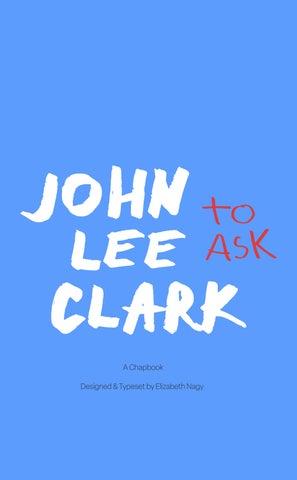
A Chapbook
Designed & Typeset by Elizabeth Nagy
A Chapbook
Designed & Typeset by Elizabeth Nagy
Copyright © by Elizabeth Nagy
artd 444 Typographic Systems
Molly C. Briggs, Instructor
Spring 2024
School of Art & Design
University of Illinois at Urbana-Champaign
John Lee Clark is an American deafblind poet, essayist, historian, and translator and an activist in the Protactile movement. His acclaimed How to Communicate: Poems, 2023, incorporates creative reflections on the Braille slate, prose poems, and “erasures” that reinterpret nineteenth-century poems and critique the limits of the canon.
To Ask is an original re-setting of Clark’s poem “To Ask”. This project was inspired by the pedagogical research of book designer and doctoral student Natalie F. Smith, with whom Professor Briggs has co-taught typography in past semesters.
The poem I have selected for this chapbook, To Ask, illustrates John Lee Clark’s experiences of navigating the world as a DeafBlind man. This poem specifically touches on his past struggles to sustain a relationship, given some of the resentment he has felt toward the world.
She didn’t have to but she started to learn Braille
I say started because she didn't finish
She didn’t finish because I was the worst boyfriend imaginable
She was studying the Braille book she had ordered from the Hadley School for the blind Braille has a simple version called Grade One and an advanced version called Grade Two and she naturally started with Grade One
She asked me about a passage
I read it and it said See Spot run
I said stupid book kiddies and tore it in half
She said hey my book
I said SEE I Is The Was SPOT run Ing run eD duh duh and tore it into more halves
She gave Braille up and almost gave me up
She went on to learn Gaelic French Japanese Danish Spanish and became a pioneer in written ASL
Braille she never touched again
It took years and being kicked out and finally being separated for two years but I learned to be a good husband
During the two years I was alone I read and read and read
The ASL words Braille and Forgive are almost the same so it was like I was saying forgive me while brushing my fingers over the dots
Forgive me forgive me forgive me
I was wrong
She did master Braille
The hardest most advanced kind
This book was designed and set into type by Elizabeth Nagy at The University of Illinois, Urbana-Champaign, and printed and bound by Elizabeth Nagy.
The text face is Elza Extralight, designed by Daniel Sabino first issued in digital form by Adobe Systems.