A2 • B1
THE MAGAZINE FOR YOUR ENGLISH
a
1
of English
YEAR XLII N° 1 • September-October 2019 • Imprimé á Taxe Réduite
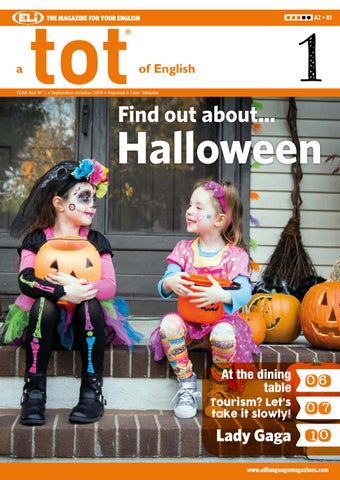
Find out about...
Halloween
At the dining table
Tourism? Let’s take it slowly!
06 07
Lady Gaga 10 www.elilanguagemagazines.com
Introducing a photograph
Afghan girl
Journalist: Steve McCurry Year: 1984 Nationality: American Subject: 12-year-old orphan* girl, Sharbat Gula, in a refugee camp* in Peshawar.
info@elimagazines.com ELI srl, C.P. 6, 62019 Recanati, Tel. (071) 750701, Fax (071) 977851, E-mail: info@elionline.com - www.elionline.com Direttore responsabile: Lamberto Pigini. Realizzazione testi: Samantha Charlton. Autorizzazione Trib. di Macerata N. 352 del 27 ottobre 1992. Realizzazione: Tecnostampa, Loreto © ELI Italy 2019 NO PART OF THIS PUBLICATION MAY BE REPRODUCED IN ANY FORM OR ANY MEANS OR FOR ANY PURPOSES WITHOUT PRIOR PERMISSION. THE PUBLISHER IS PREPARED TO MAKE PAYMENT FOR ANY COPYRIGHT OF PHOTOGRAPHS WHERE THE SOURCE HAS BEEN IMPOSSIBLE TO TRACE. ALTHOUGH WE CHECK THE CONTENT AND SUITABILITY OF THE WEB SITES FEATURED OR REFERRED TO IN OUR MAGAZINES AT THE TIME OF GOING TO PRESS, WE ARE NOT RESPONSIBLE FOR ANY CHANGES TO WHICH MAY HAVE OCCURRED SINCE, AS THESE WEB SITES ARE IN NO WAY ASSOCIATED WITH ELI.
Unauthorised photocopyng is illegal.
Interesting fact: the image has become a symbol of the Afghan wars of the 80s, thanks also to featuring on the cover of National Geographic.
www.elilanguagemagazines.com AUDIO
Your subscription includes free MP3 downloads of the audio sections of all the magazines. Visit www.elilanguagemagazines.com and insert the access code found in each magazine.
TEACHER’S NOTES
Subscribed teachers are able to download both the MP3 audio files and the Teacher’s Notes in PDF format. You should register first in the Teacher’s Resources area of the website www.elilanguagemagazines.com.
Greetings
Samantha
Welcome back everyone! How are you doing? Are you ready to start a new year with me and A TOT of English? Look out for some new features this year: on page 2 you can admire the most famous and beautiful photos in history, while on page 6 we discover unusual customs from around the world (at the dining table, at home and at school etc.) This issue’s ‘Report’ focuses on slow tourism, and the star we’ve interviewed for ‘People’ is none other than ... Lady Gaga! The excitement doesn’t end there. This month you’ll find out about the origins of Halloween on pages 12-13, and the last page of the magazine features the graphic novel ‘Anya’s Ghost’. Let’s dive in!
Contents Sommario The World’s Great Cities
4
Around the world
6
Report
7
Dublin
At the dining table Tourism? Let’s take it slowly!
People 10 Lady Gaga
Test 11 What Halloween monster are you?
Find out about...
12
Games Galore
14
Halloween
Novel 16 Graphic novel: Anya’s Ghost
The Wall of Kindness
Hi, I’m Grammy. This month we’ll learn about:
The Wall of Kindness is located in Uppsala, Sweden. This is a charity project that has been around the web thanks to the photos posted on social media. Built in the street by a real estate agency*, the wall is a real show of solidarity that was first started in Iran. It is an outdoor wall with hooks* and clothes hangers, where everyone can leave coats, warm clothes and other clothes that those in need can take freely. Very useful, especially in the winter months, the wall of kindness has as its slogan: “Leave if you do not need”. Thanks to social media, similar walls have also been created in other cities in Pakistan and China, for example, but sometimes with a different type of gift. In a Chinese city, there were no clothes but books given to poor children who could not afford them.
- use of the infinitive - use of the historical present - relative pronouns - the past simple
- the imperative form - possessive adjectives - the superlative form
Glossary
extravagant: out of the ordinary hooks: curved tools to support something (here clothes) material possessions: riches, things we own orphan: someone who lost their parents real estate agency: company that buys and sells houses refugee camp: places where victims of war or other tragedies are hosted
Secret code
There are some brilliant and extravagant* people who decide to abandon all material possessions* and live on the street, with nothing, like homeless people. For example, the Russian mathematician Grigori
E = 5 L = Q R = Y G = H O = J W = 6
H
5
Perelman ... or another famous person, who described his experiences living on the street in his first book “Down and out in Paris and London”. Use the code to discover who it is!
J
Y
H
5
J
Y
6
5
Q
Q
The answer is on page 14.
03
The World’s Great Cities
Dublin
The capital of the Republic of Ireland, Dublin is a city with personality! It has cobbled streets and classic pubs. History that dates back to the Vikings. Complete this story about what to see and do in Dublin with the superlative forms in the box.
Take the free Dublin Walking Tour and see the highlights* of this fascinating city, without paying anything! There are many tour operators offering free tours of Dublin, but locals say this one is ..............................................................! Visit Dublin Castle, the River Liffey – and many more exciting places – to discover Viking and Medieval Dublin, and the city’s literary past. One of the landmarks* you shouldn’t miss is St Patrick’s Cathedral. Built between 1220 and 1260, this cathedral is one of the few buildings left from the medieval city of Dublin. Still .............................................................. cathedral in Ireland, the building has around 700 burials on site.
04
If you like exploring the past, make sure you visit the National Museum of Ireland. This beautiful building sits on the River Liffey. It was once .............................................................. military barracks but now contains displays dating back to prehistoric Ireland. A must-see for history lovers! Dublin is also home to the famous Book of Kells. This book was written around 800 AD by Irish monks and later buried in the ground for fear of the Vikings. It is one of .............................................................. in the world. Its 680 pages of vellum contain the Latin texts of the Four Gospels.
the superlative form
• the most beautifully illustrated • the most famous • the best • the largest • the world’s biggest
B. Mountjoy Square
Planned and developed in the late 18th century by Luke Gardiner, the 1st Viscount Mountjoy, Mountjoy Square was once Dublin’s most prestigious* Georgian square. A long list of famous Dubliners have lived here. Arthur Guinness, the founder of the famous drink, died here, and the novelist James Joyce featured the square twice in his Another popular sight in Dublin is Kilmainham Gaol. This jail, which was open between 1796 and 1924, held some of ......................................................... political and military leaders in Irish history. Get an idea what it was like to be a prisoner in Ireland!
Iconic Squares of Dublin
Every city has little pockets that become the heart of social and cultural activity, and one of those places in Dublin is its squares. Here are the city’s three most popular Georgian squares.
A. St. Stephen’s Green
Opened in 1880, St. Stephen’s Green is perhaps Dublin’s most well-known Georgian square. It boasts attractions including the adjacent* Grafton Street (great for shoppers!), and the vibrant* St. Stephen’s Green park, which has 3.5km of pathways. The square also played a part in the Irish rebellion against the British. During the 1916 Easter Rising, gunfire was exchanged between the Irish Citizen Army and the British Army in the square.
Dublin squares memory test! Without looking back at the story, see if you can answer these questions correctly.
1 Which square is the oldest of the three? 2 Where did U2 used to play music? 3 Where did fighting take place in 1916?
4 Which square sits next to a large park? 5 Which square was named after a politician? 6 Which square is the most prestigious of the three? The answers are on page 14.
novel “Ulysses”. The rock-band U2 used to rehearse* in this square before they became famous!
C. Parnell Square
Perched at the end of O’Connell Street, Dublin’s main thoroughfare, Parnell Square is the oldest Georgian square in the city. Once called Rutland Square, it was renamed after Charles Stewart Parnell, a prominent* Irish politician. During Ireland’s fight for independence it was a popular place for secret meetings and hiding spots with freedom fighters, and on the eve of the 1916 Easter Rising, it was an assembly point for the Irish fighters.
Glossary
adjacent: next to or adjoining something else. highlights: the most important things landmarks: important monuments or places of interest prestigious: respected prominent: important rehearse: practice vibrant: exciting
05
Around the world
Can we use our hands?
At the dining table
In Chile it is very rude to eat food with your hands. This rule even applies to French fries, pizza and burgers! Mexican tacos, on the other hand, must absolutely be eaten with your hands, because if you use cutlery you are a snob. J In Thailand use cutlery* (the fork in the left hand and the spoon in the right) only when you eat something other than rice, otherwise ... use your hands! To use chopsticks here is considered bad taste*. In India, as in some countries of the Middle East and Africa, you have to eat with your right hand, never with the left, which is the hand for cleaning yourself. In Morocco it is important to eat with three fingers (thumb, index and middle finger), because using the whole hand is a sign of greed*.
The ancient Greeks used to eat with their hands, washing their fingers with perfumed water between each dish. The first cutlery, similar to our spoons, was used in imperial Rome. For centuries they were expensive and rare objects, until silver spoons were used and, only in the Middle Ages, forks.
Dining table manners
In Ethiopia everyone eats together with their hands from a large common plate, because serving separate dishes is wasteful*. In Tanzania you eat on the floor, sitting on a carpet: never let others see the base* of your feet though, because it is a very rude gesture indeed! In Afghanistan, if you accidentally drop your bread on the ground, pick it up and kiss it. In Turkey the rules are precise: don’t talk with your mouth full, don’t ask for the price before eating at the restaurant and, if you want, eat chicken with your hands. In Venezuela during official dinners, it is forbidden to ask for more, except for dessert.
06
Soups
In Japan, if you make a lot of noise with your mouth while eating a soup, it means that the dish is very good and you like it. Here, as in all of Asia, you can drink from the plate, but it is rude to cross or lick your chopsticks and put them straight into the rice. In China and Japan they mix hot and cold foods to keep the balance between yin and yang. In Venezuela, when you eat a soup, fill the spoon up to two thirds and drink the liquid a little at a time, without ever putting the spoon in your mouth. Pho is a beloved Vietnamese soup, especially at breakfast: often you see rows of customers waiting for their hot pho at street stands!
Glossary
greed: desire to have everything for oneself bad taste: not very polite, not very nice base: part below the foot cutlery: set of forks, spoons, knives used at the table wasteful: to use something carelessly
the imperative
A bit of history…
Report
Tourism?
Travel slowly, enjoy nature and don’t be in a hurry to get to your destination. The number of ‘slow tourists’ around the world is increasing, and they teach us to respect the environment, culture and beauty of every place. Always ... take it slowly!
Let’s take it slowly! 2019 will be the year of slow tourism in Italy. Ideal for those who love to travel at a slow pace, slow tourism is a life philosophy* and a different way of exploring the world. How does a slow tourist get around? On foot, by bicycle, on horseback, with snowshoes on their feet when there is snow, on a train that takes ancient routes. Slow tourism is respectful towards the environment and keeps you connected to nature. Slow tourism means breathing fresh air, listening to nature’s silence, taking one’s time, getting to know small towns where time doesn’t go by as fast as in the city, and admiring unfamilar landscapes.
The path
The easiest way to experience slow tourism is to walk. The Norwegian explorer Erling Kagge, in his woulderful book (Walking), tells how he managed to walk to the three “Poles” (North Pole, South Pole and
07
Report
Mount Everest) and how he walked through the New York underground, passing through the train and underground tunnels, from the Bronx to the Atlantic Ocean. Kagge explains that, in an increasingly fast-paced, hurried world, the action of walking is almost revolutionary! You don’t need to climb mountains, like he did: just go by foot everywhere. Go to school, to work, walk in the woods, or visit a city: walking to these places is good for the soul and health. Scientists say that those who walk live longer, have better memory and develop their mind. Walking gives a sense of freedom. Sylvain Tesson, a French writer and traveler, agrees. After traveling the world by bicycle, he decided to cross France on foot, from the South to the North. Author of the book ‘The Consolations of the Forest’, he explains that the most beautiful thing about walking is the ‘inner silence’ it provides. The path and silence are in fact connected.
08
Places and forms of slow tourism
The idea behind slow tourism is that the traveler pays attention to, and shows respect for, the culture of a territory, its cuisine, its inhabitants, and its natural beauty and heritage. Stay in B&Bs, in widespread hotels, or in agritourism businesses, in order to meet the locals and have an authentic experience. Widespread hotels, for example, are a new type of hospitality that offers refurbished* homes in small towns. In this way tourists can sleep in real homes, like
the local residents, but with the comforts of a hotel. Apart from walking, slow tourists love hiking, cycling, bird watching, horse trails, and tourism by river and sea.
The journey and the destination
For those who enjoy slow tourism, the journey is as important as the destination*. Traveling becomes a unique experience, a beautiful memory to keep that is rich in emotion. In fact, many travel companies now understand what tourists want and have changed to
The longest horse trail in Europe starts from Bellinzona, in the Canton Ticino (Switzerland), and finishes in Italy, in Liguria. It runs 300 km along an ancient path that crosses the Via del Sale, where merchants once used to exchange salt for fresh produce.
suit them. Now they offer long, relaxing journeys, which are often sought by those who live in the city, where life’s everyday rhythm is fast and tiring. It’s not arriving at the destination that is important, but how beautiful the road we travel is. Some examples? Sail on the Nile, from Luxor to Aswan, Egypt; or get on an old colonial* train and reach Ella, in Sri Lanka, starting from Kandy. Or finally, take a tour of the Galapagos Islands in Ecuador on a sailboat, or board the beloved* Jacobite Steam Train, in Scotland, to emulate Harry Potter.
The extreme race
use of the infinitive form, relative pronouns
The exact opposite of slow tourism is the trend of extreme racing. Increasing numbers of fans, all over the world, are racing over mountains, in the deserts, through woods, over rocks and in dangerous places. They love to test themselves, to see who is the toughest, and they also love to impress their friends. ‘The Ultra Trail du Mont Blanc’, for example, at the end of August, is 171 km long and runs around the famou s mountain; while the ‘Marathons des Sables’ is a 250 km race in the Moro ccan desert. All these races attract thousands of runners every year! But the latest fashion is … Tower running. What does it mean ? Climbing the 2,226 steps of the One World Trade Center skysc raper in New York, or the 1,027 steps of the Isozaki Tower in Milan .
Guess
Slow tourists like to eat good, healthy, honest, and environmentally-friendly foods. Slow Food (www.slowfood.com) is a movement that was founded to protect the right to eat well, and for pleasure, instead of eating fast food and junk food. What cute animal is on the Slow Food logo? a a snail
b a tortoise
c a bee
Glossary
beloved: something people love colonial: from the colonial period destination: the place where you arrive after a journey philosophy: a theory or attitude that is your guiding principle refurbished: to repair and renovate an old house
The answer is on page 14.
09
People
“Lady Gaga has taken American pop music to a higher level, because she has made it stranger, more personal and fun.”
Miss Germanotta, what kind of girl were you? I never wanted to be like the others. I knew I wanted to be myself and that’s it. I liked singing and playing the piano, so I went to bars and played. They liked my songs, so they asked me to sell them to other singers who were ‘better’ than me. I said ‘no’; the songs were mine, and only I would sing them! Even the make-up, the clothes, the look ... I always want to choose. I wanted to be an artist and in one way or another I knew I could do it. I took dance and piano lessons, so I could take on everything. Talent is not enough, it takes so much preparation and great tenacity*. You are always at the top of the music charts. How does this affect you? It makes me realise that my work is appreciated by the public and this is amazing for me. Even my 57 million followers on Twitter and the 62 million friends I have on FB tell me they love me as much as I love them. Like Madonna, to whom many people compare me, I have many fans who love me even when I change music and direction. I have no one who creates my image: I am what you see! I always hope that my music will give strength to those who feel weak and poorly understood by others. What was it like to star in a film? Wonderful. A Star is Born is an important film, for me, for Bradley (Cooper) and for everyone, since it received 8 Oscar nominations! The song Shallow won the Oscar. When I sang with Bradley, I felt free. The film made me very emotional. I often
10
Lady Gaga Identity card
Name: Stefani Joanne Angelina Surname: Germanotta Place and date of birth: New York, March 28, 1986 Profession: singer and actress Interesting facts: her stage name is inspired by the song Radio Ga Ga by Queen. cried, alone, in the dressing room*. I realised that we can all become a star. It’s important to believe in yourself and love yourself. Music, cinema and a lot of social commitment. Tell us what you like to fight for! I’ve worked against cyberbullying, in fact I dedicated a song, Hair, to a boy who was bullied. The wellbeing of young people is a topic that’s very close to my heart; in fact, with my mother in 2012, I founded the Born This Way Foundation, which listens to and helps young people who are victims* of bullying and discrimination*. Together with Elton John I created a line of clothes to support our organisations. In 2017 I donated a million dollars to the victims of Hurricane* Harvey; we helped, in person, the people who had lost their homes. It was an unforgettable moment in my life.
Glossary
discrimination: the unfair treatment of people on the grounds of race, age, or sex. dressing room: rooms where actors get dressed and put on make-up hurricane: a violent storm of wind and rain tenacity: firmness and constancy in your actions victim: a persecuted person, someone is made to suffer by others
the past simple
She’s one of the most original musical artists of the 21st century. She has sold millions of albums, knows how to act and is very committed to freedom and the rights of young What they say people. Who is she? about her Lady Gaga!
Test
What Halloween monster are you?
1 Which fantasy character do you
love the most? a The warrior hero with a legendary sword b The magician who casts spells* c The witch with magic potions*
2 Your friends sometimes say you
are ... a a bit crazy b extravagant and unique c strange but in a good way!
3 The perfect music for your
5 You are a monster: everyone is
Halloween party: a rock and metal at full volume b gothic and dark music c wild* dance!
afraid of you because of ... a your deep voice b your shroud* of mystery c your ugliness
4 Which accessory is perfect for
6 Your Halloween pumpkin is
your disguise*? a Fake sharp* teeth b Coloured contact lenses c Very long false nails
Answered mostly ‘a’: vampire You are a straightforward and quiet person in everyday life, but on Halloween night you give it everything! In recent years, thanks to Twilight, vampires are back in fashion, but you like oldfashioned ones that prowl at night and escape when faced with garlic and light. For your disguise, wear false teeth, colour your mouth with ketchup and wrap* yourself in a large black cloak! Answered mostly ‘b’: witch Whether you are the classic evil witch or a more traditional witch of the woods, Halloween is your moment: it is the most special evening of the year. Your laughter scares everyone and nobody has the courage to go against your will. Black hat, a long skirt and, of course, the ever-present broom: you’re ready for Halloween! Answered mostly ‘c’: ghost Classic, timeless and always sweet: the ghost costume is always a favourite. If you want to modernise your costume, take inspiration from Tim Burton’s Corpse Bride or Edward Scissorhands. Your costume will be perfect, especially if you have a romantic and slightly melancholic* character. If you don’t use a sheet, get a white dress, a disheveled wig and apply lots of greasepaint* to your face. A great result is guaranteed!
decorated with ... a ghosts and bats b a horror scene c an evil smile
imperative form, possessive adjectives
Glossary
disguise: set of clothes and accessories for masking your true identity greasepaint: cream that covers the face of the actors melancholic: sad and thoughtful potions: mixtures containing magical ingredients sharp: with a fine point shroud: to cover or mask spells: words spoken to cause magical effects on someone wild: that does not stop, very lively wrap: cover yourself
11
Find out about...
Halloween
Many people think that Halloween comes from the United States of America. It’s true that this festival is very popular in the USA, but did you know that it didn’t originate there? Discover the origins of Halloween. Match the headings (A-D) with the descriptions (1-4) below.
A B C D
The meaning of ‘trick-or-treating’ Ancient Celtic origins Why we wear costumes at Halloween The meaning of ‘Halloween’
1. Halloween’s origins date back to the ancient
Celtic festival of Samhain (pronounced sowin). The Celts, who lived 2,000 years ago in the area that is now Ireland, Scotland, and northern France, celebrated their new year on November 1.
2. The word “Halloween” comes from ”All Hallows’ Eve” and means “hallowed* evening.” Hundreds of years ago, people dressed up as saints and
12
went door to door, which is the origin of Halloween costumes and trick-or-treating.
3. Children in costumes travel from house to
house, asking for treats with the phrase “Trick or treat”. The “treat” is usually some form of sweets or candy, although in some cultures money is offered instead. The “trick” refers to a
threat*, usually not serious, to perform mischief* on the homeowners or their property if no treat is given. This practice comes from a similar practice in the Middle-Ages, where children and sometimes poor adults would dress up in costumes and go door to door during Hallowmas begging* for food or money in exchange for songs and prayers, often said on behalf of the dead.
4. This practice, also
known as “guising” (from “disguising”), began with the Celtic tradition of celebrating the end of the year by dressing up as evil spirits. The Celts believed that, as we moved from one year to the next, the dead and the living would overlap*, and demons would roam* the earth again. So if you dressed up as a demon and met a real one, they would think you were one of them!
Samhain
relative pronouns, past simple
Samhain (pronounced sow-in) is the ancient Celtic festival that Halloween originates from. Read the story about Samhain and complete using the Past Simple of the words in brackets.
Glossary
begging: to ask for money because you are poor blurred: difficult to see extinguished: to put out a fire hallowed: sacred, special harvest: to collect fruit and vegetables at the end of the summer mischief: to do naughty things overlap: to co-exist roam: to travel sacred: holy threat: a menace, dangerous
Samhain day ................................................. (to mark) the end of summer and the harvest*, and the beginning of the dark, cold winter – a time of year that was often associated with death. Celts .............................................. ... (to believe) that on the night before the new year, the boundary between the worlds of the living and the dead became blurred*. On the night of October 31 they celebrated Samhain, when it was believed that the ghosts of the dead ................................................. (to return) to earth. On this evening, they ................................................. (to build) huge sacred* bonfires. During the celebration, the Celts ................................................. (to wear) costumes, typically consisting of animal heads and skins. When the celebration ............................ ..................... (to be) over, they re-lit their fires at home, which they had extinguished* earlier that evening, from the sacred bonfire to help protect them during the coming winter. The answers are on page 14.
13
Games Galore
Match
Do you love traveling? Do you know the cities of the world, and what they are most famous for? Try to match each interesting fact with the correct city! A
The city with the largest museum in the world.
B
The most populous city in the world.
C
The city that first used yellow taxis.
D
The southernmost capital of the world.
E
The highest capital in the world (3600 meters).
F
The city with the most fountains in the world.
Wordfinder
Find 14 words associated with Halloween that were on pages 12-13 and discover the name of the ancient people of Ireland, Scotland, and northern France.
1 Shanghai (China) 2 Rome (Italy) 3 La Paz (Bolivia) 4 St. Petersburg (Russia) 5 New York (USA) 6 Wellington (New Zealand)
T S A C R E D H
R A U O O C E A
I M T S A F A R
C H U T M E D V
K A M U D S S E
O I N M E T P S
R N F E M I I T
T Y I S O V R L
R E R E N A I T
E A E V H L T S
A T R T E E S
The answers are below.
Answers P 3 Secret code: George Orwell. Pp 4-5 1. The best, the largest, the world’s biggest, the most beautifully illustrated, the most famous; 2. 1 C, 2 B, 3 A, 4 A, 5 C, 6. B. Pp 7-9 Guess: a), a snail. Pp 12-13 Discover the origins of Halloween: 1.B, 2.D, 3.A, 4.C; Samhain: marked, believed, returned, built, wore, was. P 14 Match: A.4, B.1, C.5, D.6, E.3, F.2; Wordfinder: trick or treat, Samhain, sacred, year, autumn, fire, costumes, roam, demon, festival, dead, spirits, harvest, eve: the Celts.
14
Liven up your lessons! With audio materials and Teacher’s notes free download: www.elilanguagemagazines.com English
intermediate advanced
ediate
te
edia
erm -int
interm
er
low
ry
ta en
m
ele
l
c
ys
ar
rim
o ho
p
Français
Lingua latina ry ima
pr
ol
scho
lower-intermediate
ntary
eleme
intermediat
e inter m adva ediate nced
y
tar
en
lem
HECCRBQ ZPSR
e
Italiano
ry nta
te intermediate
intermediate advanced
edia
term
-in wer
advanced
lo
me
low er-in
o
ch
s ry
ele
ol
a
im pr
term
Español
edia
te
Deutsch primary school
e
iat
ed
-
er
rm
inte
elementary lower-in
termedia
te
inter
med
iate int ad erm van ed ce iate d
ele
me
nt
ary
low
int
m er
ate edi
iate med inter nced adva
ELI Language Magazines
www.elilanguagemagazines.com
Novel
Graphic novel:
Spooky*, sardonic*, and sincere, Anya’s Ghost is a wonderfully entertaining debut from author/artist Vera Brosgol. This coming-ofage story has been called “a masterpiece, of Young Adult literature and of comics.”
in her life, but she is helpful in certain ways. She can help her with answers during tests. She can find out when her crush* will be out of class. She gives her tips* on being popular. Emily wants to be Anya’s friend forever. And that could be a problem, because Emily is keeping secrets, and she’s a lot more dangerous than she lets on*.
“You may look normal like everyone else, but you’re not. Not on the inside.” Vera Brosgol
The story
Anya Borzakovskaya is the daughter of a Russian immigrant. She’s frustrated with her family, frustrated with school, frustrated with her best friend Siobhan – and frustrated with her body and her (lack of) love life. And then one day, Anya falls into a hole in the park and finds a skeleton. The skeleton comes with a ghost attached – a skinny* little girl named Emily who’s been stuck* in the hole for 90 years. When Anya gets rescued, Emily ends up tagging along*. Anya doesn’t much want a ghost
16
scow, Vera Brosgol was born in Mo the to Russia in 1984 and moved five. United States when she was ssical Cla She received a diploma in llege, Animation from Sheridan Co Inc. ika and currently works at La in Portland, Oregon, drawing ation. storyboards for feature anim d trying She loves knitting, baking, an s you pe ho not to kill her plants. She wings! are enjoying looking at her dra use of the historical present
Glossary
crush: infatuation (noun) lets on: says sardonic: sarcastic skinny: thin spooky: scary stuck: can’t move tagging along: to accompany tips: advice
Tot of English N° 4 - 2019 - Poste Italiane S.P.A. - Sped. in abb. post. - D.L. 353/2003 (Conv. in L. 27/02/2004 n. 46) Art. 1, comma 1, DCB - Ancona
Written and illustrated by Vera Brosgol
Tassa Riscossa / Taxe Perçue
Anya’s Ghost