The Power of Language Games - by JoEnglish

Page 1


The Power of Language Games in the ClassroomWhy Play-Based Learning Works!

Pair up: Turning Phrasal Verbs into Play

Phrasal verbs are one of the most fascinating – and frustrating – aspects of learning English. They are everywhere in everyday communication, from casual conversation to workplace emails, yet for many learners they remain one of the biggest obstacles to fluency. Why? Because phrasal verbs don’t always follow logical patterns. They can be idiomatic, flexible, and often difficult to memorise in isolation.

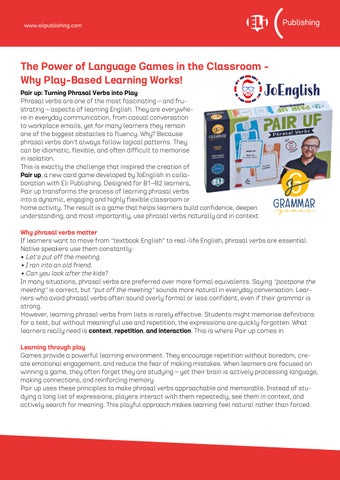
This is exactly the challenge that inspired the creation of Pair up, a new card game developed by JoEnglish in collaboration with Eli Publishing. Designed for B1–B2 learners, Pair up transforms the process of learning phrasal verbs into a dynamic, engaging and highly flexible classroom or home activity. The result is a game that helps learners build confidence, deepen understanding, and most importantly, use phrasal verbs naturally and in context.

Why phrasal verbs matter

If learners want to move from “textbook English” to real-life English, phrasal verbs are essential. Native speakers use them constantly:

• Let’s put off the meeting.

• I ran into an old friend.

• Can you look after the kids?

In many situations, phrasal verbs are preferred over more formal equivalents. Saying “postpone the meeting” is correct, but “put off the meeting” sounds more natural in everyday conversation. Learners who avoid phrasal verbs often sound overly formal or less confident, even if their grammar is strong.

However, learning phrasal verbs from lists is rarely effective. Students might memorise definitions for a test, but without meaningful use and repetition, the expressions are quickly forgotten. What learners really need is context, repetition, and interaction. This is where Pair up comes in.

Learning through play

Games provide a powerful learning environment. They encourage repetition without boredom, create emotional engagement, and reduce the fear of making mistakes. When learners are focused on winning a game, they often forget they are studying – yet their brain is actively processing language, making connections, and reinforcing memory.

Pair up uses these principles to make phrasal verbs approachable and memorable. Instead of studying a long list of expressions, players interact with them repeatedly, see them in context, and actively search for meaning. This playful approach makes learning feel natural rather than forced.

What makes Pair up unique

Pair up stands out because it is not just a single game, but a flexible learning tool. Teachers and learners can use the cards in multiple ways, adapt the difficulty level, and even invent entirely new games. This flexibility makes it suitable for:

• Teenagers in secondary school

• Adult learners in language courses

• Private tutoring sessions

• Small groups or large classrooms

• Even independent learners at home

The game bridges age gaps because it combines competition, strategy and language practice. Younger learners enjoy the fast-paced, playful nature of the activity, while adults appreciate the practical, real-life language focus.

Another unique feature is that phrasal verbs are always learned in context. Players are not simply matching words; they are connecting meaning and usage, reinforcing understanding through repeated exposure.

What’s inside the game

Pair up contains three types of cards:

• Blue cards: each card shows a phrasal verb.

• Orange cards: each card shows the meaning of a phrasal verb.

• Special cards: these add an element of surprise and strategy.

This simple structure allows for a wide variety of activities while keeping the game easy to understand and quick to set up.

How to play: The classic timed matching game

Here is one example of how Pair up can be played, although 4 gameplay versions are described in the instructions.

Preparation

1. Place all the blue phrasal verb cards face up on the table.

2. Shuffle the orange cards together with the special cards.

3. Place this deck face down on the table.

Now you’re ready to begin.

Gameplay

The first player draws an orange card and starts a one-minute timer

Their goal is simple:

Find the blue card that matches the meaning shown on the orange card. If the player chooses the correct phrasal verb:

• They keep the matching pair.

• They immediately draw another orange card.

• They continue playing until the one-minute timer finishes. If the player chooses the wrong phrasal verb, their turn ends immediately. The next player takes their turn.

This time pressure adds excitement and encourages quick thinking, helping learners develop faster language recall.

The role of special cards

To make the game even more engaging, special cards can change the course of play at any moment. When a player draws one, they must follow its instructions. Examples include:

• Give away a matching pair – pass one of your pairs to another player.

• Skip your turn – the next player misses their turn.

• Receive a matching pair – take a pair from another player.

These cards introduce strategy, unpredictability and plenty of laughter, keeping players motivated and fully involved.

Why this method works

This game format supports language learning in several important ways.

1. Active recall

Players must actively search for the correct phrasal verb, which strengthens memory far more than passive reading.

2. Immediate feedback

Players quickly discover whether their choice is correct, reinforcing learning instantly.

3. Emotional engagement

Excitement, competition and humour all help make memories stronger and more durable.

Flexibility for teachers and learners

One of the greatest strengths of Pair up is how easily it can be adapted. Teachers can:

• Remove special cards for a simpler game.

• Play in teams instead of individually.

• Add speaking challenges before players keep a pair.

• Use the cards for revision or warm-up activities. For example, before keeping a pair, a player might need to create a sentence using the phrasal verb. This transforms the game into a speaking activity and reinforces real-world usage.

Learning in context

Perhaps the most important feature of Pair up is that it encourages learners to think about meaning and usage together. Instead of memorising translations, players repeatedly connect phrasal verbs with their real meanings.

Over time, learners begin to recognise patterns and develop intuition. They start to feel when a phrasal verb “sounds right”, which is a key step towards fluency.

A game for every learner

Pair up proves that serious learning and fun can coexist. By combining language practice with gameplay, it creates an environment where learners feel relaxed, motivated and willing to take risks. Whether used in the classroom, at home, or in tutoring sessions, the game offers a natural and enjoyable way to master one of the most challenging areas of English. Phrasal verbs no longer need to be feared. With Pair up, they become something learners look forward to practising.

And that may be the most powerful learning tool of all.

This article is by

Turn static files into dynamic content formats.

Create a flipbook
The Power of Language Games - by JoEnglish by ELI Publishing - Issuu