Your English Monthly
TEEN Year XXXX - N. 1 - September / October 2019 - Imprimé à Taxe Réduite
B2/C1
®
1
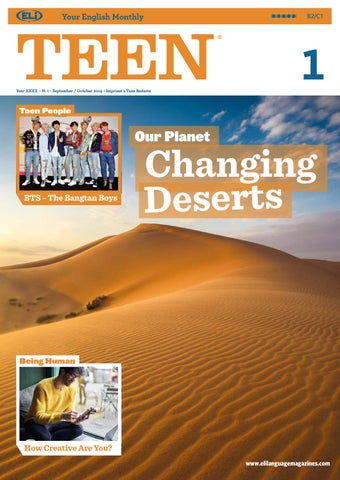
Teen People
Our Planet
BTS – The Bangtan Boys
Changing Deserts
Being Human
How Creative Are You? www.elilanguagemagazines.com
Welcome Welcome back! We begin this new year of Teen with lots of interesting articles for you to read, as well as fun activities and exercises for you to do. In this issue we meet the most popular boy band in the world, and find out about the amazing things that dogs do for us. We find out what’s happening in the world’s deserts, examine our own creativity, talk about sport in the UK, and go to university for free. Are you ready? Then, let’s go!
N. 1 - September/October 2019 Common European Framework Intermediate Level (B2–C1) In this issue look out for: - present and past tenses - subclauses, with ‘which’ and ‘with’ - comparisons (most and more) - constructions with ‘ing’ - questions and answers - phrases for expressing different opinions
Audio A subscription to the magazine allows you to download for free, in MP3 format, the audio of all the magazines in the resources section of our website www. elilanguagemagazines.com. You can do this by inserting the access code found in each issue of the magazine. Teacher’s guide For teachers, the subscription to the magazine allows you to download for free the audio material in MP3 format, as well as the teacher’s guide for all* the magazines available in PDF format. The teacher must first register in the teachers’ resources section on our website www.elilanguagemagazines.com
Liz
Contents 3 4 6 8 10 12 14
Teen People BTS Our Planet Changing Deserts Report Dogs Make Life Better Being Human How Creative Are You? Around the World University for Free Culture and Society Sport UK Playstation
Around the World
NO PART OF THIS PUBLICATION MAY BE REPRODUCED IN ANY FORM OR BY ANY MEANS OR FOR ANY PURPOSES WITHOUT PRIOR PERMISSION. THE PUBLISHER IS PREPARED TO MAKE PAYMENT FOR ANY COPYRIGHT OF PHOTOGRAPHS WHERE THE SOURCE HAS BEEN IMPOSSIBLE TO TRACE. ALTHOUGH WE CHECK THE CONTENT AND SUITABILITY OF THE WEB SITES FEATURED OR REFERRED TO IN OUR MAGAZINES AT THE TIME OF GOING TO PRESS, WE ARE NOT RESPONSIBLE FOR ANY CHANGES WHICH MAY HAVE OCCURRED SINCE, AS THESE WEB SITES ARE IN NO WAY ASSOCIATED WITH ELI. ELI srl, C.P. 6, 62019 Recanati, Tel. (071) 750701, Fax (071) 977851 Direttore responsabile: Lamberto Pigini. Realizzazione testi: Liz Ferretti. Autorizzazione Trib. di Macerata N. 237 del 4 luglio 1984. Realizzazione: Realizzazione: Tecnostampa, Loreto © ELI Italy 2018
Glossary inaugurated: when something was officially started adequate: which meets basic standards, that is good enough sustainable: that does not damage or destroy the natural environment liveable: comfortable, safe, clean – a good place to live
2
The 3 October 2019 is World Habitat Day. It was set up by the General Assembly of the United Nations in 1985, and inaugurated* in 1986. The day underlines the right of every human being to an adequate* place to live, and reviews current living conditions in our cities and towns. The theme of World Habitat Day changes every year, to cover different aspects of the sustainable* development programme of the UN-Habitat (United Nations Human Settlements)
World Habitat Day Programme. On World Habitat day we think about how we want our cities
to develop, and how we can make our cities more liveable*.
True or False 1. World Habitat Day has been celebrated since 1985. 2. Habitat is the place where people or animals live. 3. Everyone has the right to a decent standard of housing. 4. World Habitat Day focuses on the same issue every year. 5. We need our cities to be both sustainable and liveable.
True
False
Answers are on page 15
present tense – simple and continuous; present perfect; simple past
Teen People
BTS are a seven-member boy band from Seoul – the first South Korean band to get to number one in the US album chart. Their songs are about everyday problems, dreams of the future, and the challenges facing* young people today. Let’s meet the “world’s biggest boy band”.
BTS – The Bangtan Boys
Passport Name: BTS Members: RM, Jin, Suga, J-Hope, Jimin, V, Jungkook Place and date of birth: South Korea, 2013 Profession: musicians Distinguishing marks: most internationally successful South Korean band
The Name of the Band
BTS is the abbreviation* of the group’s name in Korean, “Bangtan Sonyeondan”, which means “Bulletproof* Boy Scouts”. Where does the name come from? These seven young men are questioning stereotypes* about young people. Their name is about being strong. The criticisms often aimed at* young people won’t hurt them, they say, they are ‘bulletproof’. The boys have changed since they started the band, they are older and more experienced, and have had worldwide* success. As a result, in 2017 they announced that BTS would also stand for “Beyond the Scene”, as part of a new, expanding* identity.
and regularly perform at music festivals in South Korea, and all over the world. Their first studio album, called Dark and Wild, was released in 2014. Following the album release, the band went on their first tour. Their 2015–2016 album, The Most Beautiful Moment in Life, was their first commercial success, and after that they toured in Malaysia, Latin America, Australia, the US, and Hong Kong. In 2017, they released their album The Wings Tour, and won Artist of the Year in the Mnet Asian Music Awards, a major South Korean music award.
Themes and Music
International Success
The members of the group write nearly all their own lyrics. People say this is the secret of their success. The young men are open about their feelings in their songs, and discuss a wide range of issues that affect young people. This is what their fans love about them. Their songs are often critical of Korean society. They talk about the need for freedom, the apathy* that seems to affect many young people, and their dreams of doing things differently. Their music is hip-hop, with R&B and Rock influences. Their style of music is known as K-pop, which stands for Korean pop, a particular style of popular music that originated in South Korea.
Their Story
The group was founded in 2013. They have a big following* on social media,
In 2018, BTS released their most recent album, Love Yourself, and won the American Music Award for Favourite Social Artist – the first Korean band to win this award. In 2019, they won Top Group in the American Billboard Awards as the highest charting Korean band in the US. To date, they have received many awards from around the world. BTS are widely respected, and were the first K-pop band to appear at the Grammy Awards in 2019, where they presented the prize for the Best R&B Artist. In 2019, they released their sixth album Map of the Soul.
Fun Facts
This hard-working band has released eight albums to date* – six studio albums, four compilation* albums, and six EPs
(extended plays, which contain several songs, but not as many as a full album). Not only are they talented musicians and performers, they have a big following on social media. In 2019, they entered the Guinness Book of World Records for the most viewed YouTube music video in 24 hours, for Boy with Luv. Their music isn’t typical pop music or typical K-pop, which can be a bit superficial at times, BTS are a bit different. They sing about difficult subjects like bullying and mental health problems. Their band logo, used since 2017, shows an open door. It symbolises new beginnings, a new way of doing things which leaves the old ways behind, helping ‘open the door’ to happiness. BTS also are big supporters of UNICEF and their humanitarian projects. If you don’t know their music, give them a listen!
Glossary facing: existing, happening to abbreviation: (here) using the first letters of a word to shorten it bulletproof: hard and strong, (a bullet won’t go through it) stereotypes: fixed ideas about a person or group of people aimed at: directed towards, intended for world-wide: (adj., hyphen before a noun) global, international expanding: getting bigger and wider apathy: when you have no interest in something following: (here) group of people who like a band/actor/ writer etc. to date: up to this time compilation: collection of songs from other albums
3
Our Planet
subclauses with which and with; comparisons (most and more); linking words
Changing Deserts
Deserts are areas so dry that hardly any plant life can survive there. In spite of the harshness of this environment, humans have a long relationship with deserts. Now, deserts are being used in new ways, and there are some massive projects to stop them growing.
The Geography of the Desert
Deserts cover a large part of our planet. In fact, around one third of the surface of the Earth is called arid* or semi-arid. The world’s biggest deserts are very cold. These are the polar deserts of Antarctica and the Arctic. The world’s biggest hot desert is the Sahara, in northern Africa. This is followed by the Arabian desert in the Arabian Peninsula, and the Gobi desert in Northern China and Mongolia. There are other big deserts in South and North America, Central Asia and Australia.
Desert Living
Modern technology is allowing millions of people live in or next to deserts. One of the largest desert cities in the US is Las Vegas on the edge of the Mojave Desert, with over 600,000 inhabitants. This 24-hour city was founded in the early twentieth century near an oasis* in south-western United States. The Mojave, which receives only 51mm of rain a year, is famous for Death Valley and Joshua Trees, a member of the Agave family. This desert has average summer daytime temperatures of around 50 degrees centigrade. Many of the states on the Arabian peninsular are specialists in desert living. Here are the super modern cities of Riyadh, the biggest desert city, with over 7.5 million inhabitants, as well as Dubai and Kuwait City, each with several million inhabitants. So, what’s it like living in
4
the desert? Hot and dry, but modern comforts such as air conditioning make life more bearable*. Living in the desert can have health benefits. SAD (Seasonal Affective Disorder – depression and low energy caused by a lack* of sunlight) is less likely if you live in the desert, there is less damp in the air, which can be good for respiratory disorders*, and the dryness helps you heal* more quickly if you cut yourself!
Saving the Planet
Apart from some tourism, mining* and oil wells*, deserts have not been a great
economic resource for the countries that include them. But that is starting to change. Solar power is turning deserts into gold. There is a lot of sunlight in deserts, and the land is not used for anything else. These two factors make them perfect for generating electricity through solar power plants. Traditionally poor countries such as Morocco, as well as super powers China, India and the US, are investing heavily in this type of energy generation. Take the Tengger Desert Solar Park in China. This covers 43 sq km* and generates 1.5 MW of power. That’s currently the biggest desert-based solar farm in the world, but not for long… Morocco
If you are hungry in the desert, then you can eat the fruit of cactus plants. The nicest are the Prickly Pear but watch out for the spikes! Humans have been growing palms for their sweet fruit, called dates, for over 8,000 years. The date palm grows in North Africa, the Arabian peninsula and the Middle East. is currently investing billions of dollars building what will be the world’s largest solar energy project. This will be a mixture of photovoltaic and concentrated* solar power energy. When it is finished in 2020, it will provide 38% of Morocco’s electricity. One day, the country might be able to export clean energy to Europe.
Using Trees to Stop the Desert
This all sounds positive, but in many places deserts are growing. The Sahara and neighbouring Sahel deserts are expanding.
Where is/are ...? 1. The Mojave Desert? ............................................................... 2. The Tengger Desert Solar Park? ...............................................................
This is a disaster for farmers who need to make a living from the land. But there is a plan to stop it. This is the Great Green Wall, a project involving 11 African countries which border these deserts, to counter* the effects of climate change and desertification – the word used to describe the growth of deserts. The Great Green Wall is one of the most ambitious environmental projects in the world. It includes tree planting and other projects to protect and restore degraded* land. How big is this project? When
3. The Great Green Wall? ............................................................... 4. The world’s newest and largest solar power project? ............................................................... 5. Death Valley? ...............................................................
What is/are? match. a.
Polar deserts
1. b. Seasonal Affective 2. Disorder 3. c. The Gobi Desert d. Riyadh 4.
The answers are on page 15.
Physical and mental condition caused by lack of sunlight A cold desert in China and Mongolia The world’s biggest desert city; on the Arabian peninsula The Antarctic and the Arctic
finished, it will stretch across the entire continent from west to eat. Tree planting is a large part of this plan to help the people in some of the world’s poorest countries. About 15% of the wall is now complete, with the biggest progress made in Nigeria, Ethiopia, and especially Senegal.
Desert Facts
• Some animals and plants have adapted to live in these harsh* conditions. Specialist spiders, mammals and lizards can all survive in deserts. Did you know that desert-loving scorpions are an arachnid? They have eight legs, and can be highly poisonous. • Not all deserts are hot. The Gobi desert is cold. In the middle of summer, it can get up to 25 degrees centigrade, but in winter it never gets above freezing, and there is often frost and a small amount of snow here. • Desert plants can live for hundreds of years. The oldest Joshua tree is over 1000 years old. Another famous desert plant is the Barrel Cactus, which is round and very spiky*.
Glossary arid: very dry parts of the planet oasis: small area in the desert with water and plants bearable: that you can accept lack: not enough of something respiratory disorders: illnesses to do with breathing heal: make better, (here) when the body closes up a cut naturally mining: (here) taking metals from below the ground
oil wells: extracting crude oil from under the ground sq km: square kilometres photovoltaic and concentrated (solar energy): types of electricity generation using sunlight counter: (here) go against, do the opposite degraded: destroyed, spoiled harsh: unpleasant, uncomfortable spiky: with small, sharp growths, e.g. on the surface of a cactus
5
Report
Dogs Make Life Better
Dogs are affectionate, bouncy*, and full of life. They have been our faithful* companions for centuries, but they are more than that, they can even save lives. Let’s look at how dogs help us live better. The Benefits of Owning a Dog
If you like dogs, you know how relaxing it is to interact* with them. Stroking a dog has a physical effect on our bodies, lowering levels of a hormone* called cortisol, which our bodies release when we are in a stressful situation, and increasing levels of dopamine, a chemical which improves mood*. Dogs are not only good at reducing stress, though. Having a dog helps us stay physically fit because we have to take them out for walks every day whatever the weather*, and gentle exercise out of doors is also good for our mental well-being. It can be tempting* after a long day at work or studying to get home and slump* onto the sofa to watch TV, but when you have a dog you have to put it first, you are responsible for its well-being, a dog needs exercise. And who could resist that look, that wagging tail, as your dogs stands expectantly by the front door? Having a dog can be emotionally rewarding too. Dogs can become our friends, they
6
are part of the family. Pets help combat loneliness. When we have a dog we feel wanted and needed.
Pet Therapy
This positive relationship with dogs, and other pets such as cats, rabbits or guinea pigs, is being used more and more in the treatment and management of some diseases and health conditions. Known as Pet Therapy, or Animal Assisted Therapy, this therapeutic* use of animals is getting increasing recognition from health professionals. Interacting with an animal – watching it, touching it, speaking to it –
reduces stress, as well as negative emotions such as fear, and the interaction can also help people with reduced mobility*. Your physiotherapist might suggest a repetitive exercise to do following an arm injury, for example, and they could arrange for a visit from a puppy that you can stroke, which will not only exercise your damaged arm, but will also help you to feel happier. Used alongside traditional Western medicine, Animal Assisted Therapy has been shown to improve the speed and quality of recovery of many patients. Pet therapy is good for people with learning
constructions with ‘ing’
One of the dogs recognised in 2019 for his heroic service is Jerry Lee, a Belgian Shepherd who is four years old. He received his reward after he and his master searched for 72 hours for two adolescents who had got lost in the Paris catacombs.
Sigmund Freud’s Chow Chow, Jofi, became famous for sensing the emotional state of his master’s patients. For seven years Jofi sat in on Freud’s psychoanalysis sessions. Jofi was able to pick up on the patient’s state of mind. If they were calm, he would lie down next to them, but he would keep away from patients who were agitated.
Guide Dogs
difficulties or depression, and for helping to improve levels of concentration. Interacting with animals is beneficial for people born with Down’s Syndrome, autism*, and for age-related* conditions.
We use a lot different animals to help us in different ways across the world, but dogs are often the biggest help. Dogs can be trained to guide blind and visually impaired people, and people who are deaf. Assistance dogs are a huge help to anyone who would otherwise struggle* to live on their own, allowing them to live independently. Guide dogs help people who are blind or with poor vision to leave their homes to visit friends and go to the shops, things that sighted people can take for granted*. There is a long history of dogs helping humans. The first records of assistance dogs date to the first half of the sixteenth century. The first dog training school was set up in Germany during the First World War, for veterans who had lost their sight during the fighting. Today, the most common breeds of guide dog are the Golden Retriever and the Labrador. These breeds have a gentle nature and are easy to look after. They are healthy and respond well to training.
Answer True or False 1. Dogs are the only animals that have a positive relationship with humans. 2. Stroking a dog helps keep you calm and relaxed. 3. You’re likely to be more physically active with a dog, even if you have reduced mobility. 4. The first school to train guide dogs opened in the first half of the sixteenth century. 5. Dogs have an incredible sense of smell. 6. Dogs are naturally good swimmers. 7. Dogs can be trained to save people from drowning, and rescue people buried under an avalanche. 8. Dogs don’t need to be trained to search for drugs.
True False
Re-write the passive sentences and make them active. 1. 2. 3. 4. 5.
Labradors can be trained to rescue people in the water. You …………………………………………………………………………................................................. Blind and visually impaired people are helped by guide dogs. Guide dogs …………………………………………………………………………................................... Other dogs are trained to help police in a variety of ways. The police ………………………………………………………………………….................................... The first dog training school was set up in Germany. Someone …………………………………………………………………………...................................... Dogs have been trained to detect drugs. Customs officers …………………………………………………………………………........................
The answers are on page 15
Alert* Dogs
Dogs are now being trained as Hypo Alert Dogs, specifically to save the lives of people living with diabetes. Diabetes is a chronic condition. People with diabetes can become hypoglycaemic, when levels of blood sugar are too low, and hyperglycaemic, where blood sugar is too high. Thanks to their highly developed sense of smell, these specially trained dogs can pick up decreases and increases in blood sugar, and then do something to help their diabetic owner. As an expert in canine training explains, “Hypo alert dogs can be trained to bring an emergency kit* to their diabetic owner, or to open a store cupboard and bring a carton of fruit juice. In the case of children, they can alert parents or carers by licking a hand, jumping on the bed, or other things according to need”.
Protect and Save
You may not have been rescued by a dog yourself, but you will probably have seen reports on the news about dogs saving people from drowning. Newfoundlands and Labradors are strong swimmers and can be trained to rescue people who are in difficulty in the water. Other types of dog are used to search for and rescue people buried under an avalanche*. Dogs began to be trained for this during the twentieth century. The breeds most often used for mountain rescue are the Belgian Malinois, or Belgian Shepherd dog, the Labrador, and the German Shepherd. Other dogs are trained to help police in a variety of ways. For example, they can locate and apprehend* people on the run, or search for missing people. More recently, dogs have been trained to detect drugs going through airports and ports, to help efforts to reduce drug trafficking.
Glossary bouncy: jumping, full of energy faithful: loyal, whose feelings do not change interact: spend time with, communicate with hormone: natural chemical produced by your body mood: how you feel, i.e. sad, happy… “whatever the weather”: (idiom) “it doesn’t matter if the weather is good or bad” tempting: something that attracts you even though it might be bad slump: fall heavily onto something therapeutic: treatment or cure of a disease or illness
reduced mobility: who cannot move their body easily autism: disability that affects how you communicate and relate to other people age-related: to do with getting older struggle: find something difficult take for granted: expect something without question alert: action or message that tells you something is wrong emergency kit: (here) medicines and equipment needed for a dangerous situation avalanche: large quantity of snow that falls down a mountain apprehend: (here) catch
7
Being Human
How Creative Are You?
Creativity is an essential* part of what it is to be human. We are an inventive species, always coming up with new ideas, new ways of doing things, and new things to enjoy. But in our busy lives, how easy is it for us to be as creative as we want to be? And what is creativity anyway? 8
Being Creative
Creativity comes in many different forms. Here are some questions for you.
1 On a scale* of 1 to 10, where 10 is ‘super creative’ and 1 is ‘not creative at all’, how creative are you ? .....................
2 What was the most creative thing you have done today? ......................................... .........................................................................................................................................
3 Did you make any decisions today? If so, what? ........................................................
.........................................................................................................................................
4
Have you solved a problem recently? If so, how did you solve it? .............................
.........................................................................................................................................
5 Did you post anything on social media today? Was that creative? ............................ .........................................................................................................................................
questions and answers; instructions; the hypothetical
computer technology, but knows that some problems need creative solutions? We’re probably all more creative than we think we are. Did you choose what to wear today? Did you take a photo? Play a video game? Did you think a new thought? Say something in a new way? If we look at it one way, then our whole lives are creative. In the modern workplace*, creativity is seen as important in a wide range of jobs.
Get Creative
The Definition of Creative
Being creative is the ability to come up with new ways of doing things, and to have original or different ideas. If we think about artists, writers and musicians, their creativity is obvious, and what about chefs, or the person who cooks the family meal at night? Or someone in a call centre* who gets a call from an angry customer, but finds a way to solve their problem and send them away with a smile? Or the IT specialist who understands
Creativity grows. The more you do, the more creative you become. Being creative is about looking out for ways to be creative as you go through your day. If you like taking photos, find at least one thing to photograph every day. Or get yourself a notebook and spend a couple of minutes writing what comes into your head. It might be fiction, or poetry or a new recipe you want to try. Or could you even write your own video game scenario*. Creativity is about freeing the mind to think in new ways. Write down some of the things you like doing. ..................................................................... .....................................................................
Write a poem
Two of the greatest writers in the English language, Joseph Conrad and the current* Nobel laureate, Kazuo Ishiguro, did not speak English for the first years of their lives. Have you ever tried to write a poem in English? If the idea seems difficult, here is something to help you. Write a poem about a memory. Write short lines – up to eight words is good. The poem doesn’t have to rhyme*, but it can. And remember, not all poetry is serious!
..................................................................... How could you add to them? ..................................................................... ..................................................................... ..................................................................... What new activity would you like to do? .....................................................................
Start with a memory. .........................................................................................................................
.....................................................................
Write a line with a verb in it. .......................................................................................................... In the next line include a sound. .................................................................................................... Write a line that includes an action. ..............................................................................................
.....................................................................
Repeat the first line of your poem. ................................................................................................ Write a line with a colour in it. ....................................................................................................... Add a question. ...................................................................................................................................
.....................................................................
Write something in the future tense. ............................................................................................ Write a line with a name in it. ......................................................................................................... Write a line that includes the letter S. .......................................................................................... Include an adjective in this line. .................................................................................................... Include three words from your first line in the last line. .......................................................... Now write the title of your poem at the top. Then read your poem. Does any of it make sense?
How could you add that to your life? ..................................................................... .....................................................................
Glossary essential: (here) natural and important part of scale: (here) group of numbers used to give a value to something workplace: the place where you go to work scenario: (here) idea for a new film or video game current: describes something that is happening now rhyme: when two words sound the same or have the same sound at the, e.g. ‘cat’ and ‘rat’
9
Around the World
Around the World University for Free In an ideal world, higher education would be free and open to everyone who wants it, and in some countries it is! Let’s visit the places where the right to a free education is recognised*, and see what they have to offer young people!
University for Free – What’s it All About?
Access to education is a fundamental* right in any civilised country. A good education gives people the ability to think and the freedom to make choices about their lives. When you increase the level of education of a population, you get economic growth, improved wellbeing, and a higher number of skilled* people in the workforce*. For all sorts of reasons it should be the policy of all governments to encourage their citizens to study. Of course, it is expensive for states to provide tertiary* and higher education, but it has many long-term benefits. The world’s most expensive universities are in the USA, which can cost as much as 48,000 USD per year, and the UK. In the UK, university costs around £9000 per year for tuition fees*, with living and accommodation costs on top of that. Fees are much higher for foreign students. Student loans* are available in the US and UK. In the UK, specialised loans are given to cover tuition fees and living expenses. These are paid back as a
10
percentage of earnings* when students have finished their studies and are earning above a certain amount.
Scandinavia
In Denmark, Finland, Norway and Sweden you can go to university for free. In Iceland university tuition is free, you just have to cover your living expenses. In Norway, anyone can study at university for free wherever they come from and whatever their level of education. But
there is a catch*! At undergraduate level most courses are taught in Norwegian, and students have to pass a language exam proving their knowledge of Norwegian is good enough. On the other hand, most Master’s degrees, Doctorates and PhDs are taught in English, and these are still free. In Denmark and Sweden, university courses are free for citizens of the EU, the EEA (European Economic Area), and for people from Switzerland. Doctorates and PhDs are not only fully financed, but some even offer a salary if you pass a special exam. Copenhagen, Helsinki and Stockholm are some of the best cities to study in.
phrases for expressing different opinions; language of university
If you can’t go abroad to study for a full degree, shorter courses are also available. There are many scholarships that cover short periods of study abroad. One of the most famous is the European exchange programme called Erasmus.
and the USA. However, in order to get a place, you have to show that you have a good level of German. The situation is similar in France. Here, university is open to everyone, tuition fees are very low and you have to speak French to a high standard. There is a big difference in France, however. The most prestigious* universities are a lot
might not be quite as good as some of the examples given above. Citizens of Argentina can attend public universities for free, while international students have to pay a small amount towards their studies. Private universities in Argentina are more expensive, asking for a maximum of €5000 per year to cover tuition fees. International students
Another way to study abroad cheaply is to enrol on a distance-learning course. All over the world there are universities, even some of the most expensive such as Stanford in California, which put free courses online. If you want to do a full degree via distance learning you will have to pay, but costs are pretty low all the same.
Germany and the rest of Europe
Germany is a top destination for European and international students. At the moment, university is free in Germany. Although there is a small charge of around €200 to cover administrative costs, courses are free, and in most cities the cost of living is also relatively low. The German education system is one of the best in the world, ranked* third after the UK
more expensive, and on average, the cost of living can be higher in France than it is in Germany. In Austria, Belgium, Spain and the Czech Republic, university is very cheap for EU citizens. The situation is even better in Greece where university is free for citizens of the EU and EEA.
Outside Europe
There are also good opportunities to study outside Europe, although these
Place these in order of importance to you. The cost of the course. The quality of the course. The culture and climate of the country I am studying in. The cost of living in my chosen country. How near or far I will be from home. The kind of professional and academic contacts I will make, and the career opportunities I will have.
Answer. Which of the countries outlined in this article would you choose to study in? And what are your reasons for choosing it? …………………………………………………………………………...............................................................
The answers are on page 15
heading for India will have to pay between €1,000 and €5,000 a year, but this also includes living costs. As in other countries, the cost of studying at a private university in India is much higher. One of the best places to study is Taiwan. This offers a high-quality education with a low cost. For the cost of €2000 per year, you can study at a university that is ranked 76th in the world. And the cost of living is relatively low. Where do you want to study?
Glossary recognised: understood, accepted fundamental: basic, necessary skilled: good knowledge of specialist work workforce: all the people that work in a particular place or country tertiary and higher education: education after school, e.g. university or college tuition fees: money you pay to have lessons and lectures at university student loans: money you can borrow from the government to pay for your studies earnings: the money you get when you work catch: (here) difficulty ranked: (here) given a number in a list of universities from the best to the least good prestigious: famous, and with a good name
11
Culture and Society
Great Britain is the birthplace* of several sports that are today enjoyed around the world. The country has a famous football league, and tournaments such as the tennis championships at Wimbledon, which are watched by millions of people, but how active are modern British people? The Birthplace of Sport
Britain has been a wealthy country for several centuries. It became rich by invading other countries and using their resources during the period of the British Empire, which started in the late seventeenth. This helped to fuel* the Industrial Revolution* of the eighteenth century, and as a result the concept of leisure* was born, mainly in the nineteenth century. Of course, the reality was a bit more complicated than that, but after the invention of the weekend and the shorter working week, the ordinary people of the UK had more time to both play and watch sport. Since the seventeenth century, many villages have had their own cricket team, and cricket is still a popular sport today. Professional teams associated with many
12
language of sport and statistics
Sport UK English and Welsh counties, as well as a national cricket team. Many villages also have their own amateur* teams. Cricket was invented in Britain, and you probably know that football is also a British invention, but there are others.
Sporting Nation
You can find the origins of tennis in France, but the modern game of tennis was invented during the 1860s by two friends in Birmingham. From this came table tennis, badminton and squash, all invented in the UK. The team sports of rugby, netball and hockey, as well as
rowing, snooker and billiards, croquet* and water polo were all thought up by the sporty Brits. Golf and curling* were invented in Scotland, and the UK is the home of modern boxing. That’s a lot of British sports which are now enjoyed around the world. So do the people of Britain take part in sport, or are they a nation of couch potatoes*?
Couch to 5K
Also known as C25K, this is a nine-week programme which helps people to take up running, invented in the US in the 1960s. With the invention of a smartphone
app, and encouragement from the NHS, or National Health Service, C25K has become very popular in recent years. From this you can understand that the British need some encouragement to get up off their sofas. Couch to 5K is a free training app which gradually increases the distance you run each time you train*, from zero to comfortably running 5 kilometres.
Sports Statistics
Football is the sport that most people play regularly, with 2.6 million people in England playing every month, according to recent statistics. More than half the population do some form of sport at least once a month. British people start to play sports at an early age, as PE, or
physical education, which is part of the school curriculum. While millions take part in football, over 160,000 adults play netball or cricket every week, and hockey attracts around 90,000 participants a week. The most popular sporting activities for adults however are swimming, athletics and cycling, while gymnastics are more popular with younger people. In fact, over 2.5 million people go swimming every week, mostly in their local pool, but open water swimming in the sea or lakes and rivers is also popular. That sounds good, but there are still concerns* about the health and level of fitness of the majority of British people, particularly women and people from poorer backgrounds*.
Sport is good for your physical and mental wellbeing, but it is also a great way for individuals to grow, and helps to develop healthy communities and social groups. People get to know each other well when they take part in a sport together.
And you? How much sport or physical activity do you do? Write the questions and complete the answers. Q1 (often?) ........................................................................................................................ Answer: X times per week or month ..................................................................... Q2 (time?) .......................................................................................................................... Answer: X minutes per week/month .................................................................... Q3 (favourite?) Answer: ........................................................................................................................ Q4 (why?) Answer: ........................................................................................................................ Q5 (what?) Answer: ........................................................................................................................
Answers are on page 15
‘This Girl Can’
For a long time sport was dominated by men, but with publicity campaigns such as ‘This Girl Can’, more and more women are now regularly participating in sport. According to recent surveys, over 7.2 million women in the UK regularly take part in sport. This has increased by 250,000 since the launch of ‘This Girl Can’ in 2015. This Girl Can was developed to tackle the gender gap* in sport, where 2 million more men took part in regular sport than women. Since this campaign started, that has now reduced to 1.5 million. Gender is one barrier* to playing sport, but so is income. Generally, those from poorer backgrounds do much less physical activity. Only a quarter of those from lower socio-economic groups do the
recommended amount of physical activity per week, but this rises to 39% of people from wealthier groups. The UK’s national sports organisation, Sport England, has recently launched a new campaign to try to change this situation. It’s called Towards an Active Nation. These campaigns are having a positive impact. Over 63% of people, that’s 28 million, now do the recommended 150 minutes of physical activity every week, 12.5%, or 5.6 million are fairly active, but that still leaves 11 million people who do very little. This is the group that Sport England hopes to reach.
Glossary birthplace: (here) the place where something was invented fuel: give energy to Industrial Revolution: period when industry grew fast in the UK, using steam power leisure: free time amateur: opposite of professional, (in sport) when you are not paid to participate croquet: game where you knock a ball through a series of metal gates curling: sport on ice, where
you push a round flat ball towards a target coach potatoes: (idiom, joke) people who spend a lot of time on their sofas (couches) concerns: worries background: (here) life situations, how and where you live gender gap: inequality between males and females, e.g. in the workplace or in sport etc. barrier: something that stops you doing something
13
Playstation
Fill in the gaps Fill in each gap with the correct phrase or idiom from this issue of Teen. • secret of (my/her/his/ their/your) success • challenge stereotypes • underline the importance of
• long-term benefits • take (something) for granted • for all sorts of reasons
1. The United Nations work to ................................................. liveable and sustainable cities. 2. It’s good to do regular exercise ................................................. – physical and mental wellbeing, social interaction and personal development. 3. BTS are young band from South Korea who want to ................................................. about young people.
5. When you always have food on your plate, it is easy to ................................................. .
4. The world’s top business people get plenty of sleep, have good time management skills, and take time to relax. Many people say this is the ................................................. .
6. It takes will power and dedication to keep yourself fit and healthy, but there are many ................................................. .
Solve these anagrams from the article on BTS. T Y P R E E S S O E T 1. 2. 3. 4. 5. 6.
14
E T P L O L B U O R F P A H A Y T E L S N U N C I F E S D O I T U
A M L B U
M A L O E C R C I M
Personal Trainer Write a nine-week training programme for a physically healthy person who does no exercise at all. By the end of the period, they should be doing 150 minutes of exercise or sport per week. Make the goals achievable, enjoyable and practical.
4. Week 3: You will… 5. Week 4: Now, you can… 6. Week 5: Why don’t you…?
Try to gradually increase the amount of time spent, and the intensity of exercise.
7. Week 6: Don’t Look back! Your challenge this week is…
1. Decide which activities this person could try.
8. Week 7: It’s week 7! Fantastic work. This week…
2. Week 1: Welcome! This week…
9. Week 8: You are nearly there! This week you could …
3. Week 2: You can…
10. Week 9: Congratulations! You can now…
Complete with the noun that corresponds to each adjective. 1. experienced
.............................................................................
2. freedom
.............................................................................
3. affectionate
.............................................................................
4. faithful
.............................................................................
5. bouncy
.............................................................................
6. prestigious
.............................................................................
7. solar
.............................................................................
8. poisonous
.............................................................................
9. beneficial
.............................................................................
10. repetitive
............................................................................. The answers are at the bottom of this page.
Answers P 2 T/F: 1F, 2T, 3T, 4F, 5T. P 4-5 Where is/are…?:1 South-western United States; 2 China; 3 to the north and south of the Sahara and the Sahel; 4 Morocco; 5 The Mojave Desert. What is/are…?:a4; b1; c2; d3. P 6–7 T/F: 1F, 2T, 3T, 4F, 5T, 6T, 7T, 8F, Make the passive sentences active: 1 You can train Labradors to rescue people in the water; 2 Guide dogs help blind and visually impaired people; 3 The police train dogs to help them in a variety of ways; 4 Someone in Germany set up the first dog training school; Customs officers have trained dogs to detect drugs. P 8-9 Being Creative and questions on interests and hobbies: own answers; Write a Poem: own answers. P 10-11 Put these phrases in order of importance to you. Own answers; Answer: own answers. P 12-13 Sport questions: (suggested answers) 1. How often do you play (participate in) sport per week or month? Answer: own answer. 2 How much time do you spend playing sports? Answer: own answer. 3 What is/are your favourite sport/s or physical activity? Answer: own answer. 4 Why do you enjoy this/these? Answer: own answer. 5 (several questions possible here, e.g.) What do you get out of it? What other sports would you like to do? What motivates you? … P 14-15 1 underline the importance of; 2 for all sorts of reasons; 3 challenge stereotypes; 4 secret of their success; 5 take it for granted; 6 long-term benefits. Solve the anagrams from the article on BTS. 1 stereotypes, 2 bulletproof, 3 apathy, 4 influences, 5 studio album, 6 commercial. Personal Trainer. Own answers using vocabulary from the article on Sport in the UK. Complete with the noun that corresponds to each adjective. 1 experience; 2 free; 3 affection; 4 faith; 5 bounce; 6 prestige; 7 sun; 8 poison; 9 benefit; 10 repeat/repetition.
15
Liven up your lessons! With audio materials and Teacher’s notes free download: www.elilanguagemagazines.com
intermediate advanced
ediate
te
edia
erm -int
Tassa Riscossa/Taxe Perçue
English
interm
er
low
ry
ta en
m
ele
l
c
ys
ar
rim
o ho
p
Français
ry ima
pr
ol
scho
lower-intermediate
ntary
eleme
intermediat
e inter m adva ediate nced
y
tar
en
lem
HECCRBQ ZPSR
e
Italiano
ry nta
te intermediate
intermediate advanced
edia
term
-in wer
advanced
lo
me
low er-in
o
ch
s ry
ele
ol
a
im pr
term
Español
edia
te
Deutsch primary school
e
iat
ed
-
er
rm
inte
elementary lower-in
termedia
te
inter
med
iate int ad erm van ed ce iate d
ele
me
nt
ary
low
int
m er
ate edi
iate med inter nced adva
ELI Language Magazines
www.elilanguagemagazines.com
Teen n. 4 - 2019 - Poste Italiane S.P.A. - Sped. in abb. post. - D.L. 353/2003 (Conv. in L. 27/02/2004 n. 46) Art. 1, comma 1, DCB - Ancona
Lingua latina