Pair up - Phrasal Verbs - GUIDA

Page 1


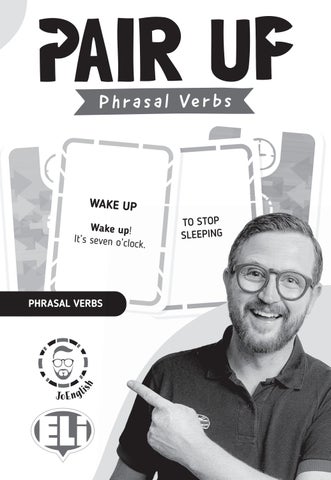
Phr asal Verbs

WAKE UP

Wake up It’s seven o’clo

PHR ASAL VERBS TO STOP SLEEPING KE UP ke up! n o’clock.

Pair up is a card game aimed at B1 - B2 (CEFR) English learners. Phrasal verbs consist of a verb combined with a particle, often resulting in a different meaning from the original verb. Phrasal verbs are common in English but are often difficult to memorise due to their many variations. Pair up facilitates their learning, which is essential for anyone wishing to communicate fluently and naturally.

Linguistic Objectives

To memorise and use phrasal verbs within a sentence and according to context.

Contents

- 64 blue cards, each showing a phrasalverb with an example sentence - 64 orange cards, each showing the meaning of a phrasalverb

Please note: to simplify learning and gameplay, only one meaning is provided for each phrasal verb , even if some may have multiple meanings depending on the context.

- 4 special cards - one timer (1 minute) - a multilingual booklet

To support a gradual learning process, the two decks (blue and orange) can be divided into four thematic categories: phrasal verbs for daily routine, travel, school/work, and sport. Each card’s category is marked on the reverse with a specific symbol:

Before starting the game, it is recommended to allow players to familiarise themselves with the phrasalverbs featured. It may be useful to have them read through the list of phrasalverbs and their meanings found at the end of these instructions.

Important note for the blue phrasalverbcards:

When you see “sb/sth” (somebody/something) on a card, it means that the phrasalverb needs an object.

CASE 1: The object (sb/sth) is shown in the middle of the phrasalverb

This means the phrasalverb is separable: the object can go either after the verb or after the particle.

Example: turn sth off

• With a pronoun object (it): turn it off X turn off it (incorrect!)

• With a noun object (TV): turn off the TV turn the TV off Rule: when using a pronoun object (e.g. it, them, him), it must always go between the verb and the particle.

CASE

2: The object (sb/sth) is shown at the end of the phrasalverb

This means the phrasalverb is non-separable: the object must go after the whole phrasalverb .

Example: look after sb

• look after the children

• look after them

• X look the children after (incorrect!)

• X look them after (incorrect!)

Rule: in this case, the verb and the particle must never be separated, not even with pronouns.

The game modes described here provide the possibility to play individually (one against the other) or in teams. For clarity, these instructions will consider individual gameplay.

GAME 1 “MATCH UP!”

Select the most suitable cards for the group: one blue deck with phrasal verbs, and one orange deck with their meanings. Lay the blue cards face up on the table, making sure they are clearly visible. Shuffle the orange deck along with four special cards (you may choose which and how many special cards to include), and place it face down on the table. Randomly choose the first player. Start the timer, and the first player draws one orange card from the deck and tries to find the matching blue card with the corresponding phrasal verb. They have one minute to find the correct match. If they guess correctly on the first try, they keep the pair (phrasal verb and meaning).

If there’s still time, they may draw another orange card and continue. If they make a mistake, they return the orange card to the bottom of the deck, and their turn ends immediately – even if the timer hasn’t run out.

Special Cards

If a player draws a special card, they must carry out the indicated action. The special cards are:

1. Pick two cards: The player draws two orange cards instead of one and tries to match both with their corresponding phrasal verbs, potentially earning two pairs.

2. Skip your turn: The player loses their turn.

3. Receiveamatchingpair: The player to the right must give one of their pairs to the player who drew the card (if they have one).

4. Give away a matching pair: The player who drew this card must give one of their pairs to the player on their left (if they have any). If they have none, nothing happens.

Note: Once used, special cards must be discarded. Play continues until all pairs have been matched. The winner is the player with the most pairs.

Tip!

To change things up, you can switch the decks - draw from the blue deck and match it with the meanings displayed from the orange deck.

GAME 2 “BINGO”

Select cards from the blue deck (phrasal verbs) and the orange deck (corresponding meanings). Shuffle the two decks separately, and deal 4 or 6 blue cards (phrasal verbs) to each player. The leader (or each player in turn) draws an orange card and reads it aloud. Any player who believes they hold the corresponding phrasal verb raises their hand and reads the verb and example aloud. If correct, the player discards that blue card. If incorrect, they keep it. The first player to discard all their cards wins.

Note: This game mode works only with large groups.

Tip!

To change the game, reverse the decks: the leader draws blue cards and players hold the orange cards. If their language level allows, players must create a sentence using the phrasal verb correctly to discard a card.

GAME 3 “ROLE PLAY”

Players split into pairs. Each pair receives four blue phrasalverb cards. The aim is to invent and write a dialogue that includes all four phrasalverbs, used appropriately within the chosen context.

Each pair selects a situation for their dialogue (e.g. ordering food, asking for directions, getting ready for a party, planning a surprise, etc.). Together, they create a realistic and entertaining dialogue between two characters that suits the chosen situation. Once the script is ready, the pair performs their dialogue in front of the other players, who award a score from 1 to 5 based on two criteria:

- correct use of phrasal verbs;

- creativity and entertainment value.

The pair with the highest score wins.

GAME 4 “MEMORY GAME”

For this game, we recommend selecting cards from one phrasal verb category (daily routine, travel, school/work, sport).

Place the blue and orange cards face down on the table in two separate groups. Players take turns flipping one blue card and one orange card in an attempt to find a correct match. If they find a match, they win the pair and may take another turn. If the match is incorrect, the cards are turned back over and left in the same position. Then it’s the next player’s turn. The winner is the player with the most pairs at the end.

TheseareonlysuggestionsforplayingPairup.Thegamecanbeenriched andexpandedwithvariousactivitiestostimulatelearningEnglish.

ITALIANO

Pair up è un gioco di carte progettato per chi possiede competenze linguistiche di livello B1 - B2 (CEFR). I phrasal verbs sono composti da un verbo che, unito a un avverbio, a una preposizione o talvolta a entrambi, acquista un significato diverso. I phrasal verbs si usano molto in inglese, ma risultano spesso complessi e difficili da memorizzare per via delle numerose varianti. Pair up favorisce il loro apprendimento, fondamentale per chi vuole comunicare in modo fluido e naturale.

Obiettivi linguistici

Memorizzare e usare i phrasal verbs all’interno di una frase e secondo il contesto.

Contenuto

- 64 carte azzurre con un phrasalverb e una frase di esempio per il suo utilizzo;

- 64 carte arancioni con il significato di ogni phrasalverb; Nota bene: al fine di semplificare l’apprendimento e lo svolgimento delle attività, è stato scelto di indicare un unico significato anche per quei phrasal verbs che possono avere più significati a seconda del contesto di utilizzo.

- 4 carte speciali;

- una clessidra (1 minuto);

- una guida multilingue.

Per apprendere i phrasal verbs in modo graduale, i due mazzi (azzurro e arancione) possono essere suddivisi in quattro categorie tematiche: phrasal verbs per daily routine, travel, school/work, e sport. La categoria è indicata sul retro di ogni carta tramite un simbolo specifico:

Daily routine Travel Sport School / Work

Prima di iniziare a giocare, è consigliabile permettere ai giocatori di familiarizzare con i phrasal verbs presenti nel gioco. Può essere utile, quindi, far loro leggere i phrasal verbs e i relativi significati riportati nella lista alla fine di queste istruzioni.

Nota importante per le carte azzurre dei phrasal verbs: Quando sulle carte trovi l’indicazione “sb/sth” (somebody/something) significa che il phrasal verb richiede un complemento oggetto.

CASO 1: l’oggetto (sb/sth) è indicato al centro del phrasal verb Questo significa che il phrasal verb è separabile: puoi mettere il complemento oggetto dopo il verbo oppure dopo la preposizione. Esempio: turn sth off

• Con un pronome oggetto (it): turn it off X turn off it (errato!)

• Con un nome oggetto (TV): turn off the TV turn the TV off Regola:seusiunpronome oggetto (come it, them, him, ecc.), deve essere sempre messo tra verbo e preposizione.

CASO 2: l’oggetto (sb/sth) è indicato alla fine del phrasal verb

Questo significa che il phrasal verb non è separabile: il complemento oggetto deve essere messo solo dopo la preposizione.

Esempio: look after sb

• look after the children

• look after them

• X look the children after (errato!)

• X look them after (errato!)

Regola: in questo caso, il verbo e la preposizione non si separano mai, né con nomi né con pronomi.

Le modalità di gioco qui proposte offrono la possibilità di giocare individualmente (uno contro l’altro) o in squadre. Per maggiore chiarezza, in queste istruzioni si prende in considerazione il gioco individuale.

GIOCO 1 “MATCH UP!”

Si selezionano le carte più adatte per il gruppo di giocatori: un mazzo azzurro dei phrasalverbs e un mazzo arancione dei rispettivi significati.

Le carte azzurre vengono disposte scoperte sul tavolo, tutte ben visibili.

Il mazzo arancione, mescolato insieme a quattro carte speciali (nota: è possibile scegliere quali e quante carte speciali includere), viene posizionato coperto sul tavolo. Si estrae a sorte il giocatore che inizierà.

Si gira la clessidra e il primo giocatore pesca una carta dal mazzo arancione dei significati, cercando tra le carte azzurre scoperte quella con il phrasalverb corrispondente. Ha un minuto di tempo per trovare l’abbinamento corretto.

Se indovina al primo tentativo, tiene la coppia di carte (il phrasal verb e il suo significato). Se il tempo non è ancora scaduto, può pescare un’altra carta arancione e cercare un nuovo abbinamento, continuando così fino alla fine del minuto. Se invece sbaglia, deve rimettere la carta arancione in fondo al mazzo dei significati, e il turno passa al giocatore successivo, anche se il tempo non è ancora scaduto.

Carte speciali

Se un giocatore pesca una carta speciale, deve eseguire l’azione indicata. Le carte speciali sono:

1. Pick two cards: il giocatore pesca subito due carte arancioni invece di una e prova ad abbinare due phrasal verbs ai rispettivi significati, guadagnando così ben due coppie.

2. Skip your turn: il giocatore perde il turno.

3. Receive a matching pair: il giocatore alla destra di chi ha pescato la carta speciale deve dargli una coppia di carte (se ce l’ha).

4.Give away a matching pair: il giocatore che ha pescato questa carta deve dare una delle proprie coppie di carte (phrasal verb + significato) al giocatore alla sua sinistra (se ce l’ha). Se non ha coppie da dare, non succede nulla.

Nota: una volta utilizzate, le carte speciali devono essere scartate. Il gioco continua fino a quando tutte le coppie di carte sono state abbinate. Vince chi ha raccolto il maggior numero di coppie.

Consiglio!

Per variare il gioco, è possibile invertire i mazzi azzurro e arancione (quindi pescare una carta azzurra e abbinarla alla carta arancione scoperta sul tavolo).

GIOCO 2 “BINGO”

Si selezionano le carte più adatte per il gruppo di giocatori: un mazzo azzurro dei phrasalverbs e un mazzo arancione dei rispettivi significati. I due mazzi vengono mescolati separatamente e ogni giocatore riceve 4 o 6 carte azzurre (phrasal verbs). Il leader (o, a turno, qualsiasi altro giocatore) pesca una carta alla volta dal mazzo arancione e legge ad alta voce il testo riportato. Il giocatore che ritiene di possedere il phrasal verb che si abbina al significato alza la mano. Può quindi leggere ad alta voce il phrasal verb e il rispettivo esempio. Se l’abbinamento è corretto, il giocatore può scartare la carta azzurra. Se non è corretto la tiene. Vince chi per primo termina le carte in mano.

Nota: questa modalità di gioco è adatta ai gruppi più numerosi.

Consiglio!

Per variare il gioco, è possibile invertire i mazzi azzurro e arancione. Il leader pesca le carte dei phrasalverbs e i giocatori tengono in mano le carte con i significati. In questo caso, se il livello linguistico lo consente, per poter scartare la propria carta, il giocatore deve inventare una frase utilizzando correttamente il phrasalverb .

GIOCO 3 “ROLE PLAY”

I giocatori si dividono in coppie. Ogni coppia riceve quattro carte azzurre (phrasal verbs). L’obiettivo è inventare e scrivere un dialogo che includa tutti e quattro i phrasalverbs, utilizzandoli in modo coerente con il contesto scelto.

Ogni coppia sceglie una situazione per il dialogo (ad esempio: ordinare cibo, chiedere indicazioni, prepararsi per una festa, organizzare una sorpresa, ecc.).

Insieme, la coppia crea un dialogo realistico e divertente tra due personaggi che rispecchi la situazione scelta.

Una volta scritto il dialogo, la coppia lo recita davanti agli altri giocatori, i quali assegnano un punteggio da 1 a 5, basandosi su due criteri: - uso corretto dei phrasalverbs ; - simpatia e creatività nell’esposizione.

Vince la coppia con il punteggio più alto.

GIOCO 4 “MEMORY GAME”

Per questo gioco, consigliamo di scegliere carte appartenenti a una categoria di phrasal verbs (daily routine, travel, school/work, sport). Le carte azzurre e le carte arancioni vengono posizionate sul tavolo, coperte. Da una parte le carte azzurre, dall’altra quelle arancioni. Uno alla volta, i giocatori scoprono due carte (azzurra e arancione) per trovare il giusto abbinamento. Se riescono ad abbinare, guadagnano la coppia di carte e possono avere un altro turno. Se invece l’abbinamento è sbagliato, le carte vanno girate e lasciate nella stessa posizione. Il turno poi passa al giocatore successivo. Vince chi riesce a collezionare più coppie di carte.

Questisonosoloalcunisuggerimentipergiocarecon Pair up. Il gioco può esserearricchitoecompletatocondiverseattività,perstimolarel’apprendimento dellalinguainglese.

In queste istruzioni l’utilizzo del genere maschile è una scelta convenzionale per facilitare la leggibilità del testo, ma include tutti i generi.

FRANÇAIS

Pair up est un jeu de cartes conçu pour des apprenants ayant des compétences linguistiques du niveau B1 - B2 (CEFR). Les phrasal verbs sont formés d’un verbe qui, suivi d’un adverbe, d’une préposition ou parfois de l’un et l’autre, acquièrent une signification différente. Les phrasal verbs sont très utilisés en anglais, mais se révèlent souvent complexes et difficiles à mémoriser compte tenu du grand nombre de variantes. Pair up en favorise l’apprentissage, ce qui est fondamental pour ceux qui souhaitent communiquer avec fluidité et de façon naturelle.

Objectifs linguistiques

Memoriser et utiliser les phrasal verbs à l’intérieur d’une phrase et selon le contexte.

Contenu

- 64 cartes bleues avec un phrasalverb et une phrase à titre d’exemple ;

- 64 cartes orange avec la signification de chaque phrasalverb;

N.B : afin de simplifier l’apprentissage et le déroulement des activités, nous avons choisi d’indiquer une seule signification pour chaque phrasalverbpouvant avoir plusieurs significations selon le contexte.

- 4 cartes spéciales ; - un sablier (1 minute) ; - un livret explicatif multilingue.

Pour apprendre progressivement les phrasal verbs, les deux jeux de cartes (bleues et orange) peuvent être divisés en quatre unités thématiques : phrasal verbs pour daily routine, travel, school/work, et sport. L’unité thématique est indiquée au dos de chaque carte par le biais d’un symbole spécifique :

Daily routine Travel Sport School / Work

Laisser les joueurs se familiariser avec les phrasal verbs présents dans le jeu. Il peut donc s’avérer utile de leur permettre de lire les phrasal verbs et leurs significations respectives listées à la fin de ce livret.

Remarque importante pour les cartes bleues des phrasalverbs: Lorsque tu vois « sb/sth » (somebody/something) sur une carte, cela signifie que le phrasal verb demande un complément d’objet (quelqu’un ou quelque chose sur qui/quoi on agit).

CAS 1 : L’objet (sb/sth) est indiqué au milieu du verbe à particule

Cela signifie que le phrasal verb est séparable : l’objet peut être placé soit après le verbe, soit après la préposition.

Exemple : turn sth off

• Avec un nom objet (TV) : turn off the TV turn the TV off

• Avec un pronom objet (it) : turn it off X turn off it (incorrect !)

Règle:avecunpronomobjet(it,them,him,etc.),onleplacetoujoursentre leverbeetlapréposition.

CAS 2 : L’objet (sb/sth) est indiqué à la fin du phrasalverb

Cela signifie que le phrasal verb non est séparable : l’objet doit être placé après l’ensemble du verbe.

Exemple : look after sb

• look after the children

• look after them

• X look the children after (incorrect !)

• X look them after (incorrect !)

Règle : dans ce cas, le verbe et la préposition ne doivent jamais être séparés, même avec des pronoms.

Les modalités de jeu proposées permettent de jouer individuellement (l’un contre l’autre) ou en formant des équipes. Pour plus de clarté, ce livret prend en compte le jeu individuel.

JEU 1 « MATCH UP ! »

Sélectionner les cartes appropriées aux joueurs : un jeu de cartes bleues des phrasalverbs et un jeu de cartes orange des significations respectives.

Les cartes bleues sont placées sur la table de façon à pouvoir les lire.

Le jeu de cartes orange, avec lesquelles on a mélangé quatre cartes spéciales, est placé sur la table. (N.B. : il est possible de choisir combien de cartes spéciales insérer et lesquelles)

On tire au sort pour connaître l’identité du premier joueur.

On retourne le sablier : le premier joueur pioche une carte orange et cherche parmi les cartes bleues le phrasalverb correspondant.

Il dispose d’une minute pour associer les cartes correctement.

S’il devine du premier coup, il garde les deux cartes associées (le phrasalverb et sa signification). Si le temps ne s’est pas encore écoulé, il peut piocher une autre carte orange pour chercher à associer deux autres cartes, et ainsi de suite jusqu’à ce que le sable se soit écoulé.

En cas d’erreur, il doit remettre la carte orange sous le jeu, et le joueur suivant peut tenter sa chance, même si le temps ne s’est pas écoulé.

Cartes spéciales

Si un joueur pioche une carte spéciale, il doit faire ce qui est indiqué sur la carte. Les cartes spéciales sont :

1. Pick two cards : le joueur pioche tout de suite deux cartes orange au lieu d’une et essaie d’associer deux phrasalverbsà leur signification respective, en gagnant ainsi deux paires de cartes.

2. Skip your turn : le joueur passe un tour.

3. Receive a matching pair : le joueur qui se trouve à droite de celui qui a pioché la carte spéciale doit céder une paire de cartes (s’il en possède une).

4. Give away a matching pair : le joueur qui a pioché cette carte doit céder l’une de ses paires (phrasal verb + signification) au joueur se trouvant à sa gauche, s’il en possède au moins une. S’il n’en possède aucune, il ne se passe rien. N.B. : une fois utilisées, les cartes spéciales doivent être éliminées. Le jeu se poursuit jusqu’à l’association de toutes les cartes. Le vainqueur est celui qui a totalisé le plus grand nombre de cartes associées.

Un conseil

Pour diversifier le jeu, il est possible d’inverser les jeux de cartes orange et bleues (de piocher donc une carte bleue et de l’associer à la carte orange placée sur la table).

JEU 2 « BINGO »

Sélectionner les cartes les plus appropriées aux joueurs : des cartes bleues des phrasalverbs et les cartes orange correspondantes. Mélanger les deux jeux de cartes séparément et distribuer 4 ou 6 cartes bleues (phrasalverbs) à chaque joueur.

Le meneur de jeu (les joueurs peuvent aussi être chef de groupe à tour de rôle) pioche une carte orange à la fois et en lit le contenu à haute voix. Le joueur qui pense avoir le phrasalverb correspondant lève le doigt. Il peut donc lire le phrasal verb à haute voix et l’exemple correspondant. Si l’association est correcte, le joueur peut éliminer la bleue. Si ce n’est pas le cas, il la garde. Le gagnant est celui qui élimine toutes ses cartes.

N.B. : cette modalité de jeu convient aux groupes plus nombreux.

Un conseil

Pour diversifier le jeu, il est possible d’inverser les jeux de cartes bleues et orange. Le meneur de jeu pioche une carte parmi les phrasal verbs et les joueurs ont les cartes contenant la signification. Dans ce cas, si le niveau linguistique le permet, pour pouvoir éliminer sa carte le joueur doit inventer et formuler une phrase en utilisant correctement le phrasalverb

JEU 3 « ROLE PLAY »

Former des paires de joueurs. Chaque paire reçoit quatre cartes bleues (phrasal verbs). L’objectif est d’inventer et d’écrire un dialogue incluant les quatre phrasal verbs, en les utilisant de façon cohérente en fonction du contexte choisi.

Chaque paire choisit un contexte pour son propre dialogue (par exemple : commander à manger, demander des indications, se préparer pour une fête, organiser une surprise, etc.). Chaque paire collabore pour créer un dialogue réel et amusant entre deux personnages en respectant le contexte choisi. Une fois le dialogue écrit, chaque paire le joue devant les autres joueurs, lesquels attribuent de 1 à 5 points, en se basant sur deux critères : - l’utilisation correcte des phrasal verbs ; - la créativité et la sympathie de la représentation mise en scène. Le paire ayant le score le plus élevé gagne la partie.

JEU 4 « MEMORY GAME »

Pour ce jeu, nous conseillons de choisir des cartes appartenant à une catégorie de phrasal verbs (daily routine, travel, school/work, sport). Les cartes bleues et les cartes orange sont retournées sur la table pour ne pas être vues. D’un côté les cartes bleues, et de l’autre les cartes orange. Un par un, les joueurs retournent deux cartes (une bleue et une orange) pour les associer correctement. S’ils y parviennent, ils remportent les deux cartes et peuvent jouer de nouveau. Dans le cas contraire, les cartes sont retournées et restent à leur place. Le tour passe ensuite au joueur suivant. Le gagnant est celui qui réussit à faire le plus grand nombre d’associations.

Ilnes’agitquedequelquessuggestionspourjoueravecPairup.Lejeupeut êtreenrichietcomplétéavecplusieursactivités,pourstimulerl’apprentissage delalangueanglaise.

Dans ce livret explicatif, l’utilisation du genre masculin est un choix conventionnel pour faciliter la lisibilité du texte, mais tous les genres sont inclus.

Pair up ist ein Kartenspiel, das sich an Teilnehmer mit Sprachkenntnissen von B1 bis B2 (CEFR) richtet. Phrasalverbsbestehen aus einem Verb, das in Kombination mit einem Adverb, einer Präposition oder manchmal auch beidem eine andere Bedeutung erhält. Phrasal verbs werden im Englischen häufig verwendet, sind aber aufgrund ihrer vielen Variationen oft komplex und schwer zu behalten.

Pair up erleichtert das Erlernen der Phrasal Verbs, was für eine flüssige und natürliche Verständigung unerlässlich ist.

Sprachliche Ziele

Sich Phrasal Verbs einprägen und sie in einem Satz und im Kontext verwenden.

Inhalt

- 64 blaue Karten mit einem Phrasal Verb und einem Beispielsatz für dessen Verwendung;

- 64 orangefarbene Kärtchen mit der Bedeutung der einzelnen Phrasal Verbs; Hinweis: Um das Lernen und die Durchführung der Aktivitäten zu vereinfachen, haben wir uns dafür entschieden, auch für die Phrasal Verbs, die je nach Verwendungskontext mehrere Bedeutungen haben können, eine einzige Bedeutung anzugeben.

- 4 Sonderkarten;

- eine Sanduhr (1 Minute);

- eine mehrsprachige Spielanleitung.

Um die Phrasal Verbs schrittweise zu lernen, können die beiden Decks (blau und orange) in vier thematische Kategorien unterteilt werden: Phrasal Verbs für daily routine, travel, school/work und sport. Die Kategorie ist auf der Rückseite jeder Karte durch ein bestimmtes Symbol gekennzeichnet:

Daily routine Travel Sport School / Work

Es ist ratsam, den Spielenden vor Spielbeginn die Möglichkeit zu geben, sich mit den Phrasal Verbs des Spiels vertraut zu machen. Es kann daher sinnvoll sein, sie die Phrasal Verbs und ihre Bedeutungen in der Liste am Ende dieser Anleitung lesen zu lassen.

Wichtiger Hinweis zu den blauen Karten der Phrasal Verbs:

Wenn du auf einer Karte „sb/sth” (somebody/something) siehst, bedeutet das, dass das Phrasal Verb ein Objekt benötigt (also jemanden oder etwas, auf den/das sich die Handlung richtet).

FALL 1: Das Objekt (sb/sth) steht in der Mitte des Phrasal Verbs

Das bedeutet, das Phrasal Verb ist trennbar: das Objekt kann entweder nach dem Verb oder nach der Präposition stehen.

Beispiel: turn sth off

• Mit einem Substantiv als Objekt (TV): turn off the TV turn the TV off

• Mit einem Pronomen als Objekt (it): turn it off

X turn off it (falsch!)

Regel:WenndueinObjektpronomenverwendest(it,them,himusw.),muss es immer zwischen Verb und Präposition stehen.

FALL 2: Das Objekt (sb/sth) steht am Ende des Phrasal Verbs

Das bedeutet, das Phrasal Verb ist nicht trennbar: das Objekt kommt immer nach dem gesamten Verb.

Beispiel: look after sb

• look after the children

• look after them

• X look the children after (falsch!)

• X look them after (falsch!)

Regel:IndiesemFalldürfenVerbund Präpositionnichtgetrenntwerden, auch nicht durch ein Pronomen.

Die hier vorgeschlagenen Spielarten bieten die Möglichkeit, einzeln (gegeneinander) oder in Teams zu spielen. Aus Gründen der Klarheit wird in dieser Anleitung das Einzelspiel berücksichtigt.

SPIEL 1 „MATCH UP!”

Die für die Spielergruppe am besten geeigneten Karten werden ausgewählt: ein blauer Stapel mit Phrasal Verbs und ein orangefarbener Stapel mit den entsprechenden Bedeutungen. Die blauen Karten werden aufgedeckt auf den Tisch gelegt, so dass sie gut sichtbar sind. Der orangefarbene Stapel wird zusammen mit vier Sonderkarten gemischt (Hinweis: Die Anzahl der Sonderkarten kann frei gewählt werden) und verdeckt auf den Tisch gelegt. Der Spieler, der beginnen soll, wird ausgelost. Die Sanduhr wird umgedreht und der erste Spieler zieht eine Karte vom orangefarbenen Stapel der Bedeutungen und sucht unter den aufgedeckten blauen Karten diejenige mit dem entsprechenden Phrasal Verb. Er hat eine Minute Zeit, um die richtige Bedeutung zu finden.

Wenn er beim ersten Versuch richtig liegt, behält er das Kartenpaar (das Phrasal Verb und seine Bedeutung). Wenn die Zeit noch nicht abgelaufen ist, kann er eine weitere orangefarbene Karte ziehen und eine neue Kombination suchen und so bis zum Ende der Minute weitermachen.

Macht er hingegen einen Fehler, muss er die orangefarbene Karte zurück unter den Bedeutungsstapel legen, und der nächste Spieler ist an der Reihe, auch wenn die Zeit noch nicht abgelaufen ist.

Sonderkarten

Zieht ein Spieler eine Sonderkarte, muss er die angegebene Aktion ausführen. Die Sonderkarten sind:

1. Pick two cards: Der Spieler zieht sofort zwei orangefarbene Karten statt einer und versucht, zwei Phrasal Verbs ihrer jeweiligen Bedeutung zuzuordnen, wodurch er zwei Paare erhält.

2. Skipyourturn: Der Spieler muss eine Runde aussetzen.

3. Receive a matching pair: Der Spieler zur Rechten des Spielers, der die Sonderkarte gezogen hat, muss ihm ein Kartenpaar abgeben (falls er eines hat).

4. Give away a matching pair: Der Spieler, der diese Karte gezogen hat, muss eines seiner eigenen Kartenpaare (Phrasal Verb + Bedeutung) an den Spieler zu seiner Linken abgeben, wenn er mindestens eines hat. Hat er keine Paare abzugeben, passiert nichts.

Hinweis: Einmal benutzte Sonderkarten müssen abgeworfen werden.

Das Spiel wird so lange fortgesetzt, bis alle Kartenpaare übereinstimmen. Wer die meisten Paare gesammelt hat, gewinnt.

Tipp!

Um das Spiel zu variieren, kann man den Ablauf umkehren, d. h. eine blaue Karte ziehen und sie mit der aufgedeckten orangefarbenen Karte auf dem Tisch kombinieren.

SPIEL 2 „BINGO”

Es werden die für die Spielergruppe am besten geeigneten Karten ausgewählt: ein blauer Stapel mit Phrasal Verbs und ein orangefarbener Stapel mit den jeweiligen Bedeutungen. Die beiden Stapel werden (getrennt) gemischt und jeder Spieler erhält 4 oder 6 blaue Karten (PhrasalVerbs). Der Spielleiter (oder abwechselnd jeder Spieler, der als Gruppenleiter fungiert) zieht jeweils eine Karte vom orangefarbenen Stapel und liest den Text laut vor. Der Spieler, der glaubt, das zur Bedeutung passende Phrasal Verb zu haben, hebt seine Hand. Er kann dann das Phrasal Verb und das entsprechende Beispiel laut vorlesen. Ist die Übereinstimmung richtig, darf der Spieler die blaue Karte ablegen. Ist sie falsch, muss er sie auf der Hand halten. Wer zuerst alle Karten abgelegt hat, gewinnt. Hinweis: Diese Spielart ist für größere Gruppen geeignet.

Tipp! Um das Spiel zu variieren, kann man den Ablauf umkehren. Der Spielleiter zieht die Phrasal Verb-Karten und die Spieler halten die Karten mit den Bedeutungen auf der Hand. In diesem Fall muss der Spieler, wenn das Sprachniveau es zulässt, einen Satz erfinden, in dem das Phrasal Verb richtig verwendet wird, um seine Karte abzulegen.

SPIEL 3 „ROLE PLAY”

Die Spieler werden in Paare aufgeteilt. Jedes Paar erhält vier blaue Karten (Phrasal Verbs). Ziel ist es, einen Dialog zu erfinden und zu schreiben, der alle vier Phrasal Verbs enthält und sie in Übereinstimmung mit einem gewählten Kontext zu verwenden. Jedes Paar wählt eine Situation für den Dialog aus (z. B. Essen bestellen, nach dem Weg fragen, eine Party vorbereiten, eine Überraschung organisieren usw.). Gemeinsam verfassen die Paare einen realistischen und lustigen Dialog zwischen zwei Personen, der die gewählte Situation widerspiegelt. Ist der Dialog geschrieben, trägt das Paar ihn vor den anderen Spielern vor, die eine Punktzahl von 1 bis 5 vergeben, wobei sie zwei Kriterien berücksichtigen:

- korrekte Verwendung der Phrasal Verbs;

- Sympathie und Kreativität in der Darstellung. Das Paar mit der höchsten Punktzahl gewinnt.

SPIEL 4 „MEMORY GAME”

Für dieses Spiel empfiehlt es sich, Karten zu wählen, die zu einer Kategorie von Phrasal Verbs gehören (daily routine, travel, school/work, sport).

Die blauen und orangefarbenen Karten werden verdeckt auf den Tisch gelegt. Auf der einen Seite liegen die blauen Karten, auf der anderen die orangefarbenen Karten. Die Spieler decken nacheinander jeweils zwei Karten (eine blaue und eine orangefarbene) auf, um die richtige Kombination zu finden. Gelingt es ihnen, eine passende Kombination zu finden, dürfen sie die Karten behalten und sie sind noch einmal an der Reihe. Ist die Kombination jedoch falsch, werden die Karten wieder umgedreht und bleiben an ihrer Stelle. Dann ist der nächste Spieler an der Reihe. Wer es schafft, die meisten Kartenpaare zu sammeln, gewinnt.

DiessindnureinigeVorschlägefürdasSpielmitPairup.DasSpielkann mitweiterenAktivitätenangereichertundergänztwerden,umdasLernen derenglischenSprachezufördern.

Die Verwendung der männlichen Form in diesen Anweisungen ist eine konventionelle Wahl, um die Lesbarkeit des Textes zu erleichtern, schließt aber alle Geschlechter ein.

ESPAÑOL

Pair up es un juego de cartas diseñado para personas con las competencias lingüísticas de nivel B1 a B2 (CEFR). Los phrasal verbs están formados por un verbo que unido a un adverbio, una preposición o incluso ambos adopta un significado diferente. Los phrasal verbs tienen un uso muy extendido en inglés, pero suelen resultar complicados y muy difíciles de memorizar a causa de sus múltiples variantes. Pair up fomenta su aprendizaje, fundamental para aquellos que quieran comunicar de manera fluida y natural.

Objetivos lingüísticos

Memorizar y usar los phrasalverbs en una frase y según el contexto.

Contenido

- 64 cartas azules con un phrasalverby una frase ejemplificativa de su uso.

- 64 cartas naranjas con el significado de cada phrasalverb

Nota bene: con el propósito de simplificar el aprendizaje y el desarrollo de las actividades, se ha decidido indicar un único significado de cada phrasal verb, incluso de aquellos que tienen más de uno en función del contexto.

- 4 cartas especiales.

- Un reloj de arena (1 minuto).

- Una guía en varios idiomas.

Para aprender los phrasal verbs de manera gradual, los dos mazos (el azul y el naranja) se pueden dividir en cuatro categorías temáticas: phrasal verbs para daily routine, travel, school/work y sport. La categoría se indica en el reverso de cada carta mediante un símbolo específico:

Daily routine Travel Sport School / Work

Antes de empezar a jugar, se aconseja dejar que los jugadores se familiaricen con los phrasalverbs del juego. A tal fin, puede resultarles útil leer los phrasal verbs y sus correspondientes significados de la lista presente al final de estas instrucciones.

Nota importante para las cartas azules de los phrasalverbs:

Cuando veas “sb/sth” (somebody/something) en una tarjeta, significa que el phrasal verb necesita un complemento directo (es decir, alguien o algo sobre quien recae la acción).

CASO 1: El complemento (sb/sth) aparece en medio del phrasalverb

Esto significa que el phrasal verb es separable: el objeto puede ir después del verbo o después de la preposición.

Ejemplo: turn sth off

• Con un nombrecomoobjeto (la tele): turn off the TV turn the TV off

• Con un pronombrecomoobjeto (it): turn it off X turn off it (incorrecto)

Regla: si usas un pronombre objeto (it, them, him, etc.), debe colocarse siempreentreelverboylapreposición.

CASO 2: El complemento (sb/sth) aparece al final del phrasal verb

Esto indica que el phrasal verb es inseparable: el objeto debe ir después del conjunto del verbo.

Ejemplo: look after sb

• look after the children

• look after them

• X look the children after (incorrecto)

• X look them after (incorrecto)

Regla: en este caso, el verbo y la preposición nunca deben separarse, ni siquiera con pronombres.

Las modalidades de juego que proponemos ofrecen la posibilidad de jugar individualmente (uno contra uno) o en equipos. Para mayor claridad, en estas instrucciones se describe el juego individual.

JUEGO 1 “¡MATCH UP!”

Se seleccionan las cartas más adecuadas al grupo de jugadores: un mazo azul con los phrasalverbs y un mazo naranja con los respectivos significados. Las cartas azules se disponen descubiertas sobre la mesa, bien visibles. El mazo naranja, mezclado junto a cuatro cartas especiales (se puede elegir qué cartas especiales incluir y cuántas), se coloca boca abajo sobre la mesa. Se elige a suertes el jugador o la jugadora que empieza la partida. Se da la vuelta al reloj de arena y el primer jugador roba una carta del mazo naranja de los significados. A continuación, debe buscar entre las cartas azules descubiertas la que contiene el phrasalverb correspondiente. Tiene un minuto de tiempo para encontrar la pareja correcta. Si lo adivina a la primera, se queda con la pareja de cartas (el phrasal verb y su significado). Si todavía queda tiempo, puede seguir jugando y buscar tantas nuevas parejas como pueda, antes de que se acabe el minuto. En cambio, si se equivoca, debe colocar la carta naranja en el fondo del mazo de los significados y el turno pasa al siguiente jugador, aunque todavía quede tiempo.

Cartas especiales

Si un jugador saca una carta especial, debe seguir la acción indicada. Las cartas especiales son:

1. Pick two cards: el jugador roba dos cartas naranjas en vez de una e intenta relacionar dos phrasalverbs con sus significados correspondientes. Si lo consigue, gana dos parejas.

2. Skip your turn: el jugador pierde su turno.

3. Receive a matching pair: el jugador de la derecha de la persona que ha robado la carta especial debe regalarle una de sus parejas de cartas (si tiene alguna).

4. Giveawayamatchingpair: el jugador que ha robado esta carta debe ceder una de sus parejas de cartas (phrasal verb + significado) al jugador sentado a su izquierda, en el caso de que tenga alguna. Si no tiene ninguna pareja, no se realiza ninguna acción.

Nota: una vez utilizadas las cartas especiales, deben descartarse. El juego sigue hasta que se hayan relacionado todas las parejas de cartas. Gana la persona que tenga más parejas.

¡Consejo!

Para hacer que el juego sea más variado, se pueden invertir los mazos azul y naranja. De este modo, habría que coger una carta azul y combinarla con una de las cartas naranjas descubiertas sobre la mesa.

JUEGO 2 “BINGO”

Se seleccionan las cartas más adecuadas al grupo de jugadores: un mazo azul con los phrasalverbs y un mazo naranja con los respectivos significados. Se barajan los dos mazos por separado y cada jugador recibe 4 o 6 cartas azules (phrasal verbs). El líder (o, por turnos, cada uno de los jugadores que haga de líder) coge una carta del mazo naranja y lee en voz alta lo que dice el texto. El jugador que crea que tiene el phrasal verb que se corresponde con el significado, levanta la mano. Entonces tiene que leer en voz alta el phrasalverb y el ejemplo respectivo. Si la pareja es correcta, el jugador puede descartar la carta azul. Si no lo es, se queda con ella. Gana el primer jugador que se queda sin cartas en la mano.

Nota: esta modalidad de juego es adecuada para grupos numerosos.

Consejo!

Para hacer que el juego sea más variado, se pueden invertir los mazos azul y naranja. El líder coge las cartas de los phrasal verbs y los jugadores se quedan en la mano las cartas con los significados.

En este caso, si el nivel lingüístico lo permite, para poder descartar su carta, el jugador debe inventar una frase utilizando correctamente el phrasalverb

JUEGO 3 “ROLE PLAY”

Los jugadores se dividen en parejas. Cada pareja recibe cuatro cartas azules (phrasal verbs). El objetivo es inventar y escribir un diálogo que incluya los cuatro phrasal verbs, utilizándolos de manera coherente y adaptándolos al contexto elegido.

Cada pareja elige una situación para el diálogo (por ejemplo: pedir comida, indicaciones, prepararse para una fiesta, organizar una sorpresa, etc.). Cada pareja debe crear un diálogo realista y divertido entre los dos personajes que refleje la situación.

Una vez escrito el diálogo, la pareja debe recitarlo ante los demás jugadores, los cuales les asignan una puntuación de 1 a 5 basándose en dos criterios:

- Uso correcto de los phrasalverbs.

- Simpatía y creatividad en la exposición.

Gana la pareja con la puntuación más alta.

JUEGO 4 “MEMORY GAME”

Para esta modalidad de juego, aconsejamos escoger cartas pertenecientes a una categoría de phrasal verbs (daily routine, travel, school/work, sport). Las cartas azules y las cartas naranjas se colocan sobre la mesa boca abajo. Se ponen de una parte las cartas azules y de la otra, las naranjas. Por turnos, los jugadores destapan dos cartas (azul y naranja) para encontrar la combinación correcta. Si logran sacar una pareja, ganan las dos cartas y repiten turno. Si la pareja es incorrecta, se les da la vuelta de nuevo y se dejan en la misma posición. El turno pasa al siguiente jugador. Gana quien consigue hacer más parejas de cartas.

Aquí tenéis algunas sugerencias para jugar a Pair up. El juego se puede enriquecer y completar con varias actividades para estimular el aprendizaje delinglés.

En estas instrucciones se utiliza el masculino de manera convencional para facilitar la legibilidad del texto, pero incluye todos los géneros.

Chill out

Eat out

Get up

Go out

Look after somebody

Meaning: to relax. (IT: rilassarsi, FR : se détendre, DE: entspannen, ES: relajarse). Example: After a busy day, Pamy likes to chill out with a book.

Meaning: to have a meal at a restaurant. (IT: mangiare fuori, FR : manger au restaurant, DE: auswärts essen, ES: comer fuera). Example: We eat out once a week at our favourite restaurant.

Meaning: to stand up after being in bed. (IT: alzarsi, FR : se lever, DE: aufstehen, ES: levantarse). Example: James gets up at 7 am every morning to go to school.

Meaning: to leave your home to go somewhere socially. (IT: uscire, FR : sortir, DE: ausgehen, ES: salir). Example: We usually go out every Saturday.

Meaning: to take care of somebody. (IT: prendersi cura di, FR : prendre soin de, DE: sich um jmdn. kümmern, ES: cuidar de alguien). Example: She spends her mornings looking after her little brother.

Pick something out

Put something away

Meaning: to choose. (IT: scegliere, FR : choisir, DE: etwas wählen, ES: elegir). Example: Every morning I pick a shirt out.

Meaning: to place something where it is usually kept. (IT: mettere a posto, FR : ranger, DE: etwas aufräumen, ES: poner en su sitio, guardar). Example: Lisa puts the books away after her English lesson.

Put something on

Meaning: to wear clothes or shoes. (IT: indossare vestiti o scarpe, FR : porter des vêtements ou des chaussures, DE: etwas anziehen, ES: llevar ropa o zapatos, vestir). Example: Jane put her coat and shoes on before leaving for work.

Run out of something

Set off

Sleep in

Stay in

Stay up

Take something off Turn something off

Meaning: to use all of something and have no more left. (IT: terminare la scorta di qualcosa, FR : finir les provisions de, DE: etwas aufbrauchen, ES: quedarse sin algo).

Example: We’ve run out of milk; I can’t make the cake!

Meaning: to start a journey. (IT: partire, FR : partir, DE: abfahren, ES: irse, salir, ponerse en marcha). Example: We set off for school at 7 am to avoid the traffic.

Meaning: to continue sleeping after the time you usually get up in the morning. (IT: dormire fino a tardi, FR : faire la grasse matinée, DE: ausschlafen, ES: dormir hasta tarde). Example: I like to sleep in on Sundays.

Meaning: to remain at home rather than go out. (IT: restare a casa, FR : rester à la maison, DE: zu Hause bleiben, ES: quedarse en casa). Example: Joe decided to stay in and watch a film instead of going to the party.

Meaning: to go to bed later than usual. (IT: restare svegli fino a tardi, FR : rester éveillé, DE: aufbleiben, ES: trasnochar, quedarse despierto hasta tarde). Example: We stayed up late watching films.

Meaning: to remove clothing or accessories. (IT: togliersi vestiti o accessori, FR : ôter ses vêtements ou ses chaussures, DE: etwas ausziehen, ES: quitarse la ropa o accesorios). Example: Please take your shoes off before coming into the house.

Meaning: to stop a device by pressing a button. (IT: spegnere un dispositivo, FR : éteindre un dispositif, DE: etwas ausschalten, ES: apagar un dispositivo). Example: Don’t forget to turn the lights off before leaving the room.

Wake up

Meaning: to stop sleeping. (IT: svegliarsi, FR : se réveiller, DE: aufwachen, ES: despertarse). Example: Wake up! It’s seven o’clock.

Check in

Check out

Meaning: to register at a hotel or airport. (IT: fare l’accettazione, FR : faire l’enregistrement, DE: einchecken, ES: registrarse, facturar). Example: You need to check in at least two hours before your flight.

Meaning: to leave a hotel and pay the bill. (IT: lasciare un hotel dopo aver pagato, FR : quitter un hôtel après avoir payé la note, DE: auschecken, ES: dejar la habitación).

Example: We checked out of the hotel and went to the train station.

Come across something

Drop somebody off

Meaning: to find something by chance. (IT: trovare qualcosa per caso, FR : trouver quelque chose par hasard, DE: etwas zufällig finden, ES: toparse con algo). Example: She came across a little bakery while in Rome.

Meaning: to take somebody to a place and leave them there. (IT: lasciare qualcuno in un luogo, FR : déposer quelqu’un quelque part, DE: absetzen, ES: llevar a alguien a algún lugar). Example: The taxi driver dropped us off at the airport entrance.

Get away

Get in

Get off something

Meaning: to escape from your usual responsibilities and go on holiday. (IT: scappare per andare in vacanza, FR : se sauver pour aller en vacances, DE: verreisen, ES: hacer una escapada). Example: I’ve had a hard week. I’d love to get away for a few days.

Meaning: to arrive. (IT: arrivare, FR : arriver, DE: ankommen, ES: llegar). Example: What time does the train get in?

Meaning: to leave certain means of transport such as a plane, train, bus, or other big vehicle. (IT: scendere da un mezzo di trasporto grande, FR : descendre d’un gros moyen de transport, DE: aus einem großen Verkehrsmittel aussteigen, ES: bajar de un medio de transporte). Example: We got off the train at the wrong station by mistake.

Get on something

Hold something up

Meaning: to board certain means of transport such as a plane, train, bus, or other big vehicle. (IT: salire su un mezzo di trasporto grande, FR : monter à bord d’un gros moyen de transport, DE: in ein großes Verkehrsmittel einsteigen, ES: subir a un medio de transporte). Example: We got on the bus just in time.

Meaning: to delay something. (IT: ritardare, trattenere, FR : retarder, DE: aufhalten, ES: retrasar algo).

Example: Bad weather held our flight up.

Look around something

Pick somebody up

Meaning: to explore a place and see what is there. (IT: guardarsi attorno, FR : regarder autour de soi, DE: sich umschauen, ES: inspeccionar un lugar). Example: We spent the afternoon looking around the old town.

Meaning: to collect somebody who is waiting for you with a car. (IT: andare a prendere qualcuno da qualche parte, FR : passer prendre quelqu’un quelque part, DE: abholen, ES: recoger a alguien en coche). Example: I’ll pick you up from the train station at 5 pm.

See somebody off

Stop over

Touch down

Meaning: to go to a station, an airport, etc. to say goodbye to somebody who is starting a journey. (IT: salutare qualcuno prima della partenza, FR : saluer quelqu’un avant le départ, DE: verabschieden, ES: despedir a alguien). Example: We went to the station to see our friends off.

Meaning: to stay somewhere for a short period on the way to another destination. (IT: fare uno scalo, FR : faire escale, DE: einen Zwischenstopp einlegen, ES: hacer noche, hacer escala). Example: We stopped over in Dubai for two days on our way to Australia.

Meaning: when a plane lands on the ground. (IT: atterrare, FR : atterrir, DE: landen, ES: aterrizar).

Example: The plane touched down at Heathrow at 6 pm.

Back something up

Brush up on something

Call something off

Meaning: to provide evidence for an argument. (IT: sostenere, FR : soutenir, DE: untermauern, ES: respaldar). Example: She backed her presentation up with strong data and research.

Meaning: to review or practise something you learned before. (IT: ripassare, FR : réviser, DE: auffrischen, ES: repasar). Example: I need to brush up on my French before the exam.

Meaning: to cancel a meeting. (IT: annullare un appuntamento, FR : annuler un rendez-vous, DE: absagen, ES: anular una cita). Example: I called the meeting off because the manager was sick.

Come up with something

Cut out for something

Meaning: to think of an idea, solution, or plan. (IT: avere un’idea, FR : avoir une idée, DE: einfallen, ES: tener una idea). Example: She came up with a brilliant marketing strategy.

Meaning: to be the right type of person for a particular job. (IT: essere tagliato per un lavoro, FR : être fait pour un travail, DE: für etwas gemacht sein, ES: ser apto para un trabajo). Example: I don’t think I’m cut out for teaching.

Fill in for somebody

Follow up

Meaning: to do somebody’s job temporarily. (IT: sostituire qualcuno, FR : remplacer quelqu’un, DE: für jemanden einspringen, ES: sustituir a alguien). Example: I’m filling in for John while he’s on holiday.

Meaning: to take further action on something after a first step has been taken. (IT: dare seguito a qualcosa, FR : donner suite à quelque chose, DE: weiterverfolgen, nachbereiten, ES: dar seguimiento a algo).

Example: The manager followed up and scheduled a second meeting.

Get ahead

Get back to somebody

Get through something

Hand something in

Keep up with something

Knuckle down

WORK / SCHOOL

Meaning: to be more successful than others in your job (IT: fare carriera, FR : faire carrière, DE: Karriere machen, ES: hacer carrera). Example: If you want to get ahead, you need to work hard.

Meaning: to reply to somebody (IT: dare una risposta a qualcuno, FR : donner une réponse à quelqu’un, DE: eine Antwort geben, ES: responder a alguien). Example: I’ll get back to you with more information after I discuss it with the team.

Meaning: to finish something difficult successfully. (IT: superare una prova, FR : décrocher un examen, DE: eine Prüfung bestehen/schaffen, ES: pasar un examen). Example: I finally got through my maths exam - it was really hard!

Meaning: to give a piece of work to a teacher. (IT: consegnare un compito all’insegnante, FR : rendre un devoir à l’enseignant, DE: eine Aufgabe bei der Lehrkraft abgeben, ES: entregar una tarea al profesor o profesora). Example: The students handed their assignments in on time.

Meaning: to stay at the same level as something. (IT: stare al passo con, FR : suivre le rythme, DE: mitkommen, am Ball bleiben, ES: seguir el ritmo de algo). Example: It’s hard to keep up with all the new technology in this job.

Meaning: to start working very hard. (IT: darsi da fare, FR : se donner du mal, DE: sich an die Arbeit machen, ES: ponerse las pilas con algo, ponerse a trabajar en serio con algo). Example: Exams start next month! I need to knuckle down and start studying.

Look into something

Look something over

Meaning: to study or investigate something carefully. (IT: indagare, approfondire una questione, FR : mener une enquête, approfondir un sujet, DE: untersuchen und herausfinden, ES: investigar, profundizar en un tema). Example: The manager is looking into the cause of the delay in deliveries.

Meaning: to check something quickly to see if it’s correct. (IT: dare un’occhiata veloce per controllare qualcosa, FR : donner un petit coup d’œil rapide pour contrôler, DE: überfliegen, noch einmal kontrollieren, ES: echar un vistazo rápido). Example: When you finish your homework, look it over to check for mistakes.

Put something forward

Put something off

Set something up

Meaning: to suggest an idea (IT: proporre un’idea, FR : proposer une idée, DE: vorschlagen, ES: proponer una idea). Example: She put some ideas forward during the meeting.

Meaning: to postpone something. (IT: posticipare, FR : reporter, DE: verschieben, ES: posponer algo). Example: We’ve had to put the meeting off until next week.

Meaning: to arrange for something to happen. (IT: organizzare qualcosa, FR : organiser quelque chose, DE: etwas organisieren, ES: organizar algo). Example: James will set a call up for tomorrow after this meeting.

Take something on

Take something over

Meaning: to agree to do a job. (IT: prendere in carico un lavoro, FR : prendre en charge une tâche, DE: annehmen, ES: hacerse cargo de algo). Example: She took the job on.

Meaning: to gain control of a business or company. (IT: rilevare un’attività, FR : reprendre une activité, DE: einen Betrieb übernehmen, ES: hacerse cargo de una actividad). Example: A big company took the small café over.

Burn something off

Catch up with somebody

Cheer

somebody on

Cool down

Drop out of something

Fight back

Hold somebody off

SPORT

Meaning: to get rid of calories through exercise. (IT: smaltire calorie, FR : brûler des calories, DE: Kalorien verbrennen, ES: quemar calorías). Example: I’ve eaten too many calories! I need to burn them off.

Meaning: to reach the same level as somebody. (IT: raggiungere, FR : rejoindre, DE: aufschließen zu, ES: alcanzar). Example: He ran fast to catch up with his friend.

Meaning: to support somebody by shouting encouragement. (IT: fare il tifo per qualcuno, FR : acclamer, DE: anfeuern, ES: alentar a alguien). Example: The crowd cheered the runners on during the final lap.

Meaning: to relax after intense physical activity by doing light exercise. (IT: fare rilassamento muscolare, FR : faire de la relaxation musculaire, DE: durch leichte Übungen entspannen, ES: enfriarse después de practicar deporte). Example: The coach told the team to cool down after the match.

Meaning: to leave an activity before finishing it. (IT: abbandonare un’attività sportiva, FR : abandonner une activité sportive, DE: eine sportliche Aktivität aufgeben, ES: abandonar una actividad). Example: She had to drop out of the race due to an injury.

Meaning: to try hard when you are losing. (IT: reagire, FR : réagir, DE: aufholen, ES: contraatacar). Example: They were losing, but they fought back to win 3-2.

Meaning: to stop somebody from beating you. (IT: resistere a un avversario, FR : résister face à un adversaire, DE: aufhalten, ES: contener a un adversario). Example: The cyclist held his rival off and won the race.

Join in

Kick off

Knock somebody out

Meaning: to take part in an activity with others. (IT: partecipare, FR : participer, DE: mitmachen, dabei sein, ES: participar en una actividad con otras personas). Example: We are going to play football – do you want to join in?

Meaning: to start an event or a game with a ball that you kick. (IT: iniziare una partita di calcio, FR : commencer un match de football, DE: ein Fußballspiel beginnen, ES: empezar un partido de fútbol). Example: The football match will kick off at 7 pm.

Meaning: to defeat an opponent so they can no longer compete. (IT: sconfiggere un avversario, FR : battre un adversaire, DE: einen Gegner besiegen, ES: derrotar a un adversario). Example: Their opponents knocked them out of the tournament in the semi-finals.

Play on

Take something up

Meaning: to continue playing. (IT: continuare a giocare, FR : continuer à jouer, DE: weiterspielen, ES: seguir jugando). Example: He was tired, but he played on until the end of the game.

Meaning: to start doing a new sport. (IT: iniziare una nuova attività sportiva, FR : commencer une nouvelle activité sportive, DE: mit einem neuen Sport beginnen, ES: empezar a practicar un deporte). Example: He took swimming up to get healthier.

Warm up

Work out

Meaning: to prepare your body for physical activity by doing light exercise. (IT: riscaldarsi, FR : s’échauffer, DE: sich aufwärmen, ES: hacer calentamiento). Example: The players warmed up before the match.

Meaning: to exercise in order to improve the strength of your body. (IT: allenarsi, FR : s’entraîner, DE: trainieren, ES: ejercitarse). Example: I work out at the gym three times a week.

Joe and Pamy Sanders

Graduated from the University of Wales Lampeter, PGCE (Post Graduate Certificate in Education) from Oxford Brookes University. They taught for 2 years in Oxford. In 2008, they opened an English school and became Cambridge ESOL Speaking Examiners.

Pair up by Joe and Pamy Sanders

© 2026 ELi s.r.l.

P.O. Box 6 - 62019 Recanati - Italy Tel. +39 071 750701 www.elionline.com - www.elilanguagegames.com

Art Director: Letizia Pigini

Editors: Francesca Bugiolacchi – Gigliola Capodaglio

Production Manager: Francesco Capitano

Graphic Design and Layout: Gianni Caputo

Printed in Italy by Tecnostampa

Pigini Group Printing Division – Loreto – Trevi

Codice stampa

ISBN: 978-88-536-4830-3

EN: All rights reserved. No part of this publication may be reproduced, stored in a retrieval system, or transmitted in any form or by any means, electronic, mechanical, photocopying, recording or otherwise, without the prior permission of ELi s.r.l.

IT: È assolutamente vietata la riproduzione totale o parziale di questa pubblicazione, così come la sua trasmissione sotto qualsiasi forma e con qualunque mezzo, senza l’autorizzazione della casa editrice ELi.

FR: Toute reproduction totale ou partielle de cet ouvrage, par quelque procédé que ce soit, photographie ou autre, est formellement interdite - même pour un usage didactique ou personnel - sans autorisation des auteurs et des éditeurs.

DE: Die vollständige oder teilweise Reproduktion dieser Publikation sowie deren Übermittlung in jeglicher Form und mit irgendwelchen Mitteln, auch durch Fotokopien, ist ohne die Genehmigung des Verlags ELi streng verboten.

ES: Queda totalmente prohibida la reproducción total o parcial de esta publicación, así como su transmisión bajo cualquier formato o por cualquier medio, incluidas las fotocopias, sin autorización previa de la editorial ELi.

Turn static files into dynamic content formats.
Create a flipbook
Issuu converts static files into: digital portfolios, online yearbooks, online catalogs, digital photo albums and more. Sign up and create your flipbook.
Pair up - Phrasal Verbs - GUIDA by ELI Publishing - Issuu