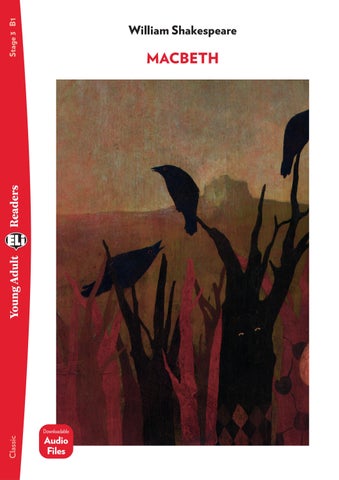
Stage 3 B1
William Shakespeare
MACBETH
MACBETH
Scotland in the eleventh century. Macbeth is a brave general who will do anything for his King Duncan and Scotland. Until, that is, he meets three terrible witches after a battle against King Duncan’s enemies. They tell him that one day he, Macbeth, will be King of Scotland. Encouraged by his wife, Macbeth does many terrible things to make the witches’ words come true and becomes King of Scotland. However, in the end, Macbeth and his wife are destroyed by their own terrible actions.
William Shakespeare
William Shakespeare MACBETH
Stage 3 B1
ELT B1
In this reader you will find:
Readers
- Information about Shakespeare’s life - A section focussing on theatrical superstitions and idioms - A section focussing on CLIL Physical Geography - A glossary of difficult words - B1 Preliminary-style activities - An exit test
Young Adult
Tag
Ambition, power
Audio Files
Look at the inside front cover flap to find out how to download your free Audio files. 600 headwords 800 headwords 1000 headwords 1800 headwords 2500 headwords Unabridged Texts
Elementary Pre-Intermediate Intermediate Upper Intermediate Advanced Proficiency
www.eligradedreaders.com
Movers Key Preliminary First Advanced Proficiency
The pleasure of Reading
Readers
8
97
S ER AD -4 l. RE .r. I 36 I s EL th 32 EL LT be 36U ac -5 AD M -88
BN IS
G
N
U
YO
Eli Readers is a beautifully illustrated series of timeless classics and specially-written stories for learners of English.
A1 A2 B1 B2 C1 C2
Young Adult
STAGE 1 STAGE 2 STAGE 3 STAGE 4 STAGE 5 STAGE 6 Classic
Downloadable
Classic
Downloadable
Audio Files
Book brief 1
Macbeth is Shakespeare’s shortest tragedy and he probably wrote it between 1603 and 1607, when King James VI of Scotland also became King James I of England.
2
Set in medieval Scotland and England, it’s based on a true story.
3
In the 11th century, there really was a King Macbeth of Scotland but he was good, not like the Macbeth in Shakespeare’s play.
4
The play is about Macbeth, a brave Scottish general, who is told by three witches that one day he’ll become King of Scotland. Their words lead Macbeth to commit many terrible crimes.
5
Main themes include kingship, superstition, ambition and guilt.
www.eligradedreaders.com
In this reader: 21st Century Skills
To encourage students to connect the story to the world they live in.
KEY
A2 level activities.
Culture notes
Brief cultural information.
Glossary
An explanation of difficult words.
Picture Caption
A brief explanation of the picture.
Audio
These icons indicate the parts of the story that are recorded: start stop
The FSC certification guarantees that the paper used in these publications comes from certified forests, promoting responsible forestry management worldwide.
For this series of ELI graded readers, we have planted 5000 new trees.
Young Adult Eli Readers The ELI Readers collection is a complete range of books and plays for readers of all ages, ranging from captivating contemporary stories to timeless classics. There are four series, each catering for a different age group: First ELI Readers, Young ELI Readers, Teen ELI Readers and Young Adult ELI Readers. The books are carefully edited and beautifully illustrated to capture the essence of the stories and plots. The readers are supplemented with ‘Focus on’ texts packed with background cultural information about the writers and their lives and times.
Macbeth William Shakespeare Retold and Activities Janet Borsbey and Ruth Swan Language Level Consultant Silvana Sardi Illustrations Simone Rea ELI Readers Founder and Series Editors Paola Accattoli, Grazia Ancillani, Daniele Garbuglia (Art Director) Graphic Design Emilia Coari Production Manager Francesco Capitano
Photo credits Getty Images, Shutterstock © New edition: 2022 First edition: 2011 ELi, Gruppo editoriale ELi P.O. Box 6 62019 Recanati (MC) Italy T +39 071750701 F +39 071977851 info@elionline.com www.elionline.com Typeset in 10,5 / 15 pt Monotype Fulmar Printed in Italy by Tecnostampa – Pigini Group Printing Division Loreto – Trevi (Italia) – ERA 308.10 ISBN 978-88-536-3236-4 www.eligradedreaders.com
Contents
6 8 10 18 20 28 30 38 40 48 50 58 60 68 70 78 80 88 90 92 94 95
Main Characters Before You Read Chapter One “When will we three meet again?” Activities Chapter Two “Is this a dagger…?” Activities Chapter Three “Horror! Oh, horror!” Activities Chapter Four “What’s done is done.” Activities Chapter Five “Double, double toil and trouble.” Activities Chapter Six “Out, damned spot!” Activities Chapter Seven “Life is just a passing shadow.” Activities Playscript Focus on… William Shakespeare (1564-1616) Focus on… Theatrical Superstitions and Idioms Focus on… CLIL Physical Geography: Scotland Test Yourself Syllabus
MAIN CHARACTERS
macbeth A Scottish Thane (Lord)
lady macbeth His wife
duncan King of Scotland malcolm
donalbain Duncan’s sons
hecate The goddess of witchcraft
6
the three witches Hecate’s servants
banquo A Scottish Thane fleance Banquo’s son
macduff
ross lennox Scottish Thanes
7
Before you Read
Vocabulary 1 The following words all appear in the story. Match the words to the dictionary definitions. Use your translation dictionary to help you find the English definition. 1 ■ dagger / 'dæɡ.ər / noun [C] a A person whose job is to fight. 2 ■ sword / sɔːd / noun [C] b A wall around the top of a castle that you can walk around. 3 ■ battlefield / 'bæt.əl.fıːld / c A short type of knife used noun [C] in fighting. 4 ■ battlements / 'bæt.əl.mənts / d A large group of people whose noun [plural] job is to fight. 5 ■ soldier / 'səυl.dʒər / noun [C] e The place where people fight. 6 ■ army / 'ɑː.mi / noun [C] f A very long type of knife used in fighting.
Reading B1 Preliminary 2 Complete the text about Shakespeare with one word for each space. The first plays Shakespeare wrote (1) .................... historical. Then he changed to comedies with stories about love and with a happy ending. Finally, he wrote his great tragedies (2) .................... Macbeth. In Shakespeare’s tragedies, and in Macbeth (3) ...................., themes include people going mad and death. There (4) .................... a huge variety of characters in his plays, (5) .................... all different social classes and the action often involves family relationships. This can also be seen in Macbeth where the relationship (6) .................... Macbeth and his wife is a very important part of the play
8
Grammar 3 Use the clues below to complete the irregular verb crossword. Use the first letter of the verb to help you. Then read chapter one and check your answers. 1
2 3
4
5 6
7
8
9 10
11 12 13
Clues Across 3 Donalbain r.................... towards his brother. (3 letters) 4 King Duncan’s men w.................... the battle. (3 letters) 6 The soldiers t.................... their stories about the day. (4 letters) 9 Macbeth was brave in the battle. He f.................... like a lion. (6 letters) 10 Macbeth t................... about his conversation with the witches. (7 letters) 12 Ross k.................... a lot about the battle. (4 letters) 13 Macbeth and Banquo h.................... a strange noise. (5 letters) Clues Down 1 King Duncan s................. Lord Ross to tell Macbeth the news. (4 letters) 2 The King of Norway p............... 10,000 gold pieces to be free. (4 letters) 4 The sun w.................... low in the sky. (3 letters) 5 The King of Norway l.................... the battle. (4 letters) 7 Macbeth l.................... the room. (4 letters) 8 Macbeth b.................... to realise something. (5 letters) 11 The witches h.................... nothing more to say. (3 letters)
9
Chapter One
“When will we three meet again?” 2 It was a dark time and a dark place. In ancient Scotland, rebellions* At the time when Shakespeare wrote this play, James I was King and many people wanted to kill him. For example, with the Gunpowder Plot (1605) rebels tried to blow up Parliament and the royal family, but they weren't successful. This day is still celebrated in the UK on 5 November and is known as Guy Fawkes Night.
were usual and kings didn’t live long. Duncan, King of Scotland, was in his palace at Forres in the far north. King Duncan was a good man and a fine king, but rebels* were trying to take his throne*. The rebel leader was a rich, powerful man, the Thane* of Cawdor. The battles were hard and bloody* and Duncan was worried about his sons. Malcolm, the older son, was fighting at that very moment. Fortunately, the younger son, Donalbain, was safe with Duncan, for now. ‘News,’ said King Duncan anxiously*, We need news about the battle. It’s hard to sit here, safe at Forres, while my men are fighting.’ ‘I know father, but we must be patient,’ replied Donalbain, with a heavy heart. The Thane of Cawdor was a very powerful man indeed. *** Away from the King’s palace, in an open field, there was a very strange sight indeed. Three shapes were visible*. They were old women, ugly old women and they were wearing black rags*. The three women were witches and they were making a terrible plan. ‘When will we three meet again?’ said one witch, ‘In thunder, lightning or in rain?’ rebellion (here) action against the King rebel (here) the person who acts against the King throne the position of being king or queen Thane a Scottish word for Lord
bloody with a lot of blood anxiously in a worried way visible that can be seen rag an old piece of cloth
10
Macbeth
‘When the battle’s lost and won!’ laughed the second. ‘Before the setting of the sun*!’ added the third. ‘Where, sisters? Where shall we meet?’ ‘Near! Near here.’ ‘Who, sisters? Who shall we meet?’ ‘Let’s meet Macbeth!’ ‘Macbeth!’ they cried together, ‘Let’s meet Macbeth. In fog and filthy* air!’ *** An hour or two later, King Duncan and Donalbain were still waiting for news about the latest battle. Suddenly, two men appeared on the horizon*. ‘Look father! It’s Malcolm! He’s with a soldier. I think he’s hurt.’ Donalbain ran towards his brother. ‘What’s happened? Are you hurt?’ he cried. ‘No, brother, I’m fine. This soldier is hurt, but he saved my life. I was almost captured* by the Thane of Cawdor’s men,’ he turned to the King, ‘Hello father. There’s no need to worry, I’m well and we won the battle. We won! It was long and terrible and this man here, this soldier, is a hero.’ ‘Malcolm. Thank God,’ whispered* the King, embracing* his son, ‘And thank you,’ Duncan turned to the soldier. ‘I’m not a hero, Sire*,’ said the soldier quietly, ‘Lord Macbeth was the true hero today.’ Lord Macbeth, the Thane of Glamis, was the King’s cousin. ‘My brave cousin,’ said the King, ‘He’s such a fine man.’ ‘Yes,’ said the soldier, ‘He fought like a lion. The battle was hard capture take someone prisoner whisper speak very, very quietly embrace hold someone in your arms Sire an old word used when talking to a king
setting of the sun when the sun goes down in the evening filthy very dirty horizon the line where the earth and the sky appear to meet
11
When Macbeth was written, James I was King of Scotland and England, (1603-1625). He very much believed in witches and the number of people who were executed for being 'witches' grew enormously while he was king.
William Shakespeare
and the King of Norway was helping the Thane of Cawdor. Their army was larger than ours too. They attacked again and again, but Macbeth and Banquo were good generals*. Scotland is safe, Sire, Scotland is safe!’ The soldier sat down heavily in a chair. ‘I’m sorry, Sire,’ he whispered. ‘Get a doctor for this brave man,’ called Duncan, ‘Quickly.’ *** The other thanes and soldiers were beginning to return to the royal palace from the battlefield*. They told their stories of the day and everyone agreed that Macbeth was the real hero. The Thane of Ross, another of the Scottish lords, knew more details about the battle. ‘God save the King!’ he called, ‘I’ve come from Fife. We captured the King of Norway! Here, here are the ten thousand gold pieces he paid for his freedom*! We took the money and he’s gone back to Norway.’ ‘What about the rebel leader?’ asked King Duncan, ‘Tell me about the Thane of Cawdor.’ ‘We captured him too. What shall we do with him?’ ‘Execute* him. Execute him now. Then I want you to go and find Macbeth. Tell him that I’ve executed the Thane of Cawdor and tell Macbeth that he’s now the new Thane. My brave cousin will now have two titles; Thane of Glamis and Thane of Cawdor! That’s his reward*.’ ‘Immediately, Sire! It’ll be a great pleasure to tell the brave Macbeth!’ Ross left, calling for his horse. *** Macbeth himself was riding across the open fields with his friend, Banquo. They were tired from the battle, but very elated*. It was execute kill reward a prize for doing something good elated very happy
general an officer in the army who tells his soldiers what to do battlefield the place where soldiers fight freedom being free, not a prisoner
12
Macbeth
getting dark and the sun was low in the sky. As they were riding along, a sudden mist* came up. Their horses stopped, afraid of something. Through the fog, the two men could just see three strange shapes, black and dark. Then they heard three women call out to them. ‘Hail*!’ ‘Hail!’ ‘Hail!’ Macbeth and Banquo stared* at each other and at the three witches. ‘Who are they?’ whispered Banquo, ‘Let’s ride on. We must be near to Forres by now.’ ‘No, wait,’ said his friend, ‘Perhaps they have a message for us.’ ‘Hail Macbeth! Thane of Glamis!’ cried the first witch. The two men were silent. ‘Hail Macbeth, the new Thane of Cawdor!’ cried the second witch. ‘Hail Macbeth, the future King of Scotland!’ cried the third. Macbeth remained* silent, trying to understand what the witches were saying, but Banquo wanted to know more. ‘You have a lot to say about my friend Macbeth. You say he’ll be Thane of Cawdor and King of Scotland’, he said boldly*, ‘but what about me? What can you tell me about my future? What will happen to me in the future? Will I be as lucky as Macbeth?’ The witches answered in turn*. ‘You’ll be less than Macbeth, but you’ll be greater.’ ‘You won’t be as lucky as Macbeth, but you’ll be luckier.’ ‘You won’t be king, but your children will be kings.’ ‘Hail Macbeth! Hail Banquo!’ the witches said together. ‘No, wait!’ cried Macbeth, ‘What do you mean? You’re right, I am mist another word for fog Hail Hello stare look at something with your eyes wide open
remain stay boldly bravely in turn one after the other
13
William Shakespeare Macbeth and his friend, Banquo meet the witches.
Thane of Glamis, that’s my title. But I can’t be Thane of Cawdor, because there’s already a Thane of Cawdor. He’s a rebel, but he’s alive. And King of Scotland? I can’t be king, because we already have a good king and we’re loyal* to him. So tell me, who are you and why have you met us here to tell us these strange prophecies*? Tell me!’ The witches had nothing more to say. They simply disappeared into the fog. ‘Where have they gone?’ said Banquo to Macbeth. ‘It seems they’ve vanished into thin air*,’ his friend replied, ‘And I want to know why they went away so suddenly. I had more to ask them.’ ‘Were they witches? Or are we going mad?’ ‘Don’t worry, your children will be kings!’ Macbeth joked. ‘And you’ll be king too!’ his friend replied. ‘Oh yes. And Thane of Cawdor as well, don’t forget that! Shh. Just a minute, I can hear horses.’ The sound of the horses came nearer and nearer. ‘Who is it?’ whispered Macbeth. ‘It’s Lord Ross!’ cried Banquo. ‘Macbeth!’ Lord Ross called out, ‘I have news from the King! Your royal* cousin is well and happy with your victory*. He sent me to congratulate you and to thank you. King Duncan has decided to give you a reward. You’re now the new Thane of Cawdor. Hail Macbeth, Thane of Cawdor!’ ‘They were witches!’ whispered Banquo to Macbeth, ‘And, it looks like they were telling the truth.’ Macbeth was confused*. He turned to Ross. ‘What do you mean? The Thane of Cawdor is still alive.’ loyal be a trusted friend of someone prophecy what someone says will happen in the future vanish into thin air disappear suddenly or in a strange way
royal being King or a member of the King’s family victory winning a battle confused how you feel when you don’t really understand what’s happening
14
William Shakespeare
‘Yes, but he’s a traitor* and he’s confessed*. King Duncan has ordered his execution.’ ‘So I’m both Thane of Glamis and Thane of Cawdor,’ Macbeth was surprised, but a little excited. He turned again to Banquo, ‘But they made a second promise. Will I be King of Scotland one day? Will your children also be royal?’ ‘Be careful, Macbeth. Perhaps it was a trick. Perhaps they were evil* spirits,’ his friend replied. Macbeth was thinking hard. The witches were right. Their prophecy was right. Now he was the new Thane of Cawdor. Perhaps they were also right about the future. Could he also become King of Scotland? But what about King Duncan? Macbeth began to realise that he wanted to be King of Scotland. Very much. ‘Macbeth! We’re waiting for you!’ said Banquo. ‘Sorry Ross, sorry Banquo,’ he said to his friends, ‘I was lost in thought. Let’s ride to King Duncan.’ *** Back in the palace at Forres, King Duncan was very much in command*. ‘Have they executed Cawdor yet?’ ‘Yes, father,’ said Malcolm, ‘They say he was very brave and honest. He confessed his treason* and asked you to forgive him. He was very sorry.’ A door opened and Macbeth, Banquo and Ross walked in. ‘My dear cousin!’ called the King, ‘Congratulations to you. I must thank you.’ He walked over to Macbeth and shook his hand warmly. He did the same to Banquo. traitor (here) a person who goes against the King confess say that you’ve done something wrong evil very bad
be in command be in control and tell others what to do treason the crime of trying to destroy the ruler head (here, the king) of your own country
16
Macbeth
‘Sire,’ said Macbeth, ‘we simply did our duty*. You’re our king and we’re loyal to you.’ ‘Welcome, welcome!’ replied the King. ‘Come and see my son, Malcolm.’ The King turned to talk to all the thanes in the room. ‘Thanes of Scotland,’ he said, ‘I thank you all for your loyalty to Scotland. I think it’s time to name my heir*. Malcolm, my eldest son, has served me well. Today, I’ve made him Prince of Cumberland. He’ll be the next King of Scotland after me. And now, Macbeth, Thane of Cawdor, I’ll stay at your castle tonight, so we can talk more.’ ‘That’s an honour*, Sire,’ replied Macbeth, ‘I must send a message to my wife.’ He bowed* to the King and left the room. He was thinking very hard. In truth, he was a little disappointed. ‘Malcolm is the new Prince of Cumberland, so he’ll be King before me. Perhaps the witches were wrong. Their first prophecy was right, but now Malcolm is in my way*.’ Back in the hall, King Duncan was still talking to the thanes. He was talking about Macbeth, his bravery and his loyalty. ‘Macbeth is a perfect cousin,’ said the King.
to do one’s duty to do what is right heir the person who takes your position after you die honour great pleasure because you feel respect for the person
bow lower your head or your body as a way of showing respect be in someone’s way stop someone going forward or doing something
17
After-Reading Activities • Chapter One
Reading Comprehension 1 Choose the best answer – A, B or C. 1 ■ ■ ■
Why was King Duncan worried? A Because he was losing the battle. B Because Donalbain was fighting. C Because he was waiting for news.
2 ■ ■ ■
Who were the three strange women? A Wives of the soldiers. B Nurses. C Witches.
3 ■ ■ ■
What’s Macbeth to King Duncan? A He’s his brother. B He’s his uncle. C He’s his cousin.
4 ■ ■ ■
What did all the Scottish lords say about Macbeth? A That he was a hero in the battle. B That they don’t know where he was. C That he was a friend of the Thane of Cawdor.
5 ■ ■ ■
What do the strange women say to Macbeth and Banquo? A That Macbeth will be king. B That Banquo will be Thane of Cawdor. C That King Duncan will leave Scotland.
6 ■ ■ ■
Where did the strange women go? A They went to the castle. B They disappeared in the fog. C They followed Macbeth home.
7 ■ ■ ■
What title did King Duncan give to his son? A Thane of Glamis. B Thane of Ross. C Prince of Cumberland.
18
Grammar 2 Complete the sentences with the comparative or superlative form of the adjectives in brackets. 1 King Duncan is .......................... (powerful) than the Thane of Cawdor. 2 The Thane of Cawdor is the .......................... (rich) man in Scotland. 3 The three witches are the .......................... (ugly) women that Macbeth has ever seen. 4 Macbeth will be .......................... (lucky) than Banquo. 5 Malcolm is .......................... (old) than Donalbain. 6 The King thinks Macbeth was the .......................... (good) man in the battle.
Speaking - Pair Work
21st Century Skills
3 In Chapter 1, we see that Macbeth believes
the witches’ prophecies. Discuss these questions with a partner. How much do you agree with each other? 1 Why does Macbeth believe what the witches say? 2 How do you think their prophecies will change his relationship with the King? Why? 3 Do you think that some people can tell the future? Why? / why not? 4 How often do you read your horoscope? Why? 5 How do you imagine your future?
Pre-Reading Activity • Chapter One
Speaking
21st Century Skills
4 Three of the following things happen in the next chapter. Which three? Tell your partner your ideas. • King Duncan stays at Macbeth’s castle. • King Duncan invites Lady Macbeth to his castle. • Macbeth kills King Duncan. • King Duncan has a strange dream. • Banquo sees Lady Macbeth with blood on her hands. • Macbeth is frightened to go into the King’s room.
19
Focus on...
William Shakespeare
Born in 1564 in Stratford-uponAvon England, he was a playwright, poet and actor and is considered one of the greatest English writers of all time, especially for his plays. 1569
Education
William probably went to school in Stratford when he was five years old. There he learned to read and write. Then, when he was seven years old, he went to Stratford’s grammar school where he studied Latin and Greek. He probably left school when he was fifteen or sixteen, which was normal at that time.
88
Shakespeare’s house and museum at Stratford-upon-Avon
1582
Marriage In 1582, when he was 18 years old, he married Anne Hathaway. She was 26 years old. Their first child, Susanna, was born less than six months later. Early in 1585, Anne had twins, Hamnet and Judith. Hamnet was their only son, but he died when he was 11. 1585
Writing and Success
We don’t know when or why Shakespeare left Stratford or what he did before he became a successful actor and dramatist. These years (1585 until 1592) are called the lost years. However, by 1595, Shakespeare was already famous in London. He was an actor in an important theatre group and he had already written some successful plays. During his life, he wrote a total of 38 plays - comedies, histories and tragedies. Shakespeare also wrote hundreds of poems.
1616
Final Years Shakespeare stayed in London until 1611, when he moved back to Stratford. He died on April 23, 1616 at the age of 52. He was buried in Holy Trinity church two days later. 89
Theatrical Superstitions and Idioms Focus on...
The Scottish Play
Theatre people are often very superstitious and a top superstition is about Macbeth. Actors often call it ‘The Scottish Play’, because the worst thing you can say in a theatre is the word ‘Macbeth’. Some people say that the origin of this is that more actors have had accidents in battle or murder scenes than in other plays. Another idea is that Macbeth has always been a very popular play. Theatre companies with money problems often staged it, so they could attract people. It didn’t always work, many theatres failed, making Macbeth unlucky. This superstition also appears in an episode of The Simpsons. When the Simpsons visit London, they meet Ian McKellen outside a theatre. Every time someone says ‘Macbeth’, something bad happens to poor Ian. So what do you do if you’re in a theatre and someone says the word ‘Macbeth’? Run outside the theatre and turn around three times. Then the bad luck will go.
Never and Always • Never whistle in the theatre. Someone will lose their job. • Never light 3 candles on stage. The person nearest to the shortest candle will get married or die. • Never say the last line of a play until the first performance on opening night, or the production will be a disaster. • Always leave a light on in an empty theatre. It’s called the ghost light, because every theatre is supposed to have a ghost in it. It’s not very green, but leaving the light on will keep ghosts away.
Blue is the Colour Blue is an unlucky colour, but not if it’s with something silver. The reason is probably that blue dye was expensive and very difficult to make. Sometimes, if a theatre company had money problems, actors would wear blue to pretend that everything was fine, even if things were going badly. However, if the actors wore blue costumes with silver, this was a good sign, because they could afford the silver too.
Break a Leg Don’t say ‘good luck’ to an actor before a play, it’s bad luck. Say ‘break a leg’. A theory behind this strange expression is from Elizabethan times. If an actor performed very well, the people in the theatre threw money onto the stage. Actors bent their knees to pick up the money, so ‘breaking’ the line of their legs. 90
Odd Idioms we use Today We use some theatrical idioms and expressions in normal language today. An actor might say that a ham was upstaging them or stealing their limelight. A ham actor is one who over-acts. If you upstage somebody, you (wrongly) become the most important person on the stage. It’s very rude. So is stealing the limelight. But why ‘limelight’? Lime (a chemical) was heated and was one of the first forms of stage lighting. Today, you can upstage someone, or steal someone’s limelight at a party, at a meeting or at a public event. It’s impossible to have two left feet
Task
and you obviously need two to tango. So why do we say these things? If something goes wrong and two people are responsible, you can say it takes two to tango, meaning, it wasn’t only me! However, if you’ve got two left feet, that is your fault. It means you often hit or break things when you move and, in ballet, that you’re not a very good dancer. Finally, watch out in the theatre if you hear the announcement ‘Mr Sands is in the bar’. We don’t say this outside the theatre, but it’s quite important to know. It means that the bar is on fire, so perhaps you should leave.
Internet research a Find out the meaning and origin of the following theatrical idioms: To tread the boards. The show must go on. To be on the edge of one’s seat. To bring the house down. Rolling in the aisles. b Find out about theatrical superstitions in your country.
91
Physical Geography: CLIL Scotland Focus on...
Lochs The Scots Gaelic word for lake is loch / lɒx, lɒk/ and there are more than 30,000 of them in Scotland. The most famous is obviously Loch Ness, because of the story of the Loch Ness monster. Loch Ness contains the largest volume of water of any of the lochs, but Loch Lomond is, in fact, the largest with an area of 71.1 km2. This makes Loch Lomond the largest freshwater lake in Great Britain. The loch is almost 40 km long and it’s from 1.21 km to about 8 km wide. There are more than thirty small islands on Loch Lomond.
Hills and Mountains
Coastline and Rivers
Scotland can be divided into three areas: the Highlands, the Southern Uplands and the Central Lowlands. Most of the mountains are in the Highlands. The highest mountain is only about 1,300 m high (Ben Nevis), but the weather can make it quite dangerous. The Highlands is divided into two by a valley, the Great Glen (glen comes from the Scottish Gaelic word for valley). The Southern Uplands is mainly made up of hills and valleys and the Central Lowlands is also a hilly area with rich mineral reserves.
As well as freshwater lochs, Scotland has a number of sea lochs which are very similar to fjords. If these sea lochs are included, Scotland’s coastline is 16,490 km long. There are a number of estuaries which are called firths (a Lowland Scots word), and they are mainly on the east coast. The longest river in Scotland is the River Tay which is about 193 km long. The River Clyde is the third largest river. It goes through Glasgow and was particularly important for shipbuilding.
Islands There are almost 800 islands in Scotland and most of them can be divided into three main groups; Shetland, Orkney and Hebrides. ‘Lewis and Harris’ is the largest island with an area of about 2,225 km2. There are about 100 Shetland Islands, but people live on only 15 of them. The Orkney Islands are mainly flat and have very few trees. This is because the islands are particularly windy. The Hebrides is an archipelago and is usually divided into two main groups: the Inner and Outer Hebrides.
92
Complete the two tables. Fill the gaps in the summary. Use the information in the texts to help you.
The Five Longest Rivers in Scotland 1 2 3 4 5
............................................... River Spey 193 km ............................................... River Tweed 156 km River Dee 137 km
Scottish Geographical Terms ............... munro ............... ............... ben
an inlet of water or estuary a mountain over 914.4 m high a valley a lake a mountain
The geography of Scotland is extremely varied. The country can be divided into three main areas, ................................, ................................. and ............................... . In addition, there are about ............. islands which can themselves be divided into three groups, ................................., ................................... and .................................. . The largest loch in Scotland, in terms of area is ......................................., although Loch Ness is the largest by volume. Scotland’s only land border is with England. The highest mountain in Scotland is ...................................., which is only ............... high and the longest river is the ..............................., which is ............. long.
Task
Do some research on the Internet about the human geography of Scotland. Think about cities and the urban population, population density, population growth/decline and industry.
93
Test Yourself 1 Answer the questions about Macbeth. 1
2 3 4 5 6 7 8 9
Who’s King of Scotland at the very beginning of the story? ................................................................................................................................ What three prophecies do the witches make when Macbeth and Banquo first meet them? ................................................................................................................................ Where’s Duncan staying when Macbeth murders him? ................................................................................................................................ Which two countries do Malcolm and Donalbain escape to? ................................................................................................................................ Why does Macbeth send people to murder Banquo and Fleance? ................................................................................................................................ Whose ghost does Macbeth see at the banquet? ................................................................................................................................ Why are the servants worried about the Queen (Lady Macbeth)? ................................................................................................................................ Who kills Macbeth? ................................................................................................................................ Who becomes King of Scotland after Macbeth? ................................................................................................................................
2 Match the words to their definitions. The words are all from the glossary. 1 ■ mist 2 ■ filthy 3 4 5 6 7 8
■ ■ ■ ■ ■ ■
capture reward pretend weird slam faint
a a prize for doing something good b act in a way so that people believe you, but it isn’t true c another word for fog d lose consciousness e close very violently f very dirty g strange and unusual h catch someone as a prisoner
94
Syllabus Level B1 This reader contains the items listed below as well as those included in Levels A1 and A2. Nouns complex noun phrases Verb forms and tenses Present Perfect Simple: unfinished past with for and since, recent past with just, Past Perfect Simple, reported speech, should for obligation, would for hypothesis and polite requests, must for deduction, may for possibility Types of Clause type-two conditionals, conditionals with unless, clauses with although, clauses with so... that, time clauses with as soon as, until, before and after
95
Young Adult
Readers
STAGE 1 Sir Arthur Conan Doyle, A Study in Scarlet Jonathan Swift, Gulliver’s Travels Sir Arthur Conan Doyle, The Hound of the Baskervilles Daniel Defoe, Robinson Crusoe STAGE 2 Shakespeare, Hamlet Prince of Denmark Charles Dickens, Great Expectations William Shakespeare, Romeo and Juliet Bram Stoker, Dracula William Shakespeare, A Midsummer Night’s Dream Robert Louis Stevenson, The Strange Case of Dr Jekyll and Mr Hyde Jerome K. Jerome, Three Men in a Boat John Buchan, Thirty-Nine Steps STAGE 3 Charlotte Brontë, Jane Eyre Jane Austen, Pride and Prejudice Oscar Wilde, The Picture of Dorian Gray William Shakespeare, Macbeth Jane Austen, Sense and Sensibility Edith Wharton, The Age of Innocence Charles Dickens, A Christmas Carol Wilkie Collins, The Woman in White Anonymous, Beowulf Robert Louis Stevenson, Kidnapped Elizabeth Ferretti, The Earthkeepers Thomas Hardy, Tess of the d’Ubervilles George Orwell, 1984 STAGE 4 James Joyce, Dubliners Mary Shelley, Frankenstein Henry James, The Turn of the Screw Emily Brontë, Wuthering Heights Edgar Allan Poe, Stories of Mystery and Suspense Charles and Mary Lamb, Tales from Shakespeare Charles Dickens, A Tale of Two Cities Hermann Melville, Moby Dick Jane Austen, Emma Nathaniel Hawthorne, The Scarlet Letter E.M.Forster, A Passage to India STAGE 5 Virginia Woolf, Mrs Dalloway Francis Scott Fitzgerald, The Great Gatsby STAGE 6 Joseph Conrad, Heart of Darkness J. Borsbey & R. Swan, Editors, A Collection of First World War Poetry Oscar Wilde, The Importance of Being Earnest