YOUR ENGLISH MONTHLY
Kid
B1 • B2
Year XLIV N. 1 • September / October 2026 Imprimé à Taxe Réduite
1
®
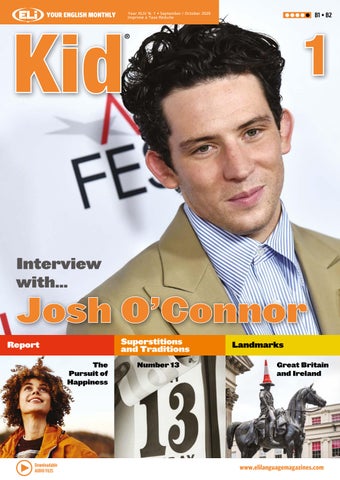
Interview with…
Josh O’Connor Superstitions and Traditions
Report The Pursuit of Happiness
Downloadable AUDIO FILES
Number 13
Landmarks Great Britain and Ireland
www.elilanguagemagazines.com
\
ario Somm Contents Hi guys! J Welcome to this year’s Kid, the magazine that helps you learn English in a fun way! On page 4, we have some fun puzzles to test your general knowledge. In this issue, find out how much you know about the United Kingdom! Are you superstitious? Have you ever wondered why some people think the number 13 is unlucky? Read our article on page 8 and find out. On page 10, you’ll love reading our interview with the wonderful and talented English actor, Josh O’Connor. Hope you enjoy our first issue! Happy reading! Pauline info@elilanguagemagazines.com
3 4 5 8 10 12 14 15
Quadro Comune Europeo (B1 – B2) Intermedio LivelloEuropean Common Framework Intermediate (B1 – B2)
Good to know! Culture Puzzles | The United Kingdom Report | The Pursuit of Happiness Superstitions and Traditions | Number 13 Interview with… | Josh O’Connor Landmarks | Great Britain and Ireland Films on release Fun and games!
Hi, I’m Grammy. This month we’ll learn about: - infinitive constructions - conditional - adverbs (-ly)
G
Downloadable Audio FIles Your subscription includes free MP3 downloads of the audio sections of all the magazines. Visit www.elilanguagemagazines.com
What is it?
Describe the picture: what do you see? In your opinion, what does it represent? ELI srl, C.P. 6, 62019 Recanati, Tel. (071) 750701, Fax (071) 977851 Direttore responsabile: Michele Casali. Realizzazione testi: Pauline Russo. Autorizzazione Trib. di Macerata N. 153/83 del 31 maggio 1983. Realizzazione: Tecnostampa, Loreto © ELI Italy 2026
2
NO PART OF THIS PUBLICATION MAY BE REPRODUCED IN ANY FORM OR BY ANY MEANS OR FOR ANY PURPOSES WITHOUT PRIOR PERMISSION. THE PUBLISHER IS PREPARED TO MAKE PAYMENT FOR ANY COPYRIGHT OF PHOTOGRAPHS WHERE THE SOURCE HAS BEEN IMPOSSIBLE TO TRACE. ALTHOUGH WE CHECK THE CONTENT AND SUITABILITY OF THE WEB SITES FEATURED OR REFERRED TO IN OUR MAGAZINES AT THE TIME OF GOING TO PRESS, WE ARE NOT RESPONSIBLE FOR ANY CHANGES WHICH MAY HAVE OCCURRED SINCE, AS THESE WEB SITES ARE IN NO WAY ASSOCIATED WITH ELI.
Teacher’s Notes Subscribed teachers are able to download both the MP3 audio files and the Teacher’s Notes in PDF format.
Good to know!
G
infinitive constructions; adverbs (-ly)
A village with one street Not far from Krakow, in southern Poland, is Suloszowa, a small village with a unique design. Its 6,000 inhabitants all live in houses on a single main street that is 9 km long. Behind each house there is a narrow strip of land, used mainly for farming. This type of land management is very old and reflects rural* traditions and practices that are still used today.
This little town became famous after photos, taken from above with a drone, were posted on social media. This aerial view* is really amazing. Sułoszowa appears as a set of parallel rows, along the central road: a perfectly ordered and geometric landscape that seems drawn, almost like a giant natural “mosaic*”.
Letters for the future Would you like to be able to communicate with yourself in the future? Well, just go to the Café Pli in Paris, the first of its kind in Europe, where a snack break becomes a little journey through time. You sit down, order a drink or a pastry, then they give you paper and a pen to write a letter to your future self. In this quiet and relaxing atmosphere, ideal for thinking, you are free to express your thoughts, dreams, fears and goals, and to make promises or give advice to a version of you that doesn’t exist yet.
When you have finished writing, you put it in an envelope and close it with a wax seal*. Then you decide when you want to receive it: in one, five or even twenty years! You can also write to a
special person to surprise them in the future, on their birthday or a special occasion, as a sign of friendship or love. In a fast moving world, this place allows us to slow down and learn patience.
SOLVE THE ANAGRAM Another way you can leave a message for your future
M E T I
Glossary
S E L U P A C
........... ........... ........... ........... ........... ........... ........... : self is to use a ........... ........... ........... ........... a container in which you put objects that are important to you now. Then you hide it somewhere for a few years. You can relive these special memories in the future... whenever you want!
The answer is on page 15
aerial view: seen from above mosaic: picture or decoration made from tiny pieces rural: related to the countryside and farming wax seal: historical way of closing an envelope
3
Culture Puzzles
The United Kingdom
What do you know about the history and culture of the United Kingdom? Try our puzzles and find out!
Crossword
1
2 3
4
1. A typical English dish: ... and chips. 2. The name of the British flag: Union ... 3. The name of the lake in Scotland where,
they say, a monster lives (2 words). 4. The first name of the current King of the United Kingdom. 5. The city in Northern Ireland where you can visit the Titanic Museum. 6. Scotland’s capital city. 7. Where to see the famous Big Ben. 8. A fish found in Scottish rivers. 9. A popular British hot drink. 10. The mythical* creature on the Welsh flag.
Anagrams
Solve the anagrams by reading the clues.
5
6 7 8
9
10
L I G E C A
1.
........... ........... ........... ........... ........... ...........
2.
........... ........... ........... ........... ........... ........... ........... ........... ........... ...........
3.
........... ........... ........... ........... ........... ........... ...........
4.
........... ........... ........... ........... ........... ........... ........... ...........
5.
........... ........... ........... ........... ........... ...........
An ancient Celtic language spoken in some parts of Scotland and Ireland.
T O N E S G E N E H A historical English site with a large circle of tall stones.
N I T A T I C The famous ‘unsinkable*’ ship built in Northern Ireland.
F A D F O L I D The national flower of Wales.
S B Y K A N The famous contemporary British artist with a secret identity.
Wordsearch
Answer the questions and find the words in the grid. 1. How many nations make up the United Kingdom? 2. In which country do men wear kilts*? 3. Which city in England did The Beatles come from? 4. Which sport is played at Wimbledon? 5. Which currency* is used in the United Kingdom? Glossary currency: the money used in a particular country fictional: not real, invented kilt: a ‘skirt’ traditionally worn by men in certain countries
mythical: something that exists in myths and legends unsinkable: something designed to stay above water
O
H
N
F
R
I
O
S
C
A
C
N
E
F
O
U
R
C
E
R
O
L
I
V
E
R
P
O
O
L
U
M
E
G
M
N
H
T
D
O
V
P
N
D
P
T
O
L
A
L
L
O
V
S
N
G
L
A
H
F
S
U
G
I
T
E
N
N
I
S
C
N
R
S
G
V
A
D
E
V
P
D
O
T
O
G
L
N
I
R
E
R
A
N
T
Z
L
E
H
G
The answers are on page 15
4
Have you ever asked yourself if there is a recipe for happiness? Is it something that just happens... or is it something that is created and pursued*? There is no magic formula, but read on for some ideas on how to be happy, day by day.
Report
The Pursuit of Happiness
A matter of opinion
Changing certain habits, or rather, changing our attitude towards what happens to us every day, is already a first step towards happiness. We should start with little things: learn to be more optimistic, realise that it is impossible to control everything, face challenges and difficulties with confidence and determination, remind ourselves to be grateful for what we have.
Over the centuries, thinkers and various cultures have outlined* their idea of happiness. From the Greek and Latin Classics to Eastern peoples, each has helped add new ingredients to that mysterious recipe we all seek*: to live with more joy. It’s not about rules, but about “methods”, behaviours, and ways of thinking that could radically* transform our lives.
5
Report
G
infinitive constructions; conditional; adverbs (-ly)
A lesson from the ancient Greeks
The Greek term for happiness is eudaimonia (from eu meaning well, and daimon, meaning spirit guide) and represents a central idea in Aristotle’s philosophy. It does not indicate happiness as an emotion or temporary state of mind, but something deeper and more lasting. It’s more like a complete realisation of what we are and what we could be, which is possible if we live our lives following our daimon, our natural ability.
Discovering our “talent”, then understanding where it wants to take us and realising our potential, is the way to getting closer to happiness.
Happiness according to Seneca
The Roman philosopher, Seneca, from the first century BC, said that happiness does not come from pleasure or material things, but from wisdom and inner harmony. In order to be happy, it would be best to eliminate past regrets and stop worrying about the future. Instead, we should tranquilly accept our destiny. In short, we should constantly strive for inner peace.
6
Don’t worry. The past is past and the future has still to arrive. Only the present counts, the “here and now”. We should live for the moment, using our time wisely, without wasting it.
Ikigai: the Japanese secret to happiness
Returning to the idea of eudaimonia, the Ikigai method is also a philosophy which helps us to find our “purpose”, our “reason for being” – practically,
what makes us get up in the morning. If we recognise what our passions and vocations are, we can understand the best way to use them in everyday, and even professional, life. Dedicating ourselves to the things we love would make us happy and lead to a long and peaceful life.
In Japanese culture it is essential to live in the present – in the “here and now” as Seneca said – because every moment of our lives is unique, and it will never be repeated. So, it would be best to do one thing at a time, carefully, without the stess of multitasking*. We should slow down and not think we always have to do everything quickly and immediately.
Hygge – a way of life
Hygge has become much more than just a Danish word. It’s the sense of warmth, comfort and well-being that we experience when we feel good, when we are with people we care about, when we read a book sitting on the sofa under a warm blanket, drinking a cup of tea while, outside, it’s cold and rainy. The pleasant feeling of a cosy home is very ‘hygge’, because happiness comes from the simple things in life.
OVER TO YOU Here is the million dollar question: what really makes you happy? Tell us about it!
........................................................................... ........................................................................... ........................................................................... ........................................................................... ........................................................................... ........................................................................... ...........................................................................
In Chinese philosophy, happiness is founded on inner and social harmony. Confucius (6th-5th a century BC) talked about virtue, respect and justice. Taoism (an ancient philosophical and religious tradition) teaches us that we achieve happiness when we accept reality or stop resisting change. Instead, we should adapt to them and move with the natural flow of life (Tao), because joy and sadness coexist*; success and failure are linked. Everything is balanced.
Glossary coexist: to live together, exist at the same time multitasking: doing more than one thing at the same time outline: to describe pursue: to follow, look for radically: extremely, in a very big way seek: to look for, pursue
7
Superstitions and Traditions
Number 13 Whether you believe in superstitions or not, they can be very important to some people and are usually based on historical traditions. Many British superstitions came from the country’s rural, maritime* and religious history. These were then taken to the USA and other countries in Asia and Africa where there was British influence.
In the Western world, the belief that the number 13 brings bad luck is quite common, and for some it can be a real phobia* called triskaidekaphobia. It can even influence daily life. Some buildings don’t have a 13th floor; hotels have no room 13 and there is no row 13 on airplanes. The London Eye, the famous observation wheel in London, has 32 pods, but they are numbered 1 to 33 – there is no pod number 13. There are many theories about this belief having religious and mythological origins: in Christianity, Judas was the 13th guest at the Last Supper and, in Norse legend, Loki was an uninvited 13th guest at a banquet* in Valhalla. According to 16th century Scottish folklore*, the number 13 was associated with witches’ covens*. Although 13 is unlucky mostly in the United Kingdom and the United States, some Eastern countries with Western influences, like Thailand
8
and Singapore, also avoid using the number 13 in hotels and other buildings. Strangely enough, even if India was a British colony, 13 is
frequently associated with positive spiritual significance. Not all cultures think 13 is negative, and some think it’s actually a symbol of good fortune.
G
adverbs (-ly)
Friday the 13th
Folklore experts in Britain say that, while separate superstitions about Friday and the number 13 have existed for centuries, the fear of Friday 13th is a relatively recent “media creation”, that became popular at the start of the 20th century, heavily influenced by Victorian literature and then films, like the horror film franchise* Friday the Thirteenth. The addition of the day Friday may be because Christ was crucified* on a Friday. American folklore specialists have said that it came from England and was seen for the first time in print in 1913.
Other unlucky numbers
In Italy, it is actually the number 17 that is unlucky. This has ancient Roman origins: the Latin word VIXI, meaning ‘I have lived’ was written on tombstones and is an anagram of XVII, number 17 in Latin. In China, Japan, Korea, and Vietnam, the number 4 is feared more than 13, because the pronunciation of “four” is similar to the word for “death”.
Lucky Numbers
A survey has shown that 7 is widely considered the luckiest number in the UK. It’s often associated with wisdom and spirituality and is frequently chosen in competitions. Former England footballer David Beckham notably wore the number 7 shirt. The number 3 is also chosen as a lucky number. This comes from the saying “All good things come in threes”.
PHOBIAS In the article, we see that a fear of the number 13 is called triskaidekaphobia. Look at the phobias listed below and guess what they are a fear of.
1. Claustrophobia ...................................... 2. Arachnophobia ...................................... 3. Monophobia ...................................... 4. Agoraphobia ...................................... 5. Aerophobia ...................................... 6. Cynophobia ...................................... Do you know any other phobias? Do you have a phobia? Tell us about it.
Glossary
The answers are on page 15
banquet: a large meal for a special celebration coven: a group of witches crucify: to hang on a cross folklore: traditional customs and stories film franchise: a collection of films with a common theme maritime: related to the sea and ships phobia: an intense, irrational fear
9
Interview with…
He has a talent for winning everyone over with his quiet intensity, and literally making them fall in love with him. Josh O’Connor is a polite, kind and humble* young man. He isn’t the typical Hollywood star. He’s an actor capable of leaving his mark, specifically because of his authenticity*.
Josh O’Connor I.D card Full name: Joshua Mathias O’Connor Place and date of birth: Southampton (England), 20th May 1990 Profession: actor In a world full of celebrities who are always trying to seem perfect, Josh O’Connor manages to be different. He can play complex characters, he’s not afraid to show his weaknesses, and... he has an unbelievably original hobby!
10
Your career is the result of years of study and hard work, starting in the theatre: from small roles in independent productions to TV series and the world of cinema. When did you realise that you had become famous?
Well, everything changed with The Crown when I played the part of Prince Charles as a young man. It was particularly complicated, because I had to show the deep emotions, insecurities and internal conflicts of a real person. But I did the same as I would do with any other part: a lot of research and everything necessary to build the character. I would like to know if he saw a little of himself in me.
G
infinitive constructions; conditional; adverbs (-ly)
Josh won many awards for The Crown: an Emmy, a Critics Choice Award and b a Golden Globe, as well as two nominations for a BAFTA Television Award.
You learnt to speak Italian for La Chimera, how to keep farm animals for God’s Own Country, and to play tennis for Challengers. Each new film has a completely different challenge for you! I think I’ve always been curious
Your way of life also allows you to keep in touch with your family, who you love very much. Can you tell us something about them?
about talents and jobs different from my own. I can’t say that I’m a great tennis player, and I certainly can’t speak Italian well, but they are two things that are now part of my life. For The History of Sound, I had to study piano and sing with my good friend Paul Mescal, who is really good. Well, I tried at least! And, to be honest, one of the advantages of my job is getting lessons in anything... free!
You’re an extremely private person, but you’re now a successful actor. Would you like to live in Hollywood?
Many of my friends live and work in Los Angeles, and some of them grew up there. So, for them, life in Hollywood is normal. But, for me, Hollywood is not real. No, I wouldn’t be able to live there. It would mean being constantly in the public eye*. When I’m not on the set, I need to be on my own and have some time to myself. I recently moved into a
I have two brothers, and then there’s my mother, who used to be a midwife*, and now paints. My father is an ex English teacher, who writes wonderful poems. He was the one who first took me to see plays at the theatre and introduced me to Shakespeare. The theatre is probably my first true love. It’s thanks to the theatre that I have a strong technical foundation and a versatile* acting style.
DID YOU KNOW?
cottage* in the English countryside, outside London. I have my hobbies to help me be myself.
Talking of hobbies, you love gardening, but also making pottery*. How did these start?
My greatest passion is pottery, and this was definitely my grandmother’s influence. She was a wonderful pottery maker and looked at the world with an artist’s eye. I was very close to her. Since I was a child, there has always been an artistic influence in our family. I can make some things, but they are not so beautiful. I would actually like to spend more time in my studio and practise making vases!
Josh is in the cast of Disclosure Day, a science fiction film that has recently been released, with Emily Blunt and Colin Firth. Josh can now say his dream has come true, because it was directed by one of the greatest directors ever. Who is it?
a. b. c.
George Lucas Quentin Tarantino Steven Spielberg The answer is on page 15
Glossary authenticity: being natural, not pretending cottage: a small house in the country humble: modest in the public eye: always noticed for being famous midwife: a nurse who delivers babies pottery: ceramic pots and vases versatile: flexible, adaptable
11
Landmarks When we see photos of countries and cities on television and in magazines, we often recognise them because of a landmark: a building or special place. Let’s look at some landmarks around the world and see how many you know… or have even visited! In each issue, we’ll look at a different part of the world and their famous – and sometimes unusual – landmarks.
England
London, England’s capital city, has many famous landmarks, but probably the most easily recognisable is Big Ben. Known around the world for its 12 chimes* at midnight on 31st December, it stands beside the Houses of Parliament. However, did you know that Big Ben is not really the name of the clock tower? It’s actually the enormous bell inside the tower that’s called Big Ben - widely believed to be named after Sir Benjamin Hall, a large man with the same nickname, who was responsible for installing* the Great Bell in 1859.
Scotland
The most famous landmarks in Scotland must surely be Edinburgh Castle and the iconic* Princes Street Gardens, or Stirling Castle and the nearby Wallace Monument, dedicated to the Scottish hero William Wallace (immortalised* in the film “Braveheart” starring Mel Gibson).
12
Great Britain and Ireland
However, the strangest landmark can be found in Glasgow, Scotland’s second city. In front of the Gallery of Modern Art, there’s a statue of the Duke of Wellington, on a horse, with a big orange and white traffic cone on
his head. The cone first appeared in the 1980s and, despite the city council removing it several times, it has always been replaced by an unknown person and has become one of Glasgow’s most iconic landmarks.
G
infinitive constructions: adverbs (-ly)
Wales
Wales is a country full of beautiful castles, but there is a more unusual landmark: the Pontcysyllte Aqueduct and Canal. Nicknamed the ‘stream in the sky’, the aqueduct carries narrowboats* along a canal of water above the River Dee. Part of a UNESCO World Heritage Site, it was designed by the well-known civil engineer*, Thomas Telford. Completed in 1805, this magnificent structure is popular with both walkers and canoeists.
Northern Ireland
The Giant’s Causeway* on the north coast of Ireland is a UNESCO site. Its 40,000 interlocking* hexagonal* columns were formed from volcanic Did you know that ruins of a Giant’s Causeway, formed from lava, have been found at Fingal’s Cave on the western Scottish island of Staffa? So, could this be the other end of the causeway? Could the legend about the giants really be true… ?
activity around 50 to 60 million years ago. Visitors can walk on these huge stones and, on a clear day, can see the west coast of Scotland.
Glossary causeway: an open path across water chime: the sound of a bell civil engineer: a person who designs bridges and roads hexagonal: having six sides iconic: symbolic immortalise: to make someone or something famous install: to put something in place interlocking: joined together to create a structure narrowboat: a long, narrow boat used on canals.
WHICH LANDMARK... 1. is named after a real person? There’s a legend that an Irish giant named Finn McCool created a causeway to cross the Irish Sea to face his rival, the Scottish giant Benandonner. After their meeting, Benandonner destroyed the causeway behind him as he fled back to Scotland, leaving only the part we see today.
....................................................................................................................... 2. is used by people walking and on boats? ....................................................................................................................... 3. is the subject of an ancient legend? ....................................................................................................................... The answers are on page 15
13
Films on release
G
Forgotten Island
infinitive constructions; conditional; adverbs (-ly)
genre: Animation, Adventure, Comedy Jo and Raissa grew up together and are best friends. After finishing their studies, they are ready to start a new chapter* in their lives. However, this means taking different paths that could separate them forever. One night, the two girls discover a mysterious portal* and they unexpectedly find themselves in a fantasy world: the forgotten island of Nakali. In this place, there are magical creatures (some friendly, others dangerous) from the mythical Philippine stories of their childhood.
During their adventures, the two friends realise that the price to pay to return home could be that they would lose all the memories of their friendship. There is only one thing they can do: find a way to leave the island before they forget each other forever. Singer and songwriter H.E.R. is the voice of the character Jo, with Liza Soberano, as the voice of Raissa.
The Phantom of the Opera (Le Fantôme de L’Opéra 2026)
The famous musical by Andrew Lloyd Webber, The Phantom of the Opera, is still currently on stage in London, and has been running continuously since 1986. In 2004, it became a film, directed by Joel Schumacher.
genre: Musical, Romance, Drama Deva Cassel is the star of the new film adaptation* of The Phantom of the Opera, from the 1909 novel written by the Frenchman, Gaston Leroux. It’s the story of Anastasia, a young and talented dancer, who arrives in Paris to take up a prestigious* role at the opera house, Palais Garnier. Strange and mysterious things start to happen: apparently the theatre holds the secret of a dark curse*. And so, for Anastasia, an impossible love story begins, which leads her to confuse reality with fantasy...
Glossary chapter: (here) a part, period curse: a wish that something bad will happen film adaptation: a version for the cinema portal: a magical entrance that transports you to another place prestigious: important
WHICH FILM… … reinterprets a classic and brings it back to the present day? .............................................................................. … celebrates the power of friendship, the importance of sacrifice and the value of remembering your roots? ................................................................................................................................................................................ … is a combination of love, mystery and legend? ..................................................................................................... The answers are on page 15
14
Fun and games!
True or false? Have you read the Report? Put yourself to the test with this true or false exercise! 1. Only optimists are always happy. 2. For the Ancient Greeks, happiness is a
4. Seneca advises us to live life fully
T F
in the present.
5. Thanks to the Ikigai method, it’s T F
profound emotion.
possible to live a long, tranquil life.
6. It’s best to do one thing at a time, according to the Danish Hygge.
7. Confucius says happiness comes from the ability to adapt to change.
3. According to Aristotele, it’s important to
8. Chinese philosophy is based on the
know yourself and follow your vocation.
belief that everything is in balance.
Find it in the magazine…
… the name of the observation wheel in London.
...........................................................................
… what happiness is, according to Hygge, when it’s cold and rainy outside. ........................................................................... … the name of the lead actress in the film The Phantom of the Opera.
...........................................................................
… the name of the cafe’ where you can write to your future self.
...........................................................................
… the city that has a statue with a traffic cone on top.
...........................................................................
… Josh O’Connor’s other hobby, apart from pottery.
........................................................................... The answers are at the bottom of the page.
Answers Page 3: Solve the anagrams: time capsule. Page 4: Crossword: 1 fish, 2 Jack, 3 Loch Ness, 4 Charles, 5 Belfast, 6 Edinburgh, 7 London, 8 salmon, 9 tea, 10 dragon. Guess who? 1 David Beckham, 2 Jane Austen, 3 Sherlock Holmes, 4 Henry VIII, 5 Ed Sheeran. Anagrams: 1 Gaelic, 2 Stonehenge, 3 Titanic, 4 Daffodil, 5 Banksy. Word Search: 1 four, 2 Scotland, 3 Liverpool, 4 Tennis, 5 pound. Pages 8-9: Phobias: 1 small and closed spaces, 2 spiders, 3 being alone, 4 large and open spaces, 5 flying, 6 dogs. Pages 10-11: Did you know? c) Steven Spielberg. Pages 12-13: Which landmark? 1 Big Ben, 2 Pontcysyllte Aqueduct, 3 The Giant’s Causeway. Page 14: Which film? The Phantom of the Opera; Forgotten Island; The Phantom of the Opera. Page 15: True or False? 1 False, 2 False, 3 True, 4 True, 5 True, 6 False, 7 False, 8 True. Find it in the magazine: The London Eye; reading a book sitting on the sofa under a warm blanket, drinking a cup of tea; Deva Cassel; Café Pli; Glasgow; gardening.
15
Liven up your lessons! To download Audio tracks English YOUR ENGLISH MONTHLY
Kid
Download on the
intermediate
intermediate-advanced
B1 • B2
Year XLIV N. 1 • September / October 2026 Imprimé à Taxe Réduite
1
®
GET IT ON
Français
primary school
Interview with …
Josh O’Connor Superstitions and Traditions
Report
lower-intermediate
The Pursuit of Happiness
intermediate
Landmarks
Number 13
Great Britain and Ireland
intermediate-advanced
elementary primary school
Downloadable AUDIO FILES
www.elilanguagemagazines.com
With PC or Mac Download MP3 Audio tracks from www.elilanguagemagazines.com
Deutsch
iate
termed
lower-in
intermediate
intermediate-advanced
elementary
Español
HECCRBQ ZPSR elementary primary school
diate interme
intermediate
intermediateadvanced
lower-
lower-intermediate
elementary
Lingua latina Italiano
primary school
elementary
iate
lower-intermed
intermediate
intermediate-advanced
advanced
ELI Language Magazines
elementary
www.elilanguagemagazines.com
Kid n. 4 - 2026 - Poste Italiane S.P.A. - Sped. in abb. post. - D.L. 353/2003 (Conv. in L. 27/02/2004 n. 46) Art. 1, comma 1, DCB - Ancona
elementary
Tassa Riscossa/Taxe Perçue
lower-intermediate