YOUNG ADULT
READERS
STAGE 3
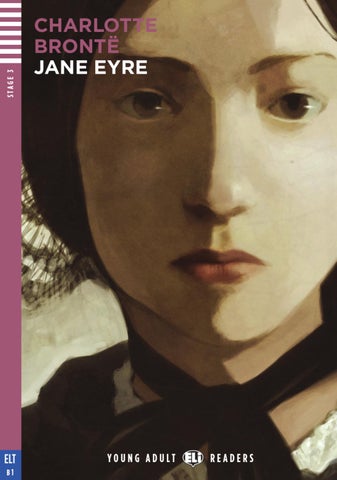
Jane Eyre Jane Eyre is an orphan, and all alone in the world. But she is no ordinary young woman; despite her lonely and unhappy childhood, she is determined to succeed at a time when women had little freedom. When she meets the enigmatic Mr Rochester, however, her independent spirit is put to the test. Will Jane ever find the happiness she desires so much?
CHARLOTTE BRONTË JANE EYRE
Charlotte Brontë
STAGE 3
Eli Readers is a beautifully illustrated series of timeless classics and specially-written stories for learners of English.
CHARLOTTE BRONTË JANE EYRE
In this reader you will find: - Background information about this novel - A short biography of Charlotte Brontë - Glossary of difficult words - Comprehension activities - PET-style activities - Exit test
Tags Love
Society
Elementary
600 headwords
A1
STAGE 2
Pre-Intermediate
800 headwords
A2
KET
STAGE 3
Intermediate
1000 headwords
B1
PET
STAGE 4
Upper Intermediate
1800 headwords
B2
FCE
STAGE 5
Advanced
2500 headwords
C1
CAE
STAGE 6
Proficiency
Unabridged Texts
C2
CPE
With free downloadable Booklet
8
97
S ER AD -5 l. RE .r. I 93 I s EL re 07 EL LT Ey 36U ne -5 AD Ja -88
BN IS
G
N
U
YO
Download full text as MP3 from www.elireaders.com
YOUNG ADULT ELI READERS
STAGE 1
ELT B 1
www.elireaders.com
ELT B1
YOUNG ADULT
READERS
MAIN CHARACTERS
6
7
BEFORE YOU READ
Vocabulary 1a Jane Eyre was published in 1847, when Victoria had been queen for ten years. Answer the following questions to help you imagine what life was like in a rich house in Victorian England. 1 How did rich people keep their houses warm? ____________________________________________________ 2 What was life like for children of wealthy families? ____________________________________________________ 3 What could these children do for entertainment? ____________________________________________________ 4 Who did the cooking, cleaning and washing in a rich house? ____________________________________________________ 5 How did people travel long distances? ____________________________________________________ 6 What do you think the class structure was like in Victorian England? ____________________________________________________
1b Discuss the following in pairs. • Would you have liked to live in Victorian times? Why/not? • What was life like for a poor person in those times?
2a Read
this short summary of Chapter One, then decide which adjectives might best describe Jane.
■ orphan ■ unhappy ■ lonely ■ timid ■ confident ■ sociable ■ rebellious ■ imaginative ■ afraid ■ brave Jane Eyre is sent to live with her aunt and uncle after her parents die, when she is only a few months old. About a year later, her uncle also dies and life becomes more difficult for her. Her aunt does not want her in the house and her cousins treat her badly. She has no one to protect her. She is often punished for what her aunt sees as bad behaviour.
8
2b Jane lives in a very big house. Match each room with its definition and what you might find in it. 1
■ ■ drawing room
a small room for eating breakfast
x bed; wardrobe; mirror; fireplace; chairs and other furniture for storing clothes
2 ■
■ bedroom
b large, formal room for relaxing and seeing visitors
y small table and chairs; fireplace
3 ■
■ breakfast
c room for sleeping and storing clothes and other personal possessions
z sofas and chairs; large fireplace
room
Grammar 2
3 Use
the prompts below to make questions. Then listen out for them in the first chapter of Jane Eyre. 1 where / she/ go (present perfect) ____________________________________________________ 2 what / you / want (present simple) ____________________________________________________ 3 what / you/ do / behind the curtain (past continuous) ____________________________________________________ 4 you / hear / her (simple past) ____________________________________________________ 5 how / you can / hit your young master (simple past) ____________________________________________________ 6 why / I / suffer in this way (simple past) ____________________________________________________ 7 Miss Eyre / you / be / ill (present simple) ____________________________________________________ 8 you / like / go to school (present conditional) ____________________________________________________
9
Chapter One
‘Unjust! – Unjust!’
2
There was no possibility of going for a walk that dark, November afternoon, there was a cold wind and it was raining heavily. I was glad – I never liked long walks. I hated going back into the house feeling cold to my bones, back to the house where I was constantly told off by Bessie, the nurse, and where I felt so inferior to my cousins Eliza, John and Georgiana Reed. That afternoon I went into the drawing room*. There, lying on a sofa was my aunt, Mrs Reed, surrounded by my cousins, her three ‘little darlings’. A bright* fire was burning in the fireplace, and the children, who were not arguing or crying, seemed perfectly happy. She looked up when she saw me but did not ask me to join them. ‘Until I have heard from Bessie, and seen with my own eyes, that you are learning to be a more sociable, more likeable child, Jane,’ she said, ‘then you will have none of the nice things that contented, happy little children are allowed to have.’ I started to ask what I had done wrong, but my aunt told me to be silent and to go somewhere out of the way. I went into the next room, a small breakfast room, which I liked because it had a bookcase. I took out one of my favourite books, A History of British Birds, climbed onto the window seat*, closed the curtain behind me and opened the drawing room (old fashioned) living room with chairs and sofas bright giving out a lot of light
10
window seat a place to sit under a window
15
AFTER-READING ACTIVITIES
Reading Comprehension 1
Answer the following questions. 1 2 3 4 5 6 7 8 9
Who lives in the house that Jane finds on the moors? ___________________________________________________ ___________________________________________________ What does Jane tell them her name is? ___________________________________________________ ___________________________________________________ How long is Jane ill? ___________________________________________________ ___________________________________________________ What does Jane tell them about herself? ___________________________________________________ ___________________________________________________ What does St John do to help Jane? ___________________________________________________ ___________________________________________________ What arrives in the post? ___________________________________________________ ___________________________________________________ What does St John ask Jane? ___________________________________________________ ___________________________________________________ What is her reaction? ___________________________________________________ ___________________________________________________ What happens when St John discovers Jane's real surname? ___________________________________________________ ___________________________________________________
Grammar 2
Choose the correct form of the verb in brackets. 1 ‘Who _____________ it?’ Rochester asked. (be)
116
2 ‘Your servants _____________ me, Pilot _____________ me!’ I said. (recognise) 3 I _____________ towards him and he _____________ his hand out to touch mine. (walk / reach) 4 ‘_____________? Is it Jane? My living Jane?’ he said, his hand now holding tightly onto my fingers. (I dream) 5 ‘It is,’ I answered. I kissed his eyes that could not see me, I pushed aside his hair and kissed his forehead. ‘It is Jane, and I _____________ you.’ (never leave)
Vocabulary 3 Find
fifteen words from this chapter in the wordsearch below, and discover what Jane finds. M
I
S
S
I
O
N
A
R
Y
M
B
F
K
I
T
C
H
E
N
K
A
E
O
T
R
B
R
E
A
D
I
R
G
R
C
H
I
L
D
U
H
S
R
G
T
M
I
L
K
E
L
E
S
I
A
U
S
E
C
R
E
T
L
E
E
R
N
O
B
L
I
N
D
P
D
D
V
E
E
X
H
A
U
S
T
E
D
E
U
N
G
R
A
T
E
F
U
L
I
N
Q
U
I
S
I
T
I
V
E
Speaking 4 Think about the following questions, then discuss your answers in pairs. • Have you enjoyed reading Jane Eyre? • Which of the characters did you like best? • Which did you like least? • Were you surprised when you found out about Bertha Mason, had you guessed that Rochester was already married? • Do you think Jane and Rochester will be happy together?
117
FOCUS ON...
Charlotte Brontë (1816 – 1855) English novelist, Charlotte Brontë, was the third child of six born to Reverend Patrick Brontë and his wife Maria. When Charlotte was five years old, the family moved to the Parsonage in Haworth – a small hill-top town in Yorkshire. Their mother died the following year, and their aunt Elizabeth moved in to look after the children.
School life At the age of eight, Charlotte was sent away with her elder sisters, Maria and Elizabeth, and her younger sister, Emily, to a newly opened school for girls. Conditions were harsh; Maria and Elizabeth became ill there, and died at home of tuberculosis the following year. Charlotte and Emily were taken away from the school and, apart from short periods at two other schools, were educated at home. Now the eldest child, Charlotte helped to look after her brother, Branwell, and her sisters Emily and Anne.
Clergy Daughters’ School (Cowan Bridge).
Feeding the Imagination From an early age, the Brontë children invented stories. They created imaginary worlds called Angria and Gondal. They wrote poems, articles and stories based on the adventures of some toy soldiers their father had bought for Branwell – all in microscopic writing. 118
Charlotte’s stories became increasingly complicated; she was already interested in exploring the complex relationships between people. You can see examples of the young Brontë’s work in the museum next to the Parsonage in Haworth. Their father encouraged them
to learn about the outside world and wrote in a letter to a friend that he could talk to his children as he could to any adult. Charlotte in particular was interested in politics, although at the time this was not thought a suitable interest for a young woman.
Working Life Charlotte became a governess for a number of families in Yorkshire, but she never stayed more than a few months at a time, probably because she missed her father, brother and sisters. In 1842, Charlotte and Emily went to Brussels, where they learnt French in return for teaching English. Charlotte became unhappy at the school – Emily had left, and she seems to have fallen in love with Constantin Heger who ran the school, but was already married. Charlotte used her experiences in Brussels as inspiration for her later novels The Professor and Villette. A childrens’ room.
Writing under a different name In 1846 she and her sisters published a small collection of poems under the names Currer, Ellis and Acton Bell. According to social conventions of the time writing was a rather scandalous occupation for women. The following year, the sisters, still using their pseudonyms, had three novels accepted for publication – Jane Eyre (Charlotte), Wuthering Heights (Emily) and Agnes Grey (Anne).
Tragedy strikes Charlotte’s brother Branwell became increasingly addicted to alcohol and opium. He died in 1848. Emily died a few months later and Anne the following year. Charlotte started to make short visits to London, where she met some influential writers of the time, but she was always pleased to return home. In 1854, Charlotte agreed to marry Reverend Nicholls, though she was not in love with him. Charlotte was pregnant with her first child when she died (probably of pneumonia) in 1854 at the age of 38. 119
FOCUS ON...
Fashion At the beginning of the Nineteenth Century, fashionable middle and upper class women wore simple ‘Empire’ style clothes, but by the time Victoria came to the throne in 1837, women’s dresses were much more complex. They were often highly decorated with lace and had large sleeves. The shoulders and skirts were wide, while the waist was made to look tiny. Women always wore hats when they were out and their clothes always covered their feet and ankles. It was not until the beginning of the Twentieth Century that women began to dress in a more liberal, more liberated way. Fashion and the way people dress is an important theme throughout Jane Eyre. The hypocrisy of Mr Brocklehurst is highlighted when his wife and daughter arrive dressed in the latest fashion, when he has just ordered the cutting of the girls' hair. Jane describes Mr Rochester’s female guests as a flock of ornate birds. The first Mrs Rochester on the other hand has wild hair and a simple white dress – her lack of care over her appearance is used here as an indication of her mental illness. Jane however is always dressed plainly. At first this is out of necessity but later this is her choice. Mrs Fairfax has to ask her to wear something more elegant when she is to meet Mr Rochester for the first time. Jane refuses to accept Mr Rochester's jewels and expensive dresses, and this helps her to keep her freedom and independence. 124
FOCUS ON...
The Parsonage The childhood home of the Brontës in Haworth is now a museum. The house is decorated and furnished as it was when Charlotte and her family lived there. It is a warm, comfortable house and it is easy to imagine the children growing up there. Behind the house is a museum where you can see the children's stories of Angria and Gondal written in tiny letters, as well as many of their possessions. If you are a fan of the Brontës it is well worth a visit.
Adaptations and Inspiration There have been many adaptations of Jane Eyre for TV, radio and the theatre, and 18 films. The novel has also been the inspiration of many novels, the most famous are Daphne du Maurier’s Rebecca, Wide Sargasso Sea by Jean Rhys, which tells the early story of Bertha Mason, and Jasper Fforde’s 2001 science fiction fantasy, The Eyre Affair. The first adaptations were often quite different from the original book, but more recently, scriptwriters have stayed closer to the text. The latest film version, released in 2011, is directed by American Cary Fukunaga. It is a close retelling of the story, with wellresearched costumes and historical detail. Unlike many previous versions, the actress
who plays Jane, Mia Wasikowska, is nineteen which is the age Jane is when she meets Rochester; Michael Fassbender is a tyrannical Rochester and the film is full of suspense – as in the book, we don’t find out the truth until the end.
Jane Eyre (2011).
Task When was Jane Eyre first published? ______________________ What name was it published under? ______________________ What was the inspiration for Lowood School? _______________ What inspired Thornfield Hall? ______________________ How old was Charlotte when she finished Jane Eyre? _________
125