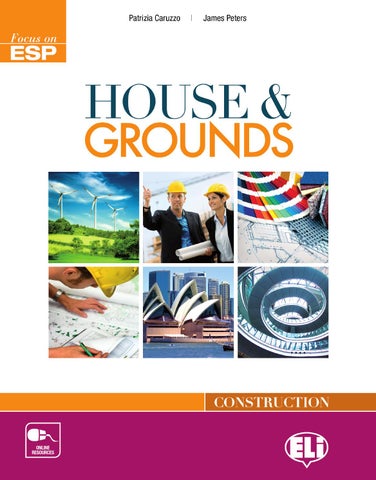
House & Grounds is an English course that helps learners to develop the necessary skills for today’s construction industry.
INTERMEDIATE TO UPPER INTERMEDIATE B1-B2
With its clear layout and presentation, in-depth analysis of the world of construction and architecture and the use of authentic articles and multimedia material (videos and internet links), this course combines both theoretical concepts and practical know-how and concentrates on the systematic expansion of reading, listening, writing and speaking skills. Further material and activities can be downloaded from www.elionline.com
For the student
For the teacher
Coursebook
Teacher’s Pack
• Online resources on www.elionline.com
• 2 audio CDs • Teacher’s Flip Book • CD-ROM Test Maker • Online resources on www.elionline.com
www.elionline.com
ONLINE RESOURCES
Contents MODULES
1
Ecology and the Environment p. 9
BUILDING in THEORY Ecology • Ecology: an overview • Sub-disciplines • The ecosystem • Human ecology and the ecosystem • Ecological crises ‘The solution to pollution is dilution’ p. 27
2 3 4 5 6
Urbanisation p. 35
Bio-Architecture p. 57
Building Materials p. 75
Design and Planning p. 93
Building and the Building Site p. 109
Environment and pollution • The human impact • Forms of pollution • Contamination and related diseases • Pollution: early environmental policies • From pollution dilution to elimination • Pollution parameters ‘Plans for UK’s ‘legacy’ of...’ p. 29
Urban growth • Urban growth • Urban land-use patterns • Choosing a place of residence • The economic life of a building • Consequences of urban growth ‘Green-based urban growth: the next wave of environmentalism’ p. 45
Urban planning • Urban economic planning • Town planning • Master Plan
Eco-building • Bio-architecture: general definitions • Eco-materials • Eco-design • Green building • Sustainable design
Eco-living • Alternative energy sources and green housing • Cohousing
Natural and man-made materials • Stone • Timber The disadvantages of timber frame • Brick • Cement and concrete
‘Sustainable urban policy’ p. 47
• Steel • Glass and metal • Plastic • Sustainable materials
Measuring instruments • Mapping • Surveying instruments • GPS as a surveying instrument
The art of design • Sketch stage and working drawings • AutoCAD • Rendering
Reports • Architectural brief and drawing • Architectural report • Building report
Building elements • Foundations • Walls • Floors • Stairs • Roofs
Restoring and renovating • Restoration • Building Renovation
On the building site • Modern methods of construction • Construction machinery • Health and safety ‘Work accidents kill one young person a month’ p. 121
7
Building Installations p. 125
House systems • Plumbing systems • Drainage • Electrical systems • Heating systems • Solar heating • Ventilation and air conditioning
‘Panta Rei: the philosophy of Feng Shui’ p. 127 ‘Concentrated solar power’ p. 133 ‘Air conditioning: use it wisely!’ p. 135
A proper use of energy • Energy conservation
FOCUS on LANGUAGE Vocabulary • The world of ecology
Grammar • Present simple • Present continuous • Zero conditional
BUILD IT UP!
MOVE to the NET
The anthropological impact on environment Human impact brings Earth to dawn of new epoch
Is nuclear safe?
C lil - history Vocabulary • The world of urbanisation • Compound nouns
Grammar • Imperative • Linkers
Social sustainability Want calmer cities? Build socially sustainable communities
Las Vegas urban sprawl
C lil - geopedology Vocabulary • ‘Green’ words • Prefixes
Grammar • The future • First conditional
Green building Building green houses for the poor
Cohousing
C lil - law Vocabulary • Materials
Grammar • Past simple • Past continuous
Natural architecture Building with earth
Stonehenge
C lil - construction Vocabulary • From surveying to design • Suffixes
Grammar • Comparatives and superlatives • Past simple vs Present perfect
AutoCAD An overview of CAD
AutoCAD
C lil - construction Vocabulary • Building elements • Safety
Grammar • Modals (1) • Second and third conditional
Complying with guidelines Universal design guidelines
Building a shed
C lil - construction Vocabulary • House systems
Grammar • Present perfect simple vs Present perfect continuous • Past perfect simple vs Past perfect continuous
Energy saving How to save energy by encouraging new habits
C lil - geopedology
Energy saving tips
MODULES
8
Building Public Works p. 143
BUILDING in THEORY Engineering • Civil engineering • Earthquake engineering
‘Chile earthquake: shock effect on earth’s axis’ p. 149
9
Working in Construction p. 163
Professionals • An overview • Operatives • Building and quantity surveyors • Civil engineers
Public works • Bridges • Gardens and parks • Roads • Tunnels • Schools • Dams • Opera houses • Airports
Education • How to become an architect in the UK
How to find a job • Job ads • CV and covering letter
‘Civil engineering’ p. 167
Building Culture DOSSIERS
1
2
A Short History of Architecture p. 180
MILESTONES in ARCHITECTURE • Prehistoric architecture • Roman heritage in Britain • The Middle-Ages: the Gothic period • Gothic cathedrals • British castles • Windsor Castle • Half-timbered houses in the UK • Half-timbered houses in the USA
p. 214
• The CN Tower • The Empire State Building • The Golden Gate Bridge • The Sydney Opera House • The Taj Mahal • The Dynamic Tower
starchitects
• Herzog & de Meuron • Daniel Libeskind
Famous Masterpieces
p. 230
Exit Test
p. 236
Word Bank
p. 244
Conversion Chart p. 251
• Gae Aulenti • Toyo Ito
• A famous Tudor town: Stratford-Upon-Avon • Renaissance and classicism: two masterpieces • Georgian architecture • Gothic revival and neoclassicism • The modern movement: Walter Gropius (1883-1969) • The modern movement: Le Corbusier (1887-1965)
• Richard Meier
FOCUS on LANGUAGE Vocabulary • Public works
Grammar • Modals (2) • The passive
BUILD IT UP!
MOVE to the NET
Famous Bridges London’s Millennium Bridge finally open to the public again
Harbour Bridge
C lil - construction Vocabulary • The CV • Professionals
Grammar • Reported speech • Relative clauses
RIBA awards A bird’s eye view of British architecture
Frank Gehry
C lil - languages
• The modern movement: Frank Lloyd Wright (1867-1959) • The postmodern movement: James Stirling and Aldo Rossi • Contemporary trends: Richard Meier (1934-) • Contemporary trends: Richard Rogers (1933-) • Contemporary trends: Norman Foster (1935-) • Contemporary trends: Frank Gehry (1929-)
GOING DEEPER
MORE THAN WALLS
Renzo Piano: the man who is reinventing architecture
Shakespeare
MOVE to the NET The Globe project
C lil - literature Gaudí’s masterpieces
Sculpture Gardens
MOVE to the NET
The Minneapolis Sculpture Garden
C lil - art
Welcome to is an English course for construction and architecture that helps learners to develop the necessary written and oral communication skills for today’s construction industry. Here is a quick guide to the main features of the book. There are 9 modules dealing with technical aspects of construction and 2 dossiers covering the history of architecture and its main masterpieces, organised as follows: BUILDING in THEORY • Each module is divided into chapters and provides theoretical texts, as well as in-depth analysis and authentic articles. • Each module includes exam preparation activities for Cambridge English: Preliminary (PET) in the first modules and First (FCE) in later ones.
Boxes Key words and concepts are highlighted in bold within the text and there are three different types of callout box which add further detail and aid comprehension: • The asterisk box (*) gives further insight into the meaning, the linguistic characteristics or etymology of the terms or expressions in the text; • More about… adds further facts on one of the topics or themes; • The interactive box has links to one or more websites where students can find further information on the subject. In the FLIP BOOK, clicking on these links takes you directly to the relevant website page.
The FOCUS on LANGUAGE section is divided into two parts: • Vocabulary to develop and consolidate the specific lexis of the module. • Grammar to practise, after a brief presentation, some of the most important grammatical areas.
PET exam preparation activities for Cambridge English: Preliminary (PET) FCE exam preparation activities for Cambridge English: First (FCE)
Extra material, MP3 audio files and the FLIP BOOK can be downloaded free of charge from www.elionline.com
The sections Build it up! (in the modules) and Going Deeper (in the dossiers) include articles from the English-speaking press and provide the opportunity to develop reading, listening, speaking and writing skills. In the Build it up! section there is also a CLIL box with ideas for inter-disciplinary projects.
Each module ends with a page called Move to the Net with authentic videos and internet links. The page is divided into four parts: • LOG IN!, a warm up activity to introduce the topic; • PASSWORDS, a list of lexical items from the video, with one or two exercises to help consolidate the language; • ON THE NET!, the video and a comprehension exercise. All the videos for this section are included in the FLIP BOOK.
More than walls, the final section of the two dossiers, provides material (including inter-disciplinary ideas) which re-connects to literature and art. The section also includes Move to the net, with a video linked to one of the topics within the dossier, followed by a comprehension activity.
The section Exit Test provides ample opportunities for revising some of the key points and issues. There are open ended questions, multiple choice questions and short adapted-authentic articles with comprehension questions.
The Starchitects section focuses on six ‘starchitects’ – architects who are famous because of their well-known designs, often innovative and iconic.
A 7-page Word bank provides a dictionary with an alphabetical list of the principal terms found in each module as well as three illustrations highlighting specific vocabulary. The section ends with a useful conversion chart.
The FLIP BOOK is the interactive digital version of the Coursebook and is full of resources and tools to be used with an Interactive Whiteboard (IWB), helping the teacher to involve the students and make the lesson more interesting and effective.
The FLIP BOOK contains all the contents of the Coursebook in multimedia format and groups together all the course components in one place: the interactive exercises with autocorrect, the audio files and videos from the modules and the videos from the Move to the Net pages.
The toolbar, on the right of the FLIP BOOK, makes working on the IWB easier as it contains all the functions such as paint, zoom, notes and print making it possible to move between the pages of the FLIP BOOK and use them in the best possible way.
The FLIP BOOK contains a complete User Guide which explains all the resources and tools available.
Module
1
Ecology and the Environment BUILDING in THEORY
BUILD IT UP!
Ecology Environment and pollution
The anthropological impact on environment
FOCUS on LANGUAGE
MOVE to the NET
VOCABULARY The world of ecology GRAMMAR Present simple Present continuous Zero conditional
Is nuclear safe?
9
Module
1 BUILDING in THEORY
warm up 1 Look at the pictures on these pages and try to predict what you will read in the text. What does ecology deal with according to you?
ecology Ecology: an overview
Activities
Ecology is the science that studies the number of living organisms in the environment and how they are distributed. It also studies how the quantity and distribution of organisms are influenced and in turn influence their interactions with the environment. The environment of an organism includes factors such as climate, solar insulation, geology and the other organisms that share its habitat. Ecology is also called ‘ecological science’ and it is multidisciplinary: this means that it draws on other branches of science, such as biology, geology, geography, meteorology, chemistry and physics. Ecological knowledge provides a scientific basis for environmentalism, whose aims and policies are the preservation, restoration and improvement of the natural environment.
reading comprehension 2 Read the text and choose the correct option. 1 Ecology studies... A the quantity of organisms in the environment. B how organisms are distributed. C both of these. 2 Ecology is also called... A meteorology.
B ecological science.
C physics.
3 Ecology makes use of... A other sciences.
B the environment.
C solar insulation.
4 Environmentalism deals with... A the protection of the environment.
B the study of the environment.
C geographical issues.
vocabulary 3 Match the words with their definitions.
1 environment 2 climate 3 chemistry 4 geology 5 physics
10
a n the study of the rocks and similar substances that make up the Earth’s surface b n the science concerned with the study of physical objects and substances, and of natural forces such as light, heat, and movement c n the surroundings or conditions in which a person, animal, or plant lives or operates d n the science that is concerned with studying the structure of substances and the way that they change or combine with each other e n the general weather conditions usually found in a particular place
Ecology and the Environment
Ecology has a great number of (1) ____________, some of which are more complex than others. Physiological and behavioural ecology focuses on the (2) ____________ of the individual to his environment. Population ecology examines the dynamics of (3) ____________ of a single species; community ecology studies the interactions between species in an ecological (4) ____________. Ecosystem and landscape ecology are even more complex. Ecology can be studied at different (5) ____________. If you study the population level, you focus on individuals of the same species, but you can also examine communities of species, (6) ____________ or biosphere levels. The outer layer of the planet Earth can be divided into three compartments: the hydrosphere is the sphere of (7) ____________, the lithosphere is the sphere of soil and rocks and the atmosphere is the sphere of (8) ____________. Last, but not least, the biosphere is the sphere of life. In short, it is the part of our (9) ____________ occupied by life.
listening 1.02 1
PET Listen to the interview with John Hale, an ecologist, and complete the text.
reading comprehension 2 PET Read the text and decide if the statements below are true (T) or false (F). T F n n n n n n n n n n n n n n n n
1 The sub-disciplines of ecology are all very complex. 2 Population ecology examines the population dynamics of a single species. 3 Ecosystem and landscape ecology are more complex than other forms of ecology. 4 If you study the population level, you concentrate on communities of species. 5 The outer layer of the planet Earth can be divided into four compartments. 6 The hydrosphere is the sphere of water. 7 The biosphere is the sphere of soil and rocks. 8 Ecology cannot be studied at different levels.
3 Now answer the questions. 1 What are the sub-divisions of ecology? 2 Do physiological and behavioural ecology focus on the adaptation of the individuals to their environment? 3 What does community ecology study? 4 What do you focus on if you study the population level? 5 How can the outer layer of the planet Earth be divided? 6 What is the lithosphere? 7 What is the biosphere? 8 What is the atmosphere?
11
Activities
Sub-disciplines
| Module 1
Module 1 | BUILDING in THEORY warm up 1 Look at the picture and answer these questions. 1 Do you know what a ‘food chain’ is? 2 Do you think that you are part of it? 3 Do you think that there are any living organisms that are not part of it?
The ecosystem The first principle of ecology is that every living organism has a constant relationship with every other element in the environment. An ecosystem is a situation where there is interaction between organisms and their environment. In an ecosystem, species are connected by food chains. A food chain begins when energy from the sun is captured by plants and trees (primary producers) through photosynthesis. Then primary consumers (herbivores) eat plants and later secondary and tertiary consumers (carnivores) eat primary consumers. The energy they create by eating and digesting is lost as waste heat. When animals and plants die, very small bacteria break down their tissue (decomposition) and the chemicals that make up those living organisms are released into the soil and act as fertilisers to help green plants to grow. In this way the food chain starts all over again. An ecosystem can vary in size: it can be a pond, a field, a piece of dead wood or a rainforest.
When you study an ecosystem, the main questions to consider are: • What are the dynamics of and changes to the ecosystem? • What methods of interaction does an ecosystem use at a local, national and global level? • Is the present state of the ecosystem stable? • What is the value of the ecosystem? • How does the interaction of ecological systems benefit humans?
M ore about... All living things play roles in the food chain. Energy is passed from one organism to another in a complex network, like a spider’s web. Food chains show how each living thing gets food and how nutrients and energy are passed from creature to creature. Food chains usually have no more than four or five links. Most animals are part of more than one food chain and eat more than one kind of food in order to meet their food and energy requirements. These interconnected food chains form a food web. Take a look at the following website to find out more about food chains and web chains. You can also try creating a food web...
www.vtaide.com/png/foodchains.htm 12
| Module 1
reading comprehension 2 Read the text and match the two parts of the sentences. 1 A food chain begins 2 An ecosystem can 3 Carnivores are 4 Every living organism 5 Herbivores are 6 In an ecosystem 7 When they die, living organisms 8 Species are connected 9 The chemicals released into the soil
a n by food chains. b n release chemicals into the soil during decomposition. c n has a continuous relationship with every other element in the environment. d n help green plants to grow. e n primary consumers. f n secondary and tertiary consumers. g n there is interaction between organisms and their environment. h n vary in size. i n when plants and trees capture energy from the sun.
vocabulary 3 Write the words in the box next to the correct definitions. carnivores • decomposition • ecosystem • environment • food chain • herbivores 1 A series of living organisms that are connected to each other because each of them eats the one below it in the series. 2 The environment and the relationship between all plants and animals living in that specific area. 3 The breaking down of plant or animal tissue by bacteria. 4 Primary consumers. 5 Secondary and tertiary consumers. 6 The world of land, sea, air, animals and plants.
__________________ __________________ __________________ __________________ __________________ __________________
4 Find the synonyms of these words in the text. 1 connection 2 component 3 habitat 4 examine 5 large scale 6 people
________________________ ________________________ ________________________ ________________________ ________________________ ________________________
speaking 5 Look at the picture of a food chain on page 12 and use your own words to explain the process. In this ecosystem there is interaction between...
6 What have you learnt about ecology? Prepare a short presentation (3-5 minutes) following the guidelines.
• What is ecology? What does it study? • How is it a multidisciplinary science? What are its sub-disciplines? What are the different levels it can be studied at? • How do food chains work? • What are the main points to consider when studying an ecosystem?
13
Activities
Ecology and the Environment
Module 1 | BUILDING in THEORY
Human ecology and the ecosystem
warm up 1 Look at the
n Sometimes humans consider
pictures and answer the questions.
• What do you see in the first picture? Can you describe the second picture? • What do you think is the main difference between humans and animals?
themselves as a separate, unnatural component that contaminates the ecosystem. There are two reasons for this: human beings are different from other species of animal in many ways and we are the species that has the greatest impact on the changes in ecology today. So ecology often studies ecosystems without humans in them. But what does human ecology deal with? n The main difference between humans and other species is that we are conscious
beings and we express our ambitions and aspirations through our relationship with the natural world. Our knowledge, principles, values and goals affect our behaviour. And we are also influenced by the society, culture, communities we have contributed to create. As a consequence, cooperation and conflict between individuals and groups have an impact on our biosphere. n Human ecology deals both with the influence
Activities
of human beings on their environment and with the effect of the environment on human behaviour. It also investigates their strategies to adapt to different situations as they understand their impact on each other better. If we want to save our planet, we must try and answer some key questions: • How do social, political and cultural interactions influence nature? • How can environmental management and the conservation of biodiversity interpret and accept human ecology, human values and our diversity?
reading comprehension 2 Read the text and match each paragraph with a heading. A How human beings behave B What human ecology is about C Are human beings different?
3 Read the text again and answer the following questions. 1 Why do humans sometimes consider themselves different from other species? 2 What does ecology often study? 3 What are the main differences between human beings and other living beings? 4 What are we influenced by? What are the consequences? 5 What interactions have an impact on the biosphere? 6 What does human ecology deal with and investigate?
14
Ecology and the Environment
| Module 1
The human influence
reading comprehension 1 Read the text and underline all the main points or facts. Then arrange these points/facts as a chart ordered according to importance. Justify your choice (not more than 3 lines each).
Main point or fact
Explanation
Everybody influences the human ecological web.
We influence it through our actions and behaviour.
vocabulary 2 Match the words with their definitions. 1 web a n the study of people, society and culture 2 impact b n a structure with connections and relationships 3 research c n the science that describes and classifies forms of life and living things 4 biology d n an important moral principle or belief 5 anthropology e n a difference, an alteration 6 change f n an effect 7 value g n the study of a subject
writing 3 Read the two texts again and answer the following questions.
• What is human ecology? • What does it investigate? • How is human ecology interdisciplinary? • In which ways does it interact with the other subjects mentioned?
15
Activities
Everybody influences the human ecological web through their actions and behaviour and we are starting to study and understand how they have an impact on the global environment. Today human ecology is not only an area of research, but also a system of methods and principles. It is interdisciplinary because it deals with a great number of different subjects, such as biology, psychology, anthropology, development studies and political ecology, and it is also experiential and reflective. Human beings are part of the ecosystem and both we and the ecosystem change while we are studying it. Thanks to these changes we can understand our values better and consequently we can change them. And every human being can help others to understand and respect each other. This can result in advantages for both humans and non-humans.
Module 1 | BUILDING in THEORY
Ecological crises
warm up 1 Scan the text
n An ecological crisis occurs when the environment of a species or a population
and match each paragraph with a picture.
develops in a way that makes its survival more difficult. There are different reasons why this can happen: for example, the quality of the environment can change with regard to the needs of a species (which can be caused by an increase in temperature or a decrease in rainfall, for example) or the environment can become less favourable for the survival of a species because of the reduced quantity of food it offers (for example in cases of overfishing). Overpopulation is another reason why the environment can become hostile to the survival of a species. n Ecological crises can take place over both a short or a long period of time. Some
crises are of natural origin, others are caused by human beings. They can affect only one species or a number of them and they can be local or global. Their consequences can be limited to the death of a few members or lead to the extinction of a species. In many cases an ecological crisis leads to a damage in the food chain, even if its cause is the disappearance of a single species. This has further consequences on the survival of other species.
A
B
n The consequences of a global crisis
Activities
C
can be much worse. In the past the extinction of some key species led to the disappearance of over 90% of the existing species. But some ecological crises, such as the extinction of the dinosaurs, have had positive results because they have helped biodiversity by permitting the development and diversification of other species.
reading comprehension 2 Read the text and choose the correct option. 1 An ecological crisis happens when the environment of a species or a population develops in a way that makes its … more difficult. A life B survival C needs
2 This can happen because the quality of the environment can change with regard to the needs of… A a population B the environment C a species 3 Another reason for an ecological crisis can be that the environment becomes less favourable for the survival of a species because of the reduced amount of … it offers. A food B rainfall C biodiversity
4 Some ecological crises are of … origin, whilst others are caused by human beings. A difficult B favourable C natural 5 Some ecological crises, such as the extinction of …, have had positive effects. A the dinosaurs B human beings C biodiversity
16
Ecology and the Environment
| Module 1
The consequences
reading comprehension 1 PET Read the text and decide if the statements below are true (T) or false (F). T F n n n n
1 No ecological crisis can be reversible. 2 One of the results of an ecological crisis can be the extinction of a species. 3 In the last few decades human beings have negatively influenced their ecosystem like no other species on Earth. 4 The greenhouse effect is related to the growing number of extreme weather phenomena and different quantities of food resources. 5 An example of a recent ecological crisis is the nuclear disaster at Chernobyl.
n
n
n n
n n
listening 2 1.03
PET Listen to the interview with Kevin Phillips speaking about the greenhouse effect and its consequences and choose the correct option.
1 The greenhouse effect takes place when certain gases in the … trap infrared radiation. A water B air C atmosphere 2 …vapour, carbon dioxide and methane are greenhouse gases. A Hot B Water C Warm 3 When the quantity of greenhouse gas in the air …, the air holds more heat. A drops B decreases C increases 4 The greenhouse effect also takes place on other planets with atmospheres, such as … for example. A Mercury B Venus C Pluto
5 Global warming is normal and important for our planet because without it the Earth’s average temperature would be about … degrees Celsius.
A -18 or -19
B +18 or +19
C between -18 and +19
speaking 3 Prepare a short presentation (3-5 minutes) about some of the consequences that an ecological crisis can lead to.
17
Activities
In some cases an ecological crisis can be reversible, but this is a rare phenomenon. Usually its consequences go on until a point where it is no longer possible to return to the previous stable state. One of the results of an ecological crisis can be the extinction of a species, but in most cases it can simply reduce the number of individuals and their quality of life. In the last few decades, human beings have been responsible for increasingly more ecological crises and they have negatively influenced their ecosystem like no other species on Earth. The main reasons for their strong impact on the environment are advances in technology and increasing population. Here are some examples of recent ecological crises: • global warming caused by the greenhouse effect (which is related to the growing number of extreme weather phenomena and to different quantities of food resources) • the problem of the hole in the ozone layer • deforestation and desertification, resulting in the disappearance of a great number of species • the nuclear meltdown at Chernobyl (1986) and Fukushima (2011) whose consequences were not only the deaths but also the genetic mutation of thousands of people, animals and plants.
Module 1 | BUILDING in THEORY warm up 1 Work in pairs. What do we need land for?
environment and pollution The human impact
A ________________________
Activities
The quality of our land is very important. We need land to create energy, to grow fruit and vegetables and to bury waste. We also need it for mineral resources, for building houses, factories, schools and hospitals, for transportation, for free time activities and much more. Land is also a vital habitat for plants and animals. But many human activities, such as industry, agriculture and transportation, and their by-products, as well as intentional or accidental pollution, can damage the soil and harm the quality of land. B ________________________ Soil is extremely important for the environment, because water and vital substances such as vitamins, minerals and fibres are stored and regenerated in it. It is also an essential medium for growing crops. And it has another fundamental function: it acts as a barrier between the atmosphere and aquatic ecosystems. However, this barrier is lost if soil is damaged or contaminated, with the consequence that the soil becomes a source of pollutants that can enter surface or groundwater and even damage the quality of air and consequently the health of plants, animals and people. Toxic substances can be dangerous for individual species, have long-term effects on ecosystems and lead to an increase in global warming.
reading comprehension 2 Read the text and write the names of the activities under the pictures. 3 Read the text again and complete the sentences with the words from the box. atmosphere • products • contaminated • growing • important • source • warming • activities
1 We need land for a great number of ____________. 2 Land is also very ____________ for animals and plants. 3 Many human activities and their ____________ can damage the quality of land. 4 Soil is essential for the environment and for ____________ crops. 5 Soil is also a barrier between the ____________ and aquatic ecosystems. 6 If soil is ____________, its function as a barrier is lost. 7 Contaminated soil becomes a ____________ of pollutants. 8 Toxic substances can increase global ____________.
vocabulary 4 Match the words with their definitions. 1 waste 2 habitat 3 groundwater 4 global warming 5 by-product 6 medium 7 pollutants
18
a n b n c n d n e n f n g n
something created while producing or processing another product water found under the ground substances that pollute the environment material that is no longer wanted because its valuable part has already been used a gradual increase in the Earth’s temperature the natural environment where animals and plants grow a substance which acts as a vehicle for a particular purpose
Ecology and the Environment
European policies
C ________________________
Some organisations protect and improve air quality by regulating the release of pollutants into the atmosphere from large industrial and agricultural activities. These authorities act at local, national and European levels. European governments decide on air and water pollution standards to try and decrease air and water pollution. They also make sure that air and water get cleaned up in cases of pollution. The European Environmental Agency checks the proper use of water resources by controlling who can take water from the environment and how much water they can take. Local Authority Environmental Health Departments supervise small industrial processes and are locally responsible for the quality of the water in our taps. This is important because we use water for a great number of applications: in our houses and gardens, in agriculture, industry and commerce and the way we use it influences our environment.
| Module 1
The European Environmental Agency (EEA) began in 1994 and aims to provide independent information about the environment. For more information visit: www.eea.europa.eu
Activities
reading comprehension 1 Read the text and answer the questions. 1 What do some organisations do? 2 How do they do this? 3 What do European governments decide? 4 What do they ensure? 5 Does the Environmental Agency make sure that air and water get cleaned up in cases of pollution? 6 What do local authorities supervise? 7 What are local Authority Environmental Health Departments responsible for? 8 Why is this important?
listening 2 1.04
PET Listen to Barry Kindersley speaking about water pollution and the Environmental Protection Agency (EPA) and decide if the statements below are true (T) or false (F). T F n n
1 Water pollution is one of the main problems in the USA. 2 In underdeveloped and in some developing countries, such as India and China, one of the greatest problems is the discharge of raw sewage into natural waters. 3 Another source of pollution is chemical wastes discarded by industries. 4 The US Environmental Protection Agency is responsible for protecting human health and the environment. 5 The EPA maintains and enforces global standards through a variety of environmental laws. 6 It also works with industries and the government in many voluntary pollution prevention programmes and energy conservation initiatives.
n n
n n
n
n
n
n
n
n
speaking 3 Choose ‘land’ or ‘water’ and prepare a short presentation (3-5 minutes) to explain why they are essential for us and for the environment.
19
Module 1 | BUILDING in THEORY
Forms of pollution
warm up 1 Do you know
The release of chemical, biological, physical or radioactive substances in the environment is called pollution. Among the main kinds of pollution are: • Soil contamination (also known as land pollution): mainly due to human activities that cause an imbalance in the natural soil environment. The dumping of industrial waste, landfills and the use of harmful chemicals can all lead to soil pollution. • Air pollution: due to the release of chemicals and particulates (solid particles forming dust) such as nitrogen oxides that create smog and hydrocarbons. Industry and motor vehicles are responsible for the production of nitrogen oxides. Other examples of air pollution are carbon monoxide and sulphur dioxide. • Water pollution: caused by industrial waste, agricultural drainage and sewage. • Radioactive contamination: caused by accidents happening in nuclear power stations and by the production and use of nuclear weapons. • Noise pollution: including roadway, aircraft and industrial noise and high-intensity sonars. • Light pollution: including light trespass and over-illumination. • Visual pollution: referring to the presence of overhead power lines, motorway billboards or open storage of junk and municipal solid waste.
what the main types of pollution are? Match the pictures with the right names. 1 n water pollution 2 n visual pollution 3 n radioactive contamination 4 n noise pollution 5 n air pollution 6 n light pollution 7 n soil contamination
Motor vehicle emissions are the main source of air pollution all over the world. In the USA there are very severe controls on emission whereas in the countries of the European Community the guidelines for this problem are not as strict. However, due to the very high number of cars and vehicles, the USA is still the main contributor to mobile source air emissions in the world. There are many other sources that contribute to make this problem increasingly worse: chemical plants, coal-fired power stations, oil refineries, incinerators, metal production factories, plastics factories and other forms of heavy industry. These are called stationary pollution sources. B
A
D
C
F
20
E
G
Ecology and the Environment
| Module 1
Type of pollution
Examples
air pollution
carbon monoxide
Activities
reading comprehension 2 Read the first part of the text and fill in the chart.
water pollution noise pollution light pollution visual pollution radioactive contamination
3 Read the second part of the text and answer the following questions. 1 What is the main source of air pollution in the world? 2 Are there any emissions controls in the world? 3 Which country is the main contributor to mobile source air emissions? Why? 4 What are other sources of pollution? 5 What are they called?
vocabulary 4 Find the synonyms of these words in the text. 1 cause ________________________ 2 exhalation ________________________ 3 strict ________________________
4 directive ________________________ 5 check ________________________
speaking 5 Write down a list of the sources of pollution that exist in the area where you live and prepare a short presentation (3-5 minutes) about the possible solutions to these problems.
M ore about... The Great Smog of 1952 in London, was a serious air pollution event which killed at least 4,000 people. As a consequence, some of the first major environmental legislation were introduced, including the Clean Air Act of 1956.
21
Module 1 | BUILDING in THEORY
Contamination
warm up 1 Look at the
Pollution can be the result of natural disasters (such as hurricanes that can cause water contamination from sewage), but in most cases it is caused by human activities. The most common soil contaminants are heavy metals (for example chromium and cadmium coming from rechargeable batteries and lead coming from lead paint), aviation fuel, petrol and other substances such as chlorinated hydrocarbons, zinc, arsenic, trichloroethylene and benzene. In addition, many chemical substances enter the soil environment and sometimes groundwater in municipal landfill sites, often because a great mixture of rubbish can be found there, C including illegal substances. This happens especially in landfills that date back to the years before the 1970s, when there was little control both in the USA and in the European Community countries. Another common type of significant environmental damage can often be caused by coastal oil rigs or refineries.
pictures: which represent a source of pollution to the environment?
B A
Activities
D
reading comprehension 2 PET Read the text and decide if the statements below are true (T) or false (F). Then correct the false ones. 1 Pollution cannot be the result of natural disasters. 2 The most common soil contaminants are heavy metals. 3 Lead comes from rechargeable batteries. 4 Many chemical substances enter the soil environment and sometimes groundwater in municipal landfills. 5 In municipal landfills there is often a great mixture of rubbish, that includes illegal substances. 6 Before the 1970s there was little control at landfills in the USA.
vocabulary 3 Match the words with their definitions. 1 hurricane 2 sewage 3 contaminant 4 rechargeable 5 soil 6 refinery
22
a n that can be filled with electricity so that it can be used again b n a factory where oil is made pure c n a violent wind or storm typical of the Western Atlantic d n the top layer of the earth e n a substance that makes water or food impure f n waste matter coming from homes and industries
T F n n n n n n n n n
n n n
Ecology and the Environment
| Module 1
E
Related diseases
reading comprehension 4 PET Read the text and decide if the statements below are true (T) or false (F). Then correct the false ones. 1 Nuclear power stations are the only source of dangerous emissions in the case of accidents. 2 Pollutants can be the cause of a large number of diseases. 3 According to studies, there is a strong link between high levels of background radiation, cancer and mortality. 4 Our brains and our central nervous system cannot be damaged by contamination caused by pollution in the environment. 5 Throat inflammations, chest pains and congestion can be caused by ozone pollution. 6 Air pollution can lead to hearing loss, high blood pressure, sleep disturbance and stress.
T F n n n n n
n
n n n
n n n
listening 5 1.05
PET Listen to Hiroshi Takashima speaking about the Fukushima nuclear disaster and choose the correct option.
1 Apart from damage to buildings and people, the Tohoku earthquake caused a tsunami that provoked... A another earthquake. B a terrible nuclear disaster. C a fire overheating. 2 The Chernobyl nuclear accident took place in... A 1976. B 1986.
C 1996.
3 Compared to Chernobyl, this accident was ... because all reactors were involved. A very similar B not as serious C more complex 4 When the earthquake occurred, reactors 4, 5 and 6 were... A working. B not working.
C flooded.
5 All power for cooling was lost and reactors started to... A overheat. B be damaged by fire.
C be damaged by explosions.
6 A ... km radius area around the plant was evacuated due to radiation leaks. A 10 B 20 C 30 7 Measurements in areas ... km from the plant showed high radioactive Caesium Levels. A 10-30 B 20-40 C 30-50
writing 6 Read the texts again and write a short essay (150-200 words) including the following points.
• Main soil contaminants • The most dangerous releases
• Their origin • Related diseases
23
Activities
In the case of accidents, some kinds of pollution can produce very dangerous emissions. Two examples are accidents happening in nuclear power stations and in oil tankers. Pollutants are the cause of a great number of diseases, such as cancer, immune diseases, allergies, and asthma. Studies have shown that there is a strong connection between high levels of background radiation, cancer and mortality. Our brains and our central nervous system can be severely damaged by contamination caused by pollution in the environment, especially if the exposure to contaminants is prolonged. Sore throat inflammation, chest pain and congestion can be caused by ozone pollution, whereas skin irritation and rashes can be caused by oil spills. Noise pollution can provoke hearing loss, high blood pressure, sleep disturbance and stress.
Module 1 | BUILDING in THEORY
Pollution: early environmental policies
warm up 1 Work in pairs.
n Ecosystems, air and water quality were not altered to a significant degree by man until the end of the Middle Ages, when the population increased and became concentrated in cities. In some places contamination, air and water pollution became evident. In particular water pollution caused by untreated human waste became a serious problem as it was often the means of disease transmission.
Look at the pictures and try to answer the following questions.
• When do you think human influence on the natural environment started? • When do you think it started having serious consequences?
n Air pollution and more
generally environmental pollution as we know it today began at the time of the Industrial Revolution because population grew in number and the basic industrial processes started flourishing. The main reason why air pollution became a major problem was the creation of great factories and the use of huge quantities of fossil fuels, especially coal. Other serious problems were the increasing quantity of untreated human waste and the great amount of industrial chemical discharges.
Activities
n In 1881 the first two American cities in the USA to pass laws that ensured cleaner air were Chicago and Cincinnati, followed by other cities at the beginning of the 20th century. At that time an Office of Air Pollution was created. During the late 1940s smog became a very serious problem in many other US cities, but it was not until the mid 1950s that this issue started to draw major public attention. As a consequence several Acts (Noise Control, Clean Air, Clean Water and National Environmental Policy) were passed by the US Congress. Since then, public awareness has been increased both by events of local pollution and contamination and by international catastrophes and, as a consequence, important legislation has been passed and measures have been taken.
reading comprehension 2 Read the text and match each paragraph with a heading. A The consequences of the development of nuclear science B The causes of air pollution
24
C Important legislation and the beginning of public awareness D First changes in the ecosystems
Ecology and the Environment
M ore about... In 1945, near the end of World War II, a ‘Fat Man’ bomb was dropped on Nagasaki, Japan. ‘Fat Man’ is the code name for this atomic bomb which killed approximately 39,000 people and injured 25,000. Thousands more died later from radiation illnesses.
reading comprehension 3 PET Read the text again and decide if the statements below are true (T) or false (F). Then correct the false ones. 1 Towards the start of the Middle Ages the population increased and became concentrated in cities. 2 Environmental pollution as we know it today began before the time of the Industrial Revolution. 3 Air pollution became a major problem due to the creation of large factories. 4 In 1881 the first two American cities in the USA to pass laws that promised cleaner air were New York and Cincinnati. 5 During the late 1950s smog became a very serious problem in many other US cities. 6 The effects of radioactive contamination can remain lethal for hundreds of thousands of years. 7 Little caution is exercised by the nuclear power industry.
T F n
n
n n
n n
n n n n
n n n n
4 Now complete the text with the correct word. 1 ________________________ and more generally environmental pollution as we know it today began at the time of the Industrial Revolution. 2 The main reason why air pollution became a major problem was the creation of great factories and the use of huge quantities of ________________________, especially coal. 3 Other great problems were the increasing quantity of ________________________ and the great amount of ________________________. 4 During the late 1940s ________________________ became a very serious problem in many other US cities, but it was not until the mid 1950s that this issue started to draw major public attention. 5 As a consequence several ________________________ were passed by the US Congress.
speaking 5 PET Work in pairs. Write down all the dates from the text. Then ask and answer questions following the example.
A What happened in the USA in 1881? B Chicago and Cincinnati passed the first
two environmental laws.
6 Prepare a short presentation (3-5 minutes) about the first policies to contrast pollution. 25
Activities
n Radioactive contamination on a large scale is a consequence of the development of nuclear science. Its effects can remain lethal for hundreds of thousands of years. During the Cold War the first nuclear weapons were sometimes tested near inhabited areas, considerably raising the levels of background radiation. Later, most tests of this kind were banned. Although extreme caution is exercised by the nuclear power industry, international incidents such as Chernobyl and Fukushima have shown that the nuclear power industry still represents a great threat to human health and can potentially lead to disasters that can affect humanity on a very large scale.
| Module 1
Module 1 | BUILDING in THEORY
rom pollution dilution to F elimination Global warming is a phenomenon that affects the whole planet. Some contaminant substances called ‘persistent organic pollutants’ have recently been found in different ecological habitats situated far from any industrial activity, such as the Arctic. Even though experimental data regarding this problem is very limited, their presence apparently proves their bioaccumulation even after just a short time of extensive use. An increasing number of people have been informed about the evidence of local and global forms of pollution, and as a consequence an environmental movement has been created whose members try to limit the human impact on the environment. In the past the first forms of pollution were a natural function of the existence of living beings. Their consequences were natural selection, the creation of a balance due to adaptation or the extinction of local species. At that time the number of human beings was lower, technology was simple and its by-products did not have very harmful effects. Today things are different and the environment is considered beyond its direct impact on human beings. Technology is a great source of harmful by-products, but thanks to it we are able to measure the concentration of pollutants; for example we can control automobile emissions and industrial exposure. A traditional approach to pollution management has followed the dictum ‘the solution of pollution is dilution’, meaning that if pollution is weakened enough, it is not harmful anymore. But this is not true in all cases, and often the elimination of pollution – the ultimate solution – is not possible because of strong economic and technological barriers.
M ore about... The World Wide Fund for Nature (the WWF) was created in 1961 and is the world’s largest independent conservation organisation. Its goal is ‘people living in harmony with nature’. One of WWF’s main aims is to reduce the negative impacts of human activity (our ‘ecological footprint’). This means ensuring that the natural resources necessary for life – land, air, water – are managed sustainably. Visit the website to learn more about the WWF’s global initiatives:
Activities
wwf.panda.org
reading comprehension 1 Read the text and answer the following questions.
1 What is the first consequence of global warming? 2 Why did pollution have no harmful effects in the past? 3 In what way is technology both a cause and a solution to pollution?
26
| Module 1
listening 2 1.06
PET Listen to Martin Campbell speaking about environmentalism and decide if the statements below are true (T) or false (F).
1 The aim of environmentalists is to protect and preserve nature, its resources and the ecosystems. 2 Environmentalists are against the idea of a sustainable management of natural resources through changes in individual behaviour. 3 They try to improve the health of the environment, for example by controlling pollution and recycling. 4 The members of this movement often talk about threats to the Earth from population decline. 5 Environmentalism is also a social movement that tries to influence politics through activism and education in order to protect nature. 6 Environmentalists are against informed consumption.
T F n
n
n
n
n n
n n
n n
n n
speaking 3 PET Work in pairs. Imagine you are talking to a very famous scientist specialising in global warming.
Write a list of questions you want to ask him/her. Your partner will try to answer them.
reading comprehension 4 Read the article and its title. Do you know other slogans about pollution and the environment?
Try to invent your own slogan which represents how you would try to limit pollution.
‘The solution to pollution is dilution’
I
s the solution to pollution dilution? Is it possible to simply dilute toxins and pollutants to the point of invisibility and will this solve the problem? The truth is, no matter how diluted pollution becomes, nothing ever goes away entirely. It has changed and reduced but it remains still there in some form. The EPA and other government regulators have set guidelines to establish what levels of toxins are acceptably safe in food and water for human consumption. However, these indications are often rather confusing. For example, back in the early 80s, public health authorities in New York issued warnings that pregnant women and small children should not eat striped bass caught in the Hudson River because of PCB contamination. However, it was acceptable for non-pregnant
women and adult men to eat the fish. But if it is bad for pregnant women and children, why is it not also potentially harmful to others? The fact is, it may be. What we know now is that some people can be very sensitive to micro-doses of toxins, carcinogens, and other pollutants. The ‘safety levels’ are an ‘educated guess’ as to what is safe for human beings to consume, but they don’t necessarily work as an absolute measure of safety for everyone. The only way to avoid the dangers of pollution is not to pollute in the first place. We have to get better at that, a lot better, on both public and personal levels.
27
Activities
Ecology and the Environment
Module 1 | BUILDING in THEORY
Pollution parameters
M ore about... According to a recent study, the six worst pollutants are: 1 lead 2 mercury 3 chromium 4 arsenic 5 pesticides 6 radionuclides For more information visit: www.worstpolluted.org
Industry and a concerned general public have discussed the importance of different forms of pollution for years. The main questions are: • Do pollutants affect everybody or just some people who are particularly vulnerable? • Are some species more vulnerable than others? • Are the consequences only direct, or are there subsequent effects? • Can the effects be insignificant today and evident only in the future? • Does a threshold for damage exist? • Will there be any consequences on employment or economic prosperity if a form of pollutant disappears?
Activities
Some substances such as heavy metals and carbon dioxide can occur naturally and play a role in some environments, but in other cases they are released in great quantities in places where they had previously been absent and they are considered a kind of pollution. Environmental interference can sometimes emphasise the connection between different areas of pollution that are usually classified independently, such as water and air. Recently a connection has been found between the increasing levels of atmospheric carbon dioxide and the rise in the acidity of ocean waters, whose consequences can be seen on marine ecosystems.
reading comprehension 1 PET Read the text and decide if the statements below are true (T) or false (F). 1 One of the main questions discussed by industry and a concerned general public is whether pollutants affect everybody or just some people who are particularly vulnerable. 2 We are not sure if the consequences are only direct, or if there are subsequent effects. 3 We are sure that a threshold for damage does not exist. 4 Environmental interference can sometimes emphasise the link between different areas of pollution that are usually classified independently. 5 No connection has been found between the growing levels of atmospheric carbon dioxide and the rise in the acidity of ocean waters. 6 The rise in the acidity of ocean waters has negative effects on marine ecosystems.
28
T F n n n
n n n
n
n
n n
n n
Ecology and the Environment
| Module 1
Activities
reading comprehension 2 Now answer the questions. 1 Where can heavy metals and carbon dioxide be found? 2 Can you answer any of the questions in the text? 3 What example of environmental interference can you find in the text?
vocabulary 3 Find the synonyms of these words in the text. 1 worried 2 sensitive 3 edge
___________________ ___________________ ___________________
4 exist 5 accentuate 6 relation
___________________ ___________________ ___________________
reading comprehension 4 PET Read the article and decide if the statements below are true (T) or false (F).
PLANS FOR UK’S ‘LEGACY’ OF NUCLEAR WASTE UNVEILED
E
uropean countries such as Germany and Switzerland have modified their nuclear policies after the recent Fukushima disaster, but last week’s national policy statements confirmed the UK’s intention to go ahead with its plans for eight new reactors, in spite of opposition from green groups. Energy minister Charles Hendry said he is going to ask the Nuclear Decommissioning Authority to look for ways to accelerate progress on storage to reduce the original 2040 goal to 2029. Some of the nuclear radioactive waste in the UK is already in storage, but yesterday the government updated its disposal programme and published a
consultation on how to choose potential storage sites for most of the future waste from both civil and defence-related nuclear programmes. According to the Department of Energy and Climate Change, geological storage is the best choice. Local authorities have been asked to identify possible sites for storage – which will be judged according to approved norms – to help meet the target of putting the first waste into a disposal facility by the end of 2029. The DECC has already established a Managing Radioactive Waste Safely programme, focusing on the long term disposal of higher activity radioactive waste in geological formations.
1 Germany and Switzerland have increased their nuclear policies after the recent Fukushima disaster. 2 The UK is going ahead with its plans for eight new reactors, in spite of opposition from green groups. 3 None of the nuclear radioactive waste in the UK is already in storage. 4 According to the DECC, geological storage is the best choice. 5 The DECC has already established a programme focusing on the long term disposal of higher activity radioactive waste in geological formations.
speaking 5 PET In pairs, discuss the following points about nuclear power. • What are the advantages and disadvantages of nuclear power? • Are you for or against nuclear power? Why? • Recently, there has been a referendum on this subject in Italy. What do you think of its result? Do you agree with the decision of the majority of Italians? Why/Why not?
29
T F n
n
n n n
n n n
n
n
Module
1
FOCUS on LANGUAGE Vocabulary 1 Match the words with their definitions. 1 environment 2 food chain 3 pollution 4 greenhouse effect 5 global warming 6 power station 7 dump 8 contaminant
a n an increase in the amount of carbon dioxide and other gases in the atmosphere b n a substance that makes something less pure or makes it poisonous c n a site for depositing rubbish d n the surroundings or conditions in which a person, animal, or plant lives or operates e n a factory where electricity is produced f n a series of organisms each dependent on the next as a source of food g n damage caused to water, air, etc. by harmful substances or waste h n a gradual increase in world temperatures
2 Choose the best alternative to complete the sentences. 1 The environment of an organism includes factors such as climate, solar insulation, geology and the other organisms that share its space/habitat. 2 Ecology has a great number of sub-disciplines/environments, some of which are more complex than others. 3 Population ecology examines the dynamics of population of a single species/organism. 4 The outer/inner layer of the planet Earth can be divided in three compartments. 5 A ecological/food chain begins when energy from the sun is captured by plants and trees through photosynthesis. 6 Human ecology deals with the influence of human beings on their environment and with the effect of the ecology/environment on human behaviour. 7 Some ecological crises have had a positive result, because they have helped biodiversity/diversification. 8 Studies have shown that there is a strong connection between high levels of background radiation/ pollution and cancer and mortality. 9 The causes/effects of radioactive contamination on a large scale can remain lethal for hundreds of thousands of years. 10 Some contaminant substances/pollution have been recently found in different ecological habitats situated far from any industrial activity. 11 Industry and a worried general public have discussed the importance of different forms of pollution/ environment for years.
3 Complete the table. Forms of pollution
Causes
Related diseases
air pollution 
chemicals  ______________________________________ ______________________________________ ______________________________________ ______________________________________ ______________________________________
______________________________________ ______________________________________ ______________________________________ ______________________________________ ______________________________________
______________________________________ ______________________________________ ______________________________________ ______________________________________ ______________________________________
asthma
Word Bank p. 244
30
Ecology and the Environment
| Module 1
GRAMMAR Present simple
Present continuous
We use the Present simple to describe habitual actions and routines or things that are always true.
We use the Present continuous to describe an action which takes place at the time of speaking or to describe temporary situations, often with time expressions like now, at the moment, at present.
Ecology deals with living organisms. Does ecology have its own rules and laws? We generally use the Present continuous with adverbs of frequency like always, usually, often, normally, sometimes, rarely, occasionally, seldom, hardly ever, never (ever) or time expressions like daily, twice a week, four times a month, every year‌
Both we and the ecosystem change while we are studying it. We are exploiting the resources of the Earth. Those scientists usually study this subject, but these days they are focusing on a new one.
Chemical substances are often harmful.
1
Choose the correct form of the verb.
1 The environment of an organism is including/includes factors such as climate, solar insulation and geology. 2 Population ecology experts examine/are examining new data these days. 3 I interview/am interviewing a famous ecologist from NY today. 4 Population ecology is examining/examines the dynamics of population of a single species. 5 Does ecology have/Is ecology having any sub-disciplines? 6 Nuclear power stations in Fukushima cause/are causing radioactive contamination.
2 Put each verb in the correct tense.
1 Ecology _______________ (comprise) a lot of sub-disciplines. 2 We _______________ (start) to study what ecology is. 3 They _______________ (not use) any pollutants at the moment. 4 Ecology _______________ (make) use of other sciences. 5 What _______________ community ecology _______________ (study)? 6 Ecology _______________ (determine) what is right or wrong.
Zero conditional We use Zero conditionals when the if clause expresses a habitual condition, real events or universal situations or truths. We use the Present simple both in the if clause and in the main clause. You focus on individuals of the same species if you study the population level. When they die, living organisms release chemicals into the soil.
3 Match the two parts of the sentences. 1 If an ecological crisis has a positive result, 2 If you have an ecological crisis, 3 We speak of air pollution 4 If pollution draws the public attention, 5 If heavy metals do not occur naturally in an area, 6 If there are aircraft and industrial noise,
a n the environment can become unfavourable to the survival of a species. b n it can help biodiversity. c n they are considered as pollutants. d n we speak of noise pollution. e n some important laws to protect the environment are passed. f n when there is a release of chemicals into the atmosphere.
4 Translate the following text into your language.
Nowadays no place on Earth is unspoiled. Even though some pollutants like DDT have been banned in developed countries, they are still used in developing countries. Thus they are spread round the world by atmospheric circulation, with terrible repercussions on the quality of food because they are part of the food chain everywhere.
31
Module
1
BUILD IT UP!
the anthropological impact on environment Human impact brings Earth to dawn of new epoch
T
he beginning of the Holocene epoch started 11,750 years ago with climate changes that marked the end of the last Ice Age. The Earth is still officially in this age, but according to some geologists the human impact on the world has caused the start of a new era called Anthropocene. Evidence of this phenomenon is that some changes have occurred since the beginning of the Industrial Revolution, such as the modification in erosion and sedimentation patterns, ocean acidification, changes to the carbon cycle and global temperatures. According to geological data, temperatures and sea levels increased for the first 2,000-3,000 years of the Holocene epoch – the longest interglacial period in the past 250,000 years – and then became stable. According to Andrew Gale of the University of Portsmouth, human activity has become the leading source of most of the major changes in the Earth’s topography and climate. ‘The great number of people living on our planet exploiting every possible resource obviously creates enormous changes in the physical, chemical and biological environment. These changes are considerably reflected in our geological record’, he says. In his opinion, it makes no sense to place the pre-and post-industrialised Earth within the same epoch because of the strength of the impact of humans over the past 200 years. 32
The scientists who have carried out significant researches have therefore come to the conclusion that the Anthropocene should be recognised as a new geological epoch. Professor Richard Alley of Pennsylvania State University in the United States supports this idea. ‘In land, water, air, ice and ecosystems, the human impact is clear, large and growing’.
Ecology and the Environment
| Module 1
reading comprehension 1 PET Read the article and choose the correct option. 1 When did the era we live in start? A In about 13760 BC B In about 9740 BC C In about 13760 AD D In about 9740 AD 2 What do some geologists think about the human impact on the world? A It caused the start of the Ice Age. B It caused the beginning of the Holocene. C It caused the beginning of the Anthropocene. D It caused the end of the Anthropocene.
3 Evidence of this phenomenon is in changes which have occurred since... A the beginning of the Industrial Revolution. B the beginning of the Ice Age. C the beginning of the Holocene. D the end of the Industrial Revolution.
4 According to Andrew Gale... A the Anthropocene should be recognised as a new geological epoch. B human activity has become the leading source of most changes in the Earth’s topography and climate. C climate changes are called the Anthropocene. D the longest interglacial period is called the Holocene.
2 Read the article again and answer the questions.
1 How did the beginning of the Holocene epoch start? 2 In which epoch is the Earth now? 3 What is the evidence of the start of a new era called Anthropocene? 4 According to geological data, what happened during the first 2,000-3,000 years of the Holocene epoch? 5 Which conclusion have the scientists who have carried out significant researches come to?
listening 3 1.07
PET Listen to Jude Greene talking about the risks of using too much concrete and decide if the statements below are true (T) or false (F).
1 Concrete is always a safe choice. 2 Concrete surfaces can increase the risk of flooding. 3 Concrete surfaces can sometimes prevent water from penetrating into the soil. 4 This usually happens more frequently in mountainous areas. 5 If water removes polluted sediments, freshwater ecosystems can be damaged. 6 It is a good idea to control the amount of concrete surfaces during land-use planning. 7 There are no alternatives to regular concrete when building pedestrian paths and road surfaces.
T F n n n n n n
n n
n
n
n
n
n
n
speaking 4 PET Work in pairs. You are a journalist for an important radio network. Write a few questions to ask
Jude Green. Your partner will play the role of Jude Green and answer your questions.
writing 5 PET
You are one of the scientists who have worked on this important subject and carried out significant research. You are meeting a group of children in a primary school and want to explain the consequences of the human impact on our world. Write a short paragraph using your own words (about 100 words).
C lil - history Group Work. Go to www.environmentalhistory.org to find out the main stages of the human impact on the environment. Each group chooses a different historical period and prepares a report including information about the most important historical events of that time, what happened from an environmental point of view, what were the causes and effects of human impact along with the carried out environmental policies.
33
Module
1
Ecology and the Environment
MOVE to the NET IS NUCLEAR SAFE? Log in! 1
Answer the questions.
1 Has your country ever had any nuclear power plants? If so, where? 2 Can you name a few countries where nuclear power plants are still used? 3 What are the main risks related to the production of nuclear energy? 4 What could be the advantages of nuclear power?
2 Use the ‘passwords’ to complete the sentences. 1 Currently there are several ways for _________ nuclear waste. 2 The most common sources of _________ energy are nuclear, hydro, solar, wind and geothermal. 3 At the moment the global public atmosphere is being used as an enormous _________. 4 It is a common misconception that _________ has to be stored in a cave after its 20-year decommissioning process. 5 _________ is highly toxic to humans and animals in high quantities. 6 The combustion of fossil fuels leads to the production of greenhouse gases, the most important of which is _________. 7 According to scientists, black _________ due to burning oil-based fuel and biomass contribute to global warming. 8 Nuclear technology can eventually be put in long term storage containers and placed back into the earth in _________ that are carefully selected.
ON THE NET! 3
Have a look at this video and answer the following questions.
1 Why does John Ritch think that nuclear technology is a superior kind of technology? 2 How much carbon dioxide is emitted in the atmosphere every year? 3 What percentage of the world’s electricity does nuclear energy produce?
www.world-nuclear.org/info/inf06.html www.ucsusa.org/nuclear_power/
34
P asswords Nuclear pollution emissions-free storing radioactive waste planetary waste dump carbon particulates carbon monoxide carbon dioxide geological repositories
House & Grounds is an English course that helps learners to develop the necessary skills for today’s construction industry.
INTERMEDIATE TO UPPER INTERMEDIATE B1-B2
With its clear layout and presentation, in-depth analysis of the world of construction and architecture and the use of authentic articles and multimedia material (videos and internet links), this course combines both theoretical concepts and practical know-how and concentrates on the systematic expansion of reading, listening, writing and speaking skills. Further material and activities can be downloaded from www.elionline.com
For the student
For the teacher
Coursebook
Teacher’s Pack
• Online resources on www.elionline.com
• 2 audio CDs • Teacher’s Flip Book • CD-ROM Test Maker • Online resources on www.elionline.com
www.elionline.com
ONLINE RESOURCES