Games and learning activities
Here are some suggestions for games and activities, useful for stimulating and checking students’ language learning.
Whether in class or at home, it is a good idea to start with a preliminary activity to check the players’ knowledge and to identify how many and which cards to play with.
The teacher or group leader lays all the cards on the table, showing both sides of each card from 1 to 10, saying the numbers out loud. After that, the same thing can be done gradually and progressively with the other cards, depending on the language level of the class or group. Ordinal numbers should be presented at a slightly more advanced level. Players can repeat the numbers as a group or individually, or they can write them down in figures and/or in letters.
Bingo
It is possible to play bingo in four different ways. The teacher or group leader can start from a basic level and work up to a more advanced level: from matching figures and words on the cards and boards up to identification of numbers from figures or words on the cards (and vice versa). The winner is the player who completes his/her board first and shouts: “bingo!” as well as saying his/her numbers out loud. If the numbers are incorrect, the game continues until the next player has completed his/her board, or everybody has.
Guess the number
The teacher or group leader places the pack of cards in the middle of the table, with the numbers in figures face up. Each player takes a cards in turn and says the number out loud without turning the card over. Then the player can turn the card to see if the number corresponds: if it does, the player wins the card; if it doesn’t, the player returns the card to the bottom of the pack. The player with the most cards at the end wins.
Written variation
The teacher or group leader places the pack of cards in the middle of the table, with the numbers in words face up. Each player takes a card in turn and says the number out loud without turning the card over. Then the player writes the number in figures on a piece of paper, or on the white board. The other players check if the figures correspond to the words: if they do the player wins the card, otherwise the player returns the card to the bottom of the pack. The player with the most cards wins.
True or false?
The teacher or group leader divides the players into two teams of the same size and gives 3-4 cards to each player. The teams sit opposite each other and each player competes against the player he/she faces. Before starting, the players from both teams show their cards. Player A starts the game and, without showing his/her cards, tells player B: “I’ve got number sixty.” Player B decides if this is true or false, and asks to see the card: if the number corresponds, A keeps the card; if the number doesn’t correspond, B wins the opponent’s card and tells him/ her a number he/she has. Play continues with subsequent pairs of players, or all pairs can play at the same time. The team that wins the most cards from their opponents wins.
Memory game
The teacher or group leader divides the players into two teams, chooses and lays the cards out on the table. The players have one minute to observe and memorise the numbers. The cards are removed from the table and each player must write all the numbers he/she remembers on a piece of paper. The team that remembers and writes down the most numbers correctly wins. Depending on the language level of the class or group, the two teams can write the numbers in figures or in letters, likewise. The team that writes the most numbers correctly wins.
My numbers
The teacher or group leader places the cards on the table, and arranges the players in a semi-circle around it. Then he or she asks the players around the table questions which require numerical data, for instance:
“How old are you?, When were you born?, Have you got any brothers or sisters? How many? How old are they?, What’s your phone number? What’s your house number?” Players reply in turn, moving clockwise around the table, for a given amount of time, and show the cards with the numbers representing the simpler or more complex answers. The player who replies correctly to all the questions within the given time wins the game.
How much?
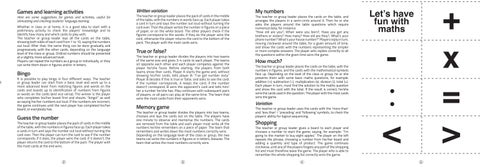
The teacher or group leader places the cards on the table, with the numbers in figures, and the cards with the mathematical symbols face up. Depending on the level of the class or group, he or she presents them with some basic maths questions, for example: addition (+), subtraction (-), multiplication (x), division (:), total (=). Each player in turn, must find the solution to the maths question and show the card with the total. If the result is correct, he/she wins the cards used in the question. The player with the most cards wins the game.
Variation
The teacher or group leader uses the cards with the ‘more than’ and ‘less than’ / ‘preceding’ and ‘following’ symbols, to check the players’ ability for logical sequencing.
Shopping
The teacher or group leader gives a board to each player and chooses a number to start the game; saying, for example: “I’m going to the market to buy eight apples.” The player on the left repeats the phrase, choosing a number from his/her board and adding a quantity and type of product. The game continues clockwise, until any of the players forgets any part of the shopping list and must therefore leave the game. The player who is able to remember the whole shopping list correctly wins the game.
Let’s have fun with maths
Dates and months
The teacher or group leader shuffles the ordinal numbers cards and places them on the table with the numbers in figures face up. The youngest player starts: taking the 1st card and replies to the question: “In which order to the days of the week come? And the months of the year?”
-“Monday is the first day of the week. / The first day of the week is Monday.” – “January is the first month of the year. / The first month of the year is January.” If the answer is correct, the player wins one point and it’s the turn of the player on the left, the game continues clockwise, until the whole sequence is completed. The player who is able to put the cards in order, and say the correct phrase in the fastest time wins the game.
What time?
The teacher or group leader shuffles the ordinal numbers pack and places the cards on the table, with the numbers in figures face up. He or she draws a big clock on a sheet of paper, pointing to the hands on the clock and asking players: “What time do you have … lessons/… training? - “In the first, second, third … hour of the morning / afternoon.” The players look for the cards corresponding to the time indicated. The player who finds, shows and says the most correct times, in the right sequence, and in the least amount of time wins.
The match
The teacher or group leader shuffles the ordinal numbers pack and divides the players into two teams and gives each team 6 cards. The team with the “first” card starts and describes a (football / basketball or volley ball) match, starting from the first minute of the game. The two teams alternate the “minute by minute” match commentary, based on the cards they have. The team which narrates without making any mistakes, in the least amount of time wins the match.
Naturally, these are only some suggestions for activities you can do with The Great Game of Numbers Teachers should make best use of the cards according to initial class language levels and specific learning objectives. They can also add to or enhance these learning activities as they wish, in order to stimulate students to learn English.
CEFR levels: Common European Framework of Reference for Languages
A1 Beginner
A2 Elementary
B1 Intermediate
B2 Upper intermediate
C1 Advanced
C2 Proficiency
Aims of the game
The Great Game of Numbers enables students of CEFR level A1 to level B1 to learn and practice cardinal and ordinal numbers in English in an enjoyable and engaging way, using the cards and the boards to play bingo and other fun games in class or at home with friends.
Contents
There are 132 cards in the game, divided as follows:
- 100 cards with cardinal numbers from 1 to 100 (red and green)
The Great Game of Numbers

by Joy Olivier
© 2019 ELI s.r.l.
P.O. Box 6 – 62019 Recanati – Italy
Tel. +39 071 750 701 – Fax +39 071 977 851 www.elionline.com www.elilanguagegames.com

English version: Catrin E. Morris
Art Director: Letizia Pigini
Editorial Department: Gigliola Capodaglio
Production Manager: Francesco Capitano
Design and graphics: Studio Cornell
Printed in Italy by Tecnostampa Pigini Group Printing Division – Loreto -Trevi
ISBN 978-88-536-2801-5 No
- 20 cards with numbers between 0 and 100,000 (hundreds and thousands) (blue and orange)
- 12 cards with ordinal numbers from 1st to 12th (yellow)
All the cards have numbers in figures on one side and in words on the other side.
The game also contains 36 bingo boards divided into:
- 18 boards with cardinal numbers from 1 to 100 (red and green)
- 18 boards with cardinal numbers between 0 and 100,000 (blue and orange)
The boards have six numbers in figures on one side and six numbers in letters on the other side, which don’t correspond, so that there are various ways of matching them with the cards.
Page 5 of this guide contains mathematical symbol counters to cut out, which are written in words on the reverse side.
plus times more than / following
Let’s have fun with maths minus divided by equals less than / preceding