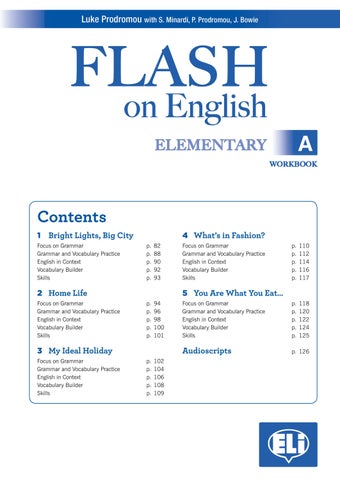
Contents 1 Bright Lights, Big City Focus on Grammar Grammar and Vocabulary Practice English in Context Vocabulary Builder Skills
4 What’s in Fashion? p. p. p. p. p.
82 88 90 92 93
2 Home Life Focus on Grammar Grammar and Vocabulary Practice English in Context Vocabulary Builder Skills
p. p. p. p. p.
110 112 114 116 117
Focus on Grammar Grammar and Vocabulary Practice English in Context Vocabulary Builder Skills
p. p. p. p. p.
118 120 122 124 125
Audioscripts
p. 126
5 You Are What You Eat… p. p. p. p. p.
94 96 98 100 101
3 My Ideal Holiday Focus on Grammar Grammar and Vocabulary Practice English in Context Vocabulary Builder Skills
Focus on Grammar Grammar and Vocabulary Practice English in Context Vocabulary Builder Skills
p. p. p. p. p.
102 104 106 108 109
1
Bright Lights, Big City Focus on Grammar
Present simple: be Affirmative form full
Negative form
contracted
full
contracted
Interrogative form
Short answers affirmative
negative
I am
I’m
I am not
I’m not
Am I?
Yes, I am.
No, I’m not.
You are
You’re
You are not
You aren’t
Are you?
Yes, you are.
No, you aren’t.
He is
He’s
He is not
He isn’t
Is he?
Yes, he is.
No, he isn’t.
She is
She’s
She is not
She isn’t
Is she?
Yes, she is.
No, she isn’t.
It is
It’s
It is not
It isn’t
Is it?
Yes, it is.
No, it isn’t.
We are
We’re
We are not
We aren’t
Are we?
Yes, we are.
No, we aren’t.
You are
You’re
You are not
You aren’t
Are you?
Yes, you are.
No, you aren’t.
They are
They’re
They are not
They aren’t
Are they?
Yes, they are.
No, they aren’t.
• The verb to be is an auxiliary verb. • We use contracted forms in informal situations. The contractions you aren’t, he isn’t, etc. are used more often than you’re not, he’s not, etc. but there is no change in meaning. • In English we normally do not respond to questions with only a ‘yes’ or a ‘no’. The personal subject pronoun and the auxiliary verb are repeated. These answers are called ‘short answers’. A Are they British? B Yes, they are. A Is she your French teacher? B No, she isn’t. • The short answer is not abbreviated in the affirmative. A Are you Canadian? B Yes, I am. (Not: Yes, I’m.) A Are we late? B Yes, you are. (Not: Yes, you’re.) • The short answer is abbreviated only in the negative. A Are they from Newcastle? B No, they aren’t. A Is he the new student? B No, he isn’t.
82
be: special uses • In English, to talk about age we use the verb to be with the following structure: subject + be + age + years old I’m 14 years old. / I’m 14. (years old can be omitted) • In questions we use How old…? with the following structure: How old + be + subject How old are you? • The verb to be followed by an adjective or a phrase is used to describe a physical state or feeling. to to to to to to to to
be be be be be be be be
hungry / thirsty cold / hot right / wrong ashamed of busy afraid of in a hurry sleepy
• We use the verb to be to talk about jobs. My sister is an architect.
there is/there are
Demonstratives
Affirmative form full
contracted
There is
There’s
There are
Interrogative form
–
1
Negative form full
• We use this (singular) and these (plural) to indicate objects or persons that are close to the speaker.
contracted
There is not
There isn’t
There are not
There aren’t
Short answers affirmative
negative
Is there…?
Yes, there is.
No, there is not. No, there isn’t.
Are there…?
Yes, there are.
No, there are not. No, there aren’t.
• We use there is with singular nouns and we use there are with plural nouns. There is a pen on my desk. There are 25 students in this class.
I like this blue hat and I love these purple gloves.
• We use that (singular) and those (plural) to indicate objects or persons that are far from the speaker.
• The short answer is not abbreviated in the affirmative. A Are there many people? B Yes, there are. • When we list several things or people, the verb to be agrees with the first item. In my backpack, there is a torch, some books and a laptop. In my family, there are four girls and one boy.
How much is that red sweater? How much are those black shoes?
• Demonstrative adjectives: – have the same form to indicate both masculine and feminine nouns. This man is American. This woman is Canadian. – have the same form to indicate both people and things. This window is always closed. That lady is Ms Smith. • We use this and that on the telephone: A Who’s that / this? Is that / this Sam? B No, this is John. Hello, this is Mark.
83
1
Present simple: have got Affirmative form full
contracted
Negative form full
contracted
Interrogative form
Short answers affirmative
negative
I have (got)
I’ve got
I have not
I haven’t got
Have I?
Yes, I have.
No, I haven’t.
You have (got)
You’ve got
You have not
You haven’t got
Have you?
Yes, you have.
No, you haven’t.
Yes, he has.
No, he hasn’t.
He has (got)
He’s got
He has not
He hasn’t got
Has he?
She has (got)
She’s got
She has not
She hasn’t got
Has she?
Yes, she has.
No, she hasn’t.
It has (got)
It’s got
It has not
It hasn’t got
Has it?
Yes, it has.
No, it hasn’t.
We have (got)
We’ve got
We have not
We haven’t got
Have we?
Yes, we have.
No, we haven’t.
You have (got)
You’ve (got)
You have not
You haven’t got
Have you?
Yes, you have.
No, you haven’t.
They have (got)
They’ve got
They have not
They haven’t got
Have they?
Yes, they have.
No, they haven’t.
• We use have got in English to indicate possession. We’ve got a big house in the country.
• For nouns that end in -f or -fe, we change the -f to -v and add -s or -es. leaf – leaves wife – wives
• In the short answer, got is always omitted. A Has she got a big car? B Yes, she has. / No, she hasn’t.
Irregular plurals
• Have got is generally used more in British English, whereas in American English they tend to use have alone, especially in the interrogative form, which takes the auxiliary do / does (but there is not change in meaning). BE Have you got any children? AE Do you have any children?
! Do not confuse the contracted 3rd person singular (’s) of the verb to be and of the verb have got. My sister’s (is) a vet and she’s (has) got six dogs.
Plurals • As a general rule, we add -s to singular nouns to make them plural. book – books boy – boys • To nouns that end in -s, -ss, -ch, -sh, -z, -x, we add -es. glass – glasses match – matches wish – wishes box – boxes • To nouns that end in -o, we add -es, except for those words that are foreign. tomato – tomatoes potato – potatoes photo – photos kilo – kilos • For nouns that end in -y the plural is formed in two ways: – if the -y is preceded by a vowel, we add -s. toy – toys – if the -y is preceded by a consonant, we change the -y to -i and add -es. lady – ladies
84
• Some nouns have an irregular plural form which conserves traces of conjugations from older languages. The most common irregular plurals are: child – children person – people man – men woman – women foot – feet mouse – mice tooth – teeth fish – fish
Imperatives • The imperative in the 2nd person singular and plural is identical to the base form of the verb. • We form the negative imperative with don’t (do not) + the base form of the verb. Don’t touch that! Don’t forget to call! • We form the imperative in the 1st person plural with let’s (let us) + the base form of the verb. Let’s have pizza for dinner tonight. • We use the imperative to: – give an order. Stand up! – give instructions. Turn left and take the first street on the right. – make requests. Pass the wine, please. – make suggestions. Let’s go to the disco tonight. – offer something. Have a piece of this cake, it’s delicious! – warn someone. Be careful! – wish someone well. Have a nice trip!
Articles The definite article • The is the only definite article and is always invariable, in gender and number. the boy / the girls • We use the in front of a noun that is specific and definite when it refers to something: – that is clear from the context. Can you hand me the book, please? (Which book? The one on the table, for example.) – that has already been mentioned in a general sense. A boy and a girl are sitting in front of me; I know the girl, but not the boy. (Which boy and which girl? The ones I have just mentioned.) – that is made clear by what follows in the sentence. The story of his life is very interesting. (Which story? His story.)
– to speak of abstract concepts. Time is money. – in front of names of continents, nations, regions, islands or lakes that are singular. France and Great Britain are in Europe. – in front of nouns that indicate a language. We study Spanish. – in front of the days of the week. She always goes to the gym on Tuesday.
The indefinite article • The indefinite article a / an is invariable in gender and only refers to a singular noun. a girl / a boy
– that is a unique entity. There are a lot of clouds in the sky today. (Which sky? The only one that exists.)
• We use a / an with countable singular nouns to indicate one among many. a camera / a girl / an elephant
• We use the in front of: – names of seas, oceans, mountain ranges, rivers, deserts. the Caribbean Sea the Atlantic Ocean the Alps the Thames the Sahara
• We use a / an with jobs. A What’s your job? B I’m a lawyer / an architect.
– names of nations that are plural or that include words like republic or kingdom. the USA the Netherlands the Seychelles the People’s Republic of China the UK – surnames when you are indicating all of the family members. The Simpsons are her new neighbours.
1
• We don’t use the: – to speak of categories of things or people in a general sense. I like animals.
• We use a in front of: – a consonant. a room – an aspirated h-. a hotel – the consonant sounds /j/ /w/ or /y/. a university a European nation a young man • We use an in front of: – a vowel. an apple – a silent h-. an hour an heir an honest man an honour
85
1
Possessive adjectives Subject pronoun
Possessive adjective
I
my
you
your
he
his
she
her
it
its
we
our
you
your
they
their
• We use possessive adjectives to indicate possession. • Possessive adjectives: – are never preceded by a definite article and are always used in front of the noun they refer to. My pen is over there. / Your mother is Irish. – always refer to the possessor. Ann has her iPod in her purse. Lin and Wang are Chinese, their friend Okura is in China. That’s a beautiful cat: its fur is so soft! – are invariable in number. your pen / your pens – are invariable in gender, except the 3rd person singular that agrees with the possessor. This is John: his sister is a student, his brother is a student, too. This is Kate: her father is an engineer, her mother is a teacher.
, Possessive s • We use the possessive ’s to indicate a relationship between people or to indicate possession between people and things. • We use the possessive ’s with the following structure: name of possessor + ’s + thing possessed (or family relation) Your neighbour My father Jennifer
86
’s ’s ’s
house. car. brother.
• When we use the possessive ’s, remember: – we only add an apostrophe to plural nouns that end in -s. The students’ books are new. – we add ’s to irregular plural nouns. The children’s books are on their desks. – when two or more people possess the same thing, we add ’s only to the last one. Mark and Helen’s parents have a big car. (Mark and Helen are brother and sister.) – when two or more people do not possess the same thing we add ’s to all the names. Jane’s and Robert’s parents work together. (Jane and Robert are not brother and sister.) • We do not use the possessive ’s to indicate a possessive relationship between things. We can express this relationship in two ways: – by using the preposition of. Look at the roof of that house! – by using two nouns together. The kitchen table is very large.
Asking and telling the time • Here are some ways to ask the time in English: What’s the time? What time is it? Have you got the time? What time do you make it? • To answer these questions we always use the pronoun it followed by the verb to be: A What’s the time, please? B It’s two o’clock. • In telling time, when the minute hand is in the right half of the clock face, we say how many minutes have gone past the hour: minutes + past + the hour It’s twenty past eight.
• When the minute hand is in the left half of the clock face, we say how many minutes are lacking to reach the hour: minutes + to + the hour It’s ten to six. • For fifteen minutes before or after the hour, we use a quarter to and a quarter past: It’s a quarter to five. It’s a quarter past eleven. • For thirty minutes after the hour, we use half past: It’s half past three. • We can also tell the time by reading the hour and the minutes exactly as they appear on the clock: the hour + the minutes It’s nine forty-five. It’s ten fifteen.
• Here are some useful expressions in the table below.
07.00
It’s seven o’clock.
12.00
It’s twelve o’clock / noon / midday.
03.10
It’s ten (minutes) past three. It’s three ten.
09.15
It’s a quarter past nine. It’s nine fifteen.
11.05
It’s five (minutes) past eleven. It’s eleven five.
06.30
It’s half past six. It’s six thirty.
04.50
It’s ten (minutes) to five. It’s four fifty.
10.45
It’s a quarter to eleven. It’s ten forty-five.
00.00
It’s midnight.
MY GLOSSARY Personal belongings cash card comb diary digital camera key laptop map mobile phone MP3 player notebook passport pen pencil pound coin ticket wallet
________________ ________________ ________________ ________________ ________________ ________________ ________________ ________________ ________________ ________________ ________________ ________________ ________________ ________________ ________________ ________________
In town airport art gallery carriage department store double-decker bus first/second class inspector library museum park public places restaurant shop supermarket theatre transport university
________________ ________________ ________________ ________________ ________________ ________________ ________________ ________________ ________________ ________________ ________________ ________________ ________________ ________________ ________________ ________________ ________________
Family members aunt brother children cousin daughter father (dad) grandfather grandmother husband mother (mum) nephew niece parents son stepbrother stepsister twin uncle wife Nationalities African Asian British Chinese English Greek Irish Italian Japanese Polish Scottish Spanish
________________ ________________ ________________ ________________ ________________ ________________ ________________ ________________ ________________ ________________ ________________ ________________ ________________ ________________ ________________ ________________ ________________ ________________ ________________ ________________ ________________ ________________ ________________ ________________ ________________ ________________ ________________ ________________ ________________ ________________ ________________
Jobs actor actress assistant director designer director producer script writer teacher technician writer
________________ ________________ ________________ ________________ ________________ ________________ ________________ ________________ ________________ ________________
Other... nouns animation course (recording) studios tap
________________ ________________ ________________ ________________
adjectives cold different excellent experienced hot huge informal professional proud small trendy
________________ ________________ ________________ ________________ ________________ ________________ ________________ ________________ ________________ ________________ ________________
adverbs by the way especially
________________ ________________
87
1
1
Grammar and Vocabulary Practice Grammar be 1 Complete the sentences with the correct form of the verb to be. 1 Frank speaks German because he__ ’s from Austria. 2 ______ you Jenny’s sister? 3 Where ______ your students? In the bar? 4 My parents ________ (not) from here, they are from Yorkshire. 5 My name ________ (not) Miguel, it’s Michael. 6 What ______ your favourite courses? 7 Where ______ the restaurant?
2 Follow the prompts and answer the questions with short answers. 1 Are you from near here? 3 Yes, I am. 2 Is Daniel a good actor? 7 No, he isn’t. 3 Are your friends happy with their course? 3 _____________ 4 Are we in the same class? 3 _____________ 5 Is your new CD good? 3 _____________ 6 Are London buses cheap? 7 _____________ 7 Am I in your film? 7 _____________ 8 Are we in the photograph? 7 _____________
have got 3
Match the sentence halves. 1 2 3 4 5 6 7 8
I haven’t got any other hobbies... We’ve got lessons tomorrow afternoon... My teacher is great because... I walk to school because ... My sister gets lost in London because ... I’ve got an MP3 player and ... We’re not interested in that school because ... My school is interesting because ...
a b c 1 d e f g h
88
she has got lots of good ideas. she hasn’t got a map. it’s got students from all over the world. because I haven’t got the time! I listen to it all the time. it hasn’t got courses for directors. but we’re free in the morning. I haven’t got money for a bus ticket.
4 Complete the sentences with the correct form of have got. have got a big family and a dog too. 1 We __________ 2 I am at film school. I _____________ lessons every day. 3 My sister _____________ a job in London. 4 My dad _____________ a fantastic digital camera. 5 You _____________ good shops near your house. 6 My school _____________ very good teachers. 7 London is a great city, it _____________ a lot of interesting things to do. 8 Oh no, I _____________ lessons early tomorrow morning.
5 Use the prompts to write complete sentences with the correct form of have got. 1 We / not / a good camera. We haven’t got a good camera. 2 your friends / a car? _________________________________________ 3 Sorry, I / not / a pen. _________________________________________ 4 My street / lots of shops and a cinema. _________________________________________ 5 you / courses for actors in your school? _________________________________________ 6 your school / a bar? _________________________________________ 7 My teacher / a laptop. _________________________________________ 8 All the students / mobile phones. _________________________________________
Possessive adjectives 6 Choose the correct option a or b to complete the sentences. 1 She’s got a laptop in ____ her bag. a her b our 2 Sarah is David’s mother and Paul is ___ father. a your b his 3 Here are Andy and Stuart with ___ grandmother. a my b their 4 Where is my wallet? It’s not in ___ pocket. a my b his 5 Julia’s got a new cat. ___ name’s Fluffy. a Their b Its 6 Hi, we are Sam and Chris and we live with ___ parents. a our b your
1
Vocabulary Personal possessions
The family
7 Underline the correct word in each sentence.
9
1 Have you got a digital camera / cash card for your bank? 2 Check you’ve got your passport / diary for the airport! 3 I’ve always got an MP3 player / the keys to my house in my bag. 4 Where is Curzon Street? Have you got a mobile phone / map? 5 This is a photograph / ticket I’ve got of the class for the school magazine, it’s great! 6 I’ve got Word, Excel and Google on my laptop / CD. 7 I’m not good with technology, I’ve got a pen / wallet and paper, not a laptop. 8 Have you got a pencil / watch? Write the name of this director on a piece of paper.
8 Now use the words you did NOT use in exercise 7 to complete these sentences. 1 I’ve got all my favourite music on my ___________ MP3 player . 2 My sister has got a ____________ for the concert this evening. 3 I’ve got a new memory card for my ____________ . 4 Have you got a ____________ please? What time is it? 5 I’ve got all my photos on a ____________ . It’s great! 6 I write my ideas for my film course in my ____________ every day. 7 He’s got all his money in his ____________ . 8 I’ve got a text message on my ____________ .
Complete the sentences with words from Unit 1.
1 My aunt Debbie lives with her daughter, my ________ cousin Julie. 2 Thomas is married, his ____________ is from Wales. 3 Peter is identical to his ____________ brother Mike. 4 Martin has got a new ____________ and she’s very nice. He’s happy his father is married again. 5 My mum’s dad, that is my ____________ , has got a laptop and mobile phone! And he’s 85! 6 My uncle Julian is great, he’s always got presents for his nieces and ____________ . 7 My cousin studies at film school and lives with his parents, my uncle Brian and my ____________ Lorna. 8 I haven’t got brothers or ____________ .
10 Complete the text with the words below. grandmother uncle stepmother stepsister cousins daughter twin
My family is great but a bit complicated. I live with my mum, and her mother, my (1) _____________ grandmother . I’ve got (2) _____________ brothers, and a (3) _____________ , Wendy. She lives with my dad and his second wife, my (4) _____________ . Her name is Marta, she’s very nice, and Wendy is her (5) _____________ . Nearby are my (6) _____________ and aunt, and their four children, my (7) _____________ Grant, Jackie, Dan and Teresa. We often see them at weekends.
89
1
English in Context 1
Complete Josie’s email with the words below.
3 Amy wants to join the gym. Complete the dialogue with the sentences below.
’s got are (x2) our aren’t haven’t got ’ve got (x2) they’re ’m their has
Yes, I have. It’s Cooper — C-o-o-p-e-r. Is that in South Africa? What’s your address in Brighton? Have you got a phone number in Brighton?
Hi Neil, are you? How (1) ____ Thanks for your message. Well, I’m English and I (2) _____________ 15. I (3) _____________ brothers and sisters, but I (4) _____________ lots of friends – 255 friends on this site! My two best friends (5) _____________ Olivia and Harry. (6) _____________ twins. (7) _____________ dad is a film director and they (8) _____________ a huge house with a swimming pool! (9) _____________ school is in Cambridge. It’s fantastic! It (10) _____________ two gyms and a cinema! (11) _____________ your school got a cinema? My parents are teachers at my school, but they (12) _____________ my teachers. Write soon, Josie
2
se Josie’s email as a model and write U sentences that are true for you, using the correct form of the verbs to be and have got.
fourteen and I ________________ ’ve got one sister . 1 I ’m ___________ 2 My best friends _________________ and they _______________________________________ . 3 My school _________________ and it _______________________________________ . 4 My town/city _________________ and it _______________________________________ . 5 My mum ______________________________ _______________________________________ . 6 My dad ________________________________ _______________________________________ .
90
I’m from Johannesburg.
Receptionist Amy Receptionist Amy Receptionist Amy Receptionist Amy Receptionist Amy Receptionist Amy Receptionist Amy Receptionist Amy Receptionist Amy
What’s your first name? My name’s Amy. What’s your surname? It’s Cooper – C-o-o-p-e-r. (1) __________________________ Where are you from Amy? (2) __________________________ (3) __________________________ Yes, that’s right. What’s your home address? Cnr Katherine Str 8 Grayston DR, Sandton, 2146 Johannesburg. (4) _________________________ It’s 32 Drew Lane. (5) _________________________ No, I haven’t but I’ve got a mobile. That’s OK. What’s your mobile number? It’s 3475623895. Have you got an email address? (6) _________________________ It’s asas@hotmail.com
4
Now answer the following questions.
1 What’s your name? _________________________________________ 2 Where are you from? _________________________________________ 3 What’s your address? _________________________________________ 4 Have you got a mobile phone? _________________________________________ 5 What’s your phone number? _________________________________________ 6 Have you got an email address? _________________________________________
Sum Up!
5 Find and correct the mistake in each sentence.
1 Henri is France. Henri is French. 2 Your brother is happy at his new school? _________________________________________ 3 Have Tim got a red car? _________________________________________ 4 Britney Spears is a singer. Your songs are famous. _________________________________________ 5 We’ve got a new dog. Their name’s Goldie. _________________________________________ 6 Thats a nice phone. _________________________________________ 7 Open the your books. _________________________________________ 8 Our teacher are great. _________________________________________
6 Underline the correct option to complete the dialogue. Joey
Blanca Joey Blanca Joey Blanca Joey Blanca Joey Blanca
Are you in (1) Mr Thompson class / the class of Mr Thompson / Mr Thompson’s class? Yes, (2) I am / I’m / am I. Have you got the homework? Yes, I have, but it’s on (3) the my laptop / my laptop / mine laptop. (4) Have you got / You’ve got / Got you it with you? Yes, it’s in my bag, just a second. That bag’s (5) large / grand / huge! What have you got in there? Three books, two pens, a notebook and (6) his / my / your laptop of course. That’s a small computer. Has it got a DVD player? (7) The course / On course / Of course.
1
7 Complete the dialogues with the expressions below. by the way that’s right and you you know sorry no problem
1 A I come from Manchester. ________ And you ? B Me? I’m from Argentina. 2 A My dad’s got a B&B, _______________ , a small hotel. B Yeah, I know, Bed and Breakfast. 3 A London’s great, really nice. _______________ , where are you from? B Me? I’m from Spain. 4 A Please, be careful, my coffee! My dress! B _______________ , are you OK? 5 A I am so sorry, please forgive me. B It’s OK, _______________ . 6 A You’re from Scotland, aren’t you? B Yes, _______________ . I’m from Glasgow.
Translate! 8 Translate these sentences into your own language. 1 My school has got a cafeteria. _________________________________________ 2 Our teacher’s French. _________________________________________ 3 This isn’t my notebook. _________________________________________ 4 I haven’t got a passport. _________________________________________ 5 Is he English? _________________________________________ 6 Lena’s 16. _________________________________________
91
1
Vocabulary Builder Compound nouns (1)
1 2 3 4 5 6 7 8 9 10
1 Look at the following words taken from Unit 1 of your Student’s Book. recording studio passport cash card scriptwriter
They are compound nouns, that is, words that are put together to form new ones. The first one acts like an adjective and it describes the second one. They can be written as one word, as two separate words or as a hyphenated word.
2
Mark is Susannah’s son-in-law. T Robert is Frank’s stepbrother. F – brother Becky is Ben’s half-sister. Maria is Ben’s stepsister. Ben is Becky’s half-brother. Julie is Maria’s stepmother. Jonathan is Sally’s father. Linda and Valerie are sisters-in-law. William and Mark are half-brothers. James is Catherine’s brother-in-law.
5 Look at the family tree again and complete Valerie’s email with the words below.
ake compound nouns with the words below. M Use a dictionary to help you.
sister-in-law stepsister son half-brother stepfather husband cousins brother-in-law
book number card shelf man security birthday point
1 2 3 4
phone ________ book phone ________ ________ pass book ________
5 6 7 8
camera ________ cash ________ ________ card ________ board
Hi Fiona, I’m really happy I’ve got a friend in Australia. Thanks for writing to me about your family. This is my family in the photograph! I’m in the middle, Valerie. I’ve got two great parents, my mum and dad, Catherine and Mark. I’ve also got a big sister, Linda. She’s married. My (1) _______________ brother-in-law ’s name is Pete. Pete and Linda haven’t got children. I’ve got an uncle William, and an aunt, his wife Sally. Sally is my mum’s (2) _______________ and she’s great! My uncle has got two sons, Robert and Frank. They’re my favourite (3) _______________ . Then I’ve got my aunt Julie. She’s my mum’s sister and she has a complicated family! Julie is married to uncle James and he’s got a daughter Maria, with his first wife. Julie’s got her daughter Becky with her first (4) _______________ , Andrew. Becky has got a (5) _______________ , Ben and a (6) _______________ , Maria. James is Becky’s (7) _______________ . My grandparents live in my town, they are Jonathan and Susannah. They are fantastic. They help Sally and their (8) _______________ William a lot with their little boy Frank. Do you understand all this?!! Write soon! Valerie
Compound nouns (2) 3
ook at these words taken from Unit 1 to L describe family relationships. stepsister stepbrother
They are compound nouns that use the word step. We also use the words half- and -in-law to describe other types of relationships. Half- precedes the noun as in half-sister; -in-law goes after the noun as in brother-in-law. Half-sister means that you and your sister have only one parent in common, for example the same father but different mothers. Your brother-in-law is your sister’s husband or your wife’s or husband’s brother.
4 Look at the family tree and write T (true) or F (false). Correct the false statements. Jonathan
Susannah
Sally
William
Catherine
Robert
Frank
Valerie
92
Mark
Linda
Andrew
Pete
Julie
Becky
James
Ben
Janet
Maria
Skills Reading
1 Alice writes for her school’s online newspaper. She is interviewing one of her classmates about her favourite film. What is a trilogy?
1 What’s your favourite film? My favourite film’s The Hunger Games. It’s the film of the same book by Suzanne Collins. 2 _________________________________________ It’s an excellent film! 3 _________________________________________ Yes, I have! The Hunger Games is a trilogy – I’ve got all three books: The Hunger Games of course, Catching Fire, and Mockingjay. 4 _________________________________________ Yes, it’s an amazing story! It’s about a 16-year-old girl named Katniss Everdeen who participates in the Hunger Games with other teenagers. They are all from Panem, a sort of post-apocalyptic nation divided into 12 districts. It’s a bit complicated and difficult, but it’s really interesting. 5 _________________________________________ The director’s name’s Gary Ross. He’s American. 6 _________________________________________ Jennifer Lawrence, my favourite actress!
2 Read the answers again and put Alice’s questions in the right place in the interview. A B C D E F G H I
Is it a good film? What’s your favourite film? What’s the director’s name? Have you got the book? Who’s the protagonist? Are the actors good? Are they all American? Has it got a good soundtrack? Is it a good story?
Writing
3 Write a paragraph about your favourite film.
7 _________________________________________ They are all good! Jennifer of course and her little sister, but then also Josh Hutcherson and Liam Hemsworth: they’re all my favourites! 8 _________________________________________ No, they aren’t. Liam Hemsworth is Australian and there’s also a British actor. His name’s Sam Claflin. 9 _________________________________________ It’s got a great soundtrack. I’ve got the CD, ‘Safe & Sound’ by Taylor Swift is magic! The photography is fantastic too, and the special effects are incredible!
Listening 4
2 Listen to the interview and decide which film they are talking about. Write Speaker 1 or Speaker 2 next to the titles A and B. A Harry Potter _______________ B High School Musical _______________
5
2 Listen again and complete the table with information on the characters. name
Troy
surname
Bolton
Use Alice’s article as a model.
age
My favourite film is...
nationality parents
93
1
2
Home Life Focus on Grammar
Present simple
Affirmative form
Negative form full
contracted
Interrogative form
Short answers affirmative
negative
I work
I do not work
I don’t work
Do I work?
Yes, I do.
No, I don’t.
You work
You do not work
You don’t work
Do you work?
Yes, you do.
No, you don’t.
He / She / It works
He / She / It does not work
He / She / It doesn’t work
Does he / she / it work?
Yes, he / she / it does.
No, he / she / it doesn’t.
We work
We do not work
We don’t work
Do we work?
Yes, we do.
No, we don’t.
You work
You do not work
You don’t work
Do you work?
Yes, you do.
No, you don’t.
They work
They do not work
They don’t work
Do they work?
Yes, they do.
No, they don’t.
• We use the Present simple to describe habits and facts that are always true. I go to school every day. Mice eat cheese.
– with names of meals. I often meet her at lunch.
• In affirmative sentences, we form the Present simple with the base form of the verb (infinitive without to).
• We use the preposition in: – with parts of the day. I get up early in the morning.
– with the expressions: at night, at dawn, at sunset, at noon.
• The affirmative form is the same for all persons except the 3rd person singular which takes an -s. Tom works in a factory.
– with months, seasons, years and centuries: in December; in winter; in 1989; in the 15th century.
• There are spelling exceptions in the 3rd person singular: – if the verb ends in -ch, -sh, -ss, -x, -zz, -o, we add -es. Sarah watches TV in the afternoon.
• We use the preposition on: – with days of the week, dates and for some recurring festivities if used with the word day: on Saturday; on 10th December, 1948; on Valentine’s Day.
– if the verb ends in a consonant + -y, we change the -y to -i and add -es. If it ends in a vowel + -y, we simply add -s. My brother studies French. Tim plays tennis at the weekend.
! Note: at Christmas refers to the whole holiday period around Christmas. on Christmas Day refers to 25th December.
Prepositions of time The prepositions at, in and on refer to a precise moment in time. • We use the preposition at: – with the time of day. Ms Smith goes to the dentist’s at three o’clock. – with names of holidays and festivities. We usually have turkey at Christmas.
94
• We use the prepositions from… to: – to indicate the beginning and the end of a period of time. I always have a lunch break from 12:30 a.m. to 1 p.m.
Prepositions of place Prepositions of place indicate a position in space or they express the idea of movement. • We use the preposition at: – to indicate a specific point or place. We are at the bus stop.
• We use the preposition on: – when one object is on top of another and there is contact between the two. There’s a bottle of wine on the table. – to indicate a floor in a building. Sarah lives on the ground floor. – in the expressions on the left / right, on TV, on the phone, on the radio. The bank is on the left. I love to watch movies on TV.
– with street numbers in an address. ‘The Club’ is at 40, High Street. – with the expression at home. When I’m tired I stay at home. • We use the preposition in: – to indicate a position inside a place or in a confined space. There is a bottle of milk in the fridge. – in addresses with just the street name and no number. ‘The Club’ is in High Street.
• We use the preposition under: – to indicate that something is lower, on the same vertical line. There is a magazine under your bedside table. • We use the preposition near: – to indicate that something is close to what you are referring to. The supermarket is near the cinema.
– with names of cities, countries, continents and cardinal points. New Orleans is in the South of the USA.
MY GLOSSARY Jobs artist busker dancer musician
________________ ________________ ________________ ________________
Daily activities to do one’s homework to get dressed to get up to get on to go home to go out to go to bed to go to work to have breakfast to have dinner to have lunch to have a shower to make breakfast to start school to study to watch TV to work
________________ ________________ ________________ ________________ ________________ ________________ ________________ ________________ ________________ ________________ ________________ ________________ ________________ ________________ ________________ ________________ ________________
Houses and accommodation armchair ________________ attic ________________ B&B ________________ bathroom ________________ bed ________________ bedroom ________________ bedsit ________________
bookcase carpet chair chimney cupboard desk door fence fireplace fridge garden gate hall hob kitchen lamp landlady to live living room oven roof sofa bed utility room wardrobe washing machine window
________________ ________________ ________________ ________________ ________________ ________________ ________________ ________________ ________________ ________________ ________________ ________________ ________________ ________________ ________________ ________________ ________________ ________________ ________________ ________________ ________________ ________________ ________________ ________________ ________________ ________________
Time afternoon evening midday morning summer winter
________________ ________________ ________________ ________________ ________________ ________________
(all) year
________________
Other... nouns costume heat light statue
________________ ________________ ________________ ________________
adjectives brave cosy dangerous easy interesting living ordinary strange traditional typical unusual
________________ ________________ ________________ ________________ ________________ ________________ ________________ ________________ ________________ ________________ ________________
verbs to dance to laugh to move to paint to play to see to sing to tease to tell stories
________________ ________________ ________________ ________________ ________________ ________________ ________________ ________________ ________________
95
2
2
2
Home Life
Grammar and Vocabulary Practice
Grammar
Present simple
4 Put the words in the correct order to write sentences.
1 Complete the sentences with the verbs below, using the affirmative form. get up take have go work (x2) live (x2)
1 In the morning I ______ get up at half past seven. 2 My brother ______ an unusual job. He plays the violin. 3 We ______ in a small flat in the city centre. 4 I ______ a bus to work. 5 My brother ______ to work by bike. 6 I ______ all day from half past eight to half past five. 7 My brother ______ in the evenings and at weekends. 8 Our parents ______ in a different city.
2 Follow the example and write similar sentences, using the negative form. 1 I like my job. My sister _________________ doesn’t like her job . 2 I play the piano. My brother ______________________________ . 3 We live in a house. They ___________________________________ . 4 My sister sees her friends on Saturday. I ______________________________________ . 5 My mum makes my breakfast for me. My dad ________________________________ . 6 They eat typical Japanese food. We ____________________________________ . 7 My mother works in town. My aunt ________________________________ . 8 I sing in the bathroom! My brother ______________________________ .
3
se the prompts to write questions. Then, U write short answers in both the affirmative and negative forms.
1 you / get up / early? Do you get up early? Yes, I do. / No, I don’t. 2 your sister / live / in a bedsit? _________________________________________ 3 you / come / from here? _________________________________________ 4 your mother / have / an interesting job? _________________________________________ 5 your brother / listen / to his MP3? _________________________________________ 6 teenagers / sleep / a lot? _________________________________________
96
1 early / on / I / up / Saturdays / get I get up early on Saturdays. 2 live / in / do / attic / you / an / ? _________________________________________ 3 she / to / school / walk / doesn’t _________________________________________ 4 jobs / love / parents / their / my _________________________________________ 5 lot / friend / a / smile / doesn’t / my _________________________________________ 6 dad / listen / pop / does / your / to / music / ? _________________________________________ 7 clothes / don’t / her / I / like _________________________________________ 8 work / the / we / afternoon / in _________________________________________
Prepositions of time 5
Complete the sentences with in, on or at. 1 2 3 4 5 6 7 8
in the evening. He does his homework ______ I get up ______ 7 o’clock. My parents don’t work ______ Sundays. He goes to bed ______ midnight. We don’t go to school ______ summer. They’ve got lessons ______ Saturday. She goes home ______ half past five. My birthday is ______ winter.
Prepositions of place
Homes, rooms and furniture
6
8
ook at the picture and complete the L sentences with in, on, under or near.
1 There’s a desk ______ near the window. 2 There’s a laptop _____________ the desk. 3 There’s a bag _____________ the desk. 4 There are a notebook and a comb _____________ the bag. 5 There are pens _____________ the laptop. 6 There’s a book _____________ the pens. 7 There’s a wallet _____________ the chair. 8 There’s money _____________ the wallet.
Vocabulary
Match the definitions to the words. 1 2 3 4 5 6 7 8
Usually two people sleep in this. It is at the top of the house. You park your car or bicycle in here. You study at this. Two or three people sit here. When it is cold, you use this. You open this to go into the house. You put your washing machine in this room.
a b 1 c d e f g h
9
Katie Jill Katie Jill
Complete the sentences with the words below.
go to bed have a shower get up watch TV start school go home have lunch do homework
1 I ______ get up early, at 6.10 a.m. 2 I _____________ at 8.30 a.m. The first lesson is English. 3 I _____________ from eight to eleven in the evenings. I love films! 4 I _____________ from school at half past three. 5 I _____________ at 1 p.m., usually a sandwich or pasta. 6 I _____________ from four to six. I study before dinner. 7 I _____________ very late, at 2 a.m. 8 I _____________ at 7.15 a.m. then I get dressed.
door chimney double bed sofa desk fireplace utility room garage
omplete the dialogue with words from Unit 2. C The first letter of each word is already given.
Daily activities 7
2
Katie Jill Katie Jill Katie Jill
Katie Jill
Hello Jill, do you like your new house? Yes, I love it! I have a fantastic edroom in the attic! (1) b_______ That’s interesting! Is it big? Yes! I’ve got a big (2) a_____________ , you know I love reading. I sit there to read. It’s very cosy. I have a beautiful (3) l_____________ near it for when it’s dark. And sometimes I sit on the floor, I’ve got a fantastic (4) c_____________ . And your books? You’ve got a lot of books. Yes, I’ve got four (5) b_____________ for them! Four? Wow! And your clothes? I’ve got a huge (6) w_____________ . What other things have you got? Well I’ve got a (7) b_____________ to sleep in of course, but I haven’t got a (8) t_____________ . I don’t watch it. I prefer my books. That’s nice. Yes, it’s my ideal bedroom.
97
2
2
Home Life
English in Context
1 Rachel and Jacob are best friends. Read how they describe each other and complete the sentences with the correct form of the verbs below. work get up live not sing
laugh listen sing not like
Rachel lives in the house next door. We’re really She (1) _______ different. She’s a very happy person: she smiles and (2) _____________ a lot. She’s a great singer, she (3) _____________ in a band. I (4) _____________ , but I (5) _____________ to music on my MP3 all the time. She (6) _____________ sports, she likes watching films and reading. She’s crazy, she (7) _____________ early every Saturday because she (8) _____________ in the theatre café. do like listen not get up study not do walk play
Jacob does a lot of sport. He is in the school rugby He (1) ______ team and he (2) _____________ every Friday evening. I (3) _____________ sports, but I (4) _____________ a lot. He hasn’t got a job, so he (5) _____________ early at the weekend. We are very different. He (6) _____________ to his MP3 a lot. I haven’t got an MP3, or a laptop! He (7) _____________ school, and he (8) _____________ a lot and he helps me with my maths homework.
2 Complete Lucy’s email with the words and expressions below. really huge on there’s (x2) cosy it’s got (x2) I’ve got my ideal home near in my there are
Hi Kate, How are you? We are finally in our new house. It’s It’s got 10 rooms. It’s (2) _____________ . great! (1) ______ My mum loves the kitchen. (3) _____________ a state-of-the-art oven and hob where mum makes dinner. (4) _____________ a utility room (5) _____________ the kitchen. (6) _____________ bedroom there’s a sofa bed for guests and (7) _____________ my own bathroom! My favourite room is the living room. (8) _____________ a fireplace, a sofa and (9) _____________ two armchairs. I do my homework (10) _____________ the sofa. It’s really (11) _____________ ! I love this house, it’s (12) _____________ ! Write soon, Love Lucy
98
3 Simon is on holiday at the home of Stuart’s family. Complete the dialogue with the words below. cool cosy does not don’t play what about you
Simon It’s a nice room. cosy but it Andy Yes, it’s OK. It’s very (1) _____ hasn’t got a TV. Simon That’s OK. I (2) _____________ watch TV! I hate it. It’s really stupid. Andy So what do you do after school? Simon Well I’m in a band, I play the guitar. Andy That’s wicked! Simon (3) _____________ ? What do you do after school? Andy Oh, I study, we have exams this year. But I play an instrument too. The violin. At the weekends I (4) _____________ in the city centre. You get lots of money. Simon (5) _____________ ! Andy Yeah, but my dad really (6) _____________ like the idea!
4 Simon is talking to his American friend. Complete the dialogue with the correct form of the verbs in brackets. Josh Simon Josh Simon Josh Simon Josh Simon Josh
Do you like How are you? (1) __________ (you / like) Edinburgh? Yes, I (2) _____________ (like) it. It’s great. And what about the Stuart family, are they nice? Yes, and Andy’s cool, but I (3) _____________ (not see) him much. Why’s that? I (4) _____________ (get up) early, and he’s in bed. He (5) _____________ (study) late in the evening and I’m in bed. Lessons (6) _____________ (start) at eight. When (7) _____________ (you / go out)? I (8) _____________ (go out) at the weekend. That’s OK then!
Sum Up!
5 Put the letters in brackets into the correct order to complete the text. Dan Robbins has an unusual life. He doesn’t make any money and he lives in a camper in a field in fence (efnce) Devon. It’s very cosy. There’s a (1) _______ and a (2) _____________ (gtea) so it’s very private. He has got a huge (3) _____________ (gradne) with vegetables in it but there isn’t a (4) _____________ (aegrga) because he hasn’t got a car and he hasn’t got a (5) _____________ (chminye) on the roof! In the camper there’s a (6) _____________ (hecitkn) where Dan makes dinner and a very small (7) _____________ (btharmoo) with a shower. There’s a (8) ____________ (liomorving) with an armchair and a bed. This is where Dan reads and sleeps.
6 Dan has got a blog. Use the words below to complete his readers’ questions. are (x2) give have up your parents go out your
Recent posts
This is a chair for Mrs Brown at number 34 Acacia Drive. She’s 72 years old and she makes fantastic cakes and is a great friend! Dan 24th May 18.45
Comments Simona, Milan, Italy 1 you from Devon? Are you from Devon? Molly, Ontario, Canada 2 do like your way of life? _____________ Toby from Texas, USA 3 do you a job? _____________
2
7 Now read Dan’s answers and underline the correct word. 1 Yes, I am, but my mum and dad live / lives in London. 2 My mum loves / she loves it, but my dad tease / teases me. 3 No, I doesn’t / don’t, but I work every day. I make furniture. 4 No, they doesn’t / don’t. They give / gives me clothes, food, things like that. 5 Yes, I do. I get up at seven and then I do / make breakfast. 6 Yes, it is. There are / is a living room with an armchair. 7 No, I don’t. I don’t goes / go to pubs or restaurants, my friends visit me. We listens / listen to music and sing / sings! 8 Yes, I am. My life isn’t easy / brave but it’s really fresh / cool.
Translate! 8 Translate these sentences into your own language. 1 Tom lives in the city centre. _________________________________________ 2 Does your dad make a lot of money? _________________________________________ 3 Jasmine’s job is really unusual. _________________________________________ 4 We have dinner at half past seven. _________________________________________ 5 Do you do your homework after school? _________________________________________ 6 Has your house got a fireplace? _________________________________________ 7 Tom doesn’t have breakfast. _________________________________________ 8 I don’t get up early. _________________________________________
Tania, Dublin, Ireland 4 do people you money for your furniture? _____________ Sonia, Warsaw, Poland 5 do you get early? _____________ Georgia, Brisbane, Australia 6 is camper cosy? _____________ Alex, Lisbon, Portugal 7 do you with your friends? _____________ Ben, London, UK 8 you happy ? _____________
99
2
2
Home Life
Vocabulary Builder
Compound nouns (3)
1 Choose words from box A and box B to make compound nouns referred to the home. Some words have been used in your Student’s Book, but some are new. Use a dictionary to help you.
A
B
bed (x2) house (x2) home arm book city
1 2 3 4
bedroom _____________ _____________ _____________ _____________
5 6 7 8
work (x2) wife centre room chair sit case
_____________ _____________ _____________ _____________
2 Complete the sentences with the words from exercise 1.
Collocations: make and do Some nouns take the verb to make and some take the verb to do. In general, we use make when we are creating or producing something, whereas we use do when we are carrying out an activity. In some cases, there are fixed expressions, called ‘collocations’, that must be learned.
Complete the expressions with do or make. 1 2 3 4
100
______ do housework ______ breakfast ______ money ______ homework
to complete the text. I am so tired! I work and work and work. make breakfast early and then I go to school. I (1) ______________ I work all day at school, and then I come home and (2) _____________ for the next day. And there’s more! I (3) _____________ to help my mum too because she works. My dad has got a great job, he (4) _____________ for people’s houses. I want to work in the afternoon after school and (5) _____________ . Then I can use it to pay for lessons and (6) _____________ , I want to learn to play the guitar and have a band. But I finish my homework late and I haven’t got any money. No chance for the moment!
have + noun phrases 5 Look at the following expressions with have,
1 I have a _____________ and I sleep there with bedroom my brother. 2 I like to do my _____________ for school in my bedroom. 3 My sister has a very small flat, just one room. It’s really a _____________ . 4 We live in the _____________ , there is a lot of traffic. 5 I’ve got an enormous _____________ for all my books and CDs. 6 I love to sit in a big _____________ to watch TV. 7 My mum doesn’t go to work, she’s a _____________ . 8 She cleans and cooks, she does all the _____________ .
3
4 Use some of the collocations from exercise 3
5 6 7 8
______ a job _______ a course ______ clothes ______ furniture
taken from Unit 2, and answer the questions. have a break have a shower have a car have breakfast
a) In which phrase does have mean ‘possess’? ___________________________________________
b) Translate the other three phrases into your own language. ___________________________________________ ___________________________________________ ___________________________________________
In English there are many expressions with have in which the verb does not mean ‘possess’, but has other meanings like ‘eat’, ‘drink’, ‘take’, ‘try’, etc. In American English they tend to use take instead of have. For example, take a break, take a shower, take a nap.
6 Replace the words in bold with the expressions below. have a break have a go
have a word with have time have lunch have a coffee
1 From 7.30 to 10.30 in the evening I’m free to have time watch television. _____________ 2 We always eat at 1 o’clock. _____________ 3 I play the guitar. It’s really easy. Why don’t you try? _____________ 4 They have lessons from 8.30 to 10.30 but then they stop for 10 minutes. _____________ 5 She isn’t very happy. Why don’t you talk to her? _____________ 6 I drink coffee in the morning and after lunch. _____________
Skills Reading 1
Read the article about Jasmine Stevens. What does she intend to do when she finishes this job? Jasmine Stevens is 25, and she’s from Bristol in England. She’s got a very exciting job. What does she do? Well, she’s the Global Tourism Ambassador for Hamilton Island, a tropical island on the Great Barrier Reef in Australia. Her job is to encourage tourists to visit the island. She lives in a beautiful villa with a view of the sea. It’s got three bedrooms, two living rooms, and a swimming pool. ‘The furniture is really nice. It’s Italian!’, says her boyfriend, Mario. He’s from Italy! Jasmine’s bedroom’s got a big bed and a TV and there’s a huge TV in the living room. But Jasmine doesn’t watch TV very much, she doesn’t have time. Why? What does Jasmine do every day? ‘Well, it depends. Every day is different. I get up at around seven; I swim in the pool, have a shower and have a big breakfast. I start work at about half past eight. I explore the island, and write about it; I’ve got an incredible computer. I write a blog and a photo diary, and answer my letters.’ That’s not all she does. Jasmine also talks to the people that live and work in Hamilton. And she works with local marine biologists – there are over 30,000 different kinds of fish on the island. There are a lot of animals to see on Hamilton, and Jasmine visits the parks and takes photos for her photo diary. Her favourites are the koala bears and the kangaroos. She loves animals and wants to work in a safari park in Australia when this job finishes. She doesn’t only talk to people on the island; she also travels to other countries to talk about her experiences. Jasmine laughs ‘I don’t work long hours – just two or three hours a day, so my job isn’t tiring! I’m happy. It’s the perfect job and they give me a lot of money to do it!’ Jasmine makes 70,000 pounds a year. ‘There are lots of things to do and see here. It’s a fantastic place. Come and visit me on paradise island!’
2
Correct the information in these sentences.
1 Jasmine lives in a small house in the country. Jasmine lives in a villa by the sea. 2 The house hasn’t got a TV. _________________________________________ 3 Her boyfriend doesn’t like the furniture. _________________________________________ 4 Jasmine watches a lot of TV. _________________________________________ 5 Jasmine writes for a magazine. _________________________________________ 6 Jasmine doesn’t like animals. _________________________________________ 7 Jasmine doesn’t visit other countries. _________________________________________ 8 Jasmine doesn’t make much money. _________________________________________
Writing 3 Write an article about a famous person’s daily life. He/She is _____________ old. He/She lives _____________ . The flat/house is _____________ . It’s got/It hasn’t got _____________ . He/She gets up _____________ . He/She works _____________ hours a day. He/She wants to _____________ .
Listening 4
3 Listen to the interview and complete the sentences with the correct information.
1 Mario _________ wakes up at half past six. 2 He _____________ breakfast. 3 He opens the shop at _____________ . 4 The shop assistant arrives at _____________ . 5 He _____________ at half past one. 6 He _____________ at quarter past two. 7 He _____________ at seven. 8 He _____________ on Mondays and Fridays at _____________ .
101
2