3
3
English is better with Buddies! Buddies is a six-level course for young learners that promotes language learning through the values of friendship and collaboration, within a context of real-world discovery and cultural exploration. It is designed to help primary students understand themselves, build friendships, and make kind, smart choices.
Aligned to the Common European Framework, Buddies provides a solid foundation in English through a variety of dynamic and motivating activities. Engaging, meaningful topics support language development while helping students build essential 21st-century skills. With well-structured lessons and inclusive content, Buddies supports all learners in developing their English language skills within a supportive and engaging environment. The course offers core language lessons, as well as additional focus on skills development, social and emotional learning (SEL), STEAM projects, and exam support.
Inside level 3:
k c a P s acher’
• 8 units based on topic-based active learning • A great variety of engaging video material (Vocabulary, Story Time, Grammar, and Culture videos) • Chants and songs to learn new vocabulary and support pronunciation in a playful way • Stories that aim to foster human connection and personal growth through SEL • STEAM projects that involve students in stimulating, creative tasks • Preparation for the YLE suite of exams • End-of-unit games for evaluating progress • Culture pages with a global perspective
Te Teacher’s Pack
For students:
• Student’s Book with Digital Book • Workbook with Digital Book
For teachers:
• Teacher’s Book • Flashcards • Posters • Digital Book • Digital resources • Digital platform with AI Tools (Test Generator, Lesson Planning, Resource Bank) Course levels
CEFR
YLE Cambridge English
Pre A1-A1
Starters
Level 1
Pre A1-A1
Level 3
A1
Level 2 Level 4
A1-A2
Movers
Level 6
A2+
Flyers
Level 5
A2
Kosmos Platform
Flyers
Scan the QR codes inside the book to listen to the recordings and watch the videos.
3
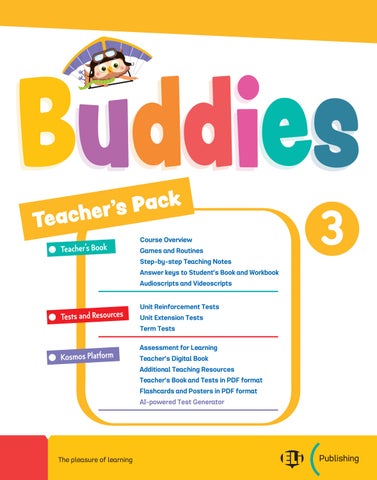
Unit Reinforcement Tests Unit Extension Tests Term Tests Assessment for Learning Teacher’s Digital Book Additional Teaching Resources Teacher’s Book and Tests in PDF format Flashcards and Posters in PDF format AI-powered Test Generator
DIGITAL PLATFORM
Teacher’s Book + Flashcards + Posters
BUDDIES_3_GUIDA.indd 1-3
Tests and Resources
Starters Movers
Teacher’s Book
Course Overview Games and Routines Step-by-step Teaching Notes Answer keys to Student’s Book and Workbook Audioscripts and Videoscripts
www.elipublishing.com
The pleasure of learning 14/05/26 11:37
Nina Lauder
Cristina Quincy
Jennifer Heath
Teacher’s Book
The pleasure of learning
3
Contents Introduction
Map of Buddies 3
page 4
Meet the Buddies family
page 7
Components for Buddies 3
page 10
Buddies presentation
Buddies methodology Features in Buddies 3 Games and routines
Teacher’s notes
page 6
page 8
page 11
page 18
Welcome Unit
page 20
Unit 2
page 40
Unit 1
Unit 3 Unit 4 Unit 5
page 26 page 56 page 70 page 86
Unit 6
page 100
Unit 8
page 130
Unit 7
Assessment
Reinforcement and Extension Unit Tests
Term Tests
Audioscripts and Answer Key
Workbook Audioscripts and Answer Key
Unit and Term Test Answer Key
page 116
page 146 page 178 page 184 page 191
Map of Buddies 3 Contents umbers umbers Musical Musical instruments instruments Days Days of of the the week week best best favorite favorite
Welcome page page 44
Time for school!
1
page page
2
page page 22
Everyday Life round round the the orld orld
3
page page 34 34
4
page page 44
Doing Chores
Wild Animals
5
Farmer’s Market round round the the orld orld
Around Town Nature
brush brush my my hair, hair, have have aa snack, snack, play play sports, sports, pack pack my my backpack, backpack, play play outside, outside, practice practice the the piano, piano, read read aa story, story, take take aa nap, nap, take take aa shower, shower, watch watch TT
Simple Simple present present with with adverbs adverbs of of fre fre uency uency always, always, sometimes, sometimes, never never
alarm alarm clock, clock, hairbrush, hairbrush, lunchbox, lunchbox, sunglasses, sunglasses, toothbrush, toothbrush, watch watch
ossessive ossessive pronouns pronouns mine mine yours yours his his hers hers ours ours theirs theirs
cloudy, cloudy, cold, cold, foggy, foggy, hot, hot, icy, icy, rainy, rainy, snowy, snowy, stormy, stormy, sunny, sunny, windy windy
How’s How’sthe theweather? weather? It’s It’sfoggy. foggy. ItItisn’t isn’thot. hot.
Like Like
clean clean my my room, room, clear clear the the table, table, feed feed the the fish, fish, make make the the bed, bed, set set the the table, table, sweep sweep the the floor, floor, take take out out the the trash, trash, walk walk the the dog, dog, wash wash the the car, car, wash wash the the dishes dishes
resent resent progressive progressive affirmative affirmative and and negative negative
go go to to the the beach, beach, go go to to the the movies, movies, have have aa picnic, picnic, jump jump inin puddles, puddles, play play inin the the snow, snow, stay stay at at home home
do do aa puzzle, puzzle, go go to to the the park, park, make make cookies, cookies, play play hide hide and and seek, seek, play play video video games, games, visit visit family family
resent resent progressive progressive uestions uestions and and short short answers answers
bat, bat, dolphin, dolphin, frog, frog, gorilla, gorilla, jellyfish, jellyfish, lion, lion, shark, shark, sloth, sloth, starfish, starfish, whale whale
omparatives omparatives short short adjectives adjectives
heavy, heavy, light, light, loud, loud, uiet, uiet, scary, scary, strong strong
Superlatives Superlatives short short adjectives adjectives
coconuts, coconuts, grapes, grapes, kiwis, kiwis, limes, limes, mangoes, mangoes, melons, melons, peaches, peaches, pineapples, pineapples, plums, plums, strawberries strawberries
ountable ountable nouns nouns with with some some any any
cereal, cereal, fish, fish, fruit, fruit, meat, meat, sugar, sugar, yogurt yogurt
ncountable ncountable nouns nouns with with some some any any
ast ast simple simple be be affirmative affirmative and and negative negative
angry, angry, bored, bored, excited, excited, hungry, hungry, scared, scared, thirsty thirsty
ast ast simple simple be be uestions uestions and and short short answers answers
pisode pisode 33
page page
ra ra ilil
ii ii
ee ico ico
bakery, bakery, bookstore, bookstore, bus bus station, station, caf caf ,, library, library, movie movie theater, theater, shopping shopping mall, mall, sports sports center, center, supermarket, supermarket, train train station station
ant, ant, beetle, beetle, butterfly, butterfly, caterpillar, caterpillar, hedgehog, hedgehog, ladybug, ladybug, mouse, mouse, owl, owl, snail, snail, ss uirrel uirrel
round round the the orld orld pisode pisode 44 Language Language ank ank page page 112 112
42
rammar rammar 22
notebook, notebook, paintbrush, paintbrush, paints, paints, Whose Whose and and possessive possessive ss pencil pencil sharpener, sharpener, scissors, scissors, schedule schedule
page page 22
page page
ocabulary ocabulary 22
Simple Simple present present have have the the time time
pisode pisode 22
page page
rammar rammar 11
art, art, drama, drama, nglish, nglish, geography, geography, history, history, IT, IT, math, math, music, music, ,, science science
pisode pisode 11
How’s the weather?
round round the the orld orld
ocabulary ocabulary 11
ersonal ersonal information information with with simple simple present present this this that that these these those those resent resent progressive progressive
ature ature round round the the orld orld
There There was was wasn’t wasn’t aa ...... field, field, forest, forest, lake, lake, There There were were some some mountain, mountain, river, river, waterfall waterfall weren’t weren’t any any ......
ing ing
Was Was there there aa ...? ...? es, es, there there was. was. o,o, there there wasn wasn t.t. Were Were there there any any ...? ...? es, es, there there were. were. o,o, there there weren weren t.t.
two
Buddies_SB3_Book.indb 2
16/01/26 14:30
Bud
tory tory Time Time and and ocial ocial and and motional motional Learning Learning
Let Let ss talk talk
honics honics
TT
am am ractice ractice
the the th th sound sound
locks locks ro ro ect ect Let Let ss design design aa clock! clock!
Speaking Speaking art art
the the sh sh sound sound
ealthy ealthy abits abits ro ro ect ect Let Let ss make make aa healthy healthy habits habits poster! poster!
eading eading and and Writing Writing art art
louds louds ro ro ect ect Let Let ss make make aa cloud cloud viewer! viewer!
eading eading and and Writing Writing art art
the the vv and and ff sounds sounds
obots obots ro ro ect ect Let Let ss design design aa robot! robot!
eading eading and and Writing Writing art art
ii ing ing opinions opinions II think think II don’t don’t think think II agree. agree. I’m I’m not not sure. sure.
the the jj sound sound
amouflage amouflage ro ro ect ect Let Let ss make make aa camouflage camouflage animal! animal!
Speaking Speaking art art
angoes angoes at at the the arket arket ocial ocial awareness awareness Being Being polite polite
aking aking polite polite re re uests uests What What would would you you like? like? I’d I’d like like some some grapes, grapes, please. please. Here Here you you go. go. Thank Thank you. you.
br and and gr gr the the br sounds sounds
ruit ruit aces aces ro ro ect ect Let Let ss make make aa fruit fruit face! face!
Listening Listening art art
here here were were they they elf elf management management Solving Solving problems problems
ol ol ing ing problems problems the the long long ee sound II can’t can’t find find my my jacket. jacket. What What can can II do? do? sound IIhave havean anidea. idea. Let’s Let’slook lookininthe thesupermarket! supermarket!
uildings uildings ro ro ect ect Let Let ss build build aa toothpick toothpick tower! tower!
Listening Listening art art
Lea Lea es es ro ro ect ect Let Let ss make make aa leaf leaf rubbing rubbing butterfly! butterfly!
Listening Listening art art
The The lant lant ro ro ect ect ocial ocial awareness awareness nderstanding nderstanding people people learn learn inin different different ways ways
aying aying what what you you re re good good at at I’m I’m good good at at art. art. I’m I’m not not good good at at math. math.
ra ra yy eather eather elf elf awareness awareness dapting dapting to to different different situations situations
cl and and pl pl aking aking and and replying replying to to suggestions suggestions the the cl sounds sounds Why Why don don tt we we go go to to the the movies? movies? es, es, good good idea. idea. Sure! Sure! II m m not not sure. sure.
hat hat are are you you doing doing Leo Leo elf elf awareness awareness Helping Helping at at home home
sking sking for for help help and and saying saying thanks thanks an an you you help help me, me, please? please? Sure! Sure! Thanks Thanks aa million! million! Thanks Thanks aa lot! lot!
rtrt lass lass elf elf awareness awareness Being Being creative creative
Describing the the se se uence uence of of ee ents ents mma mmaand andLeo Leoss ealthy ealthy abits abits Describing First, ...... esponsible esponsible decision decision making making First, ext, ext, ...... Making Making healthy healthy choices choices Last, Last, ......
ature ature ap ap ocial ocial awareness awareness Helping Helping nature nature
howing howing interest interest Seriously? Seriously? That That ss so so cool! cool! How How interesting! interesting!
the the sn sn and and sl sl sounds sounds
three 14:30
Buddies_SB3_Book.indb 3
35 16/01/26 14:30
Introduction Buddies presentation
Welcome to Buddies, a six-level primary school course that promotes language learning through the values of friendship and collaboration, within the context of real-world discovery and cultural exploration.
Buddies is an American English course developed for schools with between three and six hours of English a week. The course provides core lessons, as well as additional focus on skills development, social and emotional learning (SEL), STEAM projects, exam support, and cultural lessons. The Buddies course provides a solid language learning syllabus which corresponds to the following levels:
• Buddies 1 and Buddies 2: pre-A1 (Starters) • Buddies 3 and Buddies 4: A1 (Movers) • Buddies 5 and Buddies 6: A2 (Flyers)
1 Time for school! 1 IT
ocabulary 1
1 Look
2
hat can you see
2
Listen find and say. Then watch.
3
oint and say. 10 o’clock on Friday.
4
Listen and chant. Then chant with actions.
Time for school! It’s Tuesday, it’s cience or drama? usic, art, or ?
3 drama 4 history
rammar
geography
When do we ha e art?
We ha e art at 1 o clock.
music
We don t ha e drama at 11 15 on
science
ondays.
a g age a k
1 math
Time for school! It’s Monday, it’s . nglish or history? eography, T, or math?
OLLIE
Listen and read. Then listen again and say.
Tyler When do we ha e art, mma? mma Let’s see! Today is Monday. We ha e art at 1 o clock. Tyler reat! I like art! mma Drama is my favorite! We ha e drama at 11 15. Tyler o, we don t ha e drama at 11 15 on ondays. mma h, that’s right! We ha e drama at 11 3 .
nglish
5 art
Science!
1
rammar 1
1
2
.
1
a
Listen and match. 2
11 10 9 8
3
hat color is llie s backpack
1
2 3
7 6 5
b
32+ 56= 11 10 9 8
1
7 6 5
2 3
11
??
?
3
c
11 10 9 8
1
2 3
7 6 5
sk and answer.
When do we have English on Wednesdays? We have English at 9:15.
eight
Workbook • Page
Buddies_SB3_Book.indb 8
Workbook • Page 16/01/26 14:31
Buddies_SB3_Book.indb 9
nine 16/01/26 14:31
This Teacher’s Book includes clear teaching notes for each lesson and is designed to provide advice and strong guidance for teachers with classroom management tips, language and cultural tips, and extra ideas for mixed abilities (reinforcement and extension activities). Answers to the Student’s Book activities are indicated on the thumbnails.
Buddies: Learning together! Learning for life.
This course explores the lives of young learners through the eyes of the Buddies family and their friends. These characters grow alongside the students, supporting them throughout their language learning journey. The memorable characters mirror young learners’ real-life experiences and facilitate long-term retention and language acquisition as well as personal development.
6
Buddies allows us to see inside the kids’ world where a diverse cast of characters models the values of friendship, collaboration, and support through their everyday adventures. Outside this world, students go on a journey of real-world discovery and cultural exploration guided by their trusted mascot, Ollie the owl, who links the familiar world with the new. With well-structured lessons and engaging content, Buddies helps all students to develop their English language skills in a supportive and motivating environment.
Meet the Buddies family
At the heart of this course are four siblings: Milo, Emma, Leo, and Holly. The siblings take turns as the main characters in different levels of the course. As students develop through their primary school years, the characters accompany them, providing a sense of continuity and connection. The adult characters in the course provide a background of stability, confidence, and gentle guidance as the main characters and students move forward in their learning journey.
Mom
Dad
Grandma
Grandpa
Holly
Leo
Emma
Milo
Tyler
Who’s who in the family? Milo is the youngest sibling. He features in the first two levels of the course, Buddies 1 and Buddies 2, and appears in other levels as the youngest member of the family.
Leo is Emma’s twin brother and features alongside her in Buddies 3 and Buddies 4. He also appears in other levels alongside Emma and his other siblings.
Meet the Buddies for levels 3 and 4
Meet the Buddies mascot, Ollie the owl
Emma is eight years old. She’s Leo’s twin sister and features along with him in Buddies 3 and Buddies 4. She also appears in other levels with Leo and her other siblings.
In levels 3 and 4, our main characters, Leo and Emma, have one friend who accompanies them on their everyday adventures. This friend is Tyler.
Leo
Emma
Holly is the older sister and features in Buddies 5 and Buddies 6. She also appears in earlier levels.
The course mascot, Ollie, acts as the students’ study-buddy throughout the series, providing a link between the students’ everyday experiences and the wider world around them by: • providing guidance through core grammar lessons with explanatory videos. • providing tips on the Skills pages. • introducing hands-on project work in real-world STEAM projects. • fostering respect and interest in different cultures by exploring the different continents in the Around the Ollie World lessons.
Tyler
7
Components for Buddies 3
Student’s components
Student’s Book (including audio and video materials) Nina Lauder
3 with Buddies!
values of learning through the that promotes language and cultural exploration. course for young learners real-world discovery Buddies is a six-level and make kind, smart , within a context of themselves, build friendships, friendship and collaboration primary students understand It is designed to help English through a solid foundation in choices. Buddies provides a development European Framework, topics support language Aligned to the Common Engaging, meaningful and motivating activities. skills. variety of dynamic their English build essential 21st-century learners in developing all while helping students supports content, Buddies lessons and inclusive social and environment. With well-structured on skills development, a supportive and engaging well as additional focus language skills within language lessons, as The course offers core exam support. STEAM projects, and emotional learning (SEL),
s l Book ent’wit h Digita
Stud
3
For students:
• Student’s Book with Digital Book • Workbook with Digital Book
For teachers:
• Teacher’s Book • Flashcards • Posters • Digital Book • Digital resources • Digital platform with AI Tools
3
Course levels
For teachers:
Level 1 Level 2
• Teacher’s Book • Flashcards • Posters • Digital Book Bank) • Digital resources Lesson Planning, Resource AI Tools (Test Generator, • Digital platform with www.elipublishing.com
Course levels Level 1 Level 2
Level 3 Level 4
Level 5 Level 6
CEFR
Pre A1-A1
Pre A1-A1 A1
A1-A2 A2
A2+
The pleasure of learning
21st-century
YLE Cambridge English Starters Starters Movers
Movers Flyers
Flyers
inside Scan the QR codes the the book to listen to the recordings and watch videos.
ation
Cultural explor
SEL (Social and emotional learning) STEAM projects The pleasure of learning
(Test Generator,
CEFR
Pre A1-A1
Pre A1-A1 A1
Lesson Planning,
YLE Cambridge English
Scan the QR codes inside the book to listen to the recordings and watch the videos.
Movers
A2
Flyers
A2+
Flyers
g)
Resource Bank)
Starters
Starters Movers
A1-A2
DIGITAL PLATFORM
ts
STEAM projec
www.elipublishing.co
m
ESP053_06
www.elipublishing.com
3
3
21st-century skills Cultural exploration
nal learnin
l and emotio
SEL (Socia DIGITAL PLATFORM
Level 3 Level 4
Level 5 Level 6
skills
Workbook
Nina Lauder
Book Student’s with Digital Book Student’s Book
ook
Workb
• 8 units based on topic-based active learning • A great variety of engaging video material (Vocabulary • Chants and songs , Story Time, Grammar, to learn new vocabulary and • Stories that aim to foster human connectionand support pronunciation in a playful Culture videos) • STEAM projects way and personal growth that involve students through SEL in • Preparation for the YLE suite of exams stimulating, creative tasks • End-of-unit games for evaluating progress • Culture pages with a global perspective Nina Lauder
Digital Book • Student’s Book with Book • Workbook with Digital
Book
Student’s Book
Jennifer Heath
For students:
Jennifer Heath
Inside level 3:
Inside level 3:
videos) active learning Grammar, and Culture • 8 units based on topic-based (Vocabulary, Story Time, in a playful way engaging video material • A great variety of and support pronunciation through SEL to learn new vocabulary and personal growth • Chants and songs foster human connection creative tasks • Stories that aim to involve students in stimulating, • STEAM projects that YLE suite of exams • Preparation for the for evaluating progress • End-of-unit games a global perspective • Culture pages with
3 with Buddies!
Buddies is a six-level course for young friendship and collaboratio learners that promotes language learning n, within a context It is designed to through of real-world discovery help primary students and cultural exploration.the values of choices. understand themselves , build friendships, and make kind, smart Aligned to the Common European Framework, variety of dynamic Buddies provides and while helping students motivating activities. Engaging, meaningfula solid foundation in English through build essential 21st-centur a topics support language y skills. development With well-structured lessons and inclusive language skills within content, Buddies supports all learners a supportive and engaging environmen The course offers in developing their English core language lessons, t. as well as additional emotional learning (SEL), STEAM projects, focus on skills developmen and exam support. t, social and
3
Nina Lauder
English is better
English is better
Workbook (including audio tracks)
The pleasure of learning
The pleasure of learning
06/02/26 16:53
ESP053_05
ndd 1-3
BUDDIES_3_students.i
Teacher’s components Teacher’s Book
3
3
with Buddies!
Buddies is a six-level course for young friendship and collaboratio learners that promotes language learning n, within a context It is designed to through of real-world discovery help primary students and cultural exploration.the values of choices. understand themselves , build friendships, and make kind, smart Aligned to the Common European Framework, variety of dynamic Buddies provides and while helping students motivating activities. Engaging, meaningfula solid foundation in English through build essential 21st-centur a topics support language y skills. development With well-structured lessons and inclusive language skills within content, Buddies supports all learners a supportive and engaging environmen The course offers in developing their English core language lessons, t. as well as additional emotional learning (SEL), STEAM projects, focus on skills developmen and exam support. t, social and
Buddies 3 – Unit 3 How’s the weather?
Inside level 3:
• 8 units based on topic-based active learning • A great variety of engaging video material (Vocabulary • Chants and songs , Story Time, Grammar, to learn new vocabulary and • Stories that aim to foster human connectionand support pronunciation in a playful Culture videos) • STEAM projects way and personal growth that involve students through SEL in • Preparation for the YLE suite of exams stimulating, creative tasks • End-of-unit games for evaluating progress • Culture pages with a global perspective
Teacher’s Pack
For students:
• Student’s Book with Digital Book • Workbook with Digital Book
For teachers:
Level 3 Level 4
Level 5 Level 6
Pre A1-A1
Pre A1-A1 A1
A1-A2 A2
A2+
Generator, Lesson
Planning, Resource
YLE Cambridge English
Tests and Resources
Bank)
Starters
Starters Movers
Movers Flyers
Flyers
www.elipublishing.co
m
5
4
a the fish
3 sweep
c the dishes
5 wash
e the dog
b the trash
f
y
ld
1 It’s / It isn’t hot.
6
2 It’s / It isn’t stormy. 3 It’s / It isn’t cloudy.
3 They’re setting / They
4 It’s / It isn’t sunny.
Flashcards pack with 128 cards
• starfish • whale
3
4
2
1 We’re cleaning / We aren’t cleaning our room. 2 We’re making / We aren’t making the bed.
How’s the weather?
154
2
6
5
4
2 Look, read, and circle.
iny
2 Look, read, and circle.
The pleasure of learning
jellyfish • lion • sloth
5 3
the floor
1
Date:
two extra words.
1
d the table
6 feed
6
Test
1 Look and write. There are
bat • frog • gorilla •
1 take out
4 clear
ndy
Unit Reinforcement Tests Unit Extension Tests Term Tests
Additional Teaching Resources Teacher’s Book and Tests in PDF format Flashcards and Posters in PDF format AI-powered Test Generator
DIGITAL PLATFORM
ggy
owy
Name:
Date:
1 Match.
2 walk
Assessment for Learning Teacher’s Digital Book
Kosmos Platform Scan the QR codes inside the book to listen to the recordings and watch the videos.
ESP053_15
1
Wild Animals | Extension
Doing Chores | Reinforcem ent Test
Name:
3
2
Buddies 3 – Unit 5
Buddies 3 – Unit 4
Date:
158
1 The lion is big. It’s It’s 2 The bat is small. It’s 3 The shark is fast.
It’s 4 The sloth is slow. This dog is 5 This dog is bad. is is good. This painting 6 This animal painting
aren’t setting the table.
4 They’re washing / They
Buddies 3 | © ELI | Photocopiable
2 Read and write.
the gorilla.
the starfish. the lion.
that dog.
that painting.
aren’t washing the car.
164
Buddies 3 | © ELI | Photocopiable
the frog.
Buddies 3 | © ELI | Photocopiable
Poster pack for presenting or revising vocabulary and language Around Town
That’s me!
I have ... I don’t have ...
art
I like ... I don’t like ...
I’m ... I’m not ...
The weather is ...
I always ... I sometimes ... I never ... 3 ESP053_33
Level 1 Level 2
CEFR
Course Overview Games and Routines Step-by-step Teaching Notes Answer keys to Student’s Book and Workbook Audioscripts and Videoscripts
Teacher’s Book
1 Look and write.
1
poster pack level
Course levels
[Insert placeholder for Pacagk e of cover Teacher’sim 3 of TB 1]
| Reinforcement Test
Name:
poster pack
• Teacher’s Book • Flashcards • Posters • Digital Book • Digital resources • Digital platform with AI Tools (Test
8 Unit Tests at Reinforcement and Extension level; 3 Term Tests, available in the Teacher’s Book
level 3 ESP053_33
English is better
2026/03/24 16:06 ELI_Flashcards_Level3.indd
1
Digital resources • KOSMOS Platform At ELI Publishing, we believe education should be accessible, flexible, and exciting. That’s why we created KOSMOS, a platform that brings together all the tools you need to organize classes, grade assignments, communicate with your students, and manage your institution in one place – all with a modern, user-friendly interface. With KOSMOS, teachers can: • have creative freedom, simplify lesson planning, and save time on administrative tasks; • decide which activities to display, how many attempts to allow, and how to grade them;
10
• use our weekly planner to make lesson planning intuitive and straightforward; • interact with an AI assistant available to help simplify your class planning. • Digital Student’s Book (with audio and video material, plus interactive activities) • Digital Workbook (with audio tracks and interactive activities) • Digital Teacher’s Book • Extra online resources • QR codes in each unit with access to audio and video resources
Features in Buddies 3 Vocabulary 1
Topic-based active learning
The course is structured around engaging, relevant topics from students’ lives, ensuring that new language and concepts are taught in an integrated and relatable way. These topics form a connecting thread across each unit, allowing students to build on their previous knowledge as they progress. The units use storytelling to introduce and reinforce language, through the recurring adventures of the Buddies family and friends. Each unit opens with a large, detailed illustration that sets the scene for the new vocabulary and links to a story later on. Students actively engage with the topics and content, participating in all aspects of the lessons. Each lesson offers students the opportunity to interact with their teacher and classmates, as they take part in shared tasks.
2 Everyday Life
1
2
1 brush my hair
oint and say mma or Leo. Emma!
rammar
play outside
3 take a nap
Listen and chant. Then chant with actions.
I always pack my backpack.
Hey! Hey! What a great day! Take a shower and read a story. Hey! Hey! What a great day! lay outside and ha e a snack. But first I pack my backpack.
??
He sometimes watches T . ou ne er take a nap.
Hey! Hey! What a great day! rush my hair and watch T . Hey! Hey! What a great day! lay sports and take a nap. ractice the piano clap, clap, clap!
have a snack
2
a g age a k
?11
Listen and circle. Then color.
1 She sometimes ne er watches T in the afternoon. 2 He always ne er practices the piano in the afternoon.
4 watch T
1
3 She sometimes always takes a shower in the morning.
read a story
3
Tell a friend. I never play sports in the morning.
here s llie
2
pack my backpack
2 play sports
Brush my hair.
4
I always pack my backpack for school in the morning. ood idea! I sometimes take a nap in the afternoon. Leo ometimes? ou always take a nap after school. mma nd you ne er take a nap! Leo o, but I sometimes play outside with Tyler. mma
take a shower
hat can you see
Listen find and say. Then watch.
3
Listen and read. Then listen again and say.
Leo
ocabulary 1
1 Look
2
rammar 1
5 practice the piano
twenty
Buddies_SB3_Book.indb 20
I sometimes play sports in the afternoon.
Workbook • Page 1
Workbook • Page 1 16/01/26 14:31
twenty one
Buddies_SB3_Book.indb 21
21 16/01/26 14:31
Vocabulary presentation
Key vocabulary related to the unit topic is clearly presented in the main illustration and labeled and supported with audio and video. The new lexical items are then practiced by students in a chant.
Working with chants
Chants in every unit reinforce and practice the pronunciation of new vocabulary. They provide an easy and effective way to boost memory and engagement in the classroom. The rhythm and repetition make it simple for students to learn and retain new vocabulary quickly. In addition, chanting creates a fun and confident atmosphere, where all learners can actively participate.
Grammar 1
Grammar presentation
The first grammar presentation is introduced through a listening activity featuring the main Buddies characters and set within the context of the main illustration. It is then presented in the Grammar box, which highlights key structures. After each presentation, there is an opportunity for students to synthesize the meaning of the language point and work out its form, as well as watch fun grammar videos with Ollie. The presentation is then followed by practice activities that range from guided to semi-guided to free practice as students reach the production stage of their learning.
Grammar video s
To make grammar clear and engaging, each grammar lesson is reinforced with a short animated video. Presented by the Buddies mascot, Ollie the owl, these fun animations break down language rules in a simple and memorable way. This helps build a strong, positive foundation and keeps students motivated to learn.
11
OLLIE
Exam Practice
2
Buddies is aligned with the three levels of the YLE exams, ensuring that students are developing the appropriate skills and language at each stage of their learning journey.
am ractice eading and riting
1
ead the story. hoose a word from the bo . rite the correct word ne t to numbers 1 5. There is one e ample.
Buddies 1 and 2 prepare students for Starters (Pre-A1 CEFR level).
toothbrush
hairbrush
alarm clock
sunglasses
lunchbox
watch
ball
T
piano
Buddies 3 and 4 prepare students for Movers (A1 CEFR level). Buddies 5 and 6 prepare students for Flyers (A2 CEFR level).
To ensure early preparation and build confidence, each unit includes a dedicated YLE-style exam practice page. Each unit practices different parts of the Starters, Movers, and Flyers tests, giving students exposure to and practice of most YLE exam tasks throughout the course. This systematic inclusion familiarizes students with common task formats, which, in turn, helps them build a strong foundation in specific listening, reading, writing, and speaking skills and helps to reduce anxiety about future testing.
ample ulia always wakes up early in the morning when she hears her alarm clock at o’clock.
She gets up and goes to the bathroom. Then, she brushes her hair with . ext, she goes to the kitchen and she has breakfast. 1 her 2 Last, she brushes her teeth with her
3
.
Before school, ulia’s dad puts a sandwich and some fruit in her . ulia likes healthy snacks!
fter school, she plays outside and later she watches her favorite show in the living room. 4 on
But on Fridays, ulia goes to music class and then she practices at home. 5 the
2 3
Review and Language Bank
ow choose the best name for the story. heck ✔ one bo .
ulia’s day at school thirty
ulia’s routines
ulia’s family
Buddies_SB3_Book.indb 30
16/01/26 14:31
The final page of each unit ensures vocabulary, grammar, and skills consolidation through engaging activities.
Entertaining games help students review the unit’s vocabulary and language in a fun way, encouraging them to use critical thinking skills. The Language Bank offers a clear visual presentation of all the vocabulary and grammar from each unit and can also be used as a review tool.
2
e iew
1
lay oll a entence. rite three sentences.
e ...
ocabulary 1
. . .
art
drama
nglish
has a snack
IT
math
music
watches T
ocabulary 2
Roll 1
Roll 2
always
takes a nap
sometimes never always
reads a story
sometimes
plays sports
never
practices the piano
She never has a snack.
ead and circle.
MONDAY
TUESDAY WEDNESDAY THURSDAY
ENGLISH SCIENCE
brush my hair
play sports
have a snack
pack my backpack
play outside
practice the piano
read a story
take a nap
take a shower
watch T
OLLIE
PE
MUSIC
ENGLISH
PE
HISTORY
PE
SCIENCE
MATH
ENGLISH
LUNCH
LUNCH
LUNCH
LUNCH
LUNCH
MUSIC
ENGLISH HISTORY
MATH
ART
HISTORY
MUSIC
SCIENCE
MATH
ART
ART
MUSIC
PE
pencil sharpener
Get ready for more fun in Unit 3!
alarm clock
hairbrush
scissors
sunglasses
toothbrush
schedule
imple present ad erbs of fre uency
ossessi e pronouns
When do we ha e art?
hose notebook is this? t s Leo s notebook.
I always pack my backpack.
hose watch is this? It’s mine yours his hers ours theirs.
o’clock.
I can talk about my and other people’s possessions.
ondays.
He sometimes watches T .
hose paints are these? They re mma s paints.
ou ne er take a nap.
hose sunglasses are those? They’re mine yours his hers ours theirs.
??
Buddies_SB3_Book.indb 31
31 16/01/26 14:31
watch
hose and possessi e s
We don t ha e drama at 11 15 on
thirty one
lunchbox
HISTORY
imple present ha e the time We ha e art at
I can talk about my and other people’s daily routines.
paints FRIDAY
MATH
SCIENCE ENGLISH
ART
Workbook • Page 1
science
paintbrush
notebook
MATH
Well done!
history
OLLIE
He sometimes watches TV.
I CAN
geography
ocabulary 2
ow try to roll your sentences.
2
Unit 2 – Everyday Life
Unit 1 - Time for school!
ocabulary 1
1 He She 2 He She 3 He She
he ...
1 Language Bank
112 one hundred and twelve Buddies_SB3_Book.indb 112
? 16/01/26 14:34
??
Buddies_SB3_Book.indb 113
one hundred and thirteen
113 16/01/26 14:34
?
Teaching hours
For teachers who have:
more than 6 hours per week extend the culture pages into projects; extend the STEAM activities; assign a graded reader per term.
16
4–6 hours per week use the materials in the Student’s Book, Workbook, and Teacher’s Pack.
1.5–3 hours per week focus on the core materials (Lessons 1–7), which include Vocabulary 1 and 2, Grammar 1 and 2, and Skills work.
Assessment for learning
Buddies 3 – Unit 1
Following the Review lesson, students complete the “I can” box activities. This is their first step toward self-evaluation, allowing them to reflect on their progress and take responsibility for their own learning.
Time for school! | Reinforcement Test Name:
Date:
1 Look and circle. 1
For more formal evaluation, students can assess their progress by completing the Unit Tests (available at Reinforcement and Extension levels in the Teacher’s Guide) and three comprehensive Term Tests to use throughout the year, in addition to everyday classroom assessment.
2
IT / PE
3
history / geography
4
art / music
5
science / English
2 Read and write have or don’t have. Monday Tuesday
9:15 math science
6
math / drama
geography / English
10 o’clock drama English
1 When do we have math on Mondays? We
math at 9:15. We
We
English at 9:15. We
English at 10 o’clock.
We
drama at 9:15. We
drama at 10 o’clock.
We
science at 9:15. We
science at 10 o’clock.
math at 10 o’clock.
2 When do we have English on Tuesdays?
he Around t
World Buddies integrates culture and society, showing students that language is a global instrument for connection and exploration.
After every two units, a special double-page Culture section allows students to explore a different part of the world. Ollie, the course guide, introduces students directly to their buddies in different continents, making global learning feel personal and immediate.
3 When do we have drama on Mondays?
4 When do we have science on Tuesdays?
146
he Around t
Hello, buddies! Today, we’re visiting Marcia in Brazil. That’s a big country in South America!
2 frevo costume
Hi, everyone! I’m Marcia and I live in Brazil. We speak ortuguese in Brazil. In the morning, I have cuscu and cheese for breakfast. I always have a glass of fruit juice, too. My favorite juice is acerola juice.
From Monday to Friday, I go to school in the morning. I get up at o’clock and start classes at o’clock. Some kids go to school in the afternoon, but I finish classes at o’clock. My favorite class is science. I sometimes have chocolate brigadeiros for a snack, and I play amarelinha with my friends it’s a game like hopscotch.
acerola juice
cuscuz and cheese
Students engage with the content by reading the texts and watching a video, completing comprehension exercises, and then consolidating their knowledge through a personalization activity and class Show-andTell presentation.
1 Look at the photos. 2
hat does
fter school, I go to fre o dance classes. Frevo is a fast dance, and I sometimes wear a colorful costume.
ext, I help my grandpa in the kitchen. He sometimes makes fei oada with beans, meat, and rice. It’s the national dish of Brazil, and it’s delicious!
4
1
3
5
ead and complete.
feijoada
Do you know that bananas grow in Brazil? A lot of bananas in the world come from Brazil.
arcia drink for breakfast
Listen and read. Then watch.
3
Buddies 3 | © ELI | Photocopiable
Episode - Brazil
World
.
Listen and read again. Then check ✔ or cross Marcia speaks ortuguese.
She never plays hopscotch.
2
4
Bananas grow in Brazil.
ow is your routine similar or different to Tell the class.
sometimes • always • cheese • snack
.
She gets up at o’clock.
arcia s
Marcia gets up at 6 o’clock, but I get up at …
cheese for breakfast. 1 Marcia has cuscuz and 2 She has a glass of fruit juice. 3 She sometimes has brigadeiros for a at school. 4 Marcia’s grandpa makes feijoada and she helps him.
This progressive focus encourages curiosity and discovery. Students learn how their peers around the world go about their daily lives and are stimulated to discover and compare their own traditions with those of others in different cultures. As they actively learn about their global buddies and explore diverse societies, this process helps students appreciate shared human experiences and fosters the crucial awareness needed to become global citizens. 32
thirty two
Buddies_SB3_Book.indb 32
Workbook • Page
16/01/26 14:31
Buddies_SB3_Book.indb 33
thirty three
33
16/01/26 14:31
Using Show and Tell in the classroom
Project presentations using the Buddies System give students a real reason to use English and are a great way to build speaking confidence and celebrate students’ hard work. To get the most out of these activities, you can adopt the following routine: 1 Get students ready. Give students simple sentence starters to practice before they present. This provides a clear structure and builds their confidence. For example: This is my favorite toy. It’s name is ... It is ... 2 Provide a model. Show students what to do by presenting your own project first, using the same sentence starters. 3 Create a special place. Have a “Presenter’s spot” at the front of the class to help everyone focus. 4 Support the speaker. Support the students as much as you can during their presentations. If a student gets stuck, gently prompt them with a question about their work. Focus on encouraging communication, not on correcting every mistake. 5 Involve the rest of the class. Teach the rest of the class a simple question they can ask the speaker about their presentation. For example, What color is it? How many ... are there? 6 Finish positively. Make sure every presentation ends with a warm round of applause to celebrate the student’s hard work.
17
1 Time for school! Unit objectives At the end of this unit, students will be able to … • talk about their school classes and times • talk about school supplies and who they belong to • say what they are good at • write about their favorite school day
Materials • • • • • • • •
Student’s Book pp 8–19 Workbook pp. 4–11 Unit Tests Flashcards: art, drama, English, geography, history, IT, math, music, notebook, paintbrush, paints, pencil sharpener, schedule, science, scissors STEAM: A paper plate, colored cards, markers, scissors, a clip or a fastener Review: A piece of paper for each student with a grid of nine squares (3x3) Poster Pack Digital Book
Unit theme In this unit, students focus on their classes at school. They discuss their favorite classes at school, they learn to read their school schedule using have and the time, and they talk about their school supplies using Whose and the possessive ’s. Students also practice telling each other what they are good at, and they write about their favorite day, remembering when to use capital letters.
In the story, students are shown that people learn in different ways and that they should understand this about their friends. They learn that they can use their different skills and work together to do a group project. They are asked to respect that people are different and that every learning style is of the same worth. The STEAM lesson is an opportunity for hands-on learning. Students use different skills to design and make a clock. Ask them to bring a paper plate, colored cards, markers, scissors, and a clip or a fastener to the class.
26
1 Unit overview Vocabulary 1: art, drama, English, geography, history, IT, math, music, PE, science Vocabulary 2: notebook, paintbrush, paints, pencil sharpener, scissors, schedule
Grammar 1: Simple present: have + the time Grammar 2: Whose and possessive ‘s
Story Time: The Plant Project SEL: Understanding people learn in different ways: Social awareness – Recognizing strengths in others Listening: Listening for opinions Functional language: What are you good at?, I’m good at art., I’m not good at music. Phonics: th: math, Theo, three, Thursday Reading: Comparing and contrasting Writing: Using capital letters Exam Practice: Preparation for YLE Movers Speaking, Part 1
Unit assessment Unit 1 Reinforcement Test. See pp. 146–147. Unit 1 Extension Test. See pp. 148–149.
Digital resources • • • • •
Vocabulary 1 video Grammar videos 1 and 2 Story Time video Audio materials Digital Book
27
1
Lesson 1 Vocabulary 1
1
Time for school!
1 Look
2
hat can you see
2
Listen find and say. Then watch.
3
oint and say.
Listen and chant. Then chant with actions.
Time for school! It’s Tuesday, it’s cience or drama? usic, art, or ?
nglish
3 drama 4 history
Listen and read. Then listen again and say.
rammar
geography
When do we ha e art?
We ha e art at 1 o clock.
music
We don t ha e drama at 11 15 on
science
2
.
1
a
Listen and match. 2
11 10 9 8
3
hat color is llie s backpack
1
2 3
7 6 5
Buddies_SB3_Book.indb 8
8
1
7 6 5
2 3
?
3
c
11 10 9 8
1
2 3
7 6 5
sk and answer.
nine
Workbook • Page
Workbook • Page 16/01/26 14:31
Objective: To talk about school classes. Vocabulary: art, drama, English, geography, history, IT, math, music, PE, science Recycled language: Days of the week; telling the time Materials: Classroom Language poster; Flashcards: art, drama, English, geography, history, IT, math, music, PE, science; Digital Book
• Greet the class. Ask: What day is it today? Play Letter Scramble with days of the week. See pp. 18–19 of your Teacher’s Book. • Use the Classroom Language poster to encourage students to talk about themselves. Point out the sentence starters in the speech bubbles and ask: Do you have (a notebook)? Students reply using full sentences.
28
11 10 9
??
We have English at 9:15.
Lesson 1 objectives
Warm up
b
32+ 56=
11
When do we have English on Wednesdays?
blue
eight
ondays.
a g age a k
1 math
Time for school! It’s Monday, it’s . nglish or history? eography, T, or math?
OLLIE
Tyler When do we ha e art, mma? mma Let’s see! Today is Monday. We ha e art at 1 o clock. Tyler reat! I like art! mma Drama is my favorite! We ha e drama at 11 15. Tyler o, we don t ha e drama at 11 15 on ondays. mma h, that’s right! We ha e drama at 11 3 .
5 art
Science! 10 o’clock on Friday.
4
1
Insert SB repro page 1 IT x
ocabulary 1
1
rammar 1
Buddies_SB3_Book.indb 9
16/01/26 14:31
1 Look! What can you see?
• Show pp. 8–9 of the Student’s Book. Ask: Are they in the classroom? Elicit Yes. Ask: What days of the week are on their board? and elicit answers (Monday–Friday). • Ask: Can you see Leo, Emma, and Tyler? Ask students to look at the kids in the classroom and point to them when you say their names. • Ask students to look at the pictures on the poster on p. 8. Ask: Are they pictures of classes or games? (Classes.)
2
Listen, find, and say. Then watch.
• Display the flashcards on the board. Point to the flashcards one at a time and ask students to find the picture for the same class in their books on p. 8. • Ask students to look at their books, listen, point to the words, and say them. Play the audio. • Say: Now let’s watch a video! Use the interactive whiteboard (if available) to show the vocabulary in the video.
1
Lesson 2 Grammar 1
3
Point and say.
• Recap the time with the schedule on p. 9. Ask students to listen and point to the times you say. Say these times one at a time: nine-fifteen, ten o’clock, eleven o’clock, eleventhirty, twelve-thirty, two o’clock, three o’clock. Repeat, but this time say the times in a random order. • Explain to students that they should look at a picture for a class on p. 9, say the class, and their partner should look and say the time and day of the class. Remind students when to use on with days of the week.
4
Listen and chant. Then chant with actions.
• Display the flashcards on the board. Say: Listen to the chant. Play the audio and point to the flashcards in time with the chant. Read the chant out loud one line at a time for students to repeat. Play the audio again and encourage students to chant along. • Demonstrate these actions: Time for school! : raise both hands up high; a word for a class: students clap once. Students copy the actions. Say: Let’s chant with actions! Play the audio and encourage students to join in. • Ask students to suggest different days, times, and classes for the chant. Place the flashcards for their choices on the board in order for their chant. Write the days and times. Encourage students to do the chant again with actions, using their own ideas.
Ending the lesson
• Ask: What’s your favorite class? Ask students to raise their hands to say their favorite class.
Now go to Workbook 3 page 4.
Lesson 2 objectives Objective: To talk about what time we have classes at school. Grammar: have + time Vocabulary: See Vocabulary 1 Recycled language: Days of the week; telling the time Materials: Flashcards: see Lesson 1; Digital Book
Warm up
• Greet the class. Ask: What class is this? and elicit English. • Play Basketball. See pp. 18–19 of your Teacher’s Book.
Look!
1
and say.
Listen and read. Then listen again
• Show pp. 8–9 of the Student’s Book. Ask: What class is at 9:15 on Monday? and elicit IT. Say: Listen to Tyler and Emma. Play the audio. Check comprehension by asking: When do they have art? (Monday at 10 o’clock.) What is Emma’s favorite? (Drama.) • Play the audio again. Students read the dialogue out loud. • Review Ollie’s Grammar box, making sure students understand the meaning of the highlighted words. Ask: What word in blue is for a question with have? (Do.) What word do we use for time – at or on? (At.) What word do we use for days – at or on? (On.) Hold up a Vocabulary 1 flashcard. Ask a student to choose a day of the week and another student to choose a time. Ask a third student: When do we have (art)? and elicit a full sentence answer: We have (art) at 10 o’clock on Friday. Then say: We have English at (time) on (day) using true information for your students. Ask students to say a time and day when they don’t have English or another class of their choice. • Point to Ollie and say: Let’s watch Ollie. Play the Grammar video as many times as is needed.
2
Listen and match.
• Ask students to look at the pictures and say the classes and the times that they can see. Before listening, ask students to guess what the answers might be and write their ideas on the board. Say: Now listen and match. • Play the audio to confirm the answers. Pause after each sentence and ask students to repeat. Audioscript 1 Emma: When do we have history on Thursdays? Tyler: We have history at ten o’clock on Thursdays. 2 Tyler: When do we have math on Fridays? Emma: We have math at eleven thirty on Fridays. 3 Emma: When do we have IT on Mondays? Tyler: We have IT at nine fifteen on Mondays.
3
Ask and answer.
• Ask two students to read the example in the speech bubbles. Ask: Which words do we use with days and with the time? (on and at.) Say: Now you can practice. Students work in pairs to ask and answer questions.
Ending the lesson
• Ask: What’s the time? Students raise their hands to answer.
Now go to Workbook 3 page 5.
• Ask: What color is Ollie’s backpack? (Blue.) Ask: What color is your backpack?
29
6
Lesson 4 Vocabulary 2
6
Audioscript 1 fruit 2 cereal 3 yogurt
ocabulary 2
1
Listen and say. Then listen and number.
a
b
c
4
6 meat
d
fish
e
f
2
3
cereal
2
sugar
ercise 1 and say.
This is yogurt!
Yucky! Yummy!
3
I don’t like yogurt!
I like yogurt!
Listen and sing. Then listen and circle the food words.
Food Song Food! ood food! h, oh, good food. ood food makes me strong.
Fruit is yummy and good for me. I like plums, , , ! ereal s nice in the morning time. Sugar s nice, but not all the time.
3
Food! ood food! h, oh, good food. ood food makes me strong.
Meat and fish are yummy, too. I like them hot, how about you? ogurt s cold, I eat it each day, ood food helps me learn and play!
seventy six Buddies_SB3_Unit 6.indd 76
Workbook • Page 17 30/01/26 13:36
Lesson 4 objectives Objective: To name different food. Vocabulary: cereal, fish, fruit, meat, sugar, yogurt Materials: Flashcards: cereal, fish, fruit, meat, sugar, yogurt ; see Lesson 1; Digital Book
Warm up
• Greet the class. Say: Let’s chant and do the actions! Play the chant from Lesson 1 and encourage students to join in. • Play I Spy. See pp. 18–19 of your Teacher’s Book.
1
Listen and read. Then look at Exercise 1 and say.
• Read the examples out loud. Ask students to repeat and to point to the correct photo in Exercise 1 (photo e). Ask: Do you like yogurt? and ask them to smile for yes and frown for no. Play the audio. Ask: Do we say “Yucky” or “Yummy” for food we like? (Yummy.) Play the audio again and have students repeat. • Divide students into pairs. Explain to students that they should look at Exercise 1 and take turns to choose a food. They then say if they like or don’t like the food. Monitor pair work.
5
yogurt
Listen and read. Then look at
2
1
fruit
4 fish 5 sugar 6 meat
Listen and say. Then listen and number.
• Say: Let’s learn some more food words. Hold up the flashcards one at a time, say the word, and ask students to repeat. • Show p. 76 of the Student’s Book. Say: Let’s listen and say. Play the audio. Students repeat. • Say the vocabulary in random order and ask students to point to the correct photos. Say: Now listen and number. Play the audio.
Listen and sing. Then listen and circle the food words.
• Say: Let’s sing! Play the song a few times for students to learn it well. After students are confident with the song, ask them to clap once when they sing a food word. • Ask students to read the song and say what the food words are in the song. Say: Let’s listen and circle the food words. Play the audio. Read the song line by line and ask students to raise a hand when you say a food word they circled. • Divide students into two groups. Assign the verses to one group and the chorus to the other group. Play the song again and students stand up when they sing the parts assigned to them. The groups can then switch over.
Ending the lesson
• Say: Raise one hand for the food you eat. Hold up the flashcards one at a time. • Say: That’s the end of today’s lesson. Well done, everyone.
Extra activities
• Reinforcement: Have a class vote for the
favorite food in the lesson. Say: This is (meat). Yucky or Yummy? Stand up for Yummy. Count the students and write the number on the board. • Extension: Ask students to say how often they eat the food in the lesson using every day, sometimes, or never, e.g., I sometimes eat meat for dinner. I have cereal for breakfast every day. I never eat sugar with yogurt.
Now go to Workbook 3 page 47.
106
OLLIE
6
rammar 2
1
Listen and read. Then listen again and say. mma
h! There isn t any cereal for breakfast. Leo o, but there s some fruit on the table. mma Hmm! Let s make a fruit salad! Leo reat idea! s there any sugar? mma o, there isn t. But there s some yogurt. Leo ummy! I love fruit with yogurt!
2 Look and write some or any. 1
rammar There s some fruit. There isn t any cereal.
s there any sugar? es, there is. o, there isn t. a g age a k
2
There isn’t
3
any
cereal.
There’s
??
117
?
3
some
fruit.
Is there
any
yogurt?
Shopping List
meat
cereal
yogurt
X
sugar
s there any sh
X
seventy seven
Buddies_SB3_Book.indb 77
16/01/26 14:33
Lesson 5 objectives Objective: To say, ask, and answer what food there is. Grammar: Uncountable nouns with some/any Materials: Flashcards: see Lesson 4; Digital Book
Warm up
• Greet the class. Play the song from Lesson 4 and encourage students to sing along. • Play Quick Peek. See pp. 18–19 of your Teacher’s Book.
1
and say.
• Review Ollie’s Grammar box, making sure students understand the meaning of the highlighted words. Ask: Do you remember counting the fruit? Can we count cereal or yogurt? Say: Think about it. and give students a moment to think. Explain that there are some food words that we can’t count with numbers. Write on the board. There are some mangoes. There’s some yogurt. Ask: Can we say “There are two mangoes”? (Yes.) Can we say “There’s two sugar”? (No.) Point out that we use are for food we can count but is for food we can’t count. Explain that we use some and any in the same way for both. • Point to Ollie and say: Let’s watch Ollie. Play the Grammar video as many times as is needed. • Ask students to look at the photos and think about what they can see. Ask students to complete the sentences using some or any. • Read out the completed sentences for students to check their answers. Ask the question in number 3, ask students to answer, and elicit Yes, there is.
3
Yes, there is. Is there any meat?
fruit
Workbook • Page 1
6
2 Look and write some or any.
sk and answer.
fish
Lesson 5 Grammar 2
Listen and read. Then listen again
• Show students the picture on p. 77 of the Student’s Book. Ask: What are Leo and Emma doing? and elicit They’re having breakfast. Say: Listen to Emma and Leo. Play the audio. Check comprehension by asking: Is there any cereal? (No.) What about fruit? (Yes.) Is there sugar or yogurt? (Yogurt.) • Play the audio again and then assign the roles of Emma and Leo to pairs. Students read the dialogue out loud.
Ask and answer.
• Ask two students to read out the speech bubbles. Ask students to look at the table. Explain that they should look at which boxes have a check mark and which ones have a cross. • Divide students into pairs. Ask them to take turns to ask questions about their tables. One student asks a question, and the other student sees if the box is checked and answers Yes, there is. or crossed and answers No, there isn’t. They then switch over. Monitor pair work.
Ending the lesson
• Ask: What do you have for breakfast? • Say: Well done! You can close your books.
Extra activities
• Reinforcement: Hold up the flashcards one at
a time. Ask: Is there any (cereal)? Students repeat the question and then answer together Yes, there is. Then put the flashcard down and ask again so students answer together No, there isn’t. • Extension: Write on the board: kiwis, sugar, yogurt, strawberries. Ask students to describe a fruit salad with these food items, e.g., There are some kiwis. There’s some sugar.
Now go to Workbook 3 page 48.
107
6 SEL
SEL
SEL
SEL
SEL
SEL
Lesson 6 Listening and Speaking
6
2
Listening and peaking
1 Look at the picture.
SEL
SEL
SEL
hat fruit can en and his grandma see grapes
2
Listen and circle.
3
Talk with SEL a friend. SEL se the words in the bo .
Audioscript Grandma:
1 What would Ben’s grandma like? SEL SEL SEL some grapes some fish 2 re there any strawberries? es there are. o there aren t. 3 How many plums does randma buy? four se en SEL SEL 4 What would Ben like? some cereal some yogurt
SEL
SEL
SEL
SEL
yogurt grapes kiwis cereal plums fish peaches What would you like?
aking polite re uests What would you like? I’d like some grapes, please. Here you go. Thank you. Here you go.
I’d like some yogurt, please.
4 5
Thank you.
br and gr
Listen and say.
brown
bread green grapes
Listen and underline the br sound and circle the gr sound.
My brother Greg eats green grapes and brown bread. seventy eight Buddies_SB3_Book.indb 78
Workbook • Page 16/01/26 14:33
Lesson 6 objectives Objective: To listen for specific information/ details. Functional language: Making polite requests: What would you like?, I’d like some grapes, please., Here you go., Thank you. Phonics: br and gr: brown, bread, green, grapes Materials: Flashcards: see Lessons 1 and 4; Digital Book
Warm up
• Greet the class. Ask: Who likes puzzles? • Play Tic-Tac-Toe with the categories of countable and uncountable nouns. See pp. 18–19 of your Teacher’s Book.
1 Look at the picture. What fruit can Ben and his grandma see?
Listen and circle.
• Play the audio. Check answers orally.
SEL
• Show p. 78 of the Student’s Book. Read the question out loud and elicit grapes.
Let’s go to the grocery store! I need some things. Ben: OK, Grandma. Salesperson: Good morning! Grandma: Hello. Good morning! Salesperson: What would you like? Grandma: I’d like some grapes, please. Salesperson: Yes, of course. Anything else? Grandma: Are there any strawberries? Salesperson: No, sorry, there aren’t. Grandma: Oh! Salesperson: Would you like some plums or kiwis? They’re very good. Grandma: Yes, please. I’d like four plums, please. Salesperson: Here you go. Grandma: Thank you. What would you like, Ben? Ben: Is there any yogurt? Salesperson: Yes, there is. Ben: Great! I’d like some yogurt, please! Salesperson: Anything else? Grandma: No, that’s all, thank you.
Making polite requests
• Play the audio for Exercise 2 and ask students to raise one hand when they hear a polite request and a polite response.
3
Talk with a friend. Use the words in the box.
• Explain to students that they should take turns to make polite requests and responses. Monitor pair work.
4
Listen and say.
• Say: I’d like some bread and some grapes, please. Ask: What word has the “br” sound? (Bread.) What word has the “gr” sound? (Grapes.) Play the audio and students repeat.
5
Listen and underline the br sound and circle the gr sound.
• Play the audio. Check answers as a class.
Ending the lesson
• Say: Do you eat brown bread? What about green grapes?
Now go to Workbook 3 page 49.
108
6
Around the World: Episode 3 – Mexico he Around t
World
6
Episode 3 - Mexico
Hi, buddies! Today, we’re visiting Diego in Mexico. That’s a country in North America!
There are also lots of ocean animals in Mexico. ou can see these animals in the reat Maya eef. It’s one of the biggest reefs in the world! There are a lot of fish and coral on the reef. nd there are sea turtles and big sharks called whale sharks.
Hi, everyone! My name’s Diego and I live in Mexico. There are a lot of animals in my country. I love animals!
Do you know that Mexico has a national dog? It’s called a olo. It’s a special dog because it doesn’t have any hair. My grandpa loves dogs, and he has a olo. Its name is Max.
There are lots of wild animals in Mexico. ne animal that you can find here is the aguar. It’s a big cat and it lives in the jungle.
A whale shark isn’t a whale – it’s a shark. It has the word ‘whale’ in its name because it’s very big! Whale sharks eat lants or s all sh and they aren’t dangerous.
4 1 Look at the photos. 2
hat is Diego talking about animals
Listen and read. Then watch.
3
ead and complete.
dog from Mexico. 1 The olo is a special wild animals. They live in the 2 aguars are ocean 3 The reat Maya eef is home to many big sharks. 4 Whale sharks are
4
5
wild dog big ocean jungle
jungle animals.
Lesson objectives Objective: To learn about a boy’s life in Mexico. Vocabulary: jaguar, sea turtle Recycled language: scary, shark, whale Materials: A blank piece of paper for each student; a globe or a world map; Digital Book
Warm up
• Greet the class. Ask: Where is Mexico? Is it in North America or South America? and elicit North America. • Say: Let’s learn about Mexico. Hold up a world map or a globe and locate North America. Say: Let’s find Mexico! It’s a country that is south of the United States. Ask volunteers to come up to the front and point to Mexico on the map. • Say: Today, let’s travel to Mexico with Ollie. Let’s meet Diego.
114
In my country there are brown bears. They live in the forest.
Workbook • Page 7 16/01/26 14:33
.
re there any special animals in your country rite and draw. Tell a friend.
.
eighty four
Buddies_SB3_Book.indb 84
Listen and read again. Then check ✔ or cross
1 Mexico is in South merica. olos have a lot of hair. 2 3 ✔ aguars live in the jungle. 4 ✔ There are ocean animals in Mexico. The reat Maya eef is the smallest in the world. 5
Buddies_SB3_Book.indb 85
Did you know?
eighty five
5 16/01/26 14:33
Mexico is located in North America, and it has borders with the United States, Guatemala, and Belize. It is the northernmost country in Latin America. The Pacific Ocean is on the west side, and the Gulf of Mexico and the Caribbean Sea are on the east side of the country. Mexico is home to many animals that live on land and in the ocean. The powerful jaguar is a national symbol of Mexico, and the largest numbers live in Mexico’s Yucatan Peninsula. The Xoloitzcuintli, or Xolo, is an ancient Mexican dog breed. Some people call it the hairless dog. The breed comes in toy, miniature, and standard sizes. Xolos are known for their good health, but they do need careful skin care. The Great Maya Reef is the second-largest coral reef system in the world. It stretches over 600 miles along the coasts of Mexico, Belize, Guatemala, and Honduras. It is home to hundreds of species of fish, many species of coral, and endangered species like the green sea turtle. Whale sharks can be found in two main regions of Mexico: the Mexican Caribbean coast and the Baja California Peninsula. They are gentle mammals and people go on tours to swim with them.
Buddies 3 – Unit 1 Time for school! | Reinforcement Test Name:
Date:
1 Look and circle. 1
2
IT / PE
3
history / geography
4
5
science / English
2 Read and write have or don’t have. Monday Tuesday
9:15 math science
6
math / drama
.
geography / English
10 o’clock drama English
1 When do we have math on Mondays? We
math at 9:15. We
We
English at 9:15. We
English at 10 o’clock.
We
drama at 9:15. We
drama at 10 o’clock.
We
science at 9:15. We
science at 10 o’clock.
2 When do we have English on Tuesdays? 3 When do we have drama on Mondays?
4 When do we have science on Tuesdays?
146
art / music
Buddies 3 | © ELI | Photocopiable
math at 10 o’clock.
3 Look, read, and match. 1
paints
2
paintbrush
3
scissors
4
notebook
5
schedule
6
pencil sharpener
a c
b MY W
EEK
d
e
f
4 Look and circle. Then write. 1 Whose paints are these? They’re / It’s
2 Whose notebook is this?
paints.
They’re / It’s
notebook. Maria
3 Whose pencil sharpener is this? pencil
They’re / It’s sharpener.
4 Whose scissors are these? They’re / It’s
Liam
scissors.
Buddies 3 | © ELI | Photocopiable
147
Buddies 3 – Unit 6 Farmer’s Market | Extension Test Name:
Date:
1 Look and write. 1
2
3
These are
These are
These are
.
.
.
4
5
6
These are
These are
These are
.
.
.
2 Look, read, and write. any • are some • Are there • some • there any • there are • there aren’t plums.
Matt: Look. There are 1 Dad: Good. 2 Matt: Yes, 3
But there aren’t 4
any melons? .
grapes.
Dad: That’s OK. We have some grapes at home. Are 5
Matt: No, 6
kiwis?
. But there 7
Dad: OK. Let’s get some mangoes.
168
Buddies 3 | © ELI | Photocopiable
mangoes.
3 Circle. Then look and write. g su
arfruityogurt
fis
hce
realmeat
1
2
3
4
5
6
4 Read and write. 1
some fruit, but there isn’t
3
any sugar? No, there
2
4 Is there
any meat, but there’s
cereal? Yes, there
yogurt.
.
fish.
.
Buddies 3 | © ELI | Photocopiable
169
3
3
English is better with Buddies! Buddies is a six-level course for young learners that promotes language learning through the values of friendship and collaboration, within a context of real-world discovery and cultural exploration. It is designed to help primary students understand themselves, build friendships, and make kind, smart choices.
Aligned to the Common European Framework, Buddies provides a solid foundation in English through a variety of dynamic and motivating activities. Engaging, meaningful topics support language development while helping students build essential 21st-century skills. With well-structured lessons and inclusive content, Buddies supports all learners in developing their English language skills within a supportive and engaging environment. The course offers core language lessons, as well as additional focus on skills development, social and emotional learning (SEL), STEAM projects, and exam support.
Inside level 3:
k c a P s acher’
• 8 units based on topic-based active learning • A great variety of engaging video material (Vocabulary, Story Time, Grammar, and Culture videos) • Chants and songs to learn new vocabulary and support pronunciation in a playful way • Stories that aim to foster human connection and personal growth through SEL • STEAM projects that involve students in stimulating, creative tasks • Preparation for the YLE suite of exams • End-of-unit games for evaluating progress • Culture pages with a global perspective
Te Teacher’s Pack
For students:
• Student’s Book with Digital Book • Workbook with Digital Book
For teachers:
• Teacher’s Book • Flashcards • Posters • Digital Book • Digital resources • Digital platform with AI Tools (Test Generator, Lesson Planning, Resource Bank) Course levels
CEFR
YLE Cambridge English
Pre A1-A1
Starters
Level 1
Pre A1-A1
Level 3
A1
Level 2 Level 4
A1-A2
Movers
Level 6
A2+
Flyers
Level 5
A2
Kosmos Platform
Flyers
Scan the QR codes inside the book to listen to the recordings and watch the videos.
3
Unit Reinforcement Tests Unit Extension Tests Term Tests Assessment for Learning Teacher’s Digital Book Additional Teaching Resources Teacher’s Book and Tests in PDF format Flashcards and Posters in PDF format AI-powered Test Generator
DIGITAL PLATFORM
Teacher’s Book + Flashcards + Posters
BUDDIES_3_GUIDA.indd 1-3
Tests and Resources
Starters Movers
Teacher’s Book
Course Overview Games and Routines Step-by-step Teaching Notes Answer keys to Student’s Book and Workbook Audioscripts and Videoscripts
www.elipublishing.com
The pleasure of learning 14/05/26 11:37