The AmsterdamNewsassumes no responsibility for the return of unsolicited manuscripts or photographs. Photographs and manuscripts become the property of The Amsterdam News. Published weekly. Periodicals Class postage paid at New York, N.Y. POSTMASTER: Send address corrections to NYAmsterdamNews,2340 Frederick Douglass Blvd., New York, NY 10027.
MAIL SUBSCRIPTIONS INFORMATION
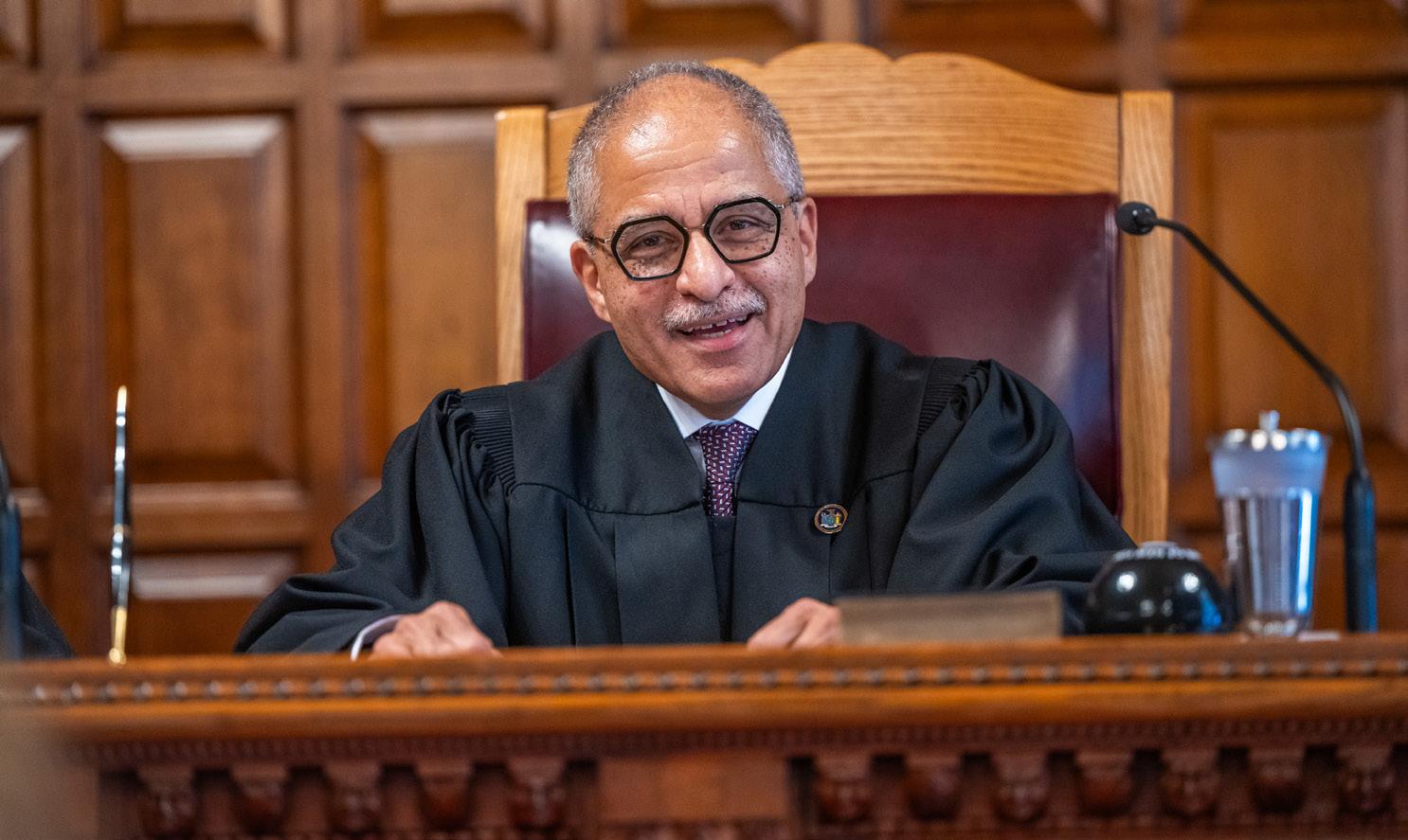
Chief Judge’s open support of sentencing reform long predates Republican backlash
By TANDY LAU Amsterdam News Staff
Chief Judge Rowan Wilson drew more than a second look for comments made during the Second Look Act Symposium hosted by the Communities Not Cages campaign last month. Republican state lawmakers like State Senator Anthony Palumbo and Assemblymember Michael Tannousis filed a formal complaint against New York’s top judge, accusing him of violating guidelines against political activity.
“Judges here are elected or, in some cases, are appointed by elected officials,” said Wilson during the symposium. “And one thing that all of you can do is find out who those people are and there are organizations who are starting to do that and starting to publicize that. And when those judges come up to be elected, don’t vote for them and get other people not to vote for them. That’s something you can do for me and Judge [Joseph] Zayas.”
The complaint also points to Wilson calling existing sentencing practices “stupid.” Currently, judges can only revisit and reevaluate a narrow set of sentences. The Second Look Act, a bill sponsored by State Senator Julia Salazar and Assemblywoman Latrice Walker, which the symposium highlights, would remove these rigid requirements.
Office of Court Administration (OCA) spokesperson Al Baker says those com-
ments remain completely above board and within Wilson’s duties as chief judge.
“It is appropriate for the Chief Judge to express his views on pending legislation that affects the court system,” said Baker in a statement. “It is also appropriate for him to speak publicly about proper judicial temperament and values, and to encourage New Yorkers to stay informed about the conduct of the judges serving their communities and to participate in the processes by which those judges are elected or appointed. Those are the points that the Chief made at this symposium, consistent
with his role as the Chief Judge of the State.” Palumbo says the complaint stems from opposing political bias rather than specific policy like the Second Look Act. The Long Island-based state lawmaker previously called the sentencing reform bill an unnecessary “extra credit” for rehabilitation. His office also believes Baker’s response reinforces his complaint’s merits.
“OCA’s failure to address Chief Judge Wilson’s comments where he urged people not to vote for certain judges is extremely telling and in fact bolsters the misconduct
See CHIEF JUDGE WILSON on page 27
Mamdani’s universal childcare rollout adds more seats for families in need
By ARIAMA C. LONG Amsterdam News Staff
Last week, city officials announced more than 1,000 new 3-K seats in neighborhoods with high demand, and launched 2,000 free 2-K seats. The move is intended to drive New York toward offering universal childcare for families in areas across the Five Boroughs.
“Put simply, universal child care will transform our city in a way that will be felt by every single New Yorker. As we expand access to 3-K, as we launch, for the first time in city history, free 2-K we are making what Wall Street would describe as a good investment,” said Mayor Zohran Mamdani at a press conference on March 11.
There were just over 57,700 4-year-olds, 45,300 3-year-olds, and 6,400 infants and toddlers enrolled in the city’s Department of Education-funded seats in 2025, according to recent city council numbers. The city’s Administration for Children’s Services (ACS) also supports about 109,000 children with child care vouchers.
The additional 3K seats will be across 56 zip codes that have historically seen higher
demand, like Staten Island, Western Queens, South Bronx, and South Brooklyn.
“We know that the earliest years of a child’s life are the most important ones. And so, academic rigor should begin in every child’s first classroom to lay the foundation for future success and for lifelong learning. For too many families, the promise of 3-K has not
always matched the reality,” said New York City Public Schools Chancellor Kamar H. Samuels. “This expansion is more than about numbers. It’s about making the system function the way it always was meant to. So that families can find high-quality early childhood education close to home.”
NYC Mayor Zohran Kwame Mamdani visits a child care center in the Bronx to tout the 2-K announcement. Friday, March 6, 2026. (Ed Reed/Mayoral Photography Office photo)
Filling the budget void: Can a wealth tax save New York’s Black and Brown homeowners?
What’s in the Mayor’s proposal?
His proposal aims to fill the city’s current $5.4 billion budget gap with a 2% raise on income taxes on residents earning more than $1 million a year and on corporate taxes on the most profitable corporations. This could generate an estimated $3 billion a year, if it got approved.
By ARIAMA C. LONG Amsterdam News Staff
As New York’s budget battles wage, legislators are embracing the call to “tax the rich” — a slightly less carnivorous version of Jean-Jacques Rousseau’s famous saying, “eat the rich.” This tax hike aims to fill the latest budget gaps, and fund much needed public services without adding to costs for everyday renters and homeowners.
As a controversial back-up plan, Mamdani said that the city might have to institute a 9.5% raise on property taxes on the average resident making a median income of $122,000, among other things. Potentially, this would generate between $3.6 and $3.8 billion a year.
For context, the median adjusted gross income for most NYC tax filers was $42,749, and more than 90% of filers earned less than $170,000 in 2023, according to the Independent Budget Office (IBO).
“People don’t really believe that if you give rich people tax cuts that eventually it will get down to them. People don’t believe in ‘trickle down.’ People have seen it not work for decades now,” said Rita Jefferson, who is a local tax analyst with the Institute on Taxation and Economic Policy, a nonpartisan group focused on tax equity.
Other states, like Massachusetts, already have a “millionaire tax” to raise revenue, address budget shortfalls, and fund critical infrastructure like public education and transportation. And according to recent IBO numbers, personal income taxes are New York City’s second-highest tax revenue source. Jefferson concurs that the best option is to raise PIT taxes on millionaires.
New York City Mayor Zohran Mamdani pushed the discussion forward on the topic of a wealth tax in February with his preliminary city budget proposal, a campaign promise that drew a lot of spectacle last year. He is hardly the first mayor in the state’s history to suggest taxing high earners more though. In 1919, New York first adopted a personal income tax (PIT) of 3% on incomes above $50,000, which is about $1 million in today’s terms, according to the Manhattan Institute.
The PIT is it
Solutions That Empower is an editorial series spotlighting financial empowerment and racial equity. We’ll feature changemakers, community voices, and practical tools that help our readers build wealth, access resources, and drive real change. See
First, wealthy people across the country got about $12 billion annually in federal income tax cuts from the Trump administration last year. Because of this, moderate and more progressive political organizers, like DREAM for NYC, are hugely in favor of raising taxes on the rich. So much so that they installed a billboard on the side of the highway in Albany that reads, “Hey Hochul, Zohran says tax the rich,” in giant letters.
“If the city actually needs money to spend on city services,” said Jefferson, “raising money from the wealthiest people who, again, got a giant tax cut last year, would be the most straightforward way to do it that would affect low-income New Yorkers, obviously, the least.”
We’d like property tax reforms, actually Homeownership is the main avenue for wealth building, and particularly for African Americans, it is frequently the only source of wealth that a lot of people have, said Jef-
ferson. The racial implications of raising property taxes in a housing market that has changed substantially over the past 50 years, and now has higher property values in many predominantly Black and Brown neighborhoods, could be dire. Jefferson said that the vast majority of people of color in the city live in multifamily apartment buildings, which are taxed at a higher rate than singlefamily homeowners.
“You end up with this wacky system in
Can New York State transfer a balance for smaller Black-owned banks?
By TANDY LAU Amsterdam News Staff
Queens might get the money, but finding a local bank remains a challenge for the borough’s predominantly Black ZIP codes. Red tape derails an otherwise promising opportunity for minority-owned banks to open and operate branches through state subsidies in these underserved areas, as well as those across New York. State lawmakers representing southeast Queens districts hope their legislation will be the change they want to see.
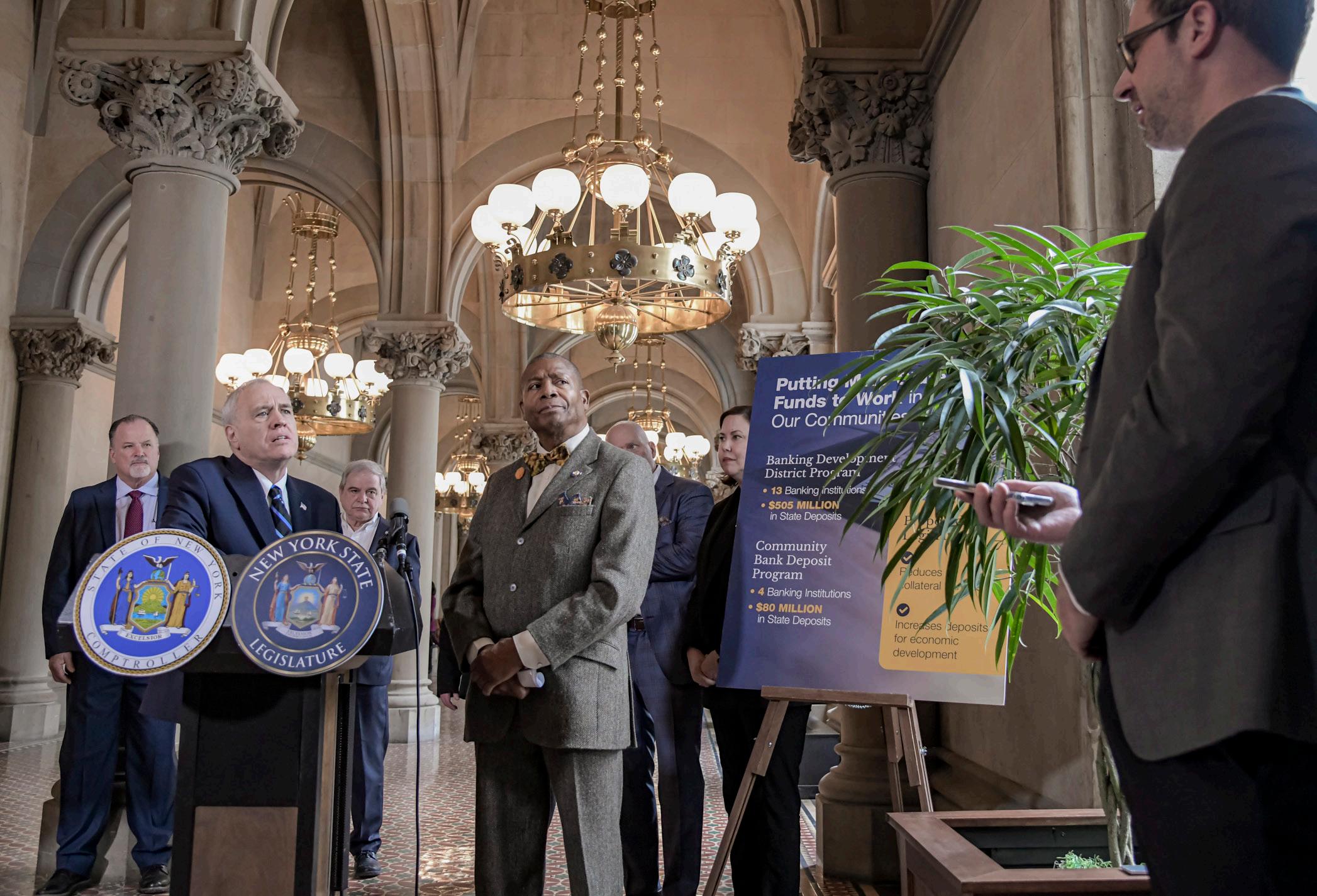
State Sen. James Sanders Jr. and Assemblymember Khaleel Anderson joined NYS Comptroller Thomas DiNapoli earlier this month to champion a pair of bills reforming how New York encourages operating physical banking sites in underserved communities, particularly through minority-owned institutions. The legislation specifically tackles the Banking Development District (BDD) program and Community Bank Deposit Program (CBDP), which place public funds in local banks and credit unions to foster economic development.
“Supporting community and minorityowned banks and credit unions puts state funds to work in neighborhoods that have historically been overlooked,” said DiNapoli
in a statement. “These funds will help expand financial services; increase access to capital; and build wealth through homeownership, entrepreneurship, and job growth. It is a winwin for the state and our local communities.”
Just two minority banks currently participate in the BDD program and none are enrolled in the CBDP. Meanwhile, “banking deserts” are frequently found in Black and Brown communities like in southeast
Queens, where a lack of physical branches means less access to credible financial services and increased vulnerability to predatory lending. This gap affects everything from cashing a check and opening an account to applying for a home loan for communities long affected by historical discriminatory practices like redlining.
“A Black-owned bank is more likely to get a Black person a loan than any other bank,” said Sanders. “You’re increasing your chances of borrowing money and to build your house and business, buy a car, finance education, [and] pay major bills.”
In 2020, Rep. Gregory Meeks’s office found that predominantly white Queens ZIP codes boasted one physical banking location for every 3,159 residents, while those with majority Black and Brown populations shared one local branch per 22,936 residents. The numbers stemmed from isolating the most recent census data. Poverty fails to explain these disparities, which persist even in the borough’s high-earning Black and Brown neighborhoods.
“There are folks [who] have access to capital and resources that should be investing in our institutions,” said Anderson during the press conference. “The reality is folks are faced with the need to access
(Monstera Production/Pexels photo)
Comptroller Thomas DiNapoli and State Sen. James Sanders Jr. holding press conference at state capitol in support of legislation that would expand lending in underserved communities and help stimulate economic development. (Office of the NYS Comptroller photo)
New data hub looks at how Black families thrive
By KAREN JUANITA CARRILLO Amsterdam News Staff
Most of the information we have about Black families in the United States focuses on deficits and negativity, says Dr. Chrishana M. Lloyd, principal investigator of the newly launched Black Families Flourishing (BFF) project. “We don’t know a lot about flourishing, wellbeing, and Black family strengths more generally,” Lloyd said. Understanding the factors that help Black families succeed is essential for advocates who want to promote effective policies. The BFF Project wants to help by highlighting the strengths, agency, and diversity of Black families and moving away from deficit-based perspectives.
BFF recently launched its Data & Insights Hub, a digital platform featuring maps and statistics that track the well-being of Black families with children nationwide. The Hub uses publicly available Census data, and it allows users to explore county-level details, including geography, child age, family structure, and income levels.
Lloyd explains that the BFF initiative wants to broaden the traditional scope of sociological research. “The Hub builds on existing efforts and analyses by broadening the definition and understanding of Black families — from including families with children up to age 25 to recognizing the rich diversity of family structures and ethnicities within Black families.”
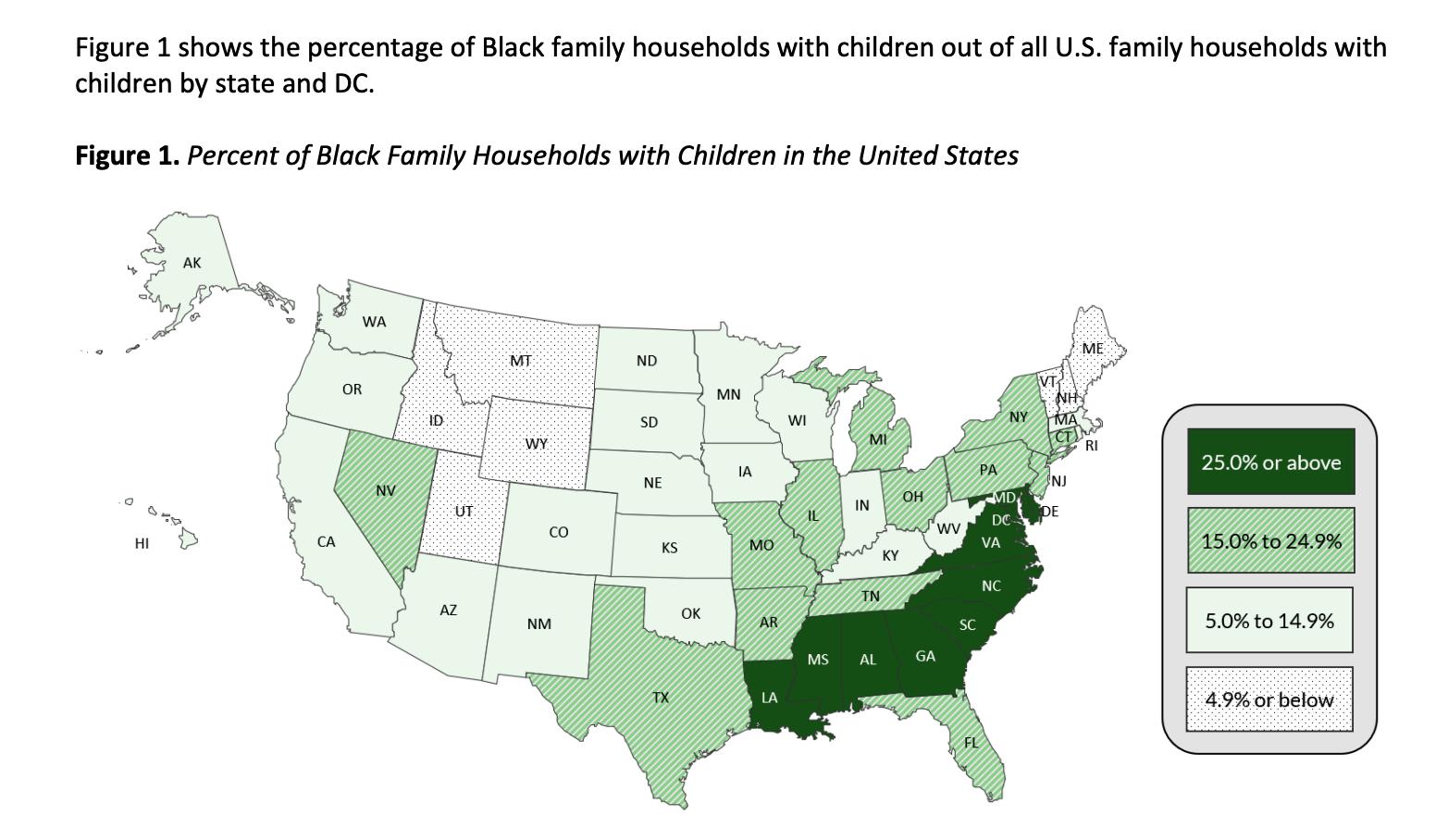
BFF’s first data release, “Fresh Look at Black Family Households with Children in the United States,” looks at the geographic distribution of Black families with children compared to the overall Black population nationwide. Their research indicates that as Black people and families continue to remigrate to the U.S. South, support systems
are being created to help ensure their wellbeing in these new areas.
The BFF project uses 2019-2023 American Community Survey microdata and plans to publish additional data throughout summer 2026. The Hub is specifically designed to provide information for researchers, policymakers, community leaders, and members who need to make informed decisions and support the development of thriving Black communities at the local and state levels. Lloyd emphasizes that the most impactful work happens at the neighborhood level: “Ultimately, what’s really happening with families is happening at a local level,” she said.
The BFF project, part of Child Trends — a national research organization focused on childhood development — began in 2020,
following a push to expand specialized research on Black domestic life. After reviewing a century’s worth of academic studies, researchers found a persistent trend of portraying Black families as lacking. “We want to understand the diversity and heterogeneity of Black families. … Most of what we know is really deficit-focused and negative,” Lloyd said, noting that government funding priorities have historically emphasized problems over inherent strengths.
Defining the capacity to thrive
A key part of the project was the development of a clear, formal definition of what it means to be a “Black family flourishing.” According to Lloyd, “Black family flourishing is the sustained capacity of Black families to love, care, and thrive together over time
and generations, and is grounded in families’ agency, cultural assets and strengths, diversity, and voice.” She said this definition was created after numerous literature reviews and consultations with a Black advisory group and nationwide focus groups. “We will continue to refine it as we do our nationally representative survey and other work,” Lloyd added, noting that the definition will evolve as new insights emerge. The project is mainly funded by the Robert Wood Johnson Foundation, which supports the three-year effort to promote strengths-based research. The project’s early work received support from the Doris Duke Foundation, Mackenzie Scott, and the Annie E. Casey Foundation. Lloyd noted that private funding allows for greater academic freedom. “From a researcher’s point of view, you have a lot more autonomy when you have private dollars,” she said.
By the fall of 2026, the BFF project plans to launch a nationally representative survey and expand its research on how federal economic changes, such as layoffs and furloughs, impact Black households. “We really want to take what we’re learning, communicate it, and disseminate that in ways that shift the narrative and highlight the positive aspects. … There are successful things happening, and we can learn from them, scale and replicate them, and bring about change,” Lloyd stated. “We want to... shine a light on what Black families look like, writ large, which nobody really knows right now.”
To follow the project’s progress and receive updates, BFF offers a newsletter signup at http://eepurl.com/i9OUxY. Learn more about the initiative at https://blackfamiliesflourishing.org/.
Members of the Black Families Flourishing (BFF) staff. (Images courtesy of Black Families Flourishing)
Percentage of Black family households with children out of all U.S. family households with children by state and DC BFF website.
Shelton Haynes wants to help businesses grow with new consulting firm
By JASON PONTEROTTO
Special to the AmNews
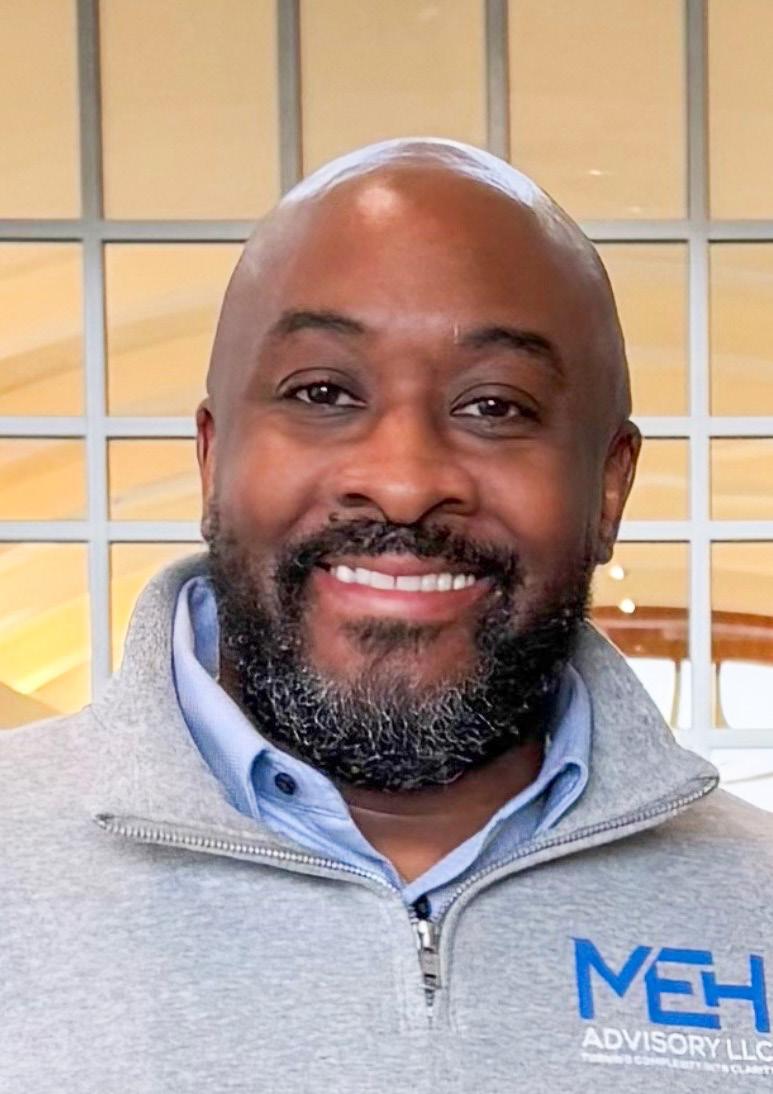
Shelton Haynes, 48, has held several leadership roles throughout his professional career. For the last 15-plus years, he has been in senior leadership roles, from the NYC Department of Housing Preservation and Development (HPD) and was later president of the Roosevelt Island Operating Corporation (RIOC). Now he has founded and is CEO of his own consulting firm, MEH Advisory. These types of firms are responsible for helping organizations of all sizes build structure and become successful.
Haynes says he has always been mission-focused, a quality developed growing up while watching both of his parents. Being raised in Hempstead on Long Island, Haynes knew early that he wanted to support his community in whatever way he could.
“Everything I have done has been centered around helping people, and I get that from my mother,” Haynes said. The initials MEH of his firm are named after his mother, Mary Ellen Haynes, a former school principal. After graduating from Hampton University in 2000, Haynes became a social worker with the NYS Health Department, then a supervisor at the New York City Department of Housing Preservation & Development (HPD), was a housing manager and later a chief operating officer with Affiliated Resources Group in Atlanta for a few years before coming back to New York in 2016 where he was, first, COO of RIOC and then president and chief operating officer by 2021.
Haynes is proud of his accomplishments at RIOC, including improving infrastructure projects and establishing the first state-approved youth program for local families. He received several awards during his tenure, including the 2024 Rudy W. Powell Memorial Community Service Award and the Lucy G. Moses Preservation Award twice. His time there would end “unceremoniously” after being fired amidst allegations of racism and discrimination from Haynes and General Counsel Gretchen Robinson, a Black woman. Litigation is still pending.
Haynes views everything he has experienced as a lesson that allowed him to grow.
“Each experience I’ve taken as a lesson and blessing. I’ve never looked at something like ‘why me?’” Haynes said. “Each experience has led me to a different and even better chapter.”
As running the island was similar to a business, Haynes says he learned a lot in his tenure about operations from all angles, whether it be legal, financial, or capital projects. In this, he was working with consulting firms constantly to assist his leadership. This allowed him to start his firm in 2025.
“I dealt with a lot of politicians, congress
Black
New Yorker
members, senators … consulting was just about the work, and I enjoyed it,” Haynes said about his choice to turn from government to consulting.
Haynes’ firm is able to provide consulting for all types of organizations on how to scale and be sustained, whether it be project management, legal advice, setting up infrastructure, how to save money, providing training, and more. He says it is made up of an accomplished set of advisors and is proud to have as diverse a team, both in expertise and ethnicity.
On the final day of Black History Month, Hayes attended a Black Men’s Brunch in Harlem, where he connected with several professional friends of his. He says this network of professional Black men supporting each other has been a resource he has been able to lean on over the years.
Since he was in his 20s, Haynes served as a basketball coach and mentor for youth through programs like the Harlem Children Society. Though he is not coaching anymore, he still mentors young people at different events, often connecting them with internships and other opportunities.
Haynes passed down these values of striving to reach your full potential despite challenges to his four sons, with his oldest now attending Howard University.
Haynes says at this stage in his life and career, he is all about giving back and providing support where it is needed, including to smaller Black-owned businesses.
“I get a chance to help my community, I get a chance to show through my actions that Black-owned businesses can be successful … and showing the quality of what we do is amazing,” Haynes said.
THE URBAN AGENDA
By David R. Jones, Esq
New Yorkers Are Demanding Housing Affordability. Governor Hochul Can Help Provide It
With the release of their one-house budget bills this month, the State Legislature sent a clear signal: include $250 million for the Housing Access Voucher Program (HAVP) in the final state budget. That’s not symbolism— it’s recognition that last year’s $50 million pilot, while historic, is nowhere near enough to meet the scale of housing insecurity facing New Yorkers today.
The case for full funding is overwhelming. HAVP is simple, targeted, and proven in concept: like federal Section 8, vouchers cap a household’s rent burden at roughly 30 percent of income and can be used to prevent eviction or speed exits from shelter— precisely the interventions New York needs most. The program first launched last year; lawmakers who championed it now urge scaling to $250 million so it can reach far more households statewide.
Consider the stakes. In 2025, more than eight percent of Bronx households were threatened with eviction filings. And this is not just a New York City story: in 27 counties outside the city, eviction filing rates in 2025 surpassed 2019 levels. These are not abstract metrics—they are warnings that thousands of families are one court date away from displacement and all the economic and educational harm that follows.
Public support for an expansion is not merely broad—it’s overwhelming. A Community Service Society of New York policy brief released last month found 91 percent of respondents across regions, incomes, races, and political affiliations support expanding HAVP and making it permanent.
Meanwhile, New York’s shelter system and statewide homelessness indicators remain under acute stress. New York City recorded roughly 90,000 people in its main shelter system on a typical night in May 2025. Statewide, HUD’s 2024 point-in-time data showed New York with 158,019 people experiencing homelessness, almost one in five of the national total—second only to California. Those figures reflect real families, real children, and real costs—moral and fiscal—when prevention fails.
Full funding for HAVP is also fiscally smart. While rental assistance costs money, so do shelters, eviction courts, emergency rooms, and jails, all of which get used more when tenants can’t afford to stay in their homes. We should be comfortable budgeting for outcomes we want, like housing stability, especially when they save on the fiscal costs and human toll of eviction and homelessness.
And the timing could not be more urgent. New York is staring down significant federal headwinds: proposed HUD cuts and policy changes would slash rental assistance and
impose time limits, shifting costs to states and localities and putting tens of thousands of New York households at risk. Under the Trump Administration HUD’s discretionary budget is being shredded – by roughly 44–51 percent – compared to the prior year with severe consequences for Section 8, public housing and homelessness programs. New York cannot wish away Washington’s retrenchment; it must build state-level tools to keep families stably housed. HAVP is exactly that tool.
Governor Hochul deserves credit for backing HAVP last year at $50 million, acknowledging the need for a state voucher. But the pilot was always a “foot in the door,” not the destination. The Assembly’s one-house budget now explicitly proposes an additional $200 million for HAVP—bringing the total to $250 million; the Senate echoes that commitment.
Skeptics will ask: can we afford it? Look at the alternatives. Eviction spikes already stretch the courts; the state’s own dashboard shows filings rising across multiple counties since 2019. Each avoidable eviction ripples through school districts, Medicaid spending, and municipal budgets. Preventing the loss of a home is invariably preferable to repairing the damage. Another plus is that HAVP’s design— modeled on Section 8 but more flexible—helps close the affordability gap for those shut out of federal programs, including some immigrants and people with past convictions, and can be deployed quickly where need is greatest.
There is also a pragmatic, statewide lens here. HAVP is not a “New York City program.” CSS research shows eviction pressure and homelessness extending well beyond the five boroughs, with several upstate counties exceeding city borough filing rates in 2025. Local leaders from Buffalo to the Capital Region need tools their communities can actually use; HAVP vouchers are portable, preventionfocused, and adaptable to local markets.
Here’s the bottom line: HAVP is that rare example of common ground where tenant advocates, many landlords, nonprofit providers, and business leaders find alignment: stable homes reduce shelter costs, reduce turnover, and make neighborhoods safer and more resilient. That’s why we’ve seen sustained, multi-year advocacy to reach this point—and why both chambers have now put $250 million on the table.
The Governor should join Majority Leader Andrea Stewart-Cousins and Speaker Carl Heastie and lock in the State Legislature’s full $250 million in the final FY27 state budget. Doing so will prevent evictions, reduce homelessness, and demonstrate that New York still knows how to solve big problems with practical, evidence-based policy—even when Washington turns away.
David R. Jones, Esq., is President and CEO of the Community Service Society of New York (CSS), the leading voice on behalf of low-income New Yorkers for more than 175 years. The views expressed in this column are solely those of the writer. The Urban Agenda is available on CSS’s
Shelton Haynes, founder and CEO of MEH Advisory. (Photo courtesy of Shelton Haynes)
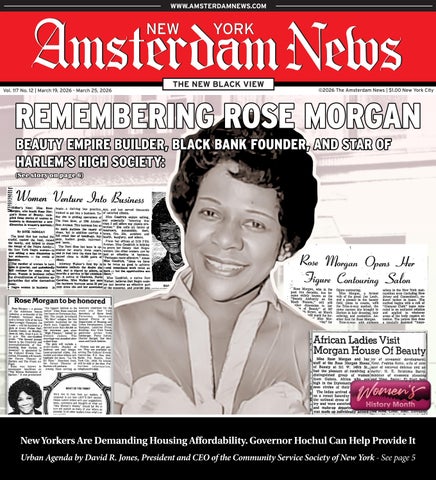
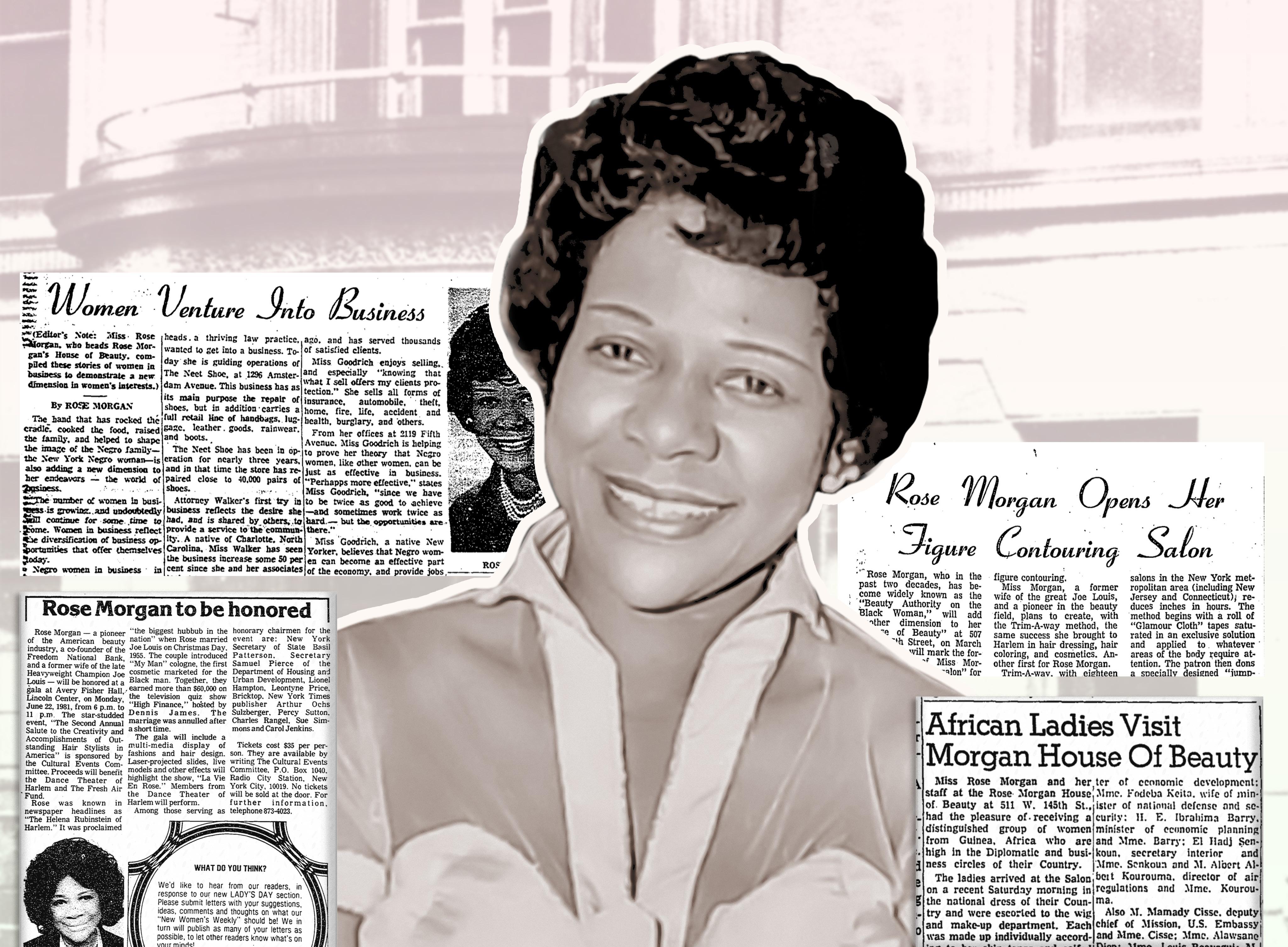
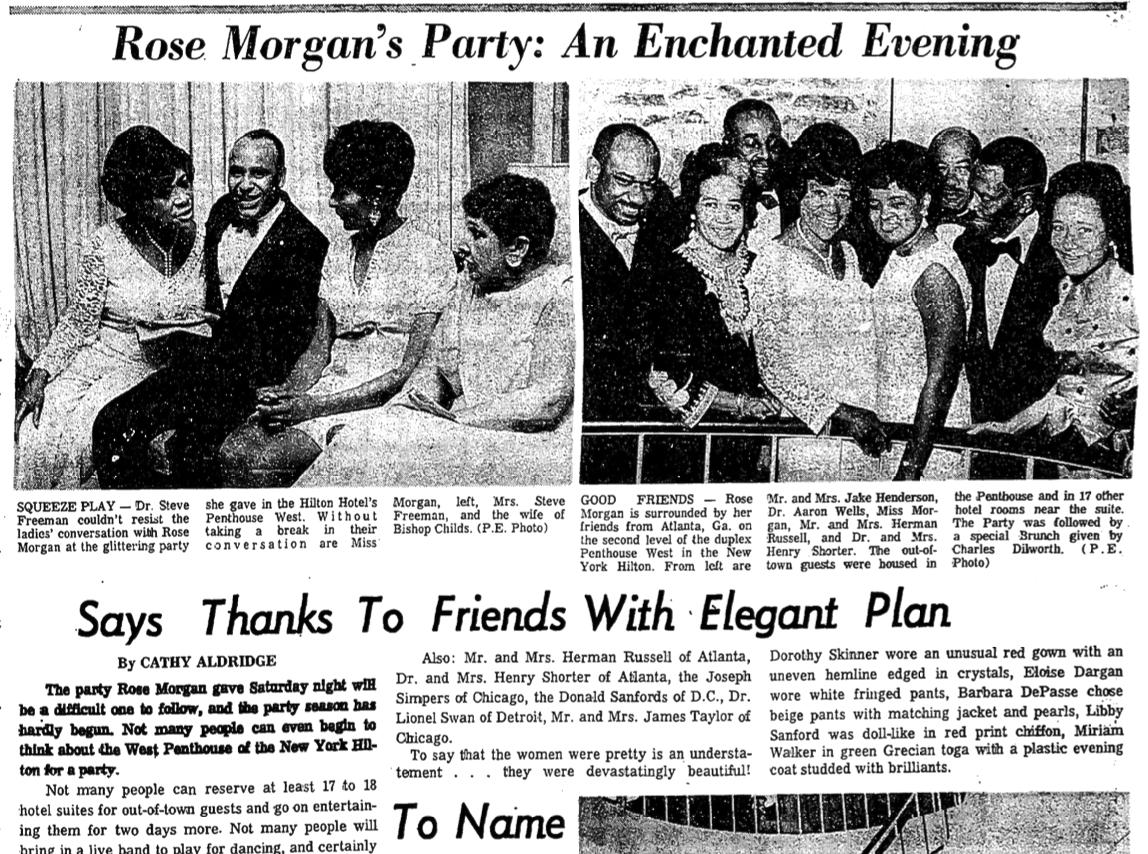
Beauty empire builder, Black bank founder, and star of Harlem’s high society: Remembering Rose Morgan
By MICHAEL HENRY ADAMS Special to the AmNews
Who today has ever heard of Rose Meta Morgan? If, thanks to groundbreaking work by Stanley Nelson and A’Lelia Bundles, many are aware of the triumphant, if brief, lives of Madam Walker and her daughter, no biographer has come forward for their successor in the sphere of Black beauty.
Born in Edward, Mississippi, in 1912, this curious brown-skinned girl grew up in Chicago. By 1942, she owned and operated the largest African American beauty parlor in the world. Emulating the enterprise of the Walkers and the business acumen of her father, industrious one-time sharecropper Chaptle Morgan, Rose Meta Morgan got her start, while a schoolgirl, making artificial flowers. Her big opportunity came in 1938, when Morgan styled the hair of the great Ethel Waters. Impressed by Morgan’s deft touch, Waters invited her to New York City as her guest. Impressed by Walters’ glamour and by New York’s sophistication, Morgan moved to Harlem and, within six months, attracted enough customers to open her own beauty shop. Soon, she hired five stylists and signed a 10-year lease on a vacant mansion owned by Dr. Charles Ford. This savvy adaptive use of an existing structure has a direct correlation with Madam Walker’s practice.
By 1946, the Rose Meta House of Beauty at 401 West 148th Street had a staff 29 strong, including 20 hairstylists, three licensed masseurs, and a registered nurse. In partnership with Olivia Lee Dilworth Stanford (another transplanted Harlemite, born in the Deep South), Morgan operated up-to-date beauty procedures, offering rub-downs, hairdressing, facials, manicures, bodybuilding, and health-food lunches.
Stanford and Morgan not only created their own line of beauty products, expressly formulated for African American women, but they expanded their business into shops around the city and across the country.
The Rose Meta House of Beauty was exactly for Black women what Elizabeth Arden’s was to whites. Broad noses, full sensuous lips, dark skin, and even “kinky” hair were not looked upon as loathed defects. Their mission was not an effort to either disguise or diminish “Blackness.” They sought instead to celebrate African Americans with products and services meant to enhance their beauty. The first step in this process was to indicate to Black women something of their worthiness, to show that their patronage was valued, by providing first-class care in luxurious surroundings.
Rose Morgan, who had been briefly wed
and quickly divorced, amazed the world when she remarried. How, among the hundreds of young, vivacious women romantically linked to the “Brown Bomber,” did this handsome, if dark, nearly middle-aged woman-of-the-world “catch” the “heart-throb” of a generation?
Joe Louis had gained his title dramatically in a 1937 rematch with Max Schmeling of Nazi Germany. The bout lasted just two minutes and four seconds. Disgraced, having suffered defeat at the hands of a Black man, ironically, Schmeling, the symbol of Aryan might, went on to become a Coca-Cola executive and a multi-millionaire. Louis, by contrast, mismanaged by manipulative handlers and dogged by Federal tax charges, died a physical wreck, seldom successful in overcoming crushing debt. Yet it’s Joe Louis who holds the distinction of having defended his title more times than any other heavyweight in history, knocking out five world champions.
For a financially desperate Louis, in part, at least, Rose Morgan’s appeal must have been her unusually ample means. In 1948, ever-increasing gains saw Morgan open a new House of Beauty in an existing but brand new building. Joe Louis’ deluxe bar and restaurant, with the “world’s largest oval bar,” fashioned from mahogany and rosewood, was planned by Black Harlem architect Vertner Woodson Tandy with engineer Sidney Frieman. Opened with fanfare in 1946, it closed abruptly in 1947. How fortuitous for Louis that Morgan could take this costly albatross off his hands. How lucky too for Miss Morgan, to find so stylish and up-to-date a venue for her expanding business, that by now included regular fashion shows featuring Black designers like Mildred Blount, Willard Winter, L’Tanya, and others who were to gain acclaim.
By 1955, Morgan’s first location at 148th Street closed, but not before an entirely new International-style Morgan’s House of Beauty, designed by Columbia-trained Black architect John Lewis Wilson, opened. Young Wilson had begun his career as a draftsman for Vertner Woodson Tandy, Madame Walker’s architect, who was the first Black architect registered in New York State. Located at 507 West 145th Street near Amsterdam Avenue, it was an ideal setting for beauty culture, and included a dressmaking department and a charm school in addition to the usual hair salon facilities. In the early 1960s, she added a wig salon. Over time, she employed and trained over 3,000 people.
Louis’ and Morgan’s Christmas Day wedding and reception were held at Rose Morgan Louis’ home, at 175-12 Murdock Avenue in the Addisleigh Park section of Saint Albans, Queens. The first suburban New York community opened to Blacks, Addisleigh Park rapidly became the suburban equivalent of Harlem’s Sugar Hill and home to greats like Lena Horne, Count Basie, Roy Campanella, Ella Fitzgerald, Illinois Jacquet, and Jackie Robinson.
Rose Morgan’s marriage to Joe Louis was
amicably annulled after three years in 1958. In 1965, Morgan was one of the founders of New York’s only Black-owned commercial bank, the Freedom National Bank. She retired in the mid 1970s.
Some said it was her friendship with Marian Bruce that prompted Morgan to marry Louis. Born in 1920, Bruce was a cabaret singer noted as an elegant stylist. During her career in show business, in the 1940s and 1950s, she starred in the first all-Black show ever presented in a Miami Beach nightclub. Beautiful and always beautifully dressed, she was also popular abroad on the continent. One element of this popularity lay in her dry wit and sharp repartee. “It was truly something
to hear such unexpected and expert cussing coming from the pretty mouth of this pretty lady...” observed Taylor Gordon and Jimmy Daniels, among others.
Never afraid to take a stand for justice, or to be photographed, Miss Bruce appeared in the illustrations of at least two news stories for Ebony and Our World magazines, covering the new House of Beauty salon opened by her dear friend Rose Morgan. In both, Bruce, most decoratively, poses clad only in a towel during strenuous exercise and a subsequent massage. Black journals from this period were hardly adverse to introducing a little titillation among their pages. The only thing surprising about these pictures is how perfectly
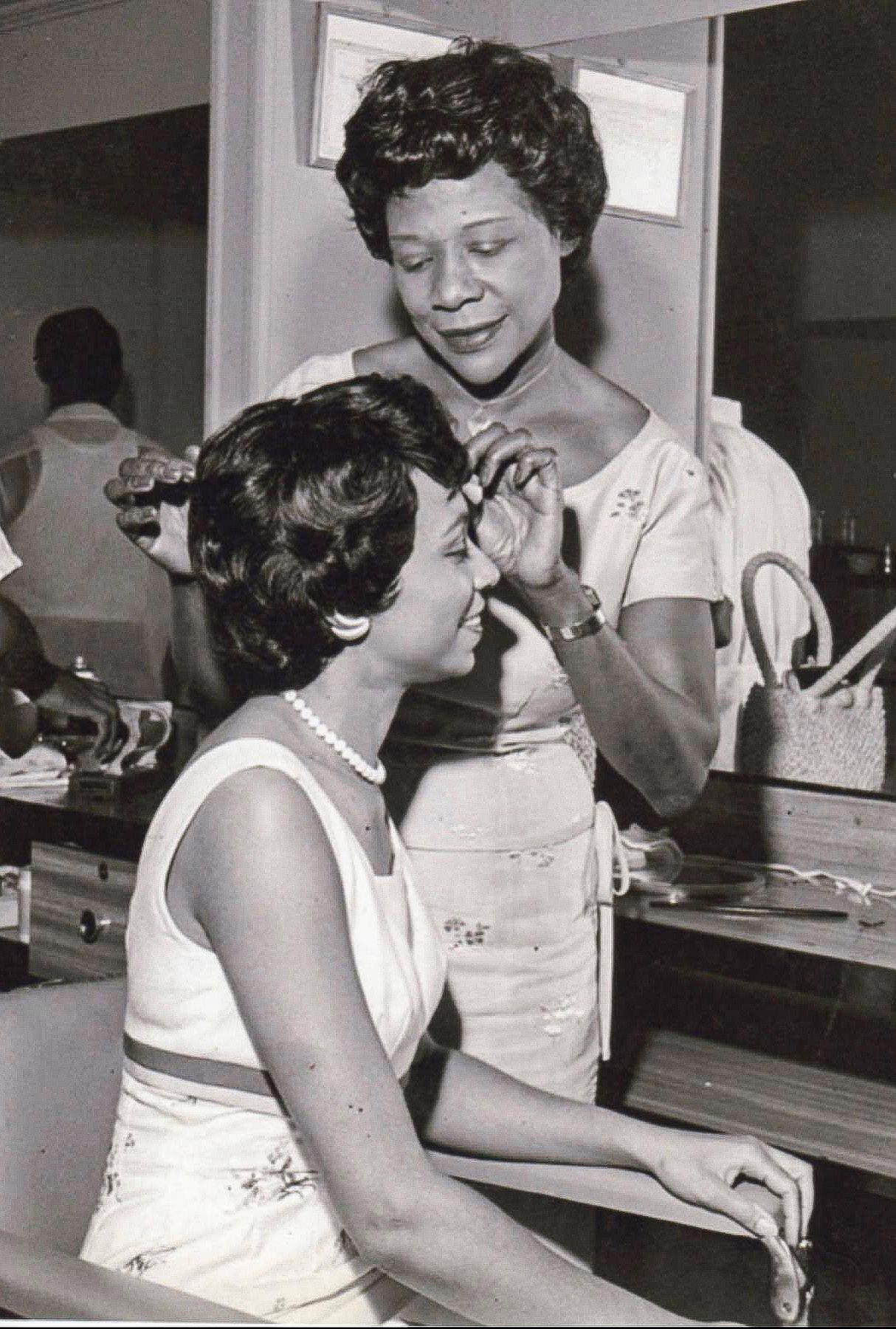
Rose Morgan in her salon with singer Margaret Tynes, ca. 1960. (Public domain photo)
they portray an aspect of the scandal that engulfed Morgan and Bruce almost immediately after they were taken.
At a House of Beauty party in August of 1948, when handsome graphic designer Art Harris went searching for his girlfriend, he found her easily enough. She was with Rose Morgan. They were in the rub-down room. They said that they were giving each other a “massage.”
“Not a word was spoken,” explained photographer Marvin Smith half a century later, saying how the couple returned home quietly. “Marian thought she had gotten over, that they would both pretend that nothing had happened. Regarding women she’s caught him with, she often had.” Harris encouraged her hopeful delusion, her friend continued. “As she undressed, he was in the bathroom. The only thing that was odd was his sharpening his razor. Why shave again, just to go to dinner?”
Smith said, she knew him well enough to know he was not kidding, when razor in his hand, he’d come after her, snarling, “‘I will kill you both’. Bare-assed-naked, she ran into the street. It was in the Amsterdam! The next day, my brother and I took her to Riis Beach to get away from the scandal.”
Marriage and family were the most drastic subterfuges used by gays to cover their tracks in the past. In no time at all, Marian Bruce and Rose Morgan both found husbands. But not before Miss Bruce, with defiant satisfaction, sued Harris for assault, for an award of $2,990. Bruce married first. Her husband was widower Arthur C. Logan, the personal physician to both Duke Ellington and his brilliant gay collaborator, Billy Strayhorn. It was in great part due to her marriage that Mrs. Logan
would come to focus her opposition to discrimination, joining her husband to become a major NAACP activist, Democratic campaign worker, and Civil Rights Movement fundraiser. These activities culminated in Mariam Logan being named to head New York City’s Commission on Human Rights from 1977 to 1979. A widow for over 20 years after her husband’s suicide, Mrs. Logan died in 1993.
I met Miss Morgan around 1989, and she once attended a party I gave. Interested in talking to others, this faultlessly turned out matron was also interesting to listen to. She said how she continued to exercise every day and to assiduously care for her health. Our mutual friend, Alma Rangel, also enjoyed listening to Morgan’s tales of her eventful life: “We were at a house party together in Florida, and she kept us spellbound, late into the night.”
After her marriage to Joe Louis ended, Rose Morgan briefly married a third time. Determined to write her life story, Rose Morgan returned to Chicago in 1999 to tend to her ailing sister. When she died in 2008, despite two major biographies of Joe Louis released at the time, almost no one noticed.
What a pity that this extraordinary lady, so fastidious and concerned with every detail, who prided herself on giving as much attention to ordinary, unknown customers as to star clients like Lena Horne, Hazel Scott, Sara Lou Harris Carter, or Katherine Dunham, never completed the memories she was determined to record. Had she succeeded, it’s doubtful a woman who accomplished so much would have died with almost no notice taken whatsoever, unmentioned in either the Chicago
or the
Tribune
New York Times
1955: A Christmas Day wedding: Rose Morgan and Joe Louis. (Public domain photo)
From the Oct. 25, 1969 issue of the AmNews.
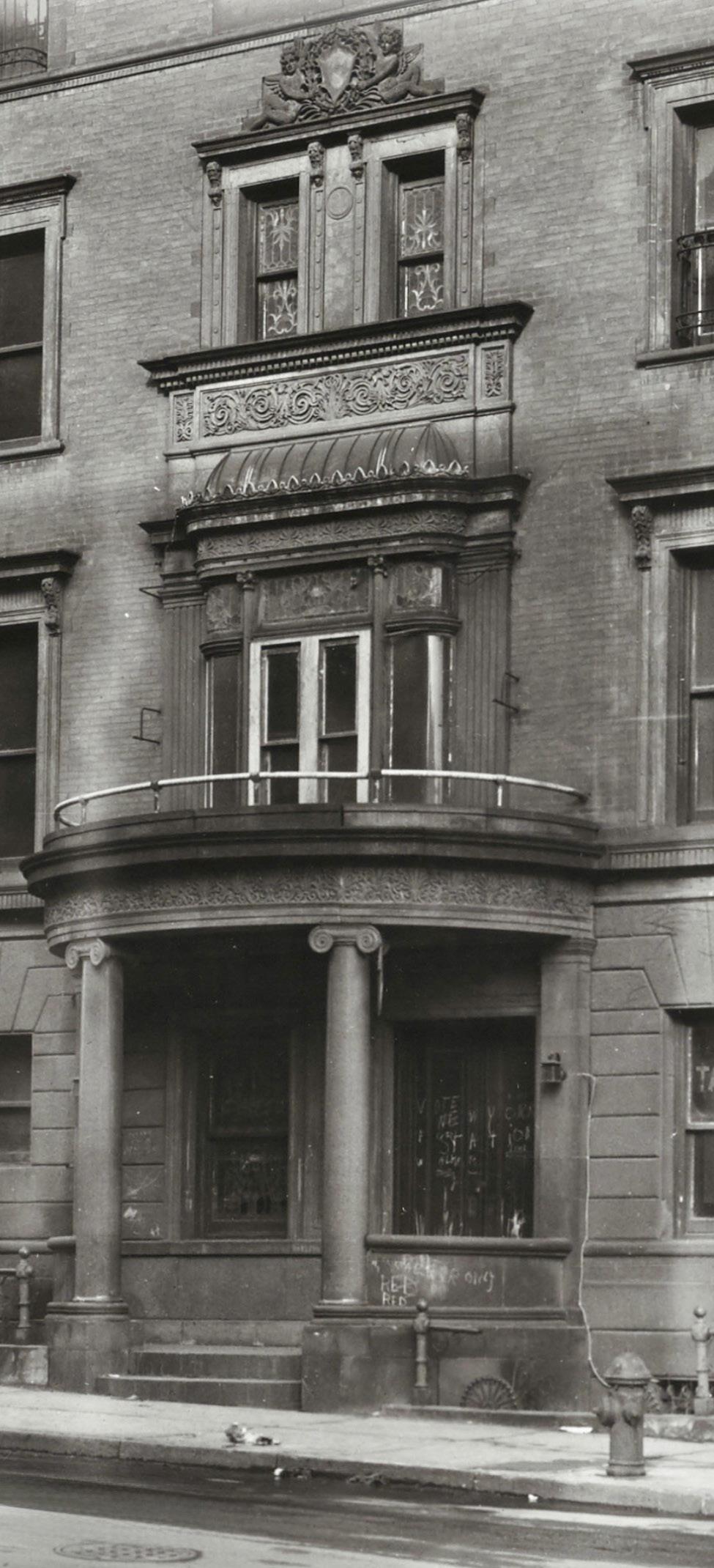
Number 401 West 148th Street was leased from Dr. Charles Ford to become The Rose Meta House of Beauty in 1946. (Photo from the writer’s collection)
Number 401 West 148th Street today. (Michael Henry Adams photo)
The cultural power of one Harlem school’s natural hair afterschool club
By ARIAMA C. LONG Amsterdam News Staff
The afro, bold and political like activist Angela Davis. Locs swinging free like Bob Marley. Black hair has a long storied history of effortlessly making a statement in its natural state. One Harlem teacher is determined to continue the tradition and knowledge of natural hair care among her students at Patrick Henry Preparatory School’s Natural Hair Club.
Jade Lambert, 30, is a fourth grade teacher at Patrick Henry (P.S. 171) in Harlem. She founded the hair club and has run it for the last two years. More than a beauty program, this club honors the deep cultural importance of hair in Black communities.
“Hair, Black hair specifically, is very community centered,” said Lambert, “Normally little girls aren’t going home and doing their own hair. They need help from a parent or an aunt. So since it’s community based, it’s about starting conversations. They understand their hair, but also the adults can too.”
The club has 15 Black and Brown girls who meet twice a week for about an hour and a half. The students that attend get natural hair education where they learn how to care for their own hair, identify different hair textures and types; create detangling, wash, and style routines; and practice protective styles using provided hair. By teach-
ing these skills to fourth, fifth, sixth, seventh, and eighth grade students, the program empowers students to embrace the uniqueness of their hair while preserving a tradition that has been passed down for generations.
“When I became a teacher, I noticed girls that have the same identity as me, and along with the same identity are…some-
hair is a point of pride and a means to have autonomy in the world, having learned how to grow and maintain it. The same is true for many of her students.
“I had a student who came in for picture day without her hair done and she was distraught, so I just quickly did something for her hair. And I think from that point I was like this is something that shouldn’t be thought of as isolated outside of school, this is something we care about inside school, especially when it comes to presenting yourself,” said Lambert. “Once that happened, we formed a connection.”
The school’s principal, Aharon Schultz, helped fund the hair club in its first year, and then Lambert secured an identity clubbased grant through the city’s Department of Education for its second year.
times insecure in our hair, so once I noticed that in my students, it was natural for me to show them different things,” said Lambert. Lambert said that hair care isn’t something that always came easily for her. She spent many years as an adult learning to take care of her curls, helping her family do their hair when she could. Now her natural
“Natural Hair Club is a space where students are able to come together to celebrate their natural beauty, build confidence, and learn to care for their hair with pride,” said the school in a statement. “Through conversations, hands-on activities, and community building, we explore the history and significance of natural hair while embracing what makes them unique. For many of our girls, the club is more than just about hair — it’s about identity, self-love, and representation. It gives them a place to feel seen, supported, and proud to wear their crowns every day.”
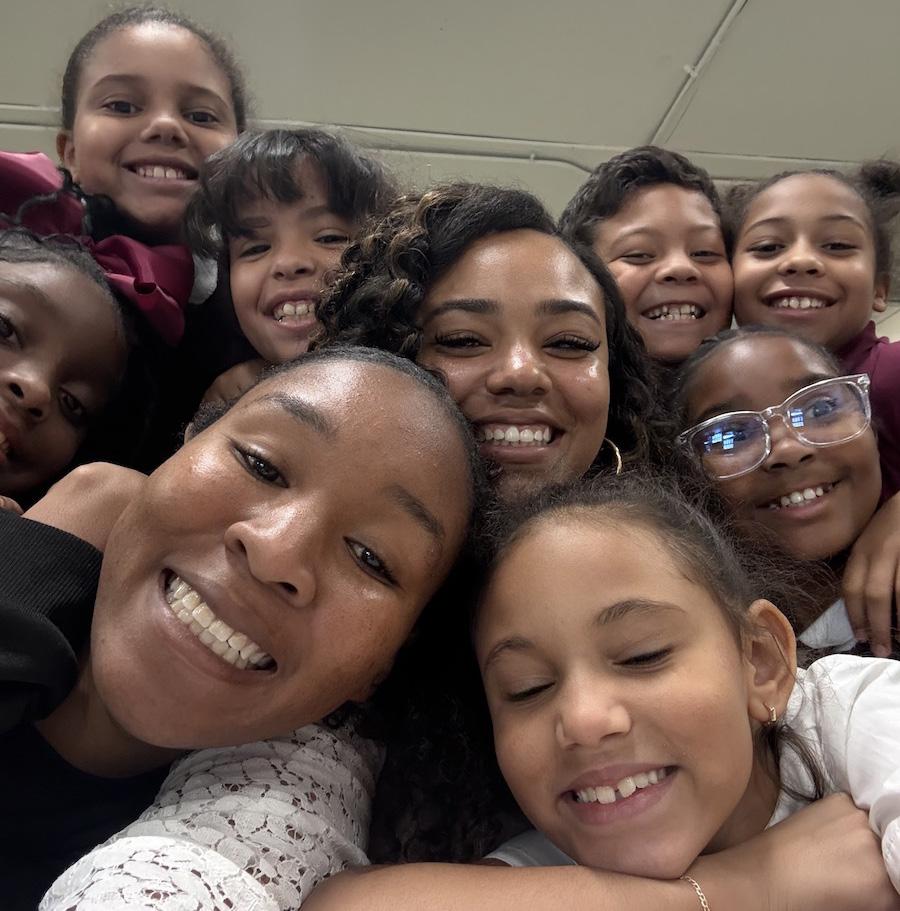
P.S. 171 teachers with the natural hair club students.
Student shows off her work.
Student focused on practicing parting on her mannequin.
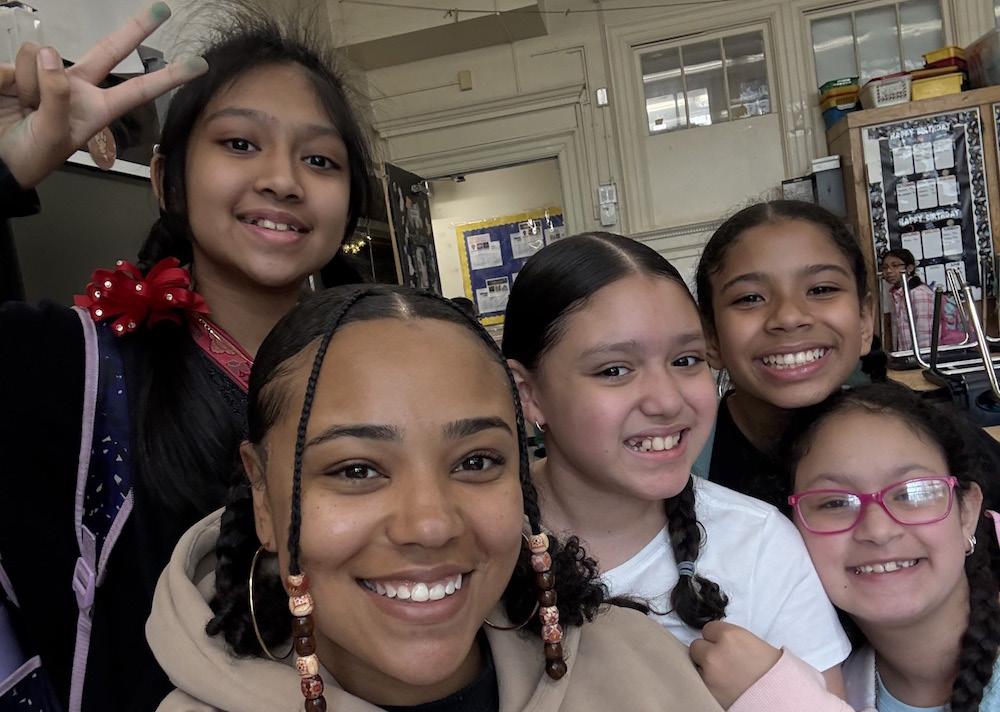
Teacher Jade Lambert with her natural hair club students. (Photos contributed by the NYC Department of Education)
Two natural hair club attendees smile for the camera.
Student brushing mannequin’s head.
One student practices braids on her doll.
Young student poses with her mannequin head at the P.S. 171 natural hair care club in March 2026.
Two students get creative, adding pink yarn and earrings to their hair model at the P.S. 171 natural hair care club in March 2026.
Divine Nine News
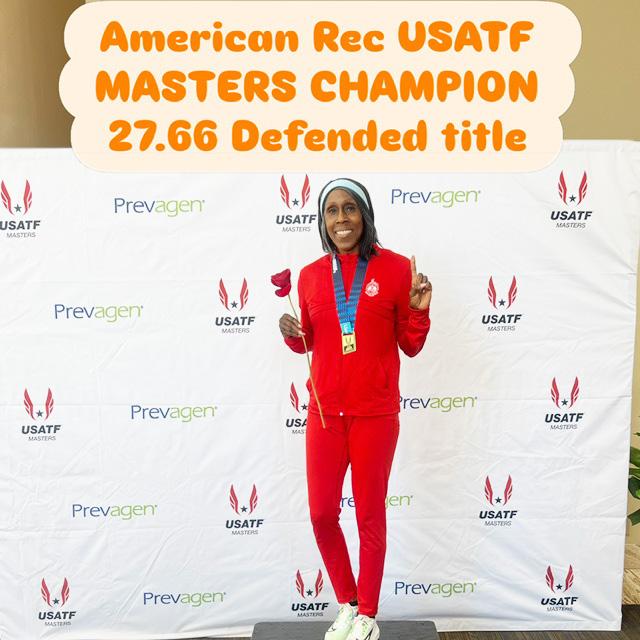
Action, service, and leadership: A message from a four-time Olympian and businesswoman
By JOETTA President of Joetta Sports and Beyond, LLC
Leadership is action. It is how you live, how you serve, and how you show up every day. As a four-time Olympian, businesswoman, motivational speaker, and proud member of the Allentown Alumnae Chapter of Delta Sigma Theta Sorority, Incorporated, my work is rooted in purpose, movement, and community impact. Delta Sigma Theta Sorority, Inc. represents leadership in action. Founded on service, scholarship, sisterhood, and social action. Delta women lead with intention. Those same values guide my professional life in business, fitness, wellness, and motivation, because strong communities depend on healthy minds, healthy bodies, and consistent leadership. My journey as an Olympian taught me discipline, focus, and resilience. Today, I am run-
ning masters, and I currently hold the USA Indoor 200-meter American record and the outdoor 100-meter American record in the 60-64 age group. Those accomplishments reflect consistency, but more importantly, they reflect mindset. That same mindset drives my work as a motivational speaker and program facilitator. I conduct leadership and motivation programs for corporations, schools, and community groups.
My message is practical, showing people how preparation, accountability, and belief can change outcomes. My sorority emphasizes leadership development and service. That alignment matters to me. Delta women understand that leadership is not just spoken, it is practiced. Whether mentoring youth or supporting wellness initiatives, this Delta shows up with structure and purpose. Fitness and wellness are central to my service, especially for the aging population. A healthy lifestyle supports both mind and body. Movement improves confidence, mental
clarity, balance, and independence, allowing people to remain active participants in their families and communities. This focus on mind-body wellness mirrors Delta’s commitment to improving quality of life. Health equity is a lead-
ership issue. When people have access to education, movement, and motivation, they are better equipped to thrive, lead, and serve.
As a businesswoman, I design fitness and wellness programs that are sustain-
To share your Divine Nine News, please contact us at d9@amsterdamnews.com and at amsterdamnews.com/d9news
able and inclusive. I believe in long-term habits, not quick fixes. That philosophy reflects how Delta Sigma Theta Sorority, Incorporated, creates lasting impact across generations. Leadership, fitness, and wellness are deeply connected in my life. Caring for the body strengthens the mind, and a strong mind fuels leadership.
Delta women have long understood this balance, leading communities with intelligence, compassion, and discipline. What excites me most is helping people realize their potential. Whether I am speaking, coaching, or leading fitness sessions, my goal is empowerment. My work and Delta’s mission are inseparable. Both focus on service, accountability, and progress. Leadership is movement, and movement requires care for the mind and body working together. I remain committed to serving communities through motivation, leadership development, and wellness education. For schools,
Happening in Harlem: Black Family Wellness Expo on March 21
The health and wellness of your family matters to the members of the Greater New York and the Metro-Manhattan (NY) Chapters of The Links, Incorporated. They are hosting the Black Family Wellness Expo on Saturday, March 21, from 11 a.m. to 3 p.m., in Harlem at Abyssinian Baptist Church in the Dr. Calvin O. Butts III Educational &
Cultural Center.
According to the late Civil Rights pioneer Rev. Dr. Martin Luther King Jr., “Of all the forms of inequality, injustice in health is the most shocking and inhumane.”
Through this wellness expo, these two chapters of The Links, Incorporated, and their community partners are collaborating to reduce health and economic disparities in the Black community. This event is a part of The Links, Incorporated’s nationwide Black Family Wellness Expos, which is being held simultaneously on
March 21 across the country to leverage its entire membership and improve health outcomes for Black families. The Black Family Wellness Expo contributes to The Links National Wellness Expo’s effort to raise awareness about conditions that shorten or impact the quality of life within the Black community. From infants to senior citizens, all are welcome to attend the expo that will include food pantry offerings, healthcare screenings, panel discussions, meditation, and yoga, as well as a diaper giveaway, other
giveaways, and door prizes. For more information, visit linksinc. org, metromanhattanlinks.org, and greaternewyorklinksinc.org.
KAYLYN KENDALL DINES, MBA
Meet a champion: Joetta, four-time Olympian and president of Joetta Sports and Beyond, LLC. (Photo courtesy of Joetta Sports and Beyond, LLC)
Union Matters
Brooklyn Hospital Center nurses cry foul at denial of health care coverage
By KAREN JUANITA CARRILLO Amsterdam News Staff
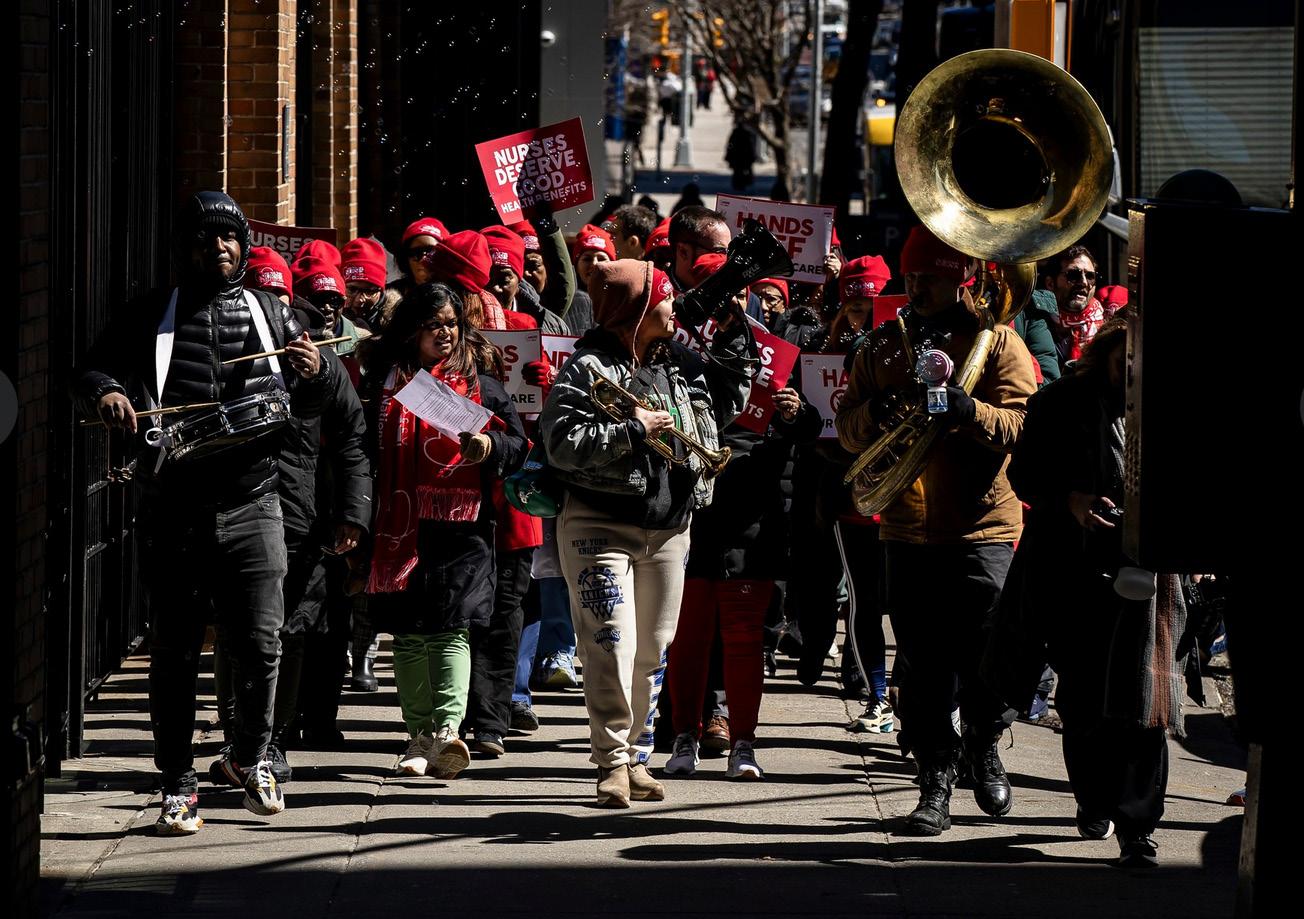
Nurses at The Brooklyn Hospital Center (TBHC), represented by the New York State Nurses Association (NYSNA), took to the streets of Downtown Brooklyn on March 17 to rally and march in protest against the 45-day cutoff of their health insurance benefits.
The nurses demonstrated by chanting slogans and holding banners, urging TBHC’s CEO, Gary Terrinoni, to recognize the urgency and the growing crisis they are facing as frontline healthcare workers are still serving their community while they don’t have critical healthcare coverage.
The rally began at the hospital’s main entrance on 121 Dekalb Ave. and wound its way over to the outside of City Point at 138 Willoughby St., where TBHC’s CEO maintains a home. The nurses called out — “we are sick and tired of corporate greed!” — and marched to the blare of a tuba and the playful swirl of bubbles.
Brooklyn Borough President Antonio Reynoso joined the crowd in front of City Point, and emphasized the fundamental role of healthcare coverage: “This is how healthcare works,” Reynoso declared. “We protect ourselves in case of an emergency, for regular checkups. We show up for each
other in New York. These health institutions have to do the same.”
TBHC nurses’ frustration has been mounting since their healthcare coverage was abruptly terminated on Jan. 31. While other staff and management at TBHC maintained their benefits, NYSNA nurses alone found themselves uninsured — a decision, according to nurse educator Rehana Lowtan, made without transparency or sufficient justification.
“Initially, when we got the notice that there was going to be a lapse in our healthcare coverage, what [Senior Vice President of Human
Resources] Guy Mennonna informed us is that they basically had no money to continue payments,” Lowtan said in an interview. “They had to make a choice between paying payroll or paying our benefits. And they chose to make payroll instead of paying the nursing benefits. Our benefits were the only ones not paid by the hospital. Everyone else’s benefits were maintained.”
Financial strain has plagued The Brooklyn Hospital Center for years, with CEO Terrinoni publicly warning of possible bankruptcy as recently as this past November.
Hospital executives have cited ongoing fiscal challenges and recently requested $160 million in emergency state aid to avert closure. Despite this, nurses say management’s communication has been sparse and opaque.
“There has been very little, if any, communication from management, and they have not been transparent with us as to what their financial status is or what’s really happening with them,”
Lowtan told the AmNews. She noted that, even after the hospital received $15 million in state funds, only a partial payment was made toward the outstanding amount owed for health benefits, leaving coverage unreinstated.
“We have nurses that, in spite of not having health coverage, still showed up for our patients. It’s just disgusting and disrespectful. It’s shocking for a hospital.”
TBHC nurses’ march was peaceful, with City Point security observing from the sidelines. One guard remarked, “As long as they don’t come in here, they’re fine. You know, it’s free speech and all that. As long as they don’t make any public threats. Like, if they’re saying like death to someone, like, no, you gotta go, you know what I mean?”
Tensions have been building since TBHC nurses narrowly avoided striking during the recent his-
toric NYSNA walkouts at other New York City hospitals. A tentative agreement with management initially prevented disruption, but the subsequent loss of health benefits has left nurses feeling betrayed.
When asked if TBHC nurses were being somewhat disrespectful by showing up at their CEO’s home, Lowtan said, “I think he needs to be shamed. He needs to be shamed because we have been shamed. It is shameful as a healthcare professional to show up in a doctor’s office or emergency room and say, ‘I have no healthcare coverage,’ and then not receive care. You’re playing with people’s lives.” Borough President Reynoso noted that removing nurses’ health benefits has caused lasting reputational damage to the institution.
“They’ve tainted their name forever. … They’re the hospital that didn’t give healthcare to nurses. They’re the…only one. How embarrassing is that?” he told the assembled nurses and supporters, adding, “You have ‘Brooklyn’ in the name of your hospital and that you would do this? Shame on you!
“These nurses standing behind me are willing to stand with you if you take care of them,” Reynoso told the crowd of people in front of City Point. “We want to be allies and partners in this work. We don’t want to fight against giving people high-quality healthcare.”
Councilmember Sandy Nurse intros ‘$30 for Our City’ bill to raise minimum wage by 2030
By KAREN JUANITA CARRILLO Amsterdam News Staff
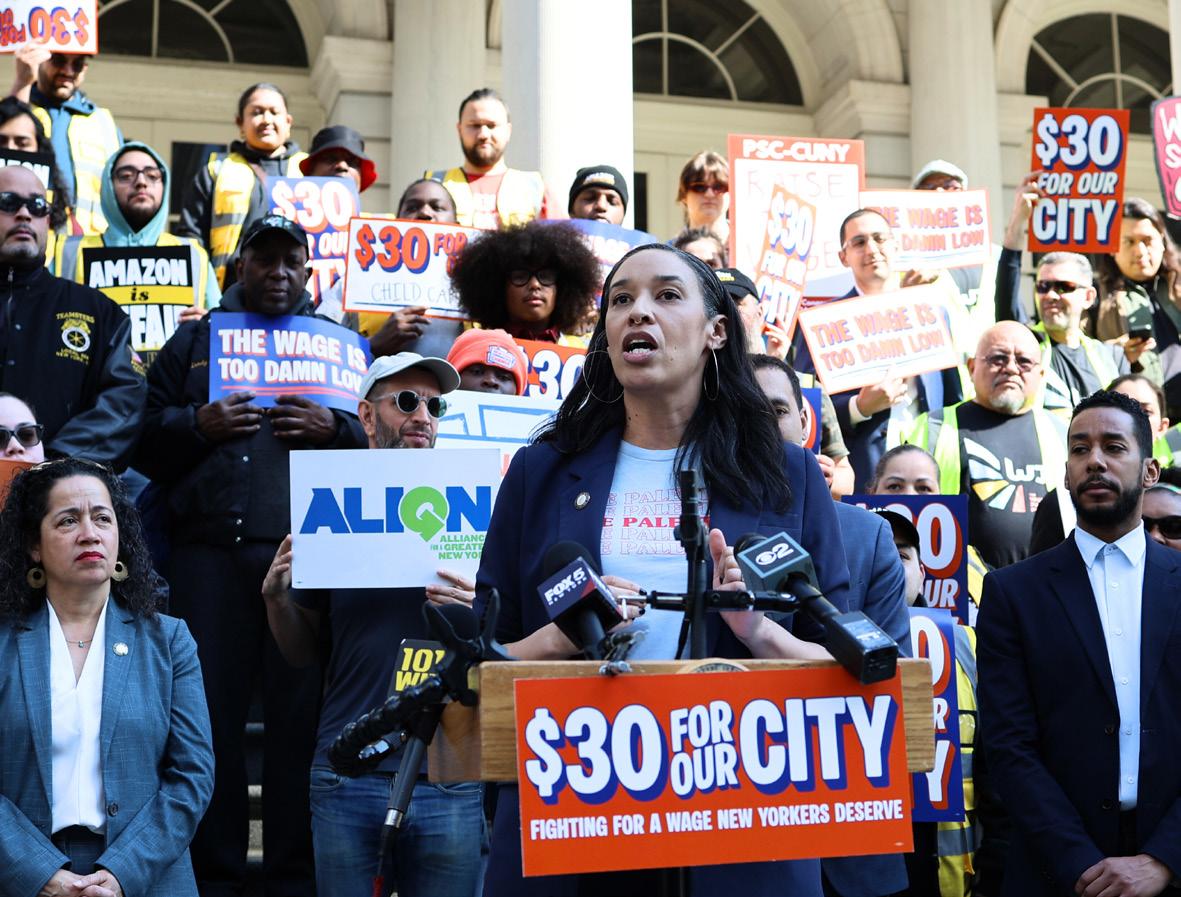
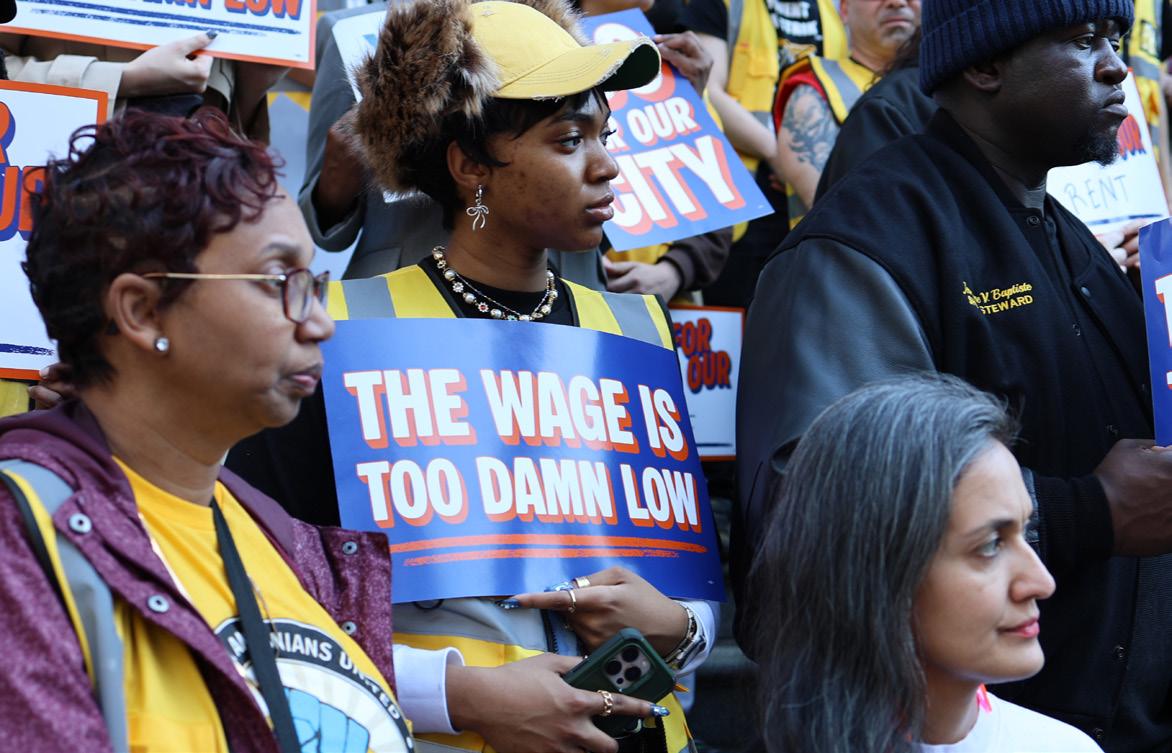
In an effort to nearly double the city’s minimum wage to $30 an hour by 2030, New York City Councilmember Sandy Nurse recently introduced the “$30 for Our City” Act.
With a crowd of supporters cheering her on as she announced the bill on March 10 from the steps of City Hall, Nurse explained that there needs to be an increase in the minimum wage because of the growing affordability crisis in the nation’s most expensive city.
New York City’s current minimum wage is $17 an hour for all employers, including tipped workers who receive a base cash wage plus tips. Tipped service employees are paid $14.15 in cash
wages with a $2.85 tip credit, while tipped food service workers must earn at least $11.35 in cash wages with a $5.65 tip credit. Starting in 2027, the minimum wage is set to increase annually based on the Consumer Price Index for the Northeast Region.
Councilmember Nurse, labor advocates, and a coalition of supporters under the Raise Up NY banner argue that current wages are not keeping pace with rising rents, grocery prices, and childcare costs.
“New York City’s minimum wage is a poverty wage, which at $17 an hour, leaves over 1 million workers barely surviving on $500 a week,” Nurse stated. “That’s why I’m introducing the $30 for Our City Act, to raise the minimum wage to $30 for every worker, with
automatic cost-of-living increases after 2030. NYC workers keep this city. They deserve to thrive, support their families, and enjoy the city they built.”
Nurses’ legislation creates a phased minimum wage increase, initially based on a business’s number of employees. For businesses with more than 500 employees — including related franchisees — wages would increase to $20 per hour in 2027, then $23 in 2028, $26 in 2029, and reach $30 by 2030.
Smaller employers, with 500 or fewer employees, would see a slower increase: $19 in 2027, $21.50 in 2028, $24 in 2029, $27 in 2030, $29 in 2031, and ultimately $30 in 2032. After that, the wage
Nurses at The Brooklyn Hospital Center rallied in Downtown Brooklyn on March 17 to protest over 45 days without health insurance benefits. (NYSNA photo).
Councilmember Sandy Nurse introduced the “$30 for Our City” Act on the steps of City Hall. ($30 for Our City campaign photo)
Opinion
NY attorney general Letitia James correctly identifies another Trump ‘witch hunt’
On March 18, the nation’s schools faced a deadline to submit data on students’ race and gender. But 17 states have taken a stand against the demand and filed a lawsuit last week to block the Trump administration’s attempt to further its partisan policy objectives. New York is among the states, and Attorney General Letitia James explicitly termed the issue another “witch hunt.”
“Colleges and universities should not be forced to turn over massive amounts of sensitive student data to satisfy another witch hunt,” she said. Moreover, she said the action was illegal, and that the administration was merely seeking “to serve its own political agenda and target DEI initiatives.”
Massachusetts Attorney General Andrea Joy Campbell took exception to the government’s “rushed and arbitrary framework,” noting that “there is no way for institutions to reasonably deliver accurate data” under these circumstances.
We agree with the attorneys general, and even if the matter were given sufficient time, we oppose any measure that interferes with efforts to diversify the student body. To this end, we join the steps being taken by the Progressive Policy Institute (PPI), which recently issued a report on economic diversity in admissions, indicating that it brings students with different backgrounds and sets of experiences to campus, and increases ideological diversity, as Richard Kahlenberg of the PPI observed, “opens paths to leadership in America to more low-income and working-class students.”
When Linda McMahon, the Secretary of Education, said the new requirements were a more transparent way to scrutinize whether colleges were abiding by the Supreme Court’s 2023 ruling, which outlawed race-conscious admissions, she was disingenuous and applied a narrow interpretation of the ruling. Of course, none of this comes as a surprise to the various distractions and artifices that are the stock in trade of the Trump administration.
Attorney General James was spot on in her assessment.
Don’t roll back game-changing testing for cancer patients
By COLETTE SMITH
My first thought was, “I’m going to die, and my son is only nine years old.”
As a Black woman who has seen cancer take a heavy toll in our communities, hearing my own diagnosis was terrifying. But after months of uncertainty and repeated doctor visits, finally having answers was empowering. It meant I could begin taking steps to defeat the disease.
Thankfully, my lung cancer was caught early and I had access to biomarker testing, a tool that gave my doctors critical information about my cancer and made it clear what treatment was best suited to fight my unique diagnosis, should it return. It gave my providers a roadmap while giving me hope.
However, millions of New Yorkers could lose access to that same opportunity if the state legislature rolls back Medicaid coverage for biomarker testing. This proposal would effectively create a two-tiered system: one for those with private insurance, and another for limited-income New Yorkers who rely on Medicaid, resulting in two very different survivorship outcomes. At a time when Black New Yorkers are already more likely to die from cancer, stripping away clear access to this revolutionary testing would resurrect access barriers and threaten efforts to ensure that everyone has the same opportunity to be healthy and cancer-free. That’s the opposite of advancing health equity.
“At a time when Black New Yorkers are already more likely to die from cancer, stripping away clear access to this revolutionary testing would resurrect access barriers and threaten efforts to ensure that everyone has the same opportunity to be healthy and cancer-free.”
justice, considering that nearly 60% of all cancer drugs approved in the last five years require or recommend biomarker testing before use. Without this tool, patients will not be matched with the latest and, often, most effective drugs that could potentially save their lives. During my cancer journey, and while caring for my husband after his prostate cancer diagnosis, I noticed that most of the patients in my Bronx community I spoke with were diagnosed at advanced stages, when treatment options are more costly, and survival rates are lower.
ly affect Black families, including sickle cell disease, lupus, and preeclampsia. There are also exciting research developments in cardiology, Alzheimer’s disease, Parkinson’s disease, and other conditions. Biomarker testing can also identify treatments that are likely to be ineffective or unnecessary, saving patients precious time and money.
Elinor R. Tatum: Publisher and Editor in Chief
Kristin
Gray: Executive & Investigative Editor
Biomarker testing is one of the most important recent advancements in cancer care and the treatment of many other diseases, including those that, historically, are hard to treat. It looks at a patient’s tissue, blood, or other samples to provide doctors with essential information to accurately diagnose the cancer, determine its stage, and choose the most effective treatment for that specific patient. This approach, known as precision medicine, can connect patients to treatments with fewer side effects, better quality of life, and more time with loved ones, compared to traditional trial-and-error approaches. Without Medicaid coverage criteria for biomarker testing, many New Yorkers could be forced to pay out of pocket, take on debt, or go without this game-changing testing. This would be a profound health in-
I have since founded Healing the Bronx to raise awareness about screening and encourage participation in clinical trials. I understand the historic mistrust that exists in our communities, but I also know that our representation in research matters.
Clinical trials are how we develop better treatments. For example, the drug that targets my biomarker, and that I will turn to if my cancer returns, is currently being studied in a clinical trial. To make sure new drugs and therapies are safe and effective for everyone, people from diverse racial and ethnic backgrounds need to be included. Many of today’s most promising clinical trials rely on biomarker testing to identify eligible patients. Without access to biomarker testing, patients cannot participate in these cutting-edge clinical trial options.
The impacts of biomarker testing extend far beyond cancer care. It also helps treat other diseases and conditions, some of which disproportionate-
100 organizations, including the American Cancer Society Cancer Action Network, sent a letter to state house and senate leaders noting that saving lives from diseases like cancer and advancing health equity increasingly involves the use of precision medicine alongside biomarker testing. While they recognized that our state legislators face difficult budget decisions stemming from deep federal cuts to Medicaid, they said rolling back Medicaid coverage for biomarker testing could ultimately cost more, in health care expenses and lives.
11 years ago, biomarker testing unlocked a path forward for my continued survivorship and gave me true peace of mind. Thanks to that, I got to live and watch my son grow up without fear and, instead, with real hope. All New Yorkers, regardless of income, race, zip code, or insurance type, deserve the same chance. I hope our state lawmakers remember that when they finalize the budget.
Colette Smith is a lung cancer survivor and volunteer with the American Cancer Society Cancer Action Network living in the Bronx.
Decriminalizing domestic violence survivors, a path to change
By EMILY JONES and CYNTHIA HOLLAND
As we mark Women’s History Month, the work to ensure women and children are safe is ongoing.
Nearly a quarter of women in the U.S. have reported experiencing severe physical violence by an intimate partner in their lifetime.
The prevalence of domestic abuse alone might seem reason enough to make it a near-constant conversation, but in most of our communities — and most of our churches — this is still a space of whispers.
Meanwhile, according to The Sentencing Project, the number of incarcerated women has grown more than 600% from 19802023, as the era of mass incarceration has continued with a relentless and deeply racist fury. But we don’t talk too much about that, either.
When we engage in these
conversations we simplify and mischaracterize the connection between incarceration and domestic abuse. We like to imagine that the criminal justice system is an abused person’s ultimate and most reliable protector. The reality is otherwise. In fact, domestic violence survivors themselves are often criminalized and punished by the very systems that claim to keep them safe. The numbers make this clear; about 8 in 10 incarcerated women were severely abused as children and about 7 in 10 experienced serious violence from an intimate partner in adulthood. Often, the court will not adequately consider a woman’s prior experience of abuse when sentencing her — even when that abuse is directly relevant to the circumstances of the crime with which she’s been charged. But that’s starting to change.
The Domestic Violence Survivors Justice Act (DVSJA) was passed in New York in 2019. This groundbreaking legislation allows judges to consider the context of abuse when survivors of domestic violence — and it allows domestic violence survivors who were sentenced prior to the DVSJA to seek relief and resentencing. The Survivors Justice Project and its forebears in the Coalition for Women Prisoners are to credit for this powerful advocacy victory. This work continues today through the Survivors Justice Project’s faithful — and necessary — efforts to ensure its full implementation. This reform has not been confined to New York either; in 2024 and 2025, respectively, Oklahoma and Georgia each passed their own versions of this legislation. The Oklahoma Survivors Act and the Georgia Survivor Justice
Act have continued this momentum for sentencing reform in pursuit of freedom for domestic violence survivors. Women on the Rise GA, led by Robyn Hasan-Simpson, drove this impactful work in Georgia.
I (Cynthia Holland) was proud to advocate alongside Women on the Rise GA and partner organizations this spring in the furious final weeks of the legislation session. The work of Women on Rise GA, Robyn, and others bore fruit this summer when the Georgia Survivor Justice Act was passed and signed into law. We are fortunate enough to live in two of the three states that have recently passed much-needed sentencing reforms to decarcerate domestic violence survivors in New York and Georgia. Our states are different. One is a blue state.
See DOMESTIC VIOLENCE SURVIVORS on page 36
Remembering the legacy of Civil Rights icon, Rev. Dr. Bernard Lafayette
By HERB BOYD
In his book, “The Making of Black Revolutionaries,”
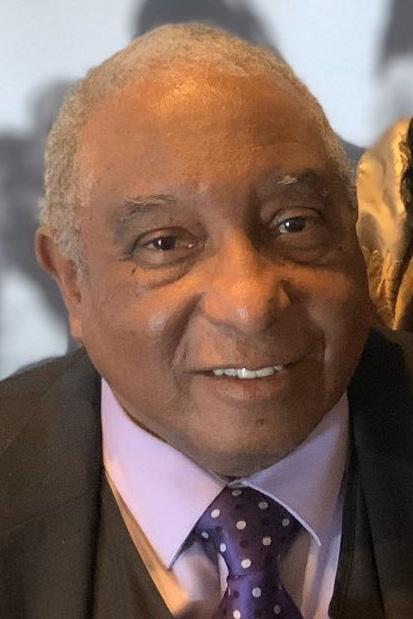
James Forman wrote that Rev. Bernard Lafayette authored “one of the finest accounts of just what it meant to be a SNCC (Student NonViolent Coordinating Committee) field worker in June of 1963 from Selma, Ala.” Forman said that Bernard and his wife, Colia, both 22, had gone to Selma to spearhead a “frontal attack on one of the most vicious and oppressive places in the Deep South.” That is a vivid opening on the life and legacy of Rev. Lafayette, who died on March 5 at his home in Tuskegee, Ala., of a heart attack. He was 85.
A photo in the SNCC files shows Lafayette with gashes in his head after he was severely beaten in Selma in 1963, two years after com-
pleting his indoctrination in Nashville as a Freedom Rider. When he was asked about his commitment to the Civil Rights Movement, he said, “It was not something you read that causes you to change,…it’s when you see other individuals fight against the system and insist that justice will come, and believe that justice will come, even if you have to lose your life.”
Life for Lafayette began July 29, 1940, in Tampa, Fla. He was seven years old when he witnessed his first incident of racism. After paying their fare and reentering a segregated trolley from the rear in Tampa, Lafayette watched as his grandmother was violently thrown to the ground. From this experience and attending church where his grandmother was an organizer in civil rights activities, Lafay-
ette received early lessons that would influence him for the rest of his life.
“She was a businesswoman and a devout Christian home missionary who owned and operated a grocery store and small animal farm,” he wrote in his memoir “In Peace and Freedom: My Journey in Selma” with Kathryn Lee Johnson. “She helped to found a church, the New Hope Missionary Baptist Church in Tampa, and built a congregation. She was my teacher and spiritual mentor, and she played a great role in my pursuit of higher education.”
When he was a teenager, he enrolled at American Baptist Theological Seminary (ABT) in Nashville, where his classmates were John Lewis and James Bevel. As Lewis related in his biography, “Walking With the Wind,” “Ber-
Be ready, have a voting plan now: Political mischief is already in the air
CHRISTINA GREER, PH.D.
nard was outgoing, but he wasn’t pushy or aggressive the way Bevel was. In fact, he was one of the few people who could handle Bevel and hold his own in a debate with that human hurricane.”
It is safe to say that the November 2026 midterm elections will be a defining moment in American democracy. Donald Trump, sensing sweeping losses across the country, is already planting seeds of distrust in the electoral process and preemptively claiming fraud. Similar to his behavior in 2016 when he, and almost all of the polls, were quite sure he would lose the presidential election, he stated that the Democrats were cheating and that the Clinton campaign had rigged the election. When he won on election night, those false claims magically disappeared. They only resurfaced when he lost the 2020 election, and he has not stopped ringing that false bell since. Most Americans prefer divided government, that is, when the president is of one party, and either one or both houses of Congress are of the opposing party. Right now, we have a unified government, that is, the Republicans controlling the presidency, the House, and the Senate. Usually, in modern history, Americans tend to vote during the midterms to usher in a divided government to slow down the political process and the policy preferences of one party. We have seen this when Democrats and Republicans held unified governments. Although divided government is the natural rhythm of American politics, the current president insists that any and all losses he incurs must be due to fraud and cheating, not his policies that are making Americans less economically stable, less healthy, and less safe at home and abroad. Therefore, if the president
does not call an emergency and cancel elections altogether in the fall, we must be prepared and have voting plans in place to combat the widespread voter suppression efforts already underway.
The Republicans are trying to quickly pass legislation, the SAVE Act, that will make it mandatory to show an ID before voting, a policy that will disproportionately affect poor people, young people, old people, and anyone who has changed their name. Therefore, we must be proactive and make sure of a few things. It is important to know your polling station and stay up to date on any changes to the location. Make sure you are registered to vote and check with friends and family members, especially those who do not vote in every election.
Depending on where you live, inform yourself about any increased police or ICE presence at your polling stations. And be sure to educate yourself about all of the races on your ballot, no matter how “minor.” It is not too early to spend just five minutes each day educating yourself about candidates and policies, especially this primary season, when these races are incredibly important in choosing who will be on the ballot in November.
Christina Greer, Ph.D., is an associate professor at Fordham University; author of the books “How to Build a Democracy: From Fannie Lou Hamer and Barbara Jordan to Stacey Abrams” and “Black Ethnics: Race, Immigration, and the Pursuit of the American Dream”; and co-host of the podcast FAQ-NYC.
Rev. Bernard Lafayette. (Public Domain photo)
Caribbean Update
Jamaicans anxious to find out whether island has commercial quantities of oil and gas
BY BERT WILKINSON Special to the AmNews
Apart from already resource-rich Guyana, Suriname, and Trinidad, Jamaica is the only other Caribbean Community nation which is very active in trying to find commercial quantities of oil and gas at a time when prices are high and the world market is volatile.
In recent weeks, the government and United Kingdom-based United Oil and Gas PLC have been forced to publicly reassure and calm an excited Jamaican public, stating that recent offshore geochemical exploration work did not mean that the island had at last found glory.
United Oil and Gas said that the work offshore in the Walton-Morant Bay area off South Jamaica had much to do with exploratory technical surveys linked to echo sounder works, heat flow probing data analysis, and piston core sampling of more than 40 seabed locations.
Once the company had an-
nounced the commencement of the surveying program, commentary from social media and some analysts had led to national excitement and anxieties to such an extent that Energy Minister Daryl Vaz was forced to issue a public statement asking Jamaicans for patience until indications are known.
The national excitement has much to do with the economic and financial windfall fellow Caricom member nation Guyana has experienced since U.S. supermajor ExxonMobil and consortium partners Hess Oil/ Chevron and China’s CNOOC first announced a “world class” commercial oil and gas find back in mid-2015.
There has been so much oil and gas found in the Stabroek Block in a so-called golden lane near Suriname, that the deepwater area was developed so fast that first oil production was achieved by the end of 2019, a record for such a massive deepwater project, analysts had stated back then.
Today, Guyana is producing 900,000 barrels of oil per day from
four projects with at least four more in the pipeline for development. In neighboring Suriname, the country is preparing for an oil boom thanks to some spectacular oil and gas finds by France-based Total Energies and Apache Corporation of Texas in early 2020. The treasury is also flush with cash and will, as well, benefit from current spiraling prices because of the Middle East war and the blocking of the Strait of Hormuz, through which around 20% of daily global production flows, officials say. Exxon says the Guyana Basin so far contains about 11 billion barrels of oil.
Guyana’s fast-growing oil sector has so energized other members of the Caricom bloc. Grenada is moving to dust off drawers containing previous seismic studies, while Barbados is signaling plans to attract the major companies to take a look at its offshore areas, near oil-producing Trinidad. The current Bahamian government says it is not interested in exploring oil or gas reserves because
Immigration news you need to know now
FELICIA PERSAUD
IMMIGRATION KORNER
With immigration policy shifting rapidly through court rulings, federal enforcement actions, and administrative decisions, it can be difficult to keep up with the developments that affect immigrant families and communities across the United States.
Here are several key immigration developments you should know this week.
ICE Detains Partner of Former North Miami Mayor
Federal immigration authorities have detained Sarahjane Ternier, the longtime partner of former North Miami mayor Philippe Bien-Aime and the mother of three of his children.
According to U.S. Immigration and Customs Enforcement (ICE), Ternier was arrested in Miami in connection with a long-standing deportation order issued on July 31, 2000. ICE records indicate that she entered the United States on June 12, 1994, and that her appeal of the deportation order was dis-
missed by the Board of Immigration Appeals in October 2002. She is currently being held at the Broward Transitional Center pending removal from the United States.
Her detention comes amid a separate federal civil case seeking to strip Bien-Aime, who was born in Haiti, of his U.S. citizenship. Federal prosecutors allege that the former mayor used fraudulent documents and multiple identities over several decades in order to obtain a green card and later U.S. citizenship.
Court filings further claim that Bien-Aime maintained multiple marriages simultaneously, including a relationship with Ternier while married to other women. According to federal documents, Bien-Aime ultimately obtained permanent residency and later U.S. citizenship through a separate marriage in Broward County.
The case highlights the growing scrutiny of immigration histories in denaturalization proceedings, a process the federal government has increasingly used in recent years.
Haiti Temporary Protected Status Case Heads to the Supreme Court
Another major development affecting thousands of immigrants in-
a spill or accident can ruin its marine and other lifeline tourism fixtures.
But, anxious for some resource that could spur national development at a rapid pace like Guyana and Suriname, Jamaica is the one that has so far successfully convinced oil companies that hydrocarbons lie below the seabed. This has triggered national excitement.
“So, once again, I caution everybody to be patient and calm and to listen to the government on this very sensitive matter. It will be two to three months before we hear anything, positive or negative, so we don’t expect to hear any rumors circulating about the discovery of oil or gas,” the minister said. “This is simply not a technical exercise. It is a meaningful step towards understanding the geological potential of offshore Jamaica. The data collected was state-of-the-art and will inform evidence-based decision-making about the country’s energy future.”
Minister Vaz says the core samples have been sent to American labs for
processing, so Jamaicans must wait for the results.
The recent shout about oil and gas has a bit to do with local fishermen reporting sea surface seeps that were initially dismissed as engine oils from small vessels or waste.
Persistent reporting by fishermen led to a deep dive that had attracted Tullow Oil of the UK, but it abandoned the project in 2020 after completing 3D seismic and other surveys. In stepped United Oil and Gas, and while it has struggled to raise funds internationally, the company has shown faith in Jamaica and now awaits the laboratory results from core and other samplings.
United Oil and Gas Chief Executive Brian Larkin has tried to hide his excitement about Jamaica, but says the firm is pressing ahead.
“The recovery of seabed sediment cores at all 42 selected locations is a fantastic achievement,” he said, describing the latest developments as “a potentially transformational exploration drilling phase for Jamaica.”
volves Temporary Protected Status (TPS) for Haiti.
On March 11, the U.S. Department of Justice filed an emergency application with the U.S. Supreme Court seeking to overturn a lower court ruling that blocked the administration from terminating Haiti’s TPS designation.
The administration argues that courts should not interfere with executive branch authority over immigration policy. However, the lower court’s injunction currently keeps Haiti’s TPS protections in place.
For now, Haitian TPS holders may continue living and working legally in the United States. Employers are also being advised to continue honoring existing employment authorization documents for Haitian TPS beneficiaries.
However, the legal situation remains fluid. The Supreme Court has ordered challengers to respond by March 16, meaning a decision on whether the administration may proceed with terminating Haiti’s TPS protections could come quickly.
Judge Blocks End of TPS for Somali Nationals
In another TPS-related case, a federal judge in Massachusetts has
temporarily blocked the administration from ending deportation protections for Somali nationals.
U.S. District Judge Allison D. Burroughs issued the order after the federal government failed to file a legal brief or assign an attorney to defend the policy in court. The ruling keeps protections in place for approximately 2,471 Somali nationals currently living in the United States under TPS.
Temporary Protected Status allows individuals from countries experiencing armed conflict, natural disasters, or extreme instability to live and work legally in the United States.
Judge Burroughs indicated that the ruling is temporary and that the court will move quickly to consider the broader merits of the case.
DHS
Terminates TPS for Yemen
At the same time, the Department of Homeland Security has announced the termination of Temporary Protected Status for Yemen. Former Homeland Security Secretary Kristi Noem stated that the administration determined Yemen no longer meets the requirements for the humanitarian protection program, which was
first granted in 2015 due to ongoing armed conflict.
The termination will take effect 60 days after publication in the Federal Register. Yemeni TPS beneficiaries without another legal immigration status will be expected to leave the United States during that period.
The administration is encouraging individuals to use the CBP Home app to voluntarily report their departure, which officials say may include travel assistance and a financial exit incentive.
Taken together, these developments show just how rapidly immigration policy is evolving in 2026. From court battles over Temporary Protected Status to increased enforcement actions and denaturalization cases, immigrants and their families are navigating a legal landscape that can change almost overnight. Staying informed is more important than ever.
Felicia J. Persaud is the founder and publisher of NewsAmericasNow.com, the only daily syndicated newswire and digital platform dedicated exclusively to Caribbean Diaspora and Black immigrant news across the Americas
New leadership for HARLEM WEEK is here to ‘honor our legacy’
By LLOYD B. DAVIS Special to the AmNews
HARLEM WEEK announced the appointment of multiple new leaders on their executive committee. This year’s HARLEM WEEK, to take place Aug. 1-16, will center around the theme “Honoring our Legacy.” The committee is excited about further developing through their online presence, expanding community partnerships, and seeking community input. All these expansions are designed to further strengthen the festival while also staying grounded in its legacy.
The new appointees are Marko Nobles, who will serve as chairman; L. Ade Williams, the son of the late Lloyd Williams will serve as first vice chairperson; Tamiko Evans will serve as second vice chairperson; Michael Flanagan, Ph.D., will serve as secretary; and Kristian Greene will serve as treasurer. All of these appointees have connections or roots within HARLEM WEEK in one way or another, and their new appointments further solidify their dedication to the festival.
Nobles, a self described “child of HARLEM WEEK” has been involved with the festival for over 40 years. He has been
working his way up in its programming by first starting as a summer youth worker and now his most recent position is second vice chairperson on the board of directors. He also owns and operates an internet radio station, RhythmAndSoulRadio. com. Nobles is grateful for the opportunities that HARLEM WEEK has given not only himself but fellow board members.
“We all were interns with HARLEM WEEK or we may have received scholarships from HARLEM WEEK, been involved in HARLEM WEEK in one way or another throughout our teenage and adult lives. We have been able to watch HARLEM WEEK grow and assist in the growth of HARLEM WEEK and now we have the honor to serve as leadership for this festival that has meant so much to us and many others,” said Nobles.
For the executive committee, building upon the foundations of HARLEM WEEK is what’s most important. According to Nobles, this includes bolstering their online presence.
“There will be more in the digital space in terms of HARLEM WEEK and what we do and how we impact the Harlem community and the Harlems around the world.”
Solidifying HARLEM WEEK’s collabo -
rations with other organizations is also important to this new board, and ensuring that all of the Black diaspora within Harlem has a chance to be represented in the festival.
“We will continue collaborations with organizations like [the] Caribbean Cultural Center. We’re looking at how we expand that partnership to continue to reach out to our brothers and sisters in the East Harlem Area,” added Nobles.
(l) Marko Nobles will serve as chairman; (r) L. Ade Williams, the son of the late Lloyd Williams will serve as first vice chairperson. (Photos courtesy of HARLEM WEEK)
See HARLEM WEEK on page 28
“My overall experience was great. I love the window, and from sales to scheduling, the experience was very good. The installers are highly skilled professionals and I would recommend Renewal by Andersen to all my contacts.” – LYNN F. | RENEWAL BY ANDERSEN CUSTOMER
Arts & Entertainment
Michael B. Jordan on legacy, craft, and the weight of an Oscar
By MAGRIRA Special to the AmNews
Sitting in the front row of the Oscars press room, I saw it up close — the kind of moment that silences a room before it explodes.
Michael B. Jordan walked in holding his Oscar.
The room stood. Applause rolled like thunder. It lasted nearly a full minute.
Jordan smiled, almost shyly, then adjusted the gold statue — eight and a half pounds of it — in the crook of his arm.
For Jordan, 39, who grew up in Newark, New Jersey, and worked his way from early roles in “The Wire” and “Friday Night Lights” to defining performances in “Fruitvale Station,” “Creed,” and “Black Panther,” the moment felt like something deeper than a victory lap.
It sounded like respect.
Here is what the Oscar winner said in his own voice. This interview has been lightly edited for clarity.
Q: I watched the film again last night before I came today. What kind of mental exercises did it take for you to create the nuances of the different personalities of these two characters?
Michael B. Jordan: That’s a great question. I write a lot of journals for my characters — their backstories. I try to go from the earliest memory I can conjure up and write all the way up to the first page of the script. It gives me an
opportunity to figure out where they’re coming from, and that informs a lot of the decisions. For these particular characters, I did a lot of chakra work around their childhood trauma just to differentiate the two of them. Smoke is a bit more quiet. He’s a protector. Stack is lighter, more buoyant, slick-talking — kind of a troublemaker. So I tried to establish different perspectives. They’ve had a relationship their entire lives. Imagine being in a partnership for thirty-something years — how many times they’d argue, how many times they’d keep score on who was right or wrong. All those
little things build up, and that’s what I wanted to live between the lines, those nuances between them. Yeah, there’s some other stuff that’s probably boring and you don’t want to hear about, but that’s a little bit of the work.
Q: Michael, you make us proud. Michael B. Jordan: Thank you.
Q: Nathan Hale Williams recently said, “Please stop telling Black people not to desire Oscars.” As someone who just won tonight, what does this recognition mean to you and to other writers and artists coming up?
Michael B. Jordan: It feels timely. Like I said before, I’m here because of the people who came before me — Sidney [Poitier], Denzel [Washington], Halle Berry, Forest [Whitaker] — all those actors who graced this stage. They weren’t looking for awards or acknowledgment. They were artists. They wanted to do the work. That’s what I focus on — doing the work. My father always told me: Don’t expect anything to be handed to you. Do the work, and everything else will figure itself out. And yeah, there’s a selfishness in understanding that this — this is the pinnacle of what
we do. This is what our industry values. You want that. But at the same time, what’s for you is for you. You can’t take anyone else’s blessings. I’m just walking my path, staying locked in. So I’d tell other actors and artists, whatever your medium is, be honest, be truthful, dream big, and be kind. I really believe in pouring into the universe, and it pours back into you. That’s how I live.
Q: You receive an incredible amount of support from fans and colleagues. What does it mean to have so many people rooting for you?
Michael B. Jordan: It feels great. Honestly, it feels incredible. I’ve been blessed. When you know people are invested in you, it hits different. I’ve been doing this for twenty-five years, and a lot of folks have seen me grow up in this business. They looked out for me when they didn’t have to. They wanted me to win when they didn’t have to. That goodwill — that energy — it matters. From the assistants responding to emails, to whoever’s opening the door letting you in, to the producers taking meetings, all of it builds something. People have been genuine with me, and it makes me want to make them proud — my parents, Ryan [Coogler], my collaborators, myself, and the kids coming up next. I’m really big on the next generation. I’m not a big talker. I’m about that action. I try to lead by example.
Michael B. Jordan accepts the Oscar® for Actor in a Leading Role during the live ABC Telecast of the 98th Oscars® at the Dolby® Theatre at Ovation Hollywood on Sunday, March 15, 2026.
Michael B. Jordan celebrates at the Governors Ball following the 98th Academy Awards at the Dolby Theatre at Ovation Hollywood in Los Angeles, California, on Sunday, March 15, 2026.
Michael B. Jordan has his Oscar® engraved at the Governors Ball following the 98th Academy Awards at the Dolby Theatre at Ovation Hollywood in Los Angeles, California, on Sunday, March 15, 2026.
History and heart: Ryan Coogler and ‘Sinners’ mark a powerful Oscar Night
By MAGRIRA
Special to the AmNews
Inside the Dolby Theatre on Sunday night, the applause for “Sinners” felt less like a routine celebration and more like something deeper.
By the end of the evening, the film had secured four Academy Awards, including Best Actor for Michael B. Jordan, Best Original Screenplay for Ryan Coogler, Best Cinematography for Autumn Durald Arkapaw, and Best Original Score for Ludwig Göransson.
The film entered the ceremony with 16 nominations — the most ever for a single movie in Oscar history. By the time the lights dimmed on Hollywood’s biggest night, “Sinners” had not swept the board, but the wins it did collect carried unmistakable weight.
At the center of that moment was Coogler.
When the Oakland-born filmmaker stepped onto the stage to accept the Oscar for Best Original Screenplay, he looked both grateful and slightly overwhelmed.
“What’s up? Please, please, please. Please sit down. Cause I’m very nervous, and they’re gonna play me off.”
He paused before thanking the Academy for recognizing a film that had premiered nearly a year earlier.
“I want to thank the Academy for thinking of our movie that came out almost a
year ago. This is an incredible honor. I want to thank my fellow nominees…for the gifts that your movies were and for your friendship over the past years and months.”
Coogler then turned toward the team that helped bring the film to life.
“I want to thank everybody that was involved with this movie, starting with
You all are winners in my book.”
He praised producers Sev Ohanian and Zinzi Coogler before speaking directly to his wife.
“Zinzi, you’re the best wife and mom in the world. Every day I get to spend with you
is better than the one that came before it.” Then he addressed his children watching from home.
“To my babies that are at home watching, I apologize for all the time away. Dad loves you. Memories are all we have. I hope I’ll give you some great ones.”
The room grew quiet when he added one more line.
“When y’all are blessed to live a long life and Dad becomes just a memory, I want y’all to remember this one thing. I love y’all more than anything.”
For many in the audience, the moment carried echoes of a longer history.
The Academy Awards began in 1929. More than a decade passed before an African American performer was recognized.
In 1940, Hattie McDaniel became the first African American to win an Oscar, receiving Best Supporting Actress for “Gone with the Wind.” Even that historic moment came with painful limits: she was required to sit at a segregated table during the ceremony at the Ambassador Hotel.
Recognition came slowly in the decades that followed.
In 1964, Sidney Poitier became the first African American man to win Best Actor for “Lilies of the Field.” Nearly forty years later, another milestone arrived. In 2002, Denzel Washington won Best Actor for “Training Day,” while Halle Berry captured
Warner Bros…all my cast and crew, please stand up. You guys are amazing.
Behind the camera, recognition has also been gradual.
In 2014, Steve McQueen became the first African American producer of a Best Picture winner with “12 Years a Slave.” In 2017, Barry Jenkins won Best Adapted Screenplay for “Moonlight,” which also took home Best Picture.
Against that long history, the success of “Sinners” carries meaning beyond the tro-
phies themselves.
The film arrived at the ceremony with a record number of nominations and left with four Oscars — including the deeply personal moment when Ryan Coogler stood on stage and spoke about family, memory, and love.
For a filmmaker who grew up in Oakland and Richmond, California, it was both a career milestone and another chapter in the ongoing story of African American artists at the Academy Awards.
At the Governors Ball, the Oscars receive their final names
By MAGRIRA Special to the AmNews
Here’s a peek inside the most influential party on Oscar night — the one where you rub elbows with winners, nominees, and gifted people from every corner of the film industry to celebrate the power of storytellers who dare. Inside the Governors Ball, the Oscars are not finished.
The ceremony may end on stage at the Dolby Theatre, but the night continues a few steps away, inside a ballroom where win ners quietly line up to have their names engraved into the base of the gold statuette. It is a surpris ingly intimate ritual. Technicians lean forward with engraving tools. Cameras hover nearby. An Acad emy representative checks the spelling of each name. Then the carving begins.
This year, there was a great deal of history to carve.
The 98th Academy Awards pro duced one of the most fascinat ing races in recent memory. By the time the celebration shifted to the Governors Ball, filmmakers, actors, composers, and craftspeople filled the room with the kind of energy that follows months of campaign ing, speculation, and creative rival ry. Yet the mood was measured. Alongside champagne and wine were elaborate zero‑proof cock tails layered with citrus, herbs, and botanical teas. The space was full of storytellers — people who spend their lives traveling, observ ing, and translating the world into images and dialogue — and the at mosphere leaned more reflective than raucous.
One quiet remark captured the tone of the night: pretending the world is in trouble, someone said, is as useful as trying to hold the sky in your fingers. What mattered here was the work. And the people who made it.
One of the milestones of the night belonged to Autumn Durald Arkapaw, who became the first woman — and the first woman of color — to win the Oscar for Best Cinematography for her work on “Sinners.” For nearly a centu ry, the category had existed with out a female winner. Her victory changed that.
“Sinners,” directed by Ryan Coogler, entered the evening with 16 nominations — the most ever for a single film — and ended with four wins, including Best Original Screenplay for Coogler, and Best
Actor for Michael B. Jordan. At the Governors Ball, Coogler moved through the room with his wife and producing partner, Zinzi Coogler. The filmmaker from Oak land, who first drew attention with “Fruitvale Station” before reshap ing Hollywood with “Creed” and “Black Panther,” appeared both re lieved and reflective as collabora tors stopped to congratulate him.
Not far away, Jordan’s victory car ried its own weight. His perfor mance in “Sinners” earned him the first Oscar of a career that began with television roles in “The Wire” and “Friday Night Lights,” and grew into defining turns in “Fruitvale Sta tion,” “Creed,” and “Black Panther.” Later, at the engraving station,
Guests drift between stations serv ing Puck’s signature smoked‑salm on Oscar pizzas, truffle chicken pot pie, and wagyu sliders. Nearby, chefs roll sushi behind glass coun ters while servers pass trays of shrimp tacos, mushroom dump lings, and steak tartare balanced on crisp potatoes.
Dessert leaned into Hollywood mythology — signature Wolf gang. I still have mine from previ ous years, carefully wrapped and frozen in my freezer, a small, glit tering reminder of Oscar night’s sweet excess. Thousands of min iature chocolate Oscar statuettes dusted with edible gold lined pastry displays, flanked by éclairs, caramel‑filled pastries, and gelato
winners leaned forward as techni cians etched their names into the bases of their Oscars. It’s a quiet moment. For a second, the room narrows to the sound of metal against metal. Then the Oscar be comes permanent.
Across the ballroom, another long‑standing ritual unfolded at the table. For more than three decades, the Governors Ball has belonged to Wolfgang Puck, the Austrian‑born chef who has overseen the menu since 1995. This year marked his 32nd year running the kitchen for the Academy’s biggest night.
The scale is staggering — hun dreds of chefs, pastry artists, and cooks preparing dozens of dishes for more than a thousand guests — yet the food still feels personal.
spun fresh inside the ballroom.
Behind the bar, bartenders poured champagne and mixed signature cocktails built on tequi la, espresso, and citrus. Still, many guests opted for the zero‑proof drinks, herbal, citrusy blends that felt more like ceremonies than cocktails.
The result was a celebration that felt measured and thoughtful, a gathering of people who spend their lives imagining the world.
Across the room, winners’ names were carved into gold. History fixed in metal. And in that corner of Hollywood’s biggest cel ebration, the future of cinema seemed just a little wider — per haps even a little brighter — than it had only a few hours earlier.
Autumn Durald Arkapaw makes history with Oscar win for Cinematography on ‘Sinners’
By MAGRIRA Special to AmNews
At the 98th Academy Awards, Autumn Durald Arkapaw made history.
The New Zealand-born cinematographer behind “Sinners,” directed by Ryan Coogler, became the first woman — and the first woman of color — to win the Oscar for Best Cinematography during the ceremony held March 15, 2026, at the Dolby Theatre in Hollywood.
Her richly textured 35mm visuals, blending practical firelight with deep blues for the film’s vampire twins, helped define the visual identity of the movie, which entered the night with 16 nominations and ultimately secured four Academy Awards.
Following her win, Arkapaw spoke with reporters in the press room about the significance of the moment.
“It’s tricky because when you go up there, you have so much to say, especially after 98 years,” she said. “There’s so much in your head and you’re like, ‘Are they going to kick me off? Can I say all this stuff?’”
One thought stayed with her
throughout the evening.
“One thing I had written down was that a lot of little girls who look like me will sleep really well tonight because they’ll want to become cinematographers,” she said. “And I know that…just being on stage, getting this award for a movie like that will change so
many girls’ lives because they’ll be inspired when they weren’t before.”
For Arkapaw, the moment was not only personal but also symbolic. For young filmmakers watching, particularly women, she said the path forward begins with visibility.
“I heard Karen O say it once at a concert,” she explained. “She said,
‘You have to see you to be you.’”
She credited the environment created on the set of “Sinners” for allowing women to lead creatively.
“Ryan gives us, the women on this film who are heads of department, those opportunities to
shine and be ourselves,” she said. “We work in a creative environment where we’re leading, we’re strong, we have power. He trusts us. That doesn’t happen very often.”
Arkapaw also acknowledged cinematographer Rachel Morrison, who recommended her for the project.
“I knew that if this was going to happen, it was going to happen with someone like him,” she said. Looking out at the audience and later at the reporters gathered in the press room, Arkapaw said the moment belonged to more than one person.
“Moments like this don’t happen without women standing up for you and advocating for you,” she said. “I’ve learned over the past few months that it takes a village to make something like this happen.”
She paused before adding what the win ultimately represents.
“This isn’t about me anymore,” she said. “It’s about so much more. I wanted it for all the ladies in the room, and I wanted it for all the girls at home.”
Sometimes showing up for yourself is the largest declaration one can make in protest of the internal tumult. Showing up and being present will prove to be right on time and just what you needed. Allow me to testify.
Like many of us, I am going through some stuff as I recover and heal both inside and out. Add to that the state of our country, of the world, plus blizzards and seasonal depression. It is difficult to fight the inertia of it all. Some days are better than others. I chose to gently place the good moments together and, one by one, build back better. One of the ways I unknowingly show up for myself is by pouring into others. A smile, a “good morning”, a compliment to strangers. So, on one of my lower days, I decided to text a friend just to say, “Sending you some Thursday energy. Grateful for you.” What this simple moment begat lives in my heart rent-free for myriad reasons.
That friend, Adam Reiner, an award-winning writer and author of “The New Rules of Dining Out,” then invited me to join him that night for a preview tasting menu at the celebrated Korean French-NYC inspired pastry boutique Lysée by chef Eunji Lee. ‘Yes’ was the only answer.
That evening, I arrived at the discreet Flatiron location and emerged into a modest,
modern, intimate space. Adam was working his way through the curated beverages. The knowledgeable, personable, and talented team did not miss a beat to guide diners through what they are calling ‘The Journey,’ a 10-course farm-to-table experience based on seasonality, craftsmanship, and collaboration. No, the symbolism of The Journey was
not lost on me. I embraced the moment from the first three savory courses of spring pea tart with calamansi-yuja and sesame oil vinaigrette, egg and caviar, and spring herb sorbet with lemongrass granita to the last three dessert courses of Lysée’s signature brown rice pastry, the perilla using the seeds of the plant creating a verdant sweet mild sesame-like oil, and their most ad-
mired dessert, mille-feuille. Between the beginning and the end of this journey lay a tremendous bread and butter course using three New York State-grown and milled grains to create a laminated masterpiece and served with house-cultured butter made with A2A2 cream. Being served in the middle of the tasting, not the beginning, reflects chef Lee’s respect for these ingredients.
There is so much more I experienced at Lysée’s The Journey. I won’t spoil the vinegar tasting or petit fours for your own journey. Reservations are limited and quickly sell out for this masterful, unique NY-forNYC tasting experience. If this is your jam, get into it.
Thank you, Adam, always for your friendship and the robust conversation-cumdebating about dining, career, and life in general. Chef Lee and the Lysée team, I know your journey beyond The Journey will remain purposeful. Cheers! And to all who know, or are in the struggle, keep showing up for yourself. Thanks for reading and happy eating!
Kysha Harris is a chef, food writer and editor, culinary producer, consultant, and owner of SCHOP!, a personalized food service in NYC for over 23 years. Follow her on Instagram, @SCHOPnyc, and on Facebook, @SCHOPnyc.
Questions, comments, requests, feedback, invitations! Email us at AmNewsFOOD@SCHOPnyc.com. Follow us on Instagram and Facebook @NYAmNewsFOOD.
With Lysée chef Eunji Lee. (Kysha Harris photos)
Spring Pea Tart Bread & Butter
The Perilla
Mille-feuille
KYSHA HARRIS FOOD EDITOR, @SCHOPNYC
Collaboration and community are key for actress, writer, and director Danielle Nicolet
By LOIS ELFMAN Special to the AmNews
When the crime thriller “Long Time Listener” premieres on April 2 on AMC’s ALLBLK Network, it will mark the featurefilm directorial debut of Danielle Nicolet, an established actress whose credits include a long-running role on the TV series “The Flash” and a starring role in the film “The Life of Me,” due out this summer.
With “The Flash” an established series (2015–23), Nicolet was not consumed with auditioning and looking for acting jobs, so she expanded her artistic vision to include writing and directing.
The “Long Time Listener” directorial position came about after Nicolet met with production company GreenApple Entertainment regarding another film that she and writing partner Kayla Compton had written. A few days later, GreenApple executive Roxanne Warren reached out for an unexpected conversation. GreenApple had entered into an agreement with AMC ALLBLK to provide four films.
Given that GreenApple is a company that creates and distributes films for African American audiences, particularly Black female audiences, and AMC ALLBLK creates content for a similar audience, Warren wanted to take that opportunity to elevate Black female directors. Familiar with Nicolet’s work as an actress and writer, Warren asked if she was interested in directing a film. Despite the challenges, such as budget and time limitations, Nicolet was all in.
“Little did Roxanne know, I had been training for quite some time to direct,” said Nicolet, whose acting credits also include iconic TV shows like “Family Matters” and “Key & Peele.” “I was shadowing on ‘The Flash’ for multiple episodes. I’ve done directing programs. I directed two short films. It was exactly the opportunity that I was looking for…and I was maybe the director that they were looking for, and they didn’t
realize it when they came up with the plan.
“I’m aware of what a terrific opportunity this is,” she added.
“Almost nobody gets to direct their first feature and know for certain that it’s going to be released and people are going to see it.”
Nicolet also brought to this project her experience shadowing the director of her upcoming film, “The Life of Me,” as well as watching friend Meagan Good direct the short film “Black Karen,” which Nicolet wrote. That film was produced by Kevin Hart’s studio. The Sundance Institute got behind it and put Nicolet through a fellowship program, and the film premiered at the Sundance Film Festival. It can now be seen on Prime Video and is being developed into a fulllength feature.
“‘Long Time Listener’ was certainly my preparation meeting an
opportunity,” Nicolet said. “I’m super grateful for the mentors that I have that are continuing to encourage me. Anybody who wants to do this, find a mentor, find several.”
“Long Time Listener” is about a true crime podcaster who becomes the target of a mysterious long-time listener. She’s pulled into a web of secrets that grow increasingly dark and is faced with the terrifying question: who is really in control of the story?
Nicolet does not star in the film, but she does have a role, which meant at times she had to simultaneously act and direct.
“Going into ‘Long Time Listener’ I knew that the best way for me to succeed as a director who’s in the film was going to be for me to reach out to friends and people who are very successful in the business that I can trust implicitly to be in the film,” she said. “Those people being [former co-
stars] Meagan Holder and Lyriq Bent [who are the leads].”
When she was in a scene and Bent was not, she would ask him to stand at the monitor and make sure she was achieving what she envisioned for the scene. He gave her adjustments. “I could trust him implicitly to do that,” Nicolet said. “He’s a producer and writer himself. The same goes for Meagan. I hardly have moments on screen without Meagan, but I can trust Meagan implicitly to be at the monitor. That level of support is the thing that made it easy for me to act in the movie as well.”
Nicolet is all about community, whether it’s working with longtime collaborators or feeling comfortable reaching out to people in the entertainment industry to ask for help or having people reach out to her with questions. Her friends are multihyphenates — actors, writers, producers, and directors — and
they elevate each other.
“For me, friendship is a verb,” Nicolet explained. “If I’m your friend, I’m not just going to say it. I’m going to show up for you, I’m going to do whatever you need. … We rally the troops, we come together, and we say, ‘How can I support you?’ I think it’s the only way women get ahead, especially in this business.”
Nicolet said, when you make quality films for people of color, they eat them up like delicious food and want more. She is very much still an actress while she works to serve up more deliciousness as a writer and director.
“I have a feature that I just finished [writing] called ‘The Bishop of Harlem,’” she said. “I’m very hopeful that when ‘Long Time Listener’ is seen, it will open more doors for me as a director. I certainly hope to do another film for GreenApple and AMC ALLBLK and continue this journey.”
(Images courtesy of GreenApple Entertainment)
Danielle Nicolet in “Long Time Listener."
Roella Oloro at Jazz Forum; opening weekend for new club Jazzcultural
Regardless of how high the bar of expectation is extended by legendary artists like Alice Coltrane, Eric Dolphy, Geri Allen, and Mary Lou Williams, there’s always space in the galaxy for aspiring generations to reach the sky.
One such young multi-instrumentalist and composer is Roella Oloro, lighting up Women’s History Month for one night only on March 22, at Jazz Forum (1 Dixon Lane, Tarrytown). Make it a point to experience this exciting young artist, who blazes across genres from hard-bop to standards and her impressionable originals.
The British-born artist of Nigerian and Jamaican descent leads a flyin’ trio that sounds like a larger group of musicians as she effortlessly moves from piano bench to centerstage, dropping burning alto sax melodies. While at home in small configurations, she has written for a variety of different ensembles. Her composition for Symphonic Wind Orchestra, “La Voyage de la Riviere,” premiered at the Berklee Performance Centre in December 2022, seven
years after she initially composed it at age 17. In 2018, she was offered a full scholarship to study at Berklee College of Music.
At Berklee, she received tutelage from professors such as NEA Jazz Masters Terri Lyne Carrington, Joanne Brackeen, and spirited saxophonist Tia Fuller. In 2022, she studied with multi-instrumentalist and vocalist Esperanza Spalding at Harvard as part of Spalding’s Black Improvisational Music and Dance class.
She appears for one night only, two shows at 4 p.m. and 6 p.m., which should energize you enough to become a true fan. For reservations, visit jazzforumforthearts.org.
On March 20-21, Jazz Forum features NEA Jazz Master pianist, composer, and educator Joanne Brackeen. She will be accompanied by the consummate first-call bassist Ugonna Okegwo, having performed with everyone from Lionel Hampton to Kenny Barron, and Michael Brecker; and resourceful drummer Matt Wilson, whose at-home clocking over 13 albums as a leader or playing alongside such artists as Herbie Hancock, Antonio Hart, Marshall Allen, and Christian McBride. Brackeen’s early performances with innovators Dexter Gordon, Chick Corea, and Ornette Coleman inspired her to play outside boundaries, find the inner core or an outer realm of extension. Having recorded over 20 albums as a leader, her trios have featured
the likes of Jack DeJohnette, Billy Hart, and Cecil McBee. She is a professor at the Berklee College of Music and at The New School. Brackeen’s curiosity consistently pushes her to stretch jazz boundaries. Two shows each night at 7 p.m. and 9:30 p.m. For reservations, visit jazzforumforthearts.org.
Mark Morris Dance Group and Music Ensemble
If music is the spirit of the soul, then more music temples — commonly known as jazz clubs — are needed. All those great jazz clubs are gone from swing street (52nd Street), the Lower East Side’s Loft scene, Boondocks, Slugs, Sweet Basil, Sweet Rhythm, Bradley’s, Mikell’s, to the Lenox Lounge and Count Basie’s in Harlem, where Roy Haynes told me, “Cats would rather go to Harlem than Heaven.”
Following the COVID pandemic and New York City’s ongoing gentrification, Jazzcultural, a new, much-needed jazz club, has risen from the rubble of jazz’s past. Spike Wilner, proprietor of Smalls and Mezzrow, has renovated one of Manhattan’s old stomping grounds — the former Swing46, located on the fabled Restaurant Row at 349 West 46th Street (formerly Red Blazer Too), a music venue with an interesting, storied past. Restaurant Row captures a time when swinging rhythms lingered like a hip rainbow over the many clubs that lined the street, in the ground floors of brownstone tenements.
Wilner may start a new trend with his Jazzcultural, deviating from the normal jazz club night activity. “We conceived of a place that will open early in the morning for breakfast and [with] coffee service until 5 p.m., an easy environment for hanging and socializing,” said Wilner during an interview with the publication West 42nd Street. The café is connected to a 98-seat, state-of-the-art concert hall (ticketedpriced venue) with incredible sound, topof-the-line equipment, and a stage large
enough to hold an 18-piece orchestra, for ticketed shows and serious jazz concerts (no eating allowed in the concert hall).
Jazzcultural is dedicated to Wilner’s mentor and teacher, legendary NEA Jazz Master pianist, composer, and educator Barry Harris. In the 1980s, Harris, along with bassist Larry Ridley and jazz impresario and publisher Jim Harrison, created The Jazz Cultural Theater, where Harris taught music classes, and which also hosted live performances and workshops. “I spent the earliest years of my career at his theater basking in the glow of the real jazz legacy of this city,” said Wilner. “The Jazz Cultural Theater had concerts, home-cooked food, and of course Barry’s continuous teaching.” The new club gets its name from the theater — Jazzcultural.
Like his West Village jazz clubs, Wilner is keeping live music affordable for the average jazz fan. At Jazzcultural evening performances in the café/bar section will be priced at $25 plus a one-drink minimum, while seating in the dedicated listening room will be $40 plus a drink. There will be no cover charge during the café’s day hours.
The opening weekend, March 20-22, features the Jesse Davis Quartet with pianist Spike Wilner, bassist John Webber, and special guest drummer Lewis Nash with two sets at 7 p.m. and 9 p.m. followed by master pianist and vocalist Johnny O’Neal and his Trio featuring bassist Joseph Ranieri, and drummer Itay Morchi at 10:30 p.m. The following weekend, March 27-29, brings NEA Jazz Master George Coleman Sr. and Quintet (two sets at 7 p.m. and 9 p.m.), followed by the Eric Wyatt Quartet. By April, operating days will extend to Wednesday through Sunday, eventually expanding to full-time hours in the very near future. For tickets, visit jazzcultural.com.
UN panel says racist hate speech by Trump and other U.S. leaders has led to human rights violations
By STEFANIE DAZIO and TERRY TANG Associated Press
GENEVA (AP) — A UN-backed panel of independent experts focusing on racial discrimination says racist hate speech by U.S. President Donald Trump and other American political leaders, along with a crackdown on immigration in the United States, have led to “grave human rights violations.”
The Geneva-based Committee on the Elimination of Racial Discrimination issued its decision Wednesday and urged the U.S. to suspend immigration enforcement operations at, and near, schools, hospitals, and faith-based institutions.
The decision, made under the committee’s early warning protocol, is not legally binding but seeks to hold a country — in this case, the U.S. — to its own international commitments.
The committee said it was also “deeply disturbed” by the use of derogatory and dehumanizing language around migrants, refugees, and asylum seekers. Committee members attributed a reported rise in racial discrimination to “racist hate speech” targeting those groups, but did not point to any specific data. Besides speech, there is also concern about the impact of politicians and other public figures weaponizing stereotypes to incite hate crimes and discrimination.
“Portraying them as criminals or as a burden, by politicians and influential public figures at the highest level, particularly the President,” the committee said in a news release, “may incite racial discrimination and hate crimes.”
Trump, as well as Presidents Joe Biden and Barack Obama, have been in office when the UN condemned systemic racism, hate, and discrimination. But the panel this time specifically cited Trump’s speech as part of the
March 19, 2026 - March 25, 2026
Divine Nine News
Continued from page 9
organizations, and community groups seeking speakers or fitness programming, collaboration creates meaningful change. As a member of Delta Sigma Theta Sorority, Incorporated, I know we have always responded to community needs with action. I am proud to extend that legacy through fitness initiatives, motivational programs, and leadership workshops that meet people where they are.
problem. They did not single out Biden or Obama for their rhetoric.
U.S. Immigration and Customs Enforcement, along with U.S. Customs and Border Protection, were also singled out for racially profiling people of color and conducting identity checks that often seemed arbitrary.
“This United Nations assessment is just as useless as their broken escalator, and their extreme bias continues to prove why no one takes them seriously,” said White House spokesperson Olivia Wales, who noted Trump’s work reducing crime and securing the U.S. border.
“No one cares what the biased United Nations’ so-called ‘experts’ think, because Americans are living in a safer, stronger country than ever before,” she added.
In the report, the committee alleges the U.S. is not living up to its obligations as a
Healthy living is not optional; it is essential. When mind and body are aligned, people think more clearly, move more strongly, and lead better. Fitness and wellness create the foundation for service, productivity, and confidence. I believe these are values that Delta promotes through action and example.
My goal is to continue building bridges between leadership, wellness, and service.
Delta Sigma Theta Sorority, Incorporated, shows us that lasting change happens through commitment, education, and action. I carry that lesson into every pro-
party in the International Convention on the Elimination of All Forms of Racial Discrimination, which the UN adopted in 1965. The report noted incidents involving “discriminatory, dangerous and violent methods” have left eight people dead in the last three months, including Alex Pretti and Renee Good, two U.S. citizens protesting in Minnesota. Pretti and Good died in separate shootings at the hands of federal agents during Operation Metro Surge.
The use of lethal force in those two cases was tantamount to “arbitrary deprivation of life and other gross violations of international human rights law,” the panel stated. Migrants, refugees, and asylum seekers who are detained also deserve humane and equal treatment free from discrimination under the Convention. But these groups have been denied basic essential services,
gram I lead and every message I share. For those interested in leadership development, motivational speaking, or fitness and wellness programming focused on longevity and quality of life, I welcome opportunities to connect. Together, through movement, mindset, and service, we strengthen individuals and communities. This work reflects who I am and what Delta represents.
Leadership must be active, visible, and grounded in wellness. When we care for ourselves, we are better prepared to care for others, lead with clarity, and create
including health care, education, and social support, the report states.
The committee is calling on the U.S. to review whether its immigration policies abide by international human rights law. This should include suspending immigration enforcement operations, including around schools, faith-based institutions, and hospitals, repealing “discriminatory measures” related to asylum procedures, and putting up safeguards so immigration agencies cannot access personal data in government databases.
However, it’s not clear if the UN could actually enforce these proposals.
This is not the first time the panel has criticized the U.S. over racism and discrimination. It did so in 2014, after the widespread Black Lives Matter protests over the police shooting death of Michael Brown and other victims, and again in 2020 after the murder of George Floyd.
Also in 2020, a different UN human rights body heard similar arguments from a special rapporteur on contemporary racism, discrimination, and xenophobia.
The Trump administration made mass deportations a key part of its second-term agenda and launched a wave of immigration restrictions and heightened enforcement in multiple cities across the country.
The crackdown has led to a surge in arrests of immigrants and mounting concerns by critics over the tactics the administration is using both in detention and enforcement.
The administration has cited security and economic concerns for the crackdown.
The Committee on the Elimination of Racial Discrimination counts 18 independent experts from around the world as members, and they monitor implementation of the Convention on the Elimination of All Forms of Racial Discrimination. The U.S. ratified the convention in 1994.
positive, lasting impact. That belief continues to guide my journey on and off the track, in business, service, and community leadership.
Joetta, a four-time Olympian, shares more resources on joettasportsandbeyond. com. She continues to draw from values that were instilled by her parents, Jetta and Dr. Joe L. Clark, whose life and impact as a school principal were featured in the movie “Lean on Me.” Joetta is also the mother of Talitha Diggs, an American track and field athlete and world champion.
Donald Trump participates in a Board of Peace meeting at the Donald J. Trump Institute of Peace in Washington, D.C. (The White House photo)
NYC 2025 graduation rate dips, fueled by declines among students with disabilities and English learners Education
By ALEX ZIMMERMAN Chalkbeat
This story was originally published by Chalkbeat. Sign up for their newsletters at ckbe.at/newsletters
Graduation rates dipped last year across New York City by just over two percentage points to 81.2% — the largest year-overyear decline in more than two decades — as officials have reinstated requirements that were loosened during the pandemic.
Meanwhile, the graduation rate across the state fell by just under one percentage point to 85.5%.
The drops in students graduating on time were most pronounced for some of the city’s most vulnerable children. Just 59% of students with disabilities graduated in four years, a drop of 5.5 percentage points. Nearly 52% of English language learners graduated in four years, down by about three percentage points.
The data, which state officials posted quietly online without the customary public announcement or press briefing, reveals the graduation rates for the Class of 2025. Those students began ninth grade in September 2021, the first time all students were required to attend school in person after the pandemic hit.
“They entered high school in a weird place,” said Sarah Part, a senior policy analyst at Advocates for Children of New York, a group that provides support and legal help to low-income families. “It is possible that some students started ninth grade not as prepared as they otherwise would have been.”
Still, the city and state’s overall graduation rate remains higher than before the pandemic, when about 77% of city students graduated in four years, and 83% of students statewide did.
City officials contend that last year’s dip was largely driven by resuming graduation standards that had been relaxed during the pandemic to account for disruptions to instruction. Some students received waivers from Regents Exams or were allowed to appeal low scores.
Nearly 14% of city students relied on a Regents exam waiver to graduate in the Class of 2025, down from a whopping 53% in the Class of 2024, city officials said. (Nearly 53% of students successfully appealed low scores, a similar number as the year before.)
It is difficult to determine to what extent the graduation policy changes have affected the graduation rate because some students may have still graduated even
without the more lenient standards.
Aaron Pallas, a professor at Columbia University’s Teachers College who has studied school performance, said it is possible the policy shifts are having a meaningful effect, but it’s important to look at longer-term trends. “My perennial claim is don’t make too much of a one-year change,” he said.
Pallas said other factors could be playing a role. Rates of chronic absenteeism remain elevated, for instance, likely affecting students’ academic performance.
Grad rates drop significantly for students with disabilities and English learners
Andrew Wilder, an English as a second language teacher at Brooklyn’s Franklin Delano Roosevelt High School, said he was unsurprised that graduation rates for English learners dropped after soaring during the pandemic.
“The fact that students did not have to pass the English Regents — that led to a pretty substantial bump in the graduation rate,” he said. “It’s an English language test more than it is a test of a student’s high school ability.”
Even accounting for this year’s decline, however, graduation rates for that group are up about 11 percentage points since the pandemic hit.
Yet, dropout rates for English learners spiked to 18%, up four percentage points, city data show.
The city’s overall dropout rate increased slightly to 5.2%.
One group that bucked the trend: The dropout rate for students with disabilities fell slightly, to 6.7%. That could suggest some students who remain in school but didn’t graduate on time will still eventually earn a diploma.
“It’s possible students are just needing a little bit more time in high school,” said Part, from Advocates for Children of New York.
The data reveal continued disparities in graduation rates between different racial groups. Nearly 92% of Asian American students graduated on time, along with 87% of white students. About 77% of Black and Latino students graduated in four years. (Every racial group saw a decline.)
Education Department spokesperson Isla Gething wrote in a statement that the city remains “committed to high-quality instruction and strengthening targeted supports so that every student, especially students with disabilities and English language learners, has equitable access to rigorous instruction and clear pathways to graduation.”
(Pexels/Pavel Danilyuk)
Phasing out Regents offers an opportunity to rethink graduation standards
The graduation rate fluctuations during and after the pandemic could hold important lessons for policymakers as they rethink what it should take to earn a diploma.
State officials are in the process of phasing out Regents exams — which have been in place since the mid-1800s — as a graduation requirement. Instead, New York students will need to meet a broader set of criteria demonstrating critical thinking, communication, and other skills known as the “portrait of a graduate.” State officials, however, have not unveiled the specific graduation standards students will be required to meet in the coming years.
Arlen Benjamin-Gomez, the executive director of EdTrust-New York, said the fluctuations for students with disabilities and English learners should prompt a broader conversation about how state officials can set appropriate standards for different groups.
It’s a “real opportunity to think about these two subgroups particularly, because this data really shows us how much they’re impacted by whatever the graduation measures are,” she said. “Having a disability shouldn’t be a reason that you are not able to graduate from high school.”
Still, she noted that officials must be careful to ensure that graduation standards remain rigorous and signify that students are ready for life after high school, including college or the workforce.
Wilder, the English as a second language teacher, was eager for more details and looks forward to spending less time teaching to the Regents exam. The test, he said, is often too far above his students’ level of English proficiency to be a useful measure of their learning.
“They come to believe that their inability to pass the English Regents is somehow a function of them as a student,” he said.
Alex Zimmerman is a reporter for Chalkbeat New York, covering NYC public schools. Contact Alex at azimmerman@chalkbeat.org.
Chief Judge Wilson
complaint,” said Palumbo over email. “All judges are strictly prohibited from engaging in political activity. While the OCA’s response was tailored directly to the Second Look Act and policy discussions, the heart of the complaint lies in the Chief Judge’s political commentary.”
But Katie Schaffer, Center for Community Alternatives director of advocacy and organizing, who helped put together the symposium, says Wilson’s comments simply condemn judges for using dehumanizing language and “rightfully” inform audience members about their ability to vote them out. And she believes the event remains a resounding success. Center for Community Alternatives, which launched Communities Not Cages, hosted the symposium in conjunction with CUNY Law School, which houses the Second Look Project NY.
The event tackles sentencing reform, which Wilson long advocated for since taking office as the state’s first Black chief judge in 2023. Last year, he platformed the issue during his State of the Judiciary — a key annual address for the state’s highest court. Wilson stood with incarcerated and formerly incarcerated individuals to highlight the need for such reforms.
“Put simply, our criminal justice
system isn’t working,” said Wilson during his remarks. “Maybe it hasn’t really ever worked. Prolonged incarceration is very expensive, and it does not make us safer. It entrenches poverty, perpetuates cycles of violence, and harms many of the New Yorkers we are trying to protect and serve.”
To be clear, the Second Look Act does not necessitate early release for every rehabilitated incarcerated individual. But the sentencing reform bill grants judges the flexibility to hear them out, and in valid cases, resentence them after a decade behind bars. The second look does not remove the conviction, but allows the judge to grant a reduced sentence or release someone based on time served.
Proponents largely point to historically draconian sentencing practices against predominantly young men of color, as well as the need to rethink sentences after years of rehabilitation and incarceration.
“In New York we have thousands of people who are serving really long sentences, many of them imposed when people were very young,” said Schaffer. “And we don’t have any way of allowing judges to look back at a sentence and see if it is still fair, just, [and] reasonable. Even the most ‘thoughtful’ judges are not fortune-tellers. So they impose a sentence that they believe to be just at the time of sentencing. But people change.”
Prof. Steven Zeidman, who co-directs
the Second Look Project NY and moderated the panel, calls sentencing reform a racial justice issue. He says the issue centers around correcting punitive measures “wildly disproportionate to other industrialized Western nations.”
“It’s not about being merciful and beneficent, it’s about rectifying,” said Zeidman. “It’s rectifying the racist sentences that have been handed down over the last several decades that fueled mass incarceration. And I don’t say the word racist lightly — I can show you the data. We know that a disproportionate number of people in New York State Prison are Black and Brown, [but] when you get the data to see the people serving the longest sentences, the racial disparity increases exponentially.
“The people who I think would have an opportunity to benefit from a second look are the people who are otherwise consigned to perish in prison. It is overwhelmingly young men of color who get those kinds of sentences. Even more so than your typical prison sentence. The longer the sentence, the greater the racial disparity.”
Panelist Charisse Peace, whose brother Shawn is serving 110 years in the maximum security Green Haven Correctional Facility, says Wilson’s support for the Second Look Act is “very encouraging.” Today, both are Communities Not Cages campaign members. She originally turned him in to the authorities as “an
act of desperation.” But he paid a sizable trial tax through mandatory minimums and consecutive sentencing after refusing a plea bargain. A decade and a half later, she says her brother is a different man after “conscious decisions towards reforming himself.”
“My brother is not the only one who’s been impacted by this draconian sentencing structure,” said Peace. “In terms of the Second Look Act, it’s not a “Get Out of Jail Free” card, [but rather] it introduces a process where people who meet the requirements of serving a particular portion of their sentence would just qualify to submit an application.”
Zeidman says Peace does not minimize the harm caused by her brother, who is convicted of second-degree attempted murder. He recalls what she said during the same panel now making headlines over the complaint against Wilson.
“All she talked about is how her brother has accepted responsibility for the harm that he caused [and] has worked hard for decades to become a different and better person,” said Zeidman. “[He] is mentoring others and encouraging them also to acknowledge the harm they cause, to accept responsibility and to take steps to change — to become better people.
“So there she is saying, does he need to perish in prison? Or can you afford him a second look, give him the opportunity to make his case in court that he doesn’t need a 110-year sentence.”
Sen. Cleare pushes for fully funded long-term care in state budget Health
By ARIAMA C. LONG Amsterdam News Staff
As New York State’s budgeting season is underway, concerns about a shortfall in nursing home funding have surfaced — especially when it comes to long-term care in Black and Brown communities.
Drastic cuts to Medicaid funding at the federal level are expected in 2026, in accordance with the Trump administration’s big bill. More than 6.8 million New Yorkers are currently covered by Medicaid, according to the governor’s office.
In an effort to offset healthcare costs, the state’s preliminary executive budget (2026–2027) proposal is dedicating $38.2 billion to its own Medicaid program. Of that, the budget allotted $750 million to provide hospital and nursing home services, such as Managed Long Term Care (MLTC). This program allows nurses and home health aides to care for chronically ill, disabled, or elderly patients in their homes.
State Sen. Cordell Cleare, who chairs the Aging Committee, introduced a bill to establish a $50 million High Acuity Stabilization Pool to ensure that the MLTC can continue to serve its most vulnerable.
“The State’s newly released MLTC rates make an already serious problem worse by underfunding the plans that care for New Yorkers with the most complex needs,” said Cleare in a statement. “Those plans, such as VNS [Health], who are willing to care for the most vulnerable need our steadfast support, and the budget and policy we pass must reflect this reality. The MLTC High-Acuity Stabilization Pool is a targeted step we can take in this year’s budget to protect care for vulnerable seniors and people with disabilities.”
Universal childcare
Continued from page 2
Meanwhile, the 2K seats (approximately 12,000 children) will be available in four boroughs, specifically school district 6 in Washington Heights and Inwood; school district 10 in Fordham and Kingsbridge in the Bronx; school
HARLEM WEEK
Continued from page 15
Williams is also excited about the potential possibilities for future HARLEM WEEK festivities. Williams has been deeply involved with the festival since he was a child.
“This has basically been a lifelong endeavor,” said Williams.
Just as important to this industry are the workers themselves.
According to the city comptroller’s office 2023 report, the home health care industry has grown exponentially since 2006. This includes the state’s Consumer Directed Personal Assistance Program, which allows adult relatives to work as assistants for the elderly. These workers are most likely to be Black or Hispanic, and immigrant women, said the report.
Esther Conteh, the vice president for Care Management for VNS Health, started out as a home health aide and went on to be a nurse practitioner for over 25 years in Harlem.
“It really is going into people’s homes and addressing the day-to-day that support them, maybe with hands-on care. Just the basic necessities of life. Bathing, dressing, making sure that they have a meal. And, you know, undressing and going out, performing activities of daily living,” said Conteh.
She added that nursing care revolves around medication management if they were hospitalized, environmental safety, food insecurity, housing, family dynamics, and complex chronic health issues like diabetes, hypertension, and heart disease.
“These are our community. These are our people. And we know the challenges. We know the cultural challenges that come with our population health,” said Conteh. “So this program, this manage long-term care program, MLTC, is a crucial program in making sure that we do exactly that. Members benefit a whole lot by these external supports that we wrap around our members to keep them safe and well in the community. This is why it’s such a very passionate topic for me.”
districts 18 and 23 in Canarsie, Brownsville, and East Flatbush; and school district 27 in Richmond Hill and the Rockaways in Queens.
Staten Island isn’t included in the initial 2K care rollout, which reportedly made many in the borough feel snubbed.
Mamdani noted that there is a chief focus on offering seats within a preferred community and closer to home
Williams is passionate about maintaining the magic of HARLEM WEEK for future generations, ensuring that this historic festival continues to be a beacon of light for future generations. He compares the festival to an elder that needs to be taken care of.
“But when you get older and your parents are elderly, you have the responsibility of taking care of your parents, and as a child of those parents, you also
for parents concerned about transportation, especially in a more isolated borough like Staten Island.
“A seat [in] a 3-K program does not do much to lift the burdens off of working families’ backs when a working parent has to take a bus and two subways just to get to that seat,” he said.
The application deadline has passed for pre-K and 3-K admissions. Fami-
need to make sure that their grandkids are also properly raised. And I think that as [Nobles, Evans, Greene,] and others of the board are children of HARLEM WEEK, that means that we’ve learned a lot and we’ve benefited from the relationship. But we also have a responsibility towards making sure that it is treated right, upkept, and the lessons and the importance are not lost.”
The executive committee also wants
lies will start receiving offers for pre-K placements on May 12 and 3-K placements on May 19. If you missed the deadline, families can still participate in admissions by applying to the waitlist. Please visit Myschools.nyc to search and join waitlists.
The 2-K admissions process is slated to begin this summer, and seats should be open in September 2026.
to highlight its appreciation for community feedback and donations, ensuring that HARLEM WEEK remains representative of the neighborhood.
“We’d like you to tell us not only what would you like to see this year, but hey, what are some of your favorite memories from HARLEM WEEK over the last 51 years? Because once we know what really was beloved, that’s the stuff that we’re going to try to make sure we repeat.”
Woman in Medical Frontliner uniform. (Photo by Laura James via Pexels)
Solutions That Empower
which there are lots and lots of Black residents in New York who are paying a higher effective tax rate, which is basically the actual percentage it takes out of their income, than a lot of white residents of the city,” she said.
Not to mention a raise in property taxes will likely put even more Black and Brown New Yorkers at risk of losing their properties because of the city’s inequitable tax lien sale process, said Jefferson.
James Parrott, a senior advisor at The New School’s Center for New York City Affairs, was on the city’s advisory commission for property tax reform in 2018 and released its final recommendations in 2021. “It’s a huge source of inequities. It’s hard to justify, and it just takes significant political will to remedy that, but it can be fixed,” said Parrott.
Parrott truly doesn’t believe Mamdani intends to raise property taxes at all, but in any case thinks a wealth tax is a fairer option to balance the budget. He said in the long-run, taxing the rich would help the city and state become more affordable as well. However, his major sticking point is overhauling the property tax system to help both financially burdened tenants and homeowners.
What about spending less money?
Even more unpopular than a tax raise are budget cuts.
“In this case, there is no good tax policy that would balance the budget. Spending has to be brought under control,” said Abir Mandal, a senior policy analyst at the Tax Foundation think tank. He said city revenues are increasing, but the city has a real spending problem that ballooned during COVID.
Back in 2018, the city budget was about $87 billion. Now it’s an estimated $127 billion for the next fiscal year. The IBO confirmed that during the pandemic in 2020, the city got billions in federal aid, which was a big influx of money that was not coming from city tax expenditures. There was an expanded budget and spending during the influx of migrants and asylum seekers to the city in the years that followed. In general, the skyrocketing costs of inflation and unfunded state mandates encourage city spending, said the IBO.
The state legislature is all in
Still, the scare tactic of raising property taxes during a trying affordability crisis and looming federal budget cuts already lit a fire under Mamdani’s former colleagues in state government.
In March, the state Senate and Assembly proposed their own one-house budget res-
olution that included a wealth tax similar to Mamdani’s. This would allow New York City to raise taxes on corporations and unincorporated businesses with incomes of $5 million or more by 0.4%, increase the tax rates on financial sector firms by 1.8%, and raise PIT taxes on those earning over $5 million and over $25 million by 0.5%.
“As Washington continues to cut essential programs New Yorkers rely on, our onehouse budget aims to strengthen funding to support the well-being of New York’s working families and invest in local economies across our state,” said Senate Majority Leader Andrea Stewart-Cousins in a statement. “We are advancing a fiscally responsible budget that seeks to protect access to affordable healthcare coverage, get us closer to universal childcare, support small businesses, continue our climate goals, and strengthen overall investments to ensure the continued vibrancy and resiliency of our state’s diverse communities.”
Mamdani seems eager to see the wealth tax gain real traction again.
“And I will just say that I’m incredibly heartened — we have a number of state legislators here who are fresh off of voting for one-house budgets, and those are budgets that put forward $5 billion in commitments in a mixture of new revenue and a change in the cost-sharing towards the city,” said Mamdani at a press conference at the Brooklyn Community Pride Center on March 13. “That is the very kind of partnership that could put our city back on the firm financial footing that’s required.”
To the notion of “millionaire flight,” meaning that rich people will leave if they’re taxed too much, both Jefferson and Parrott scoffed. The Center of Budget and Policy Priorities studies found that in other states the tax levels have little effect on whether and where people move.
Although New York’s full year resident earners, in the $1 to $2 millionaire range, have shrunk between 2015 and 2022 relative to national totals, reported the Manhattan Institute. Jefferson added that the city has certainly had millionaires that commit “egregious” tax evasion by skirting the city’s residency laws. With the clock ticking and federal COVID funding drying up, the final state budget deadline on April 1 is fast approaching. Governor Kathy Hochul, who is running for reelection this November, isn’t totally on board yet. “What I want to make sure [is that] we are smart about having a system in place where it’s not just taxing for the sake of taxing,” Hochul said at a March 12 Politico panel.
Religion & Spirituality
Rev. Robert Turner takes reparations fight nationwide after years-long protest
By JAMANNIE MORGAN
The Afro | Word in Black
For 40 months, Rev. Robert Turner has diligently walked nearly 43 miles from Baltimore to the White House in Washington, D.C.
He has walked in the rain, stayed the course when facing sleet, and even trudged along in the snow. He has done it without sponsors, without security, and certainly without pay.
“I’m inspired by my faith and by the memory of our people who have given everything to this nation from our bodies, our minds, our talent, our resources, and this nation has yet to repair the damage,” said Turner.
The pastor’s monthly journey served as a public act of advocacy for reparations and remembrance. He says each walk was done to honor African Americans who “have never been paid, never been recognized, never received reparations for building this nation.”
Some walks include a stop at the National Museum of African American History and Culture, also known as the “Blacksonian.”
There, he laid wreaths in a solemn ceremony.
“At a time when our history is being called negative or depressing, I laid that wreath in solidarity with our history, to remind America that God has not forgotten what has happened to Black people,” said Turner.
For him, the museum represents more than remembrance. It is spiritual symbolism.
“Where America seems to have forgotten what we’ve gone through,” he said, “God has not forgotten. And God will bring reparations.”
The monthly demonstrations, done in a single day, significantly impacted the faith leader’s mind and body. Rev. Turner is candid about the cost.
“With shoes on, I’m 6-foot-6,” he said. “I’m not a marathon runner. I don’t have a walker’s physique. It’s the most physically painful thing I’ve done — my knees, my feet, my back — it’s painful.”
The physical pain was one thing, but then came the emotional toll.
Turner endured racial slurs shouted from passing vehicles. Drivers intentionally splashed him with dirty puddle water. He has been struck by vehicles and faced criticism both from strangers and, at times, members of his own community.
Despite the hostility faced, Turner says the most powerful moments came from unexpected places.
There were white allies who limped alongside him in solidarity. Homeless individuals offered encouragement, and people from different races, religions, and backgrounds took part in the walks.
“I walk with no weapon, no security detail,” he said. “Through some of the most dangerous areas in Maryland and D.C., and I’ve never had a problem from the people on the street. Ever.”
For him, that grassroots respect carries weight.
“When you get love from the street, from people who don’t know you, that means something,” he said. “It tells you somebody sees that they’re worth walking for.”
Turner argues that federal reparations legislation is essential to justice in America.
The bill would establish a federal commission to study the lasting impacts of slavery and systemic discrimination and explore potential remedies.
“We’ve had commissions to study everything,” Turner said. “We’ve studied 9/11, we’ve studied outer space, but we’ve never had a commission to study America’s original sin.”
He lists slavery, Jim Crow, redlining, mass incarceration, and the war on drugs as interconnected systems that have never been formally addressed through federal repair.
“H.R. 40 could help remedy a lot of the ills that we are inflicted with,” he said.
While Turner emphasizes federal policy reform, others see investment in the community as equally critical.
Ashley David, a student at Morgan State University, believes reparations are attain-
able, but may require a focus on a broader definition of justice.
“Reparations, such as policy reform, have been done before,” David said. “But when it comes to slavery and systemic racism, everyone has a different perspective about what justice looks like.”
David believes meaningful reparations should focus on community investment. In her view, “money going toward a community instead of just an individual guarantees that it’s being spent on something important.”
David said Turner made a “bold decision” when he made the choice to spotlight the issue of reparations for Black people.
Throughout the country, Turner has garnered support over the years. Now, he says his mission is much larger.
Turner told the AFRO that his 40th walk to the White House, completed last month, was his last monthly march.
He plans to continue the D.C. walk annually, but his vision has evolved.
“My goal is to walk to every state capital in the nation,” he said. “This is going nationwide.”
After completing 40 walks, symbolizing “40 acres” and justice deferred, Turner says he feels called to expand.
Rev. Kevin Slayton, a Baltimore pastor who has joined portions of the walk, agrees that expanding the effort beyond the Maryland and D.C. area would elevate the movement.
“Historically, this type of civic engagement has always had an impact, particularly for our community,” Slayton said. “By taking it beyond the state, it grants a higher profile and brings awareness to Black communities where nobody is really working on reparations issues.”
Slayton noted that such movements don’t always produce results immediately, but lay the foundation for them to grow significantly over time.
“People won’t always appreciate what he’s doing today,” Slayton said. “But further down the road, they will.”
Both Slayton and David said younger generations will play a vital role in the movement’s growth.
“The greatest role they can play is educating themselves,” Slayton said. “People don’t have to steal anything from you that you don’t know is yours. You just give it away.” David said social media can be a tool to amplify awareness.
“It gets the word out to others,” she said. “That’s how we connect nowadays.”
Even with plans to expand the cause, Turner makes it clear the walks have never been about publicity, but for the people.
“They may not even live anymore, the people I’m walking for,” he said. “But I do it in their memory. It’s going to take more work, but I know God will provide.”
Rev. Robert Turner completes a brief speech on Feb. 16 regarding the need for reparations during his final monthly walk from Baltimore to the White House. (Courtesy Rev. Robert Turner Action Fund)
floor would be adjusted each year to keep pace with inflation.
Raise Up NY, a coalition of labor unions, community groups, workers’ rights organizations, and small businesses, support Nurses’ bill. They point to research like the recent report from the povertyfighting Robin Hood Foundation, which found that one in four New Yorkers currently lives in poverty, and half of working residents struggle to afford basic needs.
There is also a Marist poll, which suggests that because of the high cost of living, one in three New Yorkers plans to leave the state in the next five years. “Raising the minimum wage must be a part of any serious conversation about combating the affordability crisis,” said Brooklyn Borough President Antonio Reynoso, who added that “costs are skyrocketing, and the current minimum wage is simply not enough for New Yorkers to make ends meet.”
Councilmember Crystal Hudson agreed and noted that “Too many of the workers who keep New York City running are struggling to afford the very city they sus-
tain. Raising the minimum wage is about ensuring working people can afford to stay in this city and support their families.”
Though Nurses’ bill even has support from some business owners, not everyone is convinced that the $30 minimum-wage hike will be beneficial. The non-profit Employment Policies Institute (EPI) argues that the proposal could have far-reaching negative consequences for small businesses, entry-level jobs, and inflation.
“A $30 minimum wage is irresponsible and would backfire on local businesses and workers,”
EPI’s research director, Rebekah Paxton, told the Amsterdam News.
“If passed, New York City would have the highest wage mandate in the nation, soaring above similar drastic wage hikes elsewhere that have spiked inflation, slashed youth and entry-level jobs, and spurred more automation of employee tasks.”
Paxton emphasized that while EPI supports workers earning higher wages, “this is a drastic wage change that sets businesses — particularly small ones, but not limited to small businesses — in a position where they have to drastically adjust to make sure that they can keep up with those
rising labor costs.”
EPI points to recent experiences in California, where some reports show that the $20 minimum wage for fast-food workers led to a 14% increase in food prices within a year and to the loss of over 19,000 jobs in the sector.
According to Paxton, “There ends up being this trade-off that does hurt a significant portion of workers. If businesses can’t raise prices to keep up with labor costs, they may have to lay off workers or reduce their schedules. Maybe workers are making a higher
Public Notice
hourly wage, but they’re not earning as much overall. Or businesses have to shut down, and that takes away all of those employment opportunities.”
She warned that higher wage mandates can accelerate automation, citing a National Bureau of Economic Research study that estimates a $1 increase in the federal minimum wage increases the likelihood of robot adoption by up to 11%.
Paxton also noted, “There is evidence to suggest that people who come into minimum wage jobs
New York City Department of Transportation Grants and Fiscal Management Division
actually do receive a raise within one to 12 months of being on the job. It’s not like every minimumwage worker is stuck at that rate forever. Generally, studies have confirmed that minimum wages aren’t the most efficient tool for pulling people out of poverty or alleviating cost-of-living pressures because they can also contribute to increasing the cost of living.”
EPI is pushing for alternatives, such as earned income tax credits and child tax credits, that supplement wages without placing the burden squarely on businesses.
Supporters of the “$30 for Our City” Act are inspired by cities like Seattle, San Francisco, and Denver, which have already put aggressive minimum wage measures in place. They argue that New York City, once a leader in wage standards, now lags behind these high-cost-of-living cities.
“No New Yorker working full time should live in poverty,” Councilmember Shahana Hanif asserted. “As the cost of living continues to rise, our wages must rise with it. Raising the minimum wage to $30 by 2030 is about fairness, stability, and making sure working-class New Yorkers can stay in the communities they helped build.”
The New York City Department of Transportation (NYCDOT) will, upon written request, hold a public hearing on the list of projects listed below that will be the basis for Federal Fiscal Year 2026 grant applications to the Federal Transit Administration (FTA) of the United States Department of Transportation for financial assistance under the Federal Transit Act. The projects will utilize funding provided under Infrastructure Investment and Jobs Act covering Federal Fiscal Year (FFY) 2022 under Section 5307 and Federal Highway Administration Ferry Boat Discretionary Program (FHWA FBP) flexed to FTA. Based on ongoing and completed federally assisted transportation planning activities conducted by NYCDOT, and in consultation with other interested transportation agencies and transportation providers, a proposed Program of Projects and budget have been developed and will form the basis for the grant application(s) to FTA. The proposed Program of Projects and Budget herein described include the total estimated cost and the estimated Federal and Local (State and City) shares.
The New York City Department of Transportation (NYCDOT) Grants and Fiscal Management Division, 55 Water Street, 12 th floor, New York, NY 10041, is applying for a federal grant of up to $2 million, under Section 5310 of Chapter 53 of Title 49, United States Code, projects within the city of New York to meet the needs of elderly individuals and individuals with disabilities. The purpose of this notice is to invite private for-profit bus, taxi, ambulette operators and other interested parties to participate in the development of proposed grant project(s) and in the provision of enhanced transportation services to elderly individuals and individuals with disabilities.
These projects are included in the Transportation Improvement Program, which has been endorsed by the New York Metropolitan Transportation Council as a product of continuing, comprehensive, and cooperative transportation planning. Upon written request to Associate Commissioner, Renee Peters-Smith, a public hearing will be held on the subject application(s). Please submit email request to: Renee Peters-Smith, Associate Commissioner, Grants and Fiscal Management Division, New York City Department of Transportation, by e-mailing FTAProgramofProjects@dot.nyc.gov. At the hearing, if held, NYCDOT will afford interested parties the opportunity to be heard regarding the
and social effect of these projects, their impact on the
and their consistency with local planning. Requests must be received within (30) days of the publication of this notice. If a public hearing is requested, a second notice will
at least (10) days prior to the proposed hearing. If no
are
of Projects will become the Final Program of Projects.
‘$30 for Our City’ bill supporters at City Hall on March 10. ($30 for Our City campaign photo)
CLASSIFIED ADS
RULES AND REGULATIONS
CANCELLATIONS must be made in writing by 12 Noon Monday.
The forwarding of an order is construed as an acceptance of all advertising rules and conditions under which advertising space is sold by the NEW YORK AMSTERDAM NEWS. Publication is made and charged according to the terms of this card.
Rates and regulations subject to change without notice. No agreements as to position or regulations, other than those printed on this.
Til forbid orders charged for rate earned. Increases or decreases in space take the rate of a new advertisement.
The New York AMSTERDAM NEWS reserves the right to censor, reject, alter or revise all advertisements in accordance with its rules governin g the acceptance of advertising and accepts no liability for its failure to insert an advertisement for any cause. Credit for errors in advertisements allowed only for first insertion.
CLASSIFIED
• Classified advertisements take the regular earned rate of their classification. Four line minimum on all ads except spirituals and horoscopes (14 lines).
CLASSIFIED DISPLAY
• Classified Display (boarder or picture) advertisements take the regular earned rate of their classification. Display (boarder or picture) advertisements one column wide must be 14 lines deep; two columns, 28 lines deep; 3 columns, 56 lines deep. Classified Display (boarder or picture) placed as close to classifications as rules and makeup permit.
CLASSIFICATIONS
All advertisement accepted for publication is classified according to the standard classifications. Misclassification is not permitted.
BASIS OF CHARGE
Charges are based on point size and characters per line. Upon reaching 15 lines the rate converts to column inch. Any deviation from solid composition such as indentation, use of white space, bold type, etc., will incur a premium.
NOTICE OF SALE SUPREME COURT NEW YORK COUNTY U.S. BANK TRUST BANK, NATIONAL ASSOCIATION, AS TRUSTEE FOR VELOCITY COMMERCIAL CAPITAL LOAN TRUST 2022-2, Plaintiff against RAMON N. VELOZ, et al Defendant(s) Attorney for Plaintiff(s) McMichael Taylor Gray, LLC, 28 Corporate Drive, Suite 104, Halfmoon, NY 12065. Pursuant to a Judgment of Foreclosure and Sale entered January 14, 2026, I will sell at public auction to the highest bidder at Room 252 at the Supreme Court, New York County, 60 Centre Street, New York, New York on March 31, 2026 at 2:15 PM. Premises known as 4260 Broadway, Unit 604, New York, NY 10033. Block 2164 Lot 1067. All that certain plot, piece or parcel of land, situate lying and being in the Borough of Manhattan, County, City and State of New York. Approximate Amount of Judgment is $432,147.86 plus interest, fees, and costs. Premises will be sold subject to provisions of filed Judgment Index No 850078/2025. The foreclosure sale will be conducted in accordance with 1st Judicial District's Covid-19 Policies and foreclosure auction rules. The Referee shall enforce any rules in place regarding facial coverings and social distancing. Referee will only accept a certified bank check made payable to the referee. Jason Paul Sackoor, Esq., Referee File # 25-000329-01
Notice of Qualification of 127W28 HOTEL NOTEHOLDER, LLC
Appl. for Auth. filed with Secy. of State of NY (SSNY) on 02/13/26. Office location: NY County. LLC formed in Delaware (DE) on 02/10/26. SSNY designated as agent of LLC upon whom process against it may be served. SSNY shall mail process to c/o 109Co, 54 West 21st St., Ste. 607, NY, NY 10010. DE addr. of LLC: 251 Little Falls Dr., Wilmington, DE 19808. Cert. of Form. filed with Secy. of State, Div. of Corps., 401 Federal St., Ste. 4, Dover, DE 19901. Purpose: Any lawful activity.
Notice of formation of Inverniam Consulting LLC. Articles of Organization filed with the Secretary of State of NY (SSNY) on 10/04/2025. Office location: New York County (Manhattan). SSNY designated as an agent of Limited Liability Company (LLC) upon whom process against it may be served. SSNY should mail process to UNITED STATES CORPORATION AGENTS, INC.: 7014 13TH AVENUE, SUITE 202 BROOKLYN, NY, 11228, USA. Purpose: Any lawful purpose.
M/WBE bids sought for 643 East 229th Street, Bronx, NY construction project. A scope meeting will be held on March 23. Contact bidding@taxaceny. com for details.
NOTICE OF SALE SUPREME COURT NEW YORK COUNTY APEX CONDOMINIUM BOARD OF MANAGERS, Plaintiff against JMJ MANAGEMENT GROUP, LLC, et al Defendant(s) Attorney for Plaintiff(s) Mandelbaum Barrett PC, 570 Lexington Ave, 21st Floor, New York, NY 10022. Pursuant to a Judgment of Foreclosure and Sale entered January 15, 2026, I will sell at public auction to the highest bidder at Room 252 at the Supreme Court, New York County, 60 Centre Street, New York, New York on April 14, 2026 at 2:15 PM. Premises known as 2300 Frederick Douglas Boulevard a/k/a 2300 8th Avenue a/k/a 270 West 124th Street, New York, NY, Unit CFU. Sec 7 Block 1929 Lot 1346. All that certain plot, piece or parcel of land, situate, lying and being in the Borough of Manhattan, City, County and State of New York. Approximate Amount of Judgment is $13,260.30 plus interest, fees, and costs. Premises will be sold subject to provisions of filed Judgment Index No 850101/2025. The foreclosure sale will be conducted in accordance with 1st Judicial District's Covid-19 Policies and foreclosure auction rules. The Referee shall enforce any rules in place regarding facial coverings and social distancing. Referee will only accept a certified bank check made payable to the referee. Jeffrey R. Miller, Esq., Referee File # 41718-001
Notice of Qualification of CASTLE LEO PRODUCTIONS LLC Appl. for Auth. filed with Secy. of State of NY (SSNY) on 01/26/26. Office location: NY County. LLC formed in Delaware (DE) on 10/18/24. Princ. office of LLC: 9336 W. Washington Blvd., Culver City, CA 90232. SSNY designated as agent of LLC upon whom process against it may be served. SSNY shall mail process to c/o Corporation Service Co. (CSC), 80 State St., Albany, NY 122072543. DE addr. of LLC: c/o CSC, 251 Little Falls Dr., Wilmington, DE 19808. Cert. of Form. filed with Secy. of State, John G. Townsend Bldg., 401 Federal St., Ste. 3, Dover, DE 19901. Purpose: Any lawful activity.
Notice of Qualification of ESPN, LLC
Appl. for Auth. filed with Secy. of State of NY (SSNY) on 02/06/26. Office location: NY County. LLC formed in Delaware (DE) on 06/16/82. SSNY designated as agent of LLC upon whom process against it may be served. SSNY shall mail process to Corporation Service Co. (CSC), 80 State St., Albany, NY 12207-2543. DE addr. of LLC: c/o CSC, 251 Little Falls Dr., Wilmington, DE 19808. Cert. of Form. filed with Secy. of State, John G. Townsend Bldg., 401 Federal St., Ste. 4, Dover, DE 19901. Purpose: Any lawful activity.
NOTICE OF SALE SUPREME COURT COUNTY OF NEW YORK, STORMFIELD OPPORTUNITY FUND, LP, Plaintiff, vs. GLOTSER LIVING, LLC, ET AL., Defendant(s). Pursuant to a Judgment of Foreclosure and Sale duly entered on April 9, 2025, I, the undersigned Referee will sell at public auction at Room 252 of the New York County Courthouse, 60 Centre Street, New York, NY 10007 on March 31, 2026 at 2:15 p.m., premises known as 166 East 63rd Street, Unit 16D, Manhattan, NY 10065. All that certain plot, piece or parcel of land, with the buildings and improvements thereon erected, situate, lying and being in the Borough of Manhattan, County of New York, City and State of New York, Block 1397 and Lot 1341, together with an undivided 0.611252 percent interest in the Common Elements, as well as all personal property of Borrower as identified in that certain Mortgage, Assignment of Rents, Security Agreement and Fixture Filing, dated as of September 17, 2021, and recorded on October 7, 2021 as CRFN 2021000395478, and excluding any funds held by Plaintiff in any reserve, escrow, or suspense fund, and excluding any funds held by Plaintiff in any cash management account. Approximate amount of judgment is $970,128.57 plus interest and costs. Premises will be sold subject to provisions of filed Judgment Index #850572/2023. Roberta Ashkin, Esq., Referee Polsinelli PC, Aaron P. Davis, Esq., 600 Third Avenue, 42nd Floor, New York, New York 10016, Attorneys for Plaintiff
Notice of Qualification of TERMINAL F&B TRS (UPSCALE) LP
Appl. for Auth. filed with Secy. of State of NY (SSNY) on 01/30/26. Office location: NY County. LP formed in Delaware (DE) on 01/28/26. NYS fictitious name: TERMINAL F&B TRS (UPSCALE) L.P. Duration of LP is Perpetual. SSNY designated as agent of LP upon whom process against it may be served. SSNY shall mail process to Corporation Service Co. (CSC), 80 State St., Albany, NY 122072543. Name and addr. of each general partner are available from SSNY. DE addr. of LP: c/o CSC, 251 Little Falls Dr., Wilmington, DE 19808. Cert. of LP filed with Secy. of State, John G. Townsend Bldg., 401 Federal St., Ste. 4, Dover, DE 19901. Purpose: Any lawful activity.
Notice is hereby given that a license, number #RM 26-100589 for Beer And Wine has been applied for by the undersigned to sell Beer And Wine at retail in a Catering Establishment under the Alcoholic Beverage Control Law at 171 Canal St., New York,NY 10013, New York County for on premises consumption. Italia Like Locals Inc., Italia Like Locals Inc.
NOTICE FOR FORMATION of a limited liability company (LLC). The name of the limited liability company is 350 W42 8L LLC. The date of filing of the articles of organization with the Department of State was February 9, 2026. The County in New York in which the office of the company is located is New York. The Secretary of State has been designated as agent of the company upon whom process may be served, and the Secretary of State shall mail a copy of any process against the company served upon him or her to The LLC, 30 Riverside Boulevard, 31B, New York, NY 10069. The business purpose of the company is to engage in any and all business activities permitted under the laws of the State of New York.
Application for Authority of APG Six Int LLC filed with the Secy. of State of NY (SSNY) on 2/20/2026. Formed in DE on 2/19/2026. Office loc.: NY County. SSNY is designated as agent of LLC upon whom process against it may be served. The address SSNY shall mail copy of process to 379 Thornall St., Fl. 9. Ste. 9, Edison, NJ 08837. The office address required to be maintained in DE is 919 N. Market St., Ste. 425, Wilmington, DE 19801. Cert. of formation filed with the DE Secy. of State, 401 Federal St., Ste. 4, Dover, DE 19901. Purpose: Any lawful activity.
Notice of Qualification of BLACKSTONE TACTICAL OPPORTUNITIES FUND (ROBERT CO-INVEST) (CYM) L.P. Appl. for Auth. filed with Secy. of State of NY (SSNY) on 02/05/26. Office location: NY County. LP formed in Cayman Islands (C.I.) on 02/02/26. Princ. office of LP: Maples Corporate Services Limited, PO Box 309, Ugland House, Grand Cayman, C.I. KY1-1104. Duration of LP is Perpetual. SSNY designated as agent of LP upon whom process against it may be served. SSNY shall mail process to Corporation Service Co., 80 State St., Albany, NY 12207-2543. Name and addr. of each general partner are available from SSNY. Cert. of LP filed with Registrar of Exempted Limited Partnerships of the C.I., 133 Elgin Ave., George Town, Grand Cayman, C.I. KY1-9000. Purpose: Any lawful activity.
Notice of formation of ALBERTCOLOR-HAIR NYC, LLC. Articles of Organization filed with the Secretary of State of NY (SSNY) on July 01 2025. Office location: New York County (Manhattan). SSNY designated as an agent of Limited Liability Company (LLC) upon whom process against it may be served. SSNY should mail process to UNITED STATES CORPORATION AGENTS, INC: 7014 13TH AVENUE SUITE 202 BROOKLYN NY 11228. Purpose: Any lawful purpose.
NOTICE OF SALE SUPREME COURT COUNTY OF NEW YORK Morgan Stanley Private Bank, National Association, Plaintiff AGAINST Joseph Ceccarelli; et al., Defendant(s) Pursuant to a Judgment of Foreclosure and Sale duly entered April 29, 2021, I, the undersigned Referee, will sell at public auction at the New York County Courthouse, in Room 252, located at 60 Centre St, New York, NY 10007 on April 14, 2026, at 2:15PM, premises known as 200 East 32nd Street, New York City, NY 10016. All that certain plot piece or parcel of land situate, lying and being in the Borough of Manhattan City, County and State of New York, Block 912 Lot 1165. Approximate amount of judgment $1,676,660.05 plus interest and costs. Premises will be sold subject to provisions of filed Judgment Index# 850018/2017 Arthur Greig, Esq., Referee LOGS Legal Group LLP f/k/a Shapiro, DiCaro & Barak, LLC Attorney(s) for the Plaintiff 175 Mile Crossing Boulevard Rochester, New York 14624 (877) 430-4792 Dated: February 26, 2026 89233
Notice of Qualification of ESPN CLASSIC, LLC Appl. for Auth. filed with Secy. of State of NY (SSNY) on 02/06/26. Office location: NY County. LLC formed in Delaware (DE) on 09/16/96. SSNY designated as agent of LLC upon whom process against it may be served. SSNY shall mail process to Corporation Service Co. (CSC), 80 State St., Albany, NY 12207-2543. DE addr. of LLC: c/o CSC, 251 Little Falls Dr., Wilmington, DE 19808. Cert. of Form. filed with Secy. of State, John G. Townsend Bldg., 401 Federal St., Ste. 4, Dover, DE 19901. Purpose: Any lawful activity.
Notice of Qualification of The Becoming Agency LLC. Certificate of Authority filed with Secretary of State of NY (SSNY) on 02/02/2026. Office location: New York County (Manhattan). Limited Liability Company (LLC) formed on 01/20/2026. SSNY designated as agent of Limited Liability Company (LLC) upon whom process against it may be served. SSNY shall mail process to United States Corporation Agents, Inc.: 7014 13th Avenue , Suite 202, Brooklyn, NY, 11228. Articles of Organization originally filed with Secretary of State (SOS). 142 Autumn Ln, Altoona, PA 16601 Purpose: Any lawful purpose.
AUTOMOTIVE PRODUCTS1
LLC Articles of Org. filed NY Sec. of State (SSNY) 02/03/2026. Office in New York Co. SSNY desig. agent of LLC upon whom process may be served. SSNY shall mail copy of process to 13251A POPLE AVE # 2FLF, FLUSHING, NY 11355. Purpose: Any lawful purpose.
SUMMONS Index No. 850443/2025 STATE OF NEW YORK SUPREME COURT
– COUNTY OF NEW YORK WILMINGTON SAVINGS FUND SOCIETY, FSB, NOT IN ITS INDIVIDUAL CAPACITY BUT SOLELY AS OWNER TRUSTEE OF OBX 2024NQM7 TRUST, Plaintiff, -vsREUVEN SAGI, whether he/ she be alive or dead, or the successor in interest, if any, of said defendant who may be deceased, and the respective Heirs at Law, next of kin, distributees, devisees, grantees, trustees, lienors, creditors, assignees and successors in interest of the aforesaid classes of persons, if they or any of them be dead, and their respective husbands, wives or widows, if any, all of whom and whose names and places of residence are unknown to the plaintiff; NEW YORK CITY ENVIRONMENTAL CONTROL BOARD; NEW YORK CITY PARKING VIOLATIONS BUREAU; ZAHRA ALSHUMARY; JOHN DOE #2, individual whose name remains unknown to Plaintiff; JANE DOE #1, individual whose name remains unknown to Plaintiff; JOHN DOE #3, individual whose name remains unknown to Plaintiff; JANE DOE #2, individual whose name remains unknown to Plaintiff; Defendants. Mortgaged Premises: 632 West 158th Street, New York, NY 10032 TO THE ABOVE NAMED DEFENDANT(S): YOU ARE HEREBY SUMMONED to answer the Complaint in the above entitled action and to serve a copy of your Answer on the plaintiff’s attorney within twenty (20) days of the service of this Summons, exclusive of the day of service, or within thirty (30) days after service of the same is complete where service is made in any manner other than by personal delivery within the State. The United States of America, if designated as a defendant in this action, may answer or appear within sixty (60) days of service hereof. Your failure to appear or answer will result in a judgment against you by default for the relief demanded in the Complaint. In the event that a deficiency balance remains from the sale proceeds, a judgment may be entered against you, unless the Defendant obtained a bankruptcy discharge and such other or further relief as may be just and equitable. NOTICE YOU ARE IN DANGER OF LOSING YOUR HOME If you do not respond to this summons and complaint by serving a copy of the answer to the attorney for the mortgage company who filed this foreclosure proceeding against you and filing the answer with the court, a default judgment may be entered and you can lose your home. Speak to an attorney or go to the court where your case is pending for further information on how to answer the summons and protect your property. Sending payment to your mortgage company will not stop this foreclosure action. YOU MUST RESPOND BY SERVING A COPY OF THE ANSWER ON THE ATTORNEY FOR THE PLAINTIFF (MORTGAGE COMPANY) AND FILING THE ANSWER WITH THE COURT. NEW YORK County is designated as the place of trial. The basis of venue is the location of the mortgaged premises.
Dated: August 13, 2025 Mark K. Broyles, Esq. FEIN SUCH & CRANE, LLP Attorneys for Plaintiff Office and P.O. Address
28 East Main Street, Suite 1800 Rochester, New York 14614
Telephone No. (585) 232-7400
Dated: August 13, 2025 Mark K. Broyles, Esq. FEIN SUCH & CRANE, LLP Attorneys for Plaintiff Office and P.O. Address
28 East Main Street, Suite 1800 Rochester, New York 14614
Telephone No. (585) 232-7400 Block: 2134 Lot: 156 NATURE AND OBJECT OF ACTION
The object of the above action is to foreclose a mortgage held by the Plaintiff recorded in the County of NEW YORK, State of New York as more particularly described in the Complaint herein. TO THE DEFENDANT, the plaintiff makes no personal claim against you in this action. To the above named defendants: The foregoing summons is served upon you by publication pursuant to an order of HON. FRANCIS A. KAHN, III Justice of the Supreme Court of the State of New York, dated February 19, 2026 and filed along with the supporting papers in the NEW YORK County Clerk’s Office. This is an action to foreclose a Mortgage. ALL that certain plot, piece or parcel of land, situate, lying and being in the Borough of Manhattan Mortgaged Premises: 632 West 158th Street, New York, NY 10032 Tax Map/Parcel ID No.: Block: 2134 Lot: 156 of the Borough of Manhattan, NY 10032 89336
SUPREME COURT OF THE STATE OF NEW YORK COUNTY OF NEW YORK SUPPLEMENTAL SUMMONS INDEX # 850165/2025 Original filed with Clerk April 8, 2025 Plaintiff Designates New York County as the Place of Trial The Basis of Venue is that the subject action is situated New York County Premises: 159 W 121st St New York, NY 10027 CREDIT SUISSE FIRST BOSTON MORTGAGE SECURITIES CORP., CSMC MORTGAGE-BACKED PASSTHROUGH CERTIFICATES, SERIES 2006-3, U.S. BANK NATIONAL ASSOCIATION, AS TRUSTEE, Plaintiff, -againstDARRYL JONES; WOLLMUTH MAHER & DEUTSCH LLP; DARK MATTER INC.; SALT MILL LLC; GEORGE MILLER; CITIBANK (SOUTH DAKOTA) NA; JOANNE C. NERLINO; MIDLAND FUNDING LLC; NATION’S STANDARD MORTGAGE CORP.; NEW YORK SUPREME COURT; NEW YORK STATE DEPARTMENT OF TAXATION AND FINANCE; NEW YORK CITY ENVIRONMENTAL CONTROL BOARD, NATION’S STANDARD MORTGAGE CORP.; NANCY SCHUNK; MAXIMA WASSERMAN if living, and if he/she be dead, any and all persons unknown to plaintiff, claiming, or who may claim to have an interest in, or generally or specific lien upon the real property described in this action; such unknown persons being herein generally described and intended to be included in the following designation, namely: the wife, widow, husband, widower, heirs at law, next of kin, descendants, executors, administrators, devisees, legatees, creditors, trustees, committees, lienors, and assignees of such deceased, any and all persons deriving interest in or lien
upon, or title to said real property by, through or under them, or either of them, and their respective wives,
widows, husbands, widowers, heirs at law, next of kin, descendants, executors, administrators, devisees, legatees, creditors, trustees, committees, lienors and assigns, all of whom and whose names, except as stated, are unknown to plaintiff; RICHARD M. COHEN, ESQ. and
legatees, creditors, trustees, committees, lienors and assigns, all of whom and whose names, except as stated, are unknown to plaintiff; RICHARD M. COHEN, ESQ. and JOHN DOE AND JANE DOE #1 through #7, the last seven (7) names being fictitious and unknown to the Plaintiff, the persons or parties intended being the tenants, occupants, persons or parties, if any, having or claiming an interest in or lien upon the mortgaged premises described in the complaint, Defendants.
TO THE ABOVE-NAMED DEFENDANTS: YOU ARE HEREBY SUMMONED to answer the Complaint in this action and to serve a copy of your answer, or, if the Complaint is not served with this Summons, to serve a notice of appearance, on the Plaintiff’s Attorney(s) within 20 days after the service of this Summons, exclusive of the day of service (or within 30 days after the service is complete if this Summons is not personally delivered to you within the State of New York); the United States of America may appear or answer within 60 day of service hereof; and in case of your failure to appear or answer, judgment will be taken against you by default for the relief demanded in the Complaint. TO THE TO THE ABOVE NAMED DEFENDANTS: The foregoing Summons is served upon you by publication pursuant to an Order of the Hon. Francis A. Kahn, III, a Justice of the Supreme Court, County of New York on February 11, 2026 and filed with the complaint and other papers in the New York County Clerk’s Office. THE OBJECT OF THE ACTION is to foreclose a mortgage recorded in the Office of the City Register of the City of New York on June 16, 2006 at Instrument No. 2006000342211, covering premises 159 W 121 st Street, New York, NY 10027 a/k/a Block 1906, Lot 6. NOTICE YOU ARE IN DANGER OF LOSING YOUR HOME If you do not respond to this Summons and Complaint by serving a copy of the answer on the attorney for the mortgage company who filed this foreclosure proceeding against you and filing the answer with the court, a default judgment may be entered and you can lose your home. Speak to an attorney or go to the court where your case is pending for further information on how to answer the summons and protect your property. Sending a payment to your mortgage company will not stop this foreclosure action.YOU MUST RESPOND BY SERVING A COPY OF THE ANSWER ON THE ATTORNEY FOR THE PLAINTIFF CREDIT SUISSE FIRST BOSTON MORTGAGE SECURITIES CORP., CSMC MORTGAGE- BACKED PASSTHROUGH CERTIFICATES, SERIES 2006-3, U.S. BANK NATIONAL ASSOCIATION, AS TRUSTEE AND FILING THE ANSWER WITH THE COURT.
Dated: Uniondale, New York January 15, 2026 Pincus and Tarab, Attorneys at Law, PLLC By: Robert Markel Robert Markel, Esq. Attorneys for Plaintiff 425 RXR Plaza Uniondale, NY 11556 516-699-8902- File No. 01132025.64781- #102853
CRESCENT ROAD LLC Articles of Org. filed NY Sec. of State (SSNY) 10/10/2025. Office in New York Co. SSNY desig. agent of LLC upon whom process may be served. SSNY shall mail copy of process to 169 Madison Ave Ste 38431, New York, NY 10016. Purpose: Any lawful purpose.
NOTICE OF SALE SUPREME COURT ‑ COUNTY OF NEW YORK.
SBT ADVANTAGE BANK, A DIVISION OF STERLING BANK AND TRUST, FSB, Plaintiff ‑against‑ YING MA, et al Defendant(s). Pursuant to a Judgment of Foreclosure and Sale dated July 18, 2025, I, the undersigned Referee will sell at public auction in Room 130 of the New York County Court house, 60 Centre Street, New York, NY on Tuesday, March 31, 2026 at 2:15 p.m. prem ises situate, lying and being in the Borough of Manhattan, City, County and State of New York, known as Unit No. 3C in the building known as "The Iris Condominium" together with an undivided 1.39842% interest in the common elements. Block: 1198 Lot: 1117
Said premises known as 76 WEST 85TH STREET, UNIT 3C, NEW YORK, NY 10024
Approximate amount of lien $418,807.83 plus interest & costs.
Premises will be sold subject to provisions of filed Judgment and Terms of Sale.
Index Number 850678/2023.
JEFFREY R. MILLER, ESQ., Referee DRUCKMAN LAW GROUP PLLC
Attorney(s) for Plaintiff 242 Drexel Avenue, Westbury, NY 11590
DLG# 39519 {* AMSTERDAM*} NOTICE OF SALE SUPREME COURT ‑ COUNTY OF NEW YORK.
57TH ST. VACATION OWN ERS ASSOCIATION, INC., BY AND THROUGH ITS BOARD OF DIRECTORS, Plaintiff ‑against‑ SAMUEL HARRIS DUNN, PAMELA DUNN, et al Defendant(s). Pursuant to a Judgment of Foreclosure and Sale dated November 19, 2025, I, the undersigned Ref eree will sell at public auction in Room 252 of the New York County Courthouse, 60 Centre Street, New York, NY on March 31, 2026 at 2:15 p.m. prem ises situate, lying and being in the Borough of Manhattan, County of New York, City and State of New York, being an undivided ownership interest as tenant‑in‑common with other owners in the Timeshare Unit in the building located at 102 West 57th Street, New York, NY. Together with an appurtenant undivided 0.00493200000% common interest percentage. This is a foreclosure on own ership interest in a timeshare unit, a studio penthouse on a floating use basis every year, in accordance with and subject to declarations. Declaration of Covenants, Conditions and Restrictions dated October 10, 2008 and October 31, 2008 as CFRN # 2008000426142 as re corded in the Office of the City Register, County, City and State of New York. The Timeshare Unit is also designated as Block 1009 and Lot 37. Said premises known as 102 WEST 57TH STREET, NEW YORK, NY 10019
Approximate amount of lien $15,932.55 plus interest & costs.
Premises will be sold subject to provisions of filed Judgment and Terms of Sale. Index Number 850344/2023.
JASON PAUL SACKOOR, ESQ., Referee
DRUCKMAN LAW GROUP PLLC
Attorney(s) for Plaintiff 242 Drexel Avenue, Westbury, NY 11590
DLG# 39346
{*
NOTICE OF SALE SUPREME COURT ‑ COUNTY OF NEW YORK. 57TH ST. VACATION OWNERS ASSOCIATION, INC., BY AND THROUGH ITS BOARD OF DIRECTORS, Plaintiff ‑against‑ JOSEPH L. HUSSAIN, JUDITH ALLEY HUSSAIN, et al Defen dant(s). Pursuant to a Judg ment of Foreclosure and Sale dated November 19, 2025, I, the undersigned Referee will sell at public auction in Room 252 of the New York County Courthouse, 60 Centre Street, New York, NY on March 31, 2026 at 2:15 p.m. premises situate, lying and being in the Borough of Manhattan, Coun ty of New York, City and State of New York, being an undi vided ownership interest as tenant‑in‑common with other owners in the Timeshare Unit in the building located at 102 West 57th Street, New York, NY. Together with an appurtenant undivided 0.00986400000% common interest percentage. This is a foreclosure on own ership interest in a timeshare unit, a studio penthouse on a floating use basis every year, in accordance with and subject to declarations. Declaration of Covenants, Conditions and Restrictions dated October 10, 2008 and October 31, 2008 as CFRN # 2008000426142 as re corded in the Office of the City Register, County, City and State of New York. The Timeshare Unit is also designated as Block 1009 and Lot 37. Said premises known as 102 WEST 57TH STREET, NEW YORK, NY 10019
Approximate amount of lien $14,380.10 plus interest & costs.
Premises will be sold subject to provisions of filed Judgment and Terms of Sale. Index Number 850113/2024.
JASON PAUL SACKOOR, ESQ., Referee DRUCKMAN LAW GROUP PLLC
Attorney(s) for Plaintiff 242 Drexel Avenue, Westbury, NY 11590 DLG# 39661 {* AMSTERDAM*} SUPREME COURT ‑ COUNTY OF NEW YORK. BOARD OF MANAGERS OF 30 WEST 90TH STREET CON DOMINIUM, Plaintiff ‑against‑ ALBERT RUSSO and WELLS FARGO BANK, N.A., Pursuant to a Judgment of Foreclosure and Sale entered herein and dated January 5, 2026, I, the undersigned Referee will sell at public auction in Room 252 of the New York County Court house, 60 Centre Street, New York, NY on March 31, 2026 at 2:15 p.m. premises situate, lying and being in the Borough of Manhattan, City, County and State of New York, known as Unit No. 9D in the building des ignated as 30 West 90th Street Condominium, together with such Unit’s undivided 1.701% interest in the Common Ele ments. Block: 1203 Lot: 1044. Said premises known as 30 WEST 90TH STREET, UNIT 9D, NEW YORK, NY 10024
Approximate amount of lien $33,259.09 as of January 1, 2024, together will all subse quently accruing charges, plus interest & costs. Premises will be sold subject to provisions of filed Judgment and Terms of Sale. Index Number 154906/2025. MARK MCKEW, ESQ., Referee Smith, Buss & Jacobs, LLP Attorney(s) for Plaintiff 733 Yonkers Avenue, Suite 200, Yonkers, NY 10704
NOTICE OF SALE SUPREME COURT. NEW YORK COUNTY. USALLIANCE FEDERAL CREDIT UNION BY MERGER WITH NEW YORK METRO FEDERAL CREDIT UNION, Pltf. vs., UNKNOWN HEIRS AT LAW OF JAMES MCCASKILL A/K/A JAMES MC CASKILL, HIS NEXT OF KIN, DISTRIBUTEES, EXECUTORS, ADMINISTRATORS, TRUSTEES, DEVISEES, LEGATEES, ASSIGNEES, LIENORS, CEDITORS, AND SUCCESSORS IN INTEREST, AND GENERALLY ALL PERSONS HAVING OR CLAIMING, UNDER, BY OR THROUGH SAID DEFENDANT WHO MAY BE DECEASED, BY PURCHASE, INHERITANCE, LIEN OR OTHERWISE, ANY RIGHT TITLE OR INTEREST IN AND TO THE PREMISES DESCRIBED IN THE COMPLAINT HEREIN, ALL OF WHOM AND WHOSE NAMES AND PLACES OF RESIDENCE ARE UNKNOWN TO THE PLAINTIFF AND CANNOT AFTER DILIGENT INQUIRY BE ASCERTAINED, et al Deft. Index #850257/2022. Pursuant to amended judgment of foreclosure and sale and decision plus order on motion entered December 11, 2025, I will sell at public auction in Room 252 of the New York County Courthouse, 60 Centre Street, New York on April 7, 2026 at 2:15 p.m. prem. k/a 61 West 126th Street, New York, NY 10027 a/k/a Block 1724, Lot 11. Approximate amount of judgment is $150,268.50 plus cost and interest. Sold subject to terms and conditions of filed judgment and terms of sale and the right of the United States of America to redeem within 120 days from the date of sale as provided by law. CHRISTY M. DEMELFI, Referee., MARGOLIN, WEINREB & NIERER, LLP., Attys. for Pltf., 575 Underhill Blvd., Suite 224, Syosset, NY. #102753
SUPREME COURT ‑ COUNTY OF NEW YORK. VALLEY NATIONAL BANK, Plaintiff ‑against‑ 325 GREEN WICH STREET LLC, et al De fendant(s). Pursuant to a Judg ment of Foreclosure and Sale dated July 28, 2025 and en tered on September 29, 2025, I, the undersigned Referee will sell at public auction in Room 252 of the New York County Courthouse, 60 Centre Street, New York, NY on Tuesday, April 14, 2026 at 2:15 p.m. premises situate, lying and being in the Borough of Manhattan, Coun ty of New York, City and State of New York, bounded and de scribed as follows: BEGINNING at the intersection of the North erly side of Duane Street and the Easterly side of Greenwich Street; being a plot 50 feet by 40 feet by 50 feet by 40 feet. Block: 143 and Lot: 16. Said premises known as 325 GREENWICH STREET a/k/a 325/327 GREENWICH STREET a/k/a 187 DUANE STREET, NEW YORK, NY 10013
Approximate amount of lien $4,616,960.06 plus interest & costs. Premises will be sold subject to provisions of filed Judgment and Terms of Sale. Index Number 850452/2023. ROBERTA ASHKIN, ESQ., Ref eree Zeichner Ellman & Krause LLP Attorney(s) for Plaintiff 730 Third Avenue, New York, NY 10017
Notice of Qualification of ESPN ENTERPRISES, LLC
Appl. for Auth. filed with Secy. of State of NY (SSNY) on 02/06/26. Office location: NY County. LLC formed in Delaware (DE) on 03/15/89. SSNY designated as agent of LLC upon whom process against it may be served. SSNY shall mail process to Corporation Service Co. (CSC), 80 State St., Albany, NY 12207-2543. DE addr. of LLC: c/o CSC, 251 Little Falls Dr., Wilmington, DE 19808. Cert. of Form. filed with Secy. of State, John G. Townsend Bldg., 401 Federal St., Ste. 3, Dover, DE 19901. Purpose: Any lawful activity.
Notice of Qualification of ESPN PRODUCTIONS, LLC
Appl. for Auth. filed with Secy. of State of NY (SSNY) on 02/06/26. Office location: NY County. LLC formed in Delaware (DE) on 02/16/94. SSNY designated as agent of LLC upon whom process against it may be served. SSNY shall mail process to Corporation Service Co. (CSC), 80 State St., Albany, NY 12207-2543. DE addr. of LLC: c/o CSC, 251 Little Falls Dr., Wilmington, DE 19808. Cert. of Form. filed with Secy. of State, John G. Townsend Bldg., 401 Federal St., Ste. 3, Dover, DE 19901. Purpose: Any lawful activity.
Notice of Qualification of ESPN SALES & MARKETING, LLC
Appl. for Auth. filed with Secy. of State of NY (SSNY) on 02/06/26. Office location: NY County. LLC formed in Delaware (DE) on 08/06/98. SSNY designated as agent of LLC upon whom process against it may be served. SSNY shall mail process to Corporation Service Co. (CSC), 80 State St., Albany, NY 12207-2543. DE addr. of LLC: c/o CSC, 251 Little Falls Dr., Wilmington, DE 19808. Cert. of Form. filed with Secy. of State, John G. Townsend Bldg., 401 Federal St., Ste. 4, Dover, DE 19901. Purpose: Any lawful activity.
Notice of Qualification of Four Seasons Promos, LLC. Certificate of Authority filed with Secretary of State of NY (SSNY) on 02/06/2026. Office location: New York County (Manhattan). Limited Liability Company (LLC) formed on 03/31/2017. SSNY designated as agent of Limited Liability Company (LLC) upon whom process against it may be served. SSNY shall mail process to Botwinick & Company, LLC: 365 W. Passaic Street Rochelle Park NJ 07662. Articles of Organization originally filed with Secretary of State (SOS). 40 E. 80th St. NYC NY 10075 Purpose: Any lawful purpose.
Notice of Qualification of LINK LOGISTICS REAL ESTATE MANAGEMENT LLC Appl. for Auth. filed with Secy. of State of NY (SSNY) on 02/03/26. Office location: NY County. LLC formed in Delaware (DE) on 09/05/13. SSNY designated as agent of LLC upon whom process against it may be served. SSNY shall mail process to Corporation Service Co., 80 State St., Albany, NY 12207-2543. DE addr. of LLC: 251 Little Falls Dr., Wilmington, DE 19808. Cert. of Form. filed with Secy. of State, Charuni Patibanda-Sanchez, 401 Federal St., Ste. 4, Dover, DE 19901. Purpose: Any lawful activity.
Notice of formation of Niner Ivy LLC. Articles of Organization filed with the Secretary of State of NY (SSNY) on 1/9/2026. Office location: New York County (Manhattan). SSNY designated as an agent of Limited Liability Company (LLC) upon whom process against it may be served. SSNY should mail process to UNITED STATES CORPORATION AGENTS, INC.: 7014 13TH AVENUE , SUITE 202 BROOKLYN, NY, 11228, USA. Purpose: Any lawful purpose.
Notice of Qualification of QUALITY PERFORMANCE CLEANING HOLDINGS, LLC Appl. for Auth. filed with Secy. of State of NY (SSNY) on 02/03/26. Office location: NY County. LLC formed in Delaware (DE) on 01/28/26. SSNY designated as agent of LLC upon whom process against it may be served. SSNY shall mail process to the LLC, 5200 Town Center Circle, Ste. 306, Boca Raton, FL 33486. DE addr. of LLC: c/o Corporation Service Co., 251 Little Falls Dr., Wilmington, DE 19808. Cert. of Form. filed with Charuni P. Sanchez, Div. of Corps., John G. Townsend Bldg., 401 Federal St., Ste. 4, Dover, DE 19901. Purpose: Any lawful activity.
1025 GARNETT HOLDINGS, LLC. App. for Auth. filed with the SSNY on 01/30/26. Originally filed with the Secretary of State of Montana on 08/27/25. Office: New York County. SSNY designated as agent of the LLC upon whom process against it may be served. SSNY shall mail copy of process to the LLC, c/o Stenger, Glass Hagstrom, Lindars & Ieule LLP, 1136 Route 9, Wappingers Falls, NY 12590. Purpose: Any lawful purpose.
AQUILA STRATEGIES, LLC.
App. for Auth. filed with the SSNY on 01/29/26. Originally filed with the Secretary of State of the District of Columbia on 01/08/24. Office: New York County. SSNY designated as agent of the LLC upon whom process against it may be served. SSNY shall mail copy of process to the LLC, 958 Madison Avenue, Apartment 5F, New York, NY 10021. Purpose: Any lawful purpose.
Notice of Formation of BRIGHAM CONSULTING SERVICES LLC
Arts. of Org. filed with Secy. of State of NY (SSNY) on 02/24/26. Office location: NY County. Princ. office of LLC: 360 W. 119th St., Apt. 4A, NY, NY 10026. SSNY designated as agent of LLC upon whom process against it may be served. SSNY shall mail process to the LLC at the addr. of its princ. office. Purpose: Any lawful activity.
Notice of formation of What's Underneath Media, LLC. Articles of Organization filed with the Secretary of State of NY (SSNY) on 10/24/2025. Office location: New York County (Manhattan). SSNY designated as an agent of Limited Liability Company (LLC) upon whom process against it may be served. SSNY should mail process to WHAT'S UNDERNEATH MEDIA, LLC: 101 PARK AVE, SUITE 1700 NEW YORK, NY, 10178, USA. Purpose: Any lawful purpose.
Notice of Qualification of iVigee USA LLC. Certificate of Authority filed with Secretary of State of NY (SSNY) on 02/17/2026. Office location: New York County (Manhattan). Limited Liability Company (LLC) formed on 02/19/2013. SSNY designated as agent of Limited Liability Company (LLC) upon whom process against it may be served. SSNY shall mail process to iVigee USA LLC: c/o Shui Ki Seto, M.D., 1500 District Ave, Burlington, MA 01803. Articles of Organization originally filed with Secretary of State (SOS). c/o Shui Ki Seto, M.D., 1500 District Ave, Burlington, MA 01803 Purpose: Any lawful purpose.
Notice of Formation of ECC
BOWERY HOLDCO LLC
Arts. of Org. filed with Secy. of State of NY (SSNY) on 01/28/26. Office location: NY County. Princ. office of LLC: 575 Lexington Ave., Ste. 3120, NY, NY 10022. SSNY designated as agent of LLC upon whom process against it may be served. SSNY shall mail process to Corporation Service Co., 80 State St., Albany, NY 120072543. Purpose: Any lawful activity.
Notice of formation of Hawkes Fine Art LLC. Articles of Organization filed with the Secretary of State of NY (SSNY) on 01/25/2026. Office location: New York County (Manhattan). SSNY designated as an agent of Limited Liability Company (LLC) upon whom process against it may be served. SSNY should mail process to United States Corporation Agents, Inc.: 7014 13th Ave, Suite 202, Brooklyn, NY 11228. Purpose: Any lawful purpose.
NOTICE OF FORMATION OF Bray & Yaffe LLP
Articles of Organization filed with the Secretary of State of NY (SSNY) on March 9, 2026. Office Location New York County. SSNY has been designated as agent upon whom process against it may be served. The Post Office address to which the SSNY shall mail a copy of any process against the LLP served upon him/her is: 119 West 23rd Street, Suite 900 New York, NY 10011. The principal business address of the LLP is 119 West 23rd Street, Suite 900 New York, NY 10011. Purpose: Law
Notice of formation of IRVING GOODS, LLC. Articles of Organization filed with the Secretary of State of NY (SSNY) on 02/02/2026. Office location: New York County (Manhattan). SSNY designated as an agent of Limited Liability Company (LLC) upon whom process against it may be served. SSNY should mail process to ERESIDENTAGENT, INC. : 1 ROCKEFELLER PLAZA, SUITE 1204 NEW YORK, NY, 10020, USA. Purpose: Any lawful purpose.
CYNDE IVERSON DESIGNS, LLC filed Arts. of Org. with the Sect'y of State of NY (SSNY) on 12/17/2025. Office: New York County. SSNY has been designated as agent of the LLC upon whom process against it may be served and shall mail process to: The LLC, 263 W 136th St, New York, NY 10030. Purpose: any lawful act.
Notice of Qualification of Loft on 53 White Street LLC. Certificate of Authority filed with Secretary of State of NY (SSNY) on 12/30/2025. Office location: New York County (Manhattan). Limited Liability Company (LLC) formed on 05/19/2025. SSNY designated as agent of Limited Liability Company (LLC) upon whom process against it may be served. SSNY shall mail process to SSNY: c/o Clermont Directors (USA) Corp., 2 Righter Parkway, Suite 100, Wilmington, DE 19803. Articles of Organization originally filed with Secretary of State (SOS). 401 Federal St., Dover, DE 19901 Purpose: Any lawful purpose.
NOTICE OF QUALIFICATION OF SANTA ANDREA I LLC. Authority filed with Secy. of State of NY (SSNY): 12/30/2025. Office: NY County. LLC formed in DE: 11/08/2024. SSNY designated agent for service of process. SSNY shall mail process to: 200 E. 69th St., Unit 16D, NY, NY 10021. DE addr.: 131 Continental Dr., Suite 301, Newark, DE 19713-4323. Cert. of Form. filed with DE Secy. of State, P.O. Box 898, Dover, DE 19903. Purpose: any lawful activity.
Notice of formation of SORAVELLE LLC. Articles of Organization filed with the Secretary of State of NY (SSNY) on 01/02/2026. Office location: New York County (Manhattan). SSNY designated as an agent of Limited Liability Company (LLC) upon whom process against it may be served. SSNY should mail process to Secretary of State of New York: 603 W 184TH STREET APT 1EF, NEW YORK, NY, 10033. Purpose: Any lawful purpose.
Notice of formation of TAX JOYERIA LLC . Articles of Organization filed with the Secretary of State of NY (SSNY) on 01/23/2026. Office location: New York County (Manhattan). SSNY designated as an agent of Limited Liability Company (LLC) upon whom process against it may be served. SSNY should mail process to CARLOS TAX: 71 WEST 47TH ST OFFICE 904 NEW YORK, NY 10036. Purpose: Any lawful purpose.
Notice of formation of The Picture Palace LLC. Articles of Organization filed with the Secretary of State of NY (SSNY) on 10/26/2025. Office location: New York County (Manhattan). SSNY designated as an agent of Limited Liability Company (LLC) upon whom process against it may be served. SSNY should mail process to SSNY: 228 PARK AVE S #603848, NEW YORK, NY, 10003, USA. Purpose: Any lawful purpose.
Notice of formation of Epj Psych LLC. Articles of Organization filed with the Secretary of State of NY (SSNY) on 09/15/2025. Office location: New York County (Manhattan). SSNY designated as an agent of Limited Liability Company (LLC) upon whom process against it may be served. SSNY should mail process to Legal Zoom: 9000 Spectrum Drive Austin Texas 78758. Purpose: Any lawful purpose.
M/WBE bids sought for 633 Bergen Avenue, Bronx, NY construction project. A scope meeting will be held on March 23. Contact bidding@taxaceny. com for details
NOTICE OF FORMATION OF THE KADDU LAW FIRM, PLLC.
Articles of Organization filed with the Secretary of State of NY (SSNY) on 02/10/2026. Office Location New York, County. SSNY has been designated as agent upon whom process against it may be served. The principal business address and the Post Office address to which the SSNY shall mail a copy of any process against the PLLC served upon him/her is: 244 Fifth Ave Ste K252, New York, NY 10001/Allan Kaddu.
Purpose: Legal Services.
Notice of formation of Studio 258 LLC. Articles of Organization filed with the Secretary of State of NY (SSNY) on 2/17/2026. Office location: New York County (Manhattan). SSNY designated as an agent of Limited Liability Company (LLC) upon whom process against it may be served. SSNY should mail process to Angelina DeSimone: 258 St. Nicholas Avenue #3C, New York, NY 10027. Purpose: Any lawful purpose.
Notice of formation of APL Consulting Group LLC. Articles of Organization filed with the Secretary of State of NY (SSNY) on 02/07/2026. Office location: New York County (Manhattan). SSNY designated as an agent of Limited Liability Company (LLC) upon whom process against it may be served. SSNY should mail process to Alyssa Fallon: alyssa@aplconsultinggroup.com. Purpose: Any lawful purpose.
Notice of formation of Brian B Burgess LLC . Articles of Organization filed with the Secretary of State of NY (SSNY) on 01/02/2026. Office location: New York County (Manhattan). SSNY designated as an agent of Limited Liability Company (LLC) upon whom process against it may be served. SSNY should mail process to Brian Burgess : signalspotwireless@ gmail.com. Purpose: Any lawful purpose.
Notice of formation of Cazera LLC. Articles of Organization filed with the Secretary of State of NY (SSNY) on 1/06/2026. Office location: New York County (Manhattan). SSNY designated as an agent of Limited Liability Company (LLC) upon whom process against it may be served. SSNY should mail process to Luisa Zhou: 459 Columbus Ave PMB 4049, New York, NY 10024. Purpose: Any lawful purpose.
Notice of formation of New York's Studio Salon, LLC. Articles of Organization filed with the Secretary of State of NY (SSNY) on April 1st, 2025. Office location: Queens. SSNY designated as an agent of Limited Liability Company (LLC) upon whom process against it may be served. SSNY should mail process to Evelin Enciso: 10835 53rd ave 2F, NY, New York 11368. Purpose: Any lawful purpose.
M/WBE bids sought for 1923 Harrison Avenue, Bronx, NY construction project. A scope meeting will be held on March 24. Contact bidding@taxaceny. com for details.
Notice of Formation of 2794 MILL AVE OWNER LLC Arts. of Org. filed with Secy. of State of NY (SSNY) on 02/23/26. Office location: NY County. Princ. office of LLC: 1384 Broadway, Ste. 1004, NY, NY 10018. SSNY designated as agent of LLC upon whom process against it may be served. SSNY shall mail process to Corporation Service Co., 80 State St., Albany, NY 122072543. Purpose: Real estate.
Notice of Formation of NEW AMSTERDAM CONCESSIONS LLC
Arts. of Org. filed with Secy. of State of NY (SSNY) on 01/22/26. Office location: NY County. Princ. office of LLC: 214 West 42nd St., NY, NY 10036. SSNY designated as agent of LLC upon whom process against it may be served. SSNY shall mail process to Corporation Service Co., 80 State St., Albany, NY 12207-2543. Purpose: Any lawful activity.
Notice of formation of Bondd Pilates, LLC. Articles of Organization filed with the Secretary of State of NY (SSNY) on 10/10/2025. Office location: New York. SSNY designated as an agent of Limited Liability Company (LLC) upon whom process against it may be served. SSNY should mail process to Danielle Daubert: 370 E 76th Street Apt C909, New York, NY 10021. Purpose: Any lawful purpose.
Notice of formation of MIMI AGENCY LLC. Articles of Organization filed with the Secretary of State of NY (SSNY) on 01/06/2026. Office location: New York County (Manhattan). SSNY designated as an agent of Limited Liability Company (LLC) upon whom process against it may be served. SSNY should mail process to Gillian Schutzer: Gillian.Schutzer@ gmail.com. Purpose: Any lawful purpose.
Notice of formation of 149 West 126th Street, LLC. Articles of Organization filed with the Secretary of State of NY (SSNY) on 11/03/2025. Office location: New York County (Manhattan). SSNY designated as an agent of Limited Liability Company (LLC) upon whom process against it may be served. SSNY should mail process to 149 West 126th Street, LLC: 149 West 126th Street, New York, NY 10027. Purpose: Any lawful purpose.
CLEARHOME LLC Articles of Org. filed NY Sec. of State (SSNY) 03/01/2026. Office in New York Co. SSNY desig. agent of LLC upon whom process may be served. SSNY shall mail copy of process to 228 Park Ave S #927698, New York, NY 10003. United States Corporation Agents, Inc. desig. as agent for SOP 7014 13TH Avenue , Suite 202, Brooklyn, NY 11228. Purpose: Any lawful purpose.
Notice of formation of TEWARI LAW FIRM, PLLC. Articles of Organization filed with Secretary of State of NY (SSNY) on 2/3/2026. Office Location New York County. SSNY designated as agent upon whom process against PLLC may be served. SSNY shall mail process to 43 West 43rd Street, Suite 439, New York, NY 10036. Purpose: any lawful purpose
The Law Office of Kate E. Roberts, PLLC
Immigration Legal Services
Business Address:
232 W. 116th Street, Unit 1645
New York, NY 10026
774-279-0190
Notice of formation of Jenny Rader Bookkeeping LLC. Articles of Organization filed with the Secretary of State of NY (SSNY) on 12/14/2025. Office location: New York County (Manhattan). SSNY designated as an agent of Limited Liability Company (LLC) upon whom process against it may be served. SSNY should mail process to Jenny Rader: 217 West 18th Street, New York, NY. Purpose: Any lawful purpose.
Notice of formation of JINSAI LLC. Articles of Organization filed with the Secretary of State of NY (SSNY) on 2/17/2026. Office location: New York County (Manhattan). SSNY designated as an agent of Limited Liability Company (LLC) upon whom process against it may be served. SSNY should mail process to Ameer Youssef: 72 Barrow Street Apt 2E, New York NY, 10014. Purpose: Any lawful purpose.
Notice of formation of Arlen Joy Caranay, NP in Psychiatry PLLC. Articles of Organization filed with the Secretary of State of NY (SSNY) on 12/30/2025. Office location: New York County (Manhattan). SSNY designated as an agent of Professional Limited Liability Company (PLLC) upon whom process against it may be served. SSNY should mail process to Arlen Joy Caranay : Arlenjoy.caranay@gmail.com. Purpose: Any lawful purpose.
Notice of formation of Lindi Gordon Photography, LLC. Articles of Organization filed with the Secretary of State of NY (SSNY) on 2/02/2026. Office location: New York County (Manhattan). SSNY designated as an agent of Limited Liability Company (LLC) upon whom process against it may be served. SSNY should mail process to ZenBusiness: RA@ZenBusiness.com. Purpose: Any lawful purpose.
Notice of formation of NOT4SALE LLC. Articles of Organization filed with the Secretary of State of NY (SSNY) on 01/06/2026. Office location: New York County (Manhattan). SSNY designated as an agent of Limited Liability Company (LLC) upon whom process against it may be served. SSNY should mail process to Michael Linczyc: 9 West 31st Street, Suite 26F, New York, NY 10001. Purpose: Any lawful purpose.
Notice of formation of 113 West 126th Street, LLC. Articles of Organization filed with the Secretary of State of NY (SSNY) on 11/03/2025. Office location: New York County (Manhattan). SSNY designated as an agent of Limited Liability Company (LLC) upon whom process against it may be served. SSNY should mail process to 113 West 126th Street, LLC: 149 West 126th Street, New York, NY 10027. Purpose: Any lawful purpose.
NOTICE OF FORMATION OF Shelley Law PLLC. Articles of Organization filed with the Secretary of State of NY (SSNY) on January 14, 2026. Office Location New York County. SSNY has been designated as agent for service of process. The address to which the SSNY shall mail a copy of any process served upon the PLLC is: Marc Shelley, 116 W. 22nd St., Unit 1, NY, NY 10011. The principal business address of the PLLC is 116 W. 22nd St., Unit 1, New York, NY 10011. Dissolution date: NA. Purpose: any lawful act or activity.
Notice of formation of Village West LLC. Articles of Organization filed with the Secretary of State of NY (SSNY) on 2/18/2026. Office location: New York County (Manhattan). SSNY designated as an agent of Limited Liability Company (LLC) upon whom process against it may be served. SSNY should mail process to Evergreen Capital LP: 40 Bleecker St, Suite PH-F, NY, NY 10012. Purpose: Any lawful purpose.
Notice of formation of 65-35 QB LLC. Articles of Organization filed with the Secretary of State of NY (SSNY) on 07/13/2015. Office location: New York County (Manhattan). SSNY designated as an agent of Limited Liability Company (LLC) upon whom process against it may be served. SSNY should mail process to John Behette: jbehette@jovani.com. Purpose: Any lawful purpose.
SMERALDO 75 LLC Articles of Org. filed NY Sec. of State (SSNY) 01/14/2026. Office in New York Co. SSNY desig. agent of LLC upon whom process may be served. SSNY shall mail copy of process to 75 Leonard Street, Apt 2NE, New York, NY 10013. Purpose: Any lawful purpose.
Notice of formation of Robert Rohan CPA, PLLC. Arts. of Org. filed with the Sec. of State of NY (SSNY) on 12/22/2025. Office location: NY County. SSNY designated as an agent of the PLLC upon whom process against it may be served. SSNY should mail process to: 50 W 72nd St. Apt. 302. New York, NY 10023. Purpose: Any lawful purpose.
Notice of formation of Truffle Omelette LLC. Articles of Organization filed with the Secretary of State of NY (SSNY) on 01/15/2026. Office location: New York County (Manhattan). SSNY designated as an agent of Limited Liability Company (LLC) upon whom process against it may be served. SSNY should mail process to David Allee: david@davidallee.com. Purpose: Any lawful purpose.
Notice of formation of Emerson Rose Properties LLC. Articles of Organization filed with the Secretary of State of NY (SSNY) on 01/29/2026. Office location: Kings County (Brooklyn). SSNY designated as an agent of Limited Liability Company (LLC) upon whom process against it may be served. SSNY should mail process to Michael Emerson Ryan : mike@emersonroseny.com. Purpose: Any lawful purpose.
Black-owned banks
101 LEGAL NOTICES
Notice of formation of Wendy Li, MD, PLLC. Articles of Organization filed with the Secretary of State of NY (SSNY) on 11/13/2025. Office location: New York County (Manhattan). SSNY designated as an agent of Professional Limited Liability Company (PLLC) upon whom process against it may be served. SSNY should mail process to Wendy Li: li.wendy13@ gmail.com. Purpose: Any lawful purpose.
Notice is hereby given that a license, serial #NA-0340-25103028 for beer, wine & liquor has been applied for by the undersigned to sell beer, wine & liquor at retail in a restaurant under the ABC Law at 994 Columbus Ave., New York, NY 10025 for on-premises consumption; Limone LLC
101 LEGAL NOTICES
Notice of formation of Still Loft LLC. Articles of Organization filed with the Secretary of State of NY (SSNY) on 1/25/2006. Office location: New York County (Manhattan). SSNY designated as an agent of Limited Liability Company (LLC) upon whom process against it may be served. SSNY should mail process to Val Moran: stillloftllc@ gmail.com. Purpose: Any lawful purpose.
Continued from page 3
101 LEGAL NOTICES
195 HELP WANTED 195 HELP WANTED
capital, whether it’s to start a business or to purchase their first home or to invest in the community they grew up in. Now we have a program that helps to do this … the Banking Development District program. It helps bring [financial] entities and organizations to underbanked communities across our our state.”
Notice of formation of Alchemize LLC. Articles of Organization filed with the Secretary of State of NY (SSNY) on 01/01/2026. Office location: New York County (Manhattan). SSNY designated as an agent of Limited Liability Company (LLC) upon whom process against it may be served. SSNY should mail process to Emmanuelle Arang: 75 West St #11E New York NY 10006. Purpose: Any lawful purpose.
NOTICE is hereby given that a license, number NA-0370-24135212 for liquor, wine, beer & cider has been applied for by the undersigned to sell liquor, wine, beer & cider at retail in a bar/tavern under the Alcoholic Beverage Control Law at 4371 3rd Ave; Bronx, NY 10457 in Bronx County for on premises consumption. Zion Restaurant and Lounge Corp d/b/a Zion Restaurant and Lounge
Notice of formation of Wifi Shark LLC. Articles of Organization filed with the Secretary of State of NY (SSNY) on 05/23/2024. Office location: New York County (Manhattan). SSNY designated as an agent of Limited Liability Company (LLC) upon whom process against it may be served. SSNY should mail process to Joshua Ryan Gerson: 326 Columbus Ave Apt 5J, New York, NY 10023. Purpose: Any lawful purpose.
Notice of formation of SHEY DJF GROUP LLC. Articles of Organization filed with the Secretary of State of NY (SSNY) on 11/29/2025. Office location: New York County (Manhattan). SSNY designated as an agent of Limited Liability Company (LLC) upon whom process against it may be served. SSNY should mail process to Jiafu Dong: 55 broad st. Purpose: Any lawful purpose.
Notice of formation of Thomaston Park LLC. Articles of Organization filed with the Secretary of State of NY (SSNY) on 1/16/2026. Office location: New York County (Manhattan). SSNY designated as an agent of Limited Liability Company (LLC) upon whom process against it may be served. SSNY should mail process to United States Corporation Agents, Inc.: 7014 13th Avenue Suite 202, Brooklyn, NY 11228. Purpose: Any lawful purpose.
Notice of formation of Social Atlas Media LLC. Articles of Organization filed with the Secretary of State of NY (SSNY) on 02/10/2026. Office location: New York County (Manhattan). SSNY designated as an agent of Limited Liability Company (LLC) upon whom process against it may be served. SSNY should mail process to United States Corporation Agents, INC. : 7014 13th Avenue, Suite 202, Brooklyn, NY, 11228. Purpose: Any lawful purpose.
M/WBE bids sought for 631 Bergen Avenue, Bronx, NY construction project. A scope meeting will be held on March 23 Contact bidding@taxaceny. com for details
Notice of formation of Treehouse Creative LLC. Articles of Organization filed with the Secretary of State of NY (SSNY) on 2/03/2026. Office location: New York County (Manhattan). SSNY designated as an agent of Limited Liability Company (LLC) upon whom process against it may be served. SSNY should mail process to Corey Green: corey@treehousecreativenyc.com. Purpose: Any lawful purpose.
Notice of Qualification of AP CREDIT SOLUTIONS HOLDINGS (AIV) II, L.P. Appl. for Auth. filed with Secy. of State of NY (SSNY) on 01/08/25. Office location: NY County. LP formed in Delaware (DE) on 12/26/24. Princ. office of LP: Attn: General Counsel, 9 W. 57th St., 43rd Fl., NY, NY 10019. Duration of LP is Perpetual. SSNY designated as agent of LP upon whom process against it may be served. SSNY shall mail process to the Partnership at the princ. office of the LP. Name and addr. of each general partner are available from SSNY. DE addr. of LP: c/o Corporation Service Co., 251 Little Falls Dr., Wilmington, DE 19808. Cert. of LP filed with The Secy. of State of the State of DE, Dept. of State, Div. of Corps., John Townsend Bldg., Dover, DE 19901. Purpose: Any lawful activity.
Senior Affordable Apartments Patchogue, NY
Northwood Village Apartments –Patchogue, NY Low-income senior housing community Persons interested in being placed on the waiting list may contact the leasing office at 631475-1800 or email info@themetrogroup.com for additional information. This property is an Equal Housing Opportunity provider
Occupational Therapist Priority Care Staffing. Full time. Bronx. 75,712/year (36.4/ hour) Evaluate patients’ conditions; Develop and implement treatment plans; Demonstrate exercises to help relieve patients’ pain; Evaluate results and progress of occupational therapy on patients; Educate caregivers and family members of clients on patient care. usotjobs@prioritycarestaffing. com.
Continued from page 4
The BDD program specifically encourages opening and operating physical banking locations in underserved communities identified by the Department of Financial Services through subsidized state funds — but it requires participants to tie up collateral in U.S. Treasury Securities such as government bonds for assurance, freezing crucial money for smaller banks to otherwise use towards providing loans. Sanders and Anderson’s bill, S.8357/A.9574, allows them to, instead, provide collateral through reciprocal deposits, which pools FDIC-insured money in a network through a credible institution and keeps the money available for lending.
Carlos Naudon, president and CEO of Ponce Bank, heads one of two minority-owned banks (federally known as Minority Depository Institutions) enrolled in the BDD program. Puerto Rican community activists in the Bronx started the organization, which ultimately grew into a sizable, publicly traded financial institution. Even a decade ago, though, participating in BDD would be tough for Ponce, said Naudon. He believes the legislation will allow other minority banks to grow at a faster pace while serving banking deserts.
“We have to make the state feel secure by collateralizing the deposit with acceptable collateral, which means essentially treasury bills,” said Naudon. “The easiest way to explain it is, they give me $50 million [then] I have to go and buy $50 million worth of treasury securities so I can collateralize it … it might help you in terms of improving the profitability of the branch slightly, but it doesn’t leave you any money to make loans with.”
The other bill, S.8406/A.9573, is also sponsored by Sanders, with Assemblymember Clyde Vanel, to bolster the CBDP. The program allows the state comptroller to deposit funds in local banks with a track record of supporting small businesses, community development, and home mortgage lending. Through the bill, the state can place $10 million more by raising the CBDP cap from $20
“This program is a little different [from] the Banking Development District program, but in theory, the idea is similar in that we want folks to participate in it because it helps for economic development,” said NYS Comptroller spokesperson Mary Mueller. “If you expand the cap on what banks can qualify to receive, that means banks may receive more money … that also means with more money comes the ability to support more mortgages, more small businesses, more farms, and then, in turn, more economic development.”
Four banks are currently enrolled in the CBDP. None are in New York City and the NYS Comptroller’s Office would like to see minority-owned banks participate in
For Sanders, looking into banks is just the start for ensuring racial equity among financial institutions that re-
“We’re just getting warmed up,” said Sanders. “We will look at the hedge funds, we will look at the venture funds. We will look at every place that the state and the city are using the people’s money, and we will ensure that we’re going to use these monies properly. We will turn over every rock, we’re peeking into all of the books. Our job is to ensure that New York is [a] New
Domestic violence survivors
Continued from page 13
One is a red state. One is in the South. One is in the North. What they have in common are powerhouse communities of incarcerated and formerly incarcerated women and domestic violence sur-
vivors who push relentlessly for change, drawing in allies, building movements, and ultimately securing incredible victories that provide a national model. We celebrate their incredible work. And we
know that the work is not done. What has happened in New York, Oklahoma, and Georgia is a commonsense reform that can — and should — be happening in every single state.
But to do that, we have to talk about it. Incarcerated domestic violence survivors are far
too often silenced and ignored, their stories swept under the rug by a culture — and even a church — that doesn’t care to hear what they have to say. As women of faith, we are not willing — or morally able — to clamp our hands over our ears and pretend that we don’t hear them speaking to us.
That’s why our organization — United Women in Faith — recently screened “Beyond Survival,” an amazing film by Kashif and the Women & Justice Project that tells the story of the ten-year Coalition for Women Prisoners’ campaign to pass the DVSJA. We followed the film with a panel of leaders from both the Survivors Justice Project and Women on the Rise GA. More than two hundred women showed up to view and listen.
We feel called to join in the movement for freedom for incarcerated do -
mestic violence survivors. We invite all women and their allies to connect with campaigns that advocate for sentencing reform for survivors. No survivors should suffer in silence. Survivors need healing and support, not a prison sentence.
Emily Jones is the Executive for Racial Justice at United Women in Faith, the nation’s largest denominational organization for women. Cynthia Holland is a consultant with the Office of Racial Justice at United Women in Faith.
Rev. Dr. Bernard Lafayette
Continued from page 13
Later, the three of them would unite with other students, including Diane Nash, to lead a sit-in campaign in downtown Nashville. By the spring of 1960, they were the leaders of the Nashville Student Movement, which would later travel to Shaw University and join other activists to forge the Student Nonviolent Coordinating Committee. Through these actions, Lafayette became a pioneering force in the movement that took him to the Freedom Riders and deeper into the South. Two years later, he was director of SNCC’s Alabama Voter Registration Project, where, subsequently, he and his wife, under Forman’s guidance, became key fieldworkers in the county.
At some point prior to or in concert with his commitments in Selma, Lafayette was sent to Detroit on a fundraising mission. I missed him here but encountered him later when he lectured my students at City College of New York and, in 2018, at the National Museum of African American History and Culture, where we were panelists. I agreed with Lewis that Lafayette was a slowtalking, deep-thinking man who rarely minced words. Nor was he a man who cowered in the face of adversity, and even after being attacked and badly
injured by white men, he continued his voting rights campaign. Though it was mainly Bevel who initiated the Selma to Montgomery march, following the murder of Jimmy Lee Jackson, Lafayette was the field marshal and coordinator of the historic event that led to the passage of the Voting Rights Act of 1965.
A year later, Lafayette had taken his leadership and wisdom to Chicago, working with the city’s Open Housing Movement. After being ordained as a minister, he returned to his alma mater, ABT, as its president, as John Lewis had envisioned. In addition to his administrative duties at ABT, he found time to earn two additional degrees, including a doctorate in education from Harvard University. And, to some extent, these were just stepping stones to his becoming the dean at Alabama State University, a senior fellow at the University of Rhode Island, where he was also the recipient of the school’s honorary doctorate for his lifelong leadership in civil and human rights.
Lafayette had been scheduled to receive the Martin & Coretta King International Lifetime Peace & Justice Award on March 8, according to Montgomery, Ala., station WSFA
With NIL growing, tampering becomes a prevalent issue in college athletics
By JAIME C. HARRIS AmNews Sports Editor
With the official advent of the name, image, and likeness (NIL) policy in college athletics in July 2021, it had a demonstrable effect on the NCAA Transfer Portal, which began on Oct. 15, 2018. The Transfer Portal is a system that intends to streamline and create more transparency in the process of student-athletes transferring from one college to another.
The unintended consequence of the intersection of NIL and the transfer portal is it has become, in some aspects, an open market that is often palace intrigue. Athletic program general managers (a relatively new position), coaches, agents, parents, and other go-betweens engage in palace intrigue in a quest to gain the best financial and playing opportunities for student athletes endeavoring to transfer. And with it, accusations of tampering have become common and widespread.
Seton Hall University, which ended this season 21-12 and third in the Big East Conference, was not extended an invite to the NCAA Tournament. The school subsequently issued a statement that
the team would not accept any other offers to play in a postseason tournament. (In 2024 they won the NIT championship after not making the NCAA Tournament.)
Their head coach, Shaheen Holloway, this season’s Big East Coach of the Year, said playing in a tournament such as the College Basketball Crown, being held in Las Vegas from April 1-5, would provide other
schools a platform to recruit his players, which he said has already begun although the transfer portal doesn’t officially open until April 7 and closes April 21.
“I’m sure they approached them already,” Holloway said to NJ Advance Media. “That’s just kind of where [college basketball] is.”
Holloway is intimately familiar with the machinations of tamper-
ing. In 2019, he was suspended by the NCAA for four games while in his second-year as St. Peter’s University’s head coach for improper contact with a player when he was the associate head coach of Seton Hall under then head coach Kevin Willard — who is now the head coach of Villanova University.
The suspension stemmed from Holloway’s recruitment of former college player Taurean Thompson, who at the time was a member of the Syracuse University men’s team. Thompson eventually transferred to Seton Hall in 2017. Willard incurred a two-game suspension for the incident.
Tampering in college football is far more egregious than in basketball, as the stakes are significantly higher for the sport that is the primary revenue driver for the athletic departments of virtually every Power Five (the top five college conferences) program.
Allegations of nefarious behavior are rampant. At a Jan. 23 press conference, Clemson University head coach Dabo Swinney, who has won two national championships (2016 and 2018) and nine ACC titles, put forth that University of Mississippi (Ole Miss) head coach Pete Golding carried out a “straightforward
case of tampering.” What Swinney alleged was Golden’s relentless undertaking to entice former University of California linebacker Luke Ferrelli, the 2025 ACC Rookie of the Year, to attend Ole Miss. This is after Ferrelli, who entered the transfer portal in the first week of this past January, had already signed a revenue-sharing contract with Clemson University and was working out with the team and attending classes.
On Jan. 22, Ferrelli dramatically changed his commitment to Ole Miss, prompting Swinney to characterize the portal as “flat out extortion” and deride: “We have a broken system and if there are no consequences for tampering, then we have no rules and we have no governance.”
There have been appeals from college administrators, coaches, agents, and other stakeholders to the NCAA to catalyze changes in portal procedures to stem tampering. Undoubtedly structural modifications will happen — when is uncertain.
“If we don’t act about these current transfer rules, we’re going to look up in five or six years and see a mass of players without degrees who’ll have spent their short-term money,” Swinney warned.
Rod Strickland and Speedy Claxton take LIU and Hofstra to the dance
By DERREL JOHNSON Special to the AmNews
Bronx-bred Rod Strickland is New York City basketball royalty. The former Truman High School star played 17 years in the NBA after being drafted in the first round by his hometown Knicks in 1988. He currently stands 14th on the NBA’s all-time assists list with 7,987.
Craig “Speedy” Claxton is a Hempstead, Long Island, native who was a standout at Christ the King High School in Queens. Arguably the greatest hooper in Hofstra University history, Claxton, a 2000 first-round pick by the Philadelphia 76ers, played in the NBA from 2000-2009 and was an integral member of the San Antonio Spurs’ 2003 championship squad.
Now Strickland and Claxton are leaders of NCAA Tournament teams. The latter has piloted Long Island University (24-10) into the big dance, having been named the 2026 Northeast Conference (NEC) Coach of the Year. Claxton, steer-
ing his alma mater’s men’s basketball program, has taken the 24-10 Pride to the NCAA Tournament for the first time since 2001, when they were led by 2021 Naismith Basketball Hall of Fame inductee Jay Wright, who won two NCAA Tournaments in 2016 and 2018 as the head coach of Villanova University.
Hofstra received an automatic bid by defeating Monmouth 75-69 in the Coastal Athletic Association tournament last week.
“This moment is so surreal, it means so much to [me,] this program, this university,” Claxton said. “These kids never wavered, they stayed confident, and I can’t say enough about them. This started way back in
June when we first got to campus. They listened to every single thing that we had to tell them, and I couldn’t be happier for these kids. This is a moment that they are going to share for a lifetime. Like
I told them on the court, I won a championship at every level — high school, collegiate, professional. My collegiate championship meant the most to me.”
Strickland steered the LIU Sharks
to the Northeast Conference tournament championship with a 79-70 win over Mercyhurst last week. The Sharks last appeared in the NCAA tournament eight years ago and are winless in their seven prior NCAA Tournament games. With a No. 16 seed in the West region, earning their first win will be extremely difficult, as they will face the No. 1 seed Arizona Wildcats at Viejas Arena in San Diego tomorrow (1:35 p.m.)
The Hofstra Pride earned the 13th seed in the Midwest Region, and will play the No. 4 seed Alabama Crimson Tide (23-9) tomorrow (3:15 p.m.) at the Benchmark International Arena in Tampa, Florida. It will be the first matchup between the two programs. Alabama junior guard Aden Holloway, who is the team’s second leading scorer at 16.8 points per game, is no longer with the Tide after his arrest on Monday. Holloway, a first-round NBA prospect, is facing multiple felony drug charges after law enforcement authorities found 2.1 pounds of marijuana in his residence while executing a search warrant.
Shaheen Holloway is among many college coaches to express concern about tampering as fellow coaches recruit players potentially seeking to transfer. (AP Photo/Yuki Iwamura)
Rod Strickland and Speedy Claxton have coached Long Island University and Hofstra University respectively into the NCAA Tournament. (Colin Hubbard/AP Photo (Rod Strickland); Rafael Suanes CAA photo (Speedy Claxton))
The Knicks’ schedule is about to ramp up after a favorable stretch
By JAIME C. HARRIS AmNews Sports Editors
Dating back to March 11, when the Knicks defeated the Utah Jazz 134-107 on the road, each of their past three opponents had losing records (they’ve played the Indiana Pacers twice).
Same for the next three, beginning tomorrow night versus the Nets in Brooklyn, followed by the Washington Wizards on Sunday at Madison Square Garden and the New Orleans Pelicans next Tuesday at MSG. In addition to the Jazz, they have taken down the Indiana Pacers (101-92 on the road last Friday), the Golden State Warriors (110-107 at the Garden this past Sunday), and the Pacers again (136-110 at home on Tuesday) in succession.
Tuesday’s game had a heightened meaning for Brooklyn native guard Jose Alvarado, who, the Knicks acquired in a trade with the New Orleans Pelicans on February 5, made his first-ever start for
the team he grew up rooting for. He filled in admirably for starting point guard Jalen Brunson, who sat out with right ankle management and a cervical strain on the right side of his neck. Alvarado finished with 16 points and 10 assists, a solid double-double.
“I got in and first thing when they said that [I was going to start], I was like oh wow, I’m in the Garden, going to start. It was pretty special. I just got my mind ready like I always do. I knew it was going to be special to call my name in the Garden like I said.”
The Knicks have won four straight and were 45-25 when the NBA schedule tipped off last night. They were the No. 3 seed in the Eastern Conference, just one game behind the No. 2 Boston Celtics, who were 45-23. The Knicks were positioned two and a half games ahead of the No. 4 seed Cleveland Cavaliers, who were 42-27 and five below the top seeded Detroit Pistons, who had the third best record in the league at 49-19, trailing only
the Western Conference’s Oklahoma City Thunder (54-15) and the San Antonio Spurs (51-18), who are a blistering 19-2 since February 1. One of the Spurs’ losses was to the Knicks (114-89) at the Garden on March 1.
Looking ahead, the Knicks’ schedule will get much tougher to end the regular season. After hosting the Pelicans next Tuesday, seven of their nine remaining games will be against teams that currently are either playoff or PlayIn Tournament squads. Included in that group will be the Thunder on the road on March 29, the Rockets in Houston on March 31, and what will build up as a highly anticipated and perhaps consequential meeting with the Celtics at MSG on April 9.
For now, the Knicks’ objective is to continue to play winning basketball, especially on the defensive end of the court, and get their core players in the best possible health — another determining factor for how deep they’ll go in the postseason.
Where do things stand in the WNBA with the players and owners divided?
By LOIS ELFMAN Special to the AmNews
This article was written on Tuesday, before it was known whether a new WNBA Collective Bargaining Agreement (CBA) had been agreed upon or whether the players would strike.
As this week began with intense, face-to-face negotiations between the WNBA and the Women’s National Basketball Players Association (WNBPA), the 2026 WNBA season — at least a smooth start to it on the announced opening day of May 8 — hung in the balance. Paige Bueckers, Angel Reese, and the rest of the players wrapping up play at the FIBA Women’s World Cup Qualifying Tournament in San Juan are either headed home to begin preparations for the WNBA season or they’re going on an extended, unpaid vacation. How did we reach this eleventh-hour scenario? Negotiations began at last summer’s WNBA All-Star Game, where the players wore “Pay Us What You Owe Us” shirts to reflect their disagreement with the league’s proposal, and continued with back-and-
forth proposals for the past eight months. Why weren’t there inperson negotiations sooner?
I offer this opinion: the league needs to have the players’ trust, which Commissioner Cathy Engelbert does not appear to have. Insight into her thought pattern would be speculation. I think either NBA Commissioner Adam Silver should have taken the reins or Engelbert should
have been replaced with someone capable of building consensus.
On the league’s side, I will give a business perspective.
The WNBA continued to exist
through some very shaky times when profit was just a dream and a far-off goal. During a webinar presented by Sports Business Journal last month, “Pivotal Play: Women’s Basketball in 2026,” I tried to get former WNBA president Donna Orender (2005–10), who is now commissioner of the Upshot League (launching this summer), to explain that. She acknowledged there was red ink, but didn’t elaborate on how that could impact current WNBA economics.
While there is now impressive revenue — franchises valued at hundreds of millions of dollars, sold-out arenas, and plenty of sponsors — there is a long way to go until the league recoups its investment. While the WNBA must come to terms with the fact that the players deserve fair compensation for the incredible product they’ve put on the floor that got us to this pivotal moment in history, the players need to understand that the league must recoup its investment and sustain viable forward momentum. Hopefully, both sides understand reality and are ready to play ball.
Knicks guard Jose Alvarado flexes during his team’s 136-110 romp over the Indiana Pacers at Madison Square Garden. (Frank Franklin II / AP photo)
WNBA star Paige Bueckers playing in Unrivaled earlier this month. (Unrivaled photo)
Angel Reese made her U.S. Senior National Team debut at the World Cup Qualifying Tournament in San Juan, Puerto Rico, which ended Tuesday. (USA Basketball photo)
Maia Charles and WSSU’s magical run ends in the Division II Sweet 16
By LOIS ELFMAN Special to the AmNews
The Winston-Salem State University women’s basketball team had its most remarkable season in the history of the North Carolina historically Black university (HBCU).
After finishing 7-20 last year, they reached the Sweet 16 of the NCAA Division II tournament in the debut season of head coach Tierra Terry, who took over the position at her alma mater in April 2025. The Rams went 28-4 overall and 14-2 in the conference, earning the program’s first-ever Central Intercollegiate Athletic Association (CIAA) Tournament championship as Terry garnered the CIAA Coach of the Year award
A heart-wrenching 65-64 road loss to Indiana University of Pennsylvania Monday night in the Atlantic Region Championship ended the Rams’ inspirational run, but they established a foundation for sustained success. A cornerstone is sophomore forward Maia Charles, a Queens product who logged a double-double — 16 points and 10 rebounds — in No. 3 (regional ranking) WSSU’s
88-71 first-round win over No. 6
Glenville State University last Friday and paced the Rams with 19 points in a 67-48 victory against top-seeded Gannon University on Saturday.
Charles recorded a team high 13 rebounds in the defeat to No. 2 IUP, who at 29-3 advanced to the Elite 8.
Charles said attending an HBCU was a long-held desire.
“I always wanted to go to an HBCU.
During my recruitment in high school I was looking for an HBCU to go to,” Charles expressed to the AmNews. She played one year at Virginia Union University, earning CIAA Rookie of the Year, before following Terry, a former VUU coach, to WSSU. “The energy, especially at the home games, is something different. The support is crazy.”
Charles loves the sense of community and welcoming environment at WSSU. The 2024-25 season was a struggle for the Rams, so Charles understood she was part of creating a new identity for the women’s basketball team. “Coming in and trying to change the narrative about us. We were really working hard all season.”
Born in Brooklyn and raised in
Queens, Charles, 19, was certainly aware of high-profile names from the borough like New York basketball icons Tina Charles (no relation) and Chamique Holdsclaw. She wasn’t one to play pick-up in the park, but she did love AAU basketball, hooping with the Positive Direction program and having the same coach, JoAnn Pinnock, for both AAU and her high school, The Mary Lewis Academy.
Charles said her development as a college prospect proverbially happened overnight, but acknowledged it was actually days of hard work, which she continues to put in.
“Basically discipline, just knowing what my team needs from me and knowing what I have to do,” Charles said. “If they want me to rebound, I’m going to rebound. If they need me to make layups, I’m going to do that.”
That sense of discipline extends to her studies. Charles is a biology major intent on going to medical school and becoming an OB/GYN. “Being an athlete, you know how to be so disciplined, and that helps in school,” she said. “Someone can tell you to do something and you’re already on it.”
Local women’s college basketball teams get postseason tournament invites
By LOIS ELFMAN Special to the AmNews
It’s that time of year when some Division I women’s basketball teams are licking their wounds and clearing out their lockers, while others are packing their bags for their next great adventure. As postseason action kicks off, there are teams from New York and New Jersey eager to see more action. First up, the NCAA Division I Women’s Basketball Tournament. For its 37th NCAA Tournament appearance, the University of Connecticut, the only Division I team undefeated this year, has the overall #1 seed. Two teams from New Jersey are heading to the Big Dance. This is nothing new for Princeton University, which made its way back to the top of the Ivy League, earning this spot by winning both the regular season and the Ivy League Tournament. First up for the Tigers, the #9 seed in Regional 2, is Oklahoma State University, the #8 seed.
It’s back-to-back trips to the Tournament for Fairleigh Dickinson University (FDU). The team’s victory at the NEC Championship capped off two undefeated conference seasons
and 40 straight NEC wins. Junior forward Rebecca Osei-Owusu is a Brooklyn native and alumna of the Riverside Hawks. FDU, the 15th seed in Regional 4, takes on the #2 seed University of Iowa. There are two HBCU teams heading to the NCAA Tournament. Howard University, winner of the MEAC tournament (Howard swept the MEAC with the men’s team also earning an NCAA Tournament berth), has one player from Brooklyn, one from the Bronx, and three from New Jersey. The Bison, with the 14th seed in Regional 1, take on the #3 seed Ohio State University. Southern University won the SWAC Tournament. The Jaguars play Samford University today in the First Four to earn the #16 seed in Regional 4, which will play the region’s #1 seed University of South Carolina.
Several local teams are in the 32team field of the WBIT, which the NCAA produces. Play begins today as Columbia University takes on St. John’s University, while Seton Hall University takes on the University of Missouri.
Army (West Point), Monmouth University, and NJIT are playing in the 48-team WNIT with action kicking off today.
Maia Charles (No. 34) who was raised in Queens, was a key part of Winston-Salem State University’s groundbreaking season. (Photo courtesy of CIAA)
AAU Riverside Hawks alum Rebecca Osei-Owusu of FDU is making a return trip to the NCAA Tournament. (Lexi Woodcock/FDU Athletics photo)
Junior guard Savannah Catalon leads Seton Hall to the WBIT. (Seton Hall Athletics photo)
Sports
Are the St. John’s Red Storm underrated going into the NCAA Tournament?
By DERREL JOHNSON
Special to the AmNews
After a 9-5 start this season, the St. John’s Red Storm men’s basketball team, piloted by Hall of Fame head coach Rick Pitino, went 19-1 in their last 20 games, becoming the first team to win back-to-back Big East regularseason and tournament titles. They head into the NCAA Tournament 28-6 and No. 10 in the AP Top 25 rankings. Yet they were illogically designated a No. 5 seed in the East Region.
The Red Storm open the tournament tomorrow (7:10 p.m. EST tip-off) against the Northern Iowa Panthers (23-12), the region’s No. 12 seed. And if being a No. 5 is an insult, the injury is that the Johnnies and their fans have to travel all the way across the country to San Diego, California, where the game is being played at Viejas Arena. They could have been scheduled to play in Philadelphia or Buffalo, other East region locations that are much closer to St. John’s home borough of Queens. But the NCAA selection committee did them no favors.
If the Red Storm defeat Northern Iowa, they will play the winner of the matchup between the East’s No. 4 seed Kansas Jayhawks and the No. 13 California Baptist Lancers (25-8) on Sunday for a chance to advance to the Sweet 16. Fellow Big East member, the University of Connecticut (29-5), the No. 7-ranked team in the country, which St. John’s decisively beat on Saturday by 72-52 in the Big East Tournament championship game, is the East Region’s No. 2 seed. They will play No. 15 Furman (22-12) at Xfinity Mobile Arena in Philadelphia on Friday (10:00 p.m.).
The Big East, which this season placed just three teams in the NCAA Tournament — its lowest number since 1993 — with Villanova being the third, had what, for them, was a down season. Yet St. John’s warranted more respect. The same could be said about Seton Hall, which was 21-12 and 10-10 in conference games, failing to make the cut.
“I’ll be honest with you, I told these guys in the locker room, I think if the committee really sits down and has, you know, good minds in there like I know they do,” said Seton Hall head coach Shaheen Holloway following his team’s 78-68 loss to St. John’s last Friday in the Big East Tournament. “If they look at our resume and look at what we did, and our body of work is really good, it’s way better than a lot of people.”
“When [they say] on the bubble, I’m not sure why our league’s not getting the recogni-
tion that we deserve.” The Queens native was named the Big East Coach of the Year.
UConn Huskies head coach Dan Hurley agreed with Holloway when asked by the AmNews whether Seton Hall deserved to be the fourth Big East team in the tournament.
“Yes,” he unhesitatingly replied.
“Every team in our league is basically a top100 team efficiency-wise,” Hurley explained.
“There’s a lot of manipulation that goes on… and they have so many games that are so close to being a Quad 1 (Quadrant), Quad 2, where we had programs just miss that net threshold of top-75 where they easily could have three or four Quad 1 wins if we didn’t have some under-performances in the nonconference that became land mines for them.
“I mean, [Seton Hall’s] non-conference schedule was absolutely NCAA-caliber. Then they got to the semifinals of the Big East Tournament and 20-plus wins. If they’re in the NCAA tournament, they will win a game.
So, hell yeah, Seton Hall has the quality of an NCAA tournament team.”
Quad refers to the tier of teams. Quad 1 is generally defined as teams ranked in the top 30. Rankings, analytics, and metrics are the primary determinants used by the selection committee to determine at-large bids (teams that do not receive automatic bids by winning their conference tournament). For example, record, strength of schedule, and opponents’ strength of schedule.
Seton Hall did not receive an NCAA Tournament bid. By comparison, the Texas Longhorns, who finished 18-14 and 9-9 in the Southeastern Conference, good for 10th place, did.
“I don’t understand it. I think if they look at our body of work. I thought we went out, I thought we challenged ourselves. I thought we did well in our league,” Holloway added.
Pitino stated that despite St. John’s surge over the past two months, he did not expect a No. 3 or No. 4 seed.
“We’re very pleased with No. 5, difficult travel, but we’ll get out there and make the best of it,” Pitino said. “We’re excited to be part of this. We’re playing really good basketball right now. We played three tough Big East opponents.
“We had three tough games, and we had to [go to] Seton Hall, play Seton Hall again [on consecutive Friday nights]. We played Providence, and we played Connecticut. So right now we’re playing good basketball, and that’s the most important thing: not who are you playing, but make sure you’re playing good basketball.”
St. John’s forward Zuby Ejiofor (holding trophy), the Big East Player of the Year, his teammates, and head coach Rick Pitino (far right) celebrate winning the Big East Tournament championship over UConn Saturday at Madison Square Garden. (Yuki Iwamura / AP photo)