The AmsterdamNewsassumes no responsibility for the return of unsolicited manuscripts or photographs. Photographs and manuscripts become the property of The Amsterdam News. Published weekly. Periodicals Class postage paid at New York, N.Y. POSTMASTER: Send address corrections to NYAmsterdamNews,2340 Frederick Douglass Blvd., New York, NY 10027.
MAIL SUBSCRIPTIONS INFORMATION
‘Combat Hate’ hearing held by Council Speaker Menin and Councilmember Salaam, met with opposition
By
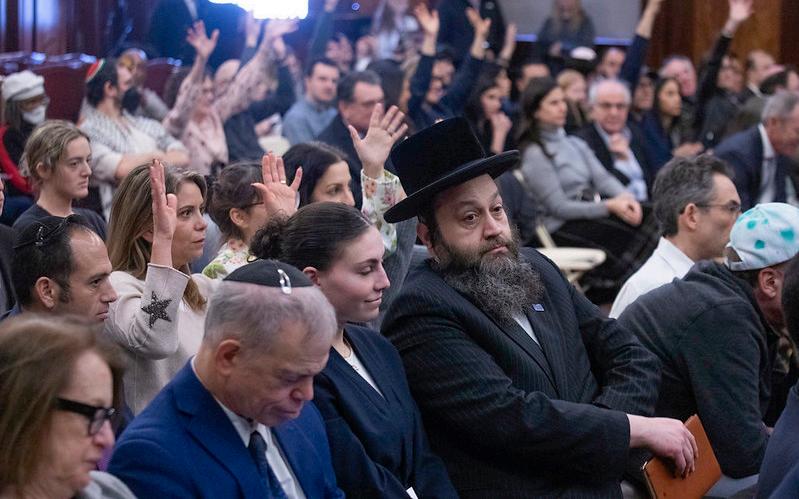
City Council Speaker Julie Menin and Councilmember Dr. Yusef Salaam combined forces in a “combat hate” hearing at City Hall, focusing on protecting access to houses of worship and schools across the city. However, most of those testifying were passionately at odds over the proposed bills.
A concern exists about protests and counterprotests near houses of worship and private religious schools based on hate crimes
and attacks that have taken place. However, a deep divide arose during the intense, almost 10-hour hearing, especially among Jewish and Palestinian New Yorkers who testified. Many supported the bills in the name of public safety and religious freedom, while just as many were against the bills in the name of protecting constitutional rights, such as the right to peacefully assemble and freedom of speech.
“This package of bills is designed to benefit all communities across New York City,” said Menin. “Our city’s tapestry is woven of many
religious spaces, backgrounds, races, creeds, ethnicities, languages, and viewpoints.”
“I have personally experienced the devastating impacts of hate, sentenced for a crime I didn’t commit simply because of the color of my skin. There was even a call for my death,” said Salaam, who chairs the newly formed Committee to Combat Hate in the city council and is a devout Muslim. “Racism is very, very real.”
Salaam added that in the past 10 years, reports of hate crimes have more than doubled in the U.S., New York State, and in the city. This includes notable rises in anti-Semitism, anti-Black hatred, anti-Muslim hatred, antiLGBTQ+, and other gender-based violence.
The hearing reviewed and heard testimony on seven bills, building on Menin’s proposed Five-Point Action Plan to Combat Antisemitism.
Some of the components of the plan would require things like “an NYPD response” plan that restricts movement or protests around houses of worship, and “buffer zones” near entrances and exits; information distributed to students about social media and online hate; and another requirement that the NYPD report on the status of hate crimes. These are just a few of the multiple proposals in the plan.
“I don’t feel that we should have to legislate this, but our spiritual well-being is at stake,” said Councilmember Darlene Mealy, who said she identifies as Christian.
See ‘COMBAT HATE’ HEARING on page 35
Community feedback plays key role in NYPD Black Lives Matter protest settlement
By TANDY LAU Amsterdam News staff
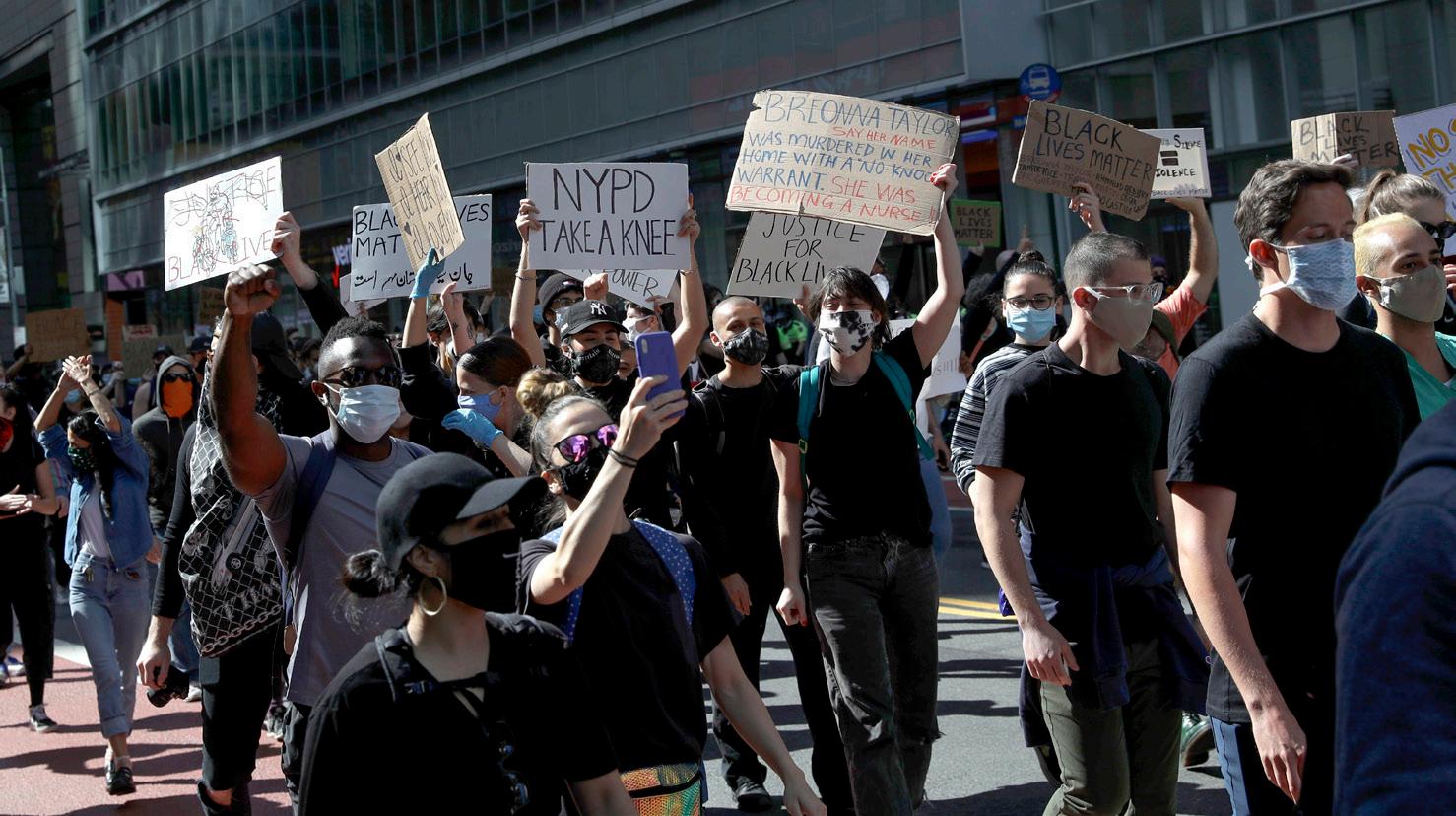
When the city settled a police brutality lawsuit with Black Lives Matter protesters in 2023, it agreed to limit a notorious NYPD unit’s deployment and ban several controversial crowd-control tactics — but the resolution also mandated the public’s inclusion and input when rolling out such reforms.
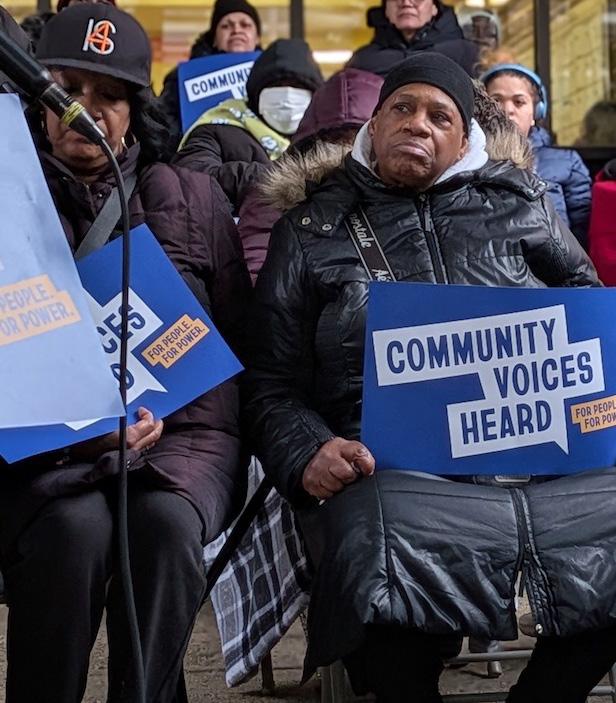
As a result, on February 28, the first Protest Testimony Project community roundtable took place to solicit feedback from everyday New Yorkers about how the NYPD responds to First Amendment-protected activities like demonstrations. The event was held in Brooklyn’s BedfordStuyvesant community and is likely to be a monthly occurrence.
“One of our main goals with the community engagement work is conducting community roundtables to make sure folks are educated about what’s in the settlement, specifically the new tier engagement structure, and the bans and the use of force constraints, but also just getting experiences from folks that are on the ground about
what it’s like to go to protests and their actual experiences,” said Obi Afriyie, a community organizer for the NAACP Legal Defense Fund. “Reports and data only tell one half of the story.
“We’ve seen with a lot of these reports that come out. They’re oftentimes [devoid] of the community input and lived experiences that really can consolidate harms.”
The settlement carved out a role for an in-
dependent community engagement expert and demanded someone with deep ties to affected communities to gather input about the reforms through a three-year contract. Afriyie was ultimately tapped for the position last year.
The lawsuit, Payne v. De Blasio, et al., stemmed from the Black Lives Matter protests in 2020 after Minneapolis police
See PROTEST
ARIAMA C. LONG Amsterdam News Staff
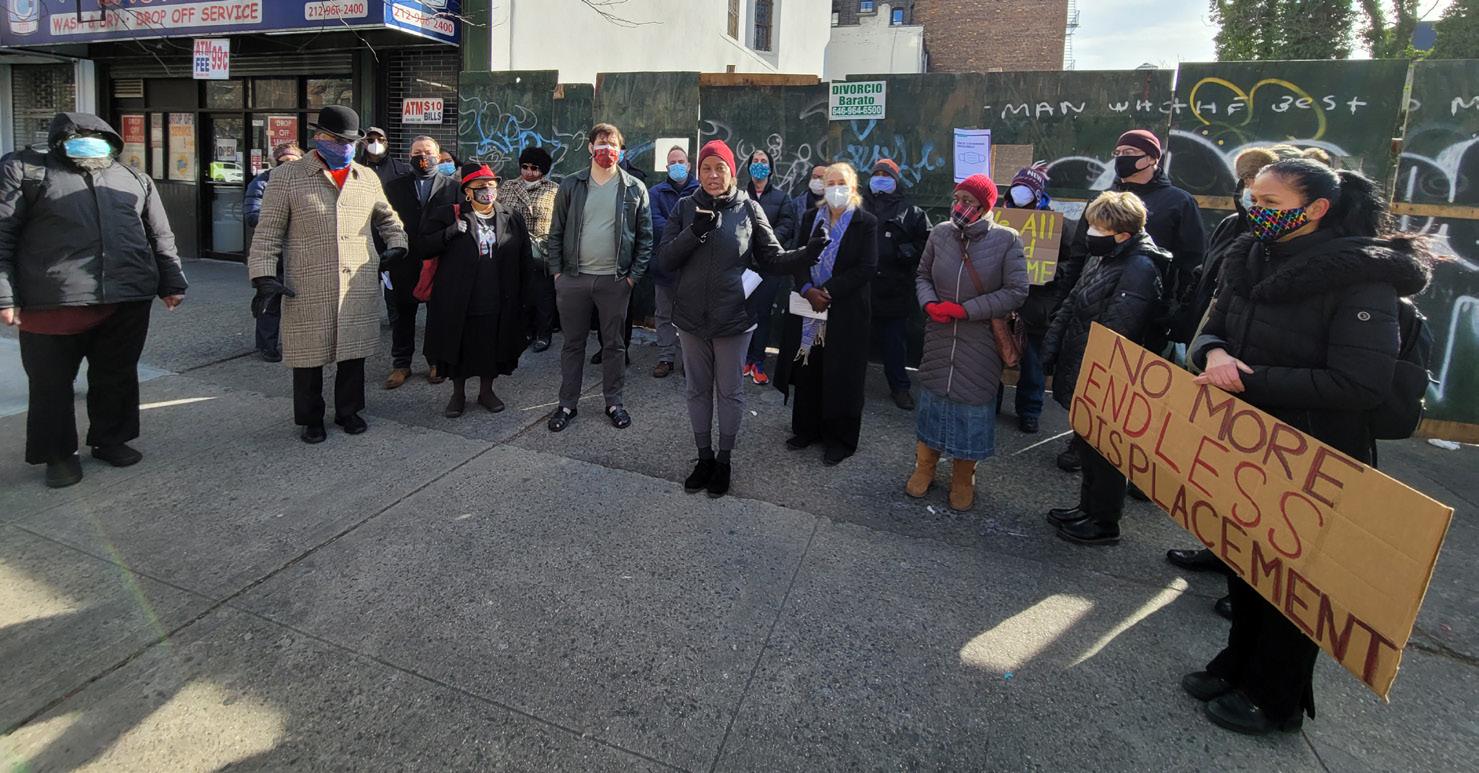
The New York City Council Committee to Combat Hate holds hearing on February 25, 2026. (John McCarten/NYC Council Media Unit photo)
Protesters march through the streets of Manhattan in New York, Monday, June 1, 2020. (AP Photo/Seth Wenig)
Leadership, legacy, and moving on: Dr. Joyce F. Brown discusses her time as president of Fashion Institute of Technology
By TAAYOO MURRAY Special to the AmNews
In 1998, Dr. Joyce F. Brown stepped into the role of president of Fashion Institute of Technology (FIT), the sixth ever person to hold the title and also the first woman and African American to do so. During her tenure, FIT awarded more than 82,000 degrees, created 33 new degree and certificate programs, and led an expansion of fields of study. But after 27 years of success, Brown has stepped down. She recently spoke with the Amsterdam News to reflect on leadership, culture change, and what it means to build something that lasts.
AmNews: You stepped into this role 27 years ago. Do you remember what it felt like in those early days? Were you apprehensive?
Dr. Joyce F. Brown: I wouldn’t say apprehension. I didn’t have any apprehension about it. I knew there were challenges ahead. My whole career had really prepared me to take on this job and those challenges. I knew there were things I didn’t know. I didn’t know which challenges were going to come and when, but it wasn’t so much apprehension. I felt prepared to do whatever needed to be done.
There’s always that little bit of nervous edge when you try something new, and there are so many unknowns, and I think what occurred to me after I got there, I felt like there was a real opportunity to create, to build on all the creativity that I saw there. FIT had really greater potential than it was demonstrating. So what I felt inspired to do was to work to kind of shed some of the restraints and constraints that, after however many years that we had been in business, some 50 plus years. When you do, when you repeat and do things the same way for that long, you really are cutting off your opportunity for new and different and innovative things. And so I was inspired to try and work to create a different kind of dialogue in the community, and create different opportunities for students, and to keep pushing.
AmNews: You’ve talked about changing culture. That’s no small feat. How do you actually shift behavior in an institution?
Brown: The question is about changing a culture. All you can do is create the opportunity for people to do their best work. And how do you do it? I think respectful listening is a big key. One of the first things that I did was start a strategic planning process, and I created a college-wide committee. Now, that sounds deadly, right? We made sure that every constituent group was represented. So
we had faculty, we had administrators, we had board members, we had students. And all the different faculty from each of the areas were represented, so that people had an opportunity to talk about what they would like to see possible in this community of educators and learners. So I think a big part of it is being respectful of people’s points of view and being willing to really weigh those points of view and change what you might have thought was the direction based on what the community thinks is better for it.
AmNews: Did you feel supported in your leadership?
Brown: Some days were better than others. You have to gain the trust of people that you conceptu alize, and you make good decisions. You’re not risk-averse. Yes, and not every decision you make is going to work. You have to have the room to pivot, have something not work out, and you try some thing else. I think I was very fortunate to have a very sup
portive board of trustees. I stayed in constant communication with the board, and they were very supportive. I built that open kind of communication with circles of faculty who represented the rest of the faculty. There’s a faculty senate that represents those who aren’t on the senate. There’s leadership, a department chair, [and] people who represent their department. So there’s a lot of interaction and a lot of communication, reconsideration, and trying new things that are required if, in fact, you’re going to have a reciprocal kind of relationship in the college community.
AmNews: Over 27 years, what are you most proud of — something that people
what we call our DTech Lab, which is sort of a small innovation center where students have the opportunity to work with industry on problem-solving, real-world issues that the industry is working on. That’s a wonderful experience for young students. So it’s not about just going to class and leaving and hoping you’re going to get a job anymore. It’s really about being involved in the cutting edge of things that are happening in the industry.
AmNews: Is there anything you wish you had more time to accomplish?
I don’t know if people talk about it, but I think the thing I am most proud of is having changed the conversation in the community. We have faculty now who talk about their research, who try innovative things, who work collaboratively with other departments, who are working on interdisciplinary kinds of approaches for students and student assignments, and that students have the opportunity as a result. We opened
Brown: I’ll put it this way: there’s always more to do, and I have many ideas about things we could do, directions we could go, things we could adopt. It’s just time to give others an opportunity. At some point, you have to move on. I would have liked to have seen how we’ve been building faculty. We’ve hired some incredible people. Now people come from all over, wanting to be at FIT because they get support for all of these wonderful new projects, and their ideas are listened to. I would have loved to have seen where we go with that. There’s always room for more people coming in with new ideas, and what that’s going to mean in terms of the community and the energy.
I was very committed to building a new science lab, because so much of the innovative work today is in textiles, in color and design, and sustainability. So much of it is science-based; we call it bio-design. You’ve got all these kids who thought they were going to be artists, and now they’re in the laboratory, and they’re making new textiles, and they’re testing on saving water and not polluting the earth with the dyes — all kinds of wonderful things. I wanted to build a new science lab, so we raised the money for it. I feel good about that. I’ll come back and visit and see the new level.
AmNews: Can you share a meaningful moment with students during your tenure?
Brown: I tried to interact with students to the extent that I could. We had 9,000 students and I did get to interact with those in leadership positions, the student government, [and] those who run clubs. I think being the leader, being an African American woman leading meant a great deal to our young women of color. I could gain a sense of that kind of moment in interacting with those students, when I listen to them and when they express the kind of pride, and I guess, hopeful optimism about their own lives, when they see me in that position. So that was very meaningful.
AmNews: You were the first woman and first Black woman to lead FIT. What advice would you give to women stepping into leadership roles today?
Brown: Giving advice is always hard. I think, because everyone’s experience is different. See BROWN on page
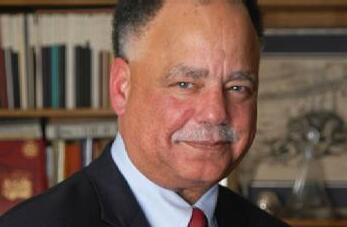
Dr. Joyce F. Brown (Courtesy Fashion Institute of Technology)
Jasmine Crockett defeated by James Talarico in Texas Democratic Senate primary after hard fought race
By THOMAS BEAUMONT, WILL WEISSERT and BILL BARROW Associated Press
DALLAS (AP) — State Rep. James Talarico topped Congresswoman Jasmine Crockett in an expensive and fiercely contested Texas Senate Democratic primary that once again has the party dreaming of a big upset in November.
Early March 4, Crockett conceded the Democratic primary in the Texas Senate race to Talarico. She called on the party to unify behind the state representative, who clinched the nomination overnight.
"Texas is primed to turn blue and we must remain united because this is bigger than any one person," Crockett said in a statement. "This is about the future of all 30 million Texans and getting America back on track."
Crockett's campaign had previously suggested that she would file a lawsuit over voting challenges in the primary. A spokesperson did not immediately respond to a question about those plans.
Who Talarico will face depends on a May runoff between longtime Republican Sen. John Cornyn and MAGA favorite Ken Paxton — a race expected to get increasingly nasty over the coming months and could hinge on whether or not President Donald Trump offers an endorsement.
No Democrat has won a statewide race in the reliably Republican state in over 30 years, but in a statement after his victory, Talarico proclaimed, "We're about to take back Texas."
Republicans head to round two Cornyn, meanwhile, is seeking a fifth term but is facing a tough challenge from Paxton, the state attorney general. Cornyn hopes to avoid becoming the first Republican senator in Texas history to seek reelection and not be renominated.
The GOP contest also featured U.S. Rep. Wesley Hunt, a Black Republican who finished a distant third and conceded. But his making it a three-way race made it tougher for any candidate to reach the 50% vote threshold needed to win the nomination outright and avoid the May 26 runoff.
All three campaigned on their ties to Trump, who did not make an endorsement in the race. Now both Cornyn and Paxton will again fiercely compete to curry the president's favor.
Cornyn was facing a tough enough battle that he didn't hold an election night party. Instead, in comments to reporters in Austin, he sought to make the case that a runoff win by Paxton would leave "a dead weight at the top of the ticket for Republicans."
Paxton, who began campaigning in earnest only last month, has made national headlines for filing lawsuits against Dem-
ocratic initiatives. He remained popular in Texas despite a 2023 impeachment trial on corruption charges, of which he was acquitted, and accusations of marital infidelity by his wife.
Senate GOP leaders, who are backing Cornyn, worry that Paxton's liabilities would make it harder to defend the seat if he is the nominee — and require significant spending that could be better used elsewhere.
Confusion at some polling places
In the Democratic campaign, Crockett and Talarico each argued that they would be the stronger general election candidate in a state that backed Trump by almost 14 percentage points in 2024.
Voting was extended in Dallas County and Williamson County, outside Austin, after voters reported being turned away and directed to different voting precincts because of new primary rules. Paxton's office later challenged a decision keeping the polls open longer, and the state Supreme Court ruled that ballots cast by
people not in line by 7 p.m. should be separated from others.
It was not immediately clear how the court's action would be carried out or how many eligible ballots remained to be counted in Dallas County, Crockett's home base. And in Harris County, which includes Houston, a spokesperson said that as of 10 p.m., there were still voters at 20 centers.
Democratic race featured clash of styles
Crockett and Talarico waged a spirited race as Democrats look for their first Senate win in Texas since 1988.
Crockett has built a national profile for zinger attacks on Republicans and focused on turning out Black voters in the Dallas and Houston areas. Talarico, a seminarian who often references the Bible, held rallies across the state, including in heavily Republican areas.
“We are not just trying to win an election," a jubilant Talarico told supporters in Austin before the race was called. “We are trying to fundamentally change our politics. And it's working."
Tomas Sanchez, a voter in Dallas County, said he supported Crockett because "she cares about immigrants, she cares about the American people in a way that a lot of the Republicans have proven they haven't."
Talarico outspent Crockett on television advertising by more than four to one as of late February. He got a burst of attention — and campaign contributions — last month from CBS's decision not to air his interview with late-night host Stephen Colbert, who said the network pulled the interview for fear of angering Trump's FCC.
In another key primary, Democratic Rep. Al Green, who was fighting to stay in office after his Houston-based district was drawn to lean Republican, has advanced to a primary runoff against Democratic Rep. Christian Menefee, who won a January special election for the current 18th District. That runoff election will take place May 26.
Dallas voter Tanu Sani said she cast her ballot for Talarico because he "really spoke to me in the way he tries to unify."
Rep. Jasmine Crockett, a Democratic U.S. candidate speaks during a primary election watch party in Dallas. (Tony Gutierrez/AP)
Could Conrad Blackburn be the next breakout Democratic Socialist candidate?
By TANDY LAU Amsterdam News Staff
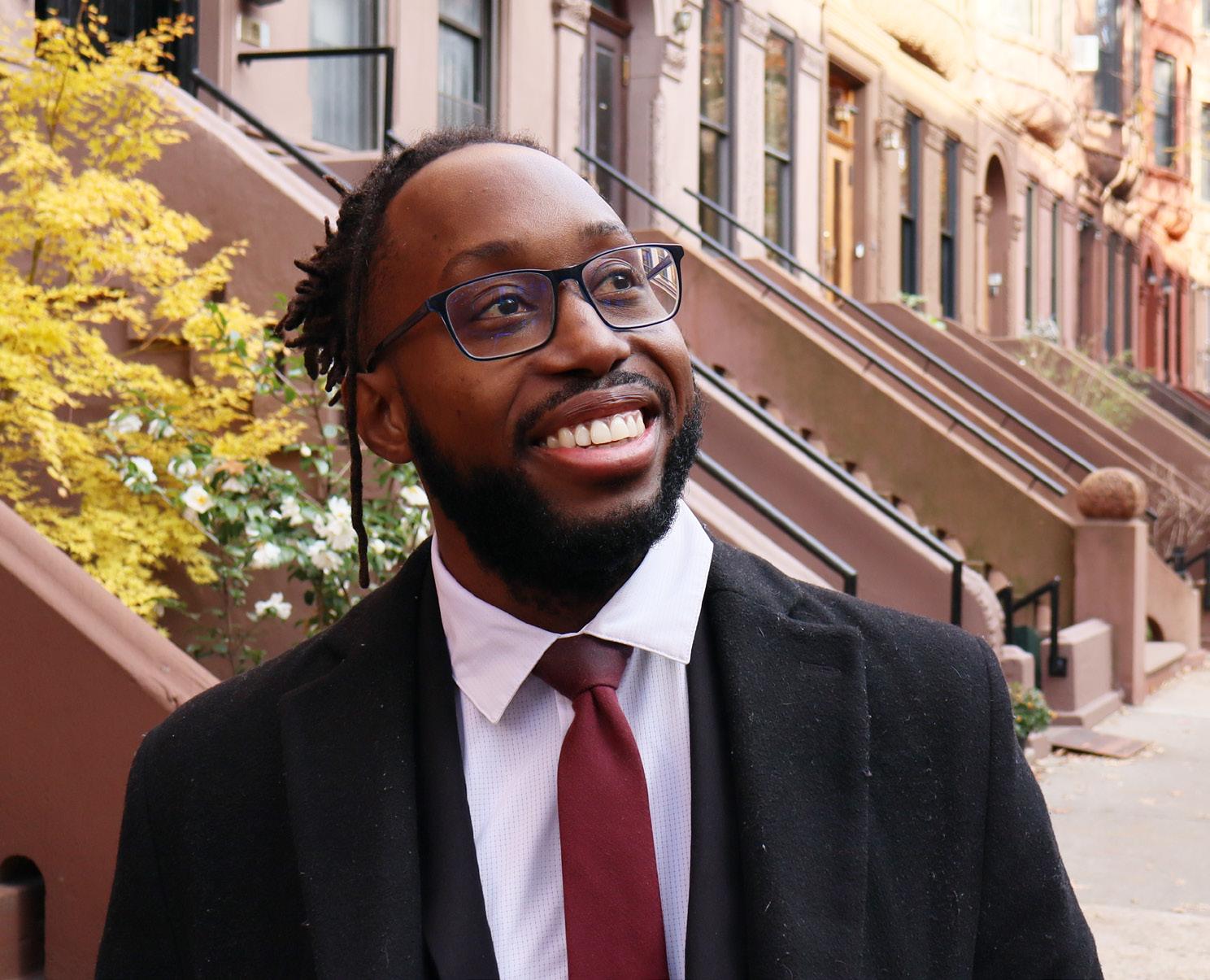
Public defender Conrad Blackburn looked to Harlem for heroes while growing up in Florida. They ranged from Malcolm X and Marcus Garvey, to hip hop artists like the Diplomats (Dipset) and Immortal Technique. Now, he hopes to be next in line as his state assembly campaign heats up.
Last November, he registered to run as a Democrat with a housing and affordability platform for Assembly District 70 in Harlem to face incumbent Jordan Wright in June’s primary. But his path to this point has led from humble beginnings in Florida to his activist platforms today.
Blackburn, 33, was born in Miami Gardens to Jamaican immigrants and raised in Tallahassee public housing by just his mother, an African Methodist Episcopal pastor. “We had to scratch to get by,” he said. “We lived paycheck to paycheck, and that really radicalized me [and] motivated me to figure out what caused that dichotomy.”
Too young to vote for Barack Obama, Blackburn first engaged politically through phone banking for the future president. Majoring in political science and philosophy later exposed him to Karl Marx and socialism in college. Suddenly, the poverty he witnessed and experienced made more sense. Outside of the classroom, he joined Students for a Democratic Society, where he rallied for Palestinian rights in the early 2010s. Law school followed and he foresaw a career in public interest work.
“As soon as I learned exactly what being a public defender was, I was hooked, and I knew that was what I was going to do,” said Blackburn. “I knew a lot of people who grew up like me would have benefited from
Black New Yorker
THE URBAN AGENDA
By David R. Jones, Esq
Mayor Mamdani’s Affordability Pledge Must Begin With NYCHA
The Trump administration, reviving a cruel idea from its first-term playbook, has proposed banning families with undocumented members from subsidized public housing.
The proposed rule could upend the lives of millions of people nationwide and place a bullseye on thousands of New Yorkers in mixed-immigration status households. At risk is nothing short of casting into homelessness low-income citizens, legal residents and many children born on U.S soil.
The chaos could complicate Mayor Zohran Mamdani’s campaign pledge to invest heavily in repairs to the New York City Housing Authority (NYCHA) as part of his housing affordability strategy. He should also speak out against the looming Trump assault guaranteed to spike homelessness among New Yorkers who desperately depend on public housing.
Houses. A state appeals court judge last month temporarily halted construction after a group of tenants successfully appealed to stop the project, which calls for roughly 3,500 mixed-income apartments – including about 1,000 permanently affordable units –stores and other amenities.
Mamdani built his campaign around his promise to freeze rent in rent-stabilized apartments, which the candidate’s constellation of friends and allies repeated far and wide to successfully appeal to young voters. He’s moving to fulfill the pledge. The rent-freeze illustrates the way Mamdani reads the room, getting everyone on board with an issue that magnifies his charisma and youthful energy.
having a lawyer that actually cared and would put work into their case.”
In 2018, he moved to New York City while studying for the bar exam. Julia Salazar’s State Senate run inspired him to plug into the NYC Democratic Socialists of America (NYC-DSA). But Blackburn initially kept the organization at arm’s length and remained unsure if electoral politics could effectively work towards Black and Brown liberation.
Meanwhile, he found a place in Harlem and joined the Bronx Defenders, rising to a policy counsel role three years ago. So Blackburn went up to Albany to fight for change long before he considered public office. The position fashioned him into a leading criminal justice reform advocate and placed him on the frontlines in the fight to preserve the bail and discovery reform laws. Blackburn also worked on writing Local Law 42, the city’s solitary confinement ban.
“I have a caseload while I’m doing policy work,” said Blackburn. “Every problem that I’m seeing that’s a systemic problem, I’m able to think [if] there is a policy solution… through doing work as an on-the-ground public defender, I’m able to talk about things in a lens that other policy councils aren’t because they don’t have cases on a day-to-day, granular level. I was able to bring my own clients’ stories and experiences into those spaces.”
But his initial decision to eschew big law for public defense meant facing economic anxiety once again. His salary was not sustainable and Blackburn risked getting priced out of Harlem. Before 2020, the Bronx Defenders long stood out among the local public defense organizations as non-unionized.
See BNY on page 25
The mayor, who has not said much publicly about NYCHA since taking office, has an obligation to articulate his plans for public housing as soon as possible. More than one million renters in New York State rely on vouchers to pay at least part of their rent. In New York City, 520,808 people live in HUD-assisted buildings, including public housing, project-based subsidies, and dwellings for the elderly and disabled persons.
Already, the long-neglected NYCHA was among thousands of agencies warned in recent weeks that they must verify the legal status of residents or face sanctions. In a test drive of the policy, which was proposed in the Heritage Foundation’s poisonous Project 2025 policy roadmap, San Francisco’s housing authority has already begun checks after it was given a 30-day deadline.
Things will get ugly fast if families, through no fault of their own, are evicted from NYCHA apartments costing on average $548 a month. In the face of New York City’s affordable housing emergency, where will they go? Forcing households into homelessness is a likely outcome – in fact, it may be the point – of this heartless policy.
Mamdani went to the White House recently to ask President Donald Trump behind closed doors for $21 billion to develop an old Queens rail yard into the city’s biggest affordable housing project in a half century. It would take years to complete and require an extraordinary political feat to make the enormous 12,000 housing units, parks, hospitals and other amenities reality.
Meanwhile, there is an imminent risk to NYCHA’s signature construction project, the creation of 2,500 market-rate units by demolishing the Fulton and Chelsea-Elliot
His more muted campaign website promised to “double” the city’s capital investment in major renovations of NYCHA housing and build new, affordable publicly controlled housing on NYCHA’s city-owned land. As well as use his political capital to increase city subsidies to housing repairs and push Albany to support his commitment to NYCHA’s capital needs on an annual basis.
The new mayor’s first preliminary five-year capital plan included $662 million in FY 2027 for upkeep of 3,200 NYCHA units and $30 million for heat pumps in the Rockaways. That’s a good start as he is poised to propose his first budget. He has promised to pay for his ambitious agenda with higher taxes on corporations and the wealthy, municipal bonds and other steps, most of which must be approved by Albany. There are signs Mamdani’s impassioned followers are pressuring Gov. Kathy Hochul and state lawmakers to support taxing the richest New Yorkers to pay for the mayor’s stated goal of leveling the economic playing field.
Mamdani’s stance on public housing should be informed by the cautionary tale of former Mayor Eric Adams’ trail of broken campaign promises. His political base experienced vertigo as he abandoned his north star pledges, tipping his political support off its axis with double-speak about NYCHA, police brutality and his public embrace of Trump.
Here’s the lesson: The challenges at NYCHA won’t magically disappear, even if we don’t mention them aloud. City Hall must take the lead in rallying the state legislature, builders, investors, banks and advocates for the poor to solve the problem of housing affordability. We all have skin in the game, whether we want to or not.
But the mayor should remind everyone involved that NYCHA is the linchpin in any solution to New York City’s affordable housing crisis.
Conrad Blackburn. (Courtesy of Conrad for Assembly)
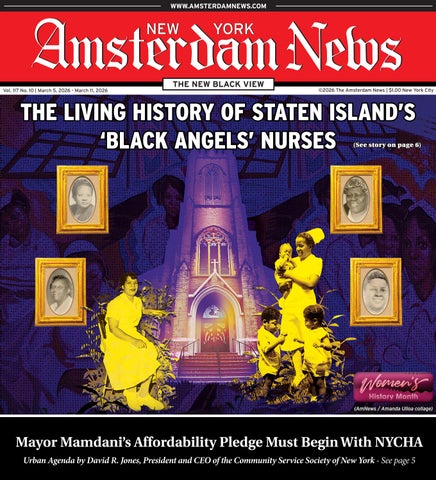
Staten Island’s ‘Black Angels’: How an unsung legion of African American nurses defeated disease and cared for the forgotten
By ARIAMA C. LONG Amsterdam News Staff
During the Great Migration, droves of African Americans traveled north in search of industrial cities with labor jobs and other steady work. But less mentioned are the groups of educated and professional Black women who also left their homes looking for employment and a better life. Among them, a small army of courageous nurses with a legacy of standing on the frontlines during the city’s darkest times. Staten Island’s ‘Black Angels’ were exceptionally skilled Black women who risked their lives to help treat and cure tuberculosis patients in the historic Sea View Hospital from the 1930s to 1961.
By the early 1900s, Harlem, which was seeing a cultural renaissance, and the Lower East Side were considered “hotbeds” for tuberculosis, a deadly disease often found spreading in the city’s tightly packed tenement buildings. These poor living conditions were prevalent at the time among the waves of mostly European immigrant families settling in the city, some Black communities, lower-income families, and homeless populations. New York City leaders considered these groups “ignorant” or “careless” for getting infected and campaigned to isolate sick patients.
“This was one of the darkest periods in American history. Cast the pre-antibiotic age of the Great Depression against the landscape of Jim Crow,” said Maria Smilios, an adjunct lecturer at Columbia University’s Mailman School of Public Health. “I don't think people really grasp it. When you say no antibiotics, it's nothing, zero. You have strep throat. You don't get an antibiotic. It's a wing and a prayer, and you might die.
“[City leaders] got sick and tired of watching people die and get sick,” said Smilios. “This was the dawning of public health.”
They opened Sea View Hospital on Staten Island for the treatment and quarantine of people with tuberculosis in 1913 — with the U.S. on the cusp of World War I. It was a 360-acre sanatorium campus with several buildings and lodgings for staff. It became one of the largest hospitals in the country treating the disease. Sea View saw early success in combating it, but by 1929, tuberculosis was still the “third-leading killer” in the city. After years of watching colleagues succumb and die, in the hospital and in the war, white nurses with other options of employment started quitting en masse.
Desperate to fill the void, the city deemed using Black nurses to treat highly conta-
gious people, considered “undesirable,” acceptable, according to the Staten Island Museum (SIM). The city began recruiting these nurses from southern and midwestern colleges with a promised “rare opportunity” for training at an integrated hospital with housing and a salary. The patients of Sea View dubbed their nurses the “Black Angels” for embracing them despite the risk to their health and that of their families.
“Black women teachers and nurses, they really changed the course of history, and they’re not talked about at all,” said Smilios, who is the author of “The Black Angels: The Untold Story of the Nurses Who Helped Cure Tuberculosis.”
Remembering the Angels
“Tuberculosis was a deadly disease. It killed millions. Those nurses, their legacy is they put themselves in harm’s way,” said Virginia Allen, 94, one of the oldest surviving Black Angels nursing aides in New York, who now resides at Sea View’s nursing home, remembering what times were like generations ago.
Allen moved from Detroit to Staten Island when she was 16. She lived with her aunt Edna Sutton-Ballard, a registered nurse at Sea View. Allen was a young student at Central School for Practical Nurses in 1947. She was a nurse’s aide at Sea View while she studied. After her graduation in 1957, she went on to work as a private duty nurse, a surgical nurse, and in labor relations with Local 1199 AFL-CIO.
She was one of hundreds of women who came to Sea View to treat patients afflicted with tuberculosis, which was not fully cured until 1951.
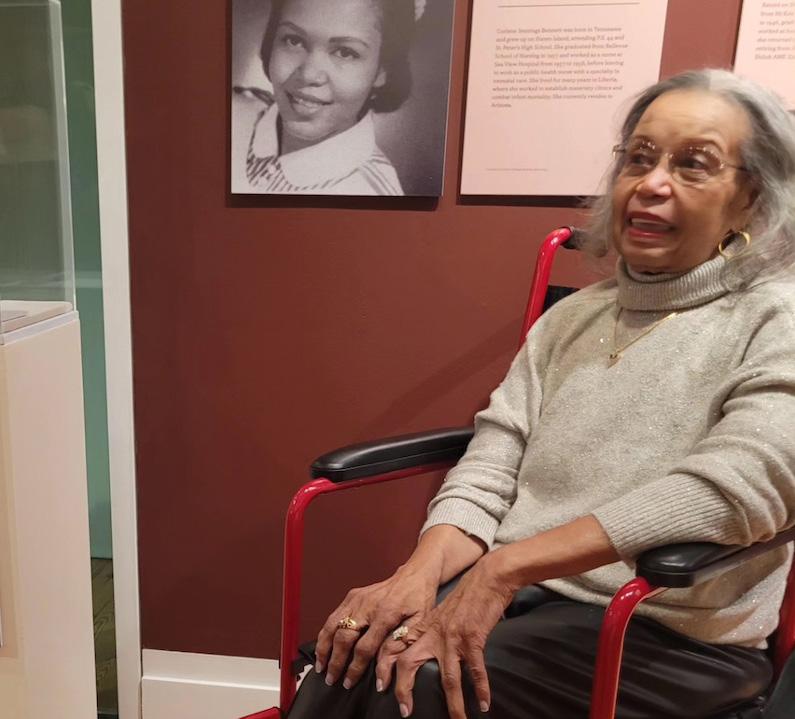
Leah Bennett, 61, a journalist and editor, remembered the bravery of her mother, Curlene Jennings Bennett, a nurse at Sea View from 1957 to 1958 before leaving to work as a public health nurse with a specialty in neonatal care. “She was so confident. She walked into tuberculosis like it
was nothing.” She is now one of the oldest living Black Angels nurses in New York, also currently residing on Staten Island. She had a stroke at 89 years old and is now in poor health, said her daughter.
Pamela Washington, 69, is a retired special education teacher who is related to several Black Angels, such as Leola Washington (aunt), Melody Pete Owens (great aunt), and Joann Molina (cousin). Her mother, Lucille Washington, worked in the kitchen at Sea View Hospital. Washington said that her family took cleanliness very seriously when they came home from work.
“My auntie would have a thing about washing hands. Oh my god, my family, my whole family can tell you that you could not come up those stairs without washing your hands first,” said Washington. “And when she came into the house, she would take her stuff off and wash all up her arms and her face. I remember that as a little girl, yeah. She’d take her clothes off. I guess she just didn't want anybody to catch anything.”
The work they did Generations of Black Angels’ descendants were not always aware of the harsh realities that their mothers, grandmothers, great aunts, cousins, sisters, and friends faced each day. Most never discussed their jobs. They carried them out with a sense of duty and grace.
“When I was growing up, you sorta knew the history of the Black Angels, but I didn't recognize the importance of it,” said Steve Molina, 60, who had a mother and grandmother who worked at Sea View in the 1960s. “I feel it now as an older person.” By 1936, the hospital began conducting tuberculosis research. Upwards of 300 nurses, 45 physicians, and 400 support staff were employed, according to the Staten Island Museum. When World War II ended, one of the first antibiotics, streptomycin, showed promise in treating the disease. Building off of the antibiotic, Sea View’s Dr. Edward Robitzek and Irving Selikoff began developing a treatment protocol with isoniazid in 1951 and 1952. For those two years, the Black Angels were integral to the success of the drug trials that would eventually cure tuberculosis.
“The nurses were tasked to administer the medication three times a day. But they weren't just giving out a pill. They were also tasked to look at the emotional, mental, and physical aspects of these patients,” said Smilios. “They knew this disease so well. They started to notate whatever side effects there were.”
The disease raged throughout the Harlem Renaissance, the Great Depression, and into World War II. Fresh air and rest were still mainly how tuberculosis was treated before the trials. When that failed, and See story on next page
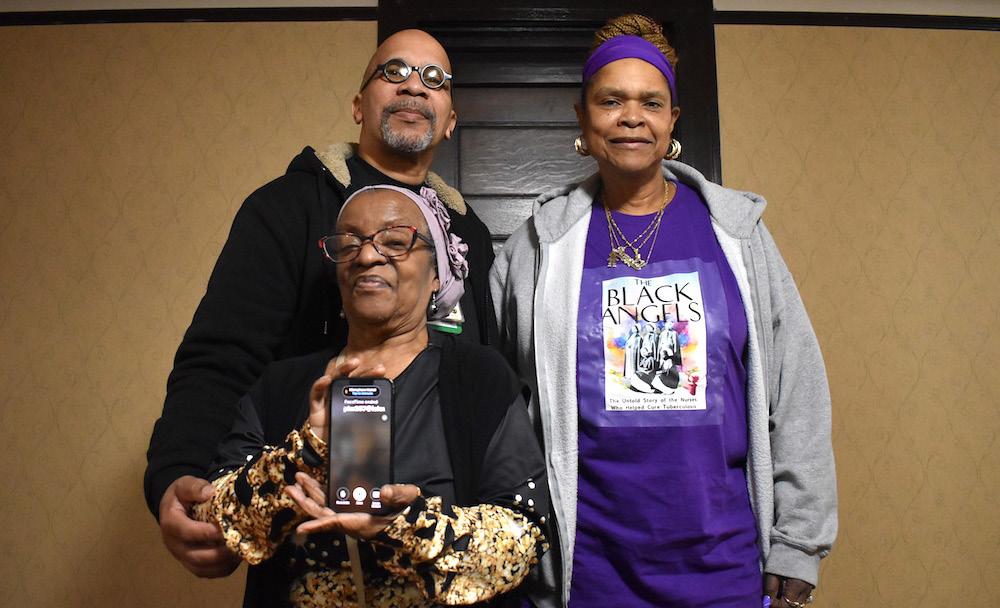
Descendants of the Black Angels from left to right: Bernice ‘Bunny’ Meadows Alleyne, Henry ‘Hank’ Pegeron, Pamela Washington. (Ariama C. Long photo)
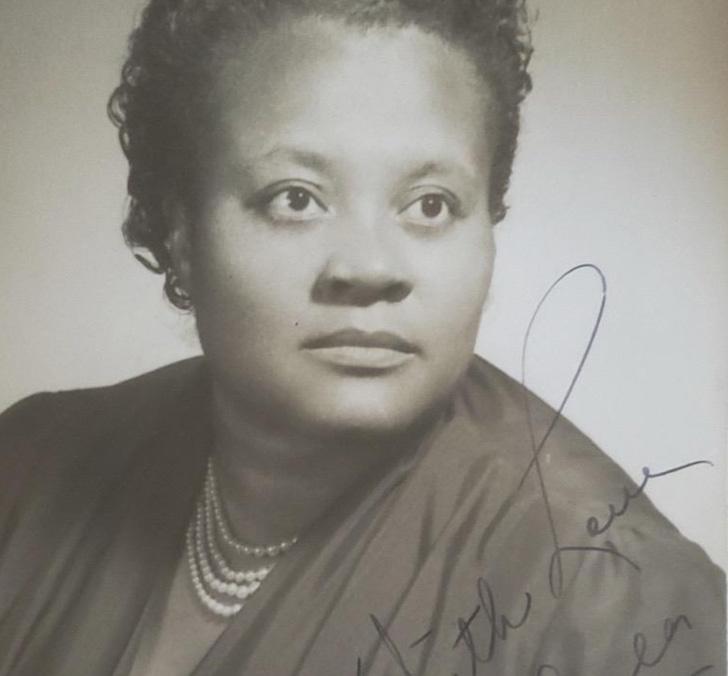
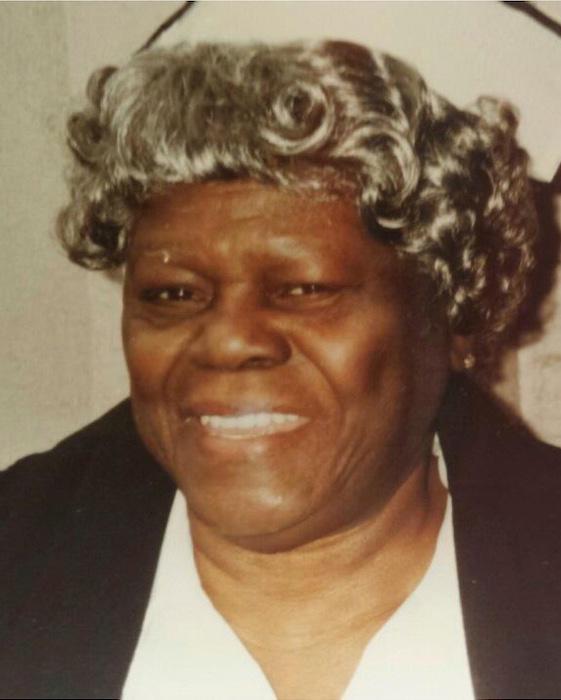
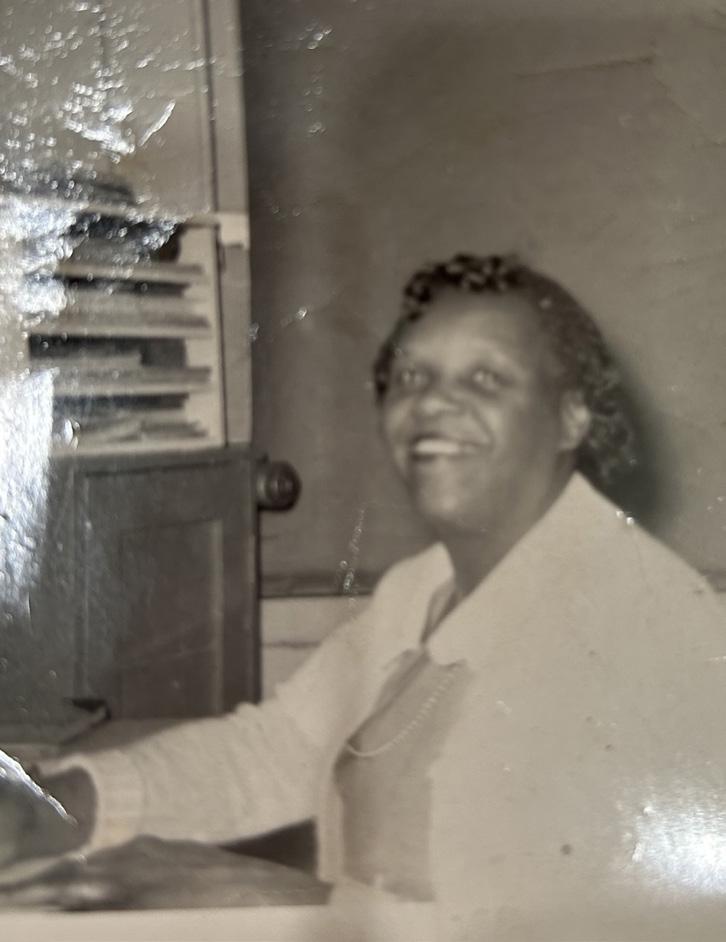
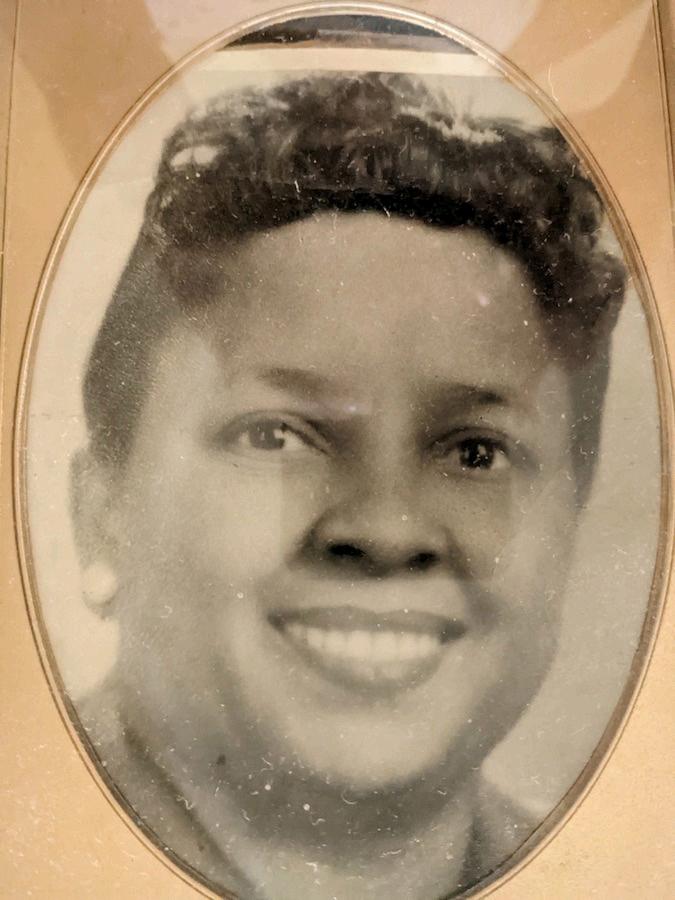
Photo of Black Angel Curlene Jennings Bennett at the Staten Island Museum, 2023. (Contributed by Leah Bennett)
Photo of young Black Angel Leola Washington. (Contributed by Pamela Washington)
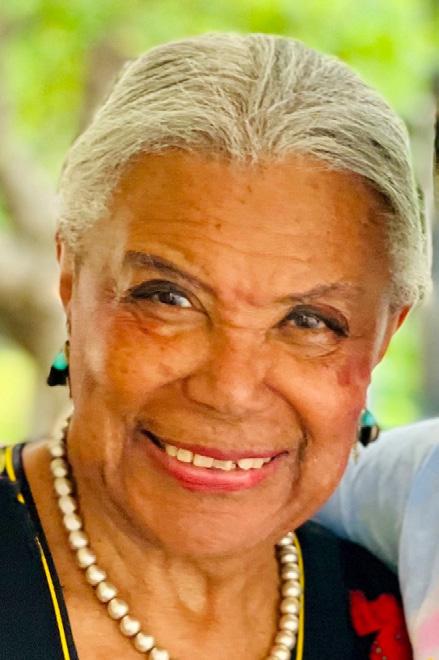
Photo of Black Angel Virginia Allen. (Courtesy of Maria Smilios)
it spread in a patient’s body, doctors prescribed horrific surgeries where ribs were sawed off “six to eight at a time.”
Chest cavities were punctured and stuffed with things like ping-pong balls to keep lungs from collapsing, according to the Staten Island Museum. All of which the Black Angels witnessed firsthand. Many did contract inactive tuberculosis while at Sea View, but because of the stringent skills of the nurses, few died from the disease.
Robitzek later noted that “had it not been for the Black nurses,” nothing in the hospital and the trials would have worked, according to Smilios. Their dedication and accomplishments were rarely acknowledged though. Black nurses and staff at Sea View weren’t given supervisor positions, which were reserved for white nurses. The nursing staff was entirely Black until the cure for tuberculosis was found, according to the museum.
“I tear up sometimes when I hear about the Black Angels because I knew so many of them personally, not just like my family, I knew a lot of those ladies growing up,” said Washington.
As the medication to treat the disease became easily accessible, it was no longer a death sentence. Sea View’s tuberculosis hospital closed in 1961.
But many of the Black Angels and their families continued to live and work in and around the hospital even as racial dynamics in the area took a turn. White Staten Islanders decried the influx of Black people and migrants to the borough in the 1960s and ‘70s. As a result, the neighborhood experienced decades of racial violence.
Not just nurses
The Black Angels were huge proponents of civil rights and homeownership, standing in resistant communities nearby whenever necessary to secure homes for their families on Staten Island’s North Shore. Through organizations like the Women’s
Civic and Political Union, Lambda Kappa Mu Sorority, Inc., the National Council of Negro Women Staten Island section, Helping Hands Society, the Booker T. Washington Colored Servicemen’s Center, and St. Philips Baptist Church, they worked to shape and build a close-knit and thriving community.
Their area along Bradley Avenue was in Willowbrook, referred to as Dog Patch (now Meiers Corners). It joined with other Black communities on the island, like Sandy Ground, a free Black settlement on Staten Island’s southside that specialized in shellfish and especially oysters back in the 1800s.
One of them was Hazel Pedro Herring, a Sandy Ground native and a nurses’ aide at Sea View. She was also a member of the Women’s Civic and Political Union, an organization focused on teaching Black women about politics and encouraging them to exercise their right to vote, according to the museum. “She had kindness, goodness, and God at the top of the list, and always went to church,” said her daughter, Lucille Herring, 79, herself a retired nurse who specialized in infection control.
Another was Missouria Louvinia Meadows-Walker, a Black Angel who worked at Sea View in 1935. An innovator, she cofounded the Progressive Nursing Club at St. Phillips Baptist Church; and was one of the movers and shakers who called on the National Association for the Advancement of Colored People so she could buy her house in Dog Patch in 1944. Her white neighbors sent her a petition, warning her not to move in. Despite their threats, she enjoyed her home.
Meadows-Walker was involved in the clinical trials in 1951 and moved on to Beth Israel Medical Center in Manhattan before retiring in 1970. She was a founding member of Staten Island’s Chapter of the National Council of Negro Women.
Bernice “Bunny” Meadows Alleyne, 79, her grandniece, described her as “a great person.”
While they were securing the community, they still took care of home.
George Meadows, 78, also had sever-
al nurses in his family. His mother, Teresa “Tessie” Meadows, passed away when he was 12 years old. He, like countless others, was essentially raised by the Black Angels. He can remember his great aunt’s house being a vibrant childcare center where nurses would drop their kids off during the day. As a child, he remembers doing odd jobs around the island for them and getting paid.
“They were pioneers and raised a community of children,” said Meadows.
“Nana was an amazing woman. Loved her family and was very diligent. She worked the 7-3 shift. Got home around 4 in the afternoon,” said Patricia “Pat” Wilson, 66. Her grandmother was Nellie Mae Holmes, who worked as a licensed practical nurse at Sea View for 24 years. She spent her final years on the campus as a resident of Sea View’s nursing home.
“I would always ask to call my Nana when she got home. And she never complained. She just took care of her patients.”
A modern lens
Today, Sea View operates mainly as a nursing home and elderly rehabilitation facility. A place that is as impressive in size as it is deeply haunting. Throughout the grounds, many of the buildings that served tuberculosis patients are now derelict and covered with graffiti, overgrown weeds, with hollowed-out insides, and missing windows. But looking back to a time when much of Staten Island's North Shore district was still covered with thick woods and fruit trees, the hospital once stood on the cutting edge of modern medicine.
“I think it’s really important [that] people realize what these women have done in history. Growing up, I had no clue of what we’re talking about right now. None,” said Henry “Hank” Pegeron, 67, who currently works at Sea View and cares for his mother. His grandmother, Marguerite E. Oates, was a Black Angel at the hospital. “My grandmother didn’t talk about the trials and tribulations they went through. They more or less protected us from all this stuff. And I believe most of the ancestors will tell you the same thing. They were guardians.”
St. Philips Baptist Church in Port Richmond, Staten Island on Feb. 16, 2026.
(Ariama C. Long photo)
Photo of Black Angel Missouria Louvinia Meadows-Walker in uniform.
(Contributed by Maria Smilios)
Photo of Black Angel Hazel Pedro Herring. (Contributed by Lucille Herring)
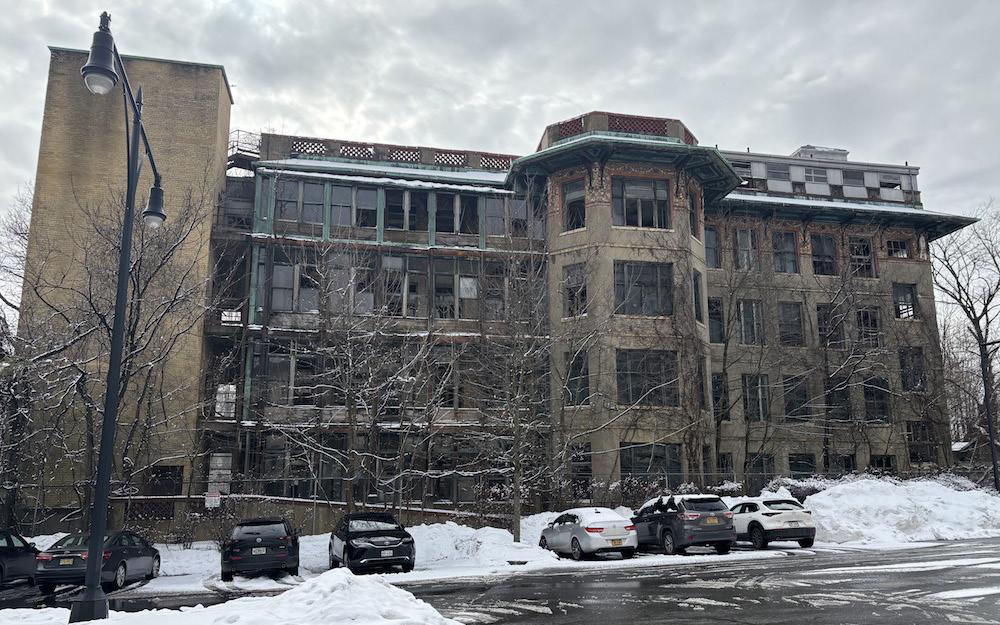
One of the defunct nurses’ resident buildings on the Sea View Hospital campus on Feb. 16, 2026. (Ariama C. Long photo)
Photo of Black Angel Nellie Mae Holmes. (Contributed by Patricia Wilson)
The Legal Aid Society marks 150 years with new exhibit
By TANDY LAU
Amsterdam News Staff
New York City’s Legal Aid Society, the nation’s oldest public defense provider, marks its 150th anniversary this year. Celebrations kick off this week at the New York Historical on the Upper West Side, where an exhibit about the organization’s history opens up on March 6.
The Legal Aid Society dates back to 1876 and originally represented German immigrants. In fact, the organization was initially called the German Legal Aid Society. But the law firm ultimately grew into an institution serving all New Yorkers in need of legal help and developed a robust civil litigation arm covering everything from family court to public benefits. Through representing plaintiffs wronged by institutional power, the Legal Aid Society impacted policy through case law and consent decrees in many cases. A class action lawsuit after a Geraldo Rivera exposé got Staten Island’s Willowbrook State School shut down over neglect and abuse, and ultimately transformed local care for people with developmental disabilities. In the early 2010s, similar conditions allegedly surfaced on Rikers Island through the Nunez settlement, which recently led to a federally-appointed takeover of New York City jails.
Then there is Yvonne McCain, who contacted the Legal Aid Society in 1983 and became lead plaintiff in a lawsuit against thenMayor Ed Koch. The ultimate ruling extended the right to shelter for unhoused families and children.
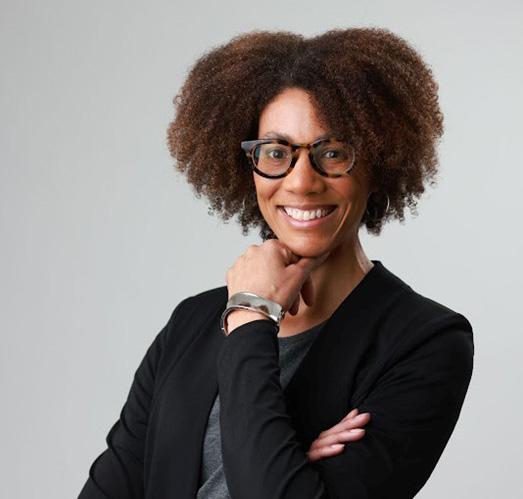
In 2022, current Attorney-InChief and CEO Twyla Carter became the first Black woman and Asian American to head the Legal Aid Society. She holds the distinction with personal pride and dispassionate disdain.
“It is truly a dream job to be able to lead this storied organization,”
Carter told the AmNews. “I always appreciate when people celebrate the fact that I am the first Black woman and first Asian American in this role. But it is not lost on me that I should not be the first Black woman and first Asian American in this role.”
all the way back in 1902. Preserving such a past remained an ambitious undertaking. The exhibit marks the first time the Legal Aid Society has worked with a historian or archivist. And like many nonprofits, artifacts were often scattered in filing cabinets, or in the possession of previous employees.
Carter recalls finding ledgers with names of incarcerated people held at Harlem Courthouse while participating in a working group at the largely deteriorated community court. She knew many names were Legal Aid Society clients and got permission to borrow them for the exhibit.
“It was quite an interesting experience, and really quite eyeopening when you think about what goes into making an exhibit,” said Carter. “Because it really is stuff that must be authentically certified and it must be the original thing, or we must have permission to be able to even use it. You can’t just take things and throw it in the case and say, ‘here’s our 150 years of service to New York.’”
Titled “Delivering Justice: 150 Years of The Legal Aid Society,” the exhibit will feature never-before-seen photos, documents, and press clippings. There will also be works by Brooklyn-based artist Josh MacPhee and reproductions from the likes of Jacob Lawrence.
will also host events commemorating the organization.
She points to several other trailblazing heads who preceded her.
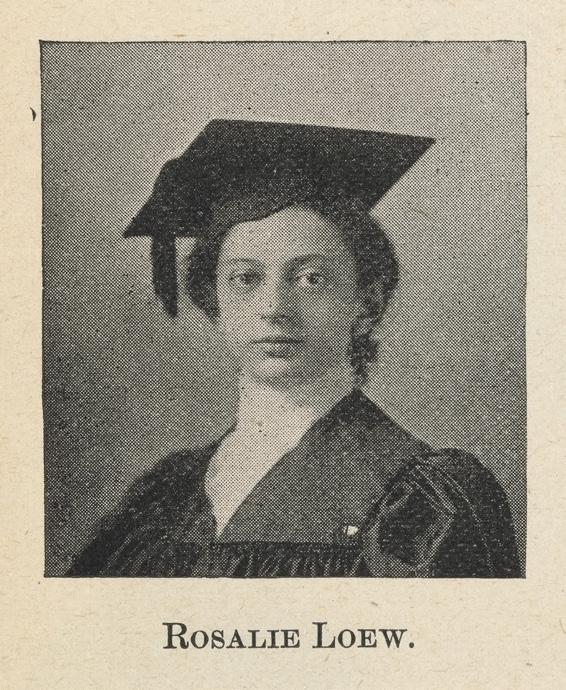
Archibald Murray became the first Black attorney-in-chief back in 1975. Rosalie Loew became the first woman appointed to the role
The celebration does not stop there. A community forum will take place next month at Brooklyn’s BRIC House and the Staten Island FerryHawks baseball team will honor the Legal Society as their “Harbor Hero.” Later in the year, cultural institutions El Museo del Barrio and the Queens Museum
As far as the next 150 years, Carter wants to tackle preventative measures like housing, education, and employment to divert New Yorkers from the criminal legal justice system long before they need a court-appointed attorney from the Legal Aid Society.
“When our systems are strong, then communities are safer not because of surveillance or punishment, but because people’s needs are met,” she said. “For us, Justice
becomes about opportunity, stability, [and] dignity, not just about defending yourself against a criminal charge in the courtroom.
“We imagine a future where justice does not begin with the courtroom, but with the resources that every New Yorker needs to live in dignity and security. And ultimately, a New York where Legal Aid Society is not necessary.” Delivering Justice: 150 Years of The Legal Aid Society will run at the New York Historical from March 6 to July 5.
NYCHA tenant death during cold front sparks renewed housing heat outcry
By ARIAMA C. LONG Amsterdam News Staff
A senior citizen was found dead in her apartment in February, as the city emerged from a dangerous cold snap. In response, her neighbors in New York City Housing Authority (NYCHA) public housing are once again calling attention to long-standing issues with heating and faulty boilers. This year’s unexpected frigid weather saw over a dozen New Yorkers living outside lose their lives as a
result of hypothermia. Unfortunately, inadequate heat during the usual winter months, let alone severe cold fronts, is only one of the major issues affecting public housing developments throughout the city.
“Public housing is a precious resource that must be cared for and invested in so that it will last not just for our lifetime but in perpetuity,” said State Sen. Cordell Cleare in a statement. “I am heartbroken to hear of the multiple breakdowns in basic habitability at UPACA 6, and I call for immediate inter-
vention and swift remediation by NYCHA and all involved private management. Housing is a human right, and the residents of UPACA 6 deserve far better than this!”
Leslie Zellars, 83, was a resident of UPACA 6, a senior NYCHA building located in East Harlem. She was found dead in her apartment early last month under a mound of blankets on the floor, discovered by her neighbor during a wellness check. Zellars’ technical cause of death was heart disease, which can be exacerbated by
cold conditions for the elderly.
“It didn’t have to happen. She needed help,” said Maria Pacheco, 85, UPACA 6 Tenant Association president.
Pacheco said that the problem with UPACA 6 heat has been ongoing for years. The building was converted from public housing to the Rental Assistance Demonstration/Permanent Affordability Commitment Together program last December and is now managed by C&C Apartment Management. Since the transi-
tion, the promised repairs have been slow despite repeated complaints about the building’s aging boiler. In the past, the residents had to fight for improvements to be made to the building, like 24/7 security and access to the lobby to sit and socialize.
“I was enraged at the way she died. Not her death because she lived to be 83 years young, which is a blessing. But the way she died hurts so much. It almost reminds
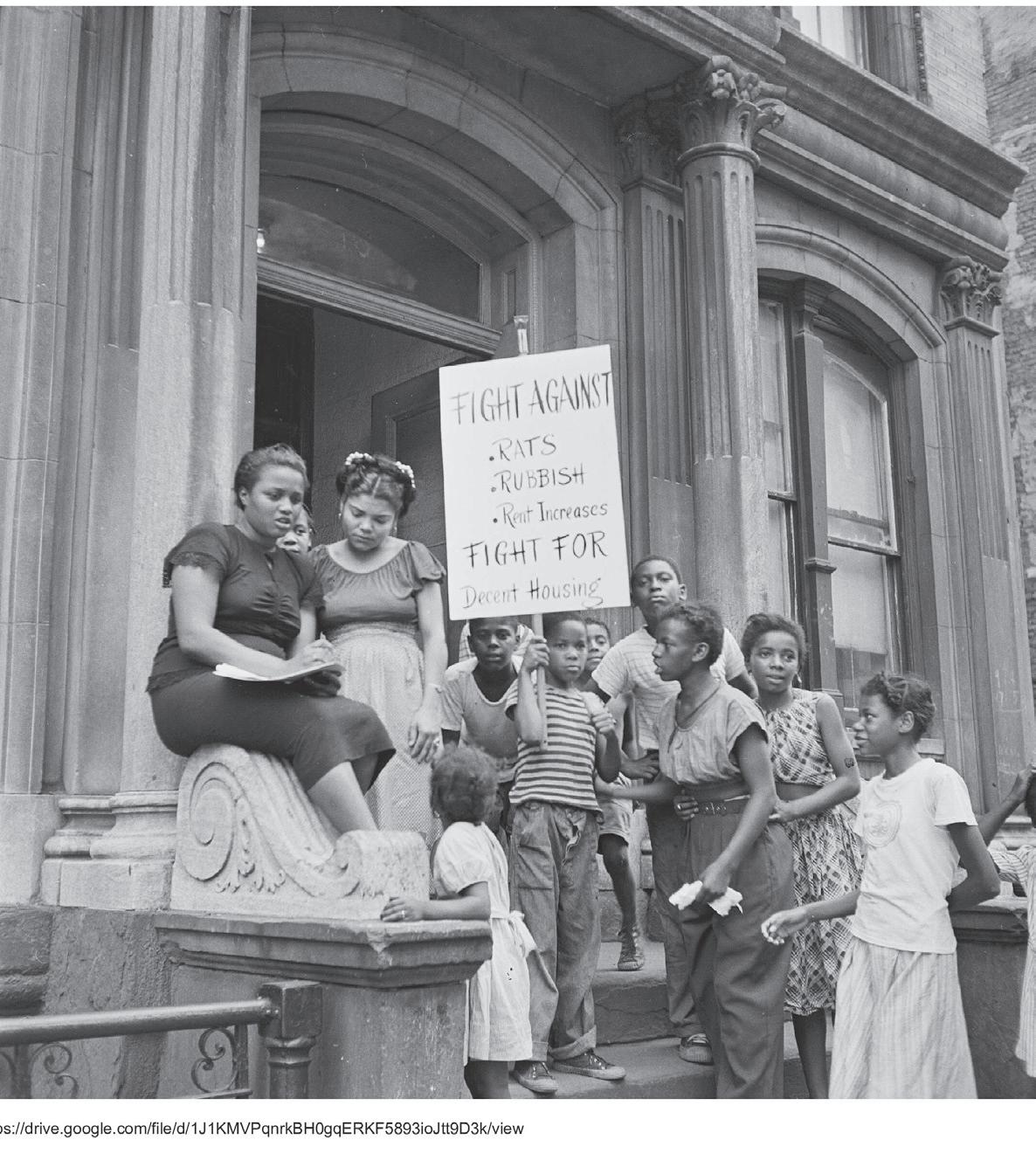
Exhibit photo of Harlem in 1949 about the Legal Aid Society’ Housing Justice unit. (John Vachon (X2011.4.11813.1) Museum of the City of New York Reproduction photo)
Photo of Rosalie Loew, the Legal Aid Society’s first woman attorney-in-chief on display at the New York Historical. (Photo courtesy of Columbia University in the City of New York Unidentified photographer Rosalie Loew, ca. 1895 Reproduction)
Divine Nine News
Capital access and the gender gap: Expanding access with women as part of the solution
By OFFICE OF JILL JOHNSON CEO and Cofounder, IFEL
The Institute for Entrepreneurial Leadership (IFEL) invites you to the Conscious Collisions Summit, March 24–March 26.
Did you know that women’s history is still being made every day? Here’s an example.
In the spring of 1988, Jill Johnson was initiated into the Xi Tau Chapter of Delta Sigma Theta Sorority, Inc. as a student at Harvard University. In 2002, she co-founded the Institute for Entrepreneurial Leadership (IFEL), a national nonprofit organization, with her father, Dr. Henry Johnson. Ever since, Jill has been a fierce champion for inclusion in the entrepreneurial ecosystem.
In 2019, Jill sought answers to the capital access problems for historically excluded populations. Leaning into the relationship connectivity as the driver of capital access, she launched the Making of Black Angels, an awareness campaign to introduce more people in the Black community to angel investing. In 2023, IFEL made the historic move to acquire Pipeline Angels, one of America’s leading angel training organizations focused on the experience of women and non-binary investors and founders.
On March 24–26, IFEL will host the virtual Conscious Collisions Summit to inspire more people to be part of the solution to the access to capital problem.
“When we pool our social equity, our expertise, and our dollars, we transform a network into a powerful engine for change,”
said Jill, host of the event.
“The Conscious Collision Summit mobilizes change agents who share our vision for a more inclusive entrepreneurial ecosystem.”
Agenda highlights for the three-day online Conscious Collision Summit include:
The Journey Unfiltered
One entrepreneur’s account of the highs, lows, and unknowns of building a business.
Capital Pathways for Inclusive Ecosystems
A provocative conversation with four resourceful entrepreneurs about how they have leveraged their communities or other innovative approaches to fund their businesses.
Why Who’s Writing the Checks Matters: Insights from Pipeline Angels
A talk with members of one
of the country’s foremost angel investor training programs that is changing the face of angel investing.
One Size Does Not Fit All: Unlocking Funding Beyond VC
A discussion about how diversification in the capital stack can lead to a lower cost of capital for entrepreneurs and stronger returns for investors.
Lightning Talks: The Architects of Alternative Capital Short presentations highlighting innovative approaches to business funding.
As part of the Summit, IFEL will host a crowdfunding showcase and a series of virtual mixers to help more people meet each other whose paths would not otherwise cross.
If interested in attending
the Conscious Collisions Summit, request an invitation at consciouscollisions.org.
IFEL is a national 501(c)(3) nonprofit organization. Its mission is to “empower champions, mobilize allies, and activate investors to use their relationships and other resources to foster a more inclusive entrepreneurial ecosystem.” To learn more, visit weareifel.org.
Q. Nicole Vanderhorst, CEO and founder of WH Farms, speaker at Conscious Collisions Summit 2026. (Photo courtesy of Q. Nicole Vanderhorst and IFEL)
Meagan Pitcher, CEO and founder of Bairitone; speaker at Conscious Collisions 2026. (Photo courtesy of Meagan Pitcher and IFEL)
Jill Johnson, CEO and co-founder of Institute for Entrepreneurial Leadership.
Join us at Conscious Collisions Summit 2026: Community as Capital! Learn more about the Summit. (Photos courtesy of IFEL)
Union Matters
Nursing home funding gaps could impact NYS healthcare
By KAREN JUANITA CARRILLO Amsterdam News Staff
New York’s nursing homes are facing a funding crisis, and as state budget negotiations get underway, advocates are warning that without increased investment, those who rely on nursing homes will suffer.
Medicaid is essential to funding nursing home care in New York State; it covers about 85% of residents, far above the national average of 63%. Yet Medicaid reimbursement covers only 75-80% of actual expenses, which leads nursing homes to have to cut beds and reduce care.
Stephen Hanse, president and CEO of the New York State Health Facilities Association, said, “Across the state, loved ones leave their elderly and fragile family members in the care of nursing homes that rely on Medicaid to cover the costs.” He represents more than 450 member facilities and is actively advocating for Medicaid
reform, sustainable funding, and workforce solutions in Albany.
When nursing homes have a shortfall, it’s felt throughout New York’s healthcare networks. As Hanse described, “With underfunded Medicaid and staffing mandates in New York State, you run into situations where nursing homes have to close beds or units because they don’t have sufficient staff. Hospitals who have patients needing subacute care at a nursing home can’t place them, or can’t place them close to their loved ones, because there are no beds available.”
This creates longer emergency room waits, delays elective procedures, and increases costs as patients remain in high-acuity hospital beds longer than necessary. Families are left in limbo, facing extended stays, higher complication risks, and fewer choices for their loved ones’ care.
Despite the push toward homebased elder care, Hanse noted that the clinical needs of many
nursing home residents are too complex for home settings. “If you were to close your eyes and open them in a nursing home, you’d say you were in a hospital. The clinical nature of our residents is so significant — their needs cannot be met at home. We have ventilator operations, high
acuity residents, and with the staffing crisis, we’re seeing backups in hospitals,” he said.
Gov. Kathy Hochul has emphasized the urgent need for funding in her fiscal year 2026–2027 budget proposal, proposing $1.5 billion for nursing homes and hospitals. Hanse’s association is
pushing for $750 million of that amount specifically for nursing homes as an essential initial step: “It’s not in the base, so it’s not continual, but it is a down payment investment to help turn the tide of the financial situation nursing homes are facing now. We’re very grateful to the governor for recognizing that nursing homes need investment, and that the state has to reverse the course of disinvestment.”
Staffing and operational needs are themselves a critical challenge. Nursing homes struggle to recruit and retain skilled nurses and caregivers, especially as Medicaid rates underfund care by nearly $100 per resident per day. Hanse emphasized that “once we increase the investment in nursing homes and recruit and retain essential healthcare staff, we can start turning this around. But over 15 years, it’s going to take work, it’s going to take a multi-year commitment by the state of New York to really invest in nursing homes.”
Families who resisted McCarthyism warn: ‘It can happen here’
By KAREN JUANITA CARRILLO Amsterdam News Staff
Children of people who were targeted during the 1950s McCarthy-era Red Scare say they remember the constant sense of surveillance they felt, even as they tried to live normal lives.
On March 3, Michael Meeropol (son of Julius and Ethel Rosenberg), MaryLouise Patterson (daughter of civil rights activists Louise and William Patterson), and Molly Jong-Fast (granddaughter of blacklisted novelist Howard Fast) came together at the Cathedral of St. John the Divine to talk about their experiences during the Red Scare, a time when the government made their ordinary lives feel unsafe.
The event, moderated by historian Beverly Gage, was part of the Columbia University Department of History program titled “Confronting McCarthyism: Generational Lessons from Families who Resisted the Red Scare.” It looked back on the surveillance climate of the 1950s and related it to what we’re living through today
Meeropol remembers that his
parents — Julius and Ethel Rosenberg, who were charged with and executed for espionage — were not simply talked about in the news, but turned into national symbols. As a child, he said, this was a frightening time: “It was scary, we were isolated. The media was against us.” At one point, he remembered discovering “one wonderful newspaper” that supported his parents and then trying to share it with the people around him. “One mother was very nice to me, and another mother threw me out of the house because she thought I, an eight-year-old, would contaminate her son,” he told the Amsterdam News. “That was a pretty scary thing for an eight-year-old.”
MaryLouise Patterson’s mother, Louise, was a labor activist who fought against the low wages and systemic discrimination faced by Black workers. She also worked with Harlem Renaissance artists to promote social justice through art. Her father, William, led the Civil Rights Congress and edited the “We Charge Genocide” petition that was submitted to the United Nations in 1951. Both
Louise and William Patterson were members of the Communist Party USA and were persecuted by McCarthy and the FBI.
The normality of racial segregation when MaryLouise was a child, in some ways, she said, protected her from the full-on affronts she later realized her parents were going through. “In African American communities, there might’ve been a little bit more protection against McCarthyism by the mere fact that we were segregated,” she said. “There really was a love…for [my family’s] history of struggle and our history of fighting against racism. So that tended to protect us.”
Patterson does remember that there was always a car parked across the street from her home.
“I remember the standard, dark Ford car across the street from the house with four white men in it, all in…dark suits,” she said. One detail that stuck in her child’s mind was their shoes, “black and shiny,” without decoration. “Anytime I saw a white man who was dressed in a dark suit and with those shoes, I knew…he was an FBI agent or an agent for the government.”
MaryLouise’s family was, she believed, constantly watched not only so the government could
gather information about them, but also so that they could isolate them. They “were trying to intimidate the neighbors and distance them from us,” she said, adding that agents may have also been attempting to recruit informants. “Who knows? I mean, they did all kinds of stuff.”
But Meeropol says that kind of pressure led him to a decision not to be scared. “The experience of losing my parents and growing up with that legacy…certainly made me a radical,” he said. “It made me want to fight back.”
Today, as the United States faces a right-wing turn in its politics, Meeropol and Patterson said the 1950s and the present are starting to look similar. The same methods of creating fear are in use: public demonization, state power, and pressure on communities to turn inward. Meeropol said he sees it in political messaging that portrays certain groups as threats to the nation itself, and that tries “to convince people that you’re fighting the good fight to…protect America” and in language about
(Riverside Premier Rehabilitation photo)
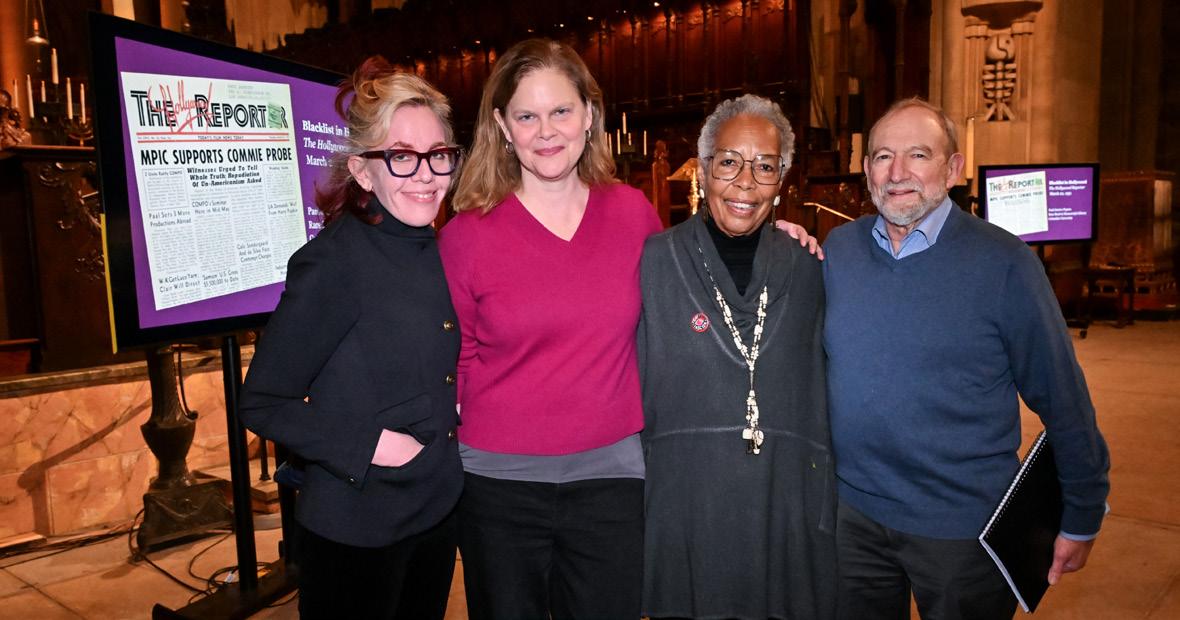
Confronting McCarthyism” panel, Molly Jong-Fast, Beverly Gage, MaryLouise Patterson, and Michael Meeropol. (Diane Bondareff photo)
Trump’s tumultuous need for a ‘forever war’
When The New York Times, the December 12th Movement, and countless other leftist formations arrive at the same conclusion about the Trump administration’s attack on Iran, you know it’s a day of reckoning. What it implies is a moment of truth, an estimation of an assault that, no matter the ideological distinctions, there is general agreement. It suggests that Trump is once again egregiously wrong, unequivocally in violation of international law, endangering our military forces without consent from Congress, and recklessly fomenting the possibility of another “forever war.” Moreover, we all can recall when he promised that he would not instigate any warfare, only to find calamitous turmoil all around us, much of it unprovoked and ushered forward by his own misconceived notions of threat and hostility. In his march toward total authoritarianism, both at home and abroad, Trump appears to be consumed with egomania and determined, at all costs, to be the global cop.
His ruthless regime has deployed an uncaring agency in our cities, kidnapped a president, and now the merciless killing of a world leader. There’s no way to assess his next move, and even if he had a plan beyond taking the life of the Ayatollah and his associates, he has no legitimate
justification for the murders. At this stage of the conflict, which Trump has stated may go on for weeks, any prospects of regime change in Iran are about as unforeseeable as “No Kings” day here in America, removing him from office. The head of the Iranian government may be chopped off, but the Islamic Revolutionary Guard is still in place, and the consequences remain incalculable. We have already learned that four members of our military have been killed, and if the war continues, there will be more, to say nothing of the collateral damage and the senseless loss of innocent lives.
Yes, we are hearing from the voices of dissent, and gradually, even those anchored in Trump’s base are beginning to see how horrendous he can be. And it is heartening to learn that, according to polls, three out of four Americans are angered by this “war of choice,” and clearly one that looks down the road to the midterm elections.
But if it is in Trump’s mangled estimation that the war could be a decisive factor in these upcoming elections, then he may be in for a rude awakening, as the American people come out of their slumber and see the devil in the details. Yes, “Operation Epic Fury” could very well backfire on the instigator, and that, to paraphrase Shakespeare’s “Hamlet,” is “a consummation, devoutly to be wish’d.”
Elinor R. Tatum: Publisher and Editor in Chief
Gray: Executive & Investigative Editor
Professor who loudly revealed her racism must be fired to protect Black children
By DR. MICHELE SWEETING-DECARO
The story has garnered much attention, but I was there.
On February 4, 2026, I logged into a Community Education Council District 3 Zoom meeting as a parent advocate for the Community Action School (CAS) on the Upper West Side. I had been invited to speak about my son, who once needed speech services and flourished in the smaller learning environment, and is now an honors math major at a premier HBCU. I came ready to testify to what happens when schools see our children, believe in our children, and expect them to soar.
As I waited for my turn, a CAS student began to speak with a mixture of courage and vulnerability that I recognize in my own college classroom. The kind of voice that tells the truth even when the room is not ready to hear it.
And then it happened.
The interruption was not just confusion — it was an act of racism from a parent, and it was flagrant, visible, and unapologetic: “They’re just too dumb to know they’re in a bad school,” the voice said. “F…, if you train a Black person well enough, they’ll know to use the back door, you don’t have to tell them anymore.”
This parent, referring to “those” students not being able to learn the right way and suggesting they would probably “end up cleaning anyway,” also referred to the students as “these Black kids.”
Time stopped in that moment. A lecture I shared with my City College students hours earlier, Ralph Ellison’s “Battle Royal,” and institutionalized racism became real to me. Institutionalized racism had moved from a theoretical concept in a course syllabus to a voice in a meeting about our students’ future. The thing that was equally upsetting to the words being spoken was the silence that filled the room afterwards.
A room filled with professional people, people with titles, people with degrees, people who have equity written into their mission statements, all silent. Perhaps they were silent because they were in utter shock, like I was, but the silence lingers too long.
I felt something rise in me — scholar, mother, pastor, and the strength
of those who came before me — all at the same time. I knew that if I allowed that moment to pass, I would be participating in the very system I teach my students to critique.
So I named it — racism.
I wrote in the chat to the person who made the remark, Allyson Friedman, Professor at Hunter College, what others did not — that her comments were disgusting, that they were harmful, that that language had no place in a space that claims to serve children. Then I heard, “Mute.” I exclaimed, “It’s too late to mute — tell us how you really feel.”
My hands were shaking. My heart was racing. When the meeting moved forward, I had to step away and scream — not because I was weak, but because I am tired of watching our children be strong in spaces that are still not safe for them — tired of watching adults choose comfort over courage.
In my classroom, I teach that racism is embedded in systems. That night, I was reminded that systems are made of people, and people make choices.
Allyson Friedman, a professor from Hunter College, chose to speak words that dehumanized Black children.
And I chose to interrupt, because our children must be protected in real time — not in a report, not in a statement, not after a committee meets. Let me say plainly what this moment requires.
A person who publicly declares that Black children are incapable of learn-
ing is not fit to prepare future teachers. Allyson Friedman must be removed from the academic classroom. Not retrained. Not reassigned. Removed. And if Hunter College does not remove Friedman, students should protest — not out of disruption, but out of a deep commitment to protecting the dignity, safety, and humanity of their learning environment. This is not about punishment; this is about providing protection. Protection for Black children to see their own brilliance when they arrive at school. Protection for future teachers who have never been allowed to have their ideologies supported because of ideological shifts, and to protect the integrity of the institution that claims its value is equity.
We need real-time protocols when racism enters public educational spaces. We need clear and public consequences for those who engage in it. We need protection for the parents, students, and educators who speak up in the moment. We need institutions that move with urgency when our children are harmed.
Because neutrality in the face of racism is not neutrality. It is an agreement.
Dr. Michele Sweeting-DeCaro is an adjunct professor at CUNY’s City College Center for Worker Education and John Jay College, Director of the CWE Writing Center, an author, pastor, and president of the CWE Alumni Association.
Madison
Kristin Fayne-Mulroy: Managing Editor
(Pexels/Andy Coffie photo)
Outdated restrictions on wine sales in grocery stores no longer make sense
By Assemblymembers
LANDON DAIS, AL TAYLOR, and JORDAN WRIGHT
Harlem and the Bronx are dotted with small, independent grocery stores. These businesses are community anchors that offer accessible, affordable groceries; steady jobs for residents; and friendly, communal spaces. They are often immigrantowned, family-run stores whose staff know their customers by name.
These neighborhood supermarkets and independent grocers show up for our communities every single day, but keeping them open and running has grown harder in the Trump era. Federal tariffs have cut into already small margins, and federal rollback of SNAP benefits has thrown a core revenue channel into uncertainty. In 2025 alone, consumers spent $310 more on groceries overall compared to 2024.
Addressing these issues facing consumers and communities requires big changes in Washington and the wider economy, but one thing we lawmakers in Albany have the ability to provide local grocers is another source of revenue,
some of which is made right here in New York State: wine.
The restriction on selling wine in grocery stores is 100 years old and doesn’t make sense anymore, especially for the small, independent grocery stores in Harlem and the Bronx that are struggling. Wine is allowed to be sold in grocery stores in 40 other states. Polls show that more than 75% of New Yorkers believe they, too, should have that convenience. Even more importantly, 80% of wine buyers say they would continue shopping at liquor stores even if this reform passes — debunking the fear that this would shut down small liquor retailers.
Many of the supermarkets in our districts are members of the National Supermarket Association (NSA), a trade association of independently owned stores serving communities up and down the East Coast. These are local entrepreneurs who reinvest in our neighborhoods, hire locally, and provide culturally relevant food options.
NSA members have made it clear that they are eager to get the chance to sell wine along with groceries in their stores. In a letter late last year, more than 80 owners urged Gov. Kathy Hochul to
Black studies: What we stand to lose
By HERB BOYD
“What We Stand to Lose” is the title of a book by anti-racism author and activist Kristen Buras. It is also the title of a conference on Thursday, March 5, at Columbia University. Both Buras’ book and the conference, sponsored by the Association for the Study of Worldwide African Diaspora in association with the Institute for Research in AfricanAmerican Studies (IRAAS), are concerned about similar potential losses, particularly the erasure of Black Studies. A central theme in Buras’
support ongoing legislative efforts to change state law. They know that allowing the sale of wine would give them the same opportunity that their peers enjoy in most of the country.
The restrictions on wine sales are also a frustrating inconvenience for consumers. Right now, a working parent, shopping after a long day, has to make an extra stop if they want to bring home a bottle of wine for dinner or a family celebration. That means more time, more cost, and more inconvenience. In communities where families are already juggling rising food prices, transportation challenges, and tight schedules, that extra stop matters.
This isn’t about choosing one small business over another. Harlem and the Bronx will always be pro-small business, and our local, independent liquor stores will always have a place in our communities. To ensure this is the case, the proposed legislation includes safeguards that encourage healthy competition in the retail sector. Liquor stores will be allowed to expand their product offerings to glassware and other alcohol-adjacent products, and grocery wine
licenses cannot be issued within 500 feet of an existing liquor store.
Those changes reflect thoughtful compromise and a recognition that we can modernize New York’s laws without harming other small businesses.
For communities like ours, this conversation is also about affordability and fairness.
We often talk about closing opportunity gaps in communities of color. That includes giving minorityowned supermarkets the ability to compete on an equal footing with their out-of-state peers. Our communities should not be left behind because of Prohibition-era policies.
Modernizing New York’s wine laws is a pro-consumer and pro-small business reform. It reflects what voters want, what neighborhood grocers are asking for, and what hardworking New Yorkers deserve. It’s time for Albany to listen — and let Harlem and the Bronx thrive.
Jordan Wright, Landon Dais, and Al Taylor are members of the New York State General Assembly. They represent districts in Harlem and the Bronx.
Wordle can bring everyone together, no matter what walk of life
CHRISTINA GREER, PH.D.
I don’t know how many of you play The New York Times’ word game Wordle, but it is more than just a game. For those of you who haven’t been introduced, you start the game with a five-letter word of your choosing and you have six tries to correctly guess the word of the day. I start each morning with the same word; I like the consistency. However, some people, like Pope Leo XIV, start each morning with a new five-letter word as they begin the game. Obviously, solving the word in three or four tries starts my morning off right. Some mornings, I guess the correct word on my sixth and final try and I am still pleased just to keep my winning streak.
However, I realize Wordle isn’t just about the word game — it’s actually about community, friendship, and family.
book is the closure of a high school in New Orleans; according to the conference planners, Black Studies is under fire, and they offer examples of that with the recent dismantling of the African and African Diaspora Studies department at the University of Texas at Austin, home of the first Black Studies Ph.D. program in the American South.
The panelists include Edmund T. Gordon, founder and former chair of African and African Diaspora Studies at the University of Texas; Andrea J. Queeley, associate professor of anthropology at
Florida International University; Ashanté M. Reese, associate professor at the University of Texas at Austin; and Michael Brandon McCormack, chair of Pan-African Studies at the University of Louisville.
Depending on when you
read this, you may not be able to attend the event from 7-9 p.m., but you can register for the webinar online at IRAAS. What we stand to lose may be the main topic, but they will be hardpressed not to deal with what we have already lost.
Each morning, Wordle is one of the first things I do when I wake up. I immediately send my score to my sister and her entire family, a best friend in the D.C. area, and another bestie and former roommate in Los Angeles. As I’ve talked to other people who play Wordle and send their scores to friends and family around the country (and the world) each morning, I realize that some of these games we play are much deeper than just the game. For so many of us, it’s a way to check in with close loved ones each morning. They know I am well and among the living, and I hear from them and know all is well.
When my college room-
mate in Los Angeles was transient last year during the Altadena wildfires, it was Wordle that let me know he was safe each morning, even if I didn’t know exactly where he was staying. As I asked around, I realized that these “games” served as a new form of communication for so many families. We all lead such busy lives, but the daily text with my entire family is a way to slow down just a bit. And the smack talk on certain days is a welcome addition — and antidote — to the stresses of life. Your game of choice may not be Wordle, but I strongly suggest finding something that binds the family or friend group chats. Although we are no longer in Covid lockdown, I am noticing a certain level of stress, anxiety, fear, and loneliness among my students. Something is amiss and I can tell that many adults are feeling the same emotions as these young people. Sometimes we can’t fully articulate what is “off,” but we can find ways to create varying levels of community with those we care about near and far. Give Wordle, or something similar, a try and spread the word.
Christina Greer, Ph.D., is an associate professor at Fordham University; author of the books “How to Build a Democracy: From Fannie Lou Hamer and Barbara Jordan to Stacey Abrams” and “Black Ethnics: Race, Immigration, and the Pursuit of the American Dream”; and co-host of the podcast FAQ-NYC.
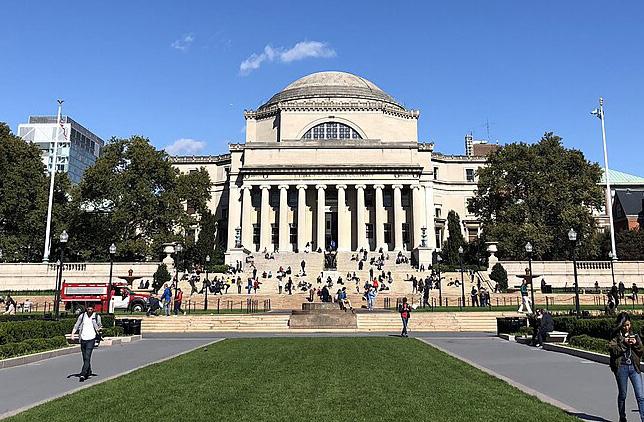
Columbia University (Public Domain Photo)
Caribbean Update
Cuba to get aid from Caricom
By BERT WILKINSON Special to the AmNews
U.S. Secretary of State Marco Rubio flew to St. Kitts in late February for talks with Caribbean Community (Caricom) leaders at their summit last week and discussed topics from hemispheric security to crossborder narco trafficking to an overhaul of tourist visas for countries around the globe, including the region.
The decades of sustained pressure on Cuba also made the agenda, and, based on reports, regional leaders appeared to have stood their ground on the special relationship the community has with Cuba, despite the economic chokehold imposed on the island by the U.S. and the pressure it is applying on the bloc to scale back relations with Cuba.
As the three-day conference came to an end, the region made it clear to all and sundry that its support for the island remains steadfast, especially because of the decades of close cooperation in training Caribbean doctors and other professionals in Cuba, in large part free of cost. Conference Chair and Kittian Prime Minister Terrance Drew said the region is moving to send a significant relief package to Cuba in the coming weeks because that is basically the right thing to do.
He noted that during the session with Rubio, “all parties recognized that there should be efforts to address the growing humanitarian crisis.”
As an indication of things to come, Jamaican Prime Minister Andrew Holness led the way at the opening ceremony by suggesting that the region owes Cuba a debt of gratitude, even as he worried about a collapsed Cuba affecting the wider Caribbean, as he called for assistance to the country.
“Its people are part of our shared history, but today, the Cuban people face severe economic hardship, energy shortages, and growing humanitarian strain. Jamaica is sensitive to the struggles of the Cuban people,” he said, while noting that “humanitarian suffering serves no one. Apart from our fraternal care and solidarity with the Cuban people, it
“With respect to Cuba and the humanitarian efforts, we are going to respond on the humanitarian end in short order, within a month,” Drew said. “The matter of the challenging situation in Cuba was also discussed. All parties recognized that there should be efforts to address the growing humanitarian crisis. The Caribbean Community, cognizant of its very close relationship with both Cuba and the USA, and mindful of the extent to which the region can be negatively affected, is willing to participate in any way that will redound to the benefit of the Cuban people, while maintaining regional stability. I can go on further to say that the community has taken the decision as well to support humanitarian efforts in Cuba.”
must be clear that a prolonged crisis in Cuba will not remain confined to Cuba. It will affect migration, security, and economic stability across the Caribbean basin. It is, therefore, important that we carefully consider this matter and take collective action.”
Drew chipped in by recalling his days of reading for a medical degree in Cuba as the leaders made the case for an assistance package to the island. “I studied in Cuba,” Drew said. “I lived in Cuba for seven years. I have friends there. I have people who are like family to me. They reach out to me and tell me of their difficulties. Food has become
terribly scarce for some. Access to water has been challenging. Garbage fills the streets. Houses are without electricity. I can only feel the pain of those who treated me so well when I was a student. I can feel their challenges and their difficulties. I do not get involved in their politics, but as a matter of humanity, it is challenging — I would say it is almost impossible — not to feel the pain that is conveyed to me in messages and calls from those who I lived among.”
It is not clear when the relief package will head to Cuba, but leaders said that it must be sent to avoid another Haiti-like crisis.
Visa crackdowns are now hitting legal immigration — and America is paying the price
In recent months, sweeping changes at the U.S. Department of State have quietly reshaped how legal immigration works. Expanded vetting, visa revocations, interview suspensions, and new travel bans are slowing lawful migration, harming families, universities, healthcare providers, and American employers.
According to a February policy brief from the American Immigration Lawyers Association (AILA), the administration’s new approach reframes immigration broadly as a national security threat. In practice, that shift has disrupted visa processing worldwide — not only for asylum seekers, but for students, high-skilled workers, and the family members of U.S. citizens and lawful permanent residents.
The impact has been swift.
According to AILA, in 2025 alone, more than 6,000 student visas were revoked, while over 4,700 international students
lost their legal status through SEVIS terminations. Consular posts paused student visa interviews for weeks and introduced sweeping social media vetting requirements, asking officers to assess whether applicants showed “hostility” toward the United States. The result was a 188% increase in student visa wait times at reporting consulates and a 17% drop in international student enrollment in fall 2025. International students are a major economic engine for the United States. When they choose Canada, the United Kingdom, or Australia instead, America loses tuition revenue, research innovation, and long-term talent.
High-skilled workers have also been caught in the disruption. In December 2025, expanded screening rules for H-1B visa holders were followed by the abrupt suspension of scheduled visa appointments. Many renewal appointments were pushed back months — some as far as 2027 — stranding workers and their families overseas. In one reported case, a cardiologist’s visa renewal delay left nearly 900 cardiac patients without access to essential care. These disruptions signal instability to U.S. employers who rely on specialized talent.
At the same time, travel bans expanded from 19 to 39 countries, and as of January 2026, immigrant visa issuance was paused for nationals of 75 countries pursuing permanent residency. A presumption of “public charge” ineligibility was applied broadly, without publicly articulated standards, even though applicants for permanent residency must already demonstrate financial support.
Families have been separated. Workers have been delayed. Businesses have been left uncertain.
Compounding the issue, the Department of State laid off more than 1,300 employees in 2025, including 246 foreign service officers. The very agency tasked with implementing expanded vetting has fewer personnel to carry it out. A 2025 survey by the American Foreign Service Association found that 98% of foreign service members reported poor morale.
Immigration policy debates often focus on unauthorized migration. What is less discussed is how sweeping enforcement measures are now disrupting legal pathways that support America’s economy, universities, healthcare systems, and families.
The question is no longer whether immigration will be tightly controlled. It is whether control can be exercised with precision rather than disruption.
Visa policy is not just about borders. It is about whether America remains a reliable destination for talent, family unity, and lawful opportunity — or signals to the world that even legal migration is uncertain.
That choice carries consequences far beyond immigration. It carries consequences for America’s economic future.
Felicia J. Persaud is the founder and publisher of NewsAmericasNow.com, the only daily syndicated newswire and digital platform dedicated exclusively to Caribbean Diaspora and Black immigrant news across the Americas.
National security is a legitimate concern. But blanket policies that overwhelm officers, delay processing for low-risk applicants, and suspend established efficiency tools, such as interview waivers, do not necessarily make the country safer. They do, however, make the system slower and less predictable.
U.S. Secretary of State Marco Rubio (second from right) chats with Jamaica’s Prime Minister Andrew Holness after posing for a photo during Caribbean Community (Caricom) meetings in Basseterre, Saint Kitts and Nevis, Wednesday, Feb. 25, 2026.
(Jonathan Ernst/Pool photo via AP)
International News
U.S. to end health aid to Zimbabwe after funding talks collapse
By FARAI MUTSAKA Associated Press
HARARE, Zimbabwe (AP) — The United States has said it will wind down health assistance to Zimbabwe after negotiations collapsed on a U.S.-proposed funding deal that the African nation rejected, in part over a requirement to share sensitive health data.
The loss of the southern African nation’s largest health donor casts uncertainty over programs to combat HIV and the public health sector in one of the world’s most vulnerable health systems, where patients often must supply even basic items themselves, such as bandages at clinics, and often have to buy their own medicines due to shortfalls.
Zimbabwean authorities said the funding proposal carried conditions they could not accept. The decision was driven by concerns over data-sharing, fairness, sovereignty, and Washington’s broader shift away from global health institutions, government spokesperson Nick Mangwana said on Wednesday. Mangwana said the U.S. proposal was tied to “comprehensive access to Zimbabwe’s sensitive health data, including virus samples and epidemiological information from our citizens.”
He said President Emmerson Mnangagwa directed that negotiations be terminated because the U.S. was not offering a “corresponding guarantee of access to any medical innovations — such as vaccines, diagnostics, or treatments — that might result from that shared data.”
“The United States was not offering reciprocal sharing of its own epidemiological data with our health authorities,” Mangwana said. “In essence, our nation would provide the raw materials for scientific discovery without any assurance that the end products would be accessible to our people should a future health crisis emerge.”
The U.S. had offered $367 million over five years to support Zimbabwe’s priority health programs, including HIV/AIDS treatment and prevention, tuberculosis, malaria, maternal and child health, and disease outbreak preparedness, the U.S. embassy in Zimbabwe said.
The proposed deal would have represented the largest potential health investment in Zimbabwe by any international partner, providing “extraordinary benefits for Zimbabwean communities — especially the 1.2 million men, women, and children currently receiving HIV treatment through U.S.-supported programs,” U.S. ambassador Pamela Tremont said in a statement on Tuesday.
“We will now turn to the difficult and regrettable task of winding down our health assistance in Zimbabwe,” she said, adding that Zimbabwe had indicated it was prepared to continue its HIV response independently. “We wish them well,” said Tremont.
The U.S. has been Zimbabwe’s largest bilateral health donor for years, providing nearly $2 billion in assistance since 2006.
The U.S. said it “is directly responsible” for Zimbabwe’s success in reaching United Nations targets for HIV treatment, testing, and viral load suppression.
Zimbabwe has begun rolling out lenacapavir, a long-acting HIV-prevention drug administered twice a year. The rollout was supported by the United States President’s Emergency Plan for AIDS Relief (PEPFAR), in partnership with the Global Fund, raising questions about future deliveries under the program.
Zimbabwe’s College of Public Health Physicians has urged continued talks, citing the need for continued U.S funding for “critical components” of Zimbabwe’s
public health system.
“An abrupt discontinuation of such support could risk treatment interruption, increased transmission, the emergence of drug resistance, and additional strain on the health system,” the college said in a statement.
Zimbabwe, like many low-income countries, has been grappling with the effects of aid reductions under President Donald Trump, although some programs continued under PEPFAR. In January, the U.S. also withdrew from the World Health Organization (WHO), as part of a broader reconfiguration of global health engagement.
Under the new U.S. framework, the Trump administration has pursued bilateral “America First” health funding agreements, replacing arrangements previously coordinated through the now-dismantled U.S. Agency for International Development.
The U.S. embassy in Zimbabwe said agreements worth more than $18 billion have been signed with 16 African countries, although recipient countries would contribute about $7.1 billion of this amount as part
of the U.S. drive to get countries to invest more in their own health sectors.
Several countries have already entered into the new pacts. Nigeria reached an agreement emphasizing Christian-based health facilities. Rwanda and Uganda have also signed deals, while some agreements, including those with Rwanda and Côte d’Ivoire, include provisions for private U.S. sector investment.
In Kenya, a pact signed in December has been delayed after the High Court suspended implementation pending a case over data safety concerns filed by a consumer rights group.
Zimbabwean officials criticized the bilateral model as “a departure from the multilateral frameworks” and said virus data with pandemic potential should be shared exclusively through the WHO system. “This system is designed to ensure that when a country contributes its data, the benefits — including vaccines and treatments — are shared equitably, not commercialized exclusively by those with the resources to develop them,” Mangwana said.
Zimbabwe’s Minister of Health and Child Care Douglas Mombeshora holds up containers of Lenacapavir, new HIV prevention drug, during launch in Harare, Zimbabwe. (Aaron Ufumeli/AP photo)
Fri, Apr 3 @ 8PM
Award-winning comic Deon Cole (Black-ish, Average Joe) heads back to NJPAC for another round of hilarious jokes. deon cole
An Evening of Songs & Stories Apr 21 @ 7PM
Get personal with the 13-time GRAMMY® winner (“All of Me,” “Ordinary People,” “Tonight”) in this intimate concert. john legend
Say Yes The Tour Apr 8 & 9 @ 8PM
After nearly a decade, Floetry — the iconic duo of Marsha Ambrosius and Natalie “The Floacist” Stewart — returns with Raheem DeVaughn and special guest Teedra Moses.
The Love & Relationship Tour Fri, Apr 24 @ 8PM
An electrifying night of praise, worship and soul-stirring gospel with the iconic power couple David and Tamela Mann.
Both Directions at Once Sat, Apr 18 @ 7:30PM
Saxophonists Joe Lovano and Melissa Aldana, pianist Nduduzo Makhathini, bassist John Patitucci and drummer Jeff “Tain” Watts pay tribute in this centennial celebration.
Fri, May 8 @ 8PM Sat, May 9 @ 8PM Sun, May 10 @ 3PM
Feel the joy and elation of African American culture with Alvin Ailey American Dance Theater, a highlight of our season.
Caroline T. Dartey.
Photo by Andrew Eccles
Arts & Entertainment
The art of reinvention with Monique Coleman
By LOIS ELFMAN Special to the AmNews
Earlier this year, Monique Coleman was in high demand for interviews about the 20th anniversary of “High School Musical,” the film series in which she played a central character. She reflected fondly on her role as Taylor McKessie in the three films that focused on the joy of musical theater and how young people can embrace it despite stereotypes. When the recent appearances wrapped, she returned to the grind of working in the entertainment industry. She presented at the Children’s & Family Emmy Awards earlier this week.
“At this stage of my life, I had to decentralize my ambitions in order to have a holistic life,” Coleman said. “My entire youth was dedicated toward becoming something, becoming prominent within the entertainment industry, achieving a certain level of success, and so forth. From the moment I left college in 2002 and reality television hit the scene, for the last 20-something years, we’ve been watching this rapid, exponential shift within the entertainment industry.”
Coleman added that “for me personally, I have to say that I have, in many ways, let go of my idea of what my career should look like. I have leaned into how I can find other fulfilling and satisfying things to do while still having a passion for being an actress — still desiring and wanting to be on set, but not putting the rest of my life on pause in pursuit of that when in many ways, my big dream did transpire and I’m very fortunate to be a part of a legacy project.”
She regularly does speaking engagements. A talented actress, singer, and dancer, Coleman would love to combine all those talents in a performance vehicle, but while she works toward that goal, she channels her artistic energy into new vehicles, most notably figure skating.
Coleman took up skating sever-
al years ago. Thanks to her dance training and performance skills, she has advanced more quickly than others coming to the sport and art as an adult. She was invited to be an honorary member of the Skating Club of Boston, and at times, she hosts events for the club. When in Los Angeles, she participates with Unity Ice Academy, which provides access to figure skating to kids in the Los Angeles area who might not otherwise have it. She recently cohosted the organization’s gala and also has a relationship with U.S. Figure Skating. In February, Coleman attended the Olympic Winter Games in Milan Cortina, where she soaked
up several of the figure skating events and enjoyed Italy’s delicious cuisine. “It really did feel like a once-in-a-lifetime magical experience,” she said. “This opportunity for us to come together and have this collective spirit of humanity and pride for our athletes was really something special.”
Seeing skating at its highest level inspired her to see what she can do within her capacity. Beyond her own on-ice experiences, Coleman would love to collaborate with a competitive skater or performer on a piece, perhaps singing for someone’s program.
“I feel like there is limitless opportunity within this space to advance personally, but also to
amplify and collaborate,” she said. “My dream would be to have a digital or streaming series that would follow my journey of learning more about this sport and, through that, interview very prominent skaters — to also interview adult skaters and people who maybe came into it later and get their stories of why they’re doing this and how it translates off ice as well.”
In addition to acting, Coleman has done hosting work, creating her own shows. Her 2018 series “Gimme Mo” explored social and emotional issues that affect young people. Much like “High School Musical” emphasized embracing one’s true self and
departing from the status quo, “Gimme Mo” encouraged young people to have compassion and express themselves.
Coleman still hopes there will be an opportunity for a resurgence in her artistic career. After two decades based in Los Angeles, she has been spending an increasing amount of time on the East Coast, hoping to find her way onto Broadway, which she described as her new dream.
“My focus is on purpose, and I believe that my purpose is to inspire, motivate, entertain, and there are a lot of different ways to do that,” she said. “[I want] to empower, to serve, and it doesn’t have to be linear.”
At 2026 U.S. Figure Skating Championships with Atoy Wilson, member of U.S. Figure Skating Hall of Fame. Monique Coleman at work.
Monique Coleman. (Photos courtesy of Monique Coleman)
Honoring Malcolm by housing more Harlemites?
If
the church where Malcolm X was laid to rest was not good enough for the city to save, shouldn’t the building replacing it at least house homeless Harlem families?
By MICHAEL HENRY ADAMS Special to the AmNews
Some considered this lost Harlem church, which was never exceptional aesthetically, to have been of no importance. Sidetracked by looks, as is so often true, they failed to realize that beauty contests were beside the point in determining this building’s historic importance.
Organized with a membership of 30, the Faith Temple Church of God in Christ was founded under the sponsorship of Dr. Alvin A. Childs and his wife, Mildred B. Childs. In the fall of 1948, the couple transferred their ministry from Chicago to the historic Imperial Elks Lodge Hall on 129th Street. Services were first held at two-week intervals.
Simultaneously, to evangelize, Dr. Childs erected a huge circus tent he’d brought from the Windy City on an empty lot at 124th Street and Saint Nicholas Avenue. For eight weeks, nightly, the revival meeting’s bright lights and stirring music helped to attract people by the thousands. The church next leased quarters on 116th Street.
All over Harlem, throughout the past century, theaters have been converted into houses of worship. Built circa 1919 as a movie house, becoming a bowling alley, then serving shortly as a synagogue, the Lido Theatre was at the crest of Sugar Hill at 1763 Amsterdam Avenue and 147th Street.
On Mother’s Day of 1952, it became the Faith Temple home. A jubilant march led by then-Bishop Childs processed through the streets to triumphantly occupy the spacious building, which had cost $175,000.
Faith Temple’s choir was so good that in no time at all, they were heard on a regu-
lar radio broadcast. By 1963, they made recordings for RCA. Solomon Herring, Jacqui Verdell, and James Cleveland were just some of the gospel greats affiliated with them.
The interior’s substantial auditorium — with Stars of David cut out of the entry doors as windows and inlaid into its linoleum floor, and a host of disparate architectural elements, including the delicately festooned parapet of long-blocked lodges flanking the proscenium arch — attests to all this structure’s different functions over the decades.
Nothing, however, commemorated its finest hour, when divine destiny transformed it into a sacred shrine of African American struggle and excellence.
That day was 61 years ago, February 27,
1965, when all other churches barred their doors to a funeral service for Malcolm X. Bravely ignoring the risk of threats of violence, Bishop Childs offered his church. John Lewis, James Farmer, and Bayard Rustin mourned among a congregation of 1,500. At the appointed hour, expounding a Black manifesto, no less moving and meaningful now than it was then, actor Ozzie Davis quietly made history. He did it by outlining what it was that Harlem — the African American cultural capital — meant for Malcolm and all that Malcolm meant for we who lived here and by extension, to Black people everywhere:
“Here, at this final hour, in this quiet place, Harlem has come to bid farewell to one of its brightest hopes -extinguished now, and gone from us forever.
“For Harlem is where he worked and where he struggled and fought — his home of homes, where his heart was, and where his people are — and it is, therefore, most fitting that we meet once again, in Harlem, to share these last moments with him. For Harlem has ever been gracious to those who have loved her, have fought for her, and have defended her honor even to the death. “It is not in the memory of man that this beleaguered, unfortunate but nonetheless proud community has found a braver, more gallant young champion than this Afro-American who lies before us, unconquered still. … There are those who will consider it their duty, as friends of the Negro people, to tell us to revile him, to flee, even from the presence of his memory, to save ourselves by writing him out of the history of our turbulent times. Many will ask what Harlem finds to honor in this stormy, controversial, and bold young captain — and we will smile. … Many will say turn away — away from this man, for he is not a man but a demon, a monster, a subverter and an enemy of the Black man — and we will smile. They will say that he is of hate — a fanatic, a racist — who can only bring evil to the cause for which you struggle! … And we will answer and say unto them: Did you ever talk to Brother Malcolm? Did you ever touch him, or have him smile at you? Did you ever really listen to him? … If you did, you would know him. And if you knew him, you would know why we must honor him: Malcolm was our manhood, our living, Black manhood! This was his meaning to his people. And, in honoring him, we honor the best in ourselves. Last year, from Africa, he wrote these words… ‘My journey … is
January 21, 2021: Led by housing advocate April Tyler, concerned community members rallied to gain support for permanent housing for families rather than transient studios as planned by city. (Photo courtesy of David Hanzal)
Malcolm X funeral at Faith Temple Church of God in Christ, February 27, 1965. (Public domain photo)
“Magen David” was inlaid into entry’s floor. (Michael Henry Adams photos)
Blocked loges flanking proscenium arch were ornamented with delicate garlands.
Past use as synagogue was indicated by windows in doors.
almost ended, and I have a much broader scope than when I started out, which I believe will add new life and dimension to our struggle for freedom and honor, and dignity in the States. I’m writing these things so that you will know for a fact the tremendous sympathy and support we have among the African States for our Human Rights struggle.
“‘The main thing is that we keep a United Front wherein our most valuable time and energy will not be wasted fighting each other.’ …
“Let his going from us serve only to bring us together, now. Consigning these mortal remains to earth, the common mother of all, secure in the knowledge that what we place in the ground is no more now a man, but a seed — which, after the winter of our discontent, will come forth again to meet us. And we will know him then for what he was and is — a Prince, our own Black shining Prince! — who didn’t hesitate to die, because he loved us so.”
Even in New York, where greed and indifference destroy so much, it is surprising that this place was allowed to be torn down. I worked hard to convince the New York State Historic Preservation Office that it was worthy of being listed on the National Register of Historic Places. Finally, they agreed, but that status did not persuade the City Historic Preservation Commission to protect the place where Malcolm X was so eloquently eulogized, as part of the Sugar Hill Historic District it bordered. With only a slight flurry of hand-wringing, a few notices in the news, and much finger-pointing, in 2017, it was demolished.
A young reporter, Nick Garber, broke the story in the Patch of how this came to happen. Attorney General Letitia James’s office filed an action in state court against Bishop Kevin Griffin, Bishop Childs’s successor at the Memorial Temple.
With routine maintenance deferred, in time, holes riddled the structure’s flat roof with destructive leaks. Since Harlem churches are so popular as redevelopment sites, “No worries,” the bishop must have thought. Ordinarily, old edifices in disrepair are razed and replaced by multi-story residential buildings. Churches get relegated to the ground floor or put underground. Apartments are provided for top church officers and $1 to $5 million enrich congregations that had previously had difficulty making ends meet.
Usually, church members are kept abreast of the particulars of such deals, but sometimes, as here, they are left completely in
dark. In 2014, it was alleged that Griffin agreed to sell the Childs Memorial Temple property to novice
developer Moujan Vahdat, of Elmo Realty. The church received $2 million for the site and a promise to spend $2.5 million on con-
structing a new building. They were assured that there was to be space for the church and upperfloor apartments for its leaders. Understandably, church officials hailed their deal as a blessing where all concerned win.
A resident of suburban New Jersey, Griffin held leadership roles in the Pentecostal Christian Church of Antigua and Barbuda, as well as in the New York State division of the Church of God in Christ. Unbeknownst to his flock, he received a $440,000 finder’s fee, rewarding the introduction he made to the pastor of the sister church, Healing from Heaven Temple, nearby on Frederick Douglass Boulevard, that was also suffering from fraught finances.
At Childs Memorial’s 2016 closing, Griffin pocketed another $450,000. His wife, prosecutors said, received $100,000 as well. Collectively, it was found that the Griffins netted in excess of $1 million. The consequence? The attorney general and the bishop struck a plea deal. Maintaining he hadn’t taken part in the vote to sell the church, the prelate received no punishment. Nor, in the end, were he or his wife required to pay restitution. Even the developer was “exhilarated.”
Next, the city took title to the cleared lot. That was when community activists and government officials sought to negotiate plans to house as many Harlem people there as possible. Instead of studio apartments for transient single people, as contemplated by HPD, they envision affordable housing, large enough for formerly homeless families.
“If you want to end homelessness, you have to give people homes,” said then Community Board 9 chair Barry Weinberg. Mere days before the death of housing advocate April Tyler, he was echoing her message: “We cannot let the city build an ever-growing homeless shelter system,” she had insisted, clearly out of patience.“They let an extraordinary landmark of Black history be destroyed. We must not let them take even more from Harlem. Housing is a right, so rent regulation is imperative!”
Reiterating the sentiments of her deceased friend, Tiffany Khan, also a tenant advocate, said, “They only want to make a fraction of the new apartments for families — just seven. But we owe it to Malcolm; I owe it to April, who helped to guide me as I started in my career, to fight for far more!”
Church has been a theater, bowling alley, and synagogue. (Michael Henry Adams photo)
ABT’s Spring 2026 season opens with Calvin Royal III as ‘Othello’
By ZITA ALLEN
Special to the AmNews
On March 6, the American Ballet Theatre’s African American principal dancer, Calvin Royal III, launches the company’s spring 2026 season at Lincoln Center performing the lead in “Othello: A Dance in Three Acts,” a sweeping reimagination of Shakespeare’s tragic tale of jealousy and betrayal that ensnares the Moorish general and his beloved wife Desdemona. The production is choreographed by Lar Lubovitch.
“Othello: A Dance in Three Acts” gives the audience an opportunity to witness Royal’s display of his technical facility, combined with a deeper and somewhat darker dramatic range as the title character at the center of this dance, about a towering figure and his wife whose lives are destroyed by an evil genius masquerading as a loyal servant who convinces Othello his wife has been unfaithful. Consumed by jealousy and rage, Othello spirals into madness, ultimately killing Desdemo-
na before learning the truth of her innocence.
Of course, as a well-known classic Shakespearean tale, the excitement of this ballet is not so much in an unfolding plot and its ending as in the captivating manner in which the tale is told with movement. It is a telling that promises to unfold beautifully in the hands of the ABT’s three casts, particularly the one on opening night that features Royal’s compelling Othello, Fangqi Li’s fragile Desdemona, James Whiteside’s sinister Iago, and a young Black ballerina named Madison Brown as Iago’s dutiful but conflicted wife, Emilia. Royal is no stranger to major roles in the classical ballet canon. In fact, since his beginnings as an ABT apprentice in 2010 to his rise a year later to becoming a member of the corps de ballet, then, in 2017, a soloist, and three years later being promoted to principal dancer, he has tackled demanding roles with critical acclaim. His repertoire with the company includes the title role in “Apollo”; Albrecht in “Giselle”;
Espada in “Don Quixote”; the third sailor in “Fancy Free”; Dr. John Brown in “Like Water for Chocolate”; Romeo and Benvolio in “Romeo and Juliet”; Prince Désiré in Susan Jaffe’s “The Sleeping Beauty, Act III”; Prince Siegfried, von Rothbart, Benno, and the Spanish Dance in “Swan Lake”; the Poet in “Les Sylphides,” and countless other leading and featured roles in the company’s repertoire.
Now, with Lubovitch’s “Othello: A Dance in Three Acts,” Royal is the first African American male principal at ABT to step into a role choreographed for and originated by another Black ABT principal dancer, the legendary Desmond Richardson. In addition to dancing with the Alvin Ailey American Dance Theater (1987–1994), Richardson co-founded the Complexions Contemporary Ballet with Dwight Rhoden in 1994.
Recently, after watching a rehearsal of “Othello” at ABT’s downtown Manhattan headquarters, the AmNews was privileged to conduct interviews with
Royal and Lubovitch, and to sit in on a webinar between Lubovitch, Richardson, and Royal. Highlights of those three conversations include Royal recalling how Lubovitch first approached him about the role, and details about the arc of perfecting his performance in time for the premiere.
Royal told us, “When Lar Lubovitch came to ABT last year, we had a chance to sit down and talk. He really wanted to check in with me because he had seen a lot of performances where I was portraying the Prince, which was much more about elegance, whereas Othello is much more into the ground — very dramatic and powerful. Also, the story isn’t one with a fairytale ending. Lar wanted to know how I felt about this idea of taking on the role of Othello … I was so appreciative. He said that this is a ballet that’s been so controversial; even as a play, it’s been controversial with all of the themes in it. He said, ‘I want to make sure that you’re okay with this idea that I want you to portray Othello.’”
“I was so grateful for that ex-
change,” Royal added. “I told him that I would, with open arms, want to take on this role at this stage in my career. I was thrilled to have this opportunity this season to perform this and become the role of Othello. There are so few roles in the ballet canon in fulllength narrative works that have a Black man at the center, and to be able to step into those boots and into that character — it’s an honor and a privilege. It is also something that I feel so incredibly like all of the years have led to a moment like this, to bring all of the experiences that I’ve had both on stage and in life.”
Royal talked briefly about “experiences of having a certain level of status and authority but also still being othered” as things he’s experienced, and will be able to pull from to take on this dramatically complex role.
Lubovitch spoke expansively about the dance during an interview that took place during his brief downtime from daily 11:30 to 6:30 rehearsals. In a spacious dance studio with dancers in an
Calvin Royal III in “Othello: A Dance in Three Acts.” (Works & Process/Elyse Mertz photo)
assortment of colorful practice clothes representing principals in ABT’s three separate casts for “Othello,” we watched Lubovitch direct their movements, giving them notes about everything from their execution and timing of the steps to how movement communicated as emotion.
At times, as they flew across the dance floor with space-eating grand jetés, he would yell “Shape” to signal the creation of snapshotlike shapes that capture memorable movements and enhance their interpretations of the characters they portray.
He commanded the three casts like a general marshaling troops with precision and attention to the esprit de corps. The interview was filled with thoughtful insights into the mysterious ethnicity of Shakespeare’s “Othello” and what made him tick. He also talked about the historic 19th-century Black tragedian Ira Aldridge, who made other actors in blackface look like pale imitations. Aldrich’s fame began in the 1800s with New York’s African company, but went global as he successfully portrayed the “the Moor of Venice” in major theaters, from England’s Covent Garden to the European continent, and even Moscow before, according to Langston Hughes and Milton Meltzer’s “Black Magic,” “settling
abroad and never returning to the United States.”
As for questions concerning Othello’s race or ethnicity, Lubovitch’s encyclopedic research leads him to suggest the character might have been Muslim, even as he falls back on saying definitely, “I think what the character [Othello] has to be is Other.”
Of the three ABT casts of dancers in the leading roles, Royal is the only Black Othello. Speaking
of Royal’s unique presence, “dignity,” and “sensitivity” as a performer, Lubovitch signaled the significance of his choice, pointing to Royal’s technical expertise and commanding presence (in the spirit of Richardson) while commenting on his uniqueness in interpreting the role: “As we go further and further into rehearsal, the idea of emulating Desmond is kind of [evolving]. … Calvin is starting to show his own ver-
sion of this character, which is different from Desmond’s — much more vulnerable. You feel the hurt rather than the violence.”
Lubovitch called Othello “one of the greatest roles ever written for a Black artist,” explaining, “At the time when Desmond did this, there were very few Black members of classical ballet companies. Now there are more.” Just as the choice of Richardson, described by the New York Times in 1998 as
“one of the most majestic dancers ever to tread the Met stage,” was based on his powerful technique and dancer presence, so too the choice of Royal is a deliberate one based on his presence.
In fact, a recent webinar conducted by Lubovitch, Richardson, and Royal was filled with the kind of mutual admiration between the three, indicative of a successful collaboration. Of the current performance, Royal told Lubovitch, “Although this production was made many decades ago, it still feels so alive, working with you in the studio because you’re there with us and encouraging us to be propelled by it versus pasting something on that doesn’t feel authentic and true.”
Richardson recalled a note given during a rehearsal of Lubovitch’s dance years ago that remains with him today. He was told to think of “acting and reacting” where “you’re really, really listening. Then you can be spontaneous instead of having to preordain something. That’s what I believe transports the audience so well into this work.”
Transported they will undoubtedly be, from the moment the curtain goes up on Calvin Royal III in Lar Lubovitch’s “Othello” to the end.
For more info, visit abt.org.
Calvin Royal III and James Whiteside in“Othello: A Dance in Three Acts.” (Works & Process/Elyse Mertz photos)
Calvin Royal III in “Othello: A Dance in Three Acts.”
Calvin Royal III in “Othello: A Dance in Three Acts.” (Quinn Wharton photo)
Fangqi Li and Calvin Royal III in “Othello: A Dance in Three Acts.” (Quinn Wharton photo)
J. Cole’s ‘The Fall-Off’ motivates artists to pursue their dreams
By BRENIKA BANKS
Special to the AmNews
Black History Month continues to reveal artists using hip hop for motivation. Feb. 6, 2026, was a significant date for hip hop superstar J. Cole when he released his seventh album, “The FallOff.” It debuted at number one on the Billboard 200 chart and sold 280,000 units in its first week. Aside from these sales, Cole and his team are driving around different cities selling physical copies directly to his fans. This humble road trip, featuring the same Honda he had before the fame, is having a promotional run called “Trunk Sale Tour ’26.” It has been a success as the rapper and his crew visit colleges and other locations for personal interactions with fans.
J. Cole, who got his bachelor’s degree from St. John’s University while pursuing hip hop stardom, is a source of inspiration for current and former college students like Nyla Symone. “I liked how he followed his dreams and it made me want to do the same thing,” said the Power 105.1 DJ, who shared how she decided to attend St. John’s University because of Cole. She recently DJed at the listening session for “The Fall-Off” album held at the Brooklyn Public Library’s Central location.
DJ Nyla was happy with the number of people who came to the
listening session and expressed how she believes her life mission is geared towards communal events. She also mentioned how powerful it was for the AmNews to be present at the event. “I’m very honored that you came on their behalf,” said Nyla. “During Black History Month, the timing couldn’t have been any better.”
“The Fall-Off” was a timely release for Black History Month, especially the album’s second track, “Two Six,” which refers to Fayetteville, Cole’s hometown, located in the 26th county of North Carolina. Support for Cole’s music has expanded, and the new album’s theme reflects his apparent control over his own “famous rapper” narrative, while protecting his family and hanging out in person with fans. This isn’t typically how a celebrity rapper at his status promotes a new project, and Cole’s relatability is why the “Trunk Sale Tour ’26” brings crowds of people to him.
A large number of people came out to the Brooklyn Public Library event in support of the new album. One of those in attendance was artist Monika Anne, the creator of a piece called “Queen of Dreams,” which showcased her take on Cole’s 2018 “KOD” album. Her inspiration for the piece was people who become hooked on things that they believed were helpful, but which were instead hindering them. “Cole really in-
spired me when I was going through a tough time … so I definitely had to pay tribute to it,” said Anne. She spoke about how much she loves the versatility on “The Fall-Off.” “Cole has a mix of something hyped, something calm, and his storytelling is amazing as usual.”
Storytelling is an important element of old-school hip hop, a craft that fans agree Cole excels in. “The Fall-Off” highlights Cole’s true love as a student of the genre, in addition to representing his hometown, while showing respect and paying homage to Atlanta hip hop legends OutKast and T.I. Cole made a few songs referencing
love, where he sounds very happy in his marriage. He refrains from sounding pressured to address a rap “beef” he avoided a couple of years ago that wasn’t his beef, nor is he aiming to impress anyone.
One artist at the listening session was impressed by Cole’s “Dollar and a Dream” concept: “The idea of believing in yourself that intensely and working so hard to get to a certain level,” Will Watson expressed. When asked about the new album, he replied, “It’s fire!” Watson especially liked Cole’s song, “Life Sentence,” which samples DMX’s “How’s It Goin’ Down.” Another track Watson found intriguing
was “What If,” a song where Cole raps as legendary hip hop rappers The Notorious B.I.G. and Tupac Shakur in two different verses. “It’s really fun to imagine the perspective of who really knows what those two guys would have been to hip hop if they were still alive,” said Watson.
In Cole’s documentary-style YouTube video, “The Fall-Off: Trunk Sale Pt. 5”, he conversed with a fan about the concept of the album. While explaining why the double disc album’s first disc is named “Disc 29,” Cole said, “I took you to 29 years old, that’s when ‘Forest Hills Drive’ dropped, so I took you back to 29.” Cole continued, explaining the reason for “Disc 39”: “Then, I gave you the life update at 39; I don’t have nothing else to say as Jermaine via ‘J. Cole.’”
Cole’s comprehension of hip hop with his studious tendencies as an artist is evident on “The FallOff.” In the YouTube video, he expresses gratitude for the love he’s been receiving from his supporters. Cole and his team are purposely visiting college campuses, and are happy to “see the impact” he’s making as his crew records significant moments.
Cole also revealed that when listeners are tuned into his new and final album, “You’re getting Jermaine; you’re sitting in the passenger seat with Jermaine the entire album.”
J. Cole’s “The Fall-Off” album vinyl and CD cover. (Brenika Banks photos)
Art inspired by J. Cole at “The Fall-Off” album listening session held at Brooklyn Public Library’s Central location.
Artist Monika Anne, the creator of, “Queen of Dreams”, discussing her piece with AmNews reporter Brenika Banks.
March 2026 Dance Calendar
By CHARMAINE PATRICIA WARREN Special to the AmNews
Enjoy this truly expansive month of dance in March. For one afternoon only, on March 7 at Danspace Project, see Jasmine Hearn’s “Memory Fleet: Time & Trinity.” Hearn who digs deeply to find source for this work, conjures this sharing through people and places, sit at their feet and listen to stories, memories, and lessons in this “continually expanding, episodic, migrating performance, and archive project that builds an alternative archive for the preservation of shared memories and stories that center the work/rest and past/ future of the Black people who mother and mentor,” according to the release. For more information, visit https://danspaceproject.org/
STILL RUNNING:
Feb. 26 - March 15: The 25th Flamenco Festival at City Center and various venues across New York City offers a lineup of legends and rising artists from Spain. On the roster is Sara Baras and her company Ballet Flamenco Sara Baras in “Vuela (Fly)”, plus the duo Estévez / Paños in “La Confluencia,” and so much more. Additional programming will be announced. For more informa-
tion, visit flamencofestival.org.
ALSO THIS MONTH:
March 4 - 5: Inspired by the origins of flamenco, the world premiere of “Fiesta Flamenca” comes to Baryshnikov Arts in an intimate cabaret-style setting and will feature dancers Raquel Heredia “La Repompa,” Juan Tomás de la Molía, Alberto Sellés, and singer-songwriter Mara Rey. For more information, visit baryshnikovarts.org.
March 12: Okwui Okpokwasili and Peter Born (Sweat Variant) bring “day pulls down the sky day pulls down the sky,” an album featuring seven songs written by Okpokwasili between 2012–2018, to Danspace Project. For more information, visit danspaceproject.org.
March 10 - 15: Compagnie Hervé KOUBI returns to The Joyce with “Sol Invictus,” named after the “invincible sun” deity. The work upholds love as the guarantor of peace, that, despite fracture, communion emerges as humanity’s saving grace. This engagement is part of the Dance Reflections by Van Cleef & Arpels Festival. For more information, visit joyce.org.
March 13: At BAAD!, the choreographer, Heather Robles, will pres-
ent “Tender,” an intimate evening of solos and duets featuring dancers Roberta Samet, Cecilia Mitchell, Dalia Engelberg, Hannah Howell, Rosa Wolff, Floyd McLean Jr., Arthur Avilés, Michael Ellis, Marin Day, and André M. Zachery (Video projection art). For more information, visit baadbronx.org.
March 13 - 14: Featuring works by emerging choreographers from China and the United States, and established choreographers including Miaotian Sun, Danielle Diniz, and Will Ervin, and Cuban choreographer Pedro Ruiz. For the evening titled "NEXT: New Voices,
Give me Liberty or give me denim
By LLOYD B. DAVIS Special to the AmNews
The streetwear brand Denim Tears recently released their spring/ summer line, “Libertas,” a collection of clothes whose themes and motifs are inspired by an often-overlooked part of the Statue of Liberty: the broken chains resting at her feet. When people see the Statue of Liberty, they respond to things like the color, her striking pose with the torch pointing to the sky, or her crown, but not many people think about what’s at the base. Sculptor Frédéric-Auguste Bartholdi decided to depict Lady Liberty standing on a broken chain and shackle to commemorate the national abolition of slavery. With this collection, Tremaine Emory, founder of Denim Tears, highlights this important feature of the landmark statue.
Emory founded Denim Tears in 2019. Known for his creative consultant work with artists like Ye, Emory also worked as the creative director at Supreme and was a longtime
friend and collaborator of the late Virgil Abloh, the first Black artistic director at Louis Vuitton.
Denim Tears’ most recognizable pieces are their jeans and hoodies with the brand’s iconic cotton wreath emblem, representative of the cotton cultivation that took place during slavery. The brand has multiple references and tie-ins to racial struggle and aspects of the African Diaspora, often overlooked by other streetwear brands.
Walking through Harlem, you will
occasionally see someone sporting the wreath emblem pattern, often on sweatpants or someone a piece from the brand’s Marc Jacobs handbag collaboration.
In a blog post from the Library of Congress site, Neely Tucker wrote, “In the original design, the Statue of Liberty is shown holding a broken chain and shackle in her left hand, representing freedom newly achieved. Bartholdi later made a major change to his design by placing the chain and shackle, symbol-
March 2 - 8: The “Uptown Rhythm Dance Festival," co-presented by 92NY, Works & Process at Guggenheim New York, and “Ladies in the Shoe” will offer performances, discussions, and classes that celebrate “the power, artistry, and cultural impact of women in rhythmic dance,” notes the release. The programs are curated and co-curated by Dormeshia, Michelle Dorrance, and Alison Manning, and will feature “Ladies in the Shoe,” plus more. For more information, visit 92ny.org.
Shared Stories," they will present stories of immigration, identity, heritage, and belonging through contemporary ballet, street dance, and folk traditions. For more information, visit eventbrite.com.
March 17 - 22: Ailey II, the second company to Alvin Ailey American Dance Theater, returns to The Joyce with new works including Renée I. McDonald’s “Likes vs Life,” Rena Butler’s “In Session,” My’Kal Stromile’s “Third Person Point of View,” and Chalvar Monteiro’s “Berry Dreamin,’” plus Ailey classic, “Streams.” For more information, visit joyce.org.
March 13 - 14: From South Africa, Robyn Orlin’s “We wear our wheels with pride and slap your streets with color… We said ‘bonjour’ to Satan in 1820” comes to NYU Skirball. Described as a “vibrant tribute to the rickshaw drivers of South Africa’s past… [this work]… celebrates their resilience, artistry, and strength,” notes the release. This is presented with Dance Reflections by Van Cleef & Arpels. For more information, visit nyuskirball.org
March 20 - 21: Japan Society presents a double-bill of the latest dance works by choreographer Hiroaki Umeda, “assimilating” and “Moving State 1.” For more information, visit https://japansociety.org/
ically broken by Liberty, at her feet. He then positioned the familiar tablet, inscribed ‘July IV, MDCCLXXVI’ (July 4, 1776), in her left hand.”
Emory said at Hypebeast, “It’s about viewing something seen as ‘Americana’ and imbuing it with a history that hasn’t been recognized by the Western world.”
For this collection, Emory drew inspiration from Dr. Joy Degruy, author of the book “Post Traumatic Slave Syndrome.” In a conversation between Degruy and Emory leading up to the collection release, Emory said, “The collection is just a bridge to you and to your book. What I do with my team across all the collections twice a year is find a story that is a Black story, a part of the Diaspora, and make the clothing that represents the story the best we can, which is for me, we’re putting out road signs towards these books.”
Degruy explained how people would visit the Statue of Liberty and say how their ancestors immigrated through Ellis Island, while Black people often felt no connection
to the island, even though unbeknownst to them, the Statue of Liberty’s original designs were made to honor the liberation of slaves.
One notable item in the collection is the studded leather jacket and shorts with a reimagined look of Lady Liberty. Artists like Playboi Carti have brought renewed interest in Pelle Pelle jackets. Fans of these types of bejeweled jackets are sure to be interested in the design and color of Denim Tears’ rendition.
There’s also an interesting fur collar polo shirt and some camouflage jackets. Other pieces in the collection have designs of the Statue of Liberty with chains in different patterns and designs.
According to a conversation at Libertas, “A t-shirt, a jacket, they’re great, but they’re just road signs to the knowledge and to the location of it.”
The first drop of the collection was scheduled for Friday, Feb. 20, with future installments to come.
The Denim Tears flagship store is in New York City. For more info, visit denimtears.com.
“Memory Fleet: Time & Trinity” choreography by Jasmine Hearn. (Myssi Robinson photo)
Interior of Denim Tears store in Soho. (Lloyd B. Davis photo)
Intergenerational women's affair at Dizzy's and Rose Hall
Every year, March is designated Women’s History Month by presidential proclamation. The month is set aside to honor women’s contributions in American history. Three distinctive styles from different generations bring their own stylistic vocals to Dizzy’s and Rose Hall that build on the legendary styles of Alberta Hunter, Adelaide Hall, Big Maybelle, Ella Fitzgerald, Billie Holiday, and Dakota Staton.
The singer, composer, and playwright Somi returns to Dizzy’s on March 6-8 for her second installment of “The Mother Africa Salon,” continuing her seasonlong look at how African sound, story, and tradition flow through jazz. Her three-night musical journey will feature her unique storytelling of original music that is a blend of her African heritage and bright rhythms that capture her experiences as a Harlem resident and touring the world. She calls her sound “new African jazz.” Her able musicians will include pianist/keyboardist Toru Dodo, bassist Ben Williams, and drummer Harvel Nakundi.
Somi’s “The Mother Africa Salon” debuted in September and will turn the page of its last chapter this June, finishing a meaningful setting where her effortless musicianship connects the ancestral sounds of Africa to American culture.
Somi’s final performance on International Women’s Day is a meaningful setting for a non-conformist song-stylist who follows the tradition of her innovative ancestors such as Abbey Lincoln, Miriam Makeba, and Nina Simone. For reservations, visit jazz.org.
Georgia Heers is the latest young jazz vocalist to keep your ears peeled for, and following her rising stardom wherever it takes you. She appears on March 10 at Dizzy’s for one night only, two shows at 7 p.m. and 9 p.m. She will be joined by her young, inventive band with pianist William Hill III, bassist Russell Hall, and drummer Jimmy Macbride.
At such an early stage in her career, she is effortlessly taking well-traveled standards down her own path of improvised harmonies with twists and turns, creating her
own musical stamp. She’s developing a vibrant scat that will grow stronger and hipper as time swings by. For reservations, visit jazz.org.
March 12-14, Jazz at Lincoln Center’s African journey continues with “African Routes: Danilo Pérez & Godwin Louis” with Wynton Marsalis and the Jazz at Lincoln Center Orchestra. Joined by Grammy Award–winning vocalist Catherine Russell, spoken word artist Yvette Modestin, and master percussionist Weedie Braimah. Be ready for an evening of Trans-
atlantic music from Afro-Caribbean, Latin, and West African traditions rooted in Pérez’s Panamanian heritage and Louis’s Haitian roots and travels, weaving sound, story, and movement into a living exchange of culture and memory.
The Savoy Ballroom, “the home of happy feet,” celebrates its centennial with events running from March 12–14 (the doors originally opened on March 12, 1926). On March 14, Savoy 100 Harlem swings out at 12 noon at the Harlem Hospital (506 Lenox Ave. and 135th Street). The day includes film clips, a special guest panel, and mini dance lessons. Later in the afternoon, stay for Ladies Night with vocalist Antoinette Montague Experience, screening of “Queen of Swing,” and much much more! For a complete schedule, call 347-709-7022. For more info, visit eventbrite.com, blacklindyhoppersfund.org, theharlemswingdancesociety.org, and jmih.org.
As we segue from Black History Month into Women’s History Month, it should be recognized that both month-long celebrations started out as an annual one-week event. Black History Week was created in 1926 by historian, author, and journalist Carter G. Woodson and the Association for the Study of Negro Life and History.
Woodson insisted that the teaching of Black History was essential to ensure the physical and intellectual survival of Blacks within broader society. His basic concept is now being challenged by the current administration, making every effort to erase, demolish, or dismiss this critical Black History by any means they see fit.
A half-century elapsed before President Gerald Ford took the responsibility to recognize Black History Month in 1976, during the celebration of the United States Bicentennial.
Two new commissions will get their debut: Grammy Award-winning Panamanian pianist Danilo Pérez’s “The Panáfrica Suite: Echoes from the Isthmus,” and saxophonist Godwin Louis’ “African Roots, Diasporic Routes: Benin, Kongo, and the Music of the Americas.” For tickets, visit jazz.org.
The Savoy Ballroom was the pride of Harlem, where death defyin,’ acrobatic flyin’ lindyhoppers ruled, where the famous Savoy lindy-hopper Frank Manning earned his dance reputation that allowed him to tour the world. It was the great ballroom where drummer Chick Webb and his orchestra, featuring Ella Fitzgerald, were the hippest big band on the scene.
Women’s History Month began as a local celebration in Santa Rosa, California. The Education Task Force of Sonoma County (California) Commission on the Status of Women planned and executed a “Women’s History Week” celebration in 1978. The organizers selected the week of March 8 to correspond with International Women’s Day.
President Jimmy Carter issued the first proclamation declaring the week of March 8 as National Women’s History Week in 1980, urging Americans to honor women like Sojourner Truth, Susan B. Anthony, and Harriet Tubman. In 1987, the U.S. Congress officially designated March as Women’s History Month.
Wynton Marsalis playing with Jazz at the Lincoln Center Orchestra, March 2020.
(Creative Commons photo)
East African jazz vocalist Somi. (Image courtesy of the Apollo Theater)
from page 3
I think I would say to young women, or any woman really coming along, is to really develop faith and confidence in yourself. To ground yourself in the belief that you’re there because you are qualified to be there, and you have to trust your judgment.
I know I have to step back and make my own judgment about what the direction is, and sometimes you have to take a lot of heat for that. But you’ve got to be ground-
Black
ed in your own confidence, and you have to remember that not everybody is rooting for your success and be okay with that. You also have to keep that little edge where you continue to evaluate what people are telling you and suggesting to you, and that you know it goes back to having been grounded in your own belief that you know how to do what you’re doing.
AmNews: How would you like to be remembered?
Brown: I guess I would like to be remembered that I was fair. That I was student-
centered. I understood every day that we came there to serve the students…and to create a good teaching and learning environment for them and for faculty. That I supported faculty in their professional aspirations, their research, the kinds of things that always redounded to the benefit of the entire community. I hope they will think I was smart about the decisions that I did make, that I was committed and persevered. It’s the legacy of never giving up on building, which is sort of exemplary of how you have to go about all of these things.
AmNews: What’s next for you?
Brown: I’m looking forward to doing something else. I never, ever, ever say the word retire. I don’t understand it as a concept. I believed it was time to step down. I built the building. As many know, you can’t stay forever, even if you think you should. So I am anticipating the next challenge. I’m talking to a lot of people. I think I have a lot of good skills to share, and it’s always been in the not-forprofit world. So we’ll see. Stay tuned.
Editor’s Note: This story has been edited for length and clarity.
could never make “Dip-Set Forever,” the former presidential candidate now ranks among his personal heroes.
Blackburn led his shop’s successful efforts to join the Association of Legal Aid Attorneys – UAW Local 2325. Last year, he and his colleagues fought to obtain a $68,500 wage floor, a new standard not only at the Bronx Defenders but for the industry at large. The folks at UAW saw even
9.6”
more potential in him and tapped him to run for office. And NYC-DSA sought other young, charismatic candidates to seize on member Mayor Zohran Mamdani’s historic victory. Blackburn’s name came up thanks to his labor organizing.
As far as his state assembly run, NYCDSA and the UAW have backed his campaign. So did the New York Working Families Party and New York Communities for Change, as well as elected officials like State Senator Jabari Brisport, Assemblymember Claire Valdez, and councilmember Chi Ossé.
Today, Blackburn believes electoral politics can play a key role in Black liberation and the socialist agenda after meeting many “dope Black organizers” in DSA. And while Eugene V. Debs
“The only way labor is going to win power is twofold,” said Blackburn. “You have to have a marriage between the workers’ union and what Eugene Debs called the ‘political union’ — that’s socialism in politics. Judges have the power of injunction, and that’s what ended up stopping a lot of unions’ power building in the past, [while] right-leaning politicians [gutted] union rights.
“So the only way we could protect union rights is by getting socialists elected into office. That really solidified my view that [the] time is now to run for office and that DSA was my political home in addition to UAW.”
Conrad Blackburn. (Courtesy of Conrad for Assembly)
Education
NYC reverses Upper West Side middle school closure after mom’s viral racist remark sparks outcry
By ALEX ZIMMERMAN Chalkbeat
This story was originally published by Chalkbeat. Sign up for their newsletters at ckbe.at/newsletters.
New York City education officials have reversed plans to close an Upper West Side middle school after a mom’s racist comment during a public meeting thrust the school into the national spotlight.
Schools Chancellor Kamar Samuels wrote in a letter to families Monday night that the city will not begin phasing out the Community Action School (CAS), as originally planned for next school year.
The move comes after a mother’s comment, which was made on a hot mic on Zoom while a Black student was speaking during a public meeting, went viral.
“They’re too dumb to know they’re in a bad school,” the woman said. Samuels said he and the local superintendent visited the school to meet with students and school leadership, and ultimately were persuaded to scrap the plan.
“First, the CAS community is continuing to process and recover from the racist and unacceptable remarks directed toward a CAS student at a [community education council] meeting in February,” Samuels wrote in the letter obtained by Chalkbeat “And second, members of the school community shared a strong desire for stability as they move forward.”
Samuels, who recently visited the campus and met with students, added: “What the CAS community needs right now is meaningful and comprehensive support — and that would be difficult to provide authentically in the context of a phase-out proposal.”
The decision represents a remarkable about-face. Samuels helped launch the closure plan in his previous role as the superintendent of District 3, a diverse chunk of Manhattan that spans from the Upper West Side to part of Harlem. The controversy represented an early test for Mayor Zohran Mamdani, who has vowed to listen to feedback from school communities in decisions that affect their schools.
City officials previously argued that CAS was too small to sustain, enrolling just over 170 students this year. They also pointed to standardized test scores that are below the city average. Families and educators pushed back against the plans, noting that the school added about 40 students this year and predominantly serves Black and Latino children from low-income families. Some parents said the school is an unusually supportive environment with strong so-
cial-emotional programming.
The closure proposal earned more intense scrutiny after a February 10 public meeting in which Allyson Friedman, a mother from the Center School, a more affluent and majority-white school, was caught on a hot mic apparently insulting the intelligence of a Black student from CAS. (Friedman — whose school is part of a separate relocation plan — participated in the meeting on Zoom while the student was in person; several people in attendance said the student probably did not immediately hear the comment.)
After making the comment about “dumb” students, Friedman then appeared to misattribute and misquote Black historian Carter G. Woodson. “Apparently Martin Luther King said it: If you train a Black person well enough, they’ll know to use the back door. You don’t have to tell them anymore,” Friedman said.
The District 3 interim acting superintendent had quoted from Woodson earlier in the meeting in his remarks about Black His-
tory Month.
In the 1933 book “The Mis-Education of the Negro,” Woodson described how racism in schools can perpetuate inequities. “If you make a man think that he is justly an outcast, you do not have to order him to the back door,” Woodson wrote.
A recording of Friedman’s comments captured international headlines and drew rebukes from Mamdani, Black parent leaders, and elected officials. In the aftermath, Hunter College placed Friedman on leave.
In an earlier email to Chalkbeat, Friedman wrote that she inadvertently unmuted herself during the meeting. “As a parent, I was trying to explain the concept of systemic racism by referencing a historical example,” she said. “My remarks were not directed at the student speaker, and they do not reflect my beliefs or values.”
Samuels previously announced that the Education Department would take action in response to the incident, offering support to the CAS community, expanding access across the system to the city’s Black
Studies curriculum, launching training for families focused on combating prejudice, and devising a citywide plan to combat anti-Black racism.
The chancellor’s letter to families did not indicate whether two other middle school closure proposals under consideration in District 3 will move forward. One of those schools, the Manhattan School for Children, shares a building with CAS. The other proposal would close the middle school program at P.S./I.S. 191, which is majority Black and Latino. Meanwhile, the Center School, which Friedman’s child attends, would move into the P.S./I.S. 191 building. Families at both campuses have raised concerns about the proposal. The parent association at the Center School previously distanced themselves from Friedman’s comments.
Alex Zimmerman is a reporter for Chalkbeat New York, covering NYC public schools. Contact Alex at azimmerman@ chalkbeat.org.
Chancellor Kamar Samuels reversed plans to phase out Community Action School after Upper West Side mom’s racist comments sparked outrage. (NYC Mayor’s Office)
Family Without Borders: Pew survey maps the depth of Black America’s kinship ties
By THE WASHINGTON INFORMER
Family, in Black America, has long stretched past the limits of law and lineage. It lives in the neighbor who kept watch from the porch, the church mother who corrected your grammar, the friend who became a cousin without a ceremony. A sweeping new Pew Research Center survey now quantifies what generations have practiced in real time.
“Half the people I call aunt or uncle aren’t related to me at all,” said Albert Youngblood, 37, a plumber who grew up in D.C.’s Ward 8. “They were there when my mom was working doubles. They were there when I got in trouble at school. Blood doesn’t make you show up. Showing up makes you family.”
The new report, “What family means to Black Americans,” is based on a survey of 4,271 Black adults and 2,555 other U.S. adults. The survey discovered that 77% of Black Americans say there is at least one person in their lives not related by birth, marriage, or law whom they consider family. Among non-Black adults, 63% say the same. Fifty-eight percent of Black
A mammogram can detect breast cancer early.
Get your scan close to home.
The MSK Ralph Lauren Center in Harlem makes getting a mammogram easy. You don't need a referral, and same-day appointments may be available.
If you’re 40 or older and haven’t had a scan in the past year, it’s time. Scan or call 833-714-1794 to schedule.
Black Americans say there is at least one person in their lives not related by birth, marriage, or law who they consider family. (Ja’Mon Jackson/The Washington Informer) See FAMILY on page 29
Novartis settles with Henrietta Lacks estate over use of her ‘stolen’ cells to advance medicine Health
By BRIAN WITTE Associated Press
Novartis has settled a lawsuit by the estate of Henrietta Lacks that alleged the pharmaceutical giant unjustly profited off her cells, which were taken from her tumor without her knowledge in 1951 and reproduced in labs to enable major medical advancements, including the polio vaccine.
Details of the agreement, which was finalized in federal court in Maryland this month, are not public.
The Lacks family and Swiss-based Novartis said in a joint statement that they are “pleased they were able to find a way to resolve this matter filed by Henrietta Lacks’ Estate outside of court,” but aren’t commenting further.
It’s the second settlement in lawsuits filed by the estate that accused biomedical businesses of reaping rewards from a racist medical system that took advantage of Black patients like Lacks. The settlement ends litigation between Novartis, one of the world’s largest pharmaceutical companies, and the estate of Lacks, a mother who died of cervical cancer at age 31 and was buried in an unmarked grave.
The 2024 lawsuit had sought from Novartis “the full amount of its net profits obtained by commercializing the HeLa cell line,” which the complaint said had been cultivated from “stolen cells.”
Doctors at Johns Hopkins Hospital took Lacks’s cervical cells in 1951 without her knowledge, and the tissue taken from her tumor before she died became the first human cells to continuously grow and reproduce in lab dishes. HeLa cells became a cornerstone of modern medicine, enabling countless scientific and medical innovations, including the development of genetic mapping and even COVID-19 vaccines, but the Lacks family wasn’t compensated along the way despite that incalculable impact on science and medicine.
Johns Hopkins said it never sold or profited from the cell lines, but many companies have patented ways of using them.
In 2023, the Lacks estate reached an undisclosed settlement with the biotechnology company Thermo Fisher Scientific Inc. Lawyers for the family argued in that case
Henrietta Lacks (Photo courtesy of NNPA)
It’s the second settlement in lawsuits filed by the [Henrietta Lacks’] estate that accused biomedical businesses of reaping rewards from a racist medical system that took advantage of Black patients like Lacks.
that the company continued to commercialize the results long after the origins of the HeLa cell line became well-known and unjustly enriched itself from Lacks’s cells.
There are other pending lawsuits by the Lacks estate. Just over a week after the estate settled the case with Thermo Fisher Scientific, attorneys for the estate filed a
lawsuit against Ultragenyx Pharmaceutical in Baltimore federal court; the same venue as the previously settled case. Litigation with Ultragenyx, as well as Viatris, a pharmaceutical company, remains active.
Attorneys for the family have indicated that additional complaints could be filed. Lacks was a poor tobacco farmer from
southern Virginia who married and moved with her husband to Turner Station, a historically Black community outside Baltimore. They were raising five children when doctors discovered a tumor in Lacks’s cervix and saved a sample of her cancer cells that were collected during a biopsy.
While most cell samples died shortly after being removed from the body, her cells survived and thrived in laboratories. They became known as the first immortalized human cell line because scientists could cultivate them indefinitely, meaning researchers anywhere could reproduce studies using identical cells.
The remarkable science involved — and the impact on the Lacks family, some of whom had chronic illnesses and no health insurance — were documented in a bestselling book by Rebecca Skloot, “The Immortal Life of Henrietta Lacks,” which was published in 2010. Oprah Winfrey portrayed her daughter in an HBO movie about the story.
adults report having more than one nonrelative they consider family.
These relationships are not casual. Among Black adults with a non-relative family member, 95% say they have known them for a long time, and 95% describe them as close friends. Ninety-two percent say those individuals supported them through a difficult time. Eighty-eight percent say they have a lot in common, 85% say that they share an aspect of identity such as race or gender, 83% call them longtime family friends, 72% say they share religious or spiritual beliefs, and 55% say they grew up in the same neighborhood.
The closeness extends across generations. Among Black adults who have them, 66% say they feel extremely or very close to a parent, and 63% say the same about a sibling. Seventy-three percent say they feel extremely or very close to a nonrelative they consider family, and 77% say that about a spouse or partner.
For many, extended relatives carry equal weight. Forty-eight percent of Black adults say they feel extremely or very close to a grandparent, compared with 33% of nonBlack adults. Forty-two percent say they are extremely or very close to a cousin, compared with 20% of others. Thirty-six percent report that level of closeness with an aunt or uncle, compared with 19 percent of non-Black adults.
Sakeena White, 33, who works for Verizon, said those ties became lifelines after her father died.
“My play cousins sat with me every night that first week,” White said. “We aren’t related on paper, but they carried me. That’s family.”
Emotional support flows in multiple directions. Sixty-seven percent of Black adults who have a spouse or partner say they are extremely or very likely to turn to them for emotional support. Half say that they would turn to a non-relative they consider family, 49% to a parent, and 45% to a sibling. Black adults are also far more likely than others to seek support from extended relatives. Thirty-four percent say they would turn to a grandparent for emotional support, compared with 15% of non-Black adults. Twenty-seven percent would turn to a cousin, compared with 10% of others, and 24% to an aunt or uncle, compared with 9%.
They are just as likely to give it. Sixtyseven percent say a spouse or partner turns to them extremely or very often for emotional support. Forty-eight percent say the same about a non-relative family member, 38% about a sibling, and 36% about a parent. Twenty-three percent say a cousin turns to them that often, 21% a grandparent, and 14% an aunt or uncle.
Among Black adults who provide emotional support to at least one family member, 46% say they find it rewarding, and 36% say it is enjoyable. Eighteen percent describe it
as stressful, and 17% as tiring.
Financial support is even more striking. Fifty-nine percent of Black adults say they gave money or financial assistance to par ents or other family members in the year prior to the survey, up from 39% in 2021. Among non-Black adults, 42% report giving financial support.
That generosity often comes at a cost. Among Black adults who gave financial help, 51% say it hurt their own financial situation at least somewhat, including 25% who say it hurt a great deal or a fair amount. Among non-Black adults who gave financial support, 35% say it hurt their finances at least somewhat.
Landry Baldwin, 48, who runs a landscape business, said he has felt that tension.
“I’ve written checks when I knew it would tighten things at home,” Baldwin said. “But if my people need help, I don’t debate it. That’s how I was raised.”
Receiving help is less common than giving it, yet still significant. Thirty-two percent of Black adults say they received financial assistance from family in the prior year, compared with 23% of nonBlack adults. Among Black adults who received help, 49% say it improved their financial situation a great deal or a fair amount, and 33% say it helped some.
The survey also documents a strong racial connection that reaches beyond im mediate networks. Seventy-five percent of Black adults say being Black is extremely or very important to how they think about themselves. Fifty-eight percent say they generally consider other Black people in the United States their brothers or sis ters. Seventy-nine percent say they feel a responsibility to look out for other Black people at least somewhat often, including 39% who say they feel that responsibility extremely or very often.
Youngblood said that a sense of duty is instinctive.
“When one of us wins, we all feel it. When one of us is hurting, we all feel that too,” he said. “That’s why family, for us, is bigger than paperwork. It always has been.”
The post Family Without Borders: Pew Survey Maps the Depth of Black America’s Kinship Ties appeared first on The Wash ington Informer.
Religion & Spirituality Black churches in Harlem, Brooklyn receive preservation grant money
By LLOYD B. DAVIS Special to the Amsterdam News
Mount Morris Ascension Church in Harlem, Bethany Baptist Church in Brooklyn, and dozens of Black churches around the country are receiving significant preservation grants. A total of $8.5 million is going to 33 churches, and funding is intended to support project planning, capital projects, and community programming.
The grant money is being provided by the African American Cultural Heritage Fund through their fourth annual round of the Preserving Black Churches program. The African American Cultural Heritage Fund is dedicated to preserving sites of historical significance within the African American community.
Last year, for example, the Cultural Heritage fund announced the completed restoration of Nina Simone’s childhood home in Tryon, North Carolina.
To be eligible for grant funding, churches, associated buildings, and landscapes must be at least 50 years old. However, churches younger than this can be eligible for grants if they demonstrate historic, architectural, or cultural significance.
Amounts awarded this year range from $50,000-$500,000.
“No pillar of the African American community has been more central to its history, identity, and social justice vision than the Black Church,” Dr. Henry Louis Gates Jr., advisor for the African American Cultural Heritage Action Fund, said in a statement.
Mt. Morris Ascension in Harlem was awarded $350,000. These funds will support the church’s roof replacement, masonry repointing, and stained glass conservation.
“2026 is the 120th Anniversary of this church in the community. The grant is a blessing that will help us to make sure that it will be here for another 120 years and more,” said Rev. Althelia Pond.
At the Bethany Baptist Church in Brooklyn, grant money will help fund the future roof repairs, window and building restoration, and future capital projects.
All of the churches receiving funding have historic pasts and served as important places for African American communal growth throughout the 19th and 20th centuries.
Ebenezer Baptist Church in Atlanta, where Martin Luther King was baptized and later became a preacher, is using their funding to help a graduate fellow in the design process of a new addition to the church.
The Memorial A.M.E. Zion Church in Rochester, famous for its connection to the Underground Railroad, will use grant money to document and interpret the church’s history. This will be through guided tours, oral histories, and digital engagement projects.
The 16th Street Baptist Church in Birmingham, Alabama, a centerpiece of the Civil Rights movement, which suffered an act of
racist domestic terrorism in 1963, is also one of the grant recipients. The church is planning to use grant money to hire a director of development, alongside the implementation of a preservation endowment and fundraising campaign. These efforts are designed to enhance the church’s religious, civic, and educational contributions to the community.
“America’s 250th anniversary is an opportunity to acknowledge and celebrate the remarkable legacy of our nation’s historically Black churches,” said Brent Leggs, executive director of the African American Cultural Heritage Action Fund and strategic advisor to the CEO of the National Trust for Historic Preservation, in a statement. “They are essential civic institutions that have anchored democracy, community leadership, and collective care for generations. By investing in their preservation today, we are safeguarding not just historic buildings and architecture, but a living legacy of resilience and social progress for the future.”
Harlem’s Mount Morris Ascension Church. (Courtesy, African American Cultural Heritage Action Fund)
me of a dog that was thrown away,” said Byron Reid, Zellars’ nephew. Neighbors said that Reid would often visit with his aunt in the lobby of her building. “I was told that she was found covered with four to five blankets trying to get warm.”
In 2024, Councilmember Yusef Salaam met with NYCHA leadership to install temporary portable boilers at UPACA 6, but residents said the heat is still lacking.
Two weeks before Zellars’ death, a pipe burst on the 10th floor, flooding apartments throughout the building, including the unit directly above where she lived. The leak went all the way down to the lobby before it was repaired by management. “They’re working on it, and I give them credit, but we’re suffering in the meantime while we’re waiting,” said Pacheco.
Community Voices Heard Executive Director Juanita Lewis said that the real issue is inadequate funding and political will for public housing. The total adoptive budget (fiscal year 2025-2026) was $13.2 billion, with an operating budget of $5.3 billion, and a capital budget of $7.8 billion.
So far, the city and federal government have kicked in their share this year, but the state hasn’t contributed, said Lewis, compounding a projected deficit of $217 million.
“They keep passing the buck,” said Lewis, “So New York State will say the feds need to give more money. Then the city will say the state needs to give. … It is hard to get all the senators and representatives to agree that public housing should be funded. So the little bit of money that we do get for public housing, that’s what we can get because the will is not there. But public housing is the last piece of affordable housing that we have in this country. And New York
McCarthyism
Continued from page 10
the country’s “blood” being “poisoned” by immigrants. This, he noted, is part of a longstanding pattern within U.S. history of targeting newcomers.
Asked what advice they would offer people feeling overwhelmed by today’s right-wing political atmosphere, Patterson rejected the idea that surviving this period would require retreat. “This is our country,” she said: “It was built on the backs of enslaved Africans and then African Americans and workers from other countries who were seeking a better life, who came poor, with nothing other than a bundle and their clothes on their backs. That’s who built this. It belongs to us. So, to run, I don’t think. ... Well, I know it’s not the answer. Not for me. And I don’t think it’s the answer, really, for anybody else.
“I think we’ve got to find people who think like us, who are trying to stay and fight for this. It doesn’t belong to the people who didn’t labor. I mean, the ruling class never
City has the largest amount of it.”
Lewis is adamant that at least $42 billion within the next year, with $60 billion in the next five years, should be dedicated to renovating and repairing NYCHA developments. This includes money for roofing, elevators, mold remediation, pest control, heating and cooling, and leaks.
Lewis believes that, should Mayor Zohran Mamdani succeed in his ‘tax the rich’ initiative, a portion should absolutely go towards fixing public housing. “If we keep pushing Senator [Chuck] Schumer, Senator [Kirsten] Gillibrand, and our congressional representatives, to keep NYCHA at the forefront, and then of course, in our advocacy around money for public housing if we actually taxed the wealthy, we could actually get some of this money that we need to make sure our folks in public housing get the repairs needed,” said Lewis.
labored. We’re the ones who labored and built this. So, this is ours, and we need to fight for it.”
“I can’t stress enough how much I agree with what MaryLouise just said,” added Meeropol. “You’ve got to keep fighting no matter how hard the odds are. All the evidence indicates that the majority of people are rejecting the ICE Nazis on the street. They are rejecting Trump’s ridiculous probillionaire economic policies. It would be wonderful if there were a coherent, unified opposition party that would sweep it all away. But you know what? It’s a broad coalition, and some of it includes people that I agree with 100%, and some of it includes people that I will hold my nose and vote for.
“I hate to say it. It’s not as simple as this, but one thing everybody’s got to do is everybody’s got to vote,” Meeropol continued. “And everybody’s got to fight for the right to vote because they’re going to try to suppress the vote this time around. They’re going to do every trick in the book, and we have to remind ourselves that we are the majority. And if we stick together, and if we don’t give up, we will prevail.”
NYCHA building UPACA 5 & 6 residents at the press conference on Feb. 19. (Photo contributed by Community Voices Heard)
CLASSIFIED ADS
RULES AND REGULATIONS
CANCELLATIONS must be made in writing by 12 Noon Monday.
The forwarding of an order is construed as an acceptance of all advertising rules and conditions under which advertising space is sold by the NEW YORK AMSTERDAM NEWS. Publication is made and charged according to the terms of this card.
Rates and regulations subject to change without notice. No agreements as to position or regulations, other than those printed on this.
Til forbid orders charged for rate earned. Increases or decreases in space take the rate of a new advertisement.
The New York AMSTERDAM NEWS reserves the right to censor, reject, alter or revise all advertisements in accordance with its rules governin g the acceptance of advertising and accepts no liability for its failure to insert an advertisement for any cause. Credit for errors in advertisements allowed only for first insertion.
CLASSIFIED
• Classified advertisements take the regular earned rate of their classification. Four line minimum on all ads except spirituals and horoscopes (14 lines).
CLASSIFIED DISPLAY
• Classified Display (boarder or picture) advertisements take the regular earned rate of their classification. Display (boarder or picture) advertisements one column wide must be 14 lines deep; two columns, 28 lines deep; 3 columns, 56 lines deep. Classified Display (boarder or picture) placed as close to classifications as rules and makeup permit.
CLASSIFICATIONS
All advertisement accepted for publication is classified according to the standard classifications. Misclassification is not permitted.
BASIS OF CHARGE
Charges are based on point size and characters per line. Upon reaching 15 lines the rate converts to column inch. Any deviation from solid composition such as indentation, use of white space, bold type, etc., will incur a premium.
Notice of Qualification of 127W28 HOTEL JV, LLC
Appl. for Auth. filed with Secy. of State of NY (SSNY) on 02/13/26. Office location: NY County. LLC formed in Delaware (DE) on 02/10/26. SSNY designated as agent of LLC upon whom process against it may be served. SSNY shall mail process to c/o 109Co, 54 West 21st St., Ste. 607, NY, NY 10010. DE addr. of LLC: 251 Little Falls Dr., Wilmington, DE 19808. Cert. of Form. filed with Secy. of State, Div. of Corps., 401 Federal St., Ste. 4, Dover, DE 19901. Purpose: Any lawful activity.
Notice of Qualification of 127W28 HOTEL NOTEHOLDER, LLC
Appl. for Auth. filed with Secy. of State of NY (SSNY) on 02/13/26. Office location: NY County. LLC formed in Delaware (DE) on 02/10/26. SSNY designated as agent of LLC upon whom process against it may be served. SSNY shall mail process to c/o 109Co, 54 West 21st St., Ste. 607, NY, NY 10010. DE addr. of LLC: 251 Little Falls Dr., Wilmington, DE 19808. Cert. of Form. filed with Secy. of State, Div. of Corps., 401 Federal St., Ste. 4, Dover, DE 19901. Purpose: Any lawful activity.
Notice of Qualification of QUALITY PERFORMANCE CLEANING HOLDINGS, LLC
Appl. for Auth. filed with Secy. of State of NY (SSNY) on 02/03/26. Office location: NY County. LLC formed in Delaware (DE) on 01/28/26. SSNY designated as agent of LLC upon whom process against it may be served. SSNY shall mail process to the LLC, 5200 Town Center Circle, Ste. 306, Boca Raton, FL 33486. DE addr. of LLC: c/o Corporation Service Co., 251 Little Falls Dr., Wilmington, DE 19808. Cert. of Form. filed with Charuni P. Sanchez, Div. of Corps., John G. Townsend Bldg., 401 Federal St., Ste. 4, Dover, DE 19901. Purpose: Any lawful activity.
CRESCENT ROAD LLC Articles of Org. filed NY Sec. of State (SSNY) 10/10/2025. Office in New York Co. SSNY desig. agent of LLC upon whom process may be served. SSNY shall mail copy of process to 169 Madison Ave Ste 38431, New York, NY 10016. Purpose: Any lawful purpose.
Notice of formation of GLOW PSYCHOTHERAPY MENTAL HEALTH COUNSELING, PLLC, a domestic PLLC. Arts. of Org. filed with SSNY on 1/16/2026. Office location: New York County. SSNY has been designated as agent upon whom process against the PLLC may be served and the SSNY shall mail a copy of any process to: 400 West 63 rd Street, Apt. 1102, New York, NY 10069. Purpose: Any lawful purpose.
Notice of Qualification of HARVEY CAPITAL PARTNERS, L.P. Appl. for Auth. filed with Secy. of State of NY (SSNY) on 01/20/26. Office location: NY County. LP formed in Delaware (DE) on 01/07/25. Princ. office of LP: 888 7th Ave., 27th Fl., NY, NY 10106. Duration of LP is Perpetual. SSNY designated as agent of LP upon whom process against it may be served. SSNY shall mail process to Corporation Service Co., 80 State St., Albany, NY 12207-2543. Name and addr. of each general partner are available from SSNY. DE addr. of LP: c/o The Corporation Trust Co., Corporation Trust Center, 1209 Orange St., Wilmington, DE 19801. Cert. of LP filed with Secy. of State, 401 Federal St., Ste. 4, Dover, DE 19901. Purpose: Any lawful activity.
Notice of Qualification of ESPN, LLC
Appl. for Auth. filed with Secy. of State of NY (SSNY) on 02/06/26. Office location: NY County. LLC formed in Delaware (DE) on 06/16/82. SSNY designated as agent of LLC upon whom process against it may be served. SSNY shall mail process to Corporation Service Co. (CSC), 80 State St., Albany, NY 12207-2543. DE addr. of LLC: c/o CSC, 251 Little Falls Dr., Wilmington, DE 19808. Cert. of Form. filed with Secy. of State, John G. Townsend Bldg., 401 Federal St., Ste. 4, Dover, DE 19901. Purpose: Any lawful activity.
Notice of Qualification of HARVEY CAPITAL MASTER FUND, L.P.
Appl. for Auth. filed with Secy. of State of NY (SSNY) on 01/20/26. Office location: NY County. LP formed in Cayman Islands (C.I.) on 07/02/25. Princ. office of LP: 190 Elgin Ave., Grand Cayman, C.I. KY1-9008. Duration of LP is Perpetual. SSNY designated as agent of LP upon whom process against it may be served. SSNY shall mail process to Corporation Service Co., 80 State St., Albany, NY 12207-2543. Name and addr. of each general partner are available from SSNY. Cert. of LP filed with Registrar of Partnerships, Government Administration Bldg., 133 Elgin Ave., George Town, Grand Cayman, C.I. KY1-9000. Purpose: Any lawful activity.
Notice of Formation of NEW AMSTERDAM CONCESSIONS
LLC Arts. of Org. filed with Secy. of State of NY (SSNY) on 01/22/26. Office location: NY County. Princ. office of LLC: 214 West 42nd St., NY, NY 10036. SSNY designated as agent of LLC upon whom process against it may be served. SSNY shall mail process to Corporation Service Co., 80 State St., Albany, NY 12207-2543. Purpose: Any lawful activity.
Notice of Qualification of LINK LOGISTICS REAL ESTATE MANAGEMENT LLC
Appl. for Auth. filed with Secy. of State of NY (SSNY) on 02/03/26. Office location: NY County. LLC formed in Delaware (DE) on 09/05/13. SSNY designated as agent of LLC upon whom process against it may be served. SSNY shall mail process to Corporation Service Co., 80 State St., Albany, NY 12207-2543. DE addr. of LLC: 251 Little Falls Dr., Wilmington, DE 19808. Cert. of Form. filed with Secy. of State, Charuni Patibanda-Sanchez, 401 Federal St., Ste. 4, Dover, DE 19901. Purpose: Any lawful activity.
Notice of Qualification of iVigee USA LLC. Certificate of Authority filed with Secretary of State of NY (SSNY) on 02/17/2026. Office location: New York County (Manhattan). Limited Liability Company (LLC) formed on 02/19/2013. SSNY designated as agent of Limited Liability Company (LLC) upon whom process against it may be served. SSNY shall mail process to iVigee USA LLC: c/o Shui Ki Seto, M.D., 1500 District Ave, Burlington, MA 01803. Articles of Organization originally filed with Secretary of State (SOS). c/o Shui Ki Seto, M.D., 1500 District Ave, Burlington, MA 01803 Purpose: Any lawful purpose.
Notice of Qualification of 400 CAPITAL MERCHANT STREET FUND LP Appl. for Auth. filed with Secy. of State of NY (SSNY) on 01/08/26. Office location: NY County. LP formed in Delaware (DE) on 12/15/25. Princ. office of LP: 660 Fifth Ave., 27th Fl., NY, NY 10103. NYS fictitious name: 400 CAPITAL MERCHANT STREET FUND L.P. Duration of LP is Perpetual. SSNY designated as agent of LP upon whom process against it may be served. SSNY shall mail process to the Partnership at the princ. office of the LP. Name and addr. of each general partner are available from SSNY. DE addr. of LP: c/o Corporation Service Co., 251 Little Falls Dr., Wilmington, DE 19808. Cert. of LP filed with Secy. of State of the State of DE, 401 Federal St., Ste. 4, Dover, DE 19901. Purpose: Any lawful activity.
Notice of formation of Dinner Date NY LLC. Articles of Organization filed with the Secretary of State of NY (SSNY) on 1/10/2026. Office location: New York County (Manhattan). SSNY designated as an agent of Limited Liability Company (LLC) upon whom process against it may be served. SSNY should mail process to UNITED STATES CORPORATION AGENTS, INC: rickikossoy@ dinnerdateny.com. Purpose: Any lawful purpose.
NOTICE OF SALE SUPREME COURT NEW YORK COUNTY US ALLIANCE FEDERAL CREDIT UNION, Plaintiff against DAVID W. WEIGEL A/K/A DAVID WEIGEL, et al Defendant(s) Attorney for Plaintiff(s) Margolin, Weinreb & Nierer, LLP, 575 Underhill Boulevard, Suite 224, Syosset, NY 11791. Pursuant to a Judgment of Foreclosure and Sale entered January 5, 2026, I will sell at public auction to the highest bidder at Room 252 at the Supreme Court, New York County, 60 Centre Street, New York, New York on March 17, 2026 at 2:15 PM. Premises known as 59 John Street, Unit 4C, New York, New York 10038. Block 78 Lot 1619. The Residential Unit known as Residential Unit No. 4C (the "Unit") in the Building known as Five Nine John Lofts in the Borough of Manhattan, City, County and State of New York. Approximate Amount of Judgment is $1,522,547.26 plus interest, fees, and costs. Premises will be sold subject to provisions of filed Judgment Index No 850585/2023. The foreclosure sale will be conducted in accordance with 1st Judicial District's Covid-19 Policies and foreclosure auction rules. The Referee shall enforce any rules in place regarding facial coverings and social distancing. Referee will only accept a certified bank check made payable to the referee. Clark Whitsett, Esq., Referee File # 22-0604
SUPREME COURT - COUNTY OF NEW YORK.
AXOS BANK, Plaintiff -againstHUDSON 805 LLC, et al Defendant(s). Pursuant to a Judgment of Foreclosure and Sale dated November 26, 2024 and entered on February 3, 2025, I, the undersigned Referee will sell at public auction in Room 252 of the New York County Courthouse, 60 Centre Street New York, NY on March 17, 2026 at 2:15 p.m. premises situate, lying and being in the Borough of Manhattan, City, County and State of New York, known as Commercial Unit No. 805-06 in the Building known as the Printing House Condominium. Together with an undivided 0.0124% interest in the Common Elements. Block: 601 and Lot: 1155
Said premises known as 421 HUDSON STREET, UNIT 805/806, NEW YORK, NY
10014
Approximate amount of lien $7,584,837.12 plus interest & costs.
Premises will be sold subject to provisions of filed Judgment and Terms of Sale. Index Number 850233/2022.
JEFFREY MILLER, ESQ., Referee Sheppard Mullin
Attn: Benjamin Gilbert
(212) 896-0682
Attorney(s) for Plaintiff 30 Rockefeller Plaza, New York, NY 10112
{* AMSTERDAM*}
NOTICE OF SALE
SUPREME COURT ‑ COUNTY OF NEW YORK. SBT ADVANTAGE BANK, A DIVISION OF STERLING BANK AND TRUST, FSB, Plaintiff ‑against‑ YING MA, et al Defendant(s). Pursuant to a Judgment of Foreclosure and Sale dated July 18, 2025, I, the undersigned Referee will sell at public auction in Room 130 of the New York County Court house, 60 Centre Street, New York, NY on Tuesday, March 31, 2026 at 2:15 p.m. prem ises situate, lying and being in the Borough of Manhattan, City, County and State of New York, known as Unit No. 3C in the building known as "The Iris Condominium" together with an undivided 1.39842% interest in the common elements. Block: 1198 Lot: 1117 Said premises known as 76 WEST 85TH STREET, UNIT 3C, NEW YORK, NY 10024
Approximate amount of lien $418,807.83 plus interest & costs.
Premises will be sold subject to provisions of filed Judgment and Terms of Sale. Index Number 850678/2023. JEFFREY R. MILLER, ESQ., Referee DRUCKMAN LAW GROUP PLLC
Attorney(s) for Plaintiff 242 Drexel Avenue, Westbury, NY 11590 DLG# 39519 {* AMSTERDAM*}
Notice of formation of Thomaston Park LLC. Articles of Organization filed with the Secretary of State of NY (SSNY) on 1/16/2026. Office location: New York County (Manhattan). SSNY designated as an agent of Limited Liability Company (LLC) upon whom process against it may be served. SSNY should mail process to United States Corporation Agents, Inc.: 7014 13th Avenue Suite 202, Brooklyn, NY 11228. Purpose: Any lawful purpose.
NOTICE OF FORMATION OF Shelley Law PLLC. Articles of Organization filed with the Secretary of State of NY (SSNY) on January 14, 2026. Office Location New York County. SSNY has been designated as agent for service of process. The address to which the SSNY shall mail a copy of any process served upon the PLLC is: Marc Shelley, 116 W. 22nd St., Unit 1, NY, NY 10011. The principal business address of the PLLC is 116 W. 22nd St., Unit 1, New York, NY 10011. Dissolution date: NA. Purpose: any lawful act or activity.
This is to announce that the next open meeting of the Harlem Children’s Zone Promise Academy I Charter School Board of Trustees will be held on Wednesday, March 18, 2026, at 4:30 PM at 245 West 129th Street, New York, NY.
NOTICE OF SALE
SUPREME COURT ‑ COUNTY OF NEW YORK.
57TH ST. VACATION OWN ERS ASSOCIATION, INC., BY AND THROUGH ITS BOARD OF DIRECTORS, Plaintiff
‑against‑ SAMUEL HARRIS DUNN, PAMELA DUNN, et al Defendant(s). Pursuant to a Judgment of Foreclosure and Sale dated November 19, 2025, I, the undersigned Ref eree will sell at public auction in Room 252 of the New York County Courthouse, 60 Centre Street, New York, NY on March 31, 2026 at 2:15 p.m. prem ises situate, lying and being in the Borough of Manhattan, County of New York, City and State of New York, being an undivided ownership interest as tenant‑in‑common with other owners in the Timeshare Unit in the building located at 102 West 57th Street, New York, NY. Together with an appurtenant undivided 0.00493200000% common interest percentage. This is a foreclosure on own ership interest in a timeshare unit, a studio penthouse on a floating use basis every year, in accordance with and subject to declarations. Declaration of Covenants, Conditions and Restrictions dated October 10, 2008 and October 31, 2008 as CFRN # 2008000426142 as re corded in the Office of the City Register, County, City and State of New York. The Timeshare Unit is also designated as Block 1009 and Lot 37.
Said premises known as 102 WEST 57TH STREET, NEW YORK, NY 10019
Approximate amount of lien $15,932.55 plus interest & costs.
Premises will be sold subject to provisions of filed Judgment and Terms of Sale.
Index Number 850344/2023.
JASON PAUL SACKOOR, ESQ., Referee DRUCKMAN LAW GROUP PLLC
Attorney(s) for Plaintiff 242 Drexel Avenue, Westbury, NY 11590 DLG# 39346 {* AMSTERDAM*}
NOTICE OF SALE SUPREME COURT ‑ COUNTY OF NEW YORK.
57TH ST. VACATION OWNERS ASSOCIATION, INC., BY AND THROUGH ITS BOARD OF DIRECTORS, Plaintiff ‑against‑ JOSEPH L. HUSSAIN, JUDITH ALLEY HUSSAIN, et al Defen dant(s). Pursuant to a Judg ment of Foreclosure and Sale dated November 19, 2025, I, the undersigned Referee will sell at public auction in Room 252 of the New York County Courthouse, 60 Centre Street, New York, NY on March 31, 2026 at 2:15 p.m. premises situate, lying and being in the Borough of Manhattan, Coun ty of New York, City and State of New York, being an undi vided ownership interest as tenant‑in‑common with other owners in the Timeshare Unit in the building located at 102 West 57th Street, New York, NY. Together with an appurtenant undivided 0.00986400000% common interest percentage. This is a foreclosure on own ership interest in a timeshare unit, a studio penthouse on a floating use basis every year, in accordance with and subject to declarations. Declaration of Covenants, Conditions and Restrictions dated October 10, 2008 and October 31, 2008 as CFRN # 2008000426142 as re corded in the Office of the City
in accordance with and subject to declarations. Declaration of Covenants, Conditions and Restrictions dated October 10, 2008 and October 31, 2008 as CFRN # 2008000426142 as re corded in the Office of the City Register, County, City and State of New York. The Timeshare Unit is also designated as Block 1009 and Lot 37. Said premises known as 102 WEST 57TH STREET, NEW YORK, NY 10019
Approximate amount of lien $14,380.10 plus interest & costs.
Premises will be sold subject to provisions of filed Judgment and Terms of Sale. Index Number 850113/2024. JASON PAUL SACKOOR, ESQ., Referee DRUCKMAN LAW GROUP PLLC
Attorney(s) for Plaintiff 242 Drexel Avenue, Westbury, NY 11590 DLG# 39661 {* AMSTERDAM*}
NOTICE OF SALE SUPREME COURT. NEW YORK COUNTY. USALLIANCE FEDERAL CREDIT UNION BY MERGER WITH NEW YORK METRO FEDERAL CREDIT UNION, Pltf. vs., UNKNOWN HEIRS AT LAW OF JAMES MCCASKILL A/K/A JAMES MC CASKILL, HIS NEXT OF KIN, DISTRIBUTEES, EXECUTORS, ADMINISTRATORS, TRUSTEES, DEVISEES, LEGATEES, ASSIGNEES, LIENORS, CEDITORS, AND SUCCESSORS IN INTEREST, AND GENERALLY ALL PERSONS HAVING OR CLAIMING, UNDER, BY OR THROUGH SAID DEFENDANT WHO MAY BE DECEASED, BY PURCHASE, INHERITANCE, LIEN OR OTHERWISE, ANY RIGHT TITLE OR INTEREST IN AND TO THE PREMISES DESCRIBED IN THE COMPLAINT HEREIN, ALL OF WHOM AND WHOSE NAMES AND PLACES OF RESIDENCE ARE UNKNOWN TO THE PLAINTIFF AND CANNOT AFTER DILIGENT INQUIRY BE ASCERTAINED, et al Deft. Index #850257/2022. Pursuant to amended judgment of foreclosure and sale and decision plus order on motion entered December 11, 2025, I will sell at public auction in Room 252 of the New York County Courthouse, 60 Centre Street, New York on April 7, 2026 at 2:15 p.m. prem. k/a 61 West 126th Street, New York, NY 10027 a/k/a Block 1724, Lot 11. Approximate amount of judgment is $150,268.50 plus cost and interest. Sold subject to terms and conditions of filed judgment and terms of sale and the right of the United States of America to redeem within 120 days from the date of sale as provided by law. CHRISTY M. DEMELFI, Referee., MARGOLIN, WEINREB & NIERER, LLP., Attys. for Pltf., 575 Underhill Blvd., Suite 224, Syosset, NY. #102753
Notice of Sale
Premises: 170 East End Ave., Unit 2C, New York, New York 10128 (the “Premises”) State of New York, Supreme Court, New York County. Evan Global Corp., Plaintiff, v. Mahmoud Thiam, et al., Defendants, Index No. 161203/2018. Pursuant to the Judgment of Foreclosure and Sale (“Judgment”) granted by this Court and entered in the County Clerk’s Office on December 23, 2024, I, the undersigned Referee duly appointed in this action for such purpose, will sell to the highest bidder, in the New York County Courthouse located at 60 Centre Street, New York, New York, on March 17, 2026, at 2:15 p.m., in Room 252, the Premises, namely, ALL that cer-
for such purpose, will sell to the highest bidder, in the New York County Courthouse located at 60 Centre Street, New York, New York, on March 17, 2026, at 2:15 p.m., in Room 252, the Premises, namely, ALL that certain plot, piece, parcel of land, with the buildings and improvements thereon erected, situate, lying, and being in the City of New York, County of New York, State of New York, as more fully described in the Judgment.
SECTION 1.
An advance copy of the Terms of Sale may be obtained by written request directed to Ballard Spahr LLP, Attention: Eugene Licker, Esq., 1675 Broadway, Suite 1900, New York, New York 10019, provided such request is received at such address on or before seven days prior to the scheduled sale.
Judgment was entered on December 23, 2024, for $1,827,849.62. Interest is due upon the judgment together with the costs of publication and postings, any advances made by plaintiff for forced placed insurance premiums, any unpaid real property taxes, assessments, and water charges which are liens at the time of sale, and the fees of the referee, upon sale. Premises will be sold subject to the filed Judgment and Terms of Sale. #102775
SUPREME COURT ‑ COUNTY OF NEW YORK. BOARD OF MANAGERS OF 30 WEST 90TH STREET CON DOMINIUM, Plaintiff ‑against‑ ALBERT RUSSO and WELLS FARGO BANK, N.A., Pursuant to a Judgment of Foreclosure and Sale entered herein and dated January 5, 2026, I, the undersigned Referee will sell at public auction in Room 252 of the New York County Court house, 60 Centre Street, New York, NY on March 31, 2026 at 2:15 p.m. premises situate, lying and being in the Borough of Manhattan, City, County and State of New York, known as Unit No. 9D in the building des ignated as 30 West 90th Street Condominium, together with such Unit’s undivided 1.701% interest in the Common Ele ments. Block: 1203 Lot: 1044. Said premises known as 30 WEST 90TH STREET, UNIT 9D, NEW YORK, NY 10024
Approximate amount of lien $33,259.09 as of January 1, 2024, together will all subse quently accruing charges, plus interest & costs.
Premises will be sold subject to provisions of filed Judgment and Terms of Sale. Index Number 154906/2025. MARK MCKEW, ESQ., Referee Smith, Buss & Jacobs, LLP
Attorney(s) for Plaintiff 733 Yonkers Avenue, Suite 200, Yonkers, NY 10704
{* AMSTERDAM*}
Notice of Qualification of TERMINAL F&B TRS (UPSCALE)
LP Appl. for Auth. filed with Secy. of State of NY (SSNY) on 01/30/26. Office location: NY County. LP formed in Delaware (DE) on 01/28/26. NYS fictitious name: TERMINAL F&B TRS (UPSCALE) L.P. Duration of LP is Perpetual. SSNY designated as agent of LP upon whom process against it may be served. SSNY shall mail process to Corporation Service Co. (CSC), 80 State St., Albany, NY 122072543. Name and addr. of each general partner are available from SSNY. DE addr. of LP: c/o CSC, 251 Little Falls Dr., Wilmington, DE 19808. Cert. of LP filed with Secy. of State, John G. Townsend Bldg., 401 Federal St., Ste. 4, Dover, DE 19901. Purpose: Any lawful activity.
NOTICE OF SALE SUPREME COURT COUNTY OF NEW YORK, STORMFIELD OPPORTUNITY FUND, LP, Plaintiff, vs. GLOTSER LIVING, LLC, ET AL., Defendant(s). Pursuant to a Judgment of Foreclosure and Sale duly entered on April 9, 2025, I, the undersigned Referee will sell at public auction at Room 252 of the New York County Courthouse, 60 Centre Street, New York, NY 10007 on March 31, 2026 at 2:15 p.m., premises known as 166 East 63rd Street, Unit 16D, Manhattan, NY 10065. All that certain plot, piece or parcel of land, with the buildings and improvements thereon erected, situate, lying and being in the Borough of Manhattan, County of New York, City and State of New York, Block 1397 and Lot 1341, together with an undivided 0.611252 percent interest in the Common Elements, as well as all personal property of Borrower as identified in that certain Mortgage, Assignment of Rents, Security Agreement and Fixture Filing, dated as of September 17, 2021, and recorded on October 7, 2021 as CRFN 2021000395478, and excluding any funds held by Plaintiff in any reserve, escrow, or suspense fund, and excluding any funds held by Plaintiff in any cash management account. Approximate amount of judgment is $970,128.57 plus interest and costs. Premises will be sold subject to provisions of filed Judgment Index #850572/2023. Roberta Ashkin, Esq., Referee Polsinelli PC, Aaron P. Davis, Esq., 600 Third Avenue, 42nd Floor, New York, New York 10016, Attorneys for Plaintiff
Notice of Qualification of Loft on 53 White Street LLC. Certificate of Authority filed with Secretary of State of NY (SSNY) on 12/30/2025. Office location: New York County (Manhattan). Limited Liability Company (LLC) formed on 05/19/2025. SSNY designated as agent of Limited Liability Company (LLC) upon whom process against it may be served. SSNY shall mail process to SSNY: c/o Clermont Directors (USA) Corp., 2 Righter Parkway, Suite 100, Wilmington, DE 19803. Articles of Organization originally filed with Secretary of State (SOS). 401 Federal St., Dover, DE 19901 Purpose: Any lawful purpose.
Notice of formation of NY WINDOWPRO LLC. Articles of Organization filed with the Secretary of State of NY (SSNY) on 11/04/2025. Office location: Bronx County. SSNY designated as an agent of Limited Liability Company (LLC) upon whom process against it may be served. SSNY should mail process to UNITED STATES CORPORATION AGENTS, INC. : 7014 13TH AVENUE , SUITE 202 BROOKLYN, NY, 11228, USA. Purpose: Any lawful purpose.
Notice of formation of TAX JOYERIA LLC . Articles of Organization filed with the Secretary of State of NY (SSNY) on 01/23/2026. Office location: New York County (Manhattan). SSNY designated as an agent of Limited Liability Company (LLC) upon whom process against it may be served. SSNY should mail process to CARLOS TAX: 71 WEST 47TH ST OFFICE 904 NEW YORK, NY 10036. Purpose: Any lawful purpose.
NOTICE OF SALE SUPREME COURT COUNTY OF New York, Metropolitan Life Insurance Company, Plaintiff, vs. David M. Simon a/k/a David Simon, ET AL., Defendant(s). Pursuant to a Judgment of Foreclosure and Sale and Decision + Order on Motion duly entered on December 4, 2024, a Decision + Order on Motion duly entered on May 23, 2025 and a Decision + Order on Motion duly entered on January 12, 2026, I, the undersigned Referee will sell at public auction in room 252 of the New York County Courtroom, 60 Centre Street, New York, NY 10007 on March 24, 2026 at 2:15 p.m., premises known as 130 West 30th Street a/k/a 128134 West 30th Street, Unit No. 16A & Storage Unit 11, New York, NY 10001. All that certain plot, piece or parcel of land, with the buildings and improvements thereon erected, situate, lying and being in the Borough of Manhattan, County of New York, City and State of New York, Block 805 and Lots 1043 & 1060 together with an undivided 2.241 percent and 0.079 percent interests respectively in the Common Elements (as such term is defined in the Declaration). Approximate amount of judgment is $943,764.76 plus interest and costs. Premises will be sold subject to provisions of filed Judgment Index #850382/2023. Tom Kleinberger, Esq., Referee Friedman Vartolo LLP, 85 Broad Street, Suite 501, New York, New York 10004, Attorneys for Plaintiff. Firm File No.: 232572-1
NOTICE OF SALE SUPREME COURT NEW YORK COUNTY U.S. BANK TRUST BANK, NATIONAL ASSOCIATION, AS TRUSTEE FOR VELOCITY COMMERCIAL CAPITAL LOAN TRUST 2022-2, Plaintiff against RAMON N. VELOZ, et al Defendant(s) Attorney for Plaintiff(s) McMichael Taylor Gray, LLC, 28 Corporate Drive, Suite 104, Halfmoon, NY 12065. Pursuant to a Judgment of Foreclosure and Sale entered January 14, 2026, I will sell at public auction to the highest bidder at Room 252 at the Supreme Court, New York County, 60 Centre Street, New York, New York on March 31, 2026 at 2:15 PM. Premises known as 4260 Broadway, Unit 604, New York, NY 10033. Block 2164 Lot 1067. All that certain plot, piece or parcel of land, situate lying and being in the Borough of Manhattan, County, City and State of New York. Approximate Amount of Judgment is $432,147.86 plus interest, fees, and costs. Premises will be sold subject to provisions of filed Judgment Index No 850078/2025. The foreclosure sale will be conducted in accordance with 1st Judicial District's Covid-19 Policies and foreclosure auction rules. The Referee shall enforce any rules in place regarding facial coverings and social distancing. Referee will only accept a certified bank check made payable to the referee. Jason Paul Sackoor, Esq., Referee File # 25-000329-01
AUTOMOTIVE PRODUCTS1
LLC Articles of Org. filed
NY Sec. of State (SSNY) 02/03/2026. Office in New York
Co. SSNY desig. agent of LLC upon whom process may be served. SSNY shall mail copy of process to 13251A POPLE AVE # 2FLF, FLUSHING, NY 11355. Purpose: Any lawful purpose.
Application for Authority of APG Six Int LLC filed with the Secy. of State of NY (SSNY) on 2/20/2026. Formed in DE on 2/19/2026. Office loc.: NY County. SSNY is designated as agent of LLC upon whom process against it may be served. The address SSNY shall mail copy of process to 379 Thornall St., Fl. 9. Ste. 9, Edison, NJ 08837. The office address required to be maintained in DE is 919 N. Market St., Ste. 425, Wilmington, DE 19801. Cert. of formation filed with the DE Secy. of State, 401 Federal St., Ste. 4, Dover, DE 19901. Purpose: Any lawful activity.
Notice of Qualification of BLACKSTONE TACTICAL OPPORTUNITIES FUND (ROBERT CO-INVEST) (CYM) L.P. Appl. for Auth. filed with Secy. of State of NY (SSNY) on 02/05/26. Office location: NY County. LP formed in Cayman Islands (C.I.) on 02/02/26. Princ. office of LP: Maples Corporate Services Limited, PO Box 309, Ugland House, Grand Cayman, C.I. KY1-1104. Duration of LP is Perpetual. SSNY designated as agent of LP upon whom process against it may be served. SSNY shall mail process to Corporation Service Co., 80 State St., Albany, NY 12207-2543. Name and addr. of each general partner are available from SSNY. Cert. of LP filed with Registrar of Exempted Limited Partnerships of the C.I., 133 Elgin Ave., George Town, Grand Cayman, C.I. KY1-9000. Purpose: Any lawful activity.
Notice of Qualification of CASTLE LEO PRODUCTIONS LLC Appl. for Auth. filed with Secy. of State of NY (SSNY) on 01/26/26. Office location: NY County. LLC formed in Delaware (DE) on 10/18/24. Princ. office of LLC: 9336 W. Washington Blvd., Culver City, CA 90232. SSNY designated as agent of LLC upon whom process against it may be served. SSNY shall mail process to c/o Corporation Service Co. (CSC), 80 State St., Albany, NY 122072543. DE addr. of LLC: c/o CSC, 251 Little Falls Dr., Wilmington, DE 19808. Cert. of Form. filed with Secy. of State, John G. Townsend Bldg., 401 Federal St., Ste. 3, Dover, DE 19901. Purpose: Any lawful activity.
Notice of formation of ENDYMION GROUP LLC. Articles of Organization filed with the Secretary of State of NY (SSNY) on 8/29/25. Office location: New York County (Manhattan). SSNY designated as an agent of Limited Liability Company (LLC) upon whom process against it may be served. SSNY should mail process to UNITED STATES CORPORATION AGENTS, INC.: 7014 13TH AVENUE , SUITE 202 BROOKLYN, NY, 11228, USA. Purpose: Any lawful purpose.
1025 GARNETT HOLDINGS, LLC. App. for Auth. filed with the SSNY on 01/30/26. Originally filed with the Secretary of State of Montana on 08/27/25. Office: New York County. SSNY designated as agent of the LLC upon whom process against it may be served. SSNY shall mail copy of process to the LLC, c/o Stenger, Glass Hagstrom, Lindars & Ieule LLP, 1136 Route 9, Wappingers Falls, NY 12590. Purpose: Any lawful purpose.
Notice of Qualification of Four Seasons Promos, LLC. Certificate of Authority filed with Secretary of State of NY (SSNY) on 02/06/2026. Office location: New York County (Manhattan). Limited Liability Company (LLC) formed on 03/31/2017. SSNY designated as agent of Limited Liability Company (LLC) upon whom process against it may be served. SSNY shall mail process to Botwinick & Company, LLC: 365 W. Passaic Street Rochelle Park NJ 07662. Articles of Organization originally filed with Secretary of State (SOS). 40 E. 80th St. NYC NY 10075 Purpose: Any lawful purpose.
Notice of Qualification of ESPN SALES & MARKETING, LLC Appl. for Auth. filed with Secy. of State of NY (SSNY) on 02/06/26. Office location: NY County. LLC formed in Delaware (DE) on 08/06/98. SSNY designated as agent of LLC upon whom process against it may be served. SSNY shall mail process to Corporation Service Co. (CSC), 80 State St., Albany, NY 12207-2543. DE addr. of LLC: c/o CSC, 251 Little Falls Dr., Wilmington, DE 19808. Cert. of Form. filed with Secy. of State, John G. Townsend Bldg., 401 Federal St., Ste. 4, Dover, DE 19901. Purpose: Any lawful activity.
Notice of formation of D2 Communications LLC. Articles of Organization filed with the Secretary of State of NY (SSNY) on 10/16/25. Office location: New York County (Manhattan). SSNY designated as an agent of Limited Liability Company (LLC) upon whom process against it may be served. SSNY should mail process to UNITED STATES CORPORATION AGENTS, INC.: 7014 13TH AVENUE , SUITE 202 BROOKLYN, NY, 11228, USA. Purpose: Any lawful purpose.
Notice of formation of Niner Ivy LLC. Articles of Organization filed with the Secretary of State of NY (SSNY) on 1/9/2026. Office location: New York County (Manhattan). SSNY designated as an agent of Limited Liability Company (LLC) upon whom process against it may be served. SSNY should mail process to UNITED STATES CORPORATION AGENTS, INC.: 7014 13TH AVENUE , SUITE 202 BROOKLYN, NY, 11228, USA. Purpose: Any lawful purpose.
AQUILA STRATEGIES, LLC.
App. for Auth. filed with the SSNY on 01/29/26. Originally filed with the Secretary of State of the District of Columbia on 01/08/24. Office: New York County. SSNY designated as agent of the LLC upon whom process against it may be served. SSNY shall mail copy of process to the LLC, 958 Madison Avenue, Apartment 5F, New York, NY 10021. Purpose: Any lawful purpose.
Notice of Qualification of ESPN CLASSIC, LLC
Appl. for Auth. filed with Secy. of State of NY (SSNY) on 02/06/26. Office location: NY County. LLC formed in Delaware (DE) on 09/16/96. SSNY designated as agent of LLC upon whom process against it may be served. SSNY shall mail process to Corporation Service Co. (CSC), 80 State St., Albany, NY 12207-2543. DE addr. of LLC: c/o CSC, 251 Little Falls Dr., Wilmington, DE 19808. Cert. of Form. filed with Secy. of State, John G. Townsend Bldg., 401 Federal St., Ste. 4, Dover, DE 19901. Purpose: Any lawful activity.
Notice of formation of Emerson Rose Properties LLC. Articles of Organization filed with the Secretary of State of NY (SSNY) on 01/29/2026. Office location: Kings County (Brooklyn). SSNY designated as an agent of Limited Liability Company (LLC) upon whom process against it may be served. SSNY should mail process to Michael Emerson Ryan : mike@emersonroseny.com. Purpose: Any lawful purpose.
Notice of formation of IRVING GOODS, LLC. Articles of Organization filed with the Secretary of State of NY (SSNY) on 02/02/2026. Office location: New York County (Manhattan). SSNY designated as an agent of Limited Liability Company (LLC) upon whom process against it may be served. SSNY should mail process to ERESIDENTAGENT, INC. : 1 ROCKEFELLER PLAZA, SUITE 1204 NEW YORK, NY, 10020, USA. Purpose: Any lawful purpose.
Notice of Formation of 2794 MILL AVE OWNER LLC
Arts. of Org. filed with Secy. of State of NY (SSNY) on 02/23/26. Office location: NY County. Princ. office of LLC: 1384 Broadway, Ste. 1004, NY, NY 10018. SSNY designated as agent of LLC upon whom process against it may be served. SSNY shall mail process to Corporation Service Co., 80 State St., Albany, NY 122072543. Purpose: Real estate.
Notice of formation of Hawkes Fine Art LLC. Articles of Organization filed with the Secretary of State of NY (SSNY) on 01/25/2026. Office location: New York County (Manhattan). SSNY designated as an agent of Limited Liability Company (LLC) upon whom process against it may be served. SSNY should mail process to United States Corporation Agents, Inc.: 7014 13th Ave, Suite 202, Brooklyn, NY 11228. Purpose: Any lawful purpose.
Notice of Qualification of ESPN PRODUCTIONS, LLC
Appl. for Auth. filed with Secy. of State of NY (SSNY) on 02/06/26. Office location: NY County. LLC formed in Delaware (DE) on 02/16/94. SSNY designated as agent of LLC upon whom process against it may be served. SSNY shall mail process to Corporation Service Co. (CSC), 80 State St., Albany, NY 12207-2543. DE addr. of LLC: c/o CSC, 251 Little Falls Dr., Wilmington, DE 19808. Cert. of Form. filed with Secy. of State, John G. Townsend Bldg., 401 Federal St., Ste. 3, Dover, DE 19901. Purpose: Any lawful activity.
Notice of formation of Inverniam Consulting LLC. Articles of Organization filed with the Secretary of State of NY (SSNY) on 10/04/2025. Office location: New York County (Manhattan). SSNY designated as an agent of Limited Liability Company (LLC) upon whom process against it may be served. SSNY should mail process to UNITED STATES CORPORATION AGENTS, INC.: 7014 13TH AVENUE, SUITE 202 BROOKLYN, NY, 11228, USA. Purpose: Any lawful purpose.
Notice of Formation of BRIGHAM CONSULTING SERVICES LLC
Arts. of Org. filed with Secy. of State of NY (SSNY) on 02/24/26. Office location: NY County. Princ. office of LLC: 360 W. 119th St., Apt. 4A, NY, NY 10026. SSNY designated as agent of LLC upon whom process against it may be served. SSNY shall mail process to the LLC at the addr. of its princ. office. Purpose: Any lawful activity.
NOTICE OF QUALIFICATION OF SANTA ANDREA I LLC. Authority filed with Secy. of State of NY (SSNY): 12/30/2025. Office: NY County. LLC formed in DE: 11/08/2024. SSNY designated agent for service of process. SSNY shall mail process to: 200 E. 69th St., Unit 16D, NY, NY 10021. DE addr.: 131 Continental Dr., Suite 301, Newark, DE 19713-4323. Cert. of Form. filed with DE Secy. of State, P.O. Box 898, Dover, DE 19903. Purpose: any lawful activity.
Notice of formation of ALBERTCOLOR-HAIR NYC, LLC. Articles of Organization filed with the Secretary of State of NY (SSNY) on July 01 2025. Office location: New York County (Manhattan). SSNY designated as an agent of Limited Liability Company (LLC) upon whom process against it may be served. SSNY should mail process to UNITED STATES CORPORATION AGENTS, INC: 7014 13TH AVENUE SUITE 202 BROOKLYN NY 11228. Purpose: Any lawful purpose.
Notice of Qualification of The Becoming Agency LLC. Certificate of Authority filed with Secretary of State of NY (SSNY) on 02/02/2026. Office location: New York County (Manhattan). Limited Liability Company (LLC) formed on 01/20/2026. SSNY designated as agent of Limited Liability Company (LLC) upon whom process against it may be served. SSNY shall mail process to United States Corporation Agents, Inc.: 7014 13th Avenue , Suite 202, Brooklyn, NY, 11228. Articles of Organization originally filed with Secretary of State (SOS). 142 Autumn Ln, Altoona, PA 16601 Purpose: Any lawful purpose.
Notice of formation of Jenny Rader Bookkeeping LLC. Articles of Organization filed with the Secretary of State of NY (SSNY) on 12/14/2025. Office location: New York County (Manhattan). SSNY designated as an agent of Limited Liability Company (LLC) upon whom process against it may be served. SSNY should mail process to Jenny Rader: 217 West 18th Street, New York, NY. Purpose: Any lawful purpose.
Notice of formation of Libra Collective. Articles of Organization filed with the Secretary of State of NY (SSNY) on 01/13/2026. Office location: New York County (Manhattan). SSNY designated as an agent of Limited Liability Company (LLC) upon whom process against it may be served. SSNY should mail process to United States Corporation Agents, Inc.: 7014 13th Avenue, Suite 202 Brooklyn NY 11228. Purpose: Any lawful purpose.
Notice of formation of NOT4SALE LLC. Articles of Organization filed with the Secretary of State of NY (SSNY) on 01/06/2026. Office location: New York County (Manhattan). SSNY designated as an agent of Limited Liability Company (LLC) upon whom process against it may be served. SSNY should mail process to Michael Linczyc: 9 West 31st Street, Suite 26F, New York, NY 10001. Purpose: Any lawful purpose.
Notice of Qualification of ESPN ENTERPRISES, LLC
Notice of formation of PORTAGE PRIME LOGISTICS . Articles of Organization filed with the Secretary of State of NY (SSNY) on 11/03/2025. Office location: Montgomery County. SSNY designated as an agent of Limited Liability Company (LLC) upon whom process against it may be served. SSNY should mail process to Marco Brown: 51 LINCOLN AVE, AMSTERDAM, NY, 12010, USA. Purpose: Any lawful purpose.
Notice of formation of Village West LLC. Articles of Organization filed with the Secretary of State of NY (SSNY) on 2/18/2026. Office location: New York County (Manhattan). SSNY designated as an agent of Limited Liability Company (LLC) upon whom process against it may be served. SSNY should mail process to Evergreen Capital LP: 40 Bleecker St, Suite PH-F, NY, NY 10012. Purpose: Any lawful purpose.
Notice of formation of 65-35 QB LLC. Articles of Organization filed with the Secretary of State of NY (SSNY) on 07/13/2015. Office location: New York County (Manhattan). SSNY designated as an agent of Limited Liability Company (LLC) upon whom process against it may be served. SSNY should mail process to John Behette: jbehette@jovani.com. Purpose: Any lawful purpose.
Notice of formation of SHEY DJF GROUP LLC. Articles of Organization filed with the Secretary of State of NY (SSNY) on 11/29/2025. Office location: New York County (Manhattan). SSNY designated as an agent of Limited Liability Company (LLC) upon whom process against it may be served. SSNY should mail process to Jiafu Dong: 55 broad st. Purpose: Any lawful purpose.
Notice of formation of TEWARI LAW FIRM, PLLC. Articles of Organization filed with Secretary of State of NY (SSNY) on 2/3/2026. Office Location New York County. SSNY designated as agent upon whom process against PLLC may be served. SSNY shall mail process to 43 West 43rd Street, Suite 439, New York, NY 10036. Purpose: any lawful purpose
Notice of formation of Brian B Burgess LLC . Articles of Organization filed with the Secretary of State of NY (SSNY) on 01/02/2026. Office location: New York County (Manhattan). SSNY designated as an agent of Limited Liability Company (LLC) upon whom process against it may be served. SSNY should mail process to Brian Burgess : signalspotwireless@ gmail.com. Purpose: Any lawful purpose.
Notice of formation of Bridgeway Solutions. Articles of Organization filed with the Secretary of State of NY (SSNY) on 01/12/2026. Office location: New York County (Manhattan). SSNY designated as an agent of Limited Liability Company (LLC) upon whom process against it may be served. SSNY should mail process to Janet Pien: jan3lee@gmail.com. Purpose: Any lawful purpose.
Notice of formation of Cazera LLC. Articles of Organization filed with the Secretary of State of NY (SSNY) on 1/06/2026. Office location: New York County (Manhattan). SSNY designated as an agent of Limited Liability Company (LLC) upon whom process against it may be served. SSNY should mail process to Luisa Zhou: 459 Columbus Ave PMB 4049, New York, NY 10024. Purpose: Any lawful purpose.
Notice of formation of 149 West 126th Street, LLC. Articles of Organization filed with the Secretary of State of NY (SSNY) on 11/03/2025. Office location: New York County (Manhattan). SSNY designated as an agent of Limited Liability Company (LLC) upon whom process against it may be served. SSNY should mail process to 149 West 126th Street, LLC: 149 West 126th Street, New York, NY 10027. Purpose: Any lawful purpose.
of process; mail to 40 W 13th St., New York, NY 10011. Purpose: lawful activity.
Notice of Formation of ECC BOWERY HOLDCO LLC
Arts. of Org. filed with Secy. of State of NY (SSNY) on 01/28/26. Office location: NY County. Princ. office of LLC: 575 Lexington Ave., Ste. 3120, NY, NY 10022. SSNY designated as agent of LLC upon whom process against it may be served. SSNY shall mail process to Corporation Service Co., 80 State St., Albany, NY 120072543. Purpose: Any lawful activity.
Notice of Formation of COLONY LAKES ACQUISITION, LLC Arts. of Org. filed with Secy. of State of NY (SSNY) on 01/16/26. Office location: NY County. Princ. office of LLC: 30 Hudson Yards, 72nd Fl., NY, NY 10001. SSNY designated as agent of LLC upon whom process against it may be served. SSNY shall mail process to Corporation Service Co., 80 State St., Albany, NY 12207. Purpose: Any lawful activity.
Appl. for Auth. filed with Secy. of State of NY (SSNY) on 02/06/26. Office location: NY County. LLC formed in Delaware (DE) on 03/15/89. SSNY designated as agent of LLC upon whom process against it may be served. SSNY shall mail process to Corporation Service Co. (CSC), 80 State St., Albany, NY 12207-2543. DE addr. of LLC: c/o CSC, 251 Little Falls Dr., Wilmington, DE 19808. Cert. of Form. filed with Secy. of State, John G. Townsend Bldg., 401 Federal St., Ste. 3, Dover, DE 19901. Purpose: Any lawful activity.
SMERALDO 75 LLC Articles of Org. filed NY Sec. of State (SSNY) 01/14/2026. Office in New York Co. SSNY desig. agent of LLC upon whom process may be served. SSNY shall mail copy of process to 75 Leonard Street, Apt 2NE, New York, NY 10013. Purpose: Any lawful purpose.
Notice of formation of Desiree Fisher Advisory Services LLC. Articles of Organization filed with the Secretary of State of NY (SSNY) on 1/28/2026. Office location: New York County (Manhattan). SSNY designated as an agent of Limited Liability Company (LLC) upon whom process against it may be served. SSNY should mail process to ZENBUSINESS INC.: 41 STATE STREET, SUITE 112 ALBANY, NY, 12207. Purpose: Any lawful purpose.
Notice of formation of APL Consulting Group LLC. Articles of Organization filed with the Secretary of State of NY (SSNY) on 02/07/2026. Office location: New York County (Manhattan). SSNY designated as an agent of Limited Liability Company (LLC) upon whom process against it may be served. SSNY should mail process to Alyssa Fallon: alyssa@aplconsultinggroup.com. Purpose: Any lawful purpose.
Notice of formation of HADII MEDIA LLC. Articles of Organization filed with the Secretary of State of NY (SSNY) on 1/26/2026. Office location: New York County (Manhattan). SSNY designated as an agent of Limited Liability Company (LLC) upon whom process against it may be served. SSNY should mail process to Harold De Longchamp II: Harold.delongchamp@gmail.com. Purpose: Any lawful purpose.
Notice of formation of Raven's Cake Studio LLC. Articles of Organization filed with the Secretary of State of NY (SSNY) on 11/15/2025. Office location: Albany County. SSNY designated as an agent of Limited Liability Company (LLC) upon whom process against it may be served. SSNY should mail process to New York State Department Of State: Ravenscakestudio@gmail.com. Purpose: Any lawful purpose.
This is to announce that the next open meeting of the Harlem Children’s Zone Promise Academy II Charter School Board of Trustees will be held on Wednesday, March 18, 2026, at 4:30 PM at 245 West 129th Street, New York, NY.
Notice of formation of JINSAI LLC. Articles of Organization filed with the Secretary of State of NY (SSNY) on 2/17/2026. Office location: New York County (Manhattan). SSNY designated as an agent of Limited Liability Company (LLC) upon whom process against it may be served. SSNY should mail process to Ameer Youssef: 72 Barrow Street Apt 2E, New York NY, 10014. Purpose: Any lawful purpose.
Notice of formation of Knolls Lodge Ventures LLC. Articles of Organization filed with the Secretary of State of NY (SSNY) on 1/30/2026. Office location: New York County (Manhattan). SSNY designated as an agent of Limited Liability Company (LLC) upon whom process against it may be served. SSNY should mail process to Vikram Soni: vikssoni@gmail.com. Purpose: Any lawful purpose.
Notice of formation of Lindi Gordon Photography, LLC. Articles of Organization filed with the Secretary of State of NY (SSNY) on 2/02/2026. Office location: New York County (Manhattan). SSNY designated as an agent of Limited Liability Company (LLC) upon whom process against it may be served. SSNY should mail process to ZenBusiness: RA@ZenBusiness.com. Purpose: Any lawful purpose.
Notice of formation of Dakini Ventures LLC. Articles of Organization filed with the Secretary of State of NY (SSNY) on 12/27/2025. Office location: New York County (Manhattan). SSNY designated as an agent of Limited Liability Company (LLC) upon whom process against it may be served. SSNY should mail process to Alexis Hamill: alexis@dakiniventures. com. Purpose: Any lawful purpose.
Notice of formation of Wendy Li, MD, PLLC. Articles of Organization filed with the Secretary of State of NY (SSNY) on 11/13/2025. Office location: New York County (Manhattan). SSNY designated as an agent of Professional Limited Liability Company (PLLC) upon whom process against it may be served. SSNY should mail process to Wendy Li: li.wendy13@ gmail.com. Purpose: Any lawful purpose.
Notice of formation of Alchemize LLC. Articles of Organization filed with the Secretary of State of NY (SSNY) on 01/01/2026. Office location: New York County (Manhattan). SSNY designated as an agent of Limited Liability Company (LLC) upon whom process against it may be served. SSNY should mail process to Emmanuelle Arang: 75 West St #11E New York NY 10006. Purpose: Any lawful purpose.
Notice of formation of 113 West 126th Street, LLC. Articles of Organization filed with the Secretary of State of NY (SSNY) on 11/03/2025. Office location: New York County (Manhattan). SSNY designated as an agent of Limited Liability Company (LLC) upon whom process against it may be served. SSNY should mail process to 113 West 126th Street, LLC: 149 West 126th Street, New York, NY 10027. Purpose: Any lawful purpose.
Notice of formation of Fortuna Filmworks. Articles of Organization filed with the Secretary of State of NY (SSNY) on 11/26/2025. Office location: New York County (Manhattan). SSNY designated as an agent of Limited Liability Company (LLC) upon whom process against it may be served. SSNY should mail process to Jarritt Negri: jarrittnegri@fortunafilmworks.com. Purpose: Any lawful purpose.
1 • February 20, 2025 - February 26, 2025
101 LEGAL NOTICES
Notice is hereby given that a license, serial #NA-0340-25103028 for beer, wine & liquor has been applied for by the undersigned to sell beer, wine & liquor at retail in a restaurant under the ABC Law at 994 Columbus Ave., New York, NY 10025 for on-premises consumption; Limone LLC
Notice of formation of Cross & Cross Enterprise LLC. Articles of Organization filed with the Secretary of State of NY (SSNY) on 9/05/2025. Office location: Bronx County. SSNY designated as an agent of Limited Liability Company (LLC) upon whom process against it may be served. SSNY should mail process to Renee Cross: 3333 Kingsland Avenue. Purpose: Any lawful purpose.
NOTICE is hereby given that a license, number NA-0370-24135212 for liquor, wine, beer & cider has been applied for by the undersigned to sell liquor, wine, beer & cider at retail in a bar/tavern under the Alcoholic Beverage Control Law at 4371 3rd Ave; Bronx, NY 10457 in Bronx County for on premises consumption. Zion Restaurant and Lounge Corp d/b/a Zion Restaurant and Lounge
Notice of formation of Robert Rohan CPA, PLLC. Arts. of Org. filed with the Sec. of State of NY (SSNY) on 12/22/2025. Office location: NY County. SSNY designated as an agent of the PLLC upon whom process against it may be served. SSNY should mail process to: 50 W 72nd St. Apt. 302. New York, NY 10023. Purpose: Any lawful purpose.
Notice of formation of Still Loft LLC. Articles of Organization filed with the Secretary of State of NY (SSNY) on 1/25/2006. Office location: New York County (Manhattan). SSNY designated as an agent of Limited Liability Company (LLC) upon whom process against it may be served. SSNY should mail process to Val Moran: stillloftllc@ gmail.com. Purpose: Any lawful purpose.
Notice of formation of Truffle Omelette LLC. Articles of Organization filed with the Secretary of State of NY (SSNY) on 01/15/2026. Office location: New York County (Manhattan). SSNY designated as an agent of Limited Liability Company (LLC) upon whom process against it may be served. SSNY should mail process to David Allee: david@davidallee.com. Purpose: Any lawful purpose.
Notice of formation of Hamilton Productions LLC. Articles of Organization filed with the Secretary of State of NY (SSNY) on 10/17/2025. Office location: New York County (Manhattan). SSNY designated as an agent of Limited Liability Company (LLC) upon whom process against it may be served. SSNY should mail process to Kyle Hamilton: 2 Bethune St, 3B New York NY 10014. Purpose: Any lawful purpose.
Notice of formation of Bondd Pilates, LLC. Articles of Organization filed with the Secretary of State of NY (SSNY) on 10/10/2025. Office location: New York. SSNY designated as an agent of Limited Liability Company (LLC) upon whom process against it may be served. SSNY should mail process to Danielle Daubert: 370 E 76th Street Apt C909, New York, NY 10021. Purpose: Any lawful purpose.
Notice of formation of New York's Studio Salon, LLC. Articles of Organization filed with the Secretary of State of NY (SSNY) on April 1st, 2025. Office location: Queens. SSNY designated as an agent of Limited Liability Company (LLC) upon whom process against it may be served. SSNY should mail process to Evelin Enciso: 10835 53rd ave 2F, NY, New York 11368. Purpose: Any lawful purpose.
101 LEGAL NOTICES
‘Combat Hate’ hearing
Continued from page 2
101 LEGAL NOTICES
195 HELP WANTED
Notice of Qualification of AP CREDIT SOLUTIONS HOLDINGS (AIV) II, L.P. Appl. for Auth. filed with Secy. of State of NY (SSNY) on 01/08/25. Office location: NY County. LP formed in Delaware (DE) on 12/26/24. Princ. office of LP: Attn: General Counsel, 9 W. 57th St., 43rd Fl., NY, NY 10019. Duration of LP is Perpetual. SSNY designated as agent of LP upon whom process against it may be served. SSNY shall mail process to the Partnership at the princ. office of the LP. Name and addr. of each general partner are available from SSNY. DE addr. of LP: c/o Corporation Service Co., 251 Little Falls Dr., Wilmington, DE 19808. Cert. of LP filed with The Secy. of State of the State of DE, Dept. of State, Div. of Corps., John Townsend Bldg., Dover, DE 19901. Purpose: Any lawful activity.
Occupational Therapist Priority Care Staffing. Full time. Bronx. 75,712/year (36.4/ hour) Evaluate patients’ conditions; Develop and implement treatment plans; Demonstrate exercises to help relieve patients’ pain; Evaluate results and progress of occupational therapy on patients; Educate caregivers and family members of clients on patient care. usotjobs@prioritycarestaffing. com. 195 HELP WANTED
“Black churches in this country have been on the receiving end of violent, racist attacks since we’ve been here,” said Councilmember Crystal Hudson. “Despite this history of violence, Black churches, broadly speaking, are not asking for this legislation. In fact, Black churches often serve as places of refuge for the communities that have exerted their First Amendment rights in the face of the very racism and antiBlackness that have killed so many.”
Continued from page 4
posed bill’s effectiveness in terms of public safety, and criminalizing protestors within the city. They pushed back against the NYPD response plans around restricting protests around churches, and for the same around schools, in particular.
killing of George Floyd in Minnesota. During that time, the city and several NYPD officials, as well as several individual officers, were sued for the “brutalizing of peaceful protesters,” according to the New York Civil Liberties Union (NYCLU) and the Legal Aid Society. They reached a settlement totalling $500,000 in 2024.
Concerns from Black and Brown New Yorkers centered around potentially fraught interactions with an increased police presence, the pro -
Menin said that the concerns about the two proposals are “misconceptions” and that the bills are pro-First Amendment. Those in direct opposition to the bills were also concerned that the legislation would target anti-ICE organizers and demonstrators.
APARTMENT FOR RENT
In 2020, there was a rash of civil disobedience and demonstrations globally following the police-
Protest settlement
Continued from page 2
officer Derek Chauvin murdered George Floyd. A legal superteam, composed of the State Attorney General’s Office and organizations like the New York Civil Liberties Union and the Legal Aid Society, represented the plaintiffs, who recounted how officers allegedly brutalized them as they took to New York City streets to call for racial justice.
“I will never forget what I experienced during the summer of 2020: People protesting violence were met with violence, inflicted by NYPD officers on people who they claim to serve and protect,” said plaintiff James Lauren in 2023. “I will never forget that [despite being] a medic in scrubs, I was forcibly detained and prevented from helping the injured. I will never forget feeling like those officers knew that they could do whatever they wanted to us with no consequence, as they’ve done in the past.”
While the city and the other police unions seemed on board, the Police Benevolent Association (PBA) unsuccessfully challenged the reforms as a third party.
The efforts slowed down the rollout. As the PBA went back-and-forth with both parties in court, the NYPD deployed the Strategic Response Group (SRG) — a militarized unit with a track record of roughing up protesters — to pro-Palestinian demonstrations on Columbia University’s campus and in Brooklyn’s Bay Ridge neighborhood, which boasts the city’s largest Arab-American community.
Last fall, the settlement finally reached phase two and led to the agreement’s keystone reforms.
The NYPD implemented a tiered-response system, restricting the SRG’s deployment to just the highest levels. Kettling, the controversial crowd control tactic of surrounding protesters and preventing them from leaving, was also banned.
The reforms come at a unique time. The settlement only holds local NYPD officers accountable at a time when city protesters often clash with federal immigration enforcement.
“I’m still trying to figure out how we’re going to ad-
“I think there’s a broad consensus in this council, and certainly for myself. We understand and are concerned about rising hate and the fear that people legitimately feel walking into different spaces,” said Councilmember Tiffany Cabán in the hearing. “Some of our concern here is that we want to make sure that we’re doing this effectively and not impeding constitutional rights.”
dress that,” said Afriyie. Other roundtables previously took place but were focused on partnering with specific community groups with a more homogeneous audience, compared to Saturday’s event. It should also be noted that policing goes beyond just protests. Afriyie mentioned a roundtable with an East New York youth group, which recalled NYPD presence at cultural celebrations like J’ouvert and the Brooklyn Pride Parade.
“The role of police at First Amendment activities is not to stop the First Amendment activities,” said Afriyie. “It’s to make sure that they can continue to go on in safer ways. There’s got to be a proper chain of escalation for those types of things. ... It’s also about who is more likely to be targeted by those same escalations [and] whose actions are deemed as being more of a threat.
“Black communities have long felt that outside of protest, celebrations of a culture where there’s just mass groupings of Black people are always shut down in those ways.”
More information can be found at protesttestimonyproject.org.
NBA old head Tom Hoover recalls days with Wilt, Malcolm X, and Richard Pryor
By TONY PAIGE Special to the AmNews
Part 2 of a two-part story
Tom Hoover was having a hard time battling Connie Hawkins, Roger Brown, and Jackie Jackson under the boards, playing in a New York City game, when a deep voice boomed.
“‘Hey Tom, come on man! You gotta be better than that! Tougher than that!’” recalls Hoover, now 85, the former Knick and seventh pick overall (1963) by the Syracuse Nationals (now the Philadelphia 76ers).
He’s president of the New York chapter of The Legends of Basketball (formerly the National Basketball Retired Players Association). “That was the first time I knew Wilt Chamberlain knew who I was, and he kept giving me that kind of encouragement.”
How did you play after that?
“Oh, much harder,” says Hoover with a chuckle.
They became buddies to the point Chamberlain would drive Hoover back to his Villanova campus when he came to New York to watch the Philadelphia Warriors play the Knicks.
An aide to Mayor John Lindsay, Hoover then went through the ranks as an inspector and commissioner of the New York State Athletic Commission for the sport of boxing.
How is boxing today?
“I think it’s horrible,” remarks Hoover.
And if that wasn’t enough, he was the road manager for The Spinners, Natalie Cole, and Richard Pryor.
He walked away from the funny man between performances because he didn’t like the way he was being treated.
“I’m here to do a job, but I’m not gonna kiss your ass. It’s a tedious job where you have no life,” reveals Hoover, who was traded to the Lakers for Dick Barnett, where he roomed with Hall of Famer Jerry West and played golf with him regularly. “Your life becomes their life.”
Then there was his friendship with the Big Dipper — Chamberlain.
“I always called him Dippy or
Dip,” reveals Hoover, who survived their forays into Atlantic City. From New York City, most reasonable drivers can make it in three hours. Wilt did it in 90 minutes.
Those trips became a regular occurrence for the two, though Hoover’s first journey with Wilt was a doozy.
“Before we left, we were drinking champagne and Old GrandDad shots. He kept laughing at me because I was drinking it like water,” exclaims Hoover with a smile. “The last thing I remember, I was sitting in the middle of Kentucky Avenue in Atlantic City. Cars are going around me, and Wilt was laughing at me.
“I don’t remember anything from that point on until I woke up in my bed back in New York. Wilt picked me up, put me in the car, and drove me home.”
There’s that booming laugh, but it goes silent when the topic turns serious.
Like the time a distinguished gentleman came to see Wilt at his club, “Small’s Paradise.”
“The club was closed, and Malcom X came in to talk to Wilt,” remembers Hoover. “He would come in the back door. We’d sit in the back and talk. Malcolm, [former Knick and broadcaster] Cal Ramsey, myself, and Dip.”
What’d you all talk about?
“Life and the importance of being Black in America … hints of wisdom,” remembers Hoover with Malcom stating, “‘It’s a struggle out here. Don’t give up the struggle because you gotta fight every day. Every morning your feet hit the ground, it’s a fight. They don’t respect us. They never have and they never will.’”
Hoover is still battling for kids like he did in the paint years ago.
“You need an education in this world to learn how to manage your money and to learn how to take care of yourself,” stresses Hoover, married 54 years to Sandra. Their son Jason was a Manhattan College basketball star in the ‘90s.
“You came into this world by yourself, you’re gonna leave here by yourself. When you’re broke, everybody is gonna say that’s a shame and that it’s your fault.
“So, yeah, that’s why I still work with kids,” states old head Hoover.
Tom Hoover (No. 12) and St. Louis Hawks teammate Bill Bridges go up against the Detroit Pistons’ John Tresvant in an NBA game on Jan. 8, 1966. (AP Photo)
The Nets’ inconsistent effort has them unable to manufacture wins
By DERREL JOHNSON Special to the AmNews
The Brooklyn Nets were the NBA’s youngest team entering this season with an average age of 23.3 years old and were not expected to be good. Those expectations have largely held.
After going 7-4 in December, the Nets have won only five games since Jan. 1, while dropping 26 games. They are 15-46 following a 124-98 road loss to the Miami Heat on Tuesday, extending their losing streak to nine straight games. When last night’s (Wednesday) NBA schedule began, the Nets were tied with the Indiana Pacers for the worst record in the 15-team Eastern Conference and were one game ahead of the Sacramento Kings for the lowest mark in the entire league.
thing you can do is be honest,” he explained. “Then it is watching film, it’s not about blaming. It’s my fault first, and then, as a group, we have to figure it out and find a way to be more consistent so it (doesn’t) turn into a negative.
Something negative has to be turned into a positive,” Fernandez added. “A positive is work. Do it together. Go out there and have fun because that’s when you have fun. When you play as hard as you can, and you ask me to sub you out because you’re playing so hard.”
On Sunday, Brooklyn rookie forward Danny Wolf scored a season-high 23 points and added nine rebounds, five assists, and two steals. Rookie forward Grant Nelson made his season debut in Boston and scored 11 points while grabbing four rebounds on Sunday against the Cavs.
“The result is something that, at times, we will not be able to control a hundred percent, but once again,
Prior to Sunday’s 106-102 loss to the Cleveland Cavaliers at the Barclays Center in Brooklyn, Nets second-year head coach Jordi Fernandez was asked about the team’s lack of consistent effort. They also got whalloped 148-111 by the Boston Celtics last Friday after trailing by only six with 6:23 left in the third quarter.
what we can control is our purpose and effort, and if we do it consistently, we always see good things.” Fernandez said. His message emphasized that the Nets’ actions start with him, and the players also must accept accountability.
“First of all, telling them that it’s unacceptable, right? That’s one
With 20 games remaining, the Nets will play the Heat tonight again in Miami then face the East’s No. 1 seed Pistons in Detroit before returning to Barclays to take on Monday to face the Memphis Grizzlies.
St. John’s women’s hoops sets single-game attendance record
By LOIS ELFMAN Special to the AmNews
“It was a great opportunity for our program in general and for our team,” said Joe Tartamella, head coach of St. John’s University women’s basketball, after the team’s 85–49 loss to the University of Connecticut at Madison Square Garden on Sunday. “Any time you get a chance to play against the best, you get stretched in many areas, it allows you to continue to teach and try to continue to get better as a team.”
Even a loss has lessons to offer.
“Every game we play against them is a test to see where you are,” Tartamella said. “Whatever they show you, you’re probably not going to see [being done] by anybody else. If you’re good enough and fortunate to play in the post-season, that type of strain and stress, people can’t duplicate. I’ve always kind of embraced that in terms of how we try to coach them.”
While the Red Storm were no match for the UConn Huskies, led by Azzi Fudd (14 points), Sarah Strong (11 points, seven rebounds), and Serah Williams (11 points, six rebounds), there was a lot to celebrate. It was the first
time St. John’s women’s team had a standalone game at Madison Square Garden, and with 9,612 people in the house, it was a single-game attendance record for the program.
“I feel like it’s a really great thing for our program,” said St. John’s guard Brooke Moore. “So many great players have been through
[this arena]. It was very surreal just playing on that court. I’m glad we had the opportunity.”
Despite UConn being the topranked team in the country, Moore noted that the St. John’s players still go into every game against the Huskies with a winning mentality. “Coming in there, embracing the challenge and just
playing together,” she said.
This game marked the end of regular-season play for UConn, which finished 31–0, the Huskies’ first undefeated season since 2018. Playing in Madison Square Garden was special for senior forward Serah Williams, who is from Brooklyn. “Coming here was almost like a homecoming,” Wil-
liams said. “It’s a blessing.” Next up is the Big East Women’s Basketball Tournament at the Mohegan Sun Arena in Connecticut. St. John’s has the sixth seed and starts play on Friday vs. Xavier. UConn has a bye to the quarterfinals and plays on Saturday against the winner of the first-round game, between Georgetown and Butler.
St. John’s players Brooke Moore (l) and Sa’Mya Wyatt (r) with head coach Joe Tartamella.
Brooklyn Nets forward Michael Porter Jr., second from left, center Nic Claxton (33), and guard Nolan Traoré, right, sit on the bench in the Nets 124-98 loss on the road to the Miami Heat on Tuesday.
(AP Photo/Lynne Sladky)
Youth from the Garden of Dreams took part in the night’s festivities. (Lois Elfman photos)
SPORTS
The streak is broken: Hunter upsets Brooklyn for the CUNY AC title
By LOIS ELFMAN Special to the AmNews
The six-peat was not to be. Although Brooklyn College dominated CUNY Athletic Conference (CUNY AC) play all season, in the championship game, the Bulldogs met their match with the Hunter College Hawks. It was an intense and physical game with Hunter getting the 77–69 win, securing their first CUNY AC title since 2019 and advancing to the NCAA Division III Tournament.
The loss ended Brooklyn’s streak of five straight titles as a bona fide dynasty.
“We had a big loss last season, so this meant everything to us,” said Hunter senior guard Makkedah Murray, who had 12 points in the championship game.
Senior forward Gianna Henriques said there were hard conversations following a loss to Brooklyn in the final regular season game on Feb. 17. “We had to make sure we talked on the court a lot,” said Henriques, who also netted 12.
“We played off each other well.” Hawks star Alexa Charles, the leading scorer in women’s college basketball, was tournament MVP, but credit must also be given to her teammates, who stepped up in every way when she struggled to score in the first half. “My teammates really came through for me; I was in my head the first half,” said Charles. “They pulled me together, told me to calm down … and I came back the second half a different player. The rest is history.
Justinna Boatwright reclaims her love of competitive basketball at KCC
By LOIS ELFMAN
Special to the AmNews
It was a strong season for the women’s basketball team at Kingsborough Community College (KCC) in Brooklyn. There have been great wins and even a shot at a National Junior College Athletic Association (NJCAA) championship. A big part of the success has been the play of sophomore guard Justinna Boatwright, 35, who is embracing this second chance to play competitive hoops.
“It’s different since when I played back then, but I never lost the passion of playing basketball,” said Boatwright, a Queens native who was a student-athlete at York College 15 years ago. She eventually dropped out to help her mother support her seven siblings. Today, her mother lives in North Carolina and takes joy in watch -
ing KCC games via livestream.
“I had to step away because of family issues, but I still loved the game,” said Boatwright, who played pickup to stay connected.
“It actually feels good to be playing my game.”
Family members had always wanted her to earn her college degree, and after her uncle and grandmother passed away, she returned to school. After a year of working out with the KCC team, she joined them this year, bringing increased success to the team and joy to her.
“Now that I’m grown, I have more responsibilities,” said Boatwright. She juggles two jobs as a supervisor for Citi Bike and at UBS Arena, and co-workers have regularly come to her games. “I have to dedicate myself to the team and I still have to work. It’s a good experience so far. My teammates feel like I’m the auntie on the team. It’s natural to me. They
“It means the world to me that my teammates have my back,” she continued. “I trusted them and they delivered for me. I hope we continue winning.”
Charles, who graduates this spring and begins her career as an accountant, is clearly a generational talent, but they won as a team. “For them to put it together and win is [a] testament to them, their hard work, how driven they are,” said head coach John Garrett. “Alexa is an unbelievable human being. Her instincts are unteach-
able. She sees the game faster than everybody else and she’s worked so hard to improve her outside shooting. She came in as an elite athlete, she’s maintained her elite athleticism, and she worked so hard to become a three-level scorer. She’s such a good teammate — she looks to pass, she rebounds, she defends, she loves being part of a winning culture.”
Hunter takes on Johns Hopkins University in the first round of the NCAA Division III Tournament on Friday.
come to me for advice. I push them and motivate them to be better. It’s interesting and fun to help somebody else out.”
After losing to Bronx Community College (BCC) in the CUNY Athletic Conference Championship game, KCC entered the NJCAA Region XV Tournament intent on success. The Wave defeated LaGuardia Community College and BCC en route to a showdown with Monroe University, which Monroe won in overtime 56–55. Boatwright had 14 points and 13 rebounds.
“I feel like I have unfinished business,” said Boatwright. “By returning, I have the opportunity to do what I love to do. I still have the love for the game.”
Boatwright will graduate with her associate degree in sports management in June. She plans to go to a four-year college to earn her bachelor’s degree and hopefully continue hooping.
Justinna Boatwright returned to competitive basketball at Kingsborough Community College 15 years after first playing for York College. (Yaneev Hirsh photo)
Hunter college captured the CUNY AC championship.
Brooklyn College’s coaching staff and players had a noteworthy 20252026. (Lois Elfman photos)
With its military action, should the United States be banned from the World Cup?
By JAIME C. HARRIS
AmNews Sports Editor
Should the United States men’s national soccer team be banned from this summer’s World Cup soccer tournament due to this country’s military operations against Venezuela and Iran?
The 2026 World Cup, featuring teams representing 48 countries, begins on June 11 with the United States, Canada, and Mexico as the host nations. The finals will take place on July 19 at MetLife Stadium in East Rutherford, New Jersey, just 10 miles from downtown Manhattan.
FIFA holds the sole authority to exclude countries from participating in its sanctioned events. The FIFA Statutes are composed of 80 articles. The organization, based in Zurich, Switzerland, and officially yet nominally registered as a nonprofit, generates billions of dollars in revenue year-over-year and is, in theory, apolitical. Yet, over many decades, they have proven highly influenced by global political climates and embroiled in massive
corruption scandals.
While their statutes do not specifically reference that countries could be barred for egregious political activities, there is a deep precedent for FIFA proscribing nations inarguably engaged in such undertakings.
Germany and Japan were precluded from the 1950 World Cup following World War II. South Africa was banned from 1961 to 1992 as a result of its oppressive apartheid system. Yugoslavia in 1994 due to the Balkan Wars. Russia received an indefinite suspension in 2022 for invading Ukraine. Pakistan was suspended by FIFA in 2025 and barred from this year’s World Cup for failing to adopt a constitution ensuring fair, democratic elections.
In the FIFA Legal Handbook, in the section “FIFA Statutes,” under “1. General provisions, 3. Human Rights,” it reads: “FIFA is committed to respecting all internationally recognised human rights and shall strive to promote the protection of these rights.” Words
can be parsed and nuanced. But fundamentally, FIFA applies the aforementioned statute to ban countries for reasons associated with political practices.
President Donald Trump has long desired to be awarded the Nobel Peace Prize. He and his sycophantic supporters have maintained he is as deserving of the honor as any United States
president since its inception in 1901. Only four U.S. presidents have been bestowed the award: Theodore Roosevelt, Woodrow Wilson, Jimmy Carter, and Barack Obama.
To curry favor with Trump and feed his narcissism, the International Association Football Federation, commonly known as FIFA, created the FIFA Peace
Prize last year and presented it to Trump on Dec. 5 at the Kennedy Center in Washington, D.C., prior to the soccer World Cup draw.
A little under a month later, on Jan. 3, Trump unilaterally launched a military operation in Caracas, Venezuela, a sovereign South American country, and detained its now former president, Nicolas Maduro, and his wife, Cilia Flores, who are now being held at the federal Metropolitan Detention Center in Brooklyn. This past weekend, Trump authorized an attack on Iran without congressional approval. He is now a wartime president who has attacked two countries over virtually a two-month span without provocation.
Given FIFA’s past and recent history of suspending countries for carrying out military actions against another sovereign country, Trump has put the United States in a position to be justifiably shut out of competing. At this point, it would be a logistical catastrophe to do so. But categorically deserved.
The Knicks take a measure of themselves against the NBA’s best
By JAIME C. HARRIS
AmNews Sports Editor
The Knicks are being tested. It isn’t a final exam but a strenuous prep. They are in a five-game stretch of facing some of the NBA’s best teams. On Sunday afternoon at Madison Square Garden and Tuesday night in Toronto, they showed a readiness that ideally will carry over into the playoffs. But the examination is ongoing. After dismantling the San Antonio Spurs — who came into the Garden on an 11-game winning streak — by 114-89, the Knicks imposed their will on the Raptors with a laudable 111-95 road win. Then last night, they had to deal with the defending NBA champion Oklahoma City Thunder at the Garden before heading out West to confront the Denver Nuggets tomorrow. The 2023 league champions are a formidable title contender again this season.
into last night’s game at MSG.
Ultimately, the Detroit Pistons, the East’s No. 1 seed, who were tied with the Thunder for the fewest losses in the NBA as of last night (the Pistons were 45-15 and OKC 48-15), the No. 2 seed Boston Celtics (41-20), and the No. 4 seed Cleveland Cavaliers (39-24) pose the most prohibitive obstacles to the Knicks reaching the Finals.
It remains to be seen if the Knicks maintain the impressive cohesion and production on both ends of the court, especially defensively, as they did versus the Spurs and Raptors. Those games are a snapshot of what the Knicks could be, which is as capable of getting to the Finals as their three aforementioned competitors.
at Houston (108-106 win at MSG on Feb. 21) our defense has gotten better, right?” said Knicks head coach Mike Brown on Sunday after the victory over the Spurs.
“They did a great job, their physicality on the basketball was apparent,” Spurs head coach Mitch Johnson noted in complimenting the Knicks.
“They did a really good job, whether it was pushing us to operate in areas, or having really good resistance, presence, and activity on the basketball. They were very connected behind it. Well coached, well executed, well connected performance from their whole group.”
Then the Knicks will play the Los Angeles Lakers on Sunday. The Lakers were 37-24 when the league’s schedule tipped off yes-
terday and had just two fewer losses than the Knicks, who were 40-22 and held the No. 3 seed in the Eastern Conference going
“I said this before, even in some of the games that we haven’t scored a lot of points, like at Chicago (105-99 win on Feb. 22 on the road) and then
New York Knicks’ guard Mikal Bridges guard and forward Mohamed Diawara squeeze San Antonio Spurs’ center Victor Wembanyama in the Knicks’ 114-89 win at Madison Square Garden on Sunday. (AP Photo/ Seth Wenig)
President Donald Trump is awarded the FIFA Peace Prize medal at the Kennedy Center in Washington, DC this past December by FIFA President Gianni Infantino. (AP Photo/Julia Demaree Nikhinson)