The AmsterdamNewsassumes no responsibility for the return of unsolicited manuscripts or photographs. Photographs and manuscripts become the property of The Amsterdam News. Published weekly. Periodicals Class postage paid at New York, N.Y. POSTMASTER: Send address corrections to NYAmsterdamNews,2340 Frederick Douglass Blvd., New York, NY 10027.
MAIL SUBSCRIPTIONS INFORMATION
U.S. Territories & Canada
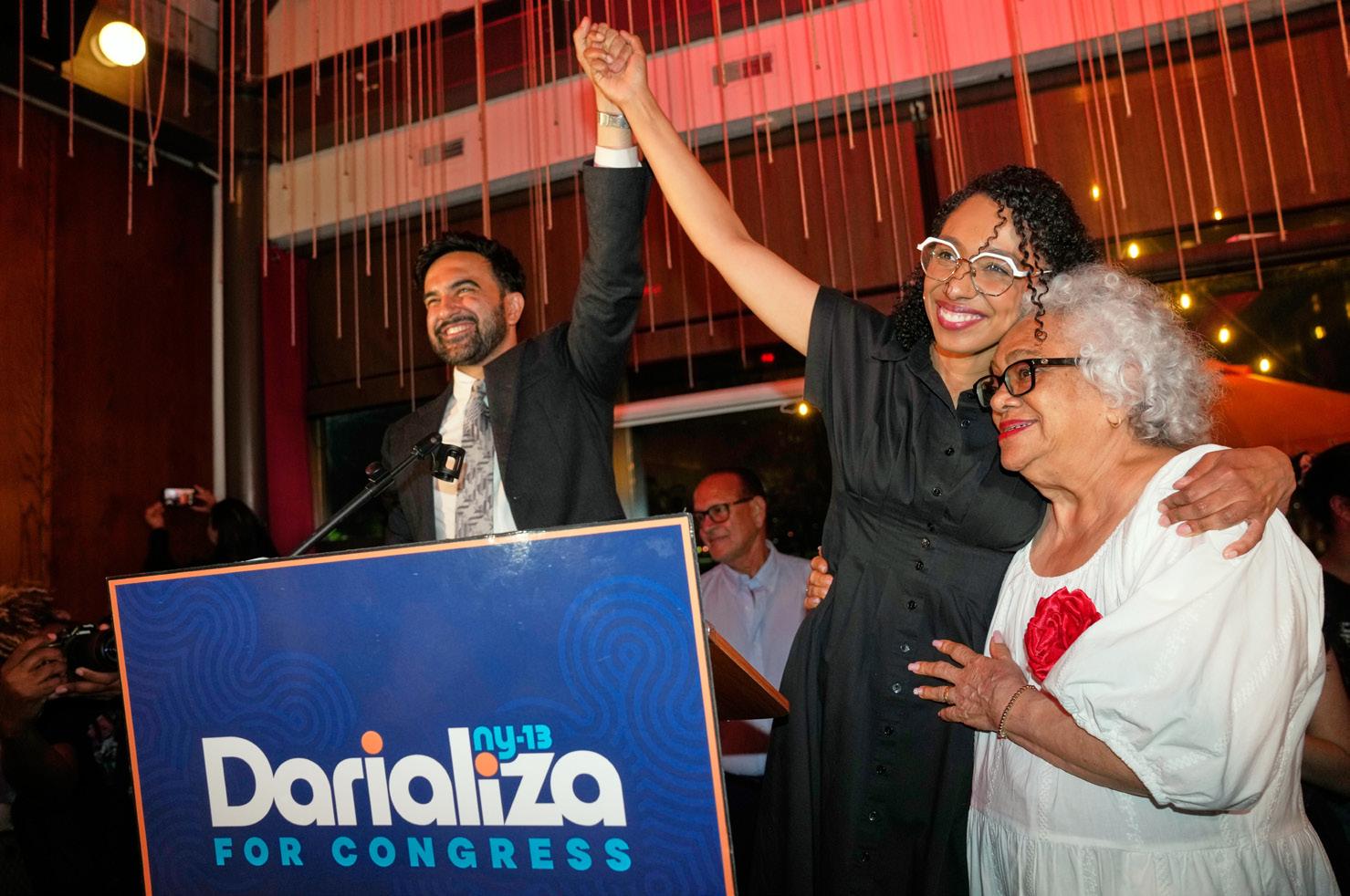
Mamdani’s midas touch drives progressive primary wins as Avila Chevalier ousts Espaillat in NY-13
By ARIAMA C. LONG Amsterdam News Staff
The dramatic, if not highly anticipated, New York primary elections have finally concluded and resulted in an insurgency of progressive challengers turning the tables on established politicians.
A new slate of elected officials swept in at the congressional and state levels in contest-
ed races in the June 23 primary. The biggest upset of the night was challenger Darializa Avila Chevalier ousting five-term incumbent U.S. Rep. Adriano Espaillat in New York’s 13th Congressional District.
At the close of the polls, Espaillat, 71, and Avila Chevalier, 32, were neck and neck as results poured in. They were nearly tied at roughly 47% of the vote each, separated by only a fraction of a percentage point. How-
ever, over the next few hours, Avila Chevalier inched ahead with 49% of the vote to Espaillat’s 45%, according to the city’s Board of Elections (BOE) unofficial election night numbers. The final blow to Espaillat’s campaign was seemingly the last round of candidate debates and racist remarks from his senior adviser attempting to use ‘Haitian’ as a slur against Avila Chevalier, which many sharply condemned.
By the end of the night, Espaillat conceded, signaling a new wave of young democratic socialists in Manhattan and the Bronx. As many as 15 candidates backed by the Democratic Socialists of America (DSA) claimed victory Tuesday night.
“I am so thrilled to have the support of my community, and I am so proud that they have put their trust in me to send me to Congress on their behalf,” said Avila Chevalier in a statement. “For too long, Uptown and the Bronx have been overlooked, let down, and neglected. That ends today. We deserve leadership in Washington that will fight tooth and nail for every single one of us, and I can’t wait to get to work with our community to deliver on that promise.”
Remarkably, Avila Chevalier wasn’t alone in her win as other progressives won their respective races in federal and state elections. Mayor Zohran Mamdani, who himself surprised Democrats when he won his mayoral primary in 2025 as a young Muslim socialist with very vocal opinions about his support for
Cambria Heights residents say barricades for Ohel pilgrimage locked them out of their own streets
By KAREN JUANITA CARRILLO Amsterdam News Staff
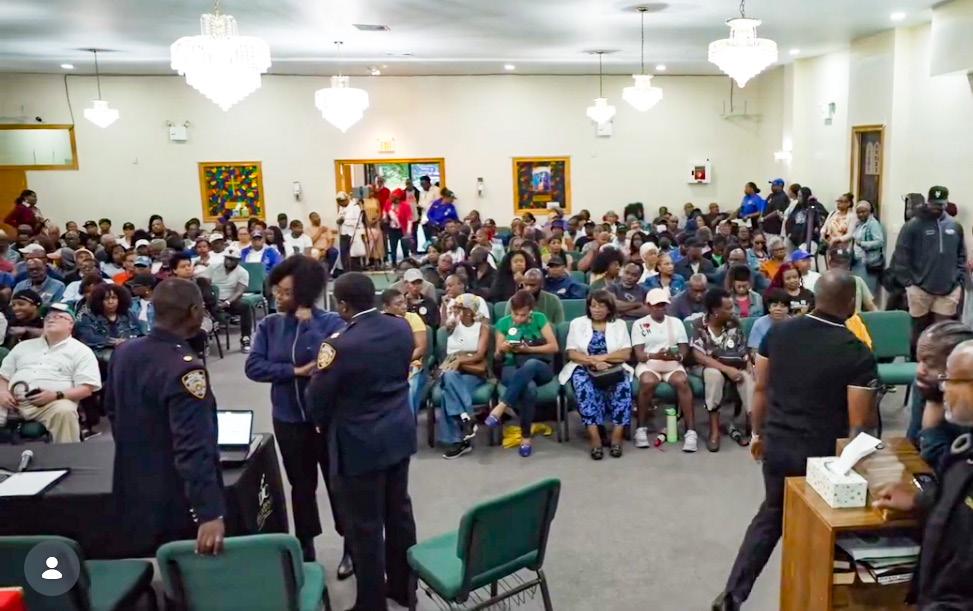
Cambria Heights, Queens, residents say they woke up this past Juneteenth and Father’s Day weekend to find metal barricades at their street intersections and police officers stationed at the entrances to their blocks. Residents were told they needed to show ID to drive down the street to get to their homes.
The barricades were put up for the annual pilgrimage to the Ohel, the Cambria Heights burial site of Rabbi Menachem Mendel Schneerson, the late Lubavitcher Rebbe, and his father-in-law, Rabbi Yosef Yitzchak Schneersohn. The pilgrimage brings thousands from around the world to the Old Montefiore Cemetery. Cars, buses, traffic, and crowds increase in the area –– which has led to complaints from locals about the impact on their quality of life.
The mostly Black, middle-class residents of this Southeast Queens neighborhood say they have gotten used to it, but residents and elected officials argue that the abrupt installation of barricades and checkpoints this year was introduced without community approval.
“You’re asking for me to show permission,
for ID to come on my block? That’s something we’ve never had before,” community organizer James Johnson said.
No one disputes that visitors have the right to pray at the Ohel, said residents and 27th District City Councilmember Dr. Nantasha Williams. The issue is whether city agencies can suddenly convert residential streets into restricted access zones, forcing homeowners
to prove they live there. “They have the right to come and be here, but not to the detriment of community members feeling welcome in their own homes,” Williams stated. Williams said her office had been planning for the Ohel with city agencies for four to five months before this year’s pilgrimage. They had conversations with the
NYPD, Depart-
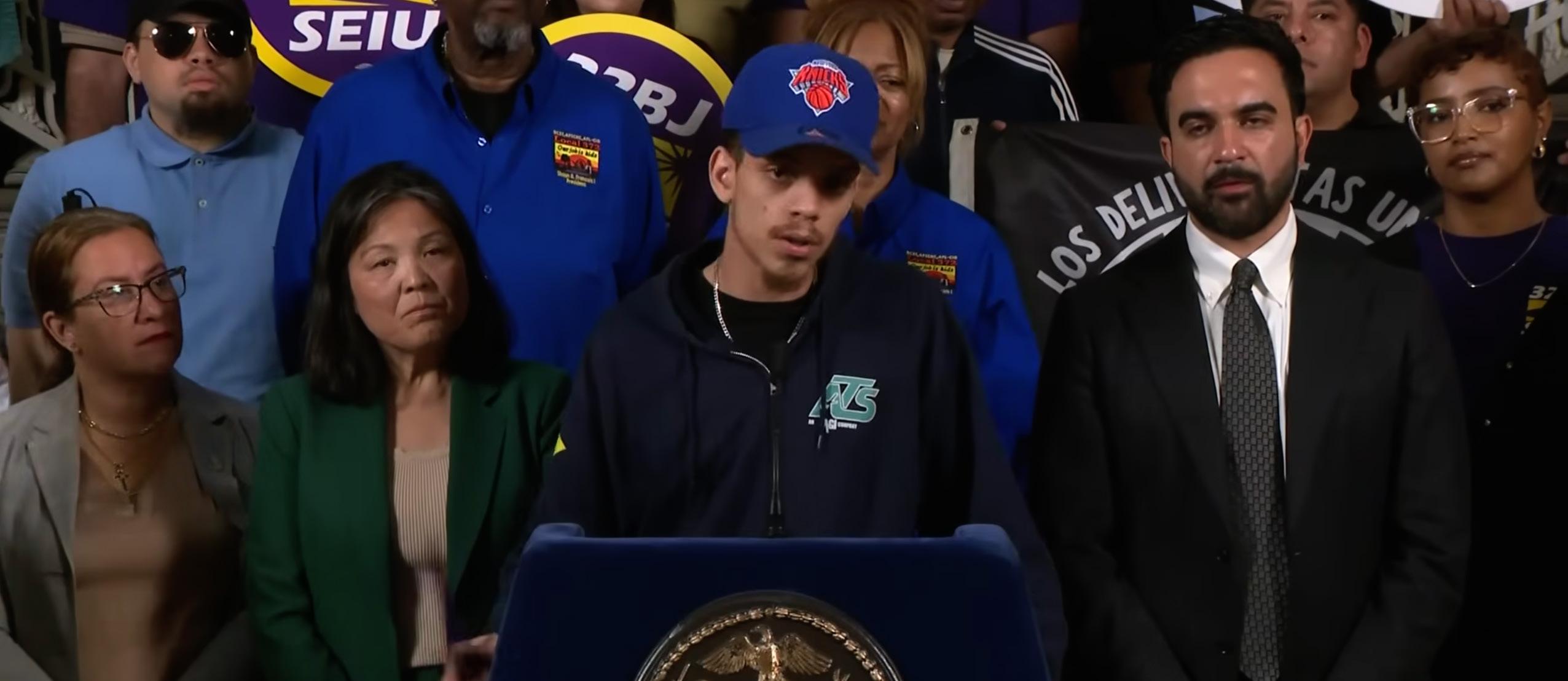
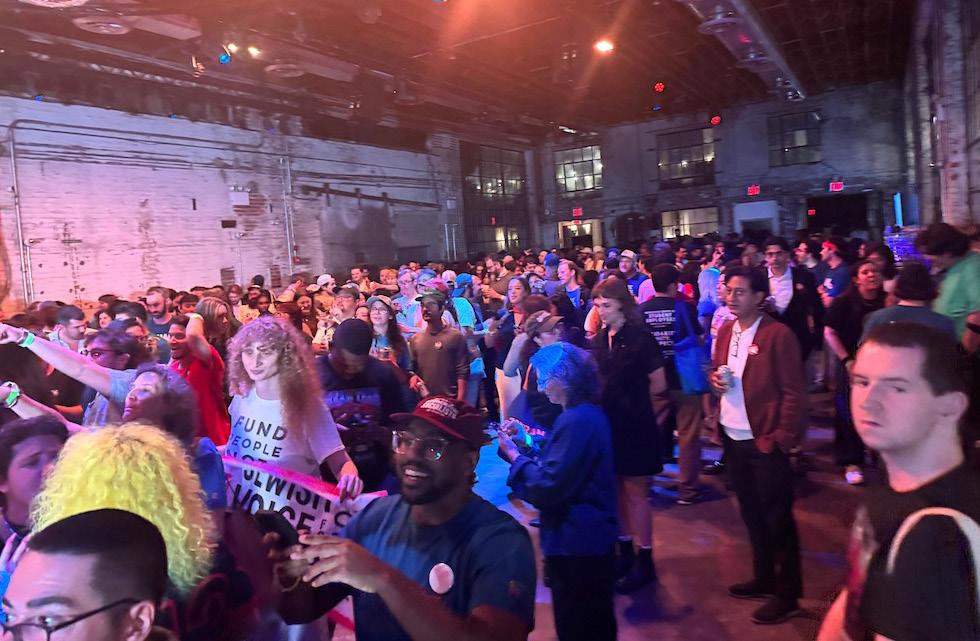
New York City Mayor Zohran Mamdani celebrates with Democratic congressional candidate Darializa Avila Chevalier, center, and community member Carmen Rojas during an election night watch party June 23. (Seth Wenig/AP photo)
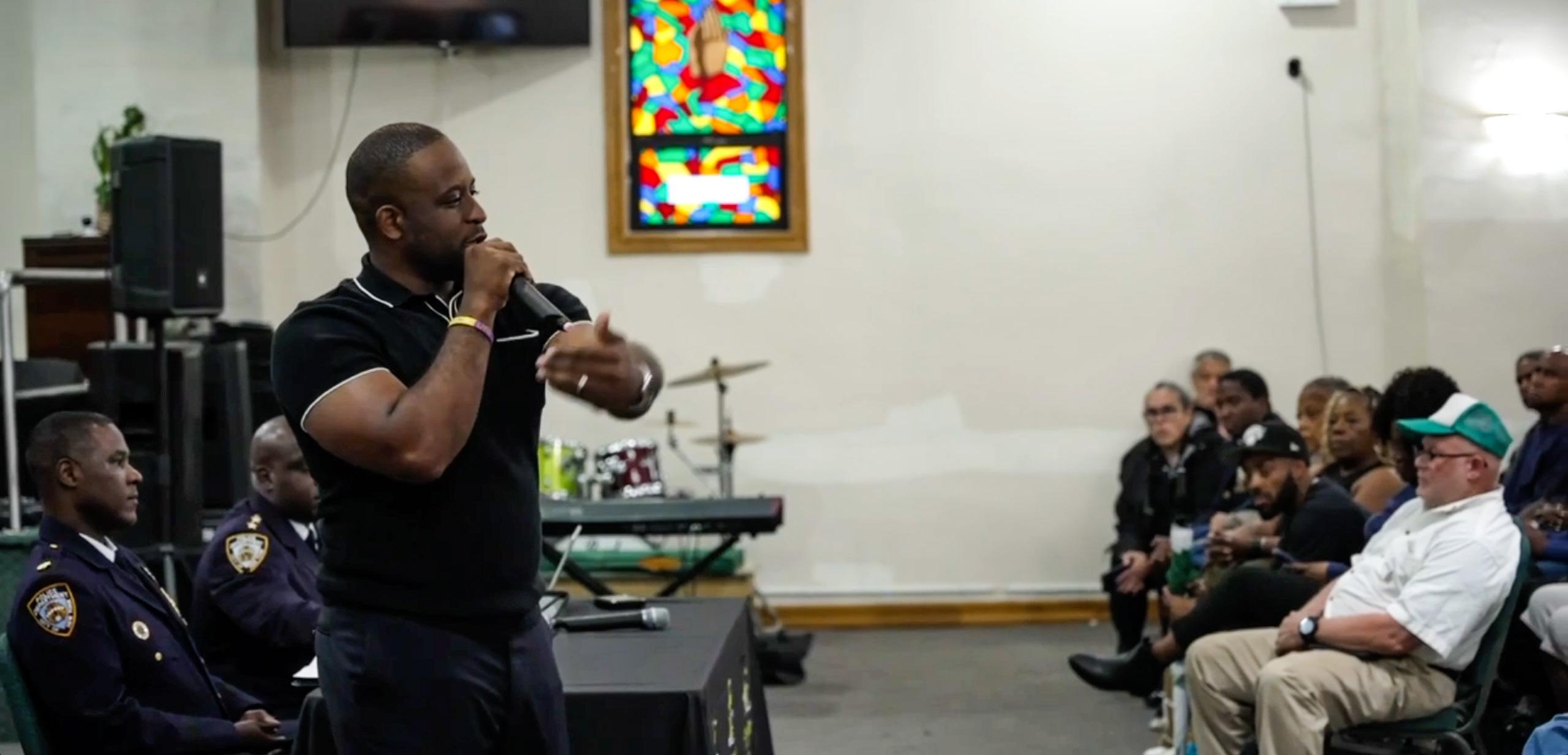
Hundreds of Cambria Heights residents showed up to discuss impact of Ohel pilgrimage on their neighborhoods. (Qasim Malik photo)
See PRIMARY WINS on
Hochul sits with Brooklyn politicians, community leaders on deed theft issue
By ARIAMA C. LONG Amsterdam News Staff
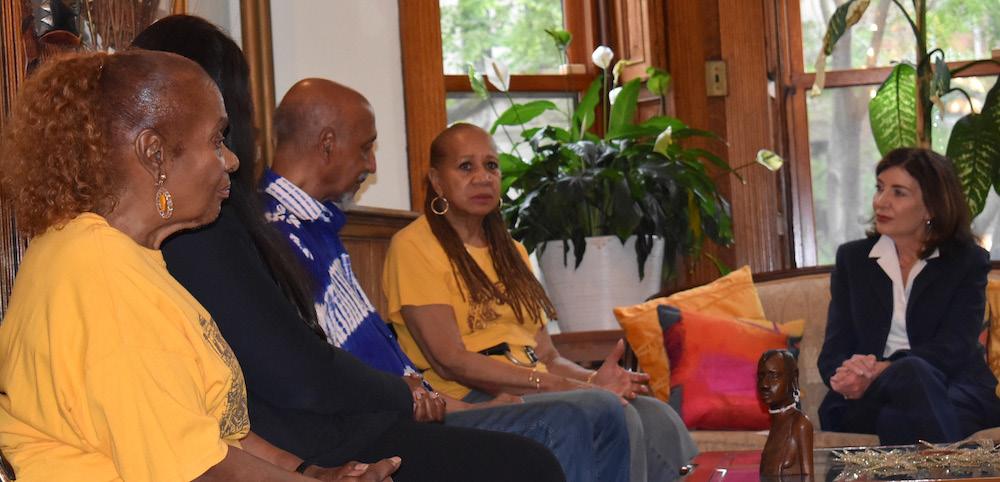
Gov. Kathy Hochul sat down with homeowners and elected officials in an intimate gathering at a Brooklyn brownstone last week to brainstorm ideas about how to further prevent deed theft at the grassroots level.
Deed theft has long plagued historically Black and Latino neighborhoods in the Five Boroughs. It is regarded as a crippling housing issue that’s become so prolific as of late that it’s shaped elections and policies at every level of government.
“This has been a challenge brought to my attention,” said Hochul. “Homeowners are being targeted by despicable criminals.”
Sitting across from Hochul were Maurice and Marilyn Reid, homeowners of the Bedford-Stuyvesant brownstone where the small roundtable was hosted. The couple and their friends are avid members of the Brownstoners of Bedford-Stuyvesant, Inc., a community group established in 1978.
Combatting deed theft really began with small organizers seeing their neighbors lose their homes and banding together to raise awareness for almost 50 years, said Reid. She said one method that worked well against the city’s tax lien sale system was steadily educating homeowners that
they were on the list and therefore at risk of losing their homes.
“We have worked very, very hard to hold
onto our homes,” said Reid. “We’ve saved hundreds of homes in this community [by] going door to door — 250 of us going door
to door in threes. We were able to do this so successfully that they … changed the law, in terms of adding the water bills to the [definition] of the lien. We need to get out there and go hand by hand, foot by foot, letting people know you do not have to lose your home.”
In May 2026, the state passed a $268.5 billion budget for fiscal 2027. Hochul allocated $4.5 million in the state budget to increase enforcement, support community outreach, and education related to deed theft. The budget also includes $40 million for the Homeowner Protection Program (HOPP), administered by the New York State Office of the Attorney General, to support free statewide housing counseling and legal services for homeowners.
In 2024, Hochul signed laws criminalizing deed theft for the first time, in partnership with New York State Attorney General Letitia James’s office. The law also created additional preventive measures to protect inherited property by prohibiting non-heirs from forcing partition sales, giving rightful heirs a right of first refusal to match an external offer to buy out another heir, and allowing for Transfer on Death Deeds in lieu of formal wills, providing tools to help safeguard generational wealth.
NJ lawmakers push bill for truth, reconciliation, and repair for slavery
By KAREN JUANITA CARRILLO Amsterdam News Staff
New Jersey could soon be forced to face the legacy of slavery in the state.
“More than half of New Jerseyans do not know slavery happened in New Jersey,” noted Rev. Charles Boyer, quoting stats from a Rutgers University and New Jersey Institute for Social Justice (NJISJ) poll conducted last year.
“One of the original sins of this state has been buried so deeply that most people don’t know it happened, added Boyer, the founder of the Black faith-based advocacy organization Salvation and Social Justice. “That’s intentional. We can’t repair what we refuse to remember, and we cannot remember what we have never been taught. As a pastor, I know that an apology is not about words. Anybody can say, ‘I’m sorry.’ The real question is, what are you willing to do after the apology?”
In 2008, the state of New Jersey officially said it had “profound regret for its role in slavery.” But today’s politicians and public policy advocates want the state to do more to make amends for its role in enslaving Black people.
During a June 18 virtual press conference put together by NJISJ, they spoke about New Jersey’s Truth, Reconciliation, and Repair Act, a bill activists hope will force
a fuller public accounting of New Jersey’s role in the enslavement of Africans and what the end of slavery left behind: segregated schools, redlined neighborhoods, racialized poverty, health disparities, mass incarceration, and the state’s massive Black-white wealth gap.
“In 2008, an apology was given,” acknowledged Assemblywoman Verlina ReynoldsJackson, chair of the New Jersey Legislative Black Caucus and sponsor of the bill in the Assembly. “But we’re here in 2025, and that just wasn’t enough for us.” She said the state has enough evidence, including wealth disparity data and a Reparations Council report, to know that an apology without action cannot end the disparities that still curtail Black life in New Jersey.
“Our democratic institutions are under attack while teaching about the history of slavery, race, and racism are being outlawed in silence,” added State Sen. Angela McKnight, who represents Legislative District 31 and is the primary Senate sponsor of the bill, which was introduced on June 15. “Each and every day, it’s important that the state –– the state of New Jersey –– take up this slack to teach the unvarnished truth to the people that we serve. We need to be an example for the rest of the nation, because teaching the truth of our history is key to multiracial democracy flourishing.” If passed, the bill would require the
At a June 18 virtual press conference, advocates spoke about New Jersey’s Truth, Reconciliation, and Repair Act, a bill that would require a fuller public accounting of New Jersey’s role in the enslavement of Africans and of what the end of slavery left behind. (NJISJ photo)
Governor Kathy Hochul sits down with Brownstoners and elected officials at Bed-Stuy home to discuss deed theft on June 17, 2026. (Ariama C. Long photo)
See DEED THEFT on page 25
Dementia, cognitive decline, and why your bank may be unprepared to deal with an aging population
By TAAYOO MURRAY Special to the Amsterdam News
In December 2025, Gregory Johnson visited a local bank branch in New Brunswick, N.J. Everything was going fine until he was ready to leave. He became agitated and confused. The bank contacted his daughter, Shakira, telling her he had no way of getting home.
“My dad was worked up. He says he called an Uber, it hasn’t come, and he’s cold,” said Johnson. She discovered that her father’s cellphone was dead, and asked the bank employee to charge her dad’s phone.
That’s when things went wrong.
“First they say we don’t have a charger,” Johnson explained, “Then he’s like, ‘Our manager said we can’t help him. If he wants his phone charged, he has to ask a customer.’” The situation escalated from there with the bank employee eventually hanging up on Johnson, and her father leaving the bank premises in a confused and agitated state.
What the bank staff didn’t immediately recognize was that Johnson, 70, had dementia and was experiencing an episode.
Incidents like this are becoming more common in the United States, with six in 10 people living with dementia wandering at least once, becoming lost or confused about their location. With the population aging rapidly and cognitive decline increasingly intersecting with everyday institutions, workers are encountering situations that they were never trained or meant to manage. Among the most unexpected places this crisis is playing out is the local bank branch. Across the country, tellers and branch managers are finding themselves on the front lines of a public health issue they were never trained to handle.
Aging population meets the banking system
More than 7 million Americans live with Alzheimer’s disease or related dementias, according to estimates from the Alzheimer’s Association. As the population ages, that number is expected to rise to nearly 13 million by 2050.
For many people experiencing cognitive decline, the bank remains one of the
Police shooting of 1-year-old Mississippi boy ignites tension between police and Black residents
By TRAVIS LOLLER and SOPHIE BATES Associated Press
JACKSON, Miss. (AP) — The fatal shooting of a 1-year-old boy by police who were responding to a shoplifting call this week has ignited simmering tensions between police and Black residents in the small town of Senatobia, Mississippi.
The death of Kohen Wiley is the latest in a series of troubling encounters with police that have outraged community members in recent years. It has led to protests and calls for greater police accountability in the town of 8,000, with some civil rights activists pointing to Kohen’s death as another example of a Black life lost over something of nominal value — in this case, allegedly stolen diapers.
“We are treating items on a shelf as more valuable than a child,” Bernice King, daughter of civil rights icon Martin Luther King Jr., said in a statement posted to Instagram on Wednesday. “That is not just bad policing; it is a moral collapse.”
Differing accounts
There are still many unanswered questions about the shooting and what led up to it.
Senatobia police responded to the shoplifting call at a local Walmart on Sunday, where they found two women and a child
leaving the store, getting into a car, and driving away. According to a statement released by the Mississippi Bureau of Investigation: “Officers attempted to stop the vehicle, but the driver drove in the direction of the officers, almost striking one. An officer then discharged their weapon and the vehicle [driver] fled the scene.”
Kohen’s mother, Vellesiya Wiley, said her son and her friend, who was driving, were hit by gunfire. In a video posted on social media Wednesday by civil rights attorney Ben Crump, Wiley said her friend was not driving toward the officers because they were “all on the right side and she was driv-
ing towards the left.”
She also disputes the shoplifting claim, saying in the video that she believes her friend paid for the diapers she was carrying.
Policing expert Ian Adams, who teaches criminal justice at the University of South Carolina, said regardless of the circumstances, the officer should not have fired at the car. “Modern policing knows that shooting into a moving vehicle is a very bad idea and one to be avoided at almost all costs,” Adams said. For one thing, “vehicles have other occupants, which is obviously a concern here in the current case.”
Shooting revives racial justice concerns Kohen was Black, as are his mother and her friend, and the circumstances leading to Kohen’s death quickly drew comparisons to another Black mother shot during a response to a shoplifting accusation.
In 2023, Ta’Kiya Young, who was pregnant, was shot by police in a Columbus, Ohio, suburb, after they attempted to apprehend her. Police said Young, who was the mother of two young sons, got into her car and accelerated in the direction of the officer, who fired at her through the windshield. Both Young and her unborn daughter were killed.
The officer in that case was acquitted of criminal charges and found justified in his use of force by a review board.
The two deaths join a long list of other instances of Black Americans dying in interactions with police after accusations of petty criminal offenses, including the murder of George Floyd in 2020, who was killed after police responded to a call that he used a fake $20 bill at a Minneapolis grocery store. For some racial justice advocates, such cases serve as a constant reminder of the consequences of systemic racism in law enforcement.
“In the name of ‘law and order,’ a child was killed and family was shattered over
Police killing of Kohen Wiley causes racial injustice concerns to surface in Mississippi. (GoFundMe)
(Pexels/Kampus Production)
From prison to author and TV, radio host: Keri D. Singleton shares his amazing journey
Black
New Yorker
By JASON PONTEROTTO
Special to the AmNews
Today, Keri D. Singleton serves as executive producer and host of Sessions Cafe, a daytime talk show focusing on real stories from everyday New Yorkers, which airs on the public access Manhattan Neighborhood Network. He is also an author of award-winning poems and novels, and formerly hosted the syndicated The Keri’s Korner Radio Show.
However, the journey for Singleton, 54, who lives on Staten Island, was one of several highs and lows, including losing his father to gun violence and going to prison for three years. Through it all, he says his love for writing and being a journalist has always carried him through.
Singleton was born and raised in Boston’s Roxbury neighborhood. Growing up with a single mother, herself a writer, he was able to stray clear of the traps of drugs and crime where other kids from his area wound up.
At age 9, Singleton, already an avid reader, found his love of writing when he submitted a poem to a Halloween-themed poetry contest at The Boston Herald, titled “Boo in Simon Sue,” about a ghost who was haunting Roxbury.
As a teenager, Singleton began interning with the popular local Black-owned Boston radio station, WILD. He had a love for music and entertainment journalism, often reading Right On magazine. He also noted The Amsterdam News was also a major inspiration for Singleton as he made sure to purchase a copy of the paper every time he traveled to the city between the 80’s and 90’s. While with the radio station, Singleton connected with Kim Ferguson, a representative of Arista Records. He recalls meeting major artists at the start of their careers, like Toni Braxton and TLC, when they would visit the station.
He was given the job of going to record stores across Boston to see how artists were selling and reporting back. He soon tran-
sitioned from journalism to music promotion, being employed with Arista as a Boston promoter, and worked on Usher’s debut album. He moved to New York City in 1996.
“Before I knew exactly what I wanted to do professionally, I knew that whatever it was, I wanted to do it in New York,” Singleton said.
That same year, however, his father was shot and killed in Roxbury, a case he says is still unsolved.
Additional hardship followed years later, after losing his job at Arista, when in 2004, Singleton was involved in a credit card scam and was sentenced to prison for three years. He ended up doing ten months at Attica Correctional Facility.
“They sent me to the worst prison in the entire state for a credit card charge,” Singleton said. He points out that he served alongside murderers who committed horrific crimes and that officers would beat up inmates for fun. He says he turned to writing poetry as a way to cope and escape the “mayhem.”
“My way of dealing with it was taking a pencil and writing,” Singleton said. “My inspiration for writing those books was not just boredom; I had to maintain my sanity.”
After his 2007 release, Singleton says every bit of success he sought out to achieve after that was dedicated to his mother.
He received his degree in criminal justice from ASA College in Brooklyn and was inducted into the honor society with a 4.0 GPA, all while on parole.
“I’m not ashamed today of my prison experience, because inadvertently it created the person that I am today,” Singleton said.
He began publishing the poems that he had written while in prison, which had been scribbled on paper and napkins. His first novel, “The Wanderer’s Game,” was published in 2013 and became awardwinning. It was adapted to a Broadway play for one night in 2015 by playwright Pearline Alexander at The Theater Center
See BNY on page 27
THE URBAN AGENDA
By David R. Jones, Esq
Mayor Takes Troubling Turn on Police Oversight, Reform
Mayor Zohran Mamdani has a chance to show who has the final say on oversight of the New York City Police Department: the civilian watchdog that investigates cases of alleged misconduct, or the police commissioner who can simply overrule all disciplinary recommendations.
Mamdani must break with the past, send a message about his authority over the NYPD and restore credibility to the Civilian Complaint Review Board (CCRB), the department’s chief independent watchdog.
Let me be clear. I support law enforcement and protecting our communities. The overwhelming majority of police officers treat members of the public with respect and believe in the rule of law. That said, good policing does not give the NYPD free rein to put a boot on the neck of people of color. Crime fighting should not come at the expense of New Yorkers’ civil rights. The mayor’s stance on the CCRB – he backed away from public musings about giving the board the final say on NYPD disciplinary decisions – deserves close scrutiny. He promised to end the NYPD’s tradition of abusive tactics that focus on Black and brown New Yorkers.
The department’s past transgressions magnify the significance of Mamdani’s slow walk or fullout turnaround from his campaign promise to make dramatic changes at NYPD. His pledge included doing away with a controversial gang database and removing police from explosive mental health emergencies.
The CCRB is essential to good law enforcement in light of the NYPD’s long, well-documented tradition of racialized policing, targeting Black and Latinx people for aggressive policing, excessive force and unconstitutional stop and frisk. Every mayor since the late 1980s – Edward Koch, David Dinkins, Rudolph Giuliani, Michael Bloomberg, Bill de Blasio and Eric Adams – all tolerated or gave wink-and-nod approval to the ugly and aggressive tactics. None of them used their bully pulpit to do the right thing.
We’re not talking ancient history. The CCRB has been defanged in the face of recent – and ongoing – systematic misconduct. In September 2024, a court-ordered, 500-page disciplinary review concluded city police officers who engage in unconstitutional stops and frisks “rarely, if ever” face discipline, even when the CCRB substantiated misconduct.
Independent civilian review plays an important role in civic discourse. For some tragic reason, elected city and state officials as well as community activists no longer speak out publicly against police excesses. For instance, there has been little public outcry in the wake of an explosive lawsuit filed this year that alleged the NYPD searched Black drivers’ cars 10 times
more often than white drivers’.
In fact, Black and Latinx drivers made up over 84 percent of reported vehicle searches between 2022 and last year, the lawsuit said. Drivers of color were in the NYPD crosshairs without any objective reason to suspect them of wrongdoing, said the suit filed by the New York Civil Liberties Union, NAACP State Conference and Bronx Defenders.
In recent years, police have criminalized poverty, placing a priority on predominantly Black and Latinx homeless and fare beaters, whose encounters with law enforcement tend to be tied to high inflation, income inequality and the cost of public transportation. Even so, One Police Plaza and City Hall downplay the consequences as the number of summonses and arrests skyrocket.
Former Mayor Eric Adams forced out two successive CCRB interim chairs after their vocal support for greater independence put them on the NYPD’s radar. Two of Adams’ police commissioners short-circuited several CCRB investigations and tinkered with the NYPD discipline matrix in ways that lowered penalties for all police officers found to have committed serious offenses. Mamdani would do well to undo the corrupt changes thereby boosting confidence in the CCRB’s independence.
Mayor Mamdani’s backpedaling from his NYPDrelated campaign promises began six months ago, at his very first joint news conference with Police Commissioner Jessica Tish. The new mayor stood silent as she defended the gang database he denounced during his campaign. More recently, the Mayor has voiced support for making tweaks and retaining the database. He also publicly apologized for his 2020 comments calling the NYPD “racist, anti-queer and a major threat to public safety.”
Mamdani’s reversal on CCRB independence illustrates him coming face to face with a truism that confronts every elected official and will figure in determining what type of mayor he becomes: Life often forces us to choose between doing the right thing vs. doing the expedient thing for the right reasons. The demands of the office can corrupt with damaging effects, tempting leaders to cynically cast away their loyalties, promises and principles.
Our previous mayor fell far short in his pledge to rein in abusive behavior by police officers and hold the NYPD accountable. Mayor Mamdani has an opportunity to send a different message to the city’s Black and brown communities, rank and file officers and the police unions: that police misconduct in any form will not be tolerated. And it starts with demanding a strong CCRB.
Keri D. Singleton is host of Sessions Cafe, a daytime talk show airing on Manhattan Neighborhood Network. (Photo courtesy of Keri D. Singleton)
Reclaiming the Gaze: Black artists on identity, freedom, and agency
By JIMMIE BRIGGS Special to the AmNews
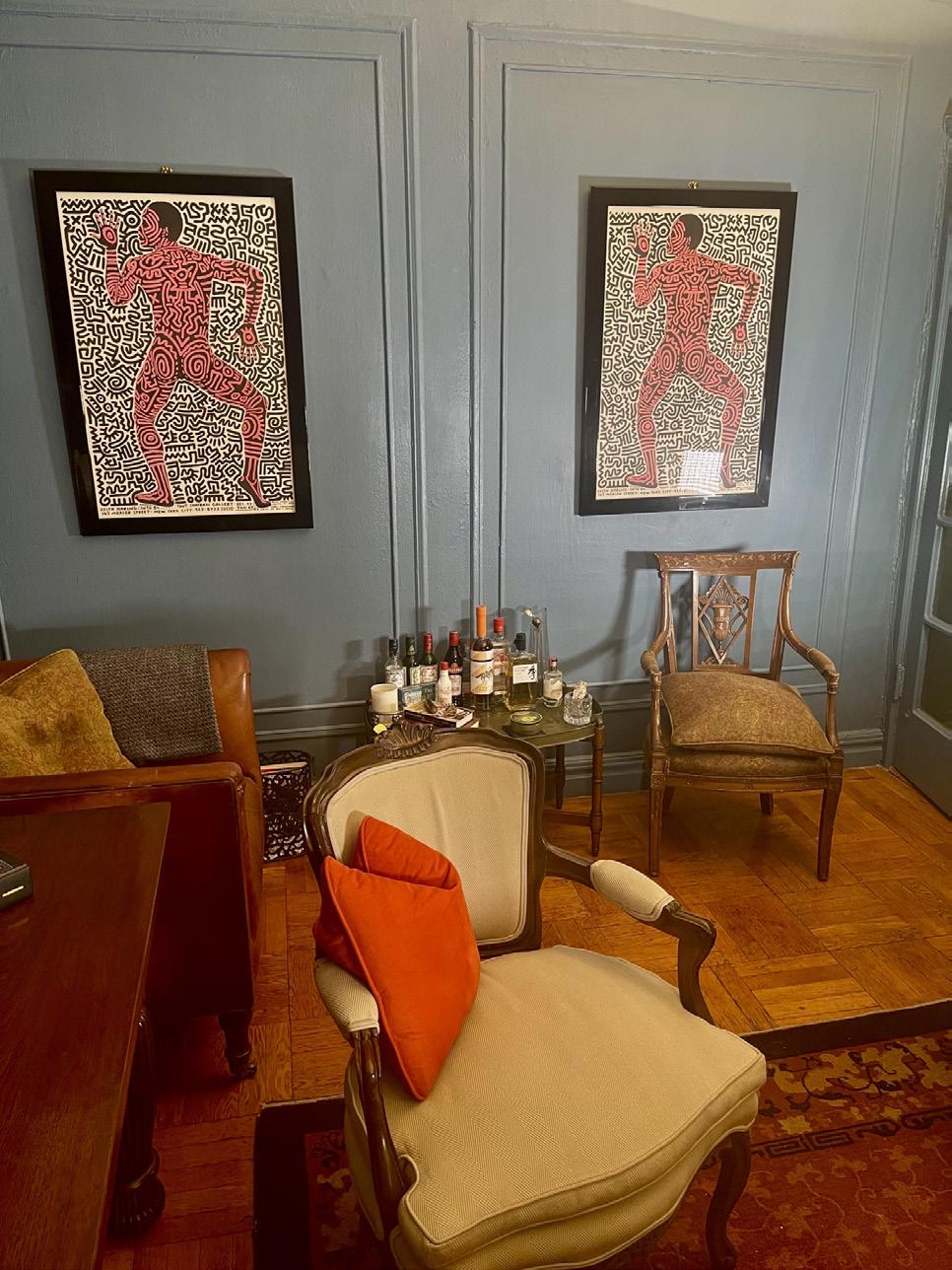
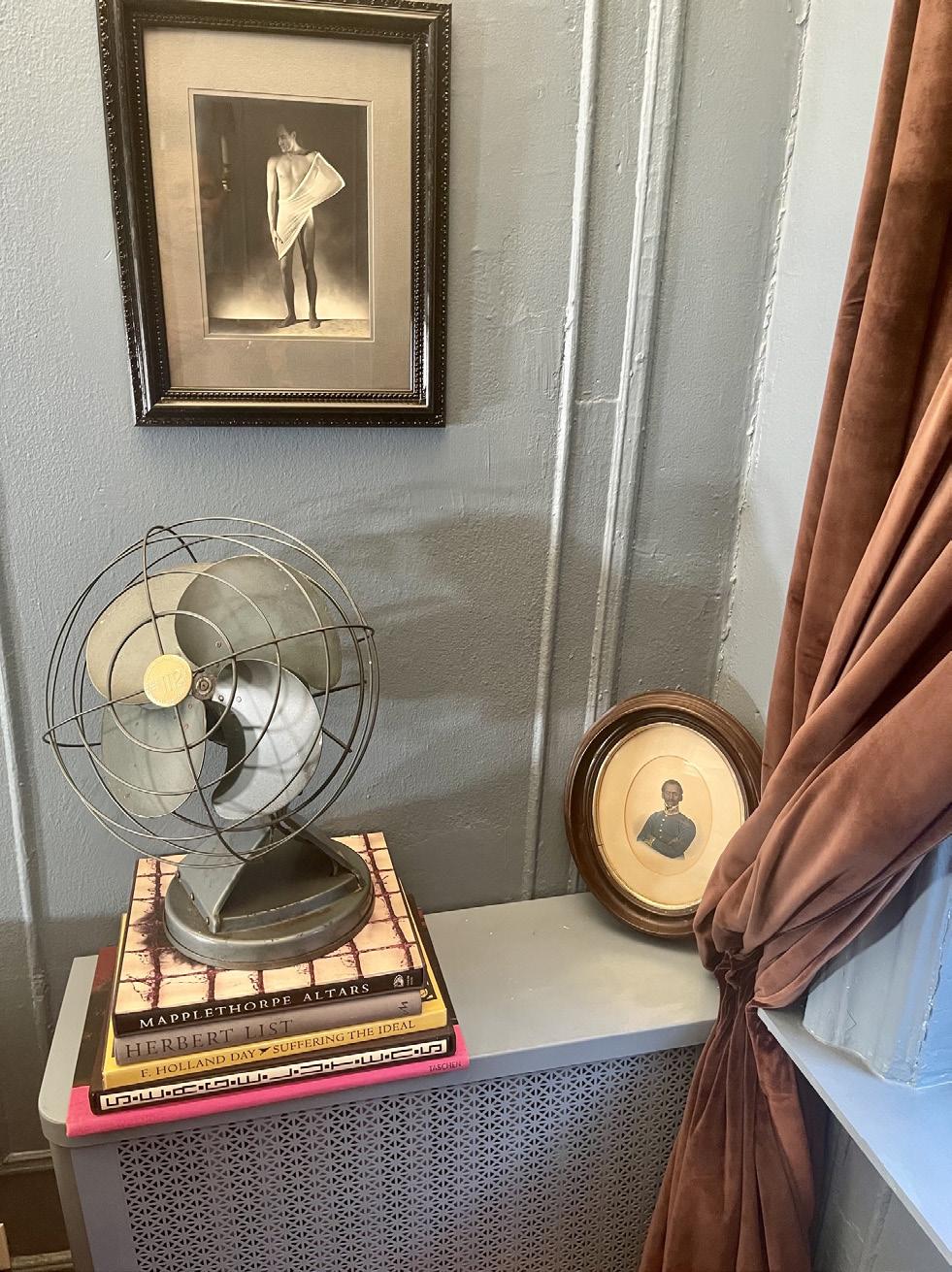
Returning to New York City from speaking on a panel in Washington, D.C. at the National Endowment for the Arts in the mid-1980s, multi-hyphenate icon Bill T. Jones was traveling with his then partner, the late Arnie Zane, and a friend, Bill Katz. They found themselves on the same flight as Robert Mapplethorpe, enfant terrible of the ‘70s and ‘80s photographic scene in New York. “Arnie says to me, ‘I’ll be in [Mapplethorpe’s] car’ because Arnie was very ambitious, and knowing Mapplethorpe was an important art photographer, he wanted him to do my portraits,” recalled Jones by phone recently while on a national tour of the Bill T. Jones/Arnie Zane Company in North Carolina. “In the same way he wanted Chuck Close to do my portrait, or when Keith Haring asked to paint my body. All those artists were identity influencers. And I had every right to do whatever I wanted to do. I’d done major campaigns with Herb Ritts, too, and for me [working with those artists and] Mapplethorpe was about personal freedom. A Black male body who may or may not be gay, choosing to present themselves naked, what about it? Because the culture is so racist, and the gaze is so tainted with racism, you are automatically making yourself ‘Exhibit A’ in a continuing story of exploitation. To that I say, ‘don’t I have the right to be outrageous? Don’t I have the right to be free?’”
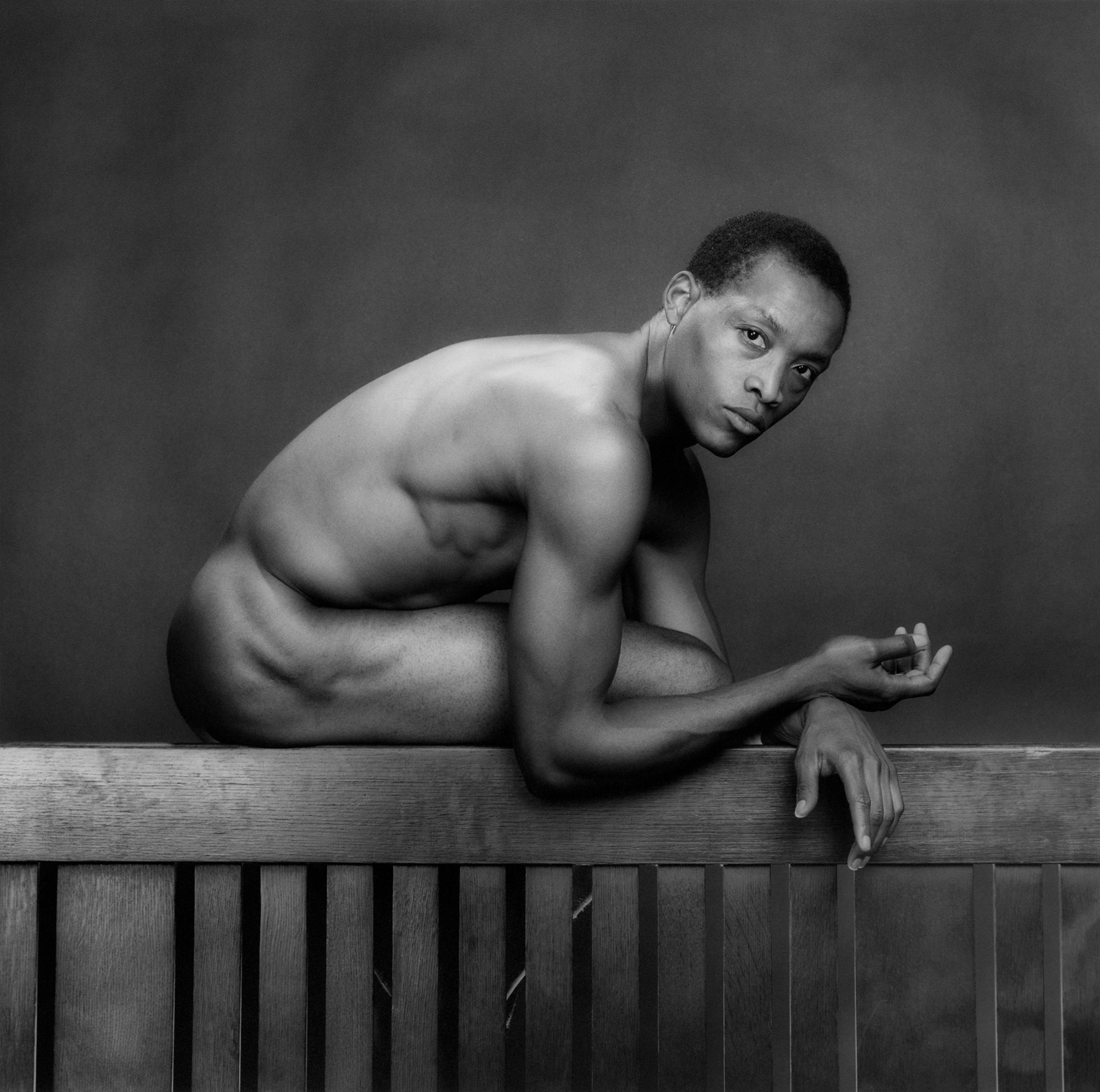
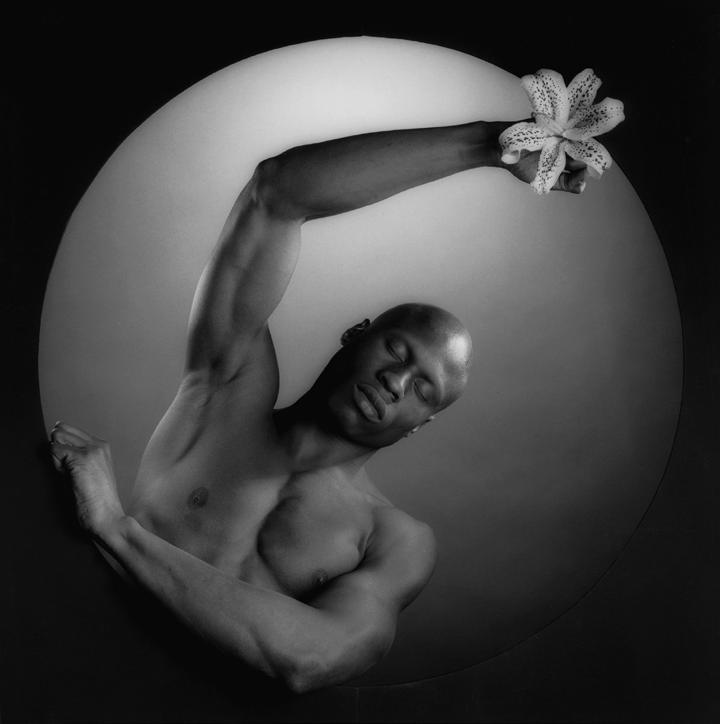
Forty years ago, photographer Robert Mapplethorpe published “Black Book,” 96 images of Black male bodies (including Bill T. Jones) depicted as whole figures, flaccid penises, bare posteriors, and about 40 images that are neither full body nor genitalia — including portraits, backs, feet, heads, etc.
Long before Mapplethorpe’s silver gelatin prints became a cultural flashpoint, Black photographers, archivists, and artists had already been doing the slow, necessary work of showing us to ourselves — in tenderness, in complexity, in the full spectrum of gendered and sexual possibility.
Today, in a climate where the so-called “crisis of men and boys” is narrated almost exclusively through a straight, white, cisgender lens, the work of Black and queer photographers, artists and thinkers feels even more urgent. Their photographs, films, and installations refuse the narrow scripts handed to Black and Brown men and boys about manhood and gender expression, broadly. Through their work, one can understand that identity — racial, sexual, and gender — is ever evolving, shaped by desire and freedom, as well as agency over visibility
and representation.
Black photographers and community archivists have captured the intimacies of Black queer life and Black male relationships — platonic or otherwise — since the late 19th century. Maurice Berger’s essay “Pictures of Men, Friends or Lovers” articulates what these images have always been sharing: Black queer relationships existed in plain sight, even when the world refused to acknowledge them.
These photographs were not made for galleries or collectors, but rather the survival of an embattled historical memory — for Black and gay Americans to say, We were here. We loved. We desired.
When Mapplethorpe first exhibited “Black Males” in 1980, at Galerie Jurka in Amsterdam, with an accompanying catalog, some critics praised the work as a celebration of Black beauty while others saw it as a continuation of
racial objectification. Many Black viewers felt admiration tangled with unease.
“In 1981, Mapplethorpe had a solo exhibition, “Black Males,” at the Robert Miller Gallery in New York, NY,” explained Paul Martineau, curator of photographs at the J. Paul Getty Museum in Los Angeles. “He also released ‘Z,’ a portfolio of limited-edition photographs of Black men. Both were successful, so a book on the subject was the next logical step in Mapplethorpe’s search for artistic acclaim. He realized that there was a dearth of books that celebrated the Black male form and decided to fill that gap.
“Mapplethorpe was aware of the photographs of Black male models by F. Holland Day, Horst P. Horst, and George Platt Lynes,” continued Martineau. “He also admired the photographs that the New Orleans-based artist, George Dureau, was creating with Black men in his community.”
In 1984, the Getty Museum purchased the collection of photographs assembled by Mapplethorpe’s artistic mentor, curator Samuel J. Wagstaff Jr. The Research Institute later secured Wagstaff’s papers and Mapplethorpe’s photography dealer Harry Lunn’s papers.
“Mapplethorpe’s sexual relationships with Black men such as Philip Prioleau, Milton Moore, and Jack Walls, played a key role,” observed Martineau. “He made hundreds of photographs of each of them …. [referring] to the color of Black skin as ‘bronze’ and was particularly interested in the texture and tonal range of Black skin as translated by high contrast black-and-white films.”
Five years later, when “Black Book” was released, a broader conversation exploded. That same year, editor Joseph Beam published “In the Life,” the first major anthology of writing by Black gay men. The timing was uncanny against the backdrop of rising AIDS-related infections and a growing chorus of gay Black men’s voices arguing for visibility and support: on one hand, a celebrated white photographer had created a book of Black men, with every subject’s name (except for five because the subject did not want to be identified when his genitalia were shown) but absent biography; and on the other, a pioneering Black writer and advocate had produced a work giving voice to a diversity of men whose lives were often erased by both the Black and gay communities.
The reception to “Black Book” was immediate. Edmund White, a white novelist who had written the catalogue text for Mapplethorpe’s earlier “Black Male” exhibition, praised it. Ntozake Shange, the playwright who’d famously created “for colored girls who have considered suicide / when the rainbow is enuf” wrote the book’s introduction, offering a more ambivalent framing both acknowledging the haunting beauty of Mapplethorpe’s images while naming power dynamics within the perspective. See story on next page
Mapplethorpe’s images of nude Black men helped catalyze public discourse on representation, desire, and the Black male body, but it was the creative and artistic advocacy of individuals such as poet Essex Hemphill, filmmaker Marlon Riggs, as well artists including Isaac Julien, Lyle Ashton Harris and Glenn Ligon who drove the conversation in ways still resonant today. Their work responded to the cultural moment — the devastation within and beyond the LGBTQIA+ community, politicization of queer representation in art, and the celebration of queer sexuality — as well as reshaped it through a noir gaze.
Hemphill’s voice was prescient, unmistakable and affirming. Following Joseph Beam’s tragic death in 1988, he oversaw the completion and publication of “Brother to Brother” in 1991, a follow-up to “In the Life.” Further, he responded directly to Mapplethorpe in the speech “Does Your Mama Know About Me?” at the first OutWrite Conference which took place at San Francisco’s Cathedral Hill Hotel on March 3-4, 1990. With a clear statement of unapologetic vulnerability, erotic honesty, and confrontation he asked, “Does your mama know about me? … Will she accuse me of stealing your love?” to the white gay men who sexually pursued Black men for the size of their sexual vitality and penis sizes without addressing the racial dynamics of their desire nor of society at large. While Essex Hemphill gave the era a new vocabulary and language, Marlon Riggs gave it moving images. His most noted works, including “Tongues Untied,” “Color Adjustment,” and “Black Is… Black Ain’t” challenged the typically distorted narratives of Black life in mainstream media of that time, refuting the notion that Blackness and queerness were incompatible. In “Tongues Untied,” Riggs created a visual chorus of Black gay men testifying to their lived experiences at a time when both AIDS and virulent homophobia were stalking Black communities, insisting on joy, beauty, and the right to exist without shame.
When “Tongues Untied” aired on PBS, the backlash was immediate. Conservative politicians including then-senators Jesse Helms and Alfonse D’Amato — some of the same voices attacking Robert Mapplethorpe — demanded that public funding for the arts be slashed. Marlon Riggs, like Mapplethorpe, became a symbol for the rising Evangelical, far-right.
In 1989, the Corcoran Gallery of Art in Washington canceled “The Perfect Moment,” Mapplethorpe’s retrospective in a heated political climate where a vocal cohort of national politicians accused the exhibition of being obscene. The National Endowment for the Arts, which had partially funded the exhibition, became the target of congressional hearings. Mapplethorpe’s photographs of Black male nudes were among those that were singled out, though rarely with explicit mention of race. Essentially, the Black male body became a signal of a broader (largely white, but not exclusively) moral panic of the 1990s focused on sexuality and purity, disease, and uncomfortably changing social norms.
While Marlon Riggs used film to traverse the
interior of Black queerness, artist Lyle Ashton Harris used photographic and archival tools focusing on his individual self and personal community. The seminal “Ektachrome Archive” compellingly documented gay nightlife, and everyday existence and grief in America and abroad in the 1980s and 1990s. It is a work of dynamism, embodying Black and gay life through a 360-degree point-of-view.
British artist Isaac Julien’s 1989 film, “Looking for Langston,” gave a lush, dreamlike meditation on Black and queer life against the backdrop of the Harlem Renaissance, imagining poet and writer Langston Hughes’ gay self as an essential element of his literary oeuvre. The black-and-white cinematography of “Looking” mirrored Mapplethorpe’s aesthetic but Julien’s gaze is rooted in longing rather than possession.
Through texts, language, and appropriation of images by Robert Mapplethorpe and others, Glenn Ligon’s “Notes on the Margin of the Black Book” (1991–93) didn’t attack Mapplethorpe directly but rather offered a contextualized dialogue with his images and the works of others on racialized gazes, identities, beauty, and history. The result is an essay which identifies the contradictions and tensions embedded in “Black Book.” Ligon deftly invites viewers to wrestle with complexity and challenge their assumptions.
“These artists must be viewed within the broader cultural context rather than isolating them in a ‘ghetto’ of alternative art or through
a black and white lens,” urged Lyle Ashton Harris on a video conversation from upstate New York. “Their legacies continue to influence contemporary artists despite the challenges they faced during the AIDS epidemic and within the Black community. Highly influential people like James Baldwin and Richard Wright as well as others have shown us how cultural representations of Black masculinity
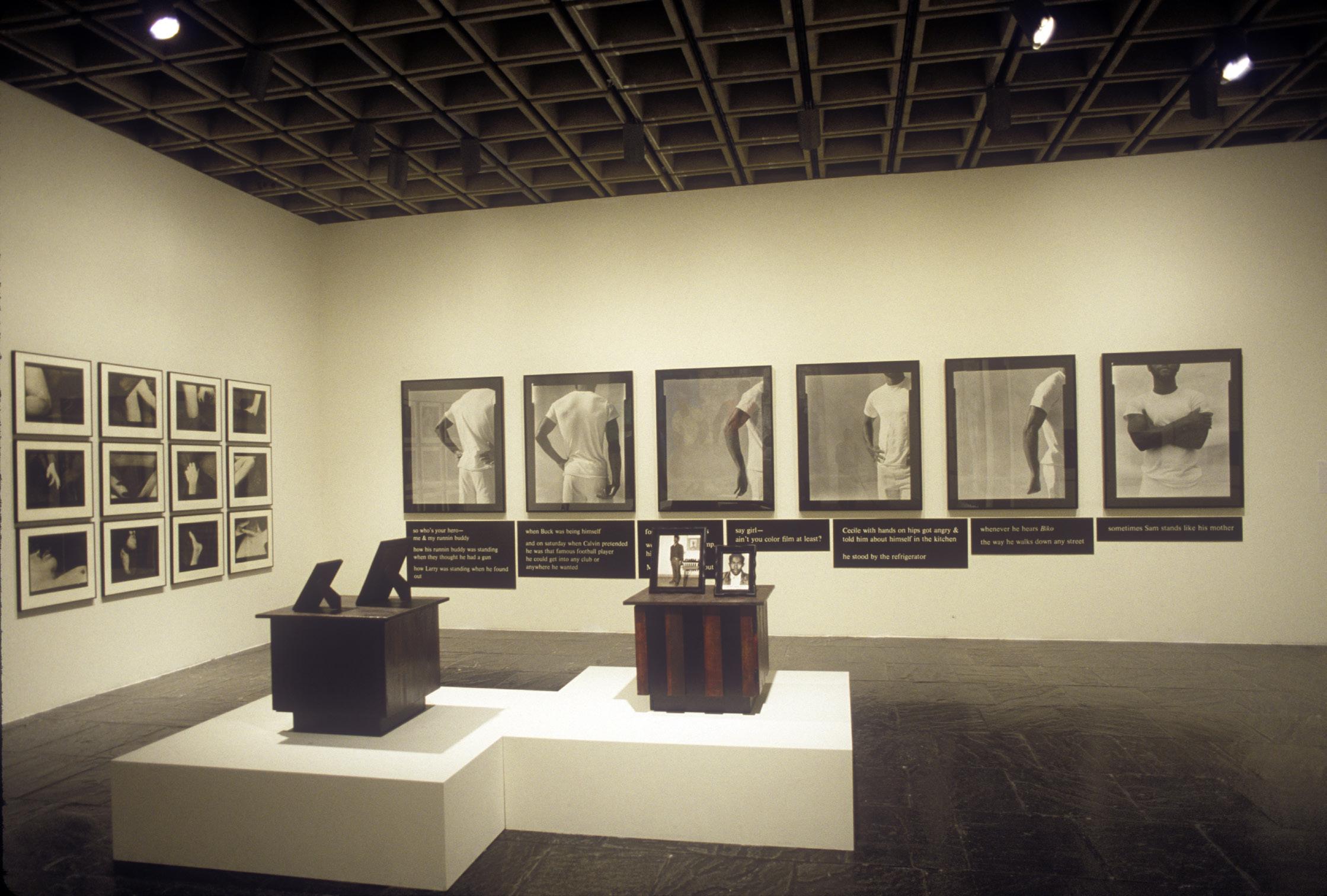
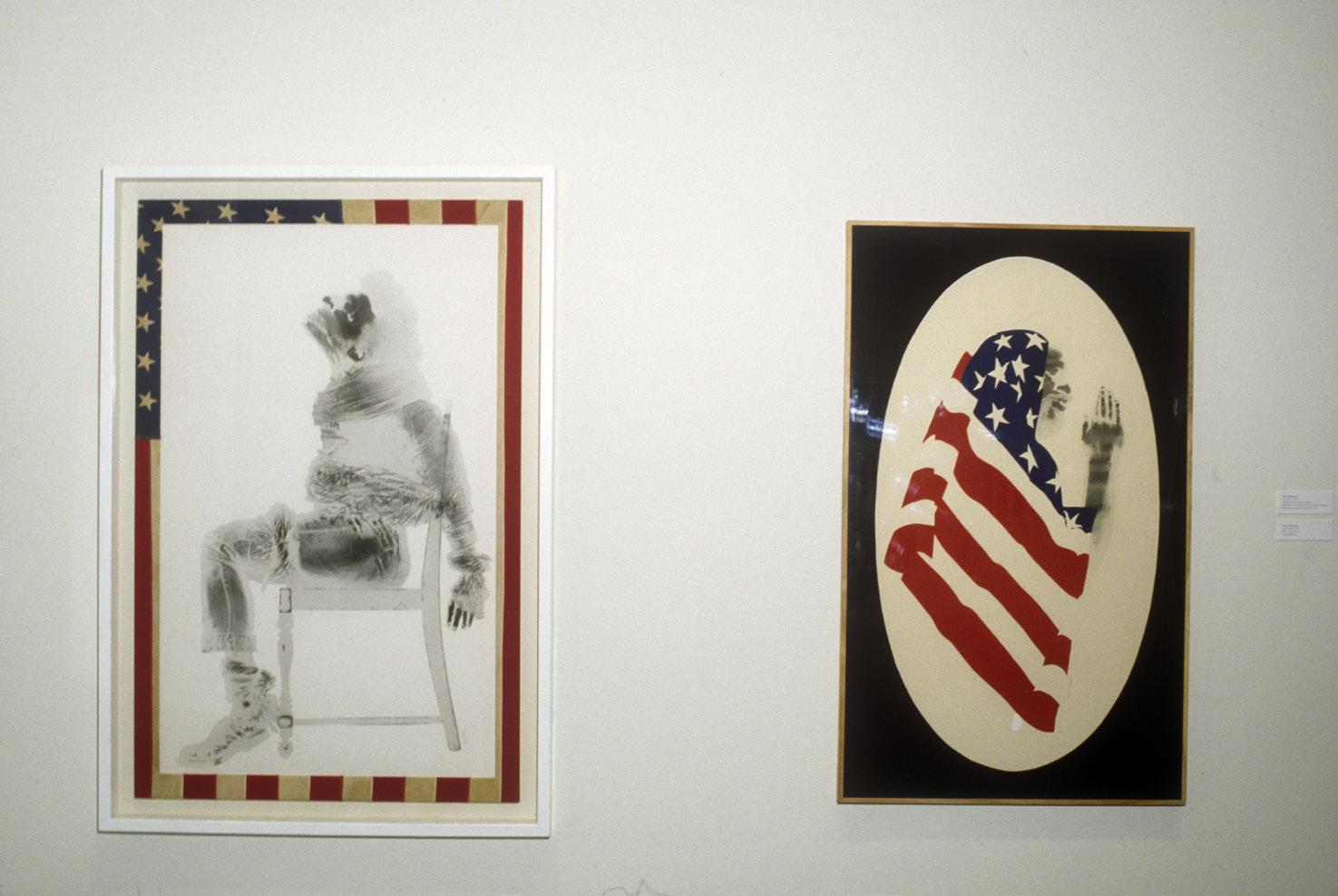
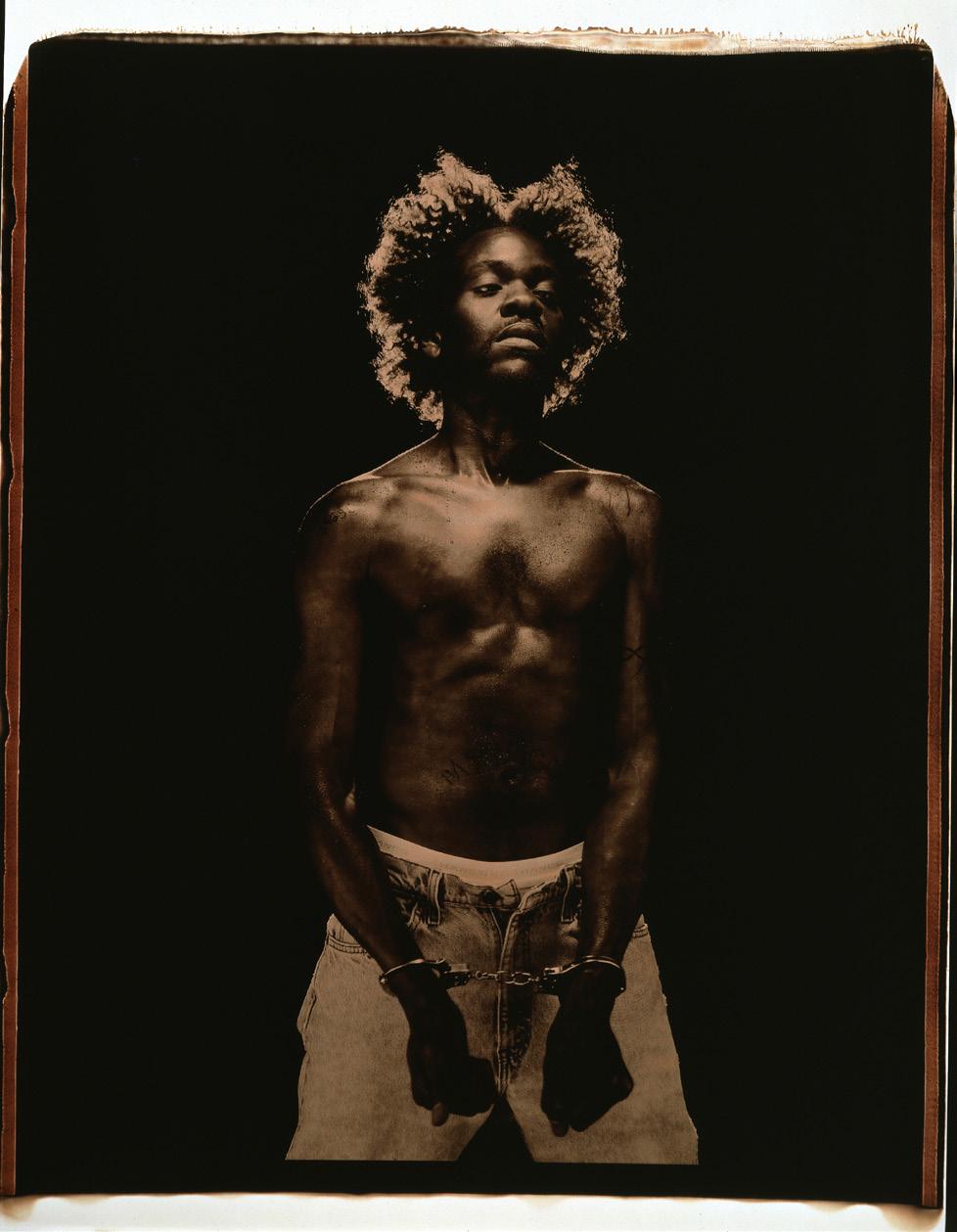
Installation view of Black Male: Representations of Masculinity in Contemporary American Art (Whitney Museum of American Art, November 10, 1994-March 5, 1995). Left to right: Dawn Ader DeDeaux, Black Christ, 1991; Dawn Ader DeDeaux, Rambo, 1991. (Photograph by Geoffrey Clements)
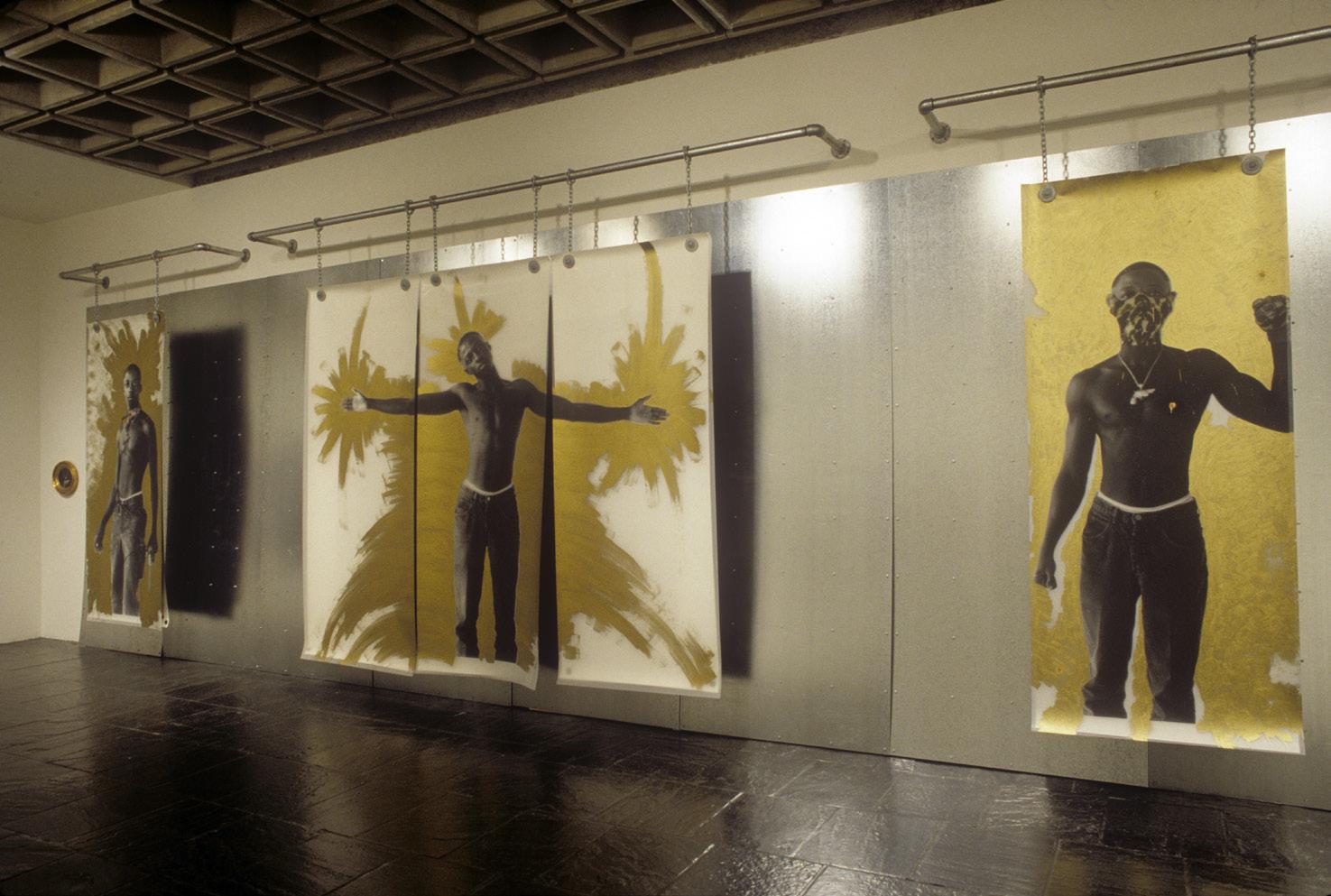
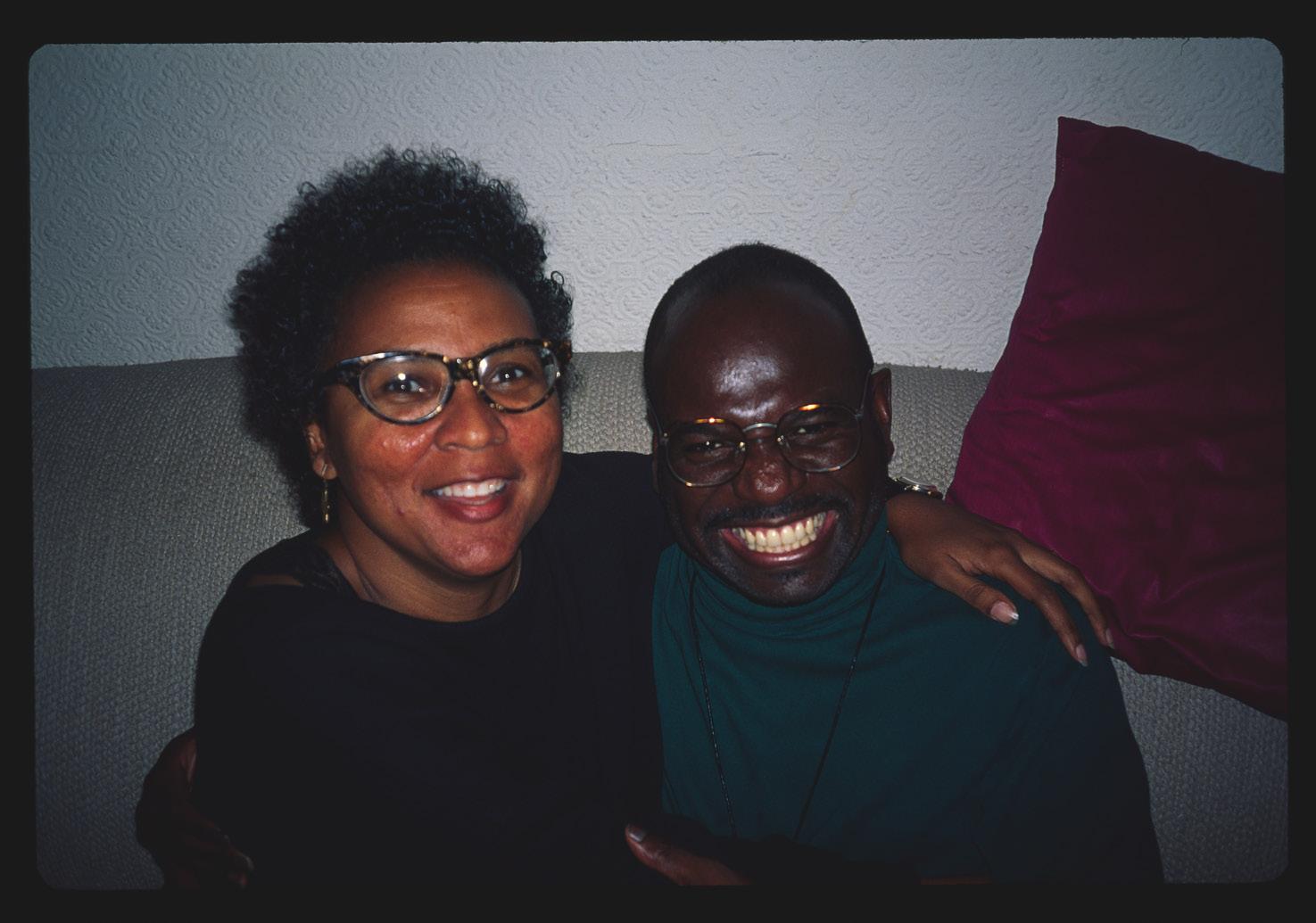
Installation view of Black Male: Representations of Masculinity in Contemporary American Art (Whitney Museum of American Art, November 10, 1994-March 5, 1995). Installation view Christian Walker, Kevin Everson and Lorna Simpson. (Photograph by Geoffrey Clements)
Father’s Day came as children of Allan Felix and Delrawn Small still seek justice
By TANDY LAU Amsterdam News Staff
The children of Allan Feliz and Delrawn Small, two men killed by NYPD officers, spent Father’s Day calling on the city to remove the cops involved in their deaths. Organizers originally planned a demonstration outside City Hall for June 22, but canceled due to stormy weather forecasts. Still, they directed their pleas to Mayor Zohran Mamdani and NYPD Commissioner Jessica Tisch through statements.
Small was killed in front of his fourmonth-old son Zaiden on July 4, 2016. Wayne Isaacs, the off-duty officer who fatally shot him, remains with the department after previously facing murder charges from a State Attorney General’s Office prosecution.
“I never got to know my dad — I had to learn about him through stories, photos, videos, and memories my family shared,” said Zaiden Small, now 10. “I never had a Father’s Day with him that I can remember. I miss my dad all the time. It is hard not to have him here — at school events, football games, birthdays, graduations — especially when I see my classmates’ dads coming around.
“It makes me wish my dad could do the same. My dad should be alive. No kids should
misconduct trial concluded that Lt. Jonathan Rivera violated department guidelines when he fatally shot the Washington Heights man during a Bronx traffic stop and faced termination — but Tisch, who has final say about discipline, opted to retain the officer in an unprecedented move. Feliz’s family is now suing to overturn the decision.
“I miss my dad,” said Eli Feliz. “Whenever I look at the moon and see the stars, I know my dad is looking down at me. I tell him, ‘I love you, Dad!’”
Feliz also raised his partner’s daughter, Kilsi Polanco, who considers him her father. Last year, she wrote a letter to Tisch calling for Rivera’s firing. Recently, Rivera pleaded guilty after another NYPD misconduct trial but kept his job. Mamdani previously called for his firing while serving in the Assembly. Polanco pointed to his past standing with the family and called for him to step in.
have to learn to live without their dad.”
Isaacs continues to avoid an NYPD misconduct trial, most recently by arguing that he acted as a private citizen even after the city paid out his settlement with taxpayer money. Earlier this year, Public Advocate Jumaane Williams and State Senator Julia Salazar penned an opinion piece for City
& State New York calling Isaacs’s defense “a new low for the NYPD.” Salazar followed the initial trial closely as an activist at the time and witnessed Zaiden and his cousin “grow up in the shadow of rallies, hearings, and endless courtrooms.”
Police killed Feliz in 2019, just months after his son Eli’s birth. Last year, an NYPD
“I was only 15 when Allan Feliz, my stepfather, was killed,” said Polanco. “I remember the panic attacks, heartbreak, and horror I felt when I first saw the video of what the NYPD did to him and a deep sadness still lives in me. What hurts the most is knowing I will never get to go out to eat with him, give him a gift for Father’s Day, hug him, or see his smile again.”
NY State agency wants to put more weight behind fatherhood engagement
By TANDY LAU Amsterdam News Staff
Moms might know best, but let’s not forget about dads. At least, that’s how the New York State Office of Children and Family Services (OCFS) feels about it, so they kicked off official efforts to strengthen fatherhood in the state on June 3.
In a recent convening, the child welfare agency and many stakeholders examined how to better engage dads and other male parental figures as a key child welfare solution; all as the statewide fatherhood steering committee gets off the ground.
“Empowering our dads, our bonus dads, our uncles, [and] our coaches to feel like they have a valuable part is so important,” said OCFS Commissioner Dr. DaMia Harris-Madden. “Sometimes I think in society we just defer to mom, but dads have a perspective and bring a unique world view that should not be ignored.”
The convening brought more than 100 child welfare and juvenile justice heads into the room, including Fathers Incorporated CEO Kenneth Braswell, who gave the keynote speech.
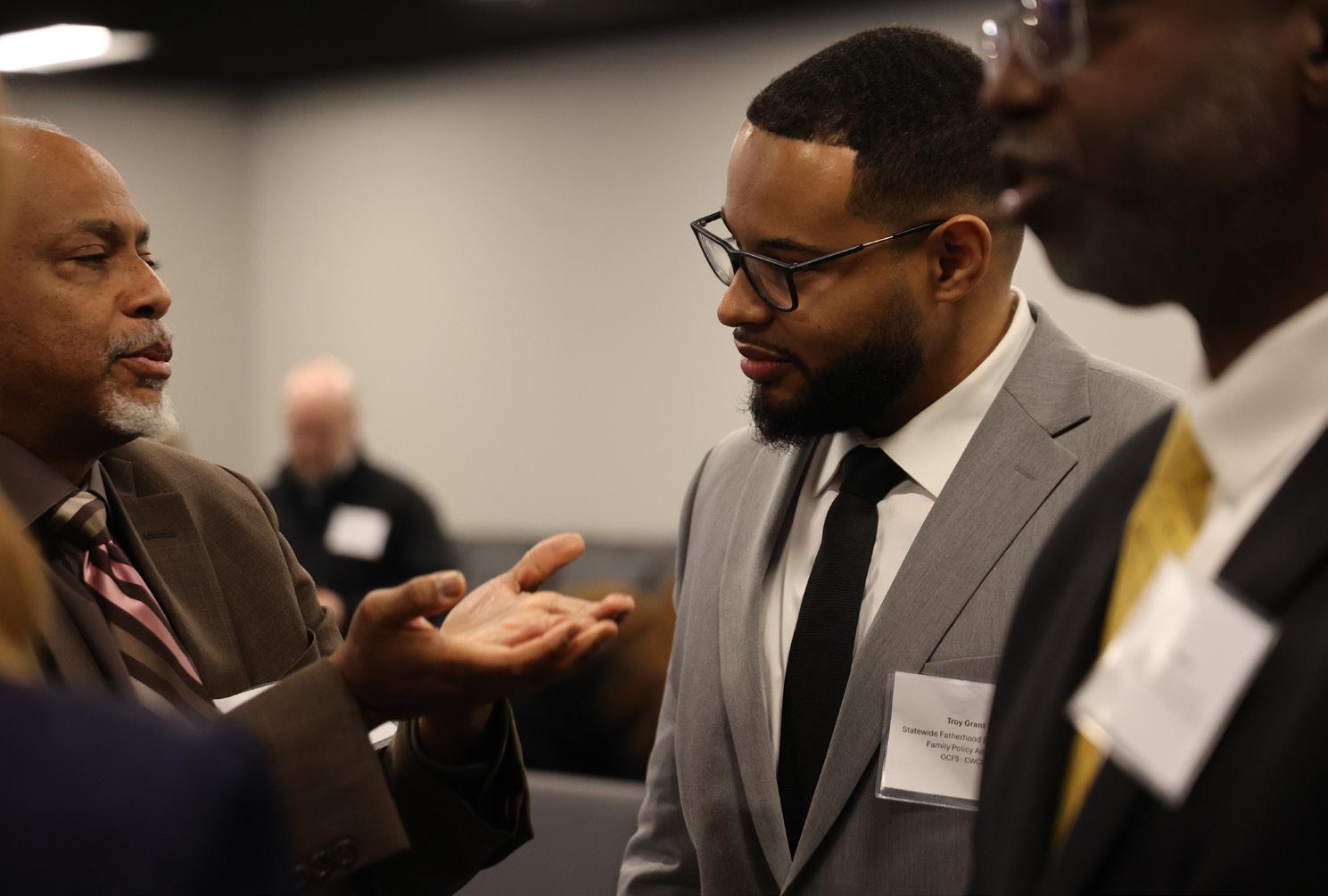
Social worker Troy Grant now spearheads this initiative as the state’s inaugural fatherhood engagement policy advisor. He boasts lived experience as a former foster kid and is also a father himself. Grant recalled building up to the convening through conversations with different fatherhood organizations, which resulted in a steering
committee. They agreed to hold a convening to hard-launch the task force and generally celebrate fatherhood.
“That formally launched our steering committee,” said Grant. “It was an event where OCFS again made that formal and public commitment to fatherhood engagement … it was just a really beautiful time to connect and there [were] people who have been in the fatherhood work for decades who hadn’t seen each other in almost 10
years. A lot of the feedback we got was [that] it was healing to have an agency take this on, and then also bring everyone together.”
Grant reconnected with a past father figure thanks to the event. His former football coach once housed him when he signed out of a group home after his 18th birthday, but they lost touch later in life. After the convening, footage of Grant reached his coach.
“We just had a really great heart-to-heart
moment,” said Grant. “He also showed me he still has a picture of me from before I entered foster care, when I was 2 years old, on his fridge. It was good for me and it just shows how this work is really healing … and we really need to support [it because] the data shows that across the board, when dads are involved, father figures are involved, there’s better outcomes for our youth, and my story is a testament to that.”
Improved childhood outcomes from fatherhood involvement are backed by studies, including reduced likelihood of spending time in jail and exhibiting behavioral problems. Contrarily, statistics show kids without present dads face significantly higher rates of poverty and depression, and are more likely to drop out of high school.
Harris-Madden also points to growing childcare investments by Gov. Kathy Hochul as support for fathers playing a role in their children’s lives. Notably, $3 billion goes toward the Child Care Assistance Program (a 40% increase) and another $500 million funds the city’s new 2-Care program for the next two years.
“This is so that dads understand too that there are resources for their children,” said Harris-Madden. “Dads can become involved with the providers of the services, and dads can participate in events centered around the children in the family, as opposed to just deferring to mom.”
As OCFS gets fatherhood engagement off the ground, the agency has also rolled out a podcast and a work-in-progress webpage.
Delrawn Small with son Zaiden (left) and Allan Feliz with son Eli (right). (Photo courtesy of Justice Committee)
Social worker Troy Grant will advise the state about fatherhood engagement. (Photo courtesy of OCFS)
Divine Nine News
Connecticut chapter of AKA addresses childhood hunger in New Haven
Provided by Alpha Kappa Alpha Sorority, Inc.
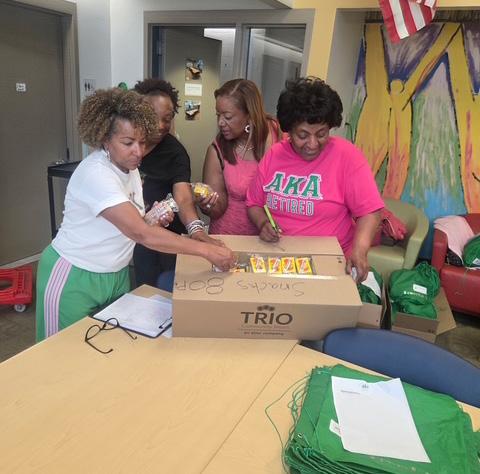
As the school year winds down, the Theta Epsilon Omega Chapter (TEO) of the Alpha Kappa Alpha Sorority, Incorporated® (AKA) is winning praise for a program that supplied hundreds of New Haven children and their families with nutritious food.
TEO members donated, packed, and distributed 11,208 Childhood Hunger Initiative Power Pack (AKA CHIPP™) bags to the Lincoln Bassett Community School during this school year. Over three years, the AKA chapter has distributed 22,861 bags.
“Your commitment to our school community has made a profound impact on our students and their families,” said Lincoln Bassett Principal Rosalind Garcia. “We are especially grateful for the tireless efforts of Ms. Tanasia Edwards (the program lead) and her dedicated team. Their hard work during school events to register families and their commitment to ensuring every participant received nourishment on schedule were essential to the program’s success.”
AKA CHIPP is a program initiative of Alpha Kappa Alpha’s Internation-
al President & CEO Danette Anthony Reed. AKA chapters locally and around the globe provide weekend and holiday meals for children who do not have the benefit of free school meals.
Theta Epsilon Omega is in the sorority’s North Atlantic Region, led by Regional Director Elicia Pegues Spearman, Esq. of Cheshire. Spearman commended TEO for its remarkable impact on its community. “Cereal, breakfast bars, applesauce, juice, graham crackers, goldfish (crackers), and other non-perishable food can combine to fill a void for families who might otherwise go without nutritious staples on non-school days,” said Spearman. “TEO has left a powerful mark on their community when many families are struggling in a difficult economy.” Spearman is also CEO of the Girl Scouts of Connecticut.
Adrienne Parkmond, president of Theta Epsilon Omega, and Sondi Jackson and Diane Forbes were cochairs of the chapter’s AKA CHIPP program. They praised the community partners who provided grants and donations that allowed the chapter to fulfill this hunger initiative, including Dixwell Avenue Congregational Church and Dominique Jones, a sorority sister.
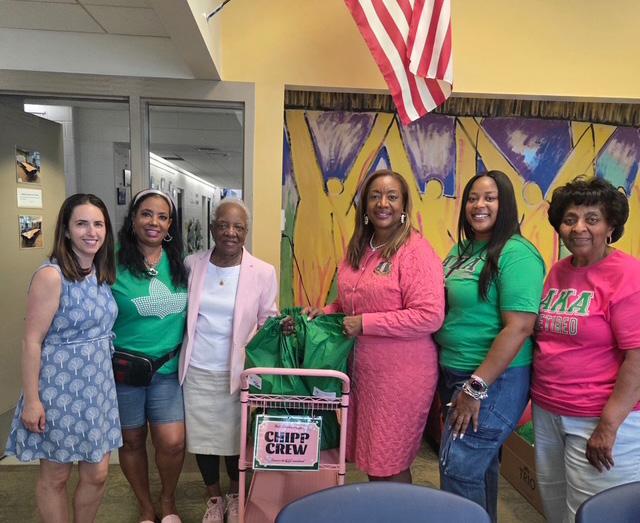
AKA members of Theta Epsilon Omega (TEO) Tanya Townsend and Lisa Stevenson; North Atlantic Regional Director Elicia Pegues Spearman; and TEO member Diane Forbes prepare Childhood Hunger Initiative Power Packs at Lincoln Bassett Community School.
Lincoln Bassett Community School Assistant Principal Eva Schultz with Theta Epsilon Omega members Doris Dumas, Eddie Joyce; North Atlantic Regional Director Elicia Pegues Spearman; and TEO members Tanasia Edwards and Diane Forbes.
Alpha Kappa Alpha Sorority, Inc.-Theta Epsilon Omega members Stephanie Willis, Tanasia Edwards, and Lisa Stevenson get ready to deliver boxes of CHIPP bags for Lincoln Bassett Community School students and their families to have nutritious meals when they are not in school. (Photos courtesy of the North Atlantic Region)
Labor & Workplace
Mamdani signs citywide order to protect workers from extreme heat
By KAREN JUANITA CARRILLO Amsterdam News Staff
New York City’s hot summer temperatures can affect the safety of workers on the job and those exposed to the heat. Ramp agents working on roasting tarmacs, construction crews pouring concrete in exposed sites, delivery workers, street vendors, and warehouse and kitchen staff often have to work in dangerously overheated conditions.
“No one should have to choose between their paycheck and their health,” Mayor Zohran Mamdani said on June 22, as he signed an executive order requiring city agencies to develop heat-safety guidance. “The workers building our skyline, delivering our packages, selling food on our street corners, and keeping this city running deserve to come home safe at the end of every shift.”
John Mosquera, a ramp agent at LaGuardia Airport, told those attending the City Hall signing about the time he passed out from the hot weather while at work:
“During one of the hottest days of the year, I was working on the tarmac in about 100-degree weather. The tarmac, nobody
knows…absorbs heat, and it was scorching that day. It’s like you’re working in the oven. I remember I was working inside the cargo hold of the plane, loading bags. Loading bags is hard work, and the bags are heavy, …but when you add in the extreme heat, it could feel overbearing. Working inside the cargo hold felt at least 10 degrees hotter, closer to 110 degrees. So, you can imagine how uncomfortable it felt being inside.
“Suddenly, as I’m loading the bags, I start seeing spots like when you press on your eyelid too hard, and you see stars,” he continued.
“I lost consciousness and just lay in the belly of the plane from how hot it was. When I was woken up a few minutes later, I was struggling to catch my breath. I was disoriented and felt scared, and my supervisor came in and asked if I was okay. When I told them I was okay, I had a short break and some water, and was sent right back to work. I finished my 10-hour shift that day.”
Mosquera also said a coworker who asked supervisors for water during a July 2024 heat wave ended up being suspended for two days. “We risk our health working in dangerous tempera-
tures, and when one of us speaks up for basic protections, we fear retaliation,” he said. “That is not what safety looks like. That is not what respect looks like. Nobody should be punished for trying to keep themselves together and their coworkers safe.”
The Mamdani administration’s new heat order does not set a citywide standard requiring water, shade, or paid breaks for all private-sector workers. But it does push city agencies to develop workplace heat rules, at a time when federal and state protections remain limited.
Mamdani and his deputies said the order is needed because over 1.4 million New Yorkers work outside for long periods of time, while many others work indoors in spaces where it gets hot without enough cooling. These workers are often Black, Latino, immigrants, low-wage workers, or gig workers who have little power to ask for protection without risking losing pay or getting into trouble.
Executive Order No. 17 directs the Department of Health and Mental Hygiene (DOHMH), NYC Emergency Management, and the Department of Citywide Administrative Services to develop and
distribute multilingual heat-safety guidance for outdoor workers as soon as possible this year. Guidance for indoor workers is due by March 1, 2027. Every agency must also create and implement heat illness prevention plans for city employees and contractors.
The Department of Buildings is also ordered to review construction-site heat safety rules and recommend whether they need to be strengthened by March 1, 2027. DOHMH will have to analyze workers’ compensation claims, measure heat-related workplace harm, and evaluate whether heat illness should be made a reportable health condition. The Department of Consumer and Worker Protection is directed to enforce existing worker-protection rules, including rules that give food delivery workers the right to use bathrooms at restaurants where they make deliveries.
The mandate covers workers in construction, airport ground service, app-based food delivery, package delivery, street vending, day labor, sanitation and municipal work, building services, restaurants, commercial kitchens, warehouses, and other workplaces where heat can be intensified by
asphalt, machinery, uniforms, protective gear, or poor ventilation.
Deputy Mayor Julie Su, a former head of the U.S. Department of Labor, said workers have told the administration they cannot always stop for water, step into shade, or slow down when quotas and schedules have to be met. She said the same basic protections surfaced repeatedly in conversations with construction workers, delivery drivers, baggage handlers, warehouse workers, and kitchen workers: water, rest, shade, training, and a plan before temperatures spike. “These basic protections are the difference between a worker who makes it home safe at the end of the day and one who doesn’t,” Su said.
There is currently no finalized federal Occupational Safety and Health Act (OSHA) standard for heat exposure in workplaces. OSHA proposed a Heat Injury and Illness Prevention rule in 2024, held a hearing in 2025, and collected feedback until October 2025, but it has not been adopted as a final standard. For now, businesses are told to ensure their workplaces don’t have hazards that could cause death or serious harm.
John Mosquera (at podium), a LaGuardia Airport ramp agent, told those at City Hall about how he collapsed inside the cargo hold of a plane while working on the tarmac in near 100-degree weather. (NYC Mayor’s Office photo)
Opinion
Is U.S./Iran MOU really a memorandum of misunderstanding?
There was no need to read beyond the first of 14 paragraphs in the highly anticipated memorandum of understanding (MPU) between the United States and Iran to see that trouble was ahead.
The signing of the MOU released on June 18 indicated an “immediate and permanent termination of military operations, on all fronts, including in Lebanon.” Those last three words underscored the difficulty of the agreement, and it certainly brought the question of where Israel stood on the matter to the surface, given that the conflict continued even as the main players were tentatively on the same page.
That dilemma continues as the U.S. and Iran meet in Switzerland to discuss lasting peace talks. At the center of the diplomatic negotiations is how the two countries can convert an issued 60-day pause in the war into a lasting peace agreement, thereby stabilizing a fragile truce. The proceedings got off to a troubling start when the Iranian delegation arrived after leaders from Qatar, Pakistan, and the U.S. had concluded the press conference.
Then, after a reported 18 hours of negotiations, Iran’s delegation — led by its speaker of the parliament, Mohammad Bagher Ghalibaf — left the Swiss venue and headed back to Tehran. Now, it’s being debated whether some constructive gains were made, although there appears to be some progress on creation of a de-confliction cell to ensure the end of military operations in Lebanon. Therein lies the rub, and one that has been unchanged since the onset of the five-month-long standoff between the U.S. and Iran. The conflict between the two nations, as more than one pundit has noted, must be seen in the broader context of the upcoming midterm elections, and Trump’s determination to hold the reins in Congress. There is much speculation, as well, about how all of this plays out for Vice President JD Vance and the 2028 presidential election, to say nothing of the midterms, and if he’s been thrown under the bus as the head of the Swiss negotiation team. He has claimed a few relative concessions, such as allowing UN inspections of Iran’s nuclear sites, though this news is contested by Iranian officials. The war between the contending forces raises a raft of questions and few foreseeable answers.
Reflecting on America’s claims and settlements as nation reaches 250
By KIMBERLYN LEARY, Ph.D., MPA
America turns 250 this year. As with all anniversaries, it is an occasion to reflect on origin stories, founding compacts, and pre-existing bargains.
who could order renditions and conscript citizens into a posse.
Elinor R. Tatum: Publisher and Editor in Chief
Madison Gray: Executive & Investigative Editor
Kristin Fayne-Mulroy: Managing
Editor
Cyril Josh Barker: Digital Editor
Damaso Reyes: Editor at Large
Siobhan "Sam"
Wilbert A. Tatum (1984-2009):
As we reflect, it’s important to remember that, even as the framers declared their own independence when they designed our Constitution, they included a fugitive slave clause to ensure the return of enslaved human beings to the people asserting they owned them. Notably, the Constitution did not provide for a procedure, a process, or a penalty — except, of course, to the enslaved persons subject to it. It functioned as a directive but lacked the machinery of government at first.
That machinery arrived with the Fugitive Slave Act of 1793. It allowed enslavers and their agents to cross state lines, seize people they claimed, and bring them before any judge for removal certificates. As the government matured, it built newer machinery. An 1850 act created new federal officers
Our declaration of liberty and its denial for some were ratified together. Call the first the “claim” — an aspiration to freedom, justice, and personhood. Call the second the “settlement” — the limits on justice that we tolerate. Our country has been part of this deal for 250 years.
Progress occurs when the claim gathers enough force and includes enough people to make the machinery yield. In the last century, this led to civil rights and voting rights statutes, as well as the Americans with Disabilities Act. More recently, it led to marriage equality. The settlement returns when enforcement weakens, or when new narratives do similar work.
This spring, in Louisiana v. Callais, the Supreme Court reinterpreted Section 2 of the Voting Rights Act. This enabled the very vote dilution the statute was meant to prevent. The claim that equity is “unfair” and renewed calls for “merit” deserve attention. Treating everyone
equally on an uneven field preserves the status quo. When a remedy is seen as a privilege, its withdrawal seems fair.
The claim has never been self-executing. Any apparatus to carry it can be shaped by whoever holds power. The machinery ahead will be powered further by generative, and soon, general artificial intelligence.
Still, we can do more than rage against the machine. Our resource is a force: enough persistent people to keep asserting countermeasures during reversals.
This is our inheritance: not a verdict in our favor, but the chance to make a demand again, now and in the future. It also means there is no resting point. The claim never executes itself automatically.
The lesson at 250: Freedom endures only if we keep insisting.
Kimberlyn Leary, Ph.D., MPA, is the Emma Bloomberg Lecturer in Public Policy and Management at the Harvard Kennedy School of Government and a Senior Fellow at New America.
(Pexels/Ben Jackson photo)
How political gentrification of Latino New York raises questions about power
By ANNA CORREA
In the aftermath of New York’s Democratic primary, a broader debate continues to unfold in the city’s Democratic coalition. For many Latino leaders, the disputes surrounding several congressional races were never simply about individual candidates. They reflected growing concerns about representation, community leadership, and whether longstanding Latino political institutions are retaining influence in the communities they helped build. Those tensions were heightened in the weeks leading up to the New York primary, when Vermont Sen. Bernie Sanders traveled here to campaign for Democratic Socialists of America-backed congressional candidates, opposing candidates supported by many of the community leaders and organizations that spent decades building political power in Latino neighborhoods.
To understand why these disputes have resonated so strongly, it is important to understand how Latino political power evolved in New York. Through decades of organizing, labor activism, coalition-building, and community institutions, Puerto Rican and Dominican leaders helped transform neighborhoods like Washington Heights into centers
of Latino political influence. That history matters because many Latino leaders are now asking whether these institutions are being treated as partners in political change or as obstacles to it. Recent disputes between prominent Latino elected officials and leaders associated with the city’s ascendant progressive movement have only intensified that debate.
Congressmember Adriano Espaillat, the first Dominican American elected to Congress and one of New York’s most influential Latino leaders, found himself at odds with Mayor Zohran Mamdani after the mayor endorsed DSA-backed challenger Darializa Avila Chevalier in New York’s 13th Congressional District. The move surprised many observers, given Espaillat’s support of Mamdani, and for many Latino leaders, the controversy was not simply about one endorsement. It reflected a broader frustration that candidates selected and promoted by outside political organizations are increasingly being elevated over local leaders who spent years organizing residents, building community relationships, and earning trust in the neighborhoods they seek to represent.
The concerns have not been limited to Latino leaders. In a recent show of solidarity, several prominent Black elected officials rallied
behind Espaillat, emphasizing the longstanding BlackLatino political alliance and warning against outside forces reshaping communities without local buy-in.
Similarly, Congresswoman Nydia Velázquez, the first Puerto Rican woman elected to Congress, has emerged as a leading voice in the debate over who gets to shape the future of Latino political representation. After endorsing Brooklyn Borough President Antonio Reynoso as her preferred successor, Velázquez found herself at odds with Mamdani, who backed DSA-endorsed candidate Claire Valdez.
The issue extends beyond endorsements. Candidates receiving significant institutional support, particularly from the DSA, often appear to have weaker ties to the communities they seek to represent than the local leaders and organizations that spent decades building political power in those neighborhoods.
Viewed individually, these disputes can be dismissed as ordinary political disagreements. Viewed together, however, they raise a larger question about power, representation, and who gets to shape the future of our communities.
This is where the concept of political gentrification becomes relevant. It occurs when longstanding communities lose influence over
institutions they spent generations building. The language of inclusion remains, but decision-making power begins to shift elsewhere.
The debate extends beyond congressional races.
New Yorkers elected a mayor to govern a city of more than 8 million people, not to lead factional battles in the Democratic coalition. While Mamdani is entitled to make endorsements, many Latino leaders wonder whether the communities that helped create that coalition still have a meaningful voice in shaping its future.
Political influence is never permanent. It must be maintained, renewed, and defended by each generation. If Latino communities want to preserve a meaningful voice in the institutions and coalitions they helped build, participation cannot end with a primary election.
For generations, Puerto Rican and Dominican leaders fought to ensure that Latino communities would speak for themselves. The challenge facing New York today is ensuring that, in the pursuit of political change, we do not forget that lesson.
Anna Correa is a third-generation Washington Heights resident of Dominican and Puerto Rican heritage. A law student at CUNY School of Law, she previously served as deputy press secretary to Mayor Eric Adams.
An increase of human agony in Cuba and we must help!
By HERB BOYD
During my recent visit to Cuba, I saw firsthand the extent of the U.S. oil blockade, particularly its impact on the pickup of garbage — it meant there was no fuel for trucks. It was often challenging to avoid the massive heaps of refuse at the street intersections. Even more devastating is the scarcity of energy for buses to transport children to school.
To conserve energy, the Cuban government imple-
mented a half-day schedule, while college students are assigned to remote learning. Even this is hampered, since electricity is needed for their computers to function.
While I was there with a fact-finding delegation, there were periodic blackouts, but now there have been considerably more outages, according to a recent report. Pressure from the Trump administration has compounded a strained economic and energy crisis.
“Education in Cuba is
at risk due to the current energy crisis,” said Anne Lemaistre, regional director of UNESCO, the United Nations education organization. “It jeopardizes the future of an entire generation.”
That jeopardy is in view of the U.S. embargo since 1966, and Trump’s “maximum pressure” has exacerbated Cuba’s humanitarian crisis. Thousands of teachers have left the country, citing low pay as the main cause.
Reflecting on Pride Month and why we celebrate
CHRISTINA GREER,
PH.D.
June is the time we celebrate our friends, family, and loved ones in the LGBTQ community and I am so blessed to have so many friends who have taught me about the history and struggles of people who have been trailblazers and educators for so many.
It is a time to reflect on the history of so many movements that have gotten us to this point, as well as the joy that exists and must be celebrated.
The Stonewall rebellion in New York City is a history that some, but far too few, know about. It began in the early morning of June 28, 1969, after a police raid of a gay bar in Greenwich Village. Days of clashes and police brutality led to what we now know as the contemporary gay liberation movement.
In addition to Stonewall, there are countless other examples, across the country and abroad, of brave men and women fighting for equality and acceptance in the face of blatant oppression and bigotry.
erase our history and humanity. However, just like all groups that have survived brutal conditions, and still recognize the fights ahead, we can all agree there must be time for joy, for communion with one another, for laughter, and for an ability to connect and share experiences that strengthen bonds seen and unseen.
It’s very difficult to chart the full ramifications of the measures to bring about political change proposed by the Trump administration, but the various means of aggression have put the nation on life support.
If you have a chance, check out Mimi Rosenberg’s show on WBAI 99.5 FM NY & Tri-State on Thursday, June 25, at 9 a.m. Her focus is on the extent to which “Africa Called and Cuba Answered.”
Now it’s our turn to do the same!
It is imperative that we remember the history and struggles that have been, and continue to be, important for providing an educational foundation for members of the LGBTQ community and those of us who support them.
However, what is equally important are the ways this community celebrates joy and resilience. I talk a lot about this with my friends and colleagues who write about Black politics. Sometimes it can feel like a never-ending stream of doom, gloom, racism, and attempts to
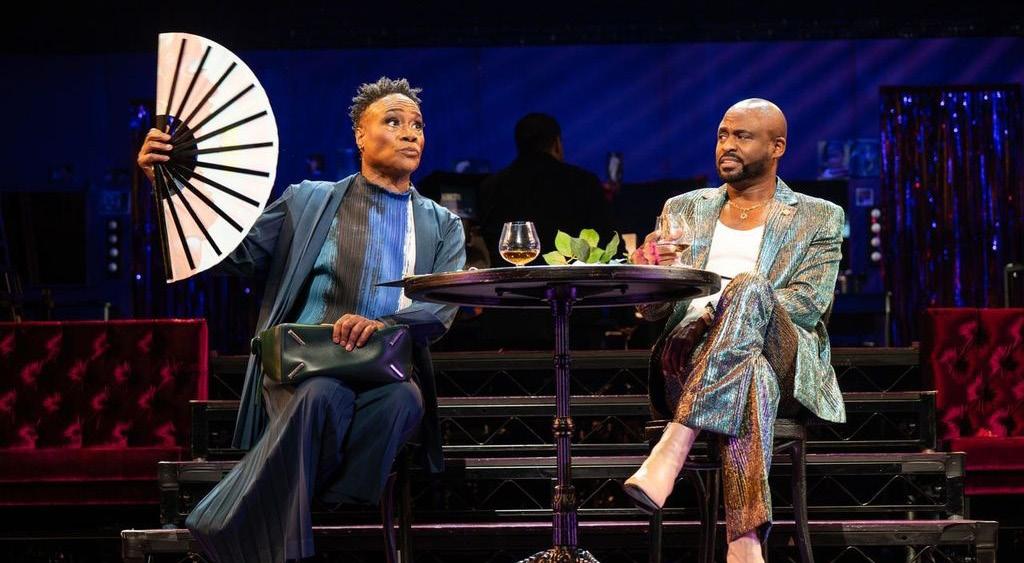
In that vein, I was delighted to attend “Cats: A Jellicle Ball” on Broadway a few months ago. Not only is Andre De Shields a national treasure, but being in a theater with men and women of all ages laughing and singing and dancing and shouting out as a release was so needed. To see primarily Black and Latino talent on stage coming in all shapes and sizes, trans and cis, young and old, felt like I was a part of history. At one point in the production (I don’t want to give away any of the surprises), there was a quiet moment when many others and I shed some tears. It was a catharsis of sorts for some and a moment of gratitude for others. However you choose to celebrate Pride Month, I hope you stop for a moment of joy, reflection, and gratitude.
Christina Greer, Ph.D., is an associate professor at Fordham University; author of the books “How to Build a Democracy: From Fannie Lou Hamer and Barbara Jordan to Stacey Abrams” and “Black Ethnics: Race, Immigration, and the Pursuit of the American Dream”; and co-host of the podcast FAQ-NYC.
Caribbean Update
U.S. and hemispheric body in major row over future of organization
By BERT WILKINSON Special to the AmNews
Formed in 1948, the umbrella Organization of American States (OAS) holds its general assembly in Panama this week amid a simmering row with the Trump administration over daily operations, budget issues, and an apparent attempt by the U.S. delegation to operate a parallel management structure to the elected one in place.
Caribbean ambassadors to the Washington, D.C., headquarters say that there is a concerted attempt by Ambassador Leandro Rizzuto Jr. and other top officials to exert pressure on Secretary General Albert Ramdin and his management staff to either make him quit or to bow to demands to allow Washington to increase its influence and control of the 35-nation body.
Up to last month, the administration had not requested any budget money for next year, as it is apparently using its leverage from contributing up to 50% of the annual
budget to increase influence and control over the organization. The administration had contributed $90.3 million to the 2024 budget, representing nearly half of its annual tally. What would happen if the U.S. does not throw in its financial lot in the coming months will likely be a key agenda item, informed officials say.
At the heart of the issue are charges and allegations about corruption, nepotism, and official mismanagement on the part of Ramdin. Surinamese-born Ramdin, 68, the first person from the Caribbean to hold the top position and elected a year ago, is adamant that a concerted effort is being made to either undermine his authority or to boot him from the body because he has been resisting pressure of daily control of the organization from the administration. Before taking up the top position, Ramdin had served as assistant secretary general and is a veteran of the organization and its systems.
Caribbean ambassadors have
accused Rizzuto of trying to bully his way into the daily operations of the body, demanding a permanent office in the main headquarters building, the right to sit in on private executive meetings hosted by Ramdin with delegations from member countries, and to travel on overseas assignments with Ramdin and his staff. They argue that if any of these requests are granted, ambassadors from other member states can also make similar demands, severely disrupting daily operations, and departing from established precedent.
And in a major twist to the saga, the State Department has revoked the visa of Ramdin’s chief of staff, Xaviera Jessurun, allegedly because she is at the center of a major probe back home over alleged financial mismanagement at state-run Surinam Airways and has ordered her to leave Washington in the coming days.
Reacting officially on Thursday, the OAS charged in a statement that its charter bans the executive
The immigrants carrying Team USA
FELICIA PERSAUD
IMMIGRATION KORNER
As the United States prepares to face Turkey on June 25 at the 2026 FIFA World Cup, one reality has become impossible to ignore. The players helping carry Team USA on soccer’s biggest stage are, in many cases, the children or grandchildren of immigrants.
Some were born abroad. Others were born in the United States to immigrant parents. Many hold dual citizenship. Several could have represented other nations but chose to wear the American jersey.
Their stories are a reminder of something long true about America: America is a nation of immigrants; they strengthen, not weaken, the country. That reality stands in sharp contrast to the rhetoric dominating much of today’s political debate.
At a time when the Trump administration is seeking to restrict birthright citizenship, expand
deportations, and portray immigrants as threats rather than contributors, Team USA is being powered by the very immigrant roots that some politicians would prefer voters fear.
No player embodies that irony more than striker Folarin Balogun.
Balogun scored twice in the Americans’ opening World Cup victory over Paraguay. Yet his very presence on the team is tied directly to the constitutional principle currently under attack in the courts.
His Nigerian parents were temporarily in New York when his mother, seven months pregnant, was prevented from boarding a flight back to London because of airline restrictions related to her pregnancy. Balogun was born in Brooklyn and became an American citizen under the 14th Amendment’s birthright citizenship clause. Today, President Donald Trump is seeking to narrow that constitutional protection through executive action. Had that policy been in effect when Balogun was born, one of Team USA’s most dangerous attacking players might never have
from taking instructions “from any government or from any authority outside the organization and shall refrain from any action that may be incompatible with their position as international officers responsible only to the organization.”
The row is expected to take center stage at this week’s general assembly meeting in Panama, with fears growing about the future existence of the OAS with the current White House in place.
In its statement, Ramdin said he would welcome an independent probe “to discuss the terms of a formal, independent investigation, if the member states so desire.”
Dismissing allegations of corruption and lavish spending, Ramdin said in his statement that internal audits have not unearthed anything.
“No such irregularities have been found in the first year of the secretary general’s tenure, and until the inspector general issues audit findings, any claim regarding financial governance is unsubstantiated and politically speculative.”
Speaking at a pre-conference forum in Panama on Sunday, a defiant Ramdin appeared to have lashed out at the U.S. and its attitude towards the OAS, saying basically no country is seen as more important than another member in the organization regardless of size and power.
“And yet there is a fundamental issue that has remained unchanged. It did not change before the OAS, before Gaviria, before Almagro, or before me. The need for cooperation has always been with us, because geography binds us together. No country in this Hemisphere, however large, can settle on its own the questions that cross our borders, whether in security, migration, public health, or the technological and climate shifts now reshaping our economies. So, the task before us is not to tear the system down and build another in its place. It is to rethink it, to make it answer today’s needs more efficiently, and to keep it credible in the eyes of the people it exists to serve. While the purpose is constant, the methods must keep pace,” he said.
been eligible to represent the United States.
But Balogun is hardly alone. Tim Weah, another key player, is the son of Liberian football legend and former Liberian president George Weah and a JamaicanAmerican mother.
Gio Reyna was born in England, as was Antonee Robinson. Ricardo Pepi was born in Texas to Mexican parents. Haji Wright is the son of a Ghanaian father and a Liberian mother. Cristian Roldan could have represented Guatemala or El Salvador. Alejandro Zendejas was born in Mexico before moving to Texas as an infant. Sergiño Dest was born in the Netherlands to a Surinamese-American father.
Matt Turner traces his family roots to Jewish immigrants who fled persecution in Lithuania. Christian Pulisic carries Croatian heritage that helped open the door to his professional career in Europe.
This is not an exception. It is modern America. The irony becomes even greater when viewed through a global lens. Nearly one-quarter of all players par-
ticipating in the 2026 World Cup are representing countries other than the ones where they were born. Twenty years ago, that figure was less than 9%. Morocco’s squad is dominated by players born in Europe. Bosnia and Herzegovina relies heavily on players whose families were displaced during the Balkan wars.
Across the tournament, migration stories have become national team stories. The World Cup itself has become a celebration of global movement, diaspora, and identity.
And nowhere is that more visible than on Team USA. These players are not evidence of America’s weakness. They are evidence of its strength.
Their families crossed oceans, fled conflict, sought opportunity, built lives, and raised children who now represent the United States before billions of viewers around the world.
Some arrived legally. Some through military families. Some have gone through generations of migration stretching back decades. Together, they tell a story
far older than the current immigration debate.
The story of America has never been one of isolation. It has always been one of arrival. As Team USA takes the field against Turkey, Americans will cheer the goals, celebrate the victories, and wave the flag. Many may never stop to consider that some of the players carrying that flag today are living proof of the very immigration traditions that helped build the country in the first place.
The irony is hard to miss. At a moment when immigration and immigrants are often portrayed as a threat to America by xenophobes with white supremacist ideals, immigrants and their children are helping carry America on the world’s biggest stage in its 250th year of independence — the 2026 World Cup.
Felicia J. Persaud is the founder and publisher of NewsAmericasNow.com, the only daily syndicated newswire and digital platform dedicated exclusively to Caribbean Diaspora and Black immigrant news across the Americas.
International News
South Africa marks 50 years since Soweto uprising by students, but challenges linger for its youth
By MOGOMOTSI MAGOME and
MICHELLE GUMEDE
Associated Press
JOHANNESBURG (AP) — On Tuesday, South Africa marks the 50th anniversary of the Soweto uprising, when more than 200 young people protesting against the apartheid education system were shot and killed by the police.
The events of June 16, 1976 — now commemorated annually as Youth Day — are considered a turning point in South Africa’s liberation struggle against white minority rule. They ignited more demonstrations in various parts of the country, fueled more resistance against the apartheid system of segregation, and brought international attention to the racial oppression faced by Black people in South Africa.
However, 50 years after the uprising, there are still concerns about the plight of young people
in the country. Survivors of the protests, experts, and young South Africans have lamented the challenges facing the country’s youth, including inequality, high unemployment, poverty, and social problems such as drug and alcohol abuse.
Soweto, one of the oldest townships in South Africa, bears symbols of the historic day that are frequently visited by local and international tourists. These include a memorial named after Hector Pieterson, the boy whose lifeless body was seen being carried away by another student in an iconic photograph that came to symbolize the 1976 uprising. Murals and billboards depicting protesting students can be found throughout the township, which is also home to the June 16 Memorial.
For those who survived the protests, however, the symbols are a painful reminder of the day that changed their lives forever.
Seth Mazibuko, a survivor, remembers vividly how students fought back against the police, who were using tear gas to try to disperse the defiant demonstrators.
“They struggled with the tear gas because when they threw it our way, the wind would blow the gas back to them, so it was also affecting them,” said Mazibuko.
“They then started sending the police dogs to us. We used stones to chase the dogs back to them.”
Mazibuko was detained for 18 months after his arrest and later imprisoned on Robben Island, where he served seven years alongside other political prisoners.
In the 50 years since the uprising, South Africa has undergone significant changes but inequality, unemployment, and poverty are among the most pressing challenges facing its “born free” generation: those born after the end of apartheid in 1994.
“I would say the issues of pover-
ty and crime are the most pressing ones,” said Sima Poto, a 19-yearold visiting the June 16 memorial.
“It is poverty that is leading many of them into crime.”
Zola Mguli, a 29-year-old who works with the Southern African Alcohol Policy Alliance, an organization campaigning against alcohol and substance abuse, said he is grateful to belong to a generation that has grown up in freedom, even as significant challenges remain. “Things are not going as well as our forefathers hoped,” he said. “There is still racism, alcoholism, and other things we are battling with, but if we, the youth, rise up, we can do better.”
Historian Noor Nieftagodien said the 1976 student protest movement was a traumatic and transformative moment that reshaped the anti-apartheid struggle, placing young people at the forefront of liberation politics.
“This was a generation that was young, gifted, and Black,” he said. “They wanted education. The idea of Black power resonated with this new generation of young people. Black consciousness was kind of electrifying; it inspired university students and then increasingly also students in high schools.”
He said that since June 16 was declared a public holiday after the end of apartheid, the significance of the event has diminished, overshadowed by celebratory events that, in his view, water down its political meaning.
“It has lost its meaning,” he said. “What has happened is that we’ve had the day marked with concerts, etc. I’m all for concerts, but, in fact, in so doing, the kind of celebrations that have been organized have been disinvested from politics, from a critical understanding of what happened.”
Hector Pieterson Memorial in Soweto. (Wikimedia Commons photo)
“My overall experience was great. I love the window, and from sales to scheduling, the experience was very good. The installers are highly skilled professionals and I would recommend Renewal by Andersen to all my contacts.” – LYNN F. | RENEWAL BY ANDERSEN CUSTOMER
KEEP THE HEAT IN AND THE COLD
Arts & Entertainment
Clive Davis, music’s kingmaker, dies at 94: What you should know about the impresario
By MATTHEW ALLEN Special to the AmNews
Clive Davis, one of the most powerful figures in the American music industry, has died. The impresario passed away on Monday, June 22, at age 94, at his Manhattan home. He had recently been hospitalized due to upper respiratory issues.
Since his death, numerous artists have expressed their grief and admiration for Davis, including singer Dionne Warwick.
“My dear friend lived a more than promised allotted time and made each moment count,” Warwick said in a statement. “I can think of no other record man that seemed to have that magical ability to know a hit when he heard a song. The entire music industry I’m sure will mourn his passing. He was one of a kind.”
Legend Stevie Wonder spoke candidly on how Davis’ death is leaving a void in the industry. “We’re losing the best while we’re keeping the worst,” Wonder told CNN. Davis’ success as a record executive extended far beyond many of his contemporaries. Over a career that spanned five decades, his accomplishments only grew and grew as other music moguls’ reigns came and went, from Janis Joplin in the 1960s to Kelly Clarkson in the 2000s.
While Davis started his tenure with Columbia Records as a lawyer in 1960, he had an eye for talent, leading him to becoming the label’s president by 1967. His knack for spotting talent was not limited to just pop and rock acts. Davis was responsible for launching the major label careers of some of Black music’s most successful acts.
The year Davis became Columbia’s president, he signed Sly and the Family Stone to the label. The Oakland band turned out to be among the most influential music collectives in American history, crafting hit records like “Everyday People,” “Stand,” and “Family Affair.” The year 1972 saw a band named Earth, Wind & Fire trying out their new line-up of young musicians behind industry vet Maurice White. Davis noticed
Houston died in 2012, hours before one of Davis’ pre-Grammy showcases.
that this new version of the band had something special. He signed them to Columbia, and everything changed. By 1975, the Elements got their first number one Billboard Hot 100 single, “Shining Star,” and by the time their run with Columbia ended, they had six double platinum albums and six Grammy Awards.
“If it had not been for Clive it’s very possible there would not be an Earth, Wind & Fire, at least not as our story has been written,” the band said in a statement on Facebook. “We are forever grateful for the role he played in our lives.”
After his stint with Columbia, Davis founded Arista Records in 1975, as his influence and ear for talent only strengthened. It was at Arista in the 1980s when Davis signed the biggest success story in Whitney Houston. Daughter of singer Cissy Houston, Whitney had a peerless vocal range and natural aesthetic grace. Davis curated producers like Narada Michael Walden, Michael Masser, and Kashif to craft a sound that would not only be perfect canvases for her voice, but appeal to a massive audience of music lovers. Houston’s longtime collaboration with Davis led to 11 number-one Billboard Hot 100 singles and three diamond certified albums. Houston is arguably the jewel of Davis’ legacy, although things ended tragically when
Davis was well-known for having an eye for artists, but he had an eye for others who had an eye for artists. By the early 1980s, Kenny “Babyface” Edmonds and Antonio “LA” Reid, one of the hottest production duos of the time, wanted to form their own label. Davis helped them achieve that goal, partnering with the former Deele members to form LaFace Records. With Arista handling distribution, Davis likened LaFace to a new Motown, and he wasn’t far off. LaFace launched the careers of Toni Braxton, Usher, TLC, and Outkast. Davis also mentored Reid, who himself became a fiercely successful executive at Motown, Epic, and Def Jam.
After decades of hits at Arista Records, Davis moved on to found J Records in 2000. Davis knew he needed a young talent to be the face of the label as Houston was for Arista. He found that in Alicia Keys, a gifted singer / songwriter / pianist from New York City. His efforts helped make Keys’ first album, 2001’s “Songs in A Minor,” a fivetime Grammy winning triumph. Keys’ success helped legitimize J Records, and Davis went on to add Angie Stone, Jamie Foxx, and Tyrese to the roster.
Finding new talent wasn’t the only thing Davis excelled at. He also was great at rejuvenating careers of proven acts, such as Aretha Franklin. After dominating the charts from late 1960s to the mid-1970s, The Queen of Soul’s reign was on a downturn. Enter Clive Davis, who signed her to his Arista Records. Davis envisioned a more sleek sonic makeover for Franklin for the 1980s, and helped her gain a new audience with pop hits like “Who’s Zoomin’ Who,” “Freeway of Love,” and her number one duet with George Michael, “I Knew You Were Waiting For Me.”
It was under Davis that Luther Vandross gained a new young audience at J Records with songs like “Take You Out Tonight,” before earning his first number-one album with “Dance with My Father.” Carlos Santa-
na was signed to Davis when his album “Supernatural” proved that the longtime rock icon was far from done, with the album winning eight Grammy Awards in 1999.
Now, Davis, like most successful record executives, was a polarizing figure. While many artists are honoring his memory, several music fans on social media are reveling in his death, due to how he treated certain artists (i.e. Phyllis Hyman) and fostered an industry that segregated R&B and pop in damaging ways by inspiring the institution of Black divisions at major labels.
For all his achievements, Davis did not have a spotless career. He missed out on opportunities to sign big acts like Meat Loaf, and clashed with artists and producers often. One such infamous incident came when Davis disagreed with producer David Foster over the arrangement of Houston’s Dolly Parton cover. He and Arista signee Phyllis Hyman fought over her sound and direction. According to TVOne’s “Unsung,” Davis did not support Hyman’s decision to join the cast of Broadway’s “Sophisticated Ladies,” for which she would earn a Tony Award nomination. While Davis had success everywhere he went, he often left labels under acrimonious circumstances. He started Arista Records after Columbia Records fired him over accusations of money mismanagement (he was later cleared, and Columbia gave him the money to start Arista). When he founded J Records, it came after Arista’s parent company, BMG Entertainment, ousted him, in his mid-60s at the time, and other older executives from leadership positions. He would later become chairman at Sony BMG overseeing its U.S. division. He guided the careers of “American Idol” winners like Clarkson, Fantasia, and Carrie Underwood before transitioning from chairman to chief creative officer. Davis, who had four children, leaves behind a legacy of music business success.
— with reporting from Associated Press writers Maria Sherman and Nekesa Mumbi Moody.
Patti LaBelle teases new project in AmNews interview ahead of BRIC Celebrates
Brooklyn! fundraiser
By JOHNNY KNOLLWOOD Special to the AmNews
Iconic singer Patti LaBelle will return to the stage in New York City at BRIC Celebrates Brooklyn! in Prospect Park on June 26. The progressive soul pioneer will be joined by Lady Wray and MORENBPLEASE at the Lena Horne Bandshell for a special fundraiser that will benefit BRIC Arts Media, which champions access to artis-
tic resources in Brooklyn and has hosted the titular festival for nearly five decades.
“It’s like I’m at home when I perform in the New York area, especially Brooklyn,” LaBelle, a Philadelphia native, said in an exclusive phone interview with the AmNews. “Patti is with her children and we’re all having fun!”
LaBelle is well known for fronting her namesake group that produced the #1 hit “Lady Marmalade,” off the band’s iconic
1974 release, “Night Birds,” before launching a successful solo career with songs like “If You Only Knew,” and “New Attitude.” “They never know what to expect from me, because I am a very spontaneous performer,” LaBelle teased ahead of the show. She wants audiences to leave Prospect Park with a sense of “peace, enjoyment, laughter, and joy — because we need joy today with everything going on,” said LaBelle. LaBelle, who already has a large and di -
verse body of work, has no plans to settle down. “I’m recording for an R&B album that I haven’t had in 20 years,” LaBelle told the AmNews . “That’s being worked on as we speak. So, before the year is up, hopefully you’ll have a new Patti LaBelle project.”
For tickets and to learn more, visit BRIC Celebrates Brooklyn! at bricartsmedia.org. You can score 50% off tickets with code LABELLE50.
Legacy Award Honoree and Walk of Fame Inductee, Clive Davis at the Apollo in 2025. (Shahar Azran for The Apollo photo)
At Home in Harlem: Pursuing beauty with Curtis Quinntin Phelps in Washington Heights
By MICHAEL HENRY ADAMS Special to the AmNews
Especially now that it’s Pride Month, my dashing and remarkable friend Quinntin, Curtis Quinntin Phelps that is, reminds me of James Baldwin.
When a British interviewer asked the late-great artist-activist if he found it ironic to be Black, impoverished, and homosexual in America — basically, he was articulating, “Damn, could your situation have been any less promising?” And asking, “Surely just being white would have made all the rest easier?” — Baldwin famously laughed and replied: “No! I thought I hit the jackpot. It was so outrageous, you could not go any further. So you had to find a way to use it.”
Baldwin was certainly not selfpitying nor rueful. Most assuredly, neither is Quinntin. Besides being from large families and often misunderstood, both men, artistic and ambitious, have used their obstacles along with their gifts to overcome any circumstance and to thrive.
Born six decades ago in Cleveland, Ohio, a finally recovering capital of the American Rust Belt, Quinntin has lived here for more than half of that time. Which is to say, like the best of us, he’s a New Yorker by choice. Any New Yorker, particularly anyone who is Queer, knows how important it is to neither complain nor explain, that it’s beneficial both to mind one’s business and to exercise discretion.
Writing in his book, “Truth of Beauty: The Path to Uncovering the Beautiful You” (2021 with Max S. Gordon), Quinntin, a makeup artist, explores beauty as a holistic practice. His tutelage encompasses physical wellness, self-care, personal style, confidence, movement, health, and the cultivation of inner improvement. It does all of this in a way that suggests to me that the only things missing from his effort to help others are lessons to be learned from an imperfect but exemplary life. By way of encouragement, this is my thumbnail sketch.
Curtis Quinntin Phelps began by losing both parents. He and a sister were raised by their highly religious grandmother. If no more than a young Baldwin, was Quinntin “out” as a youth; in the Black community, his quiet studiousness, graceful movement, and even reticence were prejudicially judged as signs of effeminacy, marking one as a “sissy.” “Grandmother was disapproving. When a friend would visit, we couldn’t go to my room. She had to keep an eye on us,” Quinntin says unflinchingly.
As hard as he worked at school, Quinntin worked harder at the job that launched his career in beauty, at Today’s Headlines, the most fashionable hair salon in the entire Cleveland area. The white Gay proprietors, Colin Lively and Richard Peterson, took this precocious, sought-after stylist under their wings. Still in high school, he had a substantial salary and then a car and contract. “We traveled with clients, even abroad. Eventually I’d have become their partner — but knowing all that was out in the world, I knew I had to leave Ohio. One great change, once I made money, was that Grandmother ceased being disapproving.”
And so, a decade before relocating to New York, after he ended an engagement to his beautiful fiancée, studied at the London School of Fashion, and was a go-go dancer in Paris, Quinntin lived! Here, working directly with Bobbi Brown during their formative years, he joined Bobbi Brown Cosmetics. Not made Ms. Brown’s partner, Quinntin joined Bergdorf Goodman, where he became that highly visible voice of luxury, beauty, and fashion, known as “Ask Quinntin.”
Today, he serves as manager of Tom Ford’s flagship beauty boutique in SoHo.
It’s quite a distance from Washington Heights to SoHo, but, athleticism being a part of his regimen, Quinntin frequently bikes to the Battery and back. Before living uptown near the George Washington Bridge, he had a loft apartment near The Police Building with oversized furniture like his Victorian library table, a Chinese wardrobe, and much more, all in one space.
They say that seeing someone’s surroundings, their home, is to
Curtis Quinntin Phelps at home. (Michael Henry Adams photos) Quinntin Phelps self-help book “Truth of Beauty” debuted in 2021.
Quinntin Phelps circa 1985. Quinntin today.
view their truest portrait, and it’s true. As easily elegant and comfortable as if he were the beneficiary of a multigenerational spendthrift trust, Quinntin’s onebedroom apartment has another quality characteristic of the abodes of inheritors of long-held wealth. With a perfection that’s
ARTS & ENTERTAINMENT
not so studied as the Ralph Lauren store, he’s arranged and combined high and low, the exquisite and the ordinary, in an extraordinary way. His secret? It is a telling combination of discernment and an admirable nonchalance. As with his immaculate wardrobe, yes, he’s aware of quality
For parties, Quinntin’s long library table and the round center table too, are pressed into service for wonderful buffet suppers of ten. The African bed below the big table serves as a bookshelf and the Chinese carpet is decorated with butterflies, dragons, and lotus blossoms.
and cherishes and takes good care of beloved objects he’d be loath to part with. But like his clothes, his household furnishings serve him, and not the other way around. Ertè, Keith Haring, George Platt Lynes, Celadon porcelain, ebony, West African ivory — apart from any prestige they
might convey, what makes them meaningful to Quinntin is how, in combination, well considered, carefully curated, they most clearly say, “Curtis Quinntin Phelps.” Gay or straight, at any age, there’s little as worthwhile or important as expressing and celebrating one’s true self.
posters advertising a Keith
84”
A 19th-century paisley shawl graces the back of Quinntin Phelps’ plain white upholstered sofa, which sits beneath an engraved 1940s looking glass
Twin
Haring’s “Into
Exhibition, depicting dancer Bill T. Jones, might well be portrayals of Quinntin Phelps, who enjoys a similar musculature.
Two 1930s figure studies by George Platt Lynes in Quinntin Phelps’ living room were gifts from the sitter. They are from the same era as his streamlined electric fan.
A reproduction Tang Dynasty horse and a porcelain vase sit on the semi-elliptical table in Quinntin Phelps’ hallway where scented candles create a memorable, lingering atmosphere. (Michael Henry Adams photos)
Chinese fu dogs, porcelain bowls, and a jadeite scepter.
Reclaiming the Gaze
Continued from page 7
anti LGBTQIA+ legislation in Africa, and the current White House administration has vigorously reduced support for artists across the board in its effort at cultural era sure of non white and LGBTQIA+ visibility.
evolved over time.”
Together, Riggs, Harris, Julien, and Ligon re fused the binary of celebration or condem nation, arguing that neither Black nor queer masculinity is monolithic. They expanded the conversation Mapplethorpe had entered and moved it to being one driven by Blackness.
In 1994 Thelma Golden, now director of the Studio Museum of Harlem, was a curator at the Whitney Museum who entered the fray re garding masculinity, manhood, and Blackness in mounting the exhibition “Black Male: Rep resentations of Masculinity in Contemporary American Art.” It ran from November 1994 to March 1995, gathering works including David Hammons, Jean‑Michel Basquiat, Lorna Simpson, Gary Simmons, Lyle Ashton Harris, Glenn Ligon, Isaac Julien, Barkley Hendricks, Robert Mapplethorpe, and others.
The conversation went beyond Black queerness to interrogate what it means to be Black and male in the United States in the context of white supremacy and all the “ isms” intersecting American life. Visitors to the Whitney weren’t allowed to see Black men as distortions or simplicities but rather in their full humanity. “It was a kind of ‘boil ing point,’” noted Ashton Harris of the show in the context of dialogues within and beyond the art world to larger society regarding Black masculinity, manhood and sexuality.
Today, exhibitions like “Exposure: Black Queer Visual Constellations” at Brown Uni versity extend the legacy of Essex Hemphill, Marlon Riggs, Lyle Ashton Harris, Isaac Julien, and Glenn Ligon as well as their contempo raries. Recently closing on June 15, the show was co curated by Alexander Ghedi Weheliye,
the Malcolm S. Forbes Professor of Modern Culture and Media at Brown, with Lindiwe Makgalemele, Jordan Mulkey, J.M. Nimocks, and Gee Wesley. According to Weheliye, it was conceived due to the surprisingly few group shows in recent years specifically featuring Black queer artists with only three or four such exhibitions in the past five years. For many of his students Black Book was a sig nificant reference point but it’s less central to the artistic conversations they’re having now, than in the 1990s.
“Initially, the scope of the exhibition was a little bit smaller,” he explained by phone from Providence, Rhode Island. “I think we started out with one particular artist but then start ed looking around at different exhibitions of contemporary Black queer art and there were actually not nearly as many as one would assume given the number of Black queer, Black gay and trans artists working particularly in the area of photography. It was important to showcase the diversity within contemporary Black queer art in terms of the work itself, but also geographically from the Caribbean, North America, Europe, and the African continent.”
The show brought together artists explor ing varied perspectives on the contempo rary world including Clifford Prince King, Nadia Huggins, Ajamu X, and Texas Isaiah, among others. Collectively they are push ing the multiplicity of Black and queer lives and perspectives using history, communi ty, and imagination.
Professor Weheliye also spoke to the global challenges facing Black queer art ists, highlighting how U.S. fundamen talist Christian groups have influenced
“For Black queer, Black trans artists, their war is by default political because of their identities,” he argues, “even though their art is not always explicitly political, but it still carries the history. We still have ways to go and need continuous spaces, resources for artists to exhibit, opportunities to sell their work and residen cies or fellowships.”
Lyle Ashton Harris is now working to develop an ex hibition honoring Riggs and Essex Hemphill in collaboration with MASS MoCA, co organized by Cantor Arts Center and MASS MoCA. It will open at the Cantor, then on to MASS MoCA, and subse quently show at the High Museum of Art, Atlanta. He met Riggs as a gradu ate student and has been poring through more than 200 boxes of archival ma terial. “The fire, the energy that [Marlon] and Essex used to propel them selves to produce their en during work are legacies that have lasted beyond their lifetime,” Harris de clared. “They are even more potent, more radical today.” Marlon Riggs died in 1994, and Hemphill fol lowed him a year later, both AIDS related.
In his poem, “The Per
fect Moment” Essex Hemphill spoke to the discourse around Robert Mapplethorpe’s images of Black men acknowledging the fears, desire, and danger for men who were Black and gay in his lifetime. One of the most haunting lines still resonates today in the midst of anti trans efforts and the threats to marriage equality and visibility for all queer people: “I want to be seen in the fullness of my life.”
Installation view of Black Male: Representations of Masculinity in Contemporary American Art (Whitney Museum of American Art, November 10, 1994-March 5, 1995). David Hammons, Injustice Case, 1970; David Hammons, Pray For America, 1974. (Photograph by Geoffrey Clements)
Lyle Ashton Harris, “bell hooks and Marlon Riggs, New York, early 1990s #2,” 2024 Chromogenic print, 15 x 20 1/2 in (Photo courtesy of Lyle Ashton Harris)
Lyle Ashton Harris, Untitled (New York Times Pre-Election Self Portrait Commission), 2000
‘La Cage Aux Folles’ is fabulous at New York City Center
By LINDA ARMSTRONG Special to the AmNews
I absolutely love that New York City Center chose to end its ENCORE! Series with an all-Black production of “La Cage Aux Folles,” now playing through June 28. It is appropriate and phenomenal that this musical is running during Pride month, since it is a touching, powerful tribute to the LGBTQIA+ community. Starring an amazing cast and with a book by Harvey Fierstein and music and lyrics by Jerry Herman, this musical is a clarion call declaring the love, beauty, and power of the LGBTQIA+ community, which also looks at the discrimination and bias that are held against this wonderful community of people who are just trying to live their lives. West 55th Street is the place to be to experience this extraordinary production.
Audiences have been loving “La Cage Aux Folles” for decades, which explains why New York City Center was completely packed to the rafters. Of course, another factor is a tremendously beloved cast which touches the heart, makes you laugh, and definitely makes you cry.
It is marvelous to see Billy Porter back on stage in the role of Albin. In every poignant, emotional moment of this musical, Porter demonstrates his passion, his power, and his appreciation for life. When
he sang “Mascara,” my heart was breaking; his performance of “I Am What I Am,” in Act One, literally had me in tears, as this song takes place when he feels abandoned by his loved ones. In Act Two, when he sings “Best of Times” with Jacqueline and the Patrons at her club, I was also in tears. When I think of Porter’s health issues in 2025 and I see him on that stage in 2026, I see a person who has overcome so much and is definitely here to bring joy to people.
Wayne Brady plays Georges, and he executes this role with such love, kindness,
compassion, and humor. I must admit I was in tears when he sang “Look Over There” to Jean-Michel with regard to Albin. The chemistry between Porter and Brady is electric, and their vibe is delightful to see and embrace. Both Porter and Brady floored you with every song.
Alaman Diadhiou is charming and entertaining as Jean-Michel. Rachel Webb is delightful as Anne. James Jackson Jr. has just the right amount of mouth and sass as Jacob, the maid. Michael McElroy is sexy and funny as Francis. Peter Fran-
cis James is amusing as Edouard, Anne’s father. Sharon Washington is marvelous as Marie, Anne’s mother. Tonya Pinkins is gorgeous, funny, and on fire as Jacqueline. She is such a magnificent talent; I love to see her in any production because she always comes with such a beautiful, energized spirit. As Jacqueline, who owns an exclusive restaurant, she plays a big part in getting Jean-Michel and Anne to be permitted to be together by Anne’s father. I’ll say no more. Lance Coadie Williams is quite memorable as Renaud, the café owner.
The fact that this musical touches the heart the way it does does not surprise me, since this musical has very loving, compassionate, and skillful direction by Robert O’Hara. It features exciting choreography by Edgar Godineaux, splendid and riveting tap choreography by Dormeshia SumbryEdwards, music direction by Joseph Joubert, and features The Encores Orchestra.
“La Cage Aux Folles” has a splendid ensemble cast that you will thoroughly enjoy. There is also stunning costume design by Clint Ramos and Michelle Ridley. The musical features scenic design by David Zinn, lighting design by Adam Honore, sound design by Megumi Katayama, and hair and wig design by Robert Pickens.
The “Best of Times” truly are now and it’s at New York City Center. For tickets, visit nycitycenter.org.
W. 8th St. christened ‘Jimi Hendrix Way’ in all-star ceremony honoring guitar hero
By JOHNNY KNOLLWOOD Special to the AmNews
On June 10, New York City honored guitar legend Jimi Hendrix by renaming West 8th Street as Jimi Hendrix Way. Fans gathered at the corner of W. 8th Street and 6th Avenue to honor the guitar hero, whose visage adorned the corner building’s walls. A host of special guests, including “Little” Steven Van Zandt, guitarist Vernon Reid, and producer Eddie Kramer, who collaborated with Hendrix on all his records, were on hand to deliver remarks about Hendrix’s influence and lasting legacy.
Hendrix revolutionized art in the late ’60s, propelling rock and roll to new heights with his soulful and then unheard of manipulation of six strings. Hendrix drew from his roots, playing blues, funk, jazz, and R&B, fusing their sensibilities during a psychedelic and tense socio-political climate during the 1960s. A Black American with Cherokee blood who laid roots down in Seattle, Nashville, and eventually NYC, Hendrix’s experience is a cultural amalgamation — and his art, in a sense, a reflection of America.
The re-naming ceremony took place steps away from Electric Lady Studios. The late musical pioneer, who influenced generations of guitar players, commissioned the studio in 1968 and held his last recording sessions there before his untimely death from an overdose in 1970, at the age of 27. Kramer, who built the studio to Hendrix’s specifications and engineered a slew of historically monumental albums there by artists including Led Zeppelin and Kiss, took time to reflect on his relationship with the monumental musician. “Jimi would walk
from his apartment on 12th Street, carrying his guitar, with the big hat and the feather sticking up — nobody bothered him,” Kramer told the crowd. “He was respected enormously. He would get over to the studio, the door would open, he would go down and create the most amazing music.”
Reid echoed a similar sentiment in an Instagram post. “This is the place where Jimi Hendrix got free,” he said. Janie Hendrix, Jimi’s stepsister (adopted by his father) and
head of Experience Hendrix, the company that manages Jimi’s estate, was also onsite for the big reveal, pulling the string alongside Van Zandt, who is introducing Hendrixbased curriculum into schools through his program “Teach Rock,” an educational initiative that champions access to musical resources for children. “Hendrix will be taught in schools,” he told the crowd. Stay up to date with Hendrix’s legacy at jimihendrix.com.
Billy Porter and Wayne Brady in a scene from “La Cage Aux Folles” at New York City Center. (Joan Marcus photo)
Fans gathered at corner of West 8th St. and 6th Ave. on June 10 to witness unveiling of Jimi Hendrix Way, mere steps from Electric Lady Studios, where the famed guitarist recorded his last sessions. “Little” Steven Van Zandt, Eddie Kramer, Vernon Reid (pictured), and Janie Hendrix were onsite for the big reveal. (Johnny Knollwood photos)
Historic Harlem’s queerest ‘landmark,’ 1890 Seventh Avenue, is unprotected
By MICHAEL HENRY ADAMS Special to the AmNews
You’d be shocked at what went on in such places, but I am not referring to the Mount Morris Park Bathhouse, nor any particular church, brothel, or movie theater balcony.
No, I’m talking about a building that went cooperative around 1929 and was a rental again by 1940. Moreover, I’m focusing on one apartment, 5C, where, irrespective of gender, whether young or old, Black or white, everyone seems to have been Queer.
Completed in 1913, the brick and terra cotta Strathmore Apartments, at 1890 Seventh Avenue, were designed by architects Gronenberg & Leuchtag in a progressive modernistic idiom.
Here, where no African Americans lived before the late 1920s, by 1932, every tenant, except for one, was Black. Nonetheless, over the next quarter century, thanks to the multi-generational mixed-race household at 5C, diversity flourished.
What’s the big deal about diversity?
“Before the Harlem Renaissance,” said Grafton Trew, Sugar Hill socialite, “before the 1920s, people were strictly segregated socially, that’s what! If you were Black and attended a party where someone white was present, unless you’d been warned ahead, you’d be pretty pissed. Unless you’d been very well brought up, the same would be true if someone odiously gay was in attendance,” he laughed.
“It was at a Greenwich Village party of Muriel Draper’s,” recalled gay dance impresario Lincoln Kirstein, discussing his meeting a gifted and beautiful Black dancer in
the late 1920s, “that I realized I had never before ever had a personal or friendly conversation with a colored person...”
It had taken the upheaval of the First World War, the enactment of Prohibition, and the emergence of jazz as a worldwide indicator that jazz fans were cool, to make Black and white, straight and gay Americans first consider becoming friends openly. “Such boldly unconventional action marked one as a progressive person, at least with other enlightened folks,” said Isabel Washington Powell, a dancer, showgirl, actress, and first wife of Adam Clayton Powell Jr. Until finally, with whites racing up to Harlem in order, local pastors preached, “to give their morals a vacation!” and the most sophisticated Blacks attending all the best Greenwich Village soirees, that great frontier was crossed.
“I was the envy of all downtown,” architect Philip Johnson said of his two-year liaison with smart song-stylist Jimmie Daniels. It happened in 1933. They had met at a Harlem nightclub, the Hotcha, where Jimmie was the star.
Their rendezvous occurred most often in a large Harlem apartment, occupied by a Black and white lesbian couple and a husband. They met under circumstances indicative of a spate of exciting situations prevailing in Harlem then. As much as Harlem was “The Black Mecca,” said Mrs. Powell, the gap between Black and white wealth was so great, that even before the Great Depression, most people had roomers and, afterward, very few indeed lived without them. “Sometimes, your roommates had roommates!”
Number 5C was owned by distinguished actress Edna Lewis Thomas, immortalized by her interpretation of Lady Macbeth in Orson Welles’ stage debut in 1934, “Voodoo Macbeth.” Born in 1884 or 1885 in Lawrenceville, Virginia. Her mother was a 13-year-old nanny who had been raped by someone as-
sociated with her white employers. Harlem’s leading stage actress was reared in genteel poverty in Boston. With gray eyes and light brown hair, “rape-colored skin” and “near-white beauty,” admired, envied, and scorned, until finding her milieu in Harlem and lower Manhattan, she had a difficult time gaining acceptance. She seems to have arrived in New York in advance of Madam C.J. Walker’s move here in 1916. First married at 17, by then she was already widowed and remarried. Her second husband, Lloyd Thomas, worked as the Black hair care product entrepreneur’s beauty salon manager. Edna Thomas was employed as Madame Walker’s social secretary. This was how they met. Unlike most men she encountered, this new bisexual suitor was cool and collected. As a contrast to hyper-masculine harassment she abhorred, she found Lloyd Thomas’ reticence delightful. He later managed the Dark Tower catering hall-arts club established in the living quarters above the Walkers’ 136th Street beauty parlor. In time, he would operate Club Ebony, The Hotcha, and a couple of restaurants; occasionally representing performers also fell under his purview.
By 1918, Edna Thomas had joined the Lafayette Players, the nation’s first professional African American repertory theater company. Next, joining the Alhambra Players, in 1926 Thomas made her Broadway debut in “Lulu Belle.” Her starring turn in “Porgy” included a run in London’s West End.
But it was not in London, but in Harlem, where these two married lovers met.
Lloyd Thomas’ wife’s white lover, a recovered cocaine addict, was a member of one of England’s most distinguished families and newly married. Olivia Madeline Grace Mary Wyndham had, in fact, only become Mrs. Harold Howland Sherwood Spencer on the eve of being introduced by Lloyd Thomas to his wife at a party hosted by A’Lelia Walker.
Previously thrice married, Spencer made a career of marrying rich women and was also gay. He miscalculated in choosing Olivia Wyndham, a great-great-granddaughter of the last Earl of Lincolnfield, related to the wealthiest aristocrats, but herself poor by New York society standards. She too had blundered, imagining Spencer to be much more affluent, as well as a trouble-free “beard,” someone who would give her security, as well as respectability. On meeting Mrs.Thomas, Mrs. Spencer wasted no time in immediately expressing her attraction. Taken aback momentarily, Edna’s reaction was offended and icy. Afterward, calling to apologize, asking if she might come over to say goodbye before returning to England so her family could meet her husband, Olivia had not been rebuffed a second time. No sooner had Edna related that even her “initial response had not been as indifferent as she’d pretended,” than Olivia had aggressively pounced! Married to a man for the second time, Edna confessed how never before that day had she ever experienced an orgasm. According to the 1950 census, the unusual trio was still in residence.
As for Johnson and Daniels, with space and privacy at a premium, one needed to be especially tactful. Sometimes their lovemaking was overheard by Daniels’ gay roommate, the great novelist Wallace Thurman of “The Blacker the Berry” and “The Infants of the Spring” fame. His stop with the Thomases was after Thurman’s ill-fated six-month marriage to celebrated Communist and writer Dorthy Thompson.
“As a roomer, one did not always feel at liberty to disturb your ‘host’ in their part of the ‘house,’ not even for meals. You were careful not to spend too much time in the bathroom either. Sometimes there was nowhere else to go when your roommate, who you shared a bed with, ‘entertained.’ Sometimes,” Daniels told Trew, who told me,
April 14, 1936, Voodoo Macbeth opening night Lloyd Thomas (in felt hat), poet Kenneth McPherson and his lover, singer Jimmie Daniels.
Circa 1938, a tea party at apartment 5C, Jimmie Daniels, (two unknown women), Olivia Wyndham, Edna Lewis Thomas, Wyndham’s cousin and his wife, Mr. & Mrs. David Tennant, Blanche Dunn, and Lloyd Thomas. (Michael Henry Adams private collection photos)
“Wally, he’d just quietly hide under the bed and try to sleep.”
America’s most acclaimed modernist architect, Johnson termed his new lover, “the first Mrs. Johnson.” Compared to Bobby Short, Daniels was a fashionable cabaret singer with his own nightclub nearby at 114 West 116th Street, “Gradually,” Johnson told me, “we drifted apart,” maintaining both, how when they parted, “I was sadder than I’d thought I might be,” and that the passionate youth had, “probably left me for someone who was better in bed...”
Johnson’s inability to protect his Black boyfriend from the indignity of fancy downtown restaurants failing to provide service on account Jimmie’s color, and his admitted failure to consult, consider, or always include him at parties and on trips, seems a more logical reason for their breakup. Jimmie next hooked up with Kenneth McPherson, a Scottish poet married to a rich English lesbian.
Among Daniel’s best friends was hat check girl-turned Broadway star Blanche Dunn. Born broke but beautiful, leaving Jamaica and hardship behind by the time she was 14, Harlem’s it girl, who drove men crazy, at least for a year or so, seems to have been “gay for pay.” Starting in 1940, competing with Marlene Dietrich, for a year she was the live-in girlfriend of Marion Barbara “Joe” Carstairs, a butch British lesbian. A Standard Oil heiress, Miss Carstairs had tattooed arms and wore well-tailored male attire. Given a Steiff doll by her girlfriend, Ruth Baldwin, naming it Lord Tod Wadley, all her life she habitually carried him about as a personal talisman. A champion speedboat racer, Carstairs’ expansive retreat occupied her own Bahamian island, Whale Cay. A hospitable hostess, she was visited by celebrities who included the Duke and
Duchess of Windsor, Mabel Mercer, and Dietrich. An odd couple’s love affair, fraught in the best of times, this tempestuous relationship was bound to end — and rather pleasantly, it’s said, with the 1950’s finding Dunn living at continental resorts and in Paris, ending up married to an Italian aristocrat, at home on the isle of Capri.
How do we know all this personal stuff about some Harlem queers, you ask? Remember Reed Peggram’s good girlfriend, pioneering lesbian sexologist Jan Gay (nee Helen Reitman)? Impressed by studies by other gay sex researchers such as Magnus Hirschfeld and Havelock Ellis, she conducted interviews for an investigation called Sex
Variants (1938). Her straight collaborators had nutty ideas about determining sexuality by measuring and comparing genitalia. Believing that love is love, Gay also felt certain that sex is sex too. Using pseudonyms, her interviews, which gained Wyndham’s and Thomas’ sex histories among dozens of others, show just that.
Jimmie Daniels. (Library of Congress by Carl Van Vechten)
English aristocrat Olivia Wyndham. (Library of Congress by Carl Van Vechten)
The Strathmore Apartments, 1890 Seventh Avenue. (Michael Henry Adams photo)
Modern architect Philip Johnson. (Michael Henry Adams private collection)
Great actress Edna Lewis Thomas. (Library of Congress by Carl Van Vechten)
Writer Wallace Thurman was Daniels’ roommate. (Michael Henry Adams private collection)
Abdullah Ibrahim, revered South African pianist, dies at 91
Abdullah Ibrahim, the South African jazz pianist, global bandleader, and composer whose subtle, intoxicating music crossed genres, borders, and cultures with a sonic sound straight out of his native township, died on June 15 in Prien am Chiemsee, Germany. He was 91.
Ibrahim — born Adolph Johannes Brand and previously known as Dollar Brand — “passed away peacefully surrounded by his loved ones after a short illness, in Germany,” said the statement issued on behalf of his family.
Ibrahim’s landmark recording “Mannenberg,” which became a significant anti-apartheid anthem in South Africa, was played at the swearing-in of New York City Mayor Zohran Mamdani. Its inclusion reflects both its global recognition and its enduring message of resilience and cultural heritage.
He wrote “Mannenberg (Where It’s Happening)” in 1974. It was named for a township in Cape Town where many residents from District Six had been forced to move under the apartheid regime. He recorded the song that same year with musicians Basil Coetzee and Robbie Jansen. The 13minute tune is an undercurrent of blissful swinging rhythms that became Ibrahim’s signature and a foundation for what became known as Cape Jazz.
After the Soweto uprising in 1976, Ibrahim and Sathima Bea Benjamin publicly supported the African National Congress (ANC), which was banned at the time. As a result, Ibrahim spent many years in exile. He and Benjamin made their way to New York, finding residency at the Chelsea Hotel.
Before a short return to South Africa, he and his wife-to-be Benjamin (they married in 1965 and eventually divorced) had spent time in Zurich, where they met Duke Ellington. Under his patronage, they both recorded albums for Frank Sinatra’s Reprise label, but only Ibrahim’s was released, titled “Duke Ellington Presents the Dollar Brand Trio.” Ellington invited both of them to perform with his band and convinced promoter George Wein to include them in the 1965 Newport Jazz Festival. He toured throughout the U.S., in addition to playing with, and on occasion leading, the Duke Ellington Orchestra.
After his conversion to Islam in 1968, Dollar Brand became Abdullah Ibrahim, while his wife became known as Sathima Bea Benjamin. In 1978, Ibrahim released a three-track album, “The Journey,” through Downtown Records. The project was highlighted by an epic 21.56-minute-long track, “Hajj,” a nod to his pilgrimage to Mecca that featured bassist Fakir Dyani. It is an infec-
tious portal to South African jazz, township additives, global sounds blistering like three suns, clambering like a thousand distant instruments; some holla, some linger.
With at least 100 albums as a leader to his credit, some of his most impressive albums include “African Piano” (Live at Jazzhus Montmartre, Copenhagen/1969), “African Space Program” (1974), “Banyana” (1976, also released as “The Children of Africa”), “African Marketplace” (1980), “Water from an Ancient Well” (1986), “Mantra Mode” (1991), “Bombella (Gold Train-South Africa)” (2009, recorded with WDR Big Band Cologne), and “The Balance” (2019).
“His music, particularly records such as “Mannenberg,” “Water from an Ancient Well,” “Tsakwe Royal Blue,” sounded like the soul of the townships, but with a thinking man’s strut,” said South African author, essayist, and public arts director Bongani Madondo during an interview with the AmNews. “To listen to Abdullah Ibrahim’s music at that age, and I have since realized, at whatever age, marked you as different.”
In 1978, a concert at Alice Tully Hall in New York and a subsequent album, “The Journey,” brought Ibrahim together with American trumpeter Don Cherry and Panamanian alto saxophonist Carlos Ward, who became a regular collaborator. There were also iconic duo recordings with drummer Max Roach and saxophonist Archie Shepp. His album recorded in New York, “Water from an Ancient Well,” includes such celebrated classics as “Song for Sathima,” the title track “The Wedding,” and the jaunty opener named after Mandela, then still imprisoned.
“I worked for five years with Abdullah’s band Ekaya. I can say that it was one of the major musical projects that I have ever been in in my life,” said trombonist Dick Griffin. “His music was so enjoyable to play and listen to that I felt like he didn’t have to pay me to do it.”
While in the U.S., Ibrahim collaborated with a host of creative artists, such as Ornette Coleman, John Coltrane, Cecil Taylor, and Pharoah Sanders; developed a cultural exchange of music and history; and shared a defiant sound (the fight for equality and justice in a world of Jim Crow and apartheid) as a bridge connecting their musical heritage, infused with sounds from around the world. Grooving piano riffs and ferocious horn phrases left no doubt that South African and American jazz each possessed a flavor of its own, but together, what an intense combination. “We never regarded the music as foreign. It was just the music of
our brothers and sisters in another part of the world,” he told the Guardian
His jazz cohorts in South Africa who had been drenched in the sounds of 1940s bebop and were also eager to explore the infinite archive of African, and sometimes regional, ethnic, urban, and rural, musical traditions, were Makwenkwe Davashe, Kippie Moeketsi, Jeff “Hoojah” Cartriers, Todd Matshikiza, and Zak Nkosi.
“Abdullah’s image and music were a soundtrack and symbolic of humanity’s struggle for liberation movements on the continent of Africa,” said multi-instrumentalist and composer Rene McLean (Muhammad Alamien Abdul Kariem).
“I’m forever grateful for sharing 50 years of friendship and having the opportunity to perform in an iteration of his band Ekaya.”
Starting in 1983, Ibrahim led a group called Ekaya that took various forms over the next four decades and included young American musicians like trombonists Craig Harris and Dick Griffin, and saxophonist McLean. It was a fertile in-the-moment apprenticeship similar to Horace Silver and Art Blakey’s Jazz Messengers’ definitive bandstand mentorships. In later years, Ekaya was based in Germany, where Ibrahim often recorded for Enja, which remained his most consistent record label into the 21st century.
He composed and performed the soundtracks for the films “Chocolat” (1988) and “No Fear, No Die” (1990), both by the French director Claire Denis, and for “Tilaï” (“The Law,” 1990), by the Burkina Faso director Idrissa Ouédraogo.
“It was an honor to be a member of the Abdullah Ibrahim large ensembles and small groups in the late ’70s, early ’80s. He provided me with a space and place to grow as a musician and human being,” said trombonist and composer Craig Harris. “We worked a lot in those times — fouror five-week tours — and anyone knows this is where you learn: on the bandstand.”
Ibrahim grew up in Kensington, a suburb of Cape Town largely inhabited by the group known as “Cape coloureds.” His father, a Black housepainter named Sentso, was killed in an unexplained shooting when Ibrahim was 4. He was raised by his “coloured” grandmother, Margaret, and his mother, Rachel, whom he believed was his sister. Both women played the piano, and he began lessons at the age of 7, absorbing music from the church (where his grandmother played). He also taught himself to play the saxophone and the cello. Leaving home at age 17, he began playing the piano professionally with a swing band, the Tuxedo Slickers. After being denied admission to Cape Town University, he moved to Johannesburg, where he met rising stars trumpeter Hugh Masekela, alto saxophonist Kippie Moeketsi, and trombonist Jonas Gwangwa. In 1959, they added bassist Johnny Gertze and drummer Makaya Ntshoko to become a sextet called the Jazz Epistles, whose album, “Verse 1,” was released the following year, and resulted in a series of now-legendary performances and the first bebop recording in South African history.
Ibrahim projected a style with roots in the mastery of Ellington and Thelonious Monk, with his Cape Town interpretation of the jazz tradition. His album “Fats, Duke & The Monk” is his tribute to the inspirations of Fats Waller, and his two main American mentors (1973).
Ibrahim was honored to return to his homeland in 1994 as a free citizen, to perform at the presidential inauguration of Nelson Mandela, who hailed the pianist as “our Mozart.” For the rest of his life, Ibrahim split his time among residences in Cape Town, New York, and Germany. In 2019, he was named an NEA Jazz Master. His final live appearance came at the Cape Town International Jazz Festival less than three months ago, “where he once again captivated audiences with the artistry, grace, and profound musical vision that defined his life’s work,” the family statement said.
Ibrahim’s illustrious seven-decade career may best be summed up by one of his compositions: “The song is my story” — or Bongani may have described it best as he noted, “In one of my episodes of frustrations, I caught myself correcting someone in the industry. You don’t get it. It’s not music! It’s Abdullah.”
Ibrahim is survived by his partner, Marina Umari; his son, Tsakwe, a pianist and guitarist; and his daughter, Tsidi, a rapper who goes by Jean Grae.
According to his family, Ibrahim will be laid to rest in the German state of Bavaria, where he lived.
Abdullah Ibrahim on stage at University Aula. The concert was part of Oslo Jazz Festival in Norway on August 26, 2016. (Tore Sætre/Creative Commons photo)
In the grassroots
At the city level, elected officials are organizing to attack deed theft on multiple fronts as well. Mayor Zohran Mamdani opened the Deed Theft Prevention office and moved to pause the city’s tax lien sale this year. While the City Council allocated $7.5 million for Specialized Deed Theft Units in district attorney offices across the five boroughs.
Brooklyn District Attorney Eric Gonzalez said that his borough has been at the epicenter of deed theft because of a rise in housing stock, primarily among Black families. With the changes in the laws criminalizing deed theft and pushing for enforcement, his office has even been able to return some homes to families. He plans to use funding to create a Housing Justice Bureau to continue addressing deed fraud and protect vulnerable homeowners and tenants from harassment, lockouts, and the theft of generational wealth.
“It’s making a difference,” said Gonzalez at the meeting. “It used to be a time when we talked about ACRIS [the Automated City Register Information System], right? The deed fraud was simple. People came in and they forged someone’s signature, they filed it, and they took it, but today, it’s much more complex. There are networks of people working behind the scenes to identify people with vulnerabilities and assets. They make fraudulent promises, and they hurt people.”
Gonzalez added that this network of deed thieves forces fractional sales, buys homeowners’ debt, attacks when people fall behind on bills and wind up on the tax lien sale, or promises to help homeowners with the bank or a short sale but never follows through. They then hold onto the deed for years until the statute of limitations runs out and it goes to civil court while a homeowner has lost their livelihood and housing, said Gonzalez.
A number of politicians who have adamantly fought for anti-deed theft laws and funding in the budget were also in attendance at the roundtable. This included Assemblymembers Stefani Zinerman, Brian
Cunningham, Latrice Walker; and Senator Kevin Parker.
“What I would like to see is [homeowners] sign off every time people go to access a deed, because … they research the court records downtown,” said Zinerman. “They are allowed access to that information because it’s public information, and they look at your age, they look at the location, and then they start their predatory practices. That’s why so many older adults have been in a situation where they’ve lost the deed.”
She concurred that door-knocking and community workshops about deed theft prevention are effective ways to keep homeowners informed.
“You’re talking about people not just losing their home where they live currently, but also all of the equity, all of the things, all the sacrifices they made,” said Parker, in talking about his home in Flatbush that was passed down to him by his parents. “Particularly in Black and Latino communities where it’s so hard. Had to fight through redlining, fight through people like Trump and their family who didn’t want to show you a property in certain neighborhoods. My family, when I moved to where I lived, was the second Black family, not only just on my block, but within blocks.”
Parker suggested engaging the city and state Department for the Aging to potentially identify elderly homeowners who could be targeted by deed thieves, launching a public awareness campaign, and developing
ways to slow down the pipeline of predators.
From a legal standpoint, Walker said nonprofits can hold workshops and offer some legal advice, but it’s the defense bar associations, a network of qualified attorneys who litigate criminal and civil cases, that can actually go to court with affected homeowners.
For trusts, wills, and heirs situations, people are unable to leave their children as legal executors on the property if they were justice involved or had a felony conviction, said Walker. She said this is especially an issue among aging homeowners in Brownsville and Ocean Hill that want to keep the building in the family. “I think the investment is incredible but it’s not hitting where
the rubber meets the road,” said Walker.
Both Walker and Gonzalez pointed out that the glaring issue is when a new homeowner buys a house that’s in the middle of a deed theft case. Many times the original homeowner never gets their house back.
“Too often, by the time they come to the DA’s office, those cases are past the statute of limitation. It has been in civil court for years,” said Gonzalez. “Once someone loses that house and a new person comes and buys it, there’s a decision of who has to take the loss — the old homeowner or the new [technically] bona fide homeowner. We want to prevent that from happening.”
Governor Kathy Hochul greets Brownstoner Marguerita Fletcher in Brooklyn on Wed, June 17, 2026. (Ariama C. Long photos)
Gov. Hochul sits down with Brownstoners and elected officials at Bed-Stuy home to discuss deed theft on June 17.
Education
What will school look like in post-Regents world? Officials tease ‘competency-based’ approach
By ALEX ZIMMERMAN Chalkbeat
This story was originally published by Chalkbeat. Sign up for their newsletters at ckbe.at/newsletters.
For years, New York officials have been talking about what it should take to earn a high school diploma as the state gradually moves away from standardized Regents exams, but they have shared few details about how a new system would work.
On Monday, they touted a new “competency-based” model as part of the state’s broader effort to phase out the Regents, which current ninth- and 10th-graders do not need to pass to graduate, under the state’s current timeline. The new graduation measures are expected to be fully phased in by the 2029–30 school year.
Under the new framework, the state would overhaul credit requirements that specify the number of hours of instruction students receive in each subject, a change officials said would free students up for projects, work-based learning, and dual-enrollment programs. It could allow schools and local districts to think more creatively about how to assess students using portfolios, performances, and other measures beyond tests and grades.
During a presentation to the state Board of Regents, Angelique Johnson-Dingle, a deputy commissioner in the state Education Department, referred to traditional school schedules — in which students move between classes at set times — as an outdated “factory model” of education.
“It is about time for us to rethink this factory model and to provide districts with the support to transform antiquated structures, reimagine the use of time and space, and refocus on deep, authentic, connected learning,” she said.
However, state officials have not offered a detailed vision of what the competencybased approach would look like and indicated that local districts and schools would have flexibility in how they implement it. Officials have also yet to explain what specific graduation measures will replace the Regents exams.
“I think it’s well-intentioned,” said Jeff Smink, deputy director of the advocacy group Ed-Trust-New York. He said the state’s explanation of the competencybased approach involved “a hell of a lot of buzzwords, but not a lot of detail on what it would look like in the classroom.”
Many states have adopted competen-
cy-based education policies to varying degrees, often because of a belief that students need to be prepared for a changing economy. However, there is limited evidence that the approach boosts student performance and it can be tricky to implement. Officials in Maine wound up rolling back a similar initiative after local districts had trouble defining proficiency and teachers struggled to communicate how students would be assessed.
Board of Regents members unhappy with lack of detailed plans
Several members of the Board of Regents said they were excited about the competency-based approach, but some expressed frustration that there were few specifics about how it fit with new graduation requirements that will replace Regents exams.
“The teachers are saying to me, ‘I don’t know what this means, and I do not know how to prepare for it,’” said Regent Hasoni Pratts, who represents Brooklyn. “I don’t think (this presentation today) gave them a little bit more clarity on that.”
Pratts noted that her own ninth-grade son is confused about whether he needs to pass Regents exams to graduate. “He’s asked me, ‘Do I take the Regents now, or do I not take
the Regents?’”
State Education Commissioner Betty Rosa acknowledged that there are some questions about the competency-based approach and stressed that more information would eventually be shared by state officials, local districts, and even Regents themselves. Students would still be required to master state learning standards in civics, math, science, and other subjects, officials said.
“Yes, we’re going to have many, many questions as we go through this, but the idea is that we do have to change,” Rosa said. The state is soliciting feedback on the framework over the summer. Final changes must be approved by the Board of Regents.
Even without clear guidance about the new competency-based framework, state officials encouraged school districts to begin experimenting with different ways of assessing students and boosting access to work-based learning in the meantime.
Other members of the board raised questions about the workload involved for educators in transitioning to the competency-based approach.
“I think the concept and the idea is wonderful,” said Regent Susan Mittler, who represents several upstate counties. However, if a teacher is pursuing more ambi-
tious projects with larger classes, “how do I get everything graded?” Mittler wondered. “How do I make sure that all the students working on a capstone project have access to me when they have a problem?”
Some advocates also raised questions about how the state will make sure that the approach doesn’t lead to uneven expectations in schools and districts throughout New York.
“We already have too many districts that are simply passing students — particularly students of color from low-income backgrounds — even though they’re not prepared,” Smink said. “This just raises a lot of both equity and rigor concerns.”
State officials vowed to release “common criteria” for demonstrating each of the competencies and other guardrails to ensure rigor across the state. “This is not about lowering standards,” said Board of Regents Chancellor Lester Young. “This is about redefining how all of our students meet the standard.”
Alex Zimmerman is a senior reporter for Chalkbeat New York, covering NYC public schools. Contact him at azimmerman@ chalkbeat.org.
Chalkbeat is a nonprofit news site covering educational change in public schools.
Student tests combinations of essential oils as part of an experiment. State officials are pushing schools to use projects and portfolios to demonstrate their learning. (Michael Elsen-Rooney/Chalkbeat)
legislature to officially admit to and apologize for New Jersey’s role in slavery and for how state and federal policies made it harder for Black people to prosper after enslavement.
It would also require education officials, through the state’s Amistad Commission, to include information from the Reparations Council in school lessons so students learn about New Jersey’s slavery history and how it affects Black life today. The state would then need to take documented action to repair past harms, such as changing its procurement rules, supporting Black businesses, creating wealth-building programs, improving community health, and setting up a public dashboard to track its progress.
Reynolds-Jackson said putting together a dashboard is essential because repair cannot be symbolic. “Without accountability, there is no mechanism,” she said. She called for investments in preventive health, lead remediation, education, housing, and communities that have been overlooked for generations.
Henal Patel, NJISJ’s interim president and CEO, said the Truth, Reconciliation, and Repair Act is the next logical step for advocates after attempts to establish a state reparations task force failed in 2019. California, New York, and Illinois have each established official statewide commissions to study the historical harms of African enslavement and systemic racism. According to the African American Redress Network, Minnesota, Massachusetts, and North Carolina have had statewide proposals introduced to create similar commissions.
When the effort to create one failed in New Jersey, the Institute organized the New Jersey Reparations Council, which last year issued the report, “For Such a Time as This: The Nowness of Reparations for Black People in New Jersey.” That report listed more than 90 policy recommendations and documented how African enslavement and later racist policies have institutionalized inequality.
“New Jersey likes to see itself as progressive and forward-looking, and in many ways it is, yet Black people in New Jersey endure some of the deepest racial disparities in the nation,” Patel said. “One of the country’s most prosperous and racially diverse states is also one of its most inequitable, with a staggering $643,000 racial wealth gap.”
The Truth, Reconciliation, and Repair Act will need at least 41 votes in the Assembly and 21 in the Senate, plus the governor’s signature to get passed, Reynolds-Jackson noted. Advocates are encouraging residents to contact their legislators by phone, text, and email to call for support for the bill.
Police shooting
Continued from page 4
items that could be restocked, written off, and replaced,” King wrote on Instagram.
“Our charge is clear: until the sacredness of human life is the starting point of every police encounter, we must demand changes in training and work unrelentingly to reform policies around police accountability.”
Tensions in Senatobia
Marquell Bridges, president and founder of an advocacy group called the Building Bridges Coalition, who has been helping the Wiley family, said Kohen’s death was “just the breaking point” after years of problematic interactions between Black residents and police. Bridges pointed to an encounter last year in which an officer threatened Breshari Faulkner with a Taser, pulled her from her car onto the ground, and arrested her during a confrontation over a handicapped parking space in the same Walmart lot where Kohen was shot.
Two years earlier, in 2023, a Senatobia officer was fired for his role in arresting a 10-year-old Black boy who had urinated in a different parking lot. The boy’s family settled a federal lawsuit with the city earlier this year.
“There is a culture there that they are above the law — just because they wear a uniform,” said civil rights attorney Carlos Moore, who has represented the 10-year-old boy and others accusing the department of misconduct.
Police did not respond to requests for comment from the Associated Press. The mayor and city aldermen also did not respond to messages.
About 40% of the city’s population of approximately 8,300 is Black, according to 2020 Census data. Police did not respond to questions about the racial makeup of the department, but the mayor and a majority of the Board of Aldermen members are white. The city has elected only three Black aldermen since it became a municipality in 1860, according to the Tate Record, a local newspaper.
A toy lawnmower
The officer who shot Kohen and the woman driving the car he was in has been placed on administrative leave, a standard practice, while the Mississippi Bureau of Investigation looks into what happened. They have promised to release video of the shooting once the investigation is complete.
Kohen’s grandmother, Veronica Roberson, was there when Kohen was born and babysat him often. She described him as a happy little baby with “the prettiest smile you could ever imagine.”
She said he was a sweet child and “he just loved on me, and I loved on him. We loved each other.”
One of his favorite toys was a little lawnmower that would blow bubbles when pushed. Roberson would sit outside with him while he played with it. “He really thought he was mowing my yard,” she said, laughing a little at the memory. “That baby was my world.”
Travis Loller reported from Nashville, Tennessee. Jack Brook contributed from New Orleans. Aaron Morrison contributed from New York City.
Continued from page 5
in Manhattan. He later released another novel, “Idol,” and “Journey: The Poems,” a compilation of his poetry.
“I wanted to prove to [my mother] and myself that my first love, which was always writing, would be part of my legacy,” Singleton said. “Nobody can ever take that away. I will forever be an award-winning Black journalist until my last breath. … It’s something that I’m proud of.”
Around 2013, after an appearance on an independent radio program with the Manhattan-based F.L.O. Empire radio station, Singleton was approached by a producer to have his own show after enjoying his personality and banter. Keri’s Corner, which highlighted old-school R&B and hip hop, exclusively ran from 2013 until 2023.
Singleton ended the show as he wanted to pursue Sessions Cafe, which began taping in early 2024. It airs on cable in Manhattan at 3 p.m. every Thursday as well as on the MNN website and YouTube. It is also syndicated on Bronxnet for the Bronx at 1:30 p.m. on Thursday.
He continues to support his home city of Roxbury, serving as master of ceremonies for the annual Roxbury Unity Parade in July. He is also president of Entrigue Magazine, an entertainment publication.
Beginning this year, Singleton will serve as the official co-host of the African American Day Parade with Dr. Bob Lee, something he is incredibly “humbled” and excited for.
“I’m going to be sharing a spotlight with [Lee] and in front of Harlem…it doesn’t get any better than that, that is the biggest honor a person could have,” Singleton said.
Over the years, Singleton has been passionate about giving back to young people, giving motivational talks to youth in jails in the Bronx and Brooklyn, and he continues to employ young interns with his show. Despite all he has overcome, he says he still feels driven to do right for his mother and
others around him.
“There’s still a part of me that’s like, ‘I gotta keep it going,’” Singleton said. “With every move that I make and every achievement that I have, I want to share that with somebody, so that they can move in the right direction as well.”
NYS health department commemorates World Sickle Cell Day
By ARIAMA C. LONG Amsterdam News Staff
New York State hosted a World Sickle Cell Day celebration on Juneteenth at Mount Sinai Hospital this year. The state’s health department highlighted recent advancements in the treatment and care of sickle cell disease and brought together health care leaders, advocates, patients, and community members to raise awareness of the disease.
“When I think about better health outcomes, we’re really talking about not just quality of life, but length of life,” said NYS Health Commissioner Dr. James McDonald in a statement. “Twenty years ago, the lifespan for someone with sickle cell might have been 20 to 30 years old. Now
it’s 50 to 60 years old and I think it’s going to be much farther.”
Sickle cell disease affects more than 100,000 people in the U.S. and 20 million people worldwide, but predominantly affects Black communities as well as individuals of Hispanic, Southern European, Middle Eastern, or Asian Indian descent.
Approximately 10% of people with sickle cell disease in the U.S. live in New York, according to the state Department of Health (DOH).
Advances in research and treatment have contributed to meaningful improvements in survival and quality of life for sickle cell patients. Life expectancy for individuals with sickle cell disease has increased to approximately 52–54 years, compared to 39 years between 1999 and
2009 and 43 years between 2010 and 2020, said DOH.
“Science always aspires for the best, and aspiring for better outcomes is a noble pursuit,” said McDonald.
Treatment options for sickle cell disease continue to evolve and now include stem cell transplantation and gene therapy. Despite these gains, disparities in outcomes persist, said DOH.
“Sickle cell disease is often an invisible disability,” said sickle cell advocate Krystal Folk-Nagua in a statement. “I remember being hospitalized at least once a year for 13 years and missing up to a month or so of school each time and having to catch up to continue to move on with my grade.
“We also face challenges in the healthcare setting, because a lot of people do
not see or understand the challenges that we live with every day … I have experienced doctors who would only refill my prescription and would not listen to any of my other concerns. I have felt limited by my body and did not know what to do, and this is happening despite millions of people who are affected globally by sickle cell disease.”
The state now provides newborn screening to identify babies at high risk for treatable disorders, like sickle cell disease, through the New York State Newborn Screening Program at the Wadsworth Center. The goal is to help babies with these conditions live long and healthy lives. in 1975, New York was the first state in the U.S. to implement newborn screening for sickle cell disease.
Sickle cell advocate Krystal Folk-Nagua; professor of emergency medicine at Mount Sinai Jeffrey Glassberg; State Health Commissioner Dr. James McDonald; Charleen JacobsMcFarlane, nurse practitioner at Mount Sinai Hospital; Mount Sinai Health System Chief Executive Officer Brendan G. Carr (left to right) on June 16. (Contributed by NYS Department of Health (DOH)).
few institutions where they still conduct important business in person. Paying bills, withdrawing cash, and questioning unfamiliar charges are routine interactions, but dementia can turn them into confusing and sometimes volatile encounters. This can happen when clients have mirror illusion (they fail to recognize themselves in a reflection), severe agitation, paranoia, increased fatigue, disorientation, and even hallucinations.
Customers may forget recent transactions, repeatedly withdraw money, accuse staff of theft, or become distressed when security procedures slow them down. Financial confusion is often one of the earliest signs of cognitive impairment, but bank employees are rarely trained to interpret those signs.
The hidden role of bank employees
Traditionally, bank tellers are trained to detect fraud and verify identity. Increasingly, they are also being asked to identify warning signs of elder financial exploitation, a growing concern among regulators and consumer advocates. The Consumer Financial Protection Bureau has encouraged financial institutions to watch for suspicious behavior that might indicate a customer is being targeted by scammers or manipulated by caregivers. Between 2020 and 2024, fraud loss for seniors 60 years and older increased four-fold, skyrocketing from about $600 million in 2020 to $2.4 billion in 2024.
However, there’s a critical distinction. Suspicious online activity caused by fraud looks very similar to confusion caused by cognitive decline. The major difference is evaluating the intent and awareness of the client. Without training, staff can misinterpret the situation. A confused customer might be treated as disruptive. A frightened person might be seen as aggressive. In some cases, police are called when the real issue is a medical condition. The result can be humiliating for families and frightening — or even dangerous — for the customer.
“It’s really important to recognize that even if there’s suspected cognitive impairment, that does not mean that someone automatically does not have financial capacity to make their own decisions,” said J. Audie Black, Ph.D, ABN, founder and chief neuropsychologist at Idaho Neuropsychology. “When we talk about financial capacity, we’re talking about the thinking and judgment ability to execute their own transactions. Many individuals with mild cognitive impairment, for instance, can still make their own financial decisions, but they are more vulnerable to undue influence.”
A
Some organizations are trying to fill the
gap. The AARP, which advocates for seniors, has developed training programs designed to help frontline employees, including bank staff, recognize signs of cognitive decline and respond more appropriately. A popular program they use is called BankSafe. “The objective is a couple of different things,” said Jilenne Gunther, director of BankSafe. ”It’s really looking at how we can empower the financial industry to better protect older adults from exploitation, but also how to better interact with those that they may suspect have had dementia.”
AARP also provides the Dementia Hub, which was launched in June 2025. It was built on BankSafe’s existing model, and brings together resources from across the world that financial institutions can use to treat clients who are facing cognitive decline, and is a direct response to a need in the industry.
These resources are key because bank employees cannot diagnose cognitive decline. “It’s looking for the signs that someone may be experiencing cognitive decline. How do I interact with that person so that you can have a better path to communication?” said Gunther.
BankSafe training and tools in the Dementia Hub equip employees with evidence-based tools to help them detect and respond to red flags. It encourages employees to slow down conversations, ask simpler questions, and recognize when confusion might be driving a customer’s behavior. It also helps workers understand when it may be appropriate to contact a trusted family member or escalate concerns through internal channels.
Adoption of this training,though, varies widely across the financial industry.
Large banks often focus heavily on fraud detection technology and cybersecurity. Smaller branches may have limited resources for specialized training. Unlike healthcare providers, financial institutions operate in a regulatory environment where privacy rules and liability concerns make intervention complicated.
When reached for comment about Gregory Johnson’s incident at the New Brunswick bank branch, TD Bank responded in a statement that ”our employees are trained to support clients of all ages, including those with disabilities, ensuring that everyone receives the assistance and service they require. Should our service standards fall short on any occasion, we conduct a thorough review to identify any missed opportunities to better support our clients in the future.”
TD Bank is not listed as one of AARP 2026 BankSafe verified organizations.
A delicate balance
Banks face a difficult balancing act: They must protect vulnerable customers from financial exploitation while respecting their independence and privacy. If employees intervene too aggressively,
they risk violating a customer’s rights. If they fail to act, a customer may lose life savings to scams or manipulation.
In 2018, the Economic Growth, Regulatory Relief, and Consumer Protection Act was signed into law. It includes a statute that provides immunity from suit for disclosure of financial exploitation of senior citizens. This provision offers a possible safe harbor for banks that report suspected elder financial exploitation to law enforcement or adult protective services, as long as they follow certain steps.
Dementia-related incidents, though, fall into a gray area. A customer may appear vulnerable without being exploited. They may insist on transactions that seem irrational but are still legally permitted. For bank employees standing at the counter, those distinctions are rarely clear. Black advises looking out for a couple of things.
“Some of the things that you can observe are if your client has difficulty understanding or retaining basic information,” Black said. “This could show up as the person repeatedly asking the same question, or they might express confusion about a routine transaction, and in some cases, they may not even fully recall why they came to the bank and be uncertain about that. You can also see difficulty with trouble following multistep explanations that you may be giving, feeling like they’re getting overwhelmed by even relatively simple choices you’re
presenting, or they can appear unusually hesitant or dependent on others to speak for them.”
Preparing for the future
The financial industry is likely to face growing pressure to adapt in the coming years as the number of retirement-age Americans increases. That could mean expanded training programs, clearer protocols for handling confused customers, and closer coordination with families and caregivers. Some banks are also experimenting with trusted contact systems, allowing customers to designate someone the bank can call if unusual activity occurs.
These steps may become increasingly necessary as demographic trends reshape everyday interactions. For now, though, the responsibility often falls to frontline employees — people hired to handle deposits and withdrawals who now find themselves navigating the complexities of cognitive decline.
“I am grateful that I found my dad relatively quickly,” said Shakira. “He was huddled up in the train station, not hurt but cold, hungry, and thirsty. The episode could have ended much worse.”
This article was written with the support of a journalism fellowship from the Gerontological Society of America, the Journalists Network on Generations, and the Silver Century Foundation.
New York City does it big for Knicks homecoming
By ARIAMA C. LONG Amsterdam News Staff
In the early morning hours of June 18, millions showed up, mostly wearing orange and blue Knicks gear, climbed scaffolding, and hung from lampposts to enthusiastically welcome home their beloved basketball championship team at last week’s parade and City Hall ceremony.
The New York Knicks’ ticker-tape parade kicked off near Battery Park and ran along the “Canyon of Heroes,” concluding at City Hall. Mayor Zohran Kwame Mamdani awarded Keys to the City to players and management to honor their win in the 2026 National Basketball Association (NBA) Finals Championship and the first tickertape parade in Knicks history.
“The Knicks did not just win for New York City — they won like New York City,” Mamdani said in a stirring speech at the ceremony. “What is New York if not your back up against the wall, a dream that feels just out of reach, a rent payment you don’t know how you will ever make? What is New York if not 99.6% of the world stacked against you? And who are New Yorkers if not people who hear those odds and smile? Who look at a 0.4% chance of success and ask, ‘Why’re you giving me a head start?’ This is our city. This is our team. For 53 years, we watched. For 53 years, we waited. Now, we’ve won.”
At least 600 avid Knick fans were also able to attend through the mayor’s lottery system, which ensured tickets were free and accessible to working-class New Yorkers. This included parks department “blacksmiths” who repair the basketball hoops at city parks, four members and the coach of the City University of New York (CUNY) wheelchair basketball team, 32-year-old “Good Samaritan” Balladoli Mieses; and 23-year-old Bangladeshi-American Ahnaf Hossain, who came up with the now famous “Knicks in Four” chant.
New York Knicks pose with their 2026 trophies as confetti rains down at their City Hall celebration. (Ariama C. Long photos)
From left to right: Queens Borough President Donovan Richards Jr., Brooklyn Senator Zellnor Myrie, Brooklyn Councilmember Chi Ossé at the Knicks ceremony at City Hall on Thursday, June 18, 2026.
Kids dance group performs at the Knicks celebration at City Hall on June 18.
A view of Broadway lined with expectant Knicks fans awaiting parade floats on June 18.
Primary wins
Palestine, very strategically endorsed select socialist candidates in congressional races.
He backed Queens State Assemblymember Claire Valdez over Brooklyn Borough President Antonio Reynoso in the 7th Congressional District, and former City Comptroller Brad Lander over Dan Goldman in the 10th Congressional District. Both swept their opponents. Valdez scored 56.06% of the votes and Lander came in with 65.81% of the votes, said the BOE.
Mamdani promptly joined Lander’s watch party at the close of the polls, along with Lander’s long-time friend Public Advocate Jumaane Williams, to celebrate.
“Brad brings a kindness to this work. He brings a sincerity to this work. He brings a vision of politics that is more than what we’ve seen for so long. And when we think about what our country needs,” said Mamdani at the party on June 23. “We need a good neighbor.”
The mayor is being overwhelmingly credited with helping them win. While campaigning with his fellow socialists in the last week, Mamdani said that it was time to bring back central notions of democracy for working people and have partners that can help fulfill the affordability agenda. In total, Mamdani endorsed eight candidates; five at the state level and three at the federal level, with each one of them victorious.
Though his endorsements certainly did catapult their candidacies into the spotlight, Mamdani is simply the face of a much larger and fervent political machine working to change the nation’s framework.
Black and Brown state legislative races
Less mentioned is the fact that Mamdani largely stayed out of state races, especially in historically Black districts where the DSA was running their own candidates of color.
In Harlem’s Assembly District 70 race, incumbent State Assemblymember Jordan J.G. Wright, who is a native son of Harlem and a Democrat, beat out his DSA-backed challenger Conrad Blackburn. Wright was even endorsed by Espaillat, a known political rival to his father, Manhattan Democratic boss Keith Wright, in an attempt to fend off the DSA from controlling the seat.
“We did it. Thank you Harlem. It is the honor of my life to serve you. Thank you for having me [for] another term. We are going to keep shooting and putting points on the board. Harlem bred, community led,” posted Wright from his watch party at The Row in Harlem on Election Night.
On the other hand, DSA candidates did sweep in Brooklyn’s Senate District 25 and Assembly District 56 races. Incumbent Senator Jabari Brisport beat out challenger Marlon Rice with 78.25% of the votes.
While progressive Eon Huntley ousted incumbent Assemblymember Stefani Zinerman with 58.29% of the votes. This had been their second matchup since 2024’s June primary, where Huntley narrowly lost.
“Tonight, I see a movement that can overcome billionaire money, transcend the lines they try to draw between us, deliver childcare for all, and build a truly affordable future,” said Huntley in a statement.
“We’ve been told socialists don’t represent the Black community, that socialism couldn’t win here, and what we’ve proven instead is that the Black socialists are the future. Democratic socialism is about the Good Life for all, and that is what has won tonight, and that is what is going to win in November, in 2028 and on.”
Zinerman’s concession speech touched on the notion that young socialists uprooting established Democrats inevitably disrupts long-held Black and Latino power structures and plans in government. She encouraged her former constituents to advocate for themselves because she isn’t convinced the DSA agenda and ideology center on Black politics.
“I feel the same way about the erasures that are happening across the country. I don’t think that what they (socialists) are doing is any different than what Trump is doing. He’s very emphatic that we don’t matter, and they’re very emphatic about the same thing,” said Zinerman.
As many progressives partied on Election Day, they also marked House Minority Leader Hakeem Jeffries as their next target, fervently booing and screaming, ‘you’re next,’ whenever he appeared on
TV news to comment on the elections. Additionally, in East Harlem’s District 68, incumbent Assemblymember Eddie Gibbs lost to former City Council Deputy Speaker Diana Ayala; in Queens’s District 32, candidate Latoya LeGrand lost to Nathaniel Hezekiah III; and in Brooklyn’s District 59, young activist Jibreel Jalloh lost to incumbent Assemblymember Jaime Williams, who is a conservative-leaning Democrat.
DSA vs. Democrat
Nationally, Democrats are hoping to at least shift the balance of power away from a Republican-controlled Senate and House with the primary elections, particularly because of the right-wing effort to redistrict Black and Brown communities, hindering their voting strength. But in New York, this year’s elections boiled down to ideological clashes between establishment Democrats and socialist-backed challengers across the board rather than between the traditional blue and red. The DSA initially rose to power in New York City right after upending several key races in 2021, but the party’s wunderkind at the moment is Mamdani as proof of concept that a socialist candidate can prevail in the city.
Even the Democratic National Committee (DNC) is far less resistant to Lander and Valdez’s wins, despite their socialist backing, than they were to Mamdani’s initially. DNC Chair Ken Martin praised Valdez as a “devoted” union organizer and assemblymember, and hailed Lander as a “tireless champion for work -
ing people throughout New York City.”
Another controversial lynchpin in the wheel of success for the DSA is weeding out American Israel Public Affairs Committee (AIPAC) backed candidates and AIPAC-aligned networks.
“A monumental shift on Palestinian rights is underway — and it is transforming Democratic Party politics,” said the Institute for Middle East Understanding (IMEU) Policy Project in a statement. “Democratic voters have made clear that they will show up to replace their representatives who are bankrolled by AIPAC and support funding Israel’s genocide of Palestinians. Like Mayor Zohran Mamdani’s victory a year ago, tonight will send earthquakes across the Democratic establishment. It is time for party leadership to wake up and listen to their voters.”
Despite the DSA successes, it is important to note that the attack on an entrenched incumbent with AIPAC funding didn’t necessarily work in New York’s 15th Congressional District race. Incumbent U.S. Rep. Ritchie Torres, a Democrat and staunch supporter of Israel, won against challenger and former Assemblymember Michael Blake with 71.95% of the votes.
Also, in the crowded New York 12th Congressional District contest, State Assemblymember Micah Lasher won the Democratic primary in his bid to succeed the retiring Rep. Jerrold Nadler, defeating fellow Assemblymember Alex Bores and Kennedy family scion Jack Schlossberg. Lasher will be opposed by Republican nominee Caroline Shinkle, but will be favored in the heavily Democratic voting district.
Snapshot of U.S Rep elect Claire Valdez’s watch party after her win on June 23, 2026. (Photo contributed by Jabaran Akram)
CLASSIFIED ADS
RULES AND REGULATIONS
CANCELLATIONS must be made in writing by 12 Noon Monday.
The forwarding of an order is construed as an acceptance of all advertising rules and conditions under which advertising space is sold by the NEW YORK AMSTERDAM NEWS. Publication is made and charged according to the terms of this card.
Rates and regulations subject to change without notice. No agreements as to position or regulations, other than those printed on this.
Til forbid orders charged for rate earned. Increases or decreases in space take the rate of a new advertisement.
The New York AMSTERDAM NEWS reserves the right to censor, reject, alter or revise all advertisements in accordance with its rules governin g the acceptance of advertising and accepts no liability for its failure to insert an advertisement for any cause. Credit for errors in advertisements allowed only for first insertion.
CLASSIFIED
• Classified advertisements take the regular earned rate of their classification. Four line minimum on all ads except spirituals and horoscopes (14 lines).
CLASSIFIED DISPLAY
• Classified Display (boarder or picture) advertisements take the regular earned rate of their classification. Display (boarder or picture) advertisements one column wide must be 14 lines deep; two columns, 28 lines deep; 3 columns, 56 lines deep. Classified Display (boarder or picture) placed as close to classifications as rules and makeup permit.
CLASSIFICATIONS
All advertisement accepted for publication is classified according to the standard classifications. Misclassification is not permitted.
BASIS OF CHARGE
Charges are based on point size and characters per line. Upon reaching 15 lines the rate converts to column inch. Any deviation from solid composition such as indentation, use of white space, bold type, etc., will incur a premium.
Notice of Formation of 121 VARICK STREET, FIFTH FLOOR LLC
Arts. of Org. filed with Secy. of State of NY (SSNY) on 09/25/25. Office location: NY County. SSNY designated as agent of LLC upon whom process against it may be served. SSNY shall mail process to Subhash Makhija, 910 Durham Ave., Westfield, NJ 07090. As amended by Cert. of Amendment filed with SSNY on 12/09/25, name changed to 121 VARICK STREET, THIRD FLOOR LLC. Purpose: Any lawful activity.
Notice of formation of 1934 ADAM LLC. Articles of Organization filed with the Secretary of State of NY (SSNY) on 3/02/2026. Office location: Bronx County. SSNY designated as an agent of Limited Liability Company (LLC) upon whom process against it may be served. SSNY should mail process to : 1934 BRONXDALE AVE SUITE 1, BRONX, NY 10462. Purpose: Any lawful purpose.
Notice of formation of STANLEY STEADFAST ROOFING AND CONSTRUCTION LLC. Articles of Organization filed with the Secretary of State of NY (SSNY) on 04/06/2026. Office location: Bronx County. SSNY designated as an agent of Limited Liability Company (LLC) upon whom process against it may be served. SSNY should mail process to Secretary of State of New York: New York Department of State Division of Corporations 99 Washington Ave Albany, NY 12231. Purpose: Any lawful purpose.
Notice of Formation of STRIVERS ROW 215 LLC Arts. of Org. filed with Secy. of State of NY (SSNY) on 05/29/26. Office location: NY County. SSNY designated as agent of LLC upon whom process against it may be served. SSNY shall mail process to Corporation Service Co., 80 State St., Albany, NY 122072543. Purpose: Any lawful activity.
NOTICE OF QUALIFICATION OF TRAVERSE32 LLC. Application for Authority filed with the Secy. of State of NY (SSNY) on 4/28/26. Office Location New York County. LLC formed in Delaware on 4/20/26. SSNY designated as agent upon whom process against it may be served. SSNY shall mail a copy of any process to: TRAVERSE32 LLC at 20 Carmen Hill Rd, No 1, New Milford, CT 06776. Reg. Agent: eResidentAgent, Inc.1 Rockefeller Plaza Ste 1204, NY, NY 10020. Delaware address of LLC is 500 Delaware Ave, 903, Wilmington, DE 19801. Cert. of LLC filed with Secy. of State of Delaware located at 401 Federal St, 4, Dover, DE 19901. Purpose: any lawful activity.
NOTICE OF QUALIFICATION OF ATEA PROPERTY MANAGEMENT, LLC. Appl. for Auth. filed with the Secy. of State of NY (SSNY) on 6/12/26. Office Loc. New York County. LLC formed in Delaware (DE) on 6/9/26. SSNY designated as agent upon whom process against it may be served. SSNY shall mail a copy of any process to: ATEA Property Management, LLC at 16027 Ventura Blvd., Ste 301, Encino, CA 91436. Reg. Agent: eResidentAgent, Inc.1 Rockefeller Plaza Ste 1204, NY, NY 10020. DE address of LLC is 500 Delaware Ave., 903, Wilmington, DE 19801. P/B/A: 16027 Ventura Blvd., Ste 301, Encino, CA 91436. Cert. of LLC filed with Secy. of State of DE located at 401 Federal St, 4, Dover, DE 19901. Purpose: any lawful activity
NOTICE OF QUALIFICATION OF MAI MELODY, LLC. Application for Authority filed with the Secy. of State of NY (SSNY) on 4/27/26. Office Location New York County. LLC formed in Delaware (DE) on 4/16/26. SSNY designated as agent upon whom process against it may be served. SSNY shall mail a copy of any process to: Mai Melody, LLC at 2049 Century Park E, Ste. 1400, Los Angeles, CA 90067. Reg. Agent: eResidentAgent, Inc.1 Rockefeller Plaza Ste 1204, NY, NY 10020. DE address of LLC is 500 Delaware Ave., 903, Wilmington, DE 19801. P/B/A: 2049 Century Park E, Ste. 1400, Los Angeles, CA 90067. Cert. of LLC filed with Secy. of State of DE located at 401 Federal St, 4, Dover, DE 19901. Purpose: any lawful activity.
NOTICE OF QUALIFICATION OF KETCHAM ENTERPRISES, LLC Application for Authority filed with the Secy. of State of NY (SSNY) on 4/16/26. Office Location New York County. LLC formed in Delaware on 4/14/26. SSNY designated as agent upon whom process against it may be served. SSNY shall mail a copy of any process to: Ketcham Enterprises, LLC at 888 7th Ave, 4th Fl, NY, NY 10106. Reg. Agent: eResidentAgent, Inc. 1 Rockefeller Plz, 1204, NY, NY 10020. Delaware address of LLC is 500 Delaware Ave., 903, Wilmington, DE 19801. P/B/A: 888 7th Ave, 4th Fl, NY, NY 10106. Cert. of LLC filed with Secy. of State of Delaware located at 401 Federal St, 4, Dover, DE 19901. Purpose: any lawful activity
VESPER HOSPITALITY STUDIO LLC Articles of Org. filed NY Sec. of State (SSNY) 03/12/2026. Office in New York Co. SSNY desig. agent of LLC upon whom process may be served. SSNY shall mail copy of process to Reg Agent for SOP: Kristen Mitchell, 180 Pearl St Apt 609, New York, NY 10005. Purpose: Any lawful purpose.
NOTICE OF QUALIFICATION OF DOUBLE LJK, LLC Application for Authority filed with the Secy. of State of NY (SSNY) on 4/06/26 Office Location New York County. LLC formed in Florida on 3/03/26. SSNY designated as agent upon whom process against it may be served. SSNY shall mail a copy of any process to: DOUBLE LJK, LLC at 3920 North Ocean Drive, 15B, Riviera Beach, FL 33404.Reg. Agent: eResidentAgent,Inc.1 Rockefeller Plaza1204, New York, NY 10020. Florida address of LLC and principal business address of the LLC is 3920 North Ocean Drive, 15B, Riviera Beach, FL 33404. Certificate of LLC filed withSecy. of State of Florida located at 2661 Executive Center Circle, Tallahassee, FL 32301. Purpose: any lawful activity.
Notice of Qualification of Asymmetrical Management LLC. Certificate of Authority filed with Secretary of State of NY (SSNY) on 12/23/2025. Office location: New York County (Manhattan). Limited Liability Company (LLC) formed on 5/22/2022. SSNY designated as agent of Limited Liability Company (LLC) upon whom process against it may be served. SSNY shall mail process to LEGALZOOM.COM, INC.: 228 PARK AVE S, SUITE 708 NEW YORK, NY, 10003, USA. Articles of Organization originally filed with Secretary of State (SOS). 401 Federal Street, Suite 4, Dover, Delaware 19901 Purpose: Any lawful purpose.
Notice of Qualification of SAKS EQUITY ACQUIRER LLC Appl. for Auth. filed with Secy. of State of NY (SSNY) on 06/10/26. Office location: NY County. LLC formed in Delaware (DE) on 06/05/26. SSNY designated as agent of LLC upon whom process against it may be served. SSNY shall mail process to Corporation Service Co., 80 State St., Albany, NY 12207-2543. DE addr. of LLC: 251 Little Falls Dr., Wilmington, DE 19808. Cert. of Form. filed with Secy. of State of the State of DE, Div. of Corps., 401 Federal St., Ste. #4, Dover, DE 19901. Purpose: Any lawful activity.
Tru Arrow Technology Partners CIV XI, LP Auth. filed w/ SSNY 5/15/26 w/ fict. name Tru Arrow Technology Partners CIV XI, L.P.. Off. in NY Co. Cert of LP filed w/ SSDE 5/13/26. Process served to SSNY - desig. as agt. of LP & mailed to the Discern Registered Agent Inc., 1252 Forrest Ave, Dover, DE 19904. Add. Maintd. in DE: 1252 Forrest Ave, Dover, DE 19904. Names & address of general partner(s) available from SSNY. Name & add. of auth. officer in where Cert. of LP filed: SSDE, Div. of Corp., John G Townsend Bldg., 401 Federal St, Ste. 4, Dover, DE 19901. Any lawful Purpose.
Notice of Formation of BB SIXONETHREE PLLC, a domestic Professional Service Limited Liability Company. Articles of Organization filed with Secretary of State of New York on 06/27/2025. Office location: New York County. Secretary of State of New York designated as agent of the PLLC upon whom process may be served. Secretary of State of New York shall mail process to BB SIXONETHREE PLLC, 1 River Place #2317, New York, NY 10036. Purpose: practice of law.
Notice of Qualification of Windchime Services, LLC. Certificate of Authority filed with Secretary of State of NY (SSNY) on 05/06/2026. Office location: Seneca County. Limited Liability Company (LLC) formed on 03/10/2026. SSNY designated as agent of Limited Liability Company (LLC) upon whom process against it may be served. SSNY shall mail process to Paracorp Incorporated: 2804 Gateway Oaks Dr., Ste 100, Sacramento, CA 95833. Articles of Organization originally filed with Secretary of State (SOS). c/o Paracorp Incorporated, 2140 S Dupont Highway, Camden, DE 19934 Purpose: Any lawful purpose.
Notice of formation of WHENYOU DESIGN LLC. Articles of Organization filed with the Secretary of State of NY (SSNY) on 5/01/2026. Office location: New York County (Manhattan). SSNY designated as an agent of Limited Liability Company (LLC) upon whom process against it may be served. SSNY should mail process to ZENBUSINESS INC: 41 STATE ST, STE 112, ALBANY, NY 12207. Purpose: Any lawful purpose.
Notice of formation of NOW SHE SPEAKS TRAINING AND CONSULTING LLC. Articles of Organization filed with the Secretary of State of NY (SSNY) on 05/18/2026. Office location: New York County (Manhattan). SSNY designated as an agent of Limited Liability Company (LLC) upon whom process against it may be served. SSNY should mail process to LEGALCORP SOLUTIONS, LLC: brian.johnston@swyftfilings.com. Purpose: Any lawful purpose.
Notice of formation of C&R Prestige, LLC. Articles of Organization filed with the Secretary of State of NY (SSNY) on 05/16/2026. Office location: New York County (Manhattan). SSNY designated as an agent of Limited Liability Company (LLC) upon whom process against it may be served. SSNY should mail process to LEGALZOOM USCA, INC: 45 Main Street Suite 238 Brooklyn NY 11201. Purpose: Any lawful purpose.
SUPREME COURT ‑ COUNTY OF NEW YORK. SIG RCRS D MF 2023 VEN TURE LLC, Plaintiff ‑against‑ 501 W 133 LLC, et al Defen dant(s). Pursuant to a Judgment of Foreclosure and Sale entered herein and dated May 8, 2026, I, the undersigned Referee will sell at public auction at the New York County Supreme Court house, 60 Centre Street, New York, NY, in the courtroom des ignated by the posting outside of Room 130, on July 14, 2026 at 2:15 p.m. premises situate, lying and being in the Borough of Manhattan, City, County and State of New York, bounded and described as follows: BE GINNING at the corner formed by the intersection of the north erly side of 133rd Street and the westerly side of Amsterdam Avenue; being a plot 100 feet by 40 feet by 100 feet by 40 feet. Block: 1987 Lot: 29
Said premises known as 1480 AMSTERDAM AVENUE a/k/a 501 WEST 133RD STREET, NEW YORK, NY
Approximate amount of lien $8,061,423.44 plus interest & costs.
Premises will be sold subject to provisions of filed Judgment and Terms of Sale. Index Number 850135/2025.
DORON LEIBY, ESQ., Referee Windels Marx Lane & Mitten dorf, LLP
Attorney(s) for Plaintiff 120 Albany Street Plaza, New Brunswick, NJ 08901
{* SUPREMEAMSTERDAM*} COURT ‑ COUNTY OF NEW YORK.
CRS EQUITIES LLC, Plaintiff ‑against‑ M R LUCKEY PROP LLC, et al Defendant(s). Pursu ant to a Judgment of Foreclo sure and Sale entered herein and dated May 7, 2026, I, the undersigned Referee will sell at public auction at the New York County Supreme Courthouse, 60 Centre Street, New York, NY, in the courtroom designated by the posting outside of Room 130, on Tuesday, July 7, 2026 at 2:15 p.m. premises situate, lying and being in the Borough of Manhattan, City, County and State of New York, bounded and described as follows: BEGIN NING at a point on the south erly side of 146th Street, distant 198 feet westerly from the cor ner formed by the intersection of the southerly side of 146th Street and the westerly side of St. Nicholas Avenue; being a plot 99 feet 11 inches by 20 feet by 99 feet 11 inches by 20 feet. Block: 2060 Lot: 140 Said premises known as 412 WEST 146TH STREET, NEW YORK, NY 10031
Approximate amount of lien $708,444.82 plus interest & costs. Premises will be sold subject to provisions of filed Judgment and Terms of Sale. Index Number 850287/2025. PAUL R. SKLAR, ESQ., Refer ee
Offit Kurman, P.A. Attorney(s) for Plaintiff 590 Madison Ave, 6th Floor, New York, NY 10022
SUPREME COURT OF THE STATE OF NEW YORK INDEX NO. 850079/2026 COUNTY OF NEW YORK
JPMORGAN CHASE BANK, NATIONAL ASSOCIATION
Plaintiff, vs.
ABRA POTKIN A/K/A ABRA P. POTKIN if living, and if she/he be dead, any and all persons unknown to plaintiff, claiming, or who may claim to have an interest in, or general or specific lien upon the real property described in this action; such unknown persons being herein generally described and intended to be included in the following designation, namely: the wife, widow, husband, widower, heirs at law, next of kin, descendants, executors, administrators, devisees, legatees, creditors, trustees, committees, lienors, and assignees of such deceased, any and all persons deriving interest in or lien upon, or title to said real property by, through or under them, or either of them, and their respective wives, widows, husbands, widowers, heirs at law, next of kin, descendants, executors, administrators, devisees, legatees, creditors, trustees, committees, lienors and assigns, all of whom and whose names, except as stated, are unknown to plaintiff, NEW YORK STATE DEPARTMENT OF TAXATION AND FINANCE; UNITED STATES OF AMERICA, INTERNAL REVENUE SERVICE-DEPARTMENT OF THE TREASURY; NEW YORK CITY PARKING VIOLATIONS BUREAU; NEW YORK CITY ENVIRONMENTAL CONTROL BOARD; NEW YORK CITY TRANSIT ADJUDICATION BUREAU, "JOHN DOE #1" through "JOHN DOE #12," the last twelve names being fictitious and unknown to plaintiff, the persons or parties intended being the tenants, occupants, persons or corporations, if any, having or claiming an interest in or lien upon the premises, described in the complaint,
Plaintiff designates NEW YORK as the place of trial situs of the real property
SUPPLEMENTAL SUMMONS
Mortgaged Premises: 79 EAST 2ND STREET, NEW YORK, NY 10003
Block: 443, Lot: 1002 F/K/A 26
Defendants.
To the above named Defendants
YOU ARE HEREBY SUMMONED to answer the Complaint in the above entitled action and to serve a copy of your Answer on the plaintiff ’s attorney within twenty (20) days of the service of this Summons, exclusive of the day of service, or within thirty (30) days after service of the same is complete where service is made in any manner other than by personal delivery within the State. The United States of America, if designated as a defendant in this action, may answer or appear within sixty (60) days of service. Your failure to appear or to answer
The United States of America, if designated as a defendant in this action, may answer or appear within sixty (60) days of service. Your failure to appear or to answer will result in a judgment against you by default for the relief demanded in the Complaint. In the event that a deficiency balance remains from the sale proceeds, a judgment may be entered against you.
NOTICE OF NATURE OF ACTION AND RELIEF SOUGHT THE OBJECT of the above caption action is to foreclose a Mortgage to secure the sum of $400,000.00 and interest, recorded on June 25, 2019 , in City Register File Number (CRFN): 2019000203542 , of the Public Records of NEW YORK County, New York. , covering premises known as 79 EAST 2ND STREET, NEW YORK, NY 10003.
The relief sought in the within action is a final judgment directing the sale of the premises described above to satisfy the debt secured by the Mortgage described above. NEW YORK County is designated as the place of trial because the real property affected by this action is located in said county.
NOTICE YOU ARE IN DANGER OF LOSING YOUR HOME
If you do not respond to this summons and complaint by serving a copy of the answer on the attorney for the mortgage company who filed this foreclosure proceeding against you and filing the answer with the court, a default judgment may be entered and you can lose your home. Speak to an attorney or go to the court where your case is pending for further information on how to answer the summons and protect your property.
Sending a payment to the mortgage company will not stop the foreclosure action. YOU MUST RESPOND BY SERVING A COPY OF THE ANSWER ON THE ATTORNEY FOR THE PLAINTIFF (MORTGAGE COMPANY) AND FILING THE ANSWER WITH THE COURT.
Dated: May 22 nd , 2026 ROBERTSON, ANSCHUTZ, SCHNEID, CRANE & PARTNERS, PLLC Attorney for Plaintiff Matthew Rothstein, Esq. 900 Merchants Concourse, Suite 310 Westbury, NY 11590 516-280-7675
SUMMONS Supreme Court of New York, New York County J.P. MORGAN CHASE BANK, NATIONAL ASSOCIATION , Plaintiff -against- CHEIKH AHMADOU BAMBA NDIAYE; NEW YORK STATE DEPARTMENT OF TAXATION AND FINANCE; THE BOARD OF MANAGERS OF PLACE 57 CONDOMINIUM; NEW YORK CITY PARKING VIOLATIONS BUREAU; NEW YORK CITY TRANSIT ADJUDICATION BUREAU; "JOHN DOE" AND "JANE DOE" said names being fictitious, it being the intention of Plaintiff to designate any and all occupants of premises being foreclosed herein , Defendants Index No. 850400/2025. Mortgaged Premises: 207 East 57th Street, Unit 34A New York, NY, 10022, New York Block: 1331 Lot: 1366 TO THE ABOVE NAMED DEFENDANTS: YOU ARE HEREBY SUMMONED to answer the Complaint in the above captioned action and to serve a copy of your Answer on the Plaintiff's attorney within twenty (20) days after the service of this Summons, exclusive
to answer the Complaint in the above captioned action and to serve a copy of your Answer on the Plaintiff's attorney within twenty (20) days after the service of this Summons, exclusive of the day of service, or within thirty (30) days after completion of service where service is made in any other manner than by personal delivery within the State. The United States of America, if designated as a Defendant in this action, may answer or appear within sixty (60) days of service hereof. In case of your failure to appear or answer, judgment will be taken against you by default for the relief demanded in the Complaint. NOTICE OF NATURE OF ACTION AND RELIEF SOUGHT THE OBJECTIVE of the above captioned action is to foreclose on a mortgage to secure $2,500,000.00 and interest, recorded in the Office of the City Register of the City of New York on February 15, 2018, in CRFN 2018000055698, covering the premises known as 207 East 57th Street, Unit 34A, New York, NY 10022. The relief sought herein is a final judgment directing sale of the premises described above to satisfy the debt secured by the reverse mortgage described above. Plaintiff designates New York as the place of trial. Venue is based upon the County in which the mortgaged premises is located. NOTICE YOU ARE IN DANGER OF LOSING YOUR HOME If you do not respond to this summons and complaint by serving a copy of the answer on the attorney for the mortgage company who filed this foreclosure proceeding against you and filing the answer with the court, a default judgment may be entered and you can lose your home. Speak to an attorney or go to the court where your case is pending for further information on how to answer the summons and protect your property. Sending a payment to your mortgage company will not stop this foreclosure action. YOU MUST RESPOND BY SERVING A COPY OF THE ANSWER ON THE ATTORNEY FOR THE PLAINTIFF (MORTGAGE COMPANY) AND FILING THE ANSWER WITH THE COURT. FRIEDMAN VARTOLO, LLP 1325 Franklin Avenue, Suite 160 Garden City, NY 11530, Attorneys for Plaintiff.
NOTICE OF SALE
SUPREME COURT ‑ COUNTY OF NEW YORK. 57TH ST. VACATION OWNERS ASSOCIATION, INC., BY AND THROUGH ITS BOARD OF DIRECTORS, Plaintiff ‑against‑ SABINA S. SLAVIN, et al Defen dant(s). Pursuant to a Judgment of Foreclosure and Sale dated April 22, 2026, I, the under signed Referee will sell at public auction at the New York County Supreme Courthouse, 60 Cen tre Street, New York, NY, in the courtroom designated by the posting outside of Room 130, on Tuesday, July 14, 2026 at 2:15 p.m. premises situate, ly ing and being in the Borough of Manhattan, County of New York, City and State of New York, be ing an undivided ownership interest as tenant‑in‑common with other owners in the Time share Unit in the building locat ed at 102 West 57th Street, New York, NY. Together with an ap purtenant undivided .009864% common interest percentage. This is a foreclosure on own ership interest in a timeshare unit, a studio penthouse on a floating use basis every year, in accordance with and subject to declarations. Declaration of Covenants, Conditions and Restrictions dated October 10, 2008 and October 31, 2008 as
CFRN # 2008000426142 as re
floating use basis every year, in accordance with and subject to declarations. Declaration of Covenants, Conditions and Restrictions dated October 10, 2008 and October 31, 2008 as CFRN # 2008000426142 as re corded in the Office of the City Register, County, City and State of New York. The Timeshare Unit is also designated as Block 1009 and Lot 37.
Said premises known as 102 WEST 57TH STREET, NEW YORK, NY 10019
Approximate amount of lien $21,042.02 plus interest & costs.
Premises will be sold subject to provisions of filed Judgment and Terms of Sale.
Index Number 850343/2023. TOM KLEINBERGER, ESQ., Referee
DRUCKMAN LAW GROUP
PLLC
Attorney(s) for Plaintiff 242 Drexel Avenue, Westbury, NY 11590
DLG# 39285 {* AMSTERDAM*}
NOTICE OF SALE
SUPREME COURT ‑ COUNTY OF NEW YORK.
HNY CLUB SUITES OWNERS ASSOCIATION INC., BY AND THROUGH ITS BOARD OF DIRECTORS, Plaintiff ‑against‑ THIRUNAVUKARASU THAY APARAN, et al Defendant(s).
Pursuant to a Judgment of Fore closure and Sale dated May 12, 2026, I, the undersigned Refer ee will sell at public auction at the New York County Supreme Courthouse, 60 Centre Street, New York, NY, in the courtroom designated by the posting out side of Room 130, on July 14, 2026 at 2:15 p.m. premises being an undivided ownership interest as tenant‑in‑common with other owners in the Time share Unit in the building lo cated at 1335 Avenue of the Americas, New York, NY; known as The NYH Condominium. Together with an appurtenant undivided 0.0381% in common interest percentage. This is a foreclosure on ownership inter est in a timeshare unit, a studio penthouse on a floating use basis every year, in accordance with and subject to declara tions. Declaration of Covenants, Conditions and Restrictions dated October 27, 2003 and November 3, 2003 as CFRN # 2003000442512 as recorded in the Office of the City Register, County, City and State of New York. The Timeshare Unit is also designated as Block 1006 and Lot 1302.
Said premises known as 1335 AVENUE OF THE AMERICAS, NEW YORK, NY 10019
Approximate amount of lien $26,609.81 plus interest & costs.
Premises will be sold subject to provisions of filed Judgment and Terms of Sale.
Index Number 850293/2023. DORON LEIBY, ESQ., Referee DRUCKMAN LAW GROUP PLLC
Attorney(s) for Plaintiff 242 Drexel Avenue, Westbury, NY 11590 DLG# 39268 {* AMSTERDAM*}
NOTICE OF SALE
SUPREME COURT ‑ COUNTY OF NEW YORK.
57TH ST. VACATION OWN ERS ASSOCIATION INC., BY AND THROUGH ITS BOARD OF DIRECTORS, Plaintiff ‑against‑ FRANKLYN HAS BUN, MAYRA A. HASBUN, et al Defendant(s). Pursuant to a Judgment of Foreclosure and Sale dated April 15, 2026, I, the undersigned Referee will sell at public auction at the New York County Supreme Courthouse, 60 Centre Street, New York, NY, in the courtroom designated by the posting outside of Room
Sale dated April 15, 2026, I, the undersigned Referee will sell at public auction at the New York County Supreme Courthouse, 60 Centre Street, New York, NY, in the courtroom designated by the posting outside of Room 130, on July 21, 2026 at 2:15 p.m. premises situate, lying and being in the Borough of Manhat tan, County of New York, City and State of New York, being an undivided ownership interest as tenant‑in‑common with other owners in the Timeshare Unit in the building located at 102 West 57th Street, New York, NY. Together with an appurtenant undivided .015171% common interest percentage. This is a foreclosure on ownership inter est in a timeshare unit, a studio penthouse on a floating use basis every year, in accordance with and subject to declara tions. Declaration of Covenants, Conditions and Restrictions dated October 10, 2008 and October 31, 2008 as CFRN # 2008000426142 as recorded in the Office of the City Register, County, City and State of New York. The Timeshare Unit is also designated as Block 1009 and Lot 37.
Said premises known as 102 WEST 57TH STREET, NEW YORK, NY 10019
Approximate amount of lien $16,129.07 plus interest & costs.
Premises will be sold subject to provisions of filed Judgment and Terms of Sale. Index Number 850155/2024.
SOFIA BALILE, ESQ., Referee DRUCKMAN LAW GROUP PLLC
Attorney(s) for Plaintiff 242 Drexel Avenue, Westbury, NY 11590 DLG# 39623 {* AMSTERDAM*}
NOTICE OF SALE SUPREME COURT. NEW YORK COUNTY. USALLIANCE FEDERAL CREDIT UNION BY MERGER WITH NEW YORK METRO FEDERAL CREDIT UNION, Pltf. vs., UNKNOWN HEIRS AT LAW OF JAMES MCCASKILL A/K/A JAMES MC CASKILL, HIS NEXT OF KIN, DISTRIBUTEES, EXECUTORS, ADMINISTRATORS, TRUSTEES, DEVISEES, LEGATEES, ASSIGNEES, LIENORS, CEDITORS, AND SUCCESSORS IN INTEREST, AND GENERALLY ALL PERSONS HAVING OR CLAIMING, UNDER, BY OR THROUGH SAID DEFENDANT WHO MAY BE DECEASED, BY PURCHASE, INHERITANCE, LIEN OR OTHERWISE, ANY RIGHT TITLE OR INTEREST IN AND TO THE PREMISES DESCRIBED IN THE COMPLAINT HEREIN, ALL OF WHOM AND WHOSE NAMES AND PLACES OF RESIDENCE ARE UNKNOWN TO THE PLAINTIFF AND CANNOT AFTER DILIGENT INQUIRY BE ASCERTAINED, et al Deft. Index #850257/2022. Pursuant to amended judgment of foreclosure and sale and decision plus order on motion entered December 11, 2025, I will sell at public auction in Room 130 of the New York County Courthouse, 60 Centre Street, New York on July 14, 2026 at 2:15 p.m. prem. k/a 61 West 126 th Street, New York, NY 10027 a/k/a Block 1724, Lot 11. Approximate amount of judgment is $150,268.50 plus cost and interest. Sold subject to terms and conditions of filed judgment and terms of sale and the right of the United States of America to redeem within 120 days from the date of sale as provided by law. CHRISTY M. DEMELFI, Referee., MARGOLIN, WEINREB & NIERER, LLP., Attys. for Pltf., 575 Underhill Blvd., Suite 224, Syosset, NY. #102983
NOTICE OF SALE SUPREME COURT ‑ COUNTY OF NEW YORK. 57TH ST. VACATION OWNERS ASSOCIATION, INC., BY AND THROUGH ITS BOARD OF DIRECTORS, Plaintiff ‑against‑ HIDAYET F. DINCBAS, et al Defendant(s). Pursuant to a Judgment of Foreclosure and Sale dated April 22, 2026, I, the undersigned Referee will sell at public auction at the New York County Supreme Courthouse, 60 Centre Street, New York, NY, in the courtroom designated by the posting outside of Room 130, on July 7, 2026 at 2:15 p.m. premises situate, lying and being in the Borough of Manhat tan, County of New York, City and State of New York, being an undivided ownership interest as tenant‑in‑common with other owners in the Timeshare Unit in the building located at 102 West 57th Street, New York, NY. Together with an appurtenant undivided .009864% common interest percentage. This is a foreclosure on ownership inter est in a timeshare unit, a studio penthouse on a floating use basis every year, in accordance with and subject to declara tions. Declaration of Covenants, Conditions and Restrictions dated October 10, 2008 and October 31, 2008 as CFRN # 2008000426142 as recorded in the Office of the City Register, County, City and State of New York. The Timeshare Unit is also designated as Block 1009 and Lot 37.
Said premises known as 102 WEST 57TH STREET, NEW YORK, NY 10019
Approximate amount of lien $19,589.02 plus interest & costs.
Premises will be sold subject to provisions of filed Judgment and Terms of Sale. Index Number 850167/2023. ALLISON M. FURMAN, ESQ., Referee DRUCKMAN LAW GROUP PLLC
Attorney(s) for Plaintiff 242 Drexel Avenue, Westbury, NY 11590 DLG# 39126 {* AMSTERDAM*}
Notice is hereby given that Application ID Number CL-25104554-01 for a On-Premises Restaurant license has been applied for by the undersigned to permit the service of beer, wine and spirits in a restaurant under the Alcoholic Beverage Control Law at Belo Grill located at 48-06 Skillman Avenue, Sunnyside in Queens County for on-premises consumption. Belo Grill Inc., 48-06 Skillman Avenue, Sunnyside, NY 11104.
Notice of Authority of RLB Official LLC. App. for Auth. filed with SSNY on 12/3/25. Offc. Loc: NY Cty. SSNY desig. for service of process. SSNY shall mail process to the LLC, c/o Square Seven Management, LLC, 15 E 26th St, Ste 602, NY, NY 10010. Purpose: any lawful purpose
NOTICE OF SALE SUPREME COURT ‑ COUNTY OF NEW YORK.
57TH ST. VACATION OWNERS ASSOCIATION, INC., BY AND THROUGH ITS BOARD OF DIRECTORS, Plaintiff ‑against‑ MEMG INTERNATIONAL, LTD, et al Defendant(s). Pursuant to a Judgment of Foreclosure and Sale dated April 22, 2026, I, the undersigned Referee will sell at public auction at the New York County Supreme Courthouse, 60 Centre Street, New York, NY, in the courtroom designated by the posting outside of Room 130, on July 14, 2026 at 2:15 p.m. premises situate, lying and being in the Borough of Manhat tan, County of New York, City and State of New York, being an undivided ownership interest as tenant‑in‑common with other owners in the Timeshare Unit in the building located at 102 West 57th Street, New York, NY. Together with an appurtenant undivided .012865% common interest percentage. This is a foreclosure on ownership inter est in a timeshare unit, a studio penthouse on a floating use basis every year, in accordance with and subject to declara tions. Declaration of Covenants, Conditions and Restrictions dated October 10, 2008 and October 31, 2008 as CFRN # 2008000426142 as recorded in the Office of the City Register, County, City and State of New York. The Timeshare Unit is also designated as Block 1009 and Lot 37.
Said premises known as 102 WEST 57TH STREET, NEW YORK, NY 10019
Approximate amount of lien $50,759.10 plus interest & costs.
Premises will be sold subject to provisions of filed Judgment and Terms of Sale.
Index Number 850125/2023.
DORON LEIBY, ESQ., Referee DRUCKMAN LAW GROUP PLLC
Attorney(s) for Plaintiff 242 Drexel Avenue, Westbury, NY 11590 DLG# 39099 {* AMSTERDAM*}
NOTICE OF SALE SUPREME COURT NEW YORK COUNTY
M&T BANK, Plaintiff against ANDREW D. KARP, et al Defendant(s) Attorney for Plaintiff(s) McCalla Raymer Leibert Pierce, LLC, 420 Lexington Avenue, Suite 840, New York, NY 10170. Pursuant to a Judgment of Foreclosure and Sale entered May 4, 2026, I will sell at public auction to the highest bidder at Room 252 at the Supreme Court, New York County, 60 Centre Street, New York, New York on July 7, 2026 at 2:15PM. Premises known as 200 Riverside Boulevard, Unit 32B, New York, NY 10069. Block 1171 Lot 1102. All that certain plot, piece or parcel of land, situate, lying and being in the Borough of Manhattan County, City and State of New York. Approximate Amount of Judgment is $684,369.84 plus interest, fees, and costs. Premises will be sold subject to provisions of f iled Judgment Index No 850256/2024. The foreclosure sale will be conducted in accordance with 1st Judicial District's Covid-19 Policies and foreclosure auction rules. The Referee shall enforce any rules in place regarding facial coverings and social distancing. Referee will only accept a certified bank check made payable to the referee. Paul Sklar, Esq., Referee File # 22-11413NY
SUPREME COURT ‑ COUNTY OF NEW YORK.
BOARD OF MANAGERS OF 11 HANCOCK PLACE CON DOMINIUM, Plaintiff ‑against‑ KAKO ENTERPRISE LLC, Defendant(s). Pursuant to a Judgment of Foreclosure and Sale dated October 22, 2025 and entered on December 9, 2025, I, the undersigned Refer ee will sell at public auction at the New York County Supreme Courthouse, 60 Centre Street, New York, NY, in the courtroom designated by the posting out side of Room 130, on Tuesday, July 7, 2026 at 2:15 p.m. premis es situate, lying and being in the Borough of Manhattan, County of New York, City and State of New York, bounded and de scribed as follows: BEGINNING at a point on the southerly side of 125th Street, distant 118 feet westerly from the corner formed by the intersection of the south erly side of 125th Street with the westerly side of St. Nicholas Avenue; being a plot 82 feet by 130 feet 2‑1/2 inches by 92 feet 4‑3/4 inches by 172 feet 9‑1/4 inches. Block: 1951 Lot: 1072 Said premises known as 11 HANCOCK PLACE, PH206, NEW YORK, NY
Approximate amount of lien $13,903.34 plus interest & costs.
Premises will be sold subject to provisions of filed Judgment and Terms of Sale. Index Number 850398/2024. ELAINE SHAY, ESQ., Referee COZEN O'CONNOR
Attorney(s) for Plaintiff 3 WTC, 175 Greenwich Street 55th Floor, New York, NY 10007
{* AMSTERDAM*}
SUPREME COURT-NEW YORK COUNTY- HILTON RESORTS CORP., Pltf. v. SERVINKUMAR JUNKOON, PRINIE PILLAY and BOARD OF DIRECTORS 57TH STREET VACATION OWNER’S ASSOCIATION, INC., Defts. - Index # 850469/2024. Pursuant to Judgment of Foreclosure and Sale dated May 12, 2026, I will sell at public auction in Room 130 of the New York County Courthouse located at 60 Centre Street, New York, NY on Tuesday, July 21, 2026, at 2:15 pm, an interest of an undivided 0.00986400000% tenant in common interest in the timeshare known as 57TH STREET VACATION SUITES located at 102 West 57th Street, New York, NY. Approximate amount of judgment is $37,448.80 plus costs and interest as of January 27, 2026. Sold subject to terms and conditions of filed Judgment and Terms of Sale which includes annual maintenance fees and charges. Allison M. Furman, Esq., Referee. Cruser, Mitchell, Novitz, Sanchez, Gaston, & Zimet LLP, Attys. for Pltf., 341 Conklin Street, Farmingdale, NY.
SUPREME COURT-NEW YORK COUNTY- HILTON RESORTS CORP., Pltf. v. EFFIE LYLES, Deft. - Index # 850161/2025. Pursuant to Judgment of Foreclosure and Sale dated May 12, 2026, I will sell at public auction in Room 130 of the New York County Courthouse located at 60 Centre Street, New York, NY on Tuesday, July 21, 2026, at 2:15 pm, an interest of an undivided 0.0147201260419194% tenant in common interest in the timeshare known as 48TH STREET VACATION SUITES located at 12 East 48th Street, New York, NY. Approximate amount of judgment is $20,624.81 plus costs and interest as of January 23, 2026. Sold subject to terms and conditions of filed Judgment and Terms of Sale which includes annual maintenance fees and charges. Allison M. Furman, Esq., Referee. Cruser, Mitchell, Novitz, Sanchez, Gaston, & Zimet LLP, Attys. for Pltf., 341 Conklin Street, Farmingdale, NY.
Formation of DIGITAL BELLA
LLC filed with the Secy. of State of NY (SSNY) on 4/17/2026. Office loc.: NY County. SSNY designated as agent of LLC upon whom process against it may be served. The principal business loc. and address SSNY shall mail process to Gary Delfiner, 1930 Broadway, Apt. 18D, New York, NY 10023. Purpose: Any lawful activity.
Notice of formation of WWK REALTY LLC. Articles of Organization filed with the Secretary of State of NY (SSNY) on 07/25/23. Office location: New York County (Manhattan). SSNY designated as an agent of Limited Liability Company (LLC) upon whom process against it may be served. SSNY should mail process to WWK REALTY LLC: 15 DIVISION STREET FL 2, New York NY 10002. Purpose: Any lawful purpose.
VTID LLC filed Arts. of Org. with the Sect'y of State of NY (SSNY) on 11/6/2025. Office: New York County. SSNY has been designated as agent of the LLC upon whom process against it may be served and shall mail process to: The LLC, 2 Cornelia St, Apt 801, New York, NY 10014. Purpose: any lawful act.
SUPREME COURT-NEW YORK COUNTY- HILTON RESORTS CORP., Pltf. v. NANCY J. BUNDY and PAUL R. BUNDY, JR., Defts. - Index # 850159/2025. Pursuant to Judgment of Foreclosure and Sale dated May 12, 2026, I will sell at public auction in Room 130 of the New York County Courthouse located at 60 Centre Street, New York, NY on Tuesday, July 21, 2026, at 2:15 pm, an interest of an undivided 0.00493200000% tenant in common interest in the timeshare known as 57TH STREET VACATION SUITES located at 102 West 57th Street, New York, NY. Approximate amount of judgment is $19,086.67 plus costs and interest as of January 23, 2026. Sold subject to terms and conditions of filed Judgment and Terms of Sale which includes annual maintenance fees and charges. Allison M. Furman, Esq., Referee. Cruser, Mitchell, Novitz, Sanchez, Gaston, & Zimet LLP, Attys. for Pltf., 341 Conklin Street, Farmingdale, NY.
Notice of formation of 447 Creative Company, LLC. Articles of Organization filed with the Secretary of State of NY (SSNY) on 04/30/2026. Office location: New York County (Manhattan). SSNY designated as an agent of Limited Liability Company (LLC) upon whom process against it may be served. SSNY should mail process to Allison Strauss: 401 East 65th Street, Apt 14J New York NY 10065. Purpose: Any lawful purpose.
Notice of Formation of PHIPPS SOLAR I, LLC
Arts. of Org. filed with Secy. of State of NY (SSNY) on 06/04/26. Office location: NY County. Princ. office of LLC: c/o Phipps Houses, 257 Park Ave. South, 12th Fl., NY, NY 10010. SSNY designated as agent of LLC upon whom process against it may be served. SSNY shall mail process to the LLC at the addr. of its princ. office. Purpose: Any lawful activity.
NOTICE OF FORMATION of JADED FLOWERS LLC. Arts of
Org filed with Secy. of State of NY (SSNY) on 4/28/25. Office location: NY County. SSNY designated may be served and shall mail copy of process against LLC to 423 E 82nd St Apt C, New York, NY 10028. R/A: US Corp Agents, Inc. 7014 13th Av, #202, BK, NY 11228. Purpose: any lawful act.
Notice is hereby given that Application ID Number NA-024026-103982 for a On-Premises Restaurant license has been applied for by the undersigned to permit the sale of beer and wine at retail in a restaurant under the Alcoholic Beverage Control Law at Chuck E. Cheese’s located at 139 Flatbush Avenue, Floor 3 in Kings County for on-premises consumption. CEC Entertainment LLC, 139 Flatbush Avenue, Floor 3, Brooklyn, NY 11217.
Notice of formation of Afterglow NYC LLC. Articles of Organization filed with the Secretary of State of NY (SSNY) on 3/09/2026. Office location: New York County (Manhattan). SSNY designated as an agent of Limited Liability Company (LLC) upon whom process against it may be served. SSNY should mail process to Katie Rue: 45 Orchard St, Storefront, New York, NY, 10002. Purpose: Any lawful purpose.
GALLIUM PRESS LLC. Arts. of Org. filed with the SSNY on 06/03/26. Office: New York County. SSNY designated as agent of the LLC upon whom process against it may be served. SSNY shall mail copy of process to the LLC, 15 West 67th Street, Suite 4FW, New York, NY 10023. Purpose: Any lawful purpose.
Notice of formation of Prompt Studios, LLC. Articles of Organization filed with the Secretary of State of NY (SSNY) on 06/02/2026. Office location: New York County (Manhattan). SSNY designated as an agent of Limited Liability Company (LLC) upon whom process against it may be served. SSNY should mail process to Prompt Studios, LLC: 140 Broadway 28th Floor New York, NY 10005. Purpose: Any lawful purpose.
Notice of formation of Revolutionary Therapeutic Services, LLC. Articles of Organization filed with the Secretary of State of NY (SSNY) on 3/30/2026. Office location: Bronx County. SSNY designated as an agent of Limited Liability Company (LLC) upon whom process against it may be served. SSNY should mail process to Shakeem E. Holmes: Shakeemh@ yahoo.com. Purpose: Any lawful purpose.
NOTICE OF SALE
SUPREME COURT COUNTY OF New York, Merchants Bank of Indiana, Plaintiff, vs. 19 W 55 LLC, ET AL., Defendant(s). Pursuant to a Judgment of Foreclosure and Sale and Decision + Order on Motion duly entered on July 22, 2024 and a Decision + Order on Motion duly entered on May 6, 2026, I, the undersigned Referee will sell at public auction at the New York County Courthouse, the room assignment will be posted outside of room 130, 60 Centre Street, New York, NY 10007 on July 21, 2026 at 2:15 p.m., premises known as 19 West 55th Street, New York, NY 10019. All that certain plot, piece or parcel of land, with the buildings and improvements thereon erected, situate, lying and being in the Borough of Manhattan, County, City and State of New York, Block 1271 and Lot 25. Approximate amount of judgment is $49,430,972.88 plus interest and costs. Premises will be sold subject to the provisions of filed Judgment Index #850114/2023. Cash will not be accepted. Clark Whitsett, Esq., Referee Knuckles & Manfro, LLP, 120 White Plains Road, Suite 215, Tarrytown, New York 10591, Attorneys for Plaintiff
Notice of formation of Good Timing Platform, LLC. Articles of Organization filed with the Secretary of State of NY (SSNY) on 12/11/2025. Office location: New York County (Manhattan). SSNY designated as an agent of Limited Liability Company (LLC) upon whom process against it may be served. SSNY should mail process to Good Timing Platform, LLC: 110 West 40th Street, Suite 1500, New York, NY 10018. Purpose: Any lawful purpose.
108 HIGH POND RD LLC. Arts. of Org. filed with the SSNY on 06/03/26. Office: New York County. SSNY designated as agent of the LLC upon whom process against it may be served. SSNY shall mail copy of process to the LLC, 251 Central Park West, Apartment 8A, New York, NY 10024. Purpose: Any lawful purpose.
133CHD, LLC. Arts. of Org. filed with the SSNY on 03/30/26. Office: New York County. SSNY designated as agent of the LLC upon whom process against it may be served. SSNY shall mail copy of process to the LLC, 33 Vestry Street, #4, New York, NY 10013. Purpose: Any lawful purpose.
Notice of formation of SEASCAPE EH1 LLC. Articles of Organization filed with the Secretary of State of NY (SSNY) on 04/07/2026. Office location: New York County (Manhattan). SSNY designated as an agent of Limited Liability Company (LLC) upon whom process against it may be served. SSNY should mail process to Stefan Reyniak: stefan@raycliff.com. Purpose: Any lawful purpose.
SKYLARK TALENT MANAGEMENT, LLC Articles of Org. filed NY Sec. of State (SSNY) 07/16/2024. Office in New York Co. SSNY desig. agent of LLC upon whom process may be served. SSNY shall mail copy of process to 192 East 3rd Street, Apt, 4A, New York, NY 10009. Purpose: Any lawful purpose.
Notice of Formation of LUCID MEDIA ENTERTAINMENT PRODUCTIONS LLC Arts. of Org. filed with Secy. of State of NY (SSNY) on 06/10/26. Office location: NY County. SSNY designated as agent of LLC upon whom process against it may be served. SSNY shall mail process to the LLC, 1 Saint St., Apt. 2, Brooklyn, NY 11217. Purpose: Any lawful activity.
Notice of Formation of WHITTINGHAM LAW PLLC Arts. of Org. filed with Secy. of State of NY (SSNY) on 05/29/26. Office location: NY County. Princ. office of PLLC: 3 Columbus Circle, Fl. 15, NY, NY 10019. SSNY designated as agent of PLLC upon whom process against it may be served. SSNY shall mail process to the PLLC at the addr. of its princ. office. Purpose: Law.
NOTICE OF SALE SUPREME COURT COUNTY OF New York, Nationstar Mortgage LLC, Plaintiff, vs. Steve Vassi, ET AL., Defendant(s). Pursuant to a Judgment of Foreclosure and Sale and Decision + Order on Motion duly entered on January 15, 2025 and a Decision + Order on Motion duly entered on April 28, 2026, I, the undersigned Referee will sell at public auction at the New York County Courthouse, room assignment will be posted outside of room 130, 60 Centre Street, New York, NY 10007 on July 7, 2026 at 2:15 p.m., premises known as 520 East 81st Street, Unit 2M, New York, NY 10028. All that certain plot, piece or parcel of land, with the buildings and improvements thereon erected, situate, lying and being in the Borough of Manhattan, County of New York, City and State of New York, Block 1577 and Lot 1024 together with an undivided 0.433094 percent interest in the Common Elements. Approximate amount of judgment is $663,856.43 plus interest and costs. Premises will be sold subject to provisions of filed Judgment Index #810060/2012. Elaine Shay, Esq., Referee Friedman Vartolo LLP, 85 Broad Street, Suite 501, New York, New York 10004, Attorneys for Plaintiff. Firm File No.: 254207-1
7 PLATT F & B LLC. Arts. of Org. filed with the SSNY on 05/07/26. Office: New York County. SSNY designated as agent of the LLC upon whom process against it may be served. SSNY shall mail copy of process to the LLC, 3 Columbus Circle, 26th Floor, New York, NY 10019. Purpose: Any lawful purpose.
JMM Mazal LLC filed Arts. of Org. with the Sect'y of State of NY (SSNY) on 3/11/2024. Office: New York County. SSNY has been designated as agent of the LLC upon whom process against it may be served and shall mail process to: The LLC, c/o Jonathan Macanian, 224 W 35th St, Ste 500 #2097, NY, NY 10001. Purpose: any lawful act.
NOTICE OF SALE SUPREME COURT COUNTY OF NEW YORK JPMorgan Chase Bank, National Association, Plaintiff AGAINST Naciye Kocak a/k/a N. Kocak; et al., Defendant(s) Pursuant to a Judgment of Foreclosure and Sale duly entered October 7, 2025, I, the undersigned Referee, will sell at public auction at the New York County Courthouse, see posted location outside room 130, at 60 Centre Street, New York, NY 10007 on July 21, 2026, at 2:15 PM, premises known as 432 Park Avenue, Unit 81A, New York, NY 10022. The Condominium Unit (the 'Unit') known as Unit No, 81A in the building (the "Building”) known as 432 Park Condominium and by the street number 432 Park Avenue, Borough of Manhattan., City of New York, County of New York, Block: 1292 Lot: 1439. Approximate amount of judgment $12,187,850.25 plus interest and costs. Premises will be sold subject to provisions of filed Judgment Index# 850209/2022.
Clark Whitsett, Esq., Referee LOGS Legal Group LLP Attorney(s) for the Plaintiff 175 Mile Crossing Boulevard Rochester, New York 14624 (877) 430-4792 Dated: June 3, 2026 90426
NOTICE OF QUALIFICATION OF THE NY MADISON AVENUE, LLC Application for Authority filed with the Secy. of State of NY (SSNY) on 4/24/26. Office Location New York County. LLC formed in Delaware on 3/6/26. SSNY designated as agent upon whom process against it may be served. SSNY shall mail a copy of any process to: THE NY MADISON AVENUE, LLC at 1880 Century Park E, Ste 1600, Los Angeles, CA 90067. Reg. Agent: eResidentAgent, Inc. 1 Rockefeller Plaza Ste 1204, NY, NY 10020. Delaware address of LLC is 500 Delaware Ave., 903, Wilmington, DE 19801. P/B/A: ONE NORTH BREAKERS ROW #442, PALM BEACH, FL 33480. Cert. of LLC filed with Secy. of State of Delaware located at 401 Federal St, 4, Dover, DE 19901. Purpose: any lawful activity.
Notice of formation of TEAPSY POTIONS LLC. Articles of Organization filed with the Secretary of State of NY (SSNY) on 03/13/2026. Office location: New York County (Manhattan). SSNY designated as an agent of Limited Liability Company (LLC) upon whom process against it may be served. SSNY should mail process to SSNY: THE LLC, 228 Park Avenue South, #252366 New York, NY 1000. Purpose: Any lawful purpose.
Notice of formation of THEBATHS.NYC LLC. Articles of Organization filed with the Secretary of State of NY (SSNY) on 04/10/2026. Office location: New York County (Manhattan). SSNY designated as an agent of Limited Liability Company (LLC) upon whom process against it may be served. SSNY should mail process to Adam Wade: admin@thebaths.nyc. Purpose: Any lawful purpose.
Notice of Formation of VCW JV, LLC Arts. of Org. filed with Secy. of State of NY (SSNY) on 06/10/26. Office location: NY County. SSNY designated as agent of LLC upon whom process against it may be served. SSNY shall mail process to the LLC, 370 Lexington Ave., 23rd Fl., NY, NY 10017. Purpose: Any lawful activity.
Notice of formation of NEW YORKS STUDIO SALON LLC.
Articles of Organization filed with the Secretary of State of NY (SSNY) on 04/21/2025. Office location: Queens County. SSNY designated as an agent of Limited Liability Company (LLC) upon whom process against it may be served. SSNY should mail process to Secretary of State: 10835 53Ave 2F Corona Queens, NY 11368. Purpose: Any lawful purpose.
THE OPPO GROUP LLC. Arts. of Org. filed with the SSNY on 04/08/25. Office: New York County. SSNY designated as agent of the LLC upon whom process against it may be served. SSNY shall mail copy of process to the LLC, P.O. Box 50082, Staten Island, NY 10305. Purpose: Any lawful purpose.
Notice of Formation of 65 CPW 1G LLC
Arts. of Org. filed with Secy. of State of NY (SSNY) on 06/02/26. Office location: NY County. SSNY designated as agent of LLC upon whom process against it may be served. SSNY shall mail process to Cindy Kadet, 65 Central Park West, Apt. 1G, NY, NY 10023. Purpose: Any lawful activity.
Any lawful activity.
Notice of formation of SIMPLE SPACES REAL ESTATE LLC.
Articles of Organization filed with the Secretary of State of NY (SSNY) on 10/18/24. Office location: New York County (Manhattan). SSNY designated as an agent of Limited Liability Company (LLC) upon whom process against it may be served. SSNY should mail process to SIMPLE SPACES REAL ESTATE LLC: 89 DIVISION STREET, NEW YORK NY 10002. Purpose: Any lawful purpose.
Cambria Heights
ment of Sanitation, Department of Buildings, Parks, the mayor’s office, and Ohel representatives. Her office also helped organize a town hall meeting at the end of May so residents could ask agencies questions directly.
However, Williams said street barricades were not part of the plan that residents were told to expect.
“Specifically as it pertains to the police department, there were no plans to block any streets: That never came up in any of the plans,” Williams told the Amsterdam News “For the most part, [for] most of the things that took place, there was line of sight and community members knew about it, but the blocking of the streets — that wasn’t a part of the plan.”
Williams said a similar barricade issue came up briefly last year, but after she and others made calls, the order was rescinded. She said it came up again during this year’s planning because her office wanted to make sure it would not happen. “We were told repeatedly that it wasn’t going to happen again,” Williams said.
Then, days before the pilgrimage, the plans changed.
Williams said NYPD officials told her the sudden change was because of counterterrorism concerns. “The original thing that they told me was terrorism,” Williams said. “They said that they were concerned about a terrorist attack and that they wanted to ensure that their plan met the muster and rating system of the counter-terrorism unit in terms of being properly secured.”
Williams said the NYPD referenced the January 28 incident in Brooklyn, when a man was arrested for repeatedly ramming a car into the building that houses the ChabadLubavitch World Headquarters in Crown Heights. Police investigated that case as a possible hate crime.
An NYPD spokesperson told the AmNews via email that the department was at the Ohel because “it is the NYPD’s responsibility to keep all of our diverse communities safe,” and because Jewish New Yorkers have faced a sharp rise in antisemitic hate crimes. “In 2025, hate crimes against Jewish New Yorkers accounted for 57% of all hate crimes reported, despite Jewish New Yorkers making up only 10% of the city’s population, so of course the NYPD would have a presence here to ensure this important Jewish site is safe,” the spokesperson said.
The spokesperson added that the department also tried to deal with the concerns of Cambria Heights residents: “We listened to feedback from residents and took proactive measures to minimize disruptions to residents in the immediate vicinity of the Ohel by offering temporary parking placards and instructing officers to communicate with community members as they enter the area to ensure residents could access their homes and park their cars on their block.”
The spokesperson said the Ohel pilgrimage was handled this way because “since October 7, there have been dozens of attacks and
plots targeting Israeli diplomatic sites, synagogues, Jewish schools, and Jewish communities across the United States and Europe,” including “a mass casualty plot against a Brooklyn synagogue disrupted by the Joint Terrorism Task Force.” The NYPD spokesperson said officers set up a “frozen zone” in Cambria Heights so residents would have access to parking near their homes during the pilgrimage after residents complained in previous years about blocked driveways, double parking, and other parking problems.
Residents were given placards to access the frozen zone, the spokesperson said. Those without placards were “simply asked if they lived on the block, and then granted access.”
The spokesperson also said a complaint about delivery drivers being unable to access the area “was corrected immediately.”
This year’s Ohel felt different Cambria Heights is used to hosting the Ohel pilgrimage. The Rebbe died in 1994, and annual tributes have brought visitors to the Ohel for more than three decades now.
Chabad officials told the news site QNS that about 20,000 people arrived on June 18, and 50,000 were expected to come throughout the week.
The Ohel is one of the most visited Jewish sites outside of Israel, according to Chabad representatives. Visitors come to pray, leave notes, and honor Schneerson’s legacy. The yearly pilgrimage has become a regular part of life in Southeast Queens, and both homeowners and residents report that it affects them.
Johnson, who lives in Cambria Heights and helped organize residents after the barricades went up, said the difference this year was not simply the size of the crowd but the way local authorities were used. “The thing that’s inconsistent is that it never happened before; they’ve never barricaded people’s houses on a block,” Johnson said. “If you’re on 120th Ave., and you want to turn on your block, you
would need identification to come on your block if it was on 121st Ave.” Johnson said the event happens every year, but “this has been the worst it has ever been.”
Most residents in Cambria Heights own and maintain their homes and expect city agencies to respect that investment. Advocates often point to Southeast Queens as one of New York City’s most important centers of Black homeownership.
“These are homeowners, single-family homeowners,” Johnson put it plainly. “They own property, their own house. We’re probably like an 85 to 90% Black neighborhood.”
Johnson said Cambria Heights residents invest heavily in their homes and expect basic city services in return. “We maintain our properties. We have a very beautiful community. Every summer or springtime, you’re going to see somebody doing a roof, new pavers, or new siding, right? We invest in our community; we just want a simple quality of life, and this is not helping our quality of life.”
That is why residents’ frustrations go beyond the barricades. For years, they say, the Ohel pilgrimage has brought cars blocking driveways and bus stops, and litter, idling, loitering, and complaints that some visitors urinate, defecate, or pass out on their lawns.
Williams said her office has heard those complaints repeatedly. “I was told that that did, in fact, happen this weekend,” she said of reports of people urinating or defecating on lawns, “but I have heard this take place in previous years.”
Williams said she has been told enforcement is difficult when police officers do not witness the incidents, but she questioned whether the officers assigned to the pilgrimage were even directed to care about residents’ quality-of-life issues.
“My thing is if they were more concerned about ensuring that these quality-of-life issues were not taking place versus what their main focus is, then perhaps they would have
actually caught people in the act, but that’s not their main focus,” she said.
Johnson also said residents believe city agencies enforce rules differently depending on who is asking. He said Cambria Heights residents are routinely denied block parties, noise permits, basketball tournaments with DJs, and park events, while the pilgrimage receives major city support despite its impact on the neighborhood.
At a June 22 community meeting at the Deliverance Baptist Church, residents, Williams, NYPD 105th Precinct representatives, and community members gathered to discuss what could be done. Johnson said the room was full, with 276 chairs filled and more people standing or sitting in pews.
Johnson said the clearest resolution from the meeting was the community’s message to the city: This cannot happen again without notice, consultation, and a plan that prioritizes residents. “The community has said this is not sustainable; we’re not doing this. We’re not going to be inconvenienced for any event,” Johnson said.
Williams said the meeting did not lead to a firm commitment from the NYPD that physical checkpoints would never be used again. She also said she still wants to know who made the decision to deploy barricades, and to have a better planning process in place that brings residents in on such decisions earlier, rather than asking them to accept the decisions after they are made. “Maybe we didn’t have the right people on the call because clearly, certain decisions were made at the 11th hour, completely ignoring the months and months of planning calls that my office was having with the respective agencies and the mayor’s office,” Williams said. “I’m still trying to figure out who should be held accountable for making that decision, and I hope to have more private meetings with folks. But you know, there’s still no commitment that this won’t happen again.”
“You’re asking me to show permission, for ID to come on my block? That’s something we’ve never had before,” Cambria Heights community organizer James Johnson said in speaking to fellow residents at community meeting with members of 105th Precinct after blockades were set up on their streets during Ohel pilgrimage. (Qasim Malik photo)
The Liberty, a WNBA cornerstone franchise, forwards league’s legacy
By DERREL JOHNSON Special to the AmNews
It was 29 years ago — June 21, 1997 — that the New York Liberty and Los Angeles Sparks played the first-ever WNBA game. It was historic then and has greater significance today as the league has grown significantly. Packed arenas, high television ratings, and streaming platform views reflect the rising popularity and appreciation of women’s basketball.
It was fitting that Sunday’s game, on the anniversary of the inaugural WNBA matchup between the Liberty and Sparks, ended in a buzzer-beater in Los Angeles when 35-year-old veteran forward Nneka Ogwumike, a 10-time league AllStar, netted a 3-pointer at the buzzer to give the Sparks a 98-97 victory. The drama seemed scripted. The Liberty led by 17 in the third quarter before the Sparks rallied, led by Ogwumike’s 12 points in the final 3:50.
The Liberty, who won their first league title in 2024 and have been to the finals six times, are a cornerstone franchise of the league that has been critically important to the global advancement of the sport. They are title contenders again this season.
New York was 11-6 and tied for fourth overall in the standings with the Dallas Wings when they faced the Las Vegas Aces, the reigning champions, on Tuesday in the second game of their four-game West Coast road trip. The Liberty will also play the Seattle Storm tonight and the Golden State Valkyries on Sunday.
Their record is largely fueled by an eight-game winning streak that began May 27 and ended last Friday with a tough 2-point home loss to the Washington Mystics. The team’s success has been without significant contributions from fourtime WNBA All-Star Sabrina Ionescu, who had only played five of the team’s 17 games this season going into Tuesday’s game.
Furthermore, Ionescu has not played well in those five games, shooting just 31.8% and only averaging 7.4 points and 3.2 assists. Look for the team to improve even more when Ionescu finds her stroke. She scored just 2 points in 22 minutes versus the Sparks.
The Liberty’s biggest off-season acquisition, three-time WNBA AllStar Satou Sabally, who missed five games this season, played a season-high 27 minutes in Sunday’s loss. She has started four of the 12
games she has played this season. Her 6-foot-4 frame, when combined with forwards Breanna Stewart and Leonie Fiebich, both also 6-foot-4, and the 6-foot-6 Jonquel Jones, makes for an imposing starting lineup for the Liberty.
The team also has the WNBA’s tallest player — 6-foot-11-inch Han Xu — coming off the bench. That makes the Liberty the best defensive rebounding team in the league thus far.
“We just thought it was time for Satou,” said Liberty first-year head coach Chris DeMarco after Sunday’s loss, about Sabally going into the starting lineup. “It is hard to get her to the minutes we want to coming off the bench, so we just wanted to have size, and we have a ton of confidence in our ability at our size to make threes, to be able to defend, and everything that goes with it.”
With the exception of her 17.6% 3-point shooting, two-time WNBA MVP Breanna Stewart is having a superb season, compensating for Ionescu’s absence by averaging 19.4 points, 8.9 rebounds, and 2.9 assists per game.
On Tuesday, the Liberty will host the Aces at the Barclays Center in Brooklyn for the Commissioner’s Cup.
The PWHL makes history with multiple Black women drafted
By LOIS ELFMAN Special to the AmNews
The Professional Women’s Hockey League (PWHL) added 72 new players at its 2026 PWHL Draft presented by Upper Deck, which took place at the Fox Theatre in Detroit last week. The PWHL expands to 12 teams (six in the U.S. and six in Canada) for its fourth season beginning later this year.
Olympic gold medalist Laila Edwards was the fourth overall pick, chosen by PWHL San Jose, the highest pick for a Black player in the league’s history. The New York Sirens kept the historic night going, selecting Katelyn Roberts, a forward from Penn State University, in the fourth round.
“It’s been an overwhelming amount of love sent my way,” said Roberts. “I’m so grateful for the PWHL putting in the work to
make this happen. It’s so inspiring to see how much the game has grown over the past few years. I’m excited to see what the next few years bring.”
Roberts’ family moved from Texas to Minnesota when she was five, soon discovering skating and ice hockey on a pond near her home. After beginning in figure skating, she transitioned into hockey. Well aware that there are very few Black women in ice hockey, Roberts has been a role model.
“It definitely puts my game and all that I do into perspective,” said Roberts. “Growing up, I’ve had the privilege of just being known as a hockey player. I thank my teammates, I’ve never really felt different. …
As I got into bigger roles playing at Penn State, it became known that I was a Black hockey player and that was something special.
I realized the impact that I could have on young girls, specifically Black girls or boys interested in playing hockey. It put into perspective the actual impact I could have.”
This summer, she’ll play in Da Beauty League’s women’s division in Minnesota. Leading up to training camp in November, Roberts will focus on speed work. She also looks forward to meeting other PWHL incoming rookies.
The PWHL has embraced Black History Month and community outreach efforts. Roberts is especially happy coming to New York, which has urban hockey leagues. Her goal is to engage in the community. “Within New York, I’m sure there are a lot of opportunities to bring minority communities to the games,” Roberts said. “I’m very excited to draw a new crowd and get people invested in women’s hockey.”
New York Liberty forward Satou Sabally rises for jumper against Los Angeles Sparks on Sunday in 98-97 road loss. (Brandon Todd photo)
New York Sirens draft pick Katelyn Roberts (c) with Sirens players (left to right) Callie Shanahan, Casey O’Brien and Elle Hartje, and the team’s general manager Pascal Daoust. (New York Sirens/PWHL photo)
The Knicks’ continue celebrating, but get to work on re-signing Robinson
By JAIME C. HARRIS AmNews Sports Editor
The championship hangover is still lingering.
The Knicks’ celebration of the franchise’s first NBA title in 53 years is deservedly ongoing. Nevertheless, the work never stops.
While the frontline combatants — the players, coaches and top executives led by team president Leon Rose — marched through the postseason, the staff of the scouting and analytics departments, and the organization’s salary cap experts were busy preparing for the NBA Draft, held at the Barclays Center Tuesday evening and last night (Wednesday) and free agency, which officially begins on June 30, at 6:00 p.m.
The Knicks’ priority is maintaining their core group of players, which includes unrestricted free-agents Mitchell Robinson and Landry Shamet. With complex salary cap rules dictating decisions, notably the first and second aprons (payroll thresholds above the luxury tax line), the Knicks’ objective is to have enough cap space to first and foremost re-sign Robinson, whom they drafted in 2018 with the No. 36 pick in the second round. Robinson is one of the most sought-after free agents on the market this offseason, with several teams prepared to make enticing offers to the NBA’s best offensive rebounder.
“We cannot go into the second apron,” Knicks owner James Dolan adamantly asserted on June 17 in a radio interview on
WFAN, four days after his team defeated the San Antonio Spurs 94-90 in Game 5 of the Finals to close out the best-of-seven series 4-1, and one day ahead of the Knicks’ massive victory parade down the Canyon of Heroes in Lower Manhattan.
“I don’t know if we’ll be able to,” Dolan explained. “We’re willing to stretch, but
there’s certain things in the NBA that you’d have to be suicidal to do. One of them is the second apron.”
The apron system was enacted as part of the league’s 2023 collective bargaining agreement (CBA) to restrict excessive spending as a means of maintaining competitive balance. The Knicks had the sec-
ond-highest payroll in the NBA this season at $207,586,234, according to Spotrac, an online database that tracks player contracts and team payrolls among other financials. They are currently in the first apron. The Cleveland Cavaliers, the team with the highest payroll at $212,404,326, are the only franchise in the second apron.
Some of the penalties for entering the second are that teams in it cannot use the taxpayer Mid-Level Exception to sign free agents and cannot combine multiple players’ salaries to execute a trade for a single, higher-paid player.
Some of the moves the Knicks have made to position themselves to re-sign Robinson are agreeing to terms on a multi-year, $10 million deal with promising rookie forward Mohamad Diawara and trading their No. 24 pick, on Tuesday night — which holds a guaranteed salary slot of $3,325,000 — guard Cameron Carr, to the Los Angeles Lakers for No. 25. They selected guard Sergio De Larrea from Spain with that pick but then dealt him to the Dallas Mavericks for the Mavs’ No. 30 selection, Arizona freshman forward Koa Peat.
The Knicks then swapped with the Phoenix Suns, sending Peat back to the state of Arizona for three second-round picks. In all, the Knicks concluded the first round obtaining five second-round picks and cash. All to avert adding guaranteed salaries with the objective of re-signing Robinson.
The Brooklyn Nets add Julius Randle and Mikel Brown to their rebuild
By DERREL JOHNSON Special to the AmNews
Sooner rather than later, the Brooklyn Nets’ numerous roster changes must translate to winning. The two newest additions may move them closer to being a playoff squad. The Nets landed former Knicks forward Julius Randle via trade late Monday, then on Tuesday selected 20-year-old combo guard Mikel Brown Jr. from Louisville with the No. 6 overall pick in the NBA Draft, which was held at the Barclays Center, the Nets’ home arena.
After finishing 20-62 this past season, the Nets are in desperate need of differencemakers. The three-time All-Star Randle, Brown, and Michael Porter Jr., who led the team in scoring last season at 24.2, could form a trio that could help the Nets make a major leap in the standings. When trades can become official on July 6, the Nets will acquire Randle from the Minnesota Timberwolves. In the three-team deal, center Nic Claxton, Brooklyn’s longest-tenured player last season, whom they drafted in the second round (No. 31) in 2019, will go to the Chicago Bulls.
first-round pick with Brooklyn’s 2027 firstround pick.
As a freshman this past season, Brown averaged 18.2 points and 4.7 assists while shooting 41% from the field overall and 34.4% from 3-point range. Brooklyn selected Brown over Arkansas freshman Darius Acuff Jr. Brown was considered the better pro prospect coming out of high school, but Acuff’s emergence as the nation’s top college point guard changed a lot of opinions.
At 6’5”, Brown is two and a half inches taller than the 6’2 1/2” Acuff. The Nets’ decision-makers consider him a better fit for their roster makeup. Brown said he also sees himself as an ideal component of the team.
“I just felt like I was the right pick,” Brown Jr said on Tuesday.
“I think I fit into the system really well and what Coach Jordi [Fernandez] is building with them. I got to see the team. The team was there when I came to work out. You could see the bond and the maturity and the camaraderie that they had.”
With Randle, who averaged 21.1 points and 5.0 assists a season ago as Minnesota’s second-leading scorer behind Anthony Ed-
The Nets will also receive Iowa State forward Joshua Jefferson, who was taken at No. 28 by the Timberwolves on Tuesday, and the Wolves will get the No. 33 pick, a secondrounder, from the Nets. Round 2 of the draft was held last night (Wednesday).
wards, Brooklyn now has a reliable second option to Porter Jr., who had the best statistical season of his career in his first season with the team. This year’s draft has added importance for the Nets as the Houston Rockets hold the right to swap their 2027
Last June, Brooklyn selected guards Egor Dëmin, Nolan Traoré, Drake Powell, and Ben Saraf in addition to forward Danny Wolf. The Nets, the youngest team in the NBA last season, now have an abundance of unproven talent that will battle for playing time alongside Porter Jr. and Randle.
New York Knicks center Mitchell Robinson (23) and guard Josh Hart (3) celebrate a 107106 Knicks win against the San Antonio Spurs after Game 4 of the NBA Finals at Madison Square Garden. (AP Photo/Ross D. Franklin)
Mikel Brown Jr., right, poses with NBA Commissioner Adam Silver after being selected by the Brooklyn Nets with the No. 6 overall pick in the NBA Draft on Tuesday at the Barclays Center. (AP Photo/Yuki Iwamura)
Columbia moves women’s wrestling to varsity status as of 2027-28
By LOIS ELFMAN Special to the AmNews
Earlier this month, Columbia Athletics announced that women’s wrestling will become the university’s 32nd varsity program as of the 2027-28 academic year. Emma Randall, who currently coaches the club team, will be the head coach. A $10 million endowment has been established to support the program. Although they must wait a year, the excitement among members of the women’s wrestling club team is palpable.
“It’s an amazing opportunity to pursue high-level academics and athletics. I’m really excited to be part of this transition,” said Francesca Gusfa. For Mia Collins, a rising sophomore at Columbia Engineering who was part of the club team’s highperformance program her freshman year, relishes the thought of being part of a varsity team. “Coming to Columbia, one of the main things that I was looking at was the wrestling opportunity here for women,” said Collins. “Our club is already [at an] elite level. We are so developed as a program that this transition into varsity is more about getting us that eligibility and getting us access to more resources.”
Women’s wrestling was part of the NCAA Emerging Sports for Women program and was voted an NCAA championship sport in January 2025. Its historic first NCAA championship was held earlier this year. Becoming a varsity sport means vastly increased
resources, including equipment and travel expenses, as well as salaries allocated for assistant coaches and support staff.
Rising senior engineering student Kaylie Musard, a team captain, has been on the club team for three years. Although she won’t get to be on the varsity team, being part of the lead-up feels powerful. “I always envisioned this since I came to Columbia,”
she said. “To start that transition to varsity while I’m still here is very meaningful.”
Randall, who has coached Columbia’s club team since 2021 while also serving as head coach of the New York City Regional Training Center women’s freestyle program, looks toward the possibilities that lay ahead. “It’s been one of those long, slow grinds but it’s been so rewarding to meet
with our student-athletes, to see the joy on their faces and know they’re going to receive the support that can help them reach their highest level,” said Randall. “We’ve been doing a lot of work with just the resources that we have as a club, and those are extremely limited. Access to varsity resources. … I’m excited to see what we can do with those.”
New Yorker Demis Maryannakis extends his lifelong love of skating
By LOIS ELFMAN
Special to the AmNews
As we approach Sunday’s Pride March, an annual celebration in the LGBTQIA+ community, Demis Maryannakis, figure skater and coach, recalls a memorable parade a few years ago when he took his talents from ice to roller blades and lived out loud. “I’ve been in the parade,” Maryannakis said. “When the ‘Barbie movie’ came out, I skated for Glitz Entertainment along the parade route in costume and we had disco ball helmets. It doesn’t get better than that.”
Maryannakis, whose mother is Black and originally from NYC and late father was Greek, first took to the ice at age seven. He had been fascinated by figure skating at the 1992 Olympic Winter Games. Adding to the excitement is that women’s gold medalist Kristi Yamaguchi came from Northern California, which is where he grew up. Already in gymnastics, he didn’t seriously pursue skating until age 13.
“It was right around the 1998 Olympics,” said Maryannakis. “Tara Lipinski and Michelle Kwan, I was again inspired. I went to Oakland Ice Center where Christy Ness, Kristi Yamaguchi’s coach, was the director.”
After meeting with Ness, Maryannakis began taking lessons and quickly pro-
gressed. By 14, he was landing double axels. He skated at various rinks in the area — Oakland, San Francisco, and San Jose — sometimes alongside some high-profile names in the sport, like Rudy Galindo. “I had some great skating icons to look up to who would come and skate in those rinks,” he recalled. He competed for a few years but stopped skating around age 17 after several injuries. Fast forward more than a decade and Maryannakis was living in Queens, with the World Ice Arena nearby. “I checked it out and thought, ‘Let me start skating again,’” he said. “I had to relearn everything. … Even though I was scared, I liked the challenge of it.” He started taking lessons and even worked in the cafe at the World Ice Arena. In time, he found his way to adult competitions (for skaters 25 and older). “It’s such a supportive, cool environment, and it is competitive,” Maryannakis said. “My first nationals I was ninth (in 2017). I worked my way from ninth to seventh to eventually a silver medal (in 2021).”
Recently, he’s coached at the SkyRink at Chelsea Piers as well as at the Gottesman Rink at the Davis Center (north end of Central Park) in the winter. After a few years away, he’s planning a return to adult competition. “I’m back in training,” Maryannakis said. “I have a new program I’d like to debut.”
Members of Columbia women’s club wrestling team with coach Emma Randall. (Lois Elfman photo)
Figure skater and coach Demis Maryannakis discovered a love for the sport at seven years old. (Photo courtesy of Demis Maryannakis)
Sports
The World Cup offers a glimpse of global social constructs
By JAIME C. HARRIS AmNews Sports Editor
Colonialism. Multiculturalism. Pluralism. Immigration. Welcome to the 2026 FIFA World Cup.
All of these social constructs are transparently prevalent on the North American soccer pitches of the United States, Mexico, and Canada, where the 23rd staging of the tournament is being held.
One of the favorites to win the championship on Saturday, July 19, at MetLife Stadium in East Rutherford, New Jersey, home of the National Football League’s New York Jets and New York Giants, is France.
Africans first arrived in the Western European country in the 1500s. Not as slaves but as independent sailors and members of royal courts among other statuses. In succeeding centuries, the transatlantic slave trade — the largest forced migration in recorded history — and voluntary migration to France have created the largest Black population in Europe, with an estimated three to five million people of African descent living in the country of 69 million. France disallows census data collection based on race, ethnicity, and religion.
The percentage of players of African ancestry comprising France’s dynamic World Cup soccer team is vastly higher. Of France’s 26-man roster, 21 are of African descent, led by the remarkable Kylian Mbappé and Ousmane Dembele. Both were born and raised in France. Mbappé was once hailed as the sport’s next great star after a sensational 2022 World Cup performance in which France lost to the great Lionel Messi, whom many soccer aficionados consider the best ever, and Argentina in the finals. While remaining a top player since then, he came into this World Cup just a notch below Dembele in the eyes of some. It was Dembele who carried the banner as the planet’s best entering the tournament. But after scoring four goals in two games — two apiece versus Senegal and Iraq in undefeated France’s two wins (they face Norway tomorrow) — Mbappé has made a case for reclaiming the throne. But Messi, at 38, has something to say about that as his five goals in two games pace the field.
France’s large contingent of Black players representing European countries is not an exception. There are a record 10 African nations playing in this year’s
World Cup and two Caribbean countries — Haiti and Curaçao. Black players are impacting virtually all of the squads regardless of geographical region. England has 15 players of African descent or mixed heritage. Germany and Belgium have nine Black players each. All of the 48 World Cup squads have at least one player who is Black or of mixed-race, with the exception of Argentina. With it comes a tournament that tells the history of human expansion out of Africa. Countries’ conquest of others for land and resources over millennia and centuries. The long and ongoing saga of hegemony, adaptation, assimilation, and subordination.
As an aside, one of the ironies of all the matches taking place in this country is that they are being held in 11 venues that are the home stadiums of NFL teams.
In virtually every other country in the world, the sport is referred to as football, not soccer. So, as the most popular sport in the world with an estimated fan base of four billion followers, soccer, or global football, dwarfs the American game of the same name.
Soccer embodies tribalism and national identity. Social order and hierarchy. It is an amalgam of cultures once separated by millions of miles of oceans.
As Franklin Foer elucidated in his seminal 2004 book, “How Soccer Explains the World,” it is an economic driver in many nations, ripe with political corruption at the highest levels of government.
The first Black player who captured the attention of the masses was the late Brazilian, Edson Arantes do Nascimento, better known as Pelé, who remains for many the most consequential
player in the annals of the sport. He is credited with popularizing the phrase “Jogo Bonito,” translation: “The beautiful game.”
Pele exported the beautiful game to the United States, to the New York City area, when he joined the New York Cosmos in 1975 and stayed until 1977. Pele passed away in December 2022. The game he mastered like few others is on grand display here this summer.
Yes, soccer explains the world as a metaphor for life.
France’s Kylian Mbappé (10) and his teammates gesture to fans following the World Cup Group I soccer match between France and Iraq in Philadelphia Monday, June 22, 2026. (AP Photo/Petr David Josek)