The AmsterdamNewsassumes no responsibility for the return of unsolicited manuscripts or photographs. Photographs and manuscripts become the property of The Amsterdam News. Published weekly. Periodicals Class postage paid at New York, N.Y. POSTMASTER: Send address corrections to NYAmsterdamNews,2340 Frederick Douglass Blvd., New York, NY 10027.
MAIL SUBSCRIPTIONS INFORMATION
Why so many are blasting the SAVE America Act as voter suppression
By ARIAMA C. LONG Amsterdam News Staff
The U.S House of Representatives voted last week to pass the so-called Safeguard American Voter Eligibility (SAVE) America Act, which would require all voters to show proof of their citizenship at the polls. Political organizers say that move could potentially disenfranchise millions of Black and Brown voters, married women, youth, seniors, rural voters, and transgender voters if it becomes law.
This bill at its core would require voters to provide proof of U.S. citizenship when registering to vote, and photo identification that proves citizenship to vote in federal elections — even though only U.S. citizens can legally register and vote, with an existing penalty for fraud already in place.
“The SAVE America Act is not about protecting our elections — it’s about disguising voter suppression techniques aimed at disenfranchising Black voters as election security,” said Legal Defense Fund Director of Policy Demetria McCain in a statement.
“It is disingenuous, it is discriminatory, and it is all based on a continuously disproven narrative of voter fraud propagated by an administration concerned not with voter protections but solely with the fear of letting people select their own leaders.”
The concept of a voter ID bill is hardly new in this country’s history. The 24th
Amendment was specifically added to the U.S. Constitution to eliminate poll taxes in 1964. Before that, poll taxes were imposed on Black voters by white supremacists angry about the passage of the 15th Amendment, which banned voting discrimination based on race. They used literacy tests, poll taxes, arbitrary voter ID rules, violence, unwarranted arrests, and intimidation to disqualify Black voters at the polls. The 1965 Voting Rights Act (VRA) was a landmark federal
law designed to enforce the 15th and 24th Amendments.
Right-wing lawmakers have made this an ongoing battle in Congress for the past two years, in the background of President Donald Trump’s violent deportation agenda. The House passed a similar version of the voter ID bill last year, but massive public backlash blocked it from going further in the Senate. The bill is consistent
Reentry Assistance Bill for formerly incarcerated gets new support among allies, elected officials
By TANDY LAU Amsterdam News Staff
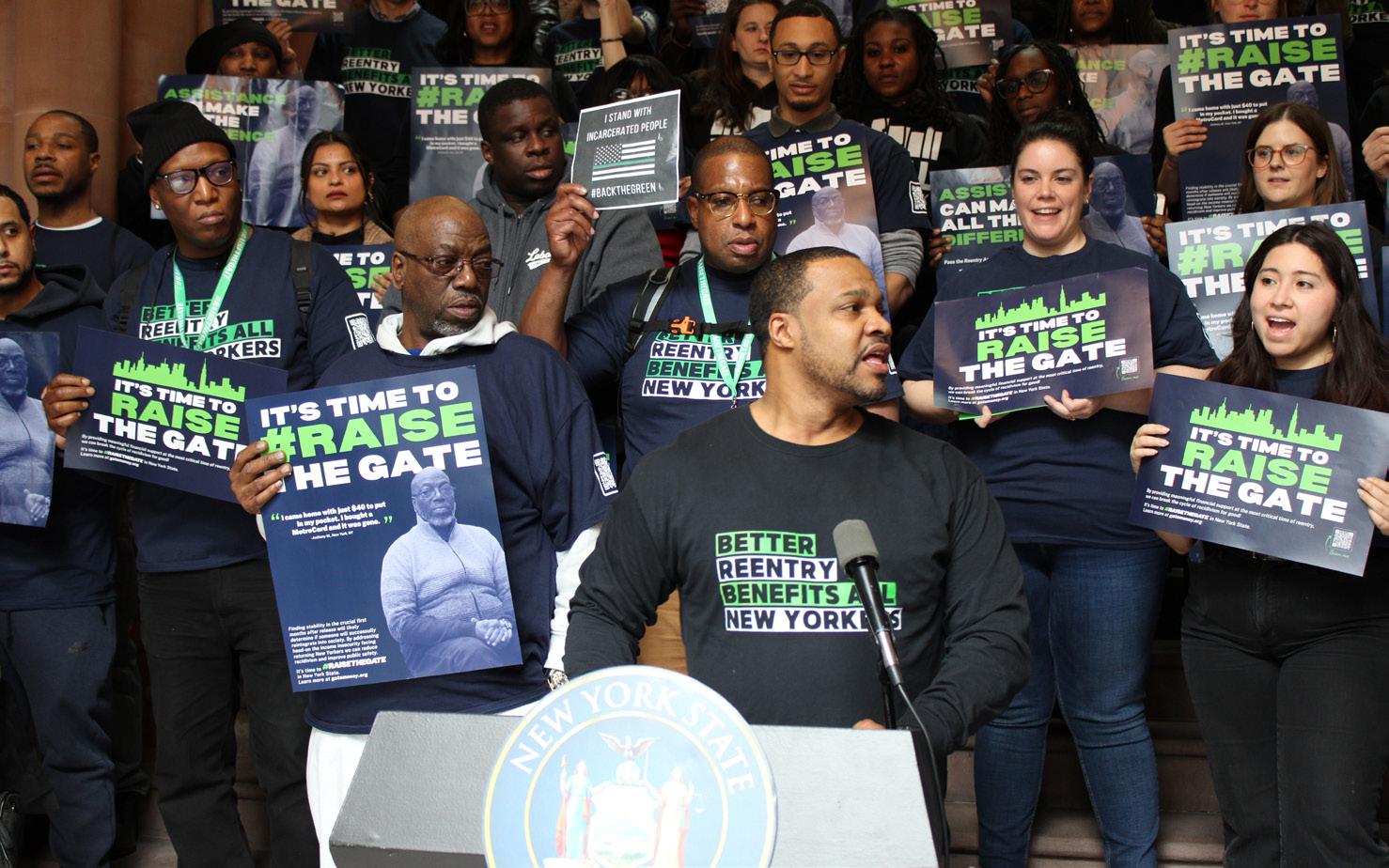
Will 2026 be the year the Reentry Assistance Bill passes? Support is growing for the two-year-old legislation to expand gate money into a $425 monthly stipend (totaling $2,550 over six months) for people who recently returned home from prison.
“Currently, a lot of people go straight from prison to our shelter system, and even when they don’t, they spend about six months, on average, looking for work,” said Simone Price, Center for Employment (CEO) director of organizing. “That’s the average amount of time before someone can secure full-time employment. So what we’re trying to do is attack that for six months.”
To be clear, advocates do not see this bill as simply charity — they argue better cash assistance drives down recidivism by tackling employment, housing and reintegration. The money will not cover a month’s rent in New York City. But it can go towards a hotel, groceries or a ride to a job interview. Additionally, the funds can go towards family or friends supporting the returning citizens. When legislators introduced the bill two
years ago, gate money issued by the Department of Corrections and Community Supervision (DOCCS) would cap at just $40 and a bus ticket. The amount later grew to up to $200, but remains impacted by how much is in their commissary.
Last month, the bill’s main proponents — mainly criminal justice reform organizations and reentry providers like CEO, the Brennan Center, and Osborne Association — held a media roundtable discussion
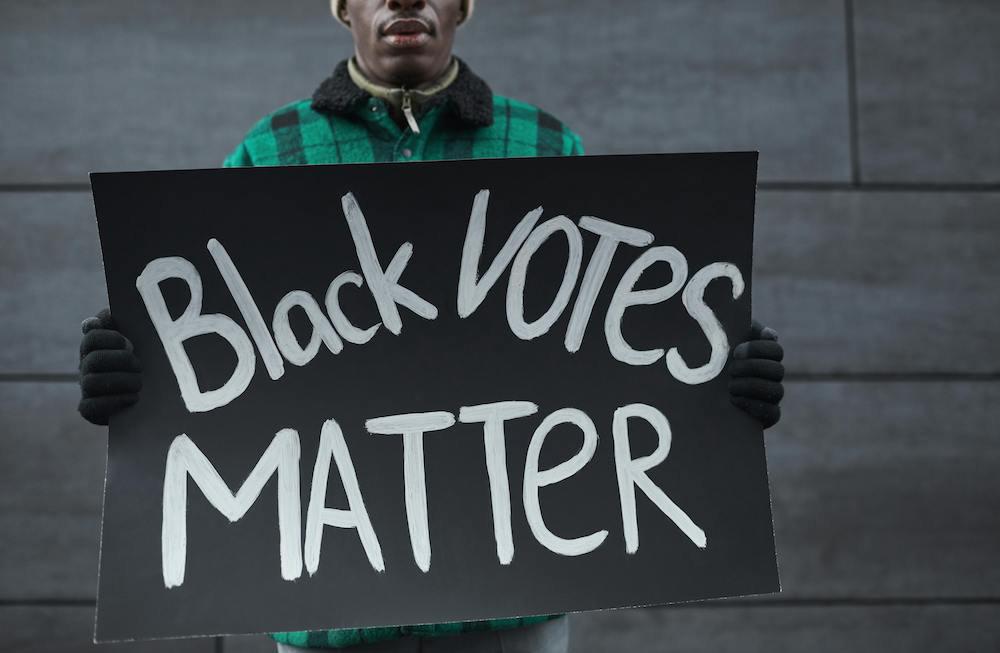
Stock photo of man holding Black Votes Matter placard. (Photo credit: Photo by Edmond Dantès via Pexels.com)
Kenneth Edwards, national manager of leadership & organizing at the Center for Employment Opportunities, rallies for Reentry Assistance Bill in Albany. (Photo courtesy of Center for Employment Opportunities)
Sanford Solny, once convicted of real estate fraud, is now trying to avoid jail time
By KAREN JUANITA CARRILLO Amsterdam News Staff
Disgraced attorney-turned-real estate fraudster Sanford Solny is challenging his conviction. Last week, Solny’s legal team filed a notice of appeal to the New York Appellate Division, regarding the verdict in People v. Sanford Solny.
Solny was convicted in June 2025 of charges including possession of stolen property, three counts of first-degree scheme to defraud, and theft of 11 properties. His sentence of only 2.5 to 7 years in prison had appeared tragically lenient, given that he had disproportionately targeted Black and Brown homeowners in Central Brooklyn and Queens.
From 2012 to 2022, Solny systematically stole 11 properties in neighborhoods such as Bedford-Stuyvesant, East Flatbush, Canarsie, East New York, and Ocean Hill. Prosecutors said he preyed on homeowners facing foreclosure, posing as a financial adviser and promising to help them sell their
homes for less than the amount owed. Instead, Solny transferred ownership of the homes to himself or his companies, collecting rent for years while victims lost their homes and equity, and had their credit ruined by unresolved foreclosures.
On Nov. 12, 2025, Brooklyn Supreme Court Justice Danny Chun sentenced Solny to prison and ordered the nullification of the 11 stolen deeds. But Solny was not ordered to return the nearly $500,000 in rent he collected from the stolen homes. With their appeal application, Solny’s attorneys now have 120 days to fully submit their appeal of his conviction. The Appellate Division’s decision, issued on Feb. 11, 2026, granted Solny a stay of his judgment, provided he posts substantial bail: an insurance company bond of $1.5 million, a partially secured bond of $2 million with 10% down, or a $300,000 cash alternative. The court imposed strict conditions, including electronic monitoring, home confinement except for essential visits, surrender of all
Brooklyn celebrates long-awaited opening of the Shirley Chisholm Recreation Center
By ARIAMA C. LONG Amsterdam News Staff
Brooklyn’s Shirley Chisholm Recreation Center finally opened this month in East Flatbush — the first new city-run recreation center built in more than a decade. This was a dream from city and community leadership that was 13 years in the making.
“The Shirley Chisholm Recreation Center will soon be alive with possibility — kids learning to swim, cook, and grow their own food; friends coming together on the court; neighbors of every generation creating and connecting, from the gym to the podcast studio. This will be a space where the city meets itself, built to serve the people who call it home,” said Mayor Zohran Kwame Mamdani, who joined city and state leaders at the opening on February 9.
The facility is named after the late Brooklyn Rep. Shirley Chisholm, the first Black woman elected to Congress, who served from 1969 to 1983, and made a historic run for president in 1972. Chisholm was a Flatbush native and descendant of Guyanese and Barbadian immigrants.
The $141 million, 74,000-square-foot recreation center features an Olympic-sized pool, rack, gym, weightlifting facility, teaching kitchen, afterschool space, event space, community class spaces, cardio rooms, and
the Caribbean American Chamber of Commerce.
The center was launched as a communitydriven response to rampant gun violence and a reaction to the police shooting of 16-yearold Kimani Gray in 2013, said Public Advocate Jumaane Williams, who was the former councilmember for the district. They decided that a community center would give youth a safe haven and be a boon to public safety, the first-ever such resource in Central Brooklyn.
“When I dropped the seed to make this happen, I wasn’t sure if I would see it happen,
but we, as elected officials and leaders, have to get to a point where it is okay for something to be completed [even if we] may not be there to see it,” said Williams at the opening. “It just cannot be about the credit of who does a thing, but the fact that the thing gets done. If we cannot get to that point, our communities will continue to suffer. There’s enough light to go around. We can all get the credit we deserve. Let’s drop those seeds and push [projects] to fruition so that our community benefits all of the time.”
Former Mayor Michael Bloomberg provided $500,000 to do the impact study for the
center. Councilmember Farah Louis, William’s successor, picked up the mantle for the center when he left the City Council in 2019. A number of state leaders, including Senator Kevin Parker, Assemblymember Monique Chandler-Waterman, and Assemblymember Rodneyse Bichotte Hermelyn, had a hand in keeping the dream of the center alive, said Williams. By 2020, former Mayor Bill de Blasio finally reallocated funding from the NYPD capital budget to finish the project.
“This moment is the result of years of advocacy, persistence, and a community that refused to give up on a vision for itself,” said Louis. “The Shirley Chisholm Recreation Center stands as a testament to what happens when residents, advocates, and public servants work together with purpose.”
“From early planning through completion, this effort was guided by community input and the belief that public investment must deliver real, lasting benefits,” said Bichotte Hermelyn. “Named in honor of Shirley Chisholm, this center stands as a living investment in wellness, opportunity, and community connection for generations to come.”
The center was fully open to the public on Tuesday, Feb. 10. The parks department is hosting guided tours, registration events, and demonstrations to help New Yorkers experience what the new facility has to offer. Membership is free for people 24 years and younger.
a media lab named for Dr. Roy A. Hastick Sr., who founded
See SANFORD on page 36
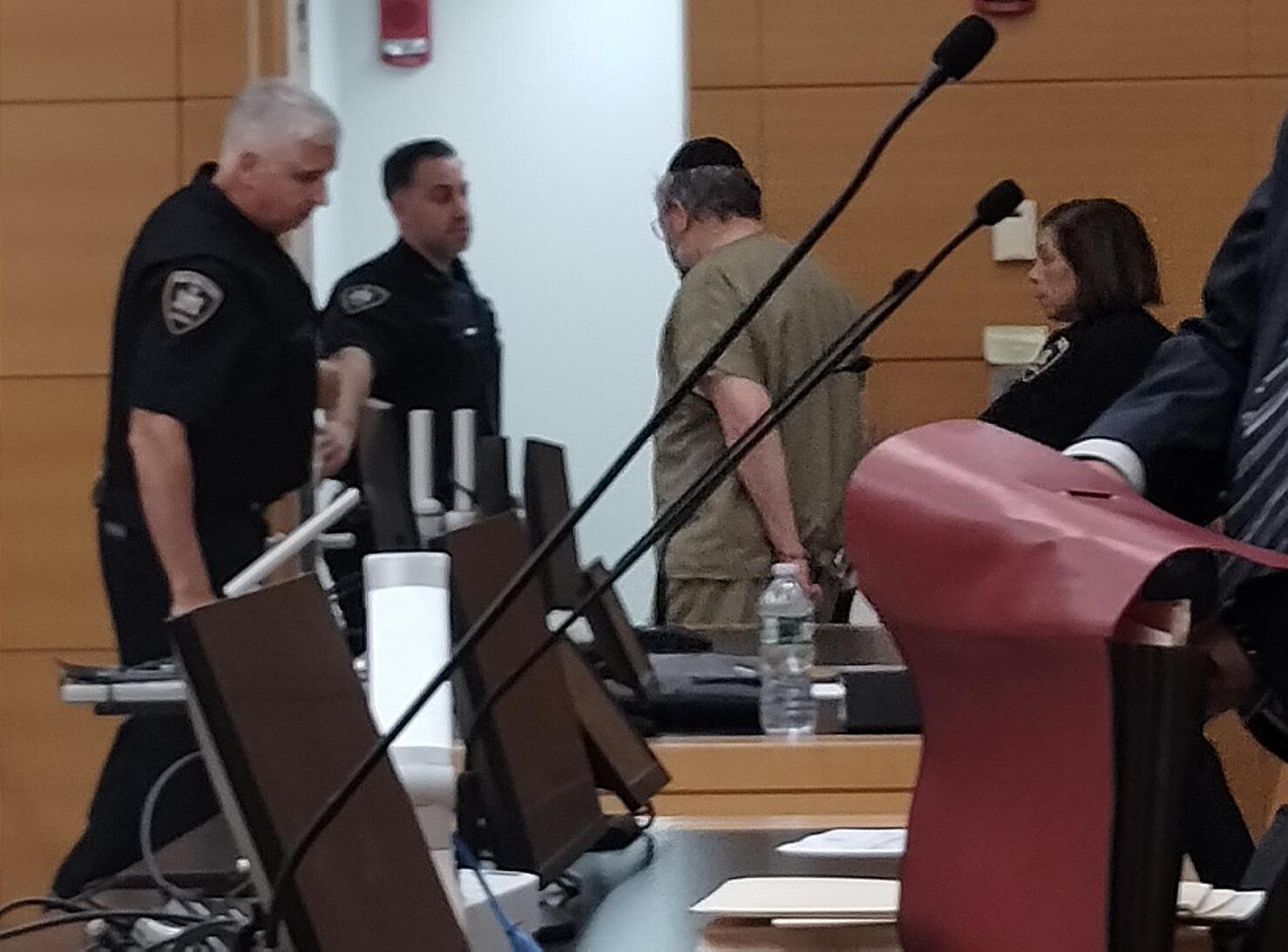
Sanford Solny, who’s been convicted of stealing 11 properties, is led out of a Brooklyn courtroom on Oct. 22. Sentenced to 2.5 to 7 years in prison, he is now appealing his conviction. (Karen Juanita Carrillo photos)
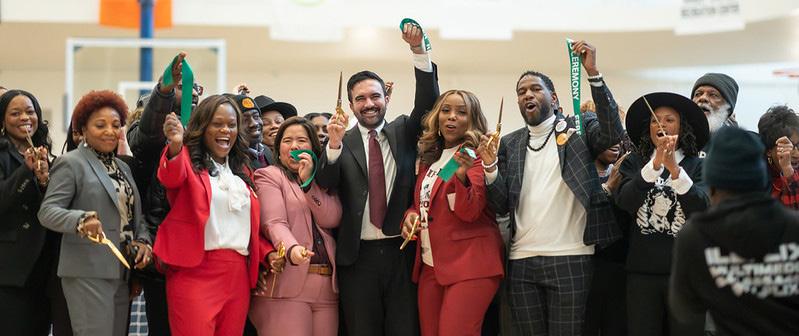
New York City Mayor Zohran Mamdani delivers remarks and cuts ribbon at opening of new Shirley Chisholm Recreation Center (3105 Farragut Place) in Brooklyn on Monday, Feb. 9, 2026. (Michael Appleton/Mayoral Photography Office)
Trump administration ordered to restore George Washington slavery exhibit it removed in Philadelphia
By ASSOCIATED PRESS
An exhibit about nine people enslaved by George Washington must be restored at his former home in Philadelphia after President Donald Trump’s administration took it down last month, a federal judge ruled on Presidents’ Day, the federal holiday honoring Washington’s legacy.
The city of Philadelphia sued in January after the National Park Service removed the explanatory panels from Independence National Historical Park, the site where George and Martha Washington lived with nine of their slaves in the 1790s, when Philadelphia was briefly the nation’s capital.
The removal came in response to a Trump executive order “restoring truth and sanity to American history” at the nation’s museums, parks, and landmarks. It directed the Interior Department to ensure those sites do not display elements that “inappropriately disparage Americans past or living.”
U.S. District Judge Cynthia Rufe ruled Monday that all materials must be restored in their original condition while a lawsuit challenging the removal’s legality plays out. She prohibited Trump officials from installing replacements that explain the history differently.
Rufe, an appointee of Republican Pres-
ident George W. Bush, began her written order with a quote from George Orwell’s dystopian novel “1984” and compared the Trump administration to the book’s totalitarian regime called the Ministry of Truth, which revised historical records to align with its own narrative.
“As if the Ministry of Truth in George Orwell’s ‘1984’ now existed, with its motto ‘Ignorance is Strength,’ this Court is now asked to determine whether the federal government has the power it claims — to dissemble and disassemble historical truths when it has some domain over historical facts,” Rufe wrote. “It does not.”
She had warned Justice Department lawyers during a January hearing that they were making “dangerous” and “horrifying” statements when they said Trump officials can choose which parts of U.S. history to display at National Park Service sites.
The Interior Department did not immediately respond to a request for comment on the ruling, which came while government offices were closed for the federal holiday.
The judge did not provide a timeline for when the exhibit must be restored. Federal officials can appeal the ruling.
The historical site is among several where the administration has quietly removed content about the history of enslaved people,
LGBTQ+ people, and Native Americans.
Signage that has disappeared from Grand Canyon National Park said settlers pushed Native American tribes “off their land” for the park to be established and “exploited” the landscape for mining and grazing.
Last week, a rainbow flag was taken down at the Stonewall National Monument, where bar patrons rebelled against a police raid and catalyzed the modern LGBTQ+ rights movement. The administration has also removed references to transgender people from its webpage about the monument, despite several trans women of color being key figures in the uprising.
The Philadelphia exhibit, created two decades ago in a partnership between the city and federal officials, included biographical details about each of the nine people enslaved by the Washingtons at the home, including two who escaped.
Among them was Oney Judge, who was born into slavery at the family’s plantation in Mount Vernon, Virginia, and later escaped from their Philadelphia house in 1796. Judge fled north to New Hampshire, a free state, while Washington had her declared a fugitive and published advertisements seeking her return.
Because Judge had escaped from the Philadelphia house, the park service in
2022 supported the site’s inclusion in a national network of Underground Railroad sites, where they would teach about abolitionists and escaped slaves. Rufe noted that materials about Judge were among those removed, which she said “conceals crucial information linking the site to the Network to Freedom.”
Only the names of Judge and the other eight enslaved people — Austin, Paris, Hercules, Richmond, Giles, Moll, and Joe, who each had a single name, and Christopher Sheels — remained engraved in a cement wall after park service employees took a crowbar to the plaques on Jan. 22.
Hercules also escaped in 1797 after he was brought to Mount Vernon, where the Washingtons had many other slaves. He reached New York City despite being declared a fugitive slave and lived under the name Hercules Posey.
Several local politicians and Black community leaders celebrated the ruling, which came while many were out rallying at the site for its restoration.
State Rep. Malcolm Kenyatta, a Philadelphia Democrat, said the community prevailed against an attempt by the Trump administration to “whitewash our history.”
“Philadelphians fought back, and I could not be more proud of how we stood together,” he said.
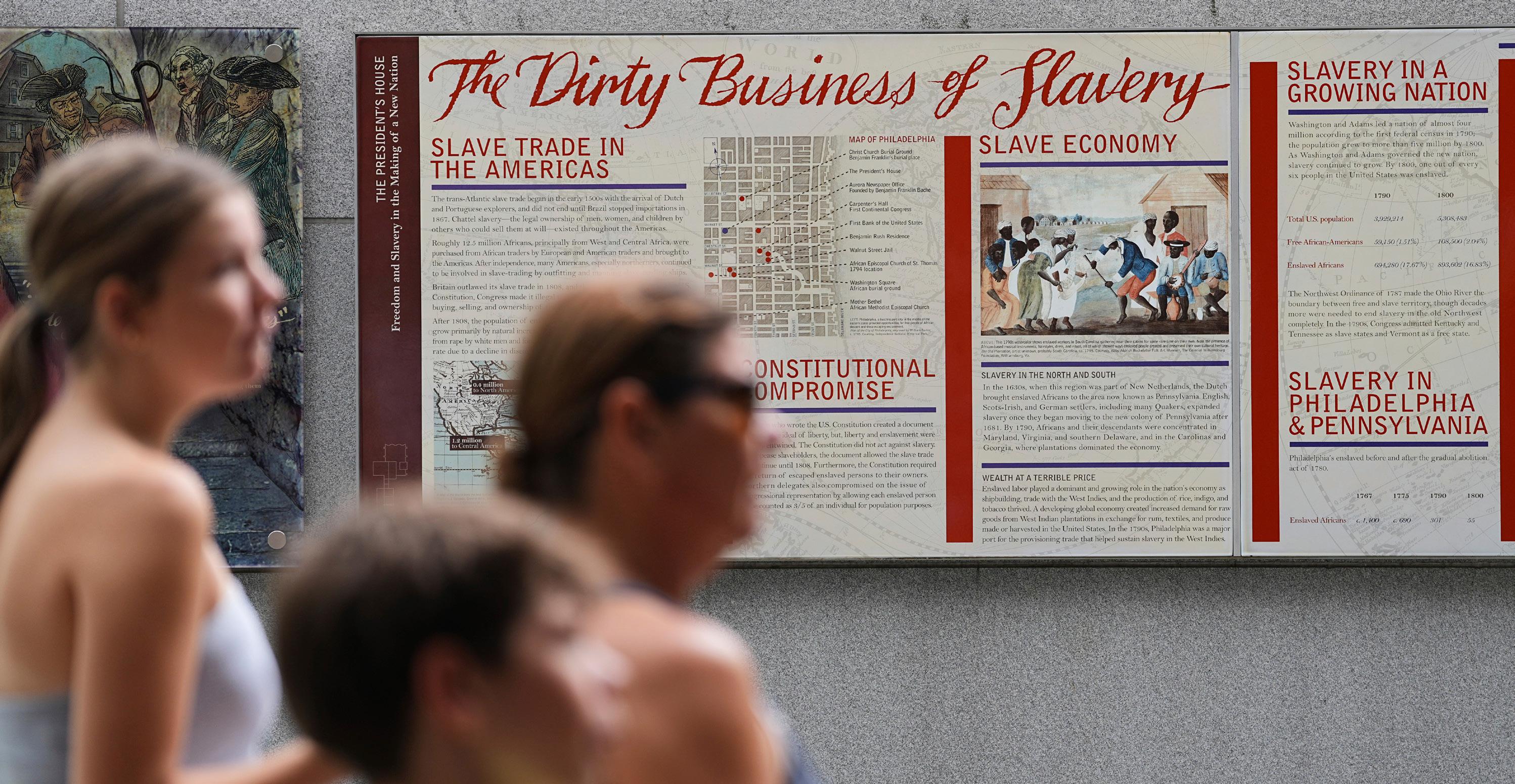
People walk past an informational panel at the President’s House Site in Philadelphia. (Matt Rourke, AP/File)
Sherry Tucker Brown: Forging a
family heritage despite being denied another
By LLOYD B. DAVIS Special to the AmNews
Black
New Yorker
and did very well by their children and their children’s children,” said Brown.
THE URBAN AGENDA
By David R. Jones, Esq
The NYPD’s “Driving While Black” Problem
New Yorkers have seen this movie before. The NYPD’s newest antigun push borrows heavily from an old script—one that turns routine encounters into dragnet stops, concentrates enforcement in Black and brown neighborhoods, and too often treats constitutional limits as optional.
A recent lawsuit by the New York Civil Liberties Union (NYCLU), the NAACP New York State Conference, and The Bronx Defenders lays out the case starkly: NYPD vehicle searches have surged, overwhelmingly target drivers of color, and rarely turn up guns. The complaint calls it what millions of New Yorkers will recognize from lived experience —“stop-and-frisk on wheels.”
The numbers are eye-opening. NYPD conducted 28,416 vehicle searches in 2024, an 83 percent increase from 2023; more than 84 percent of all searches from 2022 through September 2025 were of Black or Latino drivers, while white motorists accounted for less than four percent. Search rates are higher across all 78 precincts for Black and Latino drivers. Critically, these searches “almost never” recover a weapon according to the lawsuit.
cion that they are doing some harm, violence or using a weapon,” Lieberman said. “And when you don’t turn up a weapon in virtually any of the cases, it ceases to be a tool to get guns off the street. So, it’s not about crime, getting guns off the street or reducing violence. It’s about racial profiling.”
Former Mayor Eric Adams tolerated this revival of aggressive tactics as the necessary price of driving down shootings. But independent watchdogs have not found strong evidence that the spike in stops is what’s moving safety metrics; they have found substantial evidence of illegality and disparity. For example, ProPublica’s coverage of the federal monitor’s 2025 report on the NYPD’s Community Response Team labeled the conduct “troubling” and “unconstitutional.” The NYCLU has likewise shown that as pedestrian stops fell dramatically after Floyd, violent crime didn’t spike, undercutting the core claim that mass stopping is essential to safety.
Sherry Tucker Brown’s family roots run deep in New York, and also in a familiar brand of alcoholic spirits.
Her grandmother, Francis Dewar Tucker, who was born in Montego Bay, Jamaica, was the daughter of John Dewar Jr., the son of John Dewar, founder of Dewar’s Scotch Whiskey. There is no known official record of Black family members who are descendants of the Dewar dynasty, but Brown says she is acquainted with numerous Black Dewar descendants in Jamaica.
“I have met Black Dewars in Jamaica, and there are still Black and white Dewars who live in Jamaica,” said Brown who turned 80 in January. Her grandmother, Brown says, was sent with her sister to New York, but they had other family members who could pass for white and were sent to Scotland. However, none of her family shared in the Dewar family inheritance. She said her whole family in New York grew up knowing this family history and a rule was instilled that no Dewar’s Whiskey was not allowed in their home.
“That was really the story of the United States,” she said. “I wasn’t getting any of the money, so why was I supporting them?”
Even without the inheritance, the family made a prominent name for themselves. “Although we didn’t inherit the Scotch whiskey money, the family, the Tuckers still did very well
Sherry’s Uncle, Alfred Tucker, a World War I veteran, became the eighth Black Certified Public Accountant (CPA) in America, and the second Black CPA in New York City, working in an office on Lenox Avenue and 125th Street. He later went on to work as an accountant and field auditor at the New York State Transit Commission.
“No matter what was going on in the United States then, I mean the total segregation, he still went to law school and he graduated from Columbia [as] a CPA.”
Brown, the youngest daughter of five girls, all born in the Bronx, attended the historically Black University, Central State University in Wilberforce, Ohio. She later went to work for the New York Urban League Street Academy and also for the City of New York as a counseling department manager for a vocational training program located in what is now the Theresa Towers on 125th Street.
She is now co-principal of The Tucker Brown Group, a Cape Cod-based consulting firm.
Brown was excited about sharing her family’s story and wanted to let people know of her family’s contributions to the fabric of New York and Harlem.
Despite her family not inheriting anything from the Dewars, she said they did build a name for themselves and helped to enrich their communities.
“It’s actually a part of African American history. Some of us know where we came from, and some of us don’t.”
Those car stops sit atop a broader resurgence of pedestrian stops. The court appointed monitor in Floyd v. City of New York has repeatedly found persistent racial disparities and a troubling share of stops and frisks that lack constitutional footing. In April 2024, the monitor documented disparities across commands and poststop outcomes; later reports highlighted underreporting of stops and elevated rates of unlawful frisks and searches—particularly by specialized gun suppression units.
If this all sounds familiar, it is. The monitor’s special reviews of Neighborhood Safety Teams (NSTs)—units championed to take guns off the street—found about a quarter of their stops unlawful and 97 percent of the people they stopped to be Black or Latino. In a sample of 230 car stops, NSTs recovered a weapon twice. Those findings are not outliers; subsequent monitor snapshots and civil rights groups’ summaries have underscored rising unconstitutional stops and chronic underreporting citywide.
And what’s the NYPD’s justification for a policy that routinely violates the constitutional rights of Black and Latino motorists? They claim they go where the crime is. But a volume defense is not a constitutional defense. The Fourth and Fourteenth Amendments do not relax in zip codes with higher 911 call volumes. And there’s something else. This is not about random vehicle stops, according to Donna Lieberman, longtime executive director of the NYCLU. Rather, it’s about what happens to people after they are stopped.
“Police officers are not supposed to search the cars people are in unless they have suspi-
Meanwhile, police accountability is a myth. In September 2024, a court ordered 500 page disciplinary review concluded officers who engage in unconstitutional stops and frisks “rarely, if ever” face discipline—even when the Civilian Complaint Review Board substantiates misconduct.
Data-driven gun violence prevention doesn’t look like this. If your antigun strategy requires blanket traffic enforcement in minority neighborhoods, produces massive racial disparities and almost no firearm recoveries from those vehicle searches, it’s not a strategy—it’s a tax on dignity and equal protection. Police Commissioner Jessica Tisch is the architect of the use of data collection in police practices and policies at the NYPD. We can only hope that the Commissioner is as concerned by the allegations in this lawsuit as we are and makes changes.
A press release on the commissioner’s ‘State of the Department’ address last week announced that police officers will undergo updated “in-service training” covering a range of topics including constitutional policing. That’s good. Maybe we should take a look at the training to make sure officers have the same understanding of what is constitutional as we do.
Finally, Mayor Mamdani must hold the NYPD accountable. He knows that when bad actors in the NYPD get away with abusive behavior and misconduct, it is not good for the lion share of police officers who act with integrity, professionalism and a genuine commitment to public safety. More importantly, it hurts the community’s faith in policing.
Gun violence is real and it demands effective action. But turning Black and brown motorists into suspects first and citizens second is neither effective nor lawful. The question now is not whether the mayor can rein in racial profiling and make accountability real; it’s whether he will.
David R. Jones, Esq., is President and CEO of the Community Service Society of New York (CSS), the leading voice on behalf of low-income New Yorkers for more than 175 years. The views expressed in
Sherry Tucker Brown (center) with friends Paula Peters (left) and Tanya Hart (right)
(Photo courtesy Sherry Tucker Brown)
Advocates fear major unintended consequences in Hochul’s fight against ICE
By TANDY LAU Amsterdam News Staff
Gov. Kathy Hochul wants to open the door for New Yorkers to sue federal officials, namely immigration enforcement like ICE, in state court. But advocates fear her proposal will block or delay the same lawsuits she intends to greenlight through language codifying qualified immunity as a defense.
The legal doctrine — which stems from Supreme Court landmark decisions rather than the Constitution or a federal statute — protects government officials from personal liability in civil litigation while performing their duties. Left as it is, the Governor’s budget proposal would write it into state law for the first time.
“States have the inherent power to regulate federal officials, so long as they do so neutrally,” said Alexander Reinert, a legal scholar. “And creating a right for people to sue when they are injured by officers who violate the federal constitution is well within New York state’s au -
thority. Nothing requires New York State to also codify the dangerous and illegitimate doctrine of qualified immunity.”
Roughly 70 organizations and elected officials — including many major critics of federal immigration enforcement — signed onto a letter penned to Hochul last week asking her to amend bill language to exclude qualified immunity as a defense or outright passing an existing bill to explicitly end the defense in state court.
“While we vehemently support efforts to hold federal immigration agents and their collaborators accountable, the current proposal undermines its own stated purpose,” they wrote. “By incorporating qualified immunity into New York State law for the first time, this proposal gives New Yorkers a day in court — and makes it all too likely they will lose.”
End QI NY, or the Campaign to End Qualified Immunity in NY, led the efforts. The coalition includes many key criminal justice reform organizations and civil rights law firms including the
Innocence Project, the NAACP Legal Defense Fund, and the New York Civil Liberties Union.
State Sen. Robert Jackson, who signed onto the letter alongside fellow state lawmakers Pamela Hunter, Emily Gallagher, and Jo Ann Simon, called qualified immunity a “legal shield that blocks justice.” He currently sponsors the bill to end qualified immunity in the state.
“You cannot promise protection with one hand while handing out legal shields on the other,” said Jackson over a Zoom conference. “You cannot claim to resist federal outreach [then give] ICE a defense that they can use to escape responsibility. Accountability cannot be built on exemptions. Justice cannot survive behind loopholes. And so today, alongside legislators and organizations across this state, we are delivering a clear message: remove qualified immunity from the budget proposal and strike it from all program bills.”
On paper, qualified immunity prevents frivolous litigation against civil servants doing their jobs. But critics say the pro -
tection exists to prevent accountability. Two years ago, a federal court granted qualified immunity to North Carolina prison guards who left an incarcerated person in their care to eat with feces-covered hands.
To be clear, such protections also do not guarantee a blank check for state violence as the country awaits next steps for the federal agents who killed Renee Nicole Good and Alex Pretti in Minneapolis. But qualified immunity creates an uphill legal battle just to get the case in front of a jury, often disincentivizing attorneys to take on such cases.
A spokesperson for Hochul responded, addressing the proposal’s purpose.
“Gov. Hochul has been clear: federal officers who violate someone’s constitutional rights must be held to the same legal standards that already exist for state and local officers under federal civil rights law,” she said. “The Governor continues to work closely with the state legislature to protect New Yorkers’ constitutional rights, and discussions are ongoing.”
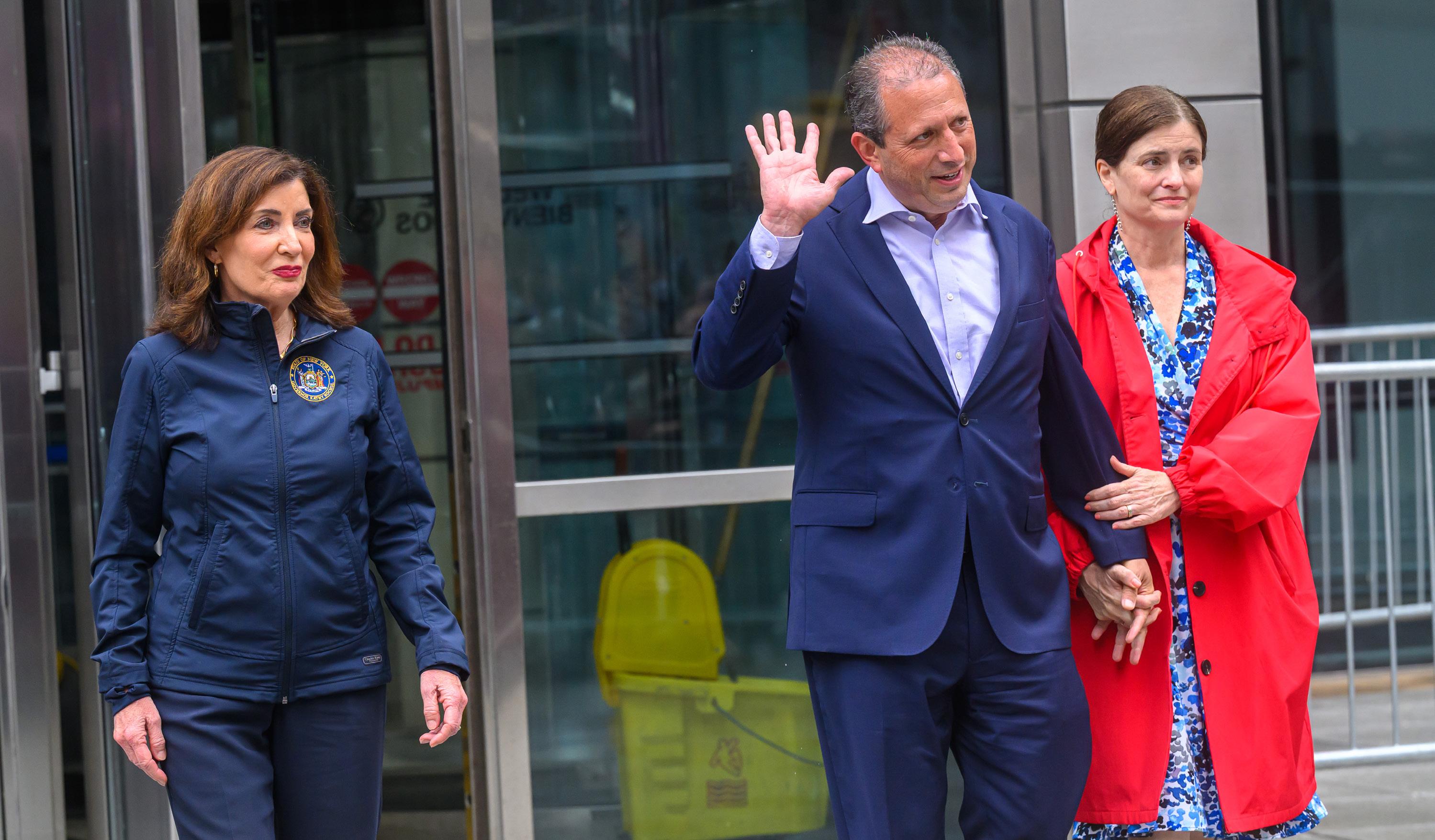
June 17, 2025 — New York, NY — Gov. Kathy Hochul walks out of 26 Federal Plaza with former NYC Comptroller Brad Lander who was arrested by ICE. (Susan Watts/Office of Governor Kathy Hochul)
Genesis ANCP Morningside LLC is pleased to announce applications are now being accepted for 19 fully renovated cooperative units at the Morningside ANCP Cluster located at: 357 W.115th St. and 321 W.116th St, NYC NY 10026 in Central Harlem-Manhattan
Amenities: Unit are fully renovated and in move-in condition, new kitchens, baths, electrical, heating, plumbing systems, energy efficient appliances, fixtures, doors, and windows. Some units include washer/dryer hookups, only.
Transit: Train: B & C - Bus: M2, M3, M7, M10, M116.
No fee to apply • No broker’s fee • More information: https://housingconnect.nyc.gov/PublicWeb/
The buildings are being renovated through the Affordable Neighborhood Cooperative Program (ANCP) of the New York City Department of Housing Preservation and Development.
Individuals or households who meet the income & asset requirements listed in the table below may apply. Eligible applicants must qualify for the NYS AHC Grant and secure a Cooperative mortgage loan from one of the pre-qualified lenders. Applicants may be required to meet additional selection criteria. General preference will be given to New York City residents
To request an application by mail, send a self-addressed envelope to:
Morningside ANCP, P.O. Box 592 521 West 146th Street, New York, New York 10031
Only send one application per development. Do not submit duplicate applications. Applicants who submit more than one application may be disqualified. Completed applications must be returned by regular mail only (no priority, certified, registered, express, oversized, or overnight mail will be accepted) to a post office box number that will be listed on the application.
Informational webinars will be hosted by Habitat for Humanity NYC & Westchester County on February 25th and March 25th at 6 pm. The seminars will provide information about the Cooperative, the application and purchase process and lending options for purchasers. Seminar attendance is not mandatory to purchase.
To join the webinar, please join via the link listed below:
February 25th, 2026 at 6pm https://teams.microsoft.com/ meet/22437384209140?p=hpadniZ0APD1LXdXDZ Meeting ID: 224 373 842 091 40
Passcode: UP7tR9dL
March 25th, 2026 at 6pm https://teams.microsoft.com/
Applications must be submitted digitally or postmarked by April 14th 2026
What Happens After You Submit an Application?
After the deadline, applications are selected for review through a lottery process.
If yours is selected and you appear to qualify, you will be asked to submit your documents for review to determine your eligibility. Requests to submit documents are usually scheduled from 2 to 10 months after the application deadline. You will be asked to submit documents that verify your household size, identity of members of your household, and your household income.
This advertisement is not an offer. It is a solicitation of interest in the advertised properties. This advertisement is made pursuant to the Cooperative Policy Statement- 11 , approved by the New York State Department of Law, file numbers CP24-0090 and CP24-0091. No offering of the advertised units can be made and no deposits can be accepted, binding or non-binding, until an offering plan is filed with the New York State Department of Law. Sponsor: Genesis ANCP Morningside LLC c/o Genesis Companies, 745 Fifth Avenue, Suite 500, New York, NY 10151
• Eligible buyers should have at least 3% of the purchase price available for a down payment.
• Funds for the 3% down payment must be in the applicant’s account for three months prior to eligibility interview.
• Each buyer MUST occupy the Cooperative Unit as their Primary Residence.
• No member of the applicant’s household may own or have previously owned/purchased any interest in residential property.
• Please note that the quoted sales prices, minimum and maximum household income, asset limit, etc., are estimated and are subject to change.
1 Household Size is subject to occupancy criteria.
2 Total Annual Income Range is subject to change; larger down payments may allow for lower minimum incomes.
3 Income guidelines subject to change.
4 Asset Limit is subject to change.
5 Estimated Monthly Maintenance is paid to the cooperative to cover building-wide operating expenses and includes real estate taxes (if any).
6 Estimated Subsidized Sales Price reflects the net sales price based on eligibility for required purchaser subsidy.
Español Presente una solicitud en línea en nyc.gov/housingconnect. Para recibir una traducción de español de este anuncio y la solici tud impresa, envíe un sobre con la dirección a: Morningside ANCP P.O. Box 592 521 West 146th Street New York, New York 10031. En el reverso del sobre, escriba en inglés la palabra “SPANISH.” Las solicitudes se deben enviar en línea o con sello postal antes de 14 de abril 2026
简体中文 访问 nyc.gov/housingconnect 在线申请。如要获取本广告及书面申请表的简体中文版,请将您的回邮信封寄送至:Morningside ANCP P.O. Box 592 521 West 146th Street, New York, New York 10031 信封背面请用英语注明“CHINESE”。必须在以下日期之前在线提交申请或邮寄书 面申请 2026年4月14日
Русский Чтобы подать заявление через интернет, зайдите на сайт: nyc.gov/housingconnect. Для получения
이 광고문과 신청서에 대한 한국어 번역본을 받아보시려면 반송용 봉투를Morningside ANCP, P.O. Box 592 521 West 146th Street, New York, New York 10031으로 보내주십시오 봉투 뒷면에 “KOREAN” 이라고 영어로 적어주십시오 2026년4월14일 까지 온라인 신청서를 제출하거나 소인이 찍힌 신청서를 보내야 합니다
Kreyòl Ayisyien
Aplike sou entènèt sou sitwèb nyc.gov/housingconnect. Pou resevwa yon tradiksyon anons sa a nan lang Kreyòl Ayisyen ak aplika syon an sou papye, voye anvlòp ki gen adrès pou retounen li nan: Morningside ANCP, P.O. Box 592 521 West 146th Street, New York, New York 10031. Nan dèyè anvlòp la, ekri mo “HATIAN CREOLE” an Anglè. Ou dwe remèt aplikasyon yo sou entènèt oswa ou dwe tenbre yo anvan da t avril 14, 2026
Morningside ANCP, P.O. Box
Polskie Aby złożyć wniosek online, przejdź na stronę nyc.gov/housingconnect. Aby uzyskać polskie tłumaczenie tego powiadomienia oraz wniosek w wersji wydrukowanej, wyślij kopertę z własnym adresem: Morningside ANCP P.O. Box 592 521 West 146th Street New York, New York 10031. Wpisz słowo POLISH” w j. angielskim na odwrocie koperty. Wnioski muszą posiadać stempel pocztowy lub zostać przesłane online nie później niż 14 kwiecień 2026 Français Pour déposer votre demande en ligne, rendez-vous sur le site nyc.gov/housingconnect. Pour recevoir une traduction en français de cet avis ainsi qu’un dossier de demande papier, envoyez une enveloppe libellée à votre nom et votre adresse à l’adresse suivante : Morningside ANCP, P.O. Box 592 521 West 146th Street, New York, New York 10031. Inscrivez le mot « FRENCH » au dos de l’enveloppe. Les demandes doivent être envoyées par la poste ou soumises en ligne au plus tard le 14 avril 2026, le cachet de la poste faisant foi.
Black History Month Events to Attend in NYC (Feb. 22-28)
As Black History Month comes to an end, there are still events you can attend in New York City. From a baby shower focusing on Black women’s maternal health to a pop-up shop showcasing Black and Brown businesses and creatives, these are some of the many events you can attend in New York City this week to celebrate the end of Black History Month.
Sunday, Feb. 22
9:30 a.m. - 11:30 p.m.
Harlem Cycle & The Harlem Method
60 W 129th St
New York, NY 10027
The Harlem Cycle and The Harlem Method are teaming up to host a Harlem Black History Month Fitness Crawl at The Harlem Method. The fitness crawl will push your limits, leaving you feeling stronger. There will be a 45-minute cycling session at Harlem Cycle’s state-of-the-art indoor cycling studio and a 45-minute fullbody conditioning session at The Harlem Method. There will also be welcome bags for each participant with a special surprise from Lululemon. You can purchase tickets on Eventbrite.
Sunday, Feb. 22
11:00 a.m. - 3:00 p.m.
The New York Historical Museum
170 Central Park W New York, NY 10024
The New York Historical Museum is hosting a “Homo Harlem” tour in conjunction with the Gay Harlem Renaissance exhibit, led by historian Michael Henry Adams. The exhibit showcases the richness of Black LGBTQ+ life in the 1920s and 1930s. At half past 1 p.m., there will be a Southern fried lunch at Miss Mamie’s Spoonbread Too. The tour costs $50.00, and you can call (212) 862-2556 for more information.
Thursday, Feb. 26
2:00 p.m. - 5:00 p.m.
SIMCA Spot 318 Rogers Ave Brooklyn, NY 11225
Seeds in the Middle is hosting its first Mommy and Me party, “Black Maternal Health Baby Shower,” for pregnant women and mothers of babies up to one year old. It is a heart-healthy workshop that focuses on listening to Black women about what they need to have healthy pregnancies and the first year after their baby is born, and learning how to keep their hearts healthy and avoid diabetes. The workshop is providing free diapers, baby items, fresh bags, healthy food, and more. Tickets can be purchased via monetary donation on Eventbrite. After getting the tickets, you must contact Seeds in the Middle via email at info@seedsinthemiddle.org, text 862-701-3858, or message on Instagram @seedsinthemiddle or Facebook @Seeds in the Middle by Tues-
day, Feb. 24, by 5 p.m. to confirm your attendance.
Thursday, Feb. 26
8:00 p.m. - 10:00 p.m.
Littlefield 635 Sackett Street Brooklyn, NY 11217
Haitian comedian Tanael Joachim, also known as TJ, will be doing a stand-up comedy show called “The Last Black History Month. Probably…” at the Littlefield venue in Brooklyn. The comedy show will give audiences temporary relief from the current state of the world while also contemplating the possibility of the last Black History Month in the United States of America through jokes and laughter. Doors will open at 7:00 p.m., and you must be at least 21 years old to attend. Tickets are available at the Littlefield website and on Eventbrite.
Friday, Feb. 27
5:00 p.m. - 7:00 p.m.
The Joseph Gabriel Foundation 1280 5th Avenue New York, NY 10029
The Joseph Gabriel Foundation is hosting a Youth Violence Prevention Forum at The
Jamaica Center for Arts & Learning (JCAL) 153-10 Jamaica Avenue Jamaica, NY 11432
The second of a two-dance presentation, The Jamaica Center for Arts & Learning is hosting “A Weekend for West African Dance at JCAL: A Black History Month Presentation.” FANIKE! African Dance Troupe will be the second dance presentation, as the African dance company focuses on the dance, rhythm, history, and growing culture tied to the African movement. Tickets are available to purchase on Eventbrite.
Saturday, Feb. 28
1:00 p.m. - 3:00 p.m.
Queens Botanical Garden
Visitors & Administration Building 43-50 Main St Flushing, NY 11355
The Queens Botanical Garden is hosting a community open mic night, hosted by Audrey Dove and Jordan Knoxx. It is open to all who like to share a 5-minute performance or come to watch. You can purchase tickets via a monetary donation ($5-$10 is suggested by The Queens Botanical Garden) on Eventbrite.
Saturday, Feb. 28
3:00 p.m. - 7:00 p.m.
Slum Children 475 East 57th Street Brooklyn, NY, 11203
Africa Center. The forum will bring together leaders, educators, advocates, youth, and families to address the challenges affecting Black and Brown youth and discuss solutions to solve these issues. The event will feature guest speakers, youth performances, and community vendors, celebrating the past, empowering the present, and protecting the future. The event is free and open to the public. You can get your tickets on the Joseph Gabriel Foundation website or Eventbrite.
Friday, Feb. 27
8:00 p.m. - 10:00 p.m.
Jamaica Center for Arts & Learning (JCAL) 153-10 Jamaica Avenue Jamaica, NY 11432
The Jamaica Center for Arts & Learning is hosting “A Weekend for West African Dance at JCAL: A Black History Month Presentation,” a two-dance presentation. It is a vibrant celebration of West African dance. The Kofago Dance Ensemble will be the first dance presentation, focusing on healing and ritual through the performing arts. Tickets are available to purchase on Eventbrite.
Saturday, Feb. 28
8:00 pm. - 10:00 p.m.
The Slum Children are hosting their Black and Brown Pop-Up shop, a communitydriven event to highlight Black and Brown businesses and creatives, and give back to the community. The event, curated by Isaiah Keaton, will have clothes, food, hair products, live jazz music, and more from all over New York City. The goal is to build relationships, collaboration, and long-term growth. The pop-up shop is free and open to the public. You can reserve your spot on Eventbrite.
Saturday, Feb. 28
4:30 p.m. - 6:30 p.m.
Cristo Rey New York High School Black Student Union 112 East 106th Street New York, NY 10029
Cristo Rey New York High School’s Black Student Union is hosting a Black History Month Gala. Inspired by the BET show “106 & Park,” the gala will showcase the influence of Black music, performance, and style of the 2000s. It will also shed light on the talent and leadership of Cristo Rey New York High School’s students. The gala will feature live performances and student hosts that display the past, present, and future of Black media. Tickets are on sale and available on Eventbrite.
— Compiled by Tyra Watts
Haitian comedian Tanael Joachim, also known as TJ, will be doing a stand-up comedy show on Thursday, Feb. 26 (Tanael Joachim photo)
Divine Nine News
Dance
Theatre of Harlem hosts 4th Annual Divine Nine & HBCU Night
Stacy Frazier smiled as she thought about being seven years old, sitting beside her mother and watching dancers glide across the stage during Dance Theatre of Harlem performances. Now, years later, that memory recently resurfaced. Frazier, who is president of the NY Chapter of the National Alumnae Association of Spelman College, realized she was having a full-circle moment. Here’s why.
The Dance Theatre of Harlem (DTH) will host its 4th Annual Divine Nine & HBCU Night at New York City Center (55th Street in Manhattan) on Saturday, April 18, at 7:30 pm. Every year, DTH highlights one historically Black college or university (HBCU). This year, the featured HBCU is Frazier’s alma mater, Spelman College.
The public is welcome to attend the event, which is being held in partnership with the National Pan-Hellenic Council of New York City, Inc. and the NY Chapter of the National Alumnae Association of Spelman College.
“As a native New Yorker, I grew up being very familiar with the Dance Theatre of Harlem,” said Frazier, a member of the Brooklyn Alumnae Chapter of Delta Sigma Theta Sorority, Inc. “There’s just something beautiful about DTH, and I’m really excited about the opportunity for Spelman not only to be the named partner, but for us to have our Spelman sister and my soror DJ Monday Blue on the ones and twos. This event is an opportunity for everybody to dance. You can come in the door dancing (when the doors open at 6:30 p.m.). You can leave the show dancing. While we get to experience the wonderful dancers through the Dance Theatre of Harlem, we also get to be engaged in moving our bodies and dancing.”
In addition to offering opportunities for people to dance before and after the performance, the evening is designed to bring together DTH, members of the
Divine Nine, HBCU alumni, faculty, students, and the public. This will be a celebration of history and culture that honors the dedicated service and commitment of these organizations, institutions, and individuals.
According to Dance Theatre of Harlem Chief Marketing Officer Fatima Jones, “It’s a moment for people to come and just enjoy and not have to worry too much about what’s going on outside in the world. We can get to that when we leave the theater, but this is a time to fall into some magic and be enchanted.” Jones, a member of the Brooklyn Alumnae Chapter of Sigma Gamma Rho Sorority, Inc., added, “Valencia Yearwood, a former DTH dancer and member of Delta Sigma Theta Sorority, Inc., helped launch this program for DTH.”
Jones said the classic tale “Firebird” will be a centerpiece of the evening — a remounting of this work to lift up the iconic name of Goeffrey Holder and celebrate his impact on culture and the arts.
She also mentioned legendary ballet dancer, educator, and DTH founder Arthur Mitchell.
Jones said she feels lucky to help carry on DTH’s 57-year legacy. “I love the fact that Mr. Robert Garland, DTH’s artistic director, always creates a night that includes something for everyone. … The dancers are absolutely gorgeous. They’re athletic. They’re at the top of their craft. They rehearse and practice and practice and use their bodies as instruments to spread joy and love and tell wonderful stories about our people.”
On Divine Nine & HBCU Night, Jones believes the audience will experience joy and feel the dancers’ energy and soul of their movements. She invited people to get tickets, come to dance, watch, and be enchanted.
For more information, visit https:// www.dancetheatreofharlem.org/divineninehbcunight.
Do you have ideas for the Divine Nine News column? We welcome your submis-
sions at d9@amsterdamnews.com and https://amsterdamnews.com/d9news.
Dance Theatre of Harlem Board Members/ Staff and their Divine Nine/HBCU Affiliations:
Marcie Cleary, Delta Sigma Theta Sorority, Inc., board member
Sharon Duncan, Howard University alumna, director of individual giving
Anna M. Glass, Alpha Kappa Alpha Sorority, Inc., executive director
Virginia Johnson, Alpha Kappa Alpha Sorority, Inc., artistic director emerita
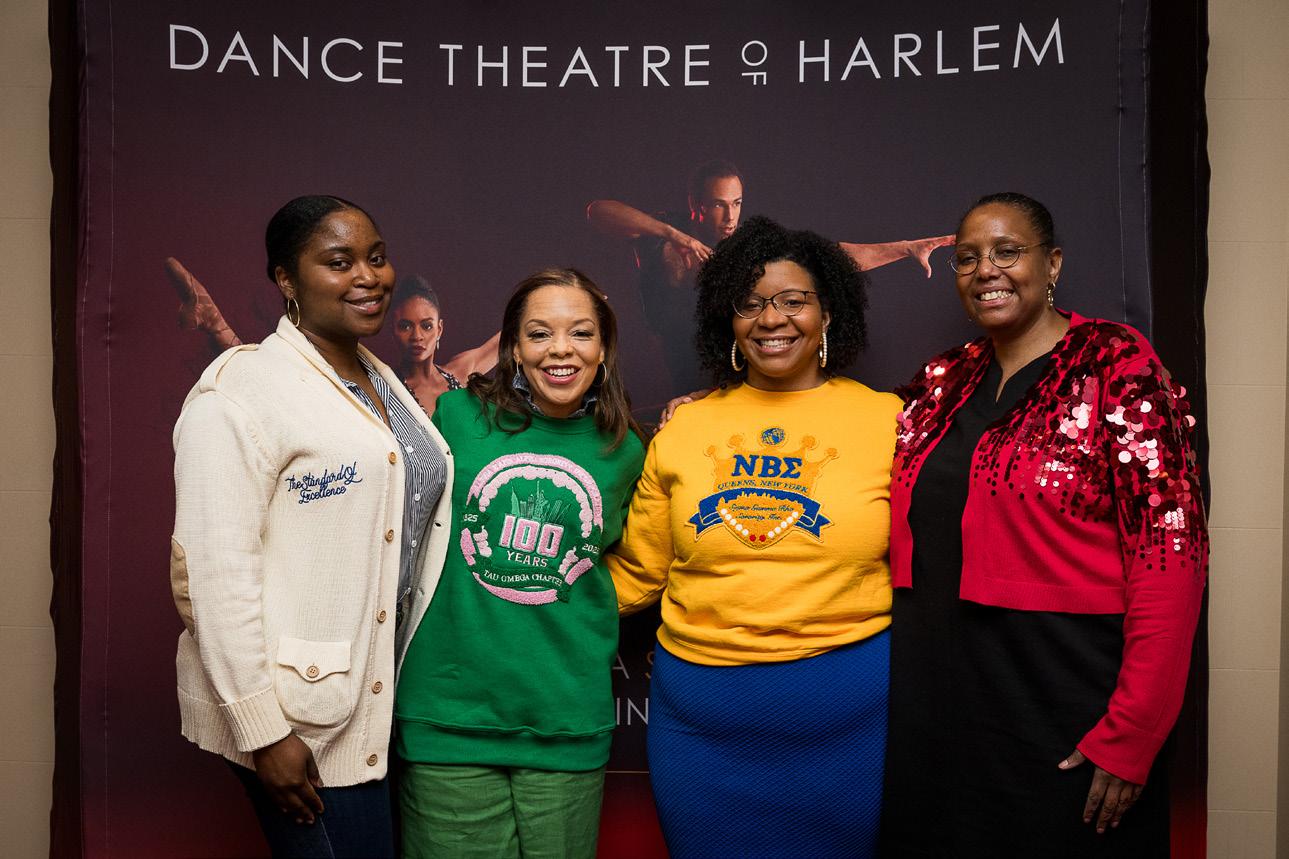
Members of all four sororities of Divine Nine share smiles during Dance Theatre of Harlem’s 2025 Divine Nine & HBCU Night. (Photo courtesy of Cherylynn Tsushima)
KAYLYN KENDALL DINES, MBA
January jobs report shows disproportionate rate of Black unemployment
By KAREN JUANITA CARRILLO Amsterdam News Staff
The January jobs report showed a surprising increase in employment, and that unemployment had decreased to 4.3%. Employment increased by 130,000, with most of the job gains coming in health care (82,000), social assistance (42,000), and construction (33,000).
Outside these national gains, however, workers in the Black community continue to face higher unemployment. Recent data and expert interviews indicate that Black unemployment remains above the national average. Black unemployment dropped from 7.5% in December to 7.2% in January. “Good is a word. I think it is definitely a progression, I would say,” said Dr. Gabrielle Smith Finnie, senior research analyst at the Joint Center for Political and Economic Studies. “We still have elevated unemployment numbers for Black workers, even with the decrease from 7.5% in December to 7.2 in January. It’s still elevated, but it definitely is better than reports that we had in December.”
However, the unemployment numbers for both Black men and women are still above the national rate. Sector-specific gains show a mixed picture for Black workers.
“There needs to be more work on the data, specifically about which sectors,” Smith Finnie said. “Now, we do know that more jobs were added in January than in December or November. In January alone, 130,000 jobs were added, which is notable. Those sectors specifically are in private education and health services, construction, and manufacturing as
well ... more positives for sure, right? That is double, nearly triple the amount of jobs added, which definitely impacts the unemployment rate.” She cautioned that it is a little too early to say what employment levels will be like throughout the year, “but I think added job gains are very hopeful.”
Black women saw some improvement, with their unemployment rate dropping by 1.4 percentage points. “One in five Black women in the labor market works in the healthcare sector. This is an opportunity where we’re seeing a positive decrease in unemployment for Black women,” Smith Finnie noted. “This could be a sector where more Black women are employed. ... We’re looking forward to seeing how that number continues, especially with more consistent job growth in the healthcare sector. We’re hoping it is a path of employment for Black women.”
Still, Black men’s unemployment rate rose to 8% in January. Smith Finnie said it is not unusual for it to be higher than Black women’s, but the rate for white men was 3.8% in January, compared with 8% for Black men. The types of jobs held by Black men — often in cyclical industries like construction and transportation — leave them especially vulnerable to economic swings.
Job layoffs and the road ahead
Alphonso David, president and CEO of the Global Black Economic Forum (GBEF), spoke of the significance of the latest jobs report in light of major federal policy shifts and workforce cuts that are affecting Black workers.
David noted that the federal government has eliminated
young people.”
Even as experts point positively to rising earnings for workers, income gains are not evenly distributed. In 2026, the median weekly earnings for Black workers were about $986, compared with $1,231 for white workers and $1,566 for Asian workers. “Those increases and gains are not evenly distributed. The median income for Black households is about 36% lower than for white households,” David said.
Ongoing attacks on Diversity, Equity, and Inclusion (DEI) initiatives create further barriers. “Over the decades, we’ve seen systemic racism built into the job market, where qualified Black and Brown people are denied opportunities simply because of their race, ethnicity, and, in some cases, gender,” David said.
270,000 jobs, with Black workers making up 19% of the federal workforce before these cuts, compared with about 13% of the overall labor force. “That is significant,” he noted. “Also, just for additional context, when the private sector refused to hire Black people in the ’50s, ’60s, ’70s, ’80s, and in some cases the ’90s, government work served, and continues to serve, as a pathway to sustainability and wealth-building for Black people and their families. That pathway is now being tripped by the federal government.”
Housing, veterans services, and public service agencies where Black workers were highly represented faced job cuts. “We also know that the agencies targeted for reductions in force were, in many cases, those where Black workers were disproportionately
represented,” David said. Some displaced Black workers are now starting their own businesses or looking for jobs in the nonprofit sector, although these are limited solutions. “When there is a reduction in force that disproportionately impacts minority populations, we create businesses. So many folks are creating their own consulting firms and businesses in order to support their families,” David observed. He also said the rising rate of Black youth unemployment, which spiked at nearly 30% in late 2025 and now hovers around 18%, is alarming. “These are young people who are underemployed or unemployed — the keys to our future — and they’re not being engaged in the work market, so it’s a dire picture for older Black workers as well as
He urged Black workers to continue taking part in the marketplace and to seek support when facing job discrimination. Events such as the GBEF’s annual business summit and public convention at the Essence Festival of Culture in July in New Orleans are some of the many ways people can meet up with different businesses, including large companies and entrepreneurs.
“Where they face bias, discrimination, or indifference, they should reach out to us and other organizations doing this work across the country, because we have to make sure we protect the civil liberties and civil rights our ancestors secured for us,” David said. “It’s not necessarily going to be easy ... but I am suggesting that we can’t assume the environment has changed so much that we no longer have protections.”
NYS nurses see contract ratifications, but thousands still on picket lines
By KAREN JUANITA CARRILLO Amsterdam News Staff
Three-year contracts were finalized for some 10,500 members of the New York State Nurses Association (NYSNA), and agreements were signed with Mount Sinai and Montefiore on February 11.
NYSNA reports that nurses gave strong approval to the agreements: at Mount Sinai, 87% rati-
fied their new contract; at Mount Sinai Morningside and West, 96% ratified; and at Montefiore, 86% did the same.
But more than 4,200 nurses at NewYork-Presbyterian voted to reject the tentative agreement NYSNA leadership brought to members last week.
NYSNA nurses at NewYorkPresbyterian voted 80% to reject their tentative agreement, saying the deal they were offered did not
sufficiently address staffing concerns. Even the decision to move forward with a vote on the proposed contract angered many rank-and-file NYSNA members at the hospital, who later complained that NYSNA leaders had not listened to their demands for more concessions.
Some union members now appear to have formed the New York Healthcare Workers Rank-and-File Committee. The
group organized a march on the NYSNA headquarters and delivered a petition signed by 1,500 coworkers demanding an investigation of top union officials, including President Nancy Hagans and Executive Director Pat Kane, for accepting the proposed NewYork-Presbyterian contract.
“NewYork-Presbyterian nurses felt that the agreement needed stronger protections against layoffs and guarantees from man-
agement on staffing,” the civil service newspaper, The Chief, reported. “Last year, NewYork-Presbyterian cut its entire workforce by 2 percent, which included about 40 union members, according to NYSNA.
“The memory of those layoffs lives fresh in the minds of the striking nurses who have walked picket lines in bitter cold for the last month and elected to continue doing so.”
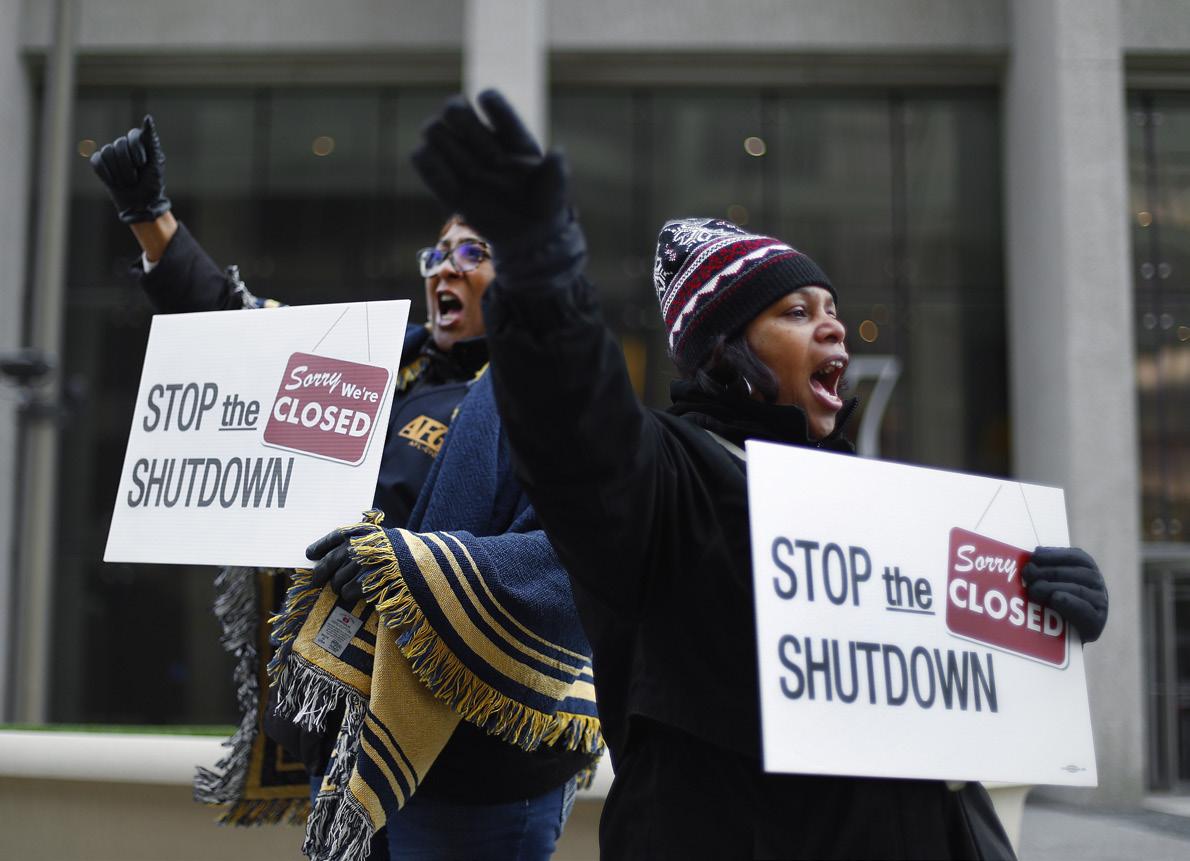
The government shutdown created an especially painful toll for AfricanAmericans who make up nearly 20% of the federal workforce and historically have been on the low end of the government pay scale. (Paul Sancya photo/AP, File)
“My overall experience was great. I love the window, and from sales to scheduling, the experience was very good. The installers are highly skilled professionals and I would recommend Renewal by Andersen to all my contacts.” – LYNN F. | RENEWAL BY ANDERSEN CUSTOMER
KEEP THE HEAT IN AND
Opinion
Trump the trickster
All the current moves and initiatives by the Trump administration pivot on the midterm elections in November, and the trickster’s hole card is half-baked vows of cash outlays to the American public.
You can bet your bottom dollar that economic matters, which always begin surfacing around income tax time, will be a prominent issue. A lot will be said and promised by the Trump administration about relief programs earmarked for the nation’s poor and underserved.
In effect, the gambits are all about buying your vote, often premised on fake news and mass distraction. Expect a multitude of rope-a-dope, “the checks in the mail” double-talk from the micromanaging snake-oil salesman. He has repeatedly made the point that Americans can expect the largest tax refunds in U.S. history and that every American child born between 2025 and 2028 should receive a $1,000 seed investment from the Treasury into an index fund, though there are several caveats.
If the income improvements fall through, Trump has other ways to keep the House and Senate under his thumb, but even that form of legerdemain, particularly of threatening to cancel the midterms, remains the province of the courts that have shown elements of resistance.
Education is repair: Black History and America at 250
By DR. MARCUS ANTHONY HUNTER
This summer, America will celebrate 250 years of independence. However, this is not the only anniversary to commemorate. February marks the 50th anniversary of Black History Month as it exists now, and 100 years of recognition in some form. As we reflect on these milestones, the struggle for freedom has seldom been more important.
When Carter G. Woodson launched Negro History Week, the precursor to Black History Month in 1926, he understood the role of history and education in repairing the damages of centuries of enslavement and racism. In 1927, Woodson proclaimed, “What we need is not a history of selected races or nations, but the history of the world void of national bias, race hate, and religious prejudice.” Black History Month, officially recognized in its current state by President Gerald Ford in 1976, is an intentional effort to combat the steady diet of misinformation and racist propaganda by uplifting Black people’s mighty achievements and histories.
Black History Month is an invitation to acknowledge and embrace the truth while committing to building a more inclusive and just future.
Elinor R. Tatum: Publisher and Editor in Chief
Madison
Damaso
Gray: Executive & Investigative Editor
Woodson was emphatic that history has the power to connect, unite, and reeducate society. It highlights our shared humanity despite pervasive systems of miseducation and division. Education and recognition are essential pillars to repair the protracted arc of exploitation, trauma, pain, and systemic inequity that African Americans have endured and continue to experience. By uplifting truth and positive images of Black people and their creations, Black History Month is an ever-present example of the practical urgency and historic call for repair. From slave ships to the ballot box, and to all the preventable injustices that persist in between,
Recognizing these contributions could shift the conversation on educational and social repair. In fact, we should all be researching which parts of our respective cities and communities were planned and developed by Black people. We should be questioning and investigating how systemic injustices imperil progress decades later. That, in and of itself, is a form of repair accessible to us all.
Amid a virulent political environment and threats to racial justice, this February, and every month thereafter, we can commit to remembering and engaging in the ongoing struggle for reparative justice. We can recall in order to narrate a future that belongs to us all.
When Woodson began his great project in 1926, he faced significant barriers. His accomplishments were not achieved easily; he struggled for history to be shared and fought through the racism he faced. Negro History Week was not accepted and recognized straight away, but it lived
Without an honest and robust engagement and documentation of history and context, it is impossible to fully grasp the need for reparations. When people think of reparations, they often think of a paycheck, but repair is not just monetary; it is awareness, dignity, and recognition. It is about healing from centuries of systemic denial of happiness and co-creating the tools to rectify, remedy, and prevent future harms. Every February, our country has an opportunity to ground ourselves in the truth that America is the product of the deliberate and untold contributions of African Americans. Indeed, Black history is American history; we cannot discuss one without the other. Benjamin Banneker, a scientist and astronomer, designed Washington, D.C. Enslaved Black people built the White House and the Capitol. The past, present, and future of the United States exist because of the contributions of Black people, and we name that truth today and every day.
in the hearts and minds of those who believed in justice until it grew into an undeniable force. We cannot be discouraged by the struggles and barriers to justice we face today. Progress grows in hard times when good people rise against what they know is wrong. Movements expand and evolve over administrations, across political trends, and through changing laws. The history of those who came before us motivates us through difficulties and shows us what is possible.
No matter where America is politically, there is still opportunity; opportunity to expand our awareness, share in our knowledge, and allow initiatives for justice to flourish. With open minds, love, and the will to persevere for what is true and right, we can go beyond what we think is possible and find repair in our history.
Dr. Marcus Anthony Hunter is a sociologist and public scholar focusing on Black communities, urban policy, and reparative justice. He is the author of “Radical Reparations: Healing the Soul of a Nation.”
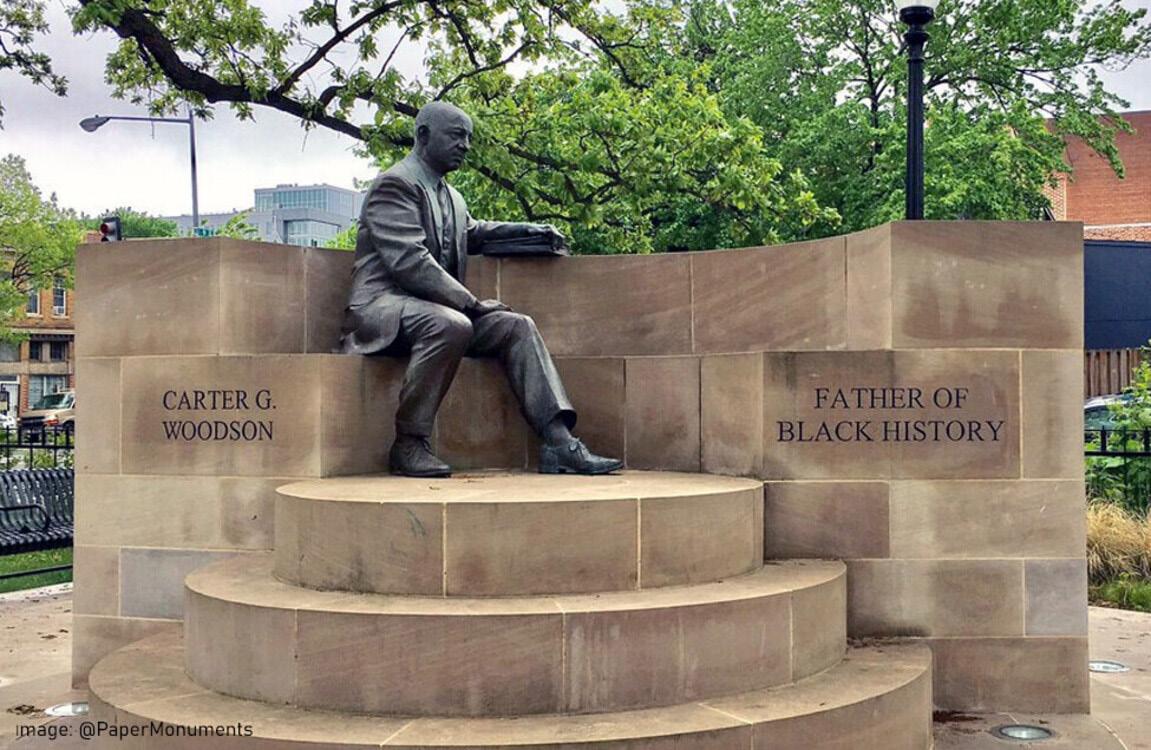
Carter G. Woodson Memorial, Washington D.C. (National Capital Planning Commission photo)
How the city’s short term rental ban is leaving homeowners shortchanged
By REV. ADOLPHUS C. LACEY
As a pastor at the historic Bethany Baptist Church in Brooklyn, it’s my job to support my congregation through everything that life throws their way, including financial hardship. People in our community are struggling, and some are being forced to leave the city that they have called home for generations — and the city needs to take action now.
Many local homeowners in my congregation used to rent out spare units for short periods of time so that they could keep up with their always-increasing bills, but they were suddenly left without this crucial source of income when the city enacted Local Law 18 in 2023. This law effectively banned short-term rental platforms in each of the Five Boroughs. It was passed under the guise of improving affordability by freeing up housing stock, but was clearly in response to hotel owners lobbying to force out their main competitor.
It’s been more than two years since this legislation went into effect, and despite a 90% drop in short-term rental listings, none of the promised benefits have come to fruition. Rents are still sky-high, vacancy rates have remained stagnant, and the hotel industry is taking advantage of the disappearance of competition by raising its rates. In fact, the only notable impact of this legislation has been to eliminate a vital source of income for New Yorkers. Black
and Brown homeowners, who have always been the backbone of New York City, are leaving at an alarming rate. The foreclosure crisis has been devastating, especially in the outer boroughs. Families who played by the rules and invested in their communities now find themselves with few options to generate the income needed to hold onto their homes.
Many of my parishioners used the extra income from short-term renting to pay property taxes, cover medical bills, or help pay for their child’s college tuition. They aren’t corporate landlords buying up affordable housing; they’re everyday homeowners who were responsibly sharing space in their own homes in order to make ends meet. That option has been taken away during a pivotal moment, by a government that is telling New Yorkers what they can and cannot do in the homes that they own. Soon, millions of fans will flock to our city to watch and experience the World Cup. These games being hosted in the Tri-State area are a once-in-a-generation moment and New York and New Jersey short-term rental hosts stand to make thousands of dollars. Yet I am heartbroken when I think of how these ridiculously restrictive regulations will mean that our local families will be left on the sidelines of what could be a massive opportunity to share the city they love with travelers and earn a living. For many working families in our neighborhood, that kind of income could mean
the difference between staying in the city or being forced to move out of the communities they were born and raised in. If the current short-term rental laws don’t change, New Yorkers will be shut out from this massive economic opportunity.
Other cities are handling the World Cup in a much more sensible manner. Kansas City, Kansas, where I am from, is temporarily relaxing restrictions during the event in order to welcome more fans and share the benefits among working-class residents. Why can’t New York do the same? Why is our government incapable of making an exception to these stringent rules so that New Yorkers can make some much-needed money? It’s beginning to feel like they care more about the billionaire hotel owners instead of real New York homeowners – especially at a time when we thought the tides were turning in the city. Our families deserve better, and our leaders can do better.
Allowing New Yorkers to host short-term rentals during special events like the World Cup would open up a world of economic opportunities in one of America’s most expensive cities. I am calling on the City to enact policy changes, or we’ll watch this incredibly rare opportunity pass by while leaving tax revenue and tourism dollars on the table. New York cannot afford to let that happen.
Rev. Adolphus C. Lacey, Ph.D. is Pastor of Bethany Baptist Church .
Somehow Charlie Kirk is sticking around – via USPS
By HERB BOYD
The legacy of Charlie Kirk has arrived in my mailbox.
Perhaps you, too, are one of the Americans who have received notifications from Turning Point Action, the right-wing organization he cofounded. One of the projects he was working on before he was assassinated last year was the Unrig the Census Emergency Petition, which aimed to allegedly show the nation — and particularly politicians — how many Americans “stand with President Trump in demanding a new, accurate census.”
If you didn’t get one of the letters,
then you may have heard about the organization’s “All-American Halftime Show,” to counter Bad Bunny’s performance at Super Bowl LX. Basically, the organization is nothing more than an echo of Trump’s complaints about the 2020 presidential election, the results of which he still refuses to accept. Rather than put the defeat behind him and move on, he’s determined to rewrite the outcome, much like his other intentions about American history.
Regarding the census, to be sure, there were demographic disparities in the enumeration of Black Americans, Hispanic Americans, and Native Americans, but not to the extent that
it would have significantly changed the outcome of the population count. There were also groups, such as Non-Hispanic whites, who were overcounted. While there’s an unlikely redo on the last census, the Bureau has announced a major planning test later this year. None of this will impact Trump’s claims, and we can anticipate a citizenship question in the next census.
If my mailbox is indicative of the Turning Point’s offensive, look out for a deluge of propaganda, and I hope we are saving you the time and effort of trying to comprehend the mishmash of garbage. We know exactly what needs unrigging.
A lesson for all of us courtesy, Chinese New Year
The year of the Fire Horse has now begun and I am excited. I don’t follow the Chinese zodiac very closely, but every now and again I must take stock of the immense energy around me. We just closed out the year of the snake and the shedding of old energy and habits. Friendships and relationships around me came to a close and there was a sense of clearing out in order to prepare for “something” great about to happen.
The year of the Fire Horse began Chinese New Year, Feb. 17, 2026, and will conclude on Feb. 20, 2027. The Chinese zodiac years are on a 12-year cycle and those who were born under the year of the horse were born in the years 1930, 1942, 1954, 1966, 1978, 1990, 2002, 2014. However, the year of the Fire Horse occurs once every 60 years and is associated with intense energy, passion, freedom, and significant transformation. So many people muddled through 2025 and are ready to make big, bold changes in their lives…even in the midst of all of the madness going on around us in the political world.
As we enter this new season, there are a few things we should lean into. It is advised to increase movement and sustainable exercise habits that can be maintained over time. This is also a year of breakthroughs, so meditating and journaling will help clear the mind. And of course, spending time in nature is suggested, so I already know the advice for this year is
right up my alley. Above all else, this is a year to rest. By doing so, your boundaries will become more clear and you will see just how essential rest is for the mind, body, and spirit. I am very excited for this new beginning. Adding time for peace and clarity means we must resist the temptation of over-scheduling. It is imperative that we leave space for spontaneity; in doing so, we are better able to act on the things that actually matter. There is so much going on politically at home, across the country, and abroad; we must not ignore just how exhausting all of this is making us…in mind, body, and spirit. I have written about decreasing clutter in our lives; it is important for us to do so physically and emotionally so we can be productive and not just busy. Again, I don’t normally pay close attention to the Chinese zodiac, but when a once in a half century energy comes through, I want to lean into the bold and transformative moments that can unfold before us… if we open our hearts, minds, and eyes to experience it all. Let the fire horse energy begin.
Christina Greer, Ph.D., is an associate professor at Fordham University; author of the books “How to Build a Democracy: From Fannie Lou Hamer and Barbara Jordan to Stacey Abrams” and “Black Ethnics: Race, Immigration, and the Pursuit of the American Dream”; and co-host of the podcast FAQ-NYC.
CHRISTINA GREER PH.D.
Caribbean Update
The Bahamas, Caribbean nations caught in middle of U.S.-China turf fight
By BERT WILKINSON Special to the AmNews
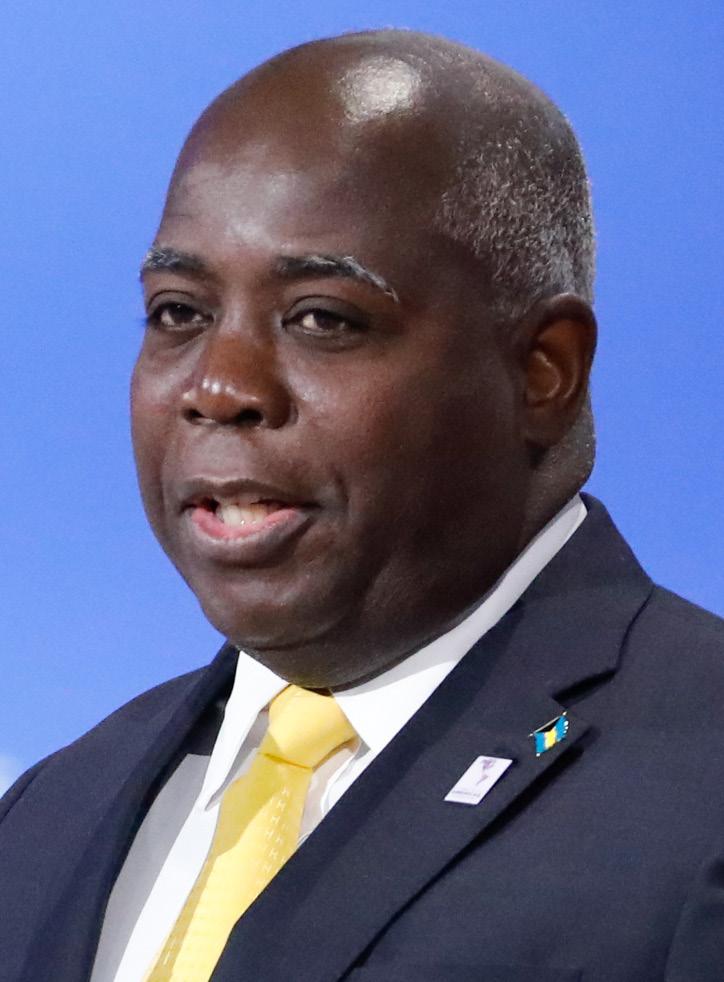
Just days after recently accredited American Ambassador Herschel Walker urged the Bahamas to abandon a Chinese loan agreement to build a specialty hospital in the country, Prime Minister Philip Davis has doubled down on the growing relations between the nation and China.
Since taking office in early December, the former NFL star turned diplomat for the Trump administration has been making it clear that part of his mission is to undermine China’s perceived diplomatic and commercial foothold in the mini archipelago just off Florida.
When local authorities recently announced that they had wrapped up an agreement for the Chinese to provide a $195 million loan for the 200-bed children’s facility, Walker wasted little time in attacking the project, indicating that Americans can easily rival the Chinese with better financing deals.
He dubbed the arrangements as not being “in the best interests of the Bahamas to submit to Chinese law and labor standards on their own soil. We stand ready to work with the Bahamas to help secure a better deal — whether from private or public sources — to provide the healthcare infrastructure Bahamians deserve.”
As it turned out, authorities made it clear to
Walker that his intervention had come way too late and that their own efforts to have secured financing from the Euro Exim Bank had failed miserably because “The Bahamas did not receive a financing response that met the scale, timing, and certainty required to advance this critical national project,” said Health Minister Michael Darville.
Walker’s efforts to pressure local officials to scale back on China have come in the midst of a sustained pressure campaign from Washington for Caribbean nations to severely downgrade their relations with the Chinese and the Cubans, and lean more toward the U.S. and the West.
Forced to walk a diplomatic tightrope, some regional governments are scaling back on relations with the Cubans but do not appear to be as willing to do so with the Chinese, who are funding numerous development projects across the 15-nation bloc.
Speaking at a Chinese New Year event in the past week, Davis hailed relations between the two, saying these are getting stronger. “I am pleased to say that the relationship between the Bahamas and China continues to develop in meaningful ways, and importantly, in ways that have [a] tangible impact. Over the past year, we have witnessed meaningful collaboration that has directly impacted lives,” he said. Davis pointed to Chinese medical assistance to provide free eye care to more than
200 locals, noting that the effort had helped to restore “dignity, recovery of independence, and reinforcement of family bonds. For those outcomes, we are genuinely appreciative. We also recognize the significant progress being made on the new Nassau hospital, which remains a major national priority.”
Even as the embassy in the Bahamas tries to sustain the pressure, though, the Chinese themselves are lashing back at the U.S. by contending that its ambitions are pure, developmental in nature, and sometimes simply a matter of commerce and business.
In its statements responding directly to Walker, the mission declared that “China–Bahamas cooperation involves no geopolitical calculations, targets no third party, and should not be interfered with by any external party.” It added that China “respects the sovereignty of the Bahamas and supports its independent choice of development paths and partners. The project aligns with the healthcare needs of the Bahamas and serves its best interests.”
Meanwhile, Security Minister Wayne Munroe said the cabinet remains hopeful that Walker and U.S. officials will come through for the Bahamas with projects in the future, including current plans to construct a modern prison facility in the capital. He said the U.S. must back up its word with action, such as capital financing.
“I will expect that we will get a good re-
sponse from American EXIM bank if we approach them for funding for the prison, because that is something else that we would be looking for funding for, and I take him at his word that the U.S. is prepared to assist us with that,” the minister said, throwing out a challenge to American banks and contractors. The project would cost around $50 million.
America deported Marcus Garvey, too. His legacy stayed.
In 1927, the United States deported one of the most influential figures in Black American history. His name was Marcus Mosiah Garvey, a Jamaican immigrant whose vision of Black economic independence and global unity awakened millions. Garvey was not deported because he posed a physical threat. He was deported because he posed an ideological threat.
Garvey arrived in the United States in 1916 and quickly built the largest mass movement of Black people the modern world had ever seen. Through the Universal Negro Improvement Association, he inspired Black Americans to see themselves not as victims of oppression, but as architects of their own economic and political destiny. His message of self-reliance, ownership, and pride resonated deeply among Black communities living under the weight of Jim Crow segregation and racial violence.
In 1923, Garvey was convicted of mail fraud in connection with the Black Star Line, his ambitious shipping company, created to connect Black people across the global diaspora. Many historians have argued that the charges were politically motivated, fueled by a government deeply uncomfortable with Garvey’s growing influence. FBI Director J. Edgar Hoover himself viewed Garvey as a dangerous agitator.
After serving nearly two years in prison, Garvey was deported to Jamaica in 1927 — but his removal did not erase his ideas. It only proved how threatening those ideas were to the status quo. Garvey’s deportation is a reminder that immigration enforcement in America has never existed in isolation. It has often intersected with race, power, and politics in ways that reflect the anxieties of the moment. Immigration law has not only been used to regulate borders but, at times, to regulate influence and silence voices deemed disruptive.
Despite his deportation, Garvey’s legacy became foundational to Black American progress. His philosophy directly influenced
However, Garvey was also an immigrant, and in America, being both Black and immigrant has long carried its own risks.
leaders such as Malcolm X, the son of a Grenadian immigrant mother, and Kwame Ture, born Stokely Carmichael in Trinidad and Tobago, who became a central figure in the Civil Rights and Black Power Movements; Shirley Chisholm, the first Black woman elected to Congress and the first Black candidate for president from a major party, who was the daughter of Barbadian immigrants; Colin Powell, the son of Jamaican immigrants, who rose to become chair of the Joint Chiefs of Staff and U.S. Secretary of State.
The story of Black America cannot be told without the story of Caribbean immigrants. They helped build the intellectual, political, and cultural framework of modern Black identity in the United States. They were not outsiders. They were nation-builders.
Yet today, nearly a century later, immigrants — particularly Black and Brown immigrants — are once again being detained, deported, and vilified under the justification of law and order. The language may be modern. The policies may be updated. The underlying tension — who belongs, who is welcome, and who is seen as a threat — remains strikingly familiar.
Garvey’s story reminds us that this moment,
however severe it may feel, is not entirely new. America has walked this road before. It has feared immigrants before. It has expelled them before. Even still, those immigrants helped shape the very future the nation now claims as its own.
Immigration enforcement removed Garvey from American soil, but it could not remove his influence from American history. His ideas endured. His legacy grew. His impact became irreversible.
Nearly a century later, as immigration raids intensify and immigrants are once again portrayed as threats rather than contributors, Garvey’s story offers both warning and perspective. The lesson is not that injustice disappears on its own. It is that enforcement cannot erase truth, contribution, or belonging.
America deported Marcus Garvey, but it could not deport the future he helped create.
Felicia J. Persaud is the founder and publisher of NewsAmericasNow.com, the only daily syndicated newswire and digital platform dedicated exclusively to Caribbean Diaspora and Black immigrant news across the Americas.
The Bahamas’ Prime Minister Philip Davis in 2022. (Palácio do Planalto from Brasilia, Brasil, CC BY 2.0, via Wikimedia Commons)
Arts & Entertainment
Son of Saturn: ‘Sun Ra: Do the Impossible’ airs on PBS
By MARK WINSTON GRIFFITH Special to the AmNews
At best, any casual music consumer would find the avant-garde work of musician, composer, and bandleader Sun Ra transportive. At worst, they may find it frustratingly inscrutable. Sun Ra wrote in 1972 that “Imagination is a magic carpet / Upon which we may soar / To distant lands and climes / And even go / beyond the moon / To any planet in the sky / If we came from / nowhere here / Why can’t we go somewhere there?”
All this may indeed be true, but any piece of abstract art, en route to “somewhere there,” can be as disorienting as it is liberating. Without fixed or familiar reference points, we can get lost in space.
Christine Turner, who produced and directed the documentary film “Sun Ra: Do the Impossible” for the documentary production house Firelight Media, must have known this instinctively, which is why I imagine she took on the task of guiding us through the magical mystery tour that is the life and mind of Sun Ra.
Sun Ra, the pioneering Afrofuturist, is one of the most fascinating, prolific, and accomplished artists of the 20th century. He is also one of the least understood and hardest to understand. It’s not just because his musical trajectory is so long — ranging from the more classical traditions of ragtime and swing to less structured and often highly improvisational forms of bebop and free jazz — but because Sun Ra himself purposefully defied classification. He was as much a fearless philosopher, scholar, and performance iconoclast as he was a miner of acoustic subterrains. He famously said, “The impossible attracts me because everything possible has been done and the world didn’t change.”
“Do the Impossible” doesn’t betray Sun Ra’s ethos by trying to make him wholly linear and legible, but instead honors it by providing context and observation. Although few specifics are known about his early years (Sun Ra consistently provided contradictory versions of his origin story, which included being a citizen of the planet Saturn),
the film shares some basics: The earthly form of Sun Ra was born Herman Poole Blount in 1914 in Alabama. He reportedly taught himself how to play the piano, as well as read and compose music. He was heavily influenced by the blues singers and big bands of the early years of jazz, served a jail bid as a WWII conscientious objector, and went on to factor prominently in the growth of the Chicago jazz scene. He gained the moniker “Sonny” as a child, but shed his slave name by legally becoming Le Sony’r Ra in 1952. He started a record label in the early 1950s, formed an “arkestra” that went by dozens of names, recorded more than 200 albums over the next 40 years, wrote more than 1,000 compositions, and toured the world wearing outfits that fused space age and ancient Egyptian themes. You can retrieve much of that information from Wikipedia, but
“Do the Impossible,” which is entirely scored with Sun Ra’s music, is a wondrous celebration of the ideas, visuals, and sounds that Sun Ra conjured. We are introduced to his eclectic and encyclopedic literacy, and hear his views about metaphysics and “transmolecularization.” We view his concerts, some of which feature more conventional big band performances, to more outrageous pageants of far-out costume parades, free-form dance, spoken word, and what can only be described honestly as noise. In one concert scene, Sun Ra has his back to the keyboard while randomly banging on keys to chaotic effect. Perhaps the juiciest moments of the film are the lineup of musicians, dancers, vocalists, scholars, and critics who serve as a collective Rosetta Stone for Sun Ra’s body of work. Many describe the experience of performing and working with Sun Ra, from
his disciplined work ethic and no-nonsense, no-drug or alcohol rehearsals, to his cheapskate management ways. Some of the commenters were clearly part of his cult of personality, but others simply had respectful and generous interpretations, declaring that he was “preparing us for a different world,” creating “portals to other dimensions,” and “saving our people.” What was particularly interesting were the observations that Sun Ra had more of a maternal energy than a fatherly one, and that he confounded easy categorizations of sex, gender, and racial identity as much as he did musical identity. He both rejected the conventional limitations in our human forms and minds, but fiercely championed our human-ness. He was intense and ostentatious, but probably took himself less seriously than most people assumed.
Although Sun Ra died in 1993,
the Sun Ra Arkestra continues to record and perform under the leadership of Marshall Allen to this day. “Do the Impossible” helps us understand that before Little Richard, George Clinton, Octavia E. Butler, Afrikka Bambaattaa, Saul Williams, Janelle Monae, and Lady Gaga beamed onto the popular culture scene from other universes, there was the counter-cultural Sun Ra, challenging us to not just think outside the box, but to dismantle the box entirely.
As jazz is increasingly relegated to the cultural margins, and artists of all genres are namelessly Spotified, “Do the Impossible” confidently asserts Sun Ra’s place in the pantheon of musical revolutionaries.
“Sun Ra: Do the Impossible” premieres nationwide on PBS on February 20, 2026, at 9 p.m. ET. (check local listings); pbs.org/americanmasters and the PBS App.
Sun Ra in “Sun Ra: Do the Impossible” (Leni Sinclaire photo)
Much like sports, in the entertainment arena, where would America be without the inventive excellence of Black people? Without our input and outsized influence, things may be mighty mediocre.
Born in 1880 on St. Valentines day, New York native Ada Overton (gaining sophistication as a performer, Walker changed her name to Aida, after the Nubian princess in Verdi’s acclaimed opera) started her theatrical career early. At just 15, she joined John Isham’s Black touring company, the “Octoroons.” That gig didn’t last long. In short
order, she left to join the chorus of “Black Patti’s Troubadours,” the “chitlin circuit” vehicle of soprano Matilda Sissieretta Joyner Jones. It was a wise decision to become affiliated with the established African American operatic star. Jones was renowned around the world. Due to white supremacy’s bias, she was famous as “The Black Patti,” referencing the Italian prima-Dona. However, so far as the quality of their voices was concerned, Patti might just as easily have been characterized as “the white Jones.” It was in Jones’ troupe that Overton met comic vaudevillian George Walker, her future husband. They wed in 1899. While she was just 19, he was 26. For the entirety of her life, despite changes of affiliation, she would forever be associated with her handsome, smooth-talking husband and his more demure partner, Bert Williams.
As Williams and Walker, these Black men transformed entertainment on Broadway. Their creativity made theater in the U.S. decidedly more American. Both were determined to co-opt minstrelsy’s indignity and defamation, transforming stereotypical ridicule into defiant empowerment. Much as the Waynans would do with “In Living Color,” employing self-deprecating humor, they caricatured racism’s absurdity. They turned the tables. Calling themselves “Two Real Coons,” they even wore blackface. If whites could blacken up to enrich themselves, satirizing Black life, with Bert’s slow-witted simpleton, always led astray by George’s big-talking con man, they could too. Only, in the process, with cunning irony and heartfelt pathos, they aimed to make integrated audiences laugh uproariously, all the while redeeming Black humanity. Authenticity and aspirational dreaming of self-improvement, anyone could empathize with, were secret weapons they wielded expertly. The sometimes intolerant talented tenth might have clutched their pearls, fearing for hard-won respectability, in indignation. But plain folks? They loved Williams and Walker; they admired their wives, the catchy, toe-tapping tunes they used, composed by serious musicians like Bob Cole or Will H. Dixon. They adored their shows, the new but familiar dance steps, their hilarity, and their style. With all their hearts, Black Americans relished the fun of Williams and Walker, and in surprising numbers, much of white America did too.
In 1900, Walker first gained national attention performing “Miss Hannah from Savannah” from Sons of Ham. For the next decade, she would follow success with success. Even before 1911, when her husband succumbed to syphilis, she’d already begun to play his part in roles he could no longer remember. Dressed in drag as a man, singing “Bon Bon Buddy,” she gained her greatest acclaim, in the process, it was reported, “holding her audiences spellbound.” Many newspapers printed cartoons of Walker outfitted in male attire. Familiar to hundreds of thousands in print and across the footlights, in so many ways with her act and larger-thanlife persona, she helped to accustom ordinary people to new ways of being.
Walker was unapologetic about
ambition or aspirations of fame. She accomplished her goal by refining the Black folk dance called the “cakewalk,” a commentary on effete affections characteristic of white folks’ idea of stylishness. Replacing rambunctious gyrations with more graceful movements, she thoroughly transformed an undisciplined romp into an elegant promenade suitable for a ballroom dance floor. Her metamorphosis of the cakewalk reflected the same impulse that inspired her to conquer ‘serious’ dance, creating her own interpretation performing the provocative dance of seven veils from Oscar Wilde’s play “Salomé.” Walker was equally brilliant when exploiting contacts with prominent whites that could enhance her career. When New York’s and Newport’s leading gay millionaire host, Robert “Bobbie” Hargous, held a dinner dance, as “In Dahomey” was a runaway hit, he decided on a more memorable form of entertainment than yet another cotillion. In a way, he was late to the game of introducing Negro artists as a party novelty, sure to dispel the “old ennui” en-
demic among the very rich. That previous August, Mrs. Cornelius Vanderbilt II, as part of her successful bid to lead Gilded Age social life, had dazzled Newport by engaging the cast and crew of Broadway’s hit musical, “The Wild Rose.” For but one night, the Knickerbocker Theater was shut down, and a new temporary auditorium, that could be changed into a ballroom, was built on the lawn at “Beaulieu.” The play was condensed to occupy the hour and a half interval before supper was served, preceding dancing. In addition, along a brilliantly lighted fairground-style midway, extending dreamily towards the sea, every conceivable carnival attraction was available. Including Eddie Foy, Walker, and members of her troupe were also on hand, offering lessons in the intricacies of the cakewalk. Hargous plans ran along similar lines. New York’s most elegant whites had not only treated Blacks with courtesy, graciously offering them refreshments, but finally, arms entwined, they proceeded to dance. Compared to Booker T. Washington dining with Teddy
A feature of Walker’s appeal among Blacks was her lavish lifestyle, wearing Paris fashions and real jewels, such as her diamond peacock feather brooch and earrings. Whites eschewed hoop earrings due to an association with enslaved Blacks. (Public domain photos)
Roosevelt, how sexually charged this must have seemed. Irrespective of color or class, readers were thoroughly shocked. Some were even outraged.
Walker’s further impudence, referring to Mrs. Arthur Paget, “As my friend Mrs. Paget, [the dinner’s American-born guest of honor, married to an English aristocrat, she was about to return to]” made some openly pity the “Naive Negress.” Her evident lack of sufficient awareness to appreciate the capricious whims of a great lady of fashion was, they felt, laughable. No matter what she might say otherwise, condescending to address someone of such lowly station, it could hardly be expected that Mrs. Paget was actually going to honor a promise made in the midst of an exuberant evening out’s fun.
But with Walker’s triumph touring, the laugh was on the doubters. Seemingly at the wave of Mrs. Paget’s gloved hand, all doors were open to her. Demand for lessons in dancing the cakewalk flooded in. Then cakewalk’s queen was “commanded” to dance before King Edward VII, and Alexandra, his Queen, on a specially constructed stage in the garden of Buckingham Palace.
But this coup was not all. A future
Sovereign, little Prince Edward, called David, the presumptive heir, shook hands with the Black lady entertaining at his ninth birthday celebration. “It was a very nice dance,” he murmured. This was a moment to cherish, a charming gesture only exceeded by the diamond brooch the King had bestowed on Walker by way of thank you. A feature of Walker’s appeal among Blacks was her lavish lifestyle. She lived in a handsome Queen Annestyle house in Harlem at 107 West 132nd St. Her private carriage, though elegant, was unostentatious. Like Madame Walker and her daughter or hat-maker Madame Seay, she was that rare role model, reminding masses of Black women of the efficacy of dreams and prayer. For those so often defeated by life, she offered hope, however elusive; there was an alternative to giving way to despair. Wearing Paris fashions and real jewels, including a diamond peacock feather brooch, a diamond necklace, a tiara, and earrings, she defied being limited by an unjust society. If whites eschewed hoop earrings, due to an association with enslaved Blacks, adding diamonds, Walker wore hers proudly. Who could know she would die
herself, so soon after her husband? Many critics contended that Walker was only just approaching the zenith of a career that ought to have lasted a long lifetime. Towards the end, how galling it must have been for Walker to witness the plaudits offered to the white husband and wife dance team, Vernon and Irene Castle, who so thoroughly appropriated the popular ragtime dance craze she originated?
Lying in state in 1914, at the new St. Philip’s Episcopal Church, thousands passed Walker’s bier. In a very short time, she accomplished a great deal. Widely mourned, she was only 34.
It’s about time to revive the stature of our once colossal star. Sure signs point to the time being ripe. Daniel E. Atkinson, an independent scholar who earned his doctorate in ethnomusicology from the University of Washington, has just published the first biography of her husband, “The Rediscovery of George ‘Nash’ Walker: The Price of Black Stardom in Jim Crow America.” ‘But, what,’ you might ask, ‘can we do that helps to reverse Aida Overton Walker’s unceremonious erasure?’ Ought we not at least pledge our commitment to restoring her Harlem home?
9.6”
As early as 1903, the Walkers anticipated the Castle dance team to come. (Public domain photo)
Historic Harlem Buildings
729 and 731 St. Nicholas Ave.: Enjoying what’s left of Harlem’s landmarks
By MICHAEL HENRY ADAMS Special to the AmNews
Landmarking is not a panacea; Harlem’s most spectacular churches prove it. These were four cathedral-scaled Roman Catholic edifices. Landmarked or not, all but one — the smallest, Saint Aloysius Church on West 132nd Street (1904, designed by Renwick, Aspinwald & Russell) — have been dramatically altered, made to become but a mere shadow of what they were.
St. Charles Borromeo, a neoGothic essay on 141st Street, is imposing enough externally (1904, designed by George H. Streeton). In order not to offend white parishioners elsewhere, before the 1950s, this was where Harlem’s Black Catholics were directed to worship and educate their children. Following a 1968 fire, instead of restoring the three-story nave, a small, onestory room was built inside its soaring, burned-out shell.
Saint Thomas the Apostle Church on 118th Street (1907, Thomas H. Poole and Sons) was such an exquisite example of the 16th-century English Gothic Perpendicular style that, even cut in half and used as an event space, it’s still a moving place.
“The Saint Patrick’s of Harlem,” All Saints Church on Madison Avenue at 129th Street (1894, designed by James W. Renwick Jr., the architect of St. Patrick’s Cathedral), is now the auditorium for Sean Combs’ Capital Prep charter school.
Thanks to the fight to try to save St. Thomas Church, valiantly led by Bill Perkins and Congressman Charles B. Rangel, both All Saints and Saint Aloysius Church were designated individual New York City Landmarks. But the fates of each were radically different. A highly-colored terracotta masterpiece, Saint Aloysius has been lovingly restored. But at All Saints, like St. Thomas’ Church, as if Visigoth barbarians had invaded uptown, stained glass windows have been removed, with pews and paintings stripped from both and sent on to white subur-
ban congregations. Similarly, side altars taken from Harlem were installed downtown at St. Patrick’s, along with marble statuary.
So no, securing official governmental “protection” cannot do everything to safeguard the buildings that formed the backdrop of our history. Only our own eternal vigilance, sending texts or raising hell when necessary, can do that. And sometimes, though I’m loath to admit it, even just saving part of something, from structures which are marvelously made and could never be duplicated, can be good enough, at least temporarily.
I say this, because all over Europe and even in America, whether the Summer Palace outside of St. Petersburg in Russia, the Frauenkirche church in Dres-
den, or the White House after it was burned by the British in the War of 1812, meaningful buildings, shared as a part of our collective memory, have been restored to ameliorate our losses and make us more whole.
729 and 731 Saint Nicholas Ave. are two exceptional houses supposedly protected in the Hamilton Heights-Sugar Hill Historic District extension from 2000 to 2001. The exuberant bow-fronted facades are two of the most original and satisfying in all of Harlem; perhaps in the entire city or whole country. Each residence features picturesque massing, including the iconic conical roofs of Norman towers, and tall, distended chimneys.
Like the lost freestanding dwelling that once occupied the
corner at 146th Street, the two row houses, which survive from a group that was meant to be four houses, celebrate their definitive medieval vernacular architecture transferred to the city.
Faced with rugged Manhattan schist, excavated from their foundations, articulated like Norman originals, with red brick detailing, they are further distinguished by unglazed yellow terra cotta ornament and imbricated cedar shingles, hidden by asphalt replacements. Curved windows no longer speak of sophisticated subtlety. Dignified double front doors and replacement stoops with serpentine bronze railings, like none you’ve ever seen, are also gone. And still, these venerable houses are so remarkable.
St. Nicholas Avenue’s earliest
speculative houses, they were devised for builder William Thompson and designed by Boston architect Theodore Minot Clark. A Harvard graduate, Clark started as an associate of the innovative designer Henry Hobson Richardson. Teaching at MIT, he went on to fill the editorship of the American Architect and Building News. Quite a commodious house, 725, though built for Nathan Hobart, was first occupied by Sigmund Bergmann, a colleague-collaborator of Thomas Alva Edison. Happily living here with his wife and daughters, serving as director of the General Incandescent Arc Light Company, by 1900, he moved to Berlin to establish an electronics empire of his own.
After just ten years of existence, 725 St. Nicholas Ave. was razed.
It’s hard to imagine that such extraordinarily sinuous stoops were destroyed.
729 and 731 St. Nicholas Ave. were completed in 1886. (Photos from writer’s collection)
Hope stays alive: The life of Rev. Jesse Jackson and the legacy he leaves
By HERB BOYD Special to the AmNews
franchised, and free innocent prisoners around the world.”
Destined to Lead
opted him. He was given his stepfather's name but maintained a relationship with Robinson.
Jackson grew up under the taunts of other children who
fiance of the Jim Crow racism that permeated the South. He attended a racially segregated high school, Sterling, in Greenville, where he was elected student class president,
quiring a scholarship to college at the University of Illinois, but his transfer may have come as a result of racism that would not let him perform as quarterback on the football team, though other lished for his continuing his education at North
Not only did he iron as quarterback at A&T, he was also elected president of the student body. Along with earning a B.S. in sociology, cal activism, joining other students in campus protests and in the city. In 1964, he attended the Chicago Theological Seminary and traveled in 1965 with a group of students to Selma, Alabama, to participate in the voting rights demonstrations that became known as “Bloody Sunday.” This gave him the exposure to King that
nizing skills, leading him to hire Jackson to work at the Chicago office of the Southern Christian Leadership Conference (SCLC). He wound up leaving the seminary after his second year to devote himself full-time to the Civil Rights Movement, principally under the tutelage of the Rev. James Lawson. From there he grew into a crusader for equality and justice and
Rev. Jesse Jackson at the Wall Street Push offices
Krutchfeld photo)
Jackson’s charismatic presence was always prominent in nearly every civic or political event concerning racial justice or civil rights, beginning with his being on the balcony of the Lorraine Motel in Memphis, where King was assassinated in 1968. But that did not end his Civil Rights career. Instead he took up King’s mantle. During these years, he also continued his affiliation with SCLC's Poor People's Crusade in D.C., establishing an office in Chicago. His relationship with SCLC and Operation Breadbasket ended after several clashes with the Rev. Ralph Abernathy. Undaunted, Jackson founded Rainbow PUSH (People United to Save Humanity), a merger of two nonprofit organizations in 1971. That was the catalyst for him leading the Civil Rights Movement of the 50s and 60s into the Black Identity movement of the 70s. He opened the historic Los Angeles Wattstax music festival in 1972, with his famous “I Am Somebody” speech. That same year, he organized the National Black Political Convention in Gary, Indiana, which, at that time, was the largest Black political gathering that had ever taken place, convening numerous political figures that went on to prominent positions in U.S. politics and resulting in the “National Black Agenda.”
In 1984, he founded the Rainbow Coalition, which was an outgrowth of his presidential political campaign. He launched his presidential run to challenge Reaganomics, which, in campaign literature, charged the president with neglecting voting rights, affirmative action, and other social programs. It was at the Democratic National Convention that year in San Francisco that he delivered a speech entitled "The Rainbow Coalition."
Toward the end of this powerful piece of oration, Jackson said, “Our time has come. Suffering breeds character. Character breeds faith. In the end, faith will not disappoint. Our time has come. Our faith, hope, and dreams will prevail. Our time has come. Weeping has endured for nights, but now joy cometh in the morning.”
He finished in third place for the Democratic nomination, trailing former Vice President Walter Mondale and Sen. Gary Hart. Four years later, he was once again on the presidential campaign trail, and though he did very well in the race, winning several states and a number of delegates, he finished behind the runner-up, Gov. Michael Dukakis of Massachusetts.
In his 1988 speech, he challenged all who listened to him to be more than what they thought they could be. It became the mantra he was known for by an emerging generation, the children of those who had marched in the Civil Rights years.
“I was born in the slum, but the slum was not born in me. And it wasn't born in you, and you can make it.
Wherever you are tonight, you can make it. Hold your head high, stick your chest out. You can make it. It gets dark sometimes, but
the morning comes. Don't you surrender. Suffering breeds character, character breeds faith. In the end faith will not disappoint. You must not surrender. You may or may not get there but just know that you're qualified. And you hold on, and hold out. We must never surrender. America will get better and better.
Keep hope alive. Keep hope alive. Keep hope alive. On tomorrow night and beyond, keep hope alive!”
“Rev. Jackson’s electrifying presidential campaign in 1988 changed the course of history in America,” Dr. Ron Daniels, who served as Jackson’s deputy campaign manager that year, told the Amsterdam News.
“Without the change to proportional allocation of delegates in presidential primaries, Barack Obama would not have become the first Black president of the U.S. and the “Jackson bump” in Black registered voters inspired by his campaign were the margin of victory in the historic election of David Dinkins as the first Black Mayor of New York City; two signature achievements directly attributable to the genius of Rev. Jesse L. Jackson.”
In 1991, he moved from Chicago to D.C., where he served as a shadow delegate and senator for D.C. from 1991 to 1997. He also made a mark on the economy by continuing King’s vision for economic equality by founding the Wall Street Project to end a multibillion dollar trade gap between American business and minority vendors. The result was large corporations to commit billions of dollars to the cause of diversity and equality.
His activism never wavered and he was often invited to speak at protests and labor union events, where he lent his voice to political abuse and issues of foreign diplomacy. In 1997, much in the manner of his role in the release of Navy Lt. Robert Goodman,
a captured U.S. pilot held in Syria, served as special envoy for President Bill Clinton to Kenya, promoting free and fair elections.
Two years later, he helped to negotiate the release of three prisoners of war in Yugoslavia during the Kosovo War. He was again on the diplomatic trail in 2005, this time to Venezuela, to meet with President Hugo Chavez, to tamp down the controversial remarks of televangelist Pat Robertson, who called for Chavez's assassination. In 2009, he was a keynote speaker at the International Peace Foundation, where the focus was building culture and peace development.
Probably one of the most poignant images in Civil Rights history, however, was the night of Nov. 4, 2008, when Barack Obama, an Illinois senator, was elected President of the United States, the first time a Black person had ever ascended to the office. Cameras caught him in literal tears as Obama gave his victory speech to a crowd of thousands at Chicago’s Grant Park.
“I thought about those who suffered to make it possible,” he told CBS News the next morning. “The marches, the murdered, the martyrs, many who were nameless and faceless, but in some sense their suffering was redeemed last night with that victory.”
Obama, now years out of the White House, acknowledged the impact Jackson had on his career, and that of many, many others.
“Reverend Jackson also created opportunities for generations of African Americans and inspired countless more, including us,” said Obama in a statement. “Michelle got her first glimpse of political organizing at the Jacksons’ kitchen table when she was a teenager. And in his two historic runs for president, he laid the foundation for my own campaign to the highest office of the land.”
Still Moving
Though ailing and barely able to get around as Parkinson’s continued to affect him, Rev. Jackson was still on the ramparts for justice. He had stepped down from his leadership in Rainbow PUSH, leaving it to a new generation of leaders. But he wasn’t done. In 2024, spearheading a summit in his hometown to address the escalating humanitarian crisis in Gaza. One of the main issues discussed at the summit was a permanent ceasefire and relief efforts for the badly devastated cities. “We are faith leaders and advocates, united in this moment of moral reckoning to affirm the sanctity of all human life,” Jackson declared.
But probably the most important gift Jackson left was his legacy, which can be seen in the thousands of people inspired by his political campaign to run for office themselves, and in his own family, which has produced two U.S. Congressmen: Jesse Jackson Jr. who served in the House of Representatives for 17 years and Rep. Jonathan Jackson, who currently serves as Representative for Illinois’ 1st Congressional District.
“He was a freedom fighter,” an emotional Jonathan Jackson told Chicago’s WGN. “He fought to make America better. He first got arrested trying to use a public library, but he ran for president…he brought back prisoners of war in Iraq and in Syria…the fight now, it continues. The mantle is now passed for another generation to bring more humane priorities at home.”
Right to his final days, his final breath, the freedom fighter was raising his voice for the oppressed and downtrodden. “We gather to build upon the historical legacy and current global movements for peace, justice, and liberation,” Jackson emphasized, before adding what he said in Lebanon some 40-plus years earlier. “We do not seek to exchange sufferers, but rather to stop suffering.”
(Public Domain photo)
How Rev. Jesse Jackson helped me and so many of us to find our voices
By REV. AL SHARPTON
A giant has returned home. Words cannot fully capture the life, legacy, and complete impact of the Rev. Jesse Jackson. Today, the nation and the world lost a civil rights icon, a champion for justice, and a righteous fighter who was always on the correct side of history. It’s strange to speak of Rev. Jackson in the past tense; someone who was a fierce force of nature who embodied the qualities of true leadership and was a foot soldier for justice. He kept the dream alive and taught young children from broken homes, like me, that we don’t have broken spirits. He told us we were somebody and made us believe. He first called me into purpose when I was just 12 years old.
My mother introduced me to civil rights leader Rev. William Augustus Jones Jr., who then brought me to Rev. Jackson when he was in his 20s and I was barely a teenager. He instantly became a mentor. I was immediately drawn to him; he was born into a family situation similar to mine, and was not of the elitist crowd that a lot of the ministers were of that day. During those transformative years of my life, his guidance helped steer me toward my own activism and find my voice. I knew Rev. Jackson before he was a national figure, before he became a household name. He was always hard on me, told me repeatedly that I needed to study and be more disciplined. He was, in short, the taskmaster of my life. Rev. Jackson appointed me as youth director of the Brooklyn branch of Operation Breadbasket, the economic arm of the Southern Christian Leadership Conference, which was founded by Rev. Martin Luther King Jr. He entrusted me with that great responsibility at such a young age, and saw something in me before I fully saw it myself. That is the true measure of a mentor: They don’t just teach you; they name you.
Years later, after I started the National Action Network, it was Rev. Jackson who named our headquarters in Harlem the House of Justice, as a reminder that movements must always be anchored in moral purpose.
Throughout his life, Rev. Jackson called for inclusivity — a multiracial alliance that was composed of every group, regardless of their socio-economic, gender, or ethnic background. He carried Dr. King’s teachings into future generations and spent decades fighting for equality across the board, for the betterment of our communities and our nation as a whole. Through Operation PUSH and the Rainbow Coalition, he expanded the political imagination of the country, and in turn, the world.
He twice ran for president, breaking down barriers and allowing us to see
that such a goal was possible. He opened doors that many of us, me included, followed through and walked in his footsteps, and ran for president as well. “Keep hope alive!” was his signature line during his second run for president. Despite the open racism he received on the campaign trail and the institutional barriers in place, Rev. Jackson never lost hope and encouraged all of us to keep pushing forward for a better tomorrow.
When Barack Obama was elected as the first Black president of the United States in 2008, Rev. Jackson had literal tears in his eyes — tears of joy and tears for all the sacrifices of our ancestors that led to that historic moment.
On the global stage, Rev. Jackson was a respected figure who helped negotiate the release of dozens of American hostages and prisoners in the 1980s and 1990s. In 1984, he secured the release of a captured Navy lieutenant from Syria, as well as the release of 48 Cuban and Cuban-American prisoners in Cuba. In 1990, he helped secure the release of prisoners held by Saddam Hussein, and later that decade helped negotiate the release of U.S. soldiers held in Kosovo. The list of his international and diplomatic work goes on and on.
Today, the nation and the world are in mourning. Throughout most of my life, I had the privilege of watching, observing, and learning from Rev. Jackson. He broadened and democratized America, including the corporate world, which then led to the opening of boardrooms and the expansion of business contracts. He continuously fought for the protection of voting rights and the inclusion and acceptance of all, including members of the LGBTQIA community and marginalized communities. When the Civil Rights Act of ’64 and the Voting Rights Act of ’65 had to be renewed, it was Rev. Jackson who took that fight and kept it going through the Ronald Reagan years and years of backlash.
He was a fighter until the very end. I visited and prayed with his family when he was in the hospital, and after learning of the tragic news of his passing, I prayed with his family once again by phone. He was more than a public figure to me — he was a mentor and even godfather to my own children. He prayed over my two daughters when they were just infants; he spoke life into them as young girls. We stood in his home not as a headline, but as family. We now feel the immense loss of a beloved family member who helped push this nation on a progres-
sive trajectory. I will always cherish the fact that he took me under his wing and will forever try to do my part to keep hope alive. Leaders are defined by their character and the mark they leave on this world. Rev. Jackson’s legacy lives on through his children and those of us lucky to have known him personally. It also continues through his activism, political and diplomatic work, and all of his efforts to unite us and create a better society. It is now up to everyone to continue that work and carry the torch forward as he did.
In these trying times, let us remember these poignant words from Rev. Jackson’s speech in 1988:
“If an issue is morally right, it will eventually be political. It may be political and never be right. Fanny Lou Hamer didn’t have the most votes in Atlantic City, but her principles have outlasted the life of every delegate who voted to lock her out. Rosa Parks did not have the most votes, but she was morally right. Dr. King didn’t have the most votes about the Vietnam War, but he was morally right. If we are principled first, our politics will fall in place.”
Rev. Al Sharpton is president and founder of the National Action Network.
(Bill Moore Photo)
Rev. Jackson lifted all of us higher
By BEN JEALOUS
One of the great strengths of our movement is that our leaders do more than inspire young people — they keep the door open for them. The leaders who carried forward the legacy of Dr. Martin Luther King Jr. understood that movements survive only when the next generation is welcomed in. Leaders like Joseph Lowery, Rev. Orange, Rev. Earl Shinholster, Andrew Young, and many others lived that commitment.
Rev. Jesse Jackson carried it farther than most. He gave time — minutes, hours, and sometimes days — to younger people trying to find their way.
When I first raised my hand to volunteer, I was 14. I was short for my age and had a bad stutter, but when I heard that a man who had taken risks alongside Dr. King was running for president, I wanted to help.
I helped lead Youth for Jackson in my county. We registered voters. We believed we could change things. And while I was giving my stump speech around my county on his behalf, I decided I had to conquer my stutter. I set my mind to it until I figured it out.
He asked to meet me when he came to speak at Stanford University and he treated young organizers like we belonged in the room.
In my early 20s, after I had been kicked out of college for organizing protests, I walked into his home in Washington, D.C., where he was serving as shadow senator. The topic was winning voting rights for Washington, D.C. — a perennial and yet always urgent battle. We talked strategy. He listened more than he spoke.
Years later, when the pressure mounted while I was leading the NAACP, he was still the person I would turn to first for advice and quiet moments. And when things got especially hot, he would just look and say: “Flood rules. Eyes open. Mouth shut. Keep stepping forward.”
In Rockford, Illinois, we drove out together because we heard that three-year-old girls who had witnessed a police shooting were losing their hair from trauma. We arrived from the funeral of a Black teenager beaten to death with two-by-fours in the streets of Chicago, some said for crossing into the wrong territory, others because hateful people believed he was gay. Rev. Jackson went where the pain was — to help
people heal, to help them find their power to move forward, and to push all of us forward again.
When voting rights came under assault, he did the same. When immigrant rights came under attack, he did the same. When working people of any color came under attack, he did the same.
In my 50s, Dave Chappelle and I sat on either side of Rev. Jackson as we watched Kamala Harris, a Black woman, accept our party’s nomination for president of the United States. It felt more than appropriate that that moment, like President Obama accepting victory on election night years earlier, happened in Rev. Jackson’s town of Chicago.
Across every chapter, he was there. Not as a symbol. As a worker in the struggle.
The lesson was simple. Show up. Keep going. Hold the door open for others. That is how movements are reborn and rebuilt, even after setbacks and even when the odds feel like they are mounting against us. That is how freedom moves forward.
Ben Jealous is a professor of practice at the University of Pennsylvania and former president and CEO of the NAACP.
We are all somebody … because Jesse Jackson told us we are
By CHRISTINA GREER, PH.D.
Whenever I need a pick-me-up, I rewatch Rev. Jesse Jackson’s “I Am Somebody” speech from his 1972 visit to Sesame Street. There’s something so bold and Black and beautiful seeing Rev. Jackson surrounded by young children having them recite that they are somebody worthy of protection and respect. That they are God’s children, no matter their race or economic status. They may be on welfare, but they are still somebody. They make a mistake, but they are still somebody. Every now and again, I need that reminder, even when sitting in my office as a tenured professor. There will be lots of reflections about the life of Rev. Jackson and his contributions to local, state, national, and international politics. There will be thought pieces about his revolutionary 1984 and 1998 presidential runs that served as a continuation of Shirley Chisholm’s legacy, which also helped deliver Barack Obama to the presidency and Black mayors to executive office in cities from New York to Philadelphia to Baltimore and to Houston, to name just a few. His contributions could fill a stadium, and his oratory skills should be placed among the giants like Barbara Jordan and Fannie Lou Hamer.
But it is his “I Am Somebody” speech, which he gave in multiple settings through the years, that I always return
to. Something about his afro and big gold medallion reciting what, at first glance, seems like a simple refrain, but in truth is so much deeper. As Jackson asked us to demand more from this country, to hold her accountable while also seeing her promise, he wanted us to remember we
were worthy of the American dream. We were worthy of the benefits that this country bestowed on some but not others. We were deserving of a fair chance, a decent wage, dignity, and respect.
I remember being a young girl attending the Omega Psi Phi Fraternity con -
claves when Jackson was running for the presidency in 1984 and wearing a purple T-shirt that stated in bold gold letters, “I Am Somebody because my daddy is a Que.” I remember feeling so loved and protected and filled with an electric energy during those family events. Not because I fully understood the weight and audacity of Jackson’s run for the presidency, but I was surrounded by thousands of Black men bursting with pride and confidence because of Jackson, a man who had the courage to look America in the face and declare his candidacy.
Jackson never made it to the White House, but he entered more homes and touched more lives than we can ever know. His efforts to help people, not just Black people, register to vote and engage in electoral politics have created generations of new voters. He created political leaders and elected officials in cities large and small. And he is the reason so many people, and not just Black people, know…without a shadow of a doubt, that they are somebody.
Christina Greer, Ph.D., is an associate professor at Fordham University; author of the books “How to Build a Democracy: From Fannie Lou Hamer and Barbara Jordan to Stacey Abrams” and “Black Ethnics: Race, Immigration, and the Pursuit of the American Dream”; and co-host of the podcast FAQ-NYC.
Rev. Jesse Jackson, Ben Jealous, Julian Bond at the Door of No Return in Senegal, 2010
Rev. Jesse Jackson during a 1972 appearance on Sesame Street (Sesame Workshop)
Analysis: What Jesse Jackson’s presidential campaigns taught us
By MARK WINSTON GRIFFITH Special to the AmNews
As the world reflects on the life of Jesse Jackson, it’s hard to fully appreciate the impact of his 1984 presidential run, in which Jackson finished third in the Democratic primary, and his 1988 race, in which he won a total of 11 state primaries and caucuses.
It’s not just because few voters and historians alike believe that Jackson could have ever won the general election. It’s also because much of what he pioneered has since become more mainstream. Anti-Blackness may still haunt our elections, but in the 40 years since Jackson ran, Black candidates are now perennial fixtures of the national Democratic Party primary scene. The vision of a class-identified, multi-racial democracy that was promoted by Jackson’s Rainbow Coalition is now being championed by the likes of today’s Working Families Party and other social justice formations.
Long before the Sen. Bernie Sanders and Mayor Zohran Mamdani campaigns helped inspire millennials and members of Gen Z, the Jackson campaigns shaped the progressive activist sensibilities of a generation of post-civil rights activists. As a wide-eyed college student in 1984, I campaigned for Jackson both on campus and on the streets of Providence, Rhode Island, and in New York City. I also went on to register people to vote in the South and in New York in service of his campaign.
For my peers and me, Jackson was an unapologetically Black candidate before we even recognized the need for such a term. He was also the first politician I ever met who explicitly welcomed poor white people, disaffected farmers, Latinos, Asians, immigrants, and LGBTQ folk under the same tent, and named them as
refugees from American democracy.
Donna Brazile famously said what is now taken as conventional wisdom: “Without Reverend Jackson, there never would have been Barack Obama.” But it isn’t that straightforward. A complex confluence of historical, cultural, and demographic conditions led to Barack Obama’s acceptance by a plurality of the American electorate.
Similarly, Jackson’s candidacy was more nuanced than simply being the second serious Black presidential candidate (after Rep. Shirley Chisholm), and his widening of political discourse is often overlooked. Jackson was the first and only successful presidential candidate to give full expression to an unequivocal revulsion toward and a rejection of South African apartheid. His recognition of the Palestinian Liberation Organization and his meeting with Yasser Arafat helped forge Black and progressive solidarity with the Palestinian people. His diplomacy in areas like Syria, Cuba, and throughout what was known as the “Third World” mainstreamed an identification with the people of the global south.
Yet, Jackson established what is now a prerequisite for Black Democratic Party candidates — who are reflexively cast as angry and counter-American — to gain wide political acceptance. Leveraging the hope and spiritual gravitas of the Civil Rights Movement, Jackson exhorted us to “keep hope alive” and revitalized the Kingian dream of people of diverse backgrounds living in racial and economic harmony — a required campaign message for Black presidential candidates that is rarely demanded of white candidates.
Indeed, Obama and those who follow his example use Jackson’s playbook to convince the American electorate that Black candidates are safe and uniquely patriotic.
AmNews office (Bill Moore photo)
(Environmental Protection Agency Public Domain photo)
(Cyril Josh Barker photo)
Herb Daughtry, JesseJackson, Al Sharpton, Brain Benjamin (Bill Moore photo)
(Vatican photo)
(Photo courtesy of Nommo Productions)
(Damaso Reyes photo)
Politicians in New York and nationwide remember Jesse Jackson’s impact and inspiration
By ARIAMA C. LONG TANDY LAU Amsterdam News Staff
Political leaders nationwide are paying tribute to Rev. Jesse Jackson and remembering him not only for his trailblazing human rights activism, but also for his historic bid for the presidency. His impact in the sphere of racial justice inspired generations of activists to forge their own campaigns, and that includes New York’s politicos.
“As a daughter of Caribbean immigrants and a public servant representing the vibrant, diverse communities of Brooklyn, I have long stood on the shoulders of Rev. Jackson’s courage and conviction,” said Rep. Yvette D. Clarke, who chairs the Congressional Black Caucus (CBC). “He showed us what fearless advocacy looks like, and the sacrifice it entails. He taught us that justice requires persistence, faith, and an unshakable belief in the power of the people. Well done, thy good and faithful servant. May he rest in eternal power.”
In 2018, the CBC Foundation presented Jackson and his wife, Jacqueline, with the prestigious Phoenix Award for Lifetime Achievement for their decades of service in advancing civil rights and social justice.
Clarke added that her prayers are with Jackson’s family, including his son, Rep. Jonathan Jackson of Illinois.
Jackson inspired seasoned politicians and people in the early years of their political careers alike, including those who have risen to one of the most important offices in the country.
“Today we mourn the passing of Rev. Jesse Jackson, a giant of the civil rights movement who never stopped demanding that America live up to its promise,” posted Mayor Zohran Mamdani. “He marched, he ran, he organized, and he preached justice without apology. May we honor him not just in words, but in struggle.”
Jackson’s two presidential campaigns, in 1984 and 1988, were groundbreaking. He helped register millions of voters and forged a new model for modern democracy. Neera Tanden, president and CEO of the Center for American Progress, said that Jackson’s Rainbow PUSH Coalition was “a multi-racial, multi-class” movement that shifted the political landscape.
“His two presidential campaigns shifted our political landscape, offering an expansive vision of opportunity that confronts inequality and builds a true multiracial democracy,” said Tanden. “His vision remains a hallmark of progressive politics today.”
It’s not an exaggeration to say that without Jackson’s ambition, the path toward becoming the first Black person to occupy the White House may not have been forged for former President Barack Obama. In a statement, Obama himself credited Jack-
son’s campaigns with laying the foundation for his own historic election victory as the country’s first Black president.
“Reverend Jackson also created opportunities for generations of African Americans and inspired countless more, including us,” said Obama. “Michelle got her first glimpse of political organizing at the Jacksons’ kitchen table when she was a teenager, and in his two historic runs for president, he laid the foundation for my own campaign to the highest office of the land.
“Michelle and I will always be grateful for Jesse’s lifetime of service, and the friendship our families share. We stood on his shoulders. We send our deepest condolences to the Jackson family and everyone in Chicago and beyond who knew and loved him.”
A host of New York State and city leaders
also mourned the passing of Jackson.
“His voice helped shape generations of leaders and inspired countless Americans to believe that change is possible,” said Senate Majority Leader Andrea Stewart-Cousins.
“We honor his legacy by continuing the work — advancing justice; protecting voting rights; expanding opportunity; and ensuring that every community is seen, heard, and valued. May he rest in power, and may his inspiration keep hope alive.”
Brooklyn Party Boss and Assemblymember Rodneyse Bichotte Hermelyn said, “I am deeply saddened to learn of the passing of Reverend Jesse Jackson. A towering figure in the Civil Rights Movement who stood shoulder to shoulder with other legendary leaders in the fight for justice, equality, and the advancement of African Americans.”
New York City Public Advocate Jumaane Williams pointed to Jackson’s sit-in protests and founding of the Rainbow PUSH Coalition. “Reverend Jackson helped to drive the movement for decades, with each march or boycott or campaign a leg in the longer journey of the ongoing Civil Rights Movement,” Williams said. “He devoted his life’s work to the liberation of oppressed peoples in many aspects of society. A tireless and dynamic warrior.”
Staten Island’s Assemblymember Charles Lavine said he was privileged to meet Jackson at a fair housing conference and will always remember his graciousness and dedication. “He was a great man who fought to make a better America. Now, perhaps more than ever, we must build on his legacy and continue to bravely fight for social change,” said Lavine.
Across the Hudson, Newark Mayor Ras Baraka recalled witnessing Jackson’s historic presidential run as a teen. “Jesse’s life altered history and left us a lasting legacy,” said Baraka. “He shouted, marched, strategized, organized, and inspired throughout the Civil Rights Movement. His impact will forever be felt, but most importantly, he was a friend to my father and our family. I will always remember their rallying cry: ‘It’s Nation Time!’”
Savannah, Georgia, Mayor Van R. Johnson II, who also serves as president of the African American Mayors Association, said he and many like him were also affected by Jackson’s campaigns and were familiar with him at their many gatherings.
“The African American Mayors Association was honored to welcome Reverend Jackson to our annual conferences, where his wisdom, passion, and unwavering commitment to empowering Black communities inspired mayors from across the nation,” said Johnson in a statement.
“His two historic presidential campaigns opened the door to what is possible for Black leaders in America and became a direct inspiration for so many of us; as he said, if our minds can conceive it, if our hearts can believe it, then we know that we can achieve it.”
The Legal Defense Fund (LDF) honored Jackson at its annual National Equal Justice Awards Dinner last year with the Tribute to the Spirit of Selma Award. “While we are utterly saddened by this profound loss, Rev. Jackson’s impact and legacy cannot be overstated,” said LDF President and Director-Counsel Janai Nelson in a statement. “His life’s work opened doors to political participation, expanded the bounds of what justice could look like, and inspired millions across the globe. His legacy will endure in the institutions he built, the movements he empowered, and the generations he emboldened to continue the fight for freedom.”
Further reproduction prohibited without permission.
Reverend Jesse Jackson Sr. at his Rainbow PUSH Coalition’s 25th Annual Wall Street Project Economic Summit at Sheraton New York Times Square Hotel in March 2022. (Ariama C. Long photos)
Rev. Jackson at luncheon for economic summit in March 2022.
Labor unions remember Rev. Jesse Jackson as ‘noble warrior’
By KAREN JUANITA CARRILLO Amsterdam News Staff
Rev. Jesse Jackson, who brought a generation of multiracial progressives into national politics via his Rainbow PUSH Coalition, was a towering figure in the Civil Rights Movement. His advocacy for progressive causes, voter registration, and economic empowerment for marginalized people made him a natural ally of the labor movement. Because of this, labor leaders are remembering him as their champion.
“The passing of Rev. Jesse Jackson gives heavenly wings to a noble warrior, a man who bent the arc of justice with his stout heart and bold leadership on behalf of people without privilege or power,” said Coalition of Black Unionists (CBTU) President Terrence Melvin. “Rev. Jackson was family to CBTU. We worked hard in his presidential runs in 1984 and 1988, when he jolted the political establishment and ignited millions of Black voters and those without a voice and little hope.
One of Jackson’s most famous images shows him standing with Rev. Martin Luther King Jr., on the balcony of Memphis’ Lorraine Motel in 1968. Jackson was serving as an aide to King. The two had come to the city to support 1,300 Black sanitation workers who were striking for union recognition, higher wages, and safer working conditions. King was assassinated during that campaign.
“Some may view unions only as ‘strategic allies.’ But Rev. Jackson understood union people from the heart. He was on the ground in Memphis with Dr. King and our beloved late CBTU President Emeritus William ‘Bill’ Lucy,” said Melvin. “He walked countless picket lines with striking workers. He rescued hostages. He marched, sometimes sacrificing his health.
“For sure, the dream of Barack Obama’s historic presidency would not have come true without the groundwork laid by Shirley Chisholm and Rev. Jackson,” Melvin continued. “History should not forget that.”
For more than half a century, Jackson bridged any gaps between civil rights and workers’ rights. He opposed right-to-work laws, joined picket lines, and lent his voice to workers’ struggles, notably supporting the International Brotherhood of Teamsters.
The Teamsters Union expressed heartfelt condolences, stating, “Rev. Jesse Jackson understood the bond between civil and workplace rights and supported Teamsters in all industries in the fight for dignity and respect on the job. Rev. Jackson stood proudly with Teamsters during contentious contract campaigns, including the 1997 UPS national strike and with United Airlines mechanics in 2016. In 2011, he spoke at Teamsters Local 413 in Columbus, Ohio, in support of unionization and against right-to-work legislation.” The union’s tribute continued: “Rev. Jackson will be remembered for his tireless commitment to
equality in the workplace and society atlarge. The Teamsters Union mourns his loss but celebrates his life.”
April Verrett, president of SEIU (Service Employees International Union), reflected on Jackson’s influence, noting, “Growing up on the South Side of Chicago, Rev. Jesse Jackson was real to us. He wasn’t just someone we heard about, he showed up in our neighborhoods, our churches, our marches, and in the way our parents talked about dignity and justice at the dinner table. He showed us what moral courage looks like when it’s lived out loud, with love for people and faith in what we can build together.
“Rev. Jackson always stood with and for working people — and for the future of unions,” Verrett continued. “He understood that there is no Civil Rights Movement without workers’ rights, and no economic justice without strong unions. Through the Rainbow PUSH Coalition, he showed us how to bring together workers, faith leaders, civil rights organizers, immigrants, and everyday people into one broad, beautiful coalition rooted in justice. He reminded us that our differences are not our weakness — they are our strength when we choose to stand together.”
Jackson’s historic runs for president, Verrett emphasized, “widened the circle of who gets to be seen, who gets to be heard, and who gets to dream big enough to claim the high-
est offices in the land. Because of Rev. Jackson, generations of Black leaders found the courage to step forward — and in doing so, helped this country see itself more clearly.”
Jackson’s life was a testament to collaborative action, Verrett concluded, “He reminds us that we are bound together. That none of us gets free alone. That the work of justice is not about who gets the credit — but about who gets lifted.”
The International Association of Machinists and Aerospace Workers (IAM) also mourned Jackson’s passing, recalling his address to IAM members in Des Moines, Iowa, during his 1988 campaign for the Democratic presidential nomination. The union’s statement highlighted Jackson’s call for balance in democracy, noting, “Rev. Jackson offered a clear and principled view of the critical relationship among labor, management, and government. He reminded members that democracy requires balance, arguing that the Reagan Administration had moved too far in favor of management, to the detriment of working families across America.”
SAG-AFTRA, the world’s largest labor union representing performers and broadcasters, honored Jackson’s legacy, stating, “His fight for justice reshaped workers’ rights, equality and inclusion: ‘The American worker…is not asking for welfare but for parity.’ We honor his legacy.”
The American Federation of Teachers (AFT) leadership, including President Randi Weingarten, Secretary-Treasurer Fedrick Ingram, and Executive Vice President Evelyn DeJesus, celebrated Jackson:
“Today, we mourn the loss of a titan of justice whose life was a testament to the belief that every voice matters and real change requires relentless moral courage. For decades, the AFT stood shoulder to shoulder with him. He walked our picket lines and lifted up our members, knowing that labor rights and civil rights are inseparable. He fought tirelessly for education funding and justice, and he spoke out with urgency against the scourge of gun violence devastating our communities.”
AFT’s tribute recognized Jackson’s affirmation — “I Am somebody” — as a source of dignity and hope for young people and commended his belief in coalitions, organized labor, and the promise of democracy.
“On behalf of our 1.8 million members, we can say that our relationship with Rev. Jackson was not fleeting — it was forged in struggle and sustained in solidarity. We are better because he walked with us. We are stronger because he believed in us. May we honor his life not only in words, but in continued action — lifting up workers, protecting children, confronting injustice and proclaiming — through our deeds as well as our voices — that everybody is somebody.”
(Bill Moore photo)
Celebs pay tribute to Rev. Jesse Jackson, honor his influence on generations
By LLOYD B. DAVIS Special to the AmNews
High-profile and ordinary people alike have been pouring in condolences and memories after the passing of Rev. Jesse Jackson on Feb. 17. Celebrities, politicians, and representatives from numerous organizations have paid tribute to the man who told the world to believe “I Am Somebody” and motivated them to “Keep Hope Alive.”
“When I was a junior in high school, we were called to an assembly to listen to Jesse Jackson speak,” media mogul Oprah Winfrey said in a Facebook post. “His speech had a profound effect on me when he said: ‘Excellence is the best deterrent to racism. Therefore, be excellent. Excellence is the best deterrent to sexism. Therefore, be excellent. In all your doing and being, strive for excellence.’ I wrote those words down and later turned them into a poster in my bedroom. They became a daily mantra for me. When I became a young reporter, he was my first interview with a “national” figure. He inspired hope that will live on as he rests in peace.”
Winfrey’s sentiments were echoed around the nation and world as news of Jackson’s passing made headlines. Many remembered his efforts alongside other civil rights luminaries, including Rev. Martin Luther King Jr., Rev. Ralph Abernathy, Rev. Hosea Williams, and Amb. Andrew Young, now one of the few left from those important years. But Jackson left an indelible mark on a younger generation that came up watching him campaign for president.
“I vividly remember sitting in our family room as a nine-year-old watching his 1988 DNC speech,” wrote Grammy-winning R&B artist John Legend, “It was amazing to see a politician light up the room in the way he did. It was affirming to see a Black man — with the cadence of the Black preachers I grew up watching — speaking and giving hope to this multi-racial crowd of delegates.”
But there were some who used their influence in the public eye to help win the battles that Jackson fought.
“I’m so privileged to be able to say that I was on tour with the Reverend Jesse Jackson to several cities with large Black populations rallying to make Dr. Martin Luther King’s birthday a national holiday,” said R&B icon Melba Moore in a statement. “I usually opened the rally with my version of ‘Lift Every Voice And Sing,’ ending with the long high note. He said it was comparable to his now legendary slogan, ‘Keep Hope Alive.’”
Jackson’s Rainbow PUSH Coalition also made its mark in Hollywood. In 2017, at the Cannes Lions festival, Jackson put pressure on the film industry — and Silicon Valley — for a lack of diversity and encouraged advertisers and marketers to create positive messages for people of color, women, and the LGBTQ community.
“You can change the world, your platform is powerful, and your power to do good is immense,” he said at the time. Though not an actor, Jackson was no stranger to the camera, having made a cameo appearance on a 1989 episode of “A Different World,” playing himself. His daughter, Ashley Laverne Jackson, will now
reportedly be a staff writer on the sitcom’s planned Netflix sequel show, according to Clutchpoints.com.
Filmmaker Tyler Perry is one Hollywood power player who has taken up Jackson’s charge for years, having built his own production studio in Atlanta.
after hearing of
“A life that inspired and a voice that will echo forever. I can only imagine the Civil Rights reunion on the other side! May God carry you to good rest my friend.”
He posted on Instagram
Jackson’s passing:
Rev. Jesse Jackson with Godfather of Soul James Brown. (Wikimedia Commons)
Continued from page 18
This was when the flourishing three-yearold Heights Club decided to move across 146th Street, to better serve its growing elite membership in a far larger clubhouse. It was beautifully appointed, the garden planted with welcoming roses and a large magnolia tree beside the open porch. Stretching behind the house from 146th to 149th Streets were the New York Tennis Club’s many clay courts. (New York’s oldest tennis club in 1886; in 1901, the group relocated to the Bronx.) Some would evolve into the African American Cosmopolitan Tennis Club, where the young Althea Gibson perfected her game.
With the 1904 opening of the Broadway IRT Subway, already anticipating the A Train to come in 1932, 725 was doomed. It’s been gone since 1906. The millionaire’s mansion was replaced by a 40-unit apartment house by commercial architect Lorenz F.J. Weiher.
A passionate booster of the Washington Heights district, as this section was known prior to becoming a Black neighborhood, Nathan Hobart was a senior member of the dry goods firm Minot, Hooper & Co., commission merchants. Instead of living in the grand corner house, he lived at 729. In addition to three servants, his family boasted his wife and their seven children, several of whom were devoted tennis enthusiasts.
Howard MacNutt and his wife, Mary Stokes MacNutt, lived at 731. Conventionally rich and respectable, she, a determined club woman, and he, the manager of the Hoffman House Hotel, were, in many ways, unexceptional. Most unusually, however, both were crucial promoters of the Bahá’í Faith. Established in Persia, Bahaism is a 19th-century monotheistic religion espousing the spiritual unity of all humanity and oneness with God. An essential validity is accorded to all religions by the Bahais. The spiritual practice adopted by Alain Locke, eliminating racial prejudice and gender inequality and fostering world unity are its major tenet.
Such egalitarianism is not expected among the upper class. But then neither are the antics of Mrs. MacNutt’s brother, businessman Edward Stiles Stokes, who, in 1901, died in bed at his sister’s house.
In 1872, Stokes shot his former friend and sometime partner, infamous financier Jim Fisk. Fierce rivalry for the charms and affection of beautiful actress and singer Josephine (Josie) Mansfield led to the men’s ruthless betrayal and double-crosses. Their quarrel ended in Fisk’s death after Stokes shot him. The clothes, jewels, and cash Fisk had lavished on Mansfield make her seem so much like a femme fatale of today. So does the rapidity with which emotions change. After Stokes was sent to Sing-Sing, it took no time at all for his lover to leave for France in the company of a famed and talented male impersonator! All over Harlem, buildings wait patiently to reveal their stories to those interested. Someday, 729 and 731 St. Nicholas Ave. might just be restored to their previous grandeur. But until then, there is still so much that remains to teach and enjoy.
Theodore Minot Clark’s 729 and 731 St. Nicholas Ave. have lost elements, but remain as serene as the Winged Victory. (Michael Henry Adams photos) Prose
Kids become artists, historymakers at Brooklyn Children’s Museum’s Black Future Fest
By MARIELLE ARGUEZA Special to the AmNews
Black History Month celebrates its 100-year-old anniversary this month and cultural institutions nationwide are recognizing the importance of the century mark with a showcase of performances and events. Brooklyn Children’s Museum (BCM) is no different.
Harvard-educated Black historian Carter G. Woodson turned the month of February into Black History Month in 1926. In its earliest years, Black History Month enshrined the contributions of Black people in American history.
For BCM, this is not just a time for looking back at history, but also the perfect time to look forward and engage children through its annual Black Future Festival.
“As Black History Month turns 100, we’re asking, ‘Who decides what the next 100 years look like?’ BCM’s Black Future Festival gives kids the answer: They should and will,” said BCM President and CEO Atiba Edwards.
This year, the one-week festival, which typically runs during students’ mid-winter recess, is packed with hands-on workshops such as rag doll-making and sculpting, explorations in dancing and music, and an interactive performance of “Silver Linings: Triumph of Loss” by Kendra J. Ross, who also happens to be leading the creative direction of this year’s Black Future Festival. Since 2024, Ross has leveraged her connections with dancers, musicians, and artists to curate the Black Future Festival.
“We saw this as an opportunity for us
to continue to employ some of our amazing artists who present during our annual summer festival, which is our flagship program. We were just pulling on the network of people that we already have,” said Ross. Ross is director and founder of STooPs, a Bed-Stuy-based nonprofit founded in 2013 that brings the magic and community of block parties to various neighborhoods. Block parties are appropriately tied to Black History because they became popular ways of gathering, organizing, and celebrating for urban Black and Brown communities. They were especially popular during the civil rights era.
While many Black History Month displays will focus on the civil rights era, Ross hopes to expand the canon of Black history beyond that time by including practices from the Black Diaspora and Afrofuturism.
These elements show up in a variety of ways, such as dance sessions, music and instrument-making workshops, sculpture and portrait-making classes, mini moon-rover building workshops, and wearable-jewelry–making classes, all led by local artists, educators, and instructors of pan-African arts such as PitsiRa Ragophala, Monifa Edwards, Pia Monique Murray, and more.
BCM is not a street-level party, however. Ross said their collaborators have to find ways of engaging a younger and heavily family-oriented audience.
“This is another opportunity for them to shine in a slightly different way because it’s not as presentational in terms of the workshops — it’s more like teaching artist work,” said Ross.
In the same vein, Ross is a dancer and choreographer first. In her performances, she includes participatory elements to bring in the audience, like teaching stomp and clapping rhythms, and chorus lines when she performs “Silver Linings: Triumph of Loss,” to involve the children more.
Created in 2017, her multi-disciplinary work explores profound personal and societal loss, and the hope and wisdom that exists after. She said that during this time, she was trying to process the grief of losing loved ones and an individual, but also what it means to lose the lives of ordinary Black people whom she didn’t know, like Michael Brown and George Floyd, who became early martyrs and figures during the Black Lives Matter movement.
“I just saw so many examples, both personally and societally, of these ways that people had lost something, but something so beautiful had actually come from that loss. That’s why I originally created this piece,” she said. “It’s not a new piece, but I feel like it’s a piece that feels really resonant for now.”
The dance feels especially poignant now as cultural institutions are actively shrinking and erasing the Black experience in American culture. While Ross explained that erasure is not new, it’s being felt on a level that affects everyone, in particular Black and Brown children. However, the festival and its lessons needed to resonate with as many people as possible.
“We wanted to make sure that we cover that expansiveness [of Black culture] so folks can see themselves — and not just
Black folks. There are things that everybody can learn from the resilience, from the movement, from the resistance, from the intentionality inside Black culture that we can all use,” Ross said. “One of the reasons why Black History Month exists is because there has been and continues to be erasure of the contributions of Black folks — specifically in American history, but also the history of the world — so we have to continue to push and contextualize Black History Month. Because in reality, Black History is American — period. End of story.”
Black futures are more important than ever, and BCM hopes that it can provide the space and programming to jumpstart that future.
“The Black Future Festival gives young people and families the tools, the vision, and the support to imagine bold futures shaped by Black creativity and innovation. We’re proud that BCM is the place where this work happens,” said the BCM’s Edwards.
“I wanted to make sure that we bring it into the now,” Ross said. “There are things that have happened recently, even within the lifetime of some young folks. They are the ones who are gonna be the participants shaping Black culture and shaping movements. They are going to be making some important shifts and changes in the way our world exists, just like in the Civil Rights Movement.”
There is still time to experience the Black Future Festival — it runs through Saturday, Feb. 21. Visit Brooklynkids.org for a full schedule and admission information.
Kendra J. Ross performs “Silver Linings: Triumph of Loss” with dancers Mikaila Ware (left) and Brittany Grier (right).
Black Future Festival will include workshops by local creatives like Let’s Dance Brooklyn: Past, Present, Future by Leslie Alston. (Marielle Argueza photos)
‘The Disappear’ is wildly delightful
By LINDA ARMSTRONG Special to the AmNews
“The Disappear” is a wildly delightful comedy written and directed by Erica Schmidt and playing at the Minetta Lane Theatre at 18 Minetta Lane in lower Manhattan. It is quite witty, engaging, and comes up with an amusing storyline about a struggling, philandering movie director, his famous novelist wife, their country residence, their troubled marriage, a new movie project, and a young woman who wants to be a star and will do “whatever” it takes. The production is having a marvelous world premiere and will definitely be something you will enjoy. Held in this intimate space, at Minetta Lane, it is a total delight, but also with a serious aspect. You need to make plans to go see “The Disappear” because it is a lot of fun and you only have until Feb. 22 to do so.
The cast is absolutely phenomenal. Hamish Linklater is perfect as Ben, the philandering movie direc-
tor, who is very egotistical and incredibly jealous of his wife Mira, played by Miriam Silverman. Ben needs constant praise and takes no responsibility for his actions, whether that involves cheating with his new actress/muse in his living room or taking their affair
to the bedroom. Silverman is phenomenal as Mira, a successful novelist who has to deal with their daughter Dolly’s unhappiness and a childish husband who cheats on her, but then claims he’s the victim. The emotional highs and lows of her character are, at times, painful
‘The Monsters’ is a smash hit!
BY LINDA ARMSTRONG
Special to the AmNews
Ngozi Anyanwu has created a smash hit with “The Monsters,” a Manhattan Theatre Club production playing at New York City Center Stage II on W 55th St. She has created a powerful story about two siblings, BIG and LIL, intensely performed by Okieriete Onaodowan and Aigner Mizzelle. The chemistry between these two actors is on fire from the opening scene. These two thespians play off of each other to perfection. There is a tension between the characters, but there is also misunderstanding, resentment, and a strained love.
Anyanwu lets the audience experience the relationship between a half-brother and sister who shared the same abusive father but had different mothers. Both mothers were the victims of the father’s abuse and paid the price by abusing substances. Both youths grew up feeling fear daily. BIG experienced a special type of trauma as a child, which cheated him of his childhood. BIG took his trauma and turned to mixed martial arts to take out his aggression on his opponent. LIL had to find ways to survive with him coming in and out of her life as a child. When we meet the characters, they have just been
at BIG’s mixed martial arts match, which he won, under his professional name “The Monster.” LIL has been tracking his career for years and finally gets up the nerve to speak to him. As these siblings come back together, the audience is taken through many touching flashback scenes, revealing how loving and protective BIG was of LIL when they were children. But then how things changed when their abusive father passed away. We see that while BIG easily defeats his opponents, he struggles with his childhood demons. LIL turns to mixed martial arts to follow in her brother’s footsteps. But, it is definitely not that cut and dry. Through the intricate storyline the audience sees how monsters can be created from one’s past traumas.
This storyline has many twists and turns that will keep you captivated. There are also riveting mixed martial arts fight scenes with punches and flying kicks that are delivered in a very imaginative way.
Onaodowan is perfectly cast for this role; not only does he have an amazing physique, but when you hear what his character is struggling with, you can imagine that he would understand the issues of BIG. He delivers an extraordinarily focused performance as BIG. You can feel his struggle with
trying to be seen as more than just his physical appearance. You can understand his frustration with people always wanting him to play a role as “The Monster” and not just be himself. Mizzelle is quite multi-layered as LIL. While her character is a bit timid in the be-
to watch. You feel complete empathy for her plight in this troubled relationship. Madeline Brewer is amusing, determined, and at times has an odd charm as Julie, the upcoming star who will do whatever it takes to get fame. She learns a hard lesson about being care-
ful of what you wish for and succeeding by any means necessary. Kelvin Harrison Jr. is a charming delight as Raf, a successful actor who shares the pitfalls of stardom. He also demonstrates his commitment to his craft and what it’s like to live just for your next role. Dylan Baker is hilarious as Michael, someone working on the film with Ben, who tends to coddle Ben, no matter what that involves. He tries to get Ben to see reason, but he also knows that Ben has a fragile ego and, sadly, he is willing to feed into that. Anna Mirodin is feisty as Dolly, the unhappy daughter of Ben and Mira, who has to witness her parents’ arguments and watch as their family goes down in flames.
Every creative aspect of this production works so well, including set design by Brett J. Banakis, costume design by Jennifer Moeller and Miriam Kelleher, lighting design by Cha See, and sound design by Palmer Hefferan. For tickets, visit audiblexminetta.com.
realize the trauma that children in a dysfunctional home can experience and how they have to find the best way to survive. However, whatever they do to survive, it does not erase the pain, the hurt, the disappointment they experienced during their childhood.
ginning, she gains the confidence and determination to have a relationship with her brother somewhat quickly. She aggressively pursues breaking down the emotional barriers he felt he needed to put up against the world, and uses humor to break the tension. Watching these two actors spare between youth to present time is mesmerizing. It is staggering to
It does not erase the feeling of abandonment they feel, when, for whatever reason, one’s older, protective sibling is no longer there to support and help you. These siblings feel a number of emotions towards each other: anger, abandonment, betrayal, and resentment. It is stunning to watch how they maneuver through their emotions to try to find a common
place where they can express their feelings and come to a common ground. It is beautiful when each character can finally see the other, not just seeing the person physically in front of them, but seeing that person on the inside. It is very difficult to live in a world and feel that you are not seen. Anyanwu’s production definitely packs a powerful punch that, in the end, will emotionally knock you out.
“The Monsters” is a play that will have you invested and engrossed. Anyanwu delivers intense direction of this poignant piece. It truly works that, in this case, the playwright is the director, because she truly seems to be able to give the story every element of layering and consistency that it needs to be a brilliant production. The play’s creative team does quite well and includes choreography by Rickey Tripp, scenic design by Andrew Boyce, costume design by Mika Eubanks, lighting design by Cha See, original music and sound design by Mikaal Sulaiman, and phenomenal fight direction by Gerry Rodriguez.
“The Monsters” runs 90 minutes with no intermission and no late seating. Believe me, you will be captivated, touched, and entertained. For ticket information, visit manhattantheatreclub.com.
Hamish Linklater, Miriam Silverman, Kelvin Harrison Jr. and Dylan Baker in “The Disappear” at the Minetta Lane Theatre. (Jeremy Daniel photo)
Okieriete Onaodowan and Aigner Mizzelle in “The Monsters” at New York City Center. (T. Charles Erickson photo)
Theo Crocker, T.K. Blue
Listening to lyrical phrasing so hip, such enticing rhythms would stop Miles Davis in his tracks. Trumpeter and composer Theo Croker is pushing the music forward, instigating hip hop, bop, that soul beat riding on funk melodies. Don’t be afraid — take a deep breath and groove to the creative voice of Croker. His track “High Vibrations” (featuring Malaya & D’LEAU) on his recently released doubleCD “Dream Manifest” (Dom Recs, 2025) is a mesmerizing dance tune (with club electronics), kickin’ hardcore hypnotic beats, and soul vibrations where dancing becomes a reflex, not a mere thought. Croker’s uncompromising hip hop rhymes expose the truth on his tune “Jazz Is Dead,” presented during an NPR Tiny Desk Concert in 2023. Check it: “Jazz is dead/ For this music our people bled/ born from black intellectual minds/ got diplomas but got to get paid/ you laughin’ and smilin’ but dancing in chains/ Charlie Parker and Miles Davis told us Jazz is dead/ jazz is going to be the death of me but we’ll show you the recipe.” The single was originally recorded in 2022 with his mentor and former professor NEA Jazz Master Gary Bartz and longtime friend and collaborator drummer Kassa Overall. “Jazz Is Dead” is Croker’s testament to the inadequacy of a single word to capture the significance of such a treasured musical tradition.
The trumpeter’s music reflects his personal kaleidoscope of life experiences, an amalgamation of Black American music that is a direct link to his legendary grandfather, trumpeter and bandleader Doc Cheatham.
From February 18–22, the Smoke Jazz & Supper Club (2751 Broadway) presents Croker armed with an arsenal of diverse music, running through hip hop underground to beautiful ballads that linger like a thousand butterflies in flight. His stellar group for this rare New York engagement will feature pianist/keyboards Tyler Bullock II, bassist Eric Wheeler, and drummer Koleby Royston.
His widely acclaimed double-CD “Dream Manifest” is more than enough to keep audiences attentive during his Smoke residency, but Croker is accustomed to taking folks far above the clouds where stars and music converse. Perhaps he will include offerings from his third album, “Escape Velocity” (DDB Records, Sony Masterworks, Okeh Records, 2016), a celestial spiritual blend of funk with modes of Pharoah Sanders — something for the spirit for these trying times.
Croker was still a teenager when we met at Harlem’s historical Lenox Lounge, where he and saxophonist Arnold Lee were accompanying his influential father, bassist, composer, and arranger Bill Lee. The two students had come in from the Oberlin Conservatory of Music for the gig. His warm timbre sparked me to follow his blossoming career that has transformed him from a young lion to an established, inventive artist, still rising.
Croker’s seven-year stay in Shanghai, China, broadened his concept of jazz to encompass worldly sounds not prevalent in the U.S. that he has since integrated into his American influences. He has toured, recorded, and collaborated with NEA Jazz Masters vocalist Dee Dee Bridgewater and Gary Bartz, who have
both played a major role in his musicianship. He continues to work with them when he is not busy with his own projects. Croker plays music in the core of now and the moment yet to be heard. For set times and reservations, visit smokejazz.com.
T.K. Blue’s touring throughout the continent of Africa over the years has influenced his vibrant alto saxophone sound with potent rhythms rooted in the Motherland. On his recent visit to Ghana, West Africa, Blue had an opportunity to perform with some of the country’s most renowned musicians, sharing in a cultural exchange of musical concepts. “Sharing music with my African brothers and sisters is always a spiritual moment most inspiring,” said Blue.
Blue brings his essential blend of African rhythms, straight-ahead jazz, and interpretations of the diaspora to the Django on February 21, for two late-night sets, at 11 p.m. and 12:15 a.m. The evening celebrates Aquarian jazz musicians, which includes Blue, who celebrated his birthday on February 7. His trusted band features trumpeter Michael Cruse, pianist Alva Nelson, acoustic bass guitarist Paul Beaudry, and drummer Greg Bufford with Blue on alto/soprano, flute, and kalimba. His repertoire will include music to heal, reminisce, invigorate, and swing from his recent acclaimed CD “Planet Bluu” (JAJA Records), as well as music from his deep reservoir of originals. For reservations or more information, visit thedjangonyc.com.
Trumpeter Theo Croker (Wikimedia Commons photo)
When A$AP Rocky Became a Substitute Teacher in Harlem Education
By ALVIN BUYINZA
A bona fide hip hop superstar, the rapper A$AP Rocky has taken on several professional and personal roles: recording artist and producer, A-list actor, fashion icon, partner to Rihanna, and father of three young children. Now, he’s added another one to the list: educator. Sort of.
Last week, Rocky pulled up to P.S. 125, the Ralph Bunche School in the Harlem neighborhood where he grew up, for an episode of “Celebrity Substitute,” a YouTube series in which celebs step into New York City’s public school classrooms for a day.
“I hope that the kids like me,” Rocky joked in an interview with series host Julian Shapiro-Barnum. “I might be a strict teacher.”
Rocky wasn’t there to warn kids about the pitfalls of fame. Instead, he handed a group of young students the mic. With just two hours on the clock, he challenged them to write lyrics and tap into hip hop as it is
meant to be used: a way of telling stories and self-expression.
Dr. Edmund Adjapong, an associate professor at Seton Hall University who studies how hip hop can create positive learning opportunities for students, said incorporating the art form into the classroom helps build students’ confidence.
“In many instances, young people are villainized for having a hip hop identity,” he said. “Bringing that perspective into schools with young people allows them to, in a sense, bring their authentic selves into schools.”
Rapping when you don’t know what to say
Together, Rocky and the kids wrote a song called “IDK,” inspired by Rocky’s new track “Punk Rocky.” He did what all good teachers do: Tap into students’ lived experiences and create a safe space for them to share honestly.
In the school’s newly donated recording studio, one student, Matthew, admitted he didn’t know what to rap about. “I have no
idea what I’m doing here!” Matthew shouted into the mic, turning confusion into a hook that had the whole room laughing — and listening.
“In the beginning, I was quiet because I didn’t want to embarrass myself, but then they said it’s OK to be loud,” Matthew later said. “And then I started being louder.”
That spark of confidence is exactly why many educators see hip hop as a tool for helping students learn.
Hip hop pedagogy has deep roots
For more than a decade, scholars and educators have pushed schools to see hip hop as a culturally relevant teaching method. Educators like Chris Emdin, a professor at Teachers College, Columbia University, and one of the founders of the hip hop education movement, have long argued that the art form’s collaborative traditions — like cyphers and call-and-response — are an asset in learning environments, particularly for Black children.
with hip hop isn’t just writing raps for the day with a celebrity. Instead, it can look like learning science concepts through rhymes and structuring class time to encourage critical thinking about systemic injustices in society — something hip hop has always done.
In New York City, for example, Cyphers for Justice brings together high school students, incarcerated youth, and educators for a 15-week course to learn to address social issues through the art form.
“A hip hop pedagogy is one that leverages hip hop culture,” said Adjapong, who co-edited a book about hip hop and education with Emdin. “It’s one that encourages young people to address the injustices and oppression that folks experience in the world.”
While Rocky’s time in the classroom only lasted a few hours, the lesson is bigger than a YouTube episode: Students are often more engaged when they see their culture, language, and lived experiences embraced.
Word in Black
Teaching
A$AP Rocky at the 2025 Cannes Film Festival. (WIkimedia Commons photo)
Continued from page 3
passports, and a waiver of extradition rights should Solny leave the jurisdiction.
The stay will end 120 days after the order, unless the appeal is argued or submitted, or unless the court extends the order. When it ends, Solny must surrender to serve his sentence, and the order authorizes law enforcement to arrest him if necessary.
Brooklyn District Attorney Eric Gonzalez’s office explained, “He was ordered released to home confinement and ankle monitoring during the pendency of the appeal, if he posts a high bond. He will remain incarcerated for now on the Queens probation violation, so he’s not getting out yet.” The DA’s office emphasized its commitment to the case, stating, “Stopping deed fraud is a priority for our office, and that’s why we prosecuted this defendant and obtained the lengthy prison sentence he received. To ensure full accountability and justice for victims, we opposed the defendant’s release to home confinement during the pendency of his appeal.”
Gaoussou Ouedraogo, a homeowner who lost two properties to Solny’s schemes, told the Amsterdam News about his disbelief and frustration: “It was something fishy going on because even before the [November] sentence, the judge was going to dismiss the case until the people stood up and went against it. It’s something fishy because with the appeal system, they give you 40 days to appeal, or…one month or two months to appeal the case if you disagree with the verdict. So, when they convicted him in June, that’s when he should have appealed.”
Ouedraogo continued, “I’m suing anybody who is on the case because it’s fishy. Somebody has to investigate this case. Even the restitution that they didn’t collect from him, they keep that money. It’s fishy. There’s something going on.”
Members of the People’s Coalition to Stop Deed Theft have announced plans to protest the ongoing Solny case next week. Evangeline Byars, a coalition leader, says her group is still finalizing details of the protest but will remain updated on the Solny case.
Byars explained that her or-
ganization has pushed to begin monitoring cases like Solny’s by now working from within the Brooklyn District Attorney’s office. She said that within the next few months, a Deed Theft Fraud (DTF) team should be set up within the Brooklyn District Attorney’s Real Estate Fraud Unit, modeled after the domestic violence unit at Safe Horizons. The idea is that DTF victims have a place they can walk into to report that their property has been stolen.
A source within the DA’s office confirmed that they are hiring more prosecutors and paralegals to form the DTF unit, and that they are also seeking funding to do more. But with the city facing a multi-billion-dollar deficit, it’s a tough time to be asking for more funding. Currently, a spokesperson for the Brooklyn DA told the Amsterdam News , “People who wish to make [deed theft] complaints should call the DA’s Action Center at 718-250-2340.”
“The way it’s been in the past is if you call the police and say somebody stole your deed or stole your house or whatever, they don’t take the report,” Byars noted. “They tell you you [you’ve] got to go to the sheriff. You’ve got to go to the Supreme Court. You’ve got to go somewhere else. But they don’t take those reports. It’s a civil matter. And so this now is forcing them, if they don’t take it, to report it to the DA’s office, and then they have to investigate and prosecute.”
She added, “They’re putting it together. We’re putting it together now. It’s not 100% ready because we’re training on both sides; they have to know what we know, and we have to know what they know. One of the things revealed in the meeting between the DA and the coalition was that the DA really didn’t understand DTF. He didn’t know what was happening the way we experienced it. He didn’t know they were physically going in and dragging people out of their homes. They were thinking, ‘Oh, you signed some paperwork, and that’s it.’ They didn’t know that people were being dragged out of their houses and that they couldn’t come back: that the police were escorting them there. So this was new information for them. And then being able to see it in real time on our social media really made the difference.”
Judge temporarily blocks Trump officials from rescinding health grants to some Democratic-led states Health
By ASSOCIATED PRESS
President Donald Trump’s administration cannot rescind $600 million in public health grants allocated to four Democratic-led states for now, a federal judge in Illinois ruled Thursday.
California, Colorado, Illinois, and Minnesota sued Wednesday to try to block the planned funding cuts to programs that track disease outbreaks and study health outcomes for LGBTQ+ people and communities of color in major cities.
U.S. District Judge Manish Shah stopped the cuts from taking effect for 14 days, saying
in his order that the states “have shown that they would suffer irreparable harm from the agency action.” That will keep grant money flowing from the Centers for Disease Control and Prevention (CDC) to state and city health departments and their partner organizations while the challenge proceeds.
The first batch of grants could have been pulled Thursday if the judge had not intervened, according to Colorado Attorney General Phil Weiser.
The Department of Health and Human Services (HHS) said the grants are being terminated because they do not reflect CDC priorities, which were re -
vised last year to align with the administration’s shift away from health equity — the idea that certain populations may need additional support to eliminate health disparities. Much of the money helped cities fight the spread of HIV and other sexually transmitted infections, especially among gay and bisexual men, adolescents, and ethnic minorities.
Federal health officials did not respond immediately to requests for comment on the judge’s order.
Officials in the four states are among Trump’s strongest political foes and view the cuts as retaliation for opposing his im -
migration enforcement crackdown. All have been targets of other federal cuts, including for food assistance programs, childcare subsidies, and electric vehicle infrastructure.
Their lawsuit, led by Illinois Attorney General Kwame Raoul, argues that the healthcare cuts violate the Constitution by imposing retroactive conditions on funding that Congress has already awarded.
“Targeting four Democratrun states that are standing up to his completely unrelated immigration policies is a transparent attempt to bully us into compliance,” Raoul said. “The president may be playing pol -
itics with critical public health funding, including more than $100 million to Illinois, but our residents are the ones who pay the price.”
The attorneys general said the loss of funding would force them to lay off hundreds of public health workers.
Minnesota Attorney General Keith Ellison said they will seek to extend the judge’s pause for the duration of the lawsuit.
Courts have temporarily blocked similar efforts by the Trump administration, including a plan to cut off billions for childcare subsidies and other programs for low-income families in the four states, plus New York.
(Public Domain photo)
British Nigerian Cartoonist, Tayo Fatunla is drawing for the Amsterdam News, documenting Black History through his OUR ROOTS illustrated feature this Black History Month.
CLASSIFIED ADS
RULES AND REGULATIONS
CANCELLATIONS must be made in writing by 12 Noon Monday.
The forwarding of an order is construed as an acceptance of all advertising rules and conditions under which advertising space is sold by the NEW YORK AMSTERDAM NEWS. Publication is made and charged according to the terms of this card.
Rates and regulations subject to change without notice. No agreements as to position or regulations, other than those printed on this.
Til forbid orders charged for rate earned. Increases or decreases in space take the rate of a new advertisement.
The New York AMSTERDAM NEWS reserves the right to censor, reject, alter or revise all advertisements in accordance with its rules governin g the acceptance of advertising and accepts no liability for its failure to insert an advertisement for any cause. Credit for errors in advertisements allowed only for first insertion.
CLASSIFIED
• Classified advertisements take the regular earned rate of their classification. Four line minimum on all ads except spirituals and horoscopes (14 lines).
CLASSIFIED DISPLAY
• Classified Display (boarder or picture) advertisements take the regular earned rate of their classification. Display (boarder or picture) advertisements one column wide must be 14 lines deep; two columns, 28 lines deep; 3 columns, 56 lines deep. Classified Display (boarder or picture) placed as close to classifications as rules and makeup permit.
CLASSIFICATIONS
All advertisement accepted for publication is classified according to the standard classifications. Misclassification is not permitted.
BASIS OF CHARGE
Charges are based on point size and characters per line. Upon reaching 15 lines the rate converts to column inch. Any deviation from solid composition such as indentation, use of white space, bold type, etc., will incur a premium.
NOTICE OF SALE SUPREME COURT NEW YORK COUNTY US ALLIANCE FEDERAL CREDIT UNION, Plaintiff against DAVID W. WEIGEL A/K/A DAVID WEIGEL, et al Defendant(s) Attorney for Plaintiff(s) Margolin, Weinreb & Nierer, LLP, 575 Underhill Boulevard, Suite 224, Syosset, NY 11791. Pursuant to a Judgment of Foreclosure and Sale entered January 5, 2026, I will sell at public auction to the highest bidder at Room 252 at the Supreme Court, New York County, 60 Centre Street, New York, New York on March 17, 2026 at 2:15 PM. Premises known as 59 John Street, Unit 4C, New York, New York 10038. Block 78 Lot 1619. The Residential Unit known as Residential Unit No. 4C (the "Unit") in the Building known as Five Nine John Lofts in the Borough of Manhattan, City, County and State of New York. Approximate Amount of Judgment is $1,522,547.26 plus interest, fees, and costs. Premises will be sold subject to provisions of filed Judgment Index No 850585/2023. The foreclosure sale will be conducted in accordance with 1st Judicial District's Covid-19 Policies and foreclosure auction rules. The Referee shall enforce any rules in place regarding facial coverings and social distancing. Referee will only accept a certified bank check made payable to the referee. Clark Whitsett, Esq., Referee File # 22-0604
Notice of Qualification of DERBY FIG HOLDINGS 1, LP Appl. for Auth. filed with Secy. of State of NY (SSNY) on 12/29/25. Office location: NY County. LP formed in Delaware (DE) on 01/14/25. Princ. office of LP: 41 Madison Ave., 40th Fl., NY, NY 10010. NYS fictitious name: DERBY FIG HOLDINGS 1, L.P. Duration of LP is Perpetual. SSNY designated as agent of LP upon whom process against it may be served. SSNY shall mail process to Corporation Service Co. (CSC), 80 State St., Albany, NY 12207-2543. Name and addr. of each general partner are available from SSNY. DE addr. of LP: CSC, 251 Little Falls Dr., Wilmington, DE 19808. Cert. of LP filed with State of DE, Secy. of State, John G. Townsend Bldg., 401 Federal St., Ste. 4, Dover, DE 19901. Purpose: To engage in or transact any lawful act, activity or business permitted under the laws of New York.
Notice of formation of Dinner Date NY LLC. Articles of Organization filed with the Secretary of State of NY (SSNY) on 1/10/2026. Office location: New York County (Manhattan). SSNY designated as an agent of Limited Liability Company (LLC) upon whom process against it may be served. SSNY should mail process to UNITED STATES CORPORATION AGENTS, INC: rickikossoy@ dinnerdateny.com. Purpose: Any lawful purpose.
NOTICE OF SALE SUPREME COURT COUNTY OF NEW YORK CITIBANK, N.A. AS OWNER TRUSTEE OF NEW RESIDENTIAL MORTGAGE LOAN TRUST 2019-RPL3, Plaintiff AGAINST PHREE T. NOEL AKA PHREE NOEL, AKA PHREE T, NORDE, JUDY H. NOEL, ET AL., Defendant(s) Pursuant to a Judgment of Foreclosure and Sale duly entered December 24, 2025, I, the undersigned Referee will sell at public auction at the New York County Courthouse in Room 252, located at 60 Centre Street, New York, NY on March 10, 2026 at 2:15 PM, premises known as 372 Central Park West, Apartment 4W, New York, NY 10025. All that certain plot piece or parcel of land, with the buildings and improvements erected, situate, lying and being in the County of New York, Borough of Manhattan, City and State of New York, Block 1833, Lot 2082. Approximate amount of judgment $646,022.32 plus interest and costs. Premises will be sold subject to provisions of filed Judgment Index #850243/2024. For sale information, please visit Auction. com at www.Auction.com or call (800) 280-2832. Sofia Balile, Esq., Referee Gross Polowy, LLC 1775 Wehrle Drive Williamsville, NY 14221 23-003813 88713
NOTICE OF SALE
SUPREME COURT COUNTY OF New York, Metropolitan Life Insurance Company, Plaintiff, vs. David M. Simon a/k/a David Simon, ET AL., Defendant(s). Pursuant to a Judgment of Foreclosure and Sale and Decision + Order on Motion duly entered on December 4, 2024, a Decision + Order on Motion duly entered on May 23, 2025 and a Decision + Order on Motion duly entered on January 12, 2026, I, the undersigned Referee will sell at public auction in room 252 of the New York County Courtroom, 60 Centre Street, New York, NY 10007 on March 24, 2026 at 2:15 p.m., premises known as 130 West 30th Street a/k/a 128134 West 30th Street, Unit No. 16A & Storage Unit 11, New York, NY 10001. All that certain plot, piece or parcel of land, with the buildings and improvements thereon erected, situate, lying and being in the Borough of Manhattan, County of New York, City and State of New York, Block 805 and Lots 1043 & 1060 together with an undivided 2.241 percent and 0.079 percent interests respectively in the Common Elements (as such term is defined in the Declaration). Approximate amount of judgment is $943,764.76 plus interest and costs. Premises will be sold subject to provisions of filed Judgment Index #850382/2023. Tom Kleinberger, Esq., Referee Friedman Vartolo LLP, 85 Broad Street, Suite 501, New York, New York 10004, Attorneys for Plaintiff. Firm File No.: 232572-1
NOTICE OF SALE SUPREME COURT: NEW YORK COUNTY. NYCTL 2021-A TRUST AND THE BANK OF NEW YORK MELLON AS COLLATERAL AGENT AND CUSTODIAN, Pltf. vs., JILA SOROUDI, Defts. Index #157345/2022. Pursuant to for judgment of foreclosure and sale entered May 8, 2024, and decision and order of Hon. Francis A. Kahn, III entered January 16, 2026, I will sell at public auction in Room 252 of the New York County Courthouse, 60 Centre Street, New York, NY on March 10, 2026 at 2:15 p.m. prem. k/a 150 West 51st Street, Unit 15-5, New York, NY 10019 a/k/a Block 01003 Lot 1240. Judgments amount $52,273.92 Sold subject to terms and conditions of filed judgment and terms of sale. DORON LEIBY, Referee. THE DELLO-IACONO LAW GROUP, P.C., Attys. For Pltf., 312 Larkfield Road, Lower Level, East Northport, NY. File No. 22-000027 - #102750
NOTICE OF SALE SUPREME COURT COUNTY OF NEW YORK First Republic Bank, Plaintiff AGAINST H. Gill Sawhney, et al., Defendant(s) Pursuant to a Judgment of Foreclosure and Sale duly entered January 15, 2026, I, the undersigned Referee will sell at public auction at the New York County Courthouse in Room 252, located at 60 Centre Street, New York, NY on March 10, 2026 at 2:15 PM, premises known as 542 LaGuardia Place, Apt 6A, New York, NY 10012. All that certain plot piece or parcel of land, with the buildings and improvements erected, situate, lying and being in the Borough of Manhattan, City and State of New York, Block: 537 Lot: 1110. Approximate amount of judgment $1,892,391.89 plus interest and costs. Premises will be sold subject to provisions of filed Judgment Index #850262/2019. Elaine Shay, Esq., Referee McCalla Raymer Leibert Pierce, LLC 420 Lexington Avenue-Suite 840 New York, NY 10170 23-15507NY 88824
Notice of Qualification of HARVEY CAPITAL PARTNERS, L.P. Appl. for Auth. filed with Secy. of State of NY (SSNY) on 01/20/26. Office location: NY County. LP formed in Delaware (DE) on 01/07/25. Princ. office of LP: 888 7th Ave., 27th Fl., NY, NY 10106. Duration of LP is Perpetual. SSNY designated as agent of LP upon whom process against it may be served. SSNY shall mail process to Corporation Service Co., 80 State St., Albany, NY 12207-2543. Name and addr. of each general partner are available from SSNY. DE addr. of LP: c/o The Corporation Trust Co., Corporation Trust Center, 1209 Orange St., Wilmington, DE 19801. Cert. of LP filed with Secy. of State, 401 Federal St., Ste. 4, Dover, DE 19901. Purpose: Any lawful activity.
NOTICE OF SALE
SUPREME COURT – NEW YORK COUNTY – BOARD OF MANAGERS OF 11 HANCOCK PLACE CONDOMINIUM, Plaintiff v. KAKO ENTERPRISE LLC, Defendant (Index No. 850398/2024). Pursuant to a Judgment of Foreclosure and Sale and Decision and Order on Motion entered on December 9, 2025 (the “Judgment”), I will sell at public auction to the highest bidder in Room 252 of the New York County Supreme Court, 60 Centre Street, New York, New York, on March 10, 2026 at 2:15 p.m., the premises known as 11 Hancock Place, PH 206, New York, New York 10027 (the “Premises”). All that certain plot, piece or parcel of land, with the buildings and improvements thereon erected, situated, lying and being in New York County and State of New York: Block 1951 Lot: 1072, as more particularly described in the Judgment. Approximate amount of Judgment is $13,903.34, plus additional interest, inspection fees, maintenance charges, further accrued common charges, taxes, insurance premiums and other advances. Premises will be sold subject to the provisions of the Judgment and Terms of Sale. The foreclosure sale will be conducted in accordance with the 1st Judicial District’s Covid-19 Policies and foreclosure auction rules.
Elaine Shay, Esq., Referee. Cozen O’Connor, 3 WTC, 175 Greenwich Street, New York, New York 10007, Attorneys for Plaintiff.
NOTICE
Notice is hereby given that a license, number #NA-0240-26102931 for Beer & Wine has been applied for by the undersigned to sell Beer & Wine at retail in a Restaurant under the Alcoholic Beverage Control Law at 1621 Lexington Ave,, New York,NY 10029-5706, New York County for on premises consumption. Sugoi Ramen & Izakaya LLC, Sugoi Ramen & Izakaya LLC
NOTICE
Notice is hereby given that a license, number # NA-037026-102640 for Beer, Wine & Liquor has been applied for by the undersigned to sell Beer, Wine & Liquor at retail in a Bar under the Alcoholic Beverage Control Law at 19 E 49th St , New York, NY 10017, New York County for on premises consumption. AT Hospitality Group LLC , AT Hospitality Group LLC
M/WBE bids sought for 1385 Sutter Avenue, Brooklyn, NY construction project. A scope meeting will be held on February 23 . Contact bidding@taxaceny.com for details
NOTICE OF SALE SUPREME COURT ‑ COUNTY OF NEW YORK. 57TH ST. VACATION OWNERS ASSOCIATION, INC., BY AND THROUGH ITS BOARD OF DIRECTORS, Plaintiff ‑against‑ ADELAIDE C. MIRARCHI, et al Defendant(s). Pursuant to a Judgment of Foreclosure and Sale dated November 19, 2025, I, the undersigned Referee will sell at public auction in Room 252 of the New York County Courthouse, 60 Centre Street, New York, NY on March 3, 2026 at 2:15 p.m. premises situate, lying and being in the Borough of Manhattan, County of New York, City and State of New York, being an undivided owner ship interest as tenant‑in‑com mon with other owners in the Timeshare Unit in the build ing located at 102 West 57th Street, New York, NY. Together with an appurtenant undivid ed 0.00986400000% common interest percentage. This is a foreclosure on ownership inter est in a timeshare unit, a studio penthouse on a floating use basis every year, in accordance with and subject to declara tions. Declaration of Covenants, Conditions and Restrictions dated October 10, 2008 and October 31, 2008 as CFRN # 2008000426142 as recorded in the Office of the City Register, County, City and State of New York. The Timeshare Unit is also designated as Block 1009 and Lot 37.
Said premises known as 102 WEST 57TH STREET, NEW YORK, NY 10019
Approximate amount of lien $15,323.56 plus interest & costs.
Premises will be sold subject to provisions of filed Judgment and Terms of Sale.
Index Number 850296/2023.
GEORGIA PAPAZIS, ESQ., Referee
DRUCKMAN LAW GROUP PLLC
Attorney(s) for Plaintiff 242 Drexel Avenue, Westbury, NY 11590
DLG# 39329 {* AMSTERDAM*}
Notice of Qualification of TERMINAL F&B TRS (UPSCALE) LP Appl. for Auth. filed with Secy. of State of NY (SSNY) on 01/30/26. Office location: NY County. LP formed in Delaware (DE) on 01/28/26. NYS fictitious name: TERMINAL F&B TRS (UPSCALE) L.P. Duration of LP is Perpetual. SSNY designated as agent of LP upon whom process against it may be served. SSNY shall mail process to Corporation Service Co. (CSC), 80 State St., Albany, NY 122072543. Name and addr. of each general partner are available from SSNY. DE addr. of LP: c/o CSC, 251 Little Falls Dr., Wilmington, DE 19808. Cert. of LP filed with Secy. of State, John G. Townsend Bldg., 401 Federal St., Ste. 4, Dover, DE 19901. Purpose: Any lawful activity.
SUPPLEMENTAL SUMMONS
SUPREME COURT OF THE STATE OF NEW YORK COUNTY OF NEW YORK HNY CLUB SUITES OWNERS ASSOCIATION INC., BY AND THROUGH ITS BOARD OF DIRECTORS, Plaintiff, -against- HAMID EBRAHIMZADEH, ZAHRA MIRHOSSEINI, if living, and if they be dead, any and all persons unknown to Plaintiff, claiming, or who may claim to have an interest in, or generally or specific lien upon the real property described in this action; such unknown persons being herein generally described and intended to be included in the following designation, namely: the wife, widow, husband, widower, heirs-at-law, next of kin, descendants, executors, administrators, devisees, legatees, creditors, trustees, committees, lienors and assignees of such deceased, any and all persons deriving interest in or lien upon, or title to said real property by, through or under them, or either of them, and their respective wives, widows, husbands, widowers, heirs-atlaw, next of kin, descendants, executors, administrators, devisees, legatees, creditors, trustees, committees, lienors and assigns, all of whom and whose names, except as stated, are unknown to Plaintiff, Defendants. INDEX NO. 850202/2020 FILED: 12/18/2025 Plaintiff designates New York County as the place of trial pursuant to CPLR §507. TO THE ABOVE NAMED DEFENDANTS: YOU ARE HEREBY SUMMONED to answer the Complaint in this action, and to serve a copy of your answer, or, if the complaint is not served with this Summons, to serve a notice of appearance on the Plaintiff's attorney within 20 days after the service of this Summons, exclusive of the day of service or within 30 days after completion of service where service is made in any other manner than by personal delivery within the State. In case of your failure to appear or answer, judgment will be taken against you by default for the relief demanded in the Complaint. NOTICE OF NATURE OF ACTION AND RELIEF SOUGHT THE OBJECT of the above captioned action is to foreclose a Notice of Lien for Unpaid and Delinquent Timeshare Owners Association Assessments (the "Lien") in the amount of $21,796.04, filed in New York County Clerk's Office on October 26, 2020 in CRFN 2020000297644 of Liens in connection with the premises known as 1335 Avenue of the Americas, New York, New York 10019-6012 and to obtain additional assessments, fees, legal fees, costs and disbursements associated therewith. Said Premises is also known on the Land and Tax Map of the County of New York as Block 1006 and Lot 1302. The relief sought in the within action is a final Judgment of Foreclosure and Sale directing the sale of the Premises described above to satisfy the debt secured by, the lien for unpaid assessment described above. The Plaintiff also seeks a deficiency judgment against Hamid Ebrahimzadeh and Zahra Mirhosseini for any debts secured by the lien for unpaid assessments, which are not satisfied by the proceeds of the sale of said Premises. To the Defendants except for Hamid Ebrahimzadeh and Zahra Mirhosseini : The Plaintiff makes no personal claim against you in this action. The claim for a deficiency judgment is made only against Hamid Ebrahimzadeh
the Defendants except for Hamid Ebrahimzadeh and Zahra Mirhosseini : The Plaintiff makes no personal claim against you in this action. The claim for a deficiency judgment is made only against Hamid Ebrahimzadeh and Zahra Mirhosseini and not against any other Defendants. The foregoing Summons is served upon you by publication pursuant an Order of the Hon. Francis A. Kahn III, a Justice of the Supreme Court, of New York County, dated December 10, 2025 and entered December 11, 2025. Dated: November 11, 2025, Westbury, New York. Maria Sideris, Esq. DRUCKMAN LAW GROUP PLLC Attorneys for Plaintiff 242 Drexel Avenue Westbury, New York 11590 (516) 876-0800 WE ARE ATTEMPTING TO COLLECT A DEBT AND ANY INFORMATION OBTAINED WILL BE USED FOR THAT PURPOSE.
SUPPLEMENTAL SUMMONS
SUPREME COURT OF THE STATE OF NEW YORK COUNTY OF NEW YORK HNY CLUB SUITES OWNERS ASSOCIATION INC., BY AND THROUGH ITS BOARD OF DIRECTORS, Plaintiff, -againstHAMID EBRAHIMZADEH, ZAHRA MIRHOSSEINI, if living, and if they be dead, any and all persons unknown to Plaintiff, claiming, or who may claim to have an interest in, or generally or specific lien upon the real property described in this action; such unknown persons being herein generally described and intended to be included in the following designation, namely: the wife, widow, husband, widower, heirs-at-law, next of kin, descendants, executors, administrators, devisees, legatees, creditors, trustees, committees, lienors and assignees of such deceased, any and all persons deriving interest in or lien upon, or title to said real property by, through or under them, or either of them, and their respective wives, widows, husbands, widowers, heirs-at law, next of kin, descendants, executors, administrators, devisees, legatees, creditors, trustees, committees, lienors and assigns, all of whom and whose names, except as stated, are unknown to Plaintiff, Defendants. INDEX NO.: 850201/2020 FILED: 12/18/2025 Plaintiff designates New York County as the place of trial pursuant to CPLR §507 TO THE ABOVE NAMED DEFENDANTS: YOU ARE HEREBY SUMMONED to answer the Complaint in this action, and to serve a copy of your answer, or, if the complaint is not served with this Summons, to serve a notice of appearance on the Plaintiff's attorney within 20 days after the service of this Summons, exclusive of the day of service or within 30 days after completion of service where service is made in any other manner than by personal delivery within the State. In case of your failure to appear or answer, judgment will be taken against you by default for the relief demanded in the Complaint. NOTICE OF NATURE OF ACTION AND RELIEF SOUGHT THE OBJECT of the above captioned action is to foreclose a Notice of Lien for Unpaid and Delinquent Timeshare Owners Association Assessments (the "Lien") in the amount of $16,861.91, filed in New York County Clerk's Office on October 26, 2020 in CRFN 2020000297670 of Liens in connection with the premises known as 1335 Avenue of the Americas, New York, New York 10019-6012 and to obtain additional assessments, fees, legal fees, costs and disbursements associated therewith. Said Premises is also known on the Land and Tax Map of the County of New York as Block 1006
10019-6012 and to obtain additional assessments, fees, legal fees, costs and disbursements associated therewith. Said Premises is also known on the Land and Tax Map of the County of New York as Block 1006 and Lot 1302. The relief sought in the within action is a final Judgment of Foreclosure and Sale directing the sale of the Premises described above to satisfy the debt secured by, the lien for unpaid assessment described above. The Plaintiff also seeks a deficiency judgment against Hamid Ebrahimzadeh and Zahra Mirhosseini for any debts secured by the lien for unpaid assessments, which are not satisfied by the proceeds of the sale of said Premises. To the Defendants except for Hamid Ebrahimzadeh and Zahra Mirhosseini: The Plaintiff makes no personal claim against you in this action. The claim for a deficiency judgment is made only against Hamid Ebrahimzadeh and Zahra Mirhosseini and not against any other Defendants. The foregoing Summons is served upon you by publication pursuant an Order of the Hon. Francis A. Kahn III, a Justice of the Supreme Court, of New York County, dated December 10, 2025 and entered December 11, 2025. Dated: November 11, 2025, Westbury, New York. Maria Sideris, Esq. DRUCKMAN LAW GROUP PLLC Attorneys for Plaintiff 242 Drexel Avenue Westbury, New York 11590 (516) 876-0800 WE ARE ATTEMPTING TO COLLECT A DEBT AND ANY INFORMATION OBTAINED WILL BE USED FOR THAT PURPOSE.
NOTICE OF SALE
WILMINGTON TRUST, NATIONAL ASSOCIATION, AS TRUSTEE FOR THE BENEFIT OF THE REGISTERED HOLDERS OF WELLS FARGO COMMERCIAL MORTGAGE TRUST 2016C34, COMMERCIAL MORTGAGE PASS-THROUGH CERTIFICATES, SERIES 2016-C34, BY AND THROUGH ITS SPECIAL SERVICER, LNR PARTNERS, LLC, Plaintiff v. 153 ELIZABETH STREET, LLC, 153 ELIZABETH HOTEL LLC, 30 KENMARE MASTER, LLC, EDMOND LI, ENVIRONMENTAL CONTROL BOARD OF THE CITY OF NEW YORK, THE CITY OF NEW YORK, and PEOPLE OF THE STATE OF NEW YORK, Defendants, Index No. 850275/2021. Pursuant to a Judgment of Foreclosure and Sale and Decision and Order on Motion dated August 8, 2024, which was duly entered in the above-entitled action and filed in the Office of the New York County Clerk on August 12, 2024 and December 26, 2024, as amended by the Decision & Order on Motion dated September 24, 2024, which was duly entered in the above-entitled action and filed in the Office of the New York County Clerk on September 26, 2024 (the “Judgment”), I the undersigned Referee in said Judgment named, will sell at public auction to the highest bidder at Room 252 of the Courthouse, located at 60 Centre Street, New York, New York, the premises directed by said Judgment to be sold. The premises will be offered for sale, as one parcel, on Tuesday, March 10, 2026 at 2:15 p.m. The premises therein described are located at 153 Elizabeth Street, New York, New York 10023, also known as Block 479, Lot 29 on the Tax Map for the County of New York, together with the buildings, improvements, fixtures, machinery, equipment, personalty and other rights or interests of any kind or nature located thereon,
as Block 479, Lot 29 on the Tax Map for the County of New York, together with the buildings, improvements, fixtures, machinery, equipment, personalty and other rights or interests of any kind or nature located thereon, and more particularly described in the Judgment. The premises will be sold subject to the provisions of the filed Judgment, Index No. 850275/2021, and the Terms of Sale, all of which are available from plaintiff’s counsel upon request.
The approximate amount of the Judgment, for the property referred to therein, is $35,312,720.52, plus interest and costs, as provided in the Judgment. The successful bidder will be required to deposit 10% of the bid by certified or official bank check, unendorsed, made payable to the Referee. Scott H. Siller, Esq., Referee (516) 644-6769
Herrick, Feinstein LLP, Attorneys for Plaintiff, Two Park Avenue, New York, New York 10016, (212) 592-1400, Attention: David R. King, Esq.
SUPPLEMENTAL SUMMONS
SUPREME COURT OF THE STATE OF NEW YORK COUNTY OF NEW YORK
57TH ST. VACATION OWNERS ASSOCIATION, INC., BY AND THROUGH ITS BOARD OF DIRECTORS, Plaintiff, -againstSTEPHEN W. ANDRASKO, LORETTA A. ANDRASKO, if living, and if they be dead, any and all persons unknown to Plaintiff, claiming, or who may claim to have an interest in, or generally or specific lien upon the real property described in this action; such unknown persons being herein generally described and intended to be included in the following designation, namely: the wife, widow, husband, widower, heirs-at-law, next of kin, descendants, executors, administrators, devisees, legatees, creditors, trustees, committees, lienors and assignees of such deceased, any and all persons deriving interest in or lien upon, or title to said real property by, through or under them, or either of them, and their respective wives, widows, husbands, widowers, heirs-at-law, next of kin, descendants, executors, administrators, devisees, legatees, creditors, trustees, committees, lienors and assigns, all of whom and whose names, except as stated, are unknown to Plaintiff, Defendants. INDEX NO.: 850051/2024 FILED: 12/23/2025 Plaintiff designates New York County as the place of trial pursuant to CPLR §507 TO THE ABOVE NAMED DEFENDANTS: YOU ARE HEREBY SUMMONED to answer the complaint in this action, and to serve a copy of your answer, or, if the complaint is not served with this summons, to serve a notice of appearance on the plaintiff's attorney within 20 days after the service of this summons, exclusive of the day of service or within 30 days after completion of service where service is made in any other manner than by personal delivery within the State. In case of your failure to appear or answer, judgment will be taken against you by default for the relief demanded in the complaint. The foregoing Summons is served upon you by publication pursuant an Order of the Hon. Francis A. Kahn III, a Justice of the Supreme Court, of New York County, dated December 17, 2025 and entered December 18, 2025. Dated: November 24, 2025, Westbury, New York. Maria Sideris, Esq., DRUCKMAN LAW GROUP PLLC Attorneys for Plaintiff 242 Drexel Avenue, Westbury, New York 11590 (516) 876-0800
Notice of Sale Premises: 170 East End Ave., Unit 2C, New York, New York 10128 (the “Premises”) State of New York, Supreme Court, New York County. Evan Global Corp., Plaintiff, v. Mahmoud Thiam, et al., Defendants, Index No. 161203/2018.
Pursuant to the Judgment of Foreclosure and Sale (“Judgment”) granted by this Court and entered in the County Clerk’s Office on December 23, 2024, I, the undersigned Referee duly appointed in this action for such purpose, will sell to the highest bidder, in the New York County Courthouse located at 60 Centre Street, New York, New York, on March 17, 2026, at 2:15 p.m., in Room 252, the Premises, namely, ALL that certain plot, piece, parcel of land, with the buildings and improvements thereon erected, situate, lying, and being in the City of New York, County of New York, State of New York, as more fully described in the Judgment. SECTION 1.
An advance copy of the Terms of Sale may be obtained by written request directed to Ballard Spahr LLP, Attention: Eugene Licker, Esq., 1675 Broadway, Suite 1900, New York, New York 10019, provided such request is received at such address on or before seven days prior to the scheduled sale. Judgment was entered on December 23, 2024, for $1,827,849.62. Interest is due upon the judgment together with the costs of publication and postings, any advances made by plaintiff for forced placed insurance premiums, any unpaid real property taxes, assessments, and water charges which are liens at the time of sale, and the fees of the referee, upon sale. Premises will be sold subject to the filed Judgment and Terms of Sale. #102775
Notice of formation of 113 West 126th Street, LLC. Articles of Organization filed with the Secretary of State of NY (SSNY) on 11/03/2025. Office location: New York County (Manhattan). SSNY designated as an agent of Limited Liability Company (LLC) upon whom process against it may be served. SSNY should mail process to 113 West 126th Street, LLC: 149 West 126th Street, New York, NY 10027. Purpose: Any lawful purpose.
Notice of formation of Sugar Hill Pictures L.L.C.. Articles of Organization filed with the Secretary of State of NY (SSNY) on 11/22/2025. Office location: New York County (Manhattan). SSNY designated as an agent of Limited Liability Company (LLC) upon whom process against it may be served. SSNY should mail process to Devin Hill: 447 Broadway Ave., 2nd Floor, #1413, New York, NY 10013. Purpose: Any lawful purpose.
Notice of formation of Thomaston Park LLC. Articles of Organization filed with the Secretary of State of NY (SSNY) on 1/16/2026. Office location: New York County (Manhattan). SSNY designated as an agent of Limited Liability Company (LLC) upon whom process against it may be served. SSNY should mail process to United States Corporation Agents, Inc.: 7014 13th Avenue Suite 202, Brooklyn, NY 11228. Purpose: Any lawful purpose.
Notice of formation of PORTAGE PRIME LOGISTICS . Articles of Organization filed with the Secretary of State of NY (SSNY) on 11/03/2025. Office location: Montgomery County. SSNY designated as an agent of Limited Liability Company (LLC) upon whom process against it may be served. SSNY should mail process to Marco Brown: 51 LINCOLN AVE, AMSTERDAM, NY, 12010, USA. Purpose: Any lawful purpose.
Notice of formation of Cross & Cross Enterprise LLC. Articles of Organization filed with the Secretary of State of NY (SSNY) on 9/05/2025. Office location: Bronx County. SSNY designated as an agent of Limited Liability Company (LLC) upon whom process against it may be served. SSNY should mail process to Renee Cross: 3333 Kingsland Avenue. Purpose: Any lawful purpose.
SUPREME COURT - COUNTY OF NEW YORK. AXOS BANK, Plaintiff -againstHUDSON 805 LLC, et al Defendant(s). Pursuant to a Judgment of Foreclosure and Sale dated November 26, 2024 and entered on February 3, 2025, I, the undersigned Referee will sell at public auction in Room 252 of the New York County Courthouse, 60 Centre Street New York, NY on March 17, 2026 at 2:15 p.m. premises situate, lying and being in the Borough of Manhattan, City, County and State of New York, known as Commercial Unit No. 805-06 in the Building known as the Printing House Condominium. Together with an undivided 0.0124% interest in the Common Elements. Block: 601 and Lot: 1155
Said premises known as 421 HUDSON STREET, UNIT 805/806, NEW YORK, NY 10014
Approximate amount of lien $7,584,837.12 plus interest & costs.
Premises will be sold subject to provisions of filed Judgment and Terms of Sale. Index Number 850233/2022. JEFFREY MILLER, ESQ., Referee
Sheppard Mullin
Attn: Benjamin Gilbert (212) 896-0682
Attorney(s) for Plaintiff 30 Rockefeller Plaza, New York, NY 10112 {* AMSTERDAM*}
Notice of formation of 65-35 QB LLC. Articles of Organization filed with the Secretary of State of NY (SSNY) on 07/13/2015. Office location: New York County (Manhattan). SSNY designated as an agent of Limited Liability Company (LLC) upon whom process against it may be served. SSNY should mail process to John Behette: jbehette@jovani.com. Purpose: Any lawful purpose.
Notice of formation of Yamshon Consulting LLC. Articles of Organization filed with the Secretary of State of NY (SSNY) on 12/11/2025. Office location: New York County (Manhattan). SSNY designated as an agent of Limited Liability Company (LLC) upon whom process against it may be served. SSNY should mail process to Samuel Yamshon: 145 W 67th St Apt 3D New York NY 10023. Purpose: Any lawful purpose.
NOTICE OF SALE
SUPREME COURT. NEW YORK COUNTY. WELLS FARGO BANK, NATIONAL ASSOCIATION, AS TRUSTEE, FOR THE BENEFIT OF THE HOLDERS OF CD 2019-CD8 MORTGAGE TRUST COMMERCIAL MORTGAGE PASSTHROUGH CERTIFICATES, SERIES 2019-CD8, Pltf. vs. 63 SPRING LAFAYETTE, LLC, et al Deft. Index# 850042/2022. Pursuant to judgment of foreclosure and sale entered April 23, 2025, I will sell at public auction in Room 252 of the New York County Courthouse, 60 Centre Street, New York, NY on March 10, 2026 at 2:15 p.m. prem. k/a 63 Spring Street, New York, NY a/k/a Block 496, Lot 34. Approximate amount of judgment is $28,125,967.56 plus cost and interest. Sold subject to terms and conditions of filed judgment and terms of sale.
ELAINE SHAY, Referee. BALLARD SPAHR LLP, Attys. for Pltf., 1675 Broadway, 19 Floor, New York, NY. #102744
Notice of Qualification of BLACKSTONE TACTICAL OPPORTUNITIES FUND (ROBERT CO-INVEST) (CYM) L.P.
Appl. for Auth. filed with Secy. of State of NY (SSNY) on 02/05/26. Office location: NY County. LP formed in Cayman Islands (C.I.) on 02/02/26. Princ. office of LP: Maples Corporate Services Limited, PO Box 309, Ugland House, Grand Cayman, C.I. KY1-1104. Duration of LP is Perpetual. SSNY designated as agent of LP upon whom process against it may be served. SSNY shall mail process to Corporation Service Co., 80 State St., Albany, NY 12207-2543. Name and addr. of each general partner are available from SSNY. Cert. of LP filed with Registrar of Exempted Limited Partnerships of the C.I., 133 Elgin Ave., George Town, Grand Cayman, C.I. KY1-9000. Purpose: Any lawful activity.
Notice of Qualification of CASTLE LEO PRODUCTIONS LLC
Appl. for Auth. filed with Secy. of State of NY (SSNY) on 01/26/26. Office location: NY County. LLC formed in Delaware (DE) on 10/18/24. Princ. office of LLC: 9336 W. Washington Blvd., Culver City, CA 90232. SSNY designated as agent of LLC upon whom process against it may be served. SSNY shall mail process to c/o Corporation Service Co. (CSC), 80 State St., Albany, NY 122072543. DE addr. of LLC: c/o CSC, 251 Little Falls Dr., Wilmington, DE 19808. Cert. of Form. filed with Secy. of State, John G. Townsend Bldg., 401 Federal St., Ste. 3, Dover, DE 19901. Purpose: Any lawful activity.
Notice of Qualification of ESPN PRODUCTIONS, LLC
Appl. for Auth. filed with Secy. of State of NY (SSNY) on 02/06/26. Office location: NY County. LLC formed in Delaware (DE) on 02/16/94. SSNY designated as agent of LLC upon whom process against it may be served. SSNY shall mail process to Corporation Service Co. (CSC), 80 State St., Albany, NY 12207-2543. DE addr. of LLC: c/o CSC, 251 Little Falls Dr., Wilmington, DE 19808. Cert. of Form. filed with Secy. of State, John G. Townsend Bldg., 401 Federal St., Ste. 3, Dover, DE 19901. Purpose: Any lawful activity.
NOTICE OF SALE Supreme Court County of New York Embrace Home Loans, Inc., Plaintiff AGAINST Kwame Dougan a/k/a Kwame L. Dougan a/k/a Kwame Leslie Dougan, et al, Defendant Pursuant to a Judgment of Foreclosure and Sale duly entered on December 26, 2025, I, the undersigned Referee, will sell at public auction at the New York County Courthouse, 60 Centre Street, Room 252, New York, NY 10007 on March 10, 2026 at 2:15 PM premises known as 207 East 120th Street, Apt 1F, New York, NY 10035. All that certain plot piece or parcel of land, with the buildings and improvements erected, situate, lying and being in the County of New York, State of New York, BLOCK: 1785, LOT: 1001. Approximate amount of judgment is $613,091.54 plus interests and costs. Premises will be sold subject to provisions of filed Judgment Index # 850489/2023. For sale information, please visit Auction.com at www.Auction.com or call (800) 280-2832. Jason Paul Sackoor, Referee FRENKEL LAMBERT WEISMAN & GORDON LLP 53 Gibson Street Bay Shore, NY 11706 01-098364-F00 88636
Notice of Qualification of HARVEY CAPITAL MASTER FUND, L.P.
Appl. for Auth. filed with Secy. of State of NY (SSNY) on 01/20/26. Office location: NY County. LP formed in Cayman Islands (C.I.) on 07/02/25. Princ. office of LP: 190 Elgin Ave., Grand Cayman, C.I. KY1-9008. Duration of LP is Perpetual. SSNY designated as agent of LP upon whom process against it may be served. SSNY shall mail process to Corporation Service Co., 80 State St., Albany, NY 12207-2543. Name and addr. of each general partner are available from SSNY. Cert. of LP filed with Registrar of Partnerships, Government Administration Bldg., 133 Elgin Ave., George Town, Grand Cayman, C.I. KY1-9000. Purpose: Any lawful activity.
Notice of Qualification of QUALITY PERFORMANCE CLEANING HOLDINGS, LLC
Appl. for Auth. filed with Secy. of State of NY (SSNY) on 02/03/26. Office location: NY County. LLC formed in Delaware (DE) on 01/28/26. SSNY designated as agent of LLC upon whom process against it may be served. SSNY shall mail process to the LLC, 5200 Town Center Circle, Ste. 306, Boca Raton, FL 33486. DE addr. of LLC: c/o Corporation Service Co., 251 Little Falls Dr., Wilmington, DE 19808. Cert. of Form. filed with Charuni P. Sanchez, Div. of Corps., John G. Townsend Bldg., 401 Federal St., Ste. 4, Dover, DE 19901. Purpose: Any lawful activity.
Notice of formation of ENDYMION GROUP LLC. Articles of Organization filed with the Secretary of State of NY (SSNY) on 8/29/25. Office location: New York County (Manhattan). SSNY designated as an agent of Limited Liability Company (LLC) upon whom process against it may be served. SSNY should mail process to UNITED STATES CORPORATION AGENTS, INC.: 7014 13TH AVENUE , SUITE 202 BROOKLYN, NY, 11228, USA. Purpose: Any lawful purpose.
Notice of formation of limited liability company (LLC). Name: BUBBLEGUM & STRING LLC. Articles of
Organization filed with Secretary of State of New York (SSNY) on 12/23/2025. NY office location: NEW YORK County. SSNY
has been designated as agent of the LLC upon whom process against it may be served. The post office address to which the SSNY shall mail a copy of any process against the LLC served upon him/her is The LLC 358 WEST 47TH STREET STE 3E NEW YORK, NY, 10036. Purpose/character of LLC: Any Lawful Purpose.
Notice of Qualification of MOTEK UPPER WEST SIDE
LLC
Appl. for Auth. filed with Secy. of State of NY (SSNY) on 09/05/25. Office location: NY County. LLC formed in Florida (FL) on 07/21/25. Princ. office of LLC: 2170-2178 Broadway, NY, NY 10024. SSNY designated as agent of LLC upon whom process against it may be served. SSNY shall mail process to the FL addr. of LLC: 2895 Collins Ave., Ste. B, Miami Beach, FL 33140. Cert. of Form. filed with Cord Byrd, State of FL at Tallahassee, the Capital, 500 South Brough St., Tallahassee, FL 32399. Purpose: Restaurant dine-in and bar, catering, third-party delivery.
Notice of formation of Inverniam Consulting LLC. Articles of Organization filed with the Secretary of State of NY (SSNY) on 10/04/2025. Office location: New York County (Manhattan). SSNY designated as an agent of Limited Liability Company (LLC) upon whom process against it may be served. SSNY should mail process to UNITED STATES CORPORATION AGENTS, INC.: 7014 13TH AVENUE, SUITE 202 BROOKLYN, NY, 11228, USA. Purpose: Any lawful purpose.
NOTICE OF QUALIFICATION of CMFH LLC. Application for authority filed with Secretary of State of NY (SSNY) on 7/6/2022. Office Location: NY County. LLC formed in DE on 5/2/2022. SSNY designated as agent of LLC upon whom process against it may be served. SSNY shall mail process to Corporation Service Company, 251 Little Falls Dr, Wilmington, DE 19808. P/B/A: 2218 Broadway, Num 218, New York, NY 10024. Cert. of Formation filed with DE Secy of State, 401 Federal St, Ste 4, Dover, DE 19901. Purpose: any lawful activity.
Notice of Qualification of LINK LOGISTICS REAL ESTATE MANAGEMENT LLC
Appl. for Auth. filed with Secy. of State of NY (SSNY) on 02/03/26. Office location: NY County. LLC formed in Delaware (DE) on 09/05/13. SSNY designated as agent of LLC upon whom process against it may be served. SSNY shall mail process to Corporation Service Co., 80 State St., Albany, NY 12207-2543. DE addr. of LLC: 251 Little Falls Dr., Wilmington, DE 19808. Cert. of Form. filed with Secy. of State, Charuni Patibanda-Sanchez, 401 Federal St., Ste. 4, Dover, DE 19901. Purpose: Any lawful activity.
Notice of Qualification of ALTA VISTA PRODUCTIONS, LLC Appl. for Auth. filed with Secy. of State of NY (SSNY) on 01/12/26. Office location: NY County. LLC formed in Delaware (DE) on 01/07/26. Princ. office of LLC: 1041 N. Formosa Ave., West Bldg., 4th Fl., West Hollywood, CA 90046. SSNY designated as agent of LLC upon whom process against it may be served. SSNY shall mail process to Corporation Service Co., 80 State St., Albany, NY 12207-2543. DE addr. of LLC: 251 Little Falls Dr., Wilmington, DE 19808. Cert. of Form. filed with Secy. of State, 401 Federal St., Ste. 4, Dover, DE 19901. Purpose: Any lawful activity.
Notice of Qualification of 400 CAPITAL MERCHANT STREET FUND LP Appl. for Auth. filed with Secy. of State of NY (SSNY) on 01/08/26. Office location: NY County. LP formed in Delaware (DE) on 12/15/25. Princ. office of LP: 660 Fifth Ave., 27th Fl., NY, NY 10103. NYS fictitious name: 400 CAPITAL MERCHANT STREET FUND L.P. Duration of LP is Perpetual. SSNY designated as agent of LP upon whom process against it may be served. SSNY shall mail process to the Partnership at the princ. office of the LP. Name and addr. of each general partner are available from SSNY. DE addr. of LP: c/o Corporation Service Co., 251 Little Falls Dr., Wilmington, DE 19808. Cert. of LP filed with Secy. of State of the State of DE, 401 Federal St., Ste. 4, Dover, DE 19901. Purpose: Any lawful activity.
Notice of formation of NY WINDOWPRO LLC. Articles of Organization filed with the Secretary of State of NY (SSNY) on 11/04/2025. Office location: Bronx County. SSNY designated as an agent of Limited Liability Company (LLC) upon whom process against it may be served. SSNY should mail process to UNITED STATES CORPORATION AGENTS, INC. : 7014 13TH AVENUE , SUITE 202 BROOKLYN, NY, 11228, USA. Purpose: Any lawful purpose.
Notice of formation of D2 Communications LLC. Articles of Organization filed with the Secretary of State of NY (SSNY) on 10/16/25. Office location: New York County (Manhattan). SSNY designated as an agent of Limited Liability Company (LLC) upon whom process against it may be served. SSNY should mail process to UNITED STATES CORPORATION AGENTS, INC.: 7014 13TH AVENUE , SUITE 202 BROOKLYN, NY, 11228, USA. Purpose: Any lawful purpose.
NOTICE OF FORMATION OF Shelley Law PLLC. Articles of Organization filed with the Secretary of State of NY (SSNY) on January 14, 2026. Office Location New York County.
SSNY has been designated as agent for service of process.
The address to which the SSNY shall mail a copy of any process served upon the PLLC is: Marc Shelley, 116 W. 22nd St., Unit 1, NY, NY 10011.
The principal business address of the PLLC is 116 W. 22nd St., Unit 1, New York, NY 10011. Dissolution date: NA. Purpose: any lawful act or activity.
Notice of formation of Good Soup Bev LLC. Articles of Organization filed with the Secretary of State of NY (SSNY) on 10/09/2024. Office location: New York County (Manhattan). SSNY designated as an agent of Limited Liability Company (LLC) upon whom process against it may be served. SSNY should mail process to United States Corporation Agents, Inc: 7014 13th Avenue, Suite 202, Brooklyn, NY 11228, USA. Purpose: Any lawful purpose.
Notice of formation of Marvelous Well LLC. Articles of Organization filed with the Secretary of State of NY (SSNY) on 10/14/2025. Office location: New York County (Manhattan). SSNY designated as an agent of Limited Liability Company (LLC) upon whom process against it may be served. SSNY should mail process to LegalZoom : 7014 13TH AVENUE, BROOKLYN, NY 11228. Purpose: Any lawful purpose.
Notice of formation of Desiree Fisher Advisory Services LLC. Articles of Organization filed with the Secretary of State of NY (SSNY) on 1/28/2026. Office location: New York County (Manhattan). SSNY designated as an agent of Limited Liability Company (LLC) upon whom process against it may be served. SSNY should mail process to ZENBUSINESS INC.: 41 STATE STREET, SUITE 112 ALBANY, NY, 12207. Purpose: Any lawful purpose.
Notice of formation of FRANCISCO J. GONZALEZ ARTS LLC. Articles of Organization filed with the Secretary of State of NY (SSNY) on 12/09/2025. Office location: New York County (Manhattan). SSNY designated as an agent of Limited Liability Company (LLC) upon whom process against it may be served. SSNY should mail process to FRANCISCO J. GONZALEZ: 40 W 116 ST A715 NY, NY. Purpose: Any lawful purpose.
Notice of formation of STYLE HOSPITALITY LLC. Articles of Organization filed with the Secretary of State of NY (SSNY) on 11/17/2025. Office location: New York County (Manhattan). SSNY designated as an agent of Limited Liability Company (LLC) upon whom process against it may be served. SSNY should mail process to THE LLC: 91 ATTORNEY ST APT 6D, NEW YORK, NY, 10002. Purpose: Any lawful purpose.
Notice of formation of Seremony. Articles of Organization filed with the Secretary of State of NY (SSNY) on 10/29/2025. Office location: New York County (Manhattan). SSNY designated as an agent of Limited Liability Company (LLC) upon whom process against it may be served. SSNY should mail process to Kathleen Taboada: 57 w 57th street NY, NY 10019 4th floor suite 412. Purpose: Any lawful purpose.
Notice of Formation of Erica Krakovitz PSYD PLLC. Arts. of Org. filed with NY Secy. of State 10/27/2025. Office: New York County. SSNY agent for service of process; mail to 40 W 13th St., New York, NY 10011. Purpose: lawful activity.
Notice of Formation of NEW AMSTERDAM CONCESSIONS LLC Arts. of Org. filed with Secy. of State of NY (SSNY) on 01/22/26. Office location: NY County. Princ. office of LLC: 214 West 42nd St., NY, NY 10036. SSNY designated as agent of LLC upon whom process against it may be served. SSNY shall mail process to Corporation Service Co., 80 State St., Albany, NY 12207-2543. Purpose: Any lawful activity.
Notice of formation of TAX JOYERIA LLC . Articles of Organization filed with the Secretary of State of NY (SSNY) on 01/23/2026. Office location: New York County (Manhattan). SSNY designated as an agent of Limited Liability Company (LLC) upon whom process against it may be served. SSNY should mail process to CARLOS TAX: 71 WEST 47TH ST OFFICE 904 NEW YORK, NY 10036. Purpose: Any lawful purpose.
Notice of formation of More Than Zero Holdings LLC. Articles of Organization filed with the Secretary of State of NY (SSNY) on 10/29/2025. Office location: New York County (Manhattan). SSNY designated as an agent of Limited Liability Company (LLC) upon whom process against it may be served. SSNY should mail process to UNITED STATES CORPORATION AGENTS, INC: 7014 13TH AVENUE SUITE 202 BROOKLYN NY 11228. Purpose: Any lawful purpose.
AQUILA STRATEGIES, LLC. App. for Auth. filed with the SSNY on 01/29/26. Originally filed with the Secretary of State of the District of Columbia on 01/08/24. Office: New York County. SSNY designated as agent of the LLC upon whom process against it may be served. SSNY shall mail copy of process to the LLC, 958 Madison Avenue, Apartment 5F, New York, NY 10021. Purpose: Any lawful purpose.
Notice of Formation of ECC BOWERY HOLDCO LLC Arts. of Org. filed with Secy. of State of NY (SSNY) on 01/28/26. Office location: NY County. Princ. office of LLC: 575 Lexington Ave., Ste. 3120, NY, NY 10022. SSNY designated as agent of LLC upon whom process against it may be served. SSNY shall mail process to Corporation Service Co., 80 State St., Albany, NY 120072543. Purpose: Any lawful activity.
Notice of formation of Bridgeway Solutions. Articles of Organization filed with the Secretary of State of NY (SSNY) on 01/12/2026. Office location: New York County (Manhattan). SSNY designated as an agent of Limited Liability Company (LLC) upon whom process against it may be served. SSNY should mail process to Janet Pien: jan3lee@gmail.com. Purpose: Any lawful purpose.
Notice of formation of Robert Rohan CPA, PLLC. Arts. of Org. filed with the Sec. of State of NY (SSNY) on 12/22/2025. Office location: NY County. SSNY designated as an agent of the PLLC upon whom process against it may be served. SSNY should mail process to: 50 W 72nd St. Apt. 302. New York, NY 10023. Purpose: Any lawful purpose.
Notice of formation of Cazera LLC. Articles of Organization filed with the Secretary of State of NY (SSNY) on 1/06/2026. Office location: New York County (Manhattan). SSNY designated as an agent of Limited Liability Company (LLC) upon whom process against it may be served. SSNY should mail process to Luisa Zhou: 459 Columbus Ave PMB 4049, New York, NY 10024. Purpose: Any lawful purpose.
Notice of Formation of COLONY LAKES ACQUISITION, LLC Arts. of Org. filed with Secy. of State of NY (SSNY) on 01/16/26. Office location: NY County. Princ. office of LLC: 30 Hudson Yards, 72nd Fl., NY, NY 10001. SSNY designated as agent of LLC upon whom process against it may be served. SSNY shall mail process to Corporation Service Co., 80 State St., Albany, NY 12207. Purpose: Any lawful activity.
Notice of formation of Bondd Pilates, LLC. Articles of Organization filed with the Secretary of State of NY (SSNY) on 10/10/2025. Office location: New York. SSNY designated as an agent of Limited Liability Company (LLC) upon whom process against it may be served. SSNY should mail process to Danielle Daubert: 370 E 76th Street Apt C909, New York, NY 10021. Purpose: Any lawful purpose.
Notice of formation of Eternal Job Lot LLC. Articles of Organization filed with the Secretary of State of NY (SSNY) on 12/05/2025. Office location: New York County (Manhattan). SSNY designated as an agent of Limited Liability Company (LLC) upon whom process against it may be served. SSNY should mail process to New York Secretary of State: New York Secretary of State One Commerce Plaza 99 Washington Ave Albany, NY 12231. Purpose: Any lawful purpose.
Notice of formation of 149 West 126th Street, LLC. Articles of Organization filed with the Secretary of State of NY (SSNY) on 11/03/2025. Office location: New York County (Manhattan). SSNY designated as an agent of Limited Liability Company (LLC) upon whom process against it may be served. SSNY should mail process to 149 West 126th Street, LLC: 149 West 126th Street, New York, NY 10027. Purpose: Any lawful purpose.
Notice of formation of AI Economics LLC. Articles of Organization filed with the Secretary of State of NY (SSNY) on 12/02/2025. Office location: New York County (Manhattan). SSNY designated as an agent of Limited Liability Company (LLC) upon whom process against it may be served. SSNY should mail process to Robert B Cohen: 90 Riverside Drive, Apt. 12D, New York, NY 10024. Purpose: Any lawful purpose.
SMERALDO 75 LLC Articles of Org. filed NY Sec. of State (SSNY) 01/14/2026. Office in New York Co. SSNY desig. agent of LLC upon whom process may be served. SSNY shall mail copy of process to 75 Leonard Street, Apt 2NE, New York, NY 10013. Purpose: Any lawful purpose.
Notice of formation of Hunter Forrest LLC. Articles of Organization filed with the Secretary of State of NY (SSNY) on 07/24/2025. Office location: New York County (Manhattan). SSNY designated as an agent of Limited Liability Company (LLC) upon whom process against it may be served. SSNY should mail process to Steven Forrest Hicks Jr: forrest@hunterforrest.com. Purpose: Any lawful purpose.
Notice of formation of HADII MEDIA LLC. Articles of Organization filed with the Secretary of State of NY (SSNY) on 1/26/2026. Office location: New York County (Manhattan). SSNY designated as an agent of Limited Liability Company (LLC) upon whom process against it may be served. SSNY should mail process to Harold De Longchamp II: Harold.delongchamp@gmail.com. Purpose: Any lawful purpose.
Notice of formation of Hamilton Productions LLC. Articles of Organization filed with the Secretary of State of NY (SSNY) on 10/17/2025. Office location: New York County (Manhattan). SSNY designated as an agent of Limited Liability Company (LLC) upon whom process against it may be served. SSNY should mail process to Kyle Hamilton: 2 Bethune St, 3B New York NY 10014. Purpose: Any lawful purpose.
Notice of formation of GLOW PSYCHOTHERAPY MENTAL HEALTH COUNSELING, PLLC, a domestic PLLC. Arts. of Org. filed with SSNY on 1/16/2026. Office location: New York County. SSNY has been designated as agent upon whom process against the PLLC may be served and the SSNY shall mail a copy of any process to: 400 West 63 rd Street, Apt. 1102, New York, NY 10069. Purpose: Any lawful purpose.
Notice of formation of Knolls Lodge Ventures LLC. Articles of Organization filed with the Secretary of State of NY (SSNY) on 1/30/2026. Office location: New York County (Manhattan). SSNY designated as an agent of Limited Liability Company (LLC) upon whom process against it may be served. SSNY should mail process to Vikram Soni: vikssoni@gmail.com. Purpose: Any lawful purpose.
Notice of formation of Alchemize LLC. Articles of Organization filed with the Secretary of State of NY (SSNY) on 01/01/2026. Office location: New York County (Manhattan). SSNY designated as an agent of Limited Liability Company (LLC) upon whom process against it may be served. SSNY should mail process to Emmanuelle Arang: 75 West St #11E New York NY 10006. Purpose: Any lawful purpose.
Notice of formation of Libra Collective. Articles of Organization filed with the Secretary of State of NY (SSNY) on 01/13/2026. Office location: New York County (Manhattan). SSNY designated as an agent of Limited Liability Company (LLC) upon whom process against it may be served. SSNY should mail process to United States Corporation Agents, Inc.: 7014 13th Avenue, Suite 202 Brooklyn NY 11228. Purpose: Any lawful purpose.
Notice of formation of Dakini Ventures LLC. Articles of Organization filed with the Secretary of State of NY (SSNY) on 12/27/2025. Office location: New York County (Manhattan). SSNY designated as an agent of Limited Liability Company (LLC) upon whom process against it may be served. SSNY should mail process to Alexis Hamill: alexis@dakiniventures. com. Purpose: Any lawful purpose.
Notice of formation of Maureen Healy, LCSW PLLC. Articles of Organization filed with the Secretary of State of NY (SSNY) on 11/10/2025. Office location: New York County (Manhattan). SSNY designated as an agent of Professional Limited Liability Company (PLLC) upon whom process against it may be served. SSNY should mail process to Maureen Healy: 80 East 116th Street, Apt. 305 New York, NY. 10029. Purpose: Any lawful purpose.
Notice of formation of Raven's Cake Studio LLC. Articles of Organization filed with the Secretary of State of NY (SSNY) on 11/15/2025. Office location: Albany County. SSNY designated as an agent of Limited Liability Company (LLC) upon whom process against it may be served. SSNY should mail process to New York State Department Of State: Ravenscakestudio@gmail.com. Purpose: Any lawful purpose.
Notice of formation of Niner Ivy LLC. Articles of Organization filed with the Secretary of State of NY (SSNY) on 1/9/2026. Office location: New York County (Manhattan). SSNY designated as an agent of Limited Liability Company (LLC) upon whom process against it may be served. SSNY should mail process to Will Marsh: 107 E 35th Street, New York, NY 10016. Purpose: Any lawful purpose.
Notice of formation of Fortuna Filmworks. Articles of Organization filed with the Secretary of State of NY (SSNY) on 11/26/2025. Office location: New York County (Manhattan). SSNY designated as an agent of Limited Liability Company (LLC) upon whom process against it may be served. SSNY should mail process to Jarritt Negri: jarrittnegri@fortunafilmworks.com. Purpose: Any lawful purpose.
Notice of formation of AFS Housing Solutions, LLC. Articles of Organization filed with the Secretary of State of NY (SSNY) on 12/20/2025. Office location: New York County (Manhattan). SSNY designated as an agent of Limited Liability Company (LLC) upon whom process against it may be served. SSNY should mail process to Davia Steeley: 206 East 118th Street, Apt 4D, New York, N.Y. 10035. Purpose: Any lawful purpose.
Notice of formation of MIMI Agency. Articles of Organization filed with the Secretary of State of NY (SSNY) on 01/06/2026. Office location: New York County (Manhattan). SSNY designated as an agent of Limited Liability Company (LLC) upon whom process against it may be served. SSNY should mail process to Gillian Schutzer: Gillian. Schutzer@gmail.com. Purpose: Any lawful purpose.
SUPREME
COURT COUNTY OF NEW YORK.
BOARD OF MANAGERS OF ONE UNITED NATIONS PARK CONDOMINIUM, Plaintiff against ZIWEN ZHANG, et al Defendant(s). Pursuant to a Judgment of Foreclosure and Sale dated November 5, 2025 and entered on December 8, 2025, as amended by the Order of the Hon. Francis A. Kahn III, entered on January 6, 2026, I, the undersigned Referee will sell at public auction in Room 252 of the New York County Courthouse, 60 Centre Street, New York, NY on March 10, 2026 at 2:15 p.m. the premises situate, lying and being in the Borough of Manhattan, County, City and State of New York, known as Unit No. 32H in the building known as "One United Nations Park" together with an undivided 0.2741% interest in the common elements. Block: 945 Lot: 1145 Said premises known as 685/699 1ST AVENUE a/k/a 343/345 EAST 39TH STREET a/k/a 332/344 EAST
40TH STREET a/k/a 685 1ST AVENUE, NEW YORK, NY 10016
Approximate amount of lien $158,388.37 as of September 18, 2025, together with further accrued common
charges, taxes, insurance premiums or other advances necessary to preserve the property, interest & costs.
Premises will be sold subject to provisions of filed Judgment and Terms of Sale. Index Number 850400/2024.
SOFIA BALILE, ESQ., Referee
Fox Rothschild LLP Attorney(s) for Plaintiff 101 Park Avenue, 17th Fl, NY, NY 10178
SUPREME COURT ‑ COUNTY OF NEW YORK.
RIO, THE CONDOMINIUM & SPA, BY ITS BOARD OF MANAGERS, Plaintiff ‑against‑ LINA POLYAKOVA, et al De fendant(s). Pursuant to a Judg ment of Foreclosure and Sale dated November 18, 2025 and entered on December 9, 2025, I, the undersigned Referee will sell at public auction in Room 252 of the New York County Courthouse, 60 Centre Street, New York, NY on Tuesday, March 10, 2026 at 2:15 p.m. premises situate, lying and being in the Borough of Manhattan, County, City and State of New York, known as Rio, "The Condominium and Spa and buy the Street Number 304 East 65 Street, together with an undivided .5914% in terest in the common elements. Block: 1439 Lot: 1123
Said premises known as 304 EAST 65TH STREET, UNIT 10D, NEW YORK, NY
Approximate amount of lien $37,637.54 plus interest & costs.
Premises will be sold subject to provisions of filed Judgment and Terms of Sale. Index Number 153301/2025. ELAINE SHAY, ESQ., Referee Schwartz Sladkus Reich Green berg Atlas LLP Attorney(s) for Plaintiff 444 Madison Ave., 6th Floor, New York, NY 10022
{* AMSTERDAM*}
Notice of formation of TEWARI LAW FIRM, PLLC. Articles of Organization filed with Secretary of State of NY (SSNY) on 2/3/2026. Office Location New York County. SSNY designated as agent upon whom process against PLLC may be served. SSNY shall mail process to 43 West 43rd Street, Suite 439, New York, NY 10036. Purpose: any lawful purpose
Notice of formation of SHEY DJF GROUP LLC. Articles of Organization filed with the Secretary of State of NY (SSNY) on 11/29/2025. Office location: New York County (Manhattan). SSNY designated as an agent of Limited Liability Company (LLC) upon whom process against it may be served. SSNY should mail process to Jiafu Dong: 55 broad st. Purpose: Any lawful purpose.
OBITUARIES
MARIETTA TANNER
Marietta J. Tanner, 98, beloved educator, proud AKA, and lifelong champion of community, passed away peacefully on January 22. Born in Willow Grove, Pennsylvania, Marietta spent most of her career teaching in the NY City public schools. She also wrote for the Amsterdam News, ran for political office, and organized the afterschool program at HARYOU-ACT. Marietta was active in the UN Association, the NAACP, the OIC, and the Schomburg Corporation. She was also the author of Driving in Second, a memoir about her journey through the segregated South in 1954.
She was preceded in death by her first husband, Cyrus S. Tanner, a NYC policeman. She is survived by her husband, Dr. Nathan Miller; her children, Stephanie Tanner Weber and David Tanner; four grandchildren; and many extended family members and friends. Two celebrations of life will be held. March 28th, 1:00 pm, Goodwin House Bailey’s Crossroads, Virginia, and May 9th, 10 AM, Unitarian Society of Germantown, Pennsylvania. For details of the memorials and donations in lieu of flowers, visit: mariettatanner.com
ELECTRONIC TECHNICIAN MANAGER
Electronic Technician Manager. Brooklyn, NY. Oversee and coordinate daily activities of the electronic technician department; establish and enforce quality standards to ensure products meet specifications; plan and control production process within the department to meet quality, budget, deadline targets; interact with manufacturing and technical support employees.
Req’d: Bachelor’s degree in Management; knowledge of Enterprise Management, Deployment of Production Forces, Work Psychology. M–F, 8:30–5:00. $102,149/yr. Send resume to Altronix Corp., alexandra@altronix.com.
PROJECT MANAGER
Project Manager. Brooklyn, NY. Plan, organize, and oversee completion of window treatment and smart home solutions projects; evaluate performance; ensure compliance with customer’s expectations. Work assignments in various unanticipated locations throughout the US.
Req’d: Bachelor’s degree in Business or Engineering; 1 y. of exp. job duties; knowledge of audio visual (AV) design; possess or be able to obtain OSHA 40 and NYC SST Card. M–F, 7am–4pm.
$112,174/yr. Send resume to Parkers Cafes Corp. DBA Distinctive Window Treatment Plus, 951 3rd Ave, Fl. 2, Brooklyn, NY 11232.
PASTOR
Pastor. New York, NY. Lead Sunday services, seminars, Bible classes; officiate weddings, baptisms, and funeral ceremonies; provide counseling and support to individuals and families; organize events and community outreach activities; train and mentor church staff and volunteers; conduct evangelism and mission work. Traveling around the 5 boroughs of New York City 50% of time. Req’d: 3 yrs exp. job duties; ordained license. Tue–Sat. 4pm–9pm, Sun. 9am–7pm. $59,592/yr. Send resume to First Ukrainian Assembly of God, Inc. d/b/a Cornerstone Church NYC, 9 East 7th St., New York, NY 10003.
To display your Legal, LLC, and classifieds ads contact:
Brian Lawrence (617) 704 - 3735 brian.lawrence@ amsterdamnews.com
SAVE America Act
with Trump’s executive order that blithely attempted to require proof of citizenship to vote but was blocked by a federal judge.
“In four years, you don’t have to vote again. We’ll have it fixed so good, you’re not gonna have to vote,” Trump said to conservative Christian voters at a 2024 Florida event.
Gréta Bedekovics, director of democracy policy at the Center for American Progress, said that House Republicans have leveraged the Department of Homeland Security (DHS) funding bill to try to “trade” a vote on the voter ID bill with the Senate, meaning that Congress may have to make a decision in the next few weeks. Bedekovics said the SAVE America Act “is not grounded in reality” and is “obviously a tactic” to sow chaos in elections before the midterms.
As of last year, about 21 million U.S. citizens do not have immediate access to a passport, birth certificate, or naturalization papers, according to the Brennan
Center for Justice. Around 34.5 million people don’t have a driver’s license or state ID. Bedekovics said it is costly and timeconsuming for the average person with a 9–5 job to acquire an original document, such as a REAL ID, birth certificate, or passport.
The voter ID bill would make voters who use absentee and/or mail-in ballots submit a copy of their ID with both the request for, and submission of, their ballot. This would functionally get rid of online and mail-in voter registration. According to the 2024 U.S. Election Assistance Commission survey, only 6% of voters currently register in person at an election office.
Bedekovics added that this would have a disproportionate impact on young adults and students since the bill would ban college IDs as valid to register with, and would require that anybody registering to vote for the first time or making an update to registration to physically go to an election office and show their documents.
Reentry Assistance Bill
renew conversation about the legislation sponsored by Rochester-based State Senator Jeremy Cooney and Manhattan-based Assemblymember Eddie Gibbs.
Republicans in rural areas of the country, who largely use mail-in ballots, and married women would also likely be disenfranchised by the voter ID bill. Bedekovics said states have tried to experiment with these laws before. Kansas, for example, passed a state version of this in around 2011 that was struck down by the courts because it blocked 32,000 eligible citizens from registering to vote. New Hampshire is currently embroiled in a lawsuit filed by the American Civil Liberties Union (ACLU), New Hampshire Youth Movement, and the League of Women Voters over a proof of citizenship state voter law that allegedly blocked women with changed surnames from voting.
“On the whole, across the country, in red states, people are far less likely to own passports, and conservative married women are far more likely to change their last name than liberal and progressive women,” said Bedekovics. “They would have the biggest problem with having a matching birth certificate that matches their married legal name.”
The act would also force states to remove “noncitizens,” or those who are suspect-
ed to be, from their official lists of eligible voters and submit their sensitive voter information to the DHS database. Bedekovics said that the Trump administration is “trying to make America a ‘show your papers’ country.”
New York City tried to give “legally documented” voting-age noncitizens, living and working in the city, the right to vote in local city elections in 2021. They wouldn’t have been allowed to vote for any federal or state office. The bill was passed in the City Council and briefly became law under Mayor Eric Adams in 2022, but was later struck down by a state judge.
“The SAVE American Act is based on the false claim that there is widespread voter fraud in the nation,” said Jana Bergere, program coordinator for the New York Public Interest Research Group (NYPIRG), in a statement. “Report after report [has] shown that is simply not true. In fact, leading experts have argued that the nation’s elections are secure. Requiring voters to jump through verification ‘hoops’ does nothing more than deter citizens from voting during a time when increased voter turnout should be encouraged.”
Gov. Kathy Hochul to pass the Reentry Assistance Bill.
“Rehabilitation can’t only occur within prison walls,” said Cooney. “It’s an ongoing process that we should all be supporting. And that’s exactly where the Reentry Assistance Bill comes in.”
there’s been no formal engagement since he came into office this year but there are plans to reconnect down the line. After all, many people come back home to New York City, the country’s most expensive city, after incarceration.
The Knicks also signed 22-year-old, 6’8” forward Jeremy Sochan, a defensive specialist who was drafted by the San Antonio Spurs in the first round in 2023 (9th overall), a former starter who was plastered to the bench due to the Spurs’ talented trove of players. Sochan and the Spurs mutually agreed to the team waiving him so that he could seek a better opportunity elsewhere. With rumors of the Knicks possibly adding Milwaukee Bucks forward Giannis
The bill was also notably co-sponsored by Mayor Zohran Mamdani while he served in the State Assembly. Price says
Antetokounmpo in a trade before the deadline passed, and with many Knicks fans eager to have one of the top five players in the world in the fold, the acquisition of Alvarado and Sochan was anticlimactic.
So now the Knicks forge forward with the resounding and prevailing question, and the only one that matters: Are they good enough to win an NBA championship?
The Knicks will play the Houston Rockets at Madison Square Garden on Saturday, then go on the road to face the Bulls on Sunday, and the Cleveland Cavaliers on Tuesday.
However, Councilmember Crystal Hudson serves as a key ally in the Five Boroughs. Last year, she successfully led a City Council resolution calling on the State Legislature and
St. John’s
Red Storm
so much fun watching Dillon Mitchell play,” Pitino said after the Red Storm’s 92-70 win over Butler late last month. “I don’t think I’ve said that too many times in my 52 years of [coaching], having fun watching a person play. Whether it’s him coming down as a point forward and attacking the basket, or making a great pass, or throwing it to Zuby and cutting to get him open.
“He really knows how to play,” empha-
“For my constituents in central Brooklyn and for communities across the cities, successful reentry means stronger families, safer streets and neighborhoods where people can thrive,” she said during the roundtable. “Resolution 371 reflects our commitment as a city to supporting this common-sense solution and we urge the state to act.”
sized Pitino, who notched his 900th win as a Division I head coach. He is just one of four coaches in history to reach that mark, notching the distinction on Jan. 24 in an 87-82 overtime win at MSG versus Xavier. Ironically, Xavier’s head coach is Pitino’s son, Richard.
“Playing with coach Pitino, you gotta play hard,” said Mitchell earlier this season. “You gotta have that killer mindset.”
After last night’s road game against Marquette, the Red Storm will host Creighton on Saturday before a rematch with UConn on the road next Wednesday.
Hunter guard Alexa Charles is the most prolific scorer in women’s college basketball
By LOIS ELFMAN Special to the AmNews
Hunter College women’s basketball is aiming to claim its first CUNY Athletic Conference title since 2019 when the CUNYAC Tournament kicks off this weekend. With the title comes a trip to the NCAA Division III Women’s Basketball Tournament. It has been a strong season for Hunter, finishing 18–7 overall and 11–3 in conference play. Standing in the Hawks’ way is Brooklyn College, which looks to six-peat. In the final regular season game, Brooklyn prevailed 68–54.
The not-so-secret weapon for Hunter is guard Alexa Charles, currently leading all of women’s college basketball — Divisions I, II, and III — in scoring with an average of 31.3 points per game. Despite that lofty statistic, the senior accounting major puts the emphasis on team and thorough preparation.
“We’ve faced a lot of challenges that honestly made us grow and learn from our mistakes,” said Charles, who this week earned her
ninth CUNYAC Player of the Week honor. “Right now, it’s just the race to the finish line.”
Charles puts her emphasis on
work ethic and training in the offseason. Over the summer, she worked with a trainer on conditioning for games, many of which
she plays a full 40 minutes. They worked on ball handling, shooting, cuts to the basket, midrange, three-pointers, and finishing.
“Getting into basketball shape is no joke,” Charles said. “At this point, it’s second nature to me; I just play and it’s been going my way.”
A dominant scorer, she also credits her teammates for their winning record. “Everyone contributing is definitely a positive thing,” said Charles. “As much as I love doing what I do, sometimes it’s great to know that I have a support system and I can make a play to my teammates because they can put the ball in the hoop. As a leader, it shows me I can expect more from them.”
The now or never mindset is very real for Charles because once the season ends, she’s beginning her accounting career. In June, she started a position as an audit associate at PKF O’Connor Davies.
“I feel like my team can break the streak that Brooklyn’s been having,” she said. “The way that we’ve grown as a team … everything that you need to win a championship, I think we have. I know my team is ready for the moment.”
“Damn You Josh Gibson. A Ghost Story,” Part 2
By TONY PAIGE
Special to the AmNews
Part two of a two-part Black History Month story (Part 1 was published in last week’s edition)
“You can’t die, because you are the last writer to see us play in the Negro Leagues. If you go, who will tell people about us?”Hall of Famer Monte Irvin to author Jerry Izenberg
The title of Jerry Izenberg’s 16th book (“Damn You Josh Gibson. A Ghost Story”/ Admission Press) and second novel is centered around an old Negro Leagues baseball player who was injured sliding into catcher Josh Gibson. Izenberg is the columnist emeritus of the New Jersey Star-Ledger
That actually happened to pitcher Max Manning, but he recovered. The book’s main character (Jeff the Jet) does not and never plays again. So begins the fantastic journey with his grandson (Jeffy) through a magical school bus, like the bus the Negro Leaguers used, to visit the past and
meet the greats from that era who were denied entry into the Major Leagues.
While the book is a fantasy, the players that Izenberg brings to life are the real players he covered, especially the Newark Eagles. In 1946, they had a record of 5624-3 and captured the Negro Leagues World Series with a roster that included hitters Larry Doby and Monte Irvin, pitcher Leon Day, and co-owner Effa Manley. All four are members of the Baseball Hall of Fame.
The Eagles beat the Kansas City Monarchs four games to three to win the 1946 World Series. During the regular season, Irvin hit .363, Doby batted .339, and Leon Day went 11-2 with a 2.41 ERA, while Max Manning finished 10-2 and a 2.80 ERA.
Even though it was the Negro Leagues, the gamesmanship from the past still resonates today. Take Manning and how he intimidated the opposition. Manning’s catcher would tell a young hitter to be careful.
“Don’t try to crowd the plate on this guy because he doesn’t know where the ball’s going,” Izenberg, 95, was told in talking with Manning. “Then he would throw the ball over everybody’s head, and the guy would edge a little bit away [from the plate]. Then Manning owned that outside corner.” Manning’s appearance made matters worse.
“They used to call Manning ‘Doctor Cyclops,’” said Izenberg with a laugh. “He had these glasses that looked like milk bottles in reverse.”
Star pitcher Leon Day earned a spot on Izenberg’s “Best of” list.
“The three best right-handed pitchers I ever saw, in no order, were Day, [Don] Drysdale, and [Bob] Gibson,” he said, adding that the best fielding third basemen were Negro Leaguer Ray Dandridge, Baltimore Orioles’ Brooks Robinson, and Brooklyn Dodgers’ Billy Cox. “Dandridge hit for average, Robinson hit for power, and Cox hit for s---,” chuckled Izenberg. Dandridge died in 1994, Day a year later, Cox in 1978.
Izenberg’s book takes the readers to places that need to be remembered, and he shares the memories — like how he stumbled on the Negro Leagues in the first place: He always found a way to sneak into the old Ruppert Stadium in the Ironbound section, only this time, the ballplayers were a bit different.
“One day, I sneak in there by myself, and I see this team out there and I don’t know who they are because they’re all Black, and the whole audience, the whole crowd is Black,” recalled Izenberg. “I say to this guy, very respectfully, ‘Who are these players? I never saw this team.’ And he says to me, ‘You never saw the Newark Eagles? They’re the pride of Newark.’ I was nine or 10. From that moment on, I was often the only white kid in short pants in the park.”
Izenberg’s book is a must-read.
Hunter senior Alexa Charles, the nation’s leading scorer among Division I, II and III programs, looks to carry the Hawks to a CUNY title. (Hunter College Athletics photo)
The New York City Basketball Hall of Fame to enshrine its class of 2026
By JAIME C. HARRIS AmNews Sports Editor
Next Tuesday at the Hilton Midtown, NYC, located at 1335 Avenue of the Americas (between 53rd and 54th Streets and 6th Avenue), the New York City Basketball Hall of Fame (hoopshallny.org) will enshrine its class of 2026 on the occasion of the organization’s 30th anniversary.
Headlining the illustrious group is former NBA All-Star and Chinese Basketball Association legend Stephon Marbury, Norfolk State and Rucker Pro immortal Richard “Pee Wee” Kirkland, and Sue Bird, one of the greatest players in women’s basketball history. The class also includes under the coaches category: longtime Cardozo head coach Ron Naclerio, Maurice “Mo” Hicks, who built a dynasty at Rice High School, and Shelly Schneider, a NYC basketball stalwart who
‘Soul Power’ illuminates the transformative history of the American Basketball Association
By TONY PAIGE Special to the AmNews
“It was a great league, a fun league. It was a tough league, and it could rival the NBA. It was just a great league because it allowed guys to play in the NBA.”
— Tom Hoover, former Knick and ABA player
“Soul Power: The Legend of the American Basketball Association” has come to Prime Video. The streaming service is airing a fourpart docu-series on the renowned ABA, complete with its colorful players, shady owners, and cutting-edge ideas. In the process, the league, approaching its 50th anniversary, changed professional basketball forever.
Director Kenan Kamwana Holley crafted this sports tapestry with a lot of young talent.“We had a lot of young people on this team,” Holley said. “They didn’t know anything about the ABA, but that’s why I brought them in. I wanted that energy.”
You may remember that some of the greatest NBA players got their start in the ABA like Hall of Famers
Julius “Doctor J” Erving, Coach George Karl (co-executive producers along with Common), Brooklyn’s Connie “The Hawk” Hawkins, and Olympic star and former Knick Spencer Haywood.
You had players who jumped from the NBA (Rick Barry) to the ABA and back to the NBA, and players who came out early (Haywood and Ralph Simpson), which was unheard of back then. The ABA gave basketball the Dunk Competition and the three-point shot. And don’t forget those magnificent afros.
“The name of this documentary is ‘Soul Power,’” said baseball Hall of Famer Bob Costas, who got his start in broadcasting doing playby-play for the Spirits of St. Louis.
“The ABA was a Blacker league than the NBA. The ABA had encouraged guys to grow afros. They had contests to see who had the biggest afro, whereas the NBA actually discouraged their players from growing afros.”
To this day, Erving, the renowned “Dr. J,” remembers the elements that made the ABA stand out. “The afros, the loosey-goosey style, the flash, the persistence of
steered Brooklyn Tech.
Journalist Charles “Chuck” Stogel and John Paquette, retired senior associate commissioner for sports media relations for the Big East Conference, will be inducted in the contributors category.
Additionally, the 2023-24 and 2024-2025 NYU women’s back-toback NCAA DIII National Championship teams, and the 2024 WNBA champion New York Liberty will be deservedly commemorated.
Peter Vecsey, a New York City basketball staple as a writer, television analyst and coach in the Rucker Pro, will be presented with the first annual Howie Evans Memorial Award for Lifetime Contribution to Basketball. The award is named in honor of Evans, the Amsterdam News sports editor emeritus and a basketball pioneer.
Marbury, a two-time high school All-American at Abraham Lincoln High School in Brooklyn,
played in the NBA from 1996 to 2009, including from 2004 to 2009 with the Knicks, before becoming a beloved figure in China as a player and coach.
A product of Harlem, Kirkland starred at Charles Evans Hughes High School, and later, along with Naismith Memorial Basketball Hall of Famer Bob Dandridge, lifted the Norfolk State Spartans to the 1968 CIAA title.
Bird, born and raised in Syosset (Long Island), New York, had storied stints at Christ the King Regional High School and UConn, winning two national titles at the latter, before authoring one of the most accomplished professional playing careers in the annals of basketball. Bird’s resume includes four WNBA championships, 13 WNBA All-Star selections, five Olympic gold medals representing the United States, and four FIBA World Cup gold medals with Team USA.
the little guys,” he said. “The NBA wasn’t allowing a lot of very good, talented players who were 5’10”, 5’11” — with Calvin Murphy being the exception — but the ABA had opened doors. We had guys who picked up the pace.”
Some of the little guys with spunk were Mack Calvin, Billy Keller, Louie Dampier, Freddie Lewis, and Monte Towe. The ABA had high wire acts (Hawkins, Erving), tough guys (Warren Jabali and John Brisker), cheap owners (Roy Boe/Nets who brokered the Dr. J sale to the 76ers), and racist owners like trucking magnate Bill Ringsby of the Denver Rockets, as Haywood reveals in the series.
There was also mismanagement in the botched attempt to sign Kareem Abdul-Jabbar. A $1 million check made out to AbdulJabbar was never delivered by the commissioner. The episode led to the dismissal of George Mikan, an NBA Hall of Famer. By the way, the last ABA commissioner was former Knick, Dave DeBusschere.
The league could have been called the ATA (American Traveling Association) because teams always seemed to be on the move.
Brooklyn Nets used to be the New Jersey Americans, who became the New York Nets (based in Commack, West Hempstead, and Uniondale, Long Island), then back to New Jersey, and then to Brooklyn. Still, the ABA pedigree is strong with the likes of George “Iceman”
The
Gervin, Artis Gilmore, Larry Brown (player and coach), Brooklyn’s Roger Brown and Billy Cunningham, Mel Daniels, Dan Issel, Moses Malone (another “hardship” case), George McGinnis, Charlie Scott, and David Thompson — all members of the Naismith Memorial Basketball Hall of Fame.
Soul Power director Kenan Kamwana Holley (left) with legendary ABA alumni Julius “Dr. J” Irving and George Karl. (Tony Paige photo)
Stephon Marbury, a former star for both the Knicks and Nets, will headline the 2026 class of inductees of the New York Basketball Hall of Fame. (AP Photo/Kathy Willens)
Volleyball standout Leah Hardeman flourishing with League One Volleyball
By LOIS ELFMAN Special to the AmNews
After a standout college career at Coastal Carolina University, outside hitter Leah Hardeman knew she wasn’t done playing competitive volleyball, so she packed her bags and headed overseas for a professional career. While her game flourished in Italy, France, and Greece, Hardeman dreamed of playing in the U.S., where she could inspire girls of color to consider the sport that she loved.
With women’s professional volleyball experiencing a new popularity in the U.S., Hardeman was able to live her dream, joining League One Volleyball (LOVB) last year. “I’m able to speak with people and engage with the fans,” said Hardeman, 30, who plays with LOVB’s Austin. “And you’re able to be a representation for the Black and Brown girls and also obviously all the other girls, too.”
Volleyball is not very diverse — according to NCAA data, Black women comprise just roughly 12% of players in Division I, II, and III programs, but a promising 33% increase over the last 10 years. However, Hardeman was fortunate to grow up playing at a predominantly Black volleyball club in Georgia.
She looked up to Olympian Destinee Hooker and other University of Texas vol-
leyball players because that was a team that always had Black student-athletes. Both her club and high school teams were college-oriented, so finding her way to a Division I school felt natural, but an overseas pro career was daunting.
“No one in my family had really lived overseas,” Hardeman said. “I took that extra year at Coastal Carolina, playing beach volleyball, doing internships, to understand if I really wanted to go do this for a job. … Then I was like, ‘Okay, this is something I really want to do. I get to experience another culture. I’m getting paid to play volleyball.’”
Last year, the opportunity to play professional volleyball in the U.S. finally came her way. She found herself in Austin, home of the Texas Longhorns. She was a key force in bringing the first-ever LOVB title to Austin, which she described as kind of euphoric. Now in her second season, she relishes playing alongside players she has looked up to.
“Being surrounded by a league that’s wanting to take care of the athlete … it’s really unique,” Hardeman said. “I went to a player appearance with a predominantly Black team … and just how they lit up to see someone that’s like them — it makes me feel really good, but also makes me want to pour into them and make sure that they can know that they can do this.”
Flame Bearers holds discussion on diversity in the Winter Olympics
By LOIS ELFMAN Special to the AmNews
Last week, Flame Bearers, a media outlet that tells the stories of women athletes’ lived experiences, presented the webinar “Who Gets to Compete in Winter Sports?” As the Olympic Winter Games take place in Italy, there are not a lot of Black athletes. The seven Black women on the U.S. team are Elana Meyers Taylor, Jasmine Jones, Kaysha Love, and Azaria Hill (bobsled), Mystique Ro (skeleton), Laila Edwards (ice hockey), and Erin Jackson (speed skating).
Dr. Ketra L. Armstrong, director of the Center for Race & Ethnicity in Sport at the University of Michigan, moderated a panel focused on the lack of diversity in winter sports that featured two-time Olympic figure skater Maé-Bérénice Méité of France and Summer and Winter Olympian Dr. Seun Adigun of Nigeria.
“We know that there are some laudable promises and possibilities that inspire us when we watch the Olympics,” said Armstrong. “But we also know that there are some perils.”
With Méité (2014, ’18) not currently competing, and the retirement of Vanessa James, who represented France in 2010, ’14, and ’18 and Canada in ’22, there are no Black skaters in this year’s figure skat-
sports, so [athletes] would have to travel somewhere else,” said Méité, who encouraged people to think creatively.
After competing in the hurdles at the 2012 Olympics, Adigun decided to make history for Nigeria by qualifying for the 2018 Winter Olympics. “Allow yourself to dream,” she said. Based in Houston, Texas, Adigun, a chiropractor and sports biomechanist, built a bobsled team with fellow track athletes of Nigerian heritage, raising the funds and finding training facilities.
“We are missing infrastructures that support these countries that are underrepresented or these athletes that are underrepresented. The infrastructure not only relies on the national federations, meaning the countries themselves, but it also relies on the international federations, which means international sporting bodies. How do we actually make room for these underrepresented countries to be represented?” added Adigun, who noted the need to examine where the disconnects are, as well as to expand education about winter sports in Black communities.
ing competition — the first time since 2002.
“The cost of the sports is one of the factors that definitely enters into play. The
other factor would be if we’re talking about Caribbean or African countries, they might not have the climate for the
In her fifth Olympics, Meyers Taylor won the gold medal in the monobob, her first gold and sixth overall medal. The two-woman bobsled begins tomorrow. The medal games in ice hockey are today.
Leah Hardeman has made a mark playing in League One Volleyball. (League One Volleyball photos)
History-making bobsledder Dr. Seun Adigun (green jacket) and scholar Dr. Ketra Armstrong took part in last week’s Flame Bearers panel on increasing diversity in the Winter Olympics. (Photos courtesy of Seun Adigun and Dr. Ketra Armstrong)
Sports
The trade deadline and All-Star break behind them, the Knicks’ stretch run begins
By JAIME C. HARRIS
AmNews Sports Editor
The Knicks singular aim is to win the NBA championship. No ifs, ands, or buts. No qualifiers.
The following four months, between now and the conclusion of the Finals, will determine the next iteration of the team. It’s now on the shoulders of their two All-NBA and All-Star players, Jalen Brunson and Karl-Anthony Towns, to drive the Knicks’ success.
Will franchise owner James Dolan and team president Leon Rose overhaul the roster if the Knicks don’t reach the Finals? They fired former head coach Tom Thibodeau last June after his squad made it to the Eastern Conference Finals, the first time the team had been there since 2000. However, a 4-2 series loss to the Indiana Pacers was unacceptable to Dolan and Rose, and Thibodeau was held accountable.
Enter Mike Brown, a two-time NBA Coach of the Year (2009, 2023). Brown has capably guided this year’s team to a 35-20 mark
at the All-Star break with 27 games remaining in the regular season when they host the East’s No. 1 seed Detroit Pistons (40-
13) tonight at Madison Square Garden. The Knicks are the third seed in the Eastern Conference, just a half game behind the No. 2
Boston Celtics (35-19).
With the trade deadline and All-Star break now history, Brown and the Knicks’ cur-
rent group of players charge is to continue the progress that began under Thibodeau when he was hired by Dolan and Rose in July 2020. The franchise’s previous playoff appearance, “prior to Thibodeau leading them there in his first season at the helm, was 2013.”
“Our goal is to build a sustainable winning culture that produces championships,” Brown has said this season, the last three words of his quote the most meaningful.
If the Knicks fall short of the Finals this season, the facts will likely show that the head coach is not the reason and that a roster restructuring is necessary. The only move the Knicks made immediately preceding the trade deadline was acquiring point guard Jose Alvarado, a Brooklyn native, from the New Orleans Pelicans for guard Dalen Terry, whom they had received from the Chicago Bulls in a trade for little-used forward Guerschon Yabusele, and two second-round picks.
How Rick Pitino’s Dillon Mitchell move reshaped the surging Red Storm
By DERREL JOHNSON Special to the AmNews
In his third season leading the St. John’s Red Storm men’s basketball team, Naismith Memorial Basketball Hall of Fame head coach Rick Pitino has heightened expectations of the program. The team began the season with their highest AP preseason ranking in school history at No. 5, and with the return of senior center Zuby Ejiofor, voted by Big East head coaches as the conference’s 20252026 Preseason Player of the Year, the bright outlook was warranted. But after an ugly 77-71 loss to the Providence Friars at Madison Square Garden on Jan. 3, after going undefeated a year ago at home on their way to winning both the Big East Conference regular season and tournament championships, the then 9-5 Red Storm didn’t have the
appearance of a national title contender. At that moment, Patino’s change to the starting lineup altered St. John’s trajectory. He inserted forward Dillon Mitchell.
A senior co-captain who transferred to St. John’s from the University of Cincinnati after spending his first two seasons at the University of Texas, Mitchell had previously been the team’s sixth man. A 6’8” talent from Tampa, Florida, Mitchell’s versatility, ability to effectively rebound, score, pass, and defend, has been a catalyst to the Red Storm’s 11-game winning streak heading into last night’s road matchup against struggling Marquette (9-17).
Since the loss to Providence, St. John’s, ranked No. 17, was 11-0 before meeting Marquette, including an 81-72 win over Big East rival University of
Connecticut at the Garden on February 6. UConn was ranked No. 3 at the time and is currently No. 5. UConn was 24-2 overall and first in the Big East (14-1), and St. John’s, second in the conference at 13-1 and 20-5 in total.
Mitchell’s impact, which cannot be narrowly defined by his stats, as he was averaging a stout 9.7 points, 8.7 rebounds, 3.5 assists, and 1.5 steals per game prior to facing Marquette, has energized the entire squad.
“You know what? I’m having
St. John’s forward Dillon Mitchell has been central to the Red Storm’s surge as they sought their 12th win in a row last night facing Marquette. (AP Photo/Mark Stockwell)
New York Knicks 2026 All-Stars Jalen Brunson (left) and Karl-Anthony Towns played for opposing teams this past Sunday in the NBA’s showcase event. (AP Photo/ Jae C. Hong)