The AmsterdamNewsassumes no responsibility for the return of unsolicited manuscripts or photographs. Photographs and manuscripts become the property of The Amsterdam News. Published weekly. Periodicals Class postage paid at New York, N.Y. POSTMASTER: Send address corrections to NYAmsterdamNews,2340 Frederick Douglass Blvd., New York, NY 10027.
MAIL SUBSCRIPTIONS INFORMATION
Bed-Stuy deed theft victims say their problems start in the courts
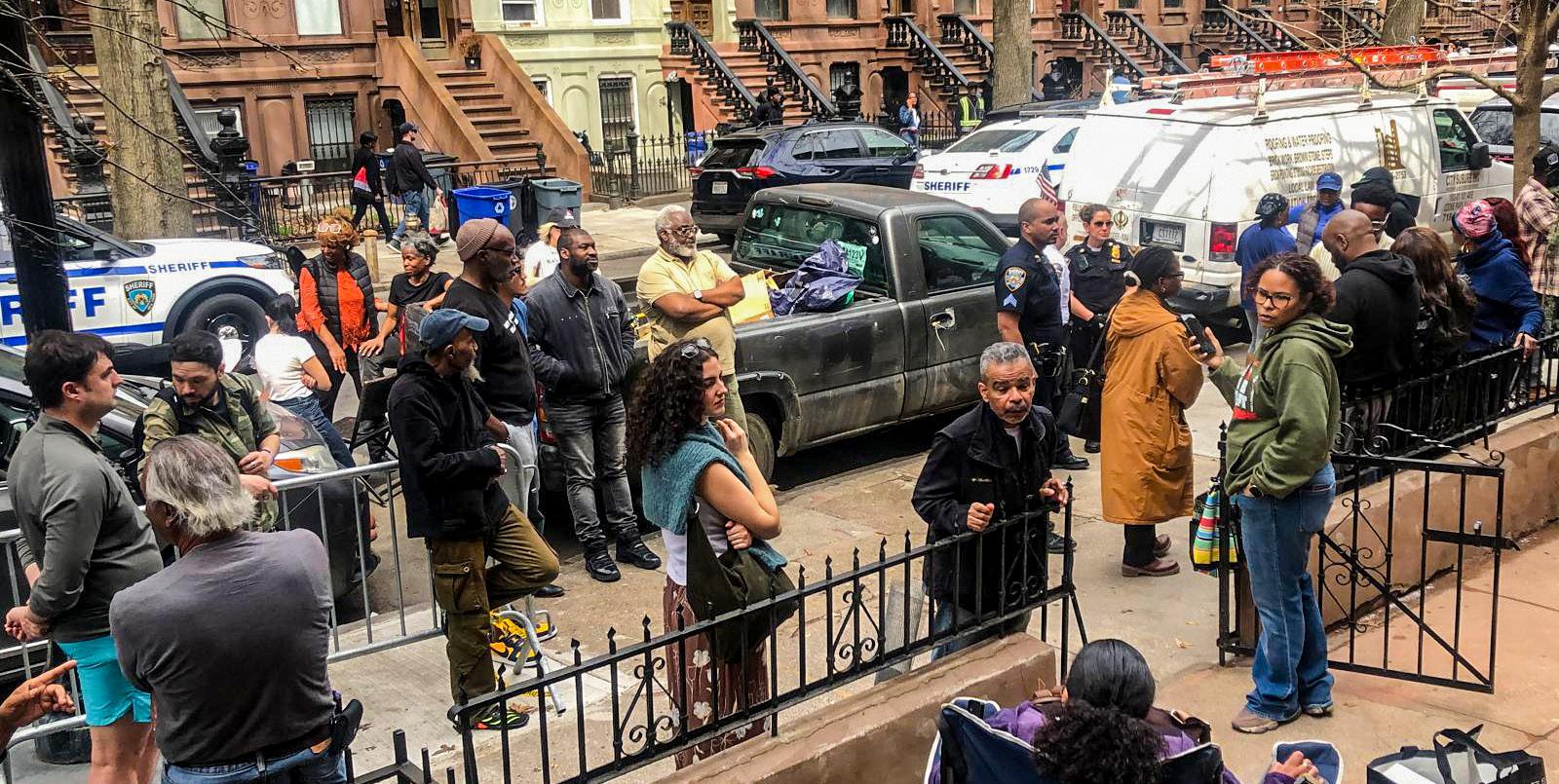
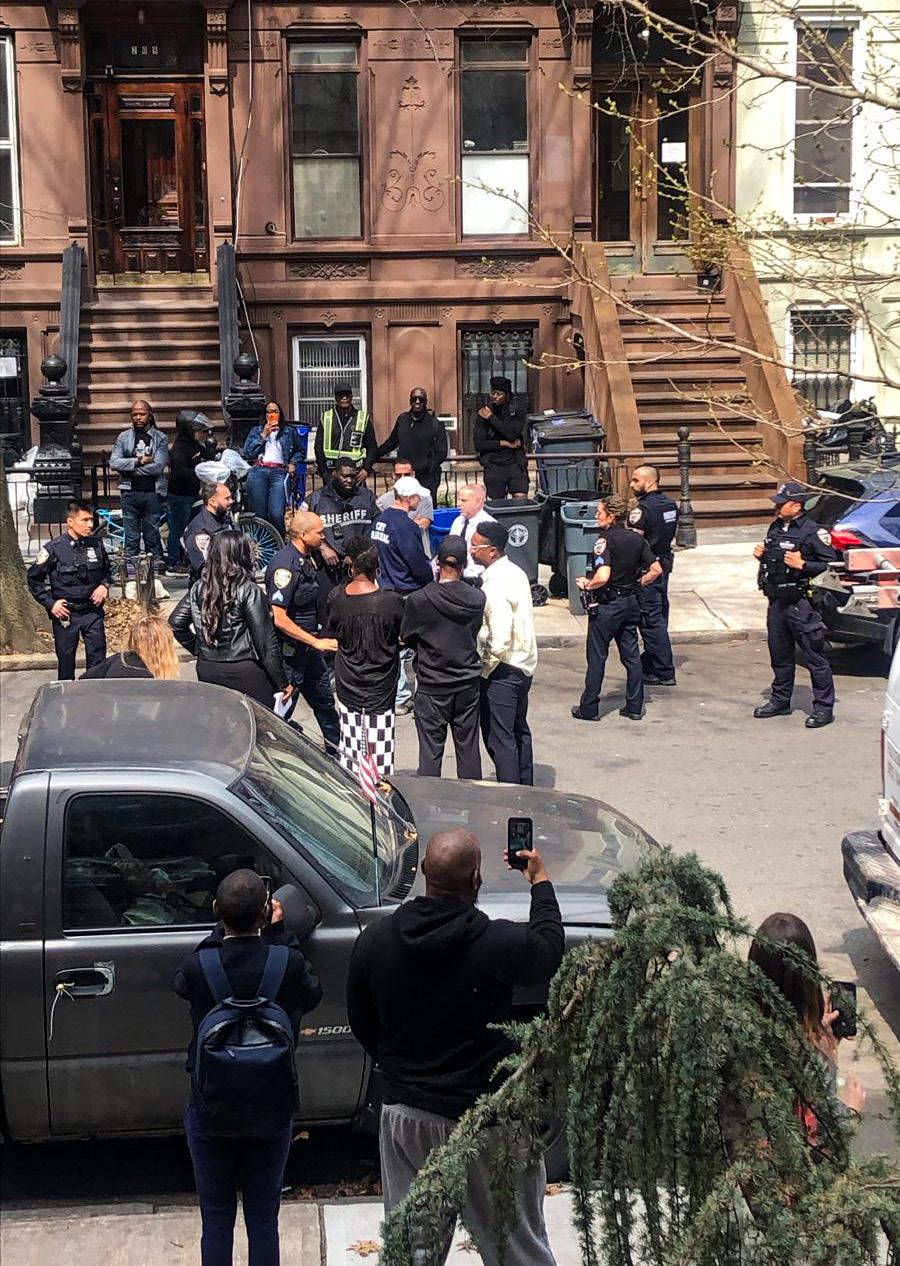
At 212 Jefferson Ave., friends gathered to support Carmella Carrington in her fight against an alleged illegal eviction attempt by a developer. (Ayisha Doyle photo)
By KAREN JUANITA CARRILLO Amsterdam News Staff
On March 31, the weather in Brooklyn’s Bedford-Stuyvesant neighborhood was warm — in the 70s; it should have been the perfect day to sit out on a stoop and talk with friends. It did start out that way at 212 Jefferson Ave., the friends who showed up to sit and talk were really coming to help defend the home’s owner, Carmella Carrington, who was preparing to fight off what she says is an “illegal
attempt by a developer” to evict her and her family from their property. Carrington said her family was facing an imminent eviction. She described how police cruisers, marshals, and a pickup truck loaded with plywood arrived, and were ready to board up her home. “They blocked off our street. The sheriff’s department blocked all the traffic so nobody could come up,” she said. The show of force included officers in bulletproof vests, despite no evidence of violence or weapons. “There was no threat … so to have that kind of level of response was,
it’s just, like, that anything concerning us, it seems that’s their normal response to us,” Carrington added.
Councilmember Chi Ossé arrived soon after and intervened with law enforcement to prevent a violent eviction. “I really do not want to see any violence, any type of violent eviction take place. I still believe that there should be some time for the courts to come to a decision on whether deed theft is taking place at this property,” Ossé told the Amsterdam News
High cost of living, diminished life expectancy mark NYC data revealing stark racial disparities
By ARIAMA C. LONG Amsterdam News Staff
New York City Mayor Zohran Mamdani hits his first 100 days in office this week. In the nick of time, his office released a longanticipated preliminary racial equity plan and true cost of living measure report, highlighting the gross disparities Black and Brown New Yorkers face.
This was developed by the Mayor’s Office of Equity & Racial Justice under new Commissioner Afua Atta-Mensah. It covers the city’s extensive Black history and centuries of discrimination, outlines how these systemic issues have continued to impact communities of color, and creates a framework for how to address these issues across 45 different city agencies.
“In terms of what we’re finding, the disparities are immense. It shows that while the cost of living crisis is affecting every New Yorker, the effects of that crisis are not applied evenly across the city,” said Mamdani in an interview with the Amsterdam News. The racial equity report found that the
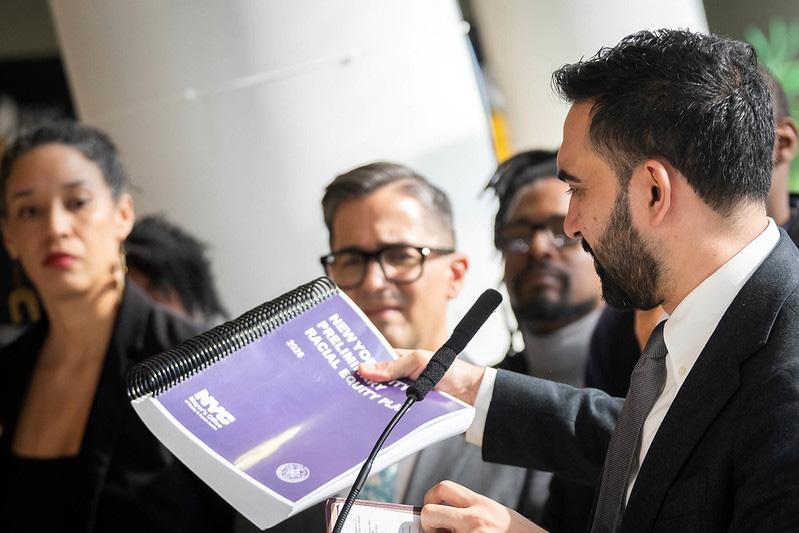
Mayor Zohran Mamdani releases the Preliminary Citywide Racial Equity Plan and the inaugural NYC True Cost of Living Measure, two reports that together establish a new framework for how New York City measures affordability, understands inequity, and plans for a more equitable future. Medgar Evers College, Brooklyn. Monday, April 6, 2026. (Ed Reed/ Mayoral Photography Office)
median household net worth of white New Yorkers is approximately $276,900, which is nearly 15 times greater than that of Black New Yorkers, at $18,870. That “alarming” gap is a result of deliberate policy choices and a lack of commitment to action for decades, even centuries, said Mamdani. Disturbingly, the report also found that
Black New Yorkers in particular have the lowest life expectancy of any racial or ethnic group in the city.
The true cost of living report further highlights how steep the affordability crisis has become, with about 62% of New Yorkers (about 5 million people) generally struggling
See DEED THEFT on page 36
Birthright citizenship: What a Supreme Court ruling could mean for us
By ARIAMA C. LONG Amsterdam News Staff
The U.S. Supreme Court began hearing arguments last week about birthright citizenship. If current guidelines are overturned, potentially hundreds of thousands of Black and Brown immigrants could be denied as American citizens from now on.
“All of us born in this country are Americans, as guaranteed by the 14th Amendment. That is the principle we defended before the United States Supreme Court,” said Cecillia Wang, national legal director for the American Civil Liberties Union (ACLU), who argued the case before the court on April 1. “I left the courtroom thinking about my parents and so many families who came here seeking refuge, opportunity, and the American way of life. We couldn’t be more confident that this unlawful, un-American executive order will be struck down.”
President Donald Trump issued an executive order on his first day in office last year that would deny birthright citizenship to all babies born in the United States after 2025 to parents without permanent legal status. This would widely affect many different groups, such as Deferred Action for Childhood Arrivals (DACA or Dreamers), who are undocumented young adults
from various Central and South American countries with “lawfully present” status in the country. According to the Migration Policy Institute’s data, there are 500,000 active DACA recipients from countries like Mexico, El Salvador, Guatemala, and Honduras in the U.S. as of 2025.
The ACLU of New Hampshire, Maine, and Massachusetts, as well as the Legal Defense Fund, Asian Law Caucus, and Democracy Defenders Fund, immediately filed a nationwide class action lawsuit, Barbara vs. Trump, to block Trump’s order. Federal courts also blocked the order as unconstitutional based on the 14th Amendment, which was ratified in the Constitution in 1868 to give former Black enslaved people birthright citizenship as “whole” persons if they were males aged 21 and older.
Ashley Burrell, senior counsel at the Legal Defense Fund, said the 14th Amendment was a direct repudiation of the infamous Dred Scott vs. Sanford decision, which ruled that slaves were considered protected property and not people in 1857. Burrell added that there was an influx of Romani and Chinese immigrants to the U.S. and the framers of the 14th Amendment argued about their status as citizens at the time.
“They were not only addressing the status of former slaves, but they were also seeking to remedy decades of injustice imposed on
free people born in the United States, ensuring that free Black Americans — those who had never been enslaved — would also still be considered a citizen,” said Burrell. “Also to clarify that anyone, irrespective of color or background, if born on U.S. soil, would be a citizen.”
In an unprecedented move, Trump himself attended the opening arguments on
April 1. He “slipped” into the public viewing section of the courtroom, stayed to hear his solicitor, and left shortly after Supreme Court Justice Ketanji Brown Jackson questioned the validity of the order and logistically how it would be carried out.
“Interestingly, some of the drawings weren’t actually, I think, fully accurate because he
See BIRTHRIGHT on page 35
Correction officer found guilty of manslaughter in prison beating death of Messiah Nantwi
By TANDY LAU Amsterdam News Staff
An Oneida County jury convicted former correction officer Jonah Levi last week for participating in the deadly beating of Messiah Nantwi, a Harlem man incarcerated at the medium-security Mid-State Correctional Facility. The incident took place in March 2025, when at least 18 prison staff members allegedly punched, hit, and stomped on the 22-year-old or stood by and watched, similarly to the murder of Robert Brooks roughly four months before this incident.
“It won’t bring Messiah back, but I haven’t really slept since this happened,” said Patterson Nantwi, father of Messiah Nantwi.
“Maybe this is a step toward me getting some rest.”
Levi was found guilty of most charges in addition to the top murder charge: firstdegree manslaughter, first-degree gang assault, second-degree gang assault, fifthdegree conspiracy, and first-degree offering of a false instrument for filing in connection with the death. He reportedly faces up to 25 years in the same state prison system he once worked for.
“Messiah Nantwi should be alive today,” said Gov. Kathy Hochul in an emailed
correction officers’ strike. Hochul and Department of Corrections and Community Supervision (DOCCS) Commissioner Daniel Martuscello ultimately moved to suspend or fire many of the officers allegedly involved in the killings. Advocates spent last year urgently demanding reforms from passing an oversight package to bolstering release mechanisms like parole, resentencing, and clemency.
Several other corrections officers still face trial for Nantwi’s death, while a handful pleaded guilty to their charges last year, largely for covering up the incident or in exchange for testifying. A total of 10 guards, including Levi, were indicted.
statement. “I have been clear that anyone responsible for his death must be held accountable to the fullest extent of the law. My thoughts are with his family, and we will continue strengthening safety, security, and transparency within our correctional system to keep everyone safe from harm.”
Brooks and Nantwi’s deaths sent shockwaves early last year over the state’s prison conditions, but coincided with an illegal
The civil rights law firm of Emery Celli Brinckerhoff Abady Ward & Maazel LLP (ECBAWM) and attorney Owen Lamb filed a federal lawsuit on behalf of Nantwi’s estate last June. According to the lawsuit’s court documents, Levi was allegedly placed on a year-long disciplinary evaluation after allegedly beating another incarcerated man. The filing also alleges that Commissioner Martuscello was “aware of the specific risk of serious harm posed by Defendant Levi.” Lamb feels the ruling helps restore faith in the system, especially with the Utica See MESSIAH NANTWI on page 35
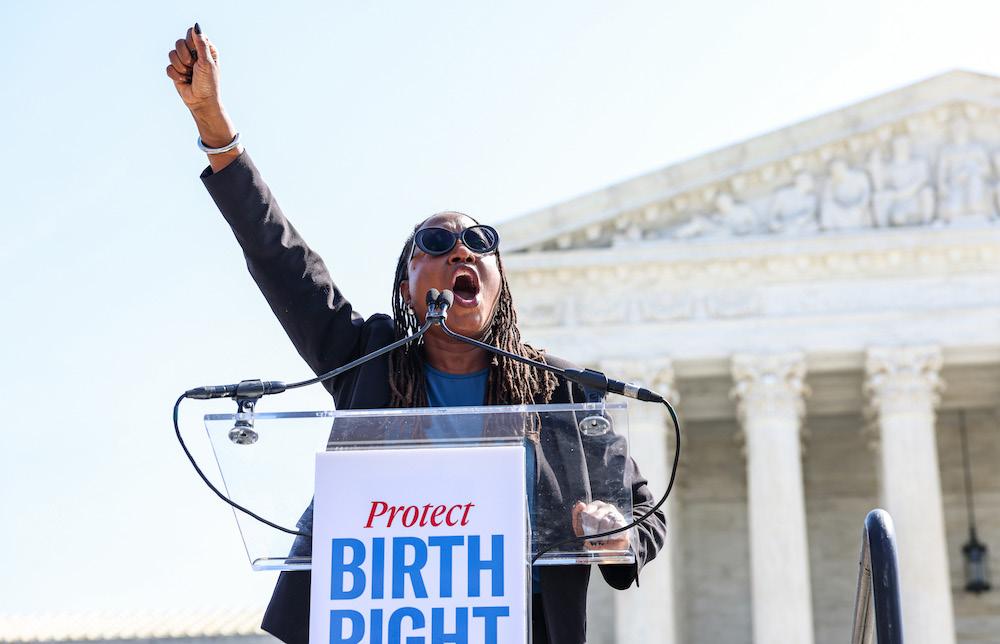
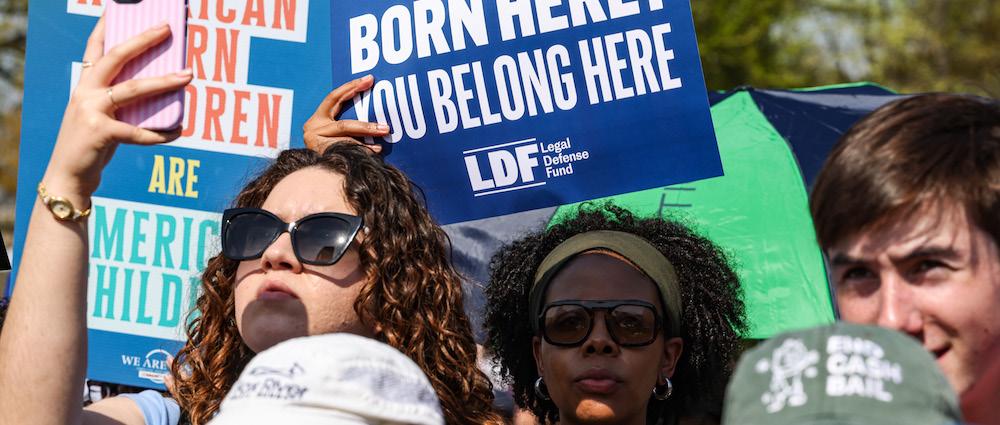
Janai Nelson, president and director-counsel of Legal Defense Fund (LDF) at rally for birthright citizenship in front of Supreme Court on April 1, 2026. (Photo contributed by Legal Defense Fund. Photographer Valerie Plesch)
Messiah Nantwi. (Photo courtesy of Messiah Nantwi’s Family)
Black-led nonprofits didn’t see the lasting funding boosts promised after 2020’s racial reckoning
By JAMES POLLARD Associated Press
NEW YORK (AP) — The racial reckoning that followed George Floyd’s murder in 2020 carried hopes of new support for disproportionately underfunded, Black-led nonprofits. American companies stepped up donations to historically Black colleges and universities. Major climate funders pledged to give more toward minority groups. Large donors sought to narrow the racial wealth gap.
But new research released Tuesday shows that such financial gains for many Black-led nonprofits were short-lived, if they happened at all.
A subset of large, Black-led nonprofits saw only temporary funding increases between 2020 and 2022, according to the analysis by nonprofit research service Candid and Black philanthropy group ABFE. Smaller organizations saw no significant change.
The pattern of disinvestment put many community groups at a greater disadvantage when President Donald Trump’s policies curtailed funding for diversity, equity, and inclusion. The nonprofit sector’s struggles deepened as the administration threatened a range of social service programs, left future grants uncertain by cutting agency staff, and chilled racial justice funding through anti-DEI executive orders.
Black Voters Matter co-founder Cliff Albright noted these community nonprofits are the same ones now tasked with helping more and more low-income families deal with spiking healthcare costs and rising food prices.
“We’re literally being asked to do more with less resources,” Albright told The Associated Press Small, Black-led nonprofits tended to have to rely on new rather than continuing funders, losing out on transformational relationships that sustain their longer-term goals and cushion them through challenging periods. These small organizations — those with annual expenses of $1 million or less — got just over one-third of their funding from continuing supporters, according to the report.
The dynamic rang true for a South Side Chicago group serving a predominantly Black neighborhood among the city’s most impoverished. Asiaha Butler, the CEO of the Resident Association of Greater Englewood, cofounded the non-
profit more than 15 years ago to empower her neighbors to combat their area’s negative narratives.
That mission had a handful of consistent backers. But summer 2020 brought more than two dozen new funders.
“All of a sudden, we were desirable for people to fund,” recalled Butler, adding the “spurt” became a “curse” as the quick infusion of capital tapered off.
“We started seeing this revenue and thinking we’re gaining really great relationships with funders,” she said. “And, really, those priorities shifted quickly.”
Lacking
relationships
Foundations lacked relationships with Black organizations of any scale prior to 2020, according to ABFE CEO Susan Taylor Batten.
Black philanthropy professionals say that distance created a scramble when protestors demanded businesses and philanthropies address systemic racism.
Kia Croom, whose fundraising firm works with nonprofits in Black communities, said her clients received more funding than ever from corporations. Some hired additional development staff to meet the demand — and then underwent layoffs when funds disappeared.
“It was just a very transactional gift at best,” she said.
Positive Results Center CEO Kandee Lewis oversees a Los Angeles nonprofit assisting survivors of domestic violence and other harms.
It was wonderful, she said, to receive checks from new supporters. But oftentimes, the support turned out to be a one-time donation rather than
the beginning of a relationship.
Lewis felt the funding came only because her group was Black-led — not because funders understood its work.
“They were so busy trying to figure out who was who that they didn’t really take time to get to know people,” she said.
Limited networks
Jaleesa Hall knows philanthropy is a relationship game.
She heads Raising A Village Foundation, which aims to advance educational equity through tutoring programs. She didn’t have many high-net-worth members in her network when she founded the Washington, D.C. nonprofit more than six years ago.
That circle made it difficult to catch the attention of foundations, which she said “haven’t really cracked” how to find potential grantees outside of their existing web of connections.
“Small, Black-led nonprofits simply aren’t in those rooms to begin with,” Hall said.
Most of their foundation grant dollars came from first-time funders, according to the report.
Cathleen Clerkin, the associate vice president of research at Candid, said the nonprofits’ work is made even more challenging by the “song and dance” necessary to secure long-term investment every year.
“They’re just constantly going on first dates with new funders and hoping that somebody will invest in them and understand them,” she said.
Small nonprofit leaders are so fo-
continuing funders than their nonBlack counterparts. Only one-third received general operating support, compared to just over half of other nonprofits.
“We are still seeing remnants of bad practice when it comes to investing in Black communities,” Batten said. “There’s just no way for a foundation to move its mission for communities in this country, let alone Black nonprofits to move theirs, if we do not evolve this sector.”
cused on day-to-day upkeep and financial viability that they don’t have time to attend networking opportunities or money to fly out for national convenings.
T’Pring Westbrook, a nonresident fellow at the Urban Institute’s Center on Nonprofits and Philanthropy, co-founded a consulting group that works with small nonprofits. The problem isn’t that foundations don’t want to support marginalized communities, she said, but that they do so through “trend funding.”
“Maybe during Black History Month there will be a funding campaign,” she said. “But the thing about a campaign is a campaign doesn’t build sustainability.”
Restrictive practices
Small nonprofits say they face additional barriers, regardless of race, including grant eligibility requirements. And limited staff may prevent qualifying organizations from keeping up with foundations’ required weekly or monthly reports on the status of projects they’ve funded.
“It ends up feeling like a burden,” Hall explained. “The juice isn’t worth the squeeze.”
Philanthropy has seen a sector-wide shift towards trust-based models that offer general operating support and multi-year grants, acknowledging nonprofits’ expertise on how to best fulfill their missions. But Batten, the ABFE leader, said Black-led nonprofits generally have not reaped the benefits of those best practices.
The report showed Black-led nonprofits had significantly fewer
‘Pulling teeth’ in Chicago Butler, the Chicago neighborhood association leader, hears excuses now from supporters who gave at the height of the 2020 racial justice movement: “Priorities have shifted,” they tell her, or there are “new strategic goals.”
“Little buzz words that just say perhaps this nonprofit — grassroots, Black-led, very focused on the Black population — is probably just not in people’s cards to continue to support,” she said.
That downturn delayed a nearly $7 million capital project building off their economic justice work after the post-George Floyd civil unrest. An 8,800-square-foot (817 square-meter) building would include a dine-in restaurant and another Black-owned business. One tenant would provide workforce development trainings. Her goal is to strengthen Englewood’s economic and social fabric through a thriving Black business district. By 2023, she had secured a $1 million grant — her nonprofit’s largest — to start the project. But she compared her search for additional funding to “pulling teeth.” Past philanthropic partners withheld support. Their prospects weren’t good.
She’s turning to public funding. The City of Chicago provided a $2.5 million grant and Butler said another $1.5 million state award is pending.
“Things shifted and so we didn’t want to start soliciting for a capital campaign,” she said. “The timing was off.”
Associated Press coverage of philanthropy and nonprofits receives support through the AP’s collaboration with The Conversation US, with funding from Lilly Endowment Inc. The AP is solely responsible for this content. For all of AP’s philanthropy coverage, visit https:// apnews.com/hub/philanthropy.
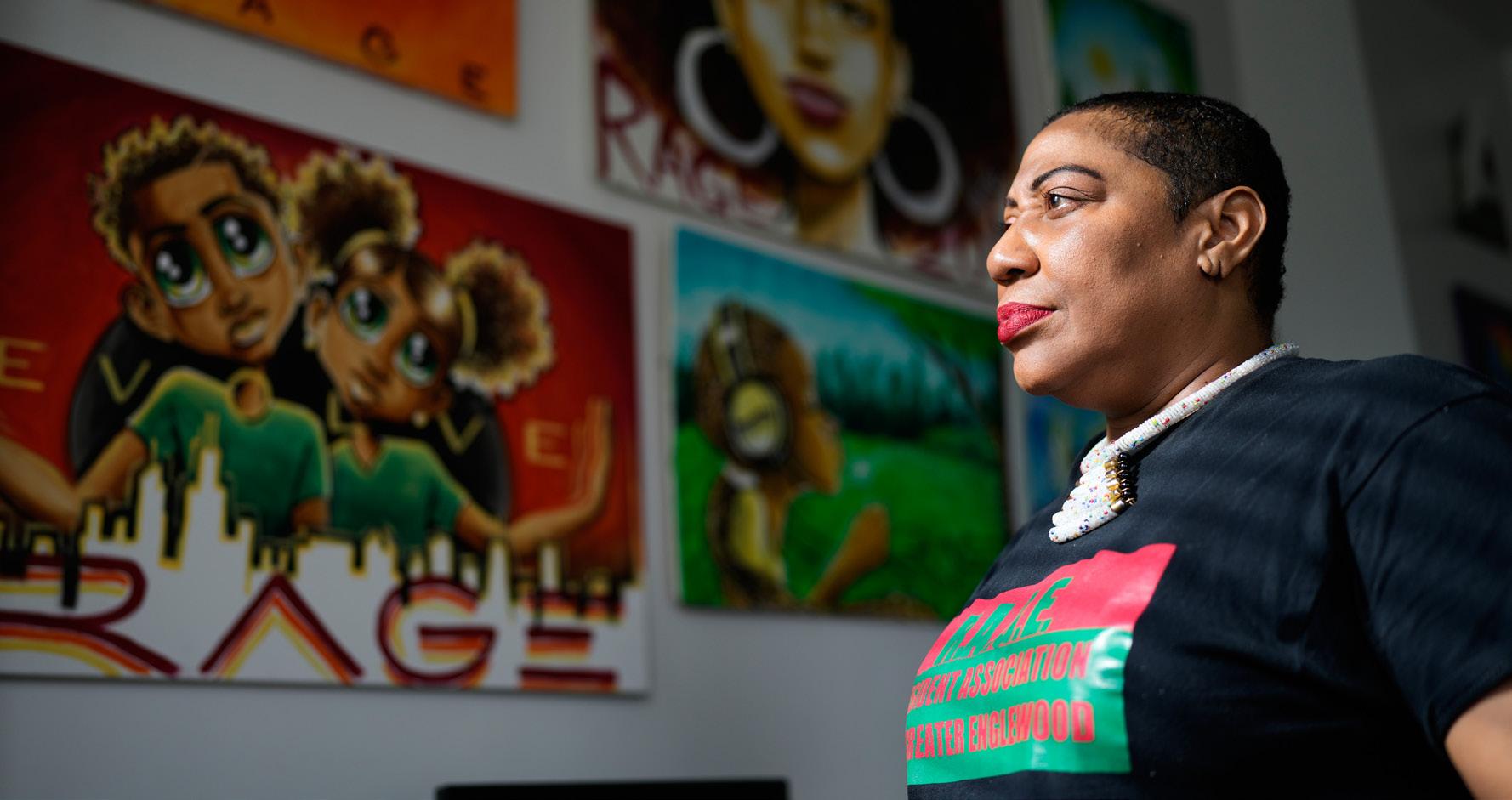
Asiaha Butler, the co-founder of the Resident Association of Greater Englewood, looks outside from her office in Chicago. (AP Photo/Nam Y. Huh)
Larry Nickens talks Harlem brand and youth development org
Black
New Yorker
By JASON PONTEROTTO Special to AmNews
When Larry M. Nickens worked as a stockbroker in the early 2000s, he was asked what he would do with his first million, to which he replied that he would make Harlem great again. He has remained committed to that mission, describing his work as being an “enforcer of goodwill in the community.”
Today, Nickens, 61, and his daughter, Aaliyah, 23, are all about empowering the Harlem community and beyond — particularly the youth. In 2022, the two established a nonprofit, Heir B&B Best & Brightest Academy, which provides youth vocational and professional development training. Nickens is the executive program director, while Aaliyah is the director of campaigns, and they work with a larger team.
“We didn’t give them the requisite infor mation they needed, and then we didn’t give them the example. Where’s the busi ness ownership? Where are the core values as adults that we’re supposed to be living, that our children see us doing instead of talking about?”
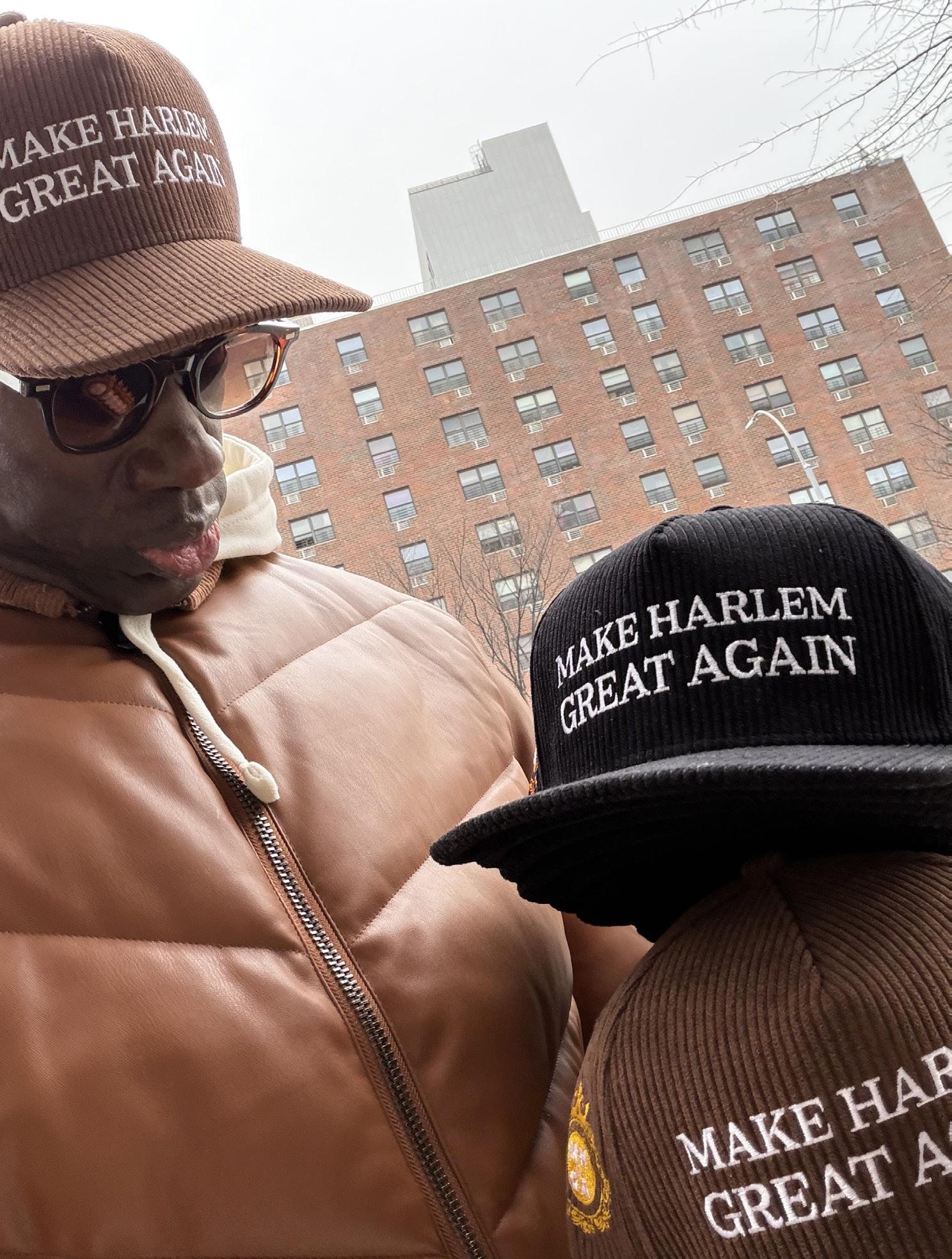
The two also run a street apparel compa ny, Goody Graphics, and created the “Make Harlem Great Again” brand campaign, which comes in hoodies and hats. The brand launched last summer and has been grow ing in immense popularity in the last sever al months. Nickens serves as senior designer for the company. Apparel can be purchased through their website and also through Cap USA, a longtime Harlem hat company, cel ebrating 30 years. Nickens can be found making connections locally and has collab orated with groups like Defend Harlem. See BNY on page 25
“When you empower younger people, you’re adding value to the community. …A lot of the chaos we have is coming from our younger people, not because they’re bad. We’re not positioning them,” Nickens said.
Larry Nickens in front of CAP USA in Harlem wearing his “Make Harlem Great Again” hat. (Courtesy of Larry Nickens)
War in Iran
Conflict in the Middle East, a reminder of the historic cost to Black servicemembers
By JIMMIE BRIGGS Special to the AmNews
As a New Jersey teenager, Kyle Bibby watched in disbelief as the World Trade Center was struck down by two planes on September 11, 2001. Inspired by the bravery of first responders at Ground Zero and the initial phase of the U.S. military’s “War on Terror,” Bibby pursued acceptance into the United States Naval Academy, and following graduation, went on to become a commissioned Marine Corps infantry officer in Afghanistan.
But now, nearly 25 years after the 9/11 attacks on the United States — and no longer in active or reserve military service — Bibby, 40, is frustrated by the escalating rhetoric and aerial bombings by the U.S. in Iran.
“It’s a real bitter pill to swallow to just watch us walk into another aimless, strategically undefined war,” he said, as a co-founder and leader of the Black Veterans Project, a nonprofit organization founded in 2018 to address discrimination against Black veterans. “We need to have more of a conversation about the resources lost by our communities. There is an element of injustice and moral injury here.”
As the United States nears completion of its sixth week of assaults on Iran, Black Americans — veterans in particular — are grappling with the specter of another looming ground war. President Donald Trump, on April 7, agreed to a two-week ceasefire while the Strait of Hormuz is opened up under tight Iranian oversight, but that does not mean the future threat of further violence has disappeared, and neither has the risk for service members.
Black people have consistently fought for America with distinction and dignity, without betrayal, even when the promise of doing so was never fulfilled and its veterans’ legacy of heroism repeatedly challenged.
To be sure, all active duty servicemen and women who face the ever-present reality of watching their friends and colleagues deploy — or even themselves — to high-risk environments, including and beyond Iran, continue to maintain resolute dedication to their assignments regardless of interior reflections.
The U.S.-Israeli air war against Iran that began on February 28, 2026, has already killed at least 15 U.S. service members and an estimated 3,500 or more civilians across the region, including over 1,600 documented civilian deaths in Iran alone from strikes on schools, hospitals, and urban neighborhoods, according to organizations such as Human Rights Watch.
In the second Trump administration, the Pentagon has scrubbed walls once lined with images of Black heroes — Tuskegee Airmen, Montford Point Marines, Vietnam veterans
whose service was long ignored — replacing them with a sanitized, whitewashed version of military history. DEI programs and cultural awareness training have been unceremoniously gutted. Black History Month has been dropped from official calendars, while promotions for Black officers have stalled under Defense Secretary Pete Hegseth, whose interventions have blocked or delayed the advancement of senior Black leaders.
A 20-year Air Force veteran on active duty in the years between the Gulf War and post 9/11 period, “Kevin” [who agreed to speak to the AmNews on condition of anonymity] recalls having experienced bias and explicit racism on active duty, and as a veteran.
“There were definitely times I was marked down in my evaluations which kept me from advancing as an NCO (non-commissioned officer). When I would question the reasoning, none of my superiors could ever give me a clear, honest answer. On deployments overseas throughout Asia and other parts, I regularly had to face hostile environments [within the military ranks]. Now, as a civilian employee with the military, mostly white officers have a hard time accepting
you as a civilian, and want to treat you as a lower-ranking person, even though you’re no longer a soldier,” he shared.
“It seems like we’re in a situation with Iran pointing to destruction on some level on all sides,” continued Kevin. “There’s so much bitterness, hatred. Americans suffer, Iranians suffer. We need to lean into solutions for ending the fighting and pulling back.”
For Black soldiers, the words and actions of a Pete Hegseth are searing reminders that true belonging in America’s military is conditional, impermanent, and can be denied at critical moments in the country’s journey, “which is why we’re envisioning a ‘1619-like’ project to acknowledge and educate people about the Black veteran experience,” said Bibby, seasoned in building impactful campaigns on behalf of organizations such as Color Of Change, and others.
show about six in 10 Americans believe that the strikes have “gone too far” and will make the U.S. less safe in the long run. Decades of research on American wars — from Vietnam to Iraq — show a persistent race gap in which Black Americans are significantly less supportive of overseas military force than white Americans, spurred by a higher sensitivity to casualty rates as well as an experiential belief that wars fought in the name of “liberation” rarely if ever reflect the realities for people of people of color in America.
Black commentators and non-profit organizations in this period are framing the Iran war in terms of “empire” and “racialized state violence,” part of a storied tradition of Black antiwar resistance extending from the World War II “Double V” campaign to Rev. Martin Luther King Jr.’s denunciation of sending Black men to Vietnam, inspired by Coretta Scott King’s greater vocal advocacy for peace in Southeast Asia.
“I think World War II lives so large in American mythology because it was a time where we could clearly see that we were ‘good guys,’” noted Bibby. “I think the entire political identity of the United States grows outward from that point. But even in that instance, Black service members still faced horrible segregation in the military and outright racial terrorism when they came home. For that era, I think of the Joe Lewis quote: ‘Lots of things wrong with America, but Hitler ain’t going to fix them.’ No matter [Blacks were] serving honorably in the largest war in world history, where the U.S. became a world power, we still came back to American fascism.”
Patriotism Unreciprocated
Public opinion continues to mushroom against the war in Iran. A Pew Research survey in late March found 59% of Americans saying the U.S. made the wrong decision to use force in Iran and 61% disapproving of President Trump’s handling of the conflict, while Reuters/Ipsos and APNORC polls similarly
Data shows that Black Americans serve at disproportionately high rates — 17% of the armed forces despite being 14% of the population, as the Carnegie Endowment for International Peace has documented — and that service is often motivated by opportunity, mobility, and a desire to claim full citizenship in a nation that has not always reciprocated that loyalty. As one 2023 Syracuse University study highlighted, 89% of Black service members say joining the military was a good decision, and 93% report pride in their accomplishments, even as many leave the ranks facing steeper financial and employment challenges than their white peers. “Lost faith or trust in military or political leadership” was tied as a primary motivation for Black veterans retiring from the military, a revealing signal of the gap between individual honor and institutional betrayal.
As Princeton University professor Naima Green-Riley argued in a 2024 essay, “The Race Gap That Shapes American Views of War” for See story on next page
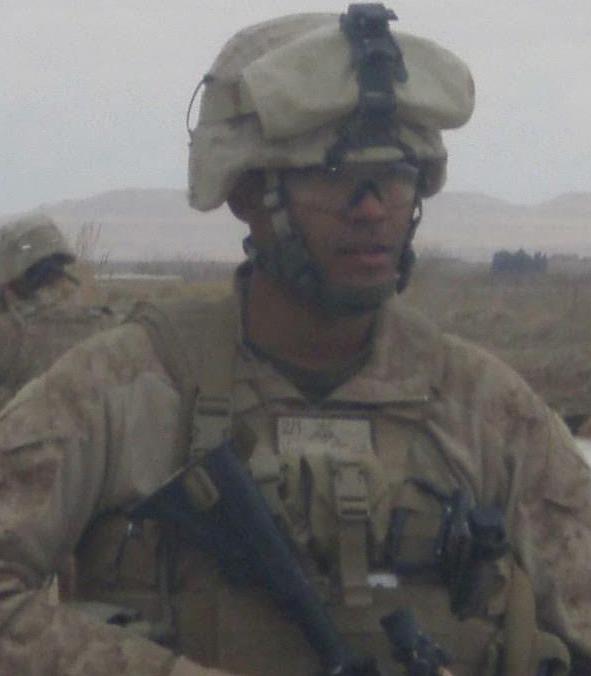
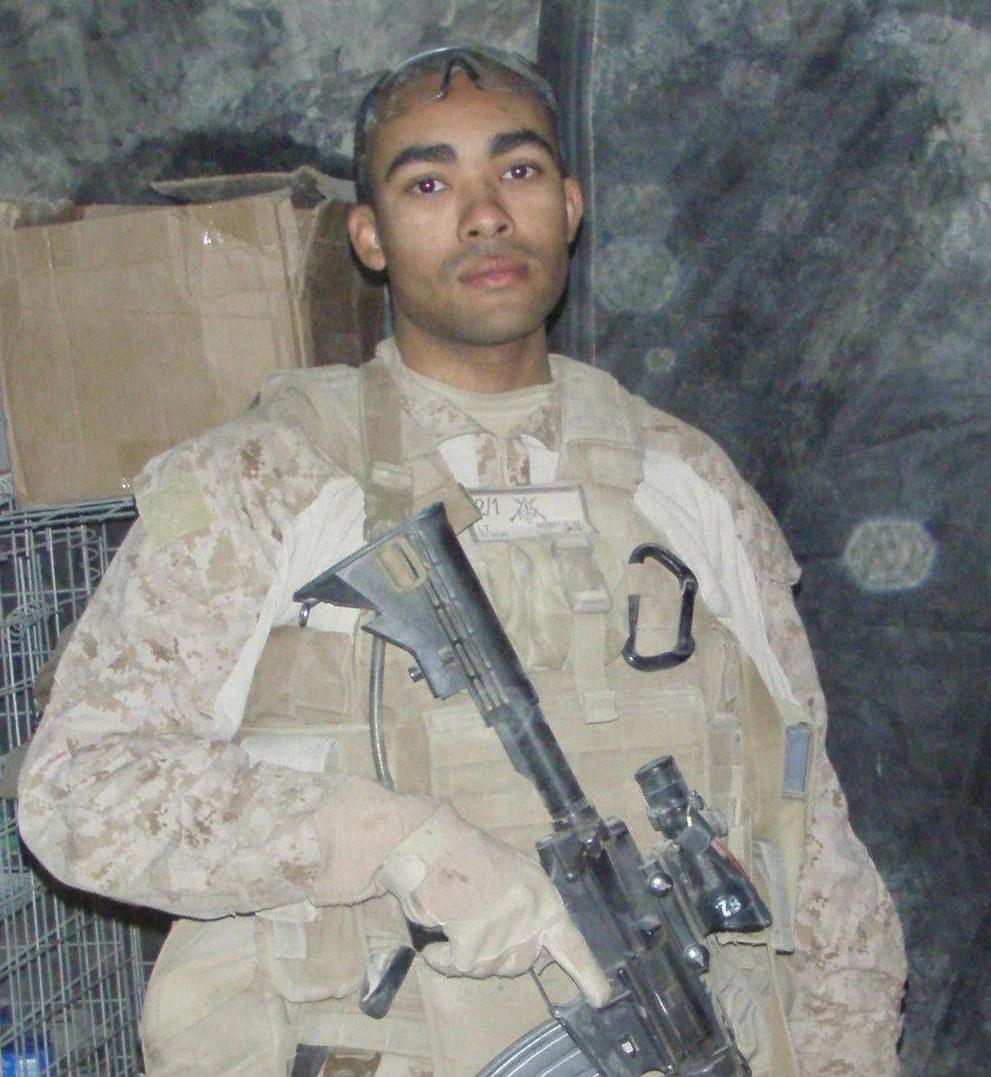
Black Veterans Project co-CEO and cofounder Kyle Bibby in Afghanistan as a commissioned Marine Corps officer. (Photos courtesy, Kyle Bibby)
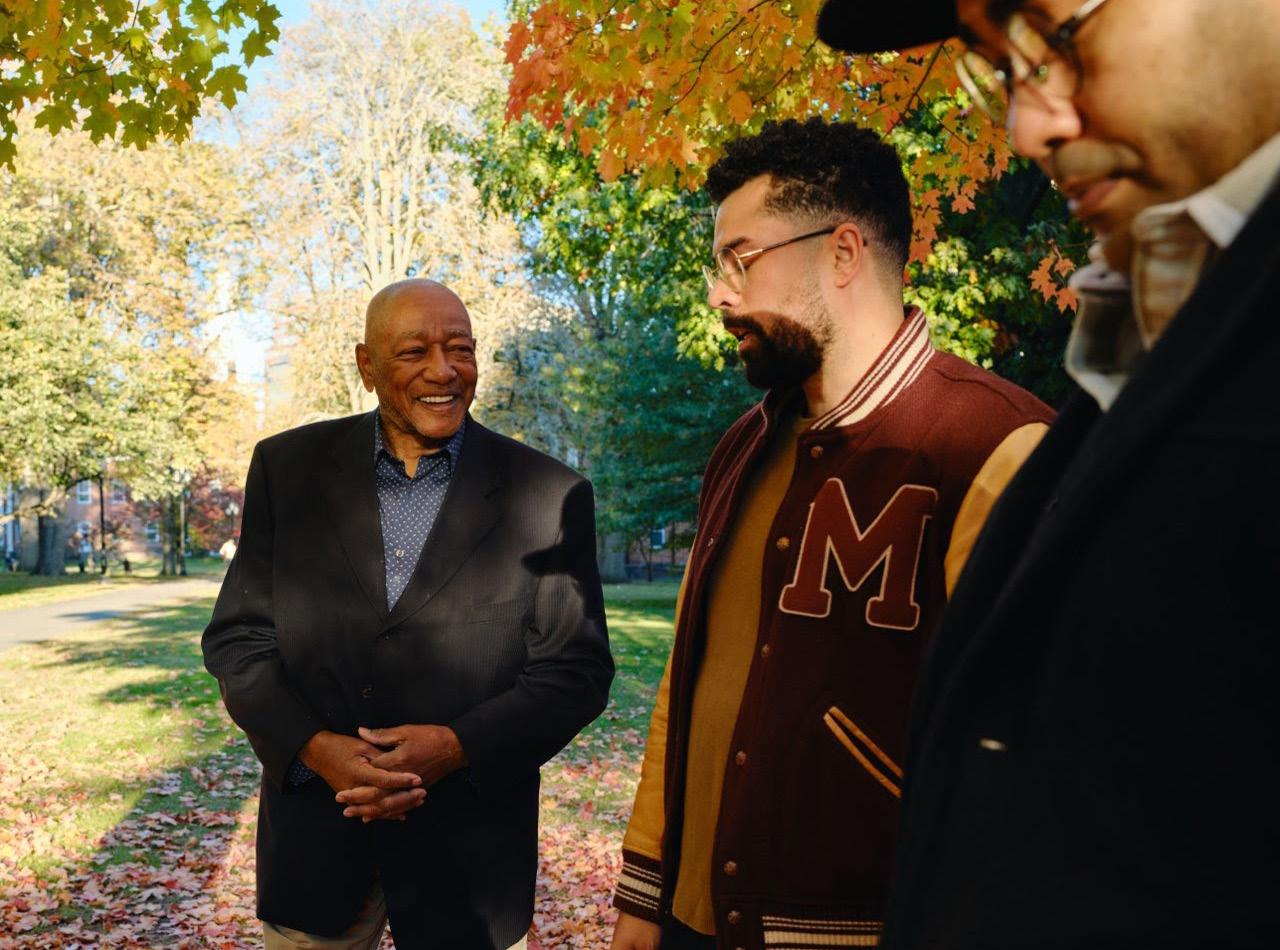
Conley Monk, a Vietnam War veteran at the center of an historic lawsuit against the United States meets with Black Veterans Project co-founders Richard Brookshire and Kyle Bibby, themselves veterans.
Foreign Affairs, Black Americans have long been “more skeptical than others about the use of U.S. military force abroad,” a skepticism rooted in history and lived experience. Polling on Iraq showed Black Americans were about 30% less likely than white Americans to support the war, driven in part by what Green-Riley and co-author Andrew Leber call “greater casualty sensitivity” — the knowledge that Black troops have often “borne an unfair burden in the fighting.” That unease persists as Black Americans are markedly less supportive of troop deployment to Ukraine, Taiwan, or the Middle East than the national average.
Two recently published books by journalist Wil Haygood and historian Matthew F. Delmont are compelling reminders that the Vietnam War was never just a foreign conflict for Black America — it exposed the existing fissures between national obligation and national betrayal. Haygood’s “The War Within a War” (Knopf) resurrects the stories of Black soldiers who fought two battles at once: one in the jungles of Southeast Asia, and another against the racism that stalked them from basic training to the VA hospital. Delmont’s “Until the Last Gun Is Silent” (Viking) widens the frame, showing how Black communities — mothers, clergy, activists, veterans — saw Vietnam not as an abstract geopolitical chess match but as a siphoning of Black life, Black labor, and Black possibility. The same questions that stalked the Black community then, as well as its soldiers and veterans, are coming to bear now: Who will be sent first? Who will be asked to sacrifice the most? And what, if anything, will our communities gain in return?
Bobby McRath understands better than most the costly folly of entering into war without clear objectives, having retired after four years of active duty in the Navy and 20-plus years in the Reserves. As an 18-year-old high school graduate, he voluntarily enlisted in the U.S. Navy after a dream one night. In Vietnam, McRath was an E5 on a Patrol Craft Fast (PCF) — more popularly known as a “swift boat” — part of John Kerry’s squadron patrolling coasts and riverways, though not on the same boat. Returning to the States wasn’t easy. “The Black guys that didn’t go to Vietnam were saying to me that I had been killing babies, or that I should’ve died over there,” McRath, 79, recalled. “It was rough because they didn’t understand the war. I felt mistreated when I came home.”
As Naima Green-Riley wrote in Foreign Affairs, Black Americans remain “more skeptical than others about the use of U.S. military force abroad,” shaped by a long memory of disproportionate casualties, broken promises, and the knowledge that wars waged in the name of democracy rarely deliver democracy at home. Haygood and Delmont, in their respective books, also show that Vietnam taught Black America to read war not through presidential speeches but through lived experience — and that lesson, painfully earned, is guiding how Black Americans are interpreting the drumbeats by American Hawks around Iran
now. Black veterans have lived with a bitter paradox for generations: they serve this country in disproportionate numbers but come home to systems that deny them benefits meant to ease their transition into civilian life. After leaving the military, McRath clashed
with the VA for years to receive the full disability benefits he was owed as the department declined to offer more than 50%. It was only when he reached out to then-presidential candidate, Sen. John Kerry, who intervened with the VA on his behalf, that McRath got the support he’d earned. Since then, “I’ve been treated nice,” he shared one evening from St. Louis.
The inequities stretch back to World War II and the GI Bill, where Black veterans received, on average, only 40% of the value of benefits granted to white veterans, as documented by researchers at Brandeis University and highlighted by the Iraq and Afghanistan Veterans of America.
The Black Veterans Project (BVP) was originally intended to be a narrative hub for preserving the historical narratives of veterans back to World War II, but soon enough began to focus on responding to the persistent benefit inequities endured by Black veterans, as well as their erasure from historical memory. BVP’s partnership with Yale Law School’s Veterans Legal Services Clinic
produced the breakthrough Monk v. U.S. case, which forced the Veterans Administration (VA) to release decades of internal data showing that Black veterans were 21.9% more likely to have disability claims denied than white veterans. That disclosure has reshaped discourse on reparations, military equity, and federal benefits. To date, the Black Veterans Project has done four seminal reports on systemic racism in the VA.
“I think the biggest divide between younger and older generations is a sense of solidarity towards people who are not Black as military members and veterans, “ explained Bibby. “Black Veterans Project has spoken out against the transgender ban in the military and supports LGBTQ rights across the board. We’ve had some older generations of black veterans tell us that we should only focus on Black issues.
“This ignores that Black veterans have intersectional lives. So when we speak about gay and transgender veterans, we are also protecting the Black veterans who are gay and transgender. Our opposition in civil rights often seeks legal precedent to exclude one group and then expands that to other groups later,” Bibby continued. “Any attacks against gay and transgender service members can eventually be expanded to include Black service members. That isn’t an exhaustive experience, though. Most of the [older] veterans we’ve met are living through the exact same things that we live through and completely share our values — they’re just one generation ahead of us.”
Jimmie Briggs is a Baltimore-based journalist and author of “Innocents Lost: When Child Soldiers Go to War” (Basic Books). He’s currently researching a book on masculinity in the 21st Century.
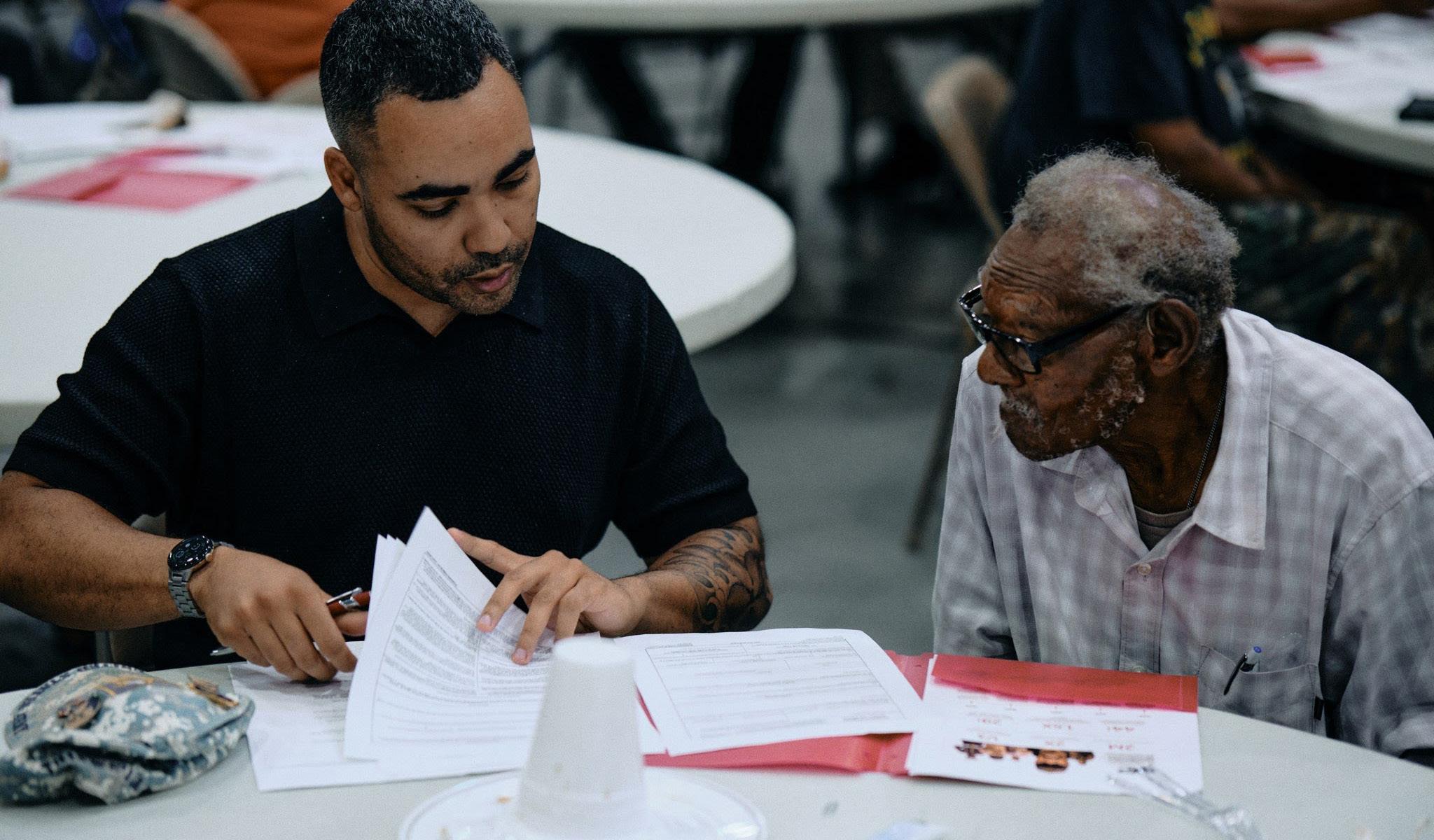
An elder Black veteran in Mississippi in discussion with Kyle Bibby during a Black Veterans Project field event in the state.
Marine Corps Lt Kyle Bibby next to a helicopter in rural Afghanistan.
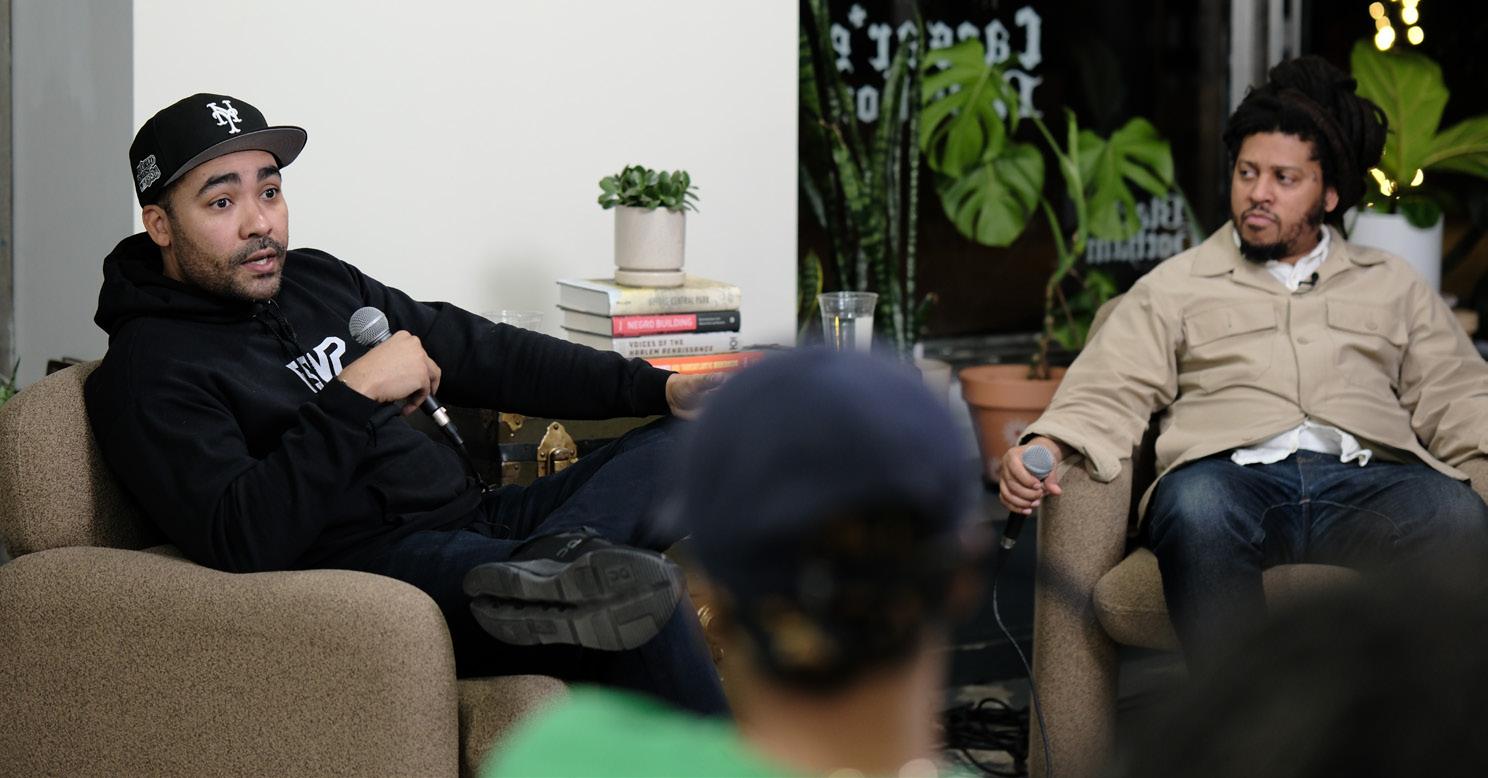
Bibby speaking at a veterans event at the Black Gotham storytelling project in Lower Manhattan.
Brooklyn Democratic district leaders navigating controversy as elections approach
By ARIAMA C. LONG Amsterdam News Staff
Scandal and federal investigations among prominent Black Democratic leadership in Brooklyn erupted last week, casting real concern about the state of the county’s party. But district leaders, who are all up for reelection this year, seem determined to push on.
So far federal prosecutors are circling Councilmember Farah Louis; her sister, Debbie Louis, who is Gov. Kathy Hochul’s assistant secretary of New York City Intergovernmental Affairs; and lobbyist Edu Hermelyn, who is the husband of Brooklyn Democratic Party Chair and Assemblymember Rodneyse Bichotte Hermelyn as well as a former senior advisor in the city’s Department of Social Services under former Mayor Eric Adams.
The elected officials are not specifically named in the indictment and arrest of four men in March in connection with the bribery scheme to funnel millions in city contracts into a migrant shelter provider and steal $1.3 million from the organization, according to The Associated Press, but their phones were seized. As a result, Debbie Louis was placed on leave from the governor’s office, and Hermelyn resigned from his position at Mercury PR Firm. The Amsterdam News reached out to Bichotte Hermelyn’s office, but officials declined to comment.
Anthony Beckford, the District Leader for the 43rd Assembly District and Male State Committee Member, has always been outspoken about the need for change and transparency. He just completed petitioning to get his name on the ballot and is gearing up for the June primary. In the past, Beckford has aggressively run against Louis for her city council seat in District 45 and lost in 2021, 2019, and 2017. He also ran against Bichotte Hermelyn in the 42nd Assembly District and lost in 2018.
Beckford said, regardless of what happens at the top, “the party is the district leaders” and is adamant in his support of Black leadership. He serves in an unpaid, volunteer party position that serves the community by staffing polling sites, conducting voter outreach, and shaping local policies. Perhaps most importantly, district leaders can select candidates for judgeships and vote for the party chair.
Bichotte Hermelyn has been
the party chairperson since 2020.
She is not only the first woman voted into the position, but the first Black woman to lead the party in any of the five boroughs.
She was the first Haitian-American woman to hold elected office in the city back in 2014, and has been a district leader since 2010.
She’s been described as a “micromanager” or “demanding” by her staff, but she’s said in the past that if she were a man, she’d simply have a strong work ethic.
Political consultants said that despite her talent for fundraising, she has always been a controversial figure because she is a complete departure from previous “white male party bosses.”
One pointed out that her predecessor, lawyer Frank Seddio, is caught up in the courts over a lawsuit for $2 million dollars in missing escrow money that isn’t getting nearly as much coverage as the downfall of Bichotte
Hermelyn’s reign as chair.
“If it’s about the community, then the scandal should be no impact,” said Mike Boomer, a longtime Male District Leader for the 57th Assembly District, about the ongoing investigation. “I vote for the person I believe can do the job.”
Beckford added that there’s a wave of “progressive” factions, like the New Kings Dems, that will likely capitalize on the current scandal to sway district leaders from voting Bichotte Hermelyn in as party chair again this August.
“I think the morale of district leaders and our party [has] been low for some time. These allegations are just the newest iteration and our party leadership has shown a pattern of behavior that [has] no place in our Democratic Party,” said Julio Peña III, Democratic District Leader for the 51st Assembly District in Sunset Park, Brooklyn.
Should Bichotte Hermelyn not
get enough votes (at least 23 district leaders), Peña is rumored to be the next promising candidate to replace her. “I haven’t made a decision on if I’d run for party leader but my hope is that regardless of the June outcome, District Leaders will be on record about the future of our party; whether that’s with the current leadership or someone with fresh ideas and a vision for our borough,” said Peña in a statement.
Lt. Gov. Adams and Louis conflict
Meanwhile, Louis is under scrutiny over an alleged feud between her office and former City Council Speaker Adrienne Adams, who is now Hochul’s running mate in this year’s governor’s race.
Louis is of Haitian descent and has always been a close colleague of Bichotte Hermelyn. Shortly after Adams was announced as the lieutenant governor, when the position was reportedly promised
to a Brooklyn pick, Louis filed a $10 million lawsuit against Adams and two members of her staff, alleging, among other things, that she’s been yelled at, retaliated against, and discriminated against as a Haitian woman while Adams was in her role as Speaker.
“This is a baseless lawsuit by an elected official seeking to take away $10 million dollars from the City and services New Yorkers depend on,” said Mandela Jones, Adams’ former council spokesperson. “Former Speaker Adams is proud of her proven track record as a leader and her work to expand housing affordability, invest in early childhood education, and fight back against hate crimes while serving on the New York City Council.”
Louis was reportedly referred to the council’s internal ethics committee. Amsterdam News reached out to her office, but they declined to comment.
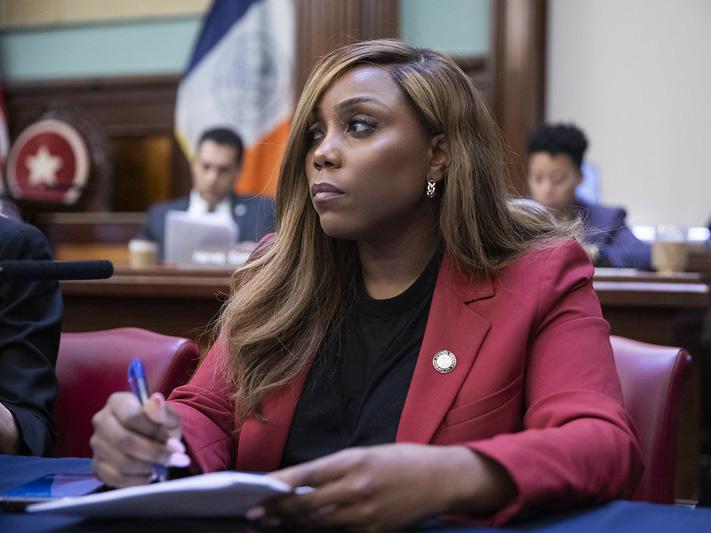
Councilmember Farah Louis attended the Final Preliminary Budget Hearing on March 25, 2026. (John McCarten/NYC Council Media Unit photo)
NAACP NY to launch Freedom Schools in Brooklyn starting April 18
By KAREN JUANITA CARRILLO Amsterdam News Staff
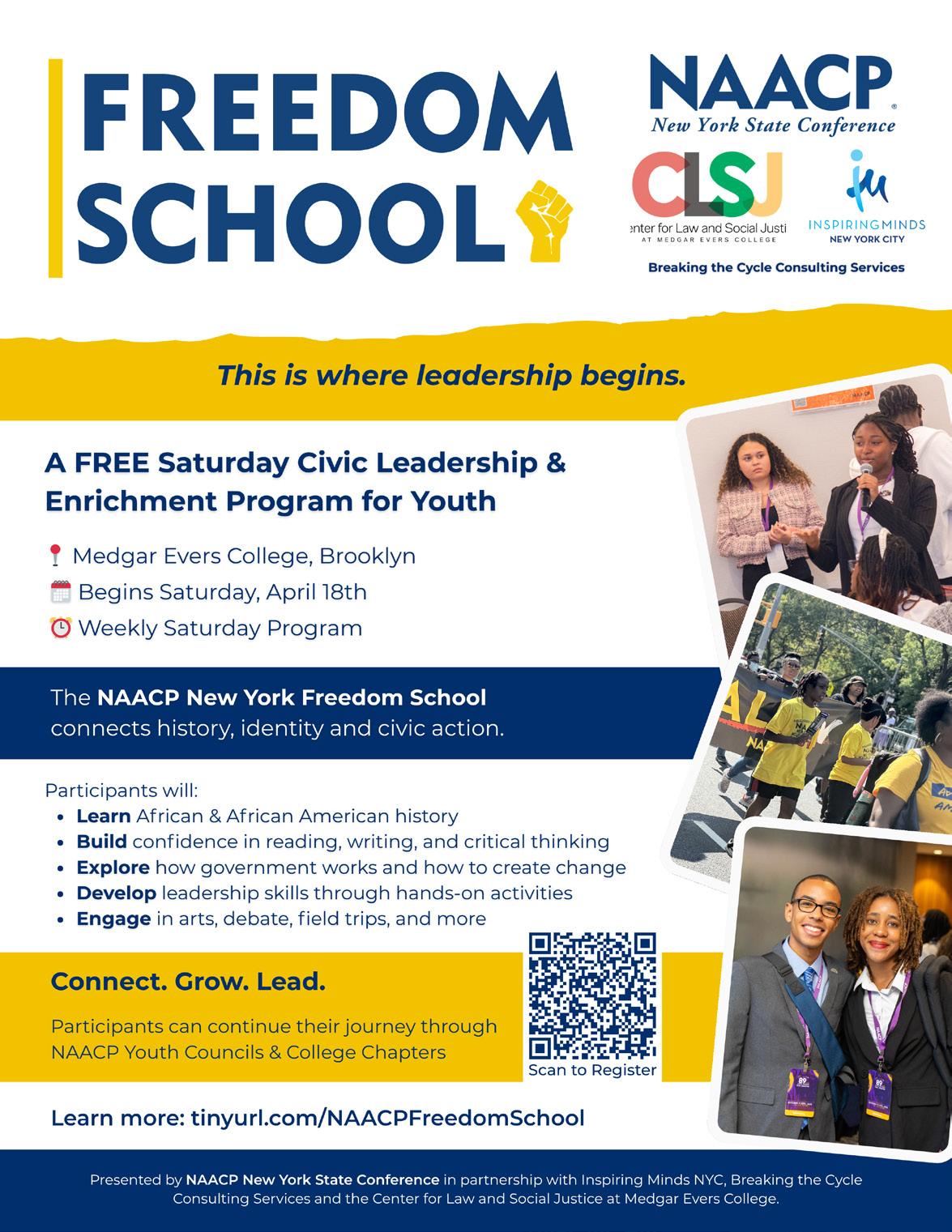
The NAACP New York State Conference has announced that it will run a modern version of a Freedom School in the city, with the first classes set to launch on April 18 at Brooklyn’s Medgar Evers College.
Freedom Schools’ Saturday classes are open to students from elementary school through college. Created to be safe and culturally affirming, the classes will focus on African and African American history and civic leadership. The intent is for the classes to help young people critically examine their racial identity and social issues in the community.
The New York Freedom Schools are modeled after ones created during the Civil Rights Movement’s 1964 Mississippi Freedom Summer, when the Council of Federated Organizations established Freedom Schools that taught Black history, constitutional rights, and literacy in the segregated South.
The NAACP NY’s revived Freedom Schools are meant to again focus on building Black civic infrastructure. The program is being launched in partnership with Inspiring Minds NYC, Breaking the Cycle Consulting Service, and the Center for Law and Social Justice at Medgar Evers College. L. Joy Williams, president of the NAACP New York State Conference and former
Brooklyn NAACP leader, noted that this new Freedom School is the realization of a broader vision she has for the organization.
“I’ve always known that I wanted to do a Freedom School, even when I was president of [the] Brooklyn NAACP,” Williams said. “Getting the resources and everything in order to execute it, and so now being elevated to state leadership, it is part of my overall plan … this 10-year plan that I put together for the NAACP here in New York.”
A core principle for the new school will be teaching Black history. Williams emphasized the importance of the community reclaiming its role as educator. “One of the phrases that is often said that grinds my gears is the ‘they don’t teach us our history’ complaint, which makes absolutely no sense, because that’s nobody’s responsibility but ours,” Williams claimed.
The program will focus on New York’s current political landscape and the future of Black political power. “Most of the conversation about Black political power here in the state of New York is talking about our waning power … whereas we’re focused on how do we build the next generation of primary voters,” Williams said. “That starts with political and civic engagement and knowledge of history, even at a younger age.”
The New York Freedom School
will be a five-and-a-half-hour program focused on both academic and physical well-being. During orientation, students will be grouped by their interests, age, and literacy levels; “opportunity youth” — those currently disconnected from school or work — are also encouraged to take part. The program will include academic lessons, tutoring, and enrichment classes in hip-hop, dance, and physical fitness. Civic engagement classes will look at the history of African American participation in New York state government, especially as the state prepares to commemorate the 200th anniversary of the abolition of slavery in New York on July 4, 2027.
“The Freedom School is really an opportunity for us to gather our younger generations in a space where they feel safe and affirmed,” Williams said — “that we address the issues of literacy and cultural competency and are able to empower young people to have a positive sense of themselves, their history, and then also give them the skills, tools, and resources to advocate for themselves right now — while also building the next generation of advocates for the future.”
The NAACP Freedom Schools’ current session runs from April through July, and there are plans to expand the program. The NAACP hopes to bring Freedom Schools to every corner of the state, with the
Bronx charter school takes state chess championship in grand fashion
By LLOYD B. DAVIS Special to the AmNews
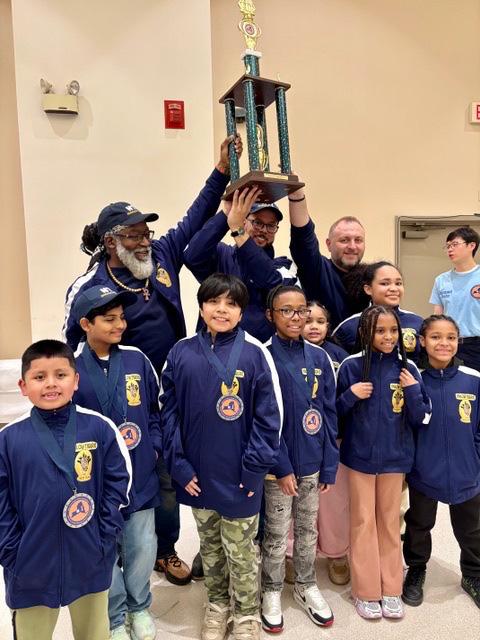
A chess team from The Rosalyn Yalow Charter School in the South Bronx won first place at the 58th annual New York State Scholastic Chess Championships on March 13 and the team will now compete at the National Scholastic Chess Championships in Baltimore on May 1.
The 26 Rosalyn students, divided into four teams, competed in the tournament against a staggering 1,750 students from across New York State, Connecticut, New Jersey, and Montreal, Canada. Three other teams from the school finished in second, third, and fourth place.
Some notable players from Rosalyn’s team include six-year-old Roger Basurto, one of the youngest players in the competition, and 11-year-old Ishaan Nikhil, who only started playing chess in the fall.
The school is coached by several internationally recognized chess players, including Irina Krush, the first woman to earn the grandmaster title in the United States. According to Krush, chess builds students’ confidence and supplies them with important life lessons.
“Chess touches nearly every aspect of who a child becomes,” said Krush.
“Kids build confidence by climbing the rankings, resilience by learning to keep going after a loss, and the early, empowering understanding that their intentional choices shape their results.
“Chess also teaches a life skill that’s harder to name but no less important,” she continued.
“The person across the board has ideas and plans
of their own, and a selfcentered attitude won’t get you far. Chess teaches that the person across from you has a perspective worth understanding — and that skill is especially important today.”
Historically, New York City has been a mecca for chess development. Notable chess players from the city include Bobby Fisher, Fabiano Caruana, and the first Black chess grandmaster, Maurice Ashley. Places like Washington Square Park and the Marshall Chess Club have helped mold some of the world’s greatest chess minds. Other New York City Schools have also been growing their own talent pools.
Most notably, there is Brooklyn’s I.S. 318 school, whose chess team has 58 national titles and was the
subject of an award-winning 2012 documentary “Brooklyn Castle.” Rosalyn’s chess program is in its infancy, but further success is within reach, especially seeing how the school’s curriculum is set up.
Chess at Rosalyn is baked into the students who receive daily chess education. Students are also being exposed to fine arts and the unorthodox sport of fencing. According to the school, having programs like these helps to support economically disadvantaged students and provide competitive collegiate options.
“Our goal at Rosalyn Yalow is to open doors to college pathways and career success for our students. We do that through the arts, through chess, and through offerings that local students wouldn’t otherwise enjoy. It’s all about unlocking the potential of the students we serve in The Bronx,” said Ross T. Lyon, chairman of the Rosalyn Yalow board of trustees.
Flyer for NAACP New York State Conference’s Freedom Schools. (NAACP NY photo)
Rosalyn Yalow Charter School students with their first place state chess championship trophy. (Rosalyn Yalow Charter School photo)
March jobs report shows high Black jobless rate, declining buying power
By KAREN JUANITA CARRILLO Amsterdam News Staff
The latest March jobs report showed the U.S. economy adding 178,000 jobs and the unemployment rate decreasing to 4.3%. But a deeper analysis shows troubling disparities for Black Americans. According to Cantrell Dumas, a senior researcher at the Joint Center for Political and Economic Studies, the report indicated a sharp economic decline for Black workers.
“Unemployment for Black women saw a sharp decrease from 7.7% to 6.3%, but the unemployment rate for Black men, however, unfortunately increased from 7.6% to 9%,” Dumas noted. He added, “The overall unemployment rate was 4.3% but the overall Black unemployment rate was 7.1%. It’s still the highest among all racial groups, with whites at 3.6%, Hispanics at 4.8%, and
Asians at 3.7%.”
Employment numbers have increased, and the federal government may have been rehiring some workers, but overall, job cuts have continued, especially in large federal positions. Employment growth has mainly occurred in small businesses, manufacturing, and healthcare sectors.
“But geopolitical things are happening that are not being accounted for,” Dumas warned, referencing ongoing tensions and conflicts such as the U.S. war on Iran, which may impact economic stability in the coming months.
On top of the economic pressures in the country, a recent report by the fintech firm SensaPay found that wage increases across various states have not helped many workers boost their purchasing power. SensaPay’s report showed the gap between earnings and the rising costs of essentials
like rent, utilities, and insurance. It found that in Florida, workers are experiencing a 10.3% decline in purchasing power, even though salaries have risen by 8.7% since 2023. This means that, despite wage hikes, inflation surpasses income growth, resulting in a decrease in residents’ living standards. Utah and Colorado face similar problems: their workers have had effective pay cuts of 9.7% and 9.6%, respectively, despite receiving salary increases. Utah residents are expected to lose nearly $9,700 in real purchasing power annually by 2026, while Colorado workers are facing a $9,600 shortfall. In Texas, despite a 7.5% increase in wages, inflation caused an 8.5% loss in purchasing power, which is the same as an income reduction of nearly $7,000 for the average worker. And in New Jersey, which has some of the highest salaries in the nation, there is a 7.6% gap between wages and rising
costs, leading to an annual real value loss of nearly $9,000.
So even as the job market appears to be improving on paper, many people — particularly Black workers and low- to middle-income workers — are not being paid sustainable living wages. As Dumas emphasized, the economic realities for Black Americans and others struggling remain grim, with inflation eroding their earning power.
“This is why many Americans feel pessimistic about the economy despite low unemployment numbers,” a SensaPay financial advisor said about the study. “If your salary goes up by 8% but your rent and electricity go up by 18%, you are losing one-tenth of your salary on inflation. This gap drains the incomes of low- and middleclass families, as the money that used to go toward savings or education is now being diverted entirely into basic survival costs.”
Trump seemed unconcerned about committing war crimes
In a follow-up to a press conference where Trump bragged about rescuing a missing airman, he threatened to annihilate Iran. Early on April 7, he said on his Truth Social platform, “A whole civilization will die tonight, never to be brought back again.”
Since that time, Iran has agreed to a two-week ceasefire and Trump says he will pull back on his threats. But all of this is for now.
Several times, the world has heard this promise that if Iran doesn’t accede to its demands, most urgently opening the Strait of Hormuz, but before those words, the U.S. began striking various sites in Kharg Island, off the coast of Iran’s mainland. In effect, the threat to destroy every bridge and power plant, as well as other parts of the country’s infrastructure, has begun, which many military analysts view as possible war crimes.
At this press conference, when Trump was asked if he was worried about committing war crimes, he refused to answer. Now, his actions
speak louder than his silence on the issue. While the more than 90-minute press conference on Monday included Secretary of Defense Pete Hegseth, Joint Chiefs of Staff Chair Gen. Dan Caine, and CIA Director John Ratcliffe, it was mainly a victory lap for the leaders, and another “litany of Trump’s greatest hits,” as one commentator observed.
No mention was made of the aircraft damaged during the mission; it was all done to perfection, they agreed. Meanwhile, millions of Iranians have volunteered to place their bodies around the targeted sites, an action that is in defiance of Trump’s strategy to inspire the masses to overthrow their government.
“We” was the operative word uttered by Trump during the press conference, as though he was personally involved in rescuing the airman. At the same time as Trump’s boasts, the Artemis II mission around the moon put the astronauts the farthest any had been in space; let us hope that this war with Iran is nowhere near that length.
Elinor R. Tatum: Publisher and Editor in Chief
Madison Gray: Executive & Investigative Editor
Kristin Fayne-Mulroy: Managing Editor
Cyril Josh
Barker: Digital Editor
Why New York City must invest in teacher diversity
By LETON HALL
In my first year of teaching, I chose to teach literally on the same block I lived on. As a Black man from the Bronx, returning to my home borough to lead a classroom felt like a blessing, but for many of my students, I was a revelation. I was the first Black male teacher they had ever had. I didn’t just take that “charge” seriously; I carried it with me every time I locked my front door and crossed the street to the school.
But here is the reality: in a school system as diverse as New York, my presence is an anomaly. While students of color make up 60% of students enrolled in K-12 schools, 75% of the teachers working in those schools are white. That isn’t just a statistic; it’s a chasm. It represents thousands of missed connections and “lost in translation” moments that happen every single school day. The struggle to keep teachers of color in the classroom is often invisible. Many of us are placed in “hardto-staff” schools and immediately
pigeonholed. Because I am a Black man, there was an unspoken assumption that my primary strength was “discipline,” as if my purpose was to manage behavior rather than cultivate minds.
There were days I almost walked away. I was stretched thin, trying to be everything for everyone, all while my actual expertise was being questioned or overlooked. I worked tirelessly to build genuine bridges with my students, maintaining high standards because I knew what they were capable of. Just like any teacher, I should not be tasked with doing this alone.
To fix this, we need more than just good intentions; we need the Underrepresented Teachers of Tomorrow Program.
This program is a lifeline. It provides the funding necessary to build pathways for diverse educators to enter and, more importantly, stay in the profession. By rewarding teachers who choose to serve in highneeds schools, we create a sense of stability in neighborhoods that have
been historically destabilized. When we keep talent in the communities that need it most, we move toward a true equilibrium for our most vulnerable students.
Having teachers who act as mirrors for their students isn’t a “perk,” it is a catalyst. The data is clear: when students see themselves reflected at the front of the room, graduation rates climb, college enrollment increases, and overall achievement soars.
Growing up in the Bronx, I could count on one hand the teachers who truly saw me. I remember the feeling of being invisible in my own classroom. We cannot continue to deny our students the chance to be seen, understood, and believed in. Funding the Underrepresented Teachers of Tomorrow Program isn’t just a niche investment; it is the backbone of educational equity for New York State, and by extension, New York City. It’s time we give our students a future that actually looks like them.
Leton Hall is a middle school educator in the Bronx.
(Pexels/Basil Otshudi photo)
Strait of Hormuz. (Public Domain photo)
Celebrate Jackie Robinson Day but recognize the strength of Mrs. Rachel Robinson
By BRIAN MACCOLL
Every year, Major League Baseball marks April 15 with a simple ritual. Every player wears 42. The story is retold. The moment is honored. It remains one of the most effective commemorations in American sports and invites a closer look at what made that moment endure.
The familiar account centers on Jackie Robinson as the singular figure who integrated baseball in 1947. That account is accurate, but it captures only the breakthrough. It does not fully reflect the system of stability that allowed that breakthrough to endure.
Long before she became a public figure, Rachel Robinson had been preparing for the work history rarely recorded. Born in 1922 in Los Angeles, she grew up in a community that valued discipline and civic responsibility. By the time she met Jackie Robinson at UCLA in 1940, she was already on a path defined by rigor. She graduated in 1945 with a degree in nursing, specializing in psychiatric care, a training that would become central to sustaining a household under extraordinary pressure.
When Jackie Robinson entered the major leagues, he was not simply joining a team. He was entering a national experiment under hostile conditions. The pressure was relentless, the scrutiny constant, and the emotional cost profound. Rachel Robinson carried much of the burden of making that experiment survivable. She managed the volatility around him, maintained stability for their growing family, and absorbed the private consequences of a very public breakthrough. Travel, threats, and public exposure did not exist separately from family life; they were part of it. What appeared as composure on the field depended on stability off it, and that stability required discipline, emotional regulation, and sustained effort. It required someone to absorb the pressures that the system itself had not yet learned how to carry. In that sense, integration was not a solo act. It was a shared system. The way we tell the story often favors visibility over function. It elevates the moment of entry and compresses everything that follows into the background, even though the period after a barrier is broken is where most re-
forms fail. That is when systems are tested and when early gains can collapse without reinforcement. Rachel Robinson’s professional trajectory during these years reinforces the point. In 1961, while raising three children and supporting a public figure, she earned a master’s degree in psychiatric nursing from NYU. By 1965, she was director of nursing at the Connecticut Mental Health Center and an assistant professor at Yale University. These were not symbolic roles. They were positions of institutional leadership built on expertise and the ability to manage complexity. Her work after Robinson’s death in 1972 makes the institutional argument even clearer. Within months, she became president of the Jackie Robinson Development Corporation, building more than 1,600 units of low- to moderate-income housing. The following year, she founded the Jackie Robinson Foundation, creating a structured pipeline that combined scholarships, mentorship, and career development for students from underserved communities. Through these efforts, she shifted the work from legacy
to infrastructure. Legacy preserves memory. Infrastructure produces results. This distinction points to a broader institutional pattern. Organizations are generally effective at recognizing firsts, but they are less consistent at building the systems that sustain them over time. Recognition is visible and immediate. Maintenance is ongoing and often invisible. Rachel Robinson’s life sits squarely in that second category. It is the kind of work that determines whether a breakthrough becomes durable or fades into symbolism.
Jackie Robinson Day succeeds because it keeps a pivotal moment in view. But to understand how that moment translated into lasting change, the frame has to widen. Wearing 42 honors a barrier that was broken. Understanding Rachel Robinson explains how it endured. History remembers the figure who enters, but systems depend on the people who make it possible for that entry to last.
Brian MacColl works in advancement and development at New York University and writes about institutional change, public policy, and civic systems.
Looking back at the legendary Paul Robeson on his birthday
By HERB BOYD
April is the cruelest month, wrote poet T. S. Eliot, and it certainly was when you consider the deaths of Dr. Martin Luther King Jr. and Adam Clayton Powell Jr. However, the month is also glorified by the birth of Paul Robeson on April 9, 1898.
Capturing the essence and majesty of Robeson’s remarkable life requires a voluminous tome, one that his son Paul Robeson Jr. began with thoroughness for the years 1898 to 1939. Unfortunately, Paul Jr.,
who died in 2014, did not live long enough to finish a full biography of his father’s life, but he left behind personal information that few biographers would ever disclose or discover. What I remember most about my many discussions with Paul Jr. was his emphasis on the contradiction between his father’s relative obscurity in the 1980s, when we spent our time together, and his vast achievements during his 50-year activist and performance career. In his book “The Undiscovered Paul Robeson,”
Paul Jr. wrote that his father is the only African American charter member of the National Theater Hall of Fame, “but his name does not appear in the index of ‘Notable Names in the American Theater,’ and has no entry of his own in ‘Famous Actors of the American Theater.’”
Paul Jr. said these omissions were the result of his father’s “relentless challenge not only to antiBlack stereotypes but also to the cultural foundations of American racism,” but with the rise of the Black liberation movement, and
I went to Trash School and I liked it
CHRISTINA GREER,
I recently graduated from the Sanitation Foundation’s “Trash School” and I cannot stop thinking about it. I love New York. I love cities in general and am fascinated by all of the city services that happen so seamlessly we almost forget the modern miracles performed each day.
So many people take for granted that when they turn on their tap, clean drinkable water will be readily available to them in hot or cold options. Far too few think about waste and trash removal in a city with roughly nine million people, including tourists, and those who commute into NYC each day to work.
PH.D.
ous it can be on the job as men and women hop on and off a moving truck, in traffic with moving cars, dealing with a truck meant to crush debris, and New Yorkers who sometimes put harmful and hazardous waste in their trash cans instead of properly disposing of the nails, paint, chemicals, and the like.
to some extent, the Civil Rights Movement, Robeson’s contributions have received wider recognition. That exhaustive coverage has included the fact that he was not only a legendary actor of stage and film but also a scholar, activist, former professional athlete, vocalist, and graduate of Columbia University Law School. A full exposition of Robeson’s life has been attempted on several occasions, but it was something that Paul Jr. shied away from, deciding that a personal memoir
I initially heard about the NY Trash Academy, sponsored by the Sanitation Foundation, a few months ago while reading The City. I heard the Sanitation Foundation was offering a free 10-module online course to discuss everything from the history of the Sanitation department to recycling and composting to snow and trash removal. I learned about European cities at the forefront of garbage can technology as well as the various stations where trash is sorted and processed. All of these complex processes happen on a daily basis to keep NYC clean.
The Department of Sanitation has so many programs to help individuals and buildings recycle everything from clothes to e-waste, that is, all the old electronics likely sitting in a back closet or a drawer in your home. I never thought about the efficiency of truck routes to ensure each neighborhood is serviced properly and equitably. I also never realized just how danger-
I could not believe what I learned about my city as well as how so many thousands of people work tirelessly to maintain it so we can decrease the rat population and maintain a modern, healthy standard of living. Interestingly enough, the Sanitation Department has an almost military-like structure as far as organization because it was once viewed as not only the second line of defense against disease, but enforcers of public health laws.
The Sanitation Foundation (www.sanitationfoundation.org) has just begun rolling admission for the next cohort of the NY Trash Academy. They ask for a small donation to cover costs if you are able, however, if you are not able to financially contribute, you can still enroll in the course. I highly recommend taking the course. I learned so much about NYC and how I can be a better New Yorker on a daily basis.
Christina Greer, Ph.D., is an associate professor at Fordham University; author of the books “How to Build a Democracy: From Fannie Lou Hamer and Barbara Jordan to Stacey Abrams” and “Black Ethnics: Race, Immigration, and the Pursuit of the American Dream”; and co-host of the podcast FAQ-NYC.
Caribbean Update
Bahamas and Antiguan governments call general elections
By BERT WILKINSON Special to the AmNews
Continuing from last year when there were 12 general elections in the Caribbean Community (Caricom) bloc, the Bahamas and Antigua will vote in the coming weeks, following Barbados, which returned the incumbent Labour Party by a landslide in early February.
Last week, Antiguan Governor General Sir Rodney Williams signed a proclamation dissolving the federation with Barbuda’s parliament. The dissolution of the 17-member house is usually the first major step before elections in the region, but Antigua and Barbuda Prime Minister Gaston Browne has held off naming a date when islanders will actually vote because he, allegedly, wants to give the main opposition, yet struggling United Progressive Party (UPP), enough time to properly organize its campaign.
“I believe in mercy,” Browne told lawmakers in parliament, while boasting that his Labour Party (the ABLP) will easily be returned to office. “The members on the other side will not get more than an additional week,” he said, hinting that a date could be named in late April or early May.
General elections in that eastern Caribbean nation are not constitutionally due until 2028, but like Prime Minister Mia Mottley in nearby Barbados, Browne and his party are clearly plotting to capitalize on internal wrangling in the UPP to win votes.
Incidentally, Mottley’s Labour Party (The BLP) won all 30 parliamentary seats for the third time, decimating its main opposition rivals as it struggled with high-profile defections and leadership issues.
In the far north of the bloc, Bahamian Prime Minister Philip Davis announced in the past week that he had asked the governor general to dissolve the 39-
member house on April 8, before election day on May 12.
The contest will pit the governing Progressive Liberal Party (PLP) of Davis against the Free National Movement (FNM) of opposition leader and former cabinet minister Michael Pintard.
The PLP is headed to the polls with 32 of the 39 seats that it had won in the 2021 general elections, but it has been beset by opposition charges that it has not achieved very much in office and has been slow to help parts of the archipelago recover from superstorm Dorian back in 2019, during the time of the FNM administration.
As both parties rally electors to register to vote, the FNM has itself been hurt by a few highprofile crossovers to the PLP and the refusal of former prime minister Hubert Minnis to step aside for a party-endorsed candidate in his constituency. Minnis has even vowed to run as an independent candidate. Davis has
said he is confident of victory, but is reminding voters that turnout is important.
“Today, I wish to advise the Bahamian people of the key dates in the next phase of our democratic process, our general election,” Davis said in a national address. “I also wish to remind the public that if you currently hold a valid purple voter’s card, your registration remains valid and there is no need to register again. The law provides that if you are on the current register of voters, you are entitled to vote.” His remarks were partly in response to local media reports of protracted waits for registration at many centers.
As usual in elections in the Bahamas, most of the 39 candidates are millionaires based on declarations to the integrity commission, including ex-PM Minnis, who says he is worth more than $13 million in cash and assets.
The Caricom nation has been
enjoying tremendous growth in and rebound of the tourism sector, which had taken a major hit during the Covid pandemic about five years ago. The country played host to 12.5 million visitors last year, representing a near 12% increase in both long stay and cruise ship tourism over the previous year. Davis had said that campaigning for the elections would have been muted during the Lenten season, but he has cleared the way for the race to kick off in earnest.
“As we move through this election season, I ask every Bahamian to remember one simple truth: Wherever we may fall politically, we all love this country,” he said. “Long after the campaign is over, we will still be one people, sharing one home, with one future to build together. I encourage every eligible Bahamian to take part in this process with seriousness, respect, and faith in our democracy.”
Who gets to belong? The Birthright Citizenship case that could redefine America
FELICIA PERSAUD
IMMIGRATION KORNER
The U.S. Supreme Court is now hearing a case that could redefine one of the most fundamental truths about America: who gets to belong.
At stake is birthright citizenship — the constitutional guarantee that if you are born in the United States, you are American. This is not just a legal debate, though. It is a test of whether history is repeating itself.
Last week, the court heard arguments in a case challenging an executive order signed in 2025 that seeks to deny citizenship to children born in the United States to undocumented immigrants or those on temporary visas. The order, already blocked by multiple lower courts, attempts to reinterpret the 14th Amendment — a move legal experts widely argue cannot be done by executive action alone.
Because birthright citizenship is not a policy. It is a constitutional guarantee.
Enshrined in the 14th Amendment in 1868, birthright citizenship was designed to settle a question the nation had once answered disastrously wrong: whether Black people born in the United States were citizens at all.
The amendment overturned the infamous Dred Scott decision of 1857, which declared that Black people “had no rights which the white man was bound to respect.” It was a direct response to exclusion — a deliberate effort to ensure that citizenship could not be denied based on race, origin, or parentage.
Black Americans were not the only people denied belonging. Native Americans — the first people of this land — were also excluded from citizenship for decades. It was not until the Indian Citizenship Act of 1924 that Indigenous people were formally recognized as U.S. citizens — long after the country had been built on their land.
In other words, birthright citi -
zenship was never just about immigration. It was about equality — and who gets to decide who belongs. Yet, here we are again.
At the center of this case is not just a constitutional argument, but a human story. The lead plaintiff, identified only as “Barbara,” is a Honduran asylum seeker living in New Hampshire. She fled gang violence with her family and is now fighting to ensure that her unborn child — a baby who would be born on U.S. soil — is recognized as American. Her case raises a profound question: If a child is born here but denied citizenship, what are they? The implications are far-reaching. If the executive order were allowed to take effect, babies born in the United States to non-citizen parents — including those here legally on work visas or under temporary protections — could be denied citizenship at birth. These children would exist in legal limbo, creating what many legal experts warn would become a permanent, multi-generational subclass of people born in America but not
recognized as belonging to it.
The American Civil Liberties Union, representing the plaintiffs, has made it clear: The Constitution does not allow the government to pick and choose which children born on U.S. soil are citizens.
That is not just a legal shift.
That is a structural one.
For more than a century, the Supreme Court has affirmed birthright citizenship, including in the landmark case United States v. Wong Kim Ark, which confirmed that children born on U.S. soil are citizens regardless of their parents’ immigration status.
That precedent has held — through wars, waves of immigration, and political change. Until now.
Supporters of the executive order argue that the Constitution’s phrase “subject to the jurisdiction thereof” should be interpreted more narrowly — excluding children of undocumented immigrants and temporary visa holders.
However, critics warn that such an interpretation is not
only historically unsupported, but dangerous, because once a government begins deciding which children qualify for citizenship and which do not, it opens the door to redefining belonging itself.
And that has never ended well.
From slavery to Reconstruction to the civil rights era, and even in the delayed recognition of Native Americans, the United States has repeatedly struggled with the question of who counts as fully American. Each time, the answer has shaped the nation’s moral and legal foundation. This moment is no different.
Because once a nation starts deciding which children are worthy of citizenship, it is no longer debating immigration — it is redefining equality itself.
Felicia J. Persaud is the founder and publisher of NewsAmericasNow.com, the only daily syndicated newswire and digital platform dedicated exclusively to Caribbean Diaspora and Black immigrant news across the Americas.
By KAREN JUANITA CARRILLO Amsterdam News Staff
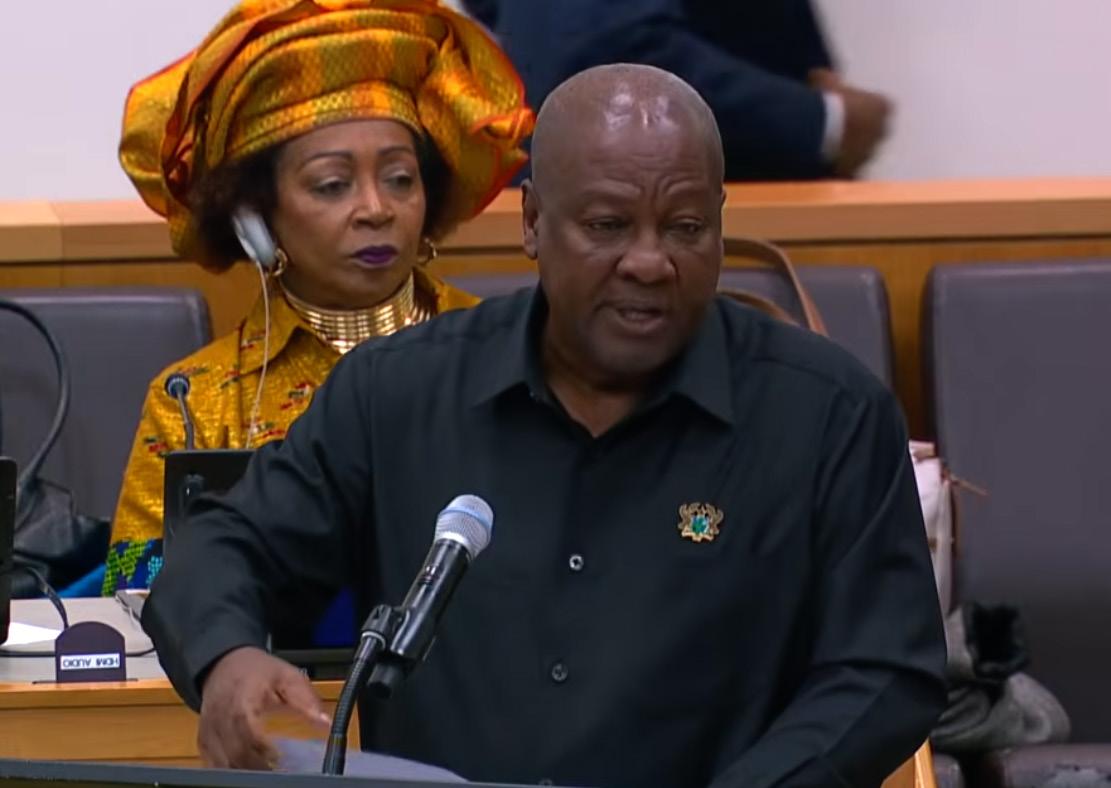
Ghana and the African Union recently pushed through a United Nations resolution calling for recognition of “the trafficking of enslaved Africans and the racialized chattel enslavement of Africans as the gravest crime against humanity.”
The March 25 resolution’s supporters say the UN vote bolsters the global push for reparations. The list of who voted for it, against it, and abstained reveals the nations that still don’t want to acknowledge the legacy of more than 400 years of slavery inflicted on people of African descent.
The resolution was adopted with a 123-3 vote, with Argentina, Israel, and the U.S. voting against, and 52 countries, including the United Kingdom, all European Union members, and Canada, abstaining. UN resolutions are not legally binding, but they influence global norms and help guide nations in identifying what they consider harmful.
Ghana presented the resolution during the UN’s annual commemoration of the International Day of Remembrance of the Victims of Slavery and the Transatlantic Slave Trade. Supporters say the strategy was to gain global recognition first, then use that positive vote to pressure for educational, developmental, and debt-justice reparation policies.
The nation of Venezuela couldn’t vote on the resolution since it had lost its voting rights in the General Assembly because of unpaid dues, but Venezuelan anthropologist Diógenes Díaz Campos, an executive committee member of the Afrodescendant Coordination for Latin America and the Caribbean (ARAAC) and a delegate tied to the Network of Afro-Venezuelan organizations, said his government’s political stance has stayed in line with reparations efforts that it last officially proclaimed in 2015.
“We are delighted with this historic victory for humanity, not just for people of African descent,” Díaz Campos wrote in a social media post. “Personally, I
International News
UN’s transatlantic slave trade resolution forces nations to take stand on reparations
am pleased that Venezuela is one of the few countries to have supported this draft resolution, which has now been adopted.”
Díaz Campos said that activists now need to use the impact of the UN vote as a symbol across Latin America, the Caribbean, and Africa — it should serve as a call to action for real policy changes in national legislatures, regional organizations, and the United Nations human rights system.
British diplomats explained their abstention vote by saying the U.K. recognizes “the gravity of the issues addressed in this resolution” and has “repeatedly recognized the abhorrent nature of slavery and the transatlantic slave trade,” but could not support what it called the text’s “fundamental propositions.”
Britain said it could not agree with the resolution’s claim that the trafficking and racialized chattel enslavement of Africans was the “gravest” crime against humanity. The U.K. warned against “creat[ing] a hierarchy of historical atrocities,” and argued against judging past actions by legal rules
developed later.
However, this cautious diplomatic approach might not sit well with British citizens. Activists in Britain are already questioning the root causes of the nation’s wealth, institutions, and racial inequalities. Recent books such as “The Crown’s Silence: The Hidden History of the British Monarchy and Slavery in the Americas” by Dr. Brooke Newman tell how the British navy and monarchy spent centuries supporting and profiting from the trade in enslaved Africans. Just this month, the University College London Center for the Study of the Legacies of British Slavery received a $575,000 grant to help develop a database focused on the lives of enslaved people in British colonies.
Bell Ribeiro-Addy, a Labour Party member of Parliament and a prominent reparations advocate, said her country’s abstention read less like legal caution than political refusal. “Britain’s refusal to support Ghana’s resolution at the UN suggests our government is not interested in acknowledging or addressing
the legacy of our country’s involvement in some of the gravest crimes against humanity,” Ribeiro-Addy told the Amsterdam News. “It tells Black Britons that their government is not interested in getting to the roots of the racism we continue to face at home. It tells former Commonwealth countries that Britain isn’t interested in dialogue about how we might build more equitable partnerships. It leaves us on the wrong side of history and more isolated on the world stage.
“I submitted a Parliamentary petition on behalf of the [All-Party Parliamentary Group; APPG] for Afrikan Reparations urging an apology for Britain’s role in the trafficking and enslavement of African peoples and the establishment of an All-Party Parliamentary Commission for Truth and Reparatory Justice,” Ribeiro-Addy added. “I am not holding my breath for a response, but the APPG will continue to operate as a bridge between the grassroots reparations movement and the U.K. Parliament, including at our annual U.K. Reparations Conference in October.”
Ribeiro-Addy’s warning is the same in the Caribbean, in Africa, and in British Commonwealth governments. Many of them have pressed the U.K. to move from remembrance to repair; Britain’s abstention, critics say, reinforces the sense that London wants to partner with its former colonies but not address past harms.
Canada, another Commonwealth nation, also abstained — a decision advocates said resonated at home because it conflicted with the country’s public commitments to human rights and Black history.
Hodan Ahmed Mohamed, cofounder of the Black Canadians Civil Society Coalition, said Canada’s abstention hit differently in a country that likes to cast itself as a refuge in the history of slavery. That national story, she said, often skips over Canada’s place in the British Empire — and the anti-Black exclusion that followed Black settlers north.
She said advocates have reached out to the government in Ottawa, looking for an explanation, and have not yet received one. “We haven’t really heard anything back from them, which is an embarrassment,” Mohamed said, adding that she planned to raise the abstention directly with Canada’s UN mission in Geneva. Mohamed disputed the premise that a “yes” vote would have automatically opened Canada to immediate reparations claims. “This was not a legally binding resolution,” she said; it was at most a baseline acknowledgment for establishing expectations for what comes next.
“It … basically signals to Black Canadians or Black people in Canada that their humanity and human rights [are] an afterthought,” Mohamed said. She added that in Canada, reparations work is still stuck at the level of formal recognition of Afro Canadians: “The legal recognition has to be established first before we even move on into any form of reparations,” she said, describing “a fight to make anti-Black inequities a federal obligation rather than a political choice that shifts with every election.”
Ghana’s President John Dramani Mahama speaking at United Nations before presenting resolution that forced nations to take stand on reparations. (UN Web TV photo)
Arts & Entertainment
Melvin Edwards, acclaimed sculptor, joins the ancestors
By HERB BOYD Special to the AmNews
Eminent sculptor Melvin Edwards, whose works in steel went beyond abstraction, died on March 30 at his home in Baltimore.
He was 88. Many art lovers recall his exhibition of works at City Hall Park in 2021, especially “Song of the Broken Chains,” which, in many ways, was emblematic of his style and his historical African American references.
Although his career began long before he became immersed in
the Black Arts Movement of the 1960s and in his association with, and later marriage to, poet Jayne Cortez, Edwards was always interested in tying things together, and he did so most meaningfully once he delved into African metallurgy.
One of his works, expressive of this innovative technique, is
“Seven,” which is featured in Black New York Artists of the 20th Century, selections from the Schomburg Center Collections. Here, the Texas-born artist, educated in California, welded and leaned a heart-shaped figure against what
could be an anvil. In the description of the piece, there’s a brief bio noting his numerous exhibitions and fellowship awards from the National Endowment for the Arts (1970, 1984) and the Guggenheim Foundation (1975), as well as a Fulbright Fellowship to Zimbabwe (1988–1989). His works often featured found objects that he shaped and conjoined to his creative imagination. In his vast collection, locks, horseshoes, screws, and other metal objects often abound, to say nothing of chains, a shovel, a monkey
wrench, barbed wire, and even a pair of scissors.
Before he devoted himself fulltime to art, Edwards was a college athlete who excelled on the gridiron at the University of Southern California. At first, his interest was primarily in painting, but soon he gravitated to sculpture and began what became his signature “Lynch Fragments,” symbolizing the history of African Americans being brutalized by a racist culture. In 1972, his teaching career began at the Livingston College campus of New
Jersey’s Rutgers University. He later became a professor and taught there for 22 years. In 1978, he revisited his work on “Lynch Fragments” and presented it at the Studio Museum. This was followed by “The Decade Show: Frameworks of Identity in the 1980s” (1990) and “Sculpted, Etched, and Cut” (2011).
Two years after this installation, his wife, Jayne Cortez, died. During our conversation a year later, at a tribute to her, he was as reticent as ever, preferring always to let his art speak, and it spoke volumes.
Artist Melvin Edwards at University of Maryland, College Park, in 2024. (Tom Nappi/Creative Commons photo)
“Double Circles” (1970), Melvin Edwards’s second public art commission, on view in Harlem. (Public domain photo)
Both sides of Melvin Edwards’s sculpture “Homage to My Father and the Spirit” (1969) at Cornell University in 2025. (Public domain photos)
Melvin Edwards’s stainless steel sculpture, “Confirmation,” in Jamaica, Queens, in front of Joseph P. Addabbo Federal Building. (Herb Boyd photo)
Proving doubters wrong: Michael Cummings, picturing parity
By MICHAEL HENRY ADAMS Special to the AmNews
Monday night at the Swann Fine Art Gallery (East 25th Street), in conjunction with their auction of Black art that featured one of his quilts, Harlem artist Michael Cummings told 50 or so admirers something about his momentous journey.
Born and educated in California, he earned a bachelor’s in American art history at Empire College in Santa Rosa. First, though, determined to please them, he told Swann’s Director of African American Art, Nigel Freeman, that he studied for two years to become the accountant of his parents’ dreams. After he decided he must make art, and that their suggestion of maintaining his creative output as just a hobby was impossible, his father responded, “Fine! But I won’t support you.”
It was a high school field trip to an exhibition where he had seen Van Gogh’s pulsating “Starry Night” that first made Cummings say to himself, “That’s what I must make!” Initially working as a painter, constructing collages and shadow boxes, Cummings gradually, early in the 1970s, followed friends’ advice to do something different. Moving to New York, he also taught himself to quilt, studying the works of local quilt artists who, he said, were invariably women. He read everything he could find about this ancient domestic art form. Quilting, he learned, is deeply rooted in the African American experience out of a necessity — surviving by turning trash into treasure.
“Quilting was meant to keep you physically warm, simultaneously warming
your soul, through the process of making objects to beautify your environment,” said Cummings.
For the longest time, he said, it might have actually looked like quilting really was just a hobby for him. “I wanted to defy the limits [my parents] tried to impose on me,” he said. “That entailed keeping a day job, but because my every waking moment and even my dreaming, contribute to a compulsion to tell stories with quilts, I’ve been an artist all along, for the past 50 years.”
Vivian Ayers-Allen was the first New York gallerist to exhibit Cummings’s quilts. Then in 1997, he was commissioned by Seagram to contribute a narrative quilt to their clever Absolut Vodka advertising campaign.
“I have been creating quilts the entire time I’ve been in New York,” Cummings said. “I love being able to tell the stories it was impossible for me to find as a youngster. I tell these stories and portray people who represent and valorize me. Working with fabrics to reflect and construct a world that extols our value and importance makes my art quilting an exciting adventure. Fabrics allow me to surround myself with color, pattern, and texture that are energizing. Sometimes I’ll keep bolts that spoke to me in the fabric store on the shelf for months, for years even, then taking [them] down, almost in a trance. When I get ‘in the zone,’ cutting out shapes, piecing them together, like you would with a puzzle or a mosaic, I like to listen to jazz, to all kinds of music, and the rhythm feeds me and fuels my creative process.”
With a penchant for creating series that enabled him to explore variations on a
person or theme, Cummings has honored and immortalized President Barack Obama; Obama’s favorite president, Abraham Lincoln; Shirley Chisholm, Josephine Baker, James Baldwin, Martin Luther King Jr., Thurgood Marshall, Langston Hughes, and others from the pantheon of African Americans worthy of recognition. Befitting their dignity, his portrayals are iconic and timeless. Inspired by Faith Ringgold, some are emblazoned with the subject’s words, emboldened with direct quotes that Cummings hopes provide viewers with some background related to struggles and pains that came before and still remain in a classand race-riven America.
His work, now commanding tens of thousands of dollars and more, his place in collections like Harlem’s Studio Museum, the Brooklyn Museum, and Washington’s Renwick Gallery, attests to the prominent stature Cummings has gained. So does his piece “Josephine Baker in Cabaret,” up for sale with a group of works by the best-known Black artists of the 20th century. Works by Charles White, Elizabeth Catlett, Hughie Lee-Smith, and more are all here, expected to fetch many millions among them.
Until recent times, though, no matter who you were, the value of Black art always lagged far behind that realized for work by white painters, printmakers, or sculptors. “A bronze by Richmond Barthé cost much less than one by Daniel Chester French, just as a genre scene painted by Henry Ossawa Tanner still commands pennies compared to the tens of millions you’d get for a George Bellows boxing match. No Tanner has ever sold for
as much,” said Harlem painter Larry Bentley. Ever so slowly, though, this will change. Championed by the Swann Gallery, the process has already begun. “The Sugar Shack,” Ernie Barnes’s picture of withering dancers, used on the “Good Times” TV series and for the cover of Marvin Gaye’s “I Want You” album, was once considered little better than an illustration — ordinary commercial art. When Eddie Murphy bought it from the Gaye estate for $50,000, some people were amazed. “But seeing changes in attitudes toward Norman Rockwell or Maxfield Parrish, I didn’t blink,” continues Larry Bently. He recalled that, “in 2022, the duplicate painted by Barnes … sold for $16,000,000. A work by Basquiat [that] cost as little as $19,000 in 1984, in 2017, sold for $210,500,000.”
Overall, Black art remains undervalued now, but this sort of “correction” is also the destiny of Michael Cummings.
Asked if his parents ever changed their mind about what they thought should be his “hobby,” Cummings smiled drolly. “Well, even past 90, my mother would refer to my work that way, but she was present for plenty of awards and art openings. She saw me applauded and mobbed by so many people, Black and white, who struggled just to get close enough to shake my hand. They’d end up pushing her out of the way and monopolizing my time, so I knew she knew.“ If equity and parity are the goal, there’s still a long way to go, but Michael Cummings’s triumphant trajectory is an indication that Black people can succeed as artists, and that we are well on our way.
Jean Garrett, Michael Cummings, and Lamerol Gatewood. (Michael Henry Adams photos)
Harlem quilt artist Michael Cummings. Harlem quilt artist Michael Cummings.
“Untitled cityscape” by Hughie Lee-Smith. (Michael Henry Adams photos)
Work by Elizabeth Catlett.
“Untitled,” Valerie Maynard.
“The Attica Crucifixion,” by Cliff Joseph.
AmNews FOOD
Talking SCHOP! Coqodaq: Nuggs & Buckets
People, my people! I hope the holiday weekend made you rise up or pass over time with friends and family. Perhaps I inspired a visit for a viral All’Antico Venaio sando from last week’s column. Either way, these spring buds are giving me life again!
The viral hits don’t stop this week as I regale you with not one, but two visits to NYC’s new(ish) fried chicken obsession and the home of the most expensive and excessive bites, Coqodaq (12 East 22nd Street, Manhattan). From the restaurateur of the celebrated, Michelin-starred, and award-winning COTE Korean Steakhouse, Simon Kim has created a high-end Korean fried chicken joint that has the cats jumping for joy.
The benefits of having dined at Coqodaq (pronounced co-codack) twice, other than feeling freer to take better photos with a flash, are getting to try different items on the menu and getting into their varied beverage program of bubbles, wines, beers, cocktails, and non-alcoholic options too. Coqodaq is a “the more the merrier” type of vibe, so my
first visit with just three people growing to my Fab 5 crew of childhood friends, left no crumbs on the table … literally.
On the first trip, I got to try Coqodaq’s viral, and trademarked, The Golden Nugget that is topped with varying types of caviar or seasonal truffle ($16$30 per nug). They sold this concept at last year’s US Open as a cheeky $100 box with six nuggets, Petrossian caviar, creme fraiche, and a mother-of-pearl spoon. This year, McDonald’s created a similar limited edition box for Valentine’s Day that sold out immediately. Yes, the nug was good. Worth it? That’s up to you.
There are other great starters at Coqodaq, like their doused in a blizzard of parm, whole-leaf Caesar salad with nori croutons (this is a MUST for Caesar lovers), but you are there for their “better fried chicken” — ethically sourced and meticulously prepared. Yes, it’s time to check off The Bucket List (also trademarked). For $46 per person, guests begin the journey with the most delicious pasture-raised chicken consommé ever known to mankind (yes, I said it) before getting a bucket of the Coqodaq original fried chicken (with varied house-made sauces) and a platter of soy-garlic glazed and/or go-
ghujang glazed fried chicken with the obligatory Korean ban-chan of bright pickled vegetables. Separately, we added sides of cole slaw, spicy tteokbokki (rice cakes), and beef tallow fried french fries. Also included in The Bucket List, once the hen has flown the coop, comes the cold perilla seed noodle. I didn’t appreciate this in my first visit to Coqodaq because I hadn’t been to that wicked good tasting at Lysée yet. Finally, the sweet-tart ending of house-made soft serve frozen yogurt with passion fruit coulis cleans the palette and you are sent off into the world … without your hair or your clothes smelling like you were bel-
lied up to the fryer.
Gamsahabnida Coqodaq!
Thanks for reading and happy eating!
Kysha Harris is a chef, food writer, and editor, culinary producer, consultant and owner of SCHOP!, a personalized food service in NYC for over 23 years. Follow her on Instagram, @SCHOPnyc and on Facebook, @SCHOPnyc. Questions, comments, requests, feedback, invitations! Email us at AmNewsFOOD@SCHOPnyc.com. Follow us on Instagram and Facebook @NYAmNewsFOOD.
KYSHA HARRIS FOOD EDITOR, @SCHOPNYC
Coqodaq exterior. (Kysha Harris photos)
Coqodaq’s Bucket List.
Coqodaq’s split-glazed Bucket List.
The consommé that doesn’t play!
The yogurt soft serve finisher.
Coqodaq interior sexy vantage shot.
Two Voices, One Harlem: examining the soul and intimate life of Dr. W.E.B. Du
By MICHAEL HENRY ADAMS Special to the AmNews
The other night was a stand-out occasion when Save Harlem Now!, collaborating with the Schomburg Center for Research in Black Culture, presented an enthralling program, Two Voices: One Harlem. This engaging presentation was a three-way conversation between literary powerhouses. Dr. David Levering Lewis is a two-time Pulitzer Prize-winning author and historian. Author of more than 30 titles, with three million books in print, Victoria Christopher Murray is a New York Times bestseller. And Sylvia L. White is secretary of the Harlem Writers Guild.
Just what made it such a splendid night? Well to begin with, following this wicked winter of our collective discontent, with the mild breezes of spring wafting about, the environment was wonderfully warm. Moreover, if the illustrious Schomburg Center is 100-years old, dear Dr. Lewis is soon (May 25) to be 90. And most generously, mindful of perpetuating his legacy of elegant erudition and African American scholarship far into the future, it
was announced that Dr. Lewis recently made a gift of $1 million for the annual David Levering Lewis Prize, matched by the Leon Levy Foundation for the best new book concerning the African Diaspora.
A recipient of the National Humanities Medal, Dr. Lewis is the author of 12 books, mostly investigating African American history, culture, and attainment.
Perhaps the most impactful is his vivid analysis of the Harlem Renaissance, “When Harlem Was in Vogue.” But the reason for his presence a week ago was his indepth knowledge of statesman W.E.B. Du Bois, the subject of his landmark two-volume biography. Winner of 10 African American Literary commendations and 2016’s NAACP Image Award, Victoria Christopher Murray was on hand to delve into her latest novel, “Harlem Rhapsody,” a captivating account of the many loves, particularly writer Jessie Fauset, of Dr. Du Bois who evidently was a formidable Romeo. If some half dozen of Ms. Murray’s books have already been made into movies for Lifetime, from all we in a rapt audience heard, this one is certain for cinematic dramatization as well!
Previously deputy executive director of the Harlem Hospital Center, Sylvia White served as the night’s interlocutor or one might even almost say, its referee. Although calmly presented, the contrasting insights into the lives and personalities of their subjects were well matched — especially when addressing what made Du Bois so irresistible to many women. Was it his mind? His masterful confidence when taking control? Relating such mysteries, each contributor was commanding. Only as both delivered detailed insights into the past in a collegial way, exhibiting much mutual admiration, Ms. White’s role might best be characterized as that of the evening’s choreographer?
At its close, Valerie Jo Bradley, president of Save Harlem Now!, paid tribute to Dr. Lewis with a lifetime achievement award for his important endeavors to preserve both Harlem’s intellectual and architectural heritage. She also gave a lovely bouquet of flowers to Claudette Brady, who, after a little less than three years, is departing as the 11-year-old group’s executive director.
Few who were there will forget
the moment in 2015 when Brady first made a name for herself among New York City’s historic preservation community. Threatened with demonstrations if they failed to add an African American to their symposium celebrating the 50th anniversary of the city’s preservation ordinance, The Museum of the City of New York added Ms. Brady.
It’s a good thing they did too.
During his address, Steven Spinola, the New York Real Estate Board president, sought to trivialize preserving old buildings as both elitist and racist. He contended that protecting buildings with landmark designation made maintaining them too expensive to utilize as affordable housing. He also suggested that officially designated historic districts had the least racial and income diversity in the city.
Speaking immediately after, Brady begged to differ. “Really? I work in Bedford-Stuyvesant. Like Harlem, it’s a community of color. But, thanks to their status as landmarks and the federal investment tax credit, we just restored two fifty-unit apartment buildings that are now not just 100% affordable, but 100% low-income housing. Be-
sides that, our research shows that buildings eligible to become landmarks represent the largest group of rent-regulated apartments in the city: that existing rent-controlled and rent-stabilized units are by far more accessible to working-class people than any new ones!”
Like the exciting public program in the Schomburg auditorium, she planned Two Voices: One Harlem, helping to realize the new Central Harlem West 130th-132nd Historic District and outlining their proposed Manhattan North and 135th Street Historic Districts. These are just some of the examples of the work Brady has successfully undertaken for Save Harlem Now! Like all who participated in Two Voices: One Harlem, she’s to be commended.
They and others do the heroic work that must be done, assuring that Black history and African American excellence, “shall not perish from the earth,” neither in Harlem, nor Bedford-Stuyvesant, nor any other Black area.
“Black history,” said Ms. Brady handing his award to a beaming Dr. Lewis, “is American history and thanks to your efforts, we are not about to be erased!”
Far left and far right, Claudette Brady and Valerie Jo Bradley flank literary lions Victoria Christopher Murray, David Levering Lewis and Sylvia White, MHA. (Michael Henry Adams photos)
Dr. David Levering Lewis and Victoria Christopher Murray discussed W.E.B. Du Bois’ life and loves.
Lana Turner, on Dr. Lewis’ right, brought out the full force of Harlem’s Literary Society.
Broadway star James Monroe Iglehart talks ‘& Juliet,’ representation, and second chances
By JOHNNY KNOLLWOOD Special to the AmNews
Broadway actor James Monroe Iglehart, who currently stars as Lance in “& Juliet,” took time to reflect on his role and the expansion of Shakespeare’s universe in a conversation with the AmNews on March 25 via Zoom. “& Juliet,” which has run on Broadway since 2022 and was nominated for nine Tony Awards, reimagines a world in which a young Juliet, one of the titular characters in the William Shakespeare classic “Romeo & Juliet,” does not meet her infamous demise. “It did make me happy that someone stepped in and gave this young woman a chance,” Iglehart told the AmNews. “The fact that she is able to have this other choice is a lot of fun for me.” Iglehart, who has performed on Broadway stages as iconic characters that include Genie in “Aladdin,” Thomas Jefferson in “Hamilton,” and King Arthur in “Spamalot,” has stepped into the role of Lance, the love interest of Juliet’s nurse, Angelique, and father of François, a young musician who is learning about his own identity and sexuality.
Iglehart succeeds several performers who
have portrayed Lance on the stage, including NSYNC’s Joey Fatone, but has interjected his own experiences into the role, providing audiences with a fresh take on
the character.
“Different people have played him, but I’m able to put my stamp on him and make him this kind of pseudo — in his mind —
‘cool dad’ … I totally identify with Lance,” Iglehart said with a smile. “Also, I’m a dad, a dad of a son who is gay,” drawing parallels between the play’s plot and his own life. “I [have] a different perspective because Lance doesn’t know and doesn’t see, and at first doesn’t understand. With my situation, my wife and I were very open and told our son, ‘Be who you are, and we love you regardless,’ so it was kind of fun to be able to bring that to the character. I play him a little different — I love the softer side of Lance.”
The show features several LGBTQ+ characters, Black and Latino actors, and perhaps an alternate viewpoint than is historically represented on the stage and screen. “Representation is important, just because you want to see yourself in these stories,” Iglehart told the AmNews. “As far as ‘& Juliet’ is concerned, I would love for people to walk away and know that just because life says you have to do one thing, that doesn’t mean that’s the path you have to choose … you don’t have to be locked into what the socalled story says. You make your own story and make your own path.”
For tickets to “& Juliet,” visit andjulietbroadway.com.
From New Orleans to NYC: Jazz Generations Initiative connects community
By JOHNNY KNOLLWOOD Special to the AmNews
The Jazz Generations Initiative, a new Mellon Foundation-funded organization, is providing valuable communal resources to jazz players and aficionados in two major hubs for the genre: New Orleans and New York City. Co-founded by pianist and Tulane University professor Courtney Bryan and Columbia University scholar Robert O’Meally, the initiative aims to “unite artists and listeners with intergenerational performance opportunities and interdisciplinary jazz studies scholarship,” according to their website.
The initiative, which launched in November 2025, has engaged the New York City community through a variety of programming. In February, the organization hosted a discussion with Amina Claudine Myers, a 2025 Jazz Legacies Fellow who is well known for her work with the AACM and beyond. Currently, the initiative hosts ongoing performances like the Soundoff Sessions at Café Erzulie in Bed-Stuy — a free bi-weekly program that highlights emerging voices in the genre and includes a post-session open jam where musicians can meet and play. Online, players and fans can stay up to date with ongoing community events through the JGI Sphere, a journal that includes weekly listings for performances in the two cities where jazz originated. The organization also recently
presented the debut of the first issue of the Healing Project Magazine, a publication by Samora Pinderhughes that aims to address “structural violence through artistic works, collective healing spaces, and advocacy initiatives,” at the Brooklyn Peace Center on April 2 in conjunction with the organization’s exhibit at the Museum of Modern Art.
New Yorkers can stay up to date with on-
going JGI programming at Café Erzulie and check out their compilation of weekly listings on Instagram @jgi.newyork. More information is available at www.linktree. com/jgi.sphere
Broadway star James Monroe Iglehart, who has performed in “Hamilton,” “Aladdin,” and “Spamalot,” discussed stepping into role of Lance in “& Juliet” in conversation with AmNews via Zoom on March 25. (Johnny Knollwood photo)
Amine Claudine Myers in discussion with George Lewis and AACM members at Roulette on Nov 14. The pianist was recently featured by the Jazz Generations Initiative which “unites artists and listeners with intergenerational performance opportunities,” according to their website. (Johnny Knollwood photo)
‘The Millennium ‘Boys 4 Life Tour’ brings BK nostalgia takeover
By BRENIKA BANKS Special to the AmNews
Reminiscing on the 2000s gives nostalgic solace for millennials, and NYC millennials in particular were happy with a recent time-traveling live music experience. “The Millennium Tour Presents: The Boys 4 Life Tour” recently stopped at Brooklyn’s Barclays Center for a sold-out night featuring performances by popular R&B and hip hop artists during the 2000s, including B5, Pretty Ricky, Bow Wow, and B2K. Fans expressed their happiness for a nostalgic evening to distract their minds from global current events.
“Millennium Tour” attendees reveled in singing and rapping along to their favorite songs from an era where adulting was farther away. R&B boy band and broth-
ers B5 had the audience in sync while performing their 2005 hit single, “All I Do.” Fans throughout the crowd shared moments, in groups and as couples, while singing, “On the Hotline” and “Grind with Me” by R&B/ hip hop group Pretty Ricky.
The excitement of the arena grew when Bow Wow appeared on stage in a cage. Fans screamed and cheered as the rapper performed his popular songs, “Bounce with Me,” “Ghetto Girls,” and “Like You.” Bow Wow’s highenergy set was configured to have ladies reminiscing on their preteenage and teenage years. A surprise no one expected was rapper and singer Lil Mama appearing on stage with Bow Wow, since the two have never worked together. However, her appearance gave the two, who kiddingly called each
other “twin” on stage, the opportunity to “clear up” a long-running online joke about them being the same person.
“Can you please put both of us in the same frame so they know this is not AI?” Bow Wow said to the crowd. Lil Mama lit up the stage via a quick performance of her 2008 debut single, “Lip Gloss,” before exiting.
Nostalgia and enthusiasm were in full effect when B2K hit the stage as the tour’s headliners. The guys started their performance with the upbeat, “Uh Huh,” their debut single. B2K’s choreography and chemistry worked well on stage, showing that the group has evolved into a noteworthy place. The quartet sang fan favorites from their first album, including “Gots Ta Be” and “Girlfriend.” B2K, who consist of members
Omarion, J-Boog, Raz-B, and Fizz, had mini concerts within their set, with each member enjoying solo moments. Raz-B went first and performed Michael Jacksoninspired moves. J-Boog had the help of backup dancers to recreate a couple of moments from the group’s 2004 dance film, “You Got Served.” Fizz had his moment rapping familiar verses as the fans showed him positive feedback.
Omarion, the lead singer of B2K and the member with the most successful solo career, followed his fellows. Known by fans as “O,” he performed his 2014 hit single “Post to Be,” featuring singers Chris Brown and Jhené Aiko. Omarion brought Bow Wow back on stage for the pair to perform their 2005 single, “Let Me Hold You,” to a strong response from fans. The graphics and cho-
reography were well coordinated while Omarion performed his 2006 single, “Ice Box,” serving as another crowd favorite. He performed his song, “Touch,” where the other three B2K members joined him back on stage for the popular end-of-song choreography moves.
This provided the perfect transition for B2K to perform their last two songs, “Why I Love You,” and “Bump, Bump, Bump” together. After the show, I was told by a few attendees that they sincerely loved the show. A couple of fans expressed their happiness seeing B2K reunite after personal issues with members within the group. Overall, NYC millennials were ecstatic during the entire timely concert, symbolizing a much-needed break from unsettled reality.
B2K closing out the show with their 2002 hit single, “Bump, Bump, Bump.”
Southern rapper Waka Flocka Flame performing as the crowd raps along.
Randy Weston Centennial, Sistas’ Place, Lulada Club
The centennial of pianist, NEA Jazz Master, composer, and arranger Randy Weston is a big deal that has already begun and will joyfully continue as his notes travel through eternity while the ancestors applaud. The pianist often shared with me that his primary role as an artist is “to share his music and inform listeners of its African origins.”
Weston’s centennial will be celebrated in his birthplace of Brooklyn on April 9 at the Brooklyn Public Library’s Central Library, Dweck Center (10 Grand Army Plaza), from 7 p.m. to 8:30 p.m. An ensemble of Weston’s collaborators will perform a live musical tribute, showcasing his signature style that blended jazz with African rhythms and global influences.
Featured artists include KA Kollektive — Kiyoko Layne (piano), Paul Ramsey (bass), Atiba Kwabena Wilson (poetry, djembe, flute, vocals), and Aquah Beale (percussion); Innov Gnawa — Maalem Hassan Ben Jaafer (sintir, tbal, vocals), Amino Belyamani (chorus, qaraqeb), and Naoufal Atiq (chorus, qaraqeb); and Gambian musicians and griots Salieu Suso (Kora) and Ebrima Jassey (balafon).
Weston was one of the first jazz musicians to include Gnawan and Gambian musicians in his band. For years, he owned a club in Morocco and was very in tune with world music of the African diaspora.
This event is free but RSVPs are required at bklynlibrary.org
April 6 officially marked Randy Weston’s centennial. Just before his birthday, Dizzy’s jazz club presented four generations of brilliant pianists to perform some of Weston’s innovative works that extend over six decades, acknowledging him as one of America’s most prolific pianists and composers.
Pianist, composer, and arranger Jason Moran went solo with a three-piece medley: Weston’s “Blue Moses,” his original “James,” and “Clef Club,” the latter two a nod to arranger, bandleader, and composer James Reese Europe. Moran and Weston both performed in a major tribute to
Europe, where they bonded for the duration of Weston’s life. Ironically, Europe was the glue that also established my bond with Weston. He was a big fan of Europe’s contribution to jazz — his reference would be “African classical music,” or “music of the ancestors.” Moran’s roaring, sometimes whispering, cords spoke from the ancestors in the present moment.
Rodney Kendrick, one of the most brilliant pianists of his generation yet the most underrated, took the spotlight next, choosing Weston’s trio format. He featured trombonist Craig Harris, bassist Michael Bowie, and guest vocalist Rhonda Ross. “Randy was a special person to me — he changed my life,” said Kendrick. “We spoke every day and traveled the world together. He was one of my main musical fathers.” The pianist and composer played a mix of Weston compositions, as well as a composition by Melba Liston (Weston’s longtime arranger, trombonist) that featured Harris.
This year also marks Liston’s centennial. Kendrick has a unique style, creatively connecting Thelonious Monk, Weston, and Harris while delivering his own sound in another realm, playing the blues and off-center jazz inside and outside the pocket. He is much too talented not to appear regularly on the NYC jazz scene. Ross infused rooted elements of jazz and R&B with Jackie Wilson’s ballad “To Be Loved.” Her tingling notes offered serious emotional healing for these times. “Loving yourself is the greatest gift that Randy gave us,” she said, “— the love that comes from tuning your inner voice.”
The second set featured pianist and composer Willerm Delisfort and trombonist Mariel Bildsten, a duo honoring both Weston and Liston. Unlike the other artists, they hadn’t had an opportunity to meet Weston but were also greatly influenced by his work. The duo performed “Earth Birth,” “Little Niles,” and a composition by Liston. Delisfort is a native Floridian, attending FAMU before making a mark in the fertile jazz city of Chicago, where he played with Bobby Broom; Ernest Dawkins; and AACM, Maurice Brown, and Marquis Hill. I must admit I wasn’t familiar with Delisfort, but his musicianship says he deserves to be seen. It is hoped that these new jazz clubs will fill the void.
Vijay Iyer, who pushes jazz bound-
aries in other directions, closed the evening with 30 engaging minutes of combustive rhythms, conversing with subtle melodies of Weston’s earlier and later works mixed in his own vocabulary.
Weston wasn’t just a giant in stature; he treated everyone with respect and made all of us feel like giants, regardless of our station in life. It was his innovative music, unique style, approach, and commitment as a Pan-African to bring audience awareness to the origins of this music that is deeply rooted in Africa. As Moran stated, “Not all audiences were ready to hear his message, but he shared this information out of love for Africa and music.” He was an anointed jazz griot, a storyteller, who connected his music and oral history for all audiences to consume. His music was on a mission, or as the O’Jays sang, “There’s A Message in the Music.”
Dizzy’s centennial ended on Easter Sunday in a fiery explosion of blazing Weston standards delivered by his longtime quin-
included “Little Niles” and “The Gathering.”
African Rhythms isn’t a mirrored reflection of Weston but a resourceful, intuitive force, bringing their shared interpretive nuances to Weston’s treasure trove of music. “Randy has mapped out the pertinence and importance of the African aesthetic within the realm of jazz and world music in general,” said T.K. “We are an extension of his vision.”
Randy’s widow, Fatou Weston, has been busy attending the recent centennial celebrations. She said she is very appreciative of all the tributes and knows he would be pleased. “I really like hearing his music played by so many great musicians, who respected and loved him so much,” said Fatou.
Miles Davis: the innovator, genius, take-no-mess instigator from Bebop to cool jazz, fusion jazz rock, and two great quintets — his music soars, roars, and hollers “Vote Miles!” as he is also celebrated on his 2026 centennial. Celebrate Miles’s 100 years on April 11 at Sistas’ Place (456 Nostrand Avenue), featuring Satish Robertson Band: A Tribute to Miles Davis. Two shows, 8 p.m. and 9:30 p.m.
tet, the African Rhythms Alumni Quintet, featuring saxophonist/flautist, composer, and musical director T.K. Blue. Weston’s mentoree Sharp Radway held the piano chair, with bassist Alex Blake, trombonist Frank Lacy, and percussionist Baba Neil Clarke.
The quintet roared on the standard “Blue Moses,” although Weston was never overjoyed with the album’s four-track recording, produced by Creed Taylor’s CTI imprint. He felt the album was too polished and miles away from his original intent for it. Creed’s production scrubbed the African intent for a more jazzy-poporiented sound, but of course, Weston’s deep-toned piano still delivered an African flavor. Anytime he performed “Blue Moses” live, it was defined in African Rhythms.
The band took “Blue Moses” to new heights, with extended solos for each band member — a far cry from its original production, of which Randy would have been quite proud. Their repertoire also
Satish began his musical travels on piano but was prompted to pick up the trumpet after hearing the mesmerizing sounds of Miles. Now residing in Brooklyn, the Jersey City native’s resume boasts such artists as Salim Washington, James Carter, and Kahlil Kwame Bell. His resonant sound has made him a first-call trumpeter when not touring with his own band. For reservations, call 718-398-1766.
The Blue Note (131 West 3rd Street, with global locations) will focus its attention on NYC’s fertile Latin scene. On April 11, the Lulada Club, an electrifying all-women salsa band, will project their feverish sounds of salsa music.
Vocalist and director Andrea Chavarro embarked on a mission to address the void of female ensembles in the live music scene in New York City. This ambition led to the creation of the Lulada Club in 2022. Renowned for their interpretations of vintage tropical rhythms encompassing salsa, bolero, and cha-cha-cha, they pay homage to the icons with a fresh perspective through their original tunes. For more information, visit bluenotejazz.com.
Randy Weston. (Ron Scott Associates photo)
Nickens raised his daughter as a single father for most of her life, and both have unique stories of overcoming trials and directing their lives toward serving their community and the youth.
Born and raised in Harlem, Nickens was the youngest of three boys and raised by his grandparents in the famous St. Nicholas projects. Both of his older brothers were in the Harlem drug scene, with his oldest having been murdered in 1981 and the other later passing away from an overdose in 2017. Being involved in communal organizations like the Shiloh Baptist Church
WANT NEWS DELIVERED TO YOUR INBOX?
and the 131st Block Association helped shield Nickens from trouble.
As a teen, Nickens got mixed up in drug dealing, and after an encounter with police at 21, he was influenced by a close family friend to get a legitimate job and turn his life around. He would go on to work at the Marriott Hotel, then Nissan Motors, and even modeled jackets in Harlem and styled for Will Smith.
In 1998, Nickens was encouraged by a friend to take a stockbroking training course and soon began working with the Whitehall Wellington brokerage firm. He officially became licensed in the summer of 2001, shortly before the market crash following 9/11, and stuck it out for another year before leaving to find work.
In November 2002, when Aaliyah was born, he transitioned to working at a friend’s security firm, becoming the site manager at St. Agnes Apartments. He also shifted to public service, becoming a community benefits supervisor with the Center for Community Alternatives in 2013.
It wasn’t until 2017, during an encounter in Las Vegas, when he was sketching designs in a notepad and was asked by a man if he could purchase the sketch. This inspired Nickens, who had a talent for drawing since he was a kid, to create his graphics company.
In 2022, he was encouraged by Aaliyah to create their nonprofit, because he was known for giving advice to and work -
ing with youth. The program works with eight cohorts, young men ages 16-25, and is looking to expand with young women soon. They partnered with a Black-owned company, Genesis Construction, to provide construction technology training as well as socialization, anger management, and conflict resolution skills.
Aaliyah also helped Nickens with the marketing for his “Make Harlem Great Again” brand, which intentionally juxtaposes President Donald Trump's “Make America Great Again.” But, critically, he says the message is about bringing back the strength of Harlem, which is all about connecting and creating community.
“Show me a pocket where you have common Harlemites that are leveraged in different spaces, whether it’s home ownership, business ownership, nonprofits that really have a transformative effect on lives … parents pooling resources,” Nickens said. “We’ve gotten away from the village.”
Nickens calls the relationship with CAP USA a brotherhood and says partnerships like those are crucial for the community in pushing back against gentrification. He credits the family that operates the store, who came to Harlem as migrants, and says they have always had community as their blueprint.
“They put $50,000 into the biggest, most historic basketball tournament in Harlem, which is Kingdome, and they don’t broadcast it,” Nickens said. “That’s ‘Make Harlem Great Again.’”
Education
NYC releases guidelines for AI in schools. Some say it raises more questions than it answers.
By LIZZIE WALSH Chalkbeat
This story was originally published by Chalkbeat. Sign up for their newsletters at ckbe.at/newsletters.
New York City’s Education Department recently unveiled its preliminary guidelines for using artificial intelligence (AI), offering a rough road map for if and when to incorporate AI tools in school.
The guidance, released Tuesday, arrives nearly three years after a short-lived school ban on ChatGPT. It also comes in the midst of ongoing debates about student privacy, AI’s effect on student learning and development, and the role of private companies in schools.
Some schools had designed their own policies while they awaited citywide guidance. Hot button issues, like how and if students can use AI for homework assignments, or whether students can use personal AI chatbot accounts in addition to tools approved and supervised by the Education Department, are still being hashed out.
City officials are asking families and educators for feedback, which will inform future versions of the guidance. The Education Department released a short survey and will also host webinars and events through May 8 to answer questions and gather feedback.
“AI is here, and our responsibility is to put strong systemwide safeguards in place,” Schools Chancellor Kamar Samuels wrote in an email to parents.
The early framework is structured in a “traffic light” approach: green light for approved uses, red light for prohibited cases, and yellow light cases for gray areas, which require significant oversight.
For example, brainstorming lesson plans and drafting non-critical communications fall under “green light” cases.
In “yellow light” cases, schools can use AI to find trends in student data, generate translations for bilingual learners, or adapt materials for students with disabilities — but a trained professional must first review the outputs before it is used with students.
All decisions made about students, including grading, development of special education and 504 plans, discipline, counseling and crisis intervention, and other academic placement decisions, are strictly forbidden. These red light cases are not expected to change in the final playbook the city aims to release in June.
Pushback has already been fierce among parents and education advocacy groups: A petition asking the city to put a two-year
pause on AI use in schools has garnered about 1,500 signatures since October. Several Community Education Councils have also passed resolutions calling for a moratorium on AI in schools.
The guidance was written by the Education Department’s AI Task Force and informed by the city’s external AI Advisory Council, which includes education technology partners from Google, OpenAI, and other companies hoping to contract with the city’s roughly 800,000 K–12 students.
Questions remain about student privacy and third-party AI contracts
Before schools can use AI tools in the classroom, each product must go through a data privacy and security vetting process called the Enterprise Request Management Application. The process, created in 2023, applies to all third-party technology vendors.
However, AI has become ubiquitous. The Education Department’s contract with Microsoft 365 programs did not originally include AI chatbots, but now does, said Naveed Hasan, a member of the Education Department’s Data Privacy Working Group.
“Just like TikTok was unregulated until school networks blocked it, so are these free AI products,” said Hasan, whose group
advised about data privacy policies before the AI guidance.
Schools can visit the department’s Ed Tech portal to see if a tool has already been approved; otherwise, schools must submit an application for new use.
The process, however, doesn’t yet include guidelines for how to review certain aspects of AI products, such as algorithmic bias or instructional effectiveness. Those are expected to be included in the final June version of the playbook.
The guidelines, which were shaped by federal and local laws, say personal student information can never be entered into unapproved AI tools, and under no circumstances can student information be used to make money or train AI models.
Although the general sentiment about privacy protection is clear, how to ensure it remains protected in every use is a key question that some close to the policy development say remains unfinished.
Hasan said the guidance alone can’t guarantee privacy and that relying on third-party products, even approved ones, makes it difficult to know what’s secure and what is not. He has called on the Education Department to consider maintaining its own hardware and training its own group of AI experts instead of relying on outside companies.
AI moratorium advocates push back
The Parent Coalition for Student Privacy, one of the groups on the AI moratorium committee, said in a response on Tuesday that the guidance does not address the potential longterm effects of AI use on learning and thinking.
The city has already accepted that AI will be a part of school learning before proving its value and safety for students, said Kelly Clancy, founder of Parents for AI Caution, another group on the committee.
“The city needs to have a burden of proof about why this is good,” Clancy said. “It shouldn’t just be about harm reduction, but rather why AI is better for my kids than a human-centered, traditional classroom.”
Education Department officials said proposals for new, AI-focused schools and programs — like Next Generation Technology, an “AI-focused” high school (pending approval) — must demonstrate how they align with the guidance’s principles.
The full preliminary guidance can be accessed at https://www.schools.nyc.gov/ about-us/vision-and-mission/guidanceon-artificial-intelligence-full.
Lizzie Walsh is a data fellow at Chalkbeat New York. She reports on New York City education and produces data-driven stories in Chalkbeat’s national network. Contact her at ewalsh@chalkbeat.org.
“My overall experience was great. I love the window, and from sales to scheduling, the experience was very good. The installers are highly skilled professionals and I would recommend Renewal by Andersen to all my contacts.” – LYNN F. | RENEWAL BY ANDERSEN CUSTOMER
KEEP THE HEAT IN AND
Health
Losing health coverage due to Trump cuts? Your guide to ‘Essential Plan’ changes
By LILLY SABELLA THE CITY
This story was originally published by THE CITY.
Nearly half a million people in New York State are poised to lose health insurance coverage as funding cuts from the Trump administration’s “One Big Beautiful Bill” begin to take effect.
On April 1, the state’s Department of Health began sending out notices to New Yorkers who receive coverage from the lowcost Essential Plan about how changes in eligibility requirements will take away their health care coverage. The shift will affect hundreds of thousands of working, lowincome New Yorkers who don’t qualify for Medicaid. Are you among them?
Here’s what we know about how the funding cuts will affect coverage, what people can do to stay insured, how to access care without insurance, and the battle playing out in Albany to cover the costs.
Why is this happening and who is affected?
President Donald Trump signed a massive tax and spending bill in July 2025, including cuts to federal funding for New York’s Essential Plan. About 450,000 people will no longer be eligible for the program beginning July 1, even after New York State got approval from the federal government to keep about 1.3 million people enrolled. The cuts primarily affect people with incomes from 200% to 250% of the federal poverty line, which this year equals yearly earnings of approximately $32,000 and $40,000 for an individual, or $54,000 to $68,000 for a family of three, according to Elisabeth Benjamin, vice president of health initiatives for the Community Service Society (CSS).
“These are not wealthy people,” Benjamin said. “It will be much more expensive. They’re going to lose their free, no-deductible coverage, and instead have to pay hundreds of dollars [per month], potentially, for a product with a deductible.”
These cuts also affect legal immigrants in New York on the Essential Plan by eliminating their premium tax credit eligibility entirely, according to Michael Kinnucan, health policy director at the Fiscal Policy Institute, in an interview with Healthbeat.
What should I do if I’m losing health care?
If you are set to lose health care through the Essential Plan on July 1, use the next three months to seek care, Rebecca Wallach, director of New York Legal Assistance Group’s legal resources program, told THE CITY.
“Make an appointment to see a primary care doctor, get prescriptions in order, get
whatever you need,” she said.
Pay attention to notices from the New York State of Health Marketplace, whether online or by mail, informing people of when they will lose health care and how they can purchase a new plan on the private market.
On May 16, you can begin shopping for Qualified Health Plans on the Marketplace, which can connect you with healthcare navigators trained to assist in the enrollment process. You have until August 30 to pick a new insurance plan, said Danielle Holahan, executive director of the New York State of Health. Remember, however, that you will lose insurance coverage on July 1 no matter what, so if you’re still choosing a plan after July 1 and before August 30, you’ll be uninsured during that time.
Call the Marketplace’s Customer Service Center at (855) 355-5777 with any questions. It is open weekdays from 8:00 a.m. to 8:00 p.m. and Saturdays, 9 a.m. to 1:00 p.m. For help in languages other than English and Spanish, call and request an interpreter.
“We will do what we can to smooth this transition,” said Holahan. “We will work with them to let them know what timeline this is all happening on, when they can come in and pick a plan that would take effect on July 1.”
The experts THE CITY spoke to all said it is critical to meet with healthcare navigators — trained individuals whose job is to help people through the byzantine process of getting insured. Mid-May and June are the times to start reaching out, according to Wallach.
This is especially important if your life or home circumstances have changed since the last time you signed up for insurance, such as if you are pregnant, have welcomed a new baby into your household, or your income has gone down. These navigators will assist you according to your individual needs.
“It’s really important to have to redo your financial eligibility,” Benjamin said. “If your income this year isn’t as high as last year, you might still be able to get the free coverage.”
The Community Service Society partners with New York State to connect people with trained navigators. It has 17 communitybased organizations that will assist you for free as part of its Navigator Network, which can be found at cssny.org.
(Pexels/Kampus Production)
Rehan Mehmood, director for health services and a healthcare navigator at the South Asian Council for Social Services, one of the organizations in the Navigator Network with an office in Flushing, Queens, said appointments are not necessary — just walk in, and they will help you.
“Our people will make sure you have access to health care,” Mehmood said. “We speak over 20 different languages. We can assist individuals going through plans, seeing what services are covered, and helping them get the care they need.”
Holahan recommends that people not put off choosing a new plan. “They can always make a change later, but I would encourage people to take action so there’s no gap in coverage,” she said.
If you speak to a navigator and are not eligible for insurance through the New York State of Health, the state’s health marketplace, but have a medical condition that affects your daily activities, Wallach advised contacting the Facilitated Enrollment for the Aged, Blind and Disabled (FE-ABD) — an application assistance program for public health insurance.
Those who could consider FE-ABD include New Yorkers with active cancer treatment, who receive dialysis, or have multiple sclerosis, Wallach said. “For an individual who is not able to get insurance through those systems in New York State of Health, FE-ABD can evaluate and screen a person for the possibility of Medicaid,” she said.
The Community Service Society’s network list of community-based organizations in the FE-ABD Program can be found at cssny.org. The Department of Health also has a list of facilitated enrollers for FE-ABD, which can be found at health.ny.gov.
What if I become uninsured, or cannot afford the insurance I am eligible for?
If you have exhausted your options for an insurance plan you can afford, the city has a safety net program administered through NYC Health + Hospitals for getting the care you need: nyccare.nyc.
“It is one of the major avenues where we can make sure clients are connected to comprehensive health care,” Mehmood said.
Anyone in the five boroughs who is uninsured or cannot afford the insurance for which they are eligible can access NYC Care. NYC Health + Hospitals administers the program and provides free or lowcost services at the facilities listed at nyc. gov. The enrollment process is outlined at nyccare.nyc, or you can call 646-692-2273 for information about how to become a NYC Care member.
These services are available regardless of immigration status, and healthcare professionals will not record your immigration status, according to the NYC Health + Hospitals website.
There are also free health clinics funded
through grants from the U.S. Department of Health and Human Services, where people can seek ongoing care. Enter your location at findahealthcenter.hrsa.gov to find one.
If you have a medical emergency, do not put off care. “Go to the emergency room,” Wallach said. “That is still true.”
What about accessing the medicine I need while uninsured, or struggling to afford medication?
You can access medication as an NYC Care member, but Wallach said there are other ways to afford many of the medications needed on an ongoing basis.
Seek prescription drug discount programs, like GoodRx, that compare prescription drug prices and tell you which pharmacies take specific insurance. NPR also has a good guide about how to get the best price for your prescription(s) when navigating drug discount options.
Can the state make up the Essential Plan funding that the federal government cut?
Gov. Kathy Hochul maintains that the state cannot take on the costs of the cuts to provide coverage for people who will lose their health insurance.
“From the beginning, I sounded the alarm about the devastating impact H.R. 1 would have on our hospitals and healthcare system, and made clear that no state can fully backfill cuts this severe,” she said in an April 1 statement.
However, Benjamin from the Community Service Society said that with the state budget yet to be finalized this spring, “it’s not over yet.” “It can be done for just under a billion dollars. The money’s there,” she said; the entire state budget is about $260 billion. “Get a hold of your state elected officials and the governor to say we don’t have to lose our coverage.”
State Sen. Gustavo Rivera and Assemblymember Amy Paulin introduced legislation last week that would protect half a million people from losing coverage through state funding. The bill currently has 10 co-sponsors in the Senate.
“We can absolutely cover folks,” Rivera told THE CITY. “You would have 450,000 New Yorkers who, without any action, would lose their coverage come July. That’s going to happen regardless. Since it’s happening during this budget year that we’re negotiating right now, we have to do something.”
Holahan from the Department of Health echoed the governor’s sentiment. “The governor has been pretty clear [that] states cannot backfill cuts of this magnitude,” she said. “It’s not something that we wanted to do, but the federal government had different ideas.”
Wallach noted that “[w]e do not know where the budget is going to fall, so the advice could change.”
Mehmood said that currently, however, Essential Plan enrollees who make up to 250% of the federal poverty line will lose coverage. “Legislators are still pushing,” he said, “but as of now, what we know is that July 1 is the last day.”
Rising optimism among small and middle market business leaders suggests growth for
New York
Sponsored content by JPMorgan Chase
Business optimism is returning for small and midsize business leaders at the start of 2026, fueling confidence and growth plans.
The 2026 Business Leaders Outlook survey, released in January by JPMorganChase reveals a turnaround from last June, when economic headwinds and uncertainty about shifting policies and tariffs caused some leaders to put their business plans on hold.
Midsize companies, who often find themselves more exposed to geopolitical shifts and policy changes, experienced a significant dip in business and economic confidence in June of 2025. As they have become more comfortable with the complexities of today’s environment, we are seeing optimism rebounding in the middle market nationwide – an encouraging sign for growth, hiring, and innovation. Small businesses, meanwhile, maintained steady optimism throughout 2025, but they aren’t shielded from domestic concerns. Many cited inflation and wage pressures as the top challenges for 2026 and are taking steps to ensure their businesses are prepared for what’s ahead.
“Northeast leaders are signaling an expansionoriented mindset, with plans for workforce growth and investment in new products and services,” said Matt Beardall, Northeast Segment Head, Commercial Banking, J.P. Morgan.
Overall, both small and midsize business leaders are feeling more confident to pursue growth opportunities, embrace emerging technologies and, in some cases, forge new strategic partnerships. That bodes well for entrepreneurs in New York. Here are a few other key findings from the Business Leaders Outlook about trends expected to drive activity in New York this year:
1. Optimism for the local economy is mixed. Sixty-one percent of New York City small business leaders are optimistic about the local economy, while New York middle market leaders feel slightly less optimistic (37%) about the local economy than the national average (44%).
2. Tariffs are impacting businesses. Over half (51%) of New York midsize business leaders say currently enacted tariffs have
had a negative impact on their business, while 45% say tariff changes in 2026 would negatively impact their business. Tariffs are the second concern among New York middle market leaders, with 64% saying they have a negative impact to some degree on the cost of doing business.
3. New York City small businesses show a divergent hiring path. Forty percent intend to increase hiring, but a larger share (22%) intend to decrease hiring (vs. 14% nationwide and 10–14% in comparator cities).
4. Despite challenges, local leaders are bullish on their own enterprises. Though the overall outlook is mixed, 76% of New York City small businesses are optimistic about their own business, while 73% of New York middle market business owners and 74% of middle market companies in the Northeast are optimistic about their company’s performance.
5. Adaption is the theme. For small business owners surveyed across the U.S., responding to continuing pressures is important in 2026. Building cash reserves (47%), renegotiating supplier terms (36%) and ramping up investments in marketing and technology are among the top priorities. In New York City, local small businesses increased use most in marketing and campaign management tools (70% in 2025), e-commerce platforms (58%), and LLMs and CRMs (both 57%).
6. Big plans are on the horizon. Sixty-one percent of Northeast middle market business leaders plan to introduce new products and services in 2026. While 42% are planning to increase headcount to some degree in 2026, and 75% expect increases in revenue and sales growth.
The bottom line
Rebounding optimism among U.S. business leaders at the start of the year is setting the stage for an active 2026. With business leaders looking to implement ambitious growth plans that position themselves for the future, momentum in New York could be beneficial future goals for leaders looking to launch, grow or scale their business this year.
Religion & Spirituality
‘Spend in the Black’ turns faith into economic power
By REV. DOROTHY S. BOULWARE Word In Black
On a stretch of 75th Street long known for its legacy of Black entrepreneurship, a South Side megachurch is urging residents to rethink how and where they spend their money. It’s not the first time.
On April 4, Salem Baptist Church of Chicago once again co-hosted “Spend in the Black,” a faith-driven economic initiative designed to channel consumer dollars into Black-owned businesses and rebuild what organizers call “the Black dollar.”
Led by senior pastor the Rev. Dr. Charlie E. Dates — who also serves as senior pastor of Progressive Baptist Church — in partnership with local elected officials and community leaders, the effort blends ministry with marketplace, transforming church influence into economic activism.
“This is about resurrecting the Black dollar, so rather than being in the red, we are spending in the Black,” Dates said during one of the marketplace events.
A marketplace model rooted in community
The initiative takes shape most visibly through large-scale vendor marketplaces held on the South Side, where at times, more than 100 Black-owned businesses line commercial corridors, offering everything from food and coffee to handmade jewelry and beauty products. Organizers say the goal is both symbolic and practical: to recreate the economic density of historic Black business districts while equipping a new generation of entrepreneurs.
At one recent event, city leaders estimated that hundreds of thousands of dollars could circulate within a single day in just a few blocks.
“We can literally see half a million to $1 million spent between three blocks,” said Alderman William Hall, who has partnered with the church to expand the initiative.
Business owners see immediate impact
The movement is rooted in a broader national push encouraging consumers to support Black-owned businesses, particularly during the Easter season. In Chicago, faith leaders have taken a leading role, framing economic engagement as both a spiritual and communal responsibility.
Stephanie Hart, owner of the Brown Sugar Bakery, who participated in last year’s event, said it was “absolutely a blessing” and “so inspiring and encouraging.”
“As a businesswoman who’s been on 75th Street for more than 24 years, to have over 100 potential businesses set up — as a businessperson, you know you need a community and strong support to be successful,” she said.
commitments.
She said customers bought cake slices, cheesecakes, and candy, and that more families came through the door “with a good spirit.”
Building generational wealth
“Every dollar spent at a Black-owned business strengthens our communities, creates jobs, and builds generational wealth,” the church said in materials promoting the effort.
For participants, the initiative offers more than a marketplace — it provides visibility and access often difficult to secure in traditional retail environments.
“It’s a blessing, an honor,” said Stefanie Moore, a local vendor. “We are grateful to be a part of this.”
Business owners and civic leaders alike say such exposure is critical as many small enterprises continue to recover from economic disruptions and navigate shifting corporate diversity, equity, and inclusion
“Last year’s event gave all the established businesses hope for a future — that we won’t be alone over here, that there’ll be new businesses and fresh blood,” she told Dates. “Furthermore, the support you garnered — it was the absolute largest day that we have ever had.”
The event has also drawn support from city officials, including Chicago Treasurer Melissa Conyears-Ervin, who emphasized the long-term implications of local spending habits.
“When we begin to invest in Black-owned businesses, we begin to build generational wealth for our community,” she said.
A grassroots response to economic shifts
The initiative comes amid growing concern among some advocates about reduced corporate investment in diversity programs. In response, faith leaders are encouraging grassroots economic strategies that rely less on large institutions and more on community participation.
Chicago Urban League President Karen Freeman-Wilson noted that Black-owned businesses often serve as anchors in their neighborhoods by employing local residents and reinvesting in community life.
More than a moment — a movement
Founded in 1985, Salem Baptist Church has long been active in social and economic outreach, but “Spend in the Black” represents one of its most visible efforts to merge faith with financial empowerment.
The church, which draws thousands of worshippers, is leveraging its platform to encourage parishioners to reconsider everyday purchasing decisions — from where they buy groceries to how they support local services.
Organizers say the effort is intentionally scalable, with hopes of expanding beyond Chicago and inspiring similar initiatives in other cities. “This is a movement to strengthen Black wealth … by increasing community support and economic circulation,” the church said.
For many involved, the vision extends beyond a single weekend or event. Instead, “Spend in the Black” is framed as a longterm strategy — one that calls on churches, consumers, and entrepreneurs alike to participate in building sustainable economic ecosystems rooted in community trust and shared prosperity.
As shoppers browsed vendor tables and business owners exchanged contact information, organizers said the deeper goal is already taking shape: a renewed sense that economic power, when pooled intentionally, can become a tool for both faith and freedom.
(Pexels/Didi Lecatompessy)
CLASSIFIED ADS
RULES AND REGULATIONS
CANCELLATIONS must be made in writing by 12 Noon Monday.
The forwarding of an order is construed as an acceptance of all advertising rules and conditions under which advertising space is sold by the NEW YORK AMSTERDAM NEWS. Publication is made and charged according to the terms of this card.
Rates and regulations subject to change without notice. No agreements as to position or regulations, other than those printed on this.
Til forbid orders charged for rate earned. Increases or decreases in space take the rate of a new advertisement.
The New York AMSTERDAM NEWS reserves the right to censor, reject, alter or revise all advertisements in accordance with its rules governin g the acceptance of advertising and accepts no liability for its failure to insert an advertisement for any cause. Credit for errors in advertisements allowed only for first insertion.
CLASSIFIED
• Classified advertisements take the regular earned rate of their classification. Four line minimum on all ads except spirituals and horoscopes (14 lines).
CLASSIFIED DISPLAY
• Classified Display (boarder or picture) advertisements take the regular earned rate of their classification. Display (boarder or picture) advertisements one column wide must be 14 lines deep; two columns, 28 lines deep; 3 columns, 56 lines deep. Classified Display (boarder or picture) placed as close to classifications as rules and makeup permit.
CLASSIFICATIONS
All advertisement accepted for publication is classified according to the standard classifications. Misclassification is not permitted.
BASIS OF CHARGE
Charges are based on point size and characters per line. Upon reaching 15 lines the rate converts to column inch. Any deviation from solid composition such as indentation, use of white space, bold type, etc., will incur a premium.
Notice of Formation of Preventive Health Medical NY, PLLC. Articles of Organization filed with the Secretary of State of New York (SSNY) on 03/17/2026. Office location: New York County. SSNY is designated as agent of the PLLC upon whom process against it may be served. SSNY shall mail a copy of any process to: The LLC, 100 Christopher Columbus Drive, #2210, Jersey City, NJ 07302, USA. Purpose: to engage in the practice of medicine and any lawful act or activity for which a professional limited liability company may be organized under the laws of New York.
Notice of formation of What's Underneath Media, LLC. Articles of Organization filed with the Secretary of State of NY (SSNY) on 10/24/2025. Office location: New York County (Manhattan). SSNY designated as an agent of Limited Liability Company (LLC) upon whom process against it may be served. SSNY should mail process to WHAT'S UNDERNEATH MEDIA, LLC: 101 PARK AVE, SUITE 1700 NEW YORK, NY, 10178, USA. Purpose: Any lawful purpose.
NOTICE OF QUALIFICATION OF SANTA ANDREA I LLC. Authority filed with Secy. of State of NY (SSNY): 12/30/2025. Office: NY County. LLC formed in DE: 11/08/2024. SSNY designated agent for service of process. SSNY shall mail process to: 200 E. 69th St., Unit 16D, NY, NY 10021. DE addr.: 131 Continental Dr., Suite 301, Newark, DE 19713-4323. Cert. of Form. filed with DE Secy. of State, P.O. Box 898, Dover, DE 19903. Purpose: any lawful activity.
Notice of formation of ALBERTCOLOR-HAIR NYC, LLC. Articles of Organization filed with the Secretary of State of NY (SSNY) on July 01 2025. Office location: New York County (Manhattan). SSNY designated as an agent of Limited Liability Company (LLC) upon whom process against it may be served. SSNY should mail process to UNITED STATES CORPORATION AGENTS, INC: 7014 13TH AVENUE SUITE 202 BROOKLYN NY 11228. Purpose: Any lawful purpose.
Notice of Qualification of Intentional Funds LLC. Certificate of Authority filed with Secretary of State of NY (SSNY) on 03/23/2026. Office location: New York County (Manhattan). Limited Liability Company (LLC) formed on 07/25/2022. SSNY designated as agent of Limited Liability Company (LLC) upon whom process against it may be served. SSNY shall mail process to ZenBusiness Inc.: 41 State Street, Suite 112, Albany, NY 12207. Articles of Organization originally filed with Secretary of State (SOS). 401 Federal Street, Suite 4, Dover, DE 19901. Purpose: Any lawful purpose.
Notice of Qualification of BLACKSTONE ABF WHOLE LOAN ASSOCIATES LLC
Appl. for Auth. filed with Secy. of State of NY (SSNY) on 03/19/26. Office location: NY County. LLC formed in Delaware (DE) on 06/25/21. Princ. office of LLC: 345 Park Ave., NY, NY 10154. SSNY designated as agent of LLC upon whom process against it may be served. SSNY shall mail process to Corporation Service Co. (CSC), 80 State St., Albany, NY 122072543. DE addr. of LLC: c/o CSC, 251 Little Falls Dr., Wilmington, DE 19808. Cert. of Form. filed with DE Secy. of State, John G. Townsend Bldg., 401 Federal St., Dover, DE 19901. Purpose: The nature of the business and purpose of the Company is to act as general partner for certain limited partnerships that invest in privately originated credit and other income-generating investments in the asset based finance market.
Notice of Qualification of GUAPO MEDIA, LLC. Certificate of Authority filed with Secretary of State of NY (SSNY) on 01/30/2026. Office location: New York County (Manhattan). Limited Liability Company (LLC) formed on 01/29/2026. SSNY designated as agent of Limited Liability Company (LLC) upon whom process against it may be served. SSNY shall mail process to eResidentAgent, Inc: 1 Rockefeller Plaza, Suite 1204, New York, NY 10020. Articles of Organization originally filed with Secretary of State (SOS). 401 Federal Street, Suite 4, Dover, DE,19901 Purpose: Any lawful purpose.
Notice of formation of Hawkes Fine Art LLC. Articles of Organization filed with the Secretary of State of NY (SSNY) on 01/25/2026. Office location: New York County (Manhattan). SSNY designated as an agent of Limited Liability Company (LLC) upon whom process against it may be served. SSNY should mail process to United States Corporation Agents, Inc.: 7014 13th Ave, Suite 202, Brooklyn, NY 11228. Purpose: Any lawful purpose.
NOTICE FOR FORMATION of a limited liability company (LLC). The name of the limited liability company is 350 W42 8L LLC. The date of filing of the articles of organization with the Department of State was February 9, 2026. The County in New York in which the office of the company is located is New York. The Secretary of State has been designated as agent of the company upon whom process may be served, and the Secretary of State shall mail a copy of any process against the company served upon him or her to The LLC, 30 Riverside Boulevard, 31B, New York, NY 10069. The business purpose of the company is to engage in any and all business activities permitted under the laws of the State of New York.
Notice of Qualification of iVigee USA LLC. Certificate of Authority filed with Secretary of State of NY (SSNY) on 02/17/2026. Office location: New York County (Manhattan). Limited Liability Company (LLC) formed on 02/19/2013. SSNY designated as agent of Limited Liability Company (LLC) upon whom process against it may be served. SSNY shall mail process to iVigee USA LLC: c/o Shui Ki Seto, M.D., 1500 District Ave, Burlington, MA 01803. Articles of Organization originally filed with Secretary of State (SOS). c/o Shui Ki Seto, M.D., 1500 District Ave, Burlington, MA 01803 Purpose: Any lawful purpose.
Notice of formation of 1315 Madison Street LLC. Articles of Organization filed with the Secretary of State of NY (SSNY) on 3/16/2026. Office location: New York County (Manhattan). SSNY designated as an agent of Limited Liability Company (LLC) upon whom process against it may be served. SSNY should mail process to Katzner Law Group, P.C.: 1407 Broadway, Room 4002, New York, NY 10018. Purpose: Any lawful purpose.
Notice of Formation of 2794 MILL AVE OWNER LLC Arts. of Org. filed with Secy. of State of NY (SSNY) on 02/23/26. Office location: NY County. Princ. office of LLC: 1384 Broadway, Ste. 1004, NY, NY 10018. SSNY designated as agent of LLC upon whom process against it may be served. SSNY shall mail process to Corporation Service Co., 80 State St., Albany, NY 122072543. Purpose: Real estate.
Notice of Qualification of 63 MADISON DF PARTICIPANT LLC Appl. for Auth. filed with Secy. of State of NY (SSNY) on 03/12/26. Office location: NY County. LLC formed in Delaware (DE) on 03/05/26. Princ. office of LLC: 1 Vanderbilt Ave., NY, NY 10017. SSNY designated as agent of LLC upon whom process against it may be served. SSNY shall mail process to Corporation Service Co., 80 State St., Albany, NY 12207-2543. DE addr. of LLC: 251 Little Falls Dr., Wilmington, DE 19808. Cert. of Form. filed with Secy. of State, 401 Federal St., Ste. 4, Dover, DE 19901. Purpose: Any lawful activity.
Notice of Formation of BRIGHAM CONSULTING SERVICES LLC
Arts. of Org. filed with Secy. of State of NY (SSNY) on 02/24/26. Office location: NY County. Princ. office of LLC: 360 W. 119th St., Apt. 4A, NY, NY 10026. SSNY designated as agent of LLC upon whom process against it may be served. SSNY shall mail process to the LLC at the addr. of its princ. office. Purpose: Any lawful activity.
NOTICE OF SALE SUPREME COURT COUNTY OF NEW YORK U.S. BANK NATIONAL ASSOCIATION, AS TRUSTEE FOR BNC MORTGAGE LOAN TRUST 2006-2, MORTGAGE PASS-THROUGH CERTIFICATES, SERIES 2006-2, Plaintiff AGAINST REGINALD BORGELLA, ET AL., Defendant(s) Pursuant to a Judgment of Foreclosure and Sale duly entered April 1, 2025, I, the undersigned Referee will sell at public auction at the New York County Courthouse in Room 252, located at 60 Centre Street, New York, NY on April 28, 2026 at 2:15 PM, premises known as 140 7th Avenue, Unit 7R, New York, NY 10011. All that certain plot piece or parcel of land, with the buildings and improvements erected, situate, lying and being in the Borough of Manhattan, City of New York, County of New York, State of New York, Block 768, Lot 1203. Approximate amount of judgment $1,043,907.05 plus interest and costs. Premises will be sold subject to provisions of filed Judgment Index #850069/2014. Scott H. Siller, Esq., Referee Gross Polowy, LLC 1775 Wehrle Drive Williamsville, NY 14221 00-299477 89438
Application for Authority of APG Six Int LLC filed with the Secy. of State of NY (SSNY) on 2/20/2026. Formed in DE on 2/19/2026. Office loc.: NY County. SSNY is designated as agent of LLC upon whom process against it may be served. The address SSNY shall mail copy of process to 379 Thornall St., Fl. 9. Ste. 9, Edison, NJ 08837. The office address required to be maintained in DE is 919 N. Market St., Ste. 425, Wilmington, DE 19801. Cert. of formation filed with the DE Secy. of State, 401 Federal St., Ste. 4, Dover, DE 19901. Purpose: Any lawful activity.
CLEARHOME LLC Articles of Org. filed NY Sec. of State (SSNY) 03/01/2026. Office in New York Co. SSNY desig. agent of LLC upon whom process may be served. SSNY shall mail copy of process to 228 Park Ave S #927698, New York, NY 10003. United States Corporation Agents, Inc. desig. as agent for SOP 7014 13TH Avenue , Suite 202, Brooklyn, NY 11228. Purpose: Any lawful purpose.
Notice of Formation of FORTUNE AND GLORY LLC Arts. of Org. filed with Secy. of State of NY (SSNY) on 03/13/26. Office location: NY County. Princ. office of LLC: 509 E 83rd St., #3W, NY, NY 10028. SSNY designated as agent of LLC upon whom process against it may be served. SSNY shall mail process to Corporation Service Co., 80 State St., Albany, NY 12207-2543. Purpose: Any lawful activity.
NOTICE OF SALE SUPREME COURT NEW YORK COUNTY U.S. BANK TRUST COMPANY, NATIONAL ASSOCIATION, AS TRUSTEE FOR VELOCITY COMMERCIAL CAPITAL LOAN TRUST 2023-3, Plaintiff against SUGAR HILL 473, LLC; BIAGIO BELMONTE, et al Defendant(s) Attorney for Plaintiff(s) McMichael Taylor Gray, LLC, 28 Corporate Drive, Suite 104, Halfmoon, NY 12065. Pursuant to a Judgment of Foreclosure and Sale entered December 12, 2024, I will sell at public auction to the highest bidder at Room 252 at the Supreme Court, New York County, 60 Centre Street, New York, New York on May 12, 2026 at 2:15 PM. Premises known as 453 West 140th Street, New York, NY 10031. Block 2057 Lot 138. All that certain plot, piece or parcel of land, situate, lying and being in the Borough of Manhattan, City, County and State of New York. Approximate Amount of Judgment is $2,648,459.02 plus interest, fees, and costs. Premises will be sold subject to provisions of filed Judgment Index No 850143/2024. The foreclosure sale will be conducted in accordance with 1st Judicial District's Covid-19 Policies and foreclosure auction rules. The Referee shall enforce any rules in place regarding facial coverings and social distancing. Referee will only accept a certified bank check made payable to the referee. Roberta Ellen Ashkin, Esq., Referee File # 24000687-01
NOTICE OF SALE SUPREME COURT COUNTY OF NEW YORK U.S. BANK NA, SUCCESSOR TRUSTEE TO BANK OF AMERICA, NA, SUCCESSOR IN INTEREST TO LASALLE BANK NA, AS TRUSTEE, ON BEHALF OF THE HOLDERS OF THE WAMU MORTGAGE PASS-THROUGH CERTIFICATES, SERIES 2007- HY7, Plaintiff AGAINST TERRE SIEPSER SIMPSON A/K/A TERRE S. SIMPSON A/K/A TERRE SIMPSON A/K/A TERRE SIEPSE-SIMPSON; ET AL., Defendant(s) Pursuant to a Judgment of Foreclosure and Sale duly entered August 4, 2025, I, the undersigned Referee will sell at public auction at the New York County Courthouse in Room 252, located at 60 Centre Street, New York, NY on April 28, 2026 at 2:15 PM, premises known as 106 Central Park South, Unit 3B, New York, NY 10019. All that certain plot piece or parcel of land, with the buildings and improvements erected, situate, lying and being in the Borough of Manhattan, City, State and County of New York, Block: 1011 Lot: 4089. Approximate amount of judgment $1,863,650.44 plus interest and costs. Premises will be sold subject to provisions of filed Judgment Index #850164/2023. Allison Furman, Esq., Referee Fein, Such & Crane, LLP 28 East Main Street Rochester, NY 14614 SPSNC846 89363
Notice of Qualification of NORWEST LIMITED, LLC Appl. for Auth. filed with Secy. of State of NY (SSNY) on 03/19/26. Office location: NY County. LLC formed in Delaware (DE) on 12/28/98. Princ. office of LLC: 90 South 7th St., Minneapolis, MN 554027506. NYS fictitious name: WF NORWEST, LLC. SSNY designated as agent of LLC upon whom process against it may be served. SSNY shall mail process to Corporation Service Co. (CSC), 80 State St., Albany, NY 12207-2543. DE addr. of LLC: c/o CSC, 251 Little Falls Dr., Wilmington, DE 19808. Cert. of Form. filed with DE Secy. of State, John G. Townsend Bldg., 401 Federal St., #4, Dover, DE 19801. Purpose: Any lawful activity.
Notice of formation of SORAVELLE LLC. Articles of Organization filed with the Secretary of State of NY (SSNY) on 01/02/2026. Office location: New York County (Manhattan). SSNY designated as an agent of Limited Liability Company (LLC) upon whom process against it may be served. SSNY should mail process to Secretary of State of New York: 603 W 184TH STREET APT 1EF, NEW YORK, NY, 10033. Purpose: Any lawful purpose.
Notice of formation of STONE AND BLOEM LLC. Articles of Organization filed with the Secretary of State of NY (SSNY) on FEBRUARY 19,2026. Office location: New York County (Manhattan). SSNY designated as an agent of Limited Liability Company (LLC) upon whom process against it may be served. SSNY should mail process to JENNIFER M. STONE: 2109 Broadway New York, NY 10023. Purpose: Any lawful purpose.
Affirmed Medical, PLLC Articles of Org. filed NY Sec. of State (SSNY) 03/17/26. Office in New York Co. SSNY desig. agent of PLLC upon whom process may be served. SSNY shall mail copy of process to 125 W 31 St, Apt 55B, New York, NY 10001. Purpose: Any lawful purpose
Notice is hereby given that Application ID Number NA-041525-109759 for a On-Premises Bottle Club license has been applied for by the undersigned to permit the service of beer, wine and spirits in a bottle club under the Alcoholic Beverage Control Law at Boots & Beer LLC located at 105 Wooster Street, New York in New York County for on-premises consumption. Boots & Beer LLC, 105 Wooster Street, New York, NY 10012.
Notice of formation of Afterglow NYC, LLC. Articles of Organization filed with the Secretary of State of NY (SSNY) on 3/09/2026. Office location: New York County (Manhattan). SSNY designated as an agent of Limited Liability Company (LLC) upon whom process against it may be served. SSNY should mail process to Katie Rue: 45 Orchard St, Storefront, New York, NY, 10002. Purpose: Any lawful purpose.
Notice of formation of Allen Signature Services, LLC . Articles of Organization filed with the Secretary of State of NY (SSNY) on 02/20/2026. Office location: New York County (Manhattan). SSNY designated as an agent of Limited Liability Company (LLC) upon whom process against it may be served. SSNY should mail process to Khadeidra Allen : 121 Saint Nicholas Ave, Apt. 5D, New York, NY 10026. Purpose: Any lawful purpose.
Notice of formation of Studio 258 LLC. Articles of Organization filed with the Secretary of State of NY (SSNY) on 2/17/2026. Office location: New York County (Manhattan). SSNY designated as an agent of Limited Liability Company (LLC) upon whom process against it may be served. SSNY should mail process to Angelina DeSimone: 258 St. Nicholas Avenue #3C, New York, NY 10027. Purpose: Any lawful purpose.
Notice of formation of APL Consulting Group LLC. Articles of Organization filed with the Secretary of State of NY (SSNY) on 02/07/2026. Office location: New York County (Manhattan). SSNY designated as an agent of Limited Liability Company (LLC) upon whom process against it may be served. SSNY should mail process to Alyssa Fallon: alyssa@aplconsultinggroup.com. Purpose: Any lawful purpose.
Notice is hereby given that Application ID Number NA-034025-129513 for a On-Premises Restaurant license has been applied for by the undersigned to permit the service of beer, wine and spirits in a restaurant under the Alcoholic Beverage Control Law at RXR 5TS Owner LLC located at 5 Times Square, Floor 4, New York in New York County for on-premises consumption. RXR 5TS Owner LLC, 5 Times Square, 4 th Floor, New York, NY 10036.
Notice of formation of Cap Studio. Articles of Organization filed with the Secretary of State of NY (SSNY) on 03/24/2026. Office location: New York County (Manhattan). SSNY designated as an agent of Limited Liability Company (LLC) upon whom process against it may be served. SSNY should mail process to Leyla Ozden: 959 First Ave, 19C. Purpose: Any lawful purpose.
Notice of formation of New York's Studio Salon, LLC. Articles of Organization filed with the Secretary of State of NY (SSNY) on April 1st, 2025. Office location: Queens. SSNY designated as an agent of Limited Liability Company (LLC) upon whom process against it may be served. SSNY should mail process to Evelin Enciso: 10835 53rd ave 2F, NY, New York 11368. Purpose: Any lawful purpose.
Notice of formation of MIMI AGENCY LLC. Articles of Organization filed with the Secretary of State of NY (SSNY) on 01/06/2026. Office location: New York County (Manhattan). SSNY designated as an agent of Limited Liability Company (LLC) upon whom process against it may be served. SSNY should mail process to Gillian Schutzer: Gillian.Schutzer@ gmail.com. Purpose: Any lawful purpose.
Notice of Formation of CT INVESTOR 2026, LLC
Arts. of Org. filed with Secy. of State of NY (SSNY) on 03/13/26. Office location: NY County. Princ. office of LLC: 30 Hudson Yards, 72nd Fl., NY, NY 10001. SSNY designated as agent of LLC upon whom process against it may be served. SSNY shall mail process to Corporation Service Co., 80 State St., Albany, NY 12207. Purpose: Any lawful activity.
Notice of formation of CUE Hospitality LLC. Articles of Organization filed with the Secretary of State of NY (SSNY) on 01/06/2026. Office location: New York County (Manhattan). SSNY designated as an agent of Limited Liability Company (LLC) upon whom process against it may be served. SSNY should mail process to Sebastian Lysen: 460 W 50th St, New York, NY 10019. Purpose: Any lawful purpose.
Notice of formation of FL NYC, LLC. Articles of Organization filed with the Secretary of State of NY (SSNY) on 3/23/2026. Office location: New York County (Manhattan). SSNY designated as an agent of Limited Liability Company (LLC) upon whom process against it may be served. SSNY should mail process to eResidentAgent, Inc: 1 Rockefeller Plaza, Suite 1204. Purpose: Any lawful purpose.
Notice of Formation of FRESH WATER POND DEVELOPER, LLC
Arts. of Org. filed with Secy. of State of NY (SSNY) on 03/13/26. Office location: NY County. Princ. office of LLC: 30 Hudson Yards, 72nd Fl., NY, NY 10001. SSNY designated as agent of LLC upon whom process against it may be served. SSNY shall mail process to Corporation Service Co., 80 State St., Albany, NY 12207. Purpose: Any lawful activity.
Notice of formation of GALA DINNERS LLC . Articles of Organization filed with the Secretary of State of NY (SSNY) on 03/06/2026. Office location: New York County (Manhattan). SSNY designated as an agent of Limited Liability Company (LLC) upon whom process against it may be served. SSNY should mail process to eResidentAgent, Inc.: 1 Rockefeller Plaza, Suite 1204, New York, NY 10020. Purpose: Any lawful purpose.
The Law Office of Kate E. Roberts, PLLC
Immigration Legal Services
Business Address:
232 W. 116th Street, Unit 1645 New York, NY 10026
774-279-0190
Notice of formation of Jenny Rader Bookkeeping LLC. Articles of Organization filed with the Secretary of State of NY (SSNY) on 12/14/2025. Office location: New York County (Manhattan). SSNY designated as an agent of Limited Liability Company (LLC) upon whom process against it may be served. SSNY should mail process to Jenny Rader: 217 West 18th Street, New York, NY. Purpose: Any lawful purpose.
Notice of formation of LA MAISON DE SOHO, LLC. Articles of Organization filed with the Secretary of State of NY (SSNY) on 02/24/2026. Office location: New York County (Manhattan). SSNY designated as an agent of Limited Liability Company (LLC) upon whom process against it may be served. SSNY should mail process to Cohen Edderai LLP: 14 East 4th St., Suite 501, New York, NY 10012.. Purpose: Any lawful purpose.
MARLOW 1 LLC. Arts. of Org. filed with the SSNY on 03/04/26. Office: New York County. SSNY designated as agent of the LLC upon whom process against it may be served. SSNY shall mail copy of process to the LLC, c/o Blumenson Accounting, 420 Lexington Avenue, Suite 300, New York, NY 10170. Purpose: Any lawful purpose.
NOTICE OF FORMATION of Myka Window LLC. Arts. of Org. filed with Secy. of State of NY (SSNY) on 3/20/2026. Office location: New York County. SSNY designated as agent of LLC upon whom process against it may be served. SSNY shall mail process to: The LLC, 79 Melba Street, Milford, CT 06460. Purpose: any lawful activity.
Notice of formation of NOT4SALE LLC. Articles of Organization filed with the Secretary of State of NY (SSNY) on 01/06/2026. Office location: New York County (Manhattan). SSNY designated as an agent of Limited Liability Company (LLC) upon whom process against it may be served. SSNY should mail process to Michael Linczyc: 9 West 31st Street, Suite 26F, New York, NY 10001. Purpose: Any lawful purpose.
NOTICE OF FORMATION of Herbie Law PLLC. Arts of Org filed with Secy. of State of NY (SSNY) on 2/25/2026. Office location: NY County. SSNY designated as agent upon whom process may be served and shall mail copy of process against PLLC to 413 W 14th Street, Suite 200, New York, NY 10014. Purpose: any lawful act.
Notice of formation of Social Atlas Media LLC. Articles of Organization filed with the Secretary of State of NY (SSNY) on 02/10/2026. Office location: New York County (Manhattan). SSNY designated as an agent of Limited Liability Company (LLC) upon whom process against it may be served. SSNY should mail process to United States Corporation Agents, INC. : 7014 13th Avenue, Suite 202, Brooklyn, NY, 11228. Purpose: Any lawful purpose.
Notice of formation of Spiral Staircase Editions LLC. Articles of Organization filed with the Secretary of State of NY (SSNY) on 3/23/2026. Office location: New York County (Manhattan). SSNY designated as an agent of Limited Liability Company (LLC) upon whom process against it may be served. SSNY should mail process to SSNY: jdd17@me.com. Purpose: Any lawful purpose.
Notice of formation of Still Loft LLC. Articles of Organization filed with the Secretary of State of NY (SSNY) on 1/25/2006. Office location: New York County (Manhattan). SSNY designated as an agent of Limited Liability Company (LLC) upon whom process against it may be served. SSNY should mail process to Val Moran: stillloftllc@ gmail.com. Purpose: Any lawful purpose.
Notice of Formation of TH135 LLC Arts. of Org. filed with Secy. of State of NY (SSNY) on 03/12/26. Office location: NY County. SSNY designated as agent of LLC upon whom process against it may be served. SSNY shall mail process to Corporation Service Co., 80 State St., Albany, NY 122072543. Purpose: Any lawful activity.
of Org. filed with NY DOS 03/20/26. County: Kings Co. SSNY is agent for process & shall mail to: 565 Gates Avenue, Brooklyn, NY 11221. Purpose: any lawful.
Neinstein Consulting LLC filed w/ SSNY 2/1/26. Off. in NY Co. Process served to SSNYdesig. as agt. of LLC & mailed to the LLC, 1 Central Park S PH 2011, NY, NY 10019. The reg. agt. is United States Corporation Agents, Inc., 7014 13th Ave, Ste. 202, Brooklyn, NY 11228. Any lawful purpose.
Notice of formation of Brian B Burgess LLC . Articles of Organization filed with the Secretary of State of NY (SSNY) on 01/02/2026. Office location: New York County (Manhattan). SSNY designated as an agent of Limited Liability Company (LLC) upon whom process against it may be served. SSNY should mail process to Brian Burgess : signalspotwireless@ gmail.com. Purpose: Any lawful purpose.
CRESCENT ROAD LLC Articles of Org. filed NY Sec. of State (SSNY) 10/10/2025. Office in New York Co. SSNY desig. agent of LLC upon whom process may be served. SSNY shall mail copy of process to 169 Madison Ave Ste 38431, New York, NY 10016. Purpose: Any lawful purpose.
Notice of formation of Epj Psych LLC. Articles of Organization filed with the Secretary of State of NY (SSNY) on 09/15/2025. Office location: New York County (Manhattan). SSNY designated as an agent of Limited Liability Company (LLC) upon whom process against it may be served. SSNY should mail process to Legal Zoom: 9000 Spectrum Drive Austin Texas 78758. Purpose: Any lawful purpose.
Notice of formation of Equus Arcadia LLC. Articles of Organization filed with the Secretary of State of NY (SSNY) on 3/16/2026. Office location: New York County (Manhattan). SSNY designated as an agent of Limited Liability Company (LLC) upon whom process against it may be served. SSNY should mail process to eResidentAgent, Inc: 1 Rockefeller Plaza, Suite 1204, New York, NY 10020. Purpose: Any lawful purpose.
Notice of formation of JINSAI LLC. Articles of Organization filed with the Secretary of State of NY (SSNY) on 2/17/2026. Office location: New York County (Manhattan). SSNY designated as an agent of Limited Liability Company (LLC) upon whom process against it may be served. SSNY should mail process to Ameer Youssef: 72 Barrow Street Apt 2E, New York NY, 10014. Purpose: Any lawful purpose.
Notice of formation of Arlen Joy Caranay, NP in Psychiatry PLLC. Articles of Organization filed with the Secretary of State of NY (SSNY) on 12/30/2025. Office location: New York County (Manhattan). SSNY designated as an agent of Professional Limited Liability Company (PLLC) upon whom process against it may be served. SSNY should mail process to Arlen Joy Caranay : Arlenjoy.caranay@gmail.com. Purpose: Any lawful purpose.
Notice of formation of Wendy Li, MD, PLLC. Articles of Organization filed with the Secretary of State of NY (SSNY) on 11/13/2025. Office location: New York County (Manhattan). SSNY designated as an agent of Professional Limited Liability Company (PLLC) upon whom process against it may be served. SSNY should mail process to Wendy Li: li.wendy13@ gmail.com. Purpose: Any lawful purpose.
Notice of formation of Treehouse Creative LLC. Articles of Organization filed with the Secretary of State of NY (SSNY) on 2/03/2026. Office location: New York County (Manhattan). SSNY designated as an agent of Limited Liability Company (LLC) upon whom process against it may be served. SSNY should mail process to Corey Green: corey@treehousecreativenyc.com. Purpose: Any lawful purpose.
M/WBE bids sought for 9524 147th Place, Queens, NY construction project. A scope meeting will be held on April 14. Contact bidding@taxaceny.com for details
Notice of formation of Emerson Rose Properties LLC. Articles of Organization filed with the Secretary of State of NY (SSNY) on 01/29/2026. Office location: Kings County (Brooklyn). SSNY designated as an agent of Limited Liability Company (LLC) upon whom process against it may be served. SSNY should mail process to Michael Emerson Ryan : mike@emersonroseny.com. Purpose: Any lawful purpose.
Notice of formation of Olive Tree Creative LLC, LLC. Articles of Organization filed with the Secretary of State of NY (SSNY) on 1/16/2026. Office location: New York County (Manhattan). SSNY designated as an agent of Limited Liability Company (LLC) upon whom process against it may be served. SSNY should mail process to NY Department of State: New York Secretary of State, One Commerce Plaza, 99 Washington Avenue, Albany, NY 12231. Purpose: Any lawful purpose.
Notice of formation of Truffle Omelette LLC. Articles of Organization filed with the Secretary of State of NY (SSNY) on 01/15/2026. Office location: New York County (Manhattan). SSNY designated as an agent of Limited Liability Company (LLC) upon whom process against it may be served. SSNY should mail process to David Allee: david@davidallee.com. Purpose: Any lawful purpose.
Sarah Shin Productions LLC. Arts.
26, 2025
Notice of formation of Wifi Shark LLC. Articles of Organization filed with the Secretary of State of NY (SSNY) on 05/23/2024. Office location: New York County (Manhattan). SSNY designated as an agent of Limited Liability Company (LLC) upon whom process against it may be served. SSNY should mail process to Joshua Ryan Gerson: 326 Columbus Ave Apt 5J, New York, NY 10023. Purpose: Any lawful purpose.
APARTMENT FOR RENT
Notice of Qualification of AP CREDIT SOLUTIONS HOLDINGS (AIV) II, L.P. Appl. for Auth. filed with Secy. of State of NY (SSNY) on 01/08/25. Office location: NY County. LP formed in Delaware (DE) on 12/26/24. Princ. office of LP: Attn: General Counsel, 9 W. 57th St., 43rd Fl., NY, NY 10019. Duration of LP is Perpetual. SSNY designated as agent of LP upon whom process against it may be served. SSNY shall mail process to the Partnership at the princ. office of the LP. Name and addr. of each general partner are available from SSNY. DE addr. of LP: c/o Corporation Service Co., 251 Little Falls Dr., Wilmington, DE 19808. Cert. of LP filed with The Secy. of State of the State of DE, Dept. of State, Div. of Corps., John Townsend Bldg., Dover, DE 19901. Purpose: Any lawful activity. OR SCHEDULE YOUR OWN BY SCANNING THE QR CODE DISPLAY
Occupational Therapist Pri ority Care Staffing. Full time. Bronx. 75,712/year (36.4/ hour) Evaluate patients’ conditions; Develop and implement treatment plans; Demonstrate exercises to help relieve patients’ pain; Evaluate results and prog ress of occupational therapy on patients; Educate care givers and family members of clients on patient care. us otjobs@prioritycarestaffing.
Act of 1940, which finalized U.S citizenship status for all Native Americans.
Caucus, in a statement.
wasn’t way up front. He was probably a few rows back in the courtroom,” said Burrell. “I think it was so telling that he didn’t stay the entire time.”
Burrell said that they’re confident, based on questions from the justices and opening arguments, that the Supreme
Court will uphold the 14th Amendment. She said the opposition’s argument that widespread “birth tourism” is a problem is not a reason to re-engineer the Constitution.
The case has two instances of legal precedent: United States v. Wong Kim Ark in 1898 and the Nationality
Messiah Nantwi
jury agreeing to the conviction. He hopes the case will influence reforms to prevent further questionable deaths. Civil rights attorney Earl Ward and fellow ECBAWM partner Katie Rosenfeld released a joint statement calling Nantwi’s and Brooks’ deaths “a disturbing pattern of violence and cover-ups in New York’s prisons that DOCCS has long ignored.”
“The jury’s conviction of former corrections officer Jonah Levi affirms what the evidence showed: Mes-
siah was restrained and defenseless when officers beat him, while others stood by and failed to intervene to stop the fatal assault,” they added. “The evidence also showed a coordinated effort to cover up the attack, including planting a weapon in Messiah’s cell to justify the use of force.”
Levi’s defense attorney, Graeme Spicer, did not comment on the ruling, citing his policy of not speaking to the press about pending matters.
While body-worn cameras captured footage of
Paul Robeson
from page 13
would have to suffice.
Although Paul Jr. had serious reservations about Martin Duberman’s lengthy study of his father’s life, it contains a wealth of important information worth debating. During my years with Paul Jr., on dinner dates with
“Birthright citizenship was affirmed in US v. Wong Kim Ark, when a Chinese American community challenged the idea that people like them could never fully belong. For Asian Americans, that history is deeply personal — it is a right we helped shape and defend,” said Aarti Kohli, executive director of the Asian Law
officers beating Robert Brooks in December 2024, the prison staff involved in Nantwi’s death did not wear them. Several people incarcerated in Mid-State at the time recounted and corroborated the incident to the New York Times.
A DOCCS spokesperson denounced Levi and pointed to department efforts to improve body-worn camera policies and enlist human rights organizations to assess safety and cultural issues in the department.
“Trump’s executive order attempts to erase that legacy, denying families the dignity, stability, and belonging that the Constitution guarantees to every child born in this country. We’re fighting today to ensure that in our democracy, no president gets to redefine who is born a citizen and who is not.”
The Supreme Court is expected to make a final de-
cision by the end of June or early July. Burrell confirmed that children born here are still currently protected by the Constitution in the meantime. “It is so sort of antithetical to a fundamental value of what it means to be American and what our forefathers and ancestors fought for, and so, again, I think that’s why we’re so hopeful that the right decision will come about,” said Burrell.
“The actions of this former officer do not reflect the values or standard of conduct expected of all DOCCS employees,” said the DOCCS spokesperson. “We immediately investigated and referred this matter to law enforcement for prosecution. We remain committed to maintaining an environment that prioritizes the safety and well-being of everyone in our facilities.”
him and his wife, Marilyn; sharing the podium with him in my classes at Wayne State University and Oberlin College; and generally being in his company, were moments when I was able to glean aspects of his
However, Jose Saldaña, who advocates for elder parole reform as director of the Release Aging People in Prison campaign, said oversight and body-worn cameras cannot repair a broken system. He pointed to historical and continued racism through mass incarceration and believes the conviction cannot fully address “the structural problems of brutality” at correctional facilities.
father, whom I never met.
“I spent 38 years in prison and I have never heard or [seen corrections officers] beat a white incarcerated person to death,” Saldaña said. “They know when to stop when it comes to white incarcerated people, but have absolutely no hesitation whatsoever to beat a Black person to death. … In all the years that I’ve been in prison, I never believed that oversight will protect me from being brutally beat[en] to death. I didn’t believe the cameras [would] stop them from beating me to death. The only thing that [I was] concerned about was to get out of prison as soon as possible.”
Each year, when we take time out to recollect on Robeson’s genius and political commitment, we gain a deeper insight into his international stature, his gift of song and language, and how much more there is to learn about him long after his death in 1976. I miss the phone calls and fine repartee with Paul Jr., particularly about Russia during the Gorbachev years.
Continued from page 3
Protesters at rally for birthright citizenship in D.C. on April 1, 2026. (Photo contributed by Legal Defense Fund. Photographer Valerie Plesch)
Deed theft
He was able to talk with both the sheriff and marshals to get Carrington and her family more time.
Ossé went with Carrington and testified in court to get a temporary stay on the eviction — so the eviction was halted for the day and Carrington’s supporters have started a GoFundMe page to help her pay for her legal expenses.
But Bed-Stuy residents and activists are still talking about the psychological toll these constant confrontations are taking on them.
“You have a certified deed, and yet the system moves to dispossess you,” one person who had come to support the Carringtons noted.
“It’s the kind of terror they’re trying to strike in people’s hearts,” added Ayisha Doyle, who witnessed Carrington’s ordeal and has been facing the threat of deed theft herself.
Bed-Stuy’s Black homeowners are reporting illegal evictions
Ayisha and her mother, Phillipa Doyle, have also been fighting to keep their property at 234 Jefferson Ave., just up the street from the Carringtons. The house has been in the Doyle family since the 1940s, but now faces a partition lawsuit from Arlo 67 LLC, a real estate company that says it bought a 75% stake in the property from a Doyle relative for $300,000. Arlo 67 LLC is trying to force a sale of the home or to buy the remaining shares in the property.
The Doyles complain that while trying to ward off Arlo 67, they’ve
Cost of living
to pay for their housing, food, health care, child care, transportation, taxes, savings, and other essentials. The report also found that Hispanic New Yorkers faced the highest cost burden rate, followed by Blacks and Asian and Pacific Islanders, when compared with whites.
Mamdani held the announcement of the racial equity plan on his 96th day in office on April 6. The event was at CUNY’s Medgar Evers College in Brooklyn, where he and his staff were joined by the college’s president, Dr. Patricia Ramsey, and Federation of Protestant Welfare Agencies CEO Jennifer Jones Austin, as well as elected officials, like Public Advocate Jumaane Williams and Councilmember Sandy Nurse.
“What this report confirms is what communities have been saying for
gotten caught up in a confusing court process, with cases that seem to be marked as closed before any orders are ever filed. They have filed official complaints alleging manipulation of their electronic court records — naming judges and attorneys — and claiming that evidence suppression has ruined their chances of getting justice in their case.
Phillipa Doyle states in her complaint, “This falsifying of court documents has been reported re-
generations. Inequality in New York City is not accidental — it’s systemic, and it’s racial,” said Williams at the event. “And I always want to say, you have to mention race in the solution, because race was mentioned in creating the problem in the first place.”
In March 2021, former Mayor Bill de Blasio greenlit the formation of the first Racial Justice Commission, which published a report and put together three ballot proposals that passed in 2022. The proposals called for a permanent office of racial equity and promised a “true cost of living” measure for essential needs like housing, food, or childcare. Former Mayor Eric Adams launched the office in 2023 but failed to release a report by the designated deadline, according to the NYC Commission on Racial Equity (CORE) lawsuit in 2025. Legal reps for Adams at the time blamed the delays on several lawsuits threatening the city’s federal funding if the report were released.
peatedly with evidence by other victims.” The New York Attorney General’s office, which is investigating the Doyles’ deed theft complaint, filed a motion to halt the sale of their house; the motion was initially granted and later vacated, and the appeal continues, with the house sale paused for now.
But the legal proceedings have left the Doyles feeling isolated and frustrated, with Ayisha commenting, “Everybody’s being very like,
“New Yorkers voted to establish these as indicators in our city,” said Mamdani. “It’s been years since the city was supposed to have released this kind of a report. We are now finally following that law and that directive.”
“We are intentional about the plan, but we also recognize that the plan is not the be-all and endall,” added Deputy Mayor for Economic Justice Julie Su, who is the former acting U.S. secretary of labor. “That a lot of the work that we are doing as an administration is not actually even reflected in the plan. This is one tool. It’s a really important one. New Yorkers wanted it, and our job is to deliver what New Yorkers vote for.”
The Budget
Meanwhile, the city is still engrossed in budget season. Mamdani put forth his $127 billion preliminary budget for Fiscal Year 2027 in February, which includ-
gal evictions, unlawful possession of property, and fraudulent foreclosures,” Phillipa Doyle wrote in her legal complaint.
Activists and legal experts also point to systemic problems like a lack of oversight, vague court procedures, and limited resources for homeowners. Community members have been organizing and using their own funds to respond quickly to urgent cases — such as evictions or court cases. And members of the People’s Coalition to Stop Deed Theft started working with Councilmember Ossé to urge the city and state to do more to help deed theft victims.
In February, Ossé wrote a letter to Gov. Kathy Hochul urging her to enforce a temporary eviction moratorium for residents at risk of deed theft and fraud. Ossé has called on the governor to declare a public state of emergency and halt evictions, while also urging Mayor Mamdani to create a citywide agency dedicated to preventing deed theft.
‘Let me just find the most diplomatic way to say nothing.’ There’s something very fishy going on.”
The cases at 212 Jefferson and 234 Jefferson are not isolated.
Across the Bedford-Stuyvesant neighborhood, Black homeowners have been reporting illegal evictions, fraudulent foreclosures, and a sense that the courts are being weaponized against them. “The Bedford-Stuyvesant minority community has been attacked with ille-
ed a controversial proposal to tax wealthy New Yorkers to fill the budget gap or fall back on raising property taxes. In response, the City Council and Speaker Julie Menin published their own proposal, claiming an alternative path to revenue that doesn’t consider raising property taxes, dipping into city reserves, or a tax hike on the rich.
Mamdani slammed the proposal in a video response last week.
Atta-Mensah said that in forming the racial equity plan, each city agency had to create short-term, midterm, and long-term action plans on how to structure its dayto-day work with an equity focus. This included budgeting for priorities like Black maternal health, childcare such as 2K and 3K, affordable housing, cheaper transportation, cheaper groceries, and higher wages.
“This data is going to be used not only to inform the question of additional resources but, also frankly,
“We need the state to step up. We need the courts and DA offices to do right by our neighbors and make sure they are able to stay in their homes,” Ossé said. He has pressed for city and state resources to be allocated to legal aid and nonprofit organizations serving affected homeowners. “The governor has the power to implement an eviction moratorium — a temporary stay on evictions — where those who are dealing with pending deed theft cases are able to stay in their homes and not live with the stress of being forced out,” Ossé said.
the allocation of existing resources. We’ve brought [Office of Management & Budget] OMB into the front end of a lot of the report so that we are actually bringing this in as a framework for the executive budget, for the adopted budget, and then for policies that continue beyond that,” said Mamdani. “Because we do not want this to be a report where we say, ‘you asked for a report, we released a report, and now it’s done.’”
The next steps will be to gather public feedback for the next 30 days before releasing a final report. CORE will be holding engagement meetings across the city and in public housing developments, said Atta-Mensah.
For more information, go to nyc. gov/equity or nyc.gov/content/ core/pages/community-engagement-cycle
The public can also fill out the 2026 NYC Preliminary Racial Equity Plan Feedback Survey.
Police cruisers, marshals, and a pickup truck loaded with plywood arrived at 212 Jefferson Ave. to board up the home. Councilmember Chi Ossé arrived shortly after and intervened with law enforcement to prevent a potentially violent eviction.
Ayisha and Phillipa Doyle are fighting to keep possession of their property at 234 Jefferson Ave., Brooklyn, despite citing issues with the Kings County legal system. (Ayisha Doyle photos)
Deontay Wilder defeats Derek Chisora in London clash
DERREL JOHNSON Special to the AmNews
Last week in the Amsterdam News, we examined the need for fighters to prioritize health over financial gain and to retire earlier rather than later to have the best possible quality of life as they age.
Two prime examples clashed on Saturday, with 40-year-old former WBC heavyweight champion Deontay Wilder (45-4-1, 43 KOs), who is 5-4-1 in his last nine fights, including suffering three brutal knockout losses in those 10 matches, defeated 42-year-old Derek Chisora (36-14, 23 KOs), 115-111, 112-115, and 115-113 at the O2 Arena in London, England in the 50th fight for both.
Hailing from Tuscaloosa, Alabama, Wilder was facing a popular U.K. figure in Chisora. Born and raised in Zimbabwe until his family moved to the North London district of Finchley when he was 16, Chisora has been outspoken about politics, including supporting the U.K. Brexit movement and the country’s former right-wing Prime Minister Boris Johnson.
As for the fight, it was intense and chaotic, with moments of disorder that included a member of Chisora’s team entering the ring during the match.
“...So many things went on, I got hit in the back of the head like at least 10 to 12 different times, and then when I finally want to retaliate and hit back, you point fingers
at me,” a frustrated Wilder said at the post-fight press conference.
“This man keeps hitting me in the back of the head. … I’m getting dizzy, but I’m bouncing back. How many fighters got hit in the head and don’t wake up tomorrow?
“I feel good externally, but internally,” Wilder added, “something may be developing inside of me
that I can’t see right now because a referee decided to allow something to happen that shouldn’t have happened.”
Chisora announced that the Wilder matchup was the last fight of his career. Conversely, Wilder aims for at least one more payday and briefly spoke with Anthony Joshua, another
Joshua Whiteside emerges with a win in BKFC debut
By DERREL JOHNSON Special to the AmNews
Welterweight Joshua Whiteside was seconds away from getting knocked down and possibly knocked out in the first round of his Bare Knuckle Fighting Championship (BKFC) debut against Isaiah Williams in front of a soldout crowd at BKFC Fight Night: Mohegan Sun 3 at Mohegan Sun Arena in Uncasville, Connecticut, on Saturday, March 28.
But Whiteside rose to his feet from two official knockdowns and regrouped a third time after being floored a split second following the bell to end the round. In the second round, Whiteside came out intending to avoid going the full five, two-minute rounds, and earned a technical knockout of Williams in a thrilling comeback victory.
“I’ve been through so much that I knew I just had to keep getting up there,” said Whiteside in his postfight interview. “So I just kept getting up.” His opponent did not return to his feet in the second round.
“That was my first fist fight I ever gotten [into in] my life, period,” he admitted after the win. “I’ve never been in a fist fight, actually, in my life, so those punches were kind of real.” Unlike boxing, where combatants wear gloves weighing at least eight ounces, BKFC fighters wear none.
Former World Boxing Organization junior lightweight champion Jamel Herring, a native of Rockville Center, NY, in Hempstead, Long Island, made his BKFC
U.K. boxer and former unified heavyweight champion.
“I said, ‘Now let’s get it on,’ and it was as simple as that. I’m ready for whoever. As long as these guys is in the heavyweight division, I’m here.”
Hebert Conceicao Sousa (10-0, 5 KOs) won the gold medal in the middleweight division in the 2020 Tokyo Olympics. He will face Johan Gonzalez (36-5, 34 KOs) tomorrow at Prudential Center in Newark, New Jersey. In the comain event, Francisco Daniel Veron (16-1-1, 10 KOs) will take on Raul Garcia (15-2-1, 12 KOs).
Longtime Wilder foe Tyson Fury (34-2-1, 24 KOs), himself a former unified champion, will meet Arslanbek Makhmudov (21-2, 19 KOs) on Saturday at Tottenham Hotspur Stadium, London.
Next Saturday, the women will be featured at Infosys Theater at Madison Square Garden when Alycia Baumgardner (17-1, 7 KOs) defends her title against Bo Mi Re Shin (19-3-3, 10 KOs. In the comain event, New Jersey’s unified super middleweight champion Shadasia Green (16-1, 11 KOs) will face Lani Daniels (11-4-2, 1 KO).
debut in January at Mohegan Sun.
He is now set to challenge for the BKFC Bantamweight championship when the former Marine faces Nate Maness at BKFC 89 Palm Desert on Friday, May 22, 2026.
“May is never just another month for me,” Herring said via X (formerly known as Twitter). “My daughter Ariyanah’s birthday is May 25th. I lost her to [Sudden Infant Death Syndrome] when she was only two months old. In 2019, on that same day, I became a world champion. Now May 22nd, just days before her birthday and during Memorial Day weekend, I get the chance to fight for another world title. As a Marine, Memorial Day is about remembering those we’ve lost. This fight is my tribute to both.”
Before that world title event, BKFC will hold fight cards in Honolulu on Saturday; Townsville City, Australia on April 18; and in Clearwater and Daytona, Florida, on April 24 and May 6, respectively, in addition to other stops around the country.
Dominican UFC star Waldo Cortes-Acosta, a former minor league pitcher from 2010 to 2012 with the Dominican Summer League Reds (an affiliate of the Cincinnati Reds) and who defeated MMA legend Derrick Lewis earlier this year, is scheduled to battle Alexander Volkov in the co-main event at UFC 328 at Prudential Center in Newark, New Jersey, on Saturday, May 9.
Heavyweights Deontay Wilder and Derek Chisora show mutual respect after their bout Saturday at the O2 Arena in London, England. (MF Pro/David Cavan Photo)
Welterweight Joshua Whiteside (white trunks) lands a left hand against Isaiah Williams at BKFC Fight Night Mohegan Sun 3 at the Mohegan Sun Arena in Uncasville, Connecticut, on March 28. (BKFC photo)
NYC basketball community celebrates the life of Kenny Jones
By TYRESE ALLEYNE-DAVIS Special to the AmNews
On March 27, at the Bedford Central Presbyterian Church in Brooklyn, the New York City basketball community celebrated the homegoing of Kenny Jones, a charismatic, loving, caring, larger-than-life mentor, coach, and caregiver whose legacy is cemented in the history of New York City basketball. Jones passed away on March 19 at the way too young age of 65. Along with his team, Kenny’s Kings, Jones was the subject of the 1997 documentary “Soul in the Hole,” directed by Danielle Gardner, and named after the basketball tournament in which they played.
The film follows Jones and Kenny’s Kings, led by playground legend Ed “Booger” Smith, during a summer of heated hoops battling in the Soul in the Hole tournament at Raymond Bush Playground in Bedford-Stuyvesant, Brooklyn, the
venue more commonly known as the Shu Niles Basketball Court. Jones’ passion and love for guiding young people through life using sports is a central theme. Through the many trials and tribulations the players endured, Jones served as an unwavering father figure.
Beyond the documentary, Jones was prominent throughout the New York City basketball community, most notably as an assistant coach with the Thomas Jefferson boys’ high school basketball team in the early 2000s.
In a 2021 interview on the YouTube channel BasketballHeadzz, hosted by Glenn “Pooh” Harding, Jones detailed how he became involved in the Soul in the Hole tournament, recalling a championship appearance in his first year. He explained that his connection with director Danielle Gardner began at a tournament at Long Island University, where she initially planned to film a streetball clip.
After meeting the team, she shifted her focus to documenting their full summer, capturing the raw environment and challenging daily realities the players faced. Jones later shared that during a private screening, he asked Gardner to keep everything in the film to preserve its authenticity.
He also reflected that while he positively affected many young athletes, they also impacted his life, making his time coaching even more meaningful. Among those players was Charles Jones, who began his college career at Rutgers before starring at LIU.
Charles Jones had a brief stint in the NBA with the Chicago Bulls and Los Angeles Clippers in 1999 and played professionally in various leagues for 11 years.
Many of the youth Jones coached have forged successful careers in a range of fields, including education, counseling, and yes, coaching. Former Thomas Jefferson player, Kwame Gaddy,
shared his thoughts on Jones’ influence.
“I met Coach Jones when he was an assistant and I was a player back in 2004. From the moment I met Coach Jones, you knew that he cared about everyone. He was full of life and laughter and always willing to share stories. Because he cared, he coached everyone hard. He inspired so many young men, including myself. He made you realize you were more than just a basketball player and that you had a bigger purpose in life. That’s something I will never forget.”
May Kenny Jones always be remembered.
UCLA pauses South Carolina’s dynasty in women’s basketball championship
By LOIS ELFMAN
Special to the AmNews
“What a great way to end it!” said UCLA senior guard Gabriela Jaquez after the Bruins’ 79-51 win over the University of South Carolina in the 2026 NCAA Division I Women’s Basketball Championship. Jaquez finished the championship game with 21 points, 10 rebounds, and five assists. She and fellow seniors — Kiki Rice, Charlisse Leger-Walker, Lauren Betts, and Gianna Kneepkens — all scored in double figures, with Betts also having a double-double and being named the tournament’s Most Outstanding Player. Jaquez, Betts, and Rice were named to the All-Tournament Team along with South Carolina’s Tessa Johnson and Ta’niya Latson.
This is the first NCAA championship for UCLA. Before the NCAA Division I women’s tournament began in 1982, UCLA won the Association of Intercollegiate Athletics for Women (AIAW) title in 1978. The AIAW was formed in 1972 and operated through 1982, with leg-
UCLA players celebrate after defeating South Carolina in women’s National Championship Final Four NCAA college basketball tournament game on Sunday in Phoenix, Arizona. (AP Photo/Ross D. Franklin)
endary pioneering teams such as three-time champions Immaculata (1972–1974) and Delta State (1975–1977) setting a foundation for today’s women’s game.
South Carolina has been one of the programs that has built on the AIAW. Under head coach Dawn Staley, who has led the Gamecocks since 2008, SC has won three national championships, made five final appearances, reached eight Final
Uptown Inner-City League
Continued from page 40
“After I injured my arm, I thought I should try to give back to the kids and share what I learned,”
said Coach Natty, who is now the league’s treasurer. Natty played baseball, flag football, and basket-
Fours, and captured nine SEC Tournament championships. However, this season belonged to UCLA. Their head coach, Cori Close, is in her 15th season with the Bruins and has, at times, faced criticism for her holistic approach to coaching. In this era of the transfer portal, Rice and Jaquez have played at UCLA their entire college careers and Betts joined as a sophomore. “Super-satisfied with this result, and the jour-
ball in the UICL program. He’s now retired from coaching after 24 years.
“The way that travel baseball is now, you have to be seen. To really get seen, you have to spend money,” he added. Playing out of the city is an important part of that
ney was even better,” said Jaquez.
“It’s just so rare in life that you can start a journey with a group of people and really envision something and then [try] to reverse engineer a plan that will actually lead you to the point that we’re experiencing right now, and that it actually happens,” said Close. “It’s with great humility that I think we are just so fortunate to be experiencing that and they’ve earned every bit of it.”
experience…”
UICL has produced dozens of college players and a few big leaguers as well. Jeimer Candelario was born in Harlem and made his big league debut in 2016 for the Chicago Cubs. He now plays for the Cin-
UCLA did not seem particularly sharp in its 51-44 semifinal win against the University of Texas, but clearly they were saving the best for last. It appeared that the Gamecocks had depleted their energy and focus in their 62-48 semifinal win over the University of Connecticut. Unfortunately, a confrontation, initiated by UConn head coach Geno Auriemma with Staley, became the talking point of the Final Four. It is still not known what he said to Staley in the game’s closing seconds before leaving the court alone while his players and coaching staff shook hands with the victors. Staley declined to comment on the situation, preferring to focus on the final game. Auriemma issued an apology that did not specifically address Staley, which many people have found unsatisfactory.
“This is UCLA’s day,” said Staley after the championship game. “Let’s keep it to UCLA … winning the National Championship. I will address all of that at another time, just not this weekend. We’re not going to damper UCLA’s day with it.”
cinnati Reds.
“When you have successful folks of color within the community of Harlem, it tells young players that just because you live in the village of Harlem, do not let that be a stigma,” said McAllister.
Kenneth Jones, who passed away on March 19, left an indelible impact on numerous people and New York City communities.
New York Sirens triumph in MSG debut
By LOIS ELFMAN
Special to the AmNews
This past Saturday night, 18,006 fans filled the “World’s Most Famous arena” to see the Sirens take on the Torrent in a Professional Women’s Hockey League (PWHL) game — a U.S. arena attendance record for women’s ice hockey. The Sirens normally play their home games at the Prudential Center in Newark, New Jersey. Bringing a game to the Garden was expensive, but the event held deep meaning for those who have been part of the league’s creation.
“I’m not surprised we sold out [Madison Square Garden] (MSG) it’s a testament to the caliber of play that we have, our fanbase, the product that we put together, and the work that we do when the lights aren’t bright,” said Hilary Knight, captain of the Seattle Torrent, after her team’s 2-1 loss to the New York Sirens. “I hope it’s not a moment, I hope we’re back here — it’s truly incredible.”
Before the game, PWHL advisory board members tennis and women’s sports icon Billie Jean King and Los Angeles Dodgers President and CEO Stan Kasten met with the media. Kasten explained how
the PWHL was formed when players said that they wanted a women’s professional hockey league that truly treated them like professionals. This meant housing, transportation, quality uniforms and equipment, real arenas, and a voice in how the league is run.
King spoke of her own connection to the Garden, having played in the arena for the Virginia Slims Championships and World Team
Tennis. The venue has deep meaning for women’s sports in terms of its prestige and exposure. As she and her colleagues did in the 1970s and ’80s, she noted that these players are also laying a foundation for future generations. The reality is that starting a professional league requires investment. Expansion can be costly, but this year (the league’s third year), the PWHL expanded from
six to eight teams — half based in the U.S. and half in Canada. A profit is not expected for several more seasons.
“Two years ago, we wouldn’t have thought this to be possible, and now the most iconic arena in the world sold out for women’s hockey; it’s just a really special first for players and fans alike,” said Jayna Hefford, PWHL executive vice president of hockey
Columbia women’s hoops reigned supreme at the WBIT
By LOIS ELFMAN Special to the AmNews
It was not the postseason that Columbia University women’s basketball was expecting, but it was glorious, nonetheless. Heartbreaking losses to Harvard in the final conference game and again in the Ivy League Tournament left the Lions without another Ivy League title or a third trip to the NCAA Division I Women’s Basketball Tournament. Seniors Susie Rafiu and Perri Page wanted to go out strong, and on April 1, they did, achieving their 100th win as Columbia Lions.
An invitation to the Women’s Basketball Invitation Tournament (WBIT), a 32-team tournament in its third year produced by the NCAA, provided Columbia hoops an opportunity to start fresh, be motivated and end the 2025-26 season on a high note. The team moved through each round with focus and determination, and in the end, the Lions hoisted the trophy in Charles Koch Arena in Wichita, Kansas, as 2026 WBIT Champions. Dominant throughout the tournament’s five rounds, despite playing without injured guards Marija Avlijas and Fliss Henderson.
operations. “This league has exceeded expectations in terms of how quickly we’ve found success, but there’s still a lot of work to do.” More work may be to come, but for one night, it was blissful. “Even if we were getting booed or cheered … it didn’t really matter,” said Knight. “It was an awesome moment for women’s hockey — to be a part of a game where you set a record is truly outstanding.”
“Our two seniors, Perri and Susie, completely made up their minds [to win the WBIT] when we lost in the Ivy League Tournament semifinal game, and without their leadership, we could not be here,” said Columbia Head Coach Megan Griffith. “To turn the page and embark on a new mission, I couldn’t say enough about who the two of them have become.”
The injuries to Avlijas and Henderson provided an opportunity
for sophomore guard Mia Broom to step into the starting lineup. Having averaged 8.2 points per game over the season, Broom poured in a team-high 23 points in the WBIT championship win over BYU. “I got a lot of confidence from my players, especially Marija and Fliss, helping me throughout the entire tournament,” said Broom. “I learned that I’m a tough player also, and I need how to learn how to take care of the ball a little bit better.” Junior guard Riley Weiss, Ivy League Player of the Year, shook off nerves and showed throughout the WBIT why she has received All-America honorable mention. She had 20 points, seven rebounds, four assists, and two steals in the championship game. “Really proud of this group for turning that page and honestly dominating in the WBIT,” said Weiss. “The Ivy League has a lot of great talent and great teams that play really high-level basketball. It’s nice that we get to show that in the postseason and bring home a championship.”
The Columbia Lions celebrate their WBIT championship. (Columbia University Athletics/Joshua Wang photo)
New York Sirens celebrate a successful Madison Square Garden debut. (PWHL photos)
Basketball star Flau’jae Johnson joined tennis legends Billie Jean King (r) and Ilana Kloss for the ceremonial puck drop.
The Knicks and Celtics preview a potential playoff matchup
By JAIME C. HARRIS AmNews Sports Editor
Winning the margins in the NBA can be the difference in a team making a deep playoff run or being eliminated early in the postseason.
Recovering 50-50 balls — also called loose balls — leads to extra possessions and increased scoring opportunities. Avoiding a negative turnover differential also reduces opponents’ scoring chances. Then there are offensive rebounds and deflections.
The Knicks have the requisite talent to compete for a championship. But by roster construction, there are other teams more equipped. It is why they must win the margins to beat the upper-class outfits in a series. In the East, that means the Detroit Pistons and Boston Celtics, and if the Knicks reach the Finals, either the Oklahoma City Thunder, San Antonio Spurs, or Denver Nuggets out of the Western Conference will be the likely competition.
Knicks head coach Mike Brown acknowledged the importance of le-
A Harlem nonprofit keeps youth sports within reach
By MAXI MALONE
Special to the AmNews
Part 1 of a two part feature
In the gymnasium at P.S. 161 in West Harlem, about a dozen children, ages two to eight, practice baseball, their sneakers screeching along the wooden floorboards and baseballs bouncing off the walls.
Coach Kelvin McAllister Sr. roams among the players in the gym, providing tips and encouragement.
“We never had a lot of funds, but we had a lot of love and compassion for the kids in the community,” said McAllister, founder and director of the nonprofit Uptown Inner-City League (UICL). McAllister founded UICL in 1990 to offer mentorship and affordable opportunities in baseball, basketball, soccer, and flag football for hundreds of children ages two to 16. “We just want to provide a safe haven for them to
come play, grow, learn, and build character,” he said.
In the multi-billion-dollar industry that is youth sports, wealth dictates access — and, by extension, opportunity and success. Sports like baseball, soccer, and basketball have increasingly become “pay-to-play,” with families expected to spend thousands of dollars on equipment, training, travel, and team fees. For many children, particularly those from inner-city and minority communities like Harlem, the rising financial commitment has priced them out of the game.
“I never want to see a kid say they want to play but my parents have no money,” McAllister said.
UICL’s New York Angels travel teams give players aged eight to 12 an affordable opportunity to showcase their talents outside of Harlem, taking trips to Cooperstown and other tournaments throughout the region.
veraging the margins after his team’s 108-105 victory over the Hawks in Atlanta on Tuesday.
“When you’re on the road versus a good team, you gotta try and win the possession game,” said Brown.
“And that involves the free throws, offensive rebounds, and turnovers, and two of those areas we lost and still found a way to win. … But if we do those two things the game might have been a little different.”
It was 11 months ago, May 12 of last year, that Celtics superstar Jayson Tatum ruptured his right Achilles tendon at Madison Square Garden versus the Knicks in Game 4 of the Eastern Conference semifinals, all but assuring a Knicks series win in the best-of-seven matchup. Indeed the Knicks defeated the Celtics 4-2. Many in basketball circles speculated Tatum would be out the entirety of this season and predicted the Celtics would finish in the lower half of the East standings. Instead, led by the elevating force of the remarkable play of MVP candidate Jaylen Brown, fourth in the NBA in scoring at 28.8 points per game, the Celtics have been
Mentorship
“Growing up, there were a lot of male figures that were not in these young kids’ lives — they took flight, they left the mom,” said McAllister. In New York City, 34% of children live in single-parent households; more than 80% of those single parents are mothers, according to a study. “They need a role model, and I am going to be that role model — otherwise they can be driven in the wrong direction,” McAllister said.
“My role models were my coaches,” said Jeffri Batista, now a UICL coach. “The only thing I had to look forward to was playing sports on the weekends. I am just trying to be a great human being and pass my experiences on,” he said.
Batista remembered the dedication of one of his coaches when he was younger, Nathaniel “Natty” Brown, who would carry a baseball L-screen ten blocks through the streets of Harlem to throw Batista and other players
the No. 2 seed in the East for most of this campaign. And Tatum’s unexpected return to the lineup on March 6 has lifted the Celtics’ odds to win the league title, as set by major sports betting operations, to second only to the defending champion Thunder.
Tatum is already giving opponents the business. The 6’8”, fourtime All-NBA first-team selection is averaging 21.6 points, 9.8 rebounds, and 5.1 assists in 15 games for the 54-25 Celtics, who will be at the Garden tonight to face the Knicks in a potential playoff preview. The Knicks, at 51-28, are the No. 3 seed, and were one game ahead of the No. 4 Cleveland Cavaliers (50-29) before the Cavs met up with the Atlanta Hawks last night (Wednesday). The Detroit Pistons were locked in at No. 1 with a 57-22 record heading into last night’s game versus the Milwaukee Bucks. The Knicks have two remaining regular season games: Tomorrow against the Toronto Raptors, a possible opening round playoff opponent, and Sunday with the Charlotte Hornets.
batting practice. Even with an injured arm from his playing days, Coach Natty threw hundreds of pitches to help the players get better.
New York Knicks guard Jalen Brunson shoots over Atlanta Hawks guard Nickeil Alexander-Walker during the Knicks 108-105 road win on Tuesday night. (AP Photo/Colin Hubbard)
Players and coaches from the Harlem-based Uptown Inner-City League. (Maxi Malone photo)