

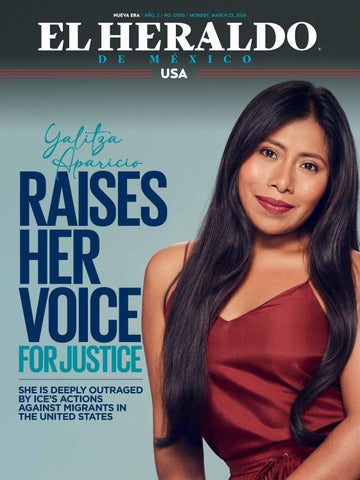
RAISES HER VOICE
FOR JUSTICE
SHE IS DEEPLY OUTRAGED BY ICE’S ACTIONS AGAINST MIGRANTS IN THE UNITED STATES
Periódico El Heraldo de México. Editor Responsable: Alfredo González Castro, Número de Certificado de Reserva otorgado por el Instituto Nacional del Derecho de Autor: 04-2009-060419022100-101. Número de Certificado de Licitud de Título y Contenido: 16921. Domicilio de la Publicación: Av. Insurgentes Sur, No. 1271, piso 2, oficina 202, Extremadura Insurgentes, Benito Juárez, C.P. 03740. Impreso en LA CRÓNICA DIARIA, SA DE CV, Avenida Azcapotzalco La Villa 160, Colonia San Marcos, Alcaldía Azcapotzalco, Ciudad de México, CP 02020. Distribuidores: ARREDONDO E HIJOS DISTRIBUIDORA, SA de CV, Iturbide 18 local D, Colonia Centro de la Ciudad de México Área 4, Alcaldía Cuauhtémoc, Ciudad de México, CP 06040. ELIZABETH IVONNE GUTIÉRREZ ORTIZ, Callejón 2o de la Luz 52, Departamento 4, Interior 1, Colonia Anáhuac II Sección, Alcaldía Miguel Hidalgo, Ciudad de México, CP 11320. AEROVÍAS EMPRESA DE CARGO, SA de CV, Paseo de la Reforma 445, Piso 9, Colonia Cuauhtémoc, alcaldía Cuauhtémoc, Ciudad de México, CP 06000 Publicación Diaria No. 3200, Lunes 23 de Marzo de 2026.

Gerardo Rodríguez Sánchez Lara*
After “El Mencho”: the scenarios

The killing of Nemesio Rubén Oseguera Cervantes, “El Mencho,” during a successful operation by Mexico’s Ministry of Defense marks a major turning point in national security. It is not a minor event. It represents the fall of the leading criminal boss of the most extensive, lethal, and defiant organization the Mexican government has faced in recent years. However, triumphalism should be avoided. Removing a leader does not, on its own, dismantle the criminal network he built. In fact, the hardest phase begins now.
The key question is not just what his death symbolizes politically or symbolically. The real issue is: what comes next for Mexico? The Jalisco New Generation Cartel (CJNG)

wasn’t just a top-down command structure led by one person. Under “El Mencho,” it became a criminal network that handled territorial control, armed violence, international trafficking, institutional corruption, and financial diversification. That’s why the true challenge for the Mexican government isn’t just the operation already carried out but its ability to prevent that organization from surviving, disbanding, or transforming.
First scenario: network persistence. This is probably the most immediate issue. The organization loses its top leader but keeps many of its components running. CJNG learned to operate through relatively autonomous nodes across different parts of the criminal economy. This structure allowed it to expand quickly and withstand pressure in various regions. Its strength did not
MONDAY / 03 / 23 / 2026
rely solely on central command but on a flexible setup for trafficking drugs, money, weapons, chemical precursors, and personnel.
This suggests that even without “El Mencho,” networks involved in methamphetamine and cocaine trafficking, control of key routes, infiltration of local authorities, port corruption, importing chemical precursors from China and India, links with Andean suppliers, money laundering through real estate and shell companies, and contacts in the U.S. for distribution and expansion could still be operational. Moreover, new methods of financial concealment, such as cryptocurrencies and hybrid systems for covert fund transfers, are being employed. In this context, the leader might be removed, but the core networks remain intact. The danger for the government is confusing short-term tactical gains with long-term victory.
Second scenario: violent fragmentation. This is the most dangerous situation. When a large organization loses its key leader, mid-level managers, regional bosses, and armed operatives may fight for control over territories, ports, labs, local markets, and international routes. Fragmentation does not always reduce the threat — it can make it worse. Less cohesion can lead to more clashes, extortion, disappearances, and violence against civilians.
The Colombian experience with BACRIM (local criminal gangs) offers a good example. The weakening or breakup of old structures didn’t automatically bring peace. Instead, more adaptable, predatory groups appeared, often harder to control because of their local and opportunistic nature. Mexico recognizes this danger. If the government doesn’t act quickly against regional sources of violence—the potential successors to routes, arsenals, labs, and extortion networks—the death of “El Mencho” could lead to a more chaotic reorganization of criminal groups. The challenge isn’t just to prevent succession but also to avoid a war among factions.
Third scenario: complete dismantling. This is the best outcome for Mexico—and the most demanding. It would mean that “El Mencho’s” death becomes more than just a successful operation; it becomes an opportunity to accelerate the dismantling of cartels responsible for the country’s worst cycle of violence from 2007 to 2018. That would be the real turning point. It wouldn’t be about replacing one priority target with another or managing new balances among rival groups. It would mean attacking all the functions that sustain the criminal system at the same time.
This involves targeting financ-
es, logistics, political protection, police corruption, ports, customs, labs, border corridors, maritime routes, shell companies, and recruitment networks. It also requires preventing quick leadership replacements, stopping precursor flows, weakening armed capacity, and reclaiming territory through a sustained government presence. Success isn’t just measured by arrests or seizures. It should be seen in fewer homicides, less criminal control over towns and highways, reduced extortion, and a clear drop in the groups’ ability to reorganize. If successful, “El Mencho’s” death will mark a new chapter.
Fourth scenario: strategic cooperation with the United States. The death of CJNG’s leader also presents an opportunity to enhance bilateral intelligence and security efforts. Criminal supply chains linking Mexico and the U.S. do not end at the border. They stretch from chemical precursors in Asia to Mexican ports, from clandestine labs to export routes, and into distribution, laundering, and consumption networks across the U.S.
Dismantling a group like CJNG requires shared intelligence, financial tracking, maritime surveillance, and high-level operational coordination. For Mexico, the key is ensuring that such cooperation remains effective, consistent, and respects national sovereignty. Shared intelligence should help identify operatives, monitor money flow, shut down routes, and predict shifts—not replace Mexican institutions but support them. Ideally, cooperation would not only hinder CJNG’s efforts to reorganize but also increase pressure on other transnational criminal groups.
Conclusion. The death of “El Mencho” is a significant victory for the Mexican government, especially for the Ministry of Defense. However, the outcome remains uncertain. Mexico could face ongoing network activities, violent fragmentation, or a real weakening of the criminal organization. Whether this represents a tactical win or a strategic shift depends on what unfolds in the coming months. In national security, symbols matter—but what truly matters is preventing the criminal group from reemerging under a new name, new leaders, and the same capacity for harm.
* The author is a professor at the Department of International Relations and Political Science at the University of the Americas, Puebla. He also serves as the Coordinator of the Academic Committee on International Security for the Mexican Association of International Studies (AMEI) and is a columnist for El Heraldo de México.
Democracy, in addition to being a form of government for societies, is a term used in international communication to showcase a state’s level of development, to denigrate another country’s political processes, or to justify military intervention by one power in another territory.
BY: DANIEL BENET
ARTWORK: ALEJANDRO OYERVIDES
According to the recently published Democracy Report from the V-Dem Institute at the University of Gothenburg – “the U.S. democracy is in a much faster deterioration process than any other democracy in modern times. Within only one year, the USA’s score on the V-Dem Liberal Democracy index has declined by 24 percent, while its world rank dropped from 20th to 51st place out of 179 nations”. The current trend in the country is concerning. In this context, President Donald Trump has pushed for an effort to increase federal control over elections with the SAVE America Act. But what impact does this have on the country’s democracy? What other elements should be considered?
GLOBAL ANALYSIS OF DEMOCRACY IN RECENT DECADES
At the dawn of the twenty-first century, in the Post–Cold War Euphoria, democracy appeared to be on the rise worldwide. Following a trend that political scientist Samuel Huntington called the “third wave of democratization,” which he traced back to the 1970s, democracy was considered the predominant form of political organization globally.
This optimistic trend plateaued in the mid-2000s. According to analyses by the U.S. Congressional Research Service and Freedom House, the global peak of civil and political rights had been reached. The world then entered a phase of democratic recession.
According to the same report, the erosion of the rule of law, concentration of power in the executive branch, corruption, declining trust in government institutions, polarization, disinformation, and assaults on the legitimacy of the media are among the elements identified as part of this democratic decline. Unlike traditional authoritarian seizures of power, these processes developed within formally democratic systems.
The COVID-19 pandemic marked a turning point. Emergency measures implemented in numerous countries restricted: speech, political opposition, and assembly, accelerating processes already underway. Governments adopted mechanisms such as expanded surveillance, emergency decrees issued without legislative approval, disinformation, and political polarization. Some temporary emergency measures became permanent, altering democratic governance norms.
According to Freedom House studies, global freedom declined for the 20th consecutive year in 2025. A total of 54 countries experienced deterioration in their
U.S. democracy declines rapidly amid polarization and distrust.
SAVE Act may restrict voting through stricter documentation rules. Electoral system flaws deepen representation gaps and tensions. 03 02

political rights and civil liberties during the year, while only 35 countries registered improvements, with the U.S. experiencing the year’s fastest decline. According to the Economist Intelligence Unit’s Democracy Index, the global average democracy score fell to 5.17—the lowest level recorded in decades—while International IDEA reported that more than half of countries are experiencing deterioration in democratic performance.
UNITED STATES
American democracy, long promoted as a global model of liberty, faces its greatest challenge in decades. President Donald Trump relied during his campaign on disinformation and polarization to consolidate support for his political movement. Now in the White House, his persistent attacks on the press—even calling reporters “piggy,” “stupid,” among other insults— and the other U.S. powers, along with his hostile international agenda and reliance on a loyal inner circle, have highlighted authoritarian tendencies.
The country’s democracy remains institutionalized but faces polarization, declining public trust, and electoral disputes. In this context, the president has urged the United States Senate to approve the SAVE America Act, an electoral initiative aimed at federalizing aspects of the electoral process, running counter to the traditional autonomy of states to administer elections, including presidential contests.
ELECTORAL PROCESSES IN THE UNITED STATES
The United States operates under a federal constitutional electoral system designed in the late eighteenth century, combining direct citizen voting with indirect institutional mechanisms. Elections are decentralized, with states administering elections under constitutional and federal legal frameworks.
The most distinctive feature is the Electoral College, established by the U.S. Constitution as a compromise between direct popular election and congressional selection of the president. Citizens vote for slates of electors rather than directly for presidential candidates. These electors—currently 538 in total—cast the official votes determining the presidency; a candidate must obtain 270 electoral votes to win.
Political representation in Congress occurs through two chambers: the House of Representatives, whose members are elected in single-member districts by plurality vote, and the Senate, where two senators per state are elected statewide regardless of population size.
House districts are redrawn every decade following the census, generating political debates over gerrymandering—the manipulation of district boundaries for partisan advantage. Research shows that

DEMOCRATIC BACKSLIDING
redistricting and geographic polarization have reduced electoral competitiveness over time.
The U.S. system emphasizes territorial representation rather than strict population proportionality, producing several democratic distortions: smaller states are overrepresented in the Senate, rural voters receive relatively greater representation, and urban and minority populations tend to be comparatively underrepresented in federal institutions.
SAVE AMERICA ACT
The SAVE America Act is a proposed U.S. federal election law that would require documentary proof of U.S. citizenship to register to vote in federal elections, impose stricter voter-ID requirements, and require states to verify and remove non-citizens from voter rolls. Supporters argue it protects election integrity, while critics say it could make voting harder for millions of eligible citizens.
The most widely cited criticism is that the proposal could prevent legally eligible citizens from voting, not because they are ineligible, but because they lack specific documents. The bill requires documentary proof of citizenship — typically a passport, birth certificate, or naturalization papers — to register or re-register to vote. However, more than 21 million U.S. citizens do not have ready access to such documents, millions lack them entirely due to loss, cost, or bureaucratic barriers.
The proposal shifts voting barriers from eligibility requirements to documentation capacity, which disproportionately affects ordinary citizens. Studies and voting-rights organizations warn that the burden would not be evenly distributed. Groups most likely to be affected include low-income citizens, elderly voters, rural residents, women who changed surnames after marriage, naturalized citizens, racial and ethnic minorities.
Critics argue this could reshape the electorate indirectly by lowering participation among historically underrepresented groups.
The U.S. electoral system traditionally allows states to administer elections. Critics argue the SAVE America Act expands federal involvement by requiring states to share voter rolls with federal agencies and imposing uniform national registration standards. This raises constitutional and federalism concerns because election administration has historically been decentralized.
Analysts warn the proposal may deepen polarization by framing elections primarily as security threats rather than civic processes. Some observers argue the bill could reinforce narratives of election illegitimacy, which has been proved to be a false narrative, provide grounds for disputing unfavorable election outcomes and increase partisan distrust in democratic institutions.
TRANSLATION OF VOTES INTO POWER
In the United States, votes are filtered through geographic units, and the Electoral College and Senate design can produce outcomes in which the national popular vote winner does not become president.
IN THE UNITED STATES AND ITS ELECTORAL
SYSTEMS
Over recent decades, the system has faced debates about representation quality. Controversies center on Electoral College legitimacy, gerrymandering, and unequal representation among states, and more recently, with Trump’s return to the White House, on concentration of power on the Executive Branch without considering other powers for important decisions affecting U.S. citizens.
If approved by the U.S. Senate, the SAVE America Act might push the country further away from democracy.


VOICES, AND PUBLIC CONVERSATION THE DEBATES
Through conferences, roundtables, podcasts, and publications,
CISAN–UNAM is turning the 2026 World Cup into a platform for public reflection — connecting soccer with food culture, gender equality,
infrastructure, diplomacy,
and urban power.
BY: ALEJANDRO MERCADO CELIS*
ARTWORK: DANTE ESCOBAR
Beyond analysis, CISAN’s initiative seeks to bring the conversation into the public eye. The program includes conferences, international colloquia, roundtables, digital broadcasts, podcasts, and a special publication aimed at expanding the debate beyond academic circles. The cycle begins with activities that connect soccer to frequently overlooked social aspects.
On April 8, a conference called “Sporting Events and Food Cultures in the United States” will include a lecture titled “Eat and Hydrate Like an Athlete: High-Performance Food Culture in the Age of Optimization,” delivered by Emily Contois from the University of Tulsa. This session examines how contemporary sports intersect with industries focused on optimization, consumer habits, and social inequalities. Additionally, mega-events shape eating patterns, market trends, and body-related narratives.
On April 21, an international colloquium titled “Football, Place, and Power: Understanding Cities Through the World’s Most Popular Sport” will bring together Steve Millington and Ian Harvey from the University of Manchester, with commentary by Juan Carlos Barrón. The discussion will delve into how soccer relates to city branding, governance, public space, and territorial inequality — and who has the “right to the city” when mega-events occur.
On May 7, a second international conference will center on “Football, Gender, and Diversity.” It will feature the lecture “Dribbling Against Machismo: A Comparative History of Women’s Soccer in Mexico and the United States, 1970–2020,” delivered by Giovani Uribe (UNAM). A panel discussion including Adrianelly Hernández Vega, Andrea Rodebaugh (FIFA Women’s), Marisol Vázquez Piñón, and Fátima Leyva will examine the political and cultural shifts in women’s soccer and the persistent barriers of gender inequality in sports.
On June 10, a conference titled “Socio-Environmental and Economic Impacts of Infrastructure for the 2026
World Cup drives CISAN public debates
3 6 16
podcasts + 1 journal expand 2026 dialogue key themes link soccer with society, power host cities featured in CISAN exhibition

World Cup,” led by Yesua Martínez Torres (El Colegio de México), will examine how infrastructure projects affect host cities. The World Cup requires significant investments in transportation and services, resulting in decisions that influence urban development and create lasting socio-environmental effects.
On August 18, a roundtable titled “Football as Paradiplomacy and Soft Power,” featuring commentary by Juan Carlos Barrón and moderated by Roberto Zepeda, will explore soccer from an international relations perspective. In a region where cities, local governments, corporations, and cultural networks also wield influence, the sport acts as a diplomatic instrument and enhances global visibility.
The program extends beyond live events. From August to October, CISAN will release a three-episode podcast series titled “The Other World Cup: Ideas, Culture, and Region,” translating key themes for wider audiences. Between March and November, seminar sessions will be streamed live on CISAN’s YouTube channel. In the second half of 2026, a special issue of Voices of Mexico will compile contributions from the seminars. In November, an exhibition showcasing visual materials from the 16 host cities will be displayed at CISAN facilities.
The invitation aims to discuss the World Cup in its social and cultural complexity. Topics such as security, public spending, urban mobility, labor rights, regulation of public spaces, tourism, environmental impact, and the influence of digital platforms will all be discussed. Additionally, an emotional aspect that cannot be overlooked will be addressed: soccer as a symbol of identity, celebration, memory, and resistance in a region shaped by migration and global connections.
Thinking critically about these processes does not diminish the emotion of sport. It amplifies it. When the final whistle blows in 2026, the scoreboard will reset — but the urban, cultural, and political marks left behind will endure. That’s precisely why this conversation matters.
* The author is a researcher at the Center for Research on North America (CISAN), UNAM.

Although the Trump administration has intensified arrests and immigration enforcement, the numbers show that deportations remain far from the promised goal. An analysis of figures, costs, and strategy reveals a more complex reality.
BY: ARIEL RUIZ SOTO*
ARTWORK: ALEJANDRO OYERVIDES
The immigration debate in the United States is often shaped by strong statements and ambitious promises. However, when the numbers are examined closely, the gap between rhetoric and reality becomes evident.
In his first year in office, President Donald Trump claimed to have deported more than 675,000 people. It is a significant number but still less than the 685,000 recorded during the final period of President Joe Biden. The contrast is notable because, despite increased enforcement visibility and more direct use of force, the deportation total has not yet reached the goal of one million per year.
It is important to differentiate between arrests, detentions, and deportations. The number of arrests within the country has increased, partly because border crossings have dropped sharply. Under the Trump administration, crossings are now reported at around 7,000 per month—a significant de-
DEPORTATIONS, STATISTICS, AND THE NARRATIVE
Enforcement has shifted inland as border crossings fall, but arrests, detentions, and deportations remain widely misunderstood.

Trump reported 675,000 deportations in one year, below Biden’s 685,000 record in his final period.
Border crossings dropped to 7,000 monthly under Trump, from 100,000 200,000 during Biden's years.
Over $400M spent to deport 300 migrants to third countries, nearly $1M per person in some cases.
Congress allocated $170B to DHS over four years, giving ICE the largest enforcement budget in the U.S.
The U.S. has 25 agreements with third countries; Mexico received nearly 12,000 non-Mexican migrants.
Around 13.7M people live without legal status in the U.S., far exceeding annual deportation capacity.
cline compared to the 100,000 to 200,000 typically seen under the Biden administration. With less pressure at the border, immigration enforcement has shifted its focus toward the interior of the country. However, not everyone who is arrested is detained, and not everyone who is detained is ultimately deported. This nuance is often overlooked in public debate, where the number of arrests is often equated with actual removals.
Another key element is the story surrounding the profile of those detained. Officials have pointed to the presence of alleged gang members and terrorists among those arrested. However, the definition of “terrorist” has expanded in recent years to include certain criminal groups, changing public perception of the issue. Most of those detained have no criminal record other than entering the country illegally, which usually counts as an administrative violation rather than a criminal offense.
This distinction is important because political rhetoric often portrays the phenomenon as a threat to national security. Consequently, a debate often combines organized crime, terrorism, and irregular migration into one category, even though the profiles and risks are quite different in practice.
At the same time, the expense of this policy is significant. A report by Democratic senators showed that over $400 million was spent to deport only 300 people to third countries, which in some cases amounted to nearly $1 million per person. This does not include the $170 billion allocated by Congress to the Department of Homeland Security (DHS) over four years. With these funds, Immigration and Customs Enforcement (ICE), the agency in charge of immigration enforcement, now has the largest budget of any law enforcement agency in the country.
The use of agreements with third countries has become a key tool. So far, 25 such agreements have been recorded, most with Latin American and Caribbean nations. Mexico occupies a central place in this framework. By the end of last year, it had received nearly 12,000 non-Mexican migrants deported from the United States, generally through low-cost land transfers.
However, the lack of transparency around these agreements raises questions about what happens to these individuals afterward. Mexico faces legal restrictions on detaining them and, in many cases, cannot deport them to their home countries. This creates situations of migratory limbo that could have international legal and humanitarian implications within Mexican territory.
Furthermore, while increasing deportations is a key goal of the Trump administration, these make up only a small part of the approximately 13.7 million people estimated to be living in irregular status in the United States. The scale of the problem greatly exceeds the system’s yearly operational capacity.
This raises a core question: can a strategy almost entirely based on enforcement and removal resolve a problem also connected to labor markets, demographic trends, and transnational economic chains?
Ultimately, the current administration has not passed new immigration laws; instead, it has reinterpreted regulatory frameworks that have gone decades without major reform. Without comprehensive legislative modernization, the system will stay vulnerable to shifts in approach depending on which political party is in power.
The real debate isn’t just about how many people are deported, but whether the U.S. immigration system can adapt to the realities of the 21st century without depending solely on cycles of political toughening and easing.
* The author is a Senior Analyst at the Migration Policy Institute (MPI).
In 2019, Time magazine listed her among the 100 most influential people in the world.

On October 4, 2019, she was named the United Nations Ambassador for Indigenous Peoples.
/ 03 / 23 / 2026
Speaks out
Yalitza Aparicio is concerned about anti-immigrant actions affecting Latinos in the United States

She
She
BY: GERARDO SÁNCHEZ
Eight years ago, Yalitza Aparicio made her big-screen debut in Roma, directed by Mexican filmmaker Alfonso Cuarón, an experience that changed her life and reshaped her worldview. Today, she has become a voice speaking out against injustice and expressing concern about ICE detentions.
Regarding the U.S. government’s anti-immigrant actions, Yalitza said: “It’s a deeply painful issue. When you look at what people are going through, it’s complicated. The only thing I can say is that, as a person, I will never agree with harming another human being. That’s not aligned with my values. I would never support anything like that.”
That is why she takes on projects where she can raise her voice, such as the recently released four-episode documentary series Peace Peace Now Now, which premiered in recognition of International Women’s Day.
In the episode Women of the Land, the Oscar-nominated actress accompanies, listens to, and narrates the story of the Abuelas de Sepur Zarco in Guatemala—a group of Indigenous women who survived one of the most violent civil wars in Latin America, which claimed more than 200,000 lives.
In an interview with El Heraldo de México, the actress explained why she chose to be part of the series: “I loved the idea. Daniela Vega approached me to share what she had in mind and to see if I wanted to be involved. I thought it was wonderful to learn about the situation of women in other countries and give them visibility, because we often have very limited information. It was incredible to open my mind a bit more to what’s happening elsewhere.”
“When everything came together, I learned that Lydia Cacho and Ester Expósito were also part of the project. It’s amazing that, as women working in different fields, we share common interests,” she added.
Yalitza also shared: “I was struck by how, after everything they went through, they try to move forward without revictimizing themselves. I never felt ‘oh, poor them,’ but rather
They raise their voices with the hope that their descendants will have a better future.’
YALITZA
their message is: ‘this happened to us, and we want it to be heard so it never happens again.’”
The actress reflected on how she connected personally with the women of Sepur Zarco: “There were many things I related to that made me reflect on my past—the desire to understand my grandmothers’ history and to learn more so I don’t judge from ignorance.”
She also spoke about the difficult conditions faced by the community: “For example, they have a river, but it now belongs to a company, so they don’t have access to water. There are no proper roads—you have to walk for hours to get there. There’s no electricity or internet. Opportunities are not equal in this society.”
The Oaxaca native explained what she gained professionally from the project: “Every project contributes so much—not just to the career I’m building, but also to who I am as a person. I can’t allow myself to be boxed into one thing; I like having the chance to learn from everything that comes my way.”
She added: “I’m very curious about everything happening around me, and working on a documentary opened my eyes to how global issues are presented and brought to the screen.”
Speaking about the documentary genre, Aparicio noted: “It’s undervalued. Behind every documentary lies years of work and research. It’s not just about showing up and filming—you have to understand people’s customs, how their systems work, and recognize that not everyone is used to a camera, so you have to find ways to make them feel comfortable.”
Yalitza also highlighted the shared message across the series: “Unfortunately, these are stories that repeat all over the world, and they shouldn’t. It reminds us that those who don’t know their history are doomed to repeat it. What happened in Guatemala, even though it was years ago, connects with many Indigenous communities in Mexico today.”
AND THE OSCAR GOES TO…
Since their first ceremony in 1929, the Academy Awards have functioned as more than a celebration of hegemonic filmmaking. The Oscars operate as a cultural archive, preserving the films that best capture the concerns, aesthetics, social discourses and ambitions of a given era.
DIVERSITY, SOCIAL TURMOIL AND REDEMPTION IN THE
2026 ACADEMY
AWARDS

OSCAR
TO…

BY: GONZALO LIRA GALVÁN
ARTWORK:
From the patriotic spectacles of the 1940s to the auteur-driven cinema of the 1970s and the blockbuster era of the late twentieth century, each generation of nominees reflects the shifting priorities of the film industry and its audience.
The Best Picture nominees of the 2026 Academy Awards offered another revealing snapshot of cinema at a moment of transformation. The ten films competing for the industry’s highest honor—Bugonia, F1, Frankenstein, Hamnet, Marty Supreme, One Battle After Another, Sentimental Value, Sinners, The Secret Agent, and Train Dreams—illustrate the remarkable breadth of contemporary filmmaking. Together they demonstrate how modern cinema balances -sometimes successfully, sometimes notelements such as spectacle, historical reflection, genre experimentation, and global storytelling.
In earlier decades, the Academy tended to favor grand historical epics or literary adaptations that emphasized prestige and technical accomplishment. While that tradition persists, the 2026 nominees showed a notable expansion in both tone and subject matter. Guillermo del Toro’s Frankenstein, for instance, revisits one of the most enduring myths of modern literature, yet frames it through a contemporary lens that emphasizes moral responsibility and the dangers of unchecked ambition. At the same time, Ryan Coogler’s Sinners blends horror, social history, and musical influences to explore racial identity and cultural memory in America.
Genre diversity is one of the defining characteristics of the 2026 lineup. Where the Academy once leaned heavily toward
films competed for Best Picture at the 2026 Academy Awards.
solemn dramas, the current field includes everything from speculative satire to sports cinema. Bugonia, directed by Yorgos Lanthimos, presents a darkly comic conspiracy narrative about paranoia and power, while F1 offers a kinetic sports drama centered on mentorship and redemption within the high-pressure world of Formula One racing. Their inclusion reflects a growing recognition that cinematic artistry can emerge from any genre when handled with ambition and craft.
films —Sinners and One Battle After Another— led the final awards tally.
record-breaking nomination run positions Sinners as a historic milestone.
Another recurring thread among the nominees is the exploration of personal ambition and its consequences. Films such as Marty Supreme portray the emotional cost of pursuing success in a world that often doubts individual dreams. Similarly, Paul Thomas Anderson’s One Battle After Another examines the legacy of political idealism, following former revolutionaries who reunite years later to confront unfinished struggles. These narratives resonate in a period marked by social polarization, ICE raids, war, genocide, political intervention and generational debate about the meaning of social change.
The nominations also revealed a strong interest in historical reflection. Hamnet, directed by Chloé Zhao, revisits the life of William Shakespeare through the lens of family tragedy, exploring grief and artistic creation in early modern England. Meanwhile, Train Dreams depicts the life of a laborer navigating the transformations of early twentieth-century America. Both films illustrate how contemporary cinema continues to reinterpret history not as distant spectacle, but as an emotional landscape that speaks directly to modern audiences.
Equally significant is the global dimension represented in this year’s nominees. Kleber Mendonça Filho’s The Secret Agent
and Joachim Trier’s Sentimental Value highlight the increasingly international character of the Academy Awards. In earlier decades, foreign-language films were often confined to a separate category. Today, they compete directly for the industry’s top prize, reflecting a cinematic culture that is increasingly transnational in both production and reception.
Among the nominees, Sinners stands out not only for its narrative ambition but also for its historic reception within the Academy. The film received a record-breaking number of nominations, signaling both the long-awaited recognition of African-American filmmakers and the Academy’s willingness to embrace genres such as horror that were once marginalized within awards culture. This milestone suggests a broader transformation in what the institution considers worthy of its highest honors.
Taken together, the 2026 Best Picture nominees reveal an industry negotiating the balance between tradition and reinvention. Classic themes—ambition, grief, moral responsibility—remain central, yet they are now explored through a wider range of cinematic languages. The presence of genre films, international productions, and historically reflective narratives illustrates an Academy increasingly responsive to the pressures amidst the inevitably growing diversity in global filmmaking. Not forgetting economic and political interests as well.
In the end, the most awarded films at the Oscar ceremony this year, both Sinners and One Battle After Another, form a cultural record. Decades from now, historians of cinema may look back at them as part of a collective portrait of what popular filmmaking meant in the mid-2020s: ambitious, stylistically varied, and deeply engaged with the anxieties and aspirations of its effervescent times.

#BOXING

Keith Thurman returns with his sights set on one last shot at the top, knowing a loss could push him to the brink of retirement.
BY: ERIKA MONTOYA PHOTOART: ALEJANDRO OYERVIDES
Keith Thurman Jr. returns to the ring with more than just another fight ahead of him: he comes back with the urgency of someone who understands this could be his final real chance to become a world champion again.
Seven years after last holding a title, the former welterweight champion faces a new stage in his career, now at 154 pounds, in a scenario that blends risk, ambition, and an inevitable narrative of redemption. Time, inactivity, and injuries have marked his recent path, but they have not changed his goal.
“It’s been a seven-year comeback… “ It’s been a very long wait,” the American said in an interview with Heraldo USA, fully aware of the long road he has traveled to return to a relevant position in elite boxing.
Thurman no longer arrives as the dominant fighter he once was, the one who unified titles and established himself as one of the most solid names in the welterweight division. Today, his reality is different. A lack of continuity—just a couple of appearances since 2019— has slowed his rhythm, forcing him to rebuild his path almost from scratch, but with the same passion
Thurman Jr. has only suffered two defeats since entering boxing: against former champion Demetrius Andrade (as an amateur) and against Manny Pacquiao (as a professional)
he has carried since discovering boxing.
Even so, his name still carries weight. His record, his offensive style, and his ability to put on a show keep him in the conversation, even in a new division and against an opponent who represents one of the most significant physical challenges. Sebastián Fundora, the reigning champion, is 20 centimeters taller and nine years younger.
“I love challenges. That’s why I love boxing,” Thurman says, making it clear that his presence in the sport is not only about chasing belts, but about something deeper: competition itself and the legacy he wants to leave behind.
That factor is key to understanding his return. Beyond the obvious differences—age, reach, current form—Thurman is betting on the experience he has built over three decades in boxing.
From his early days in the ring as a child to his battles with top-level fighters, his confidence rests on one central argument: his style has never been easy to figure out. His record reflects that, with just one loss (to Manny Pacquiao in 2019).
“I know that no matter who I’m in the ring with, a Thurman test is one of the toughest in boxing,” he says, reinforcing the idea that even at this stage of his career, he remains a high-risk opponent.
The fight against “The Towering Inferno” represents more than just a title opportunity. In many ways, it is validation.
Thurman aims to prove that his level has not been left behind, that the skills that once took him to the top remain intact despite the passage of time and inactivity.
In that context, the matchup also embodies one of boxing’s classic contrasts: youth versus experience. A narrative Thurman embraces na-
turally, fully aware that his margin for error is shrinking.
The American knows he cannot afford a loss if he wants to stay in the world title conversation. Still, he makes it clear that his mindset is not driven by fear of the result, but by the desire to compete at the highest level and find out if “the spark” is still there.
“I believe I have what it takes to be champion again… this is about a great comeback story. About overcoming every obstacle and achieving the dream,” he says, placing his return within a narrative that has long defined boxing: the fighter seeking one last chance to rewrite his destiny.
The “last chance” is not just a concept—it is Thurman’ s reality. At 37 years old, every fight is decisive and carries significant risk for everything he has built before. Becoming champion again depends not only on winning, but on proving he still belongs among the elite.
In a demanding, constantly evolving division, the American is betting on his experience, intelligence, and adaptability. He may not be the favorite, but he is a fighter who understands exactly where he stands.
His return, then, is not measured solely in victory or defeat. It is measured by his ability to compete, to endure, and to show that even after difficult years, he still has something to offer to the fans who have followed him through highs and lows.
Keith Thurman Jr. returns to the ring in Las Vegas driven by passion, competition, and the need to prove himself.
In that pursuit—this search for one last opportunity—he is risking more than a title: he is fighting for the final chapter of his own story in boxing.


It has been 7
31
23
