
Heraldo USA Lunes 9 de febrero de 2026

Page 1


ENJOYS HIS JOURNEY Sebastian Yatra

THE SINGER IS READY TO UNVEIL HIS “MILAGRO” ON AN INTERNATIONAL TOUR
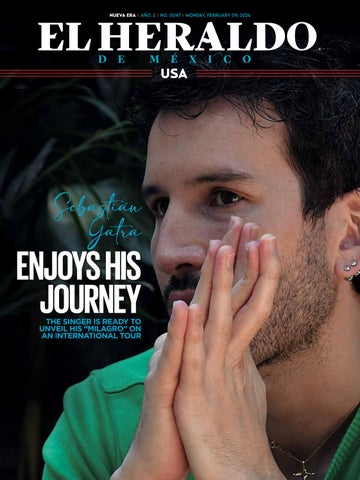
Sebastián Yatra MI RA CLE LIVES HIS

Collaborated

Colombian singer Sebastián Yatra is preparing for a world tour following the release of his new album, a project that arrived at exactly the right moment in his life. “About eight years ago, when I was writing Fantasía, I already knew I wanted to have an album someday called Milagro, and I didn’t know why. Later, I found a definition in a book that said a miracle can be something as simple as seeing things from another perspective and realizing that everything is a miracle,” he shared in an interview with El Heraldo USA.

He also recalled a phrase from a book written by his brother: “Life denies you miracles until you realize that everything can be one.” For Yatra, everyday experiences—moving his hands, feeling the cold texture of stones, drinking coffee or matcha, smelling nature, and being surrounded by kind people—are all miracles.

EXPERIENCES CAN BE TRANSFORMED

The singer-songwriter explained that the album’s title has led him to reflect deeply. By focusing attention on the present moment and recognizing life’s miracles, he says, people can stop dwelling on fears or perceived shortcomings. He believes intention can lead to better places: even negative experiences can be transformed when viewed from a different perspective.

The performer of “Tacones rojos” described faith as speaking with God before going to sleep, surrendering control, and trusting the journey ahead. “Some people talk to God, others to Allah. In India, there are a thousand gods. Some speak to the quantum field or the universe. There are many ways to name what we’re all seeking,” he said. For him, faith means letting go and trusting that wherever life leads is exactly where he needs to be.

HE SHOWS HIS LOVE FOR MEXICO Mexico holds special significance for Yatra. It is the country where he has performed the most, touring extensively and connecting with its culture, gastronomy, beaches, and people. He says he has formed lifelong friendships there and left pieces of his heart in the songs he has written in Mexico. He eagerly shared news of his upcoming tour, which will include his first performance at the Palacio de los Deportes. The tour comes with renewed energy and the release of “Canción para regresar,” a collaboration with Belinda, Gente de Zona, and Lucho RK. Yatra emphasized the importance of lyrics in his career, describing his new music as part of an ongoing “book” about his life journey—stories many people can relate to. He also highlighted his collaboration with Humbe, noting their genuine friendship and shared sensitivity toward music, which inspired them to create from honesty and enthusiasm.

INTROSPECTION

Through this album, Yatra says he has found greater balance in his life. Faith, for him, is the act of surrender—trusting in something greater, even in moments of uncertainty. By letting go of control and embracing the present, he continues to build his path with gratitude and purpose.

RAMÍREZ MAYA
PHOTOART: ALEJANDRO OYERVIDES
with Carlos Vives on “Robarte un beso.” Served as a coach on La Voz Kids.

MARK CARNEY AND THE COLLAPSE OF THE OLD LESSONS FOR MEXICO?

At the World Economic Forum in Davos, Canadian Prime Minister Mark Carney argued that the liberal international order established after World War II is coming to an end. His speech emphasizes the uncertainty of a world without clear rules and highlights the role that middle powers like Canada and Mexico can play by diversifying alliances, strengthening multilateralism, and preparing for potential changes in North America’s trade framework.

On January 20, during the World Economic Forum in Davos, Switzerland, Canadian Prime Minister Mark Carney delivered what is widely considered one of the most important speeches in 21st-century international relations. Carney—a liberal politician—predicted an idea that many scholars and theorists of international relations have warned about in recent years: the end of the post-World War II world order, which was established with the creation of the United Nations and other international organizations.

From Mexico, Carney’s speech can be viewed from two perspectives: global and regional.

The first relates to the end of over 80 years of liberal internationalism, also known as the rules-based international order, whose most recognizable form is the United Nations system and, more broadly, the set of institutions that make up global governance. The challenges of this shift come not only from the weakening of that order but also from increased uncertainty about what might replace it. The world is entering a period of unpredictability.

Carney’s ideas emphasize the options available to middle powers like Canada and Mexico to pursue a confident foreign policy amid increasing global competition among major powers for more influence in international affairs. The Canadian prime minister warned that this rivalry could threaten the rules-based international order, noting that “the strong do what they can, while the weak suffer what they must.” Confronted with this situation, many countries prefer to accommodate, avoid conflict, and hope that complacency will safeguard their security.

Carney warned that Canada will not be powerless in this situation and argued that middle powers can create a new order that upholds liberal values such as respect for human rights, sustainable development, solidarity, sovereignty, and territorial integrity. He also encouraged his peers to eliminate internal trade barriers, accelerate investment in energy, artificial intelligence, and critical minerals, double defense spending, and diversify strategic alliances across Europe, Asia, Latin America, and beyond. Subtly, Carney suggested exploring alternatives to the United States. These reflections are especially important for Mexico, a country likely to be affected by this emerging global order. Instead of just following directives from major powers, Mexico should take a leading role. Historically, Mexico has actively participated with the United Nations organizations, agencies, funds, and programs to tackle global challenges through a multilateral approach.

The second perspective to consider involves how these remarks impact North America, since Canada, the U.S., and Mexico are partners under the United States–Mexico–Canada Agreement (USMCA). While these countries are renegotiating the agreement’s terms, Canada has taken a strategic step by moving closer to China, which Ottawa views as a potential alternative to the U.S. if Washington continues its trade pressures against Canada.

In his speech, Carney said: “We are rapidly expanding internationally. We have agreed to a comprehensive strategic partnership with the European Union (…). We have signed another 12 trade and security agreements across four continents in six months (…); we have formed new strategic partnerships with China and Qatar. We are negotiating free trade agreements with India, ASEAN, Thailand, the Philippines, and Mercosur.”

This indicates that Canada is exploring new markets for trade, which raises questions about the future of the USMCA—especially in 2026, when the three countries plan to review the agreement.

Canadian foreign policy could serve as a guide for Mexico if the USMCA were to end or break down. Mexico needs to identify potential trade allies to include in new supply chains and to form partnerships with strategic allies who share similar views and interests on key global issues.

* The author is a researcher at Centro de Investigaciones sobre América del Norte (CISAN), UNA M.

Maj. Gen. (Ret.) Mauricio Quiroga*

Marco Rubio and the strategy to push Cuba to its breaking point

MARCO RUBIO’S ASCENT SHIFTS U.S. POLICY TOWARD CUBA, ACCELERATING AN ECONOMIC PRESSURE THAT LEAVES THE ISLAND WITH TWO OPTIONS: COLLAPSE OR NEGOTIATION. WITH VENEZUELA OUT OF THE PICTURE AND ALLIES LIMITED, ENERGY PRESSURE BECOMES WASHINGTON’S MOST POWERFUL TOOL. The

ARCO RUBIO’S POLITICAL JOURNEY: THE ARCHITECT OF “CHANGE”

The appointment of Marco Rubio as Secretary of State and National Security Advisor has significantly transformed the landscape. Rubio is not just a diplomat; he is the key figure behind a hemispheric “liberation” strategy.

The son of Cuban immigrants who left after the Revolution, Cuba isn’t just a foreign issue for him—it’s about family history, loss, and exile. This explains the emotional tone of his rhetoric. Rubio rejects gradual reforms or managed openings. His position is clear:

tegic, aimed at causing divisions or forcing negotiations among elites. Rubio’s reputation increased after the operation that captured Maduro, giving him political influence within the Trump administration to pursue a similar strategy in Cuba.

In Washington circles and on social media, Trump has sparked speculation that Rubio could become a key figure—or even an “administrator”—in a post-communist Cuba, raising concerns among Havana’s leadership.

POSSIBLE SCENARIOS

SCENARIO 1: COLLAPSE CAUSED BY SUFFOCATION (RUBIO–TRUMP EFFECT)

The U.S. pressures Mexico to halt Pemex supplies. Without Mexican oil and with Russia unable to meet demand, Cuba’s power grid risks a complete nationwide blackout, forcing the military elite to surrender unconditionally or triggering mass migration blocked by the U.S., which could lead to regime change.

SCENARIO 2: NEGOTIATING UNDER THE THREAT OF INTERVENTION

Following the Venezuelan example, pragmatic sectors of the Revolutionary Armed Forces contact Rubio’s office to negotiate a “dignified exit,” including the surrender of key figures and the holding of free elections in exchange for immunity and the immediate lifting of the embargo.

SCENARIO 3: ENTRENCHMENT AND THE EURASIAN AXIS Cuba tries to survive by acting as a logistics hub for Russia and China in exchange for energy. This could trigger a modern missile crisis and a full U.S. naval blockade, significantly raising the risk of armed conflict in the Caribbean.

SCENARIO 4: A “MEXICAN STYLE” OPENING Mexico defies U.S. pressure and continues oil shipments while mediating between Havana and Washington. This scenario is unlikely under a Trump administration willing to weaponize oil and supported by Rubio’s zero-tolerance policy.

CONCLUSION

From a systemic-collapse perspective, Cuba’s future in 2026 will depend less on internal politics and more on the interaction between:

1.- Mexico’s ability and willingness to maintain energy flows under pressure.

2.- Russia’s limited “survival” support.

3.- Washington’s political resolve, with the “Rubio factor” serving as a catalyst for total suppression.

With Venezuela gone, Cuba faces an energy crisis that slows down the pace of gradual reform. What remains is an enforced transition—either caused by technical failure or through negotiations under credible threat.

Operationally, the system shifts from an ideological project to one focused on basic survival needs: energy, food, social control, and minimal coercion. If external energy flows drop below the operational threshold, Scenario 1—collapse by suffocation—becomes less likely and less certain.

* The author previously served as the Director of Intelligence for Peru’s National Police. He is now the CEO of Data Forte, a member of the Latin American Network of

FB: MAURICIO QUIROGA

What is the president of the world’s most powerful nation thinking when he says that the United States is now controlling a Caribbean country?

When Donald Trump sat down at the White House table to meet with CEOs of major oil companies, he told them they should invest $100 billion in Venezuela. But Darren Woods, CEO of ExxonMobil, said he was not interested. Venezuela, he argued, was “uninvestable” because of its extremely high-country risk and because its extraction infrastructure lies in ruins after 26 years of looting and corruption. Shortly afterward, the president remarked that his former friend was merely trying to be agreeable and that Exxon would likely be excluded from the equation.

But what is really going through Trump’s mind when he claims he is now in charge of Venezuela after U.S. special forces forcibly captured Nicolás Maduro? The answer might lie with someone who advised him during his first term: John Bolton. In his book The Room Where It Happened, Bolton states that Trump truly believed Venezuelan oil belonged to the United States and couldn’t understand why it wasn’t simply seized by force. According to Bolton, Trump has held this view for over a decade—regarding countries like Iraq and Libya—but his fixation on Venezuela is especially intense. Bolton contends that Trump’s neglect of sovereignty—or his failure to grasp the concept—led to conflicts with advisers like himself and Rex Tillerson whenever they discussed international law. Trump would simply reply that U.S. oil companies should be able to access and extract resources without many legal obstacles, because he believed that a country so rich and poorly managed doesn’t deserve to control its own resources.

That way of thinking, if you can call it that, developed over time. In a speech delivered in North

MORE THAN JUST OIL

Carolina in 2023, when Joe Biden was president, Trump said: “What do you think about us buying oil from Venezuela? When I left office, that country was on the verge of collapse. We would have taken it over. We would have kept all that oil.” What he once said privately about taking every-

More importantly, we will need to watch what happens with his plan to force Venezuela to sell oil exclusively to the United States and to use those revenues to buy only U.S. products, fully excluding China, Russia, and Iran.

VENEZUELA’S COMPLEX OIL INDUSTRY

The reality of crude from the Orinoco Belt is that it is heavy oil with high sulfur content, making it more suitable for asphalt production. The United States already imports this type of heavy crude from Canada for road construction, and it might now source most of it from the Caribbean instead, especially as the maple leaf country seems increasingly resistant to Donald Trump’s expansionist ambitions by signing trade deals with China.

Even so, Venezuelan oil will not be profitable for years. Rebuilding its dismantled infrastructure would cost between $100 billion and $180 billion. Although it’s often said that Venezuela has the world’s largest oil reserves, those reserves remain underground, and extracting them is costly. Currently, Venezuela accounts for only 1% of the global hydrocarbon supply, while the world faces an oversupply of nearly 3 million barrels per day. This situation results from disastrous Bolivarian policies. As investment bank Bradesco BBI has noted: “Venezuela’s economy today is the same size it was 45 years ago, compared to eightfold growth across Latin America.”

THE NEW WORLD (DIS)ORDER All of this fits into a new geopolitical realignment. Beyond oil, what Donald Trump seeks is to decouple China from Latin America, as outlined in the now well-known National Security Strategy, which promotes Trump’s corollary to the Monroe Doctrine: a new chapter of “America for Americans.”

Meanwhile, Secretary of State Marco Rubio—who also has presidential ambitions—hopes for regime change in Cuba, the land of his ancestors, following the shutdown of Venezuelan oil supplies. Trump, Vance, Hegseth, and Rubio are all intoxicated with power after Maduro’s fall, which was achieved without casualties on their side and through their effective guardianship over the Caribbean nation’s leadership.

This places President Claudia Sheinbaum’s administration in a delicate position. She has stated that Mexico will continue shipping oil to Havana, even though the January shipment did not arrive, as has been happening since 2023 at any Cuban port— both due to contractual obligations and, possibly, humanitarian reasons—though it remains unclear whether Cuba pays for those contracts. The most hardline members of Congress in the U.S. have called this an unacceptable act of support for the island’s dictatorship, and they have issued this critique at the worst possible time.

For now, Trump doesn’t seem eager to choke Cuba financially.

U.S. Secretary of Energy Chris Wright said that Washington has not asked Mexico to stop oil supplies to the island. This is seen as a temporary pause for both Cubans and the Mexican government, even as warnings continue to grow elsewhere.

Because the intoxication caused by the operation in Caracas persists, the so-called “Donroe Doctrine” now extends from the Arctic to the rest of the Americas, frightens all of Europe, and looms ominously, threatening surgical strikes against drug traffickers on our own land.

* The author is a columnist specializing in international politics. He previously served as editor-in-chief of Inversionista

and

JARIPEO

A DOCUMENTARY EXPLORING A MEXICAN TRADITION THROUGH A QUEER

PERSPECTIVE

Jaripeo explores a deeply rooted Mexican tradition to challenge concepts of masculinity, identity, and desire through a queer lens. Directed by Efraín Mojica and Rebecca Zweig, the documentary combines community rituals, diaspora experiences, and experimental cinema.

The word jaripeo comes from Purépecha, originating from the term Xarhipeo. It is this word that names a town in Michoacán, which, along with Penjamillo, became one of the places where the identity of the Mexican man was shaped.

This tradition started in Mexico in the 16th century: a rider mounted a wild bull before a crowd. Over time, however, it developed into something much more complex and visually vibrant—dance, banda music, the jaripeo queens wearing traditional dresses, and riders dressed in leather chaps. It became a full cultural spectacle and, most importantly, a key space for shaping the archetype of the “macho Mexican man.”

This marks the beginning of Jaripeo, a documentary directed by Efraín Mojica and Rebecca Zweig, which offers a fresh look at the tradition from a queer perspective. Heraldo USA interviewed Efraín and Rebecca, who shared how the project was brought to life.

How did the project start?

Efraín Mojica (EM): The origin of Jaripeo is as natural as it is beautiful—born from friendship. I grew up in Penjamillo, where jaripeo is a key part of community life. In 2018, when Rebecca visited Mexico, I invited her to spend Christmas with my family. As tradition goes, everyone went to the jaripeo on Christmas Day, and it was the first time Rebecca had ever attended one.

The filming occurred in phases. First, we shot the teaser with a small investment from producer Sarah Struning, which mainly covered equipment rental and transportation. The rest of the production was entirely handmade, with the help of our cinematographer, sound recordist, and assistant, who are very close friends. They were there not only to work but also to live and enjoy the jaripeo.

What did your first jaripeo experience inspire in you? Rebecca Zweig (RZ): I loved it. It’s a very cinematic, lively space. From that moment, I wanted to create something there and collaborate with Efraín in that context. We thought about it for years and started filming in 2021.

What was the filming process like?

EM: We aimed to create a documentary about jaripeo, as well as explore the queer subculture within a macho and traditional world, and how these two realities coexist.

Jaripeos are organized by the local community. Throughout the year, people look forward to Christmas or New Year’s for this celebration. About 10,000 people come to a town where the population is around 6,000. Christmas and New Year’s are also times when people return from the United States to be with their families. That adds another layer to the documentary—almost like a performance for the diaspora.

On her first experience with jaripeo, Zweig states:

RZ: Jaripeo is a rodeo unique to central Mexico—covering the State of Mexico, Querétaro, Jalisco, and Michoacán. It’s a community celebration organized by local people. As we started exploring the space, we found it extremely compelling.

We’re very excited about the positive reception the film has gotten, even after only three screenings. Thank

EFRAÍN MOJICA Photographer, filmmaker, and conceptual artist from Michoacán. His multidisciplinary work has been showcased

TAKING A BREATH IS ALSO PART OF THE FIGHT

CERVANTES

“THUNDER ROSA”

ARTWORK: ALEJANDRO OYERVIDES

Professional wrestling is a tough environment. Each appearance requires physical readiness, focus, and mental clarity. You step into the ring with your body prepared and your mind in the right state. When either of those is lacking, the chance for mistakes increases.

That is why, when a wrestler like Mercedes Moné announces she will take a break from AEW, the discussion goes beyond a single moment.

During the January 10, 2026, episode of Collision, she talked about exhaustion and the need to pause and reset her path. These are decisions that come from a long and demanding career.

In wrestling, there’s always a deliberately blurred line between what is shown on screen and the decisions made behind the scenes.

That ambiguity is part of the environment in which we compete. Beyond interpretations, one thing remains constant: maintaining a career requires managing time, wear and tear, and pressure.

In Mexico, a strong culture centers around

“getting the show done.” Commitment, endurance, and dedication are core values in lucha libre. That mindset has built me-

morable careers and historic nights. It also reminds us that the body and mind have limits—and recognizing them is part of the craft.

Talking about mental health in wrestling isn't about weakness. It's about focus, making decisions, and emotional control. In the ring, even a small distraction can change the outcome of a match. Outside the ring, accumulated fatigue affects judgment, reaction time, and confidence. And confidence is a vital tool for performing at the level this sport demands.

Professionalism is demonstrated through preparation, the ability to handle pressure, and respect for the ring and everyone involved. Maintaining this balance is part of the daily commitment for those of us who stay active and recognize that individual performance impacts the entire division.

When a wrestler shares feeling worn down or undervalued, the conversation can go in many directions. One of the most helpful questions to ask is what a division needs to remain strong and consistent: continuity, clarity, and an environment that encourages growth without burnout.

Intensity has always been a vital part of professional wrestling. The key is ensuring that this intensity has clear direction and purpose. Without these, its power lessens. In a time when everything is magnified on social media, noise can quickly grow and distract from what truly matters: performance inside the ring.

Wrestling doesn’t end when the bell rings. The conversation continues outside the ring, and those of us who keep competing live within that environment every day. Support drives us forward, criticism tests our character, and finding balance is part of the job today. It also influences how the discussion is built through media and platforms. A responsible approach can elevate the dialogue and provide context. Reducing everything to immediate controversy weakens the discussion and doesn’t help the sport grow.

Recognizing when to slow down is also a sign of professionalism. Not because of a lack of commitment, but out of responsibility. In an environment where avoidable mistakes can have serious consequences, taking care of the mind means taking care of everyone involved.

Ultimately, the discussion isn't about whether someone “should” or “should not” take a break. It’s about understanding that careers are built over time. A strong foundation is maintained not only through talent but also through culture, respect, and wise choices.

Mexico has a deep connection to lucha libre. We experience it, discuss it, and stand up for it. Demanding professionalism and attention does not weaken wrestling — it makes it stronger. Because when a wrestler performs at her best, her skill level increases. And when the environment is respected, the quality of the sport rises.

Sometimes, strength is about continuing the fight. At other times, it’s about knowing when to pause and breathe.

GUACAMOLE HAS BECOME AS ESSENTIAL TO THE

BOWL AS THE

ITSELF— AND BEHIND EVERY BOWL OF

SUSTAINS ONE OF THE MOST

TMEXICO FEEDS

Turn static files into dynamic content formats.

Create a flipbook