IBPSA News Vol 36 No 1

Page 1


volume 36 number 1

https://ibpsa.org

FEATURES

SOFTWARE NEWS

CALENDAR OF EVENTS plus

Interviews with Jan Hensen, Ian Beausoleil-Morrison & Mike Barker about the Journal of Building Performance Simulation, past & present, and a summary of the IBPSA Education Committee’s deliberations about educating the next generation of BPS experts from DesignBuilder, Climate.OneBuilding.Org, FutureWeather and IES

12 events for your diary

‘Ask A Modeler’ Q&A, and a list of the latest papers published in the Journal of Building Performance Simulation

The International Building Performance Simulation Association exists to advance and promote the science of building performance simulation in order to improve the design, construction, operation and maintenance of new and existing buildings worldwide.

President & Director at Large Dru Crawley Bentley Systems dbcrawley@gmail.com

Vice-President & Director at Large Pieter De Wilde Lund University, Sweden pieter.de_wilde@ebd.lth.se

Treasurer & Director at Large Wangda Zuo Pennsylvania State University, USA wangda.zuo@psu.edu

Secretary & Director at Large Danielle Monfet Danielle.Monfet@etsmtl.ca

Directors-at-Large: Mike Barker mike@mikebarker.co.za

Andrea Gasparella andrea.gasparella@unibz.it

Matthias Haase mathaase@gmail.com

Christina Hopfe C.J.Hopfe@tugraz.at

Nathaniel Jones nathanieljon@gmail.com

Immediate Past President & Director-at-Large

Lori McElroy University of Strathclyde, UK lori.mcelroy@strath.ac.uk

President’s message

Dear IBPSA Colleagues and Friends

Welcome to 2026. This year, we will see many of our affiliates holding their regional conferences, including Conférence Francophone de l’IBPSA in Lyon, SimBuild in Minneapolis, eSim in Longueuil, BuildSim Nordic in Umeå, ASim in Singapore, and a combined BSO-uSIM in Glasgow. Check out the calendar on page 12. If you missed last year’s BS 2025, the papers are now in the IBPSA Publications web database https://ibpsa.org/publications/ . And be on the watch for announcements about BS 2027 in Vienna in less than 18 months!

A reminder of resources from IBPSA:

• Check out our website – https://ibpsa.org – updated and reorganized to make finding the information you’re looking for easier. We welcome any feedback that you may have.

• IBPSA is now co-sponsoring multiple ASHRAE Standards relating to building performance simulation. More on this on page 31

• Your IBPSA board meets regularly. Our first meeting of the association year was last October. We welcomed the new board members, and officers were elected. Dru Crawley (President), Pieter de Wilde (Vice President), Danielle Monfet (Secretary), and Wangda Zuo (Treasurer) were re-elected.

• As mentioned in previous IBPSAnews, the board has established a new Strategic Planning committee. If you are interested in participating, contact Pieter de Wilde.

• Last year, the board approved the creation of the IBPSA Women’s Network. Contact details for the Network’s coordinators and LinkedIn group are on page 30.

• We recently welcomed two new affiliates – IBPSA-Peru and IBPSA-GCC (including UAE, Saudi Arabia, Oman, Kuwait, Bahrain, and Qatar).

Membership and participation in our committees is open to all IBPSA members. If you are interested and can participate in regular committee meetings, contact the committee chair (see our website https://ibpsa.org/about/contacts for specific contacts ).

Are you a member of the IBPSA group on LinkedIn? If not, join the community of more than 13,000 people interested in building performance simulation to stay current with the latest information, at https://www.linkedin.com/groups/75552/

Also of note in this newsletter is an interview with JBPS Editors and readers, the conclusions from the BS25 discussion panel on BPS education, and the first preview of the BS27 Student Modelling competition. Other useful items include software updates, book announcements and the open call for submissions to the Journal of Building Performance Simulation.

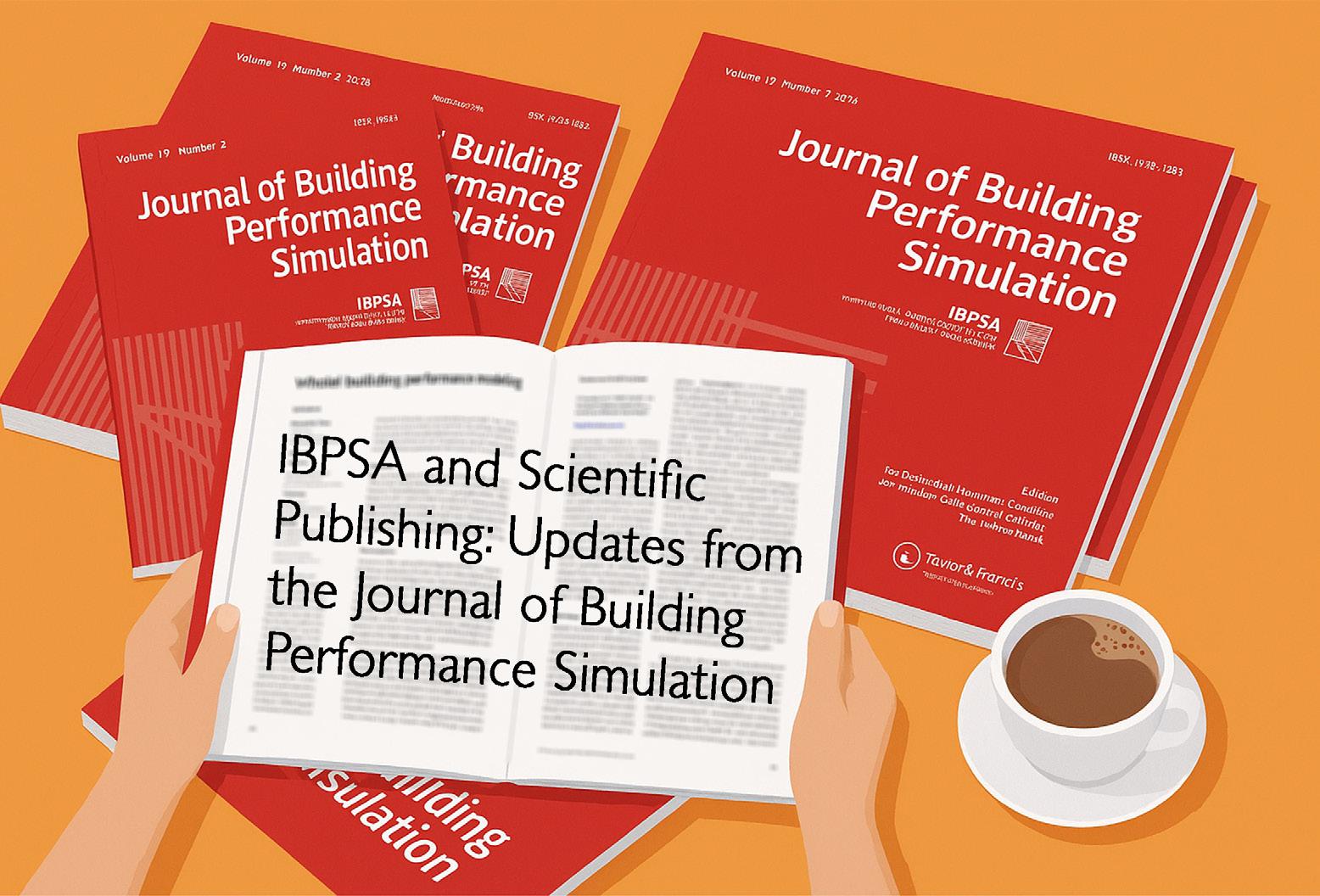
IBPSA and scientific publishing Updates from the Journal of Building Performance Simulation

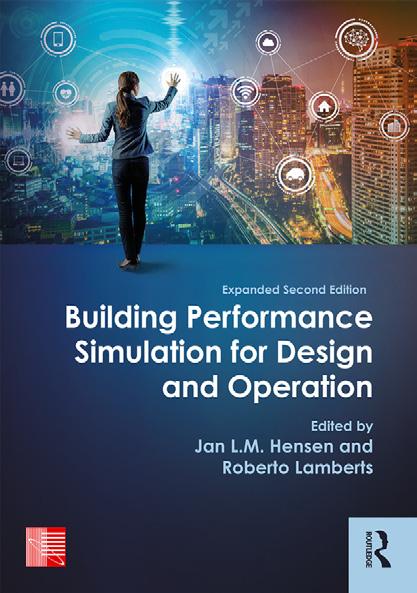
Both Jan Hensen and Ian Beausoleil-Morrison are past presidents of IBPSA and have served on its board and many of its committees for decades. Together they co-founded the JBPS and have been that journal’s Editors-in-Chief since its inception in 2008. Jan is the co-editor of the IBPSA-endorsed book Building Performance Simulation for Design and Operation while Ian is the author of Fundamentals of Building Performance Simulation, another IBPSA-endorsed book.

Mike Barker is an IBPSA Director-at- Large and has supported IBPSA’s LinkedIn outreach programs for many years. He is an Energy Engineer and an active member of various IEEE WorkGroups, and has worked on many of Africa’s high performance sustainable buildings.

In these interviews, they reflect on JBPS’s history and its role today and in the future.

Eleonora Brembilla (EB): JBPS appeared almost 20 years ago, in 2008. Jan and Ian, why was —and still is— it important for IBPSA to have its own scientific journal?

Jan Hensen and Ian Beausoleil-Morrison (JH/IB-M): Twenty years ago there were no scientific journals that were aligned with IBPSA’s mission to advance and promote the science of BPS in order to improve the design, construction, operation, and maintenance of new and existing buildings worldwide. Indeed, at that time many of the journals focussing on building performance topics exclusively considered field and laboratory studies and were less interested in articles on modelling and simulation.

IBPSA created the JBPS in order to address this gap and to provide an outlet for researchers and practitioners in the BPS community. For a learned society such as IBPSA, having its own scientific journal is critical for driving field-specific innovation, maintaining high standards of quality, and ensuring that knowledge serves the community rather than purely commercial interests. Although the JBPS’s aims and scope have evolved over time, the journal remains focused on building performance modelling and simulation, and thus remains fully aligned with IBPSA’s mission.

EB: Have you noticed significant changes over the years? Which are the most pressing challenges you are facing at the moment?

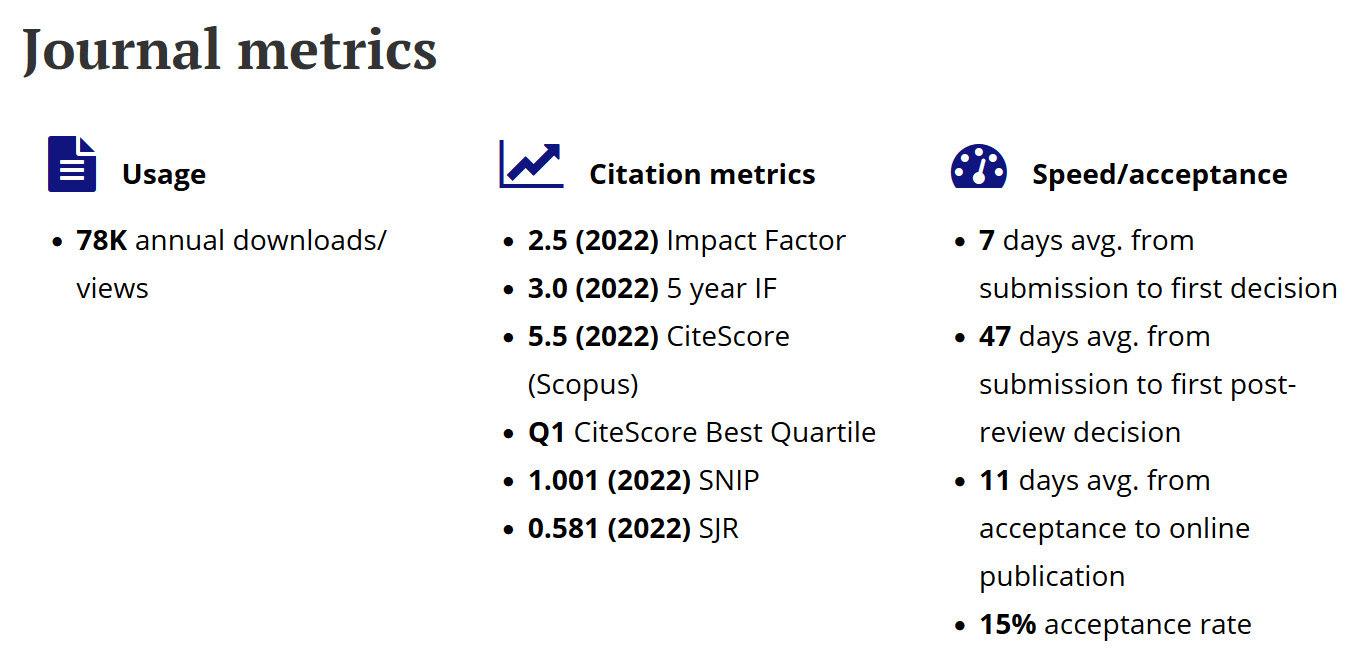
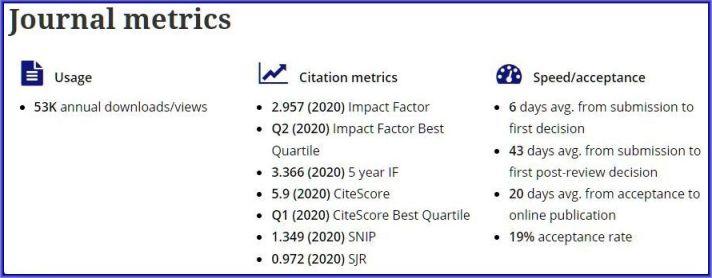
JH/IB-M: At the time of the JBPS’s inception, as co-editors-in-chief we had to work hard to solicit contributions from authors to this unknown and unproven journal. Now almost twenty years on, with the JBPS’s reputation well-established, the situation has changed considerably. Triaging submissions from authors to select only those that are well-aligned with the journal’s aims and scope and that are of the highest quality has become a challenge. Around 80% of all submissions are desk-rejected (rejected by the editors-in-chief prior to peer review) and the overall acceptance rate is only 12%. We are very lucky—and thankful—to have an excellent editorial board and a wide pool of expert reviewers to enable a thorough and effective peer review process. That said, given the growing number of submissions to the JBPS, we are always on the lookout for new reviewers who have BPS experience and a history of publishing in this domain.

Jan Hensen (top), Ian BeausoleilMorrison (centre) & Mike Barker (bottom)

EB: Mike, through the IBPSA social media channels you reach an audience made up of both academics and industry practitioners. Is there an interest in scientific publications outside of academia? Do you see opportunities to bring these two worlds closer together?

Mike Barker (MB): JBPS papers often cite case studies of buildings in many climates, and this is of real value to practitioners. Social Media posts on BIM application research and BIM standards have the most interaction, and now there is growing interest among practitioners in the ability of physics-based AI to read and understand 3D CAD files.

A common thread is that simulation can’t keep up with the increasingly rapid project development cycle, and that AI might speed building performance analysis. Academics sharing their work on frontier world models will gain the attention of the industry.

EB: Ian and Jan, what are the latest scientific breakthroughs in building performance simulation?

JH/IB-M: In the early years we received many papers focused on the modelling and simulation of heat and mass transfer and other physical processes occurring within buildings. We continue to see significant contributions in these areas, but there any now more contributions related to model predictive control, occupancy modelling, AI, machine learning, community scale modelling, optimization, digital twins, hybrid modelling, and other innovative applications of BPS.

EB: Mike, what are the most urgent needs for practitioners working with building performance simulation?

MB: During a 2022 IBPSA England Conference Debate, Professor David Coley questioned if modelling is truly useful, and noted “I’ve been wondering for quite some time why modelers aren’t asked to the table earlier in the design process”. The answer is simple – property owners and developers focus on the value of their asset - so it is all about the “money money money”! (the IBPSA BS2025 theme song, according to PC Thomas!).

That suggests to me that we should start with better metrics that tie into the Net Operating Income, Yield on cost, and the expected returns on the Net Leasable Area of new and especially existing buildings. kW and kWh need to be translated into $, €, ¥, £. It’s no longer about annual energy consumption – a valuable simulation needs to help customers understand the operational costs, and the direct equity value any savings create. Furthermore, the productivity benefits of daylighting, views, IAQ, and thermal comfort must be quantified. We need metrics for the Return-on-Investment and Total Cost of Ownership of these soft benefits.

To earn a seat at the table, IBPSA must collaborate with a wider range of professions to model both these hard and soft costs.

EB: Jan, Ian and Mike, is there anything else you would like to tell our readers?

JH/IB-M/MB: Although the JBPS is now a mature journal that receives many contributions, we are always interested and open to receiving high-quality research and viewpoint articles that are well-aligned with the journal’s aims and scope. We are also always interested in talking to members of the IBPSA community who are interested and motivated in mounting special issues that focus on topics that are aligned with the aims and scope but that may have received less attention to date.

EB: There’s a lot of food for thought in your reflections, Thank you all! n

Educating the next generation of Building Performance Simulation experts – what are the gaps?

Educating the next generation of BPS experts

What are the gaps?

The IBPSA Education Committee was established to address the growing need for structured education and capacity building in Building Performance Simulation (BPS). Over the years, our remit has evolved to include not only the development of educational resources and training programmes, but also to bring together leading educators and practitioners from around the world to share best practices. 10 years of organising panel discussions, webinars, and workshops prompted us to address a pressing question as part of BS2025 in Brisbane: Are we equipping graduates with the skills they need for the rapidly evolving world of Building Performance Simulation (BPS)?

Diverse Pathways, Common Challenges

The panel, comprising experts such as P.C. Thomas, Nikki Parker, Ian Beausoleil-Morrison, Rajan Rawal, and Veronica Garcia-Hansen, highlighted the diversity of BPS education worldwide. Programmes range from in-depth postgraduate courses focused on simulation tools and real-world case studies, to undergraduate modules that introduce broader design professionals to simulation concepts. Yet, a persistent gap remains between classroom fundamentals and the complexities of professional practice.

Key Gaps in BPS Education

Two critical gaps emerged from the discussion:

1. Understanding Simulation Results: Graduates often excel at producing simulation outputs but struggle to interpret and critically assess them. The panel stressed the importance of developing “critical thinking” skills—being able to challenge, validate, and sanity-check results, rather than accepting them at face value. As Nikki Parker noted, even experienced professionals can make errors, underscoring the need for robust validation and a healthy scepticism towards models.

2. Modelling Existing Buildings and Systems: The panel identified a growing need for expertise in modelling existing buildings, particularly their complex and often idiosyncratic services. Real-world systems rarely match textbook scenarios, and understanding their operation, control strategies, and retrofit challenges is essential for meaningful simulation and energy performance improvement, particularly where old and new plant components are operating alongside each other.

Innovative Teaching Approaches

The panellists shared a range of educational strategies to address these gaps. Rajan Rawal described experiential learning approaches, such as hands-on measurement and experimentation, before students use simulation tools. Ian Beausoleil-Morrison introduced the concept of “simulation autopsy,” where students dissect their own modelling decisions to understand discrepancies and learn from mistakes. Veronica Garcia-Hansen emphasised the challenge of engaging architecture students with simulation, advocating for early integration of simulation tools in the design process and better alignment with professional competencies.

Communication and Collaboration

A recurring theme was the need for effective communication—both within multidisciplinary teams and with clients. The ability to translate complex simulation results into actionable insights for non-specialists is as important as technical proficiency. Visual tools and clear executive summaries were recommended to bridge this gap.

Educating the next generation of Building Performance Simulation experts – what are the gaps?

Looking Forward

As the panel concluded, it was clear that the challenges and opportunities in Building Performance Simulation education are best addressed together. In response, the IBPSA World Education Committee has launched a new Best Practice Network—a collaborative platform for educators, practitioners and students to share experiences, resources and solutions.

This network aims to:

n Identify common needs and challenges in BPS education

n Facilitate the sharing of teaching resources and innovative approaches

n Create a space for honest discussion about what works - and what doesn’t - in the classroom and in practice.

If you are an academic who is committed to raising standards, bridging the gap between theory and practice, and preparing the next generation of simulation professionals, we’d like to invite you to join us – register your interest here: https://forms.cloud.microsoft/e/Xmv253gbmp n

http://www.ibpsa.org/membership

Best of ‘Ask a Modeler’: Smarter modeling for AI-driven, climate-changing world

‘Ask a Modeler’ is an advice column for the building simulation community. Each month, members of the IBPSAUSA Research Committee pose a question submitted by an IBPSA member to recognized experts to get their unique perspectives. Through this column, we hope to expand communication and create a sense of community among practitioners, researchers, and academics at all points in their building simulation careers. Below, we are reprinting some expert advice from the past few months. We hope that sharing these questions and insights will bring value to your work and possibly make you think about building performance modeling from a new point of view.

What contextual elements are most critical for enhancing the performance of large language models in building energy simulations?

— Wondering About AI

Dear Wondering,

Large language models, or LLMs, have quickly become part of everyday technical conversations. At their core, they are neural network-based models trained on massive text content to generate responses by learning semantic patterns. They are moving from novelty to practical implementations in building energy modeling (BEM) tools. In BEM, LLMs promise faster model creation, smarter debugging, and clearer explanation of results. Yet, fluency is not fidelity. For an LLM to become a reliable partner, it needs more than data. It needs context. That context determines whether the output reflects physical insight or misleading confidence. Over multiple trials with BEM tools, six contextual elements consistently proved most critical for enhancing the performance of large language models:

1. Relational Topology

Buildings are not lists of components but systems of relationships. Knowing which air handler serves which zones and which pumps feed which chillers is as important as any individual parameter. Standards such as Project Haystack help make this explicit. When the model knows that AHU 01 serves VAV1-3 and those serve zones 101-103, it can generate a connected model that closes thermodynamically. Without topology, the LLM can debug a tree but not a forest.

2. Structured component data

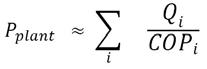
For LLMs, numbers are the bridge between text and physics. Structured component data allows quantitative reasoning grounded in real performance metrics. When information, such as “COP = 5.8”, is supplied, the model can make physics-consistent inferences. Vague descriptors like “efficient chiller” offer no such anchor. With structured inputs, the LLM can apply simple relations such as

to check plausibility and diagnose anomalies. For instance, if unmet cooling hours are high, the model can identify an undersized chiller from its capacity and COP and suggest resizing or staging changes.

Kaustubh Pradeep Phalak PhD Lead Data Center Modeling Engineer, Trane Technologies

3. Design intent

Intent is often the most important part of the context. If an LLM is asked to debug a chiller plant or explain unexpected results, it will still optimize its reasoning unless the objective is explicit. Specify that the goal is to minimize site energy and it will push toward higher deltaT operation. Change the objective to minimizing grid impact during a demand response event and it will favor thermal storage and load shedding. The physics remain the same but the operational strategy changes. Without a clear purpose, the model’s reasoning can drift.

This idea is already familiar in software engineering. Developers using copilot/coding assistants often keep a requirements document in the repository so suggestions stay aligned with intent.

4. Engine level context

Most of us at some point have been in the situation where we cannot fully explain the simulation results. We know the plant, but not always the simulation engine code.

Consider a case where zone temperature will not drop below 78oF, even though the cooling coil is correctly sized and the supply air temperature is 55oF. Without engine level context, the issue may be blamed on control sequencing. With access to simulation engine code, an LLM can identify that the solver is prioritizing humidity control and limiting coil output to prevent over dehumidification, an intentional solver decision. Engine level context allows the LLM to explain results by tracing back to code.

5. Provenance and traceability

Trust in engineering depends on transparency. When an LLM modifies a model, it should record why the change was made. Supporting provenance means tracing each modification back to its source, such as a design submittal or revised assumption. The change ledger can be maintained either as an annotated section within the model file itself (e.g., comments in idf or Modelica code) or in a dedicated external log.

6. Results as interactive context

Often the most time-consuming part of modeling is explaining what the simulation produced and why. For reasoning, LLM must understand not just the values but how outputs relate to the system. A better approach is to provide structured glimpses of results: clear column names and a small sample of output. This gives the LLM enough context to generate or refine analysis. Using this iterative process, the model can narrow in on likely causes.

The road ahead

LLMs open a new way of working with building energy simulations, where interaction, explanation, and iteration become as important as execution. As these tools mature, they will shift effort away from manual investigation and toward higher-level reasoning and design exploration. Human modelers remain in control, defining objectives and validating decisions, while LLMs amplify expertise through context-aware reasoning. Used this way, LLMs have the potential to make building energy modeling more transparent, more accessible, and ultimately more impactful.

As climate conditions shift, how should energy modeling tools evolve to better address transient thermal comfort conditions in warming climates?

— Seeking

Dear Seeking,

As global warming intensifies, achieving thermal comfort becomes increasingly challenging. In many regions, temperatures are more frequently exceeding comfort thresholds, placing heat stress on pedestrians and exposing populations to greater health risks. These conditions directly threaten the viability of walkable, pedestrian-oriented urban designs that are critical for sustainable development.

At the same time, as we incorporate more passive or semi-passive strategies and move away from purely mechanical conditioning, indoor environments become more dynamic and responsive to natural conditions. The thermal experiences of transitional spaces, such as lobbies and corridors, cannot be fully described by steady-state comfort models. Traditional metrics, which rely on equilibrium conditions, are not suitable for capturing how occupants perceive and adapt to the changing environments.

To address this, energy modeling tools should evolve to incorporate transient thermal comfort models that reflect how humans adapt to a fluctuating microclimate in a fine temporal resolution. These models will allow designers to evaluate how comfort changes as people move through different spaces or experience short-term deviations.

To enable more accurate simulation of transient conditions across various sequences and to support the assessment of dynamic environments, modeling tools should evolve to address the following aspects:

1. Path-based simulation

Transient thermal comfort is time-dependent and influenced largely by short-term activity history, making it highly individual. At a collective level, understanding transient comfort requires analyzing representative occupant trajectories to capture aggregated thermal experiences within a space. To support this, energy modeling tools should enable multi-path simulations that capture the temporal evolution of comfort along diverse activity routes and allow for aggregated spatial analyses. Such capabilities can locate critical areas where existing strategies fail to maintain acceptable comfort and to which design should pay attention.

2. Initial body condition

Thermal perception can vary significantly depending on prior condition: for instance, the experiences of an individual exiting a warm vehicle and another entering from a cold outdoor environment can be largely different. Accurately representing such differences requires defining the initial thermal state of the body at initialization. Most models define this state through physiological parameters, such as core, mean, or local skin temperatures, of which the specification often demands strong domain expertise. Modeling frameworks should either include a pre-run steady-state simulation to approximate these conditions or direct parameter inputs with well-calibrated default values to establish realistic starting points for transient comfort analysis.

3. Microclimate

Transient thermal comfort has high temporal and spatial resolution, requiring a detailed understanding of the surrounding microclimate to then accurately simulate human thermal responses. As design increasingly focuses on passive or semi-passive strategies, it becomes essential for modeling tools to capture microclimatic parameters with sufficient fidelity. While parameters like mean radiant temperature, air temperature, and humidity are relatively

Amber Jiayu Su

Best of ‘Ask a Modeler’ and Forthcoming events

straightforward to obtain or estimate, local air velocity, particularly in outdoor spaces, often requires computational fluid dynamics (CFD) analysis, which can be computationally intensive. To address this, modeling frameworks should (1) incorporate accurate CFD-based airflow simulation when air movement significantly influences comfort, with optional optimized computation by pre-calculating and storing results, or (2) integrate validated, machine learningbased surrogate models to predict local wind conditions at nearly real-time.

Ask a Modeler is looking for volunteers! If you’d like to write for or edit our column, please email askamodeler@ibpsa. us. We also want to hear your interesting, entertaining, or just plain odd questions about life and building performance simulation. Send us your questions or read our past columns at https://ibpsa.us/ask-a-modeler. Note that questions requiring an immediate response should be submitted to the community of experts at unmethours.com/questions n

Forthcoming events

Date(s) Event Further information

2026

18-22 May 2026 Conférence Francophone de l’IBPSA Lyon, France

20-22 May 2026 SimBuild Minneapolis, Minnesota, USA

14-18 June 2026 ISIAQ Indoor Air Singapore

17-19 June 2026 eSim Longueuil, QC, Canada

27 June - 01 July 2026 ASHRAE Annual conference Austin, TX, USA

19-21 August 2026 BuildSim Nordic Conference Umeå, Sweden

31 Aug - 02 Sep 2026 International Radiance Workshop Seattle, Washington, USA

09-11 September 2026 BauSIM 2026 Zurich, Switzerland

https://conference2026.ibpsa.fr/index.php

https://simbuild.ibpsa.us

www.indoorair2026.org

https://event.fourwaves.com/esim2026/pages

www.ashrae.org/conferences/2026-annualconference-austin

https://buildsimnordic2026.ibpsa-nordic.org

https://discourse.radiance-online.org/t/2026radiance-workshop-in-seattle-wa/6952

www.zhaw.ch/en/engineering/institutes-centres/icp-instituteof-computational-physics/bausim2026

16-18 November 2026 ASim Singapore https://asim2026.sg

23-24 November 2026 BSO-uSIM 2026 Glasgow, Scotland, UK

2027

https://www.bso-usim2026.org

19-22 April 2027 International Building Physics Conference Wellington, New Zealand https://ibpc2027.org

29 August01 September 2027 BS2027 Vienna, Austria https://bs2027.org

20-22 May 2026

Minneapolis, USA

https://simbuild.ibpsa. us

From Models to Reality: Bridging Simulation and Operational Performance

Join us in Minneapolis, MN, USA from May 20-22, 2026, for SimBuild 2026 This is the preeminent event for advancing building simulation and performance analysis held in the USA, your chance to gain practical, cutting-edge knowledge and network with industry leaders.

The conference features three distinguished keynote speakers – Anica Landreneau, Mary Ann Piette, and Dr Rania Labib – highlighting new directions, bold ideas, and practical solutions that will move our field forward.

The theme of SimBuild 2026 highlights IBPSA’s ongoing and future mission: Getting From Models to Reality by Bridging Simulation and Operational Performance Sessions will showcase innovation in methods, workflows, and modeling tools for better building design, performance, and operation to meet aggressive targets for energy reduction, affordability, reliability, and resiliency. Topics include:

n Resilience and Predictive Modeling for the Future

n Smarter Operations: Intelligent Buildings in Practice

n Advances in Simulation Tools and Techniques

n Simulation Case Studies and Workflows

n Human-Centered Design and Occupant Experience

n Policy, Compliance, and the Future of Energy Codes

Join early on May 19 for pre-conference workshops and tours. Develop your building simulation skills in half-day workshops hosted by Ladybug Tools, IES, and Physibel, or prepare yourself for the Building Energy Modeling Professional certification exam with a full-day training course. Tour the Hennepin Energy Recovery Center, McKnight Foundation, or the Cordia District Energy System Tour to see cutting-edge work in building performance.

Round out the conference with exciting social events, including the Welcome Reception, Awards Banquet, Student Networking Reception, and the Skyway Scavenger Hunt.

Don’t miss out on the conversations shaping the future of high-performance buildings. For updates on the program, venue, registration and more visit https://simbuild.ibpsa.us. n

Forthcoming events

17-19 June 2026

Longueuil, QC, Canada

https://event.fourwaves. com/esim2026/pages

Registration is now officially open for eSim 2026, the 14th conference organized under the auspices of IBPSA-Canada and the 25th anniversary of the first. The event will take place June 17–19, 2026, hosted by the Université de Sherbrooke at its Longueuil Campus. eSim is Canada’s leading conference on building performance simulation, bringing together researchers, engineers, practitioners, software developers, and students working to advance simulation tools and applications for high-performance and sustainable buildings. Participants will enjoy three days of technical sessions, workshops, networking opportunities, and social events, including the conference reception and banquet.

Conference Highlights

n Workshop Day (June 17, 2026): Expert-led training sessions and hands-on workshops.

n Technical Conference (June 18–19, 2026): Peer-reviewed paper presentations covering the latest research and applications in building simulation.

n Networking & Social Events: Reception and conference banquet offering opportunities to connect with the Canadian and international building simulation community.

Full conference registration includes access to all technical sessions, scheduled meals, reception drinks and snacks, and the conference banquet.

For more information, visit https://event.fourwaves.com/esim2026/pages/5c97499b7300-4e02-940e-3f0b32f2e454 or contact us at esim-2026@USherbrooke.ca

Early Bird registration has finished. Regular registration will be open from 16 April to 17 June 2026. Register today at https://event.fourwaves.com/esim2026/registration !

We look forward to welcoming the building simulation community to Longueuil for eSim 2026. n

19-21 August 2026

Umeå, Sweden

https:// buildsimnordic2026. ibpsa-nordic.org

BuildSim Nordic 2026

BuildSim Nordic is the biennial conference of IBPSA Nordic. The 2026 conference will be held in Umeå, Sweden, from 19–21 August 2026.

We warmly invite members of IBPSA Nordic, the wider International Building Performance Simulation Association (IBPSA) community, and all professionals and researchers with an interest in building simulation to join us for this exciting opportunity to explore the latest ideas and research in the field.

The theme of the conference is “Smart and Sustainable Buildings and Cities in the Nordic Countries.” This year’s special focus areas are:

n Energy Resilience of Buildings in Cold Climates

n Smart and Climate-Neutral Buildings, Districts, and Cities

Topics

More than 140 abstracts have been accepted for submission of papers. These cover a broad range of topics, including: Building acoustics; Building Information Modelling (BIM); Building physics; CFD and airflow; Commissioning; Daylighting, fenestration and lighting; Digital twins; Demand-side flexibility; Developments in simulation; Education in building performance simulation; Renewable energy and energy storage; Human behaviour in simulation; Hybrid systems; Indoor Environmental Quality (IEQ); Software developments; System optimization; Urban-scale simulation; Smart buildings; Validation, calibration and uncertainty; Weather data and climate adaptation; Zero Energy Buildings (ZEB); and Emissions and Life Cycle Analysis.

Keynote Speakers

n Professor Marie-Claude Dubois, Lund University, Sweden

n Professor Qianwen Xu, KTH Royal Institute of Technology, Sweden

n Dr Hicham Johra, SINTEF, Norway

n Dr Hassam Reham, VTT Technical Research Centre of Finland, Finland

For updates on the conference programme and further details, please visit the conference website https://buildsimnordic2026.ibpsa-nordic.org, and if you have any questions, please do not hesitate to contact us at buildsimnordic-2026@ibpsa-nordic.org .

We look forward to welcoming you to BuildSim Nordic 2026! n

Forthcoming events

09-11 September 2026

Zurich, Switzerland

www.zhaw.ch/en/ engineering/institutescentres/icp-institute-ofcomputational-physics/ bausim2026

The Zurich University of Applied Sciences (ZHAW) and IBPSA DACH cordially invite you to BauSIM2026, the 11th BauSIM, which will take place from 9-11 September 2026 in Zurich, Switzerland. The conference will include cutting edge topics from research, building design and construction, making BauSIM an ideal discussion forum for mutual exchange between experts from science and industry. There will be a traditional evening event on the second day of the conference to which all conference delegates are invited.

Call For Abstracts

Scientists, engineers and architects from science and industry are welcome to contribute to the conference, in either German or English To ensure the scientific quality of the contributions, they will be reviewed by a double-blind-review procedure. For more information about submission, please visit www.zhaw.ch/bausim2026 .

Accepted papers will be published in the IBPSA Conference Proceedings. In addition, there is the possibility of technical articles for publication in the ZHAW Digital Collection.

Main topics

n Energy-efficient building and district modelling

n Indoor climate – user interactions

n Acoustic simulations in the building sector

n Building physics simulations at component level

n BIM-based planning tools and integration approaches

n Modelling and simulation in the life cycle of buildings and districts

n Numerical Solutions, Optimization and Implementation

n Monitoring of buildings and neighborhoods

Key dates

n Abstract submission and draft paper submission dates have passed

n Final paper submission: 1 June 2026

n Project Reports applying simulation methods: 1 May 2026

n Poster with short presentation: 1 May 2026

The conference chairs are Professors Andreas Witzig and Matthias Haase, ZHAW. The organising team can be contacted at bausim2026@zhaw.ch

We look forward to welcoming you to BauSIM in September in Zurich! n

Forthcoming events

29 August01 September 2027

Vienna, Austria

https://bs2027.org

Building Simulation 2027 – Save the Date!

Following BS 2025 in Brisbane, Australia, the international building simulation community will next gather in the historic city of Vienna, Austria, for Building Simulation 2027, taking place from 29 August to 01 September 2027.

Under the theme Rethinking Building Performance for a Resilient Future, BS 2027 will bring together researchers and practitioners from around the world to exchange ideas, share pioneering work, and explore how building performance simulation can contribute to a more resilient and sustainable built environment.

With its rich academic tradition and vibrant international character, Vienna will offer an inspiring backdrop for this global gathering of the IBPSA community. We look forward to welcoming colleagues from across the world to the heart of Europe to continue shaping the future of building performance simulation together.

Stay tuned for further updates on BS 2027 and the upcoming call for papers on https:// bs2027.org n

News from IBPSA Affiliates

A successful anniversary event connecting simulation, measurement, and practice

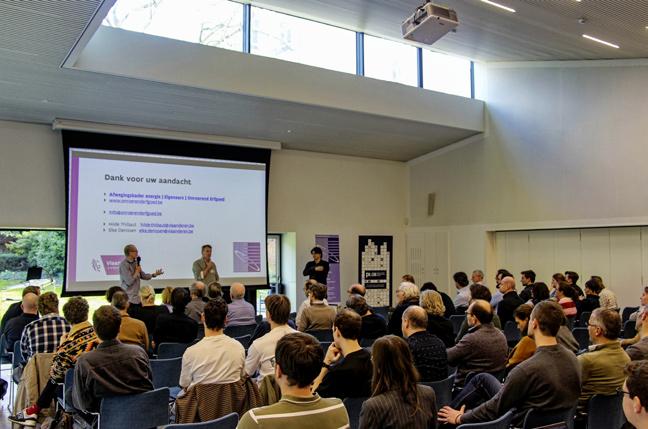
On 10 March 2026, IBPSA-NVL together with the Flemish organisation Pixii hosted a study day at the KAVA Conference Center in Antwerp. The programme focused on assessing risks and preventing moisture damage and mould growth when retrofitting existing (including heritage) buildings with internal insulation. Scientific insights from material research and hygrothermal simulations including Delphin and WUFI were brought together with lessons from practice, addressing a central question: how can we improve energy performance and thermal comfort without losing sight of the hygrothermal behaviour of (historic) building components—an essential condition for safeguarding historic buildings for the future?

More than 120 participants from academia and consultancy, joined by building owners, government representatives and students came together to exchange knowledge on internal insulation and moisture safe renovation. Five presentations and a plenary discussion formed the backbone of the programme. The morning sessions centred on theory and research, supported by simulations and measurements. After the shared lunch, the focus shifted to design decisions, application questions, and key takeaways from real world case studies.

Presentations were delivered by speakers from KU Leuven (Professors Hans Janssen and Staf Roels), Ghent University (Bruno Vanderschelden), Daidalos Peutz (Filip Descamps) and the Flemish Heritage Agency (Hilde Thibaut and Elke Denissen).

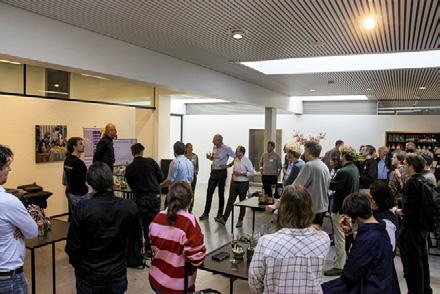
The study day also had a celebratory dimension: IBPSA-NVL marks its 25th anniversary this year. During the closing reception, a short flashback slideshow featuring programmes and photographs from earlier activities offered a look back on a quarter century of knowledge sharing. The anniversary event highlighted what IBPSA-NVL stands for: a community where building simulation and building practice meet and where insights from research and practice can meaningfully inform one another. With that same ambition, we look forward to building the next 25 years together. n

Software & other news

DesignBuilder v2025.1.1 released

A new maintenance update for DesignBuilder v2025.1 is now available, including a range of improvements to enhance performance and stability. DesignBuilder v2025.1 offers a range of powerful new features and improvements to enhance your modelling, compliance checking, and interoperability workflows.

Key highlights in this latest release include:

n ASHRAE 90.1 2019 Appendix G and improved LEED v4.1 automated MEPC reports for faster and more reliable compliance with industry standards.

n DOAS Fresh Air Loops with a new generic fan type for more accurate representation of modern HVAC systems.

n Open XML Model Format for compatibility across DesignBuilder versions and data exchange with other tools, supported by new technical documentation for third-party development and interoperability.

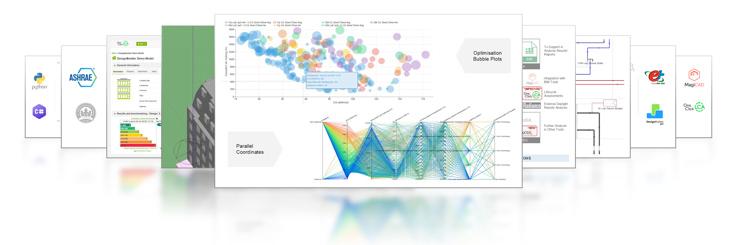
n Parametric Insights through our online Analytics platform, enabling a deeper, more interactive analysis of optimisation, sensitivity, and parametric results through Bubble Plots, Parallel Coordinates, and Parametric Analysis charts.

n Closer integration with One Click LCA, using the latest data exchange format for a more efficient and accurate lifecycle assessment workflow.

n Block Conversion Tools that allow any block type to be converted to any other block type.

n NECB Templates help boost productivity when setting up Activity, Construction, Lighting, and Glazing model data for National Energy Code of Canada projects.

n Enhanced HVAC Design Capabilities, including HVAC Load Reports, which can now be generated based on industry-standard tabular layouts. Note this is a Beta feature in v2025.1.

n Yearly Version Numbering for easier tracking of updates and a clearer timeline of software evolution.

Check out what’s new in DesignBuilder v2025.1 at https://designbuilder.co.uk/ software/what-s-new-in-2025-1 for more details on the new version. DesignBuilder welcomes feedback on how the new features help users in their modelling projects!

From Overheating to Optimisation: latest case studies

Understanding façade thermal resilience with DesignBuilder

This article is based on award-winning research by Zahra Jahed Bozorgan, Architect & Building Science Researcher, University of Bologna , whose work received the CIBSE Building Simulation Award 2025.

Most older European buildings were never designed to cope with prolonged summer heat, making them increasingly vulnerable as temperatures rise. Given the importance of a building façade in overheating mitigation, researchers have developed a new Façade Resilience Index (FRI) to help evaluate how well façades resist and recover from heat stress.

Using DesignBuilder, the study simulated nine common residential façade types across Italy, Germany, and Norway under both passive and mechanically cooled scenarios. The findings are sobering:

n Passive thermal resilience declines sharply toward 2080

n Some façade types lose up to 75% of their ability to moderate indoor temperatures

n In mechanically cooled buildings, HVAC systems often mask underlying façade weaknesses rather than solving them

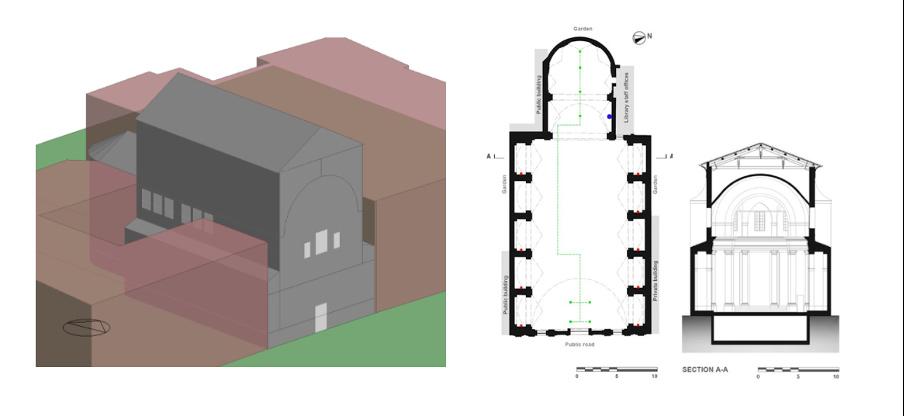
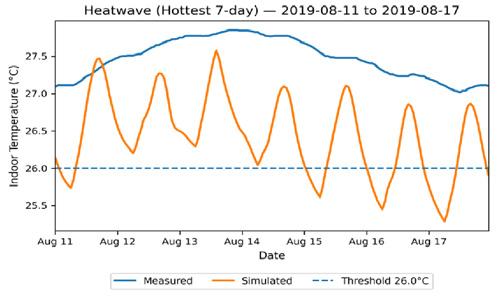
The new FRI method was validated using realworld data from the historic San Giorgio Library in Italy. A calibrated DesignBuilder model accurately reproduced observed overheating patterns during heatwaves, confirming the reliability of the simulation method.

So as overheating risk increasingly becomes a mainstream design concern, this study makes it clear that façade-first strategies - supported by credible, validated simulation - are becoming essential, not optional in overheating risk mitigation.

The full case study is available at https://designbuilder.co.uk/measuring-facadethermal-resilience .

Exceeding NECB standards through simulation-driven design

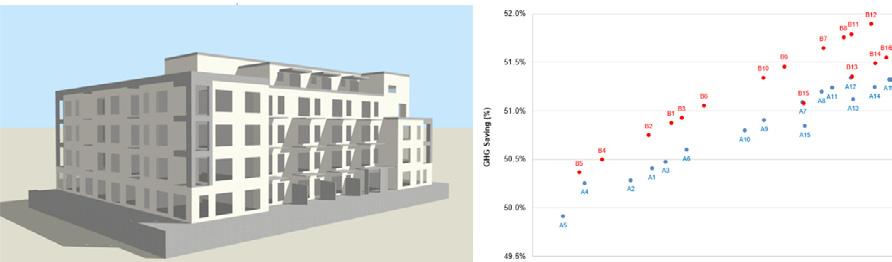
A Calgary multifamily project set out to cut energy use by at least 25% and GHG emissions by over 50%, using the NECB 2017 Green Buildings Priority Stream as its benchmark. DesignBuilder enabled the team to model the building in detail, test viable options early, and target the most impactful efficiency measures. This turned an ambitious mandate into a data-driven design process grounded in performance rather than guesswork.

Parametric analysis evaluated envelope upgrades, glazing options, and mechanical systems simultaneously, identifying combinations that compounded incremental gains into major performance improvements:

n Envelope: insulation levels, roof R-values, wall constructions

n Glazing: window-to-wall ratios, triple-pane specifications

n Mechanical: radiant floor heating, condensing boilers, high-efficiency DHW systems and low-flow fixtures

The final design exceeded all targets, with several scenarios reaching ~30% energy savings and >51% GHG reductions. No single measure delivered the result; it was the compounding effect of optimised systems modelled accurately together.

The Calgary case study is available at https://designbuilder.co.uk/multi-familyresidence-analysis-improves-on-necb-requirements-by-50 .

Optimising existing buildings: a case study in simulation-led audits

Partner Property Consultants’ recent Operational Energy Audit on a mixed-use commercial building identified retrofit solutions that minimise energy use and carbon emissions.

Using a calibrated DesignBuilder model aligned with ASHRAE Guideline 14 and IPMVP protocols, they established a reliable baseline that reflected real utility data. The team assessed targeted upgrades, including ice thermal storage, daylight-responsive lighting controls, low-E glazing, and heat pump water heaters. The key outcomes were:

n 30% reduction in annual energy use

n 117 tonnes of CO₂e saved per year

n 45% reduction in cooling load from ice thermal storage

This case study demonstrates how effective simulation can guide practical retrofit decisions that cut energy use, emissions, and operating costs.

More details about this project are available on the DesignBuilder website, https:// designbuilder.co.uk/optimising-operational-energy-commercial-buildingaudit . n

FutureWeather.co: A web platform for generating climate-adjusted EPW, DDY, and STAT files

Rowan Schmidt, CEO, Radbridge Incorporated & Head of Product, FutureWeather.co rowan@radbridge.com

With acknowledgments to Dr Eugénio Rodrigues, Head of CURA Lab, University of Coimbra, Portugal

Introduction

Designing buildings that will perform well over their lifespan requires weather data that reflects future climate conditions, not just historical observations. While validated methods for generating future weather files exist, the challenge is not only scientific; it is also one of accessibility and workflow integration.

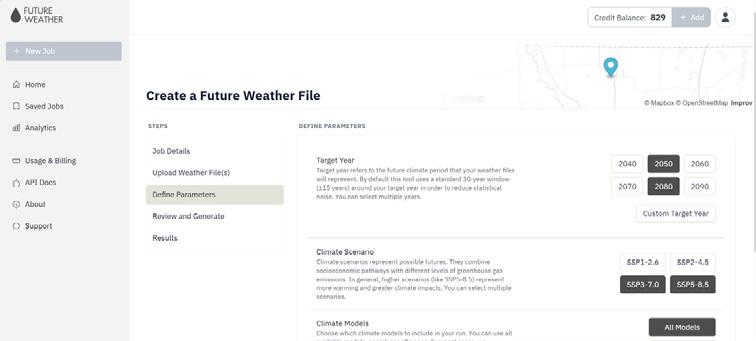
FutureWeather.co ( https://futureweather.co ) is a new web-based platform designed to bridge this gap, providing practitioners with a fast, low-friction way to generate future climate-adjusted weather files built on a peer-reviewed, transparent methodology. Users upload a historical EPW file (and an optional DDY file), select one or more target years, Shared Socioeconomic Pathway (SSP) scenarios, and climate models, and receive futureadjusted EnergyPlus Weather (EPW), Design Day (DDY), and climate statistics (STAT ) files, typically within 30 seconds.

Scientific basis

FutureWeather.co is developed by Radbridge Incorporated in partnership with the CURA Lab at the University of Coimbra, led by Dr Eugénio Rodrigues, who serve as technical advisors on the project. The platform implements the morphing methodology described in Rodrigues et al. (2023), applying monthly climate change factors derived from an ensemble of 23 CMIP6 Global Climate Models (GCMs). The morphing pipeline processes variables sequentially (temperature, pressure, humidity, dew point, wind, sky cover, radiation, precipitation, and snow depth), preserving the physical correlations and diurnal patterns embedded in the original EPW while shifting them in line with projected climate change signals.

Two new capabilities have also been added to extend the core methodology:

n Quantile shape adjustment. This novel enhancement ensures that future temperature extremes are better reflected by leveraging sub-daily climate model data. A residual correction is applied immediately after standard temperature morphing but before humidity calculations, preserving monthly mean warming while permitting the tails of the distribution to shift independently. This is particularly relevant for HVAC sizing and overheating risk assessments.

n DDY generation Design statistics are computed from both the historical and future EPW files using percentile analysis and mean coincident values. The climate-driven deltas are then applied to the original DDY file, ensuring that design conditions move in step with the morphed EPW while preserving the original DDY structure and coincident psychrometric states.

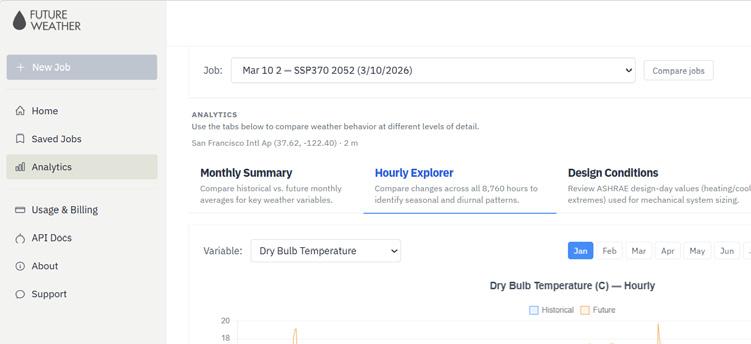
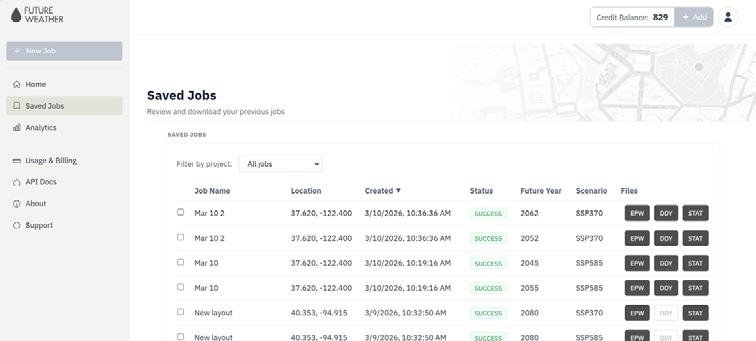
For additional convenience, users can generate multiple combinations of target years and scenarios in a single run, view and compare outputs in the Analytics dashboard, and organize jobs by project. An API with webhook support is also available for programmatic access and integration into automated workflows.

Partnerships, integrations, and outreach activities

n One integration with a popular building simulation tool is already in place, to be announced soon, and we are actively seeking additional partnerships with software developers and practitioners in the building performance space.

n We have also expanded the integration “surface area” of the tool: In addition to our API ( https://futureweather.co/publicApiPage.html ), we’ve also developed a Python package ( https://futureweather.co/python ) and an Autodesk Revit Dynamo package ( https://futureweather.co/revit ) for users who prefer to access the service that way.

n A technical (non-commercial) presentation on the tool was also given to ASHRAE Technical Committee 4.2 (Climatic Conditions) in February 2026.

Getting involved

Future Weather is fully operational and open for use. New users can sign up at https:// futureweather.co and receive 5 free credits to try the service. We are also running a pilot testing program for organizations interested in evaluating the platform in their workflows in exchange for feedback. If you are interested in integrating with the platform or participating in the pilot program – or if you have any questions or suggestions – please contact Rowan Schmidt at rowan@radbridge.com

Reference Rodrigues, E., Fernandes, M. S., & Carvalho, D. (2023). Future weather generator for building performance research: An open-source morphing tool and an application. Building and Environment, 233, 110104. n

IES release IESVE-2025 Feature Pack 2

IESVE 2025 Feature Pack 2, launched on 3rd March 2026, adds to existing capabilities, with the introduction of instant model free climate assessment, EV charger load integration, phase 1 integration of thermal storage tank modelling, HVAC part load sequencing automation, Title 24 (2025) support in California and ASHRAE 140 (2023) validation.

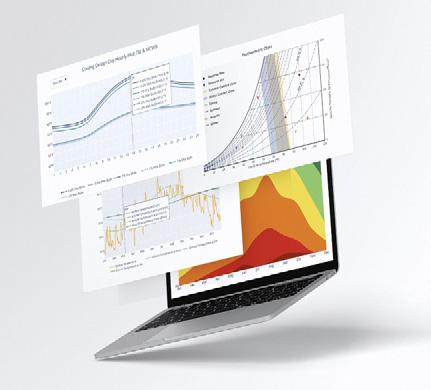
Climate Assessment Report

The new Climate Assessment Report streamlines early design workflows by instantly delivering region-specific climate resilience insights, detailed weather data analysis, and interactive graphics for informed decisionmaking. It enables robust client engagement, supports LEED V5 requirements, and positions firms as strategic climate advisors even before modelling fees are incurred. Teams can seamlessly progress from climate assessment to early architectural models to system sizing and detailed HVAC design in a unified workflow.

North America: Title 24 (2025) Compliance & Electrification

IESVE is fully approved for Title 24 (2025), continuing its longstanding 7+ year support for California energy code compliance. It introduces enhanced electrification features, including seamless EV-charging demand integration and the modelling of stratified heated hot water storage tanks as auxiliary heat sources. The design-first workflow allows users to generate actual, proposed, and baseline models efficiently for non-residential new construction projects, with a geometry export tool into CBECC available for multi-residential and other residential projects.

ApacheHVAC Decarbonisation Updates

Addition of thermal storage: Stratified hot water storage tanks

Model electric auxiliary heat sources on Hot Water Loops, enabling exploration of heat pump-driven systems and reduced fossil fuel dependency.

Intelligent part-load cooling equipment sequencing

Automatic optimisation of cooling equipment transitions as building loads fluctuate. The system replaces manual guesswork with intelligent sequencing, pinpointing fixed (“design”) and dynamic (“real-world responsive”) load range percentages computed directly from equipment performance curves.

New EV charger integration

Effortlessly incorporate EV charging loads into your IESVE models for precise calculation of peak demand and total electrical consumption:

n Total Building Load Capture: Seamlessly integrate EV charging loads into overall building energy modelling for accurate peak demand and total electrical energy assessment.

n Automatic Profile Generation: Generate detailed EV charging profiles directly from Apacheview, eliminating hours of manual work and reducing error potential.

n Future-Proof & Compliance Ready: Prepares teams for emerging EV-infrastructure code requirements.

EU Navigator improvements

This Navigator brings together two core capabilities to support EU compliant loads calculations and PMV occupant comfort optimisation – directly from the IESVE model:

n Updated for FP2 the EU Heating Loads Calculator rapidly delivers EN 12831 compliant, room by room heating loads. The calculation now considers non heated rooms for more accurate adjacencies with heated volumes.

Find out more and download Feature Pack 2

IESVE 2025 Feature Pack 2 is available for download now to all users with a valid licence. Whether you’re designing for climate resilience, delivering low-carbon HVAC systems, or preparing for EV-integrated buildings, IES believes FP2 will give you the tools to meet modern performance, compliance, and decarbonisation goals; you can find details and download at www.iesve.com/ve2025 . An on-demand webinar demonstrating the newly available features is available at https://go.iesve.com/iesve-2025-fp2-march-26-na/ p?utm_source=press .

IES Events

IES is exhibiting at the following events:

n ARBS 2026 in Melbourne, Australia from May 5th - 7th 2026, stand #112.

Find out more and register at www.iesve.com/discoveries/view-event/61265/arbs-2026

n Footprint+ 2026 in London, UK from 13th-14th May 2026, stand #277.

Find out more and register at www.iesve.com/discoveries/view-event/61261/footprint-2026

n Simbuild 2026 in Minneapolis, USA from May 20th – 22nd.

Find out more and register at www.iesve.com/discoveries/view-event/62307/simbuild-2026

n Passive House Canada 2026 in Richmond BC from May 25th – 27th.

Find out more and register at www.iesve.com/discoveries/view-event/62824/passivehouse-canada-2026

n AIA 2026 in San Diego, California from June 10th – 13th, booth #1953.

Find out more and register at www.iesve.com/discoveries/view-event/62842/aiaconference-on-architecture-2026

IES Technical Article

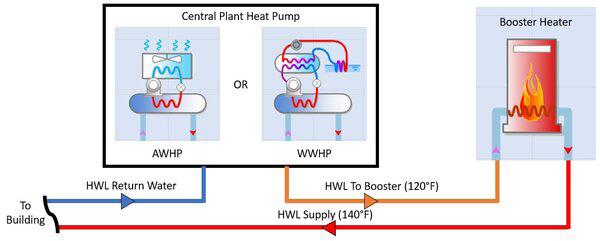
Advanced Central Plant Heat Pump Modelling: Heat Pump with Booster Heater

With the introduction of the Central Plant Heat Pumps (CPHP) in ApacheHVAC, which can serve both the Chilled Water Loop (ChWL) and Hot Water Loop (HWL), users can now model both Air-to-Water Heat Pumps (AWHP) and Water-to-Water Heat Pumps (WWHP). Moreover, this new feature has prompted inquiries about how CPHP can be used to build a custom AWHP or WWHP system. This multi-part article series will explore these custom scenarios in detail.

The full article is available at https://www.iesve.com/discoveries/view/63187/ cphp-heat-pump-with-booster-heater n

Major update of global simulation climate datasets available from Climate.OneBuilding.Org

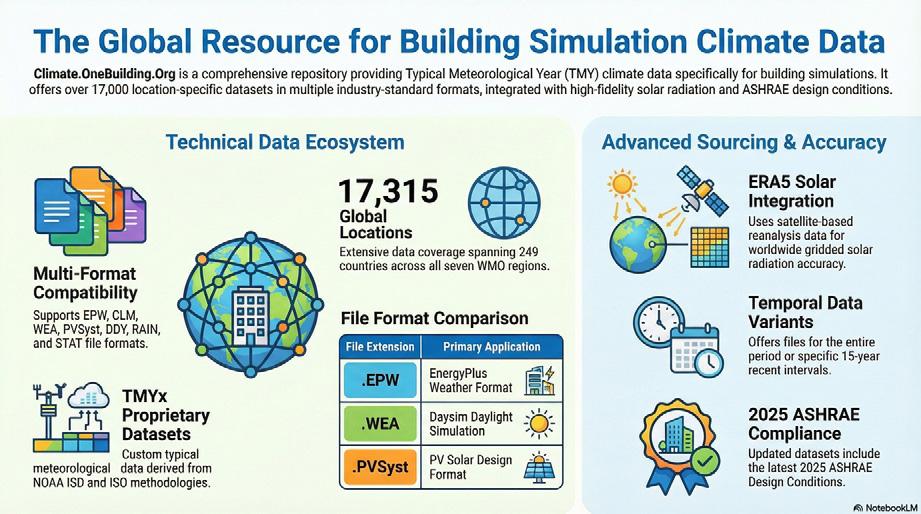
This Spring (2026), Climate.OneBuilding released an updated TMYx dataset with data through 2025. With 2023-2025 as the three hottest global years on record, simulations should show continued increased cooling when compared with older TMY-type files. These include weather station meteorology data through 2025 and corresponding solar radiation from the ERA5 reanalysis dataset ( www.ecmwf.int/en/forecasts/datasets/ reanalysis-datasets/era5 ). The ERA5 data, courtesy of Oikolab ( oikolab.com ), provides a comprehensive, worldwide, gridded solar radiation dataset based on satellite reanalysis. The new data (and all other weather files on the site, including the 2011-2025 TMYx) include the latest ASHRAE 2025 design conditions.

The TMYx are derived from hourly weather station meteorology data through 2025 in the ISD (US NOAA/NCEI’s Integrated Surface Database) and gridded solar radiation data from ERA5 reanalysis using the TMY2/ISO 15927-4:2005 methodologies. Often, there are two or more TMYx for a location, e.g., for Washington Dulles Intl AP: USA_VA_DullesWashington.Dulles.Intl.AP.724030_TMYx and USA_VA_Dulles-Washington.Dulles.Intl. AP.724030_TMYx.2011-2025. In these cases, there’s a TMY for the entire period of record and a second TMY for the most recent 15 years (2011-2025). Not all locations have recent data. The older 2004-2018, 2007-2021, and 2009-2023 TMYx have updated 2025 design conditions and remain on the website.

TMYx climate files in this update – locations over the entire available period/recent (2011-2025):

n WMO Region 1 (Africa) 1390 locations, 1183 recent n WMO Region 2 (Asia) 3175 locations, 2288 recent n WMO Region 2 (Asia) / Region 6 (Europe) – Russia 1825 locations, 958 recent n WMO Region 3 (South America) 1143 locations, 960 recent n WMO Region 4 (North and Central America, Caribbean except USA and Canada) 441 locations, 408 recent

n WMO Region 4 (USA) 2927 locations, 2656 recent n WMO Region 4 (Canada) 914 locations, 859 recent n WMO Region 5 (Southwest Pacific) 1400 locations, 1160 recent n WMO Region 6 (Europe) 3991 locations, 3711 recent n WMO Region 7 (Antarctica) 109 locations, 96 recent

The Climate.OneBuilding TMYx data set now includes more than 17,000 locations in more than 250 countries. Climate.OneBuilding now hosts more than 100,000 weather files from various sources, including future projections for several countries. All data have been extensively quality checked to identify and correct errors and out-of-range values where appropriate.

To make it easier to find and download individual files, we have added both KML maps and XLSX spreadsheets with links to all datasets on Climate.OneBuilding.

Each climate location .zip contains: EPW (EnergyPlus weather format, https://climate. onebuilding.org/papers/EnergyPlus_Weather_File_Format.pdf ), CLM (ESP-r weather format, www.strath.ac.uk/research/energysystemsresearchunit/ applications/esp-r ), WEA (Daysim weather format, https://web.mit.edu/ sustainabledesignlab/software.html ), and PVSyst (PV solar design weather format, www.pvsyst.com ), along with DDY (ASHRAE 2025 design conditions in EnergyPlus format), RAIN (hourly precipitation in mm, where available), and STAT (significantly extended EnergyPlus weather statistics).

Climate.OneBuilding thanks the building simulation community for their support – during the past three months, more than 1 million weather files were downloaded each month, with more than 30,000 weather files downloaded daily. For more information or to download any of the weather data (no cost), go to Climate.OneBuilding.org . n

Student Modelling Competition – BS2027

Fault Detection and Diagnosis of a Mixed-use University Building

The BS2027 student modelling competition challenges participants to detect and diagnose operational faults in a mixed-use university building located in Graz, Austria. Entrants receive detailed building information, weather data, and two time-series datasets: one representing normal operation of the building for calibrating their simulation models, and another containing intentionally introduced faults. Using a validated building simulation tool, participants are expected to develop a simulation model of the building and use this model to identify fault occurrences temporally and spatially, diagnose their probable causes, and reconstruct a corrected “healthy” dataset describing normal building operation.

Machine-learning or AI-based approaches may be used as complementary methods to support the simulationbased analysis. Submissions will be evaluated based on the assumptions and methods used to develop the building simulation model, the precision of fault detection (temporal accuracy, spatial precision, and credibility of the source diagnosis), the quality of the reconstructed dataset, and the overall report. The use of machine-learning methods alongside physics-based models is highly encouraged and will be viewed positively in the evaluation process. Submissions can be individual or team-based, and all entrants must be enrolled as students (master or PhD) at the time of submission. Finalists will be invited to present their work at the Building Simulation 2027 conference in Vienna, including a poster and a short presentation.

Preliminary timeline

n Publication of the modelling competition brief: 30.04.2026

n Intention to submit: 30.12.2026

n Final submission deadline: 30.03.2027

n Announcement of winners: 01.06.2027

Contact: Dr Arash Erfanibeyzaee, Arash.erfanibeyzaee@tugraz.at n

The IBPSA Women’s Network was recently launched during the Building Simulation conference in Brisbane, initiated by Esther Borkowski, PhD. The network aims to promote collaboration, innovation, and knowledge exchange among professionals in the field of building simulation. Currently, Dr Veronika Richter (richter@e3d. rwth-aachen.de ) and Mara Geske ( mara.geske@uni-weimar.de ) have taken on temporary coordination roles, contributing to shaping the network’s activities. Regular meetings are now held to develop a shared vision and generate ideas for future initiatives, laying the foundation for an active community.

To facilitate communication and engagement, we started a LinkedIn group open to all interested parties and allies to encourage broader participation ( www.linkedin.com/groups/17814017 ).

Looking ahead, the planning of the first online panel discussion is underway, with the aim of fostering meaningful conversations on key topics within building simulation and career paths.

All interested individuals are encouraged to participate, share ideas, and contribute to the successful launch and growth of this network. Engagement from the community is essential for fostering collaboration and advancing the field. n

IBPSA Standards Committee

The IBPSA Standards Committee was formed in 2022 to provide input from IBPSA on cosponsored building performance simulation-related standards. Initially, this includes the six ASHRAE standards described below. If you know of other building performance simulation standards under development or are interested in participating on the Standards committee, contact Dru Crawley ( dbcrawley@gmail.com ).

ASHRAE uses an open, consensus-based development process. All standards undergo public review. Anyone can participate in standards development, whether a voting member or not. You may apply for membership in any committee here: www.ashrae.org/technical-resources/standards-and-guidelines/how-to-join-projectcommittees

ASHRAE standards with active IBPSA involvement are:

ANSI/ASHRAE/IBPSA Standard 140-2023 - Method of Test for Evaluating Building Performance Simulation Software

Purpose: This standard specifies test procedures for evaluating the technical capabilities and ranges of applicability of software that simulates the performance of buildings and their systems.

Scope: These standard test procedures apply to software that simulates the performance of a building and its systems. While these standard test procedures cannot test all algorithms within building performance simulation software, they can be used to indicate major flaws or limitations in capabilities.

Under continuous maintenance and updating.

ANSI/ASHRAE Standard 169-2021 - Climatic Data for Building Design Standards

Purpose: This standard provides recognized climatic data for use in building design and related equipment standards.

Scope: This standard covers climatic data used in ASHRAE standards, including dry-bulb, dewpoint, and wet-bulb temperatures, enthalpy, humidity ratio, wind conditions, solar irradiation, latitude, longitude, and elevation for locations worldwide. This standard also includes statistical data such as mean temperatures, average temperatures, mean/median annual extremes, daily ranges, heating and cooling degree days and degree hours, and hours and seasonal percentages within ranges of temperatures as well as bins.

Under continuous maintenance and updating.

ANSI/ASHRAE/IBPSA Standard 205-2023 - Representation of Equipment Performance Data for HVAC&R and Other Facility Equipment

Purpose: To facilitate automated sharing of equipment performance characteristics by defining data models and data serialization formats.

Scope: This standard applies to performance data for any HVAC&R or other facility system, equipment, or component.

Under continuous maintenance and updating.

ANSI/ASHRAE/IBPSA Standard 209-2024 - Building Performance Simulation Process

Purpose: To establish minimum requirements for the process of using simulation to evaluate building performance and inform decision-making.

Scope: This standard applies to the use of building performance simulation, including energy modeling, during the design, construction, and operation of new buildings or major renovations of, or additions to, existing buildings.

Under continuous maintenance and updating.

Proposed ANSI/ASHRAE/IBPSA Standard 229P - Protocols for Evaluating Ruleset Application in Building Performance Models

Purpose: This standard establishes tests and acceptance criteria for application of rulesets and related reporting for building performance models.

Scope: This standard applies to evaluating the implementation of rulesets associated with new or existing buildings, their systems, controls, sites, and other aspects described by the ruleset. It establishes requirements for:

• building performance modeling software

• software that evaluates building performance models and associated information to check the application of a ruleset

Proposed Standard 229P is currently under development.

ANSI/ASHRAE/IBPSA Standard 232-2024 -

Common Content and Specifications for Building Data Schemas

Purpose: This standard defines metaschemas (such as data types, data elements, naming conventions, and formats) to specify and validate other standard schemas for data exchange among building performance and HVAC&R software.

Scope: This standard applies to data models and schemas specified in other standards for the design, operation, and performance of buildings.

Under continuous maintenance and updating.

A related effort is the IBPSA-USA Building Data Exchange Committee The BDE Committee provides an inclusive forum to support the development of tool-agnostic consensus-based data models for building design, analysis, and operational performance. See https://bde.ibpsa.us

As public review drafts for these standards become available, we will send out email messages to the IBPSA community and post on our LinkedIn group page. n

Books by IBPSA Fellows

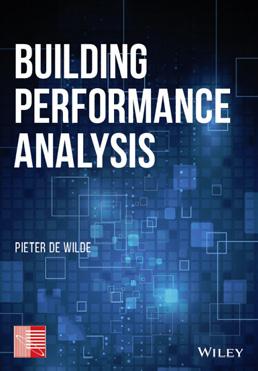
Building Performance Analysis (Wiley, 2018)

Building Performance Analysis is the go-to resource for those who want to have a deep understanding of what building performance is. The book is endorsed by IBPSA.

Offering a comprehensive and systematic overview of the concept of building performance analysis, Building Performance Analysis brings together many existing notions and ideas in one title. A substantial book, it has 11 chapters, 600 pages, and cites over 1600 references. Part I deals with the foundations of building performance, Part II deals with performance assessment, and Part III with the impact of applying of building performance analysis throughout the building life cycle. The book concludes with an epilogue that presents an emerging theory of building performance analysis.

Written for the building science community, it aims to make the following contributions to the field:

1 It reviews the significant body of knowledge on building performance that already exists.

2 It emphasizes that building performance has many aspects, and challenges the community to address those that get less prominence in the literature.

3 Going beyond simulation as a tool for building performance analysis, it also discusses physical measurement approaches, expert judgment, and stakeholder evaluation. It offers a review of the many analysis approaches available in each of these categories.

4 The emergent theory in the epilogue is intended as a key resource for researchers seeking to develop questions and hypothesis. This is intended as matter for discussion, debate, and deeper exploration. n

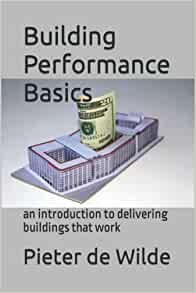
Building Performance Basics (Amazon KDP, 2022)

Building Performance Basics is a short book intended as an introductory text for students at BSc and MSc level, a primer for those entering the industry, and a refresher for those who are already in practice but want to sharpen their view. As Building Performance Analysis (above) is rather encyclopaedic, this booklet has been written with a different tone and set-up: short and cheerful, published with Amazon KDP in order to be quick to market, brief and to the point, and more persuasive in order to champion the importance and role of building performance.

Building Performance Basics deals with core questions about building performance: Why is it important? What exactly is it? Where does it play a role? Who should champion building performance? How do we quantify it? And how much performance should we aim for?

Building Performance Basics aims to provide a solid foundation for further professional development and learning about building performance, and for claiming leadership about building performance in practice. In academic courses, it provides context to modules that introduce students to hands-on performance quantification efforts using simulation, measurement and occupant surveys. In industry, this book can be used at any time where there is a wish to refresh a role as building performance champion. n

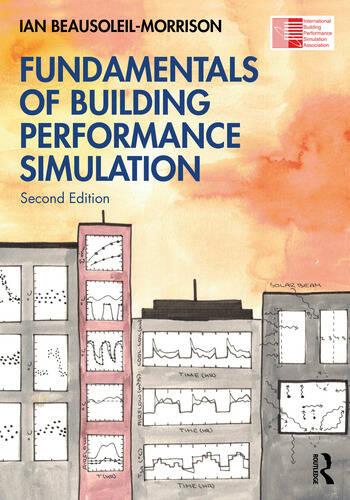
Announcing the second edition of the IBPSA-endorsed book, Fundamentals of Building Performance Simulation

The second edition incorporates many of the ideas and helpful suggestions provided by colleagues throughout the world following publication of the first edition in 2020.

The content of all chapters has been updated and expanded. This includes many new simulation exercises and several new readings.

The most significant enhancement is in the treatment of HVAC systems. Part V of the book now includes five chapters that progress from idealized methods to the explicit representation of HVAC components and their control.

Another area of major expansion is to the culminating trials that integrate the learnings of the earlier parts of the book. There are now three culminating trials to progress from the simplest case of a free floating building to one conditioned with an air-based HVAC system. Measured data for these trials are now provided within the book and more detailed guidance is given on diagnosing possible causes for disagreement between simulation predictions and these measurements.

The second edition will be available from the publisher’s website (www.routledge.com/Fundamentals-ofBuilding-Performance-Simulation/Beausoleil-Morrison/p/book/9781032724782) in late April 2025.

Get 20% off with the code 25AFLY1

Apr 2025: 432pp 105 Color illustrations

Pb: 978-1-032-72478-2 $105 $84

Hb: 978-1-032-79589-8 $170 $136

For more information visit: www.routledge.com/9781032724782

Fundamentals of Building Performance Simulation

Fundamentals of Building Performance Simulation, 2nd Edition compares the theory and practice of a multi-disciplinary field to the essentials for classroom learning and real-world applications. This textbook equips students and emerging and established professionals in engineering and architecture to predict and optimize buildings’ energy use.  The textbook will be accompanied by student and instructor digital resources including chapter introduction videos by the author, software and simulation walkthrough videos, weather data, photographs, drawings and measured data to support the culminating trials.

Integrated building design is paramount to highly energy efficient buildings. Building simulation is fundamental in this process. Prof. Beausoleil-Morrison brings us the second edition of this fantastic textbook, based on his experiential teaching method, that helps us to develop the critical view so necessary in a building simulation professional. It will become a ‘must have’ for all universities with courses in this area.

Roberto Lamberts, Laboratory for Energy Efficiency in Buildings, Federal University of Santa Catarina, Brazil

Especially in the current era of BIG DATA and AI, physics-based models are very important. They are crucial in realizing the necessary transition to a carbon-neutral society. Ian Beausoleil-Morrison teaches better than anyone what matters in Building Performance Simulation.

Helsen Lieve, KU Leuven, Belgium

Did you ever wonder what the strengths and limitations of the models in building performance simulators are? This book explains in a rigorous and approachable way the major models for building performance simulation. As building operation becomes more dynamic to facilitate renewable integration, and their energy system architectures evolve to improve grid-responsive operation, the information added in this 2nd edition about HVAC and controls is of increased importance to train simulation users. This is recommended reading for anyone who needs to be competent in building performance simulations.

Michael Wetter, Lawrence Berkeley National Laboratory, USA

20% Discount Available With This Flyer!

Building Performance Simulation for Design and Operation

University of Eindhoven, the Netherlands and Roberto Lamberts, Federal University of Santa Catarina, Brazil

This new edition provides a unique and comprehensive overview of building performance simulation for the complete building life-cycle from conception to demolition, and from a single building to district level. It contains new chapters on building information modelling, occupant behaviour modelling, urban physics modelling, urban building energy modelling, and renewable energy systems modelling. This new edition keeps the same chapter structure throughout including learning objectives, chapter summaries and assignments. It is primarily intended for building and systems designers and operators, post-graduate architectural, environmental or mechanical engineering students.

20% Discount Available - enter the code at checkout*

Hb: 978-1-138-39219-9 | £76.00

* Offer cannot be used in conjunction with any other offer or discount and only applies to books purchased directly via our website.

For more details, or to request a copy for review, please contact:

For more information visit: www.routledge.com/9781138392199

IBPSA committee chairs & contacts

Affiliate & Membership Development Committee

Dru Crawley

Awards & Fellows Committee

Liam O’Brien

Communications Committee

Christina Hopfe

Conference Committee

Erik Kolderup

EDI Committee

Rob McLeod

Education Committee

Pamela Fennell

Projects Committee

Matthias Haase

Publications Committee

Francesco Babich

Standards Committee

Dru Crawley

Strategic Planning Committee

Pieter De Wilde

IBPSA News

Eleonora Brembilla, Editor-in-Chief

Marion Bartholomew, Editor

To submit Newsletter articles and announcements: Eleonora Brembilla (Newsletter Editor-in-Chief)

TU Delft, The Netherlands

Email: e.brembilla@tudelft.nl

IBPSA Corporate Address

c/o Miller Thomson 40 King Street West, Suite 5800 Toronto, ON M5H 3S1 Canada

For additional information about IBPSA, please visit the Association’s web site at https://ibpsa.org . For information on joining, contact your nearest regional affiliate.

Members can subscribe to the IBPSA mail list (and, if desired, unsubscribe or edit) via a web interface which is available at http://lists.onebuilding.org/listinfo.cgi/bldg-sim-onebuilding.org Note that this mailing list is solely for IBPSA-related notices and to ensure that you receive future important IBPSA updates (including the election process and announcements of IBPSA News releases).

For any other purposes, please use the BLDG-SIM list. BLDG-SIM is a mailing list for users of building energy simulation programs worldwide, including weather data and other software support resources. BLDG-SIM is intended to foster the development of a community of those users. Experienced and inexperienced users of building energy simulation programs are welcome and are expected to share their questions and insights about these programs.

If you have any questions with respect to the BLDG-SIM, please contact the list owner Jason Glazer at jglazer@ gard.com or +1 847 698 5686. This list is made possible courtesy of GARD Analytics, Inc., Ridge Park, IL, USA. For further information about this list server, see the web page located at http://lists.onebuilding.org/listinfo. cgi/bldg-sim-onebuilding.org . n

IBPSA affiliates

See the IBPSA Central web site at https://ibpsa.org/about/affiliates for details of affiliate websites and contacts. Affiliate representatives are voting members of the IBPSA Board except where marked *.

AFFILIATE contact

IBPSA-Argentina Raul Fernando Ajmat

IBPSA-Australasia P C Thomas

IBPSA-Brazil Vinicius Olmos Battistini

IBPSA-Canada Karine Lavigne

IBPSA-Chile Massimo Palme

IBPSA-China Da Yan

IBPSA-ColombiaEcuador Jaime Roca

IBPSA-Czechia Martin Barták

IBPSA-DACH Jérôme Frisch

IBPSA-Danube Marija Todorović

IBPSA-Egypt Mohammad Fahmy

IBPSA-England Neveen Hamza

IBPSA-France Simon Rouchier

IBPSA-GCC (to be confirmed)

IBPSA-India Vishal Garg

IBPSA-Indonesia Muhammad Nur Fajri Alfata

IBPSA-Iran Zahra Sadat Zomorodian

AFFILIATE contact

IBPSA-Ireland Reihaneh Aghamolaei

IBPSA-Italia Vincenzo Corrado

IBPSA-Japan Yohei Yamaguchi

IBPSA-Korea Cheol-Soo Park

IBPSA-Mexico Pavel Ruiz-Torres

IBPSA-Nederland + Vlaanderen Klaas De Jonge

IBPSA-Nordic Laurent Georges

IBPSA-Peru (to be confirmed)

IBPSA-Poland Piotr Narowski

IBPSA-Russia Alina Galimshina

IBPSA-Scotland Nick Kelly

IBPSA-Singapore Poh Hee Joo

IBPSA-Slovakia Jakub Čurpek

IBPSA-Spain Licinio Alfaro Garrido

IBPSA-Turkey Aysegul Tereci

IBPSA-USA Wangda Zuo

IBPSA-Vietnam Hoang Anh Dang

IBPSA on social media

IBPSA has several internet presences on social media in addition to its main web site, its webinars, and affiliates’ sites. Thanks to Mike Barker for collating the list below:

Main IBPSA web site

https://ibpsa.org

There is a wealth of material on the main web site, including past editions of ibpsaNEWS back to 1988 and links to affiliates’ web sites at: https://ibpsa.org/about/affiliates

Linkedin:

IBPSA

www.linkedin.com/company/ibpsaworld

IBPSA Group www.linkedin.com/groups/75552

IBPSA - Daylighting & BIPV & Fenestration www.linkedin.com/groups/78517

IBPSA - EnergyPlus + Modelica www.linkedin.com/groups/2085105

JBPS

YouTube (IBPSA University)

www.linkedin.com/company/journal-of-building-performancesimulation

www.youtube.com/@IBPSAUniversity

Journal of Building Performance Simulation

EDITORS: Ian Beausoleil-Morrison, Carleton University, Canada

Jan Hensen, Eindhoven University of Technology, The Netherlands

Journal of Building Performance Simulation

Interested in contributing a paper?

Go to https://bit.ly/JBPRsubmit to contribute your research to the Journal of Building Performance Research

New content alerts

Current calls for papers:

New content alerts Special Issues Open access articles Most read articles Most cited articles

Current calls for papers:

Special Issue: Application Artificial Intelligence in Building Performance Simulation ; Guest Editors: Pieter de Wilde, Andrea Gasparella, and Ardeshir Mahdavi

Current calls for papers:

Special Issue: Application Artificial Intelligence in Building Performance Simulation ; Guest Editors: Pieter de Wilde, Andrea Gasparella, and Ardeshir Mahdavi

Special Issue: Application Artificial Intelligence in Building Performance Simulation ; Guest Editors: Pieter de Wilde, Andrea Gasparella, and Ardeshir Mahdavi

Recently published Special Issues

Recently published Special Issues

Building Sustainability and Performance Through Simulation; Guest Editors: Yunyang Ye and Zoltan Nagy 19(2), 107-355, 2026

Recently published Special Issues

Building Sustainability and Performance Through Simulation; Guest Editors: Yunyang Ye and Zoltan Nagy 19(2), 107-355, 2026

Building Sustainability and Performance Through Simulation; Guest Editors: Yunyang Ye and Zoltan Nagy 19(2), 107-355, 2026

Methods for climate-resilient building performance simulations under impacts of changing climate; Guest Editors: Dahai Qi, Liangzhu (Leon) Wang, Mohammad Heidarinejad, and Mohamed Hamdy 19(1), 1-105, 2026

Methods for climate-resilient building performance simulations under impacts of changing climate; Guest Editors: Dahai Qi, Liangzhu (Leon) Wang, Mohammad Heidarinejad, and Mohamed Hamdy 19(1), 1-105, 2026

Methods for climate-resilient building performance simulations under impacts of changing climate; Guest Editors: Dahai Qi, Liangzhu (Leon) Wang, Mohammad Heidarinejad, and Mohamed Hamdy 19(1), 1-105, 2026

Energy Performance Gap; Guest Editors: Pieter de Wilde and Cheol-Soo Park,18(5-6), 567741, 2025

Energy Performance Gap; Guest Editors: Pieter de Wilde and Cheol-Soo Park,18(5-6), 567741, 2025

Energy Performance Gap; Guest Editors: Pieter de Wilde and Cheol-Soo Park,18(5-6), 567741, 2025

Recently published articles (since previous IBPSA News) = open access

Recently published articles (since previous IBPSA News) = open access

Recently published articles (since previous IBPSA News) = open access

de Wilde, P., & Park, C. S. (2025). Quo Vadis, energy performance gap? Journal of Building Performance Simulation, 18(5–6), 567–572.

https://doi.org/10.1080/19401493.2025.2520348

de Wilde, P., & Park, C. S. (2025). Quo Vadis, energy performance gap? Journal of Building Performance Simulation, 18(5–6), 567–572.

https://doi.org/10.1080/19401493.2025.2520348

de Wilde, P., & Park, C. S. (2025). Quo Vadis, energy performance gap? Journal of Building Performance Simulation, 18(5–6), 567–572.

https://doi.org/10.1080/19401493.2025.2520348

Campagna, K., Jay, A., Pacquaut, A., & Juricic, S. (2025). Co-cooling, simulation-based exploration of a new method to measure the heat transfer coefficient of a building envelope in hot climate and summer period. Journal of Building Performance Simulation, 18(5–6), 573–592.

https://doi.org/10.1080/19401493.2024.2338767

Campagna, K., Jay, A., Pacquaut, A., & Juricic, S. (2025). Co-cooling, simulation-based exploration of a new method to measure the heat transfer coefficient of a building envelope in hot climate and summer period. Journal of Building Performance Simulation, 18(5–6), 573–592.

https://doi.org/10.1080/19401493.2024.2338767

Campagna, K., Jay, A., Pacquaut, A., & Juricic, S. (2025). Co-cooling, simulation-based exploration of a new method to measure the heat transfer coefficient of a building envelope in hot climate and summer period. Journal of Building Performance Simulation, 18(5–6), 573–592.

https://doi.org/10.1080/19401493.2024.2338767

Firth, S. K., Allinson, D., & Watson, S. (2025). Quantifying the spatial variation of the energy performance gap for the existing housing stock in England and Wales. Journal of Building Performance Simulation, 18(5–6), 593–610.

https://doi.org/10.1080/19401493.2024.2380309

Firth, S. K., Allinson, D., & Watson, S. (2025). Quantifying the spatial variation of the energy performance gap for the existing housing stock in England and Wales. Journal of Building Performance Simulation, 18(5–6), 593–610.

https://doi.org/10.1080/19401493.2024.2380309

Firth, S. K., Allinson, D., & Watson, S. (2025). Quantifying the spatial variation of the energy performance gap for the existing housing stock in England and Wales. Journal of Building Performance Simulation, 18(5–6), 593–610.

https://doi.org/10.1080/19401493.2024.2380309

Kempe, P. (2025). Reducing the energy performance gap through stepwise verification of building and system functions. Journal of Building Performance Simulation, 18(5–6), 611–630.

Kempe, P. (2025). Reducing the energy performance gap through stepwise verification of building and system functions. Journal of Building Performance Simulation, 18(5–6), 611–

https://doi.org/10.1080/19401493.2024.2416684

Kempe, P. (2025). Reducing the energy performance gap through stepwise verification of building and system functions. Journal of Building Performance Simulation, 18(5–6), 611–

Kersken, M., Rojas, G., & Strachan, P. (2025). Uncertainty of the predictions of different programs and modelling teams based on a detailed empirical validation dataset. Journal of Building Performance Simulation, 18(5–6), 631–647.

https://doi.org/10.1080/19401493.2024.2343883

Kim, H. G., & Kim, S. S. (2025). UBEM calibration method by energy consumption

Journal of Building Performance Simulation

630.

https://doi.org/10.1080/19401493.2024.2416684

Kersken, M., Rojas, G., & Strachan, P. (2025). Uncertainty of the predictions of different programs and modelling teams based on a detailed empirical validation dataset. Journal of Building Performance Simulation, 18(5–6), 631–647.

https://doi.org/10.1080/19401493.2024.2343883

Kim, H. G., & Kim, S. S. (2025). UBEM calibration method by energy consumption disaggregation using a change-point model. Journal of Building Performance Simulation, 18(5–6), 648–675.

https://doi.org/10.1080/19401493.2024.2412135

Mahdavi, A., & Berger, C. (2025). Ten questions regarding buildings, occupants and the energy performance gap. Journal of Building Performance Simulation, 18(5–6), 676–686. https://doi.org/10.1080/19401493.2024.2332245

Petrou, G., Mavrogianni, A., Symonds, P., Chalabi, Z., Lomas, K., Mylona, A., & Davies, M. (2025). Development of a Bayesian calibration framework for archetype-based housing stock models of summer indoor temperature. Journal of Building Performance Simulation, 18(5–6), 687–706.

https://doi.org/10.1080/19401493.2024.2421330

Sadevi, K. K., & Agrawal, A. (2025). Thermal performance of shaded roofs: investigating the impact of material properties and efficacy of building performance simulation. Journal of Building Performance Simulation, 18(5–6), 707–723.

https://doi.org/10.1080/19401493.2024.2388215

Walther, K., Molinari, M., & Voss, K. (2025). Controls of HVAC systems in digital twins –comparative framework and case study on the performance gap. Journal of Building Performance Simulation, 18(5–6), 724–741.

https://doi.org/10.1080/19401493.2024.2446517

Hasrat, I. R., Andersen, K. H., Jensen, P. G., Jensen, R. L., Larsen, K. G., & Srba, J. (2025). Towards model-driven heat pump control in a multi-story building. Journal of Building Performance Simulation, 18(7), 743–766.

https://doi.org/10.1080/19401493.2025.2460658

Zhong, F., Yu, H., Xie, X., Lin, Y., Zhu, X., Wang, Y., … Huang, S. (2025). Enhanced TimesNet algorithm with ConvNext and fusion of time–frequency domain features in fault detection and diagnosis of HVAC systems. Journal of Building Performance Simulation, 18(7), 767–782.

https://doi.org/10.1080/19401493.2025.2459714

Tian, Z., Shi, X., & Wei, S. (2025). Exploring the impacts of numerosity reduction on the datadriven building energy analysis for a proposed building. Journal of Building Performance Simulation, 18(7), 783–795.

https://doi.org/10.1080/19401493.2025.2461256

– the missing links in energy performance simulation. Journal of Building Performance Simulation, 18(7), 796–809.

https://doi.org/10.1080/19401493.2025.2472304

Sánchez-García, D., Bienvenido-Huertas, D., & O’Brien, W. (2025). accim: a Python library for adaptive setpoint temperatures in building performance simulations. Journal of Building Performance Simulation, 18(7), 810–822. https://doi.org/10.1080/19401493.2025.2472305

Khorasani Zadeh, Z., Ouf, M., Gunay, B., Delcroix, B., & Larochelle Martin, G. (2025). Modelling thermostat use behaviour in multi-zone residential buildings: a real-world data study and simulation framework for peak demand management. Journal of Building Performance Simulation, 18(7), 823–842. https://doi.org/10.1080/19401493.2025.2474043

Li, J., Wang, X., Cui, J., Zhang, X., Wang, P., Huai, Y., … Zhang, Y. (2025). Impact of geometric parameters on the performance of naturally ventilated photovoltaic curtain walls. Journal of Building Performance Simulation, 18(7), 843–858. https://doi.org/10.1080/19401493.2025.2478064

Pacquaut, A., Rouchier, S., Juricic, S., Jay, A., Challansonnex, A., & Wurtz, E. (2025). Bayesian approach for the assessment of heat transfer coefficients of buildings under occupancy. Journal of Building Performance Simulation, 18(7), 859–879. https://doi.org/10.1080/19401493.2025.2482973

Rocha, A. P. de A., Goffart, J., & Mendes, N. (2025). Solar shading in building simulations: assessing the reliability of pixel counting and polygon clipping methods. Journal of Building Performance Simulation, 18(7), 880–895.

https://doi.org/10.1080/19401493.2025.2487463

Ang, Y. Q., Ong, L., Teo, J., Gan, J. V., & Han, J. (2025). Advancing building performance simulation education through a crowdsourced campus digital twin. Journal of Building Performance Simulation, 18(7), 896–920.

https://doi.org/10.1080/19401493.2025.2493866

Dhaliwal, G., Gunay, B., Beausoleil-Morrison, I., & Brown, S. (2025). Development and implementation of a data-driven model predictive controller for hydronic floors: an experimental case study. Journal of Building Performance Simulation, 18(7), 921–938. https://doi.org/10.1080/19401493.2025.2496659

Le, T. L., Chong, H., Le, B. M., Nguyen-Xuan, H., & Kim, S. A. (2025). From hand sketches to daylight performance: a mixed-input neural prediction framework. Journal of Building Performance Simulation, 18(7), 939–963.

https://doi.org/10.1080/19401493.2025.2499689

Su, A. J., Ren, A., Xu, K. C., & Dogan, T. (2025). Scalable building reconstruction and window detection for urban building energy modelling applications. Journal of Building Performance Simulation, 18(7), 964–982.

https://doi.org/10.1080/19401493.2025.2501151

Michalak, P., & Bobula, M. (2025). Hourly method of ISO 11855-4 for modelling of a zone with concrete core activation at constant and varying internal heat transfer coefficients. Simulation and validation measurements. Journal of Building Performance Simulation, 18(7), 983–1002.

https://doi.org/10.1080/19401493.2025.2504003

Zanetti, E., Scoccia, R., Aprile, M., & Finocchiaro, P. (2025). 2D Modelica modelling and experimental validation of a compact cross-flow heat exchanger used in a new desiccant

Performance Simulation, 18(7), 964–982.

https://doi.org/10.1080/19401493.2025.2501151

Journal of Building Performance Simulation

Michalak, P., & Bobula, M. (2025). Hourly method of ISO 11855-4 for modelling of a zone with concrete core activation at constant and varying internal heat transfer coefficients. Simulation and validation measurements. Journal of Building Performance Simulation, 18(7), 983–1002.

https://doi.org/10.1080/19401493.2025.2504003

Zanetti, E., Scoccia, R., Aprile, M., & Finocchiaro, P. (2025). 2D Modelica modelling and experimental validation of a compact cross-flow heat exchanger used in a new desiccant evaporative cooling system. Journal of Building Performance Simulation, 18(7), 1003–1022. https://doi.org/10.1080/19401493.2025.2505101

Wu, X., Chen, H., Han, M., Ooka, R., Kikumoto, H., & Oh, W. (2025). Inferencing CFD simulation boundary conditions for coughing from experimental spatiotemporal airflow distribution: conception and results from LSTM. Journal of Building Performance Simulation, 18(7), 1023–1044. https://doi.org/10.1080/19401493.2025.2509136

Huang, X., & Hu, H. (2025). Study on the intelligent predictive model of thermal comfort for sports buildings in hot-humid climates based on AI algorithms. Journal of Building Performance Simulation, 18(7), 1045–1061.

https://doi.org/10.1080/19401493.2025.2512939

Orman, A., Safranek, S., & Pierson, C. (2025). Evaluation of spectral light simulation tools for prediction of ipRGC-influenced light responses in real-world offices with electrochromic glazing. Journal of Building Performance Simulation, 18(7), 1062–1081. https://doi.org/10.1080/19401493.2025.2515123

Thanh, T. N., Pham, Q. H., Trung, K. D., & Minh, P. V. (2025). Advanced 2D and 3D simulation techniques for maximizing rooftop solar power efficiency in office buildings. Journal of Building Performance Simulation, 18(7), 1082–1098. https://doi.org/10.1080/19401493.2025.2519180

Gunay, B., Elehwany, H., Bahiraei, F., & Darwazeh, D. (2025). Development of a contextual bandits-based thermal mass preconditioning algorithm for dynamic electricity pricing. Journal of Building Performance Simulation, 18(7), 1099–1118.

https://doi.org/10.1080/19401493.2025.2524379

Qi, D., Wang, L. L., Heidarinejad, M., & Hamdy, M. (2026). Adapting building performance simulation for climate resilience: accounting for urban microclimates and future climates. Journal of Building Performance Simulation, 19(1), 1–7.

https://doi.org/10.1080/19401493.2025.2540927

Siu, C. Y., Touchie, M., & O’Brien, W. (2026). Development and testing of an automated tool to leverage building energy models for thermal resilience analysis. Journal of Building Performance Simulation, 19(1), 8–26.

https://doi.org/10.1080/19401493.2024.2365381

Mitchell, A., Wright, G. S., & Heidarinejad, M. (2026). Thermal resilience in passive buildings: metrics, modeling methods, tool development, and evaluation of passive and mixed mode responses. Journal of Building Performance Simulation, 19(1), 27–44.

https://doi.org/10.1080/19401493.2025.2496658

Rostami, M., & Bucking, S. (2026). Adaptation to extreme weather events using preconditioning: a model-based testing of novel resilience algorithms on a residential case study. Journal of Building Performance Simulation, 19(1), 45–66.

https://doi.org/10.1080/19401493.2024.2307636

Baba, F. M., Cheong, K. C. T., Ge, H., Zmeureanu, R., Wang, L. (Leon), & Qi, D. (2026). Comparing overheating risk and mitigation strategies for two Canadian schools by using building simulation calibrated with measured data. Journal of Building Performance

metrics, modeling methods, tool development, and evaluation of passive and mixed mode responses. Journal of Building Performance Simulation, 19(1), 27–44.

https://doi.org/10.1080/19401493.2025.2496658

Journal of Building Performance Simulation

Rostami, M., & Bucking, S. (2026). Adaptation to extreme weather events using preconditioning: a model-based testing of novel resilience algorithms on a residential case study. Journal of Building Performance Simulation, 19(1), 45–66. https://doi.org/10.1080/19401493.2024.2307636

Baba, F. M., Cheong, K. C. T., Ge, H., Zmeureanu, R., Wang, L. (Leon), & Qi, D. (2026). Comparing overheating risk and mitigation strategies for two Canadian schools by using building simulation calibrated with measured data. Journal of Building Performance Simulation, 19(1), 67–85. https://doi.org/10.1080/19401493.2023.2290103

Amaripadath, D., Joshi, M. Y., Hamdy, M., Petersen, S., Stone, B., Jr., & Attia, S. (2026). Thermal resilience in a renovated nearly zero-energy dwelling during intense heat waves. Journal of Building Performance Simulation, 19(1), 86–105. https://doi.org/10.1080/19401493.2023.2253460

Ye, Y., & Nagy, Z. (2026). Building sustainability and performance through simulation. Journal of Building Performance Simulation, 19(2), 107–111. https://doi.org/10.1080/19401493.2025.2599118

Lang-Eurisch, B., Bishara, N., & Hübler, C. (2026). Informed green façade selection: integrating LCA and microclimatic analysis for a dual-method approach. Journal of Building Performance Simulation, 19(2), 112–127.

https://doi.org/10.1080/19401493.2025.2538039

Su, A. J., Xing Yizhen Brown, C., Mermelstein, R., & Cerezo Davila, C. (2026). Dynamic thermal comfort simulation: model parameter considerations for early-stage design applications. Journal of Building Performance Simulation, 19(2), 128–145. https://doi.org/10.1080/19401493.2025.2539323

Govindarajan, P., & Ortner, F. P. (2026). What density for net-zero energy? Performance driven urban and energy master planning for high-rise residential precincts in tropical climates. Journal of Building Performance Simulation, 19(2), 146–164. https://doi.org/10.1080/19401493.2025.2558875

Cui, X., Li, Y., & Shen, P. (2026). Beyond CFD: explainable machine learning for efficient assessment of urban morphology impacts on pedestrian level wind and thermal environment. Journal of Building Performance Simulation, 19(2), 165–180. https://doi.org/10.1080/19401493.2025.2508500

Yu, M. G., Vlachokostas, A., Devaprasad, K., Cornachione, M., Johnson, S., Yoder, T. A., & Salsbury, T. I. (2026). Optimizing chilled water systems with cooling towers via virtual power metrics and extremum-seeking control. Journal of Building Performance Simulation, 19(2), 181–194. https://doi.org/10.1080/19401493.2025.2575349

Zabala Urrutia, L., Febres Pascual, J., Sterling, R., & Pérez Iribarren, E. (2026). Heuristic mathematical optimization of heat pumps in cascade to reduce energy consumption. Journal of Building Performance Simulation, 19(2), 195–208.

https://doi.org/10.1080/19401493.2025.2531023 - -based predictive control framework for market and grid-oriented operation in thermally activated buildings. Journal of Building Performance Simulation, 19(2), 209–238.

https://doi.org/10.1080/19401493.2025.2565652

Arsano, A. Y., Dumoulin, T., & Chu, C. (2026). Calibration of an analytical model for earlydesign stage solar heat gain prediction. Journal of Building Performance Simulation, 19(2), 239–256.

https://doi.org/10.1080/19401493.2025.2491463

Xiang, J., Dang, Q., Cerezo Davila, C., & Samuelson, H. (2026). Convex partition zoner: a new algorithm for automated thermal zoning. Journal of Building Performance

mathematical optimization of heat pumps in cascade to reduce energy consumption. Journal of Building Performance Simulation, 19(2), 195–208.

https://doi.org/10.1080/19401493.2025.2531023

- -based predictive control framework for market and grid-oriented operation in thermally activated buildings. Journal of Building Performance Simulation, 19(2), 209–238.

https://doi.org/10.1080/19401493.2025.2565652

Arsano, A. Y., Dumoulin, T., & Chu, C. (2026). Calibration of an analytical model for earlydesign stage solar heat gain prediction. Journal of Building Performance Simulation, 19(2), 239–256.

https://doi.org/10.1080/19401493.2025.2491463

Simulation, 19(2), 257–276.

Xiang, J., Dang, Q., Cerezo Davila, C., & Samuelson, H. (2026). Convex partition zoner: a new algorithm for automated thermal zoning. Journal of Building Performance Simulation, 19(2), 257–276.

https://doi.org/10.1080/19401493.2025.2549981

https://doi.org/10.1080/19401493.2025.2549981

Park, C. H., Cho, S., Song, T. Y., Heo, S. Y., Lee, J., & Park, C. S. (2026). Physicsembedded hybrid modelling approach for room temperature prediction using Siamese neural network and RC model. Journal of Building Performance Simulation, 19(2), 277–288.

https://doi.org/10.1080/19401493.2025.2542352

Park, C. H., Cho, S., Song, T. Y., Heo, S. Y., Lee, J., & Park, C. S. (2026). Physicsembedded hybrid modelling approach for room temperature prediction using Siamese neural network and RC model. Journal of Building Performance Simulation, 19(2), 277–288. https://doi.org/10.1080/19401493.2025.2542352

Dogan, T., Li, C., Tseng, H. M., Su, A. J., & Kastner, P. (2026). A bottom-up urban building energy model for evaluating thermal load electrification measures. Journal of Building Performance Simulation, 19(2), 289–316. https://doi.org/10.1080/19401493.2025.2536261

Dogan, T., Li, C., Tseng, H. M., Su, A. J., & Kastner, P. (2026). A bottom-up urban building energy model for evaluating thermal load electrification measures. Journal of Building Performance Simulation, 19(2), 289–316. https://doi.org/10.1080/19401493.2025.2536261

Guillante, P., Compton, A., Gioppo, Z., Raleigh, Q., Kiesling, C., Cooper, J., … Poleacovschi, C. (2026). Development of residential building archetype models for rural Alaskan communities. Journal of Building Performance Simulation, 19(2), 317–341. https://doi.org/10.1080/19401493.2025.2543026

Guillante, P., Compton, A., Gioppo, Z., Raleigh, Q., Kiesling, C., Cooper, J., … Poleacovschi, C. (2026). Development of residential building archetype models for rural Alaskan communities. Journal of Building Performance Simulation, 19(2), 317–341.

https://doi.org/10.1080/19401493.2025.2543026

Gilani, S., Ferguson, A., & Azimi, S. (2026). Energy use metrics for Canada’s housing code. Journal of Building Performance Simulation, 19(2), 342–355. https://doi.org/10.1080/19401493.2025.2519183

Gilani, S., Ferguson, A., & Azimi, S. (2026). Energy use metrics for Canada’s housing code. Journal of Building Performance Simulation, 19(2), 342–355. https://doi.org/10.1080/19401493.2025.2519183

Latest articles (published online but no volume, issue or page numbers yet)

Latest articles (published online but no volume, issue or page numbers yet)

Pinheiro, L., Wang, Z., O’Neill, Z., & Pang, Z. (2026). Quantifying the impact of occupancy sensor errors on energy savings, thermal comfort, and peak demand in residential smart thermostats. Journal of Building Performance Simulation, 1–27. https://doi.org/10.1080/19401493.2026.2636562

Pinheiro, L., Wang, Z., O’Neill, Z., & Pang, Z. (2026). Quantifying the impact of occupancy sensor errors on energy savings, thermal comfort, and peak demand in residential smart thermostats. Journal of Building Performance Simulation, 1–27.

https://doi.org/10.1080/19401493.2026.2636562

Cho, S., & Park, C. S. (2026). Federated learning for enhancing extrapolation ability of HVAC models: case study on two real-life DOAS units. Journal of Building Performance Simulation, 1–16.

Cho, S., & Park, C. S. (2026). Federated learning for enhancing extrapolation ability of HVAC models: case study on two real-life DOAS units. Journal of Building Performance Simulation, 1–16.

https://doi.org/10.1080/19401493.2026.2637735

https://doi.org/10.1080/19401493.2026.2637735

Echreshavi, Z., Farbood Palangari, M., Sisti, E., Rampazzo, M., & Carli, R. (2026). Optimized graph-based modelling of multi-zone building energy systems: a sensitivity–identifiabilitydriven calibration approach. Journal of Building Performance Simulation, 1–19.

https://doi.org/10.1080/19401493.2026.2616452

Echreshavi, Z., Farbood Palangari, M., Sisti, E., Rampazzo, M., & Carli, R. (2026). Optimized graph-based modelling of multi-zone building energy systems: a sensitivity–identifiabilitydriven calibration approach. Journal of Building Performance Simulation, 1–19.

https://doi.org/10.1080/19401493.2026.2616452

Raghavan, V. S., & Giridhar, A. V. (2025). Cost-optimal residential energy scheduling via a zero-shot LLM agent and model predictive control. Journal of Building Performance Simulation, 1–19.

https://doi.org/10.1080/19401493.2025.2605465

Raghavan, V. S., & Giridhar, A. V. (2025). Cost-optimal residential energy scheduling via a zero-shot LLM agent and model predictive control. Journal of Building Performance Simulation, 1–19.

https://doi.org/10.1080/19401493.2025.2605465

Panico, S., Leonardi, E., Larcher, M., Zandonai, A., Cennamo, D., Herrera-Avellanosa, D., & Troi, A. (2025). Integrating hygrothermal simulations with monitored data in extreme climatic conditions. Journal of Building Performance Simulation, 1–24. https://doi.org/10.1080/19401493.2025.2591400

Panico, S., Leonardi, E., Larcher, M., Zandonai, A., Cennamo, D., Herrera-Avellanosa, D., & Troi, A. (2025). Integrating hygrothermal simulations with monitored data in extreme climatic conditions. Journal of Building Performance Simulation, 1–24.

https://doi.org/10.1080/19401493.2025.2591400

Guo, L., Sun, K., Liu, C., & Zhao, Y. (2025). Comparative analysis of SVR based on multiple optimization algorithms in indoor thermal comfort prediction. Journal of Building Performance

Guo, L., Sun, K., Liu, C., & Zhao, Y. (2025). Comparative analysis of SVR based on multiple

graph-based modelling of multi-zone building energy systems: a sensitivity–identifiabilitydriven calibration approach. Journal of Building Performance Simulation, 1–19.

https://doi.org/10.1080/19401493.2026.2616452

Journal of Building Performance Simulation

Raghavan, V. S., & Giridhar, A. V. (2025). Cost-optimal residential energy scheduling via a zero-shot LLM agent and model predictive control. Journal of Building Performance Simulation, 1–19.

https://doi.org/10.1080/19401493.2025.2605465

Panico, S., Leonardi, E., Larcher, M., Zandonai, A., Cennamo, D., Herrera-Avellanosa, D., & Troi, A. (2025). Integrating hygrothermal simulations with monitored data in extreme climatic conditions. Journal of Building Performance Simulation, 1–24. https://doi.org/10.1080/19401493.2025.2591400

Guo, L., Sun, K., Liu, C., & Zhao, Y. (2025). Comparative analysis of SVR based on multiple optimization algorithms in indoor thermal comfort prediction. Journal of Building Performance Simulation, 1–21.

https://doi.org/10.1080/19401493.2025.2591313

Amini, H., Bjelland, D., Maria, T., Alanne, K., Hamdy, M., & Kosonen, R. (2025). Scalable and adaptive multi-stage hourly calibration of simulation models with high usage fluctuations: case studies for multi-purpose buildings. Journal of Building Performance Simulation, 1–22. https://doi.org/10.1080/19401493.2025.2586513

Thiis, T. K., Petersen, A. J., Fuglestvedt, H. F., & Hygen, H. O. (2025). Typical meteorological years tailored for high latitudes based on high-resolution reanalysis data. Journal of Building Performance Simulation, 1–17.

https://doi.org/10.1080/19401493.2025.2573724

Zuschlag, M., Jansen, D., Streblow, R., & Müller, D. (2025). A user-friendly boiler model for dynamic simulations. Journal of Building Performance Simulation, 1–19.

https://doi.org/10.1080/19401493.2025.2572693

Bandak, A., Sreenivasan, A., Hamid, A. A., & Wilde, P. de. (2025). The energy performance gap – a Swedish perspective. Journal of Building Performance Simulation, 1–22. https://doi.org/10.1080/19401493.2025.2567993

Van Thillo, L., Audenaert, A., & Verbeke, S. (2025). The (un)predictability of manual lightswitching behaviour in residential buildings: towards interaction model RELICS. Journal of Building Performance Simulation, 1–28. https://doi.org/10.1080/19401493.2025.2564147

Mendes, N., Zuliani Lunkes, A. de L., de Mello, L. A., & Pasti, R. (2025). CFD and machine learning in building performance simulation: towards urban microclimate integration. Journal of Building Performance Simulation, 1–6.

https://doi.org/10.1080/19401493.2025.2561864

Wang, X., He, Y., Cui, J., Zhang, X., Liu, F., Yu, H., … Zhang, Y. (2025). Numerical investigation on the impact of natural convection on a multi-inlet industrial rooftop photovoltaic system. Journal of Building Performance Simulation, 1–17. https://doi.org/10.1080/19401493.2025.2560988

Lin, S. M., Hsiao, Y. T., Lu, C. T., & Chou, C. J. (2025). Numerical behavior-aware scheduling framework for residential appliance control under time-of-use tariffs. Journal of Building Performance Simulation, 1–17.

https://doi.org/10.1080/19401493.2025.2556690

Weber, S. O., Subramaniam, S., & Leistner, P. (2025). A parametric design integrated sampling and general training approach for optimal control oriented surrogate models of light-related quantities. Journal of Building Performance Simulation, 1–24. https://doi.org/10.1080/19401493.2025.2540929

Heo, Y., Setyantho, G. R., & Hong, T. (2025). Toward a new paradigm for urban climate modelling: challenges and opportunities. Journal of Building Performance Simulation, 1–8. https://doi.org/10.1080/19401493.2025.2540925

Dong, S., Kong, Q., & Meng, X. (2025). A fast method for simulating single room dynamic thermal loads using model order reduction. Journal of Building Performance Simulation, 1–20.

scheduling framework for residential appliance control under time-of-use tariffs. Journal of Building Performance Simulation, 1–17.

https://doi.org/10.1080/19401493.2025.2556690

Journal of Building Performance Simulation

Weber, S. O., Subramaniam, S., & Leistner, P. (2025). A parametric design integrated sampling and general training approach for optimal control oriented surrogate models of light-related quantities. Journal of Building Performance Simulation, 1–24.

https://doi.org/10.1080/19401493.2025.2540929

Heo, Y., Setyantho, G. R., & Hong, T. (2025). Toward a new paradigm for urban climate modelling: challenges and opportunities. Journal of Building Performance Simulation, 1–8. https://doi.org/10.1080/19401493.2025.2540925

Dong, S., Kong, Q., & Meng, X. (2025). A fast method for simulating single room dynamic thermal loads using model order reduction. Journal of Building Performance Simulation, 1–20.

https://doi.org/10.1080/19401493.2025.2540921

Hopfe, C. J. (2025). Advances in pedagogy simulation research. Journal of Building Performance Simulation, 1–2.

https://doi.org/10.1080/19401493.2025.2538058

Togashi, E., Ogata, H., Ayame, H., Nakatsuka, K., Satoh, M., Ukai, M., … Iio, Y. (2025). A benchmarking framework for HVAC optimization via competitive evaluation: insights from the 2nd wccbo. Journal of Building Performance Simulation, 1–14.

https://doi.org/10.1080/19401493.2025.2539356

Bui, R., Goffart, J., McGregor, F., Fabbri, A., Woloszyn, M., & Grillet, A. C. (2025). Hygrothermal behaviour of a rammed earth wall subjected to realistic conditions: investigation of the most influential parameters. Journal of Building Performance Simulation, 1–18.

https://doi.org/10.1080/19401493.2025.2525421

Quang, T. V., & Doan, D. T. (2025). Online transfer learning (OTL) for accelerating deep reinforcement learning (DRL) for building energy management. Journal of Building Performance Simulation, 1–20.

https://doi.org/10.1080/19401493.2025.2511826

loss coefficient – the impact of modelling methods of solar radiation distribution. Journal of Building Performance Simulation, 1–10.

https://doi.org/10.1080/19401493.2025.2511814

Bjørnskov, J., Badhwar, A., Shikhar Singh, D., Sehgal, M., Åkesson, R., & Jradi, M. (2025). Development and demonstration of a digital twin platform leveraging ontologies and datadriven simulation models. Journal of Building Performance Simulation, 1–13.

https://doi.org/10.1080/19401493.2025.2504005

Rida, M., & Kelly, N. (2025). Integrating a multi-segment occupant thermal model with building simulation and computational fluid dynamics for detailed analysis of human-building thermal interactions and thermal comfort. Journal of Building Performance Simulation, 1–19. https://doi.org/10.1080/19401493.2025.2502800

Tarkhan, N., Crawley, D. B., Lawrie, L. K., & Reinhart, C. (2025). Generation of representative meteorological years through anomaly-based detection of extreme events. Journal of Building Performance Simulation, 1–18.

https://doi.org/10.1080/19401493.2025.2499687

Johnen, S., Althaus, P., Stock, J., Xhonneux, A., & Müller, D. (2025). Data-driven approach on estimating the minimum required supply temperature for building heating systems: method development, extended application evaluation and sensitivity analysis. Journal of Building Performance Simulation, 1–15.

https://doi.org/10.1080/19401493.2025.2493868

Brembilla, E. (2025). Advances in daylight simulation research. Journal of Building Performance Simulation, 1–2.

https://doi.org/10.1080/19401493.2025.2499012

Jowett-Lockwood, L., & Evins, R. (2025). Using an inverse surrogate model for determining

building simulation and computational fluid dynamics for detailed analysis of human-building thermal interactions and thermal comfort. Journal of Building Performance Simulation, 1–19.

https://doi.org/10.1080/19401493.2025.2502800

Journal of Building Performance Simulation

Tarkhan, N., Crawley, D. B., Lawrie, L. K., & Reinhart, C. (2025). Generation of representative meteorological years through anomaly-based detection of extreme events. Journal of Building Performance Simulation, 1–18. https://doi.org/10.1080/19401493.2025.2499687

Johnen, S., Althaus, P., Stock, J., Xhonneux, A., & Müller, D. (2025). Data-driven approach on estimating the minimum required supply temperature for building heating systems: method development, extended application evaluation and sensitivity analysis. Journal of Building Performance Simulation, 1–15. https://doi.org/10.1080/19401493.2025.2493868

Brembilla, E. (2025). Advances in daylight simulation research. Journal of Building Performance Simulation, 1–2. https://doi.org/10.1080/19401493.2025.2499012

Jowett-Lockwood, L., & Evins, R. (2025). Using an inverse surrogate model for determining building thermal characteristics. Journal of Building Performance Simulation, 1–17. https://doi.org/10.1080/19401493.2025.2487459

Sood, D., Wolf, S., Cali, D., Korsholm Andersen, R., Li, R., Madsen, H., & O’Donnell, J. (2025). Room-level domestic occupancy simulation model using time use survey data. Journal of Building Performance Simulation, 1–15. https://doi.org/10.1080/19401493.2025.2465508

Amrith, S., Korolija, I., Fennell, P., Rovas, D., & Ruyssevelt, P. (2025). Optimising building stock retrofits for urban-scale action planning: improving the feasibility without losing information. Journal of Building Performance Simulation, 1–16. https://doi.org/10.1080/19401493.2025.2472306

Randow, J., Satke, P., Jaeschke, M., Bucher, A., Kolditz, O., Shao, H., & Schoenfelder, S. (2025). A software interface for coupled underground and facility simulations between OpenGeoSys and Modelica. Journal of Building Performance Simulation, 1–19. https://doi.org/10.1080/19401493.2025.2461242

Tay, J., Wortmann, T., & Ortner, F. P. (2025). Performance-informed urban design: training a generalized surrogate model for predicting building energy demand across residential morphologies in Singapore. Journal of Building Performance Simulation, 1–15. https://doi.org/10.1080/19401493.2025.2457343

Li, Y., Chen, Z., Wen, J., Fu, Y., Pertzborn, A., & O’Neill, Z. (2025). A framework for calibrating and validating an HVAC system in Modelica. Journal of Building Performance Simulation, 1–21. https://doi.org/10.1080/19401493.2025.2452657

Green-Mignacca, S., Rostami, M., & Bucking, S. (2024). Towards codification of thermal resilience upgrades in midrise residential buildings: a Canadian archetype energy model approach. Journal of Building Performance Simulation, 1–23. https://doi.org/10.1080/19401493.2024.2435908

Sadevi, K. K., & Agrawal, A. (2024). Thermal performance of shaded roofs: investigating the impact of material properties and efficacy of building performance simulation. Journal of Building Performance Simulation, 1–17. https://doi.org/10.1080/19401493.2024.2388215

Markarian, E., Qiblawi, S., Krishnan, S., Divakaran, A., Ramalingam Rethnam, O., Thomas, A., & Azar, E. (2024). Informing building retrofits at low computational costs: a multi-objective optimisation using machine learning surrogates of building performance simulation models. Journal of Building Performance Simulation, 1–17. https://doi.org/10.1080/19401493.2024.2384487

de Vries, S. B., Laan, C. M., Bons, P. C., & Heller, R. M. B. (2024). Model-predictive space heating control for energy flexibility – a case study using a long short-term memory neural network surrogate model and a genetic optimization algorithm. Journal of Building Performance Simulation, 1–20. https://doi.org/10.1080/19401493.2024.2371918

Morovat, N., Athienitis, A. K., & Candanedo, J. A. (2024). Design of a model predictive control methodology for integration of retrofitted air‐based PV/T system in school

impact of material properties and efficacy of building performance simulation. Journal of Building Performance Simulation, 1–17. https://doi.org/10.1080/19401493.2024.2388215

Markarian, E., Qiblawi, S., Krishnan, S., Divakaran, A., Ramalingam Rethnam, O., Thomas, A., & Azar, E. (2024). Informing building retrofits at low computational costs: a multi-objective optimisation using machine learning surrogates of building performance simulation models. Journal of Building Performance Simulation, 1–17. https://doi.org/10.1080/19401493.2024.2384487

de Vries, S. B., Laan, C. M., Bons, P. C., & Heller, R. M. B. (2024). Model-predictive space heating control for energy flexibility – a case study using a long short-term memory neural network surrogate model and a genetic optimization algorithm. Journal of Building Performance Simulation, 1–20. https://doi.org/10.1080/19401493.2024.2371918

Morovat, N., Athienitis, A. K., & Candanedo, J. A. (2024). Design of a model predictive control methodology for integration of retrofitted air‐based PV/T system in school buildings. Journal of Building Performance Simulation, 1–19. https://doi.org/10.1080/19401493.2024.2362241

Pan, X., Xu, Y., & Hong, T. (2024). Surrogate modelling for urban building energy simulation based on the bidirectional long short-term memory model. Journal of Building Performance Simulation, 1–19. https://doi.org/10.1080/19401493.2024.2359985


Turn static files into dynamic content formats.

Create a flipbook