Autumn 2026
electricalandplumbingskills.com
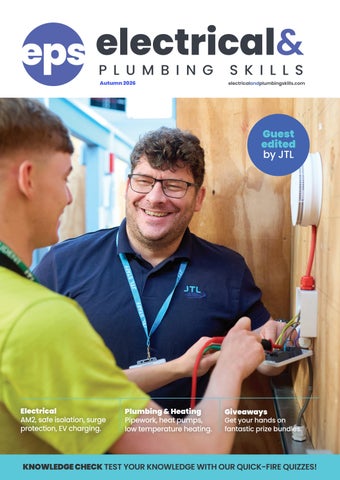
Guest edited by JTL
Electrical AM2, safe isolation, surge protection, EV charging.
Plumbing & Heating Pipework, heat pumps, low temperature heating.
Giveaways
Get your hands on fantastic prize bundles.
KNOWLEDGE CHECK TEST YOUR KNOWLEDGE WITH OUR QUICK-FIRE QUIZZES!
SIGN UP TO OUR NEWSLETTER FOR THE LATEST PRODUCT LAUNCHES, NEWS AND CHANCES TO WIN STRAIGHT TO YOUR INBOX.
DRIVEN TO OUTPERFORM. COMPACT BRUSHLESS POWER PACK
SUB COMPACT COPPER PIPE CUTTER C12 PC-0 // ART 4933411920
M12 BLPP2B-422B // ART 4933500426 KIT INCLUDES M12 BLPDRC-0 M12 BLIDRC-0 M12 B4 M12 B2 C12 C CONTRACTOR BAG
HIGH PERFORMANCE 500 RPM MOTOR CUTS 12 MM COPPER PIPE IN LESS THAN 3 SECONDS
VDE 3 PIECE PLIER SET ART 4932464575 STEEL BLADES ARE FULLY FORGED, HARDENED AND TEMPERED FOR BEST DURABILITY VDE (DIN EN/IEC 60900) CERTIFIED. TESTED TO 10,000 VOLTS AND GUARANTEED TO 1,000 VOLTS
PACKOUT™ 40 CM TOTE TOOLBAG
STEEL CURVED CLAW HAMMER 16OZ / 450G
ART 4932464085
ART 4932478655
1680 BALLISTIC MATERIAL CONSTRUCTION
MAGNETIC NAIL STARTER FOR SAFER APPLICATION
PART OF THE PACKOUT™ MODULAR STORAGE SYSTEM
SHOCKSHIELD GRIP REDUCES PEAK VIBRATION
Looking to kit out your facility with MILWAUKEE® tools or interested in trying the latest solutions for your team? Get in touch at daniel.abley@TTI-EMEA.com to discuss product demonstrations, facility requirements, and tailored MILWAUKEE® tool packages.
electrical & plumbing skills
Editor’s note
‘
Welcome to our Autumn 2026 issue...
making quality training more important than ever. Our aim is to sit alongside formal classroom training and provide something extra – whether you’re an apprentice looking to strengthen your knowledge or a tutor seeking an engaging resource to support your learners. Each issue will combine practical features, technical insight and industry news, focusing on the technologies and skills driving change across the industry. We’ll also put your knowledge to the test. Regular quizzes and challenges will help apprentices check their understanding and revise key topics, while tutors can use them as classroom exercises. And because learning a trade should be rewarding in more ways than one, every issue will include opportunities to win tools and equipment to support the journey.
W
elcome to the first issue of Electrical & Plumbing Skills, created for the people shaping the future of the UK’s electrical, plumbing and heating industries – from apprentices learning the trades to the tutors helping them build successful careers. New technologies, evolving regulations, net zero targets and increasingly sophisticated systems are transforming the work today’s apprentices will do throughout their careers,
There’s plenty more to be found at electricalandplumbingskills.com, including additional content, features and resources. We’re excited to begin this new chapter and would love to hear from you. Tell us what you’re working on, what you’re learning, what you’re teaching, the challenges you’re facing and what you’d like to see in future issues.
o Carly W
Carly Woodhead, Editorial Director
Director Nathon Woodhead nathon.woodhead@lylamedia.co.uk
Editorial Director Carly Woodhead carly.woodhead@lylamedia.co.uk
Advertising & Subscriptions To request a free regular copy of Electrical & Plumbing Skills or speak to a member of the sales team email: info@electricalandplumbingskills.com
Design & Production Sophia Kerby design@lylamedia.co.uk
Electrical & Plumbing Skills Lyla Media Ltd, Hoo St Werburgh, Rochester, Kent, ME3 9UY
K electricalandplumbingskills.com
C electrical-plumbing-skills
3
odhead
Disclaimer The opinions expressed in editorial material do not necessarily represent the views of Electrical & Plumbing Skills. Unless specifically stated, goods or services mentioned in editorial or advertisements are not formally endorsed by Electrical & Plumbing Skills, which does not guarantee, endorse, or accept any liability for any goods and/or services featured in this publication. LYla Media
Autumn 2026
CONTENTS
Contents
40
28 3
Editor’s note
6
16 Assessments
8
18 Electrical training
14
22
Guest Editor’s note
What is the AM2?
News
Raising the bar
17
Apprenticeships A new academic year
electricalandplumbingskills.com
4
Safe isolation Safety essentials
electrical &electrical plumbing Magazine & skills plumbing skills
26
Surge protection Protecting installations
28
EV charging Simple from the start
32
Knowledge check
36
20 Electrical 34 Plumbing 50 Gas
Footwear Join the comfort revolution
Test your knowledge with our quick-fire quizzes!
14
Pipework Building good habits
WIN WIN WIN
40
36
Pipework repairs Freeze pipes in five steps
42
Heating Low temperature heating
Giveaways
Enter our giveaways for your chance to win! 17 Klein Tools KTPK21 Professional Tool Kit 33 Bobcat Safety Footwear Dakota boots 35 KNIPEX Tool Bundle 51 Milwaukee M12 FUEL 7 Piece Power Pack
46 5
46
Heat pumps Busting the myths
Autumn 2026
WELCOME
Guest Editor’s note
‘
A new academic year begins…
A
t a time when the industry faces growing demand from housing, infrastructure, electrification, net zero and building safety projects, the importance of developing the next generation of skilled professionals has never been clearer. Yet while ambition among young people remains strong, employers continue to face significant pressures that can make investing in training more challenging. Apprenticeships remain the foundation of our future workforce and supporting employers to recruit and train apprentices must be a priority. The new academic year coincides
Chris Claydon MBE joined JTL as Chief Executive in February 2023. His focus is on the quality of the learner journey, and he has initiated a number of change programmes, as well as a change in strategic direction, to ensure that quality is at the forefront of all that
electricalandplumbingskills.com
with an evolving skills landscape, including greater devolution of skills funding and planning, creating an opportunity to better align training with local economic need. But whatever changes occur in policy, the fundamental challenge remains the same: ensuring enough people can enter and progress within our industry.
The importance of developing the next generation of skilled professionals has never been clearer.
”
The decisions we make now about skills, training and workforce development will shape the sector for years to come. This is the ideal moment to focus on strengthening the apprenticeship and training pipeline and creating clear, accessible routes into rewarding careers in electrical and plumbing trades.
laydon
Chris Claydon, Chief Executive of JTL
the charity does. With such high demand to deliver the nation’s infrastructure and housebuilding ambitions, Chris is committed to working closely with employers to ensure they are able to deliver the skilled people needed and build a resilient workforce. Prior to JTL,
6
Chris C
Chris spent seven years leading the industry-led statutory skills body, the ECITB. He joined the ECITB in 2015 following a career in the British Army as a helicopter pilot and senior officer where he held various roles in the Ministry of Defence.
POWERING YOUR BUSINESS
National Reach. Local Expertise. Industry-Focused Training. From developing your next generation of talent to advancing your own career, JTL delivers specialist electrical, plumbing and heating training nationwide, with local expertise and dedicated training centres focused exclusively on the industries we serve.
Discover apprenticeships, industry -recognised professional qualifications and expert support designed to help individuals and businesses thrive. Discover Training with JTL T: 0800 085 2308 E: info.jtltraining.com W: www.jtltraining.com
News
NEWS
City & Guilds BSE Network Tour City & Guilds’ BSE Network Tour is returning this autumn, offering an opportunity to connect with peers, hear the latest sector updates and access support from City & Guilds building services engineering (BSE) specialists. As the sector continues to respond to post-16 reforms, apprenticeship changes, funding developments and evolving skills priorities, these events are designed to help you stay informed, connected and prepared for the year ahead. Locations: • Bridgwater College 13 October • London office 3 November • West Suffolk College 4 November • Newbury College 10 November • Dudley College 11 November • Manchester College 12 November • Wakefield office 17 November
UK falling thousands short of electricians JTL research shows England remains below the training levels needed to meet demand for housing, clean energy and infrastructure. Findings include: • The electrical workforce in England has increased marginally from 160,200 to 161,300 in 2025, but remains 25% smaller than in 2018 – with more people projected to leave the electrical workforce than join. • Apprenticeship starts are falling, with 7,200 in 2024/25. The figure is expected to fall well below 7,000 this year – significantly below the estimated 12,500 starts per year needed to keep the workforce at the level needed and retain competence. • A persistent achievement gap of around seven percentage points exists between levy and nonlevy employers across the apprenticeship system, reflecting wider challenges around employment stability. jtltraining.com
WorldSkills Shanghai 2026 crowns champions
cityandguilds.com
ECS and NET streamline apprentice applications
The WorldSkills Shanghai 2026 closing ceremony took place on 27 September, with Team UK picking up two gold, one silver and three bronze medals, as well as 13 Medals for Excellence.
A new digital integration between National Electrotechnical Training (NET) and the Electrotechnical Certification Scheme (ECS) will make it quicker and easier for apprentices to obtain their first ECS gold card. Previously, an apprentice would have to wait for a certificate to arrive from the Department for Education to demonstrate they had successfully completed their apprenticeship. They would then upload this as part of their ECS card application. NET can now notify ECS of the apprentice’s achievement directly, via an application programming interface (API), automatically adding this evidence of eligibility to the apprentice’s MyECS account.
Among the UK medallists are: • Sam Jones – Industrial Cooling Equipment Ltd / PRTC, Burnley: Refrigeration and Air Conditioning – Gold. • Jonathan Gough – Self-employed / Southern Regional College: Electrical Installations – Medal for Excellence. • Andrew McCann – AMC Plumbing & Heating / South West College: Plumbing and Heating – Medal for Excellence. • Madeleine Warburton – RWE / GRWP Coleg Menai: Renewable Energy – Medal for Excellence.
ecscard.org.uk
worldskillsuk.org
electricalandplumbingskills.com
8
electrical & plumbing skills
New vocational GCSEs unveiled Every young person across the country will be able to pursue new vocational GCSEs and access work experience in a major shake-up of the education system. Delivering on the Prime Minister’s commitment to put technical education on an equal footing with the traditional academic path, the new national qualifications will be created to sit alongside traditional GCSEs and will replace the current Technical Awards. Set to be available from as early as September 2029, subject options could include Building and Construction. The shake-up builds on reforms including new V Levels, Occupational and Foundation Certificates and expanded T Levels. The Government is also launching a National Mission on Work Experience to boost opportunities outside the classroom. gov.uk
Martindale launches Electrical Learning Hub A dedicated new resources hub on the Martindale website has been introduced to support students and apprentices as they start their journey in the electrical industry. Martindale has collated a comprehensive library of free essential resources, guides and downloads for electrical students, apprentices and their educators – in one central hub – so that all concerned can easily: Learn – build knowledge with practical articles and technical guides. Explore – access links to key industry information all in one place. Test knowledge – with fun quizzes designed to reinforce learning. Download – access free guides, posters and learning resources. Upskill – with essential safe isolation knowledge and advice. martindale-electric.co.uk
Chris Claydon,
Chief Executive of JTL
“We welcome the Government’s interest in vocational education. These measures widen the talent pool for employers and are a positive step towards making apprenticeships accessible for more young people. However, apprentice support is one part of the equation. We must also stimulate demand from employers and that requires as much, if not more, investment from Government. Giving employers confidence to invest in apprenticeships is vital if we are to increase apprenticeships and the workforce. We need Government to better fund pre-employment training and apprenticeships, support and incentivise employers (especially SMEs) to take on apprentices, and use procurement to drive uptake.”
Financial barrier to apprenticeships removed The Government has announced a new bursary, worth up to £4,500 per year per household, to target the small number of Universal Credit families for whom the current system disincentivises apprenticeships. A Social Security Advisory Committee report found single parents with a disabled child could lose up to £340 per week in benefits when a young person started an apprenticeship, exceeding the expected apprenticeship salary of £258 per week. The bursary addresses this shortfall. It is funded through the £1 billion additional investment in the Growth and Skills Levy announced in May and is part of a wider package of support, including the Government’s decision to fully fund apprenticeship training for all eligible under-25s from 1 August. gov.uk
9
Autumn 2026
NEWS
ECA Edmundson Apprentice of the Year 2026 Remi Newman from Essex Services Group Ltd has been named as the winner of the ECA Edmundson Apprentice of the Year 2026. Remi was selected as this year’s winner after impressing the judging panel in her application and interview. She demonstrated a strong commitment to the future of the electrotechnical industry and exemplified the qualities that make her an excellent role model for her colleagues, peers and future entrants to the industry.
SkillELECTRIC 2026 UK finalists announced The eight SkillELECTRIC competitors who scored most highly across the recent national qualifying heats have been named as this year’s UK finalists:
Remi takes home prizes including a £3,000 cash reward, an overseas study tour in Dornbirn, Austria and VIP tickets to the ECA Industry Awards in October.
• Jessica Lott – UCS College Group (Bridgwater) / Jowett & Jowett • Lee McLean – SECTT / Adlib • Rhys Howey – SECTT / WPP Electrical • Ryan Whitford – SECTT / NG Bailey • Sam Chadderton – Hopwood Hall College / Isolate Electrical • Scott Drew – HM Royal Engineers • Tanvir Singh – Leicester College / C&B Electrical • Will Boyer – Blackburn College / Paul Wilson Electrical and Renewable Energy Solutions
Congratulations to Remi and finalists Samuel Leonard of P A Collacott & Co and Ethan Timmins from Derry Building Services for their remarkable achievements. eca.co.uk
Enter the Installer Awards’ apprentice category
All have been invited to take part in the SkillELECTRIC UK Final being held at Bridgend College across the week of 16 November.
Entries are now open for the Installer Awards 2027, with apprentices, heating installers, HVAC engineers and plumbers from across the UK invited to showcase their skills.
skillelectric.org.uk
The Installer Awards brings together the long-running Heating Installer Awards and The Plumber Awards under one umbrella, with the Apprentice of the Year category shining a spotlight on the next generation of talent entering the plumbing and heating industries.
New style AM2 assessment bay rolled out
The deadline for entries is 22 December 2026.
To ensure the AM2 reflects the industry apprenticeship, modern technologies and current ways of working, revisions to the AM2 bay have been introduced.
installerawards.co.uk
The new bay features an updated layout, smart heating system, and some updated materials such as lever type connectors, USB sockets and EV charging cable incorporating data. Motor control now reflects a more industrial, commercial feel, with remote operation. Safe isolation also now considers additional power sources not only from the normal supply but also from alternative sources such as solar PV and battery storage circuits. netservices.org.uk
electricalandplumbingskills.com
10
electrical & plumbing skills
London to welcome WorldSkills UK National Finals London is set to host the capital’s biggest celebration of skills since WorldSkills London 2011, after being announced as the host city for the WorldSkills UK National Finals in 2027 and 2028. The landmark event, delivered in partnership with the Mayor of London, will bring together talented apprentices and students from across the UK to compete in a diverse range of over 40 disciplines.
Top eight SkillPLUMB competitors named The eight student plumbers who scored most highly across the SkillPLUMB 2026 national qualifying heats have been named:
Entries for the 2027 WorldSkills UK National Competition will open in March 2027 and the National Finals will take place 24-26 November 2027.
• Daniel Young – Coleg Meirion Dwyfor / Andrew Stone Plumbing & Heating • Georgia Greenfield – London Southbank Technical College / Your Energy Your Way • Harvey Cooper – Oxford Energy Academy / Uni Plumb • Hudson Denner – Coleg Y Cymoedd / RSP Plumbing & Heating • Jake Elliott – Hillview Plumbing / Southern Regional College NI • Kai Gray – UHI Moray / SNIPEF / Cowie Plumbing & Heating • Lewis Wallace – New College Durham / DW Plumbing & Heating • Tristan McGrath – South West College NI / DH Mechanical
worldskillsuk.org
First Vocational Celebration Day held On 6 August, people across the UK came together to celebrate the people, skills and opportunities that keep our country moving. In a special event hosted by broadcaster Steph McGovern and streamed live from Teagle Machinery Ltd in Cornwall, the UK’s first Vocational Celebration Day shone a spotlight on vocational learners, apprentices, educators and employers, celebrating the value of vocational routes and the people shaping the future of engineering, manufacturing and beyond.
All have now been invited to go head-to-head across the week of 16 November at Bridgend College for the SkillPLUMB 2026 UK Final. bpec.org.uk
Created by Enginuity and EAL, Vocational Celebration Day was established to give vocational learning the recognition it deserves.
JIB announces support to onboard apprentices
eal.org.uk
The JIB recently approved an apprenticeship grant to be funded through the JIB Skills Development Fund. Companies new to the JIB – and existing members who have not employed an apprentice in the past five years – can apply for £500 when taking on an apprentice. The initiative has been developed to assist with costs associated with taking on and developing new entrants to the electrotechnical industry. jib.org.uk
11
Autumn 2026
APPRENTICESHIPS
This academic year must be the year we back apprentices With skills shortages putting increasing pressure on the electrical and plumbing sectors, supporting the next generation of apprentices has never been more important. As a new academic year begins, Chris Claydon, Chief Executive of JTL, looks at what needs to change to give more young people the opportunity to build a career in the industry.
A
s a new academic year begins, there is a real sense that our industry stands at an important crossroads.
We have a new Prime Minister, a renewed focus on economic growth and significant changes emerging in skills policy. The Government’s decision to devolve more responsibility for skills funding and planning to Mayoral Combined Authorities reflects a genuine desire to align training more closely with local economic need. That is a positive step.
skilled people. The electrical workforce has shrunk by 25% since 2018 and the plumbing workforce by 16%. Both of these trades rely on a strong apprenticeship pipeline. Electrical apprenticeship starts are expected to fall below 7,000 this year, and the number of plumbing apprentices is now around half the level of 10 years ago. Those leaky pipelines will have a direct result in a continued decline in the number of competent workers available to deliver housing, building safety, net zero, data centres and other infrastructure objectives.
But while policy structures may change, one challenge remains constant: our industry needs more
Creating enough opportunities At JTL, we continue to see strong interest from young people wanting
electricalandplumbingskills.com
14
We must look again at targeted incentives for SMEs, whether through grants, tax measures or tapered funding support.
electrical & plumbing skills
to enter and progress in building services engineering. Thousands apply every year seeking careers that offer purpose, stability and opportunity. The issue is not a shortage of aspiring talent. The challenge is creating enough opportunities for them. Employers, particularly small and medium-sized businesses which make up 90% of the sector, remain committed to training the next generation. However, they are facing increasing pressures. Rising employment costs, economic uncertainty and concerns about future workloads all affect decisions about whether to recruit an apprentice or upskill their team. That matters because apprenticeships remain the most effective route into skilled employment in our sector. They develop technical competence, embed workplace behaviours and create the skilled workforce our economy needs. But they do require significant investment by employers, particularly in sectors such as electrical and plumbing where apprenticeships are four years in length. Investing in apprentices If we are serious about tackling skills shortages, Government and wider industry must move to give employers greater confidence to invest.
That means looking again at targeted incentives for SMEs, whether through grants, tax measures or tapered funding support that reflects the realities of employing apprentices in high-demand, safety-critical sectors. Investing in apprentices is not simply a training decision; it is an investment in economic growth, productivity and national infrastructure. There is also an opportunity to create clearer entry routes into the industry. Employers that JTL partners with have told us they would welcome a highquality pre-employment pathway that gives prospective learners a genuine introduction to construction and building services engineering. A programme that provides health and safety training, basic practical skills to get started, exposure to employers and access to an industryrecognised site card would help individuals understand the reality of the job before committing to a full apprenticeship. For employers, it would provide confidence that learners are workready and motivated. For learners, it would create a clearer bridge into long-term careers. Most importantly, it would strengthen the entire skills pipeline. Shared commitment The challenges facing our sector cannot be
FAST FACTS
-25%
The electrical workforce has shrunk by 25% since 2018.
-16%
The plumbing workforce has shrunk by 16% since 2018.
<7,000
Electrical apprenticeship starts are expected to fall below 7,000 this year.
-50%
The number of plumbing apprentices is around half the level of 10 years ago.
solved by Government, employers, training providers or industry bodies acting alone. Success will require all parts of the system working together with a shared commitment to creating opportunities and developing talent. As we begin this academic year, that must be our focus. Every apprentice recruited today is a future electrician, plumber, heating engineer or building services professional who will help deliver the homes, infrastructure and clean energy systems our country needs tomorrow.
jtltraining.com
15
Autumn 2026
ASSESSMENTS
AM2: the driving test of your electrical apprenticeship Think of the AM2 as the driving test of your apprenticeship, says National Electrotechnical Training (NET). It’s your chance to put the skills you’ve learned into practice and demonstrate that you’re ready to become a fully qualified electrician.
I
Strict exam conditions are in place during the assessment, which means no electronic devices and no help from anyone else. You’ll be monitored by an independent assessor who will mark your work as the assessment progresses. Once you pass the assessment, it’s one of the final pieces of the puzzle towards completing your apprenticeship and becoming a fully qualified electrician. Even if it’s early days in your apprenticeship, why not take a look at what you’ll need to do during the
f you’ve recently started your apprenticeship, have you been told yet that at the end of your training you’ll need to take the AM2 assessment before you can become fully qualified? So, what is the AM2 assessment? It’s a bit like a driving test – you spend weeks or months learning how to drive, then the driving test is where you put everything into practice and you are marked against strict criteria.
AT A GLANCE • You’ll either take the AM2S or AM2D. • The whole test is spread over three days. • The test is broken down into sections. • Strict exam conditions are in place. • An independent assessor will mark your work.
electricalandplumbingskills.com
The AM2 is like this – it’s an indepth assessment where you must carry out specific tasks to show what you have learnt during your apprenticeship. You’ll either take the AM2S or the AM2D assessment, depending on whether you’re on the Installation & Maintenance Electrician apprenticeship or the Domestic Electrician apprenticeship. What to expect The whole test is spread over three days, and it’s broken down into different sections, such as safe isolation, installation, inspection, testing and certification, and fault-finding.
16
You must carry out specific tasks to show what you have learnt during your apprenticeship. assessment? The NET website gives you much more information about the assessments, including details of each section, checklists, how best to prepare and what happens during the assessment. netservices.org.uk/am2s netservices.org.uk/am2d
GIVEAWAY
Bag a KTPK21 Professional Tool Kit from Klein Tools!
WIN WIN WIN
This comprehensive seven-piece kit combines high-quality tools with essential insulated equipment, ensuring both efficiency and safety in your electrical projects.
ENTER
Perfect for electrical apprentices embarking on a new career, the KTPK21 bundle includes: • 55421BP-14 Tradesman Pro Tool Bag Backpack • 5 Piece VDE Insulated Screwdriver Set • Insulated Combination Pliers • 160mm Insulated Diagonal Cutters • 7.5m Double Hook Magnetic Tape Measure • Rare Earth Magnet Aluminium Torpedo Level • Super Rod 3.6m Cable Tongue
Scan QR code or visit: lylamedia.ubpages.com/klein 17
Autumn 2026
ELECTRICAL TRAINING
BY PROVIDING COLLEGES WITH CURRENT PRODUCT RANGES, SCOLMORE ENSURES STUDENTS AREN’T PRACTISING ON OUTDATED KIT.
Raising the bar for electrical education Scolmore Group has become an influential industry partner for UK colleges delivering electrical training.
A
t a time when FE departments are under pressure to modernise workshops, keep pace with evolving standards and prepare learners for a rapidly changing sector, Scolmore has stepped in with a level of support that goes far beyond simply supplying products. Industry-standard products for real-world learning Colleges need learners to work with the same equipment they’ll encounter on site. Scolmore’s products are widely used across the trade, which makes
electricalandplumbingskills.com
them ideal for teaching environments. By providing colleges with access to current product ranges, Scolmore ensures students aren’t practising on outdated kit. This includes: • Click wiring accessories – for installation practice. • Elucian consumer units – for teaching safe, compliant board installation and circuit protection. • Ovia lighting – for lighting design and commissioning. • ESP fire and security equipment – for systems training.
18
Colleges need learners to work with the same equipment they’ll encounter on site. • Unicrimp cable management – for safe, compliant installation work. This alignment with industry standards helps learners transition smoothly into apprenticeships and employment. Supporting workshop development Scolmore works closely with FE colleges across the UK to help ensure workshops are equipped with a
electrical & plumbing skills
regularly delivers: Curriculum sessions on new regulations and leads can shape • CPD product standards. • Hands-on workshops for emerging programmes technologies. • Technical briefings to support that genuinely curriculum updates. reflect industry This ensures lecturers can confidently teach the latest installation practices, needs, rather regulatory changes and product innovations. than relying Industry insight for curriculum on outdated development With the electrical sector evolving frameworks. – from smart home integration to ahead of the curve. Its technical team
”
broad range of industry-relevant products for practical training. This support enables departments to refresh ageing workshop stock, expand practical training facilities and introduce learners to current technologies and installation practices.
low-energy lighting and enhanced fire safety requirements – Scolmore provides colleges with insight into market trends, product innovation cycles and skills gaps identified by employers. This helps curriculum leads shape
By helping colleges maintain realistic training environments, Scolmore supports the delivery of modern, industry-aligned education and gives learners experience of the products and systems they are likely to encounter in the workplace.
• CPD sessions • Hands-on workshops • Technical briefings
• Click wiring accessories • Elucian consumer units • Ovia lighting solutions • ESP security products • Unicrimp cable accessories
and the wider industry. These partnerships often lead to guest lectures, employer visits, apprenticeship pathways and real-world project opportunities. For learners, this means exposure to the professional world long before they graduate.
Technical training and CPD for teaching staff and students Scolmore recognises that teaching staff need to stay
Scolmore’s technical team delivers:
Scolmore’s product range includes:
Championing the next generation of tradespeople Above all, Scolmore’s work with colleges reflects a long-term commitment to raising standards across the electrical industry. programmes that genuinely reflect industry needs, rather than relying on outdated frameworks. Partnerships that strengthen employer links Scolmore’s relationships with contractors, wholesalers and installers create a bridge between colleges
19
By investing in teaching staff and students, supporting workshop development, and ensuring learners have access to the tools and technologies used on site today, Scolmore is helping build a stronger, more confident workforce for the future. scolmore.com
Autumn 2026
QUIZ
e g d e l w o n K check Test your electrical knowledge with this quick-fire quiz!
Q1. Which appendix has been deleted in BS 7671:2018+A4:2026? A Appendix 7
A Multicore armoured cable in conduit or in cable ducting in the ground.
B Appendix 12 C Appendix 17
Q2. A type of earthing called TN-C-S (PNB) is now included in BS 7671:2018+A4:2026. Which is a feature of this type of earthing?
A A separate neutral and protective conductor is used throughout the system. The PEN conductor is connected to an earth electrode at a B point remote from the transformer, between the transformer and the supply terminals of the consumer. Exposed conductive parts of the installation are connected C to an earth electrode which is electrically independent of the source earth.
electricalandplumbingskills.com
Q3. What does reference method D1 describe in BS 7671:2018+A4:2026?
20
B Sheathed, armoured or multicore cables direct in the ground.
C Non-sheathed cables and multicore cables in conduit in a thermally insulated wall.
electrical & plumbing skills
Q4. What colour should a functional bonding conductor be to conform to BS 7671:2018+A4:2026? A Green and yellow B Cream C Pink
Q5. Is an arc fault detection device (AFDD) required when installing an electric vehicle charging circuit? A Yes, in all cases.
Q6. Which type of RCD cannot be placed upstream of a Type F RCD?
B No, it is not required in any circumstances. C Only when the premises is an HMO.
A Type AC B Type B C Type F
Head to the Learning Zone on electricalandplumbingskills.com to check your answers!
21
Autumn 2026
SAFE ISOLATION
Safe isolation: the critical procedure that keeps electrical work safe Electrical systems power almost every modern workplace, from industrial facilities and construction sites to commercial buildings and maintenance environments. Yet the convenience and efficiency of electricity can easily overshadow the dangers it presents when safety procedures are overlooked, says Steve Dunning, Managing Director of Martindale Electric.
A
t the heart of electrical safety is one fundamental principle: never assume that equipment is safe to work on until it has been properly isolated and proven to be dead. This is where the safe isolation procedure becomes essential – and should be front of mind from day one for students and apprentices as they start their journey in the electrical industry. Safe isolation procedures are the systematic steps used to ensure that electrical equipment or circuits are fully disconnected from all sources of electricity before any work begins. By safely isolating the power supply and
electricalandplumbingskills.com
These procedures protect anyone carrying out inspection, maintenance or repair work.
”
putting safeguards in place to prevent it from being accidentally switched back on, these procedures protect anyone carrying out inspection, maintenance or repair work. While the process itself is straightforward, understanding the terminology behind it is crucial. Point of isolation The point of isolation is the location within an electrical system where the supply is safely disconnected. The isolation device is the equipment used to physically interrupt the electrical supply. This may include a switch, circuit breaker, fused spur or isolator. Another critical element involves securing the isolation device in the OFF position using a lockout device to prevent accidental re-energisation. A non-removable tag displaying a clear warning, such as ‘Do not operate’, provides an additional visual reminder that work is in progress. Together, these measures create both physical and visual protection.
Never assume that equipment is safe to work on until it has been properly isolated and proven to be dead.
22
SAFE ISOLATION
in a circuit before work begins. A proving unit is equally important because it confirms that the voltage indicator is functioning correctly before and after testing. For best results, the proving unit should be matched to the voltage indicator being used. Lockout, tagout devices, including devices fitted to MCBs, RCBOs, fuse holders and main switches, help prevent circuits from being accidentally re-energised while work is underway. Combined with clearly visible warning tags, they provide an additional layer of protection.
When safe isolation procedures are ignored or carried out incorrectly, the consequences can be severe.
”
Test equipment Test equipment also plays a vital role in the process. A voltage indicator is an approved instrument used to check whether voltage is present before work begins. Importantly, a voltage indicator should be able to operate without requiring a battery. If a device depends on a battery and that battery is flat, it cannot reliably prove that a circuit is dead. To ensure the voltage indicator itself is functioning correctly, a proving unit or proving device is used. This verifies that the voltage indicator is operating properly both before and after testing a circuit. These tools support the process known as proving dead, which confirms that a circuit or piece of equipment
electricalandplumbingskills.com
is completely de-energised and safe to work on. The importance of following these procedures cannot be overstated. The toolkit The essential toolkit begins with a fully compliant voltage indicator that meets GS38, EN 61243-3, and EN 61010 requirements. This device is used to determine whether voltage is present
Safe isolation is essential for safety When safe isolation procedures are ignored or carried out incorrectly, the consequences can be severe. Typical issues are: • Mislabelled circuits – these present a significant risk. Mistakenly working on the wrong circuit due to mislabelling can result in unexpected energisation and create a dangerous working environment.
Prove dead to stay ALIVE
against the proving unit to confirm it is functioning correctly.
A – Approved kit: Ensure all equipment meets legal safety standards. Voltage indicators should comply with BS EN 61243-3 and BS EN 61010-1.
V – Voltage test: Use the voltage indicator to check for dangerous voltage levels and verify that the correct circuit has been isolated.
L – Lock out, tag out: Identify the point of isolation, lock it off and attach warning tags. I – Initial prove: Test the voltage indicator
24
E – Ensure: Test the voltage indicator against the proving unit again before beginning work to confirm that no faults or damage have affected the equipment.
electrical & plumbing skills
To simplify safe isolation, Martindale developed the five-step ALIVE procedure. • Using incorrect equipment – best practice for proving dead is to use a dedicated, fully compliant voltage indicator alongside a compatible proving unit. This combination helps eliminate false indications from test equipment. • In workplaces that rely on electrically powered machinery, unexpected start-up can create an additional danger. Re-energising connected equipment while maintenance work is taking place can expose workers to moving parts and cause serious injury. • The risks extend beyond physical harm. Failure to comply with UK electrical safety regulations can result in fines, prosecution or civil liability. Think ALIVE To simplify the safe isolation and proving dead process, Martindale developed the ALIVE procedure, a
five-step approach designed to make the sequence easier to remember. Electrical safety depends on a consistent, methodical process supported by the right equipment and a clear understanding of the hazards involved. Safe isolation is more than a procedure; it’s a critical safeguard that protects lives, preserves equipment and ensures that electrical tasks begin and end safely. It’s vital to start on the right track as an apprentice. Safe isolation creates a controlled and secure working environment, protecting you and others from the risk of electric shock, burns and other potentially serious injuries. It also helps ensure that electrical systems remain safe during inspection, maintenance and repair activities.
Chris Claydon,
Chief Executive of JTL “This is a great breakdown for anyone new to the trade, and a very useful recap for those who aren’t. Safe isolation should be routine from day one and is a basic that every quality training provider drills into each apprentice from the start. Training like this is exactly why full qualifications are vital in our industry. Crucially, apprentices should also be taught to ensure routine doesn’t give way to complacency, and that they can carry out the process correctly when the pressure is on in real-world environments. Martindale’s ALIVE mnemonic is a good way to keep the procedure front-of-mind.”
martindale-electric.co.uk
25
Autumn 2026
SURGE PROTECTION
Protect your installations with smart surge protection Did you know that power surges happen all the time? They’re often caused by lightning strikes or electrical switching, and over time they can damage important equipment. Even if you can’t see the damage straight away, repeated surges can lead to equipment failures, downtime and costly repairs. That’s why surge protection is such an important part of any electrical installation, explains Schneider Electric.
S
chneider Electric has developed a simple, all-inone surge protection solution designed to make installation quicker and easier. The Acti9 iPRD Type 2+3 SPD fits directly into Acti9 Isobar P and KQ Loadcentre distribution boards, meaning there’s no need for extra kits, complicated wiring or additional components. Whether you’re learning on-site as an apprentice or already working as an electrician, this solution helps make installations faster, neater and more efficient. Why it’s so useful • Easy to install – no complicated wiring or extra disconnectors required. • Designed to fit perfectly – integrates directly into Acti9 distribution boards. • Built-in fuse protection – no need for additional protection devices. • Space-saving design – helps keep distribution boards tidy and organised.
Meet the Acti9 iPRD Type 2+3 Surge Protection Device. electricalandplumbingskills.com
• Remote status indication (Acti9 version) – makes maintenance planning easier. • Replaceable cartridges – simple servicing without replacing the whole device. • Reliable protection – designed to handle high surge currents in demanding environments. Where you can use it The Acti9 iPRD Type 2+3 helps protect equipment in a wide range of applications, including: • Heating, ventilation and air conditioning (HVAC) systems. • Lighting control systems. • Industrial machinery. • IT and communications equipment. • Commercial and industrial buildings.
26
Why it matters Good surge protection helps keep electrical systems running safely and reliably. It protects valuable equipment, reduces the risk of unexpected breakdowns and gives customers confidence that their installation is built to last. When you’re designing or installing electrical systems, choosing the right surge protection is an important step in delivering a professional job. Acti9 iPRD Type 2+3: Simple to install. Built to protect. Ready for the real world.
se.com
Cut out and keep
Acti9 Surge protection device Take the hit so your kit stays safe!
What is a power surge?
Don’t worry, I’ve got this!
Power surge is a sudden spike in voltage creating a high voltage that can damage electrical equipment. It can be caused by: Lightning
Network switching
Solar systems
Large electrical loads
How does it work? Surge
What does an SPD do? The SPD provides an easier path for extra energy to travel safely to earth when a high voltage or power surge occurs. It protects EV chargers and heat pumps.
Acti9 iPRD Energy diverted safely to earth
Installation protected Spot the green window
Electricians don’t just protect cables
Green
You’re protected.
You’re protecting the equipment, devices and systems that keep everyday life running.
Electrical appliances
Smart homes
EV chargers
Laptops & devices
CCTV systems
Heat pumps
Solar installations
Battery storage
se.com
Red = Replace
Red
Time to replace the cartridge
Scan to find out more
27 SPD. SMALL DEVICE. BIG PROTECTION. Acti9
EV CHARGING
Making EV charging installations simple from the start
E
As green technologies become an increasingly important part of electrical work, apprentices need to build confidence with the likes of EV charging, solar and battery storage from the outset. By combining practical installation knowledge with hands-on experience and ongoing training, the next generation of electricians can develop the skills needed to work confidently with the energy systems of the future, says Sync Energy.
V charging, solar, battery storage and home energy management are becoming a bigger part of electrical work. For apprentices and students starting out, however, the renewables sector can sometimes seem like a lot to get your head around. There is new technology to understand, different products to become familiar with and an expanding range of installation considerations. But that shouldn’t make renewables feel out of reach. For electricians entering the industry today, these technologies are likely to become an increasingly familiar part of working life. The key is to build knowledge step by step, develop good installation habits and get hands-on experience wherever possible.
electricalandplumbingskills.com
28
electrical & plumbing skills
For Sync Energy, making new technology easier to understand goes hand in hand with designing products that are straightforward to install. Start with the installation One of the most useful habits for anyone learning to install EV charge points is that good preparation can prevent problems later. With an EV charge point, for example, that means considering the available electrical supply, where the charger will be positioned, how cables will be routed and how the equipment will integrate with the property’s existing electrical installation. Taking time to understand these requirements can help prevent problems later and provides a good foundation for safe, professional work. Robert Stuart-Walker, Head of Product at Sync Energy, said, “EV charging is a good example of why preparation matters. The technology continues to develop, but the fundamentals remain important: understand the installation, plan the work properly and make sure the equipment is installed correctly. For apprentices, developing those habits early provides a strong foundation as they gain experience.” Designed around the person doing the job Product design can also make a significant difference to what happens on site.
Consider the available electrical supply, where the charger will be positioned, how cables will be routed and how the equipment will integrate with existing installations.
When getting familiar with a new product, it is worth looking beyond what it does and considering how it has been designed to be installed. Are connections clearly identified? Are components easy to access? Is there enough room to work? Has the manufacturer considered the details that can make installation and commissioning more straightforward? Sync Energy’s new EV Charger provides some useful examples. Colour-coded push-lever terminals make connections tool-free and easier to identify, while laser striplength markings provide a clear guide when preparing conductors. Pre-fitted CT connectors are integrated into the base, reducing the number of loose components to manage during installation. A redesigned fixing bracket supports a fully sealed installation and makes mounting the charger straightforward, while upgraded pin power connectors further simplify the process. There has also been thought about what happens after the charger is on the wall. A front-mounted antitamper and smart function button provides one-touch access to RCD testing and Wi-Fi reset, helping with commissioning and future maintenance.
29
Autumn 2026
SAFE ISOLATION
why things are done in a particular way, keeping your knowledge up to date and knowing when to ask questions are just as important.
Individually, these may seem like relatively small details. Together, they demonstrate something worth remembering throughout your career: good product design should support good installation practice. Robert added, “The new Sync Energy EV Charger builds on everything installers already valued in Wall Charger 2, but with upgrades that make installation quicker, simpler and more intuitive. We’ve focused on practical changes that help on site, from reducing loose components to improving access, wiring and commissioning.” Learning doesn’t stop in the classroom Product familiarity is only one part of developing your skills. Understanding
Chris Claydon,
Chief Executive of JTL
Sync Energy and Luceco Academy (luceco-academy.com) provide free CPD opportunities covering areas including EV charge point preparation, installation requirements and best practice. For apprentices, this type of additional training can complement what is being learned at college and on site, helping connect technical knowledge with the situations encountered during real installations. There are opportunities to learn face to face, too. The all-electric Sync Energy Roadshow Van travels around the UK visiting electrical wholesalers, trade counters, events and customer sites. As a mobile showroom and demonstration space, it gives visitors the opportunity to see EV charging and home energy products up close, speak to Sync Energy experts and ask technical questions. Selected stops also include CPD sessions. Being able to examine a product, understand how its components fit together and talk through an installation can make unfamiliar technology considerably easier to understand. Think beyond the charger Increasingly, the charger may not be the only piece of technology involved. Sync Energy’s wider Flow system brings
“A good reminder from Luceco: confidence with new technology starts with the disciplined habits every quality apprenticeship builds – careful planning, solid understanding, and getting the fundamentals right first. Those skills, coupled with quality CPD, are exactly what let apprentices move confidently into emerging technologies. CPD broadens the skills of those already qualified; it’s an addition to the full qualifications essential for safe and competent work. The product detail holds another lesson: evaluating new products by their installation design is an important habit. Apprentices who can learn to interrogate products this way are better placed to pick up new equipment confidently.”
AT A GLANCE •Colour-coded push-lever terminals • Laser strip-length markings •Pre-fitted CT connectors • A redesigned fixing bracket •Upgraded pin power connectors • Front-mounted anti-tamper and smart function button
EV charging together with hybrid inverters, modular battery storage and solar power diverters, with the system managed through the Sync Energy app. For apprentices, understanding how these technologies can work together is valuable. The homes you work on throughout your career may increasingly generate, store, manage and use electricity in different ways. That doesn’t mean you need to become an expert in every technology immediately; it means building an understanding of how different parts of an electrical installation can interact and continuing to develop that knowledge as the market changes. Renewables can look complicated from the outside. Get closer to the products, the training and the people working with the technology every day, and they start to make much more sense. For electricians entering the industry now, that knowledge could become an important part of everyday working life.
sync.energy
electricalandplumbingskills.com
30
CONNECTING EDUCATION WITH INDUSTRY
Scolmore Group® is proud to support colleges in inspiring and developing the next generation of electrical professionals. Through a range of engaging, industry-focused sessions, we bring valuable realworld knowledge and hands-on experience into the classroom and workshop, helping students build the skills and confidence they need for a successful career in the electrical industry.
• INTERACTIVE THEORY SESSIONS • HANDS ON PRODUCT WORKSHOPS • CPDs ON INDUSTRY RELATED TOPICS
EXPLORE INDUSTRY-LEADING PRODUCTS & BRANDS:
PREMIUM WIRING ACCESSORIES
ADVANCED LIGHTING SOLUTIONS
01827 63454 | sales@scolmore.com | www.scolmore.com
SINGLE AND THREE PHASE BOARDS AND ACCESORIES
ADVANCED FIRE & SECURITY SOLUTIONS
HIGH-QUALITY ELECTRICAL ACCESSORY PRODUCTS
FOOTWEAR
AT A GLANCE • Over 20 styles •Lightweight materials • Composite safety toe caps LEAF-SPRING TECHNOLOGY IMPROVES IMPACT SHOCK ABSORPTION BY UP TO 46%.
•Metal-free construction • Purpose-built women’s styles
Ready to join the comfort revolution? Peter Lawson, Brand Manager at Overland Shoes, explains why the latest step change in safety footwear technology is about to make your working world a more comfortable place.
M
ost plumbers and electricians spend much of their working day on their feet – usually eight to 12 hours at a time, across demanding and ever-changing job sites. Yet
electricalandplumbingskills.com
for years, comfort has been an afterthought in safety footwear, taking a back seat to protection and price. The result? Workers have often had to rely on stiff, heavy boots, leading to sore feet, aching joints and fatigue.
32
The good news is that this is now changing. Against the backdrop of a wider footwear revolution driven by comfort-first brands such as Skechers and HOKA, the safety footwear market has finally seen the introduction of a range designed to provide busy workers with the same levels of comfort they expect from their everyday shoes. Drawing on cuttingedge sports footwear technology and extensive research into modern needs, this bold new range – spanning more than 20 distinct styles – combines the latest advances in materials, design and engineering to deliver full protection while dramatically boosting wearability. At the heart of the collection is a breakthrough in comfort technology, the Redbacks cushioning system, which redefines how safety footwear
electrical & plumbing skills
supports the wearer throughout a demanding working day. Unlike conventional foam or gel insoles that merely cushion impact, every Bobcat Safety Footwear design features advanced energy-returning Leaf-Spring technology that actively disperses pressure across the foot with every step. Whereas other insoles might flatten or degrade over time, the unique Leaf-Spring mechanism retains its structure and performance for the life of the boot or shoe, helping reduce the risk of strain injuries, foot pain and long-term musculoskeletal issues. Independent testing by the Shoe and Allied Trades Research Association (SATRA) has shown that Leaf-Spring technology improves impact shock absorption by up to 46%, delivering industry-leading protection and
outperforming competing insoles by as much as 30%. The result is reduced fatigue, improved posture and all-day comfort shift after shift. Meanwhile, features such as lightweight materials, composite safety toe caps and metal-free construction ensure maximum protection without sacrificing flexibility or comfort. Combined with an enhanced, more adaptive fit, the result is, quite possibly, the most comfortable, wearable and durable safety footwear the market has ever seen. Style is accounted for too. From the ultra-sleek, contemporary Dakota midheight boot and the premium leatherupper Virginia dealer boot to the athletic-inspired Clinch trainer-style
shoe, every style combines bold, sharp design with the tough, professional aesthetic you’d expect from the Bobcat name. Crucially, it also includes purpose-built women’s styles rather than just smaller versions of men’s boots, with bespoke lasts that properly fit and support the female foot. Working in the fast-paced trade world can be a tough gig given the level of physicality and long working hours involved – let alone adding uncomfortable footwear into the mix. Instead, by embracing the latest generation of superior, ergonomically designed footwear, plumbers and electricians can step into a safer, more comfortable working environment. bobcat-footwear.com
WINWINWIN For a chance to win one of two pairs of the popular Dakota boot from the Bobcat Safety Footwear range, simply answer the following question: What is the Bobcat brand traditionally known for? 1. Construction equipment 2. Power tools 3. Garden furniture
ENTER
Scan the QR code or visit: lylamedia.ubpages.com/bobcat
33
Autumn 2026
QUIZ
e g d e l w o n K check Test your plumbing knowledge with this quick-fire quiz!
Q1. When installing a new boiler, what must you do to comply with BS 7593?
Q3. What type of property usually requires a double-check valve on the incoming mains?
A Flush system fully using cleaner and install a magnetic filter.
A Bungalow
B Flush system only.
B Terraced property/flats
C Flush system fully using cleaner, install magnetic filter and add inhibitor.
C Detached property
Q2. Primary circulation, heating and hot water storage pipes in new builds must be fully insulated when?
A Fully insulated, even through voids, i.e. walls and floors. B Where pipes are visible. C
Not required, as generally new builds are fully insulated.
electricalandplumbingskills.com
34
Head to the Learning Zone on electricalandplumbing skills.com to check your answers!
GIVEAWAY
Get your hands on a KNIPEX Tool Bundle!
WIN WIN WIN Kick-start your toolbox with this practical KNIPEX bundle, consisting of essential tools for apprentices in both the plumbing and electrical trades. This great selection of KNIPEX essentials includes: • VDE Diagonal Cutter (70 06 160) • VDE Snipe Nose Side Cutting Pliers (26 16 200) • 180mm Chrome Cobra Pliers (87 03 180) • Limited Edition KNIPEX Carabiner Mug
ENTER Scan the QR code or visit: lylamedia.ubpages.com/ knipex 35
Autumn 2026
PIPEWORK
The finish matters as much as the fix
pipework and boiler flues and every one of those holes needs sealing properly once the job is done. Traditional methods like mortar and expanding foam have never been especially forgiving and silicone is not much better. Each one tends to crack or shrink with time and getting a neat finish outside or up a ladder is difficult. Since Part L was updated in 2022, airtightness around these penetrations has become a formal Building Regulations requirement and it can be met with purpose-made pipe collars like PipeSnug. It is flexible enough to be pushed into a standard core-drilled
Since Part L was updated in 2022, airtightness around penetrations has become a formal Building Regulations requirement.
CLIP-ON COVERS, SUCH AS TALON’S SNAPPIT RANGE, HIDE PIPEWORK WITHOUT ANY PAINTING NEEDED.
I
A heating system can tick every box on a checklist and still leave a customer unimpressed. Dean Heathfield, Commercial Director at Talon Manufacturing, looks at why the last few details around pipework are worth building into good habits early.
t is an important first lesson as an apprentice: customers can’t see compliance and might not understand good design, but they will notice a scruffy patch of foam around a flue, or bare copper running across a freshly decorated wall. Fair or not, that is often what the finish gets judged on, so it pays to build good habits from the start. Sealing the gaps Many domestic installations mean drilling holes through walls for
electricalandplumbingskills.com
The moment a ‘that will do’ starts to feel acceptable is the moment a job stops looking sharp.
”
36
hole and forms an airtight seal around the pipe in seconds. It comes in a range of sizes and colours designed to blend into most finishes rather than stand out. FlueSnug does the same job around a boiler flue and because it can be fitted from inside the property there is no need to get up on a roof or scaffold to do it properly. The newer FS5 version is sized for five-inch flues and lines up with existing core holes on like-for-like boiler swaps, so there’s no redrilling or making good required at all. Clipped and tidy Hinged clips rarely get much consideration, but they are one of
L A B S
T
1 2 3
PIPEWORK
Hinged clips that grip a pipe fully around its circumference spread the load evenly which matters as the system heats and cools and the pipe expands and contracts.
electricalandplumbingskills.com
38
electrical & plumbing skills
the easiest places for a job to start looking careless. A clip that grips a pipe fully around its circumference spreads the load evenly which matters as the system heats and cools and the pipe expands and contracts. Cheap clips that only grip a pipe on part of its surface tend to loosen or rattle over time and a run of clips at slightly different angles is one of the fastest ways a job can look amateur even when the pipework underneath is sound. Material quality plays a part too. UVstabilised plastics, used in Talon’s Hinged Clips, resist the yellowing and brittleness that sunlight and temperature swings cause in cheaper alternatives, so a run that looks good on day one still looks good years later. For longer runs, a clip system that locks together as it goes, such as Talon’s interlocking Dovetail design, keeps spacing consistent without constant remeasuring, which is a useful shortcut to learn about early on. With social media now such a big shop window for the trade, customers are increasingly likely to have seen what a genuinely well finished system
The FS5 is sized for five-inch flues and lines up with existing core holes on like-for-like boiler swaps. looks like, whether that’s a symmetrical run behind a boiler or a wall of clips spaced with almost architectural precision. It means they will often measure their own job against that same standard. Coloured clips that match pipework can help here, with clips now available in a wide range of colours. Colour can have a practical use too. Clips in red mark hot pipework while blue marks cold, so anyone working on or inspecting a system can identify a run at a glance, rather than tracing it back to source. Many ranges add a further colour for gas, which is a habit worth passing on to learners early, since it matters just as much on a busy site as it does in an exam room. On a job with several trades coming
39
and going, that small habit can save real confusion later. Covering up Not every pipe run can be chased into a wall, especially in older properties, but exposed copper around a radiator or a towel rail can undo an otherwise careful job. Clip-on covers, such as Talon’s Snappit range, hide pipework without any painting needed, and kits built for radiators and towel rails include matching collars so the last inch of visible pipe is not left bare. Skirting-level covers solve the same problem over longer runs, with corner pieces and stop ends that keep a line looking continuous rather than stopping and starting awkwardly at every joint. None of this is difficult or expensive to learn and it barely adds time to a job once it becomes habit. The real difference is not skill but mindset: the moment a ‘that will do’ starts to feel acceptable is the moment a job stops looking sharp. Getting it right early, before that mindset sets in, is what separates work that merely passes inspection from work a customer looks at and immediately reads as a great job. talon.co.uk
Autumn 2026
PIPEWORK
EASY-TO-APPLY FREEZE SPRAY FORMS A TEMPORARY BUT SOLID ICE PLUG IN THE PIPE.
The smart way to make pipework repairs Pipe freeze technology from Arctic Hayes by DiversiTech UK offers those starting out in the plumbing industry a convenient, economical, safe and environmentally friendly solution for pipe installations and repairs. UK Business Unit Director, Lee Parsons, outlines the five surefire steps to save time, money and effort on a job.
A
s part of efforts to address an industry-wide skills shortage, Arctic Hayes is enabling colleges nationwide to include specialist pipefreeze training in their courses through live technical demonstrations and interactive Q&A sessions, with students receiving a certificate of completion to enhance their qualifications. Aero disposable kits utilise a
electricalandplumbingskills.com
non-flammable refrigerant and are the most cost-effective and simple way to complete routine maintenance and emergency repairs, without needing a costly system drain-down or turning off the mains. What’s more, it’s tried and tested by the professionals. Easy-to-apply freeze spray forms a temporary but solid ice plug in the pipe so that work can be carried out with the minimum of
40
disruption. There’s no need to locate a stopcock or service valves, and it also reduces the potential for water spillage and property damage. Draining down a system is often the most disruptive part of an otherwise simple task. Whether replacing a radiator, installing a new tap or repairing a leaking shower, emptying an entire system is time-consuming and inconvenient and can leave homes or
electrical & plumbing skills
Arctic Hayes pipe freeze kits can reduce job time by an average of
85% based on a two-hour drain-down and refill.
Step-by-step How to freeze pipes
1.
1. Set-up involves switching off the pump to ensure water is not flowing and closing any valves. The system temperature should be cool, ideally below 20°C.
2. a.
b.
c.
2. Attach the freezing jacket to the affected pipe, ensuring it is as secure as possible. Now pull the drawstrings to tighten the jacket.
3.
4.
business premises without heating and hot water for extended periods. Instead, plumbers can freeze sections of pipe in minutes and carry out repairs quickly, reducing time on site and improving job turnaround. Plus, clear instructions and straightforward set-up mean heating engineers at all levels of experience can use them confidently. Designed to work with copper, steel, iron and many plastic pipe systems, they offer flexibility across a wide range of domestic and light commercial applications. There are four different types of kit in the Arctic Hayes range: Aero, Professional, Electric and the all-new Smart Freeze Clamp. Each kit caters for a range of pipe sizes and a number of applications. When you’re qualified, the Professional Pipe Freeze kit in particular can freeze pipes in a matter of minutes based on a 15mm copper pipe at an ambient temperature of 20°C or less.
3. Fit the Pipe Freeze nozzle into the jacket’s inlet valve and spray for around 10 seconds. Leave for a few seconds to avoid any flooding in the jacket (you’ll see refrigerant leaking out of the jacket if you spray too much too quickly). Repeat until you have used the dose stated on the side of the can, or you hear the click sound, which indicates the ice plug has formed. Before starting work, wait a further five minutes, or 10 if the pipe is plastic, as this allows the ice plug to fully solidify.
arctic-hayes.com
41
4. You can now safely carry out your job with no need to drain down the system. Be sure to leave the freezing jacket in place until the job is completed. This insulates the pipe and helps keep it frozen for longer.
5. 5. When you’re finished, simply remove the pipe freezing jacket. Always allow it to defrost and dry before packing away. This will help prolong the life of the jackets.
Autumn 2026
HEATING
Why low temperature heating matters
L
Low temperature heating can help cut emissions, boost efficiency and deliver better long-term value for customers. For all these reasons, it needs to be framed as an essential skill for the next generation of heating professionals, says Ian Trott, Head of Training Solutions at Baxi.
ow temperature heating is often seen as part of the heat pump conversation. But in fact, its value goes much further, offering a practical, achievable way to reduce emissions, improve efficiency and get more from a wide range of heating systems. The principle is simple: the better we use low temperature heating, the better the outcome for the customer and for the environment.
electricalandplumbingskills.com
Why the industry is changing High temperature heating used to be the default approach, mainly because it was the only option for older appliances like cast iron boilers. As technologies advanced, particularly with the arrival of aluminium heat exchangers and condensing boilers, lower temperature heating became possible. Unfortunately, the sector did not always make full use of that
42
opportunity. High temperature boiler systems were familiar, forgiving and quick to install. So, rather than carrying out detailed heat loss calculations or reviewing radiator performance, it was often easier to fit a like-forlike boiler and leave the rest of the system largely unchanged. In some cases, installers were reluctant to recommend larger radiators or wider system upgrades because of the cost, disruption or likely customer concerns.
The better we use low temperature heating, the better the outcome for the customer and for the environment.
Learning Zone Browse and download exclusive training content, including PDFs, videos, how-to tips and more... Perfect for teachers, tutors and learners New content added every week Covering electrical, plumbing & heating updates
electricalandplumbingskills.com
Learn more
HEATING
This meant that many condensing boilers were unable to operate consistently in their most efficient condensing mode, where they can recover and re-use more latent heat from flue gases, and instead wasted energy needlessly. Efficiency benefits A system designed to run efficiently at lower temperatures will still deliver comfort, but it does so by matching output more closely to the building’s needs rather than simply relying on high flow temperatures. Applying this approach will benefit homes and businesses heated by condensing boilers, as we have seen. And it will also benefit buildings served by heat pumps, where low temperature heating is even more critical to performance. Operating a heat pump system at lower temperatures will improve the seasonal coefficient of performance and reduce electrical demand. This is important both from a cost perspective – we all know how much electricity costs – and because lower electricity demand can reduce pressure on
electricalandplumbingskills.com
Future heating engineers need to understand how the whole system works together, not just how to fit an appliance in isolation. the wider energy system, including generation from fossil fuel sources. If apprentices understand this relationship early, they will be better prepared for the practical realities of installing, commissioning and explaining low-carbon heating technologies.
44
Regulatory driver What’s more, low temperature heating is supported by a regulatory driver. Under Approved Document L Building Regulations, new or fully replaced central heating systems must be designed around a maximum flow temperature of 55°C, or lower where feasible. This makes low temperature heating a practical industry requirement, not simply an optional efficiency measure. The carbon case is equally important as we edge closer to our 2050 net zero goal. By reframing low temperature heating as a musthave skill, we can also address carbon reduction. Space heating is a significant contributor to UK emissions, and improving system efficiency is one of the most direct means of cutting waste, whether the heat source is a gas boiler, a hybrid system or a heat pump. What apprentices need to know However, while the benefits are clear, low temperature heating does raise the bar for skills. Our future heating engineers will need to
electrical & plumbing skills
Training required: Heat loss calculations Correct sizing of radiators or underfloor heating Pipework considerations Commissioning Customer handover
understand how the whole system works together, not just how to fit an appliance in isolation.
heating, pipework considerations, commissioning, and customer handover.
This approach, which encourages problem-solving rather than rulefollowing, will require training on heat loss calculations, correct sizing of radiators or underfloor
With high energy costs, the best value for customers is no longer defined by the lowest upfront installation cost but by the wholelife cost and readiness for future
Chris Claydon,
Chief Executive of JTL
“Whole-system thinking – such as heat loss calculations, correct sizing and proper commissioning – certainly matters much more than fitting in isolation (and this approach can be applied to all trades). Building that rigour early helps turn a competent installer into a confident one. Apprentices who understand how a system performs best, and can optimise it safely and effectively, are better placed to deliver the long-term value that Ian rightly champions. As net zero targets keep pressure on a stretched sector, it is essential for training providers to embed the right principles from day one, as well as for the curriculum to keep pace.”
technologies. Heating engineers who have the competence and confidence to design and explain low temperature systems will be better placed to offer that value. Skill set for the future Lecturers and training providers are key to preparing apprentices for this shift. Our next generation of heating professionals will need the technical knowledge, the practical installation skills and the confidence to apply this principle on site, backed up with good customer communication. Lecturers can shape that competence from the start. By embedding low temperature heating principles in training and practice today, the sector can deliver better outcomes for homes, businesses and the environment now, while preparing UK buildings for the transition to clean heat. Find out more about Baxi’s training courses at baxi.co.uk/professional/ training. baxi.co.uk/professional
45
Autumn 2026
Heat pumps: busting the myths!
GRANT UK’S TRAINING ACADEMY OFFERS A RANGE OF HEAT PUMP COURSES.
electrical & plumbing skills
GRANT’S AERONA 290 OPERATES IN TEMPERATURES AS LOW AS -25°C.
Heat pumps are growing in popularity, but there are a lot of myths out there. Anna Wakefield at Grant UK sets the record straight.
A
ir source heat pumps are becoming a bigger part of the heating landscape and, for anyone training in plumbing and heating right now, they’re likely to shape your career more than they did the generation before you. But there are still some outdated ideas about what heat pumps can and can’t do, and it’s worth separating what’s true from what’s simply old thinking. Here are some of the most common myths and the facts behind them.
Myth:
Consumer demand for heat pumps is low Homeowner interest is in fact growing, driven partly by rising environmental awareness and partly by Government policy. The Warm Homes Plan aims
to help grow the heat pump market to more than 450,000 installations a year in existing and new builds by 2030 as part of a wider commitment to upgrade up to five million homes. According to MCS data, there were over 60,000 certified heat pump installations in 2025, a 34% increase on 2024 and the most ever for a single year.
Myth:
Heat pumps are too expensive The upfront cost is higher than a likefor-like boiler, but Government funding can help close a lot of that gap. In England and Wales, the Boiler Upgrade Scheme (BUS) currently offers £7,500 towards an air-to-water heat pump, with additional support available for eligible off-gas properties heated by oil or LPG until March 2027. The BUS doesn’t apply in Scotland, where
47
homeowners can instead apply through Home Energy Scotland for a grant of up to £7,500, an optional interest-free loan of up to £7,500, or both, with an additional rural and island uplift of £1,500 available for eligible homes. Combined with lower running costs than fossil fuel systems, the true cost of ownership is often much closer to a conventional system than the upfront price suggests.
Myth:
Heat pumps are only suitable for new builds New builds are a natural fit as energyefficient measures can be designed in from the start, but that doesn’t limit heat pumps to new-build work. Provided the whole system is properly designed with correctly sized heat emitters and the right heat pump output, an older home can be heated by a heat pump just as effectively as a new one.
Autumn 2026
HEAT PUMPS
FAST FACTS
450,000
The Warm Homes Plan targets over 450,000 heat pump installations a year by 2030.
60,000
MCS data shows over 60,000 certified heat pump installations in 2025.
£7,500
The Boiler Upgrade Scheme offers £7,500 towards an air-to-water heat pump.
Myth:
63%
Around 63% of annual heat pump energy use occurs between November and February.
Myth:
Heat pumps don’t work with existing radiators They do, with some careful design. Because heat pumps run at lower flow temperatures than a gas or oil boiler, emitters need a larger surface area to deliver the same heat. Underfloor heating naturally suits this, but plenty of homes with radiators are equally capable, sometimes with a few radiators upgraded to a larger size; as a general rule, expect radiators around two and a half times larger than on an equivalent boiler system. None of this rules radiators out; it just needs factoring into the design from the outset.
Myth:
Heat pumps don’t work efficiently in winter Installed correctly, with the right control parameters and the rest of the system properly set up, a heat pump
electricalandplumbingskills.com
will operate efficiently all year round. Grant’s Aerona 290 heat pumps, for example, can operate in conditions as low as -25°C. A heat pump does work harder in winter than in summer, using an estimated 63% of its total annual energy between November and February when demand peaks, but that’s a pattern of use, not a sign the system isn’t working properly.
Myth:
Heat pumps are noisy Heat pumps are designed to run quietly, with noise levels similar to a fridge. Grant’s Aerona 290 range has been awarded the Quiet Mark, an accolade given only to products identified as among the quietest in their category. Since heat pumps sit outside the property, any low-level operating noise has even less impact indoors. If a heat pump does sound noisy once installed, poor siting or incorrect installation is the more likely cause, not the technology itself.
48
You need planning permission In most cases, no. In England and Wales, domestic air source heat pump installations are typically permitted development, meaning formal planning permission usually isn’t required provided the installation meets the relevant limits and conditions. Listed buildings, conservation areas and roof installations can all affect whether permitted development applies. Scotland has its own separate planning framework, so installers working across the border should always check the specific rules for each nation rather than assuming they’re identical.
Myth:
Heat pump product training isn’t essential A heat pump installation is not simply a like-for-like boiler swap, and it needs thorough design preparation before any work begins. Installing without proper product training carries a real risk of poor performance and unhappy customers. Grant UK’s Training Academy offers a range of heat pump courses covering how heat pumps work, core specifications and the practical knowledge needed to get started as an installer. grantuk.com/professional
2026 Contractor Survey 5 minute survey
Complete to be entered
WIN vouchers
This survey will take around five minutes to complete. For a chance to win monthly gift cards from the likes of Amazon, Greggs, M&S and Next, please complete the survey and provide your details on the next page. Providing your details is optional.
WIN
SCAN TO GO TO SURVEY surveymonkey.com/r/2026-contractor-survey
MONTHLY GIFT CARDS
QUIZ
e g d e l w o n K check Test your gas knowledge with this quick-fire quiz!
Q1. Under Regulation 36 of the Gas Safety (Installation and Use) Regulations 1998, how often must a landlord ensure that a gas safety check is carried out on all existing gas appliances and flues provided for tenant use? A Every 2 years.
A 7 days
B Only when a new tenant moves into the property. C Every 12 months.
A 5 years B 2 years 1 year
electricalandplumbingskills.com
B 28 days C 14 days
Q2. For how long must a landlord retain the record of the most recent gas safety check under Regulation 36?
C
Q3. After a gas safety check has been carried out, how long does the landlord have to produce a copy to the tenant?
50
Head to the Learning Zone on electricalandplumbing skills.com to check your answers!
GIVEAWAY
Milwaukee M12 FUEL 7 Piece Power Pack up for grabs! This combo kit includes: • M12 FUEL Sub Compact Percussion Drill • M12 FUEL Sub Compact ¼” Impact Driver • M12 FUEL Sub Compact Multi-Material Cut-Off Tool • M12 FUEL Multi-Tool • M12 FUEL Bodygrip Jigsaw • M12 FUEL Sub Compact Hackzall • M12 Pivot Area Light • M12 2.0 Ah Battery • M12 6.0 Ah Battery • M12 Charger • PACKOUT Toolbox
WIN WIN WIN ENTER
Scan QR code or visit: lylamedia. ubpages.com/milwaukee
51
Autumn 2026
your local wholesaler, with a national presence
NATIONAL COVERAGE
We have over 400 locations across the UK, where we locally stock a wide range of top-branded electrical products, from the world's leading manufacturers.
LOCAL SERVICE
Our teams are empowered to become industry experts, because we believe that our customers deserve excellent customer service from knowledgeable staff, without exception. We can also cater our local stock to best suit you!
SPECIALIST SUPPORT?
We cater to ALL of your electrical needs with our specialist divisions! UKGT delivers sustainability, energy-saving and solar expertise, while UKLD provides nationwide lighting support with free compliant advice, design, value engineering, and lamp phase-out planning. Our wider network includes Cabletech’s specialist cables, Datatech’s high-quality IT infrastructure and electrical solutions, ventilation and hazardous-area divisions, plus EDS - ready-built panel boards that are pre-wired, populated, metered, and surge-protected.
To find your nearest locations, scan the codes below!