
Kankakee Valley REMC - March 2026 IndianaConnection

Page 1


We can’t control the future, but we can plan for it

Kankakee Valley REMC’s

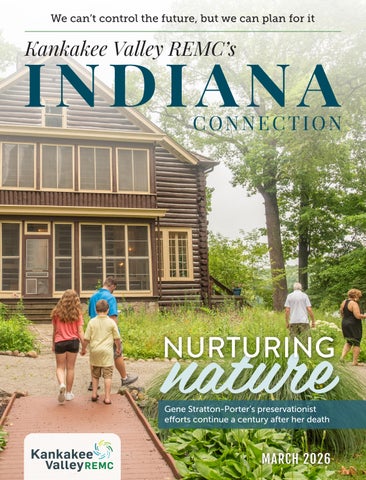
nature NURTURING

Gene Stratton-Porter’s preservationist efforts continue a century after her death

MARCH 2026
Geothermal isn’t just about comfort. It’s about energy independence, grid resilience, and good jobs.

Geothermal heating and cooling doesn’t just make homes more comfortable and efficient— they’re powered by a domestic, underground energy source that’s available 24/7, rain or shine.

Made in the USA: Our geothermal systems are built right here in America, supporting advanced manufacturing jobs.

Grid-friendly: While AI, EVs, and data centers push power demand to new heights, geothermal helps reduce peak load—easing the burden on our utilities.

Job-creating: From HVAC contractors and well drillers or trenchers to engineers and architects, geothermal supports a wide network of high-paying, skilled jobs in every community it touches.

Geothermal isn’t just smart for homeowners. It’s smart for the country.

Contact Your Local WaterFurnace Dealer

Delphi

Blue Fox Htg & Clg (765) 822-2200 bluefoxhvac.com

Farmersburg

Heady Htg & Clg (812) 696-2396

Flora

Camflo Htg & Clg (574) 967-4200 camfloheatingandcooling.com

Fort Wayne

Masters Htg & Clg, Inc. (866) 824-4328 mastersingeothermal.com

Greensburg

Wallpe Htg & Clg (812) 663-7252 wallpegeothermal.com

Indianapolis Masters Htg & Clg by Van Valer, Inc. (317) 881-9074 mastersingeothermal.com

Jasper Hulsman Refrigeration, Inc. (812) 634-1492 hulsmanrefrigeration.com

Laotto

T&T Plbg, Htg, A/C & Geothermal (260) 200-4003 tt-ph.com

Lebanon

Blue Fox Htg & Clg (765) 859-0880 bluefoxhvac.com

Nappanee Crist Plbg, Htg, Electrical (574) 831-4630 cristnappanee.com

North Manchester Mars Refrigeration, LLC (260) 901-0057

North Vernon Air One Htg & Clg, Inc. (888) 346-1790 aironehvac.com

Ossian Collier’s Comfort Services (260) 622-6622 collierscomfort.com

visit us at waterfurnace.com

Warsaw Colliers Htg & Air Conditioning (574) 203-2492 trustcolliers.com

Waterloo Gibson’s Htg & Plbg, Inc. (888) 754-1668 gibsonsgeothermal.com

Westfield Precision Comfort Systems, Inc. (317) 867-2665 precisioncomfort.com

West Lafayette Blue Fox Htg & Clg (765) 252-0051 bluefoxhvac.com

from the editor

A football dream come true

Almost two months ago, I had the wildest dream that Indiana University won the national championship in football. I gradually realized that this was not a dream but a strange alternate reality we’re living in.

If you’re a Purdue fan, I know you’re probably tired of hearing about this by now, but please give me some grace; this might be a once-in-a-lifetime chance to revel in a win like this.

I grew up an IU basketball fan, just like most of my friends. IU football, not so much. When I attended IU, you were required to buy football season tickets to get basketball tickets. My friends and I would tailgate during the first half, slip into the stadium in the third quarter, and head out by the time the fourth quarter started.

But then, two years ago, this guy named Curt Cignetti showed up. Although his confident, “Google me, I win,” is now the stuff of legend, the first reaction most fans had was “Sure you will, sugar,” and an imaginary pat on the head. We thought it couldn’t be done.

But this team, led by Fernado Mendoza, whom I have heard described as “a golden retriever playing quarterback,” not only won but also took the whole dang thing. When IU won the Big Ten Title, I didn’t even cheer. I just sat there in shock. On Jan. 19, when IU won the national championship, there were some tears, but also a feeling of complete unreality about the whole situation.

Will this championship run mark the start of a new winning legacy? If you ask Cignetti, he would say it is, but I am less convinced. If I’ve learned anything in my three-plus decades on this earth, it’s that miracles like this usually don’t happen twice. I hope I’m wrong.

Are you an IU fan who is still riding on the high on this magical run? Send me your football memories and predictions for next season at bdavis@indianaec.org

Britt Davis

On the menu: June: Submit your favorite salad recipes, deadline April 1. If we publish your recipe on our food pages, we’ll send you a $10 gift card.

Giveaway: Enter to win a family four pack of admission passes, courtesy of the Indiana State Museum and Historic Sites. Visit indianaconnection.org/talk-to-us/ contests or send your contact information to the address below. The deadline to enter is March 31.

Three ways to contact us: To send us recipes, photos, letters and entries for gift drawings, please use the forms on our website indianaconnection.org; email info@indianaconnection.org; or send to Indiana Connection, 11805 Pennsylvania Street, Carmel, IN 46032.

VOLUME 75 • NUMBER 9 ISSN 0745-4651 • USPS 262-340

Published monthly by Indiana Electric Cooperatives

Indiana Connection is for and about members of Indiana’s locally-owned, not-for-profit electric cooperatives. It helps consumers use electricity safely and efficiently; understand energy issues; connect with their co-op; and celebrate life in Indiana. Over 320,000 residents and businesses receive the magazine as part of their electric co-op membership. The average printed and mailed cost per issue is 54 cents.

CONTACT US: 11805 Pennsylvania Street Carmel, IN 46032

317-487-2220

info@indianaconnection.org IndianaConnection.org

INDIANA ELECTRIC COOPERATIVES OFFICERS: Dr. Richard Leeper President

Jamey Marcum Vice President

Melissa Menchhofer Secretary/Treasurer

John Cassady CEO

EDITORIAL STAFF:

Britt Davis Editor

Mandy Barth Vice President of Communication

Lauren Carman Communication Manager

Ashley Curry Production and Design Coordinator

Holly Huffman Communication Support Specialist

Amber Knight Creative Manager

Kiley Lipps Graphic Designer

ADVERTISING:

American MainStreet Publications Cheryl Solomon, local ad representative; 512-441-5200; amp.coop

Paid advertisements are not endorsements by any electric cooperative or this publication.

UNSOLICITED MATERIAL:

Indiana Connection does not use unsolicited freelance manuscripts or photographs and assumes no responsibility for the safekeeping or return of unsolicited material.

SUBSCRIPTIONS:

$12 for individuals not subscribing through participating REMCs/RECs.

CHANGE OF ADDRESS:

If you receive Indiana Connection through your electric co-op membership, report address changes to your local co-op.

POSTAGE:

Periodicals postage paid at Indianapolis, Indiana, and at additional mailing offices.

POSTMASTER:

Send change of address to: Indiana Connection, 11805 Pennsylvania Street, Carmel, IN 46032. Include key number.

No portion of Indiana Connection may be reproduced without permission of the editor.

kvremc.com

CONTACT US

Toll Free: 800-552-2622

Local: 219-733-2511

OFFICE HOURS

7:30 a.m.– 4 p.m. Central Time Monday-Friday

STREET ADDRESS

8642 W. U.S. Highway 30 Wanatah, IN 46390

MAILING ADDRESS

P.O. Box 157 Wanatah, IN 46390

EMERGENCY POWER OUTAGES

Power outages can be reported by calling 800-552-2622 or through the SmartHub app.

KANKAKEE VALLEY REMC STAFF

Scott Sears, Chief Executive Officer

Alissa Tucker, Executive Assistant Angie Swanson, Office Manager

Amanda Steeb, Communications and Marketing Director

Dave Howell, Facilities Manager

Scott Hanson, Director of Operations

Bri Travis, Director of Engineering

Jon Rich, IT Manager

Like us on Facebook facebook.com/KVREMC

Due to the space limitations of this issue, the quiz corner questions will be available online. To enter, scan the QR code or visit kvremc.com.

FROM THE CEO:

We can’t control the future, but we can plan for it

Last fall, our directors and leadership sat down to review Kankakee Valley REMC’s strategic plan and develop a new one. We do that roughly every three years, and it’s one of our most important responsibilities.

Nobody knows exactly what’s ahead for our communities and our cooperative, but there are several things that we know for sure. As the demand for electricity keeps growing faster than the supply, there’s more pressure on the nation’s electric power grid. We saw the effects of that during January’s cold snap, and it’s a safe bet that weather extremes will continue to challenge America’s power supply. Another example is the continued advances in technology, especially with the rapid growth of artificial intelligence.

Kankakee Valley REMC’s leadership cannot control external factors like those, but we can take steps to reduce the business risks they create. Our new plan focuses on four primary goals: maintaining financial stewardship, strengthening member engagement and education, improving employee engagement and development, and expanding processes while increasing efficiencies. We identified long lists of strategies to help us pursue those goals.

Take financial stewardship. In simple terms, we want to make sure the co-op continues to be financially strong. Improving our financial health involves every aspect of our business; everything from making sure we’re using the right contractors and paying them what we should, to how we buy supplies, to even finding ways to ensure the benefits we need to find and keep good employees remain affordable.

Improving member engagement is important because this is your cooperative. You’re not just a member; you’re also an owner. We want you to know what we’re doing and how it affects your daily life. A key priority is finding meaningful ways to explain how the energy world is changing. We think it is important that you understand how the wholesale electricity market works and how it affects what you pay each month.

Like most co-ops, we operate with a small staff, so accomplishing everything that needs to get done takes people who are willing to go the extra mile. We want those employees to find their jobs rewarding, so they keep delivering the service members like you expect. We also want them to get better at what they do by supporting their skill development.

Finally, expanding processes and improving efficiencies or in other words, “do more for less.” We never lose sight of the fact that we’re spending your money. The more efficient every aspect of our work becomes, the less you’ll have to spend. That involves everything from looking at the steps involved in a service call to determining how using AI might allow us to streamline our tasks, all focused on making sure we’re doing our best for you on all four goals!

Junior Board explores legislative process at Statehouse

The Kankakee Valley REMC Junior Board of Directors program — which offers high school juniors opportunities to connect with community leaders and gain a realworld perspective on leadership — recently visited the Indiana Statehouse to witness the heart of the legislative process.

The Junior Board participants who attended the trip included Juliana Cook, Luke Snow, and Luke Drozd from Morgan Township High School; Madison Scarborough, Mallory Rinker, Grace Shukitis, and Hope Sanderson from South Central High School; Taylor Stacy, Ava Jensen, and Harper Hazelton from Knox High School; and Lillian Earle from Washington Township High School.

The students were greeted by Reps. Jim Pressel and Ed Soliday before making their way to committee hearings. Rep. Kendell Culp and Sen. Ed Charbonneau also met with the students, sharing insights into their daily responsibilities and discussing key issues being addressed during the current legislative session. Students also observed the bustling activity of lobbyists and citizens gathered to advocate for various bills.

The visit included a behindthe-scenes tour of the Statehouse. The group explored the building’s history and visited the Court of Appeals, the Senate Chambers, the House of Representatives, and the governor’s office. As they observed the Senate in session, they had a firsthand look at the legislative process in action.

“We are lucky to have legislators who believe in investing in the future leaders of our communities,” said Amanda Steeb, Kankakee Valley REMC’s director of communications and marketing. “We are grateful to them for taking time out of their busy schedules to meet with our students and help them better understand the role of government.”

The Junior Board's visit to the Statehouse provided the next generation of leaders with handson experience and the opportunity to learn directly from those who shape the state.

Sen. Ed Charbonneau poses with the students after discussing key issues being addressed during the current legislative session.
Rep. Kendell Culp speaks with the Kankakee Valley REMC Junior Board of Directors before making his way to committee hearing.
FRONT ROW, LEFT TO RIGHT: Hope Sanderson, Ava Jensen, Juliana Cook, and Madison Scarborough BACK ROW: Mallory Rinker, Grace Shukitis, Lillian Earle, Luke Drozd, Luke Snow, Taylor Stacy, and Harper Hazelton.

Employees graduate from lineworker apprenticeship program

Tyler Wherrett and Tim Morgart, both five-year employees of Kankakee Valley REMC, were two of 30 lineworkers who graduated earlier this year from the Indiana Electric Cooperatives’ Rural Electric Apprenticeship Program (REAP).

REAP is a four-year program that professionally trains apprentice lineworkers from across Indiana. Wherrett and Morgart were both required to complete 576 hours of classroom-related study, 8,000 hours of on-the-job training at the co-op, and four classes through Ivy Tech Community College.

Upon completion, they earned Associate of Science degrees and journeyman lineman certificates.

REAP exemplifies the commitment to developing skilled professionals who uphold the values of safety, reliability, and community service.

"We are incredibly proud of Tyler and Tim for their dedication and hard work throughout this program. Their commitment to professional growth and service to the community reflects the values that drive our co-op,” said KV REMC CEO Scott Sears.

WHAT IS IT?

Have you ever looked up at a utility pole and wondered what all that equipment is doing up there? Over the next few months, we’ll share information about the electrical system and the devices working 24/7 to keep your lights on and your power flowing smoothly.

The first piece of equipment is the lightning arrestor. Imagine this: bolts of lightning strike nearby, sending thousands of volts surging through the power lines. The surge damages a transformer and other equipment, leaving your family without power.

This scenario is avoided though because of a device called a lightning arrestor. You will see this equipment on top of our poles as you drive down the road. This device protects the electrical equipment from the damaging effects of lightning by sensing when too much voltage comes through and bleeding the surge off the power lines, sending it to the ground. Lightning arrestors are installed on various equipment such as poles, towers, transformers, circuit breakers and steel structures in substations.

Next time you spot that device on a utility pole, remember it is there to protect, rain or shine.

TYLER
WHERRETT
TIM MORGART

YOUR COMMUNITY’S SILENT PARTNER:

Electric cooperatives team with businesses to make sure they thrive

You may not think twice when you stroll into work and flip on the light switch to start your day.

Your boss thinks about it more. So does everyone at your local electric cooperative.

Your energy needs are constantly at the forefront of our work. We make sure that everyone in the community — the families, farms, schools, and businesses on our lines — has the electricity they need to power their day. For many businesses, that is easier said than done. Agribusinesses, manufacturers, life-science facilities, offices, and more each have unique power needs.

Electric cooperatives support and foster economic development. This is engrained in our culture: we are consumer-owned organizations dedicated to serving our communities. We work with local officials to recruit and retain local businesses.

Sometimes that includes companies moving to or opening a new local facility.

Yet most economic development comes from supporting key accounts, which are established local businesses in our communities. If local businesses are doing well, that means that the region’s economy, families, and other organizations benefit also. We regularly meet with business leaders to help them plan growth, address challenges, and provide support to meet their energy goals while minimizing costs.

After all, local businesses are the lifeblood of a community: they create jobs and contribute to the tax base. That, in turn, means continued growth and further investment in the vibrant communities where we live and work. Electric co-ops also partner with local and regional economic development officials to create incentive packages

that help make Indiana towns and cities attractive for major investment, recruiting new businesses to the communities we serve.

We are committed to successful business recruitment and retention by supporting local corporations to thrive. This is just one way that electric cooperatives embody the cooperative principles and invest in the communities we serve.

Among the Indiana businesses that have benefited from electric cooperative support is Three Birds Casual, a luxury furniture-making business in Noble County. Discussing energy-saving strategies are Noble REMC Energy Advisor Brian Hawk (left) and Three Birds Casual President Tad Varga.

VITAL FARMS FAMILY JOIN THE

At Vital Farms, we’re on a mission to bring ethical food to the table. Help us further our mission by joining our network of farmers. All you need is at least 52 acres of land and a passion for animal welfare. We’ll set you up with a support crew and teach you everything you need to know. Visit vitalfarms.com/farmers to learn more!

OTHER FARMER PERKS

Enjoy life at home on the farm and build a lasting family operation for generations to come

Egg pricing escalates with actual feed costs

4-flock or 8-flock contract terms

Industry-leading support from a team of experts in pastured hens WHAT’S IN IT FOR YOU?

QUESTIONS?

CALL (844) 494-VITAL

Become a steward of the land and preserve natural resources

Generate a steady income on land that may not be fit for other forms of agriculture

Utilize vacant paddocks for other livestock, e.g., cattle, sheep, and goats

SCAN to learn more or VISIT vitalfarms.com/farmers

county feature

Founded in 1844, Tipton County was one of the last counties to be formed in Indiana. With more than 163,000 acres devoted to farmland producing corn, soybeans, and hogs, the county remains rooted in the agricultural traditions that shaped it.

A SIZZLING TRADITION

Tipton County COUNTY FACTS

For 56 years, Tipton County has held its annual Pork Festival the weekend after Labor Day. Founders Margaret Hinkle, Nan Nash, Henrietta Larson, and Bobbie Kauffman were all married to pig farmers, and they would hand out pork recipes and cooked samples at local grocery stores. Hoping to promote pork in a more exciting way, they first considered a barbecue contest before launching a full festival with an art show, food stands, and pork displays. In its first year, the festival served 6,000 pounds of pork and used 20 gallons of barbecue sauce. Today, it attracts around 80,000 visitors and is known for its one-inch-thick pork chops, along with two parades, three pageants, a baby contest, and carnival rides.

OBAMA’S INDIANA ROOTS

The Dunham House is a 19th-century home in Kempton, Indiana, built by relatives of former President Barack Obama. Jacob Dunham, Obama’s fourth great-grandfather, originally settled the land where the house stands. In the 1880s, William Riley Dunham, Obama’s third great-uncle, built the house. After the Dunham family sold the property, it became the McMullan Funeral Home in the 1960s, which operated until 2000. Shawn Clements, an independent contractor who specializes in historic restorations, purchased the home in 2004. During his 2008 presidential nomination campaign, Obama and his family visited the Dunham House. Today, Clements hosts private tours of the historic home.

ROOKIE TO WORLD SERIES

Charles Benjamin “Babe” Adams, born in Tipton, Indiana, in 1882, was a Major League Baseball pitcher. After debuting with the St. Louis Cardinals in 1906, he then joined the Pittsburgh Pirates. Known for his excellent control, Adams finished with 194 wins and a 2.76 earned run average. Adams led the Pirates to the 1909 World Series title, winning all three games he pitched, and becoming the first rookie to start and win a Game 7. He was also the only member of the 1909 Pirates still on the roster when Pittsburgh won the World Series again in 1925.

FOUNDED: 1844

NAMED FOR: John Tipton, a soldier in the 1811 Battle of Tippecanoe

POPULATION: 15,359

COUNTY SEAT: Tipton

INDIANA COUNTY NUMBER: 80

Tipton
Kempton
Photo courtesy of the Dunham House
Photo by Air Recon

OPEN YOUR HEART AND HOME TO HOOSIER CHILDREN

The Indiana Department of Child Services (DCS) needs loving, temporary homes across the state of Indiana for children of all ages — especially teens and sibling groups. DCS is looking for people who are willing to open their hearts and their homes to foster youth as they work toward safely reuniting with their families.

If you’ve ever thought about becoming a foster parent, please fill out an interest form at fostercare.dcs.in.gov/s/interest-form

Once you submit an interest form, A DCS regional foster care specialist will contact you and provide general introductory information about foster care, roles, and expectations, as well as licensing requirements, including training and an overview of the family preparation process.

For more information about becoming a foster parent, please visit in.gov/dcs/foster-care.

Marketplace

A FARM FRESH

Indiana eats grilling experience

A meal can sometimes change your life. Just ask Eliazabeth and Adam Stonecipher. They’re the faces behind a family-owned and -operated farm in Lafayette.

550 Wagyu offers its products online and at farmers markets and local events throughout Tippecanoe County and nearby areas. The mission is to educate and provide the American beef consumer with a unique, healthy, and delicious premium product for their family dinner table.

A PASSION FOR PREMIUM MEAT

Elizabeth’s father bought a Wagyu brisket online several years ago and put it on the smoker when preparing dinner for some special friends.

“It was unlike any meat-eating experience we had ever encountered and ignited our passion into beginning our research into producing a unique, premium quality product,” Elizabeth said. “Although we’ve raised and sold freezer Angus beef for several years, we have many friends who do the same thing and felt that we were competing with them in a sense.”

The Stoneciphers wanted something unique to differentiate themselves so that they could still support their friends’ businesses at the same time.

“Our American Wagyu cattle are fed a very unique and specialized diet that is developed by a nutritionist, and backed with significant research and experience within the Wagyu breed,”

she said. “Wagyu are unique to traditional American breeds, such as Angus, in that they take much longer to finish out and be ready to butcher at the most prime levels.”

Elizabeth said Angus cattle are typically ready at 14-18 months of age, whereas Wagyu must be fed to 24-30 months of age to get to superior levels of marbling. This means they must feed them expensive corn-fed diets for much longer, and combined with the rarity of the genetics, results in much higher costs to the farmer that, in turn, results in a more expensive product on your plate.

A COMMUNITY OF SUPPORT

“Our customers love the Wagyu ribeyes and filets,” Elizabeth said. “Those are two of the cuts that sell out the fastest and are always in high demand. Traditionally those two cuts seem to be a favorite among people regardless of breed. Of course, Wagyu makes the steaks that much more tender, rich, and flavorful.”

According to Elizabeth, they’ve had positive interactions with all of their customers, some great reviews, and several repeat customers.

“550 Wagyu supports our community through ‘Blessing Boxes’ during the holiday season and by donating to various causes such as schools and clubs,” she said. “We like to give back right in the community we live in.”

550 Wagyu was selected as one of the Featured Farmers at the 2024 Indiana State Fair. (Photo courtesy of Kenda Resler-Friend)
Wagyu Tri-Tip (Photo courtesy of Elizabeth Stonecipher)

In times of economic uncertainty—when inflation rises, markets fluctuate, and long-term financial stability feels less predictable—many investors turn to gold as a dependable store of value. By holding a portion of your wealth in gold, you can help safeguard your portfolio and preserve long-term financial security, even when broader economic conditions are unclear.

Since 2015, gold has surged over 400% — outpacing both the S&P 500 and the Dow during the same period.

American Gold Reserve is releasing government-issued $5 Gold American Eagles completely free of dealer markup for only $529 each. These beautiful $5 Gold American Eagles are a perfect way to enter the gold market. Set for immediate public release, availability is limited and supplies are expected to sell out quickly.

Electrical safety on the farm during planting season

It’s planting season for many of Indiana’s 94,000 farmers. As fields are prepared and equipment is put to work, Indiana’s electric cooperatives remind farmers to keep electrical safety top of mind.

According to the U.S. Department of Labor Occupational Safety and Health Administration, 62 farm workers are electrocuted each year in the United States. “Farm-related deaths and injuries from electricity can be prevented by following safety measures,” said John Cassady, CEO of Indiana Electric Cooperatives.

Farmers should remember the following safety practices this spring:

• Ensure farm equipment, such as planter arms and sprayers, is clear of overhead power lines. Maintain a minimum 10-foot distance from lines in all directions.

• Ask your cooperative about relocating overhead lines near buildings or high-use pathways. Consult your cooperative before new construction to learn about required clearances.

• Stay clear of utility poles and guy wires when operating machinery. If equipment damages a guy wire or pole, do not attempt to fix it yourself. Call your cooperative immediately.

• If equipment becomes entangled with power lines, call 911, keep others away, and remain on the equipment. If you must exit for life-threatening reasons, jump clear without touching the equipment and ground at the same time. Land with feet together and shuffle at least three tractor lengths away. Never re-enter or touch equipment in contact with a line.

• When planning a controlled burn, mow and clear vegetation at least 15 feet around poles and use fire retardant as directed. Do not apply retardant directly to poles. If a burn threatens poles or electrical equipment, call 911 immediately.

• Prevent fire and smoke from passing directly under power lines. Smoke contains carbon particles that conduct electricity, which can cause electrical discharges from the line to the ground. Avoid spraying water directly onto lines, as water conducts electricity.

Farmers can protect themselves, their workers, and their operations during this busy season by staying alert and taking precautions.

Use code WWC3H1 to get items 25-00882-1118, 25-01319-1118 for $9.99 and get free shipping on your order. Free shipping applies to standard shipping only, not including any additional shipping surcharges. Shipping upgrades additional. Does not apply to clearance. Discount is priced as marked in checkout. Not applicable to gift cards or prior purchases. May not be redeemed for cash or combined with other offers. Returns credited at discounted price. Only applies to in-stock merchandise. Expires 4/30/2026. Order by mail: Woman Within, 500 S. Mesa Hills Drive, El Paso, TX 79912

Simply nutty

4 cups old-fashioned oats

2 cups coarsely chopped nuts (your favorite dry roasted peanuts or pecans)

1 cup wheat germ

1 ⁄ 3 cup margarine

½ cup honey

1 tsp vanilla extract

1 cup raisins (optional)

Preheat oven to 300 F. Combine oats, nuts, and wheat germ in a large bowl. In another bowl, stir together the margarine, honey, and vanilla. Pour over the nut mixture and toss to coat thoroughly. Spread mixture over a cookie sheet. Bake for 25 minutes, stirring occasionally, until mixture is lightly browned. Remove from oven (mix in the raisins) and cool.

NUTTY GRANOLA Glenda Ferguson, Paoli

PREACHER'S CAKE Yvonne Bertke, St. Meinrad

CAKE

2 cups allpurpose flour

2 cups white sugar

1½ tsp baking soda

½ tsp salt

2 large eggs

1 tsp vanilla extract

1 (20 oz.) can crushed pineapple with juice

2 ⁄ 3 cup chopped nuts

FROSTING

8 oz. softened cream cheese

1 stick (½ cup) softened butter

tsp vanilla extract

sugar ½ cup chopped nuts

Preheat oven to 350 F. Grease and flour the bottom of a 9x13-inch cake pan. Set aside. Whisk together flour, sugar, baking soda, and salt in a medium bowl. In a large mixing bowl, beat the eggs and vanilla until fully combined. Stir in pineapple and 2 ⁄ 3 cup nuts. Stir in the dry ingredients just until combined. Don’t overmix or the cake may get tough. Pour batter into the prepared pan and bake for 35 minutes or until a toothpick inserted in the center comes out clean. While the cake is baking, prepare the frosting by beating the cream cheese and butter together with the vanilla, powdered sugar, and salt. Cool cake for 10 minutes. Spread frosting over warm cake. Sprinkle with ½ cup nuts. Refrigerate leftovers.

SPICY CASHEW SHRIMP Staff Provided

1½ pounds medium or large shrimp, peeled and deveined

Kosher salt and freshly ground pepper

1 Tbsp cornstarch

2 Tbsp oyster sauce (such as Lee Kum Kee)

2 Tbsp canola oil

4 celery stalks, cut on a bias ¼-inch thick (2½ cups)

1 tsp finely grated garlic (from 2 cloves)

1 Tbsp finely grated ginger (from a 2-inch piece)

Pinch of red pepper flakes, plus more for serving

½ cup roasted cashews

Steamed rice, for serving

Pat shrimp dry with paper towels. Toss with ½ tsp salt and ¼ tsp pepper. In a small bowl, whisk together cornstarch, oyster sauce, and ¾ cup water.

Heat a large skillet over high heat. Swirl in oil, then add shrimp in a single layer. Cook, undisturbed for 1 minute. Continue to cook, stirring occasionally, until almost cooked through, 1-2 minutes more. Add celery, garlic, ginger, and red pepper flakes. Cook, still stirring another minute. Add cornstarch mixture; stir until sauce thickens and coats shrimp and vegetables, about 1 minute more. Stir in cashews. Serve over rice, topped with more red pepper flakes. (Serves 4.)

Gene Stratton-Porter’s property on Sylvan Lake, known now as the Gene Stratton-Porter Historic Site, was recently inducted into the Old-Growth Forest Network. (Photo courtesy of the Indiana State Museum and Historic Sites; Andrew Hancock)

nature NURTURING

Imagine dense northeast Indiana wetlands spanning 13,000 acres — 10 miles wide and two miles long — encompassing marshes, bottomland hardwood forest, and abundant wildlife ranging from bald eagles to giant moths. Gene Stratton-Porter, the state’s most famous female author back in the early 1900s, didn’t have to imagine it; she lived near it for 18 years and wrote about it. Known as the Limberlost Swamp, it straddled Adams and Jay counties and extended into Wells County.

Stratton-Porter considered it her playground, spending endless hours conducting field studies and snapping photographs of its various species of flora and fauna. Her work, and her

workplace, inspired nature books like “Moths of the Limberlost” and “Friends in Feathers,” and served as the setting for best-selling novels such as “A Girl of the Limberlost” and “Freckles.”

An environmentalist ahead of her time, she observed creatures in their natural habitat, refusing to adopt the lethal practice of “scientific collecting” — as with John James Audubon’s predilection for shooting the birds he planned to sketch.

But neither public officials nor public media shared her appreciation for Limberlost and its menagerie of inhabitants. In a typical take, the Cincinnati Enquirer in 1895 dismissed the area as “malaria-ridden” and “totally unfit for cultivation” with “stagnant, slime-covered pools.”

Despite Stratton-Porter’s best efforts to preserve her beloved swamp, contractors drained it, cut down the trees, and pumped out the oil beneath it until, by 1913, Limberlost was simply lost.

Yet Stratton-Porter’s influence continues to resonate more than a century after her death in 1924. The Izaak Walton League of America, a conservationist organization that she helped found two years earlier,

Gene Stratton-Porter’s preservationist efforts continue a century after her death

endures today with 40,000 members. Closer to home, the Gene StrattonPorter Historic Site on Sylvan Lake near Rome City — where she moved after the destruction of Limberlost — received national recognition last October with the induction of her cherished Wildflower Woods into the Old-Growth Forest Network as a community forest.

Nor has Limberlost been forgotten. A swamp restoration project that took root in the early 1990s now encompasses about 1,800 acres, including two nature preserves (Loblolly Marsh and Limberlost Swamp), a park, a bird sanctuary, and hiking trails. And her former home in Geneva, once located on the swamp’s edge, is now known as the Limberlost State Historic Site.

FROM EARLY LIFE TO ADVOCATING FOR WILDLIFE

Stratton-Porter’s success her books reached an estimated 50 million readers — surprised schoolmates who recalled her as a bright student who showed no particular interest in writing. Born Geneva Grace Stratton, she grew up near Lagro in Wabash County and didn’t even graduate continued on page 22

The “pudding stone” fireplace in Stratton-Porter’s Wildflower Woods Cabin is a high point for visitors at the historic site.
(Photo of courtesy of the Indiana State Museum and Historic Sites)

continued from page 21

from Wabash High School, leaving before the end of her senior year.

But maybe it was destiny that Stratton-Porter would make a living researching, photographing, and writing about wildlife. At the beginning of her book “Homing With the Birds,” she wrote, “Almost my first distinct memory is connected with a bird … I found a woodpecker lying on the grass beneath a cherry tree.” When her father explained that the bird had been shot for stealing cherries, she offered to stop eating them — “the birds may have mine” — if her dad would make sure no other woodpeckers were targeted. As she observed, “It is probable that this small sacrifice on my part set me to watching and thinking about the birds.”

Stratton-Porter married a local druggist, Charles Dorwin Porter, at the age of 22 — he was 13 years her senior — and in 1895 they moved to the edge of the Limberlost Swamp, ironically in the town of Geneva. It was during their courtship that he gave her the nickname “Gene.”

Her twin passions as a naturalist and a novelist might have seemed worlds apart. But as she explained in a

A wisteria-covered pergola stands amid a one-acre garden at Wildflower Woods, one of the highlights of the site’s wooded paths and more than three miles of trails. (Photo courtesy of the Indiana State Museum and Historic Sites; Amy Payne)
Author Gene Stratton-Porter stands in her garden at Wildflower Woods in this historic photograph. (Photo courtesy of the Indiana State Museum and Historic Sites)

1904 Indianapolis Star story, her research on the nest of a black vulture in the Limberlost Swamp provided material for her book “Freckles.” And when her book sales caught fire, she negotiated with her publishers to produce one nature book for every novel she submitted.

As the Star wrote, “Stratton-Porter was an unusual sight with her trousered legs and high boots.” But it was necessary apparel in a forbidding environment that also prompted her to carry a gun for personal protection. “I have risked my life repeatedly for my work,” she told the Star. “The great public cannot tell by looking at a picture … that you had to wade several rods in muck to your knees, through swamp grass above your head, make the trip repeatedly, carry a heavy camera, use skill, patience, and great physical hardship to secure it. Then there are the dangers of quicksands, snakes, and of losing footing.”

As it happened, her passing in 1924 had nothing to do with wild creatures. She died of a skull fracture when her chauffeured Lincoln was struck by a Los Angeles streetcar.

So enduring was her popularity that in 1926, two years after her death, the Hoosier author was honored with the nationwide observance of Gene StrattonPorter Week, an honor previously afforded only one other American woman: Red Cross founder Clara Barton. Planned by her fans in cooperation with her publishers and movie producers, the event included the planting of 10,000 white pines in a section of the Adirondack Mountains that would henceforth be known as the Gene Stratton-Porter Memorial Forest. Yet even before the special week, tributes to the departed author had already been taking place regularly across the country. A New York wire story noted that “in an astonishing number of towns there are Gene Stratton-Porter Societies — little groups of her followers that get together to discuss her writings and revere her memory.”

Perhaps the best way to revere her memory was suggested by W.A. Guthrie, chairman of the Indiana Department of Conservation (the forerunner of today’s Department of Natural Resources), in his recollections of the time he visited the author at her Sylvan Lake property. “We saw the many kinds of flowers in her

continued on page 24

THE MYSTERY OF HOW LIMBERLOST GOT ITS NAME

Limberlost, as the story goes, owes its name to a nimble guy who got disoriented in the mucky, murky swamp.

The Indiana State Museum embraces this folktale. “The swamp received its name from Limber Jim, who got lost while hunting in the swamp. When the news spread, the cry went out: ‘Limber’s lost!’”

It’s a plausible explanation, but perhaps too tidy – since, like the kids’ game of telephone, the story changes nearly every time it’s recounted. For instance, in 1883 the Indianapolis Journal identified Limber Jim as “a tall, thin young fellow, Jim Miller” who went turkey hunting and got lost for three days.

Said a 1928 Indianapolis Star column: “The pioneer settlers decided to have a grand hunt of three days’ duration. At the end of the first day’s hunt, it was found that Jimmy McDowel was missing … Although only 16, Jim was over six feet tall and very slender.”

A 1922 Fort Wayne Journal-Gazette article said Limber Jim was James Worthington, son of a former Ohio governor. The directionally challenged Jim got lost hunting a way out of the wilderness. His associates found him several days later.

At least those versions had a happy ending. In 1925, the Decatur Daily Democrat said the many variations “all agree that a man by the name Limber Jim was drowned in its waters about one hundred years ago.”

In 1941, the WPA Writers’ Project produced a 500-page Indiana guide that mentioned a Limber Jim McDowell (2 Ls). The Hammond Times spelled his surname “McWowell” – presumably a typo. The Indianapolis Star said Limber Jim was “so known because of his dancing proclivities,” but his name was James Corbus.

A 2020 Smithsonian magazine article quipped that Corbus “either returned alive or died in the quicksand and quagmires, depending which version you hear. Nobody knows the true origin of the name.”

And maybe that’s the point. As the Terre Haute TribuneStar put it, “The naming of the place may well be the stuff of tall tales.”

continued from page 23

gardens, and I believe she had something near 7,000 varieties of plants native to Indiana … and I began to see what a great work she had done,” said Guthrie. “I cannot help thinking what coming generations will lose with her passing and how much effort we should make to carry on the work she has so well undertaken.”

A character in her novel, “A Girl of the Limberlost,” may have best expressed Stratton-Porter’s lifelong love of nature and her desire to share it with others: “We Limberlost people must not be selfish with the wonders God has given to us. We must share with those poor cooped-up city people the best we can.”

STRATTONPORTER’S BOOKS

Throughout her career, Gene StrattonPorter wrote 12 novels, seven nature books, two poetry books, children’s books, and several magazine articles. At the height of her popularity in the early 1910s, she had 50 million readers and was the most popular author in the country.

Of the only 55 books published between 1895 and 1945 that sold more than one million copies, Gene Stratton-Porter wrote five of them. Eight of her novels were adapted into movies, and her works have been translated into more than 20 languages, including Braille. Some of her movies, including “The Keeper of the Bees,” “Laddie,” and “Romance of the Limberlost” (based in part on “Girl of the Limberlost”) are available to watch on YouTube.

Among her most notable books:

• “The Song of the Cardinal,” 1903

• “Freckles,” 1904

• “What I Have with Birds,” 1907

• “A Girl of the Limberlost,” 1909

Her most recognized work, “A Girl of the Limberlost,” brought Stratton-Porter international fame.

• “Music of the Wild,” 1910

• “The Harvester,” 1911

• “Moths of the Limberlost,” 1912

• “Laddie: A True Blue Story,” 1913

• “Homing with the Birds,” 1919

• “The Keeper of the Bees,” 1925 Stratton-Porter’s last novel. It was published a year after her 1924 death.

Gene Stratton-Porter thought of herself as “merely a nature lover.” Throughout her life, she fearlessly advocated for the preservation of forests, wildlife and wetlands. (Photo courtesy of the Indiana State Museum and Historic Sites)

For more information — and to plan your visits to — Gene Stratton-Porter’s historic sites and the Loblolly Marsh Nature Preserve, contact:

Gene Stratton-Porter State Historic Site

1205 Pleasant Point, Rome City, IN 46784 317-232-1637 | indianamuseum.org Admission charged. Tours included with admission.

Limberlost State Historic Site

200 Sixth St., Geneva, IN 46740 260-368-7428 | indianamuseum.org

The site is open Wednesdays-Sunday, 10 a.m.-5 p.m. Indoor tours can be booked online. Self-guided tours of the Limberlost Conservation Area Nature Preserves are available all day. Admission charged.

Loblolly Marsh Nature Preserve

8001-8499 N. 250 W., Bryant, IN 47326 260-368-7428 | limberlost.weebly.com

JUST RELEASED!

Cache of 789 1922 Peace Silver Dollars

Still Pristine As The Day They Were Struck

Rarcoa®, America’s Oldest Coin Company, is announcing the public release of 789 of the 1922 Peace Silver Dollar, struck in 90% pure silver at the iconic “Mother Mint” in Philadelphia, the birthplace of American coinage. Each coin comes in Brilliant Uncirculated condition, pristine as the day they were struck!

Hold 103 Years of American History

Struck in 1922, each coin carries 103 years of American history. Could Al Capone have paid for a load of illegal whiskey with your coin? Or maybe your great-grandfather carried it while storming the beaches of Normandy during World War II before ending up in a small coin shop in Little Rock, Arkansas. Each coin has its own unique history and you can hold American history in your hand when you buy yours today!

Sold Nationally for as much as $209

This same 1922 Peace Silver Dollar sells elsewhere for as much as $209. But thanks to Rarcoa’s buying power and numismatic expertise, you can own one for as little as $119, in quantity while supplies last. That’s $90 LESS!

The Indiana Historical Society has an extensive collection of Gene Stratton-Porter documents, letters, and photos available for public perusal at its William H.S. Smith Memorial Library. Among the collection is her correspondence with family members, her wedding invitation, telegrams sent after her death, and correspondence regarding the transfer of the Limberlost property to the state of Indiana. The collection can be viewed online at images.indianahistory.org

Buy More and Save!

Because the precious metals market is always active and dynamic, prices may adjust to re ect the latest market opportunities.

But don’t wait, our inventory won’t last long.

1922 Peace Silver Dollar - BU Condition

1-4   $129 each

5-9   $124 each, save $5 each, save up to $45

10+  $119 each, save $10 each, save $100 or more.

FREE SHIPPING on 2 or more

Offer Code SPDP139-3

Please mention this code when you call.

and not as investments. Due to the volatility in the precious metals market, prices are subject to change. All comparison prices are accurate at the time of ad creation© 2026 RARCOA DIRECT

Stratton-Porter enjoyed spending time in the cozy parlor of her Wildflower Woods Cabin. (Photo courtesy of the Indiana State Museum and Historic Sites; Andrew Hancock)

EVENT GUIDE

1 2 3 1 2 3 5 4 4 5

32ND ANNUAL INDIANA HERITAGE QUILT SHOW

MARCH 5-7

Bloomington | Bloomington Convention Center ihqs.org

View over 200 quilts, take a class from some of the top quilting instructors in the country, and browse through hundreds of fabrics and other sewing notions and accessories at the vendor area. Traveling quilt exhibits on-site. Admission charge.

JAY COUNTY FIBER ARTS FESTIVAL

MARCH 6-7

Portland | Jay County Fairgrounds fiberarts.visitjaycounty.com

Wood-carving demonstrations, hands-on classes, artist vendors, kids area, and food. Free will donation. Friday, 10 a.m.-5 p.m., Saturday, 9 a.m.-4 p.m.

WINTER TRACTOR AND GAS ENGINE SHOW

MARCH 12-14

Auburn | Kruse Plaza wintertractorshow.com

Classic tractors, muscle tractors, a pedal pull contest, pancake breakfast, swap meet, toy show, craft show, trading post, and quilt show. Presented by Farm Power Club. Hours are 9 a.m.-5 p.m. Admission charge.

ST. PATRICK’S CELEBRATION

MARCH 13-15

Ireland | Downtown stpatsirelandin.com

5k walk/run, parade, craft fair, Leprechaun Bingo Bash, kids' events, Cars & Coffee, Jeep Run, raffle drawings, food, and more.

MIDWEST MEOW FEST

MARCH 21

South Bend | Century Center info@catladycafesouthbend.com

Cat adoption, shopping, bingo, cat-style karaoke, and more. Guest speaker: Best-selling author and kitten advocate Hannah Shaw.

THE RIGHT ANSWER?

Balance is the key in making decisions

One of the biggest misconceptions about the power industry is that there’s a simple right answer.

In reality, there rarely is.

As a co-op member, I expect reliable, affordable power just like you do. As CEO of Wabash Valley Power Alliance, I also see the complexity behind making that happen. Every major power decision involves trade-offs, and understanding those trade-offs is essential to long-term reliability and value.

At the heart of our work is a constant balance between reliability, cost, and risk. Pushing too hard in one direction inevitably creates pressure somewhere else. Prioritizing short-term savings can increase long-term risk. Overbuilding can raise costs unnecessarily. Waiting too long can leave fewer options and higher prices. There is no perfect solution, only responsible ones.

Many of the decisions we make today won’t fully reveal their impact for five, seven, or even 10 years. That’s the reality of power supply and transmission planning. New resources take time to develop, and transmission upgrades can take years to permit, site, and construct. Once those decisions are made, they shape the system for decades.

Judgment matters as much as data. Our power supply leader, Matt Moore, who is also a co-op member, spends his days evaluating data and testing scenarios. He looks at future demand, resource availability, system flexibility, and a wide range of possible outcomes. Assumptions

are stress-tested against extreme weather, changing load patterns, fuel constraints, and evolving regulations. This kind of disciplined analysis is why even some of the largest companies in the world look to Wabash Valley Power for insight. But at the center of every decision are the families and businesses that rely on us.

The cooperative difference is that every decision is made with members in mind. We’re not chasing short-term wins, but long-term reliability, affordability, and responsible stewardship of the system you depend on.

As a co-op member and as CEO, I take that responsibility personally. I expect the same reliability you do, and making tough, thoughtful choices today is how we ensure power is there when it’s needed for years to come.

Wine down

AT WHYTE HORSE

Escape from it all in exchange for the fun, fantastic flavors, and winning experience

at Monticello’s Whyte Horse Winery

Due west of the Tippecanoe River in Monticello is the escape you’ve been searching for — Whyte Horse Winery. The family-owned, familyfriendly winery infuses fun with every pour throughout each season. Known for more than its wines, Whyte Horse has a reputation for its craveable menus, curated for the season, and its robust events lineup. Pair your tasting flight with a brick oven pizza for the ultimate wind-down. Perfectly chewy, bubbly crust — topped with tangy balsamic glaze, rich pepperoni, and fresh herbs — offers an elevated experience for Friday nights and beyond. Whether you choose a spot on the peaceful porch, under the shade trees, or inside, there’s a seat waiting for you at Whyte Horse. Stop by the tasting room throughout the week to curate your ideal lineup. When you’ve found the varieties you can’t go without, consider

joining the Whyte Horse wine club, with monthly or quarterly releases in sweet, dry, or Vintner’s Choice selections. Try Indiana’s favorite Traminette, bursting with apple and strawberry notes made from grapes grown in the Whyte Horse vineyard. Pair your pizza selection with Chautauqua Red, sweet enough to compete with bold, spicy flavors, and best enjoyed chilled.

Slushies are a visitor favorite at Whyte Horse, and shift with the seasons and sync with the winery’s legendary events. In the spring, expect fresh, fruit-forward blends that beckon warmer weather, shifting into summer fun flavors full of Americana. Later in the year, plan a return to Whyte Horse for its spooky, pop culture-infused Halloween events and magical Christmas experiences, including cozy igloos, perfect for date night or group outing. Whyte Horse also

coordinates a book club, offers live music weekly, and hosts annual events folks plan for all year long. The winery’s Mother’s Day popup is one of the most sought-after events to celebrate, the Murder Mystery dinner sells out quickly, and the September car show brings in over 250 vintage rides.

Whyte Horse Winery is open yearround, Tuesday through Sunday, with extended hours on Fridays from April to October. For the most up-to-date events and concerts, visit Whyte Horse Winery’s Facebook page.

1510 S. Airport Road Monticello, IN 47960

Photos courtesy of Whyte Horse Winery

Bring spring’s beauty indoors

The urge to go outside and pick a few spring flowers is strong as we move away from winter.

Some people are reluctant to cut spring bulbs because it removes a lot of color from the landscape. Wanting to cut spring flowers for indoor enjoyment is as good a reason as any to throw a few more tulips and daffodils in the ground every fall.

The aforementioned tulips and daffodils are the most popular bulbs to be planted. When planting them, select varieties that bloom early, midor late season. Not only does this extend beauty in the landscape, but it also provides more opportunities to bring that beauty indoors.

Look for unopened flowers

With tulips, daffodils, and other spring bulbs, cut the flowers while the buds are formed but tightly closed. Snipping flowers before they fully open extends their life in a vase.

Mornings are the best time to cut flowers. Be sure to cut only the flower stem. The plant’s leaves need to stay attached until they turn yellow, brown, and fall flat. This allows the leaves to replenish the underground bulbs for next year’s flowers.

Make the cut at a 45-degree angle. The stem’s angle provides more surface for water uptake. Stems sitting flat on the bottom of the vase have limited water uptake. Remove any leaves attached to the stem.

It’s alive!

Tulips have an interesting growing habit. In the vase, the flower opens during the day and closes at night. Tulips also continue to grow or stretch toward the light, even when cut and in the vase.

When cutting spring bulbs we must contend with killer daffodils. Gardeners already know daffodils are toxic to animals, which is why they rarely bother the bulbs or the flowers.

Killer sap

Daffodils emit a toxic sap called mucilage which can clog the stems of companion plants, preventing them from taking up water. Avoid this by changing the water in a vase of mixed flowers every day.

Or, when the daffodils are first cut, place the stems in cool water overnight. This draws the mucilage out. The next morning, discard the water and rinse the stems of the daffodils. Add the daffodils to your vase of mixed flowers.

Place the vase in a cool area away from direct sun or heat. Change water every few days. As a stem begins to die, pull it from the vase, recut the remaining stems and refresh the water. Be sure to take a whiff. Many tulips and daffodils are fragrant.

Jo Ellen Meyers Sharp, a member of Garden Communicators International, blogs at hoosiergardener.com

Turn static files into dynamic content formats.

Create a flipbook
Kankakee Valley REMC - March 2026 IndianaConnection by IndianaConnection - Issuu