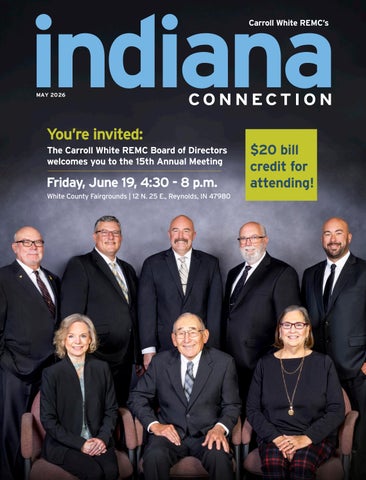
Carroll White REMC - May 2026 Indiana Connection

Page 1


OFFICIAL NOTICE

Notice is hereby given that the Annual Meeting of the members of Carroll White REMC will be held at White County Fairgrounds, 12 N 25 E, Reynolds, IN 47980 on Friday, June 19, from 4:30-8 p.m. The business meeting will be held at 7 p.m.

The following matters will be acted upon, along with speakers:

• Board President and CEO report

• Election of directors

• Junior Board of Directors report and check presentation

• Sharing Success Grants

Members are asked to detach and bring the official registration card attached to the back cover of this

publication to the Annual Meeting. The registration card must be presented to receive the $20 bill credit and to be eligible for the door prizes.

Your ticket to the meeting is on the back of this month’s magazine! BE SURE TO BRING IT WITH YOU.

Minutes of the 14th Annual Meeting of the Members

Carroll White Rural Electric Membership Corporation Friday, June 20, 2025 | White County Fairgrounds 12 N. 25 E. Reynolds, Indiana

The Annual Meeting of the members of the Carroll White Rural Electric Membership Corporation was held at the White County Fairgrounds in Reynolds, Indiana, on Friday evening, June 20, 2025 at 7 p.m. EST, pursuant to notice mailed to all members of the cooperative more than 10 days prior to the said 20th day of June 2025.

Kent P. Zimpfer, president, presided at the business meeting, and Ralph H. Zarse, secretary, acted as secretary of the meeting and kept the minutes thereof.

Zimpfer called the meeting to order.

Following the singing of the Star-Spangled Banner by Butch Kramer, the invocation was given by Pastor Candice Hinkle.

Zimpfer welcomed the members to the meeting and introduced special guests seated in the audience and the board of directors.

At the request of Zimpfer, Zarse then read the Certificate Specifying Number of Members, the Notice of the Meeting and the Proof of Giving Notice attached hereto and made a part hereof the minutes of this meeting.

Upon proper motion duly made, seconded and carried, the reading of the minutes from the Carroll White REMC Annual Meeting of the members held June 21, 2024 was dispensed.

As there were no corrections to the minutes, the minutes from the Carroll White REMC Annual Meeting of the members held June 21, 2024 were then approved by general consent, with no objections.

Zimpfer introduced CEO Cathy Raderstorf. Raderstorf gave the CEO Address.

Zimpfer delivered the President Address.

Zimpfer introduced Attorney Patrick Manahan, partner in the law firm of Emerson & Manahan to

conduct the election of directors for two board districts. Manahan then asked Zarse if there was a quorum and he replied that a quorum was present. Attorney Manahan reported that ballots cast by the membership duly elected the two unopposed directors: Jeffery M. Newell, District 2 and Martin S. Cotterman, District 4.

Zimpfer, with no further business, asked for a motion to adjourn. A motion was made, seconded, and approved by the members. The meeting adjourned at 7:30 p.m.

After adjournment of the business meeting, Raderstorf, presented donations to our Co-Bank Sharing Success Program recipients. Co-Bank and Carroll White REMC each provided $10,000 in donations to the community. The Pulaski County Historical Society received a $1,000 donation for a pocket park accessible 24/7. The Pulaski County Recovery Café received a $4,000 donation to support the goal of community-based peer support for long-term recovery. Main Street Winamac received a $5,000 donation for a beautification and renewal project—adding several locally made planters, and a vibrant mural by a local artist. The Art Enrichment Program for youth in Carroll County received a $10,000 donation. The program gives youth educational experience in fine art, music, drama, and more.

Karley Hammond Chair of the Junior Board was introduced, and she reported on the Junior Board of Directors. Proceeds earned by the Junior Board from their community service projects were awarded to three organizations selected by the Junior Board members in the Carroll White REMC service territory.

Raderstorf and Communications and Public Relations Manager Casey Crabb presented Certificates of Recognition to the outgoing Junior Board members for their service.

Door prizes were then given out through drawings conducted by Crabb.

Independent auditor’s report

Celebrating the Legacy of

INDY RACING

INDIANAPOLIS MOTOR SPEEDWAY MUSEUM REOPENS IN GRAND STYLE AFTER $ 60.5 MILLION RENOVATION

Your well could lower your heating and cooling costs.

If your home has a well, you may be halfway to a geothermal HVAC system.

Your water well can make switching to a WaterFurnace geothermal heating and cooling system easier and more affordable. An existing well can often serve as part of the geothermal loop field, reducing installation timelines and costs. WaterFurnace delivers:

• Steady, year-round heating and cooling that’s twice as efficient and lasts 40% longer than traditional HVAC

• Savings of up to 70% on home energy costs

• Long-lasting HVAC system that adds home value Contact your local WaterFurnace dealer to schedule a no-pressure home assessment for a personalized estimate.

Contact Your Local WaterFurnace Dealer

Delphi

Blue Fox Htg & Clg (765) 822-2200 bluefoxhvac.com

Farmersburg

Heady Htg & Clg (812) 696-2396

Flora

Camflo Htg & Clg (574) 967-4200 camfloheatingandcooling.com

Fort Wayne

Masters Htg & Clg, Inc. (866) 824-4328 mastersingeothermal.com

Greensburg Wallpe Htg & Clg (812) 663-7252 wallpegeothermal.com

Indianapolis Masters Htg & Clg by Van Valer, Inc. (317) 881-9074 mastersingeothermal.com

Jasper Hulsman Refrigeration, Inc. (812) 634-1492 hulsmanrefrigeration.com

Laotto T&T Plbg, Htg, A/C & Geothermal (260) 200-4003 tt-ph.com

Lebanon Blue Fox Htg & Clg (765) 859-0880 bluefoxhvac.com

Nappanee Crist Plbg, Htg, Electrical (574) 831-4630 cristnappanee.com

North Manchester Mars Refrigeration, LLC (260) 901-0057

North Vernon Air One Htg & Clg, Inc. (888) 346-1790 aironehvac.com

Ossian Collier’s Comfort Services (260) 622-6622 collierscomfort.com

Warsaw Colliers Htg & Air Conditioning (574) 203-2492 trustcolliers.com

Waterloo Gibson’s Htg & Plbg, Inc. (888) 754-1668 gibsonsgeothermal.com

Westfield Precision Comfort Systems, Inc. (317) 867-2665 precisioncomfort.com

West Lafayette Blue Fox Htg & Clg (765) 252-0051 bluefoxhvac.com

VOLUME 75 | NUMBER 11

ISSN 0745-4651 | USPS 262-340

Published monthly by INDIANA ELECTRIC COOPERATIVES

Indiana Connection is for and about members of Indiana’s locally-owned, not-for-profit electric cooperatives. It helps consumers use electricity safely and efficiently; understand energy issues; connect with their co-op; and celebrate life in Indiana. Over 300,000 residents and businesses receive the magazine as part of their electric co-op membership. The average printed and mailed cost per issue is 54 cents.

CONTACT US

11805 Pennsylvania Street Carmel, IN 46032 317-487-2220 | info@indianaconnection.org IndianaConnection.org

INDIANA ELECTRIC COOPERATIVES OFFICERS

Dr. Richard Leeper President Jamey Marcum Vice President

Melissa Menchhofer Secretary/Treasurer John Cassady CEO

EDITORIAL STAFF

Britt Davis Editor

Mandy Barth Vice President of Communication

Lauren Carman Communication Manager

Ashley Curry Production and Design Coordinator

Holly Huffman Communication Support Specialist

Amber Knight Creative Manager

Kiley Lipps Graphic Designer

UNSOLICITED MATERIAL

Indiana Connection does not use unsolicited freelance manuscripts or photographs and assumes no responsibility for the safekeeping or return of unsolicited material.

SUBSCRIPTIONS

$12 a year for individuals not subscribing through participating REMCs/RECs.

CHANGE OF ADDRESS

If you receive Indiana Connection through your electric co-op membership, report address changes to your local co-op.

POSTAGE

Periodicals postage paid at Indianapolis, Indiana, and at additional mailing offices.

POSTMASTER

Send change of address to:

Indiana Connection

11805 Pennsylvania Street, Carmel, IN 46032 Include key number.

No portion of Indiana Connection may be reproduced without permission of the editor.

A new look for your co-op magazine

In this month’s issue, you will notice a few changes to the magazine.

First, we have refreshed the magazine’s design. We have an almost entirely new magazine team, including myself, since the last redesign six years ago. Our team is always working to produce the best magazine possible for our readers, and we felt it was time to update the magazine’s appearance. The new design is cleaner, more modern, and better highlights our stories about Indiana’s electric cooperatives and their communities.

advertisers featured are trusted partners who support Indiana’s electric cooperatives in various ways throughout the year. Reducing the number of ads allows us to include more stories about our state and eliminate some of the fluff.

Although the magazine has changed its look, one thing that remains the same is our dedication to our readers. We will keep publishing the content you have come to expect from Indiana Connection, including our safety, food, and travel columns. We want this to be a magazine you look forward to receiving each month, and we hope this new design enhances your reading experience.

Second, we have decreased advertising in the magazine to offer you a more seamless reading experience. The

EMAIL: info@indianaconnectin.org

WEB: indianaconnection.org (fill out forms)

MAIL: 11805 Pennsylvania Street, Carmel, Indiana 46032

ON THE MENU: Submit your favorite recipes featuring spinach, deadline June 1. If we publish your recipe on our food pages, we’ll send you a $10 gift card.

GIVEAWAY: Enter to win four tickets to the Indianapolis Motor Speedway Museum. Visit indianaconnection.org/talk-to-us/contests or send your contact information to our office address. The deadline to enter is May 31.

TRAVEL

Experience springtime blooms at

in all editions)

Motor Speedway Museum held a grand reopening in April 2025. The

museum features expanded exhibits, innovative design elements, and a variety of artifacts celebrating the legacy of Indy racing. Learn more in this month’s feature.

“This institution is an equal opportunity provider and employer.”

cwremc.coop

CONTACT US

800-844-7161 (toll free)

EMAIL

info@cwremc.coop

OFFICE HOURS

Monticello office

7:30 a.m.–4:30 p.m., Monday–Friday

Delphi office

7:30 a.m.–4:30 p.m., Monday–Friday

MAILING ADDRESS

P.O. Box 599; Monticello, IN 47960

BOARD OF DIRECTORS

Marty Cotterman, 765-430-8000

5368 S 450 E, Monticello

Gary E. Gerlach, 574-595-7820

125 W 900 S, Star City

Kent P. Zimpfer, 765-479-3006

4672 E. Arrow Point Court, Battle Ground

Tina L. Davis, 219-204-2195

7249 W. 600 S, Winamac

Ralph H. Zarse, 219-863-6342

1535 S. 100 E, Reynolds

Aaron N. Anderson, 765-427-5592

6634 W. 300 S, Delphi

Jeffery M. Newell, 765-490-7919

1261 N 450 W, Delphi

IMPORTANT DATES

Cycle 1 April bills are due May 5 and are subject to disconnect on May 27 if unpaid.

Cycle 2 April bills are due May 20 and are subject to disconnect June 9 if unpaid.

Meter reading dates are May 1 and May 15.

MISSION STATEMENT

“Creatively enhancing our community through safety and service.”

Safety, Service and Community

Safety starts with you

Tips for spotting potential electrical hazards in your home

Electricity plays many roles in our lives, from powering baby monitors, cell phones and lighting, to running HVAC systems and appliances. Because of its instant availability, when we flip a switch, we expect most systems or devices to do their jobs.

With May being National Electrical Safety Month, it’s a great time to look around your home and check for potential safety hazards.

Remember, every electrical device has a purpose and a service lifespan. While we can extend their operations with maintenance and care, none of them are designed to last or work forever. When electricity is involved, failures can present electrical hazards that might be avoided with periodic inspections.

GROUND FAULT CIRCUIT INTERRUPTERS

Outdoor outlets or those in potentially damp locations in a kitchen, bathroom, or laundry room often include GFCI features. They are designed to sense abnormal current flows, breaking the circuit to prevent potential electric shocks from devices plugged into the outlets.

The average GFCI outlet is designed to last about 10 years, but in areas prone to electrical storms or power surges, they can wear out in five years or

less. Check them frequently by pressing the red test button. Make sure you hit the black reset button when you are done. Contact a licensed electrician to replace any failing GFCI outlets.

LOOSE OR DAMAGED OUTLETS OR SWITCHES

Unstable electrical outlets or wall switches with signs of heat damage or discoloration can offer early warnings of potential shock or electrical fire hazards. Loose connections can allow electrical current arcing. If you see these warning signs, it may be time to contact an electrician.

SURGE PROTECTORS

Power strips with surge protectors can help safeguard expensive equipment like televisions, home entertainment systems and computer components from power spikes. Voltage spikes are measured in joules, and surge protectors are rated for the number of joules they can effectively absorb. That means if your surge protector is rated at 1,000 joules, it should be replaced when it hits or passes that limit. When the limit is reached, protection stops, and you’re left with a basic power strip.

Some surge protectors include indicator lights that flicker to warn you when they’ve stopped working as designed, but many do not.

(continued on page 6)

(continued from page 5)

If your electrical system takes a major hit, or if you don’t remember when you bought your surge protector, replacement may be the best option.

EXTENSION CORDS

If you use extension cords regularly to connect devices and equipment to your wall outlets, you may live in an underwired home. With a growing number of electrical devices connecting

your family to the electricity you get from Carroll White REMC, having enough outlets in just the right spots can be challenging. Remember, extension cords are designed for temporary, occasional or periodic use.

If an extension cord gets noticeably warm when in use, it could be undersized for the intended use. If it shows any signs of frayed, cracked or heat-damaged insulation, it should be replaced. If the

grounding prong is missing, crimped or loose, a grounded cord will not provide the protection designed into its performance. And always make sure that extension cords used in outdoor or potentially damp locations are rated for exterior use.

According to the Electrical Safety Foundation International, approximately 51,000 electrical fires are reported each year in the United States, causing more than $1.3 billion in annual property damage.

Electricity is an essential necessity for modern living, and Carroll White REMC is committed to providing safe, reliable and affordable power to all of our members. We hope you’ll keep these electrical safety tips in mind so that you can note any potential hazards before damage occurs.

The Carroll White REMC offices will be closed on Monday, May 25, in observance of Memorial Day.

Carroll White REMC sponsors two students for Indiana Youth Tour

Each June, Indiana’s electric cooperatives sponsor an allexpenses-paid leadership experience to Washington, D.C. for high school seniors-to-be. Carroll White REMC is proud to sponsor Ella Grennes and Lauren Graham, both Twin Lakes High School students, for this year’s tour.

ELLA GRENNES

Ella Grennes, the daughter of Ryan and Josie Grennes, lives in rural Monticello. She is a member of the Carroll White REMC Junior Board of Directors and learned about the Youth Tour as part of that experience. “I have never been to Washington, D.C.,” said Grennes. “I am most excited to experience the culture of Washington. I plan to pursue a career focusing on law, government, and the science and history behind each.”

Grennes sees the Youth Tour as an opportunity to open up her career path. “I hope we get to see the Supreme Court building and the Library of Congress,” she said. “I have a deep-rooted passion for

reading, so being able to see not only a fundamental piece of our history, but the world’s largest library, would be an unforgettable experience related to a passion I hold close to my heart.”

“I believe that REMC finds it important to send youth on this venture as it provides tangible experiences regarding our government and where our societal functions originated,” stated Grennes. “This experience will enrich each student’s life. Thank you Carroll White REMC members for this opportunity!”

LAUREN GRAHAM

Lauren Graham also lives in rural Monticello and is the daughter of Nathan and Emily Graham.

“My brother, Lucas, went on Youth Tour a few summers ago, and he highly recommended it,” said Graham. “When I was in seventh grade, I visited Washington with my family. I’m excited to meet new friends and visit historic sites, especially the Washington Monument, because I think it’s beautiful.”

“I think REMC finds it important to sponsor Youth Tour for their member-students because young people need to see the process behind our democracy,” said Graham. “It gives students a chance to see the historic places we’ve studied. I would like to say ‘thank you’ to Carroll White REMC for giving me this opportunity to meet peers from around the country and to see Washington.”

Students spend seven unforgettable days exploring historic monuments and meeting students from across the country. Sponsored entirely by Carroll White REMC, participants gain a deeper understanding of American history, government, and electric cooperatives and return home with new friendships, stronger leadership skills, and memories that last a lifetime.

CW REMC programs available

Making geothermal more affordable

Are the upfront costs of installing a geothermal heat pump keeping you from switching your home or business to this energy-efficient heating and cooling system? Carroll White REMC’s new Looped In program is here to help you!

Carroll White REMC will pay to have a member’s loop system installed. The REMC will own the loop portion and will add a small rider to your monthly bill for your use of the loop.

The process:

• Call our energy advisor, Quinton Randle, at 800-844-7161 to set up a home visit.

• After consulting with Randle, you will select a licensed contractor to install the geothermal system and sign the necessary agreements and paperwork so work on the project can begin.

• Carroll White REMC will select a contractor for the loop installation.

• Post construction, Carroll White REMC will ensure all the work was done as expected and will finalize all rebates. A copy of the geothermal installation invoice from the member’s approved contractor will be required.

• Our billing department will then add the monthly lease fee to your electric bill.

YOUR PROJECT PARTNER

Are those money-saving energy efficiency projects on your to-do list too daunting? Carroll White REMC can help!

Partnership for Efficiency provides low interest loans to rural families and small businesses to help them with their energy efficiency projects.

Energy efficiency projects/replacements may include:

• Lighting improvements

• Building envelope improvements

• HVAC systems

• Heat pump water heaters

• Motors

• Appliance upgrades

• Compressed air systems

• Boilers, dryers, heaters, and process related equipment

• Other activities and investments directly related to efficiency

Here’s how Partnership for Efficiency

works:

1. Member must contact our energy advisor, Quinton Randle, to schedule a free energy audit.

2. Member should fill out the application.

3. A credit check is done to determine the loan amount.

4. Upon approval, the member chooses a licensed contractor to perform the work.

5. After the work is completed, the member contacts our energy advisor to perform another energy audit to validate the energy efficiency was achieved.

6. Carroll White REMC pays the contractor.

7. Carroll White REMC adds the monthly loan charge to the member’s electric bill.

Enhance safety in your home and workplace during National Electrical Safety Month

Electricity helps make our lives easier, but it also poses serious risks. May is National Electrical Safety Month — a time to focus on potential home electrical hazards and how to reduce the risk of injury or death for ourselves and our families. “We believe National Electrical Safety Month is an important opportunity to spread the word about serious risks such as shock and fire-related hazards,” said John Cassady, CEO of Indiana Electric Cooperatives. “We want our neighbors to know the basics of electrical safety to create safer families, homes, and communities. We can each do our part to help one another.”

ELECTRICAL SAFETY AT HOME

It can be easy to overlook the importance of electrical safety and the risks associated with it while at home. In fact, according to the National Fire Protection Association and Electrical Safety Foundation International, contact with electricity is a leading cause of injuries and deaths in homes and workplaces.

ELECTRICAL SAFETY AT WORK

You should also consider electrical safety at your workplace. According to the U.S. Bureau of Labor Statistics, an average of 150 workplace electrical fatalities occur each year. From 2011 to 2023, the Occupational Safety and Health Administration reported that 74% of workplace electrical deaths happened in jobs that are not electrical in nature.

National Electrical Safety Month highlights the importance of electrical safety, regardless of our location. By understanding hazards and following safety measures, we can reduce the risk of injury and fatalities. Safety begins with awareness and proactive action. Take the opportunity this month to educate yourself about electrical safety and ensure a safer environment for everyone.

THERE ARE MANY STEPS HOMEOWNERS CAN TAKE TO REDUCE RISK, SUCH AS:

• Have all electrical work done by a qualified electrician.

• Use only one heat-producing appliance plugged into a receptacle outlet at a time.

• Major appliances should be plugged directly into a wall outlet, not into extension cords or surge protectors.

• Check electrical cords to make sure they are not running across doorways or under carpets.

• Extension cords are intended for temporary use. Have a qualified electrician install additional receptacle outlets so that extension cords are no longer necessary.

HERE ARE SOME SAFETY TIPS TO KEEP IN MIND AT THE WORKPLACE:

• Be proactive about de-energizing equipment and take steps to ensure your work environment remains safe.

• Always de-energize and follow established lockout/tagout procedures to prevent injuries and save lives.

• Be sure to select the personal protective equipment (PPE) that is suitable for you and your specific circumstances.

• Each year, workers are injured or killed by circuits thought to be safely turned off. Always test before touching.

Reliable guidance you can trust

Co-op energy advisors help members save

Electric cooperative energy advisors provide unique services to co-op members. While their roles may vary depending on which co-op they work at, they all share the same goal: supporting members by resolving their electricity issues and improving their experience with their cooperative. Energy advisors do this in several ways.

ENERGY ADVISORS HELP TROUBLESHOOT CHALLENGES

Many calls to an energy advisor begin as a high bill complaint or another service question. Energy advisors can review a member’s electric bill and identify potential concerns. Bills tend to rise in winter and summer, when extreme

temperatures cause HVAC systems to run more frequently. Yet sometimes other issues can cause challenges. An energy advisor can review the situation and provide perspective.

THEY CAN ALSO HELP LOWER A HOME’S ENERGY USE

Energy advisors can speak with members about their homes, learn how their homes use electricity, and advise them on how to make energy-saving improvements. For instance, they may suggest adding more insulation to make a home more comfortable. Some electric cooperatives can even provide a home energy audit, which includes testing and in-depth analysis of the home. They can then provide the member with a to-do list of stepby-step suggestions to save energy and money.

ENERGY ADVISORS CONNECT CO-OP MEMBERS WITH PRACTICAL PROGRAMS

Many energy advisors work with businesses and homeowners on energy efficiency programs, potential incentives, and other offerings that can lower long-term costs. Energy advisors collaborate closely with members to identify programs that can best help them reach their goals.

Energy advisors are dedicated to helping co-op members. Visit your electric co-op’s website to learn about the programs they offer to help you reduce electricity and your bill.

A commitment to doing good

A few years ago, Andrew Turpen, owner of Junior’s Delicatessen in Batesville, Indiana, realized his career needed a change. While he enjoyed working in education, a discussion with his sister-in-law opened his eyes. Turpen knew he had the food-industry experience and knowledge to open his own quick-service restaurant.

“If my sister-in-law had never cared enough to encourage me to consider my options, I may have continued to struggle with my education career,” Turpen said.

With each guest, we have an opportunity to create a positive experience that can lead to more good.

thejuniorsdeli.com

10a.m. – 7 p.m., Monday– Friday

10a.m. –6 p.m., Saturday

Andrew Turpen gives back to his community through Junior’s Delicatessen

“I took everything I had learned from the great leaders I had been fortunate enough to work with and the principles that came along with that and applied them to Junior’s.”

A focus on fresh Junior’s, which opened in June of 2022, is committed to using the freshest ingredients possible. “Freshness isn’t just a marketing scheme to us, it’s what we do every day,” said Turpen. “Our opening managers are in at 7 every morning, baking our locally famous French bread loaves, and prepping our produce for the day. We are also one of the few places left that offer free delivery.”

One of their most popular sandwiches is their Cuban, with hand-pulled smoked pork carnitas, ham, provolone, Dijon mustard,

extra pickles, and Hellmann’s mayo, all grilled to perfection on the panini press.

A vessel for good Junior’s has a great reputation for helping the community.

“I believe that Junior’s exists to be a vessel for good in our community,” said Turpen. “Since our opening, we have donated thousands of dollars of food and financial support to local organizations, youth sports teams, and local schools and their staff.”

Turpen said that a couple of missions Junior’s supports, which are personally important to him, are the Batesville Safe Passage Shelter and the Batesville Middle School 8th-grade Washington, D.C., trip.

“We want to be a place where people can get a delicious, fresh sub at a fair price that ultimately creates a good moment in their day,” said Turpen. “With each guest, we have an opportunity to create a positive experience that can lead to more good.”

Warrick County

Warrick County’s first town, Newburgh, Indiana, was initially called Sprinklesburgh after its founder, John Sprinkle. By the 1850s, Newburgh had become one of the largest riverports on the Ohio-Mississippi River. Later, Newburgh served as a key stop on the Underground Railroad and was the first northern town captured by Confederates during the Civil War.

INDIANA’S LEX LUTHER

Actor Michael Rosenbaum was raised in Newburgh and attended Castle High School before earning a degree in theater arts from Western Kentucky University. He is best known for his portrayal of Lex Luthor on the television show “Smallville.” Rosenbaum is also a voice actor whose most well-known role is Wally West (The Flash) in the DC Comics animated “Justice League” series. In 2014, he wrote, directed, and starred in the comedy “Back in the Day,” which was filmed in Newburgh.

THE MAKING OF LINCOLN

When Abraham Lincoln’s family moved to Indiana in 1816, they settled along Little Pigeon Creek. This land was then a part of Warrick County before the area was redistricted into Spencer County two years later. As a young man, Lincoln would walk 17 miles to Boonville, Indiana’s courthouse, where he observed court proceedings and developed his interest in law. One attorney who particularly influenced him was John Adams Brackenridge, a prominent lawyer in southern Indiana. He not only loaned Lincoln law books but was also known for his oratory skills, and Lincoln regularly attended his closing arguments.

UNEARTHING WARRICK’S PAST

Warrick County is home to three key archeological sites — Angel Mounds, Yankeetown, and Ellerbusch. At Angel Mounds State Historic Site, grassy earthen mounds and preserved artifacts mark the site of what was once a thriving Native

American town, dating back 600 to 1,000 years. A few miles away, the Ellerbusch archeological site reveals the outlines of small homes, stone tools, and pottery shards from a tiny village connected to Angel Mounds. Farther east along the banks of the Ohio River, the Yankeetown archeological site has uncovered even older pottery and tools from Native people who lived roughly 1,500 years ago.

COUNTY FACTS

FOUNDED: 1813

NAMED FOR: Captain Jacob Warrick, an Indiana militia company commander

POPULATION: 63,898

COUNTY SEAT: Boonville

INDIANA COUNTY NUMBER: 87

Vote on the Best of Indiana

Indiana Connection is recognizing some of our readers’ favorite places in an upcoming “Best of Indiana” feature. Our readers have nominated their best-loved restaurants, festivals, and other places that make the Hoosier State great, and we have narrowed them down to three finalists in each category. Go to goiec.org/48bCk4O to vote on reader nominees in each category. You can also scan the QR code to download a paper ballot.

Indiana Best of

Indiana Connection Readers’ Choice Awards

HEART SMART

FLAVORFUL RECIPES PERFECT FOR A HEART-HEALTHY DIET

Watermelon salad

GLENDA FERGUSON, PAOLI

2 cups cubed seedless ripe watermelon

2 cups arugula

1 cup sliced cucumbers

2 tsp. balsamic vinegar

2 Tbsp. blue cheese or feta cheese Black pepper to taste

Toss watermelon with the arugula and cucumbers. Drizzle vinegar over the salad. Top with cheese. Season with pepper.

Salmon salad with avocado and chickpeas

1 (15 oz.) can chickpeas, drained and rinsed

1 avocado, peeled and chopped

1 (15 oz.) can salmon, drained with skin removed

2 celery ribs, diced

1/4 cup finely chopped red onion

1/2 cup chopped red bell pepper

2 Tbsp extra virgin olive oil

1 Tbsp red wine vinegar

1/2 tsp kosher salt or to taste

1/4 tsp ground black pepper or to taste

Combine the chickpeas and avocado in a large bowl. Mash until the avocado is smooth and creamy and about half the chickpeas are mashed. Add remaining ingredients and mix to combine. Adjust seasonings with additional salt and black pepper. Serve either on a bed of mixed fresh greens or with whole-grain crackers.

Mediterranean stir fry STAFF

SUBMITTED

1 pound chicken breast, sliced into thin strips

4 Tbsp extra virgin olive oil, divided

2 cloves of garlic, grated or minced

2 tsp Peri-Peri seasoning, divided (See recipe below.)

1/2 tsp salt

1 eggplant

2 medium zucchinis

1 sweet pepper or bell pepper

1 red onion

1 cup cherry tomatoes

6 cups fresh spinach

Add 1 tablespoon of olive oil, garlic, 1 teaspoon of Peri-Peri seasoning, and the salt to a medium bowl. Add the chicken strips. Marinate for 30 minutes or at least until you have finished preparing the vegetables. (This can be marinated overnight.) Wash, peel, core, and trim tops and bottoms off all of the vegetables. Slice them thinly and then cut them in thin short strips so that they cook evenly and fast. Set the vegetables aside in separate prepared bowls.

In a frying pan, add 1 tablespoon of olive oil and add the marinated chicken strips. Turn the chicken after 2-1/2-3 minutes. Saute until golden brown and cooked through. This should take 5-6 minutes. Remove the chicken strips from the pan and set aside. In the same pan, add another tablespoon of olive oil and add a handful of each of the sliced vegetables. Caramelize the vegetables for 1-2 minutes before you start to stir fry the vegetables. Stir fry in two batches, making sure the pan is not overcrowded. Add a pinch of salt and a pinch of seasoning, making

sure not to oversalt. Taste as you go, then set the vegetables aside next to the chicken. Add the last of the olive oil and toss in the cherry tomatoes, cooking until they blister and sizzle a little. Add the spinach and mix gently until wilted. Add the stir-fried vegetables and chicken back to the pan, mixing gently for a few moments to combine all the flavors. Serve immediately on its own or over rice or cooked grains. (Serves four.)

Peri-Peri seasoning

2 Tbsp sugar

2 Tbsp paprika

2 Tbsp onion powder

2 Tbsp garlic powder

2 Tbsp ground coriander

1 Tbsp salt

1 Tbsp dried oregano

1 Tbsp dried parsley

2 tsp ground ginger

2 tsp ground cardamom

1 tsp smoked paprika

1 tsp cayenne pepper

Mix together well and store in an airtight jar. Makes a little less than a cup.

CELEBRATING THE LEGACY OF

INDY RACING

Indianapolis Motor Speedway Museum reopens in grand style after $60.5 million renovation

In February 2025, only two months before the grand reopening of the Indianapolis Motor Speedway Museum, the most valuable car in the collection was no longer in the building — or even on the same continent. The 1954 Mercedes-Benz Streamliner, a legendary Grand Prix winner, sat on display in Stuttgart, Germany, at a museum devoted to Mercedes-Benz. But the gathering of nattily dressed spectators didn’t come to admire it — they came to buy it.

And in a stand-alone auction conducted by Sotheby’s, the car netted $53 million — the most ever paid for a Formula One car and the second-most paid for a car, period. But there was more. By the end of the month, 10 other venerable vehicles from the Speedway collection would also go on the auction block, one of them — a 1964 Ferrari — fetching $36 million. Then, on April 2, 2025, the biggest and most innovative IMS Museum in history opened to the public after a 17-month hiatus and a $60.5

million renovation. On display were nearly four dozen time-honored speed machines, led by the Marmon Wasp that Ray Harroun drove to victory in the inaugural Indy 500. Yet why did a world-class showcase for auto racing sell 11 of its best racing autos?

It’s a matter of mission, explained Communications Manager Kelsey Burr. Though the ’54 Mercedes and ’64 Ferrari achieved monumental milestones in motorsports, their tires never touched track at Indy.

Photos courtesy of the IMS Museum

Neither did Craig Breedlove’s Spirit of America, which blazed 600 mph across the Bonneville Salt Flats in 1965 to set a land speed record. It went for $1.3 million.

“The mission now is to celebrate and preserve the history of the Indianapolis Motor Speedway and the Indianapolis 500,” said Burr. “The cars we sold did not meet the mission of the museum.”

A WARM WELCOME TO GASOLINE ALLEY

The new Indy-centric institution asserts its identity even before visitors reach the first of its 10 galleries. Four green-and-white replicas of barn doors adjoin the entrance to Gasoline Alley, borrowing the longstanding nickname for the racing teams’ infield garage area. Though seemingly more appropriate for the stables at Churchill Downs, their rustic look and color scheme evoke the doors on the old wooden garages that housed Indy cars until 1985.

More history lies underfoot. The floor leading into Gasoline Alley begins as a crushed-rock-and-tar concoction, then switches to bricks and finally asphalt, recalling the progression of racing surfaces since the Speedway’s construction in 1909. To the right stand seven mock garages containing a rotating array of historic race cars from various decades; to the left are artifacts corresponding to each era — highlighted by the never-before-displayed articles of incorporation for the Indianapolis Motor Speedway Company, as it was initially named. And in a nod to other types of racing at Indy, Gasoline Alley also features racing helmets from Formula One stars, notably Michael Schumacher, who won five of the eight U.S. Grand Prix races held at Indy.

The seven race cars in the gallery’s garages change periodically, but past selections have ranged from the 1964 Lotus of pole sitter Jim Clark, a fan favorite who finished first the following year, to the 1978 Texaco Star Wildcat driven to ninth place by Janet Guthrie, the first woman to qualify for the 500.

ARCHITECTURAL INNOVATIONS AND EXPANDED SPACE

At 80,000 square feet, the new museum is twice the size of its predecessor. Yet the structure around it didn’t expand at all — designers gained the additional 40,000 square feet by efficiently utilizing existing space.

That required more than just a few tweaks. “The museum overall was completely gutted,” said Burr. “None of this was here besides the floor and the support beams.” So where did planners find the extra space? “We got rid of the low ceilings and opened up the lower level,” she said. And they conjured up a gallery out of thin air, installing the 6,000-square-foot Mezzanine half a level above the Indianapolis 500 Winners Gallery and its lineup of champion Indy cars.

Oval-shaped to resemble the track, the Mezzanine pays homage to broader aspects of the Indianapolis Motor Speedway experience, including artifacts and race-day traditions that encompass all forms of racing at the track. For instance, visitors can view the PPG Trophy, an Art Deco creation that honors the winners of the NASCAR Brickyard 400. Another exhibit shows the surprising number of steps involved in creating a new face for the Borg-Warner Trophy, which displays the faces of all Indy 500 drivers who previously landed in Victory Lane. When sculpting a new one, the artist studies photographs of the driver’s face from different angles and models a clay likeness, then casts a replica in plaster and then in red wax. In the final step, a jeweler produces a trophyworthy double in sterling silver. The gallery also gives a tip of the racing helmet to the 500’s pre-race festivities, as evidenced by the display case honoring the performance of “Back Home Again in Indiana” before Indy 500 drivers start their engines. Gracing the case are sheet music for “Back Home Again” and a uniform from the

At the Qualifying Zone, museum-goers can use machines to test their reflexes and simulate the experience of trying to qualify at Indy.

Purdue University All-American Marching Band, which customarily accompanies the vocalist in the song’s performance.

SECRETS IN THE BASEMENT

The easy access to the lower level may seem unexceptional nowadays, but only to museum newbies. For decades, it was a place of legend and mystique. “It used to be called the basement,” said Burr, “and you had to really know somebody to get down there and see it.” So what was down there? “A repository of rare, priceless, and one-of-a-kind racing and automotive artifacts and vehicles,” according to one source.

Then, several years ago, the museum began offering exclusive VIP basement tours, charging $150 for a half hour, but even then, the cellar remained secretive. Participants descended in groups of six and were prohibited from taking photos — yet the tours still raised $400,000 for the museum, a not-for-profit entity that has long operated independently of the Speedway.

Today, as part of the Winners Gallery, the former basement still contains rare and one-of-a-kind racing vehicles, and even a secret or two. Look closely at the walls, and you will discover that their banking matches that of the famed oval — 9.2 degrees. But you won’t pay $150 to enter, and no one will hassle you if you take pictures.

FUNDING THE RENOVATION

Speaking of fundraising, given that auction revenue for the museum’s 11 historic automobiles exceeded $100 million, it might seem logical to assume that the proceeds will more than cover the cost of the renovation.

But what’s logical is not always ethical in the world of museums. The American Alliance of Museums, which represents 35,000 museums and museum professionals, maintains strict rules pertaining to deaccessioning, the process of removing unwanted objects from museum collections.

Calling deaccessioning a “responsible practice” when an item no longer fits the mission of the museum, the Alliance nevertheless cautions that “if a deaccessioned object is sold, museum professional ethics require the proceeds from the sale be used only to acquire new objects for the collection or provide direct care of the collection.” As former IMS Museum President Joe Hale stated, “We can’t use the proceeds of that sale to build a new museum, but the proceeds will go to two functions: the care of the collection and to enhance our collection.”

In 2023, Hale launched the $89 million “The Stories Behind the Spectacle” capital campaign to fund the renovation of the museum and the construction of an $18 million, 60,000-square-foot Restoration and Event Facility near the track. The structure would replace a pair of nearly 70-year-old, 1,500-square-foot buildings now used to restore historic vehicles.

‘ULTRA-MODERN’ IN 1956

The IMS Museum celebrates its 70th birthday this year. Still, nearly a half-century of racing elapsed before it came into being — and even then, it had to share space with the track’s front office, previously located downtown. The new museum/administration building, situated on the southwest corner of the Speedway grounds, contained 8,000 square feet — only one-tenth the space of the current museum. However, the Indianapolis Star hailed it as an “ultra-modern structure,” citing features such as air conditioning, which was found in only 2 percent of American homes at the time.

Groundbreaking ceremonies for the museum took place in July 1955, but the mood wasn’t entirely jubilant. Thoughts of former Speedway President Wilbur Shaw, who died tragically in a plane crash the previous October, loomed large over the event, amplified by his wife’s presence as an honored guest. Speedway Owner Anton “Tony” Hulman had already announced that the museum would be dedicated to Shaw, whose contributions to the Indy 500 transcended the steering wheel.

The oval-shaped Mezzanine pays homage to broader aspects of the IMS experience, including artifacts and race-day traditions that encompass all forms of racing at the track.

Location Location Location

05/08/26

From high‑efficiency electric models to advanced heat pump water heaters, Richmond helps lower energy use and reduce monthly bills while meeting all of your hot water demands.

Want to learn more about our water heating technologies and how to save money on monthly bills? Learn how these products work with live demonstrations of Tankless Gas and Heat Pump Water Heaters.

Stop by a Menards store near you and check out our mobile showroom.

One of the greatest race drivers in history, Shaw won three Memorial Day classics and placed second on three other occasions. And his off-track accomplishments proved at least as significant. Not only did he convince Hulman to buy the deteriorating two-and-a-half-mile oval in 1945, but as its president and general manager, Shaw spearheaded the comeback of Indianapolis’ namesake race and racetrack with improvements such as the installation of steel-and-concrete grandstands in place of the aging wooden seating.

Even after his passing, Shaw remained prominent when the museum opened its doors in 1956. Only six historic cars greeted the first visitors to enter the racing shrine, whose exhibits were described as “far from complete.” But not far from the iconic Marmon Wasp stood the Maserati that Shaw piloted to victory in 1939 and 1940.

The museum also featured photos of the winning cars and drivers from previous races, trophies, and other 500 memorabilia dating back to the early 1900s, as well as a Firestone Tire & Rubber Co. display showcasing the evolution of racing tires at Indy.

The Speedway unveiled its new museum on the first day of qualifications, offering a hard-to-beat admission price — free with the purchase of a $1 ticket to enter the track, and more than 10,000 spectators went for it. (Ticket prices would remain ridiculously low for decades — only $5 for adults in 2014 — but are now $25 for adults and $18 for kids 6 to 16.)

The “steady stream of visitors” continued even after the 1956 race, with about 3,500 filing through during the Labor Day weekend, wrote the Shreveport (Louisiana) Journal, adding that the new museum was “rapidly winning recognition as one of the nation’s top tourist attractions.” A guest register showed representation from all 50 states, as well as 25 countries, ranging from Australia to Mongolia.

UPGRADING AND UPDATING

Talk of moving the museum to larger quarters began as early as 1963, when Hulman paid $100,000 to the Town of Speedway for 15 acres across the street from the original building. But ultimately the museum stayed put until 1976, when — amid the hoopla over the nation’s 200th birthday — it relocated to a new 96,000-squarefoot, two-story building inside the oval. The Chicago Tribune embraced both the hype and the necessity of

The renovated museum delivers fun experiences for race fans of all ages.

the move, reporting that Hulman “built it not only to honor the Bicentennial, but because facilities and parking space at the first museum, opened in 1956, had become inadequate.”

In 2016, foreshadowing the recent renovation, thenExecutive Director Betsy Smith voiced concern that the museum had barely evolved in 40 years and was overdue for an update. “The lighting, the technology — it’s vintage 1976,” she told the Star. “I’d like to get some technology in here and some video so that visitors could really experience racing.”

The current galleries provide just that. At the Starting Line Experience, guests enter a room where an 80-by20-foot LED screen plays a seven-minute video that re-creates the sights and sounds of race day traditions as experienced by Indy drivers on the front row. The video begins with the cannon firing and concludes with the green flag that signals the start of the race, including the “Drivers, start your engines” command that sends the cars roaring to life. Note that this gallery comes with a warning sign cautioning visitors about excessive volume (earplugs are recommended) and flashing lights.

Meanwhile, at Qualifying Zone, museum-goers of all ages can channel their inner A.J. Foyt or Danica Patrick on machines that test reflexes and simulate the experience of trying to qualify at Indy — all the way down to estimated speed and even accidents. The pit stop challenge enables motorheads to learn the tools of the trade, and a play area caters to the youngest future recipients of the Borg-Warner Trophy.

The new museum is already delivering results, as evidenced by attendance figures. Before the renovation, the facility drew about 140,000 visitors annually. However, 2025 saw 150,000 during the first six months following its reopening, said Burr. “Guests have been absolutely loving it,” she said, and some even take the time to express it. “My favorite feedback was, ‘I brought my 3-year-old child and my father-in-law in his 60s, and they both spent hours here.’”

Preparation drives reliability

PLANNING AHEAD

IS ONE OF THE WABASH VALLEY POWER TEAM’S MOST IMPORTANT RESPONSIBILITIES

In Indiana, the month of May brings a familiar rhythm. The Indianapolis 500 captures our attention, and with it comes the language of racing, preparation, precision, teamwork, and strategy. Drivers don’t just show up on race day and hope for the best. Success is built through months of planning, testing, and coordination long before the green flag waves. Reliable electricity works much the same way.

Like you, I’m a co-op member. I expect the lights to come on, my home to stay comfortable, and my community to have dependable power every day. Most of the time, I don’t think twice about it. That’s exactly how it should be.

“ ” When power is dependable, it’s not by accident. It’s the result of careful planning and constant coordination.

As CEO of Wabash Valley Power Alliance, the work that makes that reliability possible is always front

and center for me. When power is dependable, it’s not by accident. It’s the result of careful planning and constant coordination behind the scenes.

Reliable electricity depends on generation and transmission working together seamlessly. Power must be produced at the right time and delivered across a transmission system capable of moving it efficiently to local co-ops. Keeping those pieces aligned takes continuous coordination, even though most of that work happens out of sight.

Planning ahead is one of the Wabash Valley Power team’s most important responsibilities. We look years into the future to understand how demand is changing, what resources will be available, and how the transmission system must perform to keep power flowing reliably. That long-term perspective allows us to make disciplined decisions rather than reacting when conditions are already tight.

In many ways, the decisions we make today are about races that won’t be run for years. New generation resources, transmission investments,

and system upgrades often take five, seven, or even 10 years to fully come online. The choices made now help ensure the system will be ready to meet future demand.

Preparation also means stresstesting our plans. We examine how the system performs during extreme weather, equipment outages, fuel constraints, and sudden changes in demand. Identifying risks early allows us to adjust course before small issues become bigger problems.

This month, drivers at the Indianapolis Motor Speedway measure success by crossing the Yard of Bricks and seeing the checkered flag. In our work, success looks a little different. It’s flipping the switch and seeing the lights come on, knowing families, farms, and businesses have the power they depend on every day. That may not come with a trophy, but for our members and our team, it’s what matters most.

Botanical bliss

EXPERIENCE VIBRANT SPRINGTIME BLOOMS IN ALL THEIR GLORY AT ELKHART’S WELLFIELD BOTANIC GARDENS

Despite the frost of winter, ruffly, sunny daffodils and show-stopping tulips command spring’s arrival, carpeting once-barren earth with confirmation that the new season is here. These gorgeous blooms and more welcome guests gazing in the Spring Garden at Wellfield Botanic Gardens in Elkhart, whose north promenade is known for its vibrancy — the bright yellow forsythia, purple redbud clusters, pink and white magnolia, and dogwoods awakened from their winter rest.

Transport yourself into lush mops of peony blooms in the English Cottage Garden as you make your way to the Japanese Island Garden, but not before you notice the fish, over 20 varieties, that call the garden ponds and Christiana Creek home.

“Our Japanese Island Garden is a must-see in all seasons,” said Kyle Strain, Wellfield’s manager of public horticulture. “The north hill is carpeted in pink blooms of creeping thyme in May and June. The waterfall is a particularly beautiful feature, and the well-pruned pines provide elegance throughout the year.”

Wellfield is an accessible, familyfriendly destination. Its walking paths allow ample space for walkers and those traveling on wheels at any age. With ample seating throughout the gardens, plus the allowance of food, visitors can spend the day at the gardens. The Children’s Garden features a waterfall and offers arguably the best view of the gardens, in a tree house located in a grand sycamore tree.

The result of a community service project conceived by the Elkhart Rotary Club in honor of the international organization’s 100th anniversary, Wellfield Botanic Gardens is a regional gem. Botanic gardens are more than just beautiful; they’re a botanically diverse ecosystem lovingly designed and cared for by professionals. Located on 36 acres, half of which is water, the site has historical and community significance — the 13 active wells on site provide the bulk of the community’s drinking water.

Wellfield Botanic Gardens is open year-round, welcoming guests and members from 12 to 5 p.m. Pets of members with approved registration are also welcome. For information on special events, workshops, membership, and educational opportunities, visit wellfieldgardens.org

PHOTOS COURTESY OF WELLFIELD BOTANIC GARDENS

Upgrades for a more sustainable yard

CREATING A SUSTAINABLE YARD BENEFITS THE ENVIRONMENT AND YOUR WALLET

A sustainable yard can be costeffective and better for the environment. One of the most important sustainability strategies is using native plants for your area’s climate and soil type. Indigenous plants require less water to maintain and contribute to the ecosystem. To ensure pollinators always have food, plant flowers that bloom throughout the year. Mixing plants with different root structures helps aerate the soil and prevents nutrients from being drawn from the same soil layer. Some good companion plants are sunflowers, zinnias, and marigolds. Plant perennials. Not only will they improve each year, but they will also help you save money.

To enrich your soil, try using natural weed-controlling methods, such as mulching with a 2 to 4-inch layer of biodegradable products, like cardboard or newspaper. Another great option is to use corn gluten meal. Apply this in the spring before the weeds begin sprouting. It may take a few years of consistent application to reach the full weedcontrol potential, but the benefits will be well worth it.

REDUCE, REUSE, RETHINK

Water conservation is an easy money-saver. For a big impact, consider drip irrigation, which delivers water directly to the root zone of plants through pipes, tubing,

and emitters. This system delivers water exactly where it’s needed and reduces evaporation and runoff. For a simpler method, set up a rain barrel on an elevated stand and connect it to a downspout. Position the overflow hose to direct excess water away from your home’s foundation. If your barrel doesn’t already have one, install a spigot for easy retrieval.

For a fertilizer alternative, try composting. Start by making a bin out of reclaimed wood or wire mesh. Along with fruit and vegetable scraps, add healthy grass clippings, deadheaded flowers, twigs, and dried leaves. A nutrient-rich compost should have alternating layers of green material (nitrogen-rich) and brown material (carbon-rich), with a ratio of three parts brown to one

part green. Place the bin in a full-sun location to speed decomposition, turning it weekly.

To save energy, switch to an electric mower and string trimmer. There are a variety of models, both wired and battery-operated.

Hardware & Garden, family-owned and communityfocused since 1954, offering premium grills, patio furniture, lawn and garden products, and expert service.

(This article is for informational purposes only. Indiana Connection and Do it Best assume no liability for the accuracy or completeness of the information contained herein, or for injuries, property damage, or the outcome of any project.)

Official Registration Card

Must present this card June 19 from 4:30-8 p.m. The business meeting begins at 7 p.m.

STATEMENTS OF OPERATIONS

Years ended Dec. 31, 2025, and 2024

Years ended Dec. 31, 2025, and 2024

STATISTICAL REVIEW

CARROLL WHITE REMC’S 2024 OPERATING EXPENSES

THIS IS YOUR OFFICIAL REGISTRATION CARD.

Please bring this card with you to the Annual Meeting on Friday, June 19.

Do not throw this card away! Tear it off and keep it. It’s your ticket to the Annual Meeting.

MEETING AGENDA

Annual Meeting at White County Fairgrounds in Reynolds begins.

Dan’s Fish Fry will serve a fish and chicken dinner and Sycamore will provide ice cream. Bring the entire family, including grandkids, and enjoy great live music, bounce houses, ice cream, a petting zoo, face painting and more! You can also mingle and talk to our directors and employees

The business meeting will be held on the outdoor stage.

BUSINESS MEETING AGENDA

• Call to order

Kent Zimpfer, President

• National Anthem

• Invocation

• Introductions of guests and Board

Kent Zimpfer

• Read Notice of Meeting, Proof of the Notice, 2025 Annual Meeting Minutes

Ralph Zarse, Secretary

• Board of directors election

Pat Manahan

• Meeting adjournment

Kent Zimpfer

• Co-Bank Sharing Success –

Cathy Raderstorf, CEO

• Junior Board of Directors

Carter Sterrett, President

• Door prizes and thank yous Casey Crabb, Director of Communications & Public Relations

Director Candidates

KENT ZIMPFER, DISTRICT 3

Kent Zimpfer grew up in Carroll County and graduated from Delphi Community High School in 1994. He owns and operates Z Construction Company, specializing in custom homes, remodels, and commercial projects.

Zimpfer received his Credentialed Cooperative Director Certificate, Board Leadership Certificate, and Director Gold Credential. Currently, Zimpfer serves as the president of the Carroll White REMC Board of Directors.

Zimpfer and his wife, Kasey, have been married for 26 years. She is the senior director of human resources at BraunAbility Americas. They have two children: Kane, a Hanover College graduate working in Nashville, Tennessee, and Ryn, a student at Purdue University.

RALPH ZARSE, DISTRICT 5

In 2007, Ralph Zarse was elected to serve on the Carroll White REMC Board of Directors.

The love of running has followed Zarse on his life journey. Running marathons (26.2 miles) inspires him because he likes to stay fit and mentally tough to take on any health and other life challenges.

Following his high school graduation from Reynolds, Zarse began farming with his brother, Carl, in Honey Creek Township. They continue that venture today.

Zarse received his Credentialed Cooperative Director Certificate and Board Leadership Certificate. He currently serves as secretary-treasurer of the Carroll White REMC Board of Directors.

Zarse and his wife, Bonnie Lou, have two daughters, Christa Zarse and Kathleen (Brad) Perry.

TINA DAVIS, DISTRICT 7

In 2017, Tina Davis was elected to fill the director’s seat in District 7.

For 16 years, Davis worked as a contract meter reader for REMC. For six years, she served on the Operation Round Up Board of Directors, and during her last year of service, she helped merge the Carroll and White REMC Round Up Boards of Directors into one cohesive unit.

Davis completed her Credentialed Cooperative Director Certificate, the Board Leadership Certificate, and the Director Gold Credential. She is the current assistant secretary-treasurer of the Carroll White REMC Board of Directors and serves on the executive board of directors for Wabash Valley Power Alliance.

Davis and her husband, Randy, have two sons. Ross and his wife, Caty, have six children: Abby, Cody, Ella, Mia, Cooper, and Arlie, all live in Pulaski County. Their other son, Grant, lives with his wife, Katie, in Colorado. They are expecting their first child in May. Davis enjoys spending time with her family.

Turn static files into dynamic content formats.

Create a flipbook
Carroll White REMC - May 2026 Indiana Connection by IndianaConnection - Issuu