Your well could lower your heating and cooling costs.
If your home has a well, you may be halfway to a geothermal HVAC system.
Your water well can make switching to a WaterFurnace geothermal heating and cooling system easier and more affordable. An existing well can often serve as part of the geothermal loop field, reducing installation timelines and costs. WaterFurnace delivers:
• Steady, year-round heating and cooling that’s twice as efficient and lasts 40% longer than traditional HVAC
• Savings of up to 70% on home energy costs
• Long-lasting HVAC system that adds home value Contact your local WaterFurnace dealer to schedule a no-pressure home assessment for a personalized estimate.
Warsaw Colliers Htg & Air Conditioning (574) 203-2492 trustcolliers.com
Waterloo Gibson’s Htg & Plbg, Inc. (888) 754-1668 gibsonsgeothermal.com
Westfield Precision Comfort Systems, Inc. (317) 867-2665 precisioncomfort.com
West Lafayette Blue Fox Htg & Clg (765) 252-0051 bluefoxhvac.com
VOLUME 75 | NUMBER 11
ISSN 0745-4651 | USPS 262-340
Published monthly by INDIANA ELECTRIC COOPERATIVES
Indiana Connection is for and about members of Indiana’s locally-owned, not-for-profit electric cooperatives. It helps consumers use electricity safely and efficiently; understand energy issues; connect with their co-op; and celebrate life in Indiana. Over 300,000 residents and businesses receive the magazine as part of their electric co-op membership. The average printed and mailed cost per issue is 54 cents.
CONTACT US
11805 Pennsylvania Street Carmel, IN 46032 317-487-2220 | info@indianaconnection.org IndianaConnection.org
INDIANA ELECTRIC COOPERATIVES OFFICERS
Dr. Richard Leeper President Jamey Marcum Vice President
Melissa Menchhofer Secretary/Treasurer John Cassady CEO
EDITORIAL STAFF
Britt Davis Editor
Mandy Barth Vice President of Communication
Lauren Carman Communication Manager
Ashley Curry Production and Design Coordinator
Holly Huffman Communication Support Specialist
Amber Knight Creative Manager
Kiley Lipps Graphic Designer
UNSOLICITED MATERIAL
Indiana Connection does not use unsolicited freelance manuscripts or photographs and assumes no responsibility for the safekeeping or return of unsolicited material.
SUBSCRIPTIONS
$12 a year for individuals not subscribing through participating REMCs/RECs.
CHANGE OF ADDRESS
If you receive Indiana Connection through your electric co-op membership, report address changes to your local co-op.
POSTAGE
Periodicals postage paid at Indianapolis, Indiana, and at additional mailing offices.
POSTMASTER
Send change of address to:
Indiana Connection
11805 Pennsylvania Street, Carmel, IN 46032 Include key number.
No portion of Indiana Connection may be reproduced without permission of the editor.
A new look for your co-op magazine
In this month’s issue, you will notice a few changes to the magazine.
First, we have refreshed the magazine’s design. We have an almost entirely new magazine team, including myself, since the last redesign six years ago. Our team is always working to produce the best magazine possible for our readers, and we felt it was time to update the magazine’s appearance. The new design is cleaner, more modern, and better highlights our stories about Indiana’s electric cooperatives and their communities.
advertisers featured are trusted partners who support Indiana’s electric cooperatives in various ways throughout the year. Reducing the number of ads allows us to include more stories about our state and eliminate some of the fluff.
Although the magazine has changed its look, one thing that remains the same is our dedication to our readers. We will keep publishing the content you have come to expect from Indiana Connection, including our safety, food, and travel columns. We want this to be a magazine you look forward to receiving each month, and we hope this new design enhances your reading experience.
Second, we have decreased advertising in the magazine to offer you a more seamless reading experience. The
ON THE MENU: Submit your favorite recipes featuring spinach, deadline June 1. If we publish your recipe on our food pages, we’ll send you a $10 gift card.
GIVEAWAY: Enter to win four tickets to the Indianapolis Motor Speedway Museum. Visit indianaconnection.org/talk-to-us/contests or send your contact information to our office address. The deadline to enter is May 31.
PHOTO BY COLLIN STROUP
boonepower.com
CONTACT US
800-897-7362
EMAIL
contactus@boonepower.com
OFFICE HOURS
7:30 a.m.-4:30 p.m.
STREET ADDRESS
1207 Indianapolis Ave. Lebanon, IN 46052
MAILING ADDRESS
P.O. Box 563 Lebanon, IN 46052
POWER OUTAGES
The easiest way to report a power outage is on the SmartHub mobile app.
BOARD OF DIRECTORS
DISTRICT 1 W. Daniel Lawson
DISTRICT 2 Thomas E. Dull
DISTRICT 3 Mark Gruninger
DISTRICT 4 Brian Gott
DISTRICT 5 Jon Stevens
DISTRICT 6 Alan D. Cragun
DISTRICT 7 Bruce Guernsey
DISTRICT 8 Mark Starkey
DISTRICT 9 Noel R. Kendall
READ ONLINE!
Find a digital flipbook version of the magazine on the SmartHub mobile app or on our website.
FOLLOW US
Follow us on social media for energy-saving tips and important updates and reminders.
Powering growth while keeping costs in focus
Across Indiana, there is growing discussion about the future of electricity — how we keep it reliable, how we meet increasing demand, and how we do all of that while keeping costs affordable for the families and businesses who depend on it.
At Boone Power, these are discussions we take seriously because the people we serve are also the people who own this cooperative. We know that affordability and reliability are everyday concerns for our members. Our mission has always been, and will always be, to deliver safe, reliable power at a fair and reasonable price.
In recent columns, I’ve written about the growth happening in our area and the importance of responsible planning to manage costs and support reliable power.
(continued on page 23) FROM THE PRESIDENT & CEO
As new homes, businesses, and industries come to our area, we must invest in the infrastructure that delivers power safely and reliably. Those investments come with real costs, which is why we’ve taken a steady approach with gradual rate adjustments rather than steep rate increases. This approach helps us keep up with rising costs for poles, transformers, and wire — the infrastructure needed to maintain reliability and support growth.
When it comes to costs and rates, we strive for transparency. To help provide context around electric costs, the Indiana Utility Regulatory Commission conducts an annual survey of regulated electric utility billings. The most recent report reflects billing data as of July 1, 2025. For a household using 1,000 kilowatt-hours per month, the average bill among Indiana’s five investor-owned utilities was $187.00.* For a Boone Power household using the same amount of electricity, the bill was $178.64 — lower than the investor-owned utility average.
As a not-for-profit cooperative, our rates are designed to cover the cost of service and not generate returns for outside investors or stockholders.
One of our top priorities is helping our members manage their energy use and their bills.
President & CEO Bill Conley provides corporate updates at the Boone Power Member Ambassadors of the Cooperative event in March.
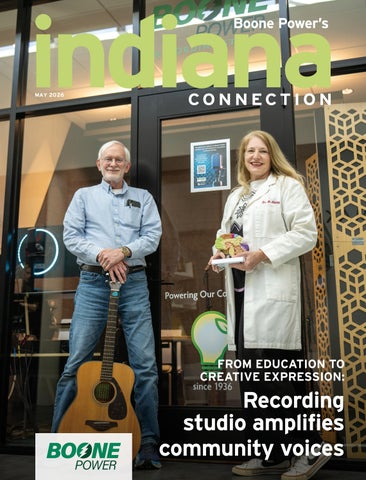
Recording studio amplifies community voices
Libraries have long fostered a love of reading, learning, and connection through books, videos, puzzles, and community programming. Today, they have evolved into vibrant community hubs, filled with new creative opportunities for all ages.
The Boone Power Recording Studio at the Hussey-Mayfield Memorial Public Library’s Whitestown branch is a prime example. This innovative space provides patrons with the tools to create and share their knowledge and talent.
A PLACE TO CREATE
The recording studio grew out of a larger effort to ensure the new branch reflected the community's needs and interests. Before construction began, a recording studio emerged as one of the top suggestions from surveying area residents. It is part of the library’s extensive MakerStudio, which allows community members to use 3D printers, a laser engraver, sewing and embroidery machines, and more.
“We wanted the library to be a place where people could not only consume information but also create it,” said Kaki Garard, director of advancement for the library. “A podcast and recording studio was a natural fit.”
BY JULI KNUTSON PHOTOS BY COLLIN STROUP, STROUP MEDIA
That’s where Boone Power came in, providing the energy to make the space a reality — both literally as the electric provider for the facility, and through a namingrights sponsorship of the studio. Boone Power views the library as an invaluable community partner, one that shares the value of improving quality of life.
The Whitestown branch serves as a central gathering spot for residents old and new, hosting alumni groups, nonprofit organizations, meetings, and programs for all ages.
The recording studio adds another dimension to that mission by encouraging creativity and learning. The space includes professional recording equipment, including a computer with software, microphones, headphones, and speakers.
UNLIMITED OPPORTUNITIES
Interest in the Boone Power Recording Studio has been strong. So far, it has been used to create podcasts, meditation recordings, singing performances, vlog editing, and audio clips for auditions.
Makerstudio Specialist Riya Shrestha Koirala demonstrates an embroidery machine.
One local user, Cindi McGarvey, MD, a neurologist, uses the space to create educational content with her colleague, Doug Strobel, MD. She is passionate about educating patients, their families, and the public about brain health. She also provides lectures on brain health topics, such as epilepsy, strokes, and dementia, every other month at the Whitestown or Zionsville library branches. In fact, that is how she learned about the studio, and she was immediately hooked.
“When you have the tools available, your mind starts thinking of things you can do,” McGarvey said. “I would never have made the leap to do podcasts otherwise. It’s an amazing opportunity, especially because it’s free to record a wealth of information that people might want to learn about.
“There is just not enough time for doctors to educate patients,” she added. “Knowledge gives them ownership over their diseases. We hope that these podcasts will help people in that way, even if it is just knowing what questions to ask.”
Neither McGarvey nor Strobel has done anything like this before, and they admit there is a lot to learn. With their growing library of content, they hope to begin sharing their podcasts soon.
CRAFTING NEW MUSIC
Mark Hansen, a retired chemist, enjoys reimagining existing songs by adding his own music and vocals to create new versions, often parodies. Some of his favorite artists are The Beach Boys and Paul McCartney. He builds each track in the studio himself and has even written a couple of original songs.
BOTTOM: Mark Hansen, a retired chemist, enjoys reimagining existing songs by adding his own music and vocals to create new versions, often parodies.
Hansen lives nearby and walks to the library. He noticed the studio early on and asked about using it to record music. Riya Shrestha Koirala, the MakerStudio specialist, was a great help to him as he got started and helped him troubleshoot in the beginning. He noted that recording music is more complicated than something like a podcast, but it’s well worth it.
“I have a ton of fun in the studio,” he said. “I have always been interested in music; I was in a band when I was younger. Sometimes I record several attempts, piecing the chords together and shaping them as I like. Then somehow it sounds like a great guitarist. I am not a great guitarist!”
(continued on page 8)
TOP: Cindi McGarvey, MD, a neurologist, creates educational content in the Boone Power Recording Studio.
The studio can be reserved up to three hours at a time.
Mark Hansen created a parody of Dr. Hook and the Medicine Show’s “On the Cover of Rolling Stone” just for Boone Power and Indiana Connection!
SCAN THE QR CODE TO LISTEN
(continued from page 7)
“In the old days, when you recorded, you had several musicians, and if you made a mistake, you had to start over. It was very painstaking. With this equipment, you can isolate each piece and fix it,” he said.
Hansen added, “The studio is a great addition to the library. I try to spread the word. I wave people in, talk to them, or play something for them. I’ve made all kinds of friends.”
It’s no wonder. After all, he uses the studio three or four times a week!
SEEING THE VALUE FOR THE COMMUNITY
Boone Power is thrilled to support this resource that benefits the community with access to enriching experiences.
“Our partnership with Boone Power allowed us to open the studio and outfit it soon after the branch opened,” Garard explained. “They saw how valuable it could be for the community and helped make it happen.”
In addition to sponsoring the new recording studio, Boone Power provided the library with rebates for energy-efficient upgrades such as LED lighting, variable-frequency drives, and energy-efficient airsource heat pumps.
“We value our local communities and look for ways to give back,” said Mandy Saucerman, Boone Power’s director of communications. “Everything we do is about supporting quality of life in our service area.”
Like many library programs, the recording studio is completely free to use. Community members do not even need a library card to reserve the studio space, though they must first complete a short training video through the library’s online learning platform.
As more residents discover the studio, library leaders hope it will continue to amplify community voices.
“Libraries are about access,” Garard said. “Access to information, to technology, and to opportunities people might not have otherwise. This studio is just one more way we can open those doors.”
Just as the library is committed to serving the community, Boone Power is committed to serving the community in a variety of ways. Through a recent Operation Round Up grant, the library has purchased cameras that will be added to the recording studio. This upgrade is expected to be available in the coming months.
Enhance safety in your home and workplace during National Electrical Safety Month
BY CHRIS ADAM
Electricity helps make our lives easier, but it also poses serious risks. May is National Electrical Safety Month — a time to focus on potential home electrical hazards and how to reduce the risk of injury or death for ourselves and our families. “We believe National Electrical Safety Month is an important opportunity to spread the word about serious risks such as shock and fire-related hazards,” said John Cassady, CEO of Indiana Electric Cooperatives. “We want our neighbors to know the basics of electrical safety to create safer families, homes, and communities. We can each do our part to help one another.”
ELECTRICAL SAFETY AT HOME
It can be easy to overlook the importance of electrical safety and the risks associated with it while at home. In fact, according to the National Fire Protection Association and Electrical Safety Foundation International, contact with electricity is a leading cause of injuries and deaths in homes and workplaces.
ELECTRICAL SAFETY AT WORK
You should also consider electrical safety at your workplace. According to the U.S. Bureau of Labor Statistics, an average of 150 workplace electrical fatalities occur each year. From 2011 to 2023, the Occupational Safety and Health Administration reported that 74% of workplace electrical deaths happened in jobs that are not electrical in nature.
National Electrical Safety Month highlights the importance of electrical safety, regardless of our location. By understanding hazards and following safety measures, we can reduce the risk of injury and fatalities. Safety begins with awareness and proactive action. Take the opportunity this month to educate yourself about electrical safety and ensure a safer environment for everyone.
THERE ARE MANY STEPS HOMEOWNERS CAN TAKE TO REDUCE RISK, SUCH AS:
• Have all electrical work done by a qualified electrician.
• Use only one heat-producing appliance plugged into a receptacle outlet at a time.
• Major appliances should be plugged directly into a wall outlet, not into extension cords or surge protectors.
• Check electrical cords to make sure they are not running across doorways or under carpets.
• Extension cords are intended for temporary use. Have a qualified electrician install additional receptacle outlets so that extension cords are no longer necessary.
HERE ARE SOME SAFETY TIPS TO KEEP IN MIND AT THE WORKPLACE:
• Be proactive about de-energizing equipment and take steps to ensure your work environment remains safe.
• Always de-energize and follow established lockout/tagout procedures to prevent injuries and save lives.
• Be sure to select the personal protective equipment (PPE) that is suitable for you and your specific circumstances.
• Each year, workers are injured or killed by circuits thought to be safely turned off. Always test before touching.
Reliable guidance you can trust
Co-op energy advisors help members save
Electric cooperative energy advisors provide unique services to co-op members. While their roles may vary depending on which co-op they work at, they all share the same goal: supporting members by resolving their electricity issues and improving their experience with their cooperative. Energy advisors do this in several ways.
ENERGY ADVISORS HELP TROUBLESHOOT CHALLENGES
Many calls to an energy advisor begin as a high bill complaint or another service question. Energy advisors can review a member’s electric bill and identify potential concerns. Bills tend to rise in winter and summer, when extreme
temperatures cause HVAC systems to run more frequently. Yet sometimes other issues can cause challenges. An energy advisor can review the situation and provide perspective.
THEY CAN ALSO HELP LOWER A HOME’S ENERGY USE
Energy advisors can speak with members about their homes, learn how their homes use electricity, and advise them on how to make energy-saving improvements. For instance, they may suggest adding more insulation to make a home more comfortable. Some electric cooperatives can even provide a home energy audit, which includes testing and in-depth analysis of the home. They can then provide the member with a to-do list of stepby-step suggestions to save energy and money.
ENERGY ADVISORS CONNECT CO-OP MEMBERS WITH PRACTICAL PROGRAMS
Many energy advisors work with businesses and homeowners on energy efficiency programs, potential incentives, and other offerings that can lower long-term costs. Energy advisors collaborate closely with members to identify programs that can best help them reach their goals.
Energy advisors are dedicated to helping co-op members. Visit your electric co-op’s website to learn about the programs they offer to help you reduce electricity and your bill.
JAKE TAYLOR Energy Advisor LaGrange County REMC
A commitment to doing good
BY CHRIS ADAM
A few years ago, Andrew Turpen, owner of Junior’s Delicatessen in Batesville, Indiana, realized his career needed a change. While he enjoyed working in education, a discussion with his sister-in-law opened his eyes. Turpen knew he had the food-industry experience and knowledge to open his own quick-service restaurant.
“If my sister-in-law had never cared enough to encourage me to consider my options, I may have continued to struggle with my education career,” Turpen said.
With each guest, we have an opportunity to create a positive experience that can lead to more good.
–
Andrew Turpen
thejuniorsdeli.com
10a.m. – 7 p.m., Monday– Friday
10a.m. –6 p.m., Saturday
Andrew Turpen gives back to his community through Junior’s Delicatessen
“I took everything I had learned from the great leaders I had been fortunate enough to work with and the principles that came along with that and applied them to Junior’s.”
A focus on fresh Junior’s, which opened in June of 2022, is committed to using the freshest ingredients possible. “Freshness isn’t just a marketing scheme to us, it’s what we do every day,” said Turpen. “Our opening managers are in at 7 every morning, baking our locally famous French bread loaves, and prepping our produce for the day. We are also one of the few places left that offer free delivery.”
One of their most popular sandwiches is their Cuban, with hand-pulled smoked pork carnitas, ham, provolone, Dijon mustard,
extra pickles, and Hellmann’s mayo, all grilled to perfection on the panini press.
A vessel for good Junior’s has a great reputation for helping the community.
“I believe that Junior’s exists to be a vessel for good in our community,” said Turpen. “Since our opening, we have donated thousands of dollars of food and financial support to local organizations, youth sports teams, and local schools and their staff.”
Turpen said that a couple of missions Junior’s supports, which are personally important to him, are the Batesville Safe Passage Shelter and the Batesville Middle School 8th-grade Washington, D.C., trip.
“We want to be a place where people can get a delicious, fresh sub at a fair price that ultimately creates a good moment in their day,” said Turpen. “With each guest, we have an opportunity to create a positive experience that can lead to more good.”
Warrick County
BY NICOLE THOMAS
Warrick County’s first town, Newburgh, Indiana, was initially called Sprinklesburgh after its founder, John Sprinkle. By the 1850s, Newburgh had become one of the largest riverports on the Ohio-Mississippi River. Later, Newburgh served as a key stop on the Underground Railroad and was the first northern town captured by Confederates during the Civil War.
INDIANA’S LEX LUTHER
Actor Michael Rosenbaum was raised in Newburgh and attended Castle High School before earning a degree in theater arts from Western Kentucky University. He is best known for his portrayal of Lex Luthor on the television show “Smallville.” Rosenbaum is also a voice actor whose most well-known role is Wally West (The Flash) in the DC Comics animated “Justice League” series. In 2014, he wrote, directed, and starred in the comedy “Back in the Day,” which was filmed in Newburgh.
THE MAKING OF LINCOLN
When Abraham Lincoln’s family moved to Indiana in 1816, they settled along Little Pigeon Creek. This land was then a part of Warrick County before the area was redistricted into Spencer County two years later. As a young man, Lincoln would walk 17 miles to Boonville, Indiana’s courthouse, where he observed court proceedings and developed his interest in law. One attorney who particularly influenced him was John Adams Brackenridge, a prominent lawyer in southern Indiana. He not only loaned Lincoln law books but was also known for his oratory skills, and Lincoln regularly attended his closing arguments.
UNEARTHING WARRICK’S PAST
Warrick County is home to three key archeological sites — Angel Mounds, Yankeetown, and Ellerbusch. At Angel Mounds State Historic Site, grassy earthen mounds and preserved artifacts mark the site of what was once a thriving Native
American town, dating back 600 to 1,000 years. A few miles away, the Ellerbusch archeological site reveals the outlines of small homes, stone tools, and pottery shards from a tiny village connected to Angel Mounds. Farther east along the banks of the Ohio River, the Yankeetown archeological site has uncovered even older pottery and tools from Native people who lived roughly 1,500 years ago.
COUNTY FACTS
FOUNDED: 1813
NAMED FOR: Captain Jacob Warrick, an Indiana militia company commander
POPULATION: 63,898
COUNTY SEAT: Boonville
INDIANA COUNTY NUMBER: 87
Vote on the Best of Indiana
Indiana Connection is recognizing some of our readers’ favorite places in an upcoming “Best of Indiana” feature. Our readers have nominated their best-loved restaurants, festivals, and other places that make the Hoosier State great, and we have narrowed them down to three finalists in each category. Go to goiec.org/48bCk4O to vote on reader nominees in each category. You can also scan the QR code to download a paper ballot.
Indiana Best of
Indiana Connection Readers’ Choice Awards
HEART SMART
FLAVORFUL RECIPES PERFECT FOR A HEART-HEALTHY DIET
Watermelon salad
GLENDA FERGUSON, PAOLI
2 cups cubed seedless ripe watermelon
2 cups arugula
1 cup sliced cucumbers
2 tsp. balsamic vinegar
2 Tbsp. blue cheese or feta cheese Black pepper to taste
Toss watermelon with the arugula and cucumbers. Drizzle vinegar over the salad. Top with cheese. Season with pepper.
Salmon salad with avocado and chickpeas
SUETTA K. TINGLER, CORYDON
1 (15 oz.) can chickpeas, drained and rinsed
1 avocado, peeled and chopped
1 (15 oz.) can salmon, drained with skin removed
2 celery ribs, diced
1/4 cup finely chopped red onion
1/2 cup chopped red bell pepper
2 Tbsp extra virgin olive oil
1 Tbsp red wine vinegar
1/2 tsp kosher salt or to taste
1/4 tsp ground black pepper or to taste
Combine the chickpeas and avocado in a large bowl. Mash until the avocado is smooth and creamy and about half the chickpeas are mashed. Add remaining ingredients and mix to combine. Adjust seasonings with additional salt and black pepper. Serve either on a bed of mixed fresh greens or with whole-grain crackers.
Mediterranean stir fry STAFF
SUBMITTED
1 pound chicken breast, sliced into thin strips
4 Tbsp extra virgin olive oil, divided
2 cloves of garlic, grated or minced
2 tsp Peri-Peri seasoning, divided (See recipe below.)
1/2 tsp salt
1 eggplant
2 medium zucchinis
1 sweet pepper or bell pepper
1 red onion
1 cup cherry tomatoes
6 cups fresh spinach
Add 1 tablespoon of olive oil, garlic, 1 teaspoon of Peri-Peri seasoning, and the salt to a medium bowl. Add the chicken strips. Marinate for 30 minutes or at least until you have finished preparing the vegetables. (This can be marinated overnight.) Wash, peel, core, and trim tops and bottoms off all of the vegetables. Slice them thinly and then cut them in thin short strips so that they cook evenly and fast. Set the vegetables aside in separate prepared bowls.
In a frying pan, add 1 tablespoon of olive oil and add the marinated chicken strips. Turn the chicken after 2-1/2-3 minutes. Saute until golden brown and cooked through. This should take 5-6 minutes. Remove the chicken strips from the pan and set aside. In the same pan, add another tablespoon of olive oil and add a handful of each of the sliced vegetables. Caramelize the vegetables for 1-2 minutes before you start to stir fry the vegetables. Stir fry in two batches, making sure the pan is not overcrowded. Add a pinch of salt and a pinch of seasoning, making
sure not to oversalt. Taste as you go, then set the vegetables aside next to the chicken. Add the last of the olive oil and toss in the cherry tomatoes, cooking until they blister and sizzle a little. Add the spinach and mix gently until wilted. Add the stir-fried vegetables and chicken back to the pan, mixing gently for a few moments to combine all the flavors. Serve immediately on its own or over rice or cooked grains. (Serves four.)
Peri-Peri seasoning
2 Tbsp sugar
2 Tbsp paprika
2 Tbsp onion powder
2 Tbsp garlic powder
2 Tbsp ground coriander
1 Tbsp salt
1 Tbsp dried oregano
1 Tbsp dried parsley
2 tsp ground ginger
2 tsp ground cardamom
1 tsp smoked paprika
1 tsp cayenne pepper
Mix together well and store in an airtight jar. Makes a little less than a cup.
CELEBRATING THE LEGACY OF
INDY RACING
Indianapolis Motor Speedway Museum reopens in grand style after $60.5 million renovation
BY BRIAN D. SMITH
In February 2025, only two months before the grand reopening of the Indianapolis Motor Speedway Museum, the most valuable car in the collection was no longer in the building — or even on the same continent. The 1954 Mercedes-Benz Streamliner, a legendary Grand Prix winner, sat on display in Stuttgart, Germany, at a museum devoted to Mercedes-Benz. But the gathering of nattily dressed spectators didn’t come to admire it — they came to buy it.
And in a stand-alone auction conducted by Sotheby’s, the car netted $53 million — the most ever paid for a Formula One car and the second-most paid for a car, period. But there was more. By the end of the month, 10 other venerable vehicles from the Speedway collection would also go on the auction block, one of them — a 1964 Ferrari — fetching $36 million. Then, on April 2, 2025, the biggest and most innovative IMS Museum in history opened to the public after a 17-month hiatus and a $60.5
million renovation. On display were nearly four dozen time-honored speed machines, led by the Marmon Wasp that Ray Harroun drove to victory in the inaugural Indy 500. Yet why did a world-class showcase for auto racing sell 11 of its best racing autos?
It’s a matter of mission, explained Communications Manager Kelsey Burr. Though the ’54 Mercedes and ’64 Ferrari achieved monumental milestones in motorsports, their tires never touched track at Indy.
Photos courtesy of the IMS Museum
Neither did Craig Breedlove’s Spirit of America, which blazed 600 mph across the Bonneville Salt Flats in 1965 to set a land speed record. It went for $1.3 million.
“The mission now is to celebrate and preserve the history of the Indianapolis Motor Speedway and the Indianapolis 500,” said Burr. “The cars we sold did not meet the mission of the museum.”
A WARM WELCOME TO GASOLINE ALLEY
The new Indy-centric institution asserts its identity even before visitors reach the first of its 10 galleries. Four green-and-white replicas of barn doors adjoin the entrance to Gasoline Alley, borrowing the longstanding nickname for the racing teams’ infield garage area. Though seemingly more appropriate for the stables at Churchill Downs, their rustic look and color scheme evoke the doors on the old wooden garages that housed Indy cars until 1985.
More history lies underfoot. The floor leading into Gasoline Alley begins as a crushed-rock-and-tar concoction, then switches to bricks and finally asphalt, recalling the progression of racing surfaces since the Speedway’s construction in 1909. To the right stand seven mock garages containing a rotating array of historic race cars from various decades; to the left are artifacts corresponding to each era — highlighted by the never-before-displayed articles of incorporation for the Indianapolis Motor Speedway Company, as it was initially named. And in a nod to other types of racing at Indy, Gasoline Alley also features racing helmets from Formula One stars, notably Michael Schumacher, who won five of the eight U.S. Grand Prix races held at Indy.
The seven race cars in the gallery’s garages change periodically, but past selections have ranged from the 1964 Lotus of pole sitter Jim Clark, a fan favorite who finished first the following year, to the 1978 Texaco Star Wildcat driven to ninth place by Janet Guthrie, the first woman to qualify for the 500.
ARCHITECTURAL INNOVATIONS AND EXPANDED SPACE
At 80,000 square feet, the new museum is twice the size of its predecessor. Yet the structure around it didn’t expand at all — designers gained the additional 40,000 square feet by efficiently utilizing existing space.
That required more than just a few tweaks. “The museum overall was completely gutted,” said Burr. “None of this was here besides the floor and the support beams.” So where did planners find the extra space? “We got rid of the low ceilings and opened up the lower level,” she said. And they conjured up a gallery out of thin air, installing the 6,000-square-foot Mezzanine half a level above the Indianapolis 500 Winners Gallery and its lineup of champion Indy cars.
Oval-shaped to resemble the track, the Mezzanine pays homage to broader aspects of the Indianapolis Motor Speedway experience, including artifacts and race-day traditions that encompass all forms of racing at the track. For instance, visitors can view the PPG Trophy, an Art Deco creation that honors the winners of the NASCAR Brickyard 400. Another exhibit shows the surprising number of steps involved in creating a new face for the Borg-Warner Trophy, which displays the faces of all Indy 500 drivers who previously landed in Victory Lane. When sculpting a new one, the artist studies photographs of the driver’s face from different angles and models a clay likeness, then casts a replica in plaster and then in red wax. In the final step, a jeweler produces a trophyworthy double in sterling silver. The gallery also gives a tip of the racing helmet to the 500’s pre-race festivities, as evidenced by the display case honoring the performance of “Back Home Again in Indiana” before Indy 500 drivers start their engines. Gracing the case are sheet music for “Back Home Again” and a uniform from the
At the Qualifying Zone, museum-goers can use machines to test their reflexes and simulate the experience of trying to qualify at Indy.
Purdue University All-American Marching Band, which customarily accompanies the vocalist in the song’s performance.
SECRETS IN THE BASEMENT
The easy access to the lower level may seem unexceptional nowadays, but only to museum newbies. For decades, it was a place of legend and mystique. “It used to be called the basement,” said Burr, “and you had to really know somebody to get down there and see it.” So what was down there? “A repository of rare, priceless, and one-of-a-kind racing and automotive artifacts and vehicles,” according to one source.
Then, several years ago, the museum began offering exclusive VIP basement tours, charging $150 for a half hour, but even then, the cellar remained secretive. Participants descended in groups of six and were prohibited from taking photos — yet the tours still raised $400,000 for the museum, a not-for-profit entity that has long operated independently of the Speedway.
Today, as part of the Winners Gallery, the former basement still contains rare and one-of-a-kind racing vehicles, and even a secret or two. Look closely at the walls, and you will discover that their banking matches that of the famed oval — 9.2 degrees. But you won’t pay $150 to enter, and no one will hassle you if you take pictures.
FUNDING THE RENOVATION
Speaking of fundraising, given that auction revenue for the museum’s 11 historic automobiles exceeded $100 million, it might seem logical to assume that the proceeds will more than cover the cost of the renovation.
But what’s logical is not always ethical in the world of museums. The American Alliance of Museums, which represents 35,000 museums and museum professionals, maintains strict rules pertaining to deaccessioning, the process of removing unwanted objects from museum collections.
Calling deaccessioning a “responsible practice” when an item no longer fits the mission of the museum, the Alliance nevertheless cautions that “if a deaccessioned object is sold, museum professional ethics require the proceeds from the sale be used only to acquire new objects for the collection or provide direct care of the collection.” As former IMS Museum President Joe Hale stated, “We can’t use the proceeds of that sale to build a new museum, but the proceeds will go to two functions: the care of the collection and to enhance our collection.”
In 2023, Hale launched the $89 million “The Stories Behind the Spectacle” capital campaign to fund the renovation of the museum and the construction of an $18 million, 60,000-square-foot Restoration and Event Facility near the track. The structure would replace a pair of nearly 70-year-old, 1,500-square-foot buildings now used to restore historic vehicles.
‘ULTRA-MODERN’ IN 1956
The IMS Museum celebrates its 70th birthday this year. Still, nearly a half-century of racing elapsed before it came into being — and even then, it had to share space with the track’s front office, previously located downtown. The new museum/administration building, situated on the southwest corner of the Speedway grounds, contained 8,000 square feet — only one-tenth the space of the current museum. However, the Indianapolis Star hailed it as an “ultra-modern structure,” citing features such as air conditioning, which was found in only 2 percent of American homes at the time.
Groundbreaking ceremonies for the museum took place in July 1955, but the mood wasn’t entirely jubilant. Thoughts of former Speedway President Wilbur Shaw, who died tragically in a plane crash the previous October, loomed large over the event, amplified by his wife’s presence as an honored guest. Speedway Owner Anton “Tony” Hulman had already announced that the museum would be dedicated to Shaw, whose contributions to the Indy 500 transcended the steering wheel.
The oval-shaped Mezzanine pays homage to broader aspects of the IMS experience, including artifacts and race-day traditions that encompass all forms of racing at the track.
Location Location Location
05/08/26
From high‑efficiency electric models to advanced heat pump water heaters, Richmond helps lower energy use and reduce monthly bills while meeting all of your hot water demands.
Want to learn more about our water heating technologies and how to save money on monthly bills? Learn how these products work with live demonstrations of Tankless Gas and Heat Pump Water Heaters.
Stop by a Menards store near you and check out our mobile showroom.
One of the greatest race drivers in history, Shaw won three Memorial Day classics and placed second on three other occasions. And his off-track accomplishments proved at least as significant. Not only did he convince Hulman to buy the deteriorating two-and-a-half-mile oval in 1945, but as its president and general manager, Shaw spearheaded the comeback of Indianapolis’ namesake race and racetrack with improvements such as the installation of steel-and-concrete grandstands in place of the aging wooden seating.
Even after his passing, Shaw remained prominent when the museum opened its doors in 1956. Only six historic cars greeted the first visitors to enter the racing shrine, whose exhibits were described as “far from complete.” But not far from the iconic Marmon Wasp stood the Maserati that Shaw piloted to victory in 1939 and 1940.
The museum also featured photos of the winning cars and drivers from previous races, trophies, and other 500 memorabilia dating back to the early 1900s, as well as a Firestone Tire & Rubber Co. display showcasing the evolution of racing tires at Indy.
The Speedway unveiled its new museum on the first day of qualifications, offering a hard-to-beat admission price — free with the purchase of a $1 ticket to enter the track, and more than 10,000 spectators went for it. (Ticket prices would remain ridiculously low for decades — only $5 for adults in 2014 — but are now $25 for adults and $18 for kids 6 to 16.)
The “steady stream of visitors” continued even after the 1956 race, with about 3,500 filing through during the Labor Day weekend, wrote the Shreveport (Louisiana) Journal, adding that the new museum was “rapidly winning recognition as one of the nation’s top tourist attractions.” A guest register showed representation from all 50 states, as well as 25 countries, ranging from Australia to Mongolia.
UPGRADING AND UPDATING
Talk of moving the museum to larger quarters began as early as 1963, when Hulman paid $100,000 to the Town of Speedway for 15 acres across the street from the original building. But ultimately the museum stayed put until 1976, when — amid the hoopla over the nation’s 200th birthday — it relocated to a new 96,000-squarefoot, two-story building inside the oval. The Chicago Tribune embraced both the hype and the necessity of
The renovated museum delivers fun experiences for race fans of all ages.
the move, reporting that Hulman “built it not only to honor the Bicentennial, but because facilities and parking space at the first museum, opened in 1956, had become inadequate.”
In 2016, foreshadowing the recent renovation, thenExecutive Director Betsy Smith voiced concern that the museum had barely evolved in 40 years and was overdue for an update. “The lighting, the technology — it’s vintage 1976,” she told the Star. “I’d like to get some technology in here and some video so that visitors could really experience racing.”
The current galleries provide just that. At the Starting Line Experience, guests enter a room where an 80-by20-foot LED screen plays a seven-minute video that re-creates the sights and sounds of race day traditions as experienced by Indy drivers on the front row. The video begins with the cannon firing and concludes with the green flag that signals the start of the race, including the “Drivers, start your engines” command that sends the cars roaring to life. Note that this gallery comes with a warning sign cautioning visitors about excessive volume (earplugs are recommended) and flashing lights.
Meanwhile, at Qualifying Zone, museum-goers of all ages can channel their inner A.J. Foyt or Danica Patrick on machines that test reflexes and simulate the experience of trying to qualify at Indy — all the way down to estimated speed and even accidents. The pit stop challenge enables motorheads to learn the tools of the trade, and a play area caters to the youngest future recipients of the Borg-Warner Trophy.
The new museum is already delivering results, as evidenced by attendance figures. Before the renovation, the facility drew about 140,000 visitors annually. However, 2025 saw 150,000 during the first six months following its reopening, said Burr. “Guests have been absolutely loving it,” she said, and some even take the time to express it. “My favorite feedback was, ‘I brought my 3-year-old child and my father-in-law in his 60s, and they both spent hours here.’”
Preparation drives reliability
PLANNING AHEAD
IS ONE OF THE WABASH VALLEY POWER TEAM’S MOST IMPORTANT RESPONSIBILITIES
In Indiana, the month of May brings a familiar rhythm. The Indianapolis 500 captures our attention, and with it comes the language of racing, preparation, precision, teamwork, and strategy. Drivers don’t just show up on race day and hope for the best. Success is built through months of planning, testing, and coordination long before the green flag waves. Reliable electricity works much the same way.
Like you, I’m a co-op member. I expect the lights to come on, my home to stay comfortable, and my community to have dependable power every day. Most of the time, I don’t think twice about it. That’s exactly how it should be.
“ ” When power is dependable, it’s not by accident. It’s the result of careful planning and constant coordination.
As CEO of Wabash Valley Power Alliance, the work that makes that reliability possible is always front
and center for me. When power is dependable, it’s not by accident. It’s the result of careful planning and constant coordination behind the scenes.
Reliable electricity depends on generation and transmission working together seamlessly. Power must be produced at the right time and delivered across a transmission system capable of moving it efficiently to local co-ops. Keeping those pieces aligned takes continuous coordination, even though most of that work happens out of sight.
Planning ahead is one of the Wabash Valley Power team’s most important responsibilities. We look years into the future to understand how demand is changing, what resources will be available, and how the transmission system must perform to keep power flowing reliably. That long-term perspective allows us to make disciplined decisions rather than reacting when conditions are already tight.
In many ways, the decisions we make today are about races that won’t be run for years. New generation resources, transmission investments,
and system upgrades often take five, seven, or even 10 years to fully come online. The choices made now help ensure the system will be ready to meet future demand.
Preparation also means stresstesting our plans. We examine how the system performs during extreme weather, equipment outages, fuel constraints, and sudden changes in demand. Identifying risks early allows us to adjust course before small issues become bigger problems.
This month, drivers at the Indianapolis Motor Speedway measure success by crossing the Yard of Bricks and seeing the checkered flag. In our work, success looks a little different. It’s flipping the switch and seeing the lights come on, knowing families, farms, and businesses have the power they depend on every day. That may not come with a trophy, but for our members and our team, it’s what matters most.
JEFF CONRAD President and CEO
Wabash Valley Power Alliance
SEASONAL SAVINGS: Preparing for warmer weather
As spring transitions into summer, it’s the perfect time to refresh your home and your energy habits. Warmer days often mean higher energy use, especially as air conditioners begin working harder. The good news? A few simple steps now can help you stay comfortable and keep your energy bills in check all season long.
START WITH A SEASONAL REFRESH
Spring cleaning isn’t just about tidying up. You can improve energy efficiency, too. Dust light bulbs to maximize brightness, and clean around appliances like your refrigerator to help them run more efficiently. Don’t forget to check sliding door tracks and seals, as buildup can create gaps where cool air escapes.
PREPARE YOUR COOLING SYSTEM
Before summer heat arrives, schedule a professional inspection of your air conditioning system. A tune-up typically includes checking refrigerant levels, electrical components, and airflow. Also, check your air filters regularly. Replace them if they are dirty to keep your system from working harder and using more energy.
ADJUST YOUR THERMOSTAT WISELY
As temperatures rise, adjust your thermostat to reflect the season. Set it higher when you’re away and at a comfortable level when you’re home. A programmable or smart thermostat can automatically manage these changes, helping you save energy
without sacrificing comfort. If you don’t yet have a smart thermostat, see which models qualify for a $75 rebate at boonepower.com/rebates
USE FANS TO STAY COMFORTABLE
Ceiling fans and portable fans can make a room feel cooler, allowing you to raise your thermostat setting by up to 4 degrees. Be sure your ceiling fan rotates counterclockwise in summer to create a cooling breeze. And remember, fans cool people, not rooms, so turn them off when spaces are unoccupied.
BLOCK THE HEAT BEFORE IT BUILDS
Sunlight streaming through windows can quickly heat your home. Close blinds or curtains on south- and west-facing windows during the hottest parts of the day to reduce solar heat gain and ease your air conditioner’s load.
SEAL AND INSULATE FOR LASTING SAVINGS
Air leaks around doors, windows, and utility openings can let cooled air escape. Seal gaps with caulk or weatherstripping, and check insulation levels in attics and basements. These improvements help maintain consistent indoor temperatures and reduce energy use year-round.
You can schedule a free in-home energy evaluation with Boone Power's energy advisor to learn practical ways to improve efficiency.
ADD SHADE AND THINK LONG-TERM
Planting trees or shrubs — especially on the south and west sides of your home — can provide natural shade and reduce cooling costs over time. Just remember to call 811 before digging and plan for the mature size of your landscaping.
CONSIDER UPGRADING EQUIPMENT
If your air conditioner is older or struggling to keep up, it may be time to upgrade to a more energyefficient model. New systems can significantly reduce energy use, and rebates or tax credits may help offset the cost. Visit boonepower. com/rebates to explore available options.
SCHEDULE A FREE ENERGY EVALUATION
You can also schedule a free in-home energy evaluation from Boone Power. Our team will assess your home and recommend practical ways to improve efficiency and lower your energy bills. Learn more and schedule in the SmartHub mobile app or by visiting boonepower.com/energy-advisorservices. While you’re there, download our free “101 Ways to Save” booklet.
2026 board of directors election
THANK YOU TO ALL THE MEMBERS WHO TOOK PART IN OUR ANNUAL DIRECTOR ELECTION!
As a member-owned cooperative, your involvement is what powers our mission. Your participation is a direct expression of the cooperative principle of democratic member control. District 1 Director Danny Lawson, District 2 Director Tom Dull, and District 3 Director Mark Gruninger have each been re-elected to serve new three-year terms.
As a thank you, all participating members will receive a $10 bill credit on their May 2026 electric bill and will
be entered into a drawing for the grand prize — a Eufy E25 robot vacuum and mop combo ($880 value).
Be sure to check the June issue of Indiana Connection, where we will announce the grand prize winner along with the 10 recipients of our $1,000 scholarships!
If you missed our annual business meeting video livestream or radio broadcast, you can find the recording on our website or YouTube channel.
(continued from page 5)
Our SmartHub app and web portal offer detailed usage data, and we offer budget billing and free in-home energy use and efficiency evaluations. I encourage you to read more about these programs on our website or call us to discuss these services.
I’m also happy to share that, in the months ahead, we will introduce a prepaid billing option and a time-of-use pilot program to give you additional ways to manage your Boone Power account and energy costs.
An important distinction of being a cooperative is that we do not answer to faraway shareholders. That means our members serve as, and elect, our board directors. I appreciate all of you who participated in our governance process this spring. It’s an important aspect of the cooperative business model that ensures Boone Power continues to be guided by the members we serve.
I also appreciate those who took the time to respond to our member satisfaction survey this year. Your responses help guide our priorities, and we look forward to sharing more about the results once our research firm compiles the data.
As conversations about energy affordability continue across our state, building and sustaining trust has never been more important. Boone Power remains focused on the priorities that have guided us for decades: responsible planning, reliable electric service, and listening to the members who own this cooperative to ensure we serve you well.
*Indiana Utility Regulatory Commission’s Annual Report for Fiscal Year 2025