ANALYSIS Wisconsin Assembly Bill 487 / Senate Bill 633 Closed Sessions for Information Technology Security Issues Prepared January 13, 2026
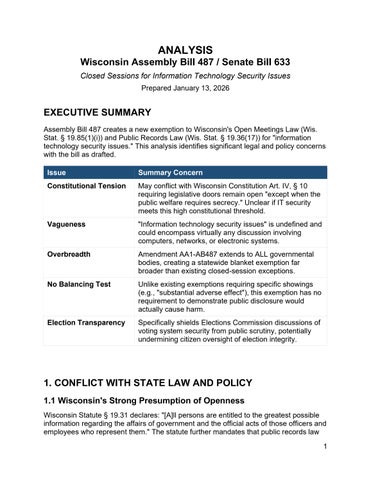
EXECUTIVE SUMMARY Assembly Bill 487 creates a new exemption to Wisconsin's Open Meetings Law (Wis. Stat. § 19.85(1)(i)) and Public Records Law (Wis. Stat. § 19.36(17)) for "information technology security issues." This analysis identifies significant legal and policy concerns with the bill as drafted. Issue
Summary Concern
Constitutional Tension
May conflict with Wisconsin Constitution Art. IV, § 10 requiring legislative doors remain open "except when the public welfare requires secrecy." Unclear if IT security meets this high constitutional threshold.
Vagueness
"Information technology security issues" is undefined and could encompass virtually any discussion involving computers, networks, or electronic systems.
Overbreadth
Amendment AA1-AB487 extends to ALL governmental bodies, creating a statewide blanket exemption far broader than existing closed-session exceptions.
No Balancing Test
Unlike existing exemptions requiring specific showings (e.g., "substantial adverse effect"), this exemption has no requirement to demonstrate public disclosure would actually cause harm.
Election Transparency
Specifically shields Elections Commission discussions of voting system security from public scrutiny, potentially undermining citizen oversight of election integrity.
1. CONFLICT WITH STATE LAW AND POLICY 1.1 Wisconsin's Strong Presumption of Openness Wisconsin Statute § 19.31 declares: "[A]ll persons are entitled to the greatest possible information regarding the affairs of government and the official acts of those officers and employees who represent them." The statute further mandates that public records law 1