LeaderinIETMTechnology


S1000DEuropean StandardvsJSG
0852Indian Standard–IsIt
ReallyNecessary forShipyards?
S1000DEuropean StandardvsJSG
0852Indian Standard–IsIt
ReallyNecessary forShipyards?
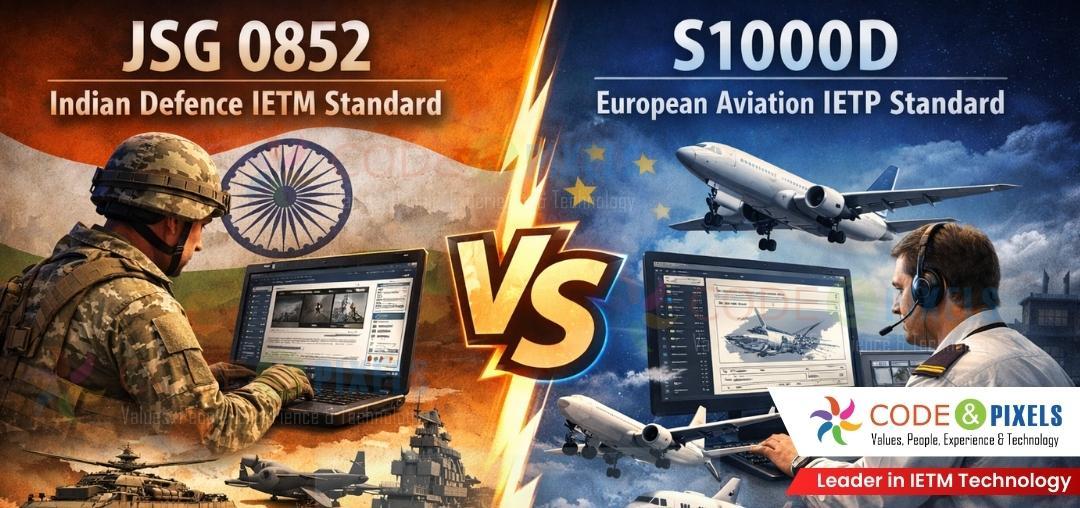
Many shipyards in India prefer to follow the Indian Defence standard JSG 0852 for IETMs.
Then why has S1000D, a European standard, suddenly become important?
Let us understand this clearly.
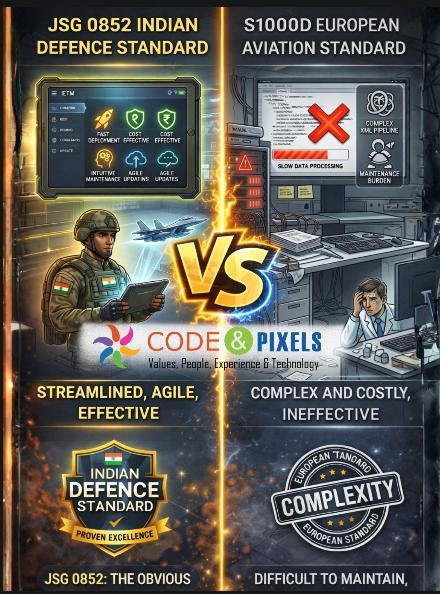
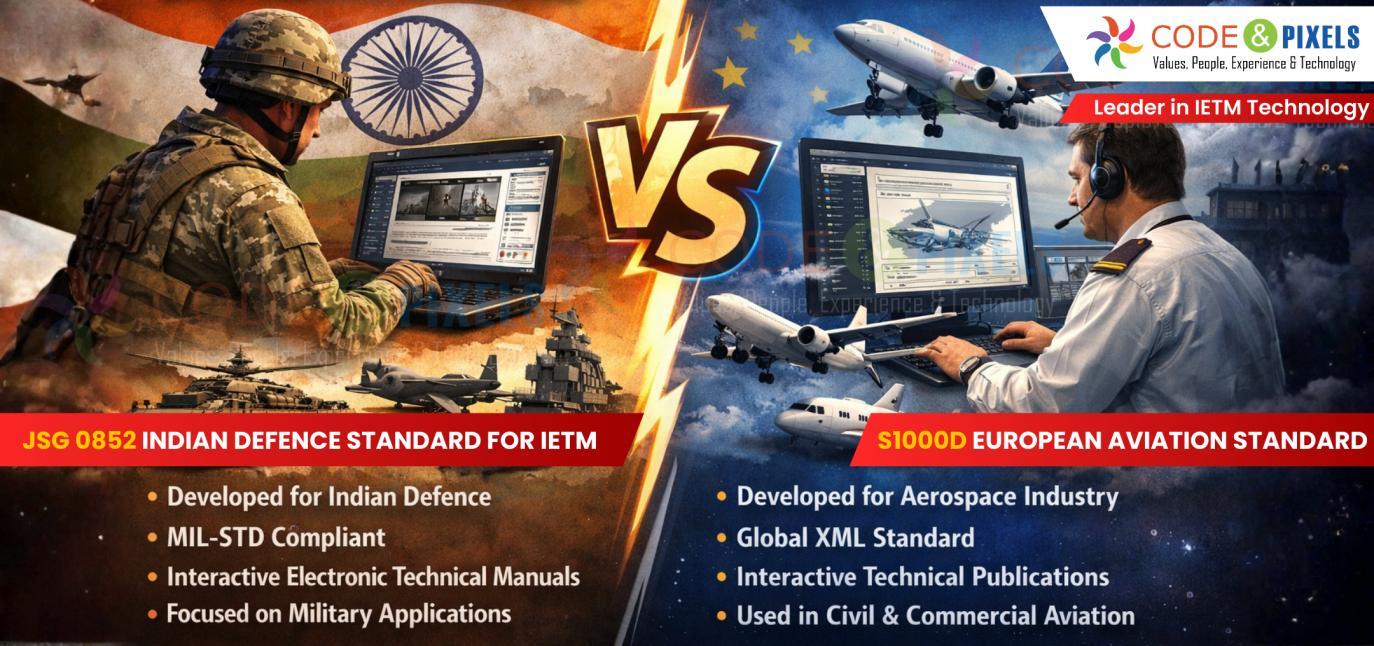
• S1000D is a European aviation standard mainly developed for the aviation industry.
• It works well for aircraft and defence systems that involve foreign machinery and imported components.
• Some people assume that since it is a European standard, it must be better than Indian standards. But this is not always true.
• JSG 0852 is not new
• It has been in use for almost 20 years.
• It is upgraded regularly.
• It is fully aligned with Indian Defence requirements.
• In many cases, it offers more practical features for Indian projects.
If the same objective can be achieved in ₹1 lakh, why spend ₹3 lakhs?
• S1000D service providers may charge ₹10 lakhs for 1000 pages.
• The same IETM using Indian standard can be developed for around ₹2.5 lakhs.
• That’s almost one-fourth the cost
• Will an OEM spend ₹1 crore on documentation tools and standards?
• Definitely not. It becomes an unnecessary burden.
Imagine
• A shipyard procures equipment from 100 different OEMs.
• Each OEM supplies its own IETM.
• The shipyard hosts all 100 IETMs on a central server.
Some shipyards think:
“If all IETMs are made in S1000D, they can be integrated into one master IETM.”
But this is not practically true.
• The shipyard must own a CSDB studio system (like Boeing Spectrum), which costs crores annually.
• All 100 OEMs must use the same CSDB system
• In reality, each OEM uses different service providers and tools.
• So the shipyard still ends up with 100 separate S1000D IETMs Integration becomes complicated and costly.

• Editing or updating S1000D documents is expensive.
• If OEMs use Indian standard based authoring tools (like cost effective solutions), editing costs can be almost ZERO once the tool is owned.
• Indian standards are easier to manage and update.
No major additional benefit for Indian shipbuilding context.
It is not that S1000D is useless.
It is just unnecessary in this specific Indian Defence shipbuilding scenario.
Using S1000D here is like:
Wearing a three piece suit to visit a temple. It’s not wrong but it’s unnecessary.
When the country promotes Make in India, shouldn’t we also promote Indian standards where they are fully capable and cost effective?
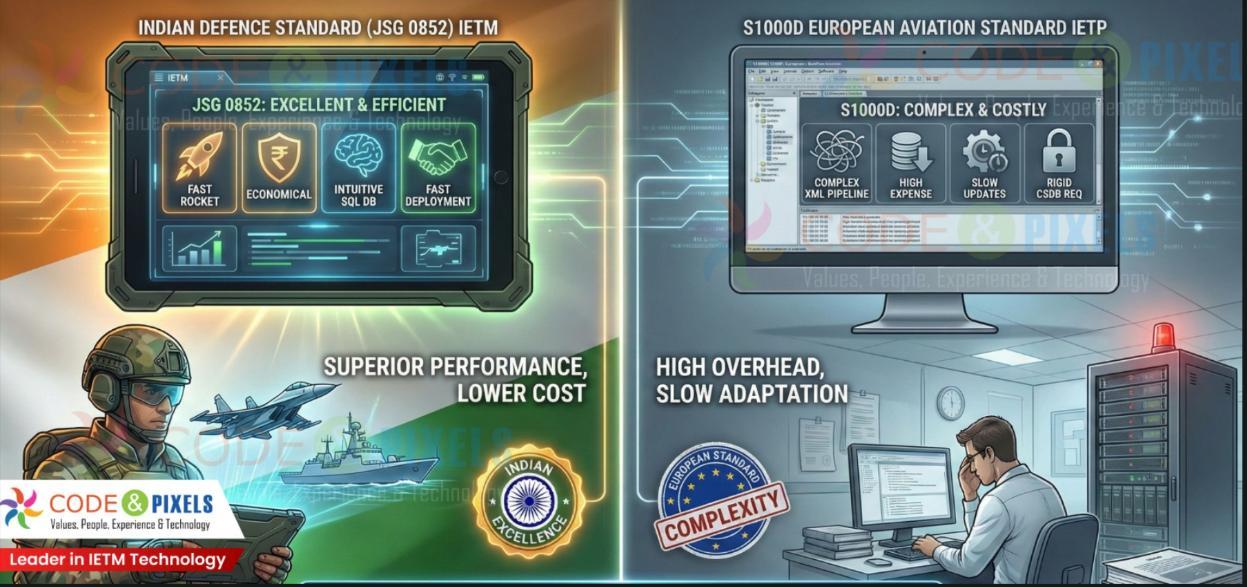
JSG 0852:
• Fits Indian Defence requirements.
• Is economical.
• Is easier to implement.
• Works efficiently for shipyards.
After working on hundreds of IETM projects across multiple equipment types, we understood one key need of shipyards:
The Real Need: Shipyards must be able to search and access content across 100 different OEM manuals quickly.
Our Solution:
Quantum TechDocs Enterprise Edition:
• Searches across 100 different OEM manuals.
• Displays unified search results instantly.
• Works efficiently without forcing S1000D complexity.
• Eliminates unnecessary integration challenges.
• Reduces overall lifecycle cost.
• Instead of spending crores on complex CSDB systems, shipyards can implement a smart, practical, and cost effective solution.
Final Conclusion
Whether you use S1000D or Indian Standard:
• Functionally, both deliver IETM documentation.
• But for Indian Defence shipbuilding projects, JSG 0852 is more practical, more economical, and easier to manage.
The key question is not “Which standard sounds bigger?”
The real question is “Which standard is suitable, affordable, and sustainable for Indian Defence Shipyards?”
Not All XML IETMs Are S1000D: Understanding the Reality
Many people believe that if an IETM is created in XML format, it automatically becomes an S1000D IETM.
But this is not true.
S1000D is much more than just XML.
Yes, S1000D requires documentation to be XML-based.
But simply creating an XML file does not make it S1000D compliant.
S1000D contains:
• Thousands of predefined XML tags
• Strict data structures
• Specific rules for each tag
• Defined business rules
• CSDB (Common Source DataBase) architecture
Each tag in S1000D has a specific meaning and purpose.
It is not just about putting content inside an XML format.
Today, many local companies create IETMs in XML using tools like FrameMaker or other third party software.
They deliver the XML file and call it “S1000D IETM.”
But:
• It may be XML.
• It may look structured.
• But it is not fully S1000D compliant.
All XML IETMs are not S1000D.
Most of these are just basic XML manuals similar to Indian IETM Level 3 with limited advanced features.
Let’s take a real life example.
If you go to a street vendor and ask for Chinese chicken fried rice, he may prepare it using Indian spices like chili powder and coriander powder.
You may eat it and think that’s original Chinese fried rice.
But when you eat fried rice in China, you realize the difference. That is authentic Chinese fried rice.
Similarly:
• What many vendors supply is “Indianized S1000D.”
• The original S1000D requires a proper CSDB system and certified tools.
• Needs strong vendor support (which is often limited).
• Can become financially risky if the project timeline extends.
After careful evaluation, we have decided to discontinue offering S1000D services.
S1000D is not useless.
But:
• Not all XML is S1000D.
• Not all vendors provide genuine S1000D.
• Implementation must be practical, financially viable, and aligned with project needs.
Before choosing S1000D, organizations must understand:
Is it truly required?
Or is it just being adopted because it sounds international?
Choosing the right solution should always be based on practicality, cost, and long term sustainability not just on name.
Learn More or Request a Demo
Website: www.codeandpixels.net
Email: ietm@codeandpixels.net
Phone: +91 98495 27706