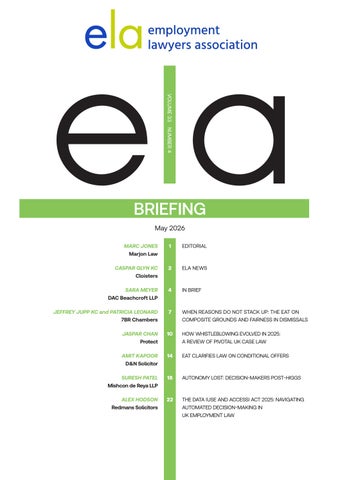
ela news
The End is Nigh. Well, it is not but this edition of ELA Briefing marks my retirement from ELA’s Management Committee, along with a group of stalwart ELA servants: Marc Jones who has tirelessly edited the Briefing for six years now, taken the Briefing digital and now provides more content than ever before; and David Regan who has chaired one of our busiest committees, Training, for six years. His time has seen ELA do more training for more people than ever before as we pivoted to webinars, which has increased reach throughout the UK and allows people to attend flexibly.
‘a big thank you for giving me this opportunity – it has been a blast!’
Cerys Mather who has driven forward the interests of our junior members for years comes to the end of her term as Chair of our Junior Committee, Sarah Wilder who took over and gave real impetus to our In-house Committee is moving off the Management Committee. Long-serving regional reps who have been more active in the regions than ever before, including Sarah Hayes and Steph Pye, retire from their ELA roles. Two brilliant members at large, Pooja Dasgupta and Jen Danvers, are stepping down. Finally, Katy Edwards successfully completes her term after delivering our new articles (a project delayed over about eight years). Thank you for all your hard work on all our behalf.
The future is bright
The new Management Committee will be led by Freshfields’ Kathleen Healy with whom I first worked in 2010 on one of the most interesting cases in my career involving the first football arbitration to be reported in the Industrial Relations Law Reports. She is brilliant, does so much and leads so widely that I am quite sure she has a superpower which allows her to stop time. With Beth Hale as her deputy, and a mix of experienced committee members stepping into chair roles alongside other experienced chairs, the longer-term future of ELA’s success is assured.
A word about ELA
ELA has grown to 7,300 members from about 6,000. The committees are busier than ever before; by way of example, in 2025, the Legislative and Policy Committee responded to about 20 consultations. The Training Committee puts on tens of events a year, and our training, pastoral, junior, regional, in-house, international offerings have grown, as has our reach in the regions. We have taken a two-prong approach to delivering more remote training because it is more in demand but also directing a significant resource to in-person networking events which are popular with a large segment of our membership. We have also completed a lot of behindthe-scenes resilience building to ensure that if and when staff move on we have standing operating procedures for nearly everything.
The brilliant secretariat
ELA now has a fully employed secretariat, very well led by James Jeynes, our Chief Operations Officer, with Angela Gordon looking after our rosily healthy finances, Cynthia Clerk overseeing our digital output, Steve Mattin delivering membership services with Jackie Williams, Danny Carlyle delivering events and the wonderful Christine Wheeler marshalling our pro bono services. They are our backbone and our strength and stay – they make it happen.
Going out with a bang!
This edition of ELA Briefing is being published a few days before the most exciting development of my time at ELA. In spite of all the hard work by judges
and those in the employment tribunals, we all know that the tribunal system is buckling. In many parts of the UK, trials are taking place years and years after the events that gave rise to them – and it is getting worse and, if it stays like this, it will get worse still.
The tribunal system needs reforming, but ELA is not moaning from the sidelines. ELA is leading. In the coming month, we will launch groundbreaking research into reforming employment dispute resolution written by Sarah Fraser Butlin KC and Professor Catherine Barnard, funded by ELA and based partly on many interviews with you. You, our members, can be proud of this contribution to civil society and of ELA’s leadership. Nothing is more important – what is the point of employment rights if access to them is unduly difficult?
Before this Management Committee steps down, we will be shouting out our research – taking it to the House of Commons, engaging Government and the press, and pushing for the reform that every practitioner knows must come if the rule of law in employment justice is properly to be delivered. There is much to be done before we handover, including David Regan’s last Annual Conference, and this Management Committee plans to do it.
Goodbye ELA, hello practice!
So, on 21 May, it will be the end of 10 years on the Management Committee, from being a member at large to chairing the Legislative and Policy Committee, to becoming Deputy Chair and finally Chair. Highlights have included helping the Government improve legislation by suggesting drafting, consulting on ramifications of their proposals, selling out the Annual Conference year after year, meeting hundreds of the newly qualified members at ‘bootcamp’, speed mentoring junior members, encouraging junior lawyers to take part in ELA and the Chair’s tour of the regions in 2025, first on the Employment Rights Bill and then on the Employment Rights Act 2025, which involved meeting hundreds of you, our valued members, along the way.
Having spent a lot of time building up an expertise on the ERA, I am hugely looking forwards to turning my views and thoughts into hard advice and in litigation in the tribunals and courts over the coming years, alongside co-leading Cloisters Chambers and helping the juniors of today become the leaders of tomorrow. I have to tell you friends, that I am really excited by the future.
Finally, a big thank you for giving me this opportunity – it has been a blast!
Recent activities
Training Committee webinars included ‘Confidentiality in Employment’ and a two-day online ‘Discrimination: The law and strategy’ course.
• The Legislative and Policy Committee responded to consultations on artificial intelligence, industrial action, e-balloting and flexible working.
• The Pastoral Committee held a webinar, ‘LawCare: Life in the Law Research’.
Looking ahead
· Training Committee: the ELA Annual Conference and Dinner will be held on 21 May in London.
• In May, the Legislative and Policy Committee will respond to consultations on collective redundancy and the Agency Work Regulatory Framework.
· The regions: there will be a social (July 1) and a training day (17 September) in Leeds. An employment law and golf day will take place in Newcastle on 26 June.
CASPAR GLYN KC, Cloisters
in
brief
Annual increases to compensation limits and statutory payment rates
The Social Security Benefits Up-rating Order 2026 (SI 2026/148) has come into force, increasing the rates of:
• statutory maternity pay from £187.18 to £194.32 per week from 5 April 2026;
• statutory paternity, adoption, shared parental, parental bereavement and neonatal care pay and maternity allowance from £187.18 to £194.32 per week from 6 April 2026; and
• statutory sick pay from £118.75 to £123.25 per week from 6 April 2026
The Employment Rights (Increase of Limits) Order 2026 (SI 2026/310) is also now in force, increasing the compensation limits and minimum amounts that apply in respect of certain tribunal awards:
‘the Government’s objective is to improve transparency around pay disparities affecting ethnic minority and disabled workers’
• the cap on the compensatory award for unfair dismissal has increased from £118,223 to £123,543 (or 52 weeks’ pay, if lower);
• the limit on a week’s pay for the purpose of calculating the unfair dismissal basic award and statutory redundancy pay, among other things, rose from £719 to £751;
• the limit on the compensatory award for failure to have a written tips policy, or to allocate and pay tips fairly, has increased from £5,135 to £5,366; and
• the minimum basic award in certain automatically unfair dismissal cases (for example, health and safety, working time, employee representative, trade union or occupational pension trustee reasons) has increased from £8,763 to £9,157. These new rates apply where the ‘appropriate date’ for the cause of action falls on or after 6 April 2026. In an unfair dismissal claim, the appropriate date is the effective date of termination. The old limits continue to apply where the appropriate date falls before 6 April 2026, regardless of the date on which compensation is awarded.
Updated Vento guidelines
On 30 March, the Presidents of the Employment Tribunals in England and Wales and in Scotland issued the latest (ninth) addendum to the Presidential Guidance on employment tribunal awards for injury to feelings and psychiatric injury. This addendum increases the Vento bands that apply to tribunal claims presented on or after 6 April 2026, as follows:
• a lower band of £1,300 to £12,600 (previously £1,200 to £12,100) for less serious cases;
• a middle band of £12,600 to £37,700 (previously £12,100 to £36,400) for cases which do not merit an award in the upper band;
• an upper band of £37,700 to £62,900 (previously £36,400 to £60,700) for the most serious cases; and
• amounts in excess of £62,900 can be awarded in the most exceptional cases.
Government response to ethnicity and disability pay gap reporting consultation
On 25 March, the Government published its response to the consultation on mandatory ethnicity and disability pay gap reporting for large employers, which concluded in June 2025. The response refers to strong support for the proposals and confirms the Government’s intention to take these forward.
The Government’s stated objective is to improve transparency around pay disparities affecting ethnic minority and disabled workers, and to use reporting to drive action on equal progression. In order to minimise the burden on employers, the new reporting requirements will closely mirror the current gender pay reporting regime, with the same six metrics, snapshot dates, reporting deadlines and online reporting platform being used.
The requirements will apply to private and voluntary sector employers in Great Britain (England, Wales and Scotland), public sector bodies in England, and certain public authorities exercising non-devolved functions across Great Britain, that have 250 or more employees. Employers in Northern Ireland will be excluded, as equality law is a transferred matter.
Ethnicity pay gap reports will, as a minimum, have to include a binary comparison between white employees and all other ethnic groups combined. Where possible without compromising anonymity, employers will also be required to report comparisons across the five broad aggregated ethnic groups used by the Office for National Statistics. The Government is proposing a minimum threshold of 10 employees in each reported group to protect anonymity.
Disability pay gap reporting will be based on a binary comparison between disabled and non-disabled employees, using the definition of disability set out in s.6 of the Equality Act 2010. Again, the Government is proposing a minimum threshold of 10 employees in each reported group to protect anonymity. Disclosure of both ethnicity and disability will be voluntary for employees and employers will have to include a ‘prefer not to say’ option in diversity questionnaires. Low disclosure rates may therefore limit the extent to which employers are able to report. The Government has committed to producing specific guidance on improving declaration rates and building employee trust.
In order to help contextualise reported pay gap data, employers will be required to report the overall composition of their workforce by ethnicity and disability, as well as the proportion of employees who did not disclose their ethnicity or disability status.
Employers will also be required to publish action plans detailing the steps they are taking to address any identified ethnicity or disability pay gaps. The Government intends to harmonise action plans across gender, ethnicity and disability, enabling employers to produce a single equality action plan where appropriate. In common with gender pay gap reporting, responsibility for enforcement will sit with the Equality and Human Rights Commission.
The consultation response includes an annex setting out initial draft clauses, which the Government intends to develop further to produce the necessary primary legislation. It also confirms that the Government will develop supporting regulations setting out the detailed requirements for ethnicity and disability pay gap reporting. However, no timeframe has been specified for bringing the new reporting regime into effect.
Approach to Chagger deductions from discrimination compensation
In KJ v British Council [2026] EAT 46, the EAT upheld the claimant’s appeal against a 35% Chagger reduction to her compensation for sex discrimination, confirming that tribunals assessing such reductions must ask what would have happened if none of the discriminatory conduct had occurred.
KJ was sexually harassed by a colleague while working for the British Council in Morocco. Following delays in the handling of her grievance, she resigned and brought claims of constructive unfair dismissal, direct sex discrimination, harassment, sexual harassment and victimisation. She succeeded in all her claims other than victimisation. The employment tribunal found that KJ had resigned in
response to the discriminatory acts to which she was subjected, which included sexual harassment and a defective grievance process. The grievance outcome report was the ‘final straw’. However, the tribunal applied a 35% Chagger reduction to KJ’s discrimination compensation as it found that KJ might have left her employment due to a proposed restructuring, a reduced benefits package and evidence that she was considering a return to the UK and external roles.
KJ appealed, arguing that the factors the tribunal had relied on as evidence that she might have left her employment in any event were themselves potentially influenced by the discrimination and harassment she had experienced. The EAT allowed the appeal, holding that the tribunal had erred in its approach. When considering a Chagger reduction, a tribunal must consider what would have happened in the absence of any discriminatory conduct, not merely what would have happened absent the ‘final straw’. The tribunal had failed to assess whether evidence that KJ had been contemplating a return to the UK, responded to a head-hunter about an external job opportunity or been considering her future with the British Council, were influenced by the harassment and discrimination she had experienced.
The EAT noted that evidence before the tribunal of a proposed restructuring by the British Council could have supported a Chagger reduction, as the risk that KJ might not secure a role in the new structure if she applied for one was a factor that was genuinely independent of the discrimination. However, the tribunal had not specified what proportion of its 35% reduction related solely to that risk, so its decision could not stand. (The issue would need to be remitted to the tribunal, but disposal was adjourned pending the hearing of a separate appeal against the remedy judgment, so that both could be dealt with together.)
This decision emphasises the disciplined approach that tribunals must adopt when assessing Chagger reductions, and the need for them to be alive to the possibility that employee behaviour and intentions may have been affected by the discrimination.
SARA MEYER, DAC Beachcroft LLP
When reasons do not stack up: the EAT on composite grounds and fairness in dismissals
JEFFREY JUPP KC and PATRICIA LEONARD, 7BR Chambers
A recent EAT decision, Chand v EE Ltd, reaffirmed that where an employer’s reason for dismissal is composite, fairness must be assessed by reference to the whole of that reason.
The facts
Ms Chand had been employed by EE as a senior customer advisor since August 2007 and had an unblemished 16-year disciplinary record. She was summarily dismissed in November 2022 for gross misconduct following four customer-related incidents which her employer categorised as fraud. The dismissing officer concluded each incident was fraudulent and that trust and confidence had irretrievably broken down as a result of the four incidents.
The employment tribunal’s decision
The employment tribunal found that the employer did not have reasonable grounds to believe that any of the four incidents involved fraud or that three of the incidents could amount to gross misconduct. However, it reasoned that one incident, a serious breach of the customer connections policy, could independently amount to gross misconduct, and upheld the dismissal as fair, notwithstanding the fact that EE had dismissed Ms Chand on the unreasonable basis of four allegations of fraud.
The appeal
On appeal, the appellant argued that the tribunal erred in law by upholding the dismissal as fair because of one allegation of gross misconduct falling short of fraud, when it also held the employer’s reason was a composite belief in four instances of fraud unsupported by any reasonable belief on the part of the employer; applying Smith.
The employer’s cross-appeal challenged the tribunal’s finding that there were no reasonable grounds for believing fraud had occurred. Alternatively, the employer argued that dismissal was fair because the single policy breach was, in itself, sufficiently serious to justify dismissal even in the absence of fraud.
The EAT decision
The cross-appeal was dismissed as the EAT upheld the tribunal’s conclusion that the employer lacked reasonable grounds to believe any incident was fraudulent, noting the analysis was rooted in the evidence before the decision-maker and no perversity was alleged.
The appeal was successful. The EAT held that the tribunal erred by not identifying the employer’s actual principal reason for dismissal, which on the findings was composite and centrally premised on fraud across four incidents. The tribunal had impermissibly focused on what the employer could have decided about the single non-fraud policy breach, rather than what the decision-maker actually did decide, contrary to the approach required by by s.98 of the Employment Rights Act 1996 (ERA) and authorities including Smith and Robinson
Given that the employer’s composite reason depended materially on a belief in fraud relating to all four incidents, found to be unsupported by reasonable grounds, there was only one lawful outcome: the dismissal was unfair. The matter has been remitted for a remedy hearing which will consider Polkey and contributory conduct.
When reasons do not stack up: the EAT on composite grounds and fairness in dismissals
‘if an employer relies on multiple allegations under a unifying label such as fraud, it must be able to demonstrate reasonable grounds for the fraud element on each material allegation’
Key legal principles reaffirmed and clarified
Chand underscores that tribunals must first identify the employer’s actual principal reason before applying the band of reasonable responses. Tribunals cannot substitute a reason the employer could have used under the same broad label (conduct). The tribunal here fell into error by asking what the employer could have concluded about a single incident, rather than determining what the decision-maker actually concluded, especially where fraud was integral to the dismissal rationale.
Employers cannot retrospectively rescue a dismissal by re-characterising it as justified by non-fraudulent but serious conduct if the actual decision was materially premised on an unreasonably held belief in fraud.
The decision aligns Robinson with Smith: where the employer’s reason is composite, fairness must be assessed by reference to the whole of that reason; if a key element is not reasonably held, the composite reason cannot be reconstructed into a lesser reason after the event. This will be different to a dismissal which is for several reasons but the principle reason alone would merit the dismissal.
Argument for leapfrog appeal
The appellant requested permission for a leapfrog appeal should the primary appeal not succeed on the basis that the range of reasonable responses is not the correct approach for determining whether a dismissal is fair or unfair within the meaning of s.98(4). The range of reasonable responses approach is, of course, binding on both the EAT and on the Court of Appeal: Foley
Debate continues over whether the range of reasonable responses test, endorsed in Foley, remains the correct approach to assessing the fairness of dismissals. The statutory wording itself arguably provides no foundation for such a test. Section 98(4) simply requires tribunals to determine for themselves whether an employer acted reasonably in treating a given matter as sufficient reason for dismissal, taking into account all relevant circumstances. Nowhere does s.98 invite tribunals to speculate about a hypothetical range of reasonable responses. There is much merit to the EAT’s approach in Haddon where it held the reasonableness of the decision to dismiss should be assessed by applying the natural and ordinary meaning of s.98(4).
In practice, the range of reasonable responses approach has drifted towards becoming a perversity test, despite explicit warnings against this in Foley. This shift arguably places an increasingly heavy thumb on the employer’s side of the scale, especially when combined with case law discouraging tribunals from ‘substituting’ their own view. As a result, tribunals can find themselves compelled to deem a dismissal fair even where, on their own assessment, the employer’s actions were not reasonable – so long as the dismissal falls within some imagined band of acceptable conduct.
A further concern is the artificiality of asking tribunals to decide what a reasonable employer would have done without any evidential basis for such a conclusion. This stands in stark contrast to other areas of law – clinical negligence being the most obvious example – where courts require concrete evidence of how a reasonable professional body actually behaves. Without equivalent evidential grounding, the range of reasonable responses test risks becoming speculative and detached from both statutory intention and workplace reality.
As the primary appeal in Chand was successful, the EAT did not need to determine the application for a leapfrog appeal.
Practical implications
Investigations and reasoning must be incident-specific. If an employer relies on multiple allegations under a unifying label such as fraud, it must be able to demonstrate reasonable grounds for the fraud element on each material allegation, or isolate and identify the principal reason actually driving the decision.
Employers should take care to frame the principal reason for dismissal accurately. Decision letters and appeal outcomes should make clear whether dismissal is based on a specific incident, or upon a composite
When
reasons do not stack up: the EAT on composite grounds and fairness in dismissals
‘internal appeal officers should reassess the actual reason and record their own reasoning’
rationale; ambiguity creates vulnerability per Smith. If an employer considers any of the incidents could also, by themselves, merit a dismissal, that should be made clear.
Internal appeal officers should reassess the actual reason and record their own reasoning, including whether they adopt the original composite rationale or rely on a distinct ground capable, on its own, of justifying dismissal.
KEY:
Chand Chand v EE Ltd [2026] EAT 17
Smith Smith v Glasgow City District [1987] ICR 796 HL
ERA Employment Rights Act 1996
Robinson Robinson v Combat Stress UKEAT/0310/14
Foley Foley v Post Office [2000] ICR 128
Haddon Haddon v Van Den Bergh Foods [1999] ICR 1150
How whistleblowing evolved in 2025: a review of pivotal UK case law
JASPAR CHAN, Protect
Several significant appellate decisions from 2025 demonstrate an ongoing struggle to reconcile statutory interpretation with underlying policy objectives and doctrinal coherence. Recurring issues emerging from these decisions include the scope of whistleblowing protection, as well as the need to resolve tensions in whistleblowing law arising from key principles established in earlier landmark decisions, notably Osipov and Jhuti.
Rogerson v Erhard-Jensen Ontological/Phenomenological Initiative Ltd
The claimant, who was employed in London, raised serious whistleblowing concerns after resigning. The respondent brought arbitration in Singapore claiming that Mr Rogerson had breached his contract’s confidentiality clause. The claim was thrown out, but only after the claimant had to fight it, with the stress and cost involved. The claimant therefore brought a post-employment s.47B Employment Rights Act 1996 (ERA) detriment claim in the employment tribunal, arguing that bringing the arbitration against him was a detriment. The respondent applied to have this struck out, arguing that judicial proceedings immunity (JPI) prevented the starting of judicial proceedings against a whistleblower from amounting to a whistleblowing detriment.
The issue before the Court of Appeal was whether JPI applied to the respondent’s commencement of the Singapore arbitration. The Court of Appeal held that an employer’s commencement of litigation against a whistleblower could clearly constitute detriment under whistleblowing law.
The court clarified that JPI does not automatically attach to all litigatory action. It does not extend to the act of commencing litigation aimed at stifling protected disclosures or penalising someone for making them. The court stated that s.47B demonstrated a clear intention on the part of Parliament to provide a remedy where a whistleblower has been victimised. For that remedy to be defeated by JPI in circumstances such as existed in this particular case would be contrary to that clear parliamentary intention. Therefore, the commencement of litigation can amount to a detriment under whistleblowing law.
Sullivan v Isle of Wight Council
The claimant was an external job applicant. Following an unsuccessful job interview, she raised concerns about the interview process. The respondent investigated her concern as a complaint and, finding it to be unsubstantiated, refused to allow her to appeal – treating her differently to internal job applicants who would have been entitled to an appeal. The claimant argued that the concern she raised amounted to a protected disclosure and that the respondent’s refusal to allow an appeal amounted to a detriment under whistleblowing law.
The ERA expressly protects workers and applicants for NHS posts but not job applicants generally. The claimant argued that this difference in treatment was incompatible with Article 14 (prohibition against
How whistleblowing evolved in 2025: a review of pivotal UK case law
‘Sullivan upholds a two-tier system where non-NHS external job applicants are not protected under whistleblowing law’
discrimination on any ground), read with Article 10 (right to freedom of expression), of the European Convention on Human Rights.
The claimant lost at both the employment tribunal and EAT, and subsequently appealed to the Court of Appeal. Protect intervened as a third party to argue that whistleblowing protection should be available to all job applicants because they, including those outside of the NHS, risk being blacklisted from their industry if they blow the whistle.
The Court of Appeal dismissed the appeal, holding that the claimant was not in a materially analogous position to a worker. This was because ‘the position of someone seeking work is materially different from someone in work’ (para 12, page 12). The court also held that the claimant was not in a materially analogous position to an NHS job applicant. The public policy rationale for the extension of whistleblower protection to NHS job applicants was to protect patient safety by ensuring that potential NHS whistleblowers are not deterred from raising concerns due to fear of being blacklisted from the rest of the NHS. This public policy rationale does not extend to applicants for jobs in other sectors. Thus, the court concluded that the difference in treatment between NHS and non-NHS job applicants was justified and not discriminatory in the pursuit of a legitimate aim legislated for by Parliament.
Sullivan therefore upholds a two-tier system where non-NHS external job applicants are not protected under whistleblowing law – thereby leaving them with no remedy if they are blacklisted for having raised concerns previously.
Rice v Wicked Vision Ltd and Barton Turns Developments Ltd v Treadwell
The causation test for a detriment claim under s.47B (material influence) is far less stringent than for a dismissal under s.103A (principal reason). Since Osipov, many whistleblowers bring a s.47B detriment claim for a co-worker’s decision to dismiss them, for which the employer is vicariously liable, limiting the effect of s.47B(2) (b) which precludes a worker from bringing a s.47B claim if ‘the detriment in question amounts to dismissal’.
In Wicked Vision, the EAT held that while an employer can be vicariously liable under s.47B(1B) for detriment inflicted by a co-worker, an employee cannot use s.47B to challenge a dismissal where a s.103A claim is available, restricting Osipov to situations where a s.103A claim cannot be brought (such as insolvency). Because Mr Rice could bring a s.103A claim, he could not also bring a s.47B claim for the decision to dismiss. This interpretation means that employee whistleblowers are – at least in relation to causation – less protected than worker whistleblowers. Employers would also be perversely tempted to dismiss rather than go for a lesser sanction such as demotion as the scrutiny for a dismissal claim will be less than for a detriment claim.
In Treadwell, a different EAT disagreed, holding that Osipov remained binding and that Wicked Vision need not be followed. This EAT held that s.47B would only exclude a claim against the employer in respect of its own act of dismissal.
The Court of Appeal disagreed with Osipov and considered that the detriment of a co-worker’s decision to dismiss a whistleblower was, in substance, inseparable from the dismissal in itself. In finding that the wording of s.47B(2) was not ambiguous ‘when Parliament has unambiguously decided that the extent of [whistleblowers’] protection from dismissal should be a claim under [s.103A ERA]’, (para 68), the Court of Appeal’s view was that Osipov-style claims should not be allowed.
However, the Court of Appeal decided that they were bound by the earlier decision in Osipov. The case will now be heard this month by the Supreme Court, where Protect will intervene as an independent third party.
Henderson v GCRM Ltd
The issue in this case is whether a manager, who was induced into dismissing a whistleblower, can be held liable for their decision to dismiss, even if their decision was not motivated by the whistleblowing.
How whistleblowing evolved in 2025: a review of pivotal UK
case law
‘taken together, these decisions illustrate a whistleblowing regime that is increasingly complex yet still inconsistent and insufficiently protective’
The claimant had blown the whistle to her line manager at work and was later dismissed for alleged misconduct by another manager. The dismissing manager did not know about her prior whistleblowing but relied on input from her line manager. The claimant brought an automatic unfair dismissal claim under s.103A against her employer. She also brought a whistleblowing detriment claim under s.47B(1A) against her line manager and the dismissing manager for the detriment of their decision to dismiss her.
The employment tribunal dismissed the s.103A claim as the dismissing manager had not been motivated by the whistleblowing, which was therefore not the principal reason for the dismissal. It also dismissed the s.47B detriment claim against the claimant’s line manager, because the line manager did not make the decision to dismiss her. However, the tribunal imputed retaliatory motivation on the part of the claimant’s line manager to the innocent dismissing manager, applying the ‘composite approach’ (para 51, page 18) to liability set out in Jhuti. The dismissing manager was found personally liable for the detriment of their decision to dismiss the claimant, for which the employer was vicariously liable through s.47B(1B).
Following appeal and cross-appeal, the EAT held that the tribunal had not properly applied Jhuti to the s.103A claim. The tribunal should have considered whether the claimant’s line manager had improperly manipulated the dismissing manager, or whether the line manager had created a false pretext for dismissal which the dismissing manager innocently relied upon. This point was sent back for reconsideration. The EAT also found that the tribunal should not have applied Jhuti to the claimant’s claim under s.47B(1A) against the dismissing manager. It would have been contrary to parliamentary intention for the tribunal to combine the motivation of the claimant’s line manager, who was influenced by her whistleblowing, with the dismissing manager’s decision to dismiss the claimant. This is to avoid a perverse outcome where unlimited liability could have been imposed on an innocent party, in this case the dismissing manager, for a detrimental act. The EAT considered that Jhuti would only apply to a s.103A dismissal claim against an employer, and not a detriment claim against an individual co-worker under s.47B(1A). An individual co-worker would only incur personal liability under s.47B(1A) if they had personally subjected a claimant to a detriment on the proscribed ground of whistleblowing.
What about a s.47B claim directly against an employer? Would the Jhuti principle apply then? Another EAT in the previous case of William had stated that ‘Jhuti does not govern the interpretation of section 47B [ERA]’ (para 84, page 18). However, the EAT in Henderson observed that ‘there is also no obvious reason in principle’ (para 50, page 18) why Jhuti could not apply to a direct claim against an employer for non-dismissal detriment under s.47B(1). This could be potentially akin to the finding of ‘a collective memory prejudicial to the claimant’ (para 103(g), page 25) in Moussa. Had Ms Henderson been suspended instead of being dismissed, the Jhuti principle could have been used to render her employer liable.
Henderson tells us that a decision-maker would only be liable if they had personally performed the act of detriment and if they had done so with the necessary proscribed intent (to victimise the whistleblower due to their whistleblowing). Personal liability under s.47B(1A) will depend solely on the co-worker’s own state of mind – their knowledge and motivation. An innocent decision-maker cannot be personally liable for an act of detriment. This is in line with the interpretation of Jhuti from the previous case of Nicol
Ms Henderson’s line manager was able to escape accountability because Ms Henderson had only pleaded a singular detriment – that of the decision to dismiss her. This was a strategic misstep. She did not plead the line manager’s manipulation of the dismissing manager as a detriment. If she had done so, whistleblowing law may still have returned her some measure of justice for her victimisation.
Conclusion
Taken together, these decisions illustrate a whistleblowing regime that is increasingly complex yet still inconsistent and insufficiently protective. Sullivan upholds a two-tier system that rightfully protects NHS job applicants but leaves everyone else defenceless against blacklisting. The different causation standards between s.47B and s.103A, combined with increasing occurrences of Osipov-style claims and the decision in
How whistleblowing evolved in 2025: a review of pivotal UK case law
‘with a Supreme Court decision imminent, we may soon be seeing an end to the era of Osipov-style claims’
Wicked Vision purporting to restrict employees from bringing a s.47B claim for the decision to dismiss, creates arbitrary and potentially perverse outcomes.
With a Supreme Court decision imminent, we may soon be seeing an end to the era of Osipov-style claims. Henderson further illustrates the technical and procedural hurdles claimants face, where liability may turn on fine distinctions in pleading and the subjective knowledge of decision-makers. Without legislative intervention to harmonise causation standards, rationalise the scope of protection and clarify the boundaries of liability, the law will continue to operate unevenly, leaving many whistleblowers inadequately protected.
KEY:
Osipov Timis v Osipov [2018] EWCA Civ 2321
Jhuti Royal Mail Group Ltd v Jhuti [2019] UKSC 55
Rogerson Rogerson v Erhard-Jensen Ontological/Phenomenological Initiative Ltd [2025] EWCA Civ 1547 1996
ERA Employment Rights Act 1996
JPI Judicial proceedings immunity
Sullivan Sullivan v Isle of Wight Council [2025] EWCA Civ 379
Wicked Vision/ Rice v Wicked Vision Ltd and Barton Treadwell Turns Developments Ltd v Treadwell [2025] EWCA Civ 1466
Treadwell Treadwell v Barton Turns Development Ltd [2024] EAT 137
Wicked Vision Wicked Vision Ltd v Rice [2024] EAT 29
Henderson Henderson v GCRM Ltd [2025] EAT 136
William William v Lewisham & Greenwich NHS Trust [2024] EAT 58
Moussa First Greater Western Ltd v Moussa [2024] EAT 82
Nicol Nicol v World Travel and Tourism Council [2024] EAT 42
EAT clarifies law on conditional offers
AMIT KAPOOR, D&N Solicitors
The EAT has set effective guardrails in law for the all-too-common issue in contract formation, where an employer seeks to withdraw a conditional offer late in the process leaving the selected candidate with losses.
Introduction
The EAT recently handed down its decision in Kankanalapalli, which provides timely and authoritative guidance on the application of orthodox contractual principles within the employment context, addressing issues of contract formation, contractual interpretation and the implication of terms.
Although disputes concerning withdrawn job offers are a frequent feature of employment tribunal litigation, they are often approached in a relatively informal manner, with tribunals sometimes applying broad heuristics as to conditionality, rather than conducting a structured contractual analysis. The EAT’s decision serves as a reminder that employment contracts are not exempt from the ordinary principles arising out of contract law.
The dispute centred on the construction of a single clause within an offer of employment (which the employment tribunal had found had been accepted by the claimant): ‘This offer is subject to receipt of satisfactory references, a right to work check and a successful six-month probation period which will commence on your start date.’ The offer was silent as to notice.
Following acceptance, but before the start date, the employer sought to withdraw the offer for a reason unconnected with any of the stated conditions. At that point:
• references had not yet been sought;
• the right to work check was intended to take place on day one of employment; and
• the claimant’s start date remained approximately three weeks away.
The employment tribunal concluded that the conditions were precedent to the formation of any contract and, as they had not been satisfied, no binding contract existed. Alternatively, it held that even if a contract had arisen, the implied notice period was nil relying on an alleged employer custom and the statutory minimum notice provisions under s.86 of the Employment Rights Act 1996 (ERA).
The claimant appealed on four grounds, contending that the employment tribunal had erred in:
• presuming the conditions were precedent to contract formation;
• alternatively failing to recognise that the employer did not have an unrestricted right of withdrawal for any other operative reason whilst the conditions could be satisfied;
• misapplying Wishart and failing to apply IPC Magazines; and
• adopting an erroneous approach to the implication of notice.
The EAT allowed the appeal on all grounds and substituted a finding that a binding contract existed with a reasonable implied notice period of three months.
Procedural context in the employment tribunal
Practitioners will be familiar with the relatively light-touch procedural approach often adopted in breach of contract claims concerning conditional offers. Such claims frequently proceed to final hearing following standard directions, with limited judicial scrutiny of the legal issues in advance.
EAT clarifies law on conditional offers
‘offers may need to specify that no binding contract arises unless and until all conditions have been satisfied’
That pattern was evident in the present case. The tribunal issued standard directions requiring disclosure and production of documents at the hearing, with an optional skeleton argument. No directions were made for the preparation of a list of issues or witness orders. Only the claimant filed a skeleton argument, proposing a structured list of issues.
The employment tribunal nevertheless formulated its own issues at the outset of the hearing, the first two being:
• whether the contract was conditional; and
• whether the conditions had been satisfied so as to render the contract binding.
As the EAT observed, this formulation embedded an implicit presumption that the conditions were necessarily precedent to contract formation. It was this presumption that materially shaped the employment tribunal’s reasoning and which the EAT ultimately found to be legally unsustainable.
Conditional offers and the absence of any presumption
The EAT reaffirmed that there is no general rule that conditions attached to an offer of employment are automatically precedent to the formation of a contract. Whether a condition prevents a contract arising or instead qualifies the operation of an already formed contract, is a matter of construction.
The correct approach is therefore to apply orthodox principles of contractual interpretation, examining the contractual documentation as a whole and asking what a reasonable person, with knowledge of the relevant background, would have understood the conditions to mean.
By starting from the premise that the conditions were necessarily precedent, the employment tribunal had effectively reversed the proper analytical order.
Interpreting the contractual framework
Applying standard interpretative principles, the EAT held that the conditions were subsequent rather than precedent. Several factors were determinative.
First, the employer required unconditional acceptance of the offer before undertaking any steps to fulfil the conditions. This strongly suggested that the employer itself regarded a binding agreement as having arisen upon acceptance.
Secondly, the documentation accompanying the offer, including reference forms and new starter documentation, contained express declarations contemplating termination if the conditions were later not met. Such language presupposed the existence of a subsisting contractual relationship capable of termination.
Thirdly, the inclusion of a ‘successful probationary period’ as a condition was inherently incompatible with the notion of pre-formation conditionality. A probationary period, by its nature, operates during the currency of employment and cannot logically be satisfied prior to contract formation.
Read together, these features led inexorably to the conclusion that the parties had intended to enter into a binding contract upon acceptance, subject to later potential termination if the conditions were not fulfilled.
Practical consequences for recruitment practice
The decision carries significant practical implications. Where employers wish conditions to operate as true barriers to contract formation, this must be made explicit in the language of the offer. In particular, offers may need to specify that no binding contract arises unless and until all conditions have been satisfied.
However, adopting such an approach is not without commercial risk. Delaying contractual formation exposes employers to:
• candidate withdrawal;
• competing offers; and
• uncertainty in workforce planning.
Conversely, seeking immediate acceptance while deferring conditional checks now carries the clear legal consequence that contractual obligations will ordinarily arise upon acceptance. The EAT’s judgment therefore
EAT clarifies law on conditional offers
‘to imply a zero-notice term would amount to incorporating an onerous contractual provision, one which would deprive the employee of any protection, without clear notice or express agreement'
requires employers to make a deliberate and informed election between speed of recruitment and preformation certainty.
Conditional obligations pending satisfaction
Although unnecessary for the disposal of the appeal, the EAT addressed the claimant’s alternative argument that even if the conditions had been precedent, they would still have operated in substance as conditions subsequent.
The EAT accepted that conditions attached to offers may impose a framework of mutual obligation pending satisfaction within a reasonable time. During that period, neither party necessarily enjoys an unrestricted right of withdrawal.
This analysis reflects broader contractual principles whereby parties who have agreed conditional arrangements are expected to act in good faith in seeking fulfilment of those conditions.
In practical terms, it prevents employers from relying on conditional language as a mechanism for unrestrained withdrawal while taking time to verify compliance.
Misapplication of Wishart and reliance on Ebner
The employment tribunal had treated Wishart as authority for the proposition that no contract exists pending completion of reference checks. The EAT firmly rejected that reading.
Wishart did not establish any general rule that conditions relating to references or checks prevent contract formation. Rather, each case turns on the proper construction of the contractual documentation.
The EAT instead reaffirmed the relevance of Ebner, from which two principles were of particular importance:
• a future, unexecuted contract cannot define the legal contents of an existing agreement; however
• the same unexecuted contract may disclose the employer’s view of what notice this job merited, and should be taken into account.
The flawed reliance on employer ‘custom’
A striking feature of the employment tribunal’s reasoning was its reliance on a template employment contract disclosed late by the employer on the morning of the hearing as originally scheduled. From this document, the employment tribunal inferred a custom whereby new employees received no notice during the first month of service.
The EAT held this approach to be legally erroneous. No evidence had been provided that any such custom had been communicated to the claimant at the point of contract formation. Uncommunicated internal practice cannot be incorporated into a contract by implication.
This aspect of the decision is a helpful reminder that incorporation requires objective communication, not merely employer habit. In fact, the traditional approach has been to rely on industry practice (as against merely an employer’s) on the basis that any operator within that industry be it an employer, or a job seeker can be expected to be aware of that custom or practice.
Statutory minimum notice and contractual implication
The employment tribunal further reasoned that the statutory minimum notice under s.86 was nil and that this supported an implied contractual term of zero notice. The EAT rejected this conflation of statutory effect and contractual formation.
Section 86 operates on the premise that a contractual notice term already exists and regulates its effect. It does not govern what term should be implied into a contract at the point of formation.
To imply a zero-notice term would amount to incorporating an onerous contractual provision, one which would deprive the employee of any protection, without clear notice or express agreement. That approach was inconsistent with established principles concerning the incorporation of onerous terms.
EAT clarifies law on conditional offers
‘the judgment reflects a principled recognition that first principles of contract law apply to deciding issues that centre on formation, construction, performance and implication of terms in employment contracts’
Substitution and the implied three-month notice period
Following the parties’ joint invitation for substitution, the EAT proceeded to determine the appropriate implied notice period. Applying well-established common law principles in employment cases, the EAT considered:
• the seniority of the role;
• the level of remuneration;
• the fact that remuneration was expressed annually; and
• the employer’s own acceptance that outside probation, the role attracted three months’ notice. On that basis, a reasonable implied notice period of three months was substituted.
Conclusion
The EAT’s decision provides authoritative clarification in an area that has often been treated with informality at tribunal level. The central messages are clear:
• conditionality does not automatically prevent contract formation;
• interpretation must follow orthodox contractual principles;
• internal employer practices cannot be retrospectively incorporated; and
• statutory minimum notice does not determine contractual implication.
Employment tribunals should now be slow to conclude that no contract exists where offer, acceptance, consideration and intention are present, merely because conditions remain outstanding.
For employers, the decision necessitates careful drafting and strategic choice in recruitment practices. For employees, it provides meaningful protection against late-stage withdrawal for extraneous reasons. More broadly, the judgment reflects a principled recognition that first principles of contract law apply to deciding issues that centre on formation, construction, performance and implication of terms in employment contracts.
KEY:
Kankanalapalli Sita Rama Swamy Kankanalapalli v Loesche Energy Systems Ltd [2026] EAT 49
ERA Employment Rights Act 1996
v National Association of Citizens Advice Bureaux Ltd [1990] ICR 794
IPC Magazines IPC Magazines Ltd v Ebner [1998] UKEAT 336/98
Wishart Wishart
Autonomy lost: decision-makers post-Higgs
SURESH PATEL, Mishcon de Reya LLP
This Briefing article considers how the law of direct discrimination relating to manifestations of belief has evolved to overthrow and marginalise the oncesupreme question of a decision-maker’s subjective mental processes – or ‘motivations’.
For context, manifestations of belief include displaying religious symbols, wearing religious clothing, dietary observance, prayer and verbal expressions of tenets of faith. Common motivations for employer treatment of individuals – ie reason(s) operating on a decision-maker’s mind – include reputational concerns, a breakdown in relations, an employee’s underperformance or misconduct and antipathy towards one or more protected characteristics.
Two ‘reason why’ tests: fact or (legal) fiction?
Part of the issue is that two different ‘reason why’ tests now apply when analysing whether there has been less favourable treatment because of a manifestation of belief:
• the first is familiar from direct discrimination claims relating to other protected characteristics. It entails an inquiry into the actual factor(s) which, consciously or unconsciously, materially influenced the subjective mental processes of the putative discriminator. Essentially, it asks why a decision-maker did what they did and yields an answer of pure fact; and
• the second is unique to claims relating to manifestations of belief. It asks whether the act complained of was an objectively justifiable response to an (objectively) objectionable manifestation of belief. Objective justification is determined in accordance with the four-stage test from Bank Mellat: (i) whether the objective of the measure is sufficiently important to justify the limitation of a protected right; (ii) whether the measure is rationally connected to the objective; (iii) whether a less intrusive measure could have been used without unacceptably compromising the achievement of the objective; and (iv) whether, balancing the severity of the measure’s effects on the rights of the persons to whom it applies against the importance of the objective, to the extent that the measure will contribute to its achievement, the former outweighs the latter (para 74). If found to be an objectively justifiable response to an (objectively) objectionable manifestation of belief, the act complained of will not be ‘treated as’ having occurred because of that manifestation (Higgs CoA, para 74); and will thus be lawful. Accordingly, this second ‘reason why’ test imports objective justification into the causation element of direct discrimination and yields something closer to a legal, rather than factual, answer. Indeed, according to Michael Foran’s Case Note, we now have ‘a legal rule that will conclusively presume a lack of causal relationship between the conduct of the respondent and the belief of the claimant, if the claimant manifests that belief in an objectionable manner’ (page 397).
In other words, the subjective mental processes of a decision-maker must now share the limelight with a legal construct. Problems are then compounded by the lack of authoritative statement as to the relationship between these two tests, with judges tending to elide their descriptions of them. Consider for instance: ‘Thus, in establishing the reason why the relevant decision-maker acted as they did (a question requiring an investigation into that person’s subjective mental processes or motivation (albeit not motive), which may be conscious or unconscious; see Page at para 29), it will not be possible to rely on a distinction between
‘this suggests an implicit “proximity test” between the objectionable manifestation of belief and its consequences, though the precise contours are undefined’
an objectionable manifestation of a belief and the holding or manifestation of the belief itself if the action taken is not a proportionate means of achieving a legitimate aim.’ (Higgs EAT, para 57) Initially, this passage seems to discuss the purely factual ‘reason why’ question; before switching to explain when the law will distinguish between action directed at an objectionable manifestation and the holding or manifestation of the belief itself. Similarly, Underhill LJ’s reliance in Higgs CoA on the ‘separability principle’ has arguably not helped. Somewhat confusingly, it has led to the adoption of an entirely fact-focused concept — described in Kong as ‘not a rule of law or a basis for deeming an employer’s reason to be anything other than the facts disclose it to be’ (para 57) — to justify a distinction in law between responses to objectionable and non-objectionable manifestations of belief.
Motivations but not manifestations?
Admittedly, there are cases where a decision-maker’s subjective motivations are still dispositive. One is where the act complained of is ostensibly undertaken because of a manifestation of belief but is, in fact, found to be because of animus towards the underlying belief. In such cases, the reason for the act complained of is the belief itself and, accordingly, amounts to direct discrimination. Similar considerations apply where the act complained of is because of negative or stereotypical assumptions made by a decision-maker about a beliefholder. At the other end of the spectrum are cases where the manifestation of belief is merely the context for the act complained of. As the Court of Appeal confirmed in Omooba, if a manifestation is found to be part of the circumstances, or sequence of events, leading to the act complained of, discrimination will not be made out — even where the act complained of would not have happened but for that manifestation.
In each of these examples, the decision-maker is motivated by something other than the manifestation of belief. These are therefore not ‘true’ manifestation cases and there is no need to consider whether the manifestation is objectionable or the response thereto objectively justifiable.
Manifestations or their consequences?
But what about ‘true’ manifestation cases? Following Higgs CoA, one might expect such cases to arise where a decision-maker is subjectively motivated either by a non-objectionable manifestation of belief (which will be unlawful) or an objectionable one (which may be lawful provided the act complained of is objectively justified). Yet, the case law suggests that manifestation cases can also arise where decision-makers act because of factors other than a manifestation of belief, objectionable or otherwise.
Take Higgs ET. The claimant’s Facebook posts were found to constitute manifestations of her belief; and it was their ‘florid and provocative’ language (para 60) that was broadly accepted to be their objectionable feature. One might expect, therefore, the analysis to proceed on the basis that the decision-maker was motivated either by the posts themselves or by the language used within them.
However, strictly speaking, neither was found at first instance to be the decision-maker’s reason for subjecting the claimant to the disciplinary process which resulted in her dismissal. Rather, that was ‘motivated by a concern on the part of the School that, by reason of her posts, [the claimant] would be perceived as holding unacceptable views in relation to gay and trans people’ (emphasis added, para 63).
Likewise, in Ngole. That case concerned a mental health support worker whose job offer was revoked after his new employer discovered newspaper articles detailing his Christian-based opposition to same-sex relationships and gender self-identification. The EAT accepted that the claimant had expressed his opposition objectionably by stating (among other things) that ‘same sex marriage is a sin whether we like or not’ (sic, para 104). However, neither the manifestation nor its objectionable manner entirely motivated the decision to require the claimant to attend a second interview (one of the acts complained of). Rather, according to HH Judge Tayler, that decision was driven by concerns that (i) the claimant might express his views inappropriately in the workplace and so not comply with the full requirements of the role; and (ii) service users might discover his posts through an internet search.
In both cases, there was clearly a connection between the objectionable manifestations of belief and the reasons – or ‘concerns’ – motivating the acts complained of. That said, it is difficult to agree entirely with
Autonomy lost: decision-makers post-Higgs
Autonomy lost: decision-makers post-Higgs
‘a tribunal will need to transition from examining what motivated the individual decision-maker to what the employer sought to achieve – but it is unclear how, if at all, the former ought to inform the latter’
Falk LJ in Omooba that ‘the uncontroversial answer to the “reason why” question in Higgs was that it was the manner in which she expressed her beliefs’ (emphasis in the original, para 25) – as it was not so much the manner of the manifestation as its perceived consequences
Indeed, this suggests an implicit ‘proximity test’ between the objectionable manifestation of belief and its consequences, though the precise contours are undefined. On the one hand are cases like Higgs and Ngole, where the consequences were apparently so closely linked to the manifestation that no distinction was made between them. On the other, are cases like Omooba, where the consequences – in that case, the adverse publicity and commercial risks arising from the claimant’s perceived hostility towards same-sex relationships, notwithstanding her being cast as a lesbian character in a theatrical production of The Colour Purple – were found to be so distinguishable from the manifestation (social media posts expressing the claimant’s religious belief that homosexuality is sinful) as to render that manifestation mere background to the acts complained of (termination of the claimant’s contracts with the theatre and her agent).
Appellate guidance on where to draw the line would be welcome. For instance – and notwithstanding the issues identified above – the law may seek inspiration from the ‘separability principle’ in Kong and frame the question as whether the consequences motivating the act complained of are so closely connected to the manifestation that a distinction cannot fairly and sensibly be drawn. Alternatively, it may adopt the approach from O’Neill in relation to pregnancy discrimination; and ask whether, on an objective consideration of all the surrounding circumstances, the act complained of is because of the manifestation of belief. At the very least, where a factual matrix comprises both manifestations of belief and concerns about, or responses to, their consequences, tribunals should strive to make clear findings as to what was, and was not, an operative reason on the decision-maker’s mind.
For now, employers should be advised to play it safe. Omooba-style arguments – ie there is enough daylight between a manifestation of belief and its consequences such that an act complained of can be considered motivated by the latter and not at all by the former – are risky. Better to assume that acts motivated by the (perceived or actual) consequences of a manifestation of belief will be treated as if motivated by the manifestation itself. In those circumstances, lawyers should focus their efforts on helping employer-clients to work through whether the manifestation in question was objectionable; and, if so, what type of response can be objectively justified in accordance with Bank Mellat
Creeping objectivity
Another issue concerns the increasingly objective nature of the ‘reason why’ test in manifestation cases. Higgs CoA introduced a requirement that the manifestation to which objection is taken is objectively objectionable. This originated in Laing LJ’s granting of permission to appeal; and was echoed by both Underhill and Falk LJJ. Subsequently, Ngole appeared to follow suit by considering whether manifestations were objectionable by reference to the specific contexts in which it was anticipated they might arise. Without question, this represents a markedly different approach to direct discrimination claims relating to other protected characteristics, where the test is exclusively concerned with subjective mental processes.
It also creates challenges for the management and training of decision-makers. Employers will be familiar with the need to support decision-makers in developing awareness of their own personal biases. But it seems that they now need the additional ability, at least in relation to manifestations of belief, to assess whether their subjective interpretations of a colleague’s behaviour will withstand scrutiny from an objective standpoint. Here, lawyers can play a vital role. By stress-testing an employer-client’s perceptions as to whether a manifestation of belief is objectively objectionable, lawyers can help temper overreactions and provide assurance in moments of self-doubt.
This ‘objectivity creep’ continues into the uneasy interplay between the individual decision-maker and the Bank Mellat objective justification test. In particular, there is an inherent difficulty in trying to square subjective motivations with Bank Mellat’s limb (1) concerning the importance of an ‘objective’. Motivations form part of an individual’s private thought processes, and are the reasons which cause them to act as they do; whereas
Autonomy lost: decision-makers post-Higgs
‘for an area of law which, by virtue of its human rights underpinnings, places such emphasis on autonomy and plurality of thought, it is somewhat surprising that the true motivations of a decision-maker can be so overridden and distorted’
objectives are typically a question for an employer as a matter of outward-facing policy, and centre on intention rather than causation. Yet, when determining whether an act complained of is an objectively justifiable response to an (objectively) objectionable manifestation of belief, a tribunal will need to transition from examining what motivated the individual decision-maker to what the employer sought to achieve – but it is unclear how, if at all, the former ought to inform the latter.
For instance, in Higgs CoA, the employer argued that its objective was to protect itself from reputational harm. Such concerns were expressed in correspondence with the claimant during her disciplinary process; but, as noted above, they were not quite what motivated the decisions to discipline and dismiss her. Furthermore, the employer cited the objectionable nature of the claimant’s Facebook posts as necessitating this objective. It therefore introduced into the Bank Mellat analysis a factor which, as discussed above, arguably belongs more to a decision-maker’s motivations than an employer’s objectives.
By contrast, the employer’s objectives in Ngole were less clear. For instance, the objective behind inviting the claimant to a second interview was seemingly two-fold: (i) to protect the health of staff and service users, and the employer’s reputation; and (ii) to enable the employer to satisfy itself that the claimant could fulfil the role notwithstanding his manifestation of beliefs. If so, one part of the employer’s objective bore little relation to the motivations of the individual decision-maker; whereas the other adopted one of those motivations almost wholesale.
Conclusion
It has only been possible to scratch the surface in this article. Other areas for exploration include (i) what role, if any, a decision-maker’s motivations play in limbs (2)–(4) of the Bank Mellat test; (ii) the implications of the apparent irrelevance of comparators when determining whether an employer’s response to an objectionable manifestation of belief was objectively justified; and (iii) how first instance tribunals are interpreting and applying these tests on a day-to-day basis.
There are also broader questions about whether the right balance is being struck. For an area of law which, by virtue of its human rights underpinnings, places such emphasis on autonomy and plurality of thought, it is somewhat surprising that the true motivations of a decision-maker can be so overridden and distorted. In addition, there are issues around practicability and fairness, including whether a decision-maker should face personal liability if something other than their own subjective reasons can be used against them. Until such matters are resolved, individuals tasked with managing belief-holders in the workplace may be forgiven for lacking faith in the law.
KEY:
Bank Mellat Bank Mellat v Her Majesty’s Treasury (No 2) [2013] UKSC 39
Higgs CoA Higgs v Farmor’s School [2025] EWCA Civ 109
Case Note Michael Foran, ‘It’s Not What You Said, It’s the Way That You Said It: Manifesting Protected Beliefs in the Workplace Following Higgs v Farmor’s School’ (2025) 54(2) Industrial Law Journal 389-414
Higgs EAT Higgs v Farmor’s School [2023] EAT 89
Kong Kong v Gulf International Bank [2022] EWCA Civ 941
Omooba Omooba v Michael Garrett Associates [2026] EWCA Civ 253
Higgs ET Higgs v Farmor’s School Case No 1401264/2019
Ngole Ngole v Touchstone Leeds [2026] EAT 29
O’Neill
O’Neill v Governors of St Thomas More RCVA Upper School EAT/1180/94
The Data (Use and Access) Act 2025: navigating automated decision-making in UK employment law
ALEX HODSON, Redmans Solicitors
The Data (Use and Access) Act 2025 marks a significant shift in how organisations make use of automated decision-making and AI - driven tools at work. With further implementation and guidance occurring this year, employment practitioners are entering a period of transition in which legal obligations, operational realities and technological capabilities are evolving simultaneously.
The Data (Use and Access) Act 2025 (DUAA) builds upon the foundations laid by the Data Protection Act 2018 (DPA), which implemented the UK GDPR and established core principles around lawful processing, individual rights and accountability. While the 2018 Act addressed automated decision-making (ADM) in broad terms, notably through Article 22 UK GDPR, which gave individuals the right not to be subject to solely automated decisions with significant effects, it left considerable gaps in the employment context. The DUAA goes further, introducing structured, phased obligations specifically targeting how organisations deploy algorithmic tools at work, and placing meaningful human oversight at the centre of compliance.
For employers, the DUAA’s impact will be felt across recruitment, performance management, employee monitoring and any process in which algorithmic tools influence outcomes. For employment lawyers, the challenge is helping clients navigate uncertainty as they prepare for a more regulated artificial intelligence (AI) environment.
A phased approach to implementation
The DUAA is not a single, sweeping reform. Instead, it is being introduced in stages to give organisations time to adapt their governance structures, technology and workforce practices. While further guidance is anticipated, the phases most relevant to employment practitioners can already be mapped.
Phase 1: core definitions and governance duties (in force from 2025)
Phase 1 establishes the statutory definitions that anchor the regime. This includes what constitutes ‘automated decision-making’ and the threshold for ‘meaningful human involvement’. It also introduces transparency, record-keeping and risk assessment duties.
For employment lawyers, this phase provides the conceptual framework: when a decision is considered ‘solely automated’, what level of human oversight is required to avoid that classification, and how organisations should begin documenting their use of ADM.
Phase 2: worker-facing rights and employer obligations (rolling commencement through 2025-2026)
Phase 2 introduces enhanced rights, ensuring that workers understand when ADM is being used in decisions that affect them. Employers must be able to explain automated decisions and offer opportunities for human review or appeals.
The Data (Use and Access) Act 2025: navigating automated decision-making in UK employment law
‘the introduction of automated decision-making into workplace processes brings a range of legal, ethical and operational risks’
These obligations are particularly relevant to recruitment, disciplinary processes, performance scoring and automated monitoring systems, where ADM is already becoming embedded.
Phase 3: sector-specific guidance and enforcement (expected throughout 2026)
The Government has signalled that further guidance will be issued for high-risk sectors, including employment and HR technology. Regulators such as the Information Commissioner’s Office and the Equality and Human Rights Commission are expected to publish compliance expectations, with enforcement powers becoming fully operational once guidance is in place.
For practitioners, 2026 is likely to be the year in which the DUAA becomes a practical reality in day-to-day HR operations.
Key AI-related risks in an employment context
The introduction of ADM into workplace processes brings a range of legal, ethical and operational risks that intersect with existing obligations under equality law, data protection and established employment principles.
One of the most significant concerns is the potential for discriminatory outcomes. AI systems are only as reliable as the data on which they are trained, and historic workforce data often reflects existing inequalities. As a result, algorithmic tools used in recruitment, performance evaluation or disciplinary processes may inadvertently replicate or even amplify bias.
Notably, this risk is not limited to fully automated decisions. Even when human oversight is present, automation can subtly influence decision-makers. This can consequently create an ‘objective’ front, in which underlying bias is concealed.
Opacity presents a further challenge. Employers may find themselves relying on tools whose internal logic is difficult to interrogate or explain. This sits uneasily with the DUAA’s transparency requirements and with broader expectations under UK GDPR, particularly where individuals have the right to understand how decisions affecting them are made.
For employment lawyers, this raises practical questions about how much information employers must obtain from vendors. It also highlights concerns about how organisations can meaningfully assess the fairness of a system they cannot fully scrutinise.
Then, there is the risk of potential over-reliance on automation. In practice, organisations may treat automated outputs as determinative even where a human is nominally involved. This undermines the ‘meaningful human involvement’ required to avoid the stricter duties associated with solely automated decisions. It also potentially exposes employers to claims that decisions were unreasonable, procedurally unfair or made without proper consideration of individual circumstances.
AI-enabled monitoring technologies add further complexity, too. Tools that track keystrokes, analyse productivity patterns or monitor behaviour raise significant privacy concerns and may erode trust within the workforce. If used in disciplinary or performance processes, such tools may also give rise to claims of unfair dismissal or breach of the implied duty of trust and confidence, particularly where employees were not adequately informed about the nature and extent of monitoring.
Finally, the deployment of ADM may have contractual and collective implications. Introducing new technologies that materially affect working conditions can trigger consultation obligations, both individually and collectively. Unions are increasingly alert to the impact of AI on job security, fairness and workplace autonomy, and employers may face heightened scrutiny as ADM becomes more prevalent.
Lessons from Amazon’s experience with ADM
Amazon’s attempt at developing an AI recruitment tool highlights the risks associated with ADM. During testing, it was revealed that the system, trained on historical data, downgraded applications that included indicators
The Data (Use and Access) Act 2025: navigating automated decision-making in UK employment law
‘the
Amazon case is a clear example of how automated decision-making can give rise to indirect discrimination under the Equality Act 2010’
associated with women. This example mirrored broader concerns about the technology, particularly regarding the reliability of the data used to train AI and the existing inequalities it may have contained.
Beyond the legal and regulatory exposure, the reputational consequences were significant. The story attracted widespread media coverage and public scrutiny, demonstrating that algorithmic bias is not merely a compliance issue but a reputational and trust risk that can affect an organisation’s ability to attract talent and maintain public confidence.
Equality Act 2010 implications
From a UK employment law perspective, the Amazon case is a clear example of how ADM can give rise to indirect discrimination under the Equality Act 2010. Even without discriminatory intent, a system that disproportionately disadvantages women (or any protected group) may breach the Act unless the employer can demonstrate that the approach is a proportionate means of achieving a legitimate aim. In practice, this is a demanding test when the disadvantage arises from flawed or biased training data.
The case also highlights the risk of ‘proxy discrimination’, where seemingly neutral variables, such as participation in certain activities or attendance at particular institutions, serve as stand-ins for protected characteristics. Importantly, employers remain responsible for discriminatory outcomes even when using third-party tools.
How Amazon’s example aligns with DUAA duties
Amazon’s experience illustrates why the DUAA imposes structured duties across its phased rollout. Under Phase 1, the tool would have triggered early-stage risk assessment obligations, including scrutiny of training data and potential discriminatory impacts. Phase 2 would then entitle those affected to be informed that ADM was used, request an explanation of the logic and seek human review. Finally, Phase 3 would likely see regulators treat the system, which is producing gender-skewed outcomes, as high-risk and subject to enhanced oversight.
For employers preparing for DUAA compliance, it is clear that ADM can create significant legal exposure when governance is weak. Strong oversight is therefore essential to ensure fairness, transparency and compliance with both the DUAA and the Equality Act 2010.
Practical questions and considerations for employers
As organisations prepare for the DUAA’s phased implementation, employment lawyers have a central role in guiding clients through the practical steps required to ensure compliance and mitigate risk.
A structured approach to governance will be essential. This begins with a clear understanding of where and how ADM is used within an organisation. Many employers are not yet fully aware of the extent to which algorithmic tools are embedded in their HR processes, particularly where systems have been introduced incrementally or through third-party platforms. Mapping these systems will be a necessary first step in assessing legal exposure.
Once the landscape is understood, employers will then need to evaluate the risks associated with each use of ADM. This includes considering the potential for discriminatory outcomes, the adequacy of data sources and the extent to which the organisation can explain how decisions are reached.
In many cases, this will require closer engagement with technology vendors, including renegotiating contracts to secure access to information, audit rights and assurances about compliance with the DUAA. Standard terms often provide little transparency about how systems operate, what data they use or how bias is tested for. Organisations should seek contractual assurances, data provenance, bias-testing protocols and notification obligations when a system is updated in ways that may affect its outputs. Failing to secure these protections at the procurement stage can significantly limit an employer’s ability to demonstrate compliance later.
The Data (Use and Access) Act 2025: navigating automated decision-making in UK employment law
‘workers must be informed when automated decision-making is used in decisions that affect them and receive clear explanations of how those decisions were made’
Transparency will be another central consideration. Workers must be informed when ADM is used in decisions that affect them and receive clear explanations of how those decisions were made. This may require updated privacy notices, new communication strategies and the development of internal processes for handling queries and challenges. The DUAA’s emphasis on human review also means that organisations should establish robust mechanisms for reconsidering automated decisions, supported by staff trained to understand the technology’s limitations.
Governance structures will need to adapt accordingly. Employers should identify who within the organisation is responsible for overseeing ADM (whether that be HR, legal, data protection or a cross-functional group), and ensure that appropriate training and oversight mechanisms are in place. Regular auditing of ADM systems will become increasingly important, both to demonstrate compliance and to identify emerging risks as technologies evolve.
Finally, employers should consider the broader workforce implications. The introduction of ADM may require consultation with employees or unions, particularly where it affects job roles, performance expectations or monitoring practices. Clear communication and opportunities for feedback can help maintain trust and reduce the risk of disputes. As ADM becomes more embedded in workplace processes, organisations that take a proactive, transparent and collaborative approach are likely to be better positioned to handle the regulatory landscape and maintain positive employee relations.
Final thoughts
The DUAA represents a significant change in the regulation of ADM in the workplace. While the phased commencement gives employers time to adapt, it also creates a period of uncertainty in which proactive governance is essential. Employment lawyers play a central role in helping organisations understand their obligations, manage risk and implement ADM in a way that is fair, transparent and legally robust. What ‘good’ looks like in this context is beginning to take shape. Organisations that are ahead of the curve tend to share common characteristics: clear internal ownership of ADM governance, regular independent audits, transparent communication with their workforce and a willingness to challenge vendor assurances rather than accept them at face value. These are the foundations on which defensible, fair and legally compliant ADM practice is built.
As guidance continues to emerge through 2026, the organisations that invest early in understanding their ADM landscape and building strong oversight frameworks will be best placed to navigate the new regulatory environment with confidence.