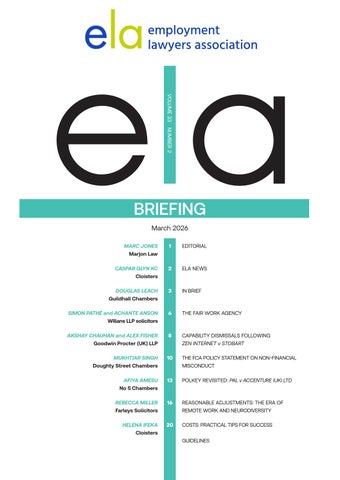
SIMON PATHÉ and ACHANTE ANSON 6 THE FAIR WORK AGENCY Willans LLP solicitors
AKSHAY CHAUHAN and ALEX FISHER 8 CAPABILITY DISMISSALS FOLLOWING Goodwin Procter (UK) LLP ZEN INTERNET v STOBART
MUKHTIAR SINGH 10 THE FCA POLICY STATEMENT ON NON-FINANCIAL Doughty Street Chambers MISCONDUCT
AFIYA AMESU 13 POLKEY REVISITED: PAL v ACCENTURE (UK) LTD No 5 Chambers
REBECCA MILLER 16 REASONABLE ADJUSTMENTS: THE ERA OF Farleys Solicitors REMOTE WORK AND NEURODIVERSITY
HELENA IFEKA 20
COSTS: PRACTICAL TIPS FOR SUCCESS Cloisters
IDS
ELA Briefing is published by IDS, part of Thomson Reuters. The IDS legal research team has been providing analysis and information on employment law since 1966.
Tel: 0345 600 9355 www.incomesdata.co.uk
Follow us on Twitter: @IDS_team
The views of the authors in ELA Briefing do not necessarily represent those of the ELA editorial board.
All rights reserved: no part of this publication may be reproduced, stored in a retrieval system, or transmitted in any form or by any means, electronic, mechanical, photocopying, recording or otherwise, without the permission of the Employment Lawyers Association.
Original design concept by Teresa Monachino www.studiomonachino.co.uk
Editor MARC JONES Marjon Law marc@marjonlaw.co.uk
Editorial committee
KATHLEEN BADA Charles Russell Speechlys LLP
CLARE FLETCHER
Slaughter and May
JO-ANNE GRAHAM / NICOLA TAYLOR Government Legal Department
DOUGLAS LEACH
Guildhall Chambers
RICHARD LINSKELL Gunnercooke LLP
CRAIG LUDLOW 3PB
SARA MEYER
DAC Beachcroft
NIKITA SONECHA Browne Jacobson
CHARLES WYNN-EVANS
University of Bristol Law School
Advertising CYNTHIA CLERK Cynthiac@elaweb.org.uk
a word from the editor
Will the rain ever stop? According to the Met Office, in parts of the UK, it has rained every day this year. On a brighter note, we have another packed ELA Briefing for you this month.
‘Judge Yallop held Mr Oxborough’s dismissal was fair, backing Lidl’s zero-tolerance stance on unpaid stock’
Legal Futures online reported an interesting Court of Appeal case regarding harassment of lawyers. Harassment arose from claims by Titan Wealth Holdings against former employee, Marian Atinuke Okunola. After breaching an earlier injunction and serving a custodial sentence for contempt, Ms Okunola was accused of sending abusive communications to lawyers. The High Court refused a further injunction, citing no cause of action between the parties. The Court of Appeal held that the High Court was wrong to find it lacked jurisdiction to grant a protective injunction against a defendant from harassing the claimants’ lawyers. It found jurisdiction existed, even where contempt was not alleged, though any order must respect Article 10 rights and litigation immunity. However, in this case, it declined relief because the proposed injunction was too broad, the conduct had ceased and a ‘far more straightforward remedy was probably available’ under the Protection from Harassment Act 1997.
This month, there are worldwide celebrations with an employment law theme. Zero Discrimination Day (1 March) aims to promote equality and eliminate discrimination worldwide. International Women’s Day (8 March) is a day to reflect on and celebrate the social, political, economic and cultural accomplishments of women. International Day for the Elimination of Racial Discrimination (21 March) commemorates the day police in Sharpeville, South Africa, opened fire and killed 69 people at a peaceful demonstration against apartheid ‘pass laws’ in 1960.
An article in the Standard caught my eye. It reported that John La, an ambulance worker, who knocked a dialysis patient he had collected from Hammersmith Hospital out of his wheelchair and handed him £20 afterwards, had been sacked. While wheeling him forward down a pavement slope, rather than backwards as trained, the patient fell and suffered wounds, including to an amputation site. The patient alleged that Mr La asked him not to report the incident and gave him £20 to ‘buy lunch’. Although Mr La reported the accident, he failed to mention the payment. Mr La was summarily dismissed for gross misconduct, including health and safety breaches and attempted bribery. He claimed unfair dismissal, but Judge Heather rejected the claim and held Mr La’s dismissal was fair.
An article in the Independent also caught my eye, reporting that Lidl employee, Julian Oxborough, had been dismissed after drinking a 17p bottle of water while on duty. Mr Oxborough, who had worked for the retailer for more than 10 years, claimed unfair dismissal. The incident occurred when a customer left behind a multipack bottle without a barcode at the checkout. Later, Mr Oxborough drank from it and used it to refill his own drink while continuing to serve customers. The next day, a manager found the bottle and reviewed the CCTV footage. Mr Oxborough said he felt dehydrated and unwell, and believed the bottle could be written off. He admitted he may have forgotten to pay but denied dishonesty. However, area manager, Karina Moon, cited inconsistent explanations and policy breaches, and Mr Oxborough was summarily dismissed for gross misconduct. Judge Yallop rejected the claim and held Mr Oxborough’s dismissal was fair, backing Lidl’s zero-tolerance stance on unpaid stock.
If you would like an article to be considered by the editorial committee, please send it to me by 6 April to ELABriefingEditor@elaweb.org.uk
I sign off this month with a quote from Saint Ambrose: ‘No one heals himself by wounding another.’
MARC JONES, Marjon Law
This will be David Regan’s final ELA Conference as Chair of Training Committee, one of the busiest committees at ELA. David has carried a heavy burden for six years and he is going out on a high. The conference will be a belter! We plan to kick off with a session on ELA’s groundbreaking research, and sessions on the Employment Rights Act (ERA) will abound as we address the new law. This conference, like the one before it, will sell out. Get your ticket now and I look forward to seeing you on 21 May.
This year is an election year at ELA, and this is my call to our members to consider standing for the Management Committee.
‘there has never been a more exciting time to join our Management Committee’
There are many roles available on the Management Committee and while some roles such as chairing committees or chairing ELA itself best suit people with an institutional knowledge of the association, there are many roles that do not. They do not require experience of ELA, just a capacity for hard extra-curricular work which is hugely rewarding.
There has never been a more exciting time to join our Management Committee. We are bigger than ever before, carrying out more training, more consultations and holding more committee meetings; we are also more active in the regions. We are a very welcoming bunch of people at ELA and our dedicated staff under James Jeynes’ leadership support us so well. ELA’s financial position is such that there are opportunities to influence employment law and drive the agenda of employment lawyers across UK. Indeed, we have positioned ourselves as ERA experts – and rightly so, as our members deliver tens of lectures on the new Act up and down the UK. In addition, ELA is feeding into new forms of dispute resolution, and is about to publish its groundbreaking research into employment tribunals. I would invite anyone who is hesitant about standing to get in touch with me (chair@elaweb. org.uk). These are exciting times for ELA. Come and be a part of it!
Recent activities
· Training Committee webinars included ‘Smart Justice? Navigating AI in employment disputes’ and ‘An Employment Lawyer’s Guide to Discrimination in Goods and Services’.
• The Legislative & Policy Committee responded to a working paper on options for reform of non-compete clauses in employment contracts.
• The Pro Bono Committee organised a webinar, ‘Introduction to discrimination law: Basic Concepts’ for those in not-for-profit organisations.
• The Pastoral Committee ran a webinar, ‘Transforming Legal Workplaces: Addiction awareness, connection and lasting change’.
• The regions: in February, there was a training course for the North East region, a St Albans Coffee morning and a Solent Training Day. There were also social meals in Leeds and Birmingham.
Looking ahead
· Training Committee: ELA Annual Conference and Dinner, London.
• ‘ELA Iftar 2026: Ramadan in the workplace’, London, 5 March.
• The In-house Committee will be holding a conference in London on 26 March.
• The Junior Committee has a speed mentoring event in London on 11 March.
• The regions: a junior training day in Leeds (19 March) and training in Birmingham (27 March).
CASPAR GLYN KC, Cloisters
in brief
Unfair dismissal round-up
On 21 January, the Government updated its ‘Employment Rights Act 2025: factsheets’ page, to add a new ‘Unfair Dismissal Factsheet’. That document indicates that the package of measures contained within the Act concerning unfair dismissal – including removal of the statutory cap on compensation – will be brought into force from 1 January 2027.
‘more at stake, may mean more appeals’
The removal of the cap has been met with much hand-wringing and consternation among commentators. Those of a more sanguine disposition may take the view, however, that a significant effect of the measure may well be a reduction in the number of lengthy trials featuring a myriad of allegations of discrimination of various sorts and/or of whistleblowing, made with an eye on circumventing the cap. How much more beautiful could life be, in a world where such claims are focused on what they are really about?
In turn, that ought to lead to a renewed focus on the law of unfair dismissal and attendant remedies: more at stake, may mean more appeals. Serendipitously, the EAT has recently handed down several judgments in the area (including Pal v Accenture (UK) Ltd [2026] EAT 12: see page 13 of this edition of ELA Briefing).
Lamb v Teva
In Lamb v Teva UK Ltd [2026] EAT 8, HH Judge Tayler provides a survey of much of the landscape of the law of unfair dismissal, highlighting the need to prove the potentially fair reason; emphasising the breadth of the range of reasonable responses test applied by tribunals; and stressing the fact-sensitive nature of tribunals’ judgments on those matters leading to limited scope for a successful appeal. Perhaps most noteworthy however, is the caution against expecting too formalised a disciplinary process (para 45):
‘When dealing with misconduct employers cannot be expected to set up their own police force to investigate the allegations, an equivalent of the Crown Prosecution Service to decide whether to bring charges or to conduct the disciplinary process as if it were the Crown Court, with a right of appeal to an equivalent of the Court of Appeal. Nor is an employer expected to conduct the process with the full rigour required in civil court proceedings. What is required is substantive industrial fairness, that takes account of the seriousness of the allegations and ensures that the allegations are investigated fairly, looking both for material that may support or undermine the allegation.’
Accordingly, the employment tribunal had been entitled to find a misconduct dismissal fair even where (i) the person who conducted the investigation provided a witness statement as part of the investigation; (ii) the note taker in the investigation also provided a witness statement as part of the investigation; (iii) evidence that was said to have materially increased the seriousness of the allegation was provided less than 24 hours before the disciplinary hearing; and (iv) the person who conducted the investigation may have been overheard saying, ‘I don’t think he is going to be back at the business’ or he ‘is done at the business’. None of those matters required the tribunal to find the dismissal unfair.
Milrine v DHL Services Ltd
The effect of the conduct of the appeal process on the fairness of dismissal was considered in Milrine v DHL Services Ltd [2026] EAT 31. The claimant was dismissed for incapability following sickness absence of over two years for various reasons. The focus of the case on unfairness in the EAT was the appeal stage:
(i) the original appeal manager declined to hear the appeal; (ii) his replacement did not turn up to the rescheduled hearing; and (iii) HR then placed the onus on the claimant to choose the appeal manager and propose dates, without confirming this to him in writing.
The claimant commenced Acas early conciliation and believed that doing so would put an end to the appeal process, but the respondent did not disabuse him or check whether he still wanted to pursue the appeal. The appeal never took place. The tribunal was critical of these features of the process, but nevertheless found the dismissal fair on the basis that the claimant had not pursued the appeal.
The EAT allowed the appeal. In the course of doing so, Judge Barry Clarke provided a thorough and convenient summary of the case law on fairness and internal appeals, building on West Midland Co-operative Society Ltd v Tipton [1986] ICR 192 (HL), and extracting the relevant principles.
In short, defects in the appeal process may render a dismissal unfair, and the tribunal had not demonstrated that it had considered that point properly. The more serious the defects, the more incumbent it is on the tribunal to demonstrate why it considers the dismissal nevertheless to be fair. The defects here were serious, and there was no suggestion that this was a case were an appeal would have been futile. A finding of unfair dismissal was substituted. Recognising that the appeal was unlikely to have resulted in continued employment however, the parties provisionally agreed that compensation would be limited to the basic award.
Chand v EE Ltd
Chand v EE Ltd [2026] EAT 17 provides a reminder of the proper approach to the analysis of the reason for dismissal. The employee was dismissed for gross misconduct, consisting of four allegations of fraud. The tribunal found that there was no reasonable basis for the employer to have concluded that any of the matters were fraudulent, but instead found that one of them seriously breached policy such that there was a different basis that would support the conclusion the employer reached (and thus, that the dismissal was fair).
HH Judge Tayler allowed the appeal and substituted a finding of unfair dismissal: it was not open to the tribunal to find a fair reason for dismissal which was not the actual reason relied upon by the dismissing officer at the time: the four allegations had been regarded as a composite whole, and that they amounted to fraud. Central planks of that reason had not been made out, in that not only was there no fraud, but only one was upheld as giving a reasonable basis for a finding of misconduct. Following Smith v Glasgow City DC [1987] ICR 796 (HL) and Robinson v Combat Stress UKEAT/0310/14; if a central plank of the reason is not proven, the potentially fair reason is not proven.
Kisheva v Secure Frontline Services Ltd
Finally in Kisheva v Secure Frontline Services Ltd [2025] EAT 194, the EAT overturned as perverse, reductions of 100% to both the basic and compensatory awards. The claimant was a door supervisor who left a shift early following an argument with a colleague which had upset her. She told her team leader that she was leaving beforehand. The claimant was summarily dismissed three days later by email for gross misconduct, no meaningful investigation or disciplinary procedure having been followed. She had 13 years’ unblemished service.
The tribunal found the dismissal unfair, but also found that leaving early without having complied with a written policy requiring a telephone call to be made explaining the reasons for absence, constituted gross misconduct. On that basis, the tribunal extinguished the awards.
Unusually, the EAT decided that the latter conclusion was not open to the tribunal: failure to comply with the telephone call procedure was not referred to as an example of gross misconduct in the code of conduct. Neither was it the respondent’s pleaded case: the ET3 made no mention of failing to comply with the telephone call procedure. Furthermore, making a phone call would have been pointless such that not doing so could not form a rational basis for a finding of gross misconduct.
The matter was remitted to a freshly constituted tribunal to consider remedy on the footing that there had not been gross misconduct by the claimant. That outcome could, of course, be significant for remedy, in that the unfairness was substantive and not merely procedural.
DOUGLAS LEACH, Guildhall Chambers
The Fair Work Agency
SIMON
PATHÉ and ACHANTE ANSON, Willans LLP solicitors
Central among the many changes introduced by the Employment Rights Act 2025 is the establishment of a new UK enforcement body – the Fair Work Agency – which is expected to launch on 7 April, although the exact date of its full enforcement powers has not been confirmed.
The Fair Work Agency (FWA) mirrors elements of Australia’s Fair Work Agency, a collaborative enforcement function conducted by Australia’s Fair Work Commission and Fair Work Ombudsman. These bodies are jointly responsible for industrial relations, maintaining workplace standards and ensuring that employers and employees comply with statutory obligations.
Historically, the UK has lacked a single, unified enforcement authority. Instead, compliance has been monitored through various fragmented channels, including employees, organisations and trade unions raising complaints or bringing tribunal claims; HMRC’s National Minimum Wage Enforcement Team; the Employment Agency Standards Inspectorate; and the Gangmasters and Labour Abuse Authority.
The UK’s FWA marks a significant shift. For the first time, monitoring and enforcement functions will be consolidated into a single body. This represents a major change in how the UK regulates and enforces employment standards.
Practical and operational approach
Given the size and complexity of the UK workforce, the FWA will not attempt to oversee every aspect of workplace activity. Instead, it will have statutory authority to detect and respond to non-compliance through targeted inspections, data-driven identification of high-risk sectors and cross agency intelligence sharing.
The FWA will also have an advisory board made up of employer representatives, trade unions and independent experts to provide balanced oversight and promote transparency.
Powers and authority
The FWA will have broad enforcement powers covering:
• holiday pay;
• statutory sick pay;
• the National Minimum Wage;
• employment agency standards;
• gangmaster licensing;
• labour exploitation and modern slavery; and
• the ability to bring tribunal claims on behalf of workers.
It will also hold significant investigatory powers, including:
• the authority to inspect workplaces;
• oversight of umbrella companies;
'ensure workplace policies
and
procedures are accurate, up to date and consistently reviewed’
• the right to request production of employment documentation;
• the ability to interview workers;
• powers to require employers to disclose evidence; and
• in some cases, stronger powers than current HMRC enforcement mechanisms.
Sanctions
Where breaches are identified, the FWA may be able to impose penalties such as:
• notices requiring payment of outstanding statutory entitlements;
• financial penalties of up to 200% of the underpayment (capped at £20,000 per individual), payable within 28 days;
• company director disqualification for repeat offenders; and
• recovery of underpayments going back up to six years.
As a result, organisations will face significantly increased scrutiny. Specifically, these will be operational areas encompassing:
• holiday pay calculation methods;
• minimum wage compliance, including permitted deductions;
• agency worker protections;
• statutory sick pay compliance; and
• robust and accurate record keeping.
Government announcements on 14 October 2025 confirmed that the FWA will prioritise ‘using new powers to ensure the estimated 900,000 people who have holiday pay withheld each year finally receive it’ and ‘cracking down on employers failing to pay the minimum wage’. Employers in sectors reliant on shift work, variable hours, agency staff or umbrella companies should expect enhanced enforcement, particularly around pay related compliance.
The FWA’s capacity to bring tribunal claims on behalf of workers is likely to reduce employer reliance on individuals not having the resources to bring claims themselves. This change removes a longstanding obstacle to enforcement and may lead to a rise in tribunal activity.
What can organisations do?
We recommend that all organisations remain informed about the Employment Rights Act (ERA) and its phased roll out. To minimise FWA-related risk, organisations should:
• conduct proactive audits and implement changes;
• ensure workplace policies and procedures are accurate, up to date and consistently reviewed – evidence of this will be key during FWA inspections/audits;
• obtain legal support to mitigate exposure to enforcement action and financial penalties; and
• provide training for managers to ensure that they understand their obligations and the consequences of non-compliance.
KEY:
Employment Rights Act 2025
Fair Work Agency
The Fair Work Agency
Capability dismissals following Zen Internet v Stobart
In Zen, the EAT provided clarity on the approach to capability dismissals in connection with a senior employee’s dismissal and considered a novel point on the application of the Polkey principle.
Zen Internet was founded by Mr Tang as an internet technology company that achieved consistent success with annual income growth. Mr Stobart, a highly regarded business leader with extensive senior management experience, was initially recruited as Chairman and mentor to Mr Tang. In September 2018, the parties agreed to swap roles, with Mr Stobart becoming CEO and Mr Tang, Chairman of the business.
Mr Stobart created a five-year strategy projecting significant revenue growth and profit increases for Zen. While the company initially made a profit in 2019, over the subsequent three years, it consistently made losses. From August 2020, Mr Tang raised profitability concerns with Mr Stobart during performance reviews, which nonetheless remained positive about his overall performance. At Mr Stobart’s final review in October 2022, Mr Tang warned that Zen was not financially sustainable and expressed scepticism over Mr Stobart’s ability to deliver a turnaround. However, Mr Tang also expressed that he was ‘very happy’ with the business direction and Mr Stobart’s work.
On 24 February 2023, Mr Tang emailed Mr Stobart insisting on swapping roles, stating he had lost confidence in Mr Stobart’s ability to achieve sustainable profitability and was not prepared to give him more chances. Mr Tang made a formal offer on 4 March for a role swap, after which Mr Stobart would become Chairman on a reduced remuneration. When Mr Stobart failed to take up Mr Tang’s offer, Mr Tang called an exceptional Board meeting on 17 March, which resulted in Mr Stobart’s dismissal (the first Board meeting). A subsequent Board meeting was called on 20 March, which led to Mr Stobart’s dismissal being brought forward to the end of March (and he was paid in lieu of the remainder of his notice period).
The employment tribunal found that Mr Stobart was unfairly dismissed as Zen failed to follow a fair procedure but, applying the principle in Polkey (ie, that a tribunal may reduce the compensatory award to reflect the chance that the employee would have been fairly dismissed had proper procedures been followed), there was nonetheless a likelihood that Mr Stobart would have been fairly dismissed had a fair procedure been followed (which the tribunal concluded would likely have happened over two months following the first Board meeting and, in any event, by no later than 31 May).
Zen appealed the decision on the basis that:
• the tribunal failed to consider whether, in light of Mr Stobart’s position as CEO, the comments in his performance reviews surrounding profitability amounted to an implied warning; and
• it erred in law in deciding that a fair dismissal would have taken place no later than 31 May (Zen submitted that the tribunal applied the Polkey assessment incorrectly by applying that principle to only the period following dismissal).
Fairness of the dismissal
The EAT found no substance to Zen’s challenge regarding the fairness of the dismissal. While the EAT acknowledged that there is no absolute requirement that, in every capability case, an employee must be given warning of performance concerns and an opportunity for improvement before a dismissal can be fair, the EAT emphasised that such procedural steps are the normal expectation (and should only be departed from in
AKSHAY CHAUHAN and ALEX FISHER, Goodwin Procter (UK) LLP
Capability dismissals following Zen Internet v Stobart ‘employers cannot bypass their own capability procedures simply because an employee holds a senior position’
exceptional circumstances). While an employee’s seniority may be relevant to the analysis of whether there is a need for warning or opportunity for improvement (which the tribunal took into account in this case), the EAT noted it would be inappropriate to lay down a general rule of law dependent upon the status or nature of an employee’s job.
The EAT upheld the tribunal’s original decision that Mr Stobart’s dismissal was procedurally unfair on the basis that Zen had failed to follow its own procedures (which were based on the Acas code) prior to the dismissal. Furthermore, the EAT concluded that the capability procedures in place had at least some practical utility and this was not one of those instances where they could be fairly dispensed with.
Application of Polkey
Zen argued that the tribunal failed to properly apply the Polkey principle to the facts as it failed to consider the counterfactual scenario from 24 February, when Mr Tang lost confidence in Mr Stobart (rather, the tribunal only considered what would have occurred after the first Board meeting on 17 March when notice of termination was given). The EAT found that Zen’s challenge to the tribunal’s finding on Polkey was justified and remitted the remedy question to the tribunal for reconsideration.
In considering the Polkey question, the EAT concluded that when predicting what is likely to have occurred if an employer had acted differently and fairly, a tribunal is not restricted to looking forward from a particular date (ie, the date of dismissal or notice of dismissal). The EAT noted that confusion may have arisen on this point as, in a typical case where a Polkey assessment is carried out, the unfairness often lies in the employer failing to take some action which would have prolonged employment – ie, there is likely to be a time gap between an actual decision to dismiss reached unfairly and a decision that may have been reached following a fair procedure. However, this will not always be the case (ie, it is possible that an employee may have been dismissed later than if a fair procedure had been followed; for example, because of an unreasonably long investigative and disciplinary process beset by delay).
Conclusions
The EAT’s decision provides important guidance on procedural fairness in capability dismissals, particularly for senior executives, and offers a crucial reminder about properly applying the Polkey principle:
• it reaffirms the principle that employers cannot bypass their own capability procedures simply because an employee holds a senior position. The fact that the performance reviews Mr Tang conducted mentioned profitability concerns did not constitute adequate warning or were a substitute for formal capability management. Particularly with the reforms that are due to come into force to unfair dismissal protection, this is likely to be a decision senior employees who are dismissed, without a sufficiently robust process, will seek to rely on when claiming compensation; and
• the EAT’s criticism of the tribunal’s Polkey assessment is particularly instructive. It is clear that tribunals must properly engage with the counterfactual scenario – what would have happened if fair procedures had been followed? – rather than simply concluding that the employer’s mind was made up. The case provides a helpful overview for parties considering how Polkey should apply in their circumstances (and opens the door for employers to argue the Polkey assessment should consider the actions they could have taken prior to dismissal, not just from the period notice of dismissal is provided).
KEY: Polkey Polkey v AE Dayton Services Ltd [1988] AC 344, [1988] ICR 142
Zen Internet Ltd v Stobart [2025] EAT 153
The FCA policy statement on non-financial misconduct
MUKHTIAR SINGH, Doughty Street Chambers
Last December, the FCA published policy statement PS25/23, introducing amendments to its Code of Conduct sourcebook, together with accompanying guidance which explains how non-financial misconduct forms part of the Fit and Proper test sourcebooks. This article follows up on ‘Biting the bad apples’ in the September/October 2025 ELA Briefing by summarising the key elements of PS25/23 and offering observations on the new regime.
What is PS25/23?
PS25/23 finalised the FCA guidance on non-financial misconduct (NFM) and brought its policy work on NFM to a close. The FCA announced (perhaps warned) that it ‘will now focus on how firms are tackling [NFM] in practice’. The guidance will come into force on 1 September 2026, at the same time as the new Code of Conduct (COCON) 1.1.7FR.
The guidance explains how firms can apply FCA rules on minimum standards of behaviour, and the factors they should take into account when assessing fitness and propriety. COCON 1.1.7FR will bring into the scope of COCON, serious cases of unwanted conduct against a colleague at Senior Managers and Certification Regime (SMCR) firms (there are around 37,000 SMCR firms), with such behaviour to become grounds for a finding of misconduct under the regulatory regime.
Amendments to COCON: application and purpose
The new rule captures NFM against a wide range of individuals beyond employees; for example, employees of service providers. This breadth of coverage goes well beyond the scope of employment law, reflecting a deliberate focus on protecting all those that may be affected by NFM.
Consistent with the proposals in its consultation paper CP25/18, there is a comprehensive new section (COCON 1.3), which provides non-exhaustive factors to help define when such conduct can be strictly considered to be outside of COCON (private or personal) or would fall within it. COCON 1.3.9G and COCON 1.3.17G provide illustrated examples and guidance on when misconduct in an individual’s private or personal life may be material to an assessment of fitness and propriety under FIT.
Guidance on individual conduct
Two examples of individual conduct that would be a breach of Rule 1 of COCON (acting with integrity) are added to COCON 4.1.1G. These are subjecting a fellow member of the workforce to ‘significant detriment’ for using the firm’s whistleblowing procedures; and harassment of a fellow member of the workforce (see COCON 4.3 discussed below).
The FCA policy statement on non-financial misconduct
‘the reference to “significant” whistleblowing detriment is regrettable: arguably all whistleblowing detriment is significant’
As to Rule 2 (due skill, care and diligence), COCON 4.1.8G now includes comprehensive new provisions relating to the positive duties of managers and includes a duty to prevent harassment; and a non-exhaustive list of examples of breaches, which includes a failure to take reasonable steps to protect staff from NFM and failing to take such complaints seriously. Managers will be able to argue that they have not breached Rule 2 on the basis that they acted reasonably (some of the relevant factors regarding reasonableness are set out in COCON 4.1.8C).
The reference to ‘significant’ whistleblowing detriment is regrettable: arguably all whistleblowing detriment is significant. Furthermore, it is notable that victimisation and other forms of discrimination (not least direct discrimination) are not included, which is consistent with COCON 1.1.7FR(4) which makes no reference to protected characteristics. This approach was in response to the feedback from firms that it would be too difficult to implement (paragraph 2.30). Accordingly, firms will need to carefully assess which regime applies in each case of NFM.
Guidance on harassment
The general non-exhaustive factors for assessing compliance (COCON 3.1) are unchanged and remain the starting point for determining whether a breach has occurred. Subject to that, NFM would be a breach of Rule 1 or Rule 2 if it is the type described in COCON 1.1.7FR(4) and it involves a lack of integrity or a failure to act with due skill, care and diligence (COCON 4.3.3G).
A new COCON 4.3 provides comprehensive, specific guidance on NFM. Under COCON 4.3.6, there are four factors to consider in deciding if the conduct falls within 1.1.7FR(4): whether the conduct was ‘serious’; its effect; its purpose; and various factors set out in COCON 4.3.16G to 4.3.18G. The FCA stresses that the new rule is only intended to cover conduct that is serious (at COCON 4.3.7G). As to whether misconduct is serious enough to amount to a breach of COCON, COCON 4.3.8 sets out the factors to take into account, which include whether the conduct would justify dismissal.
Although the factors are useful, no illustrations of seriousness are provided in PS25/23 and arguably there is wide scope to justify a finding either way. It may be the case that the reference to justifying dismissal will be the most useful factor for firms, who will need to consider employment law to determine whether the conduct amounts to gross misconduct. Furthermore, although conduct related to protected characteristics is not explicitly included in the seriousness factors, it is likely to be considered serious (para 2.30).
‘Effect of the conduct’ is explained at COCON 4.3.12G to 4.3.14G, which substantially adopts the requirements under section 26(4) of the Equality Act 2010 (EqA). There is guidance on ‘purpose’: essentially stating that there may be a breach of COCON if there is the prescribed intent even when it does not have that effect. The further factors to be considered are set out in COCON 4.3.16G to 4.3.18G, which bring in cases where the relevant effect occurs to a witness to the conduct.
Observations
The guidance suggests that the FCA has listened carefully to feedback provided in the consultation, for example, regulatory alignment with banks and more alignment with employment law. There has been a significant effort to explain COCON 1.1.7FR and the use of flow diagrams is useful as are the examples of conduct which fall outside private or personal life (COCON 1.3.7G) both in relation to COCON and FIT. Many firms (and regulatory lawyers) may need to turn to employment lawyers (or at least employment law) to better understand the principles of harassment (under COCON 1.1.7FR) and whether conduct can justify dismissal (as part of the seriousness factors under COCON 4.3.6G).
The requirement of seriousness may curtail the incidents of unwanted conduct that would amount to a breach of COCON, but would otherwise amount to harassment under s.26 EqA. The application and scope of the rules are much wider than employment law, which is a significant step towards positive cultural change. The ‘reasonable steps’ obligations introduced for managers (COCON 4.1.8) do not go as far as an obligation to
The
FCA policy statement on non-financial misconduct
‘the changes are a significant movement towards changing behaviour at FCA-regulated workplaces'
take all reasonable steps, which would have been in line with the amendment to s.40A EqA recently made by s.20 of the Employment Rights Act 2025 (ERA). Taking into account the potential career-ending consequences of breaches of COCON, the FCA approach is arguably proportionate.
The changes are a significant movement towards changing behaviour at FCA-regulated workplaces. When read with the changes to employment law enacted under ss.20-24 ERA, there is a positive policy drive to change culture and to prevent harassment.
KEY:
NFM non-financial misconduct
COCON Code of Conduct
SMCR Senior Managers and Certification Regime
EqA Equality Act 2010
ERA Employment Rights Act 2025
Polkey revisited: Pal v Accenture (UK) Ltd
AFIYA AMESU, No 5 Chambers
The decision of the EAT in Pal provides a significant restatement of the correct approach to Polkey deductions, particularly in the context of progression-based performance models and overlapping disability claims. The judgment is a reminder that Polkey is a predictive, evidence-based exercise focused on what the employer would have done, not what the tribunal considers fair in hindsight.
Factual background
The claimant commenced employment with the respondent, a global professional services firm, in August 2009 as an analyst. She was promoted to consultant level in 2011 and to a manager position in September 2013. The respondent operated a progression-based performance model, commonly described as an ‘up or elsewhere’ system, under which employees were expected to demonstrate continuous development towards the next level of seniority. Promotion from manager to senior manager was ordinarily expected within three to four years.
In September 2018, the claimant informed her employer that she required urgent surgery for ovarian cysts and was subsequently diagnosed with endometriosis. She had two periods of sickness absence related to this condition between September 2018 and January 2019, followed by a phased return to work. The claimant was assessed as ‘not progressing’ in performance reviews in August 2018 and March 2019. She was dismissed on 3 July 2019, following a meeting concerning her performance. Her appeal was unsuccessful.
The employment tribunal found that the dismissal was unfair because the respondent had failed to comply with its own disciplinary and appeals policy. However, it applied a 100 per cent Polkey deduction, concluding that the claimant would have been dismissed in any event. It also rejected the claimant’s claims of disability discrimination, finding that she was not disabled within the meaning of the Equality Act 2010 (EqA).
The EAT decision
The EAT allowed the claimant’s appeal on all grounds.
The Polkey deduction and the counterfactual error (paras 71-84)
A compensatory awarded may be reduced as per s.123(1) Employment Rights Act 1996 (ERA), to an amount the tribunal considers just and equitable in all the circumstances. That said, a Polkey deduction ‘can only be made where the employer established that it would, or might have, fairly dismissed the claimant if it had the opportunity to correct the error that rendered the dismissal unfair’ (para 51). The central error in this case was the tribunal’s approach to the Polkey counterfactual. Rather than assessing what the respondent would have
Polkey revisited: Pal v Accenture (UK) Ltd
‘employers seeking substantial deductions must adduce clear evidence explaining how a fair process would have unfolded and why dismissal would probably have followed’
done had it complied with its own procedures, the tribunal constructed a hypothetical process, effectively assuming that the employer would have introduced a new policy closely resembling the flawed process it had actually followed.
The EAT held that this was an error of law. A Polkey deduction must be grounded in evidence of the employer’s likely conduct if given the opportunity to remedy the procedural defects that rendered the dismissal unfair. It is not permissible for a tribunal to speculate about alternative policies or processes in the absence of evidence that the employer would have adopted them. The key question, therefore, is what the employer would or might have done, not what the tribunal considers would have been fair.
Capability and progression-based models
The EAT also addressed the interaction between Polkey and the respondent’s ‘up or elsewhere’ model. It emphasised that capability should be assessed by reference to the work the employee was employed to do under the contract, not by reference to readiness for promotion.
Dismissal based on a failure to progress to the next level may not amount to dismissal for capability if the employee is adequately performing in their current role (para 63). The tribunal had failed to analyse whether, had the respondent complied with its own procedures, the application of the progression model would have provided a potentially fair reason for dismissal at all (para 90).
The EAT confirmed that dismissal under an ‘up or elsewhere’ model may potentially be justified as ‘some other substantial reason’ (SOSR), provided it is capable of justifying the dismissal of an employee holding the relevant ‘position’. ‘Position’, as defined in s.235 ERA, is broader than contractual terms alone, encompassing the employee’s status, the nature of their work and their terms and conditions. The tribunal noted that SOSR can arise where an employee refuses to accept contractual changes. However, whether dismissal is justified depends on the particular position held, including expectations attached to it. For example, greater flexibility may reasonably be expected of senior employees, and in all cases, the tribunal must still assess overall fairness (paras 68-70).
Disability and discrimination arising from disability
The EAT described the tribunal’s analysis of disability as ‘wholly inadequate’ (para 103). It had failed to engage properly with the statutory definition of disability, including the likelihood of recurrence of symptoms and whether the claimant’s condition would have continued to have a substantial adverse effect absent medical treatment.
The tribunal had also failed to appropriately consider whether the respondent had actual or constructive knowledge of the claimant’s disability. The EAT noted that, had the respondent followed its own policies, further investigation would have taken place, during which the claimant’s medical condition should have been explored.
Similarly, the tribunal failed to analyse whether the claimant’s dismissal was because of something arising in consequence of her disability, such as sickness absence or a phased return to work, or whether dismissal was a proportionate means of achieving a legitimate aim. These failures undermined both the discrimination findings and the Polkey assessment.
Practical implications
The decision reinforces several important points for practitioners. First, Polkey deductions are evidentially demanding. Employers seeking substantial deductions must adduce clear evidence explaining how a fair process would have unfolded and why dismissal would probably have followed. Tribunals are not entitled to fill evidential gaps with their own assumptions.
Secondly, where progression-based performance models are relied upon, careful analysis is required to distinguish between performance in role and readiness for promotion. That distinction may be determinative both of fairness and of the Polkey counterfactual.
Polkey revisited: Pal v Accenture (UK) Ltd ‘employers who fail to effectively prove inevitability cannot expect total deductions’
Thirdly, Polkey cannot be assessed in isolation from other claims. Errors in analysing disability, knowledge or causation may fatally undermine findings on remedy.
What can parties do?
For respondents: evidence is paramount
Respondents seeking to rely on Polkey must be able to demonstrate, with specificity, what would have occurred had a fair procedure been followed. This requires:
• witness evidence from relevant decision-makers;
• contemporaneous documentation supporting the employer’s rationale and intended process; and
• a clear explanation of how concerns would have been addressed through warnings, reviews or alternative measures.
Without such evidence, tribunals may be unable to conclude that dismissal was likely, let alone inevitable.
For claimants: test the counterfactual
Claimant representatives should rigorously challenge assertions that dismissal would have occurred in any event, including by:
• scrutinising the coherence and credibility of the employer’s evidence;
• exploring whether alternative outcomes, such as redeployment or further support, were realistically available; and
• considering whether alongside procedural failings there is an absence of genuine consideration.
Conclusion
Pal does not change the law on Polkey, but it sharpens its application. By re-emphasising that the counterfactual must be supported by evidence from the employer, this case is a timely reminder that employers who fail to effectively prove inevitability cannot expect total deductions.
KEY:
EqA Equality Act 2010
ERA Employment Rights Act 1996
Pal Pal v Accenture (UK) Ltd [2026] EAT 12
Polkey Polkey v AE Dayton Services Ltd [1988] AC 344, [1988] ICR 142
SOSR some other substantial reason
Reasonable adjustments: the era of remote work and neurodiversity
REBECCA MILLER, Farleys Solicitors
The duty to make reasonable adjustments under the Equality Act 2010 has always been a practical, factsensitive exercise rather than a tick-box one. What has changed over the last few years, however, is the workplace context in which that duty is tested. Hybrid work is established, digital communication is the norm and neurodiversity is raised more frequently in employee relations processes.
For lawyers, the key shift is evidential as tribunals increasingly analyse what the employer has already shown to be workable (especially remote work), how well it consulted and whether barriers were treated as individual and dynamic.
Against that backdrop, the boundaries of what is reasonable are evolving in three notable ways:
• remote and hybrid working are no longer exceptional arrangements, making it harder for employers to argue that physical presence is inherently necessary for roles that have been performed successfully from home;
• communication itself is increasingly treated as a workplace barrier and employers are being pushed towards more individualised approaches as to how information is shared, meetings are run and decisions are explained; and
• neurodiversity is driving a more detailed understanding of disability and disadvantage with a growing emphasis on the functional impact of conditions such as ADHD, autism and dyslexia, rather than assumptions about what they should look like.
1) The legal framework briefly but with a 2026 lens
The duty arises where a disabled person is substantially disadvantaged by:
• a provision, criterion or practice (PCP);
• a physical feature; and/or
• the absence of an auxiliary aid or service.
The Equality and Human Rights Commission (EHRC) has recently reinforced that this duty is positive and proactive, applies across all stages of employment and extends fully into hybrid working arrangements. What that means in practice in 2026 is that the tribunal reasonableness analysis is increasingly shaped by:
• what the employer has already shown to be workable (for example, years of remote performance);
• how well the employer consulted and evidenced its thinking; and
• whether barriers were treated as individual and dynamic, rather than static.
2) Remote working as an adjustment for employees
Remote working remains one of the most litigated adjustments. Employers now struggle to justify attendance requirements where remote performance has historically been successful.
Reasonable adjustments: the era of remote work and neurodiversity
‘tribunals are scrutinising disability assessments more closely, especially for ADHD, autism and dyslexia’
Pryce, a Glasgow tribunal decision, illustrates this. In this case, the employer refusing full-time homeworking for an employee with multiple anxiety-related conditions was found unreasonable because the employer relied on generalisations (team cohesion, spontaneity) rather than specific operational needs.
For employment lawyers:
• defending employers requires clear, role-specific evidence of why presence is required; and
• representing employees means scrutinising vague cultural arguments and relying on historic remoteperformance evidence.
3) The limit of the duty is that adjustments must work to avoid or reduce the disadvantage
The duty is not unlimited, and adjustments must realistically alleviate the disadvantage. In Hindmarch, a refusal to supply an FFP3 mask was upheld because it would not have enabled the employee to return to work. The tribunal had found that the employer did not fail to make a reasonable adjustment or unfairly dismiss the employee as supplying him with the mask had no realistic prospect of returning him to work due to his anxiety.
Lawyers should emphasise that employers must evidence why an adjustment will not work, usually by obtaining medical or occupational health advice, and should not rely on intuition or assumption.
4) Communication as an adjustment: representatives, formats, and meeting design
Communication-related PCPs are now central, especially for neurodivergent employees or those with mental health impairments. EHRC hybrid guidance and Acas neurodiversity guidance both treat meeting participation and information processing as potential barriers.
Adjustments now commonly include:
• written agendas and structured meetings;
• questions shared in advance;
• single-channel communication;
• written follow-up after feedback; and
• allowing a representative to attend for support (even beyond statutory rights).
From a legal perspective, these are low-cost, high-impact adjustments that tribunals increasingly expect employers to consider.
5) Neurodiversity and disability require a more careful approach to substantial adverse effect
Tribunals are scrutinising disability assessments more closely, especially for ADHD, autism and dyslexia.
In Stedman, the tribunal was criticised for offsetting the claimant’s strengths against their difficulties and for misapplying the substantial adverse effect test.
For lawyers, the definition of disability under the EqA is determined by how an individual is impacted in their day-to-day life. Achievements in certain areas, does not eliminate the presence of significant challenges in others.
Tribunals are increasingly alive to the risk of stereotypes particularly where neurodivergent individuals can function well in some domains but experience significant impairment in others (for example, concentration, social interaction and sensory environments).
6) Adjustments are becoming more anticipatory and individualised
Tribunals and guidance increasingly expect employers to behave proactively once they know (or ought reasonably to know) that an employee may be disabled and disadvantaged.
The EHRC guidance explicitly states that employers must make adjustments where they know, or could reasonably be expected to know, and should do what they can to find out without intrusive or dignity-violating questioning.
Reasonable adjustments: the era of remote work and neurodiversity
‘in neurodiversity contexts, this often means employers should not wait for a formal diagnosis before acting’
In neurodiversity contexts, as well as with other mental and physical impairments, this often means that employers should not wait for a formal diagnosis before acting as an employee may still have a disability within the meaning of s.6 EqA without a diagnosis, and employers should offer support and consider adjustments.
7) Reasonable in 2026: what tribunals appear to be weighing most
While each case turns on its facts, recent themes suggest tribunals are giving significant weight to:
• feasibility – historic remote work is powerful evidence;
• consultation quality – early, structured and documented;
• timeliness – delays can amount to discrimination;
• specificity – concrete operational requirements, not broad cultural themes;
• efficacy – whether the adjustment actually reduces the disadvantage; and
• trialability – trial reasonable adjustments (as in the case of Rentokil) can be powerful as it demonstrates engagement and produces evidence.
These factors inform both claim strategies and employer defence positioning in the tribunal.
8) Practical guidance on handling requests without falling into common traps
For lawyers advising employers:
Step 1: identify the PCP precisely
This is often where cases are won or lost. Typical 2026 PCPs include office attendance rules, performance feedback styles and digital communication expectations.
Step 2: clarify disadvantage without diagnosing
Use functional, open questions and document the employee’s account of the barriers in their own words.
Step 3: consider adjustments across home, office and online settings
Tribunals expect consideration of hybrid-specific barriers and suggests exploring digital support, equipment and policy design.
Step 4: trial and review
Trials generate the evidence tribunals look for which is what has actually happened when the adjustment was implements and reviewed over time.
Step 5: document reasoning
Records should cover the PCP, disadvantage, options considered, cost and operational impact and medical evidence.
Common pitfalls
The following are common pitfalls:
• treating office presence as essential;
• overreliance on possible future enforcement of policies;
• waiting for a formal diagnosis;
• delay implementation of an adjustment; and
• ignoring communication barriers;
Conclusion: a forward look for lawyers
Reasonable adjustments disputes in 2026 revolve around evidence, consultation quality and hybrid-working realities. Lawyers should help clients:
• identify barriers;
Reasonable adjustments: the era of remote work and neurodiversity
‘the best outcomes are rarely achieved by debating abstract reasonableness; they come from practical problem-solving, early engagement’
• consult meaningfully and document clearly;
• deploy trials to generate evidence; and
• train managers to recognise communication and hybrid-related PCPs.
For lawyers, the opportunity is to help clients get ahead of disputes by embedding these principles into policies, training and capability/performance processes, particularly where communication practices and hybrid working models can unintentionally create disadvantage.
The best outcomes are rarely achieved by debating abstract reasonableness; they come from practical problem-solving, early engagement and records that show a genuine effort to remove barriers whether those barriers arise in the office, on Teams or in the way instructions are communicated.
KEY:
EqA Equality Act 2010
PCP provision, criterion or practice
EHRC Equality and Human Rights Commission
Pryce Pryce v Accountant in Bankruptcy [2024] 6000082/2022
Hindmarch Hindmarch v North-East Ambulance NHS Foundation Trust [2025] EAT 87
Stedman Stedman v Haven Leisure Ltd [2025] EAT 82
Rentokil Rentokil Initial UK Ltd v Miller [2024] EAT 37
Costs: practical tips for success
HELENA IFEKA, Cloisters
The Briefing considers the principles and procedure governing costs application and shares practical tips for achieving costs awards in the employment tribunal, with a focus on applications made under rule 74(2)(a) and (b).
Procedure
Rules 74 and 75 (Part 13) of the Employment Tribunal Procedure Rules 2024 govern when and how a costs order may or must be made.
Under rule 74(1), the tribunal may make such an order of its own initiative or on the application of a party. There are multiple grounds. A costs order may be made under rule 74(2) if the party has acted disruptively in the way they conducted proceedings; if the claim, response or reply had no reasonable prospect of success; and if the hearing was postponed or adjourned on application less than seven days before the date on which it was listed to begin (or in fact began). While the wording of rule 74(2) is that the tribunal ‘must consider making a costs order’, if one of the three grounds set out above is engaged, experience shows that tribunals rarely make costs orders of their own volition. One party must raise the issue.
In addition, under rule 74(3), a costs order may be made where a party has breached any order, rule or practice direction, or where a hearing has been postponed or adjourned (regardless of whether it was postponed less than seven days before the listing date).
Finally, rule 74(4) provides a ground specific to respondents in unfair dismissal proceedings.
Pursuant to rule 75(1), a party may apply for a costs order ‘at any stage up to 28 days after the date on which the judgment finally determining the proceedings in respect of that party was sent to the parties’. While it is, in principle, open to a party to apply for costs at an early stage of proceedings, it is more common in practice that the successful party applies for costs after a final hearing.
TIP: When defending unfair dismissal claims, beware rule 74(4). Those acting for respondents can sometimes assume that the employer will succeed in defending the claim and spend little if any time gathering evidence to resist reinstatement or reengagement. But if the claimant tells the respondent not less than seven days before the final hearing that she wants to be reinstated or re-engaged, and the respondent fails without a special reason to adduce reasonable evidence as to the availability of the job from which she was dismissed, or of comparable or suitable employment, and that failure results in the final hearing being postponed or adjourned, the tribunal must order that the respondent pay the costs incurred as a result of the postponement or adjournment.
Costs: practical tips for success
‘if a liability judgment has been handed down orally at a hearing, you may want to make a costs application orally’
TIP: If a liability judgment has been handed down orally at a hearing, you may want to make a costs application orally. An oral application could be suitable if you have decided to apply only for a portion of your costs and can make brief submissions. It is good practice to give the other side notice that you will be making (or may make) an oral application, and, of course, be ready to hand up your costs schedule to the Judge.
Under rule 75(2), the tribunal must not make a costs order unless the respondent (the prospective paying party) ‘has had a reasonable opportunity to make representations (in writing or at a hearing …)’. It is possible for a costs application to be decided on the papers, if the respondent to the application provides written submissions. However, in practice, if the application is contested, as it inevitably will be, the tribunal will usually list a costs hearing to be heard by the same judge who determined the claim.
Costs warnings
In tribunals, costs do not ordinarily follow the event: Gee per Sedley LJ at para 35. But a detailed costs warning, based on careful review of the evidence, may well discourage a claimant from continuing with unmeritorious claims – and, if it does not discourage her and she loses at trial, is likely to assist with a costs application.
A costs warning may be made in respect of any cause of action or response (Opalkova at para 15). In the author’s opinion, a costs warning may also be made in respect of a specific allegation.
Good costs warnings are detailed. They require time and thought to prepare. They should not be whipped out in an hour using generic wording or tacked onto the end of a letter as an afterthought.
At an early stage, review disclosure and hold a conference with key witnesses to test and explore their evidence. If you are confident that the claim (or allegations or causes of actions within the claim) has no reasonable prospect of success, set out your reasons under each cause of action or allegation in a without prejudice save as to costs letter. In that same letter, you should also provide a realistic estimate of your client’s costs if the matter proceeds to trial. Adopt a measured tone. Outline the law – break down the elements of each cause of action and explain why each allegation or cause of action is likely to fail. For a litigant in person, be sure to highlight and repeat the direction in any case management order to sources of free legal advice. Urge them to take advice. Invite them to withdraw their claim, ideally by a specific date.
Your assessment of merits may well change after the other party has disclosed their evidence (see, on this point, Huntley at paras 29-33 and 51). Accordingly, your position on costs should be kept under review throughout the course of litigation. If appropriate, issue separate costs warnings at different stages of the litigation. This will keep your options open. If you win, you may choose to claim all of your costs, or only the costs after your first or second costs warning.
TIP: A written costs application should set out the relevant principles and outline submissions. A short bundle, composed of pleadings, written reasons (or, alternately, counsel’s note of judgment), costs warning letters, and a costs schedule, should accompany the application.
Costs: practical tips for success
‘good costs warnings should not be whipped out in an hour using generic wording or tacked onto the end of a letter as an afterthought’
TIP: Costs warnings can be made:
(i) after your review of evidence or after mutual disclosure;
(ii) after proofing witnesses and exchanging statements, when it is clear the other side has nothing to rely on other than his sincere belief that he has been discriminated against (see, for example, Keskar at pp 497B-D);
(iii) and/or some weeks prior to a final hearing, before counsel’s brief fee will be incurred. At this junction, if appropriate, the warning could be combined with a drop hands offer.
If a represented party fails to issue any costs warning during proceedings but later applies for costs under rule 74(2)(b) (the claim had no reasonable prospect of success), their task may be more difficult (see for example Rogers at para 10, which, while decided under Employment Appeal Tribunal Rules, may be applied in the tribunal). On the other hand, if your carefully drafted costs warning predicts the outcome at tribunal, you can rely on it to submit that the unsuccessful party’s failure to engage with the points made in the costs warning was unreasonable (Peat at para 28).
Legal principles
There are three questions for the tribunal to consider:
• has the costs threshold been crossed?
• if so, should the tribunal exercise its discretion to award costs?
• if so, what amount of costs to order?
The first question: the costs threshold
Whether the costs threshold is crossed is an objective test (Radia at paras 61-62) to be determined by looking at the whole picture of what happened in the case, whether the claimant’s conduct was unreasonable, and if so, what effects it had (Yerrakalva at para 41 per Mummery LJ). The threshold test is the same, regardless of whether the party is a litigant in person or is professionally represented.
However, when deciding whether the costs threshold is met, the tribunal must consider whether the unsuccessful party was acting as a litigant in person and, if so, whether they had access to specialist help or advice at any stage in the proceedings (for example, if solicitors were on the record at some stage, if they had trade union support, a direct access barrister or received advice from the CAB or Free Representation Unit). The tribunal should not judge a litigant in person by the same standards as a competent and experienced lawyer, especially if a litigant is involved in legal proceedings for the first time in their life. This does not mean litigants in person are immune from orders for costs: far from it. Just as there is equality of access to the tribunal, so too is there ultimate equality of treatment. Whoever presses on with a doomed case after due warning faces the same risk of costs (Gee at para 34; AQ Ltd at paras 32-33).
Unreasonable conduct
Unreasonable has its ordinary meaning: Dyer per Browne-Wilkison J (P) at p 8. Whether a party’s conduct in the proceedings has been unreasonable is to be assessed objectively, considering all the circumstances: Yerrakalva at para 41.
The meaning of ‘conduct’ in proceedings is a broad concept (Gold at para 17) and, in principle, there is no limit on the type of conduct that could be considered unreasonable (Leeks at para 61) and there is no requirement for a precise causal link between the unreasonable conduct and the specific costs claimed (Yerrakalva at para 41). The examples are too numerous to list, but by way of example, voluntarily removing a company from the company register and failing to notify the claimant of the company’s imminent dissolution
Costs: practical tips for success
‘the tribunal should not judge a litigant in person by the same standards as a competent and experienced lawyer, especially if a litigant is involved in legal proceedings for the first time in their life’
was unreasonable, because the tribunal inferred that the conduct was part of the employer’s litigation strategy and was intended to defeat enforceability of judgment: Gold at paras 21-25.
Sometimes the victorious party does not make a costs application but must resist one made by the unsuccessful litigant. In those circumstances, the respondent may pray in aid the unreasonable conduct of the litigant to defend itself against the costs application. In Day, the unsuccessful claimant, Dr Day, made an equally unsuccessful costs application against his former employer. The NHS Trust cited a number of facts to resist the application and to argue that Dr Day’s own conduct had been unreasonable: the witnesses he had called and the lack of relevance of their evidence to the issues, Dr Day’s evasiveness when cross-examined, and his exceptionally long witness statement of 90 pages, which also was not confined to the issues and set out matters decided in previous proceedings.
The tribunal accepted that his conduct had increased the costs for the Trust and for the tribunal, both of which were publicly funded bodies, and declined to award costs, a decision upheld on appeal by the EAT.
TIP: While it may be helpful to review decided cases to understand how the tribunal has approached different facts or issues in the past, remember Underhill LJ’s dicta in Yerrakalva at para 42: costs decision in one case will not generally determine the outcome of a costs application in another.
No reasonable prospect
When deciding a costs application on the basis that a claim had no reasonable prospect of success, the tribunal should consider the information that was available at the date from which costs are sought, including information the tribunal has gained from hearing the case. It should not consider information which would not have been available to the parties at the date from which costs are sought: Radia at paras 65 and 67.
In Madu, HH Judge Taylor held that it may be difficult for a claimant in a discrimination claim, for which there appears to be some (albeit limited) supporting evidence, to form a clear view of merits ‘because the outcome is likely to turn on witness evidence given at the final hearing’. However, witness evidence and credibility is critical to any claim. In the author’s opinion, there is no special rule of principle applicable to litigants in person who bring discrimination cases. The real question is, on the evidence before them, when ought the claimant to have understood that their claim had no reasonable prospect of success?
The second stage: whether to exercise discretion
If the threshold is made out, the second question is whether the tribunal should make a costs order. This is an exercise of judicial discretion, to be made in accordance with recognised principles.
TIP: If, after you have applied for costs, the claimant has behaved unreasonably or vexatiously, it may be appropriate to flag their conduct to the tribunal as another factor weighing towards the tribunal exercising its discretion to order costs.
Costs: practical tips for success
‘on the evidence before them, when ought the claimant to have understood that their claim had no reasonable prospect of success?’
The third stage: quantum
Pursuant to rule 82, when deciding whether to make a costs order, the tribunal may have regard to the paying party’s ability to pay, but is not obliged to do so: Vaughan at paras 26 and 28. If the tribunal decides not to have regard to the paying party’s means, it should say why; equally, if the tribunal decides to have regard to means, it should set out its findings about the party’s ability to pay, what impact this has had on its decision as to whether to award costs or on the amount of costs and explain why, in brief terms: Jilley at paras 44 and 55.
Costs are compensatory not punitive and should be limited to what has been reasonably and necessarily incurred: Yerrakalva at 54. It is not necessary for the applicant to establish a precise causal link between the unreasonable conduct and the costs incurred: Yerrakalva at para 41.
Costs may be sought for the whole of the litigation (Radia) or from a point in time forwards (Huntley). The right approach will depend upon the facts and circumstances. However, when costs are sought from a point in time forwards, that approach is consistent with the overriding objective because it encourages litigants at all stages of the litigation to review their prospects of success and ensure that they are only pursuing claims and defences that have a reasonable prospect of success (Huntley at para 30).
TIP: If a party applies for costs under rule 74(2)(b) but has not applied for strike out (or a deposit) during proceedings, that ‘failure’ may, depending on the circumstances of the case, be of potential relevance to the tribunal deciding the costs application. However, there may be any number of reasons why a party, especially an employer, has decided not to apply for strike out: the notoriously high barrier to strike out discrimination claims, the desire to avoid the costs of a preliminary hearing or the fact that the claimant is an existing employee and the employer is trying to agree settlement. A ‘failure’ to apply for strike out (or a deposit) may be of potential relevance but it is not determinative of and should not bar a costs application: Huntley at para 52; AQ Ltd at para 34; Vaughan at para 14(1).
There are three possible approaches to assessing quantum. The first approach is to assess costs on a broad brush summary basis up to a cap of £20,000. Even if the applicant has incurred more than £20,000 in costs, summary assessment can be a sensible approach to take, because it demonstrates reasonableness, particularly when acting against a litigant in person, and avoids the costs of a detailed assessment hearing.
The second approach is to seek a detailed assessment of costs to be carried out in accordance with the Civil Procedure Rules or by the tribunal applying the same principles. There is no cap on costs under this avenue.
The third, and perhaps least common approach, is for the parties to agree between themselves the amount of costs which the paying party will pay.
If, when deciding the quantum of an award, the tribunal does exercise its discretion to consider the paying party’s means, the tribunal is not limited to considering the paying party’s ability to pay at the date the order is made. It is legitimate to consider a party’s future prospect of being able to pay a substantial amount of a costs award, so that a respondent may be able to obtain some costs recovery (Arrowsmith at para 37), and to take account of other sources of income, including family means and a loan (Abaya at paras 24-25). The focus, however, should be on the paying party’s ability to pay (QR at paras 61-62).
‘it
Enforcement
Costs: practical tips for success
is legitimate to consider a party’s future prospect of being able to pay a substantial amount of a costs award’
Once you have obtained a costs judgment in your client’s favour, the paying party has 14 days from the date the judgment takes effect to pay the amount of money due.
Practically, enforcement is through the civil courts. The cheapest and most expedient method is the Fast Track Enforcement Scheme using form EX727.
SUBMISSION: articles should be emailed as a Microsoft® Word attachment to ELABriefingEditor@elaweb.org.uk by the copy deadline (details on the website or from the editor) in order to be considered for that month’s issue. Articles may be held over to a subsequent month if there are space constraints.
PHOTO: all submitted articles should be accompanied by a highresolution portrait ‘headshot’ photograph of the author(s) in jpeg or tiff format (a minimum of 5cms at a quality of 300dpi).
REFERENCES: at the end of the article, list the short form and full name (with un-italicised case reference) of all cases and legislation, in the order in which they appear in the article. Please provide a hyperlink in the key to any case report cited, and for any reports and legislation you mention (for the digital edition).
CONTENT: articles should examine recent case law developments or legislative proposals, providing succinct analysis and practical tips and keeping the facts to a minimum (for example, there is often no need to summarise the decision of a lower tribunal). Submissions can also be opinion pieces, checklists, overviews of a topic suitable for more recently qualified readers, overviews of foreign laws or discussions of topics related to employment law, such as HR practice. ET decisions are rarely suitable. Articles should be balanced and address both employer and employee viewpoints where possible. They should be written in an accessible style, with short sentences and paragraphs, sub-headings to signpost underlying content, a conclusion and no footnotes.
WORD COUNT: for all articles must be either 600-650, 1,100-1,200 or 1,800-1,900 words (reflecting the page length).
TITLES: should be no more than 50 characters, followed by the author’s name and firm/chambers. The topic should be clear from the title.
INTRODUCTION: begin with a ‘standfirst’ paragraph of 30-40 words, which should introduce the subject covered in the article.
EXTRACTS: suggest a phrase or short sentence for each page, to be extracted as quotes.
SUB-HEADINGS: only use initial capitals for the first word.
BULLETED LISTS: use bulleted lists rather than numbered or lettered paragraphs. Short lists should be introduced with a colon, begin with a lower case letter (unless, for example, there is a name) and have no punctuation at the end. Longer bulleted paragraphs should be punctuated at the end with semi-colons and with a full stop on the final bullet.
ABBREVIATIONS:
• use symbols (%, US$,€ ); do not use ampersand unless it is part of a name
• use numerals for all numbers except one to nine and million/billion
• do not use stops for abbreviations such as etc, ie, eg
• use acronyms where they exist, but with initial capital only: Acas, Ofcom, Nato, Defra
• use standard abbreviations for organisations and the like (CBI, ECJ, EAT, MoJ, BIS, ELA)
• if no standard abbreviation exists, first use its full name, then a short form
• only define short forms (in brackets without quote marks) if not doing so would be confusing
• refer to all legislation and cases (italicised) using an abbreviated form taken from the key
• sections of legislation should appear as follows: s.94 ERA (ERA s.94 at the start of a sentence), ss.94-95 ERA
CAPITALS: use initial capitals for languages, personal titles, names of places, institutions (such as the current Government) and publications, statutory provisions (other than section and paragraph), months and public holidays. Use lower case for job titles (such as director, editor) and legal descriptors such as claimant, defendant, judge, counsel, court, tribunal, etc.
DATES: display in the following format: 24 July 2012.
ITALICS: italicise case names and names of publications.
QUOTES: use single quote marks where quoting from judgments or legislation (except for quotes within quotes). Do not italicise. Include paragraph and page references in brackets after the quote mark (para 12, p.12).