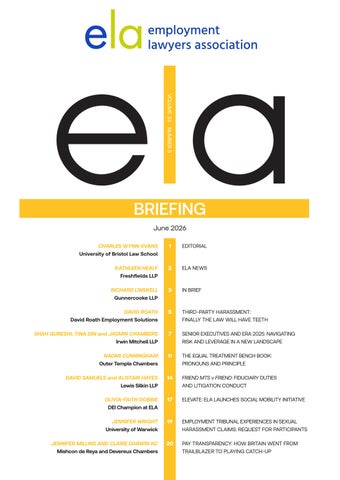
CHARLES WYNN-EVANS 1 EDITORIAL University of Bristol Law School
KATHLEEN HEALY 2 ELA NEWS Freshfields LLP
RICHARD LINSKELL 3 IN BRIEF Gunnercooke LLP
DAVID ROATH 5 THIRD-PARTY HARASSMENT: David Roath Employment Solutions FINALLY THE LAW WILL HAVE TEETH
SHAH QURESHI, TINA DIN and JASMIN CHAMBERS 7 SENIOR EXECUTIVES AND ERA 2025: NAVIGATING Irwin Mitchell LLP RISK AND LEVERAGE IN A NEW LANDSCAPE
NAOMI CUNNINGHAM 11 THE EQUAL TREATMENT BENCH BOOK: Outer Temple Chambers PRONOUNS AND PRINCIPLE
DAVID SAMUELS and ALISTAIR HAYES 14 FRIEND MTS v FRIEND: FIDUCIARY DUTIES Lewis Silkin LLP AND LITIGATION CONDUCT
OLIVIA-FAITH DOBBIE 17 ELEVATE: ELA LAUNCHES SOCIAL MOBILITY INITIATIVE DEI Champion at ELA
JENNIFER WRIGHT 19 EMPLOYMENT TRIBUNAL EXPERIENCES IN SEXUAL University of Warwick HARASSMENT CLAIMS: REQUEST FOR PARTICIPANTS
JENNIFER MILLINS AND CLAIRE DARWIN KC 20 PAY TRANSPARENCY: HOW BRITAIN WENT FROM Mishcon de Reya and Devereux Chambers TRAILBLAZER TO PLAYING CATCH-UP
IDS
ELA Briefing is published by IDS, part of Thomson Reuters. The IDS legal research team has been providing analysis and information on employment law since 1966.
Tel: 0345 600 9355 www.incomesdata.co.uk
Follow us on Twitter: @IDS_team
The views of the authors in ELA Briefing do not necessarily represent those of the ELA editorial board.
All rights reserved: no part of this publication may be reproduced, stored in a retrieval system, or transmitted in any form or by any means, electronic, mechanical, photocopying, recording or otherwise, without the permission of the Employment Lawyers Association.
Original design concept by Teresa Monachino www.studiomonachino.co.uk
Editor
CHARLES WYNN-EVANS
University of Bristol Law School
Editorial committee
KATHLEEN BADA
Charles Russell Speechlys LLP
CLARE FLETCHER
Slaughter and May
JO-ANNE GRAHAM / NICOLA TAYLOR Government Legal Department
DOUGLAS LEACH
Guildhall Chambers
RICHARD LINSKELL Gunnercooke LLP
CRAIG LUDLOW 3PB
SARA MEYER
DAC Beachcroft
NIKITA SONECHA Browne Jacobson
Advertising CYNTHIA CLERK Cynthiac@elaweb.org.uk
a word from the editor
As I take over the editorship of ELA Briefing, I would like to record my and ELA’s thanks to Marc Jones for his immense contribution over six years as editor and 25 years on the editorial committee. Slightly intimidated by the quality, variety and consistency of the editorials that Marc – and his predecessors, Alex Lock and Anna Henderson – produced, and conscious of how topical AI is, I did ask a well-known AI agent to suggest a draft for my first editorial. Perhaps unsurprisingly, I did not adopt its ‘work product’, which reminded me of a comment I read somewhere recently that AI’s writing recalled Tennyson’s description of the beautiful Maud: ‘Faultily faultless, icily regular, splendidly null. Dead perfection; no more.’
‘we plan to broaden the scope of the journal as a resource for employment lawyers at all stages of their careers’
Writing this editorial fresh from the ELA Annual Conference, with its recordbreaking attendance and breathtaking range of high quality sessions, I remain struck by how one of the most engaging aspects of the practice of employment law is its sheer breadth – in terms of the substantive legal topics it encompasses, the legal techniques it engages and the professional skills involved in client and matter management. I hope that we can continue in ELA Briefing to reflect that broad canvas of employment law practice in our coverage. While we will, of course, continue to focus primarily on the key developments and themes in employment law, we also plan to broaden the scope of the journal as a resource for employment lawyers at all stages of their careers by including, from time to time, contributions on wider issues affecting the practice of employment law – such as regulatory issues affecting solicitors and barristers, immigration and pensions developments, the handling of public relations issues and career development. We also plan to include more summaries of ELA’s responses to Government consultations and calls for evidence in order to provide accessible updates on and give appropriate credit to the valuable and time-consuming effort that the many colleagues involved in those responses commit to this important aspect of ELA’s work.
It is a fascinating time to take over the editorship of ELA Briefing as we move into what might be described as the implementation phase of the Employment Rights Act 2025, during which many issues of interpretation and the practical responses of employers, employees and trades unions will need detailed consideration and become all the more urgent – and in relation to which ELA’s membership can provide essential insight as content providers for this journal.
I am really looking forward to working with our excellent editorial committee, have promised various people that I will ensure that TUPE coverage does not become disproportionate and encourage you all to keep the submissions coming. If you have an idea for an article, but are unsure whether the topic would be suitable, please do not hesitate to contact me at ELABriefingEditor@elaweb.org. uk All and any suggestions for improvements to the journal will be very welcome. I hope to continue Marc’s tradition of ending his editorials with a quotation, so I leave you with Lord Denning: ‘If we never do anything that has not been done before, we shall never get anywhere. The law will stand still whilst the rest of the world goes on; and that will be bad for both.’
CHARLES WYNN-EVANS, University of Bristol School of Law
As I write this, our 2026 Annual Conference is drawing to a close. With record numbers of attendees (we smashed through the 700 number this year) and with content that was varied, thoughtprovoking and challenging (within the confines of what ELA is allowed to do, being firmly apolitical), it made me incredibly proud to be your new Chair but also somewhat daunted at the challenge. The flagship event was the plenary with Sarah Fraser Butlin KC and Professor Catherine Barnard, chaired by Caspar GIyn KC, launching the book summarising two years of research into the current challenges facing our employment tribunal system. The research got ELA substantial media interest to coincide with the launch and the conference, which was great, but also makes you realise that what is front page news on one day is the next day’s footnote, with new stories ready to be scrolled.
‘we need the Government to engage with the brilliantly practical solutions to help support the tribunal system’
That will not do here. It simply will not do. Now we have the unequivocal output from the research and the clear themes that have emerged, we need the Government to engage with the brilliantly practical potential solutions to help support the tribunal system to clear the backlog, reduce the number of new claims and allow it to better do what it does best, providing swift, simple access to justice for worker and employer alike. Now is the time to push and shove, and demand engagement to ensure that the brilliant research and the bang with which it was launched is followed by concrete action.
The next meeting of the Department for Business and Trade’s Dispute Resolution Taskforce is set for this month, and we will hopefully see then the direction of travel and where we need to focus our efforts.
For those of you who managed to make the conference, I hope you got to see the ‘thank you’ message we recorded for our outgoing Chair. Caspar has been a tower of brilliance, thought leadership, engagement and unending enthusiasm for all things employment law related – and a simply brilliant Chair. Caspar has agreed to remain involved with the research project and translating words into action. Given that ELA, under Caspar’s leadership, has sponsored this project from its inception, we are very happy that Caspar has agreed to remain closely involved in the coming months.
My new Deputy Chair, Beth Hale, and I are sitting down shortly to discuss what our other priorities should be for ELA for the next two years. So far our broad themes are continuing to engage with the regions and ensuring as far as possible that ELA does not drift to being London-centric, promoting the brilliant work done by ELIPS and rustling up new volunteers, and paying particular attention to our junior members and the impact on all of us, but particularly them, of the (seemingly inexorable) rise of AI.
Lots to do. Please do contact me or to Beth for ideas, requests, comments or feedback. We are here to listen and to do.
KATHLEEN HEALY, Freshfields LLP
in brief
Employment tribunal reform: ELA blazes a trail
Most of you will have noticed the publication on 21 May of the book, Reimagining Employment Dispute Resolution and Enforcement, based on research funded by ELA. The co-authors Sarah Fraser Butlin KC, Catherine Barnard and Dr Maayan Menashe have analysed problems caused by the broken tribunal system and proposed, based on evidence, a way to break the cycle of ever-increasing backlogs and delays which pose a serious challenge to the delivery of justice. The launch at our conference generated much interest and excitement, and a full article on the proposals will appear in next month’s edition of ELA Briefing, but I was just able to fit in this brief summary before publication.
The proposal has four main limbs:
‘this really is an exciting moment for employment lawyers’
(i) amend the Acas code to make disciplinary processes a last resort and to make it clear that parties must attempt to resolve issues informally before a claim is brought;
(ii) establish an Employment Resolution Service (within the new Fair Work Agency rather than Acas) whose role will include triaging and evaluating the claim and providing a mediation service for more complex matters;
(iii) amend ET1 and ET3 forms to remove the ability to insert voluminous AIdrafted text and to limit the number of free text words that can be used. It would use simple questions with short follow-on questions to identify the key facts of the case, and there would be a requirement to upload key documents with the claim; and
(iv) most radically, the proposal to introduce a three-track system of cases:
• track 1 for cases worth under £20,000 or six months’ pay, using a legal officer, with limited paperwork and possibly an online hearing with a judge lasting less than three hours. There would be no fee and no costs;
• track 2 for cases worth less than two years’ earnings, be subject to a maximum half-day Early Neutral Evaluation (ENE) failing which a hearing would last a maximum of five days with strict limits on witness statement and bundles. Limited costs could be awarded, based on a percentage of compensation where an offer made after ENE is not beaten at hearing; and
• track 3 for more complex cases; those worth more than two years’ pay or with multi-jurisdiction issues. One day’s mediation/ENE would be compulsory failing with full CPR-like rules with costs regime would follow. There is much more detail and some of that will appear in next month’s issue. One recommendation I did spot was the proposal to raise the tribunal breach of contract jurisdiction to £100,000. Without wanting to appear smug, I made the same proposal in this column in 2007, so the wheels of progress do move slowly! This really is an exciting moment for employment lawyers and it is to be hoped that the Government and civil service, despite the current political uncertainty, will grasp this opportunity and start a conversation about making things better.
The Employment Rights Act 2025: still a long road to travel
The Act passed into law on 18 December 2025. Some elements are already in force, but there is still a long way to go. It spawned 24 consultations (at the time of writing, three are open, 12 closed and nine with an outcome), and four calls for evidence, of which one has an outcome and one is still open (being TUPE). So, 15 consultations are still or will be under consideration and two calls for evidence will also need to be considered.
This is a mammoth task for civil servants and one really has to ask whether they have the bandwidth to complete all the tasks given to them in the allotted time with sufficient rigour and scrutiny. Having attended the excellent talk by Gus Baker at ELA’s conference about the complexities of the fire and rehire laws, the dog's breakfast introduced by the Government to tackle abusive practices, such as by P&O, looks like having unforeseen consequences that will hamper struggling businesses from turning themselves around. Unfortunately, there is little confidence that the flurry of guidance and regulations still to emerge will make things any clearer in relation to a number of other new laws which are due to come into effect on 1 October, less than four months away. These include the trade union right of access to the workplace, for which we are still waiting for the code of practice. We are also waiting on guidance on non-disclosure agreements.
Looking further ahead, little is yet known about how the guaranteed hours will work for zero-hours contracts, and there is also much uncertainty surrounding the additional threshold for collective consultation. On this last issue, the consultation documents have been getting longer and it is only the truly dedicated who will have had the time and energy to respond to, for example, the 138 pages of the consultation on collective redundancy consultation thresholds and the meaning of establishment to address the Woolworths case. The rules are already very complex for employers and the complexities of how the threshold for one establishment will interact with the new ‘organisation-wide’ threshold has every possibility of being just as difficult for employers to implement in practice. The possibility of different triggers being engaged and leading to different consultation periods within the same company are a realistic prospect which will add significantly to employer headaches.
Unlawful deduction claim available for non-payment of PHI after termination
The Court of Session in Scotland has ruled in Mahon v AXA ICAS Ltd [2026] CSIH 19 that an employee who was dismissed for ill health could claim for wages unlawfully deducted after the termination of employment, even though this claim is normally only available for wages properly payable during employment. Mrs Mahon was off sick from 2011. She was contractually entitled to PHI insurance; however, the employer did not take out the insurance due to an administrative error so was liable itself for the benefit. Mrs Mahon was dismissed for ill health in 2013 and she initially claimed for wages until termination. Later she sought to amend her claim to include payment of wages from 2011 until the present.
The court drew the distinction between the end of the employment relationship and the end of the employment contract. Contractual terms could continue beyond the end of the employment relationship (for example, restrictive covenants), and PHI did not require the employee to provide services to be binding, as it was collateral to the core obligations of the employment relationship. Therefore, the employer could be bound by an obligation to pay wages after the termination of employment as they were payable within the extended definition of wages in s.27 of the Employment Rights Act 1996.
Alternatively, relying on Aspden v Webbs Poultry and Meat Group (Holdings) Ltd [1996] IRLR 521 and USDAW v Tesco Stores Ltd [2024] UKSC 28, the employer could not rely on a termination of contract due to ill health for the purpose of depriving Mrs Mahon of the PHI benefits payable for the ill health.
The implied term first found in Aspden has been familiar to employment lawyers for many years. This novel interpretation of the law on unlawful deductions from wages extends those provisions to give employees greater rights to benefit from PHI.
RICHARD LINSKELL, Gunnercooke LLP
Third-party harassment: finally the law will have teeth
DAVID ROATH, David Roath Employment Solutions
In October, further provisions of the Employment Rights Act 2025 are expected to come into force. One aspect that requires close attention is the reintroduction of employer liability for third-party harassment.
Section 40 of the Equality Act 2010 (EQA 2010) is being amended to add s.40(1A)-(1C) and, under this, an employer (A) must not permit a third party to harass one of its employees (B). The employer will have permitted harassment if:
• the third party harasses B in the course of B’s employment by A; and
• A failed to take all reasonable steps to prevent the third party from doing so.
Back to the start: the Bernard Manning case
The law will finally have some teeth regarding third-party harassment after a stop-start history. To put this into context, we must go back 30 years to the summer of 1996, when a case, which became known as the ‘Bernard Manning case’, was heard in the EAT. The claimants were employed by De Vere Hotels as casual waitresses and comedian, Bernard Manning, was the speaker at a dinner event for around 400 male guests. He made racially and sexually offensive remarks to the waitresses and encouraged their abuse by other guests. The claimants were then racially and sexually harassed by certain guests. They made this complaint:
‘The Pennine Hotel made a gross error in allowing the whole incident to take place. Lack of supervision of the managing staff contributed to this greatly, had they vetted Mr Manning and his material they would not have placed three Afro-Caribbean waitresses in such a prejudiced atmosphere. Racism is an issue which we feel very strongly about; to be degraded: a) because we are women, b) because we are black, is unforgivable.’ Race and sex discrimination were outlawed by the Sex Discrimination Act 1975 and the Race Relations Act 1976, but there was no explicit protection from third-party harassment. Nevertheless, it was argued that De Vere Hotels (owner of the Pennine Hotel) had a duty to protect employees from abuse by a third party when it could have prevented or diminished the extent of the harassment. On appeal, the claim succeeded and the case established that an employer breached its statutory duty if it had control over the circumstances in which the employee was subjected to racial or sexual harassment by a third party who was not an employee.
The three strikes rule
The principle established in the Bernard Manning case was overruled in 2003, but this led, in 2008, to legislative changes, with employers being potentially liable if the employer knew the employee had been harassed by a third party on at least two previous occasions. This became known as the ‘three strikes’ rule, which rendered the law toothless. The employee had to be harassed by a third party three times for employer liability to bite. EQA 2010, retained the three strikes rule. Under the EQA 2010, an employer was not liable for third-party harassment unless it knew that the employee had already been harassed by a third party on at least two occasions. In 2013, after just three years, the EQA 2010 was amended and the third-party liability provisions were repealed. Under the three strikes rule, there would have been no remedy for the employees subject to the abuse by Bernard Manning or the abusive guests at the Pennine Hotel on the night in question, despite how bad the behaviour was and the impact of this on the waitresses.
Not surprisingly, the change in the law from 2008 did not bring a wave of claims. Between 2008 and 2013, I did not pursue or defend any third-party harassment claims, and I do not recall any of my colleagues handling these claims either. The three strikes rule effectively killed off the prospect of claims.
Third-party harassment: finally the law will have teeth
‘unfortunately, the already strained employment tribunal system will see claims brought under s.40(1A) EQA 2010’
Employer liability
The EAT in the Bernard Manning case addressed the issue of when an employer would be liable for third-party harassment and said ‘the tribunal should ask themselves whether the event in question was something which was sufficiently under the control of the employer that he could, by the application of good employment practice, have prevented the harassment or reduced the extent of it. If such is their finding, then the employer has subjected the employee to the harassment’.
The EAT’s judgment in the Bernard Manning case is now reflected in s.40(1B) EQA 2010 to a much greater extent than previous legislative attempts. The focus will be on whether the employer failed to take all reasonable steps to prevent the third party from harassing the employee. This is a stronger test than that espoused by the EAT in 1996. However, the basic intent of the law is similar. De Vere Hotels was liable in 1996 and would have been liable had s.40(1A) EQA 2010 been in force at the time.
Impact for employment lawyers
Practitioners are going to see more work in this area in relation to claims, advisory work, training and drafting. There will inevitably be claims brought against employers relating to a breach of s.40(1A) EQA 2010. Employers can try (and will be advised) to mitigate the risks, but it will be impossible to prevent third-party harassment. In the hospitality industry, for example, there will always be customers who act inappropriately towards employees working at the venue.
Section 40(1B)(b) EQA 2010 provides a defence if an employer can prove that it took all reasonable steps to prevent the third-party harassment. Practitioners will need to:
• advise clients on the new law and the ‘all reasonable steps’ defence insofar as it applies to third-party harassment;
• train clients and/or advise on training requirements, including the frequency of training; and
• review client documents and/or amend existing documents such as anti-harassment policies.
Practitioners can dovetail this work with advice relating to s.40A(1) EQA 2010 and the amendment which will place employers under a duty to take ‘all reasonable steps’ to prevent sexual harassment.
Commercial lawyers should also see an increase in work with commercial terms between employers and suppliers being amended to address the new landscape, such as with the inclusion of warranties and indemnities relating to third-party harassment.
Key takeaway for practitioners
This will be a fruitful area for practitioners and a headache for employers, especially those in areas where contact between employees and the public is unavoidable. Unfortunately, the already strained tribunal system will see claims brought under s.40(1A) EQA 2010.
Practitioners should (if they have not done already):
• speak to their clients about the forthcoming changes;
• review and revise client policies and procedures;
• advise on risk assessments;
• advise on training and/or devise new training offerings;
• advise on the reporting and handling of complaints by employees; and
• liaise with commercial colleagues in relation to the revision of commercial contracts for clients.
KEY:
Bernard Manning case Burton v De Vere Hotels [1997] ICR 1
Senior executives and ERA 2025: navigating risk and leverage in a new landscape
SHAH QURESHI, TINA DIN and JASMIN CHAMBERS, Irwin Mitchell LLP
The Employment Rights Act 2025 represents one of the most significant shifts in UK employment law. Senior executives, and their advisers, will need to understand not only the legal changes themselves, but how they recalibrate risk, leverage and strategy across recruitment, appointment and exit from employment.
Senior executives in a shifting employment landscape
Senior executive roles are distinguished by strategic leadership, governance responsibility, cultural stewardship and external accountability. They are typically engaged on bespoke contractual terms reflecting their status. These often include extended notice provisions, comprehensive restrictive covenants and increasingly complex remuneration structures incorporating bonuses, long-term incentive plans and equity participation. The Employment Rights Act 2025 (ERA 2025) materially alters the protections afforded to senior executives during the early stages of employment and, consequently, the approach employers are likely to take when hiring and managing senior talent. For senior executives, these reforms present both opportunity and vulnerability: enhanced statutory protection on the one hand, but heightened scrutiny and defensive employment practices on the other.
Key changes under ERA 2025
ERA 2025 introduces several reforms that are particularly consequential for senior executives moving roles, three of which are central to understanding the new balance of power:
• removal of the unfair dismissal compensatory award cap effective from 1 January 2027. Currently, the compensatory award for unfair dismissal is capped at the lower of 12 months’ pay or £123,543. For senior executives with complex, high-value remuneration structures, this has long meant that statutory compensation bears little relationship to the financial loss suffered on dismissal, particularly where remuneration is heavily weighted towards variable pay, long-term incentives or deferred benefits. The removal of the cap materially alters this. While the compensatory award will remain subject to the established principles under s.123 ERA 1996 – including mitigation, Polkey reductions and issues of contributory conduct – the removal of an overarching cap means tribunals will no longer be required to limit awards purely by reference to a statutory maximum. This change is likely to recalibrate the risk-reward analysis for senior executives considering statutory claims. Claims that were previously unattractive due to limited value may now warrant active pursuit, either alongside or instead of contractual claims. The impact is likely to be felt most acutely in settlement negotiations, where exposure to an uncapped compensatory award materially strengthens a senior executive’s negotiating position and increases the employer’s litigation risk;
• reduction of the unfair dismissal qualifying period to six months effective from 1 January 2027. Senior executives entering new roles will now acquire statutory unfair dismissal protection after six months’
Senior executives and ERA 2025: Navigating risk and leverage in a new landscape
‘senior executives can expect heightened scrutiny throughout the early months of employment, with more formal probationary processes, clearly articulated performance metrics and reduced tolerance for under performance’
continuous employment. This is a significant shift from the longstanding two-year qualifying period, which frequently left senior hires exposed even where they were progressing well and often close to acquiring protection. The reduced qualifying period significantly reduces the time employers have to dismiss without the risk of an unfair dismissal claim. For senior executive appointments, this is likely to sharpen employers’ focus on the initial six months of employment, particularly around role clarity, performance monitoring and early intervention where concerns arise. Employers will be identifying and addressing under performance much earlier to circumvent greater scrutiny once statutory protection applies. For senior executives, the reform strengthens bargaining position and job security during a traditionally vulnerable phase of employment. This is particularly relevant where exits occur following strategic realignment or leadership change rather than clear misconduct or capability failings; and
• extension of employment tribunal claim time limits from three to six months effective from October 2026. Extending the limitation period increases the practical ability of senior executives – whose exit negotiations are often complex and multi-layered – to take legal advice. It allows time to explore internal resolution and engage meaningfully with Acas Early Conciliation before issuing proceedings. From a procedural perspective, the reform reduces the historic tactical advantage employers enjoyed where the three-month limitation period curtailed negotiations or forced the early issue of protective proceedings. This may lead to more considered claims, and fewer cases being presented to advisers close to (or after) expiry of limitation periods.
Anticipated employer responses
The Employers are already adjusting their approach in anticipation of these reforms, particularly in relation to senior executives. Risk-averse organisations may seek to address concerns earlier on in the employment or, where concerns persist, manage executives out before the six-month qualifying period, especially where there are early concerns around performance, strategic alignment or cultural fit. Consequently, senior executives can expect heightened scrutiny throughout the early months of employment, with more formal probationary processes, clearly articulated performance metrics and reduced tolerance for under performance.
At the same time, employers will remain sensitive to reputational and governance considerations. A pattern of rapid turnover at senior level can undermine investor confidence and attract unwelcome scrutiny. Therefore, some organisations may place greater emphasis on retention strategies or internal resolution where disputes arise. Where exit disputes cannot be resolved informally, employers may be more inclined to pursue early settlement, particularly because of the increased financial risk from the removal of the compensatory award cap.
Recruitment practices are also likely to evolve, with a more cautious and evidence-based approach to senior appointments, including enhanced pre-appointment due diligence and more tightly drafted contractual and performance frameworks.
Early vulnerability, early leverage: protecting senior executives in the first six months
While the six-month qualifying period improves senior executives’ statutory position, it should not distract from the fact that the initial period of employment remains one of heightened vulnerability. The strongest negotiating position for senior executives has traditionally been at the point of accepting an offer of employment, as this is often their only meaningful opportunity to shape the terms that will govern the relationship. With heightened employer defensiveness, early and informed legal advice on executive employment terms is crucial.
Written contractual protections remain the primary safeguards available to senior executives during this period. Notice periods should be carefully balanced. While longer notice provides greater financial protection if an employer successfully manages the executive out, it can also restrict an executive’s ability to move quickly to alternative employment. Restrictive covenants should be scrutinised and narrowed where possible
Senior executives and ERA 2025: Navigating risk and leverage in a new landscape
‘senior recruitment, already costly and high-risk, is therefore likely to slow and become more competitive’
and drafted no more widely than is reasonably necessary to protect legitimate business interests, and their practical impact on future roles should be assessed at the outset.
Where settlement discussions arise and post-termination restrictions are a barrier for an executive to move to their next role, the removal of the unfair dismissal compensatory award cap may materially alter bargaining dynamics. The employer’s increased litigation exposure may strengthen the executive’s negotiating position in seeking a waiver, release or reduction of post-termination restrictions.
Probationary periods at senior executive level warrant careful challenge and are rarely appropriate where individuals have been headhunted or selected following an extensive recruitment process. Where probation cannot be avoided, attention should focus on mitigating its practical effect – such as aligning notice entitlements inside and outside probation, limiting the employer’s ability to extend the probationary period and ensuring that performance expectations are clearly articulated from the outset.
Where an executive is being recruited away from an existing role, a sign-on bonus (often referred to as a hiring bonus or ‘golden handshake’) should be treated as a core contractual protection. Its purpose is to compensate for remuneration forfeited on resignation, including base salary, bonus opportunity, deferred compensation and equity awards. For that protection to be meaningful, the sign-on bonus must be clearly segregated from any ongoing performance-related or discretionary bonus arrangements. It should be expressly stated to be unconditional, payable irrespective of termination, and not be subject to clawback or forfeiture. Payment mechanics should be drafted with precision, including timing (for example, within a fixed period following commencement, via the first payroll run, or in defined tranches on specified dates) and form (cash, shares or other instruments).
Given the heightened risk of early exit during the first six months, these protections should be enshrined in the employment contract itself rather than confined to an offer letter. Where appropriate, they should be explicitly preserved and cross-referred to in any related settlement agreement. Without this contractual certainty, executives risk a compounded loss - having already relinquished accrued rights with their former employer, only to be exited shortly after joining with no effective financial protection.
Beyond contractual protections, executives should seek clarity before signing a contract on how performance will be measured in practice, including applicable KPIs or targets, how success will be evidenced and where discretion sits with bonus outcomes. Once in role, disciplined performance management –including regular reviews, documented feedback and contemporaneous records of achievement – together with early legal advice where employer behaviour is unusual or inconsistent, provides essential protection against later disputes.
Mobility, risk and leverage: senior executive recruitment after ERA 2025
The enhanced protections introduced by ERA 2025 are likely to encourage senior executives to move roles, as they will no longer be giving up statutory protection built up over long periods of employment. This may induce greater mobility at the top of organisations, particularly where executives have historically felt ‘locked in’.
Simultaneously, recruitment is likely to become more challenging for employers operating against a backdrop of rising National Insurance (NI) costs and broader economic uncertainty. Recent data from Reed Recruitment indicates that 22% of businesses have cut back on hiring following increased NI contributions. Senior recruitment, already costly and high-risk, is therefore likely to slow and become more competitive. Employers are also likely to apply greater internal scrutiny to the commercial justification for hires and their total employment cost.
Employers are increasingly looking for leadership capability that goes beyond technical competence. Considering enhanced obligations around preventing sexual harassment, advancing diversity, equity and inclusion and supporting neurodiversity, senior executives are now expected to demonstrate advanced people-management capability and cultural leadership. As a result, recruitment processes are likely to probe
Senior executives and ERA 2025: Navigating risk and leverage in a new landscape
‘the six-month qualifying period, longer tribunal time limits and the removal of the unfair dismissal compensatory award cap strengthen an executive’s position if matters unravel’
leadership style and behavioural competence more deeply, alongside an executive’s strategic approach to workforce management. Senior recruitment may therefore become more structured, selective and datadriven, with greater reliance on behavioural assessment, psychometric profiling and external executive search expertise.
The first six months of employment remain a period in which contractual rights are paramount. While ERA 2025 does not remove risk for senior executives, it does meaningfully recalibrate where that risk sits. Understanding and anticipating the impact of the reforms, creates a more secure platform for senior executives to move roles – and a stronger negotiating position at the point where leverage is at its greatest.
Conclusion
ERA 2025 reshapes the balance of risk and leverage for senior executives, especially at the point of hire and in the first six months. The six-month qualifying period, longer tribunal time limits and the removal of the unfair dismissal compensatory award cap strengthen an executive’s position if matters unravel, while also encouraging more cautious, front-loaded hiring and early intervention by employers. The practical takeaway is to use offer-stage leverage to secure clear, robust contractual protections.
KEY:
The Equal Treatment Bench Book: pronouns and principle
NAOMI CUNNINGHAM, Outer Temple Chambers
The Equal Treatment Bench Book, first produced by the Judicial College in the early years of this century, has the commendable aim of assisting judges ensure that they manage hearings in a manner that is sensitive to the diversity of parties and witnesses.
I practise these days almost exclusively in the ‘gender wars’, the cluster of issues arising out of the tensions between the protected characteristics of sex and gender reassignment, the consequences of gender recognition and related matters. In that area of practice, guidance given at chapter 12 of the Equal Treatment Bench Book (ETBB), ‘Transgender People,’ has taken on an urgent practical importance. I first outline the changes between 2003 and 2026 and then draw some conclusions for practitioners in this area.
How chapter 12 has changed
The earliest version of the ETBB I have been able to find, archived online in 2003, deals with ‘Transsexual and transvestite people’ in five paragraphs. By 2021, the relevant section (by now the whole of chapter 12) had ballooned to 20 pages. In the current version (the February 2026 update to the 2024 edition), chapter 12 is pruned back to seven pages.
A comparison of the 2018-2021 edition and the 2026 version shows extensive cuts. The whole introductory ‘overview’ section running to a little over two pages has gone. Four paragraphs headed ‘Discrimination, harassment and violence experienced by transgender people’ have been cut to four lines. Another fourparagraph section headed ‘Disclosure of protected information under section 22 of the Gender Recognition Act’ in the 2018-2021 version has been cut to five lines. One paragraph in the previous version speculated about the policy intention behind the legal proceedings exception to s.22 of the Gender Recognition Act 2004 (GRA 2004), the provision which protects information about the status of a holder of a Gender Recognition Certificate (GRC) from disclosure, in a manner that could be seen as encouraging judges to interpret the exception narrowly. That too has been cut.
The 2021 section on the GRA 2004 observed that the legislation was 15 years-old and ‘now regarded by some as out of date’, and concluded: ‘Following a government consultation on how to reform the GRA, it has been decided not to do so.’ The current version simply describes the effect of a GRC.
A whole section on diagnosis and treatment of gender dysphoria has been removed, as have complaints about long waiting times for gender reassignment surgery, the supposedly onerous and bureaucratic nature of the process of applying for a GRC and the failure of the GRA 2004 to accommodate people who have ‘a permanent non-binary gender, or a fluid gender’. Twelve paragraphs on transgender offenders have been pruned to four, and the impact of For Women Scotland acknowledged.
Substantive advice
The substantive advice of the most practical importance in chapter 12 relates to language.
In 2021, the ETBB warned: ‘It should be possible to recognise a person’s gender identity and their present name for nearly all court and tribunal purposes.’ It acknowledged no concrete circumstances in which it
The Equal Treatment Bench Book: pronouns and principle
‘in 2021 … it acknowledged no concrete circumstances in which it might be permissible to refer in court to a trans person’s biological sex’
might be permissible to refer in court to a trans person’s biological sex, leaving it to the user to guess what an exception to ‘nearly all’ might look like.
Consistent with that, before the latest changes, compliance in courts and tribunals with trans individuals’ ‘preferred pronouns’ had become near universal. Parties in cases engaging ‘gender critical’ belief would routinely refer to both real and hypothetical trans people by pronouns reflecting their gender identity rather than their sex, or avoid using pronouns at all. In his first instance judgment in Forstater, EJ Tayler (as he then was) treated the claimant’s insistence that she was entitled to use masculine pronouns for a man who identified as ‘non-binary’ as a sign of the unacceptably ‘absolutist’ nature of her gender critical belief. Even more startlingly, in the criminal courts, rapists and other male sex offenders had been referred to by female pronouns, and one assault victim was chided by the judge and refused compensation for complying with an instruction to refer to her male assailant by feminine pronouns ‘with a bad grace’ (reported in the Standard, 13 April 2018).
The current edition of the ETBB warns that:
‘There will be other situations where the judge may decide not to use the trans person’s preferred name/pronouns to ensure a witness can give best evidence, eg a female rape victim may find it incomprehensible if the judge and others in court refer to her biologically male attacker as ‘she’ ...
‘Witnesses should never be compelled to use the trans person’s preferred pronouns. It should always be permitted for them to refer to a person how they presently understand or previously knew them (as in any case, eg a fraud where a defendant has used multiple identities) … To do otherwise, and place additional or artificial barriers on a witness, is likely to detract from their ability to give best evidence.’
A similar reversal is evident in relation to ‘deadnaming’, using the name by which a person with a trans identity went before assuming that identity. Between 2018 and 2021, the ETBB simply condemned ‘deadnaming’ as ‘highly disrespectful’. In 2026, the guidance acknowledges that witnesses must be permitted to speak of others as they knew them at the relevant time:
‘“Deadnaming” is a term used where a trans person, in the course of transitioning or having transitioned, is called by their birth name, or where their birth name is otherwise referred to, instead of their chosen name. In court, witnesses may refer to a person by their deadname if this is how they knew them.’
Implications for practitioners
Tensions about the use of language in employment cases often arise where a party or a witness or another member of the cast asserts a trans identity and another party insists either that the trans person’s biological sex is relevant to the case, or just that a commitment to using language that acknowledges sex is an important aspect of his or her gender critical belief.
If the client uses pronouns consistent with sex, advocates should think hard about what message it will convey to tribunal if their own choice is to avoid pronouns altogether, or comply with preferred pronouns. They should also consider whether they can really argue persuasively, for example, for single-sex facilities to be made available on the basis of biological sex while referring to the people they say should be excluded from women’s facilities not as ‘men’ or ‘men who identify as women’ but as ‘trans women’.
Advocates more than anyone else should be aware of the potential power of language to frame the issues in a favourable or unfavourable light and should always choose the language that best furthers and expresses their client’s case. ‘Misgendering’ may be met with vociferous objections, but recent experience has shown that courts and tribunals have little appetite to try to control the language in which advocates advocate for their clients.
The Equal Treatment Bench Book: pronouns and principle
‘the ETBB … is not a source of law. The duty to the client comes first’
The ETBB in its current form provides some comfort to advocates in framing their approach as appropriate for the client’s case. But whatever its content now or in the future, it must be remembered that it is not a source of law. The duty to the client comes first.
KEY:
ETBB Equal Treatment Bench Book GRA 2004 Gender Recognition Act 2024
GRC Gender Recognition Certificate Forstater Forstater v CGD Europe ET2200909/2019
Friend MTS v Friend: fiduciary duties and litigation conduct
DAVID SAMUELS and ALISTAIR HAYES, Lewis Silkin LLP
The High Court’s decision in FMTS provides important guidance on the scope of fiduciary duties, the consequences of inadequate pleadings and the repercussions of oppressive litigation conduct including surveillance.
Background
Jonathan Friend is the founder and a former director of Friend MTS, a company providing anti-piracy technology and consulting services. Following a private equity investment by NorthEdge Capital in 2022, Mr Friend left his employment in October 2024. He was removed as a director of Friend MTS in November 2024 but remained a non-executive director (NED) of the parent company, FMTS.
The claimants alleged that Mr Friend had breached fiduciary duties and restrictive covenants by engaging in discussions with customers, prospective customers and competitors, disclosing confidential information and establishing a rival business. Mr Friend denied competing with the claimants and contended that he had acted to protect and advance the business in which he retained a substantial shareholding.
Constable J dismissed the claims in their entirety. The judgment provides valuable guidance on three areas: the scope of directors’ duties, the importance of properly pleaded claims and the consequences of oppressive litigation conduct.
The scope of directors’ duties
The judgment provides a restatement of the principles governing directors’ duties under ss.172, 174 and 175 of the Companies Act 2006. Crucially, the s.172 duty to promote the success of the company is assessed subjectively ( Regentcrest ). The question is whether the director honestly believed his actions to be in the best interests of the company, not whether such actions were or proved to be in the best interests of the company.
By contrast, the s.175 duty to avoid conflicts of interest is strict and objective (Breitenfeld). The question is whether a reasonable person would think there was a real, sensible possibility of conflict. Importantly, the honesty of the director is irrelevant to this assessment; a breach of fiduciary duty may be ‘attended with perfect good faith’ (Snell’s 7-023).
Similarly, the s.174 duty to exercise reasonable care, skill and diligence sets a high threshold and is to be viewed objectively. As the court noted, the test is whether it has been established that ‘no reasonably competent director could have made the judgment’ (Roberts, para 108, p.438).
The judgment also clarifies the limitations of the NED role. Constable J observed that ‘ordinarily … the role of a NED is to provide support and guidance to the board of a company’ and that such a role ‘does not, and should not without express Board approval, entail involvement or interference in the day-to-day operations of the company’ (para 93, p.28). This distinction ‘is even more acute where the relevant board is that of a group parent rather than the operating subsidiary’ (para 93, p.28).
Despite this observation, the court found that Mr Friend had not breached his duty to promote the success of the company because he honestly believed his NED status empowered him to take actions to promote the interests of the group. Even if, in a given case, certain actions may be objectively questionable, subjective good
Friend MTS v Friend: fiduciary duties and litigation conduct
‘the judgment contains a stark warning about the consequences of inadequate pleadings’
faith was determinative for s.172 purposes. This underscores the importance of contemporaneous evidence demonstrating the director’s honest belief.
The importance of properly pleaded claims
The judgment contains a stark warning about the consequences of inadequate pleadings. The court was critical of the claimants’ approach, noting that the only two allegations said to have caused loss were inadequately pleaded. In relation to one alleged lost opportunity, the cause of action did not appear in the particulars of claim at all. As to another, the allegation appeared not in the particulars of claim but in the claimants’ reply to the defence, which impermissibly introduced a new claim. The proper course is to amend the particulars of claim.
Constable J rejected the submission that Lord Woolf MR’s observations in McPhilemy give parties ‘free licence to pursue at trial a scattergun of allegations which have not been properly pleaded’ (para 35, p.11). The court emphasised that, while particulars of claim are not the place for lengthy recitations of evidence, ‘the basic facts, and the basis upon which those facts are said to be a breach of particular obligations … form the necessary agenda for trial, and indeed judgment’ (para 32, p.11).
The court also noted that the pleading alleging breach of the duty to promote the success of the company did not include ‘any reference to an absence of good faith’ (para 23, p.9) – a significant omission given the subjective nature of the test. Additionally, there was a ‘very substantial shift’ (para 31, p.10) in the claimants’ position during closing submissions.
Claimants should ensure pleadings comprehensively set out the factual basis for each breach alleged and amend promptly if new matters emerge. Without doing so, a claimant should be confined to the four corners of their case as originally pleaded.
The surveillance aspect
Perhaps the most striking aspect of the judgment is the court’s condemnation of the claimants’ conduct, particularly regarding surveillance. Mr Friend and his family were subjected to surveillance on 18 days over several months. The court noted that ‘a substantial amount of the surveillance involved Mr Friend’s wife and children, often in the absence of Mr Friend’, with investigators spending ‘material periods of time outside the Friend family home’ (para 154, p.43).
The claimants’ CEO accepted in cross-examination that the surveillance ‘should never have happened’ (para 154, p.43). However, the court rejected his explanation that the failure to stop it was due to inattention. The court found that ‘at least after the first week, when the pointless but intrusive nature of the continuing surveillance of Mr Friend’s wife and children was patent, there was no legitimate purpose in its continuation’ (para 155, p.43). Continuing the surveillance ‘was a conscious decision, at the very least wholly reckless to its impact, on the basis that its continuation would bring about some advantage in the context of the wider dispute’ (para 155, p.43).
The court was equally critical of correspondence in which the claimants ‘refused to acknowledge the existence of a surveillance operation, and even at one stage suggested that the Friend family may have been the subject of surveillance by someone else’. This conduct ‘reflects very poorly on those involved in its devising and execution’ (para 155, p.43).
Conclusion
FMTS offers important lessons for lawyers advising on employee competition litigation:
• when advising on directors’ duties, the differences between the scope of the ss.172, 174 and 175 duties are of critical importance. The subjective nature of the s.172 duty was determinative here;
• pleadings should properly set out the factual and legal basis for each allegation and should be appropriately amended as the factual picture develops; and
Friend MTS v Friend: fiduciary duties and litigation conduct
‘the court will take a dim view of oppressive litigation tactics, particularly surveillance that extends unnecessarily to family members’
• the court will take a dim view of oppressive litigation tactics, particularly surveillance that extends unnecessarily to family members. Such conduct may not only attract judicial criticism but could also have costs consequences.
KEY:
FMTS Friend Media Technology Systems Ltd v Friend [2025] EWHC 2897 (KB)
NED Non-executive director
Regentcrest Regentcrest Plc v Cohen [2001] BCC 494
Breitenfeld Breitenfeld UK Ltd v Harrison [2015] EWHC 399 (Ch)
Snell’s Snell's Equity, 35th edn (London: Sweet and Maxwell, 2025)
Roberts Roberts v Frohlich [2011] EWHC 257 (Ch)
McPhilemy McPhilemy v Times Newspapers [1999] 3 All ER 775
ELEVATE: ELA launches social mobility initiative
OLIVIA-FAITH
DOBBIE, DEI Champion at ELA
ELEVATE, the Employment Law Education, Vocational Access and Training for Equality programme, has been developed in collaboration with the Sutton Trust to encourage high-achieving aspiring lawyers from less-advantaged backgrounds to pursue a career in employment law.
As employment lawyers, we work at the intersection of fairness, opportunity and equality. We advocate for just treatment in the workplace and help individuals and organisations navigate issues affecting people’s working lives. ELEVATE is designed to apply those same principles to our own profession by recognising that barriers to entry still exist and by taking practical steps to help remove them. For many aspiring lawyers, particularly those from lower-income backgrounds, a legal career can feel inaccessible. They may never have met a lawyer, might have limited or no access to professional networks or be unable to secure the work experience that is often critical to building confidence and understanding the profession.
Research and experience continue to demonstrate that social and economic background can shape educational and career opportunities in significant ways. The Sutton Trust has consistently highlighted the importance of widening access to professions and ensuring that talent and potential, rather than background or circumstance, determine opportunity. Through ELEVATE, ELA hopes to play a meaningful role in addressing these challenges within the employment law profession.
In collaboration with the Sutton Trust, ELEVATE connects law firms, chambers, in-house legal teams and employment law professionals with high-attaining aspiring lawyers aged 18 and over from less-advantaged backgrounds. The programme will create opportunities for meaningful engagement between experienced professionals and aspiring entrants to the profession, helping participants to gain insight, confidence and practical experience. We are inviting ELA members to offer opportunities to this vibrant and ambitious community through the Sutton Trust alumni network.
The Sutton Trust is the UK’s leading social mobility charity, working to improve access to education and employment opportunities for young people from lower-income backgrounds. Each year, together with its university and employer partners, the Sutton Trust supports more than 10,000 young people through university access, apprenticeship and career access programmes.
After completing Sutton Trust programmes, participants become part of a thriving alumni community made up of ambitious individuals at university level and beyond. This network enables alumni to access mentoring, professional guidance, careers support and opportunities across a wide range of industries. ELEVATE will enable ELA members to engage directly with this community and help support the next generation of employment lawyers.
Opportunities offered through ELEVATE can be flexible in format and may include:
• internships or structured placements;
• entry-level or junior paid roles (temporary or permanent);
• work experience or insight days;
ELEVATE: ELA launches social mobility initiative
‘by supporting ELEVATE, ELA members have an opportunity … to contribute to a more inclusive and representative legal profession’
• training sessions or skills workshops;
• free or sponsored places at events;
• mentoring opportunities;
• informal networking and career conversations; and
• other opportunities organisations may wish to provide.
If you or your organisation can offer an opportunity through ELEVATE, we would be delighted to hear from you using the link below. ELA will work closely with the Sutton Trust to facilitate appropriate matching. In recognition that financial barriers can prevent participation, ELA will also provide micro-bursaries to assist participants in accessing unpaid opportunities where appropriate.
By supporting ELEVATE, ELA members have an opportunity not only to invest in future talent, but also to contribute to a more inclusive and representative legal profession. Thank you for helping to open doors that might otherwise remain closed and for supporting the next generation of employment lawyers. Please scan the QR code for the ELEVATE application form.
Employment tribunal experiences in sexual harassment claims: request for participants
JENNIFER WRIGHT, University of Warwick
A University of Warwick PhD study is exploring women’s experiences as claimants in tribunal sexual harassment and harassment cases. The research seeks input from employment practitioners who have supported claimants.
Since its inception in the 1960s and 1970s, the modern employment tribunal has transformed so far from its ‘easily accessible, informal, speedy and inexpensive’ roots that Elias LJ famously commented that the ‘present system of employment tribunals bears as much relationship to the 1971 model … as the computer does to the calculator’.
Given the scale of these structural changes, it is clear that an important aspect of the debate is to consider how the tribunal is now experienced as a site of justice by claimants and other participants.
The Government collects large-scale statistical data on tribunal outcomes and claimant experiences in its five-yearly Survey of Employment Tribunal Applications (SETA). The SETA survey asks parties about their perceptions and feelings about the process. In 2018, 60% of claimants said they were satisfied with the employment tribunal process (including 27% who were very satisfied), while 35% said they were dissatisfied.
While SETA may provide an insight into wider tribunal trends, its quantitative nature means that it does not provide any significant insight into the experiences of the claimants who encounter these processes. Addressing this gap, there have been a small number of studies which have sought to explore the experiences of tribunal claimants in specific types of claims in more detail. Overall, these studies provide detailed insights into the experiences of particular cohorts of claimants in the tribunal process and add context to the SETA survey. However, they do not specifically use gender as a lens for interrogating or understanding claimant experiences.
This wider context, and my own background as a former employment solicitor, motivated me to undertake my own research studies at the University of Warwick. In particular, I am currently recruiting participants for my PhD project, which seeks to explore the experiences of women as claimants in the tribunal in the context of sexual harassment and harassment cases, focusing on perceptions, barriers and legal responses. My aim is to enhance the understanding of women as claimants in an area that has received little research to date and to inform debates about potential reforms to the system.
I am looking to speak to those who have supported women as claimants in such claims through the tribunal process, as well as any claimants who are pursuing these claims themselves (at whatever stage) and who would like an opportunity to discuss their experiences. Interviews are conducted via Teams and last approximately one hour.
If you would like to participate or would like further information, please contact jennifer.m.wright@warwick.ac.uk or scan this QR code:
My project is supervised by Professor Vanessa Munro and Dr Serena Natile. I have successfully been through ethics review approval at the University of Warwick and will apply strict data protection and confidentiality considerations. All individual contributions will be anonymised and no one will be identifiable in the final thesis.
Pay transparency: how Britain went from trailblazer to playing catch-up
JENNIFER
MILLINS, Mishcon de Reya and CLAIRE DARWIN KC, Devereux Chambers
The UK Government recognised the connection between transparency and the elimination of the gender pay gap when it introduced legislation requiring large employers in England, Wales and Scotland to report annually on their gender pay gap. However, some nine years on, Great Britain’s requirement that employers simply report limited data looks increasingly inadequate when compared with developments across the Channel.
By 7 June, EU Member States must transpose the EU Pay Transparency Directive 2023/970 (PTD) into national law. The PTD followed recognition by Member States that the application of the principle of equal pay for equal work or work of equal value is hindered by a lack of transparency about pay levels within organisations. Workers lack sufficient information about pay levels for categories of workers performing the same work or work of equal value to be able to bring successful equal pay claims.
Given the UK Government’s recent promise to go ‘further and faster in closing the gender pay gap’, is Great Britain moving towards convergence with EU standards?
Indeed, the UK itself may soon be required to give effect to the PTD. The Equality Commission for Northern Ireland and the Northern Ireland Human Rights Commission argue that, by virtue of the UK Government’s obligation to ensure that the law of Northern Ireland keeps pace with certain EU equality legislation, the PTD must be transposed into the law of Northern Ireland. The UK Government has not accepted that it is required to give effect to the PTD; but the possibility of divergence between Great Britain and Northern Ireland on pay transparency is something that employers should be aware of.
In this article, we examine what the PTD requires of EU Member States, how this compares to the UK’s plans for pay transparency, what this means for Northern Ireland in particular and the key steps employers across the UK should be taking to prepare.
The EU Pay
Transparency Directive
Pay gap reporting and jobs of equal value
As is well known, EU employers will have to regularly publish information about the pay gap between female and male workers. Employers within scope will have to comply with their reporting obligations on a phased basis, with the largest employers reporting from 7 June 2027 onwards. Those reports will be broadly similar to reports here, covering mean and median gender pay gaps, gaps in discretionary/variable pay, the share of men and women receiving such pay and the gender split across pay quartiles. However, Article 9(1)(g) PTD will require the provision of information about the gender pay gap for groups of workers whose jobs, though
Pay transparency: how Britain went from trailblazer to playing catch-up ‘contractual terms that restrict workers from disclosing information about their pay will be unlawful’
different, have been assessed as being of equal value because they demand comparable skills, effort or responsibilities. The PTD’s emphasis on work of equal value reflects an acknowledgement, recorded in its recitals, that work predominantly carried out by women has been persistently and systemically undervalued.
Article 10 PTD goes further still; where the Article 9 reports reveal a gender pay gap of 5% or more in any category of workers (ie a group of workers performing the same work or work of equal value) that an employer cannot objectively justify, or remedy within six months, then a ‘joint pay assessment’, ie a detailed assessment by employers with worker representatives must be carried out to address any gaps.
Right to information about pay, average pay, and pay criteria
Under Article 7 PTD, workers will have the right to information about their individual pay level, and average pay levels broken down by sex, not just for workers performing the same or similar roles to them, but also in relation to workers undertaking different jobs if it is work of equal value. Under Article 6 PTD, workers will have the right to information about the criteria the employer uses to determine pay, pay levels and pay progression.
Job applicants
The recitals to the PTD make clear that an important element of eliminating pay discrimination is pay transparency prior to employment. Not only will applicants have the right under Article 5 PTD to receive information from prospective employers about the intended salary or salary range for each role, but Article 5(2) prohibits employers from asking applicants about their current pay and pay history.
Prohibition of pay secrecy
Similarly, Article 7(5) PTD prohibits pay secrecy. Contractual terms that restrict workers from disclosing information about their pay will be unlawful. This goes much further than s.77 of the Equality Act 2010 (EqA 2010), which merely renders pay secrecy clauses unenforceable.
UK call for evidence on pay transparency
In April 2025, the UK Government issued a ‘call for evidence’ relating to several areas of equality policy, including improving pay transparency. The Government’s response to the call for evidence has not yet been published. The reason for that is unknown, but it may be that uncertainty about the position of Northern Ireland is delaying matters.
The call for evidence makes clear that the Government is committed to taking a range of steps to expand and strengthen equal pay rights and pay gap reporting requirements and has sought views on introducing a range of measures very similar to the PTD in the UK. Those measures under consideration include:
• requiring employers to provide the specific salary or salary ranges on job adverts or prior to an interview;
• preventing employers from asking candidates about their current or historic pay, so that employers have to set their own parameters for pay negotiations;
• requiring employers to publish or provide employees with information on pay, pay structures and criteria for pay progression; and
• requiring employers to provide employees with information on their pay levels and how an employee’s pay compares to those doing the same role or work of equal value to theirs.
The Government also consulted separately on the Equality (Race and Disability) Bill (ERD) and mandatory ethnicity and disability pay reporting for larger employers, which the Government recently confirmed it will introduce.
The call for evidence notes that the transparency measures under consultation are likely to prompt employers to resolve underlying equal pay issues, for example, ‘to be in a position to confidently publish salary information in job adverts, employers will need to first undergo a job evaluation process, and ensure that they have a clear pay and reward structure. In so doing they may uncover disparities that are not based on objective differences in job requirements and seek to rectify these’.
‘regardless of the legislative position, we fully expect to see pay transparency evolve to become a business imperative for all UK employers’
The Government in the call for evidence noted that pay transparency may be beneficial for other groups who face similar barriers, including disabled people and other underrepresented groups. This was also acknowledged in the recitals to the PTD, which made clear that an ‘intersectional approach is important for understanding and addressing the gender pay gap’.
Equality action plans and pay transparency
Under s.33 of the Employment Rights Act 2025, which inserts s.78A into the EqA 2010, the Secretary of State may make regulations requiring large employers to develop and publish equality action plans setting out the steps those employers are taking in relation to prescribed matters relating to gender equality, including addressing the gender pay gap.
While the regulations are yet to be made or published in draft, on 4 March 2026, the Government published initial guidance for employers in England, Scotland and Wales on creating equality action plans (subsequently supplemented by step-by-step guidance on 7 April 2026), stating that subject to legislation, the production and publication of such action plans will remain voluntary for the time being and are expected to be mandatory from spring 2027. The published initial guidance includes specific guidance on increasing pay transparency that echoes the PTD in striking ways, encouraging employers to include pay information in job adverts and to be transparent about the criteria used to determine pay and pay levels.
What should employers in Great Britain do now?
Regardless of the legislative position, we fully expect to see pay transparency evolve to become a business imperative for all UK employers. Employees will come to expect increased pay transparency, and employers will recognise the role that increased transparency can play in improving employee recruitment, retention and engagement. Accordingly, even before further legislation arrives, including the ERD, we would suggest that employers proactively consider making their pay policies and processes more transparent. We have three key suggestions.
First, employers should stop asking job applicants questions about their current or historic pay. In the US, it is being argued, in several prominent class action lawsuits against employers, that basing pay decisions on historic pay has a disparate impact on female employees, and an analogous argument could already be made here under s.19 EqA 2010. During recruitment, employers should be more open about pay and should provide clear information about the intended salary ranges and why some candidates will be paid towards the top end of the range. Employers who continue to set pay by reference to a job applicant’s pay history, or their propensity to negotiate for higher pay, may find themselves exposed to indirect discrimination claims, or may struggle to defend themselves against future equal pay claims.
Secondly, and linked to this, employers should give very careful thought to remuneration decisions based on actual or perceived market forces, and to how they remunerate lateral hires. A recent article in the Financial Times (FT) reported that male job applicants are more likely to inflate their potential book of business to a prospective employer, whereas female applicants are more likely to undervalue it. According to the FT, some law firms already make their own adjustments to applicants’ business case figures to redress the balance. Employers who are not making such adjustments, or whose assessment of an applicant’s value on the market is based even in part on that applicant’s own assessment of their value, may run into difficulties if they need to defend themselves against future equal pay claims.
Finally, just as EU employers will need to review and compare the value of different jobs across their organisations and ensure that there are no unjustified disparities in pay between workers undertaking work of equal value, UK employers would be well advised to undertake similar equal pay audits now focusing on different roles that may amount to work of equal value (for example, HR and IT professionals), ideally on a privileged basis.
Audits of this kind will equip employers to devise meaningful equality action plans before such plans become
Pay transparency: how Britain went from trailblazer to playing catch-up
‘many international employers will already be mirroring the changes they are making in the EU and the US over here’
mandatory in 2027, to defend themselves more effectively against any discrimination or equal pay claims that may be threatened or brought, and to comply with the more granular reporting obligations that the Government is likely to introduce in due course.
Employers in Northern Ireland
As for employers in Northern Ireland, currently not subject to any reporting obligations at all, if the UK Government decides that it is obliged to transpose the PTD into the law of Northern Ireland, then employers may suddenly be faced with the need to comply with legislation implementing the PTD. Prudent employers will want to take steps now to prepare for this eventuality, particularly given the likely overlap with future UK legislation in any event.
Conclusion
Many international employers will already be mirroring the changes they are making in the EU and the US over here, but all would be well advised to consider this now. Given the recent announcements about the ERD and equality action plans, and the looming prospect of PTD transposition in Northern Ireland, it can surely only be a matter of time before the UK catches up with its EU counterparts.
KEY:
PTD Directive 2023/970 to strengthen the application of the principle of equal pay for equal work or work of equal value between men and women through pay transparency and enforcement mechanisms [2023] OJ L132/21
EqA 2010 Equality Act 2010 ERD Equality (Race and Disability) Bill
SUBMISSION: articles should be emailed as a Microsoft® Word attachment to ELABriefingEditor@elaweb.org.uk by the copy deadline (details on the website or from the editor) in order to be considered for that month’s issue. Articles may be held over to a subsequent month if there are space constraints.
PHOTO: all submitted articles should be accompanied by a highresolution portrait ‘headshot’ photograph of the author(s) in jpeg or tiff format (a minimum of 5cms at a quality of 300dpi).
REFERENCES: at the end of the article, list the short form and full name (with un-italicised case reference) of all cases and legislation, in the order in which they appear in the article. Please provide a hyperlink in the key to any case report cited, and for any reports and legislation you mention (for the digital edition).
CONTENT: articles should examine recent case law developments or legislative proposals, providing succinct analysis and practical tips and keeping the facts to a minimum (for example, there is often no need to summarise the decision of a lower tribunal). Submissions can also be opinion pieces, checklists, overviews of a topic suitable for more recently qualified readers, overviews of foreign laws or discussions of topics related to employment law, such as HR practice. ET decisions are rarely suitable. Articles should be balanced and address both employer and employee viewpoints where possible. They should be written in an accessible style, with short sentences and paragraphs, sub-headings to signpost underlying content, a conclusion and no footnotes.
WORD COUNT: all articles must be either 550, 1,100, 1,700 or 2,300 words (reflecting page lengths).
TITLES: should be no more than 50 characters, followed by the author’s name and firm/chambers. The topic should be clear from the title.
INTRODUCTION: begin with a ‘standfirst’ paragraph of 30-40 words, which should introduce the subject covered in the article.
EXTRACTS: suggest a phrase or short sentence for each page, to be extracted as quotes.
SUB-HEADINGS: only use initial capitals for the first word.
BULLETED LISTS: use bulleted lists rather than numbered or lettered paragraphs. Short lists should be introduced with a colon, begin with a lower case letter (unless, for example, there is a name) and have no punctuation at the end. Longer bulleted paragraphs should be punctuated at the end with semi-colons and with a full stop on the final bullet.
ABBREVIATIONS:
• use symbols (%, US$,€ ); do not use ampersand unless it is part of a name
• use numerals for all numbers except one to nine and million/billion
• do not use stops for abbreviations such as etc, ie, eg
• use acronyms where they exist, but with initial capital only: Acas, Ofcom, Nato, Defra
• use standard abbreviations for organisations and the like (CBI, ECJ, EAT, MoJ, BIS, ELA)
• if no standard abbreviation exists, first use its full name, then a short form
• only define short forms (in brackets without quote marks) if not doing so would be confusing
• refer to all legislation and cases (italicised) using an abbreviated form taken from the key
• sections of legislation should appear as follows: s.94 ERA (ERA s.94 at the start of a sentence), ss.94-95 ERA
CAPITALS: use initial capitals for languages, personal titles, names of places, institutions (such as the current Government) and publications, statutory provisions (other than section and paragraph), months and public holidays. Use lower case for job titles (such as director, editor) and legal descriptors such as claimant, defendant, judge, counsel, court, tribunal, etc.
DATES: display in the following format: 24 July 2012.
ITALICS: italicise case names and names of publications.
QUOTES: use single quote marks where quoting from judgments or legislation (except for quotes within quotes). Do not italicise. Include paragraph and page references in brackets after the quote mark (para 12, p.12).