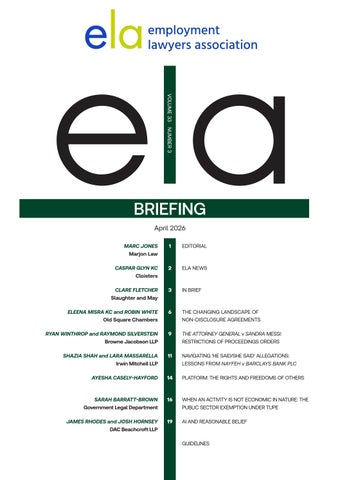

BRIEFING
April 2026
MARC JONES 1 EDITORIAL Marjon Law
CASPAR GLYN KC 2 ELA NEWS Cloisters
CLARE FLETCHER 3 IN BRIEF Slaughter and May
ELEENA MISRA KC and ROBIN WHITE 6 THE CHANGING LANDSCAPE OF Old Square Chambers NON-DISCLOSURE AGREEMENTS
RYAN WINTHROP and RAYMOND SILVERSTEIN 9 THE ATTORNEY GENERAL v SANDRA MESSI: Browne Jacobson LLP RESTRICTIONS OF PROCEEDINGS ORDERS
SHAZIA SHAH and LARA MASSARELLA 11 NAVIGATING ‘HE SAID/SHE SAID’ ALLEGATIONS: Irwin Mitchell LLP LESSONS FROM NAYFEH v BARCLAYS BANK PLC
AYESHA CASELY-HAYFORD 14 PLATFORM: THE RIGHTS AND FREEDOMS OF OTHERS
SARAH BARRATT-BROWN 16 WHEN AN ACTIVITY IS NOT ECONOMIC IN NATURE: THE Government Legal Department PUBLIC SECTOR EXEMPTION UNDER TUPE
JAMES RHODES and JOSH HORNSEY 19 AI AND REASONABLE BELIEF DAC Beachcroft LLP
IDS
ELA Briefing is published by IDS, part of Thomson Reuters. The IDS legal research team has been providing analysis and information on employment law since 1966.
Tel: 0345 600 9355 www.incomesdata.co.uk
Follow us on Twitter: @IDS_team
The views of the authors in ELA Briefing do not necessarily represent those of the ELA editorial board.
Highland House, Mayflower Close, Chandlers Ford, Eastleigh, Hampshire, SO53 4AR Tel 0204 591 5209 email: ela@elaweb.org.uk www.elaweb.org.uk
ISSN: 1474 7073
© Employment Lawyers Association
All rights reserved: no part of this publication may be reproduced, stored in a retrieval system, or transmitted in any form or by any means, electronic, mechanical, photocopying, recording or otherwise, without the permission of the Employment Lawyers Association.
Original design concept by Teresa Monachino www.studiomonachino.co.uk
Editor MARC JONES Marjon Law marc@marjonlaw.co.uk
Editorial committee
KATHLEEN BADA Charles Russell Speechlys LLP
CLARE FLETCHER
Slaughter and May
JO-ANNE GRAHAM / NICOLA TAYLOR Government Legal Department
DOUGLAS LEACH
Guildhall Chambers
RICHARD LINSKELL Gunnercooke LLP
CRAIG LUDLOW 3PB
SARA MEYER
DAC Beachcroft
NIKITA SONECHA Browne Jacobson
CHARLES WYNN-EVANS University of Bristol Law School
Advertising CYNTHIA CLERK Cynthiac@elaweb.org.uk
a word from the editor
This month will see major employment law changes with the second wave of the Employment Rights Act 2025 coming into force; for example, statutory sick pay will become a day one right, disclosures of sexual harassment will be potential qualifying disclosures and the Fair Work Agency will launch, as well as changes to compensation, rates and limits (such as a statutory redundancy payment and compensation for unfair dismissal).

‘his employer became suspicious after seeing social media videos of him singing and swaying’
In the long-running equal pay claim against Asda worth some £1.2 billion, an employment tribunal has recently compared multiple ‘non-lead’ claimants’ roles as shop floor assistants in Asda’s pharmacies and fuel stations with male comparators in distribution centres. A tribunal compared duties across 12 criteria, including knowledge, problem-solving, decision-making, physical skills, mental and emotional demands, responsibility for others, health and safety and customer goodwill. The ruling builds on an earlier decision that supported most lead claimants. In the latest judgment, Employment Judge Mark Butler found that roles such as shop floor assistants in pharmacies and petrol stations, as well as delivery drivers and security staff, are comparable to certain depot jobs. However, some roles like wine and beer department assistants were excluded. The case now moves to its final phase, where Asda must justify pay differences relying on a material factor justification.
An article in Civil Service World reported that the Public and Commercial Services Union (PCS) has declared a ‘major win’ after The Pensions Regulator (TPR) agreed to pay £90,000 to union representatives disciplined for refusing to share WhatsApp messages from personal devices. Under a settlement, affected reps will each receive £15,000, a formal apology and a commitment from TPR to train managers on constructive engagement with unions. The dispute began in 2024 when TPR sought access to a PCS branch WhatsApp group during a leak investigation. Union reps denied seeing any leaked material and raised concerns about confidentiality, but were still issued warnings for ignoring a ‘reasonable instruction’. PCS argued that such communications are union data and essential to lawful activity.
An article in the Daily Mail also caught my eye. It reported that a warehouse worker dismissed for allegedly faking a back injury was awarded £30,682 by an employment tribunal. Neil Wilson, also known as Reggae Vibes, had been on sick leave for 15 months from his role at Aliaxis UK due to chronic back pain. His employer became suspicious after seeing social media videos of him singing and swaying, as well as photos suggesting he was active while off work. Although the company stopped short of pursuing fraud charges, it cancelled his insurance payments and dismissed him in June 2023, claiming he was too unwell to return. At the tribunal, Mr Wilson argued his condition limited his ability to perform manual tasks despite occasional movement. Employment Judge Sean Jones said: ‘It was suggested to him that the video showed him “moving freely”. He seems to us to be moving rhythmically from foot to foot. He is not, in any meaningful sense, dancing. He is not moving energetically or particularly exerting himself. He is not having to bend over or lift anything. Putting it at its highest, you could not tell from the video that this was someone who was suffering from a long-term problem with back pain.’ The tribunal concluded the dismissal was unfair.
If you would like an article to be considered by the editorial committee, please send it to ELABriefingEditor@elaweb.org.uk by 6 May.
I sign off this month with a quote from John F Kennedy: ‘No one gains from fair employment law and legislation if there is no employment to be had.’
MARC JONES, Marjon Law
ela news
Reform recently made the news when it promised to repeal the whole of the Equality Act 2010 on its first day in office. I have chaired both the Industrial Law Society and the Employment Lawyers Association, and I have had a consistent approach to the apolitical nature of both organisations. Equally, both organisations regarded both the principles of the rule of law and of equality as apolitical. That view may no longer be regarded safely as apolitical, and it may be time for ELA to review its historical stance of standing both for equality and the rule of law, and defending them robustly. In my view, and I think the view of most of my colleagues, they are foundational principles of any democratic state. I do not regard them as political positions. I do not regard the principles of the rule of law such as equality before the law, access to justice and having one’s disputes determined by an independent tribunal within a reasonable time limit, as in any way a political stance.

‘I will hold fast to both the principles of the rule of law and equality’
Equally, I do not regard equality between the sexes, between people of different ethnicities or the citing of the other protected characteristics as being political. It may be, in the future, that equality law does become more political. I do understand that there can be, and that there are wide range of views on, for instance, affirmative action or the approach to affirmative action in the US. However, British law is more conservative in its approach towards affirmative action in ss.158 and 159 of the Equality Act 2010.
As I come to the end of my time chairing ELA, I will hold fast to both the principles of the rule of law and equality. In my view, they remain apolitical: they are central tenets of any lawyers’ organisation, particularly an employment lawyers’ organisation. How ELA maintains its position as an apolitical organisation is something that should be considered and thought about. I hope and trust that its position will not change as it defends the principles of the rule of law and equality.
Recent activities
· Training Committee webinars included: ‘Do The Right Thing: Non-financial misconduct for employment lawyers’.
• ‘ELA Iftar 2026: Ramadan in the workplace’ took place in London.
• The In-house Committee held a conference in London.
• The Junior Committee organised a speed mentoring event in London.
• The Legislative & Policy Committee responded to the draft Code of Practice on time off for trade union duties and activities.
• The Pro Bono Committee organised a webinar, ‘New Rights: Labour’s employment law changes’ for those in not-for-profit organisations.
• The regions held a half-day training course in St Albans, a North West Regional Flight Club Social in Liverpool, an ELA Breakfast Meeting in Lincoln, a training day in Birmingham and a junior training day in Leeds.
Looking ahead
· Training Committee: the ELA Annual Conference and Dinner will be held on 21 May in London.
• In April, the Legislative & Policy Committee will respond to consultations on flexible working, fire and rehire and the recognition code of practice and e-balloting unfair practice.
• The Pastoral Committee has planned a webinar, ‘Transforming Legal Workplaces: Addiction awareness, connection and lasting change’ (15 April).
• The regions: there will be a social in London (20 April) and a training day in Leeds (17 September).
CASPAR GLYN KC, Cloisters
in brief
Employment Rights Act 2025: April changes
This month sees the next implementation phase of the Employment Rights Act 2025 (ERA 2025). It is an eclectic mix of changes, with the overarching themes of greater regulatory oversight and increased costs for employers, enhanced time off rights for employees and reduced barriers for trade unions.
The changes in overview are:

‘there is plenty to keep HR departments busy until the next ERA 2025 changes in August’
• the Fair Work Agency (FWA) opens its doors on 7 April. Under the leadership of Matthew Taylor and Lisa Pinney, the FWA will bring together three existing enforcement bodies to create a single agency, with new jurisdictions (to enforce holiday pay and statutory sick pay) and new powers (including the power to bring proceedings in the employment tribunal on a worker’s behalf);
• statutory sick pay (SSP) becomes a day one right available to more employees, with the abolition of the three-day waiting period and lower earnings threshold. From 6 April, the rate of SSP will be set at the lower of the flat rate (£123.25) or 80% of the employee’s weekly income;
• unpaid parental and statutory paternity leave also become day one rights, and the restriction on taking paternity leave after a period of shared parental leave is repealed;
• the maximum protective award for collective redundancies will double from 90 to 180 days’ pay, for dismissals on or after 6 April;
• the list of protected disclosures in the Employment Rights Act 1996 (ERA 1996) is amended to include a disclosure ‘that sexual harassment has occurred, is occurring or is likely to occur’;
• trade union recognition process is simplified. There will no longer be a requirement to show that at least 50% of workers in the bargaining unit are likely to support recognition. The requirement for at least 10% of workers in the bargaining unit to be union members may be reduced (to as low as 2%). The 40% support requirement in the final ballot is deleted, so that a simple majority of those voting is sufficient; and
• large employers (those with 250+ employees) can choose to voluntarily publish equality action plans (these will become mandatory from 2027). The Government has recently published a suite of guidance and list of actions to assist employers in preparing their plans.
On top of the ERA 2025 changes, we will have the usual uprating of statutory payments on 5 and 6 April, and new national minimum wage rates from 1 April. There is plenty to keep HR departments busy until the next ERA 2025 changes (the first stage of electronic and workplace balloting in August).
ERA 2025: making ELA’s voice heard
As a member of ELA’s Legislative & Policy Committee, I have had the privilege of working on a number of consultation responses over the years, on topics ranging from Covid 19 measures to Brexit implementation. But I think it is fair to say we have never had a busier time than we are experiencing right now. Last year was not exactly quiet, with a number of key engagement meetings and the first few consultations on trade union measures. Then the Act received Royal Assent, and things really took off.
By the end of January, the Committee had already responded to consultations on enhanced dismissal protections for new mothers and electronic and workplace balloting. And now, in April, we have added responses on fire and rehire, flexible working and trade union recognition/unfair practices, with collective
redundancy, trade union detriment and agency work responses also underway for May.
There has rarely been a better opportunity to share your views on the myriad of changes we are facing. If you have not already (and even if you have!), I would encourage you to join one of our working parties, where we analyse how the proposed changes will work in practice, and the implications for both employers and employees. More details can be found at www.elaweb.org.uk/committees/ legislative-and-policy-committee
Team moves: some breaches, but no injunctive relief
Team move judgments are still relatively rare, so guidance from the High Court is always valuable (even with the fact-specific nature of these disputes).
In Guy Carpenter & Co Ltd v Willis Ltd [2026] EWHC 361 (KB), the High Court found that although employees involved in a team move were in breach of their duties, the limited nature of the breaches did not entitle their former employer to injunctive relief.
From June 2025, a number of individuals working in the Global Specialties business at the risk and reinsurance broker Guy Carpenter (GC) tendered their resignation with the intention of going to work at Willis Re, a start-up. GC sought injunctive relief against Willis Re, an employee of Willis Re (C) and two former senior employees of GC (S and F) which, broadly, included relief to prevent any further recruitment from the Global Specialties teams, and dealings with certain clients, in each case until 1 April 2027.
The application for injunctive relief was refused. The unlawful conduct of the defendants went slightly further than was admitted by them at the trial, but not to the extent alleged by GC. These ‘relatively limited’ breaches of duty and other unlawful acts did not, in the court’s judgment, give rise to any continuing need for injunctive relief. The period of time for which springboard relief would have been appropriate had already expired, and GC remained protected by the posttermination restraints and the garden leave provisions that had not yet expired in the contracts of employment (bolstered, in the case of S and F, by undertakings to the court). There was no basis for the other relief sought.
It was also relevant that, on the facts, the breaches of duty made little difference to the ultimate outcome, since most of the employees would have resigned to join Willis Re in any event. The court also rejected the argument that Willis Re’s deliberate decision to keep the recruitment exercise secret was itself unlawful.
The decision is a boost for recruiting employers, particularly start-ups such as Willis Re, which need to hire experienced staff to effectively grow their businesses. It is also notable in light of the Government’s recent working paper on reform of non-competes, which cites Labour’s growth mission and the need to support start-ups, scale-ups and small businesses as justification for its proposals to curb the use of non-competes. This position is echoed by the Competition and Markets Authority in its response to the working paper, in which it advocates for a total ban on non-competes below a defined employee income threshold; and a time restriction on the duration of non-competes above this threshold. The Government’s response to its working paper is awaited with interest.
Whistleblowing: personal motive and public interest
The public interest test in whistleblowing cases is a frequent cause of contention. What is clear is that the threshold is relatively low; Chesterton Global v Nurmohamed [2017] EWCA Civ 979 established that it is only if a disclosure is purely self-interested that it is likely to fail the public interest test.
A recent example is the EAT’s decision in Bibescu v Clare Jenner Ltd [2026] EAT 30, which held that the employment tribunal had erred in its approach to the public interest test. B, an accountant, was dismissed following concerns being raised about her performance. She brought claims for automatically unfair dismissal under s.103A ERA and detriment under s.47B ERA. B’s disclosures were reports of investigations she had made about a subcontractor, G, who had been asked to review her work. Her investigations at Companies House showed that, while he was disqualified from being a company director, he still appeared as a director of a company associated with his wife, and that he was not a member of the Association of Chartered Certified Accountants.
The employment tribunal concluded that the disclosure was made to provide negative information about G and to query his status in the business, and was not, as required by s.43B, ‘in her reasonable belief’ made in the public interest. This was overturned by the EAT, which found that the employment tribunal had focused unduly on B’s motive. The belief that the disclosure was in the public interest need not be the predominant motive for making it, and may form no part of the motive at all. Even if the employment tribunal considered that B’s sole motive was to discredit her colleague (or some other self-interest), it still had to make a clear finding as to whether or not she genuinely believed that the disclosures she made were, in any event, in the public interest. The detriment claim was therefore remitted for reconsideration.
B’s automatic unfair dismissal claim was, however, properly rejected by the employment tribunal. The EAT accepted its finding of fact that the ‘principal’ reason for B’s dismissal was a combination of her performance and inability to work with a sub-contractor, rather than the making of a protected disclosure.
As well as highlighting the public interest test and the different causation tests for whistleblowing detriment and dismissal claims, this case also provides an illustration of how the unfair dismissal changes in ERA 2025 may play out in practice. B had less than two years’ (but more than six months’) service when she was dismissed, barring her from a claim of ordinary unfair dismissal. From January 2027, such a claim would be possible, refocusing attention on the performance management process which led to B’s dismissal. The Government’s hope is that this may result in fewer whistleblowing claims, but many (this author included) are somewhat sceptical about whether that may prove to be the case.
CLARE FLETCHER, Slaughter and May


The changing landscape of non-disclosure agreements
ELEENA MISRA KC and ROBIN WHITE, Old Square Chambers
Non-disclosure agreements have been in the press often in the wake of the #metoo movement. They have developed a bad reputation, but it is apt to remember that there is nothing unlawful per se about an NDA and that they are used for legitimate purposes, including at the instigation of someone whom recent legislation might term a victim or potential victim.
There has been considerable legal reform in this area of law already. For practitioners, it is important to note, in particular, s.17 of the Victims and Prisoners Act 2024, which came into force on 1 October 2025, the new s.202A of the Employment Rights Act 1996 (ERA) introduced by s.24 of the Employment Rights Act 2025 (ERA 2025) and not yet in force, and the prospective changes to the whistleblowing provisions we are all so familiar with, with an amendment to s.43B ERA as of 6 April this year.
Many are familiar with the work of Zelda Perkins of Can’t Buy My Silence. In her evidence to Parliament on sexual harassment and even the attempted rape of a colleague, Perkins said:
‘I worked for the Miramax Film Corporation in their London offices from 1995 to 1998, working in development and production and as Harvey Weinstein’s assistant in the UK and Europe. At 24, I had to resign from the company, citing myself as constructively dismissed due to Mr Weinstein’s inappropriate behaviour towards me throughout my employment and the attempted rape of my colleague. Our expectation was to prosecute Mr Weinstein in seeking justice but due to the advice we were given at the time and the absence of any HR framework in the company, my colleague and I were told that we had no option other than to enter into an agreement with Mr Weinstein and The Miramax Corp., accepting a financial damages settlement and signing a stringent and thoroughly egregious non-disclosure agreement. All of this predates whistleblower protection in English law.’
That final cited sentence is an important timing context to note given that the Public Interest Disclosure Act came into being in 1998.
In 2023, the Legal Services Board (LSB) ran a call for evidence to hear about experiences with NDAs, and a summary report was published in February 2024. The key themes emerging from the submissions were described by the LSB as:
• imbalances of power;
• access to justice issues for individuals in employment disputes;
• members of the public lacking understanding about legal rights;
• and NDAs, specifically in relation to protected disclosures, covering up allegedly illegal conduct including unlawful harassment and discrimination, and the potential adverse effect on individuals personally and professionally, where there are clauses that bar individuals from sharing information with friends or family. There were differing views as to whether tighter regulation of legal professionals was mandated and it remains to be seen if matters are taken further in the regulatory sphere.
The changing landscape of non-disclosure agreements
‘the disclosure has to be made in the reasonable belief that it is in the public interest’
Practitioners will be familiar with the provisions in ERA which deal with whistleblowing and, in particular, s.43J(1) ERA which renders void any provision in an agreement to which the section applies insofar as it purports to preclude the worker from making a protected disclosure. However, it has always been the case that there are several hurdles for any claimant to cross to come within the protection of the law in this regard.
While there is an extended definition of a worker in s.47K ERA (which goes far beyond the definition to be found in s.230(3) ERA), patently not everyone in a workplace will benefit from the protection afforded to workers. More saliently perhaps, there are restrictions on what kind of information can be disclosed, how and to whom before a qualifying and protected disclosure can be established under s.43B and associated provisions of ERA.
A critical requirement, in brief summary, is that the disclosure has to be made in the reasonable belief that it is in the public interest, so it is not enough to know or believe, for example, that you have been sexually harassed, or might be, you need to have the necessary statutory altruism to get over the hurdle, ie meet the enmeshed public interest threshold.
As of 6 April this year, there will be an amendment to ERA so that any disclosure about sexual harassment will explicitly qualify as a relevant failure under the UK whistleblowing framework in a new s.43B(1)(da) ERA which adopts the definition of sexual harassment found in s.26(2) of the Equality Act 2010 (EqA). Workers and employees will no longer need to frame concerns as a criminal offence, a legal breach or a health and safety issue in order to be protected in sexual harassment cases. Workers who make qualifying disclosures about sexual harassment (directed at themselves or others) will be protected from detriment, and employees will also be protected from unfair dismissal. These protections apply where sexual harassment has happened, is happening, or is likely to happen but only where the other requirements of a qualifying and protected disclosure are met. It remains to be seen how much this amendment will really change in substance.
We await s.202A ERA, which is yet to come into force. As drafted, this stipulates that any provision in an agreement between an employer and worker is void insofar as it purports to preclude the worker from making an allegation of or disclosure of information relating to relevant harassment or discrimination or relating to the response of the employer to the same. Relevant harassment or discrimination is as defined in ss.13, 15 to 19A and 21(2) EqA. as well as s.26. It does not include victimisation as defined in s.27 EqA. That might be said to be a curious omission. Furthermore, the Secretary of State may, by regulations, set out forms of ‘excepted agreements’ which stand outside the perimeter of the prohibition and expand the categories of person to whom this applies such as contractors or those in training or on work experience. No doubt a period of consultation will be followed by more information in this respect as with many aspects of ERA 2025.
Section 142 EqA makes any term in a contract or agreement unenforceable if it promotes or requires conduct prohibited by the Act, such as discrimination, harassment or victimisation. This has not featured greatly in the debate about reform of the law on NDAs and there is a lack of authority as to whether an NDA could in principle fall foul.
Eagle eyed practitioners will have spotted the industry specific legislation in the Higher Education (Freedom of Speech) Act 2023 (HEFSA), which focuses on academic freedom of speech and the topical issue of no platforming. This legislation also introduced a ban for higher education institutions in England (alone) on NDAs being entered into with staff, members, students and visiting speakers for higher education providers.
In the specific context of securing freedom of speech within the law, the governing body of a registered higher education provider must secure that the provider does not enter into an NDA with a person (as defined above), in relation to a relevant complaint made to the provider by the person, which purports to preclude the person from publishing information about a relevant complaint. A relevant complaint is in turn a complaint relating to misconduct or alleged misconduct by any person which in turn means sexual abuse, sexual harassment or sexual misconduct and bullying or harassment. This came into force on 1 August 2025.
What may have flown under the radar, given its unusual legislative home, is the prohibition on NDAs contained in s.17 VPA. That is not limited to workplace relationships and its purpose is to prevent clauses from being enforced where they purport to prevent a victim of a crime (as defined) from accessing advice and support. They will extend to workplace relationships in some cases. Section 17(1) VPA provides that a provision in an agreement is void insofar as it purports to preclude the making of a disclosure as set out in s.17(2). A
The changing landscape of non-disclosure agreements
‘it will require delicate handling in cases in which exit agreements are being negotiated against the backdrop of complaints of abuse, assault or harassment in the workplace’
qualifying disclosure in this context is one made by someone who is a victim or reasonably believes they are a victim of criminal conduct (ie an offence).
As defined in s.1 VPA, a victim is someone who has suffered harm (including physical, mental or emotional harm or economic loss) as a direct result of being subjected to criminal conduct or in the wider circumstances set out in s.1(2) which include seeing, hearing or otherwise directly experiencing the effects of criminal conduct at the time it occurred. It is immaterial whether the criminal conduct has been reported or investigated or whether anyone has been charged or convicted. It is only disclosures to specified persons, as set out in s.17(2) VPA that are caught in this context, and this includes disclosures to the police, qualified legal professionals, support services whether provided by qualified or regulated persons or not, and to a child, parent or partner.
However, s.17(3) VPA also provides that a provision in an agreement is not void by virtue of s.17(1) so far as it purports to preclude a disclosure made for the primary purpose of releasing the information into the public domain.
The Government’s intention is to repeal s.17 VPA and replace it with a stronger protection in the Victims and Courts Bill, which will remove the specified purposes and specified persons restrictions in s.17.
On the face of it, if a person who is a victim or reasonably perceived to be a victim of crime who has suffered harm, and does not wish for information to enter the public domain then VPA does not operate so as to prevent the gagging of the employer because s.17(2) only applies to disclosures made by a victim. It operates in one direction only, ie to void clauses that bite on the worker or employee’s ability to disclose.
It is obvious at first glance that this requires a careful review of precedents for settlement agreements as well as contracts of employment themselves in appropriate cases, and for regard to be had to ERA and VPA, as well as HEFSA in some cases. This will also require delicate handling in cases in which exit agreements are being negotiated against the backdrop of complaints of abuse, assault or harassment in the workplace, for example, where they are disputed, especially where there has been no internal resolution via a complaints or grievance process and no adjudication by a court or tribunal of competent jurisdiction.
In some cases, parallel consideration of General Data Protection Regulation (GDPR) rights and, less frequently, the Official Secrets Act 1989 will be necessary.
In all cases, solicitors will need to be mindful of the Solicitors Regulatory Authority Warning Notice on the use of NDAs (updated 6 March 2024) and counsel of their regulatory obligations.
The Government has also published guidance for business and guidance for employees:
• https://www.gov.uk/government/publications/victims-and-prisoners-act-2024-changes-to-non-disclosureagreements/victims-and-prisoners-act-2024-changes-to-non-disclosure-agreements-for-victims-andindividuals-who-use-ndas
• https://assets.publishing.service.gov.uk/media/693aec9eadb5707d9f33d653/Updated_guidance_1._Buinessfacing_guidance_on_non-disclosure_agreements__section_17__11.12.25.pdf
• https://www.gov.uk/government/news/victims-freed-from-silence-under-nda-reform
KEY:
NDA Non-disclosure agreements
VPA Victims and Prisoners Act 2024
ERA Employment Rights Act 1996
ERA 2025 Employment Rights Act 2025
LSB Legal Services Board
EqA Equality Act 2010
HEFSA Higher Education (Freedom of Speech) Act 2023
GDPR General Data Protection Regulation (Regulation 2016/679 on the protection of natural persons with regard to the processing of personal data and on the free movement of such data [2026] OJ L119/1)


The Attorney General v Sandra Messi: restrictions of proceedings orders
RYAN WINTHROP and RAYMOND SILVERSTEIN, Browne Jacobson LLP
The EAT has made a restriction of proceedings order against Sandra Messi under s.33 ETA, reinforcing its role as a filter on vexatious employment claims. The case is a reminder that the power to impose a restriction of proceedings order remains a vital safeguard for the tribunal system and those required to defend claims without merit.
Background to the dispute
Since 2017, Ms Messi had brought over 50 employment tribunal claims across multiple regions. Her claims commonly alleged race, disability or sex discrimination, whistleblowing detriment and unpaid wages. No claim had succeeded and many had been struck out as having no reasonable prospect of success. Ms Messi had repeatedly failed to comply with tribunal directions and avoided hearings. She made unsubstantiated allegations of dishonesty against employers and their lawyers, reported solicitors to regulatory bodies and reported employer staff to the police.
Ms Messi argued that the Solicitor General was biased and that adverse decisions reflected her mental health difficulties rather than a lack of merit. At the hearing on 18 December 2025, Ms Messi applied to dismiss the application and asked the EAT not to proceed. Both applications were refused. She then declined to participate further on what she described as ‘religious grounds’, stating the application was tainted by fraud. The EAT proceeded without her.
The legal framework
Section 33 of the Employment Tribunals Act 1996 (ETA) allows the EAT to make a restriction of proceedings order where someone has habitually, persistently and without reasonable grounds brought vexatious proceedings or made vexatious applications.
1. A claim is vexatious if it has little or no legal basis, subjects the other party to disproportionate inconvenience and expense and amounts to an abuse of the tribunal process (Barker).
2. The litigation must be ‘habitual and persistent’ which means the litigant keeps on litigating when earlier claims have failed and any rational and objective assessment says it is time to stop. In the employment context, this can include repeated claims of a similar type against different respondents (Roberts).
3. The proceedings must have been brought ‘without any reasonable ground’ which means there was no proper basis for them, assessed objectively (Barker).
Even where all three conditions are met, the EAT has a discretion whether to grant the order. It must balance the citizen’s right to access the courts, including under Article 6 of the European Convention on Human Rights (ECHR), against the need to protect the tribunal from abusive claims. The order is a filter, not a bar which means a litigant can still bring and pursue claims but must first obtain permission from the EAT (Barker/Wheen).
The judgment
The EAT found that all three statutory conditions were clearly met. It relied primarily on the judgments of the various employment tribunals. Ms Messi had brought an extraordinary number of claims against many different
proceedings orders ‘respondents facing a pattern of persistent, meritless claims by the same individual should consider bringing the matter to the Attorney General’s attention’
employers. None had succeeded or settled. On the materials before it, her claims were of little or no merit.
There was agreement with the employment judge who observed that bringing so many failed applications ‘indicates that this is a scheme which Mrs Messi is engaged in rather than any genuine pursuit of justice’.
It was acknowledged that Ms Messi’s non-attendance was sometimes caused by mental health difficulties but noted that she had been dealt with sympathetically and hearings had frequently been adjourned at her request.
Ms Messi’s argument that the Solicitor General was biased was rejected. A fair-minded observer would not consider there to be a real risk of bias arising from the Solicitor General’s former professional association with a barrister involved in related proceedings. It also rejected her ‘fraud’ argument.
The EAT exercised its discretion to make the order. Ms Messi’s litigation caused substantial prejudice to respondents, who had to spend time and money defending meritless claims, and to the tribunal system, which had to process not only her claims but also the large volume of correspondence she generated. The order imposes a judicial filter, allowing claims with potential merit to proceed while screening out those without. The order will be for an indefinite duration.
Implications for practitioners
• The application in Messi was triggered by a law firm contacting the Attorney General’s Office, followed by other firms doing the same. Respondents facing a pattern of persistent, meritless claims by the same individual should consider bringing the matter to the Attorney General’s attention.
• The habitual and persistent test can be met even where the claims are against different employers. A pattern of similar claims across multiple respondents and regions may be enough.
• Claims with merit can still proceed. This has been found to be a proportionate response, provided the restriction does not ‘impair the very essence of the right of access to justice’.
• Section 33 does not extend to proceedings brought by others. The EAT in Messi had no jurisdiction to restrict Ms Messi from acting as a McKenzie friend. Applicants seeking the widest possible protection should be aware of this limitation.
• The rise of AI-generated litigation presents a growing risk of vexatious claim volumes. As AI tools lower the barriers to generating claims at scale, the tribunal system may find the conditions for restrictions of proceedings orders more readily satisfied and deploy them with greater frequency.
Messi confirms that the employment tribunal system has the tools to protect itself and respondents from sustained litigation abuse. The case sends a clear signal that those tools will be used where the evidence demands it.
KEY:
Messi Attorney General v Sandra Messi [2026] EAT 34
ETA Employment Tribunals Act 1996
Barker Attorney-General v Barker [2000] 1 FLR 759
Wheen Attorney General v Wheen [2001] IRLR 91
ECHR European Convention on Human Rights
The Attorney General v Sandra Messi: restrictions of


Navigating ‘he said/she said’ allegations: lessons from Nayfeh v Barclays Bank Plc
SHAZIA SHAH and LARA MASSARELLA, Irwin Mitchell LLP
He said/she said allegations present one of the most difficult challenges employers face in workplace investigations. With no witnesses and conflicting accounts, decision-makers must carefully balance fairness, evidence and their duty to protect staff from harassment. A recent Scottish judgment, Nayfeh, provides helpful guidance on how to approach these situations, and what can go wrong when a fair and balanced procedure is not followed.
The facts
Mr Nayfeh, a financial adviser, was accused of making inappropriate sexual comments to a colleague. There were no witnesses to the alleged comments, but a colleague said that he had occasionally made other comments which were ‘close to the line’ but were not sexual in nature. He was subsequently dismissed.
The tribunal found that the disciplinary hearing and the decision-making leading up to Mr Nayfeh’s dismissal were ‘seriously flawed’ and ‘fell well outside the range of reasonable responses’. It was particularly critical of the investigation. It concluded that Barclays did not have reasonable grounds to conclude that Mr Nayfeh had made the alleged comments and no reasonable employer could have dismissed in those circumstances.
The need for balanced investigations
In a harassment claim under the Equality Act 2010 (EqA), the claimant must establish sufficient facts from which a tribunal can conclude, in the absence of any other explanation, that harassment has occurred. Once they have done this, the burden shifts to the employer to show the treatment was not related to a protected characteristic.
In ‘he said/she said’ scenarios, ie where there are no independent witnesses, deciding which version of events is more likely is a balancing act, and any investigation must assess the credibility of each account provided. In such circumstances, an investigation must evaluate each person’s facts, find supporting evidence (if available) and highlight any inconsistencies, before ultimately judging on all available information which account is more likely on the balance of probabilities. This can be a difficult decision for investigators to conclude.
Where facts are contested, the investigator should ask:
• What evidence corroborates/contradicts what each side says?
• Did they tell someone else what happened or record it anywhere?
• Did the person they told have any reason to lie?
• Are there any power imbalances between the parties?
• Might this have impacted how one side reacted?
• What other circumstances are relevant, such as any pre-existing conflict between the parties?
‘a “zero tolerance” policy is not a licence to bypass due process’
When taking the above questions cumulatively, the wider facts uncovered will aid the investigator in determining which witness account presented is more reliable. As the tribunal emphasised in Nayfeh, investigators and decision-makers do not need certainty when assessing allegations raised, but they do need:
• a genuine belief in their conclusion;
• reasonable grounds for that belief; and
• to follow a fair and balanced process.
A failure to meet these standards can make a dismissal unfair, as Barclays discovered. As such, employers must avoid tunnel vision by investigating mitigating evidence with the same rigour as incriminating evidence. It may therefore be considered unlawful for an investigator to only look for evidence to support a guilty finding of sexual misconduct, in the context of undertaking ‘as much investigation as was reasonable in the circumstances’ as per Burchell
Ultimately, the case of Nayfeh reinforces that in ‘word-against-word’ scenarios, investigators must document their process in assessing the credibility of any witness accounts provided transparently (with reference to any wider evidence or inconsistencies relied upon), demonstrate how competing accounts were evaluated, and justify why one version was preferred on the balance of probabilities.
Zero tolerance policies and the need for procedural accuracy
Although the tribunal found the dismissal unfair, it also held that Mr Nayfeh’s conduct contributed to the situation. He admitted making one comment: ‘What’s the youngest a 40-year-old could go with?’. The tribunal said this was a reckless and inappropriate comment and it made a 15% reduction in the compensatory award.
A further 50% reduction was applied to reflect the possibility that a properly run process might still have resulted in dismissal, although the tribunal emphasised that the ‘zero tolerance’ policy adopted by Barclays did not automatically justify dismissal, particularly for a first offence from an employee who had a previously unblemished disciplinary record.
Importantly, a key take-away is that a ‘zero tolerance’ policy is not a licence to bypass due process.
While such policies signal that an employer is committed to tackling harassment, they do not override the need for a fair and balanced investigation. Employers should not feel compelled to uphold a grievance if evidence is insufficient; doing so risks a procedurally unfair dismissal.
When an investigator is appointed to determine the alleged misconduct, if it cannot genuinely be decided between the two versions of events which is more likely, there is a deadlock. It therefore follows that, unless it can be proven on the balance of probabilities, the alleged wrongdoer will need to be afforded the benefit of the doubt. An employer cannot simply err on the side of caution by dismissing the employee, and if there is simply not enough evidence in support of the allegations, an employer must acknowledge this and not progress to a disciplinary hearing.
Training and policy enforcement
Learning from the ruling in Nayfeh, there is an ongoing need for employers to invest in practical training for their managers and those investigating allegations of sexual harassment.
In 2021, the Fawcett Society’s (a charity campaigning for women’s rights and gender equality) conducted a study which reports that only 45% of women felt supported by their workplace, and 8 in 10 women believed employer responses would improve if staff received dedicated training. Preventing harassment and managing allegations effectively requires more than written policies. Instead, employers ought to be clearly advised on their need to:
• provide regular training for managers and employees surrounding:
• recognising and addressing misconduct;
• how to conduct a fair investigation; including the assessment of conflicting evidence;
• the level of evidence required for ‘reasonable grounds of belief’ which will ultimately tip the balance of probabilities in favour of the allegations being investigated; and
Navigating ‘he said/she said’ allegations: lessons from Nayfeh v Barclays Bank Plc
Navigating ‘he said/she said’ allegations: lessons from Nayfeh v Barclays Bank Plc ‘moving to disciplinary action without a sound evidential basis risks further unfairness and undermines the integrity of the process’
• proactively review the legislative changes and update work policies accordingly to ensure that investigators know what is expected of their role and how their findings relate to the legislative framework. It is not enough to simply have a zero-tolerance policy to specified conduct without the appropriate investigation to support this.
To tackle these alarming statistics, employers must ensure that confidentiality, neutrality and objectivity are at the foundation of all investigations into such allegations. Employers should also support the investigator in their role with the appropriate training beforehand and provide ongoing guidance throughout the investigation itself.
The study further noted that three-quarters of participants felt their trust in the investigation would have been strengthened if the employer created and adhered to timescales for reporting the findings. This approach would undoubtedly ease the uncertainty of the situation for both parties involved and have an allround greater chance of de-escalating the situation, where appropriate.
It is therefore essential that investigators conduct their enquiries in a timely manner and maintain open communication with both parties throughout the process. To promote good practice and uphold employee confidence, investigations should:
• avoid making any assumptions regarding the credibility or motive of the accused without evidence;
• document all findings, inferences and decisions, which must be supported by clear reasoning and available evidence; and
• consider whether appointing an independent third-party investigator is feasible and appropriate, as this can bring additional professional expertise to the process while helping to ensure greater confidentiality, neutrality and separation from the employer.
Summary: key takeaways for practitioners
Although this Scottish tribunal decision is not binding elsewhere, it offers useful lessons for employers in England and Wales. Employers must ensure investigations are balanced and fair, particularly where sexual harassment allegations rest solely on conflicting witness accounts.
Employers may feel pressured to uphold such complaints to avoid any suggestion of tolerating harassment, especially with forthcoming Equality Act reforms. However, if a thorough investigation does not yield sufficient evidence, employers should support investigators in delivering a fair, robust conclusion. While this may be uncomfortable, moving to disciplinary action without a sound evidential basis risks further unfairness and undermines the integrity of the process.
Given the complexity of the law concerning sexual harassment, and the need to take greater care in ‘he said/she said’ situations, where facts are in dispute, it will often be helpful for investigators to have access to independent legal advice and input in order to discuss their concerns and reach legally defensible conclusions.
KEY:
Nayfeh Nayfeh v Barclays Bank UK Plc ET8002162/2024
EqA Equality Act 2010
Burchell British Home Stores Ltd v Burchell [1978] IRLR 379

Platform: the rights and freedoms of others
AYESHA CASELY-HAYFORD
The Colour Purple, a 1982 novel by Alice Walker, is a violent and intense story covering themes of rape and incest and described by Alexa Spencer in Word In Black as ‘giving permission and hope for Black women’s resilience and rebellion’. But how did this story result in a young woman of West African descent losing her career?
Labelled a bigot; dismissed by the Curve Theatre in Leicester and dropped by her acting agents, Seyi Omooba brought an employment tribunal case for religious discrimination and also for breach of contract against the theatre and her agents. She lost all her claims and was ordered to pay the theatre company’s legal fee. She then brought an appeal against the tribunal’s decision, and lost again.
This case has become part of the UK discrimination law cannon; an outcome used to help guide on what constitutes religious belief discrimination, and what does not. The theatre’s dismissal of her and her agents dropping her were not acts of religious discrimination. But I cannot get over the fact that in putting on a show like The Colour Purple, the result has been that a young black woman has lost her career.
Background
At 3.43pm on 15 March 2019, Aaron Lee Lambert, an American musical theatre actor, tweeted about a Facebook post written by Ms Omooba five years earlier. Lambert, a gay man, asked Ms Omooba: ‘Do you still stand by this post? Or are you happy to remain a hypocrite? Seeing as you’ve now been announced as playing an LGBTQ character, I think you owe your LGBTQ peers an explanation. Immediately.’
Culture
Ms Omooba’s involvement in the play was linked to her skin colour, her sex and her age and also her Nigerian cultural heritage. As I reflect on my own West African heritage, my granny’s favourite phrase comes to mind: ‘ no curve, no bend’. These words are the fabric of idealist and fundamentalist thinking. The world of evangelism requires decisions beyond what the average person is deciding.
Ms Omooba, at the time of this decision-making, is dealing with life or death. It sounds dramatic but that is what it is. This is not a woman operating alone. This is not a woman even standing alone. This is someone brought up in a patriarchal society, and this is a world of idealism. The stakes are high, to not agree is a road to excommunication. Do we therefore have, from the start, someone who was not independent in the choices they were ever going to make in a situation like this?
This case can be viewed as a call to action to go beyond the innate independence of Western individuality and consider someone who may not have been independent in the choices they were ever going to make in a situation such as this.
The world Ms Omooba comes from and exists in is very different to that of the British theatre world. Can we see when we are asking people to make decisions that may be way beyond their remit of ability?
Platform:
the rights and freedoms of others ‘Ms
age, sex, cultural background and community were at play in her case’
What if the theatre company ignored the dug-up Facebook post and said that it will not ask someone to retract a post that pre-dates their employment relationship with them and Ms Omooba was never made (by her family, the theatre company, Aaron Lee Lambert, or general strangers), to explain her intimate life choices? Perhaps there is a way to avoid cases like this ever reaching the employment tribunal in the first place. Ms Omooba’s age, sex, cultural background and community were at play in her case. Perhaps we can learn to look more closely at the individual and ask how many different factors (alone and combined) may make them vulnerable especially when their careers are at stake.
Omooba’s
KEY:
Omooba Seyi Omooba v Michael Garrett Associates Ltd [2026] EWCA Civ 253

When an activity is not economic in nature: the public sector exemption under TUPE
SARAH BARRATT-BROWN, Government Legal Department
Before I started working at the Government Legal Department, the question of whether an activity was economic in nature or not was not one with which I had to often wrestle. As a lawyer working exclusively in the public sector, the question takes on a new level of importance. And, as a practitioner in a role where the answer to that question is often ‘no it’s not’ then the follow up question – what next? – is equally as important.
The Court of Appeal decision in Bicknell
So, when is an activity not economic in nature? When it involves the mere commissioning of activities, without the supply of such activities to the market, according to the recent Court of Appeal decision in Bicknell. This case concerned whether there was a relevant transfer under the Transfer of Undertakings (Protection of Employment) Regulations 2006 as amended (TUPE) when a clinical commissioning group merged with other local groups as part of a reorganisation and was not an economic activity for the purposes of TUPE.
The Court of Appeal in dismissing the appeal found that the tribunal had correctly construed the term ‘economic activity’ following the EAT’s decision in Nicholls (which had relied on reasoning in the European Court of Justice (ECJ) competition law case FENIN).
The work of the TUPE Hub team
While it is usually quite straightforward to determine whether activities are economic in nature on transfers within the private sector, this case demonstrates that the question is often much more complex when activities are transferring within the public sector.
In the TUPE Hub team within the Employment Directorate at the Government Legal Department, we regularly have to grapple with the question of whether a transfer of functions involves the transfer of an economic activity or whether it falls within the scope of reg 3(5) of TUPE due to it constituting an ‘administrative reorganisation of public administrative authorities or the transfer of administrative functions between public administrative authorities’. If a transfer involves the transfer of administrative functions between public administrative authorities, it will not give rise to a relevant transfer by virtue of reg 3(5). This can have significant implications for the successful transfer of functions within the public sector, as Bicknell demonstrates.
Where we find that activities risk falling within reg 3(5) or the so-called ‘Henke exemption’, for example, due to them involving the commissioning of services, being regulatory in nature or involving the exercise of core state powers, we need to consider whether another transfer mechanism is available to effect the transfer of employment of those employees carrying out the relevant functions – just because TUPE does not apply does not mean that the employees are not vital to the successful continuation of the non-economic activities,
When an activity is not economic in nature: the public sector exemption under TUPE ‘just because TUPE does not apply does not mean that employees’ … employment rights should not be protected’
or that their employment rights should not be protected. The Cabinet Office Statement of Practice on Staff Transfers within the Public Sector (COSOP) provides that usually, in these circumstances, this will involve another legislative means. Accordingly, our next port of call is usually to consider whether the proposed transfer involves the passing of new primary legislation.
The Employment Relations Act 1999
In recent years, there has been an increasing number of reforms implemented by way of new primary legislation. Such reforms often envisage the transfer of functions from existing bodies. Accordingly, in such cases, we will look to provide specialist legal input at an early stage, when the Bill is being drafted by departmental advisory lawyers, to include a statutory power to transfer staff pursuant to a staff transfer scheme in circumstances where TUPE may not apply. Due to the scrutiny that any such power will inevitably receive, this requires us to clearly and concisely explain the rationale for its inclusion by reference to the application of TUPE and the Henke exemption. Not always an easy task, but something that our Civil Service clients are increasingly becoming more familiar with as we upskill them on the significance of the Henke exemption and the recent case law in this area.
In circumstances where the proposed transfer does not require the passing of new legislation, or where the existing legislation relied upon to effect the transfer does not already include a power for the Secretary of State to make a staff transfer scheme, we may need to look to the Employment Relations Act 1999 (ERA 1999). More specifically, s.38 ERA 1999 which allows the Secretary of State to make TUPE-like regulations in circumstances where TUPE may not apply.
Before working at the Government Legal Department, I had never come across s.38 ERA 1999 and was somewhat daunted by the prospect of making secondary legislation. Luckily, we have the SI Hub at the Government Legal Department to help us with this task. They are definitely the experts when it comes to the drafting of regulations, although we do have a fair amount of experience drafting niche transfer regulations under s.38 which look to replicate the core provisions of TUPE.
Pensions can often be a tricky issue given the exemption under TUPE for old age, invalidity or survivors benefits under occupational pension schemes and the application of public sector policies including the COSOP supplementary guidance on pension protection for compulsory staff transfers within the public sector However, this is where we can add real value and provide expert input as to what should happen to pension entitlements on transfer, before leaving it to the SI Hub to finalise the precise language to be used in the regulations to reflect the policy intention.
Once the drafting is complete, we then wait for the regulations to be laid before parliament and (we hope) become law. Usually, this part is relatively straightforward assuming the regulations are made using the negative procedure (where the regulations become law within a set period of time unless they are actively voted down – something which luckily has not happened in my experience to date).
Ultimately, there is never a dull day in the GLD TUPE Hub given the wealth of instructions that continue to flow into us regarding intra-public sector transfers. We will also be keeping a close eye on the direction of travel of further cases concerning the definition of ‘economic activities’ following Bicknell and whether any future cases consider the definition in the context of a service provision change, where the legislation does not expressly refer to ‘economic activities’ but simply the transfer of ‘activities’ at reg 3(1)(b) of TUPE. The significance (or not) of which I will leave all my fellow TUPE aficionados to ponder in your own time.
Sarah Barratt-Brown is a senior lawyer in the Employment Directorate TUPE Hub at the Government Legal Department.
When an activity is not economic in nature: the public sector exemption under TUPE
‘we will be keeping a close eye on the direction of travel of further cases concerning the definition of “economic activities” following Bicknell’
KEY:
Bicknell Bicknell v NHS Nottingham and Nottinghamshire Integrated Commissioning Board [2026] EWCA Civ 21
TUPE Transfer of Undertakings (Protection of Employment) Regulations 2006 (SI 2006/246)
Nicholls Nicholls v Croydon LBC [2019] ICR 542
ECJ European Court of Justice
FENIN Federacion Espanola de Empresas de Tecnologia Sanitaria (FENIN) v Commission of the European Communities (C-205/03 P) EU:C:2006:453, [2006] ECR I-6295
COSOP Cabinet Office Statement of Practice on Staff Transfers within the Public Sector
ERA 1999 Employment Relations Act 1999


AI and reasonable belief
JAMES RHODES and JOSH HORNSEY, DAC Beachcroft LLP
The use of generative AI at work is increasing rapidly, with many large employers reporting a rise in the use of gen-AI tools such as Microsoft Copilot, Open-AI’s Chat-GPT, Anthropic Claude and Google Gemini. This uptake raises the possibility that employers may use gen-AI when making the decision to dismiss employees.
Below, we explain how employers are using AI by prompting and how this works, before setting out the well-known legal framework when deciding to dismiss employees for misconduct. We then explore whether generative AI (gen-AI)-produced documents are disclosable in an employment tribunal and highlight the risk posed by employers using gen-AI when taking the decision to dismiss an employee for misconduct, and how to mitigate this risk.
Prompting
Gen-AI is used by ‘prompting’ – the user provides instructions, usually accompanied by one or more documents. While it is advisable to avoid anthropomorphising a piece of software, a simple way of viewing gen-AI is that it treats the prompts as a set of instructions for it to execute using the documents provided to it, in a similar way a manager may ask an employee to complete a task. For example, an employer might prompt gen-AI to draft a termination letter following a disciplinary hearing.
Depending on the reliability of the tool, the quality of the inputted documents and the clarity of the prompt, the employer may be provided with a useful first draft. In our experience, this is currently as much use gen-AI can be. It can summarise and locate information quickly, but it cannot critically analyse issues as we can. This is because gen-AI uses a statistical model of language to predict the next most likely word, iteratively, to provide the user with an output.
Many users, however, expect gen-AI to conduct analytical work, posing a risk if used in decision-making processes, especially when the decision is subject to scrutiny in a case for unfair dismissal where the employee was dismissed for misconduct.
Reasonable belief
The Burchell test remains central to assessing the fairness of a dismissal for misconduct. The employer must show it genuinely believed the employee was guilty, that it held that belief on reasonable grounds and that it formed that belief following a reasonable investigation. The tribunal then assesses the employer’s actions within the band of reasonable responses and does not substitute its own judgment for that of the employer. The burden of proof is on the employer to evidence the first limb of the test, ie it must show the tribunal that its belief the employee was guilty was genuinely held. The second limb, that the belief was reasonably held, is neutral (Crabtree).
AI and reasonable belief
‘While clients may be frustrated by the increase in material to consider, there is no substitution under the current legal framework for evaluating the evidence’’
Gen-AI cannot assist with any limb of the test without a human first taking the relevant decision. It cannot help a decision-maker form a genuine belief in misconduct because belief requires a human evaluation of evidence. It cannot help balance the evidence to support reasonable grounds for the belief because reasonable grounds arise from the critical evaluation of the evidence gathered during a reasonable investigation.
The large language model (LLM), a statistical text model, cannot critically evaluate evidence in the same way a human can, and therefore decision-makers should not out-source decision-making to gen-AI. Even if the decision-maker genuinely held their own belief, the appearance of reliance on AI may damage the employer’s credibility given that the tribunal focuses on the employer’s actions at the time, and not the employer’s explanation after the fact.
Is gen-AI produced work disclosable?
The above only poses a risk to employers if documents created by a gen-AI tool are disclosable. While the term ‘document’ is not defined in the Employment Tribunal Procedure Rules 2024 (SI 2024/1155), the tribunals adopt the same definition as the civil courts – a document is ‘anything in which information of any description is recorded’ (rule 31.4 of the Civil Procedure Rules 1998 (SI 1998/3132)).
We expect this definition will cover AI input (the prompt and the documents inputted) and AI output (genAI’s answer). Accordingly, AI input and output could be disclosable if they relate to the issues the tribunal needs to determine (in accordance with the standard case management order).
Taking unfair dismissal as an example, two of the relevant issues in dispute in a misconduct dismissal are, as set out above, whether the decision-maker’s belief that the employee was guilty was genuinely held, and if it was formed on reasonable grounds. If a decision-maker provides gen-AI with disciplinary hearing notes and the evidence from the investigation, then prompts gen-AI to tell them whether the employee is guilty of the misconduct alleged, all of this information is disclosable.
Furthermore, the fact that gen-AI work is likely disclosable creates an opportunity for claimants and a challenge for employers. A tribunal may compare what the employer asked in the prompt with what gen-AI produced and contrast both with the evidence. If the decision-maker relied on an inaccurate AI summary of the evidence or overlooked missing context given in investigation meeting notes, the employer may appear to have formed a belief that the employee was guilty that could not be genuine (which it must prove). If the AI output includes content that misstates the evidence or introduces assumptions unsupported by the documents, the tribunal may find the belief in guilt was not held on reasonable grounds.
The risk here is that, analogous with HR influencing decision-makers (Ramphal), the tribunal finds the employer’s belief in the employee’s guilt was neither genuine nor reasonably held because it was influenced by gen-AI. Claimants’ representatives (and indeed savvy litigants in person) are therefore likely to seek disclosure of gen-AI documents related to the dismissal to identify any such influence. The likelihood of disclosure therefore increases the importance of disciplined prompting.
Decision-makers must treat prompts as if they may appear in a hearing, and they should assume that any request made to a gen-AI tool, and any response produced by it, will face scrutiny.
Mitigating risk
Employers should not delegate decision-making to a gen-AI tool. However, they may use gen-AI to assist with the drafting outcome letters after the decision to dismiss has been made, and only after considering the evidence. The decision-maker should consider all relevant evidence before deciding, on the balance of probabilities, whether the employee is guilty of the misconduct alleged. They may then prompt gen-Al to draft the outcome letter. The prompt should explicitly state which allegations are upheld and which are not, and explain as fully as possible why based on the evidence, before asking gen-AI to produce a first draft outcome letter. The decision-maker should then carefully check and amend the letter before providing it to the employee.
AI and reasonable belief
‘the appearance of reliance on AI may damage the employer’s credibility given the tribunal focuses on the employer’s actions at the time, and not the employer’s explanation after the fact’
Conclusion
Clients are starting to query how they can use AI to combat the increase in verbose submissions by employees apparently using AI. While clients may be frustrated by the increase in material to consider, there is no substitution under the current legal framework for evaluating the evidence.
Using our recommended approach requires the employer to make its own decision, based on the evidence, before involving gen-AI. This mitigates the risk that the reasonableness of the employer’s belief in the employee’s misconduct is called into question by the use of gen-AI. While the complexity of the required prompt may limit the time saved by the use of gen-AI, it will help to avoid a finding of unfair dismissal.
KEY:
Burchell British Home Stores Ltd v Burchell [1980] ICR 303
Crabtree Sheffield Health and Social Care NHS Foundation Trust v Crabtree [2009] 11 WLUK 301
LLM Large language model
Ramphal Ramphal v Department for Transport UKEAT/0352/14
contributor guide lines
The purpose of these guidelines is to minimise the need to edit submissions to conform to the ELA Briefing style. As the guidelines may be updated from time to time, it is important that contributors follow the latest version, available from the editor or on the ELA website. It is a condition of publication that ELA Briefing has First British Publication Rights. Do not submit articles printed elsewhere (in identical or similar form) or being considered for publication elsewhere. Authors may provide a link to their article as it appears in ELA Briefing (not the complete issue of ELA Briefing) on their firm/company website, provided they clearly acknowledge that the article was first published in ELA Briefing (© Employment Lawyers Association). Please ensure that any contributions will not expose ELA or IDS to civil or criminal proceedings.
SUBMISSION: articles should be emailed as a Microsoft® Word attachment to ELABriefingEditor@elaweb.org.uk by the copy deadline (details on the website or from the editor) in order to be considered for that month’s issue. Articles may be held over to a subsequent month if there are space constraints.
PHOTO: all submitted articles should be accompanied by a highresolution portrait ‘headshot’ photograph of the author(s) in jpeg or tiff format (a minimum of 5cms at a quality of 300dpi).
REFERENCES: at the end of the article, list the short form and full name (with un-italicised case reference) of all cases and legislation, in the order in which they appear in the article. Please provide a hyperlink in the key to any case report cited, and for any reports and legislation you mention (for the digital edition).
CONTENT: articles should examine recent case law developments or legislative proposals, providing succinct analysis and practical tips and keeping the facts to a minimum (for example, there is often no need to summarise the decision of a lower tribunal). Submissions can also be opinion pieces, checklists, overviews of a topic suitable for more recently qualified readers, overviews of foreign laws or discussions of topics related to employment law, such as HR practice. ET decisions are rarely suitable. Articles should be balanced and address both employer and employee viewpoints where possible. They should be written in an accessible style, with short sentences and paragraphs, sub-headings to signpost underlying content, a conclusion and no footnotes.
WORD COUNT: for all articles must be either 600-650, 1,100-1,200 or 1,800-1,900 words (reflecting the page length).
TITLES: should be no more than 50 characters, followed by the author’s name and firm/chambers. The topic should be clear from the title.
INTRODUCTION: begin with a ‘standfirst’ paragraph of 30-40 words, which should introduce the subject covered in the article.
EXTRACTS: suggest a phrase or short sentence for each page, to be extracted as quotes.
SUB-HEADINGS: only use initial capitals for the first word.
BULLETED LISTS: use bulleted lists rather than numbered or lettered paragraphs. Short lists should be introduced with a colon, begin with a lower case letter (unless, for example, there is a name) and have no punctuation at the end. Longer bulleted paragraphs should be punctuated at the end with semi-colons and with a full stop on the final bullet.
ABBREVIATIONS:
• use symbols (%, US$,€ ); do not use ampersand unless it is part of a name
• use numerals for all numbers except one to nine and million/billion
• do not use stops for abbreviations such as etc, ie, eg
• use acronyms where they exist, but with initial capital only: Acas, Ofcom, Nato, Defra
• use standard abbreviations for organisations and the like (CBI, ECJ, EAT, MoJ, BIS, ELA)
• if no standard abbreviation exists, first use its full name, then a short form
• only define short forms (in brackets without quote marks) if not doing so would be confusing
• refer to all legislation and cases (italicised) using an abbreviated form taken from the key
• sections of legislation should appear as follows: s.94 ERA (ERA s.94 at the start of a sentence), ss.94-95 ERA
CAPITALS: use initial capitals for languages, personal titles, names of places, institutions (such as the current Government) and publications, statutory provisions (other than section and paragraph), months and public holidays. Use lower case for job titles (such as director, editor) and legal descriptors such as claimant, defendant, judge, counsel, court, tribunal, etc.
DATES: display in the following format: 24 July 2012.
ITALICS: italicise case names and names of publications.
QUOTES: use single quote marks where quoting from judgments or legislation (except for quotes within quotes). Do not italicise. Include paragraph and page references in brackets after the quote mark (para 12, p.12).