34
Cover Story
ISSUE 122 JULY/AUGUST 2026 THE MAGAZINE FOR THE WORLD’S SHIP OWNERS & SHIP MANAGERS
STRAIGHT TALK 8 – Shipping’s mask of Janus
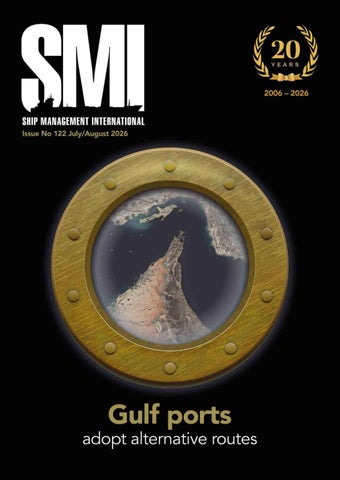
Gulf ports adopt alternative routes
NEWS WATCH 10 – SMM steers pragmatic course with
FIRST PERSON
18 – Hayato Suga
President and CEO of ClassNK
wind-assisted propulsion
11 – Hormuz must not harden ships, says IMO Secretary-General
HOW I WORK
12 – ISWAN helpline report highlights seafarers’ growing needs
13 – One small word that makes a big difference: ITIC
Get our magazine digitally. Scan QR code and fill in your details to receive.
NAUTICAL INSTITUTE 14 – If we want safer shipping operations, we need effective technology
Group MD, OSM Thome Leadership, not cost, will define the next era of ship management
INTERMANAGER OUTLOOK 16 – We must stop treating seafarers as the easiest people to blame Capt. Kuba Szymanski
22 – Tommy Olofsen
ADVERTISING FEATURE 26 – The next phase of maritime decarbonisation: OceanScore
Issue 122 July/August 2026
Ship Management International
5
SHIP MANAGEMENT INTERNATIONAL – ISSUE 122 JULY/AUGUST 2026 THE MAGAZINE FOR THE WORLD’S SHIP OWNERS & SHIP MANAGERS
MARITIME SAFETY 30 – Why vetting matters, with safety as a two-way traffic
32 – Ageing bulker fleet drives growing demand for tank top protection
CREW TRAINING Webinar
52 – EV fires afloat: What every ship operator must know
54 – Mintra and MARINA partner to strengthen digital maritime learning in the Philippines
REGIONAL FOCUS
55 – MCA launches rolling review of
Middle East Report
UK seafarer training syllabus
34 – Gulf ports adopt alternative routes 40 – Feeder shipping at scale: How Noatum Maritime is evolving to strengthen global trade connectivity
SHIP SUPPLY 56 – Sustainability as a core part of modern ship supply
41 – Q&A with Capt. Ammar Al
Shaiba, CEO of Noatum Maritime
ANALYSIS 60 – Large bulk carriers gain
Malta Report
46 – Pursuing a maritime-centred long-term national strategy
Connectivity Is Necessary and Reshaping Life at Sea
71 – The best forecasts only count if they can be acted on in time
CLEAN OCEANS 72 – Closing the sulphur compliance gap in shipping
73 – UV-based filtration enjoys wider use
TECHNICAL 62 – Building fuel-flexible two-stroke
REVIEW 76 – Bringing you the best in
SMI WEBINAR 42 – Why Hybrid Multi-Orbit
gation resilience
momentum
power
SMI + KVH
NAVIGATION 70 – Why a rethink is needed on navi-
OBJECTS OF DESIRE 74 – Our pick of the most coveted
50 – Malta Maritime Summit 2026 to discuss all the ‘big issues’
AD HOC 68 – Our regular diary section
BUNKERING 66 – Tanker operators facing ‘perfect storm’ on fuel
creations
arts & culture
LIFESTYLE 78 – Motors: Kia PV5 Passenger
ALTERNATIVE VIEWPOINT 67 – Worried about the oil price? Don’t worry, it’s right on trend! Dr Martin Stopford
The September/October issue of Ship Management International magazine (SMI 123) will feature special reports on Crew Management and Crew Welfare, as well as reporting on developments from the Seatrade Maritime Crew Connect Global event in the Philippines (20-22 October). The issue will also include a country report on Panama, including developments at the Panama Canal, as well as a latest update on IMO decarbonisation talks. For advertising enquiries, please contact Sales by emailing vijayatha@shipmanagementinternational.com You can also keep abreast of news and subscribe to our daily newsletter at shipmanagementinternational.com
6
Ship Management International
Issue 122 July/August 2026
The shipping business magazine for today’s global ship owners and ship managers Issue 122 July/August 2026
STRAIGHT TALK Connect with us /ShipManInter
Visit our website www.shipmanagementinternational.com
Join the debate @ShipManInter
Download our App Ship Management International
Shipping’s mask of Janus
I
t is often said that ‘shipping thrives in chaos’, and it’s hard to think of a period in recent times that has been more chaotic for shipowners… or more profitable. Consider first the chaos, not merely in terms of disruption to established routes and ports of call but also physical dangers to seafarers. Speaking at the end of August, IMO Secretary-General Arsenio Dominguez noted that the Iran War had now lasted six months. To date, at least 70 attacks on international shipping have been verified by IMO, he said with 19 seafarers killed, while up to 400 ships carrying around 6,000 seafarers have been unable to depart safely the Middle East Gulf via the Strait of Hormuz since the conflict began. At the same time, Russia and Ukraine have continued to exchange attacks on commercial ships in the Black Sea and Azov Sea area, the Houthis have returned to menacing traffic in the Red Sea, and piracy is returning in areas like the Gulf of Aden and surrounding areas, with some 90 seafarers being held hostage at the time of writing. Meanwhile, widespread port congestion and delays, as well as restricted traffic through
Published by
the Panama Canal, have compounded the operational chaos. But precisely because of the disruption, shipping has prospered. The greater tonne/ miles required by longer routes and resulting scarcity of capacity have served to drive up freight rates across virtually all shipping segments. Speaking on the eve of shipbuilding and ship machinery trade fair SMM (1-4 September), Clarksons Research head Steve Gordon pointed out that shipping industry was returning to the biennial Hamburg event “in rude health”. Underlying shipping rates were “stellar”, he pointed out, with the Hormuz disruption having “turbocharged” the cross-sector day-rate Clarksea Index. For example, tanker owner/operator Frontline reported its highest ever quarterly profit in Q2 of $660 million following a similar bonanza gain of $560 million the preceding quarter. Closer to the source of the Hormuz disruption, Abu Dhabi-based tanker company ADNOC L&S reported a record Q2 net profit of US$950 million, helping fuel a rapid fleet expansion. Over in liner, while the sector no longer enjoys the exceptional returns of the pandemic period, it has become highly
Wingbury Courtyard Business Village, Upper Wingbury Farm, Wingrave, Bucks, HP22 4LW, United Kingdom
Sales Enquiries Vijayatha Poojary Phone: +44 (0) 1296 682 051 Email: vijayatha@shipmanagementinternational.com Editorial Bob Jaques
Finance Lorraine Kimble
8
profitable again as a result of various disruptions including volatile trade tariffs. CMA CGM achieved EBITDA from shipping activities alone of over $3bn in H1 2026. Nobody expects either geopolitical risk or shipping’s resultant rewards to diminish much in the short term - although further out the prospect looms of shipowners once again ‘shooting themselves in the foot’ through overordering. In the meantime, how the shipping industry resolves this ‘mask of Janus’ situation that it finds itself in - balancing the woe of unacceptable physical danger to its workforce with the delight of the bountiful profits that flow – could be key to its reputational status and recruitment prospects going forward. l
Publisher: Editor: Sales Manager: Finance: Design and Layout: Regular Contributors:
Phone: +44 (0) 1296 682 089 Email: editor@shipmanagementinternational.com
Phone: +44 (0) 1296 682 051 Email: accounts@elaboratecomms.com
Ship Management International
Issue 122 July/August 2026
Motoring Journalist: Technical Editor:
Sean Moloney Bob Jaques Julian Berry Vijayatha Poojary Lorraine Kimble Diptesh Chohan Michael Grey Felicity Landon Ian Cochran Margie Collins Martin Stopford Rob Auchterlonie David Tinsley
Editorial contributors: The best and most informed writers serving the global shipmanagement and shipowning industry.
Printed in the UK by Warners Midlands plc. Although every effort has been made to ensure that the information contained in this publication is correct, Elaborate Communications accepts no responsibility or liability for any inaccuracies that may occur or their consequences. The opinions expressed in this publication are not necessarily those of the publishers. All rights reserved. No part of this publication may be reproduced whole, or in part, stored in a retrieval system or transmitted in any form or by any means without prior permission from Elaborate Communications.
News Watch SMI news and reports from around the world
SMM steers pragmatic course with wind-assisted propulsion
I
t was Clarksons Research head Steve Gordon who nailed it by noting that the shipping industry was returning to the biennial Shipbuilding, Machinery and Marine Technology (SMM) event in Hamburg in a very different frame of mind to two or four years previously. The global geopolitical dynamics and related disruption that were helping drive “an extended run of exceptional cross-sector cashflow (see also Straight Talk p.8), were now the main focus of attention, he said, rather than the green agenda. “With the green consensus ‘stalling’, alternative fuel investment share has dropped to 25% of orders by tonnage (from 50% four years ago albeit in part reflecting tankers return to orderbook mix),” he noted, while adoption of Energy Saving Technologies, comprising “fuel economics and emission economics” remains strong. Indeed, cracks were beginning to widen in the industry’s support for IMO’s Net Zero Framework, discussions on which were
10
Ship Management International
resuming at IMO committee level that week. The powerful Union of Greek Shipowners had already shown it hand over that debate, calling for “realism” rather than the IMO’s overly “ambitious targets”, with negotiations to date having revealed “serious weaknesses” in the NZF. Instead the UGS declared its support for the more pragmatic approach suggested by Panama and Liberia, which it said “takes into account critical parameters, such as the affordability, availability and scalability of the required fuels”. Amid such uncertainties swirling around the adoption of so-called alternative fuels, it was no surprise to find shipping concentrating on solutions that in the words of UGS President Melina N. Travlos “reflect technological capabilities and the realities of the global market’ rather than the more abstract realms of hydrogen, ammonia or nuclear – namely LNG (liquefied natural gas) and Wind-Assisted Propulsion Systems (WAPS). SMM again featured a special and
Issue 122 July/August 2026
Propulsion Route showcasing all the windassist technology, equipment suppliers and service providers at the exhibition. Some 40 members of the International Windship Association (IWSA) will exhibit or host wind propulsion-related activities throughout the event. The pace of commercial adoption continues to accelerate. We are seeing new installations, repeat orders and larger deployment programmes becoming the norm rather than the exception. Wind propulsion has firmly established itself as a practical, commercially viable technology that is delivering measurable fuel savings and emissions reductions today, and this is reflected in the heightened presence of wind propulsion at the industry’s largest trade fair.” With more than 100 large ships now having opted for WAPS, “the growing presence of wind propulsion at SMM mirrors the wider transformation taking place across commercial shipping,” he added. “What
News Watch
Hormuz must not harden ships, says IMO Secretary-General was once regarded as a niche, ‘blue skies’ technology has rapidly become an increasingly mainstream element of vessel decarbonisation strategies, offering shipowners immediate reductions in fuel consumption while complementing alternative fuels and energy efficiency measures. The growth in use of this energy source reflects increasing confidence from shipowners and reinforces the important role wind will play in shipping’s energy transition.” Several important wind propulsion contracts were announced during SMM week, perhaps most notably being adoption by Maersk of a Rotor Sail system for a vessel in its 8,700 TEU class Maersk Lima class – hailed by supplier Anemoi Marine Technologies as a world-first for the adoption of such technology in a large container vessel (normally thought to preclude any WAPS installation on account of limited available deck space). Then bound4blue announced that Odfjell was returning to install its eSAILs®on a second 49,000dwt chemical tanker, having already proved the concept on sistership Bow Olympus (pictured). And Oceanbird confirmed it would be installing two of its wing sails on Wallenius car carrier M/V Way Forward (render pictured) in 2027, its first multi-wing installation, after a single system had been installed on the same company’s Tirranna in June. Way Forward was built by Wallenius Marine in 2024 and is charted by Volkswagen Konzernlogistik. The vessel has been in operation for almost two years and holds the highest CII rating (A). installation of Oceanbird’s wing sails will mark “an important step towards our vision of a primary wind powered vessel,” said Oceanbird CEO Amrit Kaur Bhullar. Finally, during SMM week a consortium of leading Norwegian maritime companies and research institutions launched WINTEGRATE, a major research and innovation project aimed at accelerating the adoption of wind propulsion in commercial shipping. The grouping includes Kongsberg Maritime (project owner), SINTEF Ocean, SINTEF Digital, Odfjell SE, Seatrans, DNV, StormGeo, OsloMet, Norsepower, bound4blue, Corvus, OMS and DIGICAT. While wind propulsion is increasingly recognized as a promising decarbonizsation technology, its full potential remains limited by insufficient integration with other onboard systems, the partners believe. They aim to address this challenge through a holistic approach that combines digital technologies, operational optimisation and full-scale testing, combining wind propulsion with advanced control, energy management and weather routing systems. In this way WINTEGRATE aims to significantly increase the emissions-reduction potential of wind-assisted shipping and support the industry’s transition toward low- and zero-emission operations. l
I
f the situation in the Strait of Hormuz represents an overturning of shipping’s international norms, it is just the latest of many in the last five years, with vessels treated as viable military targets and coming under fire from well-equipped nation-states. Asked during a panel session at SMM whether it was time for shipping to take matters into its own hands by reinforcing them to withstand missile or drone attack, IMO Secretary General Arsenio Dominguez was unequivocal. “No,” he said. “The answer is no, we cannot. “This is commercial shipping, our seafarers are not trained for combat and commercial ships are not designed to actually go into that sector.” Condemning the action taken by some shipowners, Dominguez reiterated IMO’s guidance: “The call remains in place for ships not to try to cross the Strait of Hormuz. I am still trying to understand the circumstances of why some shipowners are actually taking that risk. “But we need safety and security, we are not turning commercial shipping into part of the global military naval fleet, because that’s not what shipping is all about. We are a sector that can provide a benefit around the world, not increase conflict.” John Denholm, chairman of ICS, echoed the sentiments of his fellow panellist, saying: “Responsible shipowners do not route their vessels into danger. Very few ships are going through Hormuz. Seafarers are critical to our industry, and without seafarers we have nothing. We have got to keep them safe.” Speaking later to SMI, he added: “There was the belief that the Strait of Hormuz would be reopened in a matter of days. It’s been six months. I don’t think military might can open Hormuz, [only] peace can.” l
Issue 122 July/August 2026
Ship Management International
11
News Watch
ISWAN helpline report highlights seafarers’ growing needs
T
he International Seafarers’ Welfare and Assistance Network (ISWAN) has published its annual report from its 24-hour, multilingual helpline SeafarerHelp, revealing the challenges seafarers and their families are facing as life and work at sea becomes increasingly complex. Drawing on data and insights from thousands of confidential helpline conversations, the report highlights emerging welfare concerns and the action needed across the maritime sector to support seafarers’ wellbeing, safety and dignity. The report, sponsored by NorthStandard, shows that while fewer seafarers contacted SeafarerHelp for straightforward enquiries in 2025, those who did reach out increasingly needed support with complex, interconnected challenges affecting their wellbeing, relationships, finances and safety. New contacts (i.e. calls and messages) decreased, but follow-up contacts increased as more people required ongoing support rather than a single conversation. Although SeafarerHelp primarily hears from seafarers and family members facing difficulties rather than those having positive experiences, several themes emerged consistently across helpline interactions in 2025. Seafarers described the cumulative emotional impact of long periods away from home, demanding workloads, concerns about family life ashore and uncertainty created by wider industry and geopolitical developments. Many challenges rarely occurred in isolation – mental health concerns were often closely linked to employment issues, onboard culture, financial pressures or experiences of abuse. The findings also suggest that improving onboard connectivity is changing why people seek help. Many seafarers now use online sources to find practical information themselves but continue to turn to SeafarerHelp when situations require empathy, professional judgement, specialist knowledge or emotional support. Helpline officers increasingly report that callers want reassurance they are speaking to a real person who understands the realities of maritime life. One of the clearest findings from the review is the significant rise in mental healthrelated cases. The number of contacts relating to mental health concerns increased by 35.9% compared with the previous year, reaching the highest level recorded by SeafarerHelp and exceeding levels seen at the height of the COVID-19 pandemic. In response, ISWAN expanded its mental health support
12
Ship Management International
during 2025, including the introduction of a Specialised Support Team providing ongoing mental health support, alongside initiatives such as SEAS (Seafarers’ Education and Awareness Sessions) and the BAYANIHAN mental health initiative in the Philippines. The report also highlights the continuing impact of abuse, bullying, harassment, discrimination and violence at sea. Women were disproportionately affected, being more than four times as likely as men to raise these concerns with SeafarerHelp. To address these challenges, ISWAN continues to develop programmes including its ‘Safe at sea...it takes all of us!’ campaign and the Social Interaction Matters Project, both designed to help create safer and more supportive working environments on board. At the same time, SeafarerHelp supported a growing number of seafarers affected by abandonment, with abandonment-related contacts increasing by 41.2% during 2025 and rising by 158.9% since 2022. Many affected seafarers reported being left without pay, support or a clear route home. As the organisation begins its work with consultative status at the IMO in 2026, ISWAN says it is committed to ensuring that the experiences shared through its helplines continue to inform discussions about the future of seafarer welfare. l
One of the clearest findings from the review is the significant rise in mental health-related cases… exceeding levels seen at the height of the COVID-19 pandemic.
Issue 122 July/August 2026
News Watch
One small word that makes a big difference
By Robert Hodge, Asia Pacific General Manager, ITIC
Deleting a single word from SHIPMAN may appear insignificant during contract negotiations, but it can fundamentally alter the allocation of risk. An ITIC case demonstrates why managers should think carefully before agreeing to remove “solely”.
S
HIPMAN is sometimes described as a manager-friendly contract. This is difficult to accept. The manager undertakes to use best endeavours to provide the management services in accordance with sound ship management practice and to protect and promote the owner’s interests. Best endeavours is an onerous standard, which goes beyond the usual obligation to exercise reasonable skill and care. SHIPMAN balances that demanding obligation by providing an important protection for managers. The manager is not liable for a loss unless it is proved to have resulted solely from the negligence, gross negligence, or wilful default of the manager, depending on the version and agreed wording of the contract. The key word is “solely”. During contract negotiations, owners sometimes ask for the word to be deleted. The proposed amendment can look minor. It is only one word, after all. However, deleting it can materially change the agreed allocation of risk. Ship management is complicated. A casualty, delay, detention, or cost overrun rarely has a single cause. The condition of the ship, decisions taken by the owner, the conduct of the crew, the performance of a
shipyard or contractor, the availability of spare parts, and unforeseen work can all contribute to the eventual loss. The manager may have made a mistake, but that does not necessarily mean that the mistake caused the whole loss. A recent ITIC claim illustrates this point. A manager faced claims of approximately US$2.5 million following extensive repair and refit work on an ageing bulk carrier. The owner alleged numerous management failures and sought damages for lost earnings, cost overruns, allegedly unnecessary repairs, and various other expenses. The manager denied that the losses had been caused solely by its conduct. The condition of the vessel at delivery, the absence of a pre-purchase inspection, latent defects discovered during class surveys, and the work of the shipyards and contractors were all relevant. The defence was not simply that the manager had done nothing wrong. It was that the claimed losses could not properly be attributed solely to the manager. The dispute proceeded to arbitration, requiring extensive documentary, factual, and expert evidence. On the second day of the hearing, the owner agreed to a drophands settlement. No damages or indemnity were paid to the owner, although significant legal costs had been incurred in the managers defence.
This illustrates why the word matters. If an owner proves that the manager made a mistake, that is not necessarily the end of the argument. The owner must still prove that the relevant loss resulted solely from that mistake. Where several factors combined to produce the loss, the contractual test may not be satisfied. This does not give managers a free pass. They must still meet the demanding best endeavours standard, follow sound ship management practice, and protect and promote the owner’s interests. If their negligence is the sole cause of a loss, liability may follow, subject to the remaining protections and limits in SHIPMAN. The wording recognises the reality of ship management. Managers coordinate complex operations involving many parties, but they do not control every party or guarantee every outcome. Managers should therefore think carefully before agreeing to delete “solely”. Removing it is not a tidying-up exercise. It lowers the threshold for liability and may allow an owner to recover losses caused partly by the manager, but also by the owner, the crew, a shipyard, a contractor, or circumstances outside the manager’s control. In SHIPMAN, one small word carries a great deal of weight. Managers should make sure it stays there. l
Issue 122 July/August 2026
Ship Management International
13
Nautical Institute If we want safer shipping operations, we need effective technology
By David Patraiko, Director of Projects, The Nautical Institute
T
here is no shortage of discussion about the future of technology in shipping. Automation, artificial intelligence, connectivity and increasingly sophisticated onboard systems are changing how vessels are operated and managed. But there is one group whose experience must remain at the centre of that discussion: the people who actually use the technology at sea. That may sound obvious, yet decisions about new systems, training requirements and future regulation can easily become dominated by what technology is capable of doing rather than what happens when it is placed in the hands of a working seafarer. The reality on board is more complicated. A system that appears intuitive to someone who designs it may be far less straightforward for a seafarer who needs to use it. Systems designed ashore to improve efficiency may not necessarily translate to at-sea operations where ‘the best practice’ of seamanship needs to prevail. That is why The Nautical Institute’s STEER Project, in collaboration with Lloyd’s Register Foundation, is currently asking seafarers across the industry to tell us about their experiences. Through our #ListeningToSeafarers survey, we want to hear from maritime professionals of every rank and background. That means Masters and deck officers, but equally engineers, ratings and others whose voices may not always be as prominent in debates about maritime technology. We need that breadth of experience because there is no single [resource of] seafarer experience of digitalisation. Technology can make work safer and more efficient. It can provide better information, automate repetitive processes and help people make more informed decisions. But technology can also create additional complexity. New systems require familiarisation. Interfaces differ between vessels. Increasing amounts of information have to be interpreted. And a seafarer may move from a vessel operating relatively traditional equipment to one using considerably more sophisticated digital systems with very little time to adapt. Understanding those differences is essential if the industry is going to make good decisions about what comes next. The survey is therefore not intended to sit in isolation. The findings will be considered alongside the STEER Project’s initial research report, which draws on a wider body of evidence including academic research, literature and lessons from accident investigations. Bringing those different sources together gives us an opportunity to compare what research and investigation reports tell us with what seafarers themselves are experiencing in their daily working lives. That is important. We should not design the future of maritime work around assumptions about what seafarers need. Nor should we assume that systems designed to support the management of shipping also serves the front line operations of shipping. We need evidence. We also need to make it as easy as possible for people to contribute. The survey is available in multiple languages,
14
Ship Management International
Issue 122 July/August 2026
helping us reach maritime professionals across different regions, nationalities and parts of the industry. Ultimately, however, research only has value if it leads to something useful. The ambition of STEER is not simply to produce another report that identifies a problem and then sits on a shelf. The project will use the evidence gathered to help develop a fit-for-purpose toolbox intended to support the safe and effective introduction and use of technology. Those tools will be made freely available to the maritime industry. That practical outcome is central to the project. If we can better understand where technology supports seafarers, where it creates difficulties and where additional training, guidance or consideration is required, we have a much stronger basis on which to improve future systems and working practices. The STEER Project is supported by Lloyd’s Register Foundation through its Engineering a Safer World initiative, and that emphasis on safety is fundamental to what we are trying to achieve. Technology will continue to evolve. Automation will increase and artificial intelligence will find new applications across maritime operations. The question is not whether that change will happen. It is how we ensure that change genuinely contributes to safer operations and supports the people expected to work with it. For that, we need to listen. So my request to seafarers is simple: whatever your rank, role or experience of technology, please take part. And to shipowners, managers, training organisations, professional bodies and others with access to seafarer communities: please help us share the survey as widely as possible. The more representative the evidence we gather, the more useful the eventual outcome can be for the industry. l
Take part in the #ListeningToSeafarers survey:
https://www.nautinst.org/resources-page/your-voice-is-important-to-us.html
A video series explaining more about the STEER Project is available here: https://www.youtube.com/playlist?list=PLYlPyz3vLByk
InterManager Outlook We must stop treating seafarers as the easiest people to blame By Capt. Kuba Szymanski, Secretary General, InterManager and Senior Fellow, COPE
W
hen something goes wrong at sea, the first question should always be ‘what happened?’ Too often, however, the first response is ‘who can we blame?’ Increasingly, that answer is the seafarer. As a panellist in a recent webinar hosted by the Centre for Ocean Policy & Economics (COPE), where I serve as a Senior Fellow, I joined legal experts, policymakers and maritime leaders to discuss one of the shipping industry's most pressing human rights challenges: the growing criminalisation of seafarers. The discussion reinforced what many of us have witnessed for years – that professional seafarers are too often detained, investigated or prosecuted despite acting in good faith and having little or no control over the circumstances that led to an incident. Consider the case of a Chief Officer who discovered drugs hidden in a cargo of coal. He did exactly what he was trained to do, immediately reporting the discovery to the authorities. He was assured the drugs had been removed before the vessel sailed. Yet when more drugs were found at the discharge port, he was sentenced to 30 years in prison. Imagine arresting an airline pilot because a passenger was carrying narcotics in their luggage. It would be unthinkable, yet this is the reality some seafarers face. At InterManager, we have spent the last few years building one of the industry's few dedicated databases tracking cases of seafarer criminalisation. The evidence shows this is not confined to one or two jurisdictions. It is a global issue, with cases continuing to emerge across Europe, the Americas, Asia and beyond. The problem is becoming more acute as shipping grows increasingly complex. Organised crime is exploiting global supply chains, while digitalisation and automation have created new vulnerabilities. Governments
16
Ship Management International
are right to investigate these crimes, but too often investigations are carried out by authorities with limited maritime expertise, leading to crews becoming convenient targets before the facts have been fully established. This has profound consequences. Seafarers can spend months, even years, detained far from home, separated from their families and navigating unfamiliar legal systems with limited access to independent legal advice. The impact extends well beyond the individual, leaving families facing financial uncertainty and emotional distress while receiving little information about what is happening. If a company sends an employee into a working environment, it should stand behind them when something goes wrong. That means providing legal support, maintaining communication with families and ensuring practical assistance throughout any investigation. Families should never be left facing weeks or months of uncertainty without information or support. However, the solution extends beyond individual companies.
Issue 122 July/August 2026
COPE's recently published White Paper argues that existing international frameworks do not provide consistent protections for seafarers facing criminal investigations and calls for an international treaty establishing minimum standards for due process, including access to independent legal counsel, translation services, family contact and safeguards against prolonged detention. It also proposes creating a global maritime observatory to improve transparency, collect reliable data and identify trends that can help shape fairer legal frameworks. These proposals are not about weakening law enforcement - governments must investigate crime and hold those responsible to account. But justice depends on fairness. If shipping is a global industry governed by international rules, then the men and women who keep global trade moving deserve internationally recognised standards of treatment when things go wrong. Protecting seafarers' rights is not just a human rights issue, it is fundamental to maintaining confidence in the rule of law, supporting the future maritime workforce and ensuring a resilient global shipping industry. l
First Person Hayato Suga
18
Ship Management International
Issue 122 July/August 2026
President and CEO of ClassNK
First Person
F
or classification societies, the pace of change in shipping is no longer theoretical. New fuels, digitalisation, artificial intelligence and geopolitical risk are all colliding with the day-to-day realities of keeping ships safe, compliant and commercially viable. For ClassNK, the response is not to chase a single answer, but to help the industry manage a transition in which several solutions will need to exist side-by-side. The society has been active in recent months in issuing approvals in principle and class approvals for technologies such as wind-assisted propulsion systems and an ammonia-fuelled panamax bulk carrier. These developments underline the continuing importance of technical progress, even after the postponement of the IMO Net-Zero Framework. While the delay has added uncertainty, ClassNK does not believe the basic direction of travel has changed. The industry remains committed to decarbonisation under the IMO’s greenhouse gas reduction strategy, but there is now an even greater need for clarity, international consensus and practical guidance. The concern for class is that uncertainty can slow investment, delay decision-making and encourage fragmented approaches. Shipping needs a framework that is internationally unified and capable of being applied consistently across different flags, vessel types and operating profiles. Without that, owners and managers are left trying to make long-term investment decisions in a regulatory landscape that is still moving beneath their feet. “Although the adoption of the IMO NetZero Framework (NZF) has been postponed, I believe its direction has not changed,” said Hayato Suga. “As the postponement has increased uncertainty around the movement toward decarbonisation, we hope that IMO will work together with Member States, build consensus among countries and relevant stakeholders, and provide guidance at an early stage on an internationally unified framework in line with the GHG Reduction Strategy. Through this, we expect the decarbonisation of international shipping to move forward. Suga-san added: “For ClassNK, this delay has made it even more important to support the industry through a transition period where several options may exist in parallel, rather than assuming one specific fuel or one single solution.” ClassNK’s view is that the transition must remain realistic and flexible. It is unlikely that a single fuel will dominate all ship types or trades in the near future. Biofuels and LNG may have a role to play in the short term. Lower-emission blue fuels may then support
the next stage of the transition before the wider availability of green fuels. But fuel choices will depend not only on emissions performance, but also on geopolitics, technology maturity, investment capacity, infrastructure, trading patterns and the condition of existing fleets. That creates a complex decision-making environment for shipowners and managers. A deep-sea bulk carrier, a tanker, a coastal vessel and a containership operating on a fixed route may each require different answers. The role of class is to help owners assess those options against safety, technical feasibility, compliance and economic viability. In the meantime, ClassNK sees strong value in energy-saving technologies that can be introduced more readily. Wind-assisted propulsion, low-friction coatings and voyage optimisation systems may not represent the full answer to shipping’s carbon challenge, but they are practical measures that can deliver benefits now. As uncertainty around future regulation and fuel availability gradually reduces, more fundamental measures such as alternative fuels and onboard carbon capture are expected to move forward at greater scale. “We will continue to support industry stakeholders in making appropriate decisions based on safety, technical feasibility, regulatory compliance, and economic viability, including through the issuance of AiPs and the provision of information, and contribute to a realistic transition,” he said. This practical approach reflects a wider shift inside ClassNK itself. The society’s current agenda is focused not only on the future of shipping, but also on the speed and reliability with which it can respond to industry needs. As a certification body, ClassNK sees its first responsibility as providing reliable services. But in a fast-changing market, reliability alone is not enough. Timing matters. A service that arrives too late may lose much of its value. The organisation is therefore placing greater emphasis on execution, decisionmaking speed and practical responsiveness. To support this, ClassNK has been adjusting its internal structure. Authority is being delegated more widely through an increased number of corporate officers, while planning and business functions are being reorganised to improve the journey from identifying customer needs to implementing concrete measures. The aim is to make the organisation more agile without compromising the trust and technical rigour on which classification depends. Recognition is another priority. As environmental regulation expands and digitalisation increases transparency, the number of stakeholders with an interest in classification and certification is growing.
Class is no longer speaking only to owners, managers, yards and flag administrations. Charterers, financiers, insurers, regulators, technology providers and wider society are increasingly focused on how ships are assessed, certified and monitored. For ClassNK, this creates both a challenge and an opportunity. According to the President & CEO, the society does not see its future in moving into entirely unrelated fields, but rather in applying the capabilities of classification to new needs. By doing so, it aims to build recognition and trust among a broader group of stakeholders while remaining grounded in its core role. That core role is also central to what the IMO expects from classification societies. As Recognised Organisations, class societies carry out surveys, audits and certification on behalf of flag states. Their responsibility is not simply to understand international rules, but to translate those rules into safe and effective implementation on board actual ships. This becomes especially important in areas such as alternative fuels and digitalisation, where regulation is developing quickly and the practical implications can be significant. Rules must work not only in committee rooms, but also in engine rooms, shipyards, management offices and on the bridge. Class societies bring certification experience, technical expertise, independence and global networks to that process. ClassNK sees itself as a bridge between regulation and implementation. The experience gained through surveys, approvals and certification also feeds back into future rule development, helping regulators understand what works in practice and where further clarification may be needed. “In particular, in areas such as alternative fuels and digitalisation, the certification experience, practical knowledge, global networks, independence, and technical expertise of classification societies become increasingly important. ClassNK would like to make use of these strengths and continue to play a role in connecting regulations with practical implementation in the field. “Also, through these activities, we will gain experience and knowledge. We believe this will naturally lead to feedback and support for rule development,” he said. At the same time, the external risk environment facing shipping has become more volatile. Geopolitical disruption, supply chain instability and the growth of the shadow fleet have all increased the pressure on owners, managers and class societies. In such circumstances, ClassNK says the highest priority must remain safety, while ensuring that essential services continue even during emergencies. The recent situation in the Persian Gulf provided an example of this approach.
Issue 122 July/August 2026
Ship Management International
19
First Person
THE BIG PICTURE
We will continue to contribute to the safety and stability of maritime transport by responding to the changing risk environment and continuously providing reliable services Hayato Suga, President and CEO of ClassNK
ClassNK supported owners and operators through flexible responses, including prior coordination with flag state governments and the use of remote surveys where appropriate. The aim was to maintain support for on-site operations as far as possible while adapting to the realities of the risk environment. This ability to continue operating under pressure is becoming increasingly important. Shipping cannot afford for technical assurance to stop when disruption occurs. Class must be able to respond quickly, maintain standards and support the safe movement of maritime trade even when normal operating conditions are challenged. “We will continue to contribute to the safety and stability of maritime transport by responding to the changing risk environment and continuously providing reliable services,” said Suga-san. Digitalisation and artificial intelligence will add another layer to this transformation. ClassNK believes AI will play an increasingly important role in shipping, not only by improving efficiency but by reshaping services, decision-making and potentially business models. The opportunities are significant. AI could be used to predict risk, assess ship safety, optimise environmental performance and support more sophisticated decision-making across fleets. For ship managers, this could mean better insight into vessel condition, operational performance, maintenance planning and regulatory compliance. But ClassNK is also alert to the concerns. As AI systems become more advanced, their decision-making processes can become
20
Ship Management International
difficult to explain. Responsibility may become blurred if a recommendation or assessment is generated by technology that users do not fully understand. For a sector built around safety, accountability and trust, that is a serious issue. ClassNK’s Digital Solutions Division, established in April this year, is intended to help the organisation move more quickly and confidently in this area. Its role is to promote the use of digital technologies, including AI, while addressing governance issues such as reliability, transparency and responsibility across the organisation. Behind these strategic priorities sits a personal story of long commitment to the maritime industry. Having joined ClassNK in 1986, during a severe downturn in shipping, its senior leadership reflects a generation that chose maritime not because it was easy, but because it offered the chance to contribute to a wider industry. While many graduates at the time looked to sectors such as automotive, he deliberately chose the maritime sector. Rather than pursuing a narrowly specialised field, he wanted to contribute to the broader maritime industry. He was attracted to a career in classification, which offered the opportunity to gain comprehensive experience across the industry while contributing to society. That sense of service still shapes the management philosophy today. The aim is to respect the initiative of individual staff while building an organisation that can act quickly and steadily. Individual performance matters, but so too do teamwork, contribution to the organisation and the development of longterm expertise.
Issue 122 July/August 2026
For ClassNK, the challenge is to combine agility with continuity. Staff need the confidence to build careers, deepen experience and contribute to trusted services over the long term. Welfare, loyalty and organisational trust are therefore not soft issues; they are part of the foundation that allows a classification society to operate effectively. “As for the balance between work and leisure, I travel frequently for work and do not have much free time, but I try to find opportunities to take short, intensive trips whenever I can. Visiting different places allows me to experience an atmosphere different from my daily life and refresh my mind. Even within limited time, actually going to a destination, seeing it, and experiencing it firsthand is a wonderful experience, and I also enjoy the sense of achievement it gives me. “Regarding management, I believe it is important to respect the initiative of each staff member, while building an organisation that can act quickly and steadily. To achieve this, it is important to have a system that properly evaluates not only individual results, but also teamwork and contribution to the organisation. It is also important to create an employment environment where staff can work with peace of mind over the long term, and build their experience and expertise. In addition, welfare measures that increase trust in the organisation and loyalty are also important. “By strengthening this foundation, I would like to manage the organisation in a way that allows each staff member to fully demonstrate their abilities, and enables ClassNK to continue providing services trusted by society and customers,” he concluded. l
How I Work Tommy Olofsen Group MD, OSM Thome
22
Ship Management International
Issue 122 July/August 2026
How I Work
Leadership, not cost, will define the next era of ship management Why OSM Thome’s
Tommy Olofsen believes the future belongs to performance, partnership and people By Sean Moloney
T
he ship management industry is undergoing one of the most significant transformations in its history. For years, third-party managers were often judged on one metric above all others: cost. Today, however, that conversation is changing. Shipowners are increasingly looking beyond operational expenditure and asking a far more strategic question: who can help them navigate an industry that has never been more complex? Few people are better placed to comment than Tommy Olofsen, Group Managing Director of OSM Thome. Leading one of the world’s largest ship management companies, with responsibility for more than 1,000 vessels, over 30,000 seafarers and approximately 1,600 shore-based employees across more than 20 countries, Tommy Olofsen believes ship management is entering a new phase where resilience, expertise and partnership matter more than price. “The dynamics are changing from being mainly a question of cost to becoming much more a question of performance, reliability and infrastructure,” he explains. “Ship managers are becoming a key part of a shipowner’s ability to deliver what their business needs.” It is a subtle but fundamental shift. Historically, many shipowners built their businesses around a single market segment—containers, tankers, dry bulk or offshore. Increasingly, however, owners are diversifying fleets and trading patterns, creating new operational challenges. This is where large third-party managers are finding new relevance.
“We manage more than 40 different vessel types across the world,” he says. “That gives owners access to expertise they simply may not have internally. It creates opportunities for much deeper strategic partnerships.” Rather than replacing in-house management, third-party managers are increasingly complementing it, allowing owners to expand into unfamiliar sectors while reducing operational risk. The drivers behind this evolution are numerous: regulatory compliance, geopolitical uncertainty, ESG expectations, new fuel technologies, charterer requirements and digital transformation all add layers of complexity to vessel operations. “The most important thing is building sufficient scale and robustness to handle whatever comes our way,” he says. For Tommy Olofsen, the industry’s fixation on operating costs misses a much larger commercial reality. Saving a small percentage on crewing or maintenance means little if the consequence is poor vessel performance, off-hire periods or Port State Control detentions. “You might save a few percentage points on OPEX, but if that results in performance issues, you’ve destroyed value at an entirely different level.” It is a philosophy that reflects how many charterers and cargo owners are now assessing shipping partners. Operational reliability, safety records and fleet performance increasingly influence commercial decisions. Ship management, once viewed as an outsourced operational necessity, is becoming an enabler of competitive advantage.
Since becoming Group Managing Director in late 2025, Tommy’s first priority has not been technology or commercial growth, it has been alignment. “My immediate priority has been getting everyone to work as one.” That philosophy extends across every part of the organisation, from ships at sea to finance departments ashore. “It doesn’t matter whether you’re onboard, in HR, crewing, accounting or leadership,” he says. “Every one of our 30,000 colleagues represents who OSM Thome is.” Creating a common culture is particularly important in a global business where operational consistency directly affects safety, customer experience and crew welfare. Equally important, he believes, is how organisations respond when things go wrong. “The way we handle challenges defines who we are just as much as when everything goes according to plan.” If there is one theme that consistently returns throughout the conversation, it is people. While much of shipping’s public debate remains focused on decarbonisation and technology, Tommy Olofsen believes attention has rightly shifted back towards the individuals who keep global trade moving. “I don’t think enough attention is paid to seafarers,” he says without hesitation. “It is improving, but it’s nowhere near where it should be.” The International Day of the Seafarer theme, Carrying World Trade, Carrying the Risk, resonates strongly with him. “It isn’t the steel of the ship or the fuel in the engine room that powers world trade. It’s the people.”
Issue 122 July/August 2026
Ship Management International
23
How I Work
He argues that the industry still frequently undervalues seafarers, pointing to outdated terminology and employment practices that fail to reflect today’s highly skilled maritime professionals. Perhaps most notably, OSM Thome directly employs its own seafarers rather than relying solely on external employment structures, a model Olofsen believes fundamentally changes the relationship. “When we employ them ourselves, they become our colleagues. That changes everything.” Recent geopolitical tensions have once again highlighted the pressures facing crews operating in high-risk regions. And Mr Olofsen acknowledges that today’s seafarers face increasing levels of fatigue, stress and isolation. “What concerns me most is keeping the promise we make, not only to the seafarer, but to their family, that they return home in the same condition they left.” To support crews, OSM Thome has invested heavily in welfare infrastructure, including its own medical clinics, doctors and psychologists alongside enhanced communication and welfare protocols. For Tommy, however, welfare begins with something much simpler. “It starts with treating seafarers with respect.” He is equally clear that organisations cannot simply talk about putting people first.
24
Ship Management International
“If you say seafarers matter, every action has to support that. Otherwise you’ll be called out very quickly.” Artificial intelligence dominates almost every industry discussion today, but he adopts a notably measured approach. Rather than rushing to deploy AI tools, OSM Thome has focused on fixing processes first. “If your processes are poor and your data is poor, AI simply automates poor processes using poor data.” Instead, the company has developed a structured digital roadmap, ensuring work processes are standardised before automation is introduced. Only then, he says, can digital tools genuinely improve efficiency. The objective is not to burden crews with additional systems but to reduce administrative workload. “We want people spending less time entering data and more time using information to make better decisions.” It is a pragmatic approach that reflects a broader industry realisation: digitalisation succeeds only when it supports operational objectives rather than becoming an objective in itself. Despite rapid technological change, Tommy Olofsen remains convinced that leadership, not software, will determine future success. His own philosophy centres on trust, accountability and empowering others.
Issue 120 March/April 2026
“I don’t overload people with tasks,” he says. “I overload them with accountability and responsibility.” It is an approach that enables decisionmaking throughout the organisation while allowing leaders to step back rather than attempting to control every operational detail. “I surround myself with people who are better than me,” he says with a smile. “That means I can sleep well because they do a good job.” Listening to Tommy Olofsen, it becomes clear that ship management’s future will not simply be shaped by larger fleets, smarter software or lower operating costs. It will be defined by trust. Trust between owners and managers. Trust between shore and ship. Trust between employers and seafarers. As compliance grows more demanding, geopolitical uncertainty becomes more persistent and technology reshapes operations, ship management companies are evolving from outsourced contractors into strategic partners central to fleet performance. For Olofsen, the industry’s future rests on a simple principle: Performance creates value. And performance begins, and ends, with people. l
Advertising feature
The next phase of maritime decarbonisation: Turning environmental performance into commercial value
F
or years, the maritime industry’s approach to decarbonisation has been driven primarily by regulation. New requirements such as EU ETS and FuelEU Maritime have brought additional reporting obligations, more complex compliance processes and, ultimately, additional cost. That picture is changing. While regulation continues to shape the industry’s decarbonisation efforts, it is also creating new commercial opportunities. Today, environmental performance increasingly influences commercial outcomes. Regulations are creating financial exposure, but they are also creating markets, incentives and new ways for well-performing vessels to generate value. The companies that recognise this shift early will be better positioned than those who continue to see compliance simply as an administrative obligation. The question is no longer just “How do we comply?”. Increasingly, it is “How do we manage emissions commercially?”
A regulatory framework that continues to expand
The inclusion of shipping in the EU Emissions Trading System marked a fundamental change. Carbon emissions became a direct operating cost for voyages involving European ports. According to the European Commission, the extension of the EU ETS increased average shipping costs by around 3.7% in its first year of application, with costs rising further as the phase-in progressed. On a Shanghai–Rotterdam container route, ETS costs alone were estimated at €106,000– 145,000 per voyage, depending on the routing.
26
Ship Management International
FuelEU Maritime has taken a different approach. Rather than pricing emissions directly, it sets greenhouse gas intensity targets for energy used onboard. Companies that outperform those targets can generate compliance surpluses, while others must either improve performance or acquire compliance through mechanisms such as pooling. And the regulatory picture is still expanding. The UK has introduced its own emissions trading system for shipping. Turkey has signalled its intention to develop a national emissions trading system. At the global level, the IMO’s Net-Zero Framework — agreed in principle in 2025 and might be formally adopted by the end of 2026 — will add a global pricing and reward mechanism to maritime decarbonisation, further reinforcing the shift towards commercially managed emissions. These developments are often discussed separately. In practice, they point in the same direction: environmental performance is becoming part of commercial decision-making. For shipping companies, this means emissions can no longer be managed independently from commercial operations.
Managing emissions has become a commercial discipline Where emissions create costs: • EU ETS and UK ETS exposure on individual voyages • FuelEU deficits across the fleet • Future costs under the IMO Net-Zero Framework
Where environmental performance creates value: • Reducing FuelEU compliance costs through pooling
Issue 122 July/August 2026
By
• Recovering compliance costs through charterparty and SHIPMAN mechanisms • Reduced port dues through ESI and similar incentive programmes rewarding cleaner vessels. • Improving transparency between owners, managers and charterers Commercial decisions that influence the outcome: • Vessel deployment • Speed and voyage planning • Fuel selection • Charterparty allocation of compliance costs • Participation in pooling and environmental incentive schemes l
Environmental performance is no longer only a sustainability metric. Increasingly, it is becoming a commercial one Albrecht Grell, Managing Director at OceanScore
Issue 121 May/June 2026
Ship Management International
27
Advertising feature
Compliance is creating markets
P
erhaps the clearest example is FuelEU Maritime. Much of the early discussion focused on penalties and reporting obligations. Less attention was given to the commercial market the regulation would create. The first FuelEU compliance cycle has demonstrated that the regulation is doing more than setting emissions targets. It has created an active compliance market. Compliance balances are now traded, pooling has become an established mechanism for balancing deficits and surpluses, and market participants have even seen periods of negative abatement costs (generating FuelEU compliance through biofuel blending became less expensive than
continuing with conventional fuels). At the same time, the first year of FuelEU also demonstrated how quickly compliance economics can change. During periods of negative abatement costs, generating FuelEU compliance through biofuel blending temporarily became less expensive than continuing with conventional fuels. This illustrated that the commercial value of compliance is influenced not only by regulation, but also by fuel prices, EU ETS prices and broader market conditions. The temporary emergence of negative abatement costs during the first FuelEU compliance cycle surprised many observers. More importantly, it demonstrated that compliance economics are influenced by
Market insight: FuelEU has become a commercial market
The first official FuelEU compliance data confirms that pooling has become the dominant flexibility mechanism. • • •
136 shipping companies generated a compliance surplus. 3,601 companies finished with a compliance deficit. Around 2 million tonnes CO2e of compliance balance were pooled.
These figures show that compliance surplus is concentrated among a relatively small number of market participants, while demand is spread across thousands of companies. As a result, FuelEU pooling is evolving into a genuine commercial market where transparency, liquidity and price discovery increasingly matter. Source: THETIS-MRV CY2025 data (published 1 July 2026); analysis by Meridian Trade Advisory.
28
Ship Management International
Issue 122 July/August 2026
a combination of fuel prices, carbon prices and market conditions—not by regulation alone. Environmental performance does not only reduce regulatory risk. Under the right conditions, it creates commercial value. Pooling decisions increasingly involve significant financial value. That means commercial decisions must be supported by traceable, audit-ready data. Companies need a clear data lineage—from vessel operations to voyage calculations and ultimately to invoices and settlements. The ability to explain every calculation to regulators, charterers, verifiers and finance teams is becoming just as important as producing the calculation itself. This shift is already visible in practice. OceanScore supports more than 2,500 vessels with commercial emissions compliance, and an increasing share of customer discussions now focuses not only on regulatory obligations, but on how environmental performance can influence commercial outcomes. The temporary emergence of negative abatement costs illustrated this shift particularly clearly. For a brief period, generating FuelEU compliance through biofuel blending became less expensive than continuing with conventional fuels, demonstrating that compliance can, under certain market conditions, create value rather than additional cost. Environmental performance already creates value Commercial opportunities are not limited to regulation. Around the world, ports are increasingly recognising environmental performance through financial incentives. More than 100 ports participate in the Environmental Ship Index (ESI), offering reduced port dues to vessels that perform beyond mandatory environmental requirements—for example through lower emissions, the use of shore power, cleaner fuels or technologies such as wind-assisted propulsion. More than 7,200 ships are already registered. For many vessels, participation costs are modest. In some cases, just one or two port calls at participating ports are enough to recover the annual cost of participation. Importantly, many vessels already qualify based on their existing environmental performance. In those cases, operators benefit from automatic reductions in port dues without changing vessel operations or having to apply for incentives at each port. For many operators, the challenge is not improving environmental performance. It is recognising where incentives already exist and ensuring they are captured. As ports continue investing in sustainability, programmes such as ESI demonstrate that environmental performance is becoming something operators can monetise, not simply measure. l
Advertising feature
In practice: Environmental performance can already reduce voyage costs
T
he examples below illustrate how environmental performance can translate directly into lower port dues through the Environmental Ship Index. Depending on vessel type and trading pattern, just a small number of ESI-eligible port calls can offset the annual cost of participation, while vessels making frequent calls to participating ports can achieve significant annual savings.
Managing complexity without increasing cost and risk
Within just a few years, shipping companies have had to adapt to EU ETS and FuelEU Maritime, while the UK has introduced its own maritime ETS, Türkiye is preparing a pilot ETS, and other jurisdictions are exploring similar carbon-pricing mechanisms. At the same time, the IMO’s NetZero Framework is introducing a global layer of economic measures. Companies now need to understand emissions exposure, fuel pathways, pooling opportunities, carbon markets, reporting requirements and environmental incentive schemes—often simultaneously. Adding people to manage that complexity is rarely the answer. As regulatory requirements grow, manual processes become increasingly time-consuming, costly and prone to error. The real opportunity lies in combining reliable emissions data with digital workflows that automate calculations, reduce manual effort and provide commercial insight beyond regulatory compliance. Digital tools increasingly help compliance teams identify data inconsistencies before submission, automate routine calculations and improve transparency across increasingly complex regulatory processes. The objective should not be producing more reports. It should be making better commercial decisions. l
AT A GLANCE • • •
EU ETS introduced carbon pricing for shipping. FuelEU Maritime has created a new compliance market through pooling. More than 100 ports and 7,200 vessels across the world participate in the Environmental Ship Index.
Looking beyond compliance
Shipping is entering a different phase of decarbonisation. The first years focused on understanding new regulations. The next phase will focus on managing them commercially. Companies will need to understand where emissions create costs, where environmental performance creates value, and how both influence operational and commercial decisions. At the same time, many organisations are reaching the limits of spreadsheets, isolated tools and individual workarounds. As compliance becomes part of day-to-day commercial operations, companies increasingly need professional digital infrastructure that provides governance, auditability, continuity and seamless integration with existing business systems. The organisations that invest in robust compliance infrastructure—not just regulatory expertise—will be best positioned to compete in the years ahead.
About OceanScore
OceanScore equips shipping with the digital solutions needed to comply with complex emissions regulations like EU ETS, UK ETS and FuelEU Maritime – efficiently and transparently. OceanScore’s Compliance Manager and FuelEU Pooling Marketplace streamline regulatory workflows, enhance cost visibility and support smarter commercial decisions. They integrate seamlessly with external stakeholders – from verifiers, performance solutions to EUA trading platforms, and pooling partners – automating data exchange, invoicing, and compliance workflows, turning regulatory compliance from a burden into a commercial success. l
Albrecht Grell, Managing Director at OceanScore
Issue 122 July/August 2026
Ship Management International
29
Maritime Safety Why vetting matters, with
safety as a two-way traffic
Vetting has earned its place in shipping. Its next chapter belongs to everyone in the chain, not to the ship alone, writes Capt. Daniele Badalucco – Chief HSQE Officer, Prevention at Sea
30
Ship Management International
Issue 122 July/August 2026
Maritime Safety
F
or most of my career at sea and ashore, vetting was seen as a stressful test to survive. The inspector arrives, tensions rise, and the outcome is perceived as a verdict based on a single day’s performance. That mindset is now a liability, and it was never quite accurate either. Vetting is not something done to an operator. It is the mechanism through which our industry establishes the standards of safe business. Vetting is often discussed as though it arrived fully formed. It did not. Before 1993, preparing for a vetting inspection was very different. There was no harmonised inspection questionnaire, and each oil company used its own inspection checklist and standards. The SIRE Programme came later, introducing a standardised approach. Even in dry bulk, where it gained real momentum only over the last ten years, it grew for a reason worth being honest about: the sector did not manage to calibrate and standardise its own safety expectations, so an external framework filled that space. Two decades of refinement have followed. RISQ in its current form asks more of an operator than anything that preceded it, and it is also clearer and better calibrated than before. RightShip has begun listening to the constructive feedback of ship managers through workshops and direct engagement, which is a genuinely encouraging signal for the direction of travel towards a fair vetting system. Steps remain, particularly around consistency of application, governance, quality and accuracy. Our position is a simple one: vetting helps the shipping industry do safe and responsible business. Shipping is not a hobby. It is a business, and safe business is the only version of it that remains sustainable. The frameworks are converging on the same target, and it is not equipment. In our tanker pre-SIRE 2.0 inspections, Safety Management accounted for 44.7% of observations and Navigation and Communication for a further 26.8%. Across 140 navigational audits conducted in 2024 and 2025 we recorded 1,643 findings, split by root cause 55% procedural failures to 45% behavioural ones. The trend matters more than any single figure. Over ten quarters, ECDIS-related findings fell from 24% to 8%, real evidence that technical competence in voyage planning is improving. Over exactly the same period, findings related to distraction on the bridge, from media, computers, mobile phones and visitors, climbed from 4% to 15%. The two lines cross. Technical proficiency is rising while human-factor risk intensifies, and vetting is now built to catch precisely that.
Which brings me to the part of this conversation our industry still under-discusses. Safety is two-way traffic, not one-way, and it is not the sole responsibility of the ship operator. Ship Managers, Charterers, terminals, regulators, classification societies, ship builders and the organisations that carry out vetting all shape the conditions in which a crew works, and every one of them influences the outcome an inspection eventually measures. Commercial pressure to sail, a tight laycan, excessive admin workload, or a crew change scheduled with little regard for rest: none of these appear as a finding on a report, yet each one shapes the conditions an inspector will observe. A vessel is assessed on the deck. The conditions that produced what is seen there were often set ashore. We therefore believe the next essential steps belong to every link in the chain, ourselves firmly included. Fairness, transparency, continual improvement and practicality are what the frameworks ask an operator to demonstrate, and they are reasonable things for each of us to demonstrate in return, through self-governance and independent certification of quality. Following its conclusion, the same thought raises a fair question: why not a Right-Charterer safety score, or a RightTerminal safety score? We offer it not as a criticism of what exists but as an opportunity to extend its principles more broadly across the industry. The direction is already visible in what the oil majors are asking for. Neste now enforces requirements on the resting period of travelling seafarers before they join a vessel. ExxonMobil is revising its MESQAC criteria. Chevron has signalled that it will begin reviewing seafarer behavioural competency data. Every one of these is a request for evidence about people, gathered over time, that no single attendance can supply. Physical inspection will remain valuable, though increasingly difficult to arrange as geopolitical challenges and travel restrictions bite. And by its nature a single attendance captures one vessel at one moment. We therefore expect vetting to develop into a multi-dimensional, multi-factor exercise in which physical inspection is enriched by data rather than asked to carry the whole assessment: validated operational data from digital logbooks, checklist completion, near-miss and Key Risk Indicator trends, behavioural indicators followed over months, to name just a few. Compliance comes at a cost, but that cost is a fraction of what is paid when things go wrong. We have lived with the slogan Safety First for decades. At Prevention at Sea we prefer a reframing that is harder to set aside: Return Home Safely. Vetting, at its genuine purpose, is not about a star rating or a clean report. It is about every seafarer making it back to their family at the end of the voyage, and that is an inspection none of us passes alone. l
Vetting helps the shipping industry do safe and responsible business. Shipping is not a hobby, and safe business is the only version of it that lasts
Issue 122 July/August 2026
Ship Management International
31
Maritime Safety
Ageing bulker fleet drives growing demand for tank top protection
B
ulk carrier owners are investing in corrosion protection for cargo hold tank tops as a cost-effective way of avoiding steel replacement work during drydocking and reducing long-term maintenance costs. For decades, tank tops have remained one of the few areas inside bulk carrier cargo holds that many operators have chosen not to protect. The argument being that the constant impact damage during the loading/unloading of iron ore, coal, combined with mechanical impact from bulldozers/grabs, aggregates and other abrasive cargoes made the regular repeat coating work nothing more than a costly exercise. What’s more, once damaged, many owners feared coatings could contaminate some cargoes while offering little long-term protection. German corrosion protection specialist Steelpaint, however, reports that it is now seeing a marked increase in the number of owners trialling its heavy-duty Stelpant system on cargo hold tank tops and other high-wear areas, with a significant proportion of those trials progressing on to larger applications and fleet orders. “We’ve reached a point where owners are starting to question assumptions that have existed for years,” said Frank Müller, Director of Steelpaint. “Shipowners are naturally cautious. They don’t want to be the first to try something new, but they certainly don’t want to be the last. Once operators see comparable vessels successfully using the system, confidence grows remarkably quickly.” One of the principal drivers behind this change is the age profile of today’s global bulk carrier fleet. “The last major newbuilding peak for bulk carriers was around 2010,” said Li Yinlong, General Manager of Steelpaint China. “That means the average bulk carrier is now around 15 or 16 years old and cargo hold steel condition continues to deteriorate year by year.”
32
Ship Management International
Issue 122 July/August 2026
Maritime Safety
He said owners are increasingly reassessing maintenance strategies as newbuilding deliveries remain comparatively slow and many operators look to retain vessels in service for longer. “Because of the current balance between supply and demand, together with the slower pace of fleet renewal, shipowners are willing to keep ageing vessels operating for longer,” Li said. “That makes corrosion prevention much more important. Owners are looking at ways to extend vessel life, reduce future docking costs and minimise the risk of replacing steel on tank tops and lower hopper areas.” Based on experience gained to date, Li believes demand for corrosion protection systems will continue to grow over the next five years. As of June 2026, Steelpaint had completed work on 11 Berge Bulk vessels, together with projects for Anglo-Eastern, MUR Shipping, Maran Dry Management, Xiamen Minhua Shipping, and Lomar Shipping. A further full tank top application for Load Line Group is scheduled to begin shortly. The company is also seeing increasing interest from multi-purpose vessel operators, reflecting a broader recognition that protecting
heavily loaded cargo hold areas can reduce lifecycle maintenance requirements. Recent projects have been completed at several leading Chinese repair yards, including Youlian Shipyard, Xinya Dockyard, Qingdao Beihai Shipyard and Shanghai Yuan Shipyard, where applications have focused on tank tops, lower hopper and stool sections, bulkheads and hatch coamings. The company’s zinc-rich Stelpant PUZinc system can be applied under normal commercial operating conditions, allowing owners to evaluate performance through repeated loading, unloading and cargo hold washing cycles. Minimal standard steel preparation is required, such as dry blasting or the more environmentally friendly wet blasting. The company says this practical approach has proven critical in convincing owners that coating tank tops can deliver long-term results. Steelpaint is now undertaking around ten trial applications each year, representing a noticeable increase over previous years. “In many cases an owner starts with a small test patch before progressing to a complete tank top, then perhaps a full cargo hold or several holds, before eventually introducing the system across multiple vessels,” Müller said. “We see a very clear progression from
an initial trial to larger applications and then repeat orders.” The company estimates that heavy-duty cargo hold applications are contributing to sustained annual growth of around 1015%, reflecting what it sees as a gradual but significant shift towards proactive corrosion management within the dry bulk sector. According to Steelpaint, the commercial case extends well beyond the cost of applying a coating. “Classification societies regularly monitor cargo hold steel thickness throughout a vessel’s life. As corrosion reduces plate thickness, owners can eventually be required to replace sections of steel during drydockings,” said Müller. While the steel itself represents part of the cost, Steelpaint says the much larger financial impact often comes from the extended off-hire period required to complete steel renewal. Based on its analysis, Steelpaint estimates that maintaining cargo hold steel through planned coating maintenance and periodic touch-up repairs could reduce lifecycle costs by up to US$4.5M per large bulk carrier through avoided steel renewal and reduced downtime. “As fleets continue to age, we believe more operators will view tank top protection not simply as another coating, but as part of a long-term asset management strategy,” said Müller. l
Issue 122 July/August 2026
Ship Management International
33
Regional Focus MIDDLE EAST REPORT:
Gulf ports adopt alternative routes The Iran conflict is serving to re-wire Middle East logistics and supply chain routes as players seek to bypass the Strait of Hormuz, as Peter Shaw-Smith reports from Dubai.
34
Ship Management International
W
hen the US and Israel launched military operations against Iran on February 28, global shipping lines faced a novel challenge amid the geopolitical implications of a widening Middle East conflict. For container lines, tanker operators, cargo owners and others, Iran’s retaliatory strategy of restricting seaborne trade moving in and out of the Gulf presented a question that had hitherto never or rarely existed—whether ships could continue moving safely through a key global maritime chokepoint. The Strait of Hormuz handles one-fifth of global oil exports, half of the world’s fertiliser consignments, and serves as gateway to major Gulf ports including Jebel Ali, Khalifa Port, Dammam, Hamad Port and Kuwait’s commercial facilities. Although Iran was unable to effect a complete closure of the strait, commercial shipping reacted in a predictable manner: the mere possibility of disruption was enough to trigger changes in routing decisions, insurance arrangements and supply-chain
Issue Issue122 121July/August May/June 2026 2026
planning. Shipping lines reduced exposure to Gulf facilities wherever possible, while ports and cargo owners sought alternative routes that only a few years ago would have been regarded as options they would not have even considered. The result has been an unprecedented real-world test of a concept long regarded as an optimal paradigm by Gulf governments and logistics planners: the Arabian Peninsula as a logistics landbridge. What the conflict has thrown up is not an immediate replacement for maritime transport but a glimpse of a future logistics system in which ports on the Gulf of Oman, the Arabian Sea and the Red Sea are linked to Gulf markets by increasingly sophisticated road and rail networks; at the same time ports inside the Strait of Hormuz are interconnected via an intra-Gulf feeder network far more developed than before. It may prove to be one of the most significant turning points in Middle Eastern logistics since the emergence of Dubai as a global ports operator which began nearly 50 years ago with the opening of its flagship Jebel Ali.
Regional Focus: Middle East Report
‘Zero-Hormuz dependency’
Such has been the UAE’s experience in recent months that its minister for foreign trade declared that it now intends to end any reliance on the Strait by building another major east coast port. “We’re moving towards having zero Hormuz dependency and that’s regardless of whether it’s open or not,” Dr Thani Al Zeyoudi said. “It’s going to open and we hope that will happen quickly, but we will not stop the new plan.” In late July, Dubai-based port operator DP World announced it had reached an agreement in principle with the Fujairah Ports Authority under a 50-year concession to develop two new terminals on the UAE’s east coast — the Al Rugaylat container and multi-purpose terminal, and the Dibba General Cargo terminal. The project will establish a new deepwater trade gateway on the UAE’s east coast outside the Strait of Hormuz on the Gulf of Oman, capable of handling the latest generation of Ultra Large Container Vessels. Al Rugaylat is designed to handle up to 2.5 million TEU annually, alongside 1.7 million tonnes of general cargo and 190,000 Car Equivalent Units (CEUs), while Dibba will add up to 3.6 million tonnes of annual general cargo capacity. DP World said the move would “expand its UAE capacity and gateway network, giving customers greater choice, flexibility, and connectivity across regional and global trade routes”. Containers loaded/unloaded at Fujairah could be transported via road to Dubai, Abu Dhabi and other Gulf destinations, to which end DP World has recently bought a fleet of 700 more trucks. The plan may take some time to put into operation but is occasioned by the fact that Jebel Ali’s throughput is reported to have declined by some 90% to 95% since the conflict began. It also follows DP World’s gradual evolution in recent years from a port operator into a fully integrated global logistics provider, offering integrated transport links via road, rail and sea. A latest business consolidation occurred at end-2025 when three
of its key Marine Services brands – Unifeeder, P&O Ferrymasters, and P&O Maritime Logistics – became unified under the DP World brand of Shipping Solutions, thereby bringing shipping, cross-border trucking and rail freight operations into a single offer.” One example of this multimodal offer amid Strait of Hormuz closures is DP World’s Southern Container Terminal (SCT) at Jeddah Islamic Port on the Red Sea, from where overland transport is available to other GCC destinations, thereby helping ensure what DP World terms ‘supply chain resilience’. Meanwhile, there have also been various plans mooted to build a canal connecting Sharjah with the UAE’s eastern seaboard but, as yet, nothing firm has been announced. In addition, the UAE is already building a second major crude oil pipeline from Habshan in Abu Dhabi to the port of Fujairah, to reduce the need for tankers transiting the Strait of Hormuz to carry oil exports. Fast-tracked by the Abu Dhabi National Oil Co. since the Iran conflict began, the 252-mile West-East Pipeline is reported to be already 50% complete and will double the UAE’s strait-bypassing export capacity to 3.6 million barrels per day by 2027. An existing Habshan–Fujairah oil pipeline —also known as the Abu Dhabi Crude Oil Pipeline (ADCOP)—was completed in 2012. Fujairah is already the largest port on the UAE’s eastern seaboard and the world’s second largest bunkering hub [further coverage below].
Search for safe harbours
Indeed, the immediate beneficiaries of the crisis have been ports located outside the Strait of Hormuz, such as Khorfakkan and Fujairah in the UAE, and Salalah and Sohar in Oman, which have suddenly acquired new strategic significance. Unlike ports located inside the Gulf, they remove shipping line reliance on the Hormuz gateway and offer a way of maintaining access to Gulf markets while reducing exposure to unnecessary risk. For years, these ports had promoted themselves as alternative gateways to
DP World signs agreement for new multimodal port and container terminal at Fujairah on UAE East Coast
the Arabian Peninsula but in the wake of the conflict, that proposition became a new reality. Container lines have pared regional calls, cargo owners are seeking discharge points outside the Gulf and freight forwarders have developed contingency plans built around overland transport. The shift has not been universal, nor has it completely halted shipping to Gulf ports, but it suggests a paradigm shift is under way in Middle East logistics. Containers unloaded in Salalah, Sohar, Fujairah or Khorfakkan can still reach Riyadh, Dubai, Abu Dhabi or even Kuwait by road. The journey may be more expensive than direct maritime delivery, but in times of uncertainty, reliability often becomes more important than cost. This is particularly true for manufacturers, retailers and project cargo operators facing the prospect of supply-chain interruptions. For them, paying a premium for trucking services is preferable to waiting for clarity on maritime security conditions. Few ports illustrate this shift more clearly than Khorfakkan. When Hapag-Lloyd acquired United Arab Shipping Company in 2017 and transferred transhipment traffic to Jebel Ali, many observers viewed the move as a severe blow to the east coast UAE port. A decade later, Khorfakkan has found itself at the centre of a regional logistics realignment. Operating at a capacity of around 5 million TEU annually, Khorfakkan Commercial Terminal is uniquely positioned as the UAE’s principal container gateway outside the strait. Managed by Gulftainer, it has become an essential relief valve for cargo destined for Gulf markets, with reported weekly import and export container volumes surging to approximately 50,000 containers from around 2,000 before the conflict. “It has been acting as a critical national gateway,” CEO Farid Belbouab told Reuters, describing the port’s transformation from transhipment hub to gateway terminal. “We were moving 100 trucks a day before the war. Now, actually, we move about 7,000 trucks a day,” Belbouab said, adding that the Sharjahbased company hired 900 people in two weeks at the start of the war. Congestion soon followed, with Inchcape Shipping Services reporting that all six container berths were operating at full utilisation, while breakbulk, ro-ro and general cargo vessels faced waiting times of several weeks. But for Gulftainer, years of promoting Khorfakkan’s location outside Hormuz suddenly became a powerful competitive advantage. Just 25 kilometres south of Khorfakkan, Fujairah has also already experienced a similar transformation. Traditionally known as one of the world’s leading bunkering hubs, Fujairah is now emerging as an increasingly important container gateway, confirmed by DP World’s abovementioned expansion plans there. While the existing infrastructure’s current capacity of around 720,000 TEU remains modest, expansion plans already in progress before
Issue 122 July/August 2026
Ship Management International
35
Regional Focus: Middle East Report DP World’s announcement called for this to increase to 1m TEU by 2030. By mid-April, Abu Dhabi Ports Group, which owns the port, reported handling more than 54,000 TEU through Fujairah and Khorfakkan while moving over 22,000 containers via dedicated land logistics services. The operation was supported by a fleet of trucks, feeder vessels and Etihad Rail services linking the east coast to logistics hubs elsewhere in the UAE. The company also established bonded customs corridors connecting Fujairah and Khorfakkan to Khalifa Port, Jebel Ali and Sharjah, effectively creating a domestic landbridge designed to bypass Hormuz. The conflict may permanently alter perceptions of Fujairah’s strategic importance. Even if maritime risks eventually recede, the assumption that Hormuz will always function without disruption, as Iran contemplates a new tolling mechanism perhaps shared with Oman, has been fundamentally challenged.
Oman steps forward
The Omani ports of Salalah and Sohar have also been critical to the region’s logistics response. Salalah recently expanded capacity from 5m TEU to 6m TEU to accommodate growing demand from the Gemini Cooperation alliance of Maersk and Hapag-Lloyd. In the first quarter of 2026, container throughput rose by roughly one-third year-on-year to 1.09m TEU. Yet even Salalah struggled to absorb the sudden surge in demand. Management
36
Ship Management International
responded by adjusting yard planning, berth allocation and feeder operations while actively promoting overland connections into Gulf markets. Sohar faced similar challenges, introducing stricter booking requirements, tighter controls on storage and limits on vessel call volumes to manage capacity pressures generated by shifting cargo flows. In June, however, during an official state visit to France, a partnership agreement was signed between Oman’s umbrella transport and logistics group Asyad and liner giant CMA CGM to develop, manage, and operate a new $400 million multipurpose logistics terminal in Sohar. CMA CGM Group Chairman and CEO Rodolphe Saadé said the terminal would “strengthen regional connectivity while securing reliable inland access to key trade corridors… It also reflects our confidence in Oman’s long-term vision and our commitment to strengthening its position as a strategic gateway connecting the Gulf to global markets.” Meanwhile, COSCO Shipping reported that its Abu Dhabi container freight station had handled approximately 30,000 TEU arriving overland from Khorfakkan, Fujairah and Sohar before onward distribution to Saudi Arabia, Qatar, Bahrain, Kuwait and Iraq. Such developments underline a broader reality: ports that once competed primarily for transhipment cargo are increasingly becoming components of a larger regional logistics network.
Return of the Red Sea
The conflict has also revived interest in Saudi Arabia’s Red Sea ports. Jeddah
Issue 112 2024 122 November/December July/August 2026
Islamic Port and King Abdullah Port were already important gateways to Saudi Arabia’s economy, but their strategic value increased significantly as companies searched for alternatives to Gulf routes. Maersk reported that imports into Jeddah surged by around 40% during the initial phase of the conflict. Before hostilities began, the company moved approximately 35,000 containers weekly into and out of Gulf markets. Maintaining those volumes required extensive use of overland transport corridors connecting Jeddah, Salalah, Sohar and Khorfakkan to destinations throughout the region. DP World continued an $800m expansion programme at its Jeddah South Container Terminal. The project will raise capacity from 1.8m TEU to 4m TEU initially, with potential expansion to 5m TEU as demand grows. Infrastructure projects often gain momentum when geopolitical events reveal their strategic value. In the case of Jeddah, the conflict has reinforced the argument that Red Sea gateways are not simply alternatives to Gulf ports but critical components of a resilient regional logistics system. Dubai-headquartered global shipping agent GAC, for example, in early July announced that it was offering overland transport to a number of destinations in GCC markets via Jeddah Islamic Port on the Red Sea coast of Saudi Arabia, as well as via Omani ports including Salalah, Muscat and Sohar [see later maps]. Saudi overland services were described as including end-to-end customs and brokerage services; multimodal solutions by road and
Regional Focus: Middle East Report
Gulftainer offering Al Dhaid Multi-Modal Corridor and Logistics Park to access UAE and beyond
sea; bonded transit to Riyadh, Dammam and inland Saudi destinations; and in-transit to UAE, Qatar, Kuwait and other GCC countries. GAC Saudi Arabia is one of the leading shipping agencies in Saudi, having operated in the Kingdom for more than 50 years. Today it has operations at the major ports of Dammam, Al Khafji, Jeddah, Yanbu, Jubail, Ras Tanura, Jizan, and Rabigh, as well as the dry port in Riyadh. The Middle East political situation is constantly evolving, however, the company notes, and all its solutions currently outlined remain “subject to change at short notice”.
A revolution years in the making
The conflict did not create the Arabian Peninsula landbridge but simply exposed how much of it already exists. For decades Gulf economies relied overwhelmingly on maritime transport. Ports handled imports and exports while inland transport networks played a supporting role. The region’s logistics geography reflected its coastal orientation. That picture has gradually changed. Saudi Arabia has invested heavily in highways, dry ports and freight rail. The UAE has developed world-class logistics zones and multimodal corridors. Oman has deliberately positioned its ports to capture cargo moving outside Hormuz. Logistics has evolved from a supporting service into a strategic economic sector across the Gulf. As examples, Sharjah-based Gulftainer, which already runs Sharjah Inland Container Depot (SICD) and nearby Al Sajaa International Logistics Centre, announced plans to develop a new logistics hub in the UAE to support Fujairah. On June 10, it said it would develop a larger facility to serve KCT—the Al Dhaid Multi-Modal Trade Corridor—a 150-hectare logistics zone with annual capacity of 1.5m TEU. Situated 50km from Khorfakkan Port, it will integrate that facility with the Etihad Rail network once it becomes operational. At the same time, Gulftainer’s feeder shipping subsidiary GT Lines in June inaugurated a new intra-Gulf container
service branded Gulf Connect, linking Sharjah to upper Gulf states via three dedicated loops calling Iraq/Kuwait, Saudi Arabia (Dammam); and Bahrain/Qatar thereby expanding on the previous link between just the two Gulftainer-controlled ports of Sharjah and Umm Qasr, Iraq Gulftainer has also announced plans to expand the Khorfakkan facility to 10m TEU as part of its new global trade infrastructure strategy. It will add 2.3m TEU of combined inland logistics capacity across Al Dhaid Logistics Park and Sajaa Logistics Park. Inhouse GT Lines will operate 10 chartered vessels, with fleet expansion through owned vessels underway. The goal is to construct strategic trade corridors connecting the UAE, Indian Subcontinent, China, East Africa and the GCC through four integrated business platforms: GT Ports, GT Logistics, GT Parks and GT Maritime. Elsewhere, Egypt’s EDECS Group, a Middle East and Africa EPC contractor, in May won a contract for the construction of a dry port at the Economic Zone in Al Dhahirah (EZAD), Ibri Provence, in Al Dhahirah Governorate in Oman. Spanning 388 sq km, the Dry Port facility is strategically located approximately 20 km from the Rub Al-Khali border crossing with Saudi Arabia and around 105km from Ibri Industrial City. The cumulative result of developments such as the above mentioned, will be a regional transport network that is far more integrated than it was even 10 years ago. Cargo entering through Fujairah will be distributed throughout the UAE and onward into neighbouring states. Warehousing complexes, customs facilities and industrial zones are burgeoning to support such movements. And the conflict demonstrates that these assets are no longer merely contingency infrastructure but are becoming part of the mainstream logistics system. Yet the crisis also exposed weaknesses. The strongest element of the emerging landbridge network is the road network.
Saudi Arabia, the UAE and Oman possess extensive modern highway systems capable of supporting long-haul trucking operations across vast distances, almost 2,500km in the case of Salalah to Riyadh. Nevertheless, border procedures remain a source of friction. Although GCC countries have made substantial progress towards customs harmonisation, cross-border freight transit remains complicated. Even more significant is the unfinished rail network. For more than a decade, policymakers have promoted the vision of a GCC Railway linking Kuwait, Saudi Arabia, Bahrain, Qatar, the UAE and Oman. While substantial progress has been made in Saudi Arabia and the UAE, the system remains fragmented. If the conflict demonstrated the viability of trucking-based landbridges, it also highlighted the limitations of relying primarily on road transport. Trucks offer flexibility and speed of deployment, but they cannot match rail’s efficiency for large-scale freight movement. A mature Arabian Peninsula landbridge ultimately requires trains, not just trucks. Among the projects receiving renewed attention is Saudi Arabia’s long-discussed Landbridge railway. First proposed more than two decades ago, the project would connect Jeddah on the Red Sea with Riyadh and onward to the existing line to Dammam on the Gulf coast, creating a direct rail corridor across the kingdom. For years, the project was viewed primarily in economic terms, which pointed up the difficulty of financing it. Advocates argued it would reduce transit times, stimulate industrial development and strengthen Saudi Arabia’s role as a logistics hub. The conflict has now added a strategic dimension. Should Gulf shipping face future disruptions, cargo arriving at Red Sea ports could move across Saudi Arabia by rail before reaching Gulf markets. Within a decade, such a corridor could reduce dependence on vulnerable sea lanes. The same logic applies
Issue 122 July/August 2026
Ship Management International
37
Regional Focus: Middle East Report
GAC offering intermodal routes into GCC via Jeddah and various Omani ports.
to inland logistics facilities such as Riyadh Dry Port, where operators are pursuing plans to raise handling capacity to 1.5m TEU annually by 2030.
Towards multi-gateway supply chains
Perhaps the most enduring legacy of the conflict will be psychological rather than physical. The COVID-19 pandemic exposed weaknesses in global supply chains. The Red Sea crisis highlighted the vulnerability of maritime chokepoints. The Iran conflict has reinforced concerns about geopolitical concentration risk. As a result, cargo owners are increasingly embracing multi-gateway strategies. Rather than relying exclusively on a single port, lines and forwarders are distributing cargo through multiple entry points. Rather than focusing solely on efficiency, they are increasingly prioritising resilience and flexibility. This trend favours ports such as Sohar, Duqm, Salalah, Fujairah and Khorfakkan, which may never rival Jebel Ali in scale but can provide valuable redundancy. It also strengthens the case for inland logistics hubs, dry ports and integrated overland transport corridors. Predictions of a wholesale migration away from Gulf ports would be premature. Jebel Ali remains the Middle East’s premier logistics
38
Ship Management International
hub. Khalifa Port continues to expand. Dammam remains essential to Saudi industry. Maritime transport remains vastly more efficient than road transport for large cargo volumes. The Arabian Peninsula landbridge should therefore be viewed not as a substitute for shipping but as a complement to it. The future is likely to involve a hybrid model in which ports outside Hormuz, inland logistics hubs, trucking corridors and eventually rail networks operate alongside traditional maritime gateways. The war between the U.S., Israel and Iran may ultimately be remembered not only for its geopolitical consequences but also for its effect on the geography of trade. The Iran conflict has exposed the vulnerabilities of a logistics system heavily dependent on maritime chokepoints. At the same time, it has revealed the growing capabilities of alternative routes across the Arabian Peninsula. Much remains unfinished. Rail connections are incomplete. Border
Issue 122 July/August 2026
DP World South Container Terminal at Jeddah Islamic Port
procedures require further harmonisation. Infrastructure investment must continue. Yet the foundations are increasingly visible. For years Gulf governments spoke of transforming the Arabian Peninsula into a logistics bridge linking continents and connecting multiple maritime gateways. During the crisis, that vision moved closer to reality. Whether shipping fully returns to prewar patterns or not, one thing already appears clear: the Arabian Peninsula is no longer simply a destination for cargo moving by sea. It is becoming a transport corridor in its own right. And once supply chains discover a new route, history suggests they rarely forget it. l
The Iran conflict has exposed the vulnerabilities of a logistics system heavily dependent on maritime chokepoints. At the same time, it has revealed the growing capabilities of alternative routes across the Arabian Peninsula
SPONSOR A WEBINAR, PODCAST OR ROUND TABLE DEBATE BOOK AN ADVERT ON OUR WEBSITE, NEWSLETTER + SMI APP SEND US YOUR NEWS TO APPEAR IN OUR DAILY NEWSLETTER Contact our sales team for more info vijayatha@shipmanagementinternational.com
DOWNLOAD OUR MEDIA PACK
Regional Focus: Middle East Report
Feeder shipping at scale: How Noatum Maritime is evolving to strengthen global trade connectivity
A
s global supply chains adapt to disruption and shifting trade flows, Noatum Maritime has successfully built a leading feeder shipping platform within AD Ports Group’s Maritime & Shipping Cluster, connecting major hubs with the ports and markets that keep cargo moving. In global shipping, scale is often associated with the largest vessels and the longest routes. Yet the resilience of trade increasingly depends on a different part of the network: feeder shipping. These smaller and mediumsized vessels provide the vital connections between major transshipment hubs and the regional ports that serve manufacturers, retailers, and consumers. For Noatum Maritime, the leading entity within AD Ports Group’s Maritime & Shipping Cluster, this segment has become a central pillar of growth. Noatum Maritime’s feeder shipping platform, which only commenced operations six years ago, with the launch of SAFEEN Feeders, now incorporates Transmar, and Global Feeder Shipping (GFS), combining regional depth with international reach. AD Ports Group’s decision to increase its ownership of GFS to 81% in June 2026 further strengthens this platform, providing greater strategic and operational control over one of the Group’s most important maritime assets. The timing is significant. Across the industry, geopolitical volatility, port congestion, changing customer requirements, and evolving trade patterns are placing greater emphasis on reliable regional connectivity. Feeder services have become essential to maintaining cargo flows when long-haul networks are disrupted, supporting rerouting options and helping customers preserve continuity across complex supply chains. In 2025, Noatum Maritime transported 3.35 million TEUs and completed more than 990 voyages serving the GCC, Indian Subcontinent, Red Sea, Far East, Mediterranean, and Africa. In Q1 2026, Maritime & Shipping container feeder volumes increased 20% year-on-year to 871,000 TEUs, connecting 83 ports across 34 countries.
40
Ship Management International
Issue 122 July/August 2026
This growth sits within a broader maritime expansion. In Q1 2026, AD Ports Group’s Maritime & Shipping Cluster generated AED 3.15 billion in revenue, up 38% year-on-year, and contributed 54% of Group revenue. The Cluster’s fleet reached 316 vessels across its portfolio, including 59 container vessels, reflecting the scale of a business that now spans container shipping, ro-ro, bulk, tankers, offshore and subsea, marine services, shipbuilding and repair, and agency services through Noatum Maritime and its wider portfolio. For ship owners, operators, and managers, the significance is not only in the number of vessels or routes, but in the level of integration behind them. Noatum Maritime’s feeder shipping activity is connected to AD Ports Group’s wider trade ecosystem, spanning ports, economic cities and free zones, logistics, and digital solutions. This enables customers to benefit from support across broader sections of the supply chain, from port access and cargo handling to onward logistics and trade facilitation. The expanded GFS stake strengthens that model. Greater ownership supports deeper integration across Noatum Maritime’s shipping activities and the Group’s ports and logistics operations, while also enhancing cash flow generation and long-term operational flexibility. It positions the business to respond more quickly to customer demand, strengthen service reliability, and continue developing routes in high-growth corridors where feeder shipping is increasingly critical. As global supply chains become more fragmented, the ability to connect mainline networks with secondary ports will remain a decisive competitive advantage. Noatum Maritime’s feeder shipping growth reflects a clear view of where value is being created: not only in moving cargo across oceans, but in ensuring it reaches the markets, industries, and communities that depend on it. In that sense, feeder shipping is no longer a supporting role in the maritime sector. It is becoming one of the foundations of resilient global trade. l
Regional Focus: Middle East Report
Q&A
Noatum Maritime: Building a full-service platform for a changing maritime industry
Captain Ammar Al Shaiba, CEO of Noatum Maritime and AD Ports Group’s Maritime & Shipping Cluster, discusses how the company is building a diversified, integrated, and digitally enabled maritime platform to support customers and strengthen Abu Dhabi’s role as a global maritime hub. SMI: How would you describe Noatum Maritime’s strategic role within AD Ports Group today? Capt. Ammar: Noatum Maritime is the leading entity within AD Ports Group’s Maritime & Shipping Cluster and plays a central role in supporting Abu Dhabi’s ambition to become a leading global maritime and shipping hub. We are bringing together shipping, offshore and subsea, marine services, shipbuilding and repair, and agency services under one platform. This breadth allows us to serve customers across multiple parts of the maritime value chain and reinforces Abu Dhabi’s position as a centre for maritime trade, services, and industrial capability. SMI: Why is diversification so important in today’s maritime market? Capt. Ammar: The maritime industry is exposed to constant change, from shifts in trade flows and freight rates to geopolitical disruption, energy transition, and evolving customer requirements. For Noatum Maritime, diversification is about building complementary businesses that can perform across market cycles and support different customer needs. By combining our own maritime capabilities with the wider strength of AD Ports Group, we can create a stronger, more adaptable business that is less dependent on any single segment. SMI: How is Noatum Maritime growing its shipping business? Capt. Ammar: Shipping remains a core part of Noatum Maritime’s growth story, supported by a strategy to build scale, strengthen connectivity, and extend our reach across key trade corridors. Our expanding feeder shipping business connects major hubs with regional ports and helps keep cargo moving across complex supply chains. We have an extremely fast-growing global ro-ro business, through United Global Ro-Ro (UGR), and we also carry dry bulk and liquid bulk. Our expansion across multiple shipping segments widens the cargo types, routes, and customer requirements we can serve, while strengthening the overall shipping platform. SMI: How are shipbuilding, drydocking, and fleet modernisation shaping the next phase of growth? Capt. Ammar: Shipbuilding and drydocking are essential to our ambition to provide full lifecycle maritime support. SAFEEN Drydocks is strengthening our ability to deliver repair, maintenance, conversion, and
refit services in the UAE, while Balenciaga Shipyard in Spain expands our shipbuilding capability through specialised vessel construction and engineering expertise. Balenciaga also brings valuable experience in vessels serving the offshore wind sector, a growing area of opportunity as demand increases for specialised assets that support renewable energy infrastructure. Alongside fleet modernisation, these capabilities help us support customers from design and construction through to operation, maintenance, upgrade, and long-term asset performance. SMI: What role do digital transformation and innovation play in the business? Capt. Ammar: Digital transformation is a key enabler of operational excellence. Through our AI-driven unified maritime and intelligence hub, Milahi, we are strengthening operational visibility, decision making and performance management, while enabling cost savings throughout. Innovation also supports safer and more sustainable operations within our fleet. From the first electric tugs in the Middle East within our harbour operations to lower-emission offshore unmanned survey vessels and LNG-powered ro-ro vessels, our focus is on practical innovation that improves performance and helps modernise maritime operations in ways that deliver measurable value. SMI: What message do you want the industry to take from Noatum Maritime’s growth? Capt. Ammar: Our message is that Noatum Maritime is building a globally connected maritime platform with the scale, capabilities, and ambition to support a volatile industry. We want customers to see us as a partner that can help them operate with confidence today while preparing for the demands of tomorrow. As we engage with global stakeholders, our focus is on demonstrating the breadth of our offering and the value of an integrated approach that combines reliability, innovation, and long-term growth. l
Issue 122 July/August 2026
Ship Management International
41
WEBINAR
Why Hybrid Multi-Orbit Connectivity Is Necessary and Reshaping Life at Sea
Its impact on AI and seafarer welfare The following is a lightly edited version of the latest in our series of Ship Management International webinars, which was held in association with KVH Industries in late July. It addressed why hybrid multi-orbit connectivity, combining LEO (low earth orbit) and GEO (geostationary earth orbit) satellites, is becoming essential as vessels take on more data-driven operations. Reliable coverage and redundancy are the imperatives at sea, with services like KVH’s CommBox Edge able to manage networks effectively and support cybersecurity. The webinar also touched on the growing demands of Artificial Intelligence (AI) and examined the impact of ‘always on’ connectivity on safety, operations, security, and crew welfare.
Taking part in the webinar were: Ryan Smith - Senior Director of Commercial Sales for the Americas, KVH; Robert Blackman - Director of Managed IT Services, KVH; Sumanth Dhananjaya - Senior Principal Product Manager, SES; Simon Grainge - Chief Executive, International Seafarers’ Welfare and Assistance Network (ISWAN); and Kuba Szymanski - Secretary General, InterManager. The webinar was moderated by Sean Moloney, Publisher of Ship Management International.
42
Ship Management International
Issue 122 July/August 2026
SMI + KVH Webinar
Sean Moloney
Ryan Smith - Senior Director of Commercial Sales for the Americas, KVH
Hello everybody and welcome once again to the latest in our series of Ship Management International webinars, where I’m delighted to be working this time with KVH. We’ll be discussing the subject of hybrid multiorbit connectivity, and the impact this is having on the use of AI onboard, and also on crew welfare. So without any further ado, I’m going to ask the panellists to introduce themselves, and share their perspective on this whole issue. Ryan, can I ask you to start.
Ryan Smith
Robert Blackman - Director of Managed IT Services, KVH
Good morning/afternoon/evening everybody and thank you for joining us. My name is Ryan Smith and I’m Senior Director of Commercial Sales here in the Americas for KVH. I’ve been with the company for over 20 years, so I have seen this space develop and evolve quite a bit, especially recently with LEO services, and am excited to talk about all the subject matters you have brought up. But I think the LEO ‘explosion’ - with services like Starlink [owned by SpaceX/ Elon Musk], OneWeb [Eutelsat), and obviously Amazon Leo coming into the space shortly - for seafarers and operators/owners is pretty important and dramatic in terms of what it is driving for usage and different aspects for all the users. And how all that is managed, planned and looked at is pretty critical.
Sumanth Dhananjaya - Senior Principal Product Manager, SES
I think one thing that’s really important and I’m looking forward to speaking about is how Starlink is the huge ‘buzz’ in the industry and has been for a number of years now, but there are locations around the world where Starlink does not work. And what happened when a vessel goes into an area where there is not service, what do they do? Or if something were to happen with a Starlink system or antenna or service? That’s where I think the hybrid portion of this is really pretty critical.
Sean Moloney Simon Grainge - Chief Executive, International Seafarers’ Welfare and Assistance Network (ISWAN)
Thanks, Ryan. Just one question now. You mention Starlink and Elon Musk is known for coming in and being a disruptor. The shipping industry is already advancing at quite a pace in terms of innovation, tech, AI, connectivity… How has Starlink come in and disrupted this?
Ryan Smith
Well, I think it’s the lynchpin of all the things we’re talking about here. Previously you had your traditional GEO VSAT service,
Kuba Szymanski - Secretary General, InterManager
L-band, and cellular service has been around for years. But now with the connectivity from LEO and Starlink specifically, and also OneWeb, the speeds and the low latency (time delay) of what you can do on board is what’s really changing the game. Obviously, there’s cost factors involved. Deployment ability with a small flat panel terminal is much simpler than a traditional GEO antenna, so that has sped up the adoption rate for sure, as well as pricing. But it’s the speed of LEO services that is driving the fast-paced impact. It’s what people have been looking for for decades, so that’s really the big key. The demand is there, the business model is there, the pricing is there – it’s a win-win for a lot of customers. But with that, it brings new challenges, new items they have to figure out of managing the data, cybersecurity… all the buzzwords that have been around for a long time but have become a lot more apparent now.
Sean Moloney
And I think that when we bring Simon and Kuba in, very much looking on the crew side, there are lots of opportunities, such as connectivity with loved ones, but there’s a lot of issues attached to that as well. Robert, can I ask you just to introduce yourself, and if you want to add to anything that Ryan has said.
Robert Blackman
Thanks, and thank you for having me. My name’s Robert Blackman. I’m the Director of Managed IT Services at KVH, have been with the company two years, and in the maritime Satcom space for 16 years, so I’ve worked with a number of vendors and ISPs (internet service providers), and am very familiar with the space and multi-orbit offerings. I guess I look at this from more of an IT and SD-WAN (Software-Defined Wide Area Network) standpoint. I think multi-orbit is a necessity for operators to not only have redundancy but also have the volume of data and the speed of data that they need. And typically we’ve seen ship owner/operators in the past use multi-orbit connectivity for redundancy and back-up, but I’m a huge advocate of using all the bandwidth you are paying for. So if you can utilise all of your connections using smart SD-WAN, like services we offer at KVH, then you can route priority traffic over your fastest link and nonessential traffic over least-cost routing. So, I definitely look at this from more of a ‘how’s the data getting off the vessel and what’s it being used for’ angle.
Issue 122 July/August 2026
Ship Management International
43
SMI + KVH Webinar
Sean Moloney
Brilliant, thanks. Can you please just explain a little more what SD-WAN does, for those that don’t know?
Robert Blackman
Software-defined Wide Access Network means, if you like, internet control. Often there’s an appliance or a firewall or a router on board the vessel, and then that’s handling the traffic. Historically with vessels, those routers have been very simple and just an on-off scenario, so an active and a standby. But as demands drive more connectivity - with AI, with cybersecurity, with crew welfare - a lot of the SD-WAN that we deploy is multi-WAN capable. Meaning you can have multiple profiles, you can use all your connections at once, and you can use different connections for different parts of the network. So, for example, the crew could be on your LEO connection whilst the business is on the secure VPN over VSAT. So that’s it, in a nutshell.
Sean Moloney
Thank you very much indeed on that, Robert. Simon, can I bring you in? I know you’re very much on the side of the crew, on the benefits and challenges of connectivity. If you’d like to introduce yourself and share any thoughts or comments you’ve got so far.
Simon Grainge
Certainly, thank you, Sean. I’m Simon Grainge, the Chief Executive of ISWAN. I’ve been doing this job for the last five years. ISWAN is an international maritime welfare organisation probably best known for our work on helplines, 24/7 helplines for seafarers and their families. And I guess amongst all the tech speak, I’m here to sort of put a human face on what connectivity actually means to seafarers and their families. The bottom line is that we as an organisation believe that connectivity is super important, for the welfare of seafarers, the wellbeing of seafarers, ultimately recruitment and retention, and also, of course, for a happy, well-connected crew are going to be safer. So that’s certainly our point of view, and what I’ll be doing is drawing on some of the data and information that we’ve got about how people are using connectivity to get in touch with us, for example.
Sean Moloney
So, Simon, you’ll be able to tell us how the demands from the seafarers and what they want are changing through improved connectivity? Because you’ve got issues like loneliness and bad news from home – are you seeing any changes going on?
44
Ship Management International
Simon Grainge
Yes, we are. On our Seafarer Help, which is our 24/7 multilingual helpline. We’ve just done a review of 2025, all the calls that we’ve had, and we receive something like about 400 to 450 new contacts every month. It’s not the whole picture, but I think it’s an important snapshot of what’s going on out there for seafarers and their families. And what we’ve seen is that connectivity has changed the way that seafarers are using us, for example. In the past, they would contact us for simple inquiries about things, such as port welfare facilities. But they can get that information now quite easily on the internet and with AI. So they’re contacting us now in a different way, in that they need real help. They want to talk about the challenges that they face. So we’re seeing fewer calls, but much more detailed and much longer discussions about the kind of issues that seafarers are facing. Also, we can see the impact of AI, because we’re getting seafarers who are coming to us and wanting to check that we are actually real, and that we we’re not AI. So we have to reassure them of that, because that’s what they’re looking for. And the way in which they contact us is also changing. Now live chat and WhatsApp are much more prominent and account for 70% of all initial contacts., which if you think about it is easier to find somewhere for a private conversation and have a good signal.
Sean Moloney
Thank you, Simon. Kuba, everyone knows you but if you can please introduce yourself and give your thoughts and perspectives, both from yourself personally and from InterManager’s viewpoint.
Kuba Szymanski
Kuba Szymanski here, Secretary General of InterManager, in the role for 16 years. I do go to sea still, I do keep my ticket, therefore I’m experiencing daily life on board as a seafarer. Plus, I am exposed to the younger generation on board and seeing what their expectations are. And basically, I think I am always, for the last two or three years, trying to get the message across that seafarers are regular human beings. So, don’t put things into our mouth, and don’t expect that we are demanding something you wouldn’t be requesting. When you are on a business trip, you would like to catch up with your family, you would like to make yourself available to your kids. We are no different, why should we be? So don’t be surprised when seafarers, especially the young generation, would like
Issue 122 July/August 2026
to use WhatsApp, as Simon says, because I think this is the favourite one I’m seeing, where people are catching up. I’m off watch, I would like to see what’s going on, and because I’m able to be in contact now every day, probably twice a day, the quality of my discussions with my family is different than it used to be when it was once a month. Once a month call would be concentrating on very important things. Nowadays, because I’m talking to my wife before my watch and after my watch, and maybe talking to the kids because they’ve just come back from school, then the quality of those calls are different, and that’s what we would expect. But there’s also frustration. Nowadays, very often, we do banking online. And banks are sending us text messages, which are not getting through, because banks don’t understand that seafarers don’t have SMS service. They are not geared up for seafarers, because, in fairness, there’s only two, three million of us, versus billions of users of banks. But this is what causes a problem. If I am a signatory and I want to move money around, I need to text. Therefore, we need to do the text when we are ashore, or within 4G or 5G coverage. So, why am I going immediately into details? Because I just wanted everybody on this call to understand that captains on a ship, cook, steward, are regular human beings. We’ve got other roles to play, and those roles are husbands, boyfriends, girlfriends, and so on and so forth. Therefore, connectivity allows us to be part of our environment, part of a society. And that’s why it is interesting and important for us. Also, I have to say that the young generation is shocked nowadays, because they have been born with connectivity, and they do not get what we have on board of the ship. Ryan already mentioned that there are areas where there is completely no connectivity, and it’s very difficult for a 17, 19-year-old to understand how that is possible. Well, it is possible, and sometimes there is a blessing with that, I have to say, because once you haven’t got your phone, you still survive, and five days later, when your phone finally gets to Falklands. you get connectivity, and then, funny, things happen. People don’t want to go ashore, which surprises me. And when I’m pushing them, junior officers, saying “hey guys, shore, go!”, they say “No, I haven’t been online for years, three days, therefore I need to catch up.” So this is changing dynamics on the ships as well. Okay, I’ll better stop, because I’m sure, Sean, you’ve got other questions and others to answer.
Sean Moloney
Thanks, Kuba. I just want to ask one point on
SMI + KVH Webinar
that. Does connectivity actually encourage seafarers to stay more in their own cabin, to go online rather than interact with each other or get out?
Kuba Szymanski
I’m a wrong person to ask, because I make sure that on my ships, we do interact. I make myself available for the crew to come out and talk, so we do play things, we organise things, we do FIFA on board, which means we are playing PlayStation, and so on and so forth. When we watch films, we watch what is current - I recently introduced non-British crew to ‘Clarkson’s Farm’, and they love it. Therefore, I would say use connectivity for your benefit, not against yourselves. I do have a problem when I hear “oh, well, if we give internet on board, then people will be locking themselves away.”. They don’t have to, and I hope you will be asking me later on how we can use it professionally as well. Because that’s a big thing for us, being able to be on a call when we’ve got a problem in the engine room or when we’ve got a problem with the pumps, and I would like to answer that from an InterManager point of view.
Sean Moloney
Yes, no problem. Thank you, Kuba. Sumanth, thank you very much for your patience and for waiting there. If you can please introduce yourself, and then offer some of your views or comments on what you’ve been hearing, and on the subject matter.
Sumanth Dhananjaya
Sure. Thank you, Sean. Good day, everybody, and great to be on this panel. I’m part of SES, Senior Principal Product Manager for Maritime here at SES. I’ve been in this role for SES for about four years, and I’ve been in maritime product management and satellite communications for about 15-plus years now. SES has been a multi-orbit satellite operator for decades. We have been operating a MEO
(Medium Earth Orbit) constellation, and then a GEO constellation, for close to 15, 16 years now. And, in the last almost 24 months, we’ve seen an exponential rise in multi-orbit connectivity, especially if you look at the LEO orbit and bringing it together with the GEO-orbits. And as a satellite operator, we have been thinking about it and productising this particular offering for about three years now. So it is all in the works, and we have seen this trend happening, primarily driven by some of the points that Simon and Kuba have been making about the need for consistent, reliable connectivity and how we offer that to our end users and customers and partners. And that’s what we, as a satellite operator, strive to achieve. On a daily basis, we look to see how we can improve that quality of service that we offer to our customers and end users. And I guess the operational stability is one of the things that we want to achieve, better and better, as the days goes by.
Sean Moloney
So, on the issue of operational stability, that I think is quite important, and to set KPIs, how is it going at the moment? Is it getting better? What are the goals? Because it is all about reliability and knowing it’s going to work when it needs to work.
Sumanth Dhananjaya
Absolutely. You hit the nail on the head there. Today, end users are looking for that reliability and reliable connectivity, Over and above that, they’re actually looking for quality of experience. So what I mean by that is you bring together several factors. right? And in today’s connectivity world, they’re used to the NGSOs (Non-Geostationary Satellite Operators) such as Starlink. And when they start to look at the throughput and the latency speed, they’re getting used to that. And when you start to bring the different
parameters into play, like quality of service and reliability, what they start to experience is how that connectivity experience finally works out for them. So that is kind of the measure that we are trying to put forward to our partners and to our customers: the quality of experience metric. And in the next 18 months to two years, we see the connectivity market going in that direction, So you won’t have, say, five or ten different KPIs, you’re measured on one KPI - what is the quality of experience that a particular end user is seeing onboard a vessel. So, that’s essentially how we see the market driving forward.
Sean Moloney
Okay, thank you very much indeed, Sumanth. I’m now just going to give a little bit of a sort of synopsis on the issues we want to talk about, then we’ll go straight into the questions. As vessels take on more data-driven operations, multi-orbit connectivity can no longer be an afterthought. Hybrid multi-orbit connectivity combining low earth orbit and geostationary orbit satellite services is becoming essential for delivering reliable coverage, resilience, and redundancy at sea. Intelligent networking solutions, including CommBox Edge, enable seamless network management, traffic optimisation, and cyber security. We’ll hopefully get the panel to answer and consider the increasing connectivity demands created by AI-enabled applications on board, and also to discuss the wider implications for vessel operations, safety, security and crew welfare, and looking ahead to the future of maritime connectivity. l A Question & Answer session ensued, which can be viewed along with the rest of the webinar on the website: www.shipmanagementInternational.com
To watch the webinar please scan QR code:
Issue 122 July/August 2026
Ship Management International
45
MALTA REPORT
Pursuing a maritime-centred long-term national strategy A special SMI report by Felicity Landon
I
n May this year, the Malta Maritime Forum (MMF), umbrella body for the island’s different shipping-related stakeholders, submitted its ‘Proposals for a Maritime-Centred Electoral Manifesto’ to Malta’s political parties in advance of the general election. This detailed 28-page report called for a more maritime-centred national approach aligned with long-term strategies such as Malta’s Vision 2050 and identified four key priorities: strengthening maritime policy focus by reestablishing a dedicated maritime authority, appointing a minister for maritime affairs and improving interministerial coordination; implementing a national maritime transport strategy to guide investment, digitalisation, decarbonisation and competitiveness, alongside stronger support for Malta’s ship registry; tackling skills shortages through education, training and career promotion to build a sustainable workforce; and investing in infrastructure, including port capacity, logistics hubs and multimodal transport solutions. “The maritime industry is not only a cornerstone of Malta’s economy but also a strategic enabler of its future development, resilience and global competitiveness,” said
46
Ship Management International
the report. It concluded: “By aligning national priorities with industry needs and global developments, Malta can secure a resilient and competitive future.” The ruling Labour Party won the election, a result which brought continuity for the maritime sector, said MMF Chairman Godwin Xerri. “It’s an advantage having the same minister for the maritime portfolio (Transport Minister Chris Bonett); for us, it is business as usual and we can get on with the agenda. We are 50% there towards getting a dedicated maritime minister. Under the previous administration, the minister responsible for transport had other responsibilities in his portfolio, such as infrastructure. Now it is only transport, so there is much more focus.” Matthew Attard, Partner at Ganado Advocates and an MMF board member, agreed. “It’s very positive news for the shipping industry in Malta that there hasn’t been a reshuffle. Chris Bonett has learned a lot about the industry and knows the importance of the maritime area. It would have been a tremendous pity for the industry to have to re-teach someone from scratch. And now that infrastructure has been shifted to another minister, he at least has more time to focus on transport, with the experience to do so.”
Issue 122 July/August 2026
The maritime transport strategy is progressing – it has been out for industry consultation and will be presented to the cabinet for approval. “This is a very important step – not only because it will be the first time Malta has such a strategy, but also because we have both the government and the opposition agreeing to the direction and the industry has been very much involved in its development,” said Xerri. “There are some differences in priorities but generally speaking the government and industry are very much aligned.” Meanwhile, proposed amendments to the EU Emissions Trading System (ETS) announced by the European Commission in July have been welcomed. “The ETS was causing concern to Malta because of the unfair competition from northern African terminals, relating to transhipment,” said Xerri. “This has been addressed for the first time – the EC has retained the principle of the ETS, that cargo destined for Europe is paying the emissions contribution, but cargo that has nothing to do with Europe except using a European terminal for transhipment is exempted.” Statistics comparing 2025 with 2024 showed that non-EU transhipment hubs [in the European region] increased turnover by
Regional Focus: Malta Report 8m TEU, but hubs within the EU increased by only 500,000 TEU, he pointed out. “It was like – we told you so. Brussels really needs to listen to the industry. No one disputes the issues of climate change and the environment, but to resolve one problem, you should not be creating another. The writing was on the wall – with the investment in Morocco and Egypt, the main carriers were looking there.” The EC proposals still have a way to go “but hopefully common sense will prevail”, said Xerri. “Whereas the EU was saying European ports are the backbone of European trade and should be protected and given all the necessary investment, on the other hand the ETS made European ports less competitive. We were lucky that we had a lot of support in this from the Maltese government as well as our Commissioner in the European Parliament.” Malta’s ship registry continues to expand, reaching 10,764 Malta-flagged vessels totalling 92.95m gt at the end of June. “This reflects a sustainable and steady increase in registered gross tonnage highlighting the continued growth and strength of the Malta Ship Registry. Through the sustained efforts of the Merchant Shipping Directorate and the wider shipping community, Malta has retained its position as Europe’s largest ship register,” said Dr Ivan Tabone, Registrar General of Shipping and Seamen. The registry is undergoing a digital transformation to streamline services and introduce a core platform that integrates registry services. “By the end of the year, we should be seeing the first rollout from the main vessel management system. Parallel to this, we are also working on fully digitalising seafarer documentation.” The superyacht sector is another success story. “By the end of June 2026, more than 1,369 superyachts [exceeding 24 metres in length] were flying the Maltese flag, representing a new record and reinforcing Malta’s position as a leading jurisdiction for superyacht registration,” said Tabone. The maritime sector is a central pillar of Malta’s economy, he noted, underpinned by the ongoing fleet growth, premier flag status and sustained investment in port and maritime infrastructure, including discussions on reviving the Grand Harbour and its surrounding areas. “The outlook for the coming years anticipates further digitalisation, regulatory updates and strategic infrastructure projects designed to keep the flag competitive and attract high-quality tonnage. Key challenges are likely to include maintaining rigorous compliance amid expanding fleets, ensuring timely delivery of digital services, and managing capacity during peak periods to avoid disruptions. Official communications continue to stress efficiency and service modernisation to address these pressures.” The positivity of the sector is having a knock-on effect, it seems. Matthew Attard, who is also President of the Malta Maritime Law Association (MMLA), said that in recent years shipping often had difficulty finding new recruits. “Over the past year or so, we
have seen more graduates being attracted to the maritime area once more. There are two reasons. First, Malta as a jurisdiction is continuing to promote itself as a shipping hub and more young students are becoming conscious that the industry does, in fact, exist. Second, the overall maritime offering in Malta has seen an exponential growth in yachting – a more glamorous side that is contributing to a lot of interest in shipping.” He said that from a firm base, Ganado Advocates had been constantly growing its team. “We are investing in young talent. We needed new lawyers because the work is becoming more intricate. Originally as a jurisdiction we tended to give standard services – for registration of vessels and standard types of companies. But we are seeing constant development and requests from clients for more substantial work. Certainly, over the past year we have seen our clients expanding or beefing up their structure.” The inclusion of Maltese directors on the board is becoming more common practice, largely due to the tax requirements of companies’ home countries, he explained. “They have to show that the Maltese company is not just a brass plate with nothing on record, but a company that takes certain decisions in Malta.” This, said Attard, is aligned with what’s happened over the past few years around corporate governance requirements and legal developments at the EU level regarding proper accounts, KYC (know your customer), due diligence and so on. “The byproduct of these developments is that Maltese companies need to have a more tangible feel. We are often involved in ensuring from a compliance and legal perspective that companies are maintained. A company having a director in Malta really facilitates our work – it’s another set of eyes scrutinising the company to make sure it isn’t being used for anything except shipping operations and that it is not being used for money laundering or tax evasion.” In February, the Maltese government launched a public consultation for the Grand Harbour Regeneration Plan. Based on collaboration with the private sector the
proposals are for creating a “high standard urban area that pays tribute to Malta’s maritime heritage, while delivering integrated cultural, service and recreational spaces”, with the first phase seeking to transforming the Marsa waterfront and former power station into a mixed-use zone. What this will mean for commercial shipping is unclear – and a matter of concern. The MMF has said it welcomes the government’s objectives of revitalising and enhancing one of the island’s “most iconic maritime locations”, but the Grand Harbour must remain first and foremost a working port. The Grand Harbour may be best known as the backdrop for cruise vessel calls and a heritage waterfront, but it is also a primary maritime gateway for Malta and crucial for imports, exports, passenger ferries, ship repair, bunkering, maritime logistics and offshore support operations, MMF pointed out. “Function must always take precedence over form when planning the long-term development of the Grand Harbour.” Godwin Xerri at MMF told SMI: “The concern is whether the concepts in the programme can be undertaken in line with the ship movements in the harbour – cargo operations, ro-ro, car carriers, cement, bitumen, tankers, cruise lines, ships for repairs, and so on. I would strongly recommend that serious technical discussions and studies are undertaken to ascertain that we are not developing something at the expense of another thing.” He has no objection to cargo operations being concentrated in one area of the harbour rather than spread out as at present (for example, ro-ro operations currently take place in three different locations in the harbour; cement and bulk cargoes are discharged in another), but he emphasised: “We do need more berths for cargo operations because the ships are getting bigger.” The government’s Vision 2050 includes proposals to build another terminal at Marsaxlokk, where Malta Freeport Terminals operates its container hub, but it’s too early to say if this would be dedicated for transhipment or domestic cargo, said Xerri.
Issue 122 July/August 2026
Ship Management International
47
Regional Focus: Malta Report
Attard added: “As MMF, we are trying to strike a balance with the ambitions of the project while not jeopardising the viability of the port as a whole, as the Grand Harbour is required for our maritime wellbeing and the country’s needs.” A major operator within the Grand Harbour is the multipurpose Valletta Gateway Terminals (VGT), a joint venture between Portek and Tumas which operates across several berths including the Deep Water Quay, Laboratory Wharf and Magazine Wharf. Its terminals cover more than nine hectares, with a total quay length of 1,200 metres, and it handles ro-ro, trailers, containers, conventional cargo and vehicles. Flagstone Wharf, under the jurisdiction of Transport Malta and earmarked for development within the second phase of the Grand Harbour master plan, is used by VGT for ro-ro services, said Nicholas Tan, CEO at VGT. The third phase will include Deep Water Quay. “While this masterplan seeks to revive the Grand Harbour, there are concerns from the stakeholders in the maritime industry as the masterplan envisages shifting of cargorelated and industrial related activities to the Corradino area, which will create bottlenecks and physical constraints due to the lacking infrastructure.” The Corradino area is where VGT’s Laboratory Wharf is located, as well as the adjacent, upcoming Ras Hanzir terminal; construction of this latter facility had been halted due to slow progress by the previous contractor, but a new tender has been issued, with an August deadline for applicants. “Hopefully a new contractor will be selected to continue the construction. If so, completion date would be expected to be around 2028/2029,” said Tan. “Raz Hanzir, providing an additional area of about three hectares once completed, will be connected to VGT’s concession area, but the management of it is to be decided at a later stage by Transport Malta.” The government’s onshore power supply project at Laboratory Wharf is progressing and also creating pressure on space. The work started in June 2025 and has taken up more than 5,000 sq m in the terminal. “This has created operational challenges for VGT as we have a smaller area for all the cargo we handle in the terminal,” said Tan. “We need to be more flexible and careful in the utilisation of space, especially when liaising with existing and potential customers who are all using the same limited space we have. The project is expected to take another year to complete, after which vessels would have the option of using shore power while alongside.”
48
Ship Management International
The reconstruction of the aged Deep Water Quay is also a work in progress; originally scheduled for completion in 2025, the finish date is now this year and there will be further repairs to be carried out, said Tan. Malta Freeport Terminals’ Terminal Two ‘Squaring-Off Project’ is the first expansion to take place at MFT in two decades and a major milestone in its development, said a spokeswoman for MFT. “The €56m investment is aimed at futureproofing operations, increasing operational flexibility and strengthening Malta Freeport’s strategic position as a leading transhipment hub within the Mediterranean region. The project is expected to enhance berth productivity, optimise yard utilisation and improve vessel turnround times, all of which are essential to maintaining high service standards and efficiently managing high traffic volumes.” This major land reclamation is extending the North Quay at Terminal Two by 176 metres, to a total length of 688 metres; it will be equipped with six megamax quayside cranes with outreach across 25 container rows and serve as the principal berth for ultra ultralarge container vessels exceeding 24,000 TEU. The West Quay is being extended by 195 metres to a total 313 metres and will serve as a dedicated berth for feeder vessels. Twelve caissons have been used to form the extension’s perimeter, each one constructed through a continuous and coordinated process onsite. The pre-casting of the cope beams and the wave chamber slabs are advancing significantly, said the spokeswoman. Preloading is being carried out for the caissons to achieve their final settlement. Other superstructure work continues in parallel. Also, piling work for the crane beam is progressing along with work on the crane rail. The expansion will increase MFT’s annual handling capacity from 3.6m to 4m TEU. Last year MFT handled 2.87m TEU, much the same as 2024 at 2.86m TEU. “This was achieved despite ongoing geopolitical uncertainties and evolving global shipping network dynamics,” said the spokeswoman. MFT has set the goal of reducing CO2 emissions by 30% by 2030. It recently introduced four fully electric terminal tractors, installed four EV charging stations and bought its first electric empty handler. “The progressive adoption of electric equipment is reducing emission and noise levels while enhancing workplace safety. Innovative crane technology is designed to cut emissions by 50% and there is phased replacement of older diesel-powered assets. These initiatives are complemented by optimised yard planning and digitalised terminal operations.”
Issue 122 July/August 2026
Malta Freeport is the first terminal within the CMA CGM Group to deploy NextPort, powered by AI-driven digital twin technology. “This cutting-edge solution creates a realtime virtual model of the entire terminal, enabling us to visualise equipment status and movement, detect potential delays and identify operational bottlenecks. The goal is enhanced efficiency, reduced downtime, and smarter decision making,” said the spokeswoman. In other investments, MFT has introduced a full mission crane simulator to strengthen safety, training and skills development and operational performance, and boosted its reefer handling capacity to a total of 2,632 reefer slots. MFT handles regular services to more than 110 ports worldwide, including at least 55 within the Med region. Ocean Alliance members OOCL and Evergreen, as well as MSC and Marfret, use MFT as a principal Mediterranean shipping hub. “Looking ahead over the next 12 months, prospects remain positive. The continued expansion of Terminal 2, digital transformation, automation initiatives, sustainability projects, and the increasing deployment of larger vessels across Mediterranean trade routes are expected to further strengthen Malta Freeport’s competitive position.” • Valletta Cruise Port handled 385 cruise vessel calls in 2025, an increase of 8% on 2024. A record 962,966 cruise passengers passed through the port, up 2.3% on 2024. In February, Valletta was named Best Global Port of Call for the fourth consecutive year at the Cruceroadicto Awards. • Chevron has been awarded an exploration study licence for four offshore areas off Malta’s southern coast. Under an agreement signed with the government in April, Chevron will conduct geological and geophysical desktop studies based on existing data. • “We look forward to working with the Continental Shelf Department within the Government of Malta to evaluate the hydrocarbon potential in these areas,” said Kevin McLachlan, Chevron’s Vice President of exploration. • Malta Freeport Terminals recently welcomed CMA CGM Grand Palais on its maiden voyage, marking the arrival of the largest LNG-powered container vessel ever to call at the terminal. The 400-metre vessel, with a capacity of 23,876 TEU, berthed at Terminal One North Quay as part of the MEX 1 service. l
Issue 122 July/August 2026
Ship Management International
49
Regional Focus: Malta Report
Malta Maritime Summit 2026
to discuss all the ‘big issues’
T
he opening day of this year’s 10th anniversary edition of the biennial Malta Maritime Summit, taking place in Valetta from 5 to 9 October, will discuss the big issue ‘Geopolitics & Policy: Navigating global instability’. Maltese maritime lawyer John Gauci-Maistre, founder and CEO of GM International Services and organiser of the summit in Valletta for the past decade, said: “Geopolitics have never been in such a mess as they are. The number one topic we will concentrate on will be the instability of geopolitics and the way things keep shifting.” For example, he pointed to the dangers in the Black Sea, where the Malta-flagged tanker Matilda was hit in a drone attack attributed to Ukraine. After the attack earlier this year, Transport Malta said: “Matilda was fully compliant with all applicable international, European Union and Maltese legal and regulatory requirements. This included full adherence to sanctions-related obligations.” A few days later, a Malta-flagged container ship was slightly damaged in a missile attack in the same area. Gauci-Maistre said: “We have a situation where EU-flagged vessels are being attacked by a friendly country that is being helped in this war. What do you do? The EU is helping Ukraine financially, rightly so – I don’t think anybody can dispute that Ukraine deserves all the protection. But when we have EU-flag ships being attacked, we have a problem. These ships are not breaking any EU, UN or US sanctions – they are trading in accordance with them. This is a complex issue, we know, and we hopefully have some good speakers willing to talk about it.” One high-profile speaker to have confirmed participation ay the summit is IMO Secretary-General Arsenio Dominguez, who also chairs IMO’s Malta-based International Maritime Law Institute (IMLI), who will address the opening session. Ensuing sessions will focus on: digital transformation and the real-world impact of AI on global trade; sustainability, scaling green energy, overcoming Net Zero implementation gaps and the shift towards blue economies; legal, regulatory and financial compliance; and, finally, yachting and nautical tourism. A novel concept will be a mock arbitration to be run by the London Maritime Arbitration Association during the legal session, and the programme also includes the Malta Maritime Awards presentation ceremony. “The response has been good, and we expect about 500 delegates,” said Gauci-Maistre. “The summit is for people in the industry who want to discuss and make proposals – for those who can really contribute to the industry. Afterwards, we send a summary to Maltese and European authorities to explain what has come out of the summit.”
50
Ship Management International
Issue 121 May/June 2026
Gauci-Maistre is optimistic about Malta’s maritime sector, particularly as there is continuity with the same minister responsible after the country’s general election in May. “Malta as a maritime nation is doing well and keeps on progressing, but I believe more support is needed from the EU. Maritime issues and concerns need to be given a lot more attention and important by the EU. I can understand there are other priorities, but seaborne trade is so vital. It is also forgotten that the crew are human beings, hardworking people separated from their families for long periods, and they need to be looked after. Why should a crew on a merchant ship, not naval, suddenly find themselves attacked and in danger?” Another issue of concern, and a key topic of discussion, is the shadow fleet, he added – particularly what happens after a ship has been seized. “Because of sanctions, one cannot dispose of the asset or the funds, so the ship cannot be sold because the money is frozen. We hope to have a good session at the summit on this matter.” l
Issue 121 May/June 2026
Ship Management International
51
Crew Training WEBINAR
EV fires afloat:
What every ship operator must know
S
tream Marine Technical hosted a webinar in partnership with Ship Management International to address one of the fastest-moving safety risks facing maritime operations – Electric Vehicle (EV) fires afloat. Over 170 industry professionals registered for the debate, moderated by Sean Moloney, Publisher, SMI. The webinar brought together maritime professionals, salvage specialists, emergency response experts and training providers to discuss a challenge the industry is only beginning to understand: how EV fires behave differently at sea and what that means for vessel operations, crew safety and emergency response procedures. Craig Smith from Stream Marine Technical explained how crews can identify battery failure before thermal runaway occurs. Swelling, unusual heat, chemical odours and physical damage are visible indicators. Early recognition can prevent escalation entirely. Yet most maritime professionals receive no specific training on these warning signs. Lithium-ion fires behave fundamentally differently from conventional maritime fires. Internal chemical reactions generate both fuel
52
Ship Management International
and oxygen, meaning external suppression does not stop the fire. Re-ignition can occur hours or days after initial suppression. Water and foam suppression, whilst necessary, require understanding that visibility of flame control is not fire control. The panellists discussed how confined maritime spaces amplify this challenge. Crew accommodation, vehicle decks and storage areas provide limited escape routes. Smoke spreads quickly through ventilation. Heat and toxic gases affect multiple compartments. A fire that might remain contained in a warehouse escalates far more quickly aboard a vessel. John Garner of JG Maritime Solutions, detailed water wall technology now installed on car carrier vessels like ROPAC ships. Boundary cooling and remote suppression offer practical advantages over relying solely on CO2 or foam systems. Some Japanese car carriers have installed foam as a supplementary system to mandated CO2, creating a wall of foam across vehicle decks when activated. Ruud Plomp of BlueTack added that demonstration of emerging technology will be essential in future maritime training. Understanding how these systems perform in
Issue 122 July/August 2026
realistic scenarios builds crew confidence and competence. Iain Bonehill of Stream Marine Technical highlighted the critical gap between current maritime regulation and operational reality. STCW fire safety training remains essential. It effectively covers fuel fires, galley incidents and conventional electrical faults. However, these standards were developed before lithium-ion batteries became widespread on vessels. Training standards have not caught up with technology already present onboard. The panellists agreed that regulation and training must accelerate to reflect what crews are actually encountering at sea. That means developing specific knowledge about lithiumion risks to supplement existing fire safety programmes, not replace them. The webinar demonstrated that battery fire risk is not theoretical or future-focused. It is happening now. Crews bring personal devices aboard. Ferries transport electric vehicles on enclosed decks. Superyachts store battery-powered tenders in confined spaces. Offshore installations use rechargeable tools daily. The technology is present on modern vessels across multiple sectors. The challenge is that crews, operators and
Crew Training
Craig Smith, Stream Marine Technical
Iain Bonehill, Stream Marine Technical
emergency responders are managing incidents using procedures designed for different hazards. That gap between procedure and reality is where maritime incidents occur. The webinar audience understood this. The attendance numbers, the detailed questions and the focus on practical application demonstrated industry readiness to address this emerging challenge. The question now is whether training, regulation and equipment adoption will keep pace with operational need. This webinar was not a sales pitch for any single product or regulation. It was an honest conversation between industry professionals about an emerging operational challenge. That conversation will continue. The webinar demonstrates that maritime professionals are ready to invest time in understanding battery fire risks because they recognise the hazards crews are encountering now. For maritime organisations seeking crew development, this recording serves as a foundation for understanding what specialist battery fire awareness training needs to address. It demonstrates the gap between traditional STCW knowledge and the specific understanding battery fires require. l
John Garner, JG Maritime Solutions
Ruud Plomp, BlueTack
The panellists agreed that regulation and training must accelerate to reflect what crews are actually encountering at sea
To access the webinar on the SMI website, please scan QR code:
Issue Issue 122 121 July/August May/June 2026
Ship Management International
53
Crew Training
Mintra and MARINA partner to strengthen
digital maritime learning in the Philippines
M
intra, a leading provider of digital learning and workforce management solutions for safety-critical industries, has signed a Memorandum of Understanding (MOU) on collaboration with the Maritime Industry Authority of the Philippines (MARINA). The two partners have agreed to work together to explore how digital learning and workforce management solutions can support the continued development of Filipino seafarers, maritime professionals and the wider maritime workforce. Signed in Manila on the Day of the Seafarer (25 June), the strategic partnership establishes a framework to strengthen capability across the Philippine maritime industry. The Philippines supplies around 25% of the world’s merchant crews, making the development of a future-ready workforce increasingly important as the industry adapts to rapid change, including new fuels, digitalisation, artificial intelligence, cyber risk, evolving welfare expectations and more complex onboard operations. The collaboration aims to support the development of practical, future-focused training that connects learning with the skills, behaviours and decision-making capabilities needed in today’s maritime environment. Future activities may include digital learning initiatives, train-the-trainer programmes, access to maritime learning resources, and digital certification and competence tracking through Mintra’s Trainingportal platform. These capabilities will help strengthen visibility of workforce skills, support more effective compliance management and improve confidence that training records accurately reflect individual competence. The partnership supports MARINA’s Maritime Industry Development Plan (MIDP), which focuses on strengthening the capability, competitiveness and long-term sustainability of the Philippine maritime industry. Through this collaboration, Mintra and MARINA will explore opportunities to advance maritime education and training, support workforce development, and leverage emerging technologies, such as artificial
54
Ship Management International
intelligence and data analytics, to address the evolving needs of the sector. The collaboration will also explore opportunities to support a more inclusive maritime workforce, including initiatives that encourage greater participation and development opportunities for women in the industry. Kevin Short, CEO of Mintra, commented: “The maritime industry is undergoing significant change, and ensuring people have the right skills, knowledge and support will be critical to its future success. This collaboration provides Mintra and MARINA with an opportunity to explore how modern learning approaches and competence management can strengthen workforce capability, improve the connection between training and operational needs, and provide greater visibility of competence across the maritime workforce. We are proud to bring our maritime learning expertise, digital solutions and understanding of safety-critical industries to this important initiative.” MARINA said it welcomed this partnership with Mintra as part of its continuing commitment to strengthening maritime human capital and ensuring that Filipino seafarers remain among the most competent and globally competitive
Seafarer using Mintra Training portal
Issue 122 July/August 2026
maritime professionals in the world. The collaboration supports MARINA’s wider commitment to advancing maritime education and training, enhancing employability, and preparing Filipino maritime professionals for the changing needs of the international fleet. Geir Michalsen, Charge d’Affaires of the Royal Norwegian Embassy in Manila, added: “Norway and the Philippines share deep maritime ties. This MOU reflects the practical, international collaboration needed to address modern seafaring challenges across digitalisation, sustainability and workforce development.” Implementation of the agreement will be overseen by a newly formed Joint Coordinating Committee, which will develop action plans, timelines and measurable outcomes for future initiatives. Originating in Oslo in 1997, Mintra’s strategic growth has seen the incorporation of OnSoft Computer Systems (OCS) in 2016, Atlas Knowledge in 2018, Safebridge in 2021, Seably in 2023 and Moxie Media in 2025. Mintra is a DNV-ST-0029 approved Maritime Training Provider and certified by DNV to ISO 9001:2015 and ISO/ IEC 27001:2022 Information Security Management Systems (ISMS). l
Crew Training
MCA launches rolling review of
UK seafarer training syllabus
A
new rolling review of the UK maritime syllabus has been launched, led by the Maritime and Coastguard Agency (MCA) in partnership with industry, to ensure highquality training that is fit for the future. Backing has been secured for five-yearly revisions of the UK syllabus that training centres must teach students to learn up-todate skills for safe and successful employment at sea. Future changes to the syllabus, which has taught in its newly revised version since September 2025, will be reflected in the recently launched electronic Training Record Books (eTRBs) and digital assessments. Updates to the training syllabus will include new technology, enhanced safety standards and improved practice. The development springs from the MCA-led Cadet Training and Modernisation (CT&M) Programme which brings together key stakeholders focused on improving seafarer training. The Programme was launched in 2021 to keep learning in line with modern technology and practices. The five-year review was backed by the CT&M Programme’s Oversight Committee which sets the strategic direction of the programme and report to the Maritime Minister. The CT&M Programme’s syllabus sub-group, which meets every three months to review modules, has been also expanded to include more shipping companies, training providers and industry representation bodies. MCA Chief Examiner Ajit Jacob said: “Seafarers are the lifeblood
of the UK’s maritime economy, so it is critical we ensure they are equipped with the skills to work safely and successfully. “Reviewing the syllabus every five years means we can move with the times – keeping up with the accelerating changes in vessel technology and quickly learning vital safety lessons to keep our crews from harm and protect the environment.” Merchant Navy Training Board (MNTB) Director Kevin Gregory said: “At the heart of every safe and successful voyage are seafarers trained to the highest standards – but as vessel technologies, alternative fuels and safety, environmental and regulatory requirements evolve, the skills needed at sea are changing quickly. “This collaborative review process will be an important step in ensuring UK seafarer training keeps pace with the realities of modern shipping. The next syllabus update is scheduled to be taught from 2030 following the new edition being delivered to training centres in 2029. Separately, the first UK training course tailor-made for seafarers operating the country’s growing fleet of electric-propelled vessels has been given the seal of approval by the MCA. South Shields Marine School, South Tyneside, in May become the first training provider to receive approval for delivering the Approved Electric Propulsion Course (AEPC1). The teaching will be based on official criteria approved by the MCA, created in consultation with industry and academia, to ensure the inclusion of vital safety and technical knowledge. l Issue 122 July/August 2026
Ship Management International
55
Ship Supply Sustainability as a core part of modern ship supply
Doğukan Şimşek, General Manager, AVS Global Ship Supply
S
ustainability is rapidly becoming one of the defining issues for the maritime supply chain. As shipowners face increasing expectations around environmental performance, transparency and corporate governance, suppliers are being evaluated on far more than their ability to deliver products efficiently. They are increasingly expected to demonstrate how their operations contribute to wider sustainability objectives, support responsible business practices and help customers meet their own environmental, social and governance (ESG) commitments. This represents a significant shift for the ship supply sector. Traditionally viewed as a logistical function focused on speed, availability and cost, ship supply is evolving into a strategic service that can influence everything from waste reduction and digital efficiency to crew welfare and regulatory compliance. For Istanbul-headquartered AVS Global Ship Supply, this transformation has been central to its business strategy in recent years. Two years ago, the company joined the
56
Ship Management International
United Nations Global Compact (UNGC), formalising its commitment to sustainability, human rights, labour standards and ethical business practices. According to Doğukan Şimşek, General Manager at AVS Global Ship Supply, the decision reflected the company’s ambition to align its growth with internationally recognised standards rather than simply responding to changing market expectations. “The primary motivation driving us to join the UN Global Compact was our determination not just to do our job, but to perform it at global standards and in the ‘most correct way’. For us, membership in the UNGC was not a pursuit of a title; it was a step to certify our stance on sustainability, human rights, and business ethics under the highestlevel global umbrella.” The timing coincided with a period of rapid development for the business. As AVS Global Ship Supply expanded internationally and broadened its service offering, sustainability was becoming increasingly integrated into its long-term strategy. Joining the UNGC
Issue 122 July/August 2026
provided a recognised framework through which these ambitions could be developed and measured. During this period, the company strengthened initiatives covering both environmental and social sustainability. These included its Seafarers’ Wellbeing programme, designed to support crew welfare, and Aquarex, which provides onboard water filtration systems that help vessels reduce their dependence on single-use plastic bottles. Together, these initiatives reflected AVS Global Ship Supply’s belief that responsible business should balance environmental performance with investment in people. For AVS Global Ship Supply, UNGC membership is intended to be more than a public declaration. Mr Şimşek said the principles increasingly influence strategic planning, operational decision-making and future investment across the organisation. Rather than viewing sustainability as a separate corporate initiative, the company has sought to integrate it into the way services are developed and delivered.
Ship Supply
As the maritime industry continues to evolve, suppliers will increasingly be judged not only by what they deliver, but by how they operate
“This membership ensures that we adopt our philosophy of ‘doing business in the most correct way’ as our guide in every strategic decision we make and every operational step we take.” The UNGC’s 10 principles, covering human rights, labour standards, environmental responsibility and anti-corruption, provide a framework that aligns closely with the company’s own values. Mr Şimşek said AVS Global Ship Supply’s long-term objective is to position ship supply as a service that supports wider sustainability goals rather than simply fulfilling operational requirements. That philosophy extends across several areas of the business. Through Ekol Maritime Training Center, AVS Global Ship Supply invests in structured training programmes designed to support workforce development and raise professional standards. The company’s Seafarers’ Wellbeing initiatives recognise that social sustainability is equally important, placing greater emphasis on the health, welfare and working conditions of crews who remain central to global shipping operations.
Alongside these programmes, digitalisation has become another important component of the company’s sustainability strategy. Rather than viewing technology purely as a means of increasing efficiency, it sees digital tools as a way of improving transparency, reducing unnecessary consumption and enabling better operational decision-making. “We also transform the environmental principles of the compact directly into service models, offering onboard sustainable water filtration solutions through our Aquarex partnership, reducing the plastic waste load, and preventing food waste by avoiding unnecessary supplies with our AI-powered Customer Portal infrastructure, AVS+.” The company believes these types of initiatives demonstrate how environmental objectives can be embedded within everyday operations, delivering practical benefits for both customers and the wider maritime industry. One of the most significant impacts of joining the UNGC, according to Mr
Şimşek, has been the introduction of a more structured approach to measuring sustainability performance. Rather than fundamentally changing the company’s values, the framework has helped formalise existing commitments, allowing sustainability objectives to become integrated into planning, reporting and continuous improvement. A major part of this strategy is the development of an AI-powered customer portal that aims to improve visibility throughout the supply chain. By using digital forecasting and ordering tools, the platform is intended to help customers plan more effectively, minimise unnecessary deliveries and reduce waste associated with over-ordering. Greater transparency also enables better communication between suppliers and customers, supporting more efficient procurement processes while helping vessels reduce their environmental footprint. For AVS Global Ship Supply, digitalisation therefore becomes more than an operational
Issue 122 July/August 2026
Ship Management International
57
58
Ship Management International
Issue 122 July/August 2026
Ship Supply
upgrade. It provides measurable data that can demonstrate progress against sustainability objectives while helping customers achieve their own environmental targets. The company also intends to continue expanding the use of performance metrics across training, waste reduction and operational efficiency. “In summary, AVS Global Ship Supply plans to remove all its sustainability and ethical commitments for the future from being abstract goals and transform them into reportable and traceable business outputs through digitalisation, waste management, and structured training metrics.” As sustainability reporting becomes increasingly important throughout global shipping, being able to demonstrate measurable progress is likely to become an important differentiator for suppliers seeking long-term partnerships with major shipowners and operators. The growing focus on ESG performance is also changing the way suppliers are selected. Large shipowners are increasingly looking beyond traditional procurement criteria such as price, availability and delivery speed. Corporate governance, transparency and sustainability
performance are becoming more prominent within supplier assessments, particularly among companies with ambitious environmental targets or mandatory reporting requirements. Mr Şimşek believes this trend is reinforcing the importance of internationally recognised frameworks such as the UNGC. He said membership demonstrates that AVS Global Ship Supply’s commitments are supported by globally recognised principles rather than marketing claims alone. It also helps establish confidence with customers and business partners who have embedded sustainability and ethical standards into their own procurement processes. While sustainability messaging has become commonplace across the maritime industry, AVS Global Ship Supply believes genuine differentiation comes from translating commitments into measurable business practices supported by recognised international standards. Sustainability is expected to become an increasingly important factor in the future of ship supply, driven by customer expectations, evolving regulation and the wider maritime industry’s transition towards more responsible business practices.
For AVS Global Ship Supply, the company’s UNGC membership represents part of a longer-term strategy rather than a standalone achievement. “The fundamental message we want AVS’s UN Global Compact membership to convey to the maritime industry as a whole is that ship supply is no longer just a traditional logistical operation meeting instantaneous orders, but on the contrary, it has become one of the most critical links in global sustainability targets and business ethics. “We want to demonstrate to the sector that commercial growth and acting responsibly toward the planet and people do not contradict each other; instead, it is a prerequisite for becoming a permanent and reputable actor in the global market.” As the maritime industry continues to evolve, suppliers will increasingly be judged not only by what they deliver, but by how they operate. For companies prepared to embed sustainability into everyday business practices, the opportunity extends beyond compliance. It offers a chance to build stronger customer relationships, support the industry’s wider environmental ambitions and help shape a more responsible future for global shipping. l
Issue 122 July/August 2026
Ship Management International
59
Analysis Large bulk carriers gain momentum
T
he largest bulk carrier sectors have emerged as some of the strongest performers in the dry bulk market during the first half of 2026, supported by rising cargo volumes, firm charter rates and continued demand for the vessels that carry the world’s principal raw materials. These ships form the backbone of the iron ore and coal trades, moving commodities over long distances from major exporting regions such as Australia, Brazil, Guinea and South Africa to the industrial economies of Asia. The segment encompasses Capesizes of between 120,000 and 190,000 dwt; Newcastlemaxes of 190,000 to 220,000 dwt; Wozmax vessels of 220,000 to 270,000 dwt; Guaibamax ships of 270,000 to 380,000 dwt; and the giant Valemaxes of more than 380,000 dwt. The Newcastlemax name is derived from New South Wales, while the Wozmax designation reflects the vessel type’s association with Western Australia. Vessels above 220,000 dwt are also collectively described as Very Large Ore Carriers, or VLOCs. In numerical terms, these large vessels account for 15.6% of the total bulk carrier fleet above 20,000 dwt, equivalent to 1,917 ships, according to a recent report from Genoa-based shipbroking house Banchero Costa. Capesizes remain the workhorses of the sector. The fleet comprises 1,655 vessels, representing approximately 14% of the total bulk carrier fleet, and provides the main source of liquidity in the charter markets for larger dry bulk tonnage.
Ships in the bigger size categories, by comparison, are more commonly ordered and operated against long-term charters or Contracts of Affreightment with major steel conglomerates and large mining interests. Their employment is therefore often closely aligned with specific commodity flows and long-term industrial requirements. Market earnings have reflected the strength of the larger vessel classes. Indicative 12-month time charter rates for Newcastlemaxes stood at approximately $36,938 per day in June 2026, while the corresponding average for a standard Capesize was $22,011 per day, Banchero Costa said. Asset values have also remained elevated. The benchmark newbuilding price for a Newcastlemax was estimated at approximately $84.1 million in June, compared with around $81.3 million for a standard Capesize. Indicative prices for five-year-old secondhand tonnage were only modestly below newbuilding levels. A five-year-old vessel in the larger size range was valued at approximately $75.9 million, while a standard five-year-old Capesize was estimated at around $75 million. The relatively narrow gap between newbuilding and modern secondhand values underlines the premium being placed on readily available, efficient tonnage. Deliveries of large bulk carriers are expected to rise to approximately 48 vessels this year, representing 10.07 million dwt, based on the existing orderbook and after allowing for anticipated slippage.
All graphs by Banchero Costa
60
Ship Management International
Issue 122 July/August 2026
By Ian Cochran During the first six months of 2026, 19 vessels totalling 3.92 million dwt were reported delivered. This represented a year-on-year increase of 3.2% in deadweight tonnage terms compared with the same period in 2025. The deliveries comprised one 320,000 dwt Guaibamax, 11 Newcastlemaxes totalling 2.32 million dwt and seven standard Capesizes with an aggregate capacity of 1.27 million dwt. Demolition activity is also expected to increase, although the number of vessels leaving the fleet remains relatively limited. Around 10 ships totalling 1.78 million dwt are forecast to be recycled during 2026, based on the age profile of the fleet and recent demolition trends. At least two Capesizes, totalling 350,000 dwt, were reported to have been recycled between January and June. This represented a decline of 54.3% in deadweight tonnage terms compared with the first half of 2025. Taking new deliveries, expected slippage and recycling into account, net fleet growth among bulk carriers of more than 130,000 dwt is forecast at approximately 2.1% year-on-year in 2026, rising to around 4.4% in 2027, according to Banchero Costa. Contracting activity remained active during the first six months of this year, suggesting that owners and charterers continue to see a long-term role for the largest vessel classes. The demand picture has also been positive. Total cargo volumes loaded on larger bulk carriers rose by 4.3% year-on-year to 961.7 million tonnes during the January-to-June period,
Analysis
based on AXS Marine vessel-tracking data cited by Banchero Costa. Iron ore remains by far the most important commodity carried by these vessels. Loadings increased by 3.1% year-on-year to 732.9 million tonnes during the first six months of 2026. Coal ranked second, with loadings rising by 1.4% to 113.7 million tonnes. Bauxite continued to gain momentum in third place, recording a 16.5% increase to 107.1 million tonnes during the first half of the year. China remains the principal driver of demand, accounting for 73% of large iron ore cargoes as the country continues to source raw materials for its steel industry. Approximately 70% of the iron ore volumes shipped to China were transported on Capesizes, while a further 21% moved on larger VLOCs. The volume carried by VLOCs increased by 6.8% year-on-year. Australia remained China’s principal source of imported iron ore, exporting a total of 501 million tonnes during the period under review. Brazil ranked second with 176 million tonnes,
followed by Guinea with 111 million tonnes and South Africa with 40 million tonnes. Western Australia’s Port Hedland, part of the wider Pilbara Ports network, was the leading iron ore loading terminal. It shipped 273.6 million tonnes of ore during the first five months of 2026. Coal, the second-largest commodity transported aboard large bulk carriers, has returned to favour to a certain extent as an alternative to Middle Eastern oil and gas exports, which have ceased because of the continuing conflict in the region. The disruption to Middle Eastern energy shipments has reinforced the role of thermal coal as a replacement fuel for power generators across Asia. That shift has added another layer of support to the larger dry bulk markets, although the longer-term outlook for coal will continue to be shaped by environmental policy, energy security and the pace of the transition towards alternative power sources. The age profile of the fleet will also have an important bearing on future supply.
Most large bulk carriers built, or converted from tankers, before 2000 have already been recycled. However, new environmental regulations are likely to place growing pressure on older ships, particularly the 11% of Capesizes now aged between 15 and 20 years. Around 33% of Capesize hulls were built between 15 and 19 years ago, while 28% are between 10 and 14 years old. A further 17% were delivered between five and nine years ago, and the remaining 11% are less than five years old. The larger vessel sectors have a comparatively younger fleet profile. Only 2% of ships are more than 20 years old, while 23% are aged between 15 and 19 years. A further 33% are between 10 and 14 years old, while a substantial 40% were delivered between five and nine years ago. The final 2% are less than five years old, Banchero Costa said. The younger profile of the largest vessels should provide some insulation from nearterm recycling pressure. However, tightening environmental requirements, rising compliance costs and the operational limitations of older tonnage are likely to accelerate decisions concerning the future of ageing Capesizes. For the moment, the fundamentals remain supportive. Cargo volumes are rising, charter rates are firm and the largest ships are playing an increasingly important role in connecting major commodity exporters with the industrial and energy requirements of Asia. l
Coal has come back into favour to a certain extent as a replacement for Middle East oil and gas exports
Issue 122 July/August 2026
Ship Management International
61
?????
TECHNICAL Building fuel-flexible two-stroke power
Two-stroke, low-speed, direct-drive propulsion remains the first order of choice for the deep-sea merchant fleet. New additions to the portfolio offer more pathway options towards decarbonisation. By David Tinsley, SMI Technical Editor
Two 325,000dwt ore carrier newbuilds in China for charter to Vale will have WinGD ethanol-capable two-stroke main engine power (credit: CSDC)
Although the market for large two-stroke marine engines is today the province of just three designers and licensors, the pace of product development and technological progression has never been faster.
S
upplier consolidation in any field typically provokes anxieties among customers as to the cost and service implications of reduced choice. However, the continual addition of new models and variants of lowspeed propulsion machinery - in response to ever-greater demands as to sustainability and regulatory compliance intertwined with performance - signals that complacency is anathema to each of the marques involved. The ongoing refinement and expansion of the portfolios of the three major designers, namely Everllence (formerly MAN Energy Solutions), Winterthur Gas & Diesel (WinGD) and Japan Engine Corporation (J-ENG), testifies to a sustained plough back of earnings into R&D. In fact, the developmental momentum has accelerated over recent years, the central
62
Ship Management International
theme being machinery capable of running on a widening range of cleaner fuels while still affording the operational efficiency and reliability critical to owners’ and charterers’ needs. Along with the steady beat of unrelenting power on the open sea, system safety with new fuels is also of paramount concern, in the interests of crew wellbeing as well as ship and cargo protection. Multi-fuel capability, while commanding a premium, chimes with shipowner pragmatism: there is always the fear that nomination of any alternative fuel as the single energy source may prove to be the wrong choice, leaving the ship to become what may be termed ‘a stranded asset’. Also, LNG and LPG may rank as ‘cleaner’ hydrocarbon fuels, but they are by no means fully green. Ammonia and methanol are attracting much more attention as future
Issue 122 July/August 2026
pathways, but the proving process in day-in, day-out ocean trading might take a good deal longer than their proponents suggest and their practitioners expect. Incoming series and generations of merchant ship prime movers are the product of years of engineering work, testing and validation, all of which exacts very substantial investment costs and calls for long-term vision on the part of the designers. As to ultimate returns, companies have sought to build business value beyond the engine sale or licensing fee by offering ever-more extensive and sophisticated through-life service and support, increasingly encompassing regular technological updating, facilitated by prudent platform design from the outset. For the shipowning clients, incremental upgrading of the prime mover helps maintain competitiveness and provides a
Technical ?????
Bocimar is receiving a new generation of Newcastlemax bulkers powered by ammonia-capable and ammonia-ready machinery (credit: CMB TECH)
means of improving existing vessels over time rather than relying solely on newbuilds for fleet modernisation. To what extent the ongoing technical drive geared to the energy transition will influence revenue potential per engine for the licensor or manufacturer, and how this will impact on balance sheets and, in turn, on future commitments to R&D expenditure, is unclear, as is the influence on engine price in the medium-term. The market will accordingly be keen to see how a new phase in the sector’s ownership restructure plays out, given the impending sale by Volkswagen of a majority stake in Everllence to a private equity firm. Everllence encompasses all sectors of the marine propulsion business and associated equipment as well as stationary power. Most salient to the deep-sea shipping industry in particular is its role as designer and licensor of two-stroke, low-speed power under what is now branded as the Everllence B&W range. VW has been seeking to divest what it views as non-core entities for some time, such that the sale of a 51% holding to Bostonbased investment company Bain Capital – still subject to regulatory procedures – fits with its strategic intent. The German group stated that it plans to remain a major shareholder with a 49% interest “in the medium term”. The transaction produces cash for VW and lays the groundwork for the continuation of Everllence’s growth trajectory of the past few years. Industry observers, though, refer to the investment horizon of private equity concerns, which are typically focused on medium-term value creation and potential re-sale. Arch-rival in the two-stroke domain, Switzerland-headquartered Winterthur Gas & Diesel (WinGD), has similarly maintained
a vigorous approach in rolling-out designs driven by the ramped-up demands of the energy transition and environmental regulations. However, the company has since 2016 been a 100% undertaking of centrally owned China State Shipbuilding Corporation (CSBC), such that it is effectively a constituent part of China’s expansive maritime industrial network, along with the various Chinese licensees. National strategic intent thereby provides a long-term foundation for the WinGD marque. At the same time, a European dimension is maintained through the continuation of Winterthur and its Sulzer legacy as the fountainhead of technical knowhow and innovation behind the engine range. Meanwhile, the resilience of Japan’s indigenous two-stroke segment is amply expressed in the ongoing technological drive by J-ENG, yielding further options for shipowners and vessel designers as to fuelalternative or more fuel-flexible plant. J-ENG resulted from the integration in 2017 of Kobe Diesel and the marine engine business division of Mitsubishi Heavy Industries Marine Machinery & Engine Co (MHI—MME). Especially topical, J-ENG is in the vanguard of developments aimed at commercialising hydrogen-fuelled two-stroke propulsion technology for deep-sea vessels. Under a nationally sponsored project marrying the know-how of Japan Engine Corporation (J-ENG) with that of leading shipowners, shipbuilders and the classification sector, a six-cylinder, low-speed main engine fired by liquefied hydrogen has been produced to power a multi-purpose cargo ship now under construction at a Japanese yard. Designated the UEC35LSGH type, the prime mover is a derivative of a small-bore
(350mm) model from the J-ENG range, the successor to the Mitsubishi UE portfolio. J-ENG is now putting the new engine through its paces. By April this year, the test programme had seen a co-firing ratio of over 95% on 100% load attained, confirming greenhouse gas (GHG) reduction effects and stable operation. The unit is scheduled to be transferred from the factory to Onomichi Dockyard in January 2027 for installation in a 17,500dwt general purpose cargo vessel newbuild to be operated by Mitsui OSK Lines (MOL) and MOL Drybulk. The first three years’ of the ship’s trading life will serve as the technology demonstration and safety evaluation phase of the collaborative project. Besides J-ENG, the MOL Group and Onomichi Dockyard, parties to the endeavour are ClassNK and Kawasaki Heavy Industries, the source of the engine’s hydrogen fuel supply system. Elsewhere in Japan, Everllence licensee Mitsui E&S Machinery completed a successful test run campaign with hydrogen in a 500mm-bore ME-GI two-stroke unit two years ago. A single cylinder was converted to burn hydrogen, recording up to 95% greenhouse gas (GHG) emission reduction at up to 100% load. While hydrogen, and especially ‘green’ hydrogen, has the potential to achieve netzero goals, current drawbacks include the lack of a hydrogen infrastructure and issues relating to onboard containment, given the higher flammability and lower storage temperature properties. The energy density factor presents integration challenges for larger vessels, while commercial viability is presently a major consideration.
Issue 122 July/August 2026
Ship Management International
63
????? Technical
WinGD ammonia dual-fuel engine installation in gas carrier MGC Antwerpen (credit: Exmar)
Seen as a landmark in the safetyembedded, cautious adoption of ammonia as a marine fuel, the world’s first gas carrier powered by ammonia dual-fuel two-stroke machinery was handed over in June this year. The 46,000m3-capacity LPG/ammonia tanker MGC Antwerpen, first in a series of four newbuilds booked from HD Hyundai Heavy Industries by Exmar, is intended to achieve near-zero emissions when operating on ammonia. The project is the outcome of collaboration between the Belgian shipowner, the HD Group’s shipbuilding and machinery divisions, and engine licensor WinGD. MGC Antwerpen provides the first seagoing reference for the latter’s X52DF-A prime mover, featuring high-pressure ammonia injection supplemented by a low, targeted pilot fuel dose of around 5% at full load. It is claimed that sea trials confirmed the engine’s capacity to deliver load handling, dynamic response and fuel efficiency on a par with WinGD’s diesel fuelled X-series engine in both ammonia and diesel operating modes. By mid-June this year, WinGD had logged a total 40 orders for X-DF-A models across a range of commercial vessel types. A near-contemporaneous announcement in Belgium confirmed that Antwerp-based CMB TECH had sealed a charter agreement with Australian mining and energy group Fortescue covering up to 12 Newcastlemax bulkers fitted or design-prepared for ammonia two-stroke propulsion. Up to three of the 210,000dwt vessels for CMB’s Bocimar fleet are being installed with ammonia dual-
64
Ship Management International
fuel main engines, and are scheduled to enter service by the end of 2026. The remaining nine have been specified as ammonia-ready, facilitating future conversion for operation on the fuel. CMB TECH earlier signed an agreement with WinGD for the development of ammonia-capable, large-bore two-stroke machinery, with the A variant of the X72DF type to be used in the Newcastlemax series. The factory acceptance test of the X72DF-A for the first of the newbuilds constructed by Qingdao Beihai Shipbuilding was recently completed in China at the premises of licensee CSSC Engine Co (CSE). The fuel supply system was manufactured by Sunrui Marine Environmental Engineering Co, feeding from dedicated ammonia fuel tanks on each side of the superstructure. At its research centre in Copenhagen, Everllence recently completed type approval testing for its new ammonia-capable, twocycle engine. Using the Diesel principle and the dual-fuel liquid gas injection (LGI) concept, the B&W ME-LGIA design incorporates certain features of the MELGIM and ME-LGIP units that can run on, respectively, methanol and LPG. As a chemical compound of nitrogen and hydrogen, ammonia does not produce any direct CO2 when burned. However, issues relating to toxicity, flammability and density necessitate additional features in an ME-LGIA installation as regards containment, sensors, system ventilation and double-walled fuel piping. Everllence’s early sales tally for the ME-LGIA variant includes four of Hoegh
Issue 122 July/August 2026
Autoliners’ 9,200TEU Aurora-class PCTC newbuilds in China. In the company’s 2025 Sustainability Report, Everllence expressed confidence that ammonia will become one of the three most important alternative fuels on the market, alongside methanol and methane. Giving added dimension to the options available, Brazilian mining giant Vale is behind two new initiatives that advance the cause of ethanol as a marine fuel, and founded on a massive, further phase of investment in ore export logistics. The group signed a pact this year with Everllence for the development of an ethanolcapable two-stroke based on the latter’s B&W ME-LGI platform. This was followed in May by the specification of ethanol-fuelled WinGD propulsion for two 325,000dwt ore carriers to be built to Chinese account and deployed under long-term charter to Vale. The engines will be the first of the Swiss designer’s X-DFM/E (methanol/ethanol) platform optimised for primarily ethanol use. Ethanol has a similar combustion and emissions profile to methanol, and is gaining interest as a marine fuel due to costcompetitive availability in several markets, including Brazil. Vale’s investigations point to ethanol’s ability to reduce GHG by around 90% compared with HFO. Against the backcloth of IMO’s estimate that shipping activity generates just over one billion tons of CO2 annually, some 3% of global emissions, there is a long road ahead still for engine and alternative fuel supply infrastructure development. l
Bunkering Tanker operators facing
‘perfect storm’ on fuel
A
s Red Sea hostilities continue to force widespread maritime diversions around the Cape of Good Hope, leading bunker company Peninsula is warning of a ‘perfect storm’ for global tanker operators. The unprecedented surge in tonne-mile demand is now intersecting with stringent Mediterranean emissions regulations, threatening to more than double operational costs and severely tighten bunker supply at alternative key ports. With the Bab el-Mandeb Strait increasingly bypassed, vessels are exiting the Red Sea via the Suez Canal and navigating westbound through the Mediterranean to reach Asia. Peninsula notes that this detour could more than double the normal tonne-mile demand of a Bab el-Mandeb eastbound exit. For a typical Suezmax tanker, the diversion will require around 1,500 tonnes of additional fuel, at a cost of circa $800,000, and an emissions cost of roughly 3,800 tonnes of CO2. Spot rates for Suezmax vessels - the largest tankers that can transit the Suez Canal fully laden - are already increasing, causing a scramble to cover the cargoes before the tonne-mile effect kicks in. Kenny MacLean, Chief Operations Officer at Peninsula, said: “The industry could be dealing with a sudden, significant increase in fuel consumption. This is more complex than simply plotting a longer course – it will require a fundamental recalibration of voyage economics that will squeeze global
bunker supply at a time when demand already outstrips supply.” Beyond the raw cost of fuel, Peninsula is highlighting a critical regulatory blind spot for rerouted vessels - the Mediterranean Emissions Control Area (MedECA). Under these rules, vessels transiting the entire Mediterranean must burn fuel with a maximum sulphur content of 0.1%, rendering standard Very Low Sulphur Fuel Oil (VLSFO) non-compliant. With European authorities increasingly deploying ‘sniffer drones’ to remotely analyse vessel emissions in real-time, operators must switch to compliant Marine Gas Oil (MGO) or suitable biofuels before entering the region. Failure to secure compliant fuel risks severe fines and costly vessel detentions.
The sudden shift in maritime traffic could redraw the global bunkering map. Peninsula expects significantly increased demand in alternative physical supply ports along the revised route, including Port Said, Malta, Gibraltar, Algeciras, Las Palmas, Algoa Bay, and Port Louis. Richard Alvarez, Global Head of Sales at Peninsula, added: “Operators are navigating a regulatory and logistical minefield. Securing compliant fuel conveniently, in the right location, in a rising price environment is now the defining challenge of these deviated voyages. “As supply tightens at alternative bunker hubs, the ability to rely on suppliers with a globally integrated supply network and deep access to multi-product cargos will prove critical to minimise disruption and avoid the costs of non-compliance.” l
The industry could be dealing with a sudden, significant increase in fuel consumption … that will squeeze global bunker supply at a time when demand already outstrips supply 66
Ship Management International
Issue 122 July/August 2026
Alternative Viewpoint
Worried about the oil price? Don’t worry, it’s right on trend!
O
By Dr Martin Stopford, leading maritime analyst and economist
il made the economic world we live in possible. It was commercially available by 1900, and cheap to produce. Just drill the hole and out it comes. A viscous liquid, packed with energy, cheap to ship by sea, easily stored and refined! Between 1950 and 1970 this ‘liquid gold’ sold for about $2/barrel, and big tankers, delivered it across the globe for another $1/ barrel freight. The Oil Majors expertly managed, shipping, refining and distribution to global markets. At bargain prices, oil was easy to sell, so as trade grew (see Figure 1), it transformed the world economy. Power stations, trucks, motor cars, trains, super-ships, jumbo jets, and a whole range of plastics, fibres, chemicals and fertilizers all relied on it. By 1970 the global economy was addicted to oil. Then the oil producers pushed back. On 22 December 1973 the Shah of Iran, representing the Organisation of Petroleum Exporting Countries (OPEC), told assembled journalists in the sumptuous Niavaran Palace in Tehran, that in nine days, the posted price of oil would increase to $11/barrel (see No.1 oil spike in Figure 1). This added $40 billion to the energy bill of the 24 OECD countries and halted the exponential trade growth. The dip in oil trade in 1976 was the deepest on record, but a moderate recovery followed.
Then during the No 2 oil price spike in 1979, triggered by the Iran revolution, oil hit $30/barrel. This was a massive problem for the world economy. The transfer of vast sums of petrodollars from Western economies to OPEC triggered a recession and in the early 1980s oil trade slumped (see Figure 1). At sky high prices, consumers and businesses were using less oil, and power stations, rapidly switched from oil to coal. This disruption went on for five years. In 1986 producers turned the tap back on, and oil fell to $20/ barrel, where it stayed for 15 years. The No 3 oil price spike ran from 2005 to 2014, kick started by China’s oil imports, There was a dip after the 2009 Credit Crisis, when it fell to $60/barrel, shooting up to $106/ barrel in 2012. Then it fell to $50/barrel in 2015. Until 2018 oil prices fluctuated around $40-$50/barrel. No. 4 spike took off in 2018, and after a dip during Covid, hit $119/barrel in 2022, driven by the Ukraine invasion. Currently it’s about $80/narrel.
The point of the chart is to show the relationship between oil prices and trade. Clearly, oil price spikes No. 1, No.2, No.3 and No. 4 all had a major impact on trade. But the relationship is unclear because each spike involved different economic and geopolitical relationships. But if we dig deeper the long term trend provides some sort of benchmark. The oil price trend 1900-2024 is shown by the trend line in Figure 1. In the long term, oil price inflation was 4.2% per annum. That compares with US consumer price inflation which was about 3.4% pa between 1950 and the 2020s. And the trend line in 2026 is pretty close to the $80 a barrel oil price in August 2026. So it’s right on trend! In conclusion, the ore price is impossibly volatile, wandering all over the place. But amazingly today’s (early August) oil price in the $80/barrel range is right on the long-term trend. Not a bad outcome, with Hormuz still closed! l
Issue 122 July/August 2026
Ship Management International
67
Ad Hoc
OSCAR campaign raises funds for new Children’s Cancer Centre
Our regular diary section
Neste supports Arctic Ocean observatory expedition
Maritime recruitment and HR consulting business Spinnaker has reached a major milestone with its OSCAR campaign to raise funds for the Great Ormond Street Hospital (GOSH) Charity to help seriously ill children. The OSCAR (Ocean and Shipping Community Advancing Children’s Health and Research) campaign was set up in 2011 by Spinnaker Global CEO Phil Parry after his son Oscar was successfully underwent groundbreaking treated at GOSH in London for a form of childhood cancer. To date, the campaign has raised a total of £3.5million to help support the hospital’s most urgent needs, including the building of a world-leading new Children’s Cancer Centre. Centrepiece of the campaign is an annual Oscar Dragon Boat Race in London’s Docklands, being held this year on 10 September and next year during London International Shipping Week 2027. l
Port Welfare Committee launched on Isle of Man
The Merchant Navy Welfare Board (MNWB), the umbrella charity for the UK Merchant Navy, is strengthening its support for seafarers with the launch of a new Port Welfare Committee (PWC) on the Isle of Man. The committee will provide a structured platform for collaboration between shipping, port and welfare organisations, helping to identify emerging issues, coordinate local support services and ensure seafarers' needs are represented at a local level. Stuart Rivers, CEO of the MNWB, made the announcement at the Isle of Man Maritime Conference in mid-July, saying: “The Isle of Man has a proud and thriving maritime community, and this new Port Welfare Committee builds on that strength.” “This is a hugely positive step,” added Lee Clarke, MD of Isle of Man Maritime, “and gives us a more connected and proactive way of supporting seafarers.” l
68
Ship Management International
Issue 122 July/August 2026
The Tara Ocean Foundation, a French foundation dedicated to ocean conservation, will embark on the Tara Polaris 1 scientific expedition to the Arctic to continue its work of monitoring climate change and researching its impact on the ocean. The Tara Polar Station, the foundation’s drifting laboratory and observatory station, will be at sea for its first 18-month expedition during 2026-2027, starting a 20-year-long program in partnership with 30 renowned research institutes. Neste is supporting the Tara Ocean Foundation’s important work with the supply of Neste MY Renewable Diesel™ to help reduce the expedition’s climate impact*, e.g. by replacing fossil fuel use in the polar station’s energy systems in extreme arctic weather conditions. Around 90% of Neste’s renewable diesel will be used to power generators and for heating, alongside wind and solar energy, and the remainder will be used for propulsion. l
Ad Hoc
‘From ashes to rebirth’: LALIZAS’ recovery story
ICS updates Guide to Environmental Compliance
Safety equipment supplier LALIZAS hosted a special event centred around a discussion about business recovery and resilience, at its new premises in the heart of Piraeus in early July. The event coincided with the publication of company founder Stavros Lalizas' book ‘From ashes to Rebirth’, the true story of how the company recovered from the October 2000 fire that completely destroyed its previous factory in Piraeus. Stavros Lalizas, a former national sailing champion, delivered an account of his personal journey through adversity to an attentive audience of family, friends and industry colleagues. He stressed that there are no magic shortcuts in business or in life in general, only hard work. He emphasised that open-mindedness, resilience, and being restless are the key ingredients that can help anyone move forward in life. The previous month, LALIZAS had kicked off Posidonia week by hosting the Ship Chandlers & Service Providers Summit 2026 at its new facilities. l
Panama Canal marks 10 years of expanded operations
In late June, the Panama Canal celebrated the 10th anniversary of the opening of its expanded waterway, a milestone that marked a turning point in the history of Panama and global trade. Ten years have passed since June 26, 2016, when the container ship COSCO Shipping Panama officially inaugurated the new Agua Clara and Cocolí Locks, ushering in a new era for global logistics. The expansion represented the largest infrastructure project since the opening of the original Canal in 1914, and has brought benefits to the country and global trade in general. As of May 2026, more than 31,000 transits had passed through the expanded locks since their inauguration, and these now account for more than 50% of the total revenues generated by the interoceanic waterway. This performance has been made possible by the recovery of water levels in Gatun and Alhajuela lakes, allowing the Canal to maintain safe, efficient, and reliable service. As part of the anniversary celebration, Panama Canal Administrator Dr. Ricaurte Vásquez Morales and Deputy Administrator Eng. Ilya Espino de Marotta presented commemorative plaques to five Neopanamax vessels transiting the waterway in recognition of their valuable contribution during the first decade of operations of the expanded Canal. l
International Chamber of Shipping (ICS) Publications has launched the sixth edition of ‘Shipping and the Environment: A Guide to Environmental Compliance,’ offering an expanded and accessible overview of how shipping relates to environmental protection and global regulation. Positioned as an overview rather than a technical manual, the publication explains what regulations apply, why they matter, and how the landscape is changing. It supports awareness and preparedness, helping readers understand emerging expectations and navigate an evolving regulatory environment with confidence. The sixth edition includes expanded content, updated data, and broader coverage of international, regional, and state-level frameworks, including developments specific to the US. It places stronger emphasis on future regulation, particularly measures expected to take effect from 2028 onwards, and introduces an Environmental Protection Measures Checklist designed as a practical awareness tool. Key topics explored include new potential regulations on the control of invasive aquatic species, Exhaust Gas Cleaning Systems discharges, MARPOL Annex IV (sewage) and its associated guidelines, and measures to regulate the carriage of plastic pellets by sea. “This edition has been developed to help the industry understand what environmental regulations are being updated,” says Thomas A Kazakos, Secretary General of the ICS. “Expectations are evolving quickly, and it is essential that shipping professionals understand what applies today while being aware of what is coming.” For more information about the publication, please visit: www.ics-shipping.org/publications l
Issue 122 July/August 2026
Ship Management International
69
Navigation
Why a rethink is needed on navigation resilience
C
ommercial shipping is entering a period of heightened operational complexity as immediate challenges emerge at the intersection of safety, efficiency and risk management. Shipowners are navigating a convergence of three critical pressures: an ageing global fleet, often with legacy navigation and IT systems; increasingly congested trade routes, where the problem has become structural rather than cyclical; and a growing exposure to GNSS disruption and cyber-related risks exacerbated by geopolitical conflict. Together, they are creating a compounded risk environment that is testing the limits of traditional operational and safety frameworks. According to Tommy Mikkelsen, Managing Director, Navigation and Piloting, Trelleborg Marine & Infrastructure, as navigation becomes more data-dependent, the integrity and reliability of positioning information become fundamental to safe operations. Disruption to this data, particularly in congested waterways, can create uncertainty, increase the risk of collisions and groundings and contribute to operational delays. These developments highlight the extent to which modern navigation depends on consistent and reliable inputs. They also reinforce the importance of ensuring that systems can support safe decision-making not only under normal conditions, but when data is degraded or uncertain. For shipowners, this is less about responding to isolated incidents and more about building resilience into everyday operations, ensuring that both systems and crews can operate effectively across a wider range of conditions. Traditionally, navigation system upgrades have been driven by compliance requirements or undertaken in response to specific incidents. In today’s environment, that approach is no longer sufficient. A more proactive model is required, focused on identifying and addressing vulnerabilities before they lead to operational failure. In practice, this can include targeted enhancements to improve real-time positioning accuracy and rate-of-turn data, which are essential for precise manoeuvring in congested ports and narrow waterways.
70
Ship Management International
Remote monitoring capabilities can also support improved situational awareness, allowing crews to annotate or update navigation data where required. Additional software solutions can then be integrated over time to further strengthen system performance. As systems evolve, so too does the burden placed on seafarers. Crews are increasingly required to operate multiple digital platforms, often with limited training or support. A phased approach to modernisation helps mitigate this challenge. By introducing new capabilities gradually, crews can build familiarity and confidence over time, reducing the risk of ‘technostress’ and ensuring that technology supports
Issue 122 July/August 2026
decision-making rather than complicating it. To conclude, the maritime industry is entering a new phase where safety is defined not only by the condition of physical assets, but by the integration of systems, data and human decision-making. For shipowners, this requires a shift in mindset. Navigation is no longer just about getting from point A to point B. It is about ensuring that vessels can operate safely, efficiently and predictably in an environment that is becoming increasingly complex. By adopting a more proactive, modular approach to modernisation, operators can reduce risk, support crews and build resilience into their fleets – not as a one-off upgrade, but as an ongoing process. l
Navigation
The best forecasts only count if they can be acted on in time
F
or a decade, the industry has poured its effort into improving the quality of its intelligence. Forecasting is sharper, voyage optimisation more sophisticated, and vessel performance monitored in finer detail than ever before. That progress matters, but its value depends on whether operators can act on it while it is still commercially and operationally useful. In volatile conditions, the best forecast only protects a voyage if the people responsible for it have the visibility, workflow and confidence to respond in time. Delays carry costs that compound. A weather deviation adds time. Time adds fuel burn, and increasingly the cost of carbon. A route confirmation that arrives a day late may reach the vessel after the decision has already lost its value, and the effects rarely stop there: speed changes feed into CII performance, and CII performance into future charter selection. The intelligence behind the decision was sound but the delay between insight and action was not. That delay often hides in routine processes: email chains, phone calls, desktop-bound systems and manual sign-offs. Each step looks reasonable in isolation. Together they can stretch a time-sensitive decision across the better part of a day. In one case Weathernews documented, a route change confirmation cycle that previously took around 24.5 hours was reduced to 30 minutes once the decision could be made via SeaNavigator Mobile. This shows where operational advantage is now being won. And, to be clear, it is not a binary choice between better forecasting and faster decision-making. The operators who
gain most are those who close the loop between bridge and office fast enough to act on it. It also reframes the onboardversus-shore-based decision-making debate – it is no longer about where the decision should sit, but how quickly intelligence, context and the confidence to act move between the two. This is the shift shaping the next generation of digital and operational tools in shipping. The value of putting fleet visibility on a phone, or AI-supported analysis on the bridge, is not the technology itself. It is that data, communication and decision-making finally operate at the same speed. When a shore team can respond to a route change from wherever they are, and a master can interrogate weather risk and voyage options directly, the gap between knowing and acting narrows to something close to real time. None of this replaces good seamanship or sound forecasting. Instead, it makes them count for more. Highquality intelligence, expertise and human judgment become more valuable when connected to workflows that let decisions be taken earlier and with greater confidence. This is what adaptation looks like in practice: treating volatility as a normal input rather than an exception, and protecting time, fuel and commercial performance even as conditions deteriorate. As margins tighten and conditions grow less predictable, the lag between insight and action is becoming one of the most expensive, and least examined, costs in voyage performance. The operators who recognise it first will not be those with the most data, but those who engineer the shortest distance between high-quality intelligence and the decisions that make it count. l
Weathernews’ smartphone app for AI-powered marine weather service SeaNavigator
Issue 122 July/August 2026
Ship Management International
71
Clean Oceans Closing the sulphur
compliance gap in shipping Despite global sulphur limits being in place for over five years, non-compliance remains widespread, highlighting a pressing need to modernise how the maritime industry monitors emissions. Current sulphur testing remains ad hoc, slow, and often inaccurate, posing a challenge for regulators, ports, and shipowners alike.
72
Ship Management International
T
he 2020 introduction of the global 0.5% sulphur cap for marine fuels marked a significant step in reducing local air pollution and its associated health impacts. And ships operating in existing sulphur oxide (SOx) Emission Control Areas (ECAs) face the stricter 0.1% limit. New ECAs are also emerging, with the Mediterranean one effective from May 2025, and the Canadian Arctic and Norwegian Sea effective from March 2027. Despite this regulatory progress, enforcement lags behind: EU data from 2024 shows just 1,500 vessels were tested against the 0.1% cap, while paperwork-based verification was accepted for another 8,500 ships, from millions of annual port calls. Even assuming a high compliance rate among those tested, the scale of untested vessels points to a significant number of ships likely still operating outside legal limits. Sulphur emissions are often overshadowed by the focus on greenhouse gases and decarbonisation, but SOx, nitrogen oxides (NOx), and particulate matter, including black carbon, pose serious environmental and public health risks. Exposure can exacerbate respiratory conditions, contribute to cardiovascular disease, and increase the risk of long-term illnesses such as lung cancer. For seafarers, passengers, and coastal communities, the consequences are real and already being felt. By comparison, road fuels in the EU have a maximum sulphur content of just 10 parts per million (ppm), whereas marine fuels in global ECAs can contain up to 5,000 ppm, and regional ECAs like the Mediterranean allow up to 1,000 ppm. The core challenge is verification. Traditional fuel sampling is costly and slow, taking days to process in independent labs, by which time the ship has usually left port, leaving authorities with little recourse. Continuous emission monitoring systems (CEMS) are improving, but harsh marine conditions can compromise accuracy. Remote monitoring tools, such as drones and sniffer sensors, are being trialled in some regions but are not yet globally reliable, resulting in an uneven enforcement landscape. New technology offers a credible solution. Compact, carbon-neutral units like SeaARCTOS’ powered by waste heat from ship exhausts can provide
Issue 122 July/August 2026
continuous, direct monitoring of SO2 and CO2 emissions. These devices install in under an hour, transmit real-time data via satellite, and enable ports, flag states, and regulators to verify emissions more quickly and consistently. By integrating monitoring into daily operations, shipowners can streamline compliance while providing transparency to shippers and charterers who are increasingly seeking robust ESG data. Closing the sulphur compliance gap is not just a regulatory requirement, it is a health, environmental, and operational imperative. Faster, more accurate, and scalable monitoring is essential to protect communities, support decarbonisation efforts, and create a level playing field across ports and fleets. l
Sulphur emissions are often overshadowed by the focus on greenhouse gases and decarbonisation, but SOx, nitrogen oxides (NOx), and particulate matter, including black carbon, pose serious environmental and public health risks
Clean Oceans
UV-based filtration
enjoys wider use
F
rance’s BIO-UV is one of leading manufacturers of Ultraviolet (UV)-based ballast water treatment systems to the global maritime and yachting industries with several hundred references for its BIO-SEA BWTS. UV is a form of invisible electromagnetic radiation with wavelengths from 100 to 400 nanometres (nm), shorter than visible violet light but longer than X-rays. It is primarily split into UVA, UVB, and UVC bands, with A and B band rays are able penetrate the atmosphere and cause skin ageing/damage and sunburn, C band (100–280 nm) rays are the shortest wave/highest energy variants, completely blocked by the ozone layer and used for germicidal cleaning Founded in 2000, BIO-UV Group has designed, manufactured, and marketed ultraviolet (UV-C), ozone, AOP, and saltelectrolysis water-treatment systems for a range of applications: swimming pools, aquaculture, aquariums, industrial process water, wastewater, and drinking water. In 2011, it expanded its offering to include ballast-water treatment systems for ships and yachts. In early 2026, BIO-UV Group notably secured a major contract for a water treatment and disinfection project with a global salmon producer in Iceland, which is currently under implementation. The company has also reported buoyant first-half 2026 results, with turnover in excess of €20 million. On the BWTS front, the company believes that with the vast majority of the global fleet now fitted with ballast water treatment systems, day-to-day operations of these, rather than their installation and certification, has now become the industry’s real challenge. “All IMO-approved treatment systems have undergone rigorous land-based and shipboard testing under controlled conditions, and when operated correctly and within their approved parameters, they are entirely capable of meeting regulatory standards,” said Charlène Ceresola, BWT Project Manager, BIO-UV Group. “The difficulties arise because port state control assessments evaluate not only the treatment unit but the entire ballast water management system, including crew procedures, maintenance, system
documentation, sampling methods, and the ship’s operational environment. Failures often come down to bypassing equipment, incorrect modes of operation, outdated or incomplete manuals, and insufficient crew familiarity with the vessel’s Ballast Water Management Plan. These are issues that fall outside the certification scope but directly affect operational performance. “A growing contributor to noncompliance is the variability of natural water conditions in ports worldwide,” she added. “Some ports present exceptionally challenging environments due to high turbidity, low salinity, or heavy sediment loads. In river ports especially, ships may avoid ballasting altogether because the intake sits at a depth where silt and debris are most concentrated. Masters report that these conditions can overload filtration stages or trigger alarms. Yet these challenges are well known and often manageable. “Crews can adapt procedures by switching ballasting sides, delaying uptake until reaching deeper water, or performing partial ballasting before entering port,” she said. l
All IMO-approved treatment systems have undergone rigorous land-based and shipboard testing under controlled conditions, and when operated correctly and within their approved parameters, they are entirely capable of meeting regulatory standards
Fisheries and aquaculture a growing market
Issue 122 July/August 2026
Ship Management International
73
Objects of Desire Riva 82’ Diva Yacht The charm of the sea
The 82’ Diva is a flybridge yacht from legendary Italian builder Riva, constructed from GRP and returning a top speed of 31 knots. A multiple award winner, the Riva 82’ Diva can accommodate eight guests in four cabins and is ideal for cruising and more. This model is currently in production and can be customised to meet the buyer’s specifications. Fresh from winning the 2025 ‘Best Custom Yacht of the Year’ prize at the prestigious Motor Boat Awards, Riva 82’ Diva features a new interior design and enhanced liveability, offering the ultimate in functionality, comfort and design. www.riva-yacht.com From $8,000,000
New Balance 2040v5 trainers Experience premium craftsmanship and unparalleled comfort with the New Balance ‘Made in USA’ 2040v5 trainer, a sophisticated blend of timeless design and superior performance. Engineered for ultimate support, it boasts a plush nubuck – a superior version of suede, provided by famed Chicago tannery Horween - and mesh upper, offering breathability and durability. The advanced ENCAP sole technology ensures responsive cushioning and stability, while the dual-density foam collar provides a snug and secure fit. Perfect for daily wear or active lifestyles, the 2040v5 caters to those who value luxury and function in equal measure. Released in the US in August 2026, this new lifestyle trainer hits worldwide from May 2027.
74
Ship Management International
Issue 122 July/August 2026
$400 www.newbalance.com
Objects of Desire
Babolat padel racquet With the padel craze sweeping the world, stand out amid the crowd with equipment from France-based Babolat, the oldest racquet sport company in the world founded in Lyon in 1875. Inventor of the first string-based tennis racquet, Babolat today says the use of high-quality materials such as carbon and fibreglass gives its padel bats a combination of power, lightness and durability.
Racquets come in a range of versions, suitable for different levels of play. Striking colours are available, to give your court presence that extra pzazz.
Longines Conquest automatic watch
RIMOWA Classic cabin baggage
A Swiss luxury watch brand for the discerning, Longines combines nearly two centuries of history, elegance of design and horological excellence. The ultimate everyday watch, the Conquest was also the first Longines model to have its name protected by the Swiss Federal Intellectual Property Office in 1954. The collection has since evolved through design and technology but has remained true to its original identity, exuding a harmonious blend of audacity, contemporary design and sporty elegance. Available in a range of sizes, materials and colours, the pictured Conquest model is 38mm in a stainless steel case with sunray green dial, has a matching rubber strap bracelet with double security folding clasp, and is water resistant to 10 bar.
Crafted in high-end anodised aluminium with leather handles, the German-designed RIMOWA Classic blends heritage design with precision engineering – a timeless choice for discerning travellers. Within a range of sizes, cases can be customised with colourful RIMOWA UNIQUE accessories to create a suitcase that’s unmistakably yours. Ideal for 3 to 4 days of travel, the RIMOWA Classic Cabin in silver features several ingenious functionalities: stage-free telescopic handle, RIMOWA Multiwheel® System, TSA-approved locks, and Flex Divider. Includes a complimentary leather luggage tag and a sticker. Size is 55 x 40 x 23 cm.
£1,800 www. longines.com
£1,160 www.rimowa.com
Prices from $99 to $900 www.babolat.com
Issue 122 July/August 2026
Ship Management International
75
Review
Editorial credit: Isogood_patrick / Shutterstock.com
The Bayeux Tapestry
British Museum, London 10 September 2026 – 11 July 2027 For the first time since it was made nearly 1,000 years ago, the Bayeux Tapestry is returning to England. Following a historic agreement with France, the 70-metre-long tapestry, depicting events leading up to the Battle of Hastings and the Norman Conquest of England in 1066, will be loaned to the British Museum from September 2026 to July 2027. This monumental embroidery tells the dramatic story of a moment that changed England forever. One of the wonders of the medieval world, the Tapestry offers a vision of life in 11th-century England
Revolver by The Beatles 60th anniversary
Released in the UK on August 5th, 1966, Revolver marked a bold new chapter for The Beatles. Recorded continuously over three months at Abbey Road, the album found the band exploring new sounds, ideas and possibilities in the studio, including groundbreaking techniques like tape loops and reverse guitar. Initially overshadowed by the release of Sgt Pepper’s Lonely Hearts Club Band the following year, Revolver has grown steadily in reputation ever since, and today it often tops rankings of the Beatles’ greatest albums, if not the greatest albums full stop. Remixed in 2022 from the original four-track master tapes by producer Giles Martin (son of original Beatles producer George Martin) and Sam Okell, Revolver is now available in various vinyl and CD editions. These can be purchased direct from: www.ukstore.thebeatles.com
76
Ship Management International
Issue 122 July/August 2026
both before and after the Conquest, from castles, warfare and ships to clothing, food and furniture. Likely commissioned by a Norman patron and made by English embroiderers, using manuscript drawings from Canterbury, the Tapestry is both a precious historical record and a remarkable work of art. Tickets until December 2026 are already sold out. For 2027 tickets, visit: www.britishmuseum.org
Review
City at Play
The New York street photos of Helen Levitt Kunsthal Rotterdam, until 4 October 2026 Hurry if you want to experience a comprehensive overview of the work of Helen Levitt (1913–2009), one of the most important street photographers of the twentieth century, at Kunsthal Rotterdam. With over 220 photographs, a film and colour slides, drawn for the first time from her complete archive, ‘City at Play’ brings more than fifty years of work together in one exhibition. Throughout her career, Levitt photographed life on the streets of New York: children playing under an open fire hydrant, women whispering in a doorway, a couple in the subway. Never posed or sensational, but full of subtle humour, tenderness and an eye for the everyday. Further details: www.kunsthal.nl/
C. Y. Tung (1912–1982) and the Rise of Modern Chinese Shipping By Howard Dick and Stephen Kentwell
A new 450-page book examines the life and business career of Shanghai-born - and later Hong Kong resident shipowner Tung Chao-Yung (1912–1982). The tycoon is remembered worldwide for having championed Chinese shipping, founding the companies Chinese Maritime Transport and Island Navigation, and for having pioneered container shipping for Asia with Orient Overseas Container Line/OOCL.
passenger liners, bulk carriers, tankers, and container ships, while also being diversified into port terminals, dockyards, banks, and prime real estate. After his death, sons C.H. (Chee-Hwa) Tung and C.C. (CheeChen) Tung were able to continue his business legacy. The book concludes with an overview of the emergence of the state-owned PRC fleet and brief histories of other multigenerational family companies.
Despite coming from a humble background, by the time of his death C.Y. Tung controlled a huge fleet of
To order copies, priced HK$350, visit: www.hkupress.hku.hk/
La Traviata and Carmen Aurora Opera House, Gozo, Malta 17 October 2026 and 16 October 2027
Gozo’s Teatru tal-Opra Aurora announces not one but two upcoming opera titles, as two distinct yet connected jubilees await - the 50 years of the Aurora Opera House and the 50 years of opera on the island of Gozo. The celebrations start with Giuseppe Verdi’s La Traviata on 17 October this year. The work is deemed worthy of a jubilee as it transcends time, at once intimate and grand, tragic yet radiant. A melange of timeless beauty, emotional depth, and universal humanity that embody the very essence of celebration itself.
Then in October 2027 comes Carmen, the mega-successful opera title, not only for its own composer, Georges Bizet, but also as much for the Aurora where it enjoyed raving successes in 1988, 2000, 2010 and 2016. The Aurora - which also hosts theatre and musicals (pictured) - seats an audience of 1,600, who can enjoy its plush interior and refined acoustics from stalls, tiered boxes or an upper gallery. For ticket details see: www.teatruaurora.com
Issue 122 July/August 2026
Ship Management International
77
Lifestyle Revamped van to suit
all uses and pockets By Rob Auchterlonie
78
Ship Management International
Issue 122 July/August 2026
Lifestyle: Motors
If you’ve ever thought the ID.Buzz was the vehicle for you but baulked at the high price, we might just have come across a suitable alternative.
K
ia have taken their light commercial van, reworked it for those of us who like a bit more room for the family, or even business use, and launched the PV5 Passenger. Like Buzz, it’s got a pretty distinctive look and features a smooth and clean face, with a centre-mounted charging port to simplify the charging process - but it comes with a price tag that’s over £23,000 cheaper. Not a saving you can realistically argue against when you consider you’re still getting a vehicle that will double up for personal and business use. PV5 Passenger is offered in two trim levels in the UK,‘Essential’ and ‘Plus’, and with the choice of a standard-range 51.5kWh or long-range 71.2kWh battery pack here in the ‘Plus’. It comes in a five-seat, 2-3-0 layout, with the first and second rows for seating, while the third is a spacious luggage area, with a bottom luggage tray and side storage trays. Kia say more seating configurations will join the line-up later this year. ‘Plus’ is expected to be the best seller, offering the longest range from a single
charge and a generous level of specification for transporting five people in comfort. The ride quality was certainly smooth and there is a decent level of equipment. With the 71.2 kWh battery pack it’s powered by a front-mounted electric motor producing 120kW (160bhp) and 250Nm torque, driving the front wheels and getting you to 62mph in 10.6 seconds. All variants are capable of a top speed of 84mph and benefit from fast charging capability, so when connected to a 150kW charging point the battery can be topped up from 10 to 80 per cent in less than 30 minutes. The driver’s view is similar to most of Kia’s other EV offerings: a seven inch instrument cluster is backed up by a large 12.9 inch central navigation screen. Its Android OS-based IVI system, app marketplace, and OTA updates ensure customers can enjoy a cutting-edge vehicle experience, and what is in effect a seamless integration of personal and business needs make it a truly multi-purpose solution. All round visibility is surprisingly good, aided by large door glass and big mirrors, and the legroom for the second row of seats is commendable, where the outer seats are
heated and there are easily accessible USB ports for those who need them. One advantage PV5 has over ID.Buzz in the rear is that the enormous windows have a small section that passengers can open - big enough for ventilation, but not too big for anyone small to climb through. The interior has more storage spaces than you could possibly need - your problem might be remembering which one you actually put a specific item in! Other features worthy of consideration are the bumps and side trims which are easy to remove and replace if you’re unfortunate to have a nerf, which should help to keep your insurance costs down. PV5 also introduces a dedicated ‘Pet Mode’, which displays a message on the infotainment screen to let passers-by know that the owner’s pet is both happy and comfortable. It can be used to maintain climate settings should you need to leave Muttley in the vehicle alone for short periods of time. Family friendly. Pet friendly. All bases covered. No retro styling here, but it gets by well enough without it. And at a tremendous saving. l
Issue 122 July/August 2026
Ship Management International
79
Lifestyle: Motors
‘Plus’ is expected to be the best seller, offering the longest range from a single charge and a generous level of specification for transporting five people in comfort
80
Ship Management International
Issue 122 120 July/August March/April 2026