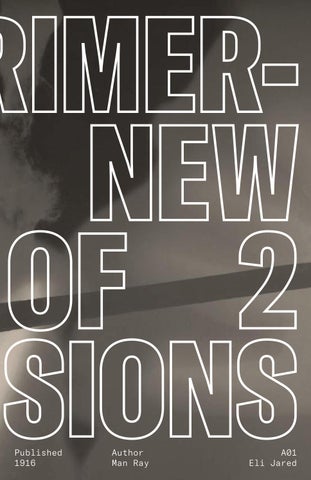
PRIMERNEW OF 2 DIMENSIONS

Author Man Ray
Eli
This concentration of life is offered by the expressive arts.
If the individual is an artist, that is, conscious, his appreciation demands proportional creative powers. An active mastery of all the arts as a means to simultaneous expression is beyond him as much as is an actual participation in all the phases of life itself. The greater the extent of the perceptions the more concentrated must be the expression. Just as the lens sacrifices actual space to focus all of that space upon the plate, so the artist must condense the time and space element to create life’s equivalent.
This leads his medium to a static condition implying the unity of time and space, that is, a concrete form of two dimensions, which is comprehensible from one point of view in an instant of time.
ANY RE-EXTENSION OF THIS MEDIUM INTO TIME OR SPACE BECOMES MERELY A FRAGMENT OF LIFE.
Now we shall see how this two-dimensional medium maintains its identity as well as its microscopic quality.
MAKES IT AS

Beginning with all the expressive arts as concentrated phases of life, the conscious individual seeks to contain their characteristics in the plastic medium of two dimensions. This is possible because each of the arts, the dynamic as well as the static, has a characterizing factor that is static and containable in the flat plane. We shall consider music, literature, dancing (the actually dynamic arts), architecture, painting and sculpture (the static arts).

In musical notation these contacts are plastically expressed by points on lines in two dimensions. To the musician these are symbols of sound. But in themselves, points and lines are static. An arrangement of these on a flat plane at once conveys musical quality to one

who hears music with his mind, as does a composer. In literature, idea and matter are plastically expressed by written words which possess distinct individual forms.

Likewise any plastic form of two dimensions with distinct character has a literary quality for one with a literary sense. An individual plastic form is the result of thought as is an arrangement of words.

THOUGHT CONNECTS WORDS, RHYTHM
DETERMINES THEIR RELATIONS & COMBINES THEM INTO A UNITY.


Static forms of two dimensions are like gestures in their expressiveness, and can also be related by rhythm, a rhythm physically static but having the dynamic origin. So dancing finds its parallel in the static plane.
All architecture is based on the principle of proportion, a purely plastic element adaptable to form in two dimensions and fully expressive of the architectural element in life.
Paintings, as an illusion of matter, or whatever the inspiring subject, is identified among the forms of expression by the color and texture of the material, that is, pigment or other material that may practically be reduced to the flat plane.
This quality, detached from its representative function and cultivated in itself, replaces the illusion of matter by a parallel realization in the material itself, thereby satisfying the desire for realism. So the essence of painting is preserved in the two-dimensional medium.
On a flat plane the contrast of absolute plastic values produces the same sensations as the effect of light on opposed planes in a space of three dimensions. Thus the quality of sculpture also is retained in two dimensions.

In the respective factors of the first three arts mentioned (music, literature, dancing)namely: points and lines, form, and rhythm, the process of their organization on the flat plane gives the dynamic quality of the arts, while the other three: proportion, color and texture of material, and values (representing architecture, painting and sculpture, respectively), in terms of content supply the static element. Just as the dynamic and static balance in life, so they do here.
By mutual dependence and common relationship they produce an activity in the two-dimensional limits which is entirely self-expressive and obedient to the laws of these limits.
The new two-dimensional medium is not merely painting any more than it is merely drawing or color: it is a most universal and concentrated form of expression. With it the artist can really begin to create, which is the highest and most joyous form of expression.


A Primer of the New Art of Two Dimensions
Eli Jared Building Books
Pratt Institute
SP2026
Fonts:
GT America Mono
Courier New Bold
Aktiv Grotesk Next
All text sourced from: Man Ray. A Primer of the New Art of Two Dimensions (1924). In Man Ray: Writings on Art, edited by Jennifer Mundy, pg. 37-39. Los Angeles: Getty Publications, 2016.
All images sourced from: Man Ray: When Objects Dream, exhibition at the Metropolitian Museum of Art.
8.5 x 5.5 in. Trim 24 Lb. Bond Paper Saddle Binding
Building Books
Ashley Simone

Date Feb 3rd, 2026