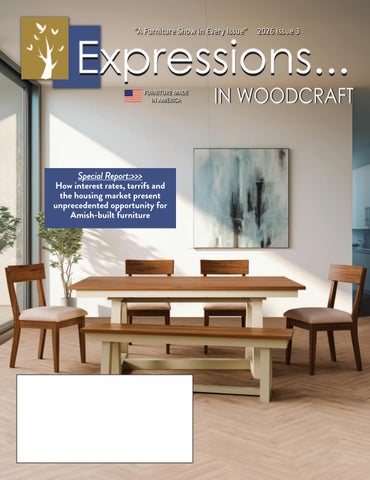
Special Report:>>> How interest rates, tarrifs and the housing market present unprecedented opportunity for Amish-built furniture
From The Publisher...
“A furniture show in every issue.” Volume 14 | Number Three 2026
Jerry Klingerman Owner, Publisher Karen Yoder Publication Coordinator/ Graphic Artist Meredith Klingerman Assistant Editor Joe Raber Account Executive Published by: Dutch Country Publishing, LLC P.O. Box 248 Fredericksburg, OH 44627 Phone 330-275-8097 Fax: 888-892-0728 Send inquiries to: editor@eiwmagazine.com
facebook.com/eiwmagazine
This publication and its contents are copyright 2026, Dutch Country Publishing, LLC. Individual copyrighted items, trademarks, etc. contained within are the property of their copyright holders. No part of this publication may be reproduced or redistributed by any means without the expressed, written authorization of the publisher.
4
There’s a lot to talk about this issue, so we’ll get right to it. The good news is most builders in Ohio’s Amish country furniture district are busy right now. Usually, around this time of year, there is a bit of a slowdown. Builders expect it and plan for it. But as we visited with builders over the last six weeks or so, the vast majority report that they are busier than expected for this time of year — and most definitely busier now than they were last year at this time. Again, that’s good news. In our lead article this issue, we examine why that may be, but we’re happy that is the case. Along those lines, we know that some of the larger retailers are struggling — there have been at least a dozen large retailers who have filed for bankruptcy protection, liquidation, or simply announced that they are ceasing operations. And while we’re not happy about that, we know that every purchase of American-made hardwood furniture benefits a number of people along a mostly US-based supply chain. Are tariffs making a difference? We believe so. Is there hard evidence of that, or statistics that we can point to? Not yet. And, of course, we’re still waiting for the final word on some tariffs, especially considering that one particular fee that was scheduled to take effect in January was delayed for a year. Right now, there’s a whirlwind — admittedly a confusing amalgam — of factors at play in the US furniture mar-
Expressions in Woodcraft | 2026 Issue 3
ket: Interest rates are keeping the breakout year in the housing industry that we had hoped for in check, while a historic shortage in available new units also is keeping prices for existing homes (artifically) high. In this issue we also take a look at “reshoring,” something we’ve discussed before, but haven’t examined for a while. In general, there’s good news on that front, but where furniture is concerned there’s not yet a lot of concrete evidence that we can look at — but there is the now ever-present hammer of the STURDY act — As Wal-Mart and Amazon recently learned the hard way, after being forced to do major recalls on items that the Consumer Product Safety Commission deemed were not in compliance. The bottom line is this: The more tariffs, the STURDY act and other things drive up prices on imports, the more attractive high-quality US-made furniture becomes. And that’s good news for everyone. Our combination of lead articles examine all of this in depth, and we’re hopeful you find the information valuable. Finally, we’ve included a fascinating look at what we recently discovered with respect to the history of MidCentury Modern furniture. We hope this message finds you well, and enjoying the final days of summer. As always, thanks for reading.
Contents... 8 Special Report: How interest rates, tarrifs and the housing market present unprecedented opportunity for Amish-built furniture
8
12 Reshoring Update: What’s the Prognosis for Furniture?
22 Spotlight on Featured Designs 36 Mid-Century Modern: A Timeless Design Popularized Via Shortages and Wartime Rationing
FEATURED
44 Index of Advertisers
6
Expressions in Woodcraft | 2026 Issue 3
36 ON THE COVER: A careful blend of wood choices, colors and seating options are showcased in this dining ensemble from Emerson Woodcraft and Kidron Tables. The solid top “Vanick”table, by Kidron Table, is shown in Rustic Hickory, with Almond stain on the top, and Country White on the table and bench bases. The Burton chair, by Emerson Woodcraft, is Rustic Hickory with Almond stain, and fabric seating.
—See ad on page 5
Rates unexpectedly high; home ownership staying out of reach for millions of Americans
The Unexpected Realities of Housing, Interest Rates and the Furniture Market By Jerry Klingerman Wow! There’s a lot going on with respect to the housing market, interest rates and furniture. Before we dive in, we should discuss a major event in the mortgage world that rocked Wall Street and the nation’s largest mortgage originator, United Wholesale Mortgage (UWM). As we were preparing this issue of Expressions In Woodcraft, Wall Street was stunned by the announcement that UWM (formerly United Shore Financial Services), experienced a quarterly loss of $452 million. That caused the stock to tank and left UWM, which is a publicly traded company, but tightly controlled by the uber-wealthy, Detroitbased Ishbia family, scrambling to find cash — which it has done. Now, before your eyes glaze over, this article is not about UWM. But we are going to talk a bit about what happened. The loss is rooted in a failed acquisition of another mortgage servicer, the details of which would make your eyes glaze over. But when a company of that size experiences a “hiccup,” Wall Street and others take notice. UWM is the largest home loan originator in the USA, and its situation does beg a closer look at the housing market, which is something we do at least once a year. You’ve likely not heard of UWM because they typically work through independent mortgage bro8
Expressions in Woodcraft | 2026 Issue 3
kers, and are not as “forward facing” as, say, Rocket Mortgage. UWM is a direct lender, and does not buy loans from other lenders. Rather, they originate loans, package them for resale and then retain the servicing. They make money on the fees associated with originating, and then servicing, a loan. For perspective, UWM currently holds servicing rights to loans with a collective balance of $247 billion — that’s a quarter of a trillion dollars, and represents approx. 600,000 single-family home loans. UWM originates 450,000+/- single-family loans a year and resells most of them. When interest rates stay high(er) as they currently are, fewer people move and pay off their lower-interest loans. That’s a double-edged sword for a company like UWM because on the one hand, they keep their servicing customers. But on the other hand, when rates drop, UWM contacts the original broker, and basically say, “Hey your client can save X dollars a month if they refinance.” UWM makes major money on the new loan, and services the new loan as well. Bear with me; we’re getting to the next chapter. Essentially, UWM structured its business around the expectation that mortgage rates will eventually drop. And they haven’t, at least not to the extent that most people (myself included) had expected/predicted. To put a bow on this, UWM experienced a major
stumble. In order to shore up operations, the Ishbia family was forced to break open their private vaults to rescue the company. But this wasn’t just an internal family transfer; they also brought in a major capital infusion from Oaktree Capital. Oaktree, an institutional giant that frequently steps into companies requiring rapid liquidity, provided the cash in exchange for significant structural concessions and enticing financial terms. This is a stark turning point for what historically had been a tightly controlled mortgage giant. So, why does this matter? Fair question. In a nutshell, the housing/mortgage industry is in a situation that few people predicted. The situation with UWM could in some ways be considered a reflection of the situation as a whole. • Inventories are still at historic lows. • Rates are higher than anyone would like. • Existing homeowners with lower-rate mortgages are not moving. • Would be buyers across the country are still, in
many ways, functionally locked out of buying a home. Supply is still a major issue Of particular note here, is the fact that existing home supplies are still at historic lows, and have been for some time. We often use comparisons to the Great Recession years of 2007-2009, when existing single-family home inventory sat at 4 million +/- homes, (source: Yahoo Finance). Today, that inventory sits at just 1.36 million homes, which is significant because that means the market isn’t saturated with unsold inventory, but also because the US population has grown 20 percent since then. Those numbers contribute to the fact that the US home market is still very much a seller’s market, pushing home prices higher and higher. To bring this into focus for the Amish-built furniture industry, consider this: As we’ve visited clients in the mid- to late-summer period, a couple surprising trends emerged. First — and perhaps most Continued on page 11 2026 Issue 3 | Expressions in Woodcraft
9
10
Expressions in Woodcraft | 2026 Issue 3
Housing, rates and furniture updates
or even below six percent. That hasn’t happened, Continued from page 9 and it’s not likely to in the remaining months of 2026. surprising — orders for bedroom furniture are on At present, the national average for a 30-year the rise. Typically, we’ve reported that younger buymortgage is at or near 6.69 percent, well below the ers’ first piece of “permanent” furniture is dining 8.5 percent peak that some markets saw in 2023 room. This is for both practical and vanity reasons. (the 2023 national average was7.79 percent), but First, a nice dining set is something that lasts forever. Plus, newer/younger homeowners get to show not where we had hoped. Stubbornly high rates affect several things. First, it off to friends and family. Bragequity-rich homeowners who ging rights are a real thing. Home ownership unfortu- are sitting on fixed mortgages But builders, via retail stores of three to four percent are and their orders, report that nately remains out of reach very reluctant to move. And, bedroom is doing well right for nearly four million Ameri- with home prices still high, now. even if rates were lower, the The majority of our clients can families, who are being question would simply be: are reporting that they are “Sell and move where?” busy, if not just a little bit referred to as “missing” Very few people who above busy. That’s good households — people who bought their homes for news, because most builders typically, historically, experiwould like to become home- $250,000-$350,000 five to 10 years ago, and locked in rates ence a slowdown this time of owners but are still locked at three or four percent, are year, before the Christmas rush. out by the combination of going to sell their homes and get a new mortgage at 6.5 perSo, what’s responsible for high prices and stubbornly cent on a home that now costs this? A lot of things. in excess of $500,000. Even Tariffs, interest rates, “stayhigh interest rates. with hundreds of thousands of put” homeowners, and more dollars in equity, it just doesn’t First things first: Interest rates. make sense. Because energy prices are trending higher (and Instead, those homeowners appear to be content unpredictable due to the war in Iran) the Federal to stay put — there’s even a new term called, “stayReserve is keeping a watchful, wary eye on inflaputters” — and plow some of that equity into their tion. The Fed’s stated goal is to keep inflation at or existing homes. This is a trend we normally see in near a two percent annual rate, and its most recent economic downturns when people can’t afford to policy decisions (keeping rates the same) have remove, but that’s not quite the case here. These flected that. homeowners are spending in three key categories: The most recent reports are that the Fed might Cabinets, dining and bedroom. even consider raising rates this fall if it thinks that As we’ve reported several times, housing invenwill keep inflation in check. Unfortunately, a potentory is low, historically low, in fact. Builders who tial rate hike could come as early as September. got caught in the oversupply bust of the Great ReThat’s in direct opposition to what we were anticicession simply have not gone back into building pating and hoping for early this year. When rates spec houses and developments. Depending upon dropped below seven percent, the smart money whose statistics are the most accurate, the market is was betting that the Fed would continue cutting the still short and estimated 4.4 million to 6 million sinPrime Rate, driving home mortgage rates down to Continued on page 21 2026 Issue 3 | Expressions in Woodcraft
11
By Jerry Klingerman
Is Furniture Manufacturing Coming Home? Reshoring continues to gain momentum across American manufacturing. But in the furniture industry, tariffs, labor costs, supply chains — and even the STURDY Act — are making the story considerably more complicated. Every so often, I like to revisit a subject we’ve followed in these pages for a number of years: reshoring. If you’re not familiar with the term, reshoring is pretty much exactly what it sounds like. A US-based company that once moved manufacturing overseas — usually in search of lower labor and production costs — brings some or all of that production back to the United States. For decades, the trend went almost entirely in the opposite direction. Factories closed. Production moved to China, Vietnam, Mexico and other lowercost countries. Entire American manufacturing communities were hollowed out in the process. But over the past several years, something has 12
Expressions in Woodcraft | 2026 Issue 3
changed. Covid exposed just how vulnerable extremely long supply chains could be. Shipping costs skyrocketed. Containers sat offshore waiting to be unloaded. Geopolitical tensions increased. Tariffs complicated the cost equation. Suddenly, the cheapest factory price wasn’t necessarily the cheapest total price, and reshoring became a serious business discussion again. Reshoring is real One of the organizations I regularly follow on this subject is the nonprofit Reshoring Institute, which studies manufacturing strategy, supply-chain risk, site selection and the practical realities of bringing production back to the United States. Interestingly, even the Institute’s current work emphasizes that reshoring isn’t simply about putting an American flag on the factory roof. Companies have to consider labor, suppliers, transportation, tariffs, automation and the entire supply chain.
The numbers suggest that companies are indeed reconsidering where they make things. A separate organization, the Reshoring Initiative, which maintains an extensive database of reshoring and foreign direct investment announcements, reported that 244,000 U.S. manufacturing jobs were announced through reshoring and foreign direct investment in 2024. Since 2010, more than 2 million jobs have been announced. In April of this year, the organization said annual reshoring had risen from just 11,000 jobs in 2010 to approximately 244,000 in 2025. Those are significant numbers. But here’s where it gets interesting for those of us in the furniture industry. Most of those jobs aren’t making dining tables, bedroom suites and entertainment centers. In fact, 88 percent of the reshoring and foreigninvestment jobs announced in 2024 were in highor medium-high-tech industries — things such as electronics, electrical equipment, batteries and transportation equipment. The Reshoring Initiative
also acknowledges one of the biggest obstacles to bringing lower-tech manufacturing back home: U.S. manufacturing costs can still run substantially higher than offshore competitors, while skilledworker shortages remain a major problem. Furniture, of course, is extraordinarily labor-intensive. We haven’t yet invented a machine that can economically replace all of the people required to cut, sand, assemble, finish, upholster, inspect and package a piece of furniture — particularly higher-quality furniture. And as manufacturers in Ohio’s Amish Country Furniture District will attest, finding those people isn’t always easy. Furniture: A much slower trip home But there are furniture reshoring success stories. One of the better examples is Paxton Furniture Industries. The company moved production from China to Okolona, MS, beginning manufacturing there in 2022. By the following year, Paxton employed approximately 80 people and was looking Continued on page 14
2026 Issue 3 | Expressions in Woodcraft
13
Reshoring Continued from page 13 for another 40. Four motion-sofa lines previously manufactured overseas were being produced in Mississippi, with frames, foam, mechanisms, most hardware and packaging sourced locally. That’s reshoring in the truest sense of the word. But it would be a mistake to look at individual examples like Paxton and conclude that the entire furniture industry is packing up its Asian factories and moving back to North Carolina, Virginia and Mississippi. It isn’t. In fact, one of the most revealing statistics I’ve found involves where imported furniture is coming from. U.S. household furniture imports totaled approximately $22.7 billion in 2025, down 11 percent from the previous year. China’s shipments plunged 39 percent, to approximately $3.6 billion. Sounds like reshoring, right? Not exactly. Vietnam shipped approximately $9.5 billion in furniture to the United States and accounted for a
14
Expressions in Woodcraft | 2026 Issue 3
whopping 42 percent of U.S. furniture imports. China was down to just 16 percent. Cambodia also increased its furniture exports to the U.S. by 45 percent. In other words, much of the furniture leaving China isn’t necessarily coming to America, it’s moving to another Asian country. That’s an important distinction. Then came the tariffs Of course, there’s now another very large factor in this equation: tariffs. And if you’ve tried to follow the tariff story over the past year, you already know that it isn’t simple. One important point is that there is not one blanket tariff rate covering every piece of imported furniture. Currently, certain imported upholstered wooden furniture is subject to a 25 percent Section 232 tariff. An increase had been scheduled for January 2026, but was postponed for a year, leaving the current 25 percent rate in place. Then, on July 24, another round of tariffs took ef-
fect involving imports from 60 trading partners. Those duties generally add either 10 percent or 12.5 percent, depending upon the country, although there are exemptions and special rules. The US Trade Representative says the tariffs are connected to whether trading partners prohibit imports produced using forced labor. For furniture, the result can get complicated very quickly. Furniture from Vietnam, China, Thailand and the Philippines, for example, generally falls into the additional 12.5 percent group, while India, Indonesia, Malaysia and Cambodia generally fall into the 10 percent group. Depending upon the product, those tariffs can be added to existing normal duties, previous Section 301 tariffs and, in some cases, antidumping or countervailing duties. There is an important exception: upholstered wooden furniture already covered under the Section 232 wood-products tariff generally does not also get hit with the new 10 or 12.5 percent forcedlabor tariff. Confused yet? Join the club. For the smaller independent furniture retailer, the important point isn’t memorizing tariff schedules. It’s understanding that the cost advantage enjoyed by imported furniture is being squeezed — and in some product categories, squeezed considerably. That doesn’t automatically make American furniture less expensive. But it can make the difference smaller, and that matters. Tariffs alone won’t bring the factories back There’s another side to this story that shouldn’t be ignored. Tariffs can make imported furniture more expensive. But they can’t magically create trained American furniture workers, domestic component suppliers or manufacturing capacity. The Home Furnishings Association made exactly that point last year. CEO Shannon Williams told Furniture Today that executives at major furniture manufacturers had not indicated plans for wholesale production moves back to the US, citing labor
costs, worker shortages and tariffs on raw materials and components. She also pointed to automation as one of the keys to making large-scale reshoring economically feasible. We’ve already seen evidence of the downside. Howard Miller, the longtime Michigan clock and furniture company that also owned Hekman Furniture, announced last year that it would wind down operations. Among the problems cited were tariffs on essential imported components that simply weren’t available domestically. That’s something we sometimes forget when discussing “Americanmade” products. A piece of furniture can be built in America while relying on drawer slides, mechanisms, fabric, hardware, machinery or other components sourced elsewhere. Tariff the component, and you can increase the cost of the American-made product, too. That’s why the Reshoring Initiative has repeatedly argued that tariffs by themselves aren’t enough. Workforce availability and the total cost of ownership ultimately determine whether reshoring makes economic sense. American manufacturers are seeing opportunity None of this means domestic furniture manufacturing is standing still. Quite the opposite. Here is one very recent example: Arkansas-based hardwood furniture manufacturer James & James announced in August that it is investing more than $9.4 million in a new Heber Springs manufacturing facility, with plans to add 47 jobs over the next four years. Even more interesting to me, the company plans to add its own lumber-milling operation, increasing vertical integration and allowing it to use more Arkansas-grown hardwoods. That’s not technically “reshoring” because James & James already manufactures domestically, but it’s important nonetheless. It’s new investment in American furniture-making capacity. Likewise, Vaughan-Bassett President Doug Bassett Continued on page 16 2026 Issue 3 | Expressions in Woodcraft
15
Reshoring Continued from page 15 said last year that tariff uncertainty was causing retailers to take another look at domestic furniture. Dealers attending High Point told the company they wanted to reduce their exposure to import risk by carrying more American-made products. And the latest manufacturing numbers offer at least some encouragement. Furniture and related products returned to expansion in July, with both new orders and backlogs increasing, according to the Institute for Supply Management’s latest manufacturing report. That’s certainly not a manufacturing renaissance. But neither is it nothing. Enter the STURDY Act There’s one more issue worth discussing, particularly for retailers who sell bedroom furniture. The STURDY Act — Stop Tip-overs of Unstable, Risky Dressers on Youth — was enacted in 2022 and resulted in a mandatory federal stability standard that applies to qualifying clothing-storage units manufactured after September 1, 2023. The standard generally covers freestanding pieces such as dressers, chests, armoires and similar bedroom-storage furniture meeting specified size and weight requirements. Covered products must pass stability tests, include compliant anti-tip restraints and carry required warning information. Manufacturers and importers also must certify that the products comply with the federal standard. Has STURDY caused furniture manufacturing to move back to America? Thus far, we haven’t seen convincing evidence of that. And technically, STURDY isn’t a reshoring law. It applies to qualifying furniture whether it was built in Millersburg, OH, or Ho Chi Minh City, Vietnam. But there is an interesting indirect effect: Compliance costs money. Products have to be engineered correctly. They have to be tested. Records have to be maintained. Certification is required. And begin-
ning July 8 of this year, importers of most regulated consumer products are required to electronically file compliance certificate information with U.S. Customs and Border Protection. So while STURDY doesn’t favor domestic manufacturers on paper, it does raise the compliance floor for everyone — and makes it more difficult for ultra-low-cost imported products to compete simply by cutting corners on engineering or safety. Also, we are seeing the law actively enforced. Enforcement is real For example, the Consumer Product Safety Commission announced a July recall of approximately 16,800 imported EnHomee fabric dressers sold through Walmart.com because the units violated the mandatory stability standard. Another EnHomee dresser sold through Amazon was recalled shortly afterward for the same reason. That doesn’t mean imported furniture is inherently unsafe, nor does it mean every Americanmade product automatically complies. But it does mean that the old competitive model of “make it as cheaply as possible, put it in a container and ship it to America” has become far more complicated. What does all this mean for you? If you own one or two furniture stores, you might not be reevaluating all of your supplier relationships. But you are deciding what to put on your floor space — and what suppliers you’re going to trust. Today, you might be asking vendors questions that weren’t nearly as important five years ago: • Where is this product actually manufactured? Not where the company is headquartered. Where is the furniture built? • Are your quoted prices landed prices? In other words, have current tariffs already been included, or could another increase be coming? • For bedroom storage, is the product compliant with the current STURDY requirements? A reputable supplier should be able to answer that question without hesitation. Continued on page 18
16
Expressions in Woodcraft | 2026 Issue 3
2026 Issue 3 | Expressions in Woodcraft
17
Reshoring Continued from page 16 • What happens if tariffs or supply-chain conditions change? Does the supplier have another source — or are you potentially looking at a sixmonth scramble for replacement merchandise? There’s also a sales opportunity here. Independent retailers can’t always beat the big chains or internet sellers on price. Frankly, trying to do so is usually not the best business strategy anyway. But you can sell quality. You can sell craftsmanship. You can sell customization. You can sell shorter and more dependable supply chains. And increasingly, you can sell the story of where something was made, who made it and how it was
18
Expressions in Woodcraft | 2026 Issue 3
made. That’s a pretty good story for American furniture manufacturers, and it’s an especially good story for the small, family-owned furniture builders we work with every day in Ohio’s Amish Country. So, is furniture manufacturing coming home? Yes. And no. That’s probably not the dramatic answer that makes a great television headline, but it’s the accurate one. Reshoring is clearly happening in American manufacturing. Tariffs are changing the economics of importing. Supply-chain risk is changing how companies calculate costs. Safety regulations such as STURDY are raising the compliance requirements for furniture sold in this country. But we aren’t witnessing a wholesale migration of furniture factories from Asia back to North Carolina — at least not yet. What we are witnessing is something that may ultimately be more important: The assumption that overseas manufacturing will always be dramatically cheaper — and therefore automatically better business — is being challenged. Manufacturers are running the numbers again. Retailers are looking harder at their supply chains. American factories are investing. And imported furniture is having to compete on something closer to its real total cost, rather than just factory price. For an American furniture industry that spent decades watching manufacturing leave our shores, that’s a significant change. And it’s one worth watching.
2026 Issue 3 | Expressions in Woodcraft
19
Housing, rates and furniture updates Continued from page 11 gle-family homes. The St. Louis Federal Reserve Bank reports that, currently, there are roughly 1.12 million active listings for single family homes. But the market actually could handle three to five million additional homes; homes that simply aren’t there. Thus, the continued high cost for existing homes. Lost in all of this is what housing experts refer to as “missing” households. These are mostly Millennial and Gen-Z buyers who would like to be homeowners, but who can’t afford to. So they’re either renting or (as their Gen X and Boomer parents will tell you!) living with family. To back up this point, consider the fact that just over four million single-family homes were sold in each of the last several years. Those are historically low numbers — a 30-year low — that, were they right-sized for rates and supply, would be somewhere between 5.5 million and six million units. All those people, including homeowners who would like to “move up,” younger folks who would like to become homeowners, and everyone in be-
tween have one thing in common: When they move, they buy furniture. If this isn’t happening, then what accounts for the fact that builders in Ohio’s Amish Country Furniture District are experiencing solid sales? Tariffs squeeze importers Given the fact that single-family home sales are nowhere where they could or should be, it might be surprising that builders in Ohio’s Amish Country Furniture District are busy. That is, until you factor in the tariffs that have been placed on imported furniture. (See related article beginning on page 14.) Multiple sources, including The New York Times, The American Bazaar, and an extensive roundup by LinkedIn News editor Jake Pere, report that traditional furniture retailers have been slammed by the one-two punch of higher tariffs and, as Perez calls it, a “record-low turnover rate” of homes. Perez quotes Gary Friedman, CEO of upscale furniture seller RH, as saying, there has been “greater fallout in the furniture business over the last few years than in any time in history.” This is a lot to absorb. But there are some huge Continued on page 42 >>>
2026 Issue 3 | Expressions in Woodcraft
21
>>> The detail on the #VT6030 Ventura TV Stand from Ashery Oak is simply stunning. The inset drawers feature bold, attractive hardware and recessed accents that show great attention to detail, while the top features a beveled edge. — See ad on page 17
Spotlight on FEATURED DESIGNS
^^^ The Baltimore Sofa is the latest in an impressive succession of new upholstered items from Quality Fabrications. Sturdy, wellbuilt frames and cushions made to stand the test of time are the hallmarks of these new entries, and this stylish model features clean, classic lines that are perfect for either a formal or contemporary space. — See ad on Back Cover
>>> The Walnut River Table from Ebony Woodworking continues to be a very popu lar item, a difficult model for them to keep in stock! With the combination of a stylish, modern metal base, and “river” effect in the middle of this thick solid Walnut top, it’s easy to see why! — See ad on page 32
Shady Lawn Oak recently introduced the Vance Chair, which features clean lines, curved slats in the back, and is a very com fortable model. It’s available in side and arm chairs as shown below and at right, as well as a bar chair with swivel and office chair. — See ad on page 14
^^^ The Marie Bed from Meadow Wood Furniture blends understated style elements, including inset pan els, rope molding accents and thick, slightly tapered legs, to create a timeless look that your customers can fit with any decor. — See ad on page 45 22
Expressions in Woodcraft | 2026 Issue 3
^^^Adding to the elegant, classic look of the #24 Sliding Door Bookcase from Farmside Wood is the fact that the doors on this barristerstyle bookcase slide for easy access. This timeless piece is a pleasing addition to home, office or your home office. — See ad on page 7
>>>The Vincent Dinette set from Schlabach Handcrafted is where Timeless craftsmanship meets modern el egance in this beautifully coordinated dining collection. Crafted from richly grained hardwood and defined by bold trestle bases, clean lines, and warm natural finishes, the set brings inviting character to any home. From intimate family dinners to lively gatherings, the spacious dining table, matching chairs, bench, and sideboard create a harmonious balance of functionality and enduring style. Inspired by classic farmhouse design and re fined for contemporary living, this collection is a celebration of quality, comfort, and lasting beauty. — See ad on page 17 2026 Issue 3 | Expressions in Woodcraft
23
Spotlight on FEATURED DESIGNS
>>>It might look like something that came across the ocean with grandpa, but the #8600 trunk is just one of the latest offer ings from Sunrise Wood. With strong rus ticwood features and genuine leather straps, your customers will be thrilled to store their “trea sure” in this beautiful piece! — See ad on page 39
24
Expressions in Woodcraft | 2026 Issue 3
2026 Issue 3 | Expressions in Woodcraft
25
With an open look, and match ing fabric features on the seat and back, the Aldrich Chair from Wengerd Wood Products com bines clean, functional lines in a contemporary/ transitional look. — See ad on page 2
Spotlight on FEATURED DESIGNS
New from A&L Furniture is the highly functional and very stylish Lake Mills Fil ing cabinet. With clear MidCentury Modern design ele ments, from the angled legs to the clean lines of the cabinet, this piece offers lots of storage and lots of style, and in a compact footprint. — See ad on page 28
<<<These stunning case goods, shown in beautiful character Walnut, are the Holton Dresser and Chest from Troy Lane Woodcraft. The strong MidCentury Modern Styling is accented by beautiful metal pulls. New! Troy Lane Woodcraft is now your exclusive source for Glass Top Specialties products. We have acquired Glass Top Specialties and taken over all manufacturing and administrative operations. — See ad on page 38
<<<The new Louisville Collection from North End Woodcraft was carefully created over time, and it shows. It’s something you need to see up close to truly appreciate. There’s incredible attention to detail on the fluted legs that are cleverly inte grated into the design. A twolevel beveled edge on the top and draw ers accent this beautiful collection, which is sure to turn heads in your showroom. — See ad on page 29
26
Expressions in Woodcraft | 2026 Issue 3
>>> Maple Hill Woodworking introduces the Wilson Collection of Occasional Tables and TV Consoles. These functional pieces provide a con temporary style, that will add value to your show room. For more options, see ad on page 19
^^^Relying heavily on rustic, liveedge styling it’s no wonder that the Tampa Bay Jr. bed from United Woodworking is a top seller. Shown here in Walnut, every piece has its own unique char acter and style. — See ad on page 25
>>>The Albany Dining Set from Hillside Chair features a stylish table with clean, mini malist lines. The legs look al most pencilpost style from a direct view, but actually are neatly tapered, and inte grated with the top. The chairs feature a Missionstyle back with curved slats and deeply contoured seats for maximum comfort. — See ad on page 45
2026 Issue 3 | Expressions in Woodcraft
27
Spotlight on FEATURED DESIGNS
<<<The Coastal Chair from Hidden Hollow Wood and Upholstery is a comfortable, modern and stylish design. The cushioned seat offers maximum comfort, while the an gled legs make for an eyecatching design. — See ad on page 24
28
Expressions in Woodcraft | 2026 Issue 3
2026 Issue 3 | Expressions in Woodcraft
29
Spotlight on FEATURED DESIGNS
>>> At home in either your corner office or home Of fice, the DC55 chair from Buckeye Rockers is long on comfort and style. Padded surfaces all around are paired with a classic design, creating a chair that is sure to please for many years. — See ad on page 20
<<< Shown here is the Hilton Chair with wood seat and back and with upholstered seat and back from Farmstead Acres Wood. This model is characterized by a modern design with clean lines, a uniquely an gled back, and an X pattern in the base. It’s an excel lent choice wherever you’re looking for style and comfort. — See ad on page 3
^^^ Emerson Woodcraft continues to be an excellent source for items constructed of reclaimed wood, including the Silverton Chair (shown here with a round table). The chairs feature wide, curved slats and a scooped seat, which add up to longterm com fort. Remember, each set is unique, showcases its own character istics, and is part of America’s heritage. — See ad on page 5 30
Expressions in Woodcraft | 2026 Issue 3
^^^ Y&M Chair has introduced a number of stylish, innovative designs in recent years, in cluding the Wren Chair. Note how the back forms an X pattern that becomes the legs — all in one piece per side. Part of the Wren Collection, this set is sure to be a “stop in your tracks” collection on your showroom floor. — See ad on page 46
>>> Part of the line allnatural products from Miller’s Natural Products is an ex cellent selection of hand and body that your customers will want to purchase again and again. Our product line is a surefire revenue generator that’s self contained in an attractive pointofpur chase display. — See ad on page 19
Spotlight on FEATURED DESIGNS
The Millcreek Chair from Pioneer Woodworking is a best seller, and it’s easy to see why. It features a clean, stylish design and goes with almost any table. Plus, it has a great price point. It can be fin ished to match a table, or provide a contrast. — See ad on page 33
The uniquelyshaped base is likely to be the first thing that attracts customers to the Hamilton Table from Hermie’s table Shop. The top, which features beveled edges, is more traditional, and provides a nice con trast to the contemporary style base. — See ad on page 10 2026 Issue 3 | Expressions in Woodcraft
31
32
Expressions in Woodcraft | 2026 Issue 3
2026 Issue 3 | Expressions in Woodcraft
33
Spotlight on FEATURED DESIGNS
<<< The durable, vibrant coatings from Finishing Designs are engineered to stand the test of time. We’re available to serve all your custom finishing needs on kitchen and dining room tables and chairs. — See ad on page 33
>>> Outdoor dining has come a long way, thanks to builders like Woodside Poly, which just introduced this new two tone dining collection. The legs, sup ports, etc. are shaped like real logs, but actually are sturdy, weatherresis tant poly lumber. Avail able with both chairs and benches, this set is sure to be a family favorite for years to come! — See ad on page 24
Comfort is the key to the Bryson Chair from Horseshoe Bend Chair. Wide, curved slats in the back con form to your shape, as does the scooped seat. Your customers are sure to enjoy this, as well as the curved lines that are carried throughout the chair. Available in side and arm chair! — See ad on page 10
^^^You don’t have to be a grandma or a new mom to enjoy the oldtime comfort of the High Back Mis sion Glider from Miller Gliders, LLC — but they’re both certain to enjoy it! Thick cushions and a time tested glider mechanism combine to make this a chair everyone in your home will want to experience. — See ad on page 29 34
Expressions in Woodcraft | 2026 Issue 3
With the introduction of the new Bellville side and arm chair, County Comfort Woodworking has just taken seating to a whole different level. The wide, curved slat is shown here wrapped in leather that matches the padded seat. The entire presentation creates an attractive look that is sure to impress your guests, and pro vide maximum comfort. — See ad on page 39
Spotlight on FEATURED DESIGNS
>>> Authentex Leathers sup plies leathers for furniture up holstery needs. We use Full grain premium leather that gives a lifetime of durable comfort. These leathers are tested by years of handson experience in upholstery. Our leathers are carefully selected to offer a wide variety of colors and textures, with a soft hand feel that ensures comfort, durability, and ease of application for the craftsman. — See ad on page 20
^^^The Centre Coffee bar from Quality Wood Products is an excellent solution for eliminating counter top clutter — and easy access for your morn ing coffee. It features sleek inset drawers designed for KCups, a trash can in one door and storage on the left side. Need a phone charge? There also are two handy USB ports! — See ad on page 32
When your customers ask for “something dif ferent,” you can show them the new Findlay dining table from Five Star Tables. Featuring two opposing circular, industrial style sup ports, on top of a round solidwood base, this new model is sure to be a hit in your show room! — See ad on page 38
2026 Issue 3 | Expressions in Woodcraft
35
Mid-Century Modern: A Timeless Design Popularized Via Shortages and Rationing
Story and photos by Jerry Klingerman
T
ucked away on the second floor of a museum in Glasgow, Scotland is an exhibit that chronicles how the shortages of raw materials in the United Kingdom during WWII led to the widespread proliferation of one of the most enduring furniture designs in modern history: Mid-Century Modern. This past July I had the extraordinary opportunity to travel to Scotland as part of a study abroad group. It was the trip of a lifetime, and to be honest, a trip that I almost passed up. But at the last minute, I decided that such an opportunity was unlikely to present itself again, so I signed up. Many of our readers probably know that there are certain “must sees” in Europe and the United Kingdom, and Scotland is no different: Museums and thousand-year-old churches are at the top of that list. In Scotland, castles also make the list — and they certainly didn’t disappoint. While Glasgow is steeped in history, it was a bit more city-like than some other destinations, Edinburgh being chief among those. But Glasgow’s Kelvingrove Art Gallery and Museum was a wonderful place, filled with displays on a fascinating variety of topics, from Impressionist painters to, yes, even an exhibit on “Barbie” — and just about everything in between. [Side note: If Glasgow is a bit less picturesque than some Scottish cities, it can be forgiven. Approx. 30 percent of the city’s original structures were lost to German air raids, due to the fact that <<<Left A permit to buy furniture? Yes. Raw materials were so scarce that the British Board of Trade rationed furniture. In most cases, only people whose homes had been bombed or were newlyweds received ration permits to purchase the newly introduced “utility” furniture. The background image here shows ration stamps from the era. A Utility chair reflects a design style that we still see today. One of the more controversial aspects of the Utility style was the introduction of metal. The Mahogany Sideboard shown features metal accents, which was in stark contrast to the ornately carved accents popular in British furniture prior to WWII. All items on display at the Kelvingrove Art Gallery and Museum, Glasgow, Scotland.
Glasgow was the home of nearly all shipbuilding in the UK. So, new buildings that perhaps were short on style were built in haste to try and get the city back on its feet.] As I browsed the exhibits at Kelvingrove I was very pleasantly surprised to find a comprehensive exhibit on the origins of what we now refer to as Mid-Century Modern furniture. In the 20+ years in which I have been involved with the furniture industry, I’ve seen two styles that seem to be timeless: Mission/Craftsman and MidCentury Modern (MCM). I’m a fan of both styles, and certainly understand why Mission has endured so long. I have a fair amount of Mission-style pieces myself. But admittedly, Mid-Century Modern probably is my favorite style. Maybe it’s a favorite of yours, too. But I had no idea that the style not only has deep roots in the United Kingdom, but also was introduced to direct as many raw materials as possible — especially wood — to the war effort. I think a lot of people in the USA ascribe MCM loosely to an outgrowth of the Frank Lloyd Wright style of architecture and, in some respects, perhaps that’s fair — again at least here in the USA. Wright’s homes certainly are well-complemented by that functional, minimalist style of furniture. But MCM furniture also has a fascinating back story in WWII-era Great Britain. Over my lifetime as I’ve learned about the second “Great War” I am constantly, continually amazed at just how much it changed everything — notably in the United States, but now I’ve learned it also greatly affected the course of many things in Europe as well. Quick example here in the USA: The 30-year home mortgage that many Americans use to finance home purchases didn’t exist prior to WWII. After millions of American GIs, who left as boys and came home as men, got married and families, the demand for housing exploded. Traditionally, Continued on page 40 2026 Issue 3 | Expressions in Woodcraft
37
38
Expressions in Woodcraft | 2026 Issue 3
2026 Issue 3 | Expressions in Woodcraft
39
Origins of Mid-Century Modern
dards and requirements for furniture production, Continued from page 37 and the “utility” style was born. homes were either purchased for cash, or with a It’s important to note that during the war, furnilarge downpayment and a short mortgage of perture was largely only available to those whose haps five years; 10 at the most. But of course, those homes had been destroyed, or to newlyweds. soldiers-turned-family-men didn’t have the money The Utility Furniture effort was led by now-legto buy a house. endary British furniture designer Gordon Russell — So, the US government, wisely recognizing that Sir Gordon Russell to be precise, as the Crown rechomeowners make good citizens, created the Fedognized Russell’s contributions to the extraordinary eral Housing Administration and the 30-year mortUtility Furniture movement and Knighted him in gage was born, ushering in an unprecedented era 1955. of American prosperity. Furniture building in the UK was traditionally But overseas, during the war, wood became in very much a “hands-on” endeavor with craftsmen very short supply and (like many things in the US creating one piece at a time (sound familiar?). at the time) was rationed. That included wood for But Russell realized that if the Utility movement furniture. But people still needed furniture! So, the was to achieve its goals — attractive, well-built furBritish Board of Trade attempted to balance the niture that used as little wood as possible — then need for furniture against real shortages by setting more machinery would have to be involved. This out a very comprehensive (read: strict) set of stanwas a rather radical idea at the time. Russell believed that “teaching the machine manners” was key to that effort. As the Gordon Russell Design Museum says, “Gordon believed the handcrafted tradition of British cabinet making could fuse with the possibilities of machinery.” As the museum reports, Russell approached the project with the notion that, “good design could elevate the human spirit. He believed in democratizing design, making it accessible to many, not just the few.” He once said, “I want to make decent furniture for ordinary people.” In truth, Russell’s approach of mass-producing furniture for a war-torn nation that still had a stylish appeal, and was very functional was pure genius. Prior to Russell’s innovations, furniture in the UK, and indeed much of the Western world, was still steeped in the traditional designs that had influenced furniture building for hundreds of years. The seeds of MCM had already been planted in An advertisement for a Glasgow, Scotland furniture store attempts the form of designs born in Scandinavia, England to portray the new “Utility” designs as elegant and sophisticated. and even Germany, notably at the German But when first introduced, the British people viewed them as the Bauhaus school, which placed a strong emphasis exact opposite. The people thought they reeked of poverty, and at on minimalism. Interestingly, the Nazi government first rejected the government-mandated designs. 40
Expressions in Woodcraft | 2026 Issue 3
ment in WWII-era Great Britain. It’s true that some American designers, like husband-and-wife designers Charles and Ray Eames, and Herman Miller already were producing designs in the general style, but the Utility movement definitely An entertainment-style sideboard and occasional table from the Utility program reflect design styles had a worldwide imthat are still popular 75+ years later. pact that still is felt shut down the Bauhaus School in 1933 more than 75 years later. because “its radical, avant-garde approach to art, So, while he didn’t create the style, Gordon Rusarchitecture, and society challenged traditional sell no doubt receives the lion’s share of the credit German values.” for the enduring popularity of these timeless deBut it’s fair to say that under Gordon’s leadership signs, many of which have been reflected in the and influence, the Utility furniture effort during pages of this magazine for years — and still are. WWII propelled Mid-Century Modern furniture to the forefront of design and acceptance, when it otherwise might not have taken hold. Was it an overnight success embraced by the people of the UK? No! In some circles the simple, austere designs — which were a huge shift from the resource-heavy Queen Anne and other traditional styles — were associated with poverty, rationing and state control. In fact, a black market developed where people would have illegal decorative wood-carved items added to their furniture! It was Russell himself who led the effort to abandon this type of thinking, and he worked hard to rebrand what we now know as MCM furniture as “elite, forward-thinking, and intentional design.” And while British subjects may not have wholly accepted the government’s solution to a major resource problem overnight, certainly history now views the effort through a far softer lens. There are those who would argue that MCM furniture would have taken hold eventually, regardless of Gordon Russell and the Utility Furniture move2026 Issue 3 | Expressions in Woodcraft
41
Housing, rates and furniture updates Continued from page 21 nuggets to be gleaned here. As Expressions In Woodcraft and the Ohio Furniture Guild both have reported recently, there has never been a better time to sell high-quality, American-made, Amishbuilt furniture. Not since the market first emerged in the 1990s has it been poised for more opportunity. Google reports that keyword searches for “Amish furniture” and “American-made furniture” have skyrocketed in recent years. This is actionable information for retailers! The time is now to get your message in front of likely buyers. However you choose to get your message out, whether it’s print, direct mail, or online, the opportunity to increase your sales has never been better. Our “story” has always resonated with younger buyers because they gravitate to small businesses and sustainability, but the opportunity to actually turn them into buyers has never been better. HINT: Educate yourself on “Geo-fencing.” Key points to communicate to younger buyers include: Hyper-local small business supply chains Millennials and Gen Z buyers are all about supporting small business. The supply chain of Amishbuilt furniture is populated almost entirely by small, family-owned businesses. Ultra-sustainable American-made hardwood furniture is sourced form well managed woodlots. We’ve all seen those old pictures of clear-cut forests, but the entire eastern USA has largely been reforested, and landowners realize that a well-managed woodlot offers generation harvesting opportunities. Non-disposable “Anti fast-furniture” Wayfair, Ikea, and Amazon don’t compare. If there’s a single group or groups of buyers in the market to whom sustainability matters, it’s Millennials and Gen-Z. They’re the folks who are most likely to be active recyclers, take their own bags to the grocery store, etc. We need to hammer home the idea that, while those Swedish bolt-together 42
Expressions in Woodcraft | 2026 Issue 3
pieces might look good, they simply don’t last — and end up in landfills. “Investment grade” Rather than plunking down hard-earned money for bolt-together/particle board furniture that will be on the curb for trash collection in three or four years, it’s imperative to impress on younger buyers that, while Amish-built furniture is a higher initial investment, it’s a one-time investment. More expensive, yes, but there’s real value in ‘permanent” furniture. “Not your grandfather’s Amish-built furniture.” Despite the amazing response to changing consumer tastes that builders have implemented across the board, Gen-Z and Millennials often still have the view that Amish-built furniture doesn’t match their tastes. Nothing could be further from the truth, but retailers have to get way out in front of this, and meet younger buyers where they are: TikTok, Instagram, Pinterest and, to a lesser extent than their parents, Facebook. (Facebook is still a very effective marketing tool for certain demographics.) Worth the wait Yes, you’ll have to wait six to 10 weeks for your furniture. But it’s made especially for you, with your wood, stain and hardware choices — and even custom dimensions (normally at no additional or low cost). If buyers are willing to wait for the next season of their favorite streaming show, then they should be willing to wait for custom-built furniture that will last a lifetime. Are consumers finally waking up to the fact that Amish-built furniture represents a smart buy with incredible value? Are tariffs having the desired effect to make US consumers seek out Americanmade products? We’re just not sure. But in a housing market that’s not where most people predicted or hope it would be at this stage, we’re grateful to report that our friends and clients are holding steady.
2026 Issue 3 | Expressions in Woodcraft
43
INDEX Of Advertisers
Business Name
Address
City
State
ZIP
Phone
Fax
A&L Furniture
8286 SR 241
Fredericksburg
OH
44627
330-674-5725
330-674-0341
28
Amco Outdoor Lawn Furniture
3248 CR 200
Fredericksburg
OH
44627
330-749-8748
330-601-0074
28
AnnDrew Enterprises
3470-B St.Rte 39
Millersburg
OH
44654
330-893-4280
330-893-4281
13
Ashery Oak
8959 TR 652
Fredericksburg
OH
44627
330-946-2600
330-946-6100
17
Authentex Leather Supply Co.
1624 CR 600
Baltic
OH
43804
330-897-2193
330-897-2197
20
Buckeye Rockers, LLC
1624 CR 600
Baltic
OH
43804
330-897-2193
330-897-2197
20
Country Comfort Woodworking 10683 Massillon Rd.
Fredericksburg
OH
44627
330-682-0740
330-682-0740
39
Ebony Woodworking
6470 TR 603
Millersburg
OH
44654
330-279-2102
844-415-1713
32
Emerson Woodcraft
11604 Emerson Rd.
Apple Creek
OH
44606
330-778-4213 x1
330-682-0748
5
Farmside Wood
11833 Harrison Rd.
Apple Creek
OH
44606
330-695-5100
330-695-2027
7
Farmstead Acres Wood
9106 CR 201
Fredericksburg
OH
44627
330-695-2089
330-695-2189
3
Finishing Designs
6455 TR 351
Millersburg
OH
44654
330-600-8315
330-698-3200
33
Five Star Tables
9652 Harrison Rd.
Fredericksburg
OH
44627
330-695-2150
330-695-2638
38
Fredericksburg Finishing
8600 CR 201
Fredericksburg
OH
44627
330-473-3216
330-698-3200
41
Hermies Table Shop
8977 TR 652
Fredericksburg
OH
44627
330-946-2700
330-682-0740
10
Hidden Hollow Wood and Upholstery 9165 TR 656
Fredericksburg
OH
44654
NA
330-698-3200
24
Hillside Chair
8413 TR 652
Millersburg
OH
44654
330-359-5991
330-359-5997
45
Horseshoe Bend Chair
6169 S. Kansas Rd.
Apple Creek
OH
44606
330-521-4522
330-682-0740
10
Maple Hill Woodworking
2726 TR 128
Millersburg
OH
44654
330-674-2500
330-674-2595
19
Meadow Wood Furniture
6110 S. Kansas Rd.
Apple Creek
OH
44606
330-698-0370
330-698-3200
45
Miller Gliders, LLC
9119 TR 659
Dundee
OH
44624
330-231-9702
Miller's Natural Products
4383 Township Rd. 369
Millersburg, OH 44654 OH
44654
330-893-7627
330-893-0840
19
Northend Woodcraft
208 N. Carr Rd.
Orrville
OH
44667
NA
NA
29
Ohio Furniture Guild
6 W. Jackson St.
Millersburg
OH
44654
330-231-5125
NA
47
Pioneer Woodworking, LLC
9210 SR 241
Fredericksburg
OH
44627
NA
330-698-3200
33
Quality Fabrications
7108 TR 569
Fredericksburg
OH
44627
330-695-2478
330-473-1359 Back cover
Quality Wood Products
543 SR 95
Loudonville
OH
44842
419-368-3165
419-368-3166
32
Salt Creek Bedding
13155 Salt Creek Rd.
Fredericksburg
OH
44627
NA
330-359-2116
25
Schlabach Handcrafted Fine Furniture 8261 Winklepleck Rd. NW Dundee
OH
44624
330-852-1125
330-852-1126
17
Shady Lawn Oak
6274 CR 77
Millersburg
OH
44654
NA
NA
14
Spring Brooke Finishing
17507 Harrison Rd.
Navarre
OH
44662
NA
330-698-3200
25
Sunrise Wood, LLC
29100 TR 212
Fresno
OH
43824
740-552-9552
740-545-8100
39
Troy Lane Woodcraft
8237 Nonpariel Rd
Fredericksburg
OH
44627
330-601-6603
330-698-3200
38
United Woodworking
7782 Maurer Rd.
Apple Creek
OH
44606
330-465-1226 VM
330-682-0740
25
Wengerd Wood Products
8618 CR 201
Fredericksburg
OH
44627
330-439-3565
330-695-2189
2
Woodside Poly
9025 Criswell Rd.
Fredericksburg
OH
44627
330-695-2792
330-682-0740
24
Y&M Chair
13776 Arnold Rd.
Dalton
OH
44618
330-641-1740
330-698-3200
46
44
Expressions in Woodcraft | 2026 Issue 3
Ad on Page
29
Legacy Collection
Established 1980
Located at: 8413 Township Road 652 Millersburg, OH 44654
NEW FOR 2026
phone (330) 359-5991 fax (330) 359-5997 email: hillsidechair@plainemails.com Find us on viztechfurniture.com
Buckeye Shaker Collection
2026 Issue 3 | Expressions in Woodcraft
45