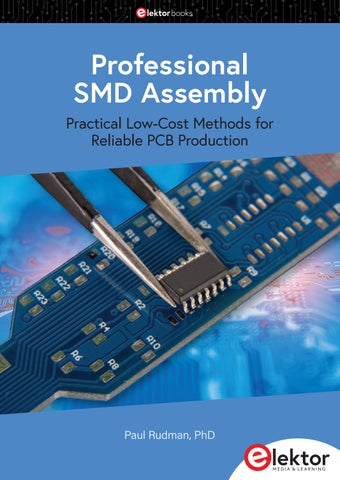
Professional SMD Assembly (Extract)

Page 1


Professional SMD Assembly

Practical Low-Cost Methods for Reliable PCB Production booksbooks

Professional SMD Assembly

Practical Low-Cost Methods for Reliable PCB Production

● © Copyright 2026 Elektor International Media

1st edition 2026

● All rights reserved.

The contributions published in this book, in particular all essays and articles, as well as all designs, plans, drawings, and illustrations, are protected by copyright. Their reproduction and distribution, even in part, is generally only permitted with the prior written consent of the publisher.

The information in this book is published without regard to any potential patent protection. Software and hardware designations mentioned in this book may be registered trademarks, even if not specifically indicated. They belong to their respective trademark holders and are subject to legal regulations.

The greatest care has been taken in compiling the texts and illustrations. Nevertheless, errors cannot be completely ruled out. The publisher, editors, and author cannot assume any legal responsibility or liability whatsoever for incorrect information and its consequences. The publisher and author are grateful for notification of any errors.

The author, translator, and publisher have made every effort to ensure the accuracy of the information contained in this book. They accept no liability for any loss or damage caused by errors or omissions in this book, regardless of whether such errors or omissions are due to negligence, oversight, or any other cause, and hereby disclaim all liability to third parties.

● Cover design: Elektor, Aachen

Editor: Glaucileine Vieira

Printers: Ipskamp, Enschede, The Netherlands

● ISBN 978-3-89576-728-9 Print 978-3-89576-729-6 eBook

● Copyright 2026 Elektor International Media - www.elektor.com

● Disclaimer: The chemicals and heating described in the book can be harmful if not approached with care. I have tried to clearly describe the precautions I take to use them safely, and I hope you will take them seriously. However, you are solely responsible for ensuring that no harm comes to yourself, your property, or anyone else. If in doubt, seek additional advice.

At the time of writing, I have a room at home set up for SMD assembly. I am at the point where I can assemble a board and be confident that it will work correctly. This book contains everything you need to know to reach that level yourself. I know you’ll do your best, as I have done mine. There are skills to learn, and I cannot be there with you to ensure you follow every last instruction exactly. Therefore, there will be both successes and failures along the way. My intention is that you will achieve professional results quickly and consistently, but, of course, it all depends on your effort.

Throughout the book, I mention specific companies and products that I use. I do this solely to provide a starting point for your own decisions. There are always alternatives that may be better suited to your situation. To be clear, I have never received, and do not receive, any commission, gifts, or incentives for mentioning any business, product, or service in this book.

There may be local laws defining how some of the chemicals you will use should be disposed of. Please ensure that you comply with any such laws.

All photographs in this book were taken by me and depict boards and equipment that I own.

Elektor is the world's leading source of essential technical information and electronics products for pro engineers, electronics designers, and the companies seeking to engage them. Each day, our international team develops and delivers high-quality content — via a variety of media channels (including magazines, video, digital media, and social media) in several languages — relating to electronics design and DIY electronics. www.elektormagazine.com

To my father, Douglas Rudman. You showed me the way.

5.6 Cleaning

5.9

7.5 Fire!

Chapter 8 Selecting Components

8.1 Passive Components (Resistors, Capacitors, Inductors)

8.2

8.3

Chapter 9 Printed Circuit Boards (PCBs)

9.1.1 Design suggestions

9.1.2 Double-sided boards

9.1.3 Design for testing

9.2 Ordering PCBs Commercially

Chapter 10 Stencil

10.1 What

Diodes,

Chapter 11 A word About Manual Soldering

11.1 Tools and Supplies

Soldering

PART 3: ASSEMBLING A BOARD

Chapter 15 Getting Ready

15.3.4 Positioning the stencil (‘registration’)

16.1

Chapter 17 Pick and Place

17.1 Preparation

17.2 Placing

17.3 Board Inspection

Chapter 18 Reflow

18.1 Using a Hot Air Rework Station

18.2 Using a Hotplate

18.2.1 The process

18.2.2 Double-sided boards

18.2.3 Recap

18.3 Using a Reflow Oven

18.3.1 The process

18.3.2 Double-sided boards

Chapter 19 Final Inspection

19.1 Visual Inspection

19.1.1 Missing component

Misaligned component

19.1.3 Poor joints.

19.1.6 Unconnected pads or legs

Chapter 20 Fixing Common Problems

20.1 Poor Joints and

20.2 ‘Tombstoning’

Chapter 21 Replacing Components

21.2.3 Adding a component.

21.3 Using Extra Flux

21.4 Missing small components

Chapter 22 Board Testing

22.1 Test carefully

Incorrect, ambiguous, incomplete or unread datasheet

22.2.2 Forgetting the specification

Workarounds

22.3.1 Exposing copper

22.3.2 Connecting to a track

22.3.3 Disconnecting a track

22.3.5 Connecting to pins

22.3.6 Changing a value

23.1 Numbering components

23.2 Solder Paste

Preface

During the Second World War, my father worked as an engineer, refitting steam engines needed to carry goods and troops around England. When I was a child, he used to tell me of a fellow engineer who built his own radio receiver and could listen to broadcasts from around the world. It must have made a big impression on him because when I turned thirteen, he bought me an electronics kit. Then a bigger one. Then a soldering iron. I was as amazed as he was at what a few magical components could be made to do. By fifteen, I was building radios and listening to those distant broadcasts with him.

The 1970s passed, and I pursued a career in software, a decade of academic study, a PhD in engineering, and a decade of academic research. When my university department closed in 2015, I decided to return to electronics, this time as a profession.

At first, I created bespoke lighting systems for several local artists. Then, in 2020, with COVID keeping everyone at home, I joined a small company that designed and manufactured bespoke electronic products for the aerospace industry. Since I was stuck at home, I experimented with assembling boards using whatever hobbyist-grade equipment I could get hold of. It took a lot of trial and error, but by the time we were allowed back into the office, I had reached the point where I could assemble complex double-sided circuit boards at home using surface-mounted components, achieving a quality that rivalled factorymade boards. As these were bespoke, one-off boards, assembling them by hand had the advantage of allowing me to build and test individual parts, or to build a second version with different component values. Many of the boards I built at home were incorporated into customer products.

Now, I have my own business designing and selling electronic devices, and I no longer have the time to actually make things myself. While I still have the knowledge I gained in smallscale SMD assembly, I decided to write this book so that those who follow have a solid starting point for professional SMD assembly without the associated price tag. It is the book I wish I had when I started.

If you are beginning your journey creating electronics with these tiny magical components, then I wish you well; may you find as much enjoyment, excitement, and fulfilment with electronics as I have.

Leicester, UK

PART 1: BACKGROUND

Chapter 1 Introduction

Assembling circuit boards using surface-mounted components (more commonly called surface-mounted devices, or SMDs) is, on the face of it, a very simple process, and is much like using traditional through-hole components (THCs). It is “simply” a matter of placing the components and solder in the correct positions on a printed circuit board, heating the solder until it melts and flows around the component-to-board joint, and then allowing it to cool.

Unlike conventional soldering — using a soldering iron and solder wire — in SMD soldering all the components are soldered at the same time. Components are placed on top of the circuit board, so there is no need to thread wires through holes or trim them to length. These differences offer obvious time-saving benefits, while also enabling components to be much smaller, leading to more compact and less expensive products.

In practice, however, there are a whole host of things that can go wrong, or at least be suboptimal. With all the components being soldered at the same time, there is no opportunity to manually adjust each individual joint as it forms, so temperature control, chemistry, and cleanliness become critical. Because components are much smaller and are not held in place by connecting wires, any errors in component placement are magnified. Thus, assembling an SMD-based circuit board to a high standard is not so much difficult as demanding. There are a large number of details that must all fall within narrow limits for success, and even small errors can have significant effects on the final outcome.

The purpose behind adopting a professional approach to assembly is to create boards that consistently work correctly, both when tested and over time, that are robust in their intended use, and that look clean and orderly — all the attributes a customer would expect from something for which they have paid. To achieve these results, small errors at the assembly stage must be eliminated, or reduced as far as possible, by carefully controlling the many variables in the process.

This book was born out of a practical need to assemble circuit boards at home during the 2020 COVID lockdown. There was no option to order thousands of euros’ worth of equipment and materials, but there was time to experiment, to try alternatives, and to be imaginative. Some ideas worked really well; others are best forgotten. Over several months, I created a process that delivered consistent, high-quality results at the lowest practical cost.

This book is aimed at small business owners, students, and hobbyists who want to assemble electronic circuits properly using surface-mounted components. It focuses on the practice of SMD assembly. Theory is included only where it is interesting or useful for placing the practical work into context. The book is suitable for complete beginners to surface-mount assembly, as well as those with experience who want to take their practice to a higher level. I have tried to describe everything that could be helpful, even things that may appear obvious; everyone begins from a different starting point, and I do not want to leave anyone behind.

Therefore, the book describes how to perform SMD assembly in a professional manner to produce consistently high-quality assembled circuit boards that are as good as — and sometimes better than — factory-assembled boards1, without the need for expensive equipment.

1 https://youtu.be/jTBOSob5MLg?si=D376DrxhHxYPL37a&t=3391

Chapter 2 How We Got Here

When electronic components were first manufactured, it made sense to think of each component as a separate object designed to perform a function, with little reference to its final application. For example, a resistor’s function would primarily be to reduce the flow of electricity, while a capacitor would be to store electricity. Electronic engineers then selected individual components and connected them together to create a circuit from which a higher function emerged, such as that of converting electro-magnetic waves into sound — what we call a radio.

There was, however, a disconnect between the creation of individual components and the creation of the finished object. Resistors, capacitors, and similar components were manufactured as generic parts, with long wires attached to allow connection in a wide range of applications. Engineers, meanwhile, needed to connect these wires together. Simply joining components with wires was simple enough — for, say, a battery, light bulb, and switch — but doing this for something more complex, like a radio, would result in something that looked more like a plate of spaghetti.

The solution was to use a piece of board (yes, wood), drill holes in it, poke the wires through and join them up underneath. This held all the components safely in place, looked neat and was reasonably practical.

However, assembling circuit boards in this way was difficult to replicate on a production line. Soldering numerous wires together correctly took a long time and was prone to mistakes. Manufacturers needed a better method, something faster and far less prone to error. The answer was to replace all the wires connecting components (but not the wires attached to the components themselves) with a predefined copper pattern formed on the board itself. That way, all the factory staff had to do was put each component through the holes and manually solder each wire to the copper pattern on the board. Provided they put each component through the correct holes, the connections were guaranteed to be correct. The printed circuit board (PCB) was born.

Originally, active components (diodes and current amplifiers) used heated wires in a vacuum to control the movement of electrons in useful ways. These vacuum tubes, or ‘valves’, needed a lot of power to heat the ‘cathode’ (negative) wire, and a high voltage to push the electrons around. That meant the need for thick wires and lots of insulation, while the valves themselves were unwieldy, typically ranging in size from a thumb to a fist. Associated components needed to be large to handle the power involved.

Over time, circuit boards improved. The wooden board was replaced with a fire-retardant ‘board’ made out of fiberglass and resin. The copper connecting surface was never ‘printed’ as such, but usually starts out as a thin layer of copper; the non-copper areas then being chemically etched away to leave the desired pattern. Further development led to copper patterns appearing on both sides of the board, and even on multiple insulated layers within the board, with tiny copper tubes (‘vias’) joining the layers together. Other developments reduced manufacturing costs further, in particular, machine placement of components and

automated ‘wave’ soldering. But the basic premise remained the same: holes in the board through which component wires are pushed, soldered to the copper pattern on the other side of the board. Because of this production method, the components became known as ‘through-hole components’ (or ‘thru-hole components’ — THCs).

The invention of the transistor in 1947 was the beginning of a new era for electronics. Diodes and transistors shrank from the size of a thumb to the size of a pea. By the 1970s, the microelectronic revolution was well under way. The integrated circuit put the equivalent of a table-top of valves into one component the size of fingernail. With the reduction in power needs of transistors and diodes compared to valves, associated components could be smaller as well.

Manufacturers looked to take advantage of this transformation in scale to reduce the cost of making their products. The obvious answer was to dispense with the long connecting wires on each component and to solder them directly onto the circuit board. This simple change hugely reduced the cost and minimum size of components, removed the cost of drilling holes in the board, and made assembly simpler by not having to feed every wire through its respective hole. The wires on each component were replaced with small metal areas (‘pads’) or metal connectors sticking out (‘legs’), all of which sat on the copper surface of the PCB and to which they would be directly soldered. As components were now mounted directly onto the copper areas on the surface of the PCB, they were soon referred to as “surface-mounted components” or “surface-mounted devices” (SMDs).

The 1980s and 90s saw this method of making electronic products become standard procedure, allowing the creation of highly complex, compact products. Since the turn of

2 A tone control from 1978. Paxolin copper-covered board. I used a Dalo etch-resist pen and Ferric Chloride as the etchant. Dalo still makes pens, but apparently not that specific model. Rumour has it that a Sharpie works quite well.

Figure 1: Etched2 PCB, created by the author

the 21st century, increasingly small components have allowed the creation of previously unimaginable products, such as the iPhone, the smart watch, and smart ring. This is made possible with a combination of specially designed integrated circuits and components the size of dust.

Fortunately, most SMD components are available in a range of sizes. Components large enough to be manipulated by hand are still very small — often smaller than is required for most prototypes or demonstration circuit boards. By choosing appropriately sized components, it is perfectly feasible to assemble a small circuit board with one hundred or more components by hand, using only low-cost equipment and a modest amount of practice.

Chapter 3 How to Use This Book

SMD assembly is a very exacting process. Accuracy and consistency are key. One small error can ruin a whole circuit board — for example, a single component with the wrong orientation or misaligned, too much solder paste creating a bridge beneath a component, or too little solder paste leaving one pad unconnected, to list just a few possibilities. During the soldering process, temperatures need to be kept within critical limits at different stages.

If you were using the equipment I have set up at my home, then it would be easy to tell you exactly how to get great results every time. Since you undoubtedly have something different, you will need to adapt to fit with what you have. What I’ve done in this book is to explain, not just what I do, but why, and to describe how to make sure you follow this process, even though you may have very different equipment and setup.

Once you have settled on a process that works, you can expect that following it exactly will result in every board being assembled correctly and successfully. The challenge then is to be 100% consistent. One small change in the process can mean one failed joint, which can in turn result in a failed board. Everything must be done in a consistent and repeatable manner.

It is true that boards can be reworked — joints repaired, components removed and replaced. Rework is described in detail, but the process is time-consuming, can be difficult, and sometimes simply not practical. You only get one chance to solder the components perfectly. This book will show you how.

B

Board, demonstration, 20–21

Boards, double-sided design, 53 reflow, 105 taping down, 85 Boards, testing, 120–123 connecting to tracks, 122 connecting to unused pins, 122–123 design errors, 120–121 disconnecting tracks, 122 rerouting tracks, 122

C

Checklist, assembly, 126

Cleaning, 26–27 boards, 89 components, 95, 112 pads (board), for reuse, 117 soldering iron tip, 61 stencil, 93

Components, features, 44–49 legs vs pads, 47 sizes, 44–48

Components, handling keeping track, 125 moisture, 48–49 ordering / overage, 46, 49 storage, 48–49 when to open, 78

Components, types active, 47 BGA, 52 MEMS, 119 passive, 44 QFN, 47, 58, 113 sizes, 45–46 thru-hole, 16–17, 48

Components, preparation board image, 79–80 bill of materials (BOM), 78–79 component packets, 78, 79 extracting components, 80–81 orientation, 82–83

Components, placing, 95–99 how to, 95–97 inspection, 98–99 orientation, 96 pickup, 95–96 placement, 96–97 practice this!, 100 pro tips, 97–98

D

Datasheets, 50, 121 Defects see Inspection, final assembly see Rework (repair)

E

Electrical testing, 108–109

ESD (Electrostatic Discharge) see Wrist band

F

Flux, for rework, 36, 60–61 applying, 119 no-clean/ clean, 23

Flux, in solder paste, 65–66 activation temperature, 67, 71, 74 no-clean/ clean, 65–66 see also Solder paste Footprint, 45, 48, 50 see also PCB design; land pattern Footprint libraries, 50

H

Hot air rework station, 23–30 air speed, 116 how to use, 116 nozzle size, 116 temperature, 70, 116 see also Reflow Hotplate, 29, 30 calibration, 70–71 how to use, 101–2 practice this!, 103 temperature profile, 70–72 see also Reflow

IInspection, solder paste, 91–93

Inspection, final assembly, 107–8 grey/ poor/ cold joints, 107 misaligned components, 107 missing components, 107 solder balls, 108 solder bridges, 108 tombstoning, 108 unconnected pads/ legs, 108 see also Rework (repair)

Intermetallic compound, 68

Isopropyl Alcohol (IPA), 26–7 see also Cleaning

J

Joints, problems

inspection, 107 repair, 111–112

K

Kapton tape, 35

L

Lead (metal), 60, 63

Lost components see Missing components

M

Magnification, 28

Microscope, 28–29

Missing components, 119 see also Inspection, final assembly

Misaligned components, 96–97, 107 see also Inspection, final assembly

Multimeter, 36–37

O Orientation

see Components, placing see Components, preparation

Oxidation, 55, 61, 65

P

PCB, attributes, 16, 50

ENIG coating, 55

glass transition temperature, 117

HASL coating, 55 ordering, 54–56 panelize (v-grooves, mouse bites), 52

PCB, design, 50–52 cathode, marking, 51, 82 copper pours, 51 design for testing, 53

double-sided boards, 53, 85, 103, 105

fiducial marks, 51, 86 land pattern; see also Footprint, 50, 98 silkscreen, 50–51 solder jumper, 53 thermal reliefs, 51

Pre-tinned wire, 37, 122

PPE (personal protection equipment), 39–43 clothing, 43 disposal, 42 gloves, 39–40 respirator (mask), 40–41 ventilation, 41–42, 101

R

Reflow,

phases, 67-68

see Hot air rework station see Hotplate see Reflow oven

see Temperature profile, explanation Reflow oven, 29, 30–31 double-sided boards, 105 how to use, 104 notes (Puhui), 75–76 practice this!, 106 temperature profile, 74–76 temperature profile, suggestion, 75, 129–130

Rework (repair), 111–123 adding components, 117–119 removing components, 116–117 solder bridges, 112–113 tombstoning, 112

see also Flux, for rework

see also Inspection, final assembly see also Missing components

RoHS (Restriction of Hazardous Substances), 60, 63

Shopping lists, 32, 38

Solder balls

see Inspection, final assembly see Rework (repair)

Solder bridges see Inspection, final assembly see Rework (repair)

Solder paste, 23, 63 see also Solder paste, characteristics

Solder paste, characteristics, 63–66 flux, 65 liquidus, 68–69 low temperature formulation, 64–65 metal particles, 63, 65 peak temperature, 64, 69 recommendation, 66 storage/ shelf life, 66, 125

Solder paste, spreading, 89–94 how to, 89–91 inspection, 91–92 leveling, 91 practice this!, 94 problems, 91–93 stencil, removing, 91–92 spreader (tool), 23

Solder wick, 35, 36 see Rework (repair)

Solder wire, 34, 35

Soldering iron, types, 33–34

Soldering iron, skill, 60–62

Standoffs, 73

Static see Wrist band

Stencil, obtaining, 56–59 framed / frameless, 58 material, 58 size, 58 thickness, 58

Stencil, using, 83–88 bowed/ flatness, 83, 90 how to, 83–88, 91–92 practice this!, 88 registration (lining up), 86–88 taping down boards, 83–86 taping down stencil, 87–88

Suction pen, 26

see also Components, placing; placement

T

Temperature profile, explanation, 67–69

Temperature profiles, setting

see Hot air rework station

see Hotplate; temperature profile

see Reflow oven; temperature profile

Tombstoning

see Inspection, final assembly

see Rework (repair)

Tweezers, 25

see also Components, placing; placement

U

Unconnected pads/ legs

see Inspection, final assembly

W

Work area, 27–28 food/ drink, 42

Wrist band (anti-static), 24

Professional SMD Assembly

Practical Low-Cost Methods for Reliable PCB Production

This book explains how to carry out reliable SMD assembly using a ordable tools and small-scale equipment. It follows the complete workflow step by step, including tool selection, solder paste handling, stencil use, component placement, reflow methods, inspection, and rework.

The focus is on bench-level and small-lab production rather than industrial assembly lines. It shows practical methods for building single and doublesided SMD boards with repeatable results.

Topics include solder paste and flux, temperature profiles, hot air and hotplate techniques, small reflow ovens, inspection methods, and defect correction. Checklists and example workflows are included to help reduce errors and improve consistency.

Key features:

> Tools and supplies for SMD assembly and rework

> Solder paste types, storage, and handling

> Stencils and paste application methods

> Pick and place workflow and component orientation

> Temperature profiles and reflow methods

> Hot air, hotplate, and reflow oven processes

> Inspection and quality control

> Common defects such as tombstoning and solder bridges

> Practical rework and component replacement

> Bench-level professional workflows and checklists

Paul Rudman developed an interest in electronics at a young age and was already building radio and hardware projects as a teenager. He later pursued a career spanning software development and academic research, earning a PhD in Engineering.

He went on to work in professional electronics design, creating bespoke lighting systems and contributing to electronic product development for aerospace applications. His work focuses on precision PCB assembly and advanced prototyping techniques. Paul runs his own electronics design business, control4art.

This book is designed as a practical bench reference for anyone who wants to assemble and troubleshoot their own SMD boards with reliable results. Elektor International Media www.elektor.com

Turn static files into dynamic content formats.

Create a flipbook