I.P.
DEUTSCH | ITALIANO | ENGLISH
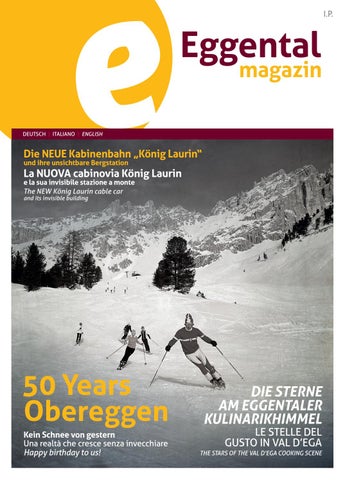
Die NEUE Kabinenbahn „König Laurin“ und ihre unsichtbare Bergstation
La NUOVA cabinovia König Laurin e la sua invisibile stazione a monte The NEW König Laurin cable car and its invisible building
50 Years Obereggen
DIE STERNE AM EGGENTALER KULINARIKHIMMEL
Kein Schnee von gestern Una realtà che cresce senza invecchiare Happy birthday to us!
THE STARS OF THE VAL D’EGA COOKING SCENE
LE STELLE DEL GUSTO IN VAL D’EGA
EGGENTAL VAL D’EGA THE SUNNY SIDE OF THE DOLOMITES
PfeiferBau w i r
B au en
z u k u n F T
Wir reALiSiereN iHr PrOJeKT QUALITATIV
kOMPrOMiSSLOS
VerLÄSSLiCH
ggental.com
Breitenkofl 5 - 39050 Deutschnofen Tel. 0471 616488 - Fax 0471 616633 - info@pfeiferbau.it - www.pfeiferbau.it
4
Funkelnd, unterirdisch, sagenumwoben Scintillante, sotterranea, leggendaria Dazzling, underground, legendary
Die Kabinenbahn „König Laurin“ La cabinovia König Laurin The König Laurin cable car
50 Jahre Obereggen 50 anni di Obereggen Obereggen turns 50
6 10
8
Die Sterne am Eggentaler Kulinarikhimmel Le stelle del gusto in Val d’Ega The stars of the Val d’Ega cooking scene
14
12
Die sechs besten Abfahrten unter dem Latemar Le sei migliori piste del Latemar The six best ski runs in the Latemar Mountains
Ein Tal voller Geschichte(n) Una valle di storie A valley full of (hi)stories
IMPRESSUM Foto: Storyteller Labs, Obereggen Latemar AG, Federico Modica, Thomas Ondertoller, Paolo Codeluppi, Alfred Tschager, Abdultaip Neziri , Alex Filz/IDM, Jens Staudt, Alberto Lavit, Alexandra Näckler, Sarah Meraner/Clicktext, Rendergraph/Arch. Werner Tscholl. Grafik & Druck / grafica & stampa / graphic & print:
KONTAKTE ∙ CONTATTI ∙ CONTACTS Texte / testi / texts: Clicktext, Tom Timlin Erstellt von / realizzato da / created by: Eggental Tourismus Gen. in Zusammenarbeit mit / in collaborazione con / in cooperation with: Eisath Marketing & Sports
Eggental Tourimus / Val d'Ega Turismo Dolomitenstr. 4 / Via Dolomiti 4 39056 Welschnofen / Nova Levante Tel. +39 0471 619 500 info@eggental.com ∙ eggental.com info@valdega.com ∙ valdega.com
INDEX | INDICE | INHALT | 3
Die Kabinenbahn „König Laurin“ und ihre unsichtbare Bergstation 50 Jahre nach Inbetriebnahme des historischen Korblifts „Laurin II“ – der 1998 zum Doppelsessellift umgebaut wurde – läutet die neue 10er Kabinenbahn „König Laurin“ eine neue Ära ein. Damit realisiert die Latemar Karersee GmbH ein wahres Mobilitäts-Highlight: Die 1.807 m lange Bahn ersetzt die zwei Sessellifte Laurin II und Laurin III und bringt die Fahrgäste von der Frommer Alm zur Kölner Hütte auf 2.337 m – in nur 6,5 Minuten und direkt zu den steil aufragenden Felsen des Rosengartens! Es ist übrigens das erste Bahnprojekt des renommierten Südtiroler Architekten Werner Tscholl, der für die Gestaltung der „unsichtbaren“ Bergstation verantwortlich zeichnet. (siehe Beitrag) Von der Landeshauptstadt aus mit umweltfreundlichen Verkehrsmitteln direkt zum Berg König Laurins wird somit ab Weihnachten 2020 barrierefrei möglich.
Realisierung eines nachhaltigen Mobilitätskonzeptes unterm Rosengarten Durch ein bewusstes und verantwortungsvolles Wirtschaften ist Carezza Dolomites – seit 2019 übrigens Teil des Klimaneutralitätsbündnisses 2025 – ein Impulsgeber für die Region und andere Unternehmen: Die Verantwortlichen engagieren sich schon seit Jahren für nachhaltigen Tourismus. Bei der Umsetzung der neuen Kabinenbahn steht Baubiologe Stefan Gasser für eine umweltschonende und schadstoffminimierende Ausführung der Bauarbeiten durch den Einsatz eines modernen Fuhrparks ein. So wurde beispielsweise außerhalb der Balz-Zeiten des Birkwildes gearbeitet und auf einen schonenden Umgang mit der Vegetation geachtet: An der Mittelstation wurde der Rasen vorsichtig mit dem Bagger ausgehoben und im Anschluss wieder angesetzt. Parallel zum Bau der neuen Kabinenbahn erfolgt auch die Verlängerung des Sesselliftes Tschein zur Moseralm. „Dadurch ergibt sich ein neues, zeitgemäßes Angebot“, erklärt Florian Eisath, Geschäftsführer von Carezza Dolomites. „Unsere Vision: das Hochplateau unterm Rosengarten autofrei erlebbar zu machen. Man kann künftig von Welschnofen aus mit der Kabinenbahn starten und umweltfreundlich zu Fuß und mit den Bahnen bis zum Karer See wandern.“ Auch vom Karer See aus erreicht man in nur 20 Gehminuten die Talstation des Sesselliftes Tschein, der eine Verbindung zur neuen König Laurin Bahn und somit bis zur Kölner Hütte garantiert.
4 | DEUTSCH | ITALIANO
La cabinovia König Laurin e la sua invisibile stazione a monte
A 50 anni dall’inaugurazione della storica cestovia Laurin II, poi divenuta seggiovia doppia nel 1998, con la nuova cabinovia a 10 posti König Laurin ha inizio una nuova era. Il progetto della Latemar Karersee S.r.l. segna una svolta in direzione della mobilità sostenibile. In soli 6,5 minuti il nuovo impianto da 1.807 metri, che va a sostituire le due seggiovie Laurin II e Laurin III, porta i passeggeri dalla malga Frommer Alm al rifugio Fronza alle Coronelle a 2.337 m, proprio tra le torri rocciose del Catinaccio! Si tratta peraltro del primo impianto di risalita firmato dall’archistar altoatesina Werner Tscholl, che ha progettato l’invisibile stazione a monte. (vedi articolo) A partire da Natale 2020 sarà possibile raggiungere la montagna di Re Laurino direttamente da Bolzano, senza barriere e con mezzi ecologici.
Un concetto di mobilità sostenibile all’ombra del Catinaccio La gestione responsabile e consapevole dell’area Carezza Dolomites, che dal 2019 fa parte del Patto per la Neutralità Climatica 2025, è una fonte di ispirazione per il terri-
The König Laurin cable car and its invisible building
Fifty years after the opening of the historic Laurin II basket lift – turned into a two-person chairlift in 1998 – the ten-person König Laurin cable car marks the beginning of a new era in Val d’Ega. At 1,807 metres in length, it replaces two chairlifts – Laurin II and Laurin III – leading from the Frommer Alm to the Kölner Hütte at 2,337 metres above sea level. The journey, which takes just 6.5 minutes, leads directly past the steep rock faces of the Catinaccio mountains. The building at the top of the cable car has been designed by the renowned local architect Werner Tscholl, who is famous for blending his projects into the natural landscape. (see blog) This new cable car means from Christmas 2020 it will be possible to use environmentally-friendly transport all the way from the regional capital, Bolzano, to the heart of the Val d’Ega region.
Sustainability mobility concept from the city to the mountains The Carezza Dolomites ski resort – since 2019 part of the Climate Neutrality Alliance 2025 – has long been a driving force for the region’s local economy and businesses. The resort’s management team has for many years now been committed to sustainable tourism.
torio e le altre imprese locali. Da anni i responsabili del progetto si impegnano a sostegno del turismo sostenibile. La fase di realizzazione della nuova cabinovia ha coinvolto anche il bioarchitetto Stefan Gasser, il cui compito è stato quello di assicurare il rispetto dell’ambiente e la minimizzazione delle emissioni grazie ad un moderno parco veicoli. Tra gli accorgimenti adottati annoveriamo la scelta di eseguire i lavori al di fuori della stagione degli amori del fagiano di monte. Anche la vegetazione presso la stazione intermedia è stata salvaguardata: si è infatti provveduto a sollevare delicatamente con un escavatore il manto erboso, che è poi stato ripristinato al termine dei lavori. Parallelamente alla costruzione della cabinovia è stato completato anche all’allungamento della seggiovia Tschein fino al Moseralm. “Il risultato è una nuova offerta al passo con i tempi”, ci spiega Florian Eisath, amministratore delegato di Carezza Dolomites. “La nostra vision è quella di rendere l’altopiano ai piedi del Catinaccio una meta visitabile in lungo e in largo, senza la necessità di mettersi al volante. In futuro sarà possibile prendere la cabinovia da Nova Levante e arrivare al Lago di Carezza a piedi e con gli altri impianti di risalita, in modo del tutto ecologico”. Anche partendo dal Lago di Carezza, la stazione a valle della seggiovia Tschein, che garantisce il collegamento con la nuova cabinovia König Laurin e il rifugio Fronza alle Coronelle, è raggiungibile con una passeggiata di appena 20 minuti.
Stefan Gasser, a biologist specialising in the impact of construction projects on the environment, was brought on board to minimise the impact of the building works on the environment. Measures taken included timing the work to avoid the breeding period of the black grouse and extensive efforts to protect the local vegetation. For example, the grass around the mid-way station of the cable car was carefully removed at the start of the project and then re-laid after completion of the building work. As well as building the new cable car, the resort has also extended the Tschein chairlift all the way to the Moseralm. “These changes bring the resort’s lift infrastructure right up to date,” explains Florian Eisath, general manager of the Carezza Dolomites ski resort. Our vision was to make the high plateau at the foot of the Catinaccio mountains a carfree zone. “Now it is possible to take the cable car from Nova Levante and travel all the way to the Lago di Carezza using environmentally friendly lifts.“ From the Lago di Carezza it is then just a 20-minute walk to the bottom of the Tschein chairlift, which now gives direct access to the new König Laurin cable car leading up to the Kölner Hütte.
Historischer Korblifts von 1950 • storica cestovia del 1950 • historic basket lift of 1950
ENGLISH | 5
Funkelnd, unterirdisch, sagenumwoben: WIE ARCHITEKT WERNER TSCHOLL DIE NATUR STAR BLEIBEN LÄSST Auch im Hochgebirge kann man Architektur schaffen, die Hand in Hand mit der Natur geht: Um den ökologischen Fußabdruck so gering wie möglich zu halten, hat sich Carezza Dolomites mit der neuen Kabinenbahn „König Laurin“ für eine „neue“ und auch kostspieligere Architektur entschieden – und dafür Stararchitekt Werner Tscholl beauftragt.
Inspiration Rosengarten
„Als ich nach einer langen Zeit wieder das erste Mal am Rosengarten war, waren seine besondere Atmosphäre, die Türme und dieser Mythos, der den Berg umgibt, einfach stark präsent“, erzählt er. Auch die König Laurin-Sage, die von unterirdischen Kristallpalästen erzählt, inspirierte Werner Tscholl zu seiner Idee für die Bergstation.
Architektur im Hochgebirge: ein Abenteuer!
„Architektur und Hochgebirge verträgt sich im Grunde nicht – daher muss man mit besonders viel Sensibilität an das Thema rangehen“, weiß Tscholl. Atmosphärische Bedingungen stellen auf 2.337 Metern Höhe bei Bauprojekten eine große Herausforderung dar. Dem Zufall überlassen wird hier oben also nichts: Jedes Detail, von der Aufzeichnung über die Ausschreibung bis hin zur Entscheidung, mit welchen Materialien und mit welchen Firmen gebaut wird, ist bestens durchdacht.
Teil des Berges werden
Die Landschaft ist das, was Italiens Architekt des Jahres 2016 in seinen Arbeiten immer mit einbezieht, so sein Grundsatz. Er verfolgt dabei immer das Ziel, den „End-Eingriff“ in die Natur möglichst unsichtbar zu halten, so auch am Rosengarten: „Die Seilbahnstation selbst ist nach Abschluss nicht mehr sichtbar, lediglich eine Ein- und Ausfahrt wird zu sehen sein. Den Rest holt sich die Natur mit der Zeit wieder zurück – man wird fast nicht merken, dass wir dort waren.“ Tscholl stößt mit seinen innovativen Ideen immer wieder auf Kritik und Widerstand – so auch dieses Mal. „Ich erlebe diesen Widerstand schon seit Anbeginn meiner Arbeit. (lacht) Gute Architektur ruft immer Kritik hervor, weil sie ihrer Zeit voraus ist.“ Am Ende habe sich der Widerstand aber immer in Wohlgefallen aufgelöst. Die Wanderer und Skifahrer, die zukünftig nach Carezza kommen, erwartet ein mystisches Erlebnis: Kommen sie mit der Kabinenbahn an der Bergstation an, gelangen die Besucher in eine Höhle, die durch besondere Lichtinstallationen Laurins unterirdischem Kristallpalast nachempfunden ist. Der Star sei aber weiterhin die imposante Landschaft der Dolomiten, betont Tscholl.
6 | DEUTSCH
.
h By Arc
ER N R E W OLL TSCH
Scintillante, sotterranea, leggendaria
Dazzling, underground, legendary:
LA NATURA È LA PROTAGONISTA INDISCUSSA DELLE OPERE ARCHITETTONICHE DI WERNER TSCHOLL
WERNER TSCHOLL’S EYE-CATCHING CABLE CAR STATION IN VAL D’EGA
Anche in alta quota l’architettura può fondersi in modo armonico con la natura. Al fine di ridurre al minimo l’impronta ecologica, per la realizzazione della Cabinovia König Laurin Carezza Dolomites investe ancora una volta sulla qualità e punta su un’architettura innovativa. Il progetto è stato affidato all’archistar Werner Tscholl.
Despite the challenges of building in the mountains, it is possible to create eye-catching construction projects which respect nature and protect the environment. Proof can be found in the form of the new König Laurin cable car designed by renowned local architect Werner Tscholl.
La fonte d’ispirazione
“When I came back to the Catinaccio mountains for the first time in many years, I could still feel the atmosphere, the peaks and the legends which make this place so special,” explains Tscholl. He drew on some of Val d’Ega’s most ancient myths, including the legend of King Laurin and his underground crystal palace, as a source of inspiration when designing the building at the top of the cable car.
“Quando, dopo molto tempo, mi sono ritrovato la prima volta sul Catinaccio, tra le sue guglie e pareti rocciose, quel mito si sentiva aleggiare ancora forte nell’aria”, racconta il celebre architetto. Del resto, anche la leggenda di Re Laurino narra di scintillanti palazzi sotterranei. Ed è proprio da questa saga che Werner Tscholl ha tratto l’ispirazione per la realizzazione della stazione a monte.
La sfida dell’architettura in alta quota
“Architettura e alta montagna sono realtà difficilmente conciliabili. Ecco dunque l’esigenza di scegliere un approccio mosso da un’elevata dose di meticolosità”, afferma Tscholl. A 2.337 metri di altitudine le condizioni atmosferiche mettono di fronte a grandi difficoltà. In quota, nulla è lasciato al caso: dalla bozza al bando di gara, fino alla scelta dei materiali da impiegare e delle imprese di cui avvalersi. Ogni aspetto è ponderato nel minimo dettaglio.
Un tutt’uno con la montagna
A non mancare mai nelle visioni di Tscholl, premiato nel 2016 come Architetto italiano dell’anno, è il paesaggio. Il suo obiettivo è quello di rendere quanto più invisibile l’impatto dell’architettura sull’ambiente. Questo approccio è stato adottato anche nel caso del Catinaccio: “La stazione della funivia è stata resa di fatto invisibile. Al termine dei lavori si potranno individuare solo l’ingresso e l’uscita. Con il tempo la natura si rimpossesserà del resto, facendo sparire ogni traccia del nostro intervento.” Le idee innovative di Tscholl espongono l’archistar alle critiche. E anche questo progetto non ha fatto eccezione. “È una resistenza in cui mi imbatto da quando ho iniziato a lavorare (ride). L’architettura di valore si scontra sempre con la critica perché precorre i tempi.” Alla fine, tuttavia, lo scetticismo iniziale si è sempre risolto. Ad attendere gli escursionisti e gli sciatori che sceglieranno di avventurarsi tra i pendii di Carezza, ci sono grandi momenti di pura contemplazione. Raggiunta la stazione a monte a bordo della cabinovia, il visitatore si ritrova calato in una cavità sotterranea in cui apposite installazioni luminose danno vita ad un’ambientazione che riecheggia l’incanto del leggendario palazzo sotterraneo di cristallo. Tuttavia, a rimanere il protagonista indiscusso è il maestoso scenario dolomitico, come ribadisce Tscholl.
Inspired by the Catinaccio mountains
The adventures of alpine architecture
“Architecture and alpine terrain don’t really go together – there is a lot of planning which goes into a good building project in the mountains,” says Tscholl. The conditions at 2,337 metres above sea level pose a major challenge, meaning nothing can be left to chance. Every detail, from the initial planning to the tender and the decision on which materials to use and which companies should be involved, is considered very carefully.
Becoming part of the mountain
The driving principle behind Werner Tscholl’s architecture is harmony – the building should become part of the landscape. This can be seen perfectly at the König Laurin cable car station, where Italy’s Architect of the Year 2016 has managed to create a seamless transition from the mountain scenery to the exposed concrete of the cable car building. “You can’t really see where the mountain finishes and the building begins,” explains Tscholl. “All that is visible is the entrance and exit area. The rest will be reclaimed by nature over time – you will barely be able to see the influence of us humans on the landscape.” Tscholl’s approach to architecture is not always to everyone’s taste. Over the years his projects have been the subject of criticism – and this one was no exception. “I have got used to it. Since the start of my career I have had to deal with criticism,” he says with a smile. “Good architecture will always be controversial because it is ahead of its time.” In most cases, he adds, initial criticism often melts away as the project progresses. The hikers and skiers who will come to Carezza in the future can look forward to an unusual cable car experience when they arrive at the top station. As they exit the building they pass through a cave with light installations inspired by King Laurin’s underground crystal palace. An impressive sight and one which visitors will not forget in a hurry. “The real star of the show, however, will always be the Dolomites themselves,” adds Tscholl with a smile.
ITALIANO | ENGLISH | 7
50 Jahre Obereggen
50 anni di Obereggen
Ein kleines, verschlafenes Bergdörfchen am Fuße des Latemar, vereinzelte Besucher im Sommer und ein paar junge Männer, die mit Zuversicht und Tatkraft ihre Vision zur Realität machten: Obereggen erzählt eine Geschichte von Beharrlichkeit und Innovationsgeist, von Zusammenhalt und Verantwortungsbewusstsein – und das schon seit 50 Jahren!
Un paesino di montagna in letargo situato ai piedi del Latemar, qualche sparuto turista estivo e la determinazione di un paio di giovani intraprendenti che hanno trasformato la loro visione in realtà. Obereggen racconta una storia di perseveranza, responsabilità e spirito d’innovazione. La storia di un’unione che fa la forza. Da ben 50 anni!
Dass die elf Gründer der Obereggen AG anfangs von vielen für ihre Idee belächelt, von manchen sogar als größenwahnsinnig bezeichnet wurden, konnte sie von ihrem Vorhaben nicht abbringen: Den Tourismus in Obereggen durch ein Skigebiet anzukurbeln – das hatten sie sich vorgenommen und daran arbeiteten sie mit Ausdauer und Überzeugungskraft. Im Jahr 1972 wurde der erste Lift in Betrieb genommen – ein Erfolg, dem noch viele weitere folgen sollten: Durch die Errichtung weiterer Liftanlagen 1975 und 1977 verzeichnete Obereggen und damit das gesamte Eggental bald einen beeindruckenden Wirtschaftsaufschwung. Endlich fanden viele junge Leute, die bis in die 1970er-Jahre hinein ihren Heimatort auf der Suche nach einer besseren Lebensgrundlage verlassen hatten, auch vor Ort genügend Arbeit: Der Skibetrieb hatte das Gebiet unter dem Latemar aufleben und zu einer beliebten Destination bei Winterund zunehmend auch Sommer-Gästen werden lassen.
All’inizio molti la trovarono un’idea ridicola, alcuni persino megalomane.Ma gli undici fondatori di Obereggen S.p.A. non si fecero scoraggiare, perseguendo con fiducia e costanza il loro obiettivo: creare un’area sciistica che facesse fiorire il turismo a Obereggen. Nel 1972 entrò in funzione il primo impianto di risalita. Fu l’inizio di una lunga serie di successi. La costruzione di ulteriori impianti nel 1975 e nel 1977 diede avvio ad un notevole boom economico per Obereggen e di conseguenza per tutta la Val d’Ega. I giovani del posto, che fino agli anni ‘70 avevano dovuto cercarsi altrove prospettive più rosee, finalmente avevano l’opportunità di trovare impiego nella loro terra d’origine. L’attività sciistica diede grande impulso alla zona del Latemar, facendone una meta popolare per l’attività sciistica e, sempre più, anche per il turismo estivo.
KEIN SCHNEE VON GESTERN.
Weitblick und Naturnähe
Die konstante Weiterentwicklung des Skigebiets wurde aktiv vorangetrieben, unter anderem mit ersten Versuchen einer flächendeckenden technischen Beschneiung, die in Obereggen bereits im Jahr 1980 unternommen wurden. Seine Vorreiterrolle stellte das Skigebiet aber auch bei den Aufstiegsanlagen immer wieder unter Beweis: 1985 wurde in Obereggen Italiens erster automatischer Vierersessellift errichtet, 1987 der erste fixgeklemmte Vierersessellift und 1990 das erste Förderband. Heute ist Obereggen weithin bekannt für seine perfekt präparierten, schneesicheren Skipisten und seine erlebnisreichen Wanderwege. Jedes Jahr im Dezember findet auf der Obereggener Maierl-Piste ein Teil des Europacups statt, der viele skibegeisterte Zuschauer anzieht. Aus den 20 Betten, die Obereggen vor rund 50 Jahren im einzigen Gasthof des Dorfes anzubieten hatte, sind mittlerweile 20 Beherbergungsbetriebe mit rund 850 Betten geworden. Nicht verändert hat sich hingegen die Einstellung der Obereggener zur Natur, die sie umgibt und deren Erhalt den Talbewohnern ein besonders großes Anliegen ist: Ein respektvoller Umgang mit Tier und Pflanze und deren Lebensräumen spielt bei allen Projekten und Unterfangen stets eine Hauptrolle – schließlich sollen sich auch zukünftige Generationen noch am einmaligen Weltnaturerbe rund um den Latemar erfreuen können.
8 | DEUTSCH | ITALIANO
UNA REALTÀ CHE CRESCE SENZA INVECCHIARE
Un occhio al futuro e uno alla natura
Il costante sviluppo dell’area sciistica è stato curato in modo attivo, ad esempio con i primi passi verso un innevamento programmato estensivo, iniziato già nel 1980. Ma negli anni Obereggen ha riconfermato più volte il suo ruolo pionieristico anche in fatto di impianti di risalita: nel 1985 fu costruita la prima seggiovia quadriposto ad ammorsamento automatico d’Italia, nel 1987 la prima seggiovia quadriposto a morse fisse. Il primo nastro trasportatore risale al 1990. Oggi Obereggen è una meta gettonatissima per le sue piste perfettamente preparate e innevate durante tutta la stagione invernale e per i suoi spettacolari sentieri escursionistici estivi. Di grande richiamo è anche la pista Maierl, su cui a dicembre si disputa l’annuale slalom di Coppa Europa. In 50 anni Obereggen ne ha fatta di strada. Si è passati da un’unica locanda con soli 20 posti letto alle 20 strutture ricettive di oggi che ne offrono circa 850. Ciò che non è mai cambiato è l’atteggiamento verso la natura dei suoi abitanti, a cui la tutela dell’ambiente sta da sempre particolarmente a cuore. In Val d’Ega, il rispetto verso la flora, la fauna e il loro habitat ha sempre un ruolo centrale in tutti i progetti e le iniziative che coinvolgono il territorio. Perché anche le generazioni future possano continuare a divertirsi ai piedi del Latemar e ad ammirare il suo inestimabile patrimonio naturale.
valley in search of employment. The new ski area at the foot of the Latemar mountains made Obereggen a popular destination for guests in both winter and, increasingly, also in summer.
Fine views and untouched nature
The resort continued to develop, including the introduction of snow-making technology from 1980. Again and again, Obereggen proved itself to be a pioneer in the field of lifts and cable cars. In 1985 it became the first resort in Italy to install an automatic four-person chairlift, followed in 1987 by the country’s first fix-clamped four-person chairlift and in 1990 by the first conveyor-belt lift. Today Obereggen is known throughout the region and beyond for its perfectly groomed pistes, snowsure conditions and beautiful summer walking trails. Each year in December the Maierl piste hosts Europa Cup races drawing spectators from near and far. A sleepy mountain village in the mountains, just a few visitors in summer, and a handful of young men with a vision – the history of Obereggen is one shaped by ambition, innovation, solidarity and responsibility. This year the resort is celebrating its 50th birthday. Time for a look back! The eleven founders of Obereggen AG, the company behind the resort, were initially ridiculed for their plans – some were even called megalomaniacs, but remained were determined to make their vision of a ski resort Obereggen a reality. In 1972 the first lift opened – and was an immediate success. It was followed by further lifts in 1975 and 1977, leading to an increase in the number of visitors and an upswing in the local economy. The resort provided much-needed work for many young people who, until the 1970s, had been forced to leave the
Obereggen‘s accommodation capacity has grown from just 20 beds 50 years ago to over 20 hotels and guesthouses with around 850 beds in total. Yet, despite this growth, Obereggen has managed to retain is original charm and beauty. The local population still holds a deep respect for the nature of Val d‘Ega and is determined to protect these natural treasures going forward so future generations can also enjoy the beauty of the UNESCO World Heritage Site and the imposing Latemar mountains.
ENGLISH | 9
M A E N R E T S DIE ENTALER L E G M G E M I H K I R A N I KUL Theodor Falser (46), Chef de Cuisine im Welschnofner Hotel Engel und Sternekoch der Johannesstube, und Gregor Eschgfäller (30), Sternekoch seines Restaurants Astra im Hotel Berghang in Steinegg, im exklusiven Interview. Gregor, du hast deinen Michelin-Stern 2018 erhalten, du, Theodor, 2014. Wie lief das ab? G: Der Ablauf ist Top Secret. Wir Köche wurden morgens von einem Bus abgeholt, die Vorhänge waren zugezogen. In einer Halle haben wir stundenlang gewartet – keiner wusste, was los war. Ganz sicher war ich mir bis zum Moment der Verleihung nicht, ob ich den Stern wirklich bekommen würde! T: Ich war gerade auf einer Kreuzfahrt auf Sizilien, als ich die News über einen Anruf vom Hotel Engel bekam. Das Komitee hatte mich nämlich nie erreicht und dann habe ich es gar nicht mitbekommen (lacht). Ich konnte es auch nicht wirklich glauben – es war sehr emotional. Wie hat sich euer Leben nach dem Stern verändert? G: Es werden immer mehr Leute auf uns aufmerksam und das Restaurant ist fast immer ausgebucht. Der Stern ist eine sehr gute Werbung! T: Man bekommt viele Einladungen und Anfragen, plötzlich interessieren sich alle für dich. Für mich war es ein riesiger Türöffner – und für das Hotel eine große Bestätigung.
10 | DEUTSCH
Worin liegen die größten Unterschiede zwischen euch? T: Taste Nature ist 100% regional – und unsere Philosophie. Es macht das Kochen natürlich schwierig: Anfangs war es sehr kompliziert, natürliche Alternativen etwa für Olivenöl, Zitronen oder Vanille zu finden. G: Ich verwende das, was mich anspricht und worauf ich Lust habe – nicht nur regional. Damit könnte ich mich nicht verwirklichen. Ich weiß nicht, wie Theodor damit klar kommt. (lacht) Was schätzt ihr aneinander besonders? G: Mich beeindrucken der Mut und der Aufwand, den Theodor aufbringt, um seine regionale Philosophie durchzusetzen. T: Gregor geht seinen Weg, er hat seine eigene Handschrift und zieht sein ganz eigenes Ding durch – dafür hat er meinen vollsten Respekt.
CHEF
ISINE
DE CU
HEAD
DOR THEO ER S FAL
CHEF
OR GREGFÄLLER
ESCHG
The stars of the Val d’Ega cooking scene Le stelle del gusto in Val d’Ega Theodor Falser (46), chef de cuisine a Nova Levante per l’Hotel Engel e cuoco stellato della Johannesstube, e Gregor Eschgfäller (30), chef del suo locale stellato, il Ristorante Astra dell’Hotel Berghang a Collepietra, si raccontano in un’intervista esclusiva. Gregor, hai ricevuto la stella Michelin nel 2018. Tu, Theodor, nel 2014. Ci spiegate com’è andata? G: “Il procedimento è top secret. Una mattina è venuto a prenderci un autobus con i vetri oscurati. Ci hanno portato in una sala dove abbiamo aspettato per ore. Nessuno sapeva cosa stesse succedendo. Fino al momento dell’assegnazione non ero sicuro che avrei ottenuto veramente la stella!” T: “Ero in crociera in Sicilia quando mi hanno telefonato dall’Hotel Engel. Il comitato non era riuscito a contattarmi e quindi io non lo sapevo proprio (ride). Quasi non potevo crederci e allo stesso tempo l’emozione era tanta.” Com’è cambiata la vostra vita dopo la stella? G: “Sta iniziando a girare la voce, le persone cominciano a conoscerci e il ristorante è quasi sempre pieno. Sicuramente la stella è un’ottima pubblicità!” T: “Ricevi tanti inviti e richieste, improvvisamente sei al centro dell’attenzione di tutti. La stella mi ha aperto molte porte, per l’hotel è stata una conferma importante.” Qual è la differenza più grande tra voi due? T: “Taste Nature è regionalità al 100%. E al contempo è anche la nostra filosofia. Ovviamente cucinare secondo questo principio è di gran lunga più difficile. All’inizio trovare un’alternativa naturale per l’olio d’oliva, per il limone e per la vaniglia è stato complicato.” G: “Utilizzo quello che mi ispira e di cui ho voglia al momento. Se usassi solo ingredienti regionali non riuscirei ad esprimermi come vorrei. Non so come faccia Theodor.” (ride) Cosa apprezzate l’uno dell’altro? G: “Mi affascina il coraggio e l’impegno di Theodor nel mettere in pratica la sua filosofia regionale.” T: “Gregor va per la sua strada. Ha il suo stile. Non si ispira a nessuno e non si fa scoraggiare. Per questo ha il mio massimo rispetto.”
Theodor Falser (46), chef de cuisine at the Hotel Engel in Nova Levante and head chef at the Johannesstube, and Gregor Eschgfäller (30), head chef of the Restaurant Astra at the Hotel Berghang in Collepietra, tell us about haute cuisine in the high mountains. Gregor, you received your Michelin star in 2018. Theodor, you were awarded yours in 2014. Tells us all about it. G: The process itself is top secret. We, the chefs, were picked up in the morning by a coach with the curtains drawn across the windows. We then had to wait for hours in a large room – nobody knew what was going on. Right up until the moment my name was read out I wasn’t even sure I would get a star at all! T: I was on a cruise in Sicily when I got the news from a member of staff at the Hotel Engel. The award committee had been trying to get in touch with me but couldn’t get through (laughs). I couldn’t really believe it – it was all very emotional. How did it change your lives? G: More and more people know about us. The restaurant is almost always fully booked. Having a Michelin star is great for business! T: I get lots of invitations and enquiries – all of a sudden, everyone is interested in what you’re doing. It has opened many doors and is a badge of honour for the hotel. How do your personal approaches to cooking differ? T: Taste Nature is 100% regional – and that’s our philosophy. It’s an approach which makes cooking difficult. For example, it was hard at the start to find natural local alternatives to olive oil, lemons or vanilla. G: I use anything I like and everything I enjoy – not just produce from the local region. That would be too limiting for me. I don’t know how Theodor does it! (laughs) What do you appreciate about each other? G: I am always impressed by Theodor’s courage and hard work when it comes to following his cooking philosophy. T: Gregor has his own way of doing things. You can immediately recognise his cooking style – that is something I really respect.
ITALIANO | ENGLISH | 11
Ein Tal voller Geschichte(n) 1896 eröffnet auf 1.630 Metern, wo einst nur Gestrüpp und Sümpfe die wilde Eggentaler Natur prägten, das Grand Hotel Carezza. Mit seinem besonderen Flair lockt es viele Berühmtheiten an den Karer See: Kaiserin Sissi, Krimi-Autorin Agatha Christie, Winnetou-Autor Karl May und den österreichischen Schriftsteller Arthur Schnitzler. Sogar Winston Churchill lässt sich hier von der eindrucksvollen Kulisse der Dolomiten beim Malen inspirieren. Dass das Grand Hotel Carezza seit jeher über die Grenzen hinaus bekannt ist, liegt vielleicht auch an seiner bewegten Geschichte, die sich beinahe wie ein abenteuerliches Drehbuch liest:
JAHRE VOLLER HÖHEN UND TIEFEN 1910: Im Grand Hotel bricht ein Großbrand aus. 1912: Das Grand Hotel Carezza steht in seiner ursprünglichen Pracht da – und mit fast 500 Betten verfügt es über eine noch größere Gästekapazität als vorher.
Erster Weltkrieg: Das Hotel dient der
österreichischen Generalität als Stützpunkt.
1925: Der Hotelbetrieb wird wieder aufgenommen. 1943: Das Hotel wird von der deutschen Wehrmacht beschlagnahmt. 1947: Das Grand Hotel eröffnet wieder als solches seine Tore. Möglich gemacht wurde der Erfolg des Grand Hotel Carezza natürlich auch von ihr: Der Eggentaler Straße, die die wundervolle Dolomiten-Natur am Fuße von Rosengarten und Latemar überhaupt erst für Gäste und Besucher öffnet.
DAS TOR ZUR DOLOMITENWELT
Die Eggentaler Straße wird bereits 1859 in nur acht Monaten gebaut – trotz großer Herausforderungen. Durch die neue Infrastruktur sollen die Dolomiten der breiteren Masse zugänglich gemacht und die Wirtschaft angekurbelt werden. Weitere Gebiete im Tal werden nun erschlossen, zudem erfolgt auch der Bau der Welschnofner und Deutschnofner Straße, sowie der Dolomitenstraße, die bis nach Cortina d’Ampezzo führt. Von da an boomt der Fremdenverkehr!
AUTOMOBILE IM EGGENTAL
Nach dem Großbrand im Grand Hotel fährt der damalige Bezirkshauptmann mit seinem Auto zur Brandstelle – damals herrscht auf der Eggentaler- und Dolomitenstraße eigentlich noch striktes Fahrverbot, das erst im Juni 1911 aufgehoben wird. Im ersten Weltkrieg schließt die Eggentaler Straße an die Dolomitenstraße an und der Automobilverkehr im Tal nimmt zu. Holzbrücken werden durch Steinbrücken ersetzt, der Unterbau der Straße wird verstärkt, die Fahrbahn verbreitert. Die erste Automobilfahrt nach Deutschnofen gelingt übrigens erst Anfang der 30er-Jahre!
12 | DEUTSCH
Una valle di storie
A valley full of (hi)stories
Correva l’anno 1893 quando a 1.630 metri sul livello del mare, dove la natura selvaggia della Val d’Ega era ancora un susseguirsi di paludi e di sterpaglie, fu inaugurato il Grand Hotel Carezza. Il suo fascino straordinario attirò sulle sponde del Lago di Carezza numerose personalità del tempo: l’imperatrice Sissi, la regina del giallo Agatha Christie, l’ideatore di Winnetou Karl May e lo scrittore austriaco Arthur Schnitzler. Qualche anno dopo fu Winston Churchill a trascorrere le sue vacanze al Grand Hotel Carezza, trovando nel panorama delle Dolomiti un magnifico soggetto per i suoi dipinti. Il fatto che il Grand Hotel Carezza sia da sempre conosciuto anche oltre i confini nazionali, è probabilmente dovuto in parte alla sua storia ricca di colpi di scena. Una storia paragonabile ad un copione di un film d’avventura.
Opened in 1896 at 1,630 metres above sea level, where scrub and swamps once dominated the land, the Grand Hotel Carezza looks back on a long and proud history. Over the last 120 years it has drawn many famous names to the shores of the Lago di Carezza, including Empress Elisabeth of Austria-Hungary, crime writer Agatha Christie, well-known German author Karl May and the Austrian writer Arthur Schnitzler. Even Winston Churchill drew inspiration from the spectacular Dolomites during his painting holidays.
UNA STORIA DI COLPI DI SCENA
able to welcome even more guests than before the fire. First World War: The Austrian Army uses the hotel as a military base. 1925: The building opens once again as a hotel. 1943: The hotel is seized by the German Army. 1947: The Grand Hotel reopens as a hotel.
1910: al Grand Hotel scopapia un incendio. 1912: il Grand Hotel Carezza torna al suo splendore originale.
Con quasi 500 posti letto, l’hotel è pronto ad accogliere più ospiti di prima.
Prima guerra mondiale: l’hotel funge da presidio militare per i generali austriaci.
1925: viene ripresa l’attività alberghiera 1943: l’hotel viene confiscato dalla Wehrmacht. 1947: il Grand Hotel riapre i battenti.
Over the decades the Grand Hotel Carezza has experienced many ups and downs, from fires to wars.
A TURBULENT HISTORY
1910: Fire rips through the Grand Hotel. 1912: The Grand Hotel Carezza is rebuilt to its former glory– with 500 beds it is
A key development in the success of the Grand Hotel Carezza was the construction of the first road into the valley, giving visitors access to the wonderful nature of the Catinaccio and Latemar massifs in the Dolomites.
THE GATEWAY TO THE DOLOMITES
Naturalmente il successo del Grand Hotel Carezza è stato reso possibile anche da lei: la strada della Val d’Ega che accompagna gli ospiti e i visitatori attraverso la meravigliosa natura dolomitica ai piedi del Catinaccio e del Latemar.
LA PORTA SULLE DOLOMITI
La strada della Val d’Ega venne inaugurata già nel 1859, dopo appena otto mesi di lavori, nonostante la geologia locale avesse posto la costruzione dinanzi a sfide enormi. La nuova infrastruttura mirava a rendere le Dolomiti accessibili al grande pubblico e a rilanciare l’economia locale. Anche altre zone della valle vissero una fase di innovazione e sviluppo. In quegli anni vennero costruite le strade di Nova Levante, di Nova Ponente e delle Dolomiti, arteria, quest’ultima, che si spingeva fino a Cortina d’Ampezzo. Da quel momento in Val d’Ega si sperimentò un boom turistico!
The road into the valley was completed in 1859 in just eight months – despite the challenges which come with construction projects in the mountains. The idea was to make the Dolomites more easily accessible to visitors and thereby boost the local economy. The construction of the main valley road was followed by further smaller side roads to individual villages such as Nova Levante, Nova Ponente and even as far as Cortina d’Ampezzo. This marked the start of tourism boom in Val d‘Ega.
AUTOMOBILES IN VAL D‘EGA
Following the terrible fire at the Grand Hotel, the regional governor drove to the building to inspect the damage – despite the fact that at the time there was a strict ban on automobiles using the roads in the valley. It was not lifted until June of 1911. During the First World War the main road into the valley and the road to Cortina d’Ampezzo were connected, leading to an increase in traffic. Wooden bridges were replaced with stone constructions. The foundations of the main road were reinforced and the road was widened. However, it was not until the early 1930s that the first car reached the village of Nova Ponente.
LA VAL D’EGA APRE ALLE PRIME AUTOMOBILI
Dopo l’incendio scoppiato al Grand Hotel, l’allora governatore distrettuale si recò in automobile sul luogo del rogo, seppure all’epoca vigesse ancora un divieto di circolazione sulla strada della Val d’Ega e sulla strada delle Dolomiti. Il divieto di transito per le automobili fu revocato solo nel giugno del 1911. Durante la Prima guerra mondiale, la strada della Val d’Ega venne collegata alla strada delle Dolomiti. Da lì a poco il traffico automobilistico nella valle aumentò considerevolmente. I ponti di legno vennero sostituiti da ponti in pietra, il sottofondo stradale venne rinforzato e la carreggiata venne ampliata. Per inciso, Nova Ponente venne collegata alla rete stradale automobilistica solo all’inizio degli anni ’30!
Quellenangabe: „Die Eggentaler Straße“, Kathrin Eisath (Athesia-Tappeiner-Verlag)
ITALIANO | ENGLISH | 13
R A M E T LA K C A P X I S
Die sechs besten Abfahrten unter dem Latemar
Pala di Santa
Oberholz
Agnello
In diesem Jahr begeht das Skigebiet Obereggen seinen 50. Geburtstag – und lässt zu diesem Anlass seine Muskeln spielen: Das „Latemar Sixpack“ bezeichnet sechs ganz besondere Abfahrten im Ski Center Latemar, die die Bauchmuskulatur aller Pistenbegeisterten – wie es der Name schon erahnen lässt – ordentlich in Anspruch nehmen. Neben Fitness und Pisten-Erfahrung erfordert das „Latemar Sixpack“ aber vor allem eins: Lust auf Nervenkitzel!
1. Oberholz
Los geht das Schneevergnügen mit der beliebten OberholzPiste, die mit ihren 600 m Höhenunterschied und reichlich Abwechslung lautstark nach (mindestens) einer Pflichtabfahrt ruft. Teilweise durch ein Stück Wald verlaufend und in verschiedenen Neigungsstufen gestaltet, fühlt sich die Piste mit ihrer großzügigen Breite auch an gut besuchten Tagen nicht voll an. Ein abwechslungsreicher und bisweilen anspruchsvoller Spaß, der ganz nebenbei mit fantastischen Ausblicken auf das Eggental, die Alpen und auf Bozen belohnt.
2. Maierl
Gut aufgewärmt und technisch anspruchsvoll geht es weiter – auf der Maierl-Piste, die seit Jahren auch Schauplatz des Europacups ist. Gut 1,6 km bestens präparierter Schnee warten auf Profi-Slalomisten und passionierte Pistenfahrer. Auf einer durchschnittlichen Breite von 53 m und mit einer maximalen Neigung von 55 % geht es schwingend talwärts.
3. Pala di Santa
Ohne die Ski abzuschnallen, lässt sich die rasante Reise in Pampeago fortsetzen. Die „Pala di Santa“-Piste beginnt auf dem sonnigen Plateau in 2.400 m Höhe – und trumpft gleich mit zwei Abfahrtsvarianten auf: der gemütlicheren Panoramapiste mit reichlich Fernblick und der schwarzen Piste „Il Muro di Santa“ mit 58 % Neigung und 100 % Adrenalin.
14 | ITALIANO
4. Agnello
Die Aufregung darf sanft ausklingen, während es auf dem Sessellift von der Talstation Pampeago wieder hinauf in die Höhe geht – zur sicherlich kunstvollsten Abfahrt dieses Sechser-Kraftpakets: Die Agnello-Piste führt auf rund 2,6 km Länge – und über verschiedene Varianten – durch einen der höchsten Kunstparks weltweit, den RespirArt.
5. Cinque Nazioni
Auch Predazzo, das dritte Skigebiet im Bunde des Ski Center Latemar, kommt im „Latemar Sixpack“ natürlich nicht zu kurz: Diese rote Piste wurde in den 1970er-Jahren im Rahmen des Fünf-Nationencups von den besten Skifahrern aus Österreich, Frankreich, Deutschland, der Schweiz und Italien befahren. Ihr Name erinnert heute noch daran.
6. Torre di Pisa
Der krönende Abschluss: die „Torre di Pisa“-Piste. So beeindruckend wie die Felsformation, so beliebt ist die danach benannte Piste bei Profi- und Amateurskifahrern. Dazu tragen nicht nur die abwechslungsreichen 1,5 km perfekt präparierte Piste und die 59 % Neigung bei, sondern auch der unvergleichliche Ausblick, der von der Palagruppe bis zum Adamello reicht.
The six best ski runs in the Latemar Mountains
1. Oberholz
Il divertimento inizia sull’amatissima pista Oberholz, che con i suoi 600 metri di dislivello e il suo tracciato molto vario merita (almeno) una discesa. La pista, che per un tratto s’inoltra nel bosco e presenta diversi cambi di pendenza, è così larga da non dare la sensazione di affollamento nemmeno nelle giornate in cui è più frequentata. Varia e a tratti impegnativa, la Oberholz premia con una vista da sogno sulla Val d’Ega, le Alpi e la città di Bolzano.
2. Maierl
Dopo un buon riscaldamento si prosegue con la Maierl, una pista tecnicamente impegnativa che da anni ospita la Coppa Europa. Slalomisti professionisti e sciatori appassionati trovano ad attenderli una pista da 1,6 km con larghezza media di 53 metri, pendenza massima del 55% e neve perfetta su cui sfrecciare verso valle.
3. Pala di Santa
Non serve slacciare gli sci: la discesa verso il Paradiso continua a Pampeago. La pista Pala di Santa inizia sul soleggiato altopiano a 2.400 metri di quota e offre due varianti: quella facile con una vista panoramica mozzafiato e la pista nera Il Muro di Santa per 58% di pendenza e 100% di adrenalina.
4. Agnello
Il batticuore si prende una pausa sulla seggiovia che dalla stazione a valle di Pampeago sale verso quella che è indubbiamente la discesa più artistica di questo six-pack. I 2,6 km di lunghezza della pista Agnello, con diverse varianti, si snodano attraverso RespirArt, una delle gallerie d’arte open air più ad alta quota del mondo.
5. Cinque Nazioni
Dal six-pack non può naturalmente mancare Predazzo, la terza area sciistica del comprensorio Ski Center Latemar. È su questa pista che negli anni ‘70 i migliori sciatori d’Italia, Austria, Svizzera, Francia e Germania si davano battaglia per aggiudicarsi la Coppa delle Cinque Nazioni, a cui deve il nome.
6. Torre di Pisa
Dulcis in fundo: la pista Torre di Pisa, emozionante come la guglia dolomitica da cui prende il nome, è amata tanto dai professionisti quanto dai dilettanti. Questo non solo per la grande varietà e il 59% di pendenza del suo chilometro e mezzo di neve perfetta, ma anche per il panorama insuperabile che spazia dalle Pale di San Martino all’Adamello.
The adventure begins on the popular Oberholz piste. Descending 600 vertical metres from top to bottom, it demands strong legs and good fitness. The run, which leads through a forest, changes gradient several times and offers plenty of space for cruising even on busy days. Last but certainly not least, skiers are rewarded with majestic views of the Val d’Ega region, the Alps and the town of Bolzano in the distance.
2. Maierl
Warmed up and ready for more? Good! The Maierl is another challenging run which has hosted the Europa Cup slalom races for many years. It measures 1.6 kilometres in length and offers excellent snow conditions throughout the season. This run averages 53 metres in width and has a maximum gradient of 55%.
3. Pala di Santa
The journey continues with no need to unclip from your skis. Head for Pampeago and the Pala di Santa piste, located on a sunny plateau at 2,400 metres above sea level. There are two different runs to choose from: the easy Panorama piste with great views and the challenging Il Muro di Santa with 58% gradients and 100% adrenaline.
4. Agnello
After all that excitement there’s just time to grab a breather on the chairlift up from Pampeago onto the mountain before piste number four of our Latemar Sixpack invites skiers to discover their artistic side. The 2.6-kilometre-long Agnello piste – which has a number of different routes to choose from – leads through RespirArt, the world’s highest outdoor art exhibition.
5. Cinque Nazioni
Predazzo, the third resort belonging to the Ski Center Latemar, is also represented in the Latemar Sixpack. It is here that skiers will find the Cinque Nazioni piste. This red piste was used in the 1970s to host races of the Five Nations Cup bringing together the best skiers from Austria, France, Germany, Switzerland and Italy. Its name Five Nations serves today as a reminder of this former event held in the resort.
6. Torre di Pisa
Last but certainly not least, the Torre di Pisa piste is as impressive as the rock formation from which it takes its name. At 1.5 kilometres in length and with a gradient of up to 59%, it is a challenge even for experts. Don’t forget to stop and enjoy the fabulous views stretching from the Pala massif to the Adamello mountain.
ITALIANO | ENGLISH | 15
Cinque Nazioni
Quest’anno l’area sciistica Obereggen festeggia il suo 50o compleanno… e per l’occasione mette in mostra i muscoli. Con “Latemar Six-pack” intendiamo un sestetto di piste dello Ski Center Latemar molto speciali che, come suggerisce il nome, mettono a dura prova gli addominali degli appassionati di sci. Oltre ad un’ottima forma fisica e una certa esperienza, queste piste richiedono soprattutto una cosa: la sete di adrenalina!
1. Oberholz
Torre di Pisa
Maierl
Le sei migliori piste del Latemar
This year the ski resort of Obereggen is celebrating its 50th birthday – the perfect opportunity to pick six of the best ski runs at the Ski Center Latemar. The Latemar Sixpack presents a challenge even for advanced and expert skiers. See if you can complete all six pistes during your holiday in the region. Ready, steady, ski!
MEHR G'SCHICHTEN AUS DEM EGGENTAL: PIÙ STORIE DELLA VAL D'EGA: MORE STORIES FROM THE VAL D'EGA:
eggental.com/blog