As you begin Year 9, you’re entering a key stage in your journey at St Teresa’s. You’ve grown in experience and independence, and now is the time to start thinking about your next steps – both in school and beyond. This year brings opportunities and responsibility. Keep contributing positively to our community, support those around you, and never stop striving to do your best. Let our values of Faith, Character, Community, Compassion, and Intellect guide your choices and actions. They will serve you well, both now and in the years to come. Be courageous, stay focused, and enjoy the challenges and achievements that lie ahead.
Mr Stuart Field, September 2025
Meet the Head of Section
My role is to oversee pastoral care for all pupils in Key Stage 3. Your daughter should now be a role model within my section. Year 9 comes with greater responsibility as it is a year where pupils begin to consolidate their learning and prepare for the transition to GCSE. My role is to ensure that pupils are supported through the opportunities and challenges this will bring, whether that be in their studies, friendships, or personal development. I am available to pupils and parents should any questions or concerns arise. I look forward to working together to help Year 9 be a year of growth, in preparation for the next stage of the journey.
Mr Dave Breeze, September 2025
Meet the Head of Year
Welcome to Year 9. This is a very important year in your daughter’s academic development as she chooses her GCSE options and considers the subjects that will support her future education and career choices. I am here to support her through the option processes and also to nurture her pastorally. Every student will receive our full support to ensure she develops into a resilient and compassionate young woman. I will encourage your daughter to become an independent learner who takes responsibility for their learning while also managing their timetable with all the extracurricular opportunities at St Teresa's provides. My main priority is to ensure every student reaches their full potential both inside and outside of the classroom. Please do contact me with any queries you have. I am very keen to support you and your daughter throughout this academic year.
Dr Heidi Benzing-Shears, September 2025
Mr
Communication
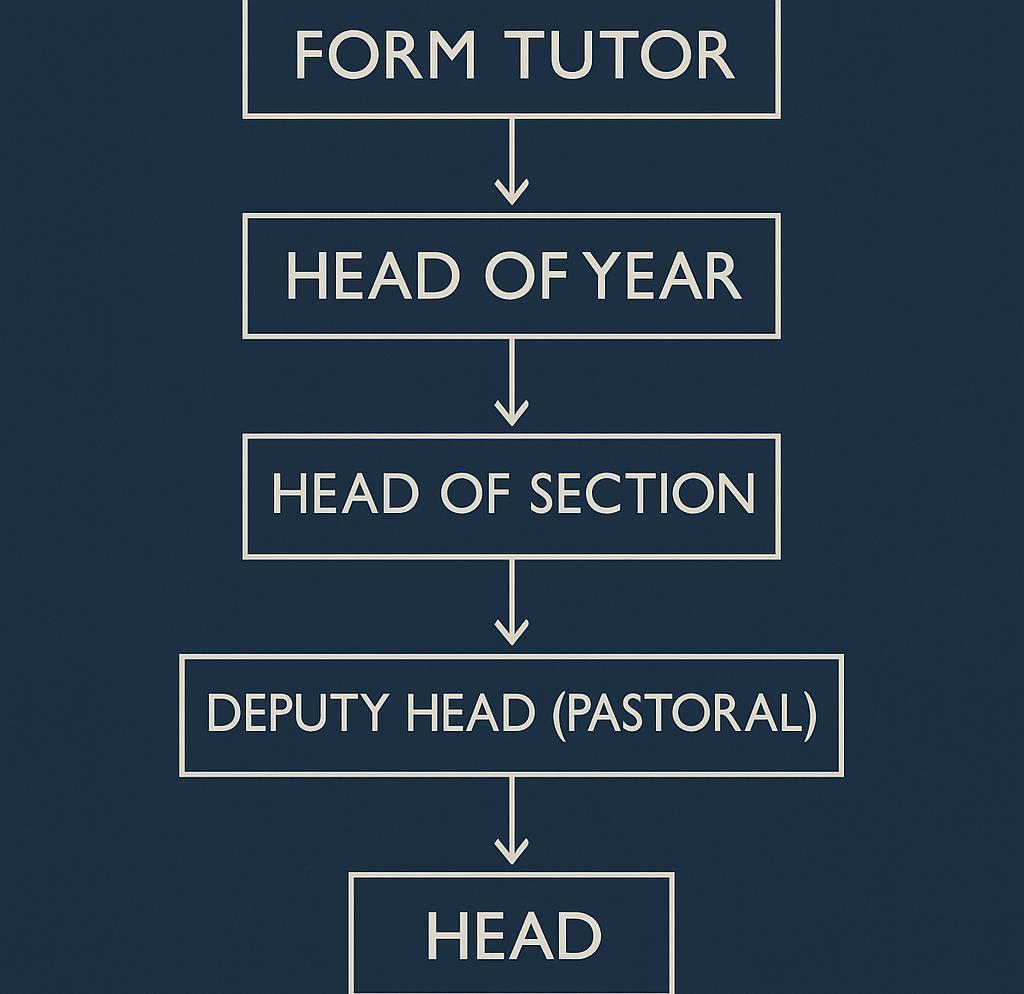
At our school, we value strong communication with parents, recognising its role in supporting pupil development. The flowchart below outlines a tiered approach to ensure clear, effective communication between families and staff. Our aim is to resolve queries and concerns promptly and efficiently. While some staff may not be able to respond immediately due to their roles, rest assured they will reply within a reasonable timeframe.
The Form Tutor should always be the first port of call, and they will be able to make direct contact elsewhere if necessary. Other useful contacts are:
General Enquiries
info@st-teresas.com
Medical Centre medical@st-teresas.com
Transport Manager transport@st-teresas.com
Safeguarding safeguarding@st-teresas.com
Aims
At St Teresa’s we aim:
To encourage pupils to rejoice in and do well through the pursuit of academic excellence across the curriculum and beyond.
To provide support, encouragement and challenge so that pupils realise their potential and are well prepared for the future.
To promote high standards of personal behaviour and the development of moral and spiritual values.
Ethos
There is no ‘one size fits all’ at St Teresa’s; our girls are individuals and valued as such. No one is invisible, and we know who needs to be stretched and who needs extra help. This commitment to individual care underpins our whole ethos and approach to teaching every pupil within our care. We believe that happy girls thrive.
A ‘can-do’ attitude is always encouraged, and a wide range of opportunities both within and beyond the curriculum enables girls to develop and discover new abilities, interests and talents while they study towards achieving first-rate GCSEs and A Levels.
No-one is pigeon-holed. Talent and achievement of all types are praised and confidence blossoms as a result. Our primary aim is, of course, to educate, but to do so in the true meaning of the word; St Teresa’s is not an academic hothouse but aims to draw out the talents latent in every girl so that at St Teresa’s she will become the best she can be. Girls are supported but encouraged to think independently and to take responsibility for their own learning. This leads to excellent A Level and GCSE results from a broad-ability intake.
Policies
Policies and Inspection Reports are available on request from the School Office, or may be downloaded from the website:
Values
St Teresa’s Effingham is one of the largest Catholic independent girls’ school in the country. It is a strong caring community based on Catholic traditions. We offer an inclusive environment that is to welcoming pupils from all backgrounds, open to pupils of all faiths and none.
Our core values knit the school together, resulting in an atmosphere of mutual support, vibrancy and kindness.
St Teresa’s is a dynamic school which has embraced the challenge to modernise and update, whilst holding true the values and philosophies which define its character and spirit. At St Teresa’s, the emphasis is very strongly on encouraging confidence.
With recognised strengths spanning academia, sport and the creative and performing arts, we focus on the individual, allowing girls to achieve their best and enabling them to follow their own unique path to happiness and success.
Results are only part of the story. At St Teresa’s, the emphasis is very strongly on encouraging confidence without swagger, recognising achievement and success but, crucially, tempering these with modesty, kindness, good humour and a sense of humility so that your daughter is not only a highly capable individual, but also an immensely likeable young woman.
Term Dates
AUTUMN TERM 2025
Wednesday 03 September
Thursday 04 September
Saturday 20 September
Boarders arrive & Year 7 Induction Afternoon
Term begins
Open Morning (All pupils attend)
Wednesday 01 October Feast of St Teresa
Friday 17 October (16:15)
Sunday 03 November
HALF TERM
Boarders return
Monday 04 November School resumes
Friday 12 December Term ends
SPRING TERM 2026
Monday 05 January
Boarders return
Tuesday 06 January Term begins
Friday 13 February (16:15)
Sunday 22 February
Monday 23 February
Friday 27 March (16:15)
SUMMER TERM 2026
Monday 20 April
Tuesday 21 April
Friday 01 May
Monday 04 May
Friday 22 May (16:15)
Sunday 31 May
Monday 01 June
Saturday 04 July
HALF TERM
Boarders return
School resumes
Term ends
Boarders return
Term begins
Open Morning
BANK HOLIDAY
HALF TERM
Boarders return
School resumes
Senior School Prize Giving
Saturday 04 July Term ends
School Timings
Please find these below:
08:35 REGISTRATION
08:45 ASSEMBLY, FORM TIME OR CHAPEL
08:55 – 09:55 Period 1
09:55 – 10:55 Period 2
10:55 – 11:15 BREAK
11:15 – 12:15 Period 3
12:15 – 13:15 Period 4
13:15 – 14:15 LUNCH, CLUBS AND ACTIVITIES
14:15 – 15:15 Period 5
15:15 – 16:15 Period 6
16:15 END OF SCHOOL
16:30 BUSES LEAVE
16:30 – 18:00 Day Girls’ Study
Reporting and Assessment
Parents and Guardians of Year 9 will receive the following academic reports:
An attitude to learning grade sheet, issued at October half-term
A full written report at the end of the Autumn Term
An attitude to learning and attainment grade sheet, issued at the end of the Spring Term
A full written report at the end of the Summer Term
The Year 9 Parents’ Evening is scheduled to take place on Thursday 15 January 2026. This will be an opportunity for parents and guardians to discuss their daughter’s academic progress.
Classroom Expectations
St Teresa’s has the following expectations of all pupils:
Arrive on time, before form time and to lessons, wait to be invited into the classroom by a member of staff.
Organise yourself in the classroom in an appropriate manner – no running or rushing for desks/seats.
Arrive with all textbooks, exercise books and other equipment that is relevant and expected. Listen carefully to instructions.
Complete all tasks that the teacher has set in an orderly and appropriate way – the instructions for the activity must be followed carefully.
Always write in blue or black ink.
Always use your neatest handwriting and take pride in the presentation of your work.
Put the date and heading on each piece of work and underline them with a ruler.
Listen in silence and be attentive whenever the teacher is instructing/explaining/talking – St Teresa’s will not tolerate interruption of the teacher.
Listen in silence and be attentive whenever a fellow pupil has been asked to contribute/see/explain something – we will follow common courtesy and listen to each other.
Seek the teacher’s permission to contribute to class discussion by raising your hand.
Complete all work by the deadlines that you are given – no late work will be accepted unless an acceptable explanation has been given to the teacher or where previous arrangements have been made.
Note that swearing will not be tolerated.
Ensure that all classrooms are left neat and tidy at the end of every lesson. All classes will need to check the state of the room at the end of each lesson.
Note that no eating or chewing gum is allowed in class.
Arrive and leave the class dressed as per the school uniform rules.
Code of Conduct
Registration: All pupils must attend morning registration; a pupil arriving after registration has closed or who misses registration for an extra-curricular lesson must sign in immediately at Reception.
Absence: School should be informed by a parent/carer on each day of absence using the Absence Notification and Evidence Form.
Day Pupils remaining in school after 16.30 must be in Study or with a member of staff at an activity.
All pupils leaving prior to the end of the school day MUST sign out at reception.
If a pupil feels unwell, they must ask permission from a member of staff to report to the Medical Centre. No pupil may telephone / text / email parents or guardians to ask to be collected. The decision to send a sick pupil home is taken by the school nurse in conjunction with one of the Deputy Heads or the pupil’s Head of Year.
Before lessons, pupils should not enter classrooms or teaching areas until invited to do so by a member of staff. Pupils are expected to conform to our Smart Start standard e.g. line up outside classrooms and wait quietly. In the classroom pupils should wait to be invited to sit by the member of staff.
Day Pupils must not go into the dormitories/study bedrooms. They may only go into boarders’ common rooms when invited and authorised by a member of staff. Boarders in are not allowed upstairs during the school day.
All money and valuables should be locked in a pupil’s locker. The school cannot be held responsible for such items and therefore we recommend precious items are always kept at home.
No pupil may at any time bring into school, use or distribute any medication, chewing gum, aerosols, sharps or instruments of harm e.g. a penknife, smoking paraphernalia such as cigarettes, vapes, or lighters nor drugs or alcohol. Possession of these articles will be treated as a very serious offence. Possession or use of drugs on school premises may result in immediate expulsion.
Damage: Damage or defacement to school property must be reported immediately to a member of staff. Offenders will be expected to pay repair costs and will serve a sanction. Bounds: No pupil may go beyond the Dorking Drive gate, the swimming pool garden, the top of the main drive or into the woods.
Food is not to be consumed in classrooms, corridors, the Sports Hall or any other teaching area.
Pupils in Year 7 – 11 must store their mobile phone in their Yondr pouch throughout the School day. If a pupil is found with their mobile phone without explicit permission from a member of staff, they will be sanctioned.
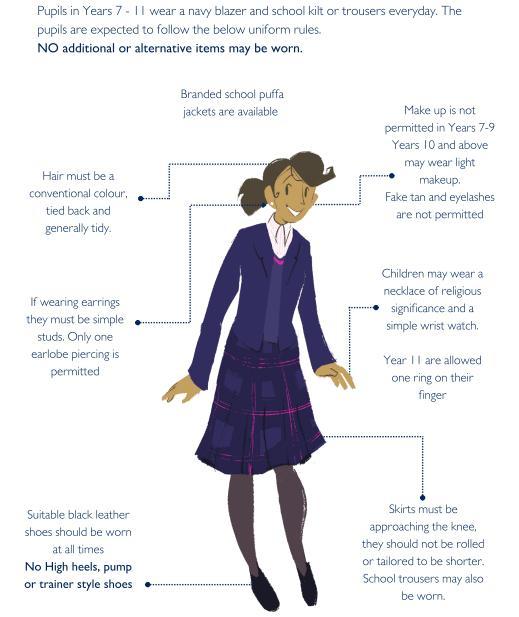
All pupils must respect the uniform rules and guidelines.
Pupils may not use social media during the school day on any device. Pupils must adhere to the Acceptable Use Policy.
All school email accounts are for communication between staff and pupils. Personal email accounts and social media accounts will be accessible at the end of the school day.
Learning Support
The Learning Support (SEND) Department at St Teresa's supports curriculum teaching by providing you with strategies to use in your everyday learning. They aim to share strategies for efficient learning and guide you to achieve your potential. You will develop into independent proactive learners, who aim to seek meaning and act with purpose to achieve. Our Learning Support teachers will help you to maximise your learning potential, teaching you a range of helpful study skills such as time management and revision skills.
When you understand how you learn best, you can articulate your learning preferences and needs to your teachers, and this will help make your studying even better. Being an independent learner who has agency will help you to become a powerful learner.
Individual lessons with Learning Support teachers are highly personalised to your needs. All our Learning Support teachers work closely with your subject teachers to ensure the best targeted support is given to you. Our Learning Support teaching takes place within a friendly, bright, open space which is well-resourced. They can help you with using assistive technology, such as computer readers and reading pens, and will assess your needs for access arrangements in tests, and, as you progress through the school, for GCSE and A Level examinations. The Learning Support Department are always here to help and look forward to welcoming you in September.
If you have any questions regarding SEND, please contact Mrs Audrey Moncrieffe (SENCO/Head of SEND Prep/Senior School) at a.moncrieffe@st-teresas.com
Attendance
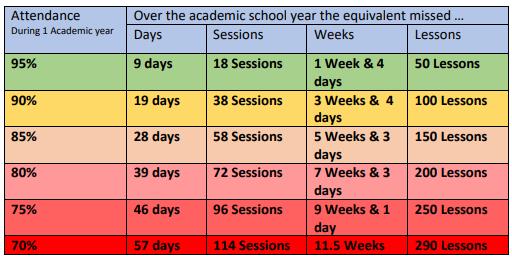
Pupils with good attendance, generally achieve higher grades and enjoy learning at school more. Having a good education will help to give your child the best possible chances in life. Learning is a progressive activity; each day’s lessons build upon those of the previous day.
Attendance notice is an email issued to parents or carers who fail to ensure their child attends school regularly (90%). A percentage below 90% is considered by the local authority as persistent absence. If your child accrues 5 school days absence or more in a twelve-week rolling period, parents could be contacted by Social Care. This includes taking holidays in term time without the school’s permission
A child registered at a school can legally miss school only in very limited circumstances:
• Genuine illness
• Religious observances
• Family bereavement
The following are not valid reasons for absence:
• Conjunctivitis
• Glandular Fever
• Tonsillitis
• Head Lice that is undergoing treatment
• Headache
• Cold
• Chicken Pox once all spots have crusted over
• Continuous periods of Diarrhoea & Vomiting after 48 hours
Wherever possible we encourage pupils to come into School, even if they try to cope. We have a Medical Centre so should there be any deterioration they will be cared for until they can be collected. Our Nursing team are also here to offer advice as needed.
Extra-Curricular Activities
There is a wide range of extra-curricular activities on offer at St Teresa’s. There are many after-school sports clubs including football, netball and hockey. The school takes part in ISHC competitions and has been highly successful in recent years.
At the Senior School, many of these activities are student-led, and the breadth and focus of activities alters depending on the interests of a particular cohort; you girls are at the heart of the action and have a voice in what we provide. If there is a club that you feel is missing, just let us know: if you have a burning passion for crochet, or wish to brush up your Cornish, there may well be a willing volunteer who can make your dream a reality! A rounded education is an enviable asset, and the activities that you devote your time to are where you will cultivate self-discipline, people-skills, teamwork, resilience, risk-taking and a sense of humour.
A guide to the full list of clubs is available or may be downloaded from the website:
Bus Services
At St Teresa’s we offer an extensive school transport network for the convenience of our parents and pupils. We operate a fleet of modern vehicles that operate morning and afternoon routes across most of the surrounding towns and villages, facilitating convenient, safe and punctual transport to and from school.
Our routes include regular morning and afternoon shuttle buses between St Teresa’s, Cranmore and Manor House, including an escorted service for our youngest pupils, and morning, afternoon and early evening shuttle services between the school and Effingham Junction Station, Woking, Guildford and Cobham and Esher.
Please note that our routes may change slightly each year to accommodate girls joining us from different areas, but we are not able to offer a door-to-door service. Once published, we endeavour not to change routes mid-term.
Parents wishing to use the school transport service must register before the start of term if possible and commit to the service for the whole term. Pupils can be registered for a weekly return journey, a weekly single journey, or to travel a few days a week, if required. Journeys not taken will not be refunded.
Pupils may take one-off or “ad-hoc” journeys subject to available seats on a bus. Parents should contact the Transport Department in advance to make the arrangements: transport@st-teresas.com
Pastoral Care
Curriculum
Over the next few pages, you will find an outline of each subject area, giving you an overview of what is covered in each of the subjects your daughter will be studying during Year 9.
Please feel free to contact Heads of Department or teachers at any time if you have any queries or further questions. All staff email contacts use the following structure: initial.surname@st-teresas.com
The academic staff look forward to meeting you at the Parents’ Evening on 15 January 2026
Art & Design
Co-Heads of Department
Mrs J Uren and Miss S Shear
art@st-teresas.com
In Year 9, students will explore the theme of Structures, drawing inspiration from the Renaissance period and the work of key artists for example Michelangelo and Raphael. Through critical research and observational studies, including continuous line, students will develop an understanding of structural form in both natural and man-made contexts. Furthermore, work will involve a range of experiments, including the mixing and application of acrylic paint, as well as mixed-media techniques such as textile manipulation and embossing. Throughout the unit, students will be encouraged to reflect on and refine their work through ongoing review and analysis.
Year 9 Curriculum Overview:
Autumn Term
• Critical thinking, analysis and contextual research- The Renaissance PeriodMichelangelo- Raphael
• Renaissance (Critical research)
• Continuous line drawing
• Raphael (Critical research)
• The Conversion of the Proconsul Sergius Paulus painted study
• Fabric Manipulation
• Observational drawing
• Interim assessment 1
Spring Term
• Critical thinking, analysis and contextual researchClassical architectureDoric, Ionic, Corinthian, Tuscan, and CompositeGrammar of Ornament
• The Conversion of the Proconsul Sergius Paulus painted study
• Observational drawing
• Continuous line drawing
• Paper manipulation
• Foil samples
• Interim assessment 2
Summer Term
• Observational drawing
• Ceramic samples
• Foil samples
• Summer Examination (interim assessment 3)
• Self-reflection and analysis
Textiles
Co-Heads of Department
Mrs J Uren and Miss S Shear
art@st-teresas.com
In Year 9, students explore material manipulation and design through a variety of processes, developing practical skills alongside critical analysis of contemporary artists. Students will study Patrick Heron, experimenting with heat transfer, mono/block printing, and stencil printing, and explore Art Deco design through vinyl techniques. They will extend their research with Sarah Morris (batik) and investigate paper manipulation inspired by Matt Shlian, as well as fabric manipulation influenced by Robert Morris, Gareth Pugh, and Iris Van Herpen. Practical work will culminate in fabric constructions, with ongoing self-reflection and analysis to refine ideas and outcomes.
This scheme of work runs for 17 weeks and forms part of the Art carousel rotation:
Group 1: September – February
Group 2: February – July
Year 9 Curriculum Overview:
Autumn Term
• Critical thinking, analysis and contextual research – Patrick Heron
• Media experimentation – heat transfer (ink)
• Art Deco Design – heat transfer (vinyl)
• Mono/block printing
• Stencil printing
• Critical research/exploration – Sarah Morris
• Batik (extension task)
• Paper manipulation – Matt Shlian
• Fabric manipulation – Robert Morris/Gareth Pugh/Iris Van Herpen
Spring Term
• Fabric manipulation
• Final outcome: fabric constructions
• Self-reflection and analysis
Summer Term
• NB: SOW duration = 17 weeks. All carousel classes rotate half way through the academic year, whereby the SOW is delivered to the second half of each form class.
• Group 1 – September –February
• Group 2 – February - July
Ceramics
Co-Heads of Department
Mrs J Uren and Miss S Shear
art@st-teresas.com
In Year 9, students explore surface and texture through ceramic and paper-based techniques, developing practical skills alongside critical analysis of contemporary artists. Students will study Jeanne Opgenhaffen, experimenting with ceramic relief, paper engineering, and observational/continuous line drawing, culminating in ceramic relief tiles. They will then explore Heather Knight and Alice Ballard, developing pinch pot techniques alongside observational and working drawings, resulting in 2–3 pinch pot pieces. Throughout the unit, students engage in critical thinking, self-reflection, and analysis to refine their designs and outcomes.
This scheme of work runs for 17 weeks and forms part of the Art carousel rotation:
Group 1: September – February
Group 2: February – July
Year 9 Curriculum Overview:
Autumn Term
• Critical thinking, analysis and contextual research – Jeanne Opgenhaffen’s
• Ceramic Relief experimentation
• Critical research/explorationJeanne Opgenhaffen
• Paper engineering
• Observational drawing
• Continuous line drawing
• Working drawings
• Relief technique
• Realisation- 3x ceramic relief tiles
Spring Term
• Critical thinking, analysis and contextual research –Heather Knight- Alice Ballard
• Pinch Pot technique
• Observational drawing
• Continuous line drawing
• Working drawings
• Realisation- 2-3 pinch pots outcomes
Summer Term
• NB: SOW duration = 17 weeks. All carousel classes rotate half way through the academic year, whereby the SOW is delivered to the second half of each form class.
• Group 1 – September –February
• Group 2 – February - July
Drama
Director of Performing Arts Miss J Hansen
j.hansen@st-teresas.com
Year 9 Drama is an exciting, creative and inspiring year. Year 9 students will create, produce, design and perform in an array of exciting styles and genres whilst exploring innovative theatre practitioners. They will also create a powerful and original devised piece of theatre, whilst experiencing script work too. Lessons will be practical and homework will be mostly written. The latter part of the term prepares those choosing Drama for GCSE and for those who do not wish to continue with Drama, they continue to develop the important transferable skills and life skills Drama offers.
Year 9 Curriculum Overview: Autumn Term
Structure –non linear
Promenade/ Immersive (Punchdrunk/ You Me..)
Verbatim
(Alecky Blyth)
Physical Theatre (Frantic Assembly) Devised Truth and Connection
Exam Preparation
Script work Page to Stage (DNA, Noughts and Crosses)
Head of Department
Mrs K McGrath
k.mcgrath@st-teresas.com
Year 9 is a bridging year between Key Stage 3 and 4. While we retain the creativity and breadth of the Key Stage 3 curriculum, we focus on consolidating the skills required for the beginning of the GCSE curriculum in Year 10. We use GCSE criteria for literature essays, which prepares pupils for the study of their GCSE set text. Similarly, the Non-Fiction units are geared towards persuasive writing and exploring conflicting opinion which will prepare students for the types of tasks required for the Language GCSE.
Year 9 Curriculum Overview:
Autumn Term Spring Term
Noughts and Crosses –playscript
Macbeth by William Shakespeare
Gothic Writing Unit
WW1 Poetry
Summer Term
Nineteenth century literature
Writing to argue and persuade
Food Preparation and Nutrition
Head of Department
Mrs L Linaker
l.linaker@st-teresas.com
In Year 9 the focus is on extending the pupils practical skills by introducing new and more complex recipes which involve a wide range of skills. They will be encouraged to follow recipes more independently and take into consideration health and safety when preparing dishes. They will understand the importance of tasting and evaluating foods to improve their dishes further. Students will gain knowledge about the main nutrients required for a healthy diet and will understand how different methods of making foods produce different outcomes. They will have a look at the chemical and functional properties of ingredients and be assessed on planning and making their own chosen dish based on a given theme.
Year 9 Curriculum Overview:
Autumn Term
A recap of the Eatwell guide and an understanding of the macro and micronutrients.
Special diets (to include looking at meat alternatives)
Packaging and labelling
Science behind cake making
Dishes made include Samosas, Dhal and naan, rock cakes, Victoria sandwich cake, Swiss roll, Christmas cupcakes
Evaluating of dish
Spring Term
Function of ingredients in breadmaking (including a yeast experiment)
Focaccia bread
Written and practical Assessment
Note: Groups changeover halfway through the year
Head of Department
Ms C Dufour
c.dufour@st-teresas.com
In Year 9 French, students continue to develop the knowledge and skills gained in Years 7 and 8. Learning is centred on the themes of Popular Culture, Communication and the World Around Us, and People and Lifestyle. These topics allow students to broaden their vocabulary while consolidating their understanding of familiar tenses and progressing to new tenses and more complex grammar.
Students will also explore cultural aspects of France and the wider Francophone world, gaining valuable insights into language in context.
Our lessons are designed to be engaging, interactive, and motivating, fostering both confidence and ability. Through a combination of collaborative activities, games, and the effective use of technology, we aim to nurture students’ enthusiasm and inspire a genuine passion for learning French.
Year 9 Curriculum Overview:
Autumn Term Spring Term Summer Term
Popular Culture and Communication and the world around us.
Skills: Vocabulary building, key skills practice and Present tense- Regular and Irregular, Forming questions, modal verbs.
Communication and the world around us/ People and lifestyle.
Skills: Vocabulary building, key skills practice and Near Future tense, Past Perfect tense, using 2 tenses together, Reflexive verbs, making adjectives agree.
People and lifestyle.
Skills: Vocabulary building, key skills practice and position of adjectives, Direct Object Pronouns, using 3 tenses together, exploring adverbs.
German
Subject Teacher
Mrs B de Jong
b.dejong@st-teresas.com
In Year 9, students continue to build on the skills and knowledge acquired in Years 7 and 8. The focus is on themes of Popular Culture, People and Lifestyle, Communication and The World around us.
Learners will compare daily school life in the UK and German-speaking countries, while also exploring topics such as Free-time activities, including social media, hobbies and sports, socialising with friends, fashion and trends.
The grammatical focus consolidates the present, past, and future tenses, while also introducing more complex structures, including declension of adjectives, differentiating between regular and irregular verbs, separable and reflexive verbs, using conjunctions to develop and justify opinions. The dative case will be introduced.
Year 9 Curriculum Overview:
Autumn Term
School
Christmas Festivities
Spring Term
Free- Time
Hobbies and Sports
Online social media
Films and Television
Fashion
Socialising with friends
Summer Term
Family
Family relationships
Role-Models
Skills: Vocabulary building, pronunciation of words, and key grammar skills focusing on the dative and accusative cases, revision of the present tense focusing on irregular verbs, the perfect tense of strong and weak verbs and conjunctions
Skills: Vocabulary building, pronunciation of words, and key grammar skills focusing on auxiliary verbs, consolidating the present, past and future tenses, question pronouns, comparisons and word order
Skills: Vocabulary building, pronunciation of words, and key grammar skills focusing on possessive adjectives, reflexive verbs, separable verbs, the subjunctive, consolidating all tenses learned and introducing the relative pronoun in the nominative case.
Geography
Head of Department Ms S Hobkinson
s.hobkinson@st-teresas.com
In Year 9 Geography, students explore the physical geography topics of coasts, ecosystems, and natural hazards as well as the human geography topic of globalisation. They study these topics at national, regional and global scales. Students further develop their cartographic, graphical, numerical and statistical skills. These topics and skills are designed to deepen students’ understanding of the world they live in while fostering independent thinking, reasoning, and the ability to communicate well-supported geographical arguments.
Year 9 Curriculum Overview:
Coasts
Asia and hot deserts
Globalisation
Tectonic hazards
Tectonic hazards
Weather hazards
The end of year assessment includes multiple choice, short answer data response and extended writing questions.
History
Head of Department Mrs M Marsden-Wilkins
m.marsden-wilkins@st-teresas.com
In Year 9 History, students study the development of democracy in Britain through the Suffragettes, the end of World War I and the interwar years, the causes of World War II and Hitler’s rise to power, life on the Homefront during WWII, and the major events and consequences of the Cold War. They develop and are assessed on skills including essay writing, evaluation, historical analysis, analysis of interpretations, and source analysis, learning to interpret evidence, draw inferences, and assess the utility and reliability of different sources.
Year 9 Curriculum Overview:
Suffragettes
Democracy in Britain
Skills: essay writing
Inter war years
Hitler’s rise to Power
Life on the Homefront in WWII
Skills: source and interpretations analysis
Events and Consequences of the Cold War
Skills: end of year exam which assesses skills learnt throughout the year
Head of Department Dr V Poffley
v.poffley@st-teresas.com
In Year 9 Latin students continue their studies with a range of more advanced language features, including participles (present active, perfect passive and perfect active), subjunctive verbs and the sentence types that use them (when/since clauses, reported questions, reported commands, purpose clauses and result clauses) and gerundives of obligation. All noun cases and verb tenses will be reviewed and revised, with regular weekly tests to ensure familiarity. Historical and cultural background material will cover Roman settlement in Bath and the complex cultural and religious interactions between Roman settlers and native Britons, the Roman Army, Roman bathing culture and Roman religion.
Year 9 Curriculum Overview:
Autumn Term
Imperative mood
Present active participles
Perfect passive participles
Perfect active participles (for deponent verbs)
The Ablative case and its uses (agent, instrument, with prepositions)
Spring Term
Subjunctive verbs in the imperfect and pluperfect tenses
When/since clauses
Reported Question construction
Gerundive of Obligation
Regular noun form tests
Summer Term
Reported Command construction
Purpose Clauses
Result Clauses
Regular verb form tests
Mathematics
Head of Department Miss L McDowall
l.mcdowall@st-teresas.com
Year 9 students will continue to strengthen their core skills by revisiting skills from Year 7 and 8, while tackling new and more challenging topics that lay the groundwork for success at GCSE. It is useful to see Year 9 as a transition to GCSE year, where we aim to encourage mathematical reasoning, develop problem-solving strategies, and prepare students for the more advanced concepts they will meet in Key Stage 4. Homework is set weekly in the booklet and pupils are encouraged, as part of their homework time, to work independently on skills they have found tricky, or their teacher has advised them to develop. The Corbett Maths website links to our curriculum to help pupils locate videos and tasks to develop their skills.
Year 9 Curriculum Overview:
Autumn Term Spring Term Summer Term
Powers, Roots, and Standard Form
Algebraic Expressions
Area and Perimeter
Linear Equations and Formulae
Fractions
Decimals and Percentages
Linear Graphs
Collecting, Representing, and Interpreting Data
Simultaneous Equations
Ratio and Proportion
Right-Angled Trigonometry
Inequalities
Quadratic Graphs
Probability and Set Notation
Music
Head of Department Mrs C Yalden
c.yalden@st-teresas.com
In Year 9, students will continue to refine and improve their keyboard and music reading skills. They will increase their understanding of chord structure and develop their listening skills. Students will use their creativity to write songs. They will learn keywords for each topic and will be encouraged to engage in music until the end of the Key Stage. Regular class performances will take place, with a good deal of practical work in groups.
Year 9 Curriculum Overview:
Autumn Term Spring Term
Jazz and Blues
Ragtime
Cover Versions
Song writing
Summer Term
Film music
Research project and presentation
Summer examination
Personal, Social, Health and Citizenship Education
Head of Department Ms A Burgess
a.burgess@st-teresas.com
Throughout the academic year, Year 9 students engage in a rich and varied PSHE curriculum that builds their understanding of personal wellbeing, relationships, and social responsibility. In the Autumn term, the focus is on self-awareness and safety, with sessions exploring character strengths, healthy lifestyles, and safeguarding in both physical and digital contexts. The Spring term deepens this learning through topics such as emotional health, grooming and exploitation, and managing peer pressure, while also addressing emerging social issues like toxic masculinity and online behaviour. In the Summer term, students consolidate their learning with reflection and assessment, while continuing to explore themes of personal safety, mental health, and respectful relationships, preparing them for responsible decision-making and independence.
Year 9 Curriculum Overview:
Autumn Term
Mental Health: Resilience, and coping strategies. The Wellbeing Hub – personal development and support channels. Character Strengths – survey and personal reflection.
Safeguarding & E-Safety: Online safety, social media, and digital lives.
Body Image, Developing
Bodies: Dove resources, It Happens (Talk)
Relationships: Consent, abstinence, and respectful endings.
-Marriage & Civil
-Partnerships
Spring Term
Nutrition & Lifestyle Healthy Coping Strategies
Grooming & Exploitation
NSPCC “It’s Not OK” resources.
Internet Safety Day – Respect and relationships online
Fundamental British ValuesPrevention of Hate Crimes, Damaging Stereotypes, Racism, Disability, LGBTQ+
Exams Week
Assessment of Learning
Mindfulness & Headspace
Careers - Goal setting & Motivation
Peer Pressure and Summer Safety – (ChildNet resources)
-Family & Parenting
Early Digital Relationships
Peer Pressure – Sexting (ChildNet resources)
E-safety & AI Chatbots –Intelligence or Plagiarism?
Negative Content Online –including Deep Fakes
Drugs & the Law: Including vaping, synthetic drugs, and cannabis.
Religious Studies
Head of Department
Mrs G Shannon
g.shannon@st-teresas.com
Year 9 RS and RE at St Teresa’s acts as a bridging year between Key Stage 3 and 4. We teach the Catholic Diocesan Religious Education Direction (RED) for Year 9 of the Key Stage 3 curriculum, whilst consolidating the skills required and knowledge for the beginning of the GCSE curriculum in Year 10. Students learn to compare beliefs across all the Abrahamic faiths, springboarding from Catholicism into Judaism and Islam. Students become familiar with religious teachings on Ethical issues and can articulate reasons for different worldviews.
Year 9 Curriculum Overview:
Autumn Term
Creation and Covenant:
Origins and Meanings
Genesis to Exodus
Ethics in Catholicism and Judaism
Spring Term
Prophecy and Promise: The Old and New Testaments.
The prophet Mohammed Religious Dialogue versus Discrimination –Antisemitism and Islamophobia
Summer Term
Saints, Salvation and Discipleship: The New Covenant
Mary, Angels and Catholic beliefs
Catholic Social Teaching
Science
Head of Department Mrs C Edwards
c.edwards@st-teresas.com
The Year 9 science curriculum is designed to deepen students’ understanding of fundamental scientific principles across biology, chemistry, and physics. Through practical investigations, model development, and critical thinking, students will consolidate prior knowledge while preparing for the rigour of GCSE-level study. The curriculum places emphasis on scientific inquiry, real-world applications, and interdisciplinary links.
Year 9 Curriculum Overview:
Autumn Term
Microscopy and cells
Scientific method and atoms
Photosynthesis
Density and pressure
Spring Term
Human reproduction
Rates and particles
Forces and acceleration
Speed and motion graphs
Summer Term
Ecology
Conservation of mass
Materials
Kinetic energy and Gravitational potential energy
Spanish
Head of Department
Mrs M González-Weekes m.gonzalez@st-teresas.com
In Year 9, students continue to build on the knowledge and skills acquired in Year 7 and 8. Learning is organised around three main GCSE Themes: Theme 2 Popular culture, Topic Free time activities. Theme 3 Communication and the world around us, Topic 1 Travel and tourism, including places of interest. Topic 2 Media and technology. These topics not only extend students’ vocabulary but also strengthen their grammatical understanding, with further practice of the Present, past, future and conditional tenses.
In addition to language learning, students will explore cultural aspects of Spain and other Spanish-speaking countries, enhancing their appreciation and understanding of the wider Hispanic world.
Lessons are designed to be engaging and interactive, supporting students in developing both confidence and ability in the main four linguistic skills, Listening, Reading, Writing and Speaking. A variety of approaches are used, including collaborative tasks, games, and effective integration of technology such as Quizlet, Active Hub, Carousel Learning, and the use of a Year 9 Spanish Padlet all aimed at fostering motivation and a lasting interest in Spanish.
Year 9 Curriculum Overview:
Popular Culture (Free time activities)
Communication and the world around us (Media and technology)
-Nationalities, numbers
-Talking about life online
-Talking about sports and free time activities
Grammar: Present, past and future tenses.
Communication and the world around us (Travel and tourism)
-Discussing travel plans in present, past and future
-Festivals in the Spanishspeaking world
-Means of transport & weather
-Ideal holidays
Grammar: Consolidation of the main tenses plus conditional
Communication and the world around us (Travel and tourism)
-Festivals in the Spanishspeaking world
Consolidation of tenses and exam skills
Contact Details
St Teresa’s Effingham
St Teresa’s Effingham
Surrey
RH5 6ST
UK
Tel: 01372 452037
Email: info@st-teresas.com
Head: Mr Stuart Field BSc (Hons), NPQSL
Head of Section: Mr Dave Breeze BA (Hons), PGCE
Head of Year: Dr Heidi Benzing-Shears BA (Hons), MA, PhD, PGCE
Governors
Our Governing Body may be contacted through Mrs Claire Minikin, Clerk to the Governors at the school address:
Cranmore School Epsom Road West Horsley Surrey KT24 6AT
Tel: 01483 280340
Email: c.minikin@effinghamschools.org
Our Chair of Governors is Mrs Annette Turner and she may be contacted at the address above or via her school contact address which is a.turner@st-teresas.com