QUILT MATH
IS YOUR SUPERPOWER
GRAB YOUR CAPE AND CALCULATOR AND PREPARE TO UNLOCK YOUR
SECRET POWERS!
This booklet is your Training Manual for mastering the math behind quilting. Inside, you’ll discover how numbers can help you cut more accurately, plan more confidently, and solve common quilting challenges with ease.
No need to fear flashbacks to high school math class. With a few simple tools and tips, you’ll be flying through calculations, like resizing blocks, estimating yardage, and measuring borders and binding.
So sharpen your pencils, trust your instincts, and get ready to save the day, one quilt at a time.
Presented by Michelle Freedman
1. BLOCK BLUEPRINTS
2. PRECUT POWER
3. EXPANSION PACK
UNDERSTAND BLOCK CONSTRUCTION, UNITS, AND SEAM ALLOWANCES.
CUT SMART WITH PRECUTS, FAT QUARTERS, AND WIDTH OF FABRIC.
ADD SASHING, SIZE UP WITH BORDERS, AND CALCULATE PERIMETER.
4. BINDING, BACKING, & BEYOND
FINISH STRONG WITH BINDING FORMULAS AND BACKING CALCULATIONS.
BLOCK BLUEPRINTS
UNDERSTAND BLOCK CONSTRUCTION, UNITS, AND SEAM ALLOWANCES
GLOSSARY UNDERSTANDING BLOCK CONSTRUCTION
BLOCK
A square or rectangle made by sewing smaller fabric pieces together. Multiple blocks make up a quilt top.
UNIT
A smaller part of a block, like a square, rectangle, or triangle.
CUT SIZE
The ‘cut size’ refers to the size of the unit before it is sewn into the block.
UNFINISHED
The unfinished block size includes a ¼” seam allowance on each side of the block. To find this measurement, add ½” + the finished size.
Example: 12” finished 12 ½” unfinished
FINISHED
Finished size is the size after the block is sewn into a quilt.
Most quilt blocks are made from simple grids and repeating shapes. Once you understand how a block is built, you can recreate it, resize it, or design your own. This section focuses on the 9-patch grid and some of its variations.
A consistent seam allowance helps your blocks fit together correctly.
Not all machines have a true quarter-inch foot. Test your seam by sewing a sample and measuring. Stick with the same machine and foot throughout your project.
(Ask me how I know!)
QUILT BLOCK EXAMPLES
CLASSIC 9-PATCH
A 3 x 3 grid made of squares
9-PATCH VARIATION
A 3 x 3 uneven grid
SAWTOOTH STAR
An 8-point star using a 9-patch structure
IMPROV STAR VARIATION
Uses a 9-patch base with stitch and flip corners
PUT ON YOUR THINKING ‘CAPE’
What other blocks use a 9-patch layout? What other kinds of grids are common in quilting?
WORKSHEET 1: BLOCK BLUEPRINTS: CUT SIZE
9-Patch block - 12” finished
What is the cut size for each unit? Write this as height x width below.
QUESTION 1 X
Hint: Divide 12” by 3, then add ½” for seam allowance (¼” on ea ch side).
Extra Credit: What is the cut size of each unit for a 15” finished 9-patch block?
QUESTION 2
Sawtooth star - 12” finished
A. What is the cut size for the center square?
B. What is the cut size for the corner squares?
C. What is the cut size for the flying geese rectangles?
D. The *triangles?
*The triangles for the flying geese start out as squares. They are half the size of the finished rectangle, plus seam allowance.
WORKSHEET 1: BLOCK BLUEPRINTS: DIY
PRACTICE
Design your own block - 12” finished
Choose a grid (like a 9-patch or a 4-patch)
Draw your block & label each unit with cut and finished sizes.
NOTES
ANSWERS:
PRECUT POWER
CUT SMART WITH PRECUTS, FAT QUARTERS, AND WIDTH OF FABRIC
GLOSSARY STANDARD PRECUT SIZES
PRECUTS
Quilting cotton cut into specific sizes by the fabric manufacturer and bundled by collection. These are different from fabric cut by the yard at a shop.
WOF
Width of Fabric. The horizontal measurement of the fabric from selvedge to selvedge. These calculations are based on a standard width of 44 inches.
LOF
Length of Fabric. The vertical measurement of fabric along the selvedge. Some precuts have edges cut in a zig-zag pattern in order to help prevent fraying.
PINKING
While the sizes are standard across the industry, the names aren’t always the same. We included the ones used by Maywood Studio.
CHARM
5” x 5” square
10” x 10” square
18” x 22”
STRIP 2½” x WOF
TO PREWASH? OR NOT TO PREWASH? OUR ADVICE: DON’T
Prewashing precuts can lead to fraying and distortion. If you choose to prewash, soak in cool water and hang to dry. Avoid machine washing or drying to help maintain the accuracy of the precut dimensions.
If your precut has pinked (zig-zag) edges, always measure before cutting.
Most pinked precuts are made to be measured from valley to valley . Measure for accuracy before using.
Pinked edges can make a piece look larger than it actually is. Measuring correctly helps you avoid sizing issues in piecing.
peak to peak valley to valley
HOW MANY 2½” SQUARES FIT IN A...
WOF STRIP?
2½” X WOF
Divide the width of fabric (42 inches) by the width of the piece you want to cut.
For example: 42 ÷ 2.5 = 16.8 Round down to 16
You can cut sixteen 2½” squares along the width of one strip.
This same formula applies when cutting across the WOF in any other context.
5” CHARM?
5” X 5” SQUARE
Width: 5 ÷ 2.5 = 2
Length: 5 ÷ 2.5 = 2
Multiply width x length: 2 x 2 = 4
You can cut four 2½” squares from one 5” square.
16 • 2½” SQUARES
4 • 2½” SQUARES
Use these formulas to calculate how many smaller pieces you can cut from standard precut sizes. Always measure and test before cutting an entire stack.
Most quilting cotton is 44” wide, but it’s better to use 42” when calculating. (Note: the following examples use 2.5-inch squares, but the method works for any size.)
10” SQUARE?
10” X 10” SQUARE
Width: 10 ÷ 2.5 = 4
Length: 10 ÷ 2.5 = 4
Multiply width x length: 4 x 4 = 16
You can cut sixteen 2½” squares from one 10” square.
FAT QUARTER?
18”(LENGTH) X 22” (WIDTH)
Width: 22 ÷ 2.5 = 8.8 round down to 8
Length: 18 ÷ 2.5 = 7.2 round down to 7
Multiply 8 x 7 = 56
You can cut fifty-six 2½” squares from one fat quarter.
• 2½” SQUARES 16 • 2½” SQUARES
WORKSHEET 2: PRECUT POWER
PRACTICE EXERCISE
CUTTING AND CREATING WITH 10” SQUARES
You have a bundle of 10” squares: 42 squares total, 21 different fabrics (2 of each print).
Draw this block on the grid to the right. Each grid square = 1”.
A: Center square: 3 inches finished — one per block.
B: Side rectangles: 2” x 3” inches finished — two per block.
C: Top and bottom rectangles: 2” x 7” finished — two per block.
Can you cut all of those pieces from one 10” square?
Write the cut sizes for each unit:
A: Center square =
B: Side rectangles =
C: Top and bottom rectangles =
Put it all together! Each block finishes at 7” square. The layout below shows a quilt top with 6 blocks across and 7 blocks down. What size will your quilt top be before you quilt it?
Draw a layout for cutting the units from a 10” square. (1) A square, (2) B rectangles, (2) C rectangles.
Use the ½” marks between the grid lines for the cut sizes.
Make two of each block or mix and match pieces to create many combinations!
EXPANSION PACK
ADD SASHING, SIZE UP WITH BORDERS, AND CALCULATE PERIMETER
GLOSSARY MAKE YOUR QUILT LARGER WITH SASHING & BORDERS
SASHING
Fabric strips that are sewn between individual blocks or rows of blocks to increase the overall dimensions of a quilt.
BORDER
Fabric strips that are sewn to the sides and to the top and bottom of a quilt top to increase the overall dimensions of the quilt.
DOUBLE BORDER
Add inner and outer borders to a quilt top to increase the overall dimensions of the quilt.
ADDING SASHING
Adding sashing between blocks adds width
Adding sashing between rows adds length
PRACTICE EXERCISE
1. Each block is 9” finished. What size is a quilt top with 4 blocks across and 5 blocks down, finished?
Width = Length =
2. Add 2” sashing (finished)
(4 blocks, 3 vertical sashing strips)
Top Width =
(5 blocks, 4 horizontal sashing strips)
Top Length =
3. Add 3” borders (finished)
(side border + top width + side border)
Top Width =
(top border + top length + bottom border)
Top Length =
top border
bottom border side border
*Note: these are the finished amounts. ADD SASHING AND BORDERS TO INCREASE THE DIMENSIONS
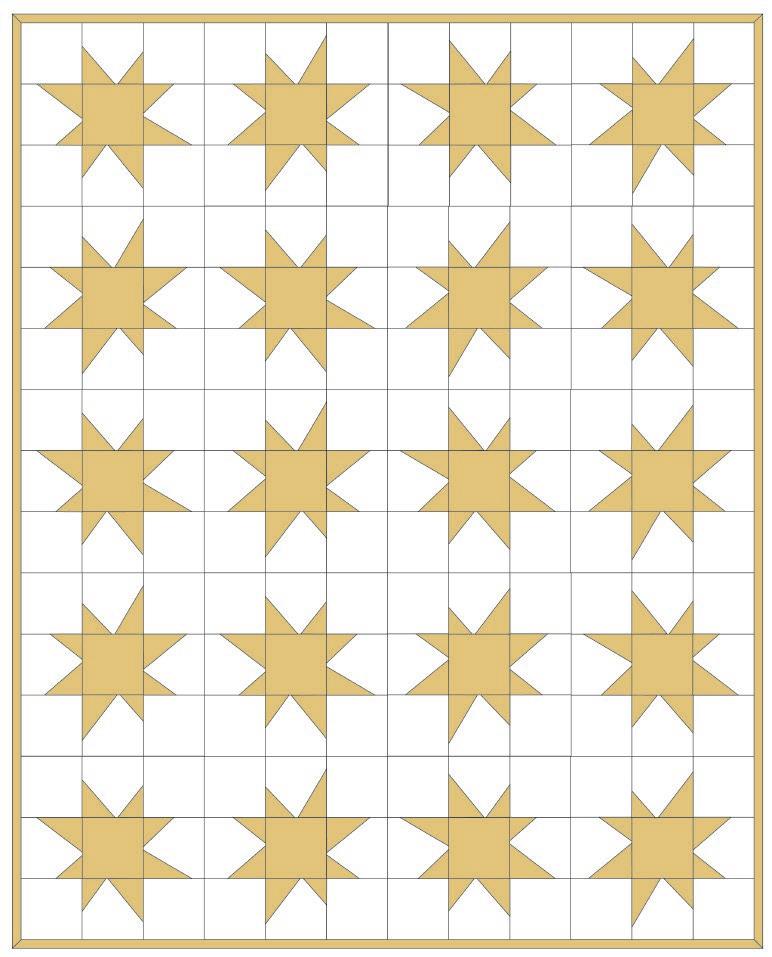
A quilt with no sashing or borders
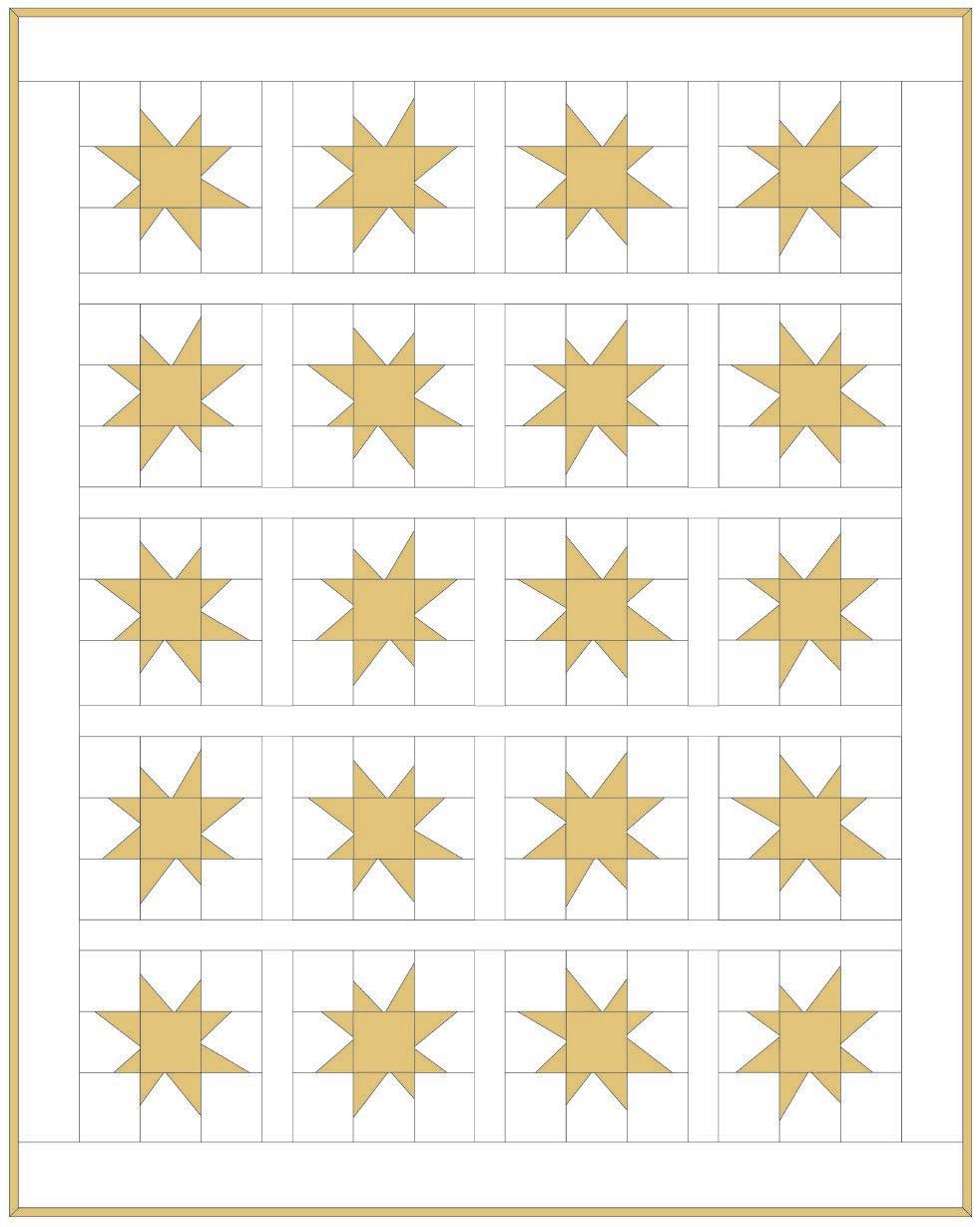
The same quilt with sashing and borders side border
Question 3: Width = 48”, Length = 59”
Question 1: Width = 36”, Length = 45”. Question 2: Width = 42”, Length = 53”.
ANSWERS:
BINDING, BACKING & BEYOND FINISH
STRONG WITH BINDING FORMULAS AND BACKING CALCULATIONS
GLOSSARY CALCULATING BINDING BINDING
The fabric that finishes the edges of a quilt. Examples include: double fold, single fold, facing, and bias binding.
BACKING
The fabric that goes on the back of a quilt.
BATTING
The material in the middle of a quilt. Batting is available in many different fiber types and lofts (thickness).
FABRIC WIDTH
Standard quilting cotton is 44” or 45” inches wide. Wide backing fabric can be up to 108” wide.
How much yardage will you need to make binding for a quilt that is 60” wide by 70” long?
For this exercise, we will use 2½” wide strips and assume a 42” usable fabric width (usable WOF) for a double fold binding.
MEASURE THE PERIMETER OF YOUR QUILT TOP
Perimeter = Top + Bottom + Side + Side
Example: 60” + 60” + 72” + 72” = 264”
DIVIDE THE PERIMETER BY THE USABLE FABRIC WIDTH (42”) TO GET THE NUMBER OF STRIPS
264 ÷ 42 = 6.28
(*Always round up to the next whole number)
7 strips are needed
MULTIPLY THE NUMBER OF STRIPS BY THE WIDTH OF THE BINDING TO GET THE TOTAL INCHES
7 strips x 2½” = 17½”
Round up to 18” to be safe 18” = ½ yard
YOU WILL NEED ½ YARD OF FABRIC FOR THE BINDING
(Shout out to Marie, the owner of Cool Cottons, who first dazzled me with this formula)
RECIPE FOR A QUILT SANDWICH
A quilt sandwich is made up of three layers: the quilt top, batting, and backing. Each layer should be slightly larger than the one above it.
QUILT TOP
BATTING
BACKING
EXAMPLE QUILT TOP: 60” WIDE X 72” LONG
BATTING
Add 2” to each side
Width: 60” + 4” = 64”
Length: 72” + 4” = 76”
BACKING
Add 4” to each side
Width: 60” + 8” = 68”
Length: 72” + 8” = 80”
CALCULATING BACKING YARDAGE
Assuming a 42” usable fabric width (non-directional), here are two common ways to piece your backing:
OPTION 1: HORIZONTAL SEAMS (FABRIC RUNS SIDE TO SIDE)
Backing width = 68”
68” divided by 36”(1 yard) = 1.89 yards
Round up to 2 yards (72”)
Backing length = 80”
Divide by fabric length 42” (WOF)
80” divided by 42” = 1.90 strips
Round up to 2 widths
Total yardage = 2 yards x 2 widths = 4 yards
OPTION 2 - VERTICAL SEAMS (FABRIC RUNS TOP TO BOTTOM )
Backing length = 80”
80” divided by 36”(1 yard) = 2.22 yards
Round up to 2¼ yards (81”)
Backing width = 68”
68” divided by 42” (WOF) = 1.61 widths
Round up to 2 widths (84” less seam allowance)
Total yardage = 2¼ yards x 2 widths = 4½ yards
This will be wider than you need.
Ask your longarm quilter how much extra backing they prefer all around and whether they prefer vertical or horizontal seams when piecing backing. It’ll help you sound like a pro and get a better quilt!
2¼ YARDS (81”) WOF WOF
(72”)
QUILT TOP - 60” X 72”
CHEAT SHEET
BACKING & BINDING MATH
(Because let’s be real...)
You’ve made it this far, now it’s time for a reward! Yes, you can do the math, but do you have to every single time? Not when you’ve got this quick reference in your super-toolkit.
BINDING QUICK REFERENCE
Using 2½” Strips & 40” Usable Width
BINDING – FORMULA RECAP
1. PERIMETER = Top + Bottom + Side + Side
2. NUMBER OF STRIPS = Perimeter ÷ 40” (round up)
3. TOTAL INCHES NEEDED = Number of strips x 2.5”
4. CONVERT TO YARDS - 36” = 1 yard & 18” = ½ yard
BINDING – FAST ESTIMATES
For quilts with straight edges and double fold binding
QUILT SIZE PERIMETER # OF STRIPS BINDING FABRIC NEEDED
BABY (36” X 45”)
THROW (60” X 72”)
TWIN (70” X 90”)
QUEEN (90” X 108”)
KING (108” X 108”)
OF STRIPS X 2.5
YARD
YARD
BACKING QUICK REFERENCE
Add 4” All Around. Backing size = Quilt Width + 8” and Quilt Length + 8”
BACKING – FAST ESTIMATES
Use this table for horizontal seams and 42” wide fabric
QUILT TOP SIZE BACKING SIZE CUTS NEEDED TOTAL YARDAGE
BABY (36” X 45”)
THROW (60” X 72”)
TWIN (70” X 90”)
QUEEN (90” X 108”)
KING (108” X 108”)
X 53”
X 80”
YARDS
YARDS
YARDS
Note: These estimates are for non-directional fabric and assume horizontal seams If using directional prints, minky, or pieced backs, adjust accordingly.