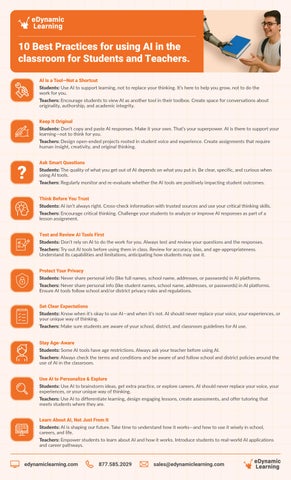
10 Best Practices for using AI in the classroom for Students and Teachers. AI is a Tool—Not a Shortcut Students: Use AI to support learning, not to replace your thinking. It’s here to help you grow, not to do the work for you. Teachers: Encourage students to view AI as another tool in their toolbox. Create space for conversations about originality, authorship, and academic integrity. Keep It Original Students: Don’t copy and paste AI responses. Make it your own. That’s your superpower. AI is there to support your learning—not to think for you. Teachers: Design open-ended projects rooted in student voice and experience. Create assignments that require human insight, creativity, and original thinking.
?
Ask Smart Questions Students: The quality of what you get out of AI depends on what you put in. Be clear, specific, and curious when using AI tools. Teachers: Regularly monitor and re-evaluate whether the AI tools are positively impacting student outcomes. Think Before You Trust Students: AI isn’t always right. Cross-check information with trusted sources and use your critical thinking skills. Teachers: Encourage critical thinking. Challenge your students to analyze or improve AI responses as part of a lesson assignment. Test and Review AI Tools First Students: Don’t rely on AI to do the work for you. Always test and review your questions and the responses. Teachers: Try out AI tools before using them in class. Review for accuracy, bias, and age-appropriateness. Understand its capabilities and limitations, anticipating how students may use it. Protect Your Privacy Students: Never share personal info (like full names, school name, addresses, or passwords) in AI platforms. Teachers: Never share personal info (like student names, school name, addresses, or passwords) in AI platforms. Ensure AI tools follow school and/or district privacy rules and regulations. Set Clear Expectations Students: Know when it’s okay to use AI—and when it’s not. AI should never replace your voice, your experiences, or your unique way of thinking. Teachers: Make sure students are aware of your school, district, and classroom guidelines for AI use. Stay Age-Aware Students: Some AI tools have age restrictions. Always ask your teacher before using AI. Teachers: Always check the terms and conditions and be aware of and follow school and district policies around the use of AI in the classroom. Use AI to Personalize & Explore Students: Use AI to brainstorm ideas, get extra practice, or explore careers. AI should never replace your voice, your experiences, or your unique way of thinking. Teachers: Use AI to differentiate learning, design engaging lessons, create assessments, and offer tutoring that meets students where they are. Learn About AI, Not Just From It Students: AI is shaping our future. Take time to understand how it works—and how to use it wisely in school, careers, and life. Teachers: Empower students to learn about AI and how it works. Introduce students to real-world AI applications and career pathways.
edynamiclearning.com
877.585.2029
sales@edynamiclearning.com