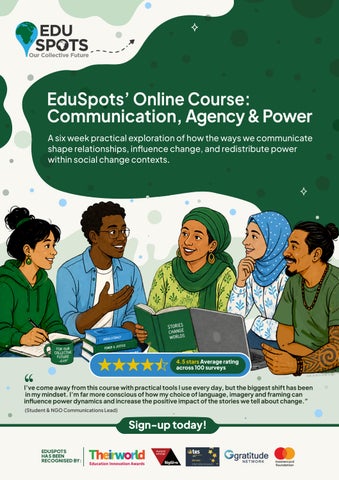
EduSpots’ Online Course: Communication, Agency
&Power
A six week practical exploration of how the ways we communicate shape relationships, influence change, and redistribute power within social change contexts.




4.5 stars Average rating across 100 surveys



I’ve come away from this course with practical tools I use every day, but the biggest shift has been in my mindset. I’m far more conscious of how my choice of language, imagery and framing can influence power dynamics and increase the positive impact of the stories we tell about change.”
(Student & NGO Communications Lead)
ABOUT EduSpots 50 700+
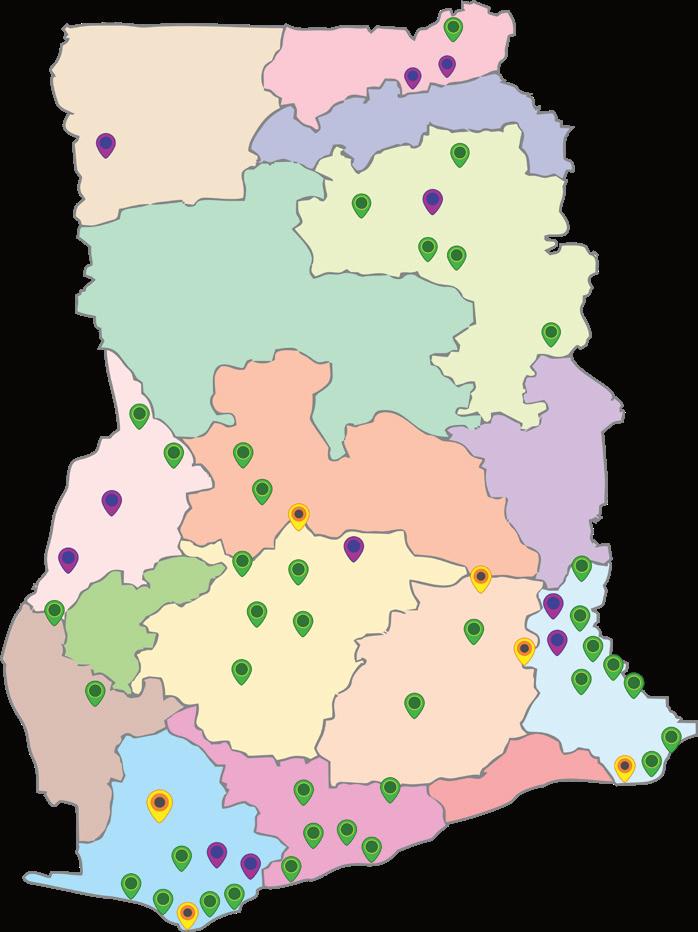
community-owned Spots across Ghana &Kenya
Local Leaders named ‘Catalysts


EduSpots was created to show that communities themselves can design, lead and sustain transformative learning.
By unlocking the knowledge and creativity already present in communities, our approach turns education into a shared civic responsibility rooted in local ownership and collective action.
In 2015, the first ‘Spot’ was created by the Addae family and local teachers in Abofour, Ashanti Region of Ghana, in response to a locked privately owned library in a neighbouring community, built on principles of community ownership, local leadership and purposeful collaboration.
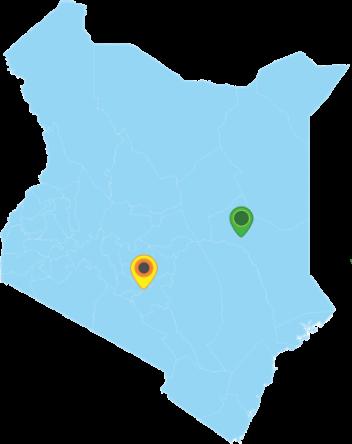
Since that point, over 700 local leaders named Catalysts, including students, teachers and community members, have come together to create 50 community-owned learning hubs–‘Spots’. Each Spot is unique, shaped by the identity and aspirations of its community, but all are part of a connected network advancing inclusive, future-ready education.
EduSpots is a UK and Ghana Registered Charity.

Why Online Courses?
EduSpots launched its first online course on education and international development in 2018 as a partnership between schools in Brighton, UK, and Tema, Ghana. During the COVID-19 pandemic, in response to growing demand for accessible online learning, we expanded our course offering significantly. Since then, more than 30 schools and universities across the UK, Ghana, Kenya and across the world have participated, engaging over 1,000 learners.
1,000+
Today, after a decade of nurturing community-led change, we are relaunching this course as part of EduSpots Unlocked. At the heart of EduSpots’ inside-out approach has always been a commitment to rethinking communications, power and agency. Through this course, we invite participants to engage critically with these ideas, while strengthening our collective understanding through shared learning and dialogue.
PARTNERSHIP
WithThankstothe UNESCOYouthforPeaceTeam
This online course was developed with the support of the UNESCO Youth for Peace Intercultural Leadership Programme 2025–2026. The project is one of a selected group of initiatives promoting intercultural dialogue and cultural understanding through innovative approaches.
The views and opinions expressed throughout this course are those of EduSpots and the contributors and do not necessarily reflect the views of UNESCO or the Kingold Group.
Who is this course for?
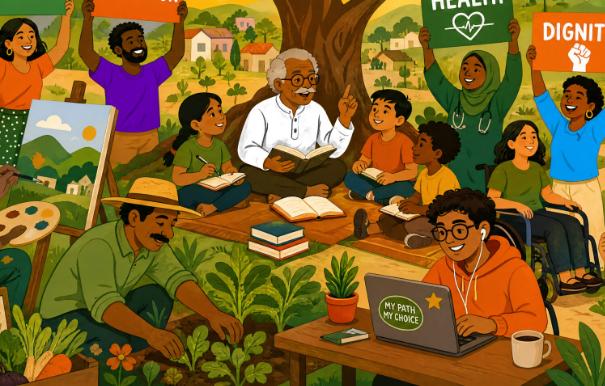
This illustrated course is designed for anyone interested in critically examining how language and communication shape perceptions, relationships, and social change, and working collaboratively to shape practical strategies to create a more inclusive, equitable world through communication.

Itmaybeparticularlyrelevantfor:
Students
(Sixth Form/Senior High School or University level) interested in exploring the power dynamics of language and their implications for practice.
Socialchange practitioners seeking to deepen their critical reflection on language and communication within international development contexts.
Localchange makers
who want to communicate in ways that amplify, rather than unintentionally patronise, the communities they work with.
Philanthropyand corporate professionals who want to better understand power dynamics in storytelling and reporting, and avoid performative storytelling.
Curiouslearners
interested in how language shapes reality, and in engaging with the ideas, history, and debates in this field
Educators
looking to gain ideas on how to engage learners of diverse ages in complex themes relating to communication, agency and power.

What are the course aims?
01 03
Critically reflect on how their own positioning shapes their communication practices and wider perspective.
Apply ethical and inclusive storytelling approaches that centre local perspectives and avoid stereotypes or deficitbased narratives.
05
02 04 06 Reflect Apply Examine
Examine how narratives around migration, displacement, identity, and belonging influence public perceptions.


Evaluate
Evaluate how historical and geopolitical contexts influence development discourse and contribute to patterns of marginalisation.
Analyse
Analyse how communication practices (e.g. narratives, framing, and visual media) shape beliefs, norms, behaviours, and power dynamics.
Demonstrate
Demonstrate practical skills for ethical communication within development, humanitarian, and charitable contexts.

What are the course themes?
Week 1
Gainingcritical self-awareness
Week 2
CentringLocal Agency:From Beneficiaries toParticipants
We explore how we can be more aware of our own cultural and wider influences, exploring Adichie’s idea of ‘Single Stories’ and applying Vanessa Andreotti's idea of soft and critical forms of global citizenship to practical communication examples
We consider the language shifts that can be made to better position local people as agents of their own change. In this process, we look at Jon Alexanders’ Citizen Story framing and Paulo Freire’s critical pedagogy as tools to shift our communication lens.


Week 3
Communicating forChange: Development TheoryinAction
Week 4
FromProblemsto Possibilities: Asset-Based Approachesin Practice
We explore the development approaches of modernism, human capabilities, postcolonial thinking and post development, before exploring Franz Fanon’s writing. We apply these theories to representation, considering the origins of longstanding development terminology.
We look at the application of assetsbased and deficits-based lenses to social change communication, taking a deeper dive into Cormac Russell’s Assets Based Community Development and exploring how this thinking plays out in practice.

Week 5
FromOtheringto Belongingina Worldonthe Move
Week 6
EmbeddingEthical Communication inPractice
We dive into the concept of Othering, and how certain communication approaches have Othered people whether intentionally, or without awareness. We explore Said’s Orientalism and Appiah’s Compolitanism ahead of considering pathways to create greater belonging.

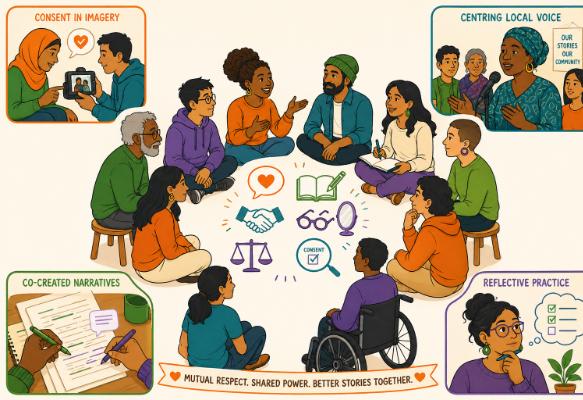
We bring the course together, considering the practical dimension of ethical representation including themes of consent, safeguarding, shifting power through storytelling and offering a checklist for ethical communications practice.
What approach do we take?
This is a 6−week, self-directed online course likely taking between one hour a week, depending on depth of engagement in wider reading, image analysis and watching.
However, this course is not simply about learning information or scholarly approaches; it aims to offer a framework for critically reflecting on diverse perspectives, considering our own hidden biases through testing ideas out through an interactive discussion board, bringing learners across the world together.

Conversation doesn’t have to lead to consensus about anything, especially not values; it’s enough that it helps people to get used to one another.”
(Kwame Appiah,
Scholar Spotlights
Key thinkers and theories that deepen understanding
Short questions to check understanding of core concepts
Real-world examples showing how ideas are applied in practice
A discussion space for learners to reflect, question, and learn together, often following a video prompt.
A concise summary of the main insights from the section
Further reading / watching suggestions
A collection of recommended ideas for deeper exploration across the themes
Cosmopolitanism: Ethics in a World of Strangers, 2007)
What safeguarding considerations do we have?
We have a comprehensive safeguarding policy that relates to EduSpots’ online courses and engagement with students under 18, that we can share with schools.
All comments on the discussion board are read and approved by an experienced and background-checked moderator ahead of approval.
We have a dedicated full-time Educational Partnerships Manager who is available to respond to any concerns, alongside a dedicated safeguarding email safeguarding@eduspots.org
An example of ‘Bridging Theory and Practice’
As part of the end of each course post, we offer practical frameworks and examples of how to apply ideas to communications practice.
The example below looks at possible changes to traditional development terminology with simple suggestions and explanations.
SUGGESTED CHANGE
ThirdWorld/FirstWorld
Mention the specific country; “lower-” or “middleincome country” where relevant
WHY MAKE THE CHANGE?
These are Cold War-era terms that homogenise diverse countries and imply marginality or inferiority.
Poorcountries/ poorcommunities
field
Top-down/bottom-up Developedworld/ undevelopedworld
“Global Majority”, “Global North”, “Global South”, or (even better) mention the specific country or region and avoid generalisations.
Locally defined well-being, opportunity, or social change
International collaboration, partnership, investment, or reparations
Be specific about the issue or challenge faced
Communities, partner organisations, or project locations
Learning visit, partnership visit, or community visit
Collaborative learning, skills sharing, or strengthening existing capacities
Participants, partners, members, communities, or rights-holders
Inside-out, community-led, locally driven, proximate leadership
Enable, support, amplify, or create opportunities for
Describe the specific inequity or barrier. For example: “living on less than $1/day”, “limited internet access”, or “a one-hour walk to access clean water”.
Avoids deficit-based labels and recognises historical and global power imbalances more accurately.
“Aid” can reinforce a donor–recipient hierarchy rooted in colonial relationships.
Avoids reducing communities to a single deficit or identity. Avoids assuming there is a single universal model or endpoint of “development”.
“The field” can position communities as distant or “other”, and reinforces an outsider perspective.
Encourages more reciprocal and respectful language.
“Capacity building” can sound patronising, implying local communities lack knowledge or expertise.
Emphasises agency and participation rather than passive receipt of support.
Highlights change that begins with those closest to the context and challenges.
“Empower” can imply power is being granted externally rather than already existing within communities.
Poverty is often framed only economically, ignoring social, cultural, and relational dimensions of well-being.
How do we award certificates?
Certificates are awarded based on participation quality and quiz performance across the 6 weeks.
High level of thoughtful and collaborative participation in the course, with reflective answers that add value to the course’s Recognition Awards Top 2−5%
Distinction Top 20%
Detailed engagement in the course,opening questions for other participants to consider. 75% quiz answers are correct.
Merit 40%
Consistent thoughtful participation across the full course. 60% quiz answers are correct.
Pass 40%
Participation across most of the course, even if answers are short. 50% quiz answers are correct.
How much does it cost to join?
Schools & universities NGOs & Social Enterprises
Learners at schools & universities (independent, free for state):
Independent Schools: State Schools: £45 / Ghc200 per Learner
Professionals at NGOs, social enterprises, businesses: Organisations can self-define across:
Small organisation: £75 / 200 Cedis
Medium organisation: £100 / 300 Cedis
Large Organisation: £125 / 400 Cedis

Email: Jennifer Mensah, jmensah@eduspots.org for further information about signing up for this course.
For interested participants, and for a fee, we may be able to hold further sessions on Zoom or offer accompanying Powerpoints for these courses to be run internally whether in a student club or professional development on Zoom.

For more information on EduSpots, visit www.eduspots.org
www.eduspots.org