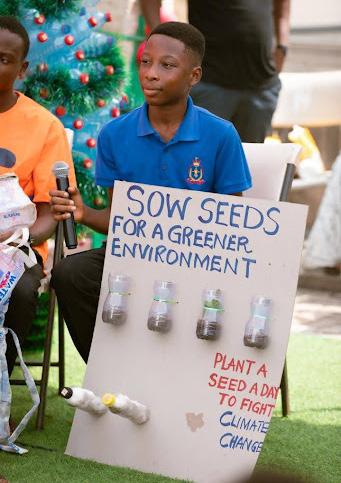
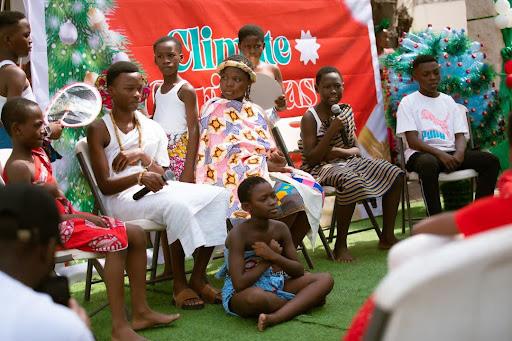
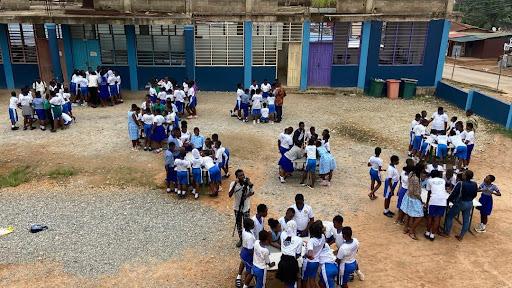
Ghana Climate Education Community of Practice (CECOP) Legacy Report
“All NGOs working on climate change education need to come under one umbrella so that our voices will be heard.” (Augustine Oti Yeboah, Conservation Ghana)
Climate Education in Ghana
Ghana is home to a diverse range of ecosystems including forests, wetlands and open savanna, some of which lie within 21 protected areas (this includes National Parks, Forest Reserves and designated Ramsar sites). In 2026, Ghana faces a myriad of environmental issues such as air, water and land pollution (particularly of plastics), inadequate waste management, deforestation, and - in recent years - rampant illegal mining (known locally as “galamsey”) which causes devastating harm to water bodies, forests and farm land. Climate change is causing rising temperatures, erratic rainfall, and extreme weather, impacting food security, water resources, health, and coastal areas, threatening economic growth through effects on agriculture, energy, and infrastructure (WHO, 2025).
Education becomes a critical lever in this context, helping young people not only understand their local environment but also connect it to global systems, build agency for change and adapt to evolving ecological realities. In Ghana, this means enabling learners to see their natural heritage in relation to worldwide environmental dynamics, to address challenges in their own
communities and further afield, and to deepen their understanding of climate change, climate justice and the sustainable use of energy and resources.
Ghana’s Environmental Protection Authority (EPA) is “the leading public body for protecting and improving the environment in Ghana”. The EPA worked with GES and MESTI to incorporate aspects of environmental education into the national curriculum, at Primary (B1 to B6), Junior High School (JHS, B7 to B9) and Senior High School (SHS, B10 - B12) levels. However, despite this, a 2024 study found that “gaps remain in training for trainers, curriculum coherence, and community engagement”. (Dede and Berényi 2025)
In Ghana, environmental education is often carried out by NGOs although the scope of activities can be limited with ‘reliance on external donors or government funding’ (GEEP. online 2026) . Many local NGOs, often with youth taking the lead, are developing innovative and impactful tools, curricula and models for igniting change through curriculum integration, youth ambassador programmes and climate education clubs; however, they can lack the technical specialism to extensively evaluate learning outcomes, grow the reach and quality of programme delivery, and advocate at the national level.
a) Background of the CCEP and Gower Street’s Vision
The Complementary Climate Education Programme (CCEP) emerges from a critical recognition that climate change is now affecting everyday life in rural Ghana, with school children often being the first to experience its impacts through disrupted learning, compromised wellbeing, and food insecurity at home. This generation will need to adapt to our changing world and develop innovative solutions to mitigate climate challenges.
Since 2022, Gower Street has been supporting various small and medium-sized Ghanaian NGOs in delivering complementary climate education - educational activities on climate-related topics that complement children’s school learning while helping families and communities understand and adapt to their changing climate.
As Gower Street moves into its final phase of grant-making (concluding by 2028), the CCEP represents one of three complementary workstreams designed to:
1. Support the next generation to be better equipped to survive and thrive in a changing world, through climate education
2. Support civil society in turning the policy aspiration of energy transition into an achievable and socially inclusive reality for communities across Ghana, through the Ghana Energy Transition Consortium
3. Ensure that the current adult population who live in, with and from the land can innovate the solutions their children will need, thereby effectively navigating life in a changing landscape
b) Programme Aims
While the Complementary Climate Education Programme (CCEP) represents the broader initiative funded by Gower Street to strengthen community-based climate education across Ghana, the Climate Education Community of Practice (CECOP) is a core sub-component of the programme. This is where peer learning, co-design, and strategic collaboration will take place among delivery partners ahead of the grant funding cycle.
The CECOP was facilitated by EduSpots and will serve as the shared space for collaborative learning, practical experimentation, and community exchange. EduSpots is a Ghana-based NGO working across 50 communities in 12 regions of Ghana and Kenya, to ignite digitalised community-led education through spaces named ‘Spots’. See www.eduspots.org
c) CECOP Specific Aims
The Climate Education Community of Practice (CECOP) aims to:
1. Foster collaboration: Create meaningful connections between organisations for resource sharing and potential partnerships
2. Strengthen skills and knowledge: Enhance partner organisations’ understanding of effective climate education approaches and methodologies
3. Develop resources: Support the creation and adaptation of shareable climate education materials and tools.
4. Establish networks: Create sustainable peer learning networks that continue beyond the formal CECOP period.
5. Strengthen fundraising: Prepare organisations to submit competitive grant applications to the broader climate education funding programme, and raise income via other sustainable forms.
6. Document learning: Capture early insights and best practices to inform the broader CCEP implementation
d) CECOP Timeline
Onboarding and System Setup
Monthly online CoP sessions, reflections and WhatsApp Community
Midpoint review and convening prep Legacy Report & planning next steps
2-day In-person Summit, Tamale
“This community of practice has really given us a chance to partner with other members of the same fraternity, share ideas, and learn lessons from what partners are doing within the climate change education platform.” (Dr. Francis Chimsah, Climate Smart Training)
ORGANISATION AREA OF FOCUS IN CLIMATE EDUCATION
AfriKids
Climate Smart Training Programme
EcoCare Ghana
EduSpots
Orgiis
RAIN Ghana
RAINS
RoNAG
SUNG Foundation
SYND
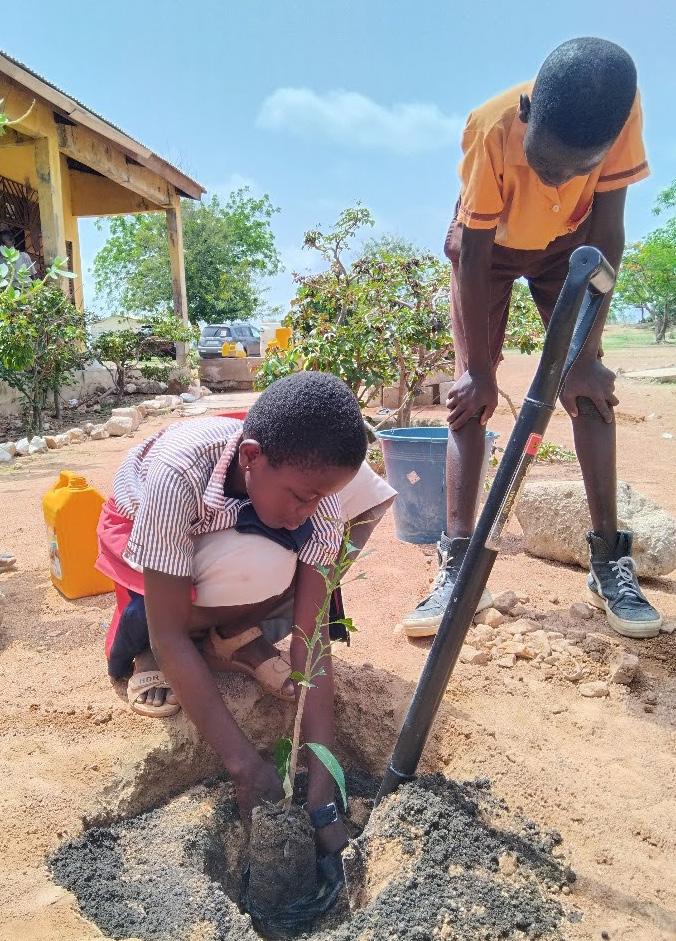
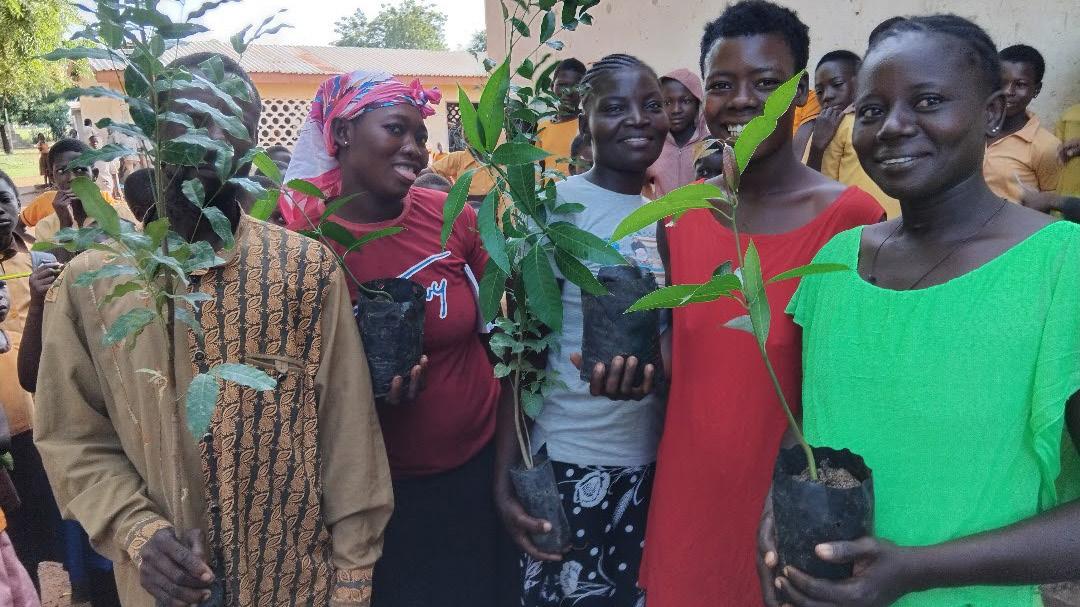
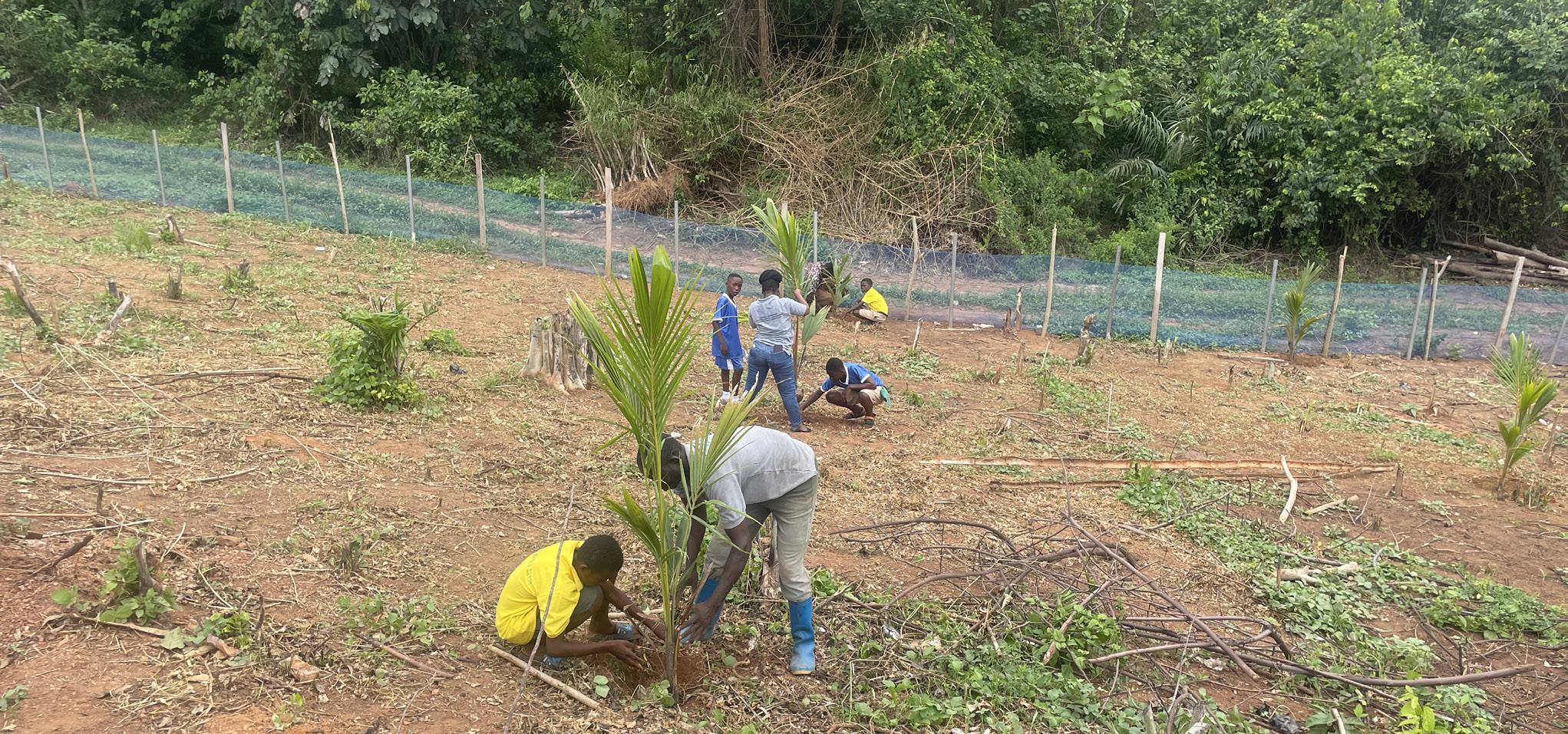
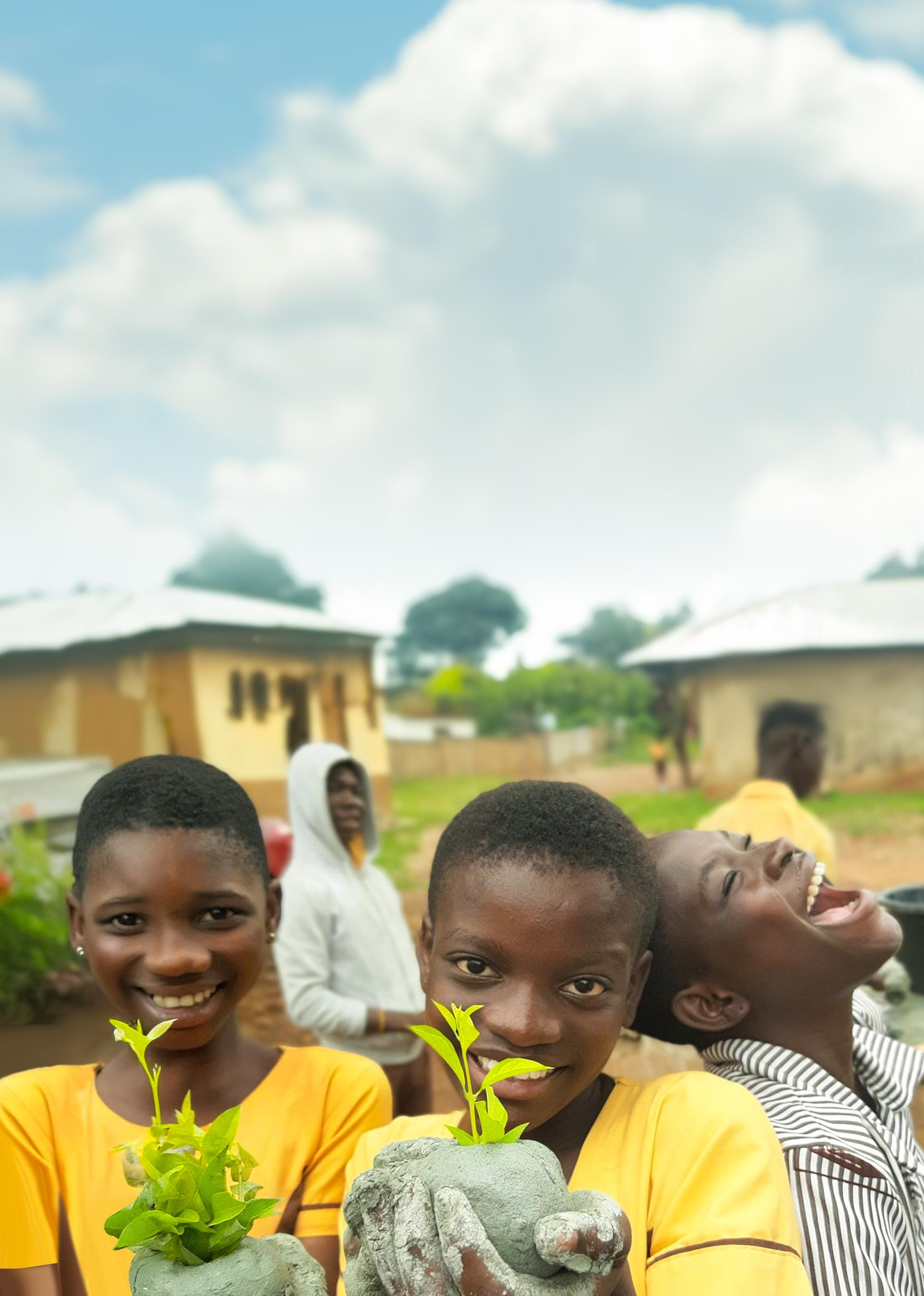
School-based tree planting
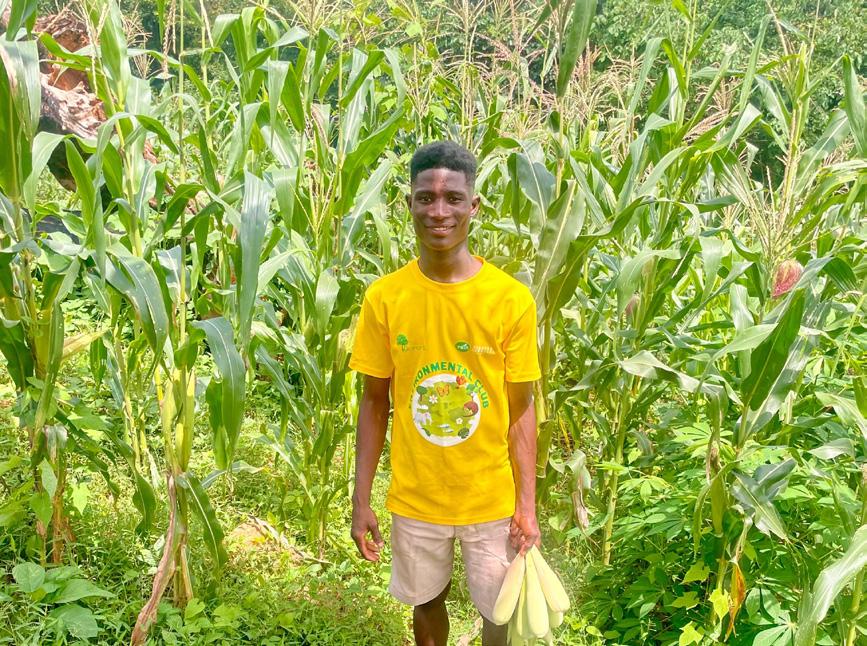
Implementing sustainable agricultural practices
Eco Clubs in theTransition Landscape
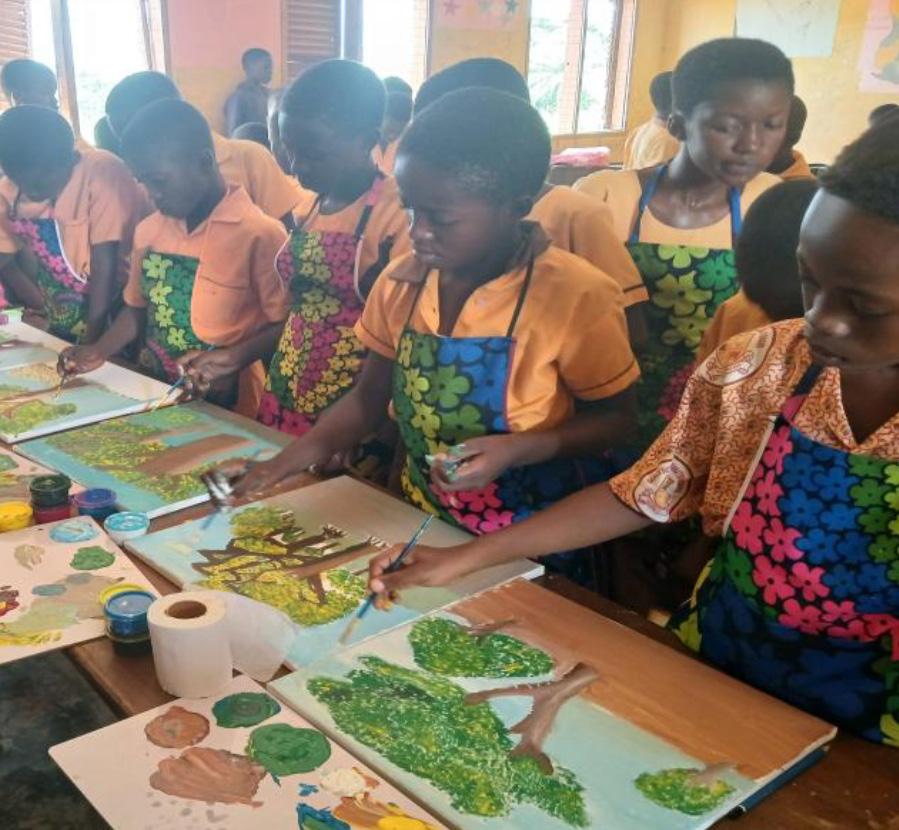
EcoSTEM clubs for learners (working with Junior High School learners), with wider community-led environmental leadership via the Spot model.
Tree restoration and environmental greening, alongside climate education for young people including school-based environmental clubs.
School Eco Clubs in the Ashanti Region
Education and Climate Change through school garden projects
Complementary climate education using indigenous knowledge systems
Youth-led tree planting and action projects
Children for Climate Action: Training young people as key actors contributing to the planning and implementation of climate and other environmental interventions at all levels of the decision-making process.
g) A Participatory, Digitalised Approach
EduSpots aims to consistently model a collaborative, playful and inclusive approach throughout this community of practice and beyond, also using simple digital tools to effectively aid this process.
The key aspects the facilitation approach were:
• Enabling group members to take leadership roles of diverse forms, both in person, and online.
• Using surveys, conversations and WhatsApp polls to enable group members to input their ideas throughout the process.
• Making learning and engagement fun through mixed use of humour, emojis, gifs, energisers, claps and other play-based methods, adapted to the adult education context.
• Relating content and design to the Ghanaian context, whilst tapping into global narratives on climate education.
• Ensuring all learning was interactive in form rather than didactic, with a focus on using effective open-ended discussion prompts, with scaffolded response frameworks.
h) Report Methodology
The methods used to monitor and evaluate the process and gather learning for this report, were the following:
• Baseline survey, establishing interests, needs and potential contribution.
• 25 post-programme survey responses (a mix of those who joined the in-person Summit, and those who joined only online, and both).
• 10 semi-structured interviews in-person in Tamale.
• Observations and note-taking during online sessions (on Zoom).
• Post-session documentation of ideas shared by participants on Google Drive.
• Analysis of engagement on WhatsApp using Chat Stats, and wider observation and resource sharing. .
• Brief literature review of climate education in Ghana.
• Case studies from five organizations (self-selected)
2. Key CECOP Activities
a) Online Sessions
“I felt able to share my ideas on WhatsApp and on Zoom, in a supportive and inclusive environment.” 61% strongly agreed, 94% agreed or strongly agreed, 6% neither agree nor disagree.
We achieved close to 100% participation of at least one member from each organization attending all online sessions, with some individuals arriving late, and network challenges presenting difficulties for some members. It was clear that the group had differing levels of confidence and familiarity with using Zoom as a forum for learning.
i) Session contents
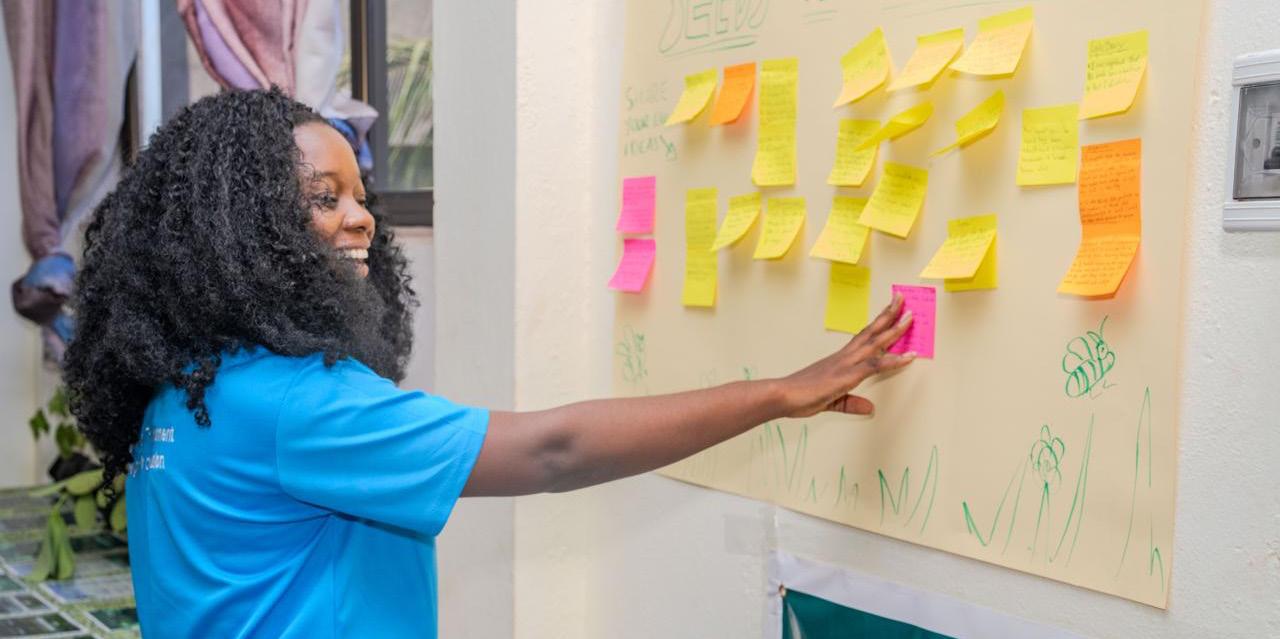
All sessions were held on Zoom, and co-created with members from the CECOP, with 2-3 organisations presenting in each session. The facilitators from EduSpots ensured discussions were highly interactive using a mixture of group discussions, zoom break-out spaces, and effective use of the chat box. We used a mix of media to share information and ideas stretching from poetry and music, to news stories and interviews, to participants from the group sharing ideas.
After each session, we sent an open working document on Google Drive, with a clear structure relating to the session, alongside sharing ideas on WhatsApp, in order to capture key learnings and applications that emerged.
Session: 1 Empowering Student Agency in Climate Action (July)
“This session has deepened our understanding of the importance of not only involving students in climate action but also creating structures that allow them to lead. We realised that while we have engaged students in activities such as tree planting, clean-up campaigns, and awareness creation, we have sometimes been too directive in our approach.
We plan to give students more space to identify issues, design their solutions, and take the lead in implementing them. This means shifting from a facilitator-driven model to a student-led model, with our role being to guide, mentor, and provide resources.
In our organisational planning, we will intentionally integrate activities that nurture decision-making, problem-solving, and leadership among students, ensuring their voices and ideas shape the climate initiatives we undertake together.” (Sung Foundation)
Pre-session WhatsApp reflections:
“I used to think student agency was just about leaving students to do things on their own till I realized that it was more about them taking charge of what they have, making whatever we teach them stick with them.”
(Yolanda Araba Aidoo, Coordinator of the Youth-NREG Academy)
“Student agency in climate action means equipping young people with the knowledge, skills, and confidence to take meaningful, locally relevant steps to address climate change. It’s about treating students as active partners in creating solutions, not just passive recipients of information.”
(Khadija Gombilla Ami, Sung Foundation)
“For me and RAIN, we believe that student agency in climate action means enabling young people to become proactive stewards of the environment by equipping them with not just information, but the confidence, tools, and platforms to act meaningfully within their communities.”
(Chris Anane Konadu, RAIN)
The online session focused on diverse strategies used to empower students as leaders:
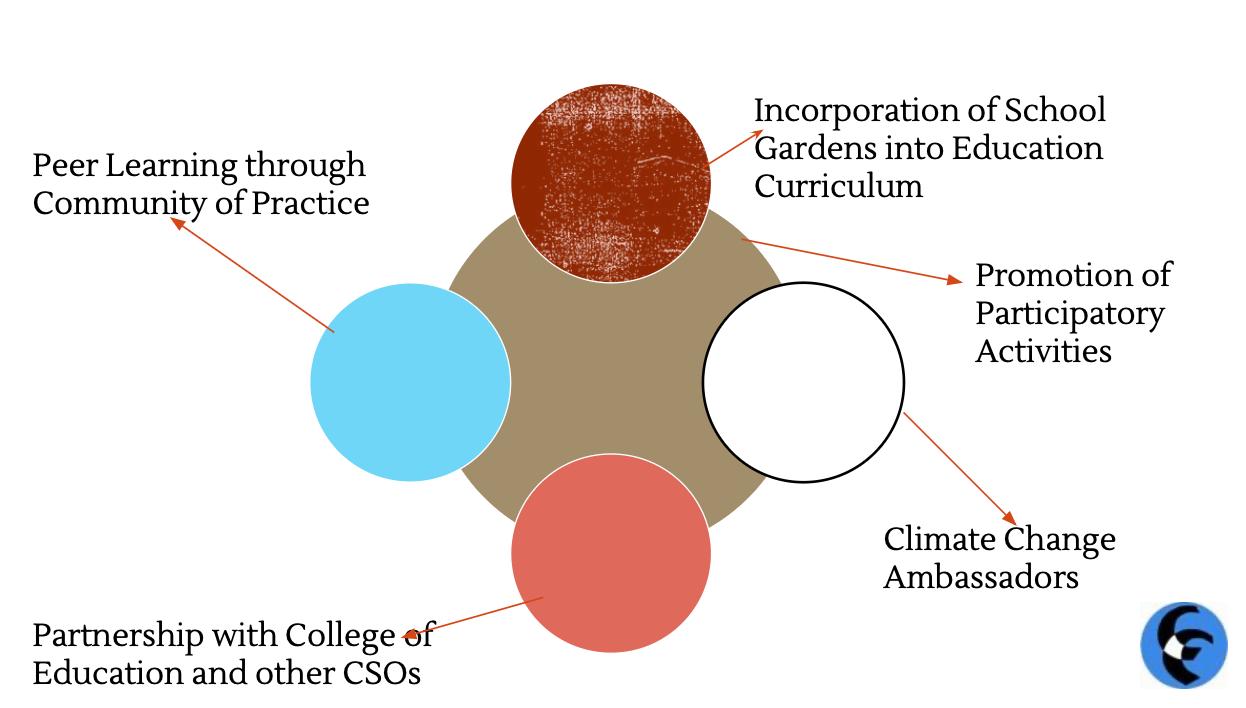
• EduSpots shared their broader educational approach, with active global citizenship at its core, ahead of explaining both the EcoSTEM clubs for Junior High School students with a projectbased learning model, and the annual Green Spot Innovation Challenge, that Spots engage in, with grant funding for winners to roll-out ideas that relate to their local context.
• The Sung Foundation shared their Climate Ambassadors initiative and Eco Clubs Model, which had a focus on student leadership, with teachers stepping back into a guidance role. Projects included tree-planing, eco drama, and clean-up activities.
• RAIN presented their student-led climate clubs, where students choose the meeting times, lead discussions, and have choice and agency in activities.
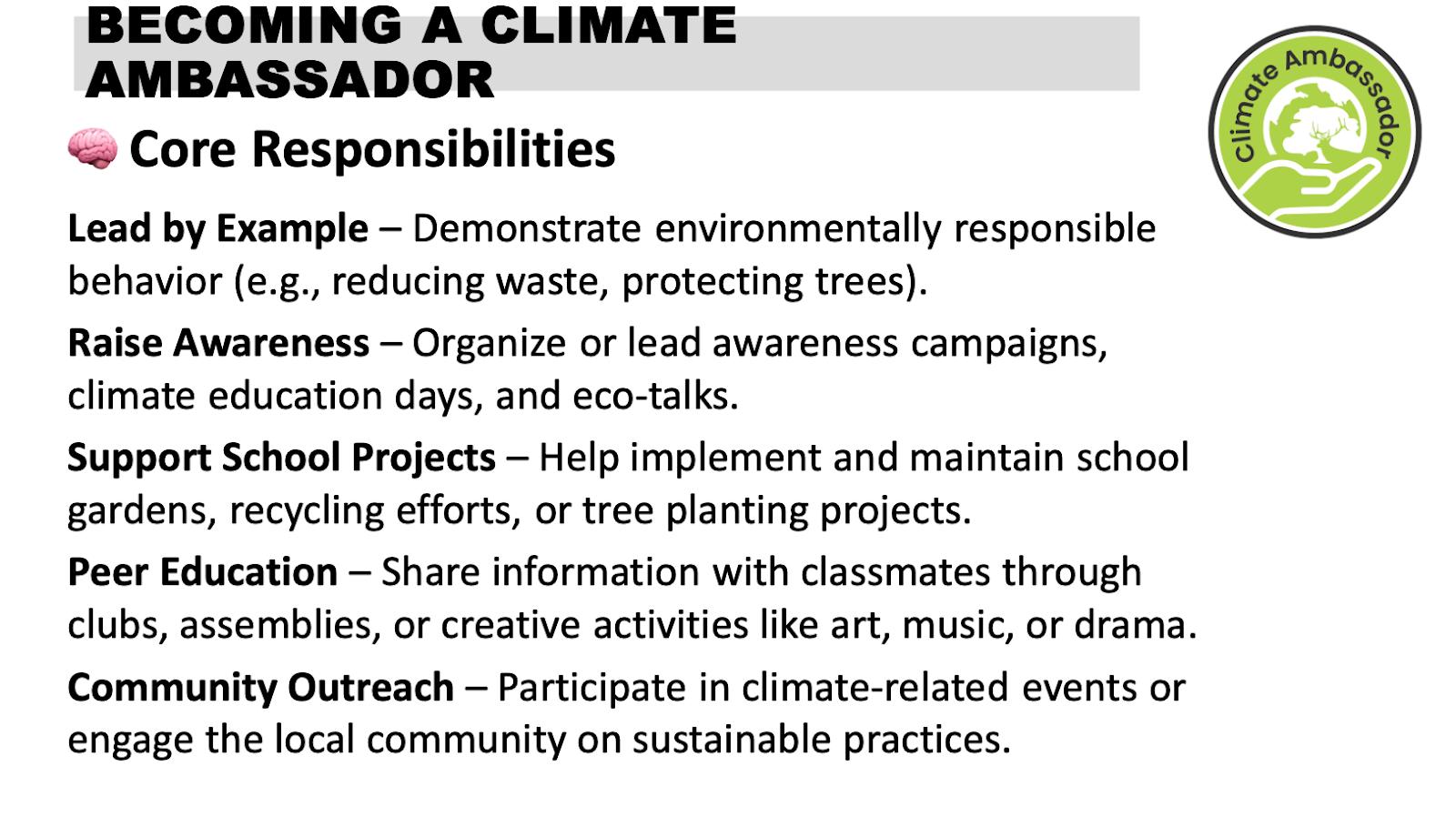
• Climate Smart Training Programme shared their Climate Ambassador programme where students are chosen to advocate for climate action, lead by example in school and the wider community and organise wider awareness campaigns.
Activities being led by learners that were shared:
• Tree planting and care
• Waste segregation and clean-up exercises
• Advocacy campaigns (e.g. through drama, art, storytelling, student journalism)
• Peer education and talks on climate change
• Interviewing elders in the community and community engagement
• Raising and tending gardens
• Debating clubs on climate themes,
• Designing their own eco badges and noticeboards
• Exploring climate change through science
Key Learnings Shared on Student Leadership in Climate Education
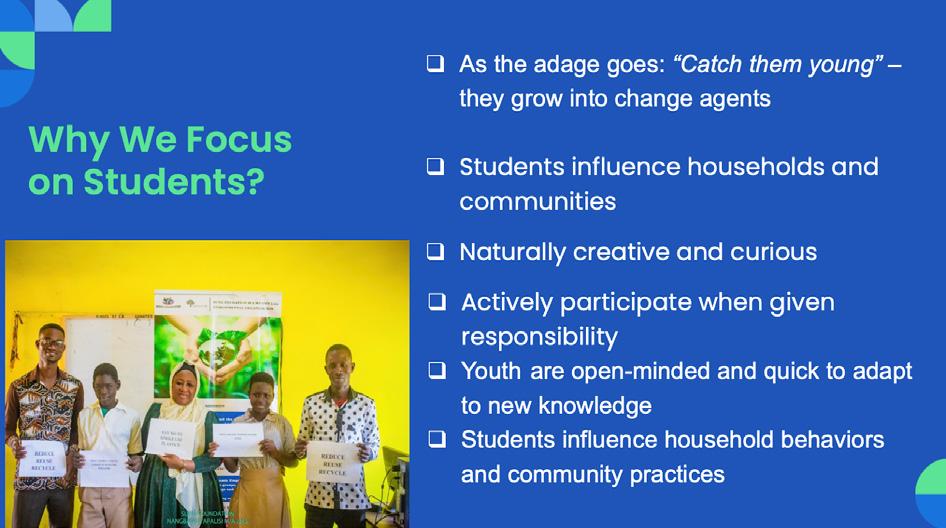
The value: As shared by the Sung Foundation, students are naturally creative and curious, have the power to influence households and broader communities, are keen to take on responsibility, and are open minded to new ways of thinking.
Roles: Giving students named role responsibilities for climate education in their schools (e.g. Ambassador, Club Leader, EcoChamp etc) with clear role descriptions agreed with their peers, that they help to shape (e.g. as shared by Climate Smart Training Programme: leading talks and peer learning, raising awareness, setting an example, leading waste collection systems, leading on project delivery, participating in wider events).
Frameworks: Ensuring that students have a clear framework to work within, so that learning doesn’t become entirely unstructured. EduSpots’ monthly challenges are an example of how to strike a balance between open-ended projects and directed research and investigation.
Resources: Students benefit from having resources needed to complete research and investigation – digital tools can open a whole world of environmental learning and apps, and strong reading resources can also support student motivation and engagement.
Group work: Using project-based learning methodologies, with students each having clear roles in group activities, and taking it in turn to present, with simple shifts such as teachers moving to the back of the room, and students keeping time or leading questioning, helping to cultivate a more student-led environment.
Collaboration: As shared by RAIN, collaboration with local schools and wider actors in environmental education, and parents, is key. EduSpots used the ‘Green Spot Innovation Challenge’ to enable learners, parents, teachers and wider communities to come together to co-create a green innovation.
Celebration: Encourage and motivation students through celebrating their efforts, spotlighting their projects through community events, and celebrating them through certificates. Examples from Climate Smart Training Programme included certificates, ‘Climate Hero’ badge, gift backs (notebook, seeds, t-shirts), feature on the school bulletin or radio, and the opportunity to represent the school at environmental events.
Example from Climate Smart Training Programme, on the core responsibilities of a climate Ambassador.
Session 2: Greening Teaching, Learning & the Curriculum (August)
“Greening the curriculum should go beyond classroom theory to include experiential and community-based learning. Policymakers should integrate climate-smart and regenerative agriculture, tree planting, and waste management projects into the school calendar to make climate education practical, inclusive, and action-oriented.” (Sung Foundation)
School Gardens Curriculum
RAINS shared their reasons behind the School Gardens curriculum integrated model, which they have developed over 8 years as part of the School Pedagogy Project (SPP). They are advocating for incorporation into the Ghana national curriculum, with a formal handbook of the approach created.
• Practical Learning: Links theory to real-life contexts (e.g., science, nutrition, English etc).
• Participatory Approach: Engages students in decision-making and teamwork
• Local Relevance: Rooted in community culture, knowledge and needs Avenues for practical Climate Actions.
Strategic approach:
See a case study on page 38 for more information on the school gardens model.
Afrikids’ Climate Teaching Approach
Afrikids shared a 5 step approach used in their Eco Clubs:
• Hook : Learners identify local problem/photo/story
• Investigation: Learners work in groups to investigate and collect data
• Share & Make Sense: Groups share findings
• Apply: Groups propose an improvement/solution
• Practical: Groups undertake solution
Our Approach to Teaching Climate Topics
• Establish CLUBS in schools
• Support TEACHERS
• Teacher capacity building on creative pedagogy and supply of Kits/TLRs
• Short, simple activity guides)
• Peer coaching + monitoring after training
• Make it LOCAL & ACTIVE
• Hands-on, integrated Climate education tasks connecting to local environments(food, waste, heat, water, air, health, etc.)
• Industrial trips to organizations such as ICOUR (Irrigation Company of Upper Region Ltd)
• In person and virtual clinics with Climate experts across the Globe
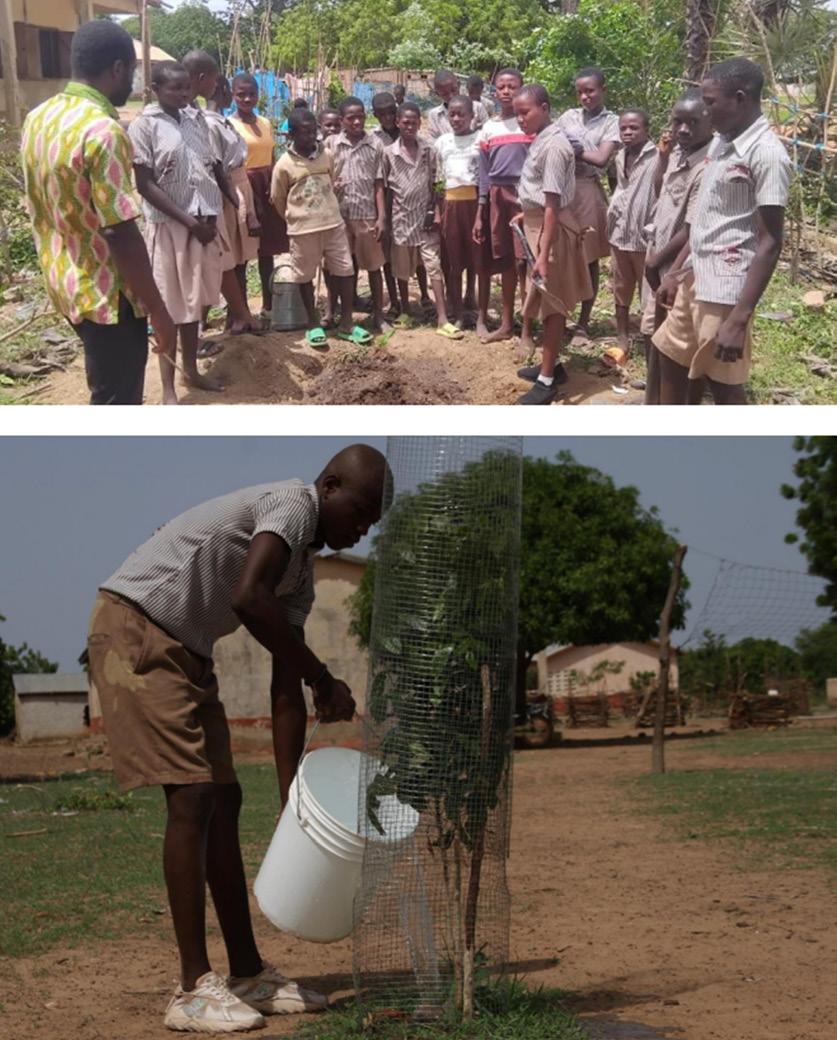
Activity: Tree Planting & Stewardship
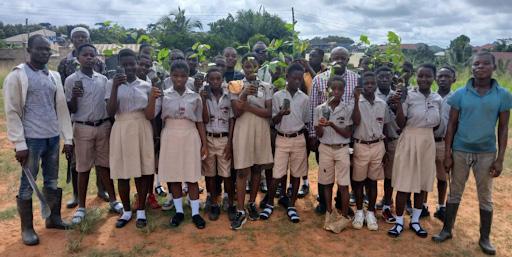
• 7000 trees planted and grown since 2023
• 100 trees grown at our head office in Pusu-Namong
• How it integrates with learning
• basic plant care routines
• Biodiversity links: they are taught why native species are very important(e.g. heat & drought tolerance)
• Simple monitoring: class/club adoption rosters
• Benefits & outcomes
• Student agency and responsibility; practical climate action
• Greening school compounds; prevention of strong winds destroying roofs, shade & erosion control
SYND: Inspiring youth engagement
SYND shared a range of highly practical and creative strategies that learners engaged with, stretching across:
• Use of movies and multimedia
• Theatrical performances
• Seed planting and advocacy
• Games
• Capstone projects
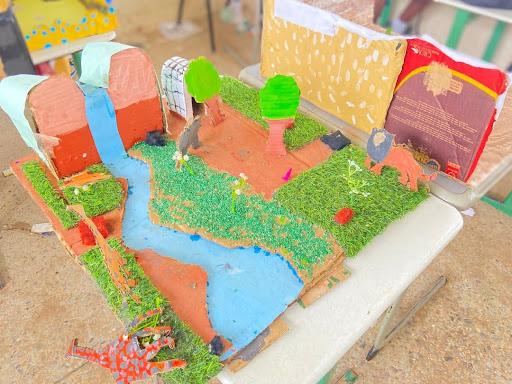
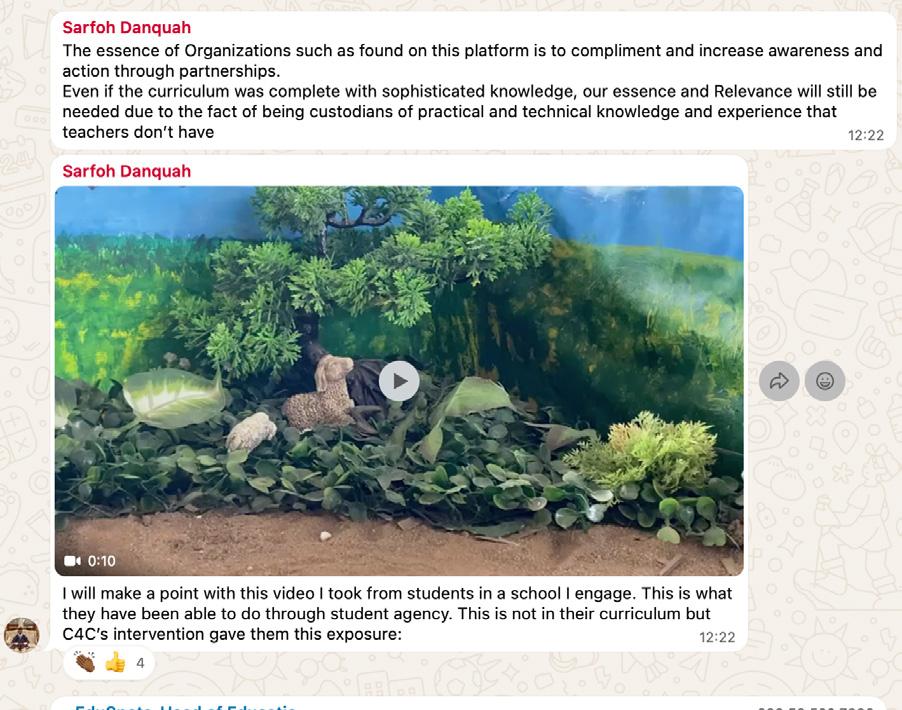
• Arts and crafts (e.g. climate dioramas)
• Creating local crafts from recycled materials
• Eco excursions
SYND is a youth-oriented NGO focused on youth inclusion in the governance of our natural resources and environmental sector.
Session
3: Localising Climate Solutions Through School & Community Projects (September)
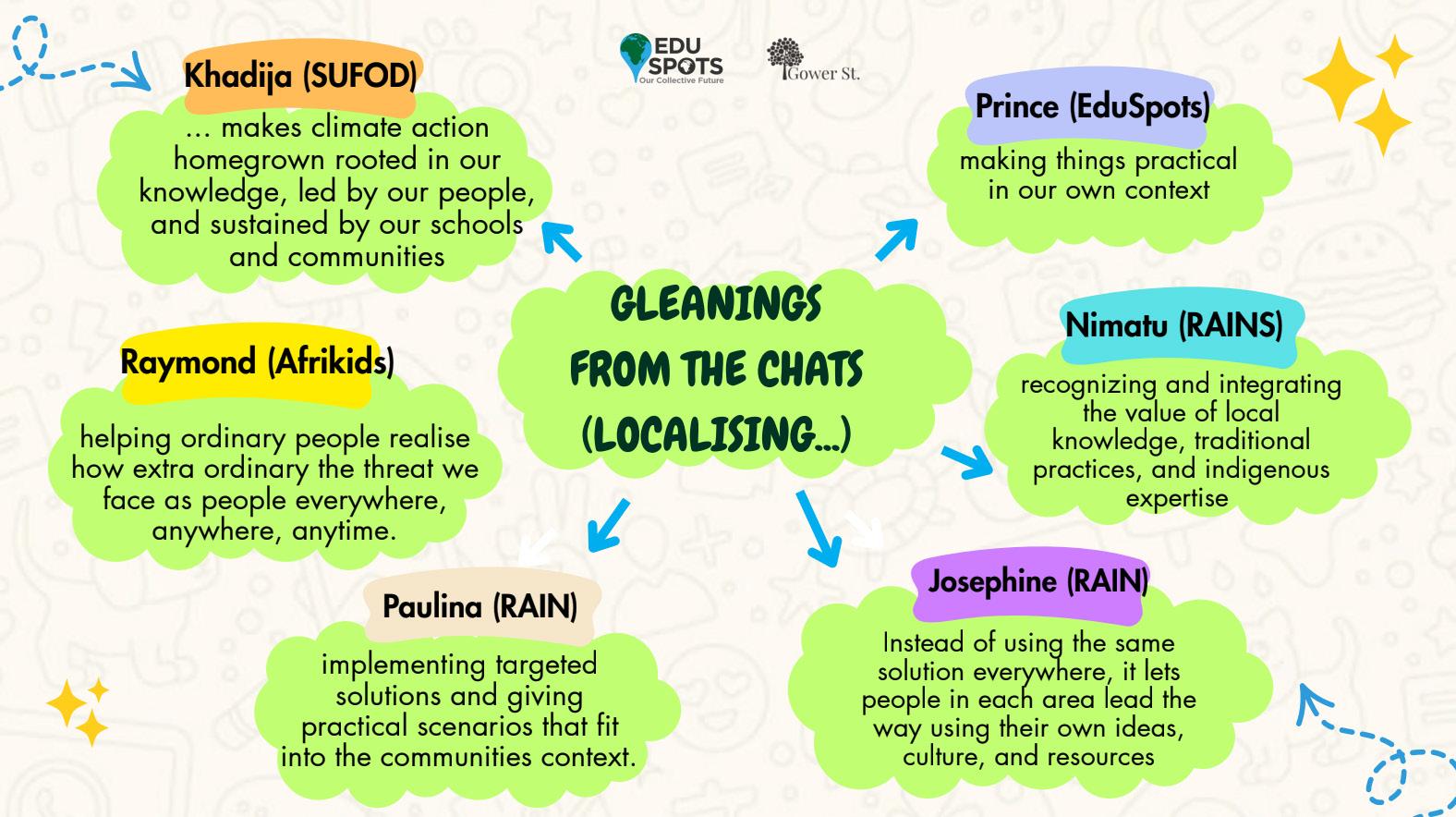
What does localising mean to the CECOP participants?
Reflections shared following the session on how climate education can be effectively localised: Sung Foundation: “To localise climate solutions, SUFOD grounds all activities in community knowledge, culture, and livelihoods. We engage local leaders, teachers, and women’s groups in co-designing projects such as tree planting, clean cooking, and school and community gardens so that solutions reflect real needs and available resources. Climate messages are translated into local languages and linked to daily experiences like farming, water use, and waste management. The biggest challenges are limited resources, low awareness, and the perception that climate change is a distant issue. We overcome this by using storytelling, and demonstrations to show practical benefits for example, how tree planting improves soil fertility or how solar lamps and energy serving stoves reduce energy costs and improve good health. By doing this, climate action becomes relatable, affordable, and owned by the people themselves.”
ORGIIS: “ORGIIS works with communities through the CREMAs (Community Resource Management Areas). We engage both the CECs (Community Executive Committees) and the CRMCs (Community Resource Management Committees) by providing training and supporting them with the necessary tools to monitor and manage their natural resources. The communities elect patrol teams who periodically enter the forest. Anyone found destroying natural resources without a permit is apprehended and handed over to the CECs. Their items are confiscated, and they are fined.”
Localising Pedagogical Approaches
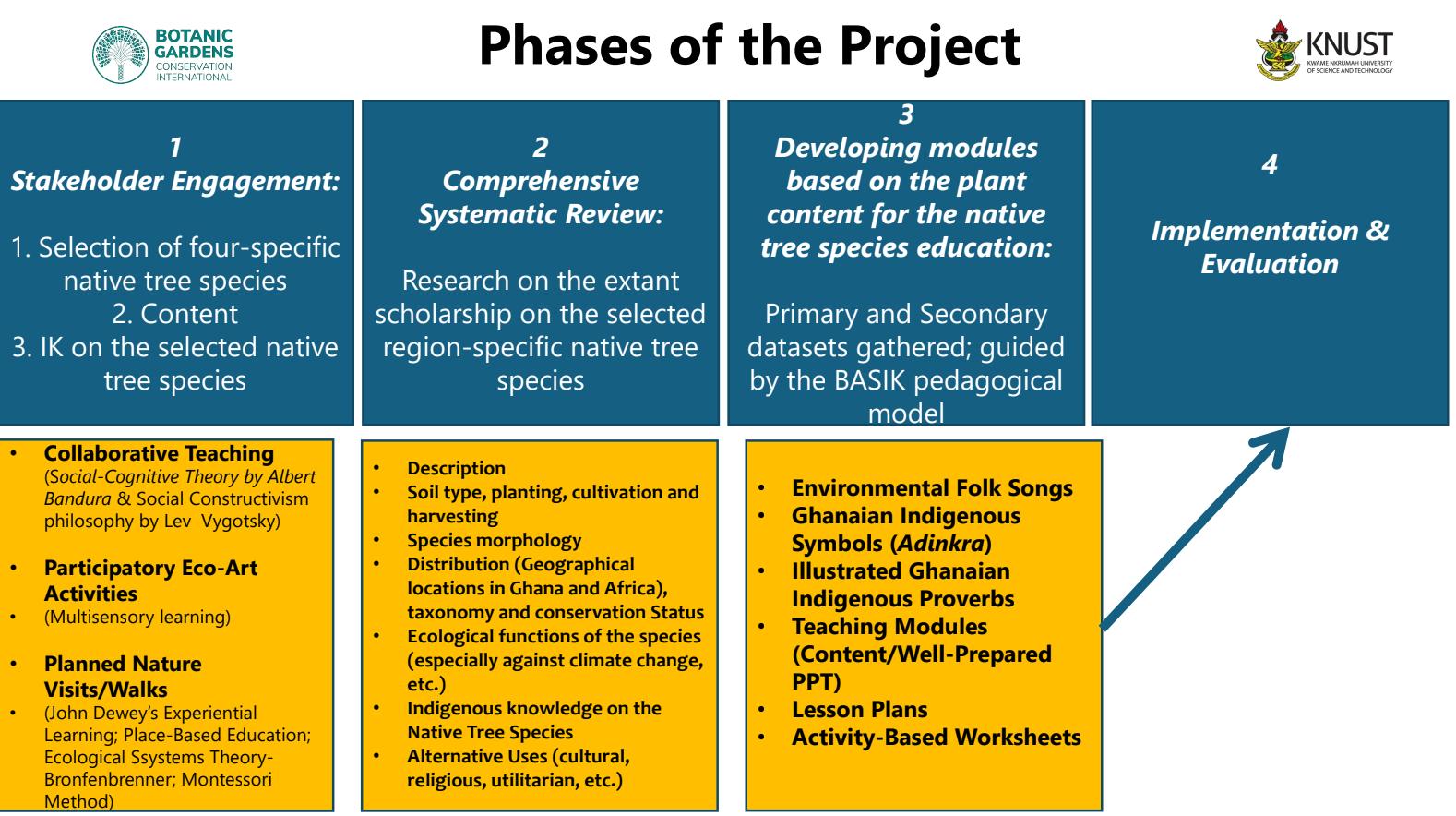
Dickson Adom (PhD), Faculty of Educational Studies, KNUST-Ghana and Director, Rights of Nature Ghana Movement (RoNAG) presented on “Localising Plant Content in the Ghanaian Basic School Curriculum: Teaching Native Tree Species and their Roles Against Climate Change.
See page 32 for a more developed case study on this project.
Sarfoh Dankwah, with SYND shared a wide range of highly practical projects that enabled students to come up with climate solutions and innovations local to their context:
This session explored the role of monitoring, learning and evaluation in programme design, with examples of a MEL framework given by Orgiis, who used a combination of the following methods:
• Mixed-methods: Surveys, focus groups, and participatory workshops
• Mobile tools and GIS mapping for real-time data
• Citizen science and youth engagement in data collection
• Integration of local knowledge with scientific data
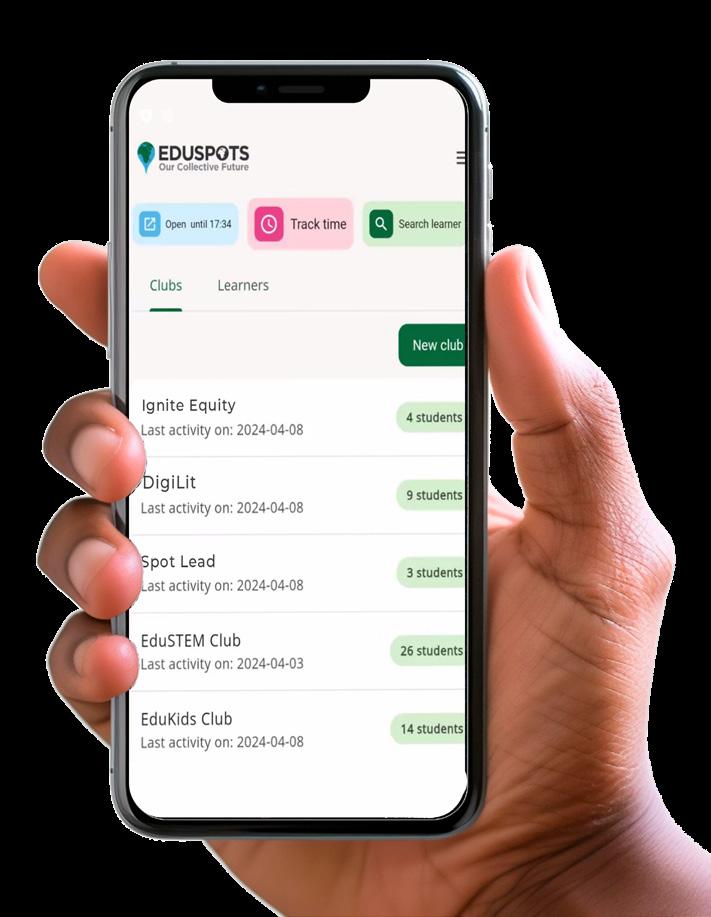
EduSpots’ shared their use of the Impact Ed software and validated surveys at baseline, mid point and end line, across a range of behavioral measures for environmental action, which are analysed alongside semi-structured interviews and focus group discussion,
They also asked for input from the community into how the EduSpots app could be better leveraged for capturing data and learning relating to climate education.
Most Significant Change approach
EduSpots suggested the use of the simple qualitative Most Significant Change (MSC) approach as an inductive method that enables communities to analyse the changes they observe, and explain the value that they have. Simple questions: What is the most significant change you have observed (within a particular scope - e.g. school, community, yourself)? Why was it significant, and to whom? The benefit to this approach is that it avoids directing answers,and can lead to a wider range of unexpected outcomes being analysed, also ascertaining what the community member, teacher or learner themselves value.
Session 4: Monitoring, Learning and Systems Change for Climate Education (October)
Systems thinking
Orgiis highlighted the importance of adopting a systems thinking approach: ‘an approach that targets the root causes of complex problems by transforming the underlying structures, policies, and mindsets, rather than just addressing symptoms. Instead of providing shortterm fixes, it seeks to alter the fundamental rules, relationships, and power dynamics that perpetuate the problem to create sustainable, long-term solutions. This involves a holistic view that recognizes the interconnectedness of issues and focuses on changing the system itself through collaborative, nonlinear, and often emergent strategies and behaviors.’
Change explored in this way would naturally look to encourage collaboration across education, environment and policy sectors.
The benefits of this approach to climate education NGOs, identified by Orgiis were:
• Climate education operates within complex social systems
• Helps NGOs design programs that influence long-term change
• Identifies leverage points for scaling successful interventions
• Aligns local actions with national and global climate goals
From the responses, it was clear that the group would have benefited from more extensive technical monitoring, evaluation and learning training with a much lower degree of confidence in this area.
Activity 2: Structured WhatsApp Community
“EduSpots’ WhatsApp strategies enabled us to strengthen our learning as a community.” 53% strongly agreed, 42% agreed, 5% neither agreed nor disagreed.
i) Purpose
The WhatsApp group created between all members, serves as the backbone of CECOP’s ongoing collaboration and learning, enabling:
• A consistent sense of community
• Peer-to-peer learning and problem-solving
• Timely communication and support
• Quick resource sharing and updates
• Celebration of successes and milestones
ii) Timetable
Following analysis of interests from the group, EduSpots devised a light-touch weekly timetable, which was maintained throughout.
ACTIVITY
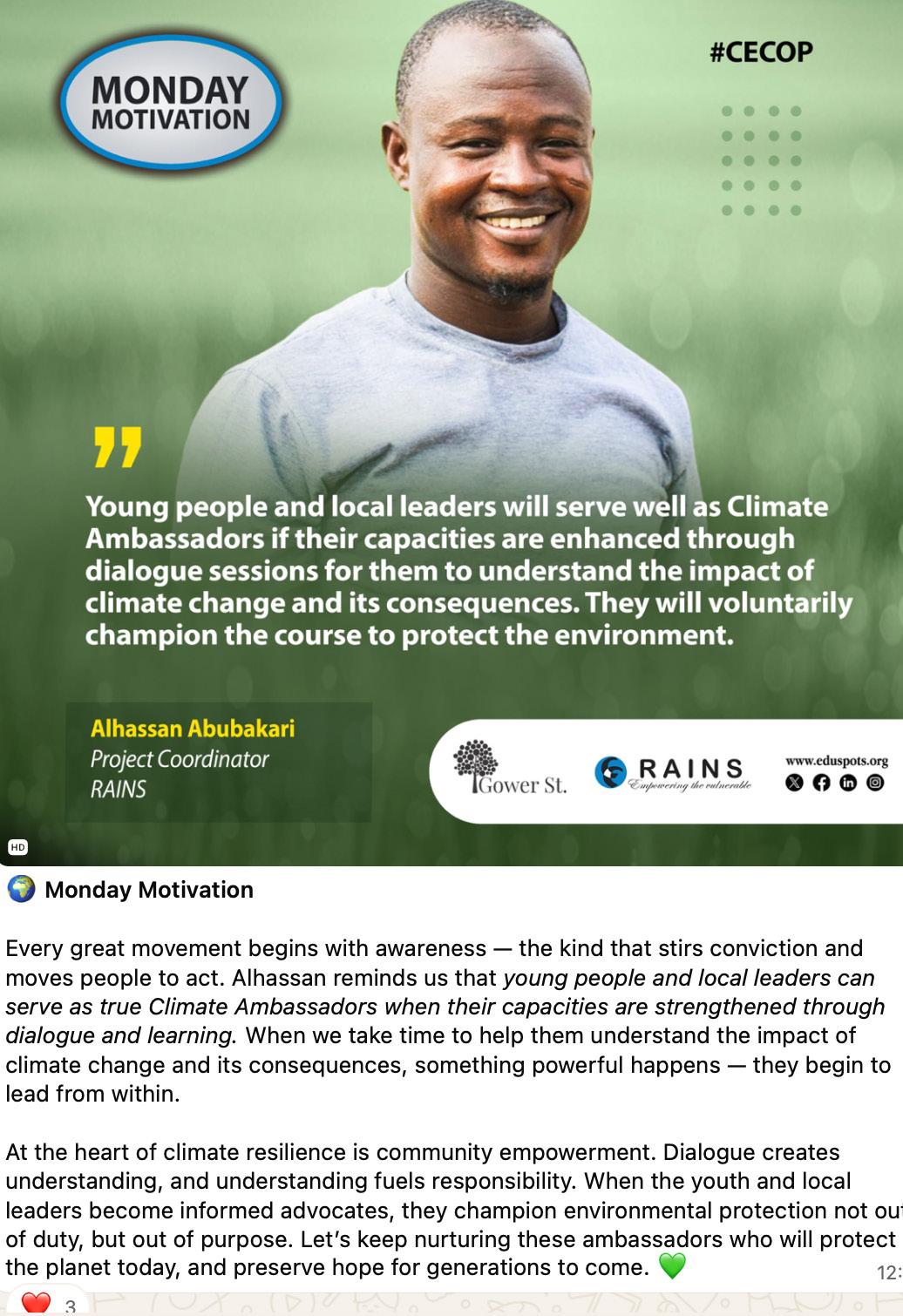
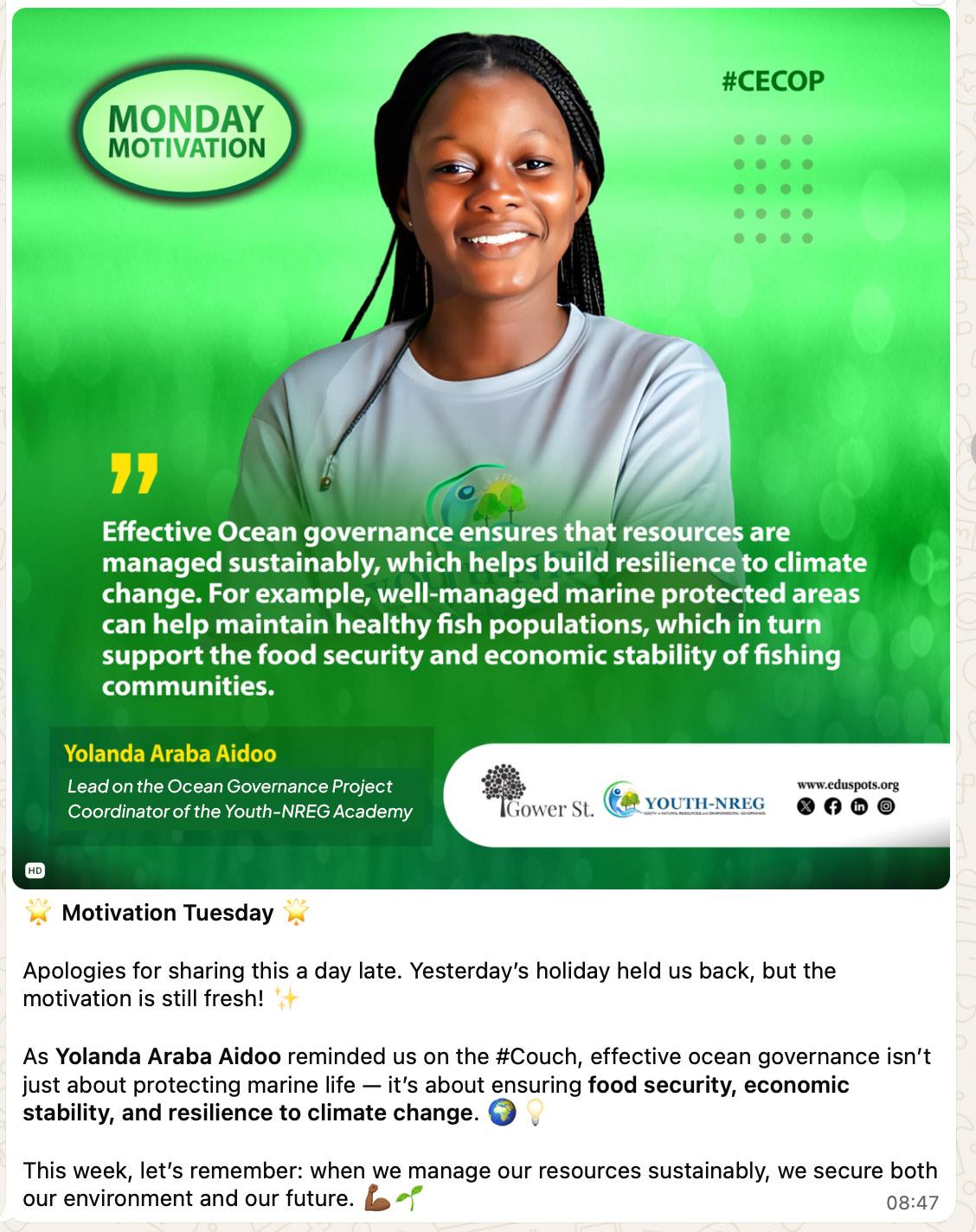
Monday #MotivationMondays
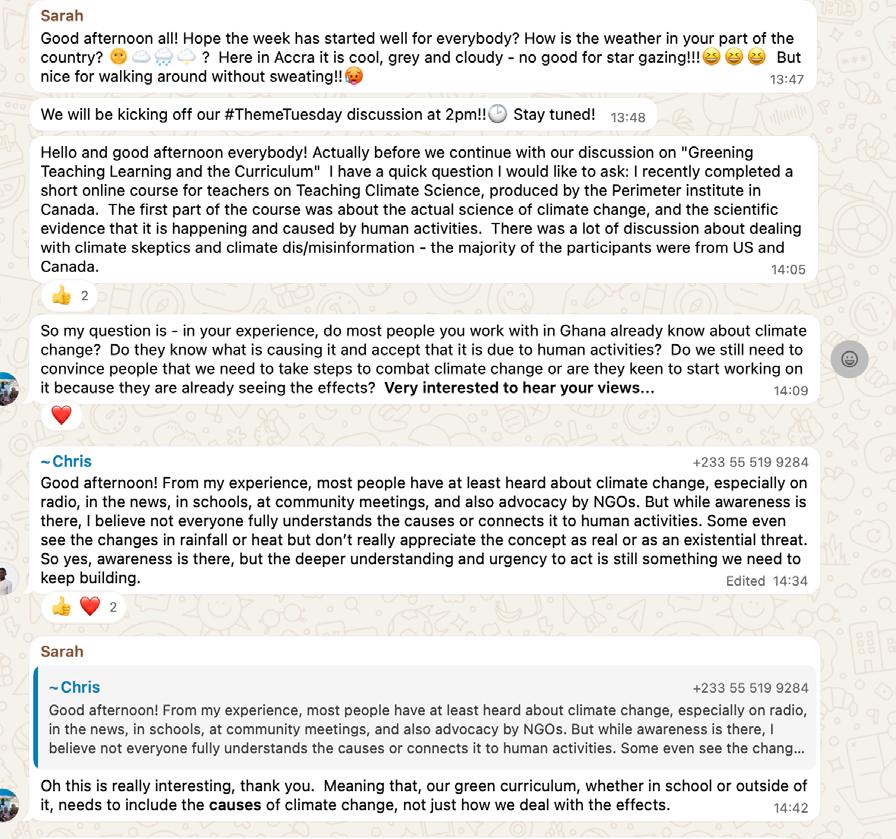
Tuesday - Wednesday #ThemeTuesdays
Thursdays #OpportunityKnocks
Friday #CouchFridays
Motivation from the previous Friday’s interview - key quotes/ideas pulled out into social media shareable graphics with organisation logos.
Discussion relating to the monthly theme - either introducing themes, or reflecting afterwards.
Sharing opportunities & resources
Organisation on the couch: each week, a different organisation is ‘on the couch’, interviewed on their practice and ideas in this area.
OUTCOMES OBSERVED
Strengthening a sense of joint membership of the CECOP among participating organisations.
Increasing visibility of the CECOP beyond the group.
To enable reflection/ further exploration before and after Zoom sessions.
To provoke further collaboration, ideas sharing and discussion.
Giving a structure for the network to share climate education-related opportunities and resources.
Enabling participants to better know our different work across organisations, and the individuals behind the change.
iii) Example 1: #Motivation Monday
Approach: Each week, a quotation that could bring wider motivation or insight was drawn from the Friday interview and shared via a social graphic which included the individual’s face, and organisational logo.
Outcomes: These graphics were often shared across social channels by the members of the group, creating a stronger sense of shared ownership, building relationships between members and increasing viability of the wider CECOP. Starting the week with the voice of one member, set a precedent for members taking leadership.
Example 2: #ThemeTuesday
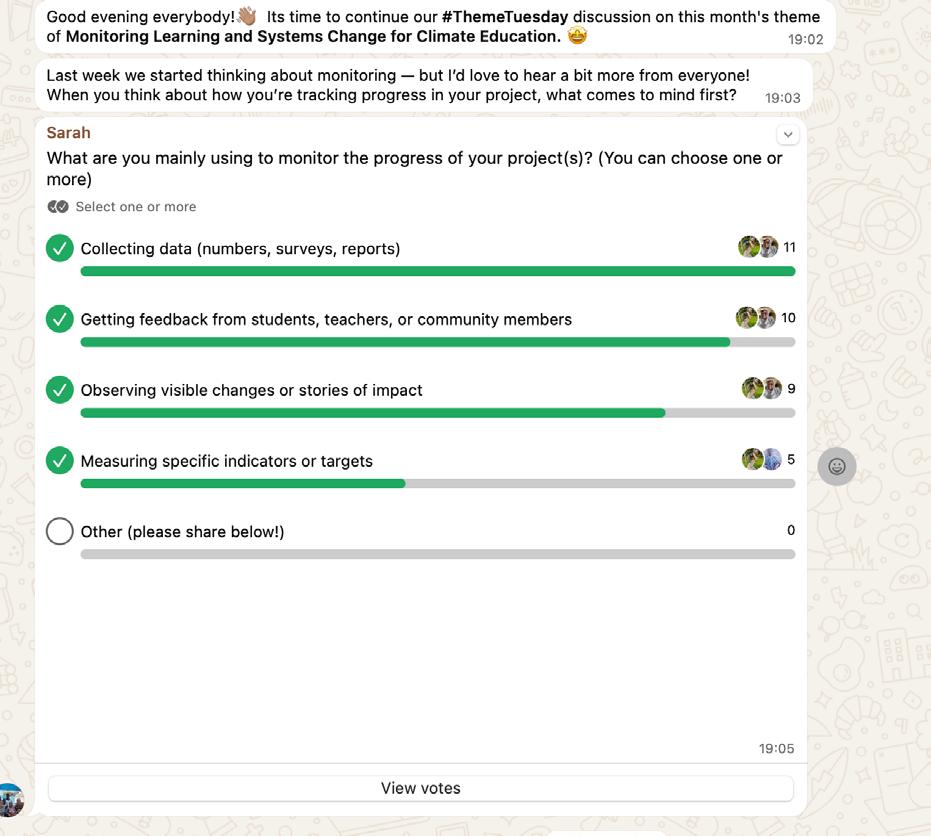
Approach: Each Tuesday, often linking to the broader Zoom sessions, EduSpots provoked a debate on a particular theme, encouraging members across the group to participate, using polls as a simple touch point for initiating learning and reflection. We also used WhatsApp as a key tool to continue discussions, after zoom sessions had closed, extending break-out space time, and asking participants to share their thoughts in the WhatsApp group after sessions.
Outcomes: This enabled members to have a structure to reflect on their own practices and methodologies, and also engage in broader themes relating to strengthening climate education, in Ghana and beyond.
Example 3: #CouchFridays - CECOP Member Interviews
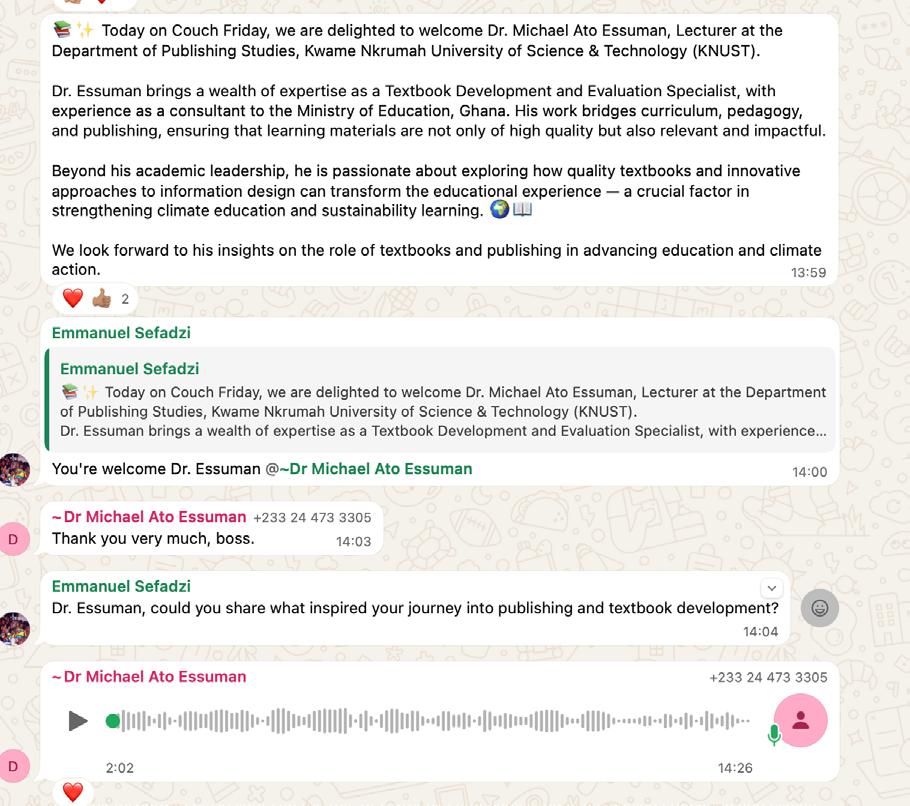
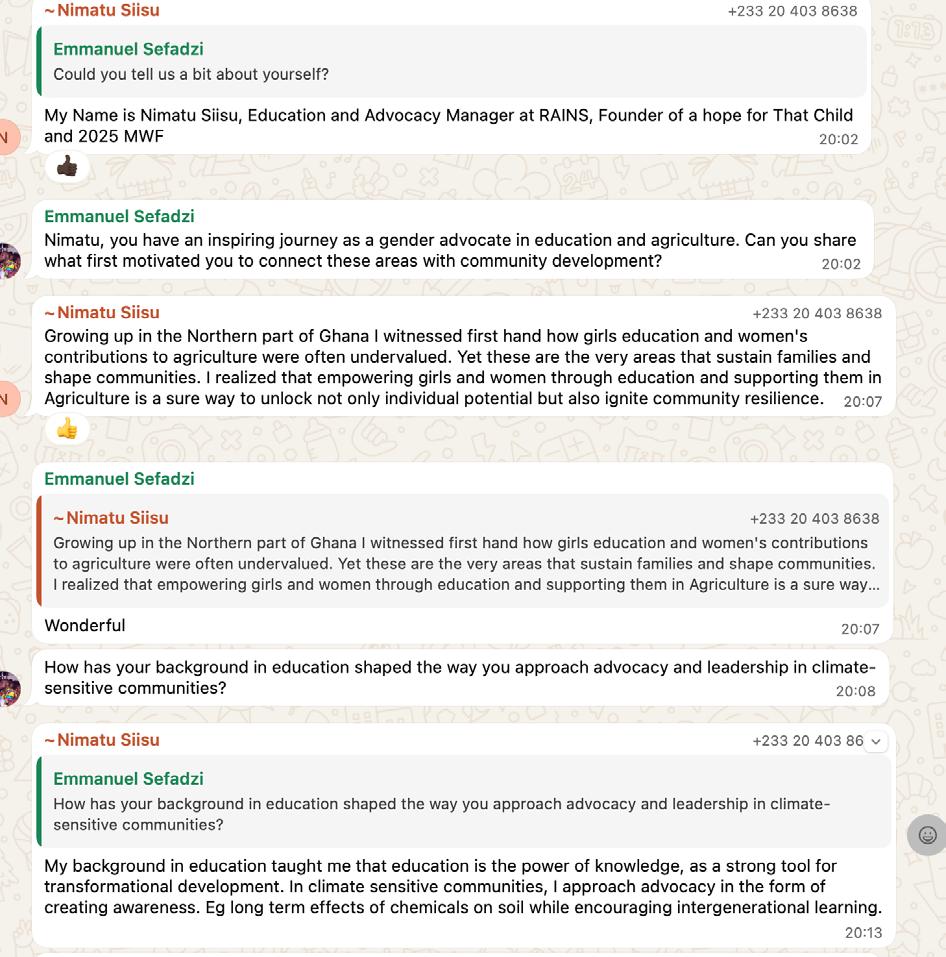
Approach: Each week, EduSpots invited one group member to sit on the metaphorical ‘couch’ for an interactive interview. Interviewees could use a mix of text, voice note, video, images and files as suited them. Across the period individuals from across all organizations were interviewed.
Outcomes: This enabled us to better understand the people behind the educational creativity, also learning more about the projects and approaches taken by the various NGOs, with a chance for open questions from the room. It also enabled people to feel more connected to the CECOP group, having shared their story in a public space.
iv) Engagement
Summary across a 5 month, 150 day period:
Participation: Engagement on WhatsApp was mixed with some outstanding individual engagement, and others who didn’t seem to have used WhatsApp groups for learning previously; an initial induction on Zoom, may have been helpful to ignite further participation.
The community engaged most in 1-1 interviews, debates on complex and topical themes, and shared the quotes and motivation we shared more widely. From the end-line survey and talking to participants, it is clear that people were reading messages and learning from the discussions, but many could make participation a clearer habit in the programme cycle.
EduSpots believe that more time dedicated 1-1 engagement and relationship development from staff would have increased outcomes, but staff were stretched in time due to the transitioning of the EduSpots’ staff leading the CECOP one month in.
Sharing resources and opportunities: The CECOP group were surprisingly reticent in sharing opportunities or resources, even with the EduSpots team leading by example; perhaps if we had led the in-person summit in the middle or at the start, this may have built a stronger connection, leading to more sharing from across the wider group, reducing a potential sense of competition between NGOs.
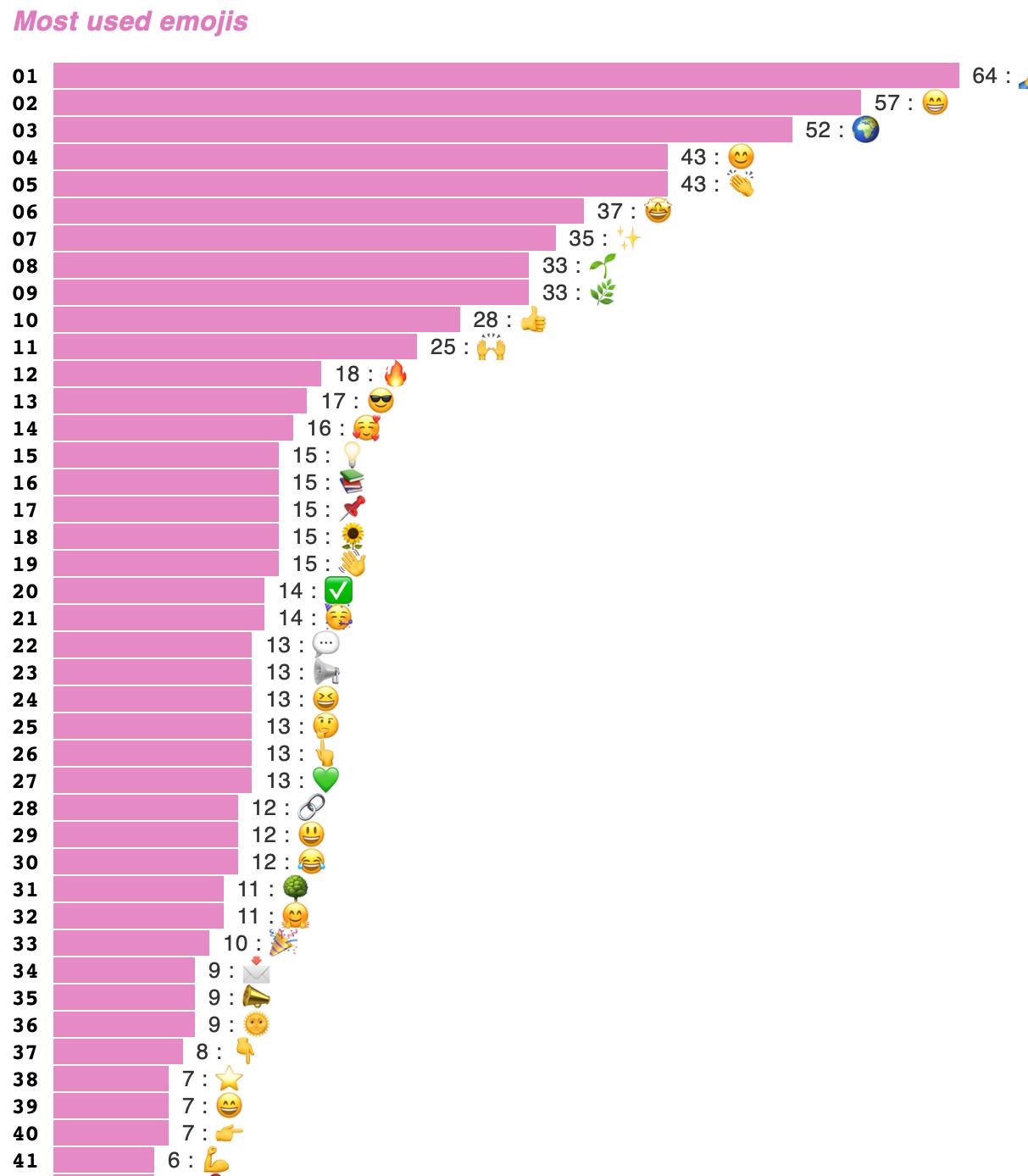
The analysis of emojis indicates a high degree of both gratitude through use of the ‘prayer’ sign, and also the clear presence of humour, with the ‘wide smile’ having 57 hits. The use of the ‘globe’ emojis, points to the positioning of climate education within the global context, with the ‘claps’ also indicating a high degree of peer appreciation and celebration.
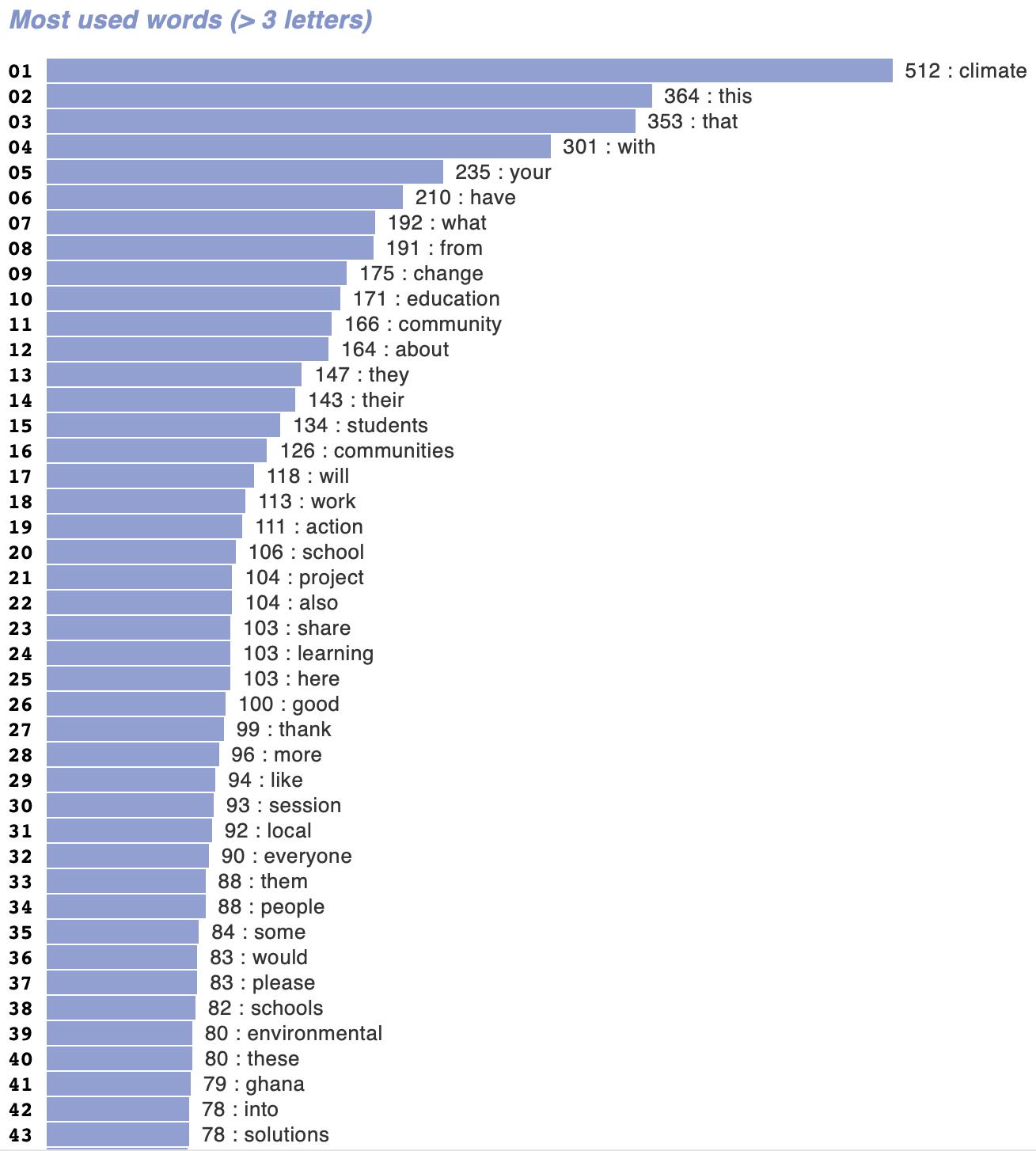
The analysis of words below reflects the strong focus on climate education for learners, with a community-orientated approach.
v) Funding Opportunities
During the 5 month period and beyond, the EduSpots team researched and shared over 50 relevant funding opportunities that were a fit for the Ghana Climate Education space, alongside fellowship and wider training opportunities. Through a post-Summit survey, we established that:
Writing in January 2026, we have not been able to gather any further information on the amount or nature of the funding that was secured.
vi) Resource Sharing
Whilst organisations were prepared to offer Powerpoint presentations on aspects of their work, in line with Zoom session themes, and shared ideas and outcomes more widely, education resource sharing was not a sustained feature of the WhatsApp community as hoped. The reasons for this may be due to the NGO participants not being at the stage of development where their own resources are ready for wider sharing; in terms of sharing pre-existing resources, it appeared that not all NGOs were in the regular practice of looking at pre-existing resources, rather focusing on the development of their own work.
This may point to the need for:
• Resource development support: Design support for NGOs to develop resource packs to capture key learnings (e.g. handbooks, Powerpoints, curriculums, videos, reels, posters etc).
• Resource hub: The need to create a climate education resource hub to store and share relevant climate education opportunities, specific to the Ghanaian context.
• Communication skill strengthening: NGOs to gain more support in both appreciating the value of communicating their work and tools, and gaining confidence more widely in sharing aspects of their work, particularly on digital platforms.
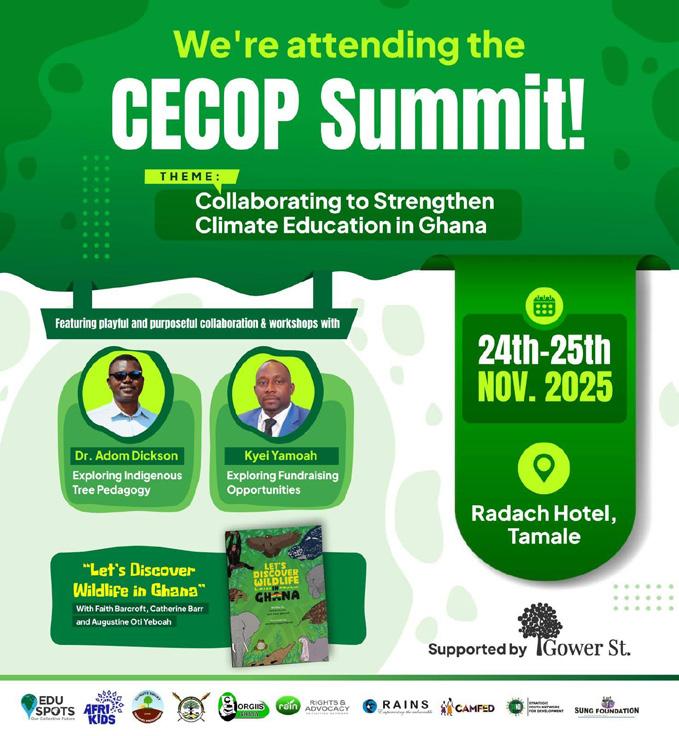
c) Activity 3: In-Person Academy: 24th-25th November
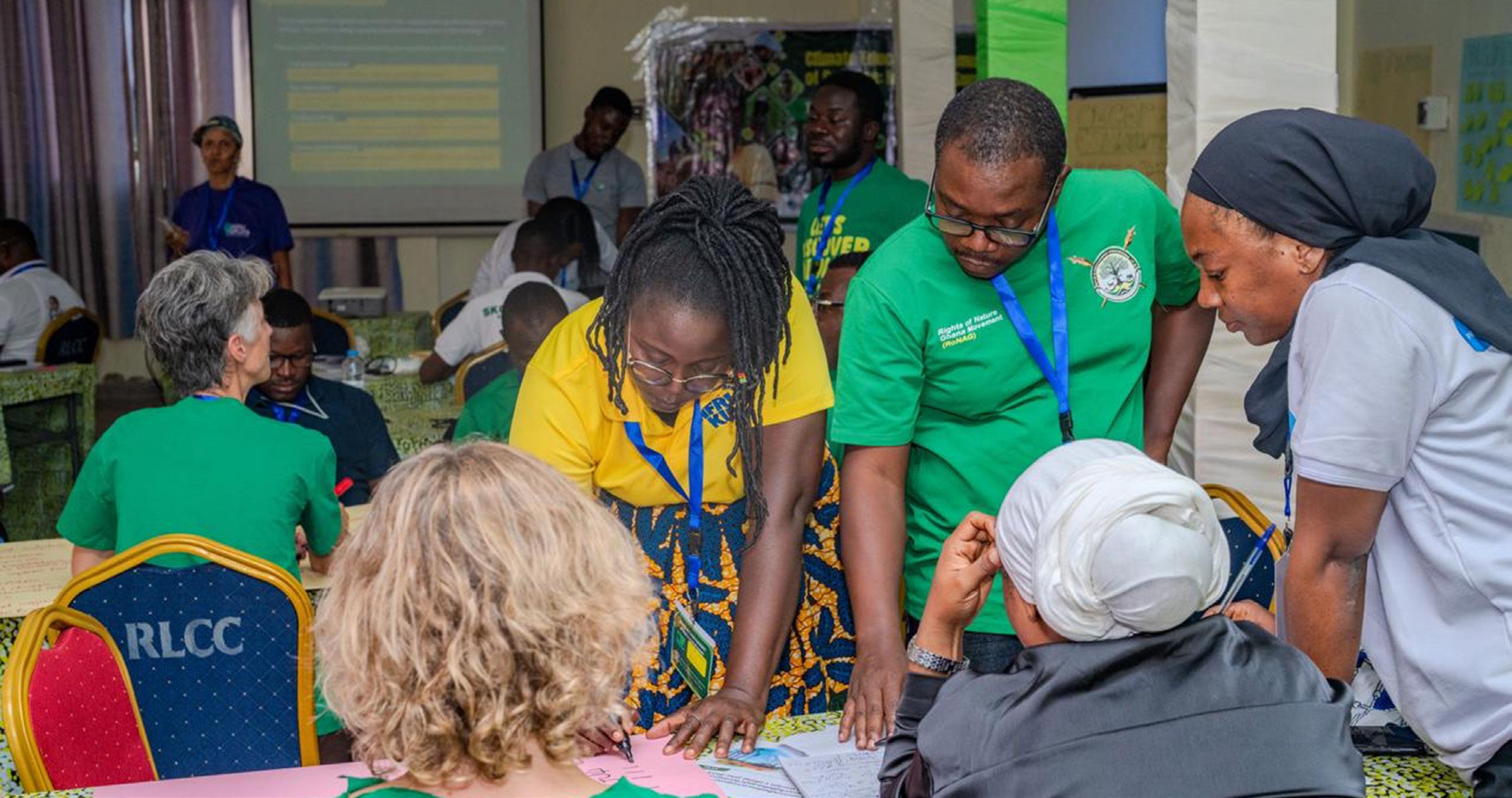
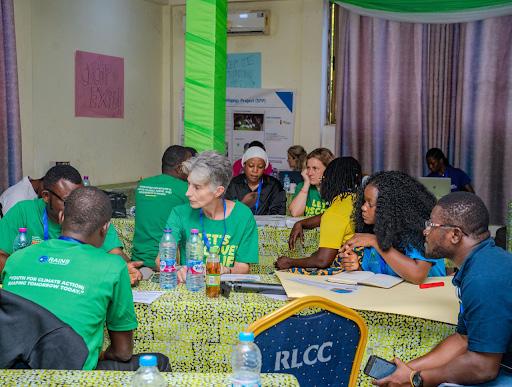
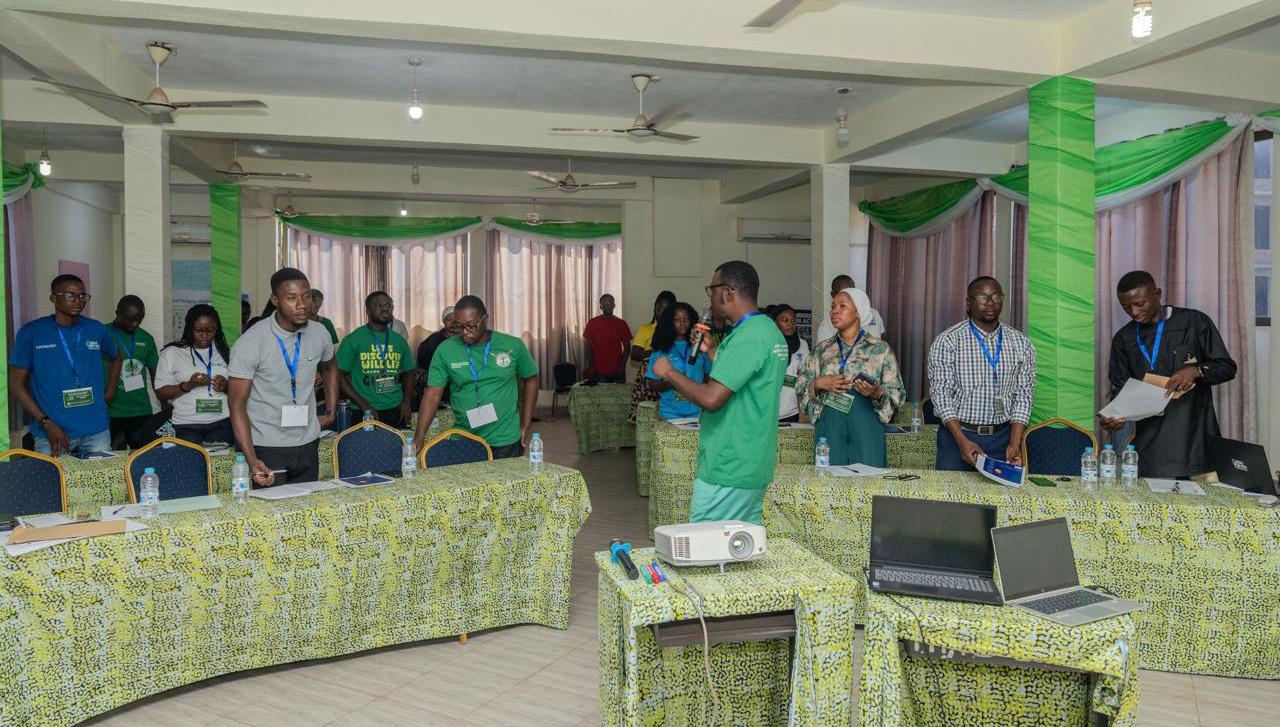
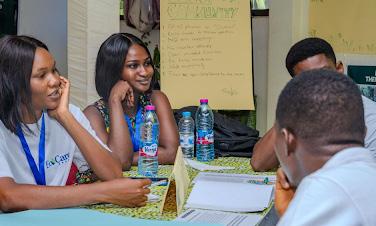
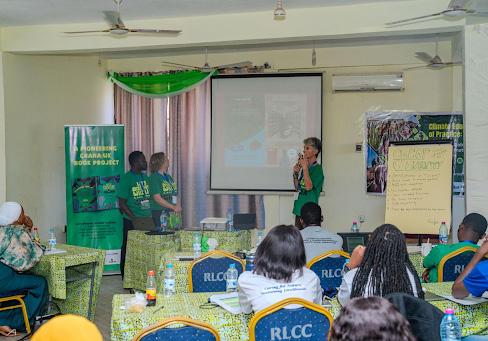
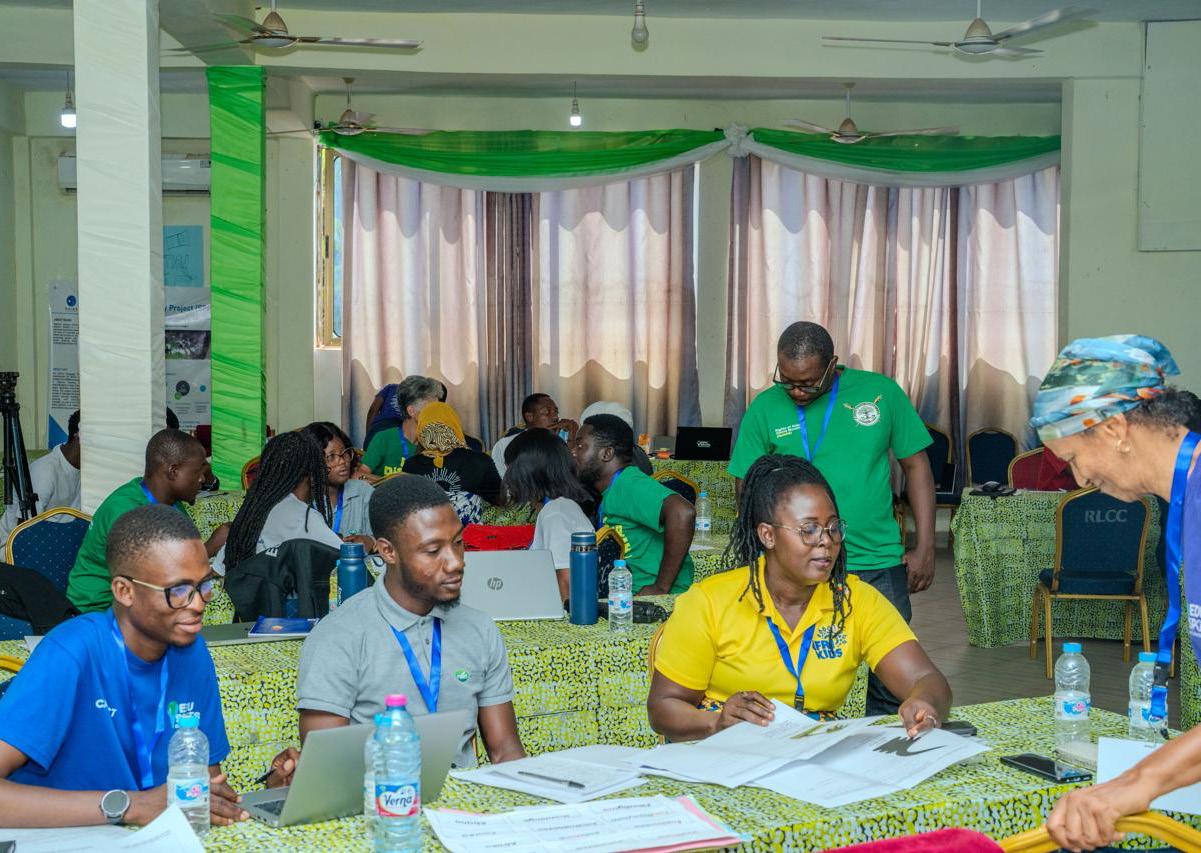
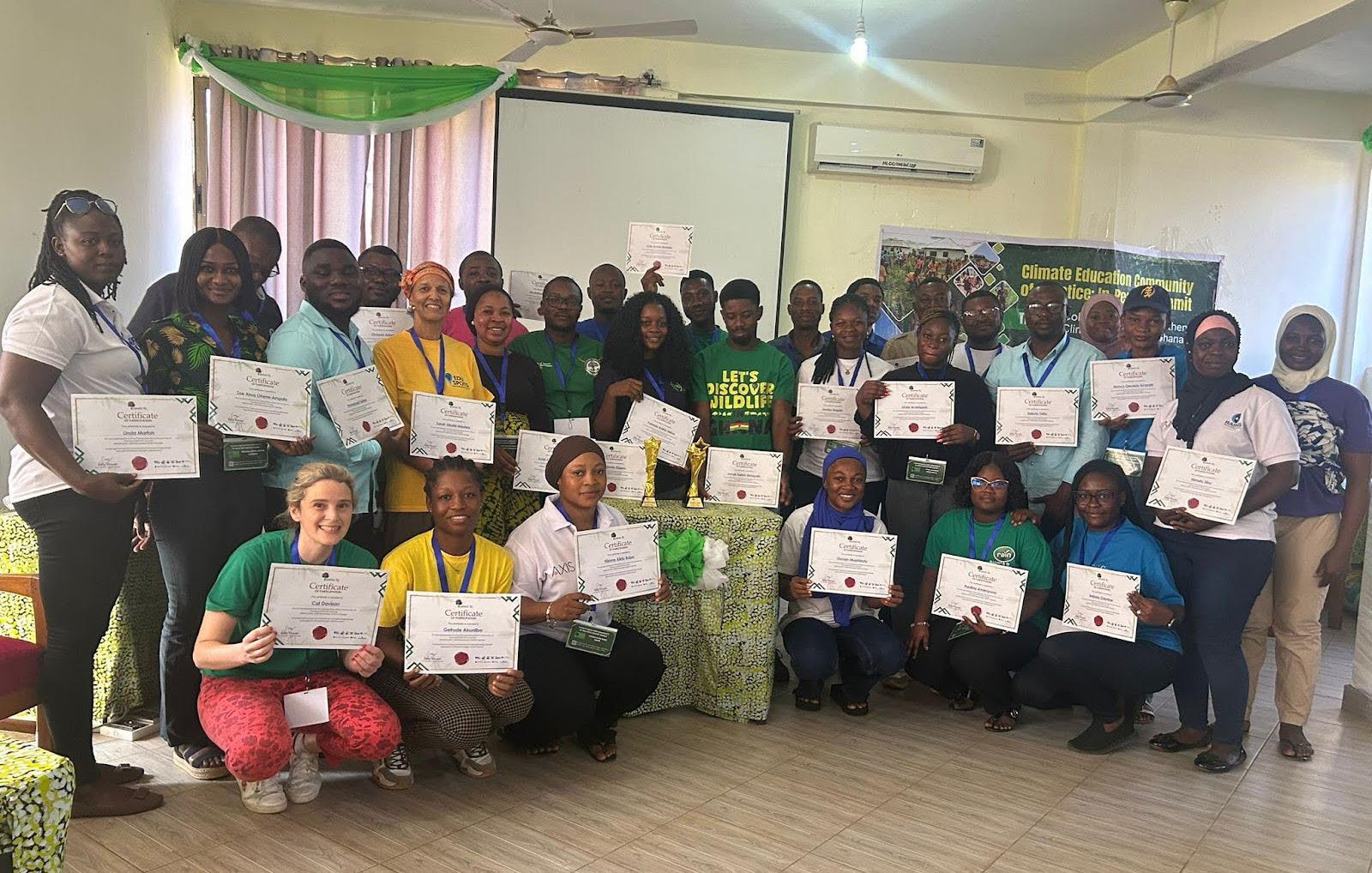
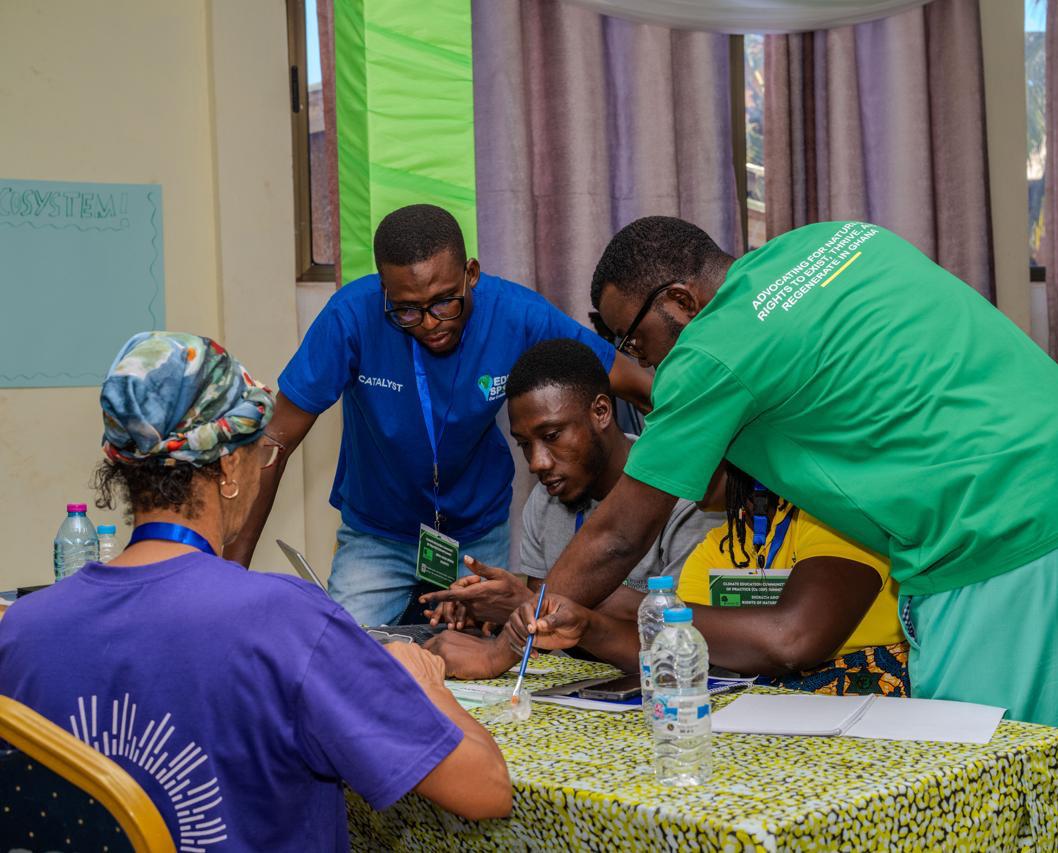
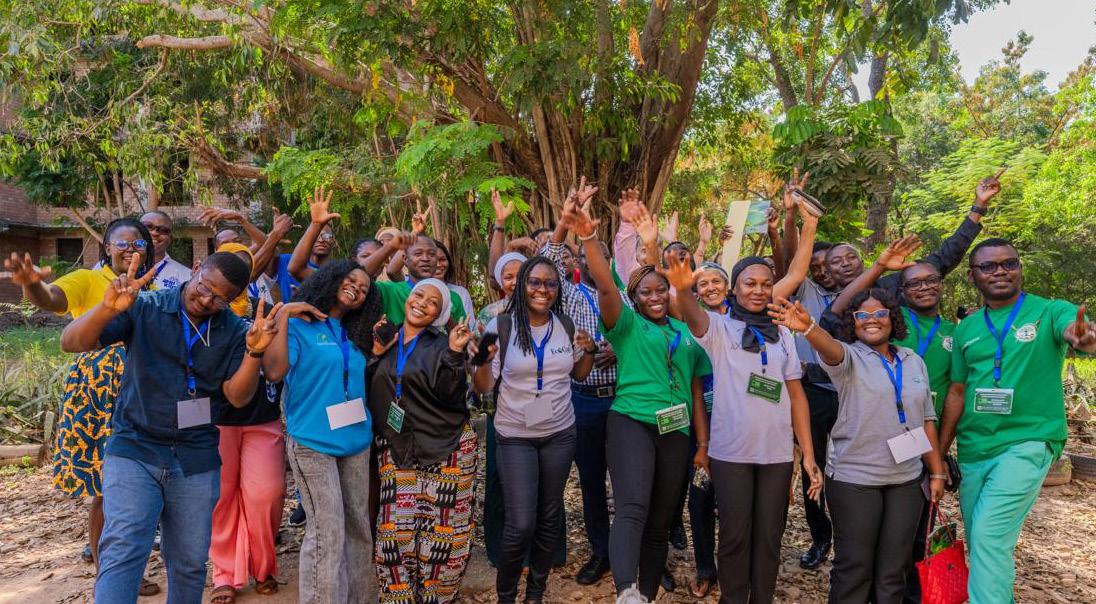
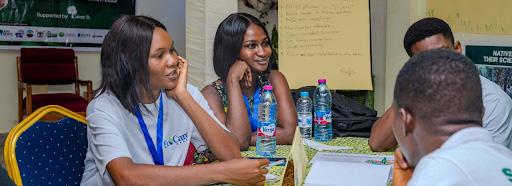
This was a two-day event in Tamale, bringing together 40 participants from 10 NGOs in a range of sessions stretched across indigenous pedagogy, partnerships development, fundraising, resource support, group problemsolving and more!
TIME ACTIVITY
7.30-8.30am Arrival by 8.30am latest, mini exhibition set-up
8.30-9.30am Welcome & introductions
9.30-11.30am Localising plant content in the Ghana Basic School Curriculum with Dr Adom Dickson
11.30-11.45 Short break (snack)
11.45-13.45 “Let’s Discover Wildlife in Ghana” Project with Faith Barcroft, Catherine Barr and Augustine Oti Yeboah (Herp Conservation Ghana and Pangolin-Gh)
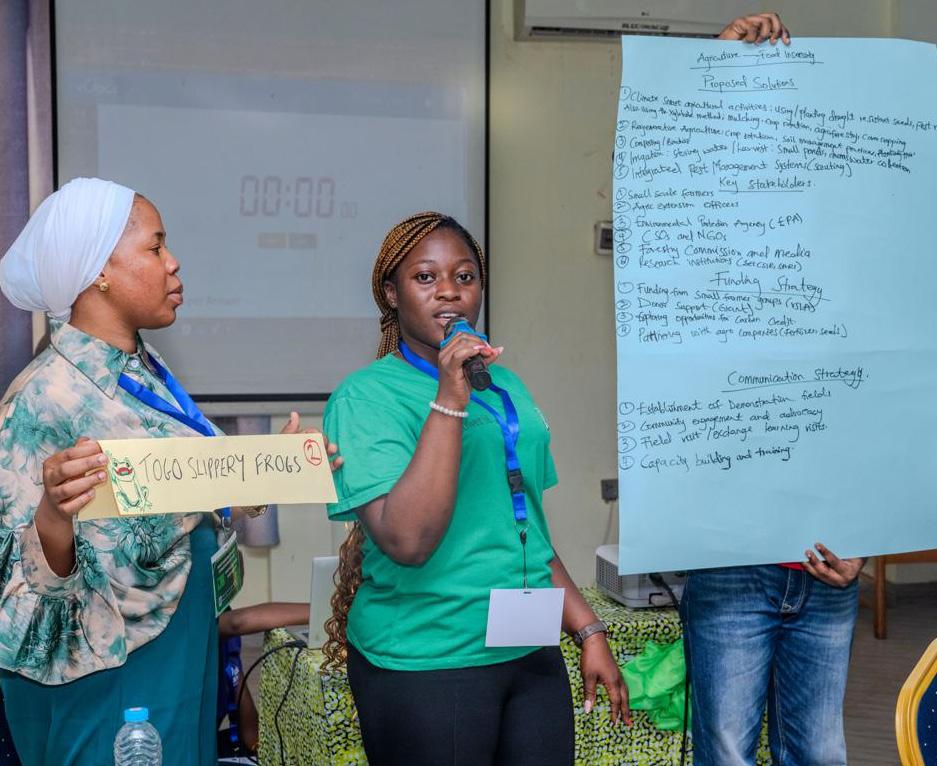
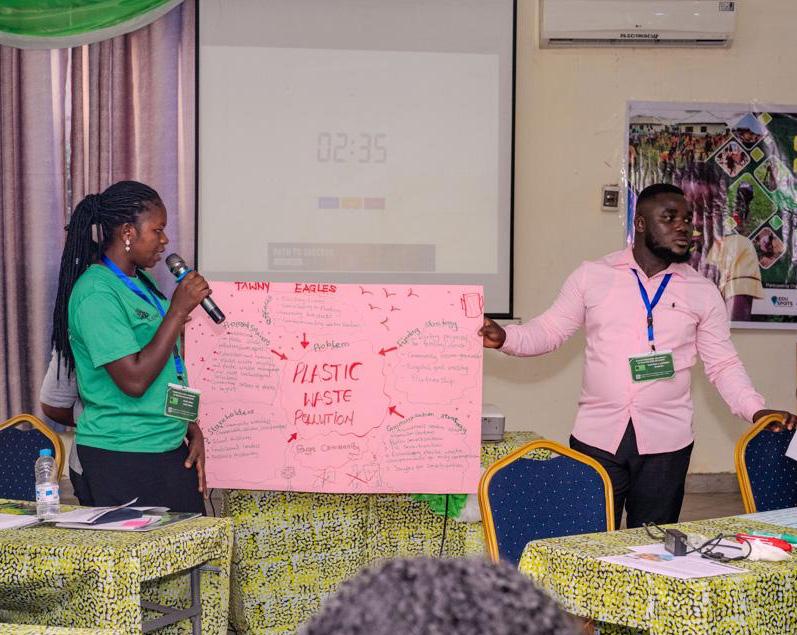
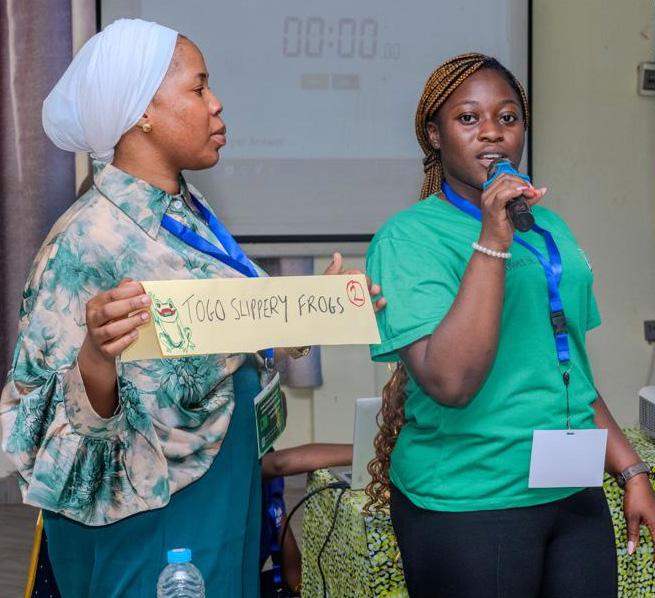
4.15-5.00pm Group presentations & community reflections
5.00-5.30pm Relaxed networking
5.30-6.30pm Evening meal
7.00-9.00pm Quiz & Games
25th November 2025
TIME ACTIVITY
8.00-9.00am Arrival
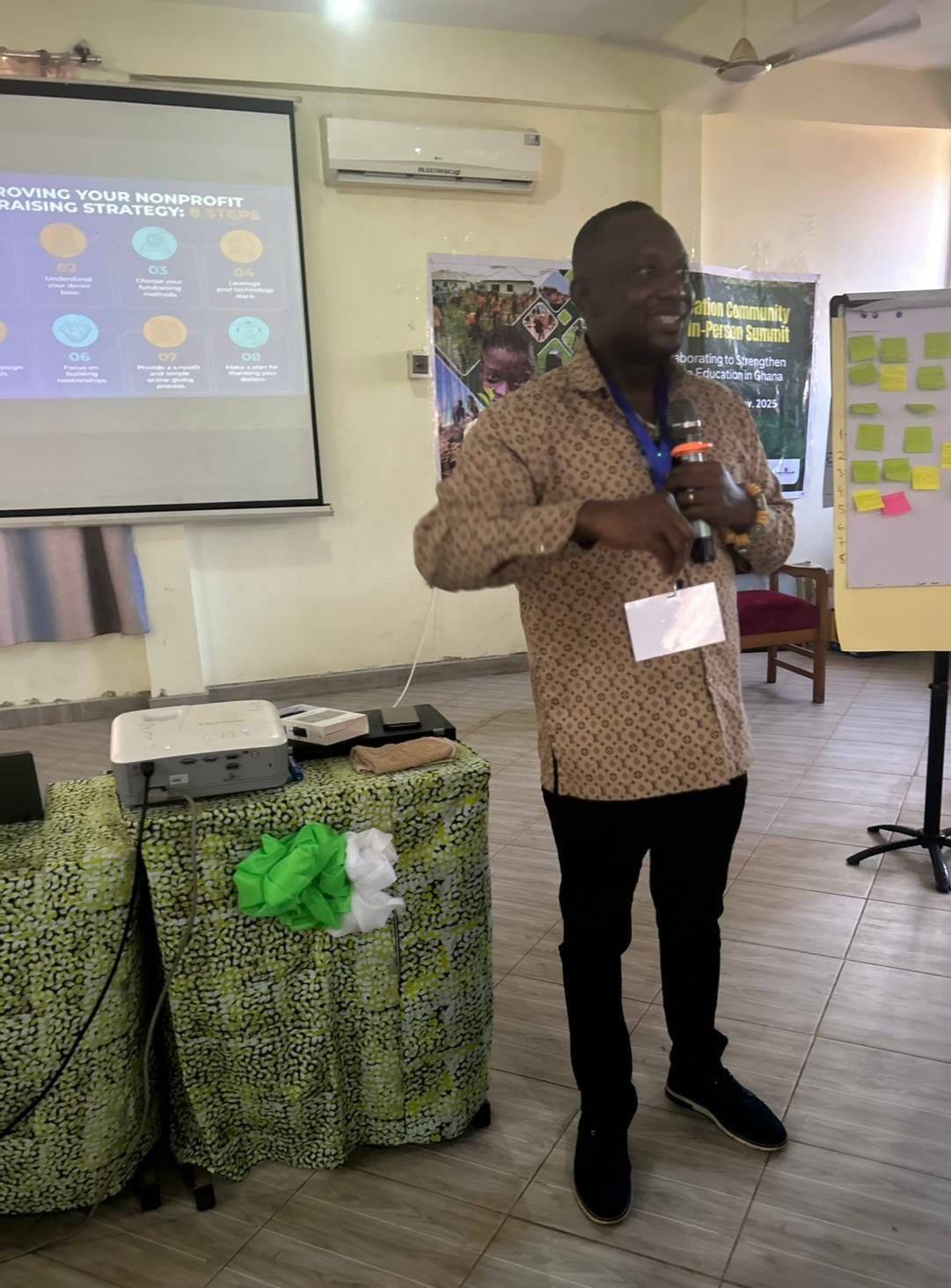
9.00-11.00am Climate Education Fundraising Workshop facilitated by Kyei Yamoah
11.00-11.15pm Break
11.15-12.45pm Organisational speed matching!
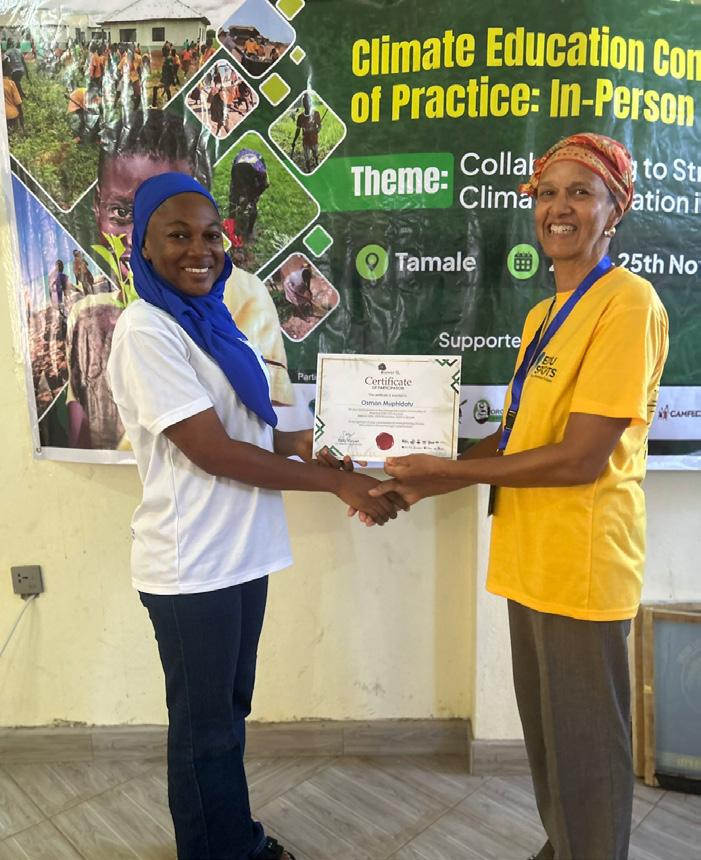
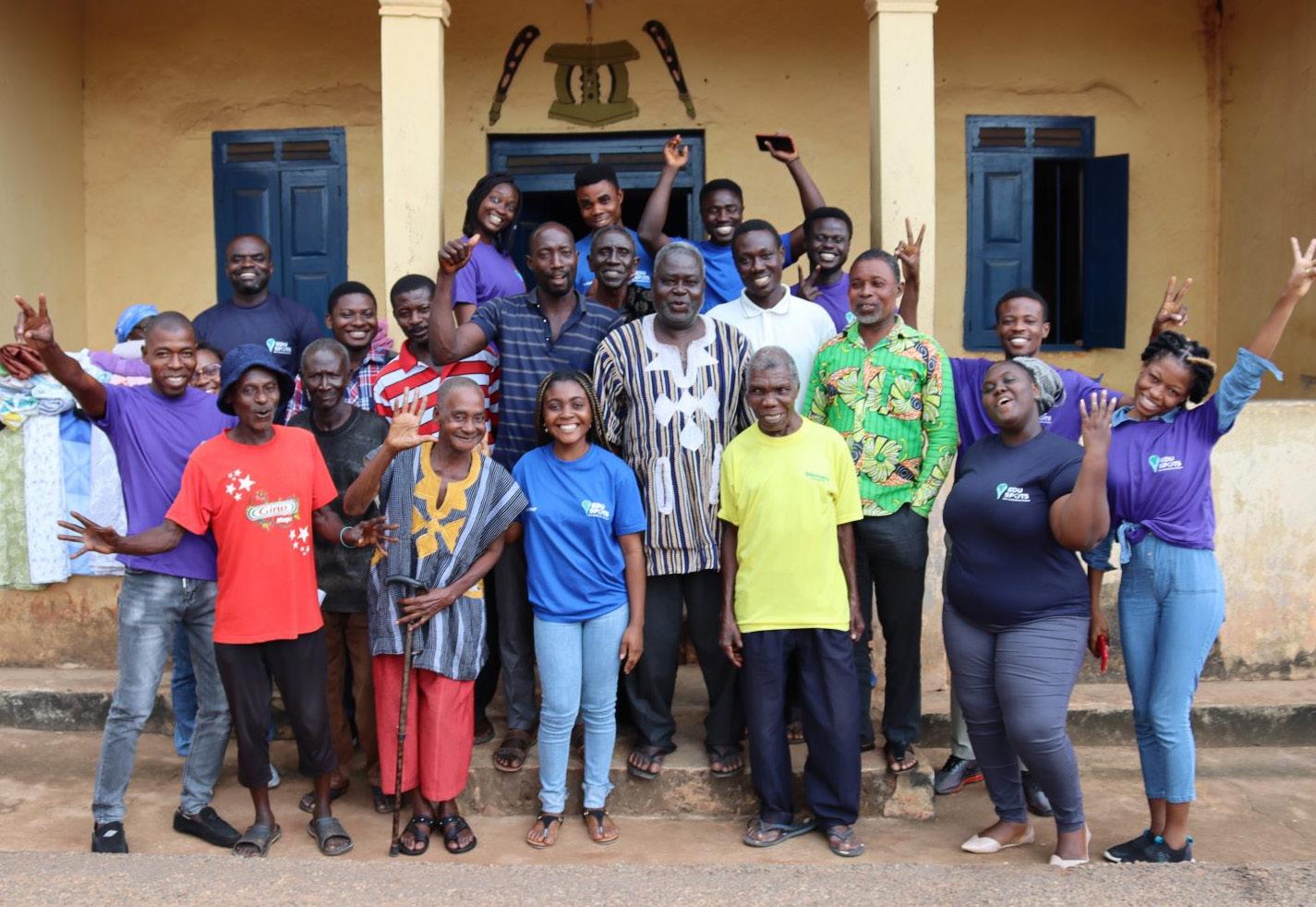
12.45pm Awards & Closing remarks, Final group photo
1.15 pm Food & Departures
i) Key Sessions, Speakers & Reflections
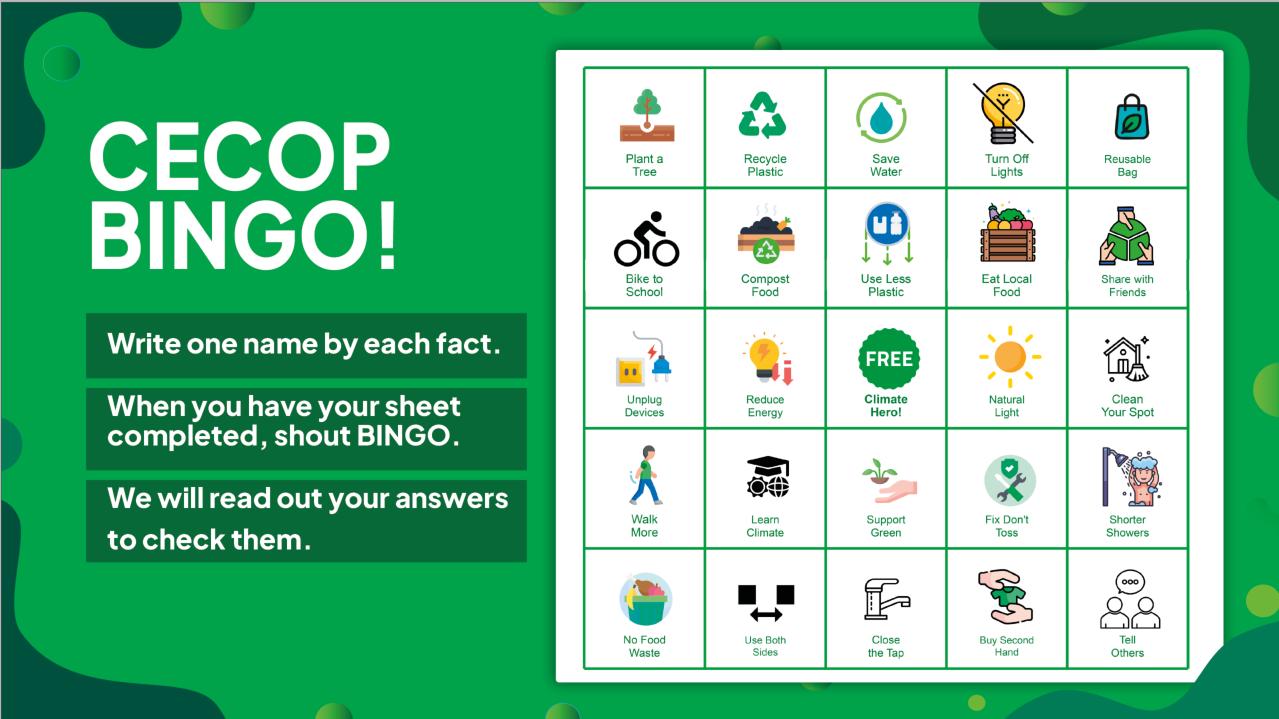
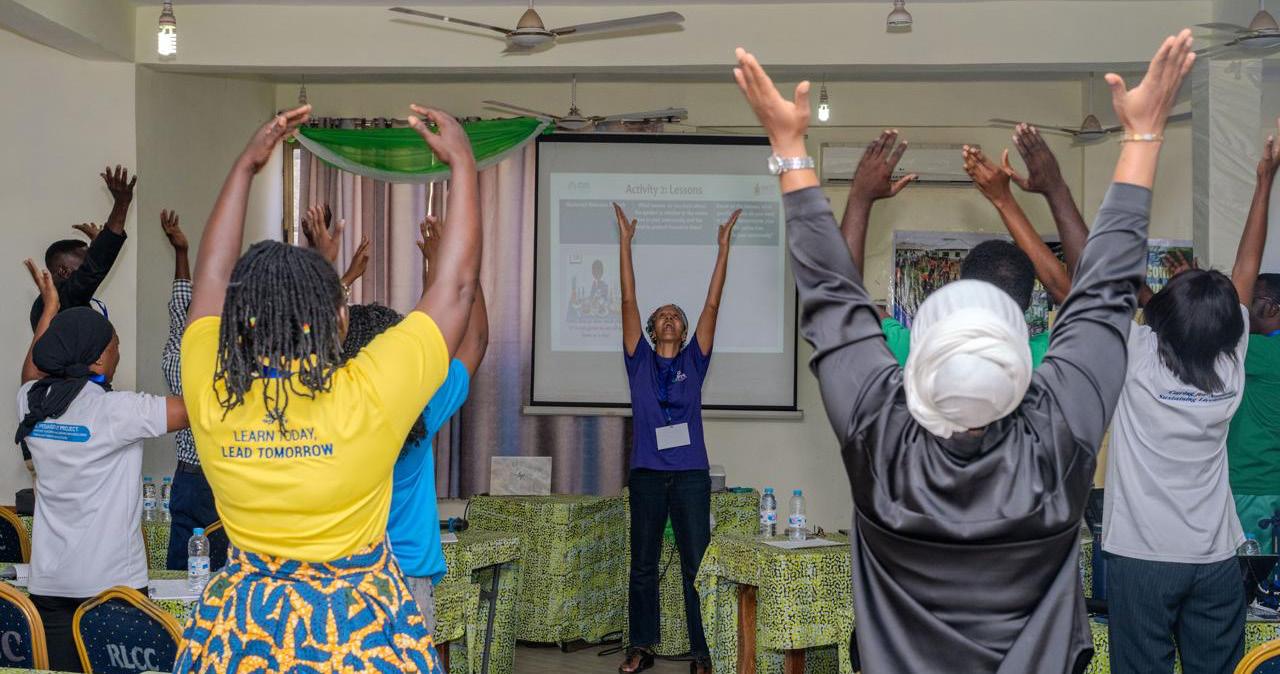
A range of play-based claps and energisers were used throughout, with organisations offering their own versions, keeping learning fun, interactive and enabling participants to maintain their attention. The event started with CECOP Bingo, enabling participants to learn more about who was in the room!
Localising plant content in the Ghana Basic School Curriculum with Dr Adom Dickson
“In the session led by Dr. Dickson, I learned that our native plants are trees are localized like our cultural practices. This tends to erase our actual culture and adapt , meaning in some years our roots would be lost. His session inspired me to uphold and learn more on what we have locally.”
“My most memorable session was localizing plant content in the Ghana basic school curriculum. This is because it gave me a better insight about the indigenous plants that I had no idea about and also about how to sustain the ecosystem.”
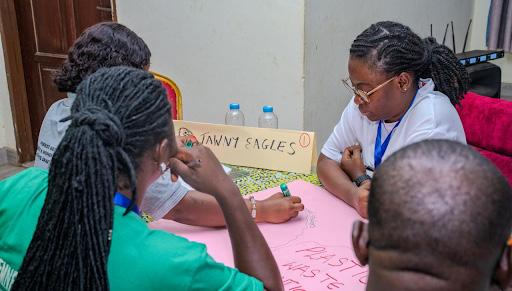
Problem-Solving Challenge in Groups
“The session where we worked in groups to solve environmental problems enabled us to exchange ideas and work in effective collaboration.”
Examples of the problem cards distributed to mixed groups:
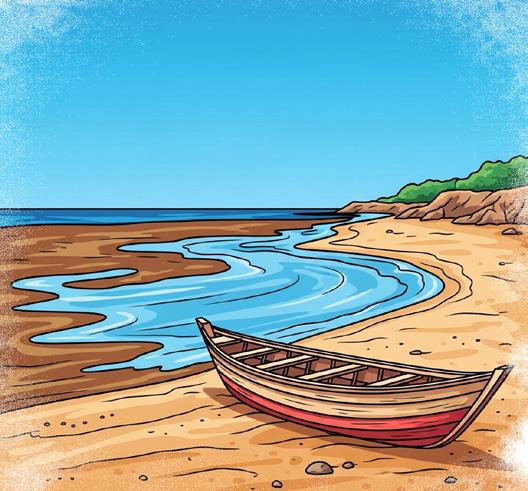
Marine and Coastal Degradation
Coastal communities in Ghana, including areas such as Cape Three Points, are struggling with severe environmental degradation. Illegal mining (galamsey) activities near coastal zones are washing sediment and chemicals into the sea, damaging marine habitats, killing fish, and threatening the livelihoods of fishing families. Coastal erosion, pollution, and mangrove destruction further deepen the crisis.
Your group is tasked with supporting a coastal community facing these pressures. Develop a practical solution that protects the coastline, restores marine ecosystems, and supports the people whose livelihoods depend on these resources.
Youth
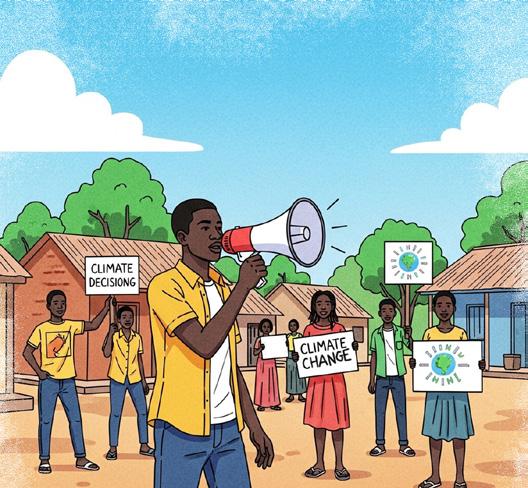
Climate change is not affecting everyone in Ghana equally. Rural and low-income communities face rising temperatures, water shortages, unpredictable rains, and food insecurity, yet they often have the least voice in decision-making. Many young people in these communities want to act but lack platforms, knowledge, or support to engage in climate advocacy or adaptation efforts.
Your task is to design an initiative that empowers young people in a vulnerable community to understand climate justice, raise their voices, and take informed action on the climate challenges affecting them.
TASK
CECOP SUMMIT – ECO CHALLENGE
voice in Climate Justice
TASK
CECOP SUMMIT – ECO CHALLENGE
Quiz Night & Team Building Activities
“The Quiz Session brought new learnings and discovery”
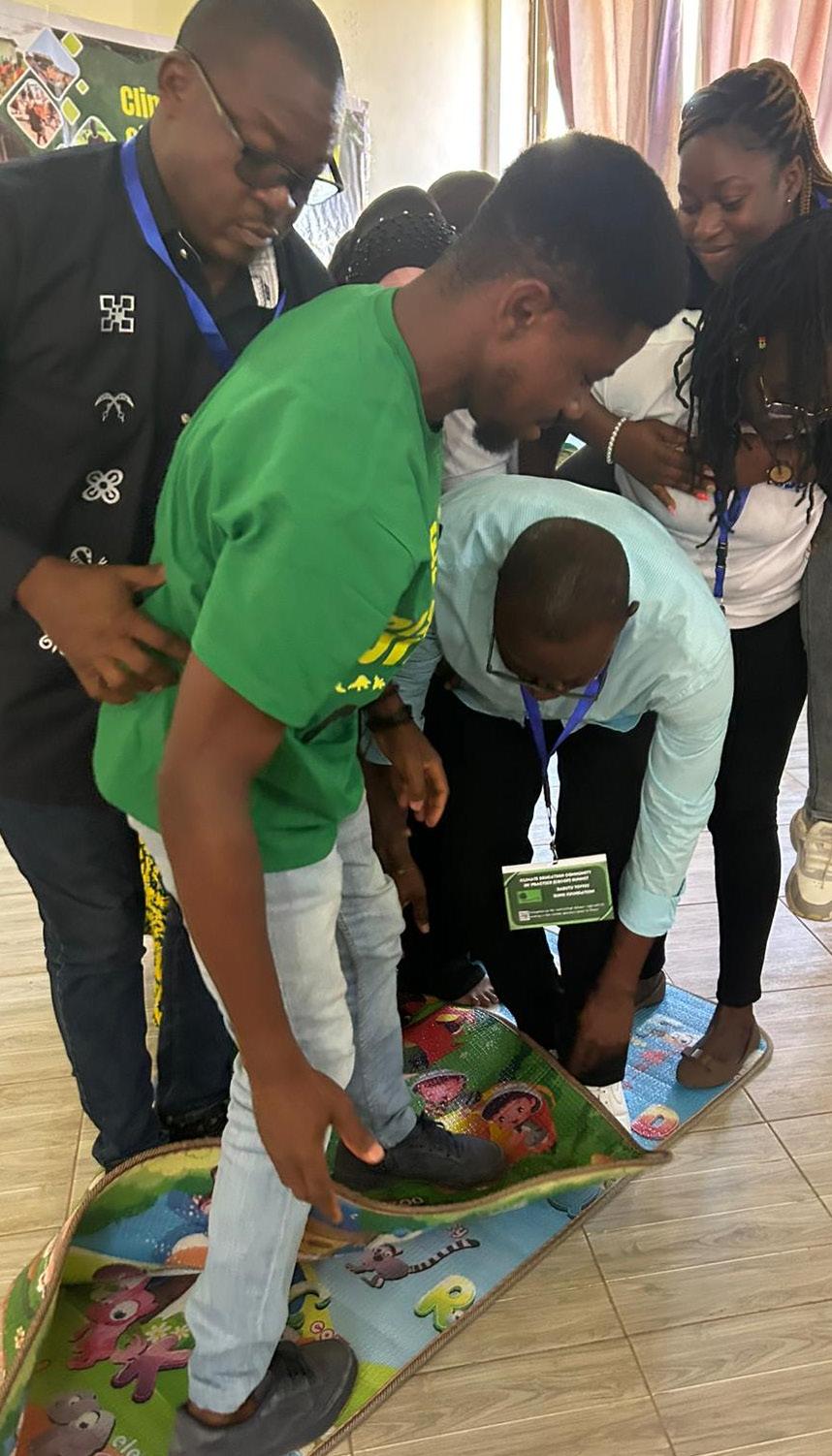
There were a variety of sessions intended to stimulate discussion, ignite curiosity, and strengthen team relationships. This included the ‘flip the mat’ team challenge, which was used as a stimulus to reflect on how we can better work together in the climate education space.
On the first evening, the EduSpots team ran a highly entertaining climate education quiz which involved a mix of factual traditional quiz questions, with playful storytelling, drama and artwork, aiming to reflect the pedagogy that could be used to engage learners.
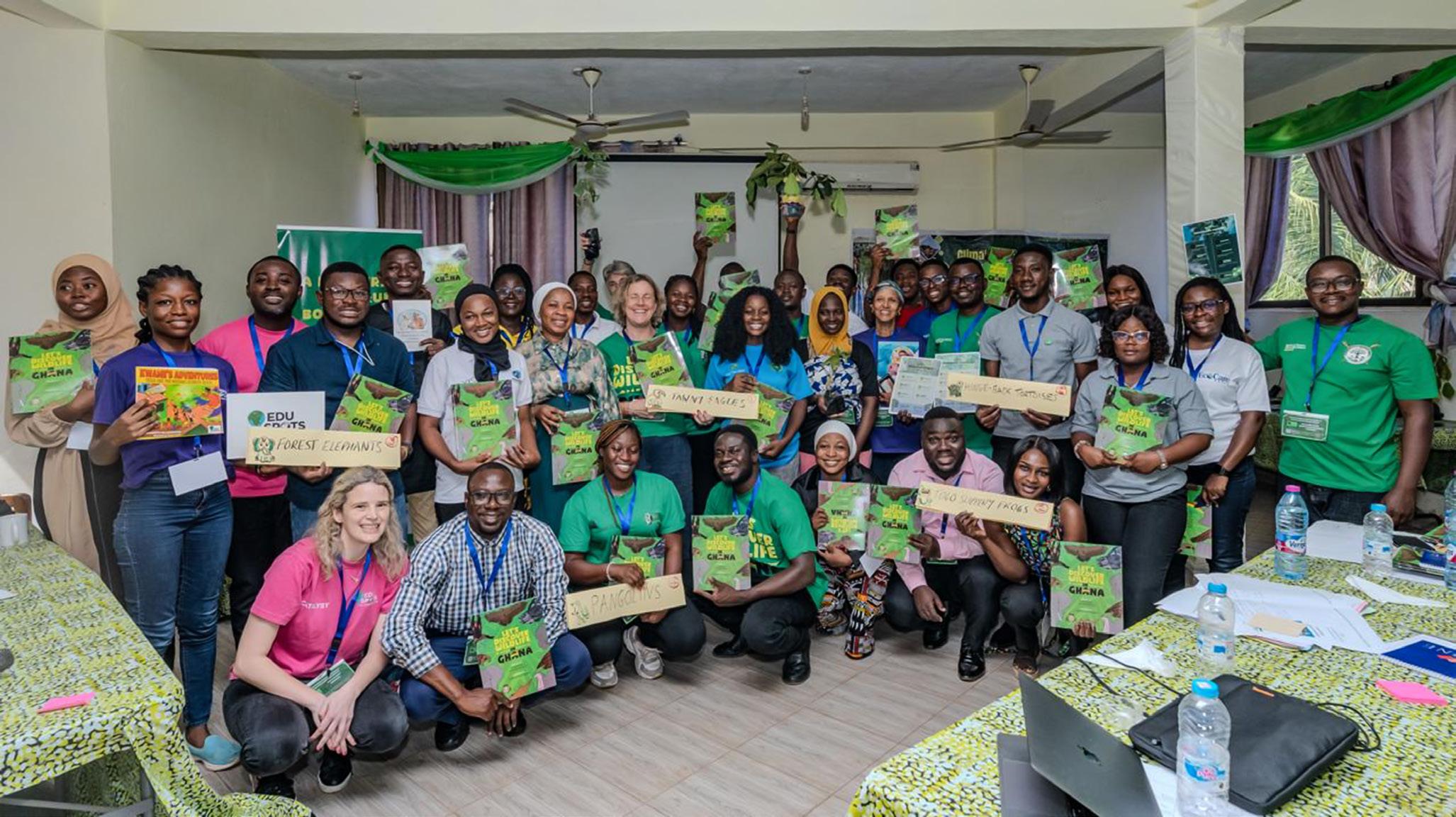
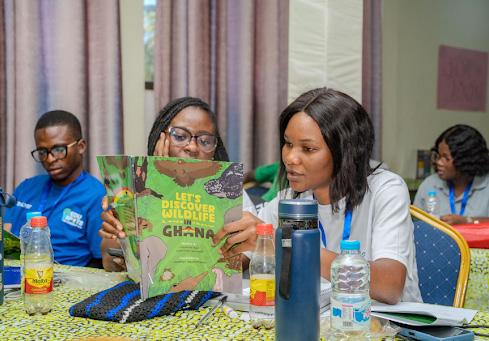
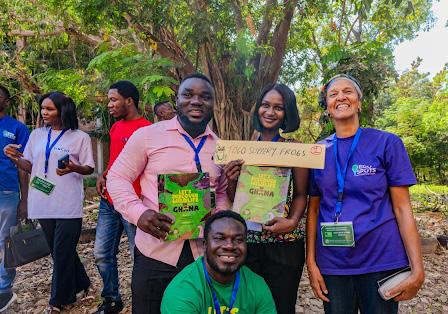
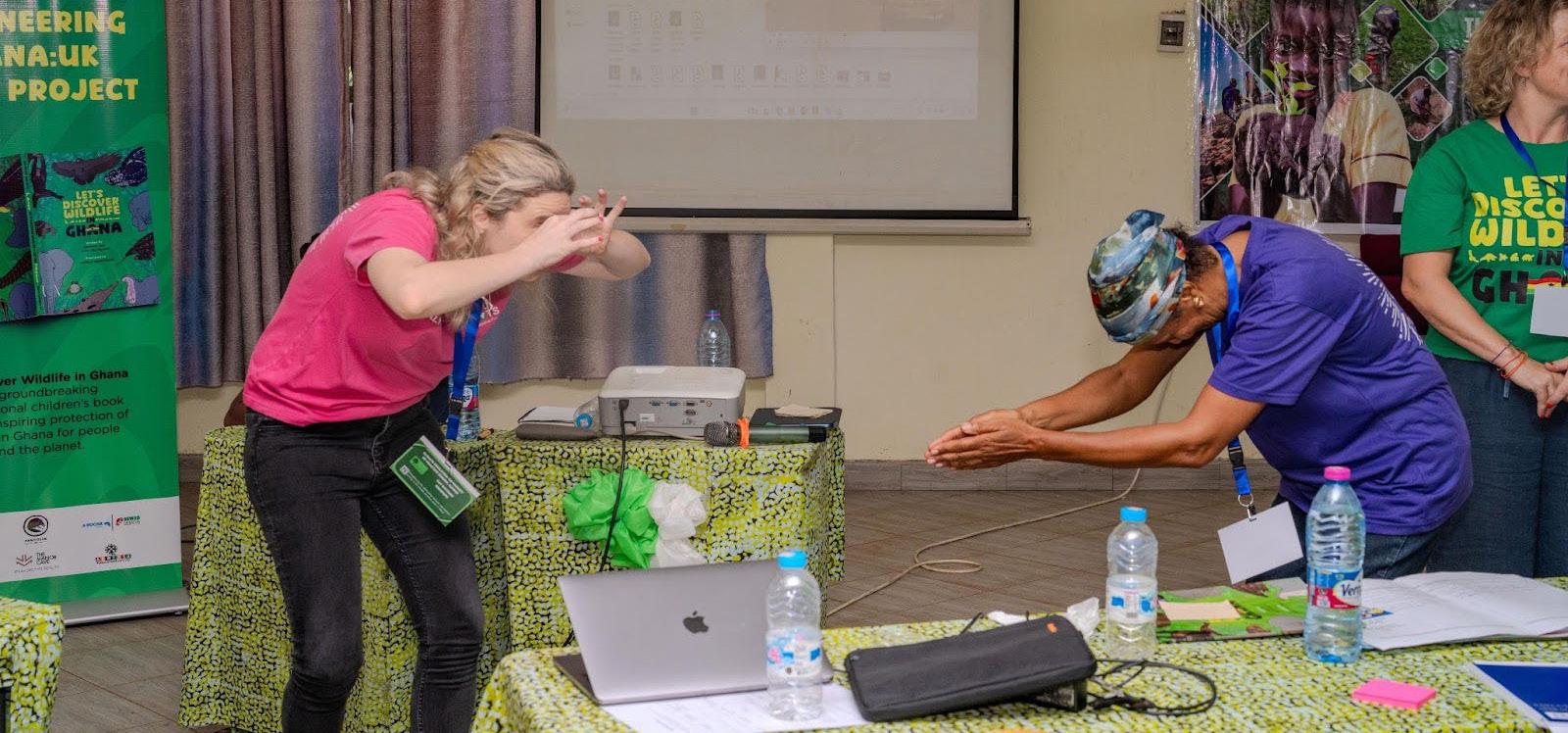
During the session, participants were introduced to the book ‘Let’s Discover Wildlife in Ghana’ and engaged directly with its author, Catherine Barr, and the Project Manager, Faith Barcroft. The author described how she worked closely with several conservation organisations in Ghana to produce the colourful, richly illustrated book, which highlights ten endangered species found in the country. The book aims to inspire children to protect biodiversity and wildlife, and includes a particularly valuable feature on careers in nature conservation – fields that many young people are not widely aware of.
Participants were invited to read the book and share their feedback, which sparked engaging discussions, including the potential for translating the book into local languages to broaden its reach. The session concluded with a fun activity, “Conservation Career Charades”, where participants took turns acting out conservation-related careers featured in the book while others guessed the roles!
All participants received a copy of the book, with some receiving multiple copies to distribute to schools and educational institutions they work with.
Quiz Night & Team Building Activities
Impact and Possible Activities:
“The book enables young people to learn about endangered species in Ghana and what threatens them, and aims to inspire readers to protect biodiversity and wildlife. It includes a particularly valuable feature on careers in nature conservation – fields that many young people are not widely aware of.”
The book could be used as a prompt for a wide variety of activities such as:
• Research on the animals - finding further details on the featured animals, looking for other endangered species in Ghana, finding out what species live in their local area
• Research on habitats and ecosystem – learning more about the habitats of the featured animals, comparing to their own local ecosystem
• Art – creating drawings, posters, poems, songs or dramas about the animals and their habitats
• Debate – exploring how human activities impact animal habitats, and debating the pros and cons
• ·STEM careers – inspiring students to take up conservation-related careers
Climate Education Fundraising Workshop facilitated by
Kyei Yamoah
“The fundraising session was valuable to me as it is crucial in myself and my team’s ability to raise funds for sustainability.”
Mr. Kyei Yamoah joined the group to share a far-reaching presentation on fundraising strategies for the climate education space.
This not only focused on the diverse types of fundraising across grants, events, enterprise and individual giving, but also focused on the different ways in which the NGOs can communicate their work, gain visibility, and build effective partnerships.
Mr Yeboah also introduced the group to the Ghana CSOs funding platform he had developed, and encouraged them to keep an eye on opportunities.
SCAN HERE FOR FUNDING OPPORTUNITIES
Speed Matching
“The Speed Matching Session was most useful because we got to know each other’s work and key supper powers and exchanged contacts for future partnership.”
The final session of the summit involved allocated 5 mins to each organisation to meet with every other organization, learning about their “eco superpowers”, and their partnerships interests and needs.
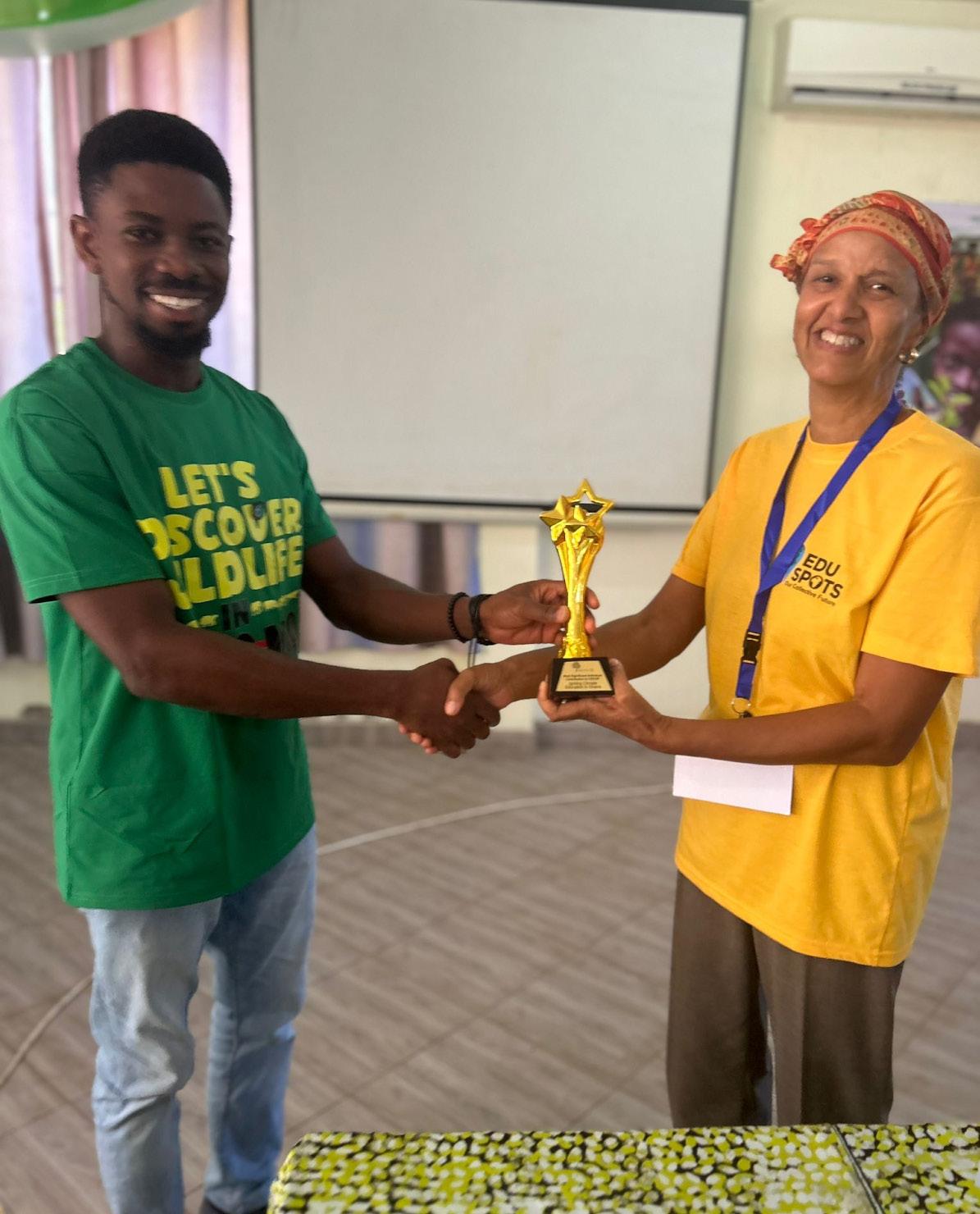
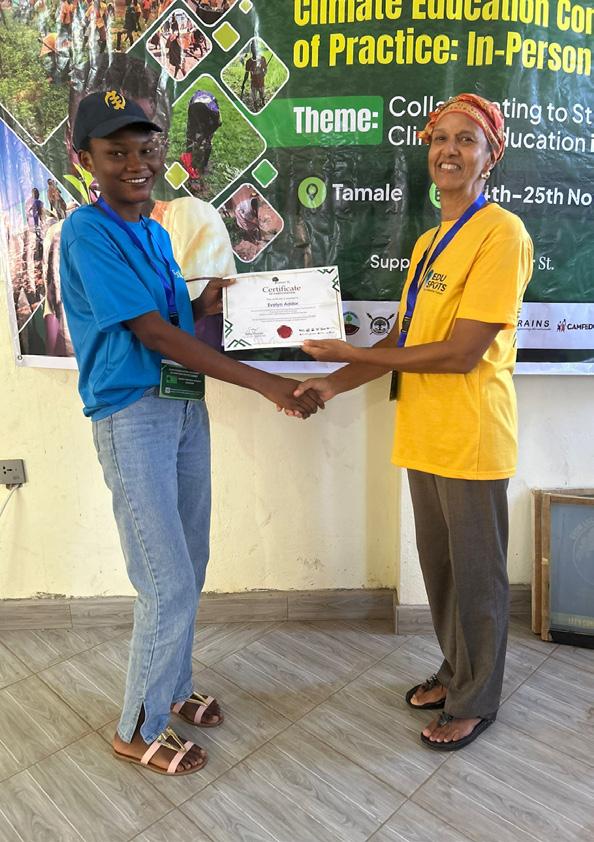
iii) Awards and Recognition
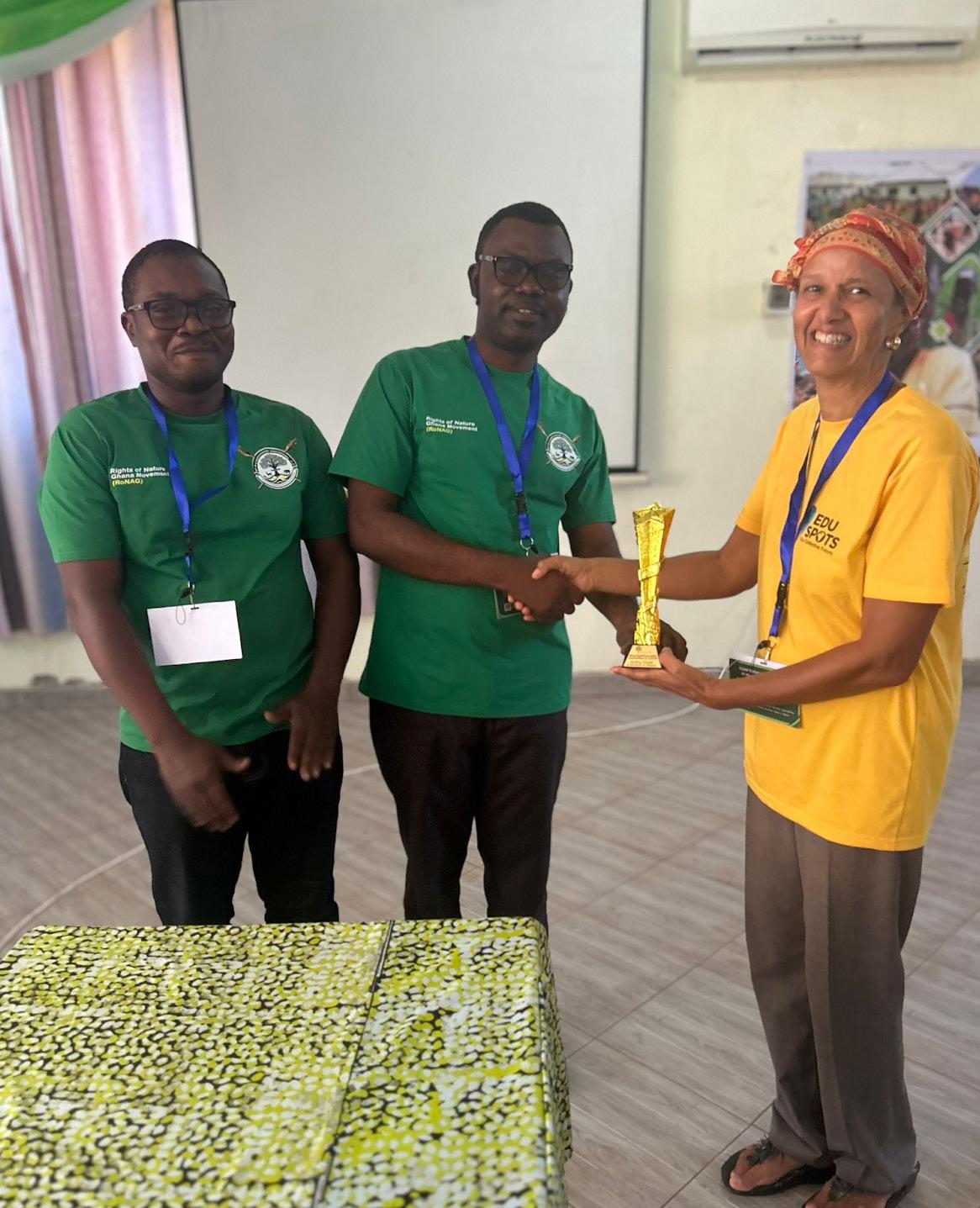
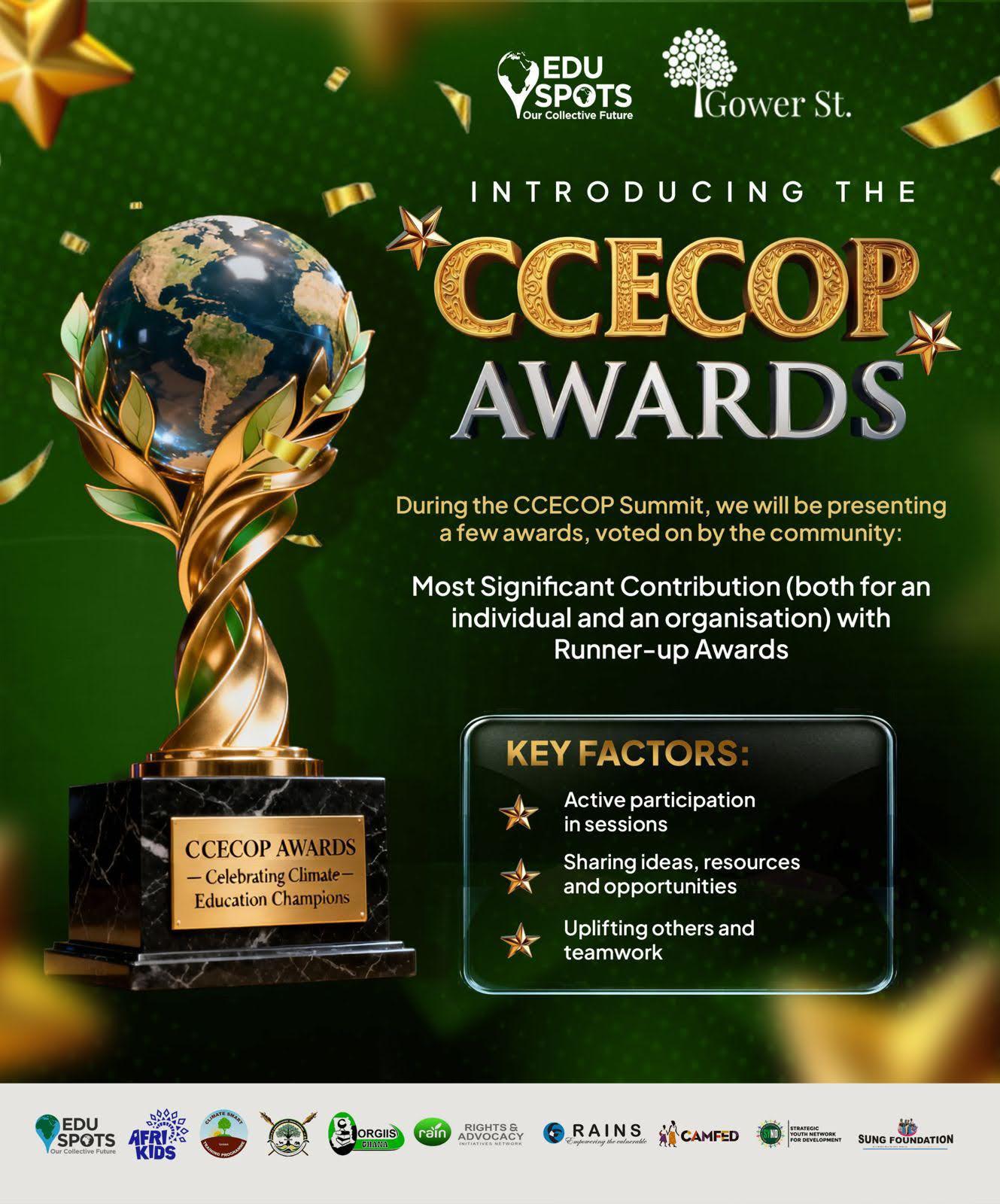
Midway through the CECOP process from July-October, EduSpots decided to introduce the opportunity to nominate peers for an award - both as NGOs and as individuals.
This aimed to both throw a spotlight on, and further strengthen, the qualities we were looking to propel in the community of practice, namely:
1. Active participation in sessions.
2. Sharing ideas, resources and opportunities.
3. Uplifting others and teamwork. The nominations came from group members, who had to give a reason for their nomination.
Most Significant NGO Contribution: RoNAG
Most Significant NGO Contribution: Sarfoh Danquah
Which session was most valuable?
Most common answers that came from an open-ended survey question.
All participants were given certificates, reflecting their participation in the CECOP Summit.
Led by Kyei Yamoah
TREE PEDAGOGY Led by Dr. AdomDickson
TEAM CHALLENGE Led by EduSpots
Led by EduSpots
iv) Summit Feedback
“I hope this wouldn’t be the last. This summit is perfect and well organized with lots of learning and fun.”
(CECOP Summit Participant)
Key statistics
“The CECOP Summit was well organised”
“I felt included in the CECOP Summit Activities”.
“The CECOP Summit’s activities were relevant to my work in climate education.”
100% AGREED
100% AGREED 84%
AGREE
100% AGREED 84%
AGREE
“I feel more confident in fundraising in climate education as a result of the CECOP Summit.” 96% AGREED
“I have made new friends/colleagues through the CECOP event with whom I will keep in touch.”
“The CECOP Summit inspired me to strengthen my work in climate education.”
96% AGREED
100% AGREED
68%
v) Suggestions for future summits:
“It was a very well thoughtful and organized program which should be done twice a year.” “Improve? This is the best I’ve seen and experienced.”
Awards / dinner night
Increase length of Summit
Increase frequency in the year
Improve venue/food quality
Consider flights from Accra
Improve Projector
vi) What worked in terms of facilitation?
These were some of the reflections from participants shared in the post-Summit surveys, with many suggesting that they would use similar learning strategies in their own facilitation approach moving forwards:
“The practice while learning in the in-person meeting was most effective. You leave the meeting with what you learnt written on your heart.”
“Inclusivity. This creates opportunities for people to share ideas and learn.”
“Shared learning: Where participants were allowed to facilitate discussions. It strengthened the learning process.”
“The icebreakers and fun games made it more entertaining and energizing so no one felt bored or lost interest in any session.”
“The regular Group Exercise. This helps each person engage, and helps develop personal development through individual participation.”
Ice-breakers, Creativity & Play
Inclusive approach
Group exercises
Which of the learning and facilitation strategies that EduSpots have used did you find the most effective? (Open ended question)
3. Climate Education Case Studies
a) Dr. Adom Dickson: Basic School Indigenous Knowledge Inspired (BASIK) Pedagogy for Teaching Native Trees in Ghana
“Before the project, our learners’ attitude toward the trees in the school was just a passive relationship, acting as if they didn’t even exist. Now, our learners can confidently identify various native trees within our school and locality.” (Teacher 21, Savannah Region, February 13, 2025)
Background and Purpose
Education on native tree species using indigenous knowledge systems is crucial in schools, teaching children about the important ecological role native trees play and their interconnections with culture and lived experiences. Formal education in Ghana follows a Western-based approach, where historically there have been very few resources available to teach indigenous knowledge. The BASIK tree pedagogy is part of the climate and nature-based education workstream, one of the four strategic activities by the Rights of Nature Ghana Movement (RoNAG) led by Dr. Dickson Adom (PI) and Ms. Yvette Harvey-Brown (Co-PI). The novel pilot project carried out in the Ashanti Region of Ghana was funded by Fondation Franklinia and Botanic Gardens Conservation International (BGCI). Later, Gower Street Trust provided funding for the expansion of the project in four other regions of Ghana, namely Western, Savannah, Eastern, and Greater Accra regions.
The project aims at teaching basic school learners about native trees in their communities using Ghanaian indigenous knowledge, such as proverbs, cultural symbols, folk songs, cosmological belief systems, and myths related to native trees and, broadly, biodiversity conservation. The project emphasises traditional ecological knowledge related to climate mitigation/adaptation strategies, and indigenous agronomic practices related to native tree species. This is a step to decolonise the plant content in the Basic school curriculum, promote contextual and experiential learning, preserve indigenous knowledge, ensure that learners are well-versed with their cultural heritage, and promote native tree species conservation in Ghana.
reflect on how we can better work together in the climate education space.
On the first evening, the EduSpots team ran a highly entertaining climate education quiz which involved a mix of factual traditional quiz questions, with playful storytelling, drama and artwork, aiming to reflect the pedagogy that could be used to engage learners.
Project Deliverables
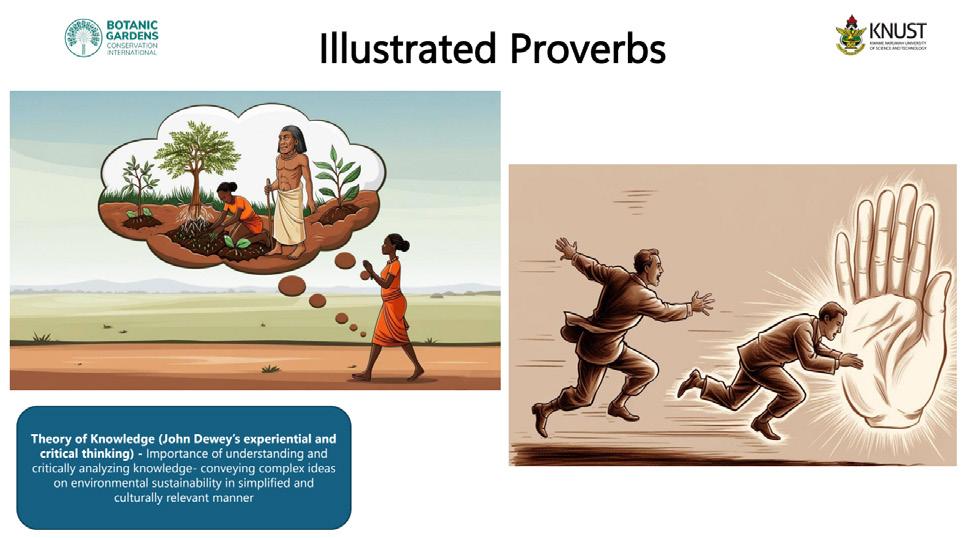
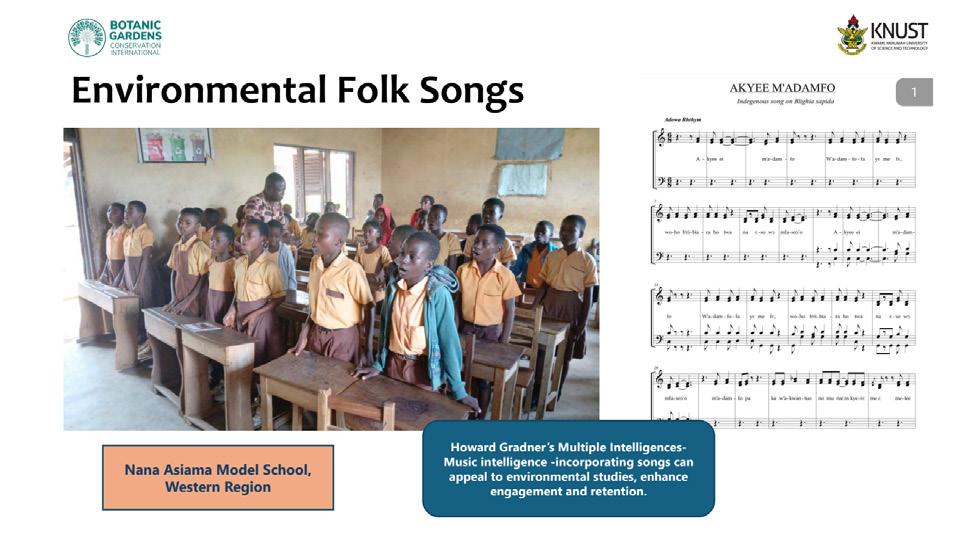
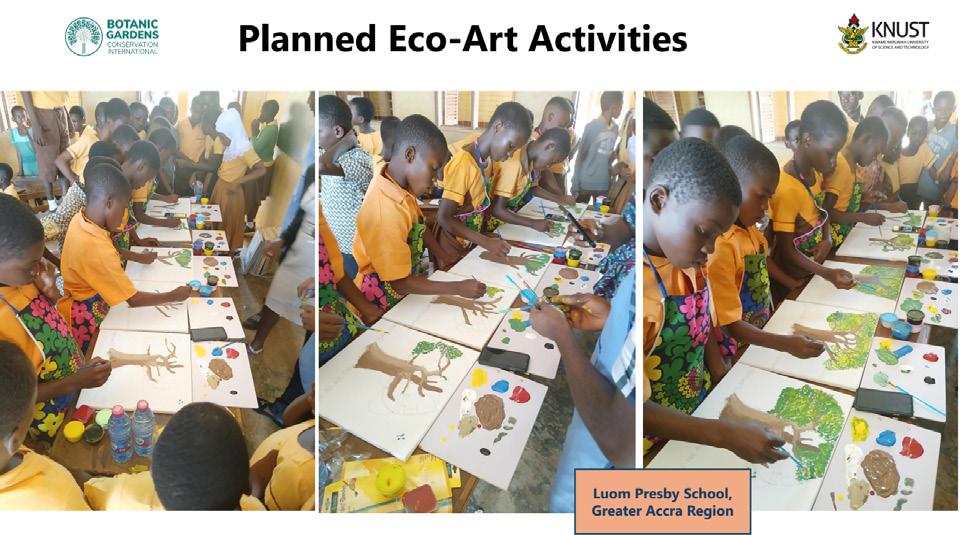
The project has developed an innovative pedagogical guide on native trees for basic school learners. In addition, the project has developed 20 environmental folk songs, based on twenty documented native tree species from five (5) regions in Ghana, illustrated proverbs and cultural symbols for lessons and projects on the uses and preservation of native trees. In addition, the project promotes the use of eco-art activities and collaborative teaching of native tree content with teams consisting of basic school teachers, community members, and foresters. The project included native tree planting and gardening projects in schools undertaken in partnership between schools and communities.
Project Outcomes
This project has resulted in a greater harmonious relationship between Ghana’s youth, its native trees, and its unique cultural heritage. Basic school learners, basic school teachers, school administrators, and community members are now encouraged to plant and protect the native trees in their communities and regions. Some of the impact stories are stated below:
“The integration of Adinkra cultural symbols and proverbs also helped in forging a powerful connection between traditional wisdom and environmental responsibility. The students’ understanding of Adinkra symbols, traditionally used to convey profound philosophical concepts, instilled within them a sense of responsibility in preserving and protecting native trees.” (Teacher 21, Savannah Region, February 13, 2025)
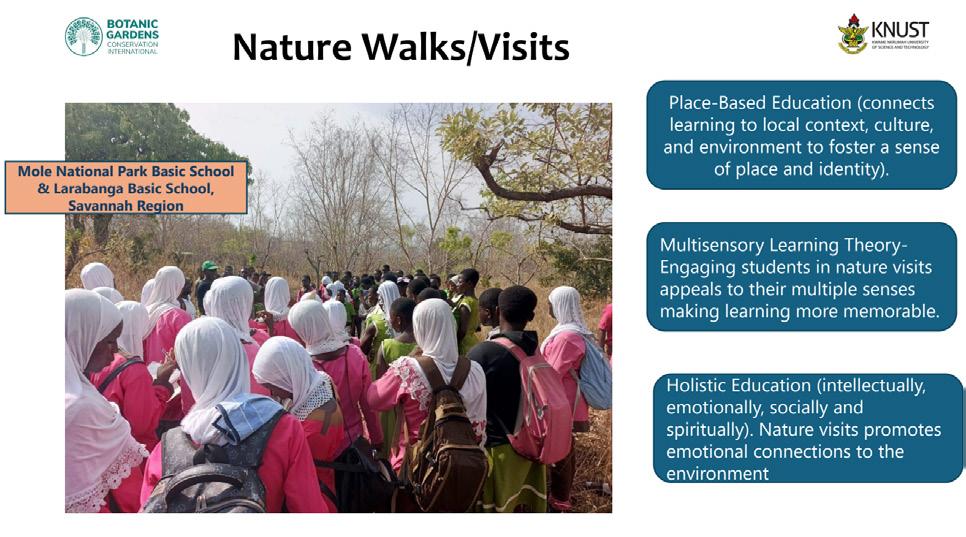
“The teaching and learning activities made us very interactive learners. We were able to interact well with the trees when we went on field trips and nature walks. Also, the group and individual projects pushed us to work and get involved in all the lessons on native tree species. Together with our classmates, we planted seedlings of native trees, prepared and cared for a garden, and did drawings and colouring works on native trees for class presentations. They really helped us to own the learning.” (Basic School Learners, FGD-5, November 13, 2024).
“The learners have learned the ecological, cultural, and medicinal values of the native trees around us, some of which we ourselves didn’t know of, though they were in our environment. We also embarked on several field trips to a nursery where young trees are groomed and also to the forest reserve, Asenema Waterfall, to view the growth and development processes of native tree species. This has given the learners experiential knowledge and hands-on experience on conserving native native trees in their environment.” (Teacher 4, Eastern Region, February 28, 2025).
“I am overjoyed that I have the privilege of serving as a teacher in a school, teaching my grandchildren things I was taught by my kinsmen about these native tree species. I am happy that at least they will know about them well and protect them for posterity. I see this responsibility as a spiritual duty required of me by Tweaduampon [God] and my ancestors, and I know they would give me a great reward after my physical passing to where they are.”
(Elderly Man, Personal Interview, November 15, 2024).
Next Steps after CECOP Summit 2025
Expand the research and documentation
Expand the research and documentation on native tree species in the remaining eleven (11) regions in Ghana, at least four species in each region, and develop similar instructional resources to assist teachers in teaching the basic school learners.
Print hard copies
Print hard copies of the developed teacher guide and learner book/ resource on native trees in Ghana.
Organise training workshops
Organise training workshops for basic school teachers and leaders of CSOs working in climate/nature-based education on how to use the developed resources based on the BASIK tree pedagogy in different regions in Ghana.
Develop community-school tree plantation projects
Develop communityschool partnered native tree plantation projects in various communities in Ghana.
Develop a native tree project guide
Develop a native tree project guide for new native tree clubs or existing eco-clubs to guide them in their activities and projects.
Organize a national competition & tree festivals
Organize a national native tree education competition and a national tree festival across basic schools in Ghana.
Develop a learner resources
Develop a learner book/ resource on native trees for basic school learners on native trees in Ghana.
Create native tree clubs
Create native tree clubs in basic schools with no eco-clubs with a teacher and community member patrons. It will encourage existing eco-clubs to include projects on native tree species in their school and community projects.
Mainstream resources in school curriculum
Liaise with the basic school curriculum review to mainstream the developed resources in localising the plant content in the basic school curriculum.
b) EduSpots: EcoSTEM Co-Curricular Clubs
“EduSpots didn’t just provide resources; they ignited a culture of learning, collaboration and leadership that changed my life.’ (Abdul-Raheem, learner, EcoSTEM Learner, now EcoSTEM Catalyst, Sakasaka Spot)
The EduSpots EcoSTEM strand seeks to enhance practical STEM and environmental sustainability education across the communities in the EduSpots network and beyond, with 25 clubs participating in 2025 led by trained local volunteers named ‘Catalysts’, involving over 400 students mostly between the ages of 11-14 in Junior High 1-3.
EduSpots runs the EcoSTEM clubs at community-led spaces named ‘Spots’, many of which are inside Ghana Education Service schools, with a new relationship established with the Ghana Library Authority in Teshie. There is a strong focus on community leadership, community engagement and participatory methods, aiming to make learning practical, relevant to the local context, and suffused with critical thinking and scientific exploration.
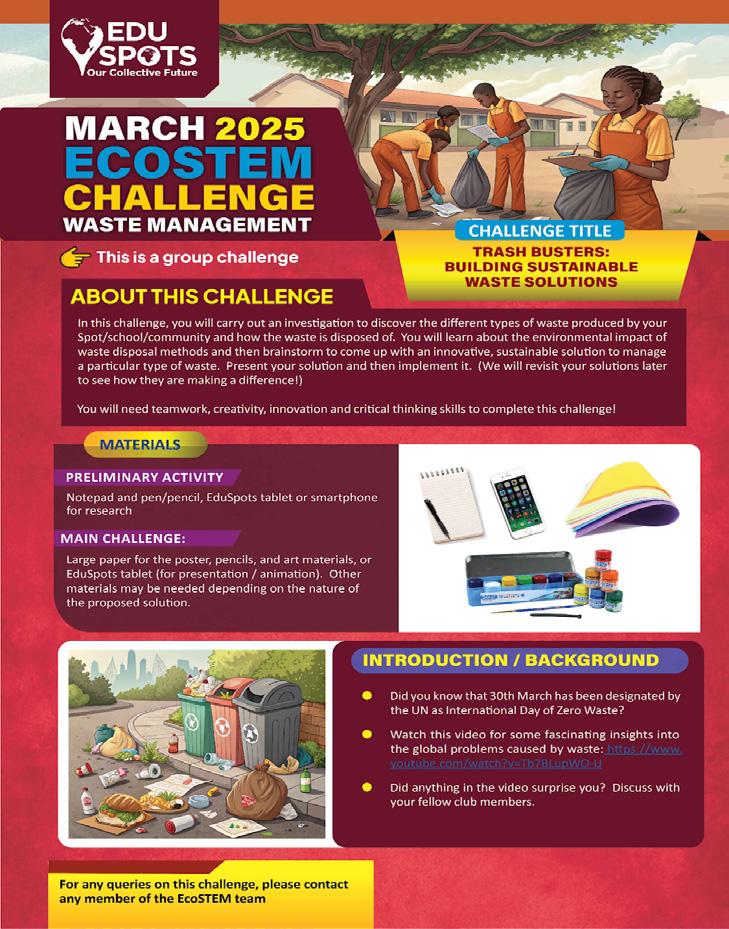
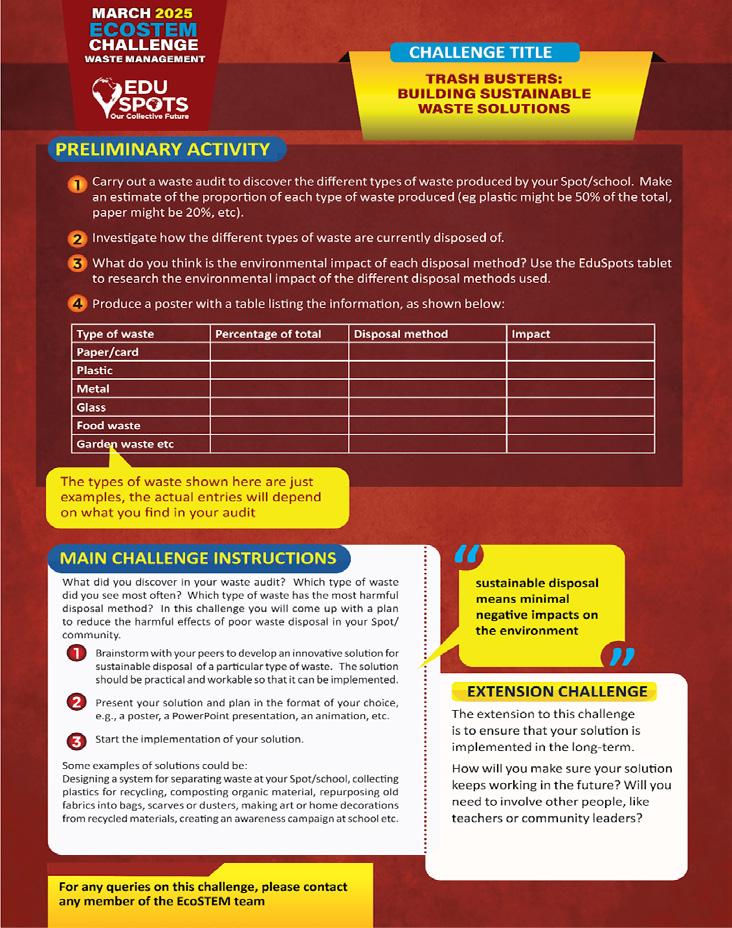
Across a decade of igniting digitalised community-led education, EduSpots has developed a multi-step system that enables Catalysts to exchange ideas on WhatsApp, gain support from peer mentors, and engage high-level training on Zoom, led by specialist facilitators, often drawn from the network. Each month, the Strand Coordinator launches a monthly team-based activity (named a ‘challenge’) among the network of EcoSTEM clubs. These enable students in JHS to work as a team to conduct some form of scientific experiment or activity that often relates to an environmental challenge, with clubs working in friendly competition, with a clear mark scheme, enabling a strong sense of purpose in catalysing key learning outcomes.
Through the clubs, and the wider Spot model, EduSpots is training a generation that can collaborate in problem-solving to make a positive impact in their communities, creating the futures they want to see for themselves, and others. Over 10% of learners become volunteers in the Spots, with independent evaluation by Expectation State in 2025 confirming “a shift towards more learnercentred, inclusive, and practical teaching methods has transformed school-based pedagogy, making education more relevant and engaging for students.”
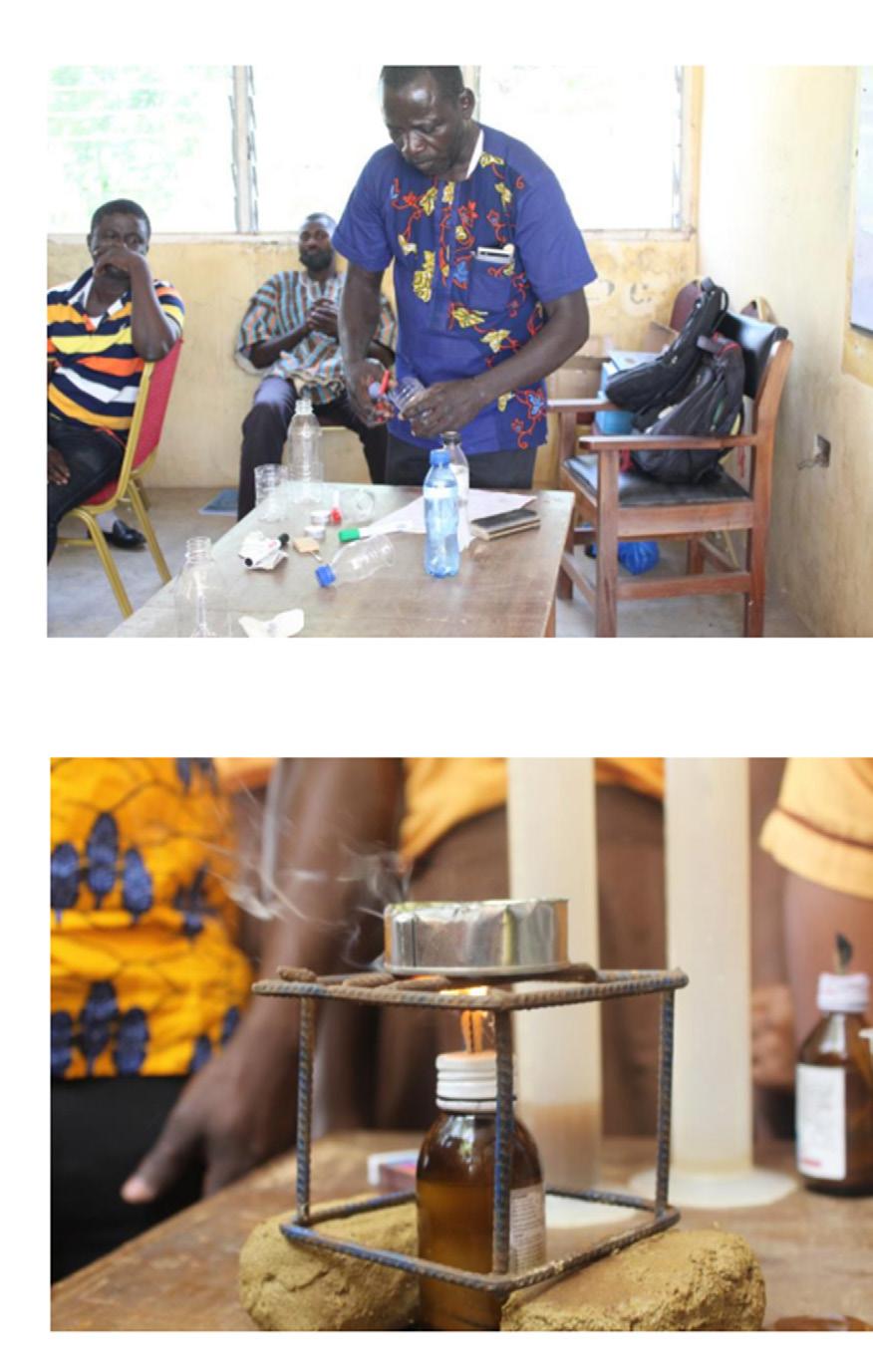
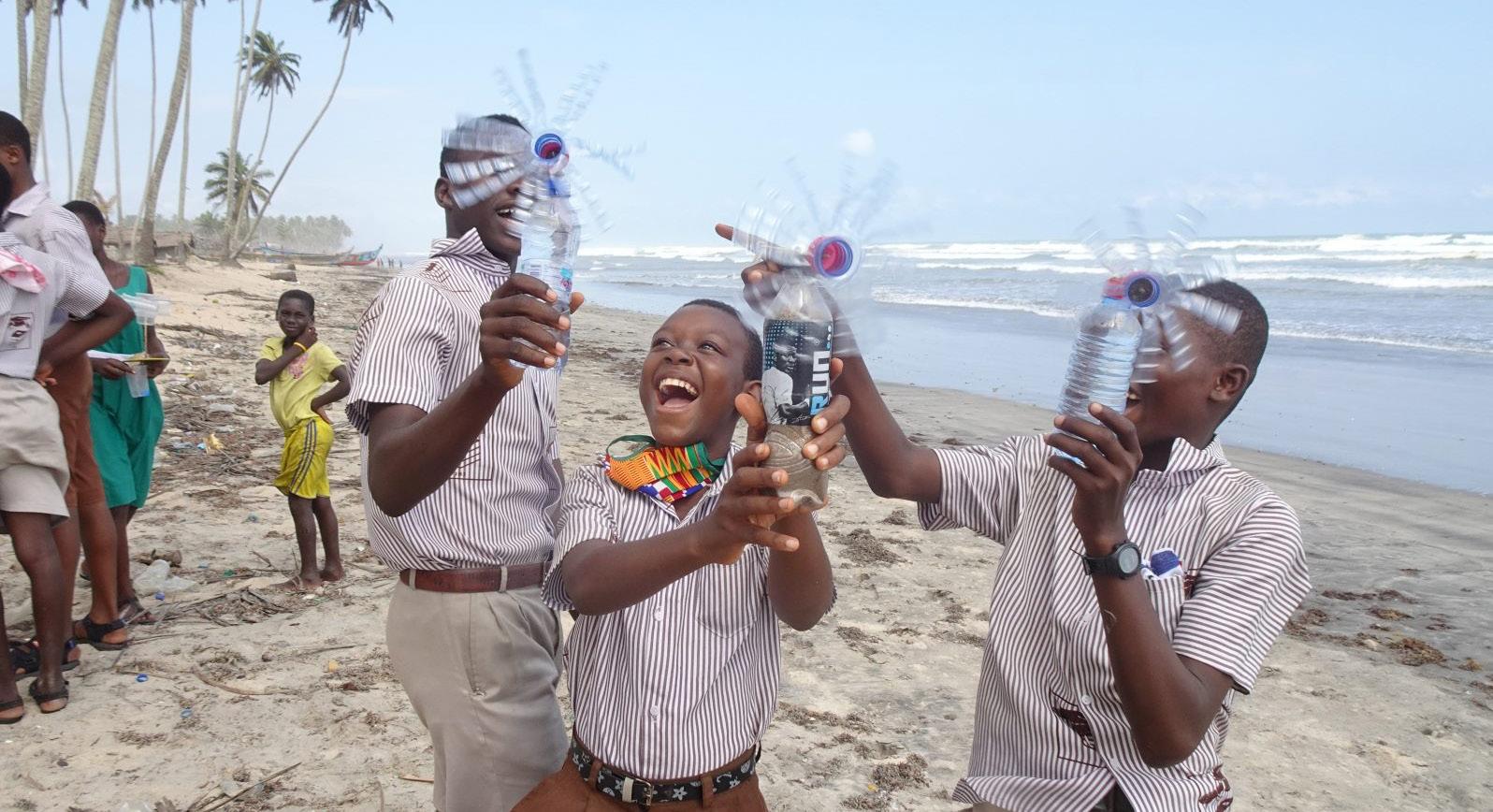
Learners in Sanzule, exploring sustainable energy sources during EcoSTEM club sessions
EcoSTEM Monthly challenge example
The Impact of CECOP in EduSpots’ EcoSTEM Strand:
Being part of CECOP will strengthen the environmental aspect of the EcoSTEM strand, through being able to tap into the experience and expertise of the other partners:
Access to well-designed resources from that have already been tested (eg card games around climate change solutions, illustrated local proverbs related to the environment, folk songs in local languages related to the environment, and more!)
Access to local experts in areas such as indigenous trees and their uses, tree planting techniques, ocean conservation, and wider specialisms existing within the group.
Ideas and experiences related to setting up and running climate clubs, having climate ambassadors in schools, creating school gardens, where organisations have evaluated models.
Possibly direct assistance/training for Spots in the regions where the other organisations operate eg climate smart agriculture training in the Northern regions, training on creation of energy saving cookstoves, composting, and similar.
Possible increase in the number of Spots and EcoSTEM clubs, through partners working in many communities, contingent on applications to join the EduSpots network.
C)
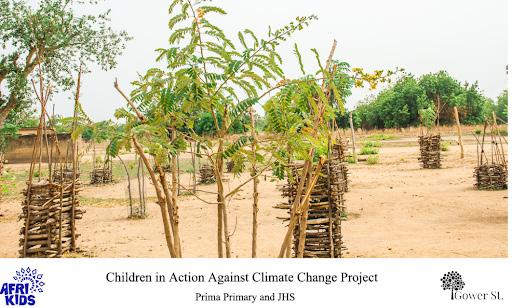
Afrikids: Children in Action against Climate Change (CACC)
“The children of Northern Ghana are showing that climate change is not just an adult’s fight; it is a collective mission, and they are ready to lead.” (Raymond Akolbire, External Affairs manager)
Similarly, Prima Primary School has demonstrated how children’s efforts can inspire recognition at the highest levels. The school’s vibrant garden won the Best School Garden category at both the district and North East Regional Farmers’ Day Celebrations this year. This achievement underscores how children’s hands-on involvement in climate initiatives can bring pride and visibility to their communities.
At the heart of these successes lies strong community mobilization and partnership. Parents, teachers, and local leaders have embraced the vision, ensuring that climate action is not a project but a shared responsibility. The children, empowered with knowledge and practical skills, are proving that they can be agents of change, influencing both their peers and the wider society. Through the platform provided by CECOP, we continue to expand and grow our work, building networks that amplify the voices and actions of children. Together, we are not only planting trees—we are planting hope, resilience, and leadership.
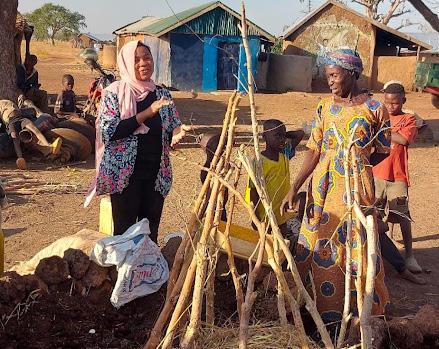
In Northern Ghana, children are stepping forward as champions of climate action through the efforts of our complementary climate change organization. Working with about 80 schools—three in the Upper East Region and one in the North East Region—we have built a movement that places children at the center of environmental transformation. With the support of partners such as ORGIIS, the Forestry Commission, the Ghana Education Service, community leaders, teachers, and the schoolchildren themselves, more than 5,000 trees have been planted in schools and public spaces across our districts. This work is not only greening the landscape but also reshaping the future. Our schools are excelling academically while leading in climate resilience. Winkogo Junior High School, for instance, has become a beacon of sustainability. Its afforestation project attracted the attention of other NGOs, resulting in the provision of a borehole to sustain tree planting and additional support to develop sports facilities. Partners have openly acknowledged that the school’s lush green environment was the magnet that drew them in.
The children of Northern Ghana are showing that climate change is not just an adult’s fight; it is a collective mission, and they are ready to lead.
d) RAINS: School Gardens
“Now we go to the garden, touch the plants, and talk about what we see. Learning is fun, and I understand the lessons better, thank you to RAINS.” (Elizabeth Alhassan, a Basic Six pupil)
The context
In many rural schools across Northern Ghana, teaching and learning have traditionally been constrained by limited materials, overcrowded classrooms, and highly teacher-centred methods. In 2017, the School Pedagogy Project (SPP) set out to change this reality by introducing participatory, learner-centred teaching approaches that place children at the heart of the learning process.
Brief overview of the School Pedagogy Project
Implemented by Regional Advisory Information and Network Systems (RAINS) in partnership with AXIS and funded by CISU/DANIDA, the project began in just two basic schools in the Savelugu Municipality. Over five years, it expanded to 12 schools, reaching more than 170 teachers and 4,700 pupils.
School gardens as a participatory teaching and learning tool
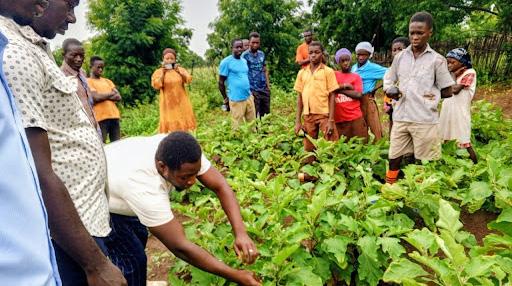
Teacher explaining crop germination with students in the garden.
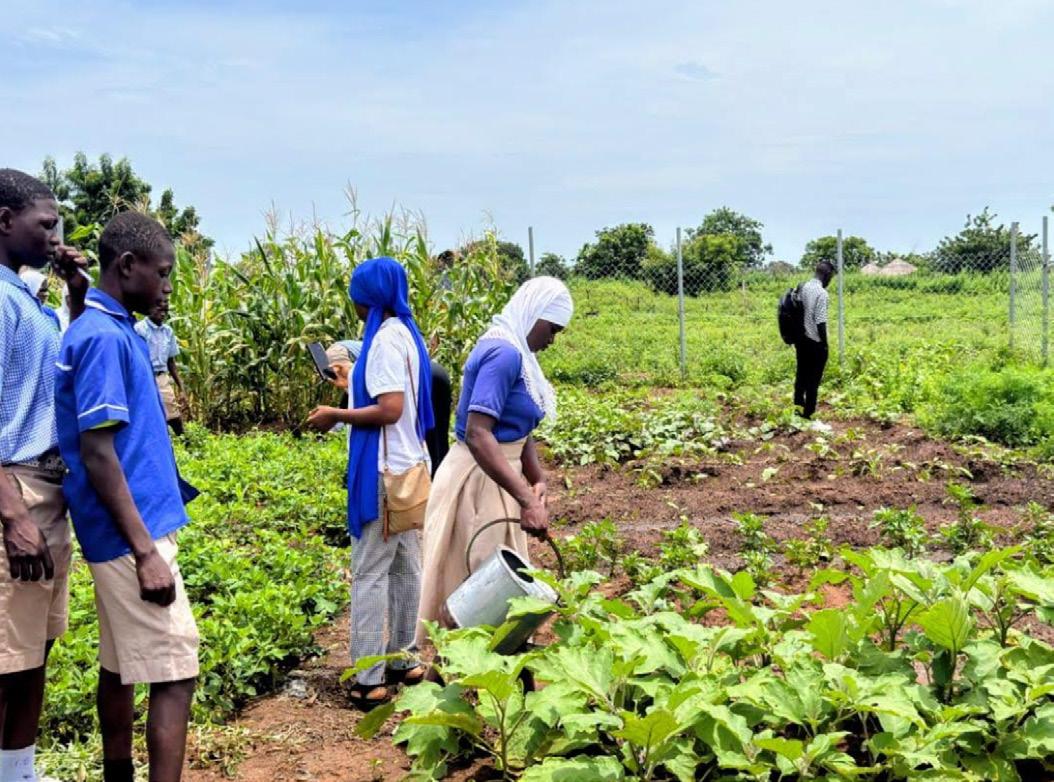
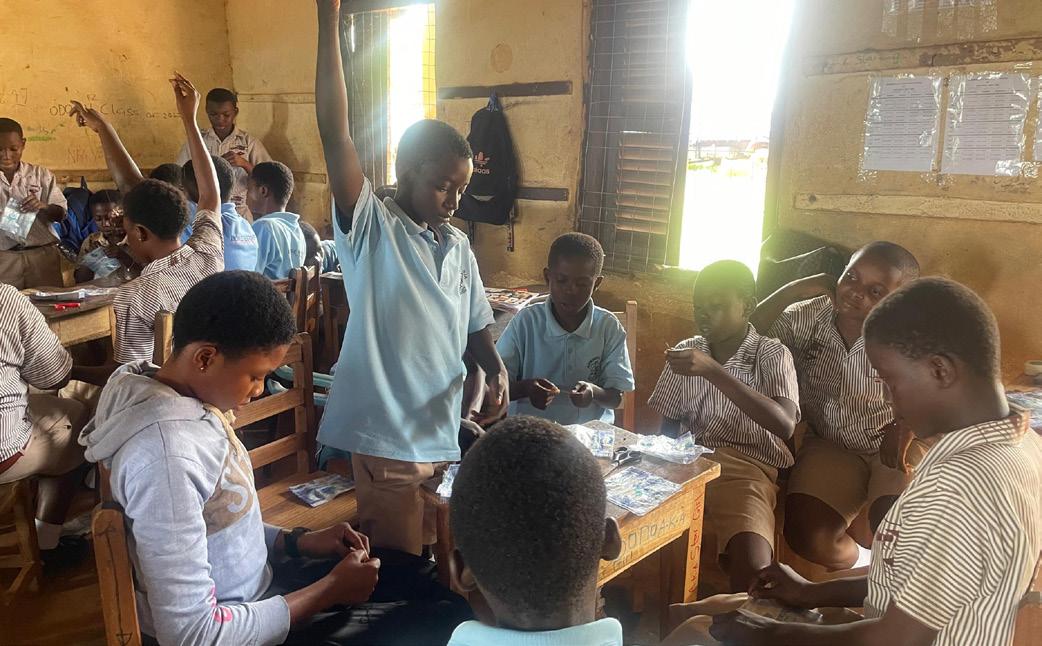
Central to the project’s approach is the use of school gardens as living classrooms, where pupils learn science, mathematics, language, and environmental concepts through hands-on activities rooted in their everyday experiences. In one participating school, lessons that once relied solely on chalk and textbooks now take place among rows of maize, vegetables, and legumes. Teachers guide learners to observe plant growth, measure garden beds, record changes, and discuss the impact of rainfall and soil conditions. These practical activities have significantly increased learner engagement, attendance, and understanding.
Results achieved
The impact has been remarkable. Learning outcomes improved from a baseline of 43.8% to 95.7%, and schools recorded higher retention rates, with additional pupils enrolling as parents observed renewed enthusiasm for learning. Communities also became more involved, contributing to school infrastructure improvements and supporting garden activities. Elizabeth Alhassan, a Basic six pupils shared her experience: “Before the execution of SPP, we just listened to the teacher and copied notes. Now we go to the garden, touch the plants, and talk about what we see. Learning is fun, and I understand the lessons better, thank you to RAINS.”
Teachers report increased confidence and creativity in lesson delivery, while students demonstrate stronger critical thinking, teamwork, and self-expression. Beyond academic gains, the project has strengthened school–community relationships and empowered learners to see education as relevant to their lives. The School Pedagogy Project shows that when classrooms are opened to participatory learning and local environments are embraced as teaching tools, education becomes not just about memorising facts, but about becoming active, confident learners prepared for the future.
Sustainability
The sustainability of the School Pedagogy Project is built on strong community ownership and institutional support. School Garden Committees have been established in all project schools to ensure the continuous maintenance and use of school gardens, particularly when schools are on break. These community-led structures help keep the gardens productive and relevant as learning spaces. The project also promotes sustainability through Professional Learning Communities (PLCs), which enable teachers to share best practices, strengthen participatory teaching skills, and address learners’ psychosocial needs. Institutional collaboration with the Municipal Education Directorate further reinforces sustainability by supporting supervision, coaching, and quality assurance to ensure participatory methodologies are effectively integrated into classroom practice.
Additional measures include continuous teacher capacity building, alignment with national education policies and NaCCA curriculum frameworks, the development of practical teaching guides, and strengthened school–community partnerships. Together, these strategies ensure the project’s longterm impact and scalability beyond the implementation period.
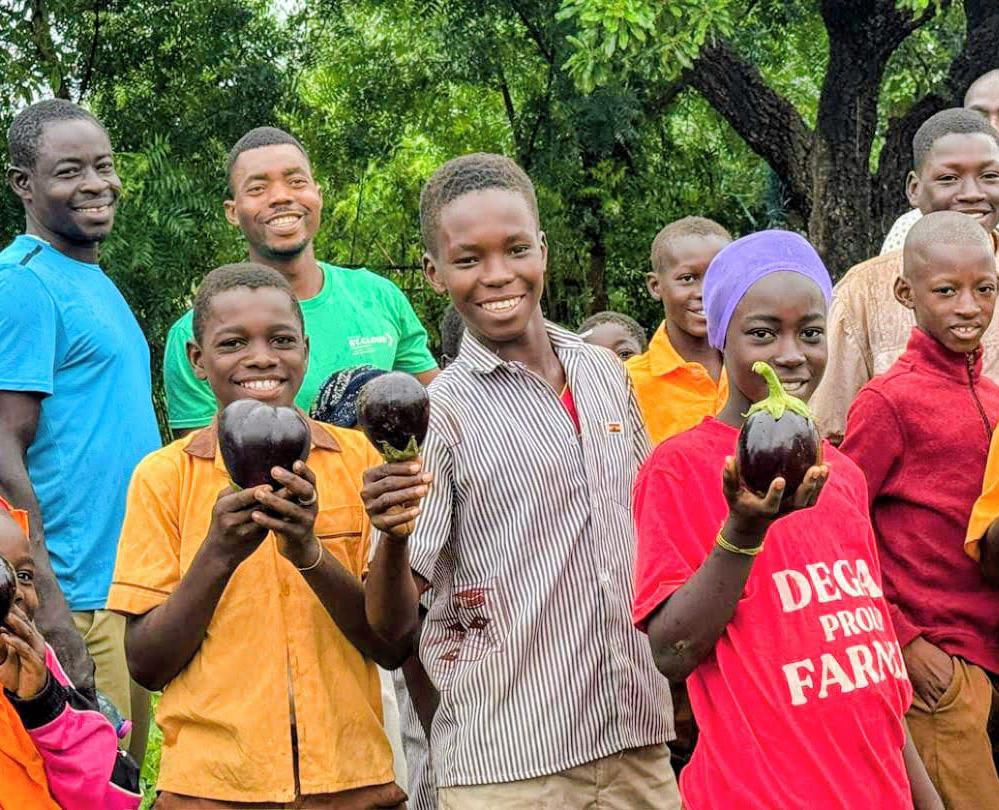
Section of students with some harvested egg plants learners watering crops as part of garden activities
e) Sung Foundation: Keyhole and Sack Gardening
CLIMATE-SMART KEYHOLE AND SACK GARDENING FOR DRY-SEASON NUTRITION
“Before this training, we only farmed during the rains. Now I can grow vegetables near my house even in the dry season, and my children eat fresh leaves every week.”
— Adishetu Mahammadu, Northern Ghana
What we do
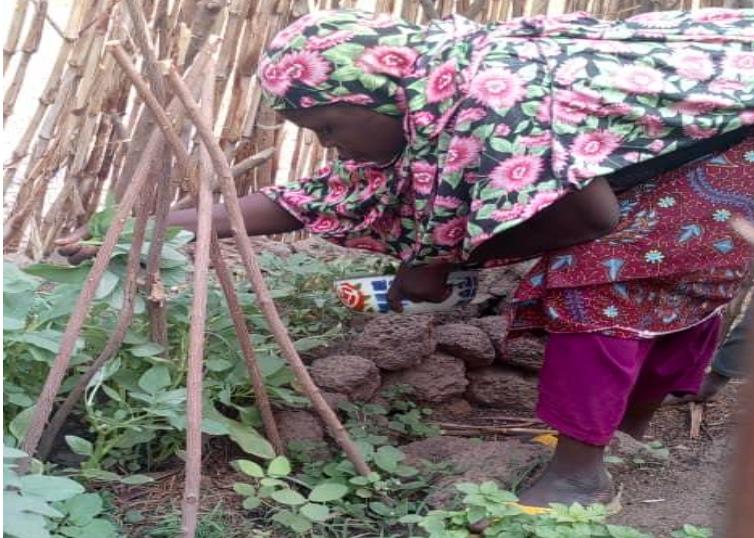
In Northern Ghana, farming largely depends on the rainy season, leaving households without access to fresh vegetables during the long dry months. To address this, Sung Foundation (SUFOD) supports communities to adopt keyhole, sack, and container gardening low-cost, home-based techniques that allow families to grow leafy vegetables year-round, even with limited water. Seventeen communities without reliable water sources were selected for this activity. Households were trained on how to set up and maintain keyhole, sack, and container gardens using locally available materials. Most communities preferred keyhole gardening, as stones are abundant and help retain moisture. Training began in December 2024, and ten communities have already completed sessions.
The training covered:
• Setting up and maintaining keyholes and sack gardens
• Efficient watering to minimize water use
• Applying organic manure and compost
• Pest and animal protection
• Simple crop rotation to keep soil fertile
Each household received seeds for ayoyo, bra, alefu, cowpea leaves, and okro, and were encouraged to add additional containers from home for sack or container gardening.
Strengthening and next steps
What changes we have seen
Households have begun establishing keyholes and sack/container gardens at home, and leafy vegetables are now available even during the dry season. This has improved nutrition for women and children and reduced the need to buy vegetables in local markets. Communities now understand that farming is possible yearround with climate-smart approaches, which also increases resilience to changing weather patterns.
Following the CECOP summit in Tamale, Sung Foundation is inspired to strengthen its keyhole and sack gardening initiative by integrating insights from climate education peers. We plan to connect indigenous knowledge and storytelling with practical climate-smart practices in our training materials to make guidance more culturally relevant. Peer learning will be enhanced, with successful households mentoring others within and across communities. We also aim to document and share communityled adaptations widely, promoting learning exchanges with other organizations. Additionally, we will explore strategies for sustaining these activities and integrating nutrition education to improve household food security and dietary diversity.
Training Session on keyhole setup
A woman harvesting green leafy vegetables from her keyhole garden
f) RAIN: Student Agency through School Gardens and Plastic Recycling.
“Before the club, we only learned about climate change in class. Now, we are growing food, managing waste, and teaching others how to care for our environment.”
(Student member, Adiembra D/A JHS, Ashanti Region, July 2025)
In many rural Ghanaian schools, climate education is either not taught at all or remains largely theoretical, offering few opportunities for learners to understand the natural resources that surround them or to act on climate challenges in practical ways. As a result, young people often lack both the knowledge and the confidence to see themselves as active actors in environmental protection.
To address this gap, the Rights and Advocacy Initiatives Network (RAIN), through its project “Partnerships for Forest Protection and Livelihood in a Changing Climate” (Gower Street Project), prioritised increasing youth awareness and agency as a pathway to long-term environmental stewardship. RAIN begins by building students’ foundational understanding of climate change, forests, food systems, and waste through structured learning sessions, and then deliberately empowers students to design and lead their own climate actions.
This objective led to the establishment of co-curricular climate clubs in basic schools. Operating beyond the formal curriculum, the clubs give students voice, responsibility, and ownership— allowing them to translate theoretical knowledge into student-led, practical action supported by mentorship from teachers and RAIN s
At Adiembra D/A JHS in the Ashanti Region, students established and now independently manage a school garden under the Gower Street Project. The garden serves as a practical learning space for climate-smart agriculture while contributing to improved dietary diversity among pupils and strengthening understanding of sustainable food systems.
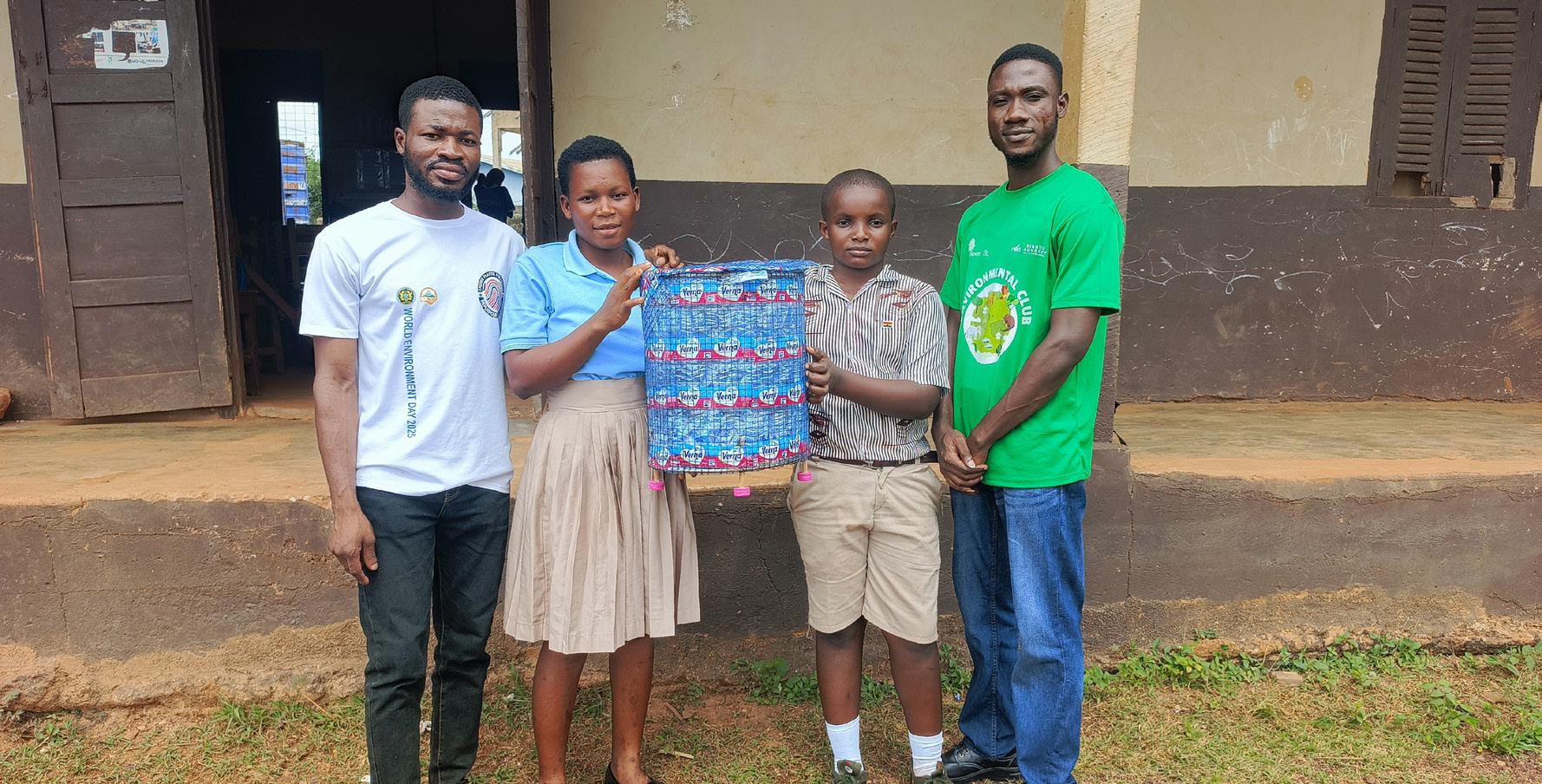
Building on this foundation, RAIN facilitated a Plastic Recycling Practical Workshop with the Green Gold Environmental Club:
• 61 students participated (37 boys, 24 girls).
• An Environmental Protection Agency (EPA) official facilitated a session on “Plastic Waste as a Resource”.
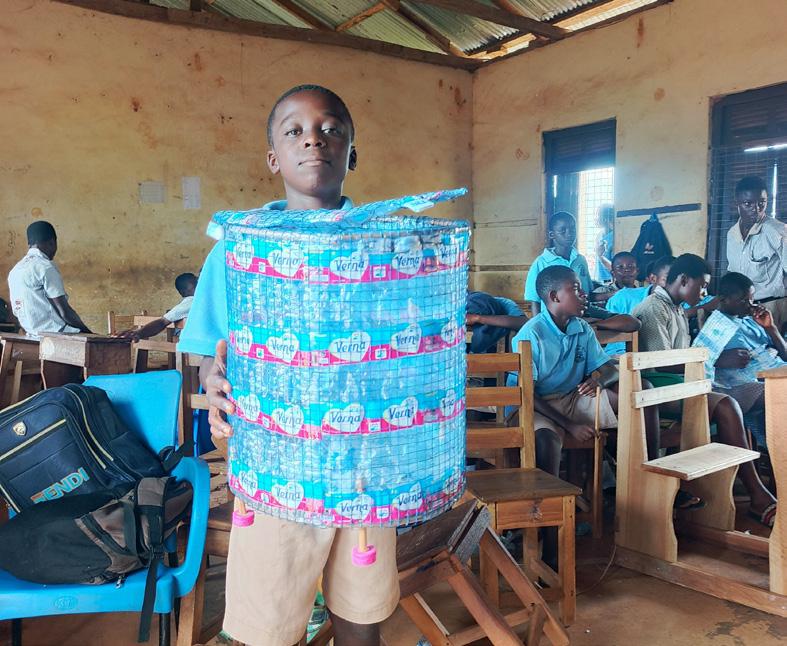
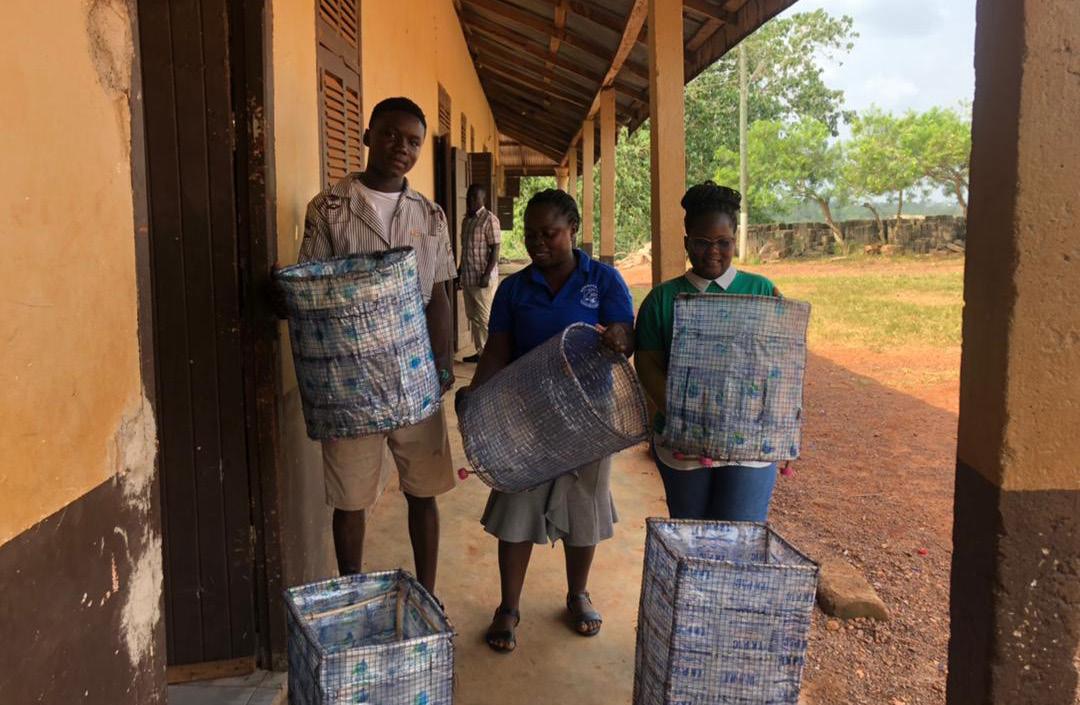
• Students learned to recycle waste sachet rubbers and plastic bottles into dustbins through hands-on demonstrations.
• With materials left with the club for continued practice, students made additional 9 dustbins
Outcomes and Impact
The activities strengthened student ownership of environmental action. Learners transitioned from passive recipients of climate information to active problem-solvers, applying knowledge to real challenges within their school. Students demonstrated increased confidence in waste management, environmental leadership, and peer education, and committed to organising a community clean-up exercise, extending impact beyond the school.
Learning and Way Forward
RAIN’s experience shows that increasing youth awareness must be paired with agency and practical responsibility. Climate clubs established through the Gower Street Project provide an effective platform for nurturing long-term environmental stewardship and strengthening the link between education, livelihoods, and forest protection.
“I have put ideas into practice that have been shared in this community of practice.”
Spread of responses emerging from survey question: What learnings have you drawn from CECOP?
The following emerged as key themes that arose from open-ended questions, with the named comments drawn from semi-structured face-to-face interviews, and the anonymous comments shared by survey, completed on the final day of the in-person Summit.
a) Importance of collaboration and partnerships
Education on native tree species using indigenous knowledge systems is crucial in schools, teaching “My organisation has clear ideas on who we could partner with to strengthen our work moving forwards.” 100% agreed, 53% strongly agreed.
The most frequently referenced learning was understanding the value that working collaboratively, and in formal partnership could be in strengthening climate education in Ghana. Several groups referenced the importance of ‘working together as a team’, and recognising how this contributes to strong impact, and ‘helping our mission be easier and effective.’
The group recognised that members of the group had already tested approaches stretching across specific technical aspects of climate education, to approaches across clubs, school gardens, curriculum developments and Ambassador programmes, and called for ‘sharing of knowledge and what we do and what works’, also recognising the financial benefit that could be drawn from applying to grants in a partnership.
The group recognised the ‘importance and power of forming partnerships’, rather than working in silos as an organization, with many organisations actively looking at the possibilities of working closely with other members of the group, particularly following the ‘speed-matching’ activity.
Collaboration was also a clear theme emerging from the interviews:
“A collaborative effort among these NGOS’s and groups would help in a long way to preach to people about climate change and how to adapt to us.” (Senam Amegashie EcoGhana)
“Yes, we have built a partnership with Dr. Francis A. Chimsah’s organization. we have been working with him to implement the climate resilience um project in our communities.” (Muphidatu Osman is my name, RAINS)
“I’ve started to build partnerships. I have started to build collaborations. By the time I leave here, I should have cemented it.” (Sarfoh Dankquah , SYND)
“Yes, under this community, climate smart training program in Tamale has also built a lot of partnerships and collaborations based on this community… and there are other ones in the pipeline, so this community has already given us that enablement to be able to work together.” (Dr. Francis A. Chimsah, Climate Smart Training)
“EduSpots has a strong focus on teamwork – our slogan from the outset has been #OurCollectiveFuture, and we hope to always model active inclusion in any strategy, at the student, Catalyst, staff and organisational level. This seems particularly important in climate change, where we have one shared planet, but diverse attitudes and contributions to protecting it.” (Cat Davison, EduSpots)
b) Learning Becoming More Practical
“I’ve learned new ways of engaging children, specifically engaging them innovatively in climate education such that it doesn’t have to be conventional. When I say conventional, I mean sitting just sitting down in a theatrical way, but more of activity based, taking them to the field and engaging them so that every single person gets to learn CECOP has helped me in implementing my projects.”
(Sarfoh Danquah, SYND)
Many participants referenced changes to be made to the way in which they will engage both learners and adult participants or volunteers, with a recognition of the need to focus more on ‘developing the capacity of teachers’ to meet the needed outcomes.
Several members pointed to a shift towards more activity-based learning, with one individual sharing that “It’s changed the way [he’s] engage children now. not going to be all talkative in all those things but specifically being very very activity based.”
It was clear that both learners and teachers saw the value in activities being practical and outdoors, beyond the remit of the classroom, whether involving tree planting or tending to school gardens, as Amin Khadija Gombilla from the Sung Foundation notes: “So with this there’s a change of mindset in what they do and then it’s not only limited to classroom teaching but it’s brought outside and then it’s circulated.”
c) The Value of Creativity
Creativity was central throughout the CECOP, and a recurrent theme in the reflections, with diverse mediums being used to engage learners, stretching across music, poetry, drama, art and dance. Augustine Oti Yeboah, from Conservation Ghana shared that:
‘We are seeing how we can incorporate folk songs in our activities. So, we know of all these trees we have in our forest reserves but trying to incorporate these things into kids becoming difficult. We know how children like music and so what I’ve learned today how singing about trees it’s exciting and I want to implement this in my communities.’
d) The Need for Deeper Student Leadership
A strongly emerging belief was the importance in truly involving students as leaders, not participants or passive beneficiaries, with some remarkable examples of how to do this shared across the group. As Amin Khadija Gombilla from the Sung Foundation commented, “So what I’ve learned through the CECOP of learning community of practice is that it’s actually a wonderful and a powerful tool when students or youths are given the opportunity to lead rather than really giving them only participation. So fully being involved and then leading is actually one of the things I have learned.” (Amin Khadija Gombilla, Sung Foundation)
A few specific strategies emerged on how to do this successfully. Chris Konadu from RAIN highlighted the of stepping back, and how he has now changed his approach:
“I tend to guide the students to do these things, do these things way, do this that way, do this that way. But from what I’ve learned, just give them the space, create that safe environment, let them be creative, let them come up with their solutions, their ideas, and then I believe they can, you know, move forward from there and cultivate that leadership and autonomy by themselves.” (Chris Konadu, RAIN)
e) Centring Indigenous Knowledge
Dr Adom Dickson inspired the whole community on the importance of ensuring that climate education related to the specific geographical and cultural context, that the students are positioned within, with a particular focus on trees.
This was the first next step articulated by Nancy Owusua Acquah, Project Assistant, EcoCare Ghana: “So when we get to the office, we are going to include native knowledge about native indigenous trees into our curriculum which we are using to and we are hoping that when it comes when it’s finalized we’ll use it to train our club our Climate generation club members.”
Following the launch of Let’s Protect Ghana Wildlife!, the group could see the value of further resources – whether books, videos, animations, or curriculums that reflect the local context. It was clear that many of the organisation’s would be putting this book into action and explore with learners “about wildlife going extinct in Ghana and how best they can also put in effort to conserve this wildlife.’ (Nancy Owusua Acquah, Project Assistant, EcoCare Ghana)
f) Community Engagement, and Women’s Groups
One member explained that they were now ‘including the community members we work with in decisionmaking’ as a key learning. This is central to EduSpots’ approach, where communities have ownership of the ‘Spot’ (learning hub), with nearly all activities involving the community in some form, with Spots also overseen by a community-wide committee.
Another example of this is Orgis Ghana where Linda Ametepeh (Director of Operations) commented that she has “learned we have put some of the community practices into use by involving the community members during decision making. An example is the Kolia demo farm in Paga Upper East where the women came together and their voices were heard and now, they have an agroecology farm.”
There was a strong focus on the importance of including women in climate related activities with Dr. Francis A. Chimsah of Climate Smart Training commenting:
“One of the ideas that we have learned from this platform that we want to use as um to change or to also practice in these communities or within our catchment area is the issue of trying the involvement of the natives and the indigenous women’s group in our approach to solving a lot of climate issues in the communities. So we are targeting the youth of women organised groups and as you know working with women sometimes is more effective because they take up this kind of lessons and this kind of initiative more seriously and their impact and their resilience in terms of this effort that we want to put based on tree planting climate smart but agricultural practices is very key and we are keen of trying to work with these groups in the near future.”
g) Fundraising
“So the community has taught a lot of things and one thing I’ll take home to our Accra is the fundraising. So we learned ways we can raise funds. Mostly we know about grants but today we’ve learned a lot of things that we can put into practice that help us raise more funds for our project.” (Senam Amegashie, Intern EcoGhana)
One member cited the importance of not solely relying on grants funding, especially considering today’s landscaping, indicating that they were looking at ‘fundraising thorough events’. Another referenced a strategy underway to ‘become more viable’ through an improved approach to communications.
i) Wider Observed Changes
“I am more confident in my practice as a result of being part of the climate education community of practice.” 61% strongly agree, 22% agree, 11% neither agree nor disagree.
It was clear from a number of conversations and observations, that through moving through the CECOP stages, confidence had grown in leading effective climate change education activities, with the group now able to tap into both a wide network of support, and activity suggestions.
“We have already learned new ideas especially in the aspect of climate education with partners who have got past and then longer experience in that have really given us a really good model to really use and adding education on climate to our programs especially for the younger generation than the kids.” (Dr. Francis A. Chimsah, Climate Smart Training)
5. Value for Money
This Community of Practice across from July - December cost £15,000. This included:
• All costs involved in organising a 2-day residential Summit in Tamale for 40 participants.
• Community building throughout, ensuring an inclusive approach
• Communication of the programme (articles, media, design work, social fliers, reels)
• MEL, interviews and writing this detailed post-programme report.
The reach of impact, we estimate stretches across 40-50 direct participants, with the 10 NGOs involved, having an estimated reach of 100,000 learners in Ghana.
We hope that the ideas, collaborations, and advocacy resulting from this group will work towards a nationwide impact, and that aspects of this Community of Practice model could be used elsewhere through wide sharing of this report.
8. Media Coverage
6. The Future Ahead
a) The Future of CECOP
“I feel part of a connected climate education community in Ghana, as a result of the community of practice.” 50% strongly agreed, 39% agreed, 11% neither agreed nor disagreed.
The following suggestions were made by CECOP members during the feedback survey:
• Expansion: Many members pointed to the potential impact of expanding the CECOP to other climate NGOs in Ghana, with the aim of it being eventually ‘nationally recognised’ for the extent of its contribution to educational transformation. Other members considered the possibility of engaging with wider NGOs in the international context.
• Curriculum: Several individuals pointed to the value of collectively devising a curriculum, and partnering with government authorities to expand climate education in schools. Some favoured curriculum-integrated approach, whilst others saw the need for sharable resources to use in cocurricular clubs, for NGOs and schools to use.
• Further training opportunities in education: Many participants saw the importance of further in-person training sessions in climate pedagogy for members of the group, also considering the confidence of children in this process, and how digital skills can best be implemented in this process.
• Leadership engagement: One member pointed to the need for the leaders of NGOs to have a separate group, to ensure strong participation in CECOP’s development, with most NGOs not having their Executive Director present either in-person or in online sessions.
• Monitoring, evaluation and learning: This was identified by a few participants as a need for further capacity development, with support for diversified tools in ‘assessing learnings and gains in climate education’.
• Regularity: Many participants called for the event to be held annually, with some suggesting bringing further climate education experts into the sessions.
b) Barriers to Effective Climate Education in Ghana
Teacher engagement: Our main challenge is that in some schools, only a few teachers are interested in supporting students in implementing CCE programmes, especially when there is no financial support for snacks and meals. Additionally, during school vacations, students often stop all activities, which sometimes affects the care and survival of the trees that were planted. (ORGIIS)
Solution: Design award or recognise schemes and incentives to motivate the teachers. Afrikids mentioned TVs, EduSpots has annual awards nights and recognition for volunteers, and a prize system focused on educational resources.
Teacher resistance to adopting the gardens as an instructional tool, especially among newly posted teachers. (RAINS)
Solution:Organise refresher training for teachers who have been newly posted.Work with or involve SISOs when it is difficult when working with teachers
Crammed school timetables often affect the consistency with which our clubs can run. For example, during revision and exam periods, many schools prefer not to hold club-based activities. (EduSpots)
Solution: To address this, we structure our programme plan so that, if we need to launch a monthly challenge during such periods, it is designed to be simple and quick to complete. This helps maintain momentum and avoids creating gaps in learners’ interest in club activities. (EduSpots)
Solution: Work with headteachers to co-design programmes so they create space on the school’s timetable right from the onset.
Solution: Push some of the activities to holiday or vacation periods.
Financial constraints to implement some activities students propose to engage in. For example, students in the GreenGold environmental club wanted to go on an excursion for nature seeing but because of budget limitation, we could not embark on that activity. Also some teachers feel reluctaant to participate in activities organized by the club. (RAIN)
Solution:The adjustment we made for this was to engage, talk to the teachers and explain the concept of the club to make them understand and willingly want to participate. We also make some teachers patrons of the clubs to motivate them to be interested in the activities of the club. (RAIN)
Student engagement: One of the biggest barriers we face in running CCE programmes is sustaining student engagement and environmental action beyond one-off activities, especially in rural schools where resources for follow-up are limited and teachers often have competing priorities. (Sung Foundation)
Solution: To address this, we shifted from one-off events to a club model in schools, where environmental clubs meet regularly, set their own goals, and carry out small, low-cost projects like maintaining tree seedlings, running monthly clean-up campaigns, or creating climate awareness posters. We also train a small group of “student climate champions” and link them with teachers who act as mentors, ensuring continuity even when Sung Foundation staff cannot be physically present. This approach has helped maintain momentum and ownership at the school level without heavy external resources. (Sung Foundation)
Solution: Extend the club formation to students in upper primary or involve them
Practical challenges: Some teachers initially found it difficult to integrate climate topics due to tight academic schedules, exam-oriented teaching, and limited teaching aids. In rural schools, the lack of gardening tools, water, and support for extracurricular activities also made it harder to sustain engagement over time. (Sung Foundation)
Solution: SUFOD worked around these barriers by ensuring our activities naturally fit into what teachers were already doing. For example, we linked climate lessons to existing science and agriculture topics so teachers didn’t feel it was “extra work.” We also involved head teachers from the start, so they could give the needed support and encouragement to their staff. In schools where we introduced gardens or tree planting, we provided simple starter packs, watering cans, seedlings, and tools to make it easy to begin. (Sung Foundation)
Solution: Most importantly, we encouraged teachers to learn from one another. When one school successfully set up an active Eco Club or garden, we invited others to visit and learn from their experience. This practical peer learning helped build confidence, ownership, and steady progress across some schools. (Sung Foundation)
Overlooked wider issues shared by members during Zoom sessions:
• Lack of assessment models for our work, so that we can track activities and behavior changes, ensure that students are actually applying what they have learned.
• The need to conduct scientific research to properly measure the level of impact of our work – interviewing students, teachers, parents etc, analyzing their perspectives, to come out with findings.
• Parental involvement – the extent to which parents are aware of the activities of their wards and the impact
• Lack of social media presence and media presence to promote and showcase the work that is being done
• CCE needs to be truly inclusive, hence we should not overlook marginalized groups such as disabled people, out of school kids, women etc
• Government support: teacher training should include inculcating practical teaching methods and that teacher resources such handouts and kits created by CCE practitioners are provided to all teachers as they have nationwide reach compared to us
c)
The Future of Climate Education in Ghana
These ideas were given during in-person interviews in October 2025:
“I would say creating a national climate ambassador hub where we have all schools coming on board so we fight against climate change and then we teach climate adaptation and mitigation practices.”
(Amin Khadija Gombilla, Sung Foundation)
“So I believe as much as we are trying to inculcate all this knowledge in them, we need to strategically focus on a sense of self. So as a complimentary target of climate or climate education or any practice in general to encourage advocacy through selfesteem through self-confidence and a sense of self that is one thing I will consider”.
( Chris Konadu, RAIN)
“The idea I have that could transform Ghana education is I suggest Ghana should adapt or integrate school gardens into their educational curriculum.”
(Muphidatu Osman, Project Officer, RAINS.)
“One idea to transform climate action education in Ghana… exposing children to the real life situations on ground rather than just the classroom situations. That would be my one idea for climate education.”
(Sarfoh Dankquah, SYND)
“One idea to transform climate education in Ghana is collaborating with other partners to infuse climate education into our curriculum for all schools from the primary from the basic session through to the senior high school for the tertiary some of them are doing courses directly on climate change so we are hoping that we can also push that agenda forward to that especially at the Ghana education service to also embed climate technical climate knowledge into our curriculum.”
“One idea I have that can transform climate education in Ghana is putting climate education into movies, into books, a little of it at a time.”
(Araba Yolanda
“One idea I have is making climate education more practical and also incorporating practical or activity tool kits for students every week.”
(Linda Ametepeh, Orgis Ghana)
Araba Aidoo, Coordinator of the Youth-NREG Academy)
8. Conclusion & Next Steps
“I feel inspired to strengthen my work in climate education, as a result of this community of practice.” 53% strongly agreed, 42% agreed, 5% neither agreed nor disagreed.
It is clear that the CECOP methodology combining participatory online and in-person learning and collaboration approaches have built a strong foundation for advancing the quality of climate education across 10 NGOs in Ghana, and beyond.
Members of the community are keen to continue the CECOP, and EduSpots will be following up with the group in 2026, to determine the next steps, deciding what form the future leadership of the group should take, and whether new members should be welcomed, whether in Ghana, or internationally.
One resounding voice came through: that climate education is urgently in need of strengthening and that we need to give space for students to truly lead and make decisions.
“To close, I want to say this: climate action cannot wait. And the good news is that students are already stepping up. Our role as adults is to support them, not to lead for them. ” (Amin Khadija Gombilla, Sung Foundation).
Thank you to everyone who participated in the Climate Education Community of Practice in 2025!
Any
final comments?
I
(Augustine Oti Yeboah, Conservation Ghana)
Sarah Abotsi-Masters, EcoSTEM Specialist, EduSpots sabotsi-masters@eduspots.org
Sally Vivyan, Co-Director, Gower Street Trust, sally@gowerstreet.org