
JUNE 2026 ECOSTEM CHALLENGE


CHALLENGE TITLE
SOLAR SYSTEM SAFARI
This is a group challenge.
ABOUT THIS CHALLENGE
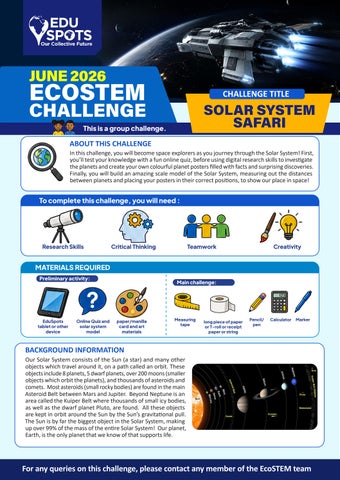
In this challenge, you will become space explorers as you journey through the Solar System! First, you’ll test your knowledge with a fun online quiz, before using digital research skills to investigate the planets and create your own colourful planet posters filled with facts and surprising discoveries. Finally, you will build an amazing scale model of the Solar System, measuring out the distances between planets and placing your posters in their correct positions, to show our place in space!
To complete this challenge, you will
MATERIALS REQUIRED





BACKGROUND INFORMATION

Our Solar System consists of the Sun (a star) and many other objects which travel around it, on a path called an orbit. These objects include 8 planets, 5 dwarf planets, over 200 moons (smaller objects which orbit the planets), and thousands of asteroids and comets. Most asteroids (small rocky bodies) are found in the main Asteroid Belt between Mars and Jupiter. Beyond Neptune is an area called the Kuiper Belt where thousands of small icy bodies, as well as the dwarf planet Pluto, are found. All these objects are kept in orbit around the Sun by the Sun’s gravitational pull. The Sun is by far the biggest object in the Solar System, making up over 99% of the mass of the entire Solar System! Our planet, Earth, is the only planet that we know of that supports life.
EduSpots tablet or other device
Online Quiz and solar system model
card and art materials



SOLAR SYSTEM SAFARI
PRELIMINARY ACTIVITY
Part 1 - KNOWLEDGE CHECK
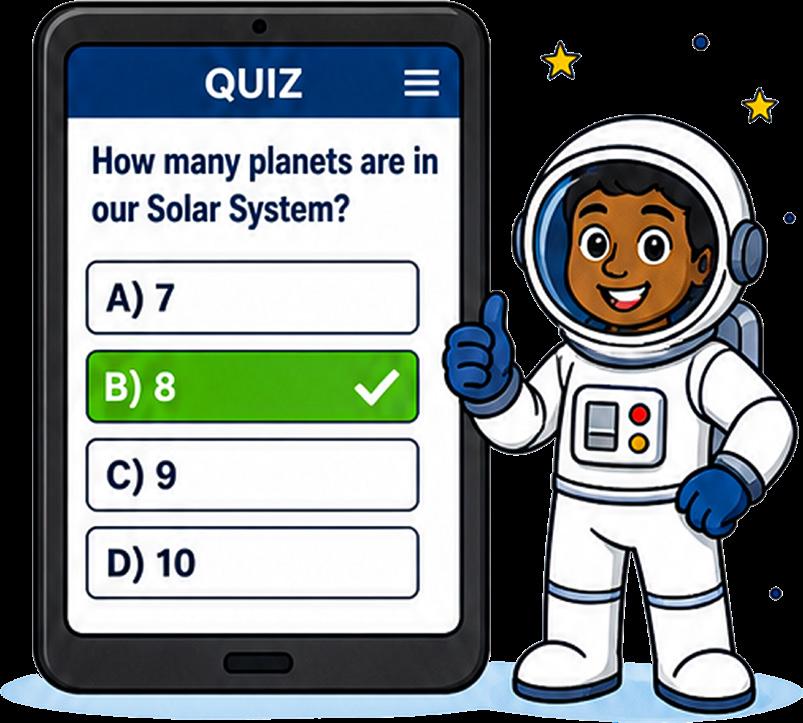
First, you are going to do an online quiz to check your solar system knowledge!
Procedure
1. Using the EduSpots tablet or any other device, copy this link to run the quiz: https://wordwall.net/resource/49447/solar-system-quiz
2. Follow the instructions to answer the multiple choice quiz questions
3. As soon as you answer, you will be told if the answer is correct or incorrect
4. If incorrect, the correct answer is automatically revealed
Did any of the answers surprise you?
If so, you can research online to learn more or find explanations. The following websites have lots of great information on the solar system:
General information on the solar system: https://www.schoolsobservatory.org/learn/space/solar-system
Solar system information from NASA: https://science.nasa.gov/solar-system/ 10 facts you didn’t know about our solar system: https://www.bbc.co.uk/bitesize/articles/zkdbqp3#zwtxwsg
Part 2 - PLANET POSTERS
In groups, you will research a planet using an online solar system model, then create a poster about each planet.
1. Get into groups. (Ideally you will need 11 groups or pairs –one for each planet, plus the Sun, asteroid belt and Pluto. If you don’t have enough club members, each group can research 2 planets instead, or you can stick to just the 8 planets only)
2. Use the SolarSystemScope online model, plus other resources if you wish, to research your chosen object. Find out the basic facts plus at least one exciting “fun fact”! (Details of how to use SolarSystemScope are in the Appendix at the end of this document)
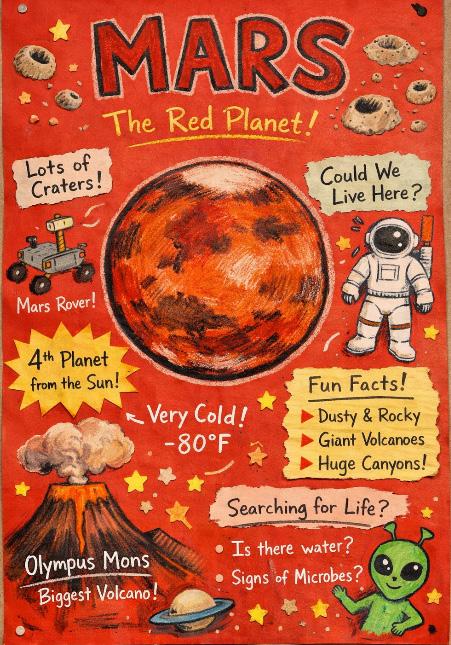
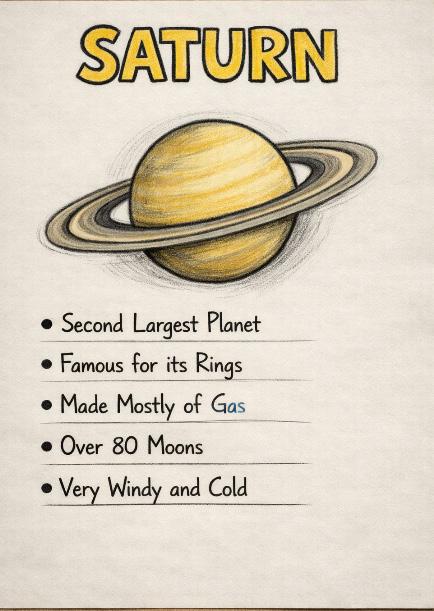
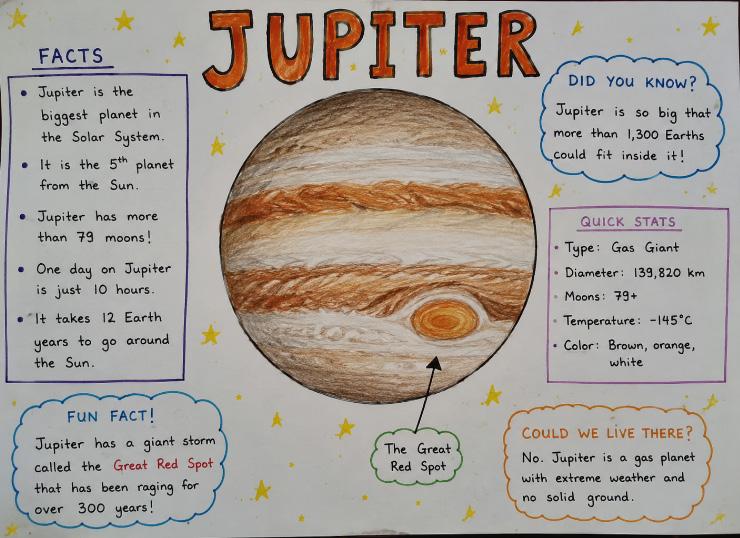
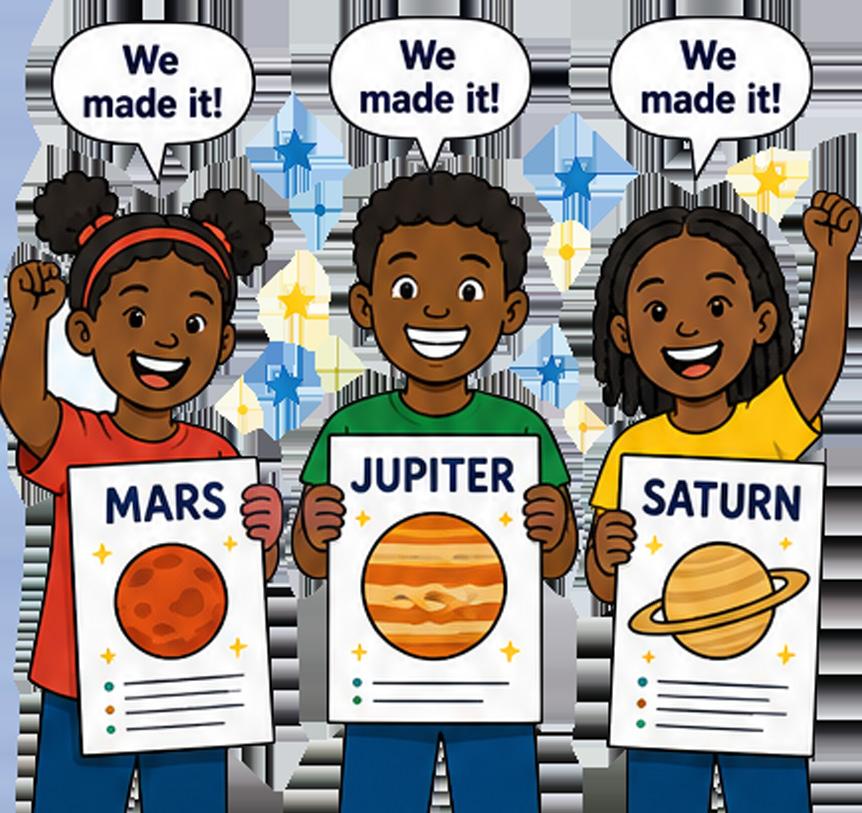
3. Create a colourful and eye-catching poster about your object. Include a drawing of the object, at least 3 basic facts, and 1 fun fact! These posters will be displayed in your classroom or Spot, so use your creativity to make them attractive and informative (see examples below).
4. Each group should present their poster and what they have learned to the other club members
5. Create a video where one Spark from each group presents their planet poster and shares ONE fun fact they discovered about the planet – try to find something that will wow everyone!
Examples of Planet Posters
These examples are just to inspire you - use your imagination to create something original and exciting
For any queries on this challenge, please contact any member of the EcoSTEM team
SOLAR SYSTEM SAFARI
MAIN CHALLENGE
You are going to create a scale model of distances in the solar system that will be displayed in your Spot/classroom/school for all to see!
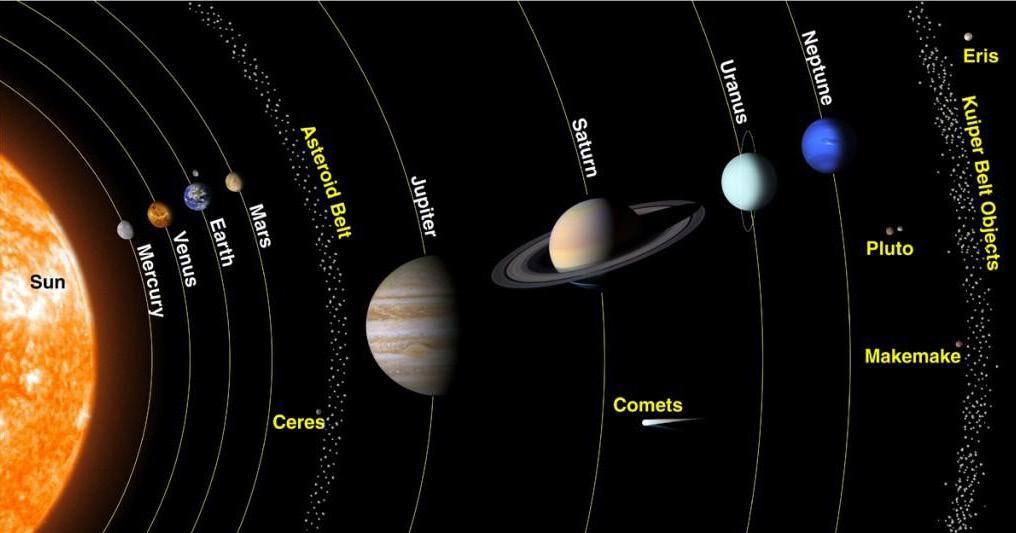
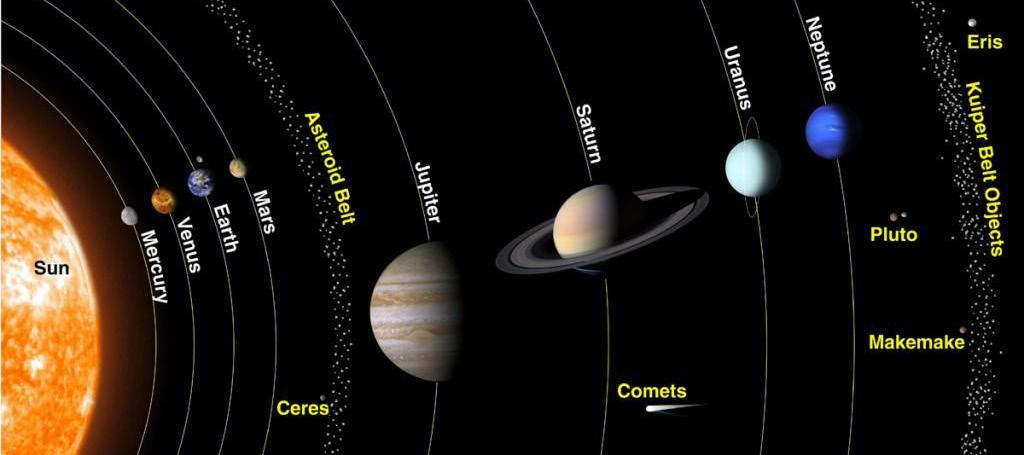
Can you say what is wrong with this image:
This image shows us the regions of the solar system and the various objects within it, but it doesn’t give any idea of the actual size of the solar system, and how far away the planets are from the Sun. It looks as though the planets are equally spaced from the Sun. But is that correct? You are going to create a scale model to show you the true picture of distances of planets from the Sun!
The table below shows the actual distances of the planets from the Sun:
Now we can use this scale factor to work out where all the other planets will be along the distance scale
If the Sun is at one end of the room, where will Mercury be?
Mercury is 57 million km from the Sun, so using our scale factor that would be 57/12 cm away from the Sun = 4.75 cm
Venus is 108 million km from the Sun, so using our scale factor that would be 108/12 cm away from the Sun = 9 cm etc
4. Calculate your scale factor (as shown in the example above) using the length of your chosen space
5. Using the scale factor, calculate the positions of the planets on your model, and fill out the table below. You will be using the formula below:

Note: that the 2nd and 3rd columns are showing the SAME NUMBER , but in DIFFERENT UNITS.
1. Your solar system distance scale is going to be put on display somewhere in your school/Spot, so first, find a suitable space. This could be along one wall of a classroom or library, or along a corridor outside several classrooms. Ideally you want a space at least a few metres long.
2. Measure the length of your space - that length (L) will represent the distance from the Sun to Pluto/Kuiper Belt on your scale model
3. To decide where each of the planets will be placed between the Sun and Pluto on your model, you need to work out your scale factor. In other words, if the length of the space represents the distance from the Sun to Pluto, what distance does 1cm represent?
Example
Suppose your room length is
The
from the
to
or
is 5,900,000,000km or 5900 million km
So in this case the scale is 500cm to 5900 million km
Which means that 1cm represents 5900 / 500 million km = 11.8 million km
So 1cm represents 11.8 million km, this is your scale factor. For simplicity, let’s round it up to 12 million km
228,000,000 228
OF ASTEROID BELT 329,000,000 329 END OF ASTEROID BELT 479,000,000 479
JUPITER 779,000,000 779
SATURN 1,430,000,000 1430
URANUS 2,880,000,000 2880
NEPTUNE 4,550,000,000 4550 PLUTO/KUIPER BELT 5,900,000,000 5900
SOLAR SYSTEM SAFARI
MAIN CHALLENGE (continued)
6. You will need either a long piece of paper that will reach the full length of your space, or you could use a long piece of string, drying line etc.
7. Mark the Sun at one end of your model, and Pluto/Kuiper Belt at the other
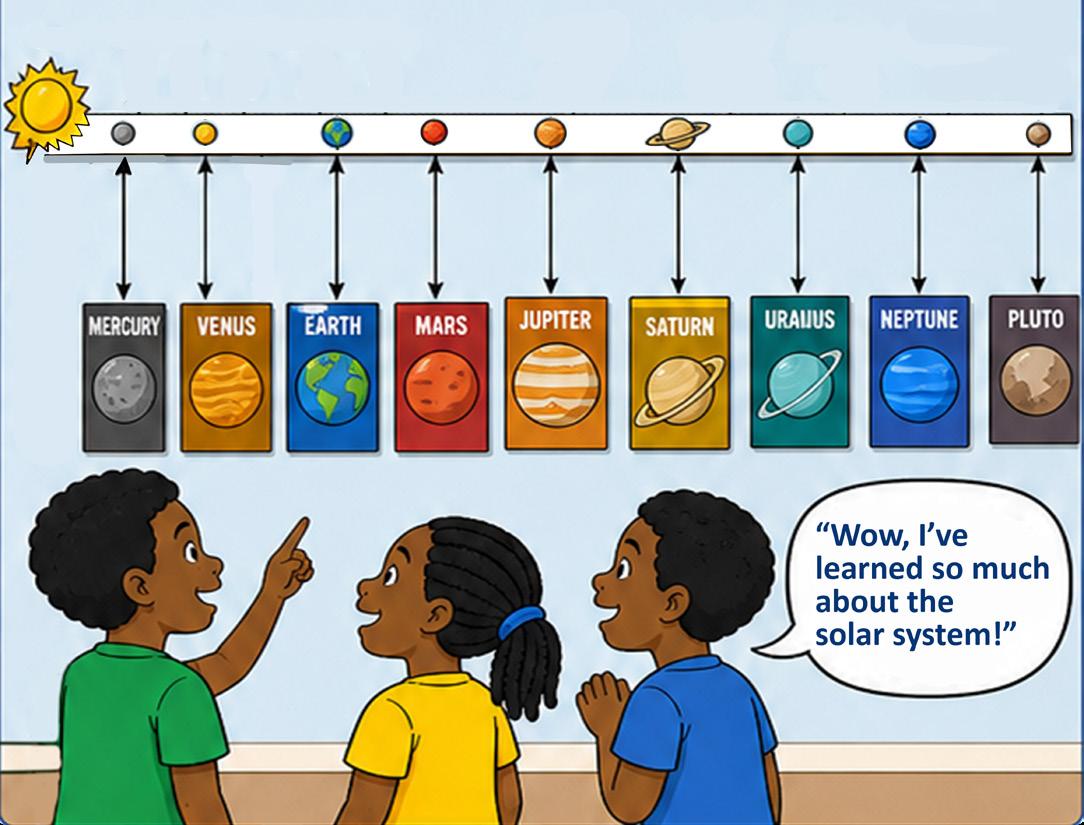
8. Using the calculations from the table above, mark the positions of the planets along your distance scale (if you are using paper you can mark the positions with a pen, if you are using string you can mark the positions by tying knots in the string) 9. Now that your scale model is complete you can fix it to the wall 10 Place the posters you created earlier in the correct positions below your scale model (you might find you have to use paper/cardboard arrows or string to connect the poster to the position of the planet on the scale model)
11 Now everyone can see the amazing work you have done and can also learn about our place in space!
Discussion points for your video
Create a short video showing your solar system distance model in place, with different Sparks talking about the following discussion points:

Does anything surprise you about your solar system distance model? What have you learned about the distances of the planets from the Sun?


planet in the Solar System would YOU like to visit, and why? What does the model tell you about what the temperature might be like on each planet?

All life on Earth needs water, so when scientists are thinking about whether life could exist on other planets, the first thing they look for is water. Do you think liquid water could exist on other planets apart from the Earth? Why or why not? Show your scale model on the wall, with different Sparks sharing each discussion point. Make sure all group members get a chance to speak!




JUNE 2026
ECOSTEM CHALLENGE
INFORMATION FOR THE CATALYST
Curriculum links: Science CCP B7.3.2 / B8.3.2 / B9.3.2 The Solar System
CHALLENGE DELIVERABLES
Preliminary activity:
Photos of the Sparks taking the online quiz and using SolarSystemScope
Planet posters
Video of Sparks presenting their posters and fun facts
Main challenge:
Video showing the solar system distance scale and posters in position (eg on classroom wall)
Video includes Sparks talking through the discussion points
CHALLENGE TITLE
SOLAR SYSTEM SAFARI
WHAT WE ARE LOKING FOR AND MARKING CRITERIA

15
Planet posters have correct information, showing that Sparks have gained an understanding of planet characteristics, and have used research skills
Solar system distance model is correct, showing that Sparks have correctly carried out the calculations
Video shows that Sparks have an understanding of the true scale of distances in the Solar System, and how this impacts temperature and presence of water on the planets

Collaboration & Inclusion
Photos show Sparks working in groups on their research and posters, with participation of all Sparks, both boys and girls Creativity &
10

10

Communication & Presentation

5
Planet posters show creativity
Sparks come up with a way to create the solar system distance model using paper or string and display it in their school/Spot
Photos show the Sparks employing digital research skills and using the solarsystemscope program
Information on the planet posters is well presented
10
Sparks speak confidently in the videos, presenting their fun facts, and talking about solar system distances

SOLAR SYSTEM SAFARI
This free software allows you to explore the solar system and the night sky online. Some basic information on how to use the software is outlined below, however, the program is easy to use, so feel free to explore and discover more! Access it at www.solarsystemscope.com
1. Using the EduSpots tablet or any other device, copy this link to run the Solar System Scope app: https://www.solarsystemscope.com/
2. Click on the START button
3. When prompted, click on the screen to start running the model 1 2 3
The
should look like this:

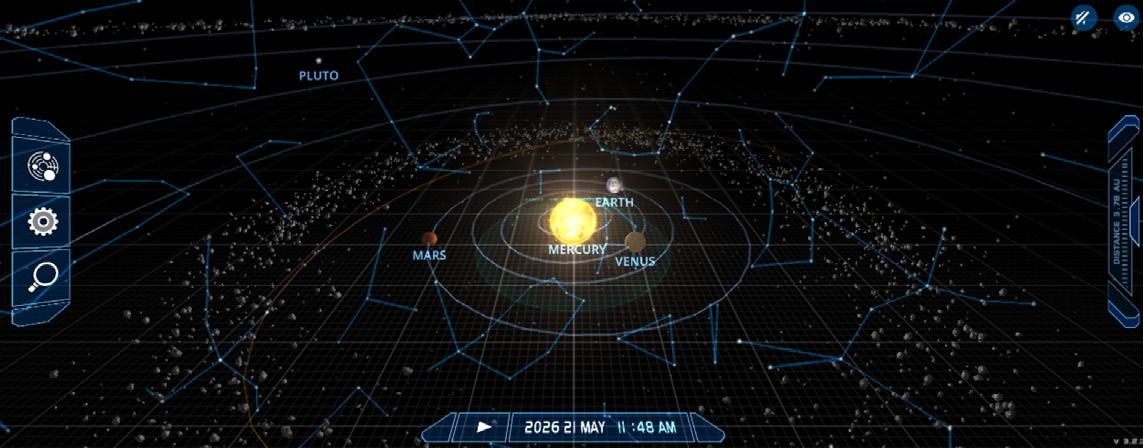



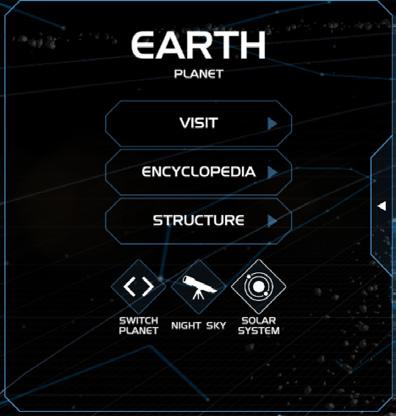
Click on a planet (or other object) to select
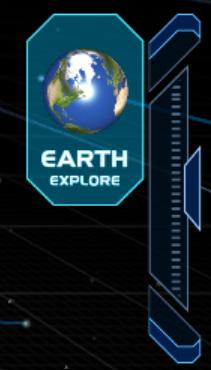
An “explore” button for that object will appear on the right hand side