UCalgary
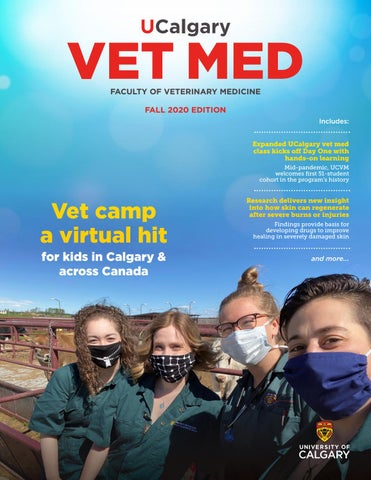
VET MED FACULTY OF VETERINARY MEDICINE FALL 2020 EDITION Includes: Expanded UCalgary vet med class kicks off Day One with hands-on learning Mid-pandemic, UCVM welcomes first 51-student cohort in the program’s history
Vet camp a virtual hit for kids in Calgary & across Canada
Research delivers new insight into how skin can regenerate after severe burns or injuries Findings provide basis for developing drugs to improve healing in severely damaged skin
and more...
A message from Dr. Baljit Singh Dean of the University of Calgary Faculty of Veterinary Medicine (UCVM)
W
elcome to the fall edition of the UCVM newsletter. It has been a rollercoaster of a year. In March, there was the disruption and disappointment caused by pandemic-induced lock downs, which forced our Class of 2020 to complete their final rotations remotely and say goodbye to their classmates via Zoom, instead of in person at Convocation ceremonies. But there was also the excitement and sense of achievement felt as we completed our DVM expansion project. In September, we welcomed the first expanded class of 51 future veterinarians to new, larger facilities at the UCVM, along with newly recruited staff and academics to support their learning. We are grateful for the support of the provincial government and the Alberta Veterinary Medical Association in making this three-year project a reality. As you’ll see from the stories in this issue, there has been plenty to celebrate between those two milestone moments. New research into how skin can regenerate after severe burns, a new agri-food policy and education centre created with a gift from Alberta rancher John Simpson, a new way of assessing a cat’s facial expressions for signs of pain, and much more. Dr. Baljit Singh with his wife Sarbjit Kaur Gill, and son Pahul.
On a personal note, I will be stepping down as UCVM’s dean on October 31 and leaving UCalgary officially on January 31, 2021 to take on the role of vice-president, research at the University of Saskatchewan. While I am looking forward to this new chapter, I will miss the incredible program and community we have built together at UCVM. We have achieved so much over the last four years. We developed the 2017-2022 UCVM Strategic Plan to advance the vision and build on the theme of One Community, One Health. Our connection to community was amplified in 2018 through the transformational gift of W.A. Ranches, valued at $44-million, from Jack Anderson and his daughter Wynne Chisholm. Together, we’ve led a campus-wide collaborative effort ensuring that One Health was named as an emerging research theme at UCalgary. We’ve grown our research intensity through the allocation of three new Canada Research Chairs, the renewal of federal- and donor-funded research chairs, and admitting as many graduate students into research programs as undergrads into our DVM program. I’m also excited about the expansion of our Diagnostic Services Unit, thanks to a $3.4 million grant from the province. Additional staff are being recruited and we hope to soon offer expanded services, including clinical microbiology, to animal owners. We are grateful for the support of the Alberta Beef Producers, the Alberta Cattle Feeders Association, and many ranchers in this project.
UCVM is a unique program and it enjoys deep support from the community. There are individual supporters, veterinary clinics across the province, as well as organizations such as the Calgary Stampede, Spruce Meadows, and the Calgary Firefighters Burn Treatment Society. Community support makes possible the ambitions of UCVM students and scholars to find better ways of teaching, to do cutting-edge research, and to create new knowledge to improve the health of animals, people, and the environment. It has been a tremendous honour to lead this outstanding veterinary program, which continues to raise the bar in teaching, research, and community engagement and to advance the evolution of the profession! Thank you!
Baljit Singh
Research delivers new insight into how skin can regenerate after severe burns or injuries
Findings provide basis for developing drugs to improve healing in severely damaged skin “Following injury, these dermal progenitors become activated, proliferate and then migrate into the wound where they generate nearly all of the new dermal tissue that will fill the wound, both scar and regenerated tissue,” says Biernaskie, professor of stem cell biology in UCVM, and the Calgary Firefighters Burn Treatment Society Chair in Skin Regeneration and Wound Healing.
P
eople who suffer severe burns or extensive skin injuries are often left to live with extreme scarring, disfigurement, and skin that feels chronically tight and itchy. That’s because the body’s healing processes have evolved to focus on preventing infection by quickly closing up wounds, rather than regenerating or restoring normal skin tissue. New research led by Dr. Jeff Biernaskie, PhD, has made an exciting leap forward in understanding how skin heals, which could lead to drug treatments to vastly improve wound healing. The study, published in the scientific journal Cell Stem Cell was co-led by Dr. Sepideh Abbasi, DVM, PhD; Sarthak Sinha, MD/ PhD candidate; and Dr. Elodie Labit, PhD, postdoctoral fellow. “We identified a specific population of progenitor cells that reside within the dermis, the deep connective tissue of the skin. Progenitor cells are unique in that they are able to undergo cell division and generate many new cells to either maintain or repair tissues.”
Why some cells can regenerate new skin while others can’t Biernaskie’s intensive study, five years in the making, offers new knowledge on why dermal cells typically form disfiguring scar tissue instead of regenerating functional skin. Using cutting-edge genomics techniques to profile thousands of individual cells at different times after injury, the research team compared scarforming versus regenerative zones within skin wounds. “Remarkably, we found that although these cells come from the same cellular origin, different microenvironments within the wound activate entirely different sets of genes. Meaning, the signals found within ‘regenerative zones’ of the wound promote reactivation of genes that are typically engaged during skin development. Whereas in scar-forming zones, these pro-regenerative programs are absent or suppressed and scar-forming programs dominate.”
Working with these findings, the researchers then showed it’s possible to modify the genetic programs that enable skin regeneration. “What we’ve shown is that you can alter the wound environment with drugs, or modify the genetics of these progenitor cells directly, and both are sufficient to change their behaviour during wound healing. That can have really quite impressive effects on healing that includes regeneration of new hair follicles, glands and fat within the wounded skin,” says Biernaskie. Findings provide the basis for drug therapies to improve skin healing This research offers critical insights into the molecular signals that drive scar formation during wound healing and it identifies a number of genetic signals that are able to overcome fibrosis and promote true regeneration of adult skin. “This proof of principle is really important, because it suggests that the adult woundresponsive cells do in fact harbour a latent regenerative capacity, it just simply needs to be unmasked,” says Biernaskie. “Now, we are actively looking for additional pathways that may be involved. Our hope is to develop a cocktail of drugs that we could safely administer in humans and animals to entirely prevent genetic programs that initiate scar formation in order to greatly improve the quality of skin healing.” The study was funded by the Canadian Institutes of Health Research and the Calgary Firefighters Burn Treatment Society.
First-year Vet Med students participate in their first anatomy lab.
Expanded UCalgary vet med class kicks off Day One with hands-on learning
Mid-pandemic, Faculty of Veterinary Medicine welcomes first 51-student cohort in the program’s history
E
ven without a global pandemic, 2020 was going to be different for incoming first year students at UCVM.
unique homegrown program that graduates veterinarians to support communities across the province.”
The Class of 2024 has the distinction of being the largest cohort of new students in the faculty’s history, with 51 future veterinarians, up from the previous 30.
To accommodate the larger class size, UCVM’s Spy Hill campus has just completed a significant expansion. Over the last three years, there has been nearly $26 million of construction, including $8 million finished this summer.
The expansion of the class marks a significant investment in funding and a vote of confidence from the Government of Alberta, says Dr. Baljit Singh, dean of UCVM. “Our college’s teaching research programs have attained a degree of program quality and international recognition that the Government of Alberta recognized and saw as an opportunity to further invest in a
“The expansion of the program would not have been possible without the support of the university, and provincial and federal governments, as well as the Alberta Veterinary Medical Association (ABVMA),” says Singh.
More Alberta veterinarians and veterinary technicians “UCalgary is so proud to welcome 20 additional students to the Class of 2024,” said Dr. Dru Marshall, provost and vicepresident (academic). “This additional investment by the Government of Alberta will result in an increased number of veterinarians, which will directly impact and improve animal welfare in our province.” The larger class size means more veterinarians serving Alberta in the future. It also means hiring extra faculty and support staff to bolster teaching and research, which will result in more knowledge and community support for animal owners.
This is a big win in the eyes of Dr. Kirsten Aarbo, president of the ABVMA. “We’re very excited about the expanded class,” says Aarbo. “There is a shortage of veterinarians and veterinary technicians in Alberta and the support of UCVM and the government to help fill more seats in veterinary programs with more bright minds is a positive step.” Aarbo sees this as great progress towards the ABVMA’s goal of Alberta becoming a leader in veterinary research, especially in the field of zoonotic diseases (those transmitted from animals to people), which is critical to the health of both humans and animals, and to preventing future outbreaks like COVID-19. Donor-supplied equine teaching equipment A timely donation of $100,000 from the Equine Foundation of Canada (EFC) enables UCVM to buy valuable equine teaching simulators to help in educating the expanded class. This includes a clinical teaching package with equine GI tract and colic simulators, power float dental kits, digital stethoscopes, and an ECG. “These are really fabulous teaching models with realistic parts,” says EFC President Bob Watson, of the equine simulators. “The EFC board is really happy that students will have more of these useful learning tools.” The EFC is a longtime supporter of UCVM, funding some $273,000 in equipment and student scholarships since the faculty’s inception. And while the EFC supports all Canadian veterinary programs, Watson particularly likes UCVM’s emphasis on building patient relationships and providing the opportunity for hands-on learning in the veterinary practices that comprise the Distributed Veterinary Learning Community (DVLC). Students spend their final year honing their skills in DVLC practicum rotations across Alberta. “People are really attached to their horses and it’s important that students get lots of practical experience so they can learn good bedside manner,” Watson says. “The focus UCVM puts on that is invaluable.” Second-year student gives a horse a check up in clinical skills lab.
First-year UCVM students Derrick Zhang (left) and Brooke Whitmarsh (right)
Bigger class size still feels intimate to first years For first-year UCVM students Brooke Whitmarsh and Derrick Zhang, the expanded class still feels small compared to their larger undergrad programs. “Everyone has been super nice,” says Whitmarsh. “My undergrad program had 1,500 people in it, so this feels small to me, actually knowing faces when I come into the building.” Zhang agrees. “I’m looking forward to meeting everyone and actually being able to put names to faces. I really enjoy working with my classmates.” As for starting school in the middle of the COVID-19 pandemic, both are optimistic, even if it’s caused a few obstacles. “Just today I went out the door to go to my first anatomy lab and forgot my mask. I had to turn around and that’s why I showed up a bit late,” Zhang explains to Whitmarsh, who was one of his anatomy lab partners. “Hopefully, as we continue on through this pandemic, things will get a bit smoother and we’ll continue to help and support each other during this tough time.” “It’s been a little chaotic,” adds Whitmarsh. “I think for the faculty, as well, just trying to figure everything out. But you can’t ignore the opportunity to go to vet school. It’s not how we wanted it or expected it, but we’re trying to make the best of it as it is.” Despite pandemic issues, their enthusiasm for starting this program hasn’t been dampened. In fact, it’s palpable. When asked what they were most looking forward to they had this to say: “Working with live animals,” says Zhang emphatically. “Starting a program that’s oriented towards my profession,” said Whitmarsh. “I’m excited about every class on my schedule.” Zhang nods in agreement.
Veterinary care in a pandemic
A paradigm shift
UCalgary veterinarians experiencing a new way of helping animals and their owners
Serge Chalhoub greets his patient Ellie-Mae, a 10-year-old bloodhound, outside the clinic.
I
f you’ve taken your pet to the veterinarian’s recently, you’ll know this: Veterinary care, like so many other facets of our lives, is seeing great changes because of the COVID-19 pandemic. Veterinary medicine is an essential service and while most veterinary clinics remain open, it’s not business as usual. Many have reduced hours and stopped booking routine or non-urgent appointments. Plus, their doors may be locked.
Inside the clinic, veterinary staff wear PPE and try to maintain distance when possible. Their already rigorous cleaning and sanitation procedures have ramped up. “Staff shortages are a problem,” Chalhoub adds. “If people have any kind of cold- or flu-like symptoms, they have to self-isolate. And that puts a strain on the remaining staff.” Challenges in providing empathy and comfort
Small animal veterinary clinic changes “The biggest difference is there’s zero physical client contact,” says Dr. Serge Chalhoub, DVM, a small animal internal medicine specialist and senior instructor at UCVM.
Chalhoub says it’s stressful for people not being able to be with their pets inside the clinic, but the new policy is necessary in this time of crisis. The one exception is when an animal has to be euthanized.
“We had a very chronically ill case where the cat wasn’t doing well, and it was just time. The owner had to wear full PPE as they held their cat,” explains Chalhoub. “I was in full PPE as well and it was so difficult to not be able to comfort the client in ways that I normally would.” The rise of telemedicine Another big change is more extensive use of telemedicine — be that a phone call or connecting visually through a video conferencing platform. “I’ve heard from a lot of colleagues that it takes a real disruption to create major paradigm shifts in how we do things and we’re seeing that with telemedicine,” says Chalhoub.
“We’re recognizing that there are clients we can reach now that we couldn’t reach before. It offers an alternative type of care, but telemedicine won’t and shouldn’t replace in-person contact once the pandemic ends.” On the farm and in the barn Many changes now seen in small animal veterinary clinics, however, don’t apply to veterinarians treating horses or livestock. For large animal veterinarians, most appointments are on farm, going into people’s barns, handling facilities, and fields. “It’s not like a small animal veterinary clinic where you drop your animal off at the door and you reduce all of that contact,” says Dr. Ashley Whitehead, DVM, a large animal internal medicine specialist and associate dean, clinical programs at UCVM. “You’re going to a different barn with different people for each case.” And unlike treating an animal in a fully staffed clinic, many large animal veterinarians rely on owners or facility staff to handle the animals while treatments are being done.
Ashley Whitehead examines a foal at Moore Equine.
“For safety reasons, you usually want to be on the same side of the horse as the person who’s holding on,” Whitehead explains. “But you can’t be six feet from that person when on the same side of an animal. So even the basics of the safe handling and restraint of animals are now an issue.”
But no matter the animal species, owners all experience anxiety about their animals’ health and well-being.
Whitehead says large animal veterinarians reduce the amount of close contact by asking clients more questions on the phone beforehand, and limiting the number of people around during appointments.
Serge Chalhoub examines Ellie-Mae, in for a recheck of a kidney problem.
An anxious time for all
Chalhoub also sees the strain in both colleagues and owners dealing with same underlying worry about the spread of COVID-19. “Being a veterinarian right now, it’s definitely a change. I can sense the anxiety in everyone. We’re coming to work because we believe in what we do and we provide an essential service. At the same time, everyone is scared because we can all potentially carry the virus without having symptoms. We come back home to our loved ones so there’s always that extra concern. It’s a difficult time.”
Gift from Alberta rancher John Simpson creates new agricultural research centre Simpson Centre will advance leading-edge agri-food and agri-business research in School of Public Policy
I
n February, The School of Public Policy, with UCVM, announced the creation of the Simpson Centre for Agricultural and Food Innovation and Public Education. The new centre will advance research around public policies that strengthen and support the growth and sustainability of agri-food and agri-business, particularly in western Canada. The Simpson Centre was made possible through a generous gift from noted Calgary rancher and businessman John Simpson. Simpson, a born and raised Albertan, is the owner, chairman and CEO of the CANA Group of Companies, a familyowned private construction services and development company. Simpson’s support fuels four key research areas that will impact decision-making in an effort to strengthen the agricultural sector in Canada and as it exports abroad. Those four fields are trade policy, environment and climate change, agriculture as a major resource sector, and food and agriculture technology.
“Agriculture is of major importance not just to farmers and ranchers, but to all Canadians. We all benefit from advances in agri-tech, accessible export markets and business-friendly policies that help spur economic growth,” says Dr. Ed McCauley, UCalgary president and vice chancellor. “Several years ago, The School launched an initiative to quantify the contribution of various resource sectors to the economy,” says Dr. PG Forest, director of The School of Public Policy. “We intuitively knew that the contribution of resource sectors, such as agriculture and livestock, were being undervalued and underestimated. John Simpson understands that — and he understands the incredible future contribution of globally traded Western Canadian agricultural exports to our economy. We’re grateful for his generosity and foresight.”
“The Simpson Centre will foster collaboration between The School of Public Policy and UCVM as well as other programs at the University of Calgary to drive evidence-based agri-food policy, new innovations in animal production, and to create dialogue to bridge the gap between producers and consumers through public education,” says Dr. Baljit Singh, dean of UCVM. “We are grateful to John Simpson and the Simpson Family for this unique initiative.”
Researchers find a peptide
that ‘wakes up’ the gut against harmful bacteria Shift in understanding may lead to an alternative to antibiotics
R
esearchers in UCVM and the Cumming School of Medicine (CSM) have discovered that cathelicidin, a small peptide that’s produced naturally in the gut of humans and animals, is able to detect harmful bacteria in the colon and coordinate the immune system to mount an attack against the pathogen. The scholars have published their study in Gut Microbes, a leading scientific journal. “The gut is interesting because it needs to live in peace with bacteria all the time without reacting, however, when you have an infectious bacteria like Salmonella the gut needs to react,” says Dr. Eduardo Cobo, DVM, PhD, an associate professor of cattle health at UCVM and the senior author of the paper. The gut has to distinguish between good bacteria and bad bacteria Cobo’s former doctoral student, Dr. Ravi Holani, PhD, found that when harmful bacteria such as Salmonella are present in the gut, cathelicidins bind with the bacteria or parts of it.
Cobo’s former doctoral student, Dr. Ravi Holani, PhD
Study authors Eduardo Cobo, left, and Morley Hollenberg.
This process “wakes up the gut” and stimulates the gut wall to send a signal to attract specific white blood cells to the colon to attack and kill the harmful bacteria. “This is a paradigm shift in in our understanding of how the body’s own antibacterial compounds work to protect us from infection-caused inflammation,” says co-author of the study Dr. Morley Hollenberg, MD, PhD, a professor of physiology and pharmacology in CSM, and a member of the CSM’s Snyder Institute for Chronic Diseases. Many researchers have already looked at how cells can excrete cathelicidins to ward off bacteria. But this research found that the peptides have “a newly discovered role inside the body,” says Hollenberg. “The body has figured out a way to use these compounds in a very different way, almost like small hormones. When produced by the body’s intestinal cells, they allow the tissue to bind pieces of the harmful bacteria. This process stimulates the gut to send a message to our white blood cells to attack the bacteria.”
New knowledge helpful for health of both humans and animals This new knowledge about cathelicidins will help researchers promote health and well-being in humans and animals, as well as new opportunities to control infections. It also has long-term potential to help create an alternative to antibiotics – an area of increasing importance, given the growing prevalence of antibiotic resistant superbugs. “We now understand how this locally produced hormone can help fight off inflammation in the gut,” says Hollenberg. “It’s not going to result directly in a drug, but it unmasks a new therapeutic target for dealing with gut inflammation.”
The COVID Crew, from left: Dara Singerman, Alana Graham, Megan Haas, and Chevonne Codd created a virtual vet camp that gives kids in Grades 6 to 9 an immersive look into the world of veterinary medicine.
Vet camp a virtual hit
for kids in Calgary and across Canada Vet Med students transform a live summer camp into an online adventure in veterinary medicine
W
hat do you do when a pandemic makes it impossible to safely deliver one of UCalgary’s most popular summer camps in person? That’s the challenge students in the UCVM faced at the end of May. “We were disappointed because we really wanted the opportunity to work with kids and help them learn about this field we’re so passionate about,” says Megan Haas, a second-year UCVM student who was hired, along with Chevonne Codd, Alana Graham, and Dara Singerman (the self-dubbed COVID Crew) for summer outreach programs. Rather than cancel the camps outright, they decided to create a virtual version. A bit daunting considering it’s hands-on activities like brushing horses and haltering cows that made the camps such a hit in past years. “We were worried about the limits of lecture-type learning,” says Haas. “We didn’t want kids saying ‘Wow, this sucks. It’s just like summer school.’”
The team built a website that would give professional web designers a run for their money with the help of Codd, who has a background in web design.
A step-by-step guide to virtual camp creation
Steps two and three: Build a website, and create hours of live programming
So, the crew decided to think big. They channeled their creative energy into making an online version of the camp that would immerse kids in grades five to nine into the world of veterinary medicine. They would engineer a website with videos on all kinds of animals and all kinds of veterinary careers — with interactive content ranging from the anatomy of cows, horses, cats, dogs, and birds, to veterinary skills like bandaging, suturing, and blood smears.
Creating a website from scratch, jampacked with great content is no small feat. But fortunately, the team had a bit of a ringer in Codd, who crafted a website that would give professional web designers a run for their money.
For good measure, they’d add biosecurity, wildlife rehabilitation, and disease monitoring. And they’d give each camper a swag bag with a scrub top, and an instrument kit complete with stethoscope and other materials for at-home activities.
“Chevonne having done website design before was a bit of a saving grace for us,” says Dr. Penni Murphy, DVM, an instructor in small animal medicine at UCVM who, along with Dr. Dayna Goldsmith, DVM, Samantha Lewin, and Tanya Sooley, supported the student team. “But the fact they could draw on their own underlying skills to make such a great program and website was number one, lucky, but number two, shows the amazing nature of the students we have at UCVM.”
But they only had a few weeks to pull it off. Step one: Make a bunch of videos “We started filming right away because we wanted the videos to be a large component of the camp. It took us about a week and a half to film all of the videos with the teaching animals,” says Graham. “After that we started editing, and I think we underestimated how much time it would take to edit all the footage we’d shot.”
Four weeks of camps were offered, and the team focused each day of the week on a different animal theme: small animal, equine, bovine, exotics, and wildlife/zoo animals. The end result: Happy campers from all over the country “The feedback from campers and parents has been overwhelmingly extremely
Singerman (left) and Haas (right) with some of the furry friends.
Alana Graham demonstrates to campers how to safely restrain a cat
positive,” says Murphy. “There was one parent who said the programming was just outstanding and she wanted to give kudos to the students for being able to put together something so engaging and so inspiring for her kid.” A major plus of the online camp is more kids were able take part and they didn’t have to live in Calgary. Campers came from as far afield as Ontario, the Northwest Territories, and Atlantic Canada. With all the hard work done, the team is leaving a ready-made website and teaching materials for use in coming years. And they may leave a little something extra. “We definitely have a lot of video bloopers,” laughs Graham. “We’ll have to make a blooper reel.”
UCalgary researchers host workshop
for northern Indigenous hunters North and south learn from each other about Arctic wildlife health
F
or many years, researchers from UCVM have travelled to northern communities to work with locals to respond to concerns about wildlife health. Through collaborative community-based wildlife health surveillance programs, Inuit and First Nations hunters collect samples of animals for the researchers to examine for parasites and disease, and report any abnormalities they may encounter in animals they harvest. Some of those hunters came to Calgary for three days earlier this year to learn more about wildlife monitoring techniques and disease investigation in the lab. They heard from a number of experts including UCVM pathologist Dr. Dayna Goldsmith, DVM, and Knut Madslien, a visiting scientist from Norway who studies moose health. The workshop was organized by Dr. Fabien Mavrot, DVM, PhD, a postdoctoral fellow in Dr. Susan Kutz, PhD,’s lab at UCVM supported by a grant from the Shikar Foundation.
Changing climate brings new animal health concerns in the North People in northern communities are increasingly concerned about the health of animals they rely on for food. “They sometimes see abnormalities in the animals. Because they are their own meat inspectors and things are changing in the North, they often are quite worried about things that they see that they don’t recognize.” This is the second time UCVM has hosted a workshop for Indigenous hunters on campus. This year’s event was the result of a new collaboration with Dr. Janelle Baker and colleagues at Athabasca University, and the Bigstone Cree First Nation in Wabasca. Researchers and hunters share wildlife insights As well as learning more about how to investigate disease in animals, the hunters shared some of their knowledge with the researchers.
Hunters from the Arctic visited UCVM for workshops on wildlife monitoring and disease investigation
“We got a lot of insights about animal health and the role of wildlife in their cultures, not just for food, but the importance in their culture,” says Kutz. As part of UCVM’s One Community, One Health Strategic Plan, the faculty is committed to working with, and learning from, Indigenous Canadians, and building on current programs and linkages with Indigenous communities in wildlife health, and ecosystem and public health. We are thankful for the support of Canada North Outfitting, Indigenous Fund for Community-based Environmental Monitoring, Government of Canada; Nunavut Arctic College, Polar Knowledge Canada, Irving Maritime Shipbuilding; and the Shikar Foundation.
UCalgary employee prepares puppies for future careers as assistance dogs Canine trainee gets work experience in UCVM
P
axton loves his job. Before COVID-19 precautions required employees to work from home, Paxton would get up early every day ready to don his assistance-dog-in-training vest and board the bus for work at UCVM. The young Labrador retriever spent his days by the desk of Madeline Kapiczowski, a project co-ordinator in UCVM who is readying Paxton for his next career move — advanced training to become a certified wheelchair assistance dog. Kapiczowski and her husband, Troy, are ‘puppy-raising’ volunteers with PADS (Pacific Assistance Dog Society) — a charitable organization that breeds, raises, and trains fully certified assistance dogs for people with physical disabilities other than blindness. The couple has had Paxton for about a year, socializing him in preparation for his working life ahead. “He’ll likely be going to advanced training soon,” Kapiczowski says. “There, the trainers will decide the best career for him — whether it’s working with someone with a manual wheelchair or a powered chair or as a bracing dog for somebody who’s a little bit more mobile.” Twenty-one canine recruits and counting The couple has welcomed 21 puppies into their home since they began volunteering with PADS. “They start in their little vests at eight weeks. It’s really too much. It’s so cute,” Kapiczowski says with a big smile. “Right from then, we take them out in public with us. A huge part of the raising of them is just socialization. It’s about giving them the opportunity to experience different people, different places, different textures, different sounds, different smells.
(Top) Part of Paxton’s training includes going to work with Madeline Kapiczowski each day. (Below) New recruit Brew with Troy Kapiczowski getting out and about as part of the puppy’s socialization.
We teach them basic commands, but the most important part is the routine of coming to work and going out in public and experiencing all these life things. Wherever their clients may end up, they need to be able to handle it.” Raise a puppy. Change a life The volunteer section of the PADS website reads: Raise a puppy. Change a life. For Kapiczowski, that’s exactly what motivates her to do volunteer work that ends up each time in having to say goodbye. “People say ‘I don’t know how you can do it. I could never give them away,’ but for us we always just keep in mind that somebody else needs them more than we do.They really do change lives.”
Cats’ faces reveal their hidden pain
New Feline Grimace Scale will help better treat cats with pain medication
C
ats are notorious for hiding their pain. But despite this tendency to suffer in silence, the feline face speaks volumes about the pain it’s feeling. Veterinary researchers recently published a paper in Scientific Reports on the Feline Grimace Scale, a fast, easy way of assessing a cat’s facial expressions to help determine how much pain it is feeling. The scale assesses five features: the position of the cat’s ears, head, and whiskers, whether its eyes are open or closed (orbital tightening), and muzzle tension. “All of these things reflect whether there’s tension in the face,” says Dr. Daniel Pang, DVM, PhD, associate professor of anesthesia and analgesia at UCVM. Pang, along with Dr. Paulo Steagall, PhD, was co-author of the study and co-supervisor of the study’s lead author, Marina Evangelista, a PhD student at the Université de Montréal. Vets less likely to prescribe painkillers for cats Cats are often undertreated for pain and studies show they are prescribed fewer painkillers than dogs. “Veterinarians always say the same thing — they are unsure how best to assess pain, and they’re not comfortable doing it because they don’t feel they have the right assessment tools,” says Pang, a veterinary pain researcher whose previous work on a grimace scale for rats was the foundation for designing the new Feline Grimace Scale.
New tool to help patients who can’t tell you if they hurt The study compared the new grimace scale with a more complex pain assessment scale in dozens of cats that were brought into the Université de Montréal’s veterinary hospital in acute pain, and subsequently given pain medication. “We were able to show that the scale we’d developed worked as well, and was as sensitive, as the more complicated scale,” says Pang. The researchers hope their new diagnostic tool will help veterinarians and other veterinary care professionals identify and treat cats suffering acute pain. The published paper includes a downloadable training manual. “Now we have something so you walk up to the cat, look at it and you make your assessment within seconds. It’s got the attractive features of being tested, practical, and it takes advantage of the fact that we’re familiar with them and their little faces anyway. So why not make the most of it?” says Pang.
But what about cat owners? “At the moment that’s a big unknown,” says Pang. “But the thought process is exactly the same. And cat owners are great because they know their cat so well when they see a change, they tend to spot it anyway. It’s just the interpretation of that change that’s not always that obvious.”
FELINE GRIMACE SCALE EARS
No Sign
Moderate Sign
Obvious Sign
EYES
No Sign
Moderate Sign
Obvious Sign
WHISKERS
No Sign
Moderate Sign
Obvious Sign
CLASS O Bluffton-bound Vet Med grad pulls up stakes and heads to an Alberta hamlet City-raised Justine Maybee is excited about living the life of a rural veterinarian
O
nly a few weeks before Dr. Justine Maybee, DVM, was due to complete four intensive years of veterinary medicine studies, the COVID-19 pandemic shut down her last practicum rotation. Finishing her degree in a pandemic was, in a word, “anticlimactic.” “We were in the middle of a rotation, and we got an email saying, ‘Stay home.’ And then one saying, ‘Your rotations are done,’” says Maybee, a newly minted veterinarian from the Class of 2020 at UCVM. Lots of variety in a rural mixed veterinary practice Although the end of school might have been a letdown, Maybee is thrilled about what lies ahead: practising mixed animal medicine in the tiny hamlet of Bluffton, Alberta, about 97 kilometres northwest of Red Deer. At Bluffton Veterinary Services, she is treating creatures great and small,
working both in the clinic and on the farm. “Bluffton is 60 per cent large animal and 40 per cent small animal. They have a lot of equine and cattle clients, but they also have a lot of goat and sheep clients in the area. And a bit of alternative livestock, like elk and bison as well,” Maybee explains. “That was one of the draws for me, the fact there are so many different species that I get to work on.” Leaving UCVM, but not really leaving Although Maybee has left the big city and UCVM behind, she hopes to stay connected with both her classmates and her teachers. “Our class was really tight knit, and you got to know everyone really well. And we had so many amazing professors, going above and beyond to make the learning fun or make concepts stick. I remember one day Dr. (Bruce) Stover came in with a
model of a steer that he had put together in order to show us how to perform a perineal uretheostomy.” Those close ties will be helpful going forward. “All of our professors have given us their emails or personal phone numbers to call or text anytime with questions or cases. They’re more than willing to help consult and help you through.” Maybee headed off to her new life as a rural veterinarian with three city cats and a dog in tow. But setting up a home in the agricultural heartland of Alberta, will she be adding some livestock to the menagerie? “Not yet, but hopefully a Jersey cow in the future,” she says, laughing.
OF 2020 Hands-on labs broaden horizons of Veterinary Medicine graduate Jesse Pawlak had to follow career path to see where it went
D
r. Jesse Pawlak, DVM, grew up in Red Deer surrounded by animals — dogs, guinea pigs, even a few budgies over the years. When he started at UCVM after finishing a BSc at the University of Alberta, he had little interest in working with cattle or other food production animals.
“I’m excited Jesse has found his passion,” says Chalhoub, “and that’s one of the incredible parts of our training program and profession.”
But during his first year at UCVM, he and his classmates spent a lot of time in labs working “hands on” with dairy cattle, and that experience broadened his career horizons. “It was really new to me and it was really exciting, and that was when I knew that I had to follow that path and see where it went,” says Pawlak.
Pawlak is applying his experience with, and enthusiasm for, food production animals at Central Veterinary Clinic, a mixed animal veterinary clinic in Ponoka that treats small animals along with a lot of dairy cattle.
Dr. Serge Chalhoub, DVM, a small animal internal medicine specialist and senior instructor at UCVM, mentored Pawlak over the course of the DVM program and watched as his clinical acumen and confidence grew. Pawlak’s career trajectory doesn’t surprise him.
New grad applies enthusiasm for cattle and other livestock
“It’s going really well,” says Pawlak. “The veterinarians out here, the partners, and the associates have been super supportive, and there’s always people to bounce ideas off and ask questions. This is where the real learning begins, I guess.” Pawlak is happy to be back in Central Alberta — “it just feels like home” — but like so many others in UCalgary’s Class of 2020, he’s disappointed he couldn’t graduate shoulder-to-shoulder with his classmates.
“You’re so used to seeing all your friends all the time and they’re the ones that get you through vet school,” says Pawlak. “But with the pandemic, with all the social distancing, we didn’t really get a chance to say goodbye. That’s hard because we started the program together, but we weren’t able to finish it together.” A community within a classroom Pawlak and his classmates are keeping in touch and he is looking forward to the day, hopefully in the near future, when they can meet, catch up and congratulate each other in person. “It’s a community within the class. You know your classmates really well,” he says. No amount of physical distancing will break those bonds: “We’re definitely looking forward to swapping stories in the fall.”
IN MEMORIAM
DEBI MOWAT FACULTY OF VETERINARY MEDICINE
The Faculty of Veterinary Medicine is mourning the loss of Debi Mowat, who passed away on March 18 at the age of 54. Mowat was an exceptional person, with boundless energy and a deep commitment to student learning and our teaching animals. She played a crucial role in the continued success of the professional skills program, helping future veterinarians to learn the communication and professional skills necessary to offer their patients the best possible care. As a former registered veterinary technologist with a background in both small and large animal medicine, Mowat made tremendous contributions to all areas of our professional and clinical skills teams. She was recognized in 2015 with a UCVM Staff Performance Excellence Award. These were the words Mowat posted on social media shortly before her passing.
To all my friends and family, I want you all to know how important you all are in my life. I want everyone to be happy, embrace the bad and enjoy the good! I have lived my life to the fullest and enjoyed every minute. I love and appreciate every one of you!! Mowat will be forever remembered for her kindness, big personality, and her willingness to help wherever and whenever possible. The Debi Mowat Spirit Award has been established to honour the memory and contributions Debi Mowat made to UCVM. Donations to this award will support a deserving UCVM student who demonstrates leadership and compassion through acts of kindness within the DVM program. “Debi loved nothing more than being involved with the teaching of our students at UCVM,” says friend and colleague Nicole O’Brien, manager, Spy Hill Operations. “This award is such a fitting way to remember someone who showed acts of kindness to others every day. We’ve seen amazing support from the community to make this award a reality. We are just $4,000 from reaching an endowment level, which would mean this award would exist in perpetuity.” Contributions to support this award can be made at: https://netcommunity.ucalgary.ca/debimowat
FACULTY OF VETERINARY MEDICINE 3280 Hospital Dr. NW Calgary, AB T2N 4Z6 CANADA 403.210.3961 vetmed@ucalgary.ca
vet.ucalgary.ca
PHOTO CONTRIBUTORS: Riley Brandt Chevonne Codd Todd Korol Adrian Shellard