A Publication Series of The American Academy of Religion and Oxford University Press
FEMINIST POETICS OF THE SACRED
Creative Suspicions
Edited by Frances Devlin-Glass and Lyn McCredden
PARABLES FOR OUR TIME
Rereading New TestamentScholarship after the Holocaust
Tania Oldenhage
MOSES IN AMERICA
The CulturalUses ofBiblicalNarrative
Melanie Jane Wright
INTERSECTING PATHWAYS
Modern JewishTheologians in Conversation withChristianity
Marc A. Krell
ASCETICISM AND ITS CRITICS
HistoricalAccounts andComparative Perspectives
Edited by Oliver Freiberger
VIRTUOUS BODIES
The PhysicalDimensions ofMorality in Buddhist Ethics
Susanne Mrozik
IMAGINING THE FETUS
The Unborn in Myth, Religion, andCulture
Edited by Vanessa R. Sasson and Jane Marie Law
VICTORIAN REFORMATION
The Fightover Idolatry in the ChurchofEngland, 1840-1860
Dominic Janes
SCHLEIERMACHER ON RELIGION AND THE NATURAL ORDER
Andrew C. Dole
MUSLIMS AND OTHERS IN SACRED SPACE
Edited by Margaret Cormack
REAL SADHUS SING TO GOD
Gender, Asceticism, andVernacular Religion in Rajasthan
Antoinette Elizabeth DeNapoli
LITTLE BUDDHAS
Children andChildhoods in Buddhist Texts andTraditions
Edited by Vanessa R. Sasson
HINDU CHRISTIAN FAQIR
Modern Monks, GlobalChristianity, andIndian Sainthood
Timothy S. Dobe
MUSLIMS BEYOND THE ARAB WORLD
The Odyssey of ʿAjamī andthe Murīdiyya Fallou Ngom
MUSLIM CIVIL SOCIETY AND THE POLITICS OF RELIGIOUS FREEDOM IN TURKEY
Jeremy F. Walton
LATINO AND MUSLIM IN AMERICA
Race, Religion, andthe Making ofa New Minority
Harold D. Morales
THE MANY FACES OF A HIMALAYAN GODDESS
Haḍimbā,Her Devotees, andReligion in RapidChange
Ehud Halperin
MISSIONARY CALCULUS
Americans in the Making ofSunday Schools in Victorian India
Anilkumar Belvadi
DEVOTIONAL SOVEREIGNTY
Kingship andReligion in India
Caleb Simmons
ECOLOGIES OF RESONANCE IN CHRISTIAN MUSICKING
Mark Porter
GLOBAL TANTRA
Julian Strube
LAUGHTER, CREATIVITY, AND PERSEVERANCE
Ute Hüsken
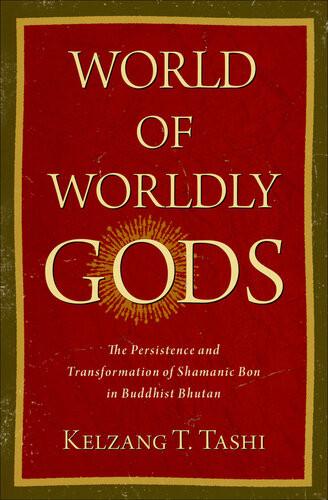
WORLD OF WORLDLY GODS
The Persistence andTransformation ofShamanic Bon in Buddhist Bhutan
Kelzang T. Tashi
World of Worldly Gods
The Persistence andTransformation ofShamanic Bon in Buddhist Bhutan
KELZANG T. TASHI
Oxford University Press is a department of the University of Oxford. It furthers the University’s objective of excellence in research, scholarship, and education by publishing worldwide. Oxford is a registered trade mark of Oxford University Press in the UK and certain other countries.
Published in the United States of America by Oxford University Press 198 Madison Avenue, New York, NY 10016, United States of America.
All rights reserved. No part of this publication may be reproduced, stored in a retrieval system, or transmitted, in any form or by any means, without the prior permission in writing of Oxford University Press, or as expressly permitted by law, by license, or under terms agreed with the appropriate reproduction rights organization. Inquiries concerning reproduction outside the scope of the above should be sent to the Rights Department, Oxford University Press, at the address above.
You must not circulate this work in any other form and you must impose this same condition on any acquirer.
Library of Congress Cataloging-in-Publication Data
Names: Tashi, Kelzang T., author.
Title: World of worldly gods : the persistence and transformation of shamanic Bon in Buddhist Bhutan / Kelzang T. Tashi. Other titles: Contested past, challenging future Description: New York : Oxford University Press, 2023. | Series: Religion, culture, and history | Revision of the author’s thesis (doctoral)—Australian National University, 2020, under the title: Contested past, challenging future : an ethnography of pre-Buddhist Bon religious practices in central Bhutan. | Includes bibliographical references and index.
Identifiers: LCCN 2022044647 (print) | LCCN 2022044648 (ebook) | ISBN 9780197669860 (hardback) | ISBN 9780197669884 (epub) | ISBN 9780197669891
Subjects: LCSH: Bon (Tibetan religion)—Zhemgang (District) | Shamanism—Zhemgang (District) | Buddhism—Zhemgang (District) | Religion and culture—Bhutan—Zhemgang (District) | Social change—Bhutan—Zhemgang (District) | Zhemgang (Bhutan : District)—Religious life and customs.
LC record available at https://lccn.loc.gov/2022044647
LC ebook record available at https://lccn.loc.gov/2022044648
DOI: 10.1093/oso/9780197669860.001.0001
InlovingmemoryofmybelovedMother
Contents
ListofIllustrations
Acknowledgments
NoteonOrthography
1. Introduction
Multiple Identities
Bon in Bhutan
Great and Little Traditions?
Fieldwork and Methodology
Structure of the Book
2. Goleng Village in Zhemgang District
Three Ridges of Zhemgang
Goleng Village
Social Organization: Dung, Kudrung, Pirpön, and Mamai
Lineage Houses
The Goleng DungNobility and Lineage Deities
The Founding of Buddhist Temples in Goleng
3. Soul Loss and Retrieval
The Fluidity of Five Life Elements
Common Rituals for Strengthening Declining Life Elements
The Primordial Bon Ritual for Recapturing the Abducted Soul
The Local Divinities of the Golengpa Bon Pantheon
4. Dealing with Threats to Health and Welfare
Protective and Healing Rituals
The Big GyalpoBeings
GyalpoShulDu: The Ritual of Dispatching the Big Gyalpoto His Palace
The Small or Familial GyalpoSpirits
Autochthonous Demons
Demonesses and Witches
Discerning the SondreHost
Shartsen: The Eastern Mountain Deities
Poison Givers: We Are Pure and Clean People
Treating the Poison Attack
Gyalpo, Sondre, and DukBeings as Economy-Generating Spirits
5. Controlling the Bon Priests
Lu’iBonpo: Becoming a LuSpecialist
The Ritual of Releasing Trapped Serpent Spirits
Ways of Becoming a Bonpo Shaman
The Shamanic Retrieval of Lost Souls
The Official Bonpos of Zhemgang
The Official Bonpo of Goleng
Bonpos in Court
The Politics of Black Magic Rituals
6. The Annual RupRitual
The Significance of Rupto the DungNobility
RupRules and Consequences
Outline of the RupRite
DhamDham: RupDivinities, Divinations, and Sealing Rites
The Rites of the First, Second, and Third Days of Rup
Rupand Its Future
7. Phallic Rituals and Pernicious Gossip
Phallic Symbols
The Antigossip Ritual
The Phallic Rituals of the Annual Chodpa
The Buddhist Phallic Ritual Cake
The Phallic Rituals by the Gadpo
8. Buddhist Accommodation of Bon Rites and Practices
The Annual Propitiatory Ritual of Local Deities and Demons
Buddhist Versions of the Odé Gungyal Ritual
Child Gods and Naming Patterns
The Former Clerical Bon Temple
9. The Persistence and Transformation of Golengpa Religiosity
Buddhism, Shamanic Bon, and Clerical Bon
From Oral/Literary to Mundane/Supramundane Distinctions
Syncretism and the Politics of Religion
10. Conclusion
Appendix:PhoneticRenderingsofLocalTerms
Notes
References
Index
1.1. 2.1.
3.1.
7.1.
8.1.
8.2.
3.1. 6.1. 6.2.
Illustrations
Figures
Goleng and neighboring villages
A partial view of Goleng village
The abode of serpent beings
The phallic kharam structure
The ritual cakes depicting the four main local deities
The journey of god Odé Gungyal
Tables
The Five Classes of Local Gods and Spirit Beings Consequences of Noncompliance with Ritual Rules RupRites and Rituals
Acknowledgments
This book would not have come to fruition without the support and generosity of a number of people and institutions. It is first and foremost to the people of Goleng that I owe a deep and lasting debt of gratitude for their kindness and hospitality during a year of fieldwork. They treated me as if I were one of their family members and tolerated my intrusion into their annual rites and everyday rituals, which often took place in the face of difficult and serious situations. My sincere thanks to the village headman, Ugyen Penjore, who introduced me to Tsultrim Wangmo and her brilliant son Sangay Dorji. She was the first Golengpa to welcome me to her house and subsequently became my generous host, while her son helped me as a long-term research assistant before resuming his studies.
Thanks are also due to Dechen Wangdi, Kinzang Wangchuck, Jambay Tshering, Ugyen Dema, Jambay Kelzang, Tshering Dorji, Kinley Wangdi, Kinley Yangzom, Kinely Namgyal, Dorji, Nima Tshering, and Kunley for their contributions to this project. My grateful thanks are extended to Tshultrim Dorji, who accompanied me to Shobleng village, introduced me to Bonpos there, and hosted me at his mother-in-law’s house during their annual rup rite. The same goes for Yeshi Dorji, who took me to Ngangla in the southern part of Zhemgang, and Phuba—the janitor of Kumbum temple in Wangdiphodrang—who welcomed me despite odd hours.
I am especially indebted to Bonpo Chungla, Bonpo Pemala, and Bonpo Sangay of Goleng, Bonpo Tempala of Shobleng, pamo Karma of Berti, a Chungdu pawo from a nearby village in Nangkor county, and Bonpo Dophu of Bumthang, all of whom invited me to attend various rituals and provided invaluable insights by patiently answering my endless questions. Heartfelt thanks go to lay Buddhist chöpas in equal measure, particularly to Lopön Pema Wangchuk,
who very kindly not only invited me to attend various Buddhist rites but also contributed many invaluable insights and provided advice. Besides Golengpas, I am grateful to the former district governor (Dzongdag) of Zhemgang, Harka Singh Tamang, and the county headman of Nangkor, Dorji Wangchuk, for allowing me to conduct research in Goleng, which is under their direct jurisdiction.
I owe a deepest and inestimable gratitude to my PhD supervisor at the Australian National University (ANU), Nicolas Peterson, without whose constant guidance, support, and generosity throughout this journey this project would have been impossible. During my doctoral research, he not only provided a detailed commentary on each chapter but also supported the final months of my fieldwork with additional funding from his research fund. Most importantly, he taught me how to think anthropologically and reminded me of the importance of clear and simple writing over an opaque style. Despite his retirement, he was generous with his precious time and continued to provide the most invaluable comments and suggestions on the revised draft of this book. Nic continues to be my constant source of inspiration and guidance. I would like to offer my special thanks to my supervisory panel members, Patrick Guinness (ANU) and Dorji Penjore (Centre for Bhutan Studies). It was Dorji Penjore who not only introduced me to Nicolas Peterson but also recommended Goleng as an ideal study location. He was involved in the formulation of the thesis proposal, and during the fieldwork he provided me with crucial advice and support. Patrick Guinness read the earlier drafts of Chapters 5, 6, and 7 and provided valuable comments and suggestions in the Thesis Writing Group. Philip Taylor, Christine Helliwell, Caroline Schuster, and Simone Dennis introduced me to anthropology as a first-year PhD student, and without their support and guidance I would not have found a home in anthropology. I greatly appreciated the support that I received from Yasmine Musharbash and Chris Gregory during my studies. Thanks in particular go to Meera Ashar, Philip Taylor, and Assa Doron, all of whom served as my interim supervisors at different stages of my first-year PhD program.
My research was generously supported by Endeavour Scholarships and Fellowships (2016–2020) provided by the Australian Government’s Department of Education and Training. Fieldwork was funded by an ANU Higher Degree Research Grant with the award of an additional Vice-Chancellor’s Travel Grant (2017–2018). My sincere thanks to both the funding agencies, without which this work would not have been possible. This book has been greatly improved by the constructive comments and thoughtful suggestions from five anonymous reviewers. I am grateful to the three thesis examiners whom I know to be Geoffrey Samuel, David Holmberg, and Tsering Shakya. Unanimously recommending the award of the PhD, they provided generous and illuminating comments, inspiring me to push myself to think theoretically as well as transnationally in new ways.
At the American Academy of Religion, I am forever indebted to the erudite editor of the Religion, Culture, and History series, Robert Yelle, for his kind guidance, support, and encouragement right through the initial phase of the book proposal to the blind peer review process. I am grateful to two reviewers of the book manuscript, one of whom I know to be Daniel Berounský, for their valuable feedback and suggestions. Their crucial comments and critiques greatly improved the overall clarity of the manuscript. At Oxford University Press in New York, my deepest gratitude is due to Cynthia Read, Steve Wiggins, Theo Calderara, project editor Paloma Escovedo, project manager Suganya Elango (Newgen), book cover designer James Perales, and most importantly the judicious copyeditor Richard Isomaki for their kind assistance and guidance throughout the publication process.
At the University of Toronto, I am grateful to Christoph Emmrich and Michael Lambek for their generosity and support for my work during my affiliation with the Centre for South Asian Studies at Munk School of Global Affairs, where I was a research associate. At the London School of Economics and Political Science, I am equally grateful to Catherine Allerton and Katy Gardner for their interest in my work and the support given to me as a visiting fellow in the Department of Anthropology.
I gratefully acknowledge that a part of the final revision of this book was undertaken during my affiliation as a postdoctoral fellow with National University of Singapore (NUS). I must express my sincere gratitude to the Asia Research Institute for a postdoctoral fellowship, and to Jamie Davidson, who has been a gracious mentor and guide at NUS. I have been also extremely fortunate to have the support and guidance of William Sax at Heidelberg University as I embark upon a new research project.
My special thanks to the participants of the Department of Anthropology’s Thesis Writing Group (2019) at ANU for stimulating discussions. Fay Styman, Ian Pollock, Meng Cao, Shamim Homayun, Shaun Gessler, Kirsty Wissing, Simon Theobald, Alexander D’Aloia, Shamim Homayun, and Stefanie Puszka all provided useful comments on the earlier drafts of Chapters 5, 6, and 7. Thanks are also due to the panel organizers and participants of the Australian Anthropological Society Annual Conference (2019), the American Anthropological Association / Canadian Anthropological Society Annual Meeting (2019), and the Association of Social Anthropologists of the UK and Commonwealth Annual Conference (2019), where I have presented some sections of Chapters 2, 3, and 5. I gave a talk on Chapter 9 at the University of Toronto as part of the Centre for South Asian Studies Pathbreaker Series. Some information on social organization in Chapter 2 appeared in my article in the Journal of Anthropological Research (2022). The friendship and support of a group of Bhutanese academics in Canberra, particularly Dendup Chophel and Lhawang Ugyel, is greatly appreciated.
Lastly but most importantly, I would like to thank my family. My dearest mother Sherab Yangchen was a devout Buddhist born into a deeply religious family with a long line of hereditary lamas. She was my source of inspiration and primary refuge, without whose support and blessings I would not be where I am today. Her sudden demise in mid-2018 when I barely started writing my dissertation devastated and traumatized me for many months, rendering my life completely empty and meaningless. My father, Gyembo, is an equally devout Buddhist with great discipline and integrity. Despite his own enduring grief, my father kept encouraging me and constantly prayed for the
successful completion of my studies. He is my guide and a role model that I look up to. My sincere thanks go to my siblings and relatives, who always support me. Thanks in particular go to my elder brother Khenpo Kencho Tenzin for helping me with the Wylie transliteration and for his unfailing encouragement and prayers. Most importantly, I want to thank my dearest son Norbu Yoedbar for his patience, as he had to separate from his mother to support his father’s ambitions. Finally, I want to thank my amazing wife Dema Yangzom from the bottom of my heart for her love and constant support, and for everything else.
Note on Orthography
The dialects spoken by the people of central Bhutan have no formal written script. Except where necessary, I have not followed the Wylie convention of transliteration in the book, but romanized words based on how they are pronounced by people and how I heard them. The local words are italicized throughout the book, but their first appearance is shown in parenthesis. Where appropriate, non-English words have been pluralized. A list of the phonetic rendering of local terms with Wylie transliteration has been provided at the end of the book.
1
Introduction
Without Buddhist priests, dharma protectors will be displeased; without Bon priests, local deities will be angered.
Local adage
Before the coming of Buddhism to Bhutan in the seventh century, Bon was the only prevalent religious practice, and it continues to survive down to the present day. This is surprising because Bon religiosity has been looked down on by Buddhists due to the practice of animal sacrifice and its alleged association with black magic rituals that are antithetical to core Buddhist values. Moreover, unlike Buddhism, Bon does not offer enlightenment to sentient beings and accordingly has no salvific function. Despite many centuries of Buddhist opposition, including ongoing censure today, Bon beliefs and practices continue to play a role in the lives of people in Bhutan through annual celebrations and everyday engagement in Bon healing and protective rituals.
This book is an exploration of the relationship between Bon and Buddhism through an ethnography of Goleng village (also spelled as Goling) and its neighbors in Zhemgang district in central Bhutan, which are a stronghold of Bon practices and beliefs. I am interested in why people, despite shifting contexts, continue to practice and engage with Bon rituals while recognizing that what they are doing is antithetical to the civilizing mission of the Buddhist masters from Tibet and, of course, against the religious prescription of the Bhutanese state, which made Drukpa Kagyu—a branch of the Kagyu school of Tibetan Buddhism—its state religion in the seventeenth century. Against the backdrop of long-standing tensions between
Buddhism and Bon, which go back to the eighth century, this study investigates the failure to eliminate Bon, and why Buddhists felt it necessary to reach a rather awkward accommodation not only with some Bonpos but also with their own mission of illuminating the socalled uncultivated country with the universalizing light of Buddhism. Zhemgang is particularly relevant to addressing this question as Buddhist institutions came very late to some areas of the district, indeed, only in the 1960s. Although the majority of Bhutanese people identify as Buddhists, Bon is widely practiced across Bhutan, with people taking part in a range of Bon practices through everyday rituals and annual rites. Some villages in western Bhutan, for instance Haa, have shared annual Bon rites, in which live-animal sacrifices were made until recently. Yet I have chosen Zhemgang in central Bhutan as my field site because it is the region where the surviving nobilities, despite officially not existing, thrive, and the annual Bon rite is the most intense.
What follows is not simply a study about the relationship between a local religious practice, Bon and Buddhism, a world religion; it is also a study of the ontological orientation of villagers in the contemporary Bhutanese society. At the heart of the book lies the question of cultural persistence and change: what explains the tenacity of pre-Buddhist Bon beliefs, as they are lived and contested, in the presence of the invalidating force—Buddhism. Framed in longstanding debates around practices unsystematically identified as “Bon” by Tibetologists and anthropologists, and how they relate to what anthropologists refer to as religious syncretism, my analysis lays bare deeper forces that operate under the veneer of Buddhism’s civilizing mission.
The study reveals that the reasons for the tenacity of Bon practices and beliefs amid censures by the Buddhists are manifold and complex. One explanation for the persistence of pre-Buddhist religious beliefs in Goleng and Shobleng villages is their remoteness and small population so that no official Buddhist institutions were actually established in the area until the mid-twentieth century. Buddhism itself was never as strong as in other areas that are home to the major Buddhist centers of the country, and hence, Bon has
managed, despite the odds, to be seen as more relevant to villagers’ everyday concerns and local problems. Nevertheless, the villages of this area have been well aware of Buddhism for centuries through their contacts with Buddhist masters and practitioners from elsewhere whose religious traditions, though official, are unaffiliated with the state-sponsored school of Buddhism, which is mainly concentrated in the state-based institutions found in district (dzongkhag) and subdistrict headquarters (drungkhag).
Given the long history of Buddhist antagonism toward Bon, it was very surprising to learn that there has been an appointment of the first official Bon priest (hereafter Bonpo) of Zhemgang proper1 by the district office in the 1990s in an effort to restrict and marshal Bon practices in the region. Similarly, the appointment of a local Bonpo to the official Bonpo role in Goleng by the district office is another case in point. This was, however, against the will of the people of Goleng (Golengpa hereafter) and historically unprecedented not only in Goleng, or for that matter in Zhemgang, but in the country as a whole. While Bon in general and Bonpos in particular have been denigrated by the Buddhists for centuries, this particular scheme is aimed to crack down on the former by designating a specific Bon priest as the “official Bonpo” in the hope of discrediting the others.
Two Buddhist temples have recently been established in Goleng: the first temple construction was in the 1960s and antedated the appointment of the official Golengpa Bonpo, while the second temple was established in 1994. In addition to it, there have been several occasions in Zhemgang proper and Buli villages in which the local Bonpos were subject to religious validation. All the active Bonpos from the neighboring villages were summoned to the village centers, and their Bon practices were then systematically scrutinized, reviewed, contested, and judged by Buddhist clergies and highranking officials. It was on one such occasion that Bonpo Karma of Pam village was singled out from the pool of Bonpos for the newly created position of the official Bonpo of Zhemgang proper. Currently, a monthly honorarium of Nu 500 ($8) is provided by the district
office for his religious services at the courtyard of the district office. Bonpo Karma, who boasts about his role by calling himself the state or official Bonpo (zhung-gi bonpo), emphasizes that the Buddhist clergies and high-ranking officials were affiliated with the statefunded school of Buddhism and came all the way from the capital, Thimphu, to organize the selection of the official Bonpo.
Slowly and methodically, the district office’s interests in certifying Bonpos have extended beyond its headquarters, particularly to Bon stronghold villages such as Goleng. While their mission is guided by Buddhist logic, the designation of an official Bonpo of Goleng was the corollary of a lawsuit filed by three Golengpa plaintiffs against a Bon priest who was believed to be practicing a form of Black Bon2 (bonnag) involving live-animal sacrifices and black magic rituals as opposed to White Bon (bon kar)—which by the same token is denuded of animal sacrifices and black magic rituals. It should be, however, noted bon kar and bon nag are both retrospective labels given by Buddhists, but they are now accepted and employed by the Bonpos themselves to refer to their specific forms of ritual. It was this legal process that culminated in Bonpo Chungla’s appointment as the first official Golengpa Bonpo—the vocation that he embraced until he stepped down from his formal role due to his age and medical condition in the early 2000s. However, except for Chungla, who embraces bon kar, the district court issued a written order in the early 1990s prohibiting more than six active Golengpa Bon priests, including the current de facto village Bonpo, from performing destructive rituals and engaging in Bon divinations and burnt offerings (sur). The surveillance of Bon by the district office is still in place, but it only becomes active when people complain about the Bonpos or their Bon rituals.
While the Bonpos who resort to black magic ritual and live-animal sacrifice were reprimanded and indefinitely banned from performing their rituals by the court, the handful of Bonpos who adhere to the Buddhist ethics and moral status of any sentient being have continued to be recognized by the Zhemgang district office. Chungla of Goleng and Karma of Zhemgang proper both belong to this latter
category. On the other hand, Bonpo Pemala, who was originally banned by the district court from performing any forms of Bon rituals, was made a de facto “official” Golengpa Bonpo by the villagers themselves following his predecessor’s retirement in the early 2000s. Although the appeal of the decision of the district court was made by a group of village elite3 (goshé nyenshé) in 1993, Bonpo Pemala’s candidature for the position of the second official Golengpa Bonpo was dismissed in line with the first court ruling. Nonetheless, Bonpo Pemala has been officiating at the annual Bon rituals, thereby contradicting the court ruling, and of course, it was against the wishes of lay Buddhists, including Lopön Pema Wangchuck, who is the head of Golengpa lay Buddhists. Despite the fact that the court can impose a penalty of up to Nu 1,000 ($16) and a six-month jail sentence for the breach of its orders, these unofficial Bonpos, while desisting from the acts of animal sacrifice and black magic rituals practice their art—from basic sur offerings to advanced shamanic ritual healings—and more than 99% of Golengpas continue to have recourse to Bon rituals to this day.
Multiple Identities
Before proceeding with the history of Bon in Bhutan, it is helpful to provide an overview of the long and complex history of Buddhism and Bon in Tibet, and their relationship over the course of many centuries. The pre-Buddhist Bon is portrayed in Buddhist sources as an anti-Buddhist religious practice that opposed and resisted the propagation of Buddhism in eighth-century Tibet4 and as the religion that later inspired the anti-Buddhist campaign during the reign of the pro-Bon Tibetan emperor Langdarma5 (r. 838–42). During this troubled era, the believers of Bon were viewed by Buddhists as adepts at black magic rituals and animal sacrifices who like untamed and hostile autochthonous beings were in need of spiritual domestication and religious upgrading to Buddhism. For this reason, the thirty-eighth emperor of Tibet, Trisong Detsen, invited masters including the famed Tantric master Padmasambhava (also known as
Guru Rinpoche) from India to assist him to firmly re-establish Buddhism in Tibet.
During this early diffusion of Buddhism (tenpa ngadar), Padmasambhava accomplished this mission by first employing Tantric means to subjugate the powerful local deities who obstructed the construction of Samye monastery in the eighth century, and then eventually converting and binding them by oath to become the protectors of Buddhist dharma (chökyong). Since then a plethora of Tantric deities, converted earthly gods, and subsequent Buddhist masters have been engaged in a civilizing mission of “taming, ordering and bringing under cultivation of the wild territory of Tibet and its various humans and non-human inhabitants” (Samuel 2013: 78). The believers of pre-Buddhist Bon were then largely persecuted by the state, and, according to Karmay (2009 [1997]: 118), the Bonpos of central Tibet were banished, while those unwilling to leave were converted to Buddhism.
This pre-Buddhist Bon, particularly in Tibet, is said to have undergone a series of religious transformations that, according to Buddhist sources,6 had at least three distinct historical stages,7 namely, wild or outbreak Bon (rdolbon), corrupted or erroneous Bon (’khyar bon), and reformed or plagiarized Bon (bsgyurbon) (cf. Van Schaik 2011, 2013b; Bjerken 2004; Martin 2001). While this narrative seems to reflect the Buddhist polemics against the transformation of Bon, the first, rdol bon, corresponds to the preBuddhist Bon that existed until the legendary King Drigum Tsenpo,8 while bsgyur bon characterizes the contemporary Clerical or “eternal” Bon (hereafter Yungdrung Bon), which began reorganizing its religious beliefs and practices between the eleventh and fourteenth centuries under strong Buddhist influence (Samuel 2017: 123–124) of Nyingma and other postimperial Tibetan Buddhist schools during the later diffusion9 (tenpachidar). On the other hand, ’khyar bon is more or less the later version of rdol bon but with renewed religious prominence due to the Bonpos ritualistic function at the royal court until the late eighth century.
After the 1960s, the studies in which “Bon” increasingly became the official label for the “organized, soteriological religion calling itself Yungdrung Bon” proliferated, while the old manuscripts containing the word “Bon” and the local ritualists among the culturally Tibetan populations in pan-Himalayan societies designating themselves as Bonpo and their rituals as Bon along with its various vernacular appellations such as lhaven, lhabon, bombo, phajo, nejum, pawo, and so on, continue to appear (Huber 2015c: 271). The above rituals and priests, along with the other local ritualists without a Bon referent,10 which are found in northern Nepal, Sikkim, Bhutan, Arunachal Pradesh, and southern Kham in Tibet, rather than isolated phenomena, share a “clear family resemblance” (Huber 2015c: 272; Samuel 2013: 80) and are characteristic of pre-Buddhist or unorganized Bon. However, since the translation of the “Nine Ways of Bon” by Snellgrove (1980 [1967]) in collaboration with contemporary Yungdrung Bonpo monks, views of pre-Buddhist Bon have completely transformed, from its being seen as shamanistic, unorganized, and animal-sacrificing religious practices to a clerical and organized religion with its own founder, canonical texts, and philosophies.
According to Kværne (1995), the pre-Buddhist Bon of Tibet concerns funerary rites involving animal sacrifices performed by priests known as Bonpos, particularly for the kings of the imperial period. The claims of continuity with this unorganized religion are therefore being made by the followers of Yungdrung Bon based on this priestly ritual tradition at the royal court, which was certainly shamanic in nature. The other important rituals of the period for the laity, such as the worship of local gods and deities, divinations, and so on, were, to a degree, not seen as the tasks of the ancient Bonpos, resulting in some scholars calling them “popular religion.”11 The most notable labels for these pre-Buddhist religious practices, excepting the death rituals of the kings, are “folk religion” (Tucci 1980), “nameless religion” (Stein 1972),12 and recently, “pagan religion” (Ramble 1998, 2008). Although as Samuel (2017) rightly suggests, a term like “folk religion” tends to represent the non-