FOREWORD
Neither of us are musicians, but both of us have some experience with protest, and we can say with assurance that if you’re not singing—or dancing, or using the tools that culture has to offer—you’re not doing it right.
We say this for several reasons. One is internal. Movements are made up of human beings, and human beings are braver and more unified when they are singing. If, say, you are sitting someplace you’re not supposed to be, waiting to get arrested, you can’t help but feel a little worried. But if you’re all singing “We Shall Not Be Moved,” or “We Shall Overcome,” it’s easier to remind yourself that you’re part of a tradition, that you have friends all around you, that you are stronger than you think. And in jail? The civil rights movement made clear that songs of freedom keep you strong, especially when you are alone and feeling discouraged, and we’ve found that to be true.
But at least as important, music helps other people understand what you’re up to. The point of movements is to shift the zeitgeist, to persuade onlookers (and most people are onlookers) that change must come. Some of this persuasion is done with statistics and arguments—you have to win the argument. But you can win the argument and lose the fight, because fights are often about power. The status quo can usually count on money as its ally; those trying to force change have to find other weapons. And some of the strongest weapons are music and art—an appeal to that half of the human brain that does not respond to bar graphs and pie charts.
One of the finest things about music is the way it can bridge the gulfs that have divided Americans and kept them from cooperating for change. We know, for instance, that when people think about music for environmentalists, they tend to imagine a white guy in a sweater with a guitar strapped around his neck. John Denver, say. But the finest and most important environmental anthem in American history is almost certainly Marvin Gaye’s “Mercy Mercy Me (The Ecology Song).” It’s a reminder that in 1970 the environment seemed as much a project of inner-city America as of the wilderness. If we’d kept that
link stronger, we might have avoided abominations like Flint’s water crisis. That’s why it’s so powerful right now to see hip-hop and R&B musicians writing the next wave of environmental songs.
This volume is a powerful reminder of just how crucial music has been over the long history of American protest. And it’s a reminder too of the way that America has specialized in protest—one of the great gifts we’ve given to the rest of the world has been the long and rich history of people standing up to power. America was born in protest against the greatest empire on earth, and protesters have tried to fix some of its grave defects ever since. This book emerges in a moment of great upheaval, as many Americans try to come to terms with the radical presidency of Donald Trump. More than ever, we need hearts and minds moved simultaneously. We have a great tradition to draw on!
Rev. Lennox Yearwood, Hip Hop Caucus
Bill McKibben, 350.org
INTRODUCTION
The Star-Spangled Banner
Though this book is about the power of words, the American protest song that spoke the loudest may be the one that was played without them.
When Jimi Hendrix wrung the notes of “The Star- Spangled Banner” from his white Fender Stratocaster from the Woodstock stage on a breaking Sunday morning in August 1969, he bombarded the melody with eruptions of feedback. Those amplified sound effects echoed the war that was tearing apart the country of Vietnam, and, closer to home, the American family: the cluster-bombing, the machine-gun fire, the slapping helicopter blades, the screaming napalm victims.
Hendrix himself had been a candidate for duty in Vietnam, having enlisted in the US Army at the age of eighteen and been assigned to the 101st Airborne Division at Fort Campbell, Kentucky. He never made it to the field of battle. An indifferent soldier, he was honorably discharged following an ankle injury on a training jump.
A few weeks after the Woodstock Music & Art Fair—the cultural event in Upstate New York that would define a generation—Hendrix made a rare appearance on a television talk show, sitting down with interviewer Dick Cavett for his prime-time ABC program. When Cavett asked about the “controversy” the guitar’s rendition of the national anthem had evoked, Hendrix replied, “I don’t know, man. I’m American, and so I played it. . . . They made me sing it in school, so it was a flashback.”
Persisting gently, Cavett noted the unorthodoxy of Hendrix’s approach to the song.
“That’s not unorthodox,” the soft-spoken musician responded. “I thought it was beautiful.”
Ask Johnny Cash to choose, and he’d take the side of the disadvantaged every time. In a field of music dominated by cowboys, the country singer told tales
of the Native Americans they’d vanquished. He sang of the farmhands and the assembly line workers. He recorded his fabled live albums at Folsom Prison and San Quentin because he felt a kinship with the inmates and the outlaws. He sang for the forgotten, the outsiders, the ones who have no voice.
On this day in early 1970, however, Johnny Cash was going to the White House. He’d been invited by President Nixon, who’d heard impressive things about the singer from the Reverend Billy Graham, a mutual friend. At the height of his career, with a weekly network television show and a long string of hit records dating back to the mid-1950s, Cash was an entertainment king.
Nixon had a few requests. The president wanted to hear Cash sing “A Boy Named Sue,” his oddball hit written by Shel Silverstein; “Welfare Cadillac,” a wry poke at federal handouts by the songwriter Guy Drake; and “Okie from Muskogee,” Merle Haggard’s classic song about the great divide between traditional American values and the counterculture of the 1960s. Cash did play “A Boy Named Sue,” but he politely declined to perform the others: he didn’t know them, he claimed. During a forty-minute appearance, Cash and his accompanists performed songs including “Five Feet High and Rising,” “Jesus Was a Carpenter,” and the gospel standard “Peace in the Valley.”
Cash also played a new song that, like Haggard’s, addressed the generation gap then roiling the country. “What Is Truth” was inspired by comments Cash heard on the set of his television show, when a fellow country music veteran complained that he couldn’t make sense of the loud rock music the younger generation was making. Cash had written his latest single at the urging of Graham, the evangelical minister, who’d suggested the youth of America needed some guidance. Instead, the song attempted to explain their side to his own peers. “Maybe I was trying to be a kid again,” he told the guests at the White House.
A little boy of three sittin’ on the floor
Looks up and says, “Daddy, what is war?”
“Son, that’s when people fight and die”
A little boy of three says, “Daddy, why?”
“What Is Truth” went on to remind those in power that the young were destined to have their day: “The ones that you’re callin’ wild/Are going to be the leaders in a little while.” After he finished delivering the song, Cash quietly told the president that he hoped the soldiers who were overseas could come home as soon as possible. The two hundred guests responded with a sincere, sustained round of applause.1
A year later, Cash released another purposeful new single, this one called “Man in Black.” He’d written it after meeting with students at Vanderbilt University to discuss a range of issues. Asked why he wore black clothing onstage, he used his answer as the song’s theme. He wore black, he wrote, as a comment on the world’s inequities. He chose to wear somber colors to honor the poor, the hungry, the elderly, the “beaten down.” He dressed in black for those who hadn’t heard Jesus’ message of love and charity, and for the thousands who died in wartime, “believing that the Lord was on their side.” Some troubles may never be solved, Cash knew, but we could surely make some things right. “Till things are brighter,” he rumbled, “I’m the man in black.”
The hardest song to write is a protest song, Joan Baez once said, though few of her contemporaries seemed to think so. The 1960s—so full of disruption that the adjectives “turbulent” and “tumultuous” are practically synonymous with the decade—were consumed with a spirit of popular protest. Folk, rock, and soul musicians wrote and performed songs that condemned segregation and bigotry, the war in Vietnam, the second-class status of women, the plunder of Mother Earth. Some of those words have proven timeless.
How many roads must a man walk down before you call him a man?
There’s a man with a gun over there, telling me I got to beware.
War—what is it good for?
From the American Revolution to the twenty-first century, every social debate in America—about war, class, gender, race, the environment—has been set to song. “This machine kills fascists,” as Woody Guthrie inscribed on his guitar—but his familiar model of the guitar-strumming dissident is only one of many. Protest music has spanned nearly every style of American music, from the town common to the digital commons.
The United States was born out of protest, and many of the country’s greatest artistic contributions have come as protest in one form or another. Woody Guthrie wrote “This Land Is Your Land” about freedoms not granted, but restricted. Spirituals and blues lamented racial inequality. Rock ’n’ roll originated as the voice of an underestimated youth movement. Hip-hop, too, emerged from an overlooked segment of society as an urge to be heard.
The nineteenth century saw the dawning of social movements to demand the abolition of slavery and the end of segregation; equal rights for women, including the right to vote; and overdue safeguards for the working class,
from shorter workdays and compensation for injuries sustained on the job to the curtailing of child labor practices.
“Write and sing about it,” urged Joshua McCarter Simpson, a freeborn man who composed dozens of antislavery songs. “You can sing what would be death to speak.”
The right to protest was ingrained in the American experiment from its very inception. New World colonists demonstrated against the duties imposed on them as English subjects, arguing that they had no voice in Parliament. “No taxation without representation,” as the Congregational minister Jonathan Mayhew put it in a sermon in Boston in 1750, coining the phrase that would help spark the American Revolution.
Like many of his fellow Bostonians at the time, Andrew Oliver felt that the British Parliament’s Stamp Act of 1765 would be an onerous burden on commerce in the New World. But Oliver, scion of a merchant family, was not one to protest.
As a public official, having served as Boston’s town auditor, Oliver dutifully accepted when he was appointed to administer the Stamp Act, which levied taxes on the distribution of newspapers, legal documents, and even playing cards in the colonies. The edict was an unpopular one, to say the least. During the night leading into August 14, 1765, a group of Boston’s most vehement Stamp Act opponents hung Oliver in effigy from a sturdy American elm standing at the edge of Boston’s South End, near the Boston Common. In the morning, Thomas Hutchinson, the patriarch who would become governor of the province of Massachusetts Bay, called for the removal of the effigy. But a gathering mob guarded the scene around the symbolic meeting point, which they’d named the Liberty Tree.2
As the day progressed, the demonstration led to a march through the streets, during which the protesters destroyed a building rumored to be one of the new stamp distribution centers. Then they set upon Oliver’s private home, stomping through his garden and ransacking the interior. When Hutchinson tried to intervene, they threw stones. Within days, Oliver had resigned from his post.
That year produced one of the first musical salvos of the colonists’ resentment toward the British crown. Written by a Connecticut schoolteacher named Peter St. John, “American Taxation” (sung to the tune of the traditional marching song “The British Grenadiers”) accused King George of enacting laws “of the blackest kind.”3 Soon the Boston agitators were promoting a boycott on imported British goods, particularly fabrics. In the popular ballad “To the Ladies,” American women were implored to spurn British fashion
in favor of “clothes of your own make and spinning.” The boycott resulted in an estimated $3 million drop (more than $85 million in today’s dollars) in British exports to the colonies in the year 1769.
Around the time the boycott was established, Philadelphia’s John Dickinson celebrated the resistance in a poem. Dickinson, later known as the “Penman of the Revolution” for his series of essays “Letters from a Farmer in Pennsylvania,” would serve as a delegate to the First Continental Congress. Though he would decline to sign the Declaration of Independence, favoring mediation over open revolution, Dickinson wrote “The Liberty Song” as a rallying cry against submission to England’s oppressive legislation: “For shame is to freemen more dreadful than pain.”4 He set his verse to the tune of “Hearts of Oak,” a beloved British military song that celebrated the British navy’s victorious campaigns overseas. Dickinson’s song quickly drew a rejoinder from the Loyalist side, “Parody upon a Well-Known Liberty Song.” First printed in the Boston Gazette, the satire took aim at the “numskulls” and “pumpkins” who resorted to demonstrating in the streets against the Crown: “All ages shall speak with contempt and amaze/of the vilest banditti that swarmed in these days.”5
But the protesters were to gather again. Eight years after the first mob action against the Stamp Act, Boston’s Sons of Liberty demanded that a prominent tea merchant appear under the Liberty Tree to recuse himself of his contract with the East India Company. The Tea Act of 1773 had granted the merchant’s troubled company a virtual monopoly on the tea trade in the North American colonies. “Fail not upon your peril,” wrote the protesters in their demand. When the merchant did not show up, the Boston Tea Party began in earnest.
By then, the Liberty Tree was a symbol of the colonists’ “glorious cause,” their fight for home rule. Occupying British soldiers ridiculed the tree. When they detained an aspiring Minuteman who tried to arrange to buy arms from an undercover British soldier, they tarred and feathered him and carted him to the Liberty Tree. As they marched, a fife and drum corps playing a derisive rendition of “Yankee Doodle.”
Finally, in August 1775, a group of British loyalists chopped down the old elm, using the logs for firewood. For years the stump remained, a reminder of the revolution the Sons of Liberty helped incite. In memory of the tree, hundreds of seedlings—the new Liberty Trees—were planted on commons across the colonies. A pine tree flag, often bearing the inscription “An Appeal to Heaven,” became a familiar sight during the Revolutionary War.
Thomas Paine, the political philosopher who wrote the pro-independence pamphlet “Common Sense,” found the inspiration of the Liberty Tree worthy of his own poem. He published the verse in Pennsylvania Magazine during the summer of 1775. (Sometime after the first publication, Paine added a subtitle: “A Song, Written Early in the American Revolution.”) Set to a pastoral air, “Liberty Tree” helped spread early word that the revolution was imminent. It eventually became a rallying cry for the American rebels.
From the east to the west blow the trumpet to arms
Through the land let the sound of it flee
Let the far and the near all unite with a cheer
In defense of our Liberty Tree.6
Few songs from the time of the Revolutionary War survived much beyond the period. Music itself played a complicated role in everyday life in colonial America; the descendants of the original settlers were often still influenced by the Puritans’ disavowal of entertainment in any form. And much of the music that did become familiar to the colonists tended to be based on British ballads. But Paine’s verse, like those of St. John and Dickinson, was an early example of the American protest song: an exercise, set to rhyme and melody, of the First Amendment’s guarantee “to petition the government for a redress of grievances.”
“The duty of youth is to challenge corruption,” said the late Kurt Cobain. And not just the young. More than two centuries after the revolutionaries won independence, the folk singer Pete Seeger, then in his late eighties, performed a rendition of Paine’s song at the dedication of the New York Liberty Tree at Washington’s Headquarters, the Hudson Valley farm where the first president once lived. New York’s Liberty Tree was one of thirteen saplings harvested from the oldest surviving Liberty Tree, planted in each of the original thirteen colonies by an environmental conservation group.
“In the largest sense,” Seeger once said, “every work of art is protest. . . . A lullaby is a propaganda song, and any three-year-old knows it.”
The songs covered in this book—one hundred of them that span a century of petition in the name of social progress—are more eloquent than speech. They were written and performed by artists both popular and unpopular, famous and unknown, commercially successful and unrecorded. Published at a time of notable unrest, just like many others in our collective history, Which Side Are You On? will tell the story of modern American democracy, and the music that had the audacity to speak up and take a side.
This book is a selective survey. A hundred songs is a lot of songs, but there were dozens more considered, and still more hundreds that might have been. In focusing on American issues, I have chosen not to include the brilliant protest music of the Clash, Bob Marley, Fela Kuti, or Victor Jara, to name a few of the many omissions some readers may note. Neither should the book be read as a comprehensive history of the social movements described in each chapter. These are introductions only.
The lessons handed down from the major social movements of the twentieth century—from organized labor, civil rights, women’s liberation, opposition to war—have left a proliferation of causes that sometimes feels too multifarious, too factionalized, for any kind of meaningful gain. There are many distinct definitions of feminism, for instance; those who identify as environmentalists range from organic consumers to ecoterrorists; various groups call themselves libertarians, socialists, anti-globalists, anarchists. “At times,” writes the longtime activist and journalist L. A. Kauffman, “it can seem like the number of recent radicalisms stands in inverse proportion to their overall influence.”7
The 1960s were a heyday of protest against which all future dissenting voices would be measured. Every new cause for demonstration in recent years, be it climate change, police brutality, or a legislative assault on the social safety net, has invited questions about the supposed scarcity of modern protest songs. In fact, however, protest music thrives. In February 2017, two weeks after the presidential inauguration, the chameleonic pop star Lady Gaga appeared during the NFL Super Bowl halftime show in Houston. A year after Beyoncé’s halftime performance, which was seen in part as a statement against racial profiling, some critics saw Lady Gaga’s performance as refreshingly apolitical. But to those who recognize the legacy of protest song in this country, her opening rendition of Woody Guthrie’s “This Land Is Your Land,” paired with Irving Berlin’s “God Bless America,” suggested otherwise.
WHICH SIDE ARE YOU ON?
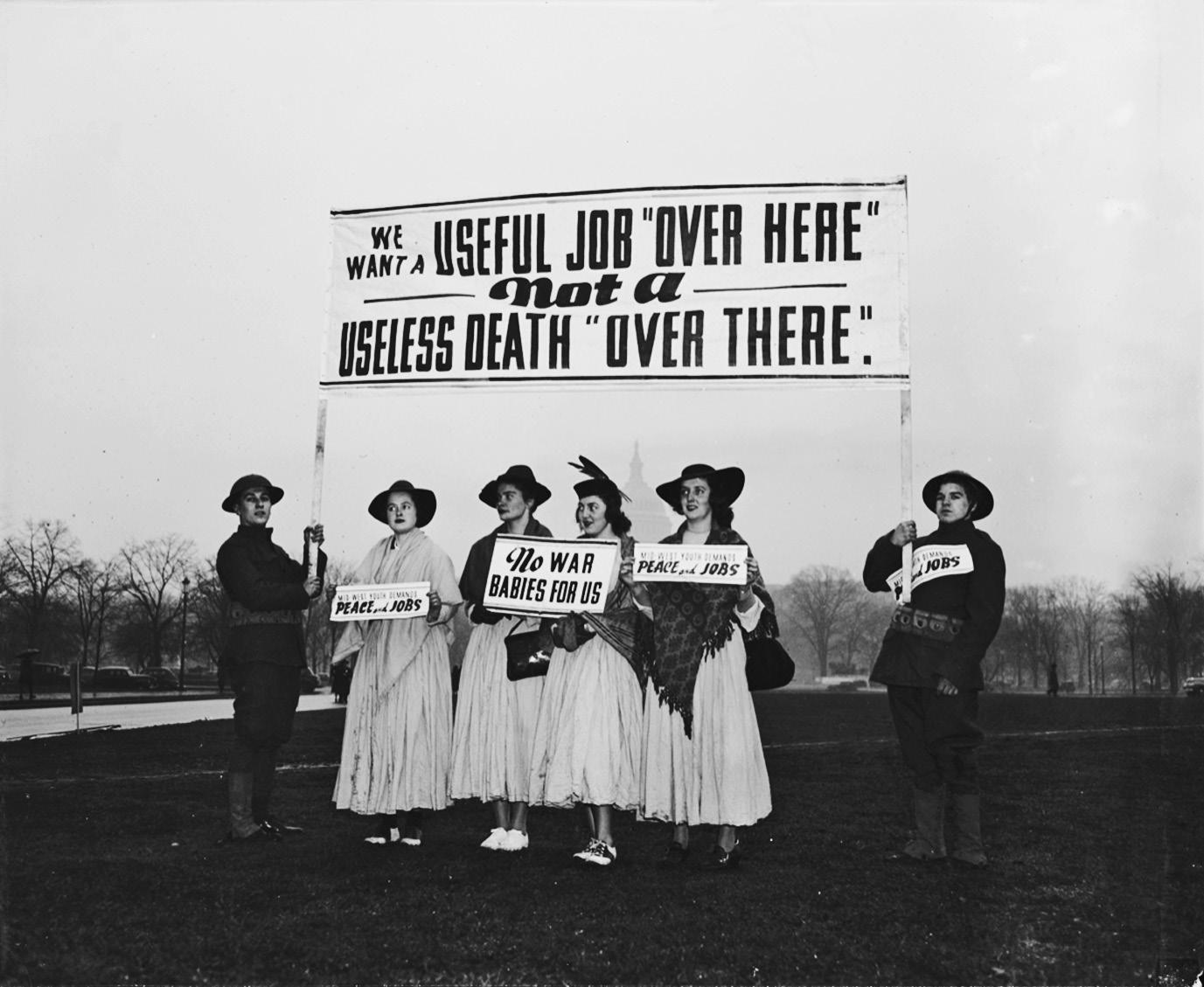
War protesters, c. 1940.
Credit: Library of Congress, Prints & Photographs Division, photograph by Harris & Ewing. http://www.loc.gov/pictures/resource/hec.28132/
NONVIOLENCE
I-Feel-Like-I’m-Fixin’-to-Die Rag – Handsome Johnny – With God on Our Side –I Ain’t Marching Anymore – Three-Five-Zero-Zero – Kill for Peace – The Strange Death of John Doe – Waist Deep in the Big Muddy – I Didn’t Raise My Boy to Be a Soldier – God Bless America
“War is hell,” said, among many, William Tecumseh Sherman.
“I am tired and sick of war,” he once confessed. “Its glory is all moonshine. It is only those who have neither fired a shot nor heard the shrieks and groans of the wounded who cry aloud for blood, for vengeance, for desolation.”
Sherman’s Union troops almost surely sang a similar sentiment. “We are tired of war,” as one verse begins in “Tenting on the Old Camp Ground,” one of the most popular songs to be produced during the war meant “to preserve the Union.” Written in 1863 by New Hampshire native Walter Kittredge, the song was conceived, as its composer noted, while he was “soon expecting to go down South to join the boys in blue.”1
One hundred years after Sherman, the fierce debate across the United States over the purpose of another war—this time the one in Vietnam—felt like its own kind of hell. By the late 1960s there appeared to be no end in sight in the battle against communist influence in Asia, which the adversary was conducting in an unconventional style that bewildered the American generals. Back at home in America, the country convulsed in recrimination and mistrust. What were we fighting for?
One conscientious objector encouraged his peers to raise their own voices in outrage, creating one of the enduring images of politically charged popular music. For the generation of military draft-age young adults who were mobilizing the opposition, the Woodstock Music & Art Fair was a cultural event that came to symbolize a true political awakening. In an early afternoon solo set on muddy farmland in Upstate New York, Country Joe McDonald
goaded his vast audience of bleary-eyed listeners, who were just waking up after the first night of the soon-to-be-legendary weekend festival. “Listen, people, I don’t know how you expect to ever stop the war if you can’t sing it any better than that,” he chastised as the crowd half-heartedly sang along. “There’s about three hundred thousand of you fuckers out there. I want you to start singing! Come on!”
Wearing an unbuttoned, olive drab Army surplus shirt and a bandanna folded into a headband around his long, wavy hair, McDonald coaxed his crowd—young, shirtless men in the midday sun, young women in peasant blouses—to climb to their feet and join in to the bitter satire of his “I-Feel-Like-I’m-Fixin’-to-Die Rag.”
Well it’s one, two, three, what are we fighting for?
Don’t tell me I don’t give a damn Next stop is Vietnam
And it’s five, six, seven, open up the pearly gates
Well, there ain’t no time to wonder why Whoopee! We’re all gonna die!
McDonald was the second act on Saturday, the second day of the festival. Early Sunday evening he performed again, this time with his band, and reprised his anti-war “rag.”
The defiant tone of the festival had been set when the folk singer Richie Havens inaugurated the weekend’s events at five o’clock on Friday afternoon. A familiar presence on the Greenwich Village folk scene, Havens opened his acoustic performance with “Minstrel from Gaul,” an original song that alluded to the war with an image of a soldier who “came down from Dien Bien Phu with silence in his eyes.” In the last verse, Havens evoked the Ten Commandments (“a man came down from Sinai mountain with words of truth for us all”) before concluding that God’s lessons had gone unheeded. “When it came to listening,” he sang, “we listened little, if at all, if at all.”
Havens, who had family roots in the Blackfoot tribe and the British West Indies, was born and raised in Brooklyn. In 1966 he released his debut album, Mixed Bag, which included the anti-war song “Handsome Johnny,” which he performed near the end of his set at Woodstock. Havens co-wrote the song with the actor Louis Gossett, Jr., then known for his roles on and off Broadway. Each verse imagined an American soldier marching off to war: there’s Handsome Johnny marching off to Concord “with a musket in his hand.” There he is marching to Gettysburg with a flintlock in his hand.
Our man Johnny goes off to Dunkirk and Korea and Vietnam, and the result, the lyrics imply, is always the same—always tragic. “Hey, what’s the use of singing this song/Some of you are not even listening,” Havens scolded. But the song did have an effect, as he wrote in his 1999 autobiography, when he performed it on The Tonight Show the year before Woodstock. “The live audience was mostly made up of visiting tourists from the Midwest,” Havens remembered. “To my surprise, the audience understood perfectly what was being said about the war.” When he finished, they stood and applauded.2
If Richie Havens took a somber approach to the absurdity of war, Country Joe met that absurdity on its own terms. Joseph Allen McDonald was raised by parents who were Communist Party members in their youth. They’d named their son, who was born in Washington, DC, after Joseph Stalin. McDonald served three years in the US Navy beginning at age seventeen. After his discharge, he made his way from Southern California to Berkeley, where he busked on Telegraph Avenue, amid growing student dissent over the conflict overseas and the Free Speech Movement that was polarizing the nearby UC–Berkeley campus.
Formed out of the irreverent folk music revival that produced the Jim Kweskin Jug Band and the groups that would soon become the Lovin’ Spoonful and the Grateful Dead, Country Joe and the Fish evolved in 1965 from McDonald’s earlier group, the Instant Action Jug Band, which he’d formed with the guitarist Barry Melton. Besides making music, for a year or two McDonald published an underground paper called Rag Baby. His publishing partner, Eugene “ED” Denson, was then a music columnist for the Berkeley Barb; he’d cofounded the independent Takoma Records label with guitarist John Fahey.
Denson helped McDonald record an audio version of their publication in the form of a limited-edition, extended-play vinyl recording. The EP Rag Baby Talking Issue No. 1, one hundred copies of which were sold in the autumn of 1965, featured two topical songs by a local folk musician named Peter Krug, one of them called “Johnny’s Gone to the War.” The flip side was pressed with two songs by the group now billed as Country Joe and the Fish. The band name referenced both Stalin’s World War II nickname, which McDonald adopted as his own, and a favored expression of another Communist giant, the Chinese leader Mao Zedong, who once referred to revolutionaries as those who “must move amongst the people as the fish swims in the sea.”3
Those two songs by Country Joe and the Fish included a jab at President Lyndon B. Johnson called “Superbird” and the antiwar ditty—written in a half hour, McDonald has claimed—that he called his “I-Feel-Like-I’m-Fixin’-to-Die
Rag.” “Be the first on your block to have your boy come home in a box!” he sang like some sort of deranged huckster, savaging the law-abiding citizens who had yet to come around to the idea that the war in Vietnam was unsupportable.
The band featured a new version of their anti-war broadside— sometimes called the “Fish Cheer” for its invitation to audiences to spell out F-I- S-H— on their second album, which took the song’s name as its title. By 1969, the war resistance that had begun in the leftist corners of college campuses had grown into a mass movement. The Woodstock generation would be defined by its scruffy style, its mind- altering substances and the art forms that accompanied those trips, and, most of all, its pacifist, hedonistic activism.
The era produced the most sustained wave of issue-oriented popular music that the recording industry has ever supported. Most famously, Bob Dylan seized the attention of his peers with topical songs that expressed the anxieties of the Cold War and the looming threat of nuclear annihilation, among them “Blowin’ in the Wind,” “A Hard Rain’s a- Gonna Fall,” and “Masters of War,” all of which appeared on his second album, The Freewheelin’ Bob Dylan. But it was the young balladeer’s “With God on Our Side,” the third song on his next release, The Times They Are a-Changin’, that seemed to speak directly to the escalating tensions in Vietnam, though Dylan didn’t mention the conflict by name.
Like “Handsome Johnny” and Buffy Sainte-Marie’s “Universal Soldier,” another song (released in 1964) that questioned the motives behind all wars, “With God on Our Side” spans hundreds of years of conflict. Dylan’s verses march forward from the extermination campaigns of Native Americans to the Spanish-American War, the Civil War, and more recent times when the country’s young men fought “with God on our side.”
“You never ask questions when God’s on your side,” he suggested—before doing just that.
The words fill my head And fall to the floor
That if God’s on our side
He’ll stop the next war
The debut of Dylan’s song brought about an early instance of the sourcing disputes that would become a familiar part of his legacy. The song borrowed liberally from “The Patriot Game,” a contemporary Irish ballad about a deadly
Irish Republican Army raid in the 1950s. The folk singer Dominic Behan, in turn, drew his own melody from older sources, such as the traditional tune “The Merry Month of May.”
Whatever the provenance, Dylan’s antiwar song was a thing of beauty to Joan Baez, who found it to be the first modern protest song she felt compelled to sing. “It was a song that, as the Quakers say, spoke to Joan’s condition,” as David Hajdu would write.4 The two sang it together for the first time at the Monterey Folk Festival in May 1963, marking Dylan’s West Coast debut. When Dylan took the stage by himself, the crowd wasn’t impressed. Unsure what to make of him, they chatted and laughed through his short set. But when Baez strode up to join him, she urged the audience to listen closely to this young man, who had something to say. By the time they finished singing “With God on Our Side” together, the newcomer was ready to join Baez as an idol of the folk scene.
Twenty years after Dylan renounced his short-lived role as a “protest” folk singer, he added a new verse about the Vietnam War for his occasional live renditions of “With God on Our Side.” Just as Country Joe McDonald would demand, Dylan’s question is simple and direct: “Can somebody tell me what we’re fighting for?”
So many young men died So many mothers cried Now I ask the question Was God on our side?
One of Dylan’s most polemical peers, Phil Ochs, who brought a journalist’s sensibility to the coffeehouse folk scene, released an album in 1965 named for its title track, “I Ain’t Marching Anymore,” which quickly became the singer’s signature song. “It’s always the old who lead us to war, always the young to fall,” Ochs sang over his own acoustic guitar accompaniment, picking the strings like a one-man fife and drum corps. His lyrics, too, imagined a universal soldier who represented generations of casualties, from the Battle of New Orleans during the War of 1812 and Custer’s last stand in the Battle of Little Bighorn to the world war “that was bound to end all wars”— and the enlistees the US government was sending overseas two decades later. The many songs Ochs ripped from the headlines (in fact, he named his debut album All the News That’s Fit to Sing) featured themes such as labor struggle, institutional racism, and political apathy. At a time when the Vietnam War was just beginning to intensify, he recorded a song called “The War Is Over,”