The right of Sharath Srinivasan to be identified as the author of this publication is asserted by him in accordance with the Copyright, Designs and Patents Act, 1988.
A Cataloguing-in-Publication data record for this book is available from the British Library.
ISBN: 9781849048316 www.hurstpublishers.com
The author acknowledges Oxford University Press and the Royal African Society as publishers of an earlier version of Chapter 5 ‘Negotiating violence: Sudan’s peacemakers and the war in Darfur’, African Affairs vol. 113 (450), pp. 24–44, 2014.
For my parents, Saro and Srini
‘Srinivasan brings a high level of scholarship and a salutary scepticism to the analysis of international diplomatic intervention in Sudan and South Sudan. A major advance in understanding the interrelated failures of external peacemaking and the local and national conflicts besetting the two countries.’
—John Ryle, Legrand Ramsey Professor of Anthropology, Bard College
‘Srinivasan proposes a novel approach to the question of why peacemaking efforts in Sudan have reproduced violence and authoritarianism. This is a masterful study of why the logic of international peacemaking may subvert the potential for “non-violent civil politics.”’
—Khalid Medani, Associate Professor of Political Science and Islamic Studies, McGill University
‘An innovative and provocative contribution to peacemaking theory and practice. Srinivasan provides a thorough, comprehensive, and original perspective on war and peace in the Sudans. This will be of enormous value to peace practitioners, policy-makers, international relations experts, and scholars of African politics alike.’
—Severine Autesserre, author of Peaceland and The Frontlines of Peace
‘Profoundly original and disturbing, this book is an urgent call for a radical rethinking of international peacemaking anchored in civil political action. If you read only one book on international peace interventions, this should be it.’
—Rita Abrahamsen, Director of the Centre for International Policy Studies, University of Ottawa
‘When Peace Kills Politics is a detailed appraisal of the peace process in the Sudans, drawing attention to the inherent contradictions of peacemaking itself. The argument is clear, consistent, important and true, and should ensure it widespread attention.’
—Christopher Clapham, Professor Emeritus, Centre of African Studies, University of Cambridge
‘By showing how a peace process can ignite violence and close off space for necessary political discussion, this fine book deepens our understanding not just of Sudan and South Sudan, but of peace processes more generally.’
—David Keen, Professor of Conflict Studies, London School of Economics
‘Sudan’s military rulers signed numerous peace deals with rebel commanders in recent decades. This book gives a lucid, thorough and challenging account of how they worked and why they didn’t bring lasting peace, explaining the vital importance of “people power”—the political agency of citizens. An excellent read.’
—Eddie Thomas, author of South Sudan: A Slow Liberation
‘A corrective to conventional understandings of war and peace, this book shows that the failure of peacemaking in the Sudans cannot be reduced to bad design, poor implementation or duplicitous actors. Srinivasan explains how peace efforts reinforced the logic of violence, undermining political solutions. A catalyst for rethinking peacemaking and international intervention.’
—Matthew LeRiche, Assistant Professor of Global Studies, Ohio University, and co-author of South Sudan: From Revolution to Independence
‘Srinivasan sheds merciless light on the inadequacies of international actors who attempted to end Sudan’s wars. Excluding civilians from the peace process left them dealing with warlords and political parties, who manipulated the conflicts for their own benefit and left communities in ruins.’
—Martin Plaut, Senior Research Fellow, School of Advanced Study, University of London
ACKNOWLEDGEMENTS
If this book was a river, then its sources were many and its course to the sea was long and winding, with many tributaries, confluences and waystations, and some harsh deserts too. Its most important beginning was beside the great river that one is never destined to drink from only once, during my first period living in Khartoum during tumultuous times in 2003 and 2004. Some will know well that it is the Sudanese who draw you in, bring you back, and whom you ever hold close. The subtext of this book is my own journey to disassemble perversions and ambivalences in the relationship between encounterers and the encountered, intervenors and the intervened upon, solvers and those whom they problematise perhaps just to make sense of themselves. My hope is that this study makes a contribution to recovering a more agentic and political understanding of the Sudanese as their own world-makers, and to nourishing new possibilities for how outsiders might act in solidarity with this. In Sudan and South Sudan, though in different circumstances, that matters now more than ever. Countless people and institutions made contributions to this book’s journey. My research, in Sudan and on Sudan, over fifteen years, has been supported by the generosity of many. I owe a debt of gratitude first of all to the scores of Sudanese, South Sudanese and foreign diplomats, analysts and practitioners who, in interviews, lent me their time, thoughts, contacts and documents for my research, most of whom remain anonymous. How I interpreted this material is of course my responsibility alone. In my research, I have been fortunate to share a passion and gain insight, advice and joy from interactions
ACKNOWLEDGEMENTS
with a number of Sudanese, South Sudanese and fellow ‘Sudanists’, especially: Nada Mustafa Ali, Peter Biar Ajak, Suliman Baldo, Francis Deng, David Deng, Omer Egemi, Abdel Ghaffar Ahmed, Magdi elGizouli, the late Mansour Khalid, Guma Kunda Komey, Shafie el Khidder Saeed, Jok Madut Jok, Alfred Sebit Lokuji, Leben Moro, Suleiman Musa Rahhal, Rabah al-Saddiq, Al-Hajj Warrag; Benedetta de Alessi, Brendan Bromwich, Sophia Dawkins, Laura James, Wendy James, Douglas Johnson, David Keen, Nicki Kindersley, Dan Large, Cherry Leonardi, Gill Lusk, Rosalind Marsden, Jason Matus, Zach Mampilly, Sarah Nouwen, Joanna Oyediran, Sara Pantuliano, Phil Roessler, John Ryle, Gunnar Sørbø, Eddie Thomas, Jérôme Tubiana, Chris Vaughan, Harry Verhoeven, Aly Verjee, Alex de Waal, Justin Willis and Philip Winter. My heartfelt thanks to Aislin Baker, Mark Bryson-Richardson, Rebecca Dale, Nadia Ali Eltom, Julie Flint, Angus McKee, Jenny Ross, Patty Swahn and Graham Thompson for generous help that enabled various bouts of field research. The International Rescue Committee, the British Embassy in Khartoum, the UK Department for International Development and Minority Rights Group International provided logistical support or opportunities for field research alongside professional engagements. Thanks also to the Acropole Hotel in Khartoum.
This study began as graduate research at the University of Oxford. During that time, I was supported by funding from the ORISHA (Oxford Research in the Scholarship and Humanities of Africa) scholarship, the Chr. Michelsen Institute in Norway, the Oxford Clarendon Fund, the British Chevening Scholarships programme, and the Overseas Student Research Awards Scheme. Jocelyn Alexander was a wise, incisive and always generous supervisor of my doctoral work. David Anderson, Barbara Harris-White, Henry Shue and the late Raufu Mustapha were excellent teachers. For their friendship and solidarity from that time, I will always be grateful to Alexey Smirnov, Virginia Horscroft, Mayur Patel, Hannah Morris, Irina Mosel, Jason Mosley, Phil Clark, Ricardo Soares de Oliviera, Nic Cheeseman, Steph Topp, Liz Kistin, Adam Higazi, Ben Tolley, Dot Brady, Anne RoemerMahler, Ami Shah, Narae Choi, Zuzanna Olszewska and Anokhi Parikh.
I renewed and revived this project at the University of Cambridge, in the Department of Politics and International Studies (POLIS) and
at King’s College. I know how fortunate I have been to have had such excellent colleagues and friends over the years at, and in, Cambridge. For their support and encouragement, my heartfelt thanks to Devon Curtis, Adam Branch, Duncan Bell, Jude Browne, John Dunn, Ella McPherson, Sarah Nouwen, Sebastien Ahnert, Florence BrissetFoucault, Christopher Clapham, Iginio Gagliardone, David Good, Rob Foley, Andrew Gamble, Stephanie Diepeveen, Harri Englund, Alastair Fraser, Elizabeth Watson, Justin Pearce, Thomas Probert, Glen Rangwala and David Runciman. Beyond Cambridge, Pamela Aall, Adekeye Adebajo, Séverine Autesserre, Mark Bradbury, Christof Heyns, Winnie Mitullah and Will Reno have encouraged my work in different ways. During these years, additional funding supporting research and writing was provided by POLIS, the David and Elaine Potter Foundation and the Centre of Governance and Human Rights, as well as King’s College. I had the good fortune of exchanging ideas with others in the know when on faculty and as director of studies for the Rift Valley Institute’s Sudans field course.
I am most grateful to Partha Moman for his excellent research assistance and our lively exchanges during a critical period when this study was reshaped. This book would not have been written without Rue Claude Bernard: mille mercis Mary and Declan O’Callaghan. For valuable comments on various chapters and papers that led to chapters, I am indebted to Adam Branch, Devon Curtis, John Dunn, David Keen, Magdi el-Gizouli, Patricia Owens, Peter Biar Ajak, Stephanie Diepeveen, Harry Verhoeven, Fiona O’Brien, Luke Church, the editors (Nic Cheeseman and Rita Abrahamsen) and anonymous reviewers for African Affairs (who published an earlier article-length version of Chapter 5, Lying) and three very helpful anonymous reviewers of the manuscript for Hurst & Co. All errors and stubborn insistence in spite of their good advice is of course my own responsibility. I gained important insights from attendees at academic seminars at Oxford, Cambridge, Ulster, Pretoria and SOAS and conferences or meetings organised by the Centre for Conflict Resolution in Cape Town, Chatham House, the British Institute in Eastern Africa, the African Studies Association UK, the African Studies Association in the US, the Society for the Study of the Sudans UK and the Sudan Studies Association, and the International Studies Association. I also benefited
ACKNOWLEDGEMENTS
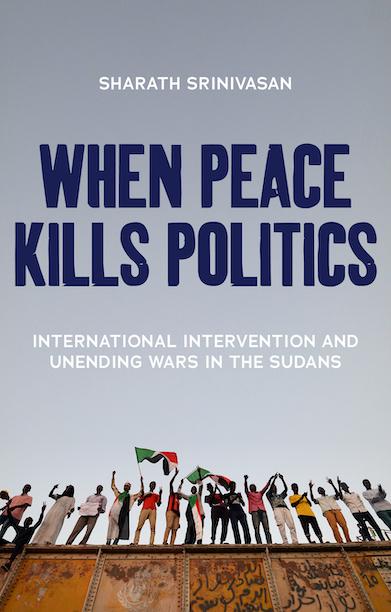
a great deal from exchanges with the contributors and commentators at a 2015 conference in Cambridge to mark ten years after the Comprehensive Peace Agreement, which led to the Proceedings of the British Academy volume, Making and Breaking Peace in Sudan and South Sudan:The Comprehensive Peace Agreement and Beyond (Oxford University Press), that I had the pleasure of co-editing with Sarah Nouwen and Laura James. Thanks, too, Jocelyn Perry, Deepa Iyer, Rebecca Rumpel, Muna Gasim, Monica Matthews and Antoine Sander for editorial support. This would be a lesser book, or not even one, without the generosity, patience and advice of my publisher, Michael Dwyer, and the work of his wonderful team at Hurst & Co. Thanks to Sebastian Ballard, cartographer, for his map work. I am very grateful to Mohamed Elshahed for his generosity in allowing me to use his photograph from the 2019 Sudanese revolution for the book’s cover.
Looking back, this book had many beginnings. I first learned about civil politics during law studies at the University of New South Wales in Sydney, Australia, through lenses of indigenous rights, the republican movement and deliberative democracy. Martin Krygier, Robert Shelley, Mark Aronson and, especially, the late George Winterton, taught me what I first knew and inspired me to find out more about rights, constitutions and popular sovereignty. George’s civic republicanism had in mind an Australian Constitution that might instead begin: ‘We, the people of Australia, do hereby enact and give to ourselves this Constitution’. In Sydney, talking, and arguing, about the world to share the possibility of making it anew was a habit with great beginnings thanks to Catriona Menzies-Pike, Michael Ryan, Craig Cawood, JennyYounan, Michelle Gortan, Peter Regan, Bronwyn Isaac, BJ Kim, Sarah Gilbert, Shankari Nadanachandran, David Raper, Sonal Joshi, Judith Levine and, especially, Shalini Satkunanandan. Preambles are everything. For the still silences that run deep, thanks to Mark Simpson and Warren Lo.
Beginnings have their own beginnings. Natality, Hannah Arendt suggests, is the most special of all. My parents, Saro and Srini, in their words and deeds, ever encouraged me to seek out a life worth living. I dedicate this book to them. With Shubha, Ananth, Akshay and Nirav, they are my antipodean anchorage even in distancing times. More than anyone else, Sorcha O’Callaghan helped this river to find its way. She
carefully managed to not exhaust either enthusiasm or patience over many years, and I owe my deepest gratitude of all to her for that, as well as for much excellent advice on how to make my ideas more readable. Thank you for sharing this journey with me. That we might once more drink in the stars camping by the river Nile, this time with our lovely sons Nhial and Rohan. They, with Sorcha, deserve for this book to run into the sea. And so… here’s to new beginnings, always.
Sharath Srinivasan
Cambridge January 2021
EGYP T
L IBY A
Dongola
CHAD
El Geneina
D a r f u r R e g i o n
Jebel Marra
Nyala
Kafia
Kinji
El Fasher
Omdurman
U D A N
Kosti
El Obeid
Nuba Mountains
Kauda
Renk
Atbara
Khartoum
Port Sudan
Kassala
Damazin
Roseires
Dam
Kadugli
Abyei
Aweil Raga
Wau
CENTRA L AFRICAN REPUBLI C
DEMOCRA TI C
Bentiu
Malakal
Nasir
Kurmuk
R ed Se a
ETHIOPIA ERITRE A
Rumbek
Bor
Juba
Torit
Yei
REPUBLIC OF CONG O U GANDA
(2021)
INTRODUCTION
In June 1989, Africa’s biggest country lurched towards militant political Islam following a bloodless coup. The coup, orchestrated by an Islamist ideologue, the late Dr Hassan al-Turabi, and his National Islamic Front (NIF), brought President Omar al-Bashir to power and deposed an enfeebled democratic government that had failed to end a six-yearold civil war. The new ‘National Salvation’ regime banished political parties, trade unions and civil society organisations and enforced a radical religious social reengineering project. During the geopolitical flux at the end of the Cold War, Sudan became a greater foreign policy priority for the new global hegemon, the United States. Khartoum sided with Iraq’s President Saddam Hussein in the first Gulf War and then courted the Islamic Republic of Iran. It espoused an expansionist Islamist project and armed Islamist rebels in the Horn of Africa. It gave sanctuary to al-Qaeda leader Osama bin Laden at the time of the first World Trade Center terrorist bombing in New York in 1993. Sudanese state operatives were implicated in an assassination attempt on Egyptian President Hosni Mubarak in 1995 and in the bombings of US embassies in Nairobi and Dar es Salaam in 1998. Sudan became a focus of Western opprobrium despite previously being Washington’s ally in the region’s ‘hot’ Cold War. Khartoum was placed on the US Congress ‘state sponsors of terrorism’ list and became subject to American and United Nations sanctions.
Within these shifts, Sudan’s second civil war, which began in 1983, evolved and grew, and by the early 2000s came to be known as ‘Africa’s longest running civil war’. It was always misleading to characterise
this war as simply fought between the rebel Sudan People’s Liberation Movement/Army (SPLM/A) and the Sudanese state, as if two regular fighting forces were the sole protagonists. Besides periodic intensive confrontations between organised armies on both sides, the cashstrapped Sudanese state relied heavily on mobilising ethnic militias. The SPLM/A, in the vast rural hinterland it claimed to control, was a fractious patchwork of locally commanded armed groups. These diverse agents of coercion operated according to their own logics, with their own grievances and pursuits. The civilian experience of this messy war was characterised by famine and starvation, episodes of genocidal activity and other mass atrocities, slave-raiding, forced displacement, internment and forced labour, systematic rape, and largescale plunder. With estimates of 1 to 2 million lives lost due to war 1 and 4 million civilians displaced internally and as refugees, Sudan required the world’s largest humanitarian relief effort.
The war was not simply between the SPLM/A and the Government of Sudan, but nor was it simply an ethno-regional identity conflict often referred to as the ‘war in southern Sudan’ fought between ‘the Arab and Muslim north and the Christian and Animist south’. This convenient catch-phrase, favoured by Western media outlets,2 betrayed the fact that much of the worst violence occurred between southerners, as well as between Muslims in the border regions straddling the north and south. Given the international wrath that Khartoum invited upon itself, it also became easy to forget that al-Bashir’s government inherited the war, albeit prosecuting it with deathly vigour. Al-Bashir’s ‘National Salvation’ regime had vowed to modernise Sudan religiously, socially and economically. It insisted that it did not need the war. Yet it, too, conveniently trivialised the war’s complex politics. When he came to power, al-Bashir promised to swiftly end what had come to be called the ‘Southern problem’. Soon after, the iconic leader of the SPLM/A, John Garang (‘Dr John’), addressed the new president on Radio SPLA, which broadcast from the territory of its patrons in the communist Ethiopian Derg government.
Omer [al-Bashir] thinks that he is the Sudanese nationalist and we in the SPLA are his Southerners … all that which is required is for him to sit down with Dr. John Garang, representing the South, and him
representing the Sudan, and in his words, talk soldier to soldier to solve his Southern Problem. Has Brig. Omer el Bashir bothered to ask the question as to what it is that makes him the Sudanese and makes Dr. John Garang his Southerner?3
For his part, John Garang was on the receiving end of the opposite criticism from his detractors in southern Sudan. Inspired by the African nationalism of the continent’s anti-colonial struggle, he sought to represent an alliance of marginalised groups across all of Sudan and espoused a national agenda for a unified, plural and democratic ‘New Sudan’. Many southerners felt this betrayed their cause. They wanted him to represent the south, and only the south, in their quest for liberation. What right had Dr John, who was a southerner, to make southerners fight a national war? Garang did not tolerate dissent. When the SPLM/A split in the early 1990s, a bloody intra-southern civil war, a war within the wider war, ensued. The ethnic dimensions of that violence, between the Nuer and Dinka peoples, would echo in South Sudan’s civil war two decades later. Meanwhile, during the 1990s, communists, democrats, Arab nationalists and leaders of Sudan’s sectarian religious-political parties in northern Sudan, who were all exiled or underground, also sought to lay claims to Sudan’s political future.
So, although the violence that constituted the civil war was fragmented, local and unpredictable – a function of different logics in distinct but interconnected areas of the country – national political questions lay at the heart of it. In turn, this begged a simple but important question: which war in Sudan should international peacemakers intervene to resolve? Who should decide this? There was, as in many civil wars, a national conflict over what the war was actually about. And there were conflicting ideas amongst various foreign states and international organisations who, with their own interests to consider, came to make peace.
By the late 1990s, accusations of modern-day slavery in Sudan triggered an unlikely coalition in the US consisting of evangelical Christians, human rights organisations and African-American leaders who lobbied hard for greater efforts by Washington. Through deft diplomacy, SPLM/A leaders and other opposition figures mobilised
and nourished this foreign legion of civilian foot soldiers. Garang built close ties with a range of senior aid, diplomatic and government officials. Sudan’s civil war already mattered in the foreign ministries of Western capitals from London to Oslo and from Rome to The Hague, but in Washington a potent mix of domestic lobbying and counter-terrorism concerns secured its prominence. Within days of coming to power in 2001, US President George W. Bush made it clear that ending Sudan’s war was a priority. Even though American politicians insisted that there was no ‘moral equivalence’ between the Government of Sudan and the SPLM/A, Washington now had to do business with Khartoum.
What followed was one of the most significant international peacemaking drives in Africa since the end of the Cold War. The regionally led Inter-Governmental Authority for Development (IGAD) peace negotiations between the Government of Sudan and the SPLM/A were backed heavily by the US and other Western countries, and they delivered the landmark 2005 Comprehensive Peace Agreement (CPA). The CPA guaranteed a referendum on selfdetermination for southern Sudanese that led to the secession of South Sudan in July 2011.
Yet from the time of the CPA negotiations onwards, the wars in Sudan and South Sudan recurred and multiplied without end. More international peacemaking interventions followed. Militarised, authoritarian rule remained entrenched in both countries, and their economies were in deep crisis. In stark contrast, when a civilian uprising led to al-Bashir’s deposal after 30 years in power and a new political beginning arrived in Sudan in 2019, it was non-violent and had a locally rooted modus operandi. When civil politics triumphantly returned, foreign peacemaking was distant from the wheels of change.
So, why, despite decades of international peacemaking interventions, were wars seemingly unending in Sudan and South Sudan? Peacemaking cannot be held solely responsible for the continuing wars in the Sudans. The wider political history of the two countries and the Sudanese and South Sudanese who shaped this history, matter immensely. Yet international peacemaking is deeply entangled in this history. Centred around the CPA and its legacy, this study develops a provocative new explanation for why peacemaking interventions resulted in war
mutating, multiplying and recurring. Understanding this is clearly important for scholars, policymakers and practitioners concerned with Sudan and South Sudan. Beyond the Sudans, the book tackles this particularly difficult set of cases in the recent history of external peacemaking in civil war to make a much bigger contribution. This book asks us to rethink the international project of making peace in civil wars by proposing that it has more in common with logics of violence than with non-violent civil politics. The book examines whether contemporary peacemaking interventions tragically risk killing such politics in the very process of trying to bring it into being.
Failed Peacemaking During and After Sudan’s CPA
An important episode during the CPA negotiations illuminates the perils of peacemaking in Sudan. In Khartoum, from April to June 2004, a relatively small group of foreign emissaries who staffed Western embassies, UN offices and non-governmental organisations were engulfed by a political storm. The world’s gaze had rapidly descended upon Sudan, and the focus was not on the final weeks’ negotiations between the Government of Sudan and the SPLM/A, which was taking place in a distant resort in neighbouring Kenya. Rather, death and destruction in Sudan’s western region of Darfur had become the headline story of global crisis.
The 18-month-old conflict in Darfur could no longer be referred to as a ‘storm in a teacup’, as a Western ambassador had labelled it a year earlier to deflect the anxious concerns of a senior aid worker. By late March 2004, the most senior UN official in Sudan had accused the government of ethnic cleansing on BBC radio. Weeks later, the UN Secretary-General, Kofi Annan, gave a speech commemorating the tenth anniversary of the Rwandan genocide and spoke of ‘a deep sense of foreboding’ about what was transpiring in Darfur. Foreign ministers, the mainstream international press, human rights researchers and the first in a long line of celebrities descended upon Sudan, demanding answers and action.
Yet, in the eyes of some working on peacemaking in Sudan, listening to these calls and prioritising the violent events in Darfur risked upsetting their plans. Indeed, I knew how they felt. A year earlier,
in mid-2003, I had been posted to Khartoum by an international humanitarian organisation to build a ‘post-conflict development’ programme. Darfur’s violence and the prolonging of the CPA negotiations had made a mess of my posting. I later regretted how we dragged our heels in responding to what quickly became the world’s worst humanitarian crisis. Yet something more deeply troubling was afoot. In early 2004, I quizzed a British diplomat on the soft approach towards the Government of Sudan’s counter-insurgency in Darfur. He reminded me that sovereign states had a right to enforce security against illegitimate armed groups. In the midst of peacemaking, President al-Bashir was making unlikely new friends.
With time, I came to understand the longer history of what a senior UN official condemned as a ‘conspiracy not to see’. Those clamouring for action on Darfur, chided a senior British diplomat in 2003, risked becoming ‘peace spoilers’.4 While war raged, the head of political affairs at the UN in New York allegedly downplayed the crisis so it would not be brought to the Security Council’s attention.5 ‘We needed to prevent the exclusion of various political groupings,’ recalled the Norwegian envoy to the talks, ‘from upsetting [the peace] process’.6 The ‘ideal, though unsustainable, scenario for the international community’, connived an Italian diplomat with his American counterparts, was ‘to just freeze the Darfur conflict and to come back to it as soon as an agreement is reached between the [Government of Sudan] and the SPLM/A’.7
This was a troubling period in which actors with a stated goal to make peace seemed willing to tolerate escalating conflict in one part of Sudan to end war in another. Notions that ‘freezing’ Darfur’s spiralling violence was possible, just not sustainable, or that peace risked being ‘upset’ or ‘spoiled’ by attending to other wars in the same country might seem wrongheaded now.Yet for many it seemed to make sense at the time. The more important question is how peacemaking engenders such quandaries and mindsets, which in turn can propel peacemaking, and the countries it is directed at, towards violent failure.
The war in Darfur raged on in 2004, but Sudan’s primary peacemaking workshop was closed for new business. On the eve of the CPA signing, Darfur rebel movements repeated demands for peace talks on an equal footing with those taking place in Naivasha, Kenya.
The Sudanese government and the SPLM/A were not supportive. Nor were the foreign peacemakers who were shaping Sudan’s ‘peace’: Sudan’s African neighbours in the IGAD regional organisation that convened the talks8 and their Western backers (namely the US, the UK, Norway and Italy). In late 2004, US diplomats told the Darfur rebels, no, ‘Naivasha will not be reopened’ and that they had to ‘work on the national level within the process that the [CPA] will begin, taking advantage of opportunities provided by an increasingly open and democratic political structure’.9 It seemed sensible enough to protect a peace agreement that was on the verge of being signed to end a 22-year civil war. Yet insistence on this was fuelling violent resistance to the agreement. In turn, President al-Bashir’s government faced growing international condemnation, and his military-security apparatus in Khartoum bunkered down. The anticipated democratic opening faltered. The bet of sequencing one idea of peace ahead of addressing another war was quickly being lost. The CPA was signed, but Sudan’s cycle of war and peacemaking continued.
With a history shot through with violence, peace in Sudan has long seemed a bad bet to make. This has not dissuaded the punters. For decades, something has needed to be done by international interveners to make or build peace. If peacemaking is called on to intervene in civil war’s hard cases, history suggests the conflicts in the Sudans might be some of the hardest of all. Before and after the CPA, Sudan and South Sudan have been the focus of multiple major peacemaking efforts to end war and secure wider political change. From the late 1990s to the present, one can reckon over a dozen peace initiatives tackling conflicts involving scores of armed groups.10 Yet external peacemaking efforts to bring about an end to war and a new civil politics in both countries have repeatedly failed. Peace agreements were hard to achieve, whether they were quick fix deals or complex elite settlements and institutional prescriptions. They often quickly unravelled or left more violent conflict in their wake.
Working outwards from the CPA negotiations at its centre, this book gets to grips with the deep interrelationships between different conflicts and diverse peacemaking initiatives in the Sudans. It examines
how the strategies and behaviours of domestic political actors and international interveners towards peacemaking are part of the logic of the region’s unending wars.
At its heart, the CPA actualised southern Sudan as a proto-state. Southerners were given the right to self-determination through an internationally guaranteed referendum that would include the option of secession after an interim period of six and a half years. The SPLM/A secured dominant control over wealth (through burgeoning oil revenues), security and government within the regional boundaries of southern Sudan. With this autonomy, southerners were exempted from Islamic sharia law, which was a flashpoint issue since the earliest days of the war. In turn, the CPA rehabilitated President alBashir’s National Congress Party (NCP) as the dominant partner in a Government of National Unity with the SPLM/A. Seemingly brought in from the cold, the NCP waited impatiently for the normalisation in relations with Washington and the lifting of sanctions. There was, too, the promise of major post-conflict development funding and a restart for Sudan’s relationships with international financial institutions.
On paper, the CPA’s provisions were more than just this elite deal. The agreement had the building blocks for a new peaceful civil political order for Sudan. It included a multi-party constitutional review process, reforms of judicial and security institutions, stronger protections for political pluralism and provisions for elections at federal and state levels, some decentralisation of political and economic power to states within a stronger federal model, and the protection and promotion of international human rights. There was much to feed the imagination in the 241 pages of commitments in the peace agreement. The NCP and the SPLM/A also agreed to ‘make unity attractive’ for southerners preceding their referendum on secession, and much turned on the promised new political dispensation in the country.
Yet the deal was between only these two belligerents, and the related political restructuring was controlled by them. The promise that the CPA would nevertheless usher in civil politics was counter-intuitive to other Sudanese political actors. Soon after the CPA was sealed, a new rebel alliance in Sudan’s east revived another overlooked conflict.
Opposition political parties were ambivalent about the limited political space that opened up and were quickly unsatisfied with their prospects.
In southern Sudan, although the SPLM/A succeeded somewhat in attending to the intra-southern animosities that the peace agreement largely overlooked, it was through grubby tactics of co-option and coercion that invited more trouble. The conflict in Darfur rapidly escalated and took on national political dimensions. When senior government officials including President al-Bashir were indicted by the International Criminal Court, Darfur’s war dramatically changed the context for the CPA’s implementation.
The CPA delivered neither peace in the sense of the absence of organised armed conflict nor peace in the sense of political transformation out of war. In a very narrow sense, peacemaking ‘ended’ the war between the SPLM/A and the Government of Sudan. But that war was, in turn, fought in border areas in Sudan’s north, which reignited on the eve of South Sudan’s independence. It was fought within southern Sudan – and brutally so – between rival groups, organised substantially along ethnic lines, as is South Sudan’s civil war. It was fought in Sudan’s east, which remained restive after the CPA and was only subdued through co-option and force.
The devastating civil war of newly sovereign South Sudan began less than 3 years after its independence, in late 2013, and was only halted by a forced and patchy peace in fits and starts. The conflicts in Darfur still burned, despite peace initiatives that toured through Nigeria, Libya, Ethiopia and Qatar. Renewed wars in the border areas of the Nuba Mountains and Blue Nile protracted and fragmented, sometimes fuelling inter-state armed clashes and tiring out the African Union’s mediation efforts led by former South African President Thabo Mbeki. In both countries, authoritarian regimes pursued survival, coercion dominated political contest, and human suffering continued unabated.
Fifteen years after the CPA, in 2020, South Sudan and Sudan were the fourth and fifth highest funding targets for humanitarian aid worldwide. The UN counted over 4 million South Sudanese and close to 3 million Sudanese who were forcibly displaced either within or outside both countries. Over 6 million South Sudanese were food insecure. One study estimates that excess deaths in South Sudan due to its civil war exceeded 380,000 between late 2013 and April 2018, approximately 190,000 of which were violent killings.11 A new ‘peace deal’ in South Sudan in 2018 was entirely at odds with
deeper authoritarian rule, a coerced civic space and ongoing violence. By contrast, when al-Bashir was deposed in Sudan there was growing promise of a sustained triumph of civil politics. When Sudanese citizens and unarmed civil and political organisations broke through and seized this political opening in 2019, the language of ‘peace’ was conspicuously absent.
For decades, then, the fates of Sudan and South Sudan, their peoples and polities, have been heavily bound up in foreign peacemaking efforts. The CPA era shows how these peacemaking efforts have in turn been bound up in reproducing political violence. During the ‘north–south’ CPA negotiations, the SPLM/A benefitted from the convenient conflation of being ‘the south’ at the expense of intra-southern divisions.Yet John Garang also violently resisted the organisation being reduced to only of and for ‘the south’ and not a national movement. The Darfur conflict unfolded in the manner it did during the CPA negotiations partly because of how Darfur-based rebels, the SPLM/A and the Sudanese government all deployed violence in ways that were shaped and motivated by peacemaking. Also, conflict in central Sudan did not fit a neat north–south binary and was tactically depoliticised by peacemakers to achieve the CPA, though civil war later returned. After the CPA, security logics still dominated a state facing ongoing armed rebellion. The long-running hollowing-out of civil politics in Sudan continued and the peace deal’s democratic promise failed to materialise. In southern Sudan during the CPA years, political debates over what liberation should mean, however weak they were during the war, became obsolete. Peace was equated with a preordained inevitability – a referendum on secession – alongside a technocratic state-building effort. The result was the birth of a new sovereign state but a failed political founding that led rapidly to civil war. Peace killed South Sudan’s possibilities for civil politics right at the moment when this new political community should have been born.
When Peace Kills Politics
This book has three aims. The first is to prise open the workings of foreign peacemaking interventions and to shed a new and different light on why they can go wrong. The second aim is to understand
to what extent and why this may be inherent in diverse forms of contemporary peacemaking. The third aim is to open up ways to rethink this endeavour.
I hope to achieve the first aim through close-range empirical analysis regarding the manner in which peacemaking repeatedly met failure in the Sudans. This book unravels what peacemaking is and what it does by drawing upon the political thought of Hannah Arendt and her characterisation of the relationships between violence, war and politics. The second aim is pursued alongside the first by deepening and extending the implications of Arendt’s ideas when applied to peacemaking. The book aims to reveal the profound tension between the means and logic of making peace to end civil war and the political realm that it aspires to create. Thus, I hope the third aim of this book can be achieved in the broadest sense by leaving the reader with a different perspective and sensibility than what they started with. Before we propose to do anything different, we must find a way to think differently about this inherent tension and its implications. The book concludes with some provocations towards this aim.
This book advances its aims by interrogating peacemaking against the simple touchstone of fostering non-violent civil politics. The starting assumption is modest: international interventions to end civil wars, whatever their theory, model or design, and if not cynically reduced to only parochial foreign policy interests, must be aimed at significantly increasing the prominence of non-violent civil politics relative to armed violence. The book seeks to unravel the relationship between peacemaking and the conditions for and trajectories towards a non-violent civil political realm. ‘Non-violent civil politics’ sounds idealistic. It is not. In what follows, it is never over-specified. It is not normatively loaded with adjectives of ‘inclusive’, ‘democratic’, ‘sustainable’, ‘just’ or the like. Even ‘civil’ is used cautiously, simply to indicate a distinction from a political realm beholden to coercive domination. I am interested in the direction of travel, not in any rigid measure or high watermark being met.
In taking this approach, the book considers but rejects other dominant theories concerning what ‘peace’ should be about and by what peacemaking should be measured. Those theories and this book’s critique of them are discussed at length in the next chapter, but here I
stake out the broad approach. Reductive approaches aimed at securing belligerent bargains for conflict termination, liberal peacemaking models for democratic transformation and expanding freedoms, statebuilding prescriptions that focus on strengthening institutions, all start with assumptions on the ‘problem’ of civil war and preferred ‘solutions’ that are distant from specific conflict realities. Peacemaking in practice anyway tends to be a complicated mix of applying all of these theories, models and frameworks, defying any analysis of whether one or the other ‘worked’ or ‘failed’. We must take peacemaking as we find it: a vexed, messy and unenviable project in the midst of complex civil wars. We need to give the difficulties of peacemaking in the Sudans their due, yet still seek to understand whether there are fundamental reasons for why the efforts have failed so badly.
This book’s first argument is that making peace during civil wars risks debilitating, rather than fostering, non-violent civil politics because it frequently relies upon means and instrumental logics that are in essence violent. The book shows how this happens at close range, with Sudan as its case-study. The explanation as to why this happens rests upon an original application of Arendt’s political thought to analysing peacemaking, which is introduced below. It is ‘in the making’ that the pursuit of peace may reproduce violence. The very means employed to make peace, and their consequences, may defeat even the best sought after ends. The wrong conclusion is that peace simply should have been made or built better, with a wiser model, smarter design, an improved toolkit, and better craftsmanship. It is equally wrong-headed to explain away failed peace interventions as a result of the maligned or self-interested intentions of outside interveners. This book does not seek to castigate the cast and crew of peacemaking in the Sudans for error or ineptitude, let alone for hubris or malevolence. That is not to say that none of these qualities might be present, but that they are a distraction from the deeper problem. Rather, this book asks us first to stop and think what we are doing when making peace.
What do we mean when we talk about ‘peacemaking’ or ‘peacebuilding’? Talking about making or building anything in the midst of civil war seems to be already asking for trouble. This is about much more than cute semantics. ‘Making’ and ‘building’ conceal a much