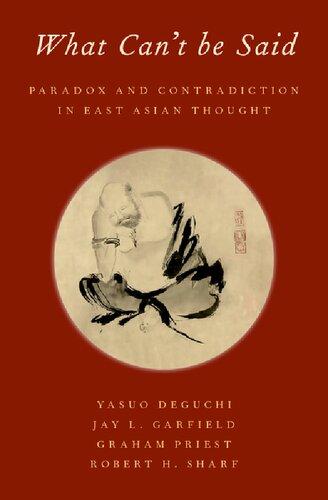
What Can’t Be Said
Paradox and Contradiction in East Asian Thought
YASUO DEGUCHI, JAY L. GARFIELD, GRAHAM PRIEST, AND ROBERT H. SHARF
Oxford University Press is a department of the University of Oxford. It furthers the University’s objective of excellence in research, scholarship, and education by publishing worldwide. Oxford is a registered trade mark of Oxford University Press in the UK and certain other countries.
Published in the United States of America by Oxford University Press 198 Madison Avenue, New York, NY 10016, United States of America.
© Oxford University Press 2021
All rights reserved. No part of this publication may be reproduced, stored in a retrieval system, or transmitted, in any form or by any means, without the prior permission in writing of Oxford University Press, or as expressly permitted by law, by license, or under terms agreed with the appropriate reproduction rights organization. Inquiries concerning reproduction outside the scope of the above should be sent to the Rights Department, Oxford University Press, at the address above.
You must not circulate this work in any other form and you must impose this same condition on any acquirer.
Library of Congress Cataloging-in-Publication Data
Names: Deguchi, Yasuo, author. | Garfield, Jay L., 1955– author. | Priest, Graham, author. | Sharf, Robert H., author.
Title: What can’t be said : paradox and contradiction in East Asian thought / Yasuo Deguchi, Jay L. Garfield, Graham Priest, Robert H. Sharf.
Description: New York, NY, United States of America : Oxford University Press, 2021. | Includes bibliographical references and index.
Identifiers: LCCN 2020031164 (print) | LCCN 2020031165 (ebook) | ISBN 9780197526187 (hb) | ISBN 9780197526200 (epub)
Subjects: LCSH: Philosophy—East Asia.
Classification: LCC B5165 .D44 2021 (print) | LCC B5165 (ebook) | DDC 165—dc23
LC record available at https://lccn.loc.gov/2020031164
LC ebook record available at https://lccn.loc.gov/2020031165
DOI: 10.1093/oso/9780197526187.001.0001
1 3 5 7 9 8 6 4 2
Printed by Integrated Books International, United States of America
“There is no truth, and even if there were we could not know it, and even if we could know it, we could not articulate it.”
Plato, The Gorgias
Preface ix
Reference Abbreviations xi
1. Introduction and Motivation 1
Jay L. Garfield and Graham Priest
2. Knots in the Dao 13
Jay L. Garfield and Graham Priest
3. Silence and Upāya: Paradox in the Vimalakīrti-nirdeśa-sūtra 42
Jay L. Garfield
4. Non-dualism of the Two Truths: Sanlun and Tiantai on Contradictions 57
Yasuo Deguchi
5. Chan Cases 80
Robert H. Sharf
6. Dining on Painted Rice Cakes: Dōgen’s Use of Paradox and Contradiction 105
Jay L. Garfield and Graham Priest
7. Dialetheism in the Work of Nishida Kitarō 123
Yasuo Deguchi and Naoya Fujikawa
8. Review and Preview 143
Jay L. Garfield and Graham Priest
9. Epilogue: Mind in World, World in Mind 152
Robert H. Sharf
1 Introduction and Motivation
Jay L. Garfield and Graham Priest
Introduction
In this book, we bring together two topics that have never been put together before: dialetheism and East Asian philosophy. We will start by orienting the reader to these two topics. We will then provide some background on Indian Buddhism and briefly survey where our journey will take us. Finally, we will comment on the turn in our last chapter.
Dialetheism
Let us start with dialetheism, since this is a view that is likely to be unfamiliar to many readers.
A dialetheia is a pair of statements, A and ~A (it’s not the case that A), which are both true. Alternatively, and equivalently given a natural assumption about how negation works, a dialetheia is a statement, A, that is both true and false. Dialetheism is the view that there are some dialetheias. A dialetheist holds that some contradictions are true, not (necessarily) that all contradictions are true. The view that all contradictions are true is called trivialism, and it is a special case.
Dialetheism countenances the violation of the Principle of Non-Contradiction (PNC): the thesis that no contradiction can be true. The PNC has been high orthodoxy in Western philosophy
Jay L. Garfield and Graham Priest, Introduction and Motivation In: What Can’t Be Said. Edited by: Yasuo Deguchi, Jay L. Garfield, Graham Priest, and Robert H. Sharf, Oxford University Press (2021). © Oxford University Press. DOI: 10.1093/oso/9780197526187.003.0001
since Aristotle’s badly flawed but highly influential defense of it in the Metaphysics. 1 While there have been some important Western philosophers who rejected the PNC—Hegel is the most obvious example2 these have been but isolated voices, at least until recently.3
Contemporary dialetheism is closely connected with recent developments in logic, and specifically paraconsistent logic. In non-paraconsistent logics, such as the familiar Frege/Russell logic, a contradiction implies everything. Hence, if one countenances any contradiction, one is immediately committed to accepting any proposition whatsoever, and this fuels the reluctance on the part of many philosophers to countenance true contradictions: trivialism is a high price to pay. A paraconsistent logic, on the other hand, is one in which contradictions do not imply everything. In the second half of the 20th century, a number of logicians have shown that paraconsistent logic is viable and indeed useful. Using a paraconsistent logic thus opens the door to the rational acceptability of theories that contain contradictions. These may then reveal metaphysical possibilities that might otherwise go unnoticed, or that might be dismissed out of hand, including, for example, the possibility that reality itself is inconsistent. This is because in a paraconsistent framework, contradictions do not spread, but are localized as “singularities.”4 (We will not go into the logical details here. We decided, as a matter of policy, to keep this book largely free of technical issues. Those interested can find the relevant literature in the references.)
Unsurprisingly, then, we have seen a number of philosophers who have come to endorse contradictory theories about various
1 For an analysis and discussion of Aristotle’s arguments, see Priest 2006, ch. 1.
2 Though, we note, interpreting Hegel as a dialetheist is certainly contentious. For a defense, see Priest 2019a.
3 For a more on dialetheism, see Priest 2007a, and Priest, Berto, and Weber 2018.
4 For more on paraconsistent logic, see, again, Priest 2007a, and Priest, Tanaka, and Weber 2017.
topics. The most high-profile of these concerns paradoxes of selfreference, such as the liar paradox. This is the simplest of a whole family of paradoxes. It concerns the sentence This sentence is false. If it is true, it is false; and if it is false, it is true. And, since it is either true or false, as it appears it must be, it follows that it is both true and false.
The liar paradox is an ancient and venerable paradox, and it has occasioned much discussion in the history of Western logic. Nearly all the discussions have tried to explain what is wrong with the contradiction-generating reasoning. The lack of success is underscored by the fact that, after some two and a half millennia, there is still no consensus on the matter. A dialetheic approach to the paradox cuts through this tortured history. The reasoning is simply what it appears to be: a sound argument for a true contradiction.5
The applications of dialetheism have now gone a long way beyond the paradoxes of self-reference. Let us note briefly a few more examples. One of these concerns the nature of motion and its paradoxes. Dialetheism may be applied to solve some of these. Consider one of Zeno’s paradoxes of motion: the Arrow. Take an arrow that is travelling from point a to point b. Consider any instant of its motion. At that instant, because it is an instant, progress made in its journey is zero. But the time of the motion is composed of all the instants in it. At each such instance it makes zero progress. An infinite number of zeros added together (even uncountably infinitely many) is zero. So the progress made on the whole journey is zero: the arrow never moves.
The dialetheic solution is that at every instant it does move. The arrow is where it is, but it is also where it is not. Since it is in motion, it is already at a later point of its motion, and maybe also at an earlier point of its motion. Since it makes progress at an instant, it
5 On the matter of the liar paradox, see Beall and Glanzberg 2017.
can make therefore progress at a sum of instants. Clearly, the analysis is dialetheic.6
Another sort of paradox to which dialetheism may be applied— and one which is more relevant to what is to come, since it may deal with inconsistent identities—is the sorites paradox. Sorites paradoxes are paradoxes concerning some predicate which is such that making small changes does not affect its applicability. One famous sorites paradox concerns the Ship of Theseus. Theseus had a ship, call it a. Every day, he changed one of the old planks and replaced it with a new plank. After a while, every plank in the ship had been changed. Let us call the resulting ship b. Changing one plank of a ship does not affect its identity. So after each day, the ship was still the ship a. In particular, a = b. However, Theseus, being a careful fellow, kept all the old planks, and it occurred to him to reassemble them, which he did. Clearly, the reassembled ship is a. Equally clearly, it is not b, since they are in different places, so it is not the case that a = b. That is, a is and is not b. If you are not a dialetheist, this is obviously a problem. If you are, you may just take yourself to be in the presence of another sound argument with a contradictory conclusion.7
A final application of dialetheism, and one which will also be very relevant in what is to come, is a paradox of the ineffable. A number of very important Western philosophers have argued that language has its limits: there are things of which we cannot speak. Thus, in the Critique of Pure Reason, Kant tells us that the categories are not applicable to noumena, such as a thing in itself. Any statement about such a thing would apply the categories, so one cannot speak of such things. Or, in the Tractatus, Wittgenstein tells us that statements are about objects. But statements have a form, and form is not an object. Hence, one cannot make statements about form. Or
6 For what it is worth, this was also Hegel’s solution to the paradox. On all these things, see Priest 1987, ch. 12.
7 Sorites paradoxes and identity are discussed in Priest 2010b.
again, in Being and Time, Heidegger tells us that being is not itself a being. It follows that one can say nothing about it. For, as he also tells us, to make a statement about anything is to treat it as a being. But as is evident to even a cursory perusal, Kant, Wittgenstein, and Heidegger say much about the things about which they say we cannot talk, if only that we can say nothing about them. If one takes any of these theories to be correct, one therefore has a paradox at the limits of the expressible.
The philosophers in question were, of course, well aware of these contradictions. And each suggested ways in which the contradiction may be avoided. Wittgenstein even resorts to the desperate measure of calling the claims in his book literally meaningless, including, presumably, that one, resulting in further paradox. Though this is not the place to go into the matter, it is not hard to see that these ploys do not work.8 If one subscribes to one of these positions, a radical, but arguably more sensible, position is simply to accept the contradiction at the limits of thought. So much for the first of our two conjoined topics. Let us move to the second: East Asian philosophy.
East Asian Philosophy
As we have noted, Western philosophical traditions have generally been hostile to dialetheism. Again generally speaking, the Asian philosophical traditions have been less so—though Western commentators on these traditions have been hesitant to endorse dialetheic interpretations of the texts involved for fear of making their favorite philosophers appear irrational, given the interpreters’ Aristotle-inspired horror contradictionis.
8 On all of these matters, see Priest 2002. We note that in the end Heidegger finally conceded the dialetheism of his view. See Casati 2016.
Take, for example, South Asian philosophy. Early Indian philosophy is arguably more open to dialetheism than Western philosophy. Various philosophers endorse the thought that some things are both true and false (or neither true nor false, thus endorsing the possibility of truth value gaps, as well as truth value gluts). This idea is often represented in a framework called the catuskoti (four corners), according to which a statement may be true (only), false (only), both, or neither. The framework is deployed by both early Hindu and early Buddhist thinkers. Jain logic utilizes not four but seven semantic valuations! This is their saptabhangi (seven-fold categorization), and some of these valuations are clearly dialetheic.9 Later Indian philosophy is much less dialetheism-friendly. Indeed, under the influence of the orthodox Nyaya philosophers and the Buddhist epistemologists Dignaga and Dharmakirti, the PNC becomes orthodox in Indian thought around the 6th century CE.10
Turning to East Asia, matters are different again. Unencumbered by either Aristotelian or Nyaya thinking, philosophers were freer to develop and explore contradictory theories. Indeed, many East Asian texts are full of paradoxical-sounding claims.11 Of course, it would be absurd to suppose that on each such occasion, the author of the text is endorsing a dialetheic view. Such authors are as entitled to metaphor and poetic license as anyone else. Sometimes context may show that the contradiction is simply the penultimate line of some kind of reductio argument. Sometimes contradictions may be uttered for their shock value alone, to shake up someone’s thinking. That is, they have value as upaya (skillful means). And sometimes, if the authors had been more careful, they would have indicated that the contradictory claims were true in different senses.12
9 For further details, see Priest 2007b, 2010.
10 Aspects of the contradictory nature of early Indian thinking are explored in Garfield and Priest 2003; Deguchi, Garfield, and Priest 2008; and Priest 2018.
11 In Chinese, one expression for a contradiction is maodun 矛盾 (“sword and shield”). This refers to an old story concerning a weapons salesman. When selling a sword, he would claim that it could cut through any shield; and when selling a shield, he would claim that it was invulnerable to any sword.
12 For more on these matters, see Deguchi, Garfield, and Priest 2008.
Even when all such occurrences of contradictions are set aside, however, there remain many places where the authors utter contradictions intending to endorse them, literally and unambiguously. The contradictory natures of the things concerned are not only endorsed, but they are also defended, explained, and their consequences explored. The world (that is, all that is the case), they argue, has contradictory aspects. It may be that some of these contradictory aspects reveal profound truths about the nature of reality and human existence, truths that would be inaccessible to one limited by the bounds of consistency.
Background on Madhyamaka
This brings us to the present book. Its point is to show that many East Asian philosophers were indeed dialetheists; moreover, that dialetheism was central to their philosophical programs. That is, not only were East Asian philosophers less shy of contradiction than their Western colleagues, but they may have developed important insights that evaded their Western colleagues as a consequence of this willingness to entertain, and sometimes even to embrace, paradox. We will consider a number of texts from East Asian philosophy, examining and explaining the dialetheias their authors endorsed, the reasons for them, and their philosophical consequences.
Interpretation is, of course, always a difficult and contentious matter, and there will be times when the friends of consistency might reasonably disagree with our interpretations. But in some cases, that the view being endorsed is dialetheic is virtually impossible to gainsay. Moreover, bearing in mind the historical and intellectual influences that run between our texts, the central claim of our book, that there is a strong vein of dialetheism running through East Asian philosophy, would seem to be as definitively established as any piece of hermeneutics can be.
Our journey will start with two Chinese classics, Daodejing and Zhuangzi, but the majority of the texts we will be dealing with are Buddhist. These Buddhist texts draw, of course, on their Indian heritage. So a word of background on the relevant parts of this, and specifically the Madhyamaka Buddhism of Nagarjuna, is pertinent here. Buddhist exegetes operated with a notion of two truths (satyas):13 a conventional one, samvrti-satya, that concerns the way things appear to be, and an ultimate one, paramartha-satya, that pertains to how things actually are. In the pre-Mahayana Abhidharma traditions, the ultimate point of view is that everything is composed in the last instance of dharmas. These are metaphysical atoms, each of which exists in and of itself; that is, each has intrinsic nature or own-being (svabhava). The objects of conventional understanding are then merely conceptual/mereological constructions made up of these dharmas; they are collections of dharmas, perceived or cognized as unified wholes through the application of some name or concept.14
Nagarjuna’s Mulamadhyamakakarika, and the Madhyamaka School of Buddhism which was based in large part on this text, rejected this picture. There is nothing that is what it is in and of itself: everything is empty (sunya) of intrinsic nature (svabhava). Nagarjuna is as insistent as his Abhidharma predecessors that there are two satyas, but he understands them differently. Nāgārjuna argues that ultimate reality is emptiness—that everything is empty of intrinsic nature, including emptiness itself. Moreover, he argues that, since to be empty is to be empty of intrinsic nature, to be
13 Recent commentators sometimes prefer to translate satya in this context as reality, arguing that it is ambiguous between truth and reality. Arguably, truth is preferable. Truth in English is cognate with trust, and it means originally something in which one can trust. We can trust a true friend or true coin of the realm; the true water in a lake as opposed to the deceptive water in a mirage. Derivatively, a true sentence is a sentence on which we can rely. Semantic truth is thus but one kind of truth, not different from reality. So, when we talk about the two truths—conventional and ultimate—we are talking about the two domains of things on which one can rely, including cabbages and kings, sentences and emptiness.
14 See Siderits 2007, especially ch. 6.
empty is to be dependently originated, which is the very nature of the conventional truth. There is, hence, both a profound difference between, and an identity of, the two truths.
Nagarjuna’s thought bequeathed Buddhism two tricky problems. First, ultimate reality is the way things are independent of the way they are taken to be when viewed through the lens of the concepts appropriate to conventional reality. It is therefore ineffable, since to describe anything, you have to apply concepts to it. But Nagarjuna and those who followed him certainly talk about it. Secondly, and even more disconcertingly, since everything is empty, so is ultimate reality. There is, then, no ultimate difference between conventional and ultimate reality; the final nature of each is emptiness, which, again, is identified with dependent origination. Nagarjuna himself points this out when he claims that there is not an iota of difference between the two. So they are different and the same. Indeed, if the ultimate truth is the way that things are ultimately, Madhyamaka, in virtue of arguing that there is no way that things are ultimately, suggests that there is no ultimate truth—and that this is it. The Madhyamaka view is therefore pregnant with at least two potential contradictions.15
A number of later Indian and Tibetan Buddhists struggled to defuse the air of contradiction. We leave aside, here, both the question of the exegetical correctness and that of the philosophical cogency of these readings. The East Asian reaction, however, was quite different. Rather than trying to avoid the contradictions, or downplay them, many East Asian Buddhist philosophers accepted them. They not only accepted them; they foregrounded them in their Buddhist thinking. We may see, here, the influence of Daoist thought. Daoist ideas played an enormous role in the formation of various strands of Chinese Buddhism, and the Indian paradoxes resonated with those already present in Daoism.16
15 For a translation of, and commentary on, the Mulamadhyamakakarika, see Garfield 1995.
16 On the entry of Buddhism into China, see Sharf 2002.
Where Are We Going?
So here is where we are going. In the next chapter, Chapter 2, we will look at some aspects of the Daodejing and the Zhuangzi. The first will deliver us the paradox of the ineffability of the Dao, while the second will deliver paradoxes concerning meaning and reasoning. Chapter 3 turns to the Vimalakirti-nirdesa Sutra. Though this is an Indian text, there is little evidence that it had much of an impact on the development of Indian Buddhism. It had, however, an enormous impact in China, particularly on Chan. In this chapter, we will see how this text handles the paradox of the ineffability of the ultimate. Chapter 4 concerns the paradox of the identity and difference of ultimate and conventional reality, and how this is handled by two schools of Chinese Buddhism, Sanlun and Tiantai. Sanlun, represented for our purposes by Jizang, builds the paradox into a dialectical progression of Hegelean proportion. Tiantai theorizes the identity of the two different truths by postulating a third, the middle, which is exactly the identity of the first two. Neither of these strategies avoids the contradiction involved. Rather, they are ways of articulating it.
In Chapter 5, we turn to Chan and its use of “public cases” (Chinese: gong’an 公案, Japanese: koan). One might attempt to resolve the contradiction concerning the two truths by parameterization (disambiguation): the conventional and ultimate are different conventionally, but the same ultimately. But this can’t work: if the conventional and ultimate are indeed ultimately the same, the distinction collapses. Chan public cases develop and explore this paradox in the context of various points of doctrinal controversy. In Chapter 6, we turn to Dogen, the founder of the Japanese Soto school of Zen. We examine some of the fascicles of his Shobogenzo to see how Dogen uses the identity of the two truths to generate and deploy other contradictions relevant to Buddhism, including contradictions concerning enlightenment, time, and language.
In Chapter 7, we come to our final East Asian thinker, Nishida Kitarō, founder of the influential Japanese Kyoto School of philosophy. Nishida draws on Japanese Zen to deliver an analysis of absolute nothingness, which both is and is not an object, and which is and is not ineffable. He also produces an analysis of the self and the world in which it is embedded. These are both identical to and distinct from each other. Chapter 8 briefly reviews the preceding chapters, spelling out precisely the contradictions we have met along the way.
The Book’s Coda
We could have ended there, but we decided not to do so. The central aim of the book is to establish the dialetheic tradition running through East Asian philosophy. By the end of Chapter 8, this has been achieved. Many of the thinkers and traditions we consider were clearly dialetheic.
Whether or not any of the contradictory theories we address is true is an entirely different matter. Whatever we say in the first eight chapters (as distinct from what each of us might think) is neutral on that issue. But there is a point at which neutrality becomes impossible: a contradiction that appears in our discussions, and assumes more and more significance as the chapters accumulate, is the contradiction between the first-person (“subjective”) view of the world and the third-person (“objective”) view. This is the contradiction we take up in the book’s coda, Chapter 9. And here, drawing on discussion from previous chapters, we do argue for, and endorse, this contradiction.
Why did we decide to include this final chapter? History and scholarship are interesting and important pursuits. Nonetheless, the texts we are dealing with are philosophical texts. They are dealing with philosophical issues, issues that are alive and important today. The texts are therefore no mere objects of scholarship.